Think of the Flyers as an explorer who landed on a deserted island. On this island, deep within miles of thick jungle, is treasure. The explorer knows the treasure is there somewhere, and he aims to find it.
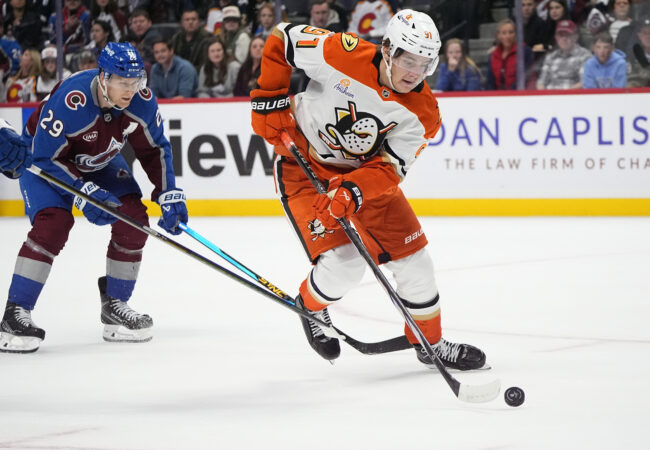
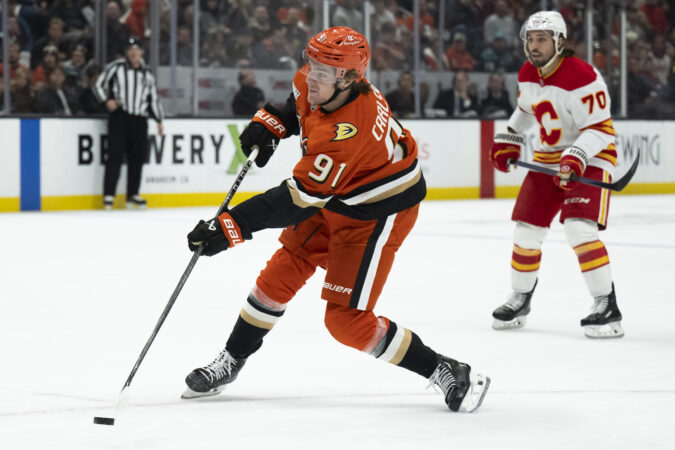
Leo Carlsson would have been a new machete: sharp, strong, capable of cutting through all those vines and branches and trunks to make the Flyers’ journey to those riches easier and faster. Now the explorer won’t have that tool. Now that the Anaheim Ducks have matched the five-year, $90-million offer sheet that Carlsson signed with the Flyers last week, the Flyers won’t have the steel blade that Carlsson represented as a 6-foot-3, 21-year-old, clear-cut first-line center just entering his prime.
So where does that leave them? It means that their trek to that treasure, to their first Stanley Cup since 1974-75, will likely be slower and less certain. They may get to it eventually, but it’s going to take more time and be more costly.
Had the Ducks declined to match the Flyers’ audacious offer — and make no mistake, this gambit by Danny Brière was bold and creative, as close to a Now youse can’t leave move as an NHL general manager can make — Anaheim would have received four first-round picks from the Flyers. That price would have been steep. But the Flyers would have added Carlsson, who averaged nearly a point a game last season, is an excellent player now, and has shown every sign that he will get even better.
They need a No. 1 center, not merely for the talent and scoring touch such a player would provide, but also so they can slot their other centers — Trevor Zegras, Christian Dvorak, and Sean Couturier — more appropriately. With Carlsson (or any center of similar caliber, for that matter), Zegras would have become the second-line guy. Dvorak would have become a terrific third-line guy. And Couturier would have remained in the role he played so well in last season’s playoffs, as an outstanding fourth-line checker, faceoff-taker, and leader.
What’s more, the Flyers have a roster and a farm system with plenty of promising young players, and if this move had come to fruition, they wouldn’t have had to sacrifice any of them to fill one of their biggest holes. That’s perhaps the most disappointing aspect of this result for them: That luxury of gaining an emerging superstar without having to give up valuable players and/or prospects already within the organization likely is no longer available to them.
With the Carlsson episode behind him, Flyers general manager Danny Brière must be practical about the team’s range of needs.
They’re interested in the Detroit Red Wings’ Dylan Larkin, for instance; though Larkin is 7½ years older than Carlsson, he still would fit the Flyers like a well-tailored suit. But assuming Larkin, who has a full no-movement clause, is even willing to join the Flyers, the trade package necessary to acquire him would probably have to include a player or two on their current roster. Would Larkin be worth the departure of, say, Owen Tippett and/or Denver Barkey?
Just because Brière made such a huge play for Carlsson doesn’t mean he has to answer that question, immediately or ever. The smartest thing he and the Flyers’ leadership team have done in the three years since he took over as GM has been to give themselves flexibility in improving the team. They didn’t have to shock the NHL by presenting that offer sheet to Carlsson — a proposal for a contract that has now made him the league’s highest-paid player. But they did. After years of running in place, after qualifying for the postseason for the first time since 2020, they declared that they were ready to spend again, but they made that declaration on their terms.
They have several choices for how they can proceed. They need not just a No. 1 center, but a top-pair defenseman, or at least one capable of quarterbacking a power play. They can act quickly to acquire one or both of those players, to find short-term and/or long-term answers to those lingering questions, or they can wait.
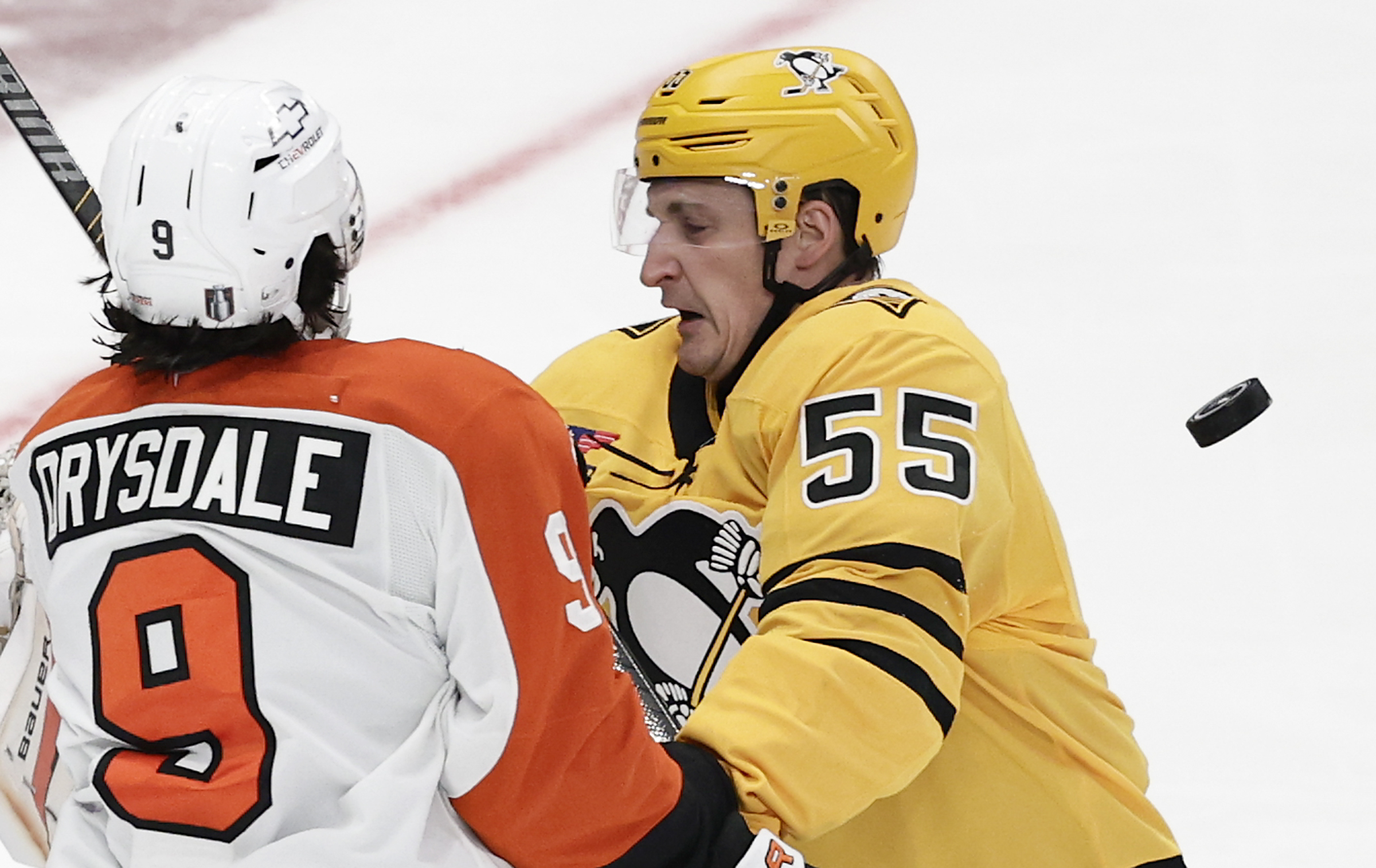
Remember: Even if they had won their duel with the Ducks for Carlsson, the Flyers wouldn’t have been considered a true contender this season for the Stanley Cup. Porter Martone, Matvei Michkov, Tyson Foerster, Jamie Drysdale, Alex Bump, Zegras: All of them have growth and development ahead of them. Yes, the Flyers’ hunt will take longer now that Leo Carlsson, that oh-so useful tool, will remain on the West Coast, but they can still find that chest of gold. They just have to take care not to get lost along the way.
The Flyers’ pre-Fourth of July fireworks have officially become a dud.
On July 3, the team set off a bombshell when it tendered an offer sheet to Anaheim Ducks center Leo Carlsson. It came with a five-year contract worth an average annual value of $18 million. According to a league source, the deal was front-loaded with a heavy signing bonus — and signing bonuses every year of the deal. Carlsson would receive the league minimum in base salary every year, a deal Carlsson said was “too good to pass on.”
“It was an offer that 99% of people would sign too,” Carlsson told reporters on Thursday. “It’s a pretty simple answer. I really wanted to be here though. I really wanted them to match. I want to be an Anaheim Duck.”
That contract is now under control of the Anaheim Ducks, who matched the offer sheet on Thursday, a day before the 3 p.m. Friday deadline. The Ducks cannot trade Carlsson, who now has the highest AAV in the NHL, for one year.
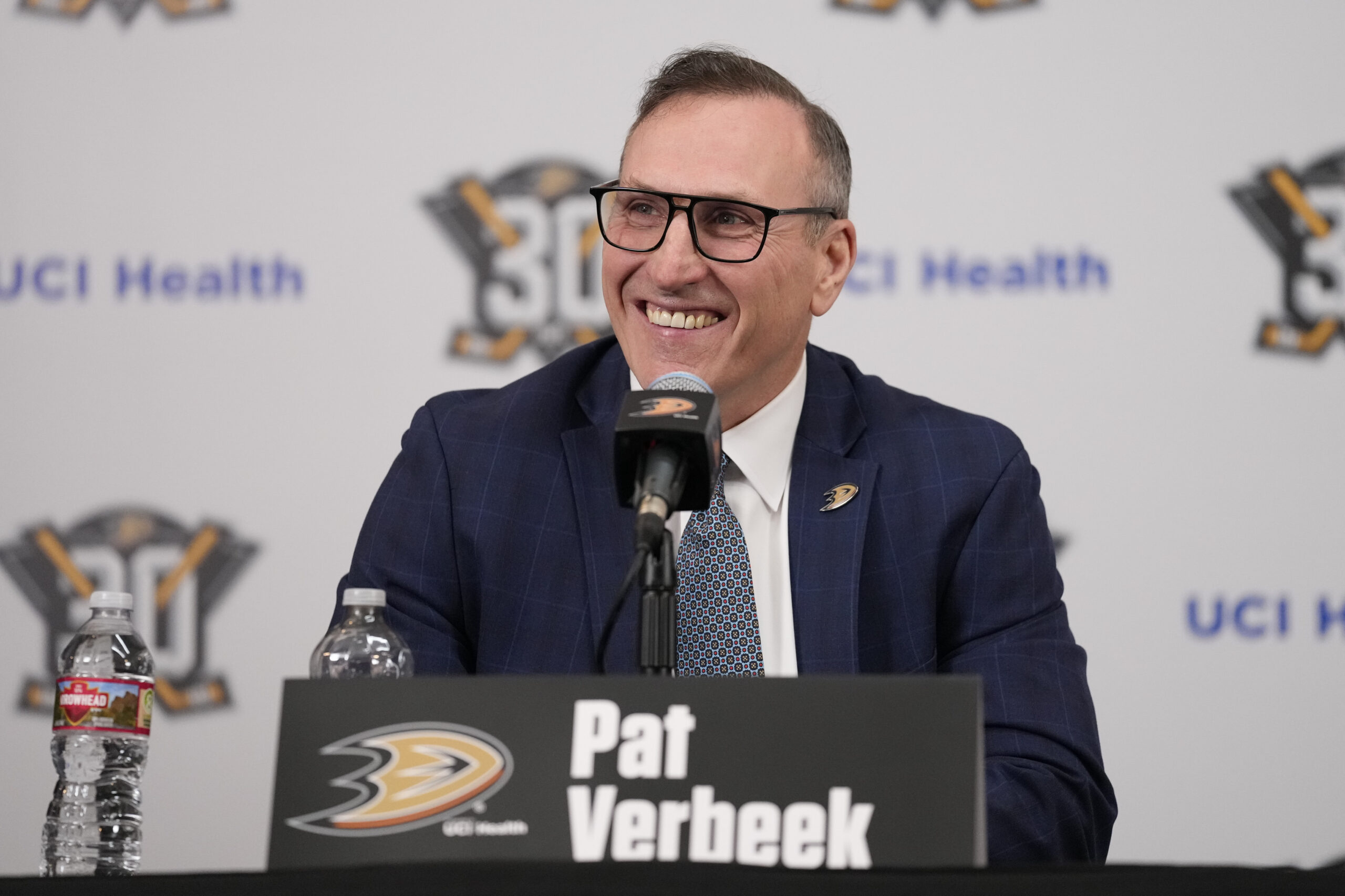
“Did we expect the offer sheet to be this high? No. We did not see that one coming,” Verbeek told reporters on Thursday. “But we’re very confident, with the cap going up and the ability of Leo to make strides of improvement and become an elite player, we feel confident this contract will be a good one in the end.”
Did they leave enough cap space? The Ducks do have to re-sign restricted free agent Cutter Gauthier. But that is Anaheim’s problem now.
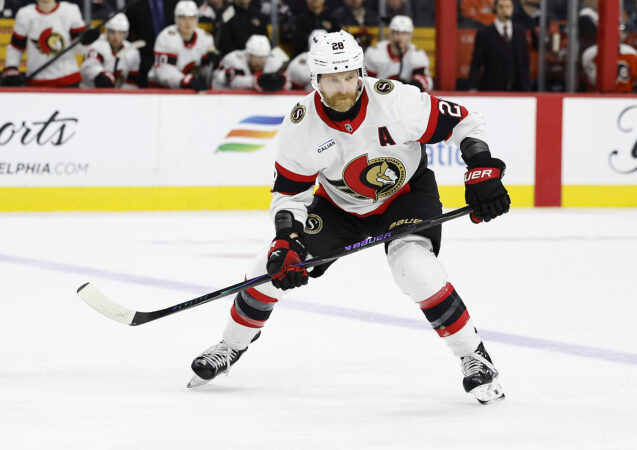
Carlsson was the type of top-line center the Flyers have been longing for since Claude Giroux was traded to the Florida Panthers in March 2022. Giroux, who was rumored to be interested in a return to the Flyers, inked a one-year deal to stay with the Ottawa Senators on Tuesday.
The offer sheet was always a long shot, but for a Flyers team that hopes its days at the bottom of the standings are done, it was one of scarce options. Since 2010, only nine players have signed an offer sheet, and six were matched. Top-six centers Sebastian Aho and Ryan O’Reilly, and now Carlsson, are among the group to be retained by their original team. The Flyers now have to pivot elsewhere to find a potential top-line center solution this offseason.
Could the Flyers take a swing at Columbus Blue Jackets center Adam Fantilli?
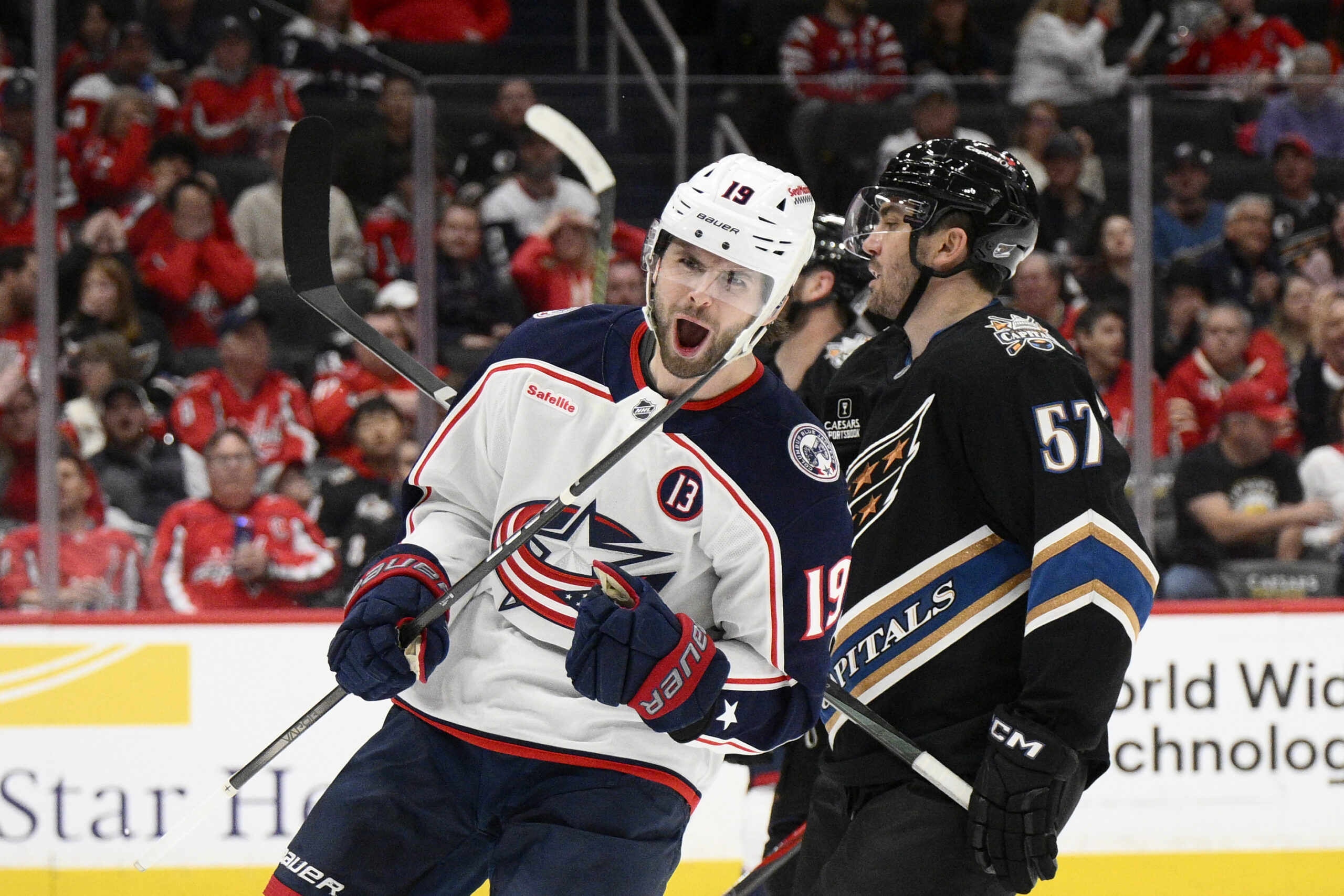
Aaron Portzline of The Athletic reported that Blue Jackets center Adam Fantilli, the No. 3 overall pick in 2023, could be the Flyers’ next target. Since Columbus is in the division, he would be difficult to pry away via trade, but could be amenable to an offer sheet. Fantilli was not eligible for arbitration.
Fantilli set career highs with 35 assists and 59 points in 2025-26. Across his 213 career games, Fantilli has 140 points (67 goals, 73 assists) but he hasn’t yet lived up to the high expectations of his record NCAA freshman season at Michigan, when he became just the third freshman to win the Hobey Baker Award as the nation’s top player, after Jack Eichel and Paul Kariya. That might make him easier to pry away, but the team runs the risk of giving up four first round picks for a middle-six player.
The Flyers are unlikely to make an attempt at the Chicago Blackhawks’ Connor Bedard, who is out for at least four months after undergoing shoulder surgery. The Blackhawks have nearly $30 million in cap space, per PuckPedia, and almost certainly would match any offer, assuming Bedard signed it.
Had the Ducks not matched the Carlsson offer sheet, the Flyers would have sent their next four first-round picks to Anaheim in return.
According to PuckPedia, the Flyers have a smidge over $29.5 million in cap space; however, that number includes center Jett Luchanko‘s contract ($941,667), and Flyers general manager Danny Brière told The Inquirer in early June that the expectation is he will be in Lehigh Valley of the American Hockey League. They still need to re-sign restricted free agents Trevor Zegras and Jamie Drysdale, who filed for arbitration on Sunday.
After he had been around the world — well, Florida and Ottawa — it sounded like there was only one place left Claude Giroux wanted to go: back to Philadelphia.
But after 1,571 days away and several false reports, the former Flyers captain is not returning to the City of Brotherly Love. He has signed a one-year contract to stay with the Ottawa Senators. According to the team, the deal carries a base salary of $2 million with bonuses that could reach a maximum value of $5 million.
It really never gets old saying Claude Giroux is an Ottawa Senator 🫡
“I chose to come back because I want to be here. I’m excited to be an Ottawa Senator,” Giroux said in a news release. “Being around those guys for four years, we got really close. This team feels like a family. I just care for those players.”
Giroux has been with Ottawa for four seasons after signing with the team in July 2022. Following the trade of captain Brady Tkachuk, it makes sense that the Senators kept the 38-year-old veteran to stabilize things.
The announcement comes days after some misinformation online. Were the Flyers out on Giroux, like some reports said on Friday? That was inaccurate, a team source confirmed to The Inquirer.
Was he signing with the Flyers, as other reports said on Friday? Also no, clearly.
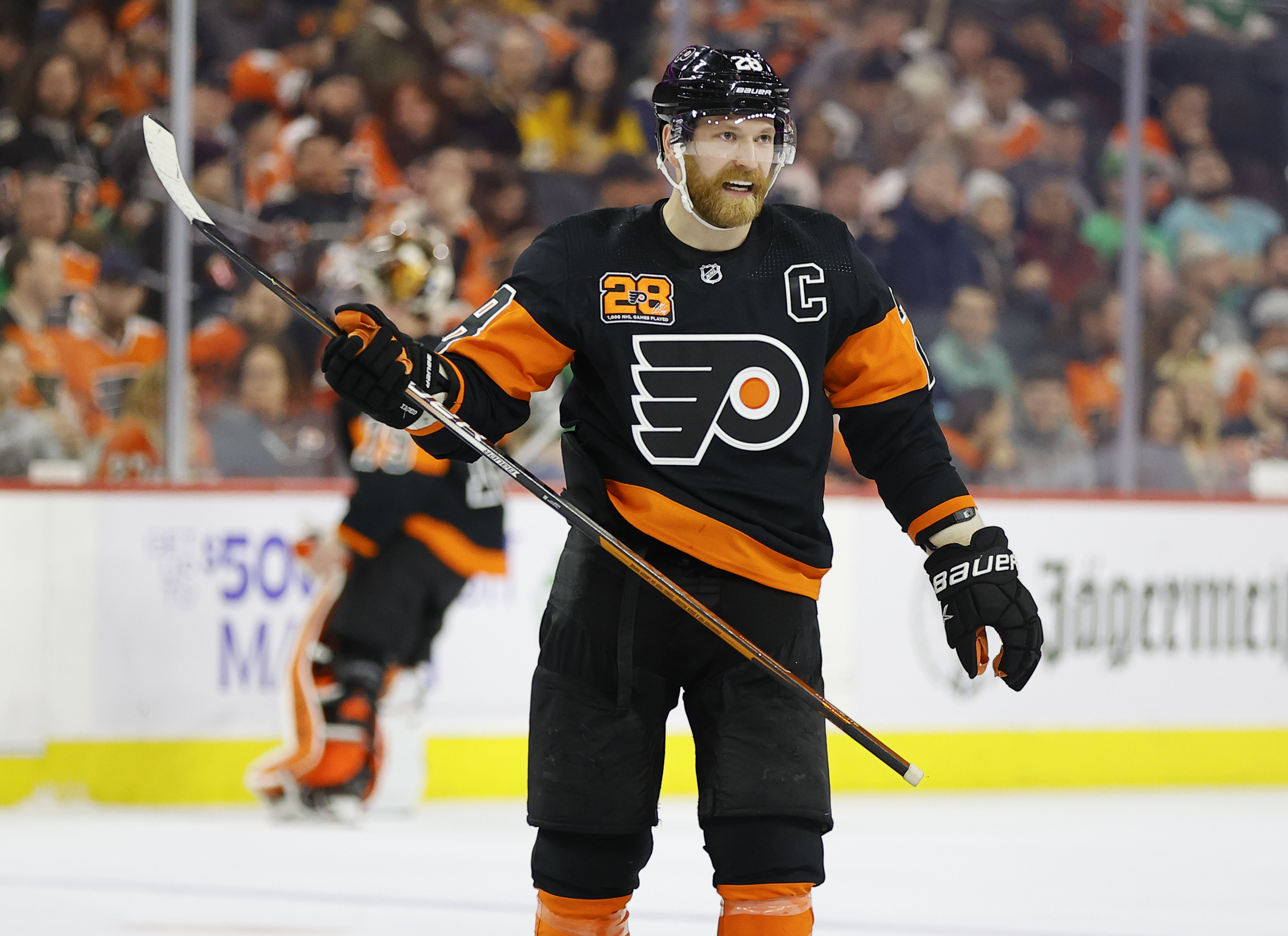
Claude Giroux wore the ‘C’ for the Flyers for 1,000 games.
As reported on X (formerly Twitter) by The Inquirer, the word of Giroux’s imminent return was premature, as the Flyers’ attention was on the announcement that they had tendered an offer sheet to Leo Carlsson on Friday afternoon. That seemingly put everything on hold.
In the end, Giroux opted to stay in Ontario.
“Claude took his time to evaluate his options, and his decision to re-sign with us shows his belief and commitment to our group,” Ottawa general manager Steve Staios said. “He is the consummate professional and brings veteran experience to our core on and off the ice.”
Although it would have been a welcome return for many fans, without a reunion, Giroux stays on the nice, round numbers of 900 points in 1,000 games with Philly. He is one of only two players, the other being Bobby Clarke, to play at least 1,000 games for the Orange and Black. Current Flyers captain Sean Couturier is 48 games away from joining them.
This past season, Giroux had 14 goals and 49 points, including a power-play goal and 13 power-play points in 82 games. The expectation was that he could help a power play that, including his last season in Philly (2021-22), has been the NHL’s worst (14.1%). Across his first 14 seasons with the Flyers, the power play was ranked the fifth-best (20.3%).
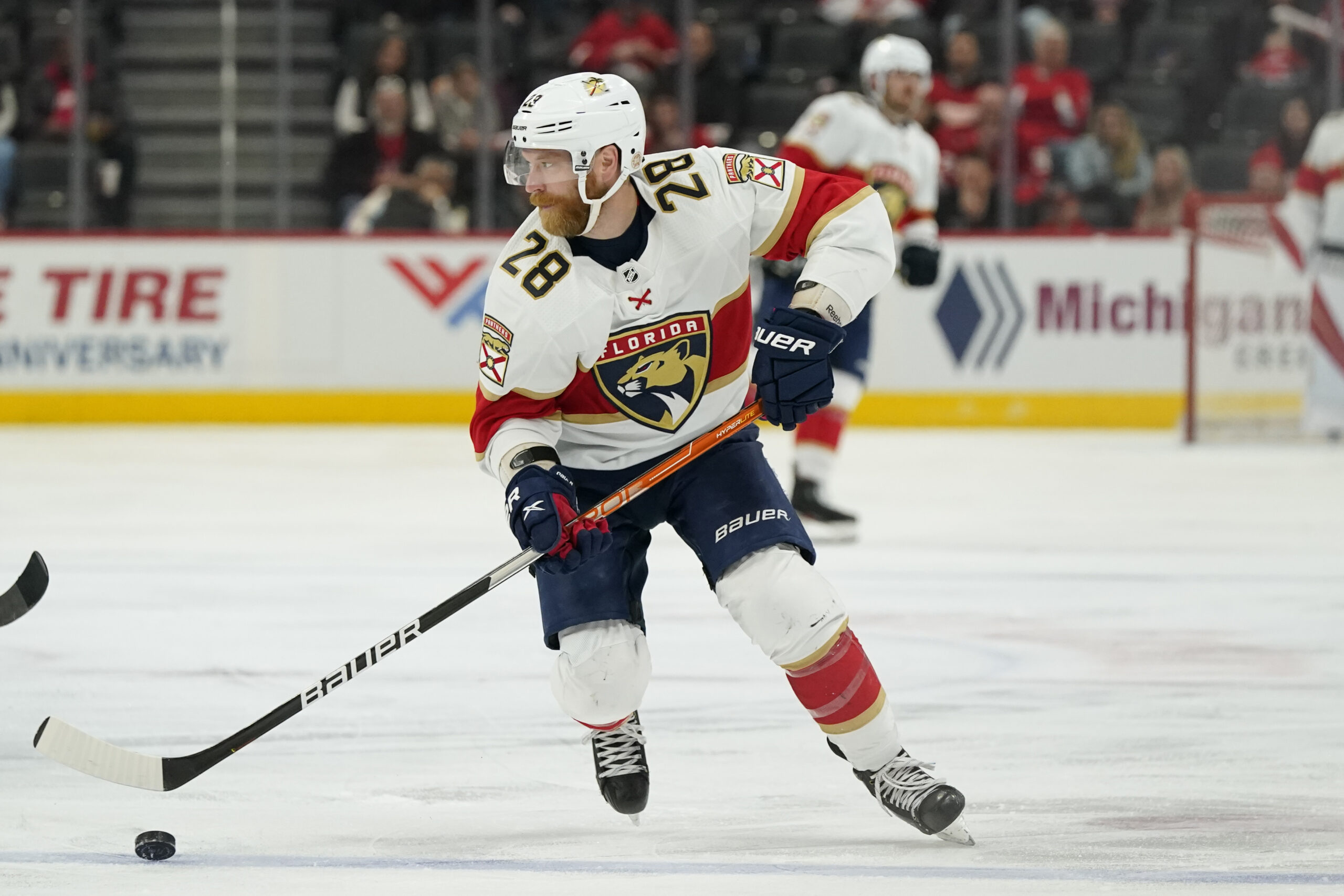
In March 2022, Giroux was traded to the Florida Panthers in a multiplayer swap. The Flyers acquired forward Owen Tippett, a 2023 third-round pick that became Denver Barkey, and a conditional first-round pick that was swapped with the Edmonton Oilers and then packaged to move up to get Jack Nesbitt in 2025.
No one locally wanted to see Giroux depart. But it was time.
One of the worst teams in the NHL, and a team that had not made the playoffs since the COVID-19 bubble of 2020, the Flyers had to change course.
Claude Giroux was dealt to the Panthers in 2022, and was given a chance to win at a higher level than he could in Philly at the time.
Giroux went to chase a Stanley Cup with the Panthers, which had 41 more points in the standings thanks to 23 more wins. They won the Presidents’ Trophy as the NHL’s top club but were ultimately swept in the second round by the two-time defending Cup champion Tampa Bay Lightning. Florida would make the next three Finals, winning the last two, but Giroux was already back home in Ontario.
The deal worked out for both sides. Giroux got a chance to win, and the Flyers picked up some valuable pieces. Nesbitt, a center, is heading to University of Michigan in the fall; Barkey has become a spark plug with an unstoppable motor; and Tippett is the speedy winger the Flyers need to keep defenses on their heels.
A little more than a year after the trade, Chuck Fletcher was out as general manager, and Danny Brière was in. Many thought a Giroux deal would get done this summer since Giroux and Brière were teammates for several seasons, and Giroux had lived with Brière and his three sons during the 2010-11 season.
The remaining players from Giroux’s tenure are forwards Couturier, Travis Konecny and Noah Cates, and defensemen Travis Sanheim, Rasmus Ristolainen, Nick Seeler, and Cam York.
Noel Acciari has gotten a few text messages and calls since July 1.
They came from friends, family, and a few other people, all saying the same thing: “You fit the Flyer mold.”
That was why the Flyers targeted the unrestricted free agent who checked a lot of boxes, including “experience, playoff experience, the hardness, the fourth-line role, face-offs, the leadership,” according to general manager Danny Brière.
The veteran forward inked a two-year deal that carries a $2.8 million average annual value. Acciari, 34, is now heading east on I-76 after spending three seasons in Pittsburgh.
“Choosing Philly was an easy decision,” he said during a Zoom news conference on Tuesday. “Seeing how their momentum was after the break, and it’s a young team, to be able to do what they did was pretty special to watch and play against, and I just wanted to be a part of that.”
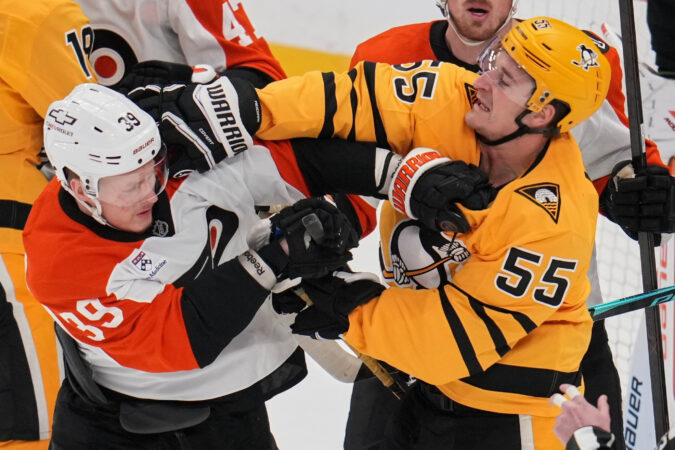
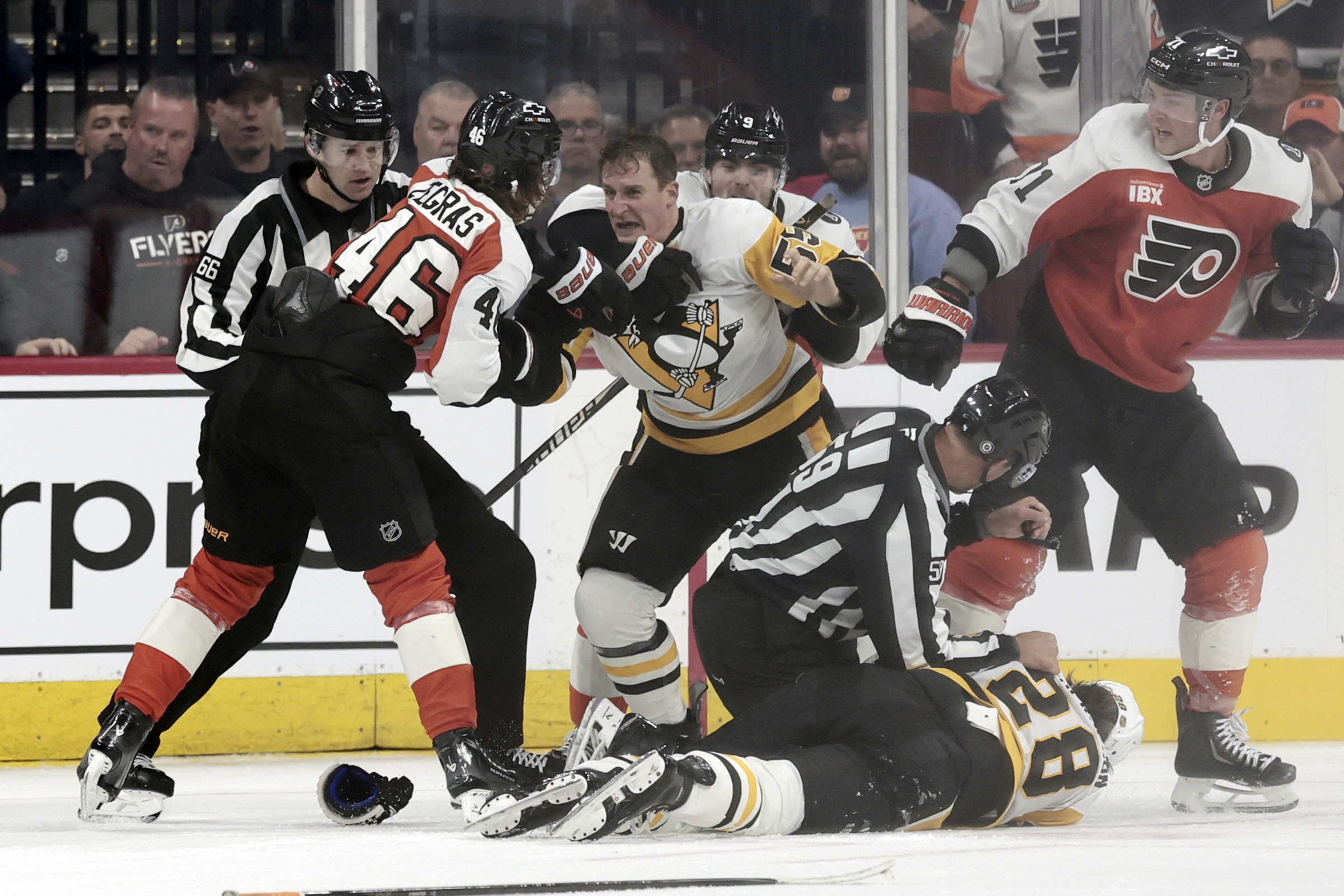
The Flyers’ Trevor Zegras and then-Penguins forward Noel Acciari tangle during a game on Oct. 28, 2025.
The forward was on the Penguins team that lost in the opening round of the Stanley Cup playoffs to the Flyers. Brière noted that it was difficult for the Flyers to play against Acciari, who brings a physical, defensive game with high-end prowess on the penalty kill, similar to what Garnet Hathaway did for three seasons before he was traded to the Florida Panthers right before the draft.
Acciari is a natural center who has played a lot of wing, including in Pittsburgh. He combined with Connor Dewar and Blake Lizotte to make up one of the league’s top fourth lines. This past season, he had 13 goals, 25 points, won 52% of his faceoffs, and had an impressive plus-14 rating in 67 games.
He posted one assist in the six playoff games against Philly — Brière said it was because of the Flyers’ stingy defense — but dominated in the face-off circle, winning 61% of his draws.
His prowess in the dot will help bolster a team that has not re-signed Luke Glendening, who won 57.2% of his faceoffs with the Flyers. Glendening, a late-season addition, was the team’s only right-handed centerman, and now Acciari holds that title. Across all 82 games last season, the Flyers collectively won only 49.5% of faceoffs; they improved against the Penguins in the playoffs but were worse against the eventual Stanley Cup champion Carolina Hurricanes.
“If it’s not on a score sheet, I want to help out the team in any way possible, whether it’s blocking a shot, winning a faceoff, or throwing a big hit,” said Acciari. “All the little things that helped me throughout my career, and I’d love to bring [them] on over to Philly.”
Noel Acciari (right) had 13 goals, 25 points, and an impressive plus-14 rating in 67 games last season for the Pittsburgh Penguins.
A veteran of 585 career games with the Boston Bruins, Florida Panthers, St. Louis Blues, Toronto Maple Leafs, and Penguins, Acciari has amassed 81 goals and 144 points. One of the biggest draws for him was the Flyers’ locker room. He says he saw how tight the team is, the excitement they had, and how much fun they were having, and he wanted to be a part of it.
He also knows a few Flyers. He played with Owen Tippett in Florida and Joseph Woll in Toronto and overlapped with Dan Vladař in the Boston organization. He also worked with Flyers assistant coach Todd Reirden in Pittsburgh.
— NBC Sports Philadelphia (@NBCSPhilly) July 7, 2026
There’s also his interaction during the regular season with Trevor Zegras. The two were part of a melee that saw both players tossed after Acciari wasn’t too happy with the Flyers forward for knocking off his helmet. So while Acciari has spoken to the guys he knows, has he chatted yet with Zegras?
“I have not talked to Trevor yet, but I bet that will come soon enough,” he said after grinning when Zegras’ name was brought up. “But, you know, it’s all water under the bridge. Have a good laugh at it now. He does what he needs to do on the ice to get under guys’ skin, and he does a good job, and he’s effective at it.”
He’s excited to now be on the same side as Zegras — and Philadelphia’s fans.
“Just being a part of that Pennsylvania rivalry, I got to experience it on the other side, which was a lot of fun,” he said. “And just seeing how passionate the fans are, which is unbelievable, and to be able to experience it with their cheering for you this time. I’m so excited for, and I’m glad to have them on my side now because they are very passionate, and they’re all up in your face.
“It’s fun to play against, but at the same time, I’m happy I get to play on the same side.”
It’s a little past 3 p.m. on the Friday before the Fourth of July. The Flyers’ development camp had wrapped up a few hours ago, and all that seemed to be on the agenda were new contracts for their four restricted free agents, including Trevor Zegras and Jamie Drysdale.
Then the notifications went off. The text messages. The emails.
Six words sent the hockey world afire: “We have tendered an offer sheet.”
What is the offer sheet the Flyers tendered to Carlsson?
An offer sheet is tendered to a player on another team who is a restricted free agent and who was provided a qualifying offer. In this case, the Ducks, who own Carlsson’s rights, had until July 1, the start of free agency, to negotiate an exclusive contract without worry of an offer sheet.
The Flyers’ offer is a five-year contract worth an average annual value of $18 million. According to a league source, it is front-loaded with a heavy signing bonus — and signing bonuses every ensuing year of the deal. Carlsson would receive the league minimum in base salary every year.
According to PuckPedia, the final year has a no-movement clause.
Anaheim Ducks general manager Pat Verbeek must consider the team’s next move on Leo Carlsson.
The announcement means that Carlsson, 21, has accepted the offer. It would make him the highest-paid player in AAV in the NHL and would walk him directly to unrestricted free agency.
It all comes just two days after Flyers general manager Danny Brière made some interesting comments on the first day of free agency, like stating that if the organization has an opportunity to make the roster better, “we’ll jump on it,” and “There’s a chance, and a good chance, that we take a little bit of a step back this year.”
Was that a tell with the first part and a sleight of hand on the second as the Flyers try to get the first-line center they’ve been craving for years?
According to the collective bargaining agreement, the Ducks have seven days to match the offer, which means they have until 3 p.m. Friday.
If they match, the Ducks must meet the structure of the contract and pay Carlsson the signing bonuses — something Anaheim rarely doles out — along with taking on the $18 million salary cap hit.
It could come down to the final day, and it should be noted that the Utah Mammoth are weighing a similar decision after the New Jersey Devils tendered an offer sheet to Barrett Hayton. That offer sheet is for one year, $4.775 million, and Utah must decide by Wednesday.
The interesting part is that Sportsnet insider Elliotte Friedman reported on Thursday that he had heard “over the past few hours Anaheim guaranteed it will match any attempt on Leo Carlsson.” The clock is ticking.
The two teams could still work out a side trade for Carlsson to preempt Anaheim’s decision to match, but if the Ducks match, they would be unable to trade him for one year.
What compensation would the Ducks receive from the Flyers?
If the Ducks do not match the offer sheet, they will receive four first-round picks in the next four drafts from the Flyers. The compensation is based on the amount of the offer, and because it is over $11,939,166.
Since Philly has all its own picks moving forward — it is not permitted to use the first-rounder it is receiving from the Toronto Maple Leafs as compensation here — the Ducks would receive the Flyers’ first-round picks in 2027, 2028, 2029 and 2030. Had the Flyers already traded one of their picks in the next four drafts, they would have been required to provide the 2031 first-rounder for the missing year.
The Flyers are one of 28 teams that still have four picks in the next five years to tender an offer sheet. Having just made the postseason for the first time since 2020, the hope is that the four picks the Flyers would give to Anaheim would be in the 20s or worse, and not a lottery pick. The Flyers’ expectation is that it would not be a player as highly valued as Carlsson, who is a first-line center.
Leo Carlsson’s offer sheet brings about potential roster construction complications for the Ducks and Flyers.
How does the Carlsson offer sheet impact the Flyers and Ducks?
If the Ducks match
According to PuckPedia, the Flyers would have a smidge over $29.5 million in cap space; however, that number includes center Jett Luchanko‘s contract ($941,667), and Brière told The Inquirer in early June that the expectation is he will be in Lehigh Valley of the American Hockey League. They do have to re-sign restricted free agents Drysdale, Zegras, Nikita Grebenkin, and Hunter McDonald, who is expected to be in the minors.
The Ducks would then be the ones saddled with an $18 million AAV. The problem? As of Monday night, they have just under $10 million in cap space after signing Pavel Mintyukov to a five-year deal with an AAV of $7.2 million. They still have to sign restricted free agent forward and ex-Flyers draft pick Cutter Gauthier, who scored 41 goals this past season, and defenseman Tyson Hinds. Anaheim could try to move out some players like Chris Kreider, Frank Vatrano, and Alex Killorn; however, they all have modified no-trade clauses, so trade partners are limited. Troy Terry could also be placed on long-term injured reserve, but that would impact the Ducks’ salary cap at the deadline and next season.
Fitting Leo Carlsson’s salary into the roster could mean trade talks for Rasmus Ristolainen escalate.
If the Ducks do not match
The Flyers would be the ones saddled with an $18 million AAV and would have a little over $12.5 million in cap space — with Luchanko being sent down — to sign Zegras and Drysdale to NHL contracts. Grebenkin could land in the minors to start, along with McDonald, so those contracts would not impact the cap space. Zegras and Drysdale’s new deals are expected to combine for in the neighborhood of $15 million, so if the Flyers do land Carlsson, they would likely have to move out a contract or two. Does Rasmus Ristolainen finally get moved, or does a forward get moved to help stabilize things up front?
The Ducks would probably still have to move out a contract to sign Gauthier, who will likely ask for more than $10 million.
What would Carlsson bring to the Flyers?
Although some would argue the amount is an overpayment, Carlsson is a 6-foot-3, 208-pound dynamic center coming off a breakout season in which he had 29 goals and 67 points in 70 games. He missed time after sustaining a Morel-Lavallée lesion in his left thigh in mid-January but returned after the Olympic break and scored 11 goals and 23 points in 26 games. According to Physiopedia, a Morel-Lavallée lesion is “due to shearing forces which separate the skin and subcutaneous tissue from the deep fascia.”
The 21-year-old ex-teammate of Zegras and Drysdale has size, speed, playmaking ability, and a lethal shot. Selected second overall in the 2023 NHL draft, Carlsson had four goals and 11 points in 12 playoff games last season, his first postseason experience. Across 201 career games, he has 141 points (61 goals and 80 assists) with a 14.7 shooting percentage, and he should be able to help the Flyers’ dismal power play after scoring four goals and 18 points last season with the man advantage. He would have tied Matvei Michkov for second in power-play goals, and the 18 points would have been the second-most on the Flyers behind Zegras.
Carlsson is a No. 1 center with tremendous upside given his young age. The Flyers have needed a top-line pivot since trading Claude Giroux, who, despite some rumblings of a reunion, appears to be staying in Ottawa with the Senators. Carlsson would fit in quite nicely with right winger Porter Martone on the top line, and then, more than likely, speedster Owen Tippett on the left.
Did Carlsson’s offer sheet impact Zegras’ and Drysdale’s negotiations?
The long and short of it all is … kinda.
Obviously, Zegras and Drysdale have not signed their new contracts yet, and it feels like everything is on hold until the decision about Carlsson is made. As mentioned, they are expected to combine for a figure in the neighborhood of $15 million, and there is still the question of whether Zegras will be paid like a winger or a center; typically, centers get paid more.
Hearings are scheduled to run from July 20 to Aug. 1, and until they begin, the team and player can still negotiate a deal. If it does go to the arbitrator, they can award only a one- or two-year contract. Because it was a player’s choice, the Flyers will select the term length, and if Philly selects a two-year contract, the player will walk to unrestricted free agency. If it is for one year, the player would be a restricted free agent next summer.
Could Adam Fantilli be a Plan B for the Flyers?
What is Plan B if the Ducks match?
Finding a true No. 1 center has long been the Flyers’ goal, so what happens if they do not get Carlsson? According to Aaron Portzline of The Athletic, there have been rumblings that the Flyers could pivot to Adam Fantilli of the Columbus Blue Jackets.
Fantilli, 21, is a restricted free agent center, so they could try either another offer sheet or a trade. The Canadian center just registered career highs in assists (35), points (59), power-play goals (four), power-play points (13), average time on ice (18 minutes, 54 seconds), and face-off winning percentage (49.8%). Across his 213 career games, Fantilli has 140 points (67 goals, 73 assists).
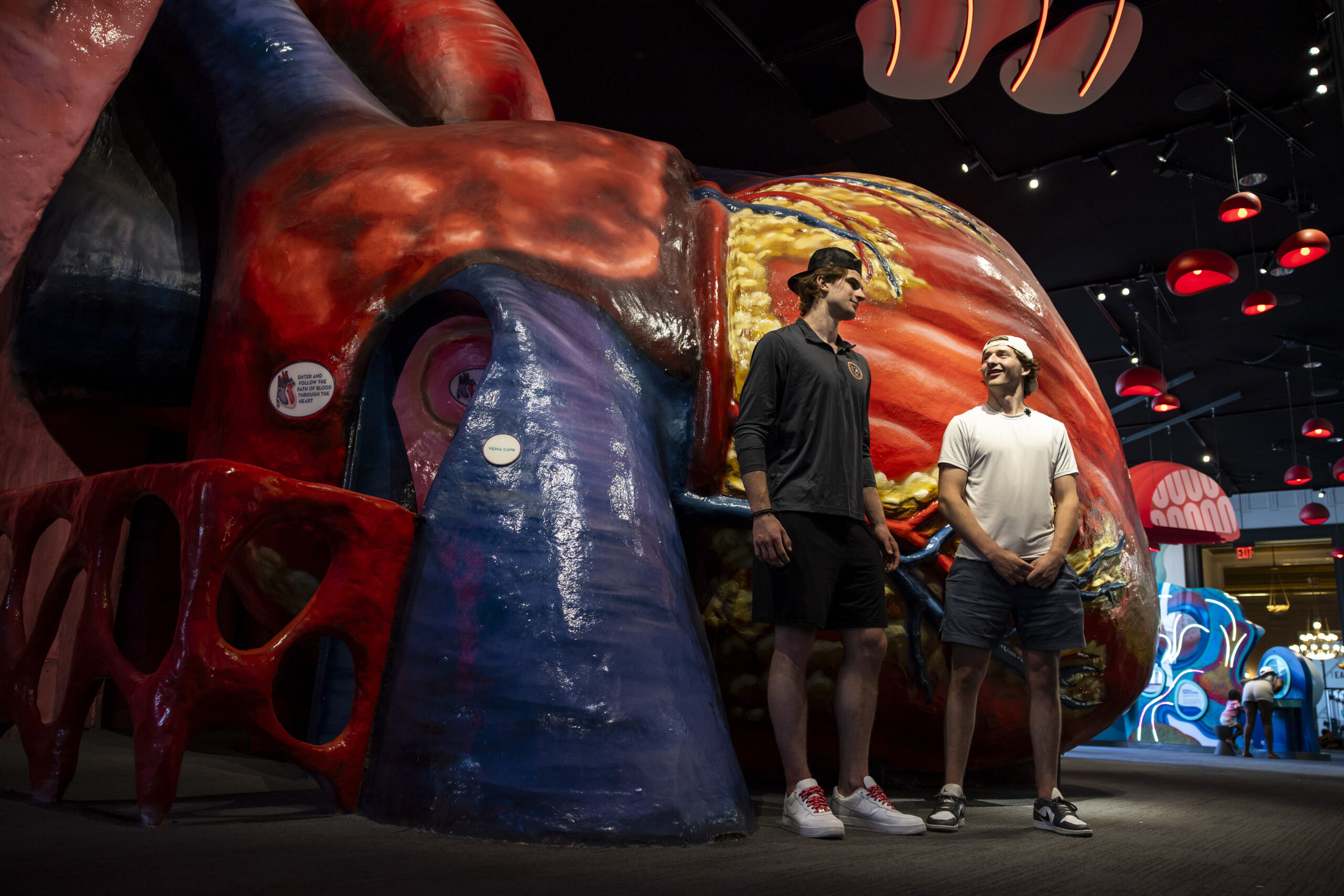
It’s called the Giant Heart, but for Flyers’ first-round draft pick Maksim Sokolovskii, even that’s not big enough.
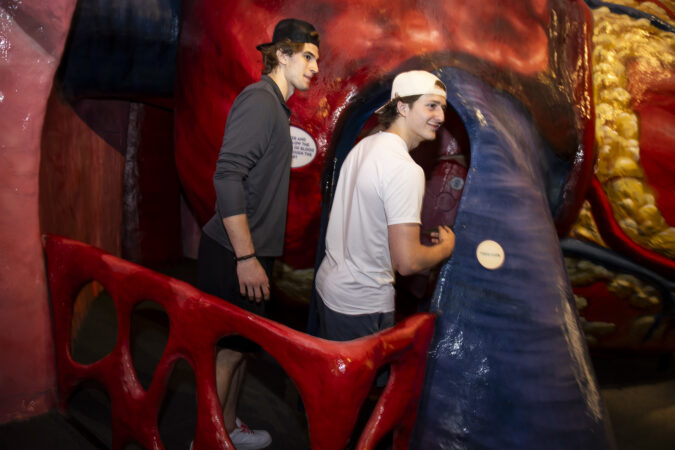
The 6-foot-7 defenseman ducked as he made his way into the popular exhibit at the Franklin Institute, navigating narrow stairways and the twists and turns of the heart’s anatomy. Leading the way was Flyers’ second-round draft pick Brek Liske.
Less than a minute later, the two players appeared at the top of the heart, waving to those watching from floor as they capped a very Philly adventure for two of the city’s newest athletes.
It was a busy first week, which included attending Flyers development camp. And as part of the camp, all six of the team’s draft picks, alongside current players like Porter Martone and Denver Barkey, attended an autograph session at the Franklin Institute, where they met fans and took in new sights along the way.
We caught up with Liske and Sokolovskii to discuss their time in Philly, their game-day soundtracks, and more:
Q.What did you know about Philly before you were drafted to the Flyers?
Sokolovskii: I just know all the Russian guys [who] played here.
Liske: I’ve been here a few times when I was younger. Been to the practice facility. I know it’s a pretty cool city with passionate fans. That’s about it. It’s cool seeing behind the scenes.
Q. And what’s the city been like for you so far?
Liske: It’s been pretty cool. Even just driving through, there’s lots to take in, right? Lots of Flyers stuff everywhere. It’s awesome to see.
Sokolovskii: Yeah, good downtown, good big city. All of the fans.
Liske: I did when I was younger. I’ll have to have it again. It was a good experience. Yeah, I’ll absolutely have to try.
Sokolovskii: I’ve never had [one].
Liske: Oh, we did [on Tuesday]. The slider thing. The roll. The cheesesteak roll.
Sokolovskii: Oh yeah. … not bad.
Flyers prospects Maksim Sokolovskii and Brek Liske stand in front of the Giant Heart at the Franklin Institute.
Q. Brek, what was it like for you growing up as a Flyers fan in Winnipeg?
Liske: Lots of people chirping at me, I guess. [There are] a lot of Jets fans in Winnipeg, so [I’m] happy to be actually a part of [the Flyers] now and they can’t say much anymore.
Q. And your dad is a die-hard Flyers fan. What’s his favorite piece of Flyers memorabilia that he owns?
Liske: I don’t know. His favorite player was [Claude] Giroux, for sure. He loved [Rod] Brind’Amour and [Rick] Tocchet as well. So, not memorabilia, but those are his favorite guys.
Q. Do you have a favorite Flyers memory from your past visits?
Liske: Probably just getting the Shayne Gostisbehere signed stick. That’s pretty cool. Still have it in my room. … It’s mounted, so that’s the best thing.
Q. And, Maksim, English isn’t your first language. What’s been a way that you’ve been trying to learn the language?
Sokolovskii: Just talking, trying talking with everyone, and watching movies.
Liske: He’s been good. He’s been really good.
Maksim Sokolovskii is 6-foot-7, making the Giant Heart look just a little smaller than usual.
Q. What’s your go-to music to listen to ahead of game day?
Sokolovskii: Drake, I listen to Drake.
Liske: Yeah, me too. A bit of everything. Whatever I’m feeling like, but, good answer.
Sokolovskii: I listen to Russian.
Q. What’s been the biggest challenge for you playing hockey as such a taller guy?
Sokolovskii: Nothing.
Liske: I like that.
Q. Brek, I know you’re already a Philly sports fan. But Maksim, what have you heard about Philly sports fans?
Sokolovskii: They’re crazy, crazy fans. I like it.
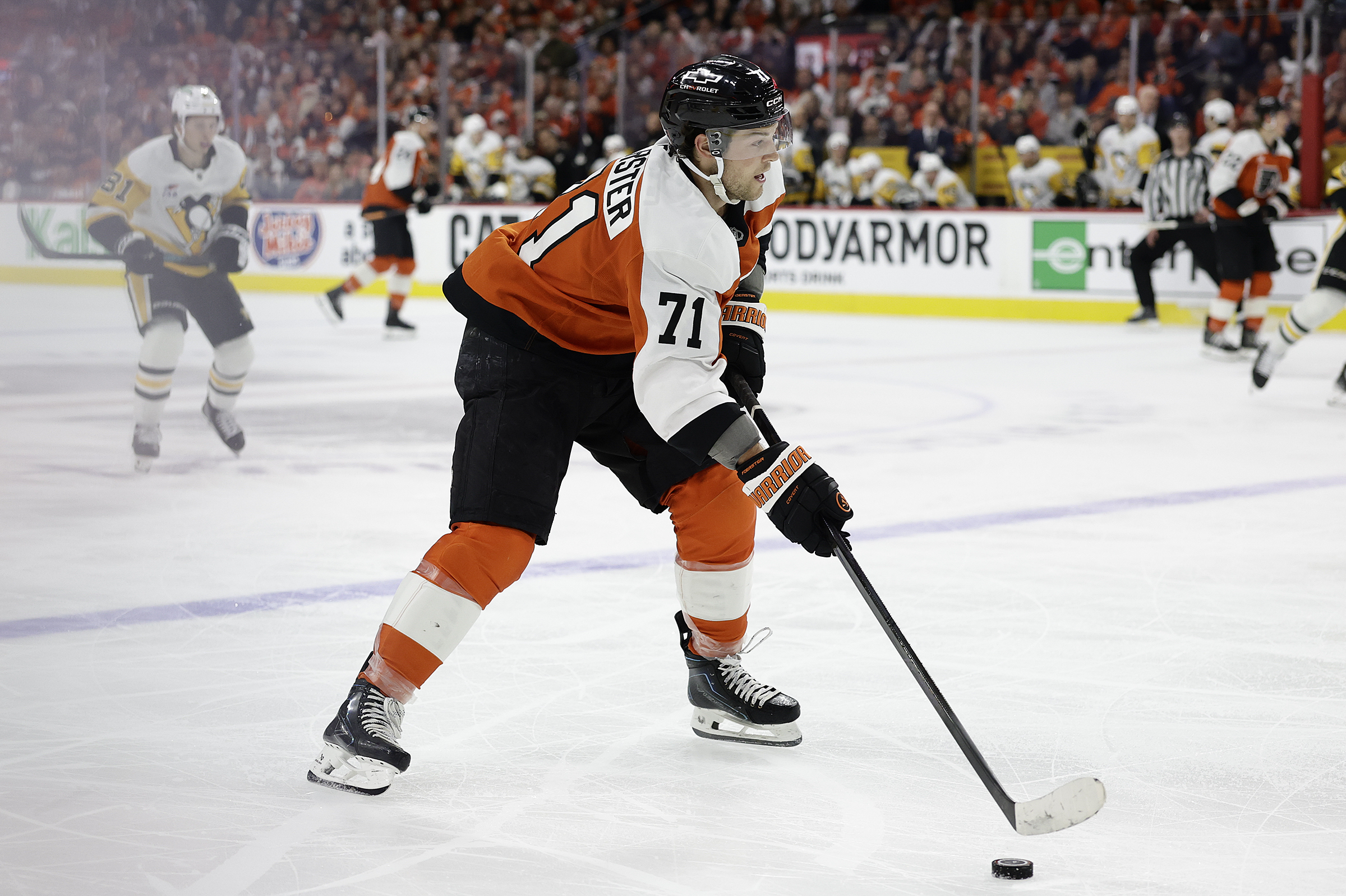
Fresh off the first playoff berth of his career, Tyson Foerster locked in his future with the Flyers and signed an eight-year extension with $7.1 million average annual value last week.
Foerster was leading the team in goals before he missed 49 games last season with an upper-body injury and returned just in time for the playoffs. But instead of waiting a year to potentially increase his value with a healthy season, Foerster chose to extend now.
“For me, I love Philadelphia, and I love playing with these guys,” he said. “They asked me if I would look to extend this year, and it was a no-brainer for me. I mean, I don’t play hockey for the money, so it’s all fun, and just happy to be here, hopefully, for the next nine years.”
Even with wing prospects pushing up the lineup for spots, Foerster projects to be a top-six fixture for much of his contract’s duration. The Flyers’ 2020 first-round pick scored 20 goals in 2023-24 and 25 goals in 2024-25 and was on pace to set a career high before his injury.
Tyson Foerster has solidified himself as a major part of the Flyers’ future.
Foerster didn’t have the playoff run he may have wanted, netting just one goal in 10 games. With a mostly healthy offseason ahead, he has plenty to work on as the Flyers continue to build.
“Keep working on my skating, everything overall, but hopefully work on my hands a little bit,” he said. “I think my shot’s pretty good, and I can score from a decent ways out. But I think if I can get in tight around the net, get it upstairs quick enough, little things like that, maybe try and beat a guy one-on- one with a skill play, just something along those lines. That’s what I’m starting to work on here.”
The Flyers hope signing Foerster is just the beginning of an offseason of upgrades. General manager Danny Brière tendered an offer sheet to Anaheim Ducks center Leo Carlsson in an effort to land the top-line center the Flyers have been missing.
Regardless of whether the Ducks match, the move provides evidence to the fan base and players that Brière is ready to be creative and aggressive to improve the team.
“Danny, that’s one of the reasons I signed a long-term here, because he’s going to try and push to make us better,” Foerster said.
As the Flyers await word on whether the Anaheim Ducks will match the offer sheet they tendered to center Leo Carlsson, two of the organization’s four restricted free agents filed for salary arbitration.
On Sunday, Jamie Drysdale and forward Trevor Zegras opted for salary arbitration and, therefore, cannot be tendered an offer sheet by another NHL team.
The hearings are scheduled between July 20 and Aug. 1, and the team and player can still negotiate a deal until the hearing begins. If it does go to the arbitrator, they can only award a one- or two-year contract. Because it was a player’s choice, the Flyers will select the term length. If the Flyers select a two-year contract, the player would walk to unrestricted free agency, but if it is for one year, the player would be a restricted free agent next summer.
Zegras said he felt like he “had lost a little bit of that drive and passion to win” in Anaheim and felt rejuvenated this past year. He did have a career year, notching highs in goals (26), points (67), power-play goals (10), and power-play points (23) across 81 games. The New York native spent time on the wing and at center this season. How he is viewed, whether as a winger or a center by either side, impacts contract negotiations because, typically, centers are paid more.
Flyers center Trevor Zegras scored 26 goals during the 2025-26 season.
At his end-of-season availability, Drysdale said the biggest step he took this year was “just coming to the rink and believing that I was a good player and could make an impact.” The blueliner played in 78 games, his highest total since he played 81 in 2021-22, had a career-high in goals (eight), and tied his career-high in points (32).
Both got their first taste of the postseason, with Drysdale scoring two goals and four points, and Zegras adding four goals and six points in 10 games apiece.
Defenseman Hunter McDonald is a restricted free agent and did not elect salary arbitration by the 5 p.m. deadline. Forward Nikita Grebenkin, the final RFA for the Flyers, was not eligible.
Zegras and Drysdale are two of 15 players to elect salary arbitration. The others are forwards Xavier Bourgault (Ottawa Senators), Kirby Dach (Montreal Canadiens), Alex Jefferies (New York Islanders), Peyton Krebs (Buffalo Sabres), Connor McMichael (St. Louis Blues), Cole Perfetti (Winnipeg Jets), Jason Robertson (Dallas Stars), Nick Robertson (Pittsburgh Penguins), and Cole Sillinger (Columbus Blue Jackets); goalies Jet Greaves (Columbus Blue Jackets) and Akira Schmid (Florida Panthers); and defensemen Braden Schneider (New York Rangers) and Ronan Seeley (Carolina Hurricanes).
The AAV on the Flyers’ offer would make Leo Carlsson the highest-paid player in the NHL.
On Friday, the Flyers sent shockwaves through the hockey world by tendering a five-year offer sheet with an average annual value of $18 million to Carlsson, which would make him the highest-paid player in terms of AAV in the NHL.
According to a league source, it is front-loaded with heavy signing bonuses.
GM Pat Verbeek and the Ducks have seven days to match the offer. If they don’t, according to the team’s press release, the Flyers would have to transfer their own first-round draft pick in each of the next four seasons as compensation. However, according to PuckPedia, it is four in the next five years.
They, along with a throng of fans, were entertained by a competitive three-on-three tournament. The squad led by Denver Barkey, who notched two goals in quick succession late in the game to snag the win from Jack Nesbitt and his crew, celebrated by lifting the trophy and banging the glass as they skated by the faithful.
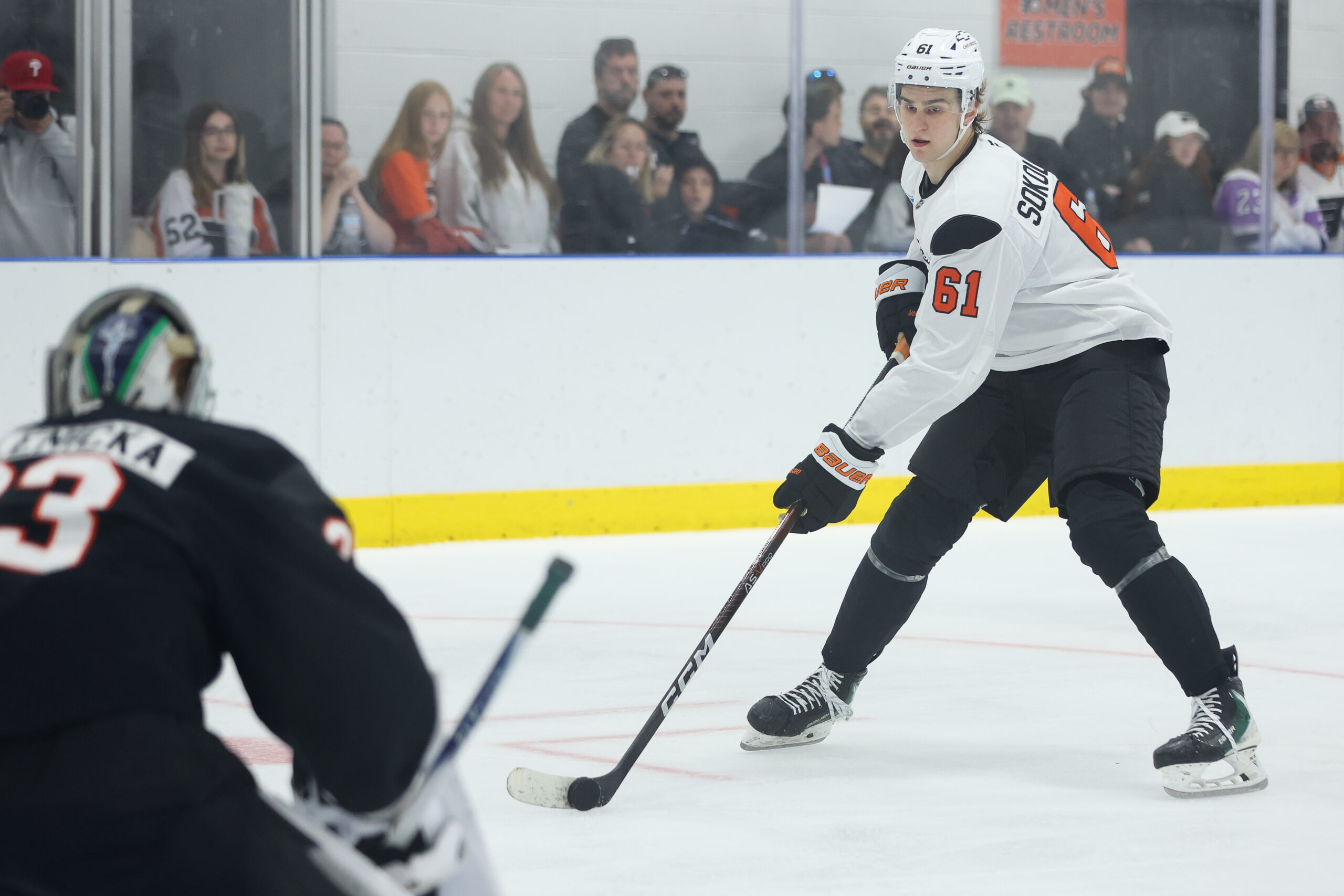
Maksim Sokolovskii showed off some good hands during development camp, including his goal in the three-on-three tournament.
The tournament came less than 24 hours after a five-on-five scrimmage in which players also worked on power play for 10 minutes. Defenseman Luke Vlooswyk, who has five goals in 139 regular-season games in the Western Hockey League, scored the only power-play tally.
Team Brière defeated Team Jones, 4-3, in the scrimmage, after a 16-round shootout in which the very last skater, camp invitee Matthew Desiderio, scored and his team poured onto the ice.
Here’s what else we saw at Flyers development camp:
Orange, white, and boom
There were a lot of confused faces and comments after the Flyers drafted 6-foot-7, 238-pound defenseman Maksim Sokolovskii with the 27th pick in June’s draft. But when he stepped onto the ice in Voorhees, it was easy to see why assistant general manager Brent Flahr called him “a unicorn.”
Although he still is raw and needs to pump up the offense, the big man can skate. And the size is intimidating.
“Yeah, it’s terrible. He mauled me in practice,” defenseman Oliver Bonk, who is 6-2, said with a big grin.
“We were doing little keep-away drills, and I wasn’t ready for it. The first one, I just came up and, like, ‘OK, whatever, this is like a warm-up drill.’ And I go, and he just mauls me. He takes the puck away and … for like 1:30, I’m trying to chase this guy around, arms out.
“I got ready, and the next one, I kind of — I got back at him a little bit — protected the puck a little bit better. But, yeah, he’s going to be a really good player.”
The first 2½ days of on-ice activity at camp focused on power skating and skills. Director of player development Riley Armstrong and Flyers skating instructor Lindsay Tilley noticed Sokolovskii was turning his upper body too much during the skating-only drills.
“When your hips and your shoulders don’t stay in a square, it throws you all off balance,” Armstrong said.
But when they were working with pucks, the Kazakhstan-born, Russia-raised defenseman executed puck retrievals with some deception while keeping his feet moving. Although he had been off the ice for two weeks, there was a smoothness to his skating.
As the games went on in the scrimmage and tournament, he got more confident, especially offensively and with his skating. He used his footwork to get out of trouble and was so vocal on the ice that he could be heard on the perches for media. English is not his first language, but as his junior coach, Rick Steadman, told The Inquirer, as he got more comfortable with the language, his on-ice game ramped up.
Sokolovskii cut off 6-5 center Nesbitt along the end boards and crushed 2025 second-rounder Jack Murtagh, too. The blueliner cut off zone entries at five-on-five and showed craftiness with the puck across the ice. He scored in the three-on-three tournament — and chirped the opposition bench on the way past — and when he had a chance in the shootout on Thursday, there was a big “Awww” when he was stopped.
And the kid who turns 18 on July 12 was doing it all using someone else’s stick with a different blade pattern. It makes his camp even more impressive.
“He’s actually confident,” Flahr said Friday. “We tell him, ‘Just play your game, just go,’ and I think you watch him in drills, and some of the things he can do for a player that size, at his age, are impressive. … His physical tools are immense, and, for us, it’s just the tip of the iceberg.”
Sometimes an afterthought when names like Barkey, Alex Bump, Porter Martone, and Nesbitt are mentioned, Cole Knuble, 22, put himself at the forefront this past week. The forward whom Flahr has called “one of my favorites” in the pipeline stood out for his aggressiveness, high hockey IQ, and vision, notably when he set up Bump for the game-tying goal for Team Jones.
“I can remember three years ago, right away, [he] had excellent hockey sense and has certainly rounded out his game over the years, and looks like he’s improved every time we get eyes on him,” said Patrick Sharp, a special adviser in hockey operations who works in development.
Knuble, who signed his entry-level contract and joined Lehigh Valley of the American Hockey League after his junior season at Notre Dame, skated in seven games with the Phantoms, which included time at center.
He played down the middle during the five-on-five scrimmage and showed off his ability to be a gnat on the ice. He was everywhere, showing the improvement in his skating, and was a player the Flyers have said has a good motor.
“Growing up, I kind of realized, like, that’s the way I’m going to be able to make it, a guy that’s going to go [in] every battle,” Knuble said Monday. “I think, growing up, the emphasis was not goals or assists; it was always, ‘Did you win your 50-50s, and did you stick your nose in there?’”
That emphasis came from his dad, ex-NHLer Mike Knuble, who played five seasons with the Flyers: “He used to say, ‘If you have 12 eggs in your pockets, they should all be broken.’”
Forward Cole Knuble is the son of former Flyer Mike Knuble.
Let freedom ring
Carter Amico, 19, was held off the ice at last year’s development camp as he continued his recovery from a fractured patella that required two surgeries.
He said he still feels some of the aftereffects at times, but nothing concerning, and after splitting this past season between Boston University and Muskegon of the United States Hockey League — he’ll be returning to BU in the fall alongside Murtagh — he came to camp healthy and showed why the 2025 second-rounder is a top prospect for the Flyers.
“From a year ago to now, he’s just come a million miles. I thought it was a great decision, going back to [the USHL and to] Muskegon, with all the time lost, and they were great with him,” Flahr said of Amico, who also previously played for the U.S. National Team Development Program. “They played him a ton. He played in a lot of offensive situations, and they really freed him up. You can see the confidence, the size, the skating is all coming. To me, he’s got a tremendous upside.”
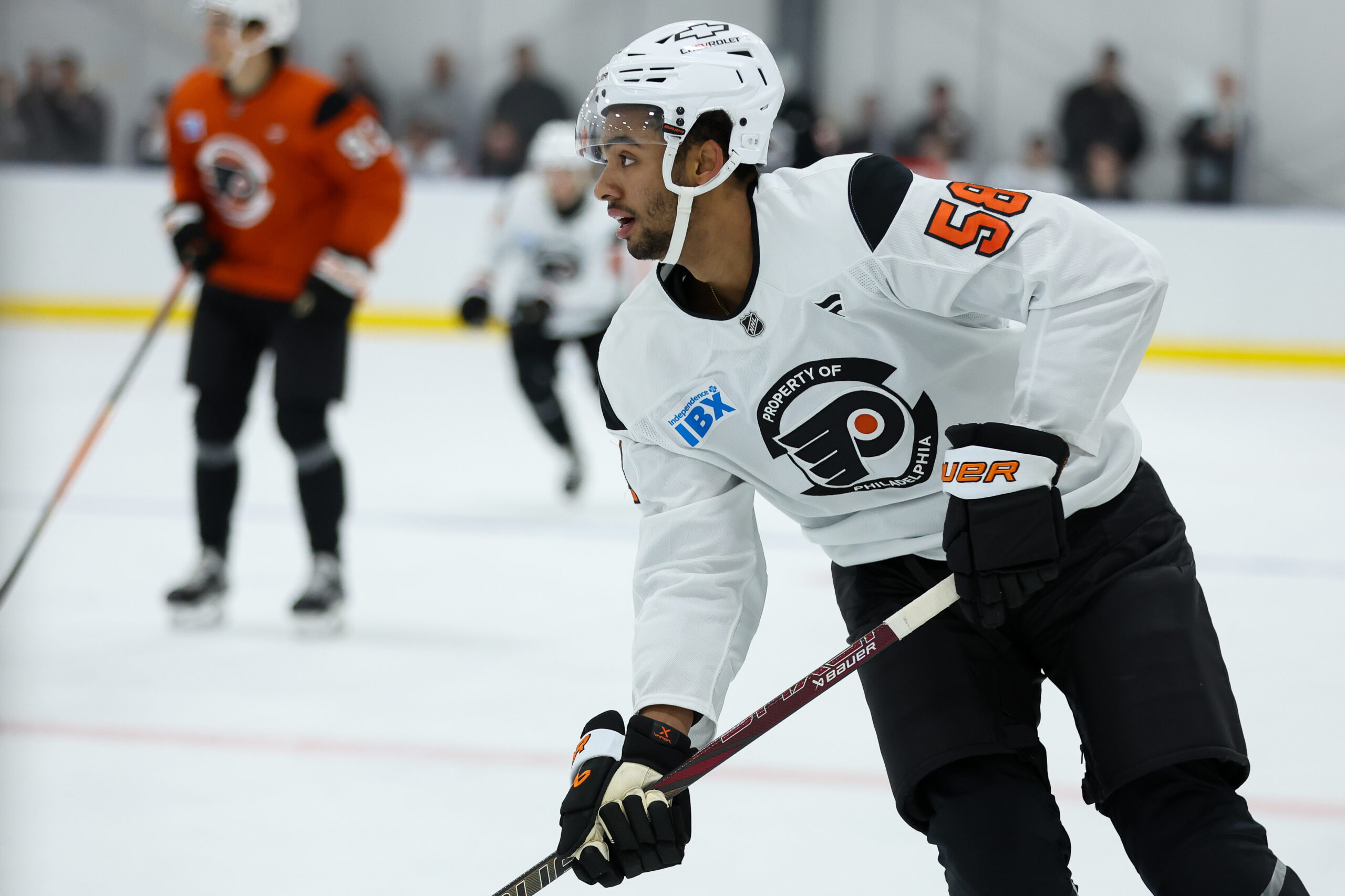
Carter Amico (58) skates during the Flyers Development Camp at the Flyers Training Center on Friday, July 3, 2026, in Philadelphia.
Watching his smooth skating this week, you wouldn’t know that he missed almost the entire 2024-25 season.
He used his body and size to attack offenses and get away from defenders, noting he worked last week with Sam Morin, an ex-Flyers defenseman who now is working in player development. Morin, who stands 6-6, an inch taller than Amico, dealt with severe knee injuries that ended his career. They focused on “accepting the contact instead of going away, talking about driving your legs into the guy, and separating and creating space,” Amico said.
Bonk, 21, to push for a job come September. The blueliner looked like a seasoned pro in the games against the prospects, which is why Flahr said, “I think he’ll challenge at camp.”
Brek Liske, 18, taken in the second round by the Flyers, showed why he is a versatile, all-around defenseman who needs to continue to work on his game. He can skate well — he made a nice spin move in the offensive zone — and play with confidence and smarts in his own end, with a nice poke check on Murtagh. But he did get fooled pretty well by Bonk as he put on the breaks at the half-wall in the full-ice scrimmage. “I think his strengths are his puck game, obviously the way he sees it. He’s mobile, he’s very confident, has swagger,” Flahr said. “… In order to handle box-outs and things down low and around the net, he’s going to have to get stronger, which he’s well aware of. He’s a hockey player, though, loves to play the game. He’s got some swagger.”
Flyers have liked Brek Liske’s poise and skating ability. He showed some of it here with a spin and shot.
Last year, Noah Powell, 21, was all about the boom. After getting some time with the Phantoms following the end of his season with Arizona State, he brought a well-rounded game to development camp. Powell, played confidently, showing off spin moves and smart passing, and was quick on the puck and with his release. “I think I want to really show more of my offensive side,” said Powell, mentioning he worked with assistant coach Terrence Wallin and Sharp on his shot. “I feel like I kind of got a good bearing in the physicality, the hitting, and the gritty side. … Something the coaches and I have talked about is being a little more calm. Sometimes, it’s hard to turn that switch off; you go from trying to hit guys to then try to make skill plays.”
The two Czech goalies — and childhood friends — selected in the 2026 draft, Marek Sklenička, 17, and Martin Psohlavec, 18, played well, with Psohlavec putting on a show in the five-on-five scrimmage. He had a rare shutout, showing off his ability to square up to shooters, read plays, and flash the leather. He was injured during the three-on-three tourney but mentioned that he was excited to be drafted by Philly because of the culture and, as someone who loves basketball, the 76ers.
The Flyers announced they have reached the end of their rebuild on Friday, when they tendered an offer sheet to Anaheim Ducks center Leo Carlsson for five years and $90 million. The average annual value would be an NHL-record $18 million, at least for a while. Carlsson is a restricted free agent, so Anaheim has a week to match the offer. If they do not, the Flyers would send them their next four first-round draft picks as compensation.
Carlsson would fill the massive hole in the Flyers’ lineup at the first-line center spot that has existed since they traded Claude Giroux in March 2022 and announced the first real rebuild in franchise history. Coincidentally, Giroux, now a 38-year-old free agent, apparently is the consolation prize if the Ducks match the Carlsson offer.
This is a marked departure from the Flyers’ behavior since Danny Brière became general manager in March 2023. His moves have been conservative. His strategy has been patience. Brière, president Keith Jones, and governor Dan Hilferty have resisted adding pricey veterans and have moved on from aging players to allow younger players the ice time to blossom.
However, with every move, Brière has said:
“If something makes too much sense for the future of this organization, we’re going to take it.”
They took it.
They had to after this past season.
They discovered a franchise goalie, they saw their young core overachieve under first-year coach Rick Tocchet, they saw defenseman Travis Sanheim, 30, round into one of the best blueliners in the game, and they realized that their window was opening a year or two earlier than they expected.
They dabbled in discussions to add other completion pieces, but in the end, going all-in for a 21-year-old budding star in Carlsson just made too much sense.
They made the playoffs on the backs of some of those younger players, such as 21-year-old winger Matvei Michkov, in his second season, and 19-year-old winger Porter Martone, who joined the team straight from the NCAA Tournament, as well as the emergence of late-bloomer goalie Dan Vladař.
Then they beat the Pittsburgh Penguins on the backs of some of those same players and, again, Vladař. He just agreed to a five-year extension and will be under contract for the next six seasons. Tyson Foerster, a 24-year-old winger, also had a year left on his contract when, on Wednesday, he signed an eight-year, $56.8 million extension.
Leo Carlsson, 21, is one of the NHL’s top rising stars. Last year, he averaged just under a point per game for the Anaheim Ducks.
Now, the Flyers have offered Carlsson the moon.
Rebuild over.
This comes on the back of the Sixers’ surprise trade with the Celtics, in which Boston sent star swingman Jaylen Brown, 29, to Philly in exchange for broken-down Paul George, 36, and the crippling contract he carries, as well as two first-round picks and two second-round picks.
And don’t forget that the Eagles traded disgruntled franchise receiver A.J. Brown to the New England Patriots last month.
Oh, yeah: LeBron James is considering signing with the Sixers, too.
Perplexingly, the news about Carlsson might have a larger impact than any of the others — and it could have the least impact as well.
Four firsts and $90 million is a massive overpayment for a player who, after three seasons, sits firmly in the second tier of NHL stars. But prying a restricted free agent from his team always requires overpayment, and that’s why it happens so seldom.
That said, Carlsson’s goals and points totals have steadily increased, though his 67 points last season were tied with three other players, including potential new teammate Trevor Zegras, for 57th in the league. The Flyers are banking on the ever-improving Carlsson, who possesses a tantalizing combination of size (6-foot-3, 208 pounds), speed, skill, and goal-scoring ability, growing into one of the league’s top players.
This (pending) move is sort of a bookend to the trade of Giroux to the Florida Panthers. Part of the return from that deal was cornerstone winger Owen Tippett and a third-round pick that became promising forward Denver Barkey.
More than anything, though, this move is a recognition that the Flyers believe they are much closer to winning their first title in five decades than they’d previously advertised.
Flyers general manager Danny Briere’s offer sheet sends a clear signal that he believes the Flyers can win now.
Between Vladař, Sanheim, 29-year-old All-Star wing Travis Konecny, and 33-year-old captain Sean Couturier, a former first-line center now serving as a fourth-line defensive specialist, the Flyers have a productive veteran core. Couturier has four years left on his deal. Konecny has seven years left.
What that means is there is a five- or six-year window in which the Flyers, scanning the landscape of the NHL, believe they can win it all. And, apparently, it just made too much sense to add Carlsson to this roster, regardless of the absurd price.