Category: Wellness

  • For these military veterans, Brazilian jiujitsu is a path to healing and finding a new community

    For these military veterans, Brazilian jiujitsu is a path to healing and finding a new community

    As a U.S. Army soldier in Afghanistan in 2013, Dan Kovalik got used to the adrenaline rush of bullets whizzing by while on patrol. Risking his life was part of his job as he radioed in Apache helicopters to protect other soldiers.

    But by the time he retired from the Army in 2018, his 23 years of military service had taken their toll. He had been diagnosed with post-traumatic stress disorder and was rated 80% disabled by the U.S. Department of Veterans Affairs. Kovalik moved back to his hometown of Johnstown, Pa., where he struggled to find the sense of purpose and camaraderie that had come so easily in the military.

    “I was looking for ways to be part of the community,” Kovalik said. “Church. The VFW. Then I tried jiujitsu.”

    Kovalik, 49, shared his story Saturday from the deck of the USS New Jersey, the decommissioned Navy battleship in Camden. The battleship was host to dozens of fans of and participants in Brazilian jiujitsu — a martial art that uses grappling and leverage to subdue opponents — for a day of competition.

    It was part of a two-day jiujitsu seminar and fundraiser put on by the We Defy Foundation, a Texas-based nonprofit that provides qualified combat veterans with free local jiujitsu classes and mentors who help them reintegrate into civilian life. Veterans must have been honorably discharged and have a VA disability rating of at least 80%.

    “The physical execution and mental chess game helps me to focus,” Kovalik said. “That, and just going out for a beer or dinner with friends afterwards.”

    Omar Feliciano, a 33-year-old Marine Corps veteran from Brooklyn, wins his match against Matthew Castillo, with Prodigy BJJ, at the We Defy Foundation jiujitsu event at the USS New Jersey in Camden on Saturday, June 20, 2026.

    The program has over 500 veterans currently enrolled, We Defy Foundation executive director Kevin Linderman said. About 70% of those who enroll complete the one-year program.

    “What makes it so different is, you have to do it with someone else,” Linderman said of jiujitsu. “When you’re grappling, you’re connecting with someone deeply. You’re both getting better through the process. It’s physical, and you’re learning how to operate under stress.”

    It’s also one more way to fight an ongoing crisis, Linderman said. Though military veterans made up 7.6% of the U.S. population in 2020, they accounted for 14% of suicides, according to research published in the National Library of Medicine. The suicide rate among veterans is 1.5 times higher than that of the overall population, after adjusting for age and sex, researchers noted.

    Though prevention efforts have shown some success, nearly 6,400 veterans died by suicide in 2023 — the most recent year for which data were available — according to the Department of Veterans Affairs.

    Omar Feliciano of Brooklyn, N.Y., said he found Brazilian jiujitsu after struggling to process a traumatic event he witnessed while in the Marines.

    “It really affected my sleep, my relationships with people,” Feliciano said. “I was irritable for no particular reason.”

    After another Marine recommended the We Defy Foundation, Feliciano applied. Now, Feliciano benefits from the structure of attending jiujitsu class twice a week, keeping him physically active and building camaraderie with other people in his community.

    The 33-year-old mechanical engineer said jiujitsu is helping him be a better father. He fought — and won — a jiujitsu match Saturday.

    “We’ve seen that it has a significant impact in reducing PTSD, depression, and anxiety,” said Linderman, 52, who came to the sport in 2015 while dealing with multiple deaths among his family and friends. Much like the veterans he helps, Linderman said, he was caught in a “rumination cycle,” and he quickly learned that an evening of grappling with opponents was a great way to break that cycle.
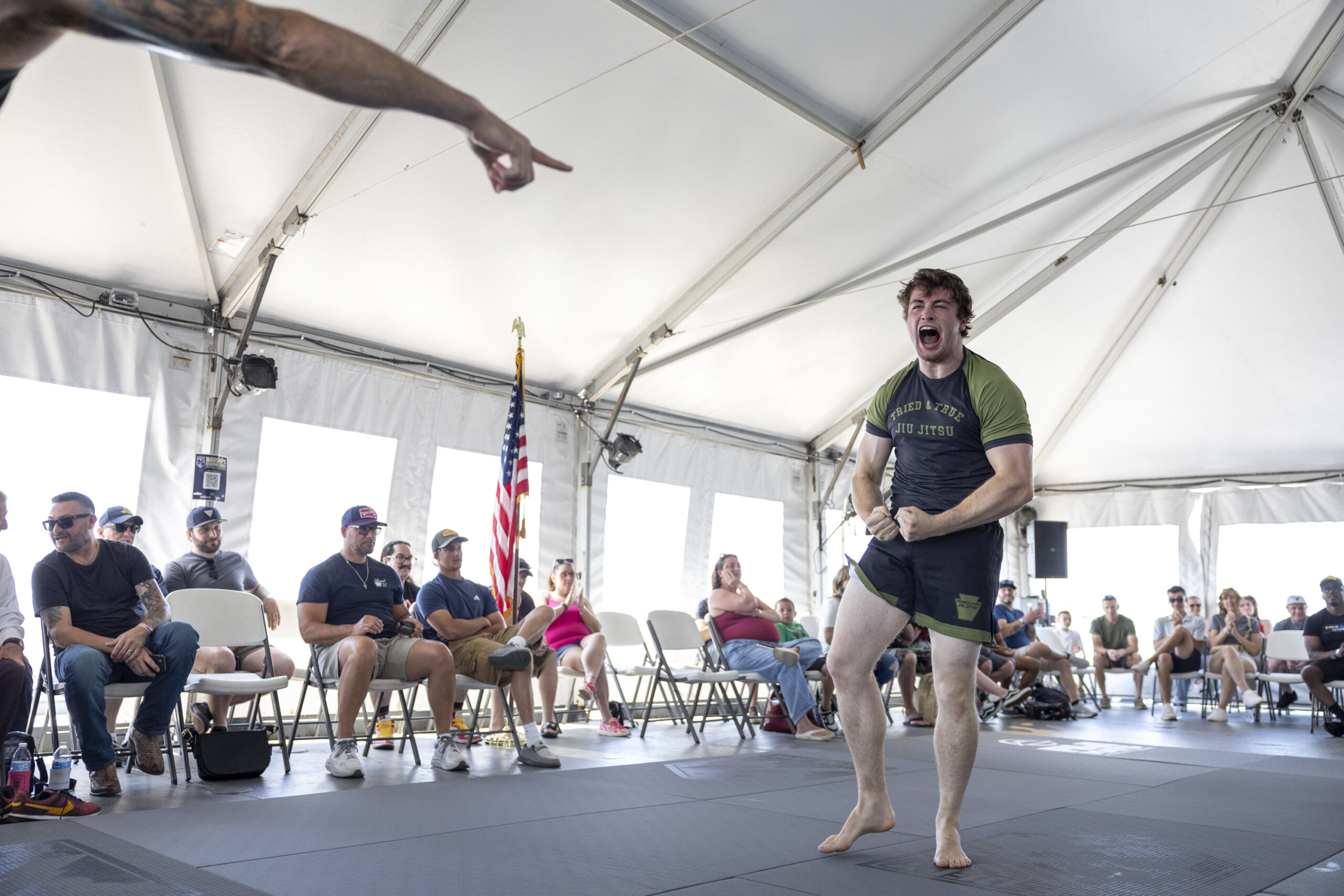
    Ethan Wanner, 21, of Williamsport, Pa. and Tried and True Gym, celebrates after winning his match against Josh Newhart, with 10P Bethlehem, at the We Defy Foundation jiujitsu event at the USS New Jersey in Camden on Saturday, June 20, 2026.

    The foundation was formed in 2015 by Army veterans Alan Shebaro and Joey Bozik. Though Bozik lost part of one arm and both legs from the blast of a roadside bomb in Iraq, he learned how to adapt his body to the martial art. In the process, Bozik regained much of the community he had been missing, Linderman said.

    As the COVID-19 pandemic waned, interest in the group accelerated, Linderman said. The organization has gotten $250,000 a year in financial backing from Facebook head Tom Alison. With 2,000 people moving through the program so far, interest is only growing. Linderman estimated that there are hundreds of thousands of Iraq or Afghanistan veterans who qualify for the program — including some who are struggling to find connection in civilian life.

    “I think that a way for people to stay connected to each other is one of the most important things right now,” Linderman said.
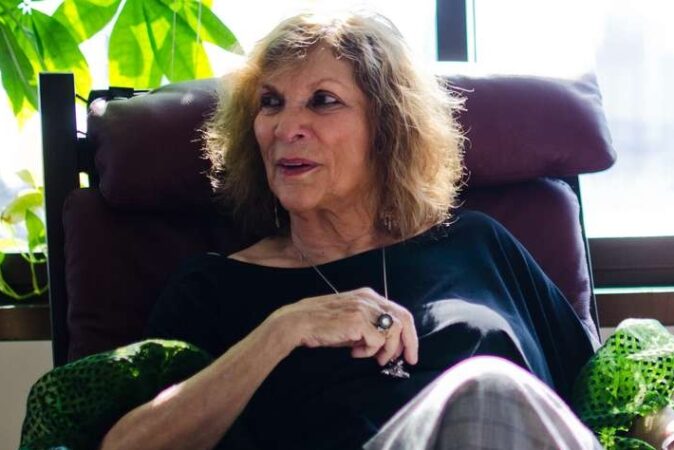
  • Edna B. Foa, celebrated pioneering psychologist and longtime Penn professor, has died at 88

    Edna B. Foa, celebrated pioneering psychologist and longtime Penn professor, has died at 88

    Edna B. Foa, 88, of Philadelphia, renowned clinical psychologist, pioneering mental health researcher, creator of the celebrated prolonged exposure therapy for post-traumatic stress disorder, longtime professor of clinical psychology in psychiatry at the University of Pennsylvania, lecturer, mentor, and volunteer, died Tuesday, March 24, of complications from pneumonia at Pennsylvania Hospital.

    Dr. Foa was among the first psychologists in the 1970s and ‘80s to infuse empirical case study research into existing behavior protocols to create more effective mental health treatments for victims of rape, combat trauma, childhood sexual abuse, and other ordeals. She became an expert in PTSD, obsessive-compulsive disorder, and social phobia, and her prolonged exposure therapy for PTSD and exposure and response prevention treatments for OCD are still hailed as breakthrough innovations.

    From 1971 to 1997, she was a fellow, professor, and clinical researcher in the psychiatry departments at Temple University and the old Medical College of Pennsylvania, now part of Drexel University. She joined Penn’s Department of Psychiatry in 1998 and, over more than 50 years, evaluated thousands of mental health cases to determine which behavior therapy was best for each condition.

    “Her work truly changed the field,” colleagues at the Ardmore-based Center for Hope and Health said on Instagram. They said she “spent her career doing what she believed mattered most: studying what actually helps people get better, and making those treatments more accessible.”

    She created the Center for the Treatment and Study of Anxiety at Temple in 1979 and directed it later at Penn. Colleagues at the center said on Facebook: “Through her brilliance, determination, and unwavering belief in the power of evidence-based care, she transformed the understanding and treatment of anxiety-related disorders and changed the lives of countless individuals and families around the world.”

    Other colleagues and friends called her “brilliant,” “amazing,” and “extremely influential” in online tributes. One said she was “a giant who taught the world how to conquer fear and reclaim life.”

    Dr. Foa earned grants for research and education, and taught her therapy techniques to veterans counselors in the United States and Israel, to therapists for the U.S. Army and the City of Philadelphia, and to clinicians at Women Against Rape and other groups around the world. In 2010, she was named one of Time magazine’s 100 most influential people in the world.

    To share her innovations and encourage peer review, Dr. Foa edited Failures in Behavior Therapy in 1983 and cowrote Emotional Process of Fear in 1986 and Emotional Processing of Traumatic Experiences in 2007. The hundreds of books, manuals, articles, and papers she wrote, cowrote, or edited about memory, stress, anger, depression, and guilt have been cited more than 13,000 times by other authors.

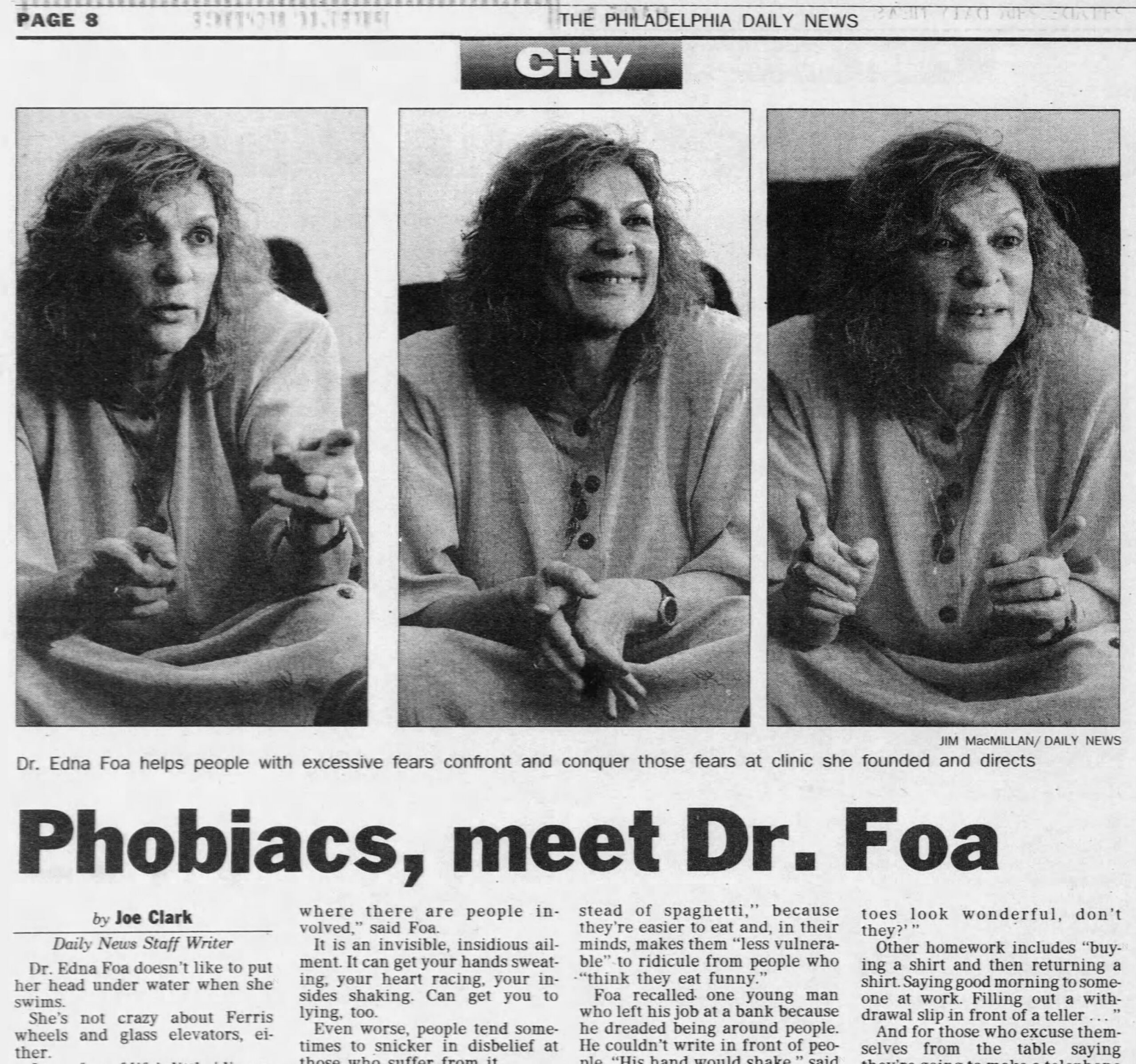
    The Daily News published this story and photos of Dr. Foa in 1993.

    She also volunteered as a consultant and supervisor at clinics and medical centers. She lectured and organized clinical workshops in the United States, Israel, and elsewhere. In 2010, she told Time magazine: “If you develop a wonderful protocol, it’s useless if nobody uses it.”

    She was affiliated with many mental health societies and associations, and earned lifetime achievement awards from the American Psychological Association, the International Society for Traumatic Stress Studies, and other groups. She was featured often in The Inquirer and the Daily News, and told the Daily News in 1993 that “everyone has little fears.” She said her little fears were of heights and swimming underwater.

    In 1970, Dr. Foa earned both a doctorate in clinical psychology and personality from the University of Missouri, and a master’s degree in clinical psychology at the University of Illinois. In 1962, she earned a bachelor’s degree in psychology and literature at Bar-Ilan University in Israel.

    She stopped working full-time at Penn in 2023 but never really retired. In April, she was scheduled to lead a workshop in prolonged exposure therapy. In 2011, she told The Inquirer: “If I die tomorrow, I think that what I have achieved is fine. If I don’t die, I don’t need to stop.”

    Edna Ben Jacob was born Dec. 28, 1937, in what is now Haifa, Israel. She became fascinated by the work of psychologist Sigmund Freud, she told the Encyclopedia of Behavior Modification and Cognitive Behavior Therapy, and she worked briefly with juvenile offenders near Tel Aviv after high school.

    In 2011, she told The Inquirer she was shattered by her own trauma in 1948 when her brother, Uri, was killed in the war and her father, Abraham, died four years later.

    She married and divorced when she was young, and met Professor Uriel Foa at Bar-Ilan. They married when she was 24, had daughter Dora, and moved to the United States in 1966. They had daughters Yael and Michelle, and lived in Illinois and Missouri before moving to Glenside and then Penn Valley. She moved to Philadelphia a few years ago.

    After a divorce, she married Penn professor Charles Kahn. Her husband and former husband died earlier.

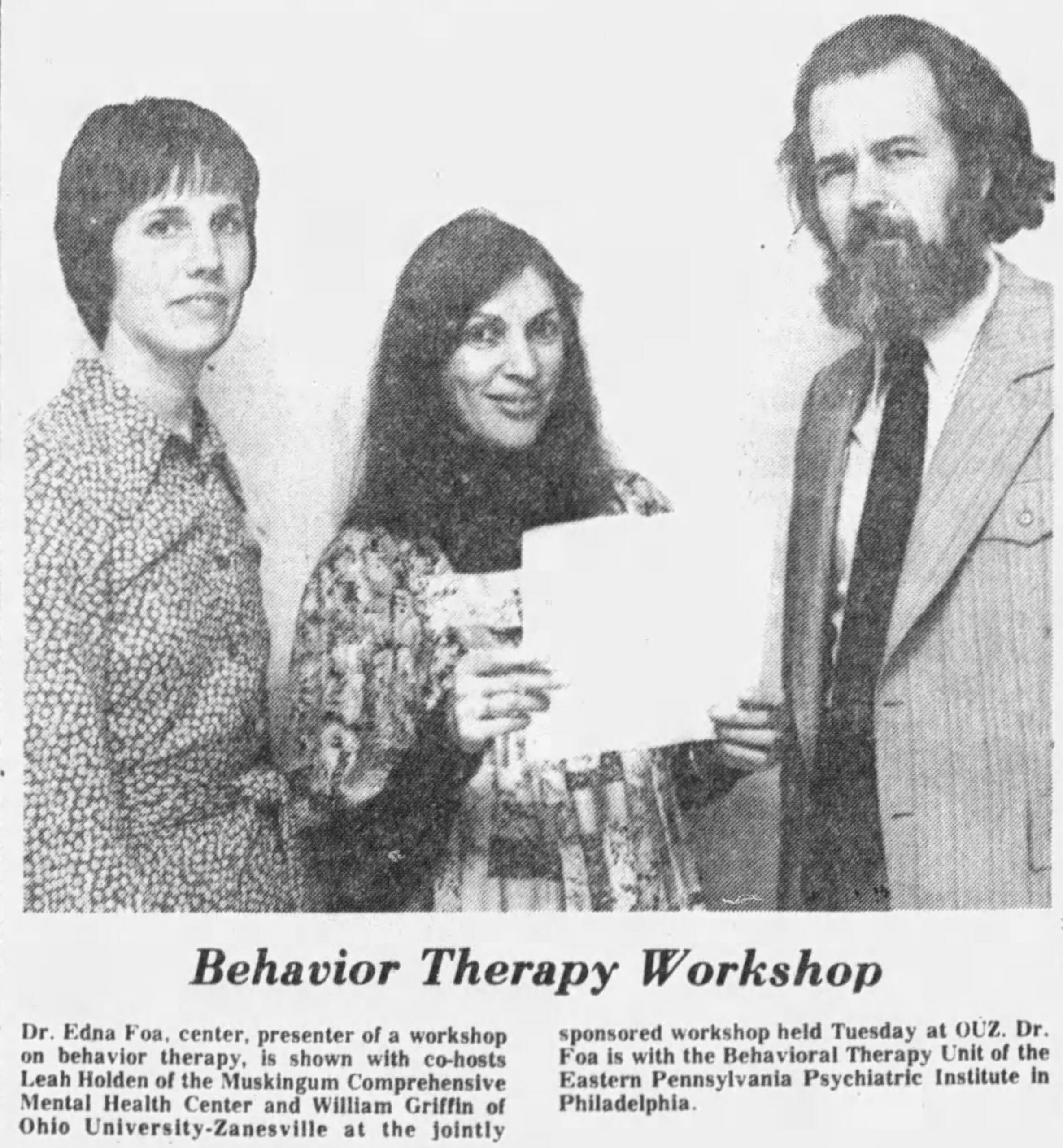
    This photo of Dr. Foa (center) appeared in the Times Recorder in Ohio in 1978.

    Away from work, Dr. Foa enjoyed traveling, gardening, and hosting family and friends at holidays. She collected art and antiques.

    She told an interviewer she had a bad habit of deleting emails before reading them. She managed lung cancer years ago.

    “She was full of energy, vivacious, a force of nature,” said her daughter Yael. Her daughter Michelle said: “She was an extraordinary figure who lived a very rich life.”

    In addition to her daughters, Dr. Foa is survived by five grandchildren, a great-granddaughter, and other relatives.

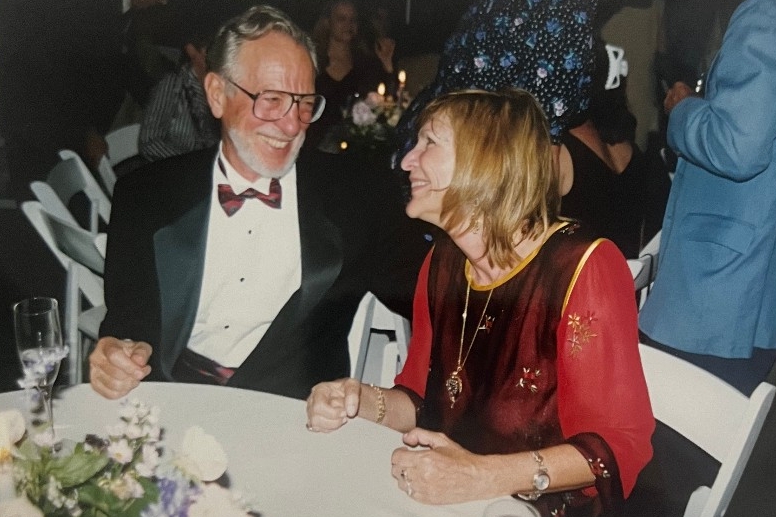
    Dr. Foa laughs with her husband, Charles Kahn.

    Private services are to be held later.

    Donations in her name may be made to the Philadelphia Museum of Art, 2600 Benjamin Franklin Parkway, Philadelphia, Pa. 19130; and the Philadelphia Orchestra, 300 S. Broad St., Philadelphia, Pa. 19102.

  • Paul F. Engstrom, award-winning pioneer in cancer prevention and control at Fox Chase Cancer Center, has died at 89

    Paul F. Engstrom, award-winning pioneer in cancer prevention and control at Fox Chase Cancer Center, has died at 89

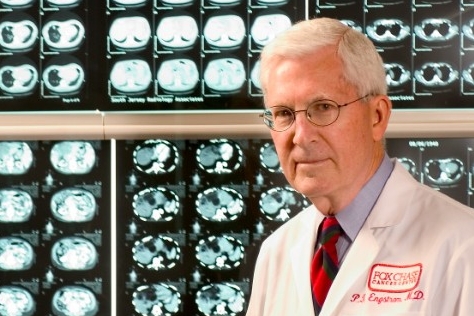
    Paul F. Engstrom, 89, formerly of Ambler, Montgomery County, celebrated pioneer in cancer prevention, education, and treatment, former chair and professor emeritus of the hematology and oncology department at Fox Chase Cancer Center, retired vice president of cancer control and senior adviser to the president at Fox Chase, Army veteran, and mentor, died Friday, Dec. 26, of Parkinson’s disease at Normandy Farms Estates in Blue Bell.

    The son of a small-town doctor, Dr. Engstrom accompanied his father on house calls in Minnesota when he was young and assisted sometimes on routine procedures. Later, after earning his medical degree at the University of Minnesota, he excelled at identifying cancer-related health problems and creating solutions.

    Starting in the 1960s and ’70s, Dr. Engstrom noticed large gaps in cancer prevention programs and treatment strategies. So he compiled comprehensive clinical care guidelines for cancer doctors and hospitals around the world, forged sustainable oncology research networks and community education partnerships, and established one of the country’s first cancer prevention and control programs at Fox Chase.

    “Most doctors and oncologists in the 1970s were training to treat cancer, not necessarily to prevent it,” former Fox Chase colleague Carolyn Fang said in a 2018 story for Fox Chase’s Forward magazine. “He was one of the first to recognize that prevention was important.”

    In 1991, Dr. Engstrom told the Daily News: “Changing the behavior of the public is only part of my job. We must change the physicians, too.” In 2000, he told The Inquirer: “Nowadays, the trend is toward identifying high-risk individuals and treatments we can give to prevent cancer from ever starting.”

    Dr. Engstrom was adept at organization and collaboration, former colleagues said in online tributes. He recruited other cancer experts to Fox Chase and established cutting-edge programs for cancer screening, smoking cessation, and education at hospitals, schools, private companies, and other organizations.

    He taught clinical science classes, secured vital grants from the National Cancer Institute and other groups, and made seminal clinical trials available to many more patients. “He was really aware of the need to integrate the community into this work.” Fang said in 2018.

    Dr. Engstrom joined the old American Oncologic Hospital in Philadelphia in 1970 and oversaw its merger with the Institute for Cancer Research in 1974 to become the Fox Chase Cancer Center. He was named vice president of cancer control and continuing education in 1984, and head of community cancer program activities in 1989.

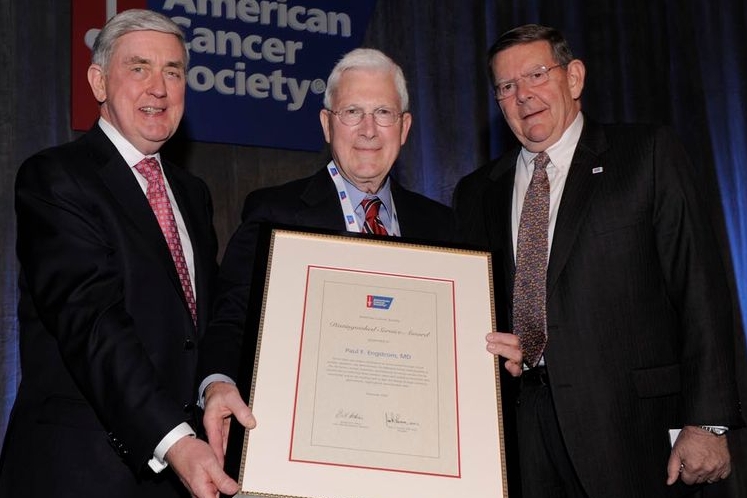
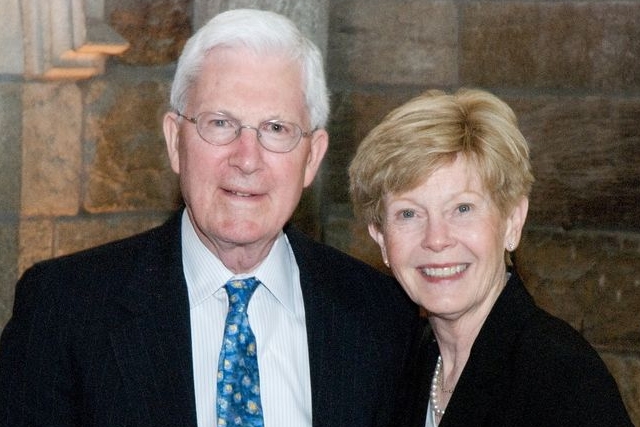
    Dr. Engstrom (center) earned many awards over his long career.

    He was also vice president for population science and held the Samuel M.V. Hamilton endowed chair in cancer prevention. He specialized in treating gastrointestinal cancers and neuroendocrine tumors. He retired in 2018 but continued as a special adviser to the Fox Chase president.

    He cofounded the National Comprehensive Cancer Network and was a fellow of the American College of Physicians and longtime member of the American Association of Cancer Research and other groups. He served on many boards and earned a clinical care achievement award in 2013 from the Association of Community Cancer Centers.

    In 2016, Dr. Engstrom and his wife, Janet, were honored by Fox Chase colleagues for their combined 80 years of service to the center. In 2020, colleagues published a series of articles about his career in the journal Cancer Prevention Research. In 2023, friends, colleagues, patients, and his family established the Paul F. Engstrom professorship in oncology at Fox Chase.

    Dr. Engstrom edited, wrote, or cowrote hundreds of research papers and lectured around the world. He was drafted into the Army in 1967, rose to the rank of major, and served three years as head of hematology and oncology at Tripler Army Hospital in Honolulu.

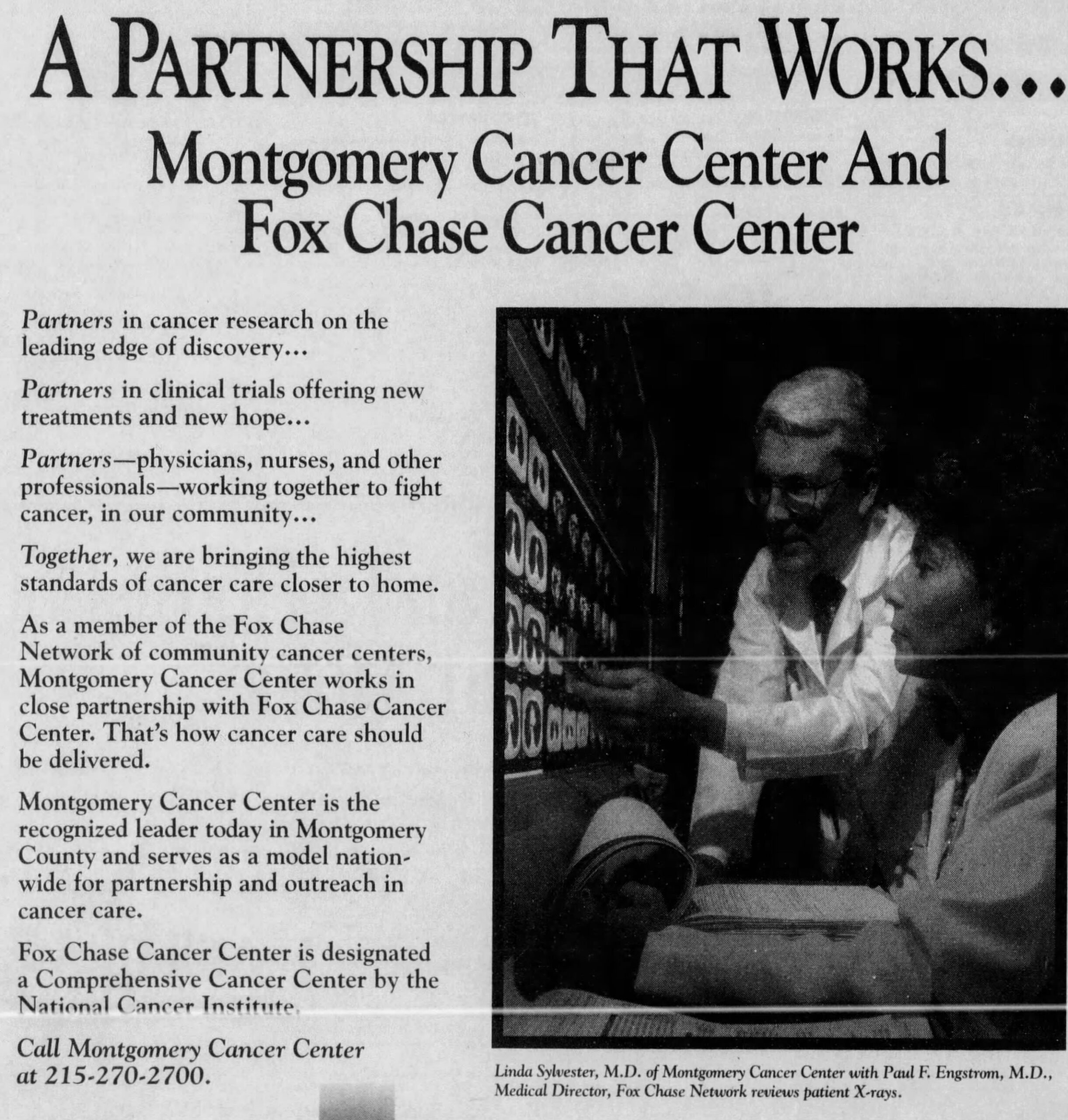
    Dr. Engstrom (left in the photo) appeared in many print advertisements for the Fox Chase Cancer Center, such as this 1995 ad in The Inquirer.

    “Medicine is a great career,” he said in 2018. “It is still the most satisfying and the best opportunity to do well, but most importantly to do good.”

    Paul Frederick Engstrom was born May 28, 1936, in St. Cloud, Minn. He played football and basketball, ran track, played trombone in the high school band, and sang in the school chorus.

    His father was the only doctor in Belgrade, Minn., and Dr. Engstrom knew early he was going to be a doctor, too. He earned a bachelor’s degree at St. Olaf College in Minnesota and completed a public health fellowship at the California Department of Health during medical school.

    He met nurse Janet Johnson during a procedure in a Minnesota hospital in 1960, and they married in 1961. They lived in Hawaii while he served in the Army and in Ambler until recently, and had daughters Karin and Maria, and a son, David.

    Dr. Engstrom met his wife, Janet, when she was an intensive care unit nurse.

    Dr. Engstrom and his wife enjoyed the orchestra, ballet, and theater in Philadelphia. He liked to garden, read, and travel. He was thrifty, his wife said.
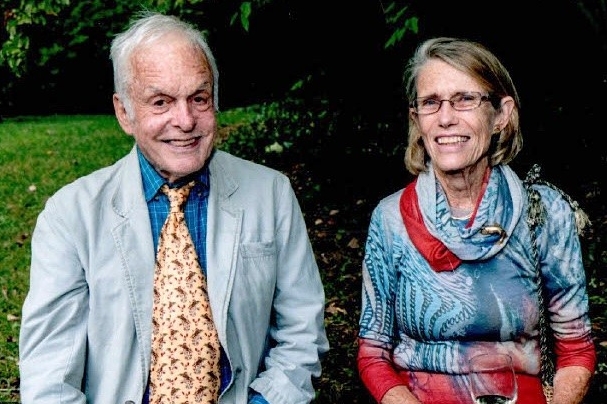
    He followed many of the local college and professional sports teams, especially the Eagles, and sang in the choir at Christ’s Lutheran Church in Oreland. He survived prostate cancer and remained a lifelong learner.

    “He liked being a student,” his wife said. “He was quiet. He was persistent.”
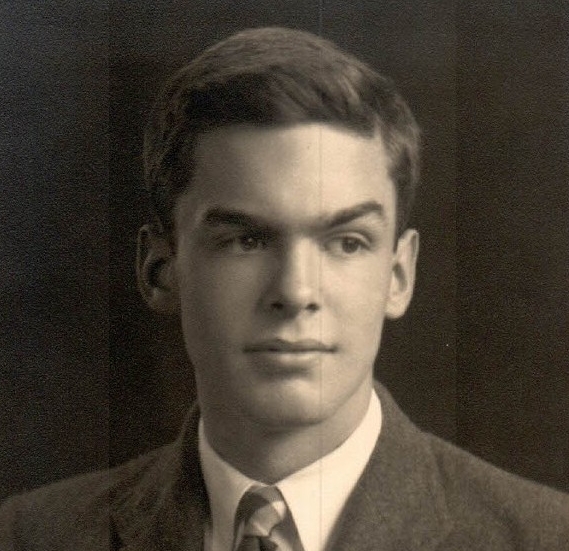
    His family said in a tribute: “He cherished every moment spent with his wife, children, and grandchildren.”

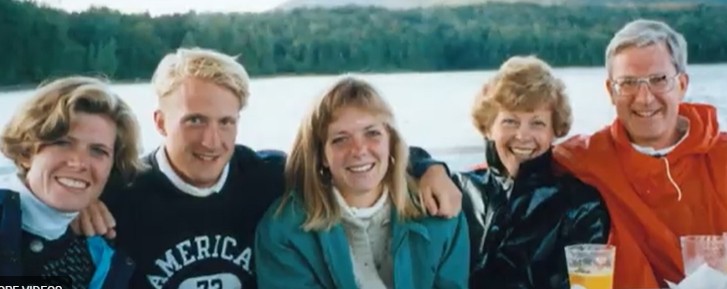
    Dr. Engstrom (right) enjoyed time with his family.

    In addition to his wife and children, Dr. Engstrom is survived by eight grandchildren, a brother, and other relatives. A brother died earlier.

    A celebration of his life was held earlier.

    Donations in his name may be made to the Fox Chase Cancer Center, 333 Cottman Ave., Philadelphia, Pa. 19111; and Christ’s Lutheran Church, 700 E. Pennsylvania Ave., Oreland, Pa. 19075.

  • Robert E. Booth Jr., pioneering knee surgeon and celebrated antiquarian, has died at 80

    Robert E. Booth Jr., pioneering knee surgeon and celebrated antiquarian, has died at 80

    Robert E. Booth Jr., 80, of Gladwyne, renowned pioneering knee surgeon, former head of the Department of Physical Medicine and Rehabilitation at Pennsylvania Hospital, celebrated antiquarian, professor, researcher, writer, lecturer, athlete, mentor, and volunteer, died Thursday, Jan. 15, of complications from cancer at his home.

    Born in Philadelphia and reared in Haddonfield, Dr. Booth was a top honors student at Haddonfield Memorial High School, Princeton University, and what is now the Perelman School of Medicine at the University of Pennsylvania. He was good at seeing things differently and went on to design new artificial knee joint implants and improved surgical instruments, serve as chief of orthopedics at Pennsylvania Hospital, and mentor celebrated surgical staffs at Jefferson Health, Aria Health, and Penn Medicine.

    He joined with two other prominent doctors to cofound the 3B orthopedic private practice in the late 1990s and, over 50 years until recently, performed more than 50,000 knee replacements, more than anyone, according to several sources. Last March 26, he did five knee replacements on his 80th birthday.

    In a tribute, fellow physician Alex Vaccaro, president of Rothman Orthopaedic Institute, said: “He restored mobility to thousands, pairing unmatched technical mastery with a compassion that patients never forgot.”

    In a 1989 story about his career, Dr. Booth told The Inquirer: “It’s so much fun and so gratifying and so rewarding to see what it means to these people. You don’t see that in the operating room. You see that in the follow-ups. That’s the fun of being a surgeon.”

    Friends called him “a legend in his profession” and “a friend to everyone” in online tributes. He was known to check in with patients the night before every surgery, and a colleague said online: “Patients were all shocked by his compassion.”

    Dr. Booth was also praised for his organization and collaboration in the operating room. “His OR was a clinic in team work and efficiency,” a former colleague said on LinkedIn.

    He told Medical Economics magazine in 2015: “I love fixing things. I like the mechanics and the positivity of something assembled and fixed.”

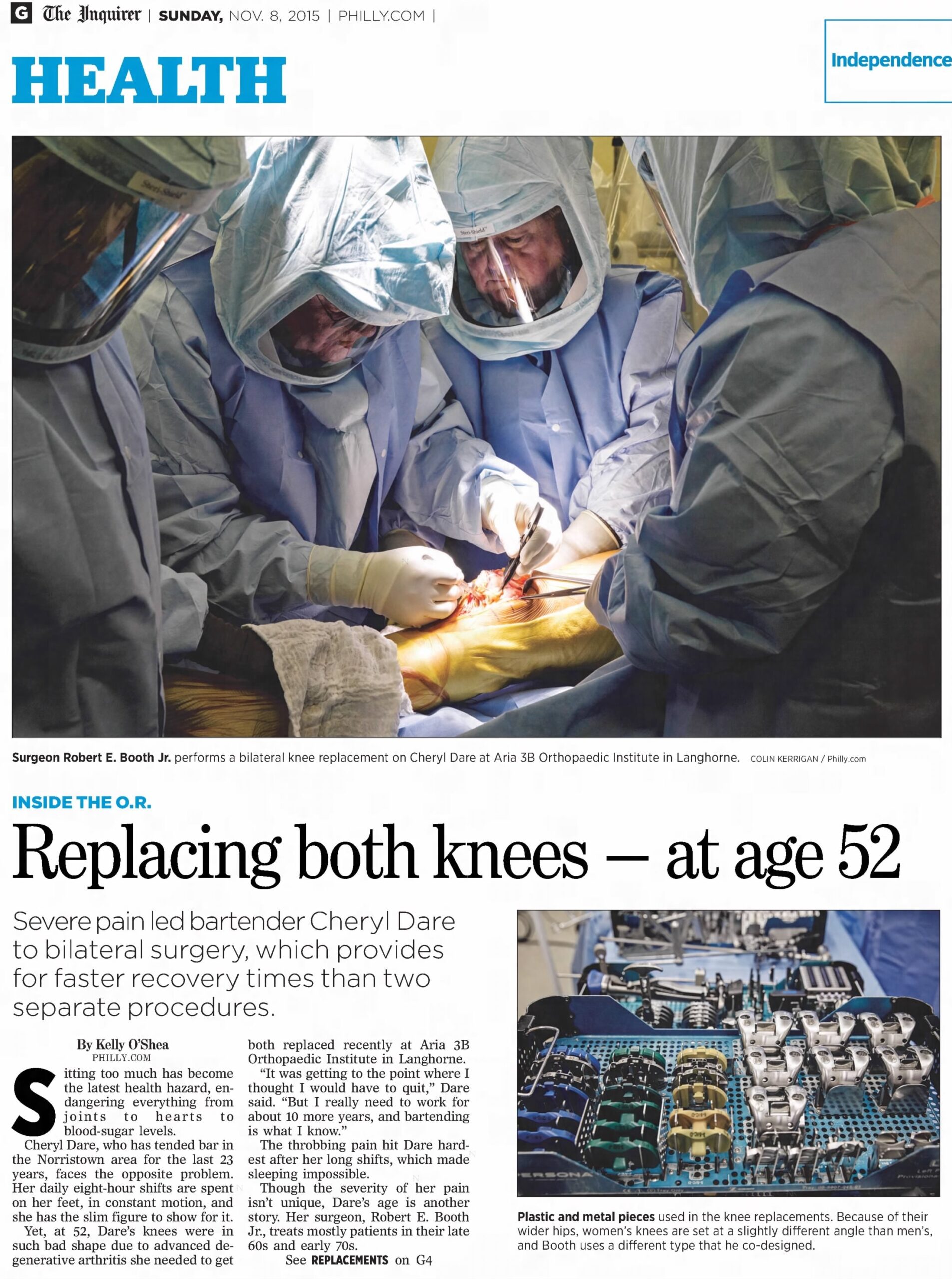
    This article about Dr. Booth’s practice was published in The Inquirer in 2015.

    His procedural innovations reduced infection rates and increased success rates. They were scrutinized in case studies by Harvard University and others, and replicated by colleagues around the world. Some of the instruments he redesigned, such as the Booth retractor, bear his name.

    He was president of the Illinois-based Knee Society in the early 2000s and earned its 2026 lifetime achievement award. In an Instagram post, colleagues there called him “one of the most influential leaders in the history of knee arthroplasty.”

    He was a professor of orthopedics at Penn’s school of medicine, Thomas Jefferson University Hospital, and the old Allegheny University of Health Sciences. He loved language and studied poetry on a scholarship in England after Princeton and before medical school at Penn. He told his family that his greatest professional satisfaction was using both his “manual and linguistic skills.”

    He was onetime president of the International Spine Study Group and volunteered with the nonprofit Operation Walk Denver to provide free surgical care for severe arthritis patients in Panama, Guatemala, Honduras, Nicaragua, and elsewhere. Colleagues at Operation Walk Denver noted his “remarkable spirit, profound expertise, and unwavering commitment” in a Facebook tribute.

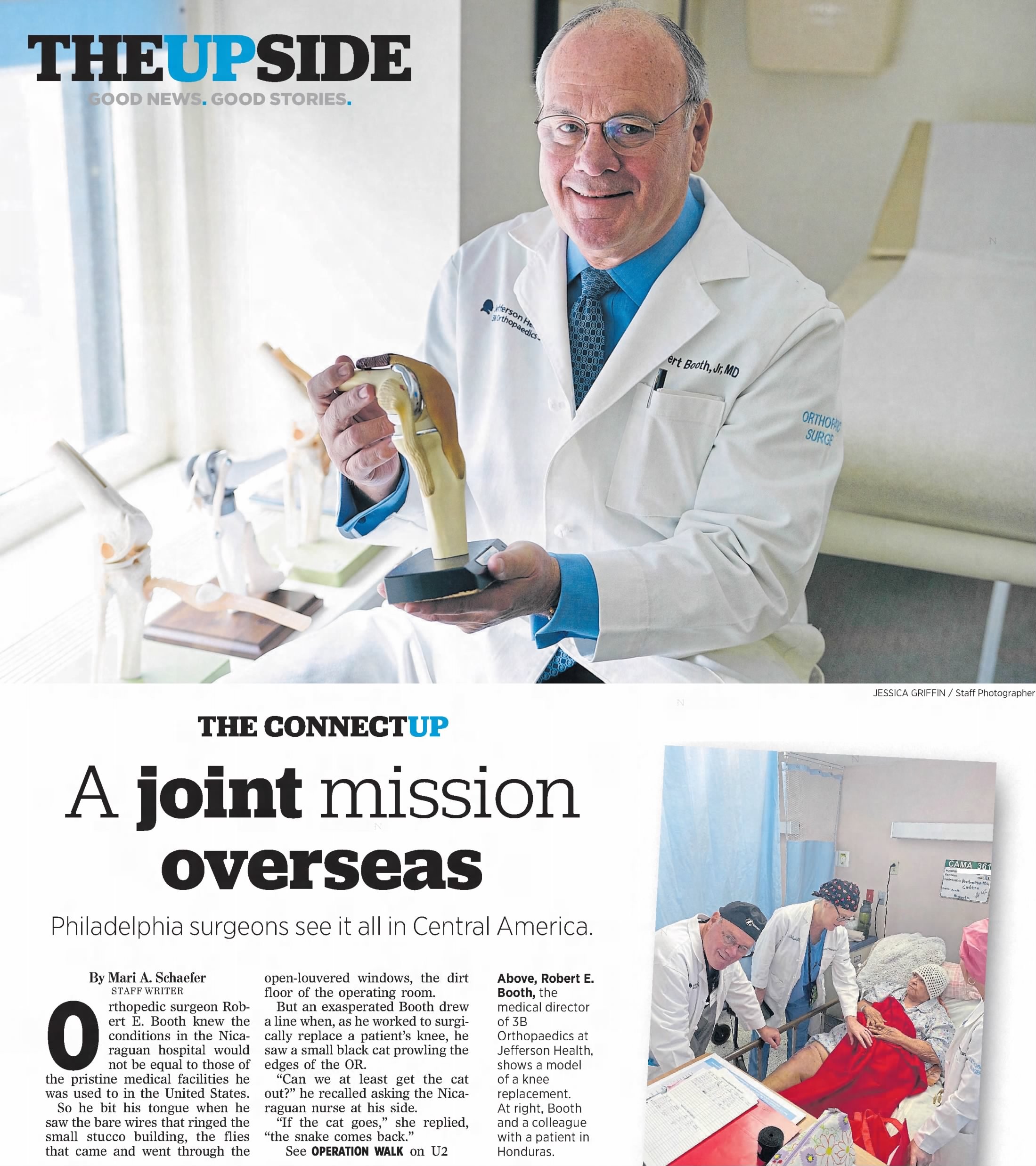
    This story about Dr. Booth’s charitable work abroad appeared in The Inquirer in 2020.

    At home, Dr. Booth and his wife, Kathy, amassed an extensive collection of Shaker and Pennsylvania German folk art. They curated five notable exhibitions at the Philadelphia Antiques Show and were recognized as exceptional collectors in 2011 by the Philadelphia Society for the Preservation of Landmarks.

    He lectured widely about art and antiques, and wrote articles for Magazine Antiques and other publications. He was president of the American Folk Art Society and active at the Philadelphia Museum of Art, the Metropolitan Museum of Art in New York, and the Canterbury Shaker Village in New Hampshire.

    “He was larger than life for sure,” said his daughter, Courtney.

    Robert Emrey Booth Jr. was born March 26, 1945, in Philadelphia. He was the salutatorian of his senior class and ran track and field at Haddonfield High School.

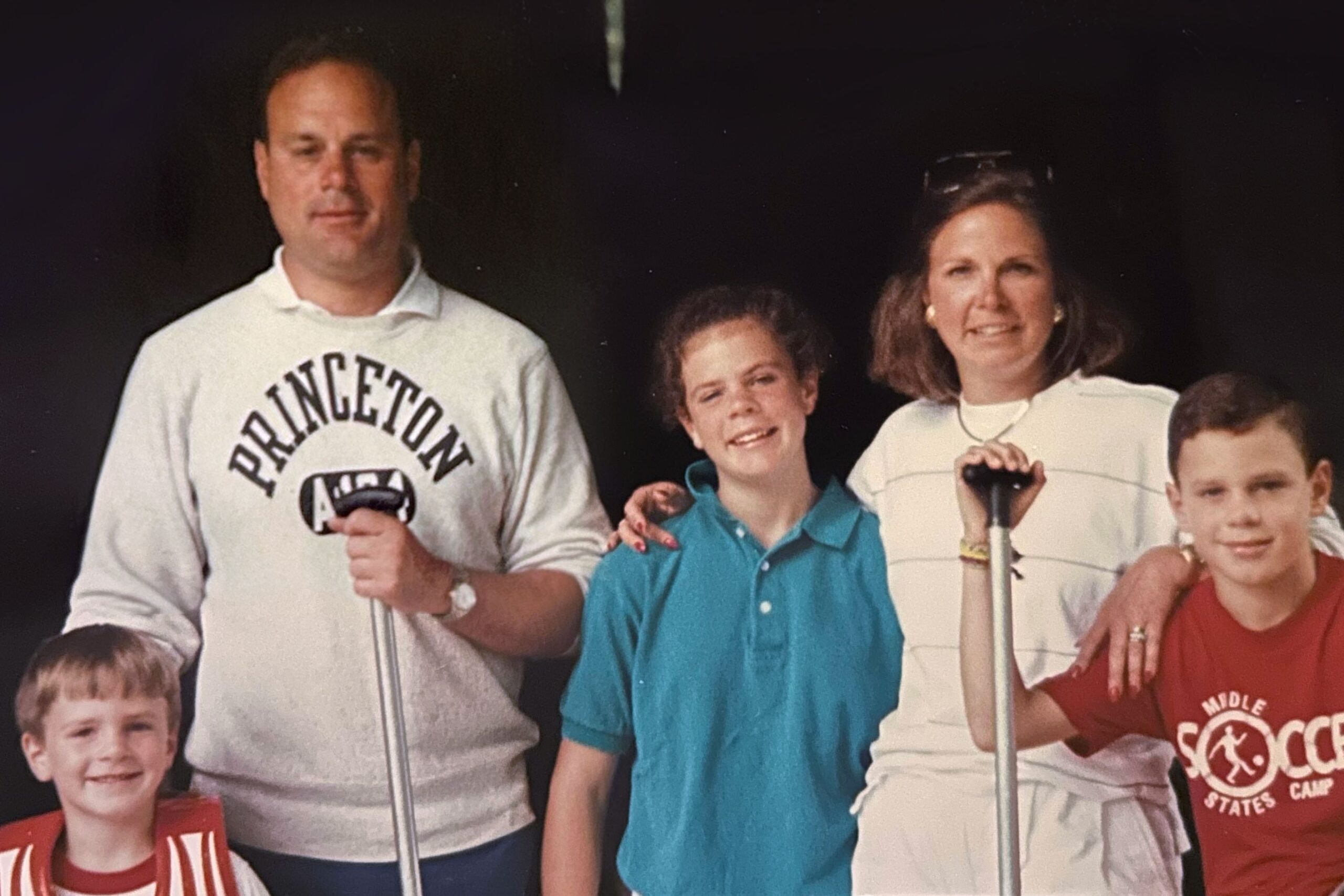
    Dr. Booth enjoyed time with his family.

    He earned a bachelor’s degree in English at Princeton in 1967, won a letter on the swimming and diving team, and played on the school’s Ivy League championship lacrosse team as a senior. He wrote his senior thesis about poet William Butler Yeats and returned to Philadelphia from England at the suggestion of his father, a prominent radiologist, to become a doctor. He graduated from Penn’s medical school in 1972.

    “I always liked the intellectual side of medicine,” he told Medical Economics. “And once I got to see the clinical side, I was pretty well hooked.”

    He met Kathy Plummer at a wedding, and they married in 1972 and had a daughter, Courtney, and sons Robert and Thomas. They lived in Society Hill, Haddonfield, and Gladwyne.

    Dr. Booth liked to ski and play golf. He was an avid reader and enjoyed time with his family on Lake Kezar in Lovell, Maine.

    “He was quite the person, quite the partner, and quite the husband,” his wife said, “and I’m so proud of what we built together.”

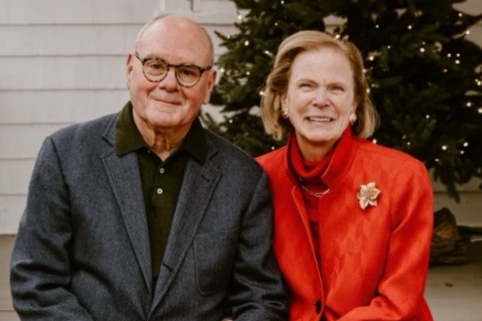
    Dr. Booth and his wife, Kathy, married in 1972.

    In addition to his wife and children, Dr. Booth is survived by six grandchildren and other relatives.

    A private celebration of his life is to be held later.

    Donations in his name may be made to Operation Walk Denver, 950 E. Harvard Ave., Suite 230, Denver, Colo. 80210.

  • Trump announces outlines of healthcare plan he wants Congress to consider

    Trump announces outlines of healthcare plan he wants Congress to consider

    WASHINGTON — President Donald Trump on Thursday announced the outlines of a healthcare plan he wants Congress to take up as Republicans have faced increasing pressure to address rising health costs after lawmakers let subsidies expire.

    The cornerstone is his proposal to send money directly to Americans for health savings accounts so they can handle insurance and health costs as they see fit. Democrats have rejected the idea as a paltry substitute for the tax credits that had helped lower monthly premiums for many people.

    “The government is going to pay the money directly to you,” Trump said in a taped video the White House released to announce the plan. “It goes to you and then you take the money and buy your own healthcare.”

    Trump’s plan also focuses on lowering drug prices and requiring insurers to be more upfront with the public about costs, revenues, rejected claims and wait times for care.

    Trump has long been dogged by his lack of a comprehensive healthcare plan as he and Republicans have sought to unwind former President Barack Obama’s signature legislation, the Affordable Care Act. Trump was thwarted during his first term in trying to repeal and replace the law.

    When he ran for president in 2024, Trump said he had only “concepts of a plan” to address healthcare. His new proposal, short on many specifics, appeared to be the concepts of a plan.

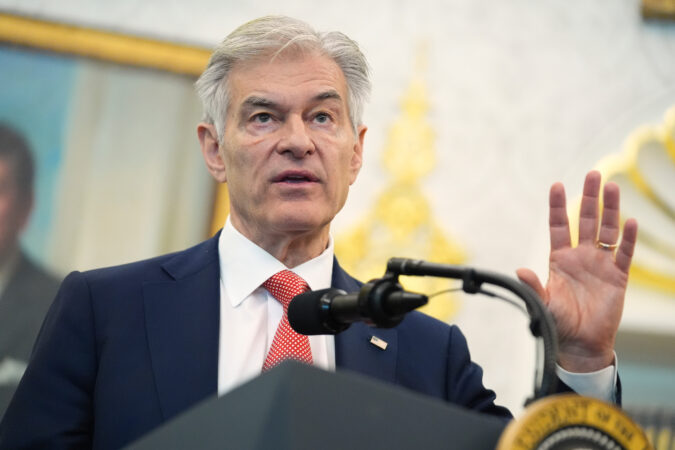
    Mehmet Oz, administrator of the Centers for Medicare and Medicaid Services, described it to reporters on a telephone briefing as a “framework that we believe will help Congress create legislation.”

    It was not immediately clear if any lawmakers in Congress were working to introduce the Republican president’s plan. A White House official who was not authorized to speak publicly and described some details on condition of anonymity said the administration had been discussing the proposal with allies in Congress, but was unable to name any lawmakers who were working to address the plan.

    Few specifics on health savings accounts

    The White House did not offer any details about how much money it envisioned being sent to consumers to shop for insurance, or whether the money would be available to all “Obamacare” enrollees or just those with lower-tier bronze and catastrophic plans.

    The idea mirrors one floated among Republican senators last year. Democrats largely rejected it, saying the accounts would not be enough to cover costs for most consumers. Currently, such accounts are used disproportionately by the wealthiest Americans, who have more income to fund them and a bigger incentive to lower their tax rate.

    White House press secretary Karoline Leavitt was asked at her briefing Thursday whether the president could guarantee that under his plan, people would be able to cover their health costs. She did not directly answer, but said, “If this plan is put in place, every single American who has health care in the United States will see lower costs as a result.”

    Enhanced tax credits that helped reduce the cost of insurance for the vast majority of Affordable Care Act enrollees expired at the end of 2025 even though Democrats had forced a 43-day government shutdown over the issue.

    Sen. Bernie Moreno (R., Ohio) has been leading a bipartisan group of 12 senators trying to devise a compromise that would extend those subsidies for two years while adding new limits on who can receive them. That proposal would create the option, in the second year, of a health savings account that Trump and Republicans prefer.

    The White House official denied that Trump was closing the door completely on those bipartisan negotiations, and said the White House preferred to send money directly to consumers.

    Plan follows massive cuts to health programs

    Trump’s plan comes months after the Republicans’ big tax and spending bill last year cut more than $1 trillion over a decade in federal healthcare and food assistance, largely by imposing work requirements on those receiving aid and shifting certain federal costs to the states.

    Democrats have blasted those cuts as devastating for vulnerable people who rely on programs such as Medicaid for their healthcare. The GOP bill included an infusion of $50 billion over five years for rural health programs, an amount experts have said is inadequate to fill the gap in funding.

    The White House said Trump’s new proposal will seek to bring down premiums by fully funding cost-sharing reductions, or CSRs, a type of financial help that insurers give to low-income ACA enrollees on silver-level, or mid-tier plans.

    From 2014 until 2017, the federal government reimbursed insurance companies for CSRs. In 2017, the first Trump administration stopped making those payments. To make up for the lost money, insurance companies raised premiums for silver-level plans. That ended up increasing the financial assistance many enrollees got to help them pay for premiums.

    As a result, health analysts say that while restoring money for CSRs would likely bring down silver-level premiums, as Trump says, it could have the unwelcome ripple effect of increasing many people’s net premiums on bronze and gold plans.

    Lowering drug prices is a priority

    Oz said Trump’s plans also seeks to have certain medications made available over the counter instead of by prescription if they are deemed safe enough. He mentioned higher-dose nonsteroidal anti-inflammatory drugs and peptic ulcer drugs as two examples.

    It was unclear whether the White House is asking Congress to take steps to make more prescription drugs available over the counter. For decades, the Food and Drug Administration has had the ability to do that.

    The heartburn drug Prilosec, as well as numerous allergy medications, are among those the FDA has approved for over-the-counter sales. The FDA only approves such changes if studies show patients can safely take the drug after reading the package labeling. Companies must apply for the switch.

    The White House said Trump’s plan would also codify his efforts to lower drug prices by tying prices to the lowest price paid by other countries.

    Trump has already struck deals with a number of drugmakers to get them to lower the prices. As part of that, the drugmakers have agreed to sell pharmacy-ready medicines directly to consumers who can shop online at the White House’s website for selling drugs directly to consumers, TrumpRx.gov.

    TrumpRx did not yet have any drugs listed on Thursday. Oz said drugs will be available on the website at the end of the month.

  • Trump administration slashes funding for substance abuse and mental health programs nationwide

    Trump administration slashes funding for substance abuse and mental health programs nationwide

    NEW YORK — The Trump administration has made abrupt and sweeping cuts to substance abuse and mental health programs across the country in a move that advocates said will jeopardize the lives of some of the country’s most vulnerable.

    The Substance Abuse and Mental Health Services Administration on Tuesday night canceled some 2,000 grants representing nearly $2 billion in funding, according to an administration official with knowledge of the cuts who was not authorized to discuss them publicly.

    The move pulls back funding for a wide swath of discretionary grants and represents about a quarter of SAMHSA’s overall budget. It builds on other, wide-ranging cuts that have been made at the Department of Health and Human Services, including the elimination of thousands of jobs and the freezing or canceling of billions of dollars for scientific research.

    The latest funding cuts immediately jeopardize programs that give direct mental health services, opioid treatment, drug prevention resources, peer support and more to communities affected by addiction, mental illness and homelessness.

    “Without that funding, people are going to lose access to lifesaving services,” said Yngvild Olsen, former director of SAMHSA’s Center for Substance Abuse Treatment and a national adviser at Manatt Health. “Providers are going to really need to look at potentially laying off staff and not being able to continue.”

    Funding tied to agency’s priorities

    SAMHSA, a sub-agency of HHS, notified grant recipients that their funding would be canceled effective immediately in emailed letters on Tuesday evening, according to several copies received by organizations and reviewed by The Associated Press.

    The letters, signed by SAMHSA Principal Deputy Assistant Secretary Christopher Carroll, justified the terminations using a regulation that says the agency may terminate any federal award that “no longer effectuates the program goals or agency priorities.”

    Grant recipients who were notified of the cancellations said they were confused by that explanation and didn’t get any further detail about why the agency felt their work didn’t match up with SAMHSA’s priorities.

    “The goal of our grants is entirely in line with the priorities listed in that letter,” said Jamie Ross, CEO of the Las Vegas-based PACT Coalition, a community organization focused on substance use issues that lost funding from three grants totaling $560,000.

    HHS didn’t respond to a request for comment on the funding cancellations, which were first reported by NPR. Two sources within SAMHSA who were not authorized to speak to media said staff weren’t widely notified of the agency’s action.

    Programs at risk after funding is slashed

    Organizations reeling from the news on Wednesday told the AP they had already been forced to cut staff and cancel trainings. In the long term, many were considering whether they could keep programs alive by shuffling them to different funding sources or whether they’d need to stop the services altogether.

    Robert Franks, CEO of the Boston-based mental health provider the Baker Center for Children and Families, which lost two federal grants totaling $1 million, said the loss of funding will force his organization to lay off staff and put care in jeopardy for some 600 families receiving it. One of the canceled grants had been awarded through the National Child Traumatic Stress Initiative, a more than 20-year-old program supporting specialized care for children who have been through traumatic events ranging from sexual abuse to school violence.

    Franks said his organization’s work directly advances SAMHSA’s goals to address mental illness. He said trauma care provided to children through his organization helps people from all walks of life and reduces burdens on other parts of society.

    “The reality is these programs are probably our most effective tool in addressing the issues that they identify as being critical to them,” he said. “Honestly, I don’t understand it.”
    The National Association of County Behavioral Health and Developmental Disability Directors, a group that represents local organizations that deliver safety net services, sent a letter to its members on Wednesday noting that many of its partners estimated the funding pullbacks were focused on grants classified as Programs of Regional and National Significance. They also said the grants totaled around 2,000 and likely amounted to some $2 billion.

    The group said it believed certain block grants, 988 suicide and crisis lifeline funding and Certified Community Behavioral Health Clinics were spared from the cuts.

    For Honesty Liller, CEO of the peer support organization the McShin Foundation in Richmond, Va., the loss of about $1.4 million in funding is personal. She said the foundation she leads saved her life 18 years ago when she was struggling with a heroin addiction.

    The terminated grant has already forced Liller to lay off five staff members. It will mean fewer peers are available to go into local jails and visit incarcerated people who are recovering from substance abuse disorder.

    “They need hope dealers like us, they need people that have lived experience in recovery and they need this funding,” Liller said. “I’ve just never felt so gut punched.”

  • Kids get free dental care at this Philly school. Officials say it’s a model that could be replicated in schools with empty space.

    Kids get free dental care at this Philly school. Officials say it’s a model that could be replicated in schools with empty space.

    Crystal Edwards didn’t see a dentist until she had a deep cavity at age 10: growing up in a struggling Philadelphia family, the resources to access dental checkups just weren’t there.

    So she jumped at the opportunity to locate a dental clinic in the school where she is now principal, W.D. Kelley, a K-8 in North Philadelphia.

    “This dental clinic is saving lives,” said Edwards.

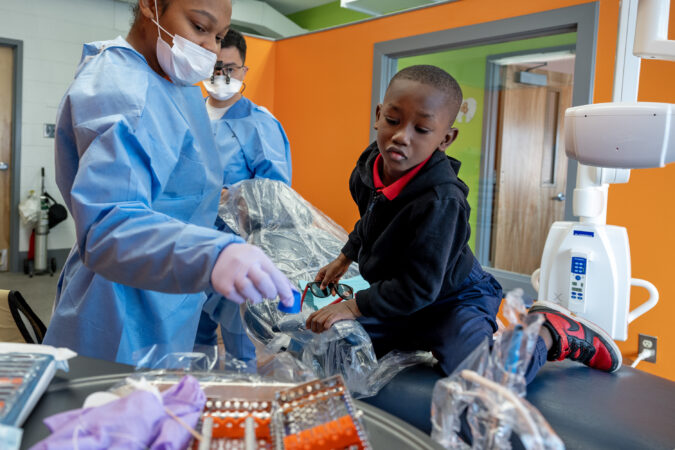
    Tucked into a converted science lab on the school’s third floor, the Dental Clinic at William. D. Kelley, operated by Temple University’s Maurice H. Kornberg School of Dentistry, is nearing its third year of operation. It is open to all Philadelphia children, including those who do not attend Kelley, regardless of insurance status.

    School district officials have pointed to the Kelley clinic as a model as it prepares to make facilities master plan decisions, which will result in closing, combining, and reconfiguring some school buildings. The clinic is an example, they say, of how the system could use available space in some of its schools for public good.

    Soribel Acosta arrives at the Dental Clinic at William D. Kelley public school on Thursday, with her children, Andrea Jimenez (left), 6. And Sayra Jimenez, 7.

    “This is certainly a great example of what can happen when a university partners with a school district to create life-changing opportunities and outcomes for young people,” Superintendent Tony B. Watlington Sr. said in a statement in 2023, when the clinic opened.

    Temple dental school officials said more clinics could follow elsewhere in the city.

    Taking care of every child

    The underlying concept is simple, said Eileen Barfuss, the Temple dental professor who leads the clinic.

    “If your tooth hurts, if you’re not feeling well, you’re not going to learn,” said Barfuss. “In the past, there have been a lot of barriers to care for dentistry that weren’t there for medicine, but preventative care is so important so it doesn’t get to the point of pain.”

    The clinic accepts all comers, including those who are uninsured or underinsured, and sometimes treats students’ parents. (Most, but not all, patients have Medicaid dental, and grants help cover treatment for those without insurance.)

    Temple dentistry student Carly Pandit works on the teeth of Andrea Jimenez, 6, as her mother, Soribel Acosta, entertains sister Sayra Jimenez, 7, waiting her turn in the char at the dental clinic at William D. Kelley public school on Thursday.

    “We try to take care of every child in the Philadelphia School District,” said Barfuss. “There’s a place that they can come and get comprehensive care and establish a dental home.”

    To date, the clinic has seen nearly 700 patients, some of whom are repeat visitors. Patients are treated both by Barfuss and dental students she supervises.

    Students do come from other schools to the clinic; Barfuss said her team does outreach at community events and spreads the word through the district’s school nurses, who often send patients to the clinic. And staff teach lessons in Kelley classrooms on oral health and the importance of seeing a dentist twice a year.

    Being in a school helps normalize the dentist for many kids, who might poke their heads into the clinic to look around and see the friendly dental staff in their scrubs in the hallways, Barfuss said.

    ‘This is a good dentist’

    On Thursday, Fatoumata Bathily, a fourth grader with pink glasses and a bright smile, swung her legs down from a Kelley clinic dentist chair after a successful checkup.

    Eileen K. Barfuss (left), a pediatric dentist and Temple dentistry instructor consults with Fily Dramera after her daughter Fatoumata Bathily (rear), 9, was seen by a Temple student dentist at the Dental Clinic at William D. Kelley public school on Thursday.

    “It’s good here,” said Fatoumata, who attends nearby Robert Morris Elementary, and came for preventive care along with her brother, Abubakr. “This is a good dentist. I like that it’s colorful, and the people are nice.”

    Amid Ismail has wanted to bring such a model to the city since he became dean of Temple’s dental school in 2008. Decades ago, some schools offered dental care via city services, but as funding dried up, those clinics went away, Ismail said.

    Ismail raised the idea of a Temple-district partnership, but it took several years to get off the ground. Edwards, an award-winning principal who takes pride in bringing the community into Kelley, got the vision intuitively, he said.

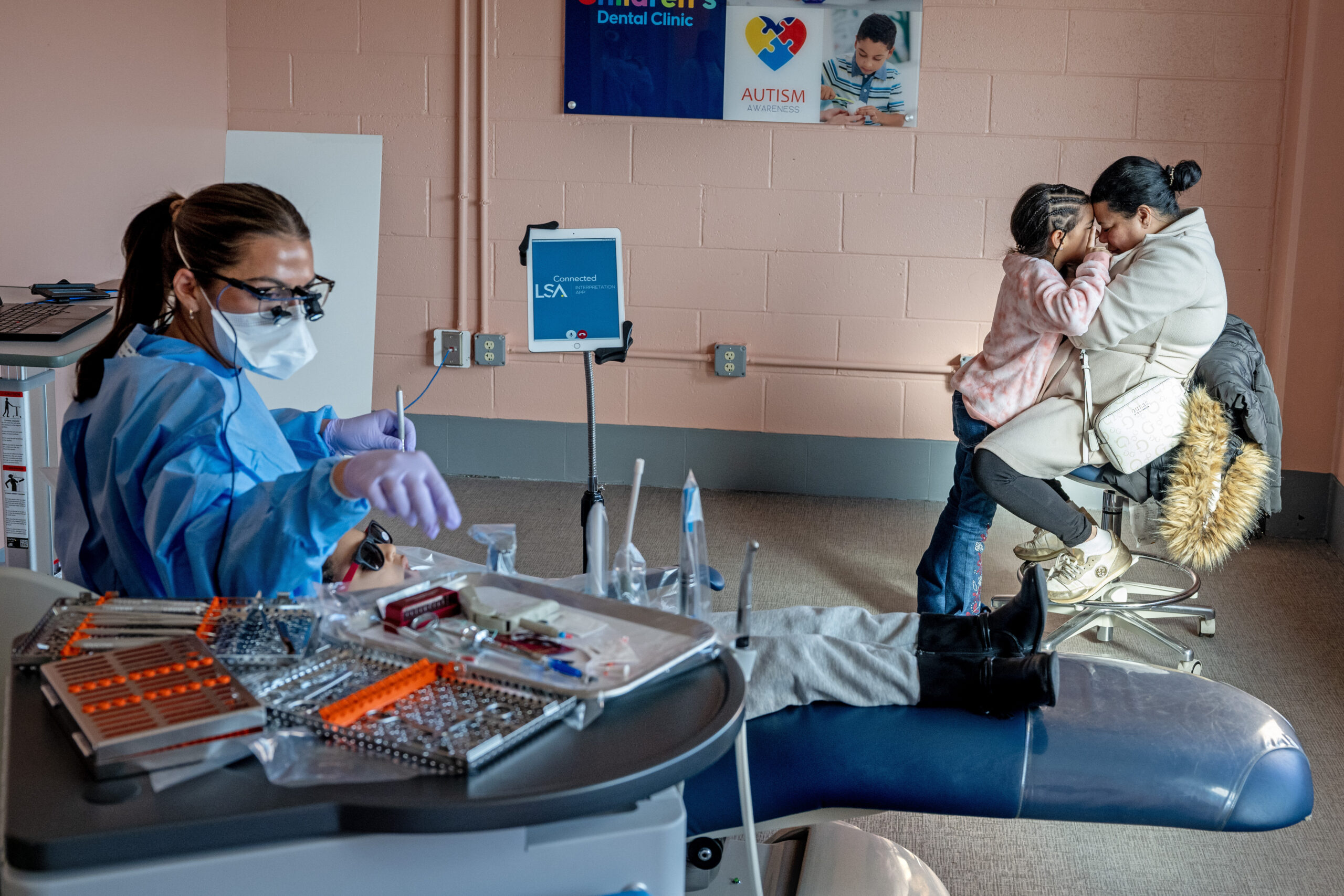
    Temple paid to transform a large science lab into the dental clinic; the district provides the space and does not charge rent. There are four chairs, including one in a space specifically designed for patients with autism who might need a quieter environment and more room. Rooms are bright and modern.

    “The message to the parents and caregivers is that this is a nice place where all treatment is provided,” Ismail said. “A lot of children do have dental problems, but here we can treat them easily — they miss one class, max, and they don’t have to stay a long time.”

    Soribel Acosta waits for their appointment with her children, Sayra Jimenez (left), 7; and Andrea Jimenez (right), 6, at the Dental Clinic at William D. Kelley public school on Thursday.

    The clinic, which is about to celebrate its third anniversary, just expanded its schedule — it’s open four days a week, and officials eventually hope it will be open five days.

    Edwards fought for the clinic to come to Kelley, and it’s been just the boon she had hoped, she said.

    “This is a historic community that was really devastated and hard hit by the crack and drug pandemic,” said Edwards. “The dental office has really given us leverage on how to serve the community better.”

  • David E. Loder, longtime attorney, multifaceted board member, and education advocate, has died at 71

    David E. Loder, longtime attorney, multifaceted board member, and education advocate, has died at 71

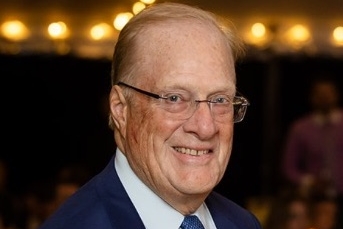
    David E. Loder, 71, of Flourtown, longtime attorney at Duane Morris LLP, multifaceted trustee and board member, education advocate, mentor, and volunteer, died Thursday, Oct. 23, of complications from lymphoma and scleroderma at his home.

    A graduate of Germantown Friends School and what is now the University of Pennsylvania’s Carey Law School, Mr. Loder spent 43 years, from 1982 to his retirement in 2024, as an associate, partner, and chair of the health law group at the Duane Morris law firm. He became partner in 1989 and helped the health law practice gain national recognition for its success.

    Mr. Loder and his team represented the Hospital and Healthsystem Association of Pennsylvania, the Pennsylvania Trauma Systems Foundation, and other medical providers in all kinds of consequential litigation. In 2006, he helped local hospitals win a multimillion-dollar settlement with an insurance company. In 2010, he supervised a case that successfully revived a state abatement program that alleviated medical malpractice costs for physicians and hospitals.

    In a tribute, former colleagues at the Pennsylvania Trauma Systems Foundation praised “his ability to see both the legal complexities and the human dimensions of every situation.”

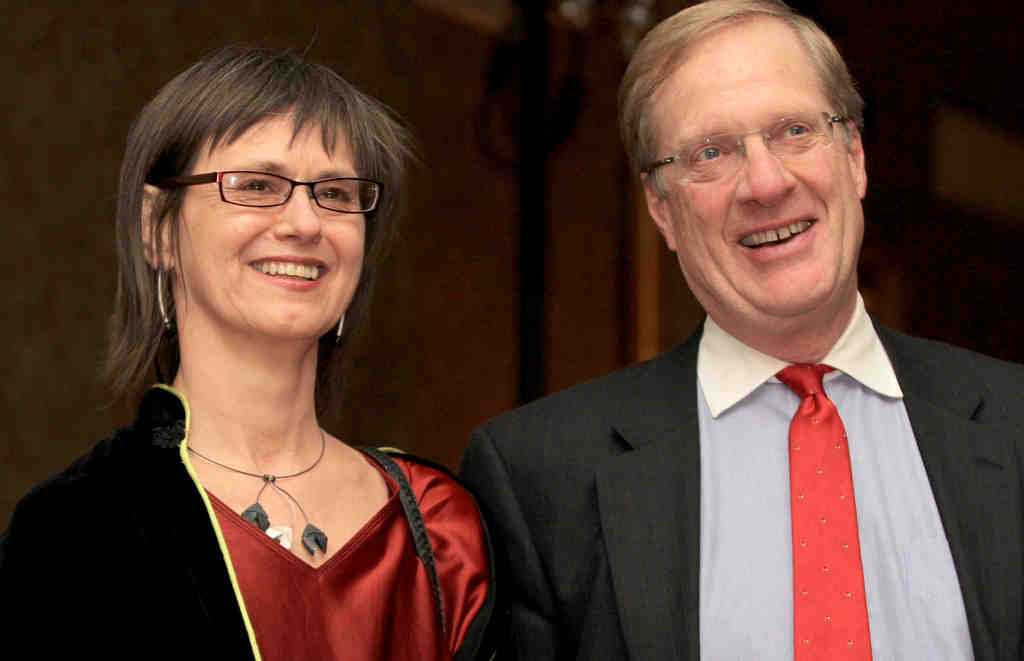
    Mr. Loder stands with Blanka Zizka , the Wilma Theater’s artistic director, at an event in 2018.

    He was adept in vendor contract law, board governance, policy development, and human relations issues. He took special interest in doctor-patient relations and told the Daily News in 2016: “While it is critical that the healthcare provider convey necessary and accurate information to patients concerning their health condition, it is also important to remain sensitive to the patient’s interest and willingness to hear such information.”

    Matthew A. Taylor, chair and chief executive officer at Duane Morris, said in a tribute: “He was one of the nation’s most respected healthcare lawyers.”

    Mr. Loder also represented the Philadelphia Zoo, homeowners fighting increased property assessments, participants in gestational-carrier programs, and other clients. “He was a shrewd judge of character,” said his son Kyle. “He was thoughtful and strategic. He became a confidant and adviser to many of his clients.”

    John Soroko, chair emeritus at Duane Morris, said in a tribute: “Dave had a unique ability to turn friends into clients. But, even more importantly, to turn clients into friends.”

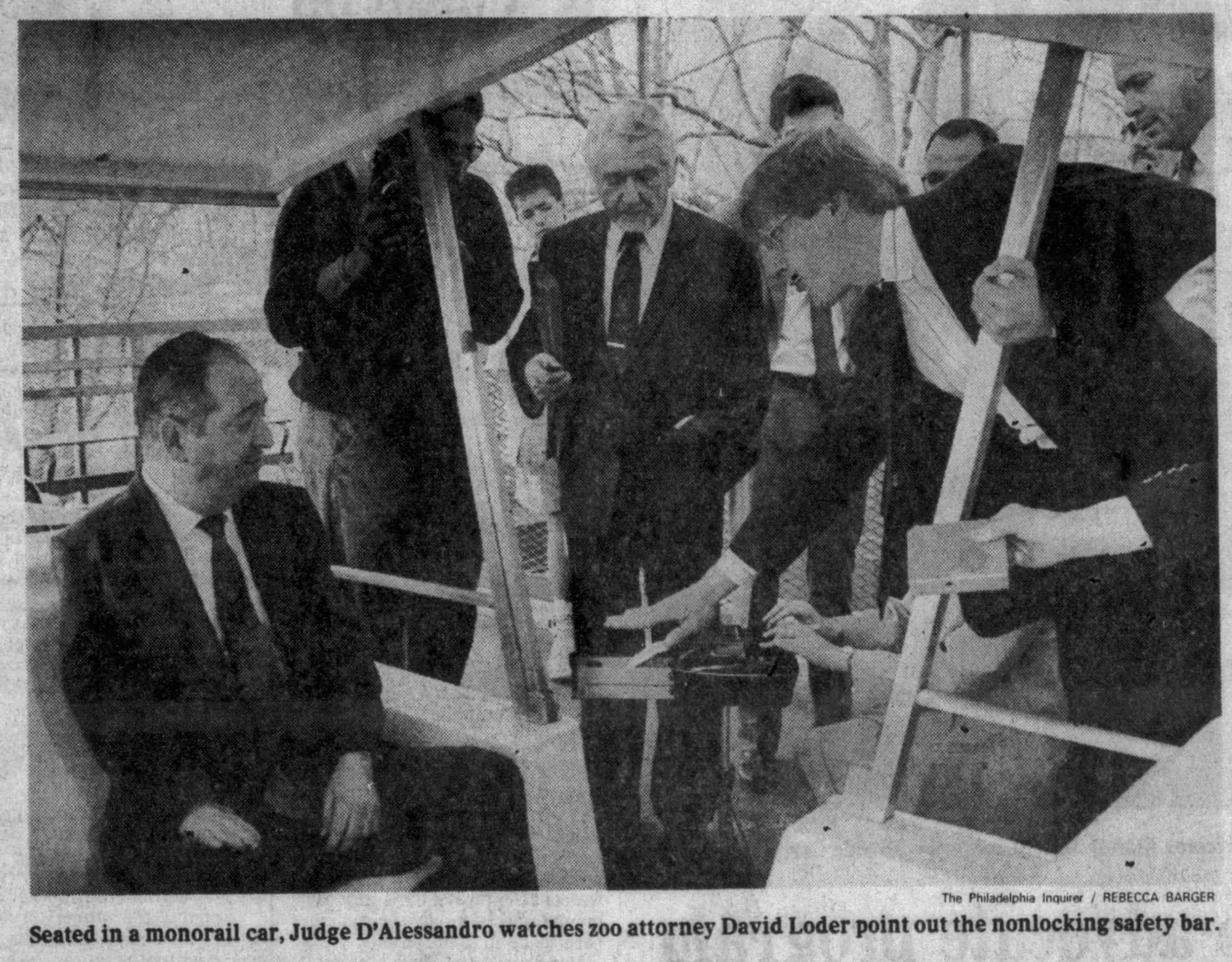
    This photo of Mr. Loder (right) representing the Philadelphia Zoo appeared in The Inquirer in 1989.

    Away from the law firm, Mr. Loder was chair of the board for the Wilma Theater and served on boards at Germantown Friends, the old University of the Sciences, the World Affairs Council of Philadelphia, and other groups. He was a trustee at the Dolfinger-McMahon Foundation and the Christian R. and Mary F. Lindback Foundation, and represented the Lindback regularly at its annual distinguished educators awards ceremony.

    “There’s a firm belief in the importance of excellence in education in the public schools,” he told The Inquirer at the 2016 Lindback ceremony. In 2017, he said: “All of us need to recognize that the Philadelphia public schools are serving an incredibly important function.” In 2018, he said: “People need to know that there are some exceptional educators in Philadelphia public schools.”

    He mentored many other lawyers and volunteered to help students in need. In online tributes, friends noted his “kind advice,” “voice of reason and compassion,” and “sense of humor, keen intellect, love of sports, and limitless knowledge on so many topics.”

    In 1998, he was featured in an Inquirer story about the challenges parents face when dealing with young children stuck inside during the cold winter months. He said: “I find that if you can get the kids down by 6 p.m. and have a glass of wine in front of the fireplace, it gets you through.”

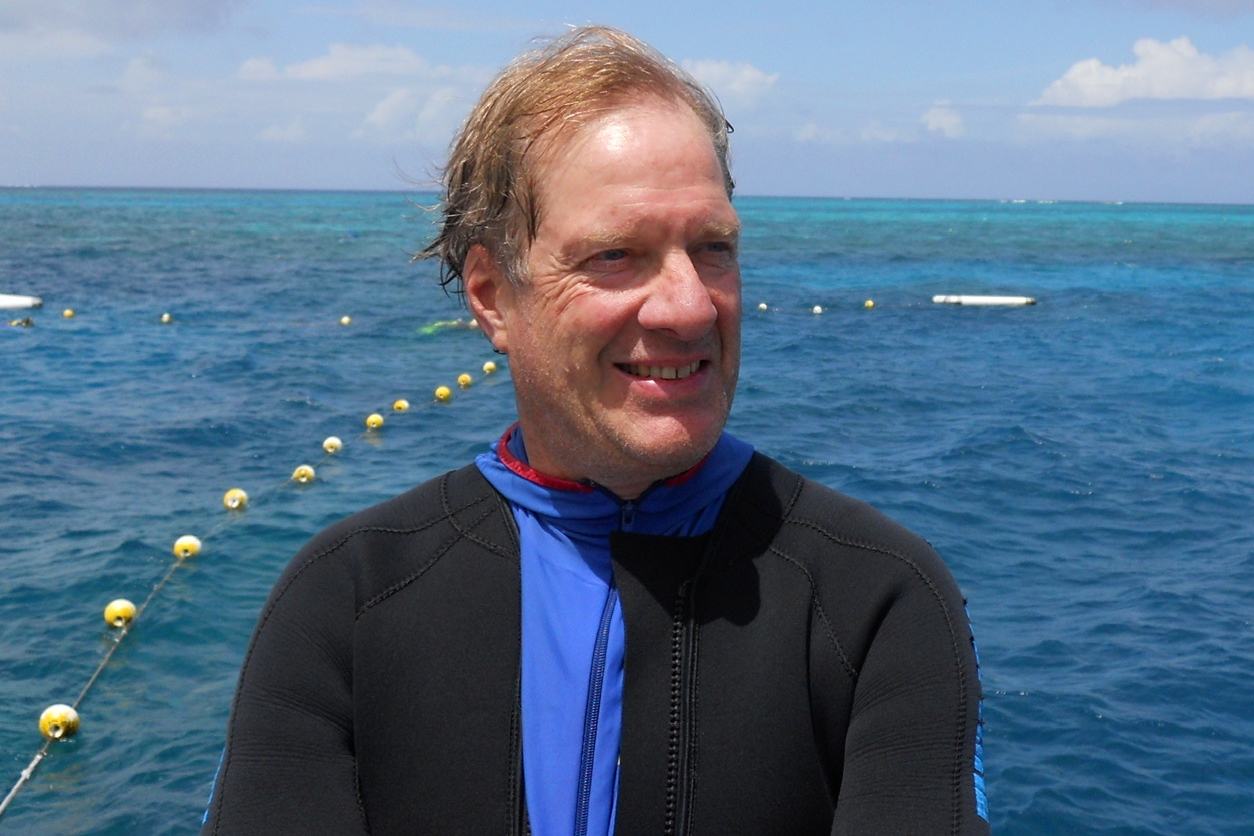
    Mr. Loder enjoyed sports and the outdoors.

    His family said in a tribute: “He took life seriously but never too seriously, and his warmth, humor, guidance, and generosity will be remembered.”

    David Edwin Loder was born April 22, 1954, in Yalesville, Conn. His father, noted theologian Theodore Loder, moved the family to West Mount Airy when Mr. Loder was a boy, and he graduated from Germantown Friends in 1972.

    He starred in football, basketball, and baseball in high school, and went on to play basketball and earn a bachelor’s degree in political science at Wesleyan University in Connecticut in 1977. He worked briefly after college as a high school history teacher, served an independent study fellowship in Poland, earned his law degree at Penn in 1981, and studied international law at the London School of Economics and Political Science.

    He married Nadya Shmavonian, and they had sons Marek and Kyle, and a daughter, Julya, and lived in Philadelphia and Flourtown. After a divorce, he married Jennifer Ventresca and welcomed her children into the family.

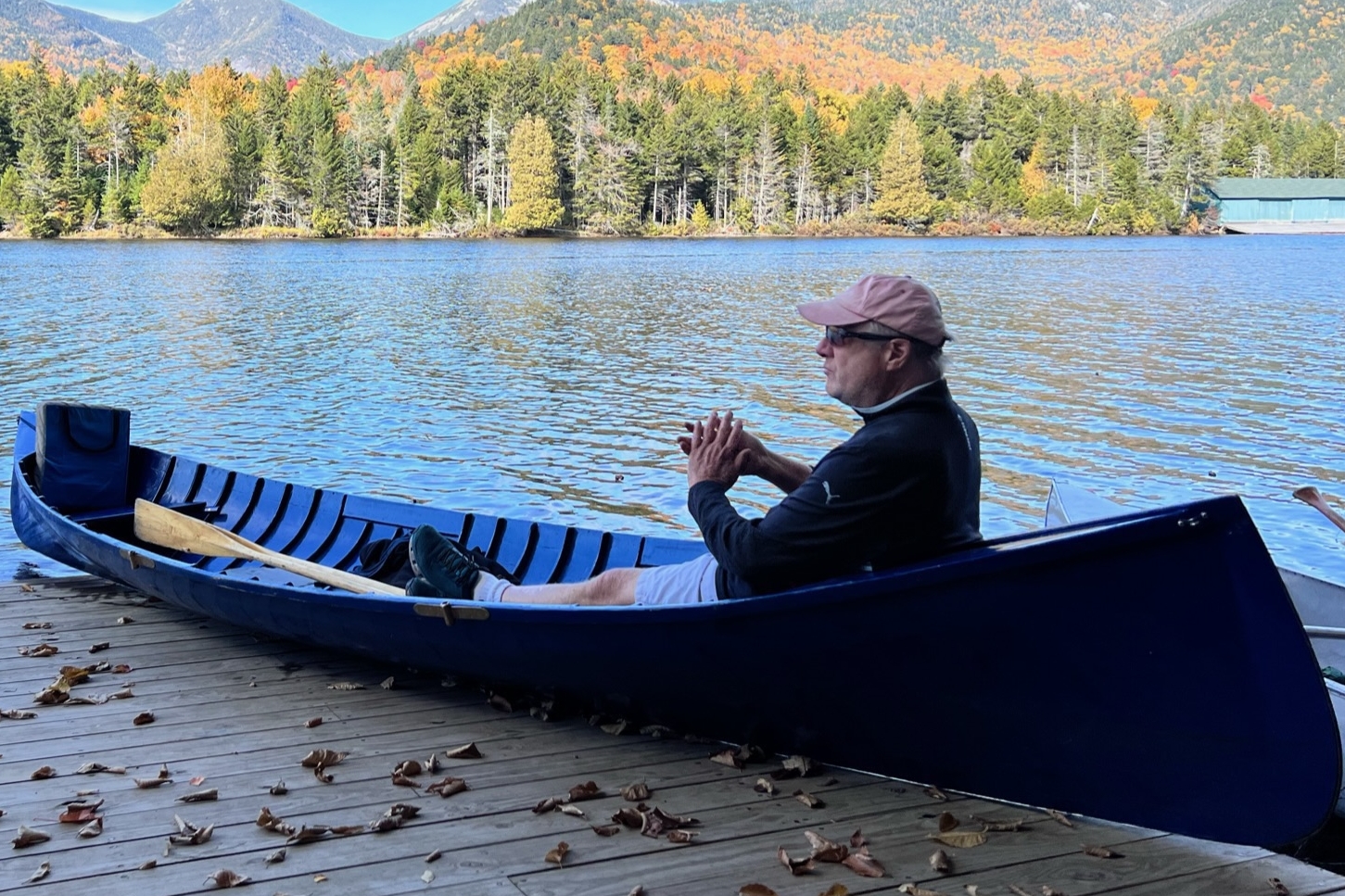
    Mr. Loder liked hiking in New York’s Adirondack Mountains and relaxing at his getaway home on Long Beach Island.

    Mr. Loder enjoyed tennis, squash, and golf at the Philadelphia Cricket Club. He liked hiking in New York’s Adirondack Mountains and relaxing at his getaway home on Long Beach Island, N.J.

    He doted on his family and Labrador, and played cards every month for years with an eclectic group of old friends.

    “David embodied the values of faith, service, and integrity,” his family said. His son Kyle said: “He was magnetic, gracious, thoughtful, and curious. He was easy to talk to.”

    In addition to his wife, children, and former wife, Mr. Loder is survived by a granddaughter, a sister, two brothers, and other relatives.

    Mr. Loder “was magnetic, gracious, thoughtful and curious,” his son Kyle said.

    A memorial service and celebration of his life were held earlier.

    Donations in his name may be made to the Penn Medicine Scleroderma Center, Attn: Amanda Hills, 3535 Market St., Suite 750, Philadelphia, Pa. 19104.

  • Mark Hallett, world-renowned neuroscientist and groundbreaking researcher, has died at 82

    Mark Hallett, world-renowned neuroscientist and groundbreaking researcher, has died at 82

    Mark Hallett, 82, of Bethesda, Md., world-renowned scientist emeritus at the Maryland-based National Institute of Neurological Disorders and Stroke, former chief of the clinical neurophysiology laboratory at Brigham and Women’s Hospital in Boston, associate professor of neurology at Harvard Medical School, groundbreaking researcher, prolific author, mentor, and world traveler, died Sunday, Nov. 2, of glioblastoma at his home.

    Dr. Hallett was born in Philadelphia and reared in Lower Merion Township. He graduated from Harriton High School in 1961 and became a pioneering expert in movement, brain physiology, and human motor control.

    He spent 38 years, from 1984 to his retirement in 2022, at the National Institutes of Health in Bethesda and was clinical director and chief of the medical neurology branch of the National Institute of Neurological Disorders and Stroke. He and his colleagues examined the human nervous system and the brain, and their decades of research helped doctors and countless patients treat dystonia, Parkinson’s, and other neurodegenerative diseases.

    “When I met him, I was in bad shape,” a former patient said on Instagram. “I’d also been told … that no one would ever figure out the source of my illness. … He and his team diagnosed me, and thereby, I’m pretty sure, saved my life”

    Dr. Hallett told the Associated Press in 1992: “The more that we know about the way these cells function, the better off we are.”

    He founded the NINDS’ human motor control section in 1984, cofounded the Functional Neurological Disorder Society in 2018, and served as the society’s first president. He cultivated thousands of colleagues around the world, and they called him a “giant in the field” and a “global expert” in online tributes.

    Barbara Dworetzky, current president of the FNDS, said Dr. Hallett was a “brilliant scientist, visionary leader, and compassionate physician whose legacy will endure.” Former NIH colleagues called his contributions “astounding” and said: “The scope and impact of Dr. Hallett’s work transcend traditional productivity metrics.”

    He chaired scientific committees and conferences, and supervised workshops for many organizations. He earned honorary degrees and clinical teaching awards, and mentored more than 150 fellows at NIH. “Our lab’s demonstration of trans-modal plasticity in humans was another milestone,” he told the NIH Record in 2023. “And, of course, I am particularly proud of the fellows that I have trained and their accomplishments.”

    In a tribute, his family said those he mentored “valued his intellect, his encouragement, his kindness, and his humor.”

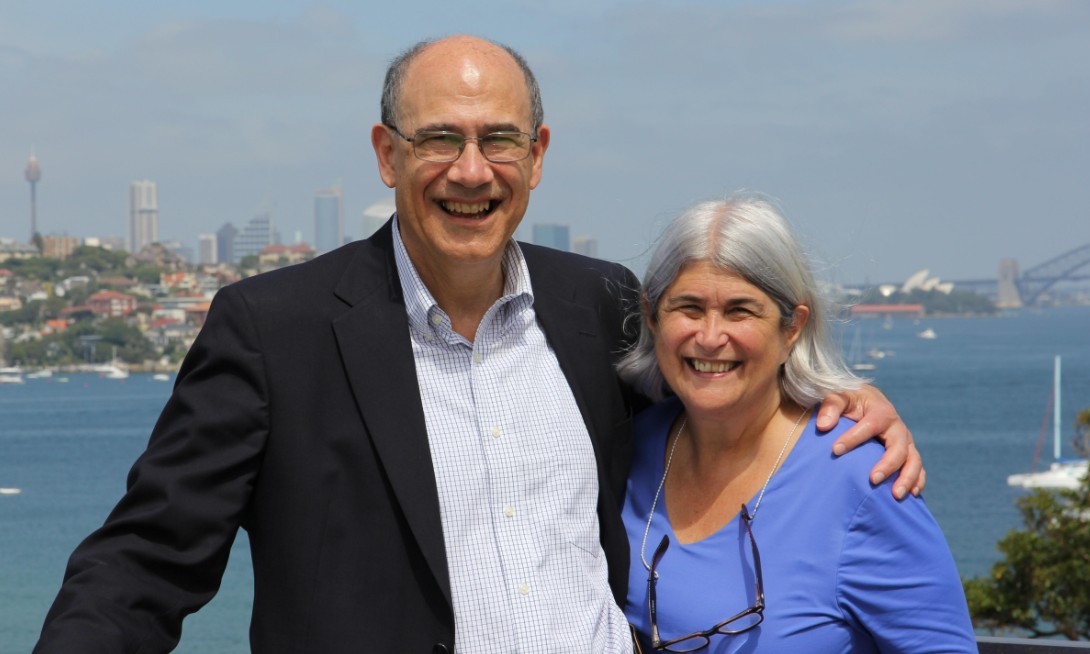
    Dr. Hallett and his wife, Judy, married in 1966.

    Dr. Hallett had planned to study astronomy at Harvard University after high school. Instead, he earned a bachelor’s degree in biology in 1965 and a medical degree at Harvard Medical School in 1969. He completed an internship at the old Peter Bent Brigham Hospital, now part of Brigham and Women’s, and joined a research program at the NIH in 1970 to fulfill his military obligation during the Vietnam War.

    A fellowship in neurophysiology and biophysics at the National Institute of Mental Health sparked his interest in motor control, and he served a neurology residency at Massachusetts General Hospital in 1972 and a fellowship at the Institute of Psychiatry in London in 1974.

    He returned to Brigham and Women’s in 1976 to supervise the clinical neurophysiology laboratory and rose to associate professor of neurology at Harvard. In 2019, he earned the Medal for Contribution to Neuroscience from the World Federation of Neurology, and former colleagues there recently said his work “had a lasting global impact and shaped modern clinical and research practice.”

    He also studied the scientific nature of voluntary movement and free will. He wrote or cowrote more than 1,200 scientific papers on all kinds of topics, edited dozens of publications and books, and served on editorial boards.

    He was past president of the International Federation of Clinical Neurophysiology and the International Parkinson and Movement Disorder Society, and vice president of the American Academy of Neurology.

    At Harriton, he was senior class president, a star tennis player, and a leading man in several theatrical shows. “The only time he disobeyed his parents,” his family said, “was when he decided to leave Philadelphia to attend Harvard College.”

    Mark Hallett was born Oct. 22, 1943. The oldest of three children, he was a natural nurturer, a longtime summer camp counselor, and the winner of an Alfred P. Sloan Foundation national scholarship award in high school.

    He grew up in Merion and met Judith Peller at a party in 1963. They married in 1966 and had a son, Nicholas, and a daughter, Victoria.

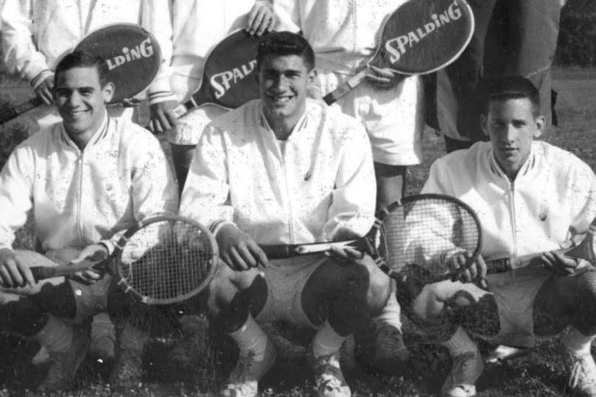
    Dr. Hallett (center) was a star on the Harriton High School tennis team.

    Dr. Hallett was an avid photographer and a master of the family group shot. He championed a healthy work-life balance, and his family said: “He eagerly built sand castles, skipped stones, and started pillow fights. His easy laugh was contagious.”

    He enjoyed hiking, biking, jazz bands, and organizing family vacations. “He was a natural leader,” his son said, “self-assured and patient of others, with a deep sincerity and a desire to help people.”

    His daughter said: “People were constantly turning to him for medical advice, and he was always willing and eager to help.”

    His wife said: “He was very high energy. He brought out the best and the most in young people. He made them feel good about themselves.”

    Dr. Hallett traveled the world on business and family vacations.

    In addition to his wife and children, Dr. Hallett is survived by two granddaughters, a sister, a brother, and other relatives.

    A memorial service is to be held later.

    Donations in his name may be made to the Functional Neurological Disorder Society, 555 E. Wells St., Suite 1100, Milwaukee, Wis. 53202; and the International Parkinson and Movement Disorder Society, 555 E. Wells St., Suite 1100, Milwaukee, Wis. 53202.

  • William L. Elkins, pioneering research immunologist at Penn and innovative Chester County cattle rancher, has died at 93

    William L. Elkins, pioneering research immunologist at Penn and innovative Chester County cattle rancher, has died at 93

    William L. Elkins, 93, of Coatesville, pioneering research immunologist at what is now the University of Pennsylvania’s Perelman School of Medicine, associate professor emeritus of pathology and laboratory medicine, innovative longtime Angus cattle rancher in Chester County, avid sailor, and veteran, died Tuesday, Nov. 11, of complications from pneumonia at Chester County Hospital.

    The great-great-grandson of Philadelphia business tycoon William Lukens Elkins, Dr. Elkins fashioned his own distinguished career as a scientist, medical researcher, and professor at Penn from 1965 to 1985, and owner of the Buck Run Farm cattle ranch in Coatesville for the last 39 years.

    At Penn, Dr. Elkins conducted pioneering research on how the human immune system fights infection and disease. He collaborated with colleagues in Philadelphia and elsewhere around the country to provide critical new research regarding bone marrow transplants and pediatric oncology.

    His work contributed to new and more effective medical procedures at Penn, Children’s Hospital of Philadelphia, and elsewhere, and he instructed students and residents at Penn. But his lifelong love of the fields and rolling hills he roamed as a boy in Chester County never faded, he told Greet Brandywine Valley magazine in 2023.

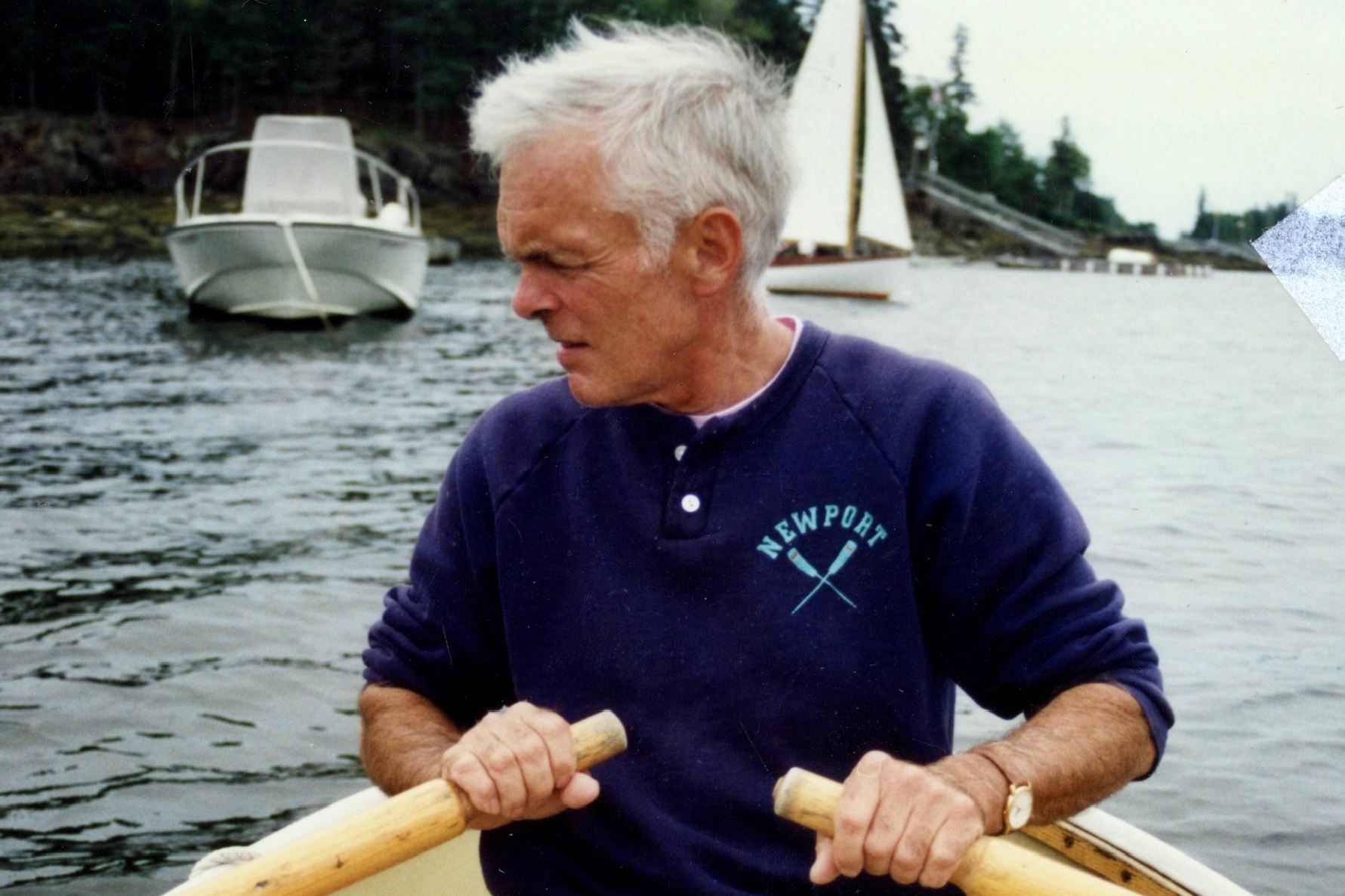
    Dr. Elkins was a lifelong outdoorsman.

    “Farming is in my blood,” he said. “So even when I went to medical school and all that, the enthusiasm never left, and I wanted to go back to it.”

    So he retired from medicine at 53, and he and his wife, Helen, bought nearly 300 acres of the old King Ranch on Doe Run Church Road in Coatesville. She kept the books and looked after the business. He became an expert on breeding cattle and growing the high-energy grass they eat.

    Wearing floppy hats and riding a colorful ATV from field to field, Dr. Elkins worked his land for decades. He mended fences and tended daily to his 120 cows, heifers, and prize bulls.

    He championed holistic regenerative farming and used new scientific systems to feed his cattle. He rejected commercial fertilizer and knew all about soil composition, grass growing, and body fat in cattle.

    Dr. Elkins and his wife, Helen, married in 1966.

    In a 1995 Inquirer story, he said: “Cattle are just like anyone else. If you just turn a few cattle out in a great big field, they will wander around, eat the grass they like best, and leave what they don’t want. That means the less desirable grasses tend to predominate.”

    He traveled the country to confer with other cattlemen and helped found the Southeast Regional Cattlemen’s Association in 1994. He sold his beefsteaks, patties, jerky sticks, and kielbasa grillers to private customers online and to butchers and restaurants.

    At least one local chef featured an item on the menu called Dr. Elkins’ Angusburger. Lots of folks called him Doc.

    He earned his medical degree at Harvard University in 1958 and served two years in the Navy at the hospital in Bethesda, Md. He was a surgical intern in New York and discovered that he preferred the research lab. Before Penn, he worked at the Wistar Institute of biomedical research.

    Dr. Elkins graduated from St. Mark’s School in Massachusetts in 1950.

    Away from the lab, Dr. Elkins was an ocean sailor, expert navigator, and former boat club commodore. He was active with the Brandywine Conservancy, Natural Lands, and other groups, and was lauded by national organizations for his wide-ranging conservation and wildlife efforts.

    He made his farm a haven again for the bobolink grassland songbird and other migratory birds and butterflies that had dwindled. “Buck Run Farm is more about growing grass and trees than beef,” he told Greet Brandywine Valley. “We’re blessed by the land.”

    William Lukens Elkins was born Aug. 2, 1932, in Boston. He lived on the family dairy farm in Pocopson, Chester County, when he was young, went to boarding school in Massachusetts for four years, and earned a bachelor’s degree in biology at Princeton University.

    He met Helen MacLeod at a party in Washington, and they married in 1966 and had a daughter, Sheila, and a son, Jake. They lived in Center City, Society Hill, and Villanova before moving to the farm. “He was easy to be with,” his wife said.

    Dr. Elkins enjoyed sailing and fishing.

    Dr. Elkins loved nature, fishing, and baseball, and he followed the Phillies, the Flyers, and other sports teams. “He had a wonderful bedside manner,” his daughter said. “He was a great listener. He really knew how to support people.”

    His son said: “He was unassuming and direct. He spoke his mind. He connected with so many different people. He was curious about the world around him.”

    His wife said: “He was thoughtful and always concerned about people. He had good humor. He was fun.”

    In addition to his wife and children, Dr. Elkins is survived by five grandchildren and other relatives. A sister died earlier.

    This article about Dr. Elkins and his ranch appeared in The Inquirer in 1995.

    A celebration of his life is to be held later.

    Donations is his name may be made to the Stroud Water Research Center, 970 Spencer Rd., Avondale, Pa. 19311.