DEAR ABBY: My wife’s nephew is getting divorced. The process seems to be amicable; there was no cheating or abuse. They have two children. Even though the soon-to-be-ex, “Michelle,” has always been welcoming and nice, my wife’s family has circled the wagons. They no longer talk to her and have made clear I can’t either. I don’t think that’s right.
Michelle has done nothing wrong and has been cordial to us. My wife says to stay out of it and never contact her. I think that’s immature. I realize my thoughts don’t matter. However, I’m thinking about contacting Michelle to say I feel bad about being in that position and apologize.
I think if I did, I’d feel better about myself, and she’d know that everyone doesn’t hate her. Should something happen to my wife’s nephew, I would have some basis for connection to the children. What do you think?
— NAVIGATING CHANGE IN ILLINOIS
DEAR NAVIGATING: I think you are more mature than your wife’s family. You are an adult, and you should do what you feel is right.
** ** **
DEAR ABBY: My father left our family when I was in sixth grade. Because he had cheated on our mom numerous times, he was removed from his ministry and went into education. I tried to resolve my feelings with him, but he would never admit his faults. When I finally asked him to tell me the truth, he refused.
I am now in my 60s and still angry at him. I have a wonderful wife and two beautiful kids he has never met. Before he dies, I’d like to tell him how I feel about him and ask him one more time to tell the truth. Is this worth the effort? He is 92, so I don’t have much time.
— ANGRY STILL IN PENNSYLVANIA
DEAR ANGRY: Your efforts will be better spent if you meet with your father and tell him you forgive him for his transgressions. Do this not for him but for yourself, to free you from the burden of anger you have carried for all these years — and will continue to carry after his demise.
** ** **
DEAR ABBY: How does one approach, by phone, email or in person, a couple — close friends of many years — whose husband is slipping into dementia? Do we acknowledge and commiserate, pretend nothing is amiss, stop communicating and seeing them? Or … WHAT, exactly?
The profound tragedy is that the husband has been an intellectual and executive giant of immense quality, with abundant gifts and skills. Watching this slow-motion tragedy unfold is agonizing. Not knowing what to say or do compounds the pain.
— DELIVERING PAINFUL NEWS
DEAR DELIVERING: Social isolation is a killer. People in the early to middle stages of dementia are capable of being social. What you should continue to do is be the friend to this couple that you always have been and take your guidance from the wife. She will appreciate your kindness and support during this difficult time.
DEAR ABBY: My husband and I (we’re both male) have been together since 2007. We moved to Arizona in 2010. Most of our family lives in the Midwest. We have been visiting our families as often as possible, at least every other year. Our son-in-law refuses to let us stay the night in his home when we visit. His excuse is, he doesn’t want to have to explain to his two daughters why we sleep in the same bed. (The daughters are 6 and 8.)
My husband and I no longer feel comfortable around our son-in-law, and we told our daughter we feel it would be best to skip this year’s visit. She offered to put us up in a hotel. We declined the offer and said we have other friends we can visit. Our daughter then offered to come and visit us with our granddaughters. We also declined that offer.
Are we doing the right thing? We feel the son-in-law is using his daughters as an excuse for his own homophobic feelings toward us.
— UNWELCOME IN THE WEST
DEAR UNWELCOME: I see nothing positive to be gained by punishing your daughter and your 6- and 8-year-old grandchildren, who have offered viable alternatives, because their father is uncomfortable with your sexual orientation. Let your daughter visit and bring the children. Foster a strong relationship with all of them. If you succeed, your narrow-minded son-in-law may find himself increasingly marginalized.
** ** **
DEAR ABBY: In the past, I always disliked my appearance. I have been obese most of my 70 years but am now within 20 pounds of my ideal weight. My problem is, I have met someone I like very much and could see spending the rest of my life with. However, she is obese, and it bothers me greatly. How can I effectively communicate my desire that she lose 30 to 50 pounds without being offensive?
— FINALLY SLIM IN FLORIDA
DEAR FINALLY SLIM: Approaching someone and saying you want them to lose 30 to 50 pounds would be like touching the third rail. You can, however, as you get to know this person better, model your healthy lifestyle and encourage her by setting an example. If she picks up on it, she may be the lady for you.
** ** **
DEAR ABBY: About six months ago, I began arranging a group dinner for the wives of my husband’s poker buddies. It started out great. However, a new wife to the group has instigated praying in the restaurant, along with holding hands as we pray.
This is not my style nor is it for a few others. We feel held hostage to her request and aren’t sure how to put a stop to this display. I’m very private about the spiritual side of my life. Another member of the group is agnostic. Please advise me on a tactful way to address this dear woman.
— UNCOMFORTABLE IN THE WEST
DEAR UNCOMFORTABLE: I’m glad to help. Address this privately. Explain to the woman that not everyone in the group is comfortable displaying their religiosity in public, and some may prefer to do their worshiping privately. If necessary, remind her that silent prayer is just as effective as praying aloud.
The Philadelphia Superiority Complex is an occasional series of highly opinionated takes about why Philadelphia is better than other cities.
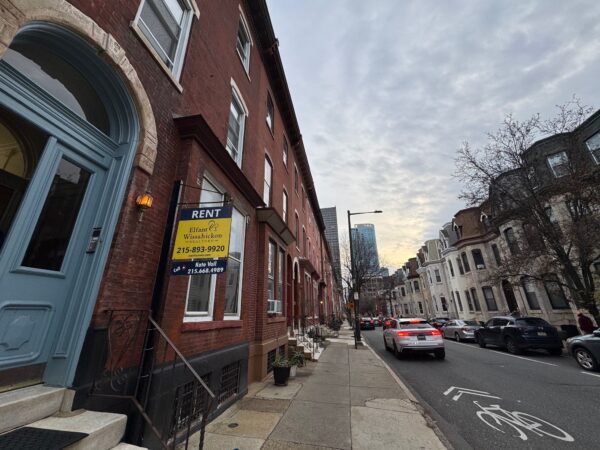
As I began in earnest my search for a Philadelphia apartment recently, I steeled myself for a tradition I assumed to be as East Coast as unnecessary honking and an unhealthy animosity toward outsiders.
I’m speaking, of course, about the broker fee.
As a native Midwesterner and perpetual renter who has spent the past decade living in Boston, I’d come to view broker fees as an inescapable part of big-city life.
For the uninitiated, broker fees are a lot like extortion payments. Here’s how it would go in Boston: A so-called apartment broker — to this day I couldn’t tell you what a broker actually is — meets you at an available apartment, unlocks the door, and stands there while you give yourself a brief tour of the unit. In exchange for this white-glove service, and the privilege of renting the apartment, you pay the broker a one-time, nonrefundable fee typically equal to one month’s rent. In Boston, where the average rent for a one-bedroom apartments sits at around $3,500, this is no small thing.
Making matters worse, the Boston brokers always seem to be finance-bros-in-training, arriving to these brief showings in Lexuses or BMWs, hair meticulously styled and dressed head to toe in Brooks Brothers.
How refreshing it has been, then, to discover that broker fees just … don’t actually exist here?
Not once since I began responding to online apartment postings have I been asked to hand a stranger a $3,500 check in exchange for arranging a two-minute tour. I haven’t yet received a torrent of unwanted text messages from guys named Brock or Beau, demanding to know the earliest possible moment I can schedule a viewing.
And from what I can gather, I’m not going to.
As one longtime Philadelphian explained it to me recently, “There is a beauty in Philadelphia that no matter how cool it’s trying to be, it is never desirable enough to warrant something like brokers fees.”
It’s been a true revelation.
(In Boston’s defense, Massachusetts legislators recently passed a measure mandating that landlords can no longer require tenants to pay a broker fee. Of course, that doesn’t give me back the thousands of dollars I would’ve otherwise put into my retirement fund or, more likely, Uber Eats and Nerf machine guns.)
Which is not to say, certainly, that things here are perfect. An increasing number of Philly renters are cost-burdened. And the city recently ranked among the nation’s least affordable for apartment renters, according to one online real estate brokerage firm.
And as someone who is at the very beginning of the process, I’m sure there will be more disappointment in store.
I’m preparing for an upcoming weekend of apartment tours in Philly, and I have no illusions about how it’s likely to go. I’m imagining a couple days of drab leasing offices and hidden-fee horrors, one-sided rental agreements and a good ol’-fashioned scam or two.
Fine.
If it means not handing a half-month’s salary over to a smug 25-year-old in wingtips, well, then, I’m OK with all of it.
DEAR ABBY: I lost my beloved puppy, “Truffle,” nine months ago. She was almost 15. I had to euthanize her because she was ill and suffering. I cannot begin to describe the depth of grief I’m experiencing. Her loss has been harder for me than any human loss. We had a connection that words cannot express. Truffle captured my soul. I work from home, and we spent every day together. I’m thankful that I had a lot more time with her because of this.
My husband doesn’t understand my grief and can’t wrap his mind around my affection for an animal. He has tried to be understanding, but now he says he can no longer be supportive because it’s senseless for me to grieve this way. He said that life should be about HIM now, and my grieving is taking away from the attention he should have.
I have learned to silence my pain in his presence, and this just feels wrong and unfair. To be completely transparent, I am far more broken than what he has ever known. I’m getting grief counseling he is not aware of, I keep journals and I am compiling a memory book for my precious Truffle puppy.
I feel like I can’t win, because if he knows I am not being honest about how I feel, he’ll be upset (rightfully so). But he will also be upset if he knows the depth of grief I am dealing with. Any advice on how to handle this?
— SUFFERING IN SILENCE
DEAR SUFFERING: Please accept my sympathy for the loss of your beloved furry family member. Truffle was your companion and confidant for a long time. That you miss her companionship is understandable.
What you said about your husband is revealing. Is it possible you doted so much on Truffle that he felt jealous, and now that she’s gone, he is relieved that he will finally have his wife fully back? If that’s the case, you may have work to do.
That you are receiving grief counseling is wonderful. I think the memory book is a great idea, IF it helps you through the process and doesn’t hold you back. At this point, I don’t think you need to hide anything from your husband. You both could benefit from talking about all of this with a licensed marriage and family therapist.
** ** **
DEAR ABBY: A man in a Facebook group has been rude and unpleasant to me, as well as to others. I blocked him, and life has been more pleasant since. My wife refuses to block him and encourages a Facebook relationship, which brings him back into my life. Am I wrong to feel she should be more supportive of me? I would absolutely support her if she were in a similar situation.
— WANTS PEACE IN GEORGIA
DEAR WANTS PEACE: Does your wife discuss this unpleasant person’s posts with you? If she does, tell her to cut it out because it upsets you. Apart from that, let her make her own communication choices because they are her decision and not yours.
If you’re going to get married in Philadelphia, this is the correct way to do it: sequins, sneakers, a string band, bitter cold, delayed schedules, and a crowd that didn’t ask for romance but got it anyway.
A couple saying “I do” in the middle of the Mummers Parade is the purest expression of this city’s personality. Equal parts earnest and unhinged. Romantic, but only after everyone’s been standing around freezing for hours. Vegas chapel energy, but filtered through South Philly logistics and Broad Street chaos.
This wasn’t a viral stunt or a look-at-us wedding. It was two people already marching, already committed, deciding that if they were going to wait around in the cold anyway, they might as well get married while they’re at it. Honestly? Efficient.
The details make it sing: golden sneakers instead of heels, a flask for warmth and nerves, vows practiced on a bus, Elvis officiating, and the inevitable Philly closer, “I’m glad it’s done so I can get warm.” That’s love, but realistic.
And of course it happened at the Mummers. The parade that routinely features feathers, fake arrests, grown adults sobbing at saxophone solos, and more sequins than dignity. If any institution could absorb a full wedding without breaking stride, it’s this one.
”Queen Mumm” Avril Davidge, a 93-year-old Welsh grandma meets Quaker City String Band Captain Jimmy Good as he surprises her at the Mummers Museum on Wednesday, Dec. 31, 2025. Davidge got to live her dream of going to the Mummers Parade, starting on New Year’s Eve morning with a tour of the museum.
Mummers devotion, no notes: A+
Yes, we’re grading two Mummers stories this week, and no, that’s not an accident.
Avril Davidge didn’t come to Philadelphia for irony or spectacle. She came because she fell genuinely, deeply in love with the Mummers through YouTube — learned the string bands, picked favorites, developed opinions — and decided, at 93, that she needed to see it in person. That alone clears the grading curve.
What makes this story land isn’t just the transatlantic trip. It’s how naturally Philly met her energy. A museum tour. A surprise meeting with her favorite band captain. A golf cart to the parade. No skepticism, no gatekeeping … just, “Yeah, of course. Welcome.”
And then there’s the wedding: sequins, sneakers, vows exchanged in the cold on Market Street, because if you’re already marching, why not also get married? It’s unhinged. It’s beautiful. It’s extremely us.
No notes.
Philadelphia’s cost of living vs. the suburbs: C (with math and feelings)
On paper, this sounds like a win: It’s up to 26% cheaper to live in Philadelphia than in places like Ardmore, King of Prussia, and Phoenixville, Philadelphia Business Journal reported. Congrats to the city for clearing the extremely low bar of not being the suburbs.
The problem is the second half of the equation: income.
Suburban households make dramatically more money, which means they somehow pay more and end up with way more left over. Ardmore residents, for example, are apparently out here saving more than $50,000 a year, which is a number that sounds fake if you live south of Girard.
So what we really have here isn’t a victory lap. It’s a familiar Philly paradox. The city is more affordable because it has to be. Lower costs don’t feel like a flex when they’re paired with lower wages, longer commutes, and the constant background hum of “maybe next year.”
Mary Wright and Rich Misdom of Collingswood consider their options at the Roy Rogers located in the Peter J. Camiel Service Plaza on the Pennsylvania Turnpike in late November 2025.
This isn’t just personal bitterness; it’s structural. The Turnpike’s dining lineup is effectively locked in by a decades-old contract, which explains why eating on one of the state’s busiest roads feels less like a pit stop and more like a museum exhibit titled Fast Food, 1998. Auntie Anne’s. Burger King. Dunkin’. Starbucks. Repeat until New Jersey.
To be clear, this isn’t about disrespecting Roy Rogers. Roy Rogers has survived longer than many of our friendships. But when New Jersey and New York travelers are choosing between Shake Shack and Pret a Manger, and Pennsylvanians are debating whether this Sbarro feels better or worse than the last one, something has gone off the rails.
A C+ feels right. The food won’t kill you. It will fill the void. It might even unlock a memory of your mom liking Roy Rogers, which is sweet in its own way. But if the Turnpike is going to keep charging premium tolls, it might eventually want to acknowledge that the rest of the world moved on from mall food courts, and took better rest-stop dining with it.
Eagles quarterback Tanner McKee hands off the football to running back Tank Bigsby against the Las Vegas Raiders in the fourth quarter on Sunday, December 14, 2025, in Philadelphia.
Eagles resting the starters (and trusting the vibes): B+
This is one of those decisions that feels smart, responsible, and completely terrifying all at once … which means it’s extremely on brand for Philadelphia football.
The Eagles are essentially turning Week 18 into a spa day for Jalen Hurts and most of the starters, handing the keys to Tanner McKee and asking the football gods to be normal about it. On paper, it makes sense. They’ve been here before. Sirianni keeps pointing out that the two Super Bowl runs came with byes, rest, and fresh legs. He’s not wrong. The scars from 2023 — A.J. Brown getting hurt in a meaningless finale, Hurts dislocating a finger — are still very much part of the group chat.
But this is Philly, so we can’t just rest people quietly.
Because technically, this game still matters. There’s still a path to the No. 2 seed. There’s still a chance to build offensive momentum, which has been… inconsistent, let’s say. And instead, the Eagles are choosing peace. Or at least the idea of it.
If McKee plays well, WIP will combust. If he struggles, everyone will retroactively insist the starters should’ve played. There is no outcome where this doesn’t get litigated.
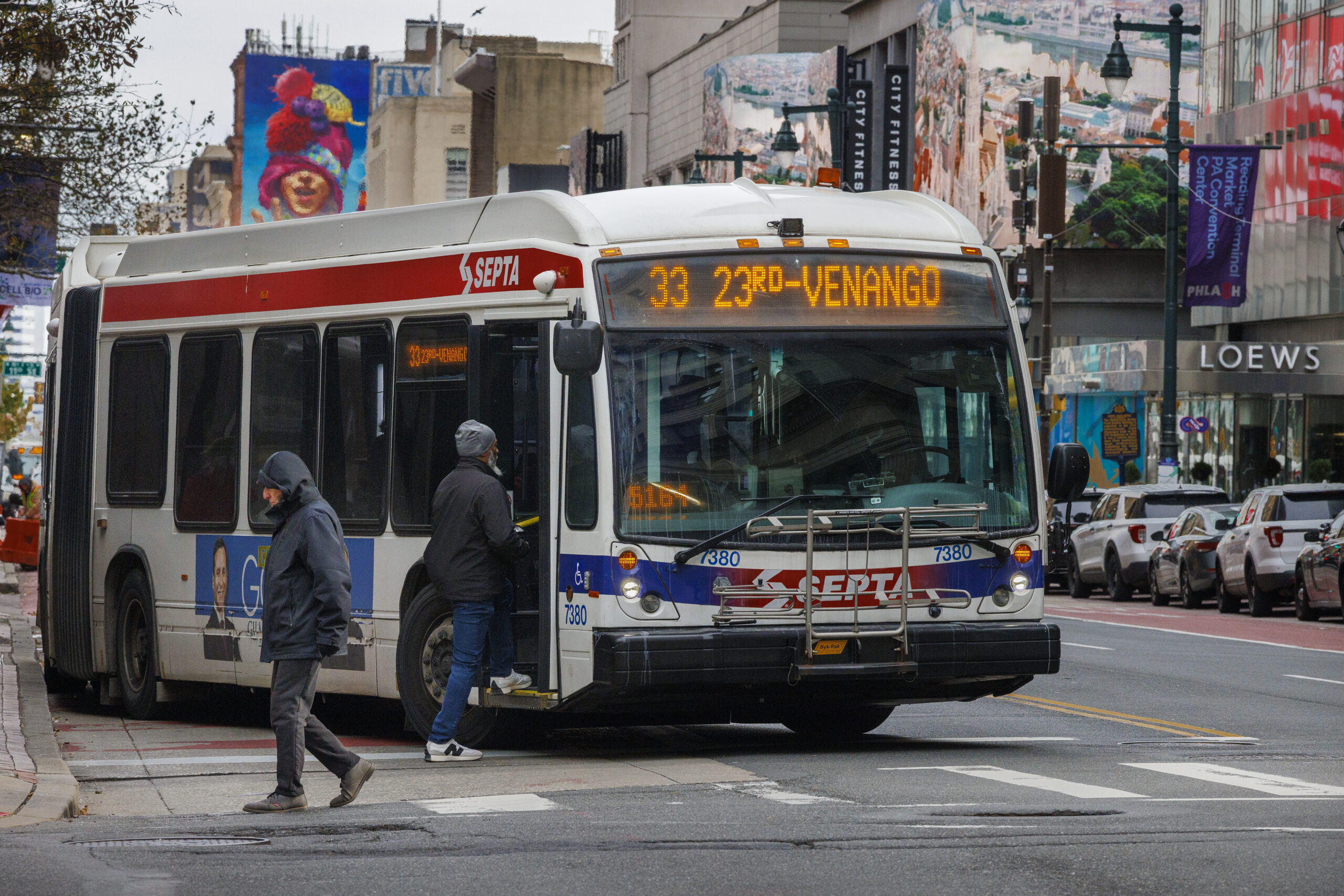
SEPTA 33 bus picking up passengers at 13th and Market Street, Center City Philadelphia, Monday, December 8, 2025.
If you rode transit even semiregularly this year, you don’t need a recap. You felt it in missed connections, sudden service cuts, mystery delays, and that low-grade anxiety that comes from not knowing whether your train is late, canceled, or quietly on fire. Five Regional Rail fires. A trolley tunnel that closed, reopened, and closed again. A budget cliff so real it had a dollar amount attached to it. Near-strikes. Court-ordered service reversals. Emergency money parachuting in at the last second like SEPTA is a reality show contestant who keeps surviving elimination.
The most Philly part? SEPTA technically survived. Barely. With duct tape, emergency funds from Gov. Josh Shapiro, and the kind of last-minute labor deal that had everyone holding their breath. There’s something almost admirable about how resilient the system is — not because it’s thriving, but because it simply refuses to collapse on schedule.
To be fair, some things improved. Serious crime dropped. Fare evasion finally got gates and consequences. SEPTA moved hundreds of thousands of people for the Super Bowl parade without melting down, which honestly might have been the most impressive transit achievement of the year.
But none of that erases the larger truth: SEPTA spent 2025 lurching from crisis to crisis, stuck in the same funding limbo it’s been warning about for years, with riders paying the price in time, stress, and reliability. The money fixes were temporary. The politics were familiar. And the promise for 2026 is essentially: please let us just do the basics.
That’s a low bar… and one SEPTA hasn’t consistently cleared in a while.
New Jersey’s minimum wage lapping Pennsylvania: D (for us)
We love to say we’re better than New Jersey. Spiritually. Culturally. Hoagie-wise. But on minimum wage? Absolutely not. Not even close.
New Jersey is heading into 2026 with a $15.92 minimum wage, adjusted for inflation like it’s a normal, functioning place that occasionally updates laws to reflect reality. Pennsylvania, meanwhile, is still parked at $7.25 — the same number it’s been since 2009, back when we all thought flip phones might be making a comeback.
That gap isn’t just embarrassing; it’s structural. You can cross the bridge and make more than double per hour doing the same work. And while yes, New Jersey is more expensive overall, that doesn’t magically excuse Pennsylvania paying wages that don’t come close to covering basic needs. Even the MIT living wage calculator, which is not exactly a radical think tank, says Pennsylvanians need far more than $7.25 to survive. Shock.
Philly has been stuck in the same frustrating loop for years. The city wants the power to set its own minimum wage. The governor supports raising it. Bills exist. Rallies happen. And yet nothing changes, leaving workers watching Jersey do the thing we keep promising to “get to.”
Daniel Rodriguez travels through Philadelphia’s Suburban Station on Friday, Dec. 19, 2025, in Philadelphia. Rodriguez uses the station to commute between Philadelphia and metro Atlanta, taking a train from Center City to Philadelphia International Airport before boarding flights to and from his company’s Atlanta office.
Flying to Atlanta twice a week so you can keep living in a Jewelers’ Row apartment with your wife, avoid owning a car, and still make your job work is the kind of stubborn, impractical devotion this city respects. It’s extreme. It’s exhausting. It makes no sense on paper. And yet it somehow feels more reasonable than moving to the suburbs.
This isn’t about hustle culture or going viral (though he did). It’s about refusing to uproot your life because the job market is broken, SEPTA is unreliable, and cities don’t always make it easy to stay. Instead of leaving Philly, Rodriguez made the commute worse. Heroic behavior.
Is it sustainable? Questionable. Is it environmentally clean? Debatable. Is it the most Philly response imaginable to a bad system? Absolutely.
Nicole Michalik spends her afternoons talking directly to Philadelphians as they make their way home. As a host on 92.5 XTU, the city’s country music station, she’s on air from 2 to 7 p.m., juggling live breaks, listener calls, and interviews with artists like Luke Combs and Parker McCollum. Radio, she insists, is still relevant, “sexy” even. “I’m live, I’m local, I’m talking about stuff that’s going on in Philly,” Michalik said. What more could you want?
Michalik lives in Midtown Village, but her days stretch across the city, including a trek to Bala Cynwyd, where the radio station is located. She loves her job. In fact, she loves it so much that her perfect Philly day includes a trip to the office. Here’s what else it includes.
This interview has been lightly edited for clarity.
7:30 a.m.
I usually wake up somewhere between 7 and 7:30. First thing I do is check socials and email, then I make coffee at home. I need it piping hot. I use a Keurig — no judgment — with organic half-and-half.
I take it back to bed and do my Instagram bit, “Coffee Under the Covers.” I started it during COVID and it just became a thing. I’ll take a sip and talk about whatever’s on my mind. People have sent me mugs. It’s wild.
After that, I record my Boston radio show from home. I’m on Country 102.5 up there, so I have a whole setup — computer, mic, everything. I want it to feel as local as possible, even though I’m not physically there.
10 a.m.
I force myself to work out. I walk to XForce to train with James, who keeps me accountable. I hate working out, but I don’t hate it there, so that’s a win for me.
When I cross Broad Street, I always take a photo of City Hall and post the temperature. It’s become a thing. One of my friends who lives in Portugal checks it every day. He calls me his Cecily Tynan.
11:30 a.m.
After the gym, I get my hair blown out at Dina Does Glam inside Sola Salons at 15th and Walnut. I go at least once a week. I love that Sola lets people in the beauty industry run their own little studios.
From there, I walk to Gran Caffè L’Aquila for an iced coffee. It’s the best iced coffee in the city. That’s nonnegotiable.
I try to head home after that, because if I don’t, I’ll get sucked into Sephora buying makeup I absolutely do not need.
1 p.m.
I get ready for work and drive to Bala Cynwyd. On the way, I stop at the Starbucks on City Avenue. I order an iced Americano with almond milk and a drizzle of caramel. They know me there.
I don’t even know if caffeine really affects me that much. I just love the ritual. I like sipping it throughout the show.
Nicole Michalik works at 925XTU on Monday, Dec. 1, 2025 in Philadelphia.
2 to 7 p.m.
I’m live on the air. On my perfect day, I’m doing a Zoom interview with Luke Combs, and he finally announces he’s coming back to Philly. We’ve been mad at him for skipping us for a few years, so this would be huge.
7:30 p.m.
After work, I meet friends at Lark in Bala Cynwyd. It’s right across from the station, and it’s one of my favorite places. I’m ordering the gnocco fritto — they’re like little puffy clouds with lemon ricotta — and the striped bass. Nick Elmi just knows what he’s doing.
9 p.m.
I’m heading to a Sixers game. In my perfect world, it’s the Eastern Conference finals, Joel Embiid has great knees, and we’re winning. I live in the city and love walking everywhere, but I also love that Philly is easy to drive around — as long as the PPA doesn’t get you.
11 p.m.
Once 11 p.m. hits — I’m like Cinderella — I’m ready for bed. I love going home to put my pajamas on.
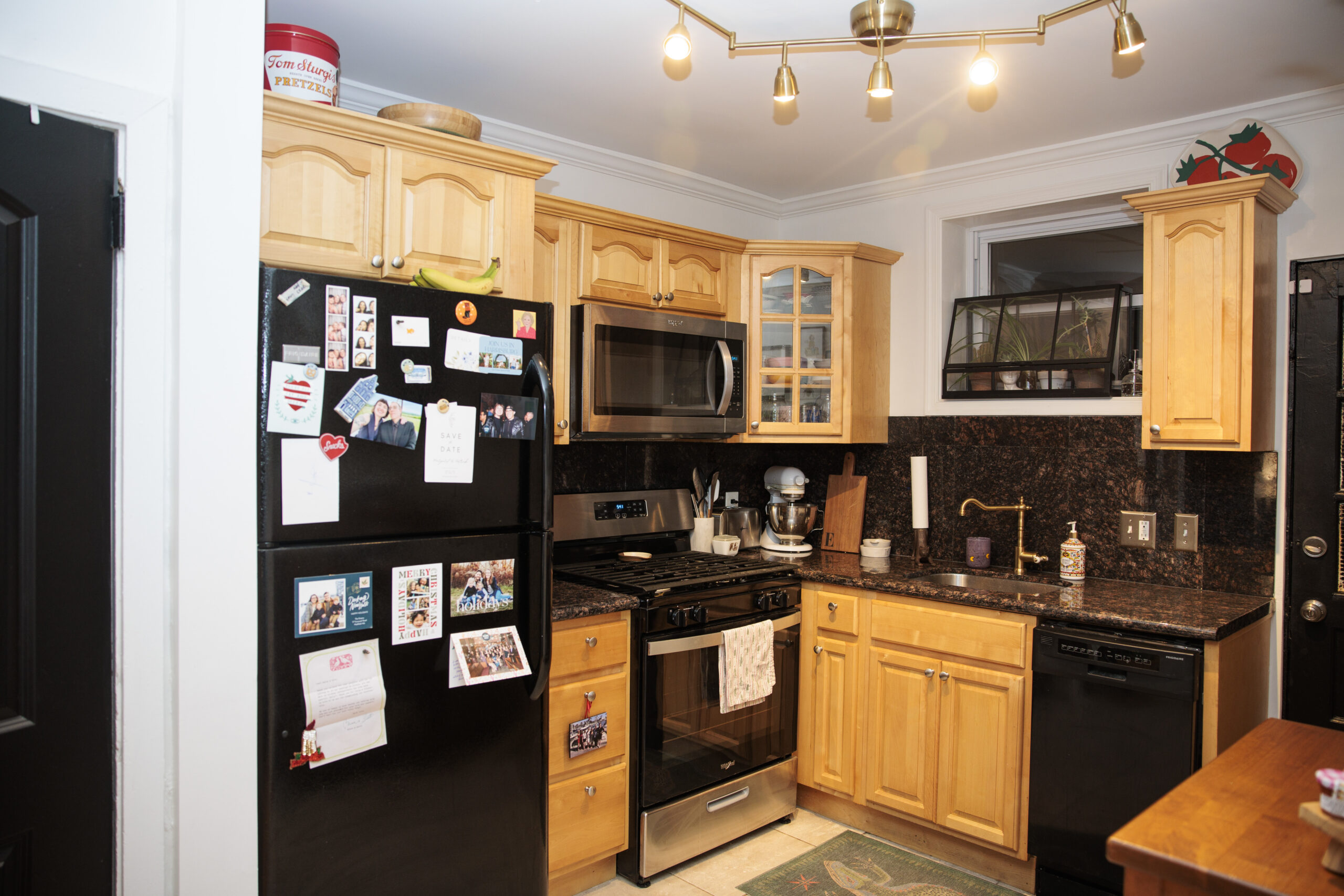
The house: A 784-square-foot rowhouse in Newbold with two bedrooms and one bath, built in 1920.
The price: Listedand purchased for $249,000
The agent: Allison Fegel, Elfant Wissahickon
Miles in her two-bedroom home.
The ask: The only good thing about Emily Miles’ old apartment was the price. Miles was making a “nonprofit lawyer salary” and trying to save money. But “it was terrible,” Miles said. Disgusting even. And by November 2024, she’d had enough.
Owning a home felt aspirational, if vague. “It was always something I wanted to do,” she said. “But I didn’t know when I’d be able to do it.”
It didn’t seem like the right time. Miles had student loans. She was bartending in the evenings to make ends meet. Nevertheless, she decided to check out the market and searched for an agent with grant experience. She kept her house wish list short: three bedrooms, outdoor space, and central heat and air.
The search: Miles had no sense ofbudget until her lender preapproved her for about $310,000. From there, her agent began sending her listings across the city, including large homes far from the neighborhoods Miles associated with Philadelphia.
“They were still in Philadelphia County, but not really Philly as you think of it,” Miles said. West Philadelphia, where she was living, was not affordable. Other neighborhoods lacked reliable transportation.
Between late November and January, Miles saw 30 to 40 homes. “They were a lot of flips, and I didn’t want that,” she said.
Eventually, Miles found a place and made an offer. But during the inspection, theydiscovered damage to the front door that indicated someone had kicked it in, and Miles decided to walk away. She was out $1,500. “My pride was hurt a little bit,” she said.
Miles took a brief break, then started attending open houses on her own. That’s how she found the one, a little less than a month after she backed out of the first house.
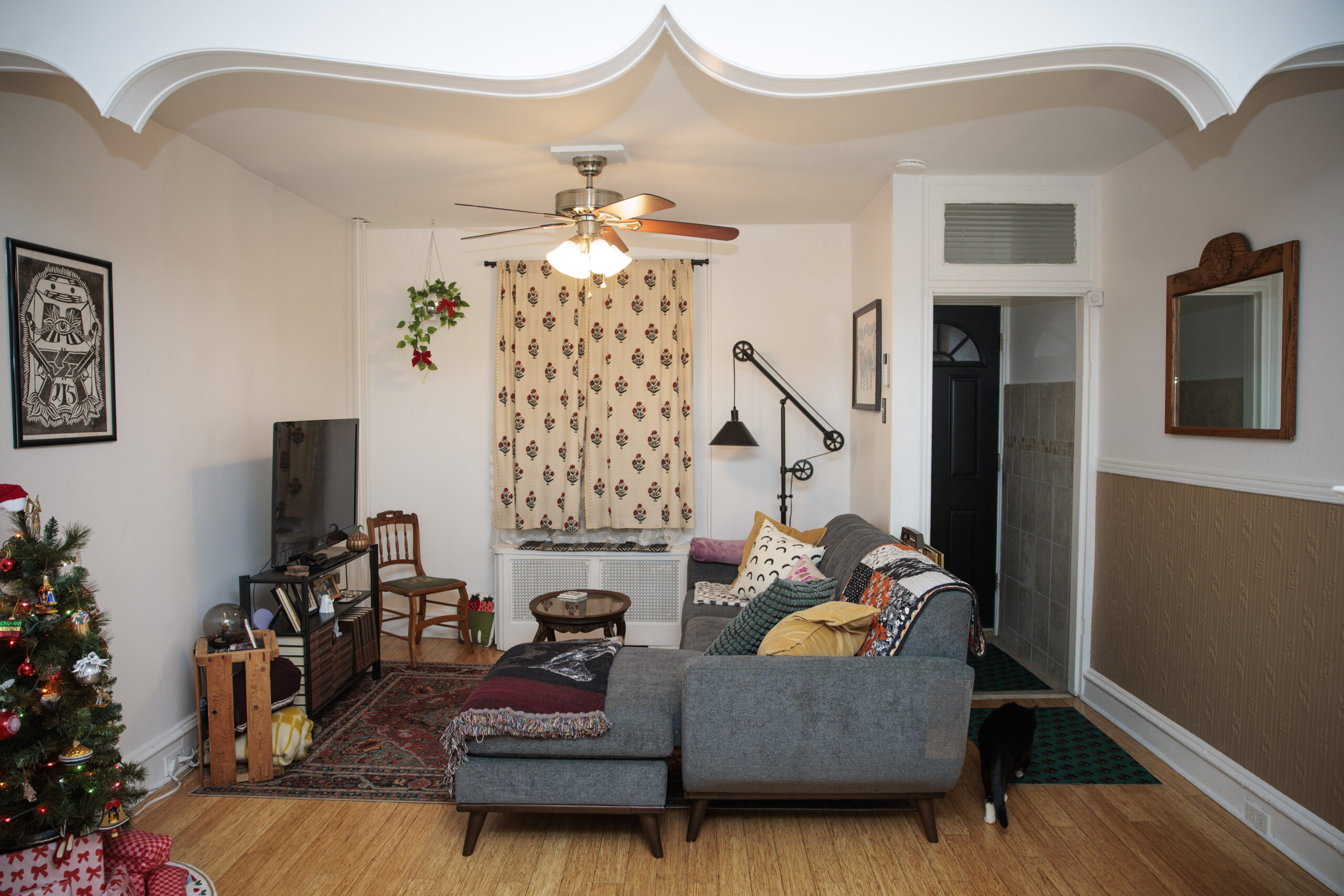
Miles liked the house’s original features and character, such as the arched framing of the living room.
The appeal: The house Miles ultimately bought — a two-bedroom, one-bath, 780-square-foot rowhouse in South Philadelphia — checked none of her original boxes. “The big LOL about the whole thing is that I ended up with something I didn’t want at all,” she said. It had radiator heat. No air-conditioning. Less space than she planned. The house had been a rental for more than a decade. Carpet covered original features. Paint concealed years of wear. “It was a real landlord special,” Miles said. But when she stepped inside, something clicked. “I walked in, and I could see it,” she said. “It’s full of character.”
The deal: Miles stumbled into the house she would buy while walking to a bar with her boyfriend on a Friday night. The listing price was $249,900. She offered the asking price the following morning.
The seller took days to respond but eventually accepted her offer after no one else made a bid.
When the inspection revealed issues, Miles asked for $5,000 to $7,000 in credits. The seller countered with zero. “He redlined all my stuff,” she said. “So I re-redlined all of his stuff.” The back-and-forth ended with $2,000 in seller’s credit. “Which is better than zero,” Miles said. “I’m pretty proud of that.”
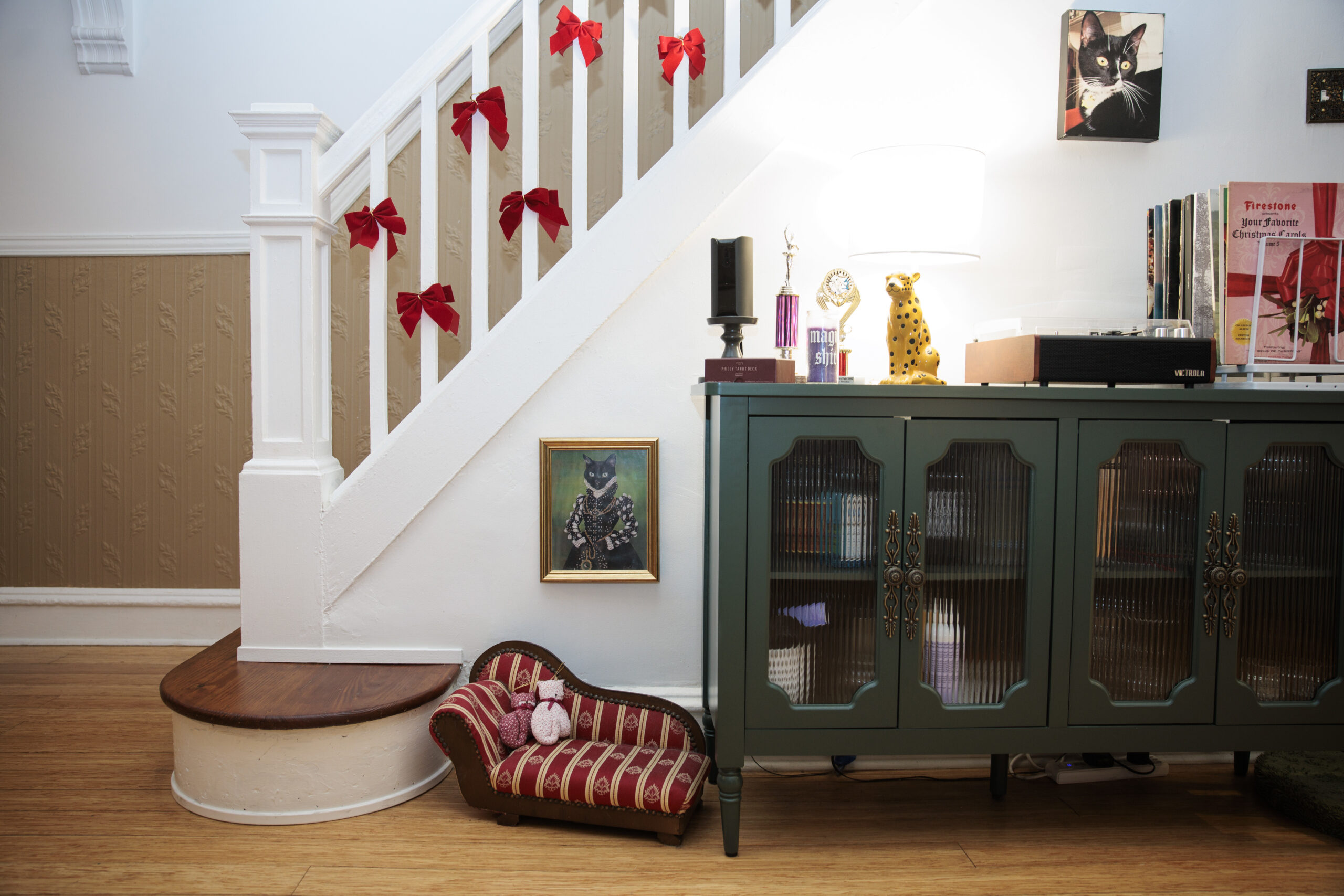
Miles filled her home with vintage furniture she found at local thrift shops. Her cat, August, has his own bed.
The money: Miles had about $20,000 saved from her time before law school, when she worked as a human resources manager in New York City. She had an additional $10,000 from the Philly First Home program, $2,000 from the seller’s credit, and $1,000 from her Realtor’s Building Equity program.
Her lender approved her to put down only 3%, so she made a $7,500 good-faith deposit and brought $1,500 to closing. Miles’ credit score and salary qualified her for a 5.75% interest rate at a time when average rates hovered closer to 7%.
Her monthly mortgage payment is about $1,800 and includes $120 for private mortgage insurance, which she must pay until she reaches 20%. She recently applied for a Philadelphia homestead exemption, which reduces the taxable portion of your house by $100,000 if you use it as your primary residence, and expects her monthly payment to drop closer to $1,700 as a result.
The move: Miles closed on March 19 and moved on April 29. She broke her lease without penalty. “I had been complaining about it being a bad apartment for months,” she said, “so I think they were just happy to be rid of me.”
Miles had to get rid of a lot of her stuff because her new house was so much smaller than her apartment. “I downsized quite significantly,” she said. She also discarded stuff that wouldn’t fit through the house’s small, 30-inch doorway, like her couch. “Luckily, I had some foresight and got rid of it before I moved it over,” she said.
Miles installed new lighting and faucets to make her home feel less like a rental.
Any reservations? Miles wishes she knew that refinished floors can take weeks to fully cure. She had to sleep on the living room floor while she waited for the fumes to fully dissipate upstairs. “It was just my cats and me on the ground for about a month,” she said. Still, she doesn’t have any regrets. “Live and learn,” she said.
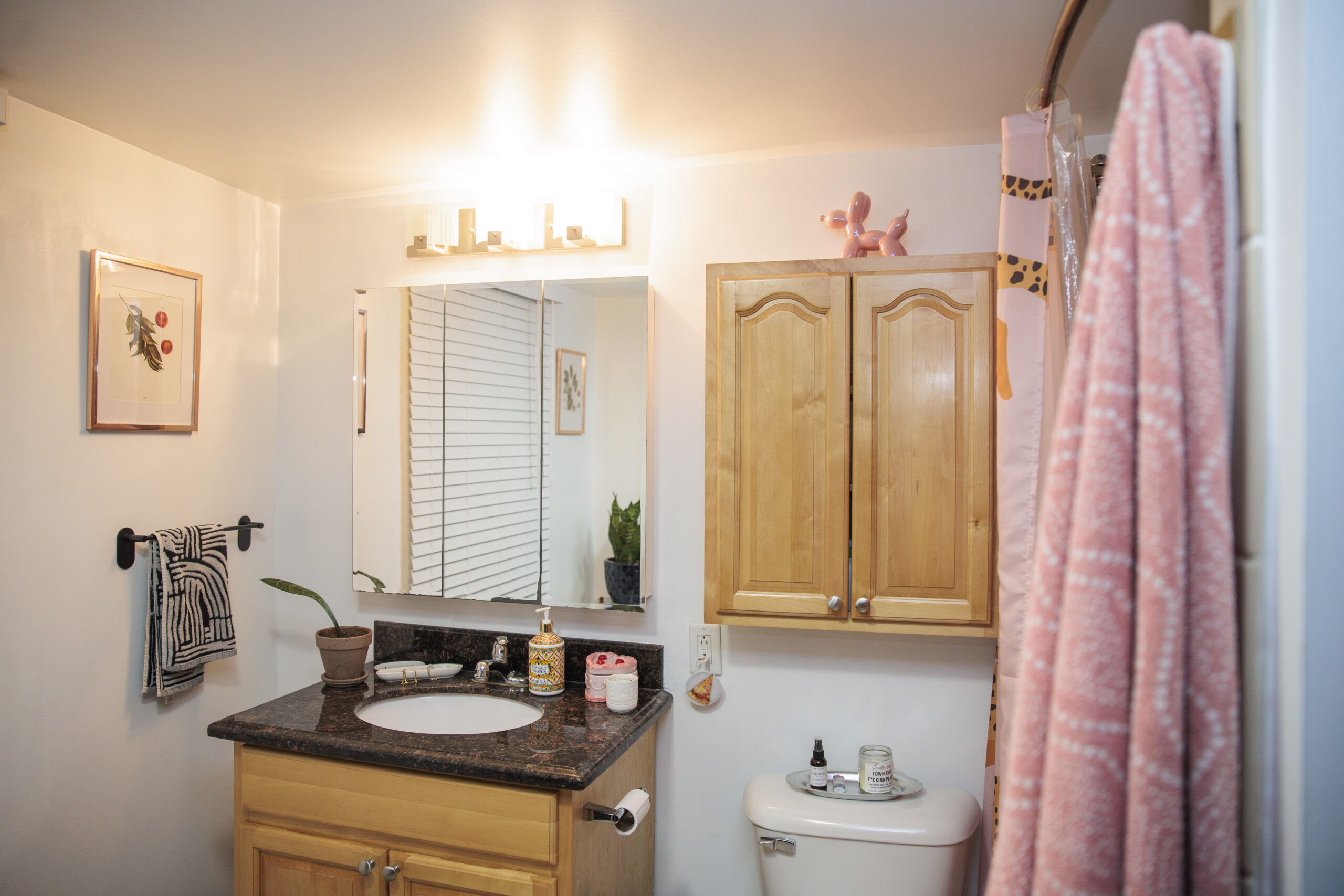
The bathroom in Emily Miles’ Newbold home.
Life after close: Miles used the money her parents had saved for her wedding to make a few cosmetic updates. She fixed the back patio, refurbished the upstairs floors, and replaced light fixtures and faucets so that the house felt less like a rental. She put in a new boiler, too. And filled the house with vintage furniture she thrifted locally. “Stuff that fits the vibe of the house,” she said.
Sometimes you take a road trip to experience something totally different from the world you inhabit — the absolute silence of a state forest, the carnivalesque majesty of the shore in full swing. A weekend in Baltimore is not that kind of trip.
Charm City is the most Philly of the cities on the Acela corridor: smaller in size, but equally quirky, proud, and shaped by blue-collar roots. (Our accents are even passably close.) It’s also stacked with restaurants, museums, and cultural institutions that compete on a national level, all with a distinctly Baltimorean flavor, less than two hours away.
Once arriving in Baltimore proper, take I-83 up to the Remington neighborhood on the north side of the city, where Café Los Sueños roasts and brews its own beans in a peaceful, light-washed space a couple blocks off the highway exit. (The name translates to “Café of Dreams,” fitting for owner Carlos Payes, who came to the U.S. from the coffee plantations of El Salvador.) A horchata latte and croissant make for a perfectly calming start to the trip.
📍 2740 Huntingdon Ave., Unit B, Baltimore, Md. 21211
If it’s not too cold — and you’re up for a walk — Los Sueños sits near the eastern edge of Druid Hill Park, the third-oldest urban park in the country and, for millennials, the namesake of Dru Hill. Follow the path along Druid Lake toward the Rawlings Conservatory, a circa-1888 botanical garden with five greenhouses. Even when it’s frosty outside, the impressive Victorian conservatories filled with tropical orchids, ceiling-skimming palms, and citrus blossoms deliver full-on summer music-video energy.
Check into the Pendry Baltimore, a moody, stylish 127-room hotel housed in a grand 1914 building on the former Recreation Pier. The Fell’s Point location is both charming and convenient, putting you within walking distance of many of Baltimore’s marquee attractions. Many of the wood-and-leather-clad rooms overlook the waterfront. The huge pool, which seems to float in the Inner Harbor, will have you booking a return visit for summer.
No curveball here. The National Aquarium is Baltimore’s claim to fame, and if the last time you were here was on an eighth-grade field trip, you should come back as an adult, with or without your own kids. The sprawling complex houses 2.2 million gallons of water and residents ranging from reef sharks and puffins to otters and moray eels. Don’t miss the Harbor Wetland exhibit, which opened in 2024 along a series of floating docks in the Inner Harbor and be sure to book tickets in advance. Aim for off-hours to beat the crowds.
📍 501 E. Pratt St., Baltimore, Md. 21202
View: American Visionary Art Museum
The title Cap Bathing Moligator With Angelic Visitation (Dickens 44) tells you just about everything you need to know about the boundary-pushing work housed at the American Visionary Art Museum. This brick-and-mirror-clad institution in Federal Hill celebrates outsider art in all its surreal glory from landscapes to cosmological oil paintings to sculptures of a mosaic-winged Icarus and Baltimore icon Divine. The collection embodies the city’s DIY spirit and unbreakable creative streak.
With its deep pedigree and polished service, Charleston in Harbor East possesses a sense of occasion that few restaurants have anymore. Even if you’re just passing through for drinks in its swanky little lounge, where local power brokers and big-night-out suburbanites mingle with tourists, those drinks are crafted with gravitas and élan as much as sparkling wine, passionfruit and honey (the Ipanema Fizz), or blanco tequila, Strega, and ginger (the Arandas Monk). The wine list is famously deep, which helps explain why Charleston won the James Beard Award for Outstanding Wine and Other Beverages Program.
From one medalist to another, the Wren, one of Bon Appetit’s best new restaurants of 2025, sits less than a 10-minute walk from Charleston in Fell’s Point. The location is an ideal spot for drink or dinner, with a much more casual silhouette with its wood paneling, pressed-tin ceilings, and no-reservations policy. It’s a pub essentially, and like the very best pubs in Ireland and the U.K. (partner Millie Powell hails from Dublin), the cooking comforts and satisfies on a cellular level. Think glazed ham, golden onion pie, sharp cheeses, honey-roasted apple cake, and the like. (Your Philly analog is Meetinghouse.) As expected, the bartenders pour a precise pint of Guinness, the perfect finale to a Baltimore weekend.
I opened this question up to a wider team because I knew there would be many different takes. What do you think? Email me.
Ariane Datil, Social Video Host
Pick a new resolution, sir.
Ellen Dunkel, Programming Editor
It might not be possible, but it helps not to care. Or to be a fair-weather fan. I am completely disinterested, except in a journalism way (and wanting my friends to be happy). But I enjoy when they win the big game. If they don’t, I move on immediately. It’s very relaxing to not care.
Caryn Shaffer, Senior SEO Editor
The most helpful piece of advice about loss I’ve received this year is to focus on what you DO have. Sure, the Eagles lost a game, and it sucks not to have that win. But do you have friends you watched the game with, and can commiserate with? A partner and family who love you? Your health, a roof over your head, and food on the table?
When you’re feeling sad about a loss, reach out to someone you care about, go for a walk outside, get a little treat to cheer you up, or do another activity you enjoy.
Zoe Greenberg, Features Reporter
Be like me and be a fan who only jumps on the bandwagon when the team is winning. Then your day is never ruined, only made.
Hira Qureshi, Food and Dining Reporter
Like Zoe, I only become a fan when they are winning, lol.
Matt Mullin, Senior Editor for Digital Strategy and Audience Development for Sports
When teams are winning, the expectation is that it’ll stay that way forever, so the losses, especially season-ending ones, are unexpected and crushing. That’s the biggest problem with jumping on the bandwagon — it’s when the losses hurt the most.
My advice is a combination of exposure therapy and resetting expectations.
First, if you hide from defeat, of course it’s going to sting that much more when it finally arrives. All those losses, they become a part of you, they callus over, and the next time they don’t hurt as bad.
Second — and all the losses should help with this — the lower you’re able to set your expectations, the less likely you are to be disappointed after a defeat and the more jubilant you’ll be after a win.
When it comes to Philly sports, as is the case with most things in life, expectations can dictate your level of happiness, or in this case sadness, so set them low. Is that a miserable existence? Perhaps, but it’s the life of a Philly sports fan — and might explain why we party so hard after wins.
Abigail Covington, Life & Culture Reporter
Just remember it could be worse: You could be a Carolina Panthers fan.
I make it my mission to always be eating something delicious when I’m watching a stressful sports game. So if they lose … at least I had a good meal.
Kate Dailey, Managing Editor, Features
I have decided that I’m only a regular-season baseball fan, because I love how slow, meditative, and calming baseball is. Baseball on the radio while you wash the dishes? Beats a spa weekend.
I realized this year that the pressure of the playoffs ruined what I liked best about baseball, so I just decided to tune out. Figure out what you like best about the sport and double down on that, at the expense of the parts you don’t. Unless what you like best is victory. In that case, I can’t help you.
Dan DeLuca, Arts and Entertainment Reporter
You’re not a true Philly sports fan until you’ve suffered. You have to give yourself over to the suffering. That’s what makes the good times good. I personally suffer more when the Phillies and Sixers lose than I do when the Eagles do. That might be my way of rebelling against the dominant culture.
Also the advice I often give myself (but don’t always follow) is it’s better to go to the show than go to the game. Because the show will reward you probably 90% of the time, and your batting average at the game will be much lower.
DEAR ABBY: A co-worker, “Erin,” has been allowed to work from home since the COVID-19 pandemic, while the rest of us came back to the office. We function alongside each other much like a small family. We have no drama, no office politics and an overall great atmosphere. Erin’s absence has caused a strain on our team and has fueled resentment. Many feel it’s unfair, although these feelings have not been shared with Erin.
It so happens that Erin has accepted a new job and hasn’t told our boss because she’s worried about how the boss will react. When I found out, I did tell the boss even though Erin told me not to. So now I am caught in the snare of my own little trap of deceit. Advice?
— TANGLED WEB IN NEW MEXICO
DEAR TANGLED WEB: I’m sorry you didn’t mention what the benefit structure is at your company. Erin took a job on the Q.T. while still on your boss’ payroll. In the state where I live (California), that would be a reason to fire her. I do not regard enlightening your boss about what Erin did as deceitful. I think what you did was the right thing to do and loyal to the company.
** ** **
DEAR ABBY: I’m nearly 70, and suddenly I’m remembering things from the past that I haven’t thought about in years — mostly conversations in which I wish I had responded differently. (I’ve never been really quick about responding to things.) Now they keep popping up, and I can’t seem to stop thinking about what I wish I had said. I don’t know why this is happening or how to stop it. Any advice?
— MEMORY-RIDDEN IN MICHIGAN
DEAR MEMORY-RIDDEN: If this is how you are spending your leisure time, you may have too much of it on your hands. When this happens, try to redirect your thoughts to something else. Then remind yourself that none of us can change the past, but we can LEARN from it so we don’t repeat our mistakes (or errors of omission) in the future. If what’s happening leads to depression or anxiety, you might benefit from consulting a therapist about it.
** ** **
DEAR ABBY: I have been an avid reader my entire life, and you have always given solid advice, especially when it comes to topics regarding proper etiquette. That’s why you were the first person I thought to ask when my friend shared this information from our Catholic priest on how to attend Mass with reverence. “Don’t cross your legs. Crossing your legs is considered a disrespectful posture.” I’m all for proper manners and posture, but I have never heard this before.
— WONDERING IN THE MIDWEST
DEAR WONDERING: This is the first I have heard of it, but your friend may be correct. In some Orthodox cultures outside North America, crossing one’s legs is considered to be very disrespectful. Here in America, however, it is not taboo, but it is considered to be “too casual and relaxed” for church.