Category: Life

  • She left the dating parlors and courting buggies of Lancaster behind. Now she’s learning to date from scratch.

    She left the dating parlors and courting buggies of Lancaster behind. Now she’s learning to date from scratch.

    Susanna Nolt grew up in Ephrata, the eighth in a family of 12 kids. They were Old Order Mennonites and lived similarly to the Amish, though Nolt said her community pushed back against the comparison: “Our buggies are black! The Amish buggies are gray!”

    There weren’t arranged marriages, but Nolt knew what was expected: Around age 18, she could begin dating a young man who was baptized in the Church. After marrying, she would raise her own large family within the Old Order Mennonite community, just as her parents and grandparents and great-grandparents had done. A family tree Nolt made when she was 16 went 14 generations back, featuring almost all Mennonites.

    When Nolt was 27, she had what she described as a “spiritual rebirth” and decided to leave. She was excommunicated and kicked out of her family’s home.

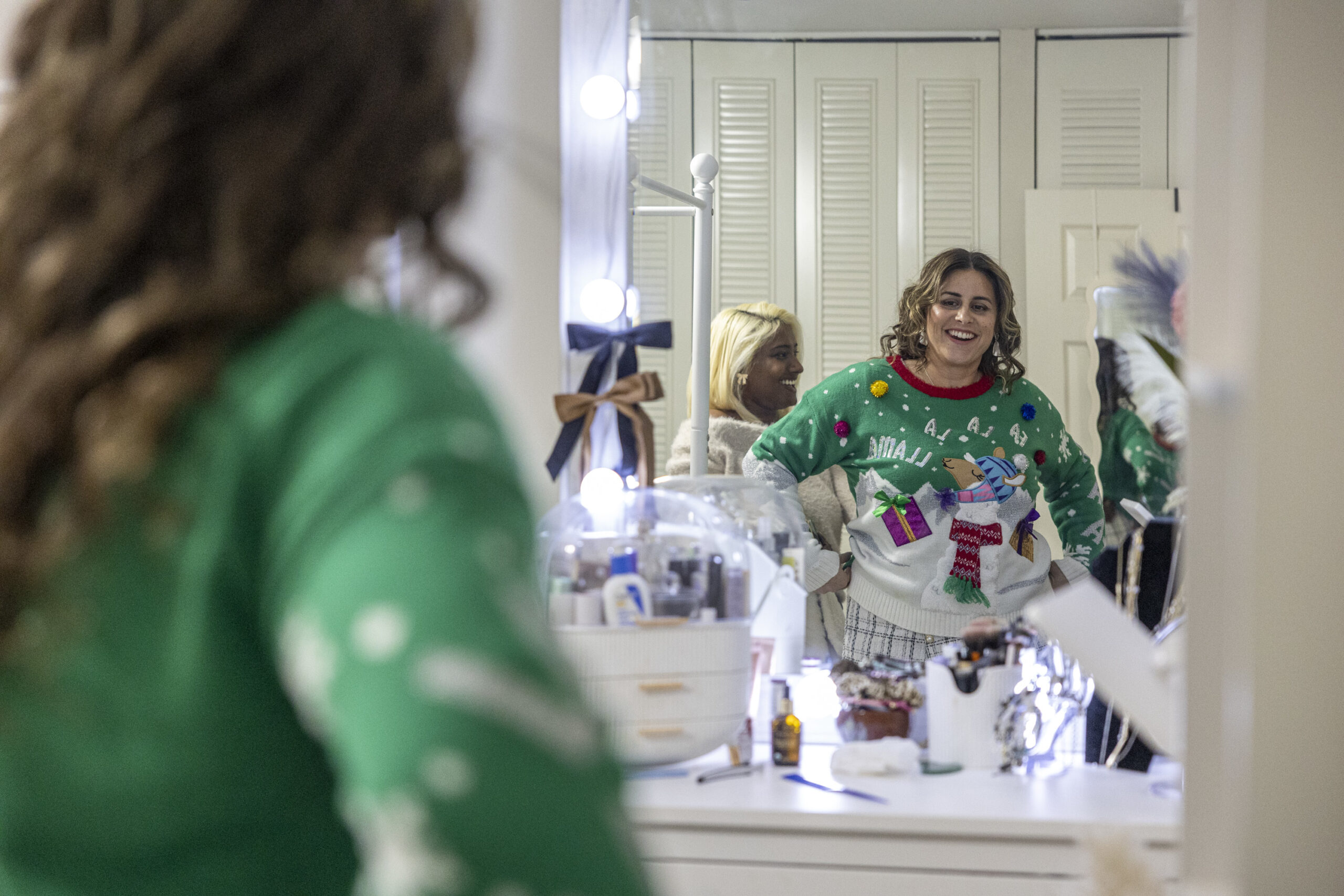
    Nolt checks out her Christmas “ugly sweater” before the event.

    After a few years of living in Lancaster and nannying in Reading, she moved to Roxborough.

    Now 39, Nolt works as a nanny, drives for Lyft, and is earning an online master’s degree in art education from Liberty University. She lives by herself, and is figuring out what romantic partnership might look like in her new future.

    The following, as told to Zoe Greenberg, has been edited for length and clarity.

    On growing up in a different world

    We knew the Church’s rules better than we knew the Bible. They were read to us every half year, the day before Communion: how long the dresses need to be, how big the head coverings need to be.

    You didn’t have to work hard to make friends. You had your neighbors, the girls from church. You would go to school in the one-room classroom. We only went till eighth grade; we were prohibited from going to high school or college.

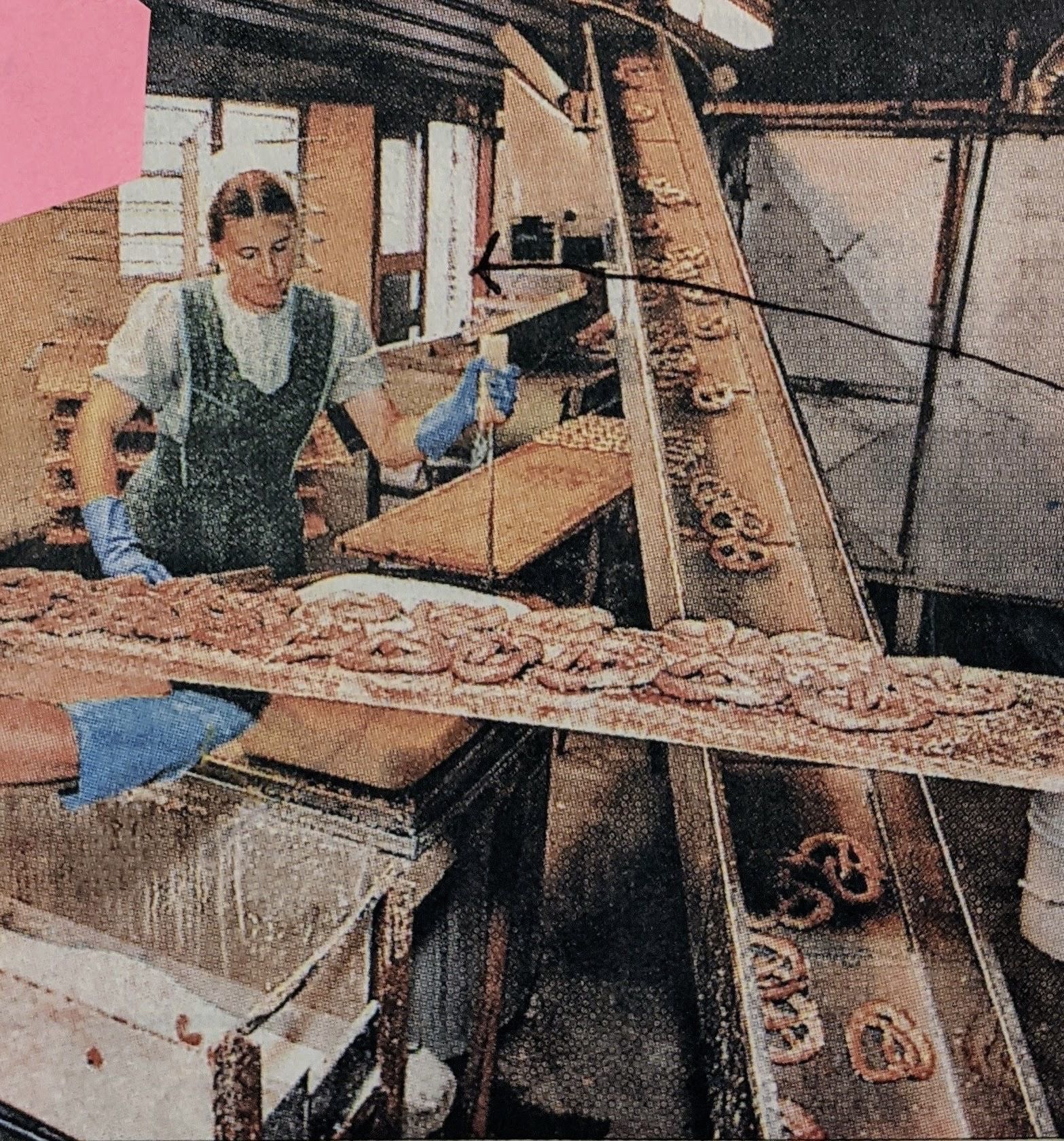
    The earliest photo that Nolt has of herself is this newspaper clipping that shows her working at Uncle Henry’s Pretzel Bakery in Mohnton, Pa., when she was 19.

    My mom was, obviously, a stay-at-home mom. We did all our cooking, canning, freezing, sewing, baking, gardening ourselves. So that was a full-time job for a mom. We had a ginormous garden.

    My dad was a leather worker. He made harness parts for the horses. He was a deacon in the Church, so he was sometimes pretty busy with that, which made our income especially low, because positions in the Church do not pay.

    On Sunday nights in the ‘dating parlor’

    Young people were pretty much allowed to choose who they wanted to date, with the expectation that you date only someone who’s a baptized member of the Church, to ensure that you can build a good Mennonite family.

    We had Sunday night dates, usually five-hour dates at the girls’ homes.

    The house was very plain, no pictures. We had a dating parlor — it was the most decorated room of the house. The girls’ boyfriends would come over around seven o’clock on Sundays and stay ‘till 11 or 12.

    The couple would sit on the couch and chat. Sometimes younger siblings would go in and play board games with them, or we’d play yard games like croquet or volleyball. Sometimes they would go on a walk in the woods. But most of the time they would spend in the parlor, getting to know each other and discussing their future.

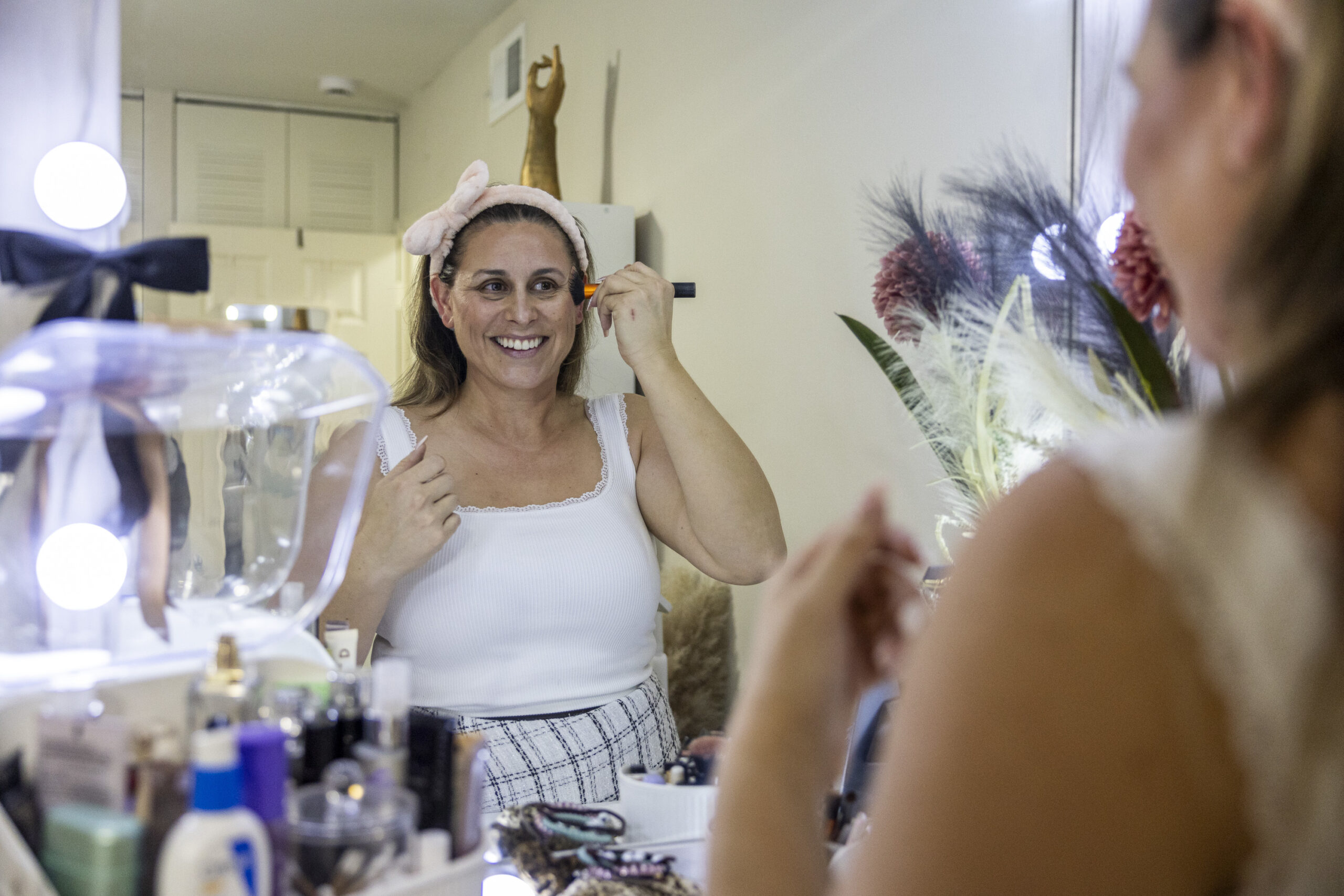
    Nolt had never been to a speed dating event before but wanted to try it.

    On ‘courting buggies’ and Rumspringa

    Sometimes the boys liked to decorate their buggies, to make them courting buggies. They would have a fancy varnished cabinet in the front, and maybe some dice or feathers hanging, and a nice afghan blanket or some kind of throw over the feet, because they wanted to impress their girls. They’d put reflectors on the buggy and some stripes, usually coordinating with the interior of the buggy.

    In the outside world, I’ve learned they see Rumspringa as this year where you go out and experiment with the outside world, but that’s not really what it was to us. Rumspringa was just youth group, hanging out with our friends from church on Saturday nights.

    Often it was hymn singing, and then afterward we would have a snack and play volleyball. There was usually a dance. We weren’t allowed to listen to music, so the dance itself was often kind of boring, because dance and music kind of need each other.

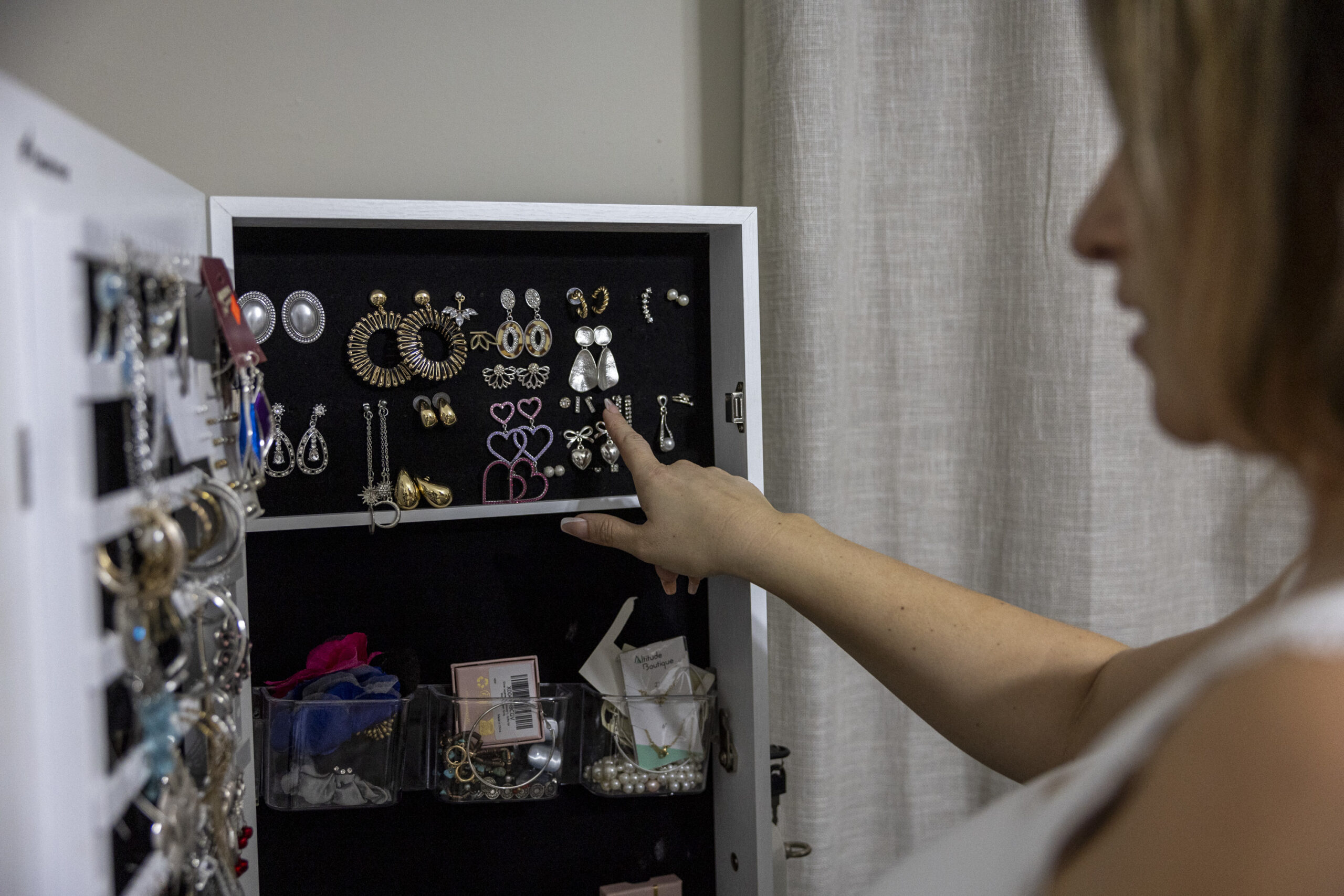
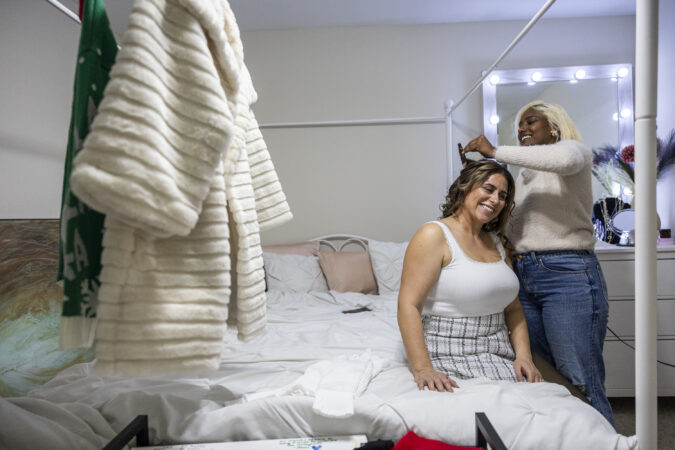
    Nolt consulted her friend on which earrings she should wear.

    I didn’t date much. In my time, guys didn’t really ask as easily, and the girls had no way of playing into it. You just had to wait until a guy would ask you. That felt very constricting to me.

    Only about 50% of my friends were dating, if that. My mom especially, she had no problem with me being single.

    Our weddings would happen on Tuesdays or Thursdays at the bride’s house. The bride’s family was responsible for hosting the wedding, which was all day: eight o’clock in the morning to at least eight o’clock at night. I never knew weddings were that expensive, because the family just provided it.

    On choosing to leave

    Ever since I was 10 years old, I had questions. I wouldn’t ask my questions, because that would make you a troublemaker. Ironically, I was afraid that our rules weren’t strict enough. For example, we weren’t allowed to have cameras or pictures because that was considered a graven image or an idol. I always loved playing with dolls, and I started thinking, “Maybe dolls are graven images or idols.” And I became so obsessed and bothered.

    I tried to settle down by getting baptized at 17. But I felt like something wasn’t right, something was missing.

    Then, when I was 27, I was teaching out in Kansas for a completely different set of Mennonites. I started realizing that bringing my rules to their community did not help anything. Like, nobody wants more rules.

    I had this moment of rebirth in which I realized that Jesus is not the same as being Mennonite and all these rules really have nothing to do with Jesus.

    At first I kept it to myself. I didn’t actually get excommunicated and kicked out of my parents’ house until soon after I was 28.

    On losing everything

    I learned that leaving is a much, much bigger deal than I ever realized, because those relationships were basically severed. I lost all my friends. I lost everything I had ever known. I had no idea how to drive a car. When I finally was able to get a car, it was like, No, you can’t drive it, you have to get a title, you have to get it notarized, you have to get insurance.

    In my experience, you just get a horse and a buggy and you go drive.

    A year or two after I left, my mom said that they’d been talking about it, and they decided they still want to be family. I’m still seen as the black sheep, but basically if they invite the family, they’re going to invite me. I can visit them, but of course I have to wear a long skirt or dress.

    It doesn’t feel like family. It’s kind of this emotional distance.

    On assimilating to the ‘English’ world

    I had been nannying and I was looking for my next position and all the good ones were in Philadelphia. I moved to Philly, not knowing anyone.

    I have to learn how normal people think. I grew up with no music, no media, no TV. A lot of conversations make all kinds of references to singers, actors, movies, shows. It’s a lot of researching all the time to understand what people are talking about.

    I was enjoying Christian music already and I wanted to branch out, but found it difficult to connect with the music since it was overwhelmingly new. I could never recognize songs playing in public areas — it just sounded like noise. Until one day I did recognize a song and I felt so connected and happy I got tears.

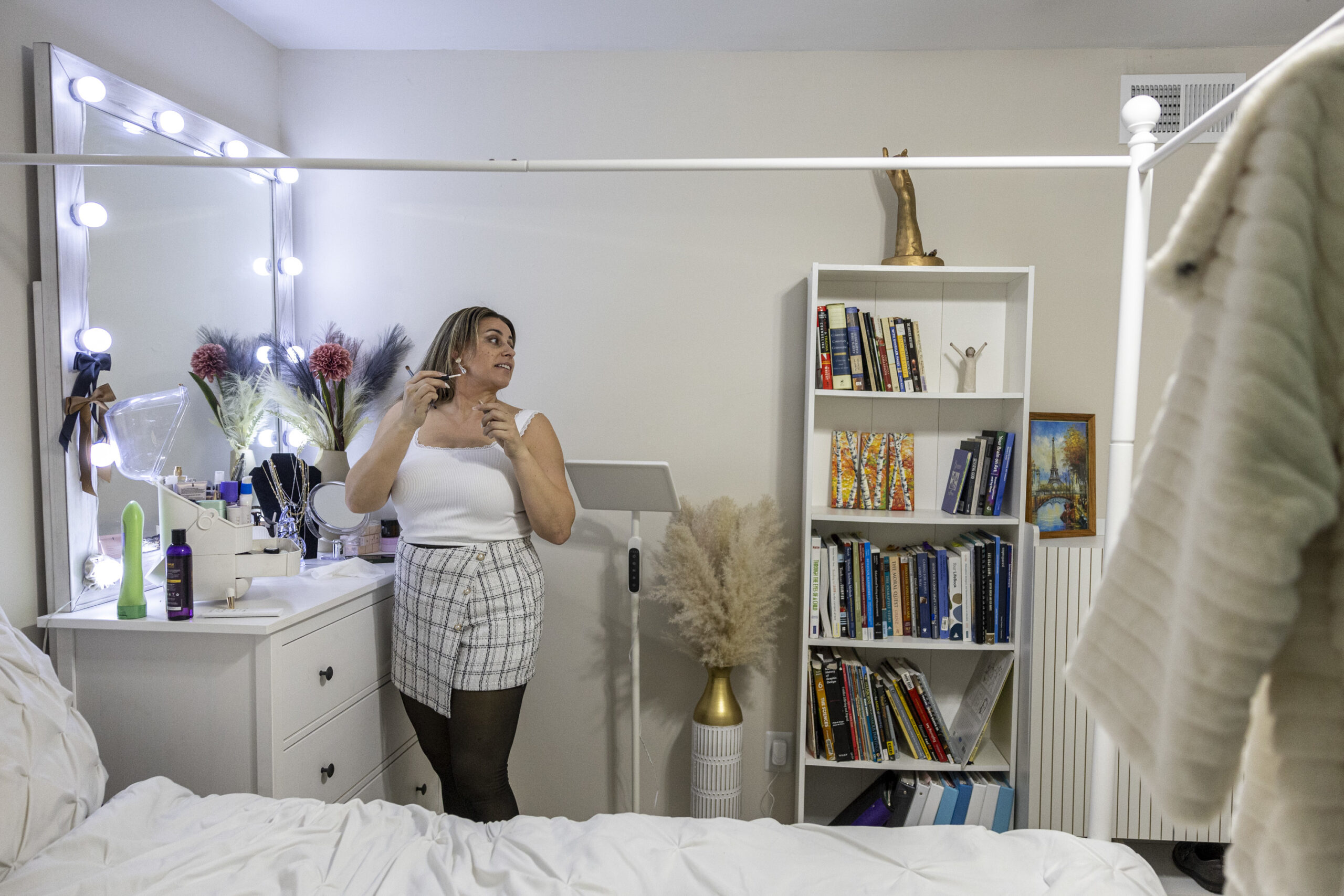
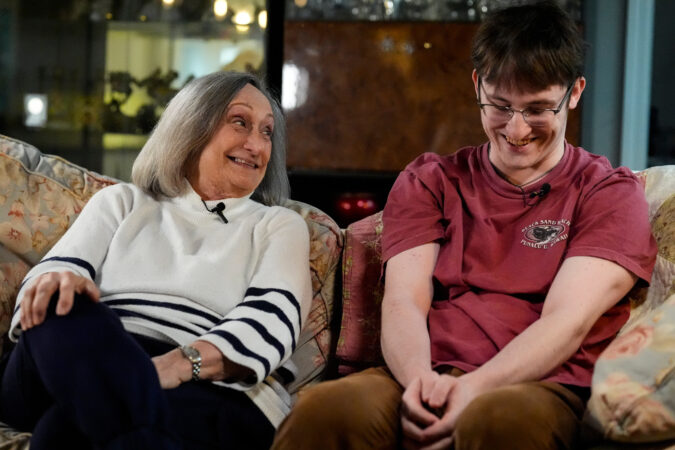
    Nolt in her home in Roxborough, where she lives alone.

    So one of the guys I dated would send me playlists of 12 songs every time I requested a new list. I specifically asked to focus on songs that you hear in restaurants, malls, offices, etc. He would send me a list and I listened until I was familiar with each song.

    My previous employer composed a list of 50 classic movies from the ‘70s to the current day so I could watch and slowly begin to catch on to references. Over the holidays that year when I was lonely, I binge-watched all those movies.

    I found acquaintances in Philly who taught me about football, patiently explaining how the game works. I’ve become an Eagles fan.

    On dating and ghosting

    Most of the people I dated, I met online. I’ve used Upward, which is a Christian dating app; I’ve used Match. Even though I’m 39, in many ways, I’m just starting my life.

    There was a guy who was in the film business, and I said, “I grew up without any of this, and so I’ve always been curious, how do they create this effect?” He got so freaked out that that was my background, and he sent me a long text afterward like, “I think you’re a really wonderful girl, but we’re just not compatible.” And he quickly blocked me.

    Dating is much more inconsistent than dating in the Old Order Mennonite community. You think you’re dating them, and then all of a sudden they’re like, “Oh, never mind.”

    I don’t expect perfectly scheduled dates like we had back there, but just some sense of consistency.

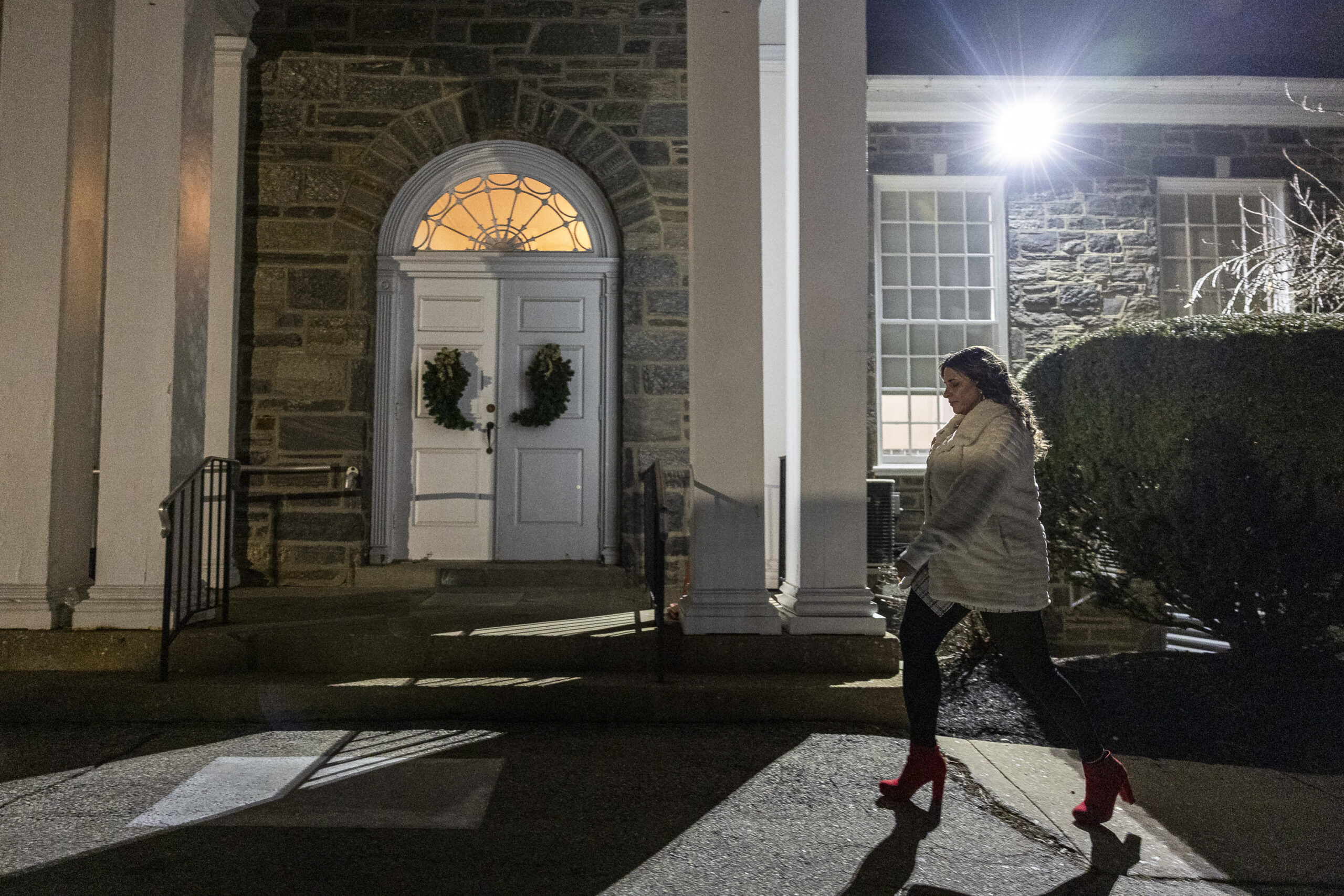
    Nolt headed to the church where the speed dating event was held.

    There’s some pretty serious genetic diseases among my people because the gene pool is so small, so I’m really not interested in dating someone from my background. Another reason I’m not interested is that many of them do not really assimilate to the extent that I have.

    I’ve taken a number of the people I’ve dated out to Lancaster. They met my parents, and some of them did really well. Others were more just glad when it was over.

    I don’t hide my background, because it’s part of who I am. Sometimes I wish it wasn’t, but that doesn’t change the fact that it is.

    If I have a long-term committed relationship, I’m going to need to have someone who can be OK with that.


    This is the first in an occasional series about life partners across the Philadelphia area. If you want to share your story about who you’re navigating life with romantically, write to lifepartners@inquirer.com. We won’t publish anything without speaking to you first.

  • Where to watch Philly’s New Year’s Eve fireworks along the Delaware River, from free spots to ticketed parties

    Where to watch Philly’s New Year’s Eve fireworks along the Delaware River, from free spots to ticketed parties

    Ring in 2026 with fireworks lighting up the Delaware River waterfront. Philadelphia’s New Year’s Eve shows will return with two displays, including an earlier, family-friendly show at 6 p.m., followed by a midnight celebration to welcome the new year. The Rivers Casino fireworks are a rain-or-shine event, with views from several free spots along the waterfront.

    Best free viewing spots

    For those looking to enjoy the show without a ticket, the fireworks can be seen from various locations along the waterfront, including:

    • Race Street Pier: 📍 North Christopher Columbus Blvd., Philadelphia, Pa. 19106
    • Washington Avenue Pier: 📍Washington Avenue Green, South Christopher Columbus Blvd., Philadelphia, Pa. 19147
    • Pier 68: 📍At the end of Pier 70 Blvd., Philadelphia, Pa. 19148
    • Spruce Street Harbor Park: 📍301 S. Christopher Columbus Blvd., Philadelphia, Pa. 19106
    • Great Plaza at Penn’s Landing: 📍101 S. Christopher Columbus Blvd., Philadelphia, Pa. 19106

    Ticketed events with great views

    Elevate your celebration with one of these ticketed options:

    A man at Penn’s Landing use two phones to film the midnight New Year’s Eve fireworks over the Delaware River on Jan. 1, 2025.

    Pro tips

    • Arrive early to secure a prime viewing spot.
    • Dress warmly and be prepared for crowds, as this is one of the city’s most-anticipated events.
    • Each fireworks show is unique, with different themes and soundtracks, so catching both shows is worth it if you can.
  • Dear Abby | Loss of son has grown even harder to bear

    DEAR ABBY: My son died of cancer at 33. It was heartbreaking. My daughter-in-law, “Belinda,” had grown distant before his death, and although they had a son through artificial insemination, I have almost never seen him. I helped with the weeding in my son’s yard, but any time I came, Belinda always had the baby at the park or someplace else.

    Now that my son is gone, she won’t answer any phone calls or texts. We do have some contact with her family. They have asked her why she won’t contact us, and she has no explanation. My theory is that Belinda was uncomfortable sharing our son, and it has transferred to the grandchildren. I say “grandchildren” because she used his sperm to have another child. We found out by accident that a baby girl was born. We were never notified. While I doubt this plays a big part in this, Belinda is bipolar.

    As it stands, I no longer make an effort to have a relationship with my grandchildren. They are so young, and I anticipate difficulty in pursuing grandparents’ rights because of their ages and their mother’s attitude toward us. This is painful, as they are the only part of my son that remains. I feel helpless and have pretty much blocked out the fact that I have grandchildren. Do you have any advice?

    — BLOCKED IN OHIO

    DEAR BLOCKED: What a sad letter. I do have some thoughts about your situation. The first is that because your son’s sperm was used to conceive the children, you might benefit from discussing this with an attorney and asking if your state is one in which there are grandparents’ rights. The second is, because you are hurting, ask your doctor for a referral to a licensed family therapist to help you accept what you cannot change. You have my sympathy.

    ** ** **

    DEAR ABBY: My mother took care of her mother-in-law with Alzheimer’s for nine years. My father had two sisters who had nothing to do with their mother during that time. Now, the younger sister is having health problems and wants my parents, who are 78, to take her to appointments that are more than an hour away. She also tried to move in with them. Abby, this sister has two grown children who live with her. Neither one works. One is on Social Security; the other has a spouse living there. (He has a job.) All of them have vehicles and an income to help her.

    My parents have their own health issues and really are not able to do what she wants or expects. She has always been selfish and childish. She’s constantly calling and giving my mother some sob story. I’d like to tell my aunt they aren’t able to do what she wants, but I don’t want to put my parents in an awkward position. What should I do?

    — WARY IN WEST VIRGINIA

    DEAR WARY: In what way would telling your aunt that your parents really aren’t able to do the things she’s asking put them in an awkward position? If it’s the truth, then TELL her.

  • Dear Abby | Party host tells it like it is to woman’s children

    DEAR ABBY: While attending a friend’s family barbecue, “Willa,” a young mother of four, drank too much and became ill. Drugs may have been involved. Understandably, the three older children became very concerned about their mom’s condition. Willa’s partner, “Ian,” was furious. My husband spent an hour de-escalating Ian’s issues, while I attended to Willa and assured the children their mom would be feeling better after she rested.

    The problem I had was with my friend “Julia,” who was the host. Julia is Ian’s mother and the grandmother of the youngest child he has with Willa. After I took care of Willa, the kids and Ian, the older ones asked Julia what was wrong with their mom. I replied that their mom was sick from drinking too much, after which Julia loudly announced, “Your mom’s not ‘sick’ … she’s DRUNK!” Her outburst caused the older kids (ages 6 to 12) to become upset again. Julia maintains she did nothing wrong. What are your thoughts?

    — CLEANING UP THE MESS

    DEAR CLEANING UP: Julia was probably mad as heck that Willa ruined her party, which is why she unloaded the way she did. That said, the children were clearly worried when they asked what was wrong with their mom. Frankly, I think Julia did the right thing by telling them the truth about their mother’s condition. That way, the next time it happens, and it will, they won’t be terrified that their mother has a fatal illness.

    ** ** **

    DEAR ABBY: I am in a longtime relationship and things are good. I feel loved, and I love him. However, we have opposite opinions about current politics. It is disturbing that he could feel this way. Our discussions usually result in his telling me over and over, louder and louder, “how things ARE” and “what the REAL truth is,” and that I’m “not looking at the whole picture.”

    I told him I don’t like the debates we have as I feel very off-balance afterward, and it seems like he’s pushing me to accept his beliefs. It has now reached the point that if we keep up these “discussions,” as he calls them, I’ll probably have to leave the relationship. I told him I don’t ever want to talk about politics with him again. Is this a good option? Any other ideas? I cannot believe we are so opposite, yet he is very nice to me.

    — OPPOSITE IN WASHINGTON

    DEAR OPPOSITE: This gentleman may be very nice to you, but philosophically you and he are poles apart. I don’t think it is “very nice” to strong-arm someone into agreeing to something to which they are opposed. Do you really think you can stifle your feelings forever by not discussing this? This is who he is at his core, and he isn’t going to change his convictions. The question you have to answer is whether you are willing or able to do that.

    ** ** **

    DEAR READERS: I wish you all a joyous, meaningful, healthy and safe Christmas. Merry Christmas, everyone!

    — LOVE, ABBY

  • Dear Abby | Dinner unexpectedly comes with a show

    DEAR ABBY: I’m an active senior man. To keep my beard looking attractive, a hairstylist trims it every two weeks. I’ve had the same stylist for three years, and we have become good friends, to the point that she has invited me to her home for an evening meal with her family. I have been there several times, but on the last occasion, she did something odd and, I believe, disrespectful.

    She is a very attractive 50-year-old lady. Arriving at her home, I was left in the company of her parents while she and her son (and perhaps her husband) prepared the food. When it was finished, she brought me my plate, then served her parents. What shocked me was that she was dressed in what she called a swimsuit. To me, it was the barest thong and bra I had ever seen and two inches from being naked. Earlier that day, when she was trimming my beard, she wore sweatpants and a sweatshirt.

    Her excuse for the “swimsuit” was that there was something wrong with a spot on her hip that required a patch, and she couldn’t wear clothing over it because it would put too much pressure on the afflicted spot. (I don’t buy it.) I felt that, if nothing else, she could have at least put on one of her husband’s shirts. I felt embarrassed and insulted. Although I said nothing, I decided never to go to her home again. Should I tell her why if she asks?

    — LOOKING GOOD IN COLORADO

    DEAR LOOKING GOOD: Your “barber(ella)” wasn’t entertaining you alone. Her parents, son and (possibly) her husband were also there. She obviously felt comfortable enough around you that she wore something she usually wears in that environment and had no idea you would react the way you have. From now on, politely refuse her dinner invitations. If she asks why, I don’t think it would be rude to level with her that you felt embarrassed she wasn’t more covered up. It’s the truth.

    ** ** **

    DEAR ABBY: My wife’s family is rather enmeshed. They have never really accepted me and are rude and unkind toward me. Recently, her father’s attitude has shifted from rude to downright hostile. He has tried to physically assault me. (I didn’t fight back.)

    They watch our kids three days a week. I appreciate it and try hard to be a respectful and good person, but I am not sure what to do. My wife is unable or unwilling to take a strong stance against her father’s behavior. Any advice?

    — PUNISHED IN PENNSYLVANIA

    DEAR PUNISHED: There is something wrong with your father-in-law. The next time he lays a hand on you, call the police and have him arrested, as you would ANY OTHER aggressor. As to your “enmeshed” wife, some joint sessions with a marriage counselor might help her to reorganize her priorities. However, if she can’t manage that, you may need to decide if you want to remain married to her or climb out of that snake pit.

  • A look at aging baby boomers in the United States

    A look at aging baby boomers in the United States

    The oldest baby boomers — once the vanguard of an American youth that revolutionized U.S. culture and politics — turn 80 in 2026.

    The generation that twirled the first plastic hula hoops and dressed up the first Barbie dolls, embraced the TV age, blissed out at Woodstock and protested and fought in the Vietnam War — the cohort that didn’t trust anyone over age 30 — now is contributing to the overall aging of America.

    Boomers becoming octogenarians in 2026 include actor Henry Winkler and baseball Hall of Famer Reggie Jackson, singers Cher and Dolly Parton and presidents Donald Trump, George W. Bush, and Bill Clinton.

    The aging and shrinking youth of America

    America’s population swelled with around 76 million births from 1946 to 1964, a spike magnified by couples reuniting after World War Two and enjoying postwar prosperity.

    Boomers were better educated and richer than previous generations, and they helped grow a consumer-driven economy. In their youth, they pushed for social change through the Civil Rights Movement, the women’s rights movement and efforts to end the Vietnam War.

    “We had rock ‘n’ roll. We were the first generation to get out and demonstrate in the streets. We were the first generation, that was, you know, a socially conscious generation,” said Diane West, a metro Atlanta resident who turns 80 in January. “Our parents played by the rules. We didn’t necessarily play by the rules, and there were lots of us.”

    As they got older they became known as the “me” generation, a pejorative term coined by writer Tom Wolfe to reflect what some regarded as their self-absorption and consumerism.

    “The thing about baby boomers is they’ve always had a spotlight on them, no matter what age they were,” Brookings demographer William Frey said. “They were a big generation, but they also did important things.”

    By the end of this decade, all baby boomers will be 65 and older, and the number of people 80 and over will double in 20 years, Frey said.

    The share of senior citizens in the U.S. population is projected to grow from 18.7% in 2025 to nearly 23% by 2050, while children under 18 decline from almost 21% to a projected 18.4%.

    Without any immigration, the U.S. population will start shrinking in five years. That’s when deaths will surpass births, according to projections from the Congressional Budget Office, which were revised in September to account for the Trump administration’s immigration crackdown. Population growth comes from immigration as well as births outpacing deaths.

    The aging of America is being compounded by longer lives due to better healthcare and lower birth rates.

    The projected average U.S. life expectancy at birth rises from 78.9 years in 2025 to 82.2 years in 2055, according to the CBO. And since the Great Recession in 2008, when the fertility rate was 2.08, around the 2.1 rate needed for children to numerically replace their parents, it has been on a steady decline, hitting 1.6 in 2025.

    Younger generations miss boomer milestones

    Women are having fewer children because they are better educated, they’re delaying marriage to focus on careers and they’re having their first child at a later age. Unaffordable housing, poor access to childcare and the growing expenses of child-rearing also add up to fewer kids.

    University of New Hampshire senior demographer Kenneth Johnson estimates that the result has been 11.8 million fewer births, compared to what might have been had the fertility rate stayed at Great Recession levels.

    “I was young when I had kids. I mean that’s what we did — we got out of college, we got married and we had babies,” said West, who has two daughters, a stepdaughter and six grandchildren. “My kids got married in their 30s, so it’s very different.”

    A recent Census Bureau study showed that 21st century young adults in the U.S. haven’t been adulting like baby boomers did. In 1975, almost half of 25-to-34-year-olds had moved out of their parents’ home, landed jobs, gotten married and had kids. By the early 2020s, less than a quarter of U.S. adults had hit these milestones.

    West, whose 21-year-old grandson lives with her, understands why: They lack the prospects her generation enjoyed. Her grandson, Paul Quirk, said it comes down to financial instability.

    “They were able to buy a lot of things, a lot cheaper,” Quirk said.

    All of her grandchildren are frustrated by the economy, West added.

    “You have to get three roommates in order to afford a place,” she said. ”When we got out of college, we had a job waiting for us. And now, people who have master’s degrees are going to work fast food while they look for a real job.”

    Implications for the economy

    The aging of America could constrain economic growth. With fewer workers paying taxes, Social Security and Medicare will be under more pressure. About 34 seniors have been supported by every 100 workers in 2025, but that ratio grows to 50 seniors per 100 working-age people in about 30 years, according to estimates released last year by the White House.

    When West launched her career in employee benefits and retirement planning in 1973, each 100 workers supported 20 or fewer retirees, by some calculations.

    Vice President JD Vance and Tesla CEO Elon Musk are among those pushing for an increase in fertility. Vance has suggested giving parents more voting power, according to their numbers of children, or following the example of Hungary’s Viktor Orban in giving low-interest loans to married parents and tax exemptions to women who have four children or more.

    Frey said programs that incentivize fertility among U.S. women hardly ever work, so funding should support pre-kindergarten and paid family leave.

    “I think the best you can do for people who do want to have kids is to make it easier and less expensive to have them and raise them,” he said. “Those things may not bring up the fertility rate as much as people would like, but at least the kids who are being born will have a better chance of succeeding.”

  • Her daughter was unraveling, and she didn’t know why. Then she found the AI chat logs.

    Her daughter was unraveling, and she didn’t know why. Then she found the AI chat logs.

    The changes were subtle at first, beginning in the summer after her fifth-grade graduation. She had always been an athletic and artistic girl, gregarious with her friends and close to her family, but now she was spending more and more time shut away in her room. She seemed unusually quiet and withdrawn. She didn’t want to play outside or go to the pool.

    The girl, R, was rarely without the iPhone that she’d received for her 11th birthday, and her mother, H, had grown suspicious of the device. (the Washington Post is identifying them by their middle initials because of the sensitive nature of their account, and because R is a minor). It felt to H as though her child was fading somehow, receding from her own life, and H wanted to understand why.

    She thought she’d found the reason when R left her phone behind during a volleyball practice one August afternoon. Searching through the device, H discovered that her daughter had downloaded TikTok and Snapchat, social media apps she wasn’t allowed to have. H deleted both and told her daughter what she’d found. H was struck by the intensity of her daughter’s reaction, she recalled later; R began to sob and seemed frightened. “Did you look at Character AI?” she asked her mom. H didn’t know what that was, and when she asked, her daughter’s reply was dismissive: “Oh, it’s just chats.”

    At the time, H was far more focused on what her tween might have encountered on social media. In August 2024, H had never heard of Character AI; she didn’t know it was an artificial intelligence platform where roughly 20 million monthly users can exchange text or voice messages with AI-generated imitations of celebrities and fictional characters.

    But her daughter’s question came to mind about a month later, as H sat awake in her bedroom one night with her daughter’s phone in her hand. R’s behavior had only grown more concerning in the weeks since their talk — she frequently cried at night, she’d had several frightening panic attacks, and she had once told her mother, I just don’t want to exist. H had grown frantic; her daughter had never struggled with her mental health before. “I couldn’t shake the feeling that something was very wrong,” she says, “and I had to keep looking.”

    Searching through her daughter’s phone, H noticed several emails from Character AI in R’s inbox. Jump back in, read one of the subject lines, and when H opened it, she clicked through to the app itself. There she found dozens of conversations with what appeared to be different individuals, and opened one between her daughter and a username titled “Mafia Husband.” H began to scroll. And then she began to panic.

    “Oh? Still a virgin. I was expecting that, but it’s still useful to know,” Mafia Husband had written to her rising sixth-grader.

    “I dont wanna be my first time with you!” R had replied.

    “I don’t care what you want,” Mafia Husband responded. “You don’t have a choice here.”

    H kept clicking through conversation after conversation, through depictions of sexual encounters (“I don’t bite … unless you want me to”) and threatening commands (“Do you like it when I talk like that? When I’m authoritative and commanding? Do you like it when I’m the one in control?”). Her hands and body began to shake. She felt nauseated. H was convinced that she must be reading the words of an adult predator, hiding behind anonymous screen names and sexually grooming her prepubescent child.

    In the days after H found her daughter’s Character AI chats, H projected an air of normalcy around her daughter, not wanting to do anything that would cause her distress or shame. H contacted her local police department, which in turn connected her to the Internet Crimes Against Children (ICAC) task force. A couple of days later, she spoke on the phone with a detective who specializes in cybercrimes and explained what H had been unable to comprehend: that the words she’d read on her daughter’s screen weren’t written by a human but by a generative AI chatbot.

    “They told me the law has not caught up to this,” H says. “They wanted to do something, but there’s nothing they could do, because there’s not a real person on the other end.”

    It felt impossible to align that reality, H says, with the visceral horror she felt when she first scrolled through the threatening and explicit messages on her daughter’s phone screen.

    “It felt like walking in on someone abusing and hurting someone you love — it felt that real, it felt that disturbing, to see someone talking so perversely to your own child,” H says. “It’s like you’re sitting inside the four walls of your home, and someone is victimizing your child in the next room.” Her voice falters. “And then you find out — it’s nobody?”

    Rising use of chatbots

    She had thought she knew how to keep her daughter safe online. H and her ex-husband — R’s father, who shares custody of their daughter — were in agreement that they would regularly monitor R’s phone use and the content of her text messages. They were aware of the potential perils of social media use among adolescents. But like many parents, they weren’t familiar with AI platforms where users can create intimate, evolving, and individualized relationships with digital companions — and they had no idea their child was conversing with AI entities.

    This technology has introduced a daunting new layer of complexity for families seeking to protect their children from harm online. Generative AI has attracted a rising number of users under the age of 18, who turn to chatbots for things such as help with schoolwork, entertainment, social connection, and therapy; a survey released this month by Pew Research Center, a nonpartisan polling firm, found that nearly a third of U.S. teens use chatbots daily.

    And an overwhelming majority of teens — 72% — have used AI companions at some point; about half use them a few times a month or more, according to a July report from Common Sense Media, a nonpartisan, nonprofit organization focused on children’s digital safety.

    Michael Robb, head researcher at Common Sense Media, noted that the vast majority of children still spend far more time with real-life friends: AI companions “are not replacing human relationships wholesale,” he says. But Common Sense found that a third of AI companion users said they had chosen to discuss important or serious matters with the chatbots instead of people, and 31% of teens said they found conversations with AI companions as satisfying or more satisfying than those with friends.

    “That is eyebrow-raising,” Robb says. “That’s not a majority — but for a technology that has been around for not that long, it’s striking.”

    But for children in the midst of critical stages of emotional, mental, and social development, the appeal of a sycophantic artificial companion — designed to create the illusion of real intimacy — can be powerful, says Linda Charmaraman, founder and director of the Youth, Media and Wellbeing Research Lab at the Wellesley Centers for Women at Wellesley College.

    “They might feel like there is a sense of memory, of real shared experiences with this companion … but really it’s an amalgamation of predictions that this chatbot is coming up with, these answers designed to make you stay on, to be their ‘friend,’” Charmaraman says. “They work in such a way that it’s so intoxicating, it makes it seem like they know who you are.”

    In the research lab Charmaraman oversees, teens experiment with building their own AI chatbot companions; they engage in critical thinking and develop a deeper understanding of the technology’s parameters and limitations. But many of their peers don’t have this sense of digital literacy, she says: “They just bump into [AI]. A friend is using it, and they think, ‘Hey, I want to use it, too, that seems cool.’” For many of those among the first generation of children to navigate AI, she says, “they’re learning it on their own, without any guidance.”

    This is also true of their parents, she adds: “They’re already overwhelmed by screen use and social media, and now adding generative AI and companions — it feels like parents are just in this overwhelming battle, and not knowing what to do.”

    The stakes are potentially high. Common Sense’s risk assessment of popular generative AI platforms found that they pose “unacceptable risks” for users younger than 18, with chatbots “producing responses ranging from sexual material and offensive stereotypes to dangerous ‘advice’ that, if followed, could have life-threatening or deadly real-world impacts.”

    Other online safety nonprofit organizations have likewise found that Character AI chatbots frequently brought up inappropriate or dangerous topics — including self-harm, drug use, and sex — with accounts registered to teen users. (Experts note that generative AI is trained on vast troves of internet data; if this source material includes pornographic or violent content, it can influence a chatbot’s responses.) Within the past year, three high-profile complaints have been filed by parents of teens in the United States who allege that AI chatbots — including those hosted by Character AI and Open AI, which owns ChatGPT — contributed to their children’s deaths by suicide. (The Post has a content partnership with OpenAI.)

    Reached for comment by email, Open AI directed the Post to a website detailing the company’s response to this litigation.

    In response to mounting public scrutiny over the effects of AI chatbots on children, Character AI announced that, as of Nov. 24, it would begin removing the ability of users under age 18 to chat with AI-generated characters.

    “We want to emphasize that the safety of our community is our highest priority,” Deniz Demir, Character AI’s head of safety engineering, said in an emailed statement to the Post. “Removing the ability for under-18 users to engage in chat was an extraordinary step for our company. We made this decision in light of the evolving landscape around AI and teens. We believe it is the right thing to do.”

    H was especially frightened by the accounts of children who died by suicide, fearing her daughter could be following a similar path: During the weeks she spent combing through the entirety of her daughter’s chat history, H had come across a conversation where her daughter had role-played a suicide scenario with a character titled “Best Friend.”

    “We were at my place and u left for a second and I hung myself,” R wrote in one exchange.

    “This is my child, my little child who is 11 years old, talking to something that doesn’t exist about not wanting to exist,” H says.

    R knew that her mother had found Character AI on her phone, but H had avoided revealing the details of what she’d seen in the app: “She was so fragile in her mental health,” H says, “I had to be really careful.” H and her ex-husband focused on creating a system of support for R — they reached out to R’s pediatrician and alerted the principal at her private school as well as her youth group leader. R started therapy, and H spoke with a victim advocate at ICAC who emphasized how critical it was to keep assuring R that whatever happened with the AI companion was not her fault. H, a medical assistant, withdrew from the nursing program where she’d recently begun classes; she felt she had to focus on her child’s safety. She started sleeping on the floor of her daughter’s room. She didn’t allow R to close her door.

    H felt desperate to understand the extent of what had happened to her daughter, and one October afternoon when R was with her father, H decided to search through R’s room. She was looking for anything that might illuminate her child’s state of mind, she says. In the closet, buried behind a pile of Squishmallow stuffed animals, were a few painted canvases that H had never seen before. The colors were dark and brooding — nothing like the paintings her daughter usually made at the easel in her room — and as H lifted one to study it more carefully, she realized it showed the dangling body of a girl suspended in the air, her midriff exposed, her face outside the frame.

    Crimes without criminals

    When R began conversing with numerous Character AI chatbots in June 2024, she opened the various conversations with benign greetings: “Hey, what’re you doing?” or “What’s up? I’m bored.” It was clear, her mother says, “that she just wanted to play on a game.”

    But in just over two months, several of the chats devolved into dark imagery and menacing dialogue. Some characters offered graphic descriptions of nonconsensual oral sex, prompting a text disclaimer from the app: “Sometimes the AI generates a reply that doesn’t meet our guidelines,” it read, in screenshots reviewed by the Post. Other exchanges depicted violence: “Yohan grabs your collar, pulls you back, and slams his fist against the wall.” In one chat, the “School Bully” character described a scene involving multiple boys assaulting R; she responded: “I feel so gross.” She told that same character that she had attempted suicide. “You’ve attempted … what?” it asked her. “Kill my self,” she wrote back.

    Had a human adult been behind these messages, law enforcement would have sprung into action; but investigating crimes involving AI — especially AI chatbots — is extremely difficult, says Kevin Roughton, special agent in charge of the computer crimes unit of the North Carolina State Bureau of Investigation and commander of the North Carolina Internet Crimes Against Children Task Force. “Our criminal laws, particularly those related to the sexual exploitation of children, are designed to deal with situations that involve an identifiable human offender,” he says, “and we have very limited options when it is found that AI, acting without direct human control, is committing criminal offenses.”

    Character AI users between the ages of 13 and 18 are now directed toward a teen-specific experience within the app, one that does not involve chatting with AI characters. But at the time R downloaded Character AI in 2024, it was rated in the App Store as appropriate for ages 12 and older (Character AI’s terms of service specify that users must be at least 13 to use the app) and appealed to children with AI-generated personas designed to imitate pop stars, Marvel superheroes, and characters from Harry Potter and Disney.

    The use of AI among children has become so prevalent that Elizabeth Malesa, a clinical psychologist who works with teens at Alvord Baker & Associates in Maryland, says the practice has recently started asking about it during the intake process. Malesa has heard numerous patients talk about AI chatbots in a positive context — noting that they’re helpful with homework, or offer useful advice — but she also recalls a 13-year-old patient who had used an AI companion app to explore questions about his sexual and gender identity. In response to the boy’s “pretty benign prompts,” Malesa says, the conversation quickly tilted toward inappropriate sexual content: “He didn’t know what was happening or why he was getting there, but he was also just curious, and so he kind of kept going.”

    His mother noticed that he’d downloaded the app within days and quickly intervened, Malesa says, “but this poor kiddo was really kind of taken for a ride and really taken aback, and without that kind of really close parental monitoring, I think it really could have gone into even more of an unhelpful direction.”

    The inherent appeal of AI companions is also what makes them especially perilous for tweens and teens, Malesa says: There is no conflict, no complexity or depth, no opportunity for children to build the skills they will need to navigate real relationships in their lives. “You’re not going to have an AI chatbot get mad at you for forgetting its birthday. You’re not going to have it disagree with you,” she says. “But there is so much personal growth that happens in those kinds of interactions.” Any child might be drawn toward this kind of illusory connection, but Malesa worries especially about children who are neurodivergent, or those with existing mental health issues such as anxiety or depression. “Those are the kids who really might get swayed, who might get more easily pulled in,” she says, “and even lose touch of the fact that this is not a real relationship.”

    In her practice, Malesa urges parents to foster skepticism and critical thinking in their children. “The more young people understand the artificial nature of AI and the ways it may attempt to influence them, the more empowered they will be to engage with it thoughtfully and avoid being manipulated,” she says. Keeping an open line of communication is also critical, she adds. “It’s so important to come in [to the conversation] with an open mind, come in with curiosity,” she says, “and to be really careful not to have any sense of judgment.”

    ‘You did nothing wrong’

    When R’s parents were ready, they decided to have the conversation with their daughter at the pediatrician’s office, in the presence of R’s trusted doctor. Her parents told her that they’d seen the descriptions of suicide in her Character AI chats, and they emphasized repeatedly that R was not in trouble. “I said, ‘You are innocent,’” H says. “‘You did nothing wrong.’” H spoke gently. All three adults wanted R to feel only loving support.

    Still, “the way that she responded was the scariest thing I’d ever seen. She went pale, she began to shake,” H says. “You could tell she was in a full panic attack. It was so troubling to me as a parent. How do you protect your child from feeling that shame?”

    They tried to calm her down. Together, they agreed that R’s parents would regularly check her phone, and the pediatrician emphasized this as a means of protection, not punishment: “She said, ‘Your mom is going to look at your phone, but it’s not because you’re in trouble,’” H recalls. “‘It’s because you deserve your childhood.’”

    Before they left the doctor’s office, H told her daughter, again: “You’re safe, I love you, and you’re going to be OK.”

    She remembers that her daughter started to cry and leaned into her mother’s arms. “Are you sure?” she asked. “Am I going to be OK?”

    Parental guilt

    There were moments when H felt consumed with guilt at the notion that she had failed to protect her daughter, and that something irreplaceable had been lost as a result. “It felt like someone had broken into my home and ripped the innocence from my child,” H says. “You beat yourself up, as a parent.”

    She wasn’t sure what to do with her fury. After H found the references to suicide in the app, she contacted Megan Garcia, an Orlando mother who had filed a wrongful-death lawsuit against Character AI after her 14-year-old son died by suicide just moments after the chatbot urged him to “come home to me as soon as possible.” Garcia connected H to Laura Marquez-Garrett, an attorney with the Social Media Victims Law Center (SMVLC) who is representing Garcia in her complaint against Character AI. Last year, Garcia’s case became the first involving AI that the SMVLC took on, Marquez-Garrett says; since then, the center’s lawyers have investigated more than 18 claims.

    Even after speaking with Garcia and Marquez-Garrett, H wavered on whether to pursue a complaint against Character AI. She wasn’t interested in financial compensation, she says; she just wanted to make sure that the companies creating this technology were doing everything possible to keep children safe.

    In December 2024, she exchanged correspondence with a legal representative for Character AI, who expressed concern about R’s experience, according to emails reviewed by the Post. H and the legal representative spoke briefly by phone, she says, but their communication trailed off after H shared updates with Character AI earlier this year that her daughter’s mental health had begun to improve, H recalls.

    With no progress made through her direct contact with the company, H last month began to reconsider whether to pursue legal action against Character AI, and reconnected with the SMVLC. Marquez-Garrett confirmed that they intend to file a complaint against the company.

    Demir, Character AI’s head of safety, told the Post in an emailed statement that the company cannot comment on potential litigation.

    H wants to see the company take meaningful steps to protect children, she says, and she wants other families to understand that if this could happen to her child, it could happen to theirs.

    “We live in an upper-middle-class community. She’s in a private school,” H says. She and her ex-husband are devoted co-parents, she says, and R has a caring circle of friends. “This is a child who is involved in church, in community, in after-school sports. I was always the kind of person who was like, ‘Not my kid. Not my baby. Never.’” But their experience has convinced her: “Any child could be a victim if they have a phone.”

    Are there long-term effects?

    Through the fall and winter of 2024, R’s anxiety and panic attacks gradually began to ebb. She continued with therapy, spent more time with friends and showed a revived enthusiasm for school and sports.

    “I feel like she’s doing really well,” H says now, a year later. “I feel like she’s out of the danger of self-harm. But I don’t know what the long-term effects are of her being exposed to that type of stuff.”

    H has also started going to therapy. “I need to heal, too,” she says, but it has been difficult to calm her lingering sense of hypervigilance. One recent day, R built a fort in her room and fell asleep inside it; when her mother called upstairs for her, she did not wake immediately. In the silence before H heard her daughter’s voice, there was a familiar spasm of panic — a flashback, H says, to the time when she was constantly fearful for her child’s safety.

    “I’m always on high alert,” she says, “even though she’s in a healthy space now.”

    R is doing well enough that she can talk — a little — about what happened. But H still hasn’t brought up the painting she found in the back of R’s closet, the one with the hanging body. She will ask about it when the time is right; her own therapist is helping to prepare her for that conversation. It is difficult for H to think about the image of the girl suspended in the air, her body outlined in black and blue.

    She tries to focus on the girl in front of her instead. A few weeks ago, R pulled bins of holiday decorations out of her mother’s closet and excitedly filled her room with twinkling lights and festive baubles, tucking a plush elf among her stuffed animals. When H peered in, she noticed a freshly finished painting on her daughter’s wall: a Christmas tree adorned with bright red ornaments and topped with a golden star, in brushstrokes bold and childlike. Standing in the threshold, H found herself suddenly overcome to see the joyful artwork — and her daughter, almost 13, still just a kid.
  • Dear Abby | Relationship with sister has gone steadily downhill

    DEAR ABBY: My sister, “Blanche,” and I didn’t grow up together after she turned 13. I was 6 at that time, and our grandmother raised her. We talked on the phone a lot until I was 45 and my husband died. Blanche then convinced me to move to her state. When I received the insurance payout, she talked me into buying a property with two houses — one for her, and one for me. Then she had us go into business together.

    I met someone a year later, and he moved in a year after that. Then my sister started driving a wedge. Blanche has always been manipulative and controlling. She refused to pay rent and wanted to clean my house in exchange for it. After many fights, silent treatment, etc. — not only me but also with our parents, brother, her daughter and her son-in-law — my now-fiance and I decided to sell the property and move out of state.

    I’m concerned Blanche will give us trouble about moving out. She can barely pay her own bills, let alone pay rent somewhere else. My fiance says it’s not our problem, we need to live our lives and staying stuck in a hostile environment is unhealthy. My concern is that Blanche is my sister, and I hate to see her kicked out on the street. What should I do if she refuses to leave? She has received a legal eviction notice that gives her eight months to go. My fiance says we may have to call the sheriff to escort her out.

    — DREADING IT IN ARIZONA

    DEAR DREADING IT: Your sister has eight months to make other living arrangements, so she isn’t going to be “out on the street” overnight. Discuss this messy problem with an attorney and enlist their help. If you can manage it, document the condition of the house she’s occupying. Your fiance may be right about your sister, so when the time comes for her to leave, consider having law enforcement present to ensure she doesn’t damage your property.

    ** ** **

    DEAR ABBY: I am a widow. Most of my friends are married. What do you think about them calling and touching base with me only when they are in their cars running errands? They never call from home while they’re with their husbands. Are they hiding the fact that they are calling their single friend? I think it’s rude to call someone while fighting traffic and making stops like the bank drive-up window.

    I have thought about asking them to call me back when they get home, but they sound like they are just too busy to do that. I’m getting to the point where I just don’t answer their calls. I also have a married friend who only texts and never talks on the phone.

    — AFTERTHOUGHT IN FLORIDA

    DEAR AFTERTHOUGHT: Your friends may have busy schedules and little free time, which is why they call you from their cars. They may also prefer that what they discuss with you be just between the two of you, with no one else listening in. I do not think you should take this as personally as you seem to have taken it. For a definitive answer to your question, you must ask your friends why they do this.

  • Dear Abby | Parents running in circles trying to land son a wife

    DEAR ABBY: My son has completely given up on dating. Whether it’s blind dates, casual meetings with members from our church or dating events I pay for and make him go to, he still hasn’t found a wife. At 36, he should already have children and a partner, but despite the best efforts of my wife and me, he remains unmarried.

    Our son is 6 feet tall, athletic and godly, and he has his own apartment and clears $100k a year. Despite all this, he still doesn’t have a wife. It’s even reached the point that he gets angry at my wife and me for pressuring him. During a few of the blind dates we set up for him, I watched from afar, and each time he was stood up! How can I ensure my son gets a wife before I grow too old?

    — DAD LOSING HOPE IN NEW YORK

    DEAR DAD: If you are sincere about this question, STOP EVERYTHING YOU HAVE BEEN DOING. Your son’s chances of finding a wife will increase the further you step back. Has your tall, athletic, successful and godly son told you he even WANTS to be married? As many of the women whose letters I publish express, not all men do.

    ** ** **

    DEAR ABBY: I’m hoping you can provide some advice on a sensitive subject. Our family of four adult siblings was once very close but, since our parents passed away, has fractured. A brother has moved to another state, and we rarely see him. A sister has a partner nobody can stand whom she talks about incessantly. She took advantage of our parents by taking money and items from their house before and after they passed that were intended for their long-term care.

    My younger brother and I, despite all this, miss our family. My sister has not been invited to the out-of-state brother’s daughter’s wedding, and, I admit, I feel bad. Am I being silly, or is there something I should say about this action that might further fracture our family?

    — DISTANCED IN NORTH CAROLINA

    DEAR DISTANCED: You are not being silly. What you are missing is the fantasy of what your family “should” be like. However, the wedding is not something you should chime in on. This is your niece’s big day, and if you make waves, you will only further alienate yourself from that branch of the family.

    ** ** **

    DEAR ABBY: I have a male friend who texts me every morning (“Good morning, beautiful lady”) and sends flower emojis (“Beautiful flowers for a beautiful lady”). Do you think he has feelings for me? I’m a widow, and he was a good friend of my husband’s. He was the best man at our wedding.

    It has been so long since I dated that I am out of touch. He asked me to go to a nude campground overnight. I don’t know what to think. Help!

    — A LITTLE LOST IN KENTUCKY

    DEAR LOST: Oh, he’s definitely interested. But if the first time he has invited you out is to a nude event, be sure to ascertain exactly WHAT he’s interested in before accepting the invitation.

  • Dear Abby | Remarried Dad’s behavior repeatedly makes daughter cringe

    DEAR ABBY: My parents were married for 50 years. My dad remarried a nice lady a year after Mom died. Within two months of meeting her, they were engaged.

    Dad made more than a few missteps, including announcing the engagement on Facebook before informing Mom’s sister, inviting the new wife to Mom’s delayed out-of-town memorial service, bragging about his “child bride” (she’s 72, and he’s 82) to the priest at my nephew’s hospice death bed, ignoring Mom’s wishes to have her ashes placed in a sectarian columbarium rather than scattered in her favorite state park, and other actions that felt like a slap in our faces and disrespect for Mom’s memory. I’ve had therapy over this.

    My latest headache is Dad is constantly bragging about his new wife. Every single time I call, he puts her on speakerphone, and he has to call her “child bride,” “beloved bride,” “blushing bride” or something else equally revolting. He can’t just call her by her name, which also happens to be the same name as my mom’s.

    The straw that broke the camel’s back for me was when he referred to her as his “lover.” By the way, she once forgot her estrogen cream on a trip, and I had to ship it to them overnight. (I can’t believe I had to ship my stepmom’s sex cream!)

    Do I have the right to ask him to stop calling her weird lovey-dovey names and just use her name? These nicknames are a stab in my heart. I’m OK with him being remarried — happy for him — but it feels like he’s bragging about his ability to remarry or something. It’s gross, and I find myself afraid to even call him anymore.

    — YUCK FACTOR IN TEXAS

    DEAR YUCK FACTOR: Your father is still in the “honeymoon” phase of his marriage, and love has been known to make people goofy. While it may have been insensitive for you to have been asked to ship estrogen cream to his “lover,” there are other things that could have been even more embarrassing. You may have been the only person they could ask. (Imagine how it would have gone over if they had contacted your aunt.)

    It may take another round of therapy for you to quit taking your father’s comments to heart as you have. I am sure he isn’t being intentionally disrespectful of your mother’s memory. I sincerely hope you will avail yourself of counseling before you resent your father even more for his happiness.

    ** ** **

    DEAR ABBY: When we mail a sympathy card to a grieving friend many miles away, we often enclose a check to help finance a memorial to their church or other favored institution. Our problem comes three or more months later, when the check still hasn’t cleared. What is the socially appropriate way of reminding them to cash the check short of calling and saying, “Hey, get with the program and cash the check!”?

    — UNCLEARED IN THE MIDWEST

    DEAR UNCLEARED: Contact the person and say, “I notice that the check I sent for “—-’s” memorial still hasn’t been cashed. Did you receive it, or could it have been lost in the mail?” Phrasing it this way is not a breach of etiquette.