Gov. Josh Shapiro is hitting the campaign trail in two key states this weekend.
With less than two weeks left until Election Day, Shapiro will campaign and raise cash for U.S. Reps. Mikie Sherrill (D., N.J.) and Abigail Spanberger, (D., Va.), two Democratic hopefuls in high-stakes gubernatorial races that could preview the national mood ahead of next year’s midterms.
Shapiro will campaign with Sherrill Saturday morning in Monroe Township at an event to mark the start of early in-person voting in the Democratic-leaning state which has grown increasingly red. The pair will then attend a Souls to the Polls event at a church in New Brunswick, Shapiro For Pennsylvania spokesperson Manuel Bonder said.
The governor is also expected to hold a fundraiser for the New Jersey Democratic State Committee to benefit Sherrill’s campaign later in the day.
On Sunday, Shapiro will head to Virginia to attend events in Portsmouth and Norfolk with Spanberger.
Sherrill has amped up her campaigning in recent weeks, and she’s brought out big Democratic names to help her. In the last three weeks, she’s campaigned with New Jersey Sens. Cory Booker and Andy Kim, and with Maryland Gov. Wes Moore. Former Secretary of Transportation Pete Buttigieg is planning a visit to New Jersey next weekend, and Sherrill’s campaign curtain call the Saturday before Election Day will feature a rally with former President Barack Obama.
This combination photo shows candidates for governor of New Jersey Republican Jack Ciattarelli, left, and Democrat Mikie Sherrill during the final debate in governors race, Oct. 8, 2025, in New Brunswick, N.J. (AP Photos/Heather Khalifa)
Why Shapiro is involved in the New Jersey governor’s race
Shapiro is a big draw on the campaign trail as he continues to build a national profile, and gears up for his own reelection campaign next year. The first-term governor, who is seen as a potential 2028 presidential candidate, announced the 2026 release of a memoir this week.
The poll also found that Shapiro is viewed favorably by some Republicans, an across-the-aisle appeal that appears to extend across the Delaware River.
Shapiro’s been lauded by Sherrill’s Republican opponent in the New Jersey race, Jack Ciattarelli, a trend chronicled recently by Politico.
Ciattarelli commended Shapiro’s willingness to criticize New York City mayoral candidate Zohran Mamdani’s past comments on Israel, and praised his handling of small businesses, energy and property taxes in Pennsylvania, contrastingly saying New Jersey faces a “crisis” in all three.
Sherrill has said frequently that she wants to mimic Pennsylvania’s success in cutting the time it takes business owners to get permits from state government.
This story has been updated to correct the location of Gov. Josh Shapiro’s first stop with U.S. Rep. Mikie Sherrill on the campaign trail Saturday.
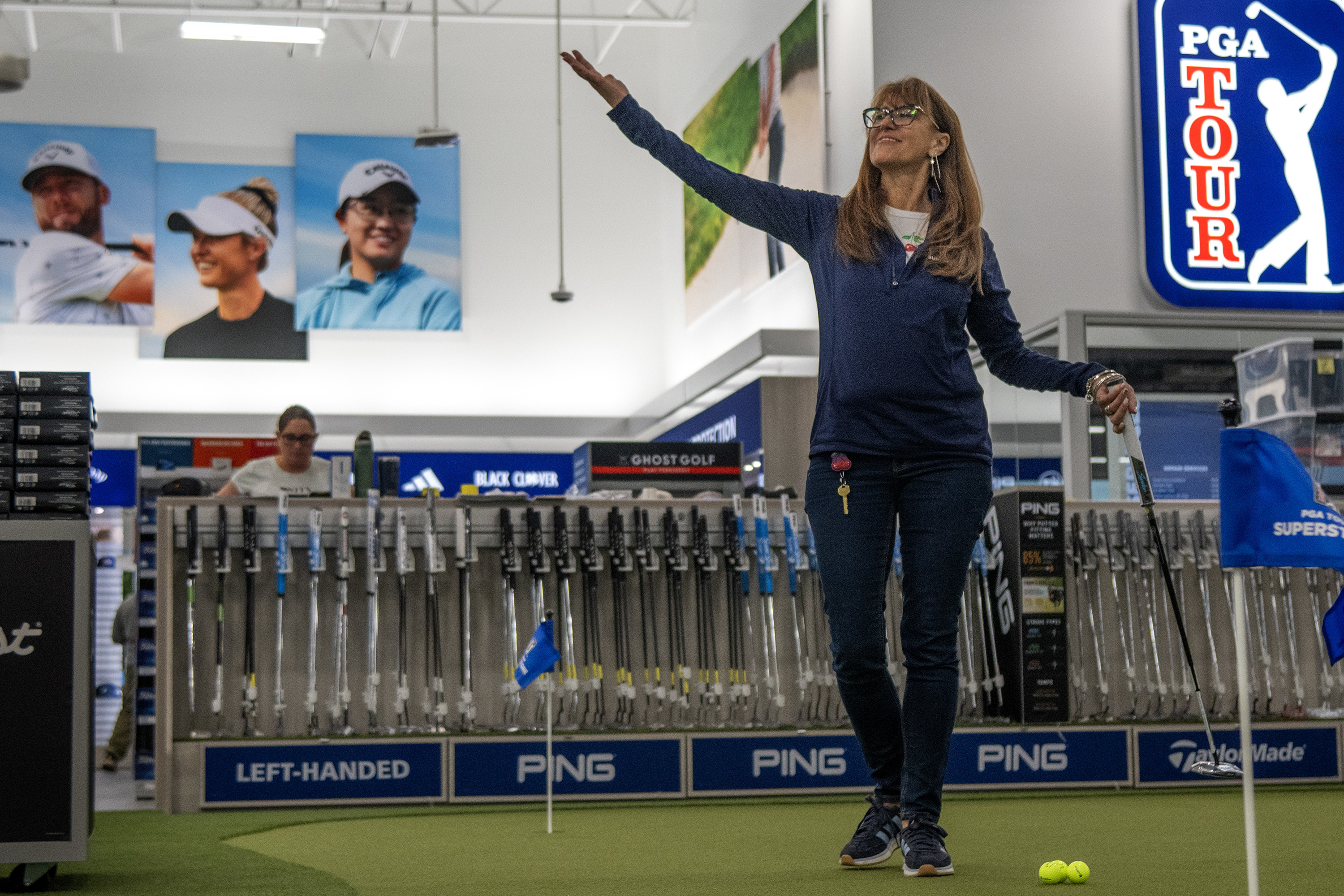
Golfers can test their skills on a putting green at the new PGA Tour Superstore.
Golfers don’t need to hop on a plane to tee off on the sunlit fairway of California’s Titleist Performance Institute. They just have to venture to the 40,000-square-foot PGA Tour Superstore at 2232 Route 70, where the shop will open this Saturday at 9 a.m.
A major highlight is the golf simulation bay, where customers can cycle through a list of world-famous golf courses projected onto a screen and receive analytics on their swings, The Inquirer’s Henry Savage reports.
The sprawling store also sells gear, offers club fittings, and will have $30,000 in giveaways during its grand opening.
Cherry Hill police are warning residents about a calling and texting scam in which someone is claiming to be from the police department. Residents should not engage with the scammer and are encouraged to report incidents to the non-emergency line.
Alocal bakery helped a Cherry Hilldoodle named Zeus celebrate a “bark mitzvah” last month by creating a bone-shaped cake dotted with bite-sized Stars of David. Zeus’ cake and the bakery behind it are part of a growing trend of upscale pet bakeries catering to pooches.
Longtime Cherry Hill contractor Craig Taylor tapped his friends and family to help grow a grassroots event to bring people together against hate. Known as “Kiss Hate Goodbye,” the event is slated to take place in Berlin on Nov. 20 and will include dinner, dancing, and throwback tunes. (6abc)
The township is hosting a free rabies clinic on Saturday from noon to 2 p.m. at Challenge Grove Park. Pet owners can bring their licensed cat or dog to get vaccinated. And on Sunday, there’s a free drive-up shredding and recycling event where residents can drop off up to four boxes of papers for shredding, as well as single-stream recyclables, tires, car batteries, rechargeable batteries, and CFL light bulbs. Read more about the event here.
Lamberti’s Tutti Toscani is celebrating its 40th anniversary through the end of November with a menu that includes items from the past four decades. The Brace Road BYOB’s anniversary menu includes clams casino, manicotti, chicken cacciatore, and veal casalinga.
The recently opened Barclay Pies on Marlton Pike is serving up pizzas that meet certain dietary restrictions, like those with Celiac disease, something the families ofowners TJ Hunton and Daniel Romero face. Not only can pizzas be made gluten-free, but so can the salads, chicken fingers, and wings. (Patch)
🎳 Things to Do
🔍 Killer Night Out: The library’s 21-and-over murder mystery event will transport participants back to the Roaring ‘20s where they must solve a murder. ⏰ Friday, Oct. 24, 6-9 p.m. 💵 $30 📍 Cherry Hill Library
🌽 Cherry Hill Harvest Fest: This fall-themed festival includes food vendors, a trunk-or-treat, games, and music. Costumes are encouraged. ⏰ Saturday, Oct. 25, 3-6 p.m. 💵 Pay as you go 📍 The Church of the Good Shepherd
🎃 Pumpkin Picking Hayrides: It’s your last chance to take a hayride and go pumpkin picking at Springdale Farms for the season. ⏰ Saturday, Oct. 25-Sunday, Oct. 26, 10 a.m.-4 p.m. 💵 $7.50 for hayrides, pumpkins are priced by the pound 📍 Springdale Farms
💗 Party in Pink: This breast cancer awareness event includes a discussion with a survivor, a 90-minute session with dancing and music, and access to other health and wellness resources. ⏰ Sunday, Oct. 26, 10 a.m.-12:30 p.m. 💵 $20-$25 📍 Katz JCC
🛼 Mickey & Minnie Halloween Skatetacular: The beloved duo will be visiting for this skate party that includes trick-or-treating, a costume contest, face painting, and ICEEs. ⏰ Sunday, Oct. 26, 12:30-3:30 p.m. and 4:30-7:30 p.m. 💵 $14 admission plus $6 skate rental 📍 Hot Wheelz
🎃 No-Carve Pumpkin Decorating: Kids in sixth through 12th grade can create a one-of-a-kind artificial mini pumpkin. ⏰ Wednesday, Oct. 29, 7-8 p.m. 💵 Free 📍 Cherry Hill Library
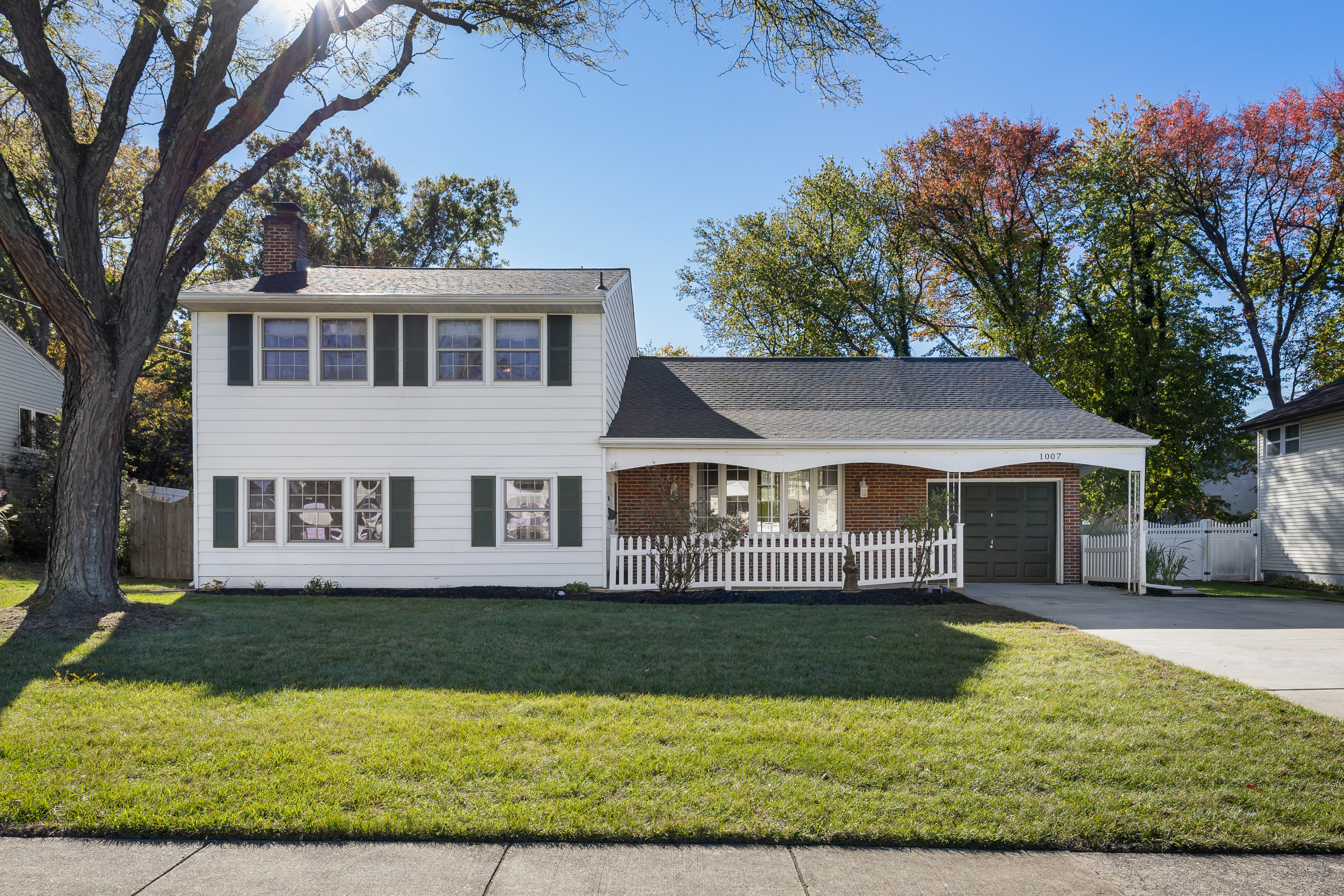
The front of the home features white siding, red brick, and a white picket fence.
Built in 1957, this white-siding and red-brick home has four bedrooms, including a primary suite with its own bathroom, all located on the upper level. On the home’s main level, there’s a family room with original hardwood flooring, a dining room, and an eat-in kitchen. It has updated appliances, floral wallpaper, and a white tile backsplash with fruits interspersed throughout. The home also has a living room off its entryway, complete with a wood-burning fireplace and log storage. Outside, there’s a covered front porch offset by a white picket fence, while out back there’s a fenced yard with a storage shed. The home has a newly installed roof, as well. There’s an open house Sunday from 11 a.m. to 1 p.m.
By submitting your written, visual, and/or audio contributions, you agree to The Inquirer’s Terms of Use, including the grant of rights in Section 10.
This suburban content is produced with support from the Leslie Miller and Richard Worley Foundation and The Lenfest Institute for Journalism. Editorial content is created independently of the project donors. Gifts to support The Inquirer’s high-impact journalism can be made at inquirer.com/donate. A list of Lenfest Institute donors can be found at lenfestinstitute.org/supporters.
Clearing a golf ball past the 250-yard mark into the sunlit fairway of California’s Titleist Performance Institute is getting easier for a whole lot of people in the region.
All they have to do is stop by the virtual golf simulators at Cherry Hill’s PGA Tour Superstore. The Georgia-based chain is opening store No. 80 in South Jersey. It already has an outlet in the Metroplex Mall in Plymouth Meeting, and is looking to expand to Ocean Township, N.J., soon.
The company has undergone a significant growth spurt in the last six years with new brick-and-mortar locations and a 200% jump in e-commerce, a company spokesperson said.
The sprawling 40,000-square-foot superstore in Cherry Hill will open at 9 a.m. Saturday with $30,000 worth of giveaways, including a full set of iron golf clubs to the first two customers.
It will house dozens of aisles of the latest golf clubs, balls, apparel, and other gear, among six practice and play hitting bays, virtual golf simulation stations, and an expert club fitting area. Store sales manager Lexi Humbert, a golfer of 16 years, said she added 10 yards to her drive after a new club head suggestion.
Store general manager Lisa-Jo Donnelly reacts as she sinks a putt on the practice green at the PGA Superstore.
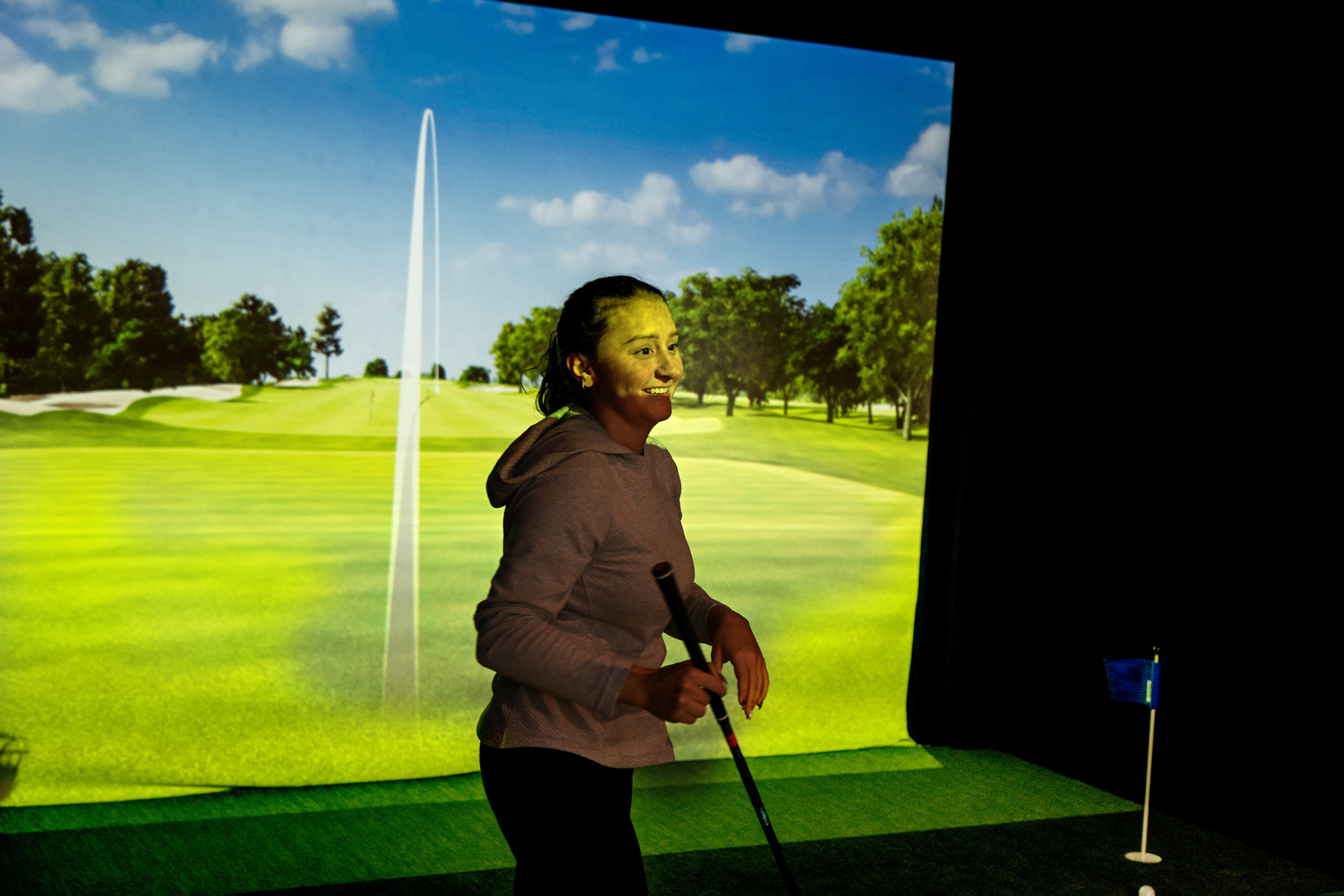
The real draw is the golf simulation bay, where customers can cycle through world-famous golf courses projected onto a screen, and drive balls nearly 100 mph into them, receiving analytics on each swing.
The putting green is lined with the most popular putters from classics like Taylor Made Spiders and Scotty Cameron Phantoms to the fresh lineup of L.A.B. brand putters. Golfers can explore clubs and then test them out in the golf simulation bays, or get hands-on fittings with the experts. Regripping and repair services are available, too.
Golf, historically associated with wealthier, white men, is a growing sport — especially “off-course golf.” It was made popular by TopGolf — a trend PGA Tour Superstore hopes to capitalize on with recurring Saturday events, inviting youth groups (like First Tee) in for lessons, and providing a social space for those looking to get some swings in outside of the green.
“The average golfer is now down to their early 40s‚” said the store’s general manager, Lisa-Jo Donnelly. The goal is to create a space that will become part of the Cherry Hill golfing community, within a region that is home to 70 courses and a local high school team that likes bringing home trophies, she said.
The store has an expansive women’s and juniors’ sections. Humbert, who said she has been to golf stores all over the country, said the selections will be refreshing for many, as stores tend to skimp on women’s and junior equipment.
“When I go to other stores, I already know that I’m not going to have nearly the selection that I need. I always get frustrated,” Humbert said. “The biggest thing for me is for those just wanting to get into golf and see a PGA shirt at other places for $150, whereas here you can go into the back of the store and find something for $20 to $30.”
Store sales manager Lexi Humbert reacts after a great drive on a virtual golf simulation at the PGA Superstore.
Saturday’s opening day is likely to lure hundreds to the store for giveaways, but they may have to contend with the dozens of people who will camp out for days to be first.
“These opening giveaways are so popular that we had, for quite a few openings, the same person in the front of the line. He was traveling around the country and getting there first,” Donnelly said.
The store will provide campers with pizza on Friday night and coffee and Krispy Kreme doughnuts on Saturday. The new PGA Tour Superstore CEO, Troy Rice, and Cherry Hill Mayor David Fleisher will also be in attendance Saturday, alongside members of the township council.
📅 Opening Oct. 25, at 9 a.m.📍2232 N.J. Route 70, Suite C, Cherry Hill Township, N.J. 08002, 🕒 Monday to Friday 10 a.m. to 8 p.m., Saturday 9 a.m. to 8 p.m., Sunday 10 a.m. to 6 p.m. 🌐 pgatoursuperstore.com
Steve Hirst relies on virtual visits with his urologist, whose office is an hour away from his Broomall home, to stay on top of his treatment plan and renew medications.
But earlier this month Hirst, 70, got a notice from his doctor’s office informing him that it could no longer schedule telemedicine visits for patients like him who have Medicare because of new federal policy changes.
Medicare began covering telemedicine services during the COVID-19 pandemic and has maintained the popular offering through temporary waivers approved by Congress since. But the most recent of those waivers expired at the end of September when Congress failed to reach a budget deal and the government shut down.
The change specifically affects traditional Medicare, which is administered by the government for people 65 and older and some with disabilities. People with Medicare Advantage plans, which are administered by private insurers, should check with their plan.
Some of the Philadelphia area’s leading health systems, including Temple Health and Penn Medicine, have said they are continuing to provide telehealth services to people with Medicare and temporarily suspending billing for those services, with hope that coverage will be reinstated when a budget deal is eventually reached.
But smaller provider practices may not have the luxury of delaying payment for thousands of dollars in services for an indefinite period of time.
With the government shutdown in its third week, Republicans and Democrats seem no closer to reaching a deal. The next vote is scheduled for Monday evening, though no deal is expected.
Another health policy issue — tax credits for people who buy insurance through Affordable Care Act marketplaces, including Pennie in Pennsylvania — has been a major sticking point in the ongoing federal budget debate. Democrats want the enhanced subsidies extended permanently as part of the budget deal, and Republicans have refused, arguing that lawmakers could address the issue separately, before the subsidies expire at the end of the year.
Meanwhile, the waiver’s expiration has left Hirst and others who are covered by Medicare unsure how they will access needed health services.
Telehealth rose in popularity during the COVID-19 pandemic, when people were urged to avoid hospitals unless they were having an emergency and when most routine procedures were canceled.
The approach was especially helpful to older adults and people with disabilities, who needed to stay in contact with doctors for ongoing treatment and who were considered particularly vulnerable to severe illness from COVID-19.
After the pandemic ended, many private insurers, Medicaid, and Medicare permanently adopted telehealth coverage for certain services, such as mental health, because of its popularity during the pandemic.
Medicare has used temporary waivers to continue telehealth coverage for other types of doctors’ visits.
Beyond patient popularity, research has found that telehealth visits can be as effective as in-person visits for certain types of care, such as palliative care for cancer patients, while improving access to patients with transportation challenges.
Philadelphia health systems respond
Philadelphia’s largest health systems said they are optimistic that coverage will be reinstated — either by a new temporary waiver or a permanent change — when Congress reaches a new budget agreement and the shutdown ends.
Temple Health will continue to provide telehealth services to Medicare patients for the next three weeks, in anticipation of Congress reaching a deal.
Penn Medicine has not billed Medicare patients for telehealth visits since the shutdown began and has paused its process for filing claims until the government reopens, a spokesperson said.
“Congress has been vocal in its support of telehealth and its value, and we are hopeful that legislation will be passed to ensure permanent Medicare telehealth coverage and flexibilities once the government reopens,” Penn said in a statement.
Main Line Health has been reaching out to affected patients to help them change previously scheduled virtual visits into in-person appointments or reschedule virtual visits that can be put off.
Jefferson Health did not respond to a request for comment in time for publication.
Patients in limbo
Hirst drives into Philadelphia to see his urologist in person once a year. Every three months, he has a virtual visit to check in and renew prescriptions.
Driving to Philadelphia for every appointment would be inconvenient, but Hirst will probably do it “for now,” he said.
But he worries about older adults and people with disabilities who can’t safely drive to the doctor’s office, and for whom virtual care is a lifeline. They could end up putting themselves or others at risk being on the road when they shouldn’t be. Or they may end up skipping needed care because they don’t have a ride.
After graduating law school in the 1950s, Joseph H. Rodriguez was told he wouldn’t go far and should consider changing his last name.
He ignored that advice and went on to becomeNew Jersey’s first Hispanic federal judge — and its longest serving. He recently retired after 40 years as a jurist.
He was among the first Hispanic lawyers in Camden, and New Jersey as a whole. He also served asthe state’s public defender and advocate.
Rodriguez mentored countless aspiring lawyers and judges, and as his stature rose nationally he never forgot his humble roots. Associates dubbed him“a gentle giant.”
“He served with humility, grace, wisdom, and humor,” said Chief U.S. District Judge Renee M. Bumb, who met Rodriguez as a federal prosecutor. “We all looked up to him.”
U.S. District Judge Joseph H. Rodriguez, 94, sits for an interview at his daughter’s law office in Cherry Hill, N.J. U.S. District Judge Joseph H. Rodriguez, 94, was the first Hispanic federal judge in New Jersey. His father, Mario Rodriguez, survived the 1918 sinking of the SS Carolina.
Rodriguez became a senior judgein 1998,which reduced his workload, but he continued to preside over trials and write opinions, filing his last decision about three weeks before he retired.
‘I just wanted to slip into the shadows’
Rodriguez decided last month to quietly retire. He left the Mitchell Cohen Courthouse in downtown Camden after an emotional send-off with fellow judges and friends.
“I just wanted to slip into the shadows.” hesaid in a recent interview. “What I’ve done some people were in favor of it, some were not. It’s there as a public record. I stand by it.”
Rodriguez was born in 1930 in Camden and grew up a few blocks from the courthouse where he would later preside.
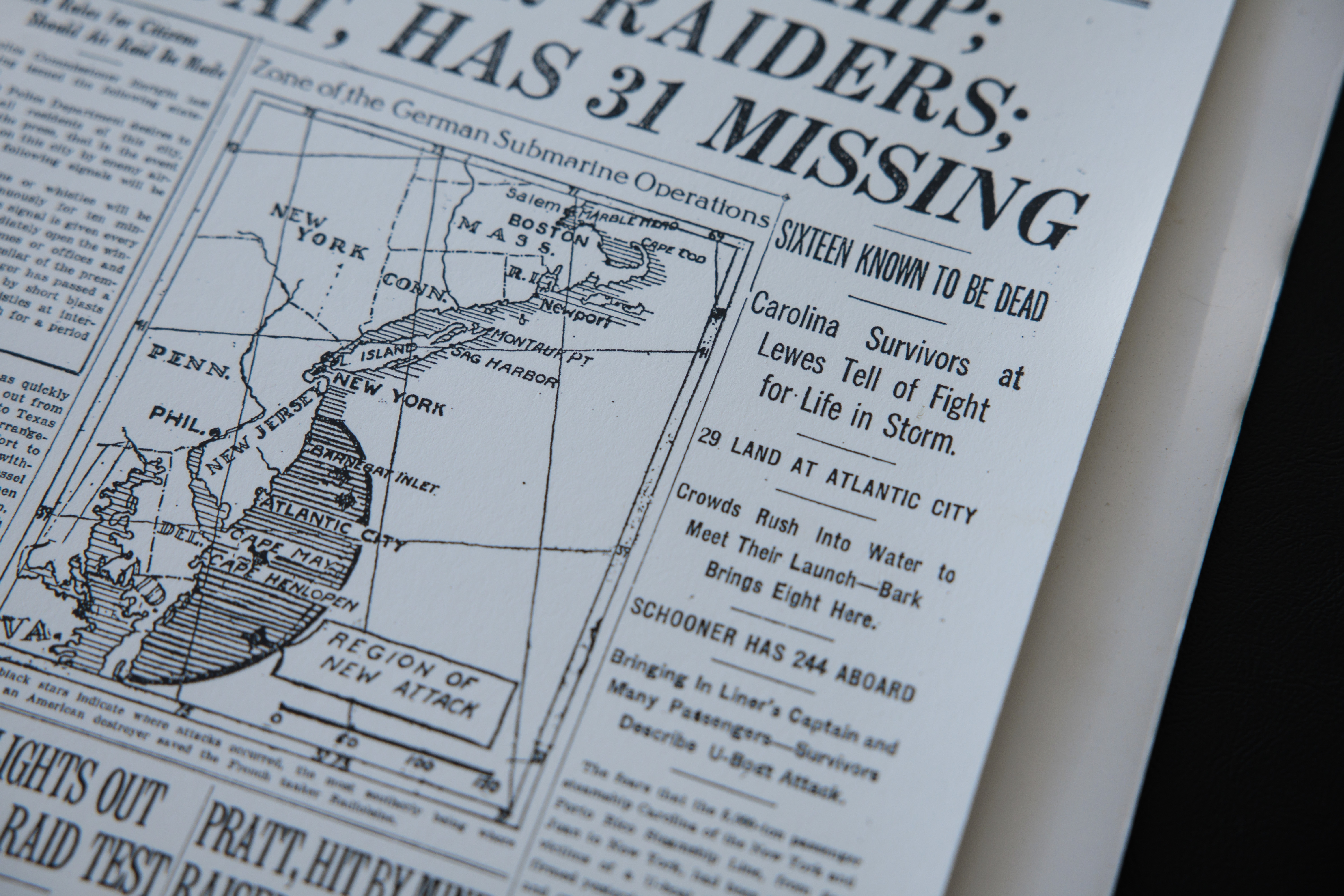
His father, Mario, a Cuban national raised in Puerto Rico, was aboard the passenger ship SS Carolina when it was torpedoed by a German U-boat off the coast of New Jersey in June 1918.
The New York Times front page story about the sinking of the SS Carolina in 1918. U.S. District Judge Joseph H. Rodriguez has a copy of the paper because his father survived the sinking.
The Germans targeted six ships on what was known as Black Sunday. The Carolina sunk, and Mario Rodriguez spent two days on a lifeboat before swimming ashore in Atlantic City.
Rodriguez would later have a full circle moment, when scuba divers made a claim in federal court to salvage the vessel. He said hegranted sole rights after the divers presented a brass “C” from the ship’s name on the stern and a china dinner plate with its logo.
Mario raised four sons and a daughter in Camdenwith his wife, Carmen, and worked in a tobacco factory.
The couple, among the first Hispanic families to settle in Camden, was highly respected in the community, and often served as interpreters and gave advice to other Hispanic residents.
As a youngster, Rodriguez recalled hearing his father recite the U.S. Constitution to study to become a citizen, which he did in 1939 — in the same courtroom where his son later became a judge.
The memory stuck with Rodriguez and became a guiding principle in his legal career. His parents and sister were killed in a car accident in 1973.
When he landed his first job at a real estate firm, the agent urged Rodriguez to change his name to Joe Roddy.
“I was told with that name I could never go far,” he recalled. “I would never change my name.”
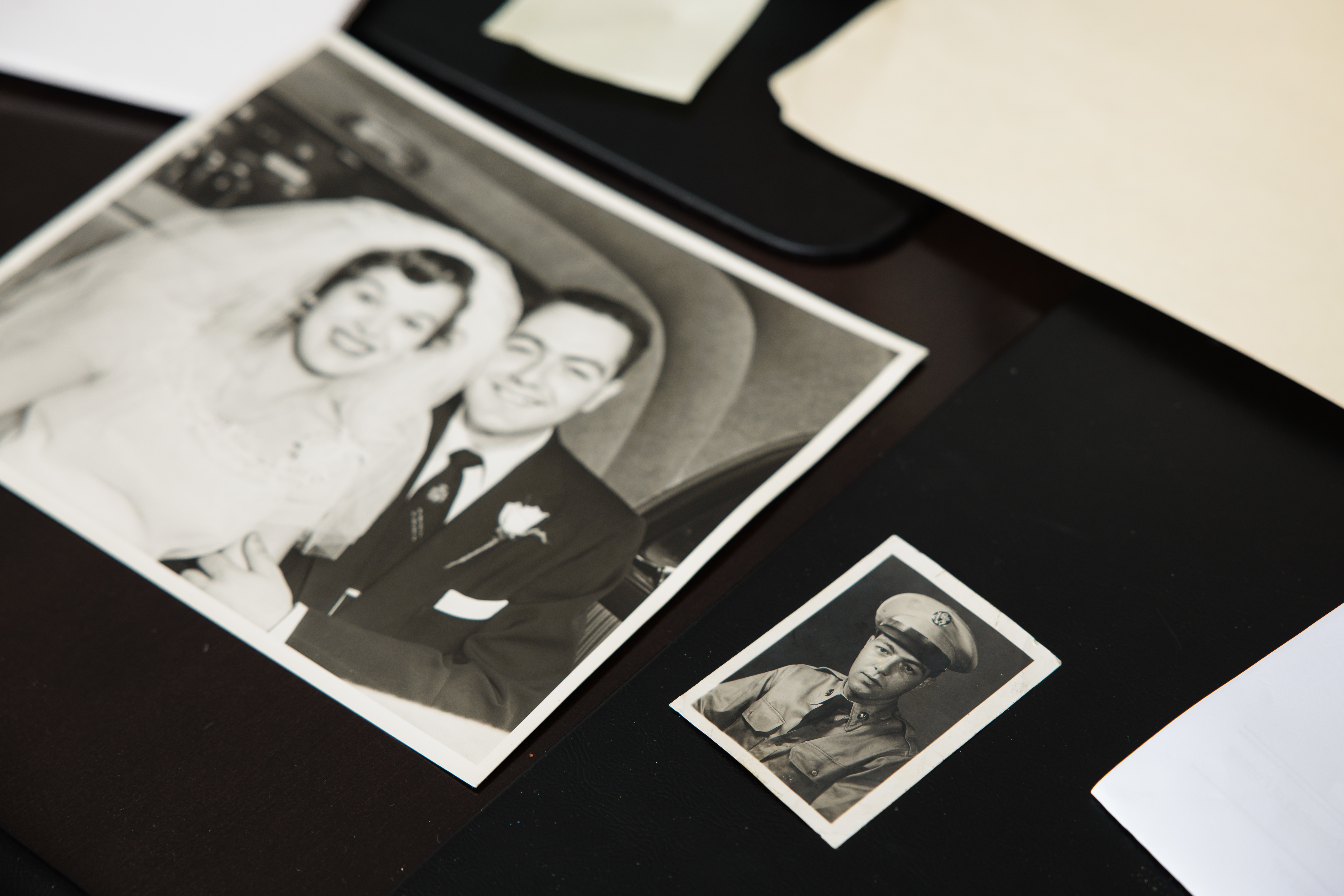
An undated Army photograph of Joseph H. Rodriguez, now 94, and his wedding photo.
Rodriguez was hired as an attorney at Brown & Connery, one of the oldest law firms in South Jersey. He earned a reputation as a tough trial lawyer and specialized in medical malpractice. He later became the first Hispanic president of the New Jersey Bar Association.
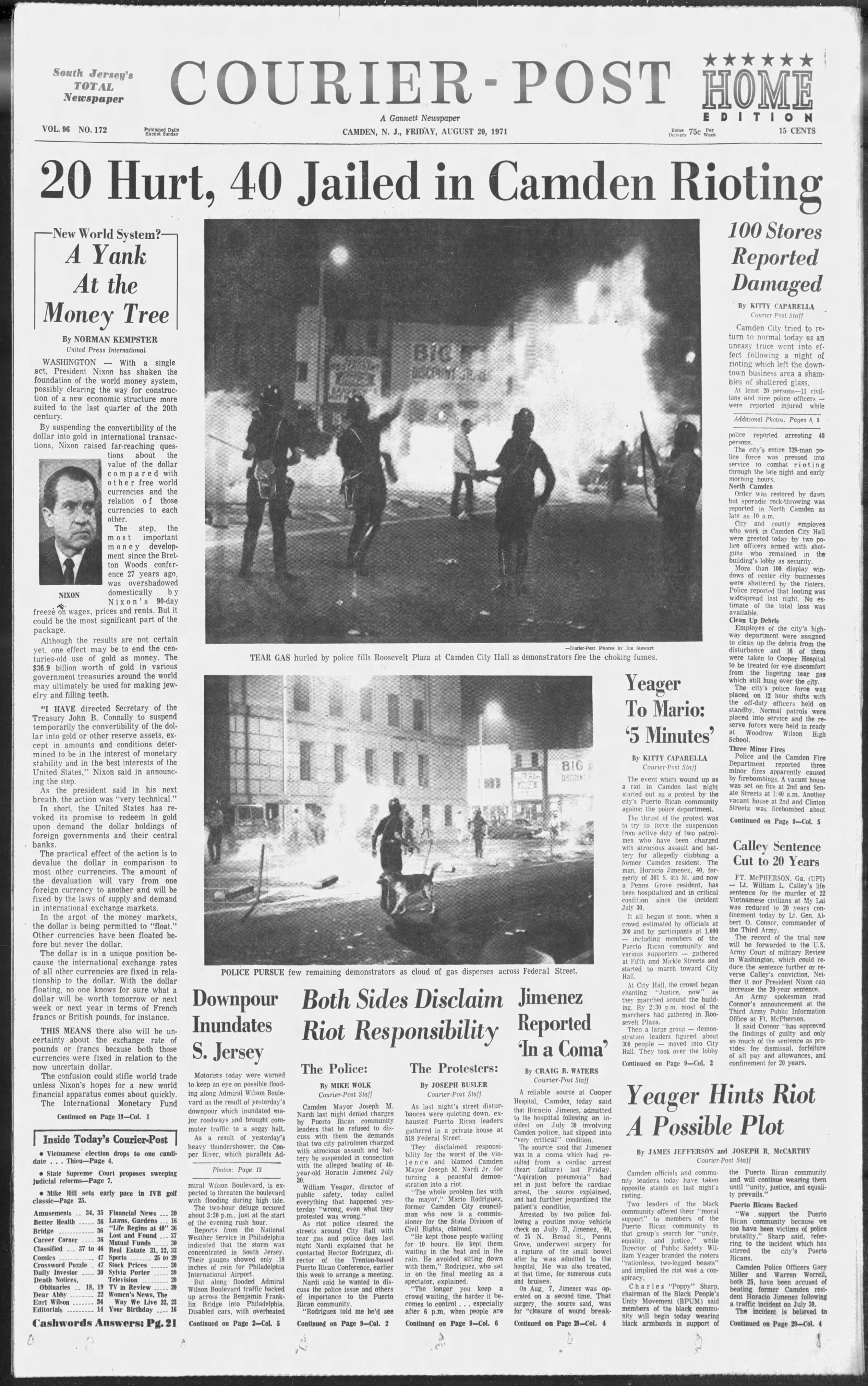
Rodriguez was pressed into action when unrest erupted in Camden in 1971, after a Hispanic man was killed while in police custody. The Hispanic community demanded an investigation. A protest turned into days of rioting in front of City Hall.
Then the only known Hispanic lawyer in Camden, Rodriguez met with then-Mayor Joe Nardi to negotiate a settlement. The police officers were eventually indicted by a grand jury, but acquitted.
The Courier-Post edition pictures a riot at Roosevelt Plaza at Camden City Hall Aug. 20, 1971.
“He was the calm in the eye of the storm,” said Gualberto “Gil” Medina, who organized a student protest at the time. “He made it clear that the cause was just but the means had to be tempered.”
Rodriguez eventually left Camden for the suburbs but remained connected to the city. He was one of the original organizers of Camden’s San Juan Bautista Parade.
“He became the respected patriarch of the Hispanic community,” said Medina.
`A public conscience’
Rodriguez advocated in manyprecedent-setting cases for New Jersey’s disenfranchised residents. They includea landmark product liability case that resulted in the state Supreme Court ruling in 1965 that a mass builder could be held liable for a defective hot water system that severely scalded a child.
As chairman of Camden Legal Services, he brought a lawsuit that resulted in a requirement for municipal judges to appoint a lawyer to represent defendants facing possible jail time. Another case established tenant rights.
Then-Gov. William T. Cahill named Rodriguez chairman of the State Board of Higher Education in 1972, and later chairman of the State Commission of Investigation, where he investigated organized crime.
Although Rodriguez wasa Democrat, former Republican Gov. Thomas Kean appointed him as the state’s Public Advocate in 1982.
In that role, Rodriguez filed the complaint that lead to Mount Laurel doctrine, through which the New Jersey Supreme Court outlawed local discriminatory zoning regulations and required municipalities to provide affordable housing.
“He always had a public conscience,” said Carl D. Poplar, a lawyer and longtime friend.
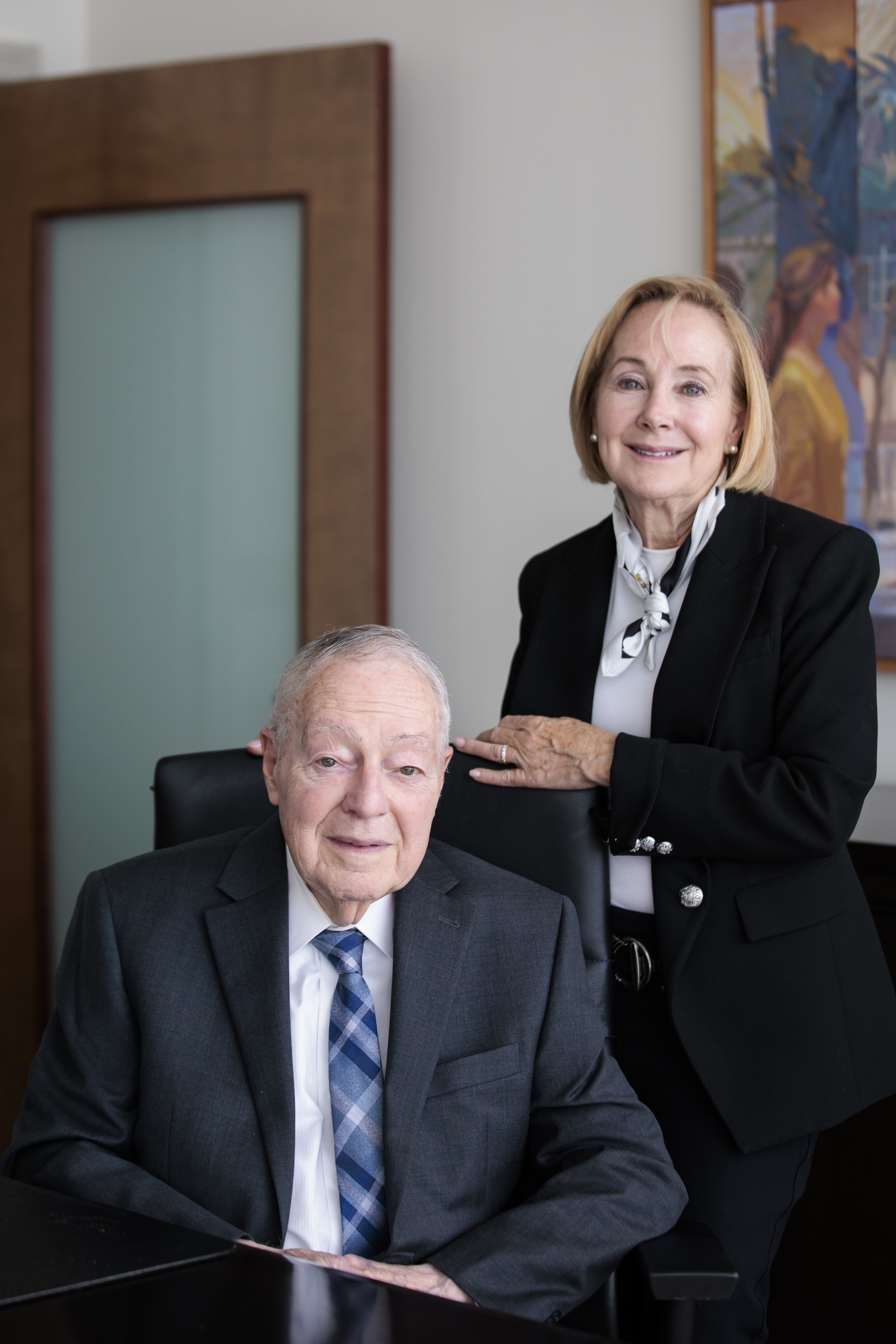
Judge Joseph H. Rodriguez, 94, posed for a portrait with his daughter Lisa Rodriguez at her law office in Cherry Hill this month.
Rodriguez also was involved in the landmark right-to-die case of Karen Ann Quinlan, whose parents waged a fight to have her removed from a respirator.
“We didn’t go around looking for trouble. If it had to be done and people had to be helped, you help them,” Rodriguez said.
President Ronald Reagan appointed Rodriguez to the federal bench in 1985.
Rodriguez was known as an easygoing andfair judge. U.S. Supreme Court Chief Justice William Rehnquist dispatched Rodriguez to Montgomery, Ala., in 1999 to preside over a desegregation case.
“It was like going to heaven working for him,” said Carl Nami, his court reporter for 18 years. “I don’t how I was so fortunate.”
Nicknamed “Joe Rod,” Rodriguez was a role model for other judges, said retired U.S. Magistrate Joel B. Rosen. He could always be counted on for jokes and bad puns at their weekly lunch gatherings, he said.
“He’s always been a gentleman and what in my view what a judge should be: knowledgeable and fair,” Rosen said.
Said Robert Kugler, another retired federal judge: “He kept the courthouse going.” The jury room was named in honor of Rodriguez.
“His judicial demeanor and temperament are unrivaled,” said civil rights attorney Stanley O. King. “The likes of him I don’t know if can ever be replaced or replicated.”
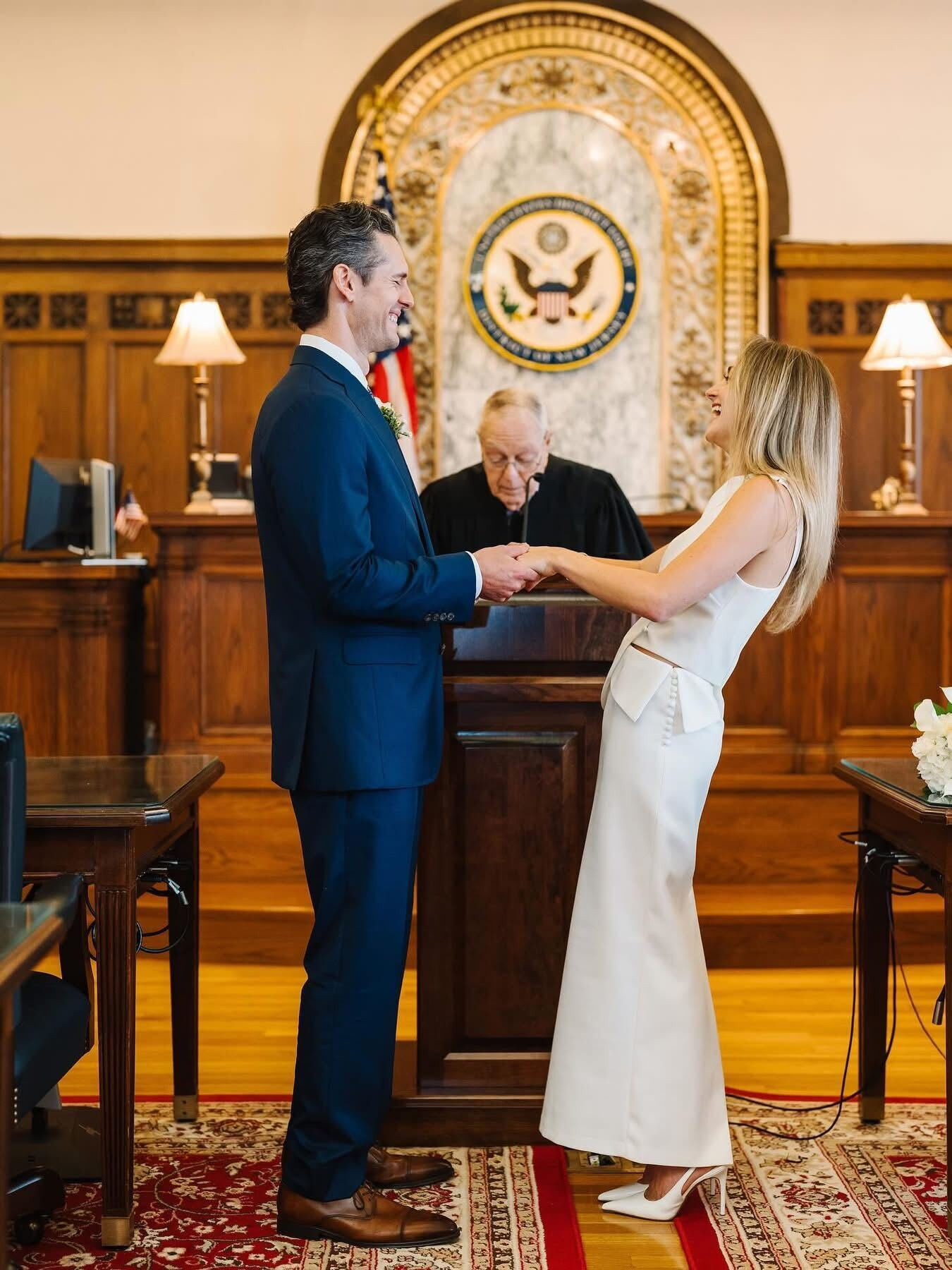
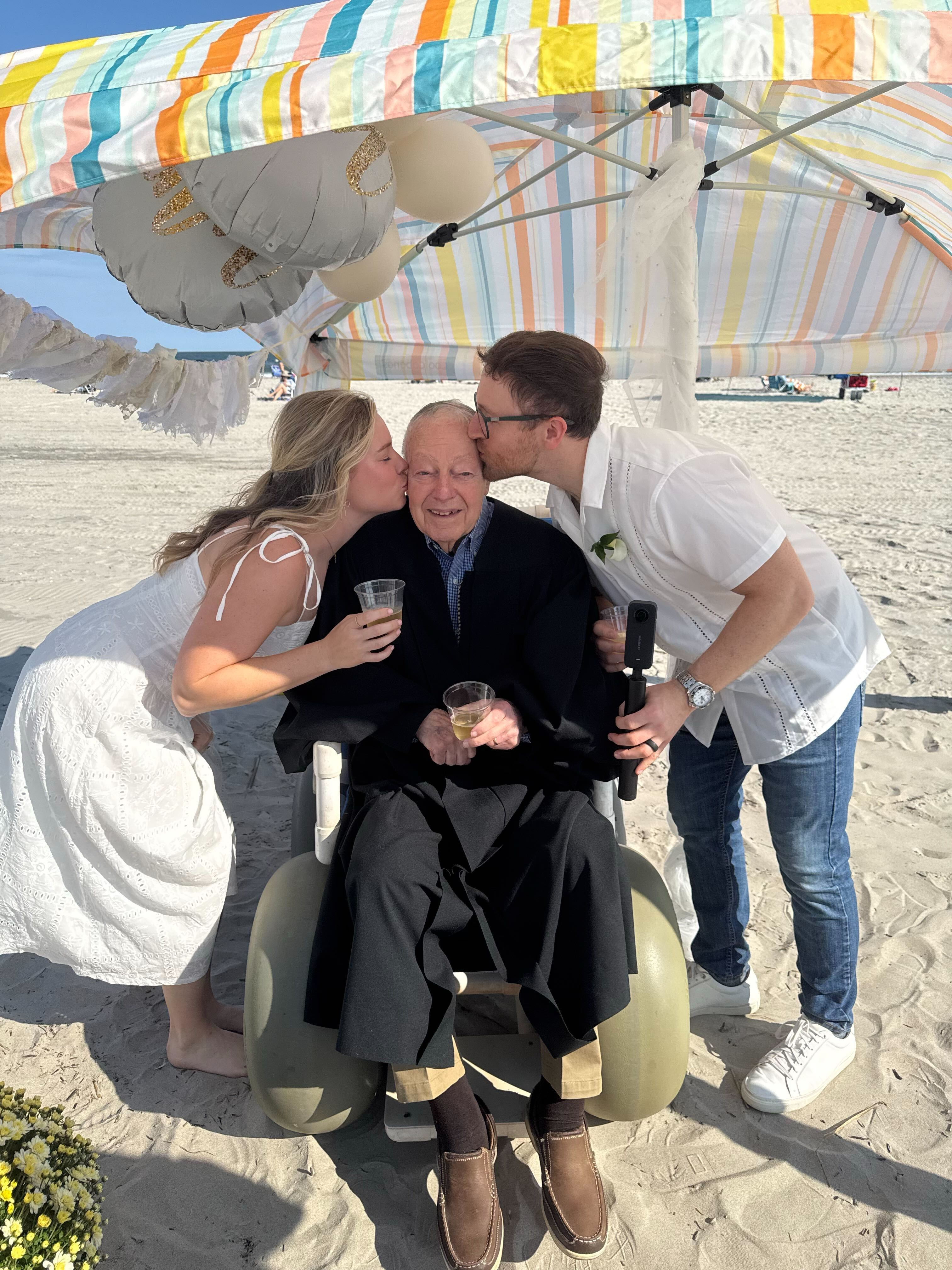
U.S. District Judge Joseph H. Rodriguez performed the marriage ceremony of his granddaughter Taylor Jacobs to Cole Sutliff. It was held in the same courtroom where Rodriguez presided in federal court in Camden for years.
Before stepping down, Rodriguez performed a final act as a sitting judge. He performed the wedding ceremony for a granddaughter, Taylor, in his courtroom. He also recently married a grandson, Quinn, in a beach ceremony.
Rodriguez said he plans to spend more time with his wife of 71 years, Barbara, and his four daughters, 10 grandchildren, and seven great-children. He enjoys cooking for them, especially paella, his specialty dish.
U.S. District Judge Joseph H. Rodriguez performed the marriage ceremony of his grandson Quinn Jacobs and Brittany Peters at the Jersey Shore.
Asked what he would like his legacy to be, Rodriguez choked back tears. His daughter, Lisa Rodriguez, an attorney with Dilworth Paxson, passed him a tissue.
“You can’t do it all, but you should never stop trying,” he said. “If everyone backs away you’re just giving up.”
There was a time — back when The Inquirer had multiple suburban bureaus — that photographers like myself who were assigned to the main newsroom on North Broad Street worked only in the city. (We’re now more like ride share drivers, going everywhere.)
So I walked a lot more to cover news and events in Center City, and more often stumbled into things and sights that piqued my curiosity.
Things like a long line.
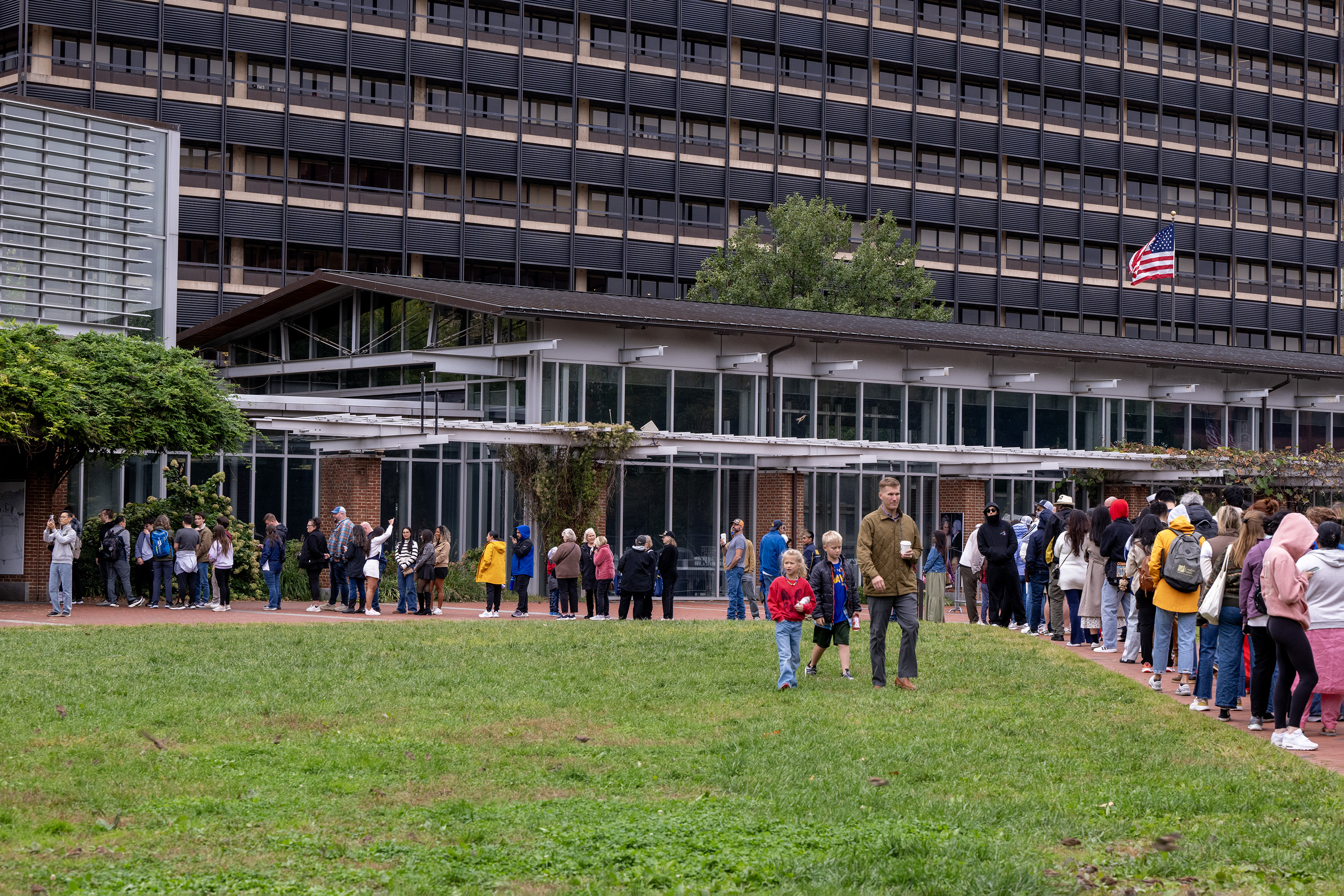
Visitors queue up to get a glimpse through a single window in the Liberty Bell Center Oct. 12, 2025 while the building is closed due to the federal government shutdown.
Years ago seeing one likely meant unhoused people were waiting as church folks or outreach advocates served dinner on the street. Or they were waiting for concert tickets or movie premiers (Beanie Babies?).
I remember once questioning someone standing in a blocks-long line along Walnut Street and was flabbergasted to learn a new sneaker was dropping.
Or for a device that combined a portable media player, a cell phone, and an internet communicator.
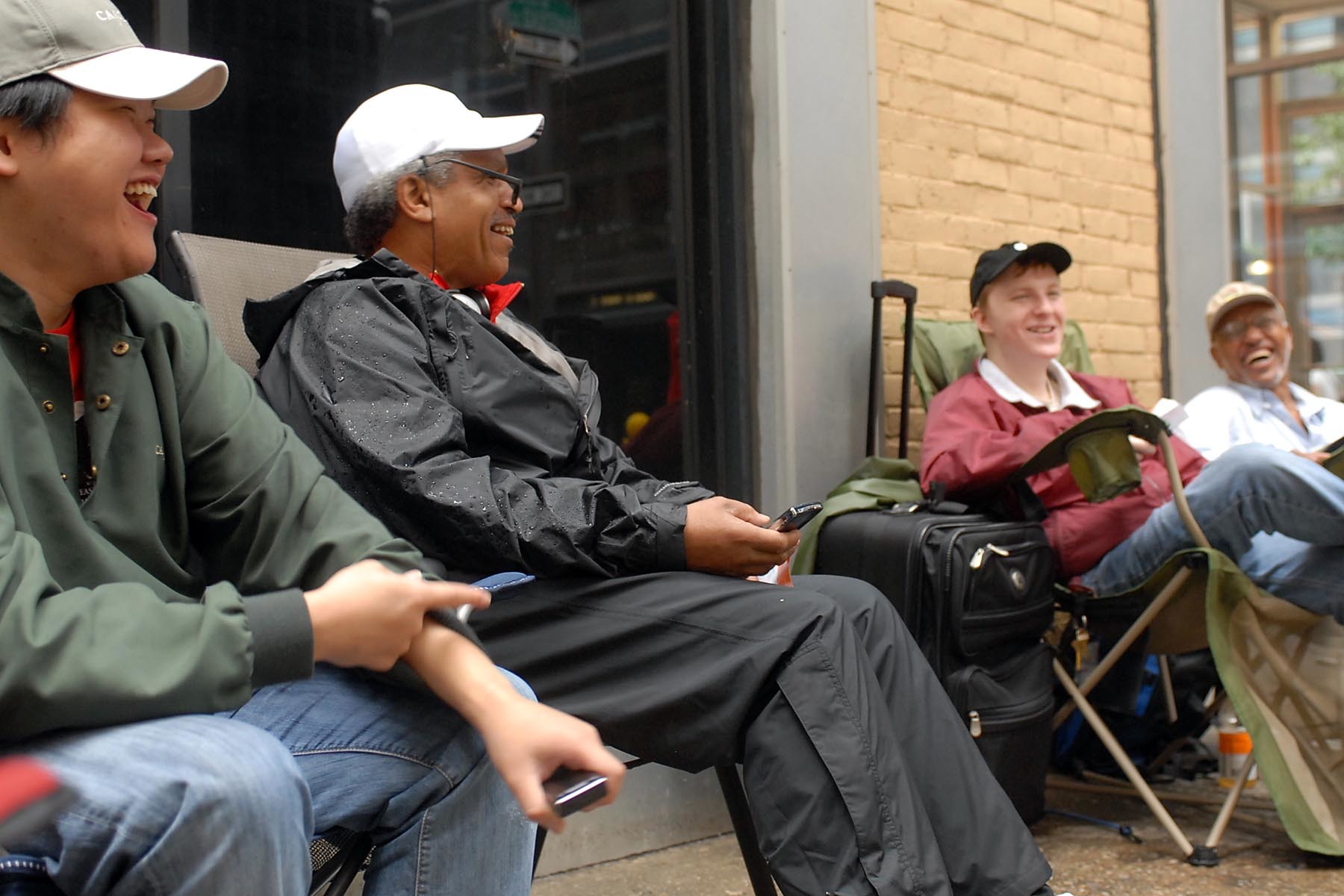
Mayor John F. Street reads jokes aloud from his Blackberry as he waits with fellow technology enthusiasts in an alley off 16th Street to purchase an iPhone at the At&T store Jun. 29, 2007. There were two models available that day: a 4GB for $499 and the 8GB for $599.
Mayor Street was the third in line to buy the first-generation iPhone 2G launched that day. He said he arrived around 3:30 a.m. Leonard F. Johnson (far right) at the front of the line, arrived 36 hours ahead of the 6:00 p.m. official release.
Hizzoner defended the time he spent in line, saying he got work done and kept in touch with city officials on the issues of the day using his Blackberry to send emails and make phone calls.
I had no idea what the yellow shipping container was when I saw it next to City Hall last weekend. Even after I walked over and watched those at the front of the long line take their selfies inside a retro Philly diner-esque booth tableau.
I watched it all unfold, along with others, asking ourselves what was going on. Nobody knew. Except those in line.
It was the last stop on the Pleasing Express Line that ended its nation-wide tour in Philadelphia.
Followers on social media were invited to, “Climb on to immerse yourself in the worlds of Pleasing Fragrance, Big Lip, and exclusive treasures,” including a spin of the “Freebie Wheel,” for products of the unisex lifestyle brand Pleasing, created by former One Direction singer Harry Styles.
A spontaneous walk around Center City can build for me the same kind of excitement felt by those waiting in lines. Except they know their eventual reward. Mine comes from the anticipation of not knowing what’s around a corner.
And that is exactly what makes street photography worth the walk – and sometimes even the wait.
Since 1998 a black-and-white photo has appeared every Monday in staff photographer Tom Gralish’s “Scene Through the Lens” photo column in the print editions of The Inquirer’s local news section. Here are the most recent, in color:
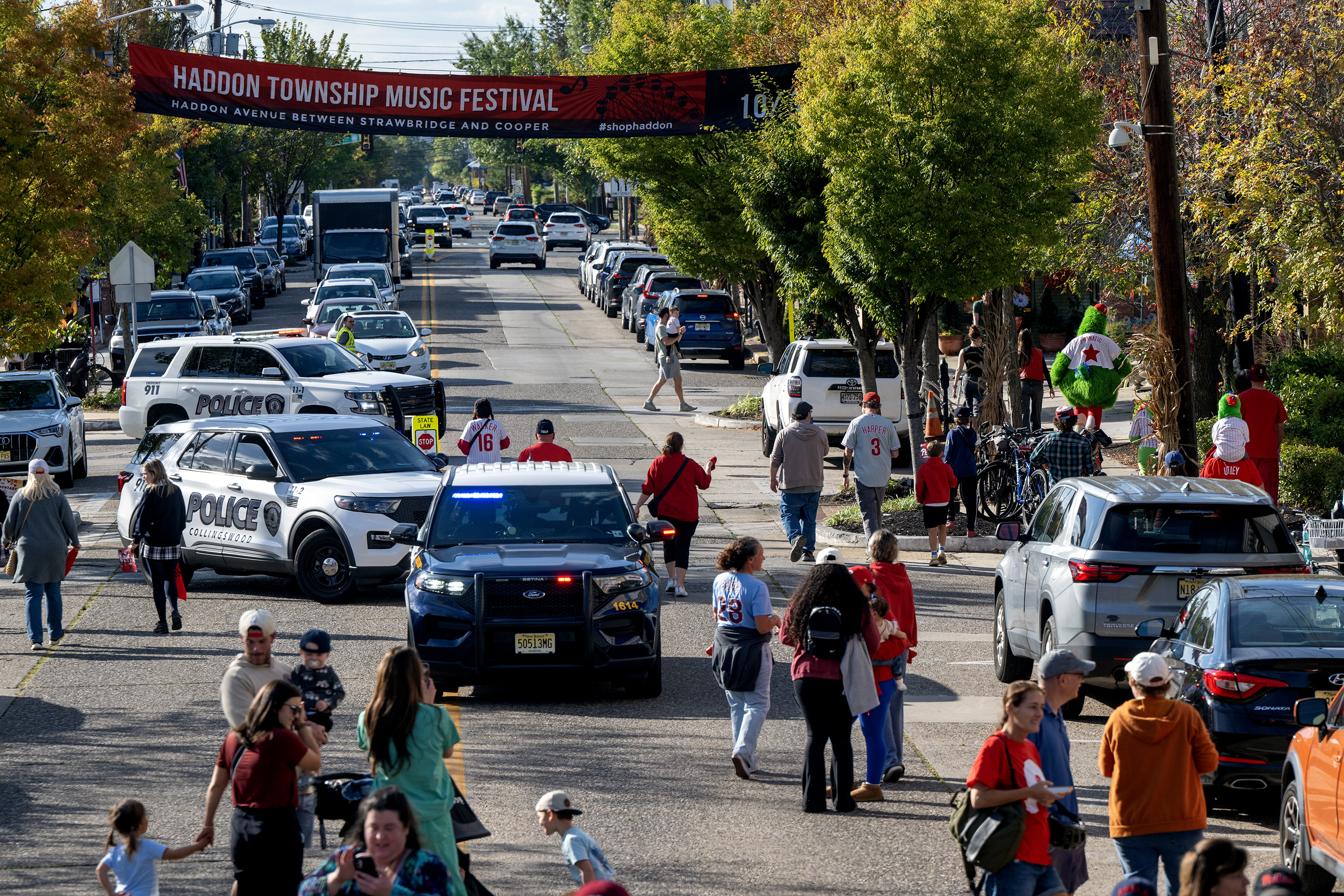
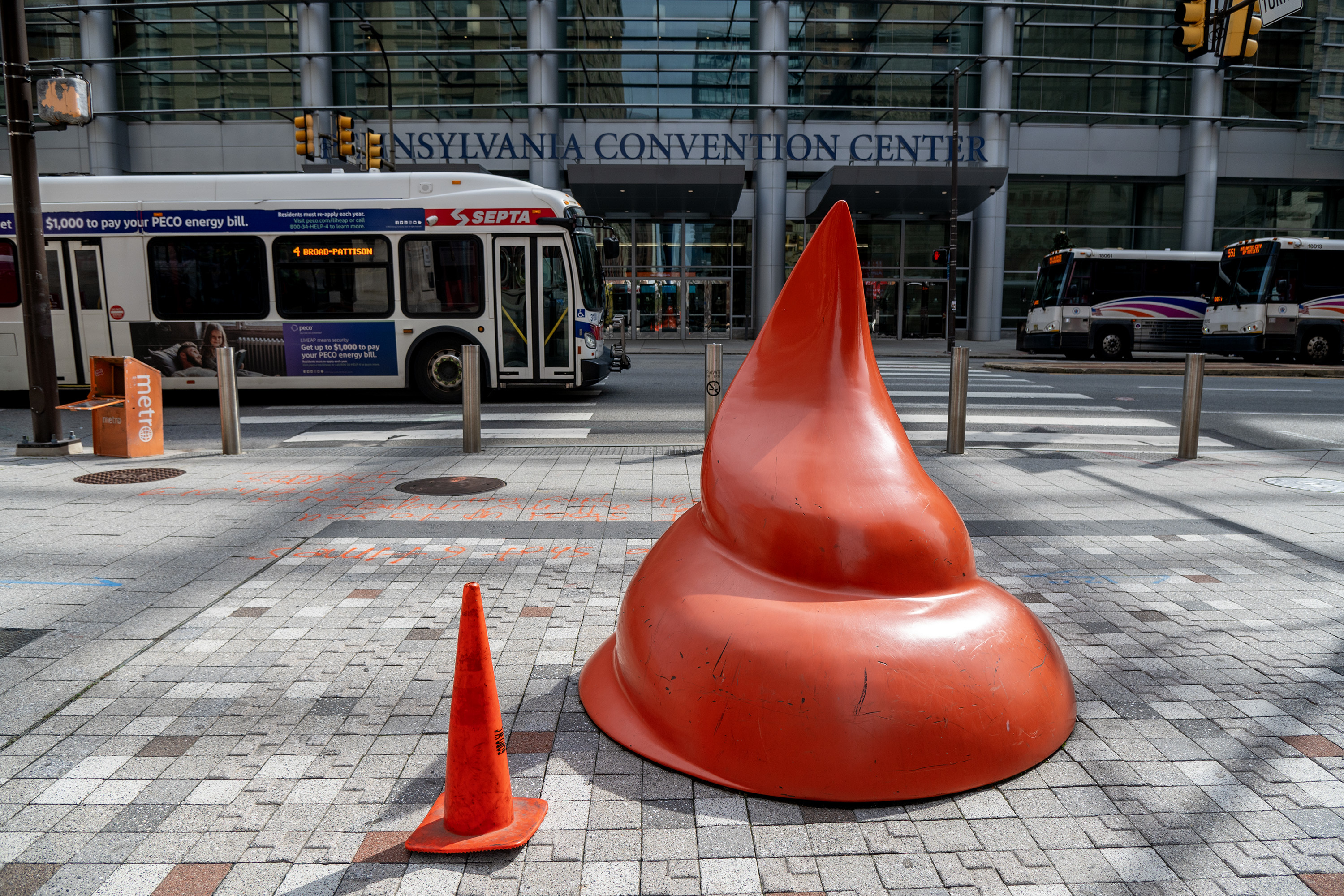
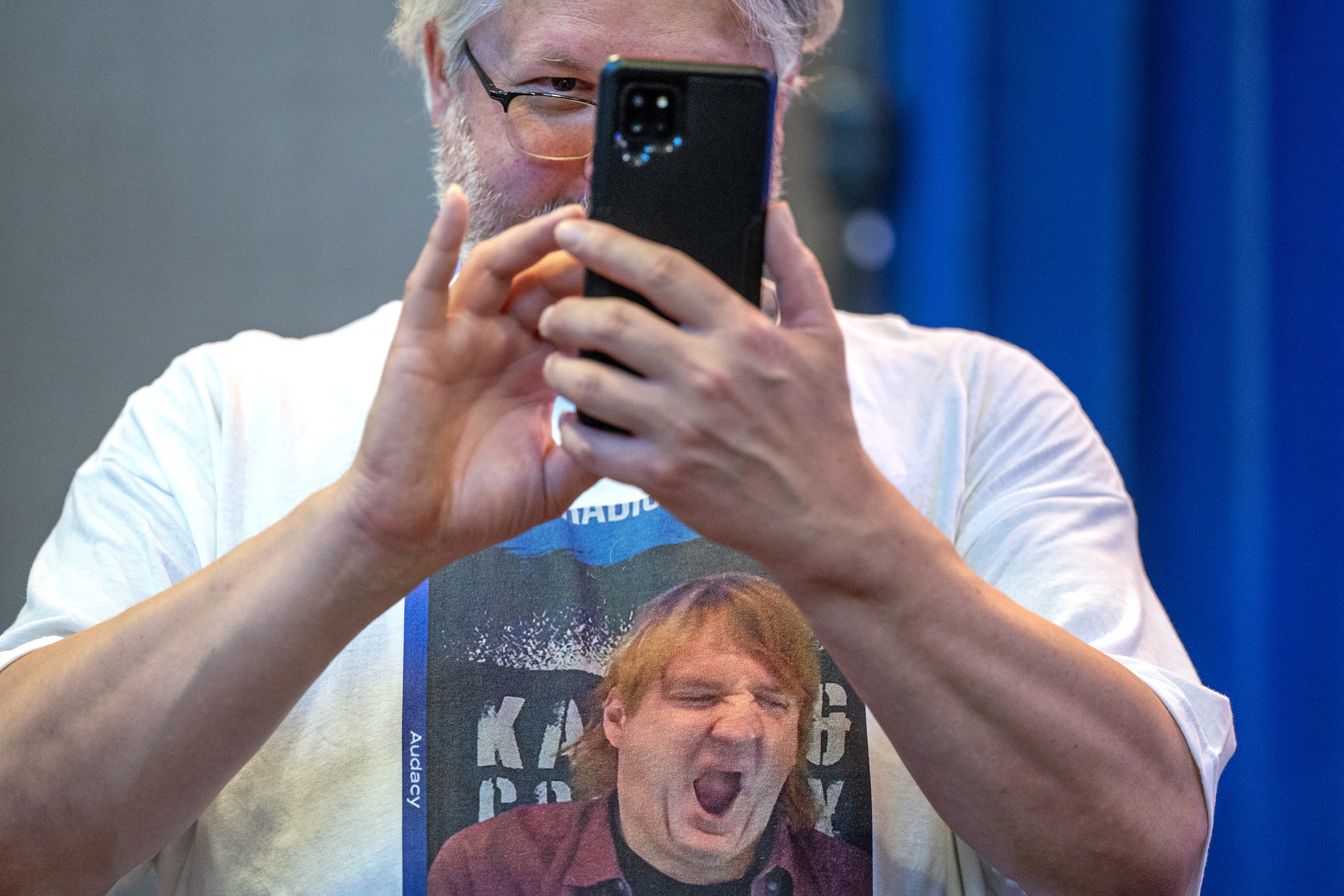
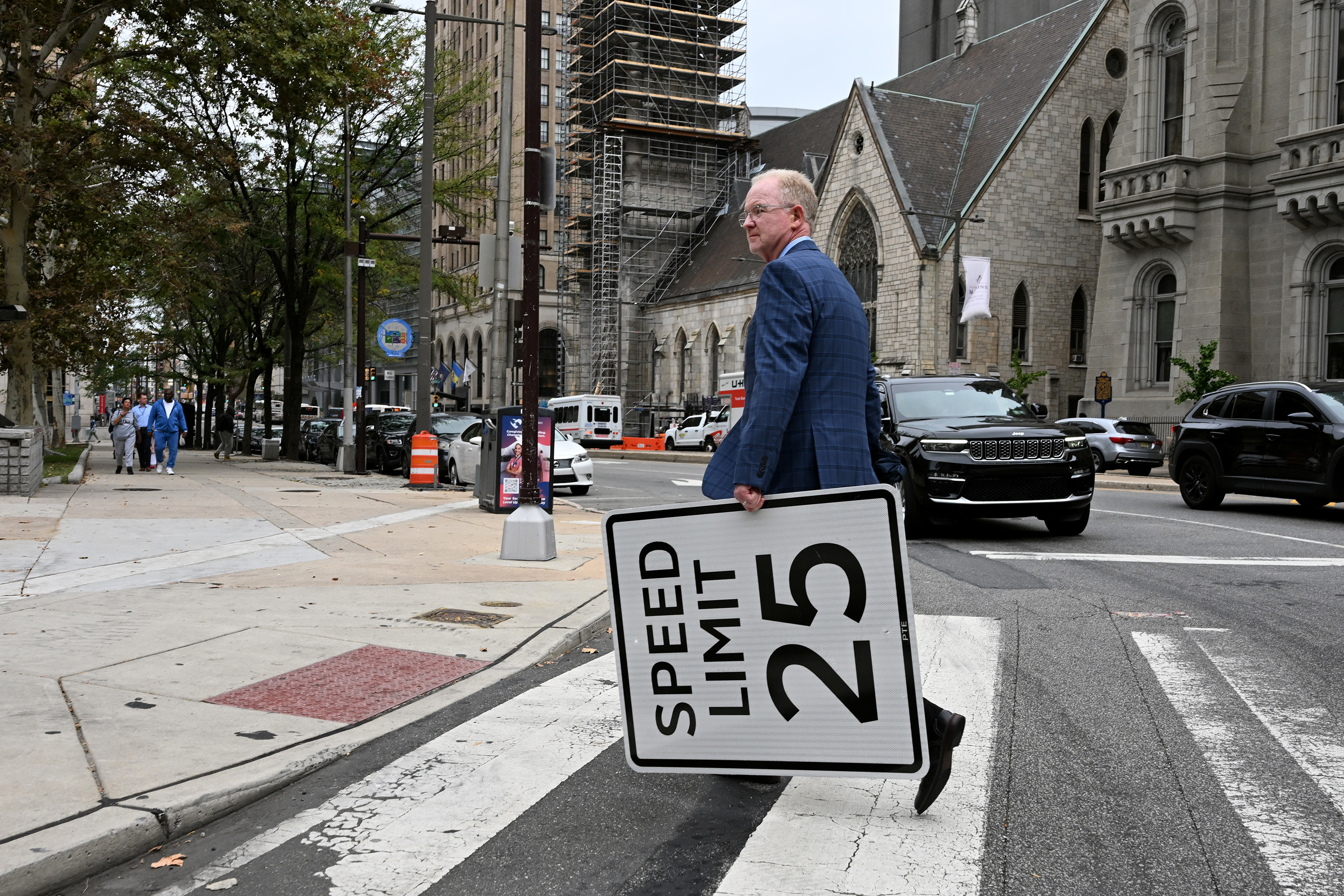
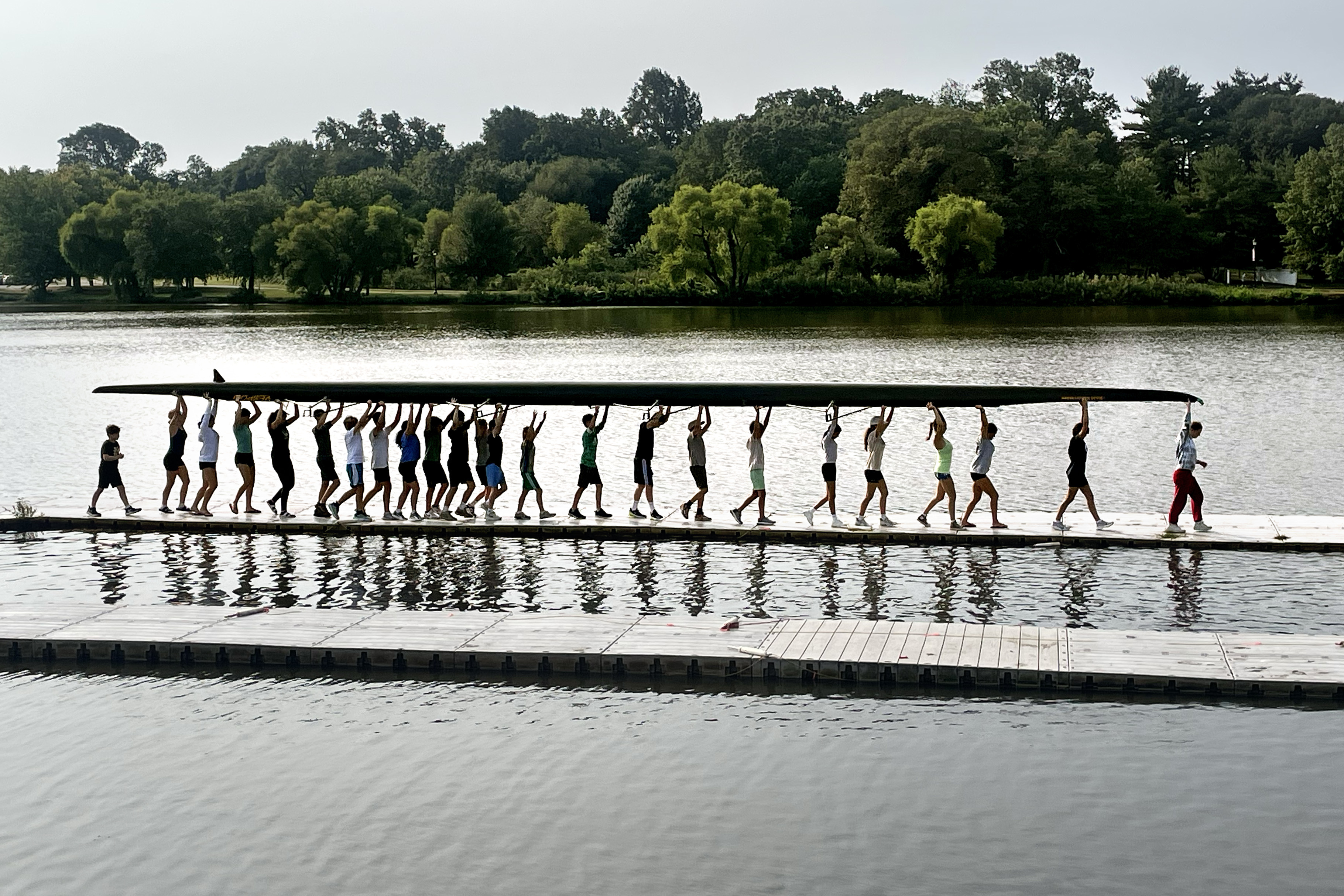
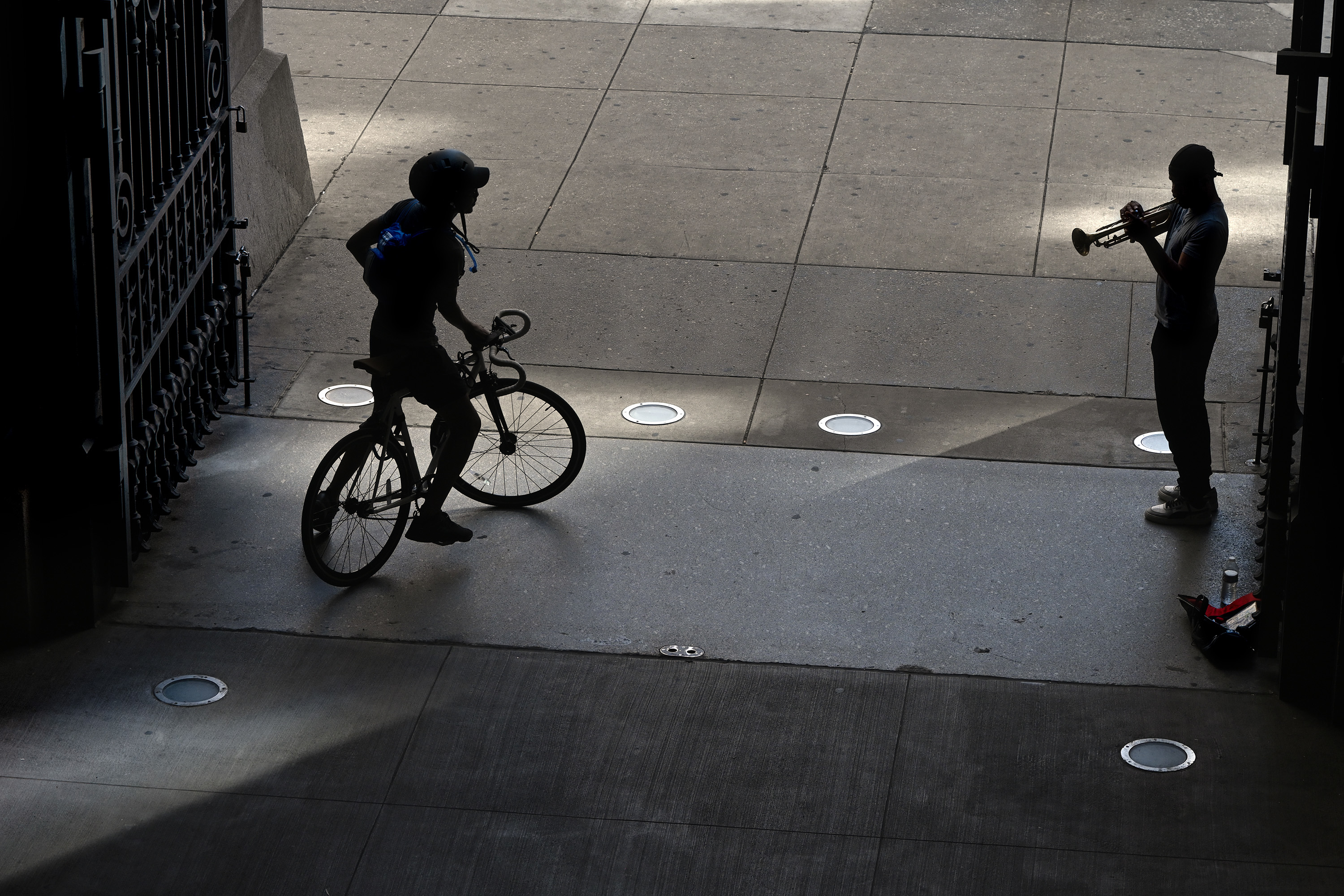
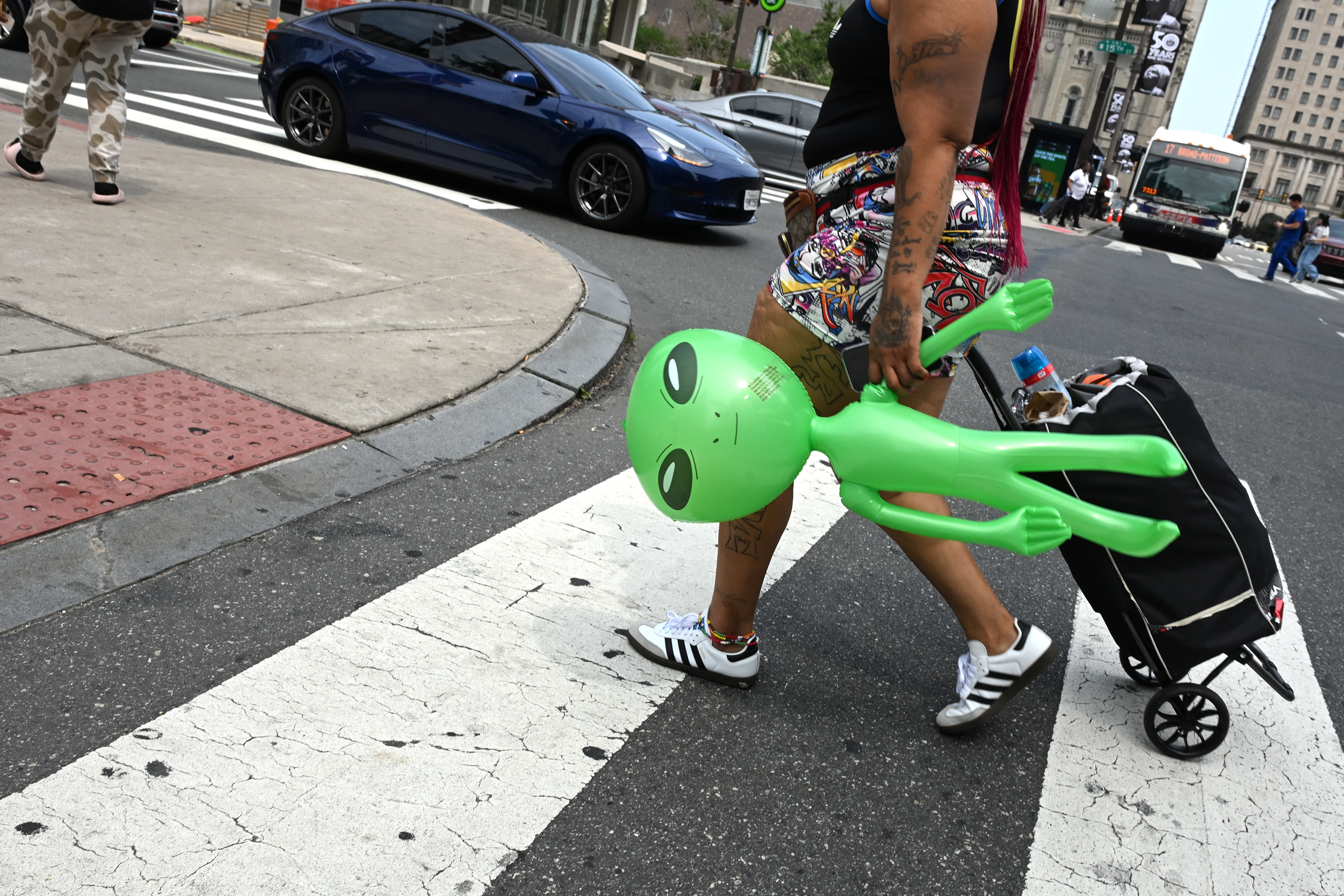
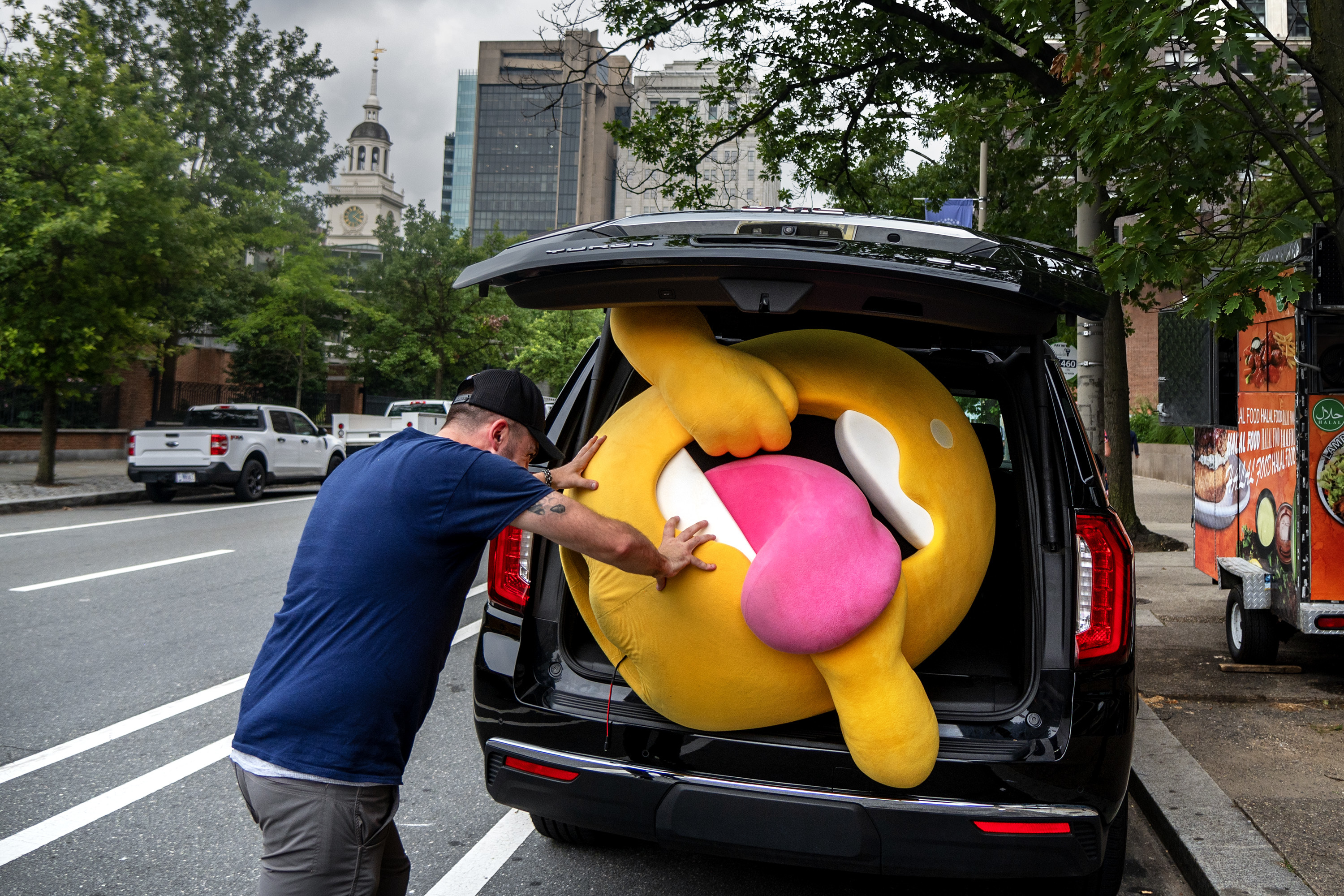
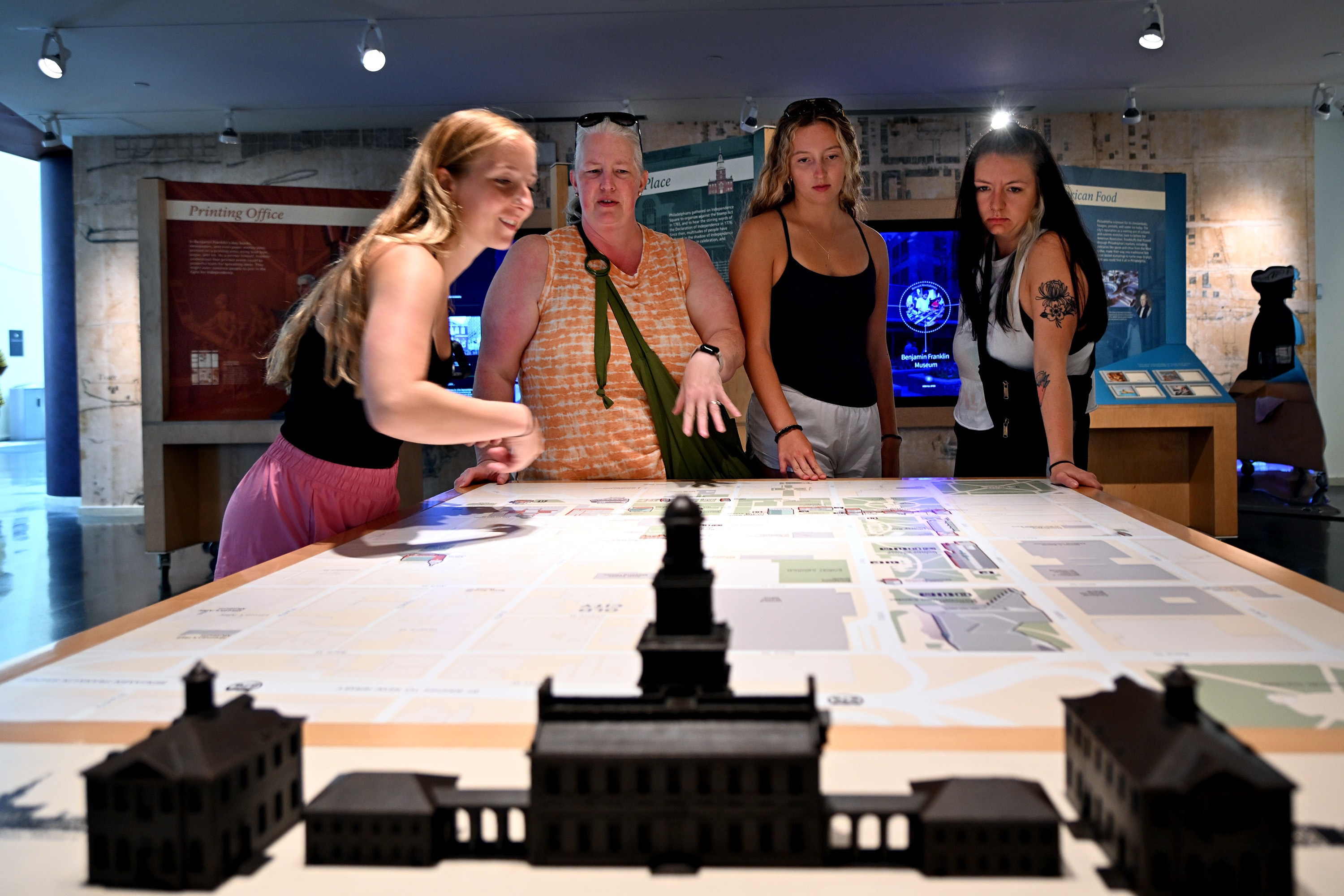
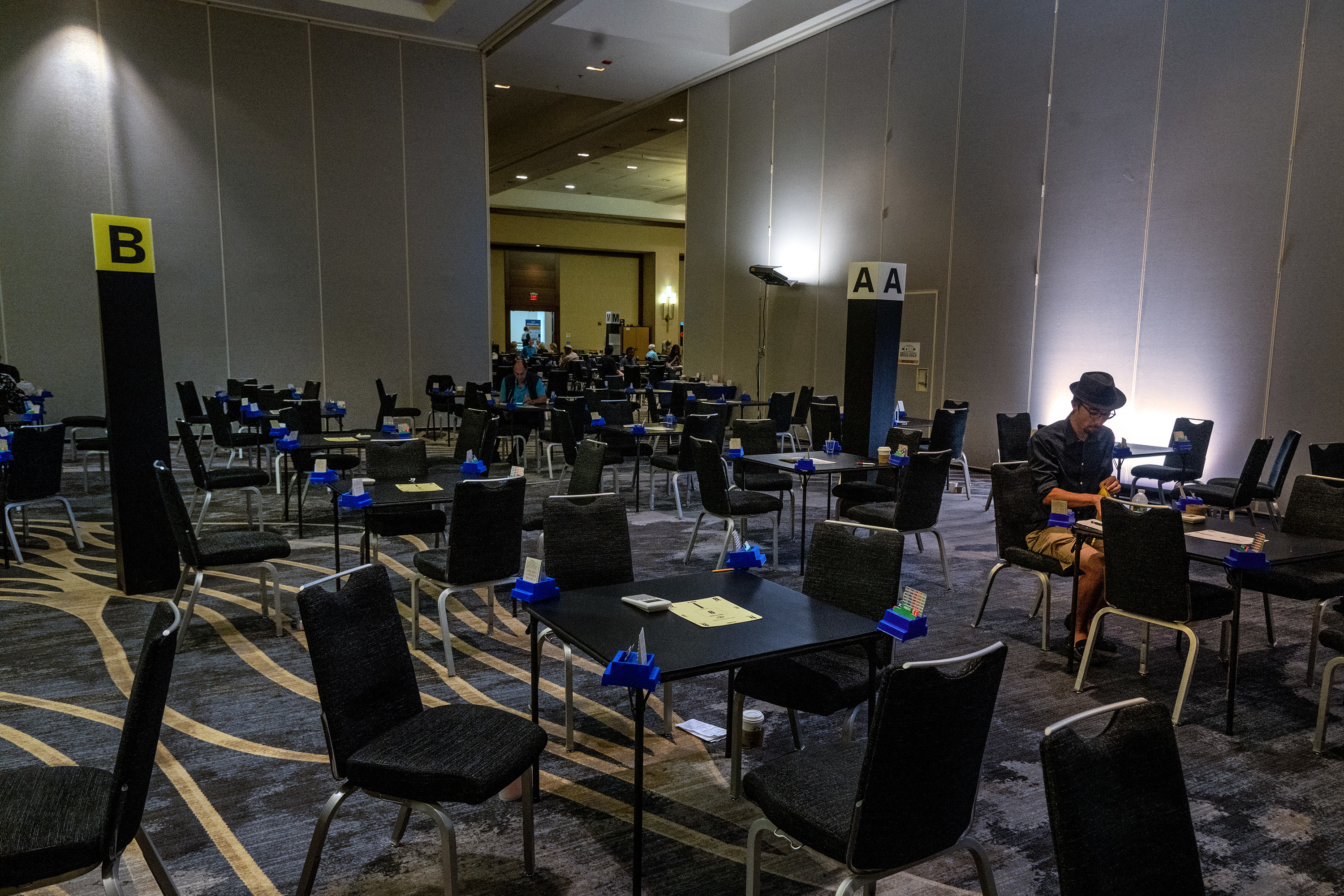
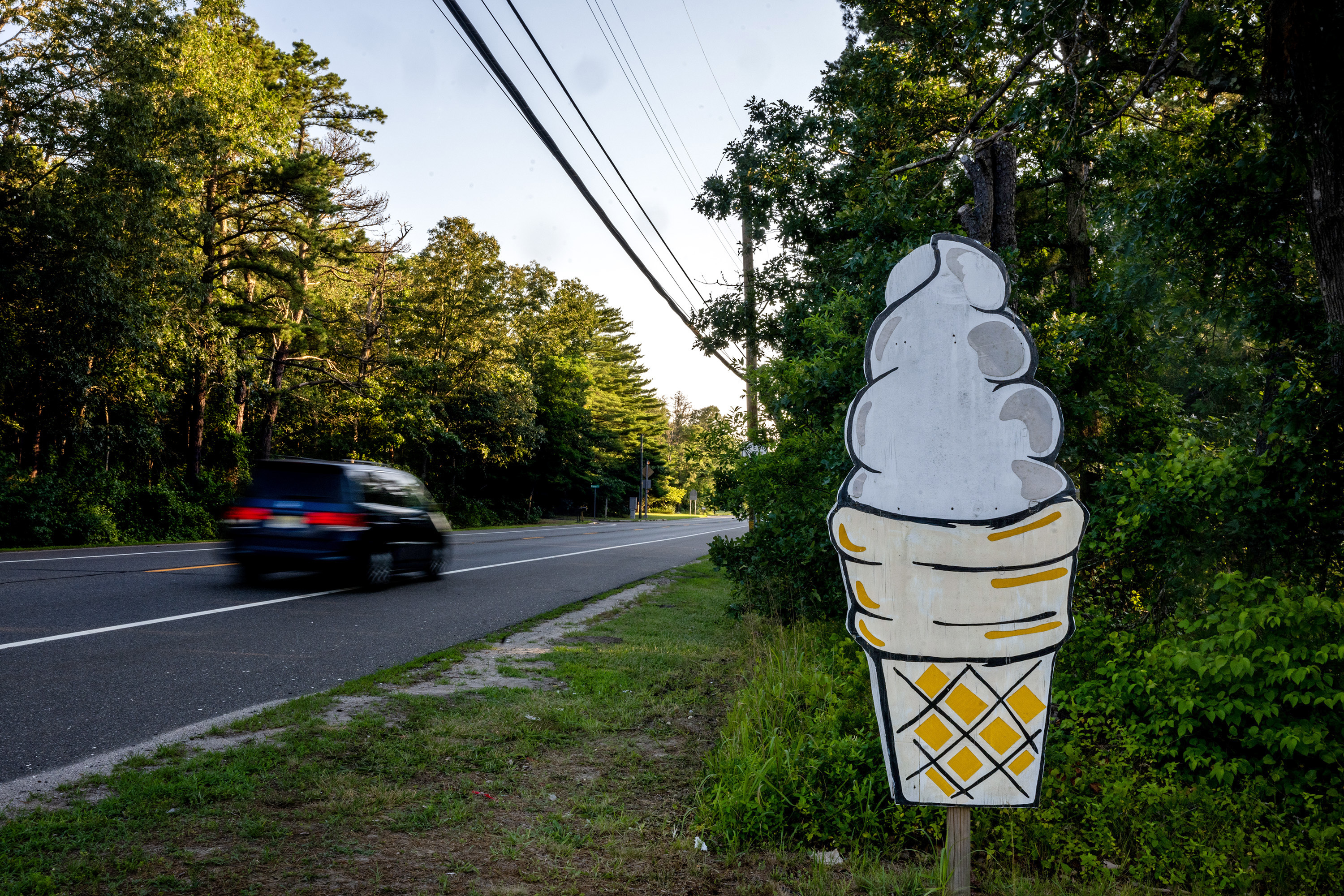
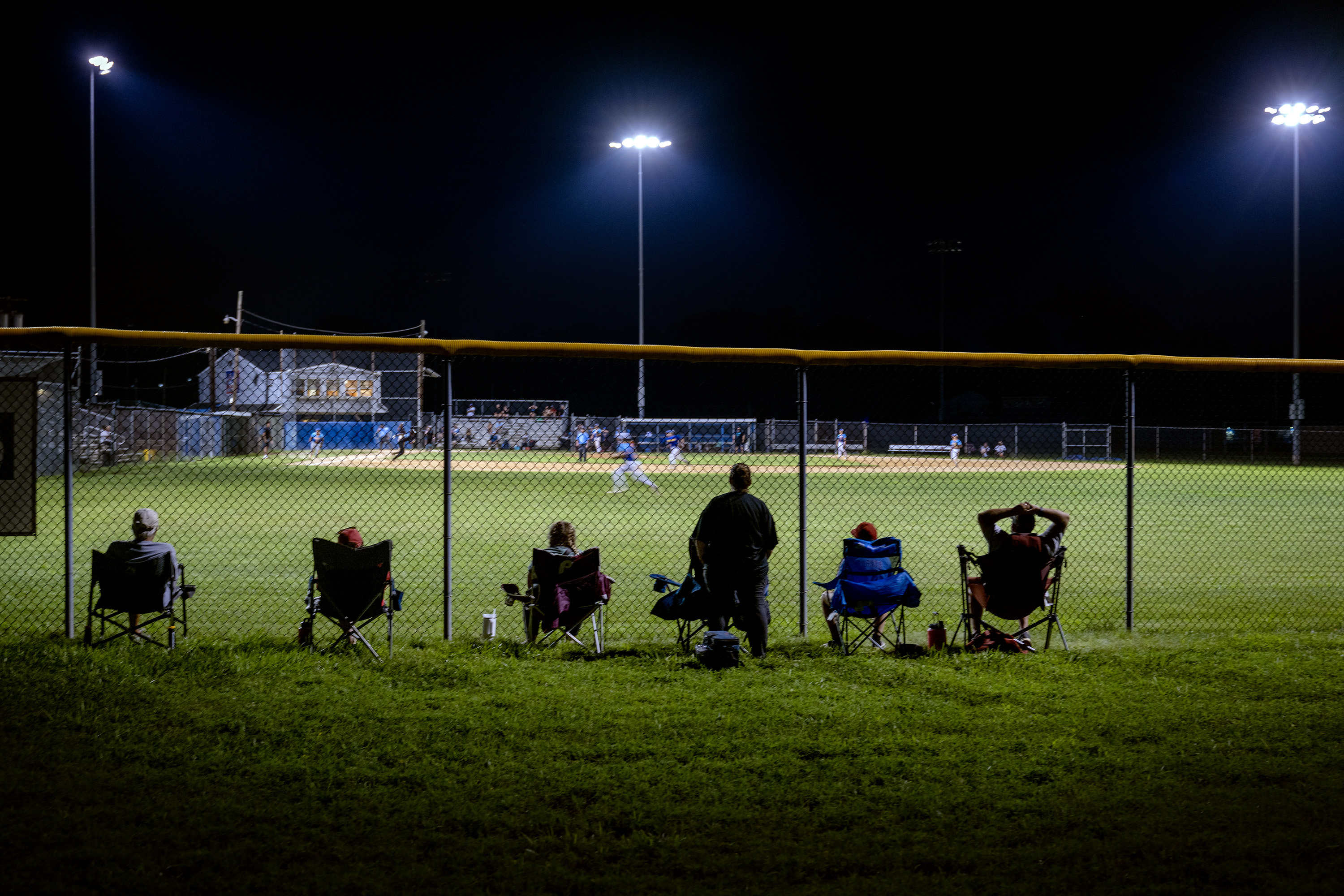
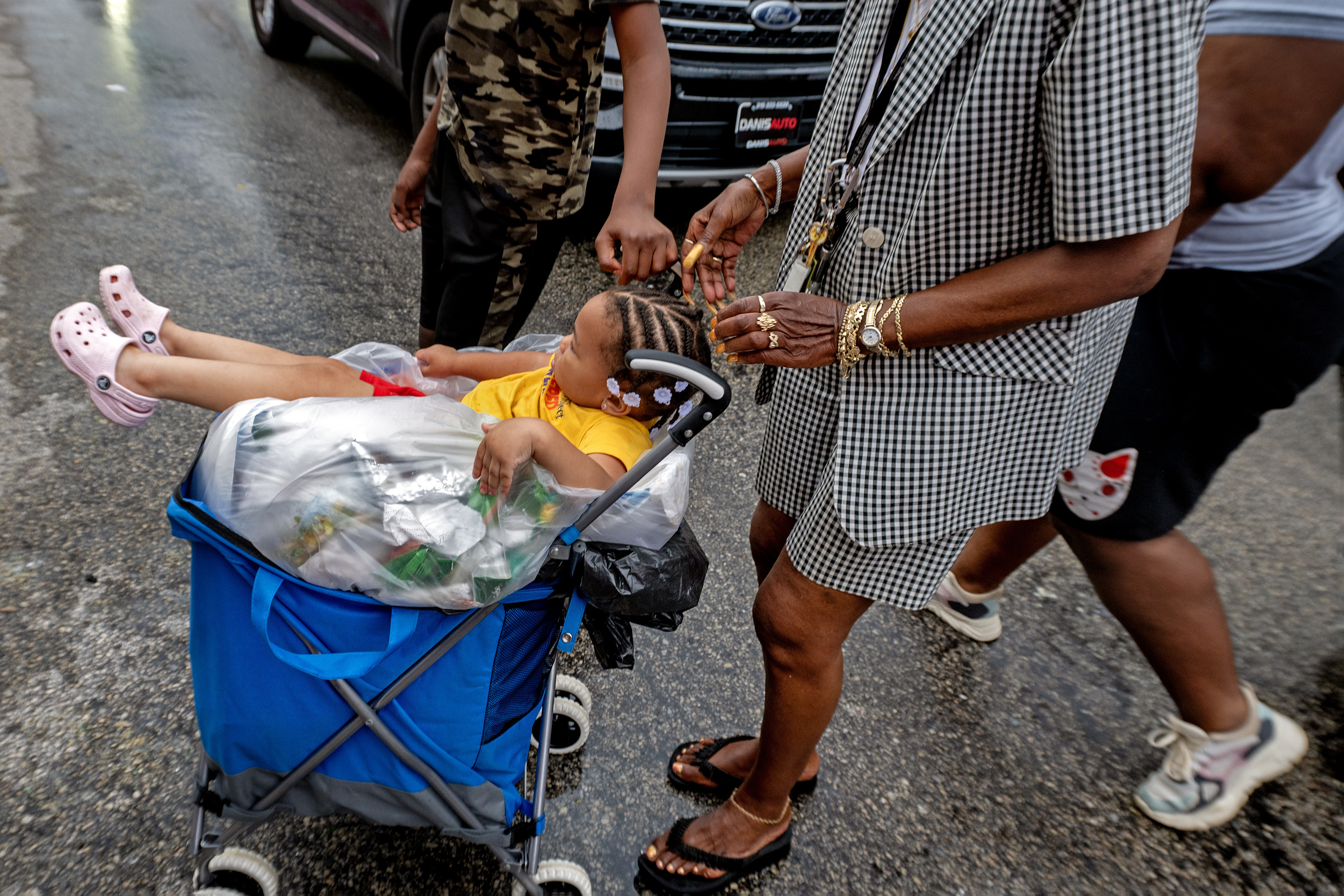
October 11, 2025: Can you find the Phillie Phanatic, as he leaves a “Rally for Red October Bus Tour” stop in downtown Westmont, N.J. just before the start of the NLDS? There’s always next year and he’ll be back. The 2026 Spring Training schedule has yet to be announced by Major League Baseball, but Phillies pitchers and catchers generally first report to Clearwater, Florida in mid-February.October 6. 2025: Fluorescent orange safety cone, 28 in, Poly Ethylene. Right: Paint Torch (detail) Claes Oldenburg, 2011, Steel, Fiberglass Reinforced Plastic, Gelcoat and Polyurethane. (Gob of paint, 6 ft. Main sculpture, 51 ft.). Lenfest Plaza at the Pennsylvania Academy of the Fine Arts on North Broad Street, across from the Convention Center.September 29, 2025: A concerned resident who follows Bucks County politics, Kevin Puls records the scene before a campaign rally for State Treasurer Stacy Garrity, the GOP candidate for governor. His T-shirt is “personal clickbait” with a url to direct people to the website for The Travis Manion Foundation created to empower veterans and families of fallen heroes. The image on the shirts is of Greg Stocker, one of the hosts of Kayal and Company, “A fun and entertaining conservative spin on Politics, News, and Sports,” mornings on Talk Radio 1210 WPHT.September 22, 2025: A shadow is cast by “The Cock’s Comb,” created by Alexander “Sandy” Calder in 1960, is the first work seen by visitors arriving at Calder Gardens, the new sanctuary on the Ben Franklin Parkway. The indoor and outdoor spaces feature the mobiles, stabiles, and paintings of Calder, who was born in Philadelphia in 1898, the third generation of the family’s artistic legacy in the city.September 15, 2025: Department of Streets Director of Operations Thomas Buck leaves City Hall following a news conference marking the activation of Automated Speed Enforcement (ASE) cameras on the Broad Street corridor – one the city’s busiest and most dangerous roads. The speed limit on the street, also named PA Route 611, is 25 mph.September 8, 2025: Middle schoolers carry a boat to the water during their first outing in a learn-to-row program with the Cooper Junior Rowing Club, at the Camden County Boathouse on the Cooper River in Pennsauken. September 1, 2025: Trumpet player Rome Leone busks at City Hall’s Easr Portal. The Philadelphia native plays many instruments, including violin and piano, which he started playing when he was 3 years old. He tells those who stop to talk that his grandfather played with Billie Holiday, Duke Ellington, Nina Simone, and Dizzy Gillespie. August 25, 2025: Bicycling along on East Market Street.August 18, 2025: Just passing through Center City; another extraterrestrial among us. August 11, 2025: Chris Brown stows away Tongue, the mascot for a new hard iced tea brand, after wearing the lemon costume on a marketing stroll through the Historic District. Trenton-based Crooked Tea is a zero-sugar alcoholic tea brand founded by the creator of Bai, the antioxidant-infused coconut-flavored water, and launched in April with former Eagles defensive end Brandon Graham as a partner.August 4,2025: Shanna Chandler and her daughters figure out their plans for a morning spent in Independence National Historical Park on the map in the Independence Visitor Center. The women (from left) Lora, 20; Shanna; Lenna, 17; and Indigo, 29, were stopping on their way home to Richmond, Virginia after vacationing in Maine. The last time they were all in Philadelphia Shanna was pregnant with Lenna. July 28, 2025: Louis-Amaury Beauchet, a professional bridge player from Brittany, France, takes a break between game sessions in an empty ballroom during the North American Bridge Championships at the Center City Marriott with some 4000 people in town over week of the tournament. The American Contract Bridge League is hosting the week of meetings and tournaments with bridge players from all over the world. The ACBL is the largest bridge organization in North America, with over 120,000 members (down from around 165,000 before COVID). Bridge draws players of all ages and walks of life – fictional characters James Bond and Snoopy both played as do billionaires Bill Gates and Warren Buffett (who sometimes play as partners).July 21, 2015: Signage for the Kustard Korner in Egg Harbor City, on the way to the Jersey Shore. President Ronald Reagan designated July as National Ice Cream Month and the third Sunday of the month.July 14, 2025: Fans watch a game at the Maple Shade Babe Ruth Field, part of the 20th Annual Franny Friel Summer Classic, on a cool(er) night with a refreshing breeze, the weekend before the MLB All-Star Game (with Kyle Schwarber the lone Phillies representative).July 7, 2025: Caroline Small wheels her two year-old great-granddaughter atop a bag of garbage as she carts it to a drop-off site at the Tustin Playground at 60th St. and W Columbia Ave. as residential trash collection stopped when a strike was called by District Council 33. Small lives just around the corner and said of the toddler, “she was just walking too slow.”
Former President Barack Obama endorsed U.S. Rep. Mikie Sherrill, the Democratic nominee for New Jersey governor, who is locked in a tight race with Republican Jack Ciattarelli.
Obama’s announcement just weeks ahead of the Nov. 4 election came in the form of an ad paid for by Sherrill’s campaign that Sherrill shared on X Friday morning.
“Mikie is a mom who will drive down costs for New Jersey families,” Obama said in the ad, echoing her campaign’s core message. “As a federal prosecutor and former Navy helicopter pilot, she worked to keep our communities safe.”
“Mikie’s integrity, grit, and commitment to service are what we need right now in our leaders,” he adds.
I'm honored to have President @BarackObama on Team Mikie.
This movement is about delivering something better for New Jersey — lower costs, more opportunity for our kids, and a government that's truly accountable to the people. pic.twitter.com/A0f5mHr0GI
Sherrill maintains a single-digit leadin polls over Ciattarelli, a former Assembly member who also ran for governor in 2017 and 2021 and has the endorsement of President Donald Trump.
In a statement, Sherrill praised Obama for leading “historic efforts to lower healthcare costs” and criticized Ciattarelli for defending cuts to Medicaid in Trump’s “big beautiful bill.”
“There’s so much at stake in this election, so President Obama and I are mobilizing New Jerseyans to make a plan to vote on or before November 4,” Sherrill added.
Sherrill last week appeared in South Jersey last week with Sens. Cory Booker (D., N.J.) and Amy Klobuchar (D., Minn.) and in her hometown of Montclair with former U.S. Rep. Gabby Giffords, an Arizona Democrat. She will appear in this weekend with Maryland Gov. Wes Moore.
Ciattarelli appeared on Wednesday with Ohio gubernatorial candidate Vivek Ramaswamy, who co-founded Trump’s DOGE and who appeared at a GOP summit in Atlantic City earlier this year to garner enthusiasm ahead of the gubernatorial primary.
Trump does not currently have plans to appear in the state with Ciattarelli, Axios reported. While New Jersey shifted more in support of Trump in 2024 he still lost the state by 6 percentage points.
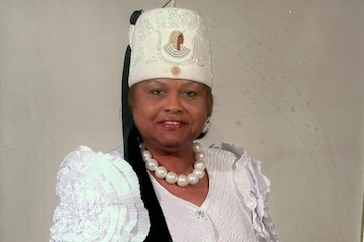
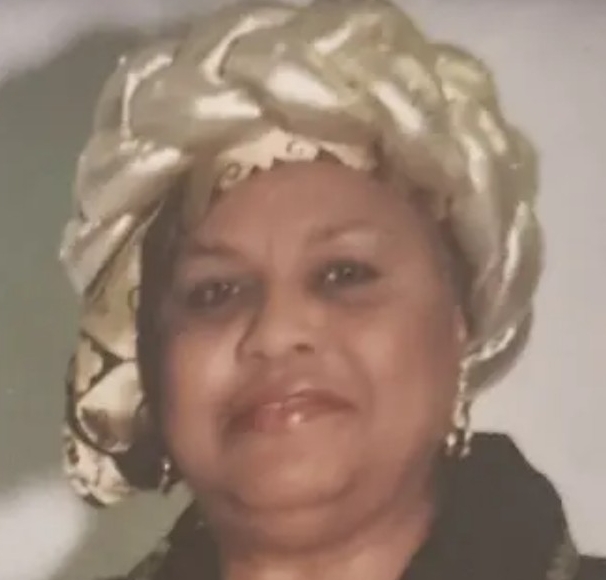
Dorothy Womble-Wyatt, 84, of Cherry Hill, innovative teacher and celebrated school principal for the Camden City School District, active church member, mentor, and proud graduate of what is now Fayetteville State University, died Tuesday, Sept. 23, of complications from a heart condition at her home.
For 37 years, from 1968 to her retirement in 2005, Ms. Womble-Wyatt connected with Camden students through progressive teaching techniques, and with classroom colleagues, parents, and nearby residents through her collaborative administrative style.
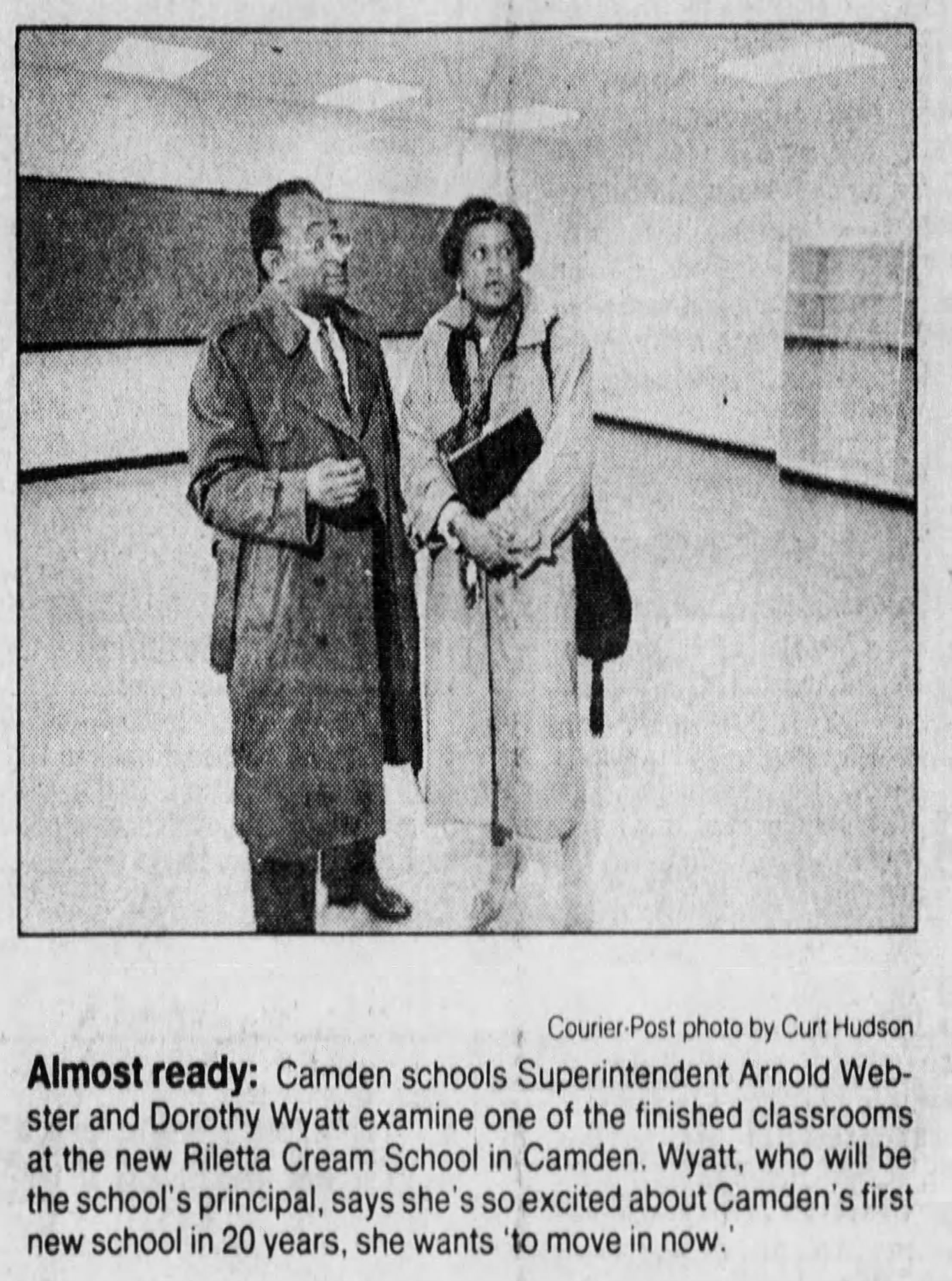
She was named principal at the old Bonsall Elementary School in 1977 and became the first principal at the new Riletta T. Cream Elementary School in 1991.
“She led the Riletta Twyne Cream Family School with distinction,” the Camden City Advisory Board of Education said in a recent resolution, “guiding its opening in January 1991 and building a school culture centered on high expectations, literacy, and community partnership.”
As a teacher, Ms. Womble-Wyatt focused on elementary school students, and she emphasized how math, geography, spelling, science, English, and other subjects were important in everyday life. She joined the school district in 1968 as a first-grade teacher and served as an administrative assistant before advancing to principal at Bonsall.
Ms. Womble-Wyatt was active with the Order of the Eastern Star.
In its resolution, the Board of Education said she “championed professional learning and innovative classroom practices that advanced student growth.”
Her nephew Micheal W. Moore said: “She was always a teacher at heart. She taught her family when she was young and her classmates in high school. She never stopped.”
As principal at the Cream School, Ms. Womble-Wyatt supervised the transfer of 800 students from four other elementary schools during the 1990-91 school year and told the Courier-Post: “I’m just thinking about a smooth transition. … It’s the same as if you’re moving into a new home. You’re excited moving into a new environment. When you get something nice, you want to keep it that way.”
She supported all kinds of new educational initiatives and lobbied tirelessly for better school supplies and improved healthcare services for Camden students. The Courier-Post covered Cream’s grand opening, and 9-year-old student Bradford Sunkett told the newspaper: “I’m glad to be at a new school. But I’m most glad Ms. Wyatt is here. Ms. Wyatt and the teachers are more important than a school building.”
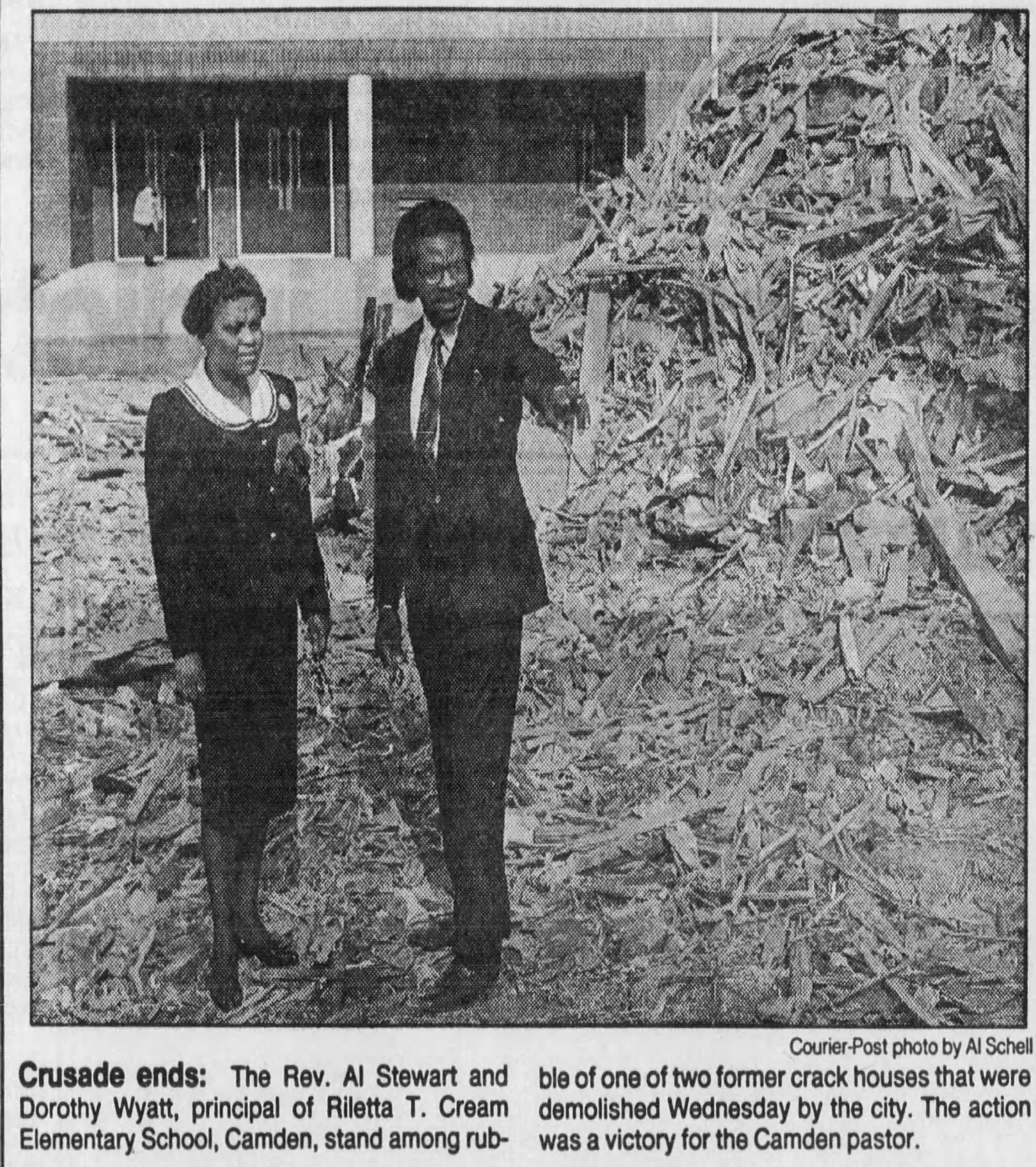
She cheered in 1992 when community activists cleared a cluttered lot near the school and told the Courier-Post: “It’s a joyful feeling knowing people have listened to what we have to say and did something about it.”
This photo of Ms. Womble-Wyatt appeared in the Courier-Post in 1990 as she was assuming the role of principal at the Cream School.
In 1999, she endorsed a New Jersey state reform program that invited parents to help shape school curriculum. “It’s a great thing for parents because many don’t have the experience of what schools are up against,” she told the Courier-Post. “All they hear is that schools are failing. This lets parents become part of the foundation.”
Ms. Womble-Wyatt was active at Roberts Chapel Missionary Baptist Church in North Carolina, First Nazarene and Zion Baptist Churches in Camden, and New Community Baptist Church in Collingswood. Zion recognized her with a service award in 2008.
“She loved to invite family and friends to attend worship services with her on Sundays and join her for dinner afterward,” her nephew said.
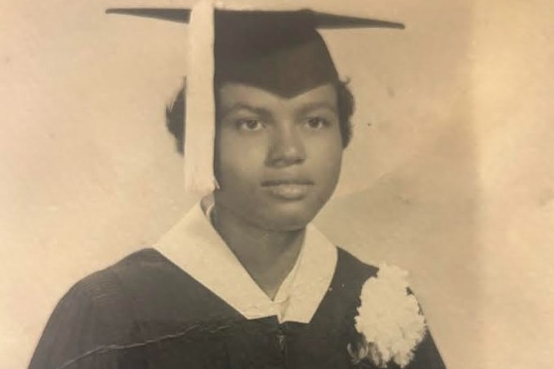
She earned a bachelor’s degree in education and leadership at Fayetteville State in North Carolina and recruited new students everywhere she went. In 2003, the university’s Gospel Choir honored her lifelong support with a concert at Camden High School.
This photo of Ms. Womble-Wyatt was published in the Courier-Post in 1992 during a nearby neighborhood cleanup.
She belonged to the Alpha Kappa Alpha Sorority and the Order of the Eastern Star, and spoke often at churches and community groups about Black history. She was honored at Camden’s third annual Women’s Recognition Ceremony in 1996 and earned an Outstanding Citizen’s Award from the local Freemasons in 1997.
“People wanted to be around her,” her nephew said. “She lifted you up.”
Dorothy Marie Womble was born May 16, 1941, in Goldston, N.C. She earned a master’s degree in education from North Carolina Central University, married Glenmore Wyatt in 1967, and they had a son, Glen. Her husband died in 2021, and their son died in 2023.
Ms. Womble-Wyatt collected African artifacts, hosted memorable dinners, and never forgot a birthday. She enjoyed casinos, shopping for gifts, and visiting family and friends.
Ms. Womble-Wyatt earned a master’s degree in education from North Carolina Central University.
On Instagram, a friend called her “an educator par excellence, a fashionista, and genuine lover of people.” Her nephew said: “She was generous and joyous. She was a queen in every right.”
In addition to her nephew, Ms. Womble-Wyatt is survived by a grandson and other relatives. A brother died earlier.
Services were held Oct. 2 and 3 in Camden, and Oct. 12 in North Carolina.
Ms. Womble-Wyatt’s “life was vibrant and ever moving,” her family said in a tribute. “Indeed, her legacy has grown into a gorgeous train of diamonds and appreciation.”
As The Philadelphia Inquirer closes its printing plant, a ‘family’ of employees marks the end of an era
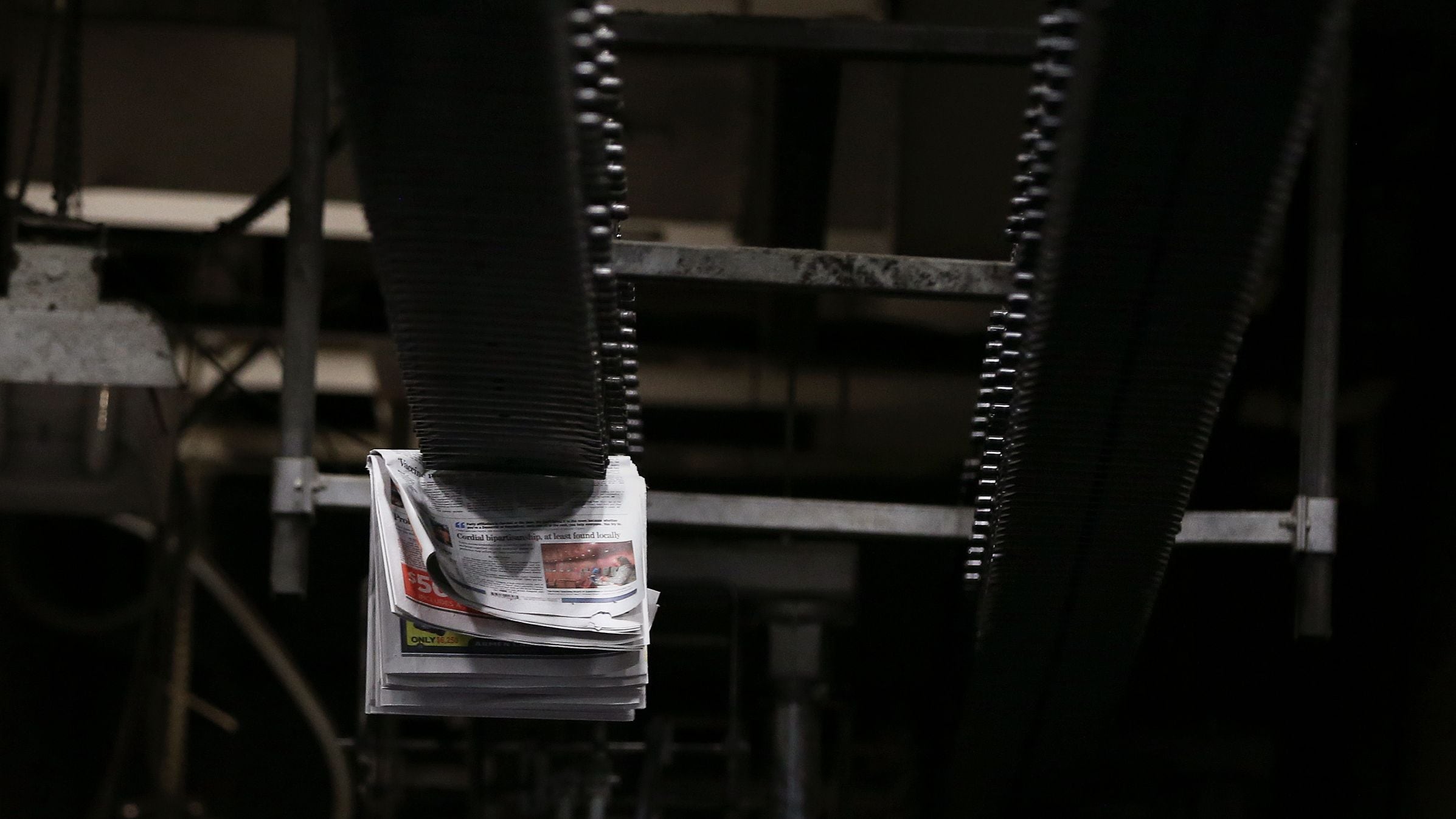
A tattered copy of The Inquirer is the last to ride the grippers from the pressroom to the mailroom at the Schuylkill Printing Plant in Upper Merion Township on March 28.TIM TAI / Staff Photographer
Tom “Three Bars” Lafauci had no chance of disappearing quietly into the howling winds of the night.
“Lafauci!”
Sybil White, a longtime security officer, summoned him before he could reach the only available exit at The Philadelphia Inquirer’s Schuylkill Printing Plant, the mammoth newspaper factory that was about to call it an era.
“Come on, get in the picture,” she commanded him. Almost reflexively, Len Leach and Tanya Rockeymore, who were working the lobby security detail that night, stuck their heads in the frame. They might not see him again. One of 500 who lost their jobs with the building’s sale, this was Lafauci’s last work shift.
At the age of 192, The Inquirer is stopping its own presses for good — the April 1 issues marked the last official runs — and will be outsourcing its print operations in line with newspapers across the country that are cutting costs and fighting a media universe changing at the speed of breaking news.
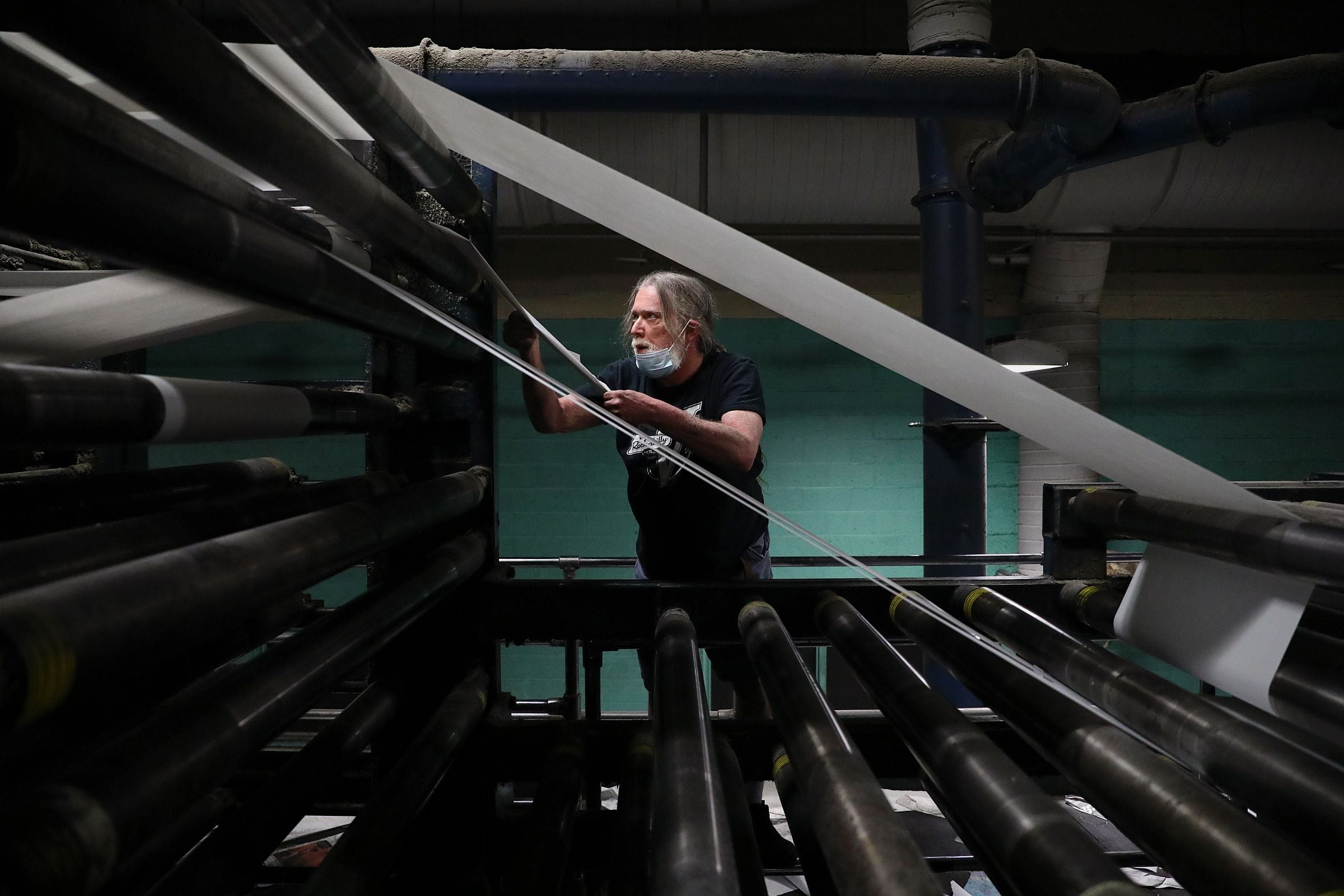
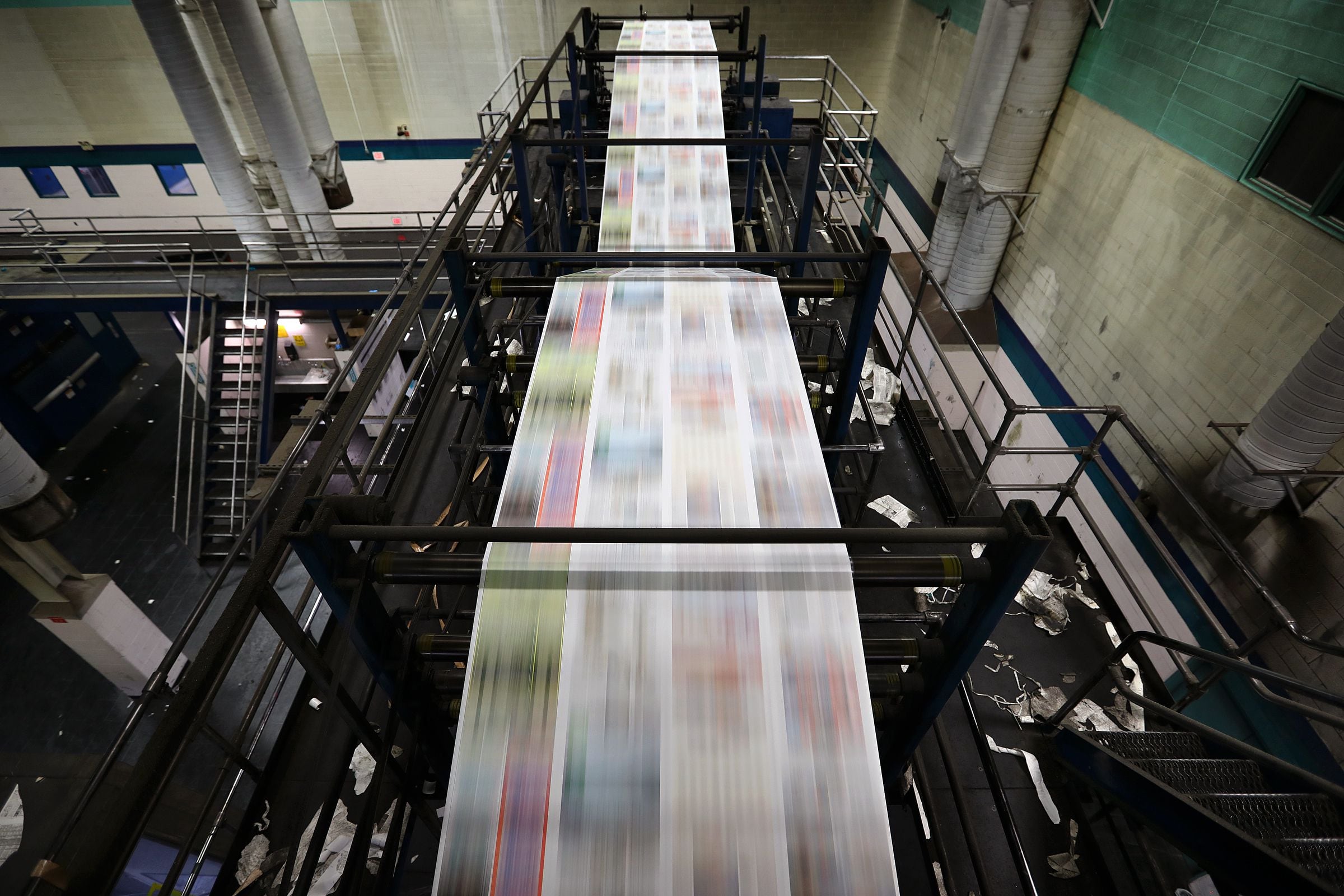
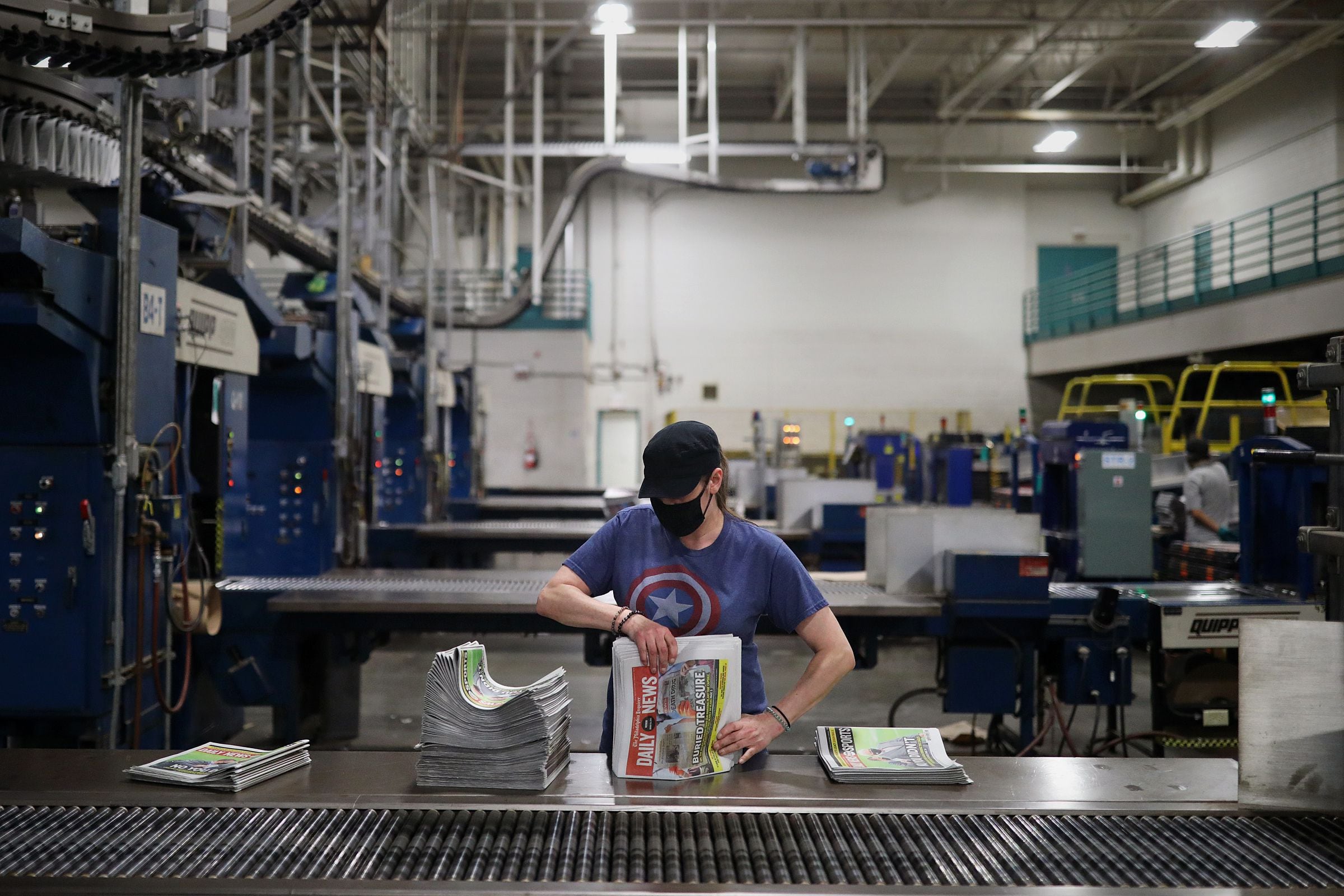
Aaron Krakovitz, a third-generation, 47-year pressman, threads paper through a set of rollers as he prepares for the night's press run. TIM TAI / Staff PhotographerA blur of paper courses along rollers during a Sunday advance run; some sections of the Sunday paper are printed ahead of time. TIM TAI / Staff PhotographerColor pages speed across rollers for a Sunday advance run. TIM TAI / Staff Photographer
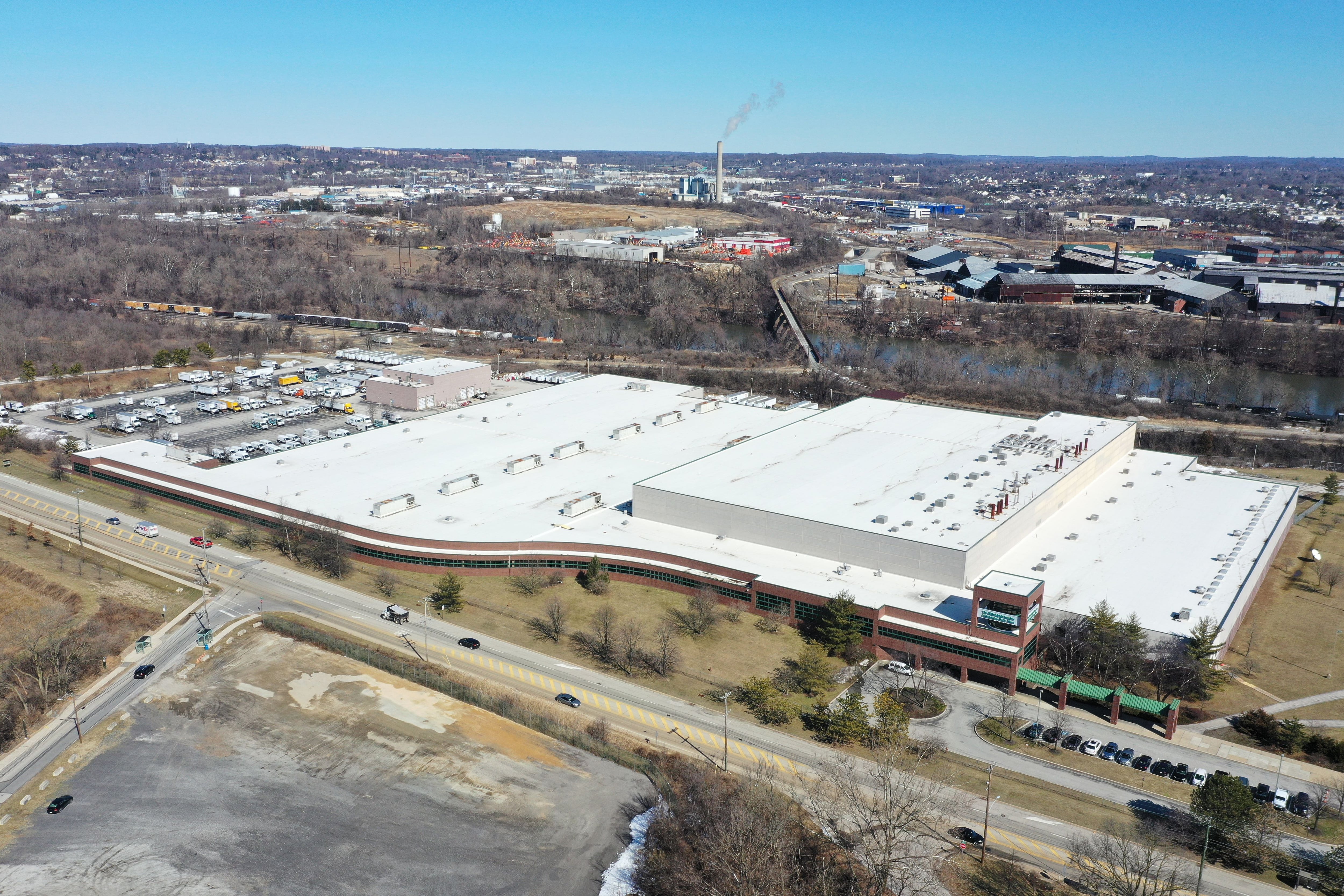
The guards seemed to be well-acquainted with Three Bars. Actually, they seemed to be well-acquainted with everyone exiting and entering the brick, curving structure built for $299.5 million (about $600 million in today’s dollars) 30 years ago, and sold to developer J. Brian O’Neill for $37 million to become part of his burgeoning biotech-health science empire.
“You get to know everybody,” said White. “It’s like family,” a leitmotif sentiment among the guards, engravers, pressmen, mailers, and drivers who worked in the immense, quirk-infested complex that was marinated in the vague odors of paper and the ink that blackwashed the floors and layered the handrails.
A production theme park
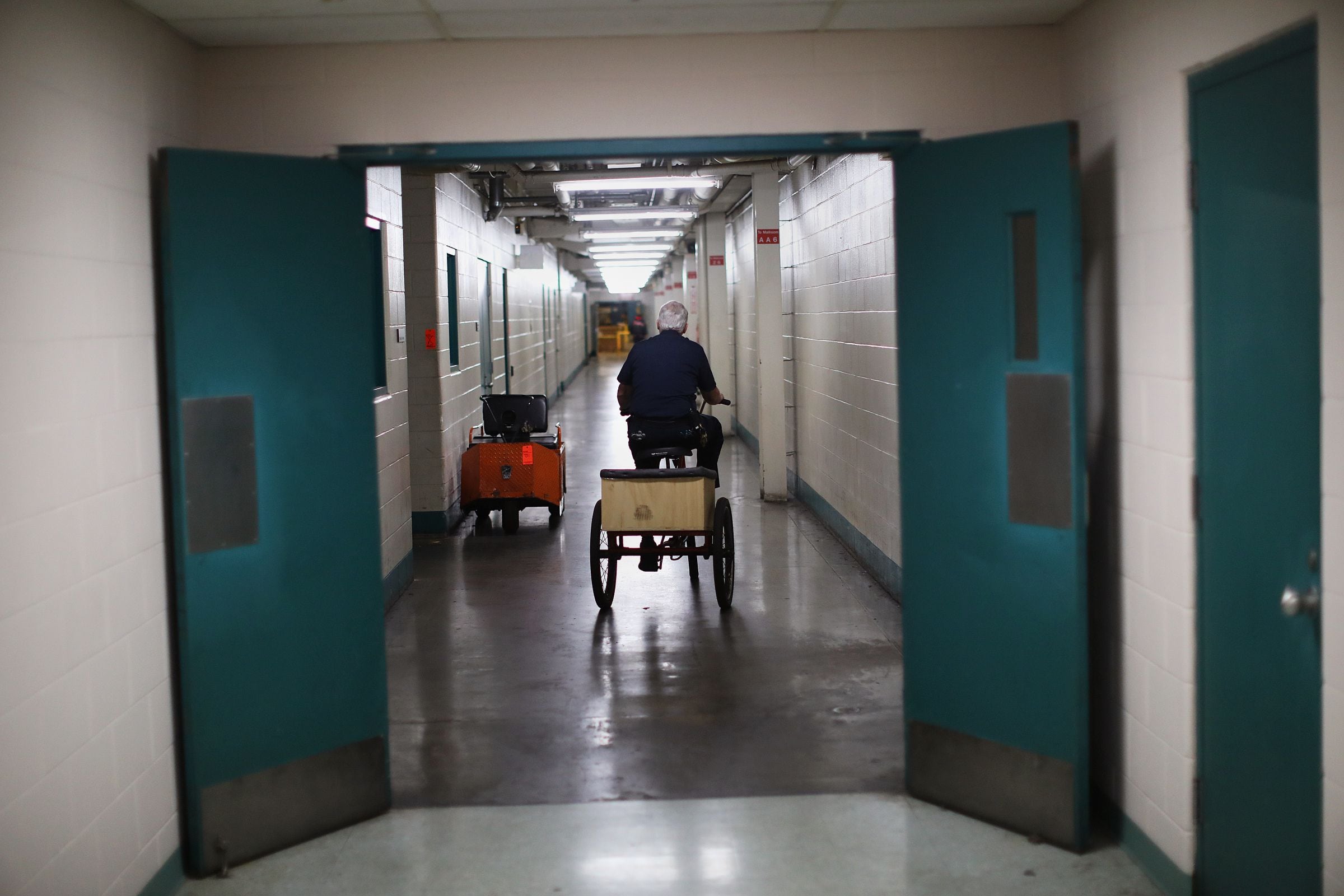
The printing plant, a 681,023-square-foot complex along the river, was built to house $160 million worth of “state of the art” presses. FRANK WIESE / StaffSecond childhood? No, engineer Joe Hoban is riding a tricycle that can carry tools while navigating the building’s lengthy corridors. TIM TAI / Staff Photographer
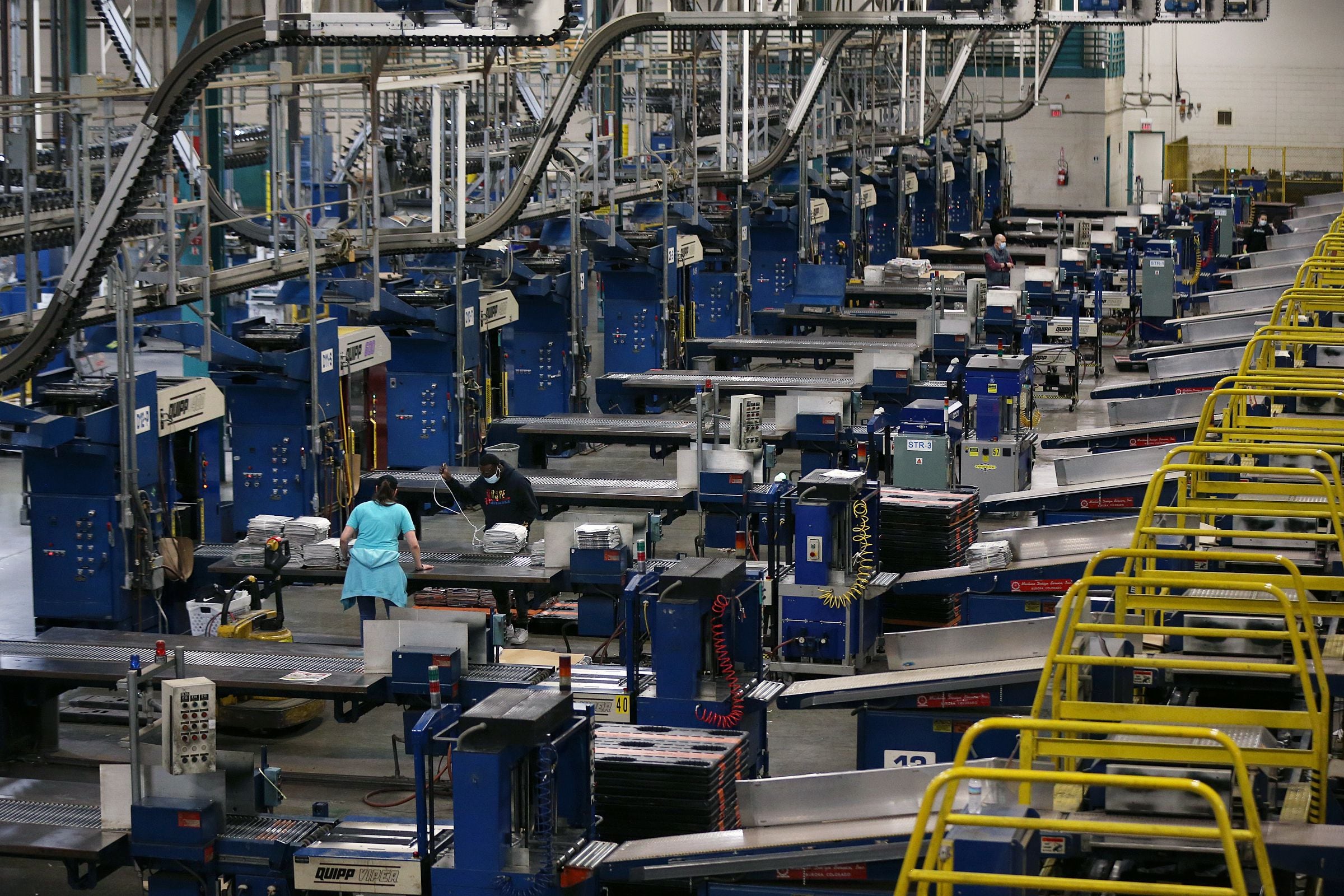
This was a thundering production theme park of impossible intricacy, where paper-carrying freight cars rumbled and rammed into the rail bay, where newspaper pages rolled off presses that collectively weighed as much as a Navy destroyer.
They were folded and collated, and commuted on cars and conveyors as though they had purchased tickets on amusement rides. Ultimately they landed in trucks that ferried The Inquirer and Daily News to hundreds of locations while most readers slept.
All it took to get them their papers, said Fred Lehman, vice president of operations, was about two million moving parts.
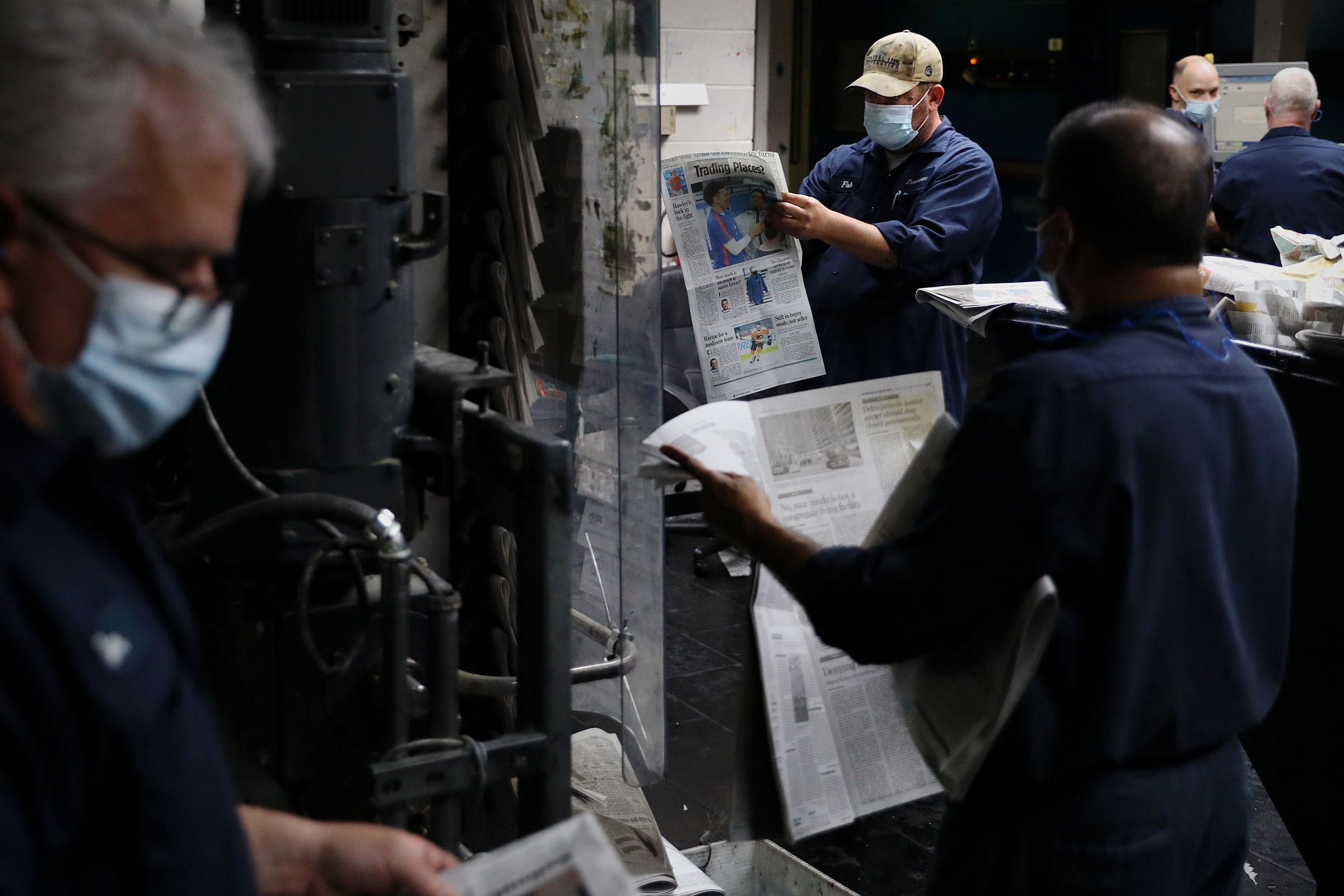
Pressroom supervisor Jim Fish (top) flips through Inquirer pages as a quality check. TIM TAI / Staff Photographer
Somehow amid the often hellish cacophony in this 681,023-square-foot behemoth, people got to know each other.
In many cases, they knew each other already. “Family” was more than metaphoric in White’s case. Her uncle got her the job 25 years ago; he worked at the company. Her father was a driver.
Lafauci, a mailer, said his nickname had no association with happy hour. “Three Bars … my grandfather worked here, my father worked here.” Yes, he was the third bar. Bill Burk, a transportation manager, worked with all three bars, and at one time or another, The Inquirer employed 20 of Burk’s family members.
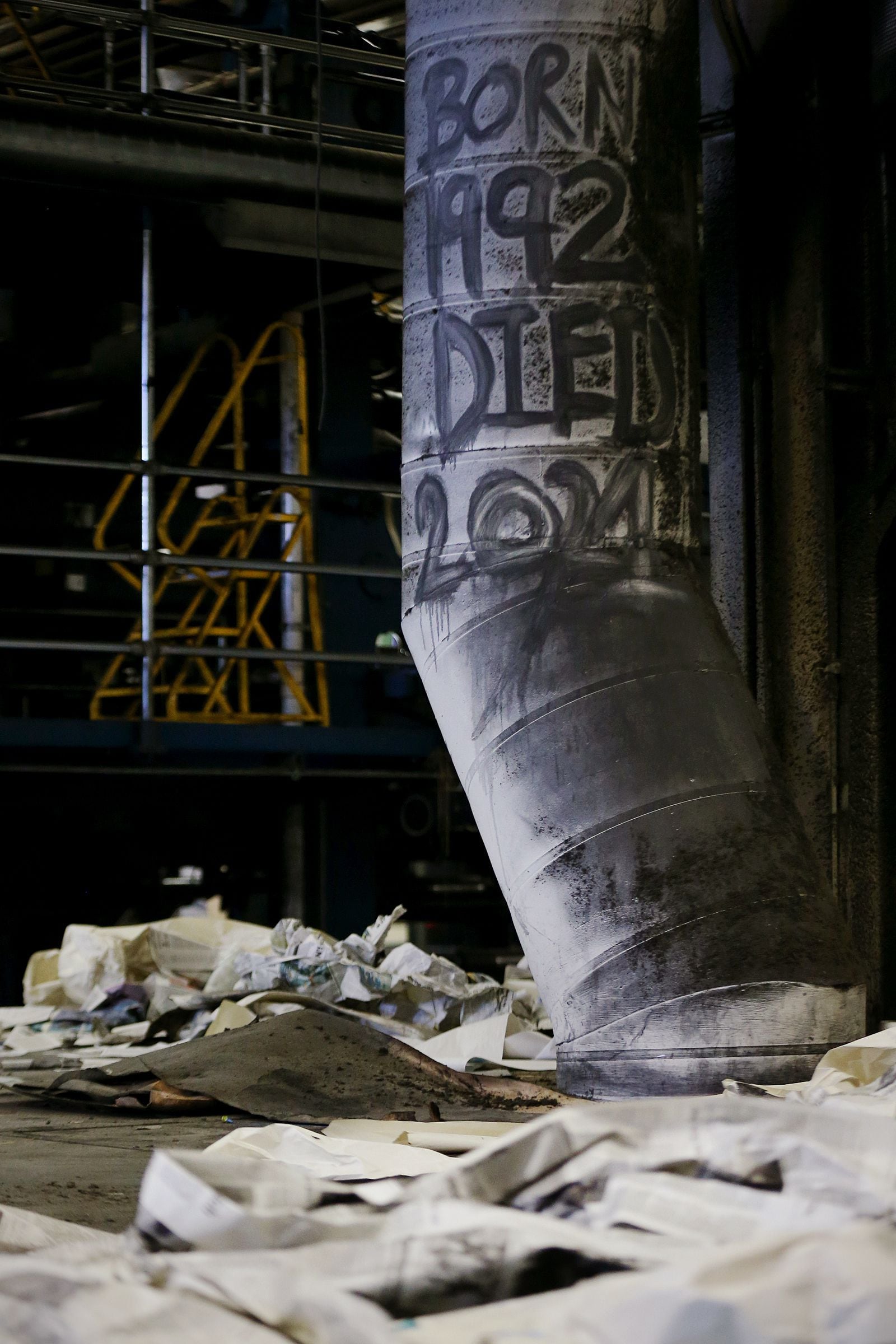
Epitaph for an era: "BORN 1992 DIED 2021" is traced in the grime on an air duct inside the pressroom. TIM TAI / Staff Photographer
“My grandfather worked here, my father worked here.”
Tom “Three Bars” Lafauci
‘It was family’
Those days are history, as soon will be the printing plant, located in Upper Merion Township at the junction of Routes 23 and 320, a location a reporter once described as “centrally isolated.”
Rather than a death in the family, October’s announcement that SPP would be sold was more like deaths in multiple families, and the sense of loss — a mix of resignation, equanimity, sadness, with a dash of bitterness — condensed as employees were leaving the building for the last time.
“It was family,” Lafauci said. There’s that word again.
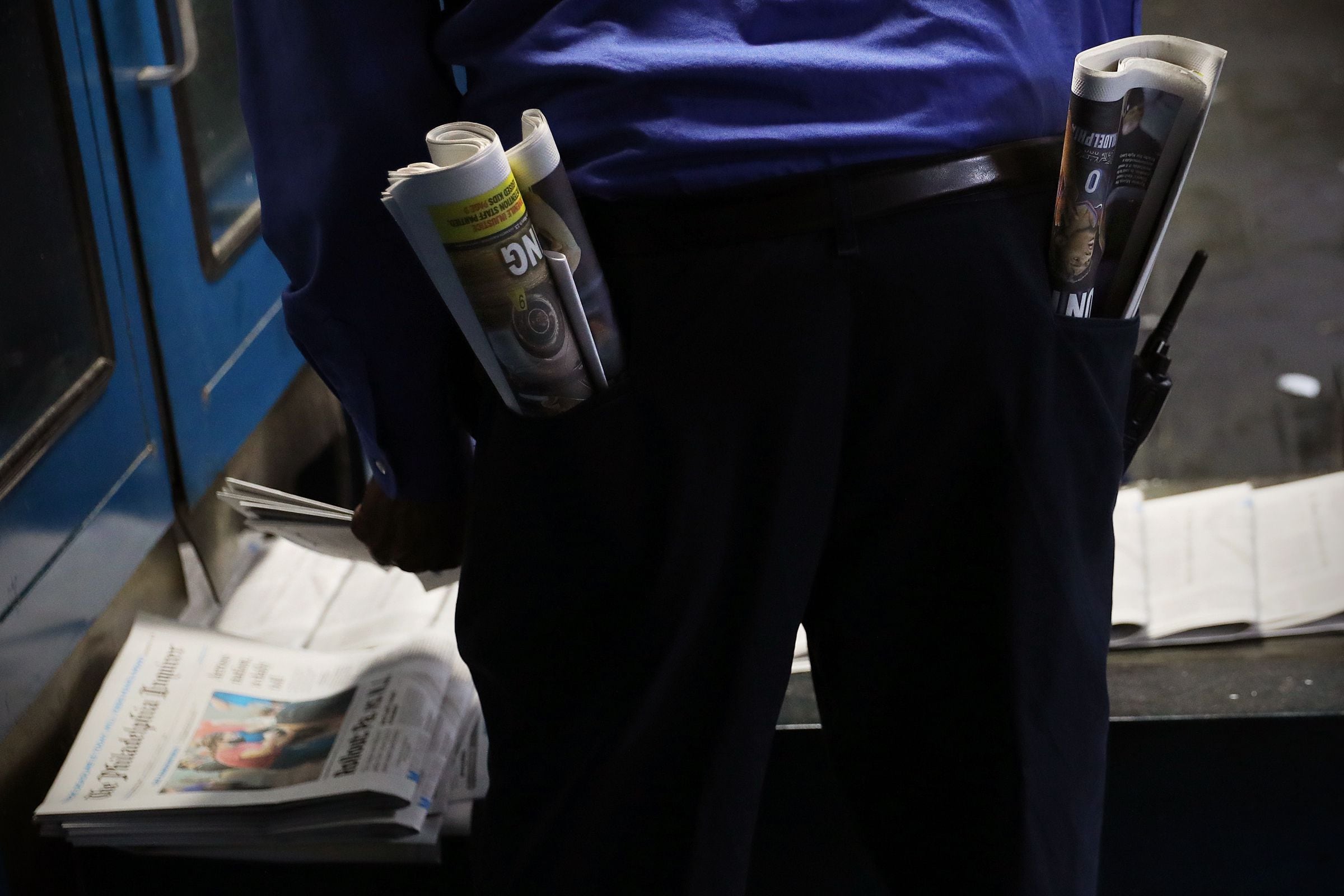
Mailer Jessica Tayoun, who started working for The Inquirer in 1992, stacks a bundle of Daily News issues. TIM TAI / Staff PhotographerTayoun and Lionel Shaw, a 37-year Inquirer veteran, prepare bundles of the newspaper's last scheduled edition to be printed at SPP. TIM TAI / Staff PhotographerPressroom supervisor Tom Addison, hired in 1979, carries in his rear pockets rolled-up Daily News issues that he will examine later for quality. TIM TAI / Staff Photographer
About the only problems they had at the plant, the guards said, involved intra-family disputes that reasoned discussion failed to resolve. Said White, “We tried to calm them down.”
The writers and editors reported and crafted the stories — from seven presidential elections in the SPP era, to a World Series title and a Super Bowl championship, to the 9/11 terrorist attacks, to one tenacious pandemic — but the SPP workforce made sure people got to read them on paper that they could hold in their hands, and perhaps even save.
During the last run of the Inquirer's own presses, a “family” of employees say goodbye as the company transitions to an outsourced printing operation.Kristen Balderas, Raishad Hardnett, Astrid Rodrigues, Lauren Schneiderman and Frank Wiese / Staff
All the news that fits
In the pre-SPP days, type and advertisements were posted on flats by hand. Editors marked last-minute cuts with blue pencils, and the compositors would surgically consign them to the cutting-room floor.
The job evolved rapidly with “pagination,” as computer screens replaced the flats and workers such as Kathleen Griffiths moved from the composing room to a video terminal. Inspecting the pages to make sure that the ads are properly placed and error-free, and that the display type and copy are correctly confined to a page is a critical step in the “prepress” process.
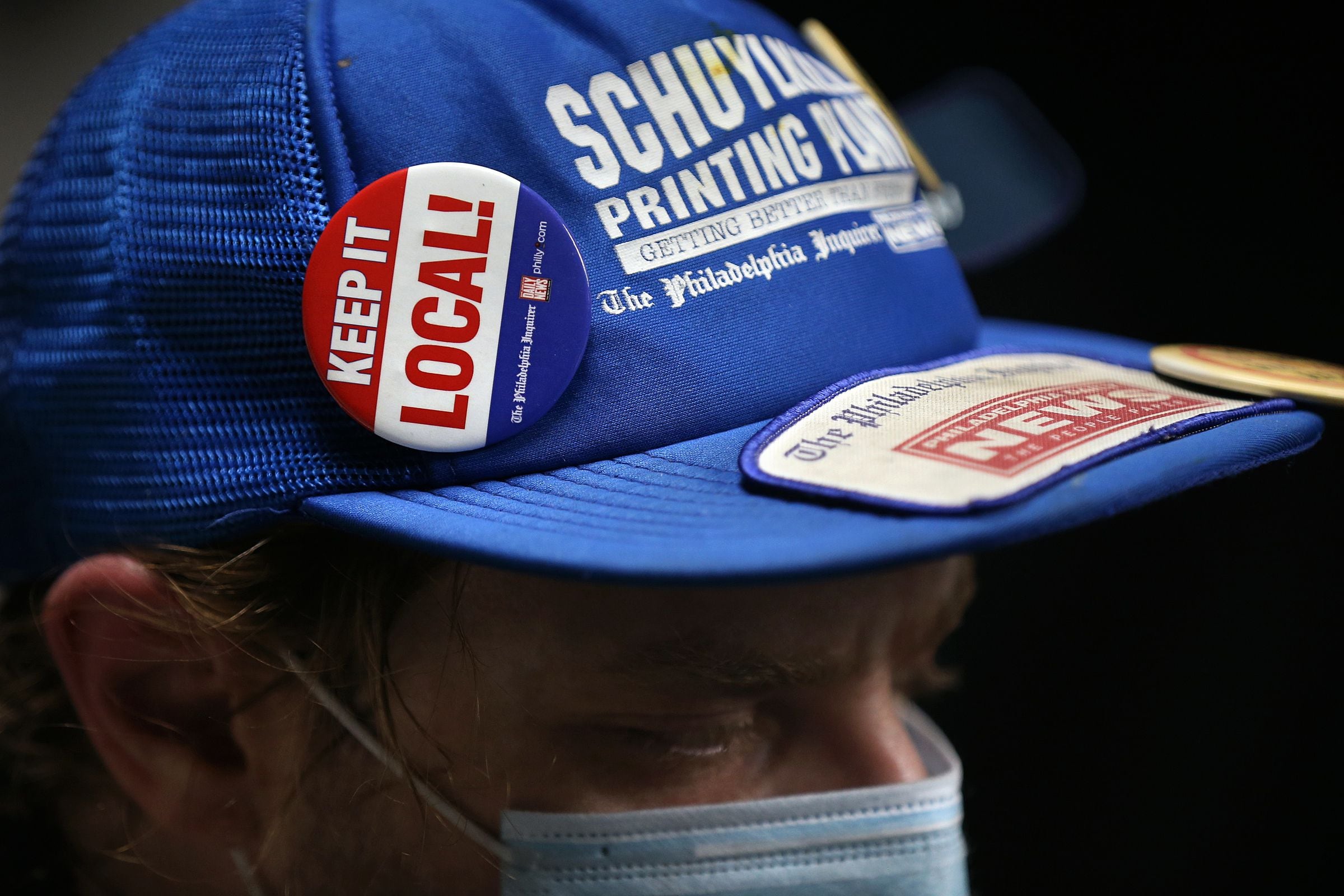
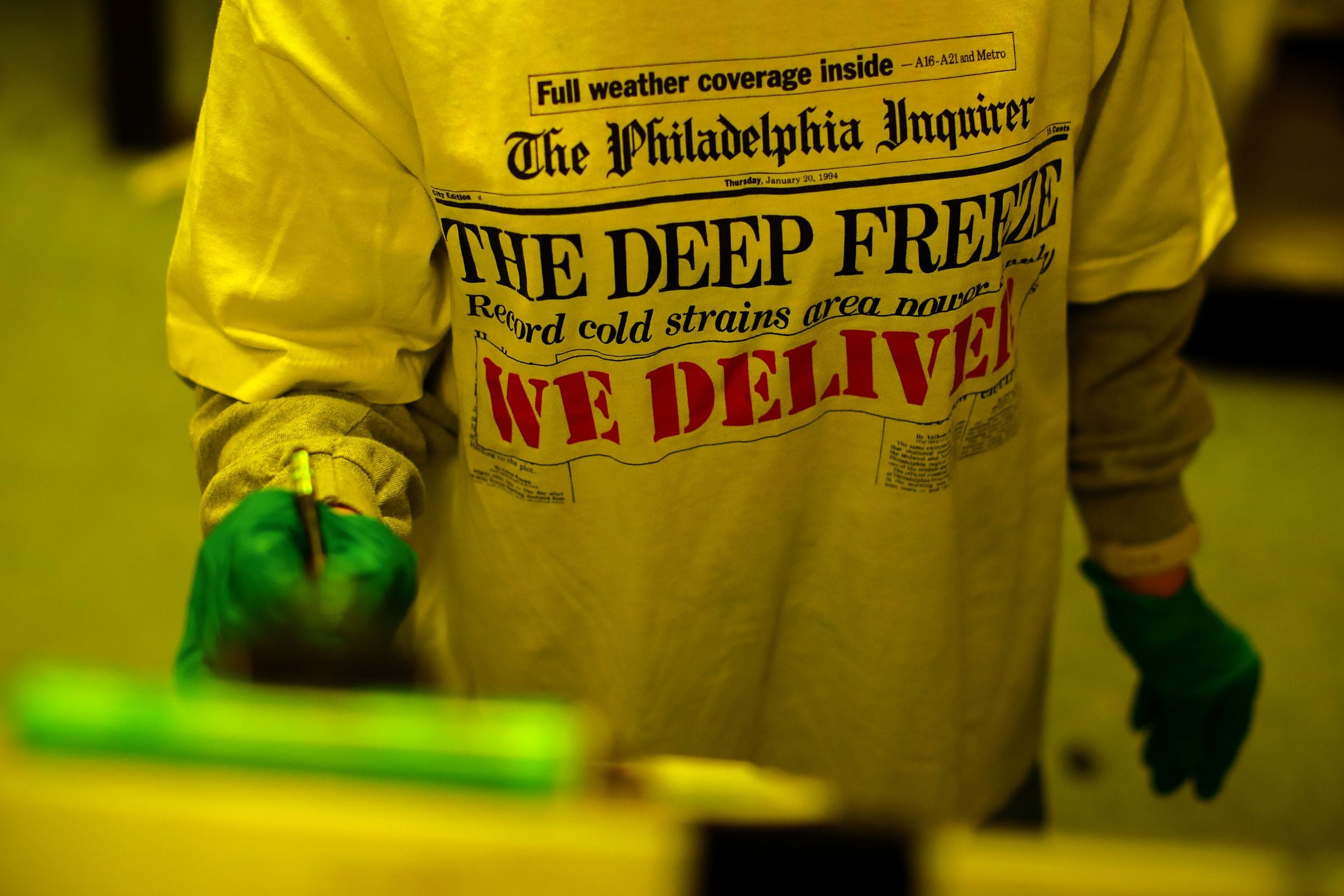
Pressman Brett Nick, who started working at The Inquirer in 2003, wears a hat with an old Inquirer campaign slogan: "Keep It Local!" TIM TAI / Staff PhotographerPlatemaker Debbie Dougherty wears a T-shirt stamped with a front-page image from Jan. 20, 1994, the year she was hired. TIM TAI / Staff Photographer
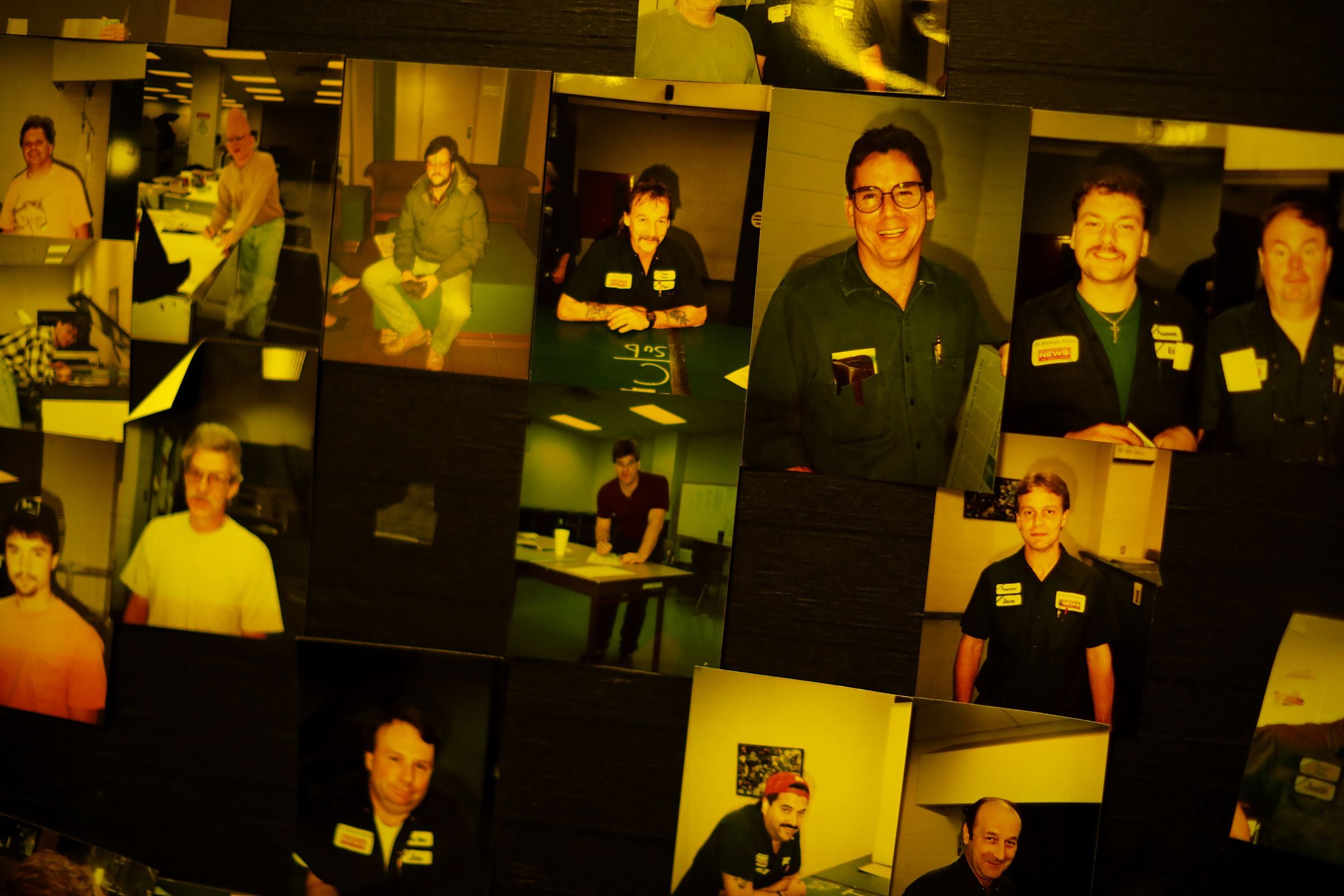
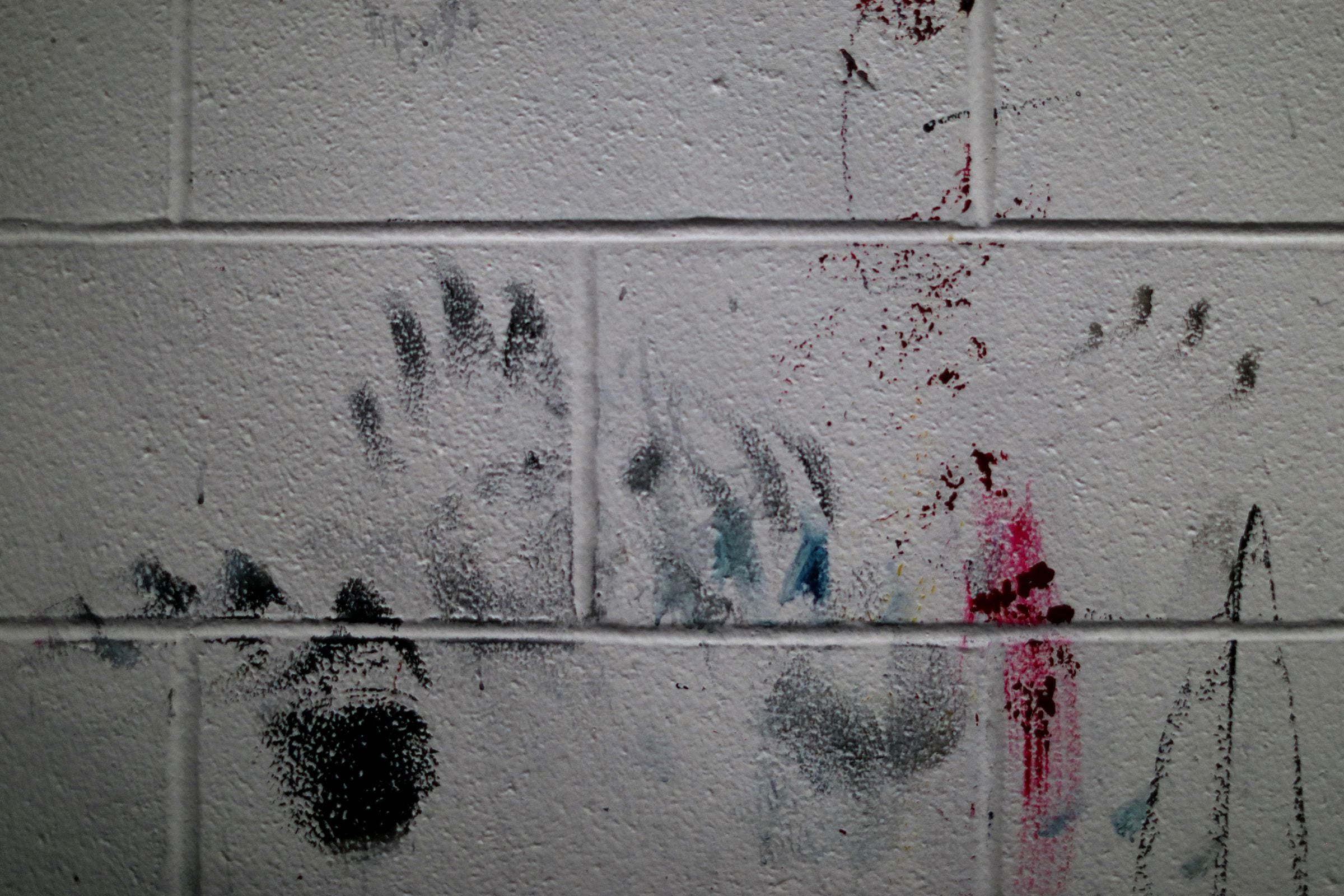
Engraved in memory: A board inside the plate room features photos of former employees. TIM TAI / Staff PhotographerInk-stained handprints decorate a pressroom wall. TIM TAI / Staff Photographer
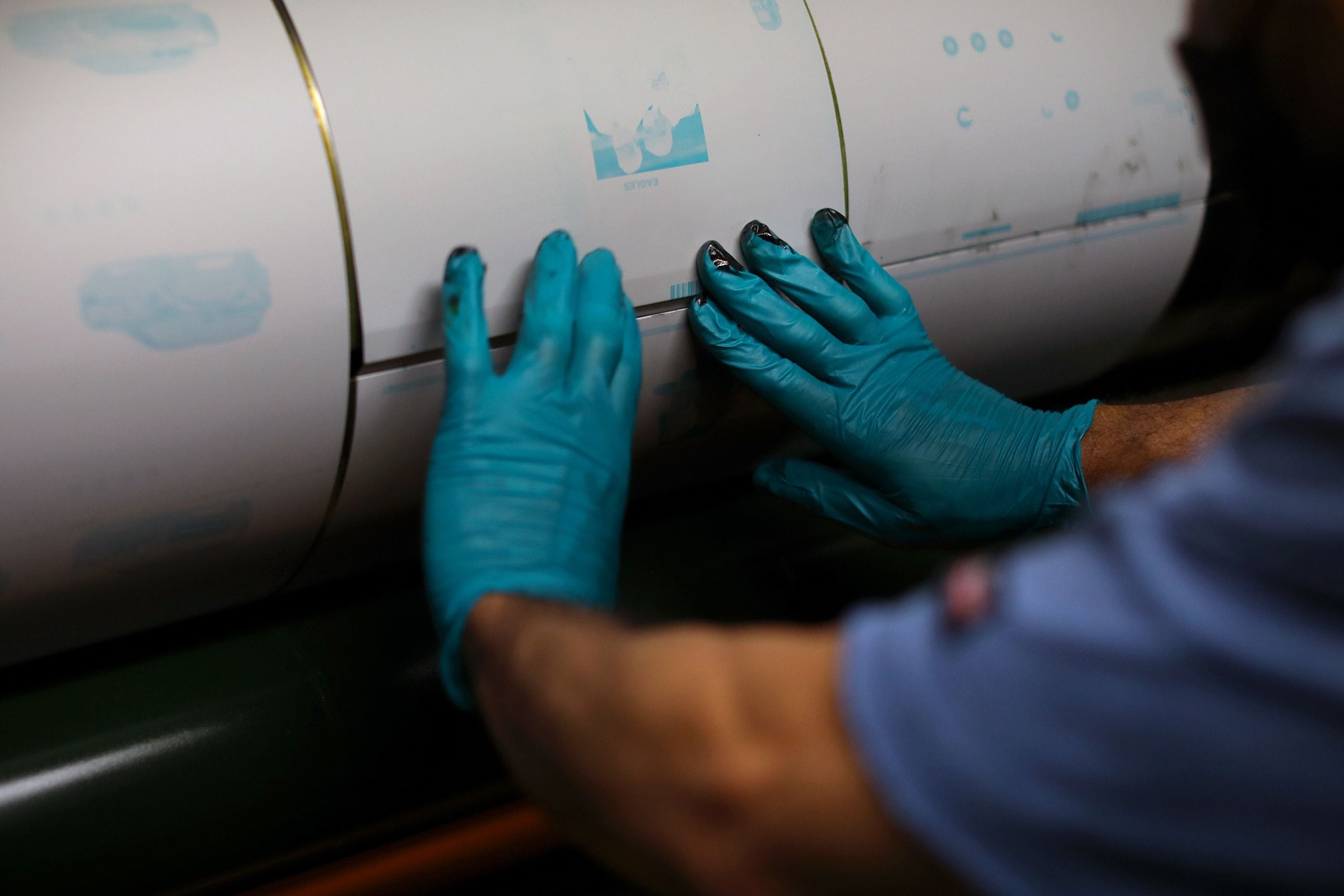
“It’s like putting a puzzle together,” said Tom Chambers, who has worked for the company for 31 years. He and the other platemakers imprint those completed-puzzle images on wafer-thin aluminum plates that bear the images of the pages of The Inquirer and Daily News.
On any given day those images would be stamped on paper rolls whose linear footage would reach halfway around the world — all the way on Sundays.
Pressman Hayden Darrabie, hired in 1998, presses plates into place before the night's run. TIM TAI / Staff Photographer
Roll ‘em
SPP is more or less a prodigious shell built around $160 million worth of presses, said Pat McElwee, the production supervisor. When the plant started operating in the summer of 1992, “It was fantastic,” he said.
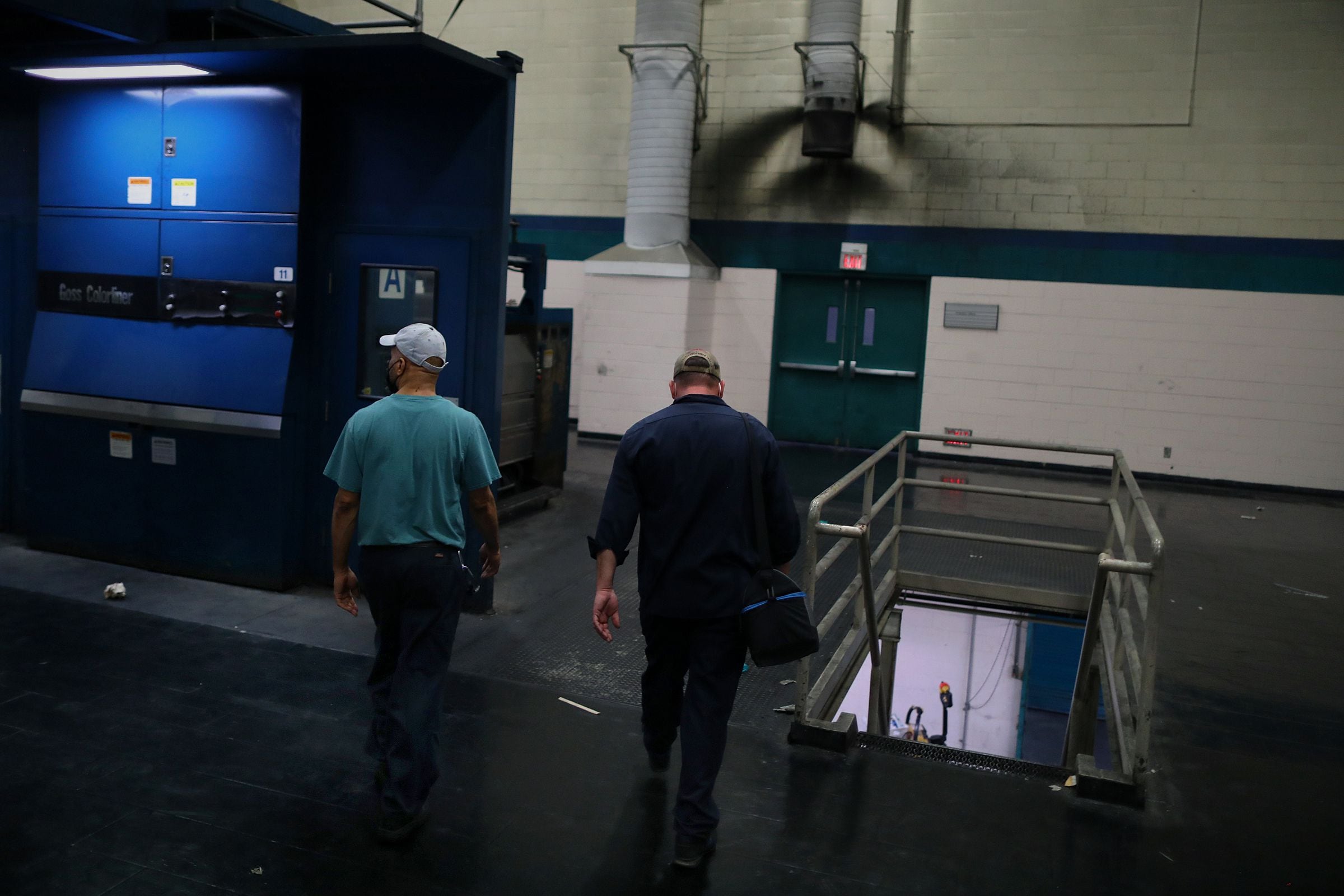
The Goss Colorlink “offset” presses were radically different from the 45-year-old “letterpress” predecessors in which plates were pressed directly onto the paper. With offset, the plates roll against rubber “blankets” that press against the paper. For the first time The Inquirer and Daily News could publish photographs and ads in color.
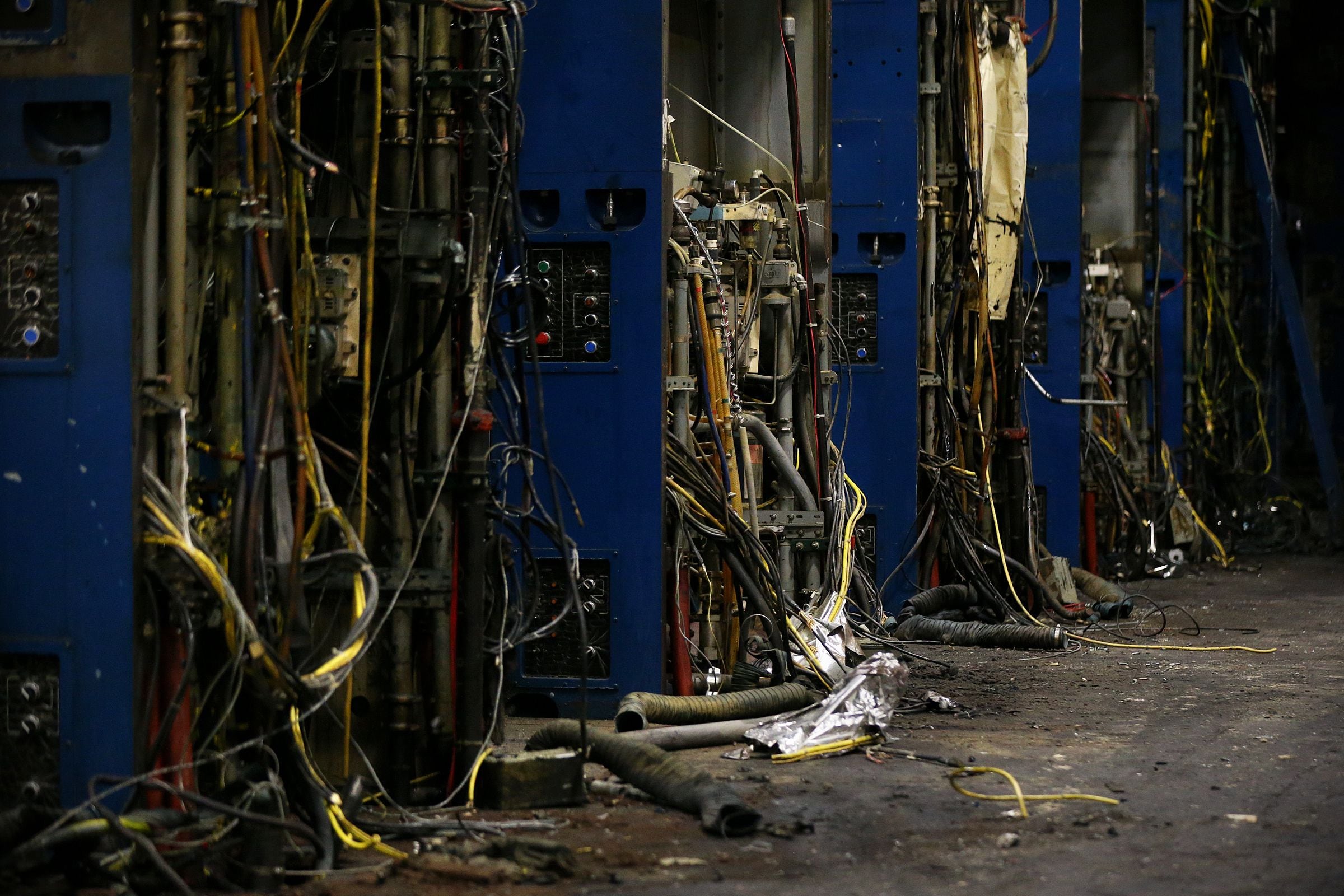
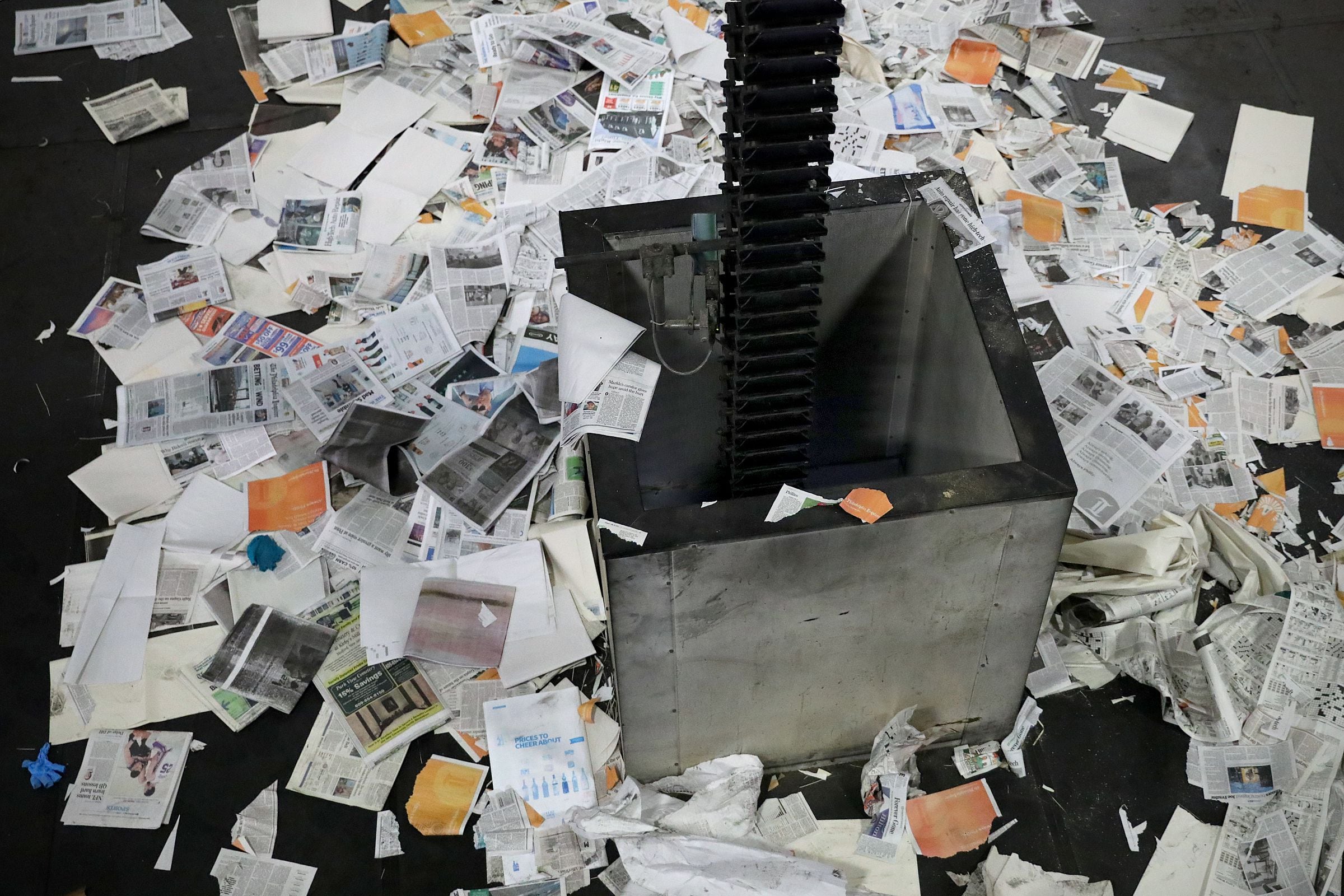
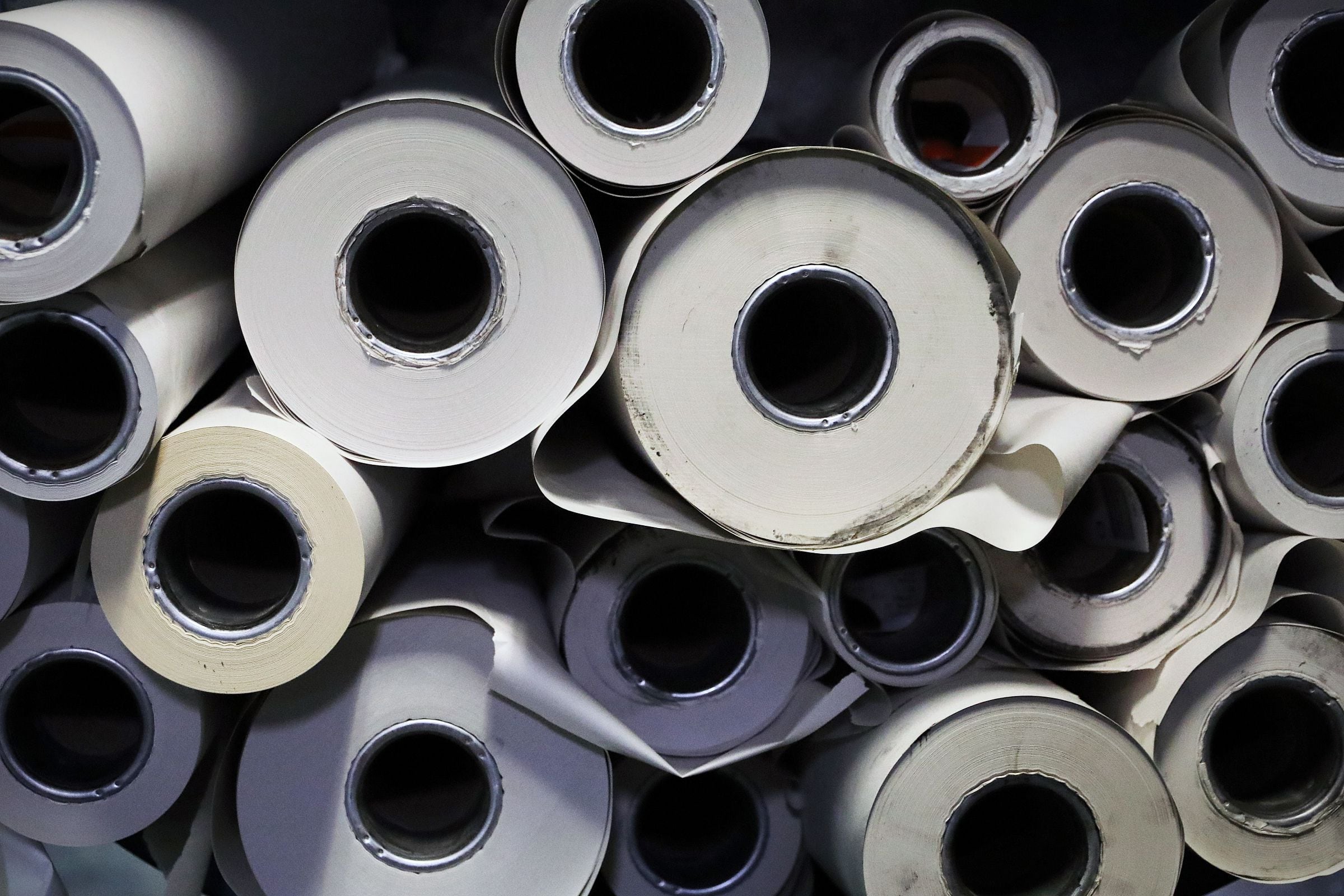
Wiring dangles from one of the nine Goss Colorliner presses. TIM TAI / Staff PhotographerLoose papers are scattered across the base of the gripper chute from which papers are conveyed from the pressroom to the mailroom for packaging. TIM TAI / Staff PhotographerPartial rolls of leftover paper from press runs, known as "butt rolls," are stored in the reel room. TIM TAI / Staff Photographer
“It was all new,” said Tom Addison, the company pressroom foreman. With novelty came mishaps. More than once the papers published “To our readers” apology notes for delivery issues.
Like so many employees on the production side, Addison was a lifer, having started in 1979.
And to Aaron Krakovitz, Addison was a newcomer: Krakovitz already had been there five years, starting as a high school senior, recruited to fill in on a short-staffed weekend. He was child labor whose own father was a pressman.
The pressmen developed a familial and literal closeness, said Jim Fish, the union foreman: In the heydays, he said, “You worked with six to seven guys on the press.”
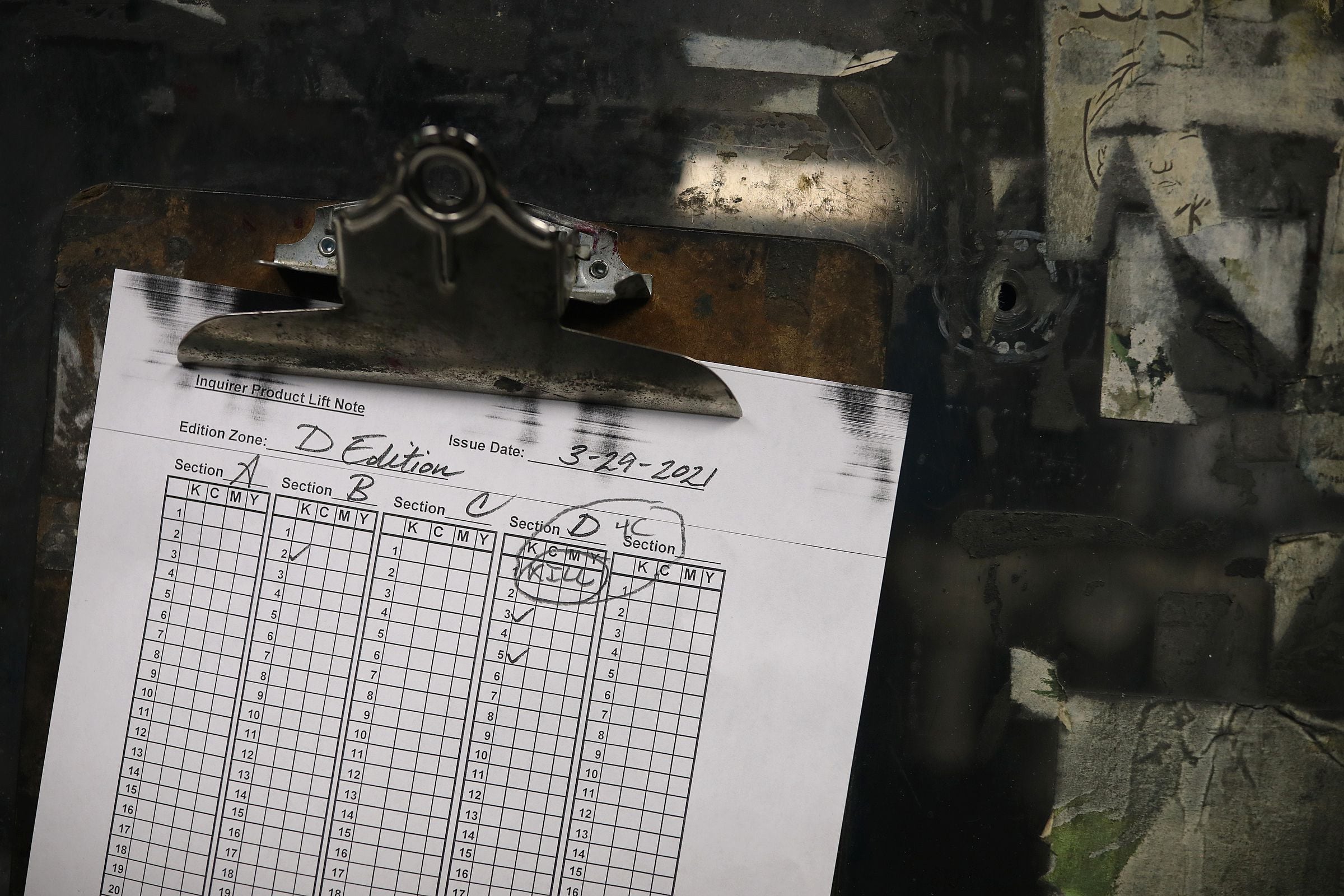
A clipboard in the quiet room informs pressmen about the plates that need to be switched out for a "lift" for a later edition. TIM TAI / Staff PhotographerPressman Keith Jones (left), who was hired in 2005, and Jim Fish prepare to embrace as they are about to depart after the last scheduled press run. TIM TAI / Staff Photographer
Fold ‘em, stuff ‘em
Among all his family members who ever worked in the mail room, a 187,000-square-foot canyon where the printed sections and advertising inserts were added and prepared for the trucks, Devin Leidy counted 150 years’ experience.
“When I was 12 years old, my father said, ‘You’re going to be delivering newspapers. You’re going to learn how to hand-stuff,’ ” said Leidy.
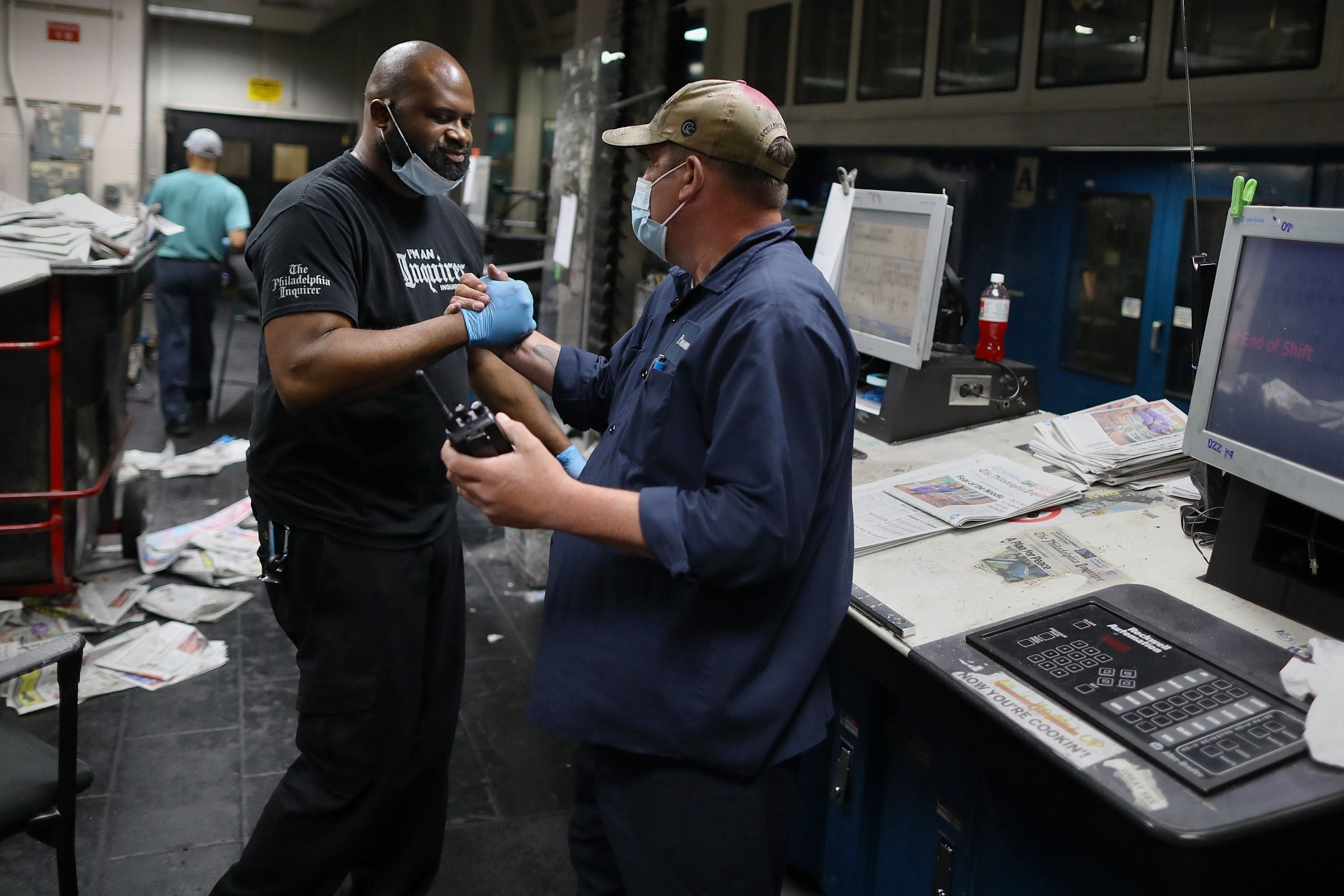
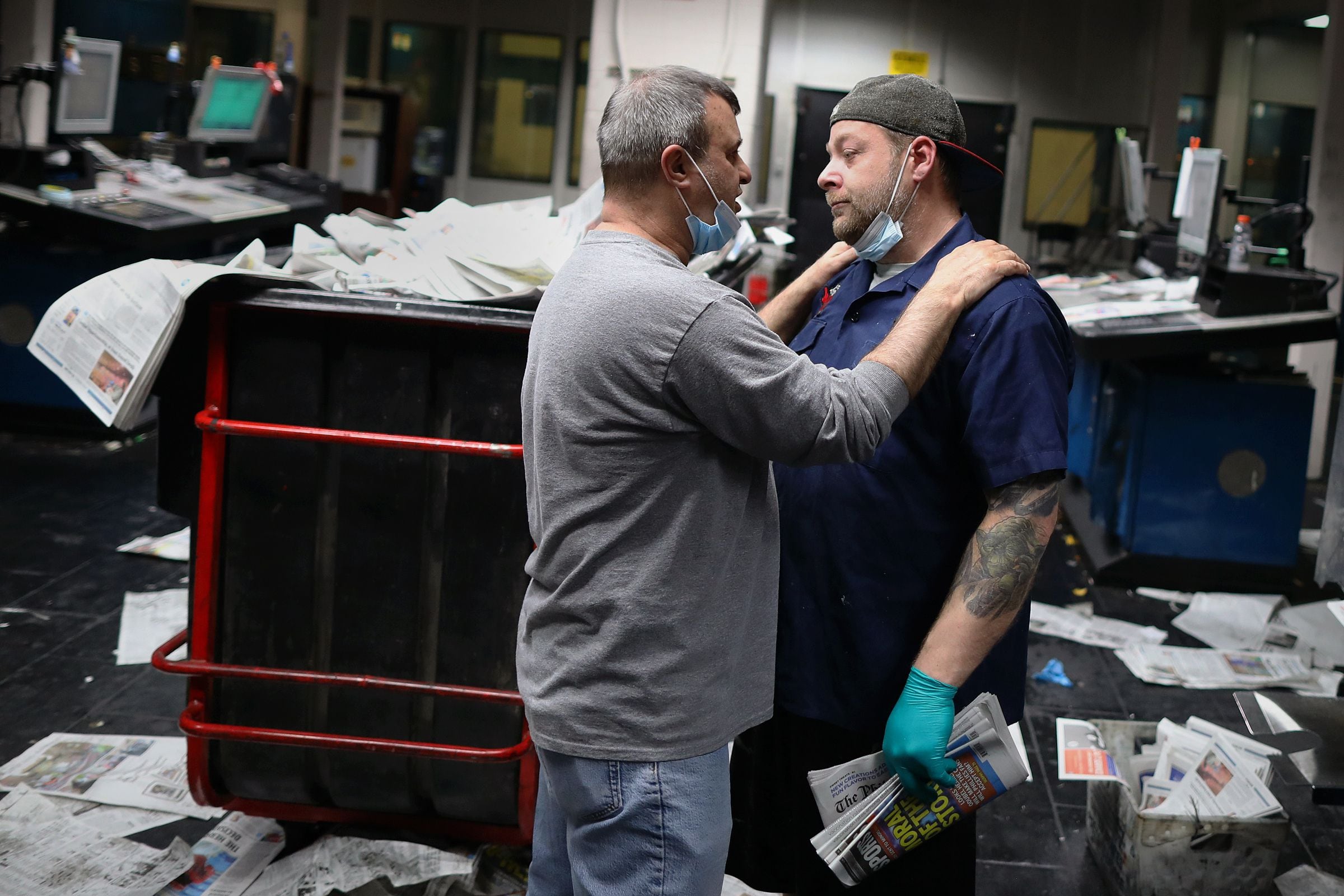
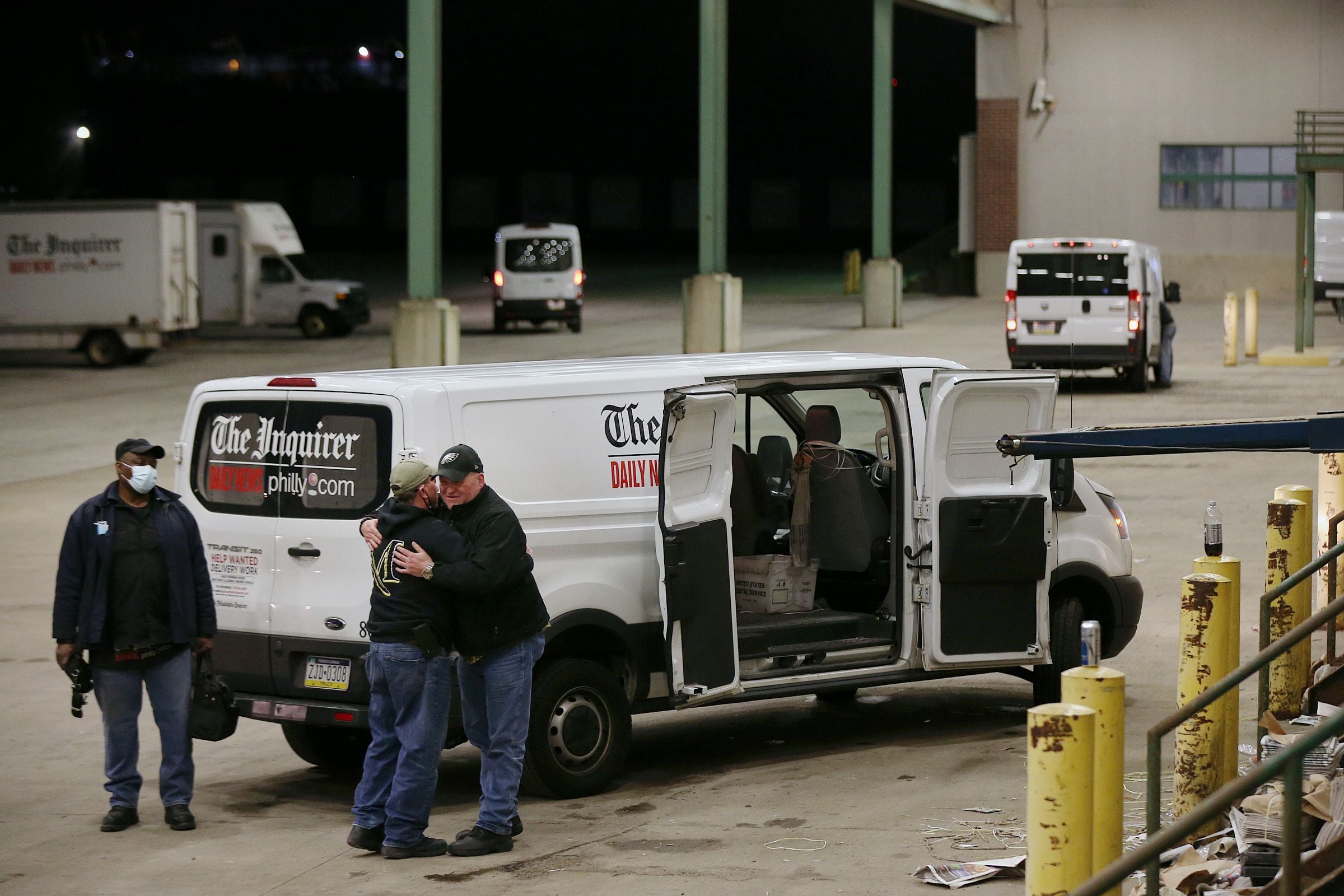
Pressroom supervisor David Creek (left), hired in 1984, chats with colleague Bobby Nick, who joined The Inquirer in 2002, as Nick gets ready to sign off. TIM TAI / Staff PhotographerDriver Darryl Jackson (left) looks toward dispatcher George Young (center) hugging driver Dominic Delvecchio, all of whom started in 2000. TIM TAI / Staff PhotographerPressman Hayden Darrabie (left) and Jim Fish walk out of the press room after the last scheduled run. TIM TAI / Staff Photographer
Leidy, who would grow up to be a mailroom supervisor, said the assembly and presentation of the papers were critical to sales: “You’re trying to put it out correctly … neatly.”
Evie Lang, a mailer who (stop if you heard this before) was the daughter and granddaughter of mailers, derived satisfaction from her labor as she left the house on Sunday mornings. “The newspaper would fall out the door and you’d go, ‘Oh, I helped to make that.’ ”
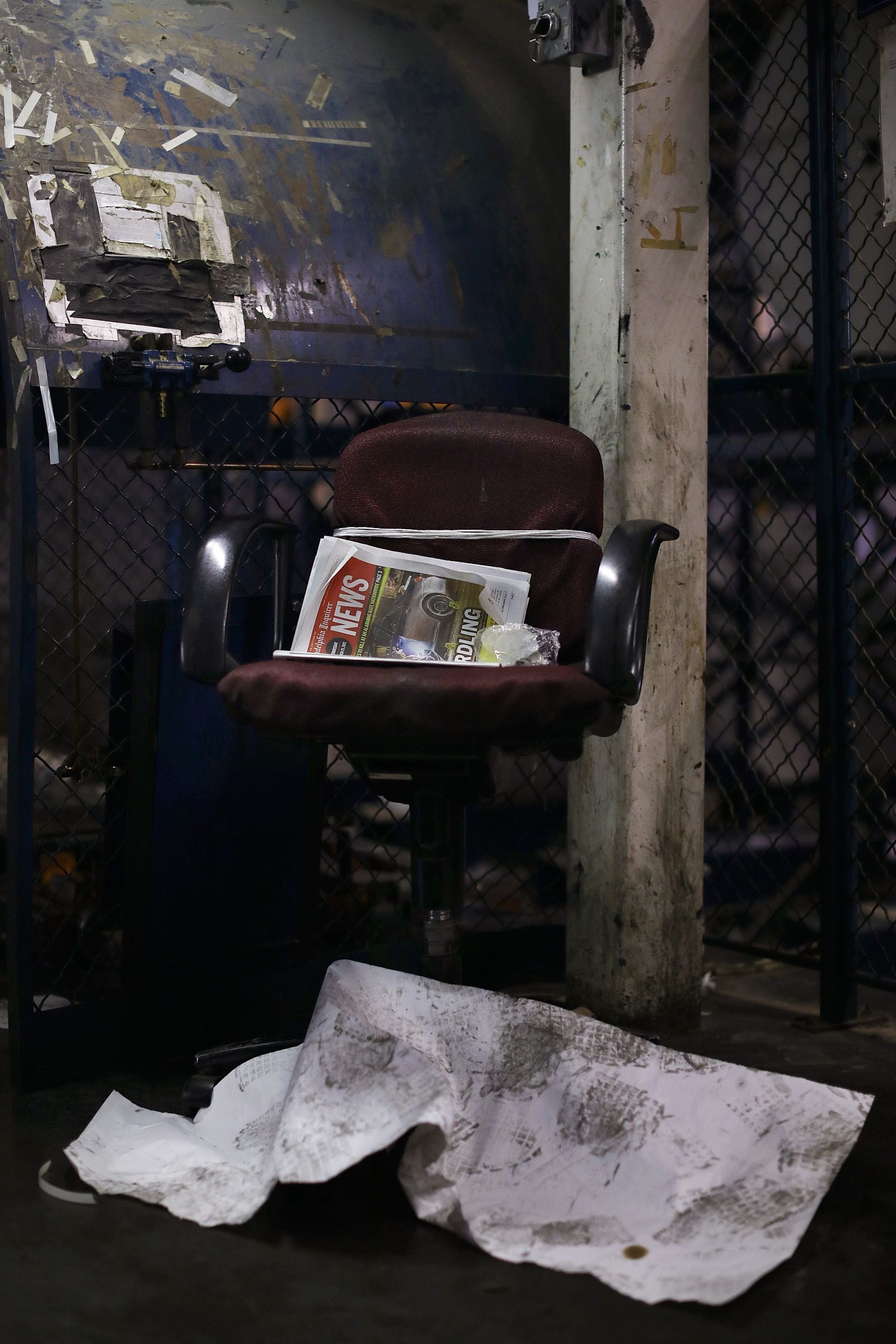
A discarded Daily News rests in a chair in the reel room, where paper had been loaded onto the presses that had been operating since 1992. TIM TAI / Staff Photographer
“My whole life. I wanted to yell, ‘Stop the presses.’ But now, when I think about it, I don’t want to stop them. I wish they could keep going.”
Pat McElwee
The last rides
Budd Emmett got hired in an antiquarian fashion: through a newspaper ad. That was in 1971.
Emmett became a transportation supervisor in 1988, overseeing a truck fleet that at one time exceeded 325.
“It’s all family,” Emmett said. It wasn’t an echo; it just sounded like one. The mood at the building in the closing days was similar to that of a pre-funeral viewing, only in this case the subject of conversation wasn’t yet deceased and had the benefit of hearing the praise.
Emmett said he plans to retire, as does pressman Krakovitz and others.
The furloughed SPP workers generally were pleased with what they viewed as generous severance packages. Lehman said those who wanted to keep working have found jobs.
Lehman and McElwee are among those who plan to call it a career. McElwee is anxious to spend more time with his grandchildren, but the end is profoundly bittersweet.
“My whole life. I wanted to yell, ‘Stop the presses.’ ” he said. “But now, when I think about it, I don’t want to stop them. I wish they could keep going.”
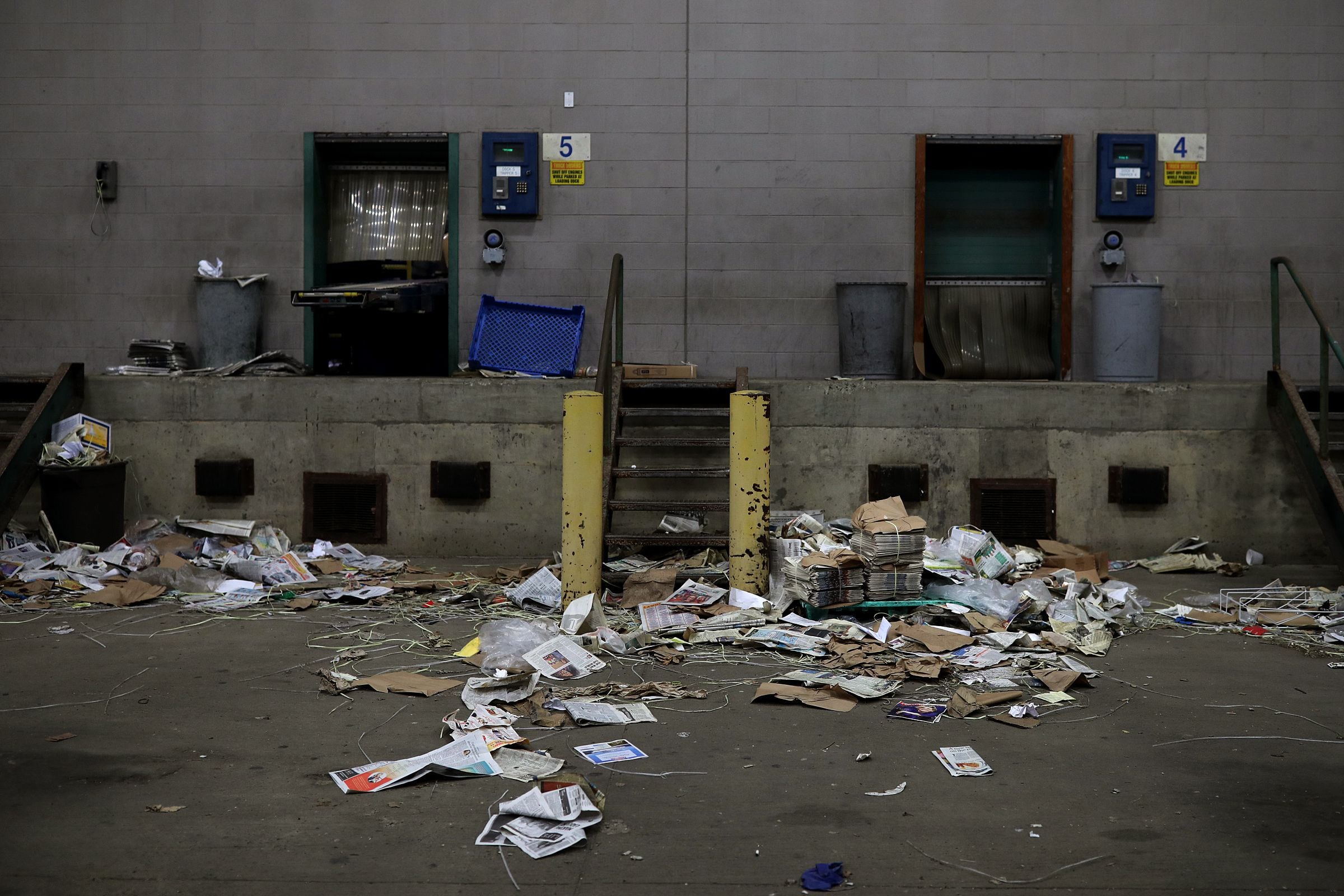
In the early morning hours of March 29, newspapers litter the docks that no longer will be used for loading The Inquirer and Daily News onto delivery trucks while most of us slept. TIM TAI / Staff Photographer
Staff Contributors
Reporting: Anthony R. Wood
Visuals: Tim Tai, Frank Wiese, Danese Kenon, Astrid Rodrigues, Kristen Balderas, Lauren Schneiderman, and Raishad Hardnett
Design & Development: Dain Saint and Jessica Parks
Editing: Emily Babay and Diane Mastrull
Digital: Kerith Gabriel, Patricia Madej, Lauren Aguirre, and Caryn Shaffer
Copy editing & Print: Brian Leighton and Sterling Chen