Category: Philadelphia News

  • ‘ICE out’ protesters take to the streets in Philly and around the country

    ‘ICE out’ protesters take to the streets in Philly and around the country

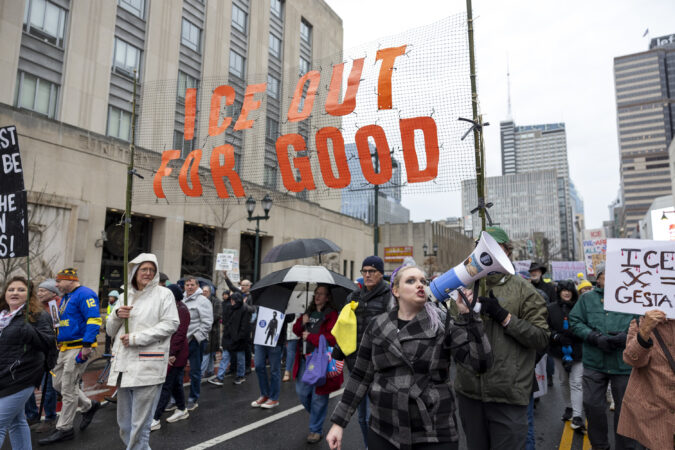
    Demonstrators swept onto the streets of Philadelphia and cities across the country on Saturday to vent anger and sadness over the ICE killing of an unarmed woman motorist in Minneapolis.

    Protests over the fatal Wednesday shooting of 37-year-old Renee Good were taking place or being planned in hundreds of places, from small towns to major cities in Pennsylvania, New Jersey, Texas, Florida, California, New York, and elsewhere.

    Organizers intend to hold rallies on Sunday in Trenton, Abington, Cherry Hill, Ardmore, Ambler, and other communities, the breadth of the protests signaling the scope of resistance to President Donald Trump’s immigration agenda. Leading civil rights groups have called for people to step up and support the ICE Out for Good Weekend of Action.

    “What happened in Minneapolis is unforgivable,” said Vicki Miller, a leader of Indivisible Philadelphia, who gathered with others at City Hall on Saturday morning.

    In Philadelphia the day began in a cold, steady rain, with about a hundred people at City Hall chanting, “No fear, no hate, no ICE in our state.”

    Trump administration officials insist the agent who shot Good three times had fired out of self-defense, saying he was about to be run over, and Secretary of Homeland Security Kristi Noem described the incident as “an act of domestic terrorism.”
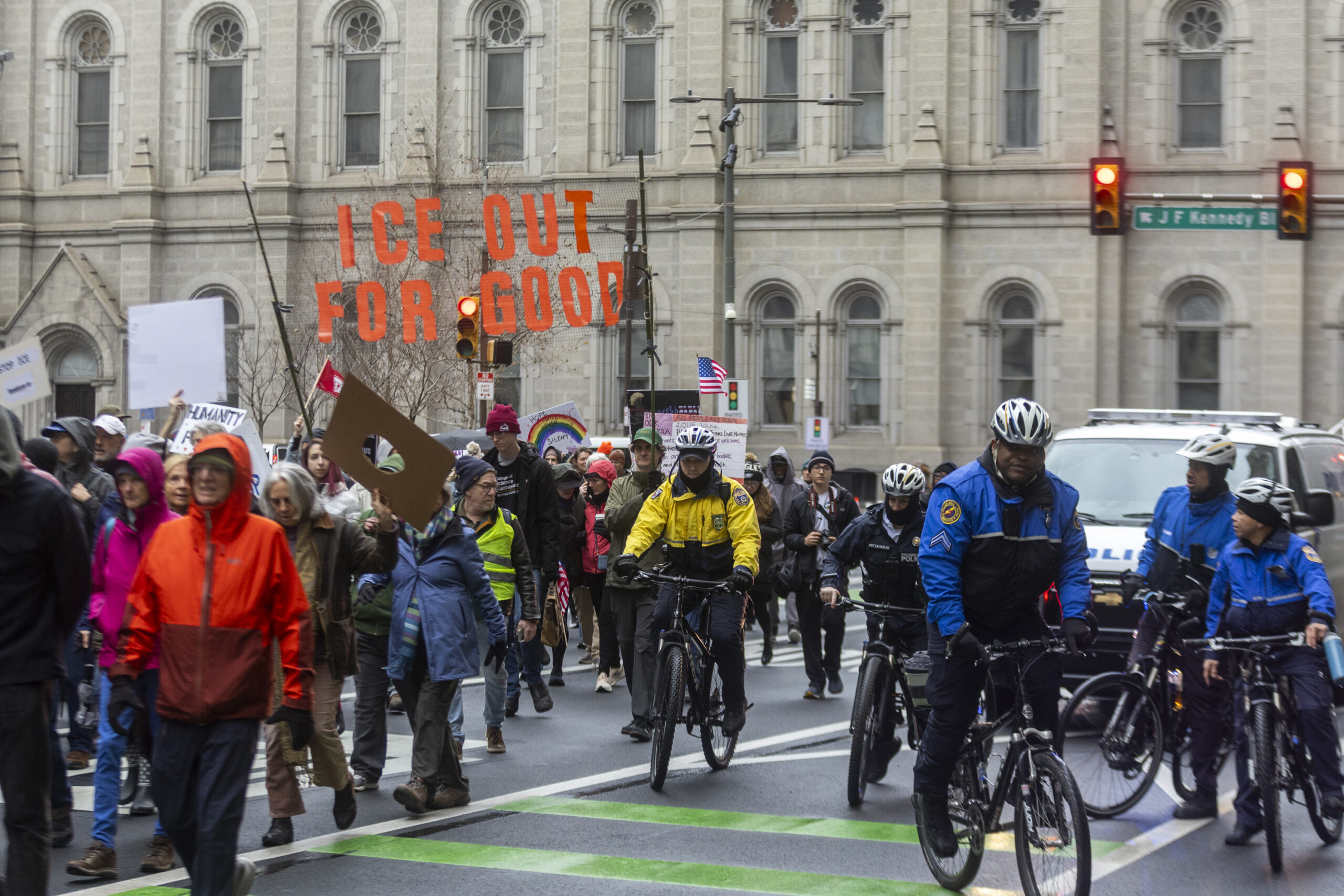
    Many gather to show their support for Renee Good and to protest against ICE in Philadelphia, Pa., on Saturday, Jan. 10, 2026.

    Video taken by bystanders appears to show that the agent was not in the path of Good’s SUV when he fired, and activists have condemned the shooting as evidence of a violent, undisciplined federal agency.

    Trump has undertaken an unprecedented campaign to arrest and deport millions of immigrants, an effort that’s included sending ICE and federal troops into blue American cities.

    An estimated 2,000 federal agents have surged into Minnesota, following similar deployments in Los Angeles, Chicago, Washington, Memphis, and elsewhere. Somehow Philadelphia has gone untouched, despite its history of feuding with Trump.

    On Friday night, a 1,000-person protest outside of a Minneapolis hotel turned violent as demonstrators threw ice, snow, and rocks at officers, according to Minneapolis police.

    The demonstrations there continue as the Department of Homeland Security pushes forward in the Twin Cities with what it calls its biggest-ever immigration enforcement operation.

    At Philadelphia City Hall, Miller called on residents to protect one another from the Trump administration.

    “An authoritarian wants us to feel alone. We are showing that we are not alone,” she said. “We are happy to be here for our neighbors; we are here to protect them.”

    By 10:30 a.m., the crowd began moving down Market Street, meeting up with another demonstration near federal properties around Seventh and Arch Streets, and growing in size to about 500 people.
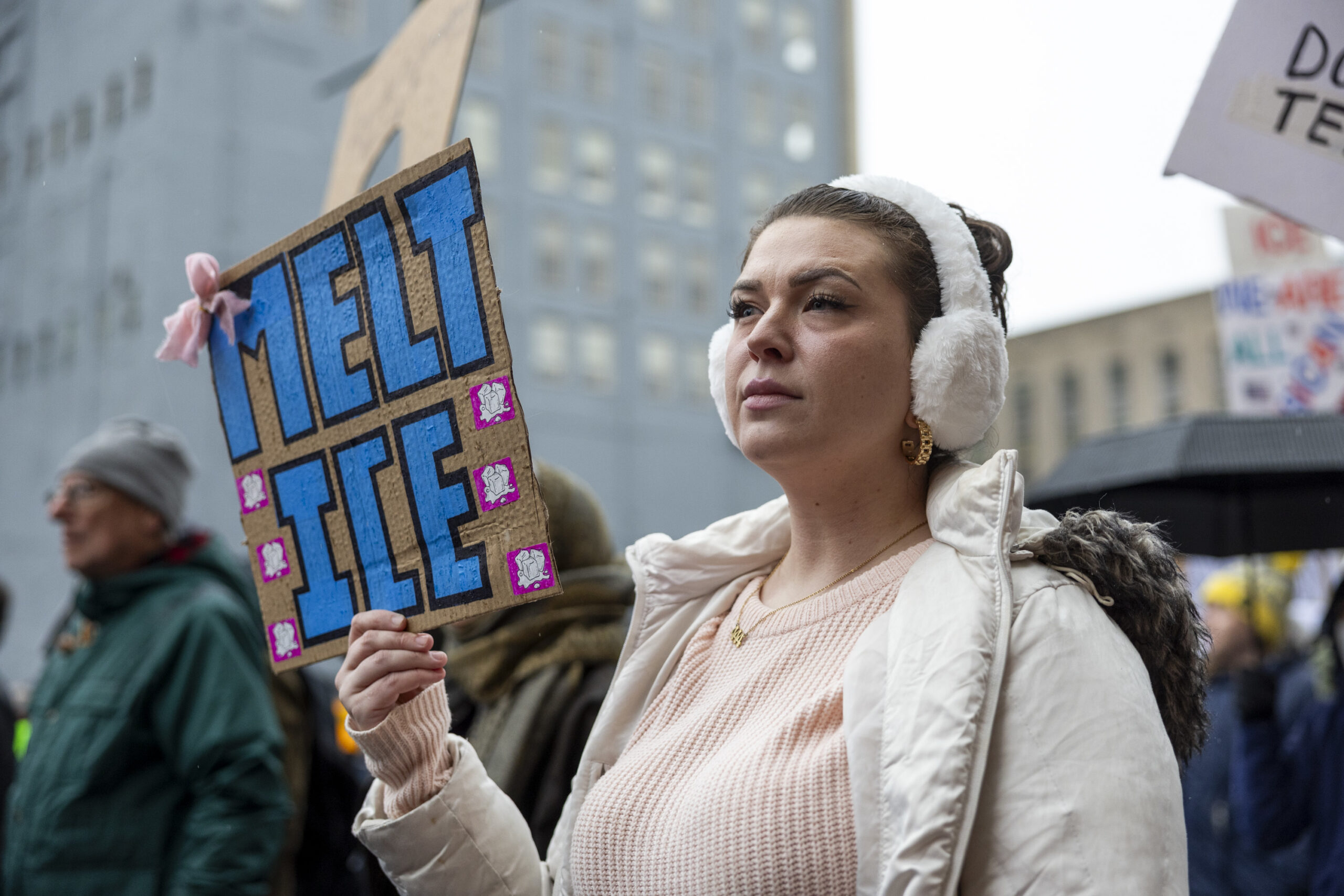
    Tiffanie Knott, of Rittenhouse, holding a sign reading “Melt ICE” as she marches with many others to protest against ICE in Philadelphia, Pa., on Saturday, Jan. 10, 2026.

    School psychologist Michele Messer, 51, came from Camden with her students in mind.

    “Our immigrant students are impacted and it will have a long-lasting effect in their education,” said the member of grassroots group Cooper River Indivisible. “We need to show up so they know we love them; we hear them, and we will be here for you until this is over.”

    Jim Greway, 77, said he was protesting for those who couldn’t be present, whose immigration status or race made them fearful of speaking out.

    “People who look different than me are being told they don’t belong here and will never succeed in this country,” said Greway, who is white. “I’m here to say that’s not true.”

    A couple in their late 70s marched down Market Street holding hands, chanting with the crowd for Immigration and Customs Enforcement to be shut down.

    “We have good friends that are afraid to leave their house, so to us this is personal,” explained Lori Chewkanes.

    Her husband, Michael Chewkanes, said that ICE actions in Minneapolis made the couple feel like their patriotism was being stolen.

    “As a veteran, it makes me sick to my stomach,” he said. “[ICE] should be protecting the people, not hurting them. This should have never happened.”

    Madeline Forrest, 20, of Camden, handed out copies of a poem she wrote that condemned ICE. As she did so, MAGA supporter Patrick Labrie, also 20, approached to talk about why he supported the agency, including the shooting by the officer in Minnesota.

    “From the clips, it seemed like he was in a lot of danger, so it seems like he did everything he could to protect himself,” Labrie said.

    Labrie continued to defend the officer’s actions, later attempting to interrupt the chants of the crowd.

    Forrest thought Labrie was deliberating trying to attract attention to draw more watchers on social media. She tried to engage him again, but was unable do so as police moved in to safeguard him from the crowd.
  • As Minneapolis shooting stirs fears of state violence, several Black Panther Party members made their presence known in Philly

    As Minneapolis shooting stirs fears of state violence, several Black Panther Party members made their presence known in Philly

    As the Trump administration increases the presence of federal agents in U.S. cities, a local group identifying as part of the Black Panther Party for Self-Defense has become more active in Philadelphia.

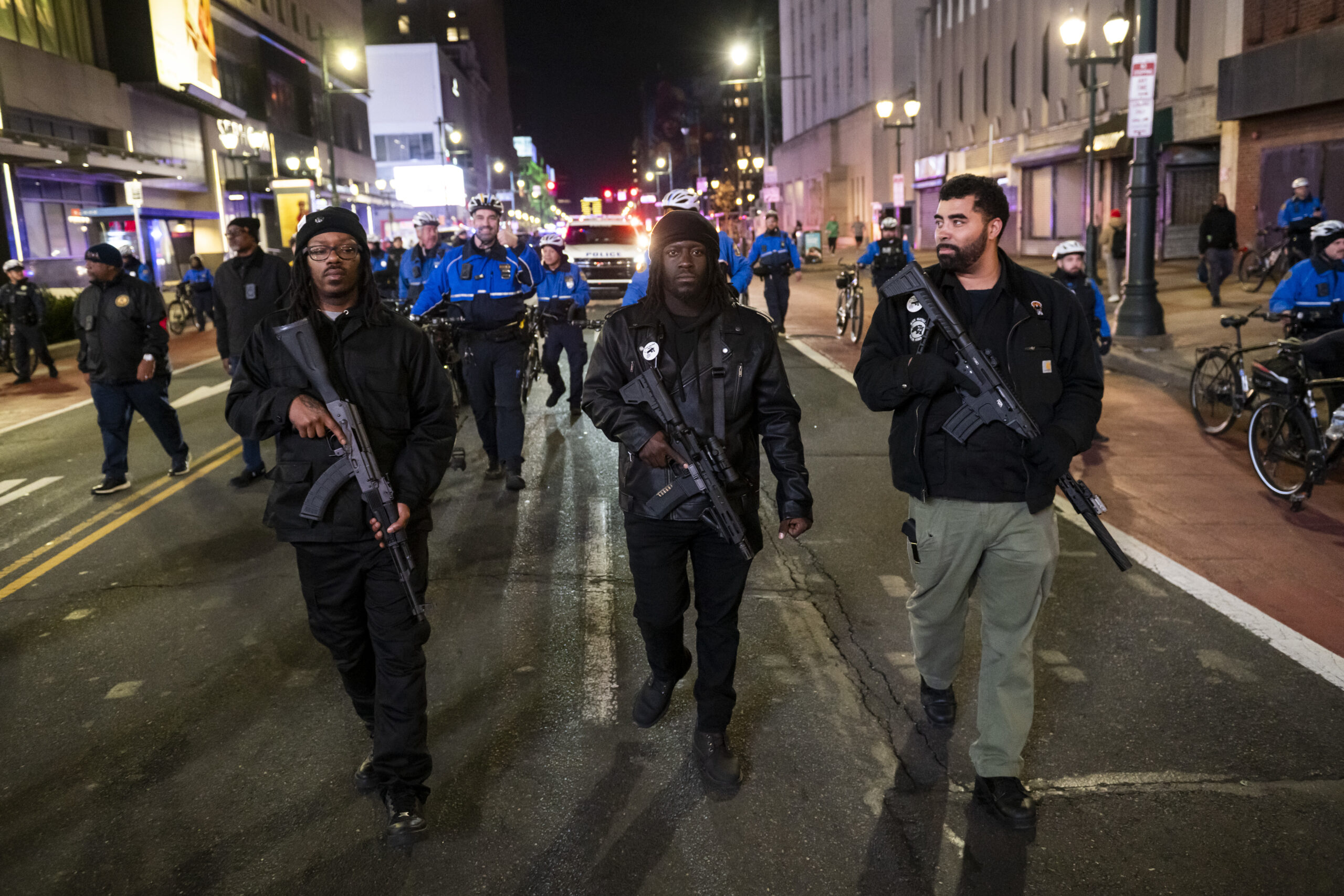
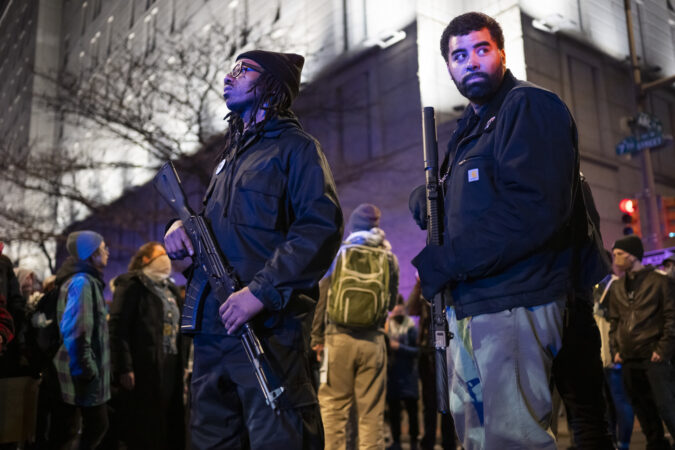
    The group says it is a resurgence of the militant Black power group dating back to the 1960s, and has been trained by some of the original party’s surviving members. Several attended an anti-ICE protest Thursday at Philadelphia City Hall, carrying military-style weapons.

    They say they’re legally permitted to carry firearms and are showing up as a response to violence from the Trump administration.

    The group has been holding regular weekly free food programs in North Philadelphia for several years, according to 39-year-old Paul Birdsong of West Philadelphia, who identifies himself as the Black Panther Party’s national chairman.

    Birdsong and others attended the Philly protest one day after Immigration and Customs Enforcement officer Jonathan Ross shot and killed 37-year-old Renee Nicole Good in Minneapolis.

    “That wouldn’t have happened if we were there,” Birdsong said. “Not a single person would have gotten touched.”
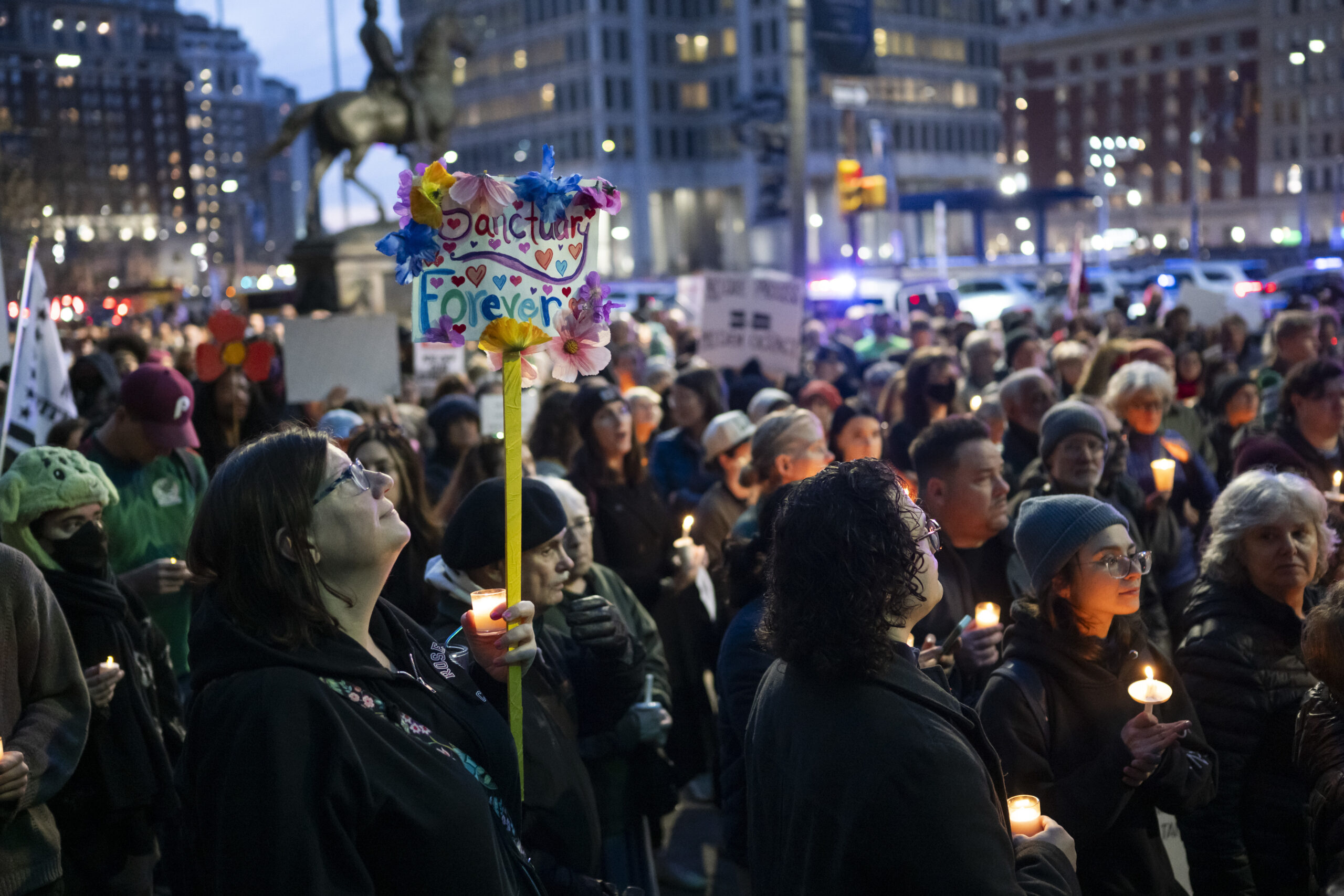
    Jane Wiedman of Mount Airy holds up a sign among the crowd of protesters at City Hall on Thursday, Jan. 8, 2026, as they gather for a vigil to rally against the killing of Renee Nicole Good, who was shot by an ICE agent in Minneapolis.
    Millions of people have watched videos of the shooting online, sparking national protests. The Trump administration quickly defended the shooter, with JD Vance asserting Ross has “absolute immunity” and “was doing his job.” Some have rejected Vance’s suggestion that Ross couldn’t be tried by the state, and Minnesota leaders Friday renewed their calls for state involvement in an investigation of the shooting.

    Birdsong said the group wants to see ICE abolished and the Trump administration held accountable.

    “You got people that are part of a cabal, that are self serving … and they prey on the common folks of the United States,” Birdsong said.

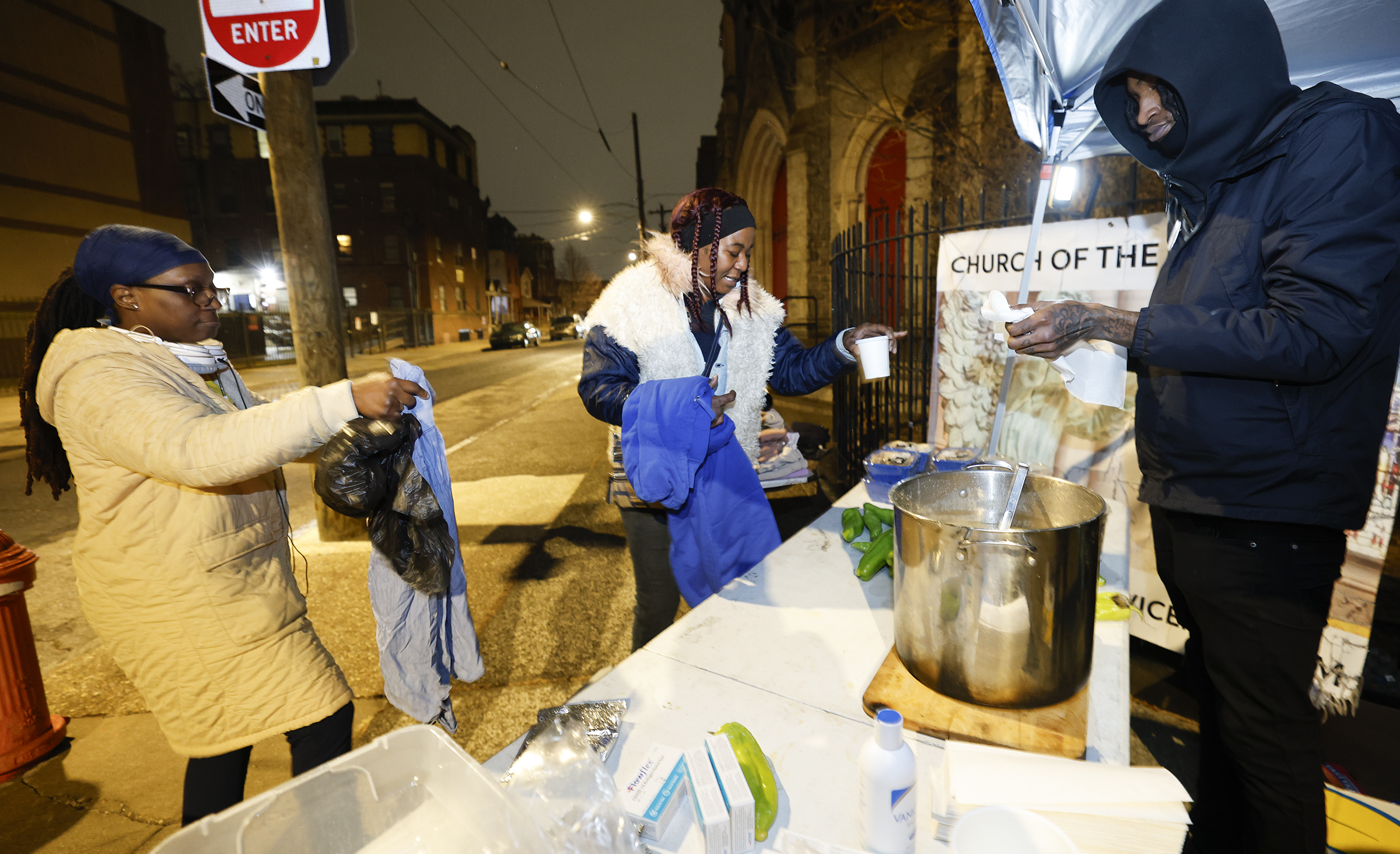
    Philadelphia Black Panther Party for Self-Defense member Skiippy (right) hands soup to Yolanda Gray (center) and Roxanne Hart outside the Church of the Advocate in North Philadelphia on Friday, Jan. 9, 2026. The Philadelphia Black Panther Party for Self-Defense helps supply food and clothes for residents.

    A free food program

    Birdsong said he was recruited by members of the Black Panther Party in the wake of the 2020 police killing of George Floyd, and he listed several surviving elders of the group as mentors. The Philly chapter has “less than 100″ members, he said, though he declined to provide more detail.

    On Friday evening, Birdsong and several other Black Panther Party members set up a pop-up food pantry outside Church of the Advocate at the corner of 18th and Diamond Streets in North Philadelphia.

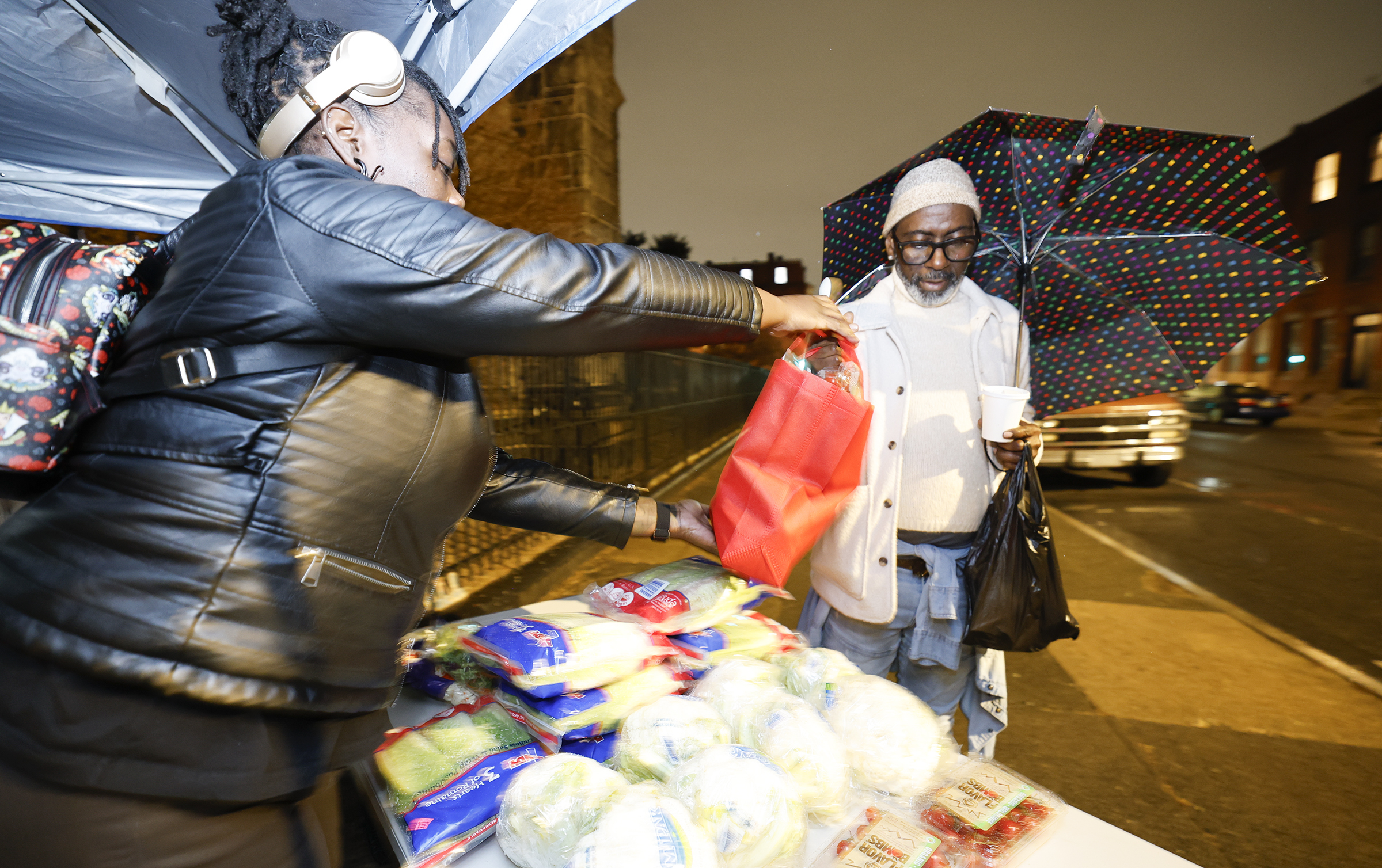
    The members laid out bananas, grapes, salad greens, romaine lettuce, cherry tomatoes, apples, pears, celery, peppers, and mushrooms on folding tables.

    They added bread, Tastykakes — immediately popular with passing children — canned food, and hygiene items like shampoo, COVID-19 test kits, and adult undergarments. On another table were children’s clothes and a large pot of chicken soup, all near a banner with the Black Panthers logo.

    Philadelphia Black Panther Party for Self-Defense member Sharon Fischer (left) hands a bag of food to Daren Robison in North Philadelphia on Friday, Jan. 9, 2026. The Philadelphia Black Panther Party for Self-Defense supplies food and clothes for residents.

    Birdsong said the money to buy the food comes from members’ own paychecks, as well as donations from people in the community.

    “It really helps out,” said Dawn Henkins, 60, who lives nearby. She said it’s especially helpful for older people who are living on a fixed income.

    “The brothers can help people — they are here for the people,” Henkins said.

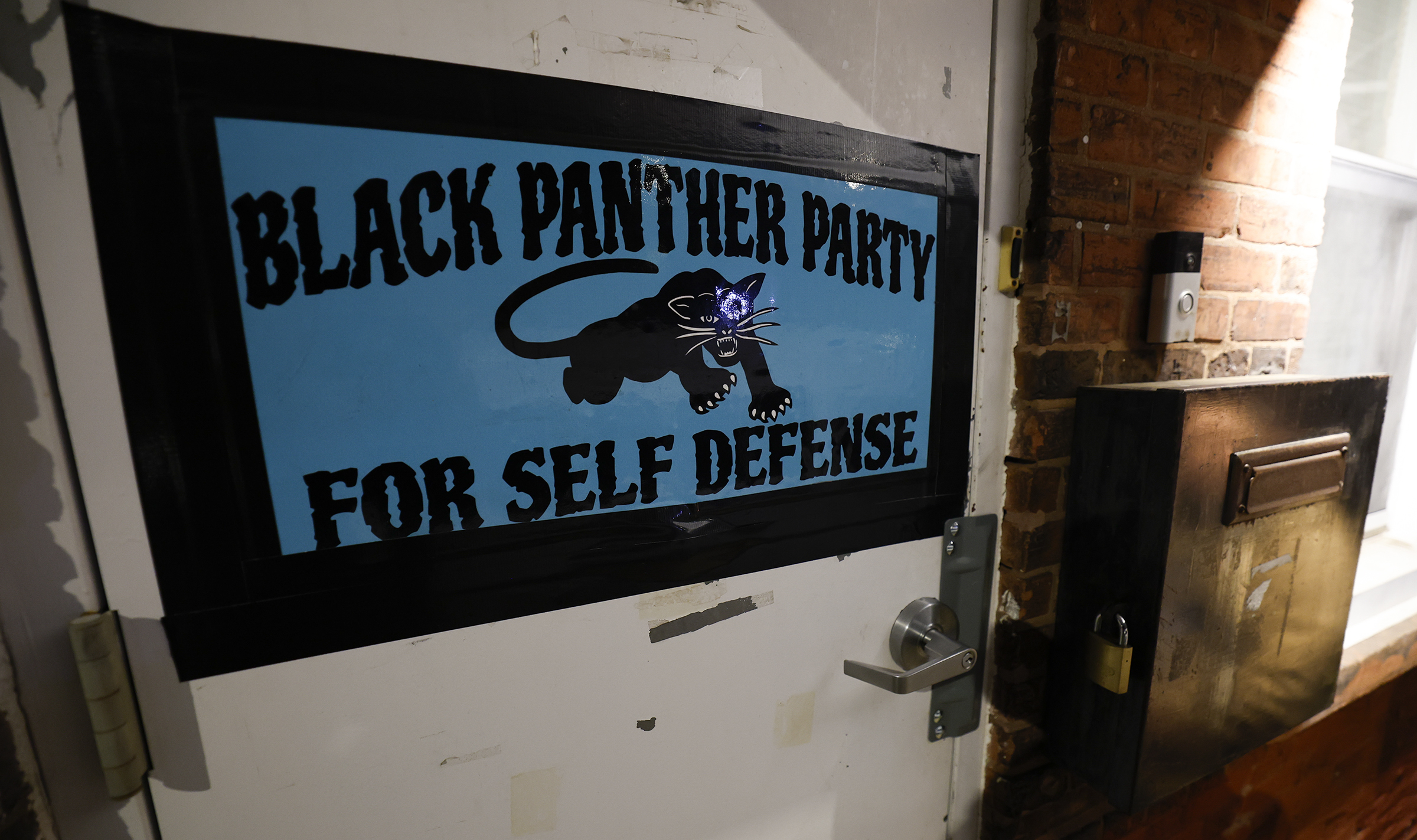
    The Black Panthers previously held food programs at 33rd Street and Cecil B. Moore Avenue in Strawberry Mansion, and at Jefferson Square Park in Pennsport, Birdsong said. More recently, the group was able to move into 2123 N. Gratz St. — a North Philadelphia location that Birdsong says once was a headquarters for the original Black Panther Party Philadelphia chapter.

    The original Black Panther Party was founded by Bobby Seale and Huey P. Newton in Oakland, Calif., in 1966 and was active nationally until the early 1980s. The group formed to fight against police brutality and quickly evolved to promote other social changes including prison reform and access to education, food, and healthcare, according to the National Museum of African American History and Culture.

    The group was soon targeted by J. Edgar Hoover’s FBI, which sought to “discredit, disrupt, and destroy” the Black rights movement, according to UC Berkeley Library. Two Black Panthers in Chicago, Fred Hampton and Mark Clark, were killed in a Chicago police raid that was later revealed to have been coordinated by the FBI.

    The Philadelphia chapter was active from 1968 until 1973, according to a University of Washington website that maps U.S. social movements. Prominent local figures from this era include Sultan Ahmad, who went on to hold roles in city government, and Paula Peebles, a social activist who stayed involved in the Black Panthers for much of her life.

    The Black Panther Party for Self-Defense headquarters in North Philadelphia on Friday, Jan. 9, 2026.

    One person who stopped by for soup on Friday, Jerome Hill, 63, said he can distantly remember the days when Episcopalian pastor and social activist the Rev. Paul Washington let the Black Panthers hold events at Church of the Advocate.

    “They primarily were always community oriented,” Hill said. He said he’s glad to see the group handing out food, and added that they could serve as role models for younger people in the neighborhood.

    While one member of the group served up chicken soup to several boys who stopped by the tables, another member stood at the corner holding an AK-47-style rifle.

    “I feel like we’re welcome,” said one member, also carrying a firearm, who identified himself as Comrade Arch. He said he was a fan of the original group growing up, and he joined a few months ago. “I’ve always had a revolutionary spirit.”

    Under a canopy behind the tables, Birdsong moved back his jacket to reveal a modern MP5, a weapon that has its origins in German submachine guns. He also carried two semiautomatic handguns.

    It’s a controversial posture: Many pro-democracy advocates and experts on civil rights emphasize that nonviolence is essential to successful protest movements.

    The law says you can carry a gun in Philadelphia — but only if you have a license to carry firearms, according to Dillon Harris, an attorney who focuses on gun rights.

    “Open carry,” or carrying a firearm in a way that it can be plainly seen by others, is “generally lawful” in Pennsylvania, except for in prohibited locations such as federal buildings, said Harris.

    But Philadelphia is an exception to this rule, Harris said. A state law prohibits carrying firearms in “a first class city” without a license to carry firearms. That statute applies to Philadelphia.

    But while many civil rights advocates argue that firearms tend to escalate violent confrontations, rather than prevent them, it’s long been part of the Black Panthers’ tactics, and Birdsong pushed back against that idea.

    “We feel safe,” Birdsong said. “No police, no drug dealers doing anything to us here.”

    Armed members of the Black Panther Party for Self-Defense march down Market Street with a crowd of protesters on Thursday, Jan. 8, 2026, to rally against the killing of Renee Good, who was shot by an ICE agent in Minneapolis, Minn.

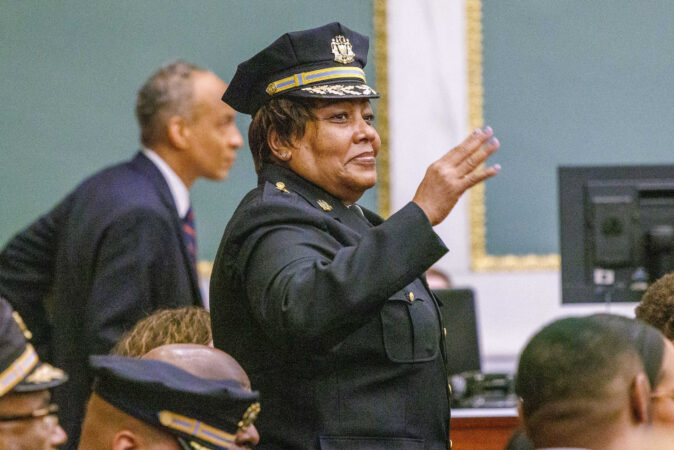
  • ‘You don’t want this smoke’: Philadelphia Sheriff Rochelle Bilal goes viral, draws criticism for message to ICE agents

    ‘You don’t want this smoke’: Philadelphia Sheriff Rochelle Bilal goes viral, draws criticism for message to ICE agents

    Sheriff Rochelle Bilal has garnered national headlines and condemnation for calling U.S. Immigration and Customs Enforcement “fake, wannabe law enforcement” and sending a blunt warning to immigration officers who commit crimes in Philadelphia.

    “If any [ICE agents] want to come in this city and commit a crime, you will not be able to hide, nobody will whisk you off,” Bilal said. “You don’t want this smoke, cause we will bring it to you. … The criminal in the White House would not be able to keep you from going to jail.”

    Bilal made the now-viral remarks at a news conference Thursday alongside Philadelphia District Attorney Larry Krasner, who vowed to prosecute law enforcement officers who commit crimes. The news conference was held in response to the killing of Renee Nicole Good by ICE officer Jonathan Ross in Minneapolis.

    Since then, clips of Bilal have circled social media — with one post on X amassing 1.6 million views and more than 91,000 likes as of Saturday afternoon — and the sheriff’s name has been invoked in Fox News, Newsweek, and HuffPost headlines, among others. Philadelphia Police Commissioner Kevin Bethel said his department has been inundated with calls and emails, leading him to put out a statement Friday affirming that the sheriff’s office is a separate entity from the Philadelphia Police Department. One Florida politician said Bilal should be arrested.

    The sheriff’s office and a spokesperson for Bilal did not immediately respond to requests for comment Saturday. In an interview with CNN’s Erin Burnett, Bilal said “enough is enough.”

    “People are tired of these people coming into the city, masked up — basically all masked up — and pulling people out and causing havoc,” Bilal told the network. “This was supposed to be helping cities out, this was supposed to be eliminating crime, but yet, you are committing them here, you are putting people in fear, you are breaking up families.”

    Bilal spoke for less than four minutes at the Thursday news conference. She upbraided ICE agents for wearing masks that obscure their faces and said their actions violate “not only legal law but the moral law.”

    “Law enforcement professionals around the country do their job, and we have been fighting for years to build that bridge between us and our communities,” Bilal said. “You had one negative nutcase that causes this problem and now we all have to fight again to let people know law enforcement works with communities.”

    Some praised Bilal on social media. Ben Crump, a prominent civil rights attorney, wrote on Facebook, “Sheriff Rochelle Bilal didn’t hold back. … Tragedies like this happen when agents operate in our communities with little to no oversight.”

    Meanwhile, the Pennsylvania GOP posted on X, “When local law enforcement stands with criminals rather than people keeping our communities safe, you know there’s a problem. … Rhetoric like this only makes this situation more dangerous for federal law enforcement and the city of Philadelphia.”

    A video of Bilal’s statement was also posted by LibsofTikTok, a controversial far-right social media account. That post had more than 746,800 views and 8,500 likes as of Saturday afternoon.

    U.S. Rep. Randy Fine, a Republican from Florida, responded to LibsofTikTok’s post, writing, “She should be arrested.”

    The Philadelphia Sheriff’s Office does not police the city; instead, the office’s core functions are deploying deputies to the county’s courtrooms and transporting in-custody defendants to court.

    In his statement, Police Commissioner Bethel distinguished the roles of the sheriff’s office and the police department, noting that the sheriff’s office does not “conduct criminal investigations, nor does it in any way direct municipal policing.” The sheriff is an elected official, while police commissioners are appointed by the mayor.

    “The Philadelphia Police Department will continue to work professionally with all of our enforcement partners,” Bethel said. “But clear lines of authority — and accurate public representation of those roles — are essential to maintaining public trust and effective public safety operations.”

    Under Bilal — who took office in 2020 — there’s been a series of breakdowns in the sheriff’s office, The Inquirer has reported, including misappropriated funds, lax courthouse security, mishandled domestic-abuse cases, and allegations of missing guns. The issues have renewed calls to reform or abolish the embattled office.

  • The New York Times agrees Philly is the place to be (locals still skeptical) | Weekly Report Card

    The New York Times agrees Philly is the place to be (locals still skeptical) | Weekly Report Card

    The New York Times also names Philly the top place to visit in 2026: A- (yet again)

    Well, here we go again. Philadelphia has once more been crowned the world’s best place to visit in 2026 — this time by the New York Times, which means we are now in the extremely Philly position of being right twice and still deeply suspicious about it.

    Yes, the reasons are familiar. The Semiquincentennial. The World Cup. The All-Star Game. Fireworks, parades, exhibitions, concerts, TED talks, themed balls, and a calendar so packed it feels like someone dared the city to see what would break first. It’s a lot. Enough, apparently, to push Philly to the top of the Times’ “52 Places to Go” list.

    But at this point, the events are almost beside the point. Big moments don’t explain why people want to be here, they just give them an excuse.

    Philly keeps landing on these lists because it’s a place that feels alive even when nothing “special” is happening. It’s opinionated without being curated. Historic without being precious. Welcoming in a way that involves some yelling, a little side-eye, and eventually someone telling you where to eat. You don’t visit Philly to be impressed. You visit to be absorbed.

    So why not an A+? Because every time the outside world decides Philly is the place to be, the city pays for it in very real ways. Hotel prices climb. SEPTA gets stress-tested. Streets designed for horse traffic brace for global crowds. And locals are once again asked to host a massive party while still making it to work, daycare pickup, and whatever delayed train they’re already standing on.

    There’s also the small matter of validation fatigue. Philly didn’t suddenly get good because the New York Times said so — just like it didn’t when the Wall Street Journal said it. The city’s been doing this for a long time, whether or not anyone was paying attention.

    Why?
    byu/UnionAdAgency inphilly

    ‘Avoid Philadelphia’ road sign goes viral: A

    Nothing says Philadelphia quite like being named the top travel destination in the world for 2026 and, at the exact same time, going viral for a road sign that simply reads: “Avoid Philadelphia.” No explanation. No branding. Just a warning.

    The photo resurfaced on r/philly and immediately became a public forum for collective truth-telling. When one user asked, “Why?” the answers poured in: “The usual reasons.” “Mental health reasons. Financial reasons.” “SEPTA.” Another went full blunt-force: “Bad things happen in Philly.”

    Of course, the Eagles entered the chat. “Eagles lost yesterday,” one commenter offered. Another countered, “Or Eagles won yesterday… Could be Eagles just did a thing. Go Birds.” Honestly, both feel correct.

    Then came the traffic trauma. “Spend a day on the Blue Route,” someone wrote — a sentence that should probably be included in driver’s ed. One person proposed Google Maps should add a new setting: “avoid highways, avoid toll roads, avoid Philadelphia.”

    But buried in the comments was the buzzkill reality check: This sign is almost certainly old. Several users pointed out it likely dates back to the I-95 bridge collapse in 2023, when avoiding Philadelphia was not a vibe, but a Department of Transportation directive. “Why are you posting a 5+ year old pic?” one top commenter asked, ruining the mystery but improving the accuracy.

    But the timing is what makes this perfect. As the Wall Street Journal and the New York Times roll out the red carpet for 2026, locals are standing off to the side holding a faded road sign like, just so you know. It’s not anti-tourism. It’s informed consent.

    An A for honesty, context, and a comment section that somehow functions as a city guide, traffic alert, sports recap, and warning label… even when the photo is old.

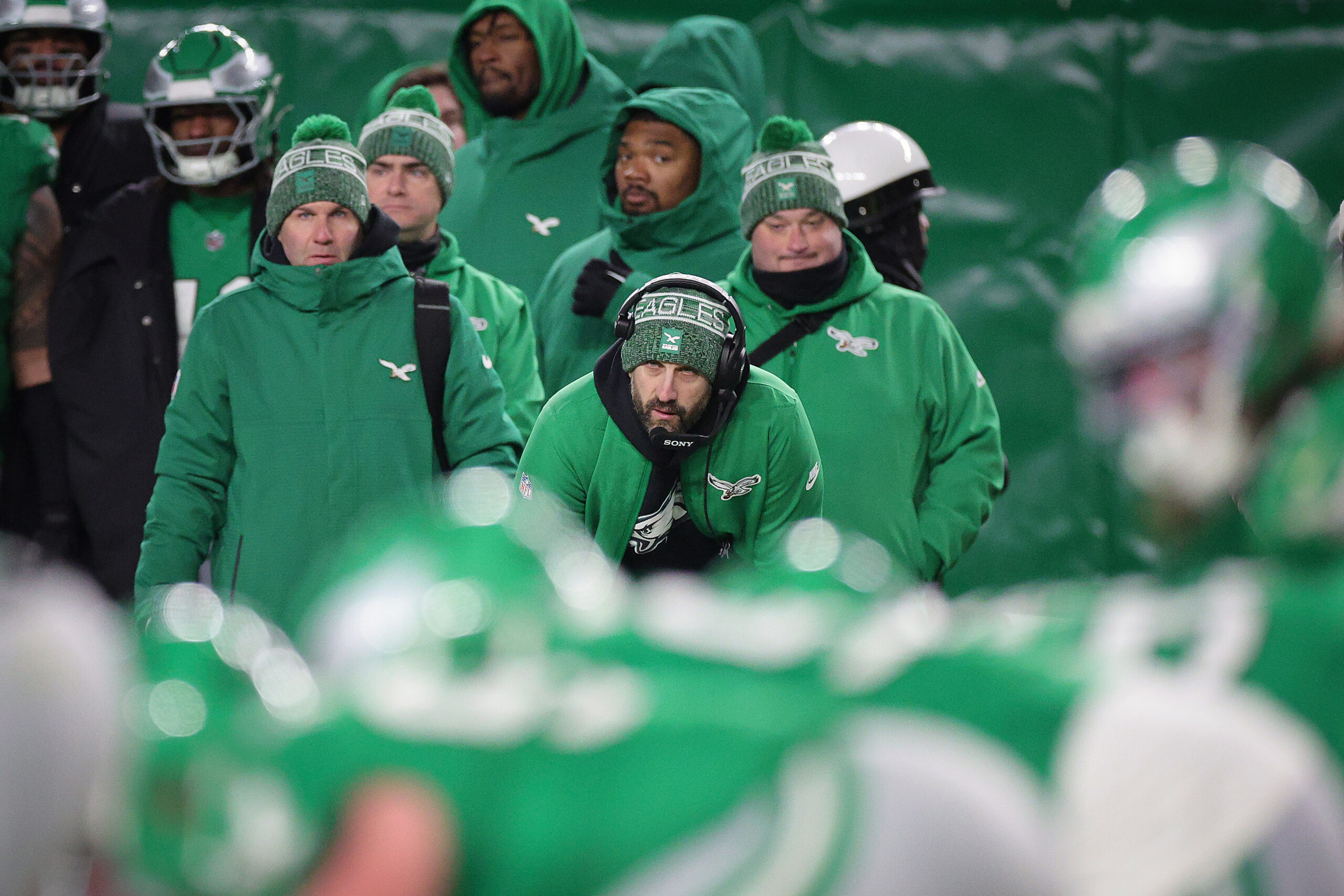
    Philadelphia Eagles head coach Nick Sirianni (center bottom) watches his team play the Washington Commanders at Lincoln Financial Field in Philadelphia on Sunday, Jan. 4, 2026.

    Eagles start the playoffs as the No. 3 seed: B-

    The Eagles enter the playoffs as a No. 3 seed, a position that history treats like a warning label. The math is rude: Few No. 3 seeds make the Super Bowl, and most of them don’t even sniff it. The Eagles themselves have tried this route before and usually wound up packing up by the divisional round. Not great.

    And yes, this is at least partially self-inflicted. Resting the starters in Week 18 cost them a real shot at the No. 2 seed and an objectively easier path. That decision is already being litigated in every bar, group chat, and radio segment. And it will keep getting relitigated until either A) the Eagles lose or B) they win enough that no one wants to admit they were wrong.

    Here’s the thing, though: This specific matchup is not terrifying.

    The 49ers limping into the Linc with injuries, tired legs, and a defense that is no longer the Final Boss version Philly remembers? That’s manageable. The Eagles’ defense has been the most reliable unit all season, and if this game turns into trench warfare, that favors the Birds. Saquon Barkley doesn’t need to be vintage playoff Saquon yet. He just needs to exist long enough to keep the offense functional.

    Still, the unease is earned. This is a team with Super Bowl expectations walking a historically unfriendly path, powered by a defense everyone trusts and an offense no one fully believes in. That’s not nothing. That’s the whole tension.

    So yes, the road is harder than it needed to be. Yes, the margin for error is thin. And yes, if this goes sideways, the No. 3 seed will be Exhibit A in the postmortem.

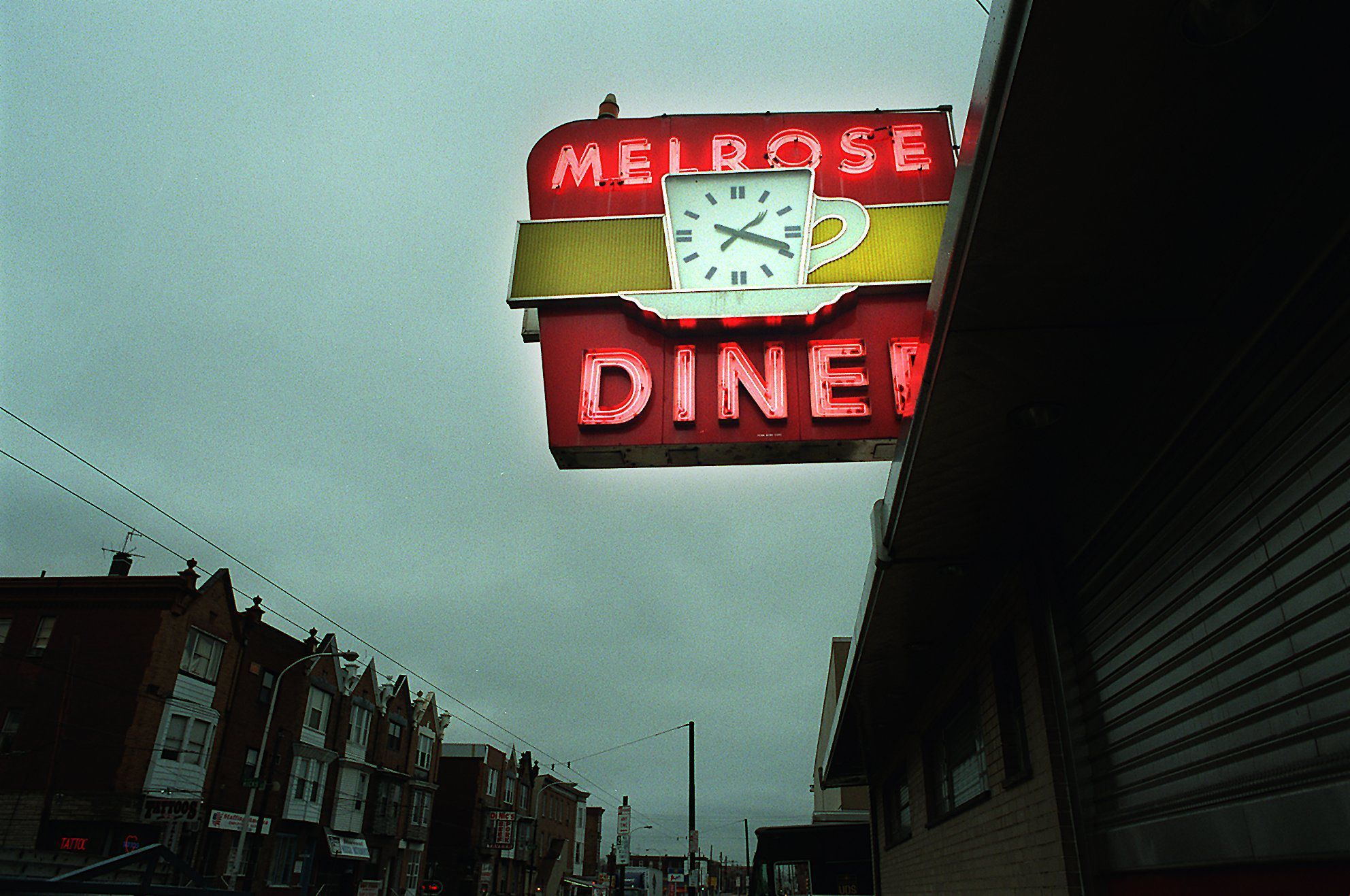
    In this photo from 2000, the Melrose Diner sign shines bright on a gray day.

    The Melrose Diner sign hits Facebook Marketplace: A+

    Nothing says Philadelphia like scrolling Facebook Marketplace and suddenly finding the neon soul of a demolished diner listed as “very heavy and totally cool.”

    Yes, the iconic Melrose Diner sign — red, yellow, stainless steel nostalgia and all — is apparently for sale. Not at auction. Not through a preservation society. Not behind glass in a museum. Just vibes, photos, and the immortal Marketplace closer: “Serious inquiries only.”

    There’s something perfectly on-brand about this. The Melrose didn’t go out quietly. It didn’t get a tasteful plaque or a respectful archival goodbye. It got torn down for apartments, went into “storage,” and has now reemerged like a ghost asking for a sizable offer and a pickup truck.

    The listing itself is doing a lot of work: four pieces, sold as a set, “used — good,” with the helpful reminder that Olga’s Diner once sold signage for $12,000. Philly translation: Don’t lowball me, I know what I’ve got.

    Selling the sign feels a little like selling a family photo album. The Melrose wasn’t just a diner — it was late nights, early mornings, post-bar waffles, post-court appearance coffees, and at least one story involving a mobster, depending on who you ask.

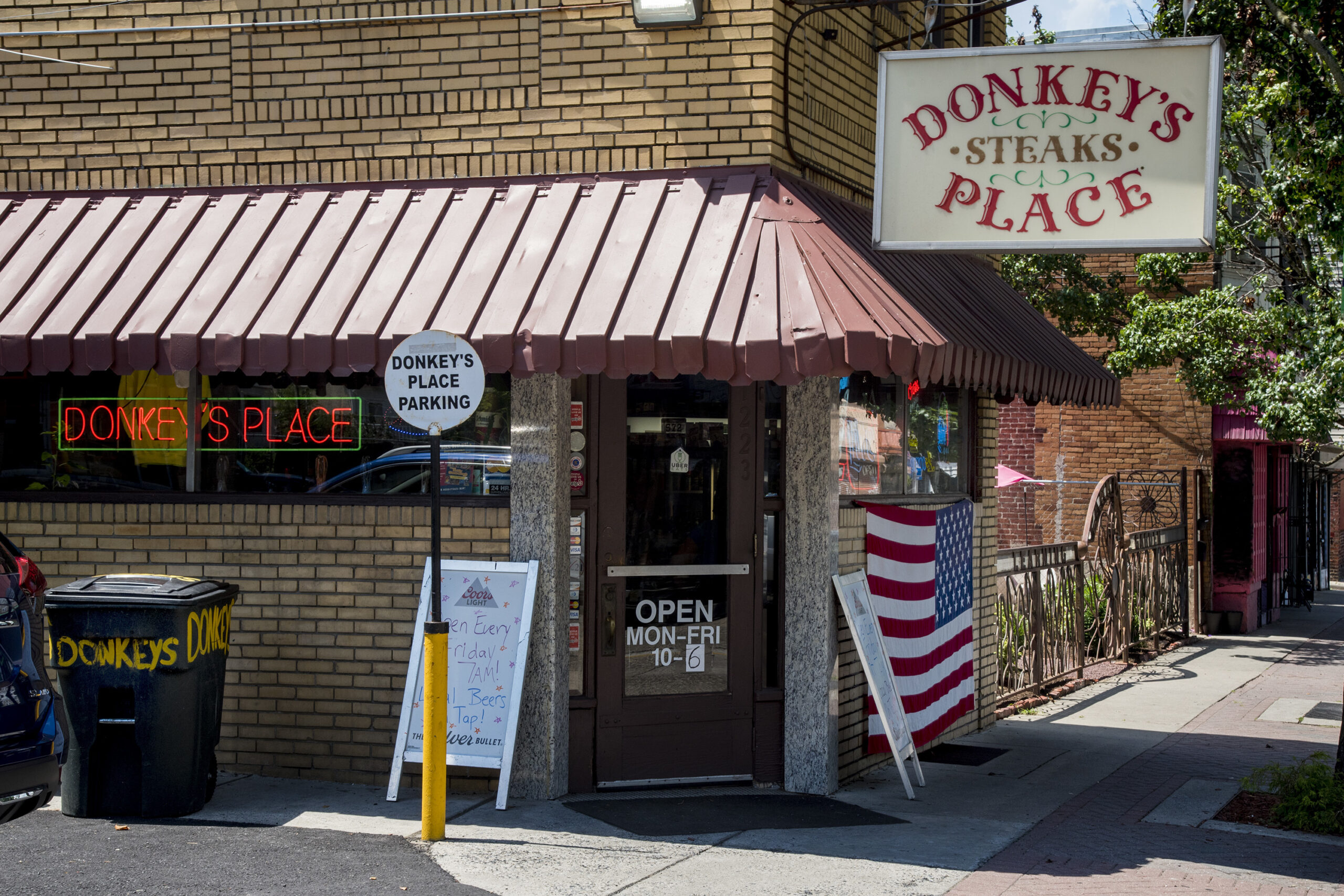
    Donkey’s Place in Camden on July 18, 2018, one of 10 eateries Anthony Bourdain visited in a 2015 episode of his “Parts Unknown” show in New Jersey.

    Donkey’s Place walrus bone theft: D (return it, coward)

    There are lines you don’t cross in this city, and stealing a beloved bar’s decades-old walrus penis bone is absolutely one of them.

    Donkey’s Place didn’t ask questions about the bone for years — it just existed, looming behind the bar like a strange guardian angel of cheesesteaks and beers. It wasn’t sentimental, it wasn’t precious. It was just there. Which somehow makes taking it worse.

    The alleged thief wrapped it in a scarf and walked out like this was Ocean’s Eleven: South Jersey Edition, and now the bar is left explaining to the internet why they’re asking nicely for a walrus baculum to be returned, no police report, no drama, just vibes and decency.

    The deduction from an A is only because this never should’ve happened. Otherwise, this is peak Philly-area energy: a historic bar, an inexplicable artifact, security footage, TikTok pleas, and a collective regional agreement that yes, this matters.

    Mail it back. No questions asked. Everyone will pretend this never happened.

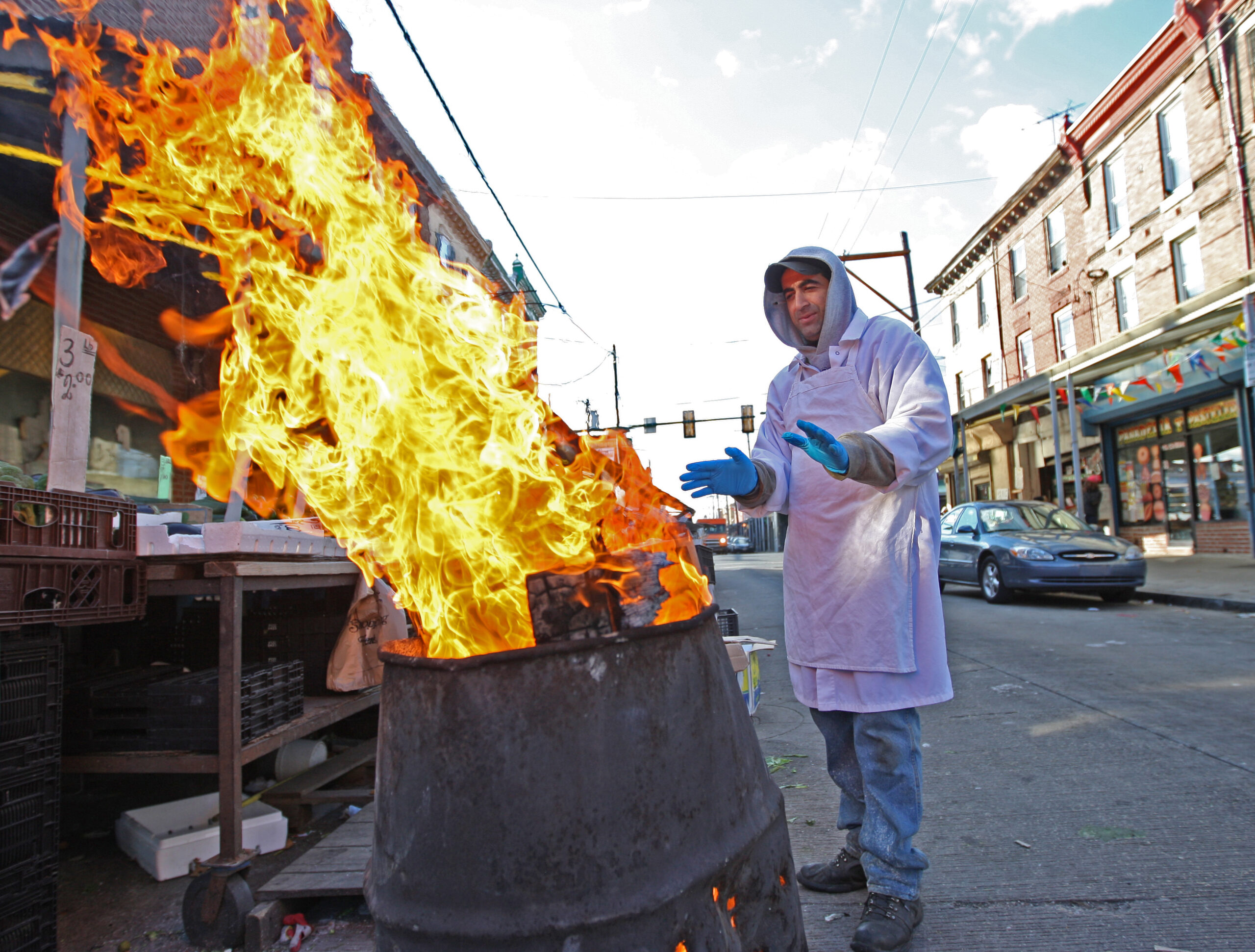
    In this Dec. 4, 2007 Inquirer file photo, Joe Carioti, of Carl’s Poultry, warms his hands on the first really cold day down at the market.

    Trash can fires are back on Ninth Street: A

    You don’t need a calendar to tell you winter has arrived in Philadelphia. You just need to walk down Ninth Street and see a trash can on fire.

    The barrels come back when mornings turn brutal and vendors are out before dawn, unloading boxes, setting up stalls, and bracing against the cold. This isn’t nostalgia or aesthetic — it’s practical. A few minutes of heat for hands that don’t get to stay in pockets, a pause before the work continues.

    They’re regulated, debated, occasionally questioned, and absolutely unmoved by any of that. Every winter, they come back anyway. Not as a statement, but as a fact of life.

    When spring shows up, they’ll disappear again. Until then, the fire’s on.

  • When I switched from film to digital

    When I switched from film to digital

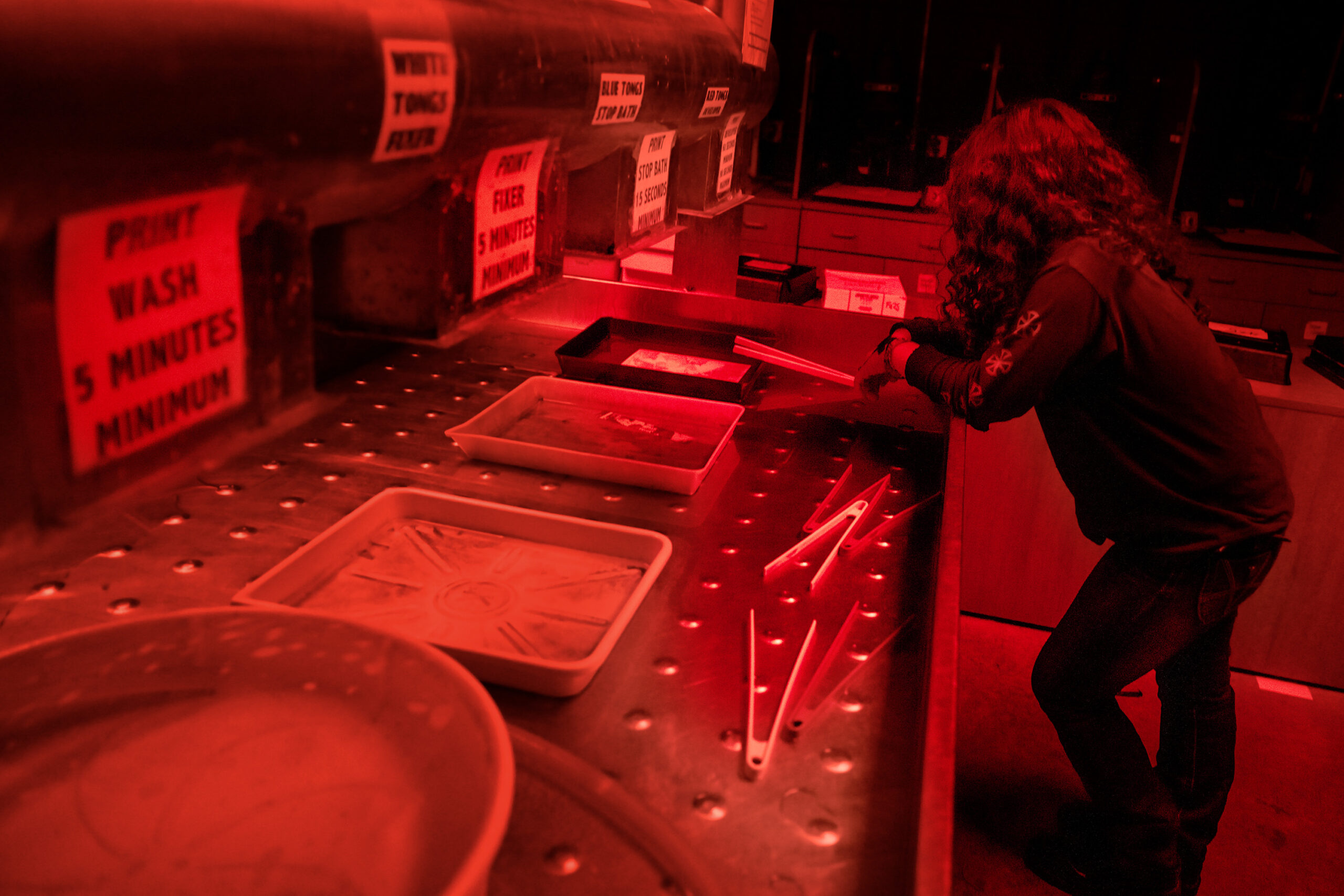
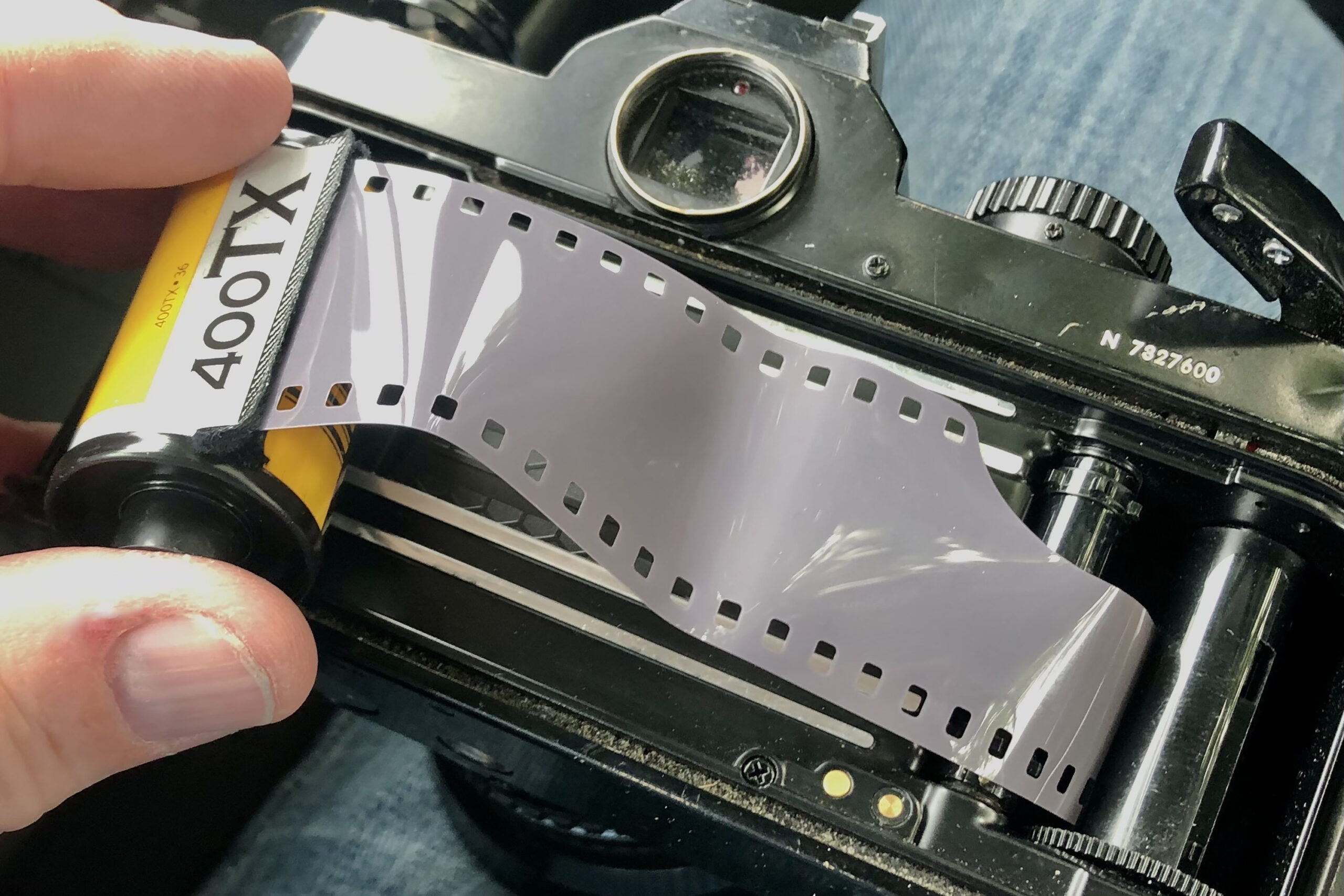
    I stepped into a real live, working — smells and all — black and white darkroom this week, for the first time in decades.

    I watched Charlotte Astor, a junior at Cherry Hill High School East, develop her B&W photographs in the school’s darkroom.

    For a few years after The Inquirer went digital I kept the small enlarger and other personal equipment that I’d used in my crude basement darkroom from when I was starting out. I had little use for it after I got my first staff job with bigger and better facilities. It all stayed boxed up, through multiple moves, long after I’d stopped exposing any film — even for family photos.

    I finally gave it all away when young people first started using analog formats like typewriters, vinyl records, “dumb phones,” and film cameras as a move away from digital overload. (A few years ago our photo staff did a group project where we each took a turn with the same 35 mm mechanical camera using just one roll of black-and-white film.)

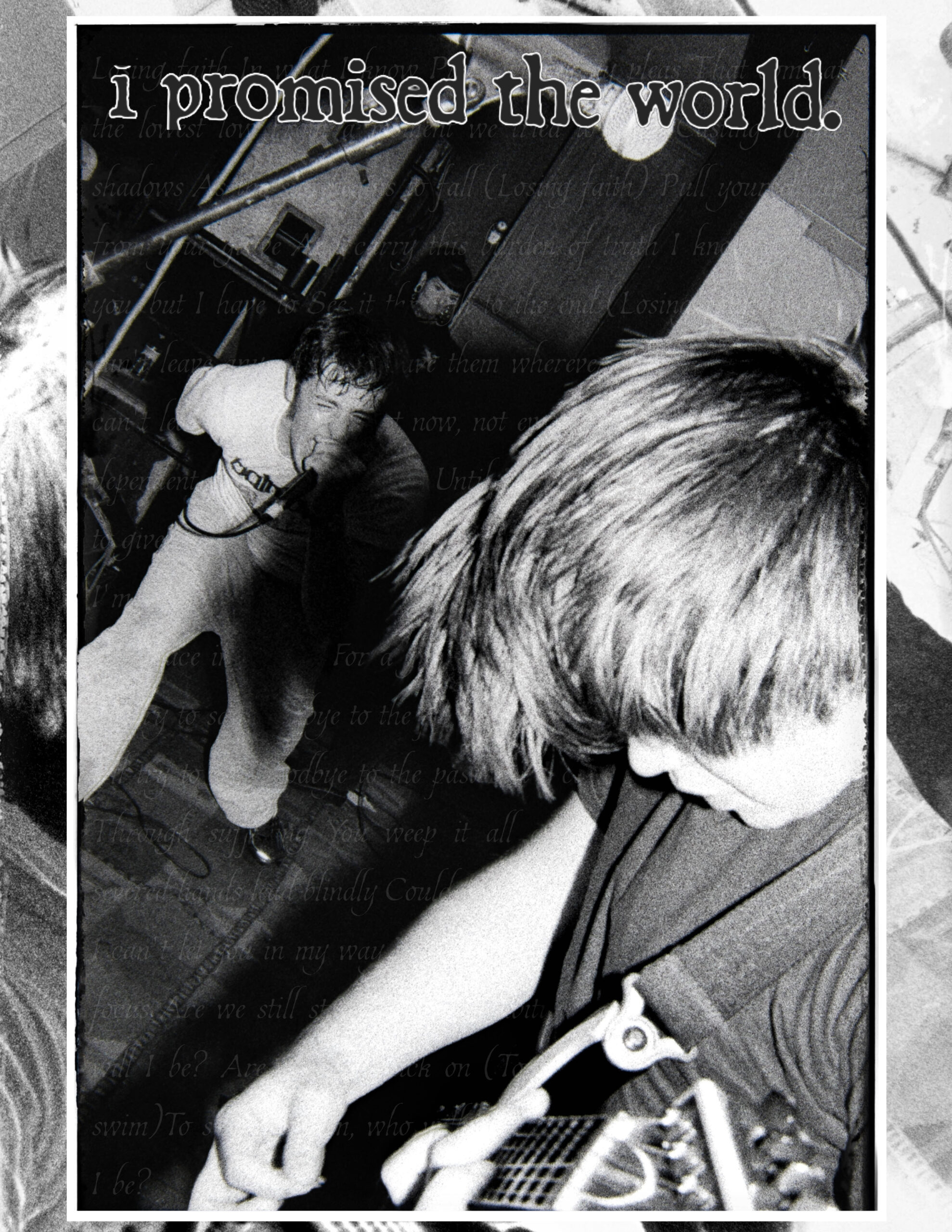
    Like many digital natives who grew up with smartphones and the internet and are now “detoxing,” Astor has totally embraced B&W 35 mm, photographing at hardcore shows around the area for a zine she self-publishes, “Through Our Eyes.”

    “So often,” she says of the music scene, “you’ll see these people taking a million photos a second, and to me it’s just waste. When I shoot film, I only have 36 shots before I gotta risk reloading in the middle of the pit, so every shot I have to make count. It keeps me in that moment, with this kind of clarity. When you get the shot, even though you can’t see it, you just know that you got that moment perfect. That moment means everything to me. I wouldn’t trade it for the world, and digital will never come close.”

    Photo by Charlotte Astor, from a show by “I Promised the World” at the First Unitarian Church in Philadelphia Nov. 22, 2025. Taken with a Nikon FE and Tmax 3200 film.

    But that’s not why I was taking her picture. Our story, published next week, is about Astor’s four year search for a demo tape — yes, an analog cassette — from her mother’s teenage band.

    I enjoyed talking with her about photography, and I couldn’t stop thinking about what digital photography has brought us.

    Film demanded patience and technical precision. Digital offered instant feedback and greater flexibility in lighting conditions.

    Photojournalists delivered images faster, adapted to the demands of online media and met tighter and more frequent deadlines.

    The transition hasn’t changed the way I see, and interpret. I still emphasize composition, context, or complexity. However, I have adapted and adjusted. I see the value in making the kinds of thumbnails that online platforms prioritize to generate algorithmic attention.

    Between photographing for stories on assignment I still wander whatever neighborhood I am in looking for “standalones.”

    But I am also always on the lookout for “stock” photos that can be used as thumbnails with future stories. Think images of police tape or flashing lights, city street scenes, and skylines, educational, civic, and medical institutions.

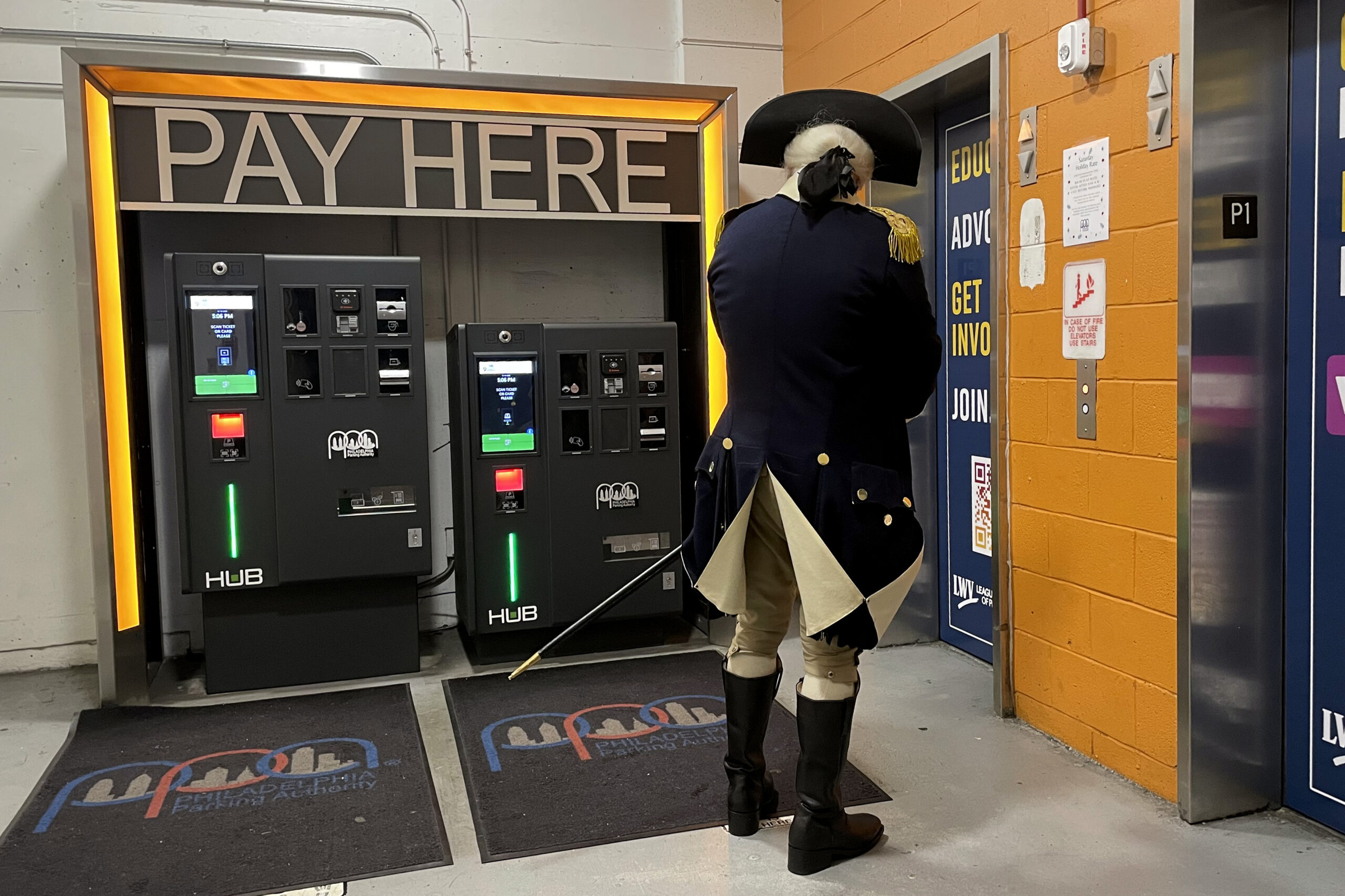
    Made while riding in a parking garage elevator, this photo had been been published with over a dozen stories in the past year.

    After an assignment at the Philadelphia Art Museum, I loitered outside.

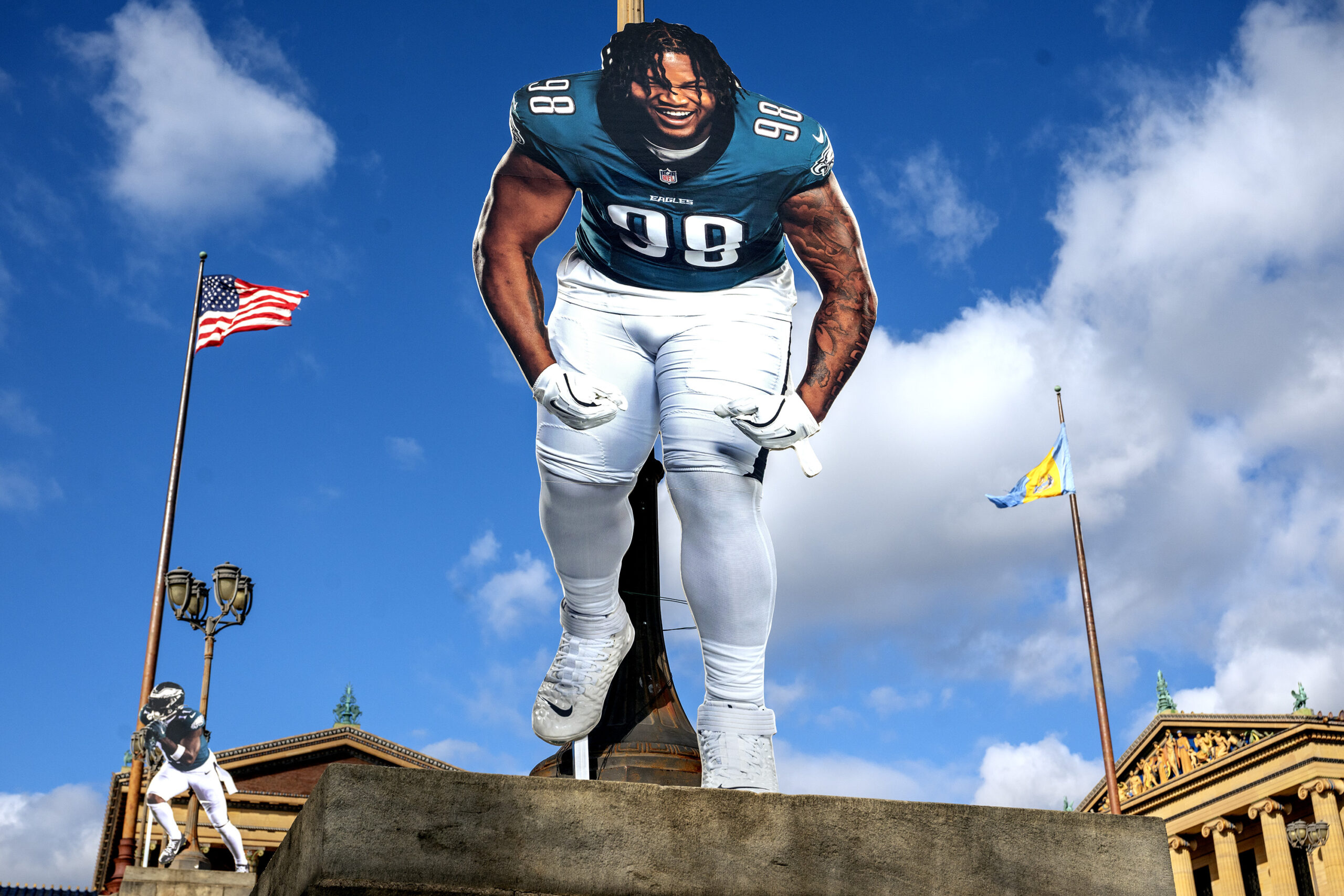
    Ahead of Sunday’s wildcard playoff game against the San Francisco 49ers, the museum put up giant cutouts of four Eagles players on its iconic front steps. The cutouts first appeared in 2014 (before the Birds’ wild-card loss to the New Orleans Saints) and again a few times over the years, including before both Super Bowl wins in 2018 and last year.

    Eagles defensive tackle Jalen Carter (and wide receiver A.J. Brown, lower left).

    The newspaper already has lots of photos from the steps, including many of that movie prop, but I knew the city’s Art Commission is voting next week to see if it stays, or not.

    So what’s one — or two — more? (There are currently two versions at the museum!)

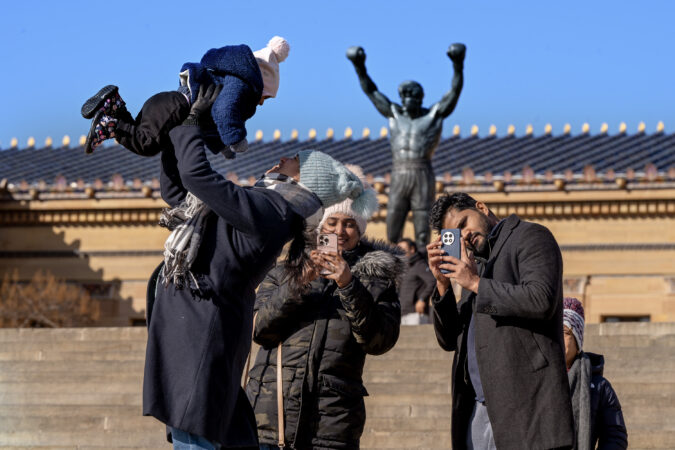
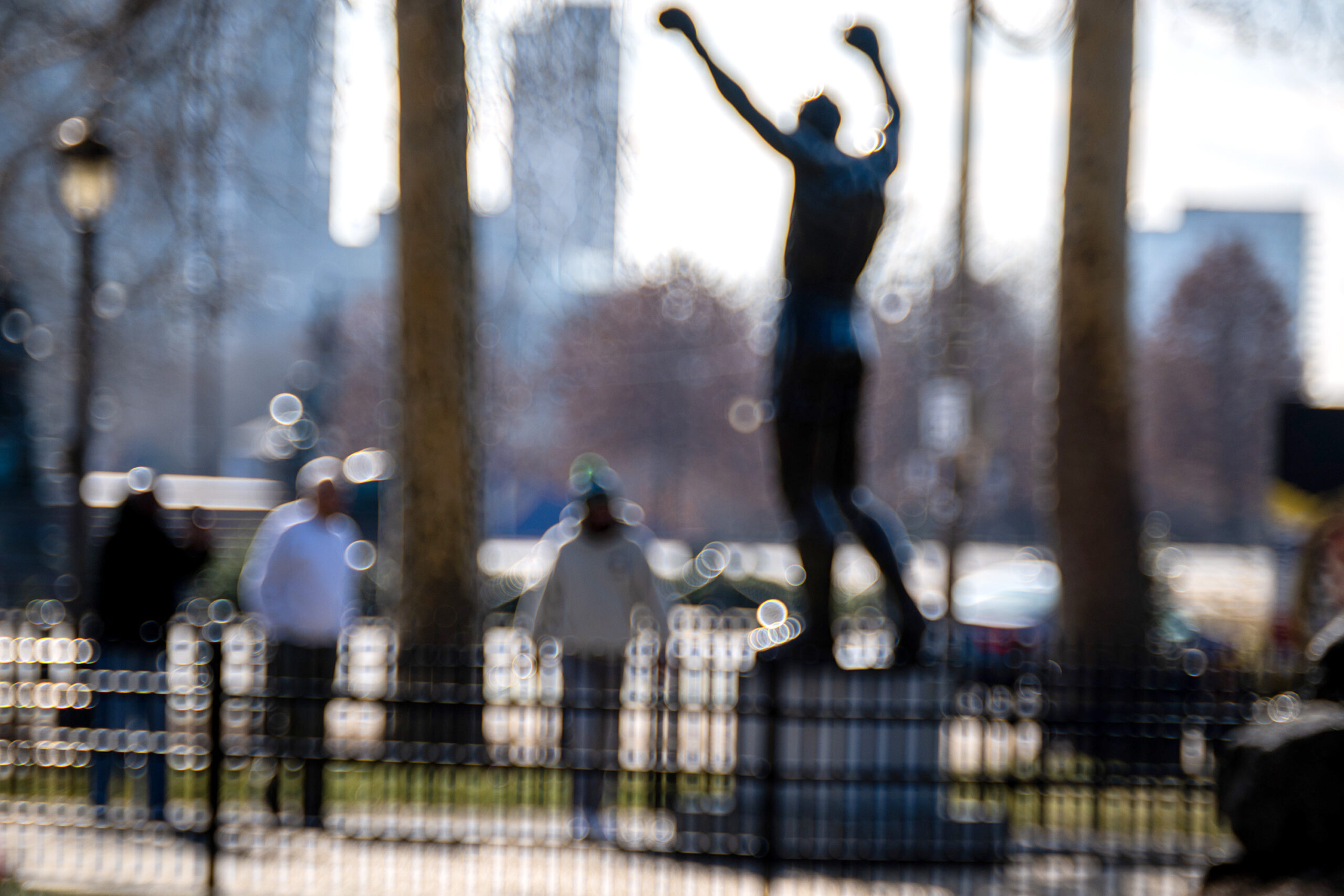
    That famous movie prop seen out-of-focus – and captured – between changing f-stops for different depths-of-field. Did you know (spoiler alert, there is math involved) that an f-stop is the numerical value of the ratio of the focal length of the lens to the diameter of its aperture.

    If it stays, the “original” version of the statue from 1982’s Rocky III that now sits at street level would be moved inside the museum for an exhibit this summer, then go back outside and installed at the top of the steps “permanently.” And the “second casting” statue there now “temporarily” would be returned to Sylvester Stallone.

    (If it sounds like I have more than a passing interest in this, I do. Reporter Mike Vitez and I spent an entire year on the steps to produce the locally best-selling book Rocky Stories: Tales of Love, Hope, and Happiness at America’s Most Famous Steps.)

    It was that really nice, warm sprint-like day we had on Wednesday, following those bitterly cold first days of 2026, so I didn’t mind being outside making “stock” photos.

    And THAT’S when I spotted a real moment — the kind photographers live for — of the family taking selfies on the steps, and how I ended up making the photo at the very top of this column.

    Since 1998 a black-and-white photo has appeared every Monday in staff photographer Tom Gralish’s “Scene Through the Lens” photo column in the print editions of The Inquirer’s local news section. Here are the most recent, in color:

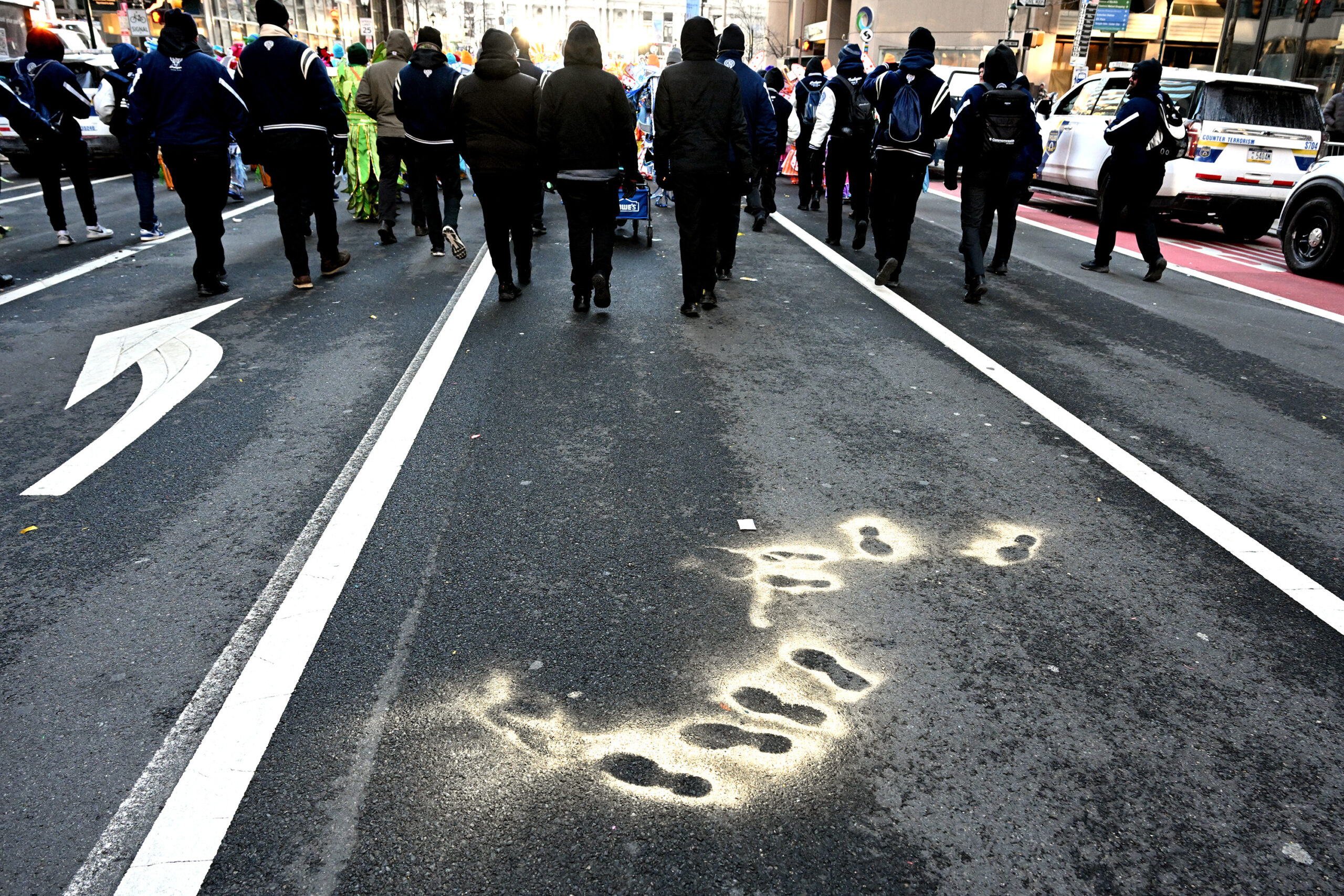
    January 5, 2026: Parade marshals trail behind the musicians of the Greater Kensington String Band heading to their #9 position start in the Mummers Parade. Spray paint by comic wenches earlier in the day left “Oh, Dem Golden Slippers” shadows on the pavement of Market Street. This year marked the 125th anniversary of Philly’s iconic New Year’s Day celebration.
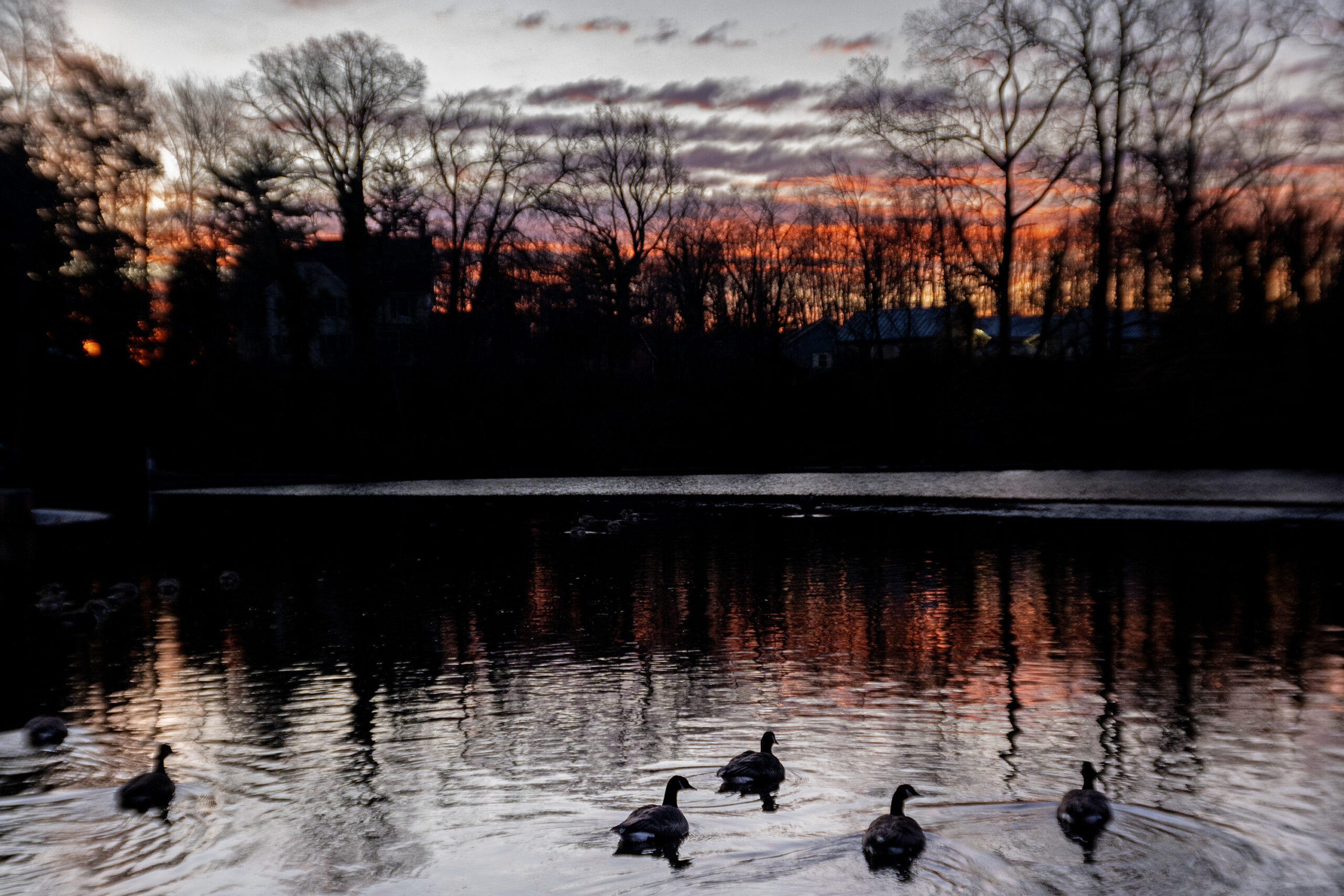
    Dec. 29, 2025: Canada geese at sunrise in Evans Pond in Haddonfield, during the week of the Winter Solstice for the Northern Hemisphere.
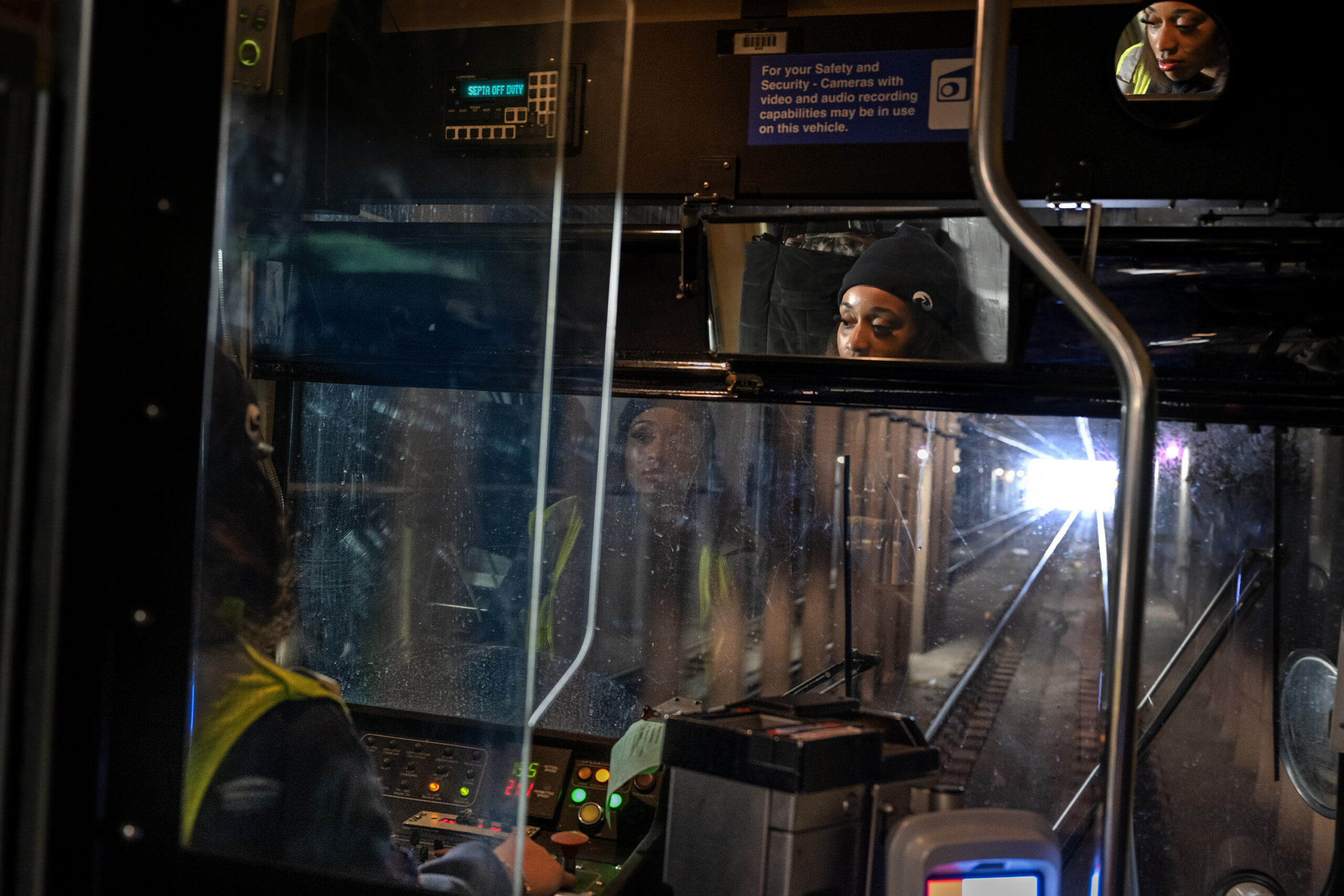
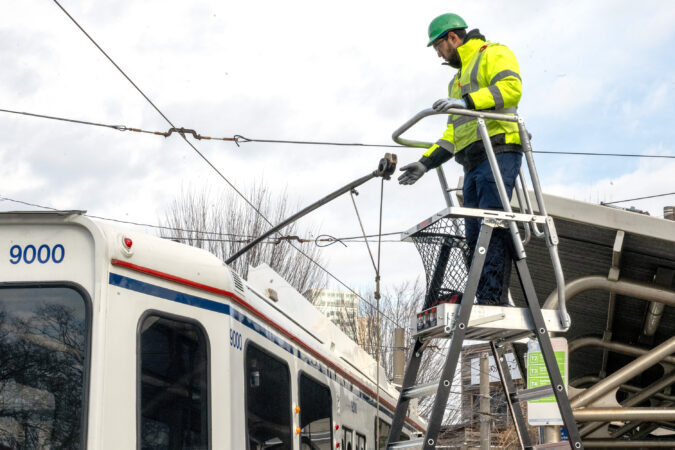
    December 22, 2025: SEPTA trolley operator Victoria Daniels approaches the end of the Center City Tunnel, heading toward the 40th Street trolley portal after a tour to update the news media on overhead wire repairs in the closed tunnel due to unexpected issues from new slider parts.
    December 15, 2025: A historical interpreter waits at the parking garage elevators headed not to a December crossing of the Delaware River, but an event at the National Constitution Center. General George Washington was on his way to an unveiling of the U.S. Mint’s new 2026 coins for the Semiquincentennial,
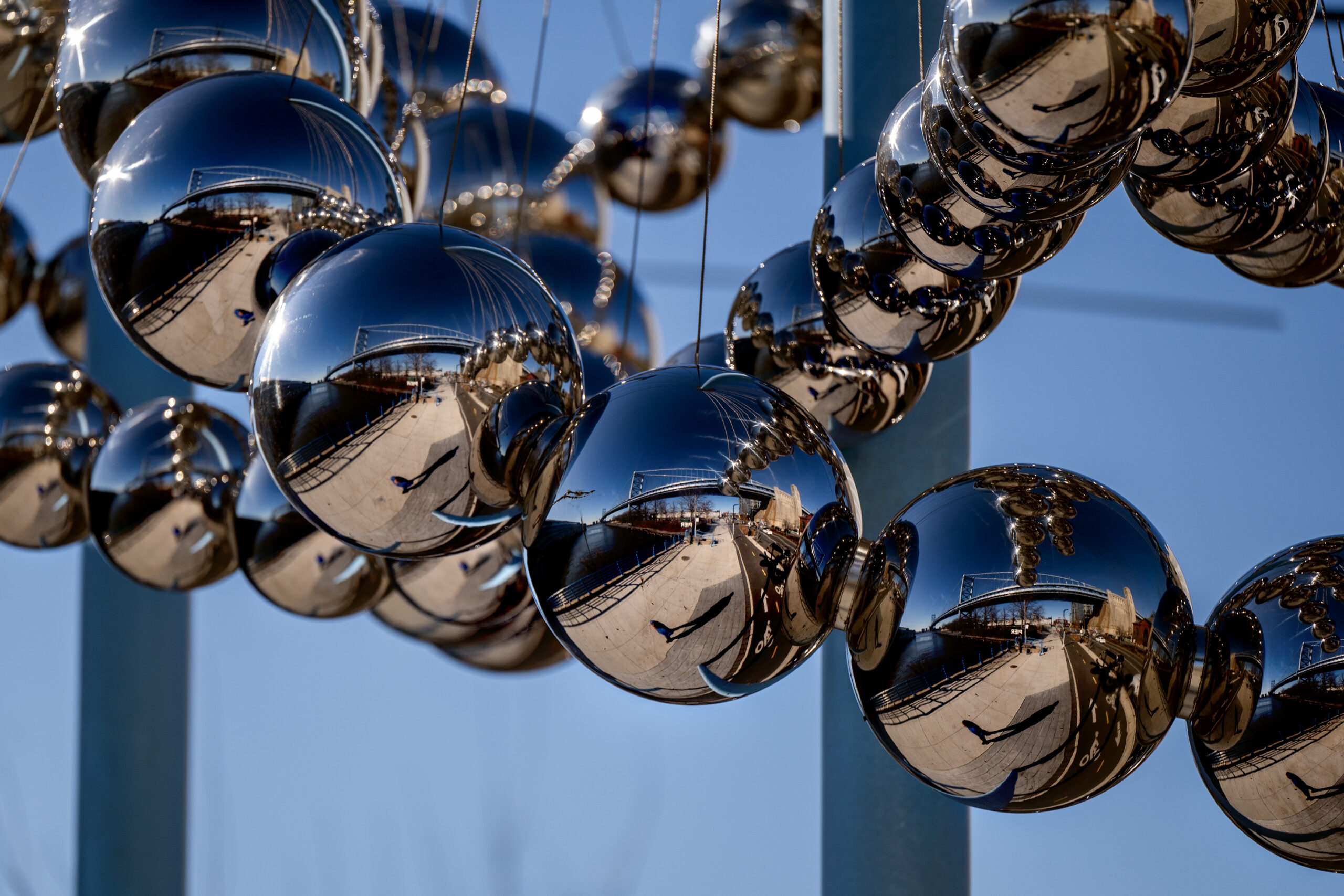
    December 8, 2025: The Benjamin Franklin Bridge and pedestrians on the Delaware River Trail are reflected in mirrored spheres of the “Weaver’s Knot: Sheet Bend” public artwork on Columbus Boulevard. The site-specific stainless steel piece located between the Cherry Street and Race Street Piers was commissioned by the City’s Public Art Office and the Delaware River Waterfront Corporation and created and installed in 2022 by the design and fabrication group Ball-Nogues Studio. The name recalls a history that dominated the region for hundreds of years. “Weaver’s knot” derives from use in textile mills and the “Sheet bend” or “sheet knot” was used on sailing vessels for bending ropes to sails.
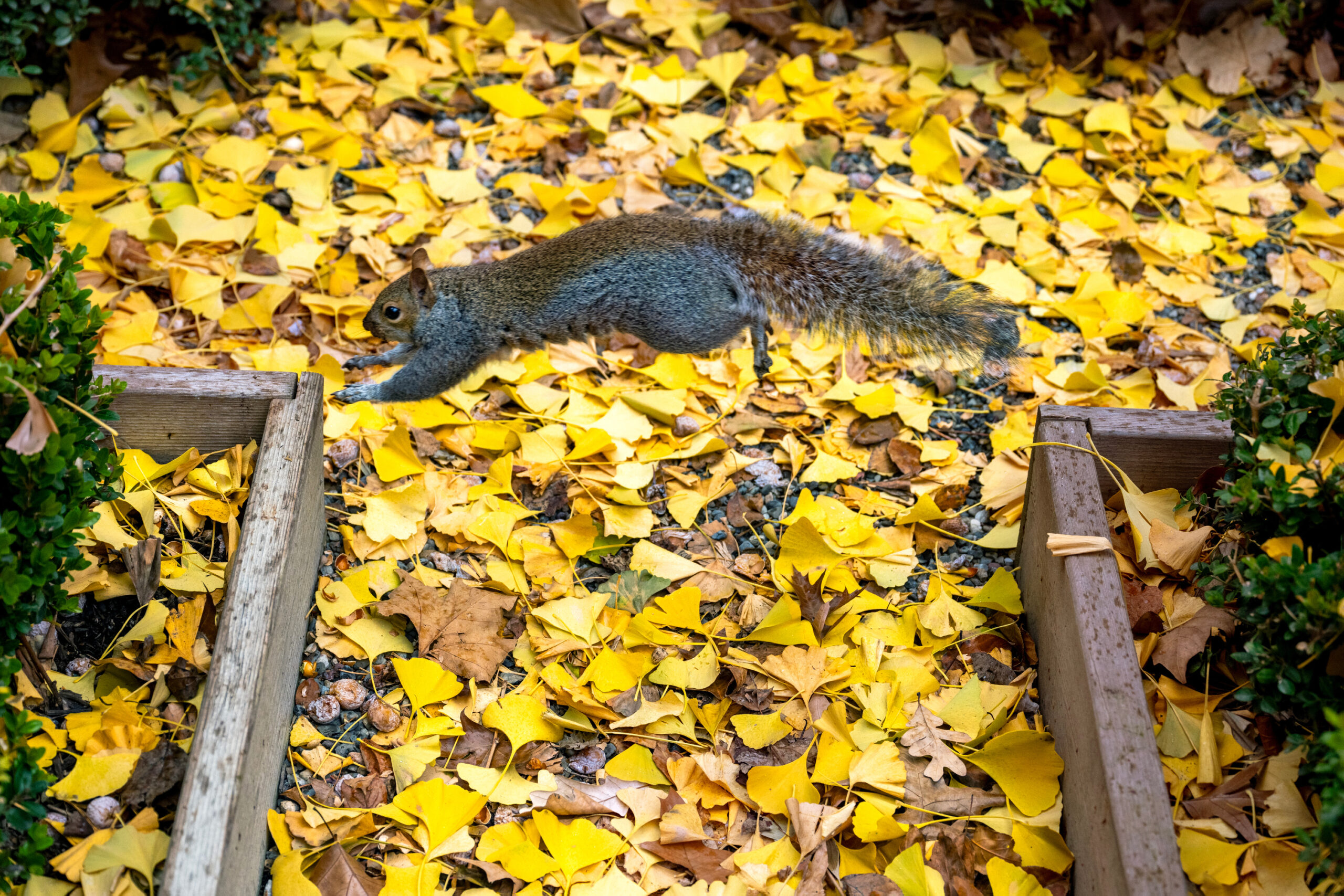
    November 29, 2025: t’s ginkgo time in our region again when the distinctive fan-shaped leaves turn yellow and then, on one day, lose all their leaves at the same time laying a carpet on city streets and sidewalks. A squirrel leaps over leaves in the 18th Century Garden in Independence National Historical Park Nov. 25, 2025. The ginkgo (Ginkgo biloba) is considered a living fossil as it’s the only surviving species of a group of trees that existed before dinosaurs. Genetically, it has remained unchanged over the past 200 million years. William Hamilton, owner the Woodlands in SW Phila (no relation to Alexander Hamilton) brought the first ginkgo trees to North America in 1785.
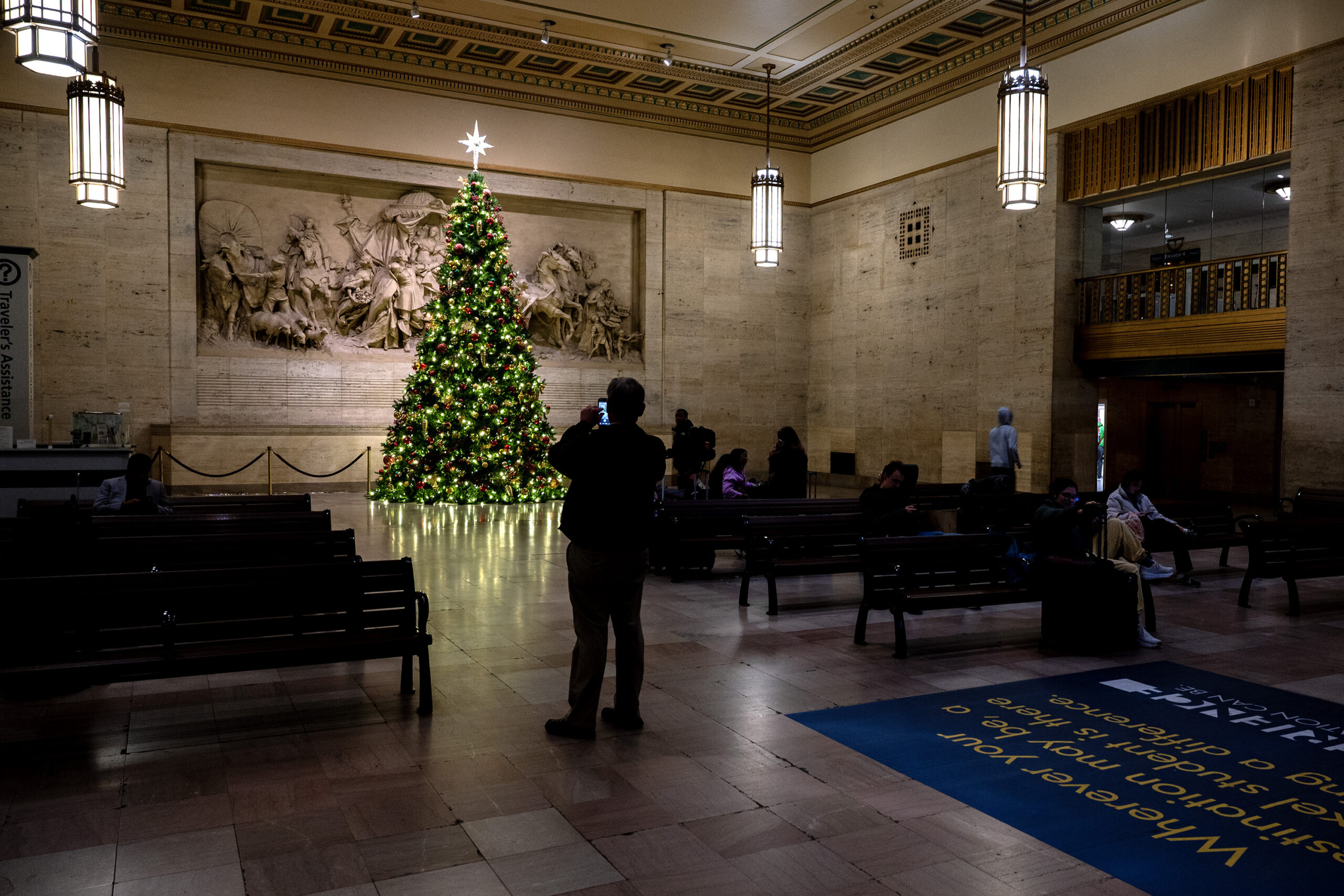
    November 24, 2025: The old waiting room at 30th Street Station that most people only pass through on their way to the restrooms has been spiffed up with benches – and a Christmas tree. It was placed there this year in front of the 30-foot frieze, “The Spirit of Transportation” while the lobby of Amtrak’s $550 million station restoration is underway. The 1895 relief sculpture by Karl Bitter was originally hung in the Broad Street Station by City Hall, but was moved in 1933. It depicts travel from ancient to modern and even futuristic times.
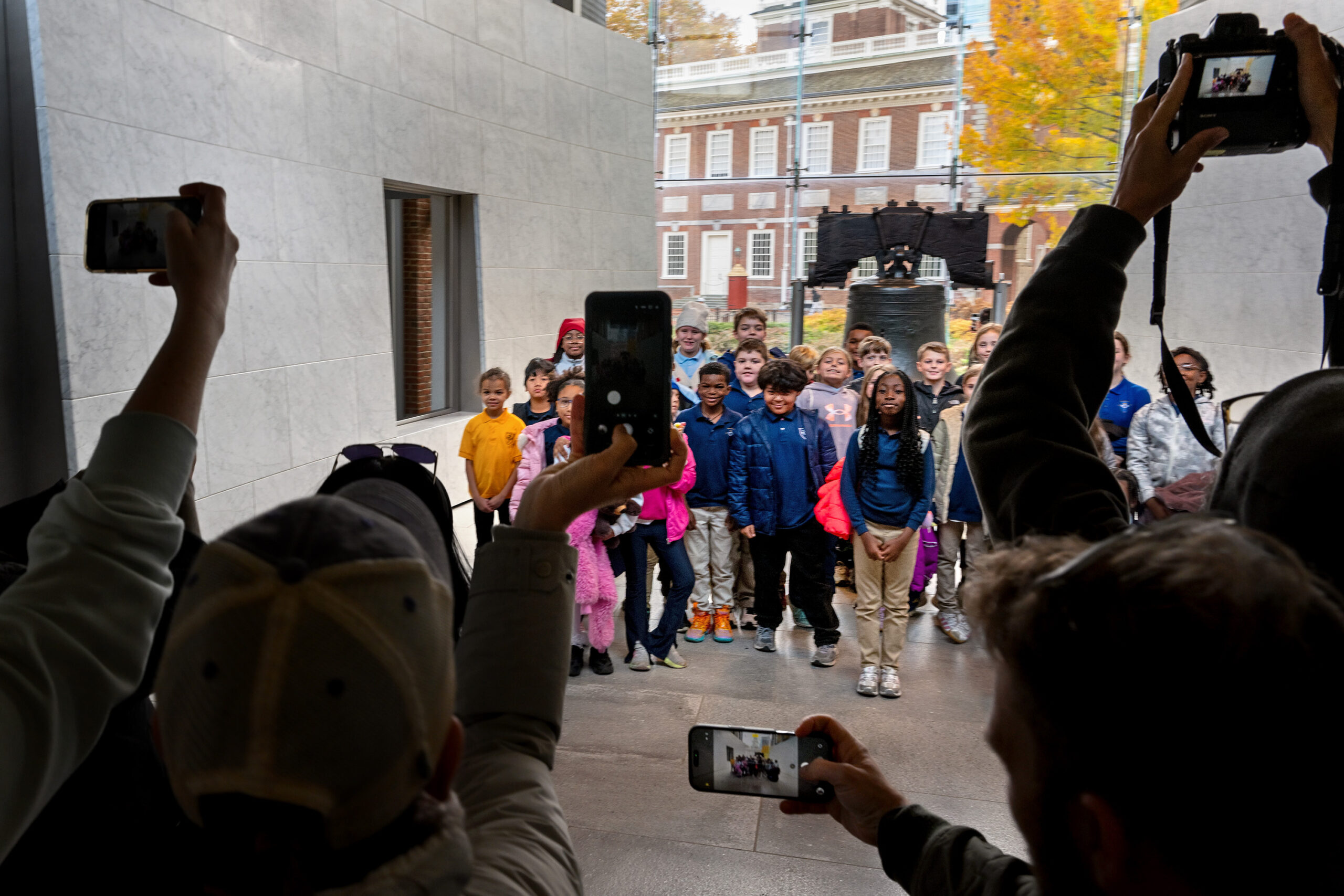
    November 17, 2025: Students on a field trip from the Christian Academy in Brookhaven, Delaware County, pose for a group photo in front of the Liberty Bell in Independence National Historical Park on Thursday. The trip was planned weeks earlier, before they knew it would be on the day park buildings were reopening after the government shutdown ended. “We got so lucky,” a teacher said. Then corrected herself. “It’s because we prayed for it.”
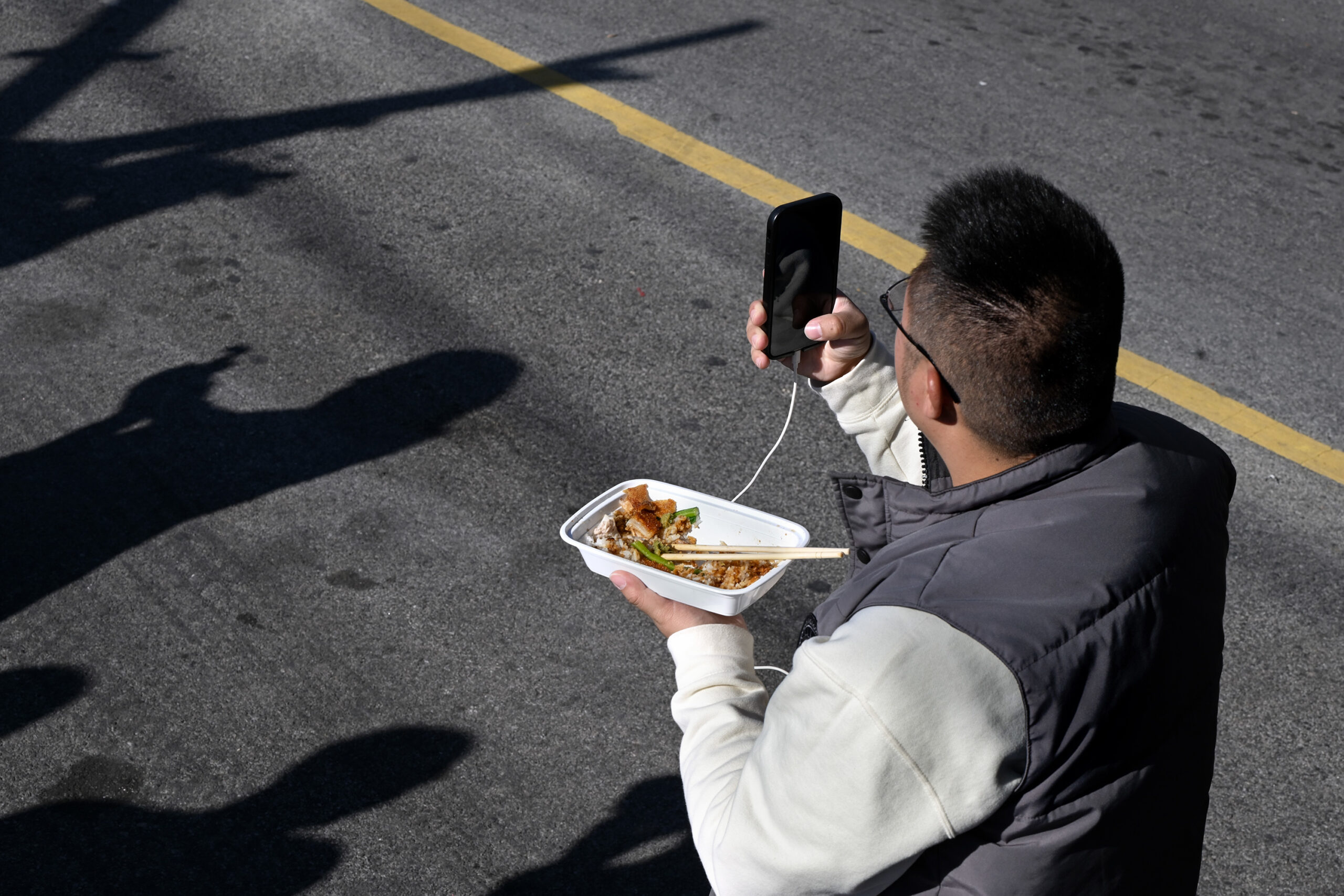
    November 8, 2025: Multitasking during the Festival de Día de Muertos – Day of the Dead – in South Philadelphia.
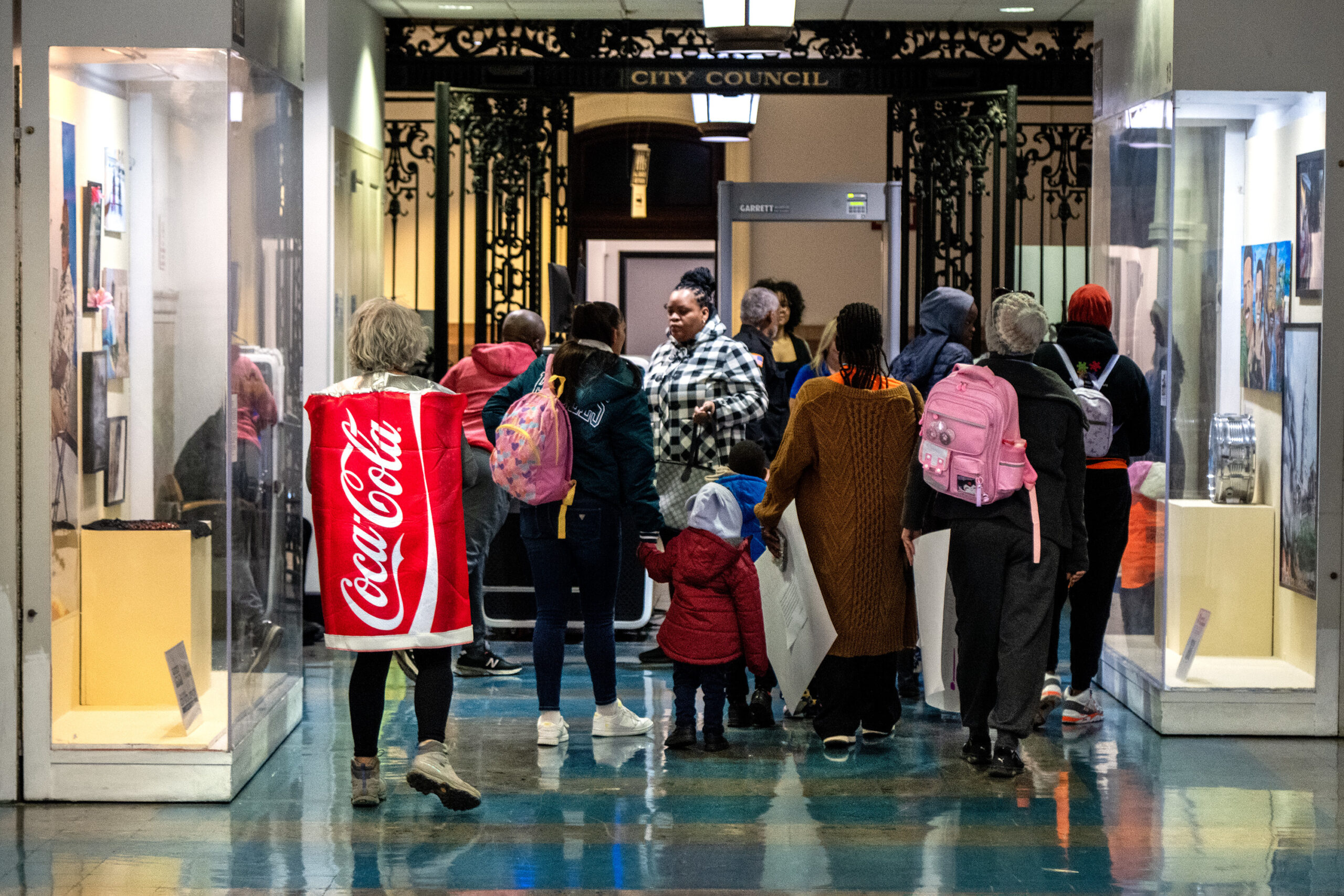
    November 1, 2025: Marcy Boroff is at City Hall dressed as a Coke can, along with preschoolers and their caregivers, in support of former Mayor Jim Kenney’s 2017 tax on sweetened beverages. City Council is considering repealing the tax, which funds the city’s pre-K programs.
    October 25, 2025: Austin Gabauer, paint and production assistant at the Johnson Atelier, in Hamilton Twp, N.J. as the finished “O” letter awaits the return to Philadelphia. The “Y” part of the OY/YO sculpture is inside the painting booth. The well-known sculpture outside the Weitzman National Museum of American Jewish History was removed in May while construction continues on Market Street and has been undergoing refurbishment at the Atelier at the Grounds for Sculpture outside of Trenton.
    October 20, 2025:The yellow shipping container next to City Hall attracted a line of over 300 people that stretched around a corner of Dilworth Park. Bystanders wondered as they watched devotees reaching the front take their selfies inside a retro Philly diner-esque booth tableau. Followers on social media had been invited to “Climb on to immerse yourself in the worlds of Pleasing Fragrance, Big Lip, and exclusive treasures,” including a spin of the “Freebie Wheel,” for products of the unisex lifestyle brand Pleasing, created by former One Direction singer Harry Styles.
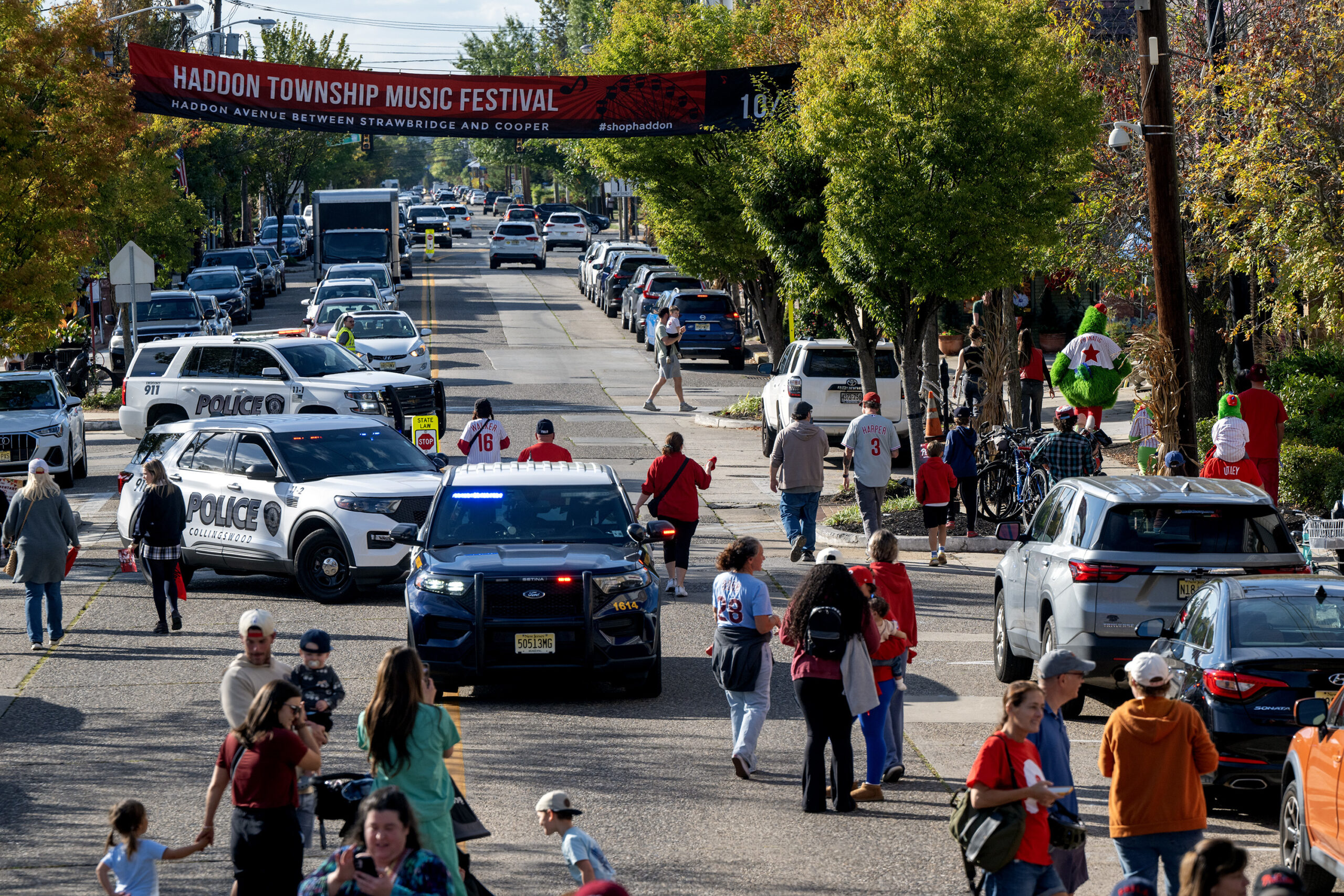
    October 11, 2025: Can you find the Phillie Phanatic, as he leaves a “Rally for Red October Bus Tour” stop in downtown Westmont, N.J. just before the start of the NLDS? There’s always next year and he’ll be back. The 2026 Spring Training schedule has yet to be announced by Major League Baseball, but Phillies pitchers and catchers generally first report to Clearwater, Florida in mid-February.
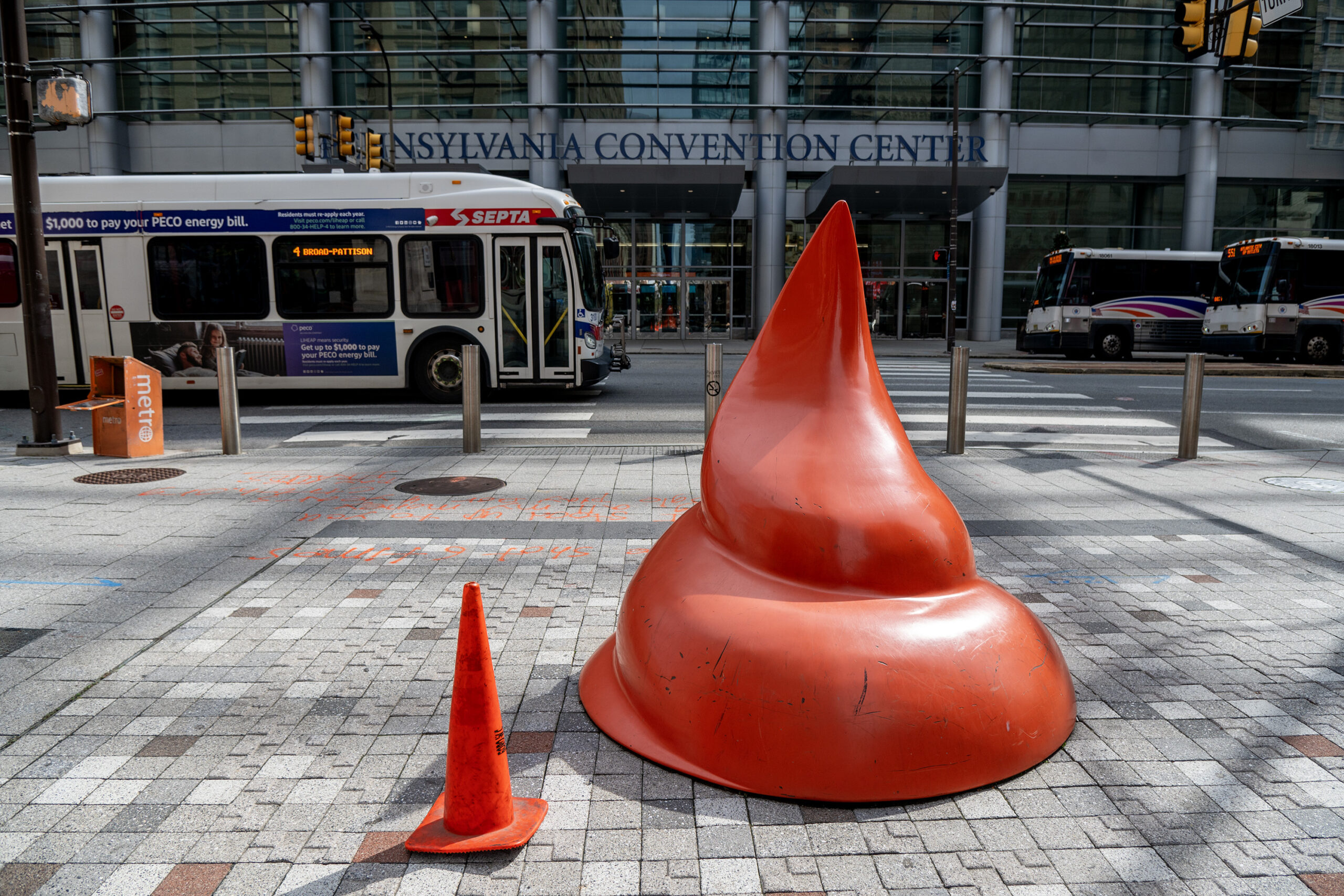
    October 6. 2025: Fluorescent orange safety cone, 28 in, Poly Ethylene. Right: Paint Torch (detail) Claes Oldenburg, 2011, Steel, Fiberglass Reinforced Plastic, Gelcoat and Polyurethane. (Gob of paint, 6 ft. Main sculpture, 51 ft.). Lenfest Plaza at the Pennsylvania Academy of the Fine Arts on North Broad Street, across from the Convention Center.

    » SEE MORE: Archived columns and Twenty years of a photo column.

  • Trolley tunnel will be open Monday at 5 a.m., SEPTA says

    Trolley tunnel will be open Monday at 5 a.m., SEPTA says

    Relief is coming to thousands of aggrieved trolley riders.

    After two months of closure, the trolley tunnel connecting Center City and West Philadelphia is scheduled to reopen Monday at 5 a.m., SEPTA announced late Friday.

    Test runs of trolleys through the 5-mile passageway have shown that repairs to damaged connections between the vehicles and the overhead electric wires that supply their power have worked and it’s safe to resume normal operations, officials said.

    “We recognize that this prolonged closure of the trolley tunnel posed a significant inconvenience for our riders, and we appreciate their patience,” SEPTA General Manager Scott A. Sauer said. “Our crews worked around the clock to complete the emergency repairs.”

    About 60,000 riders traveled daily through the tunnel between 13th Street and its West Philadelphia portal at 40th Street before SEPTA closed it in early November.

    Since then, people have had to use slower shuttle bus service or the Market-Frankford El as alternatives.

    Since November, SEPTA has replaced nearly 5,000 feet of overhead wire, or about 20% of the wire in the tunnel. Crews will continue to replace wire during scheduled weekend closures, the transit agency said.

    At issue is a U-shaped brass part called a slider that carries carbon, a lubricant which coats the copper wires. SEPTA changed from 3-inch to 4-inch sliders earlier in the fall, in hopes of saving maintenance costs. Testing had suggested that the change would reduce wear and tear on the carbon seated in the sliders, meaning that at least in theory they’d have to be changed less often.

    It was not to be. It turned out the longer units wore down quickly and wire was chewed up by metal-on-metal contact. SEPTA has since changed back to its usual 3-inch sliders.

  • Philadelphia man who goes by “YP SlumBoy” accused of killing the mother of his child in October after arrest by U.S. Marshals

    Philadelphia man who goes by “YP SlumBoy” accused of killing the mother of his child in October after arrest by U.S. Marshals

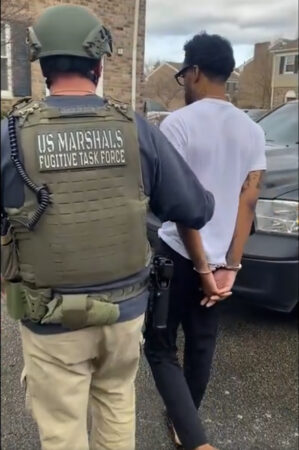
    A Philadelphia man who goes by the alias “YP SlumBoy” was arrested Thursday by U.S. Marshals and charged with killing the mother of his child, tampering with evidence and other crimes.

    Quamir Jones, 25, is accused of fatally shooting 23-year-old Siani Smith early in the morning of Oct. 12, according to an affidavit of probable cause for his arrest.

    Investigators say Smith was in the passenger seat of a vehicle with another man on the 7400 block of Dicks Avenue in the city’s Eastwick neighborhood when Jones pulled up in a car shortly after 5 a.m.

    Jones approached the front driver side of the vehicle, the affidavit says. The other man, surprised at Jones’ presence, asked whether he was blocking the driveway.

    After a short exchange between the two men, Jones drew a gun, stuck it inside the vehicle and fired once. As the vehicle sped off, Jones fired the weapon again, according to the affidavit.

    Finding Smith had been struck, the man drove her to a nearby hospital, where she was pronounced dead around 5:30 a.m.

    Meanwhile, Jones called Smith’s mother, police said. He told the woman that a group of men had been outside her home, and that she needed to go outside and pick up shell casings they left behind.

    Jones told Smith’s mother that the casings would lead back to a gun registered in his name, but she did not find any casings outside, according to the affidavit.

    Smith’s mother later told investigators she was asleep during the shooting but was awoken when she heard “five to six gunshots outside.”

    The last time Smith’s mother had seen her daughter was earlier that evening, when Smith arrived home after a night out.

    Smith’s mother said she had heard her daughter talking to the child she shared with Jones, according to the affidavit. Siani Smith and the child had moved back into the home two weeks prior.

    The woman told police Jones was known to carry guns, and investigators later learned Jones had a valid permit to carry a concealed firearm, a Glock 9mm pistol that was registered in his name in Delaware County.

    Jones had two prior arrests for gun crimes in 2022, according to the affidavit. One of those cases was dropped for reasons that were not immediately clear, and the other was dismissed for lack of evidence.

    On Thursday, Marshals arrested Jones on the 200 block of E. Mermaid Lane in Chestnut Hill, nearly three months after Smith’s death. It was not immediately clear where Jones resided during that time.

    In a post on X, the U.S. Marshals of Eastern Pennsylvania alleged Jones is a member of the city’s “Blumberg” gang.

    In addition to murder, prosecutors charged Jones with possessing an instrument of crime, criminal solicitation, recklessly endangering another person, and tampering with evidence.

    He is being held at the Curran-Fromhold Correctional Facility and was denied bail, court records show. He is represented by a court-appointed defense attorney.

    Philadelphia police confirmed Friday that Jones went by the alias “YP SlumBoy,” a rap name that has garnered a modest following on social media.

    A music video posted on YP SlumBoy’s Instagram in November includes a clip of a news anchor discussing the search for Tyvine Jones, or “Blumberg Eerd,” a North Philadelphia gang member arrested by Marshals in December for three separate killings.

    Another post on the page promotes a song called “Saddam” and features artwork depicting the former Iraqi dictator.

  • Philly has begun an $11.5 million beautification and anti-graffiti project before its big summer

    Philly has begun an $11.5 million beautification and anti-graffiti project before its big summer

    Philadelphia is cleaning up before the company gets here.

    Work is underway for a $11.5 million beautification and anti-graffiti project ahead of Philly’s coming summer of major events.

    The initiative will focus on major transportation gateways to the city. Each location will receive graffiti removal, new landscaping, fresh murals, and enhanced maintenance before visitors flock to Philly for the World Cup, the nation’s semiquincentennial, and the MLB All-Star Game.

    “We are ensuring that Philadelphia makes the right first impression as we prepare to welcome the nation and the world,” said Mayor Cherelle L. Parker at an event announcing the Gateways to Philadelphia initiative Friday.

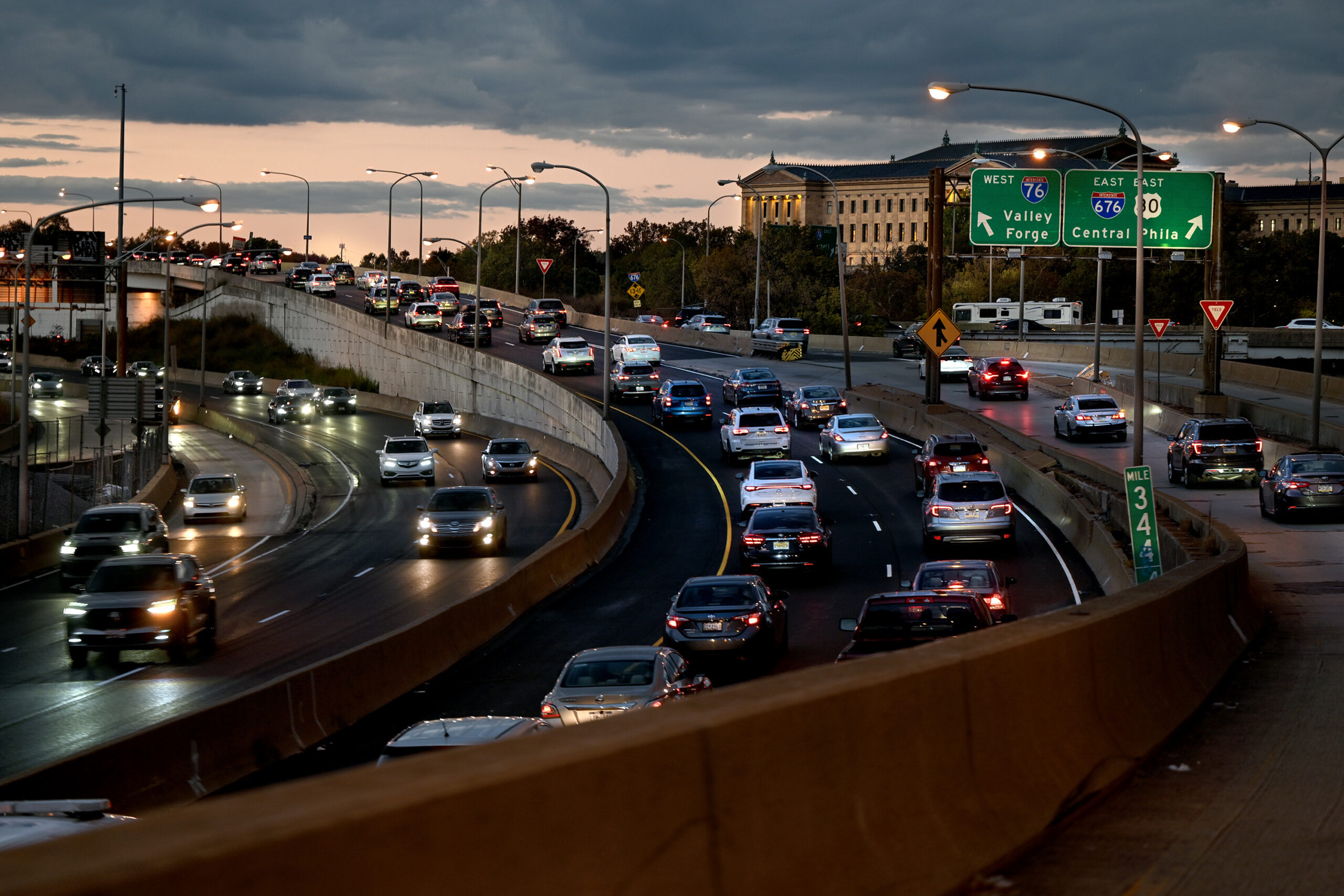
    Traffic on Interstate I-76 (Schuylkill Expressway) in Philadelphia Oct. 26, 2025. The Gateways to Philadelphia initiative will target several high traffic areas along the roadway.

    “This is our moment to make Philadelphia shine on the world’s biggest stage,” said Carlton Williams, director of the city’s Office of Clean and Green Initiatives.

    The project is led by a partnership between the city, Mural Arts Philadelphia, and the Pennsylvania Horticultural Society. It is funded by $6.5 million from the city, $3.5 million from the Pennsylvania Department of Transportation, private donations, and philanthropy.

    The beautification work will focus on seven locations in its first phase, including:

    • 26th Street at Penrose Avenue
    • South Street Bridge and ramps
    • 30th Street Station’s “honeycomb wall” and medians
    • I-76 and I-676 interchange at 15th and 16th Streets/Vine Street
    • I-76 and I-676 interchange at Sixth and Eighth Streets/Callowhill Street
    • I-76 and I-95 interchange at Second and Third Streets at Callowhill Street
    • CSX/Amtrak wall at Spring Garden Street

    Parker said that similar projects would be rolled out to other locations in the future. Work began in the fall, including the planting of 95,000 bulbs in the green spaces alongside roadways that are normally barren or filled with weeds. The project uses gold ribbons as a theme and color palette, with matching flowers and repainted walls.

    “This project is about elevating people’s experience, perception and expectations of Philadelphia, whether they live here or whether they’ve visiting for the first time,” said Pennsylvania Horticultural Society President Matt Rader.

    Mural Arts Philadelphia’s work will range from smaller murals of flowers on the blank walls hugging the interstate, to a wide Philadelphia landmark-themed mural on the CSX/Amtrak wall. Much of the mural construction will take place at night to avoid travel interruptions, but there could be some shutdowns coming on the Amtrak corridor to accommodate work, according to executive director Jane Golden.

    “Creativity belongs in public life, and even the most utilitarian of spaces can reflect care, dignity and imagination… it makes the shared spaces of our city feel alive with hope, with possibility and with beauty,” she said.

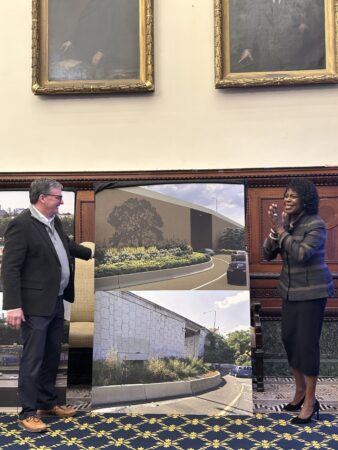
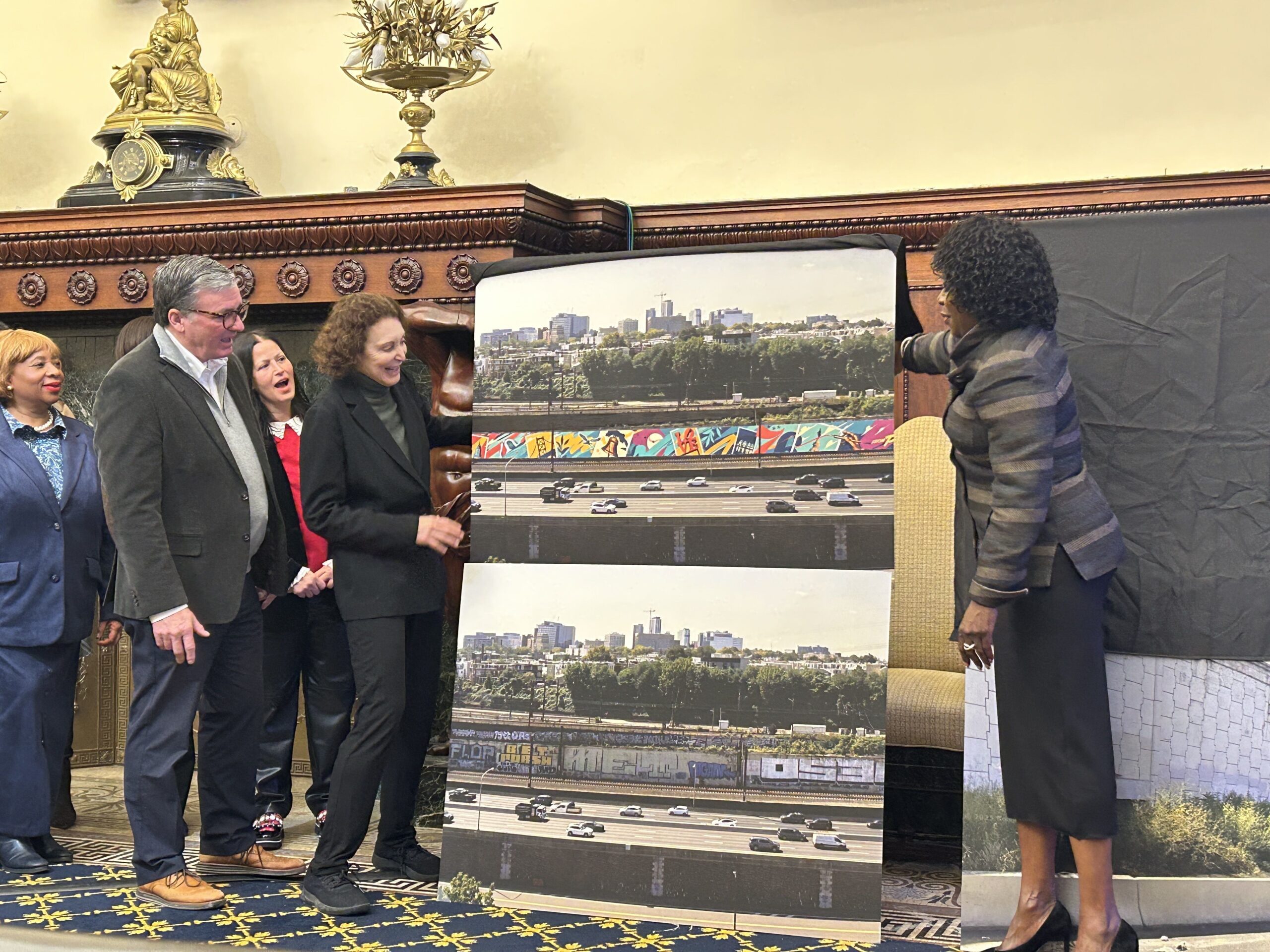
    Mayor Cherelle L. Parker and Jane Golden, Executive Director of Mural Arts Philadelphia, reveal a mockup for a new Philadelphia themed mural design coming to the CSX/Amtrak wall at Spring Garden Street. Their pasteboard shows a current look at the wall, which is filled with graffiti.

    While the project is happening largely because of visitors, speakers said they understood the need to maintain these new features for the city after the events end. PennDot’s $3.5 million contribution is meant to cover long-term maintenance.

    “As much as we want to welcome… the folks that visit Pennsylvania in 2026, it’s as much about that as it is about the folks that live in Fishtown and in South Philly,” said Pennsylvania Secretary of Transportation Michael B. Carroll.

    “This is about Philadelphia remembering who we are and getting our own house in order and making sure that it stays in order even after the company leaves,” Parker said.

    Parker said she intends for this initiative to have an impact on shaking what has become maybe Philadelphia’s most infamous nickname.

    “I’m unapologetic about this — we’re going to get rid of that ugly moniker ‘Filthadelphia,’“ she said.

  • Kenneth W. Ford, hydrogen bomb physicist, educator, and author, has died at 99

    Kenneth W. Ford, hydrogen bomb physicist, educator, and author, has died at 99

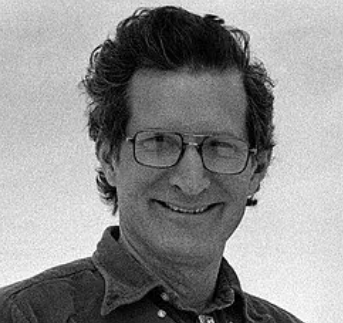
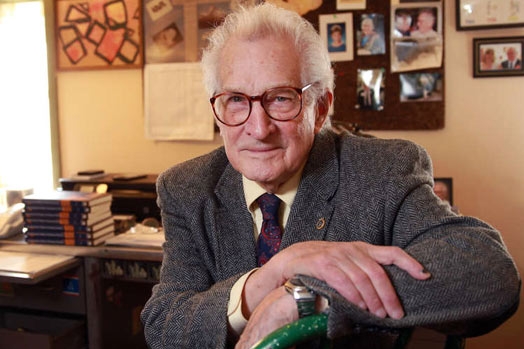
    Kenneth W. Ford, 99, of Gwynedd, Montgomery County, theoretical physicist who helped develop the hydrogen bomb in 1952, university president, college professor, executive director, award-winning author, and Navy veteran, died Friday, Dec. 5, of pneumonia at Foulkeways at Gwynedd retirement community.

    Dr. Ford was a 24-year-old physics graduate student at Princeton University in 1950 when he was recruited by a colleague to help other scientists covertly build a hydrogen bomb. “I was told if we don’t do it, the Soviet Union will,” Dr. Ford told The Inquirer in 2023, “and the world will become a much more dangerous place.”

    So he spent one year at the Los Alamos National Laboratory in New Mexico and another back at Princeton, creating calculations on the burning of the fuel that ignited the bomb and theorizing about nuclear fission and fusion. The H-bomb was tested in 1952.

    Dr. Ford’s expertise was in nuclear structure and particle and mathematical physics. He and Albert Einstein attended the same lecture when he was young, and he knew Robert Oppenheimer, Fredrick Reines, John Wheeler, and dozens of other accomplished scientists and professors over his long career.

    He came to Philadelphia from the University System of Maryland in 1983 to be president of a startup biotech firm. He joined the American Physical Society as an education officer in 1986 and was named executive director of the American Institute of Physics in 1987.

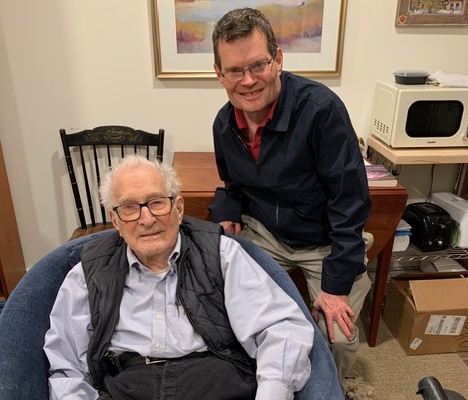
    “He always seemed to be the head of something,” his son Jason said.

    He retired from the AIP in 1993 but kept busy as a consultant for the California-based Packard Foundation and physics teacher at Germantown Academy and Germantown Friends School. Michael Moloney, current chief executive of the AIP, praised Dr. Ford’s “steady and transformative leadership” in a tribute. He said: “His career in research, education, and global scientific collaboration puts him among the giants.”

    As president of the New Mexico Institute of Mining and Technology from 1975 to 1982, Dr. Ford oversaw improvements in the school’s enrollment, faculty, budget, and facilities. He “was an accomplished researcher, scholar and teacher,” Michael Jackson, interim president of New Mexico Tech, said in a tribute, “a techie through and through.”

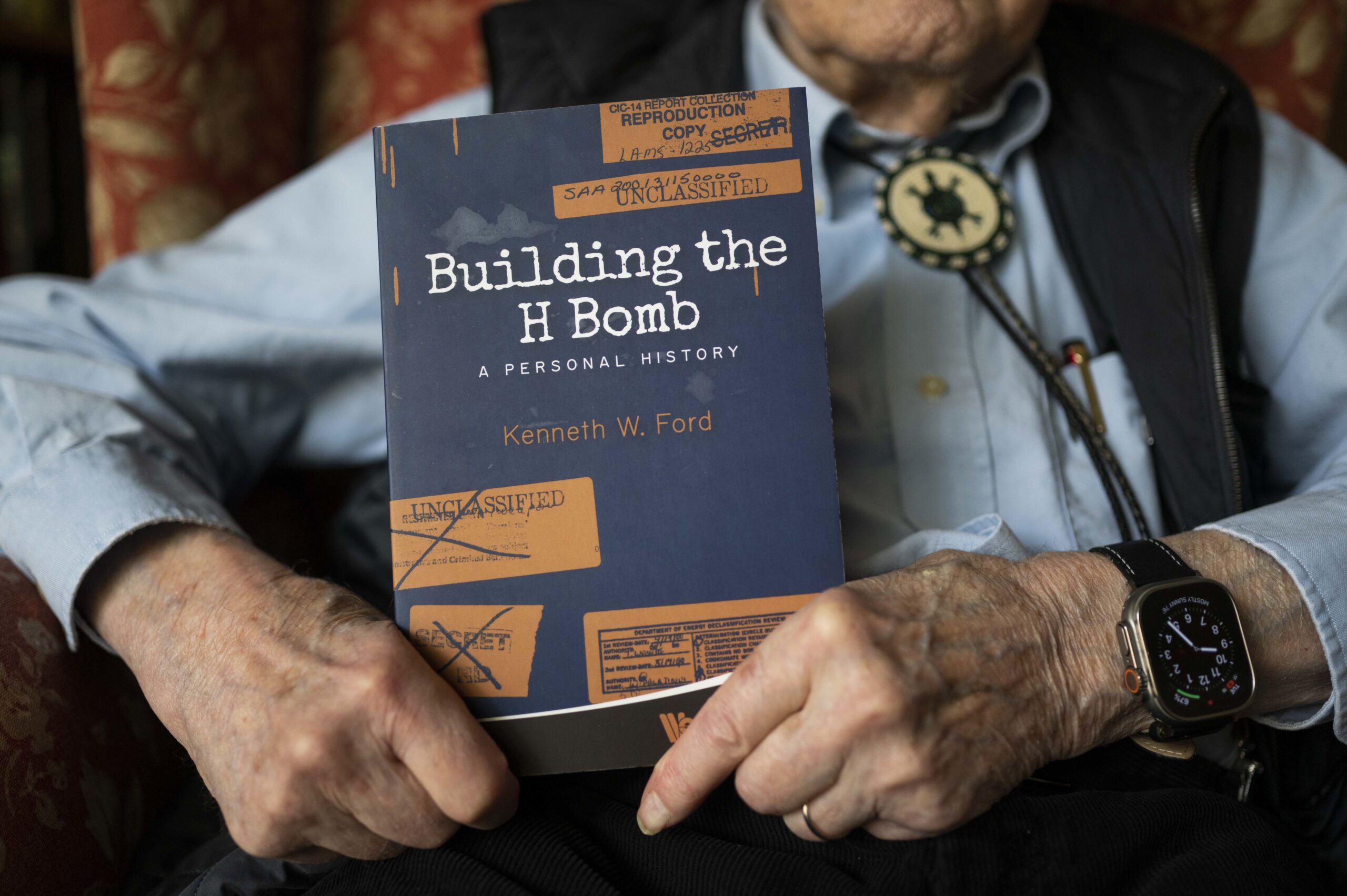
    Dr. Ford wrote “Building the H Bomb,” and it was published in 2015.

    Before Philadelphia, he spent a year as executive vice president of the University System of Maryland. Earlier, from 1953 to 1975, he was a researcher at Indiana University, physics professor at Brandeis University in Massachusetts and the University of Massachusetts, and founding chair of the department of physics at the University of California, Irvine.

    Officials at UC Irvine said in a tribute: Dr. Ford “leaves an enduring legacy as a scientist, educator, and institution builder. … The School of Physical Sciences honors his foundational role in our history and celebrates the broad impact of his distinguished life.”

    He told The Inquirer that he hung out at the local library as he grew up in a Kentucky suburb of Cincinnati and read every book he could find about “biology, chemistry, geology, you name it.” He went on to write 11 books about physics, flying, and building the H-bomb.

    Two of his books won awards, and 2015’s Building the H Bomb: A Personal History became a hit when the Department of Energy unsuccessfully tried to edit out some of his best material. His research papers on particle scattering, the nuclear transparency of neutrons, and other topics are cited in hundreds of publications.

    Dr. Ford was a popular professor because he created interesting demonstrations of physics for his students.

    In 1976, he earned a distinguished service citation from the American Association of Physics Teachers. In 2006, he earned an AAPT medal for notable contributions to the teaching of physics.

    He was the valedictorian at Phillips Exeter Academy in New Hampshire in 1944. He served two years in the Navy and earned a summa cum laude bachelor’s degree in physics at Harvard University and his doctorate at Princeton in 1953.

    In 1968, he was so opposed to the Vietnam War that he publicly declined to ever again work in secret or on weapons. “It was a statement of principle,” he told The Inquirer.

    Kenneth William Ford was born May 1, 1926, in West Palm Beach, Fla. He married Karin Stehnike in 1953, and they had a son, Paul, and a daughter, Sarah. After a divorce, he married Joanne Baumunk, and they had daughters Caroline and Star, and sons Adam and Jason. His wife and former wife died earlier.

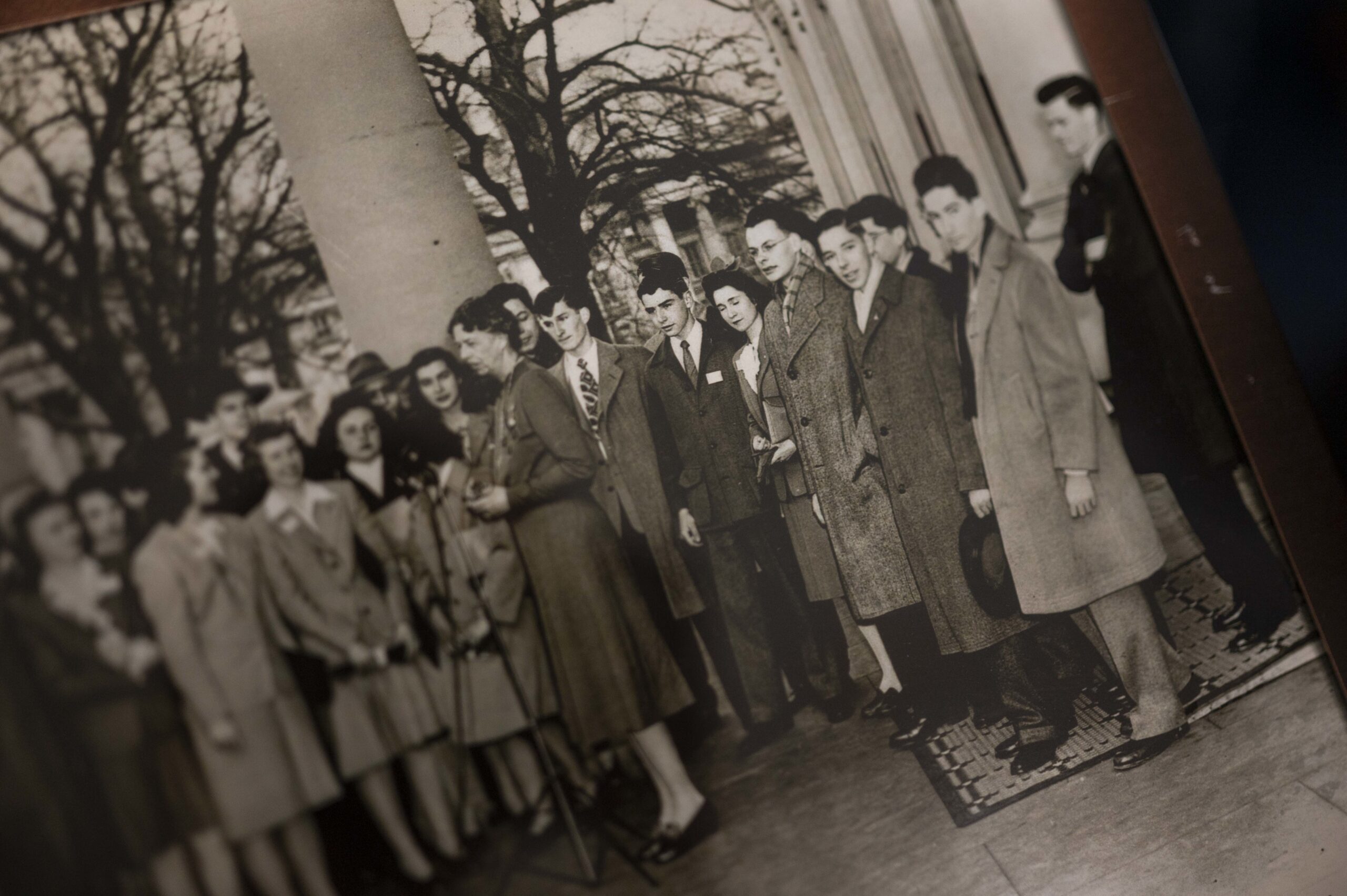
    This photo shows Dr. Ford (center) and other students listening to former First Lady Eleanor Roosevelt speak in 1944.

    Dr. Ford lived in University City, Germantown, and Mount Airy before moving to Foulkeways in 2019. He was an avid pilot and glider for decades. He enjoyed folk dancing, followed the Eagles closely, and excelled at Scrabble and other word games.

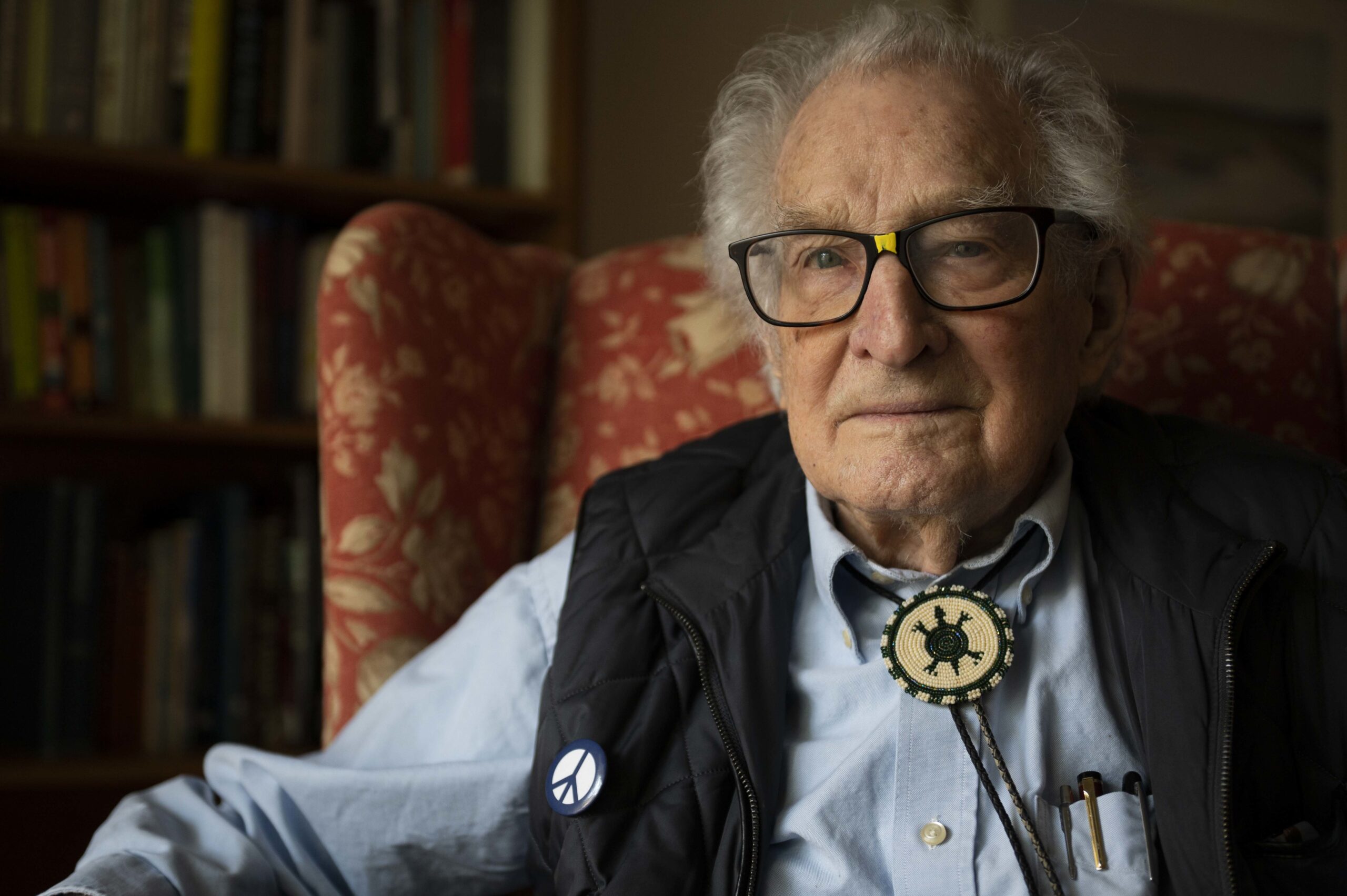
    He loved ice cream, coffee, and bad puns. He became a Quaker and wore a peace sign button for years. Ever the writer, he edited the Foulkeways newsletter.

    In 2023, he said: “I spent my whole life looking for new challenges.” His son Jason said. “He found connections between things. He had an active mind that went in all different directions.”

    In addition to his children, Dr. Ford is survived by 14 grandchildren, a great-grandson, a sister, a stepdaughter, Nina, and other relatives.

    Services are to be from 2 to 4:30 p.m., Saturday, Jan. 24, at Foulkeways at Gwynedd, 1120 Meetinghouse Rd., Gwynedd, Pa. 19436.

    Dr. Ford and his son Jason
    Dr. Ford wore a peace sign button for years.
  • An Indonesian man was deported on Christmas after being arrested at a routine immigration appointment in Philly

    An Indonesian man was deported on Christmas after being arrested at a routine immigration appointment in Philly

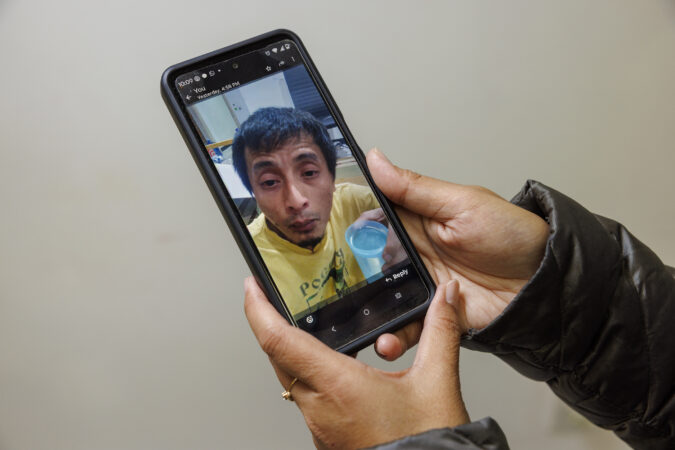
    A longtime Philadelphia resident who was arrested by ICE at a routine immigration appointment has been deported to Indonesia, his family said.

    Rian Andrianzah, 46, walked into a Philadelphia office of U.S. Citizenship and Immigration Services on Oct. 16, expecting to be fingerprinted and photographed and sent home, but instead was taken into custody and placed in detention.

    On Christmas night he was flown to Jakarta, the Indonesian capital, leaving behind his wife, also of Indonesia, and two children who are American citizens.

    The case angered the city’s Indonesian community ― and placed Andrianzah among a growing number of immigrants who have shown up for routine immigration appointments or check-ins, only to be handcuffed and taken into detention.

    Green-card applicants, asylum-seekers, and others who have ongoing legal or visa cases have been unexpectedly detained in what lawyers and advocates say is a Trump administration strategy to boost arrests and deportations.

    “It’s frustrating, because we’re going to be able to bring him back in the next few months,” said Philadelphia immigration attorney Christopher Casazza, who represents Andrianzah and his family. “They deported him simply [to gain] a statistic.”

    He expects Andrianzah could be able to return to the United States in the summer, via a legal process that could grant status to his wife and, through her, to him.

    Andrianzah’s wife, Siti Rahayu, 44, has a strong case to be awarded a T visa, the family’s lawyer said. That visa offers permission to live in the U.S. and a path to permanent residency and citizenship. As her husband, Andrianzah would receive those same benefits under her visa, said Casazza, of the Philadelphia firm Palladino, Isbell & Casazza LLC.

    Rahayu said in a text message that she was distressed and not up to discussing her husband’s deportation. Others said his removal hurts the family and the community.

    “Rian’s absence means a family without their father and our community without a friend,” said Kintan Silvany, the civic-engagement coordinator at Gapura, which works to empower local Indonesian Americans. “A warm, friendly face will no longer be seen at our annual festivals and cultural events. ICE has taken a beloved member who helped us and the folks around him.”

    Andrianzah, meanwhile, like other deportees faces a return to a homeland transformed by time, where family ties have dwindled and emotional and financial hardship looms, his lawyer said.

    Immigration and Customs Enforcement officials were unable to immediately reply to a request for comment.

    A T visa can be available to people who have been victims of human trafficking. It offers a near-blanket waiver on past immigration violations. Authorities say the issuance of T visas offer protection to victims while enhancing the ability of law-enforcement agencies to detect and prosecute human trafficking.

    Andrianzah legally entered the United States on a visitor’s visa in February 2000, but did not return to Indonesia before it expired. He was placed in removal proceedings in 2003, and a judge issued a final order of deportation in November 2006. His appeal was denied two years later.

    The removal order was never enforced, as had been common for those the government then saw as low-priority immigration violators. Some people with final orders have lived in the U.S. for decades.

    Since then Andrianzah worked factory and warehouse jobs, and married. He and his wife made a home in South Philadelphia and became parents of a son, age 8, and a daughter, 15, both U.S. citizens.

    Andrianzah and his wife went to USCIS that October day as part of her T-visa application. In an interview with The Inquirer, Rahayu said she was sent to the U.S. in 2001 by relatives who saw her as a means to pay off a debt, delivering her to an underground organization that puts people in low-paying jobs, then keeps them working indefinitely. Her work would help pay the debt owed by her relatives.

    Rahayu said that on Oct. 16, she completed her own biometrics appointment, then grew concerned when her husband did not appear. She soon learned he had been arrested.

    Some immigrants are required to appear every couple of weeks, some once a month, others once a year. The appointments help immigration officials keep track of people who in the past have been low priorities for deportation.

    Biometrics appointments are usually brief sessions at which the government captures fingerprints, a passport-style photo, and a signature. The immigrant may also be asked to provide information like height and weight.

    Despite the fresh risk of being arrested on the spot, immigrants have little option except to show up. Many types of immigration applications require in-person appearances. And failure to appear for a required ICE appointment can by itself result in an order for removal.