Two former Philadelphia homicide detectives were sentenced Wednesday to a combined three years of probation for lying about their knowledge of DNA evidence during the retrial of a man they helped convict of murder 35 years ago.
Common Pleas Court Judge Lucretia Clemons imposed a two-year probation sentence for Manuel Santiago, 76, and one-year sentence for Frank Jastrzembski, 78. The retired detectives will not be required to meet with probation officers.
The sentencing punctuates an unusual case in which prosecutors accused three retired Philadelphia police officers of fabricating evidence in a decades-old homicide case, and later perjuring themselves when testifying about that evidence under oath. A grueling eight-day trial in March revisited the 1991 murder of 77-year-old Louis Talley in Nicetown and the 2016 retrial of Anthony Wright, the man police helped send to prison for the crime.
The jury ultimately rejected the larger conspiracy built by prosecutors that the detectives had framed Wright, but found both Santiago and Jastrzembski guilty of misdemeanor false swearing and found Santiago guilty on an additional count of perjury, a felony. A third detective who worked on the case, Martin Devlin, was acquitted of all charges.
Santiago’s attorney, Fortunado Perri Jr., thanked Clemons for the “appropriate” sentence on Wednesday. Steve Patton, an attorney for Jastrzembski, reiterated that the jury had acquitted his client of planting evidence and described the conviction as a matter of “technical knowledge.”
“We’re pleased with that outcome and thankful for the judge’s careful consideration of the facts of this case,” Patton said.
In an interview Wednesday, Krasner blasted what he described as lenient sentencing guidelines for lying under oath in Pennsylvania. Probation is the recommended sentence for a false swearing conviction, while the maximum recommended penalty for perjury is nine months.
“Those sentencing guidelines are disgraceful,” Krasner said, while also acknowledging the two defendants are both now in their 70s and have health issues.
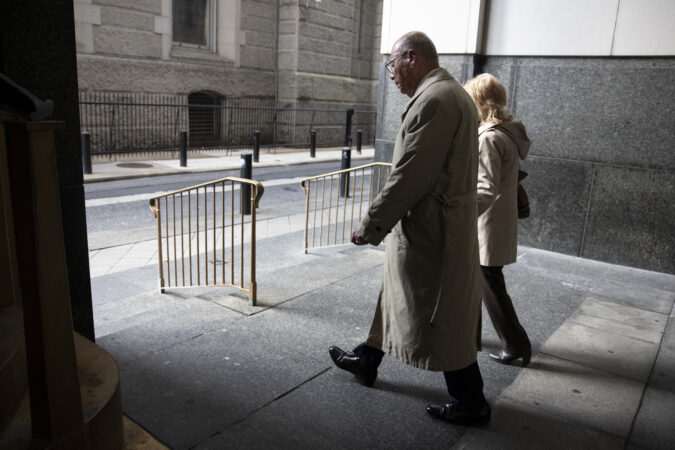
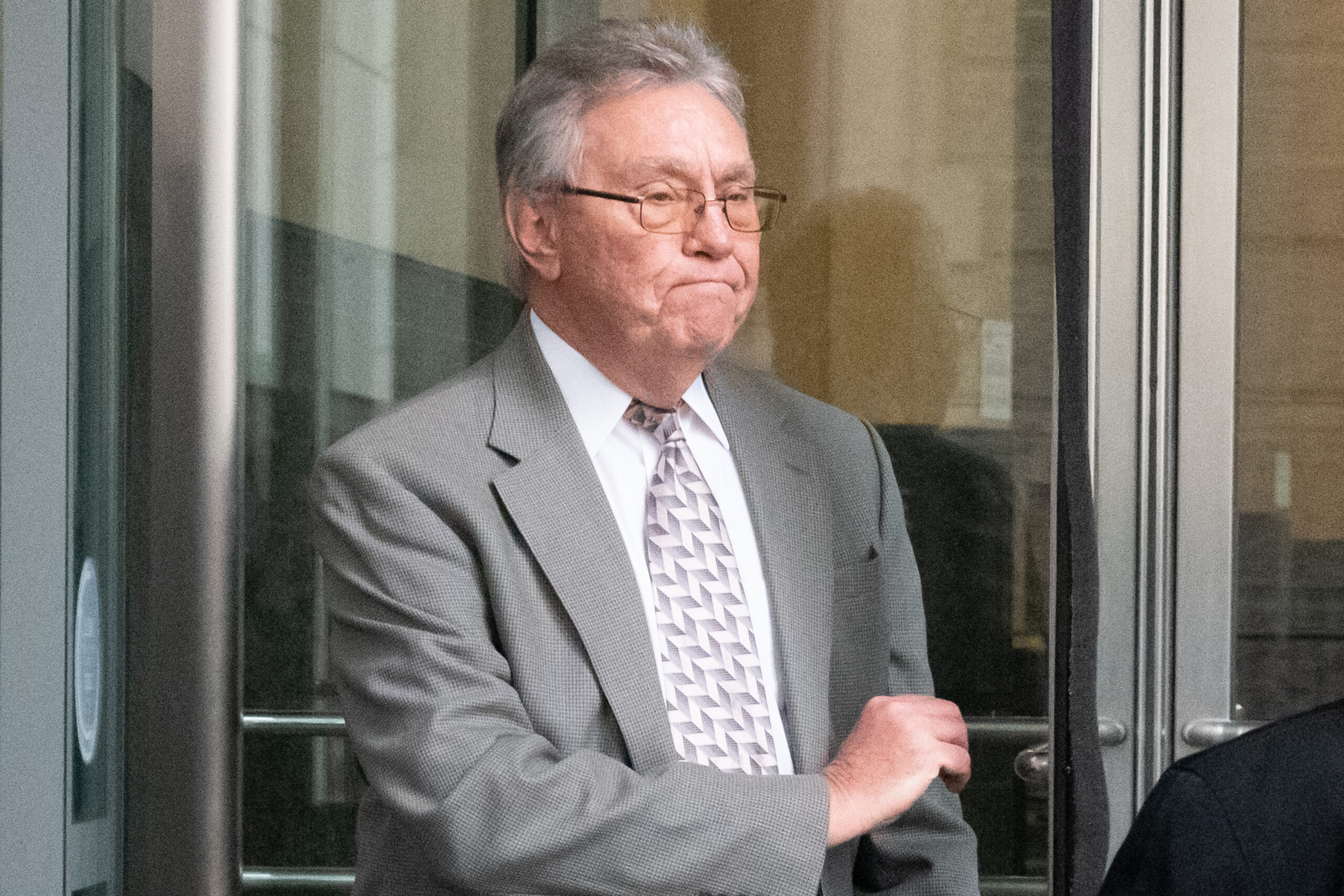
Former Philadelphia Police Detective Frank Jastrzembski leaves the Criminal Justice Center in Philadelphia on March 17, 2025.
At trial, Krasner’s top prosecutors contended that the three detectives had conspired to frame Wright for Talley’s murder, extracted a false confession from him, and planted evidence in his home.
Santiago was acquitted of perjury in connection with his testimony about Wright’s murder confession, while Jastrzembski was acquitted of perjury and related charges for his testimony about a search warrant he executed at Wright’s home — charges that hinged on prosecutors’ ability to prove the detectives had wholly fabricated evidence.
Instead, the convictions centered on what Santiago and Jastrzembski knew about the evidence against Wright when they testified at his 2016 retrial. The two detectives were instrumental in building the original case against Wright in 1991, and later sought to send him back to prison — even after DNA evidence implicated another man in Talley’s murder. Wright’s conviction was overturned in 2014 based on the strength of that forensic science.
When prosecutors under former District Attorney Seth Williams charged Wright a second time — under suspicion that he had acted with an accomplice — Santiago and Jastrzembski were briefed on the new DNA information. The results pointed to a known crack user who lived near Talley in Nicetown, a man who had since died in a prison.
Under oath at Wright’s retrial, however, Santiago and Jastrzembski denied knowing the DNA evidence implicated another suspect.
Wright was acquitted and later filed a federal civil rights lawsuit against the city and won a $9.85 million settlement. During sworn depositions in that case, Santiago and Jastrzembski were questioned about the DNA evidence and gave answers that prosecutors said contradicted their earlier trial testimony.
The perjury trial in March at times resembled a second retrial for Wright, with defense attorneys accusing him of getting away with Talley’s murder. Wright proclaimed his innocence.
Following the jury’s verdict, Krasner insisted that the detectives had framed Wright, and he criticized his predecessor’s decision to retry the man after his conviction was overturned.
The American colonies in the autumn of 1775, then under the thumb of King George III and his sprawling British Empire, were divided on the prospect of independence.
Revolutionary ideas start in refined quarters, but they must spread to the masses to surge into action.
And the 13 colonies were divided in threes: those who favored independence from English rule, those who opposed it, and those who wished to remain neutral.
And then the spark arrived as a pamphlet.
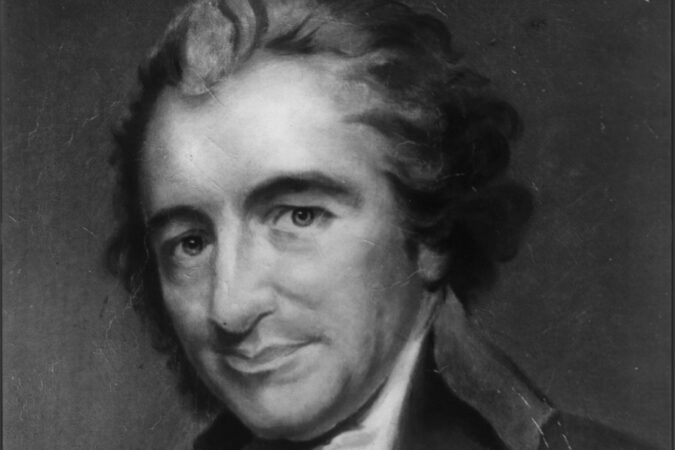
On Jan. 10, 1776, in a small publishing house at Third and Walnut Streets in present-day Old City, Englishman Thomas Paine published his 47-page document. It promoted the cause of American independence, and stoked the fires of revolution.
This pamphlet, titled “Common Sense,” was first printed anonymously.
But the colonists knew who wrote it.
An original English printing of “Common Sense,” the pamphlet written by Thomas Paine, combined with a rebuke entitled “Plain Truth” by James Chalmers, a British Loyalist officer. The two pamphlets were reprinted together in a book in London in 1776.
Paine was a self-educated rabble-rouser who had found little success making corsets or collecting taxes.
And who, upon meeting Benjamin Franklin after giving a speech in London,opted to join the upstart colonists and move to America in 1774.
After following Franklin to Philadelphia, he followed him into journalism, writing and editing for Pennsylvania Magazine.
It’s where he displayed a knack for speaking to the common people through essays denouncing slavery, promoting women’s rights, and dumping on English rule.
And again he took from Franklin, turning his pamphlet into a lightning rod.
In it he laid out his arguments in plain language.
An island, he argued, should not rule a continent.
“Every thing that is right or natural pleads for separation,” he wrote.
More than 500,000 copies circulated the colonies, convincing the commoners, the people who would actually take up arms against the Royal military,to support a war against Great Britain.
Despite his outsized role in lighting the fires of rebellion, Paine’s services would go unrecognized for a generation.
Hetemporarily returned to Europe after the war, and his later denouncing of Christianity did him no favors on either side of the Atlantic. He died in poverty in New York in 1809 at age 72.
It wouldn’t be until the mid-1970s for historians to recognize the enduring power of Paine’s pamphlet, which now holds a place of honor a step below Thomas Jefferson’s Declaration of Independence.
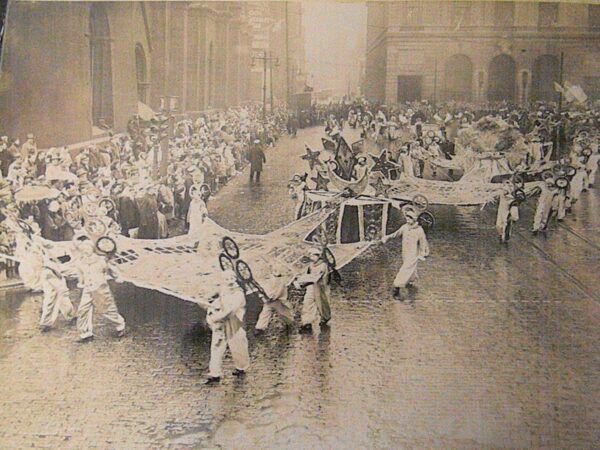
As the fog lifted on Jan. 1, 1901, four Fancy Dress Clubsand 16 Comic Clubs gathered at the corner of Broad and Reed Streets for the first ever Mummers Parade.
“Kings, emperors, knights and jesters, clothed in purple royal or tinkling tensel [sic], wended their way up the broad thoroughfare …” reads a front-page story from the Jan. 2, 1901, Philadelphia Inquirer. “In the throng of merry makers, no tribe no nation, scarcely an individual was neglected.”
That inaugural Mummers Parade was America’s first folk parade. It also marks the first time an American city hosted a New Year’s Day procession.
It will be remembered Saturday at the Firstival in the Mummers Museum. Firstivals are the Philadelphia Historic District’s weekly day parties celebrating historic events that happened in Philadelphia before anywhere else in America, and often the world. They are part of a yearlong celebration of America’s 250th birthday.
Artist Anh Ly’s No. 1 highlights the Mummers Parade’s vibrant costumes, instruments and playful traditions.
That first Mummers Parade began 125 years ago at 9 a.m. on a chilly overcast morning, said Mark A. Montanaro, the Mummers Museum’s curator. It took participants just two hours to march up Broad Street and around City Hall to Girard Avenue.
Three hundred dollars — $11,575 in today’s money — was awarded to the parade’s two first-place winners: the Elkton Association, part of the Fancy Dressed Club; and the White Cap Association, belonging to the Comic Club.
Revelers partied all day and into the night.
The boisterousness remains to this day. So much so that the Philadelphia Historic District did not want to start the Firstival celebrations with the parade, even though that was the initial plan. Why? Because they assumed the Mummers would still be recovering from their parade.
The word mummer is derived from Momus, the Greek god of satire and mockery. Mommer is the Old French word for mime.
Philadelphia’s 17th century English and Swedish immigrants dressed in elaborate regalia during the days between Christmas and New Year’s, knocked on their neighbors’ doors, and demanded treats of sweets and nuts. Over the decades, the door-to-door tradition turned into rambunctious neighborhood parties as Dutch, Irish, and Italian immigrants joined in on the fun.
In November of 1900, Philadelphia Evening Bulletin reporter and theatrical promoter H. Bart McHugh and City Councilman John H. Baizley asked Mayor Samuel Ashbridge if the city would consolidate the block parties into one big parade.
Plans were finalized by mid-December.
The Mummers Parade remains one of Philadelphia’s most enduring traditions. It’s only been canceled three times: during the 1919 Spanish Flu, 1934 during the Great Depression, and 2021 during COVID. (This year, the String Band Division called off its competition due to strong winds.)
The Jokers perform during the Fancy Brigade Finale at the Pennsylvania Convention Center during the 2026 Mummers Parade in Philadelphia on Thursday, Jan. 1, 2026.
Parade routes have changed; today it starts at City Hall and ends at Washington Avenue. At times its been fraught with racial controversy, as some members have appeared in blackface as recently as 2020.
That’s all in the past, Montanaro stressed.
“The Mummers are striving for inclusivity,” Montanaro said. “We are a little bit of Mardi Gras, a little bit of Carnival, and a whole lot of Philly.”
This week’s Firstival is Saturday, Jan. 9, 11 a.m. — 1 p.m., at the Mummers Museum, located at 1100 S. 2nd Street. The Inquirer will highlight a “first” from Philadelphia Historic District’s 52 Weeks of Firsts program every week.
In Kensington, a program to mitigate street violence was hitting its stride.
After joining the New Kensington Community Development Corporation in 2023, outreach coordinators with Cure Violence began responding to shootings in the neighborhood, connecting folks with mental health services and other wellness resources.
They hosted men’s therapy groups, safe spaces to open up about the experience of poverty and trauma, and organized a recreational basketball league at residents’ request. Their team of violence interrupters even intervened in an argument that they said could have led to a shooting.
Cure Violence Kensington was funded by a $1.5 million federal grant from the Department of Justice, part of a Biden-era initiative to combat the nation’s gun violence epidemic by awarding funds to community-based anti-violence programs rather than law enforcement agencies.
One year after a political shift in Washington, however, federal grants that Philadelphia’s anti-violence nonprofits say allowed them to flourish are disappearing.
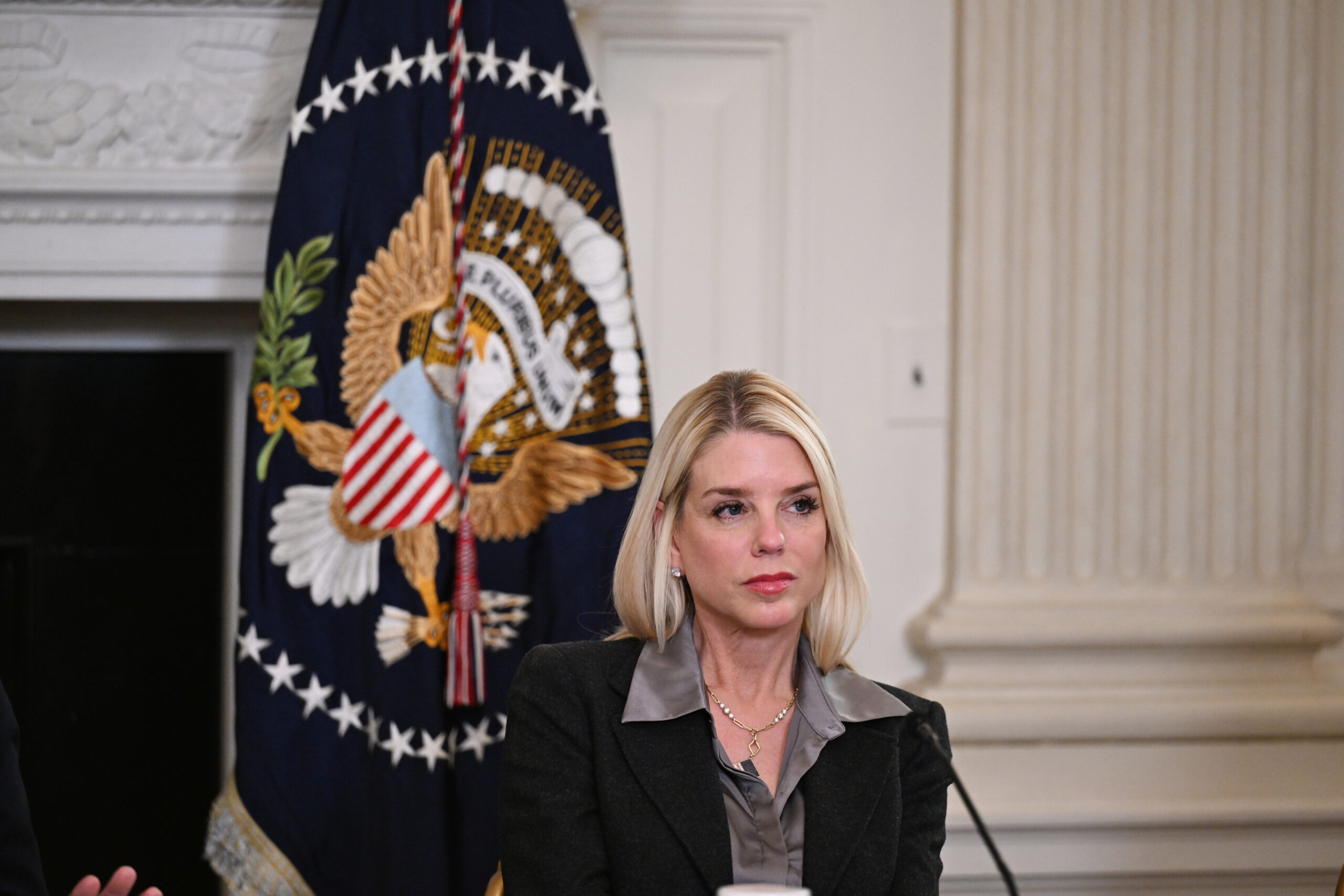
In the spring, New Kensington CDC received a letter from the Justice Department, saying that under the leadership of Attorney General Pam Bondi it had terminated the grant that would have funded Cure Violence for the next three years.
The work, the letter said, “no longer effectuates the program goals or agency priorities.” In the future, it said, the department would offer such grants exclusively to local law enforcement efforts.
“It was a heavy hit,” said Bill McKinney, the nonprofit’s executive director.
The cuts come amid a Trump administration crackdown on nonprofits and other organizations it views as either wasteful or focused on diversity and DEI.
It spent 2025 slashing funds for programs that supplied aid abroad, conducted scientific research, and monitored climate change. At the Justice Department, cuts came for groups like McKinney’s, which aim to target the root causes of violence by offeringmental health services, job programs, conflict mediation, and other alternatives to traditional policing.
In Philadelphia, organizations like the Antiviolence Partnership of Philadelphia and the E.M.I.R. Healing Center say they, too, lost federal funding last yearand expect to see further reductions in 2026 as they scramble to cover shortfalls.
A Justice Department spokesperson said changes to the grant program reflect the office’s commitment to law enforcement and victims of crime, and that they would ensure an “efficient use of taxpayer dollars.”
“The Department has full faith that local law enforcement can effectively utilize these resources to restore public safety in cities across America,” the spokesperson said in an email.
Nonprofits may appeal the decisions, the spokesperson said, and New Kensington CDC has done so.
Attorney General Pam Bondi takes part in an event at the White House on Oct. 23.
Philadelphia city officials, for their part, say they remain committed to anti-violence programs, in which they have invested tens of millions of dollars in recent years.
“There are always going to be things that happen externally that we have no control over as a city,” said Adam Geer, director of the Office of Public Safety.
The reversal in federal support comes at a time when officials like Geer say the efforts of anti-violence programs are beginning to show results.
Violent crime in Philadelphia fell to historic lows in 2025, a welcome relief after the sharp upturn in shootings and homicides that befell the city at the height of the pandemic.
In 2021, the city announced a large-scale campaign to combat gun violence that,in the past year, included nearly $24 million for anti-violence programs.
That was on top of the Biden administration’s Community Based Violence Intervention and Prevention Initiative. Since launching in 2022, the DOJ program awarded more than $300 million to more than 120 anti-violence organizations nationwide.
In April, many of those groups, including New Kensington CDC, lost funds. And in September, a larger swath learned they were now barred from applying for other Justice Department grants that would have arrived this spring.
“We’ve seen enormous dividends” from the work of such groups, said Adam Garber, executive director of CeaseFirePA, a leading gun violence prevention group in the state. “Pulling back now puts that progress at risk — and puts lives on the line.”
Philadelphia feels the squeeze
Federal grants helped Natasha McGlynn’s nonprofit thrive.
McGlynn, executive director of the Antiviolence Partnership of Philadelphia, said a DOJ grant called STOP School Violence allowed her organization to launch a counseling program for young people who had been victims of violence or otherwise exposed to it in some of the city’s most violent neighborhoods.
The nonprofit used the grant to hire therapists to help students develop healthier attitudes around conflict and trauma, she said.
The $997,000 grant was cut in April, and when McGlynn went to apply for another round of funding in the fall, she learned that nonprofits were no longer eligible. The lost funding means some services, like counseling, could now be eliminated, she said.
“I would say several positions are in question,” McGlynn said. “I would say the program is in question.”
Chantay Love, the director of Every Murder is Real, said her Germantown-based victim services nonprofit also lost Justice Department funding in 2025.
Federal grants are not the nonprofit’s only source of income, Love said, but she along with other nonprofit leaders in the city are considering whether they’ll need to cut back on programs this year.
Record-setting investment
The decade before the pandemic saw gun-related deaths in the state climb steadily, spiking during the lockdown as social isolation, school closures, shuttered community services, and higher levels of stress contributed to a spate of gun homicides and shootings that began to ease only in 2024.
Two years earlier, the state began dispersing more than $100 million to community-based anti-violence programs, much of the money coming from the American Rescue Plan, a sweeping Biden administration pandemic recovery package that also sought to reduce rising gun violence. And when those funds expired, state lawmakers continued to invest millions each year, as did Philadelphia city officials.
Garber, of CeaseFirePA, said those efforts “get a lot of heavy-lifting credit” for Philadelphia’s historic decrease in violence.
A report compiled by CeaseFirePA cites studies that found outreach programs like Cure Violence helped reduce shootings around Temple University, as well as in cities like New York and Baltimore, where homicides and shootings in some parts of the city fell by more than 20%.
While it’s too early for data to provide a full picture on how such funding has contributed to overall violence reduction, officials like Geer, the Philadelphia public safety director, agreed that programs like Cure Violence have helped crime reach record lows.
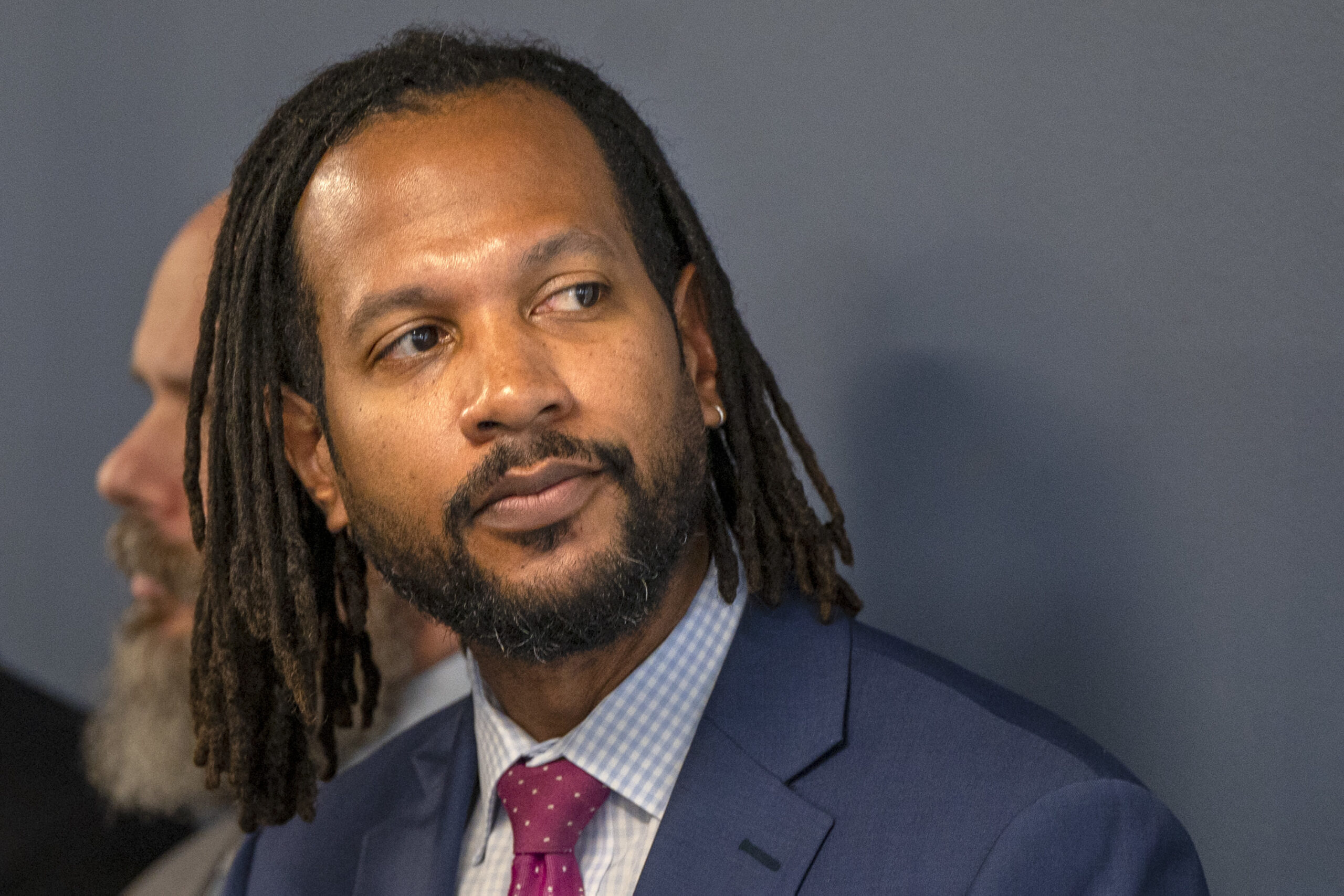
Philadelphia acting chief public safety director Adam Geer attends a news conference on Jan. 30, 2024, about a shooting that left an officer wounded and a suspect dead.
Outreach workers with the city-supported Group Violence Intervention program made more than 300 contacts with at-risk residents in 2025, according to data provided by Geer’s office, either offering support or intervening in conflicts.
And they offered support to members of more than 140 street groups — small, neighborhood-oriented collectives of young people that lack the larger organization of criminal gangs — while more than doubling the amount of service referrals made the previous year.
In practice, a program’s success looks like an incident in Kensington in which Cure Violence workers intervened in a likely shooting, according to members of New Kensington CDC.
In April, a business owner called on the nonprofit after seeing a group of men fighting outside his Frankford Avenue store and leaving to return with guns. Members of the outreach team spoke with both parties, de-escalating the conflict before it potentially turned deadly.
“Each dollar cut is ultimately a potential missed opportunity to stop a shooting,” Garber said.
Cutting off the ‘spigot’
Even as community-based anti-violence programs have risen in popularity, they are not without their critics.
While some officials champion them as innovative solutions to lowering crime, others say the programs can lack oversight and that success is difficult to measure.
In 2023, an Inquirer investigation found that nonprofits with ambitious plans to mitigate gun violence received millions in city funds, but in some cases had no paid staff, no boards of directors, and no offices.
A subsequent review by the Office of the Controller found some programs had not targeted violent areas or had little financial oversight. But by the next round of funding, the city had made improvements to the grant program, the controller’s office found, adding funding benchmarks and enhanced reporting requirements.
Meanwhile, as Philadelphia continued its support these programs, President Donald Trump’s Justice Department began a review of more than 5,800 grants awarded through its Office of Justice Programs. It ultimately made cuts of more than $800 million that spring.
Among programs that lost funding, 93% were “non-governmental agencies,” including nonprofits, according to a letter DOJ officials sent to the Senate explaining the decision.
The balance of remaining funds in the violence prevention grant program — an estimated $34 million — will be available for law enforcement efforts, according to a DOJ grant report. In addition to fighting crime, the money will help agencies improve “police-community relations,” hire officers, and purchase equipment, the document says.
Agencies conducting immigration enforcement are also eligible for grants, the report says, while groups that violate immigration law, provide legal services to people who entered the country illegally, or “unlawfully favor” people based on race are barred.
One group lauding the cuts is the National Rifle Association, which commended the Trump administration in November for cutting off the “spigot” to anti-violence nonprofits.
‘[T]he changes hopefully mean that nonprofits and community groups associated with advocating gun control will be less likely to do it at the expense of the American taxpayer and that real progress can occur on policing violent criminals,” the NRA’s legislative arm wrote in a blog post that month.
Nate Riley disagrees.
Riley, an outreach worker with Cure Violence Kensington, said the cuts threaten to reverse the progress New Kensington CDC has made since he joined the program early last year.
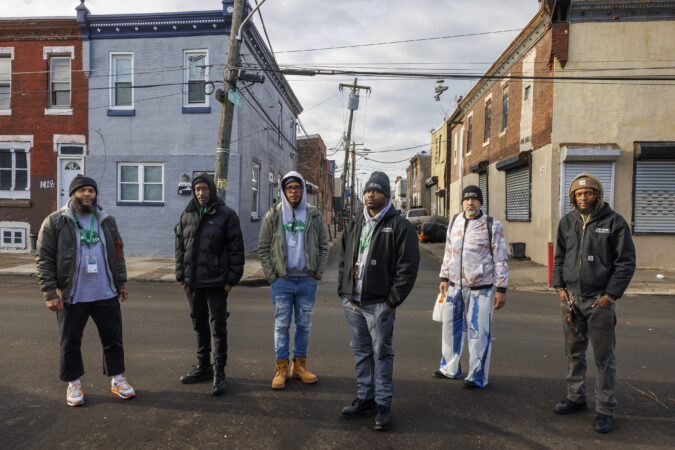
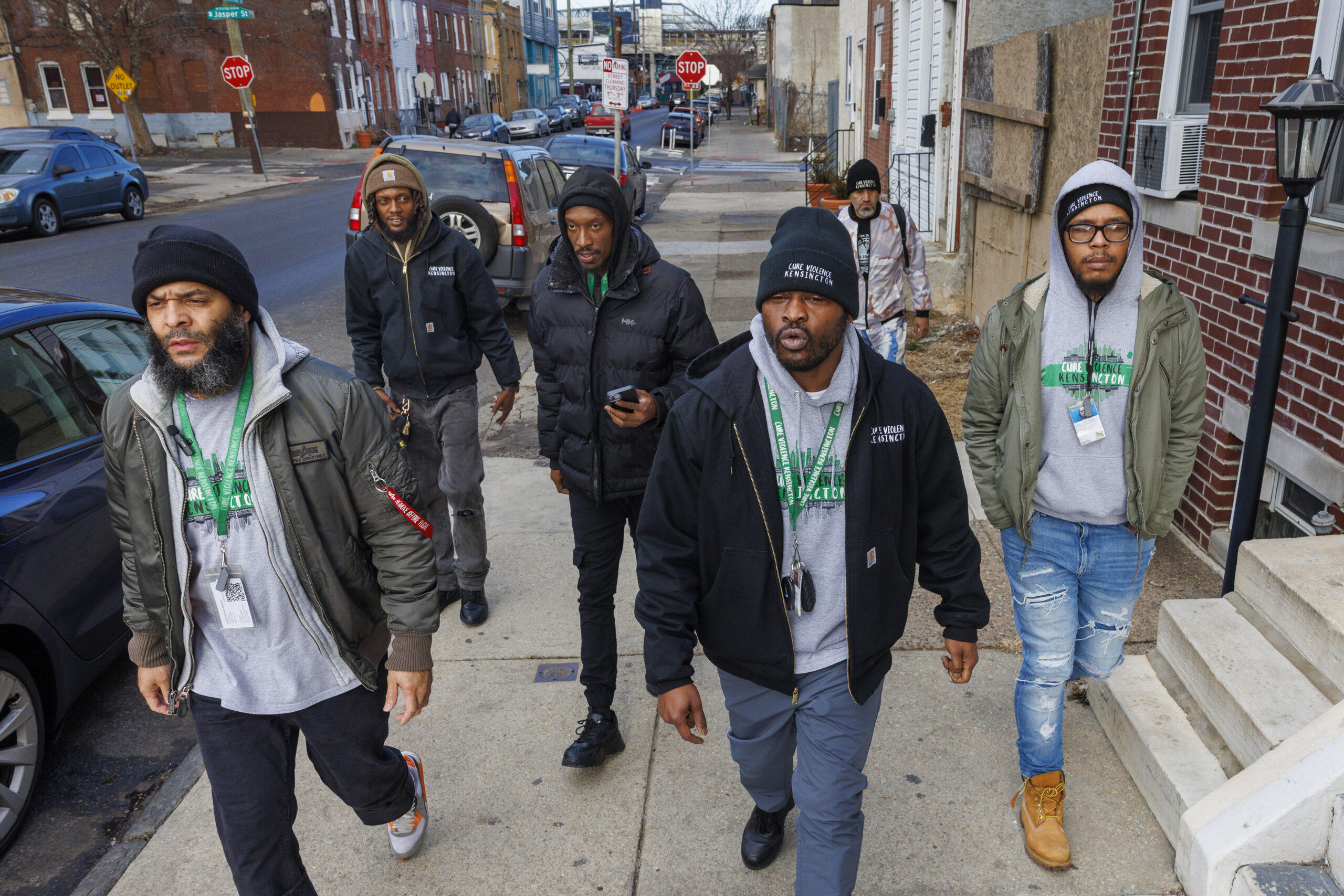
Nate Riley (from left), Tyree Batties, Dante Singleton, Tyreek Counts, Ivan Rodriguez, and Jamall Green-Holmes, outreach workers with New Kensington Community Development Corporation, making their rounds on Wednesday.
Cure Violence’s six-person outreach team is made up of people like Riley, who grew up in North Philadelphia and says he is well-versed in the relationship between poverty, trauma, and violence and brings that experience to Kensington.
“This is a community that’s been neglected for decades,” Riley said. “For lack of a better term, you’ve got to help them come in outside of the rain.”
In a recent month, Cure Violence outreach workers responded to 75% of shootings in the Kensington area within three days, a feat Riley is particularly proud of.
He said the program is not meant to supplant the role of police.
Instead, Riley sees street outreach as another outlet for those whose negative experiences with authorities have led them to distrust law enforcement.
Those people may alter their behavior if they know police are present, he added, giving outreach workers embedded in the community a better chance at picking up on cues that someone is struggling.
From Kensington to Washington
McKinney, with New Kensington CDC, said the group was still expecting about $600,000 from the Justice Department when the grant was cut short.
The nonprofit has since secured a patchwork of private donations and state grants that will keep Cure Violence running through much of 2026, he said.
After that, the program’s future is uncertain.
In the wake of the cuts, national organizations like the Community Justice Action Fund are advocating for federal officials to preserve funding for community-based anti-violence programs in future budgets. Adzi Vokhiwa, a federal policy advocate with the fund, said the group has formed a network of anti-violence nonprofits dubbed the “Invest in Us Coalition” to do so.
The group petitioned congressional leadership in December to appropriate $55 million for anti-violence organizations in the next budget — a figure that both Democrats and Republicans in the Senate have previously agreed on and that Vokhiwa views as a sign of bipartisan support for such programs.
McKinney, with New Kensington CDC, said it was impossible to ignore that the nonprofit and others like it provide services to neighborhoods where residents are overwhelmingly Black and brown. In his view, the cuts also reflect the administration’s “war on cities.”
He was bothered that the Justice Department did not seem to evaluate whether New Kensington CDC’s program had made an impact on the neighborhood before making cuts.
“We’re in a situation where the violence isn’t going away,” he said. “Even if there’s been decreases, the reality is that Kensington still leads the way. As those cuts get deeper, we are going to see increases in violence.”
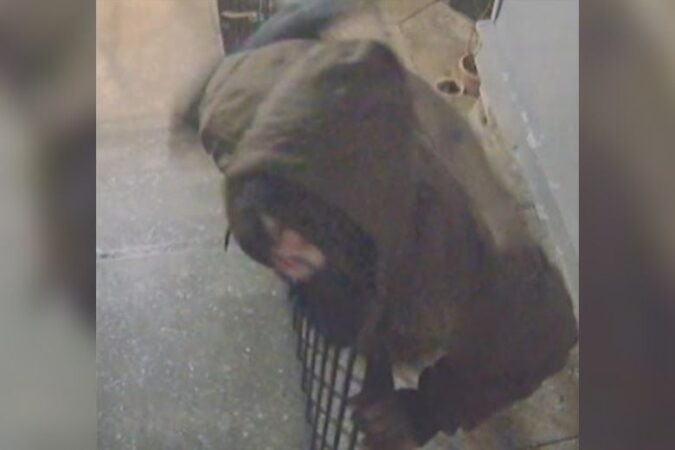
Philadelphia police are searching for a man they say tried to steal a package from the front steps of a Feltonville home, then exchanged gunfire with both the homeowner and responding officers before fleeing Sunday evening.
Security camera footage from a home in the 400 block of East Rockland Street shows a man approaching the front steps and attempting to take a package, police said. The homeowner, a 50-year-old man, came outside carrying a handgun and confronted him, police said.
The homeowner fired a shot into the ground, police said, prompting the man to run. As he fled, the man fired a gun at the homeowner, they said.
Officers who had been called to the area after reports of a crowd and a person with a weapon on the 4900 block of D Street heard the gunfire and ran toward it, police said. When they encountered the man, police said, he fired his weapon at one of the officers, and the officer fired back.
The man escaped, police said. Officers later recovered a .40-caliber handgun and a jacket on Rockland Street.
Police described the suspect as light-skinned with a stocky build, and a possible goatee. He was last seen wearing a brown coat, black pants, and gray sneakers.
Police ask that anyone with information about the man or the shooting call or text police at 215-683-1866.
The Philadelphia Fraternal Order of Police is offering a $5,000 reward for information leading to an arrest and conviction.
The officer who fired his weapon has been placed on administrative duty, as is customary, pending an internal investigation, police said. His name has not been released.
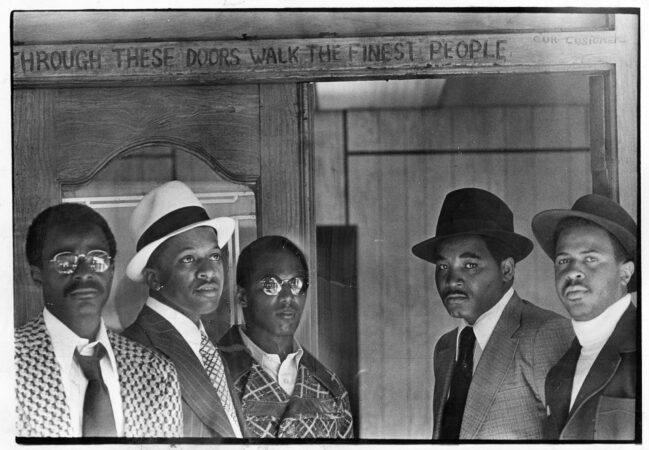
After more than 40 years behind bars, reputed former Black Mafia leader Lonnie Dawson has been freed from prison, ending a decades-long legal drama that includes state and federal convictions for crimes, including drug trafficking and murder.
Dawson’s release, though weeks old, went viral on social media in recent days thanks to video clips appearing to show his first moments as a newly free man. The widely shared video shows a man exiting the gates of a prison and immediately kneeling on a sidewalk in prayer.
Dawson, also known as Abdul Salim, was freed from SCI Smithfield in Huntingdon County on Dec. 22 following a successful petition under the Pennsylvania Post Conviction Relief Act, his attorney, David B. Mischak, told The Inquirer. The Pennsylvania Department of Corrections confirmed Dawson’s release date, noting that he had been held in that state prison for three months before he was freed. The bulk of his incarceration, however, was served in federal prison.
“Mr. Dawson has spent the majority of his adult life behind bars,” Mischak said in a statement posted to his law firm’s website. “After more than 40 years of incarceration, Lonnie Dawson is grateful for the opportunity to live out his remaining years with dignity and peace.”
Dawson’s path to release was a long and circuitous one that stretches back to a 1975 murder of which he was twice convicted at the state level — and sentenced to life. In the 1980s, federal convictions on drug distribution and related charges followed, leading to a staggering 134-year federal sentence. Here is how The Inquirer and Daily News covered it:
Article from Aug 10, 1982 Philadelphia Daily News (Philadelphia, Pennsylvania) <!— –>
The murder of Herschell Williams
In November 1975, a purported drug dealer and Black Mafia member named Herschell Williams — also known as the “Jolly Green Giant” due to his 6-foot-6 frame — was gunned down near his Mount Airy home. Shortly after the murder, Dawson, along with fellow reputed Black Mafia members Roy Hoskins and Joseph Rhone, were arrested in connection with the slaying while driving on the Schuylkill Expressway, reports from the time indicate.
Investigators later linked Williams’ murder to a dispute over cocaine, and authorities alleged that Hoskins and Rhone carried out the shooting while Dawson, whom they said ordered the killing, served as the getaway driver, The Inquirer and Daily News reported. Several months later, both Dawson and Hoskins were convicted of murder in separate cases and sentenced to life in prison, while Rhone, who jumped bail following his arrest, remained a fugitive.
The convictions stuck until July 1978, when the state Supreme Court ordered new trials due to legal errors during the initial proceedings. Following their arrests, both men had been questioned by then-Detective Michael Chitwood, and Dawson’s conviction was overturned in part because his attorney was not allowed to cross-examine Chitwood. Dawson alleged Chitwood had fabricated a confession used during the trial, according to Inquirer reports.
The retrial, however, did not work out in either man’s favor. Dawson, for his part, was again convicted in August 1982 and later sentenced to life for a second time, despite having maintained at trial that he was busy giving one of his children a haircut about 20 blocks away at the time Williams was killed, according to Inquirer and Daily News reports.
Article from Dec 14, 1982 The Philadelphia Inquirer (Philadelphia, Pennsylvania) <!— –>
A federal conviction
As Dawson awaited retrial in the Williams case, more legal issues were added to his docket. In April 1982, an FBI affidavit alleged that Dawson and Hoskins quickly took over the Black Mafia after the state Supreme Court overturned their convictions, and revealed that both had been investigated over the past year by federal authorities.
That, however, only came to light after Dawson, Hoskins, and several others were arrested following a high-speed car chase on I-95 in which a car was riddled with bullets in an apparent attempt to kill a federal informant, Inquirer and Daily News reports from the time indicate.
The informant, Lawrence D. Simons, who said he was a member of the Black Mafia, was unharmed in the chase, which concluded after his would-be killers crashed their vehicle into a tree, the Daily News reported.
Federal grand jury indictments followed, with Dawson and his alleged cohorts facing a lengthy list of charges, including obstruction of justice, conspiracy, drug, and gun counts. Authorities alleged Dawson was the Black Mafia’s leader, and said the group was linked to drug trafficking throughout Philadelphia and Delaware County, The Inquirer reported.
After a three-week trial, Dawson was found guilty on a number of counts, and sentenced to a 134-year prison sentence and $230,000 in fines — though a later appeal dropped that sentence to 65 years and $100,000. Hoskins faced a similarly stiff penalty.
U.S. District Judge Louis C. Bechtle in his ruling referred to both men as “major drug manufacturers” who were a “danger to the community.” The sentences, the Daily News reported at the time, were the harshest ever imposed by a federal judge in the Philadelphia area for drug trafficking.
Dawson in court denied he was involved in a major drug ring and called the charges “a bunch of malarkey,” the Daily News reported.
Article from Dec 21, 1984 Philadelphia Daily News (Philadelphia, Pennsylvania) <!— –>
‘Ain’t calling too many shots now’
While Dawson was imprisoned in the early 1980s, a report from the Daily News alleged that he remained in control of drug sales in Philadelphia — particularly in North Philadelphia, Germantown, and Mount Airy. An unnamed FBI source told the People Paper that despite Dawson being jailed, his drug trafficking activity did not slow down, and said he regularly met with organized crime figures to orchestrate sales.
The Daily News later reported that Dawson was placed in administrative segregation in prison. The move, an unnamed associate told the paper, diminished Dawson’s alleged stature in the drug trade, and as a result, he “ain’t calling too many shots now.”
In late 1984, Dawson responded to the Daily News’ reporting directly in a letter to the paper in which he denied controlling drug sales anywhere. While in prison, he said, he had never met with organized crime figures to discuss drug manufacturing or sales, and said claims were floated by reporters “in hope of getting some type of promotion and/or attention.”
“Why must I be the sacrificial lamb?” Dawson wrote. “Why?”
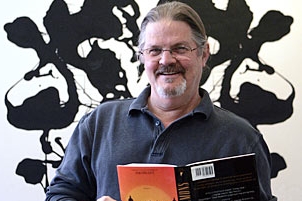
John Langdon, 79, formerly of Philadelphia, innovative award-winning graphic designer, painter, writer, and longtime adjunct professor of typography at Drexel University, died Thursday, Jan. 1, of complications from a heart attack at French Hospital Medical Center in San Luis Obispo, Calif.
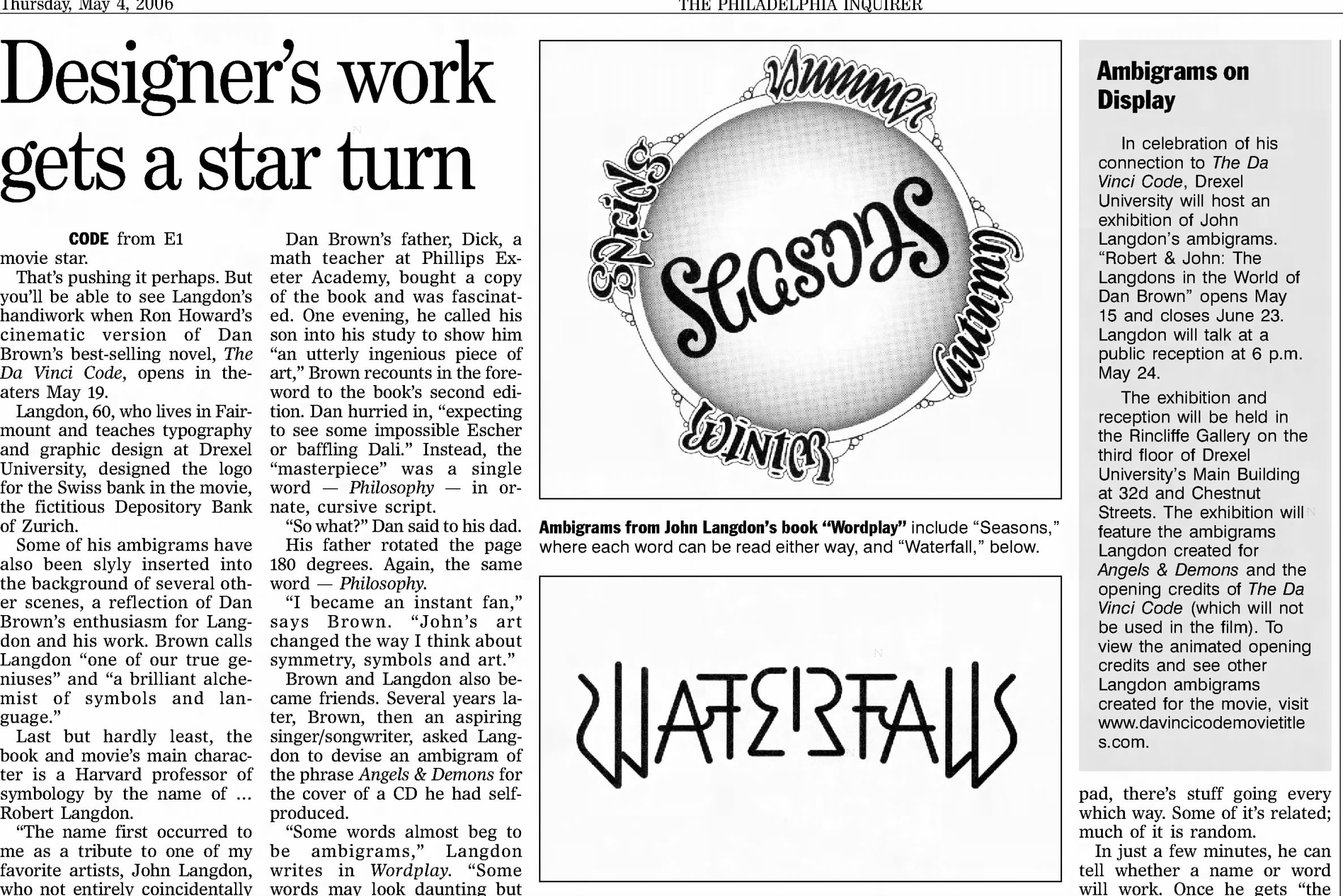
Mr. Langdon was a lifelong artist and wordsmith. He originated ambigrams in the early 1970s and created distinctive logos for corporate clients, artists, musicians, and others. Ambigrams are words or designs that retain meaning when viewed from different perspectives, and his work influenced countless other designers and typographers who followed.
“They also present familiar concepts in an unfamiliar way,” he told The Inquirer in 1992, “and thus stimulate the reader’s imagination.”
On his website, johnlangdon.net, Mr. Langdon described his work as “making abstract concepts visual, almost always through the design of words, letters, and symbols.” He called it “words as art” and said: “I specialize in the visual presentation of words.”
His designs were featured in more than a dozen solo shows in galleries and museums in Pennsylvania, New Jersey, New York, Connecticut, Maryland, and Delaware, and in more than 50 group exhibitions around the country and Europe. He created six ambigrams for author Dan Brown’s best-selling book, Angels & Demons, and Brown named his fictional protagonist, Harvard symbologist Robert Langdon, after John Langdon.
“John’s art changed the way I think about symmetry, symbols, and art,” Brown told The Inquirer in 2006.
Mr. Langdon’s own book about ambigrams, Wordplay, was first published in 1992 and updated in 2005. He also wrote the forwards of other books and articles for journals and newsletters. He said he had a “particular interest in word origins” in an interview on his website.
He was featured several times in The Inquirer and wrote an op-ed piece in 2014 about the Philadelphia Museum of Art’s new logo. He opened the article with: “Please, beloved Philadelphia Museum of Art, before you print one piece of stationery or a single promotional flier, reconsider your new logo.”
Mr. Langdon’s work was featured in The Inquirer in 2006.
In 1996, he began painting what he called his “visual-verbal meditations and manipulations” on canvas. “My paintings still involve symmetry and illusion, a bit of philosophy, and a few puns thrown in for good measure,” he said on his website.
He cocreated the Flexion typeface and won a 2007 award from the New York-based Type Directors Club. He spoke often about design at colleges and high schools, and to professional societies. He gave a TEDx talk about font and the future of typeface at Drexel.
Douglas Hofstadter, a professor at Indiana University who coined the term ambigram in 1984, told The Inquirer in 2006 that Mr. Langdon had a “very strong sense of legibility but also a marvelous sense of esthetics, flow, and elegance.”
Born in Wynnewood and reared in Narberth, Mr. Langdon graduated from Episcopal Academy in 1964 and earned a bachelor’s degree in English at Dickinson College in Carlisle, Pa. He worked in the photo-lettering department of a type house and for a design studio in Philadelphia after college, and began freelancing as a logo designer, type specialist, and lettering artist in 1977.
He taught typography and logo design classes at Moore College of Art and Design from 1985 to 1988 and at Drexel from 1988 to his retirement in 2015. In an online tribute, one student said he was “one of my favorite teachers of all time.”
He was interested in Taoism and inspired by artists Salvador Dalí and M.C. Escher, and authors Edgar Allan Poe and Ogden Nash. “In the early ’70s, I tried to do with words what Dali and Escher did with images,” he said in a 2006 interview posted on Newswise.com.
John Wilbur Langdon was born April 19, 1946. He played high school and college soccer and drew caricatures of classmates for the Episcopal yearbook.
After college, he took painting and drawing classes at the Pennsylvania Academy of the Fine Arts and the old Philadelphia College of Art. He married Lynn Ochsenreiter, and they had a daughter, Jessica. They divorced later.
Mr. Langdon enjoyed vacation road trips and told stories of hitchhiking around the country in the 1960s. He followed the Phillies, was interested in genealogy, and traced his family back to the Founding Fathers.
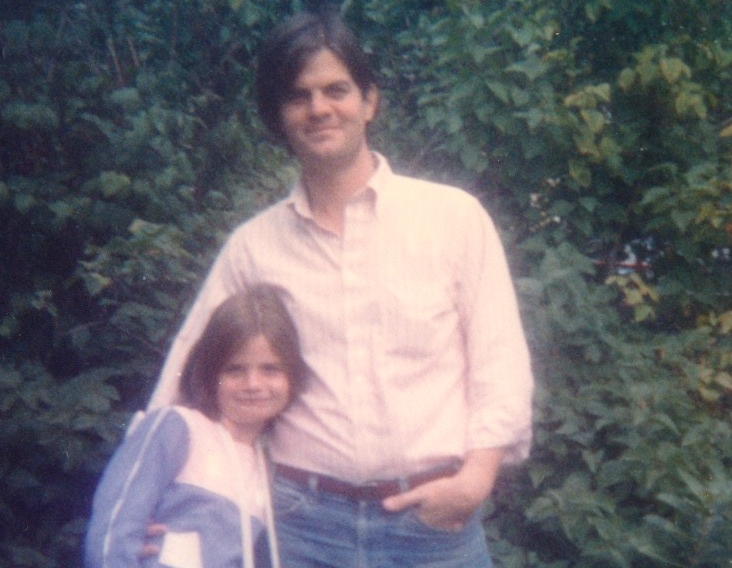
Mr. Langdon stands with his daughter, Jessica.
He lived in Darby, Woodbury, Wenonah, and Philadelphia before moving to California in 2016. “He was jovial, social, and amusing,” his daughter said. “People said he was clever, and everyone liked him.”
He told The Inquirer in 2006: “It may seem counterintuitive, but the more ambiguity you invite into your life, the more things make sense and become understandable.”
Philadelphia police seek to identify the suspect responsible for recent vandalism at Roxborough High School.
A person painted racist and antisemitic slogans across the exterior walls of the school building Sunday, which included a swastika and racial epithets.
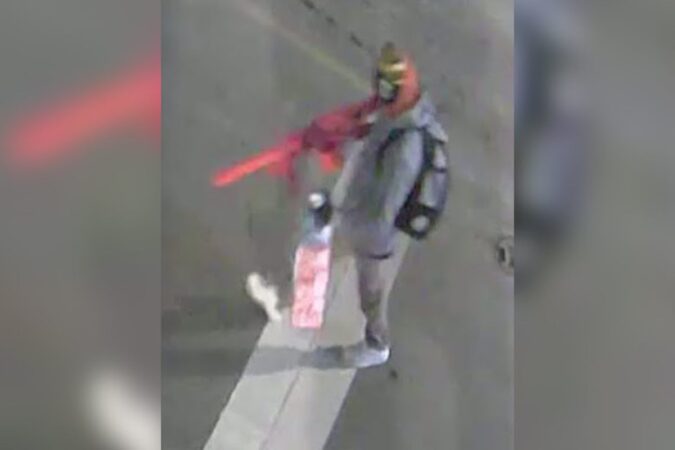
Surveillance video caught the suspect vandalizing the walls around 5:25 a.m. Police describe the suspect as a white male, wearing an orange scarf, a green and black winter hat, a gray hooded jacket, gray pants, and a gray and black backpack.
Cameras captured the person on Jan. 4 approaching the school on foot, coming eastbound from Fountain Street toward Pechin Street. The suspect was last seen heading toward Ridge Avenue
Police asked people to call 911 if the suspect is seen. Information about this crime or suspect can also be shared with Northwest Detective Division by calling 215-686-3353
The public can also submit tips by calling 215-686-8477 or using the online form. All tips remain confidential.
Members of the Roxborough High community chalked positive messages outside the school on Ridge Avenue after racist and antisemitic graffiti was scrawled at the school.
After officials painted over the vandalism over the weekend, Roxborough High School countered the hateful messaging with peaceful messages of their own, written in chalk.
Principal Kristin Williams Smalley said the act of hate didn’t represent the school body.
“We are deeply disappointed by these actions,” Williams Smalley wrote in a letter to the community. “We wish to remind everyone that we have a zero-tolerance policy for harassment or hate speech of any kind, and we will investigate all matters involving racist remarks and other hate speech.”
On Wednesday, the Pennsylvania Human Relations Commission condemned the “acts of hate and discrimination” and praised Roxborough’s respons as a testament to the community’s dignity, respect, and shared values.
“Racism and antisemitism are not isolated acts. These acts harm entire communities,” commission executive director Chad Dion Lassiter said. “The response at Roxborough High School shows what is possible when people refuse to be divided and instead stand together to affirm humanity, belonging, and respect. That solidarity is a powerful counter to hate.”
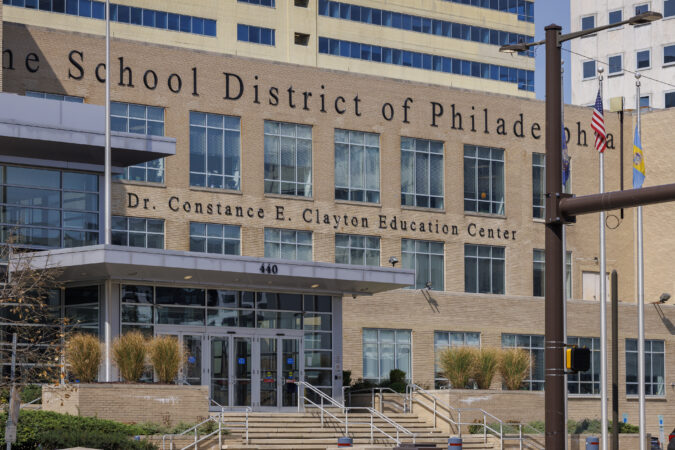
The topline result: Philadelphians don’t want their local schools closed.
Some urged prioritizing small classes. Others suggested adding more magnets, like Masterman; pouring more resources into neighborhood K-8s and high schools, and modernizing facilities.
But while Superintendent Tony B. Watlington Sr. promised to use the feedback to shape the district’s plan, he and other district leaders have said school closings are a given — the district has 70,000 excess seats in schools across the district of 113,000, and dozens of buildings that are in poor shape.
That process is expected to play out this year. Itinitially was to have yielded decisions in December, but Watlington said his administration needed more time to analyze data and reach out to school communities before ordering sweeping changes that they say are necessary.
Watlington now says he will present a draft facilities plan sometime this winter, with more feedback and revisions to come before a board vote. The timeline for a final vote is notclear.
In an email, he thanked those who participated in the survey and other parts of the planning process. “We have, and will continue to take your feedback very seriously, as we know these will be difficult decisions that could impact many families,” he wrote, adding that there will be additional “community conversations” before the final plan goes to the board.
The district last engaged in a similar process in 2012, closing 30 schools by 2013, a hugely controversial process that officials later said did not improve academic outcomes for students or yield significant long-lasting savings for the district. Officials have said they will undertake the process more deliberately and with different aims in this incarnation.
Boosting neighborhood high schools, strengthening K-8s
The new survey data, released by officials as winter break began, did not yield surprises, but reiterated themes that will be tough for the cash-strapped district to balance.
Officials had previously identified four main topics that have emerged from more than a year of analyzing data and gathering feedback — strengthening K-8 schools, reinvesting in neighborhood high schools, reducing school transitions for students, and expanding access to grades 5-12 criteria-based high schools.
Survey respondents rated each of those “important” or “very important” — with reinvesting in neighborhood high schools (85%) and strengthening K-8 schools (81%) at the top of the priority list.
Overall, those who responded to the survey support their local schools, want strong schools close to where they live, and want the buildings closest to where they live to berenovated, not shut down.
Respondents raised concerns around several topics districtwide: overcrowding, inadequate staffing, school safety, insufficient supports for students with disabilities, student behavior issues, facilities quality and cleanliness, and support for libraries, recess, and extracurricular activities.
Some also expressed worries about transparency in the facilities planning process, and worries that when the district says its goal is “better use of space” it means that it will close schools.
They outlined fears about potential hardships that closing schools could create, such aslonger walks to school ortough bus rides in unfamiliar or unsafe areas. And they flagged worries about merging more than oneschool into a single building and having large grade spans in a single building. (Though some said they relished the idea of having many grades in one spot.)
In their own words
Respondents had plenty of ideas for officials as they plan steps that will have implications for the city for years to come. Here are some excerpts from survey responses:
“I believe that we should stop closing schools and update areas so that we can utilize small class sizes. The ONLY way to accomplish meeting the needs of students, emotionally, physically, psychologically, and educationally is to have SMALL class sizes,” one person wrote.
“By closing buildings and combining schools, some children will have to walk an additional distance, most likely making them late or just deciding on certain days that the travel distance is just not worth it,” another respondent said.
“We need new high schools, middle schools, especially with vocational training. Current year textbooks, technology, air-conditioning, and programs for Tech and Art,” said another writer.
“Many [Philadelphia high schools] currently lack basic college-preparatory opportunities — few or no Honors or AP courses, limited world languages, and minimal enrichment options. This pushes academically motivated students into magnet schools, leaving neighborhood schools underenrolled and concentrated with students who have the highest support needs,” wrote one commenter.
“More schools like Masterman will prevent families from leaving the city if their child cannot get in through the lottery. It is beneficial to Philadelphia as a whole to keep these parents/families in the city instead of fleeing to the suburbs,” wrote one person.
Bristol Township identified resident Patricia Mero, 66, as the latest death following the fire that destroyed parts of the Bristol Health & Rehab Center in Bristol Township on Dec. 23. Mero died Monday morning, according to the Bucks County Coroner’s Office. The cause of death was listed as a chest trauma; the manner of death an accident.
Nurse Muthoni Nduthu and a woman whom Bristol Township Police identified as Ann Reddy, another resident, were also killed in the fire.
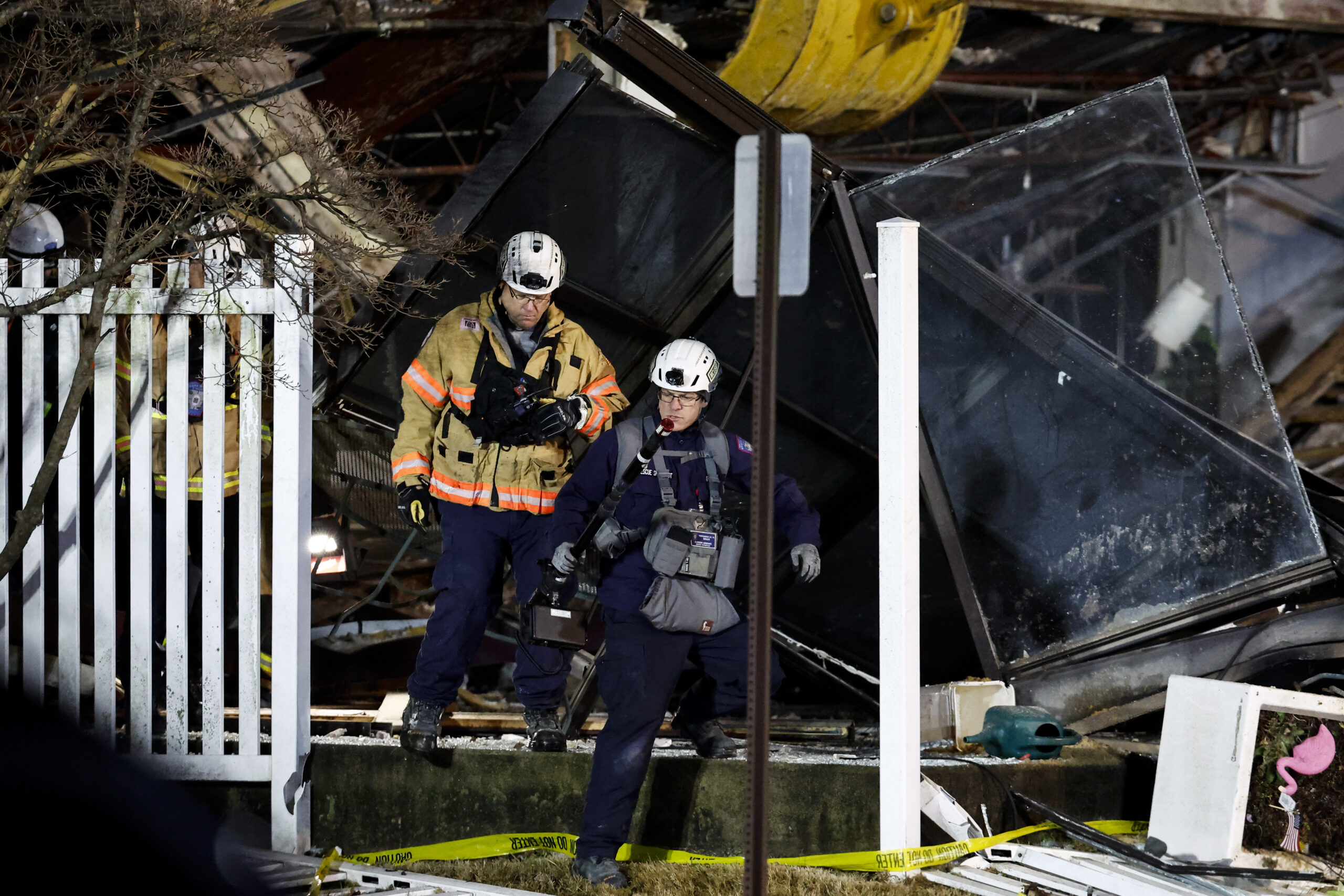
First responders work the scene of an explosion and fire on Dec. 23, 2025, at Bristol Health & Rehab Center.
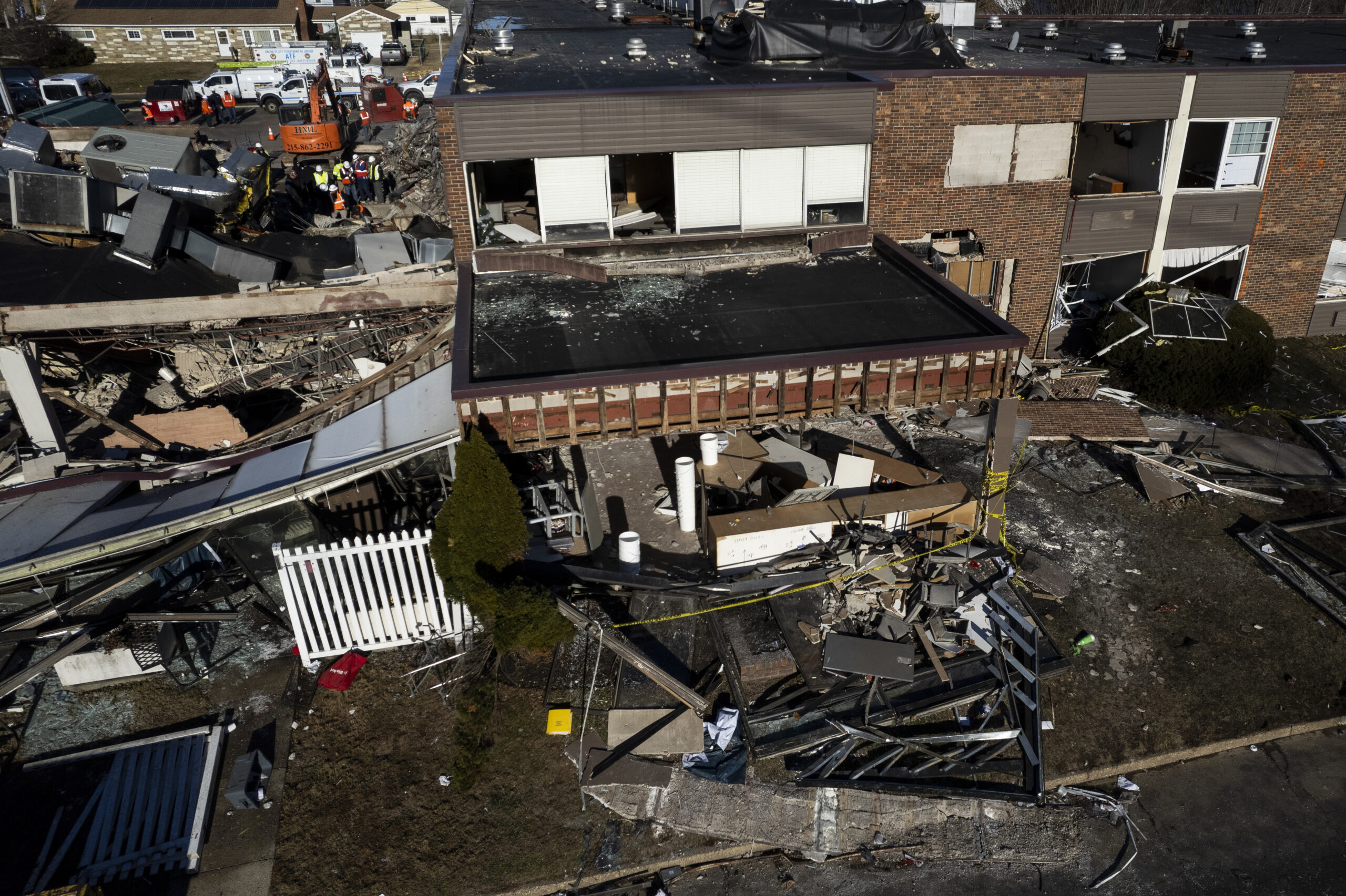
An explosion occurred at the nursing home in the early afternoon on Dec. 23, flattening a section of the building that collapsed the first floor and sent people and debris tumbling into the basement. Bristol Fire Chief Kevin Dippolito said that at one point, a heavy odor of gas forced firefighters out of the building, only for another explosion to go off 30 seconds later.
Investigators work the scene at Bristol Health & Rehab Center on Dec. 24, 2025 in Bristol Township.
The National Transportation Safety Board is leading an investigation into the cause of the fire, while the owners of the nursing home, Saber Healthcare Group, Peco, and others are being sued for their alleged negligence in the fiery explosion.
On Monday, the NTSB said it had completed on-scene work in Bristol and would release a preliminary report on its findings by early February.
The investigation into the fire will likely take months, with experts telling The Inquirer that federal investigators would focus on Peco and the nursing home operator’s actions leading up to the explosion.



 –>
–>  –>
–>  –>
–>