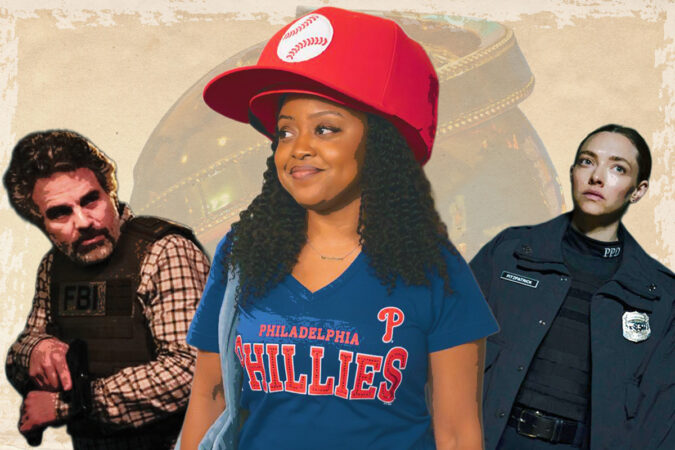
The Golden Globe Awards on Mondayannounced its nominees for the best in television and movies, and with it, another chance for victoryfor regional productions and local actors.
The ceremony airsJan. 11 with awards given in 28 categories.
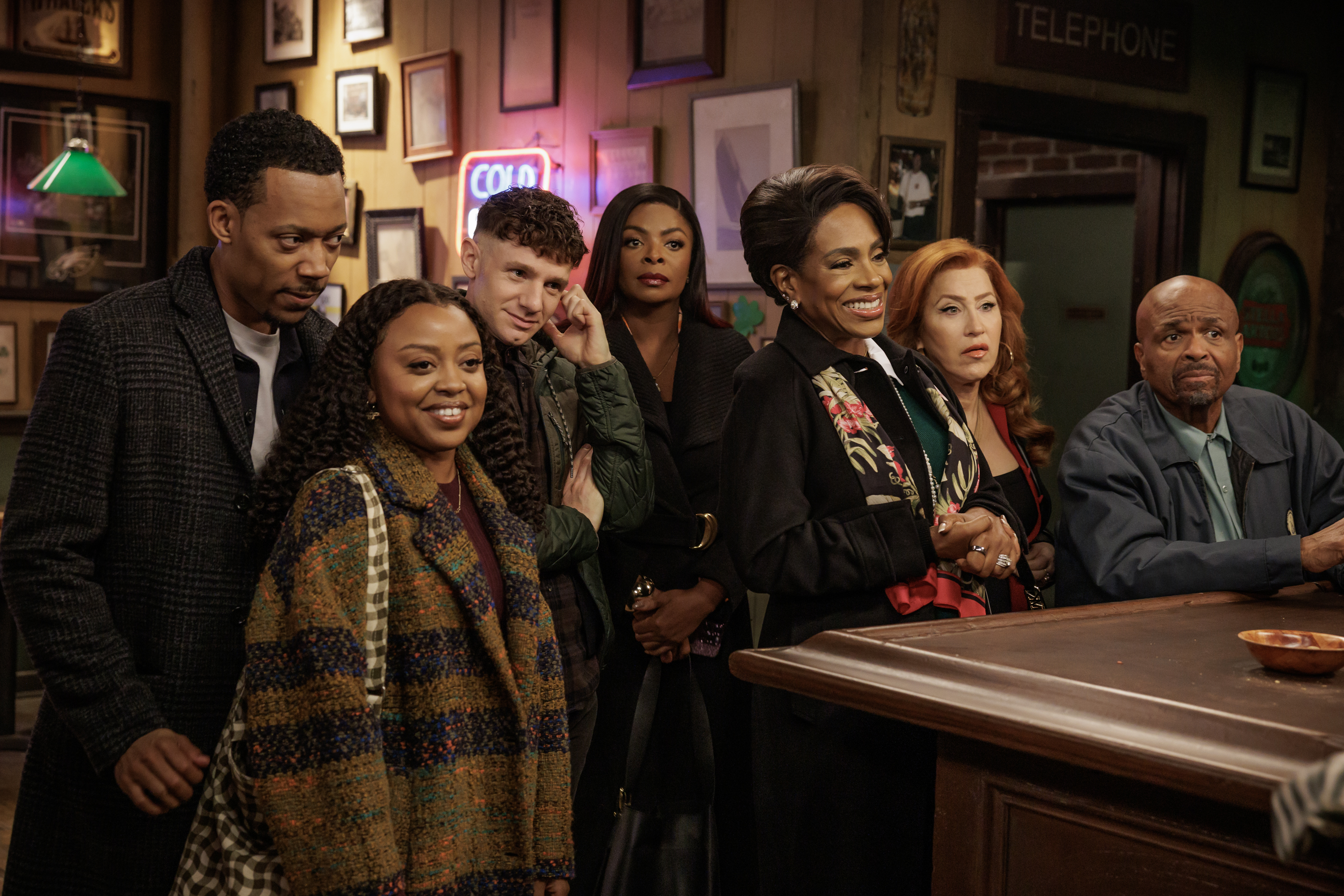
The Abbott Elementary crew visits the Always Sunny gang at Paddy’s Pub in the “It’s Always Sunny in Philadelphia” and “Abbott Elementary” crossover.
In its fifth season, Abbott Elementary has already won the hearts of Philadelphians and three Golden Globes. Still, this wholesome band of teachers, starring Philly-native Quinta Brunson, isup again for best musical or comedy television series.
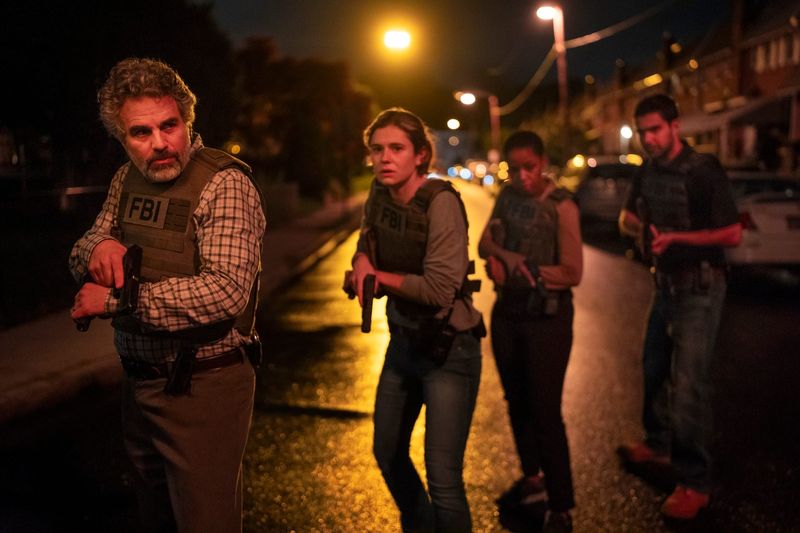
HBO’s Task and Peacock’s Long Bright River, two crime thrillers set in Philadelphia neighborhoods and suburbs, both have leading actors nominated for Golden Globes this season.
Mark Ruffalo as Tom, Alison Oliver as Lizzie, Thuso Mbedu as Aleah, and Fabien Frankel as Anthony in “Task.”
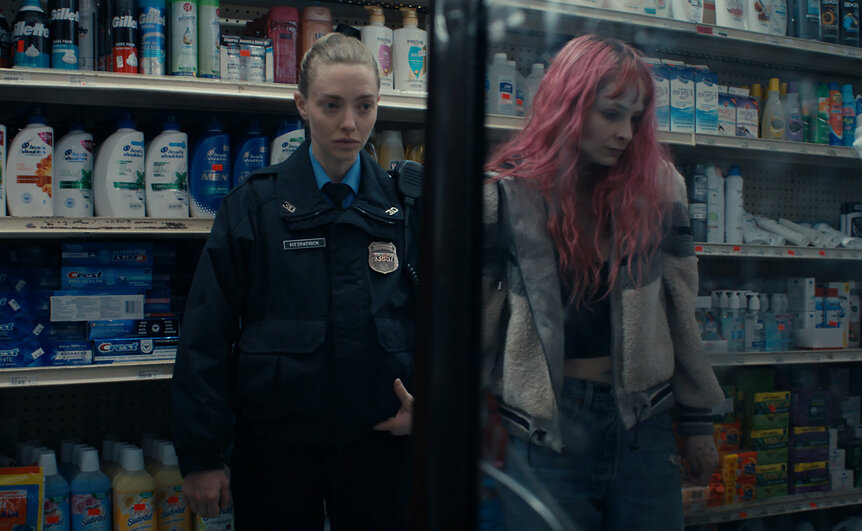
Amanda Seyfried (left) and Asleigh Cummings in the Kensington-set Peacock series “Long Bright River,” based on the novel of the same name by Temple professor and novelist Liz Moore.
Liz Moore’s crime novel Long Bright Riverturned heads when it was released in 2020, detailing the harrowing story of a Kensington police officer, played in the series by Amanda Seyfried, searching for her sister in a cat-and-mouse chase with a killer targeting sex workers. While the television adaptation was filmed in New York City, the bulk of the show takes place in Kensington and other Philadelphia neighborhoods, with Seyfried grabbing a nomination for best female performance in a dramatic limited series.
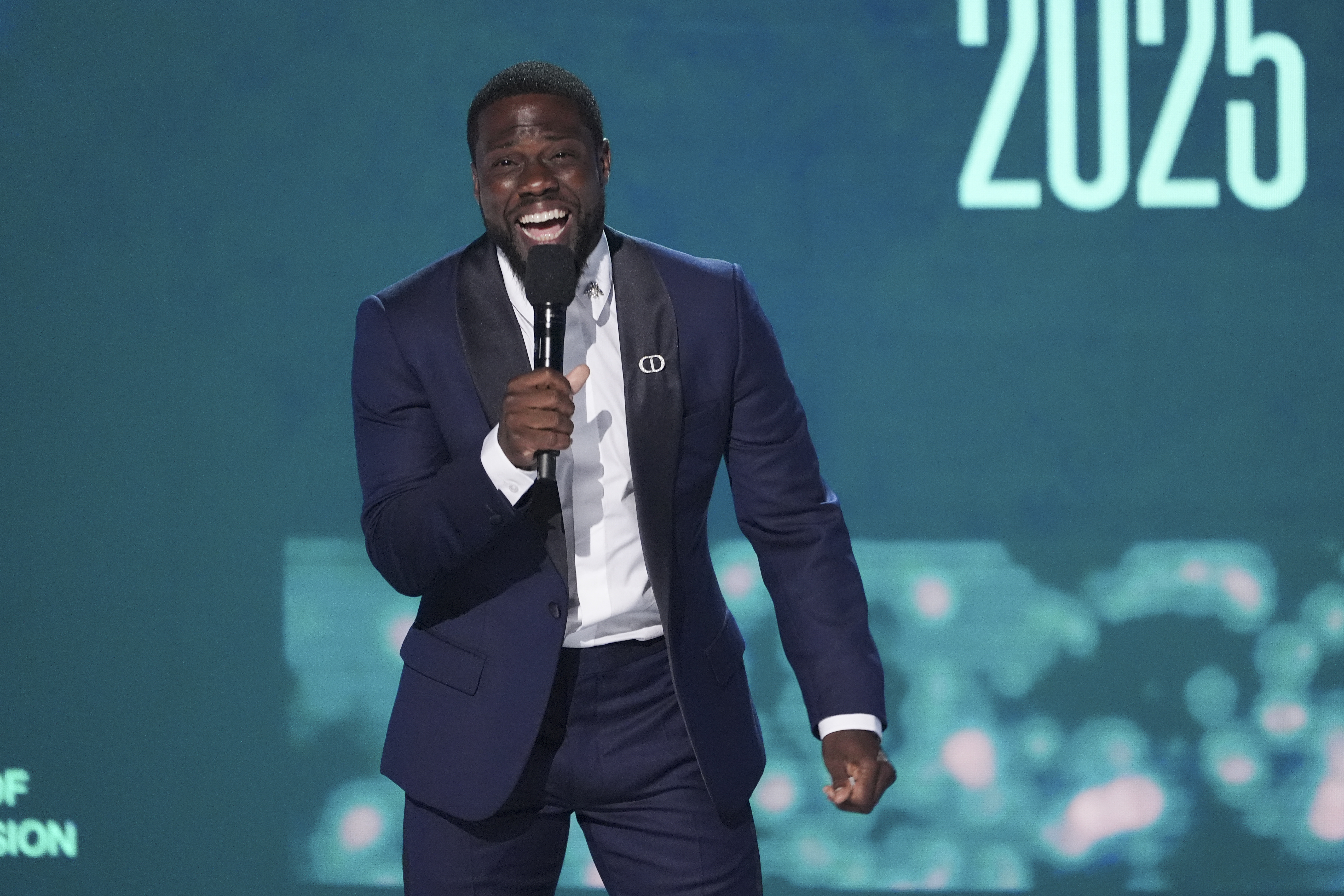
Hometown stand-up icon Kevin Hart was back to his roots with a new comedy special, Kevin Hart: Acting My Age, tackling injuries after 40, Chick-fil-A’s spicy chicken sandwich consequences, and slipping in the shower. He earned a nomination for best stand-up comedy performance on television.
Host Kevin Hart speaks during the BET Awards on Monday, June 9, 2025, at the Peacock Theater in Los Angeles.
And through a few degrees of separation, several other nomineescan be claimed as Philly-adjacent.
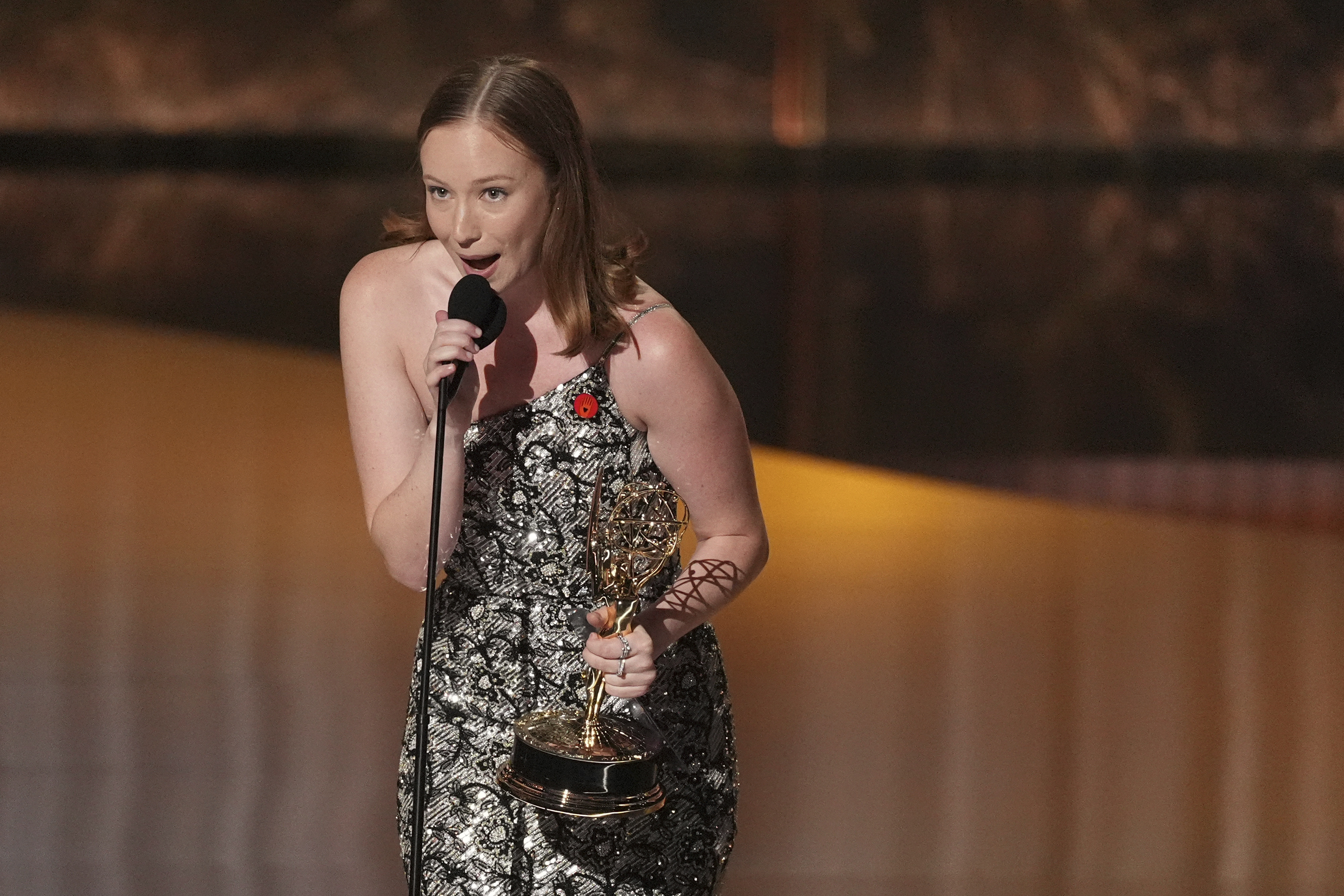
Hannah Einbinder, whose father is from Doylestown, accepts the award for outstanding supporting actress in a comedy series for “Hacks” during the 77th Primetime Emmy Awards on Sunday, Sept. 14, 2025, at the Peacock Theater in Los Angeles. (AP Photo/Chris Pizzello)
Take Hacks actress Hannah Einbinder, who shouted “Go Birds!” during her speech after winning an Emmy for best supporting actress in a comedy series, and was filmed by the evening news crying in the streets of Los Angeles after the Eagles’ 2018 Super Bowl win.
She may not be from Philadelphia (her father, actor Chad Einbinder, is from Doylestown), but she reps the city. HBO’s Hacks, which follows a veteran Las Vegas comic mentoring a young comedy writer, is up for best musical or comedy television series, with Einbinder and costar Jean Smart nominated for best supporting female actor and best actor in a musical or comedy series, respectively.
And there are some broader Pennsylvania and New Jersey ties among the nominees.
The breakout medical drama The Pitt, which takes place in the fictional Pittsburgh Trauma Center, depicts a 15-hour shift in an emergency room, split across 15 one-hour episodes. The Pitt’s lead actor, Noah Wyle (known for his role as Dr. John Carter in NBC’s ER), is up against Ruffalo for best male actor in a dramatic television series.
After a major overhaul of the award show in recent years, including the sunsetting of the Hollywood Foreign Press Association due to ethics and diversity concerns, the new Golden Globe Awards are judged by a panel of 400 journalists from across the world.
The Golden Globes will be broadcast live on Jan. 11 at 8 p.m. Philadelphia time on CBS and streaming on Paramount+.
Beginning in late afternoon, members of Gov. Josh Shapiro’s staff met with union leaders and SEPTA senior managers at the governor’s Philadelphia office. The goal was to unstick talks that had faltered, seeing if compromise was possible.
The union’s push for an increase in pensions and SEPTA’s proposal for union members to pay a greater share of the cost of their healthcare coverage emerged over the last week as the biggest obstacles to an agreement, according to both union and transit authority sources.
“Gov. Shapiro’s office brought the parties together and they made progress,” SEPTA spokesperson Andrew Busch said. “It was significant.”
In a statement, the union said “significant progress” was made.
“Gov. Shapiro was instrumental in preventing a strike that could have started as soon as Monday morning. We’re grateful for his close involvement,” said TWU Local 234 President Will Vera.
A work stoppage would have brought chaos to a mass transit system that carries a weekday average of 790,000 riders.
TWU Local 234 represents 5,000 bus, subway, elevated train and trolley operators, as well as mechanics, cashiers, maintenance people and custodians, primarily in the city.
Their one-year labor contract expired Nov. 7, but members stayed at their posts. On Nov. 16, they authorized Local 234’s leaders to call a strike if needed. The vote was unanimous.
SEPTA and the union were not far apart on salary and both wanted a two-year deal after a series of one-year pacts during a time of financial crisis for the transit agency, sources said.
Management wanted to hike what union members pay for health coverage and increase co-pays for doctor and hospital visits.
The union pushed for an enhancement to the formula that determines retirees’ monthly pensions, based on years of service. It was last increased in 2016.
SEPTA officials calculated that TWU’s proposed changes would have created an annual unfunded liability of about $6 million for an undetermined length of time. The union says the pension plan books showed a bump was affordable.
Because TWU Local 234 is the largest SEPTA union, its contracts are used as a template for the other locals working for the transit system, which could boost costs.
Regional Rail was a concern to SEPTA because commuter railroad workers, like others, receive a federal pension that has tended to be less generous. Those unions would have wanted a SEPTA sweetener to their retirement benefits too.
TWU Local 234 also wanted changes to work rules involving sick time benefits and the length of time it takes new members to qualify for dental and vision benefits — currently 15 months.
The local also represents several hundred suburban workers, primarily operators, in SEPTA’s Frontier district, which runs 24 bus routes in Montgomery County, Lower Bucks County, and part of Chester County.
The Victory district has a similar number of employees, who are represented by SMART Local 1594. They run Delaware County’s two trolley lines, the Norristown High Speed Line, and 20 bus routes in the suburbs.
Unions for both the Frontier and Victory districts could choose to strike alongside TWU Local 234. If that happened, Regional Rail, already plagued by delays and cancellations due to federally-mandated repairs on train cars, would be the only public transit running.
TWU last struck in 2016. It lasted for six days and ended the day before the general election. Democrat Hillary Clinton’s presidential campaign was worried about voter turnout, and the city sought an injunction to end the strike. That proved unnecessary.
Regional Rail would operate during a TWU strike. Locomotive engineers and conductors on the commuter service are represented by different unions than transit employees, and are working under current contracts.
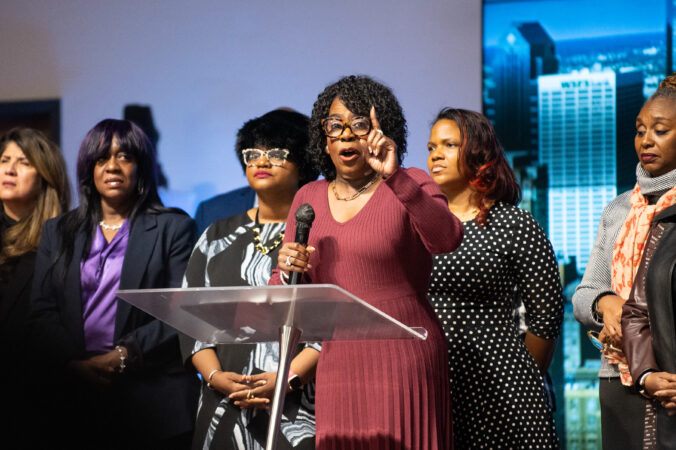
Mayor Cherelle L. Parker traversed pulpits across West and North Philadelphia on Sunday, promoting her vision for her signature housing initiative that’s heightening tensions in City Hall.
Parker, who wants to ensure the initiative helps those with varying incomes, largely opposes the changes, which has caused one of the most notable standoffs between the city’s executive and legislative branches during her mayoralty. From West Philly’s Church of Christian Compassion on Sunday morning, she lobbied her constituents, saying her vision for the housing plan is to avoid “trying to pit the ‘have-nots’ against those who have just a little bit.”
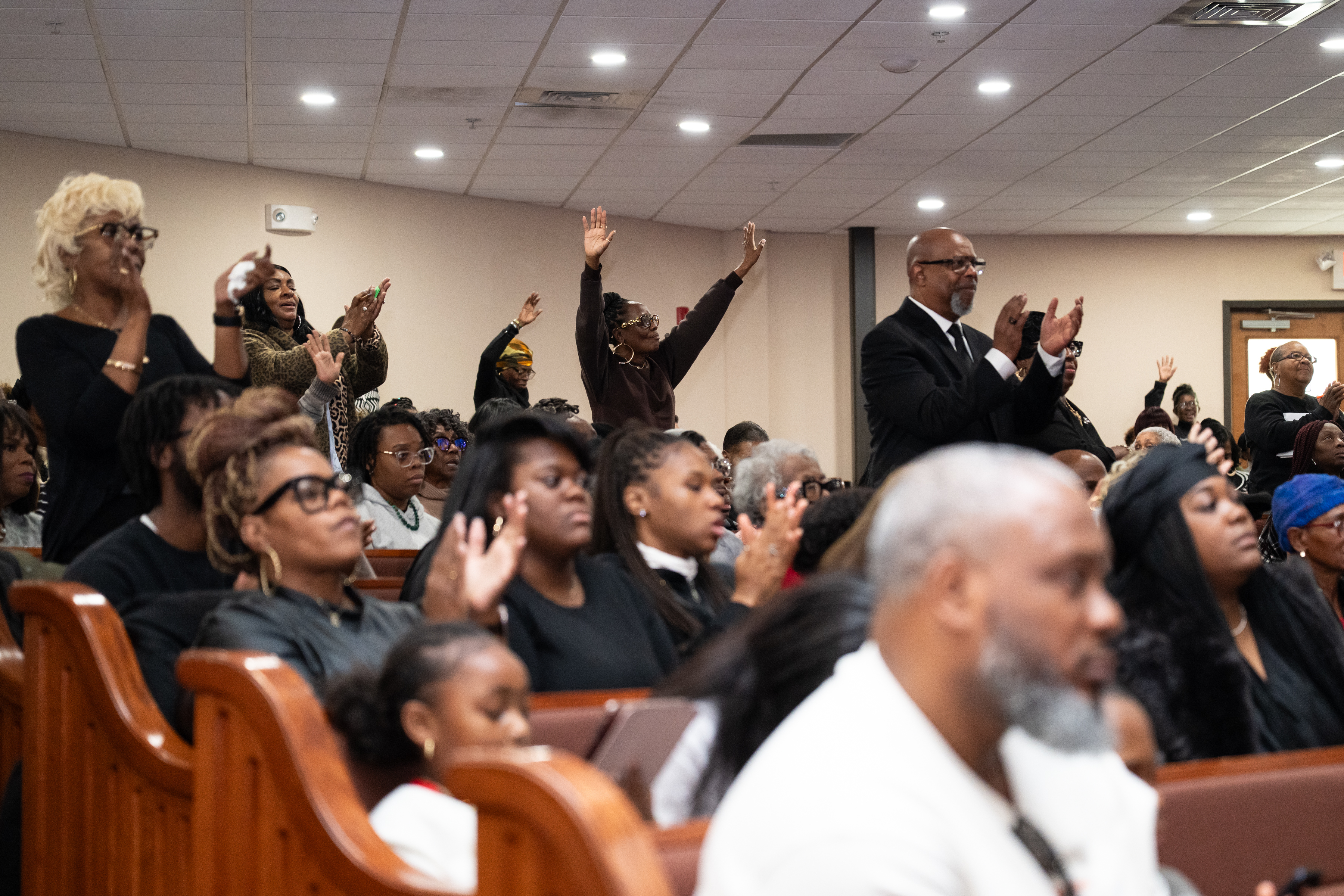
“We should be about addition, not subtraction,” she said to a packed sanctuary, as she sought to reclaim the narrative surrounding H.O.M.E. Her rousing 10-minute address was met with acclaim and applause, bringing some in the crowd to their feet.
“We’ve got to take care of the people who are most in need, but we can’t penalize the people who are going to work every day, pay their taxes, contribute to the city, and they can’t benefit from home improvement programs.”
The H.O.M.E. initiative calls for spending $800 million across dozens of existing programs. The bulk of the funding would go to affordable-housing preservation, the Turn the Key program, the Basic Systems Repair Program, affordable housing production, and One Philly Mortgage, which would provide loans to low income households.
Councilmember Jamie Gauthier, chair of the Committee on Housing, Neighborhood Development, and the Homeless, and whose district includes Church of Christian Compassion, called Council’s proposal reasonable and compromised and a fiscally responsible response to “Philadelphians who need our help the most in this moment.”
“The mayor has every right to get out into the public, to tell her side, to talk about her vision,” Gauthier said in an interview, “but I will say there was plenty of time to negotiate with Council on this, and plenty of attempts made from the Council’s side.”
Despite the disagreement over eligibility rules, Parker and Council are on the same page about the broad strokes of the housing plan; critical pieces of legislation Parker proposed as part of H.O.M.E. were approved by Council earlier this year. The changes last week did not alter the fundamentals of the program, which Parker hopes will achieve her goal of creating or preserving 30,000 units of housing in her first term.
Congregants at the Church of Christian Compassion cheer as Mayor Cherelle L. Parker addresses the crowd before service in the Cobbs Creek neighborhood of West Philadelphia on Sunday, Dec. 7, 2025.
The main sticking point in recent negotiations has been eligibility criteria for several programs: Parker, for instance, had proposed that H.O.M.E. funding for the Basic Systems Repair Program — which subsidizes critical home improvements — is open to any homeowner who makes Philadelphia’s area median income, about $119,400 for a family of four. Council’s amendments, however, require 90% of the new funding to go to families making 60% of the area median income or less, about $71,640 for a family of four.
Gauthier likened what’s in dispute to an emergency room: “The person who’s having a heart attack is going to be seen before the person with a broken leg, because that person who’s experiencing a heart attack might not make it if they don’t get immediate assistance.”
The squabble has given way to the most significant public dustup between Parker and Council President Kenyatta Johnson. In an uncharacteristically blunt statement last week, Johnson broke from his usual alignment with the mayor and defied her administration’s analysis of the situation.
In a statement Sunday, Johnson’s spokesperson Vincent Thompson said “Johnson heard clearly and directly from Councilmembers and housing organizations in Philadelphia about critical issues they want addressed in the first-year H.O.M.E. Plan spending. Those concerns center on accountability, neighborhood equity, and — most importantly — making sure that the deepest investments reach the poorest and most vulnerable Philadelphians.”
The amended budget could be up for a final vote as soon as Thursday, Dec. 11, Council’s last meeting before its winter break, according to Johnson’s office.
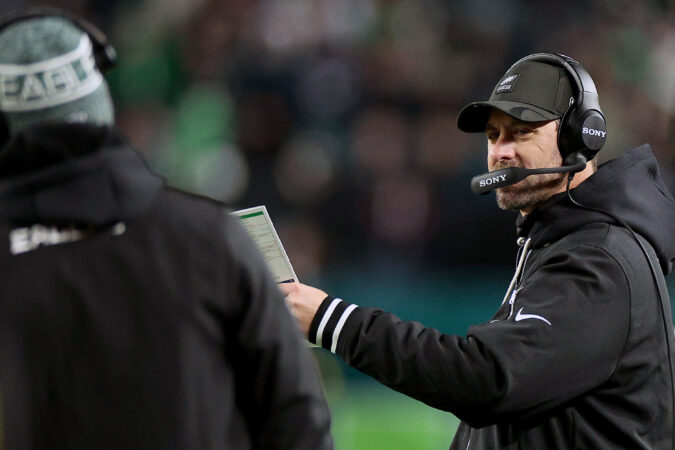
Listen — Philly has a reputation. We know this. We wear it like a badge. We boo Santa, we heckle refs, we meltdown on WIP like it’s an Olympic sport. But there’s passion, there’s unhinged, and then there’s driving to Moorestown at 3 a.m. to egg the offensive coordinator’s house because the Eagles lost to the Bears.
That’s not passion. That’s just loser behavior.
Patullo said all the right things this week. That criticism is part of the job, that he’s been here five years, that he loves the city and the fans. But he also made it clear: When it involves your family, the line isn’t just crossed… it’s obliterated. And he’s right. Yell at the TV, tweet about it, call WIP at 6 a.m. pretending to be “Bryce from Bridesburg.” But families are off-limits.
The good news? Neighbors rallied, the community reached out, and Patullo isn’t going anywhere — not from his home, and not from the sidelines (despite Nick Foles’ dream of him coaching from the booth like it’s Madden franchise mode).
Philly can take a joke, a hit, and a heartbreak season. What we can’t take is letting a few clowns make us look like we egg coaches every time the offense ranks 24th in yards.
Save the eggs for tailgates. Or better yet, breakfast.
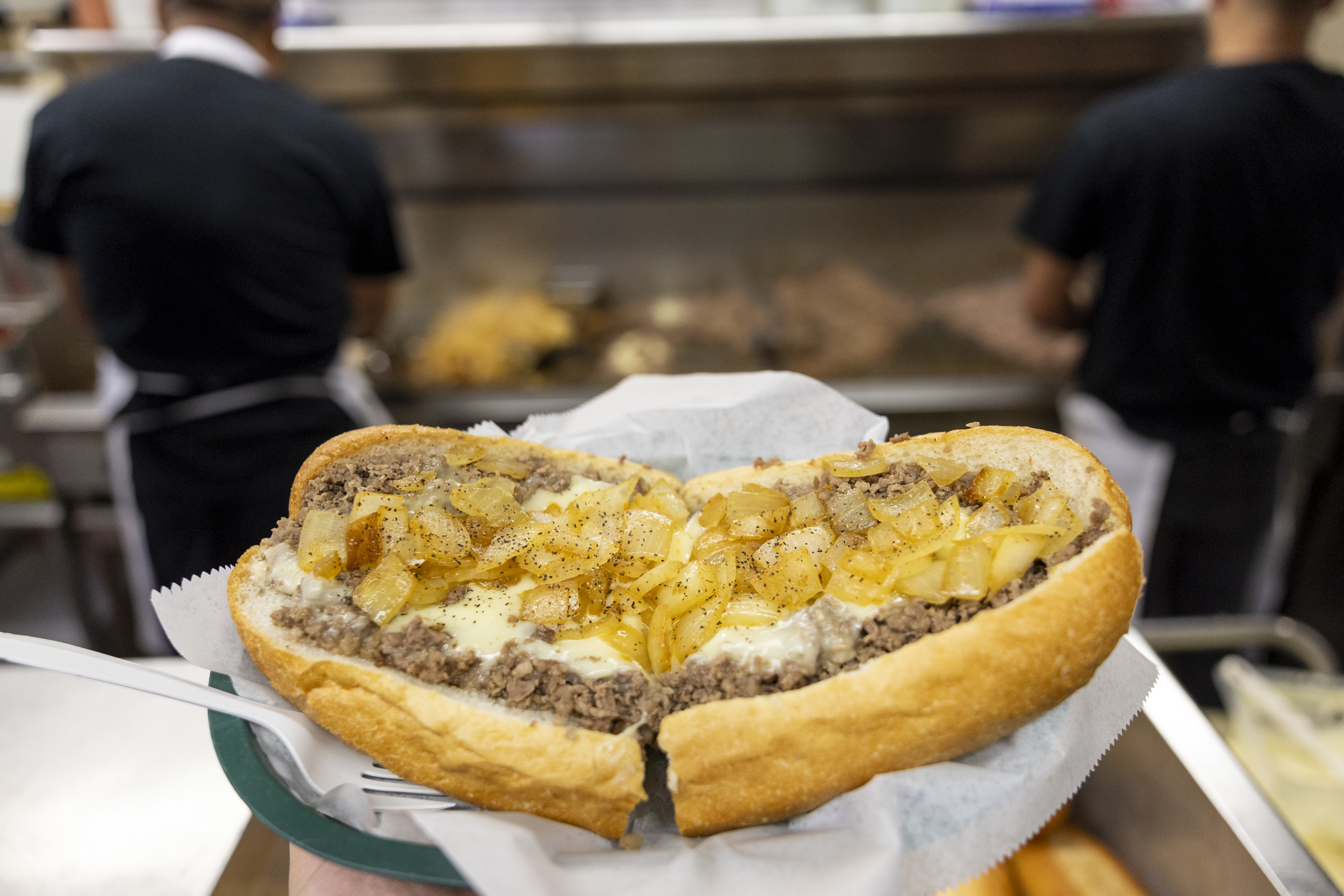
A cheesesteak from Dalessandro’s in Philadelphia, on Friday, Nov. 21, 2025. Michelin recently recognized the restaurant with a Bib Gourmand. Cheesesteak restaurants Angelo’s and Del Rossi’s were also recognized by Michelin.
Philly is America’s No. 1 foodcation destination: A (obviously)
All because of one thing: the cheesesteak, which topped the national list with 27% of Americans saying it’s their dream domestic “foodcation.” Translation: People are now booking vacations around a sandwich we buy at 1 a.m. like it’s no big deal.
Food & Wine says Americans spend about $910 on their typical food-focused trip and would nearly double that budget if the bite was bucket-list–worthy. So somewhere out there is a family justifying a $2,000 vacation to stand outside Angelo’s at 10 a.m. behind 70 locals who think they have “a system.”
Meanwhile, New York tied us at 27% for pizza — but let’s be serious. A cheesesteak beating out an entire city’s worth of pizza is so Philly-coded it should count as a parade.
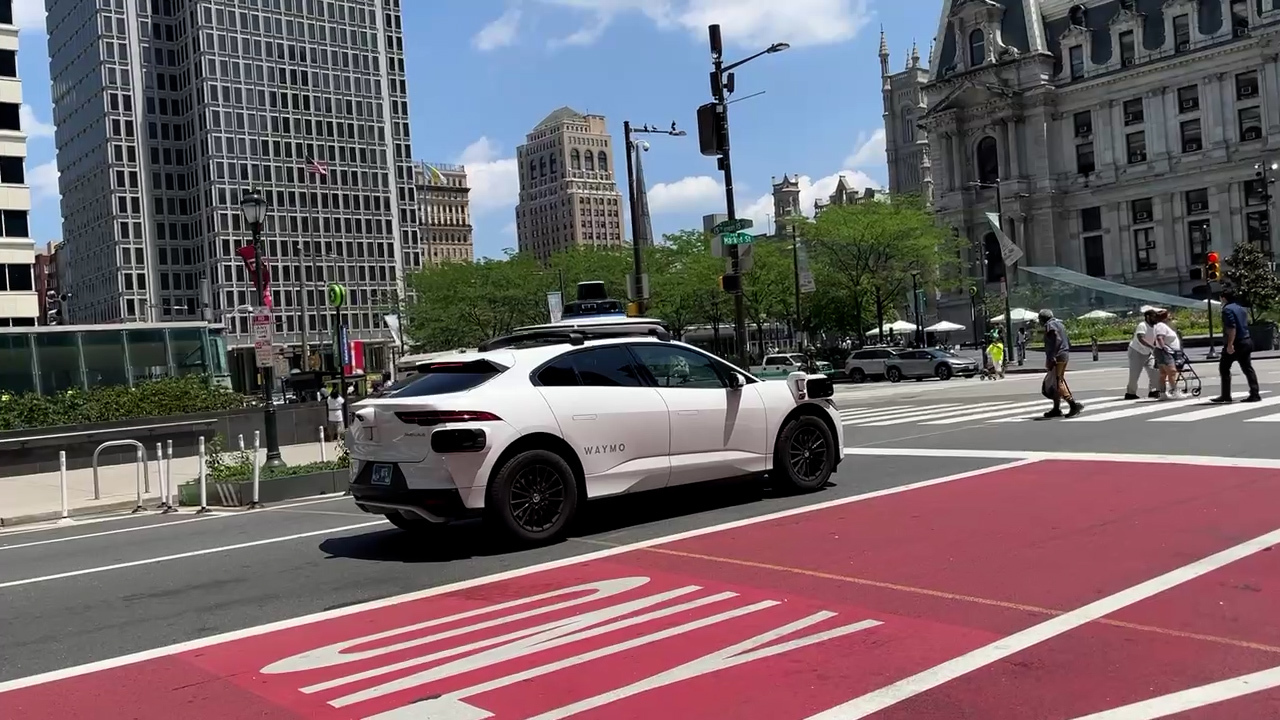
A Waymo car drives down Market Street Tuesday, July 8, 2025, in Philadelphia.
The company says its cars are now driving autonomously (with a human babysitter for now), mapping our neighborhoods and “laying the groundwork” to eventually chauffeur actual Philadelphians around.
Bold. Truly bold. Because sure, a driverless car can operate in Phoenix. But can it:
Identify a pothole before it becomes a crater?
Handle a double-parked Amazon van, a food truck, and a guy pushing a sofa on a hand truck… all in the same block?
Not get stolen? (It’s Philly. We have statistics.)
City officials say they’re “monitoring the situation,” which is Philly-speak for: If this thing blocks a SEPTA bus, there will be consequences. Meanwhile, Waymo has been chatting with local groups — the Bicycle Coalition, Best Buddies — which is smart, because they’ll need all the friends they can get once these cars try to merge on I-95.
Delco Donny turning Wawa parking lots into concert venues: A
Only in the Greater Philadelphia region could a man with a guitar, a thick Delco accent, and a dream turn random Wawa parking lots into 100-person pop-up concerts — and somehow it feels… correct.
“Delco Donny,” the alter ego of musician Jake Dillon, started as a joke for his girlfriend’s Delco mom, reported Philly Voice. Now he’s pulling six-figure TikTok views by belting out Oasis, the Killers, and “Creep” between parked Hyundais and people sprinting inside for Sizzlis. At his Boothwyn Wawa show, fans were literally acting like he was Noah Kahan, except with more vowels flattened and more hoodies with paint stains.
The shtick is simple: He shows up, leans into the Delco accent America learned during Mare of Easttown, and sings like he’s headlining the Spectrum in 1996. And people eat it up. Wawa corporate even started sending him merch, which is basically the Delco version of getting knighted.
There’s something kind of pure about it: a Northeast Philly native channeling a fictional Boothwyn legend who meditates in a cluttered van, reviews local pizza joints, and humbly accepts Marlboro Reds as offerings from the people. The man is doing character work in a gas-station parking lot, and somehow it feels like local folklore in the making.
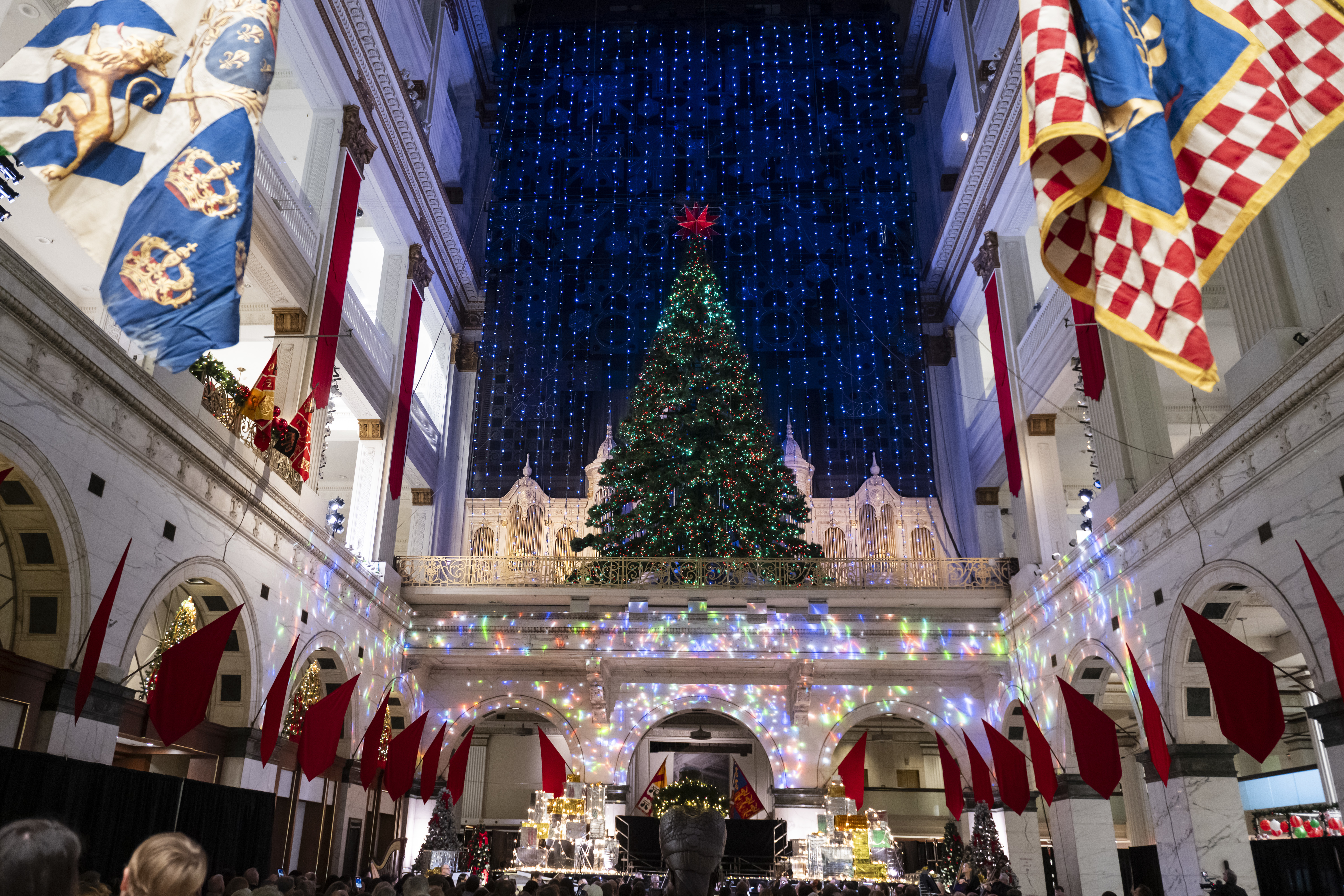
Opera Philadelphia hosted “Home for the Holidays” at the Wanamaker Building’s Grand Court on Tuesday, Dec. 2, 2025.
The Wanamaker Christmas comeback: A
In the most Philadelphia plot twist imaginable, the Wanamaker Grand Court took what could’ve been a gut punch — Macy’s closing, holiday traditions dangling by a thread — and turned it into a full-blown victory lap complete with a wreath-wearing Wanamaker Eagle, opera singers, dinosaur dancers, and an organ flex so powerful it could rattle the Market-Frankford Line.
“Home for the Holidays,” Opera Philadelphia’s one-night takeover, wasn’t just a concert, it was a statement. Philly looked at a soon-to-be shuttered space and said, Fine, then we’re going out in style. The whole night doubled as a nostalgia bomb: marching-toy projections for anyone who remembers buying Christmas presents in the old store, an audience gasping at the tree like it was 1978 again, and the ground-shaking Wanamaker Organ.
But the real Philly heart came from the subtext: This was also a campaign to keep the space public, alive, and musical long after renovations. You don’t raise $1 million for a Pipe Up! series unless you’re gearing up for a fight.
Philly is getting a cruise terminal again (!!): A-
PhilaPort struck a deal with Norwegian Cruise Line, building a new terminal in Tinicum Township with 41 voyages already on the books over the next two years, reported 6ABC. Norwegian’s locked in through 2033, sending thousands to Bermuda, the Bahamas, Canada, and New England, all sailing straight out of the airport’s backyard.
It’s a major comeback for a region that hasn’t had a real cruise hub in more than a decade, and the timing couldn’t be better with the 250th, the World Cup, and the All-Star Game all landing next year. Economic impact? Around $300 million annually. Jobs? More than 2,100.
And yes, it’s a six-hour ride down the Delaware before you hit the Atlantic. Philly’s response: New York isn’t much faster, Baltimore is way slower. So grab a drink and enjoy the shoreline.
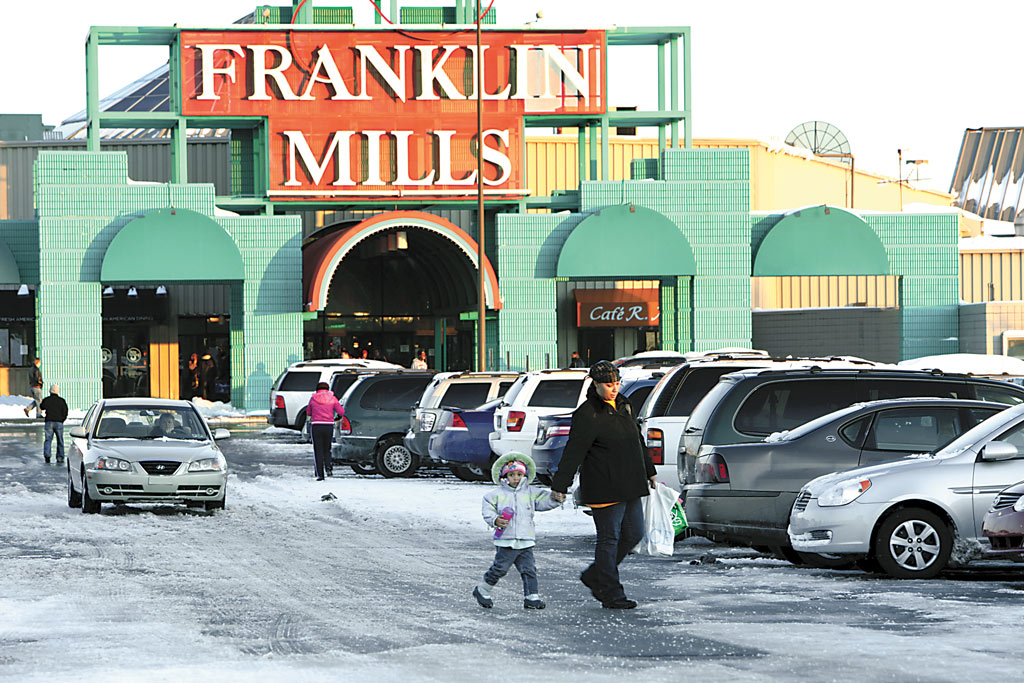
Franklin Mall, previously known as Franklin Mills, is for sale again.
Franklin Mills (sorry, “Franklin Mall”) is officially for sale: C
Franklin Mills, the place where Northeast Philly teens found Hot Topic, freedom, and an alarming amount of Orange Julius, is officially on the market. Again. After years of falling occupancy, collapsing value, and visitor counts dropping from 20 million a year in the ’90s to 5.6 million today, it’s basically being lilsted as: “137 acres… willing to become literally anything.”
Industrial redevelopment? Sure. Warehousing? Probably. Housing? Maybe, if City Council blesses it. A mall again? As one architect put it: “Unlikely.” (Philly translation: absolutely not.)
This place is 1.8 million square feet (second only to King of Prussia), but while KOP is still the superstar of malls, Franklin Mills slowly slid into its “legacy act” phase. The valuation dropped from $370 million in 2007 to $76 million last year. Even the name had to be changed back because Simon Property Group kept the Mills trademark, which feels like getting your hoodie taken in a breakup.
Real talk: The building is basically a demolition project waiting for a permit. But to its credit, 65% occupancy means it isn’t a ghost town yet — just a mall trying to remember who it used to be.
It might become warehouses, apartments, or over a million square feet of “don’t worry, it’ll create jobs.” But one thing’s for sure: If Northeast Philly wakes up to find a sea of Amazon vans where Franklin Mills once stood, people will still call it Franklin Mills.
This week after completing two different portrait assignments I was was looking around as I walked back to my parked car.
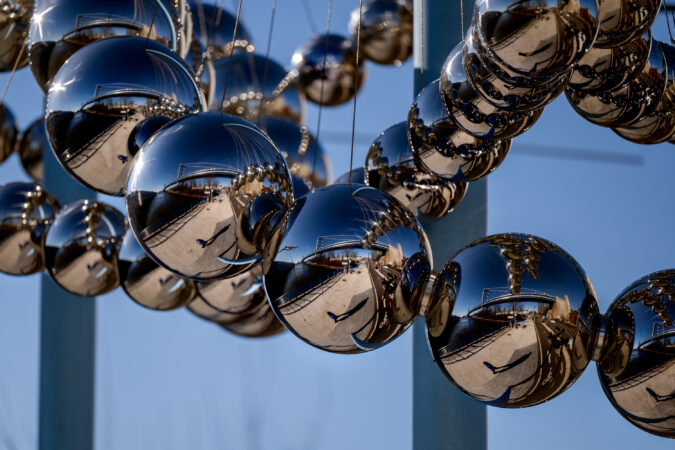
I’d seen it in Old City before, but on a really clear, cold morning when the sky’s color perfectly matched that of the Ben Franklin Bridge towering over the public artwork on Columbus Boulevard, I looked more carefully at the giant knot of stainless steel spheres.
Sometimes you go looking for pictures but “found” pictures are most often located just where you happen to be.
I studied the shiny surface, looking through my viewfinder, varying the focal length on the two zoom lenses I had (a 24-70mm and 70-200mm) and switching between different apertures to achieve either more or less depth-of-focus on the orbs and the reflections they mirrored.
I also made a slightly “harsher” version of the blue sky and bridge.
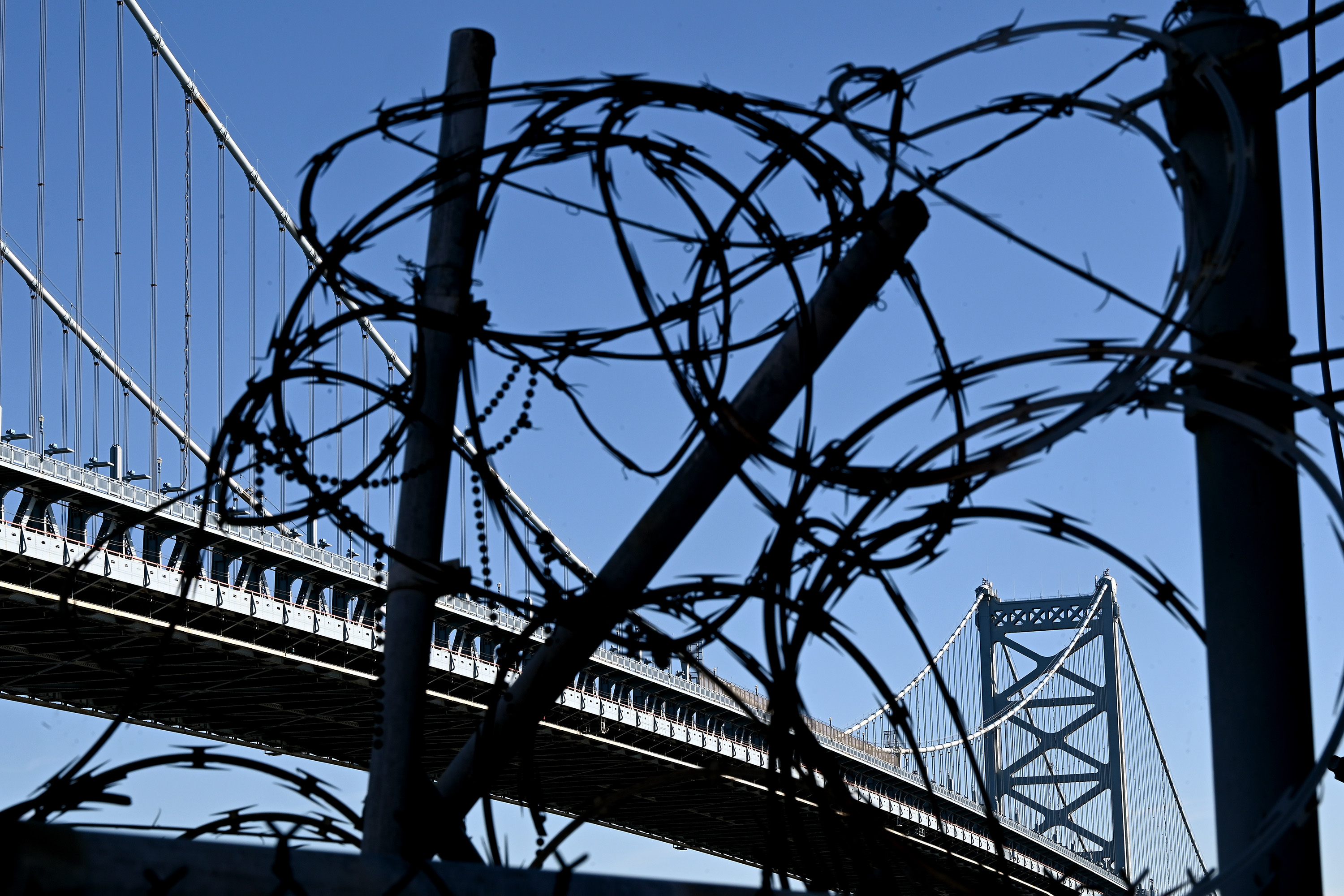
Razor wire beside a pier on Columbus Boulevard frames the Benjamin Franklin Bridge Dec. 3, 2025.
Weather the day before was in sharp contrast — literally, with winds blowing rain almost knife-like horizontally at me as I fought with my umbrella to make a picture outside following another indoor portrait assignment.
I ended up moving to the roof of the garage where I parked my car.
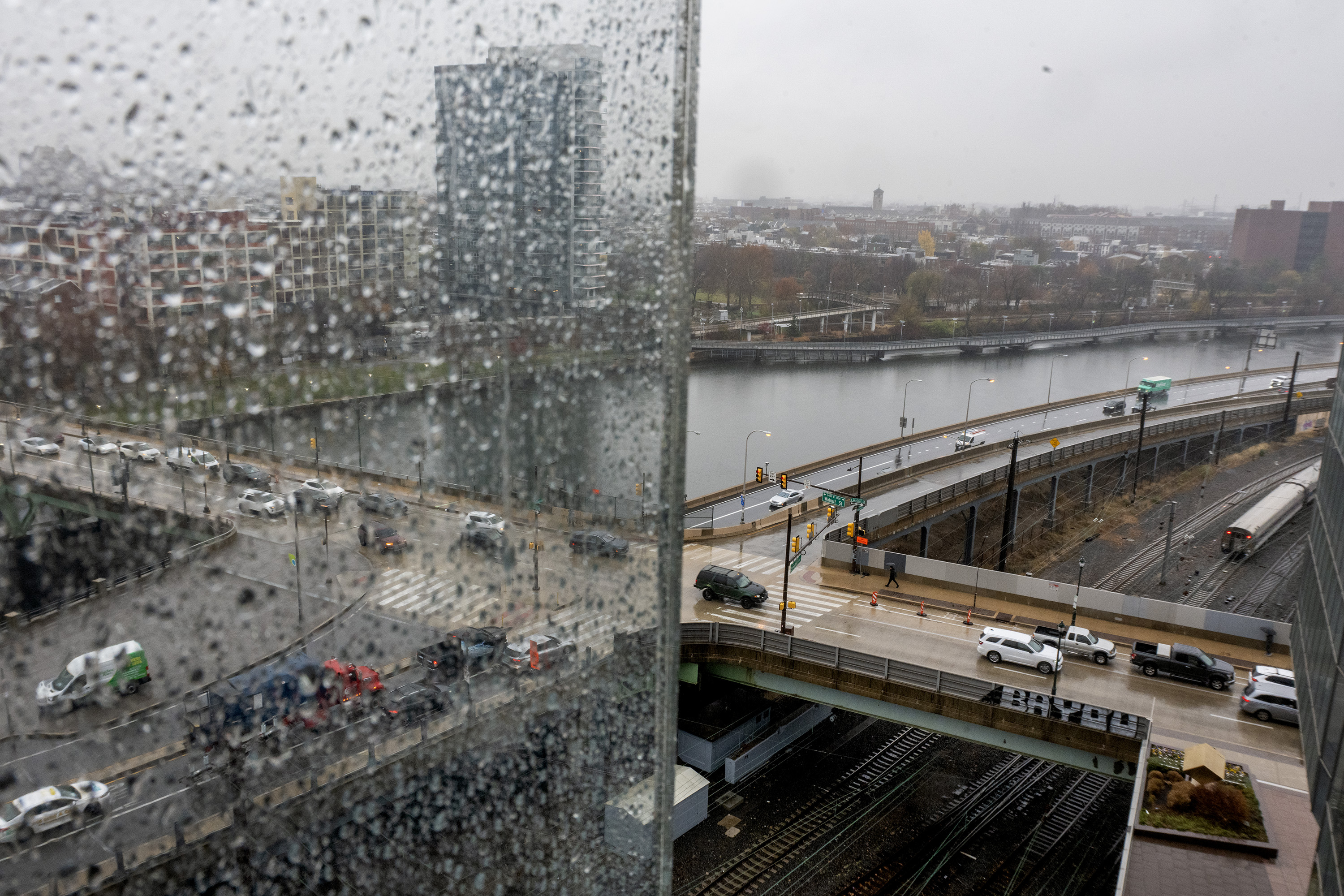
Conditions were more wet than white as an early winter storm hit the region Tuesday, Dec. 3, 2025. This was a view of the Schuylkill, I-76, Walnut Street and the Amtrak and SEPTA tracks leading into 30th Street Station.
A note in support of copy editors: You know how seeing writers (mostly on social media) confusing a possessive pronoun with a contraction or thinking an apostrophe always indicates possession can be mildly distfacting or jarringly annoying to readers? (it’s vs. its and your vs. you’re.)
Well as a long-time photo caption reader (and writer) there are two common errors that exasperate me. Those would be the names of a common migratory water fowl and one of Philadelphia’s three major waterways.
Addam Schwartz, The Inquirer’s senior multiplatform editor, wrote the rain caption for the print version of the photo. He correctly changed my “Schuylkill River” to just plain “Schuylkill.” He knows the word means “hidden river,” so “River” is redundant. (It was named by Dutch settlers in the early 1600s. Prior to that time, the river was called Manayunk, meaning “where we go to drink” or Ganoshowanna, meaning “falling water” by the Lenape.)
In my defense I also know all that. Decades ago Suzanne Weston, the copy editor at Inquirer Magazine when I was on staff there educated me. But I do make mistakes, especially when typing captions on my laptop in my car.
And, it’s Canada goose, not Canadian. As a Consulate General in Minneapolis pointed out to me decades ago, while Canada would be proud to claim Branta canadensis as its own, they belong to ALL of the continent.
(By the way, Schuylkill Expressway IS okay.)
Since 1998 a black-and-white photo has appeared every Monday in staff photographer Tom Gralish’s “Scene Through the Lens” photo column in the print editions of The Inquirer’s local news section. Here are the most recent, in color:
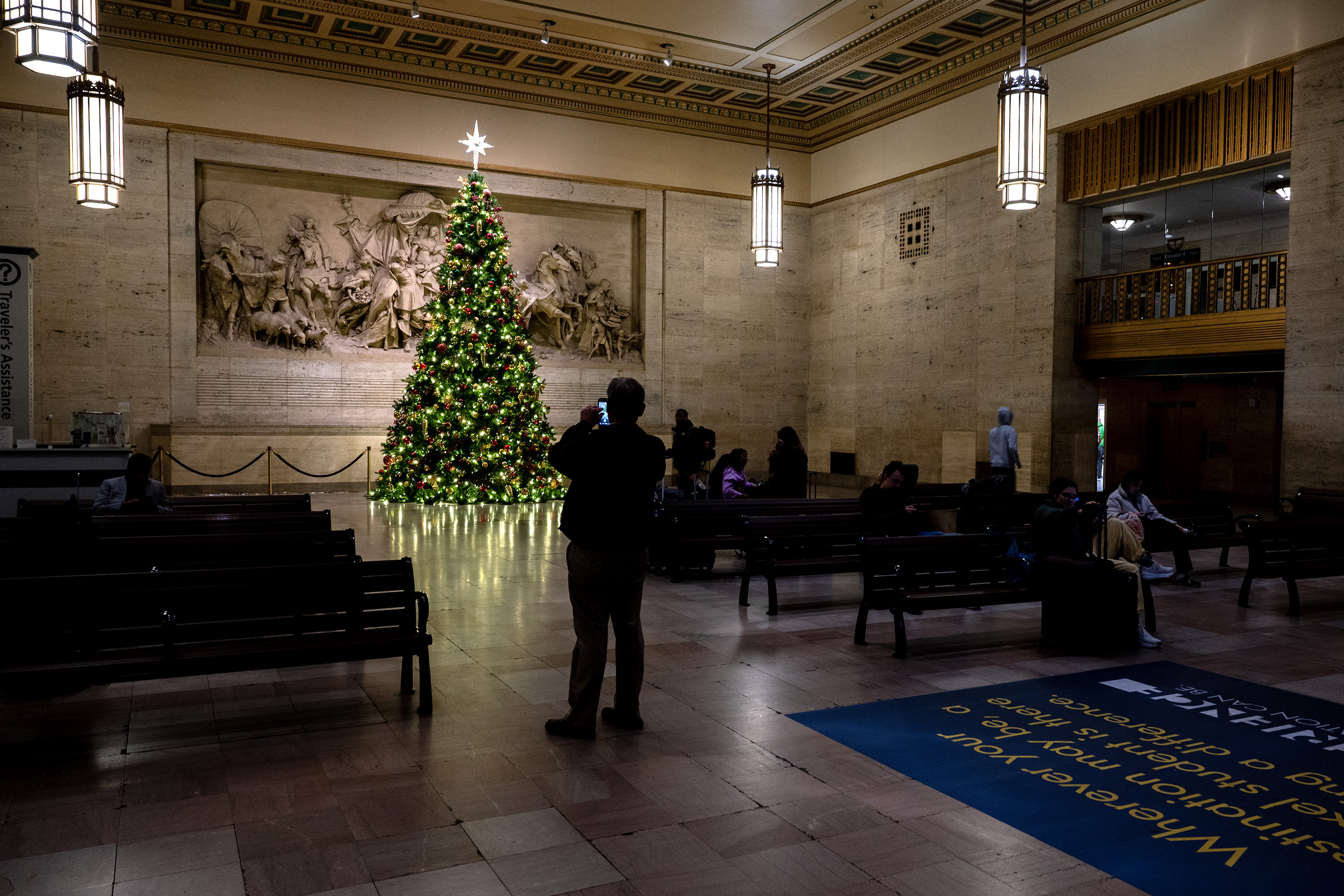
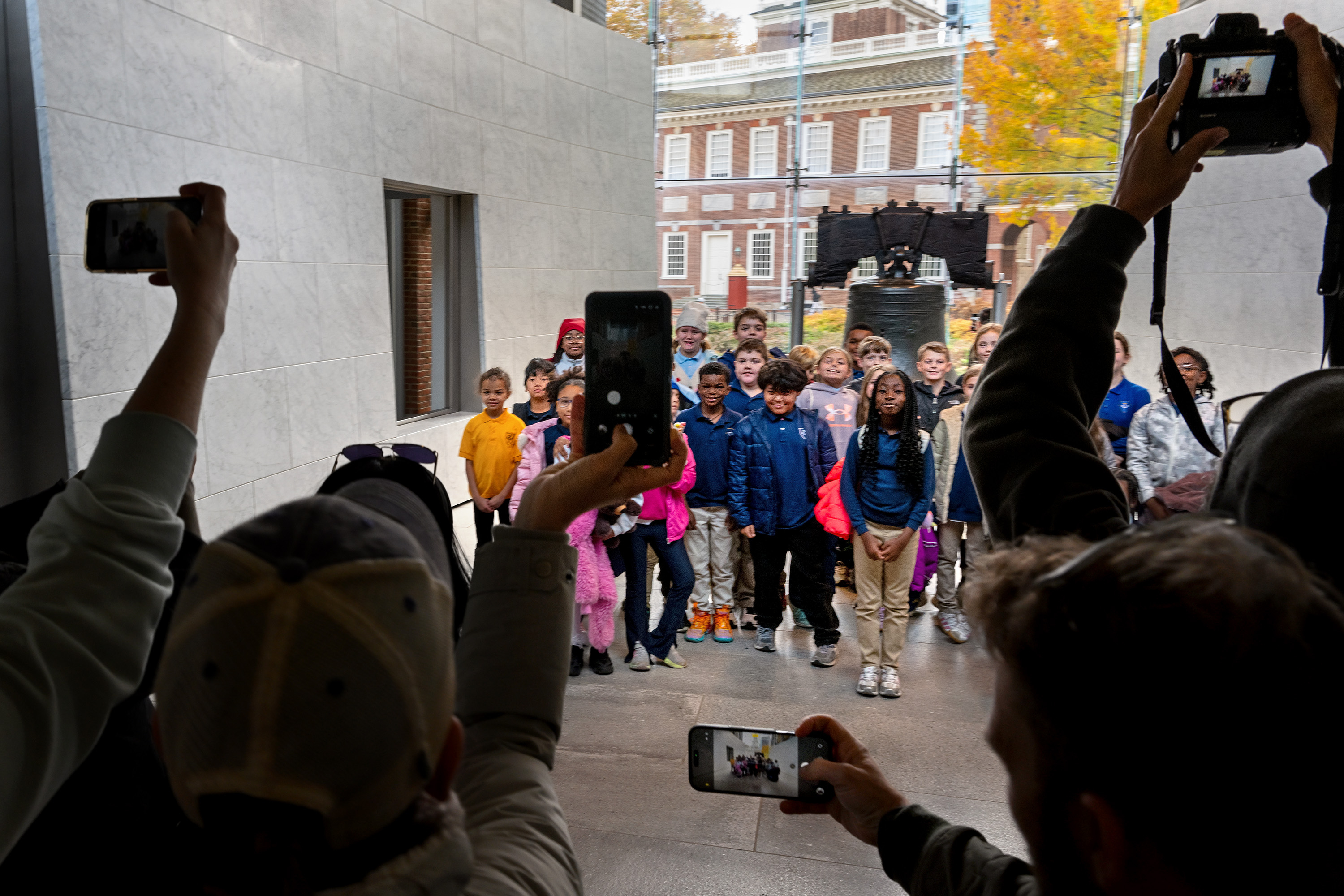
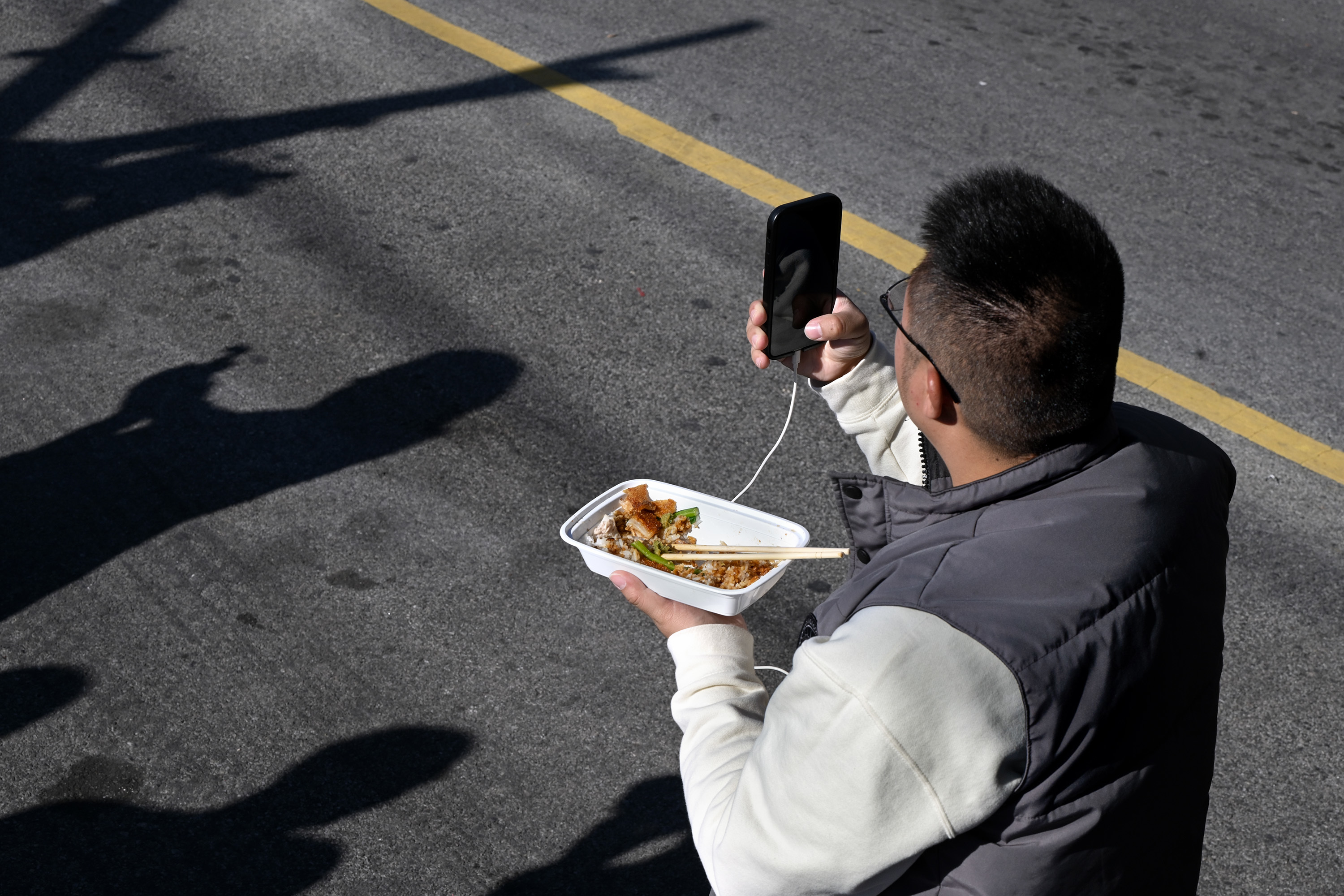
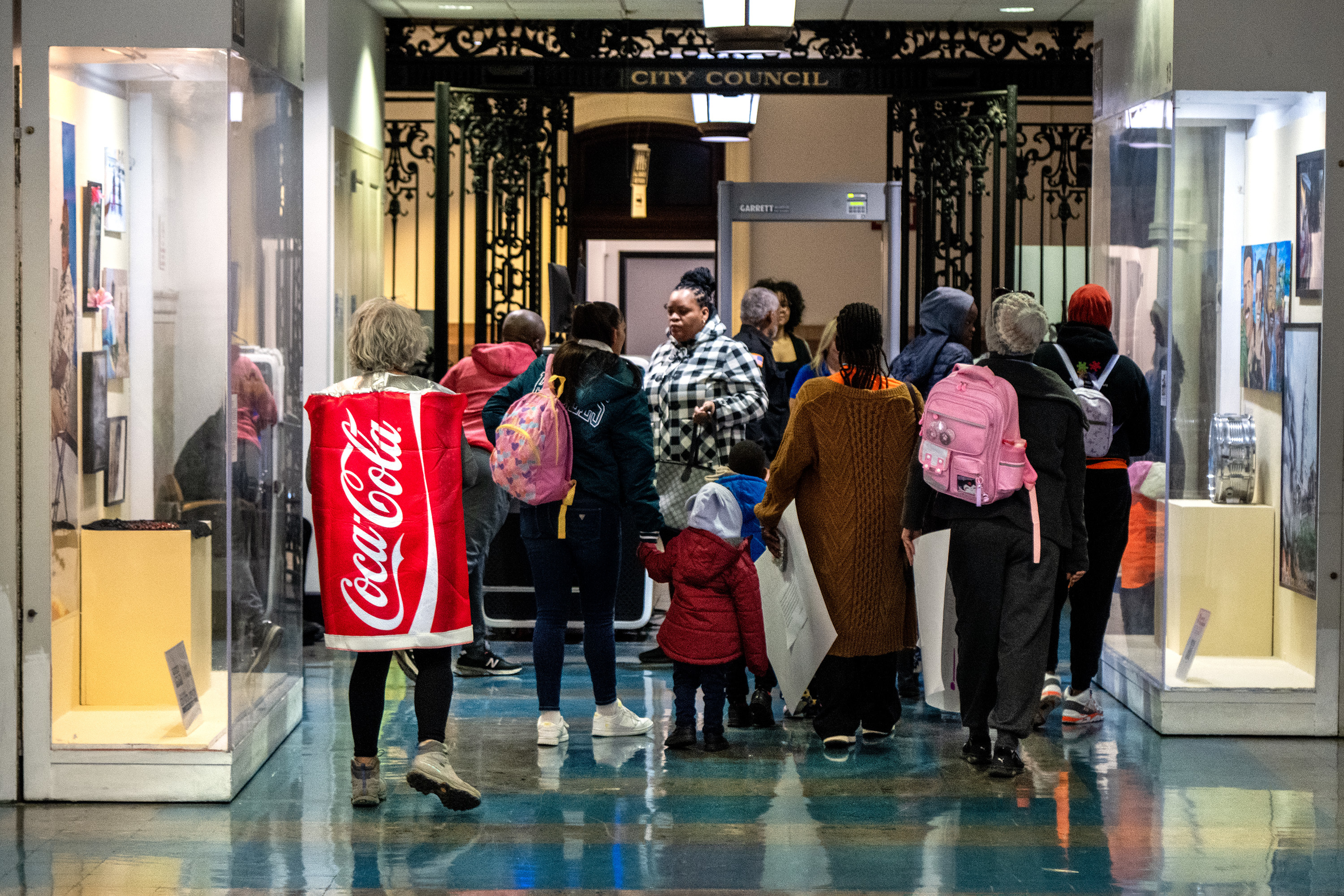
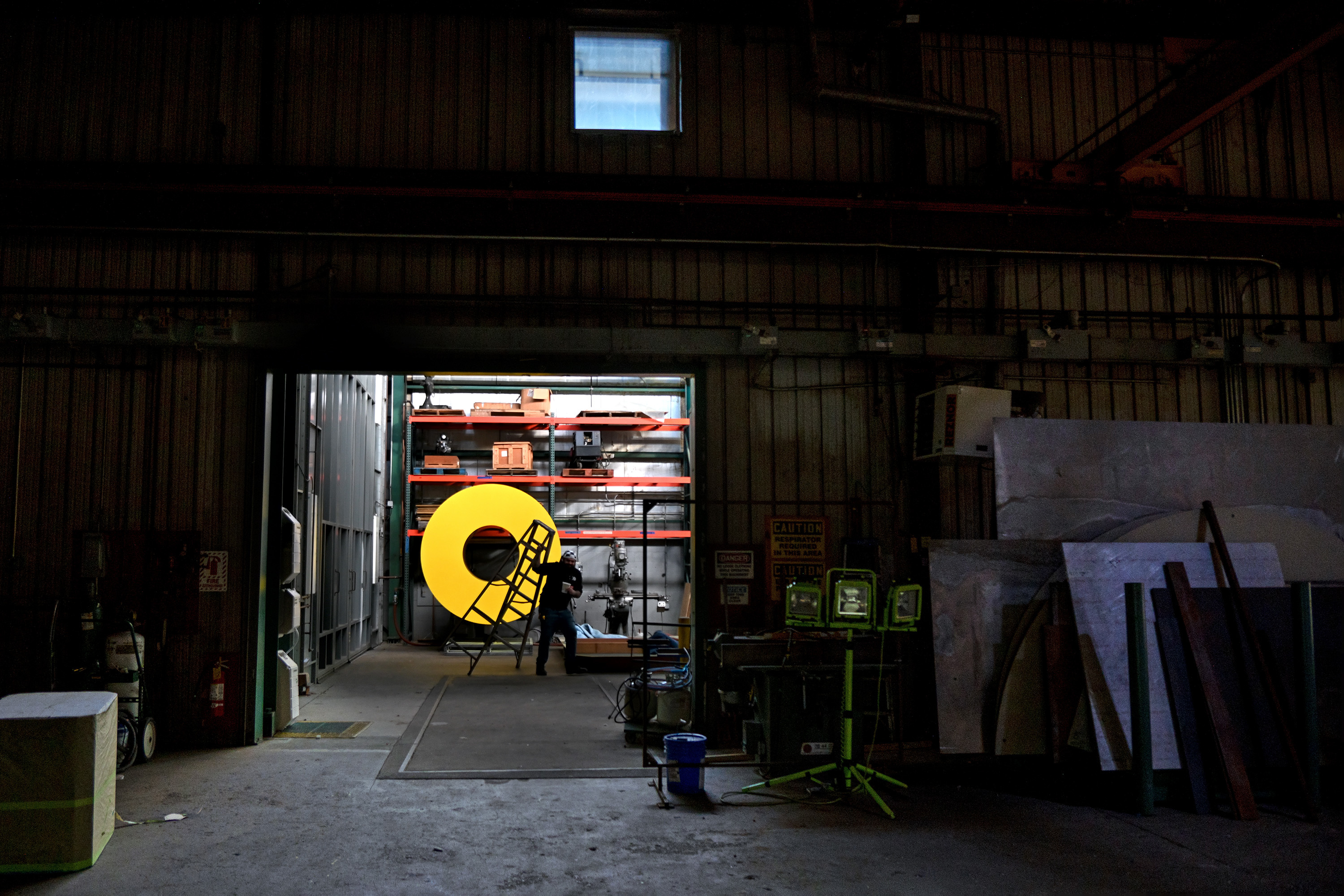
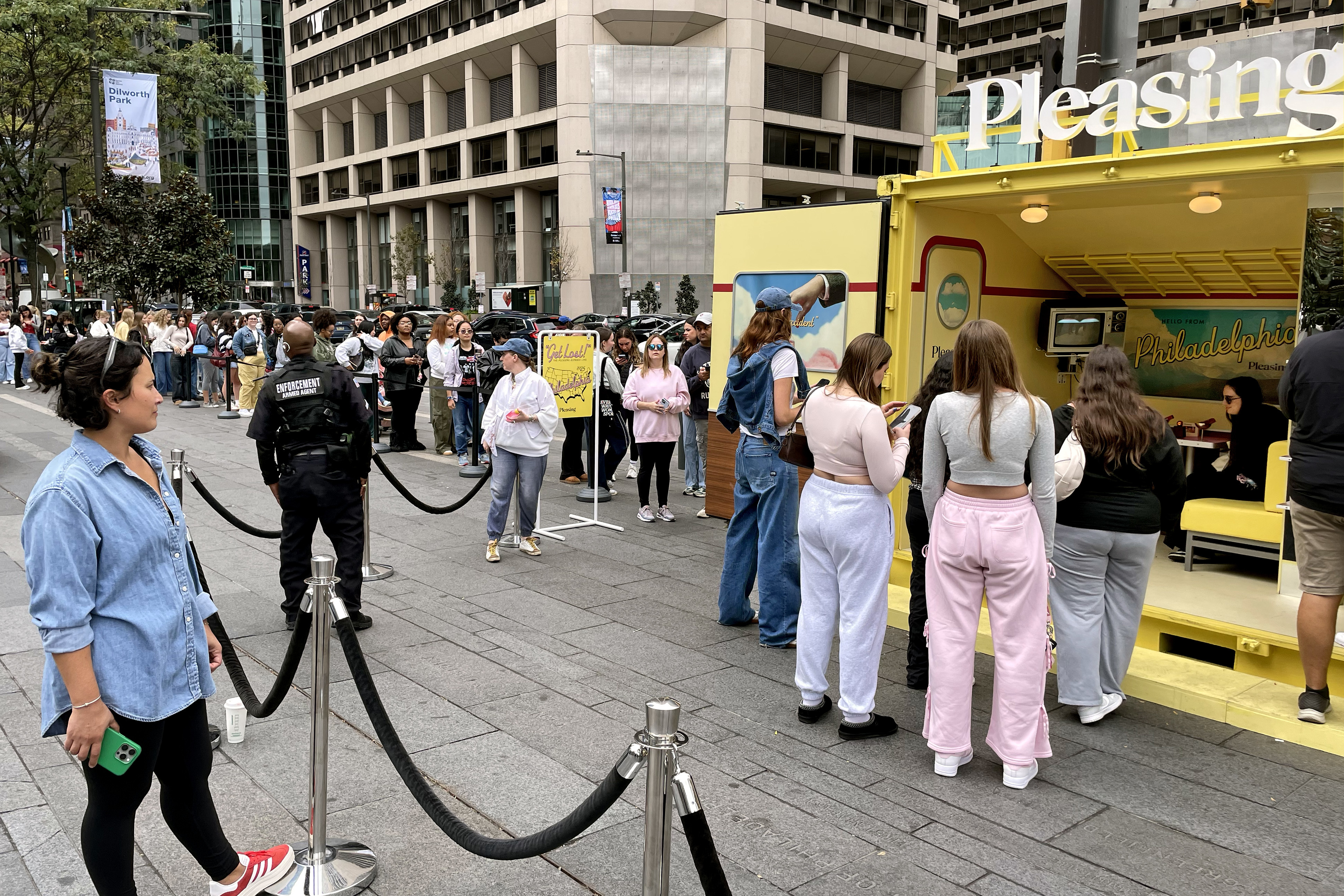
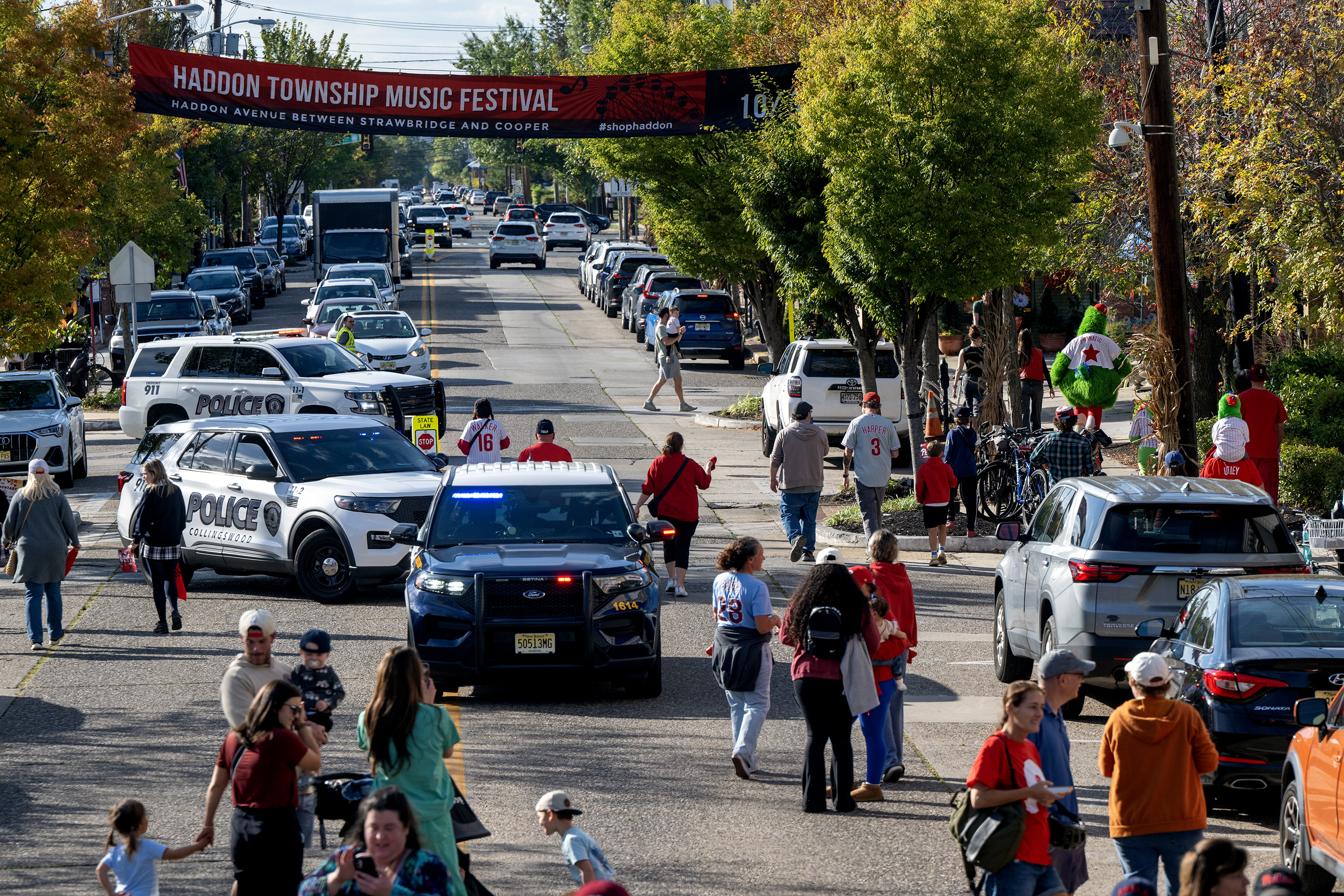
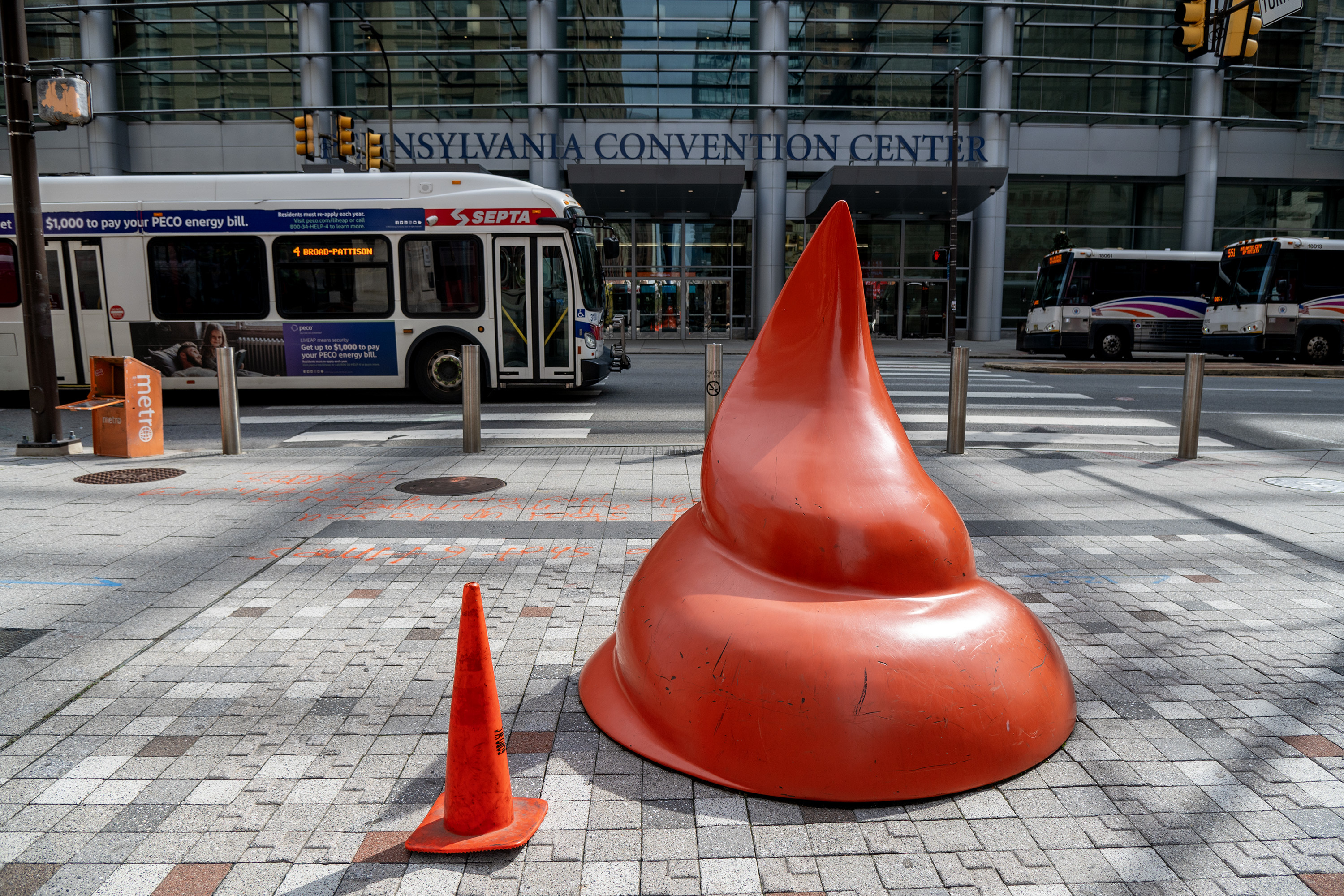
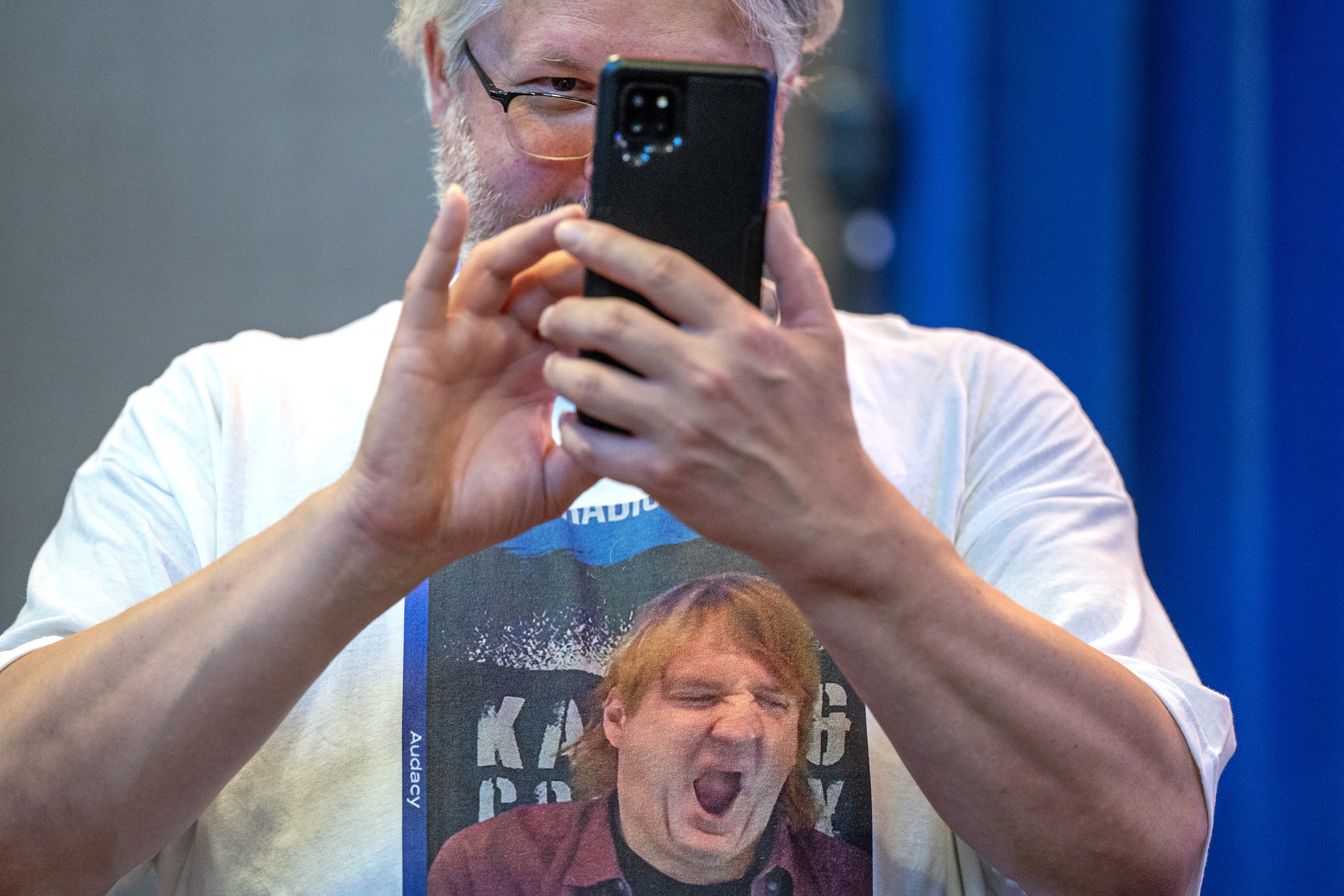
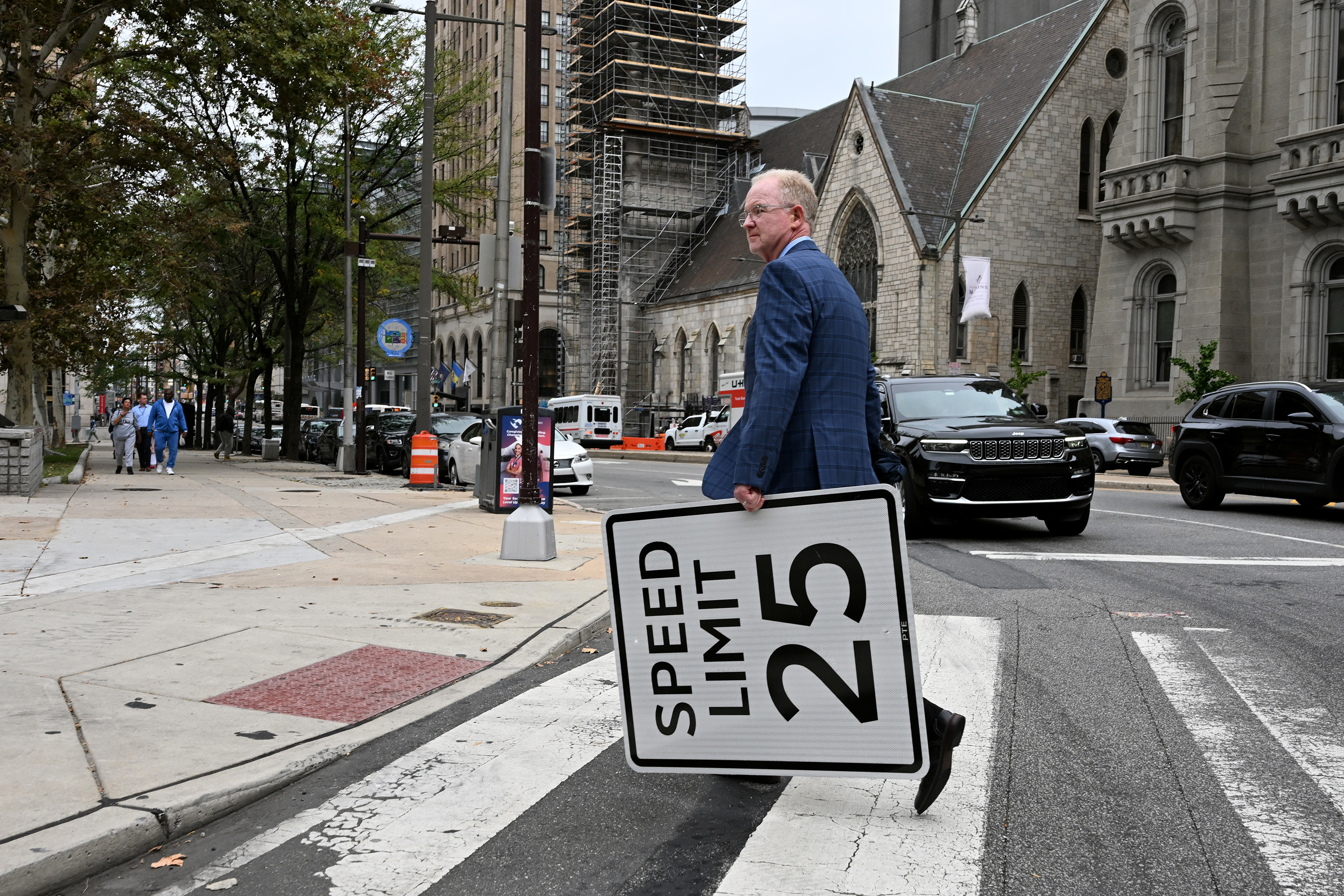
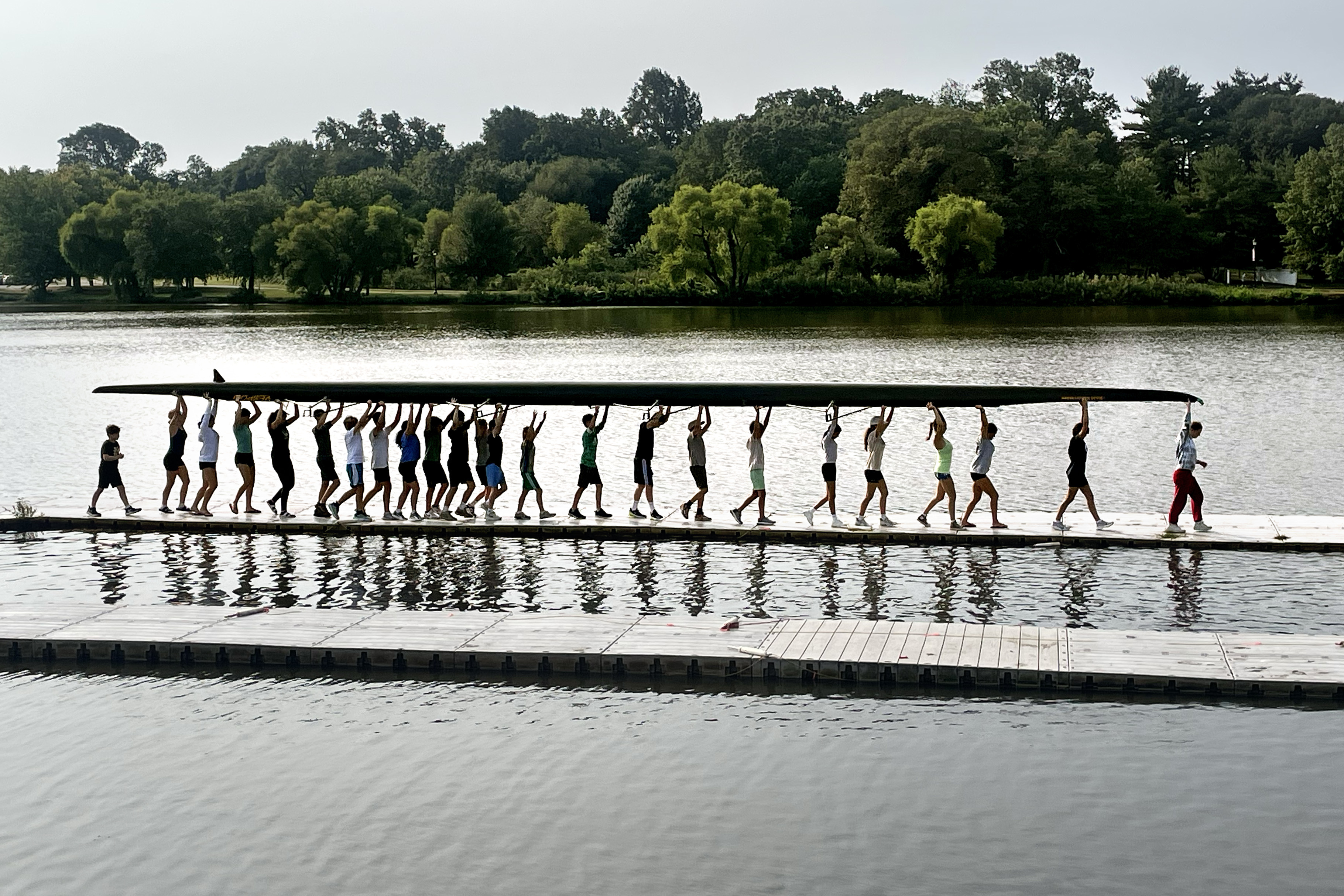
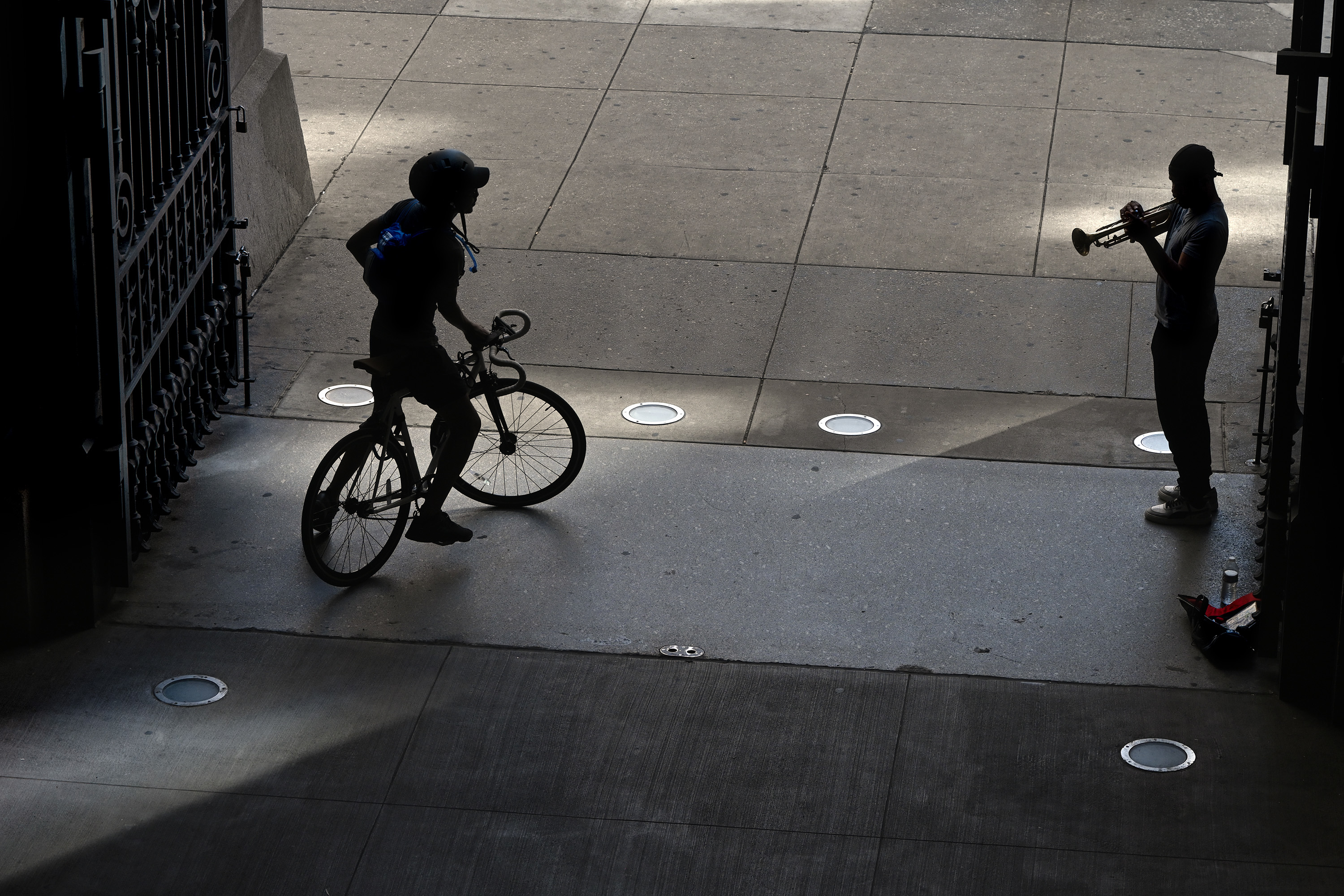
November 29, 2025: t’s ginkgo time in our region again when the distinctive fan-shaped leaves turn yellow and then, on one day, lose all their leaves at the same time laying a carpet on city streets and sidewalks. A squirrel leaps over leaves in the 18th Century Garden in Independence National Historical Park Nov. 25, 2025. The ginkgo (Ginkgo biloba) is considered a living fossil as it’s the only surviving species of a group of trees that existed before dinosaurs. Genetically, it has remained unchanged over the past 200 million years. William Hamilton, owner the Woodlands in SW Phila (no relation to Alexander Hamilton) brought the first ginkgo trees to North America in 1785.November 24, 2025: The old waiting room at 30th Street Station that most people only pass through on their way to the restrooms has been spiffed up with benches – and a Christmas tree. It was placed there this year in front of the 30-foot frieze, “The Spirit of Transportation” while the lobby of Amtrak’s $550 million station restoration is underway. The 1895 relief sculpture by Karl Bitter was originally hung in the Broad Street Station by City Hall, but was moved in 1933. It depicts travel from ancient to modern and even futuristic times. November 17, 2025: Students on a field trip from the Christian Academy in Brookhaven, Delaware County, pose for a group photo in front of the Liberty Bell in Independence National Historical Park on Thursday. The trip was planned weeks earlier, before they knew it would be on the day park buildings were reopening after the government shutdown ended. “We got so lucky,” a teacher said. Then corrected herself. “It’s because we prayed for it.” November 8, 2025: Multitasking during the Festival de Día de Muertos – Day of the Dead – in South Philadelphia.November 1, 2025: Marcy Boroff is at City Hall dressed as a Coke can, along with preschoolers and their caregivers, in support of former Mayor Jim Kenney’s 2017 tax on sweetened beverages. City Council is considering repealing the tax, which funds the city’s pre-K programs. October 25, 2025: Austin Gabauer, paint and production assistant at the Johnson Atelier, in Hamilton Twp, N.J. as the finished “O” letter awaits the return to Philadelphia. The “Y” part of the OY/YO sculpture is inside the painting booth. The well-known sculpture outside the Weitzman National Museum of American Jewish History was removed in May while construction continues on Market Street and has been undergoing refurbishment at the Atelier at the Grounds for Sculpture outside of Trenton.October 20, 2025:The yellow shipping container next to City Hall attracted a line of over 300 people that stretched around a corner of Dilworth Park. Bystanders wondered as they watched devotees reaching the front take their selfies inside a retro Philly diner-esque booth tableau. Followers on social media had been invited to “Climb on to immerse yourself in the worlds of Pleasing Fragrance, Big Lip, and exclusive treasures,” including a spin of the “Freebie Wheel,” for products of the unisex lifestyle brand Pleasing, created by former One Direction singer Harry Styles.October 11, 2025: Can you find the Phillie Phanatic, as he leaves a “Rally for Red October Bus Tour” stop in downtown Westmont, N.J. just before the start of the NLDS? There’s always next year and he’ll be back. The 2026 Spring Training schedule has yet to be announced by Major League Baseball, but Phillies pitchers and catchers generally first report to Clearwater, Florida in mid-February.October 6. 2025: Fluorescent orange safety cone, 28 in, Poly Ethylene. Right: Paint Torch (detail) Claes Oldenburg, 2011, Steel, Fiberglass Reinforced Plastic, Gelcoat and Polyurethane. (Gob of paint, 6 ft. Main sculpture, 51 ft.). Lenfest Plaza at the Pennsylvania Academy of the Fine Arts on North Broad Street, across from the Convention Center.September 29, 2025: A concerned resident who follows Bucks County politics, Kevin Puls records the scene before a campaign rally for State Treasurer Stacy Garrity, the GOP candidate for governor. His T-shirt is “personal clickbait” with a url to direct people to the website for The Travis Manion Foundation created to empower veterans and families of fallen heroes. The image on the shirts is of Greg Stocker, one of the hosts of Kayal and Company, “A fun and entertaining conservative spin on Politics, News, and Sports,” mornings on Talk Radio 1210 WPHT.September 22, 2025: A shadow is cast by “The Cock’s Comb,” created by Alexander “Sandy” Calder in 1960, is the first work seen by visitors arriving at Calder Gardens, the new sanctuary on the Ben Franklin Parkway. The indoor and outdoor spaces feature the mobiles, stabiles, and paintings of Calder, who was born in Philadelphia in 1898, the third generation of the family’s artistic legacy in the city.September 15, 2025: Department of Streets Director of Operations Thomas Buck leaves City Hall following a news conference marking the activation of Automated Speed Enforcement (ASE) cameras on the Broad Street corridor – one the city’s busiest and most dangerous roads. The speed limit on the street, also named PA Route 611, is 25 mph.September 8, 2025: Middle schoolers carry a boat to the water during their first outing in a learn-to-row program with the Cooper Junior Rowing Club, at the Camden County Boathouse on the Cooper River in Pennsauken. September 1, 2025: Trumpet player Rome Leone busks at City Hall’s Easr Portal. The Philadelphia native plays many instruments, including violin and piano, which he started playing when he was 3 years old. He tells those who stop to talk that his grandfather played with Billie Holiday, Duke Ellington, Nina Simone, and Dizzy Gillespie. August 25, 2025: Bicycling along on East Market Street.
Chris Emmanouilides, 63, of Rutledge, Delaware County, digital media director, award-winning filmmaker, TV executive producer, cameraman, teacher, and mentor, died Saturday, April 26, of a heart attack at his home.
Born in Philadelphia and reared in Los Angeles, Mr. Emmanouilides followed his then-girlfriend back to the city in the 1980s, earned a master’s degree in radio, TV, and film at Temple University, and crafted a 36-year career as an independent filmmaker, vice president of programming for Banyan Productions, cofounder and chief content officer of the VuNeex video marketing platform, and director of digital media at the King of Prussia-based American College of Financial Services.
He specialized in independent documentary films, commercials, and early forms of reality TV, and cofounded Parallax Pictures in the 1990s. His films were screened at the Philadelphia Festival of World Cinema, the Sundance Film Festival, and elsewhere around the world.
His 40-minute film Archive premiered at the Los Angeles Greek Film Festival in 2013 and earned the Audience Choice Orpheus Award. His 1989 film Suelto! earned first prize at the 1990 Sundance Slice of Life Film Festival.
In 1994, Inquirer movie critic Desmond Ryan called Mr. Emmanouilides’ film Remains “especially noteworthy.” In 1997, The Ad and the Egoearned the top prize at the San Francisco International Film Festival.
In 2001, critic Damon C. Williams reviewed TalkFast for the Daily News. Mr. Emmanouilides was the film’s director of photography. Williams said: “It does an incredible job in detailing the desire, dedication and heartbreak that go with pursuing a dream. It also shows that some do indeed find success in chasing their dreams.”
From 1997 to 2014, Mr. Emmanouilides was an executive producer, director of special projects, and vice president of programing at Philadelphia-based Banyan Productions. Working with the Discovery Channel, the Travel Channel, the Food Network, TLC, Lifetime, and other TV outlets, he and his colleagues created thousands of hours of popular award-winning programming. Among his series credits are Travelers, Reunion, Trading Spaces, Deliver Me, Cruises We Love, and A Wedding Story.
“What we pull off in four days — the emotions and the intimacy — is extremely rare on television,” he told The Inquirer in a 1998 story about the Reunion series. “It’s a constant push, trying to make a high-quality show on a limited budget, with limited time. And the question is, will it find an audience?”
He worked with Reader’s Digest and Hope Paige Designs on video marketing projects at VuNeex in 2015, and spent the last 10 years as a senior producer and director of digital media at the American College of Financial Services. “Chris was relentless in the pursuit of quality,” Jared Trexler, senior vice president at American College, said in an online tribute. “He was inquisitive, introspective, and always learning. Most importantly, he was kind, caring, and funny.”
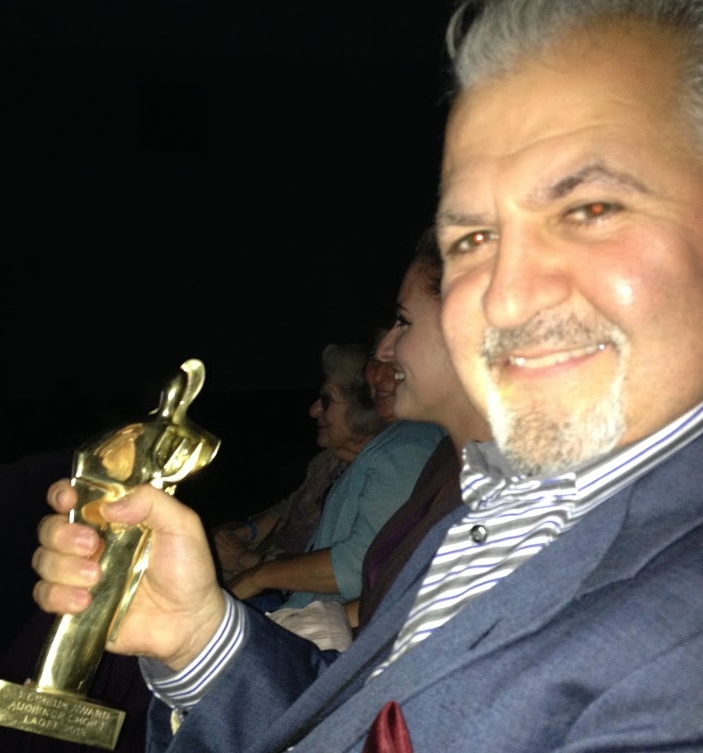
Mr. Emmanouilides won the 2013 Audience Choice Orpheus Award in Los Angeles.
In tributes, colleagues called him “an amazing man and incredible coworker” and “very passionate about our field.” One said: “He always brought genuine fun and energy to whatever we were doing.”
Gregarious and energetic, Mr. Emmanouilides taught film and production courses at Temple, the University of Toledo, the Scribe Video Center, and the old University of the Arts. He lectured at Drexel and Villanova Universities, spoke at conferences and seminars, and taught English-language classes in Greece and Spain.
He was a longtime member and onetime board president of the Philadelphia Independent Film and Video Association, and he mentored production novices at Scribe Video in Center City and elsewhere. “These newcomers don’t respect the conventions of film that much,” he told The Inquirer in 1993. “They’re trying to find their own voice. So they’re finding new ways to tell stories.”
Christopher George Emmanouilides was born Aug. 31, 1961. His family moved from Philadelphia to Los Angeles when he was young, and he earned a bachelor’s degree in philosophy at Colorado College in 1983 and a master’s degree at Temple in 1992.
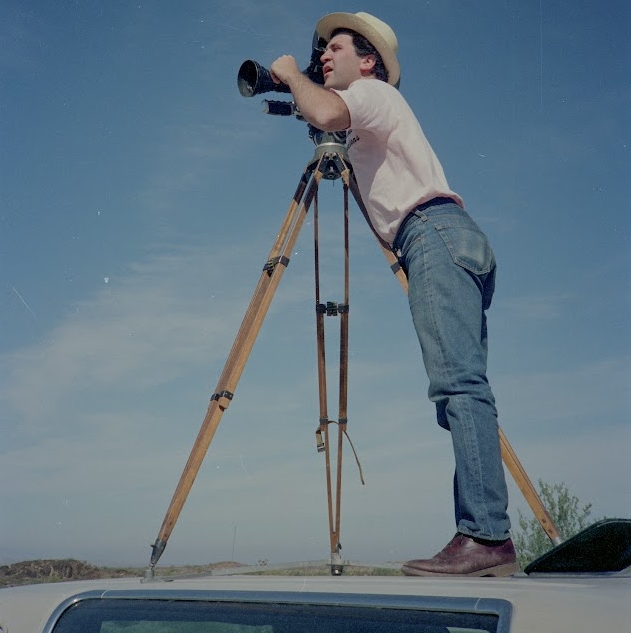
Mr. Emmanouilides was a talented cameraman and photographer.
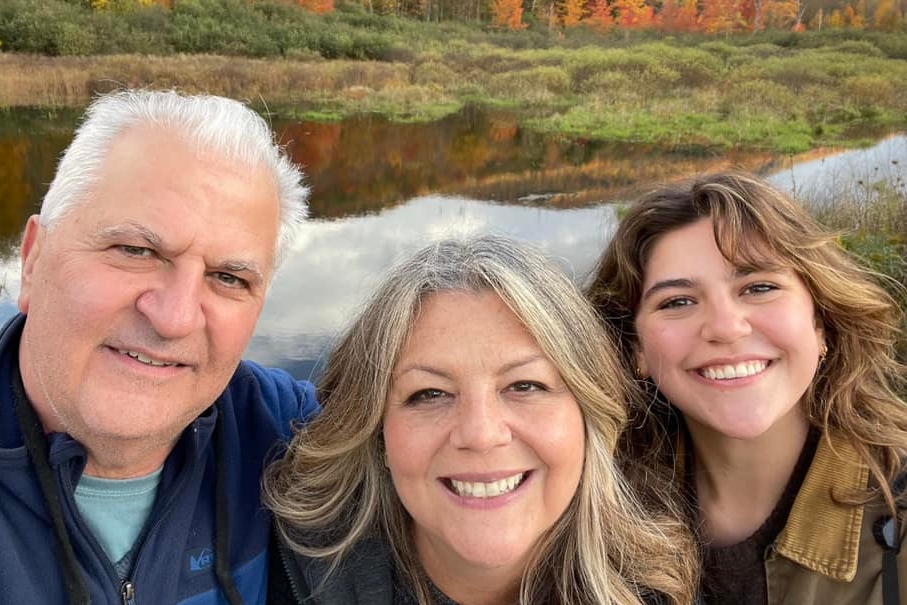
He met Sandra Enck at an independent film event in Philadelphia, and they married in 2004 and had a daughter, Isabella. He doted on his family, and especially enjoyed seeing films with his wife and decorating his daughter’s breakfast pancakes with eyes, nose, and mouth cut from fresh fruit.
“We took their pictures, and we eventually had hundreds of faces from countless mornings together,” his daughter said on her website facethemorning.com. “None were the same, and each seemed to have something to say.”
His wife said: “We’d see a film and then talk about it for three days.”
Mr. Emmanouilides was an avid reader and photographer. He liked to fly-fish, ski, hike, and cook.
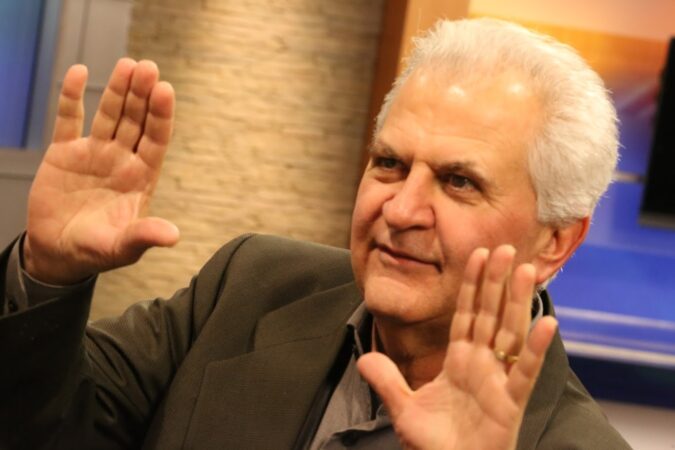
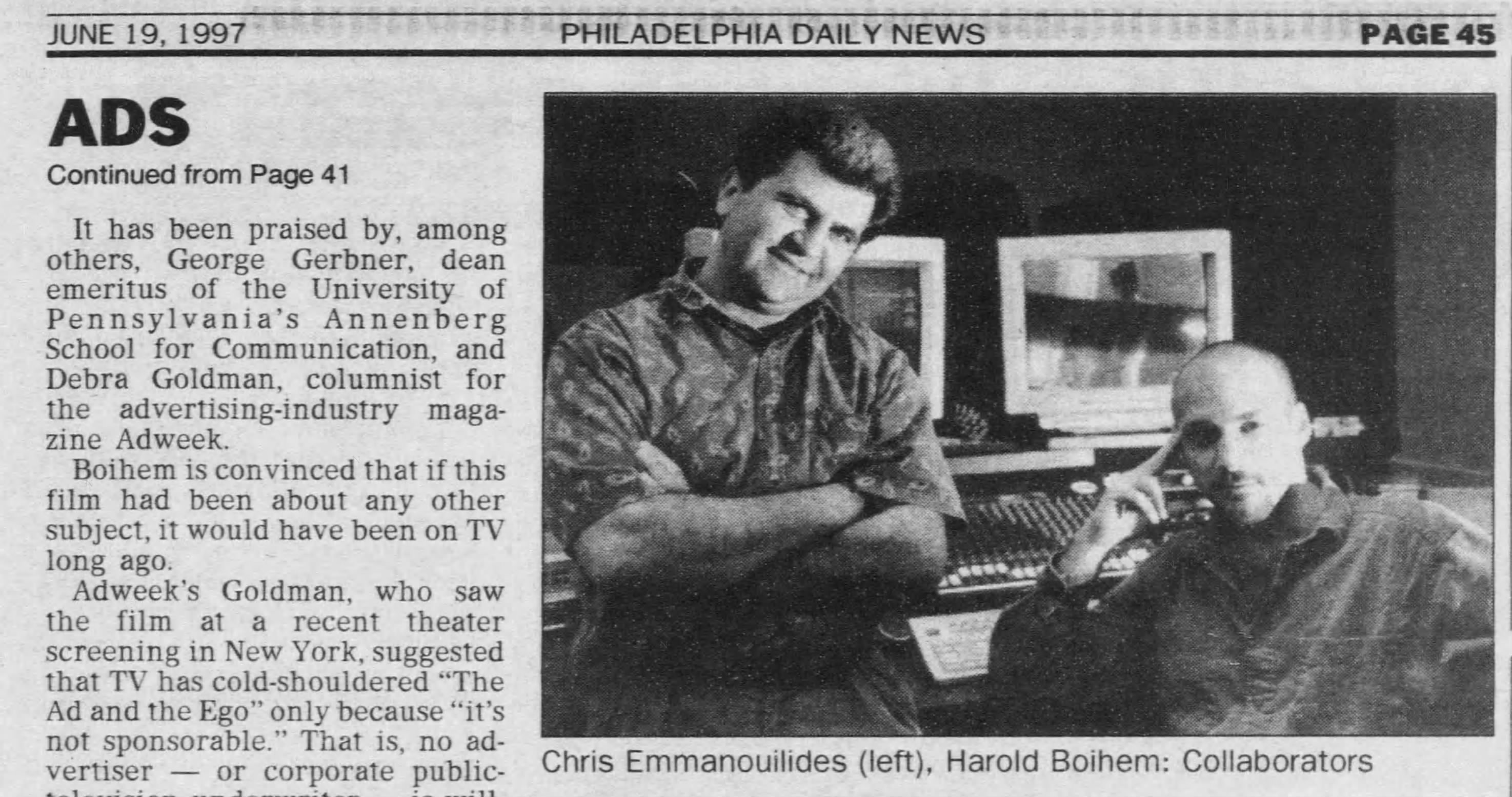
This article about Mr. Emmanouilides (left) appeared in the Daily News in 1997.
He had an infectious laugh, performed magic tricks, listened to the Grateful Dead, and followed the Eagles and Phillies. “He was a big thinker,” his wife said. “He was buoyant and a powerful life force. You never forgot that you met him.”
In addition to his wife and daughter, Mr. Emmanouilides is survived by three sisters, a brother, and other relatives.
Celebrations of his life were held earlier.
Donations in his name may be made to the Bryn Mawr Film Institute, 824 W. Lancaster Ave., Bryn Mawr, Pa. 19010.
We’ll show you a photo taken in the Philly-area, you drop a pin where you think it was taken. Closer to the location results in a better score. This week’s theme is all about winter. Good luck!
Round #10
Question 1
Where is this ice rink?
Loading…
.location {
fill: var(–color-secondary);
}
ClickTap on map to guess the location in the photo
ClickTap again to change your guess and hit submit when you're happy
You will be scored at the end. The closer to the location the better the score
Charles Fox / Staff Photographer
Pretty good/Not bad/Way off! Your guess was from the location.Spot on! Your guess was exactly at the location. Here's also where a random selection of Inquirer readers guessed.
This is Rothman Orthopaedics Ice Rink located at the west side of City Hall. The ice rink opened on November 14 and will be available to skate on through February 22, 2026.
Quiz continues after ad
Question 2
Where can you find these holiday lights?
Loading…
.location {
fill: var(–color-secondary);
}
Margo Reed / Staff Photographer
Pretty good/Not bad/Way off! Your guess was from the location.Spot on! Your guess was exactly at the location. Here's also where a random selection of Inquirer readers guessed.
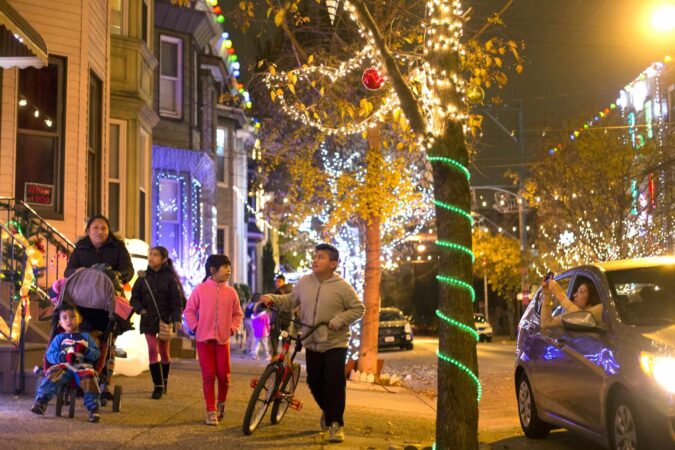
This is the Miracle on South 13th Street. Residents of South 13th St. have been decorating their houses for about 20 years, turning the area into a popular holiday season attraction.
Quiz continues after ad
Question 3
Where is this garden?
Loading…
.location {
fill: var(–color-secondary);
}
Jose F. Moreno / Staff Photographer
Pretty good/Not bad/Way off! Your guess was from the location.Spot on! Your guess was exactly at the location. Here's also where a random selection of Inquirer readers guessed.
This is the Shofuso Japanese Cultural Center. It was originally built in Japan in 1953 and exhibited at the Museum of Modern Art in New York before being moved to Fairmount Park in 1958.
Your Score
ARank
Amazing work. You know so much about winter! Are you a snowman?
BRank
Good stuff. Your performance was as beautiful as a freshly fallen snowflake.
CRank
C is a passing grade, but your performance was almost a slippery slope to failure.
DRank
D isn’t great. Your performance was an avalanche of bad answers.
FRank
We don’t want to say you failed, but you didn’t not fail.
You beat % of other Inquirer readers.
We’ll be back next Saturday for another round of Citywide Quest.
Famed architect Frank Gehry died Friday in his home in Santa Monica at 96 after a brief respiratory illness. And while he is gone, cities all over the world will continue to hold a piece of him — including Philadelphia.
Though he is known for the striking, rambunctious architecture of buildings like the Guggenheim Museum in Bilbao, Spain, and the Walt Disney Concert Hall in Los Angeles, around here, Gehry will perhaps be best remembered as the man behind the Philadelphia Art Museum as we know it today. Gehry in 2006 was selected from a slate of more than 20 renowned architects to oversee what would become a $233 million renovation of the Art Museum.
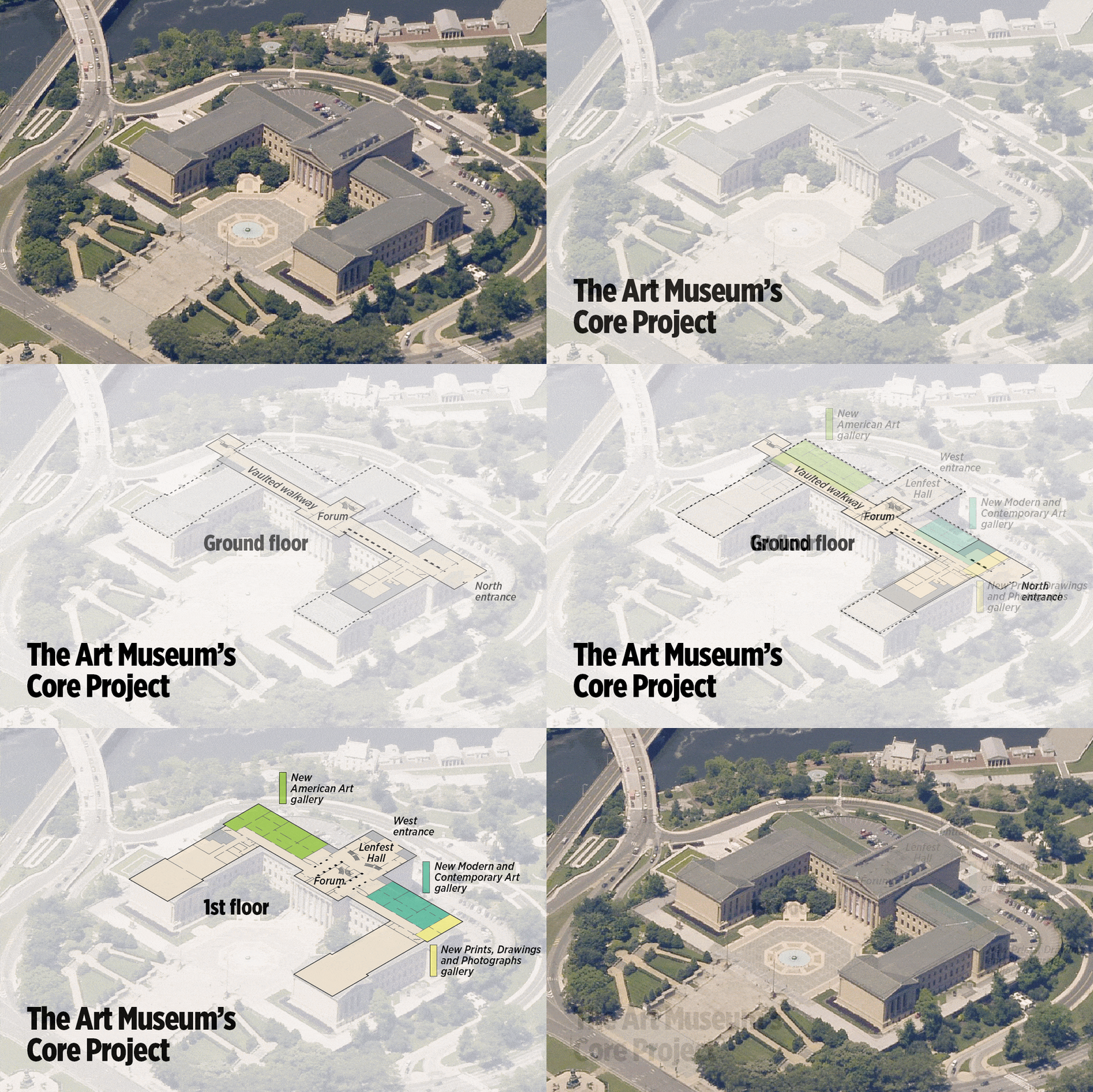
Known as the Core Project, the effort — completed in 2021 — was designed to open up the museum’s floor plans, reclaim a ground level that had been closed to the public for decades, and add some 20,000 square feet of new gallery space. Completed in phases over more than a decade, Gehry’s planned renovations were designed to make the building more accessible, revitalize its aging infrastructure, and give the space more flow — all while not disrupting the museum’s iconic look.
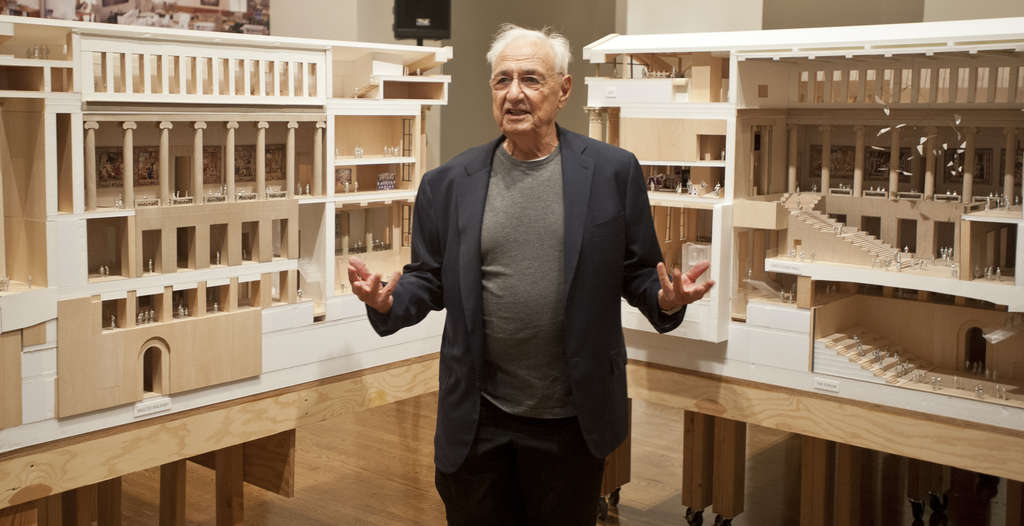
Frank Gehry with a model of his design for the museum’s expansion, to be on display in the exhibit “Making a Classic Modern: Frank Gehry’s Master Plan for the Philadelphia Museum of Art.”
“Frank always felt in the design of the core project that he was collaborating with the original architects,” said retired Philadelphia Art Museum chief operating officer Gail Harrity Friday. “He often said he was following the bread crumbs left by the original architects to revitalize a building that needed a flow, needed the restoration of the east-west access, the north-south access.”
Gehry’s work on the Art Museum created “views toward a work of art that pull you like a magnet into the galleries,” Harrity said. And in a 2021 Inquirer review of the revamp, architecture critic Inga Saffron found that the redesign gave “museum officials precisely what they wanted: clarity, light, and space.”
A contentious choice
But when he was selected to lead the effort, Gehry was something of a controversial choice. At the time, Gehry was known for flamboyant architecture dotted with playful, tumbling forms — much different from the Greek Revival and Neoclassical design that made the Art Museum an icon on the Benjamin Franklin Parkway. Some museum lovers worried he would desecrate Philly’s art museum, while others pondered why museum officials would pick such a high-profile architect to design features that largely would not be seen from the outside.
“Nothing [Gehry] has done gives me a good feeling,” one reader wrote to The Inquirer in 2006. “Please rethink using this man to destroy the Philadelphia Museum of Art.”
Gehry himself did little to quell his detractor’s worries. As he put it to The Inquirer at one point: “We will set off a bomb. But I can’t tell what kind till the fat lady sings. I think we’ll make it memorable.”
A $233 million Frank Gehry-designed renovation of the Art Museum focusing on the building’s bottom two floors. The Core Project’s goals were to open up the museum’s floor plans, reclaim a ground level that had been closed to the public for decades, and add 20,000 square feet of new gallery space.
Ultimately, Gehry’s design would be understated and in line with the museum’s existing structure. In fact, it was Gehry’s work on the ’60s-era Norton Simon Museum in Pasadena — which he transformed into a series of serene, classically arranged galleries in the 1990s — that convinced Art Museum officials to go with him for their redesign, so there was perhaps little to be concerned about all along.
Museumgoers got their first taste of the revamp in the fall of 2012, when work on an art-handling facility was completed. That project moved a loading dock and backstage area from the building’s northeast side near Kelly Drive to the Schuylkill side, and would allow for Gehry’s redesign project to progress.
And, at least to Gehry, big plans were afoot.
“I wonder if people in Philadelphia know what a big deal this is,” he told The Inquirer in 2014. “Bilbao was a sleepy little town before the Guggenheim came along. This is going to change Philadelphia.”
The unveiling
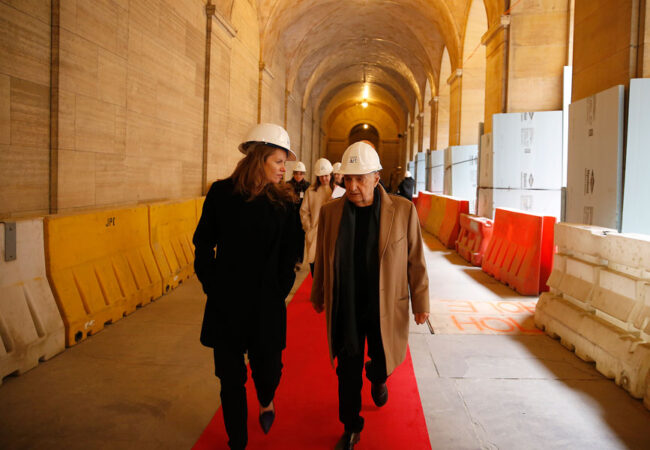
By 2017, the Art Museum officially broke ground on the Core Project phase of its redesign. Two years later, in 2019, it reopened a long-shut entryway on the building’s north side, leading to a vaulted walkway more than 600 feet long, running the width of the museum. An auditorium was demolished, being replaced by the area today known as the Williams Forum.
Its removal opened up the interior of the museum, allowing visitors to see through the entire building, bringing in light and street vistas through windows, and “possibly ending that feeling of being lost amid proliferating galleries of art,” The Inquirer reported at the time.
In 2021, the Art Museum officially unveiled Gehry’s work, showing off the result of 15 years of planning, design, and reconstruction. The Daniel W. Dietrich II Galleries and Robert L. McNeil Jr. Galleries made their debut, housing contemporary and American art, respectively.
“Gehry has provided the canvas,” Saffron wrote of the redesign. “Now it’s up to the museum to make the most of it.”
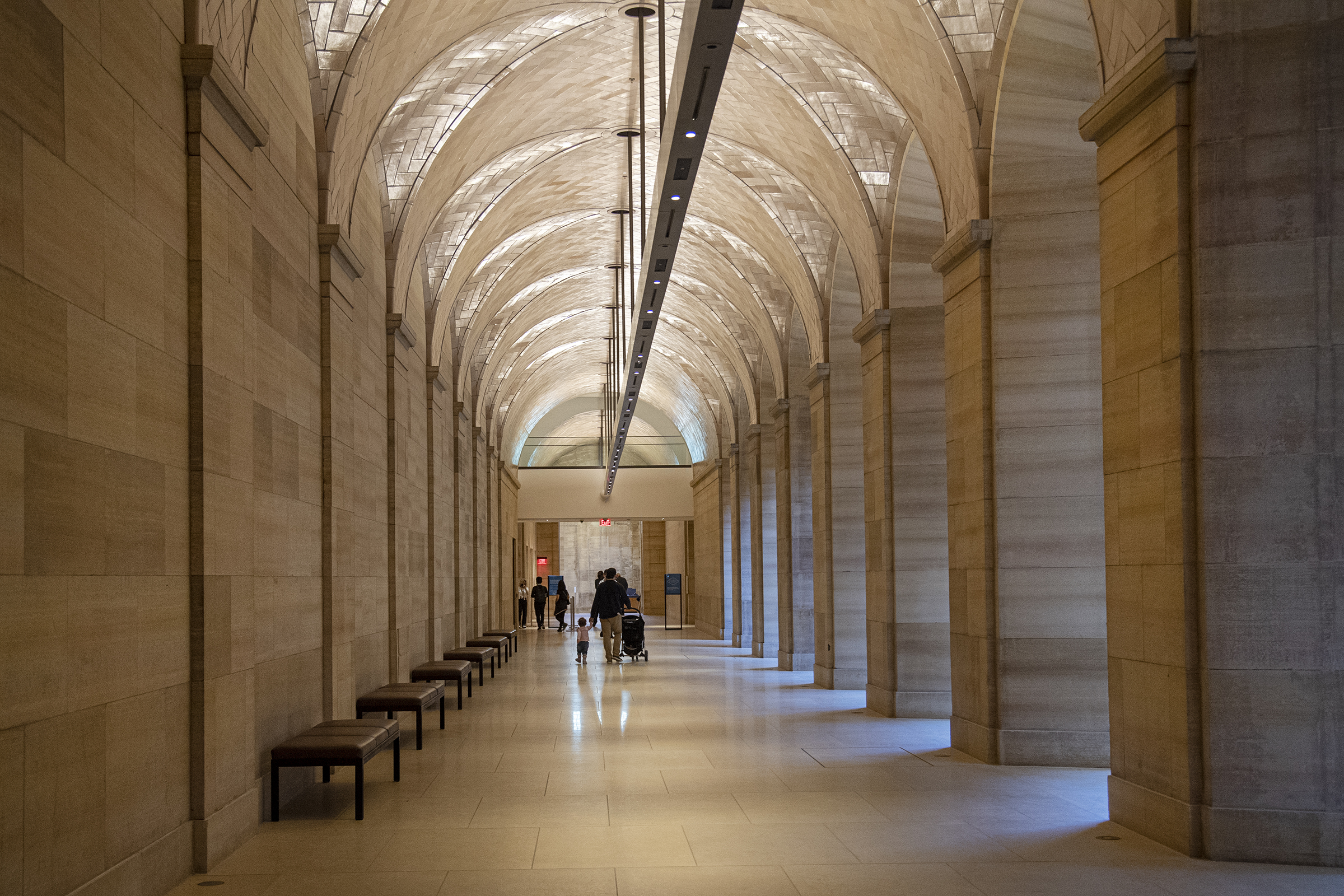
View of the vaulted walkway at the Art Museum.
But the design wasn’t exactly completely finished. Gehry also created the Philadelphia’s museum’s master plan that includes a proposed next phase: building more gallery space beneath the museum’s east steps. The project has been on hold for a number of years, and its status remains undetermined, a museum spokesperson said Friday.
The museum had also had informal discussions recently with Gehry about designing a learning and engagement center, but that project‘s status is also undetermined, the spokesperson said.
“The building is a landmark that is iconic in Philadelphia, that’s difficult to change the exterior of, and in many respects is on a site that is hard to expand,” said Harrity. “So in looking at previous ideas and designs I think Frank’s solution for further increasing gallery space while responding to the architectural integrity of a landmark that is beloved in Philadelphia is brilliant.”
This article contains information from the Associated Press.
A man was stabbed several times on a SEPTA train in Center City early Friday evening, police said.
The stabbing occurred shortly before 5:25 p.m. and the victim was taken by SEPTA Transit Police from the 13th Street Station on the Market-Frankford Line to Thomas Jefferson University Hospital, police said.
“Two people were engaged in an argument that escalated into a fight and then a stabbing that left one of them in critical condition,” SEPTA spokesperson Andrew Busch said in an email.
The victim was stabbed in the neck, police said. No further information was available about him.
More than 130 drug cases were dismissed Friday — and hundreds more are expected to collapse in the coming months — after prosecutors said three Philadelphia narcotics officers repeatedly gave false testimony in court.
Common Pleas Court Judge Lillian Ransom vacated 134 cases during the first in a series of hearings that could see nearly a thousand criminal prosecutions collapse because the testimony of three officers on the Narcotics Strike Force has been deemed unreliable.
Philadelphia Police Officers Ricardo Rosa, Eugene Roher, and Jeffrey Holden were found to have repeatedly given false testimony against people suspected of selling drugs after lawyers with the Defender Association of Philadelphia recovered video footage that contradicted their statements, the district attorney’s office said.
The defenders said the officers regularly watched surveillance cameras to monitor suspects in drug investigations in real time, then didn’t disclose it to prosecutors or defense attorneys in court, officials said. The video footage later showed they also testified to things that never happened or that they could not have seen from where they were positioned, according to court filings.
Prosecutors later conceded that they could no longer vouch for the officers’ credibility and are expected to dismiss scores of cases built on their testimony.
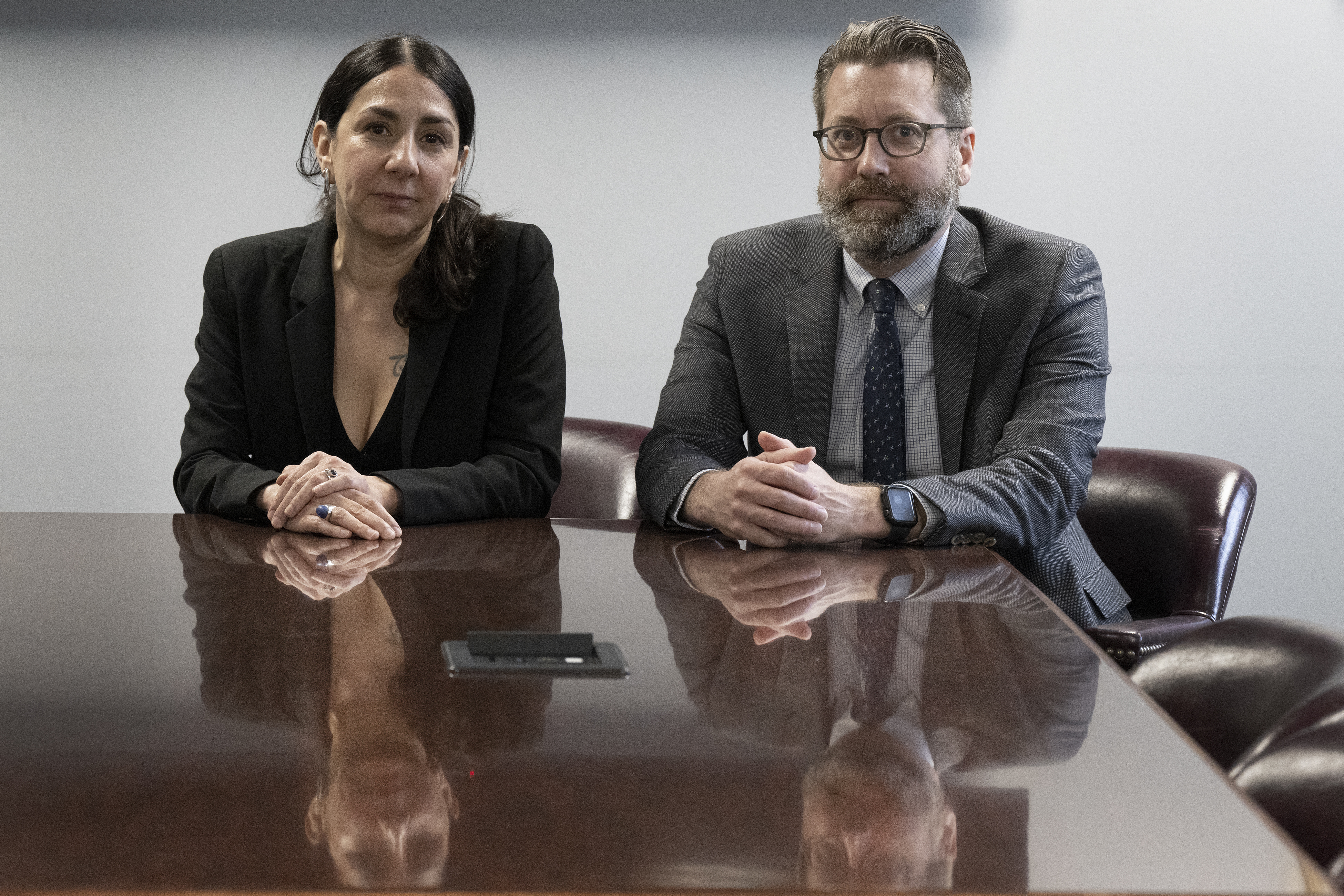
Michael Mellon and Paula Sen, of the Defender Association, began looking into whether officers on the narcotics squad were lying in court starting in 2019.
After a review of cases and convictions involving the officers’ testimony, lawyers for the defender association and prosecutors identified more than 900 cases and expect to ask the judge to dismiss them over the next year. It was not immediately clear how many people, if any, served time in jail, or are still in custody, as a result of the prosecutions that are now in question.
Holden, reached by phone Friday, said he was shocked to learn that his cases and testimony were under scrutiny, and said he had not been told of the move to end the cases at Friday’s hearing. He declined to comment further.
Rosa and Roher did not immediately respond to requests for comment. The officers remain assigned to their narcotics squads.
The district attorney’s office said it provided the police department’s internal affairs unit with details of the officers’ false statements in multiple cases last March.
Police Commissioner Kevin Bethel, in a statement, said the department takes “potential credibility issues with our officers extremely seriously.”
An internal affairs investigation into the matter was launched last March and remains ongoing, he said.
The department requested and reviewed cases flagged by prosecutors, he said, but “thus far we have not identified any evidence that would raise concerns of misconduct or criminal behavior on the part of those officers.”
He added: “We will, as always, take appropriate action if and when evidence supports such action, but we will not preemptively sideline officers absent some verified findings.”
Bethel said he learned of the plans to dismiss the cases on Thursday, and has asked prosecutors to provide additional information to assist with their review. He also said the police department has been working with the district attorney to develop a clearer protocol on how officers can use surveillance cameras during investigations.
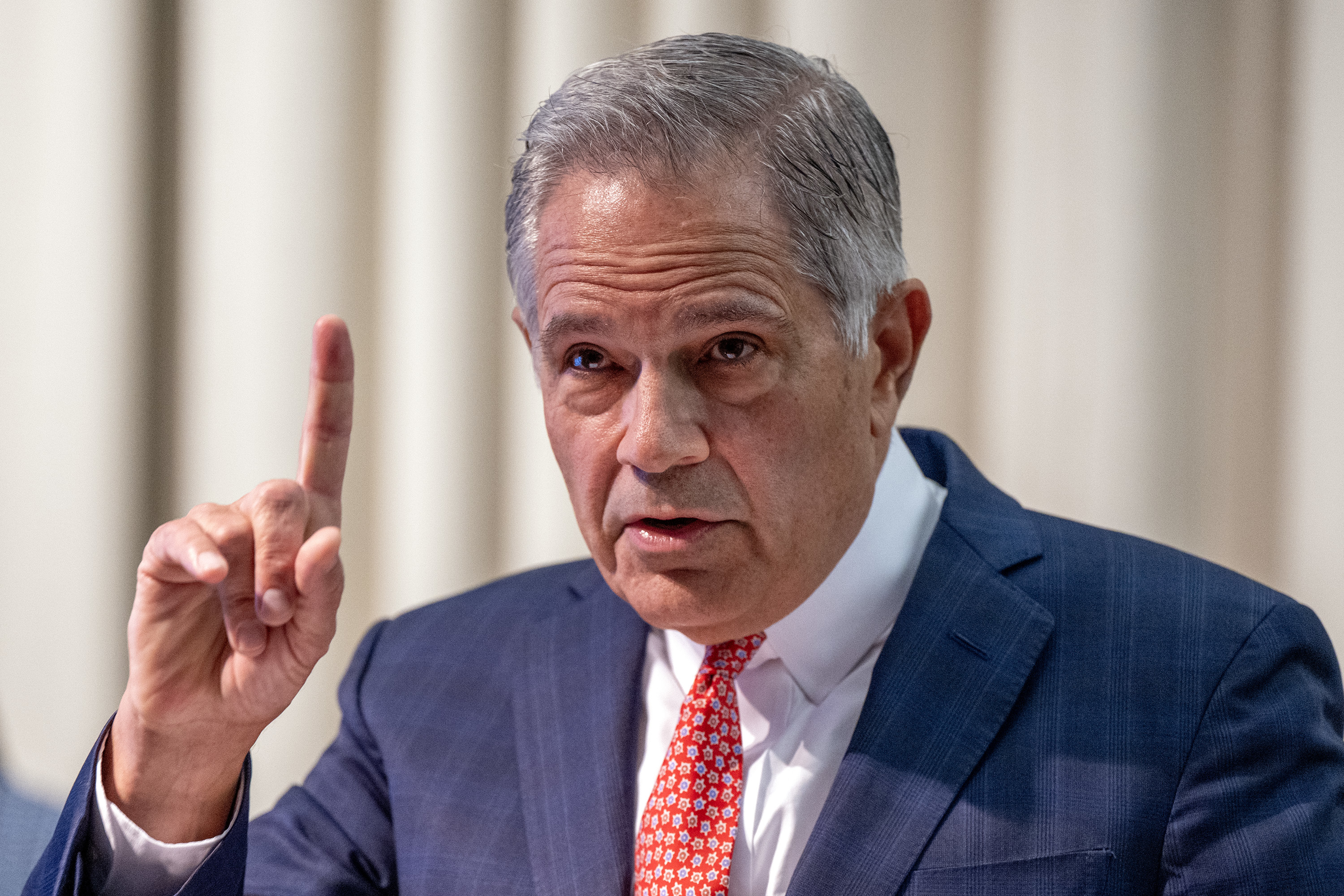
District Attorney Larry Krasner on Friday declined to say whether his office was investigating the officers’ conduct, but noted that “the statute of limitations for police officers in their capacity is much longer than the statue of limit for other offenses.”
“I have dealt extensively with Commissioner Bethel. I know he and the mayor are committed to rooting corruption, lying, stealing, and cheating out of the police department,” he said.
District Attorney Larry Krasner declined to say whether his office was investigating the officers’ conduct as criminal in nature.
‘They’re lying’
Assistant District Attorney David Napiorski, who reviewed the cases for the office, stopped short of accusing the officers of lying, but said “there’s enough of a pattern of inconsistencies across testimony that we can’t rely on them as critical witnesses in court.”
But Paula Sen and Michael Mellon of the Defenders’ Police Accountability Unit disagreed.
“It’s a fancy way of saying they’re lying,” said Sen, who has worked with Mellon to uncover the officers’ credibility issues since 2019.
The unfolding scrutiny is the latest in a series of large-scale conviction reversals in Philadelphia tied to misconduct in the narcotics unit. Over the past three decades, judges have thrown out thousands of drug cases after officers were found to have fabricated evidence, lied on the stand, or stolen money from dealers.
Bradley Bridge, a longtime public defender, was often the driving force behind those reviews and estimates he’s worked to overturn about 2,500 drug convictions since 1995.
In 2015, Bridge filed a petition to vacate more than 1,400 drug convictions tied to six ex-narcotics cops after they were charged with robbing and beating drug dealers, then altering police paperwork to cover their tracks. The officers were later acquitted by a jury and got their jobs back through arbitration, but more than 950 cases were thrown out after officials agreed they couldn’t trust their testimony.
Bridge, who returned from retirement to handle the cases tied to Rosa, Roher, and Holden, said, “Tragically, nothing is unique about this. It’s exactly the same problems that keep arising since 1995, including the lack of supervision and oversight of police officers on the street.”
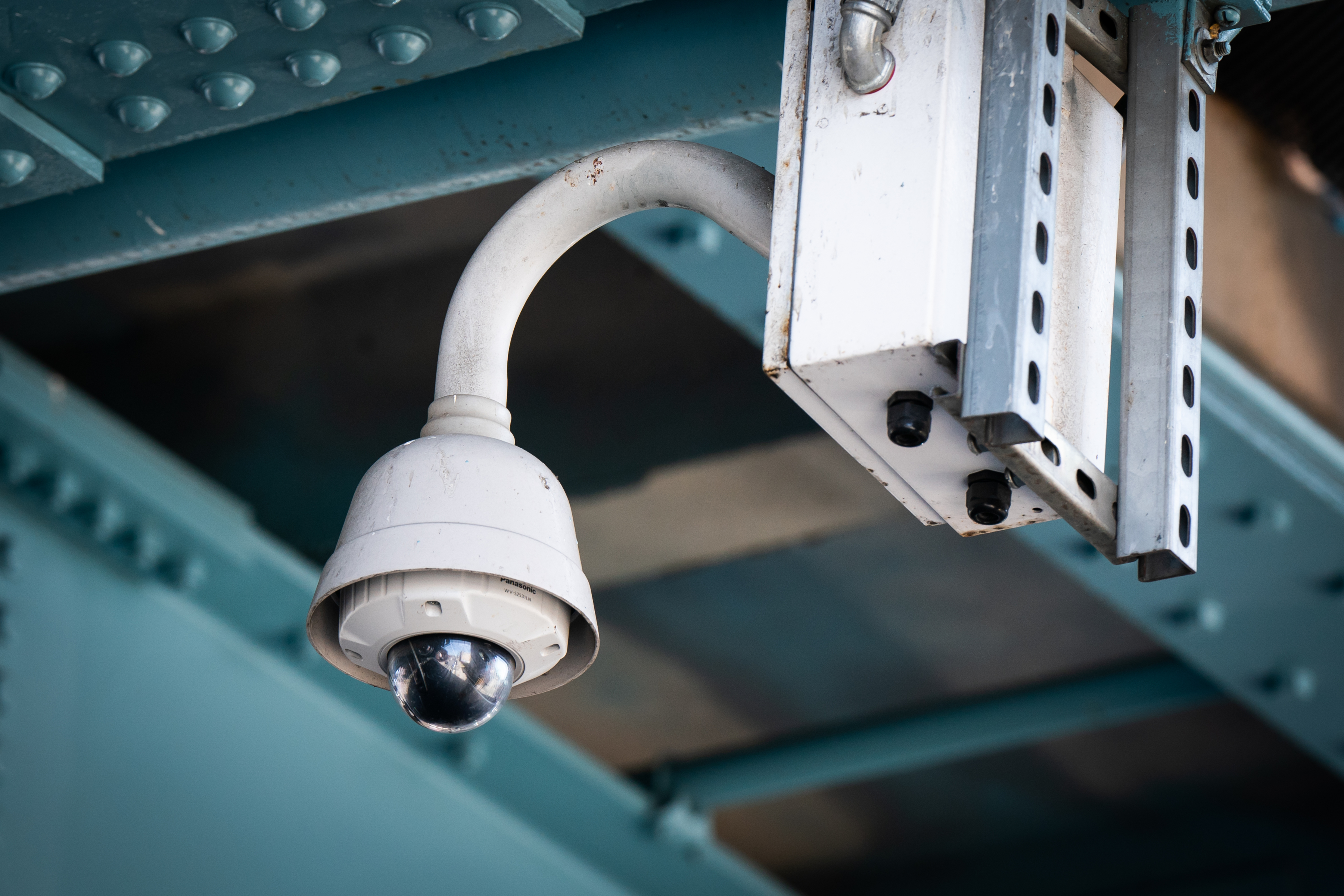
A video camera used by Philadelphia police located at Somerset Street in Kensington.
Sen and Mellon said they first noticed a pattern of false testimony in 2019 after they reviewed surveillance footage that contradicted statements Rosa gave about drug cases. As time passed, they said, they continued to monitor his narcotics squad, and found inconsistencies with Holden and Roher’s testimony, too.
They said the officers used the city’s surveillance camera systems to monitor suspected drug activity in real time, but didn’t disclose it as part of their investigation — a violation of due process because the evidence wasn’t shared with defense attorneys.
In court, the officers denied using the cameras, Mellon said, and often said they witnessed hand-to-hand drug transactions that video later showed either never happened or that they could never have seen because the suspect was out of sight.
“They just straight up lied and invented acts of criminality,” Sen said.
‘Who are they gonna believe?’
In one case, Roher said he was seated in an unmarked police car when he saw Darrin Moss sell drugs to two people near Somerset and Helen Streets in Kensington in April 2022. He said he could see Moss inside the fenced lot retrieve drugs, then hand them to a buyer and accept money in return.
Prosecutors later said in court filings that video footage captured by a surveillance camera on the end of the block showed that one drug deal never happened, and the other supposed deal was behind a building and would have been impossible to see.
The charges against Moss were withdrawn.
When prosecutors learned of the discrepancies, they asked Roher to meet and discuss the case, but he failed to appear in court twice without explanation, they said in a court filing.
Prosecutors said this became a pattern — once the officers seemed to learn their testimony was under scrutiny, they stopped showing up to court.
Court filings identify at least nine cases in which the three officers allegedly gave false testimony. Napiorski, of the district attorney’s office, said prosecutors reviewed a few dozen videos from other cases that suggested a systemic pattern of false information in court.
Sen, of the defenders association, said it was troubling that the officers remained assigned to the narcotics squad and have been able to continue making arrests.
“How is the public supposed to have trust in a department that continues to employ people who have so clearly proved themselves to be liars, that has resulted in thousands of people being arrested and jailed?” she asked.
Most of the cases dismissed Friday were drug crimes that led to a sentence of probation, prosecutors said. Seven included a gun charge.
The drug charge against Ramoye Berry was among them.
Berry, 29, from North Philadelphia, said that in April 2023, he was standing on the 1300 block of West Boston Street talking to some friends when a group of officers tackled him and accused him of selling drugs.
When they searched his car, he said, they found a small amount of weed, but he wasn’t selling it. He was charged with possession with intent to sell drugs.
Berry couldn’t recall which officer testified against him in court, but he said he remembered telling his lawyer that the officer wasn’t telling the truth.
He said he pleaded guilty to drug possession and accepted a year of probation because he didn’t think he could prove his innocence, and the court dates were challenging to keep up with. It kept him from being able to get a job, he said.
When he learned on Friday that the officer had a history of giving false information and that his conviction would be vacated, he said he felt vindicated — but frustrated by the time and jobs he lost to the case.
“This is what I was saying from the beginning,” he said, shaking his head. “But who are they gonna believe? The cops, or me?”