For some, the removal of exhibits about slavery at the President’s House Site at Independence National Historical Park on Thursday came as a shock.
For John Garrison Marks, a historian and author who writes and researches about America’s early years, it looked like history repeating itself.
In April, Marks will publish his book Thy Will Be Done: George Washington’s Legacy of Slavery and the Fight for American Memory. The book delves into George Washington’s life, his relationship with slavery, and how that relationship has been manipulated by politicians and activists over the last 2½ centuries to serve various narratives.
Marks talked to The Inquirer about how the removal of the slavery exhibits at the President’s House will become another chapter in the nation’s struggle to reconcile how a man renowned for fighting for freedom forced so many into bondage.
The following interview has been edited for clarity and brevity.
Can you tell me a little about the specific history of this site?
While [Washington] was there, he enslaved at least nine people. He had enslaved people for the entirety of his adult life. He had grown accustomed to being served by enslaved people at his home in Virginia.
So he brought these people from Mount Vernon to the President’s House in Philadelphia while he was serving as president there, and the major complication that came up with this, and this is one of the things that the historic site did a great job of explaining, is that the state of Pennsylvania passed a law to gradually abolish the institution of slavery in 1780.
As part of that law, any enslaved person who remained in residence in Pennsylvania for more than six months would be entitled to their freedom. George Washington discovered this soon after assuming the presidency and relocating to Philadelphia, and he also learned, as many future presidents would learn, that the law also would apply to him. He wanted to keep the labor of these people that he enslaved, and so he devised a scheme he very much wanted to be kept secret to rotate enslaved people in and out of Pennsylvania before they had arrived at that six-month mark and would be entitled to their freedom.
Sometimes he would send people back to Virginia. Sometimes he would just take them across the river to New Jersey for a little while, but he was very aware of this gradual abolition law and worked very hard to make sure that it wouldn’t apply to the people he personally enslaved.
The tragic irony in that is, at the very same time, George Washington was expressing in letters to people, in private correspondence, how much he supported these Northern gradual abolition laws.
Was there some sort of moral struggle that we have evidence of that he was experiencing? How was he reconciling these things?
He writes to people in private, talking about how he recognizes the hypocrisy inherent in him leading a revolution to found a nation dedicated to liberty and equality and his own involvement with slavery.
There were these statements that he made limiting the nature of his involvement, of trying to establish some limits for himself of how he would and would not engage with the institution of slavery, but he also proved flexible on that point.
Hercules Posey, the chef that he enslaved in Philadelphia, escapes from slavery and escapes from the Washingtons.
After that happens, Washington writes in a letter that he’s disappointed because he vowed never to gain another enslaved person by purchase but then says, “Now this is a vow I must break.” So it seems he never even considered the possibility of hiring and paying a free chef.
How has Washington’s experience with slaves, in general but particularly there, been sort of warped over time?
In the months after Washington’s death, almost every American would have known that he freed the people he enslaved in his last will and testament, and yet almost no one talked about it.
There are dozens of biographies of Washington that get published in the decade after his death, and almost none of them acknowledge slavery in any way.
But there have always been people in America who are dedicated to lifting up that history, to resurfacing Washington’s involvement in slavery. So during the 1932 bicentennial [of Washington’s birth] you have Black educators and activists, Black newspapers who say, if this is going to be about getting back to the real George Washington, now is the time that we have to reckon with his involvement in slavery.
It happens again, to varying extents, during the Civil Rights Movement as there’s a greater scholarly attention to the histories of slavery and African Americans. You’ve seen it over the course of the last couple decades about what kinds of things can and can’t be taught in American schools.
Always, the conversation is about Washington, but it’s never just about Washington. It is always about America and what America stands for, and depending on people’s assessment of what the nation is and what it means, that often dictates how they think the story of George Washington and slavery should be treated.
Why do you think it’s important we have the President’s House as a memorial with the plaques that have been removed? What do you make of the removal of them?
Trying to hide the nation’s history of slavery has never worked. We’ve been trying it over and over again throughout American history, but there have always been other people who insist that we reckon with this past, that we face it head on, that we include the full story so we can learn from it.
As we approach the nation’s 250th anniversary, I can’t help but think how many people are going to be visiting Independence Hall, are going to be visiting Independence National Historical Park, who would have had the opportunity to encounter this history of slavery that is so closely tied to our history of the founding and maybe learned it for the first time.
Eliminating the ability for people to learn from that history, to have conversations about that history, to reckon with what that history should mean for us today is only going to set us farther back. It is going to make much more challenging any effort to move the United States to becoming a more just society.
Justice Kevin Dougherty, writing for a unanimous court, said that “protecting the efficiency of justice” including the “independence, integrity, and impartiality of the judiciary” is more important than “Cohen’s interest in posting partisan political content on Facebook where the volume and tone of his posts cast him as little more than a spokesperson for the Democratic Party.”
The former judge was suspended without pay for the remainder of his term in October 2024 by the Pennsylvania Court of Judicial Discipline. The court said Cohen violated the Code of Judicial Conduct when he posted Facebook comments that skewered Republicans and praised Democratic politicians or left-leaning causes.
The Court of Judicial Discipline’s opinion called Cohen’s behavior unprecedented, especially his refusal to stop posting after having been warned by his superiors.
“No other case in the history of the Court of Judicial Discipline has involved such defiance post decision,” the opinion reads. “Judges are not allowed to broadcast their political leanings. People appearing before judges deserve fair, unprejudiced jurists.”
Cohen, 76, is a former member of the statehouse who represented lower Northeast Philadelphia for 42 years. He was elected to the bench in 2017 and was suspended months before the end of his term. Regardless of his suspension, Cohen was ineligible to run for a second term because of Pennsylvania’s judicial mandatory retirement age, which is 75.
The Inquirer was unable to reach Cohen based on publicly available contact information.
Cohen appealed his suspension to the Pennsylvania Supreme Court, telling The Inquirer at the time, “this is a pathbreaking case seeking to severely limit freedom of speech.”
The exact limit on the First Amendment rights of sitting judges is an open question of law that neither the Pennsylvania Supreme Court nor the U.S. Supreme Court hasruled on previously.
Judges have the right to free speech, including some degree of political speech during their ownelections, wrote Dougherty, who campaigned vigorously for his own retention on the state’s highest bench this fall.
The task of the Supreme Court was to balance the right of a sitting judge freedom of speech with the integrity of the courts in Pennsylvania.
Cohen “advocated for legislation,“ ”cheered on Democratic politicians,” and “criticized the policies of predominately Republican legislatures,” Dougherty wrote. The former judge made more than 60 posts that were of concern, all from a Facebook page identifying himself as a judge.
“An ordinary citizen comparing Judge Cohen’s posts with the posts of our state politicians would likely see little distinction,” Dougherty wrote.
The ruling does not intend to muzzle judges or dissuade all social media use, the opinion said. But judges should, like everyone else, make sure that their social media use “comports with the rules of the position they have voluntarily attained or the organization they have voluntarily chosen to join.”
Justice David Wecht also wrote a concurring opinion in which he said it was important to distinguish whether political speech froma judge was made during a retention campaign, in which avoiding politics completely is impossible.
“If the people of this Commonwealth wish to imagine their judiciary to be as pure as the driven snow, and if the people are under some impression that elimination of judicial elections would advance such purity, they are free to alter their Constitution,” Wecht wrote.
Students are going home from school Friday with charged computers, but Watlington, speaking at a city emergency services news conference, said he wanted students to focus on having fun.
“We’re inviting students and staff to enjoy this snowfall, which will be the most I’ve seen during my nearly four years here in Philadelphia,” the superintendent said. “Sledding is appropriate. Snow angels are appropriate, and [Police Commissioner Kevin Bethel] gave us permission to have one or two safe and fun snowball fights.”
If conditions require more days out of school buildings, “every subsequent day will be a remote learning day,” Watlington said.
Philadelphia Achdiocesan high schools and parochial elementary schools also will have a virtual day Monday.
Suburban schools prep
Philadelphia isn’t the only district that has already announced plans or warned that closures were likely.
In Upper Darby, school officials told families Thursday night to prepare for the prospect of virtual instruction on Monday, and possibly Tuesday.
“If the weather is more significant than anticipated, and there are power outages in the area, we will shift to a snow day,” with no virtual school, Superintendent Daniel McGarry said in the message.
In the Cheltenham School District, Superintendent Brian Scriven told families that “if weather conditions require us to close schools and offices,” the district will have a traditional snow day Monday. Tuesday is to be determined — and Wednesday could be virtual instruction, “if conditions are significant enough,” Scriven said.
Colonial School District Superintendent Michael Christian told parents Friday that “if the accumulation is as high as some meteorologists are projecting, we would call for a traditional snow day on Monday and quite possibly Tuesday as well.” And Wednesday could be a virtual instruction day, Christian said.
Meanwhile, the Council Rock School District said that “if school buildings must close on Monday,” students would have virtual instruction.
Based on what the computers and their human interpreters are saying, a key question this weekend will be whether measuring the snow in the Philly region will require a ruler or a yardstick.
This no doubt will be a moving target, but on Friday morning, the National Weather Service in Mount Holly was seeing eight to 14 inches for Philly, said meteorologist Alex Staarmann. Several inches were possible even at the Jersey Shore.
Friday AM Update: A major winter storm is still expected to impact the region Sat Night through Mon Morning. The primary change with this update is a slight reduction in snow totals across the Delmarva into southeastern NJ due to increasing sleet/freezing rain potential. (1/2) pic.twitter.com/OqV4a5QiHW
A wild card would be a potentially unpleasant atmospheric parfait that would add ice to the mix on Sunday, and computer models Friday were suggesting that mixing was likely near I-95 and in Delaware and South Jersey. However, the weather service expects that to yield to all snow Sunday night.
While this is all quite a complicated meteorological setup, in essence Arctic air is pressing southward and it is going to interact with an impressively juicy storm to the south.
“Having the Arctic front come through before the onset of wintry precipitation, that’s really concerning,” said Ray Kruzdlo, the staff hydrologist in the weather service office, where “it’s all hands on deck.”
Below-zero windchills are expected Saturday morning, prompting a cold-weather advisory, and temperatures in Philly may stay below freezing the rest of the month.
What time will the snow start and end?
The timing and duration of precipitation aren’t among the strong suits of computer models.
The weather service’s winter storm watch, which covers the entire region, all of Delaware, and most of Pennsylvania and New Jersey, is in effect from 7 p.m. Saturday until 1 p.m. Monday.
The daytime Saturday “looks fine if you have to get out,” said Tom Kines, senior meteorologist with AccuWeather Inc.
The weather service is listing the likeliest starting time as the early morning hours of Sunday, with snow likely into the early morning hours of Monday.
Sunday is going to be one of the colder days of the winter with temperatures in the teens and lower 20s. The weather service introduces the possibility of freezing rain and sleet by 1 p.m., with a forecast temperature of 19 degrees.
Yes, it can rain when it’s below 20 degrees at the surface, and precipitation doesn’t get much more dangerous.
Snow and sleet, liquid that freezes on the way down, can at least provide traction on the roads. Rain that freezes on contact becomes an ice sheet. Also, when freezing rain accumulates on fallen snow it can bring down trees and power lines.
Peco has heard the storm rumors (who hasn’t?) and will have crews on call through the weekend, said spokesperson Candace Womack.
The threat of ice is related to the possibility of warm layers of air, borne on onshore winds from the ocean, at levels of the atmosphere where precipitation is formed.
That could well happen Sunday as the coastal storm intensifies, said Kruzdlo, and winds build from the Northeast, perhaps gusting past 20 mph. Any rain or sleet would encounter very cold air at the surface, locked and dammed in place by the Appalachian Mountains.
“That’s the complexity of living where we are so close to the ocean,” Kruzdlo said. “We have tens of thousands of observations at the surface,” he added, but data from the upper atmosphere is wanting, adding challenges to forecasting changeovers.
Along the I-95 corridor, storms of purely snow are the exceptions, Kruzdlo said.
One of the more notable busts occurred in January 2015 when forecasts called for an I-95 East Coast snowstorm so ferocious that the mayor of New York imposed a curfew.
His boss at the time, weather service head Louis Uccellini, said no apology was necessary: Science has its limits. Busts have been known to happen in the battle of science against nonlinear.
This time around, meteorologists are all but certain something “impactful” is going to happen.
Said Kruzdlo, the slim chance of this storm “not being significant is leaving us.”
A Brooks armored truck pulled up to the main PSFS Bank office in Center City on the morning of Jan. 20, 1988, but guard Edward Leigh Hunt Jr. didn’t get out.
Two other employees of the Wilmington-based company, a driver and another guard, went inside the bank office on 13th Street near Market. When they returned about 30 minutes later, the 24-year-old Hunt was gone.
He fled the vehicle carrying two canvas bags containing used bills totaling $651,000, or more than $1.7 million in today’s dollars.
’See ya soon’
A few days after the robbery, Hunt, who went by Leigh, had made his way to Los Angeles, and phoned a friend from back home — mainly asking how much publicity he was receiving.
And then Hunt went silent for nearly 20 months.
In the meantime, he was twice featured on America’s Most Wanted and attracted national attention as well as a following.
“The whole incident has been bizarre since day one,” the fugitive’s father, Edward Leigh Hunt Sr., a former prosecutor for the Delaware Attorney General’s Office, would say later.
As the two-year anniversary of the heist approached, editors from the Wilmington News Journal newspaper inexplicably received a handwritten letter.
It was from Hunt, and he said the money was gone.
The University of Delaware graduate said he gambled it all away in an attempt, he wrote, to quadruple the sum and then return half the proceeds.
He missed his family, he wrote, and wanted to surrender on the second anniversary of the theft, Jan. 20, 1990, at noon in front of the Chamber of Commerce offices in downtown Los Angeles. He enclosed a photo of himself emerging from a swimming pool.
He sent a second letter to the newspaper a few days later, reiterating that he would be turning himself in. “Just a reminder,” he wrote.
“I’m sorry about the problems I have caused,” he added. “It’s nobody’s fault but mine. See ya soon.”
Going downtown
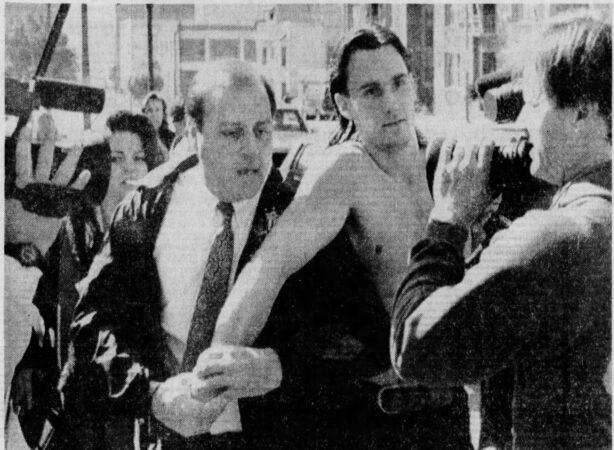
Hunt, now 26, arrived shirtless and five minutes late, but nonetheless surrendered as planned to members of the FBI.
“I love America,” Hunt said as he was taken into custody. “America is a great country.”
As he was taken away, according to the Los Angeles Times, a few supportive spectators shouted, “Free Leigh.”
Six months later, Hunt pleaded guilty to interstate theft, and a federal judge in Philadelphia sentenced him to eight years in prison. In hopes of getting his sentence reduced, Hunt later came clean and confessed to having hidden most of the money in a Hollywood storage locker.The FBI recovered nearly $574,000, and Hunt’s sentence was cut down to six years.
Think you know your news? There’s only one way to find out. Welcome back to our weekly News Quiz — a quick way to see if your reading habits are sinking in and to put your local news knowledge to the test.
Question 1 of 10
Just in time for what figures to be a monumental year for local tourism, Philadelphia’s Four Seasons Hotel at the Comcast Center has introduced a new luxury floor dedicated to what it calls personalized, “residential-style” living. About how much will a night in the penthouse suite cost you?
CorrectIncorrect. XX% of other readers got this question right.
A booking agent on Tuesday said the penthouse suite — which spans some 4,000 square feet and features a sizable outdoor terrace — is currently going for around $25,000 per night (plus tax). See you there?
Question 2 of 10
According to a new law signed by former Gov. Phil Murphy, some New Jersey elementary school students will be required to learn this skill:
CorrectIncorrect. XX% of other readers got this question right.
Beginning in September, New Jersey public schools must begin teaching cursive writing to students in grades three to five. New Jersey joins Delaware and at least two dozen other states that require cursive writing. Similar legislation proposed in Pennsylvania did not advance.
story continues after advertisement
Question 3 of 10
Tyrese Maxey is getting his first signature shoe. Which brand is behind the partnership?
CorrectIncorrect. XX% of other readers got this question right.
Getting his own signature shoe from New Balance is the latest example of Maxey’s rising star power — following in the footsteps of teammate Joel Embiid, who debuted his own signature shoe with Skechers in December.
Question 4 of 10
At 18, South Jersey figure skater Isabeau Levito is heading to the Olympics. What activity does she do on the side and plan to do in Milan to calm her nerves?
CorrectIncorrect. XX% of other readers got this question right.
Levito won’t forget to pack her bedazzling kit. Besides all the sparkles she wears on the ice, she enjoys adding rhinestones to her various makeup cases and a comb. “It’s so soothing,” she said.
Question 5 of 10
Nearly all the stars of this new Netflix series have Philly roots:
CorrectIncorrect. XX% of other readers got this question right.
Four of the five Mar-a-Lago women on Netflix’s Members Only: Palm Beach are from Philly or the Philly region. They include an interior designer who sells real estate, a DJ, a former Bucks County Zumba instructor, and a fashion line owner.
Subscribe to The Philadelphia Inquirer
Our reporting is directly supported by reader subscriptions. If you want more journalism like this story, please subscribe today.
A fictional copy of The Philadelphia Inquirer was featured on this week’s episode of Abbott Elementary with a photo of the Abbott crew. What is the headline accompanying the article?
CorrectIncorrect. XX% of other readers got this question right.
Designed by Abbott Elementary’s props and production team, the mock front page pictures the teachers and principal surrounded by students with the headline, “Do schools even need schools?”
Question 7 of 10
The American ___ Tournament is moving from Connecticut to Philadelphia next year.
CorrectIncorrect. XX% of other readers got this question right.
New York Times crossword editor and NPR puzzle master Will Shortz announced he’s moving the American Crossword Puzzle Tournament from Connecticut down to Philly next year.
Question 8 of 10
Charlotte Astor, a junior at Cherry Hill High School East, is on the hunt for her mom’s 30-year-old demo tape. What was her mom’s band called?
CorrectIncorrect. XX% of other readers got this question right.
For Charlotte, Seed’s tape became a kind of white whale — a relic of her mother’s hard-charging past, something the teen occasionally scoured the web for, to no avail. Now, the hardcore community has stepped in.
Question 9 of 10
The former KYW radio building on Walnut Street sold for about $5 million — a steep discount from the $19 million it sold for in 2019. Which Beatle once worked there?
CorrectIncorrect. XX% of other readers got this question right.
The building was built for KYW radio in 1937 and, later, its television division. The influential Mike Douglas Show was based out of the building for much of its run, employing Roger Ailes, later of Fox News fame, in the late 1960s. In the early 1970s, John Lennon and Yoko Ono guest-hosted the show from the building for a week, interviewing people including Chuck Berry and Ralph Nader.
Question 10 of 10
A Philly-area university professor is competing in the Jeopardy! tournament of champions. To celebrate, a local business named this menu item after him:
CorrectIncorrect. XX% of other readers got this question right.
Joshua Weikert will watch the show Friday among family and friends — including his fellow contestant Matt Massie — at Troubles End Brewing in Collegeville, which named one of its beers after him. It’s an English Bitter, one of Weikert’s favorites, called “Who is Josh?”
Your Results
You have skipped .
You scored XX out of 10.
The average reader scored XX out of 10
Seems like you’ve been skimming more than reading there, buddy. There’s always next week.
You’ve read some articles (or made some educated guesses) but we wouldn’t come to you first for our local news recaps. Better luck next week!
Do you work here? You’re a local news stan with the latest updates on Philly happenings. Your friends definitely ask you for summaries on what’s going on and it shows.
In the end, the pressure on the family simply became too great.
Johny Merida Aguilara, the detained immigrant father of a 5-year-old son with brain cancer, has decided to drop efforts to stay in the United States and accept deportation to Bolivia.
His wife and three American-citizen children will also leave the country, though they are not required to do so, departing their Northeast Philadelphia home to reunite with their husband and father in the central Bolivian city of Cochabamba.
The decision to go comes as Merida Aguilara, 48, approaches his fifth month in immigration detention ― with no end in sight. The family’s forced separation has been emotionally devastating, friends and supporters said. And with Merida Aguilara in custody and unable to work, the financial situation for his wife and children was growing desperate.
Merida Aguilara had been a main caregiver for his son, Jair, who has been treated at Children’s Hospital of Philadelphia, and whose future is now deeply uncertain. Quality healthcare can be lacking in Bolivia, where the U.S. State Department warns that “hospitals cannot handle serious conditions.”
Jair has autism and a severe eating disorder, surviving on PediaSure nutrition drink delivered through a plastic syringe. He generally would accept food only from his father, and Merida Aguilara would leave work during the day to feed his son.
The father was arrested by ICE for an immigration violation during a September traffic stop on Roosevelt Boulevard near Hunting Park Avenue, having lived in the United States without official permission for nearly 20 years.
“I am tired,” Gimena Morales Antezana, his wife, said in an interview with The Inquirer. “We have been trying to survive, but it is difficult with the children because they miss their dad so much.”
U.S. Immigration and Customs Enforcement officials did not reply to a request for comment on Thursday.
The family has received strong community support, Morales Antezana said, but that could not continue indefinitely, and at this point she can no longer afford rent, water, or heat,
Son Matias, 7, cries himself to sleep most nights, calling out for his father to come home. His sadness deepened after Christmas, turning into anger when Morales Antezana finally revealed that his father was not away on an extended work trip, but was being held by immigration authorities at the Moshannon Valley Processing Center, an ICE facility in central Pennsylvania.
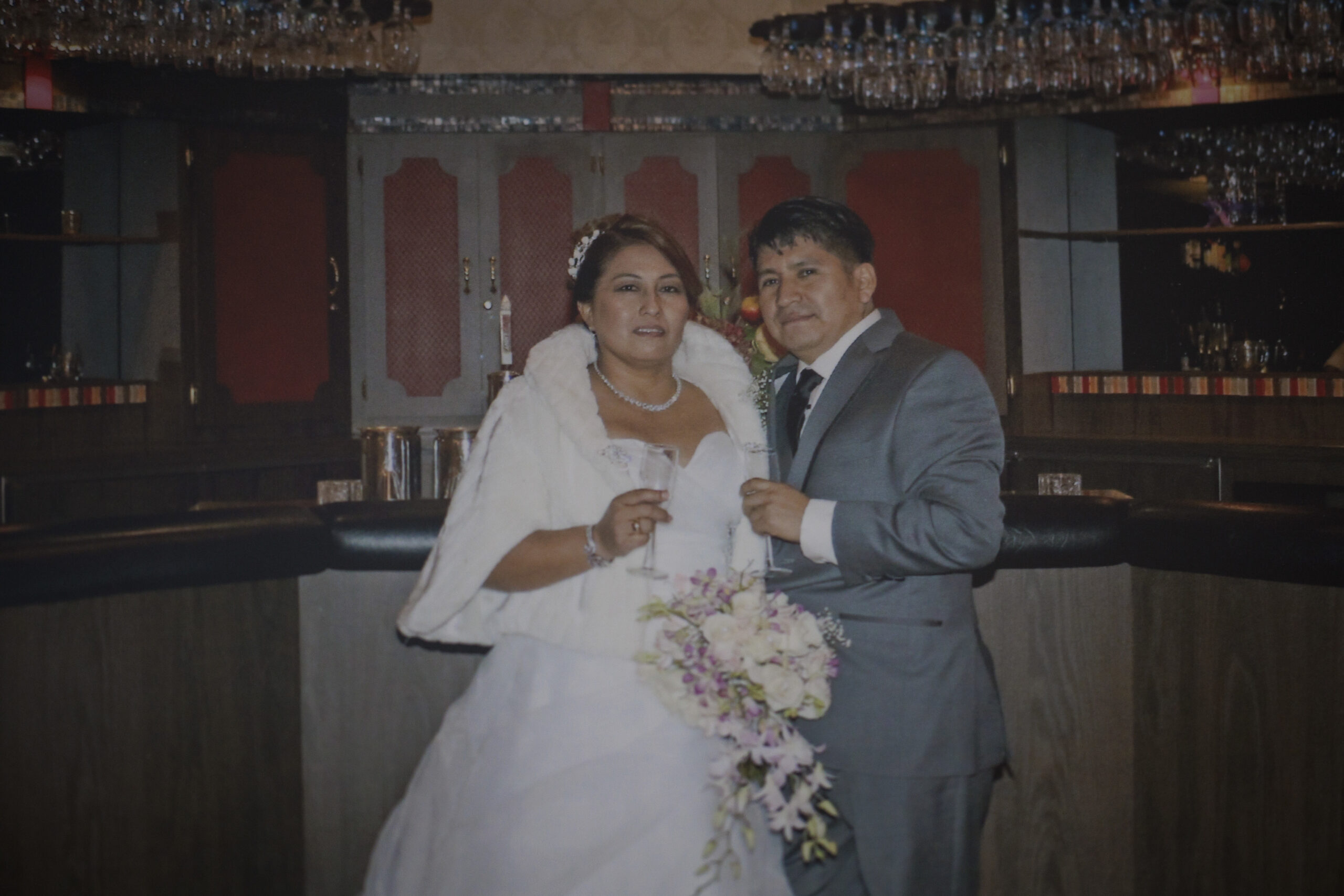
Gimena Morales Antezana and Johny Merida Aguilar’s wedding photos hang on the wall at their home in Northeast Philadelphia.
Daughter Melany, 13, now feels unsafe in the U.S., her mother said. Teenage insecurities have bloomed into a persistent sense of danger, and she told her mom that leaving might be the only way to feel comfortable again.
Jair cries inconsolably every time he sees or hears his father on the phone, asking why his dad can’t be home, Morales Antezana said.
All three children were born in this country and are U.S. citizens by law.
Some good news came this month. Doctors told Morales Antezana that Jair’s brain tumor had not grown, allowing time to try to find care in Bolivia.
“This is going to be a constant struggle every day until God decides,” Morales Antezana said. “It’s scary to think that if something happens we don’t have a hospital to take him to, but knowing his dad will be there makes it a little lighter to bear.”
Jair Merida, 5, posed for a portrait at home in October. His father, Johny Merida Aguilar, was stopped and arrested by ICE in September.
She has not been ordered deported while she has pursued legal means to stay in the country. Mother and children plan to voluntarily depart this month, while the precise timing of Merida Aguilara’s deportation is uncertain.
“He couldn’t do it anymore; he reached his limit,” said Philadelphia immigration attorney John Vandenberg, who represents the family. “It’s a tough environment in the jail.”
Vandenberg won relief in the U.S. Court of Appeals for the Third Circuit, which issued a Sept. 30 order to temporarily block Merida Aguilar’s deportation. The lawyer also applied on Morales Antezana’s behalf for a T visa, which can bestow a path to citizenship on victims of human trafficking and their families.
But time has gone on with no sign from the government as to when that visa application might be considered.
Vandenberg said Merida Aguilar has no criminal record in the U.S., and Bolivian authorities provided documentation showing he had committed no offenses in that country.
His efforts to remain in the U.S. have been complicated by a previous deportation, when he tried to enter the U.S. east of San Diego in 2008. Immigration officials sent him to Mexico, but Merida Aguilar secretly crossed back into the U.S. almost immediately.
Now he and his wife want their children to be in Bolivia in time for the new school year, which starts in February.
“I want to make sure our kids can study,” Morales Antezana said, “so they can decide who they want to be in the future, and come back [to the U.S.] as professionals with a different story than us.”
Her parents, and a son from a previous relationship, are eager to see them in Bolivia.
She said she is looking forward to what many people might take for granted ― hugging her partner, watching him play with their children, enjoying a meal as a family. That helps ease the pain of saying goodbye to a city she sees as home and to the friends who tried to help.
“They kept me strong and helped me not get more depressed,” Morales Antezana said. “I’m going to miss everything about Philadelphia. It hurts a lot to have to leave because there are good people here.”
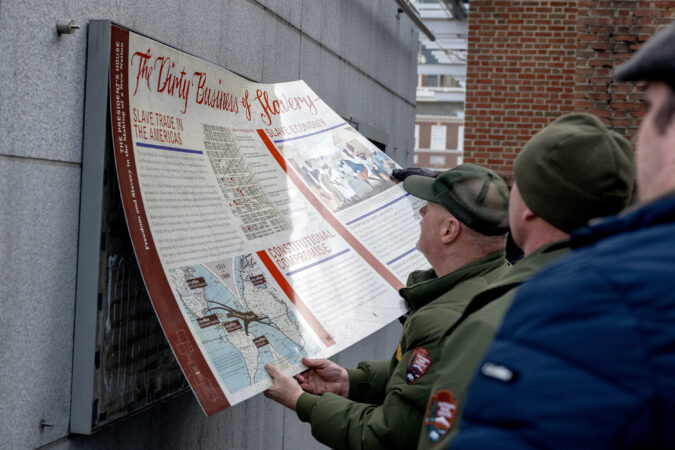
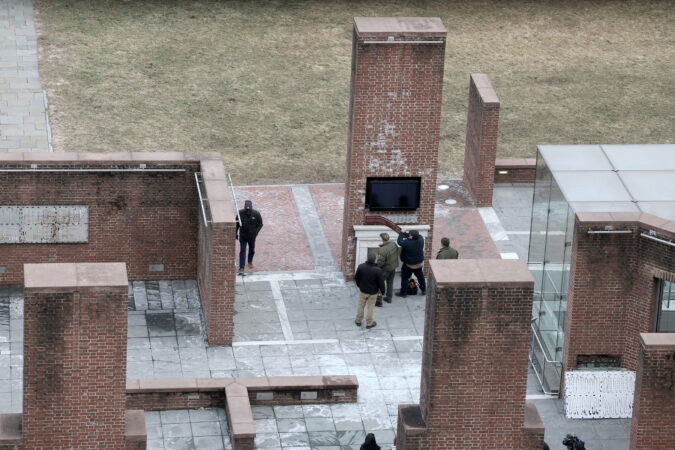
On Thursday, the National Park Service dismantled exhibits about slavery at the President’s House in Independence National Historical Park. This follows orders by President Donald Trump and Interior Secretary Doug Burgum to remove content at national parks that “inappropriately disparage” the U.S.
Here are some of the signs that were removed and why they were flagged:
The President’s House site has a complex history dating back to a 1997 plan for redesigning Independence Mall that did not include its memorialization and according to Inquirer archives, the National Park Service initially did not want to have the site studied. Local Black activists and historians led an effort to excavate the site and create an exhibit that made enslaved individuals who lived and worked in the President’s House a focal point of the historic monument. Developed through a collaboration between the activists, the NPS and others, the President’s House opened to the public in 2010.
A section on a panel that describes the history of the President’s house was flagged for mentioning that history and showing “negativity towards the National Park Service.” Seth C. Bruggeman, a professor of history at Temple University, noted that the site is now important not only for its subject matter, but because of the power of the community members who fought for it and helped develop it.
“Trump can change whatever sign he likes,” said Bruggeman, “but that won't erase the memory of Philadelphians coming together to insist on an honest reckoning with our past.”
Most other passages that were flagged seemingly respond to the “disparagement of historical figures” part of Trump’s order. On the same panel, National Park employees flagged the use of the words “profoundly disturbing” to describe Washington transporting enslaved people between Virginia and Pennsylvania.
story continues after advertisement
A panel describing life under slavery was flagged three times. NPS comments questioned whether George Washington’s motivation to have a steward sign an advertisement seeking the return of a slave who escaped the President’s house could be known.
Cory Young, an assistant history professor at the University of Iowa and a scholar of abolition and slavery in the American North, says that historians are generally in agreement that Washington was very aware of his public image and the fact that he was setting precedent for future American presidents.
Descriptions of the treatment of enslaved individuals at the hands of slaveholders and how Africans were kidnapped and brought to America were also flagged. These passages don’t appear to have been flagged for any factual inaccuracies. It’s possible they were flagged because descriptions of brutality against slaves could be interpreted as reflecting negatively on past Americans.
An illustration depicting Washington signing the Fugitive Slave Act while a group of white men are depicted with clubs and guns shooting at Black men was also flagged for review. Similar to the previous panel, park comments don’t dispute any facts depicted in the illustration.
A wayside sign introducing the President’s House Site was flagged for saying that the Adams household “possibly” hired enslaved people to work in the President’s house. While we know the Adams household hired African Americans, due to scarce documentation about slavery during the early American Era, it’s difficult for historians to say with certainty whether any of them were enslaved.
A panel titled The Dirty Business of Slavery was also flagged twice. Text describing the growth of the enslaved population as a result of both natural increase, but also as a result of rape and forced breeding, was flagged. NPS staff flagged the text, but didn’t include any concerns about facts depicted.
An entry in the Slavery Timeline on this panel was also flagged because an image near the 1793 Fugitive Slave Act entry references the “much harsher” 1850 Fugitive Slave Law. Young believes this is more a layout issue than an issue with historical accuracy as both images are labeled correctly and the timeline later contains an entry for the 1850 law.
story continues after advertisement
A panel about the executive branch was flagged for review twice. First, NPS comments appear to take issue with the panel’s interpretation of why Southern delegates favored a site along the Potomac River for the new capital city. The panel doesn’t explicitly say that Southern delegates preferred this location because Maryland and Virginia were both slave states, but might have been flagged because of the association of slavery with the creation of the new nation’s capital.
The panel was also flagged because “it gives no background as to why” neither John Adams nor George Washington commented on petitions or publications protesting slavery. According to Young, it wasn’t common at the time for the president to speak about slavery as a political issue in public speeches or petitions.
National Park employees submitted three items for review on a panel describing the people who lived in the President’s House, both free and enslaved. According to NPS comment, “the timeline calls out everyone who lived there and who was a slaveholder. No other descriptors are used.” However, the panel also describes Mary Lawrence Masters as a wealthy widow of the former mayor and describes Robert Morris additionally as a financier. George Washington is not explicitly described as a slaveholder nor as president, though his roles as both are described elsewhere on this panel and throughout the exhibit.
The NPS also flagged a subtitle on the panel for review: Washington’s Deceit. Saying that “The section speaks of Washington secretly rotating his enslaved laborers between Mt. Vernon and the President’s House in order to take advantage of a loophole in Pennsylvania’s abolition law. The panel demonstrates that he was secretive, but not deceitful.”
NPS staffers didn’t question the factual basis of the panel. Young noted that while historians might never be able to know if George Washington felt as if he was being deceitful or secretive, they do know that by rotating slaves between Pennsylvania and Virginia, Washington was attempting to avoid freeing any of his slaves under Pennsylvania’s gradual abolition law.
NPS also flagged panel text regarding Martha Washington that says “evidence suggests that she accepted the institution of slavery,” noting that the panel does not direct to any evidence. Use of the word “accepted” doesn’t explicitly suggest that she advocated for or against slavery publicly. The panel describes her inheriting slaves and passing at least some enslaved individuals down to her children after her death.
story continues after advertisement
Staff Contributors
Design, Development, and Reporting: Aileen Clarke
Editing: Sam Morris and Ariella Cohen
Photography: Tom Gralish
Photo Editing: Frank Wiese
Digital Editing: Patricia Madej
Subscribe to The Philadelphia Inquirer
Our reporting is directly supported by reader subscriptions. If you want more journalism like this story, please subscribe today
Informal plans for a snowball fight in Rittenhouse Square. Debates on the best snow to craft the most aerodynamic orb.
A run on ice salt. Public denunciations of said runs.
Searches for snow shovelers.
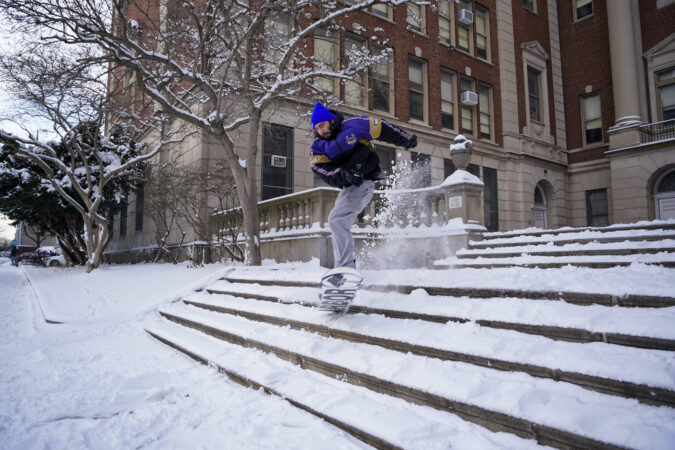
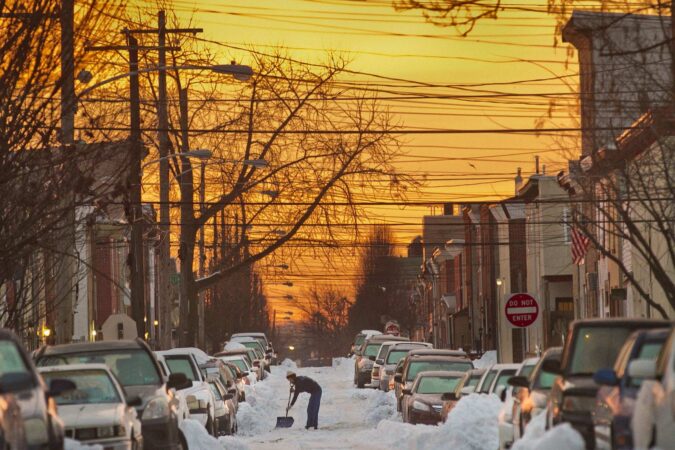
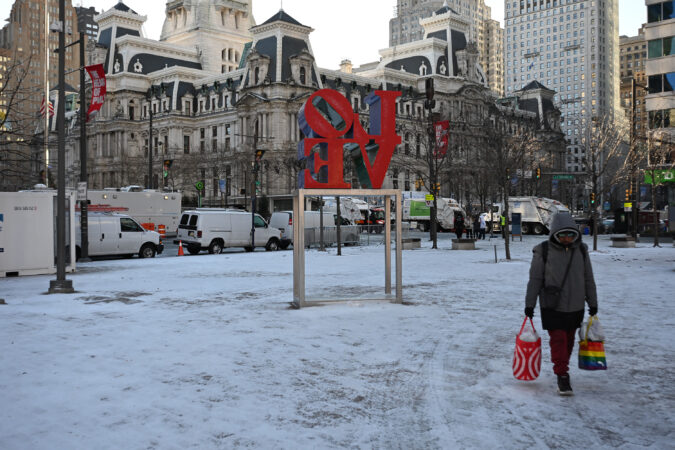
Love it or hate it, Philadelphia could be racking up its first double-digit snowfall since 2016, and residents are bursting at the seams of their snowsuits with the peril and promise of a real, old-school winter wonderland.
Alex Janconski, a manager at Stanley True Value, a hardware store in Roxborough, said the recent snow dustings in the city had already proved to be good for business but this weekend’s forecast had made it hard for suppliers to keep up. People seem to be stocked up on shovels at this point, Janconski said, but in recent days salt has been a hot commodity.
People are taking whatever they can get — rock salt, fast melt, magnesium chloride.
Janconski said the urgency felt by his customers is reminiscent of the COVID-19 days. Three pallets of ice melt sold within 15 minutes of opening Thursday. He suspects the demand has to do with the significant snow projections.
“In terms of the inches, it’s hard to get away from that number and feel like, oh, I can get away with just having nothing,” he said.
While the traditional run on stores before a storm is a strongly held American tradition, there is an added novelty in a city like Philadelphia, where some generations can still wax poetic about staring at the TV waiting for school closure announcements that would give them the all-clear to sled down the Art Museum steps, at Clark Park, or on Fairmount Park’s Belmont Plateau.
Snowfall in the digital age, as the rarity that it is, has lost much of the whimsy.
“Forecasts of any type are going to be imperfect,” he said in a TikTok video, after announcing Wednesday that he would be doing two weather updates a day until the storm hits.
“You got any sports forecasts that are correct? Political forecasts? Economic forecasts? It’s hard to predict the future.”
“Dual [sic] at high noon?” asked the poster, whom, sadly, The Inquirer could not reach to ask about what makes a great snowball fight setting.
Another thread pitched a pond hockey game at FDR Park should the ice be thick enough. Supportive commenters already began work to get the Philadelphia Flyers and Gritty to join.
Meanwhile, contingency plans abound ahead of the potential weekend dump. Businesses are calling it and closing their doors, and state agencies are fully activated, adjusting their various plowing and emergency response plans.
Even the 25th Annual Keystone Sacred Harp Convention at the Rotunda finds itself adjusting to potential snow.
The members of the group, who don’t actually play any harps, practice a style of early American a cappella singing called shape-note singing that uses a series of different shapes rather than typical oval-shaped note heads. The notation was invented in Philadelphia in the 1700s, according to the convention’s chair, Rachel Hall.
About 200 people from across the country were originally slated to come to the events over the weekend, Hall said. But, if the snow falls as predicted, Hall plans on hosting the singers in the living room of her West Philly home Sunday for those willing to make the trudge. She said she likes how the activity brings people together.
“We have a lot of traditions that enable us to come together and think about things that are beyond ourselves,” Hall said.
A Temple student and another individual not associated with the university were robbed by armed men near the school’s North Philadelphia campus early Thursday, according to university officials.
Around 1:30 a.m., the Temple student was walking near the 1500 block of Oxford Street when two men approached with a handgun and stole the student’s phone, Jennifer Griffin, Temple’s vice president for public safety and chief of police, said in a statement.
The men ran off and fired one shot in the air as they fled.
Minutes earlier, in a separate incident several blocks away, those men robbed another individual, stealing that person’s phone, near the 1300 block of Carlisle Street.
The robberies were the second instance of phone theft near Temple’s campus this week.
Around 6:15 a.m. on Wednesday, a man with a handgun approached a Temple student walking on the 1800 block of West Montgomery Avenue and stole that person’s phone, Griffin said in an earlier statement.
The robber fled north on 18th Street. No arrests have been made in the incidents.
On Thursday, Griffin announced that Temple and Philadelphia police would be coordinating a concentrated presence in the area as both departments investigate the robberies.
“Incidents like this are deeply troubling,” Griffin said.
Later in the day, Temple’s public safety department released an image of two suspects wanted in connection with Thursday’s robberies, urging anyone who recognized them to contact Investigations@temple.edu or call 215-204-6200.