Category: Philadelphia News

  • After a difficult 2025, Philly Thanksgiving Day parade attendees still share their gratitude

    After a difficult 2025, Philly Thanksgiving Day parade attendees still share their gratitude

    At the last minute on Thanksgiving morning, Chontai Diggs and her daughter decided to leave their Mount Airy home.

    Diggs, 35, had always watched Philadelphia’s Thanksgiving Day parade on TV, despite being born and raised in the city. But this year, her 9-year old, Zaria Roscoe, wanted to see the towering inflatable floats up close. She grinned as the minutes ticked away, squinting as sun drenched the Benjamin Franklin Parkway.

    Once it was finished, mom and daughter needed to get back home to cook some dishes for their Thanksgiving meal, they said. Zaria was looking forward to eating “ham and mashed potatoes and cornbread and pumpkin pie.”

    On a brisk morning when floats threatened to break free in the wind, but for their determined handlers, many families lined the route of the 106th 6abc Dunkin’ Thanksgiving Day Parade, the nation’s oldest.
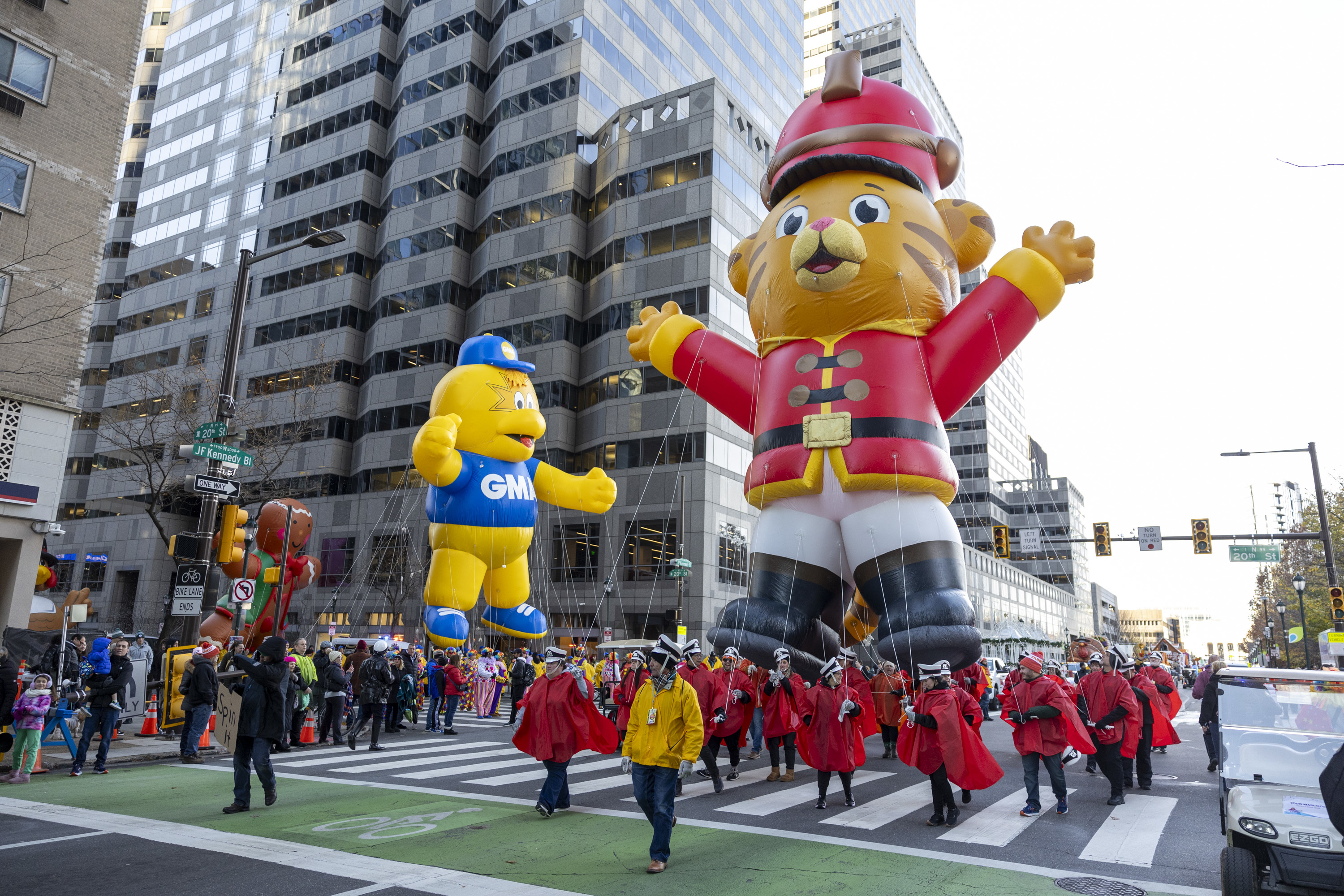
    Large floats present a towering start to this year’s Thanksgiving Day Parade in Philadelphia.

    Kamila Bond, 29, and Alex Vaz, 32, were thankful they even got a chance to see the parade. The two University of Pennsylvania medical residents said they’re usually working on Turkey Day but were happy to see some communal joy, a welcome respite from what they normally see inside the hospital.

    They were grateful for their own health this year and said they were excited to finally spend some time with friends and family on the holiday.

    “And sleeping,” Vaz said, coffee in hand.

    Thanks after a hard year

    Philly’s parade has been running since 1920, when Ellis Gimbel of the once prominent Gimbel Brothers department store on the 800 block of Market Street came up with the idea to celebrate Thanksgiving.

    Until 1986, the parade ended with Santa Claus climbing into an eighth-floor store window, but now finishes with a procession up the Parkway to the Art Museum. Today’s parade might be much larger and influenced by its sponsors, but it still holds a distinct Philly flair.

    “Go Birds! Happy Thanksgiving! Gobble gobble!” said a parade participant in a clown costume, dressed like the original Gimbel employees.
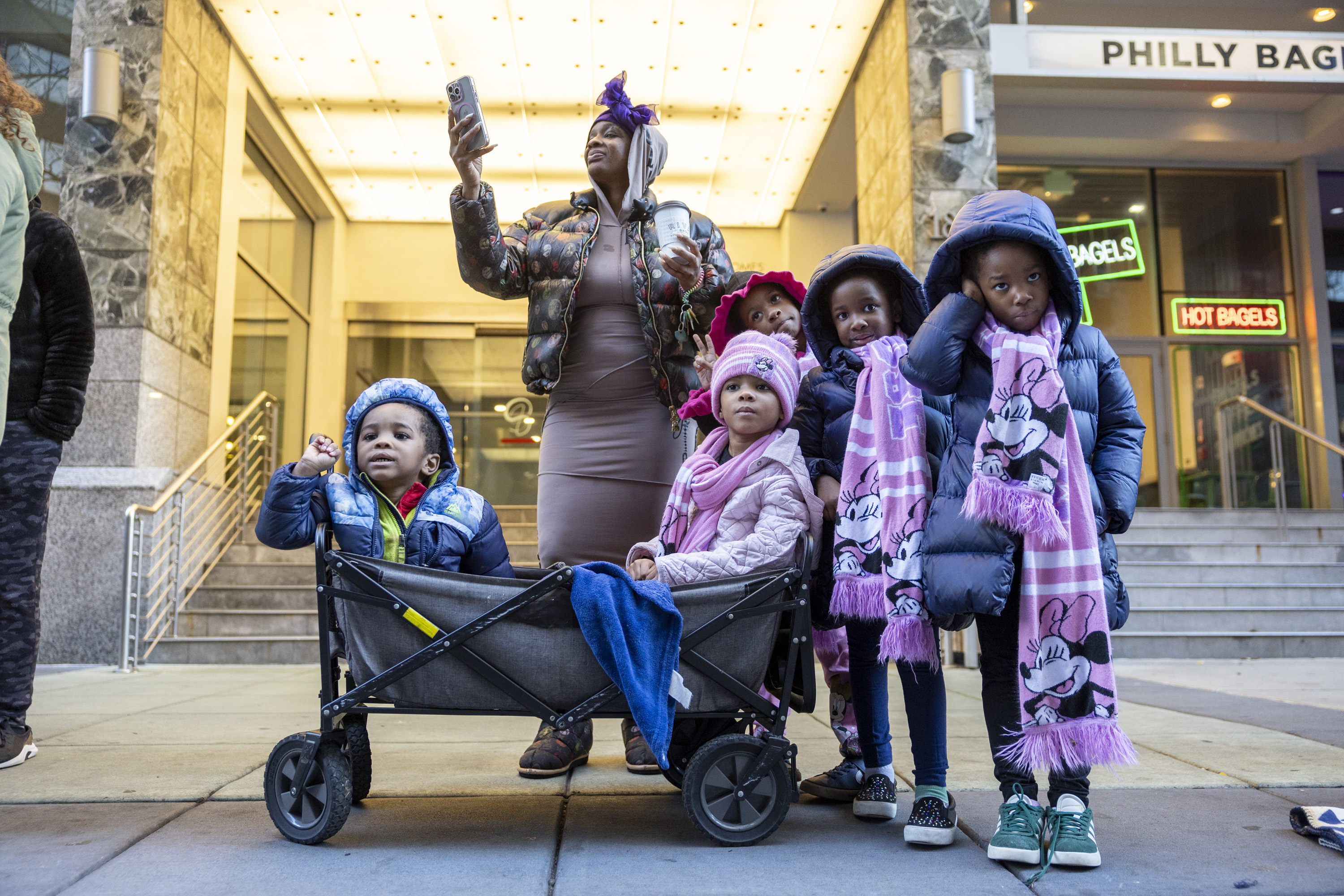
    Sharina Sims, of Center City, and her kids were bundled up for the parade.

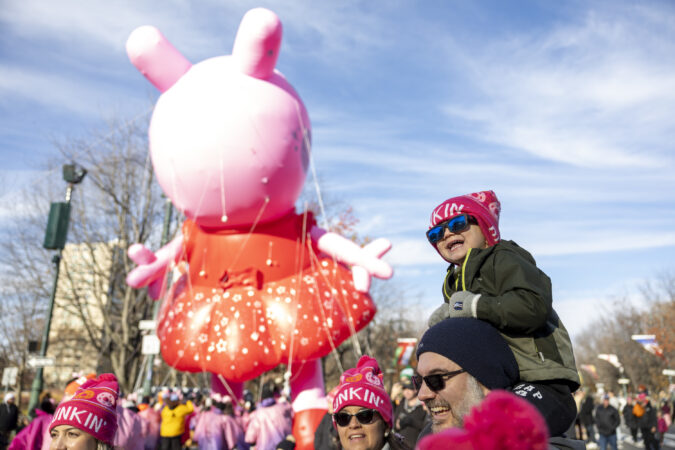
    Little brought as much joy to the crowd as when float carriers relented to chants of “spin it!” and turned their displays around in a 360-degree circle. Second in popularity were the free pink Dunkin’ beanies handed out by the parade sponsor.

    Missing from the celebration was the Temple University marching band. The 200-member ensemble was one of only 11 selected to participate in the 99th edition of the Macy’s Thanksgiving Day Parade in New York City, and the only band from Pennsylvania.

    It was Temple’s first time performing in the New York parade, a fitting year-end celebration for the band, which marked its own 100th anniversary this year. High school bands from as far as Alabama and Indiana filled their place with their own perfectly polished silver tubas.
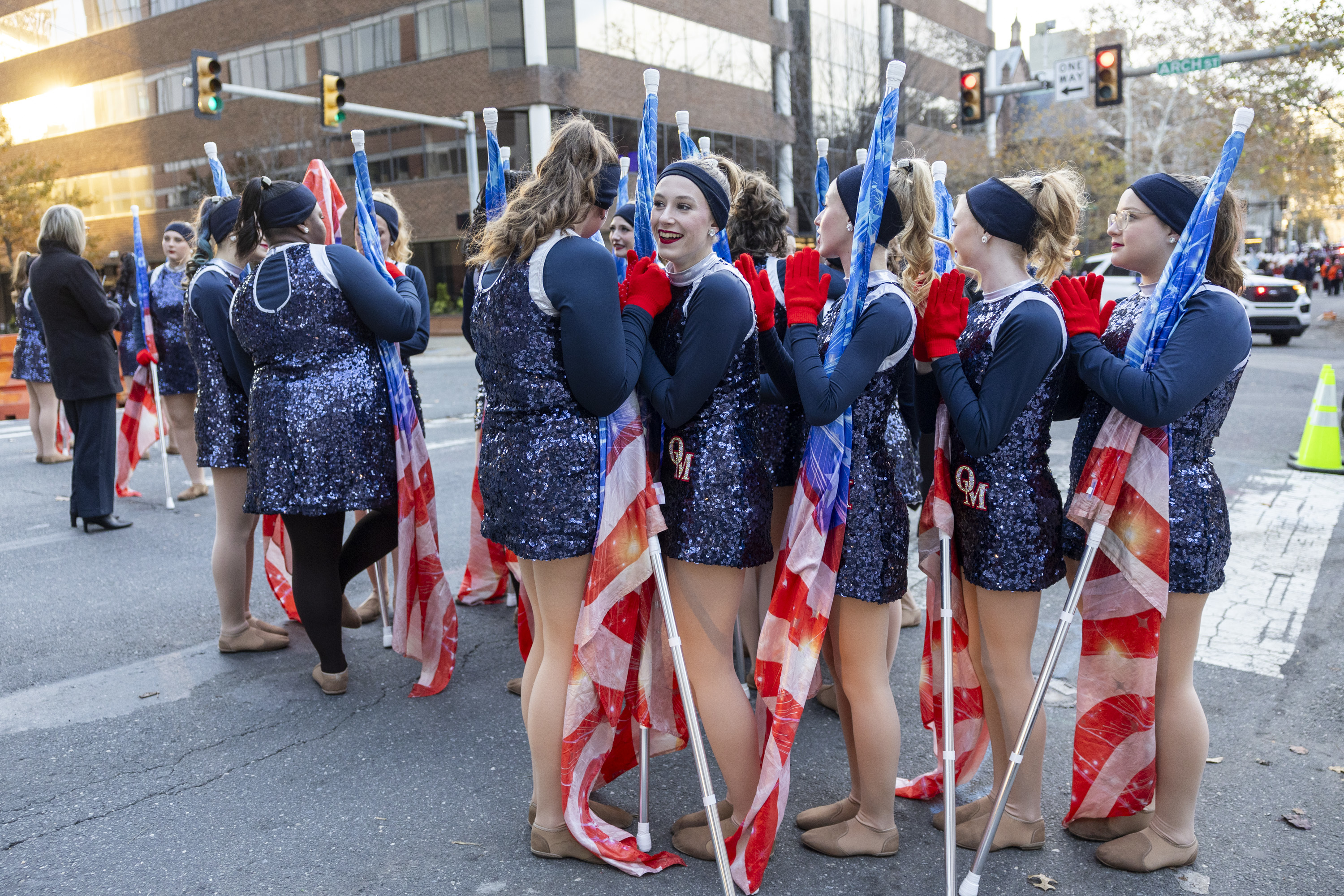
    Anna Reynolds, 16, an 11th grader, is keeping warm with her fellow color guard members before the start of the wind-chilled Thanksgiving Day Parade in Philadelphia. The parade started at 20th Street and JFK Boulevard, traveled east to 16th Street and then north to the Parkway, with the procession ending on Eakins Oval at the Art Museum.

    Perhaps for the good of the festive mood, former Dallas Cowboys quarterback Troy Aikman was not in attendance. Though 6abc advertised his appearance alongside Monday Night Football broadcast partner Joe Buck, the pair merely gave a taped message that aired during the parade’s television broadcast.
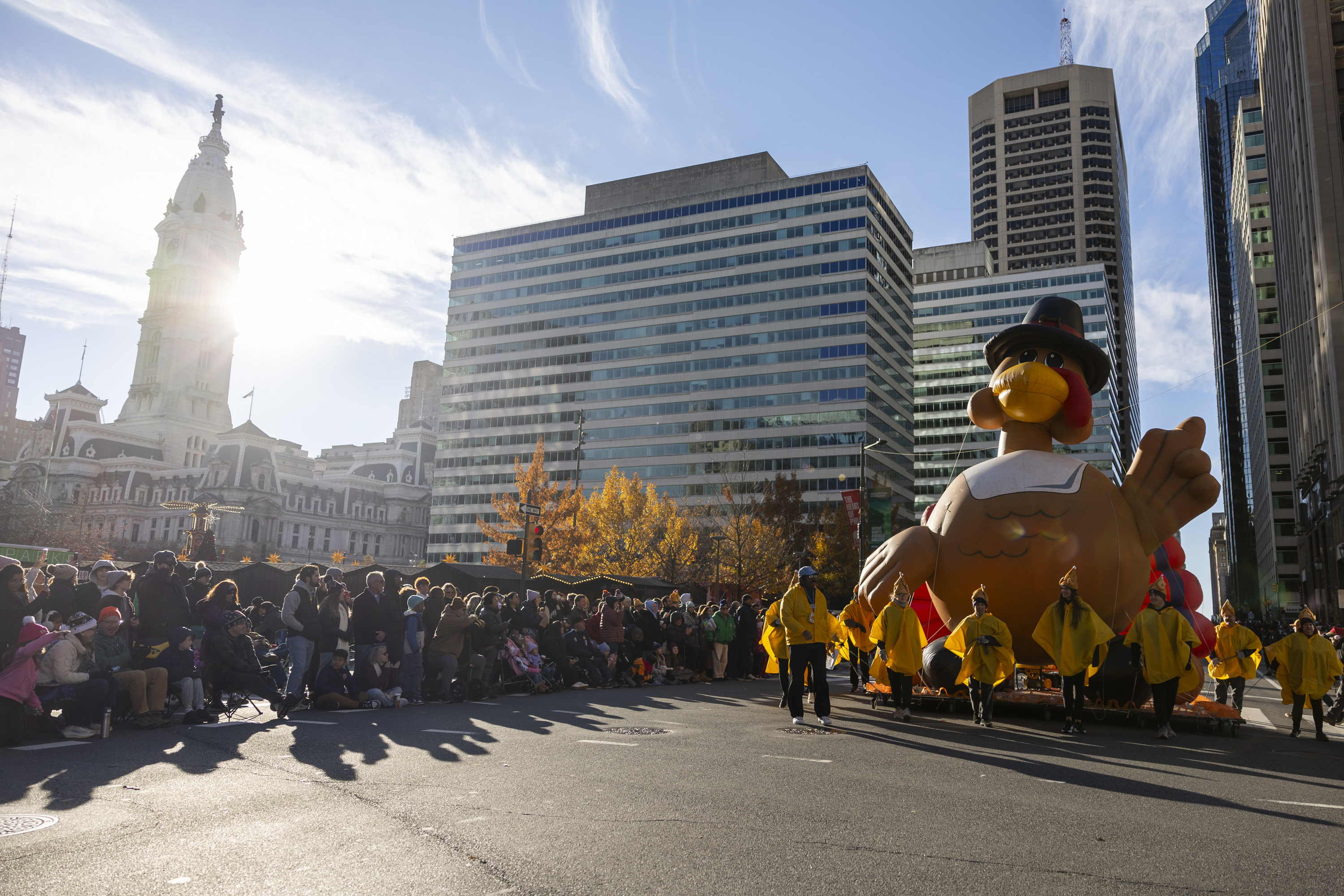
    This turkey was not the edible kind, but one that nonetheless entertained parade onlookers on 16th Street near LOVE Park. The parade started at 20th Street and JFK Boulevard, traveled east to 16th and then north to the Parkway, with the procession ending on Eakins Oval at the Art Museum.

    For reasons that are unclear, Aikman shouted out the Philadelphia Professional Football Cheerleader Alumni group, a collection of former Eagles cheerleaders who strutted down the Parkway wearing jackets displaying what appeared to be the years they last cheered for the team.

    When they reflected back on 2025, some attendees conceded that it had been a difficult year for them and the country. Sarah LaBruce, 46, from Fishtown, said she was hopeful that things would be better going forward — and already had her bright-red Christmas leggings on.
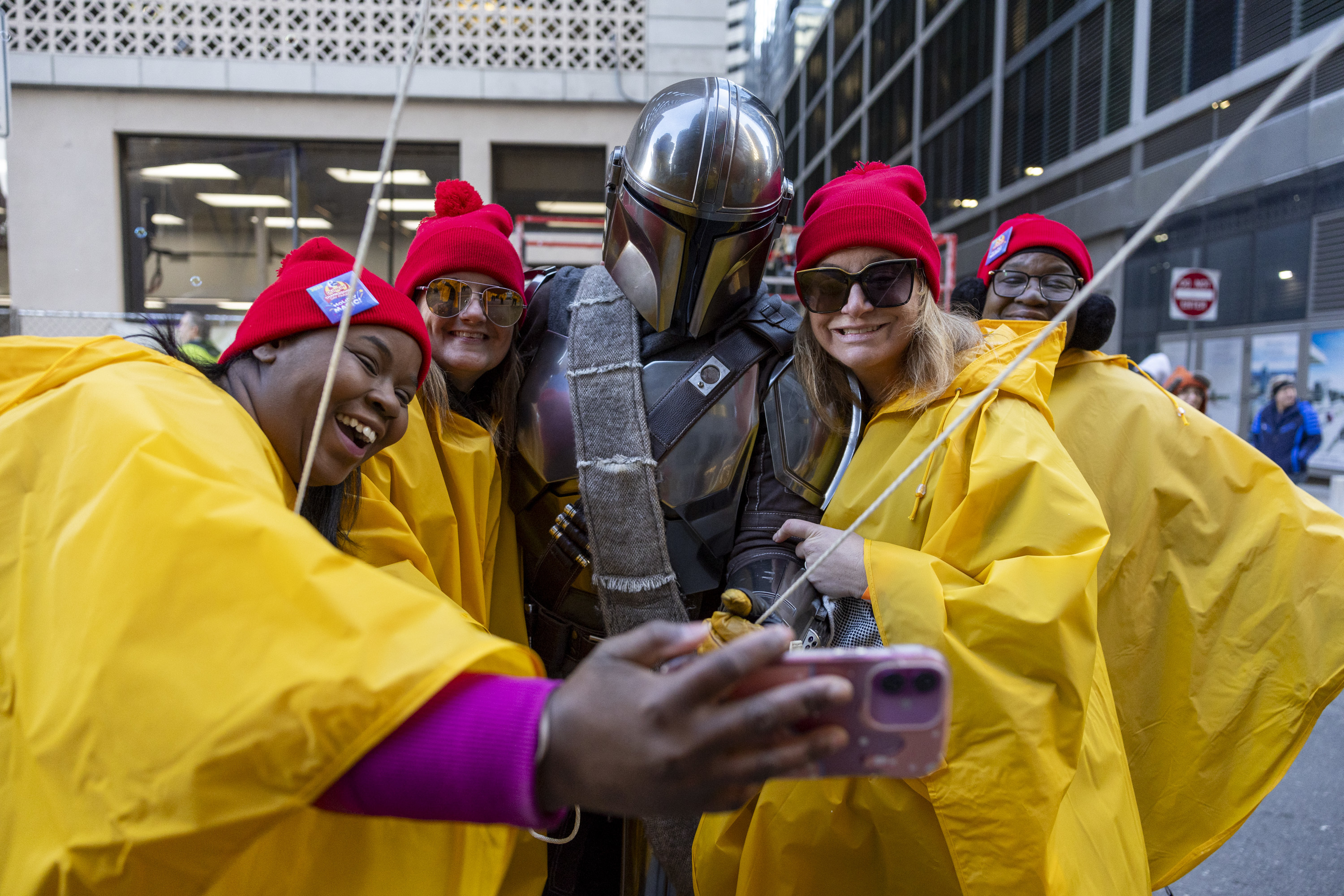
    (From left to right) Dawn Simons, of Lawnside, camden County; Ann Marie Laun, of Northeast Philadelphia; and Lori Aument, of Oreland, Montgomery County, take a photo with the Mandalorian with the 501st Legion before the parade got underway.

    James Govan, 64, is already eyeing his retirement next year, when he plans to leave Philadelphia. He’s a federal worker, and has been able to hold onto his job during all of the recent tumult in the government.

    But until then, the Northeast resident said he was thankful for the everyday parts of life, including the plate of greens with smoked turkey and macaroni and cheese he had prepared for the day. He figured that he would swing by the parade this year, he said, because you never know when it could be your last chance to experience it.

    “Let me see this Santa Claus guy,” he joked, before turning a bit more serious, a walking cane in his right hand.

    “When we’re young, we take it for granted.”

  • Former Fox exec urges FCC to reconsider petition to revoke Fox 29 license

    Former Fox exec urges FCC to reconsider petition to revoke Fox 29 license

    A former Fox broadcasting executive submitted a letter to the Federal Communications Commission on Tuesday asking the agency to reconsider a petition seeking to terminate the license of the network’s Philadelphia-area affiliate, Fox29.

    Preston Padden, who worked as a senior executive at the broadcasting network controlled by Rupert Murdoch and his family in the 1990s, has been a vocal critic of Fox News and its coverage of the 2020 election and an early supporter of the petition.

    In his letter to the FCC, Padden writes that Fox and the Murdochs lied to the American people by reporting that the 2020 election was stolen, despite knowing that it was untrue.

    He cites court findings in the defamation case brought against Fox News by Dominion Voting Systems, which resulted in a $787 million settlement.

    “Fox and the Murdochs’ lies to the American people had consequences,“ Padden wrote. ”Those lies undermined public confidence in the electoral process.”

    Neither Padden nor Fox’s attorneys responded to requests for comment.

    Padden’s letter urged the FCC to respond to an appeal of the order denying the challenge to Fox29’s license.

    The FCC dismissed in January a challenge to Fox29’s license renewal that was brought by the Media and Democracy Project, a self-described nonpartisan nonprofit. The petition, originally filed in July 2023, accused Fox of broadcasting “knowingly false narratives about the 2020 election” on the cable-based Fox News Channel.

    Former FCC chairperson Jessica Rosenworcel, who was appointed by President Joe Biden, said in a statement accompanying the dismissal of the petition, alongside three other complaints targeting local TV stations, that the order was intended to direct the agency to “take a stand on behalf of the First Amendment.”

    “We draw a bright line at a moment when clarity about government interference with the free press is needed more than ever,” she said.

    The challenge is not based on materials broadcast on Fox29, or the local channel’s journalism. Instead, character requirements for broadcast license owners that include a prohibition on “broadcasting false information that causes substantial ‘public harm.’”

    The examples in the FCC’s consumer guide are related to a crime or a catastrophe.

    Fox said in its filings with the FCC that revoking Fox29’s license would be “fundamentally incompatible with the First Amendment.”

    The Media and Democracy Project’s appeal is still pending, and is now in the hands of FCC chair Brendan Carr, a President Donald Trump appointee who has been criticized for interfering in broadcasters’ editorial decisions.

    In September, ABC temporarily removed Jimmy Kimmel’s late-night show from broadcast after a threat Carr made on a conservative podcast.

    “We can do this the easy way or the hard way,” Carr said following remarks Kimmel made about the assassination of conservative commentator and activist Charlie Kirk. “These companies can find ways to change conduct, to take action, frankly, on Kimmel, or there is going to be additional work for the FCC ahead.”

    Carr also reopened previously dismissed complaints of ABC’s moderation of a 2020 presidential debate and CBS’s 60 Minutes interview of then-Vice President Kamala Harris.

    He also blasted news organizations over their coverage of the deportation of the immigrant Kilmar Abrego García.

    Arthur Belendiuk, the attorney for the Media and Democracy Project, said he expects to “grow old and die” before Carr issues a response. Even if Carr denies the appeal, he would open the possibility of an appeal to court.

    Belendiuk believes that’s a risk the FCC chair will not take.

    “If you, Brendan Carr, think you are right, issue a decision and defend it in court,” the attorney said. “Be a man.”

    Staff writers Rob Tornoe and Nick Vadala contributed to this article.

  • Philly’s new unarmed volunteer ‘auxiliary police’ unit could launch in 2026

    Philly’s new unarmed volunteer ‘auxiliary police’ unit could launch in 2026

    The Philadelphia Police Department is forming an “auxiliary” unit that may be ready as early as next year, according to a department spokesperson, adding to its ranks volunteer members who will assist officers at large public gatherings.

    Auxiliary police will not carry weapons and will not be assigned typical law enforcement duties, according to Sgt. Eric Gripp, a department spokesperson. They will not be authorized to make arrests.

    But the department wants the unit to act as a link between the public and police, participating in community engagement and, according to Gripp, serving as additional “eyes and ears” for officers on the ground.

    As Philadelphia prepares to host a series of widely attended events in 2026 — the country’s 250th July Fourth anniversary celebration, FIFA World Cup matches, and more — the police department will be tasked with maintaining order amid an influx of visitors.

    An auxiliary unit would assist police during those types of events, according to Gripp. He said the department had tasked its academy recruits with similar duties during citywide celebrations after the Eagles’ Super Bowl victory in February.

    It is unclear whether the auxiliary unit will be ready in time for the summer.

    The department does not have an official estimate on when it plans to introduce the unit; the idea is still in the planning stages and targeted for 2026, Gripp said. The only confirmed requirement is that recruits must be 18 years old to apply.

    Police departments in municipalities large and small have used auxiliary units, sometimes called reserve units, for years.

    The New York Police Department has maintained its auxiliary unit for more than half a century; major cities like Baltimore also have reserve officers, as do smaller townships like Cranford, N.J.

    Criminologists and former law enforcement officers say police departments use these units to assist with traffic management, crowd control, and community engagement, and for reporting more serious issues to officers who have the authority to intervene.

    Experts say the units are a boon to departments facing recruitment and retention issues, providing unpaid assistance from those who are already curious about life as a police officer and who often hail from the communities they are assigned to.

    But departments must invest time, money, and adequate training into auxiliary units for them to be successful.

    Joseph Giacalone, a retired NYPD sergeant and criminal justice instructor at Pennsylvania State University’s Lehigh Valley campus, said the New York department often uses its 3,700-member auxiliary unit for crowd control during “fun events” like parades and street fairs.

    Most importantly, Giacalone said, departments should not view their auxiliary unit as a crime-fighting tool; members should be provided uniforms that are recognizable to the public, he said, distinct from those of actual police officers.

    “We’re not talking riots,” Giacalone said of situations in which auxiliary officers are useful. “We don’t want them really identifying things such as drug dealing, dens of prostitution, things like that. We can get that from ordinary intelligence — we don’t want ordinary citizens doing that.”

    Still, auxiliary members may help officers with other duties.

    During Giacalone’s tenure with the department, the NYPD’s auxiliary unit proved beneficial when members reported quality-of-life issues such as abandoned vehicles and broken traffic lights, he said.

    Given the potential danger that accompanies police work, Giacalone said, he hopes the Philadelphia department’s plan includes extensive training for auxiliary recruits — as well as protective gear.

    The former sergeant still recalls a harrowing day in 2007 when two unarmed New York auxiliary officers were shot and killed by a gunman in the city’s Greenwich Village neighborhood while out on patrol.

    Gripp, the Philadelphia department spokesperson, said the city’s auxiliary unit would not conduct foot patrols. He said members would be trained by the department’s internal staff.

    Meanwhile, New York auxiliary officers must pass hours of training courses in first aid, self-defense, and patrol technique; in Giacalone’s experience, those trainings require more experienced officers to sacrifice time and energy to the project.

    By the former sergeant’s estimate, for Philadelphia, “it’s going to take a while to get this up and running.”

  • Jean E. Corrigan, former Montgomery County manager and longtime assistant to then-State Rep. Josh Shapiro, has died at 70

    Jean E. Corrigan, former Montgomery County manager and longtime assistant to then-State Rep. Josh Shapiro, has died at 70

    Jean E. Corrigan, 70, of Roslyn, Montgomery County, retired fleet and operations manager for the Montgomery County Department of Assets and Infrastructure, onetime constituent services representative for then-State Rep. Josh Shapiro, hair salon owner and operator, disability services advocate, and award-winning volunteer, died Saturday, Nov. 22, of non-alcoholic cirrhosis of the liver at her home.

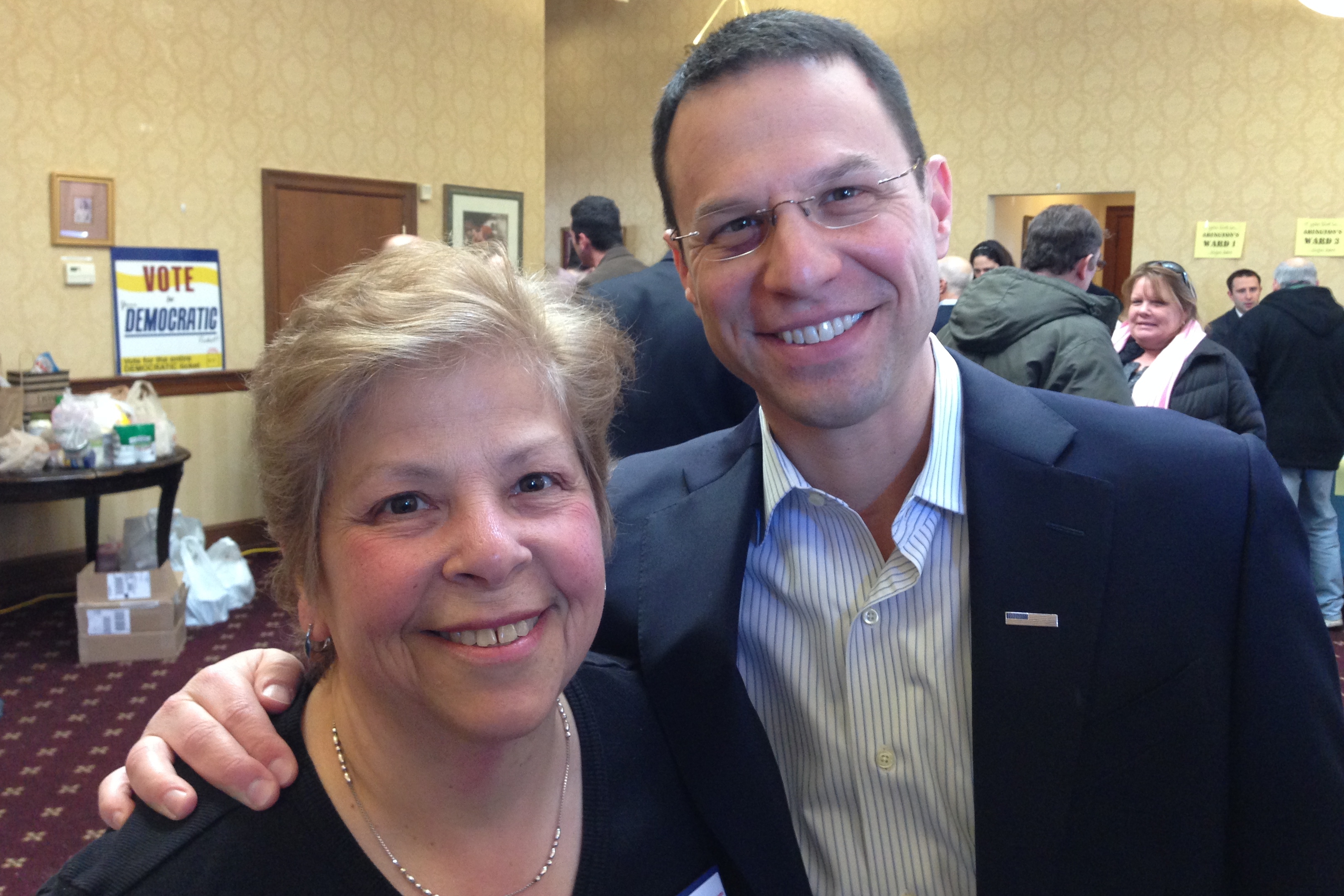
    A lifelong resident of Glenside and nearby Roslyn, Mrs. Corrigan was vice chair of the Abington-Rockledge Democratic Committee from 1995 to 2013, and served as Gov. Shapiro’s constituent service agent when he represented the 153rd Legislative District in the Pennsylvania House of Representatives from 2004 to 2012.

    “Jean was the very first volunteer on my very first campaign,” Shapiro recalled. “We knocked doors together, met our neighbors together, and, after winning, served our community together.”

    In addition to breaking down bureaucratic delays and solving all kinds of constituent problems for Shapiro, Mrs. Corrigan doggedly championed fair wages, reproductive freedom, increased funding for special education and disability services, and improved healthcare. Colleagues called her a “super volunteer” and a “campaign mom” because she helped so many candidates win elections.

    Gov. Shapiro said Mrs. Corrigan “made her neighbors’ lives better.”

    She hosted visiting campaign workers at her home for years, took charge of distributing lawn signs and sample ballots, and organized other preelection events at her dining room table. She was named the local committee’s Democrat of the Year in 2002 and earned several awards from community service organizations.

    “Through that work, I got to see just how much of herself she gave to others,” Shapiro said. “Where there was a need in the community, she worked to address it. When someone needed help, she lent a hand. She made her neighbors’ lives better, and I will forever be grateful for her life of service.”

    In 2001, Mrs. Corrigan ran unsuccessfully for Abington Township commissioner, finishing second among three candidates and losing to a long-entrenched incumbent. In a preelection profile in The Inquirer, she listed “responsible growth” as a top value and “maintain integrity of Abington Township” as a main goal.

    “Jean was passionate about serving others,” her family said in a tribute. “She believed that politics and civic activism could make a positive difference in people’s lives.”

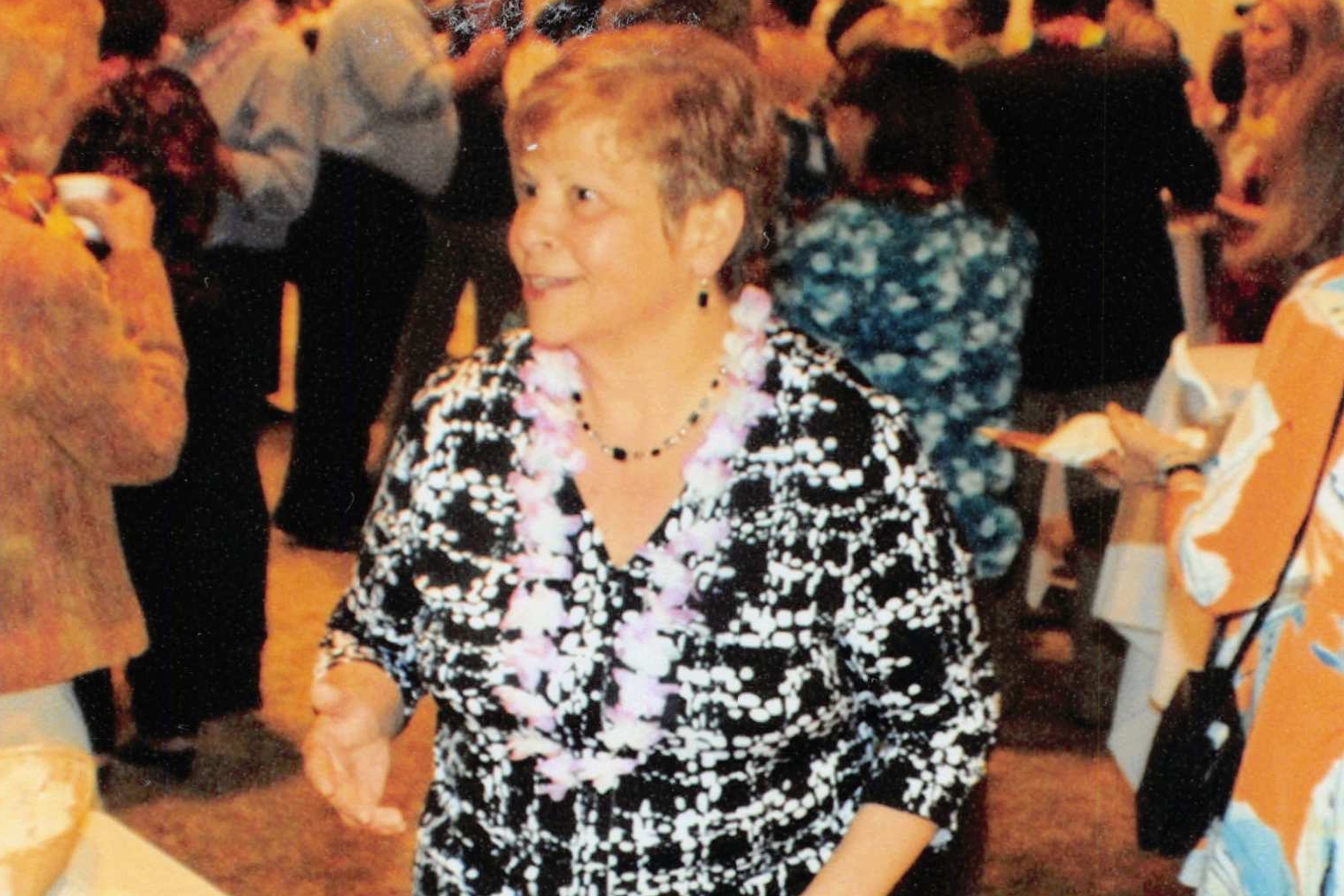
    Mrs. Corrigan was called a “super volunteer” by colleagues and friends.

    At work, Mrs. Corrigan managed Montgomery County’s fleet of vehicles from 2015 to her retirement in 2022. She joined the county’s assets and infrastructure department in 2012 as operations manager for public property and supervised the county’s building services, construction carpenters, project collaboration, and computer-aided design.

    She studied beauty science and hair styling in high school, attended the Willow Grove Beauty Academy, and ran her own salon called Shears to You from 1993 to 2001. As a volunteer, she was one-time president of the Abington School District Special Education Parent Advisory Council, copresident of the Abington Junior High School parent-teacher organization, and chair and vice chair of several Abington Township community initiatives.

    She raised funds for school events and served on the board of the Abington YMCA. “Jean was selfless, empathetic, blunt, affectionate, caring, plainspoken, honest, and incredibly hard-working,” her family said. “There was no ego, no vanity.”

    Jean Elizabeth Fanelli was born Aug. 30, 1955, in Abington Township. She grew up with a brother, Angelo, and graduated from Abington High School in 1973. She was interested in clothing design as well as beauty culture and took classes at Temple University.

    Mrs. Corrigan stands with her husband, Peter, and son David

    After a brief marriage to Bruce Cunningham was annulled, she married Peter Corrigan — an usher at her first wedding — in 1977, and they had sons Joseph and David and a daughter, Pauline. They lived in Glenside for decades, in the same house in which she grew up, and moved to Roslyn a few years ago.

    Mrs. Corrigan enjoyed shopping trips with her daughter and baking holiday cookies. She liked to entertain and cook for everybody.

    She doted on her two granddaughters and spent memorable summers near Arrowhead Lake in the Pocono Mountains. She could talk to anybody, her family said.

    “She was a wonderful mother,” her daughter said. “I learned to have respect and manners from her.”

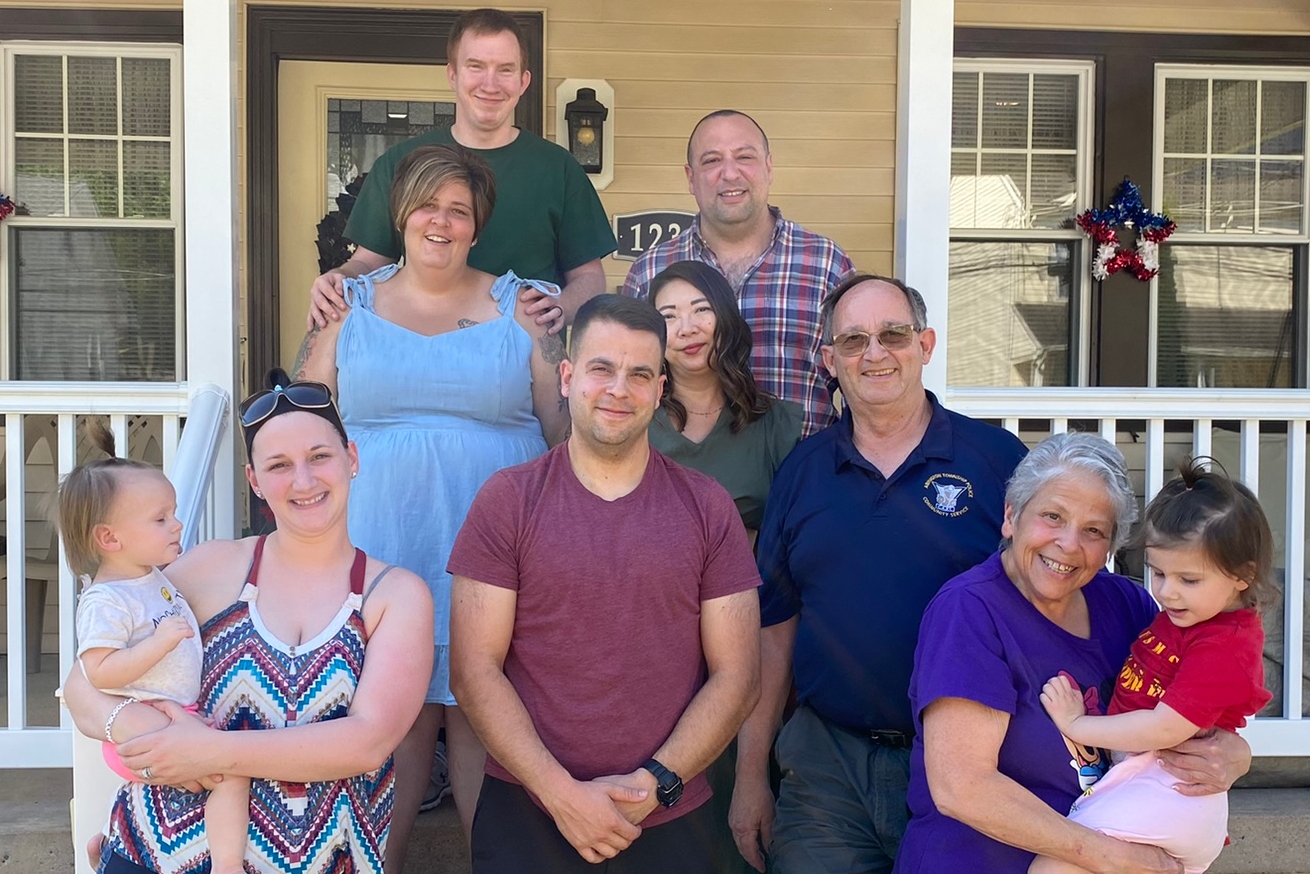
    Mrs. Corrigan (front right) enjoyed time with her family.

    Her son David said: “She taught me to be considerate and understanding of everyone I encounter, a lesson I will never forget.”

    Her son Joseph said: “She was incredibly generous with her time and resources. She could build relationships, and a theme of her life was caring for people.”

    Her husband said: “She was one of a kind.”

    In addition to her husband, children, granddaughters, and brother, Mrs. Corrigan is survived by other relatives.

    A private celebration of her life is to be held later.

    Donations in her name may be made to Hedwig House Inc., 1920 Old York Rd., Abington, Pa. 19001.

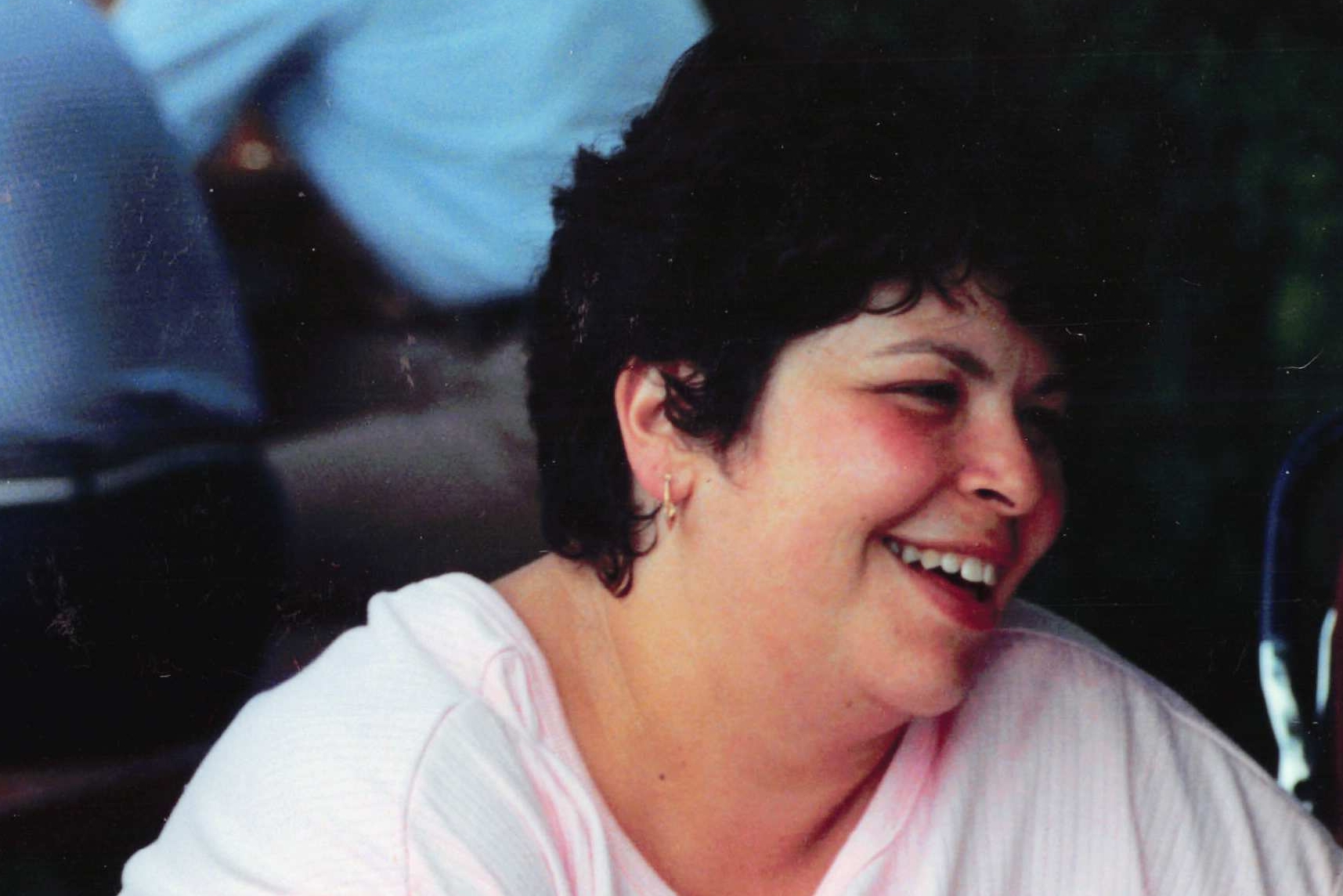
    Mrs. Corrigan’s smile could light up a room, her family said.
  • After Manayunk’s Bridget the Dino statue was decapitated, neighbors will decide the name for a new dinosaur

    After Manayunk’s Bridget the Dino statue was decapitated, neighbors will decide the name for a new dinosaur

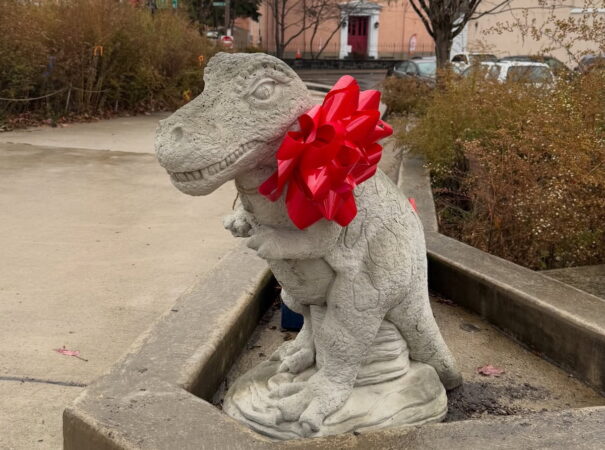
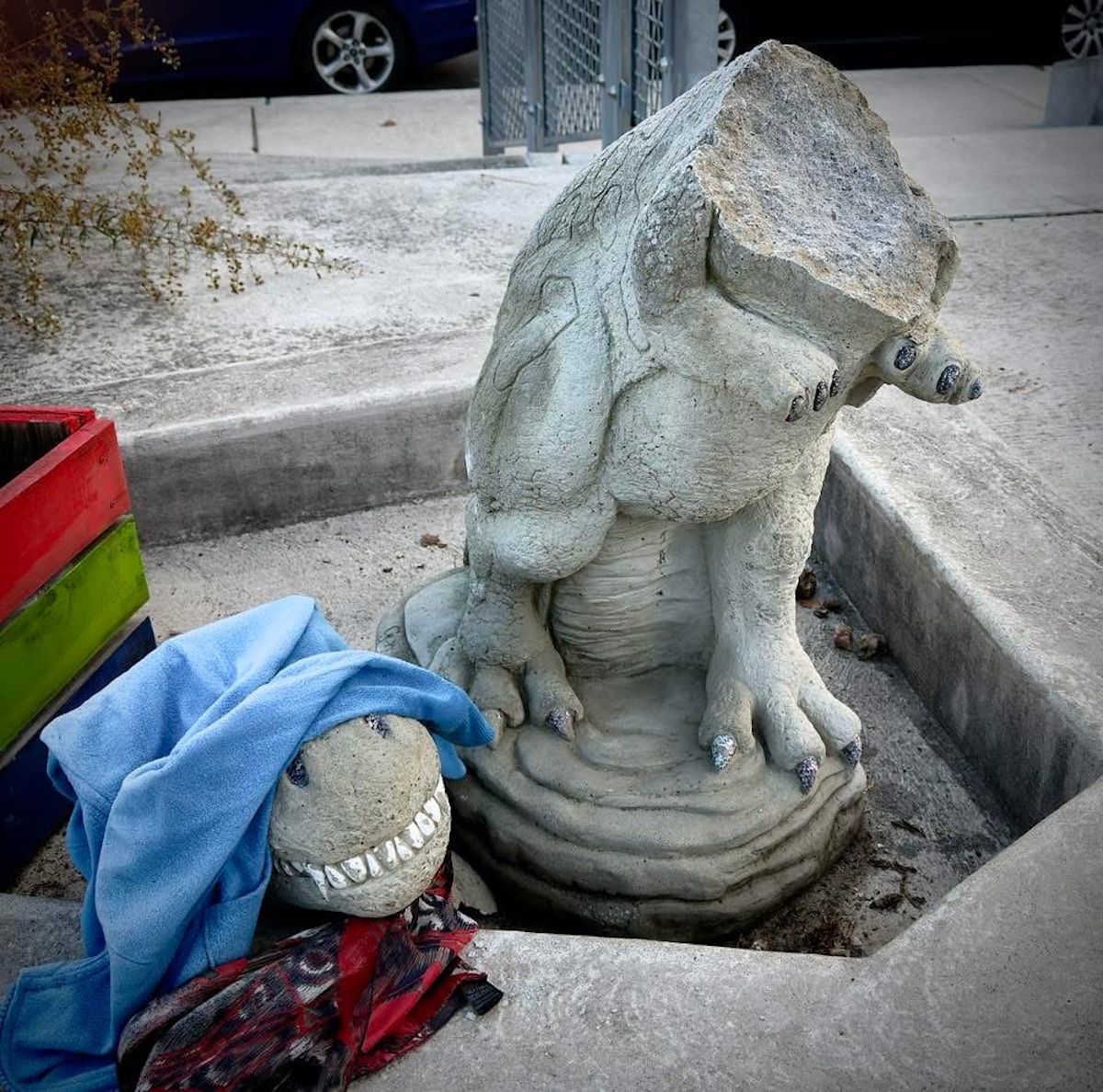
    The decapitation of a beloved stone garden dinosaur in Manayunk left the community reeling earlier this week.

    Bridget the Dino was a symbol for the neighborhood’s green spaces and neighborly affection, who oversaw the Manayunk Bridge Trail gardens.

    When all hope was lost, the original owners of Bridget, and other neighborhood dinosaurs that have become a staple to Roxborough and Manayunk, saved the day.

    Holod’s, the Lafayette Hill home and garden store, donated a brand new stone dinosaur to the Manayunk gardens at Dupont and High Streets, taking over Bridget’s yearslong watch as the garden guardian.

    “After the heartbreak of seeing Bridget damaged, this unexpected act of kindness means more than words can say. The neighborhood love is real, and this Dino is already feeling it,” park organizers announced on Tuesday.

    Now that the difficult task of placing a new 300-pound stone garden dinosaur is complete, the fun part comes: choosing a name for the new dino. When park organizers learned they would be getting a brand new dino, they decided they couldn’t just name the new statue Bridget, as she is “irreplaceable,” said park volunteer and Roxborough resident Juliane Holz.

    “The community is so much a part of this that they can help us name this new one,” Holz said. “I like Manny. But we also have to decide whether she is a girl or a boy dino. I do like ‘Holly’ for Holod’s.”

    Park organizers have already posted a list of suggested names for the new statue. This reporter is partial to “Yunker.”

    Potential dinosaur names:

    • Manny (for Manayunk)
    • Archie (for the arch of the bridge)
    • Roxie (for the Roxborough side)
    • Schuylie (for the Schuylkill)
    • Ivy (garden vibes)
    • Rocky (Philly and Roxborough)
    • Ledger (bridge and connection vibes)
    • Petra (means “rock”)
    • Yunker (play on Manayunk)

    Residents from Manayunk, Roxborough, and beyond can drop a comment below the park’s latest Instagram post to vote on one of the above names or suggest a new one.

    Last Sunday, a neighbor found Bridget’s head lying at the feet of her stone body after it was smashed between late Saturday evening and early Sunday morning. The vandalism came as a shock to the community that welcomed Bridget with open arms, as she grew into a beacon for the ever-growing green spaces that the families of Manayunk and Roxborough have come to revitalize.

    Bridget the Dino, a beloved stone garden statue at the Manayunk Bridge Garden, had its head smashed off between late Saturday night, Nov. 22, and early Sunday morning, Nov. 23, 2025. The 300-pound stone statue would be hard to move, neighbors say, leading some to believe an adult purposefully broke the statue.

    “It seems like something silly to be upset about, but someone put a lot of effort and money — these statues and improvements are not cheap — into making that bridge garden a really nice place,” Manayunk resident Annie Schuster said. “I hate the fact that somebody did that.”

    Neighbors believe the cowardly act to have been perpetrated by an adult who intended to destroy the iconic statue. Holz believed the statue proved too heavy for someone to mistakenly bump into it. Police reached out to Holz and park organizers to let them know they will investigate the crime, Holz said.

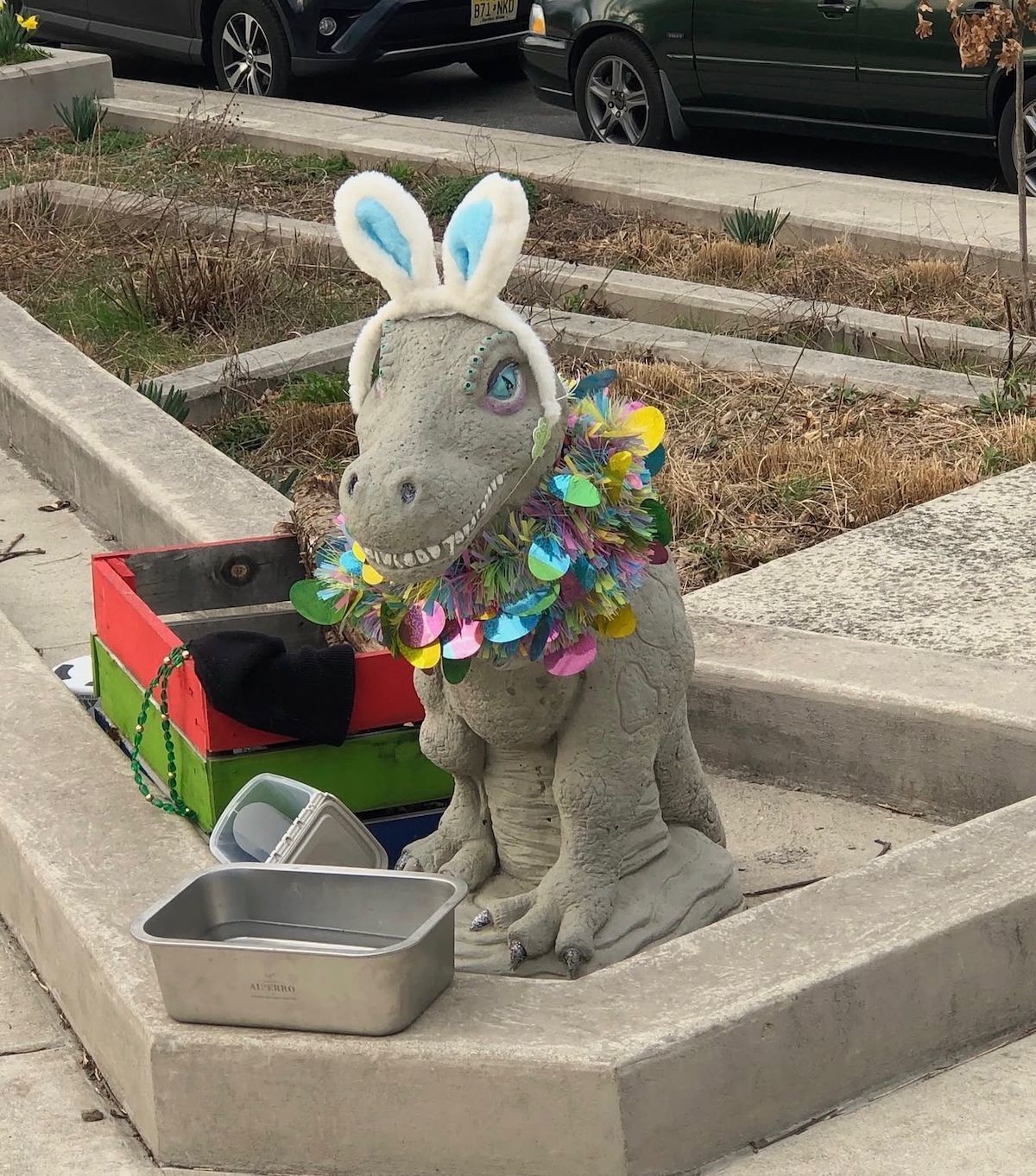
    Bridget the Dino, a beloved stone garden statue at the Manayunk Bridge Garden, pictured in an Easter Bunny costume for Easter. The community often dresses up Bridget during different holidays and themed events. In November 2026, her head was smashed off her body.

    Meanwhile, they’ll repurpose Bridget elsewhere among the garden beds and usher a new dinosaur dynasty with Holod’s latest statue. Holz said perhaps Bridget’s new iteration will be as a bird bath installation or an addition in a new sensory garden.

    The Manayunk Bridge Garden is one of the many public spaces being transformed into neighborhood gardens and pedestrian thoroughfares. Since COVID-19 lockdowns, residents have donated their time, alongside the Roxborough Manayunk Conservancy, to making this place special for local families. Bridget and her new friend encapsulate all of that passion.

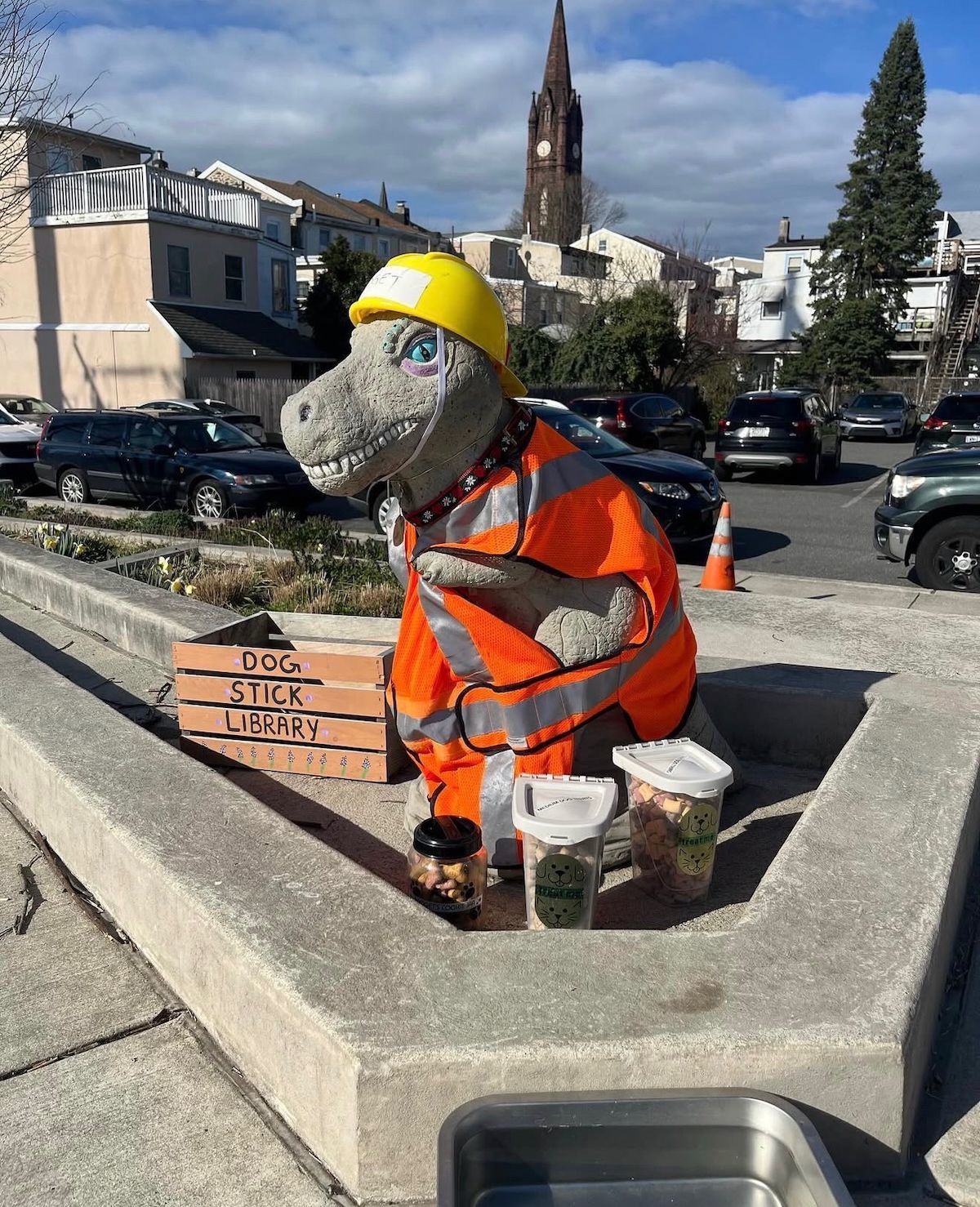
    Bridget the Dino, a beloved stone garden statue at the Manayunk Bridge Garden, pictured in a construction worker’s uniform. The community often dresses up Bridget during different holidays and themed events. In November 2026, her head was smashed off her body.

    “We are focused on improving the park’s ecology and creating opportunities for the community to enjoy and use the space. The gardens are stunning in autumn with their masses of purple asters and yellow goldenrod,” said Avigail Milder of the Roxborough Manayunk Conservancy.

    Along with the welcoming stone dinosaur, volunteers have been planting native shrubs and herbaceous plants that bloom through spring and summer. A new sugar maple tree was planted for much-needed shade. And most recently, Opus Piano donated a mini grand piano to be enjoyed and played by all parkgoers.

  • The time Philly almost didn’t have a Thanksgiving Day parade

    The time Philly almost didn’t have a Thanksgiving Day parade

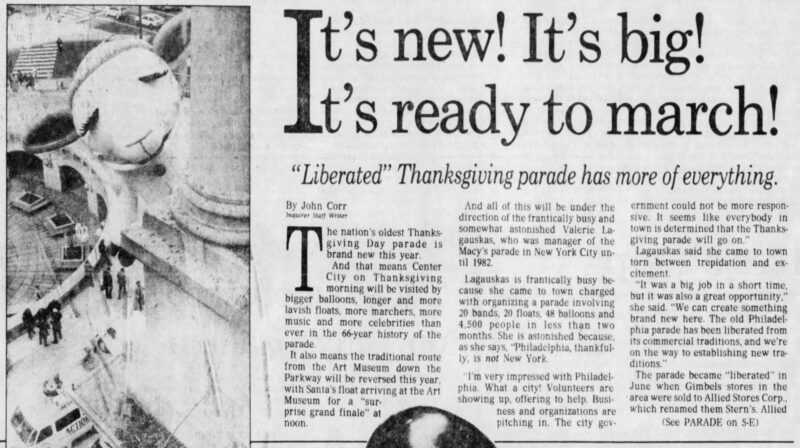
    Since 1920, Philadelphia has gone without a Thanksgiving Day parade only twice — once because of poor weather, and once because of a global pandemic. But nearly four decades ago, another formidable foe — corporate sponsorship — threatened the city’s beloved holiday tradition.

    That’s not a bad record for the country’s oldest Thanksgiving Day parade, which Gimbel Brothers Department Store launched with a humble procession through Center City. For more than 60 years, the festivities ended with Santa Claus climbing a ladder into the window of the Gimbels store at Ninth and Market Streets, signaling the start of the holiday season.

    Until 1986, that is. Gimbels by then had fallen on hard times and, following its sale to the highest bidder, was liquidated. Its Philadelphia-area locations were to be converted into Stern’s department stores, and Gimbels hoped to pass the baton to that chain to keep the Thanksgiving Day tradition alive.

    The problem was that Stern’s and its parent company, Allied Stores Corp., were not interested.

    “I think the best we could do this fast is to buy the Mummers some T-shirts,” Allied Stores chairman Thomas Macioce told the Daily News in 1986.

    The parade that year, however, became bigger and better than it had ever been. Here is how The Inquirer and Daily News covered it:

    https://www.newspapers.com/article/philadelphia-daily-news/185403993/

    Article from Jun 18, 1986 Philadelphia Daily News (Philadelphia, Pennsylvania) <!— –>

    ‘We can’t be ready in time’

    A deal in the Gimbels sale emerged in June 1986 and, right away, the Thanksgiving Day parade was on the chopping block, at least for that year. Allied officials claimed no planning had yet been done and there was no way to put it together in time.

    That, it turns out, wasn’t true. Ann Stuart, a Gimbels executive, told the Daily News that parade organizers had been proceeding as though the parade would be held as scheduled. And Barbara Fenhagen, the city’s special events coordinator, said planning was going ahead as usual.

    Either way, Stern’s and Allied’s lack of interest left the city in a tight spot. Aug. 15 was the last day orders could go in for the floats to be ready on time, marking a hard deadline to find a sponsor. Whoever took up the role would be expected to spend hundreds of thousands of dollars.

    “We will do everything we can to make sure that [the parade’s] appearance is not interrupted, even for one year,” Fenhagen said at the time.

    https://www.newspapers.com/article/philadelphia-daily-news/185404572/

    Article from Jul 16, 1986 Philadelphia Daily News (Philadelphia, Pennsylvania) <!— –>

    ‘Don’t rain on our parade’

    As the controversy wore on, Philadelphians and the local press grieved and snarled at the potential loss of a holiday tradition. The Daily News seemed to plead for Stern’s to reconsider.

    “Please don’t rain on our parade,” the People Paper wrote in an editorial. “To Philadelphians of all ages, it launches the holiday season in a special and heartwarming way.”

    Business columnist Jack Roberts struck a more combative tone, likening Stern’s to a houseguest who begins a conversation “by spitting in your face.” He later suggested that readers send back Stern’s junk mail to the company’s “Scrooge” executives with the phrase “I want the parade” scrawled across it.

    Special events professionals, meanwhile, warned that forgoing the sponsorship might create a bad name for Stern’s that would be difficult to overcome.

    “Philadelphians have a way of remembering,” special events consultant Shelly Picker said.

    https://www.newspapers.com/article/philadelphia-daily-news/185404234/

    Article from Nov 21, 1986 Philadelphia Daily News (Philadelphia, Pennsylvania) <!— –>

    ‘We’re delighted’

    The search for a new lead sponsor was arduous, with city officials approaching “most every local company that breathes,” according to a Daily News report. A number of bigger local outfits — ranging from Meridian Bancorp to Kiddie City — bowed out over cost and branding concerns.

    Then, after 56 days of limbo, the Thanksgiving Day parade was back on. And it was thanks to WPVI (Channel 6), better known today as 6abc.

    “When it became clear that because of the time frame and other commitments most were unable to assume that mantle, we decided to do it — and we’re delighted,” said the station’s general manager, Rick Spinner.

    The station had been airing the parade locally for 19 years and seemed to be a natural fit to take over. And, as the Daily News reported, the city had been pressuring Channel 6 to come up with a plan, seeing as the station benefited significantly from broadcasting the day’s festivities.

    The parade would go on to be known as the “Channel 6 Thanksgiving Day Parade.” But that was not the only — or even the biggest — change afoot.

    https://www.newspapers.com/article/philadelphia-daily-news/185404169/

    Article from Sep 24, 1986 Philadelphia Daily News (Philadelphia, Pennsylvania) <!— –>

    ‘Establishing new traditions’

    Channel 6 brought in the big guns straight away. Namely, by hiring a parade coordinator named Valerie Lagauskas, who previously managed the Macy’s parade in New York and wrote a book on parade planning.

    A number of changes came under Lagauskas’ leadership, including a new route. Instead of starting at the Philadelphia Art Museum and marching toward City Hall, as had been tradition, the parade would reverse direction and end at the Art Museum. The route would allow for the use of larger balloons, bigger floats, and better camera angles for the parade’s telecast.

    The full parade that year would also be broadcast nationally for the first time, appearing on the Lifetime network, in which ABC was part owner.

    In total, there would be 20 bands, 20 floats, 8 gigantic balloons, and 40 other balloons that were merely very large, The Inquirer reported. A massive balloon of the cartoon cat Heathcliff would make its debut. The theme, fittingly, would be “We Love a Parade.” And leading it all as parade marshal would be Sixers legend Julius “Dr. J” Erving,

    “The old Philadelphia parade has been liberated from its commercial traditions and we’re on the way to establishing new traditions,” Lagauskas said.

    https://www.newspapers.com/article/the-philadelphia-inquirer/185404381/

    Article from Nov 28, 1986 The Philadelphia Inquirer (Philadelphia, Pennsylvania) <!— –>

    ‘The best ever’

    On parade day, more than 500,000 spectators were expected to attend. And, according to reports from the time, they were not disappointed.

    Not only were there better floats and a more picturesque route, but paradegoers also were met with unseasonably warm temperatures.

    “It’s the first time we’ve been to a Thanksgiving Day parade where you could get a sunburn,” one attendee joked.

    The parade itself seemingly went off without a hitch, concluding on the steps of the Art Museum as Santa Claus pulled up to a rendition of “Happy Holidays.” Musicians and dancers let go of green and white balloons that drifted out over the Benjamin Franklin Parkway to cheers.

    And at least one Philadelphian didn’t forget who saved the day. Donna Harris, 30, of Audubon, who had attended the parade yearly since she was 5, was spotted holding a sign that read “Thank You WPVI.”

    “This parade was the best ever,” she said.

  • Elfreth’s Alley is getting a park to honor woman who saved it from demolition

    Elfreth’s Alley is getting a park to honor woman who saved it from demolition

    Few Philadelphians may recognize the name Dolly Ottey, yet nearly all know Elfreth’s Alley — the nation’s oldest residential street — which she helped rescue from decline and demolition starting in the 1930s.

    Now, after years of wrangling, a long-neglected vacant lot that some have derided as an eyesore at the historic location is slated for a transformation in time for the 250th anniversary of the Declaration of Independence.

    Plans call for the lot at North Second Street and Elfreth’s Alley to be reborn as Dolly Ottey Park, honoring the woman who first championed preservation of the narrow cobblestone passage starting in the 1930s.

    window.addEventListener(“message”,function(a){if(void 0!==a.data[“datawrapper-height”]){var e=document.querySelectorAll(“iframe”);for(var t in a.data[“datawrapper-height”])for(var r,i=0;r=e[i];i++)if(r.contentWindow===a.source){var d=a.data[“datawrapper-height”][t]+”px”;r.style.height=d}}});

    Job Itzkowitz, executive director of Old City District, said the project took eight years of sporadic effort to get multiple parties to sign off on an agreement to create the park. Old City District is a nonprofit registered community organization.

    “We want it to be a place where residents, tourists, visitors, employers, and employees can take a bit of a respite,” he said. “It’s going to be a drastic improvement.”

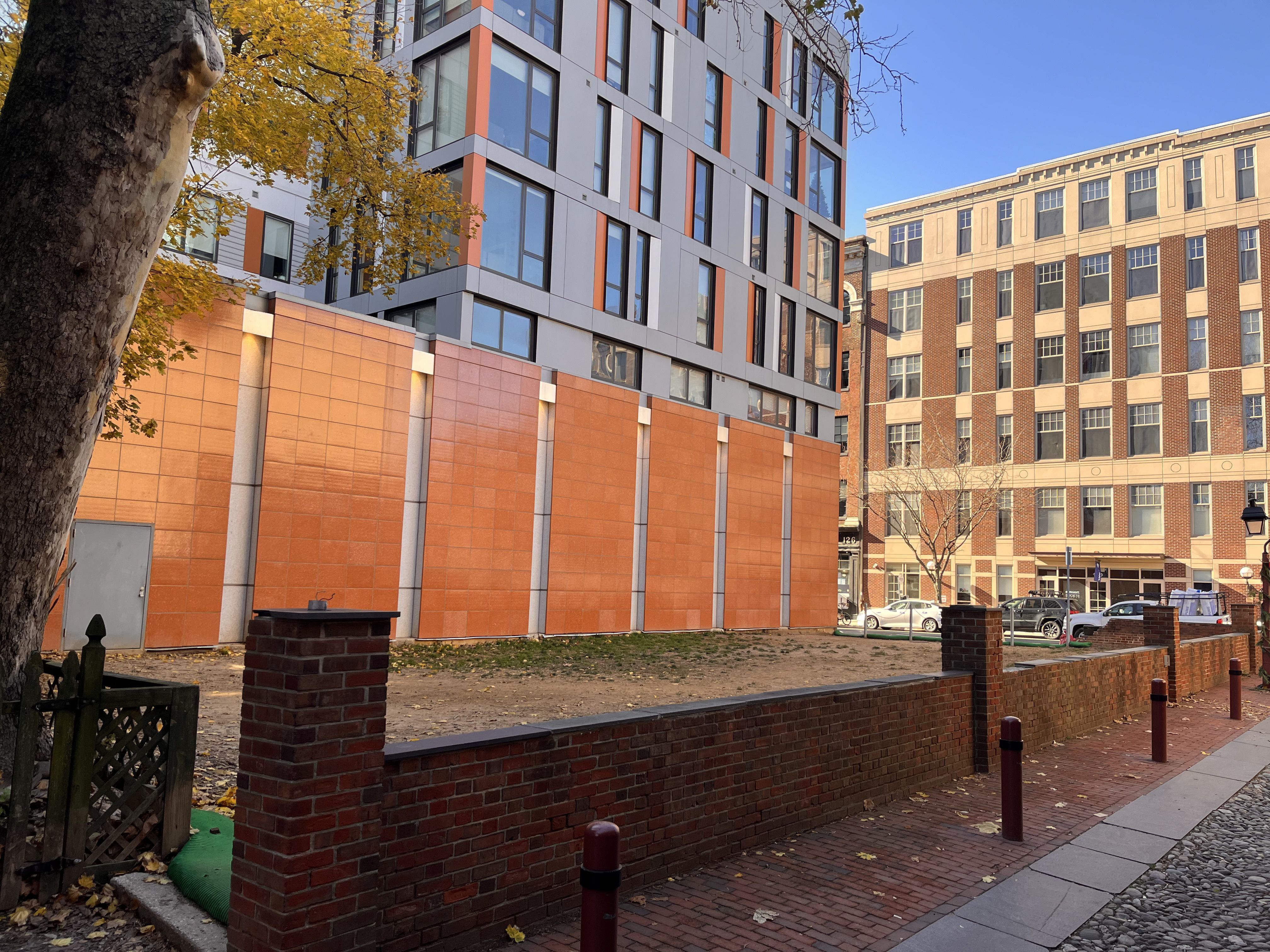
    A conceptual rendering of Dolly Ottey park at Second Street and Elfreth’s Alley in Old City, Philadelphia. Organizers hope to transform the existing vacant space into a park by spring.

    On a recent day, families and couples toured Elfreth’s Alley, taking pictures and discussing the history of the area. But none ventured into the vacant lot. Later, a lone woman could be seen walking her dog there.

    Itzkowitz credited a renewed spirit of collaboration for breaking the stalemate.

    He said changes in leadership at the real estate advisory board for the National Old City Apartments, which abuts the park, and crucial support from the nonprofit Elfreth’s Alley Association paved a path for agreement.

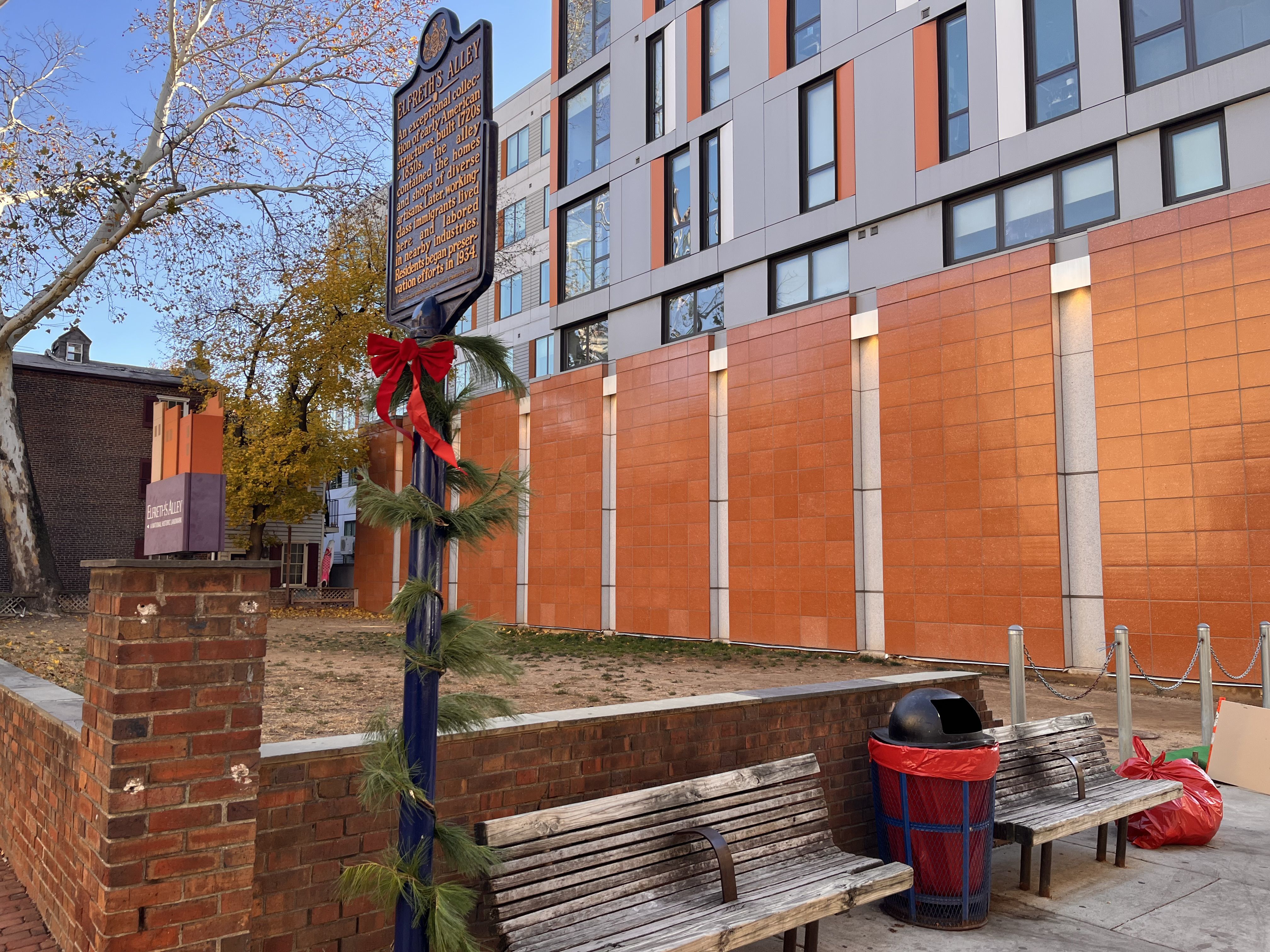
    A view of a vacant lot at Second Street and Elfreth’s Alley in Old City Philadelphia. Plans for creation of Dolly Ottey Park at the location and named after an advocate who helped save Elfreth’s Alley in the early to mid 20th Century.

    The lot is owned by Bit Investment Seventy-Eight LLC, according to city records, and is part of that company’s holdings for National Old City Apartments along North Second Street.

    A usable space by spring

    The pocket park will rise in two phases: an interim stage featuring a crushed stone base, picnic tables, planters, wild grasses, and repairs to a crumbling brick wall, followed by a more permanent design.

    An architect has been hired to craft a cost-effective plan to deliver a usable public space by spring 2026.

    The interim plan design for Dolly Ottey Park carries a modest $60,000 budget, with fundraising to break ground in February and finish by March. Old City District has set up an online link for public contributions.

    Itzkowitz said the timing for the interim phase would ensure the park provides a welcoming experience for visitors during the Semiquincentennial as part of a significant historical landmark.

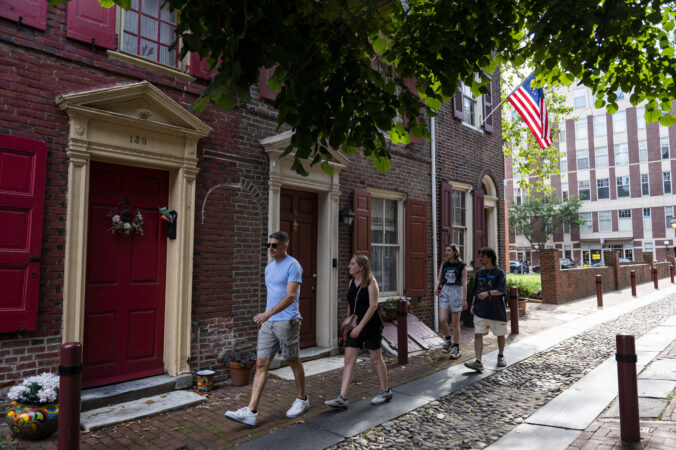
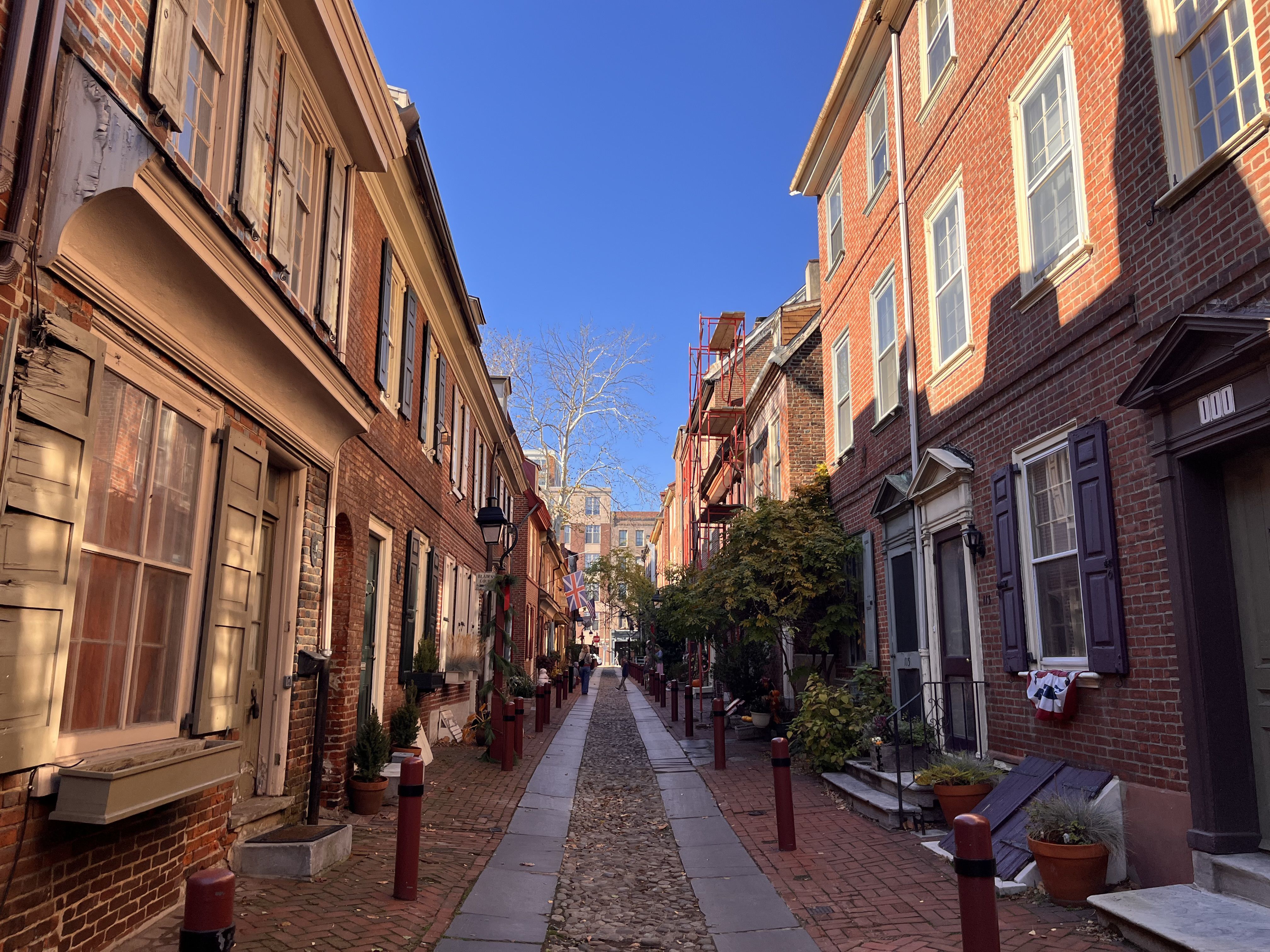
    A view of Elfreth’s Alley.

    Elfreth’s Alley is believed to be America’s oldest continuously inhabited residential street. Its origins trace to the early 1700s, when two landowners combined properties to create a cart path leading to the river. People have been living there since 1713.

    The cobblestone alley, about 400 feet long and lined by 30 brick buildings, was named for Jeremiah Elfreth, an 18th-century blacksmith. It originally housed artisans and merchants, serving as a base for business ventures. Notable figures such as Stephen Girard, who helped finance the War of 1812, are believed to have lived here.

    However, Elfreth’s Alley faced demolition due to neglect and development pressure. From the 1890s to the 1930s, part of the block was rebranded as Cherry Street, leading to the loss of at least one historic home.

    Who is Dolly Ottey?

    Ottey, a resident and owner of the Hearthstone restaurant at 115 Elfreth’s Alley, formed the Elfreth’s Alley Association in 1934 to protect the unique street and save it from destruction.

    A view from Elfreth’s Alley facing a vacant lot at Second Street that will be transformed into Dolly Ottey Park.

    Elfreth’s Alley faced an even bigger existential threat in the 1950s and 1960s when proposed construction of I-95 would have demolished at least half the block.

    The demolition was vehemently opposed by Ottey and the Elfreth’s Alley Association. The community gathered 12,000 signatures for a petition presented at City Hall, successfully pleading for the street to be spared.

    Elfreth’s Alley was protected as a National Historic Landmark in the 1960s as a result and is listed on Philadelphia’s historic register.

    Ottey died in 1996, in South Jersey, at age 85.

    Elfreth’s Alley remains not only a residential area but also a cultural and historical attraction. It holds a museum that educates visitors on its history and the lives of early inhabitants.

  • Philly wants to set its own speed limits, and other highlights of the city’s new Vision Zero report

    Philly wants to set its own speed limits, and other highlights of the city’s new Vision Zero report

    Philadelphia can’t set the speed limits on roads within its own borders. Only the state can.

    So city transportation officials want to persuade Harrisburg to give it the power to set speed limits more appropriate to the density of Philadelphia.

    That is a top action item in the city’s new Vision Zero report, released Tuesday, which will guide traffic safety efforts for the next five years.

    “We’re looking to work with the state legislature to make our roads safer,” said Christopher Puchalsky, director of policy and strategic initiatives at the Philadelphia Office of Transportation and Infrastructure Systems.

    In Pennsylvania, as in many states, speed limits are based on the 85th percentile rule. Engineers measure speeds in a study area and set the limit based on how fast 85% of the drivers there are traveling.

    “It just sort of got adopted and enshrined in law,” Puchalsky said of the principle developed from studies of rural roads in the 1950s and ’60s.

    In recent years, traffic engineers, many states, and federal agencies in charge of traffic safety have been moving away from the approach and toward speeds that help prevent injuries and deaths.

    “It’s one of those things we’ll look back on and say, ‘Why did people think that was a good method?’” Puchalsky said. “And we’ll all scratch our heads — or at least our grandchildren will scratch their heads.”

    Pennsylvania’s legislature would need to amend the state’s vehicle code to grant Philadelphia the authority.

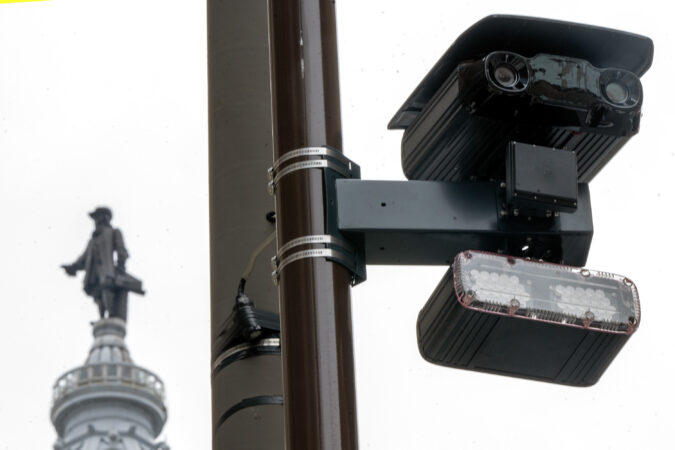
    Similarly, the city wants to expand the use of automated speed enforcement cameras and red-light enforcement cameras. That would also require legislation.

    The speed cameras on Roosevelt Boulevard are now permanent, and the city was authorized to put them on five other dangerous roads on a trial basis.

    Speed cameras also went up on most of Broad Street.

    Here are other takeaways from the Vision Zero report:

    Traffic deaths are still high in Philly

    In 2024, 120 people were killed in vehicle crashes in the city. The number of fatalities has been trending down slightly since 2020, but that figure is still 41% higher than it was in 2015, when the Vision Zero program began.

    “I think we’ve unfortunately hit a higher set-point post pandemic than we would like,” said Kelley Yemen, director of multimodal planning for the city. “We’re seeing encouraging news with this year, but we’ve got two months to go and are holding our breaths.”

    Yemen said the city has seen a 20% reduction in crashes on corridors where Vision Zero has been able to do traffic-calming projects such as installing speed cushions, implementing road diets that slow drivers, and installing separated bike lanes.

    “As we get further out from the pandemic, we’re also hoping we reset some cultural norms on our streets, whether it’s through automated speed enforcement, red-light cameras, or working with [the police department],” she said.

    The size of Philly’s problem

    Philadelphia is an old, dense city with a robust transit system, similar to New York and Boston. But its rate of traffic-related deaths per 100,000 people is many times New York’s — and most closely resembles that of Los Angeles, the Vision Zero report noted, citing federal data from 2019 through 2023.

    Philadelphia had 8.48 traffic deaths per 100,000 people, and Los Angeles had 8.11 per 100,000 residents.

    “We are still reviewing the plan, but our initial reaction is that the goals set forth are not transformational enough to address the climbing traffic death statistics,” said Jessie Amadio, an organizer with Philly Bike Action.

    “Vision Zero safety interventions work in the places they are installed,” but annual progress is too slow, she said.

    Factors that make a crash severe

    Speeding was the leading contributing factor in serious injury and fatal crashes between 2020 and 2024, present in 19%, the report said. Drivers impaired by alcohol or drugs were involved in 8% of the crashes, and 8% ran a red traffic light. Distracted driving was responsible in 4% of crashes, and running stop signs in 2%.

    People walking or using a personal mobility device were involved in 6% of crashes from 2002 through 2024 but were 40% of those who were killed, the report found.

    Thirty-eight percent of people who died were in motor vehicles.

    What were residents’ biggest concerns and asks?

    The Philadelphia Office of Transportation and Infrastructure Systems heard from about 3,000 city residents about their biggest concerns and preferred responses, said Marco Gorini, the Vision Zero program manager.

    Speeding was the topmost concern, cited by 24% of the people participating, followed by drivers running red lights and stop signs, cited by 23%.

    People were reached at roundtables involving more than 80 community groups, by online services, and through a polling firm that randomly queried 1,500 Philadelphians representative of the city’s overall population.

    Participants supported tough enforcement by automated cameras and police against those violations by wide margins.

    Infrastructure-related changes work best to protect people and change driver behavior, residents said, and they clamored for more traffic-calming measures and street redesigns, according to Gorini. They want to prioritize changes around schools, senior centers, and public parks.

    Besides enforcement and traffic-slowing infrastructure, residents expressed strong support for more safety education — instruction for high school students on safe driving (76%) and education for young students on safe walking and biking (71%).

    And another thing: People want transparency with safety efforts.

    “It’s very important that we regularly report on the state of traffic safety in Philadelphia and the results of Vision Zero interventions,” Gorini said. “This ensures accountability and helps the public understand what the issues are and how efforts to address them are going.”

    Next steps

    The city will be developing a spending plan for new safety projects for the next annual budget, due in the first quarter of 2026. And figuring how to pay for them from city funds and state and federal grants.

  • These professors say they’re part of a growing movement banning laptops from the classroom

    These professors say they’re part of a growing movement banning laptops from the classroom

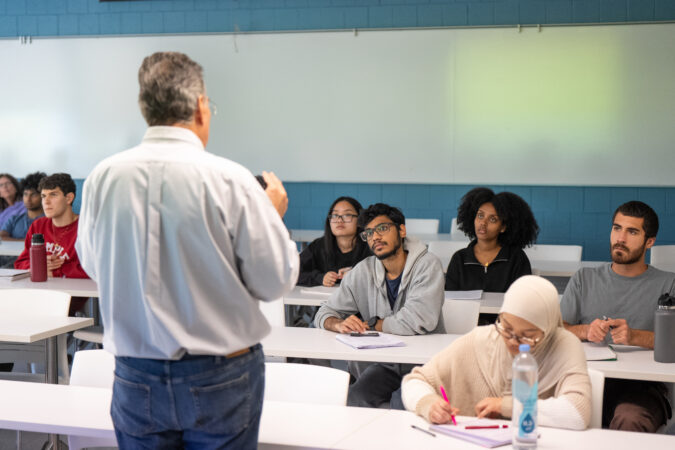
    Biology professor Jody Hey was lecturing on human evolution one recent day at Temple University.

    His students vigorously took notes by hand in paper notebooks.

    There wasn’t a laptop in sight. Nor an iPhone. No student’s face was hidden by a screen.

    Hey said he stopped allowing them about a year and a half ago after seeing research that students are too often distracted when laptops are open in front of them and actually learn better when they have to distill lectures into handwritten notes.

    “The clearest sign that it’s making a difference is that students are paying attention more,” said Hey, who has taught at Temple for more than 12 years. “And they want to participate much more than before.”

    Hey is among a seemingly growing number of professors who have chosen to keep laptop and phone use out of class, with exceptions for students with disabilities who require accommodations. Several said they made the decision after seeing what some students were doing on their laptops during class.

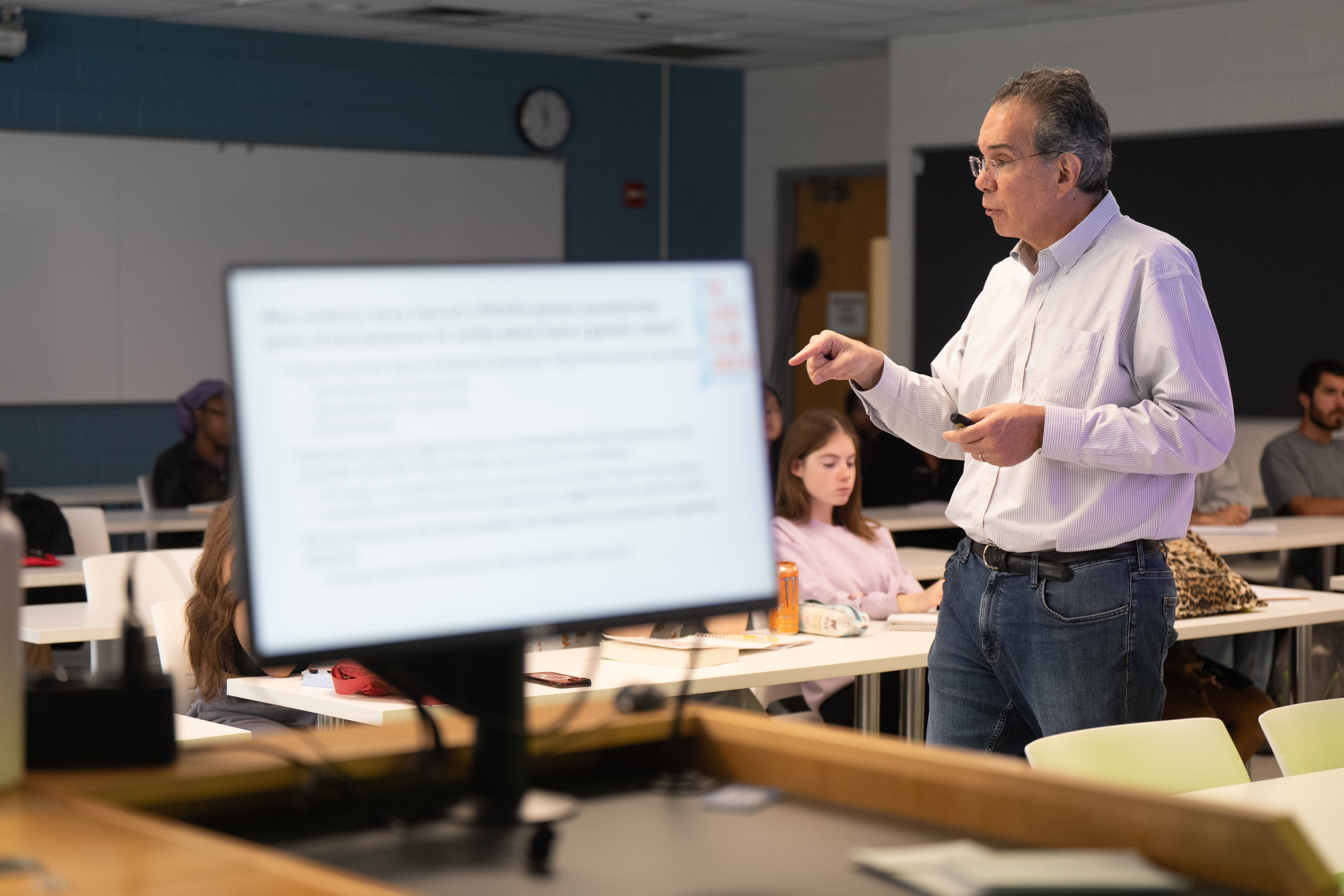
    Temple University biology professor Jody Hey stopped allowing laptops to be used in class about a year and a half ago. He said he’s noticed improvement in student performance.

    Jessa Lingel, an associate professor of communication at the University of Pennsylvania and director of the Gender, Sexuality, and Women’s Studies Program there, stationed teaching assistants in the back of her room to observe.

    Students “were out there booking flights and Airbnbs,” Lingel said. “Fun fall cocktail recipes. They were online gambling in class. I thought, ‘This is not acceptable.’”

    She originally disallowed laptops in 2017, but decided to go easy in 2021 as students returned after the pandemic, she said. She reinforced the ban after her teaching assistants’ observations.

    “It’s a movement,” Lingel said. “More and more people are headed in this direction.”

    In Hey’s class, students have warmed up to the laptop ban.

    “At first I didn’t like it,” said Jess Nguyen, 20, a junior genomic medicine major from Broomall, “because I kind of organize all my notes on my laptop. But I feel I’ve been learning better by writing my notes.”

    When she took notes on her iPad, she sometimes got distracted and played computer games, she said. In Hey’s class, that’s not an option.

    Students said it takes more time to write notes and sometimes their hands get tired.

    “After a couple classes, you kind of get used to it,” said Sara Tedla, 22, a senior natural sciences major from Philadelphia.

    She’s on the fence about which way she prefers to take notes.

    “It’s good that for an hour and 20 minutes you can just sit down and, without any technological distractions, focus because that’s a part of your brain you can work on,” said Quinn Johnson, 20, a senior ecology major from Philadelphia. “The more you do it, the easier it becomes to focus on something for a long period of time.”

    ‘Students learn better’

    Professors say laptops are pretty ubiquitous in the classroom when they are permitted.

    Hey conducted research on laptop use and presented it at a Temple department faculty meeting earlier this year.

    “As early as 2003, a study was done contrasting the retention of lecture material by two groups of students, one who had laptops and unrestrained internet access and a second who worked without laptops,” he said. “In that study, students with laptops scored 20% lower on average in the subsequent exam.”

    Four of every five students who used laptops in a general psychology class said they checked email during lectures, another study showed, while 68% used instant messaging, 43% surfed the net, 25% played games, and 35% said they did “other” activities.

    He also cited studies showing students who took notes by hand performed better on tests. Others cited that research, too.

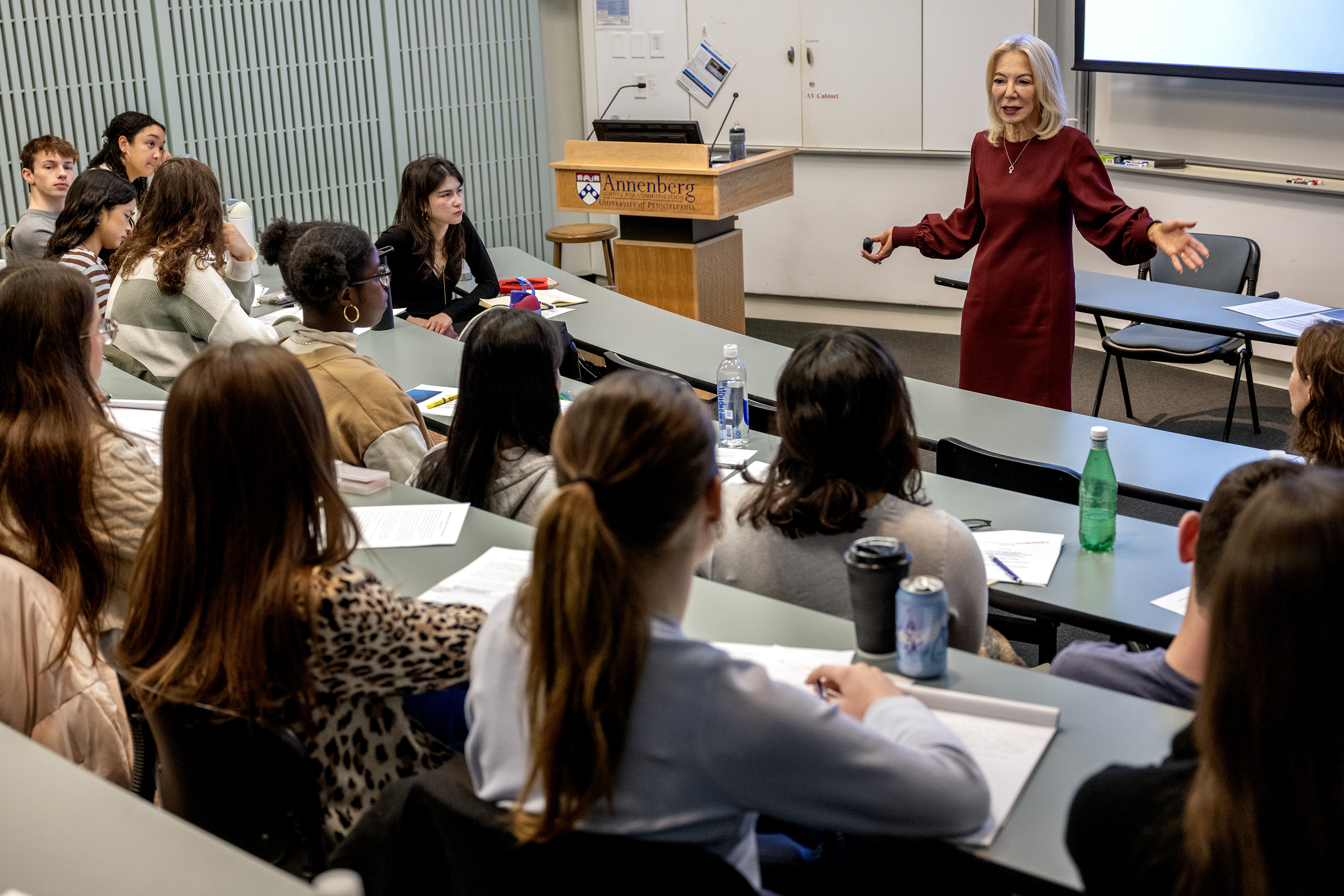
    Penn President emerita Amy Gutmann co-teaches a class at Penn’s Annenberg School for Communication with the dean Sarah Banet-Weiser. They don’t allow laptops or phones to be used in the classroom.

    “I read the literature on it and it really showed that students learn better when they’re taking notes rather than trying to type as fast as they can verbatim what you say,” said Amy Gutmann, Penn president emerita, who is co-teaching a class at the Annenberg School for Communication this fall.

    Gutmann and co-teacher Sarah Banet-Weiser, dean of Annenberg, do not provide students with copies of their lecture slides, either.

    “We give them time to write down what’s on the slides,” Banet-Weiser said.

    Benefits of technology

    Some professors say laptop use in class can be beneficial.

    Sudhir Kumar, a Temple biology professor, said he asks his class of 150 students to respond to questions on their laptops every 10 minutes. Their answers count toward their grades.

    “It’s constantly keeping them on their toes,” he said.

    He would not want to see everyone give up on laptop use in class.

    “We cannot fight technology,” he said. “Teachers have to embrace technology, whether it is artificial intelligence or computers. That is a standard mode of operation for most people today.”

    (Left to Right) Jess Nguyen, 20, a junior from Broomall, Allan Thomas, 22, a senior from Philly, and Sara Tedla, 22, a senior from Philly, in a class taught by Temple University biology professor Jody Hey last month.

    In Cathy Brant’s social studies methods class of 20 to 25 students at Rowan University, laptops are key. Brant, an associate professor of education, said there are lots of hands-on group projects, and she frequently asks students to check New Jersey standards online as they prepare their lessons. She also teaches them how to use AI appropriately in the classroom.

    One of her students, she said, recently handed in a paper with very detailed notes from Brant’s lecture that she probably got only because she was able to type quickly on her computer.

    “You’re responsible for paying attention in class,” she said. “Maybe it’s a little harsh, but I’m just like, ‘If you want to be on Facebook the entire time during class, that’s on you.’”

    Jordan Shapiro, an associate professor at Temple, more than a decade ago used to make a point of having his students post on Twitter, now X, during class and counted it toward classroom participation.

    Now, he tells students to put their laptops away during class.

    “I tell them I have no problem with tech or laptops,” he said. “I just think that none of us get enough time in our lives to just focus on ideas or to listen in a sustained way to the people around us.”

    He also became concerned about students doing homework during class, he said, and using artificial intelligence to supply them with questions and comments to ask in class. They were “outsourcing class participation to the robots,” he said.

    Mark Boudreau, a biology professor at Penn State Brandywine, disallowed laptops for the first time this semester.

    “I thought I would get real pushback … or people might even drop the class,” he said. “But … a lot of students have had other faculty who have this policy.”

    Exam scores in his three courses are better this year, he said.

    Hey noted student grades have gone up, too. But he can tell some students struggle with note-taking; some just listen and don’t take notes.

    “That’s better than sitting there and going on Facebook,” he said.

  • Regional Rail service snarled late into Tuesday night because of earlier disabled trains, SEPTA says

    Regional Rail service snarled late into Tuesday night because of earlier disabled trains, SEPTA says

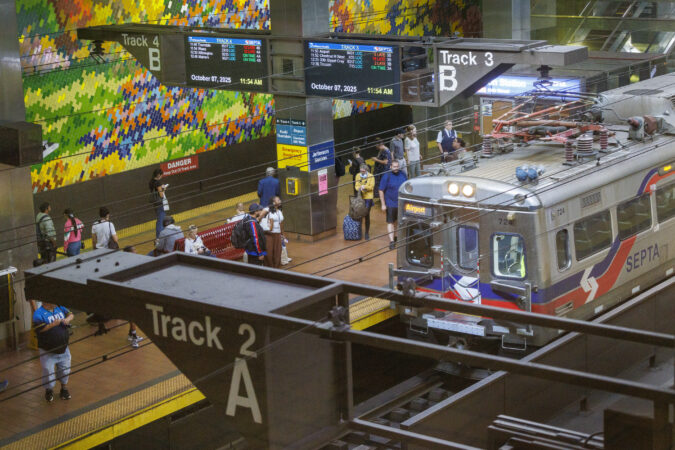
    Regional Rail service through Center City was snarled early Tuesday evening — and late into the night — because of disabled trains blocking a tunnel, SEPTA said.

    “We had a brief power outage at about 4:15 that started this. The power was back within 10 minutes, but we had three trains that could not restart,” said SEPTA spokesperson Andrew Busch.

    “We are in the process of transferring those customers to other trains, but it is causing major delays,” Busch said.

    Busch later added that the afternoon power outage originated with Amtrak.

    Shortly before 10:20 p.m., SEPTA reported on social media that service “remains significantly delayed due to earlier overhead power loss in Center City. Expect delays of up to 45 minutes.”