Three-year-old Hope Jones weighed 24.5 pounds, less than 99% of children her height and age, just a month before she died in July 2022.
The child was starved and beaten up by her foster parent, a distant relative from Southwest Philadelphia who pleaded no contest to third-degree murder over Hope’s death.
A new federal lawsuit is pointing a finger in another direction. It accuses medical providers from Philadelphia FIGHT, a community health nonprofit based in Center City, of failing to investigate or report abuse despite a series of red flags from Hope’s wellness checks.
The lawsuit, filed Friday in the Eastern District of Pennsylvania, is against the United States because FIGHT is a federally qualified health center and thus receives funding and operates with requirements from the government.
Philadelphia’s U.S. Attorney’s Office declined to comment. FIGHT did not respond to a request for comment.
The lawsuit is not only the latest legal fallout from Hope’s death, but the latest in litigation brought after children who were part of the city’s child welfare system have been harmed.
The city and its affiliated agencies were sued nearly 70 times between 2012 and 2024 after kids in their care were killed, sexually abused, or injured, an Inquirer/Resolve Philly investigation found. And at least 50 of these lawsuits led to settlements or verdicts of $1 million or more.
The new lawsuit on behalf of Hope’s biological family extends the circle of litigants to include medical providers.
“It’s another group of professionals that failed Hope,” said Sherrell Dandy, one of the Kline & Specter attorneys representing the family.
Child welfare services were involved in Hope’s life from her first days on Earth, according to the complaint. Her mother and the infant tested positive for marijuana after the delivery, and the Philadelphia Department of Human Services placed the infant under its care.
Hope became a FIGHT patient, and her first few visits as a baby went well, the lawsuit says. She was “well-developed and well-nourished,” the complaint says, and had a “good appetite.”
Hope’s weight reached the 98th percentile at her 15-month wellness visit, in the summer of 2020, but she fell off the growth chart steadily after the following November when she was placed in foster care with a distant relative, the complaint says. Hope failed to meet developmental milestones and lost teeth, a couple times without explanation and another time following an alleged fall.
The child’s medical records note that she developed an abnormal gait, ate her own feces, and was eating extremely fast followed by periodically vomiting, the suit says.
The FIGHT physicians did refer Hope to an orthopedic specialist because of her gait, but the lawsuit says that they failed to recognize it as “clinical indicators of severe weight loss and underlying caloric deprivation, starvation, and neglect.”
Hope’s weight fell to the single digits as summer 2022 approach. She was rushed to the hospital that July and was pronounced dead. The Philadelphia Medical Examiner’s Office determined that her cause of death was multiple blunt impact injuries, and the manner of death was homicide.
“The hallmark for health is growth,” said Nadeem Bezar, another Kline & Specter attorney. “During those visits there were alarming things that were never followed up on.”
A previous version of the lawsuit was filed against FIGHT in federal court in February. A judge dismissed that case in March because Hope’s estate had other administrative remedies to pursue before filing a lawsuit, and said that the appropriate defendant would be the United States.The new lawsuit says that all administrative remedies were exhausted and the government is the only defendant.
Since taking office for his second term, President Donald Trump has moved to cancel tax incentives and spending for clean-energy technology and prioritized expanded production of oil and natural gas.
But the federal government apparently is not 100% out of the green fuels business.
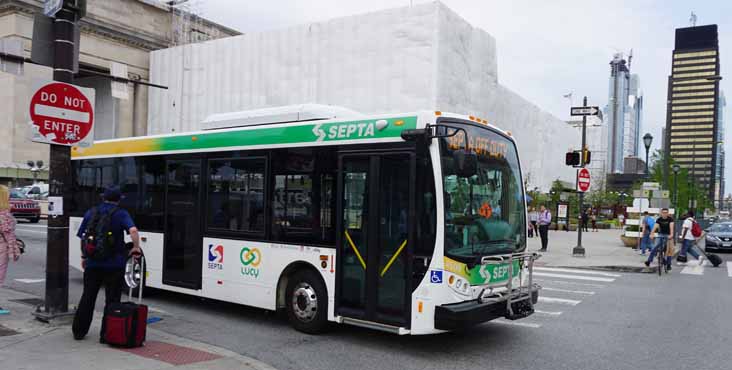
Last week, SEPTA won a $43 million grant from the Federal Transit Administration to replace 35 diesel-powered 30-foot buses with an equal number of cleaner diesel-electric hybrid buses that are 32 feet long.
When the new buses are delivered, expected to be in 2028, SEPTA no longer will have diesel-only buses in its fleet.
Most SEPTA buses are 40 feet long or 60-foot articulated models (the ones with the accordion in the middle). The shorter hybrids will be used on the LUCY Loop in University City and Routes 310, 311, 312, and Route 204, which runs from Eagleville to Paoli Station.
“These new hybrid buses will increase operational efficiency and help ensure that SEPTA can continue to provide reliable service for customers,” general manager Scott Sauer said.
SEPTA applied for the grant in July, a spokesperson said.
“This is a major win for Philadelphia,” U.S. Rep. Brendan Boyle of Philadelphia said. “These new hybrid buses will mean more reliable service, a stronger transit system, and cleaner air for the hundreds of thousands of riders who depend on SEPTA every day.”
Boyle, a Democrat, said the money came from President Joe Biden’s bipartisan infrastructure law, which Boyle helped champion. The grants were given from the fiscal year 2025 federal budget.
“Delivering new-and-improved bus infrastructure is yet another example of how America is building again under President Trump,” U.S. Transportation Secretary Sean P. Duffy said in a statement. “More people travel by bus than any other form of public transportation.”
SEPTA’s grant was part of $1.1 billion distributed from the fiscal year 2025 federal budget. The U.S. Department of Transportation said in the announcement that $518 million would be added to the low- and no-emission bus grant program from the fiscal 2026 budget.
Late on a stormy September night, Katie and Anthony Young were watching a horror show. In this instance, it wasalso a reality show.
A surveillance camera showed 8-footfloodwaters drowning the generator in the rear of their restaurant, Hank’s Place. The water crashed into the dining and kitchen areas, tossing around furniture and emptying the contents of refrigerators.
The remnants of Hurricane Ida in 2021 had overwhelmed the Brandywine Creek at Chadds Ford, one of the region’s most picturesque locales, made famous by a frequent Hank’s customer, artist Andrew Wyeth.
“I don’t think either one of us was anticipating it being that catastrophic,” Katie Young said.
In a region where flooding is a perennial threat, an Inquirer analysis of the area’s most flood-prone waterways found the Brandywine ranks among the elite, based on available U.S. Geological Survey data.
(function() {
var l2 = function() {
new pym.Parent(‘area_floods’,
‘https://media.inquirer.com/storage/inquirer/projects/innovation/arcgis_iframe/area_floods.html’);
};
if (typeof(pym) === ‘undefined’) {
var h = document.getElementsByTagName(‘head’)[0],
s = document.createElement(‘script’);
s.type = ‘text/javascript’;
s.src = ‘https://pym.nprapps.org/pym.v1.min.js’;
s.onload = l2;
h.appendChild(s);
} else {
l2();
}
})();
A total of 61 major and moderate floods have occurred since 2005 at Chadds Ford and three other gages on the main stem of the Brandywine and its branches. The Brandywine East Branch near Downingtown has registered more major and moderatefloods, with 33 combined, than any gage point in the region.
No. 2 on the list was the Delaware River at Burlington, with seven major and 19 moderate floods, although that is not quite the same as stream flooding. Technically, flooding measured on the five Delaware River gages south of Trenton, including the one at Washington Avenue in South Philly, is “tidal,” since it is influenced by the behavior of the Atlantic Ocean and the Delaware Bay.
The chaotic behavior of the atmosphere may forever be elusive; however, more flooding along the Brandywine, the Delaware, and the rest of the region’s waterways is an absolute certainty.
Various studies have documented increases in extreme precipitation events with the warming of the planet. But humans are affecting the flood calculus immeasurably by hard-topping rain-absorbent vegetation.
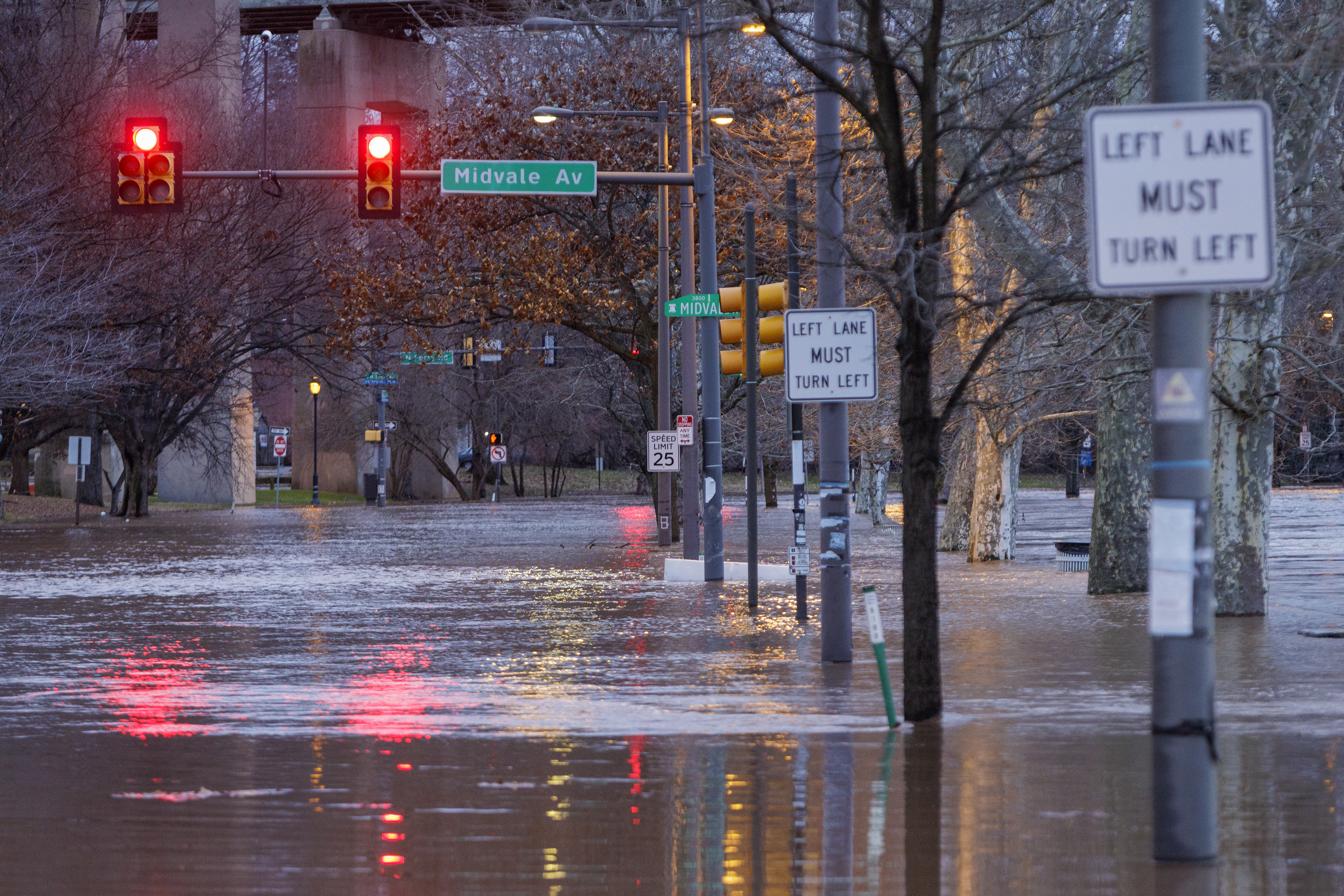
Schuylkill River floods onto Kelly Drive at Midvale in the East Falls section of Philadelphia on Wednesday, Jan. 10, 2024.
A comprehensive analysis of the Brandywine watershedpublished in April reported that impervious surfaces increased by 15% along the Great Valley’s Route 30 corridor from 2001 to 2020.
Those increases are “significant,” said Gerald Kauffman, director of the University of Delaware’s Water Resources Center, which coauthored the study along with the Brandywine Conservancy and the Chester County Water Resources Authority.
Municipalities welcome tax-generating development. Conversely, Kauffman said: “You get more value if you build next to a greenway. It’s the eternal debate.”
From 2001 to 2020, the population in the Brandywine watershed grew nearly 25%, to 265,000 people, with 150,000 more expected by the end of the century. That’s a lot of rooftops and driveways feeding water into the stream, which empties into the Delaware River.
Along the Delaware, the rising water levels of the Atlantic Ocean and the Delaware Bay are forecast to generate more flooding. The National Oceanic and Atmospheric Administration estimates that sea levels have been rising about an inch every five years.
While the oceanic salt line— the boundary between ocean and freshwater — usually stays well south of Philly, the tidal pulses contribute to flooding in the city and areas to the north, where the channel narrows, said Amy Shallcross, water resources operations manager at the Delaware River Basin Commission.
The five tidal gages along the Delaware from Newbold Island to Marcus Hook have registered more than 90 significant floods since 2005, according to the Inquirer analysis.
The study was limited to the 33 USGS gages that had a period of record of at least 20 yearsand list designated flood stages.
Along with the Delaware River sites, other stream gages that appeared in the top 10 list for major and moderate flooding were those on the Perkiomen, Chester, Neshaminy, and Frankford Creeks.
Motorists brave the heavy rain and deep puddles along Creek Road in Chadds Ford during a nasty flood event in January 2024.
The gage network cannot capture all the episodic flooding from the likes of thunderstorm downpours.
Flood frequency is not the only consideration for siting a gage, said Tyler Madsen, a hydrologist with NOAA’s Middle Atlantic River Forecast Center, in State College. For example, the gages have to be located in areas free of unnatural barriers, such as bridge abutments.
Plus, a major consideration is funding. They are costly to monitor and operate, serving multiple purposes such as measuring water quality and streamflow.
They rely on a variety of funding sources, including state and local governments, that are not available everywhere.
The Brandywine study’s suggested remedies included adding flood-control structures and beefing up warning systems all along the watershed, but warned: “Even with unlimited financial and technological resources, it would be impossible to eliminate all flood risks.”
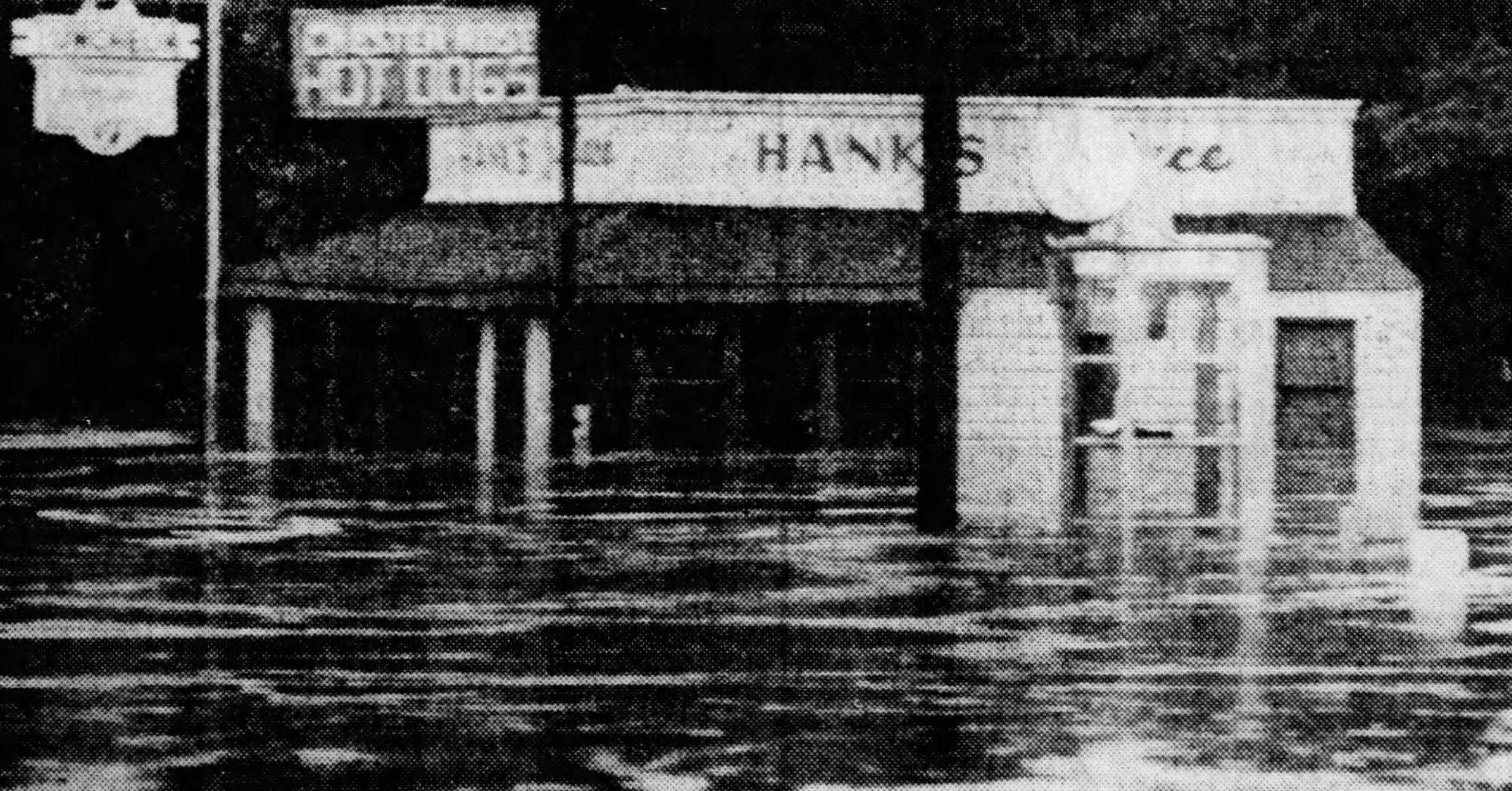
Hank’s Place, on Routes 1 and 100 in Chadds Ford, was swamped by water from the rains of Tropical Storm Agnes in June 1972. The area has a long history of flooding, and the restaurant was reconstructed after it was flooded and damaged by Ida in 2021.
The Youngs are prepared to live with those risks, come storms or high water.
It’s been almost two months since the Philadelphia Art Museum unveiled its new name and logo to, let’s be kind and say, a mixed response. To the bane of all graphic designers, rebrands are lightning rods where everyone suddenly becomes a branding expert.
So we wanted to put your knowledge to the test. We’re going to ask you to identify the real logo among those that we’ve subtly modified.
Good luck!
story continues after advertisement
Question 1 of 6
Before the change, one of these was the real logo for The Philadelphia Museum of Art. Can you pick the right one?
CorrectIncorrect. XX% of other readers got this question right.
For those concerned about the changing logo, fear not. Legally the museum’s name isn’t changing, just its “consumer-facing” one.
Alejandro A. Alvarez / Staff Photographer
The questions will get a little harder from here.
Question 2 of 6
Which logo replaced the one above?
CorrectIncorrect. XX% of other readers got this question right.
The museum said in a statement, “The new brand identity captures Philadelphia’s vibrant culture, reflecting how art influences everyday life and resonates across the city’s diverse communities.” The change surprised many, with lots of critics upset with the new look.
Question 3 of 6
Let’s move to another art gallery. Which is the real logo for the Barnes Foundation?
CorrectIncorrect. XX% of other readers got this question right.
Pentagram, the company responsible for the logo, said about the design: “The identity is based on the forms found within a specific ‘ensemble.’ The letters play with positive and negative space, gaining coherence through the act of reading across the ensemble.”
Alejandro A. Alvarez / Staff Photographer
story continues after advertisement
Question 4 of 6
Which is the real Pennsylvania Academy of Fine Arts logo?
CorrectIncorrect. XX% of other readers got this question right.
The Pennsylvania Academy of Fine Arts is the nation’s first institution that is both an art museum and school. The Heads of State, the brand agency that designed the logo, said: “We felt a classic wordmark would be an opportunity for visual simplicity and increased name recognition.”
Tom Gralish / Staff Photographer
Question 5 of 6
Eastern State Penitentiary also recently rebranded. Can you pick out their new logo?
CorrectIncorrect. XX% of other readers got this question right.
Not only does Eastern State have a new look, but they also recently released their 2025-2029 strategic plan, with a focus on criminal justice education and a reimagined visitor experience.
Question 6 of 6
The Museum of the American Revolution has part of its logo displayed on its building. Can you spot the right design?
CorrectIncorrect. XX% of other readers got this question right.
The thirteen stars in the museum’s logo are displayed on the building outside. The stars are based off the Commander in Chief’s Standard flag, which is on display in the museum.
Tyger Williams / Staff Photographer
Your Results
You have skipped .
You scored XX out of 6.
The average reader scored XX out of 6
Get out there and see some museums!
Respectable. You clearly have a good eye or spend all your free time at museums across the city.
Good eye! We’ll listen to any of your “takes” on the new Philadelphia Art Museum branding.
Staff Contributors
Design, development, and reporting: Garland Fordice
Editing: Sam Morris
Copy Editing: Brian Leighton
Subscribe to The Philadelphia Inquirer
Our reporting is directly supported by reader subscriptions. If you want more journalism like this story, please subscribe today
Ramon Roman-Montanez knew the police were watching.
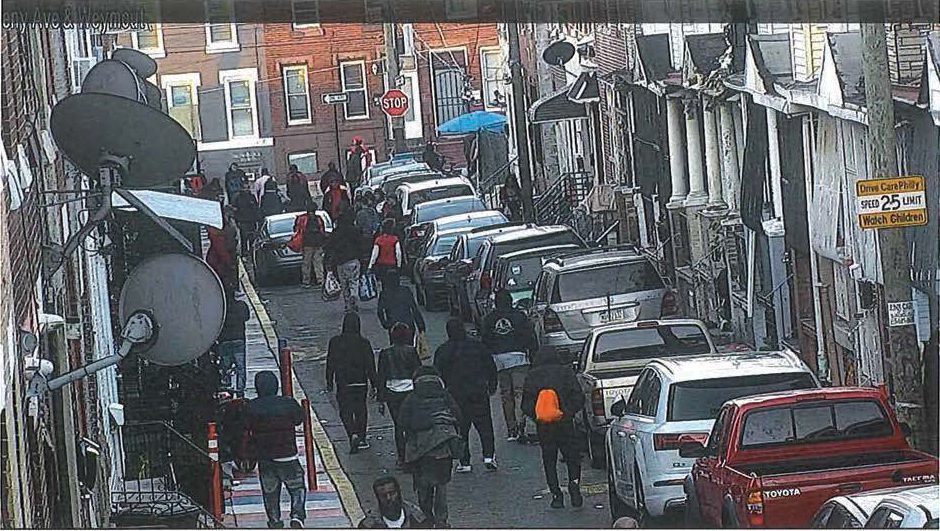
One day last April, as Roman-Montanez prepared to hand out free drug samples to users on Weymouth Street — a common tactic that dealers use to attract customers — he stood in the middle of the Kensington block and spotted a problem.
The cops had put up a pole camera.
Using binoculars, Roman-Montanez scouted out the new device at the end of the block, prosecutors said in court documents. But he had a business to run — and so, after talking with a few associates in the street, he decided that giveaway day would move forward as planned.
Shortly after dawn, prosecutors said, customers were recorded on the new surveillance camera crowding onto the 3100 block of Weymouth to receive their samples.
And in the weeks to come, business continued to boom.
A pole camera placed near Weymouth Street captured potential drug customers coming to the block to receive free samples handed out by the gang that ran the block, prosecutors said.
The camera, however, was just one hint of what authorities now say was a sprawling, multiyear investigation into the gang Roman-Montanez helped lead — a group that sold thousands of doses of heroin, fentanyl, crack, and cocaine over the course of more than a decade, and effectively took over a residential block in a neighborhood that has long suffered from crime, open-air drug dealing, and neglect.
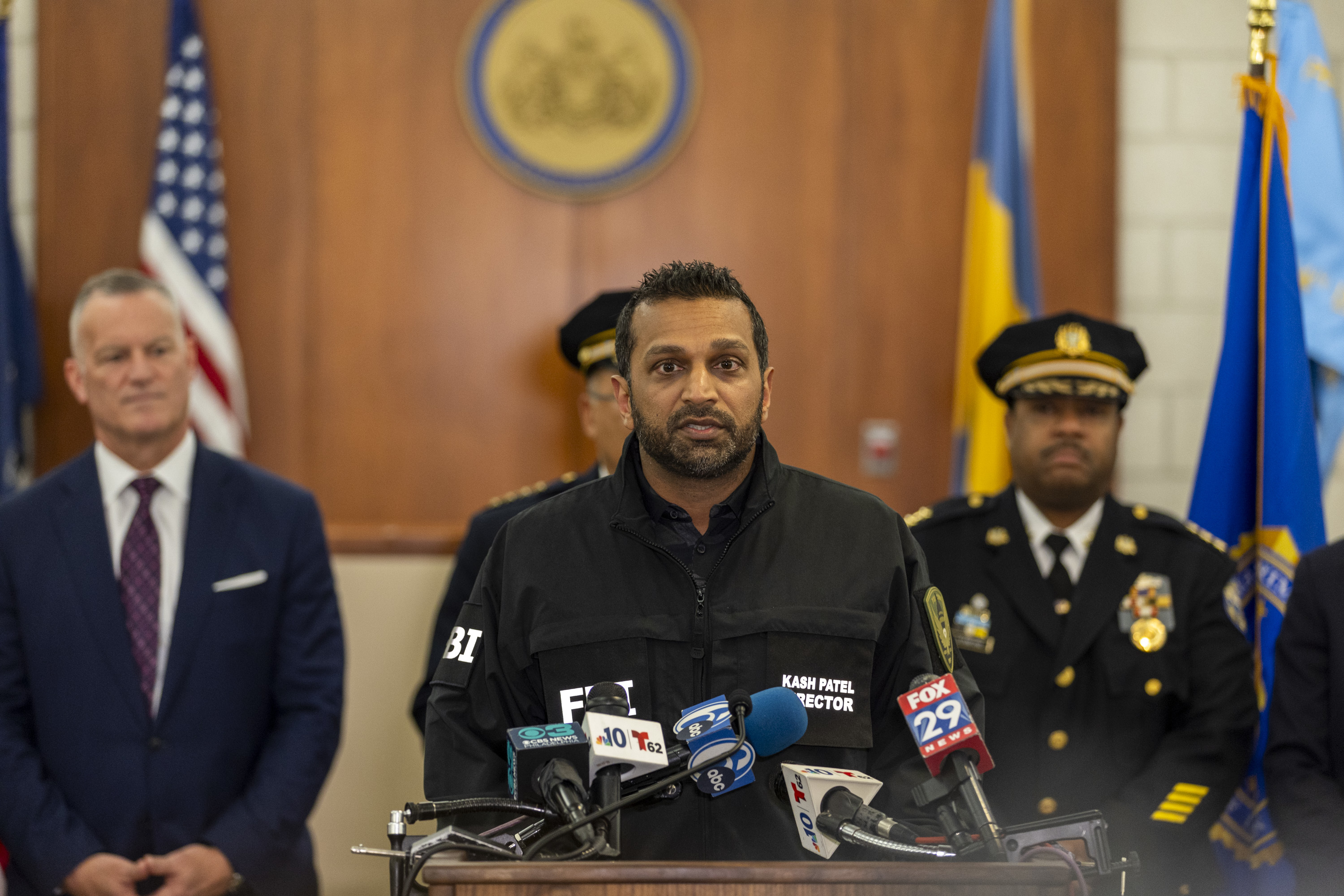
The results of the probe came to light last month, when FBI Director Kash Patel came to Philadelphia to announce that 33 people, including Roman-Montanez, had been indicted on drug charges. Patel called the case a model for law enforcement across the country, and an example of how to take out a drug gang terrorizing a community.
FBI Director Kash Patel speaks to press at the 24th Police District Headquarters in Philadelphia on Oct. 24.
To understand the scope of the case — which U.S. Attorney David Metcalf described as the region’s largest single prosecution in a quarter-century — The Inquirer reviewed hundreds of pages of court records, examined social media accounts and videos connected to the group, and interviewed law enforcement officials and Weymouth Street residents.
The review revealed previously unreported details about the investigation, including that authorities ran monthslong wiretaps on about a half-dozen phones tied to gang members, placed a recording device in a vacant lot the gang used as a meeting place, employed at least seven confidential informants, and believe that over the course of nine years, the group trafficked tens of thousands of doses of drugs into the city — worth millions of dollars.
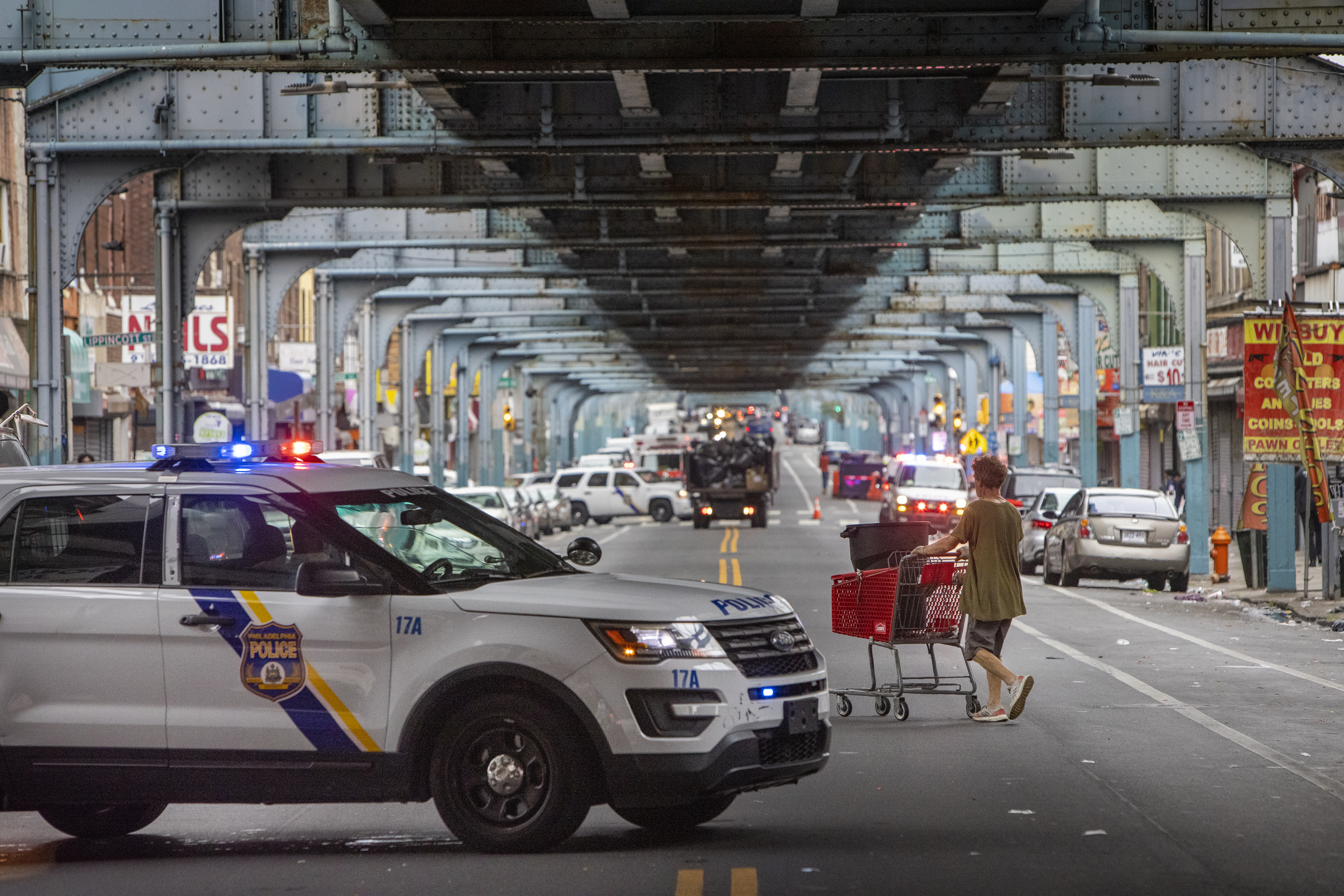
Philadelphia police this month continued to restrict access to Weymouth Street long after gang members had been arrested, a highly unconventional approach that officials said was aimed at sustaining the block’s newfound sense of quiet. Several residents said they didn’t mind the unusual tactic, in part because it helped prevent their block from quickly returning to its status as a marketplace for round-the-clock drug deals.
Those tactics underscored the depth of the investigation, which unfolded in the heart of Kensington — where law enforcement has employed a variety of approaches over the years to try to address crime, drug dealing and violence, sometimes with mixed results.
Philadelphia officials have for years tried a variety of tactics to try and address crime and quality-of-life concerns along Kensington Avenue.
But the review also showed that even as the investigation was underway, the gang continued to operate in the open — and some of law enforcement’s attempts to hold people accountable as the probe was unfolding were unsuccessful.
In August, for example, Roman-Montanez was charged in state court with drug possession and related crimes after police found fentanyl, crack, and $20,000 in cash in his house — the result of a raid on Weymouth Street that was part of the investigation into his gang.
But a few weeks later, his attorneys persuaded a Philadelphia judge to reduce his bail and he walked out of jail. The 40-year-old — who federal prosecutors now say was the de facto chief operating officer of one of the city’s biggest drug conspiracies — was taken back into custody only this month, when federal authorities unsealed his indictment.
Even as investigators were continuing to collect evidence against the gang, members routinely appeared in videos and songs on social media in which they boasted about their gang affiliation, brandished guns, and threatened acts of violence against rivals.
Some of the videos made modest Weymouth Street look more like a nightclub. Men wearing shimmering gold chains can be seen carrying designer bags and waving guns with extended clips at the camera. Others smoke blunts, or mix soda and a purple liquid together to make what appears to be the codeine-infused drink “lean.”
A video for the song “Philly Boy,” uploaded to YouTube last spring, made clear where the debauchery was taking place: It opens with a shot of the Weymouth street sign.
Beyond the fact that people who remained on the street could continue to sell drugs, prosecutors said the gang used threats to maintain control over their territory. And at least two suspected coconspirators were killed as the investigation wore on — sparking the potential for more retaliatory violence. Prosecutors have not yet charged any gang members with any shootings or homicides, but have said their investigation is continuing.
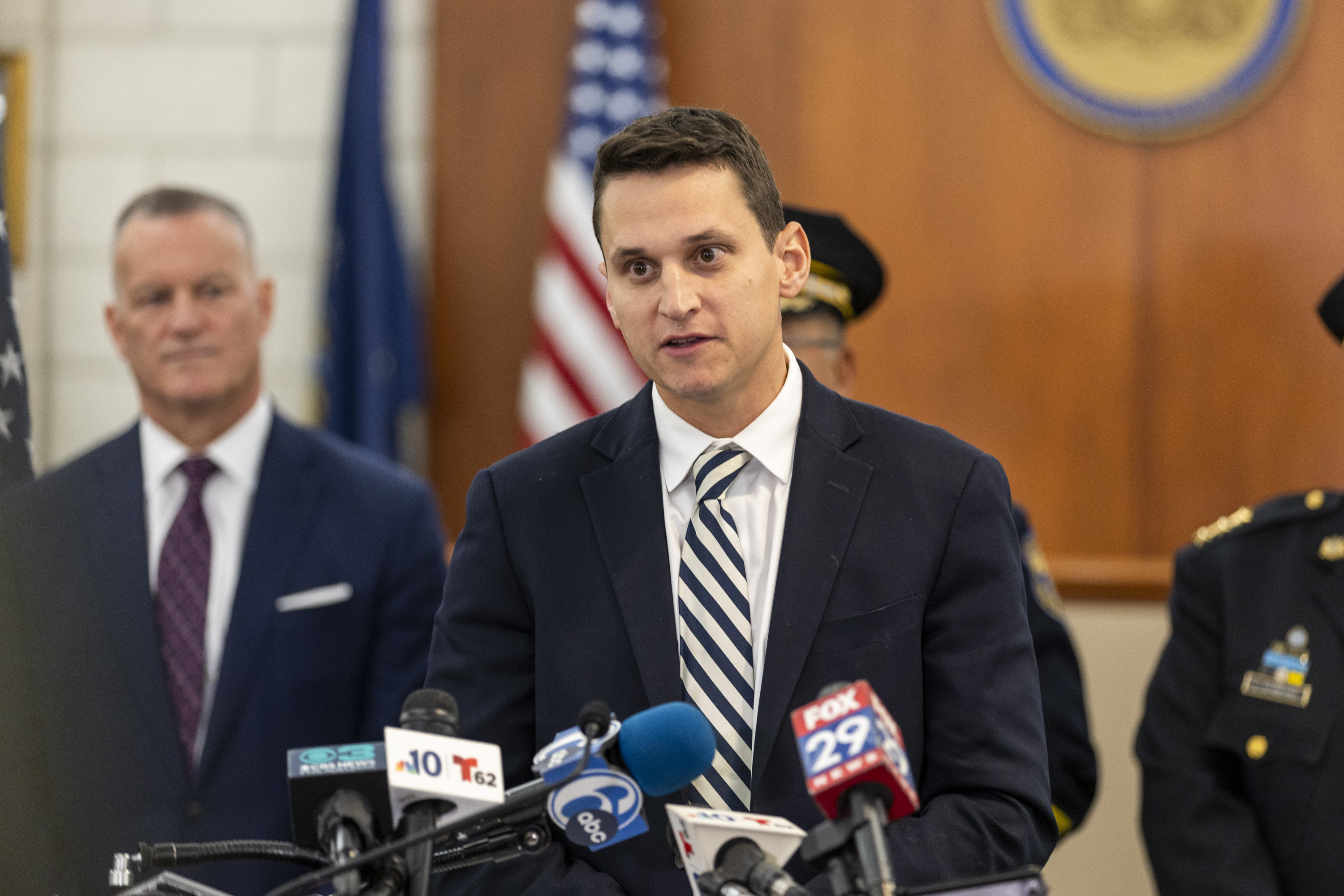
Metcalf, through a spokesperson, declined an interview request to discuss the case in more detail. But while announcing the takedown last month, he said there is always a tension in long-running investigations between making quick arrests and taking time to gather evidence for broader or stronger cases. And in this instance, he said, the goal was clear: Prosecutors were seeking to “eliminate the organization.”
“We could obviously just prosecute individual seizures of guns and drugs. But the organizational prosecution … that’s what’s going to make a difference in the community,” he said. “This neighborhood will be a lot safer than it [would’ve been] if we didn’t take our time to do that.”
U.S. Attorney David Metcalf speaks to press at the 24th Police District Headquarters on Oct. 24.
A sophisticated operation
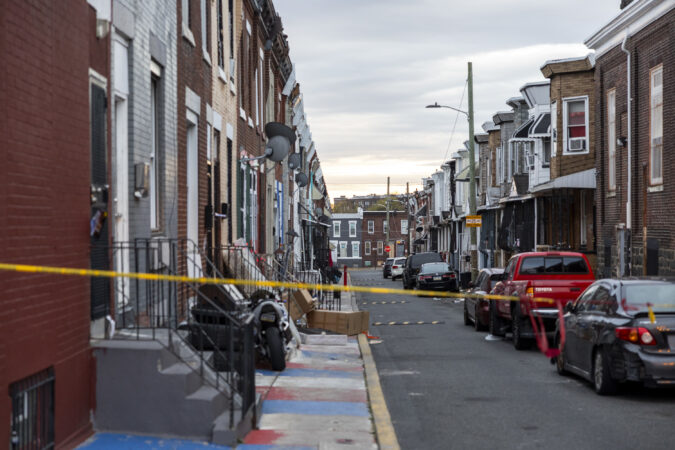
Weymouth Street is one of a series of narrow, rowhouse-lined blocks in Kensington just a few steps from McPherson Square and near the intersection of Kensington and Allegheny Avenues — long the epicenters of a bustling narcotics bazaar.
Some corners in the area can pull in tens of thousands of dollars a day in drug sales, authorities say. And the competition among dealers has often led to violence, with shootings and homicides in Kensington historically outpacing the rest of Philadelphia.
The crew on Weymouth Street thrived in that environment, prosecutors said, and developed a sophisticated system for seeking to build and protect a business that sold fentanyl, crack, and cocaine 24 hours a day, seven days a week.
Their drugs were branded with unique stamps or names like Ric Flair, Horse Power, Gucci, or Donald Trump. Bags were sold for $5 each, prosecutors said, while “bundles” of about a dozen packets went for between $55 and $75.
The group maintained an internal hierarchy, prosecutors said, with key figures at the top overseeing layers of workers who engaged in hand-to-hand sales, watched out for police, managed the drug supply, or used violence to protect the operation. Many members were related to one another, prosecutors said, and some families had people from multiple generations working for the group.
The leader was Jose Antonio Morales Nieves, prosecutors said, who “owned” the block and allowed people to deal there in exchange for payments he called “rent.”
His top deputies ran the day-to-day operations, prosecutors said, and included Roman-Montanez, nicknamed Viejo, and Roman-Montanez’s paramour, Nancy Rios-Valentin.
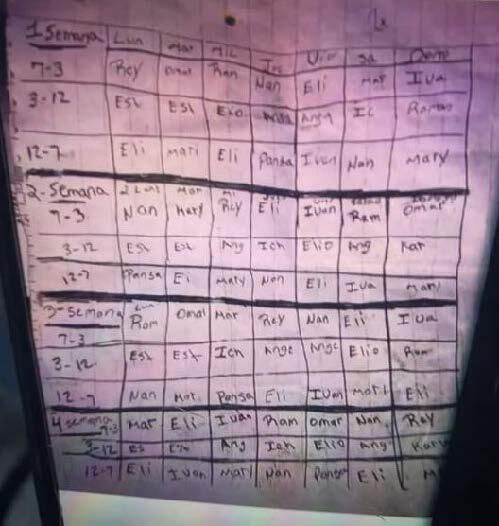
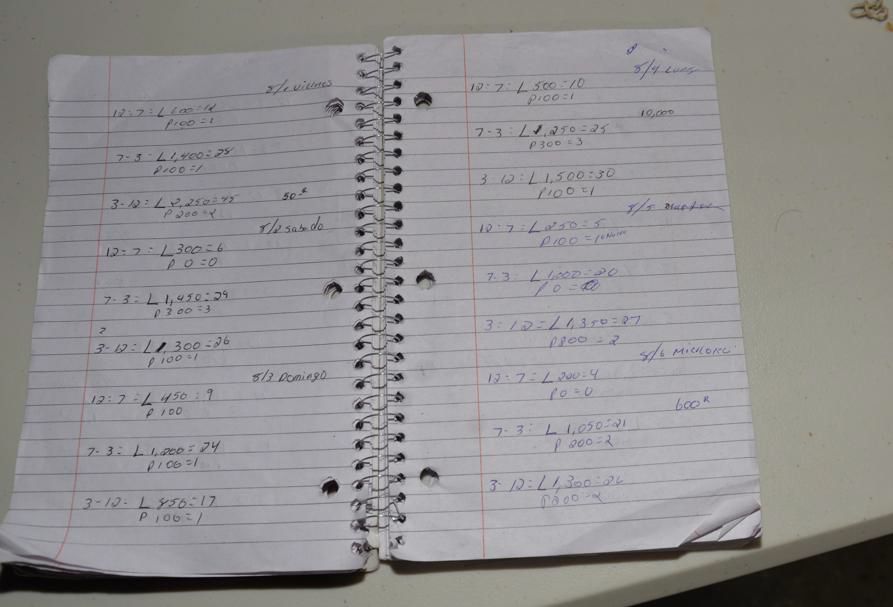
The two set and distributed schedules for lower-level employees, kept track of how and when drug stashes needed to be refilled, and maintained handwritten ledgers tracking sales per shift.
Prosecutors said leaders of the Weymouth Street drug trafficking organization kept detailed schedules on which members would work which shifts.
The first episode in the indictment dates to January 2016, when, prosecutors said, Angel Rios-Valentin — the brother of Nancy Rios-Valentin — stood watch as someone sold drugs to a confidential informant.
A few months later, the indictment said, police conducted a traffic stop on the block, and gang leader Morales-Nieves — also known as Flaco — responded by approaching the officers in a threatening manner carrying a shovel.
As the gang continued to build its business on Weymouth, prosecutors said, several members took up residence on the block, including Roman-Montanez, and members used a variety of houses or abandoned lots to store or sell drugs.
Among them, prosecutors said, was a vacant lot with a tent they labeled the “bunker.” It was next door to the house Roman-Montanez shared with Rios-Valentin, they said, and served as a meeting place, stash location, and place to cook crack.
Last May, prosecutors said, it also served as a site for violence, when Roman-Montanez dragged a man into the bunker, and another gang member — who is not named in court documents — beat him with a rod.
Crimes involving violence
Much of the 170-page indictment revolves around individual episodes in which members of the gang conducted operations that would be considered routine if they weren’t illegal, such as selling drugs to users, managing the block’s supply, or handling illicit proceeds.
The document includes detailed quotes from those accused of taking part in the operation and describes their actions with unusual precision, the result of what prosecutors said were a series of wiretapped phones, cameras — including one inside the bunker — interactions with informants, and seizures of drugs by police.
Police found handwritten ledgers detailing drug activities inside Ramon Roman-Montanez’s house on Weymouth Street, prosecutors said.
Some incidents, however, went well beyond the everyday rhythm of drug sales, prosecutors said.
In November 2024, several gang members ran after a car that had sped down Weymouth, then fired shots at the vehicle after they caught up to it around the corner, the indictment said. The document does not say if anyone in the car was struck.
Six months later, prosecutors said, the pole camera captured footage of two members of the gang — John David Lopez-Boria and Luis Williams — laughing at someone sitting on a front step across the street, then beating the person and dragging the victim into an abandoned lot to continue the assault.
The gang’s violent nature was also captured on YouTube, where gang members appeared in videos taunting rivals and flaunting guns.
In one video, the rapper Sombra PR — whom prosecutors described in court documents as an unindicted coconspirator — made clear that he and a Weymouth Street gang member known as Panza would use a Draco gun to come after anyone who threatened them.
“I’ll get you with Panza with Draco and you’re stiff,” he rapped.
Prosecutors said Weymouth Street members often flaunted guns and boasted about their gang affiliation in YouTube videos.
Panza, whose given name was Heriberto Torres Gual, was described by prosecutors in court documents as one of the group’s enforcers, and he appeared in some of Sombra PR’s videos.
But last month, Gual, 31, was gunned down while riding an electric bike on the 3000 block of Kensington Avenue, just a few blocks from Weymouth, according to police. Surveillance footage showed a torrent of shots being fired out of an SUV that had pulled up beside him.
In all, police recovered 35 spent shell casings from the scene and said it was a targeted attack.
Gual was the second high-ranking gang member to be killed in the last year, authorities said. Last November, Felix Rios-Valentin — the brother of Nancy and Angel Rios-Valentin — was fatally shot in Mayfair.
Police have made no arrests in either case.
After Gual’s death, an Instagram account for a record label dubbed “Weymouth Family” made a post referencing the title of a new song that memorialized Gual. The post tagged Pressure 9X19, the artist behind “Philly Boy.”
And on another account associated with Weymouth-tied rappers was an illustration of an unmistakable street sign: the marker for the intersection of Allegheny Avenue and Weymouth Street.
Evading accountability
During their long investigation, law enforcement did sometimes disrupt the gang’s drug operations and make arrests.
In 2020, Angel Rios-Valentin was convicted in federal court of illegal gun possession after officers found him carrying a loaded handgun that he had taken from Roman-Montanez’s house. He was sentenced to five years in prison and was on supervised release when he was arrested again last month.
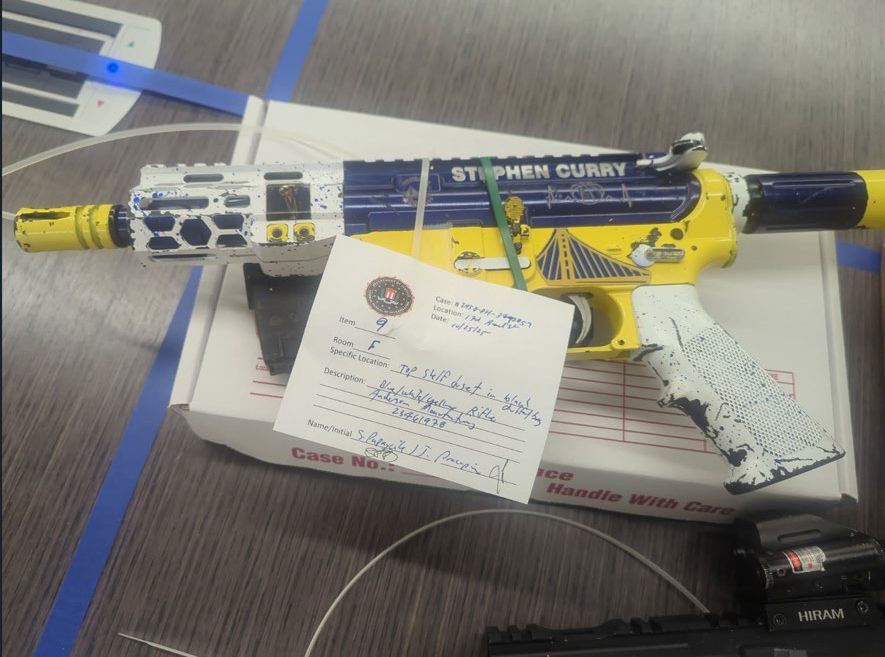
Police found four guns in Rios-Valentin’s house, a discovery that prosecutors said showed his ongoing commitment to the gang.
When Angel Rios-Valentin was arrested, prosecutors said, responding officers found several guns in his house, including this assault rifle.
Roman-Montanez, meanwhile, was arrested twice in the last three years, court documents show — but in both cases managed to avoid significant consequences.
In October 2022, police searched his house and found 96 grams of fentanyl, four loaded guns, and nearly $125,000 in cash, prosecutors said. Roman-Montanez was charged in state court, but the case was withdrawn.
Federal prosecutors did not explain the withdrawal in court documents, and because the case did not result in a conviction, the records are now sealed under Pennsylvania law. The district attorney’s office did not respond to a request for comment.
A source familiar with the case said it collapsed because scheduling issues with lawyers and witnesses delayed the preliminary hearing for more than a year and prosecutors ultimately withdrew the charges.
The second arrest was in August, when police, acting on a search warrant, again searched Roman-Montanez’s house and found more fentanyl, crack, and cash inside, court records show. He was charged with crimes including conspiracy and possession with intent to deliver, and his bail was set at $750,000.
But a month later, his lawyers persuaded a judge to lower his bail.
The prosecutor argued against that, according to a transcript of the bail hearing, saying the sheer amount of drugs and cash involved made clear that Roman-Montanez was “not a minor player.”
But Common Pleas Court Judge Elvin Ross III said details about Roman-Montanez’s role in the conspiracy were lacking. He reduced bail to $300,000, and a few weeks later, Roman-Montanez was back on the street.
Will the quieter aftermath last?
On the morning of Oct. 24, dozens of federal agents and city police officers swarmed Weymouth Street to arrest suspected gang members and gather additional evidence to use in their court case. Some targets were taken into custody elsewhere — the group’s leader, Morales Nieves, was arrested in Luquillo, Puerto Rico.
Patel, the FBI director, said at a news conference afterward that the case “is not just one instance of removing a couple of people — it is an example of how you remove an entire organization that has corrupted not just the city of Philadelphia but the state of Pennsylvania as well.”
Roman-Montanez has pleaded not guilty, as has Nancy Rios-Valentin. Her attorney wrote in court documents that she maintains her innocence, that the case against her was “not strong,” and that she “cannot be convicted on a theory of ‘guilt by association.’” A federal judge on Monday ordered that Rios-Valentin — who has four children — be released from jail and placed in home confinement at her sister’s house while awaiting trial.
On Weymouth Street, residents said in interviews that life has been quieter in the weeks since the raids. Some of that is the result of the ongoing police presence, which began to relax this week as officers resumed allowing passersby to walk or drive through the street.
One resident, who asked not to be identified for fear of retaliation, said he appreciated law enforcement’s attempt to help clean up a struggling area.
But he was skeptical that one prosecution — even one as ambitious as this — would reverse a persistent and neighborhood-wide problem.
“I don’t see it making a big difference any time soon, and it’s nobody’s fault,” he said. “This is not an overnight fix.”
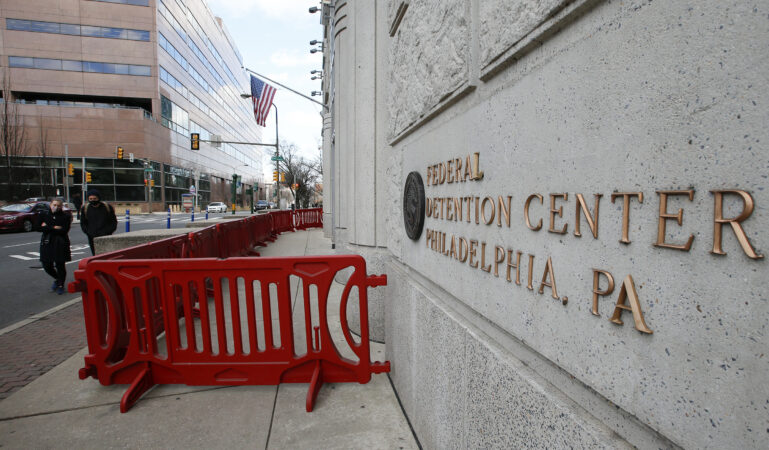
A woman who was incarcerated at Philadelphia’s Federal Detention Center has sued a correctional officer who she says raped her while she was isolated in a cell and under suicide watch.
The lawsuit, filed this week in federal court in Philadelphia, alleges that Michael Jefferson unlocked the woman’s cell early on July 6, 2024, as she slept. She awoke, the lawsuit said, as Jefferson pinned her down and sexually assaulted her while she pleaded for him to stop.
The woman, identified in the lawsuit only as Jane Doe, is also suing the United States, contending that the Bureau of Prisons failed to protect her from Jefferson’s abuse. Another officer was also either absent from his post or ignored signs of the assault, the lawsuit said.
Jefferson was charged earlier this year with crimes including aggravated sexual abuse and deprivation of rights under color of law. That case is scheduled for trial in January.
He has pleaded not guilty. His attorney, Lonny Fish, did not immediately respond to a phone call Tuesday afternoon.
Jaehyun Oh, a lawyer for the woman, called the assault “a senseless and gruesome rape at the hands of a federal officer who was entrusted with safeguarding and protecting her.”
After the assault, the lawsuit said, a medical exam showed that the woman suffered from injuries and bruising that confirmed a sexual assault and indicated “the violence of the rape.”
In the suicide-watch cell, the woman should have been under increased supervision, Oh said, because of her “highly vulnerable state, psychologically.” Since the attack, the woman has suffered from flashbacks and was diagnosed with major depressive disorder, the filing said.
“We are hoping this case sheds light not just on the rape itself, but the fact that the United States needs to do better and can do better for women in its custody,” Oh said.
In a letter responding to the lawsuit’s claims, the Bureau of Prisons “unilaterally denied” the woman’s claims, according to the lawsuit.
Two Camden men were convicted of murder and related crimes Monday in the shooting death of Philadelphia Police Officer Richard Mendez at the airport in 2023.
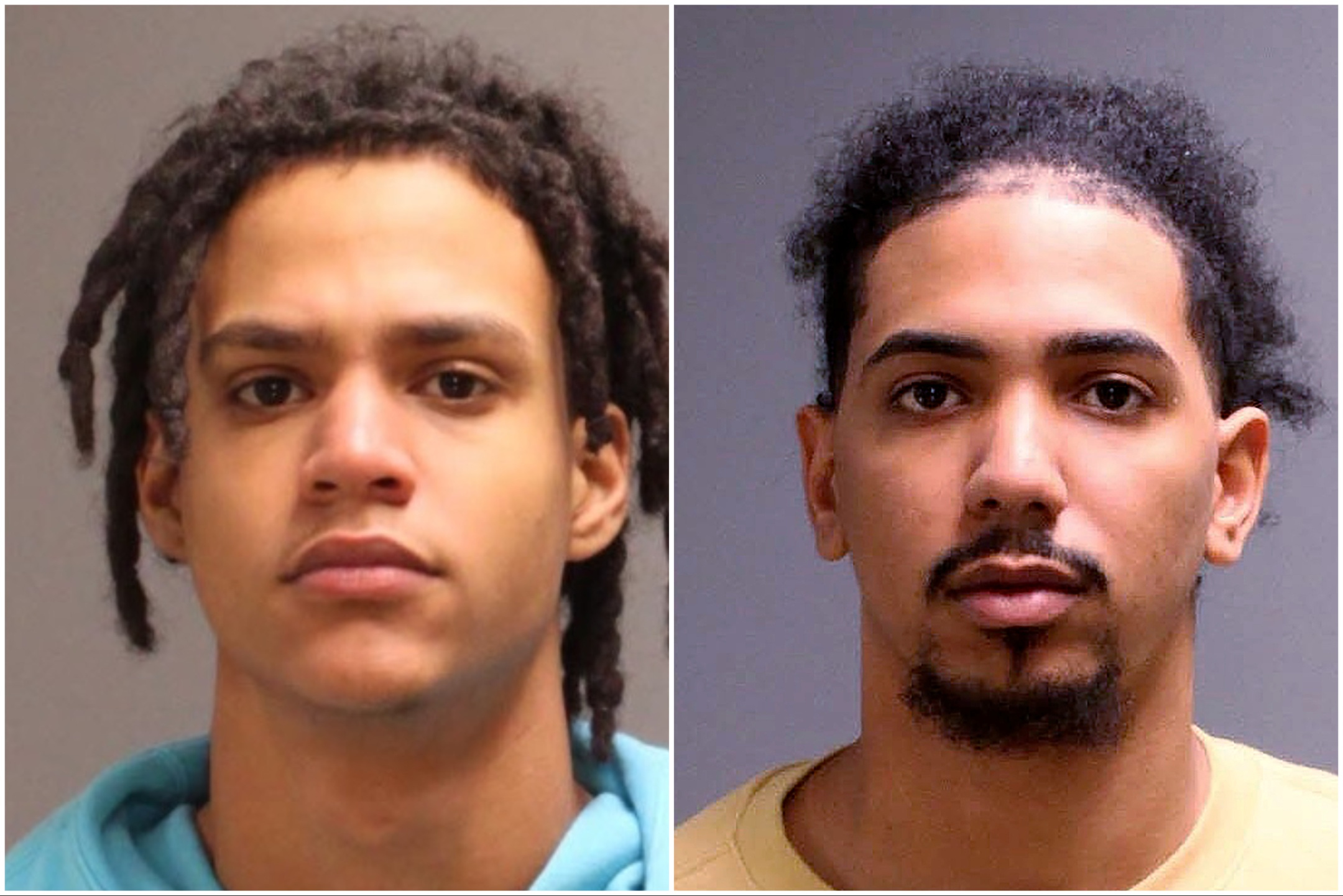
Yobranny Martinez-Fernandez, 20, who fired the fatal shots, was found guilty of first-degree murder. Hendrick Pena-Fernandez, 23, was convicted of second-degree murder because he took part in the car theft that gave rise to the fatal shooting.
Yobranny Martinez-Fernandez, left, 20, and Hendrick Pena-Fernandez, 23.
About an hour after the jury returned its verdict, both men were sentenced to life in prison without parole.
Mendez, 50, was killed after he and his partner, Raul Ortiz, tried to stop a car theft in progress in garage D at the Philadelphia International Airport. As they approached a Dodge Charger, Martinez-Fernandez opened fire as he crouched beneath the steering wheel, prosecutors said. Mendez was struck four times in the torso. Ortiz was struck once in the arm and survived his injuries.
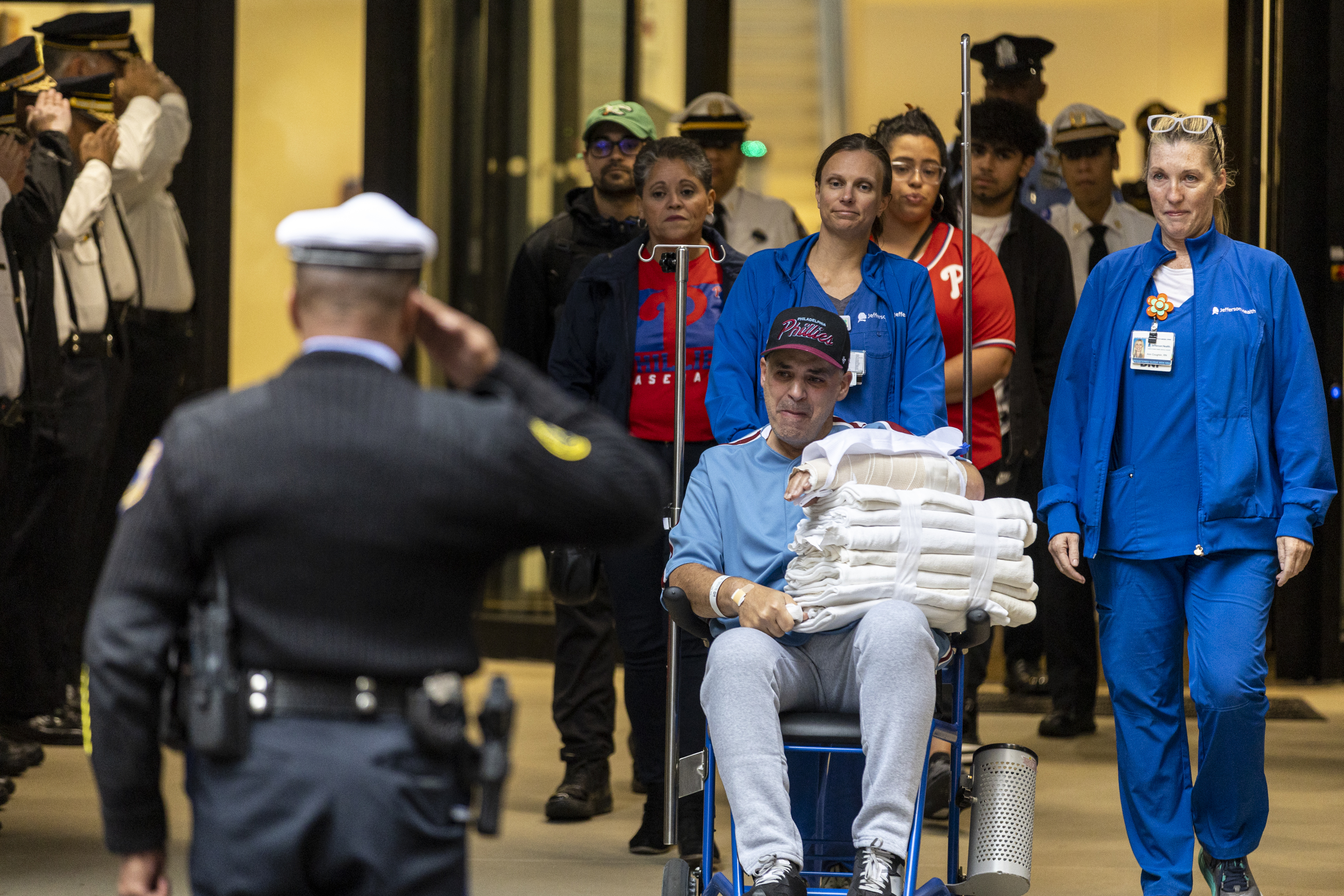
Officer Raul Ortiz, 60, approaches the entrance as fellow Philadelphia police officers stand and salute for his release from the Thomas Jefferson University Hospital on Oct. 14, 2023.
Prosecutors said Martinez-Fernandez also unintentionally shot one of his accomplices, Jesus Madera Duran, 18, who later died at a nearby hospital. The men dropped him there during a frantic escape that eventually led them to a central New Jersey warehouse where prosecutors said they burned their getaway vehicle.
Martinez-Fernandez was also found guilty of killing Duran, in addition to nearly all related charges. Meanwhile, Pena-Fernandez was found not guilty for a handful of other offenses, including third-degree murder.
Throughout nearly a week of testimony, prosecutors argued that both men were responsible for the death of Mendez, a father of two and a 22-year veteran of the police force.
For Mendez’s widow, Alex Carrero, and the couple’s daughter, Mia, the verdict capped what they described as a two-year nightmare.
“No 19-year-old should have to pick the color of her dad’s casket,” Mia Carrero said as she addressed the judge before her father’s killers were sentenced. She wore Mendez’s police badge pinned to her sweater.
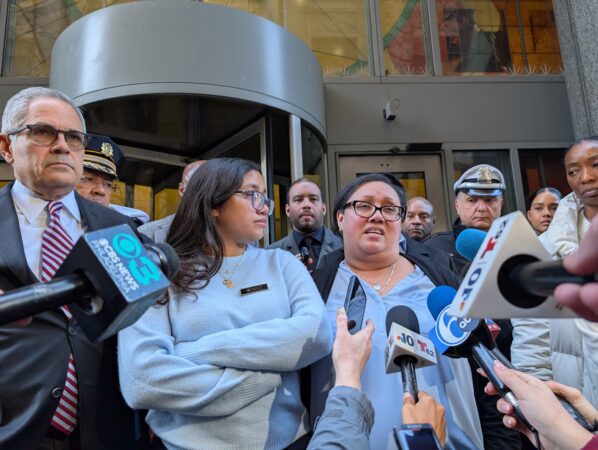
Later, she appeared outside the courthouse with her mother alongside District Attorney Larry Krasner, Police Commissioner Kevin Bethel, and other high-ranking officials.
“He was the love of my life, my soulmate,” Alex Carrero said, breaking into tears. “I have to live the rest of my life without him.”
Bethel thanked prosecutors and the jury, and told Mendez’s family their pain was “just a chapter, but it may never go away.”
“He gave his life for the safety of this city,” Bethel said of Mendez. “We will continue to carry that charge forward.”
Krasner said the sentences reflected the gravity of “a truly horrific crime.” He commended prosecutors for weathering a prolonged jury deliberation — one that lasted four days as two jurors were dismissed; one for a medical emergency and another for reasons that were not publicly disclosed.
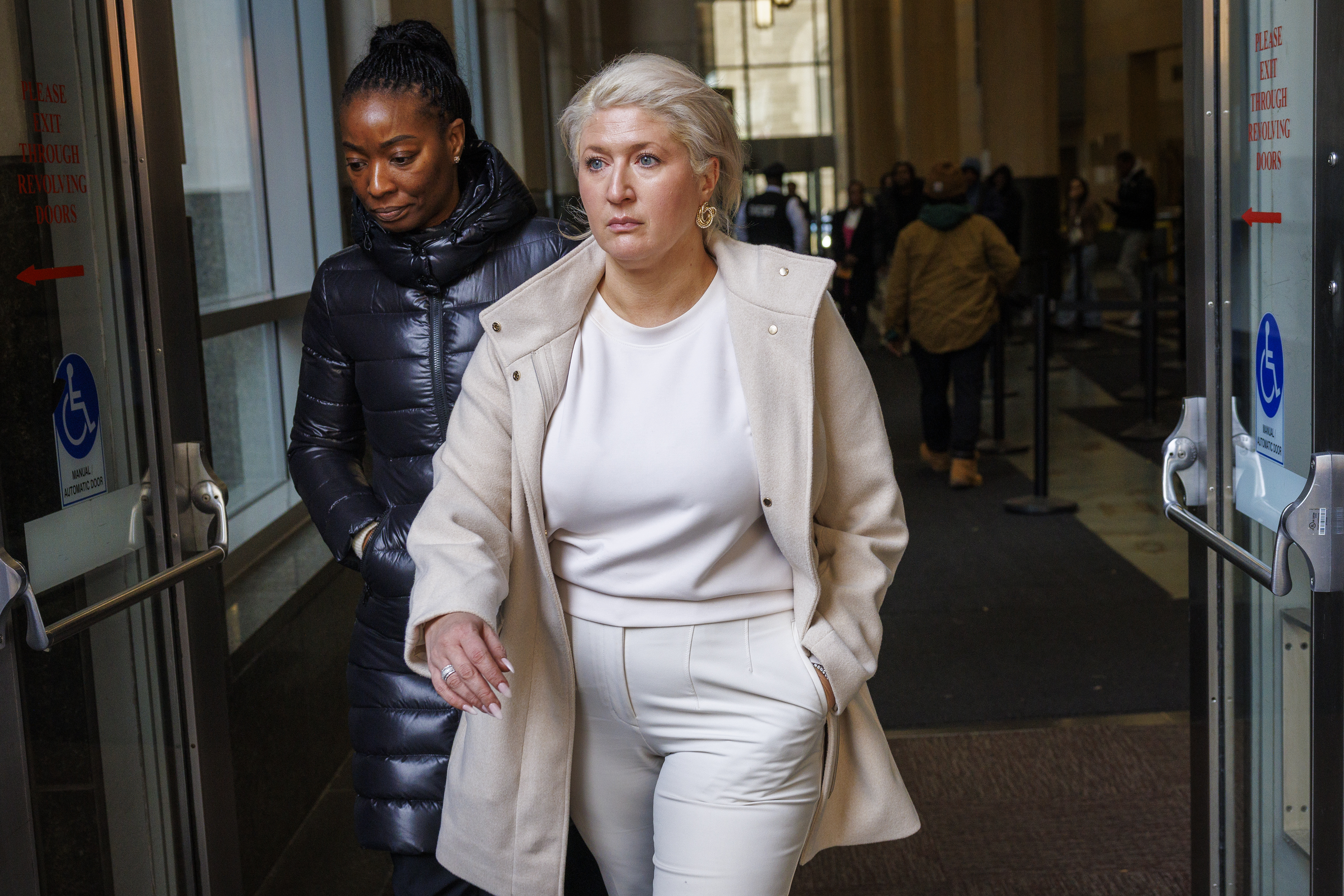
Assistant District Attorney Cydney Pope leaves Juanita Kidd Stout Center for Criminal Justice during break in the first day of trial for defendant in shooting death of Philadelphia Police Officer Richard Mendez.
Assistant District Attorney Cydney Pope’s case included cell tower data, surveillance footage, recovered DNA, and witnesses, including an accomplice to the crime who testified and implicated the two men. Taken together, Pope said, the evidence was compelling and linked the two men to the crime and its multistate scene.
“This is something that truly never had to happen,” Pope said before sentencing. Instead of pulling the trigger, she said, Martinez-Fernandez could have surrendered to Mendez and faced far more lenient consequences.
When asked if he would like to speak before the ruling, Martinez-Fernandez declined. Pena-Fernandez, barely audible, said: “I wish the best for everybody.”
Defense attorneys maintained that Pope did not prove that their clients were at the scene of the shooting. And they told jurors they should not trust prosecutors’ star witness, a man who joined in the airport theft and who pleaded guilty to lesser charges in exchange for his testimony.
Robert Gamburg, Pena-Fernandez’s attorney, said he planned to appeal the verdict.
“Of course we’re disappointed with the verdict,” Gamburg told reporters. “However, there are substantial issues which will be raised eventually on appeal.”
They sat through the presentation of evidence that included life-size mannequins of Mendez, Ortiz, and the injured accomplice, Jesus Herman Madera Duran, all with markings noting where prosecutors said 9mm bullets tore through their bodies.
Prosecutors recreated the crime scene by playing video taken by drone cameras that depicted the maze of vehicles in the concrete parking area where the shooting place. They also offered testimony from two witnesses — weary travelers who were making their way to their cars — to recount the burst of gunfire, followed by the sound of squealing tires as the men peeled out of the garage, knocking down the security gate in the process.
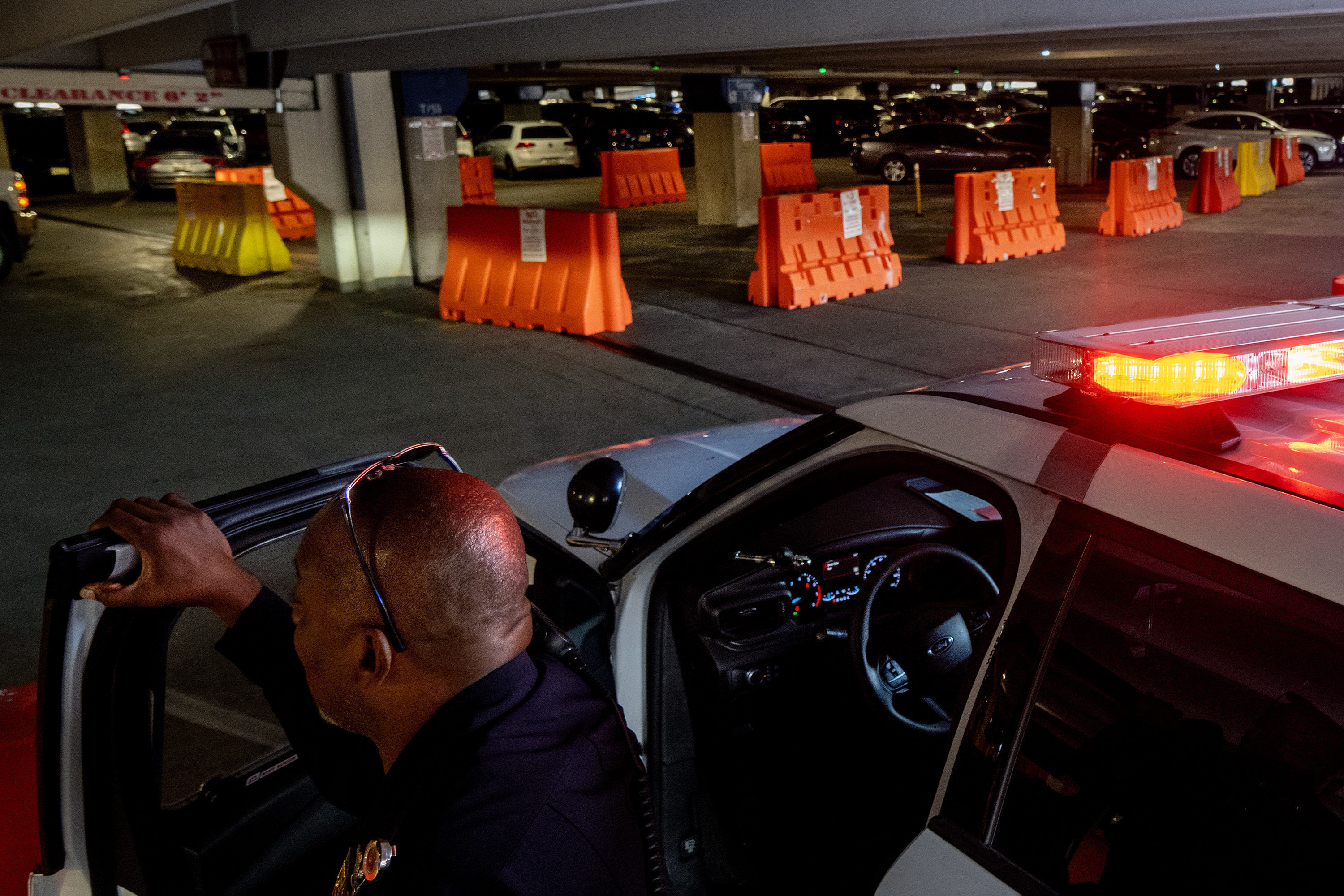
Barriers are set up to prevent parking in a section of Philadelphia International Airport Terminal D parking garage on Nov. 9 ahead of a trial for two men charged with killing Police Officer Richard Mendez and wounding Officer Raul Ortiz during a 2023 attempted car theft.
Prosecutors also played an audio recording of Ortiz screaming into his radio, “Officer down!” and saying that he, too, had been struck and could no longer feel his arm.
“I’m gonna faint,” he said, “I’m losing feeling.”
“They shot Rich,” he repeated throughout the call, his voice wavering in disbelief.
Martinez-Fernandez and Pena-Fernandez declined to testify when asked by Common Pleas Court Judge Giovanni O. Campbell whether they would like to do so. And the defense presented no witnesses of testimony.
But on cross-examination of witnesses called by prosecutors, their attorneys, Gamburg and Earl G. Kauffman, made clear that those who testified had heard — but not seen — the crime.
And Gamburg argued that his client was improperly charged with second-degree murder, a crime committed during the commission of another felony. In this case, he said, the attempted car theft was not a forceful or violent crime and should not have given rise to the more serious charge.
Gamburg told the jury Pena-Fernandez did not go out that night with the intent to kill a police officer, did not fire a weapon, and had not known that Martinez-Fernandez was carrying a gun.
The trial was also marked by jury issues that left the courtroom on edge as deliberations stretched into Monday morning.
The panel’s work was almost immediately derailed Wednesday afternoon when a juror had a medical emergency and was carried out on a stretcher. Campbell called in an alternate juror and ordered that deliberations begin anew.
Jurors appeared to be making progress Thursday as they repeatedly asked to review pieces of evidence. But Campbell later abruptly called jurors into court and told them they must approach the case with “courtesy and respect.”
No resolution came Friday, either. After nearly a full day of silence from jurors, Campbell announced that a second juror had been dismissed.
He did not explain why. And again, he ordered deliberations to start anew.
On Monday, Pope, the prosecutor, praised the jury for its diligence.
“This was a nuanced verdict,” she said. “They didn’t just go down the line and say ‘You’re guilty of all these charges.’ They went through and took their time, did the work.”
Annie Schuster couldn’t believe what she saw Sunday night when scrolling Instagram. She ran to the kitchen to show her husband the grisly crime that had occurred in their Manayunk neighborhood hours earlier.
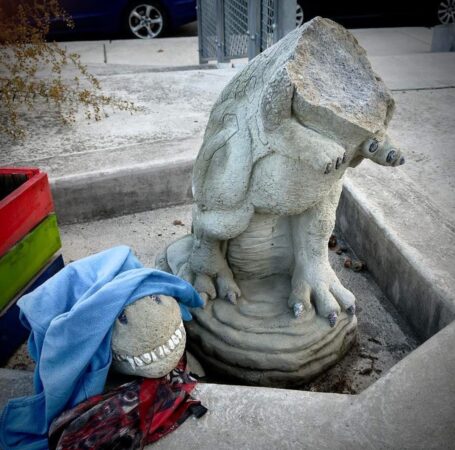
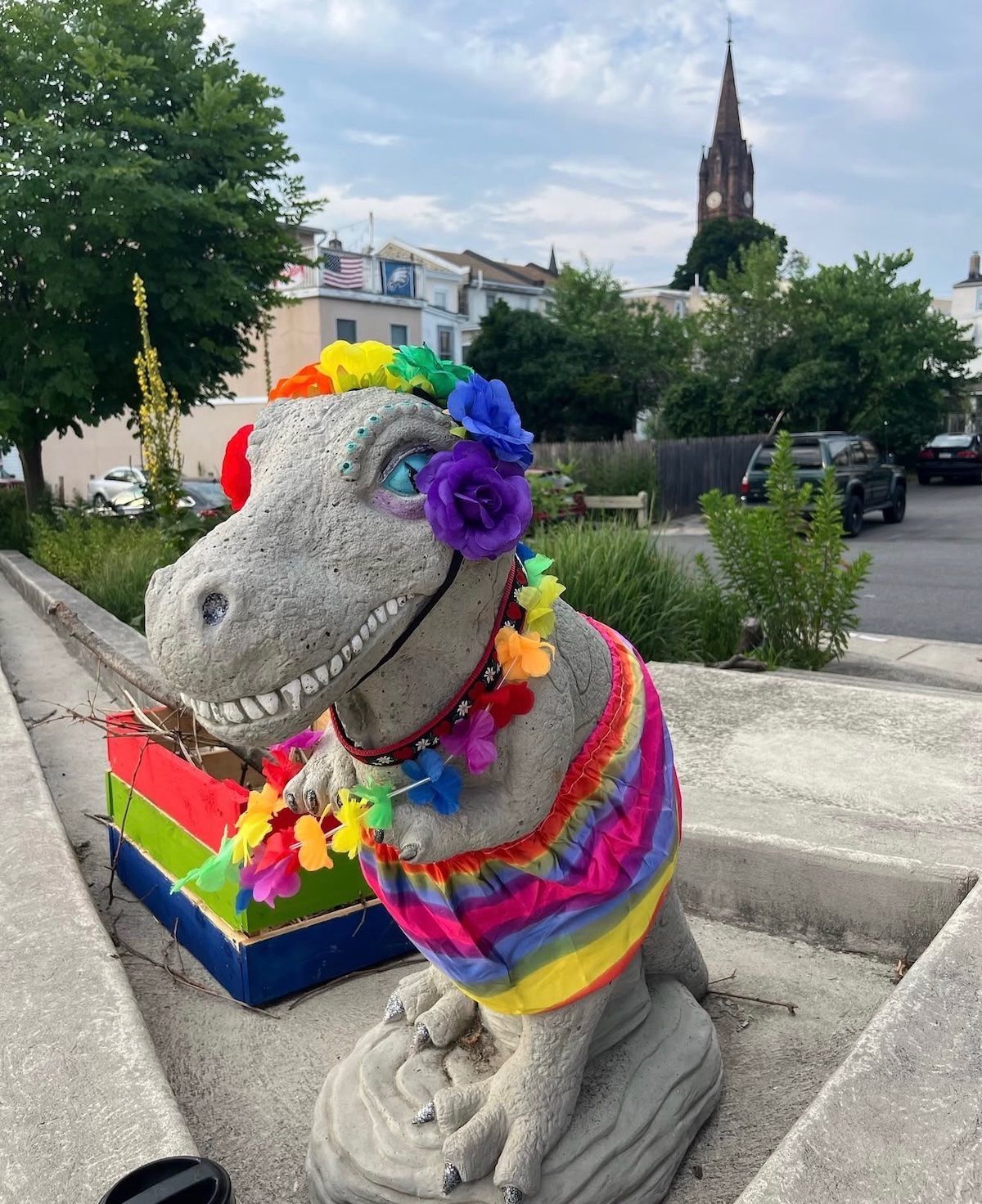
Bridget the Dino, a 3-foot-tall costume-sporting stone Tyrannosaurus rex, was ruthlessly beheaded, in the garden she calls home. Bridget’s head, still wearing a scarf, was lying at the foot of her stone body in the photo posted by the Manayunk Bridge Garden, the dinosaur’s caretakers.
Schuster and her husband, who live in Manayunk and take their children to see Bridget regularly, were in shock. “I thought it was like an unspoken rule, you leave Bridget alone,” she said.
Roxborough resident Juliane Holz felt a wave of anger and sadness as she learned of the vandalism, “She’s actually decapitated,” she said to herself upon reading a text from a neighbor.
Park volunteers notified the community that someone knocked the head off the statue in a heartfelt Instagram post Sunday evening. While the park didn’t announce any suspects or persons of interest, they’re calling on the community for help. “If you saw anything, or know what happened, please reach out,” the statement said. Volunteers filed a report of vandalism with Philadelphia police, but neighbors aren’t expecting police to catch the person who did it, Holz said.
Holz, who serves as a volunteer for the Roxborough Manayunk Conservancy, which oversees the garden at Dupont and High Streets, believes the vandalism occurred between a volunteer event that the garden hosted Saturday evening and early Sunday, when neighbors walk their dogs in the morning.
Schuster and other parents teach their children the golden rules of keeping one’s hands to oneself, so it’s perplexing to think an adult would do something like this, she said.
“I think it definitely had to be an adult, which is unfortunate because it’s not very adultlike behavior. It had to involve a lot of strength because I don’t even know how you carry one, they’re so heavy. Let alone knock it over and put it back up.“
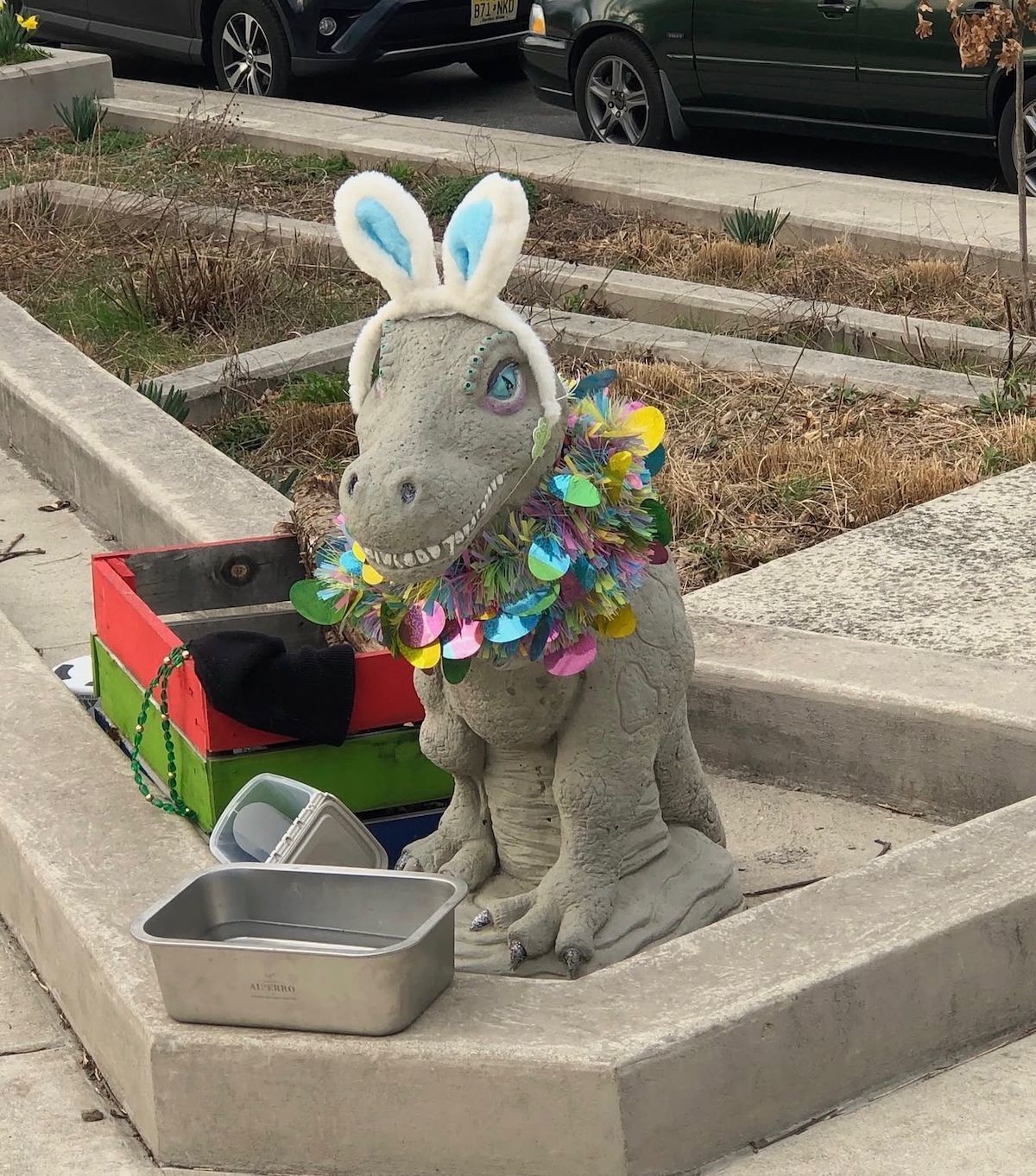
Bridget the Dino, a beloved stone garden statue at the Manayunk Bridge Garden, pictured in an Easter Bunny costume for Easter. The community often dresses up Bridget during different holidays and themed events. In November 2026, her head was smashed off her body.
Holz echoed other neighbors’ sentiments that it must have been an intentional act committed by an adult, seeing as the 300-pound Bridget would be difficult to move even for the strongest Philadelphians, Holz said.
This is a blow to a neighborhood, Schuster said, which has steadily been redefining its community spaces to be more green, inviting, and a safe place for the many young families of Manayunk. Bridget the Dino is a symbol for the patchwork of neighbors who are volunteering their time and contributing to public spaces. On holidays, locals adorn her in themed costumes, like a witch for Halloween or rainbow-colored skirts for Pride.
“It seems like something silly to be upset about, but someone put a lot of effort and money — these statues and improvements are not cheap — into making that bridge garden a really nice place,” Schuster said. “I hate the fact that somebody did that.”
Holz and Schuster both agree that if a perpetrator is caught, they will receive a community service punishment of a full year of mandatory weeding. “The most grueling job in the garden,” Holz said.
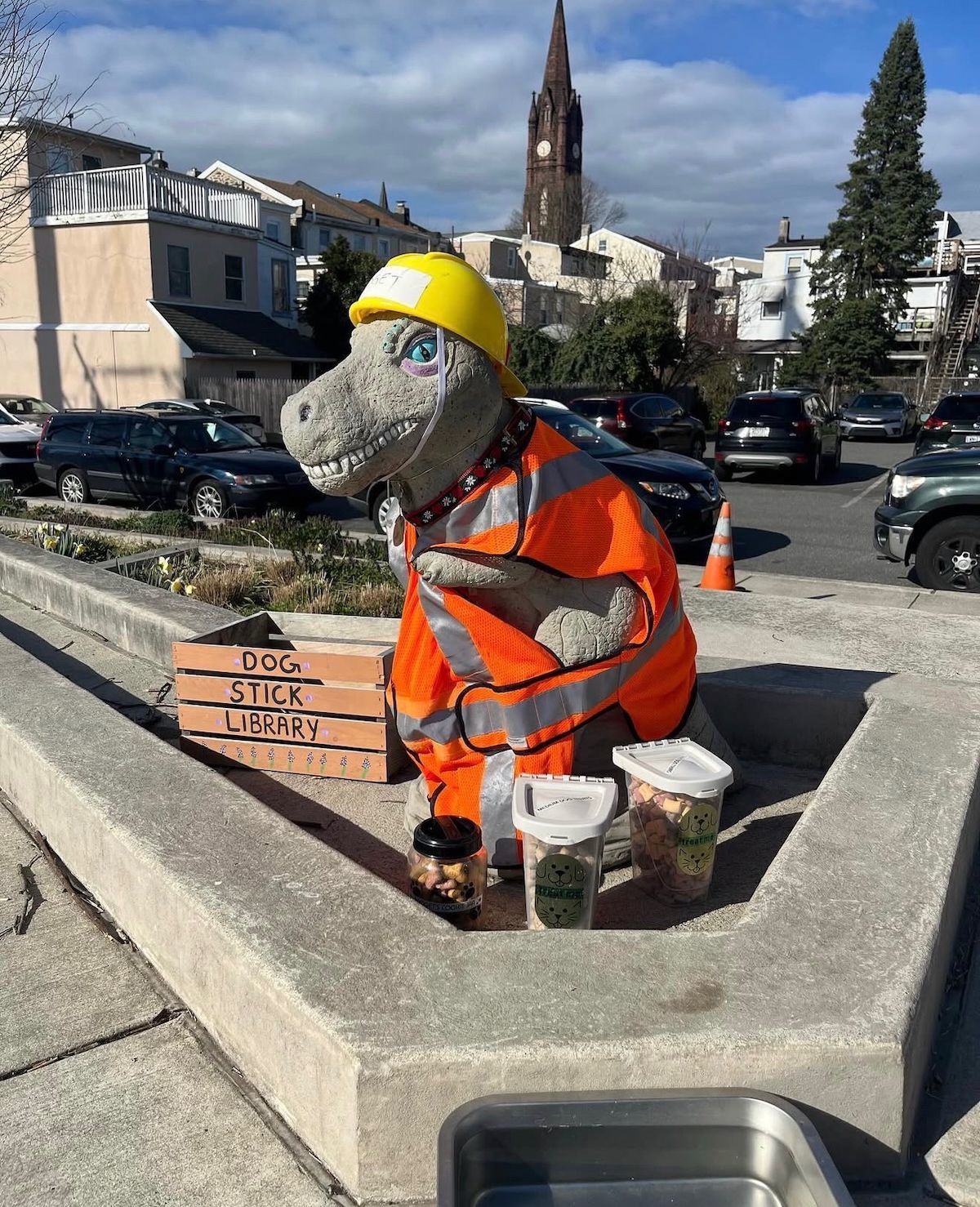
Bridget the Dino, a beloved stone garden statue at the Manayunk Bridge Garden, pictured in a construction worker’s uniform. The community often dresses up Bridget during different holidays and themed events. In November 2026, her head was smashed off her body.
Does Manayunk replace or repair Bridget the Dino?
Holz said that the Manayunk Bridge Park will neither replace nor repair Bridget, as the dinosaur is “irreplaceable” and it would be disrespectful to place another stone dinosaur in her stead and refer to is as “Bridget.” Park volunteers are wary of repairing Bridget because of the slanted break across her neck. Any repair could easily succumb to the weight of a child riding her back or a dog leaning on top of her, and cause injury, Holz said.
Bridget originates from the local home and garden center store, Holod’s on Ridge Pike in Lafayette Hill, which hosts an annual stone T. rex costume contest. Last year’s winner was “Rexy the Paleontologist.”
In the wake of Bridget’s destruction, Holod’s will be donating a brand new stone dinosaur statue, Holz said. Several neighbors already own stone dinos from Holod’s, which has become a staple on stoops throughout Roxborough and Manayunk. Holz’s home dinosaur is named Hans.
Many offered to donate their own, but Holz is grateful for Holod’s contribution.
Bridget the Dino, a beloved stone garden statue at the Manayunk Bridge Garden, pictured in a rainbow skirt and accessories for Pride Month. The community often dresses up Bridget during different holidays and themed events. In November 2026, her head was smashed off her body.
This isn’t the first time animal statue vandalism has hit the Bridge Garden. Bridget had a friend named “Gary the Goat,” a similar-sized plush goat toy who dressed up alongside Bridget, who was stolen from the park in 2023. “He was stripped of his clothes, and poof, he was gone from the Manayunk Bridge Gardens. Bridget misses her friend,” one Roxborough Rants & Raves Facebook group member wrote at the time.
As the Manayunk Railroad bridge was converted into a pedestrian and cyclist bridge in 2015, a movement began to revitalize the green spaces along the trail, birthing the Manayunk Bridge Park around 2020. Bridget the Dino, named after the bridge she lives at, soon arrived and graced the park as its loyal guardian and mascot for the wider community.
It also helps that Bridget is eye-level with most young children for approving pats on the head, Schuster said.
Bridget will soon be repurposed elsewhere in the garden to safely rest and continue her tenure as the garden’s guardian, Holz said. Once the new dinosaur statue arrives, the community will have to come together to imagine a new name and backstory, “Could it be Bridget’s child or maybe an entirely new dinosaur altogether?” she said.
Earlier this month, the Federal Transit Administration ordered SEPTA to inspect its trolley power system after four incidents, including two times trolleys stalled in the Center City tunnel, requiring 415 passengers to be evacuated.
The budget impasse
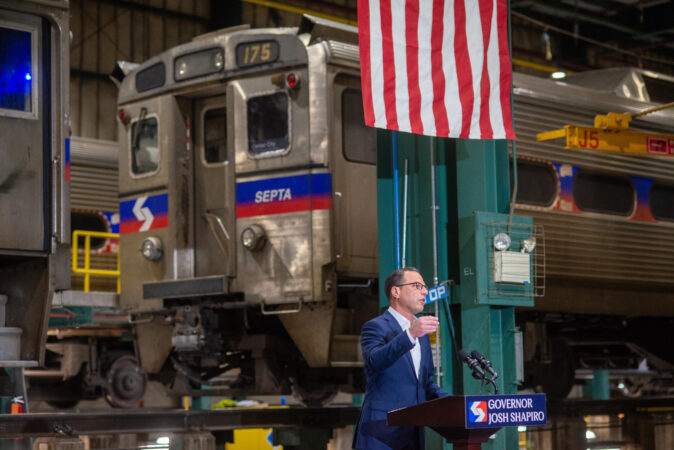
Shapiro said he was forced to act for the second straight year because Senate Republicans wouldn’t support additional recurring funding for mass transit operations in the state budget.
“They’ve come up with a ton of excuses, but they haven’t come up with the funding,” Shapiro said.
After the governor decided in September that no budget agreement on transit funding was possible, PennDotallowed SEPTA to tap $394 million in state money allocated for future capital projects to pay for two yearsof operating expenses.
The transit agency was facing a $213 million recurring deficit in its operating budget.
Yet the problems with the rail cars and trolleys served to underscore the risks of using capital funds for day-to-day operations.
“A history of chronic underinvestment has led us to this point,” said Chester County Commissioner Marian D. Moskowitz, who is vice chair of SEPTA’s board.
She noted that SEPTA has a much smaller capital budget than other large transit agencies.
$95 million for electrical system upgrades, overhauled propulsion motors and more on the Silverliner IV train cars and the newer Silverliner V models.
$48.4 million to update the overhead catenary wires in the trolley tunnel, along with three new catenary-maintenance cars for the tunnel and along trolley lines, and on long Regional Rail lines.
$51.5 million to upgrade 13 escalators at SEPTA stations, install AI-powered inspection cameras to catch potential problems earlier, and technology improvements at SEPTA’s Control Center
$8 million to install replacement parts for Broad Street Line and Norristown High Speed Line cars.
“These funds are going to make a significant difference in our efforts to overcome the current crises,” SEPTA general manager Scott Sauer said, and to help avoid future ones.
He thanked the governor and pledged “a comprehensive effort to identify potential problems sooner before they grow and lead to delays, cancellations, or shutdowns.”
Shapiro had proposed an increase in the share of general sales-tax revenue devoted to transit subsidies over five years.
Leaders of the GOP-controlled Senate said the $1.5 billion price tag was too high and proposed shifting capital money to operating subsidies for the state’s transit systems and roads — an idea partially reflected in the Shapiro administration’s temporary solution.
“I am glad the Governor continues to take our advice and use existing resources to support public transit,” Senate Majority Leader Joe Pittman (R., Indiana) said in a statement.
“It’s unfortunate that just one year ago, he took $153 million of funding from critical [road] infrastructure projects to fund transit, neglecting the needs of those who use our roadways every single day,” Pittman said.
Republicans also argued that SEPTA had been mismanaged and needs change.
As the next state budget cycle nears, the debate is likely to continue.
“I want you to know I’m going to be a continue to be a governor who supports mass transit, who gives a damn about SEPTA, who cares about those 800,000 people that rely on SEPTA every single day,” Shapiro said.
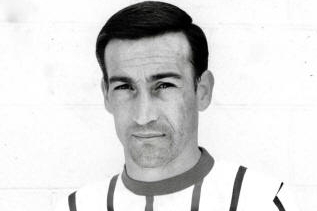
John Borodiak, 89, of Philadelphia, Hall of Fame Argentine American professional soccer player, popular coach and sports center volunteer, and longtime Center City dental lab owner, died Saturday, Sept. 13, of complications from Alzheimer’s and Parkinson’s diseases at Graduate Post Acute nursing facility.
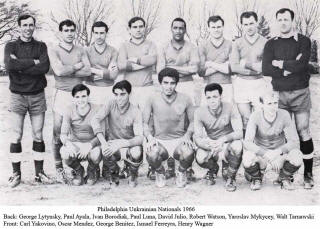
Born and reared in Buenos Aires, Argentina, of Ukrainian descent, a young Mr. Borodiak was such a star that, in 1960, at 24, he was invited to leave South America and play soccer in the United States for the Ukrainian Nationals in Philadelphia. So, for seven seasons, through 1966, he played fullback for the Ukrainian Nationals and won four American Soccer League championships and four U.S. Open Cup titles.
As a 5-foot-8, 160-pound defensive whiz, Mr. Borodiak didn’t score many goals or race down the field on breakaways. But, said his son, Ivan, also a former pro soccer player: “He was smooth, quick, and good up in the air.”
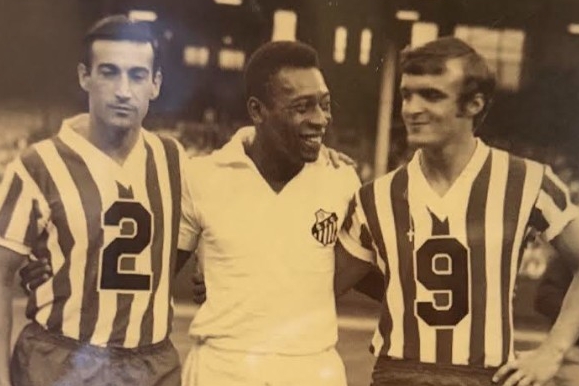
He played on the 1964 U.S. national team and was inducted into the Horsham-based Ukrainian Sports Museum and Hall of Fame in 2017. Over the years, he played against Brazilian superstar Pele and other international stars, and former colleagues called him “a living legend.”
Mr. Borodiak (left) played against Pele (center) and other international stars.
He also played with the Philadelphia Spartans in the National Professional Soccer League and the ASL’s Newark Ukrainian Sitch in 1966 and ’67. He spent the 1968 season with the Cleveland Stokers and 1969 with the Baltimore Bays in the North American Soccer League. He retired after playing a final season with the Spartans in 1970.
He made headlines after a game in 1967 when he blocked the game-tying goal after his goalie was caught out of position. “After I saw [the goaltender) go out, I expected something to happen in that corner,” he told the Daily News. “I moved up there, and the shot bounced off my chest.”
Affable and engaging off the field, Mr Borodiak became a favorite of teammates, fans, and sportswriters. He hosted instructional clinics for young players and, after learning English himself, served as a translator for other players and the media. He spoke Ukrainian, English, Spanish, and Italian.
In 1967, Daily News sports writer Dick Metzgar published his Christmas wish list and asked for “more hustling performers like little fullback John Borodiak.”
Mr. Borodiak (left) passed his athleticism on to his son and grandson.
He helped anchor a Spartans defense in 1967 that Metzgar called “impenetrable” and was known for his aggressiveness. He was ejected for fighting in a game against Baltimore that season, and he told the Delaware County Daily Times that his opponent hit him in the back. “Naturally,” he said, “I hit back.”
He was a team cocaptain in Cleveland and named a NASL all-star in 1968, and his Stokers lost a heartbreaking playoff game to Atlanta in overtime that season. After the game, a disappointed Mr. Borodiak told the Cleveland Plain Dealer: “I’m sorry.”
He rejoined the Spartans in 1970 when they entered the American Soccer League, and The Inquirer covered their big win over the Syracuse Scorpions. “A strong defensive cog, John Borodiak, was added to the Spartans lineup,” The Inquirer said, “and he played fullback in impressive style.”
In a 1969 story after the Bays tied the Dallas Tornado, the Baltimore Sun said: “Borodiak made one of the best saves of the day when he blocked a shot after [the goalie] had been pulled out of the net.” In 1966, he played briefly for Roma in the Eastern Canada Pro Soccer League, and a teammate told the Toronto Star: “Borodiak is a fine fullback and fits in well with our style of play.”
Mr. Borodiak (rear, third from left) and teammates on the Philadelphia Ukrainian Nationals pose during the 1966 season.
He coached soccer teams after he retired, played with amateur teams into his 40s, and was active for years at the Ukrainian American Sports Center in North Wales.
He earned certification at Temple University in dental cosmetics in the 1960s and owned a lab in the Medical Arts Building in Center City until he retired in 2018. At 50 years, Mr. Borodiak was the longest-tenured tenant ever in that building, his son, Ivan, said.
“He was a wonderful person,” his family said in a tribute, “He was a best friend, a champion, and a legend of his sport and in life.”
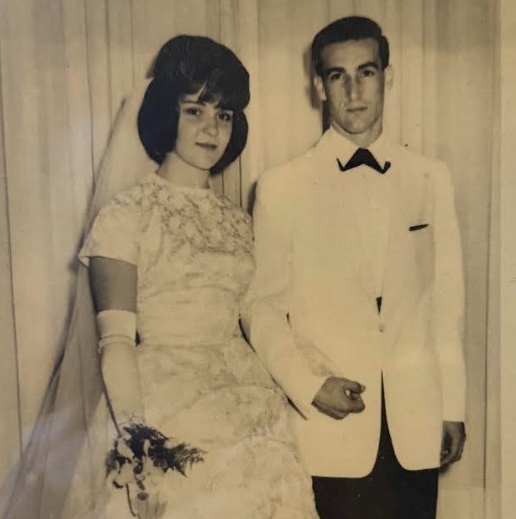
Born July, 13, 1936, Ivan Gregorio Borodiak changed his name to John when he came to the United States. He met Betty Pilari in Argentina, and they married in 1962, and lived in Bensalem and Queen Village.
Mr. Borodiak and his wife, Betty, married in 1962.
Mr. Borodiak was generous and gentle, his son said. He enjoyed fishing and car shows, and he built his own Mercedes-Benz from the tires up.
Friends noted his “kindness, gratitude, and warmth” in online tributes. One said: ”He was always a people person, and his smile could light up the darkest room.”
His son said: “He was a great man. He never had an enemy, and he overcame every adversity.”
In addition to his wife and son, Mr. Borodiak is survived by four grandchildren, a great-granddaughter, and other relatives. A sister died earlier.
Mr. Borodiak (left) doted on his grandchildren.
Private services were held earlier.
Donations in his name may be made to the Alzheimer’s Association, 225 N. Michigan Ave. Floor 17, Chicago, Ill. 60601.