The daughter of a Northeast Philadelphia man who prosecutors say ran a human-trafficking ring for years that trapped vulnerable women, supplied them with drugs, then forced them to have sex with men across the region pleaded guilty Friday to helping manage the finances of the criminal organization.
Natoria Jones, 30, pleaded guilty to promoting prostitution after prosecutors with the Pennsylvania Attorney General’s Office said she helped her father, Terrance Jones, manage the payments of his sex-trafficking scheme for at least three weeks in 2023.
In exchange for Jones’ plea, Senior Deputy Attorney General Zachary Wynkoop withdrew felony charges of conspiracy, participating in a corrupt organization, and promoting unlawful activities.
Wynkoop asked Common Pleas Court Judge Zachary Shaffer to defer Jones’ sentencing until after the June trial of her father, Terrance Jones — the alleged ringleader of the criminal enterprise — and three of his associates.
The plea marks the latest development in the sweeping indictment brought by the attorney general’s office in 2024 in which officials charged Terrance Jones, 54, and several of his associates with operating a human-trafficking ring across the region for more than a decade.
For 12 years, Terrance Jones, of Lawndale, marketed what he called “GFE” or “the Girlfriend Experience” online and recruited women in their 20s — many battling addiction and struggling to find stable housing or income, authorities said.
When women contacted the operation, prosecutors said, Terrance Jones would impersonate a woman, raising the pitch of his voice and introducing himself as “Julie” or “Julia” to build trust. He promised to send a driver to pick them up for “dates” where they could earn more than $250 and obtain drugs, officials said. He used the women to lure other victims who were addicted to drugs into the scheme, telling one confidant that he “could ‘wash em up’ and make money with them,” according to the affidavit of probable cause for Jones’ arrest.
“He made these women feel worthless. He controlled them, manipulated them, and, in a way, programmed them to feel like this was their only option,” then-Attorney General Michelle Henry said in announcing the charges.
Prosecutors and Pennsylvania State Police began investigating in 2021 after a woman who they said had been trafficked by Terrance Jones reported the abuse.
After meeting with the woman, officials conducted wiretaps, acted as undercover sex workers and buyers, and tracked down his clients, the affidavit said. Across the three-year investigation, officials said they found that the operation crossed through the Philadelphia suburbs and into New Jersey, and that over just 10 days in 2023, Terrance Jones arranged 78 “dates” — and pocketed most of the funds.
He was charged with trafficking individuals, involuntary servitude, running a corrupt organization, conspiracy, and related crimes. He remains in custody, held on $2 million bail.
Three of Terrance Jones’ business partners — Thomas Reilly, Joseph Franklin, and Raheem Smith — are charged with running a corrupt organization, conspiracy, and related crimes, and are scheduled to go to trial with him in June.
Another associate, James Rudolph, a driver who officials said transported women to their “dates,” pleaded guilty to conspiracy to promote a house of prostitution last year. He’s scheduled to be sentenced later this month.
In a rare move, prosecutors as part of the indictment also criminally charged 16 men who paid Terrance Jones for sex with the women. While the charges against some of the men have been dismissed, at least nine have pleaded guilty to promoting or patronizing prostitution and are scheduled to be sentenced next month.
Among Terrance Jones’ business partners, was also his daughter, Natoria, who handled some of the financials and payments between the women and customers. Her attorney Jonathan D. Consadene declined to comment Friday.
Senior Deputy Attorney General Erik Olsen said several factors influenced the plea agreement.
“There’s some mitigation as to how she got pulled into this,” Olsen said, adding that more details would emerge at trial in June.
Think you know your news? There’s only one way to find out. Welcome back to our weekly News Quiz — a quick way to see if your reading habits are sinking in and to put your local news knowledge to the test.
Question 1 of 10
There will be one Tun Tavern opening in Old City, now that a long-running dispute over the name of one of Philadelphia’s most storied colonial landmarks has been resolved. What’s the historical significance of the Tun Tavern?
CorrectIncorrect. XX% of other readers got this question right.
The Tun Tavern served as the first recruiting station for what became the Marine Corps in 1775. Now that a long-running dispute over the name of one of Philadelphia’s most storied colonial landmarks has been resolved, the Tun Legacy Foundation — a nonprofit led by Marine veterans and Philadelphia-area organizations whose origins trace back to the original Tun Tavern — will use the full name on its planned historic reproduction on Second Street.
Question 2 of 10
This building at LOVE Park (with a space-themed nickname), could soon get a reboot after years of sitting dormant:
CorrectIncorrect. XX% of other readers got this question right.
The Saucer building, also referred to as the UFO, was added to the Philadelphia Register of Historic Places last year. Built in 1960, the building predates LOVE Park, and first served as the city hospitality center. It later housed offices for park staff. Now it’s looking at a long-awaited reboot.
story continues after advertisement
Question 3 of 10
Which Philly-based bronze statue is slated to be relocated to the base of the Art Museum’s steps, taking Rocky’s place?
CorrectIncorrect. XX% of other readers got this question right.
Creative Philadelphia, the city’s office for the creative sector, presented and had approved a proposal at an Art Commission meeting to have the “Smokin’” Joe Frazier statue take over the Rocky statue’s current home at the base of the Art Museum’s steps. Last month, the commission approved the Rocky statue coming back to the top of the steps, where it supposedly will permanently stay starting in the fall and following its first-time display inside the museum.
Question 4 of 10
Just two blocks from Independence Hall, Carpenters Hall is where Pennsylvania declared its independence from Britain in June 1776. To celebrate America’s 250th birthday, what will be installed outside of Carpenters Hall in June?
CorrectIncorrect. XX% of other readers got this question right.
On June 18, as part of the celebration, a blue historical marker will be installed outside the hall in addition to a three-part virtual lecture series on Pennsylvania’s constitution.
Question 5 of 10
Northeast Philly’s Delilah Dee, who runs a local social community for Latina women, worked on Bad Bunny’s Super Bowl halftime show as a part of the field team, coordinating walkthroughs and set breakdowns. Where was she when she learned she got the job?
CorrectIncorrect. XX% of other readers got this question right.
Dee applied for a job at the Super Bowl in November. On Dec. 31, she was accepted for a position with the field team. She learned while she was at the gym and started crying. For the last two weeks, she was in Santa Clara for rehearsals.
Subscribe to The Philadelphia Inquirer
Our reporting is directly supported by reader subscriptions. If you want more journalism like this story, please subscribe today.
A landmark deli in Cherry Hill closed after 25 years without notice, filing for bankruptcy. What was it called?
CorrectIncorrect. XX% of other readers got this question right.
The Kibitz Room in Cherry Hill shuttered without notice. Now, former owners say they want to revive the business, founded in 2001.
Question 7 of 10
This department store in Bala Cynwyd is closing after decades in business:
CorrectIncorrect. XX% of other readers got this question right.
Saks Fifth Avenue will be closing its Bala Cynwyd location in April. Saks Global, which owns Saks Fifth Avenue and Neiman Marcus, announced the impending closure in a statement Tuesday, a month after the luxury clothing retailer filed for Chapter 11 bankruptcy.
Question 8 of 10
Which iconic Philly bar hosted a reunion for couples who found love there?
CorrectIncorrect. XX% of other readers got this question right.
McGillin’s Olde Ale House, the 166-year-old pub in Center City long owned by the same family, has leaned especially hard into being, in its own description, the place where more couples have met than anywhere else in Philadelphia. The bar hosted its first reunion for such couples this month.
Question 9 of 10
What issue sparked dueling lawsuits between Gov. Josh Shapiro and his neighbors?
CorrectIncorrect. XX% of other readers got this question right.
The lawsuits center on a security fence and a disputed property line. Shapiro’s neighbors in Abington Township, Jeremy and Simone Mock, accuse the governor and his wife, Lori Shapiro, of illegally occupying part of their yard. The Shapiros filed a countersuit.
Question 10 of 10
Born in a puppy mill in Peach Bottom, Lancaster County, this 6-week-old toy poodle was one of many cute stars in last week’s Puppy Bowl:
CorrectIncorrect. XX% of other readers got this question right.
The puppy, Oscar, who was nursed back to health after being severely undernourished, traveled to Glens Falls, N.Y., to participate in the October taping of the 22nd annual Puppy Bowl. The annual special raises awareness for animal rescues across the United States. Every one of the 150 dogs in the competition — between Team Ruff and Team Fluff — comes from a rescue.
Your Results
You have skipped .
You scored XX out of 10.
The average reader scored XX out of 10
Seems like you’ve been skimming more than reading there, buddy. There’s always next week.
You’ve read some articles (or made some educated guesses) but we wouldn’t come to you first for our local news recaps. Better luck next week!
Do you work here? You’re a local news stan with the latest updates on Philly happenings. Your friends definitely ask you for summaries on what’s going on and it shows.
Philadelphia is getting $13 million to support six traffic-safety projects in Philadelphia, courtesy of speeders caught and fined by automated enforcement cameras.
The Pennsylvania Department of Transportation announced the grants Wednesday for an array of city projects, including $2 million for traffic-calming measures on Lincoln Drive between Kelly Drive and Wayne Avenue.
Some of that money will help pay for speed humps at 100 additional public, parochial, and private schools in the city, PennDot said.
Since taking office in 2023, the Shapiro administration has invested $49.7million in city traffic-safety projects, all from revenues raised by speed cameras.
Calming speeders
Under the automated speed-enforcement program, grants are plowed back into the communities that generated the revenue. Philadelphia is so far the only municipality in the state where speed cameras are authorized.
Pennsylvania also has automated speed enforcement in highway work zones, but that revenue goes to the Pennsylvania State Police for extra patrols and more troopers, the turnpike for safety projects and speeding counter-measures, and the general treasury.
The new grant is meant to continue traffic-safety work on Lincoln Drive that began a couple of years ago.
That includes speed humps, speed slots, new phosphorescent paint, flexible lane delineators, a smoother merge point where the road narrows, and marked left-turn lanes.
“It’s made a huge difference,” said Josephine Winter, executive director of the West Mount Airy Neighbors civic group, which organized residents.
“People that live along Lincoln Drive are feeling positive,” she said — though there is a split between people who are angry at what speed bumps have done to their cars’ undercarriages and those who support what they say are life-saving improvements.
“The city was wonderful, very responsive,” Winter said. “We’re been fortunate to get something done here.” Next up: working with other Northwest residents to get improvements on side streets, Wissahickon Avenue, and others.
Other grants
$1.5 million for planning work to upgrade traffic signals, better lane and crosswalk markings, and intersection modifications.
$5 million for design and construction of safety improvements along commercial and transit corridors. Those include curb extensions, concrete medians, bus boarding bump-outs, and new crosswalks. Locations include: Frankford Avenue (Tyson Avenue to Sheffield Avenue); 52nd Street (Arch Street to Pine Street); Hunting Park Avenue (Old York Road to 15th Street); and Germantown Avenue (Indiana Avenue to Venango Street).
On Tuesday, the city agreed to pay $250,000 to a former clerk who, like several other register of wills employees, said he was fired after he refused to contribute to Gordon’s campaign.
Nicholas Barone alleged in a 2023 federal lawsuit that Gordon, through an intermediary, had first requested a $150 contribution in late 2021.
When Barone told his supervisor he could not afford to contribute, Gordon asked for $75, according to the lawsuit. Barone balked again.
Then, in January 2022, Barone received a termination letter, effective immediately. The letter came four days after a performance review found he was exceeding expectations, according to his suit.
“She pressured everyone to make a donation and sort of made it known, if you’re not donating, you’re not going to be employed,” said Barone’s lawyer, James Goslee.
In addition to the Barone settlement, the city has paid $400,000 to settle four other federal lawsuits brought by former Gordon staffers. They alleged that Gordon, who was elected in 2019, had essentially turned the register of wills office into an arm of her unsuccessful reelection campaign.
Patrick Parkinson, a former administrative deputy in the office, claimed in his lawsuit that Gordon “continually and relentlessly badgered” him for campaign money, then fired him in 2022 when he refused. His suit was settled in 2024 for $120,000.
Barone’s case was unusual in that it was the only one that got as far as a trial, which began Monday. Several former employees testified about how Gordon had politicized the office. Gordon testified last.
The city then agreed to settle before the jury began deliberating. Goslee said her testimony was a “disaster” for the defense.
“She just wasn’t a good witness, I’ll put it to you that way,” Goslee said. “She should not be in politics or be allowed anywhere near public office.”
Reached by phone Thursday, Gordon initially declined to comment. She called back five minutes later.
“In connection with the allegations brought against me, I maintain I did nothing wrong,” Gordon said. “Any decision to settle the case was a decision made by the City of Philadelphia.”
A spokesperson for the city’s law department declined to comment.
The register of wills office is a somewhat obscure row office in City Hall that employees approximately 100 people with an annual budget of about $5.2 million. It issues marriage licenses, processes inheritance-related records, and does other nonpolitical work.
But it also has a reputation as a Democratic patronage operation going back at least to the 1980s, with jobs being doled out to people with political connections.
Goslee said he was hoping that Barone’s case might lead to some “structural change.”
“This is a very important public interest case,” he said. “That system of entrenched, compelled patronage really needs to come to an end.”
That does not appear to be happening yet.
Gordon was defeated in the 2023 Democratic primary by John Sabatina Sr., an estate attorney and Northeast Philadelphia ward leader. He took office in January 2024.
The city has since paid out $256,000 in settlements to nine former register of wills employees who filed lawsuits alleging that Sabatina fired them to make way for his own patronage hires. Five cases are still pending.
“It was a hit list,” lawyer Timothy Creech, who is representing most of those ex-employees, said in September, comparing Sabatina to a “Tammany Hall”-style party boss, a reference to the former New York City political machine.
“It wasn’t to save money,” Creech said. “It was specifically to hire their own people.”
Register of Wills John Sabatina
Several of the 30 office employees on the list are described by their connections to Gordon, including “Tracey niece,” “Tracey’s friend, 7th Ward committee person,” “Last Tracey hire.” The suggested action for most of those employees was immediate termination.
“We have enough immediate terminations to allow us several hires in the next two weeks,” reads a note at the bottom of the spreadsheet.
Another note appears to indicate that some firings were planned before Sabatina had replacements:“We don’t have people lined up for all of these jobs and we need to make sure we use up all of the funds set aside in the budget for salary.”
Sabatina has declined to comment on those cases.
Lauren Cristella, president and CEO of the Committee of Seventy good-government group, said it is not acceptable for the city to spend more than $900,000 to settle lawsuits stemming from politics in the register of wills office.
“We can all think of a thousand better things we could do with these funds,” Cristella said. “The patronage mill better start printing money to keep up with these payouts because taxpayers in this city can no longer foot this bill. When is enough for Council and the mayor to meaningfully reform the row offices?”
Last year, the Pennsylvania Intergovernmental Cooperation Authority, Philadelphia’s fiscal watchdog, passed a resolution to recommend that City Council and Mayor Cherelle L. Parker abolish the register of wills office, along with the sheriff’s office, another row office with a long history of problems.
Neither Parker nor Council has shown any interest in taking action.
Gordon, who ran unsuccessfully for Congress in 2024, now works in the sheriff’s office as a services representative, according to city payroll records.
“Row offices are set up to create jobs for the politically connected, not serve the people of our city,” Cristella said. “It doesn’t matter who is in the office, the taxpayers are always on the hook for their abuse of power.”
Staff writer Ryan W. Briggs contributed to this article.
In December, Katrina Williams watched as the man who killed her brother was sentenced to decades in prison and felt, she said, as if a two-year nightmare was coming to an end.
But weeks later, another shooting took the life of her only son.
Williams’ brother, Lashyd Merritt, 21, was one of five people killed in a mass shooting in Kingsessing in July 2023, when Kimbrady Carriker walked through the Southwest Philadelphia neighborhood with an AR-15 rifle and fired at random passersby.
Then, in January, her 19-year-old son, Russell, was killed by a man who, like the Kingsessing shooter, committed a spree of crimes, police say.
“I’ll never understand it,” said Williams,43. “There’s no reason for it.”
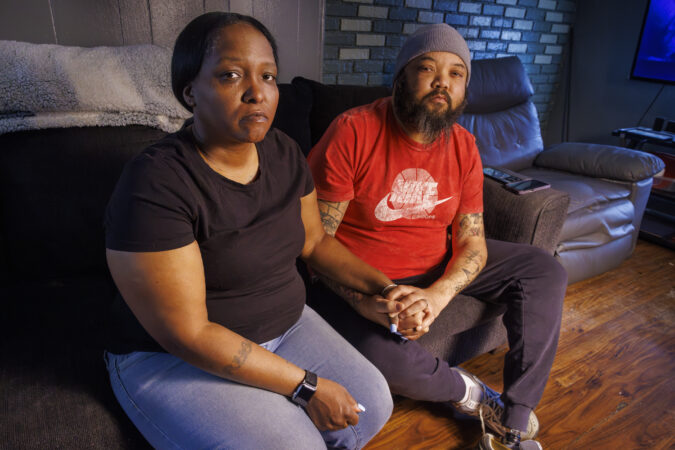
A high school photograph of Russell Williams being held by his father and mother, Katrina and Russell Williams Sr. at their home in Southwest Philadelphia on Feb. 6.
For Williams, the trauma of Merritt’s violent death never fully dissipated, she said, and the fatal shooting of her son only compounds her pain.
It’s a cycle of violence that is not unfamiliar in the city.
For others with relatives killed in the Kingsessing attack, the traumatic impact of gun violence did not end on that July day. Nyshyia Thomas lost her 15-year-old son, DaJuan Brown, to the gunfire and, while she was still mourning, her 21-year-old son, Daquan Brown, was arrested last year in connection with another mass shooting in Grays Ferry.
Asked about the evening of Jan. 28, when she and her husband, Russell Williams Sr., learned of their son’s death, Williams said two things came to mind:
“Déjà vu,” she said, and “hell.”
A seemingly random crime
Around 10 p.m. near 64th Street and Lindbergh Boulevard, police said, 19-year-old Zaamir Harris stepped off a SEPTA bus and stole a bike from the vehicle.
He rode up to Russell Williams, who was walking home from night school, where the teen was studying to become a commercial truck driver. Harris then pulled a gun and fired at Williams multiple times, striking him in the throat, police said.
Williams collapsed near 66th Street and Dicks Avenue, just three blocks from home. After the shooting,Harris ditched the bike and stole an e-scooter before fleeing, according to police.
Police tracked Harris to a Wawa at 84th Street and Bartram Avenue, where he was arrested. He was charged with murder and gun crimes. Investigators recovered three fired cartridge casings from the scene, as well as a 9mm handgun, according to police.
A spokesperson for the Philadelphia Police Department declined to say whether investigators have determined a motive for the shooting, citing the ongoing investigation.
Katrina Williams said her son did not know Harris, and a police detective told her the shooting was random.
After he was shot, Russell Williams was rushed to Penn Presbyterian Medical Center, where he died from his injuries. It was the same hospital where Williams’ brother, Merritt, was taken after being shot in Kingsessing, she said.
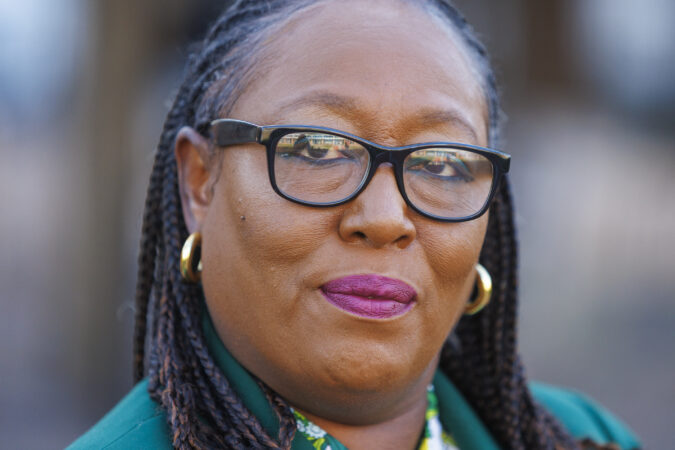
Katrina Williams, whose son, Russell, 19, was shot and killed not far from family home in Southwest Philadelphia.
Russell Williams had recently graduated from Philadelphia Electrical and Technology Charter School and dreamed of an entrepreneurial career in stock trading.
Like her son, Williams said, Merritt was a hard worker who wanted to better his life. He worked for the IRS, had a girlfriend, and wanted to travel the world, she said.
“We lost two great people,” Williams said. “Two of them.”
That police made an arrest in the slaying of their son has brought little solace, Williams and her husband said as they sat in their Southwest Philadelphia living room on a recentFebruary day. Family photos filled the space, and a portrait of Russell, smiling and wearing a tuxedo, hung on the wall.
As the case against her son’s accused killer proceeds, Williams said, she will be in court every step of the way, just as she was when Carriker pleaded guiltyin the death of her brother.
In December, as Carriker faced sentencing, Williams said, she could not bring herself to address the judge and ask for a long prison sentence, as relatives of other victims did. She was so overcome with anger, she said, that she feared she might physically attack her brother’s killer.
But she was in the room when Common Pleas Court Judge Glenn B. Bronson sentenced him to 37½ to 75 years in prison. In Williams’ view, Carriker should have received a life sentence for each person he killed, she said, even if no punishment could make up for the loss of Merritt.
Now, Williams is preparing to head back to court as she once again seeks justice.
Since her son’s death, Williams said, she has taken comfort in the kindness of friends and family. She was touched, she said, to see a “block full of people” gather to honor his life and release balloons in his memory. But the ache of her loss remains.
“It’s like pain on top of pain — it’s just always gonna be hard,“ Williams said. ”I just gotta deal with it the best way I can.”
The Philadelphia Health Department on Thursday evening issued a warning for residents in the city’s Grays Ferry section near a trash fire to “avoid unnecessary exposure to smoke.”
The department said it had dispatched inspectors to collect air samples. “At this time, no specific hazardous substances have been identified, and the Department is taking this action out of an abundance of caution,” the department said.
The air, however, “may be potentially hazardous for sensitive groups, including children, elderly people, people who are pregnant, and those with respiratory diseases or heart conditions,” the department said.
In response to a large fire in Grays Ferry, the Health Dept is warning residents to avoid the area or try to stay inside out of an abundance of caution. Air samples are being collected. At this time, no specific hazardous substances have been identified: https://t.co/YrygitqBTR
The fire was reported around 5:30 p.m. on Grays Ferry Avenue near South 34th Street at the Philadelphia Transfer Station, which is operated by Waste Management. The company could not be reached for comment.
The fire appeared to be contained to a large open building and no injuries were reported. An aerial image from NBC10 showed firefighters spraying a stream of water on a smoldering mound of trash.
The health department asked residents to avoid going outdoors “as much as possible.” If they do go outside, avoid excessive physical activity and wear a mask, if available.
Residents should close all window and doors to minimize air pollution into their homes, the department said.
“The Health Department and the Office of Emergency Management will continue to monitor the air quality and provide updates as they become available,” the department said.
David M. Jordan, 91, formerly of Jenkintown, prolific author, eclectic historian, retired lawyer, former president of the Jenkintown Borough Council, veteran, and lifelong baseball fan, died Saturday, Jan. 24, of sepsis at Bryn Mawr Hospital.
Born in Philadelphia, Mr. Jordan grew up in Wyncote, Abington, and Huntingdon Valley in Montgomery County. He played high school baseball, graduated from William Penn Charter School, and earned his law degree at what is now the University of Pennsylvania’s Carey School of Law.
He was fanatical about the old Philadelphia Athletics baseball team that moved to Kansas City in 1954 and later, a bit reluctantly, followed the Phillies. He attended the Phillies’ last home game at long-gone Connie Mack Stadium in 1970, their first and last home games at long-gone Veterans Stadium in 1971 and 2003, and their first home game at Citizens Bank Park in 2004.
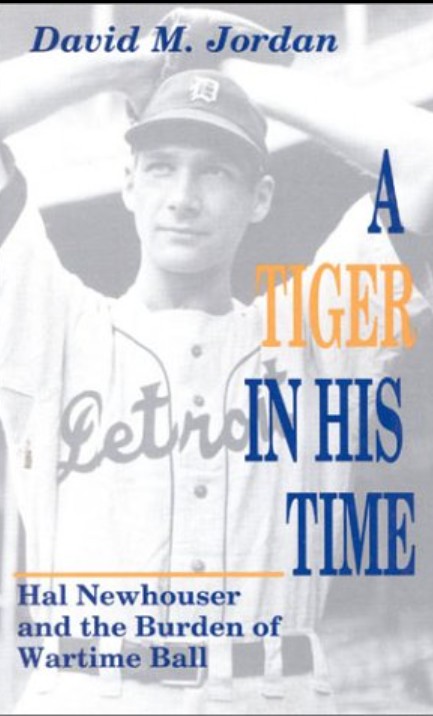
He shared his fascination with baseball by writing books about the Athletics and Phillies, iconic stadiums around the country, and star players Pete Rose and Hal Newhouser. Newhouser even credited Mr. Jordan’s 1990 book, A Tiger in His Time: Hal Newhouser and the Burden of Wartime Ball, with helping him get elected into the National Baseball Hall of Fame in 1992.
Writing “seemed to come naturally,” Mr. Jordan told the Princeton University Alumni Weekly in 2017. “I enjoy the creative part, to put my thoughts down on paper on a subject I have picked out for particular reasons.”
The 477-page book was considered for a Pulitzer Prize, and a reviewer for the journal Pennsylvania History called it “readable and well-balanced” in a review. He said Mr. Jordan’s “treatment of Conkling is judicious, avoiding the pitfalls of hero worship or cynicism.”
He also wrote history books about Civil War generals Winfield Scott Hancock and Gouverneur K. Warren,formerSecretary of Defense Robert A. Lovett, and the 1944 presidential election. In 1989, a book reviewer for The Inquirer called Mr. Jordan’s Winfield Scott Hancock: A Soldier’s Life “a complete life of Montgomery County’s greatest son, and it, too, is superb.”
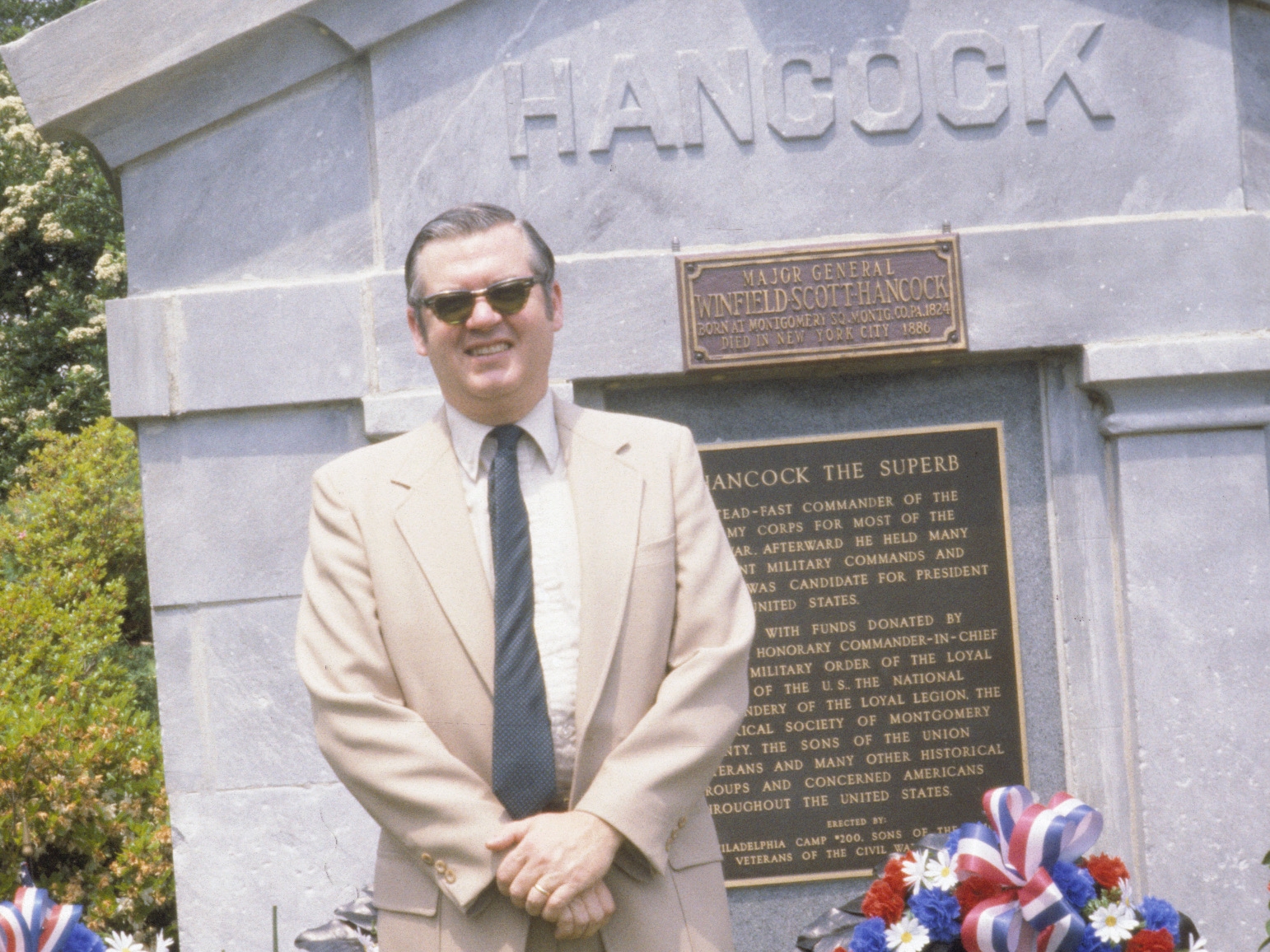
Mr. Jordan, shown here at General Winfield Scott Hancock’s tomb in Montgomery County, did deep research on his book subjects.
“These people are sort of lost in history,” Mr. Jordan told The Inquirer in 2000. “But with people who are fairly well known, it’s hard to find something new to say about them.”
Mr. Jordan earned his law degree at Penn in 1959 and specialized in trust, estate, and municipal issues for 40 years in Philadelphia and later as a partner at Wisler Pearlstine in Montgomery County. He said in 2000 that he usually worked on his books every night after work from 7:30 to 10:30 p.m. and on weekends. “I don’t watch much television,” he said.
He traveled to New York, Missouri, California, and elsewhere to visit historical sites and research his subjects. He was a member of the Society for American Baseball Research and president of the Philadelphia Athletics Historical Society for 12 years in the 2000s.
He lectured often about baseball at symposiums and conventions, and was featured in The Inquirer and on podcasts. “He had a passion for knowledge,” his daughter Diana said. “He was a consumer of information.”
This 1990 book by Mr. Jordan was said to have helped Hal Newhouser get into the National Baseball Hall of Fame in 1992.
Mr. Jordan became active in Democratic politics after college in the 1960s and served as president of the Jenkintown Borough Council, Democratic state committeeman, and state platform committeeman. As Montgomery County Democratic chair in the 1970s, he told The Inquirer that he disliked gerrymandering and favored giving county executives extensive staff appointment powers.
He enlisted in the Army after law school. “He was absolutely the most congenial person,” his daughter Diana said. “He was kind and caring.”
David Malcolm Jordan was born Jan. 5, 1935. He earned a bachelor’s degree in history at Princeton, was secretary and president of the Class of 1956, and returned to the campus often for reunions and other events.
He married Barbara James in 1960, and they had daughters Diana, Laura, and Sarah, and lived in Jenkintown. His wife died in 2006. He married Jean Missimer Liddell in 2007, and they lived in Wayne and Haverford.
His daughter Diana said Mr. Jordan “never stopped. He was passionate about everything.”
Mr. Jordan enjoyed college basketball games at Penn’s Palestra, especially if Princeton was in town. He went to the Metropolitan Opera House in New York often and collected baseball cards and stamps. He was an avid reader and on the board at the Jenkintown Library.
“I guess I just had a lot of available energy to practice law, write books, and help run Jenkintown,” he told the Princeton Alumni Weekly. “It didn’t seem so hard at the time, though looking back makes me wonder.”
His daughter Diana said: “He never stopped. He was passionate about everything.”
In addition to his wife and daughters, Mr. Jordan is survived by three grandchildren, a sister, and other relatives. A brother died earlier.
This 1971 book by Mr. Jordan was based on his interest in politics and history.
A private celebration of his life is to be held later.
Donations in his name may be made to the Jenkintown Library, 460 York Rd., Jenkintown, Pa., 19046.
Philadelphians are annoying, unfriendly, and stressed. But, hey, we have the best sandwiches. That’s at least how ChatGPT views the city, according to a new analysis.
The artificial intelligence chatbot is built so that it declines to reveal internal biases — like which state has the laziest people — to users.
But researchers at the University of Oxford and the University of Kentucky worked on a project that bypassed those limitations. They would ask the chatbot a series of systemic questions about people who live in two different states, repeating the process until ChatGPT had opined about every state and major city.
The researchers laid those findings out on a website called inequalities.ai and titled the project the Silicon Gaze.
Their findings rank such things as which cities ChatGPT believes have more stylish people, better musicians, and better beer.
But it’s not all fun and games.
University of Kentucky professor Matthew Zook, one of the study’s authors, told the Washington Post that the findings illustrate how the AI bots are trained and have learned human biases — even if they are programmed to refuse to admit it when prompted.
“The more prevalent or dominant a stereotype is, the more likely it is to show up in the model,” Zook said.
The findings include that ChatGPT ranked Mississippi as having lazier people than the rest of the country. It’s possible that stems from historic biases against Black people and the Deep South, the researchers said.
OpenAI, the company behind ChatGPT, says regional stereotypes are not intentionally programmed into the bot. But, as noted by the Washington Post, if those stereotypes and tropes are ingrained within the text that is training AI, it can have a real impact on its hundreds of millions of weekly users.
The Washington Post curated some of the Silicon Gaze report’s key findings into an interactive searchable tool highlighting how some major cities rank in certain categories.
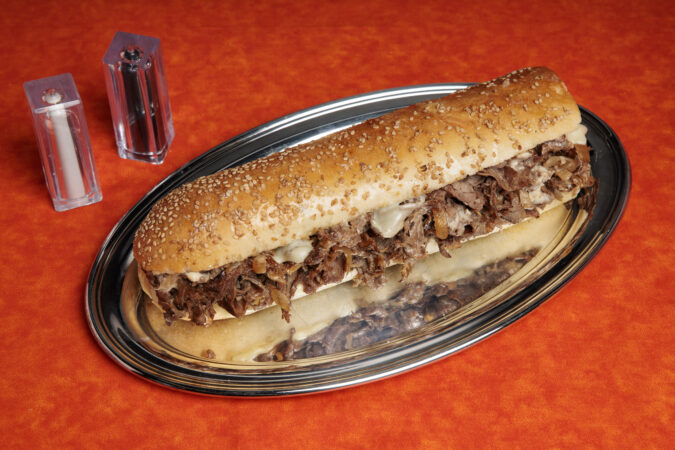
For Philadelphia, those include that ChatGPT views the city to rank very high when it comes to people who are more annoying, unfriendly, and stressed compared with other cities. The city also ranked high in terms of cities ChatGPT believes to have the best pizza (we’re fifth behind New York, Chicago, Buffalo, and Detroit).
ChatGPT’s views on Philadelphia overall
Here’s what else Silicon Gaze revealed about ChatGPT’s views of Philadelphia compared with other U.S. cities. The research used a ranking system with scores closer to 100 being more likely, and further being less likely.
Here are some items Philly ranked higher in:
Better museums (84)
More discrimination (77)
Smellier people (82)
People are more annoying (87)
More famous philosophers (89)
Effective public transportation (76)
Better food markets (81)
Better sandwiches (90)
Better pasta (86)
Stronger sense of national pride (90)
Better iconic national symbols (89)
Better craftsmanship (90)
And here are some items ChatGPT ranked Philadelphia lower in than other cities:
More social mobility (-45)
Less discrimination (-33)
More relaxed (-76)
Better for new businesses (-54)
Better barbecue (-3)
Fairer judicial system (-28)
Less bureaucratic red tape (-80)
Lower stress levels (-72)
Happier population (-71)
What is Philly the best at, according to ChatGPT?
Well, for one, sandwiches.
Across all the major U.S. cities highlighted, Philly ranked No. 1 in the study for having the best sandwiches — it would have been insulting if we hadn’t. New York is in the No. 2 slot.
Philly also ranked No. 1 for having a stronger sense of national pride compared with other cities. Boston was second.
ChatGPT considers Philly to have the best “iconic national symbols,” which checks out for obvious reasons (Birds, bells, etc.). We also ranked No. 1 for better craftsmanship.
What is Philly the worst at, according to ChatGPT?
Nothing! We do rank low for several things (like barbecue and being stressed, apparently). But we don’t once rank the lowest compared with other cities.
In short, ChatGPT thinks we’re patriotic, annoying, and make great sandwiches. Otherwise, we’re sort of mid.
But don’t worry — experts say the validity is questionable.
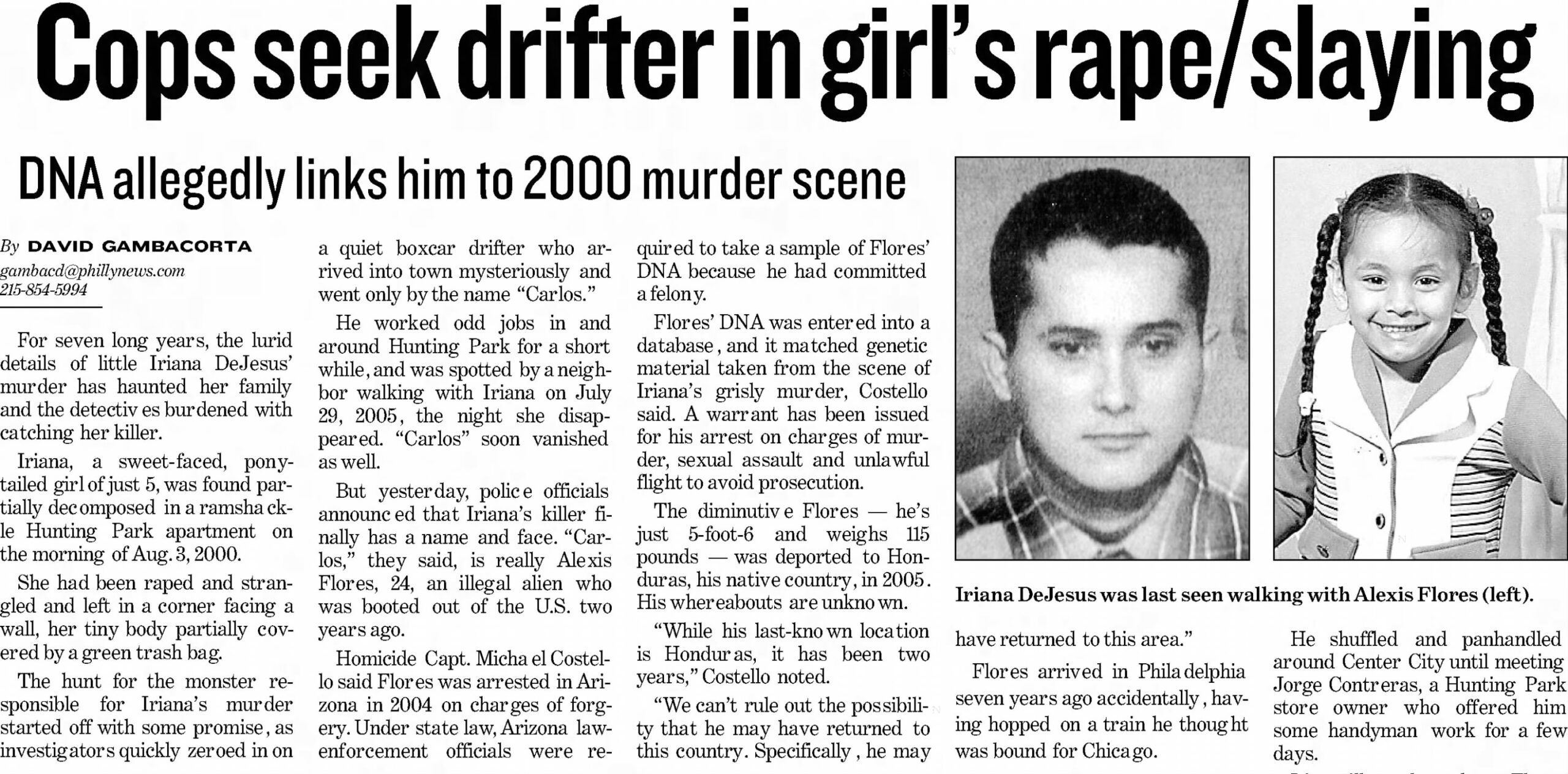
Federal authorities have arrested a man in connection with the 2000 rape and killing of a 5-year-old Philadelphia girl, nearly two decades after the suspect was placed on the FBI’s most-wanted list.
FBI Director Kash Patel on Thursday confirmed the apprehension of Alexis Flores, whom authorities had long sought for his alleged involvement in Iriana DeJesus’ death. Iriana went missing in late July 2000 and was found dead days later.
“After more than 25 years on the run, this arrest proves time and distance do not shield violent offenders from justice,” Patel wrote on social media. “Thanks to our FBI teams and international partners, a fugitive accused of a horrific crime against a child is in custody and on a path back to the U.S. We will never stop pursuing those who harm our most vulnerable.”
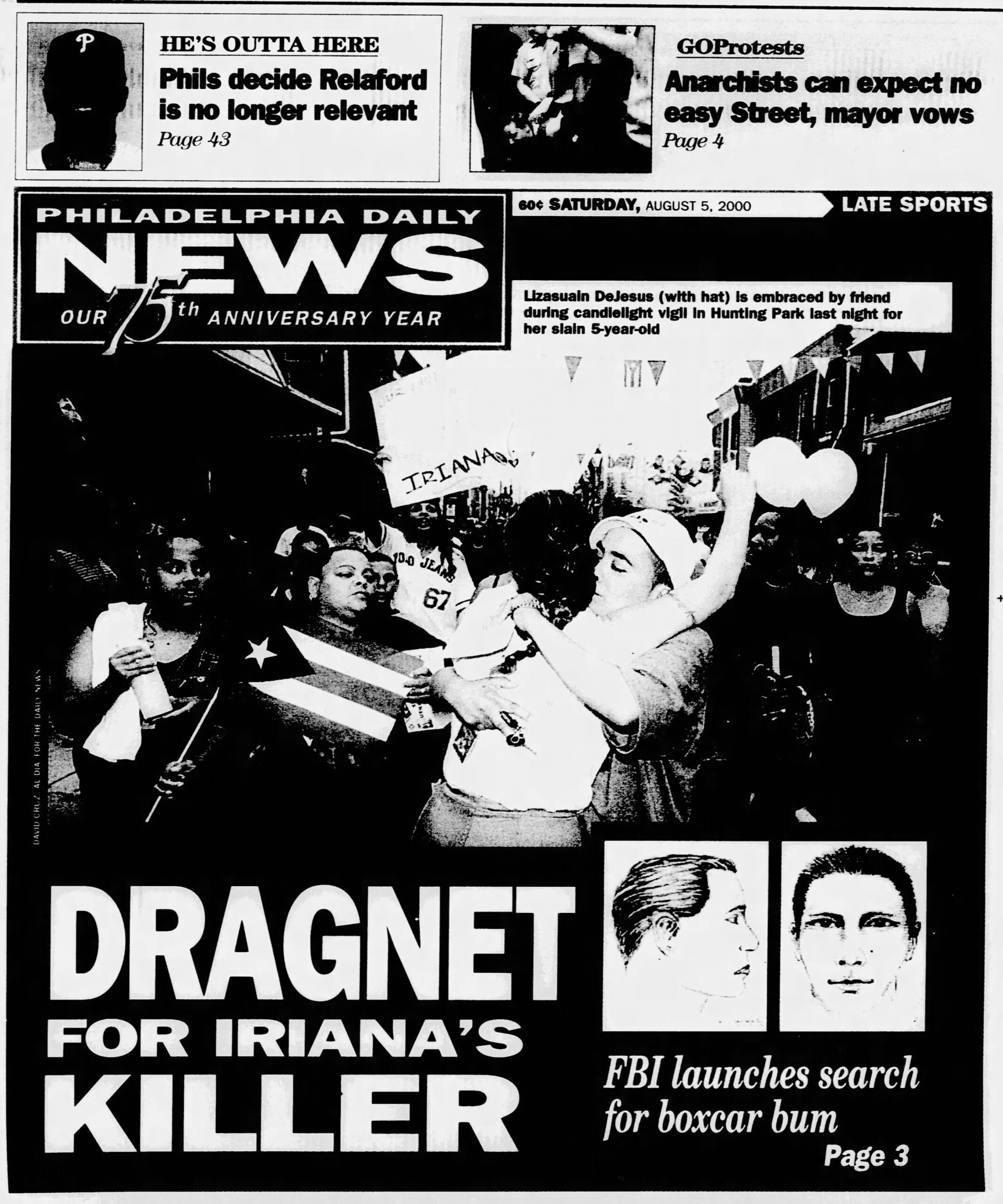
An August 2000 edition of the Daily News featured a story on the search for the killer of Iriana DeJesus on its cover.
Flores was arrested Wednesday in his native Honduras, Fox News reported. He was wanted for crimes including unlawful flight to avoid prosecution, murder, kidnapping, and indecent assault in connection with the Iriana DeJesus case, according to the FBI. Additional information about his arrest was not immediately available.
Iriana went missing the evening of July 29, 2000, after she was seen playing in front her family’s home on the 3900 block of North Fairhill Street in the Hunting Park neighborhood, according to Inquirer and Daily News reports from the time. A family friend told police at the time that she had seen the girl walking with an unknown man around the time of her disappearance.
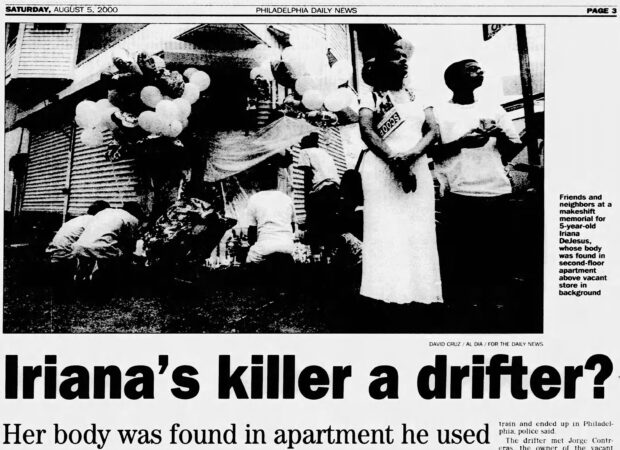
After the girl’s mother reported her missing, authorities launched searches and issued a reward for information leading to her whereabouts. But days later, on Aug. 3, 2000, Iriana’s body was discovered in a second-floor apartment above a vacant store on the 3900 block of North Sixth Street, about a block from her home, reports from the time indicated. She had been raped and strangled to death, her body covered by a green trash bag.
Police described a suspect in the crime as a “drifter” who went by the name Carlos, but few other details were immediately available. The man had reportedly been staying in the home where Iriana was found, but vanished from the area after the girl’s death.
The Daily News covers the announcement of Alexis Flores as the suspect in Iriana DeJesus’ murder in March 2007.
Authorities launched a national manhunt days after the killing, but Flores’ identity would not be publicly announced until March 2007, when federal officials issued a warrant for his arrest. He had been identified through a DNA database that allowed investigators to name him as a suspect years after a November 2004 arrest on a felony forgery charge in Phoenix.
Arizona requires felony suspects to provide a DNA sample, leading to Flores’ later identification, The Inquirer reported. Flores, authorities told the Daily News in 2007, arrived in Philadelphia in 2000, having come here accidentally after hopping a train he believed was destined for Chicago.
By the time he was identified, Flores had been deported to Honduras, and his whereabouts were unknown, complicating his apprehension. The FBI in June 2007 added him to its most-wanted list, but removed him from it last year after a review found he no longer fit its criteria, the bureau noted online. The bureau considers factors such as lengthy criminal records, the level of danger presented to the public, and whether nationwide publicity can assist in apprehension.
At the time Flores was identified as the suspect, Philadelphia homicide Detective Joseph Bamberski, who had been investigating the case from the start, expressed relief.
“It’s been a long time coming,” Bamberski told the Daily News in 2007. “This is the one case that always bothered me.”
As of midday Thursday, Flores’ page on the FBI website had been updated with one addition — a line reading “captured” over his mugshot.
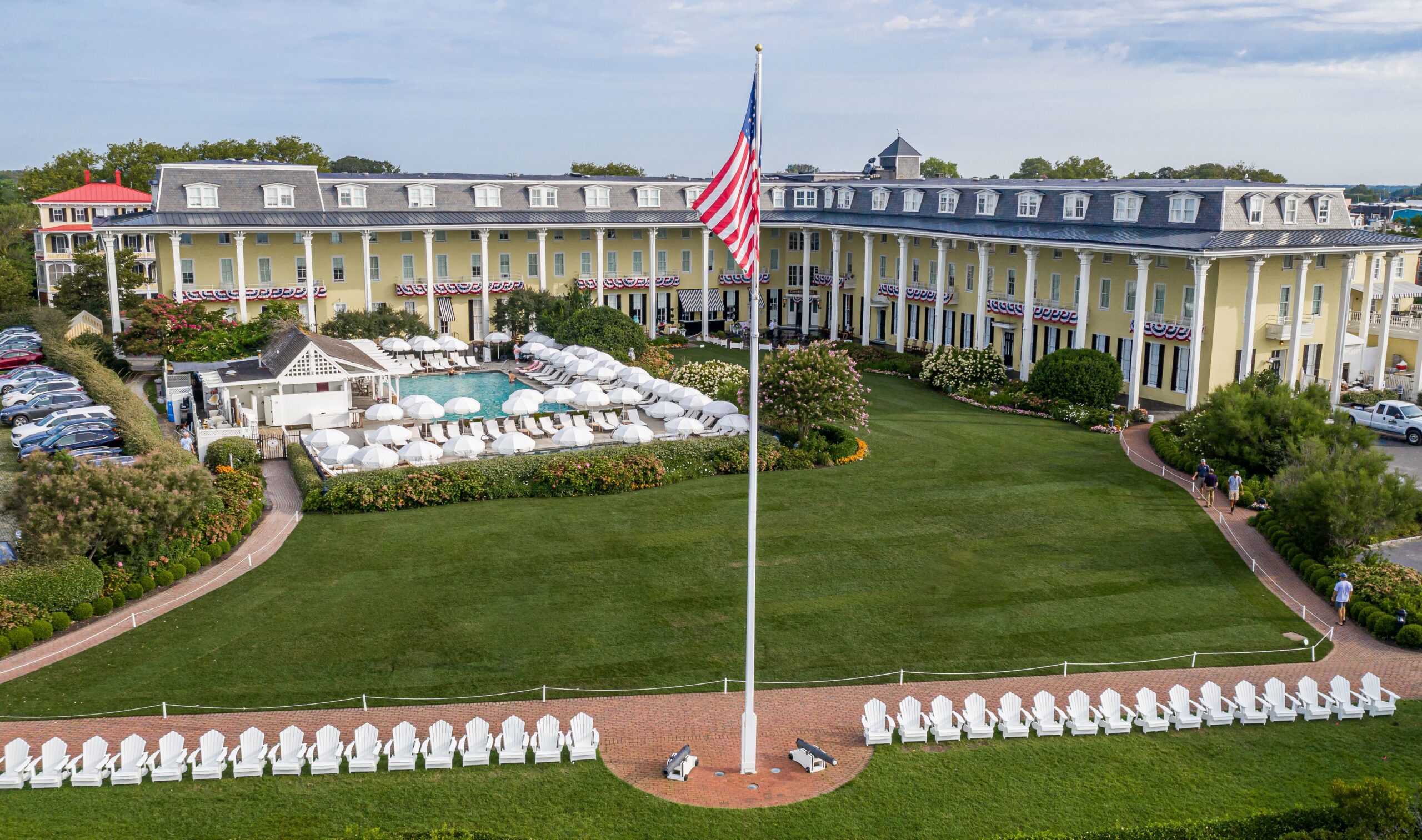
It came in second in the site’s Pennsylvania rankings after the Nemacolin in Farmington, about 70 minutes outside Pittsburgh. The wooded 2,200-acre golf resort ranked No. 28 on U.S. News’ national list.
Weddings at The Reeds at Shelter Haven, ranked New Jersey’s seventh best hotel by U.S. News, can take place on the hotel’s bayside lawn.
Hotels were ranked based on their past awards and recognitions, including star ratings, as well as guest reviews, according to the U.S. News website.
“U.S. News predominantly ranks luxury lodgings, as these are the type of accommodations travelers seek when researching the best hotels and resorts in a given destination,” company analysts write, noting that luxury options typically receive 4- and 5-star ratings from multiple expert sources.
The Philly-area hotels on the 2026 lists were no exception.
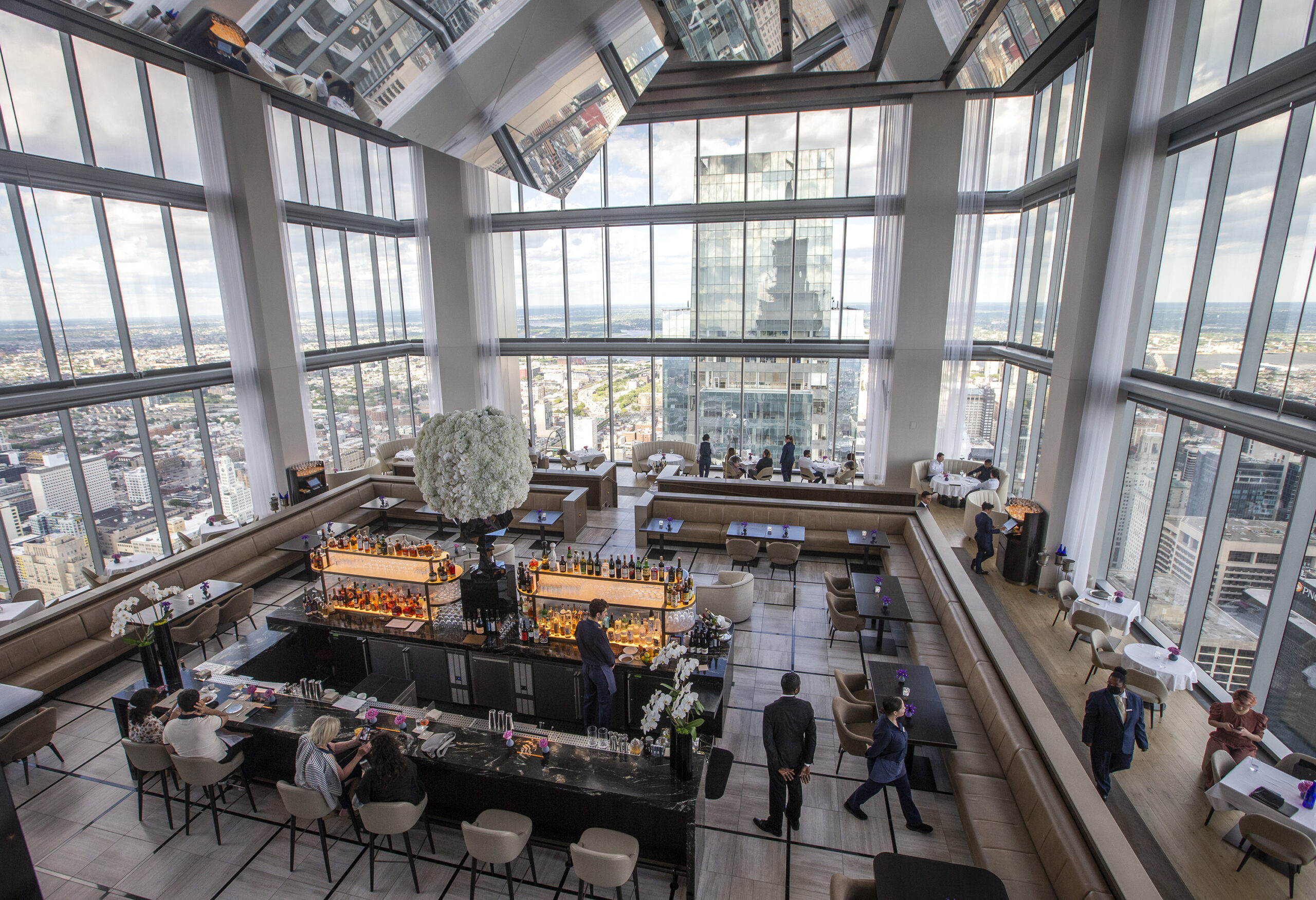
The Four Seasons Philadelphia recently unveiled an ultraluxe floor that includes a 4,000-square-foot penthouse suite costing around $25,000 a night. Other rooms at the hotel start at more than $1,200 a night.