Category: Philadelphia News

  • There were no kings, but there was music royalty at the Philly protest this weekend

    There were no kings, but there was music royalty at the Philly protest this weekend

    Former Talking Heads front man David Byrne, in Philadelphia for a three-night stop on his latest tour, joined the “No Kings” protest in Philadelphia on Saturday to show support for the anti-Trump movement and snap a few photos with fans along the way.

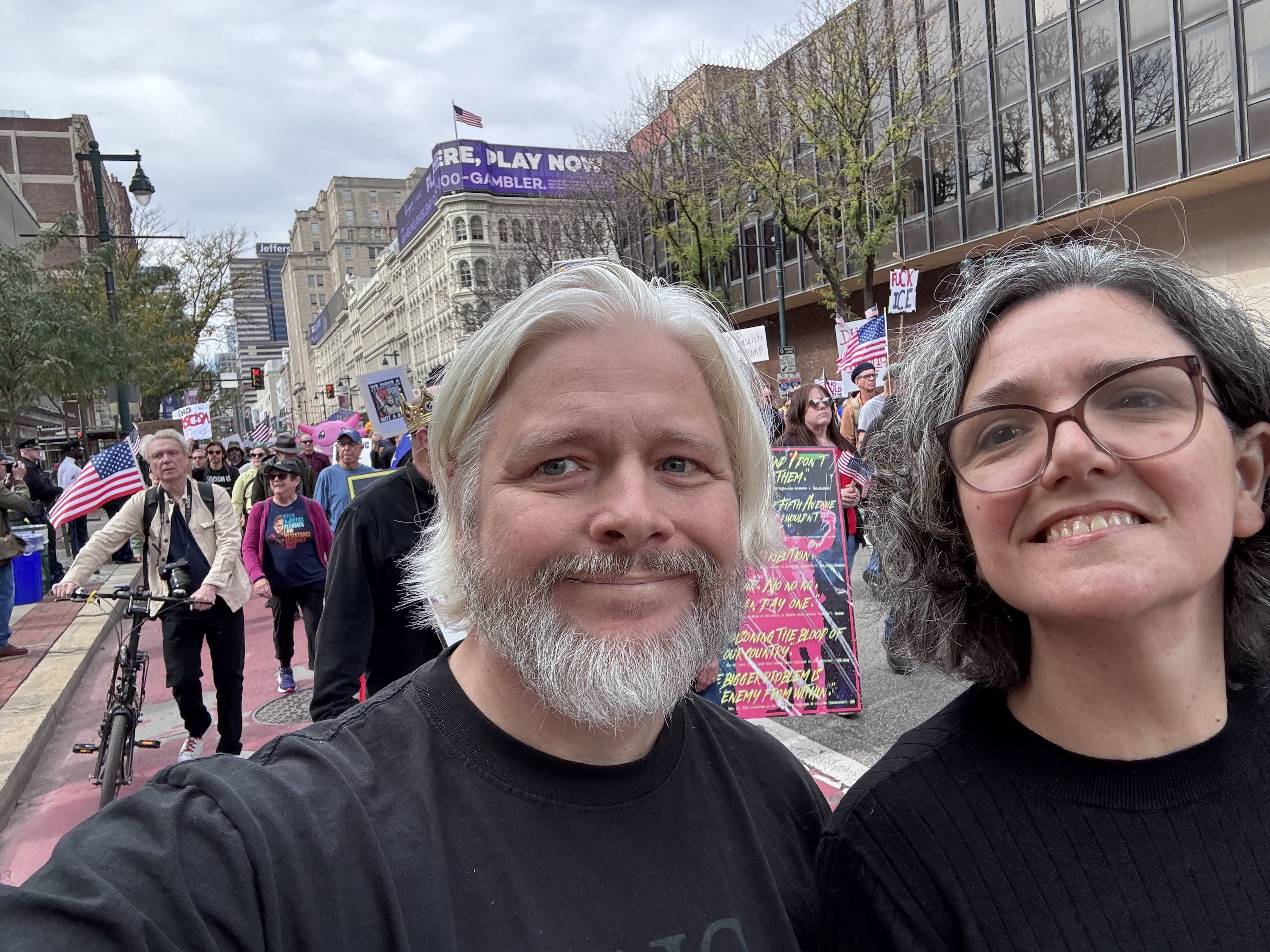
    Several marchers posted photos of themselves on social media with Byrne, who rode a bike during the march, which went from City Hall to Independence Mall.

    Ryan Godfrey, a 54-year-old software solutions engineer, was among those who chatted with Byrne, shortly after surreptitiously taking a photo of Byrne behind him.

    Godfrey attended one of Byrne’s concerts on Thursday and recognized the singer when he saw him on his bicycle alongside marchers on Market Street.

    “I knew he was a big bike guy — and we had just seen him on Thursday,” Godfrey said. He decided to introduce himself.

    “I said, ‘Hi, I really appreciated your concert the other night. It was amazing; thank you so much for that.’ He said, ‘Of course, thanks for enjoying it,’ and then I said, ‘And also thank you very much for being here today — this is very important, that you’re doing this,’” Godfrey recalled.

    “And he said, ‘Of course. I wanted to be here for this.’”

    West Philadelphia residents Ryan Godfrey and Jessica Lowenthal pose for a selfie, surreptitiously photographing singer David Byrne in the background on the left, during the “No Kings” march on Oct. 18, 2025, on Market Street in Philadelphia.

    Godfrey regretted not asking Byrne one question: How were the videos at his concert projected around the stage and on the floor without the performers casting shadows on them?

    “It was a kind of magic trick that I don’t really understand,” Godfrey said. Godfrey has been a fan of Byrne’s since the ‘80s, but his interest was renewed when he saw the 1984 Talking Heads concert film Stop Making Sense in a theater last year.

    “I was sorry that I had waited that long because it was almost certainly the greatest concert film I’ve ever seen,” he said.

    He said Byrne was anything but aloof with marchers.

    “He was very genial, very kind and very friendly and open to interactions from everyone around him,” he said

    Another fan quoted Byrne in the sign they carried in the march, then got to hold the sign next to a laughing Byrne. The message? “Love & acceptance are now ‘punk ideologies.’”

    Byrne has been critical of Trump both in his music and in interviews and writings. During Saturday’s show, he mentioned the “No Kings” rally, drawing applause from the crowd, according to social media posts.

    One Bluesky poster said Byrne — who can be seen carrying a camera during the protest — showed photos of himself and his band at the march on the stage backdrop during Saturday night’s concert.

  • Thousands turn out in Philly for the ‘No Kings’ protest

    Thousands turn out in Philly for the ‘No Kings’ protest

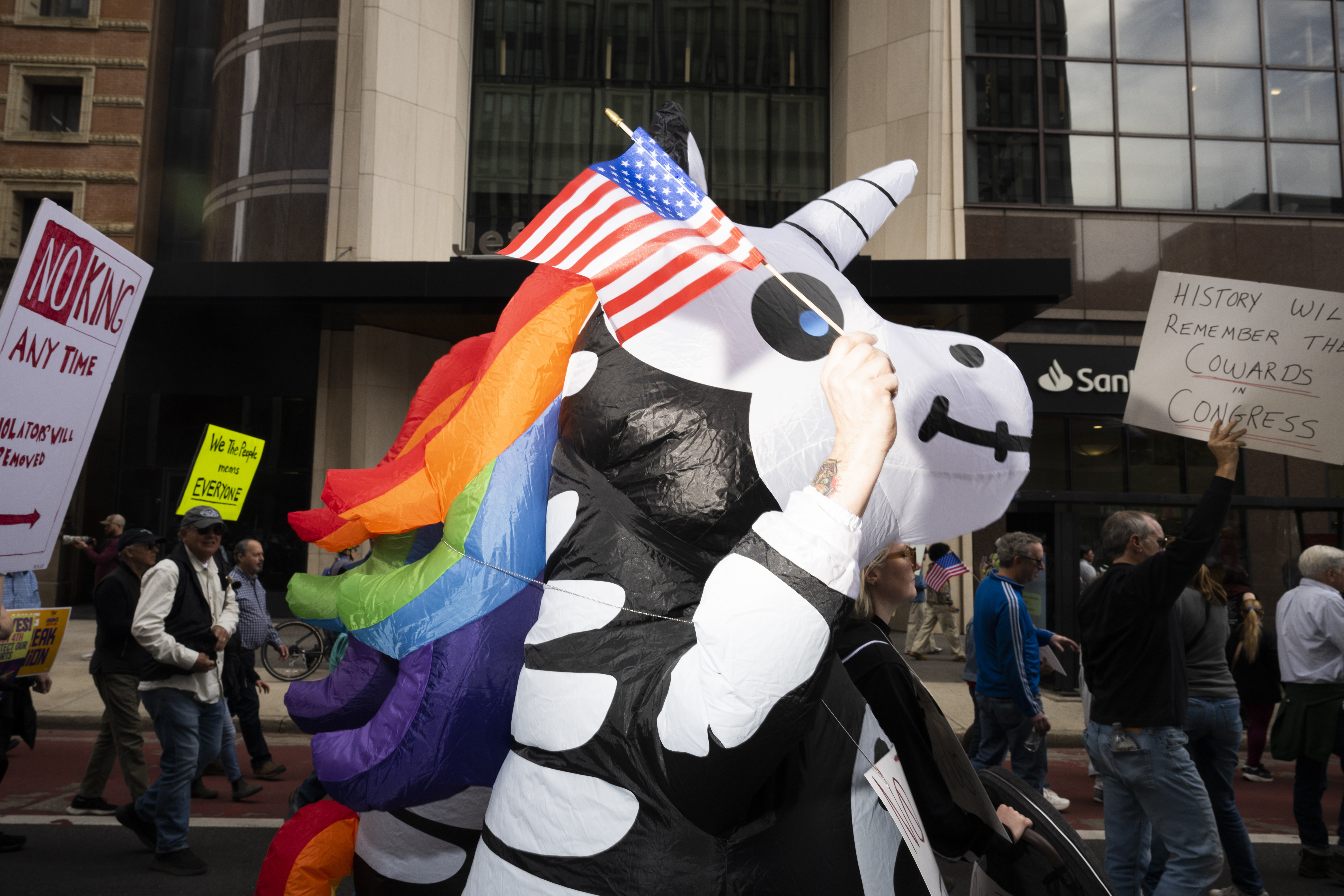
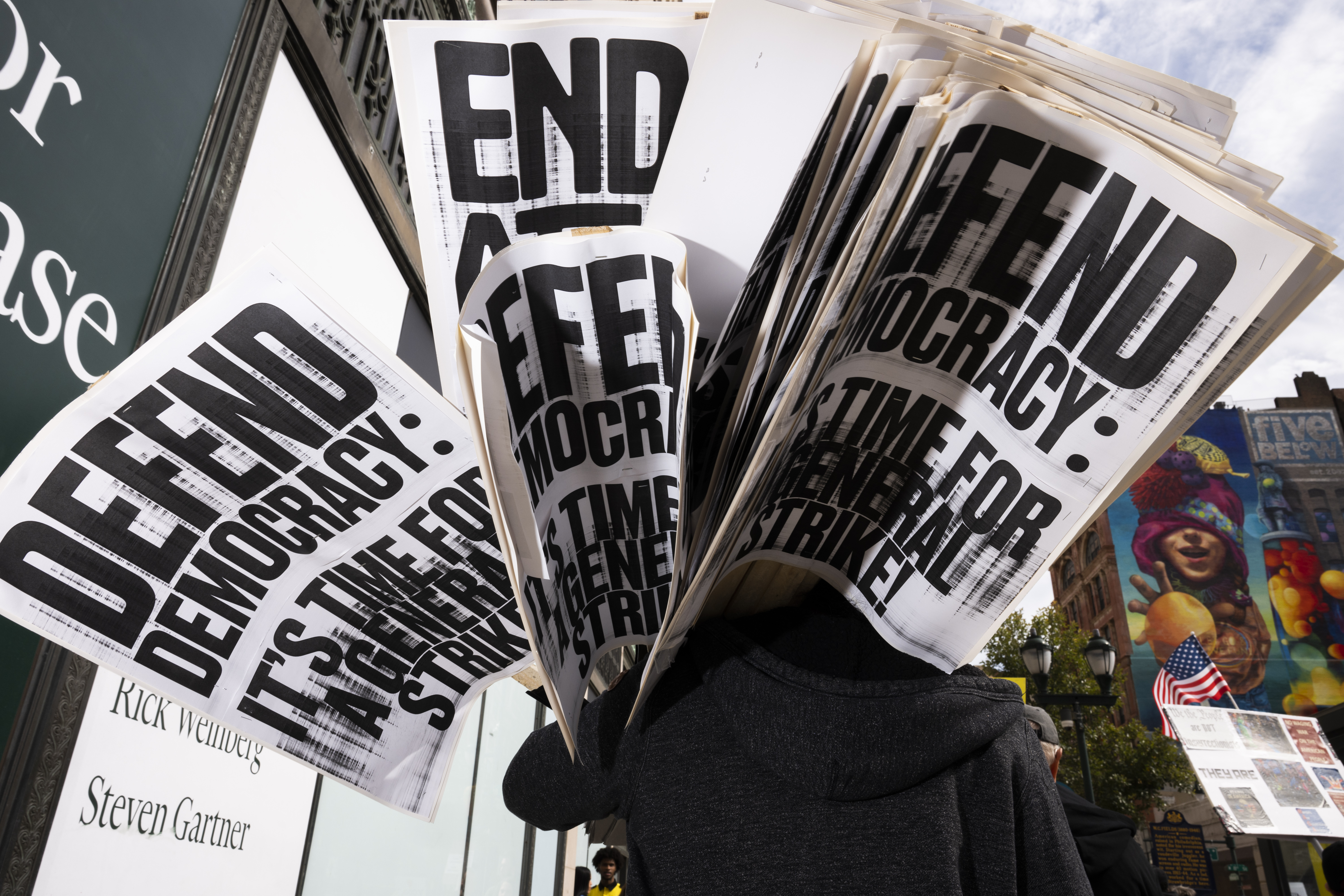
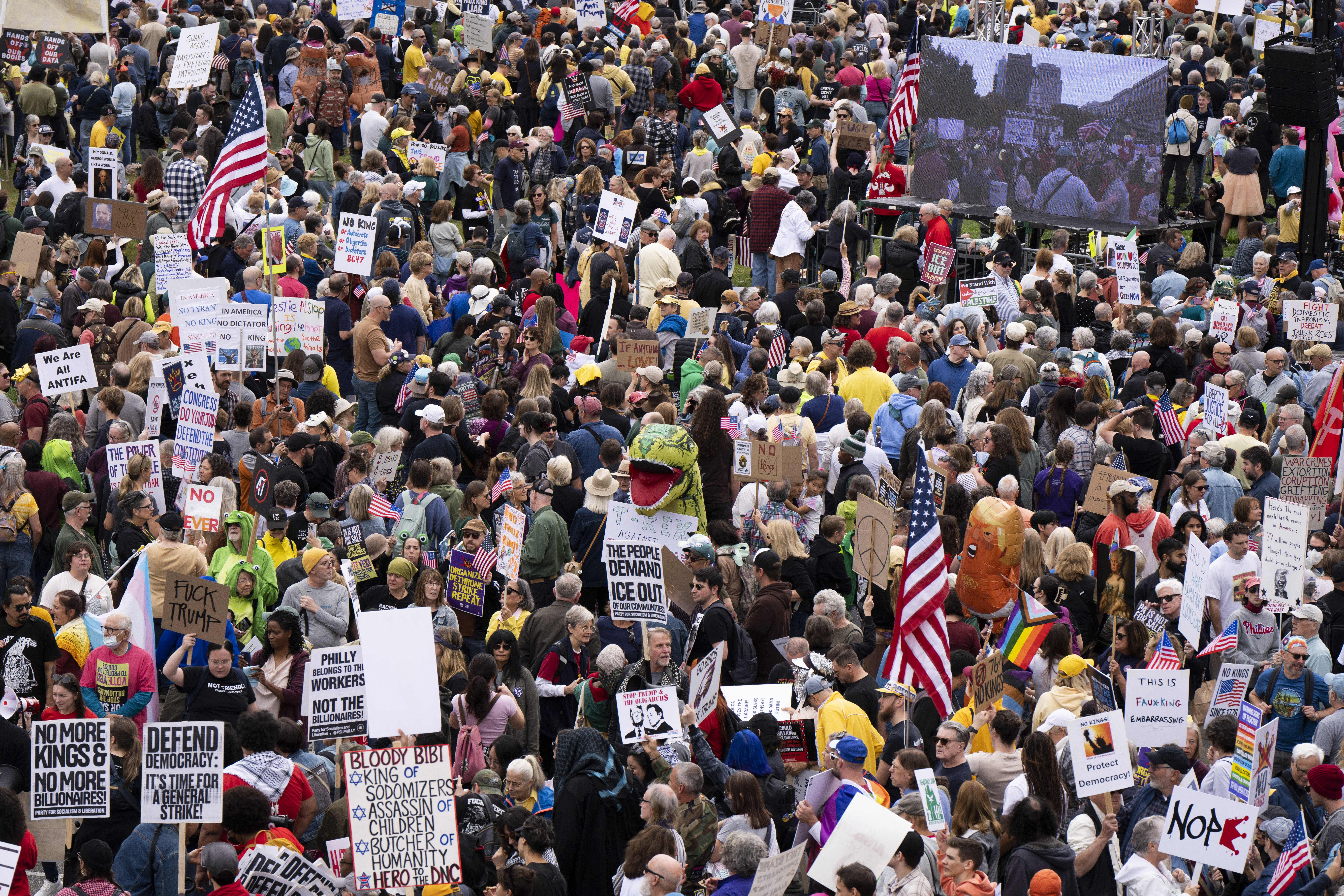
    Joining demonstrators around the country, thousands gathered Saturday in Philadelphia to protest President Donald Trump’s actions that they contend are threatening to undermine 250 years of the nation’s democratic traditions.

    “I think everybody needs to know that we’re not going to just sit back,” said Sherri King, who arrived at the “No Kings” rally in Center City wearing an inflatable chicken costume.

    On a mild October afternoon when the weather was drawing no protests, the event began in a festive atmosphere with the sounds of clanking bells as participants gathered at City Hall — some, like King, wearing pre-Halloween regalia — and marched to Independence Mall.

    Demonstrators gather for a’ No Kings’ rally in Philadelphia on Saturday, Oct. 18, 2025.

    “It’s a very large, orderly crowd,” said Police Capt. Frank Palumbo. The three-hour march and rally, which began at noon, actually ended on time.

    Said Thomas Bacon, a 72-year-old Vietnam veteran from North Philadelphia: “It’s peaceful. No division. Just opposition.”

    Under Trump, he said, “the whole world is turned upside down.”

    In what was the third mass anti-Trump protest this year, several organizers were taking credit, including Indivisible, MoveOn, and the 50501 Movement.

    The demonstrators’ menu of grievances included aggressive raids by Immigration and Customs Enforcement, Trump’s budget and efforts to limit free speech, and the government shutdown that began Oct 1.

    Organizers of the more than 2,500 demonstrations nationwide say the shutdown in particular is a dangerous move toward authoritarianism.

    Trump and congressional Republicans are blaming Democrats for refusing to vote on a reopening.

    For his part, Trump spent the day of what fellow Republicans were calling “Hate America” rallies at his Florida mansion.

    Demonstrators gather for a’ No Kings’ rally in Philadelphia on Saturday, Oct. 18, 2025.

    At the Philadelphia protest, Laura Murphy, a 74-year-old retiree, said she was struggling with the “Hate America” concept. “It’s ridiculous,” she said. “What could be more American than being against kings?”

    Along with demonstrators, Democratic politicians were evident at events in Philly and elsewhere.

    With Democrats hoping to make significant gains in the 2026 election, the presence of party elected officials was evident at rallies in Philly and elsewhere. Among those who showed up in Philadelphia were area U.S. Reps. Mary Gay Scanlon, Madeleine Dean, and Brendan Boyle, along with U.S. Rep. Jamie Raskin of Maryland.

    Rallies were being held all over New Jersey, Pennsylvania, the region, the nation — even Spain, where a few hundred gathered in Madrid. About 5,000 people jammed the streets of West Chester.

    In Philly, Jerry Lopresti, who said he never had attended a protest in his 64 years, said: “There has to be a show of numbers. It’s important to show up.”

    Demonstrators gather for a ’No Kings’ rally in Philadelphia on Saturday, Oct. 18, 2025.

    Among those who showed up conspicuously was Michael Noonan, 48, of Northern Liberties. He was wearing a Tinky-Winky Teletubby costume as he walked off a Market-Frankford Line subway car.

    He said his outfit was a counterpoint to suggestions that the demonstrations might turn violent. “Nobody’s here to fight anyone,” he said, “nobody’s here to kill anyone.”

    Not everyone who showed up had issues with Trump.

    Patrick Ladrie, 20, who lives in Camden County, stood out in his Trump hat and “ultra MAGA” T-shirt that proclaimed “I love our king.”

    He said he crossed the Delaware River to “get a good viewpoint of what the American left is.”

    After engaging in debate with three protesters on matters that included Christianity and conservatism, Ladrie reported that the environment was not so bad.

    In fact, he said, it was one of the “most peaceful” debates he could recall. As one of his adversaries jogged away to meet up with his friends, Ladrie said, “Keep out of trouble.”

    The protest was a decidedly intergenerational affair, with some parents describing the event as a teachable moment, while others said it was their progeny who came up with the idea to attend. Danielle Pisechko, 38, carried her youngest, who wore orange butterfly wings, on her shoulders.

    Their sign read: “The only monarchs we want are butterflies.”

    Demonstrators gather for a’ No Kings’ rally in Philadelphia on Saturday, Oct. 18, 2025.

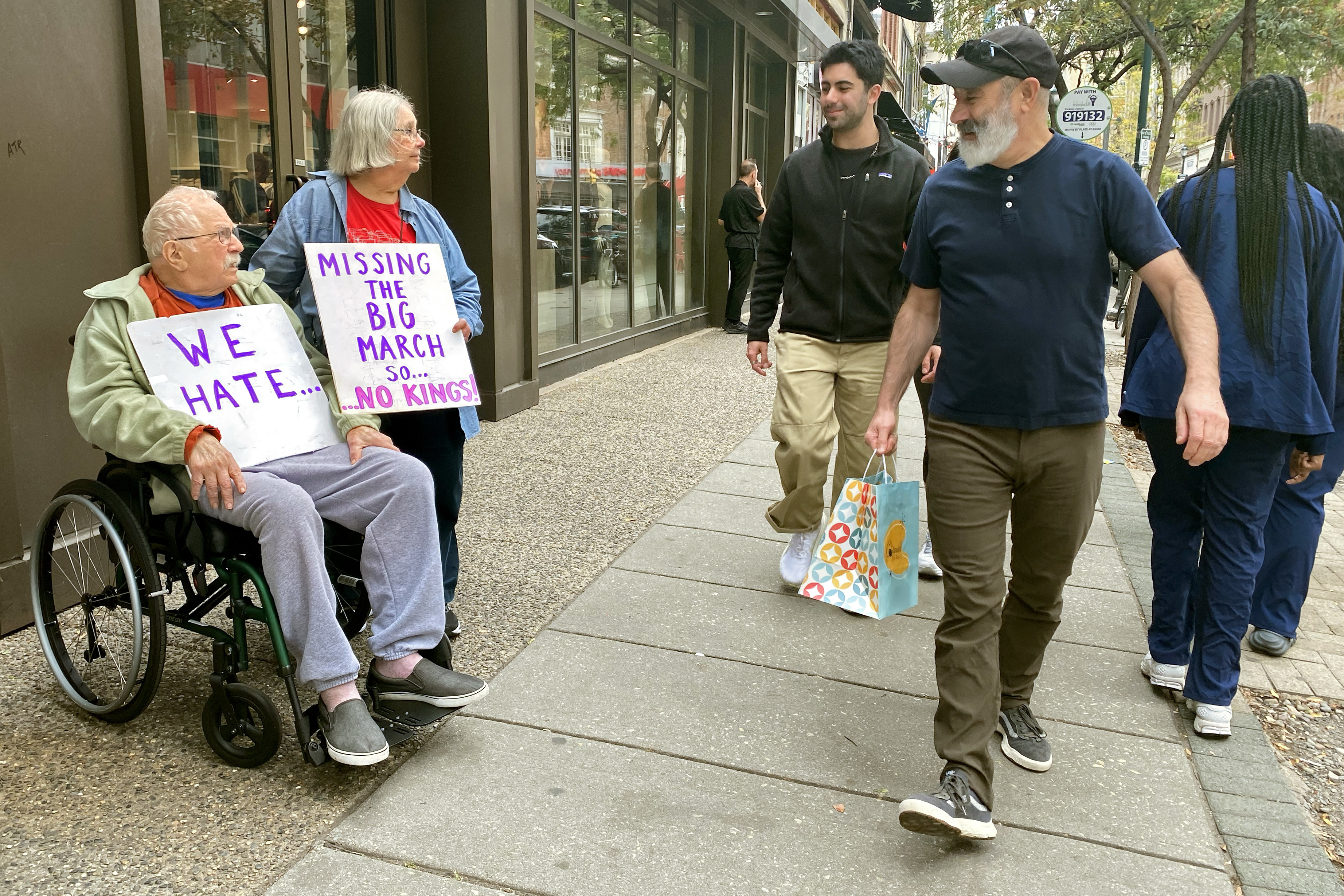
    The participants included Center City resident Reed Oxman, 66. Although his disability limited his movement, he and his husband sat on a ledge near City Hall as evidence of the diversity of the crowd. “It’s [about] representation and clearing all the lies about who is coming to this,” Oxman said.

    Lana Reckeweg, who lives at a North Philly women’s shelter, said her resources were seriously limited, but that didn’t stop her from finding cardboard and getting markers to make signs to give to other demonstrators.

    She said that over the last several months a handful of undocumented women have found sanctuary in the place she calls home, and seeing their struggles made her want to attend the protest on their behalf.

    “I have done a lot of crying. I see how it’s affecting them every day,” said Reckeweg, trying to keep her handwriting steady on a moving bus.

    “I am here because they can’t be. People need to wake up and realize it’s getting a lot more serious more quickly than expected.”

    As for what effect the rallies might have, “I would tend to doubt that the protests will have any immediate direct impact on the administration’s policies,” said David Redlawsk, chair of the political science and international relations department at the University of Delaware, but “they may work to embolden those who are opposed to Trump’s actions to continue to organize and respond.”

    Sam Daveiga, 15, attended her first protest, the Women’s March, when she was 7 years old. This time, she brought along her father, Ed. “Every voice counts,” the Philly teen said.

    “You can have a small voice, but the second you put it with everyone else who’s come out, it amplifies.”

    Staff writers Emily Bloch, Scott Sturgis, and Rob Tornoe contributed to this article, which contains information from the Associated Press.

    Fourteen blocks away from the “No Kings” rally on Independence Mall, Bert and Lynne Strieb stand (and sit) in silent protest Saturday, Oct. 18, 2025 outside their apartment building in the 1900 block of Chestnut Street, vicariously joining thousands of others in Philadelphia and in cities across the country in response to Trump’s masked ICE agents and the deployment of troops in American cities. The Striebs, both in their 80s, could not attend the June “No Kings” march as Bert was in the hospital, and Lynne said they “did not want to miss this one.”

  • Hundreds waited in line for the Pleasing Express | Scene Through the Lens

    Hundreds waited in line for the Pleasing Express | Scene Through the Lens

    There was a time — back when The Inquirer had multiple suburban bureaus — that photographers like myself who were assigned to the main newsroom on North Broad Street worked only in the city. (We’re now more like ride share drivers, going everywhere.)

    So I walked a lot more to cover news and events in Center City, and more often stumbled into things and sights that piqued my curiosity.

    Things like a long line.

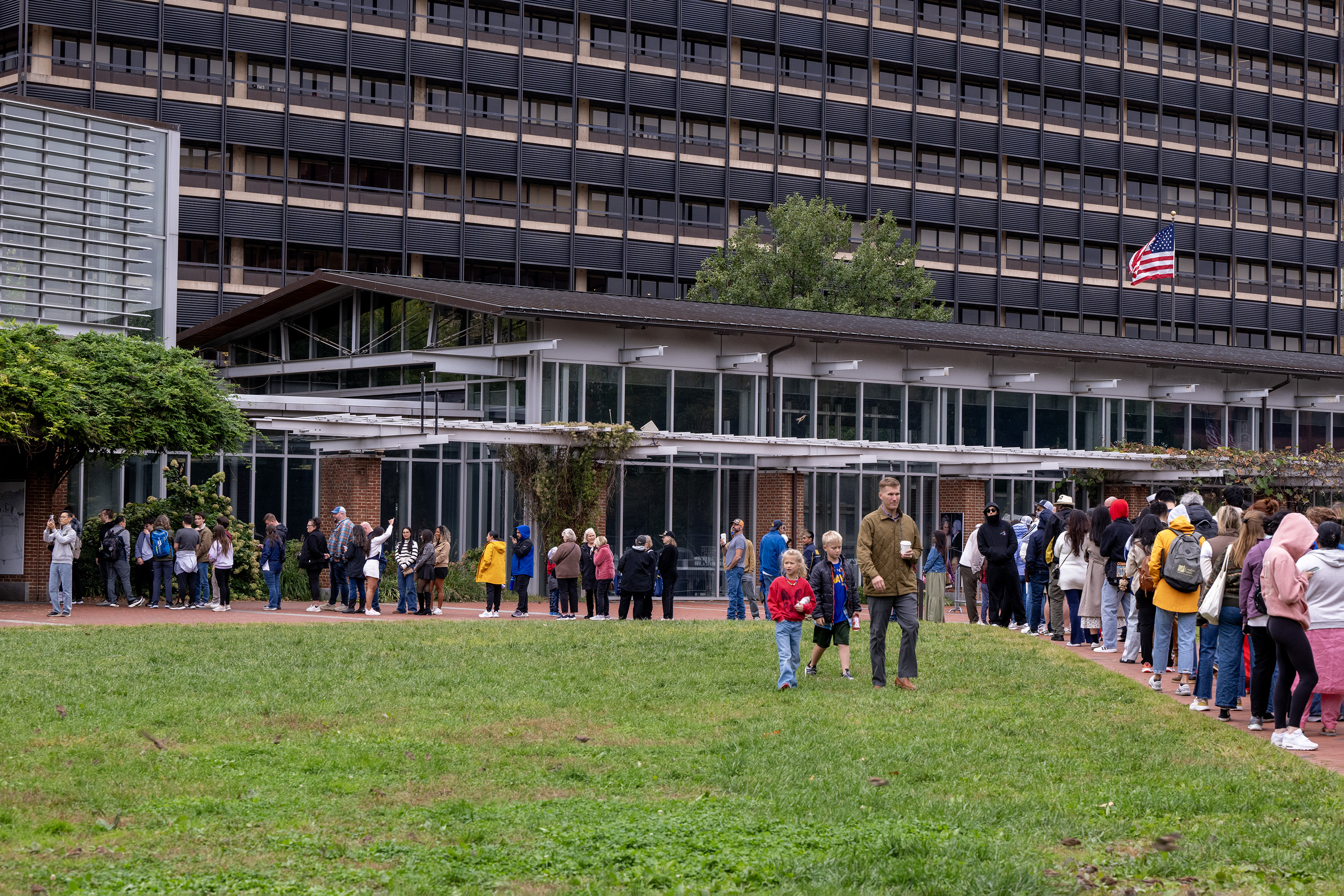
    Visitors queue up to get a glimpse through a single window in the Liberty Bell Center Oct. 12, 2025 while the building is closed due to the federal government shutdown.

    Years ago seeing one likely meant unhoused people were waiting as church folks or outreach advocates served dinner on the street. Or they were waiting for concert tickets or movie premiers (Beanie Babies?).

    I remember once questioning someone standing in a blocks-long line along Walnut Street and was flabbergasted to learn a new sneaker was dropping.

    Or for a device that combined a portable media player, a cell phone, and an internet communicator.

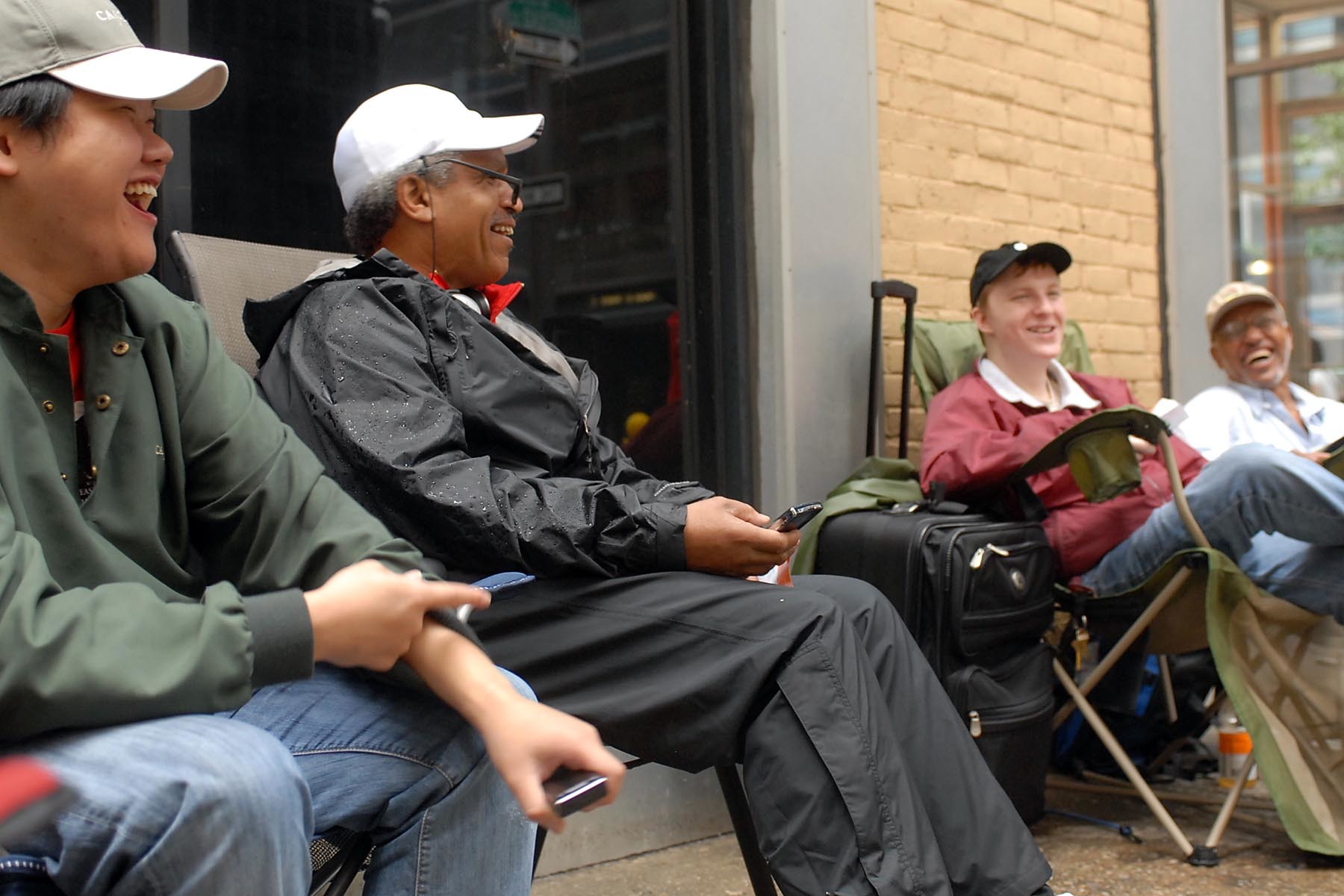
    Mayor John F. Street reads jokes aloud from his Blackberry as he waits with fellow technology enthusiasts in an alley off 16th Street to purchase an iPhone at the At&T store Jun. 29, 2007. There were two models available that day: a 4GB for $499 and the 8GB for $599.

    Mayor Street was the third in line to buy the first-generation iPhone 2G launched that day. He said he arrived around 3:30 a.m. Leonard F. Johnson (far right) at the front of the line, arrived 36 hours ahead of the 6:00 p.m. official release.

    Hizzoner defended the time he spent in line, saying he got work done and kept in touch with city officials on the issues of the day using his Blackberry to send emails and make phone calls.

    I had no idea what the yellow shipping container was when I saw it next to City Hall last weekend. Even after I walked over and watched those at the front of the long line take their selfies inside a retro Philly diner-esque booth tableau.

    I watched it all unfold, along with others, asking ourselves what was going on. Nobody knew. Except those in line.

    It was the last stop on the Pleasing Express Line that ended its nation-wide tour in Philadelphia.

    Followers on social media were invited to, “Climb on to immerse yourself in the worlds of Pleasing Fragrance, Big Lip, and exclusive treasures,” including a spin of the “Freebie Wheel,” for products of the unisex lifestyle brand Pleasing, created by former One Direction singer Harry Styles.

    A spontaneous walk around Center City can build for me the same kind of excitement felt by those waiting in lines. Except they know their eventual reward. Mine comes from the anticipation of not knowing what’s around a corner.

    And that is exactly what makes street photography worth the walk – and sometimes even the wait.

    Since 1998 a black-and-white photo has appeared every Monday in staff photographer Tom Gralish’s “Scene Through the Lens” photo column in the print editions of The Inquirer’s local news section. Here are the most recent, in color:

    » SEE MORE: Archived columns and Twenty years of a photo column.

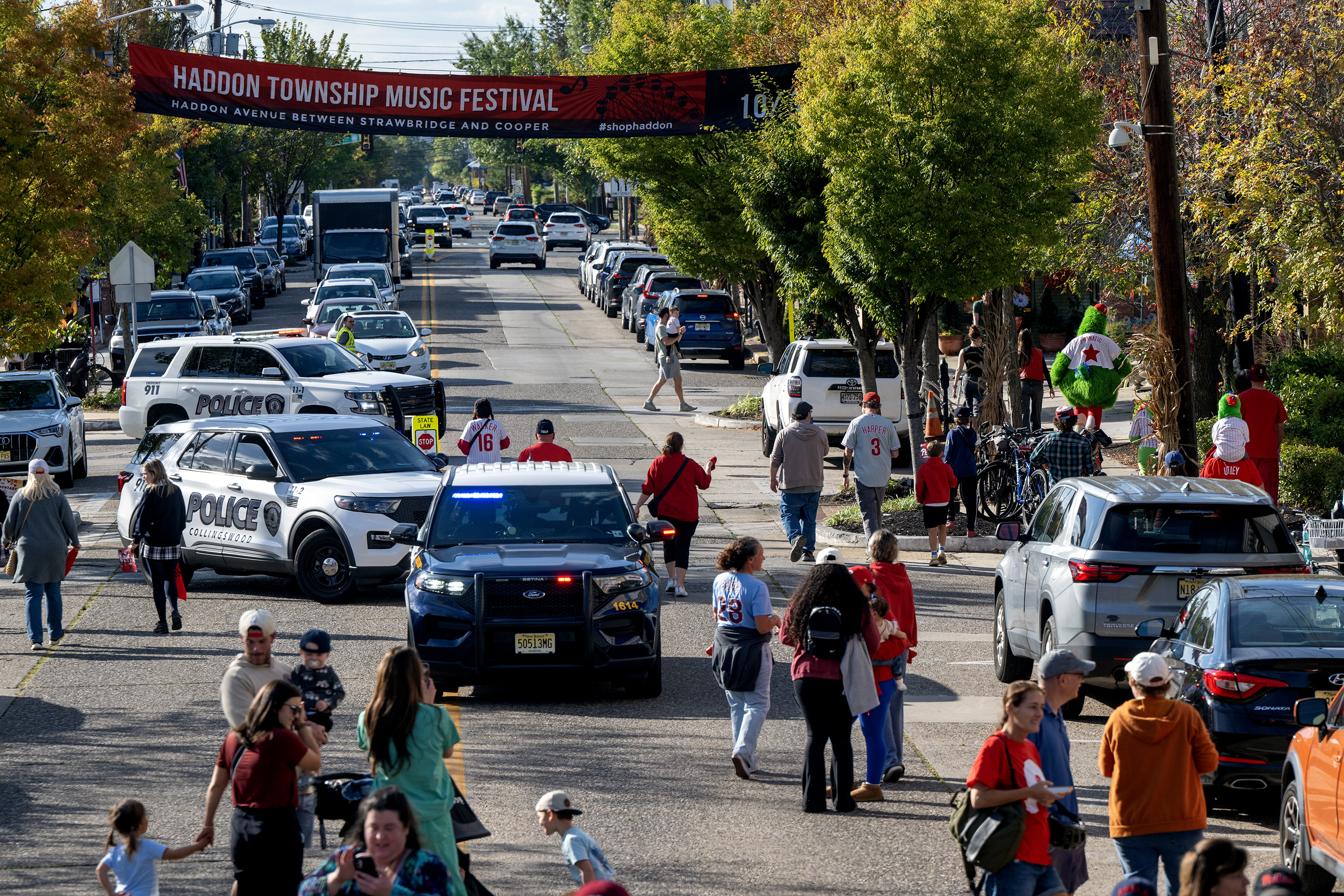
    October 11, 2025: Can you find the Phillie Phanatic, as he leaves a “Rally for Red October Bus Tour” stop in downtown Westmont, N.J. just before the start of the NLDS? There’s always next year and he’ll be back. The 2026 Spring Training schedule has yet to be announced by Major League Baseball, but Phillies pitchers and catchers generally first report to Clearwater, Florida in mid-February.
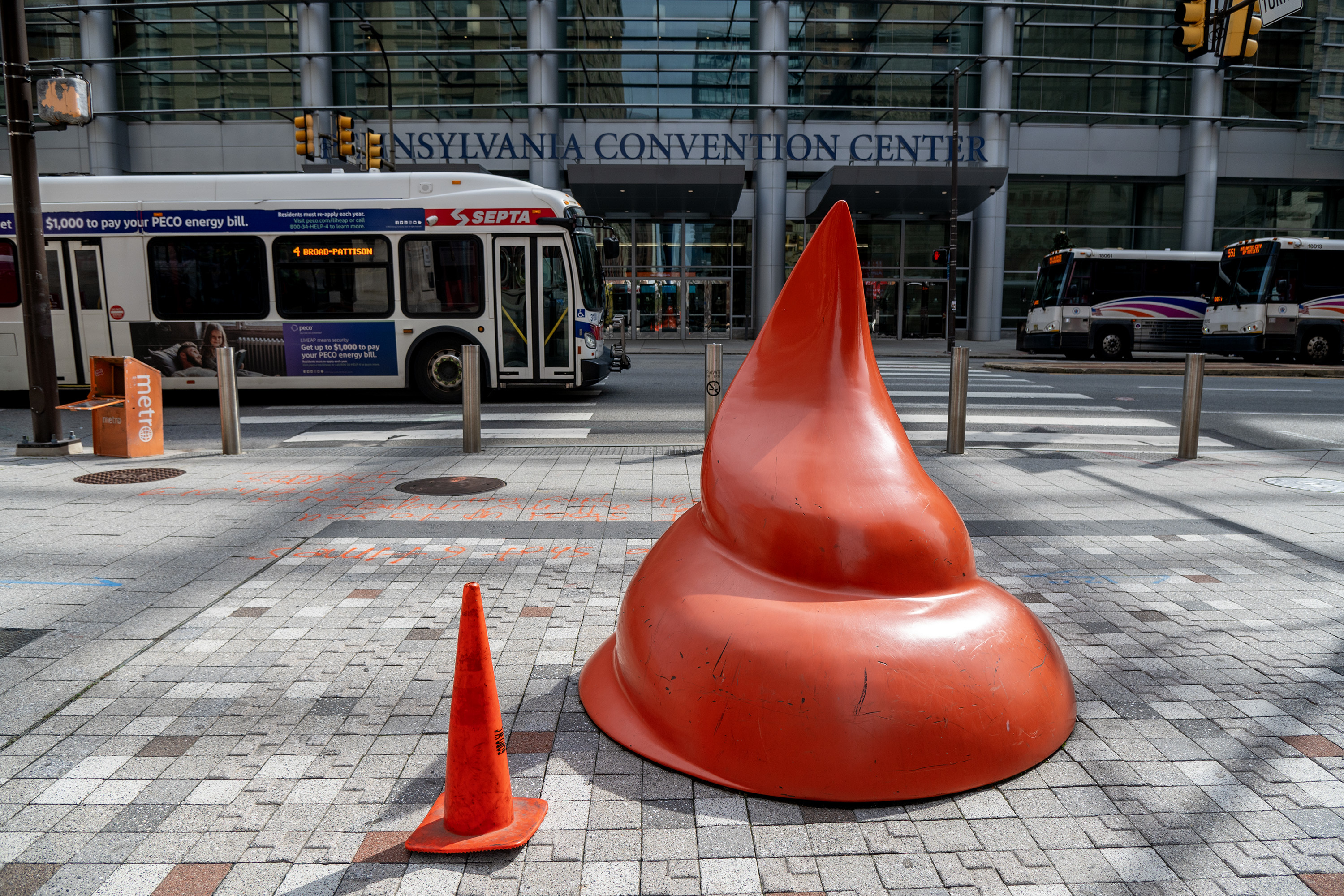
    October 6. 2025: Fluorescent orange safety cone, 28 in, Poly Ethylene. Right: Paint Torch (detail) Claes Oldenburg, 2011, Steel, Fiberglass Reinforced Plastic, Gelcoat and Polyurethane. (Gob of paint, 6 ft. Main sculpture, 51 ft.). Lenfest Plaza at the Pennsylvania Academy of the Fine Arts on North Broad Street, across from the Convention Center.
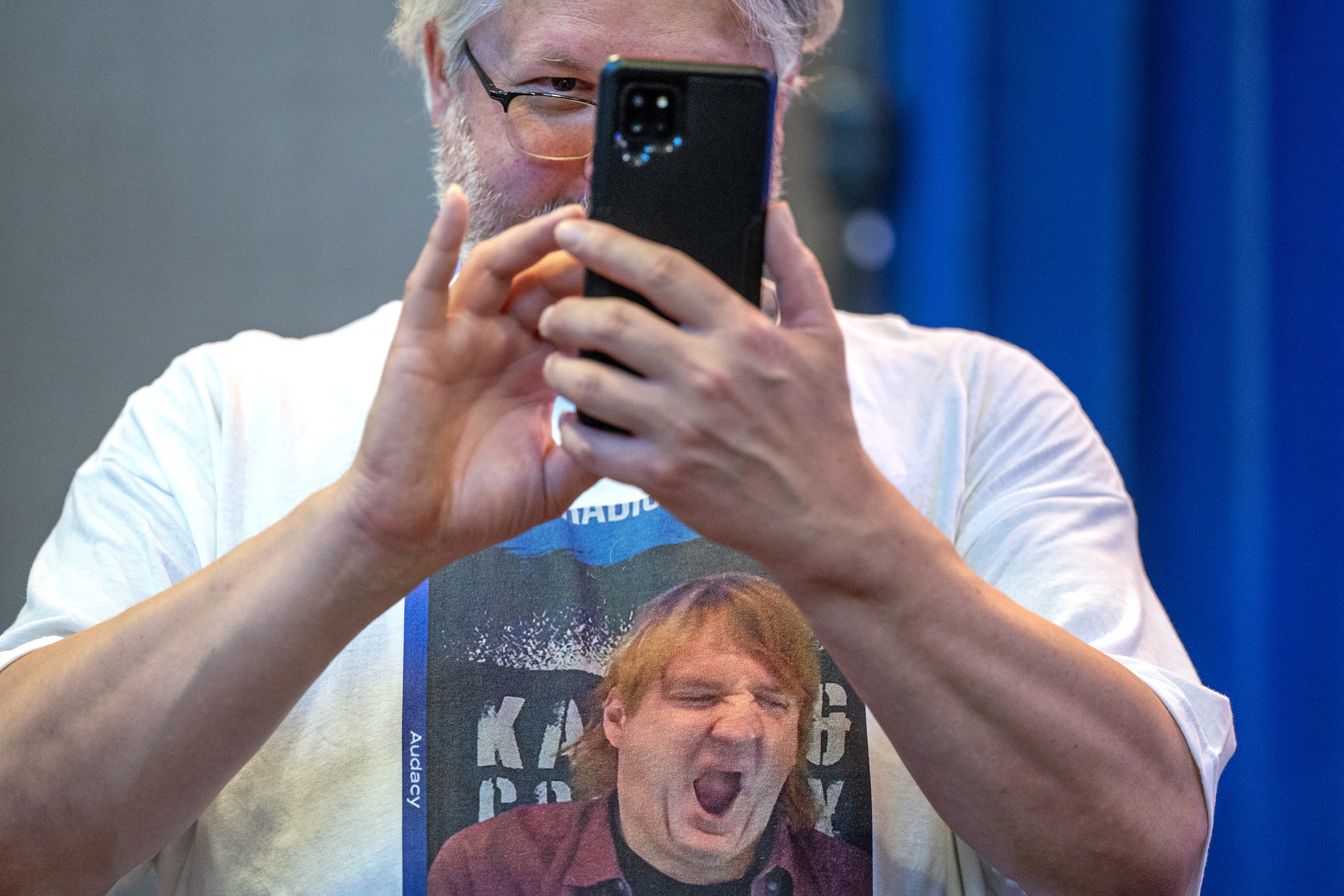
    September 29, 2025: A concerned resident who follows Bucks County politics, Kevin Puls records the scene before a campaign rally for State Treasurer Stacy Garrity, the GOP candidate for governor. His T-shirt is “personal clickbait” with a url to direct people to the website for The Travis Manion Foundation created to empower veterans and families of fallen heroes. The image on the shirts is of Greg Stocker, one of the hosts of Kayal and Company, “A fun and entertaining conservative spin on Politics, News, and Sports,” mornings on Talk Radio 1210 WPHT.
    September 22, 2025: A shadow is cast by “The Cock’s Comb,” created by Alexander “Sandy” Calder in 1960, is the first work seen by visitors arriving at Calder Gardens, the new sanctuary on the Ben Franklin Parkway. The indoor and outdoor spaces feature the mobiles, stabiles, and paintings of Calder, who was born in Philadelphia in 1898, the third generation of the family’s artistic legacy in the city.
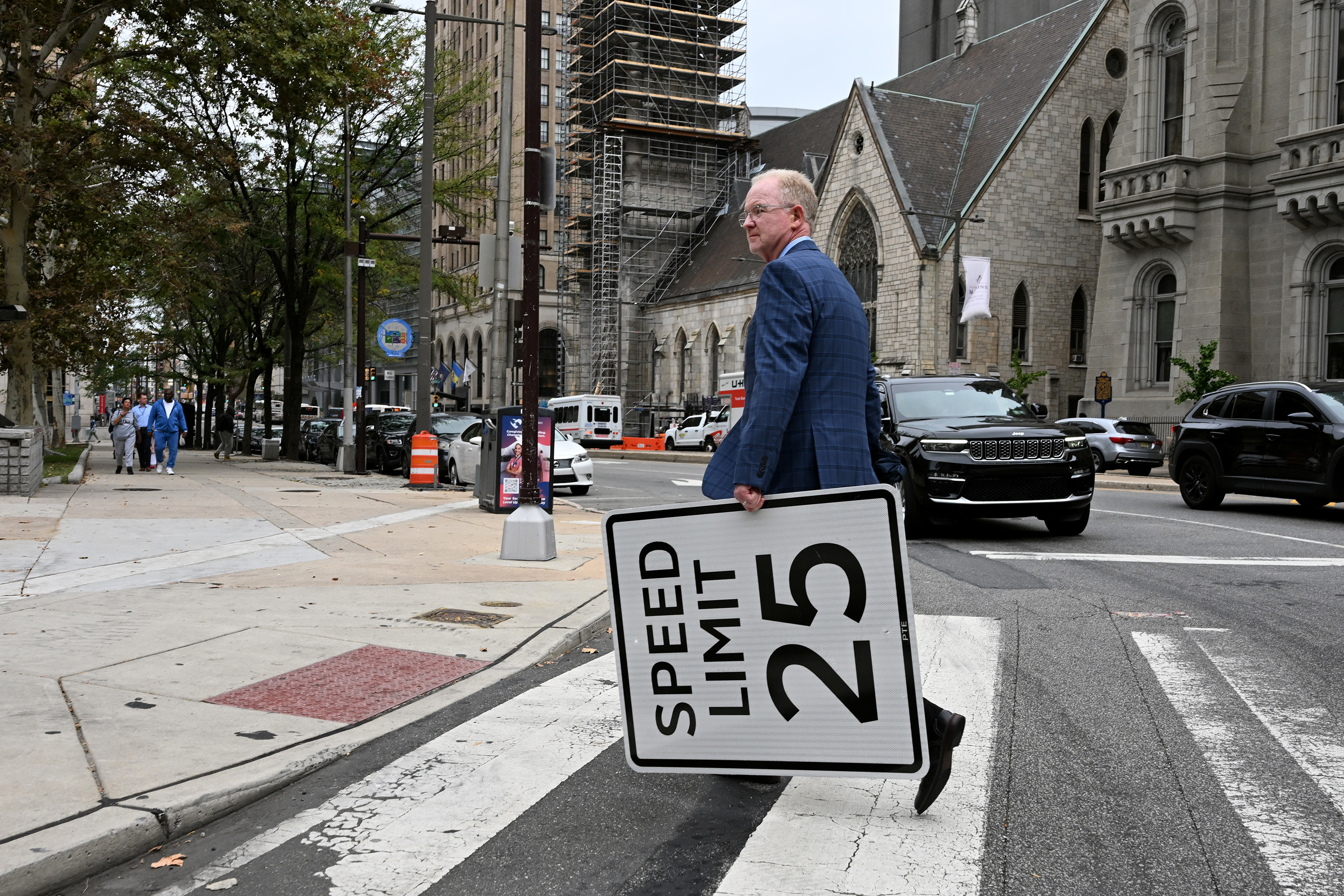
    September 15, 2025: Department of Streets Director of Operations Thomas Buck leaves City Hall following a news conference marking the activation of Automated Speed Enforcement (ASE) cameras on the Broad Street corridor – one the city’s busiest and most dangerous roads. The speed limit on the street, also named PA Route 611, is 25 mph.
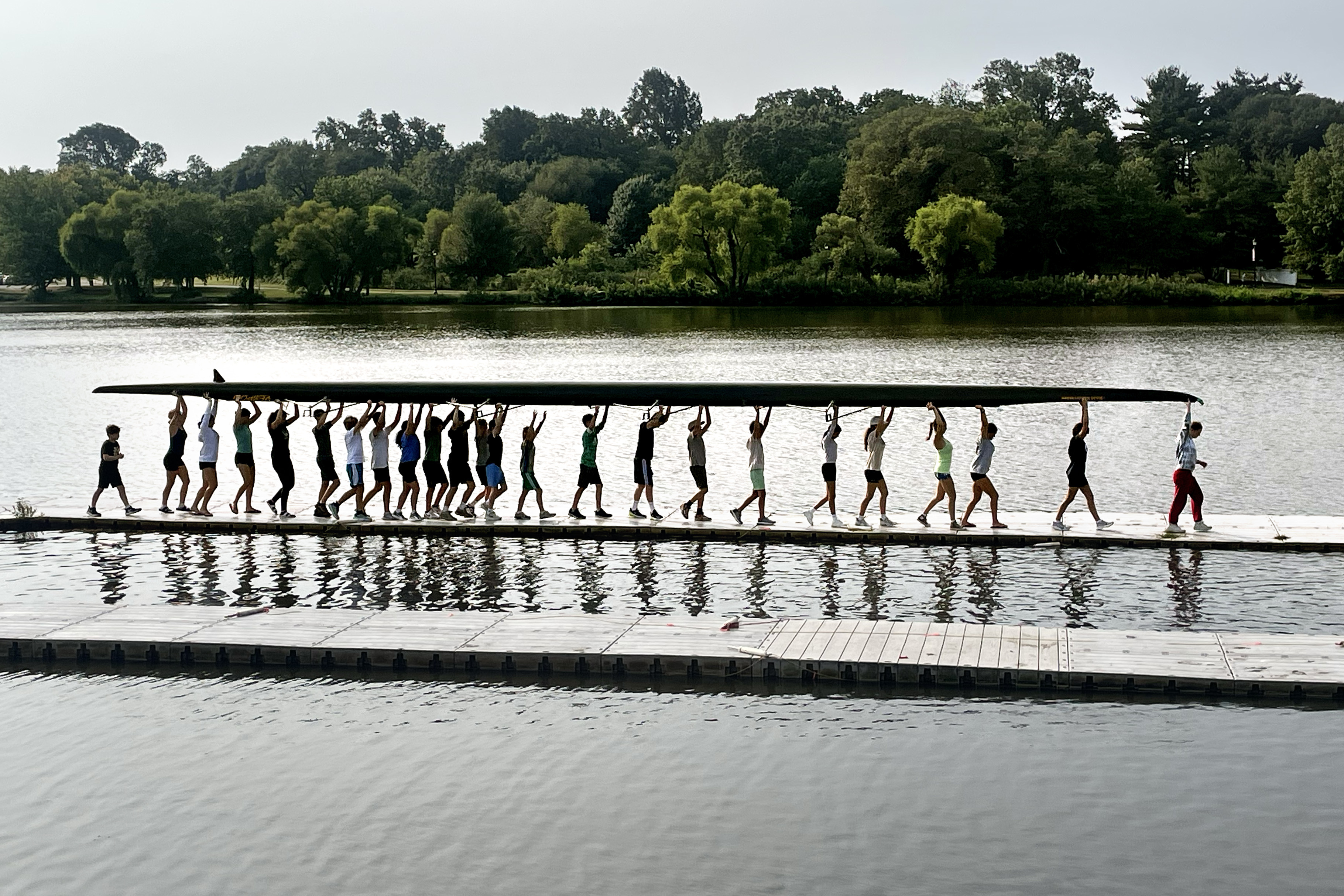
    September 8, 2025: Middle schoolers carry a boat to the water during their first outing in a learn-to-row program with the Cooper Junior Rowing Club, at the Camden County Boathouse on the Cooper River in Pennsauken.
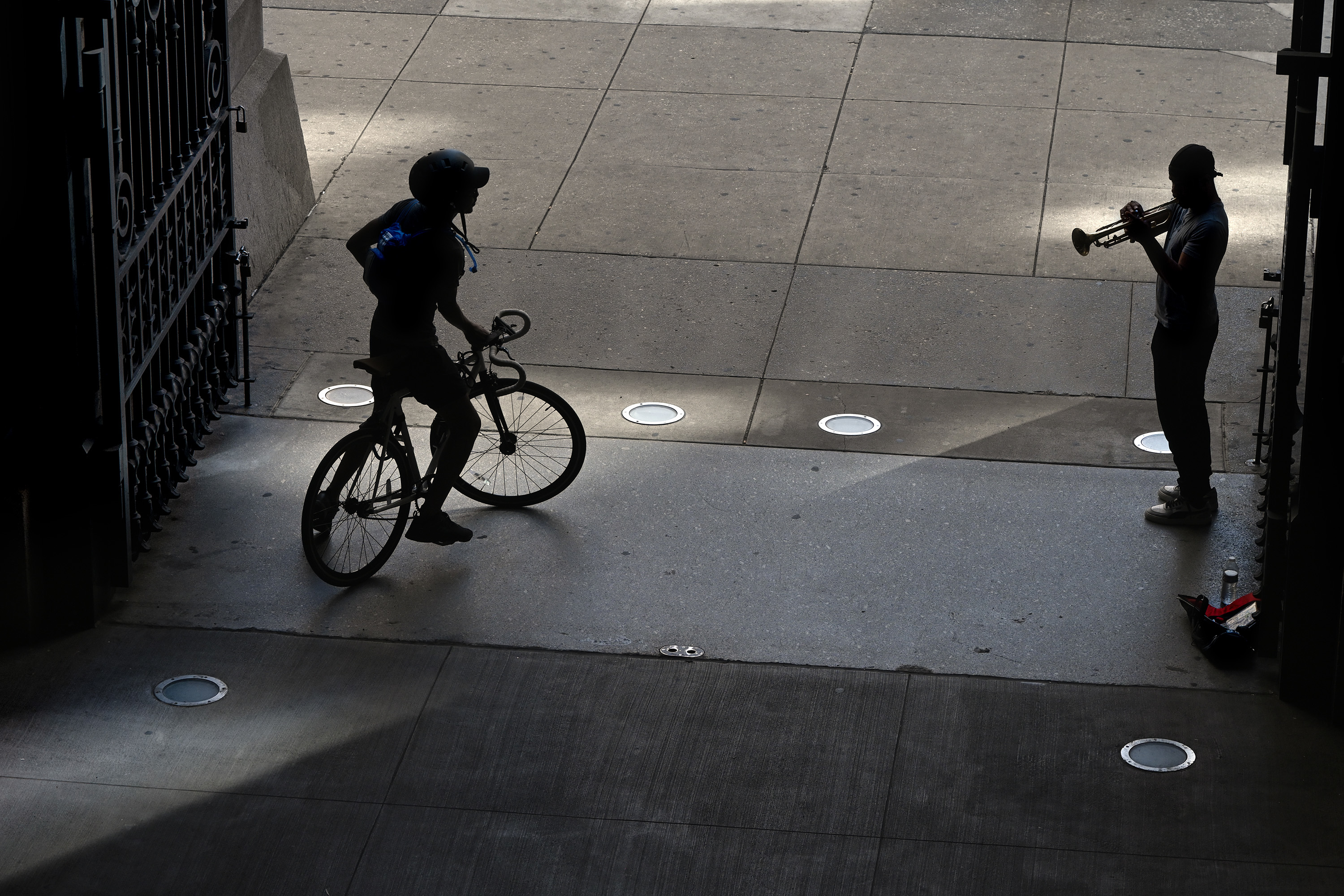
    September 1, 2025: Trumpet player Rome Leone busks at City Hall’s Easr Portal. The Philadelphia native plays many instruments, including violin and piano, which he started playing when he was 3 years old. He tells those who stop to talk that his grandfather played with Billie Holiday, Duke Ellington, Nina Simone, and Dizzy Gillespie.
    August 25, 2025: Bicycling along on East Market Street.
    August 18, 2025: Just passing through Center City; another extraterrestrial among us.
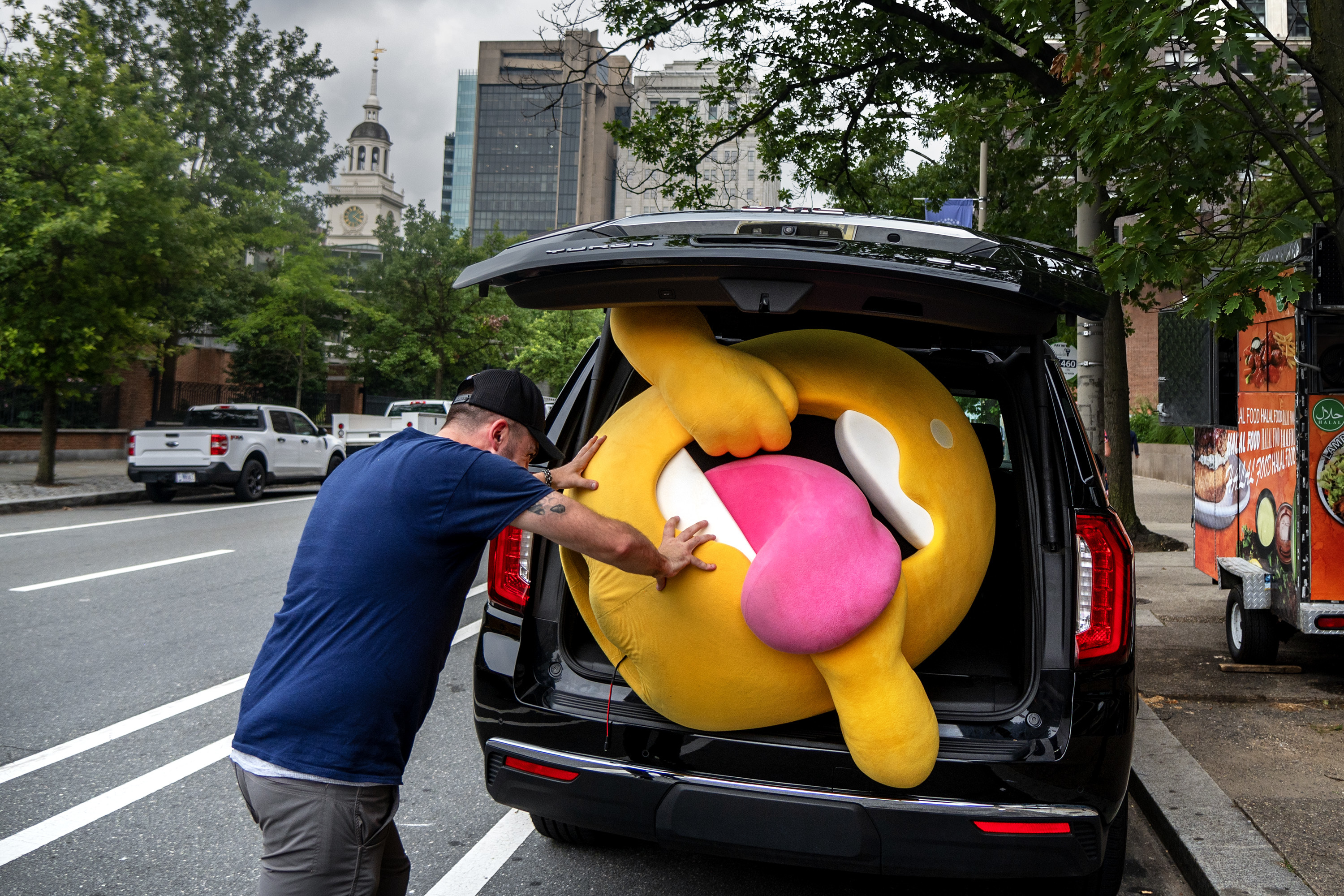
    August 11, 2025: Chris Brown stows away Tongue, the mascot for a new hard iced tea brand, after wearing the lemon costume on a marketing stroll through the Historic District. Trenton-based Crooked Tea is a zero-sugar alcoholic tea brand founded by the creator of Bai, the antioxidant-infused coconut-flavored water, and launched in April with former Eagles defensive end Brandon Graham as a partner.
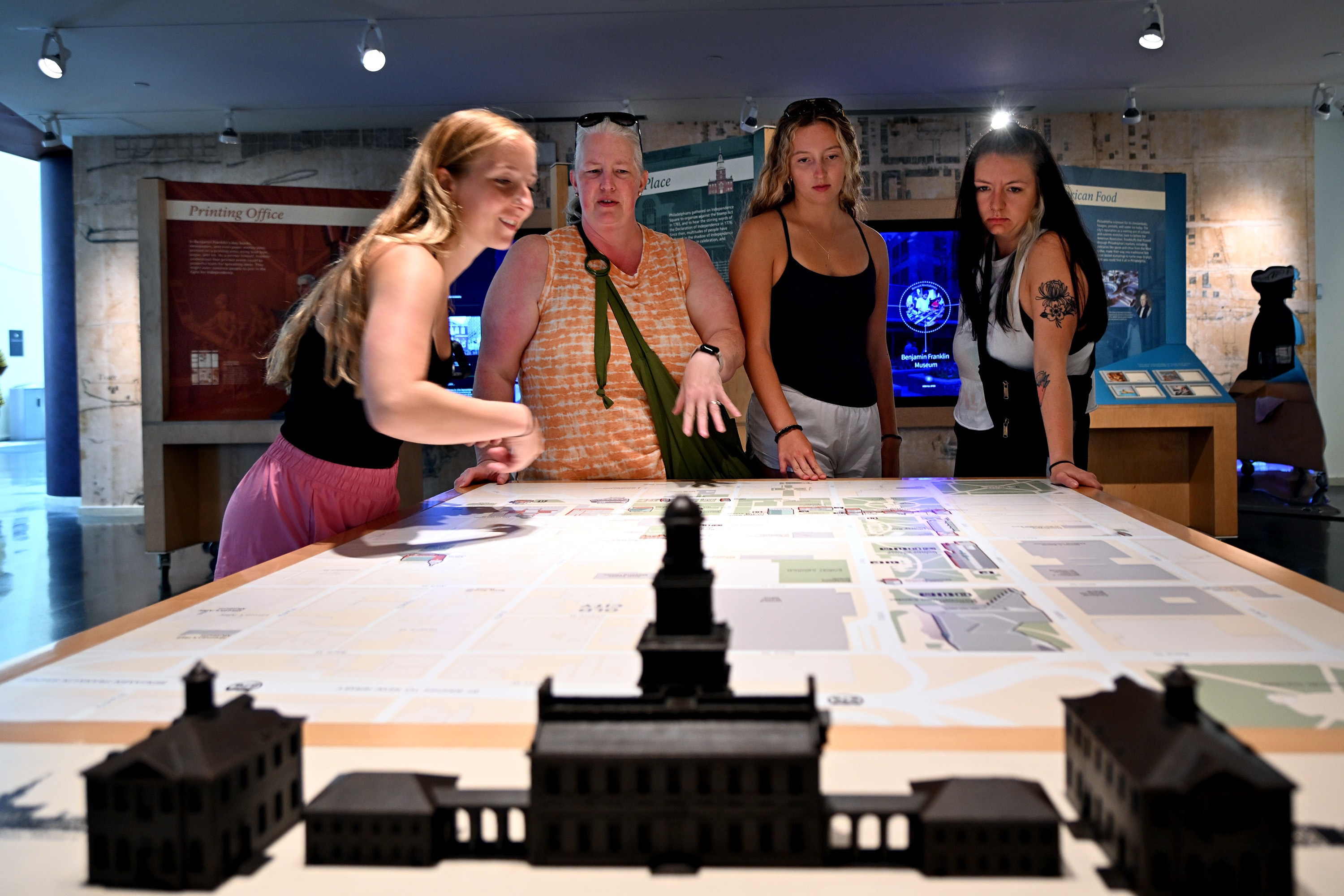
    August 4,2025: Shanna Chandler and her daughters figure out their plans for a morning spent in Independence National Historical Park on the map in the Independence Visitor Center. The women (from left) Lora, 20; Shanna; Lenna, 17; and Indigo, 29, were stopping on their way home to Richmond, Virginia after vacationing in Maine. The last time they were all in Philadelphia Shanna was pregnant with Lenna.
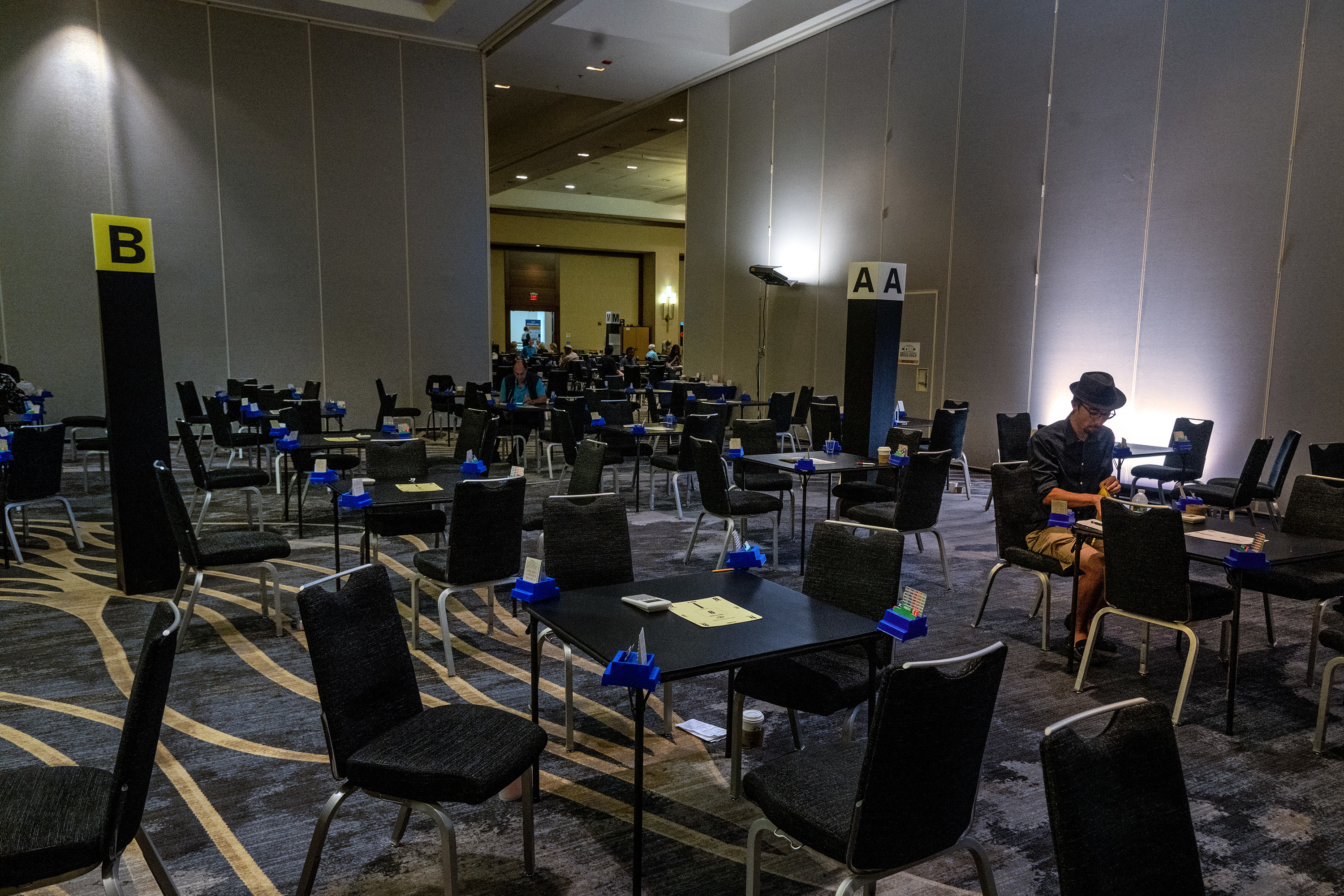
    July 28, 2025: Louis-Amaury Beauchet, a professional bridge player from Brittany, France, takes a break between game sessions in an empty ballroom during the North American Bridge Championships at the Center City Marriott with some 4000 people in town over week of the tournament. The American Contract Bridge League is hosting the week of meetings and tournaments with bridge players from all over the world. The ACBL is the largest bridge organization in North America, with over 120,000 members (down from around 165,000 before COVID). Bridge draws players of all ages and walks of life – fictional characters James Bond and Snoopy both played as do billionaires Bill Gates and Warren Buffett (who sometimes play as partners).
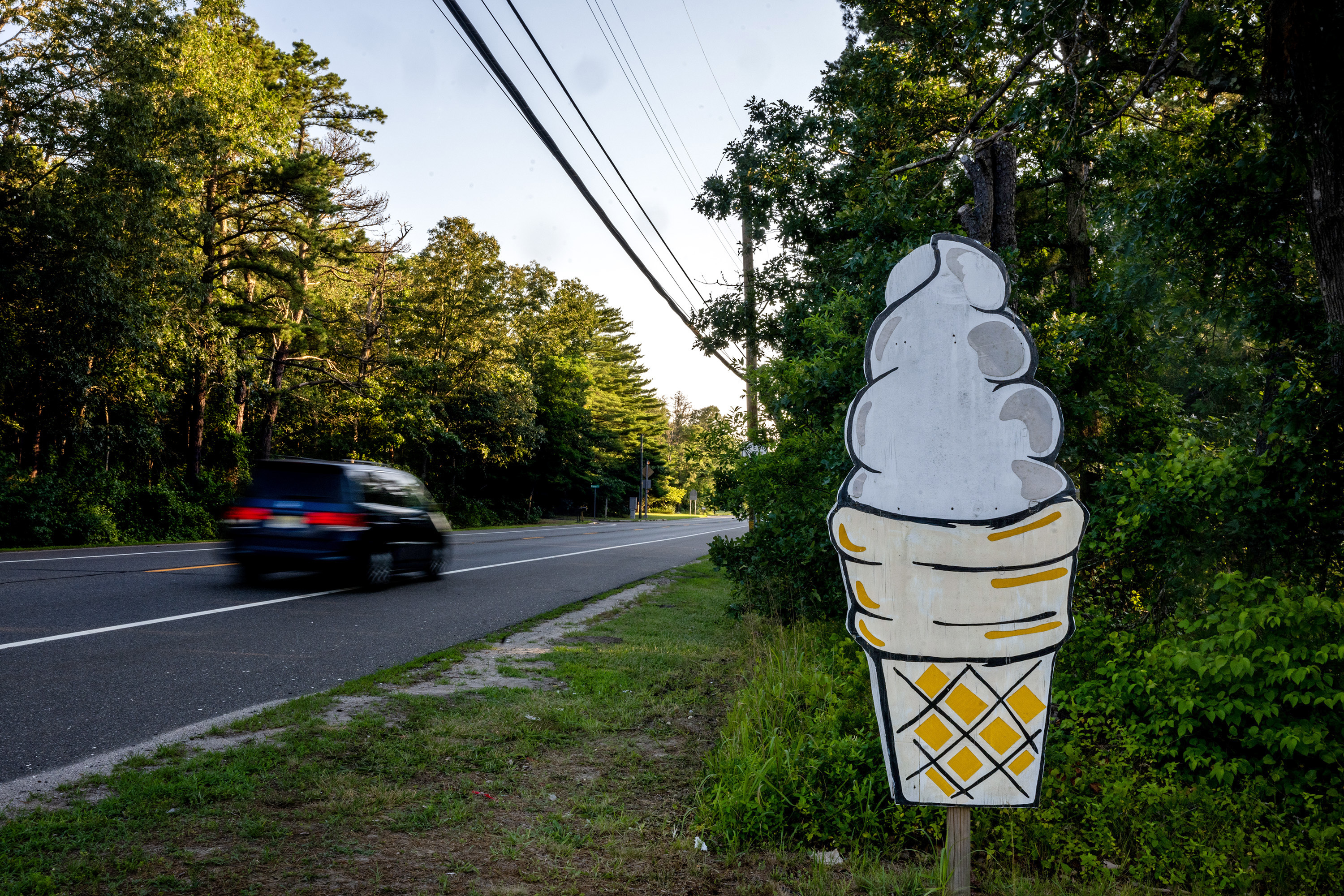
    July 21, 2015: Signage for the Kustard Korner in Egg Harbor City, on the way to the Jersey Shore. President Ronald Reagan designated July as National Ice Cream Month and the third Sunday of the month.
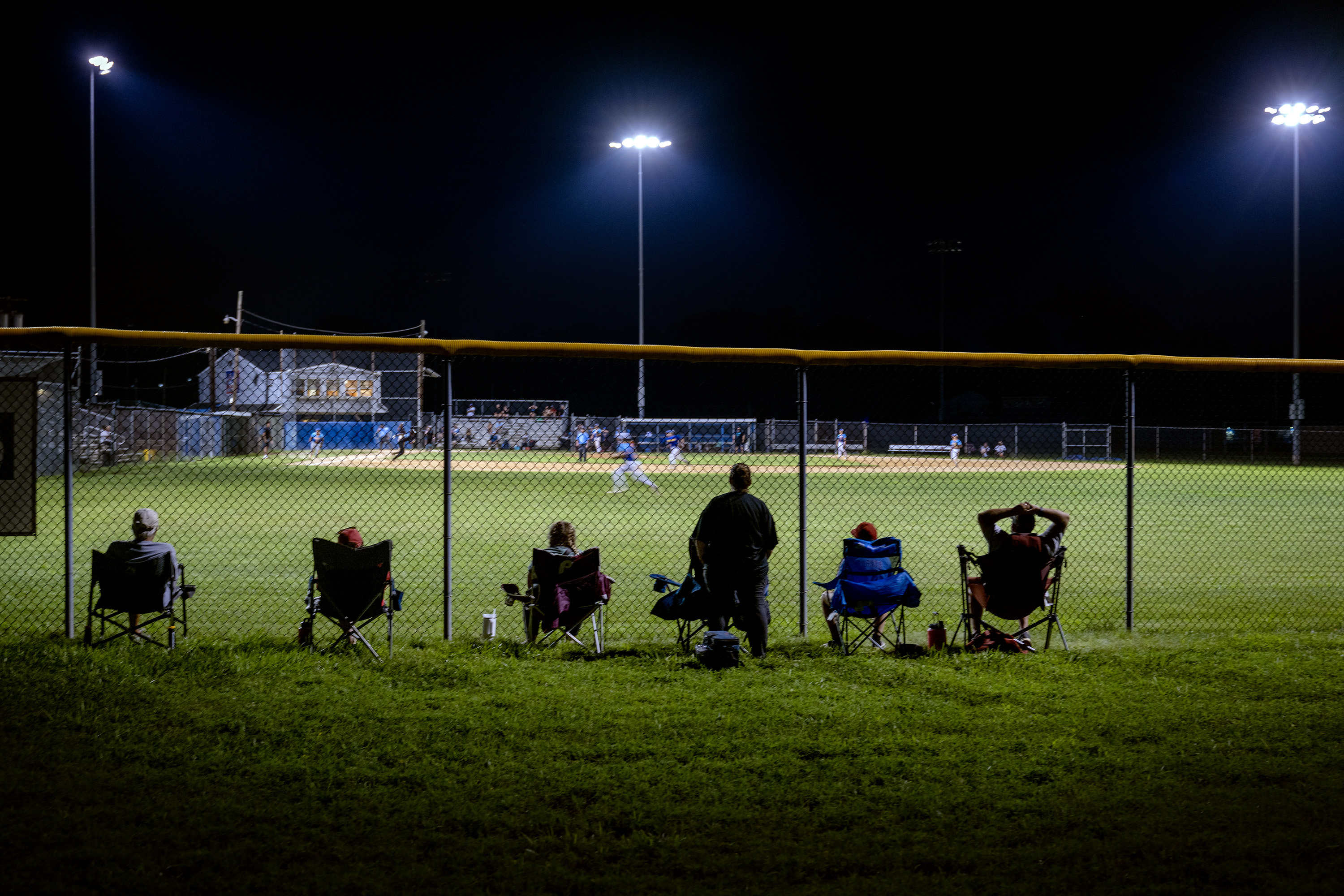
    July 14, 2025: Fans watch a game at the Maple Shade Babe Ruth Field, part of the 20th Annual Franny Friel Summer Classic, on a cool(er) night with a refreshing breeze, the weekend before the MLB All-Star Game (with Kyle Schwarber the lone Phillies representative).
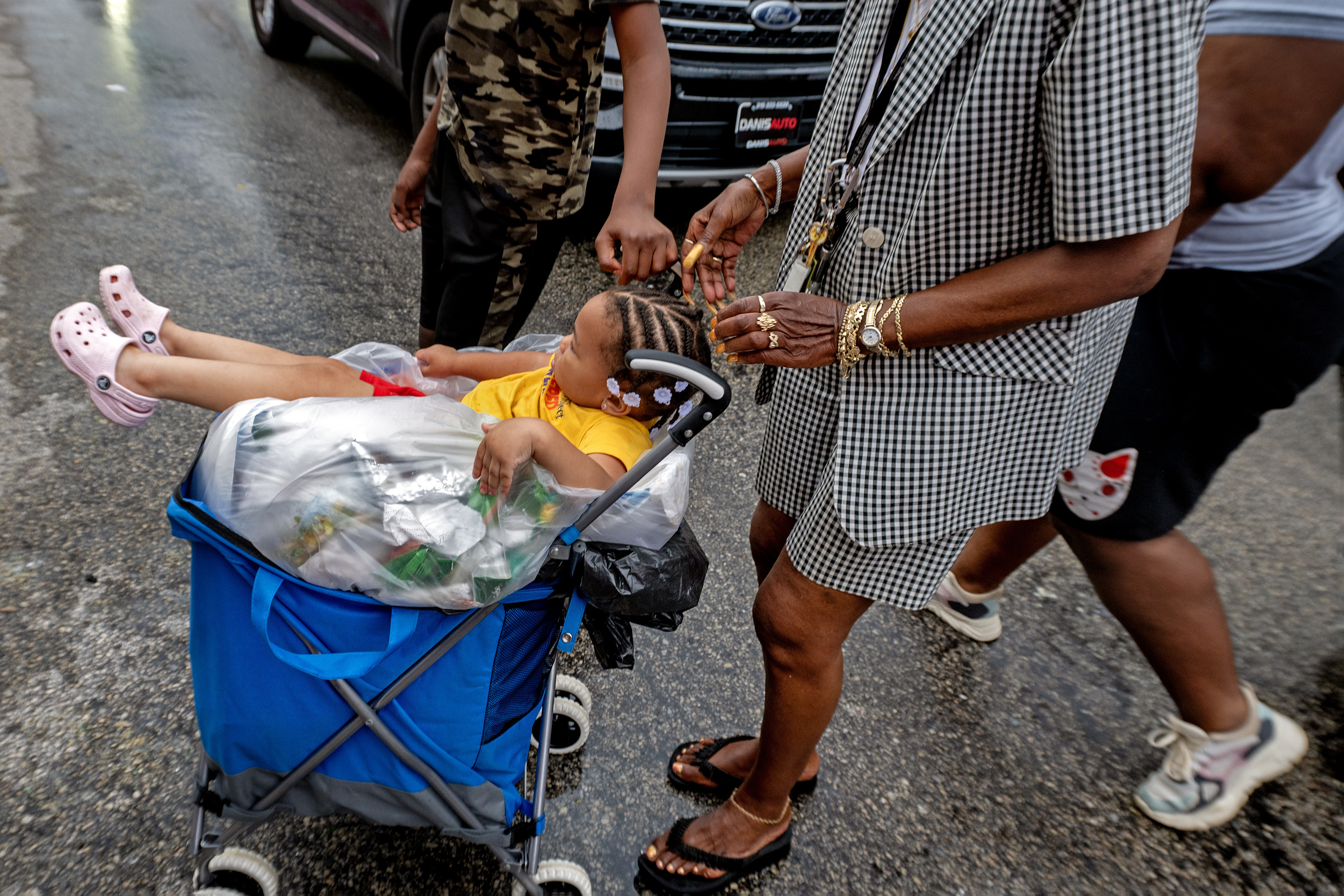
    July 7, 2025: Caroline Small wheels her two year-old great-granddaughter atop a bag of garbage as she carts it to a drop-off site at the Tustin Playground at 60th St. and W Columbia Ave. as residential trash collection stopped when a strike was called by District Council 33. Small lives just around the corner and said of the toddler, “she was just walking too slow.”
  • 2 men charged in attempted robbery of armored truck that led to school lockdowns in Lower Merion

    2 men charged in attempted robbery of armored truck that led to school lockdowns in Lower Merion

    The FBI on Friday announced criminal charges against two men in connection with an attempted robbery of an armored truck on Oct. 3 that led to school lockdowns and a shelter-in-place order in Lower Merion Township.

    Dante Shackleford, 26, also was charged by indictment with two attempted robberies of armored trucks in Philadelphia in July and an armored truck heist in Elkins Park in August in which $119,100 was stolen.

    Mujahid Davis, 24, and Shackleford were charged with the Oct. 3 attempted robbery of an armored truck on the Philadelphia side of City Avenue that led to a pursuit and an hours-long incident. Several suspects were finally arrested in Lower Merion.

    The FBI announcement came just hours after another attempted robbery of an armored truck, this time outside a Wawa store in Philadelphia.

    Shortly before 8 a.m. on the 7700 block of Frankford Avenue, two male suspects attempted to rob a Loomis truck when the driver fired two shots at the suspects, who then fled. Police reported no injuries or arrests.

    The indictment against Shackleford and Davis filed in federal court on Thursday provided few details about the prior armored truck crimes.

    On July 15 and on July 22, Shackleford and others allegedly attempted to rob Brink’s trucks in Philadelphia, according to the indictment.

    On Aug. 12, Shackleford and others allegedly robbed a Brink’s truck in Elkins Park and got away with approximately $119,100 and the Brink’s employee’s gun.

    Then on Oct. 3, Shackleford and Davis allegedly attempted to rob a Brink’s truck in Philadelphia, which reportedly occurred in the area of City Avenue.

    Davis also is charged in Montgomery County Court with multiple counts related to what happened on Oct. 3, including fleeing law enforcement and evading arrest.

  • A changing death industry puts Philly cemeteries at risk

    A changing death industry puts Philly cemeteries at risk

    It always figured to be an emotional day when the Alter family gathered at Har Jehuda Cemetery in Upper Darby. They were commemorating their mother’s first yahrzeit, the anniversary of death in the Jewish tradition.

    But when the family arrived at her grave, they found it in devastating condition.

    Beatrice Reina Alter, 93, was buried last year next to her husband, Milton Alter, in plots that the couple bought in the Jewish cemetery in the 1990s. When their family came together for her yahrzeit in August, they expected there to be a new headstone to match Milton’s.

    Instead, her grave was covered in a fresh mound of dirt. The corner of a plywood board stuck out. And there was no headstone to be seen.

    “We were shaken and appalled,” said Daniel Alter, one of the couple’s five children.

    Yet issues at the cemetery — and for the burial industry — extend beyond placing headstones on time. Har Jehuda reflects an industry facing serious challenges to its longevity, where sometimes small, antiquated businesses must reinvent themselves. The country’s relationships with cemeteries and burials are changing, putting a seemingly timeless business at risk.

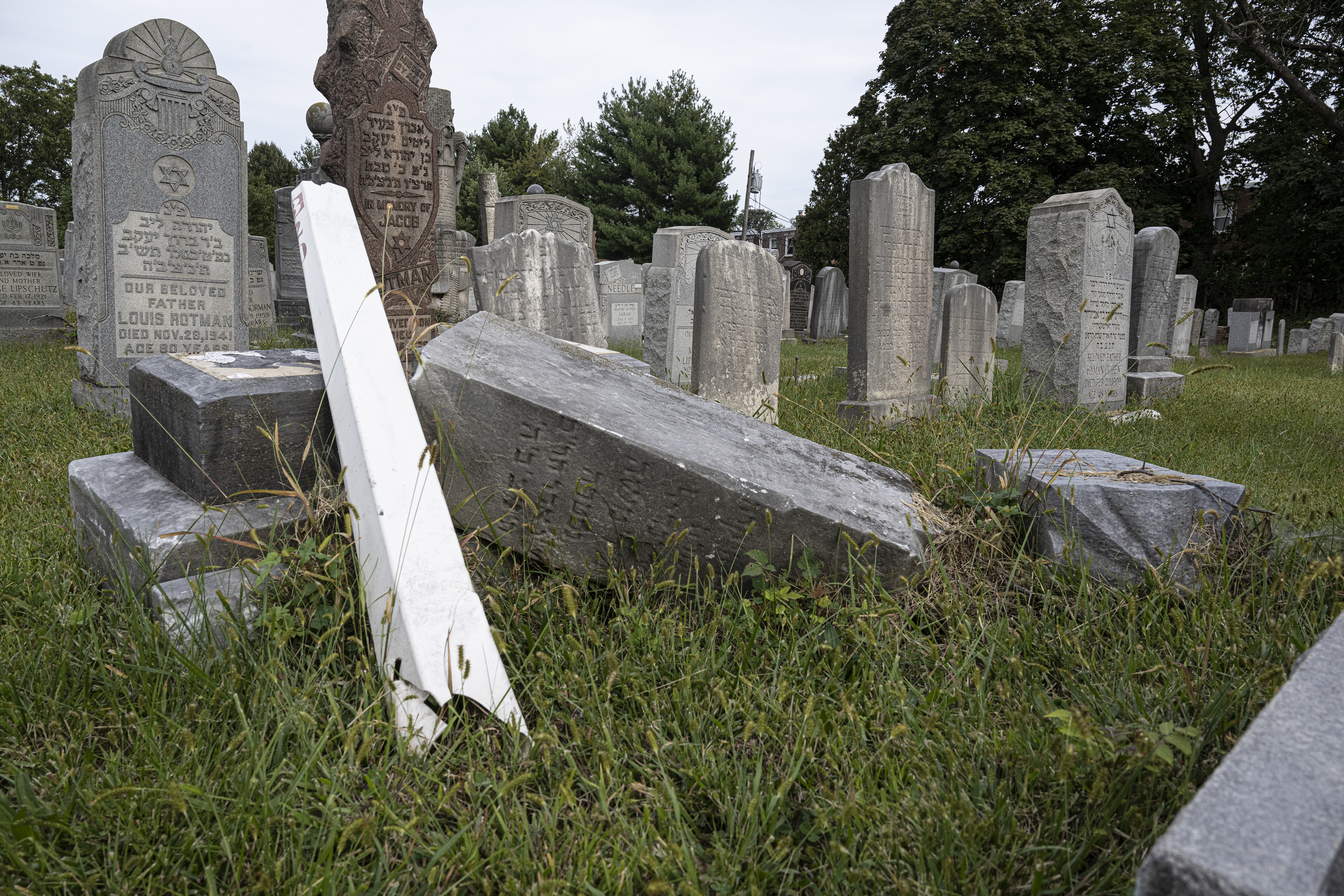
    Har Jehuda, for instance, has been an important institution for the region’s Jewish community since its founding in the 1890s, holding more than 20,000 graves. But today, its grounds are largely overgrown and unkept, and numerous gravestones have fallen into disrepair. A volunteer group has stepped in to cover some of the maintenance and landscaping costs but fears it cannot sustain the cemetery for long.

    Overgrown weeds and displaced headstones at Har Jehuda Cemetery in Upper Darby.

    “The reality is that there are not enough staff or funds to maintain the cemetery, and there hasn’t been for years,” Randi Raskin Nash, a member of the Friends of Har Jehuda Cemetery group, said by email.

    The cremation boom

    A hundred years ago, cremation was an unusual choice in the United States. Things started to shift in 1963, when the Catholic Church lifted its prohibition of the practice and Jessica Mitford’s book The American Way of Death, an exposé of the death industry, was published. Before then the cremation rate was reported to be in the single digits, and even as it rose, by 1999 only about 25% of Americans were cremated. But that is changing.

    Cremations are expected to double the number of burials in 2025, according to a report from the National Funeral Directors Association. By 2045, the cremation rate in Pennsylvania is projected to reach over 82%, with burials dropping to just under 14%.

    Several factors appear to be driving the shift, according to Christopher Robinson, the president of the association’s board of directors. Those include costs, environmental concerns, declines in religious affiliation, and growing cultural acceptance of cremation.

    window.addEventListener(“message”,function(a){if(void 0!==a.data[“datawrapper-height”]){var e=document.querySelectorAll(“iframe”);for(var t in a.data[“datawrapper-height”])for(var r,i=0;r=e[i];i++)if(r.contentWindow===a.source){var d=a.data[“datawrapper-height”][t]+”px”;r.style.height=d}}});

    But that is not the business model that most cemeteries were built upon.

    When folks secure a plot for interment, they are really buying an easement for burial rights, or essentially a license to use the cemetery’s land. Plots can cost thousands of dollars and are often nonrefundable.

    Once it comes time for a person to be buried, the cemetery may charge for other parts of the process, like digging and closing the plot, creating a headstone monument, or supplying a vault for the casket.

    Most cemeteries sustain themselves for the future by putting a portion of that revenue into an endowment fund, where the return on investment can be used for maintenance and repairs. Friends of Har Jehuda estimates that it requires roughly $50,000 to $75,000 just to cover lawn mowing and weeding per season.

    Cremations are much less profitable, particularly if a cemetery does not actually perform it — a walled recess with an engraved cover for a loved one’s urn may cost only a few hundred dollars.

    It’s unknown exactly how many cemeteries have formally closed or been abandoned in recent years, since the statistic does not appear to be widely tracked. What is clear is that cremation trends and dwindling space for future burials have left cemeteries struggling.

    “There’s going to be a lot of cemeteries going out of business in the next 20 years,” said Tanya Marsh, a law professor at Wake Forest University who teaches funeral and cemetery law, in an episode of The Economics of Everyday Things podcast last year.

    Would you get married at a cemetery?

    Some cemeteries have embraced the changes and creatively diversified their offerings.

    “We’re an outdoor museum. We’re a sculpture garden, we’re an arboretum … we’re more than just a cemetery,” said Nancy Goldenberg, CEO of Laurel Hill Cemeteries in Philadelphia.

    Laurel Hill uses its combined 265 acres on both sides of the Schuylkill to its advantage. On a given day at the historic cemetery, you might see visitors on a history tour, stretching out to watch a movie screening, attending a wedding, or meeting with the official book club, Boneyard Bookworms.

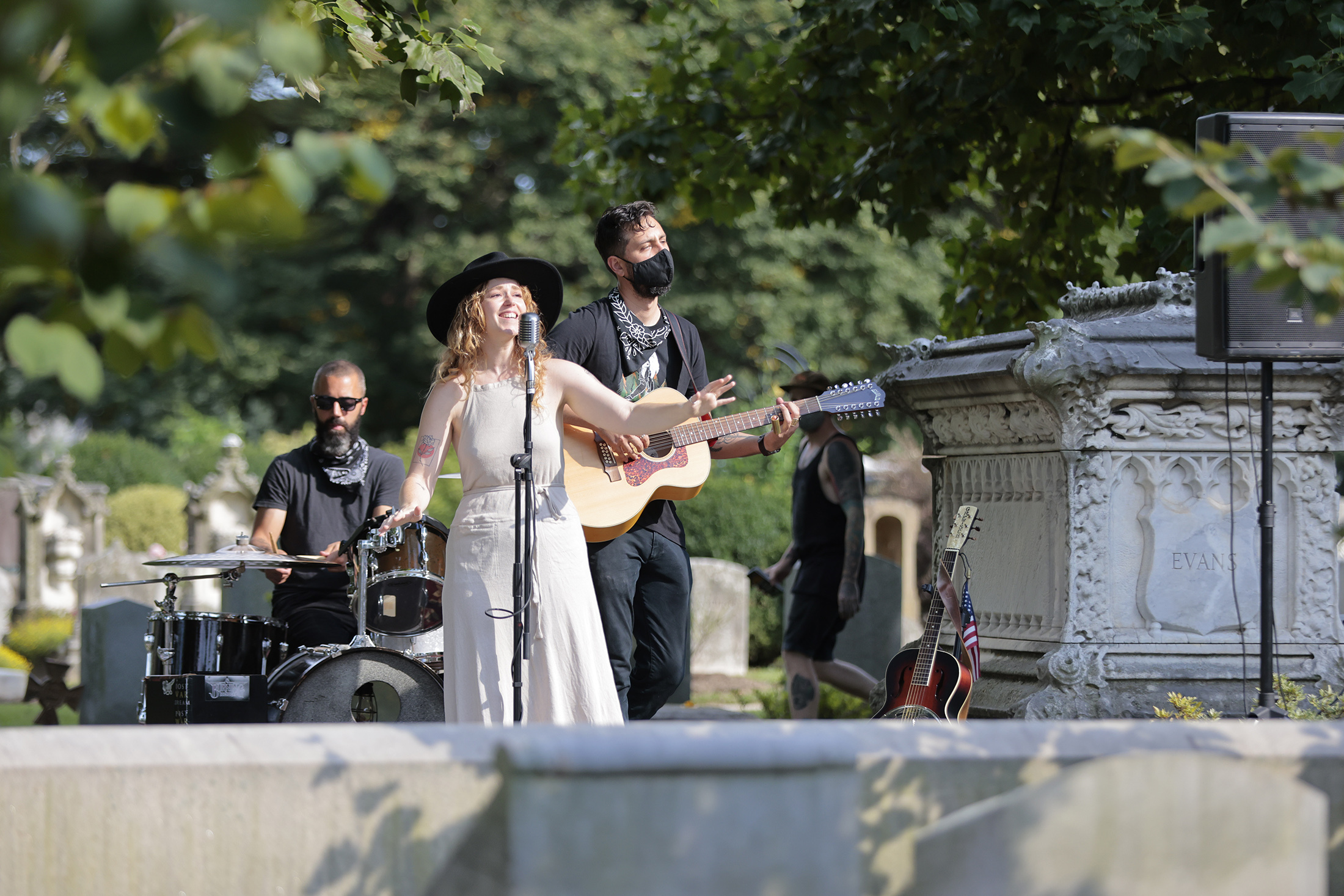
    The 49 Burning Condors singer Kimber Dulin, Christopher Tremogile on guitar and Jason Gooch on drums play as folks shop for unusual antiques, vintage items, artwork and handmade wares at the Market of the Macabre at the Laurel Hill Cemetery in 2021.

    Goldenberg said the extensive offerings are meant to build connections between people and the cemetery: They will be more likely to contribute money, or when they eventually need a resting place for their loved ones, they will look there first.

    This all used to be more common — the first U.S. cemeteries in the mid-19th century also served as the country’s first public parks, with open grassy fields fit for a picnic. Before then, people buried their dead in smaller graveyards that eventually became overcrowded and sources of disease.

    Laurel Hill is readying itself for a changing death industry, too. Goldenberg said she anticipates a rise in “green burials,” in which a person is buried without embalming or a casket, and said the cemetery was designating a section for them.

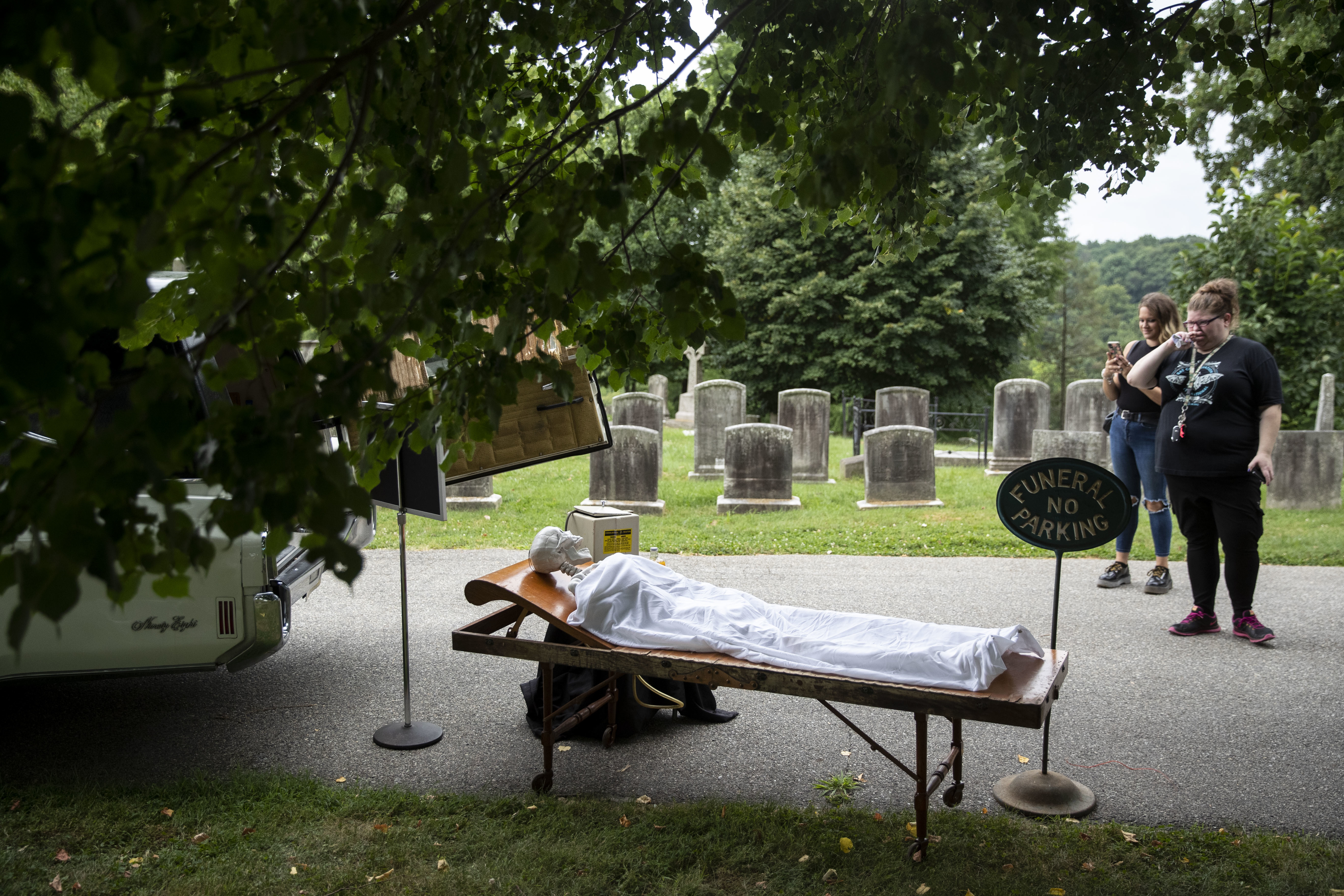
    Visitors view a display behind a hearse during the 13th Car & Hearse Show presented by the Mohnton Professional Car Club at Laurel Hill Cemetery in 2021.

    And while Goldenberg said she would be long gone before the cemetery runs out of space for new burials, it is a reality officials are planning for.

    Laurel Hill is adding space for an additional 225 niches for cremated remains.

    “There are small cemeteries, and once they fill up, that’s the revenue stream. … You have to be prepared for that,” she said.

    “If you don’t, that’s when you fall on hard times.”

    If a cemetery reaches the point of closure or abandonment, it’s not always clear what would happen to it. Last year, Gov. Josh Shapiro signed into law a bill sponsored by State Rep. Tim Brennan (D., Bucks) that would give financial relief to municipalities that take over abandoned cemeteries, since doing so can be a costly burden that local governments want to avoid.

    Uncertain futures for cemeteries

    Days after the Alter family made it through the prayers and memorial they planned, the emotional weight of the experience hit them even harder.

    Daniel Alter later confirmed with Har Jehuda that a fresh grave had been dug where he believed his mother was buried. Recently, he hired a ground-penetrating radar company to examine the burial site, which determined the freshly dug grave was directly adjacent to where his mother was buried. While Alter was relieved to learn his mother’s grave had not been disturbed, he said Har Jehuda could have prevented the anguish he and his family have felt over the last few months.

    Har Jehuda Cemetery’s owner, Larry Moskowitz, declined to comment for this article. Moskowitz was previously prosecuted by the state attorney general’s office over allegations that his other business, Wertheimer Monuments, had failed to deliver headstones to people who had paid for them. Complaints like these against the burial industry happen occasionally — the attorney general’s office also sued another Philadelphia monuments company in 2023 for failing to deliver headstones. There are multiple organizations dedicated to protecting consumers against predatory burial providers.

    The Alters, like other families, continue to visit and bury their loved ones at Har Jehuda, but they hope that no one else goes through their experience.

    “Our collective wish is that it never, ever, ever happens again to anyone in the Philly area,” Daniel Alter said.

  • Five things contributing to Philadelphia’s improved homicide clearance rate

    Five things contributing to Philadelphia’s improved homicide clearance rate

    Just four years ago, Philadelphia saw the most homicides in its history — and police solved them at the lowest rate on record.

    Now, those trends have flipped.

    The city is now on pace for the fewest killings in half a century, and detectives are solving murders at the highest rate in recent memory.

    The homicide clearance rate this year has hovered between 86% and 90% — the highest since 1984, when the department recorded a 95% clearance rate.

    The change is a welcome improvement from the challenges of 2015 to 2022, when the rate of solved homicides hovered around 50% or less and dropped to a historic low of 41.8% in 2021, according to police data.

    Just as there’s no single explanation for the drop in shootings, there’s no simple answer to why detectives are closing cases more quickly this year. And a higher arrest rate doesn’t account for whether a defendant is convicted at trial.

    But interviews with law enforcement officials and a review of police data and court records suggest a few likely factors: the overall decline in violence, which gives officers more time to investigate, and recent investments in technology that give detectives faster access to evidence.

    Here are five things contributing to the improved clearance rate:

    !function(){“use strict”;window.addEventListener(“message”,function(a){if(void 0!==a.data[“datawrapper-height”]){var e=document.querySelectorAll(“iframe”);for(var t in a.data[“datawrapper-height”])for(var r,i=0;r=e[i];i++)if(r.contentWindow===a.source){var d=a.data[“datawrapper-height”][t]+”px”;r.style.height=d}}})}();

    Simple math

    The clearance rate is calculated by dividing the number of homicide cases solved in a given year — regardless of when the crime occurred — by the number of homicides that occurred in that same year.

    And so the apparent improvement partly comes down to simple math: with dramatically fewer killings this year, even fewer total arrests can boost the clearance rate.

    Through August, police had solved about 60% of the killings in 2025, but because they’ve cleared nearly 50 others from previous years — and because there are a third as many homicides as three years ago — the rate goes up.

    Still, that number is notable. Only about a third of killings that occurred in 2021 and 2022 were solved that same year, according to an Inquirer analysis of court records and police data.

    !function(){“use strict”;window.addEventListener(“message”,function(a){if(void 0!==a.data[“datawrapper-height”]){var e=document.querySelectorAll(“iframe”);for(var t in a.data[“datawrapper-height”])for(var r,i=0;r=e[i];i++)if(r.contentWindow===a.source){var d=a.data[“datawrapper-height”][t]+”px”;r.style.height=d}}})}();

    Time

    The significant reduction in violence this year has given detectives the time to solve their cases, both old and new.

    During the pandemic — as the city recorded about 2,000 homicides in just four years — detectives were handling 10 to 15 cases each year, more than twice the workload recommended by the U.S. Department of Justice.

    This year, it’s half that.

    That’s making a difference. Detectives this year appear to be solving cases more quickly than years past, according to an Inquirer analysis.

    Through August, police arrested a suspect within a week in about 31% of cases — up from just 15% three years ago.

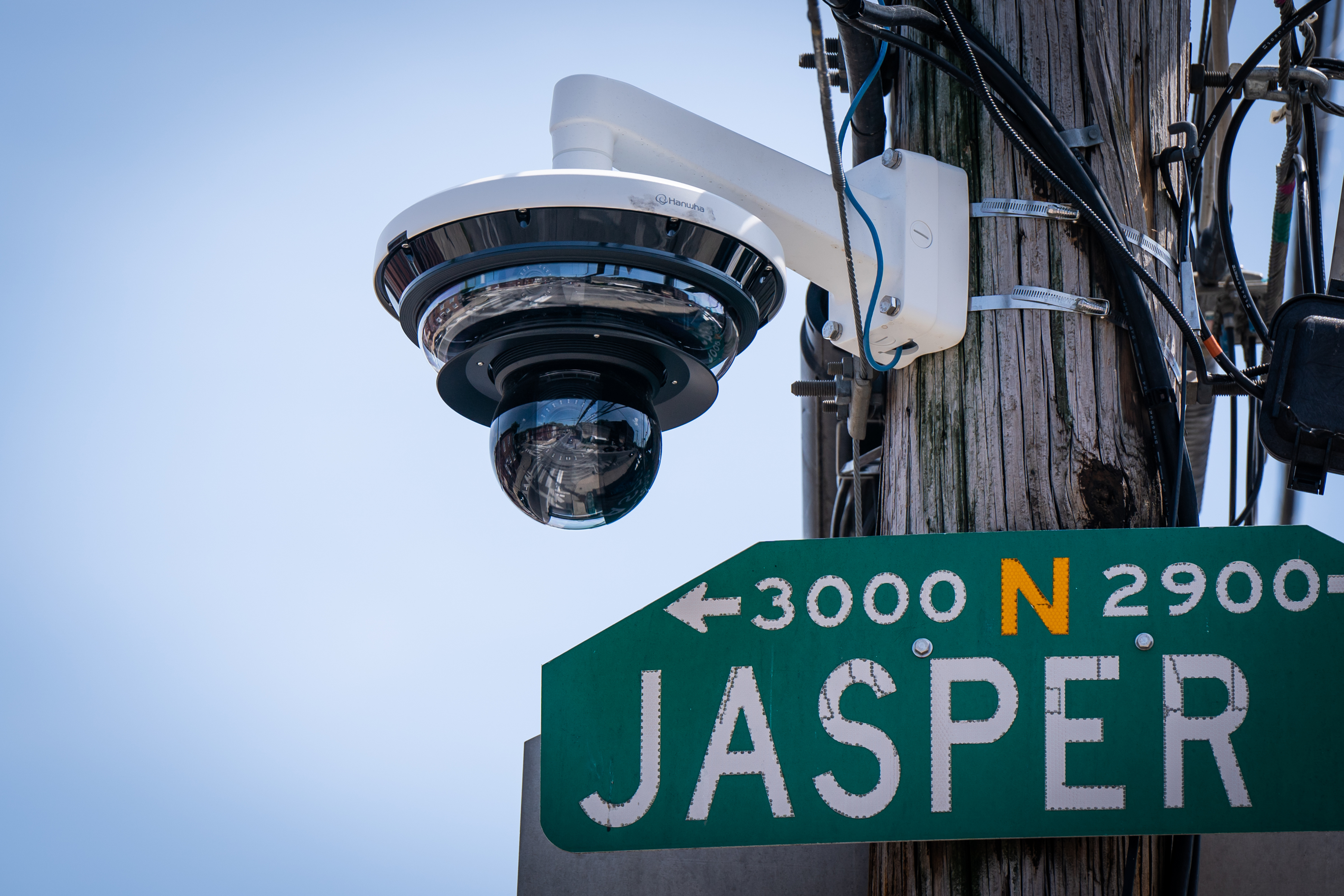
    A video camera at Jasper and Orleans Streets in Philadelphia.

    Cameras are everywhere

    Just in the last year, police have doubled the number of “real-time crime” cameras on Philadelphia’s streets. In 2024, police said there were 3,625 of the ultrahigh-resolution cameras across the city. This year, there are 7,309.

    And there are tens of thousands of other cameras through SEPTA, private businesses, and residents’ home-surveillance systems that give detectives leads on suspects.

    Police have also recently installed hundreds of license plate readers — 650 for every patrol vehicle and another 125 on poles across the city.

    The department also subscribes to a software that taps into a broader network of millions of other plate readers — on tow trucks, in parking garages, and even private businesses across the region.

    Police said the tools are helping them track shooters’ movements before and after a shooting and locate getaway cars more quickly, by searching a vehicle’s license plate or even by its make and model.

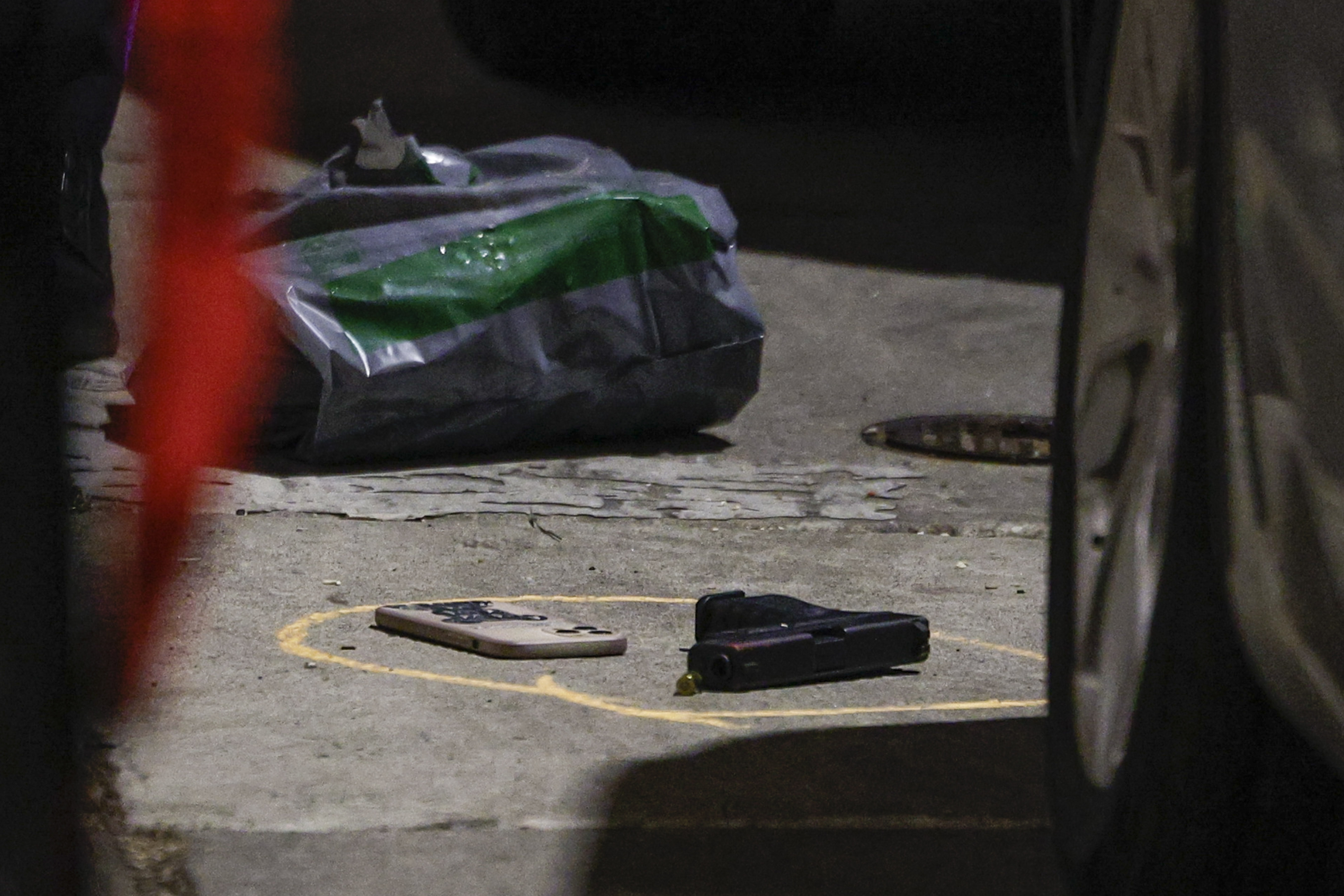
    Police locate a gun and a cell phone on the 700 block of East Willard Street, where a man in his 20s was fatally shot in December 2024.

    Phones and social media

    Philadelphia police and the district attorney’s office have greatly expanded their digital evidence tools in the past two years.

    Where cases once relied on grainy video and often-reluctant witnesses, detectives now have high-definition video footage, partial DNA processors, and cell phone location data — evidence that “never goes away” and doesn’t lie, said Deputy Police Commissioner Frank Vanore.

    Getting access to a suspect’s — and victim’s — phones and social media can often tell the story behind a crime.

    The Gun Violence Task Force, which investigates gang violence and works closely with homicide and shooting detectives, had just two cell phone extraction devices two years ago. Now, it has 14, plus a host of advanced software that helps investigators track and map gang networks.

    Between the homicide unit and the task force, nearly 2,000 phones were processed last year — often giving detectives crucial evidence and information about crimes beyond the one they were initially investigating.

    Improved morale

    Some detectives, who asked not to be identified to speak frankly about their work, said morale in the homicide unit — and across the department — has improved.

    During the pandemic, when shootings surged, tensions in the unit went unchecked, and conditions at the Roundhouse headquarters were dire. The office was overcrowded and infested with vermin, and investigators shared just 15 computers among nearly 100 detectives.

    Since moving in 2022 to new offices at 400 N. Broad St., each detective now has a desk and computer, and that has boosted productivity, they said.

    The detectives also said that patrol officers seem more empowered than during the height of the gun violence crisis to engage with their neighborhoods and gather information that ends up being important to their investigations.

  • A Polish museum got a free Society Hill home for nearly 40 years. Then the city evicted it.

    A Polish museum got a free Society Hill home for nearly 40 years. Then the city evicted it.

    To hear Michael Blichasz tell it, none of this would have happened if he hadn’t gone asking for a copy of the deed.

    City officials never would have come knocking on the door of his nonprofit museum, the Polish American Cultural Center, curious how he came to be the supposed owner of a multimillion-dollar property in the heart of Philadelphia’s historic district.

    They never would have begun scrutinizing the decades-long paper trail, the political handshakes, and the forgotten promises made to the once-powerful community leader.

    And the quaint Polish history museum that has operated in Society Hill since 1987 would still have its home.

    Because for nearly 30 years, City Hall never questioned whether Blichasz’s nonprofit actually owned the building at 308 Walnut St.

    “No one mentioned a word about it,” Blichasz, 79, said. “It was totally silent.”

    That silence started unraveling seven years ago when, Blichasz said, he requested a copy of the deed in order to get a state grant to make repairs on the five-story property. He had somehow avoided an inquiry for decades, despite securing other grants and contracts to keep alive his nonprofit’s mission: providing Polish immigrants with a one-stop cultural hub that could connect them to city services.

    Officials at the Philadelphia Redevelopment Authority (PRA) scratched their heads at the request, according to Blichasz. Records showed the authority owned the museum building, not the Polish group.

    PRA eventually took Blichasz to court, accusing him of squatting in the property and failing to pay back millions in loan installments. Blichasz said former Mayor W. Wilson Goode and other elected officials in the late 1980s purchased the property for his group and promised to pay off the debt as a gift to the Polish community.

    But apparently those promises were never written down.

    “The city has no records [or] evidence anyone in the city ever agreed to pay the balance on behalf of [the Polish museum] to obtain ownership of the property,” Jamila Davis, a PRA spokesperson, said in a statement.

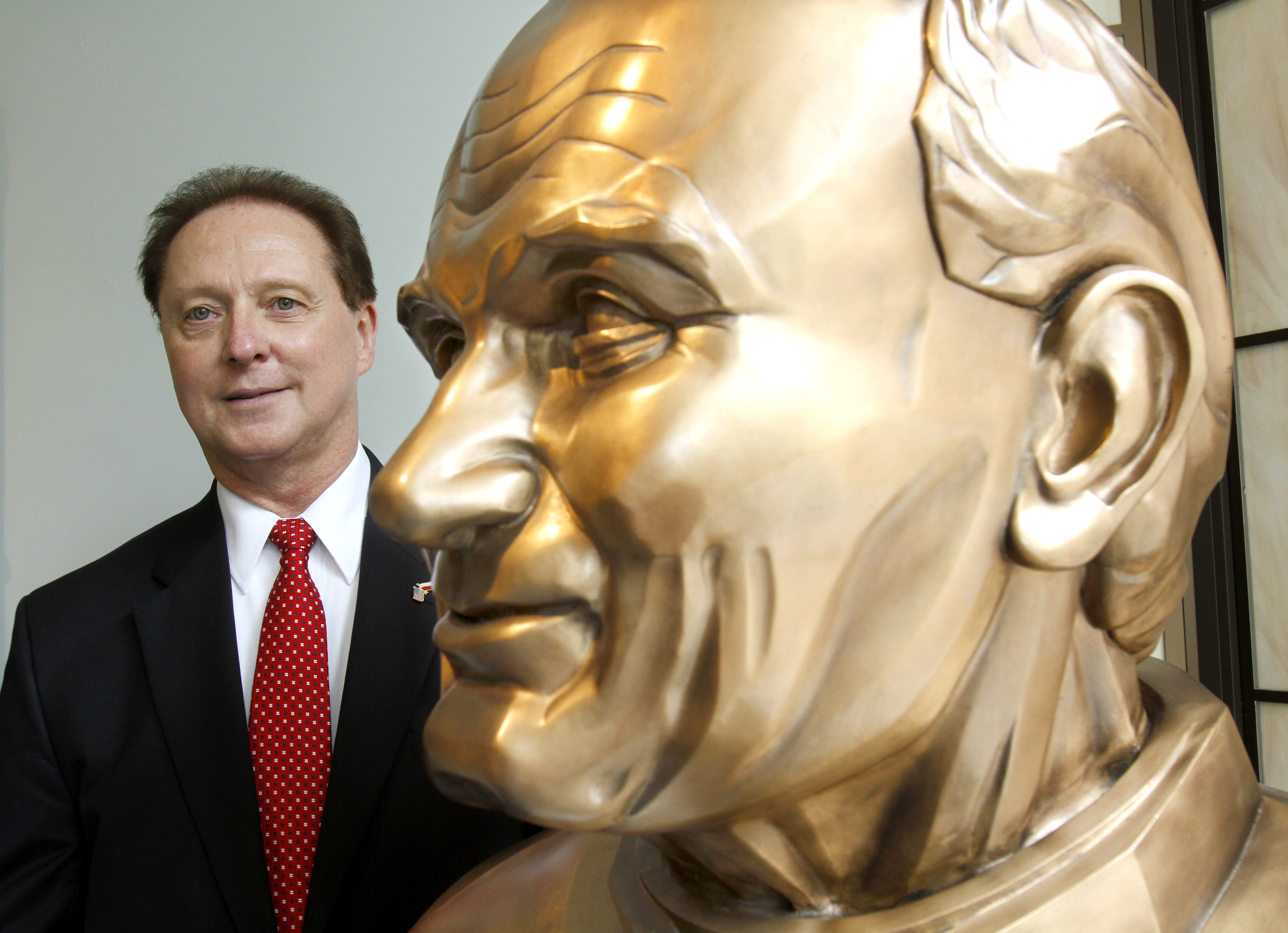
    Michael Blichasz, president of the Polish American Cultural Center, stands beside a bust of the former Pope John Paul II.

    This much both sides agree on: The Polish American Cultural Center came to occupy the historic building thanks to a rare and generous arrangement in 1987.

    Goode approved a $2.1 million bond to buy a permanent home for United Polish American Social Services, a nonprofit run by Blichasz that had been aiding the city’s Polish immigrants since the early 20th century.

    The grant led to the birth of the city’s first and only Polish museum, where Blichasz amassed an exhibit hall full of national folk art, portraits of famous Poles such as Pope John Paul II, and historical artifacts dating from the first immigrant settlers to these shores in 1608 to the diaspora that followed the 1939 invasion of the Nazis.

    But Goode’s act of benevolence came with a caveat: According to the bond agreement, if the Polish group failed to keep up with payments, the city could kill the deal and take back the building. Blichasz claims Goode and other elected officials at the time, many of whom are now dead, promised he would never have to pay a dime.

    “They said, ‘You will pay zero,’” he said.

    A copy of a $81,875 check Blichasz provided to The Inquirer represents one of the only payments made by the nonprofit to the city — in August 1988. PRA said Blichasz’s nonprofit, all told, paid about $155,000 toward the bond taken out by the city, which grew to $4.6 million with interest.

    The Goode administration later applied for a federal grant through the U.S. Department of Housing and Urban Development (HUD) to pay off the property, according to records provided to The Inquirer.

    Blichasz said he was under the impression the deal was done. But those federal funds never materialized — and the city didn’t seek to settle the debt for decades.

    Bicentennial cash and ethnic tensions

    The museum’s origins lie in the summer of 1987, when City Hall faced accusations of racial and ethnic favoritism.

    The city had just unlocked $2 million left from the 1976 Bicentennial, and Council members had sent half that money to nine Black community groups. Anger simmered among white ethnic leaders like Blichasz.

    “Reverse discrimination,” Councilmember Joan Krajewski said at the time.

    Critics asserted also that regardless of race, the fund was supporting activities with few ties to America’s birthday celebration — from a Trinidadian steelpan orchestra to a Polish-American festival at Penn’s Landing led by Blichasz.

    At the time, however, Blichasz’s nonprofit was also trying to move its headquarters from Fairmount to Philadelphia’s historic district.

    And the city had already agreed to pay for the new building.

    After the city inked the bond purchase on behalf of the Polish group, Blichasz vowed to increase the nonprofit’s annual budget by 50% to keep up with repayment. Goode promised the group leniency, but newspaper articles from the time show no offer to fully wipe the debt.

    Blichasz was confident. Donors in the Polish community, he said, would “respond with joy” to bring this first-of-its-kind museum to life in Philadelphia.

    But the joy proved less than hoped.

    Months later, Blichasz was back at City Hall asking for a bailout. His group had raised only a fraction of its $1 million goal and needed an additional $350,000 to pay the mortgage and museum build-out costs.

    He pointed out that the city had financed capital projects for other ethnic groups, including the Mummers Museum, the African American history museum, and the Jewish museum.

    “This is going to tell us just how appreciated the good, taxpaying Poles are by this country,” Blichasz said at the time.

    The museum, he promised, would be “an attraction” that would more than repay its debt.

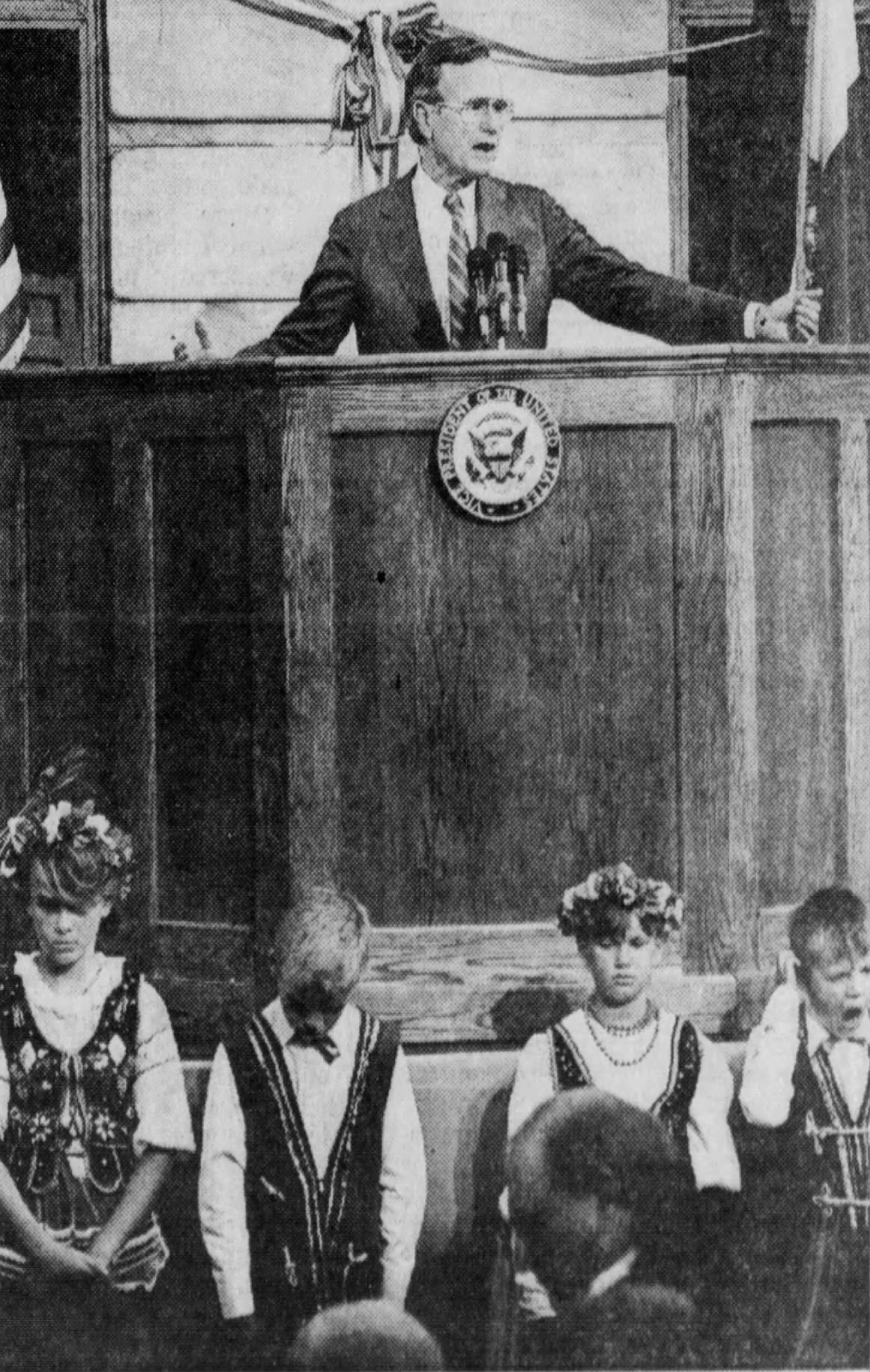
    Then Vice President George H.W. Bush visits the Polish American Cultural Center for the opening published on Aug. 10, 1988, in The Inquirer.

    Teaching self-sufficiency

    The Polish American Cultural Center opened its doors in August 1988 to a flag-waving crowd of 300 people. Then-Vice President George H.W. Bush attended the ribbon-cutting ceremony, where visitors admired hand-cut Polish crystal and other curios from the homeland.

    Alongside the museum, the nonprofit continued to provide the community with services that ranged from English language courses to help with rent and fuel rebates — work Blichasz said was “teaching Polish immigrants to be self-sufficient.”

    Much of that work was also financed by the city.

    Auditors later raised concern over a six-figure contract the Goode administration dealt to the nonprofit. At the time, the arrangement led former city finance director David Brenner to speculate about Blichasz’s political clout: “Where his influence comes from beats the hell out of me, but no question he’s got it.”

    At some point, however, concerns over the debt for 308 Walnut St. disappeared.

    As far as Blichasz was concerned, it was absolved after Goode applied for the HUD grant.

    Blichasz said officials like Krajewski and Goode insisted his group not cut any more checks to the city, saying “we will take care of it.”

    Why PRA did not inquire about the outstanding mortgage agreement remains uncertain. A spokesperson did not immediately respond to a question about the matter, and city records show only one inspection of the property, in 2011.

    By the time PRA took a renewed interest, Blichasz had a problem: Many of the people who helped facilitate the initial deal were no longer around to help explain.

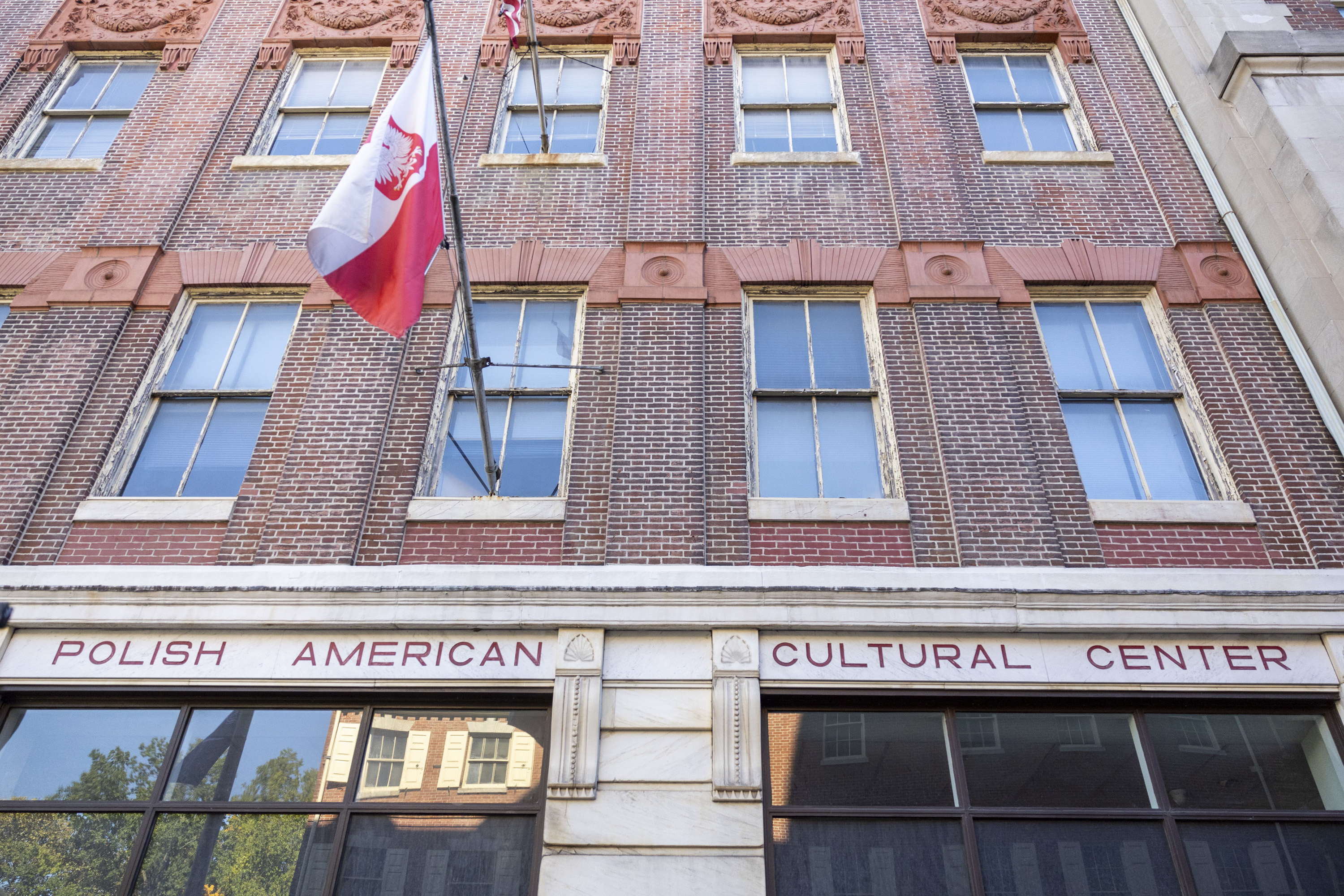
    The outside of the Polish American Cultural Center.

    A historic takeback

    The museum fell under the radar until Mayor Jim Kenney’s first term. Soon after Kenney took office in 2016, Blichasz recalled, there was a heated meeting after the nascent administration ended his nonprofit’s six-figure social services contract.

    He described the city as more interested in “giving out condoms” than providing help to an increasingly elderly Polish population.

    Years later, during an insurance audit of large buildings owned by the Philadelphia Redevelopment Authority, Kenney administration officials were baffled by 308 Walnut St. It’s not clear if the PRA even knew who owned it.

    PRA officials toured the building in 2019 and found the museum on the first floor much as it had ever been. But the floors above were in shambles, according to a city employee who toured the property.

    The second through fourth floors looked as if their occupants had been raptured, with calendars from the 1980s frozen on the walls and moldy cups of coffee that appeared to date to the same decade.

    On the fifth floor, officials said, they found evidence that someone had been sleeping in the building along with boxes of old documents and recording equipment where Blichasz broadcast his Polish American radio hour.

    PRA quickly moved to intervene.

    “Based on concerning conditions observed during the tour,” PRA said in a statement this week, it hired an engineering firm to document the state of the building. The contractors reported it needed at least $1.8 million to be brought back to code. The lack of maintenance resulted “in potentially dangerous structural issues,” PRA said in a statement.

    Blichasz acknowledged water damage from leaks, which he had hoped to repair with state grants. But he called the PRA’s overall assessment of the property a fiction. He said his nonprofit spent “millions” in repairs over the years out of its operating budget.

    “It’s very fishy,” Blichasz said of PRA’s inspection.

    The agency said in a statement that officials “attempted to negotiate” but that Blichasz “refused to cooperate and repeatedly requested outright ownership” of the property, despite not having complied with the terms of the original deal.

    With no legal title, the PRA took the nonprofit to court in 2023. The agency ultimately won, wresting back control of the building. A judge ordered the nonprofit to pay $3.5 million dollars in debt and damages.

    This April, the Polish American Cultural Center was evicted.

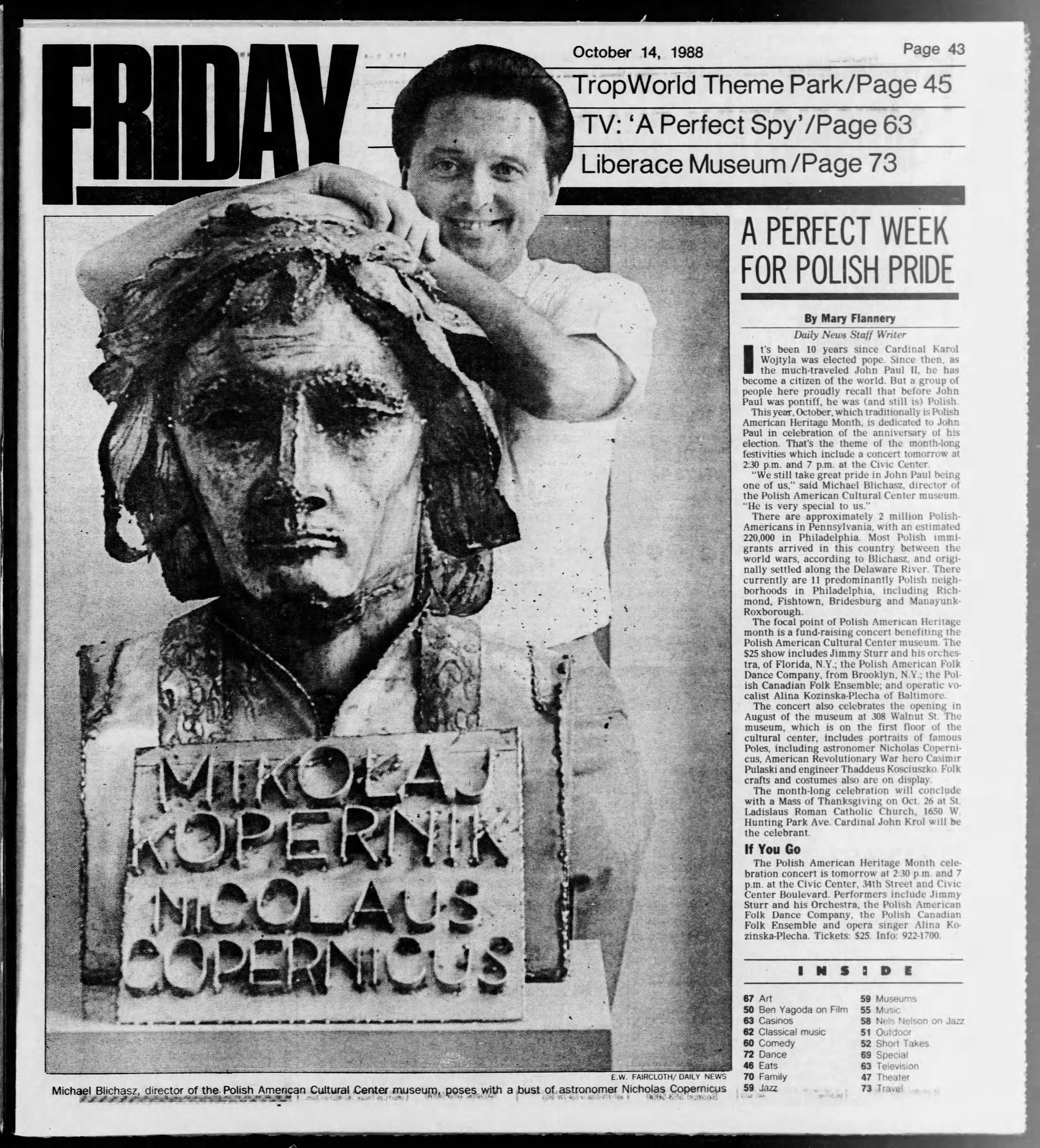
    Michael Blichasz, director of the Polish American Cultural Center museum poses with a bust of astronomer Nicholas Copernicus. Published in the Philadelphia Daily News on Oct. 14, 1988.

    Last chance to cut a deal

    As the city clawed back the property, Blichasz accused officials of negotiating in bad faith. He also suggested it was a racially motivated attack against his organization to divert funding to nonwhite community groups.

    Those who could attest to the original deal are dead or not talking. Krajewski, the former Council member, died in 2013. Blichasz said he hadn’t reached out to Goode in years. Phone calls to the former mayor were not returned.

    “When those people were alive, we could have had a nice get-together, a hearing,” Blichasz said. “Now they want to take me to court. I said, ‘Why? You never sat down with us to discuss this.’ All I want to do is keep the original mission and goals alive.”

    The ordeal has interested at least one current elected official.

    Councilmember Mark Squilla, who represents the area, has acted as a liaison between Mayor Cherelle L. Parker and Blichasz this year. Emails shared with The Inquirer showed that Blichasz turned down three compromise options from Parker that would have either allowed the Polish group to remain in the building under a new lease or helped pay for the group’s relocation.

    Squilla acknowledged that the paperwork didn’t support Blichasz’s case. But he argued that his decades of contributions to the city should be considered, too.

    “After we did some background research, I figured there’s no way we could find out what really happened,” Squilla said. “So I figured, ‘Why don’t we just work out a deal?’ And unfortunately, the deals that the PRA made were not accepted by the Polish museum folks.”

    Squilla introduced a resolution in City Council on Oct. 9 to hold hearings on the PRA’s treatment of Blichasz.

    “After 30 years, I believe that they had the right to stay in and use the building,” the Council member said.

    On Wednesday, a woman approached the doorway of the museum, asking if it was open.

    Inside, standing in the wood-paneled hallway that harkened back to another era, a maintenance worker shooed her away.

  • A leaked, secret survey reveals what Philly attorneys think about judges up for election

    A leaked, secret survey reveals what Philly attorneys think about judges up for election

    It’s a local tradition as predictable as slow-rolling through a South Philly stop sign or cursing Schuylkill Expressway traffic: Each election season, the Philadelphia Bar Association publishes its carefully considered opinion of the sitting judges up for reelection — then, the voters ignore it and send every incumbent back to the bench.

    That’s because, since 1969, judicial retention elections have been yes-or-no votes for each judge rather than head-to-head competition. In that time, only one Philadelphia Common Pleas Court judge has ever been denied another term — and he was already facing removal for misconduct in a high-profile case. He “had to work damn hard to lose that election,” retired Common Pleas judge Benjamin Lerner said.

    In September, the bar’s Commission on Judicial Selection and Retention issued its advice for the Nov. 4 election, recommending 13 out of the 18 judges seeking reelection to Philadelphia’s Common Pleas and Municipal Courts. Other than noting that three of the five “not recommended” judges had not participated in the review process, the bar — as is typically the case — released no further information about its decisions.

    But this year, The Inquirer obtained the confidential survey responses the association collected from hundreds of lawyers. The attorneys — who practice in Philadelphia’s criminal, civil, and family courts — provided the bar with detailed feedback under the cover of anonymity about the sitting judges. They also answered yes-or-no questions about their confidence in each judge’s integrity, legal ability, temperament, diligence, attentiveness, and general qualification for the job.

    The Inquirer followed up on the issues raised in the survey by interviewing lawyers and judges, watching weeks of court hearings, and reviewing a decade of Superior Court decisions.

    The survey results and The Inquirer’s examination offer voters a rare window into how members of Philadelphia’s legal community view the performance of the judges up for retention next month. It has been at least 40 years since such inside information was made available to the public.

    window.addEventListener(“message”,function(a){if(void 0!==a.data[“datawrapper-height”]){var e=document.querySelectorAll(“iframe”);for(var t in a.data[“datawrapper-height”])for(var r,i=0;r=e[i];i++)if(r.contentWindow===a.source){var d=a.data[“datawrapper-height”][t]+”px”;r.style.height=d}}});

    The survey responses show that, overall, lawyers have confidence in the integrity of the bench, a profound turnaround from an era of chronic judicial corruption scandals that continued well into this century.

    The judges earning the bar association’s recommendation include several on Common Pleas Court with near-unanimous support: Family Court Judges Walter Olszewski, Ourania Papademetriou, and Christopher Mallios; and Judge Ann Butchart, who handles civil cases.

    Olszewski is a “wonderful, caring, intelligent jurist,” one lawyer wrote. “A true public servant.”

    The majority of the judges received the bar’s recommendation despite feedback that was mixed, though generally positive.

    The most polarizing was Judge Tracy Brandeis-Roman, who has faced blistering appeals from the district attorney’s office accusing her of a pro-defendant bias. Two-thirds of lawyers surveyed said Brandeis-Roman is qualified, and some referred to her as a “fair and compassionate” jurist. But others called her biased and “ill-informed on the law.”

    Brandeis-Roman declined to comment.

    The judges who received the harshest criticism — and whom the bar ultimately declined to recommend — were faulted for their demeanor, disciplinary histories, or disregard for legal procedures.

    “She was cruel and condescending to my client,” a lawyer wrote of Common Pleas Court Judge Lyris F. Younge, who faced parent protests in 2018 and was later sanctioned by the state Court of Judicial Discipline.

    “Incapable, even after all of the years of being on the bench, of making an appropriate decision expeditiously,” another said of Common Pleas Court Judge Frank Palumbo.

    Younge and Palumbo did not respond to requests for comment.

    Marc Zucker, who chairs the bar’s Commission on Judicial Selection and Retention, said the anonymous survey has no bearing on the final recommendations. Instead, he described it as a jumping-off point for an extensive process in which more than 100 volunteer investigators interview candidates, other judges, and lawyers. They also scrutinize judges’ written opinions, social media posts, and financial disclosures.

    “We don’t take any criticism at face value,” Zucker said. “We try and look behind it, and hear multiple voices addressing each of those matters.”

    That information is kept private, he said, to encourage candor.

    The bar’s work does seem to have an influence on voters in competitive primaries. In May, only candidates it recommended won primaries for Common Pleas Court judge.

    Retention elections can be confusing for voters and are low-profile by design because sitting judges are limited in how they can campaign, said Lauren Cristella, executive director of the good-government group Committee of Seventy and a Judicial Commission member.

    But the stakes are high. Local judges “make decisions that have a huge impact on our communities,” Cristella said. “Everyone knows someone who’s had a custody hearing, or had to appear in traffic court. People have all kinds of reasons to be before a judge.”

    Here is what voters should know about some of the more notable judges up for retention on Nov. 4:

    (function() { var l = function() { new pym.Parent( ‘retention-palumbo3__graphic’, ‘https://media.inquirer.com/storage/inquirer/ai2html/retention-palumbo3/index.html’); }; if(typeof(pym) === ‘undefined’) { var h = document.getElementsByTagName(‘head’)[0], s = document.createElement(‘script’); s.type = ‘text/javascript’; s.src = ‘https://pym.nprapps.org/pym.v1.min.js’; s.onload = l; h.appendChild(s); } else { l(); } })();

    When Palumbo first ran for judge in 1999, he was best known as the son of a famous Philly power broker and nightclub owner. The bar association declined to recommend him, but Palumbo drew the top ballot position and cruised to victory. Since then, he has been reelected twice without the bar’s support.

    This year, survey participants complained that Palumbo is erratic and indecisive. One lawyer wrote that getting through a daily list of cases “is an immense struggle for him.” Another claimed he “purposefully blows up negotiated pleas in his room so he does not have to take them.”

    The Superior Court has overturned about one-quarter of cases it decided on appeal from Palumbo’s courtroom over the last decade, well above the statewide average of 13%.

    Most days, Palumbo is assigned a modest docket that consists of probation violations.

    A reporter sat in Palumbo’s courtroom on five occasions in August and September. By the time he arrived around 10:30 a.m., most matters had already been resolved by agreement.

    One day, the prosecutor and the public defender informed Palumbo that, in his absence, they had agreed on the outcome of every single case: In minutes, Palumbo’s work on the bench was done.

    But when the lawyers in the matters before him did not reach a complete agreement, as was the case on Aug. 27, Palumbo launched into circuitous legal questioning that stymied what might have been a routine proceeding.

    On that day, Palumbo took the bench at 10:40 a.m. and asked, “Is everything worked out?”

    The lawyers told him there was just one outstanding matter: A man on probation had agreed to plead guilty in a gun case, and they wanted Palumbo to order a presentence investigation and schedule a sentencing for a future date. Instead, Palumbo questioned why the case was in his courtroom, offered to transfer it to another judge, and then aborted the proceeding, saying he could not accept the plea without the man’s probation file in hand.

    After the prosecutor complained, Palumbo offered, twice more, to transfer the case elsewhere. “I can just move it to the trial room,” he said.

    Generally speaking, lawyers on both sides find it difficult to navigate judges who unilaterally delay or derail proceedings, said Dana Bazelon, a former Philadelphia defense lawyer and policy director for the district attorney’s office, who is now a fellow at the Quattrone Center of the University of Pennsylvania Carey Law School.

    “There are judges who really struggle to make decisions who are currently sitting — and that is as basic a tenet of the job as there is,” she said. “You can’t really do the job if you can’t make decisions.”

    (function() { var l = function() { new pym.Parent( ‘retention-roman2__graphic’, ‘https://media.inquirer.com/storage/inquirer/ai2html/retention-roman2/index.html’); }; if(typeof(pym) === ‘undefined’) { var h = document.getElementsByTagName(‘head’)[0], s = document.createElement(‘script’); s.type = ‘text/javascript’; s.src = ‘https://pym.nprapps.org/pym.v1.min.js’; s.onload = l; h.appendChild(s); } else { l(); } })();

    After a jury returned a guilty verdict against Stephen Jones in a child sexual assault case this May, the victim’s family felt a moment’s relief. Then Brandeis-Roman handed down her sentence.

    Rather than the lengthy prison term the prosecutor sought, the judge released the ailing, 80-year-old defendant on short-term house arrest and probation.

    The victim’s family was furious.

    The outcome was not unusual for Brandeis-Roman. Philadelphia’s district attorney’s office has appealed more than two dozen of her rulings, arguing that her sentences are too lenient and that her decisions have a pro-defendant bias. It’s a notable trend given that the office, under D.A. Larry Krasner, is considered one of the most progressive in the country.

    The Superior Court has so far decided 17 of those cases appealed by prosecutors. Sixteen of them were overturned, including a guilty jury verdict Brandeis-Roman had tossed out despite what the Superior Court called “uncontradicted and overwhelming” video evidence tying the defendant to a shooting.

    Krasner’s office is appealing another Brandeis-Roman decision to vacate a jury’s guilty verdict in a sexual assault trial.

    At what was supposed to be the sentencing hearing for that case, the judge instead threw out the verdict, saying that the evidence did not support the jury’s finding and that the defendant might not have known the victim was incapacitated. The prosecutor’s appeal argued that Brandeis-Roman usurped the role of the jury, took a “thoroughly slanted view,” and disregarded testimony that the woman had been so drunk that her friends had to clean up her vomit and put her to bed.

    Marian Braccia, a Temple University law professor and former Philadelphia prosecutor, said it is rare to see a judge overrule a jury in that manner and requires a finding that no reasonable jury could have reached that verdict.

    For that to happen repeatedly, she said, “really undermines the reliability of the whole system.”

    The lawyers responding to the bar’s survey who praised Brandeis-Roman cited her diligence, compassion, and unyielding commitment to justice.

    “Constantly bullied by the [district attorney’s office] and yet still has the self-respect and respect for fairness to be kind and stand up to them. Holds everyone to the same standard,” one lawyer wrote.

    Setting aside the prosecution’s appeals, the appellate court has affirmed more than 90% of her rulings.

    Prosecutors, meanwhile, continue to file motions urging Brandeis-Roman to reconsider what they say are light sentences.

    In one September case, she sentenced Eladio Vega — a 33-year-old man convicted of beating a pregnant woman, causing her to miscarry and breaking her jaw — to a brief jail term, followed by probation and drug treatment.

    The prosecutor had requested five to 10 years in prison for Vega, given previous convictions for domestic incidents that included breaking his mother’s wrist. But Brandeis-Roman, noting that Vega had survived child abuse and mental illness, said state prison “would absolutely be adding to the trauma.”

    She acknowledged that her decision went against state guidelines: “On paper,” she said, giving him a lighter sentence “doesn’t make sense.”

    (function() { var l = function() { new pym.Parent( ‘retention-younge2__graphic’, ‘https://media.inquirer.com/storage/inquirer/ai2html/retention-younge2/index.html’); }; if(typeof(pym) === ‘undefined’) { var h = document.getElementsByTagName(‘head’)[0], s = document.createElement(‘script’); s.type = ‘text/javascript’; s.src = ‘https://pym.nprapps.org/pym.v1.min.js’; s.onload = l; h.appendChild(s); } else { l(); } })();

    In 2018, parents took to the streets calling for action against Younge.

    Then a relatively new Family Court judge hearing child-welfare cases, Younge had come to the bench with deep expertise in child welfare, having worked as a lawyer for the City of Philadelphia and an executive in the Philadelphia Department of Human Services.

    But, among other complaints, the protesting parents said Younge had shut them out of proceedings. One mother who became ill during a hearing stepped out of the room, and Younge would not allow her to return, terminating her parental rights in her absence.

    The Superior Court reversed a spate of the judge’s decisions, finding Younge abused her discretion in throwing a grandmother in jail and handcuffing a mother while her kids were removed.

    One appellate decision cited “example after example of overreaching, failing to be fair and impartial, evidence of a fixed presumptive idea of what took place, and a failure to provide due process to the two parents involved. … The punishment effectuated by [Younge] was, at best, neglectful and, at worst, designed to affect the bond between Parents and [child] so that termination would be the natural outcome of the proceedings.”

    The Court of Judicial Discipline in 2021 suspended Younge for six months, placing her on judicial probation and banning her from Family Court for the duration of her term.

    Instead of child-welfare matters, Younge is now hearing civil cases. Over her tenure, the Superior Court has overturned about 27% of the cases appealed from her courtroom, double the statewide average.

    Younge did not participate in the bar’s process or respond to requests for comment from The Inquirer.

    In the survey, most lawyers brought up concerns with her record in Family Court. Those who had been in her civil courtroom gave mixed feedback.

    “Those patterns and practices are still present in her civil courtrooms,” one lawyer wrote. “No party, on either side, gets a fair trial.”

    (function() { var l = function() { new pym.Parent( ‘retention-diclaudio2__graphic’, ‘https://media.inquirer.com/storage/inquirer/ai2html/retention-diclaudio2/index.html’); }; if(typeof(pym) === ‘undefined’) { var h = document.getElementsByTagName(‘head’)[0], s = document.createElement(‘script’); s.type = ‘text/javascript’; s.src = ‘https://pym.nprapps.org/pym.v1.min.js’; s.onload = l; h.appendChild(s); } else { l(); } })();

    Presiding mostly over post-conviction reviews in criminal court, DiClaudio inherited a docket that included cases pending for a decade or longer, and he said he prided himself on his hard work and efficiency in clearing that backlog. He has noted that his record includes overturning roughly 50 homicide convictions.

    Lawyers surveyed about DiClaudio were divided, with many criticizing his courtroom demeanor even as they said he “knows the law and gets to the right conclusions.” The Superior Court has overturned his rulings in only about 7% of cases.

    But DiClaudio’s decade on the bench has been marked by controversy, including three cases the Judicial Conduct Board brought against him.

    In the first case, from 2019, the board said DiClaudio ignored court orders related to a lawsuit over unpaid membership dues he owed to a sports club. DiClaudio was given a two-week suspension and placed on judicial probation until 2026.

    This year, the board argued that DiClaudio had improperly used his office to promote his wife’s cheesesteak shop and “traded on and abused the prestige of his office for the personal and economic benefit of himself and others.”

    While a final decision on that case was pending, fellow Common Pleas Court Judge Zachary Shaffer alleged that DiClaudio tried to influence his sentencing decision in a gun case by showing Shaffer a piece of paper with the name of a defendant and saying, “I’ve heard you might do the right thing anyway.”

    Court supervisors placed DiClaudio on administrative leave, and the Judicial Conduct Board pushed for his suspension without pay on the grounds that his continued employment as a judge would “erode public confidence in the judiciary.”

    DiClaudio stipulated to various missteps in the 2019 case related to the club debt, but he has denied any wrongdoing in the two pending cases. DiClaudio denied trying to influence Shaffer, and his lawyer insisted that he had not sought to sway the judge but had happened to mention the defendant in passing when Shaffer stopped by his chambers to buy a T-shirt from the cheesesteak shop.

    (function() { var l = function() { new pym.Parent( ‘retention-grey2__graphic’, ‘https://media.inquirer.com/storage/inquirer/ai2html/retention-grey2/index.html’); }; if(typeof(pym) === ‘undefined’) { var h = document.getElementsByTagName(‘head’)[0], s = document.createElement(‘script’); s.type = ‘text/javascript’; s.src = ‘https://pym.nprapps.org/pym.v1.min.js’; s.onload = l; h.appendChild(s); } else { l(); } })();

    Grey, a Family Court judge overseeing child-welfare cases, has drawn harsh criticism from the lawyers participating in the bar’s survey and from Superior Court judges reviewing his decisions.

    A former criminal-defense lawyer, Grey was recommended by the bar when he first ran for judge in 2015.

    Some survey respondents praised him for his commitment to families. But lawyers also raised concerns about his temperament, saying he yells at litigants and interrupts testimony.

    “Judge Grey’s judicial performance is highly dependent on his mood, which varies widely from day to day,” one lawyer wrote. “He is also frequently aggressively impatient with attorneys, social workers and adult parties. Great with kids.”

    An Inquirer review of Superior Court decisions found Grey had the highest reversal rate of any judge in Family Court’s juvenile division. In several opinions, appellate judges said Grey returned children home to dangerous situations — in one case going so far as to say they were “appalled” by Grey’s decision.

    In an interview, Grey acknowledged some errors but said in most cases, his decisions were properly grounded in the available evidence and the law.

    As for occasionally yelling, he said it’s warranted.

    “I’ve yelled at attorneys for not knowing what’s going on or being prepared,” he said.

    Grey said that allowing himself to become emotionally involved is crucial to building connections, and that it is incumbent on him to get involved in asking questions and guiding testimony so that he has all the information he needs to decide cases.

    (function() { var l = function() { new pym.Parent( ‘retention-frazier-lyde2__graphic’, ‘https://media.inquirer.com/storage/inquirer/ai2html/retention-frazier-lyde2/index.html’); }; if(typeof(pym) === ‘undefined’) { var h = document.getElementsByTagName(‘head’)[0], s = document.createElement(‘script’); s.type = ‘text/javascript’; s.src = ‘https://pym.nprapps.org/pym.v1.min.js’; s.onload = l; h.appendChild(s); } else { l(); } })();

    Frazier-Lyde is the only Municipal Court candidate up for retention whom the bar declined to recommend.

    It’s unlikely to affect her chances at the polls. In the last election cycle, she won by the largest margin of any Municipal Court judge.

    The former champion boxer — and daughter of a Philly legend, Smokin’ Joe Frazier — is often responsible for reviewing defendants’ bail terms and handling preliminary hearings, including in domestic violence cases.

    Frazier-Lyde, in an interview, said she is proud of her work on the bench and in the community, and she said she felt blindsided by the bar’s failure to recommend her. She noted the association’s magazine praised her in a feature in its spring 2025 issue as “kind, empathetic and outwardly focused.”

    “I have public interest and public welfare at the forefront of how I look at everything,” Frazier-Lyde said, adding that she had heard no complaints from the legal community or her supervisors, who in recent months have asked her to handle a double caseload.

    But lawyers who responded to the survey said Frazier-Lyde often ignores procedural rules, such as when she questions witnesses after both sides have rested.

    She disagreed with that assessment. “I follow the law. I know the law,” she said.

    Survey respondents also questioned her handling of domestic violence cases, reporting that she had ordered victims and their alleged abusers into couples counseling. Frazier-Lyde said she does not order anyone into counseling but does seek expert evaluations to determine whether counseling is warranted.

    She also frequently imposes mutual stay-away orders on both defendants and complainants — even extending that to unspecified “friends, family, and associates” on both sides, advising that any violation could result in criminal charges.

    Frazier-Lyde said it’s her job to do all she can to keep everyone safe before trial, and such orders help achieve that.

    Bazelon, the Penn Law fellow, said it can become impossible to prosecute domestic violence cases if judges see their role as mediating an interpersonal conflict rather than assessing the evidence in an alleged crime.

    “Many people see domestic violence as not real crime,” she said. “But when judges bring that to the bench, it means they’re not taking victims seriously enough, and it has the potential to put people in danger.

    Staff writers Dylan Purcell and Chris A. Williams contributed to this article.

    Correction: A previous version of this story incorrectly stated the terms of Eladio Vega’s sentence.

    ACKNOWLEDGMENT
    The Inquirer’s journalism is supported in part by The Lenfest Institute for Journalism and readers like you. News and Editorial content is created independently of The Inquirer’s donors. Gifts to support The Inquirer’s high-impact journalism can be made at inquirer.com/donate. A list of Lenfest Institute donors can be found at lenfestinstitute.org/supporters.

  • The West Philly Tool Library is moving, and asking for help

    The West Philly Tool Library is moving, and asking for help

    The West Philly Tool Library, where members can borrow from several thousand different tools and attend classes learning how to use them, is moving from its home of the past 15 years.

    Its landlord on South 47th Street near Woodland Avenue has chosen not to renew its lease, and the library will have to move by the end of November.

    Executive director Jason R. Sanders said that the tool library has been receiving below-market-rate rent since moving in and that the organization was not upset with its landlord for raising the rent beyond what the tool library could afford.

    “We’re very grateful and want to dispel that,” Sanders said.

    The tool library’s leadership is scouting options for a new home. Wherever the library goes, it will likely need to perform repairs and retrofitting before it can open again. Sanders said that work plus moving costs would likely exceed $50,000.


    Tools cabinets inside the West Philly Tool Library last week.

    The library has called for donations through an online fundraiser with the goal of reaching $20,000, and is already roughly three-quarters of the way there. (The link is available at westphillytools.org.)

    Asking for money is something Sanders and the library have always sought to avoid. They run a purposefully tight operation, with $20 annual memberships, volunteer staff, and minimal grant funding.

    Sanders said the organization started in 2007 as a few friends who shared tools with their neighbors to make DIY home repairs. They never imagined to have the reach the library does now, with over 1,300 active members and even more coming through its classes.

    The library offers nearly every kind of household tool imaginable, from mundane screwdrivers and pliers to jackhammers and power washers. Its classes teach attendees about plumbing and electrical work, as well as sewing and date-night woodworking projects. It aims to help people live more safely and healthily in their homes, Sanders said.
    “We want to live within our means and support the community with the support we receive. So it’s kind of an unprecedented thing for us to ask for that, and I think people understand that we’re asking in a time of need,” Sanders said.

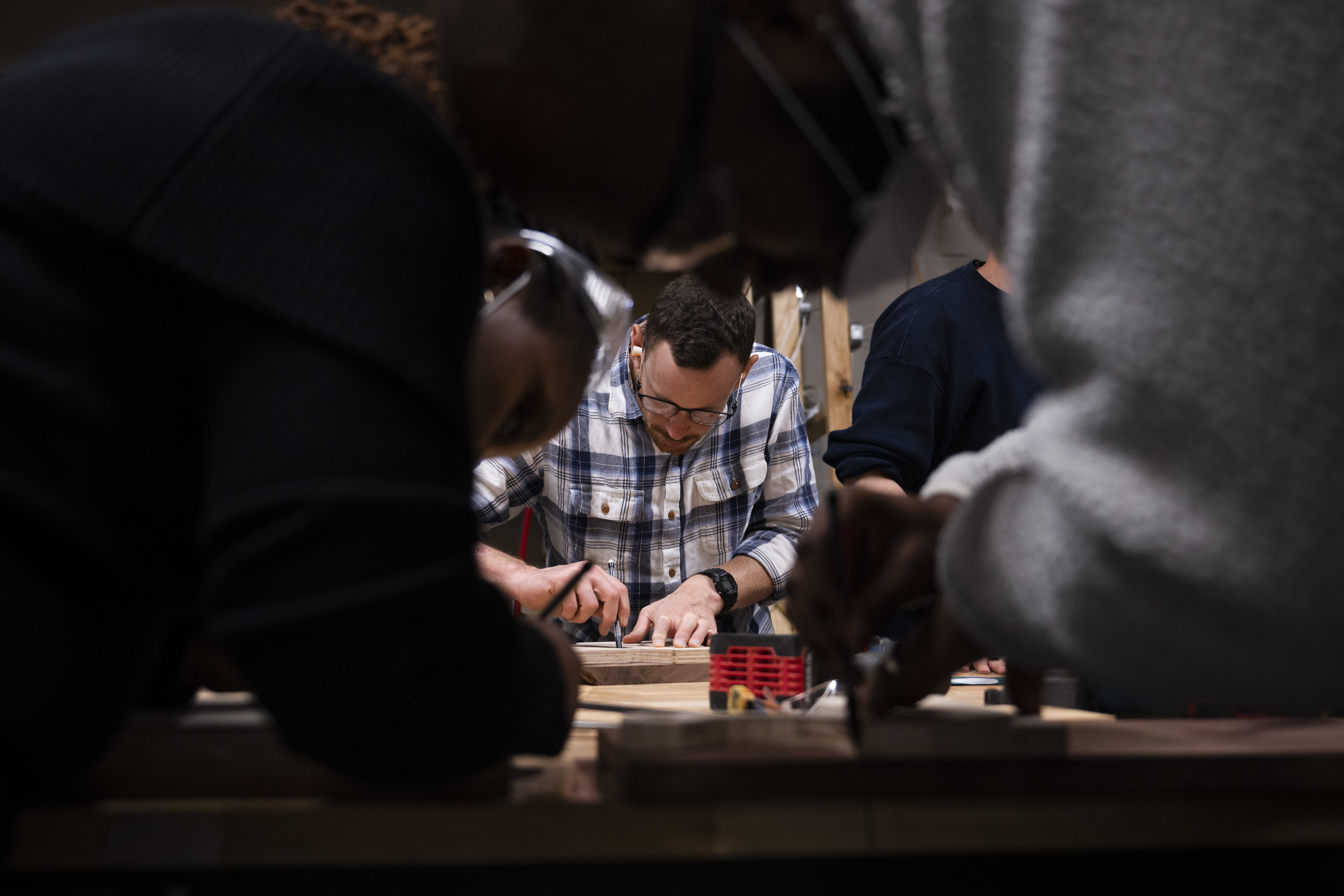
    Alan Hahn works on a charcuterie board during a woodworking class at the West Philly Tool Library on Friday, Oct. 10.

    Sanders said that particularly over the last few years, the library has become a sort of “community hub” that means more to West Philly than just a place you can grab a hammer.

    “It blows me away,” Sanders said about the support the library has received.

    Beginning later this week, the library will host volunteer days for those willing to help prepare for their move. The library is also accepting donated construction materials for renovations like drywall and wiring.

    The tool library is hosting a fundraiser event on Oct. 25, with pumpkin carving, food and drink, and a raffle from local businesses and artists.

  • Ray the goat needs a wheelchair. The Philly Goat Project hopes its fundraiser will get him one.

    Ray the goat needs a wheelchair. The Philly Goat Project hopes its fundraiser will get him one.

    Ray the Nubian goat has come a long way since a parasite threatened to take his life, leaving him with three legs but not dampening his spirit. Now he’s in need of a wheelchair.

    As a jolly middle-aged goat, 7-year-old Ray loved taking long strolls around Awbury Arboretum, supporting people in bereavement with hoofshakes and kisses, and taking children with cerebral palsy on rides.

    The wagon was his biggest job, and he took it seriously, said Karen Krivit, the director of Philly Goat Project, an East Germantown nonprofit that provides community wellness through nature connection. So much so that he hid his pain.

    “Goats tend to hide their injuries,” Krivit said. “Ray was determined to keep from showing any pain and just trying to pull his head high and be with everybody else.”

    Philly Goat Project’s annual Christmas Tree-Cycle feeds old trees to goats.

    Ray had been battling a parasite infection common among outdoor animals, Krivit said. But, as often happens for his breed, he was resistant to the medication. As his veterinarian team continued trying for a cure, a slight limp alerted the Philly Goat Project staff that his condition had worsened.

    The parasite affected his bone density, causing one of his femurs to break in three places. A big problem for any goat due to their rough-and-tumble nature.

    The place Ray had called home since he was 3 months old rallied around him, raising money for a titanium plate to secure the bone in place. But his anatomy once again worked against him.

    With Ray standing at a little over 3 feet tall, his natural lanky composition would have made it hard for the plate and the screws to hold onto the bone. The titanium plate could have collapsed his bone in another area, causing additional damage, Krivit said.

    “We were able to eliminate the parasite, but not in time enough to save his leg,” she added. “The safest long-term plan was amputation.”

    For tall animals in particular, it’s hard to thrive on three legs, Krivit explained. The biggest challenges since the amputation in May have been teaching him how to move around by himself and reintegrating him into his herd of 13 goats.

    “Humans tend to be mean to each other if you look different or act differently; it’s the same with goats,” Krivit said. “But humans can use their voices and talk about it; goats can only be mean and exclude another goat. Not being rejected is vital to his survival.”

    Ray was placed in a nearby separate stall. His brother Teddy never stopped looking out for him.

    Ten thousand dollars and months of rehabilitation later, Ray has a severe limp, but can now stand up and lie down by himself. The herd has accepted him back, but he seems to feel left behind when they go on long walks, often bellowing as the other goats head out without him.

    “Because he is moving his body in three legs instead of four, he is at risk for hurting himself further if he goes on a long walk, making it harder for him to stay connected to the herd,” Krivit said.

    So Ray needs a wheelchair.

    For goats, that involves a metal harness with a wheel on each side of the goat, mimicking a leg. But they are expensive.

    The Goat Project needs $2,000 for a custom-made wheelchair for Ray, physical therapy, and proper fitting.

    For Krivit, leaving her beloved otherwise-healthy goat without a wheelchair is not an option. She is hoping to raise enough money at the group’s annual GOAToberFest to get him a chair.

    The Oct. 18 event will take place at the Conservatory at Laurel Hill West Cemetery, and tickets run for $75, with free snacks, drinks, and goodie bags.

    Until then, she hopes folks can see in Ray a symbol of resilience.

    “A wheelchair is the missing link for him to safely go on walks that will support his body and his spirit to not be left behind,” Krivit said. “If Ray can be resilient and he can survive this, I hope that gives people hope in their times of adversity.”

    Krivit hopes their upcoming annual GOAToberFest can help get Ray a wheelchair.