Category: Philadelphia News

  • Dexter, the U.S. Navy’s last working horse, is buried in Philly

    Dexter, the U.S. Navy’s last working horse, is buried in Philly

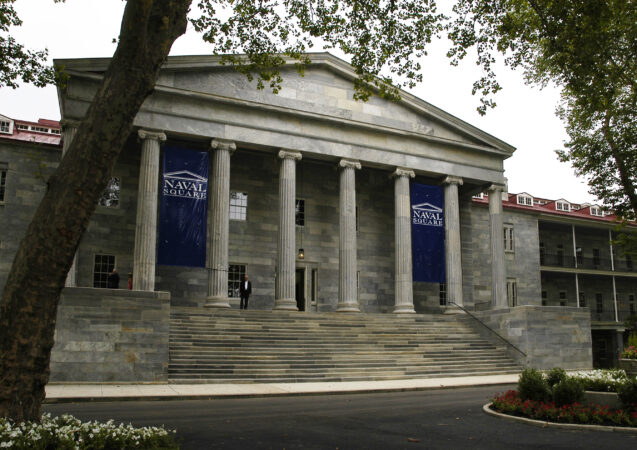
    Naval Square, as it is now known, has been many things before becoming a gated community of expensive condos on the banks of the Schuylkill in a neighborhood with many names.

    The Inquirer calls the area Schuylkill, but others might use Devil’s Pocket, Southwest Center City, or Graduate Hospital, the newest name on the block.

    But whatever you call it, the 24-acre plot of land on Grays Ferry Avenue has been associated with the Navy since 1827 and has the unusual distinction of being the final resting place of Dexter, the Navy’s last working horse.

    A reader interested in learning more about the horse — the questioner thought it was a mule — asked about it through Curious Philly, the Inquirer and Daily News question-and-answer forum through which readers submit questions about their communities and reporters seek to answer them.

    First, a little history about the site.

    The Philadelphia Naval Asylum, a hospital, opened there in 1827.

    From 1838 until 1845, the site also served as the precursor to the U.S. Naval Academy, until the officers training school opened in Annapolis with seven instructors, four of them from Philadelphia.

    In 1889, its name was changed to the Naval Home to reflect its role as a retirement home for old salts, as they used to call retired sailors. It closed in 1976, when the Naval Home moved to Gulfport, Miss.

    It was in the service of the Naval Home that Dexter came to Philadelphia.

    Originally an Army artillery horse foaled in 1934, Dexter was transferred to the Navy in 1945 to haul a trash cart around the Naval Home.

    Despite his lowly duties, the men — only men lived there — loved him.

    “That horse was more human than animal,” Edward Pohler, chief of security at the home, told the Inquirer in 1968. “He had the run of the grounds and would come to the door of my office every day to beg for an apple or a lump of sugar.”

    The chestnut gelding was retired in 1966 and sent to a farm in Exton, but that did not last long. Naval Home residents who missed him committed to paying the $50 monthly bill for his feed and care.

    For two years he grazed on a three-acre field that residents dubbed Dexter Park.

    But on July, 11, 1968, Dexter, who had stopped eating and was not responding to medication, died at the age of 34 in his stall with a little human intervention to make it pain-free.
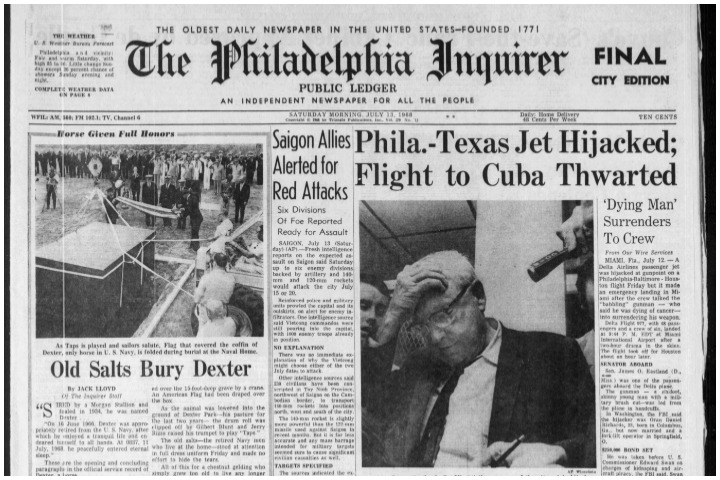
    The story about the funeral for Dexter was on the front page of the Inquirer on July 13, 1968.

    The next day, 400 people, including Navy men in dress uniform, turned out for a burial with full military honors.

    Dexter was placed in a casket measuring 9 feet long, 5 feet wide, and 5 feet deep, with an American flag draped on the top. Retired Rear Adm. M.F.D. Flaherty, the home’s governor, offered final words, saying, “Dexter was no ordinary horse.”

    As the casket was lowered by a crane into the 15-foot-deep grave, Gilbert Blunt rolled the drum and Jerry Rizzo played “Taps” on his trumpet. Members of the honor guard folded the flag into a triangle of white stars on a blue field and presented it to Albert A. Brenneke, a retired aviation mechanic and former farm boy from Missouri who was Dexter’s groom.

    Brenneke recalled Dexter fondly, saying the horse was “very gentle and playful” and “liked to nibble on you,” according to news coverage of the funeral.

    No sign exists marking Dexter’s final place.

    The pasture, however, did not remain empty for long.

    According to the December 1968 issue of the Navy magazine All Hands, a retired 16-year-old Fairmount Park Police horse named Tallyho took up residence at the Naval Home after Dexter’s death.

    But, unlike Dexter, Tallyho, a bay gelding, was a gift to the home’s residents and did not receive an official Navy serial number.

    “As was the case with Dexter, Tallyho’s only duty will be to contribute to the happiness of the men who share their retirement with him at the U.S. Naval Home,” the magazine said.

    What happened to Tallyho after he went to the Naval Home is not clear.
  • 1990s flashback: When the desire for Starter jackets turned deadly

    1990s flashback: When the desire for Starter jackets turned deadly

    Just before midnight on March 4, 1990, 15-year-old Darius Lamont was pulled through the back door of a friend’s home in Charlotte, N.C.

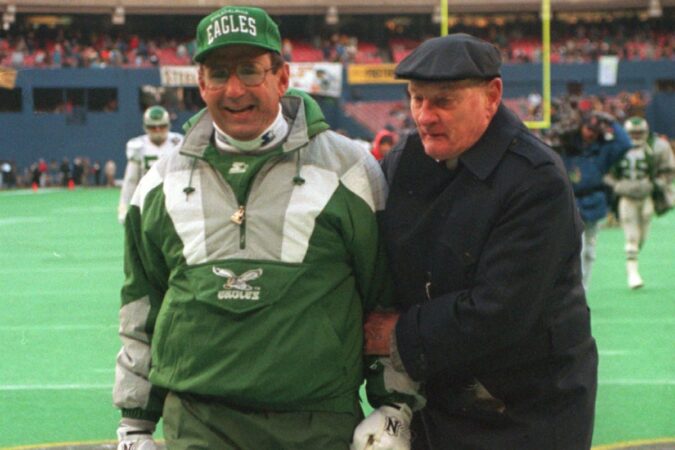
    His attacker wanted the teenager’s green-and-white Eagles Starter-brand jacket, valued at $125. During their struggle, the attacker pulled out a gun and shot Lamont in the face.

    When police arrived, the jacket was gone. Lamont died 10 hours later.

    His death — like the jacket — was part of a trend.

    The growing popularity of professional sports in the late 1980s and early ’90s spawned a new cultural status symbol: expensive sports gear lined in team colors and affixed with hulking logos. The apparel was marketed to the eager-to-impress in their teens and early 20s. But the gear was so popular that some young wearers became crime victims.

    As the 2017 NFL season kicks off and sports stores start to push their cold-weather gear, we look back on the chaos that followed the rise in sports-gear popularity and crimes spurred by the Starter-brand jacket trend.

    In the 1980s and ’90s, the jackets were manufactured by the Starter Corp. of New Haven, Conn. The company was licensed to produce gear for all the major professional teams, including baseball, hockey, basketball, and football. While the brand still exists, it’s now an underutilized subsidy of Iconix Brand Group, which continues to sell the jackets for about $100 each.

    Starter’s business peaked in 1992, when the brand made $350 million in sales. The most popular product was the winter-weight jacket, worn by gangster rappers and Hollywood superstars alike.

    But the status symbol also led to a secondary industry: jacket theft. In Philadelphia, especially in the lower Northeast, some who couldn’t afford one turned to violence.

    Two and three times a week, the police blotter was full. On one week in 1993:

    – “14-year-old boy was jumped by a group of four men at 8:45 p.m. Jan 23 in the 6300 block of Charles Street and robbed of his $100 warmup jacket”

    – “14-year-old boy was punched and robbed of his $100 Starter jacket at 9:15 p.m. Jan. 22 in the 4100 block of Levick Street by a group of three teen-age boys”

    – “A 13-year-old boy was robbed of his $100 Starter jacket at 3:15 p.m. Jan. 21 in the 1500 block of Foulkrod Street by a 15-year-old boy”

    Philadelphia police went so far as to send the freshest-faced cops undercover as decoys to catch would-be thieves. A Mayfair neighborhood group offered to put jackets on a registry, scribbling assigned serial numbers in three separate and secret locations on the jackets. But the thieves caught on, cutting out the serial numbers after they were lifted.

    In 1993, when Robert Levins was inspector of the Northeast Police Division, he told then-Daily News columnist Jill Porter that he would lecture parents.

    “I tell parents that I wouldn’t buy one for my child because of the fact — why put a target on your kid?” he said. “Why make your kid a victim? Buy him a nice coat, but it doesn’t have to be a Starter jacket or a sports team jacket.”

    Porter wrote in response: “Sounds good to me, but try telling that to your kid.”

    James Lamont, Darius’ father, told the Charlotte Observer that he had given his son money for Christmas to buy the jacket.

    “It’s a shame you can’t buy something for your child,” he said, “without worrying if he’ll be safe to wear it.”