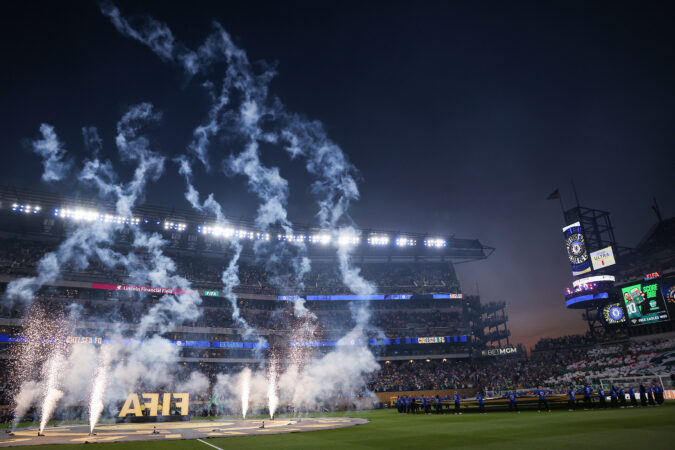
Airbnb expects to host 17,000 guests at its short-term rentals across the Philadelphia region when the FIFA World Cup comes to town next summer.
That’s according to a new report done by Deloitte at Airbnb’s behest and released last week. Airbnb guests are expected to spend about $52 million on average during their stays in the Philly region, and about $14 million of that total will be spent on the rentals.
Over the course of the six matches in June and July, Airbnb hosts are expected to rake in about $1,900 on average, totaling about $8 million in earnings for all area hosts, according to the report.
Officials from Philadelphia Soccer 2026 have estimated that the World Cup will bring 500,000 visitors to the region. Airbnb’s report estimates that 149,000 of them will require overnight accommodations.
Each Airbnb guest is expected to spend about $109 a night on average on the rentals, as well as another $301 a night on food, entertainment, and other expenses, according to the company’s report.
Airbnb guests will have a total impact of about $167 million, including direct and indirect spending, the report projected, and that activity is expected to spur additional spending in the city over the following five years.
After the games were announced, some people went online to secure their short-term rentals. All host cities saw a 33% spike in new bookings last weekend, according to AirDNA, a site that analyzes data on short-term rentals. In Philadelphia, occupancy across all game days has reached 20%, a year and a half ahead of the event.
Federal authorities are searching for someone who shattered two windows at Philadelphia’s federal courthouse this week.
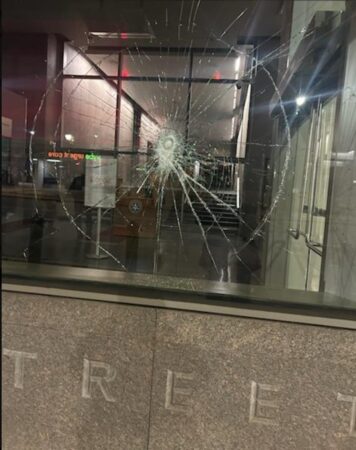
The vandalism occurred late Monday night when someone used a cobblestone brick to smash two glass windows at the front entrance of the James A. Byrne U.S. Courthouse on the 600 block of Market Street, said Supervisory Deputy U.S. Marshal Robert Clark.
Clark said it was not clear if the attack was targeted. Authorities were also looking into whether there was any link to another report of windows being smashed around the same time that night a few blocks away in Old City, he said.
Investigators were reviewing surveillance video in hopes of identifying a suspect, Clark said, and the brick that was used was left at the scene.
The courthouse is where most of the region’s federal civil and criminal cases are heard. It also houses the Third Circuit Court of Appeals.
A judge said this week that arguments questioning the legality of Joyce Wilkerson’s seat on the Philadelphia school board had merit, and directed the board to halt nonrenewal proceedings for two charter schools.
Philadelphia Common Pleas Court Judge Christopher R. Hall granted a preliminary injunction to People for People Charter School and KIPP North Philadelphia Academy on Monday, saying that a lawsuit against the school board can continue because lawyers had presented sufficient evidence.
The charters claim that board member Wilkerson — who is perceived to be anti-charter schools — tainted the votes against them this year and should not be on the board.
City Council declined to approve Wilkerson last yearas a school board member, but Mayor Cherelle L. Parker asked her to serve until she named areplacement.
People for People’s initial lawsuit complaint, filed in September, said that Wilkerson is an “illegally and unlawfully seated member of the BOE” and that her participation in the nonrenewal deliberations tainted and ultimately invalidated them.
The city and the board have said that the city’s Home Rule Charter allows Wilkerson to continue to serve — without Council approval — until a replacement is named.
Reginald Streater, the school board president, said the ruling overshadows the underlying issues.
“The board’s decision to begin the process of nonrenewal was on the merits of each board member’s independent assessment of the schools’ outcomes,” Streater said in a statement. Board members’ concerns were aired publicly over months.
Any delay slows the board’s ability to give the schools full hearings, with testimony and the ability to present evidence, he said.
“Our schools, families, and children deserve resolution,” Streater said. “We remain committed to transparency and to continuing this work in the best interest of the community.”
(Nonrenewal does not equal closure, though it is the first step on that path. It triggers an extensive nonrenewal hearing, after which an officer makes a recommendation; then the board votes again on whether to non-renew the school.)
Lawyers for the charters argued that Wilkerson essentially poisoned the votes, and the judge wrote in his order that there was enough evidence to move forward with the injunction.
“This leaves the question whether Ms. Wilkerson’s participation in the pertinent BOE meetings without color of right tainted its vote [on the charter nonrenewals]. Plaintiffs have shown it likely did,” Hall wrote.
Hall’s order means that nonrenewal hearings cannot proceed, but the board had not yet scheduled them.
What was Wilkerson’s role on the People for People and KIPP votes?
Wilkerson, Hall noted in his order, “was the first to press” to issue a nonrenewal notice to the schools at a June board meeting, and in August called for a vote on the nonrenewal notice.
The KIPP North Philadelphia nonrenewal vote passed unanimously; board member Whitney Jones was the onlyvote against the People for People non-renewal.
But Wilkerson, a former school board president and School Reform Commission chair, was not the only board member with concerns about the two charter schools.
Board member Cheryl Harper said People for People is “failing our children. How long do we allow them to keep failing our children? I have an issue with these schools not being able to succeed for our children.”
Board vice president Sarah-Ashley Andrews cited issues with KIPP North Philadelphia’s “failure to deliver for our students,” specifically calling out its academics and suspension rates.
Streater, the board president, called KIPP’s performance “unacceptable.”
What’s next?
Thecourt case will now proceed, andis likely to drag on for months.
But Hall’s legal ruling on Wilkerson’s school board seat could mean open season for other parties that are unhappy with decisions the board has made and are willing to challenge those rulings legally.
As to whether Wilkerson will remain on the board, Parker has staunchly stood by her in the past.
When the People for People suit was first filed, a member of her administration said she stood by Wilkerson as “an official member of the Philadelphia Board of Education” who “has the full support of Mayor Cherelle L. Parker.”
What was the reaction?
Mark Seiberling, a lawyer for People for People, said the ruling was an important one.
“We are pleased with Judge Hall’s thoughtful and well-reasoned decision following a lengthy hearing at which multiple witnesses from the School District of Philadelphia were called to testify,” Seiberling said in a statement. “We look forward to Ms. Wilkerson’s replacement being nominated and confirmed in accordance with Philadelphia’s Home Rule Charter.”
A former top-ranking deputy with the Philadelphia Fire Department has been demoted amid two ongoing investigations into sexual harassment and overtime abuse, The Inquirer has learned.
Former Deputy Commissioner for Operations Anthony Hudgins — who had been the second-highest ranking official in the 2,800-member department — was recently downgraded to deputy fire chief and reassigned to the Incident Safety Office, according to spokespeople with the city and fire department. The demotion cut his annual salary by nearly 25%, from $202,550 to $155,106, payroll records show.
Hudgins was the subject of an array of sexual harassment allegations, which led the city to hire an outside law firm to investigate the claims and interview department personnel. In a May interview with The Inquirer, Hudgins called the probe baseless and claimed he was targeted with false allegations after uncovering rampant overtime fraud. He acknowledged that as fewer than10 employees had lodged complaints against him. The city inked a $35,000 contract with the law firm Campbell Durrant to investigate the allegations.
Hudgins, a 31-year department veteran, did not immediately respond to a request for comment. After publication, Hudgins’ attorney, Amanda N. Martinez, sent a statement saying that Hudgins“remains committed to assisting the City with any legitimate investigation into the overtime fraud that he brought to light.”
She added that Hudgins is “reviewing the details surrounding the City’s actions and all defamatory statements made against him by individuals” and will “pursue all available legal remedies under the law necessary to protect Mr. Hudgins’ reputation and employment rights.”
The fire department has for decades faced allegations of pervasive sexual misconduct, and yet the Hudgins probe is significant in that it targeted a top-ranking department official. Although they acknowledged that Hudgins had been demoted, spokespeople for the city and fire department declined to confirm whether any of the allegations against him had been substantiated, citing the city’s policy to not discuss personnel issues.
Fire department leadership did not elaborate on the results of the investigation. A request for comment from Mayor Cherelle L. Parker resulted in a prepared statement from City Solicitor Renee Garcia, who said the city “takes any allegations of sexual harassment or fraud, including overtime fraud, very seriously.”
“We investigate any such allegations thoroughly and, if misconduct is found, we will take appropriate action to implement any warranted discipline expeditiously,” Garcia said.
The city has also declined to reveal whether any fire department employees have faced discipline as a result of the related investigation into alleged overtime abuse. Inspector General Alexander DeSantis — who as far back as January launched a probe into the overtime fraud claims — said his office’s investigation is “still ongoing and may be for some time.” He described the probe as “active” but declined to elaborate.
City officials have declined to release public records that would shed light on some of the fire department’s top overtime earners — and are taking The Inquirer to court in an effort to keep those records hidden.
In an affidavit submitted to the Office of Open Records, the agency that enforces state open-records laws, DeSantis argued that releasing the records to The Inquirer would jeopardize his office’s investigation and that it could not release the files “without identifying or implying who may be directly involved in this investigation.” Records related to noncriminal investigations are exempt from release under Pennsylvania’s Right-to-Know Law.
The Office of Open Records ruled in May that The Inquirer is entitled to receive the records, which cannot be withheld simply because the OIG opened an investigation.
The city again declined to release the overtime sheets and instead appealed the OOR ruling to the Court of Common Pleas. In a 21-page brief filed in that case, attorneys for the city urged the court to vacate the OOR’s ruling on the grounds that releasing the records would raise questions about “the efficacy of investigations, witness confidentiality, and harm to reputation.”
The OIG probe has yet to publicly reveal any findings. DeSantis offered no timeline for its conclusion, and the results may not be made public even after the investigation ends.
The OIG’s stated mission is to “keep City government free from fraud, corruption, and misconduct,” but the office rarely releases specifics related to the outcome of its fraud investigations. Instead, it publishes an annual report summarizing the office’s work from the previous year.
The OIG has yet to release that report for 2024.
Staff writers Samantha Melamed and Ryan W. Briggs contributed to this article.
Correction: A previous version of this story incorrectly characterized the total number of employees that Hudgins said may have filed complaints against him.
Mental health professionals at Rogers Behavioral Health in West Philadelphia have formed a union, citing increased workloads and business changes that diminished patient care.
The nonprofit mental healthcare provider last year transitioned from individual patient sessions to a group care model, said Tiffany Murphy, a licensed professional counselor and therapist at the facility. Some workers there were also moved from salaried to hourly positions then forced to reduce hours, their union has said.
Some patients and workers have left amid the changes, says Murphy, estimating that 22 of her colleagues have quit in the past year.
“A lot of us sort of put our jobs on the line by [unionizing], because we believe in the organization, but more so, we believe in our patients. We wanted to provide the best patient care that we possibly could for them,” said Murphy.
The 19 West Philadelphia Rogers employees, including therapists and behavioral specialists, filed their petition last month to unionize with the National Union of Healthcare Workers. Rogers voluntarily recognized the union, according to NUHW, marking the union’s first unit in Pennsylvania.
NUHW represents some 19,000 healthcare workers, primarily in California.
Sal Rosselli, NUHW president emeritus, said the union is pleased that Rogers accepted the petition. “All too often, employers do the opposite and put together very anti-union campaigns, spending all kinds of patient care dollars to prevent their workers from organizing,” he said.
A spokesperson for Rogers declined to comment on employees’ organizing efforts and remarks on workplace changes.
Rogers provides addiction treatment and mental healthcare with facilities in 10 states. In Philadelphia, the nonprofit offers outpatient treatment and partial hospitalization, treating patients with depression, anxiety, and obsessive-compulsive disorder.
In recent years, Rogers workers in California also unionized with NUHW. Their recently forged union contract includes caseload limits and a cap on how many newly admitted patients can be assigned to each therapist or nurse.
Thousands of healthcare workers in the Philadelphia area have moved to unionize in recent years.
The organizing push means that about 81% of the city’s resident physicians are unionized.
What do workers want?
When Murphy first started working at the Rogers facility in Philadelphia 4½ years ago, she said there was “a really good work-life balance.”
At the time, clinicians had four patients per day, provided individualized care, and led group sessions. As the organization moved toward group counseling, she said, caseloads have grown, with up to 12 patients in each group.
The organization hired behavioral specialists to support therapists, said Murphy, but “it was difficult to provide the patients with the care that they really needed and deserved with the new structure.”
Some patients and staff left because of the new model, said Murphy.
This year, some salaried workers were switched to hourly, and Rogers started sending workers home due to low patient demand, leaving the rest with larger workloads, according to the union. That meant some used paid time off to avoid going without pay, said Murphy.
When Philadelphia Rogers employees heard their colleagues in California were unionizing, “That became a bit enticing to us,” said Murphy, noting the workplace had become challenging and sometimes “unbearable.”
Now, she says, the union members want more manageable caseloads — or pay increases to account for the larger caseloads — and a return to the old pay model for those who were switched to hourly work.
“We are unionizing to have a voice at work that will allow us to promote a healthier work-life balance as well as high-quality sustainable patient care,” therapist Sara Deichman said in a union news release.
“The industry is forcing fewer providers to care for more and more patients because the focus is on the bottom line,” said Rosselli.
Staffing concerns plague the healthcare industry generally, said Rebecca Givan, an associate professor at Rutgers University’s School of Management and Labor Relations.
“If the facility wants to hold down costs, it tries to keep staffing levels as low as possible,” said Givan. “In the case of mental health providers, it can be about shortening appointment times or increasing caseloads so that each provider has a very large number of cases or clients.”
She says there’s not “a huge amount of union representation” in stand-alone behavioral health facilities, but some public hospitals are unionized.
Private practice mental health workers can’t unionize because they’re self employed, Givan noted, but “one could argue that they might benefit from collectively negotiating, for example, with the insurance companies that determine their reimbursement rates.”
NUHW is leading efforts to organize independent providers. The goal, Rosselli says, is to “establish an employer for them so that they can have leverage against insurance companies to increase pay and increase access to patient care issues.”
The union has already done this in the home care industry in California, Rosselli noted.
Staff reporter Aubrey Whelan contributed to this article.
One man, buried under $20,000 in online gambling debt, became homeless. A woman lost $13,000 and missed her last five mortgage payments. A mother gambled away her son’s college tuition, piling up over $100,000 in debt.
Such dire stories — shared with gambling helplines in Pennsylvania and New Jersey in recent years — are on the rise. And for the growing number of people, the problem isn’t the casino, but the apps on their phones that let them gamble anywhere, 24-7.
“My family is hosting fundraisers for my son who had a stroke, and here I am, gambling on my phone,” one caller said. “What’s wrong with me?”
The Philadelphia media market — which encompasses the city, Southeastern Pennsylvania, and central and southern New Jersey — has become an epicenter of online gambling in the United States. In 2024, internet gaming and sports wagering revenues alone topped $6 billion in Pennsylvania and New Jersey, up from about $3.6 billion in 2021.
In the same period, the number of calls and texts to 1-800-GAMBLER rose in both Pennsylvania and New Jersey, two of only six states in the U.S. where both sports betting and online casino games are legal. But calls about online gambling problems rose significantly more — 180% in Pennsylvania and 160% in New Jersey in that period. In 2019, only about one in 10 Pennsylvania callers said online gambling was the main issue. By 2024, it was every other caller.
window.addEventListener(“message”,function(a){if(void 0!==a.data[“datawrapper-height”]){var e=document.querySelectorAll(“iframe”);for(var t in a.data[“datawrapper-height”])for(var r,i=0;r=e[i];i++)if(r.contentWindow===a.source){var d=a.data[“datawrapper-height”][t]+”px”;r.style.height=d}}});
The Inquirer analyzed anonymized helpline call logs, state revenue reports, and advertising data to shed light on how the Philadelphia-area market has become a hub for the online gambling industry. An increasing volume of gamblers face financial devastation as they struggle to get off the apps.
As of this fall, the Philadelphia media market outpaced New York City and Las Vegas as the No. 1 market for internet gambling advertisement, with companies spending more than $37 million on ads between January and September, according to data provided by Nielsen Ad Intel.
As many as 30% of Pennsylvania adults now gamble on online sports with some regularity, according to researchers at Pennsylvania State University who conduct an annual, state-funded survey of online gambling. And as many as 6% of Pennsylvanians, or 785,000 people, are estimated to be problem gamblers, according to the most recent survey, which is not yet published.
While problem gambling has a range of severity, the American Psychiatric Association recognizes it as a mental health condition. A gambling disorder is defined by a persistent pattern of problematic betting with an inability to limit or stop, leading to emotional, financial, and or relational distress.
For many, the losses are crushing. In New Jersey, helpline callers reported a combined $28 million in debt at least among people who disclosed this financial information, averaging about $34,000 for each of these callers. In Pennsylvania, 60% of those people willing to share said they owed money, though the state does not track totals.
Across both states, callers reported they had drained entire retirement accounts, lost homes to bank foreclosure, or blown through entire paychecks. One anonymous caller in New Jersey reported losing $400,000 in a single night — his life savings.
“We [also] have people who call us and say, ‘I think I’m doing this too much. I think I need a little bit of help,’” said Josh Ercole, executive director of the Council on Compulsive Gambling of Pennsylvania, the state-funded nonprofit that runs the hotline for the commonwealth’s residents.
Four calls made in New Jersey between 2023 and 2024 were about children under the age of 12 struggling with gambling problems, according to the state’s fiscal year report. Ten other calls were about children under the age of 18. In Pennsylvania, 10 calls involved children between the ages of 13 and 17.
Experts say the explosion of sports betting and casino apps has fueled what is increasingly seen as a public health crisis, as gambling profits and state tax revenues derived from them have soared since sports betting’s legalization in 2018. And Philadelphia is now viewed as something of a promised land for e-gambling boosters.
window.addEventListener(“message”,function(a){if(void 0!==a.data[“datawrapper-height”]){var e=document.querySelectorAll(“iframe”);for(var t in a.data[“datawrapper-height”])for(var r,i=0;r=e[i];i++)if(r.contentWindow===a.source){var d=a.data[“datawrapper-height”][t]+”px”;r.style.height=d}}});
Uttara Madurai Ananthakrishnan, an economics professor at the University of Washington who has studied the psychology of gambling, said lawmakers have struggled to keep pace with the industry’s meteoric growth.
“I don’t think people expected it to explode at this level,” said Madurai Ananthakrishnan, who previously worked in Pennsylvania. “All of this is going to slowly add up and cause a ton of issues downstream.”
Harrisburg also benefited handsomely from the high rollers, drawing $165 million last year in gambling taxes, up from $46 million five years prior. About $10 million was earmarked for gambling addiction helplines and treatment programs, which came directly from industry profits.
Online betting now accounts for nearly half of all gambling revenue in Pennsylvania, according to an Inquirer analysis of state reports. Pennsylvanians wagered a staggering $8.3 billion during the 2024-25 fiscal year in online sports betting alone, making it by far the most popular gambling method. Total revenue for sportsbook and iGaming sites rose past $2.9 billion last year.
window.addEventListener(“message”,function(a){if(void 0!==a.data[“datawrapper-height”]){var e=document.querySelectorAll(“iframe”);for(var t in a.data[“datawrapper-height”])for(var r,i=0;r=e[i];i++)if(r.contentWindow===a.source){var d=a.data[“datawrapper-height”][t]+”px”;r.style.height=d}}});
In New Jersey gaming revenue was nearly $6.3 billion in 2024 — $3.3 billion of which came from internet gaming and sports wagering, according to the state’s Casino Control Commission’s annual report.
Yet the amount spent online is almost certainly higher than what states can track — as is the number of people who have developed online problems.
Caron Treatment Center, a Pennsylvania-based substance use treatment facility, said 160 people in their inpatient treatment problem were struggling with gambling this year — a 162% increase from five years ago.
“I’ve been getting call after call about gambling,” said Eric Webber, a behavioral health specialist and gambling counselor at Caron. “It’s a national crisis that doesn’t have a national solution.”
Fewer than two dozen gambling sites are technically legal in Pennsylvania. But thanks to pervasive online advertising, many gamblers now use so-called offshore gambling sites that are not regulated by the state.
As of last year, more than 20% of online gamblers were using these illegal or unregulated sites, according to the 2024 Penn State report. Such sites often lack state-mandated guardrails like easily allowing users to set weekly betting limits or request a “self-exclusion” — avoluntary ban from licensed casinos, internet-based gambling, video gaming terminals, and fantasy sports wagering.
Self-exclusions in Pennsylvania are higher this year than last year — 8,315 people have already opted out compared with the 7,489 people who requested a ban through Dec. 31 of last year.
Major online sportsbooks say they are going above and beyond.
Beyond self-imposed spending limits, FanDuel, one of the largest sports betting advertisers in the Philadelphia market, introduced a dashboard to allow gamblers to track their spending habits. The company also began tracking betting patterns on its platform and alerting customers when they bet more than their normal wager.
“When users attempt to deposit significantly more than their predicted amount, we surface that information to them and prompt them to reduce their deposit or to set a go-forward deposit limit,” a FanDuel spokesperson said.
DraftKings, in a statement, said it works closely with a gambling company alliance to support responsible betting, “leveraging technology to help detect signs of potentially problematic behavior.”
Some lawmakers want to see more regulation.State Rep. Tarik Khan, a Democrat who represents parts of Montgomery County and Philadelphia, has called for hearings to examine best practices to rein in an industry that he said heavily targets youth.
“More and more people, especially young people, are getting addicted to it, and blowing large portions of their paychecks on feeding this addiction,” Khan said. “It’s already pervasive, and it’s going to get worse.”
‘I’ve gambled everything away on FanDuel’
In New Jersey, more than half of the callers to gambling hotlines who disclosed their age were under 35. In Pennsylvania, people under 35 accounted for 41% of callers.
“Things have shifted to a younger crowd,” said Ercole, of the Council on Compulsive Gambling of Pennsylvania. “Typically our highest call volume used to be in the 35 to 55 ranges.”
People from all professions are affected — nurses, construction workers, software engineers, chefs, attorneys, postal workers, microbiologists, and tattoo artists. Some are students, retirees, or unemployed.
Regardless of one’s income level, online gambling can put serious strain on personal and professional lives. Some people told of losing contact with their parents, getting divorced, or being cut off from friends.
Others lost jobs or had their homes and cars repossessed.
“I have nothing,” a 30-year-old caller told a New Jersey helpline operator in 2023. “I’ve gambled everything away on FanDuel.”
Most people are calling about their own gambling problems. But dozens of family members called to ask for help with their loved ones’ betting. In one case, a woman asked if she could use her father’s Social Security number to ban him from online betting apps.
Many gamblers do not call the hotlines or seek professional help until they face financial ruin or they are confronted by family members.
At the height of his problem, one man from New Jersey started gambling on Russian table tennis matches and Australian basketball games. His wife, who spoke to The Inquirer on condition of anonymity to discuss a sensitive family matter, said his compulsion had grown so severe that he needed a fix to hold him over between sports seasons.
“He was betting $1,000 on a sport he knows nothing about, played by people he’s never heard of before,” his wife said.
The husband kept his gambling hidden for her years, until she found his secret bank account — along with two dozen maxed-out credit cards and records of tribal loans he had taken out, one of them with a 300% interest rate. She also learned that, in 2021, he had quietly lost $70,000 while the newlyweds were on their honeymoon in France.
“It’s horrifying,” she said.
FanDuel, DraftKings and other online gambling apps are displayed on a phone. (AP Photo/Jeff Chiu, File)
The casino-to-app pipeline
Across Pennsylvania, as of 2024, people sought help for addiction to internet games more than any other type of gambling, especially in the suburbs.
In Montgomery County, the most common type of gambling problem cited was internet slots — with 47 calls. In Bucks, internet sports had the highest volume with 34 calls.
In Philadelphia, home to both Live! Casino and Rivers Casino, in-person games remain the largest reported problem for struggling gamblers, according to call center logs.
Some brick-and-mortar casinos, however, have seen business drop as bettors migrate to their phones. At Rivers Casino Philadelphia, sports-betting revenue fell from $29 million in fiscal 2019 — the first full year of legal wagering — to $11 million in 2024, according to state records.
But even in Philadelphia, a county with two casinos, the number of calls and texts for online gambling shot up in recent years. And experts say that people who gamble exclusively online show heightened risk.
“You can get cut off at the casino. You could walk away from the machine,” said Gillian Russell, an assistant Penn State professor who works on the annual online gambling survey. “Those things that maybe cause breaks, a lot of those things are removed.”
About 13% of people who gamble both online and in person were classified as problem or pathological gamblers, according to the 2024 Penn State survey. Online-only gamblers, though just 3% of the total gambling population, showed even greater risk: 37% fell into problem categories.
Prop bets, the practice of betting on various occurrences within a game rather than just the outcome, are a pointed concern. Such wagers have come under scrutiny as bet-fixing schemes ensnare athletes from the NBA, MLB, the NCAA, and even niche sports like table tennis.
Among normal gamblers, however, prop bettors are far more likely to develop problems, Russell said. Webber, the gambling counselor, likened in-game prop betting to a constant stream of small dopamine hits, which create a kind of withdrawal.
And with gambling sites offering bonus cash and rewards points, he said, the temptation can feel constant.
“DraftKings says, ‘Hey, I haven’t seen you in a couple weeks, here’s $50.’ The local beer distributor doesn’t say, ‘Hey, you haven’t been here in a while, here’s a cold six-pack,’” he said. “That doesn’t help somebody who’s struggling.”
A 30-year-old man and 16-year-old boy were killed after a meeting for a possible transaction escalated into gunfire early Tuesday evening in the city’s Germantown section, police said.
Officers responded shortly after 5 p.m. to multiple reports of a shooting at the intersection of West Queen Lane and Laurens Street and found the man and the teen lying on the ground unresponsive with multiple gunshot wounds to their upper bodies, said Chief Inspector Scott Small.
They were both transported by police to Temple University Hospital, where they were pronounced dead around 5:30 p.m. A handgun was found on the body of the man.
At the shooting scene, police found 11 spent shell casings from a handgun and a rifle, Small said.
A Nissan registered to the deceased man was found at the scene with a bullet hole and the driver’s side door still open, Small said.
A witness said the 30-year-old arrived at the location for a transaction that was reportedly not related to drugs, and the teen was with another man who apparently had the rifle, Small said. The man who arrived with the teen fled the scene.
Police were checking for video from cameras in the area that may have recorded what happened, Small said.
The Rocky statue sitting atop of Philadelphia Art Museum’s famed steps could soon be there permanently — and the one at the bottom may be going back to the Italian Stallion himself, Sylvester Stallone.
That’s according to a recent proposal from Creative Philadelphia, the city’s office for the creative sector, which is slated to present its proposal at an Art Commission meeting for a concept review Wednesday. The plan, the proposal notes, is endorsed by Mayor Cherelle L. Parker and Art Museum officials, as well as leaders in the Parks and Recreation department and at the Philadelphia Visitor Center, all of whom filed letters of support.
“This project is about more than relocating a sculpture,” chief cultural officer Valerie V. Gay and public art director Marguerite Anglin wrote in a letter to the Art Commission. “It’s about elevating an artwork that, for decades, has symbolized perseverance, aspiration, and the resilience of the human spirit.”
The statue at the top of the Art Museum’s steps was set there last December as part of the city’s inaugural RockyFest, which celebrates the Rocky franchise. Initially intended to be a temporary installation, that statue — a replica of sculptor A. Thomas Schomberg’s original, made by the artist himself — was lent to the city by Stallone, who purchased it for about $403,000 at an auction in 2017, The Inquirer previously reported.
The statue at the foot of the steps, meanwhile, is owned by the city, and has sat there since 2006, arriving after years of controversy and moves since it appeared in 1982’s Rocky III. Stallone commissioned that statue for the film, and later gave it to the city.
As part of the city’s plan, Philly would swap ownership of the two statues, taking ownership of the statue at the top of the steps, and returning the statue at the bottom “to the original donor’s private collection” following its exhibition inside the Art Museum this spring, the proposal notes.
The city would then “install another City-owned statue at the bottom of the Art Museum steps,” and move the statue at the top back several feet for its permanent installation.
The project would cost an estimated $150,000, the proposal notes. It was not immediately clear what statue would be relocated to the bottom of the steps, or what prompted the exchange of statues.
An Art Commission agenda notes that in its concept review Wednesday, the proposal could receive final approval if it is found to be “sufficiently developed.”
A history of moves
The proposed move marks yet another chapter in the Rocky statue’s storied history in town. It arrived for the filming of Rocky III, but when the shoot wrapped in 1981, a permanent location had not been approved, causing it to be shipped back to Los Angeles. It ultimately came back and was temporarily exhibited again at the top of the Art Museum steps before being moved to an area outside the Spectrum at the stadium complex in South Philly, where it was supposed to permanently stay.
But in 1990, the statue was again temporarily installed at the museum for the filming of Rocky V, reigniting public debate about whether it should remain there. The statue was returned to the stadium complex before being moved in 2006back to the bottom of the museum’s steps, where it has sat ever since.
Gay and Anglin seem to reference the statue’s history in their letter, noting that a permanent installation at the top of the museum’s steps could be an “an opportunity to lean into the evolving conversation about what is considered ‘art’ and what deserves a place in our most treasured civic spaces.”
“The Rocky statue is a clear example of this evolution,” they wrote. “Its artistic significance has not been shaped by institutions, but by the millions of people who engage with it year after year.”
“Rocky is the DNA of this great city of Philadelphia,” Schomberg said in a statement released with the airport statue’s unveiling. “There’s a little bit of Rocky in all of us. Rocky is not just known here in Philadelphia but is known across this country and the world.”
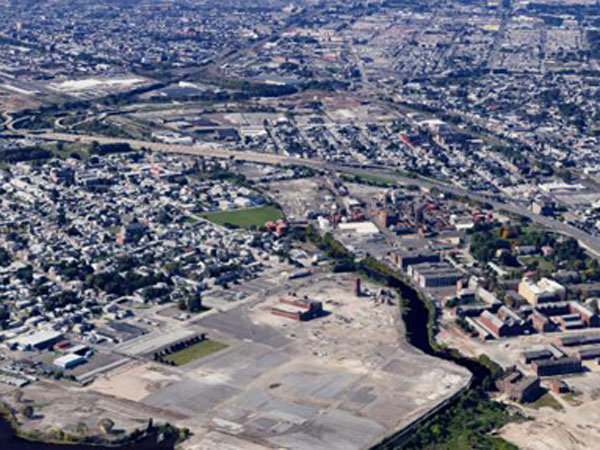
Joseph Cooney joined the Philadelphia Police Department’s narcotics unit in 1998. For eight years, the officer began and finished each workday at the unit’s headquarters on the site of the old Frankford Arsenal in Philadelphia’s Bridesburg section, where munitions were manufactured and tested from the Civil War through the Vietnam War.
Cooney, 53, said he would joke with his colleagues that “we’ll all be glowing in the dark someday” because of the materials left behind in the ground and the chemical plants across the Frankford Creek. In 2024, that joke became a dark reality for Cooney when he was diagnosed with glioblastoma, an aggressive and incurable brain cancer.
In a lawsuit, filed along with lawsuits by the families of two narcotics officers who died of the disease, Cooney links his cancer to radioactive and toxic materials that had not been properly remediated when the munitions factory shut down and the site was converted to a business park.
The lawsuit, filed Monday in Common Pleas Court, accuses the Philadelphia Authority for Industrial Development, developer Mark Hankin, and Hankin’s businesses of having known about risks of exposure but failing to warn those working in the location or properly remediate the harm.
“This type of cancer, at the end of the day, it’s a death sentence,” Cooney said. “When you go to work every day, you don’t expect to be dealing with this.”
The Philadelphia Authority for Industrial Development declined to comment. Hankin did not respond to requests for comment.
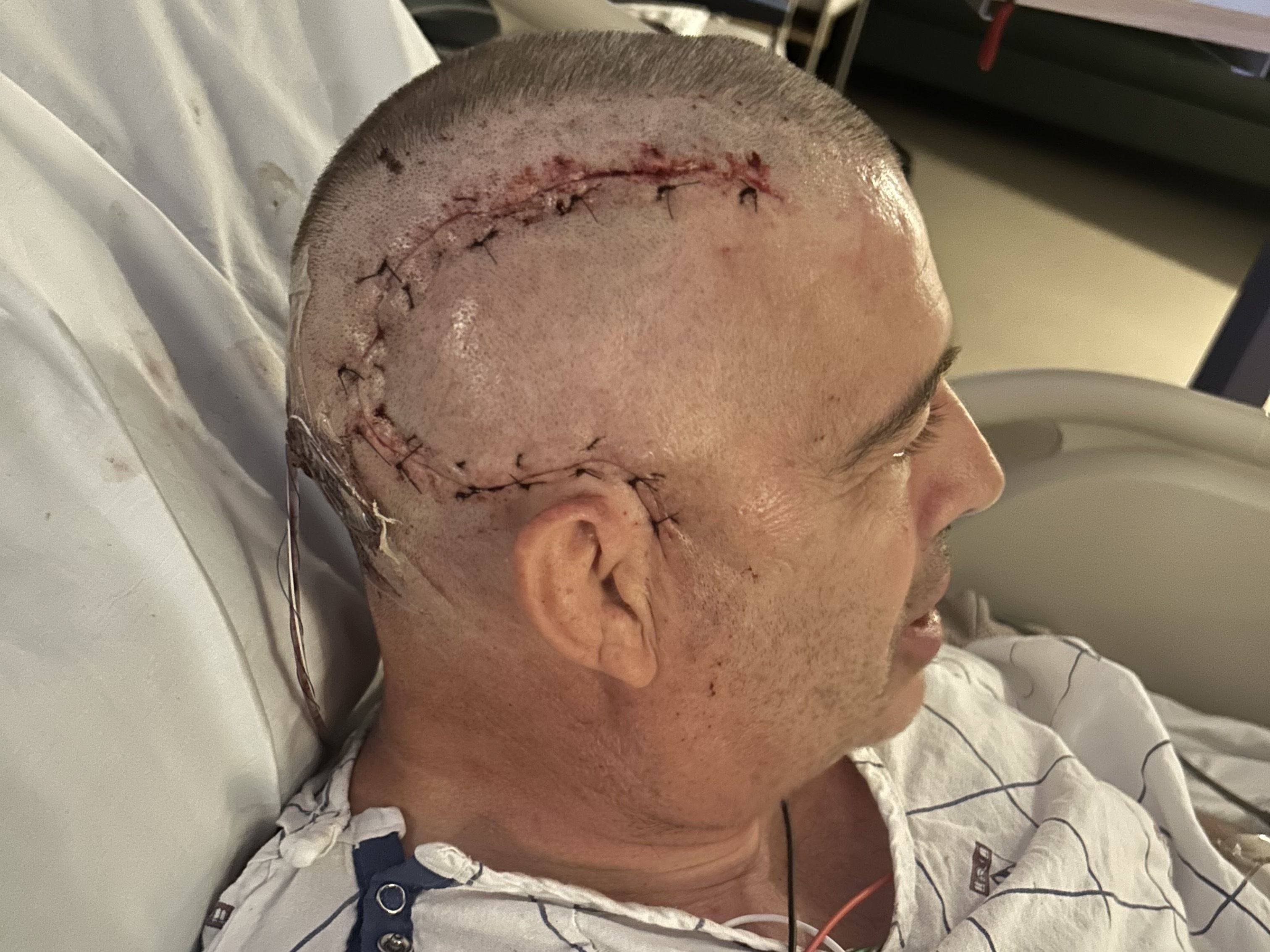
Joseph Cooney, a police officer who was diagnosed with glioblastoma in 2024, seen after his third surgery in July 2025.
‘The street that beat Hitler’
The Frankford Arsenal opened in 1816 as a weapons storage and repair shop for the U.S. Army, and in 1849 became the country’s largest developer and manufacturer of small arms and artillery shells. The arsenal’s campus grew over the years, including a massive expansion during World War II. By the end of the war, workers fondly referred to it as “the street that beat Hitler.”
Each war throughout the century-plus of the arsenal’s existence brought its own challenges, and the complex between Bridge Street, Tacony Street, and the Frankford Creek adapted to support the nation’s military needs.
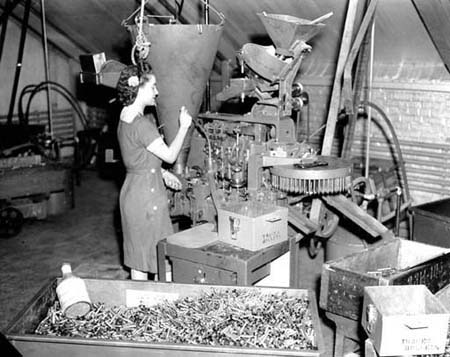
This woman is loading powder into cartridges of .30 caliber tracer bullets in the assembly division of the Frankford Arsenal in Philadelphia, Penn., on July 27, 1940 during World War II. (AP Photo)
The arsenal closed in 1977 and the authority for industrial development, an agency with a mayor-appointed board, became the campus’ steward. Hankin, a Montgomery County developer, bought the campus in the 1980s and transformed it into a business park, which included the narcotics unit headquarters from the early 1990s until 2015.
As soon as the arsenal closed, decontamination needs were discussed, newspaper articles from the time show. An official report found the existence of dangerous materials in buildings in 1981, before the property was converted to civilian use, the lawsuits say.
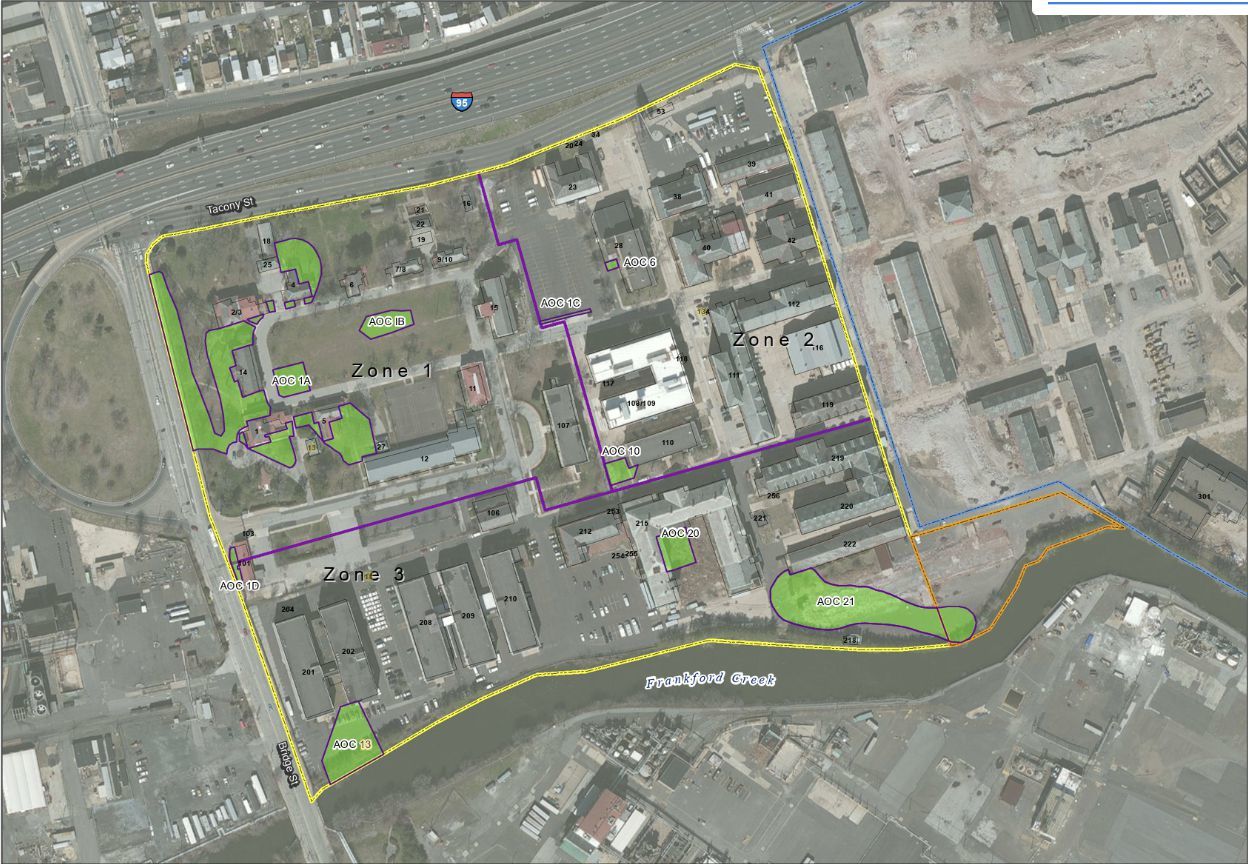
Throughout the 2000s, the U.S. Army Corps of Engineers, in a series of reports, flagged concerns over dangers in the old arsenal’s ground. A 2016 report found elevated concentrations of lead and potentially cancer-causing substances in six areas that posed “unacceptable risk or potential concerns to future human receptors.”
One of the areas of concern noted in the report sits atop building 202 — the narcotics unit’s former home.
A map showing areas of concern for hazardous materials at the Frankford Arsenal site, from a 2016 report on a feasibility study conducted by the U.S. Army Corp of Engineers.
The common denominator
Cooney has been hearing over the past decades about colleagues from his narcotics unit days who have gotten sick.
Michael Deal, who spent 37 years on the police force and joined the narcotics unit in 1994, was diagnosed with glioblastoma in 2018 and died the next year at age 64. Then, in 2023, Andrew Schafer, a 20-year veteran who worked at narcotics from 2002 to 2015, also was diagnosed with the brain cancer. He died in March at age 51.
The families of Deal and Schafer also filed lawsuits similar to Cooney’s.
Cooney heard through the grapevine about other cases. And then he was diagnosed.
“Everyone sat down, started talking,” Cooney said. “The only common denominator was everybody worked in the same building.”
Adding to their concern were the adjacent chemical plants, Cooney said.
Fifty-four employees of the Rohm & Haas chemical plant, right across the Frankford Creek from the arsenal, died of lung cancer in the 1960s and early ’70s, the Philadelphia Daily News reported in 1981.
The current suits allege that the contaminants in the arsenal ground were not properly cleaned up, and that those working at the site were not warned despite a series of reports.
“The remediation was not done to the extent that it eliminated the risk,“ saidWilliam Davis, the attorney who filed the suits. ”Up until now we have no evidence that there was any warning to any tenants.”
Cooney still works as a police officer, with a desk job supporting the city’s SWAT team. He has lost much of his independence to the disease, which can be slowed but not cured. He can no longer drive or coach youth sports, and relies on a cane to walk.
The officer is concerned about who will take care of his wife and their seven children once he is gone, and Cooney is especially worried for the health of one of his daughters— a biology teacher at Franklin Towne Charter High School, which sits on the arsenal’s old site.
The 2026 FIFA World Cup is officially six months away, and Philadelphians’ next chance to buy general admission tickets starts Thursday.
From Dec. 11 to Jan. 13, fans can enter a lottery for the chance to buy World Cup match tickets, like the two previous lottery phases. The “random selection draw” is the third of several ticket sale phases leading up to the World Cup’s first match on June 11, 2026, in Mexico City.
During the first two ticket phases, the United States, Canada, and Mexico (in that order) drove the bulk of ticket sales, according to FIFA. Fans in 212 countries have bought tickets.
However, since the final draw on Friday, the World Cup matchups and schedule have been finalized. This will be the first ticket sale phase in which fans can apply for single-game tickets for exact matchups and teams.
Brazil’s Raphinha (center) celebrates with teammate Vinícius Júnior after scoring his side’s opening goal against Venezuela during a World Cup qualifying match.
How to enter the random selection draw for FIFA World Cup tickets
The lottery application form will become available on FIFA’s website starting at 11 a.m. Thursday and will close at 11 a.m. on Jan. 13.
Log in during the application window and complete the random selection draw application form.
Winners will be selected in a random draw, with notifications starting soon after Jan. 13. Those selected will receive an assigned date and time to purchase tickets, subject to availability.
Single-match tickets to all 104 games, plus venue-specific and team-specific options, will be made available to choose from. That means fans in the Philadelphia area could buy tickets for matches at Lincoln Financial Field — if selected.
Fans who have applied to previous ticket sale lotteries must submit a new application form.