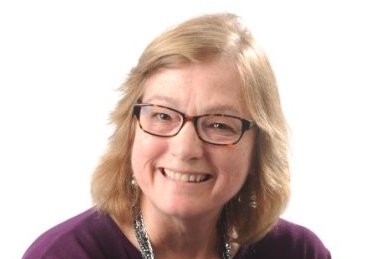
Virginia A. Smith, 75, of Philadelphia, longtime reporter and editor for The Inquirer, the Philadelphia Bulletin, the Akron Beacon Journal, and other newspapers, mentor and working-mother role model to many, and avid gardener, died Friday, Nov. 14, of interstitial lung disease at Roxborough Memorial Hospital.
Born in Philadelphia, Ms. Smith joined her hometown Inquirer in 1985 after three years at the Beacon Journal in Ohio, six months at the Bulletin in Philadelphia, and earlier stints at other papers in New York and Connecticut. Until her retirement in 2015, she covered news, health, and gardens as a reporter for The Inquirer, and served as city and Pennsylvania editor.
In her official Inquirer profile, she described her final assignment as “happily writing — and learning — about gardening full time since 2006.” Her son, Josh Wiegand, said: “She was a curious person and interested in so many different things.”
Former colleagues praised the depth and variety of her reporting, especially the detailed long-form stories she wrote about Sister Mary Scullion in 1992, the Iraq War in 2004, her own extensive garden in 2006, and the other interesting people and significant events she encountered. “She was open to reporting a story until she was confident she had all of its shadings,” Inquirer investigations editor Daniel Rubin said. “She had a gift for the stories people would talk about.”
For Ms. Smith, there was no better place than her own garden.
Ms. Smith was named The Inquirer’s garden writer in 2006, and, of course, wrote detailed previews and reviews of the annual Philadelphia Flower Show. But her favorite stories, she told colleagues, were the hundreds of others about climate change, garden gnomes, community gardens, butterflies, pruning techniques, seed banks, edible weeds, how blind people enjoy gardens, and other topics.
Her winter holiday story in 2006 was not about poinsettias or Christmas tree farms. Instead, she profiled an author who discovered a treasure trove of old black-and-white photos of gardeners tending plots in prisons, war zones, and concentration camps.
“It was her idea,” said Joanne McLaughlin, her editor then. “She wanted to write about gardens nurturing the soul under the worst of circumstances, giving hope under the worst of circumstances.”
She wrote often about her own garden in East Falls and ended one story in 2006 with: “When winter arrives, maybe I’ll settle down. Oh, what are the chances? New years are for confessions, so here’s mine: Come first snow, I’ll be out there shoveling the garden pathways, hoping to sneak another peek.”
Ms. Smith wrote this two-part series in 2012.
Her column was called “Garden Scoop,” and she blogged at “Kiss the Earth” on Inquirer.com. She won two achievement awards from what used to be called the National Garden Writers Association and the 2011 Green Exemplar Award from Bartram’s Garden.
“She understood how important the topic was to this area,” said Reid Tuvim, a longtime editor at The Inquirer.
As a health reporter in the early 2000s, Ms. Smith wrote about bottled water, flu medicine, Lyme disease, organ donation, mental illness, children’s healthcare, and other issues. In 2004, she wrote a story about the Medical Mission Sisters, a progressive religious order that offered healthcare advice and full-body massages as well as spiritual guidance. In the third paragraph, she said: “But this is no spa. And that woman doing the hands-on — are you kidding me? — is a nun!”
She covered Scullion’s acceptance speech of the 1992 Philadelphia Award for community service and described it as “fiery and heartfelt, troubling and joyful.” Inquirer staff writer Amy Rosenberg said Ms. Smith “always drilled down to such emotional depths with her subjects. She defined so much of what The Inquirer meant back then.”
Ms. Smith doted on her granddaughters.
She mentored colleagues as she had been mentored and was a role model for fellow working mothers. “I watched her over and over again get up at 5 p.m. and walk out of the newsroom to get her son when he was young,” Rosenberg said. “Never mind what any of the boys in the room thought.”
Virginia Ann Smith was born Oct. 26, 1950. She graduated from the old Eden Hall high school in Philadelphia and earned a bachelor’s degree in English at Manhattanville University in New York in 1972. In 1981, she earned a master of legal studies degree at Yale University Law School through a Ford Foundation fellowship for journalists.
She married Alan Wiegand, and they had a son, Josh, and lived in East Falls. After a divorce, she married Randy Smith in 1985. He died in 2020, and she moved to Cathedral Village Retirement Community a few years ago.
Ms. Smith was a great cook, friends said. They said she was funny, stubborn, and opinionated. She was so into gardens, her son said, that she visited him in Colorado specifically to renovate his garden.
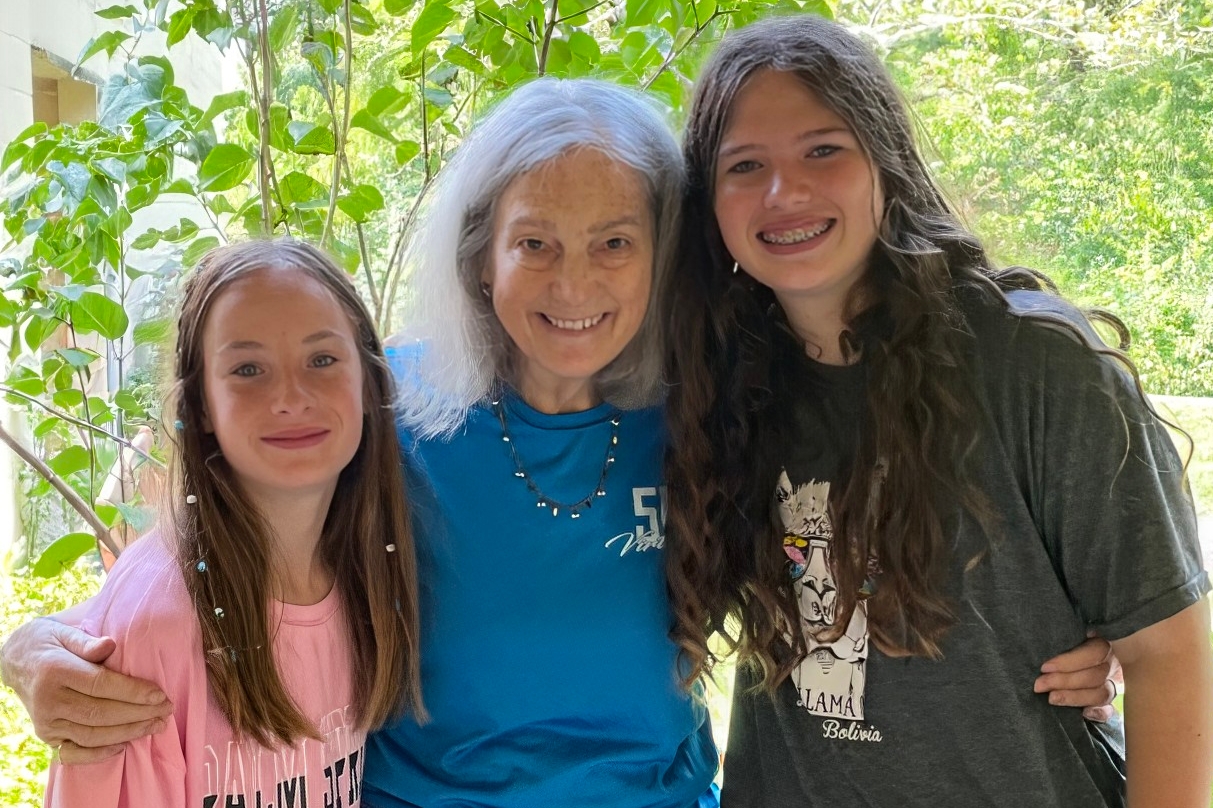
Ms. Smith poses with her husband, Randy, and her two granddaughters.
She listened to classical music and danced at blues festivals. Everyone said she made them feel as if she was their best friend.
“She was one of the most genuine people I’ve ever known,” said friend and former colleague Mari Schaefer. Friend and former colleague Mary Flannery said: “She was so creative and so brave.”
Her son said: “She was the best. I don’t know how she did it. She wanted to do it all, and she did.”
In addition to her son and her former husband, Ms. Smith is survived by two granddaughters, two brothers, and other relatives.
A celebration of her life is to be held later.
Donations in her name may be made to the Schuylkill Center, 8480 Hagys Mill Rd., Philadelphia, Pa. 19128.
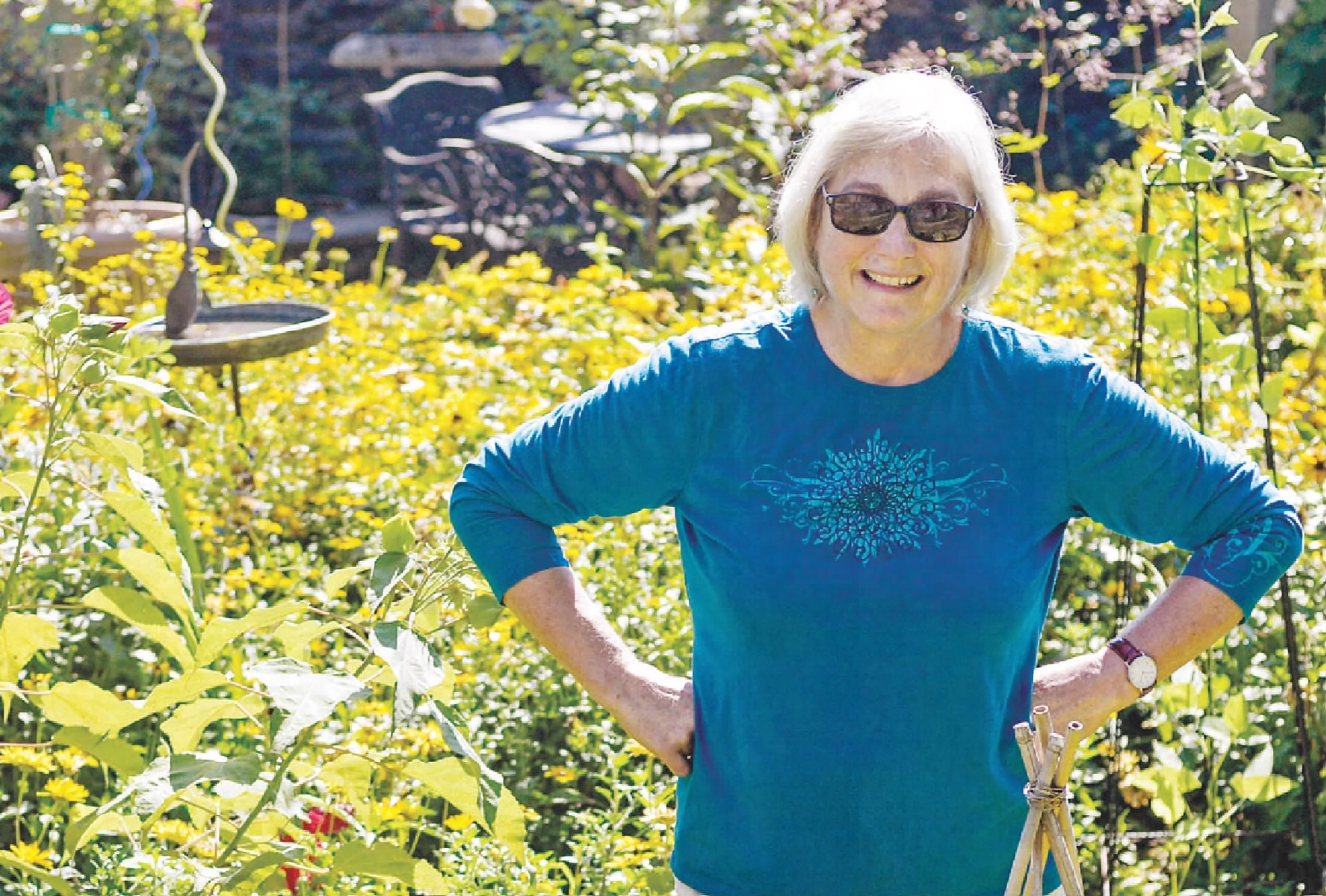
Ms. Smith tends to her garden’s black-eyed Susans in this photo.
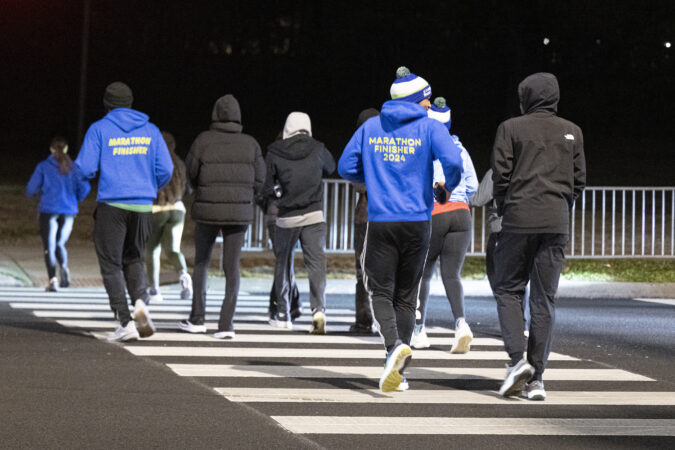
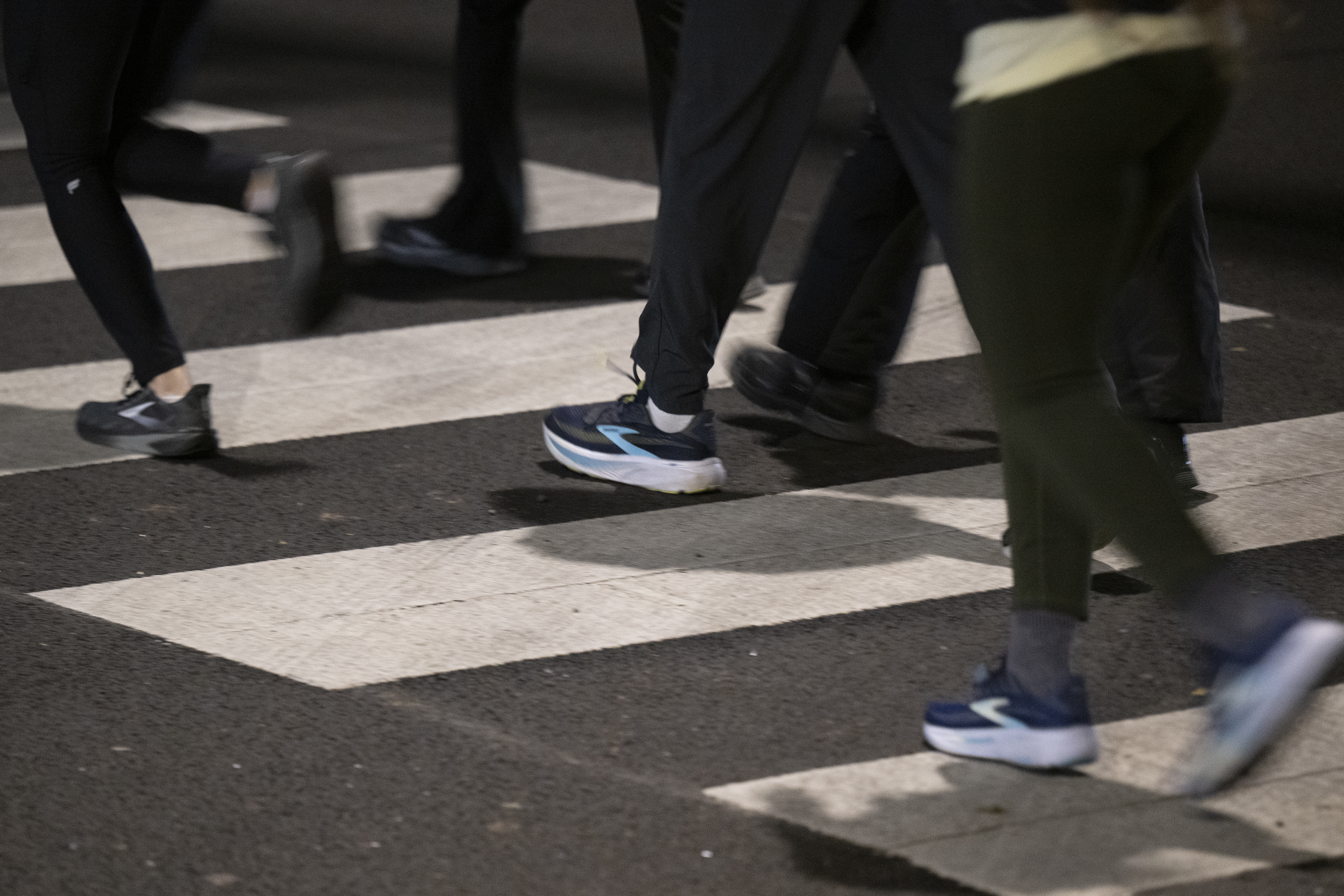
Before the start of Tuesday’s team practice on Boathouse Row, a couple of teenagers filmed their own TikTok dances. The boy was sheepish about showing his adult coaches the final product on his phone, while a group of girls compared hairstyles. After a quick warmup in the cold air, with some students moving more enthusiastically than others, the group went off on its three-mile run.
It was one of the last steps remaining for the teenagers to get their criminal records expunged.
On Saturday, the group of mostly high schoolers will complete their program by running the 13.1 miles of the Philadelphia Half Marathon.
They are members of MileUp, a juvenile diversion program operated by the nonprofit Students Run Philly Style in partnership with the Philadelphia District Attorney’s Office and Drexel University’s Center for Nonviolence and Social Justice. MileUp gives youth ages 11 to 17 who are charged with certain offenses the opportunity to learn and practice distance running to clear their criminal records.
MileUp intends to teach the students about accountability and responsibility through running, while creating a supportive community. According to Students Run Philly Style, about 92% of MileUp students have completed the program since 2020, which puts them on the path toward having their records expunged.
“You see young people change their mindset over how much control they have over what’s ahead of them,” said Students Run Philly Style executive director Lauren Kobylarz
“This is a chance to let that choice that maybe wasn’t the best … to leave that behind you and move forward,” she said.
This weekend, 128 Students Run Philly Style youth will run the half marathon, including eight from MileUp, and others will do the marathon or 8K, all wearing the same SRPS T-shirts.
For students, the program starts with a referral from the district attorney’s office, where the teenagers are identified as candidates for diversion programming. Some of the most common charges for MileUp students include auto theft, assault, and vandalism. For most, it is their first offense.
The teenagers are given their choice of diversion program. Under District AttorneyLarry Krasner, the officehas expanded the initiative to about 30 programs in sports, arts, and trades.
MileUp has cohorts in the fall and spring, where students meet for practice three times per week for 12 weeks with Students Run Philly Style staff, trained adult volunteers, and peer mentors, who are program graduates paid for their work.
District Attorney Larry Krasner has expanded the use of juvenile diversion programs since coming into office in 2018.
For the fall cohort, milestone runsinclude a 5K, the All-City 10 Miler, and the half marathon.
After the first race, they earn restitution fees associated with their case, which can often be a financial burden.
Afterthe second, the charges get dropped, as long as they ultimately complete the program.
And for a student who finishes the final race, writes a reflection, and is not arrested within six months, the case is expunged, erasing all records of it.
“These are honestly great students … they’re not beat down by what’s happened to them,” said volunteer Juan Batista, 25, whose mother works for The Inquirer in human resources. He said he fell in love with running after he began participating in Students Run Philly Style’s standard program when he was 12.
Batista grew up in Juniata under similar circumstances to many of the MileUp students, and started working with them after he finished college. Their shared background helps them connect, Batista said. He noticed that, in many cases, it has been just a matter of wrong place, wrong time.
“Sometimes bad things happen, and that could be on your record for the rest of your life,” he said.
Second chances
When Lucas from Northeast Philly joined MileUp two years ago, he struggled. It wasn’t fun, and the 16-year-old,whose full name is not being used because he is a juvenile, said that he had been treating his body poorly up to that point. But he showed up to nearlyevery practice, and felt himself maturing as he got stronger as a runner. His record was expunged, and he said having his restitution fees paid was a major help.
“It’s really worth it,” he said.
Now, Lucas is back with MileUp as a peer mentor. He enjoys serving as an example for the other teenagers, and said it feels good to encourage and give advice to those who need it. Lucas said that lots of kids don’t have enough people they can rely on.
“It’s good to have people you can go to for help,” he said.
MileUp diversion program participants have already completed a 5k and 10 mile race together. Their last milestone is the Philadelphia Half-Marathon on Saturday, Nov. 22.
He arrived at Tuesday’s practice with Na’Sean, another 16-year-old from Northeast Philly who is also being identified only by his first name because he is a juvenile. Na’Sean is a current MileUp student who said he came back from a family trip to learn there was a warrant for his arrest, stemming from a years-ago incident.
His focus at the half marathon will be on keeping a steady pace, without starting too fast. It happened to him during the 10-miler and he struggled near the end, but said one of the adult leaders helped him push through. He said he valued the support he has gotten and will miss the group after the program ends.
Na’Sean appreciated how his future remains wide open, and how his ability to get a good job one day won’t be limited by something he may have done when he was a young teenager.
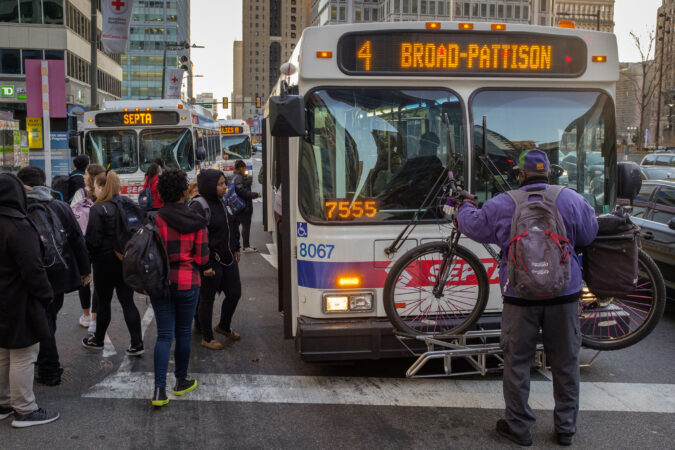
SEPTA’s21.5% increase in transit fares and service cuts fell hardest on disadvantaged Philadelphians this year, showing an urgent need to make the city’s Zero Fare program permanent, CityCouncilmember Nicolas O’Rourke argues.
He touted his proposal to dedicate 0.5% of the city budget each year to pay for the initiative that provides free SEPTA passes to people living in poverty.
O’Rourke’s proposedTransit Access Fund would be written into the City Charter “so it can’t be yanked away at a moment’s notice when somebody wants to shift something around in the budget,” hetold about 150 people in a town hall at the Friends Center on Cherry Street.
O’Rourke, Democratic State Sen. NikilSaval, and the advocacy group Transit Forward Philadelphia called the meeting to push for affordable public transportation and ways to sustainably fund SEPTA after Harrisburg’s failure to provide new state money for mass transit agencies.
A broad coalition and patience are needed in Pennsylvania, Saval said. ” Every major political win comes from months, years, sometimes decades, of work,” he said.
“We pushed back hard,” said O’Rourke, a member of the Working Families Party. “People with the least income are paying a larger share of their money just to get around. That’s upside down.”
Funding is not guaranteed after June 30, when the current budget expires, however.
If enacted, a Transit Access Fund would generate an estimated $34 million in the 2026-2027 fiscal year, O’Rourke’s office calculates.
That would generateenough money — between $20 million to $25 million, according to managers of the Zero Fare program —to give free SEPTA passes to 60,000 Philadelphians at or below the federal poverty standard.
O’Rourke and his staff also are considering usingthe remaining $10 million to $14 million for matching grants to help businesses, landlords and housing developments to join the SEPTA Key Advantage program, which provides subsidized transit passes.
People living at or below the federal poverty standard are eligible for the Zero FareSEPTA passes. For 2025, that is $15,650 for an individual and $32,150 for a family of four.
Philadelphia’s poverty rate was 19.7% in 2024, the latest figure available, according to the U.S. Census.
“When we’re made to feel like we’re on opposite sides of the fight, our numbers become smaller and we focus on the wrong targets,” said Saval.
“It’s not the person in Schuylkill County frustrated about potholes and road conditions that’s to blame for lack of transit funding” he said. “That person deserves to get safely where they need to go, too.”
The package was mailed from New Jersey, which should have been the first clue.
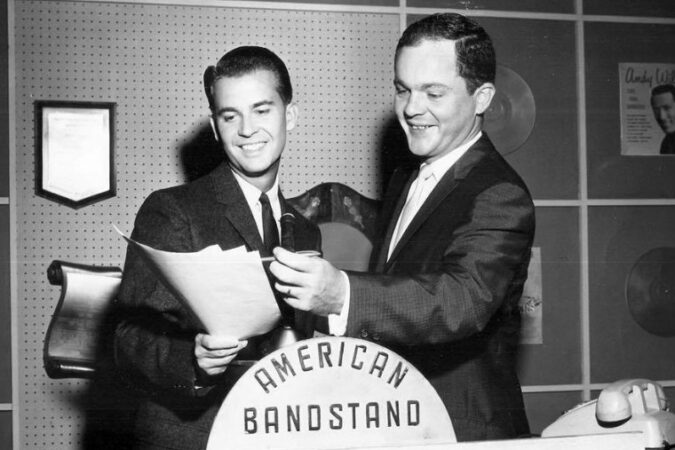
Inside was a cigar box rigged to resemble a bomb, and it was delivered on the afternoon of Nov. 21, 1960, to the office of TV host Dick Clark.
Clark, a week away from his 31st birthday, was the star of the nationally televised ABC program American Bandstand, which was filmed at WFIL-TV studios at 46th and Market Streets. He was filming his afternoon program when the parcel arrived shortly after 3 p.m.
His secretary received the package, and as she started to untie the brown-paper wrapping, the cigar box became visible. One side of the box had been removed, and she spotted a net of wires and a five-inch piece of copper tubing.
Police quickly arrived and inspected the device, and took it to their headquarters for further evaluation. And while it looked like a crudely constructed explosive device, police and postal leaders told The Inquirer that it was missing two key components: powder and a fuse.
There were no actual explosives in the box, and the device couldn’t have set any off.
It contained what at first appeared to be a blasting cap, but after closer examination was identified as a piece of tree bark.
“The package was obviously the work of a crank,” the officials told The Inquirer.
Philly Police, the U.S. Postal Service, and the FBI took part in the investigation, but no culprit was ever publicly identified.
TV staffers were still jumpy a few weeks later when an unmarked gift package that resembled the faux bomb arrived at Clark’s office.
Responding police, taking no chances, carried it across the street and into the middle of Drexel University’s athletic field.
When they finally got the courage to open it, out popped a shaggy, stuffed dog.
All packages from then on, The Inquirer quipped, should carry a notation:
Think you know your news? There’s only one way to find out. Welcome back to our weekly News Quiz — a quick way to see if your reading habits are sinking in and to put your local news knowledge to the test.
Question 1 of 10
The Michelin awards are officially in Philadelphia. The first batch of honors was marked with a ceremony Tuesday. How many Philly-based restaurants received one star?
CorrectIncorrect. XX% of other readers got this question right.
Three Philly restaurants received one Michelin star: Her Place Supper Club, Friday Saturday Sunday, and Provenance.
Question 2 of 10
Clyde Peeling, 83, of Allentown, is regarded as the reptile king. He was actually bitten by a rattlesnake while serving with this military branch:
CorrectIncorrect. XX% of other readers got this question right.
Peeling’s first bite occurred when he was serving with the Air Force. But it wouldn’t be his last. Today, his space, Reptiland, is home to a slew of Komodo dragons, poisonous Gila monsters, anacondas, and more.
Subscribe to The Philadelphia Inquirer
Our reporting is directly supported by reader subscriptions. If you want more journalism like this story, please subscribe today.
President Donald Trump lashed out at Bloomberg reporter Catherine Lucey on Air Force One last week, telling her, “quiet piggy” when she asked him about the Jeffrey Epstein case. Years before Lucey was at Bloomberg, she was a reporter in Philadelphia. Where did she work?
CorrectIncorrect. XX% of other readers got this question right.
Before her time in D.C., Lucey was a respected reporter in Philadelphia, spending 12 years at the Philadelphia Daily News covering everything from police corruption to local news — but her sweet spot was politics. Her portfolio included coverage of then-Mayor Michael Nutter’s administration and the city’s changing power dynamics.
Question 4 of 10
Sixers player Tyrese Maxey made a cameo as a dog handler at the National Dog Show hosted outside Philadelphia. The dog lover has three dogs of his own, Apollo: a Cane Corso, and Aries and Arrow who are both this breed:
CorrectIncorrect. XX% of other readers got this question right.
Maxey got Aries and Arrow, both Bernedoodles, during the summer. He has been working on his dog training skills for more than a year.
Question 5 of 10
This museum, managed by the College of Physicians, will undergo a $27 million renovation beginning next year:
CorrectIncorrect. XX% of other readers got this question right.
The first phase of renovations at the Mütter Museum will include larger galleries, building upgrades, better signage, and expanded exhibition space. Construction will begin in early 2026.
story continues after advertisement
Question 6 of 10
In Craig LaBan’s review of Borromini, Stephen Starr’s Italian destination in Rittenhouse Square, there was only one dish the food critic said he orders every single visit.
CorrectIncorrect. XX% of other readers got this question right.
LaBan noted that he found the restaurant’s signature 100-layer lasagna to be underwhelming. But he insists on ordering the focaccia di Recco, featuring a hot crispy flatbread paired with wafer-thin rounds of tangy stracchino cheese, every time. The bread is a recipe from consulting chef, Nancy Silverton, the L.A. star with whom Starr runs Osteria Mozza in D.C.
Question 7 of 10
Task, the HBO show set in Delco, has been renewed for a second season. Season one starred Tom Pelphrey and this actor:
CorrectIncorrect. XX% of other readers got this question right.
The first season of Task followed an FBI task force led by Tom Brandis (Mark Ruffalo) — a former priest and grieving widower — as they tracked down thieves robbing drug houses in the Philly suburbs.
Question 8 of 10
Boathouse Row could be seen during the Eagles’ Sunday Night Football broadcast, in special hues to promote this movie:
CorrectIncorrect. XX% of other readers got this question right.
Boathouse Row went green and pink to promote Wicked: For Good as part of NBC's large marketing campaign for the film. It marks the historic strip’s first movie promotion.
Question 9 of 10
Artist Rose Luardo has previously caught locals’ attention with outdoor art installations including “Boob Garden” and “Rave Coffin.” What’s her latest display titled?
CorrectIncorrect. XX% of other readers got this question right.
Located at the intersection of Washington Avenue, Passyunk Avenue, and Eighth Street, “Crab Couch” — which is exactly what it sounds like — is the latest work Luardo set up at what she calls Capt. Jesse G’s Crab Shack Gallery. That’s because the shuttered business’ sign inexplicably remains lording over the lot on a freestanding pole, even though the building was long-ago demolished.
Question 10 of 10
The Franklin Institute is returning its lunar module, which was on display outside for 49 years, back to Smithsonian’s National Air and Space Museum in D.C. What is next for the module?
CorrectIncorrect. XX% of other readers got this question right.
There are currently no plans for it to be displayed at the National Air and Space Museum, a Smithsonian spokesperson told The Inquirer.
Your Results
You have skipped .
You scored XX out of 10.
The average reader scored XX out of 10
Seems like you’ve been skimming more than reading there, buddy. There’s always next week.
You’ve read some articles (or made some educated guesses) but we wouldn’t come to you first for our local news recaps. Better luck next week!
Do you work here? You’re a local news stan with the latest updates on Philly happenings. Your friends definitely ask you for summaries on what’s going on and it shows.
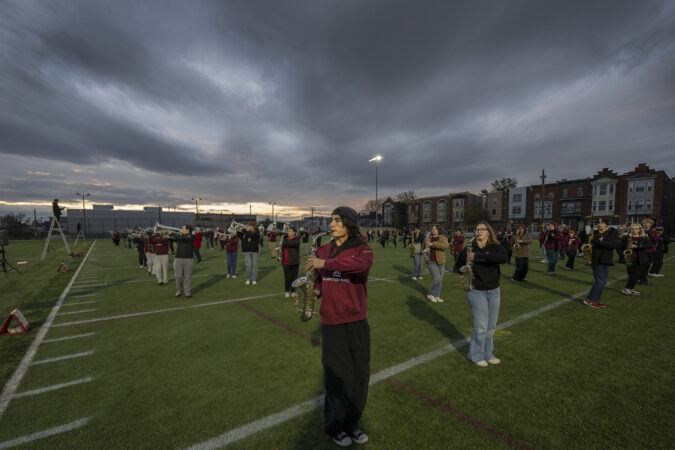
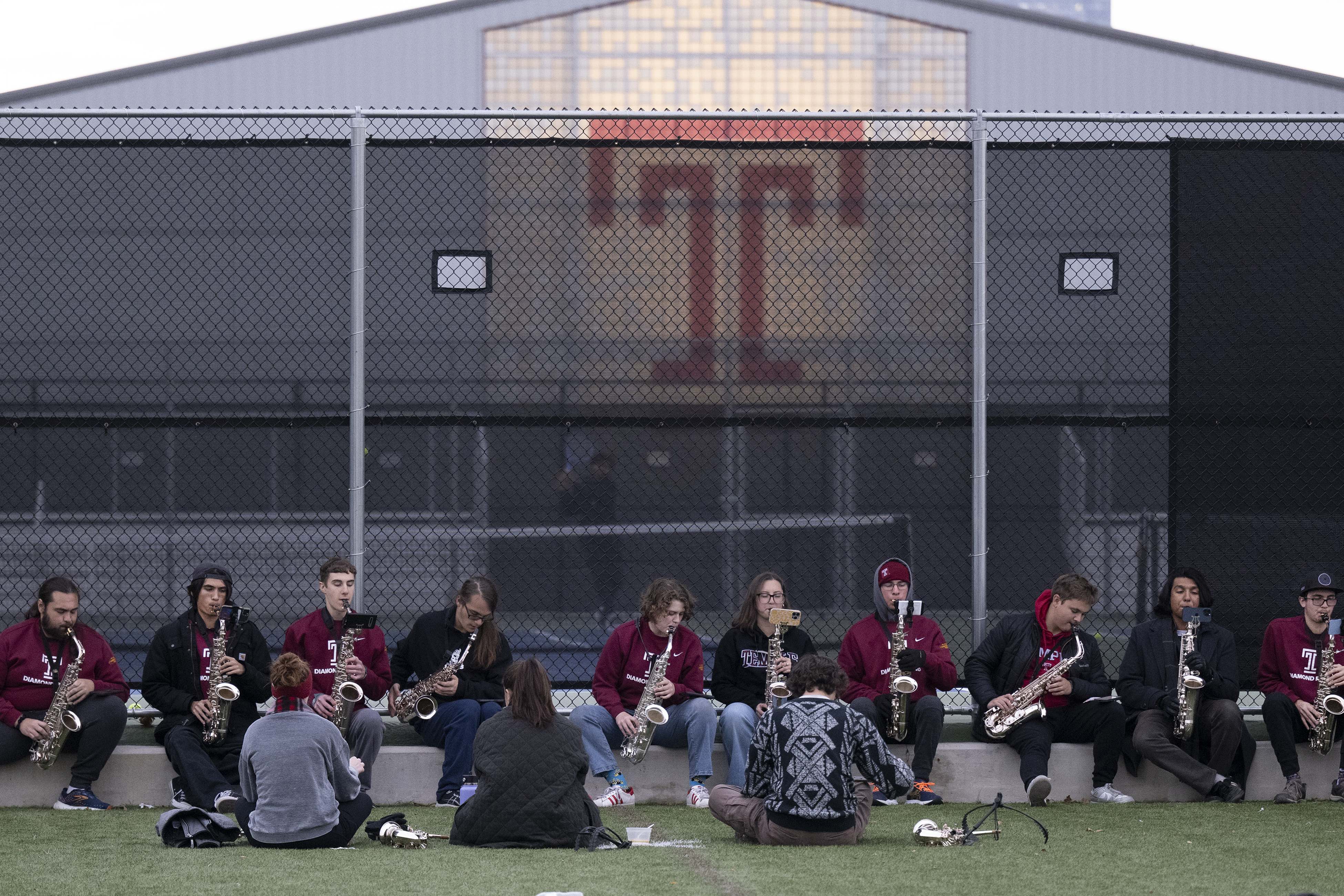
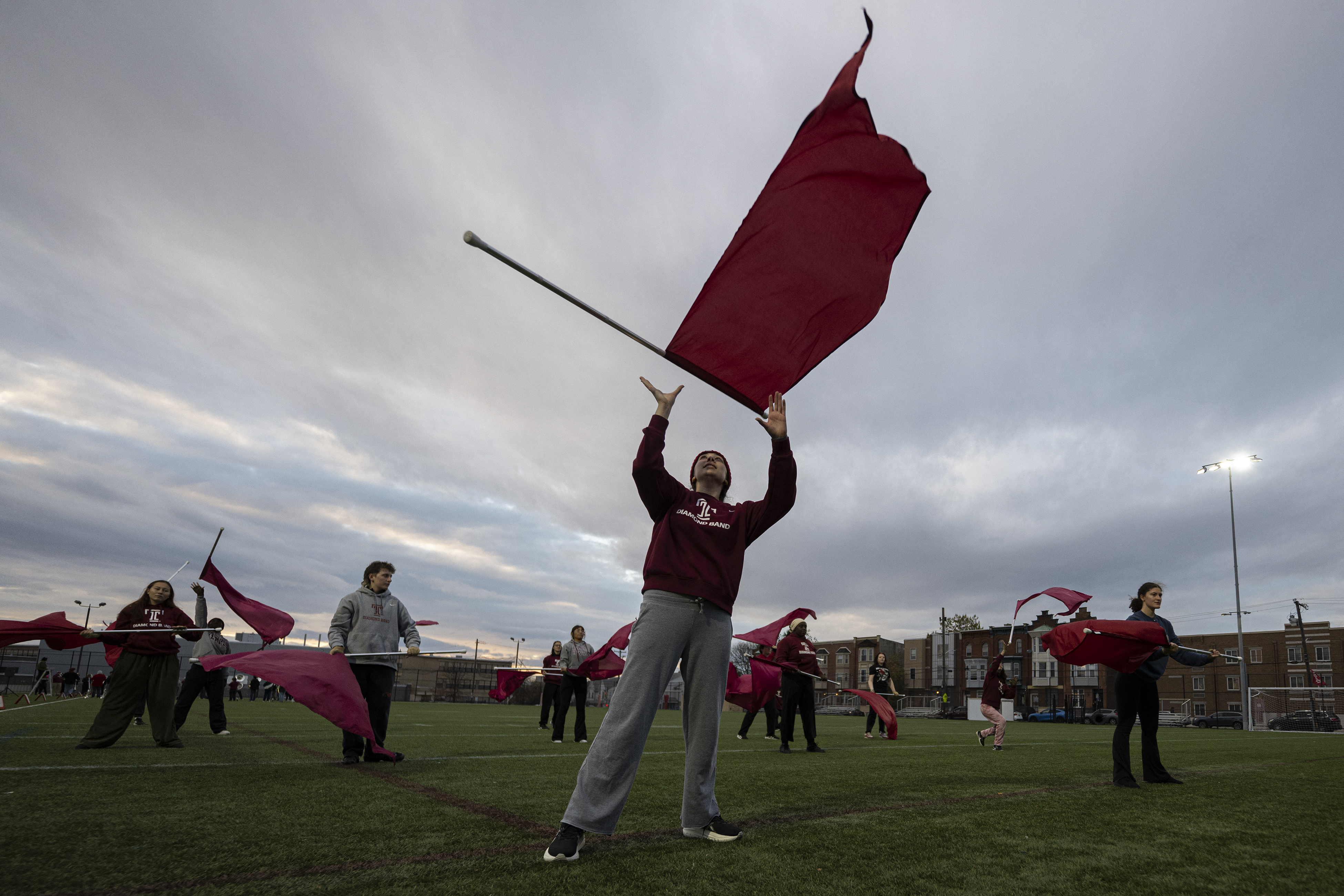
As the pink of twilight peeked through the November clouds, Temple University’s Diamond Marching Band, instruments and flags in tote, practiced on the campus’ Geasey Field.
They ran through selections by Taylor Swift and from the movie KPop Demon Hunters while athletic bands director Matthew Brunner studied their sound and formation from a scissor lift 25 feet in the air.
“Notes should be long,” Brunner called out over a microphone after one selection. “Don’t try to play them too short.”
There were few spectators that afternoon. But that’s about to change in a big way.
The 200-member band is one of only 11 that have been selected to participate in the Macy’s Thanksgiving Day Parade in New York City. It’s a first for Temple, which will be the only band from Pennsylvania or New Jersey in this year’s parade. More than 30 million people likely will be watching from home and 3.5 million in person, if prior numbers are any indication.
Members of the Temple University Marching Band prepare to practice. The band will perform in the Macy’s Thanksgiving Day Parade this year.
That’s a lot of exposure for the Cherry and White, which could be a boost for recruitment and fundraising.
“I can scarcely think of a better way to bring visibility to Temple,” said John Fry, Temple’s president.
And that visibility could lead to more people visiting Temple’s website and seeing what the university has to offer, he said.
“It’s going to be incredible for the university,” said Brunner, who initially announced Temple’s band had been selected for the parade in August 2024. “There’s no television event, other than the Super Bowl, that is bigger.”
The excitement is palpable among students, some of whose families plan to attend the parade.
“It’s a once-in-a-lifetime opportunity,” said Erin Flanagan, 21, who grew up watching the parade with her family and notes she wanted to march in it since she was 6. “I mean, the Macy’s parade is iconic.”
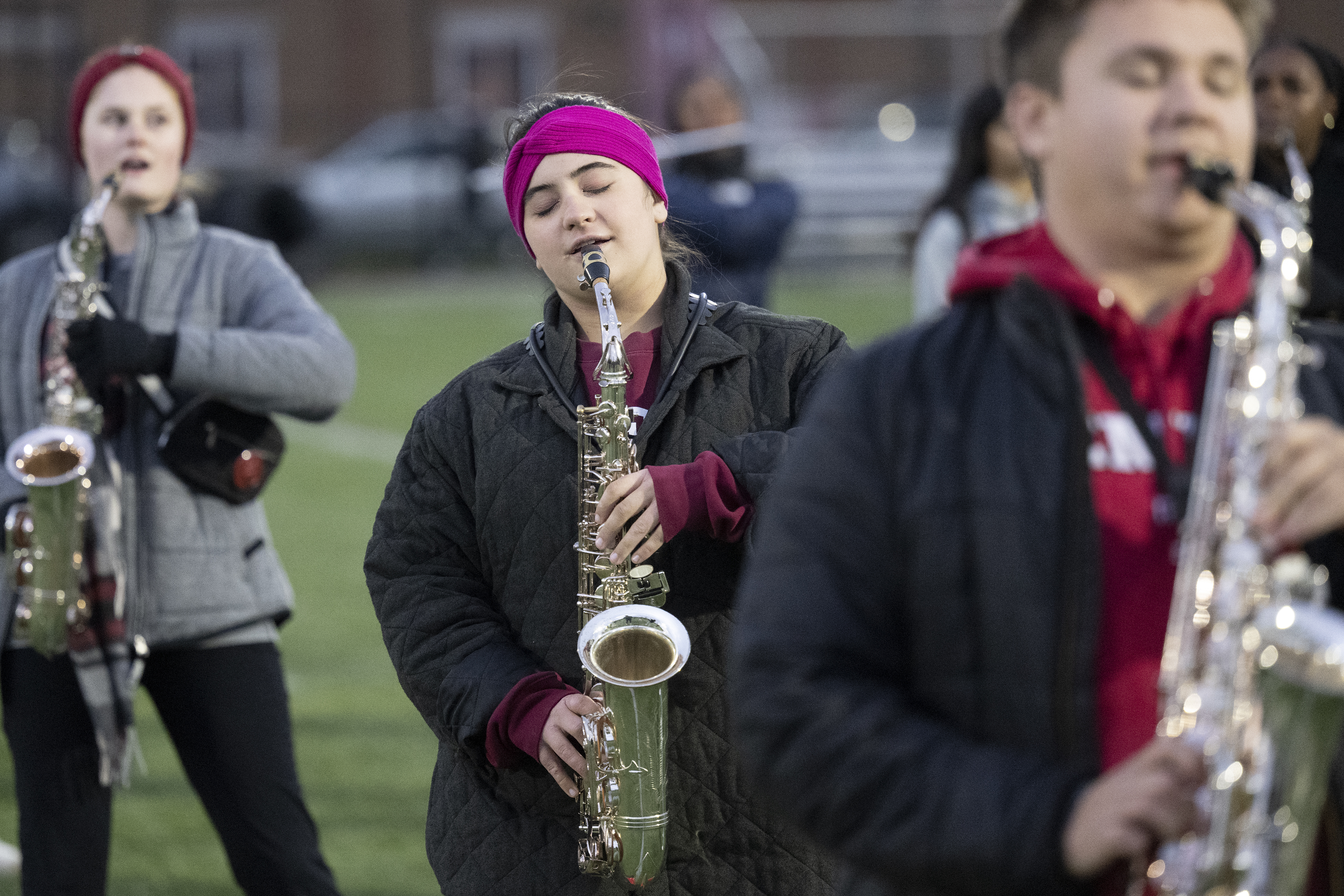
Temple University alto saxophone player Erin Flanagan rehearses with the marching band.
The music education major from Manasquan, N.J., who is a senior, said it likely will be her last performance with the band, and she could not have scripted it better.
“I get to go to this awesome performance and just show everybody what Temple stands for,” said Flanagan, an alto saxophone section leader.
It’s the 99th anniversary of the 2.5-mile parade, which kicks off about 8:30 a.m. on Thanksgiving Day on NBC and Peacock, hosted by Savannah Guthrie, Hoda Kotb, and Al Roker.
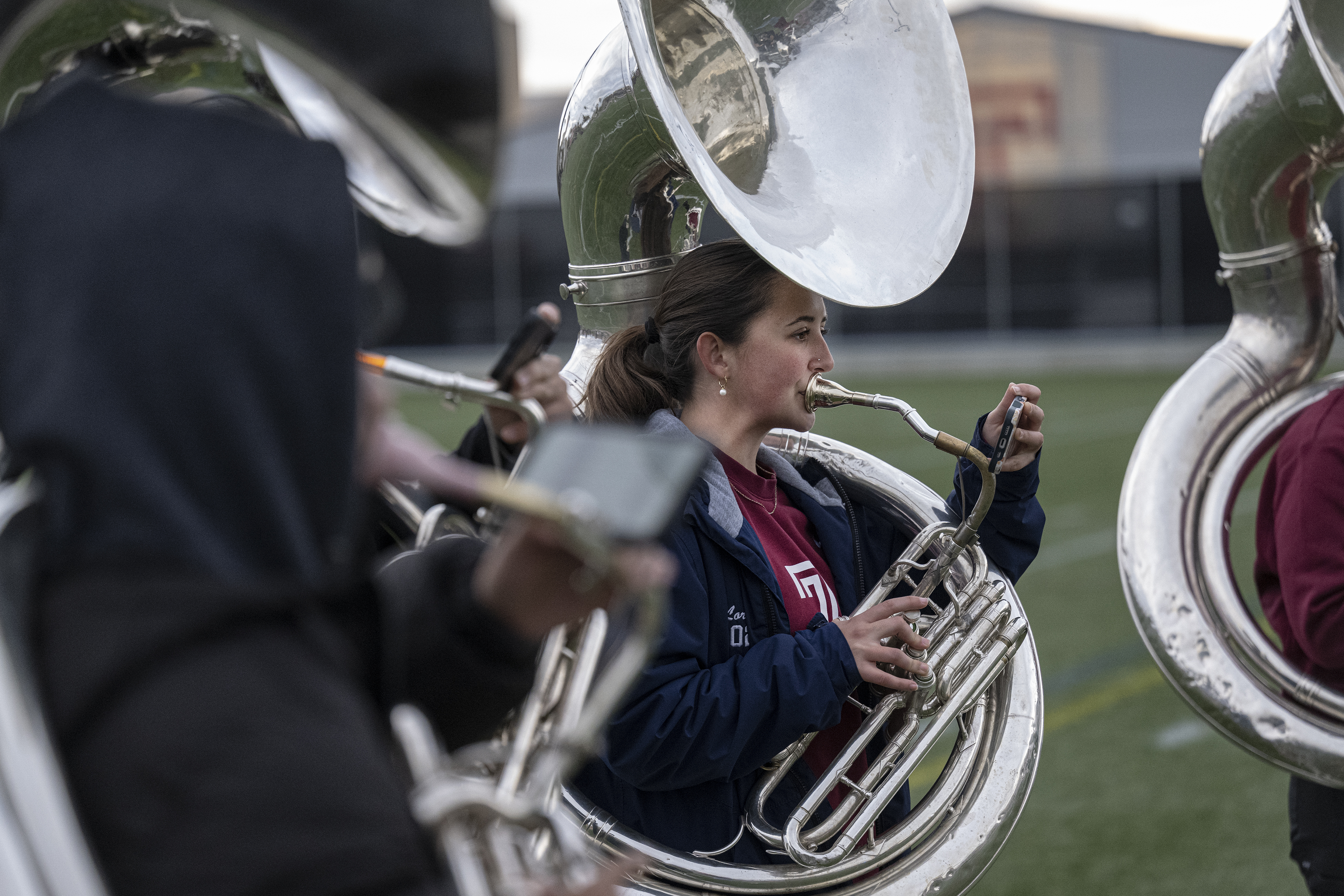
Temple University tuba player Lorali Minde plays the tuba in the marching band.
Lorali Minde, 18, a freshman from Levittown, will be marching while playing the tuba, a 36-pound instrument.
“You kind of get used to it,” she said. “It’s like carrying a really heavy purse.”
Brunner, who has led the marching band for 18 years, said he had applied to be in the parade several times before. It’s a competitive process, with more than 100 applicants vying for a spot. He had to submit video of a performance — he sent the 10-minute show the band did off the Barbie movie soundtrack — pictures of the band in uniform, reasons that Temple deserved a shot, and the band’s resume and biography.
Matthew Brunner, athletic bands director, leads a practice in 2018.
When his wife saw the Barbie show, Brunner said, she texted him: “That’s the show you need to send to Macy’s.”
It proved a winner.
“They loved the fact that the music we play is current,” he said.
The honor comes at a special time for the band, which is celebrating its 100th anniversary. Brunner played that fact up in the application, too.
Under Brunner, the band has grown and has been hitting high marks. Over the years, the school has been recognized as one of the top collegiate marching bands in the nation by USA Today and Rolling Stone, appeared on Good Morning America, The Tonight Show Starring Jimmy Fallon, and an episode of Madam Secretary, and was featured in two Hollywood movies, The Wolf of Wall Street, starring Leonardo DiCaprio, and the remake of Annie. Some of its performances have received millions of views on YouTube, including a 2018 performance of “Idol” by the K-pop group BTS, which currently has more than five million views on Ricky Swalm’s YouTube channel.
The band includes a color guard, a baton twirler, brass and woodwind instruments, a drum line, and a dance team. The group typically practices three times a week for two hours at a time.
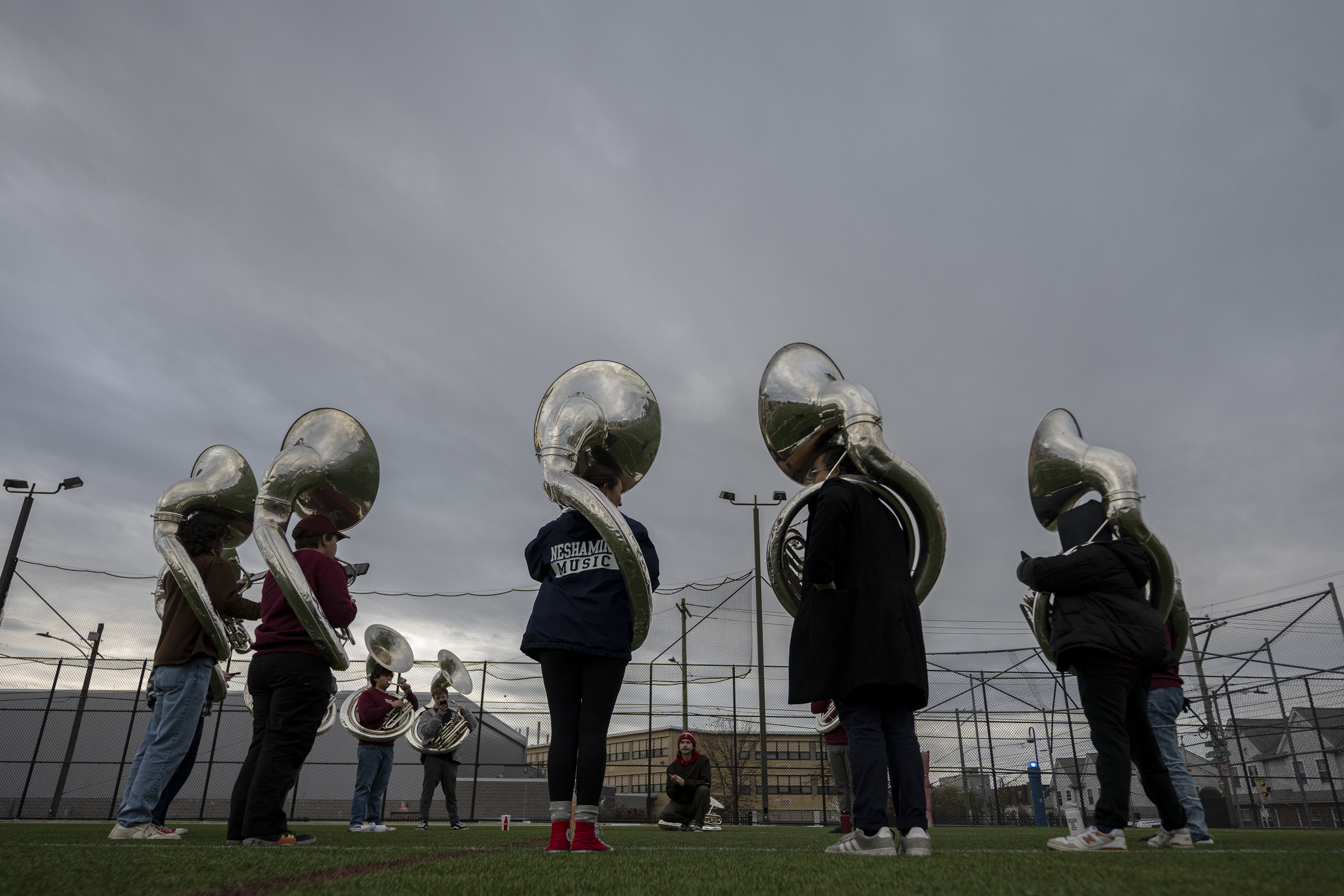
Temple University Marching Band tuba players practice.
“The band is infectious,” Brunner said. “When you see them perform, you can’t help but smile.”
Students have been eying the parade opportunity for a while.
When Flanagan was a sophomore, she asked Brunner point-blank: “When are we doing the Macy’s parade?”
Recently, she and her roommates, also band members, have been counting down the days on a whiteboard.
Brunner declined to say exactly what the band will perform on Thanksgiving, but promised a mix of holiday, audience participation, and Temple songs.
“We’re hoping for no wind,” he said.
Temple University Marching Band Color Guard Captain Abigail Rosen practices with her flag.
Abigail Rosen, color guard captain, and her cocaptain are planning an “epic toss” of their flags over other band members, and wind could hinder it, he explained.
“It’s an exchange toss,” said Rosen, 20, a junior advertising major from Abington. “So I toss my flag to Dana [Samuelson] and she tosses her flag to me, and we catch each other’s flags.”
Bands selected received $10,000 from the retailer, which Temple officials said helped them get started on fundraising to pay for the trip.
The band will be heading to New York on Tuesday for an alumni event, then a performance on the Today show Wednesday. Band members will be up in the wee hours of the morning Thursday for a rehearsal, and after the parade, they will be treated by the school to a Thanksgiving dinner cruise along the Hudson River.
Andrew Malick, 20, a music education major from Carlisle, Pa., who plays the tuba, can’t wait.
“It will be cool to say you’ve done it for the rest of your life,” he said.
Jeremiah Murrell, a freshman trumpet player from Savannah, GA, rehearses with the Temple University Marching Band Thursday, Nov. 13, 2025.
Across Philadelphia, low- and moderate-income households rely on federal subsidies that reduce the cost of their rent.
Federal housing programs directly subsidize at least 476 properties,totaling about 34,350 rental units. But the city is at risk of losing more than one in five of these affordable housing units during the next decade, according to an analysis by the Housing Initiative at Penn published Thursday.
Between 2026 and 2036, federal contracts or mandates that cap the rents at these properties can expire.
Owners candecide whether to renew contracts or let them end and then chargehigher market-rate rents orsell their properties in potentially lucrative deals as property values in the city continue to rise.
A property owner’s decision in 2021 not to renew a subsidy contract at the University City Townhomes in West Philadelphia is a recent high-profile example of what’s at stake. The site had grown much more valuable since the subsidized townhomes were built four decades earlier, and the owner decided to sell the property, displacing 69 households.
“Philadelphia has long relied on a large number of federally subsidized properties to provide affordable housing options that are protected from market forces,” researchers at the Housing Initiative at Penn wrote.
Also helpful, researchers noted, will be the public database of subsidized housing properties and their subsidy expiration dates that the city is creating, as directed by legislation City Council passed in 2023. City officials said they hope to launch the database early next year.
Here are some takeaways from Penn researchers’ analysis of subsidized properties in Philadelphia.
These properties are concentrated in certain areas
Subsidized properties, including those at risk of having their subsidies expire, operate in neighborhoods across the city.
But they are most concentrated in three City Council districts: the Third in West Philadelphia, the Fifth in North Philadelphia, and the Eighth, which includes the area around Germantown and Mount Airy.
The report’s total count of federally subsidized properties does not include those added in the last two to three years, due to limitations of the data.
Subsidies face several risk factors
Researchers found that where properties are located influences the odds of an owner ending participation in a subsidy program and if they do, how much rents potentially could increase.
Thirty-eight of the 136 Philadelphia properties whose subsidies will be up for renewal during the next decade are in areas where rents, household incomes, and home values have increased more than in the city as a whole.
In census tracts that have properties with expiring subsidies, home values increased by 28% in the last decade, compared to 21% citywide.
In areas with strong housing markets, property owners have more incentive to end subsidy contracts and charge market-rate rents.
For-profit property owners are less likely than nonprofit owners to renew subsidy contracts. And about six in 10 properties with expiring subsidies are owned by for-profit owners.
Researchers also noted that any policy change by President Donald Trump’s administration that reduces federal funding for subsidy programs would make properties less affordable for tenants.
These are the most common subsidies
The country’s largest source of funding for new and renovated subsidized rental housing is the Low-Income Housing Tax Credit program. It’s also the most common subsidy source in Philadelphia.
These properties have to keep rents affordable for 30 to 40 years after they are built.
Of the properties that have subsidies that expire within the next 10 years, 57% use Low-Income Housing Tax Credit subsidies, either alone or in combination with other programs.
In a 2024 report, Fannie Mae said the credit was “one of the most successful” programs that support affordable housing for “some of the most vulnerable renters in the country.”
Fannie Mae found that in early 2024, the average asking rent for Low-Income Housing Tax Credit properties in the Philadelphia metropolitan area was about half the average asking rent for a market-rate property.
For Philadelphia properties, the next largest source of federal housing subsidies is the Section 8 program that ties subsidies to units, not households.
This program, either alone or in combination with other programs, covers 27% of the city’s subsidized properties that have agreements that expire during the next decade.
Property owners can choose whether to renew these contracts when they end, which is usually after five to 20 years. Current contracts are all renewals of agreements that date back to before 1983, when Congress ended the program.
A 20-year-old woman and a 19-year-old man who were critically wounded in a shooting Thursday night were dropped off by a private vehicle at Children’s Hospital of Philadelphia, police said.
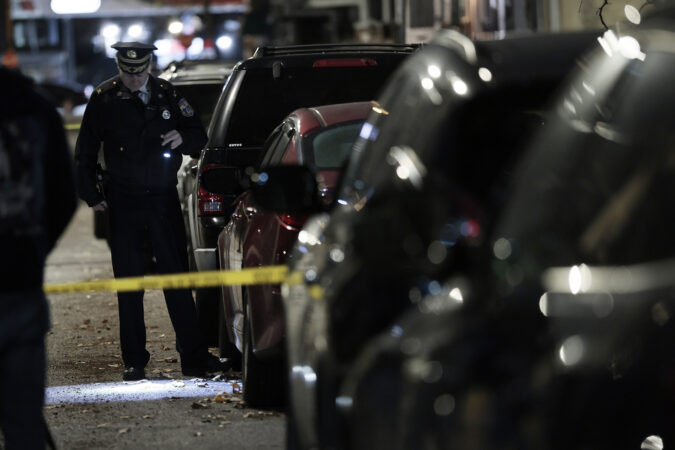
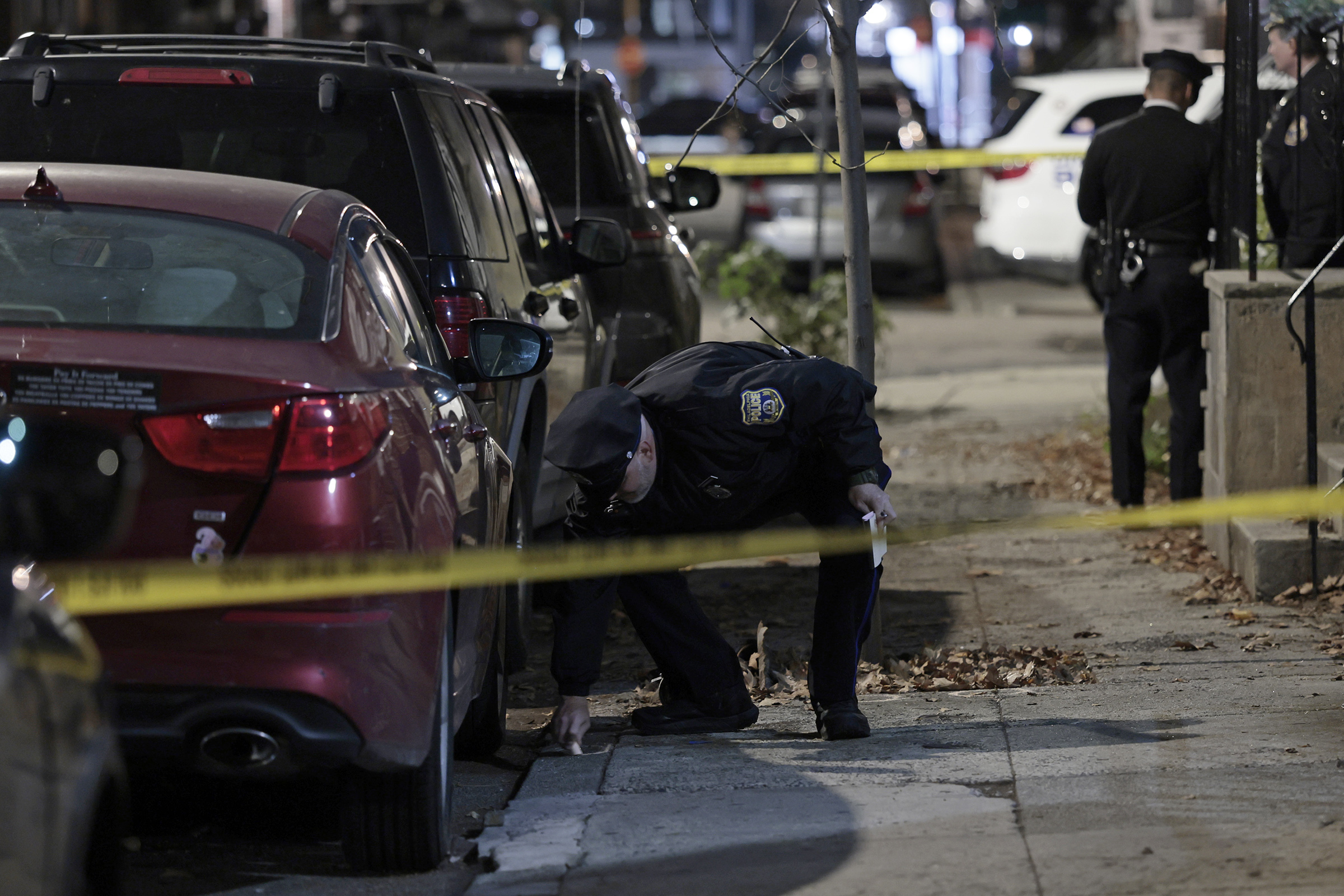
The shooting “likely” happened on the 2100 block of South Norwood Street in South Philadelphia, where 14 spent shell casings were found, said Chief Inspector Scott Small.
However, the victims have been unable to speak and no witnesses had yet been located to say for certain where the two people were shot, Small said.
Shortly before 8:30 p.m., police responded to a report of gunshots in the area of 21st and Jackson Streets and found the shooting scene nearby on the 2100 block of South Norwood Street, Small said.
Police investigating shooting evidence on the 2100 block of South Norwood Street in Philadelphia on Thursday.
A short time later, police were notified that two shooting victims were taken by private vehicle to Children’s Hospital of Philadelphia, Small said. The vehicle did not remain at the hospital.
There were no other shooting incidents reported to police around the time the victims were dropped off at the hospital, Small said.
Police also did not find blood evidence on Norwood Street, adding to uncertainty about what happened, Small said.
Police were checking to see if any security cameras recorded video in the area, Small said.
Philadelphia police are investigating two reported sexual assaults possibly involving the same Temple University student, school officials said Thursday.
In a statement, Temple officials said the university “has received two credible reports” alleging sexual assault, “one during a social event in a residence hall and a second incident at an off-campus location, potentially involving the same suspect who was positively identified yesterday.”
The university has placed “a student of interest” on interim suspension pending investigations by the Philadelphia Police Department, Temple’s Department of Public Safety, and the university, the statement said.
While suspended, the student is prohibited from being on campus or in university buildings or classes, according to the statement signed by Jennifer Griffin, the university’s vice president for public safety and chief of police, and Jodi Bailey Accavallo, vice president for student affairs.
“As these investigations are ongoing,” the statement said, “we strongly encourage students with information or otherwise in need of support regarding any concerns of sexual misconduct to contact” Temple Police at 215-204-1234 or police@temple.edu, the Title IX coordinator at 215-204-3283 or titleix@temple.edu, or the Dean of Students Office at 215-204-7188 or dos@temple.edu.
Students and other members of the university community or members of the public can also submit an anonymous report at helpline.temple.edu.
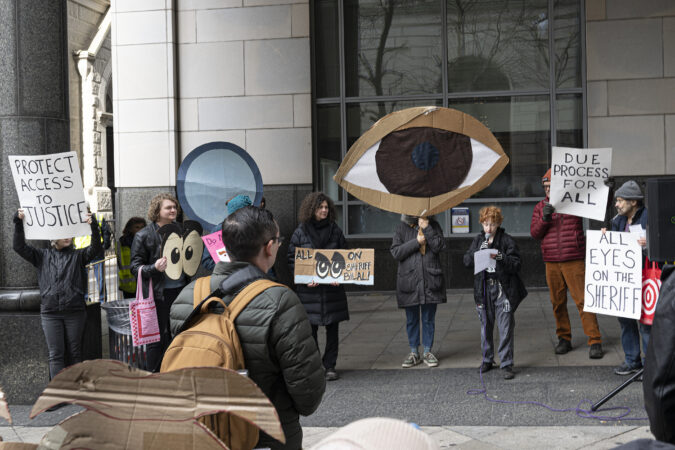
Activists rallied outside the Philadelphia Criminal Justice Center on Thursday to press their assertion that ICE has been allowed to turn the courthouse into “a hunting ground” for immigrants.
The noon demonstration crystalized months of contention between activists and lawyers who say the courthouse must be a place to seek and render justice ― not to target immigrants ― and federal authorities who insist that making arrests there is legal, safe, and sane.
No ICE Philly, the rally organizer, says agents have been enabled to essentially hang out at the Center City courthouse, waiting in the lobby or scouring the hallways, then making arrests on the sidewalks outside, a pattern they say has been repeated dozens of times since President Donald Trump took office in January.
“ICE is kidnapping immigrants who are obeying the law and coming to court,” said Ashen Harper, a college student who helped lead the demonstration, which targeted Sheriff Rochelle Bilal. “She is capitulating and cooperating with ICE.”
Many people who go to the courthouse, the group noted, are not criminal defendants ― they are witnesses, crime victims, family members, people dealing with alleged offenses like shoplifting or trespassing, and others who are already in diversionary programs.
Organizers said ICE has arrested about 90 people outside the courthouse since January, a dramatic increase over the previous year. And they pledged to return on Dec. 4 ― lugging a podium for Bilal so that, organizers said, she can explain changes she intends to make, including barring ICE.
The sheriff did not immediately reply to a request for comment Thursday.
Members of No ICE Philly rally outside the Criminal Justice Center on Thursday, calling on the sheriff to cut off Immigration and Customs Enforcement access to the building.
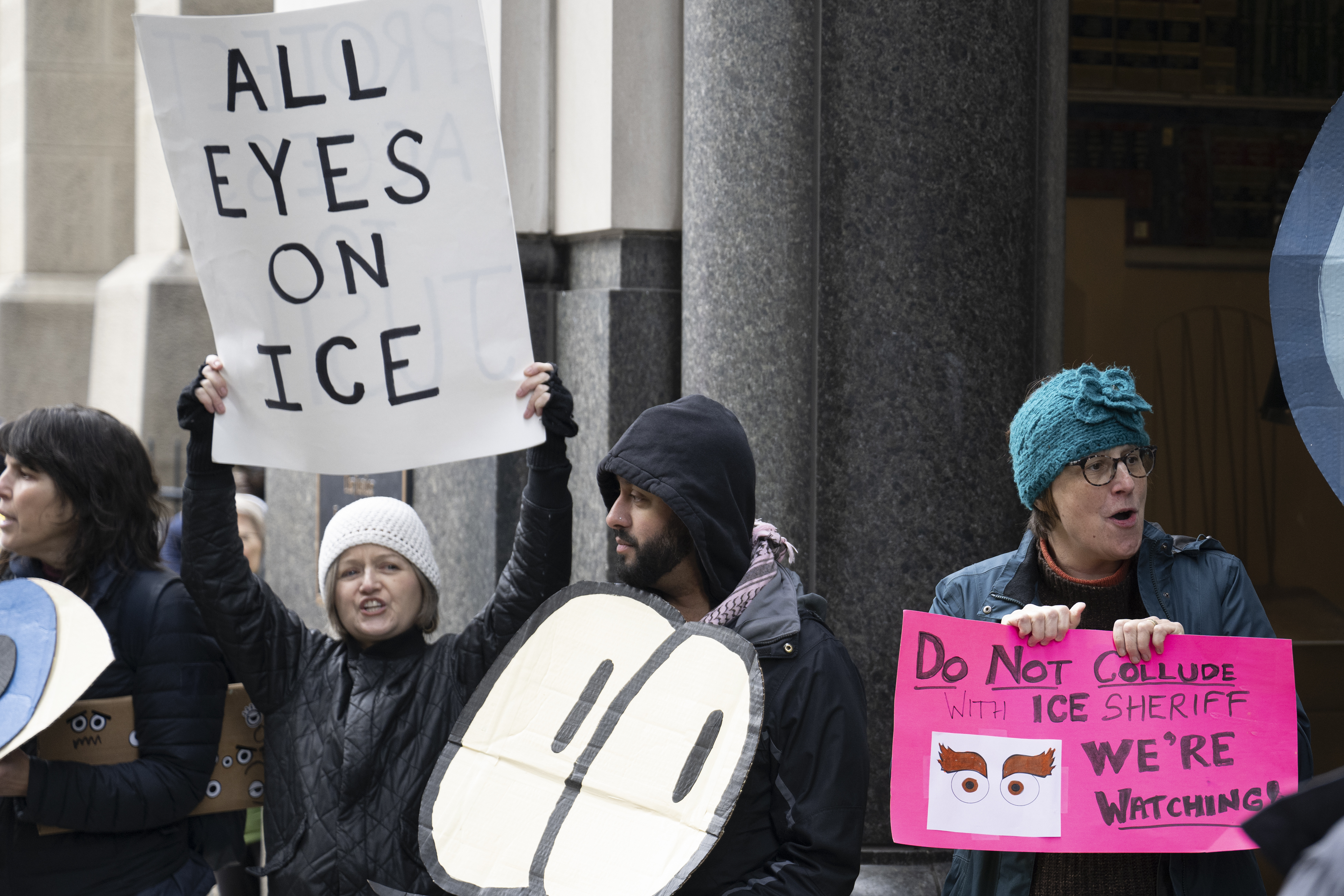
“We want to put the sheriff on notice that we’re watching,” said Aniqa Raihan, a No ICE Philly organizer. “We want to raise awareness of the fact … that ICE is using the courthouse as a hunting ground.”
As word of plans for the demonstration spread, Bilal issued a statement aimed at “addressing public concerns” around ICE activity.
“Let me be very clear: the Philadelphia Sheriff’s Office does not partner with ICE,” the sheriff said. “Our deputies do not assist ICE, share information, or participate in immigration enforcement.”
Deputies verify the credentials of ICE agents entering the courthouse ― and those agents are not permitted to make arrests in courtrooms or anywhere else inside, she said.
Raihan and other advocates say that is no protection. ICE agents linger in the lobby, they said, then follow their target outside and quickly make the arrest.
A police department spokesperson said at the time that the Spanish-speaking officer offered to walk with the man to help translate, but did not detain him. The Defender Association of Philadelphia and others questioned how the incident squared with the city’s sanctuary policies.
U.S. Immigration and Customs Enforcement officials in Philadelphia did not reply to a request for comment.
On Thursday, about 40 demonstrators gathered outside the courthouse, chanting and singing under the watchful eye of city police officers and sheriff’s deputies. No ICE agents were visible. Protesters carried signs to indicate that they, too, were watching, raising colorful cardboard eyeballs, eyeglasses, and magnifiers.
Lenore Ramos, the community defense organizer with the Juntos advocacy group, called on the sheriff and city government officials to protect immigrants at the courthouse. Proclaiming Philadelphia a welcoming city, she said, is not just a slogan ― it’s a promise, one that local government must fulfill.
“The city is not standing behind our immigrant communities,” Ramos said. “It is walking all over them.”
In an interview earlier this week, Whitney Viets, an immigration counsel at the Defender Association, said ICE agents are at the courthouse almost every day, and arrests occur there almost daily.
The government does not publicly release data detailing where most immigration arrests occur, but Viets estimated that dozens of arrests have taken place at the courthouse since the start of the year. Masked plainclothes agents are seen outside the building, in the lobby, in courtrooms, and in hallways, she said.
“Agents are effectively doing enforcement in the courthouse, through identification,” she said.
She explained that agents may identify a person they are seeking in or near a courtroom, then either follow them outside or alert other agents who are already waiting on the sidewalk.
It is unclear where ICE is obtaining information on who will be at the courthouse on any particular day, although some details about ongoing criminal cases are available in public records.One result of ICE enforcement, she said, is people are afraid to come to court.
“This is about whether our justice system operates effectively,” Viets said. “The actions of ICE have gotten brazen. … What we need at this time is public engagement against this activity.”
No ICE Philly decried “kidnappings” by the agency and demanded the sheriff “protect everyone inside and outside the courthouse,” including “immigrants targeted by ICE as well as citizens observing and documenting ICE arrests.”
The Philadelphia Sheriff’s Office is in charge of courthouse security. However, Bilal said in her statement, her office has no authority to intervene in lawful activities that are conducted off the property.
“Inside the courthouse, everyone’s rights and safety are protected equally under the law,” she said. “We are law enforcement professionals who follow the law.”
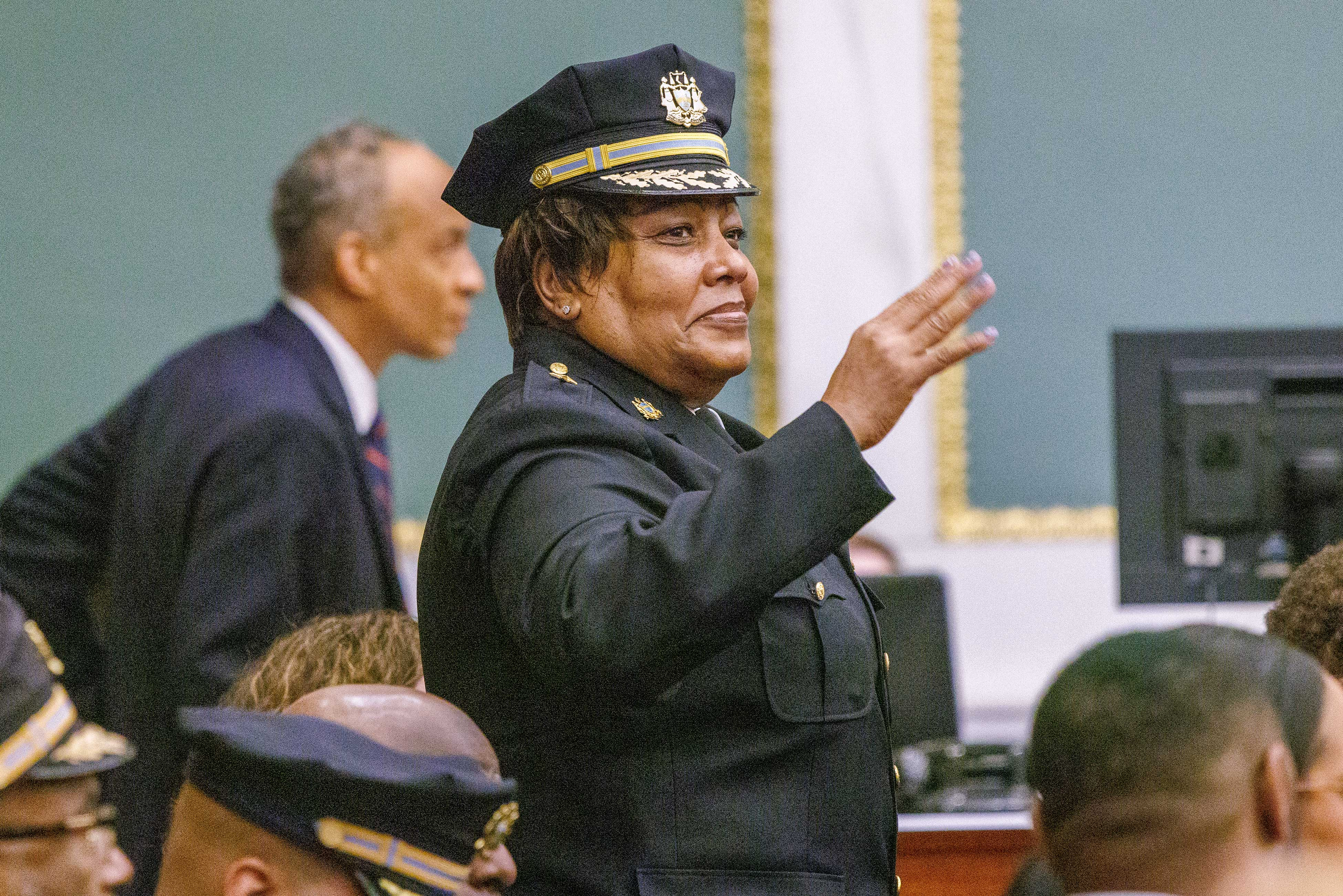
Philadelphia Sheriff Rochelle Bilal stands to be recognized at City Hall in March.
In Philadelphia and places around the country, courthouses have become disputed locales as the Trump administration pursues ever-more-aggressive arrest and deportation policies.
Under President Joe Biden, limits were set on what ICE could do at courthouses. Agents were permitted to take action at or near a courthouse only if it involved a threat to national security, an imminent risk of death or violence, the pursuit of someone who threatened the public safety, or a risk of destruction of evidence.
Even then, advocacy groups accused ICE of violating the policy by arresting people who were only short distances from courthouses.
The Biden restrictions on ICE vanished the day after Trump took office.
The new guidance said agents could conduct enforcement actions in or near courthouses ― period. The only conditions were that agents must have credible information that their target would be present at a specific location and that the local jurisdiction had not passed laws barring such enforcement.
The guidance said that, to the extent practicable, ICE action should take place in nonpublic areas of the courthouse and be done in collaboration with court security staff. Officers should generally avoid making arrests in or near family or small-claims courts.
The Department of Homeland Security said that the Biden administration had “thwarted law enforcement” from doing its job, that arresting immigrants in courthouses is safer for agents and the public because those being sought have passed through metal detectors and security checkpoints.
“The ability of law enforcement to make arrests of criminal illegal aliens in courthouses is common sense,” Assistant Secretary Tricia McLaughlin said earlier this year. “It conserves valuable law enforcement resources because they already know where a target will be.”
Philadelphia city officials have said repeatedly that they do not cooperate with ICE, and that the sanctuary city policies created under former Mayor Jim Kenney remain in place under Mayor Cherelle L. Parker.
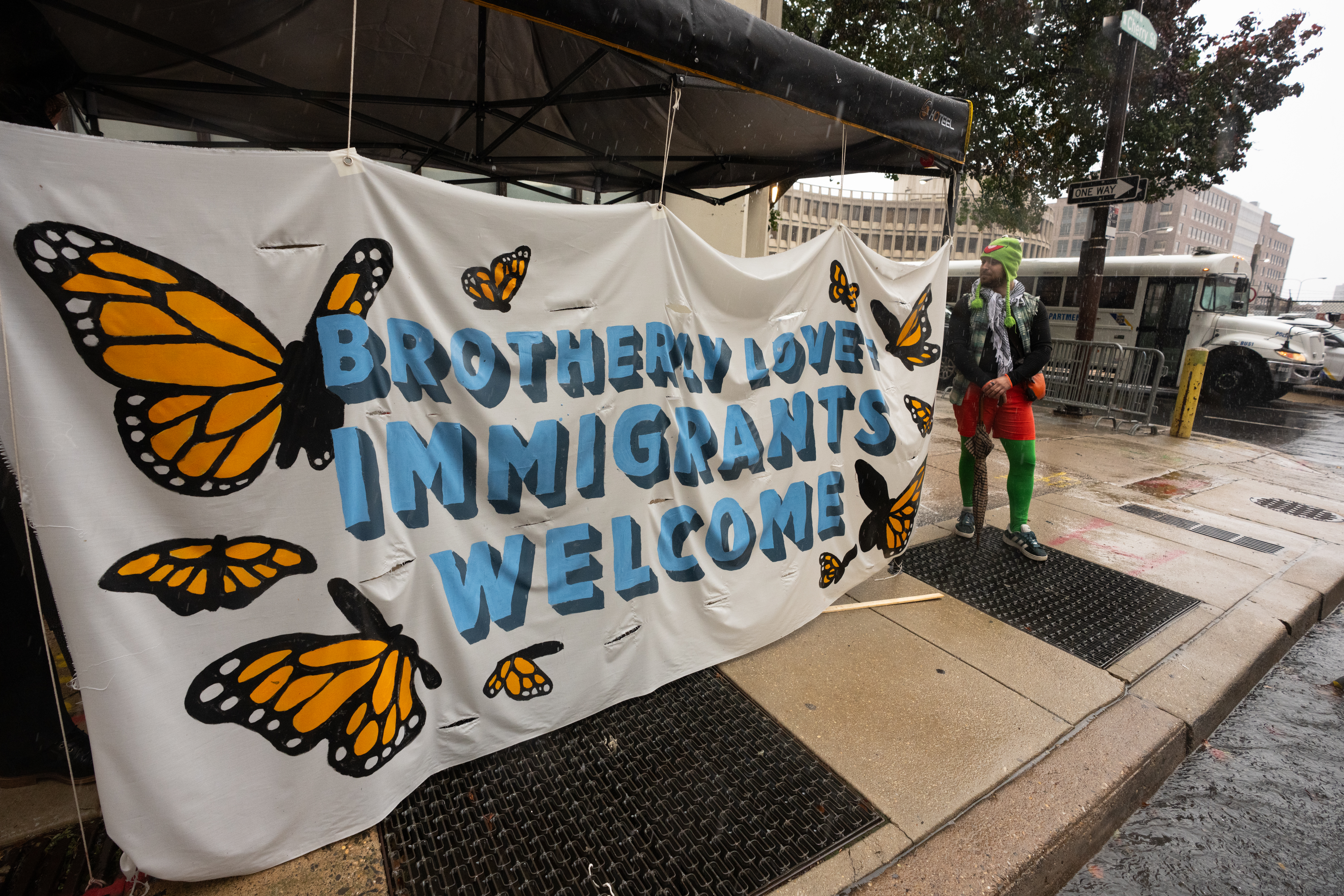
Protesters Elias Siegelman, right, with No Ice Philly, who also works with the groups Indivisible, Jewish Voice for Peace, and Progressive Victory, outside the ICE office, in Philadelphia on Oct. 30.
Nationally, 10 months into the Trump administration, some Democratic jurisdictions are acting to tighten ICE access at courthouses.
In Connecticut this month, state lawmakers passed a bill to bar most civil immigration arrests at courthouses, unless federal authorities have obtained a signed judicial warrant in advance.
The Senate bill, already approved by the House, also bans law enforcement officers from wearing face coverings in court, Connecticut Public Radio reported. Democratic Gov. Ned Lamont is expected to sign the measure.
Last month in Chicago, which has faced weeks of controversial immigration enforcement, the top Cook County judge barred ICE from arresting people at courthouses. That came as federal agents stationed themselves outside courthouses, drawing crowds of protesters, CBS News reported.
On Monday, a federal judge dismissed a Trump administration challenge to a New York law that barred the immigration arrests of people going into and out of courthouses. New York passed the Protect Our Courts Act in 2020, during Trump’s first term, a law the administration said had imposed unconstitutional restrictions on enforcement, the Hill reported.
The Thursday rally marked the third recent protest by No ICE Philly, which seeks to stop agency activity in the city. The organization’s Halloween Eve demonstration outside the ICE office erupted into physical confrontations with police, with several people pushed to the ground and four arrested.
The arrests came after some demonstrators attempted to stop ICE vehicles from leaving the facility at Eighth and Cherry Streets.
No ICE Philly organizers said Thursday that they will continue to scrutinize ICE activity at the courthouse.
“There are people watching. We have eyes on this,” Raihan said, adding that ICE is “allowed to hang in the lobby, sometimes in the courtrooms.”
“Somehow they seem to know when somebody vulnerable is in the courthouse. … We’re concerned with how they’re finding out that information.”