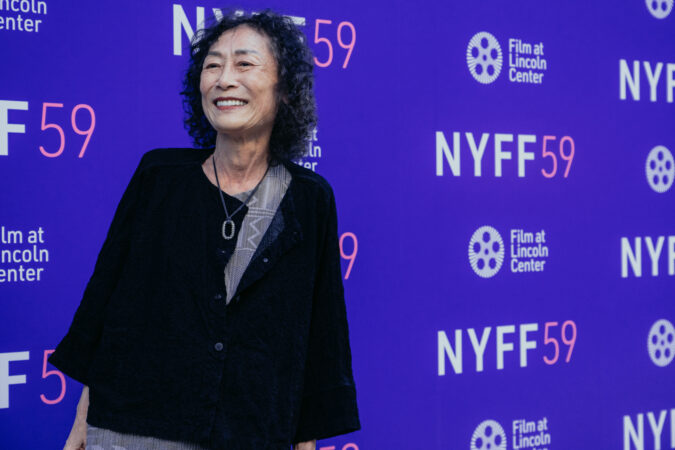
Christine Choy, a trailblazer for Asian Americans in independent film and whose documentary on the fatal beating of Vincent Chin was nominated for an Academy Award, has died. She was 73.
Ms. Choy died Sunday, according to a statement from JT Takagi, executive director of Third World Newsreel, a filmmaking collective Choy helped establish in the 1970s. No cause of death was given.
“She was a prolific filmmaker who made significant films that helped form our Asian American and American film history,” Takagi said on the organization’s website.
Chin, a Chinese American who grew up in Detroit, was celebrating his bachelor party in 1982 when two white autoworkers attacked him. At that time, Japanese auto companies were being blamed for job losses in the U.S. auto manufacturing industry. The attackers were motivated by their assumption Chin was Japanese. His death and the lack of prison time for the two assailants is considered a galvanizing moment for Asian Americans fighting anti-Asian hate.
Renee Tajima-Peña, co-director of Who Killed Vincent Chin?, met Ms. Choy around 1980 through Third World Newsreel. They decided to collaborate on a documentary a year after Chin’s death after seeing how little coverage it received.
Tajima-Peña recalls bonding with Ms. Choy and other crew during freezing Detroit winter nights while waiting for witnesses in Chin’s death and evenings spent with Chin’s mother’s over home-cooked meals.
“We were in constant motion during the production with Chris always the picture of cool — sunglasses, stylishly slim, cigarette in hand. And yes she was brash and outspoken — her cigarettes may have had filters but her language didn’t,” Tajima-Peña said in an email to the Associated Press on Friday. “But, her audaciousness was all a part of the package.”
Their production was lauded for bringing more attention to Chin’s slaying and went on to earn an Oscar nomination for best documentary feature in 1989. In 2021, it was chosen for preservation in the National Film Registry by the Library of Congress.
Ms. Choy was a full-time professor at New York University’s Tisch School of the Arts up until her death. She was praised as someone who enjoyed mentoring young auteurs and students at NYU and Third World Newsreel.
In a statement, Dean Rubén Polendo called her “a triumphant force in documentary filmmaking whose works penetrated America’s social conscience.”
“Christine’s loss is felt deeply across the Tisch community, where her unparalleled legacy survives through her pioneering work as an artist and educator,” Polendo said.
Born in China, Ms. Choy grew up with a Korean father and a Chinese mother. She immigrated to New York City as a teen. Being there in the 1960s, Ms. Choy learned about the Civil Rights Movement up-close. That would shape her passion for social justice, according to her NYU faculty biography.
She moved to Los Angeles and earned a directing certificate from the American Film Institute. But she eventually moved back to New York and, in 1972, helped create Third World Newsreel. The group’s mission was to advance films about social justice and marginalized communities, particularly people of color. Ms. Choy’s early documentaries included subjects such as New York City’s Chinatown and race relations in the Mississippi Delta.
Ms. Choy received several awards and fellowships over the years including Guggenheim and Rockefeller fellowships. She also taught at other universities including Yale, Cornell and City University in Hong Kong.
Plans for funeral services were not immediately known.
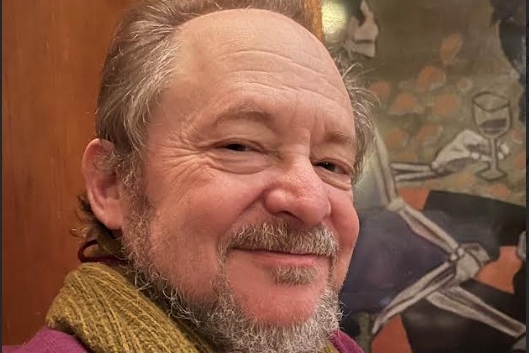
Aaron Goldblatt, 70, of Philadelphia, award-winning museum services partner emeritus at Metcalfe Architecture & Design, former vice president for exhibits at the Please Touch Museum, exhibit designer, sculptor, adventurer, and mentor, died Sunday, Dec. 7, of lung cancer at his home.
He joined business partner Alan Metcalfe in 2002 and specialized in constructing canopy walks, glass floors, elevated walkways, net bridges, abstract playgrounds, multimedia exhibits, and other unique designs in prominent locations. Visitors encounter their creations at the Museum of the American Revolution, the Independence Seaport Museum, Children’s Hospital of Philadelphia, the National Museum of Industrial History in Bethlehem, Pa., and the Whiting Forest at Dow Gardens in Michigan.
He and colleagues built the Lorax Loft on the Trail of the Lorax at the Philadelphia Zoo, the innovative garden and playground at Abington Friends School, and the lobby at Wissahickon Charter School. At Morris Arboretum, they built the celebrated Out on a Limb and Squirrel Scramble “treetop experiences” that Inquirer architecture critic Inga Saffron called “an irresistible allure, to young and old alike.”
He earned bachelor’s and master’s degrees in sculpture, hitchhiked from adventure to adventure around the country and South America after high school, and said in 2019 that “learning, laughter, and creating genuine connections between people, nature, and history … really inspire my design.”
Play, he said, is one of those genuine connections. “Wherever people are, as long as they are there long enough, play will happen,” he said in 2019. “It happens in schools, museums, and even prisons. Play is fundamental to being human.”
Together, Mr. Goldblatt, Metcalfe, and their colleagues earned design awards from the local chapter of the American Institute of Architects, the American Association of Museums, and other groups. In 2022, they earned the Wyck-Strickland Award from the historic Wyck house, garden, and farm for outstanding contributions to the cultural life of Philadelphia.
In a tribute, colleagues at Metcalfe said Mr. Goldblatt “transformed our studio into the place we are today.” They said: “His generosity, wisdom, and passion for play emanated throughout every conversation, punctuated only by his wit and sense of humor.”
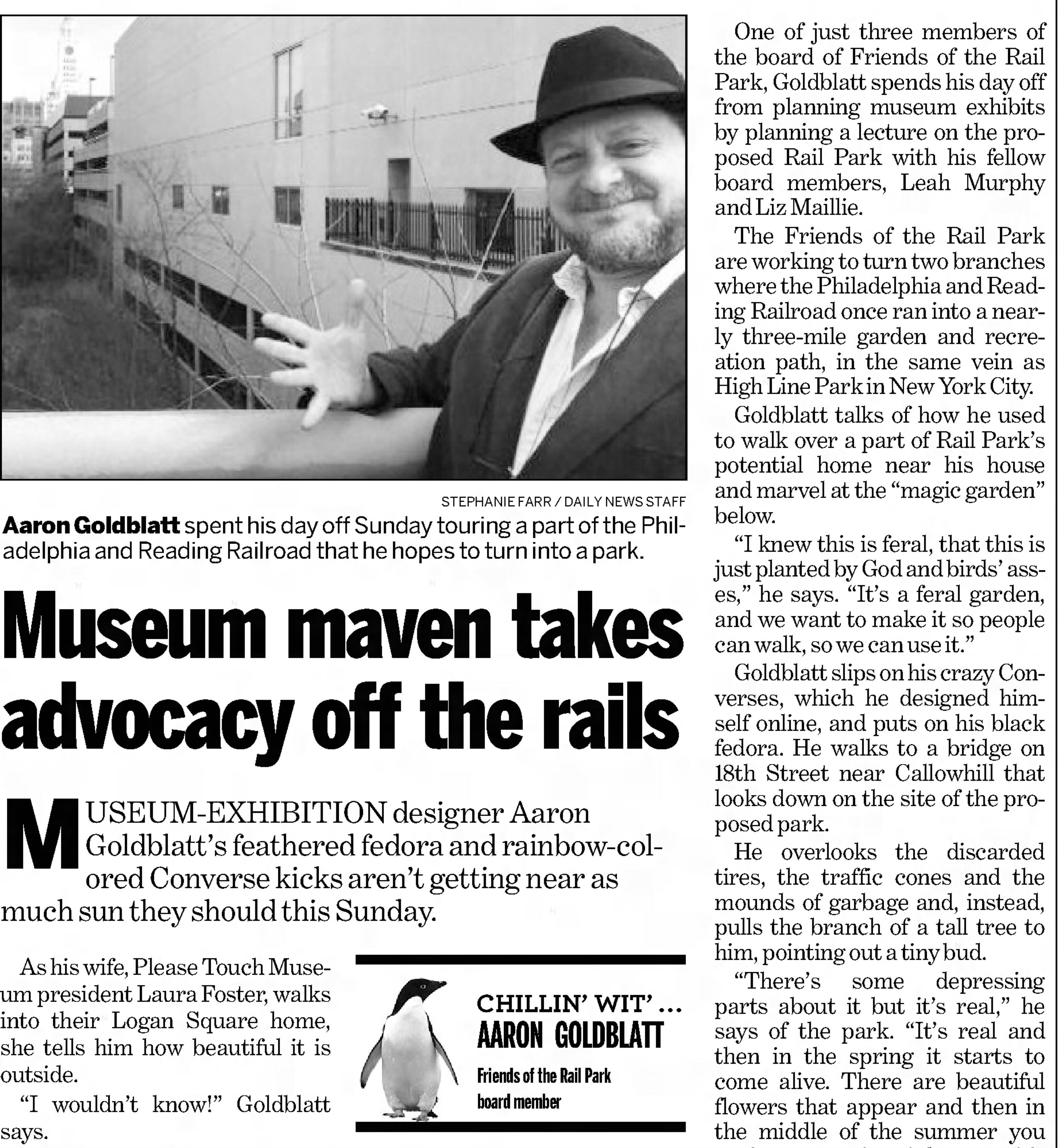
This photo and story about Mr. Goldblatt appeared in the Daily News in 2013.
From 1990 to 2002, he designed and developed exhibits at the Please Touch Museum. Earlier, he was director of exhibits for the Academy of Natural Sciences, assistant director at the Wagner Free Institute of Science, and studio assistant to sculptor Alice Aycock and other artists.
He helped design the Rail Park and was a cofounder and longtime board member of Friends of the Rail Park. He served on boards at the Print Center, the Wagner Free Institute of Science, and other groups, and taught postgraduate museum studies at the University of the Arts for 20 years.
“He developed a love of the process and philosophy of building,” said his daughter, Lillian. His wife, Susan Hagen, said: “He was always engaged, always asking questions. He was curious, funny, and extremely smart.”
Friends called him “lovely, smart, and witty” and “warm, wise, and creative” in Facebook tributes. One friend said: “He always had a spark.”
Aaron Shlomo Goldblatt was born March 22, 1955, in Cleveland. His father was in the Army, and Mr. Goldblatt grew up on military bases across the country and in Germany.
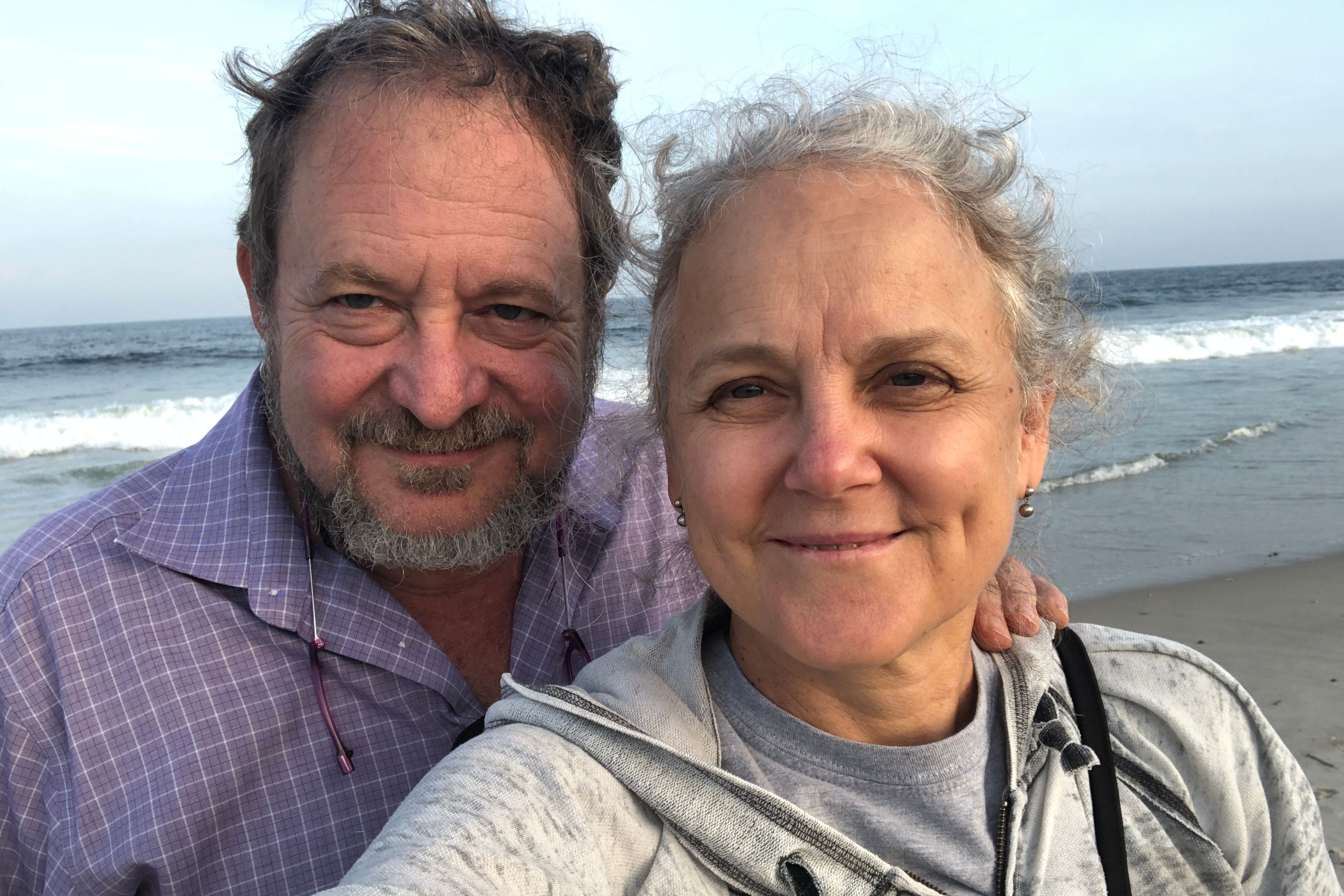
Mr. Goldblatt and his wife, Susan Hagen, married in 2023.
He graduated from high school in Maryland and earned his bachelor’s degree at Philadelphia College of Art in 1982 and master’s degree at Rutgers University in 1990. Before settling in Philadelphia, he worked on farms, painted houses, and spent time as a carpenter, a welder, and a potter.
He married Diane Pontius, and they had a daughter, Lilly. After a divorce, he married Laura Foster. She died in 2019. He married fellow artist Susan Hagen in 2023, and they lived in Spring Garden.
An engaging storyteller and talented cook, Mr. Goldblatt enjoyed all kinds of art, music, and books. He watched foreign films, wrote letters to politicians and the editor of The Inquirer, and visited the Reading Terminal Market as often as possible. He and his wife started birding during the pandemic.
“Aaron led with his heart, engaging deeply with the people and ideas around him,” his daughter said. “He could burst into song at any moment.”
Mr. Goldblatt smiles with his daughter, Lilly.
His wife said: “He was a family person, and everyone talks about his love and kindness.”
In addition to his wife and daughter, Mr. Goldblatt is survived by a grandson, a sister, a brother, his former wife, and other relatives.
LONDON — British writer Joanna Trollope, whose best-selling novels charted domestic and romantic travails in well-heeled rural England, has died, her family said Friday. She was 82.
Ms. Trollope’s daughters, Antonia and Louise, said the writer died peacefully at her home in Oxfordshire, southern England, on Thursday.
Ms. Trollope wrote almost two dozen contemporary novels, including The Rector’s Wife, Marrying theMistress, Other People’s Children, and Next of Kin. They were often dubbed “Aga sagas,” after the old-fashioned Aga ovens found in affluent country homes.
Ms. Trollope disliked the term, noting that her books tackled uncomfortable subjects including infidelity, marital breakdown, and the challenges of parenting.
“That was a very unfortunate phrase and I think it’s done me a lot of damage,” she once said. ”It was so patronizing to the readers, too.”
Ms. Trollope’s most recent novel, Mum & Dad, examined the “sandwich generation” of middle-aged people looking after both children and elderly parents.
Ms. Trollope also published 10 historical novels under the pseudonym Caroline Harvey.
Ms. Trollope, a distant relative of Victorian novelist Anthony Trollope, was born in Minchinhampton in the west of England in 1943. She studied English at Oxford University, then worked in Britain’s Foreign Office and as a teacher before becoming a full-time writer in 1980. She became a household name after The Rector’s Wife was adapted for television in 1991.
Ms. Trollope’s novel Parson Harding’s Daughter won a novel of the year award from the Romantic Novelists’ Association in 1980. In 2010, the association gave her a lifetime achievement award for services to romance.
In 2019, she was made a Commander of the Order of the British Empire, or CBE, by Queen Elizabeth II.
Her literary agent, James Gill, called Ms. Trollope “one of our most cherished, acclaimed and widely enjoyed novelists.
“Joanna will be mourned by her children, grandchildren, family, her countless friends and — of course — her readers,” Gill said.
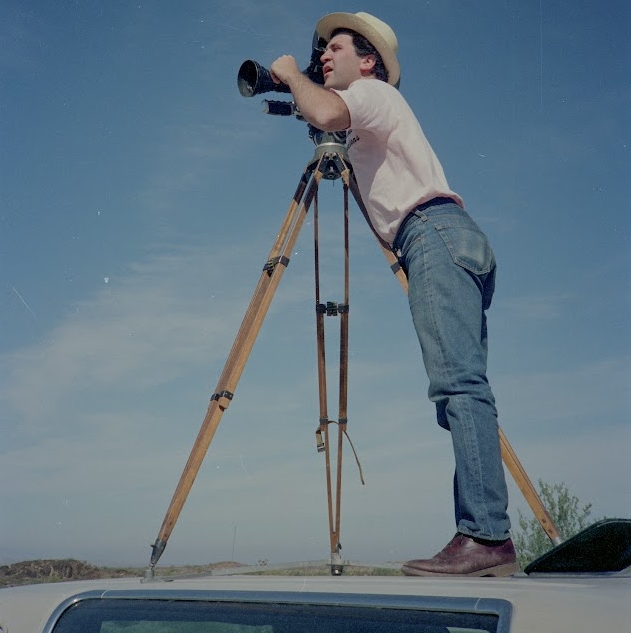
Chris Emmanouilides, 63, of Rutledge, Delaware County, digital media director, award-winning filmmaker, TV executive producer, cameraman, teacher, and mentor, died Saturday, April 26, of a heart attack at his home.
Born in Philadelphia and reared in Los Angeles, Mr. Emmanouilides followed his then-girlfriend back to the city in the 1980s, earned a master’s degree in radio, TV, and film at Temple University, and crafted a 36-year career as an independent filmmaker, vice president of programming for Banyan Productions, cofounder and chief content officer of the VuNeex video marketing platform, and director of digital media at the King of Prussia-based American College of Financial Services.
He specialized in independent documentary films, commercials, and early forms of reality TV, and cofounded Parallax Pictures in the 1990s. His films were screened at the Philadelphia Festival of World Cinema, the Sundance Film Festival, and elsewhere around the world.
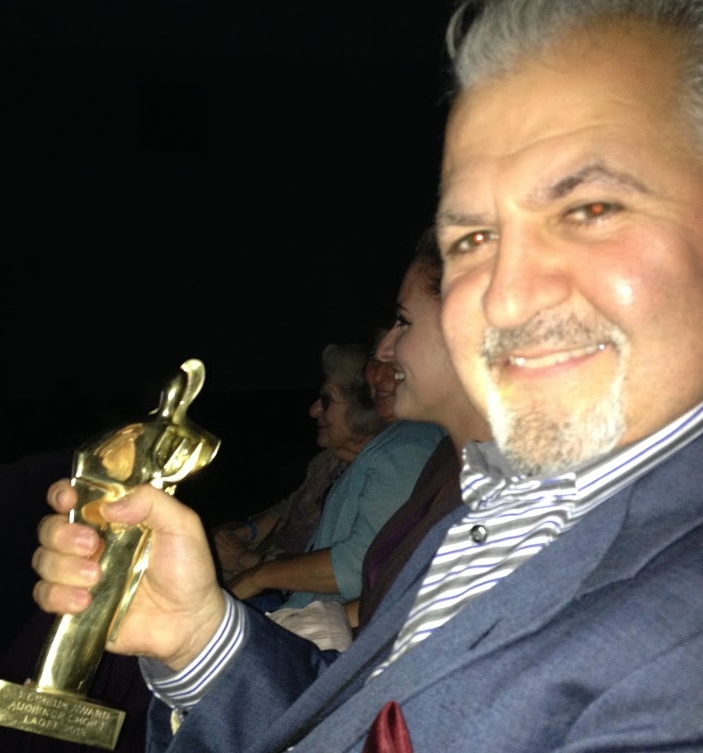
His 40-minute film Archive premiered at the Los Angeles Greek Film Festival in 2013 and earned the Audience Choice Orpheus Award. His 1989 film Suelto! earned first prize at the 1990 Sundance Slice of Life Film Festival.
In 1994, Inquirer movie critic Desmond Ryan called Mr. Emmanouilides’ film Remains “especially noteworthy.” In 1997, The Ad and the Egoearned the top prize at the San Francisco International Film Festival.
In 2001, critic Damon C. Williams reviewed TalkFast for the Daily News. Mr. Emmanouilides was the film’s director of photography. Williams said: “It does an incredible job in detailing the desire, dedication and heartbreak that go with pursuing a dream. It also shows that some do indeed find success in chasing their dreams.”
From 1997 to 2014, Mr. Emmanouilides was an executive producer, director of special projects, and vice president of programing at Philadelphia-based Banyan Productions. Working with the Discovery Channel, the Travel Channel, the Food Network, TLC, Lifetime, and other TV outlets, he and his colleagues created thousands of hours of popular award-winning programming. Among his series credits are Travelers, Reunion, Trading Spaces, Deliver Me, Cruises We Love, and A Wedding Story.
“What we pull off in four days — the emotions and the intimacy — is extremely rare on television,” he told The Inquirer in a 1998 story about the Reunion series. “It’s a constant push, trying to make a high-quality show on a limited budget, with limited time. And the question is, will it find an audience?”
He worked with Reader’s Digest and Hope Paige Designs on video marketing projects at VuNeex in 2015, and spent the last 10 years as a senior producer and director of digital media at the American College of Financial Services. “Chris was relentless in the pursuit of quality,” Jared Trexler, senior vice president at American College, said in an online tribute. “He was inquisitive, introspective, and always learning. Most importantly, he was kind, caring, and funny.”
Mr. Emmanouilides won the 2013 Audience Choice Orpheus Award in Los Angeles.
In tributes, colleagues called him “an amazing man and incredible coworker” and “very passionate about our field.” One said: “He always brought genuine fun and energy to whatever we were doing.”
Gregarious and energetic, Mr. Emmanouilides taught film and production courses at Temple, the University of Toledo, the Scribe Video Center, and the old University of the Arts. He lectured at Drexel and Villanova Universities, spoke at conferences and seminars, and taught English-language classes in Greece and Spain.
He was a longtime member and onetime board president of the Philadelphia Independent Film and Video Association, and he mentored production novices at Scribe Video in Center City and elsewhere. “These newcomers don’t respect the conventions of film that much,” he told The Inquirer in 1993. “They’re trying to find their own voice. So they’re finding new ways to tell stories.”
Christopher George Emmanouilides was born Aug. 31, 1961. His family moved from Philadelphia to Los Angeles when he was young, and he earned a bachelor’s degree in philosophy at Colorado College in 1983 and a master’s degree at Temple in 1992.
Mr. Emmanouilides was a talented cameraman and photographer.
He met Sandra Enck at an independent film event in Philadelphia, and they married in 2004 and had a daughter, Isabella. He doted on his family, and especially enjoyed seeing films with his wife and decorating his daughter’s breakfast pancakes with eyes, nose, and mouth cut from fresh fruit.
“We took their pictures, and we eventually had hundreds of faces from countless mornings together,” his daughter said on her website facethemorning.com. “None were the same, and each seemed to have something to say.”
His wife said: “We’d see a film and then talk about it for three days.”
Mr. Emmanouilides was an avid reader and photographer. He liked to fly-fish, ski, hike, and cook.
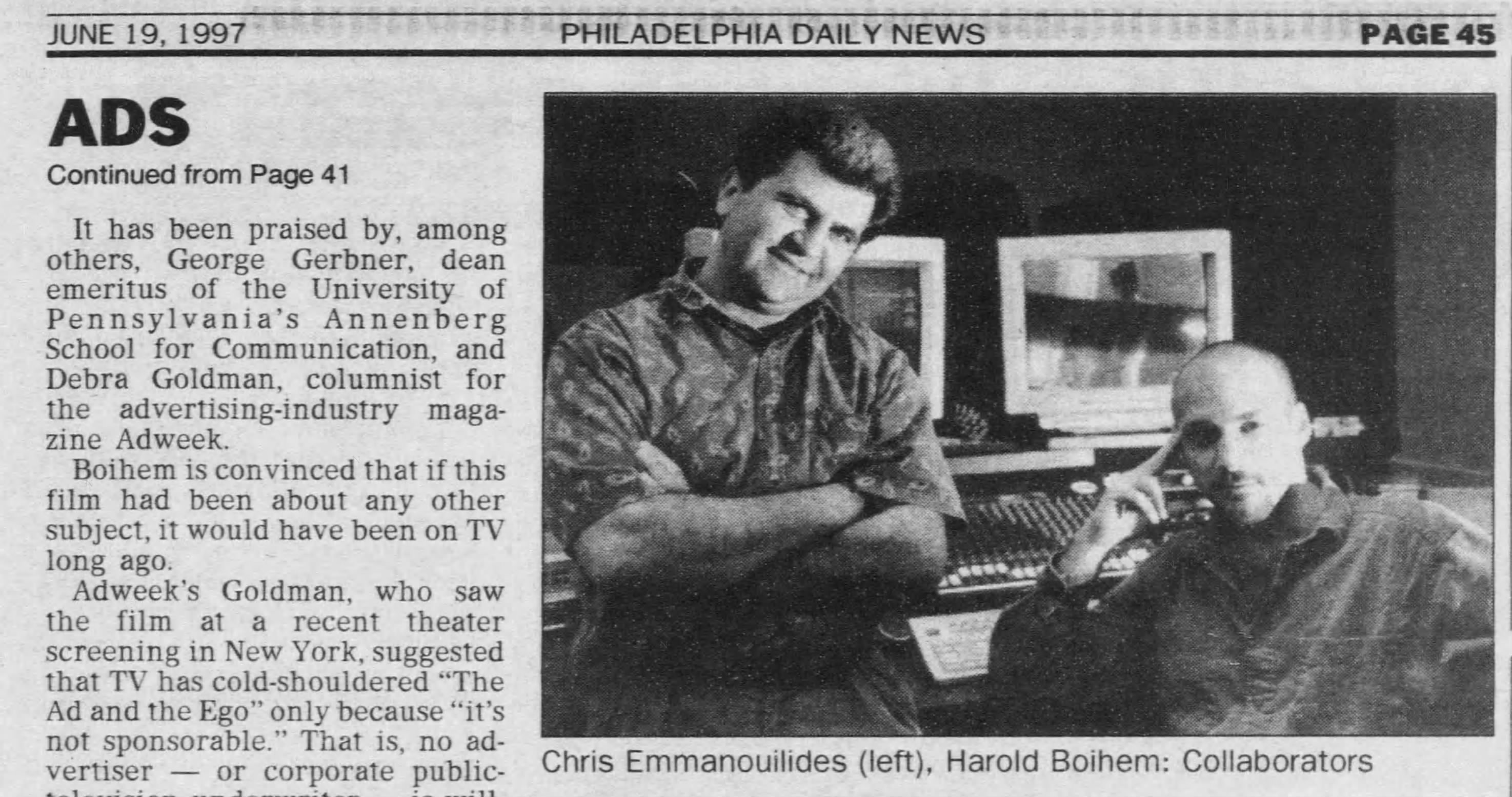
This article about Mr. Emmanouilides (left) appeared in the Daily News in 1997.
He had an infectious laugh, performed magic tricks, listened to the Grateful Dead, and followed the Eagles and Phillies. “He was a big thinker,” his wife said. “He was buoyant and a powerful life force. You never forgot that you met him.”
In addition to his wife and daughter, Mr. Emmanouilides is survived by three sisters, a brother, and other relatives.
Celebrations of his life were held earlier.
Donations in his name may be made to the Bryn Mawr Film Institute, 824 W. Lancaster Ave., Bryn Mawr, Pa. 19010.
LOS ANGELES — Frank Gehry, who designed some of the most imaginative buildings ever constructed and achieved a level of worldwide acclaim seldom afforded any architect, has died. He was 96.
Mr. Gehry died Friday in his home in Santa Monica after a brief respiratory illness, said Meaghan Lloyd, chief of staff at Gehry Partners LLP.
Mr. Gehry’s fascination with modern pop art led to the creation of distinctive, striking buildings. Among his many masterpieces are the Guggenheim Museum in Bilbao, Spain; the Walt Disney Concert Hall in Los Angeles; and Berlin’s DZ Bank Building.
He also oversaw a $233 million renovation of the Philadelphia Museum of Art that stuck with tradition. “Instead of wreaking havoc, the 92-year-old architectural radical has played against type and given museum officials precisely what they wanted: clarity, light, and space,” Inquirer architecture critic Inga Saffron wrote when the new galleries and public spaces opened in 2021.
He also designed an expansion of Facebook’s Northern California headquarters at the insistence of the company’s CEO, Mark Zuckerberg.
Mr. Gehry was awarded every major prize architecture has to offer, including the field’s top honor, the Pritzker Prize, for what has been described as “refreshingly original and totally American” work.
Other honors include the Royal Institute of British Architects gold medal, the Americans for the Arts lifetime achievement award, and his native country’s highest honor, the Companion of the Order of Canada.
To improve the flow and sight lines into the Philadelphia Museum of Art, architect Frank Gehry took down the wall where Chagall’s theater backdrop hung and streamlined the space.
The start of his career in architecture
After earning a degree in architecture from the University of Southern California in 1954 and serving in the Army, Mr. Gehry studied urban planning at Harvard University.
But his career got off to a slow start. He struggled for years to make ends meet, designing public housing projects, shopping centers, and even driving a delivery truck for a time.
Eventually, he got the chance to design a modern shopping mall overlooking the Santa Monica Pier. He was determined to play it safe and came up with drawings for an enclosed shopping mall that looked similar to others in the United States in the 1980s.
To celebrate its completion, the mall’s developer dropped by Mr. Gehry’s house and was stunned by what he saw: The architect had transformed a modest 1920s-era bungalow into an inventive abode by remodeling it with chain-link fencing, exposed wood, and corrugated metal.
Asked why he hadn’t proposed something similar for the mall, Mr. Gehry replied, “Because I have to make a living.”
If he really wanted to make a statement as an architect, he was told, he should drop that attitude and follow his creative vision.
Mr. Gehry would do just that for the rest of his life, working into his 90s to create buildings that doubled as stunning works of art.
As his acclaim grew, Gehry Partners LLP, the architectural firm he founded in 1962, grew with it, expanding to include more than 130 employees at one point. But as big as it got, Mr. Gehry insisted on personally overseeing every project it took on.
The headquarters of the InterActiveCorp, known as the IAC Building, took the shape of a shimmering beehive when it was completed in New York City’s Chelsea district in 2007. The 76-story New York By Gehry building, once one of the world’s tallest residential structures, was a stunning addition to the lower Manhattan skyline when it opened in 2011.
That same year, Mr. Gehry joined the faculty of his alma mater, the University of Southern California, as a professor of architecture. He also taught at Yale and Columbia University.
The Walt Disney Concert Hall is the fourth hall of the Los Angeles Music Center and was designed by Frank Gehry. Here, it’s photographed from the Los Angeles City Hall Observation Deck on Feb. 14, 2018, in Los Angeles.
Imaginative designs drew criticism along with praise
Not everyone was a fan of Mr. Gehry’s work. Some naysayers dismissed it as not much more than gigantic, lopsided reincarnations of the little scrap-wood cities he said he spent hours building when he was growing up in the mining town of Timmins, Ontario.
Princeton art critic Hal Foster dismissed many of his later efforts as “oppressive,” arguing they were designed primarily to be tourist attractions. Some denounced the Disney Hall as looking like a collection of cardboard boxes that had been left out in the rain.
Still other critics included Dwight D. Eisenhower’s family, who objected to Mr. Gehry’s bold proposal for a memorial to honor the nation’s 34th president. Although the family said it wanted a simple memorial and not the one Mr. Gehry had proposed, with its multiple statues and billowing metal tapestries depicting Eisenhower’s life, the architect declined to change his design significantly.
If the words of his critics annoyed Mr. Gehry, he rarely let on. Indeed, he even sometimes played along. He appeared as himself in a 2005 episode of The Simpsons cartoon show, in which he agreed to design a concert hall that was later converted into a prison.
He came up with the idea for the design, which looked a lot like the Disney Hall, after crumpling Marge Simpson’s letter to him and throwing it on the ground. After taking a look at it, he declared, “Frank Gehry, you’ve done it again!”
“Some people think I actually do that,” he would later tell the AP.
Gehry’s lasting legacy around the world
Ephraim Owen Goldberg was born in Toronto on Feb. 28, 1929, and moved to Los Angeles with his family in 1947, eventually becoming a U.S. citizen. As an adult, he changed his name at the suggestion of his first wife, who told him antisemitism might be holding back his career.
Although he had enjoyed drawing and building model cities as a child, Mr. Gehry said it wasn’t until he was 20 that he pondered the possibility of pursuing a career in architecture, after a college ceramics teacher recognized his talent.
“It was like the first thing in my life that I’d done well in,” he said.
Mr. Gehry steadfastly denied being an artist though.
“Yes, architects in the past have been both sculptors and architects,” he declared in a 2006 interview with the Associated Press. “But I still think I’m doing buildings, and it’s different from what they do.”
His words reflected both a lifelong shyness and an insecurity that stayed with Mr. Gehry long after he’d been declared the greatest architect of his time.
“I’m totally flabbergasted that I got to where I’ve gotten,” he told the AP in 2001. “Now it seems inevitable, but at the time it seemed very problematic.”
The Gehry-designed Guggenheim Museum in Abu Dhabi, first proposed in 2006, is expected to finally be completed in 2026 after a series of construction delays and sporadic work. The 30,000-square-foot structure will be the world’s largest Guggenheim, leaving a lasting legacy in the capital city of the United Arab Emirates.
His survivors include his wife, Berta; daughter, Brina; sons Alejandro and Samuel; and the buildings he created.
Another daughter, Leslie Gehry Brenner, died of cancer in 2008.
David E. Loder, 71, of Flourtown, longtime attorney at Duane Morris LLP, multifaceted trustee and board member, education advocate, mentor, and volunteer, died Thursday, Oct. 23, of complications from lymphoma and scleroderma at his home.
A graduate of Germantown Friends School and what is now the University of Pennsylvania’s Carey Law School, Mr. Loder spent 43 years, from 1982 to his retirement in 2024, as an associate, partner, and chair of the health law group at the Duane Morris law firm. He became partner in 1989 and helped the health law practice gain national recognition for its success.
Mr. Loder and his team represented the Hospital and Healthsystem Association of Pennsylvania, the Pennsylvania Trauma Systems Foundation, and other medical providers in all kinds of consequential litigation. In 2006, he helped local hospitals win a multimillion-dollar settlement with an insurance company. In 2010, he supervised a case that successfully revived a state abatement program that alleviated medical malpractice costs for physicians and hospitals.
In a tribute, former colleagues at the Pennsylvania Trauma Systems Foundation praised “his ability to see both the legal complexities and the human dimensions of every situation.”
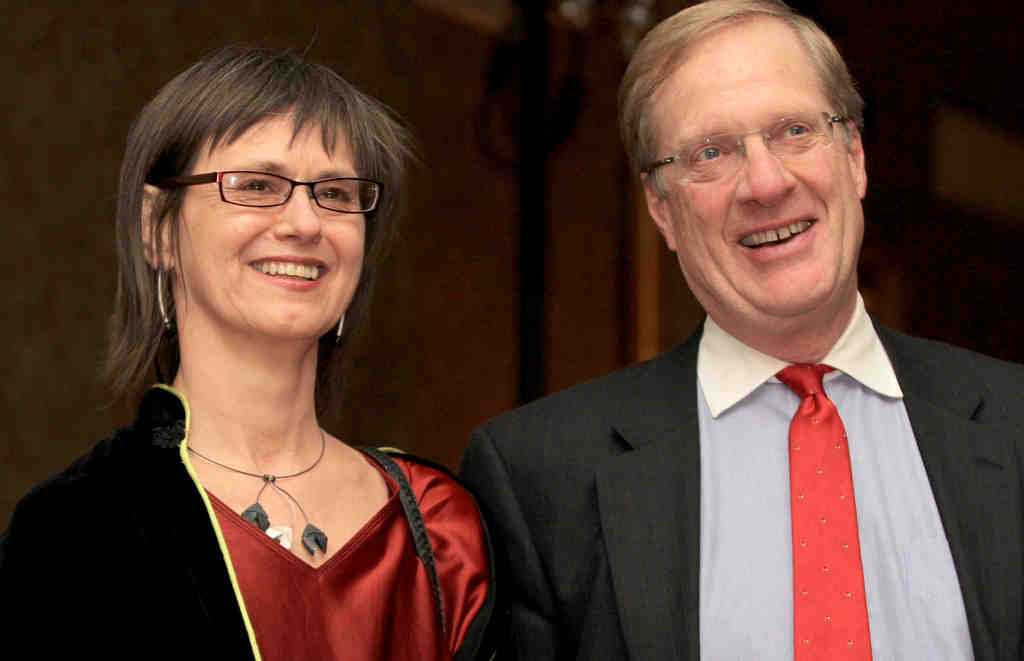
Mr. Loder stands with Blanka Zizka , the Wilma Theater’s artistic director, at an event in 2018.
He was adept in vendor contract law, board governance, policy development, and human relations issues. He took special interest in doctor-patient relations and told the Daily News in 2016: “While it is critical that the healthcare provider convey necessary and accurate information to patients concerning their health condition, it is also important to remain sensitive to the patient’s interest and willingness to hear such information.”
Matthew A. Taylor, chair and chief executive officer at Duane Morris, said in a tribute: “He was one of the nation’s most respected healthcare lawyers.”
Mr. Loder also represented the Philadelphia Zoo, homeowners fighting increased property assessments, participants in gestational-carrier programs, and other clients. “He was a shrewd judge of character,” said his son Kyle. “He was thoughtful and strategic. He became a confidant and adviser to many of his clients.”
John Soroko, chair emeritus at Duane Morris, said in a tribute: “Dave had a unique ability to turn friends into clients. But, even more importantly, to turn clients into friends.”
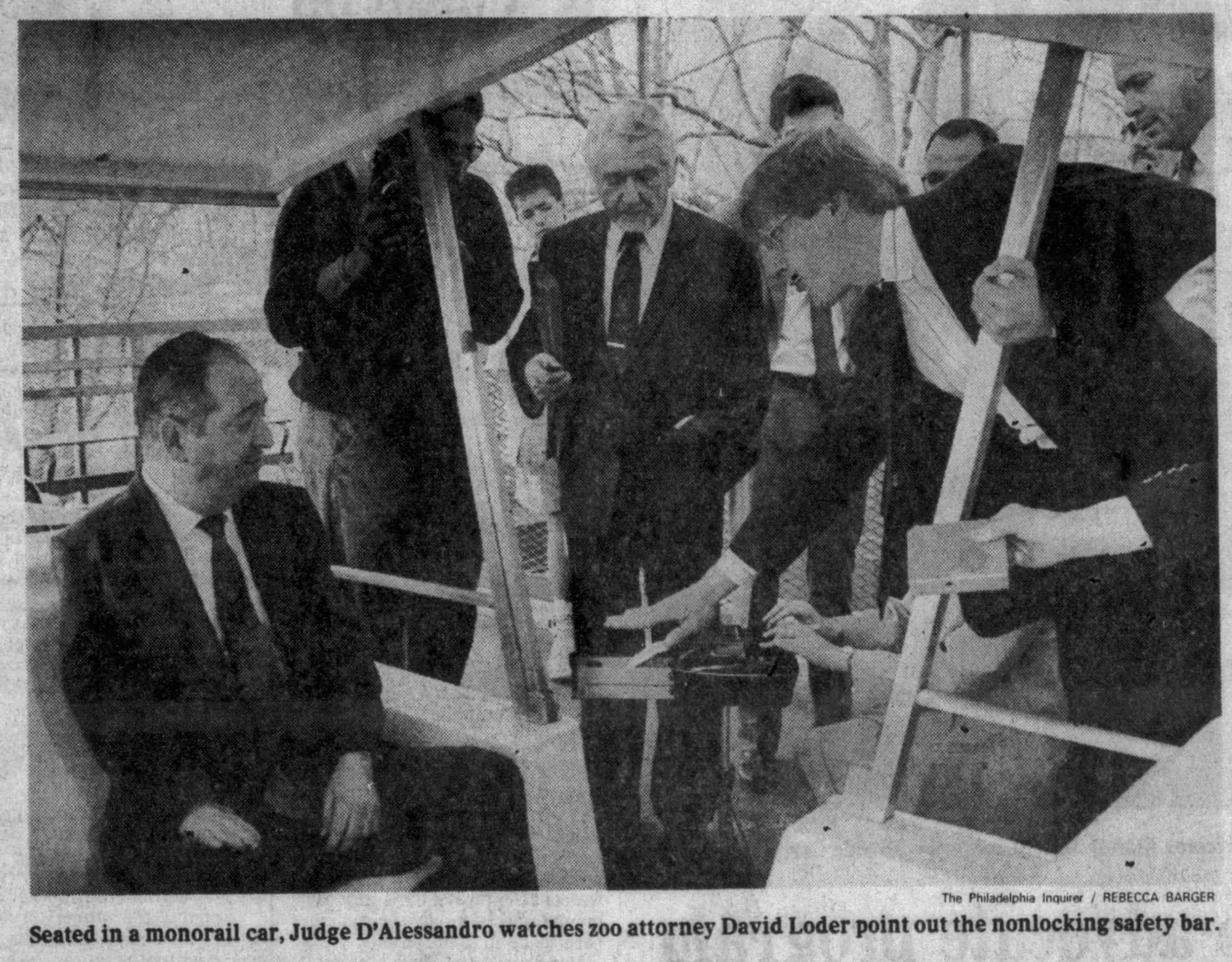
This photo of Mr. Loder (right) representing the Philadelphia Zoo appeared in The Inquirer in 1989.
Away from the law firm, Mr. Loder was chair of the board for the Wilma Theater and served on boards at Germantown Friends, the old University of the Sciences, the World Affairs Council of Philadelphia, and other groups. He was a trustee at the Dolfinger-McMahon Foundation and the Christian R. and Mary F. Lindback Foundation, and represented the Lindback regularly at its annual distinguished educators awards ceremony.
“There’s a firm belief in the importance of excellence in education in the public schools,” he told The Inquirer at the 2016 Lindback ceremony. In 2017, he said: “All of us need to recognize that the Philadelphia public schools are serving an incredibly important function.” In 2018, he said: “People need to know that there are some exceptional educators in Philadelphia public schools.”
He mentored many other lawyers and volunteered to help students in need. In online tributes, friends noted his “kind advice,” “voice of reason and compassion,” and “sense of humor, keen intellect, love of sports, and limitless knowledge on so many topics.”
In 1998, he was featured in an Inquirer story about the challenges parents face when dealing with young children stuck inside during the cold winter months. He said: “I find that if you can get the kids down by 6 p.m. and have a glass of wine in front of the fireplace, it gets you through.”
Mr. Loder enjoyed sports and the outdoors.
His family said in a tribute: “He took life seriously but never too seriously, and his warmth, humor, guidance, and generosity will be remembered.”
David Edwin Loder was born April 22, 1954, in Yalesville, Conn. His father, noted theologian Theodore Loder, moved the family to West Mount Airy when Mr. Loder was a boy, and he graduated from Germantown Friends in 1972.
He starred in football, basketball, and baseball in high school, and went on to play basketball and earn a bachelor’s degree in political science at Wesleyan University in Connecticut in 1977. He worked briefly after college as a high school history teacher, served an independent study fellowship in Poland, earned his law degree at Penn in 1981, and studied international law at the London School of Economics and Political Science.
He married Nadya Shmavonian, and they had sons Marek and Kyle, and a daughter, Julya, and lived in Philadelphia and Flourtown. After a divorce, he married Jennifer Ventresca and welcomed her children into the family.
Mr. Loder liked hiking in New York’s Adirondack Mountains and relaxing at his getaway home on Long Beach Island.
Mr. Loder enjoyed tennis, squash, and golf at the Philadelphia Cricket Club. He liked hiking in New York’s Adirondack Mountains and relaxing at his getaway home on Long Beach Island, N.J.
He doted on his family and Labrador, and played cards every month for years with an eclectic group of old friends.
“David embodied the values of faith, service, and integrity,” his family said. His son Kyle said: “He was magnetic, gracious, thoughtful, and curious. He was easy to talk to.”
In addition to his wife, children, and former wife, Mr. Loder is survived by a granddaughter, a sister, two brothers, and other relatives.
Mr. Loder “was magnetic, gracious, thoughtful and curious,” his son Kyle said.
A memorial service and celebration of his life were held earlier.
Donations in his name may be made to the Penn Medicine Scleroderma Center, Attn: Amanda Hills, 3535 Market St., Suite 750, Philadelphia, Pa. 19104.
Steve Cropper, an internationally renowned, Grammy-winning guitarist and Rock & Roll Hall of Fame inductee who played with luminaries such as Otis Redding, B.B. King, Booker T. & the MG’s and the Blues Brothers, died Dec. 3 in Nashville. He was 84 years old.
Mr. Cropper’s death was announced on his social media accounts in a statement that called him “a beloved musician, songwriter, and producer.” The cause of death was not disclosed.
In the earliest days of his decades-long career, Mr. Cropper played guitar as a founding member of the Memphis band the Mar-Keys, which had a national hit with “Last Night” in 1961. He formed the band with his childhood friend, Donald “Duck” Dunn, who became a well-known bassist. The two continued to collaborate for years afterward, notably with the famed Booker T. & the MG’s — a groundbreaking, racially integrated R&B/soul studio band formed by Mr. Cropper in 1962.
Mr. Cropper performed on many enduring hits, including with Otis Redding on “(Sittin’ On) The Dock of the Bay,” which the two co-wrote, and with Sam & Dave on “Soul Man.”
He also played on two albums with the Blues Brothers and co-wrote hits such as “In the Midnight Hour” with Wilson Pickett, “Knock on Wood” with Eddie Floyd, and “Green Onions” as part of Booker T. & the MG’s.
Stephen Lee Cropper was born on a farm near Dora, Mo., on Oct. 21, 1941. He recalled falling in love with music after his family moved to Memphis when he was 9 years old and he started hearing Black gospel songs on local radio stations.
“I really enjoyed that music. I don’t know what it was. At such a young age, it impressed me,” he recalled in a 1984 interview. “The Black spiritual music … it gave me a whole different attitude about music.”
At aboutage 14, he decided he wanted to play guitar and scraped together $20 to order one from a catalog by setting pins at a bowling alley in Memphis — earning about 10 cents a game. He recalled his shock when he opened the box and found that the instrument had not been strung.
“I went, ‘Wait a minute, isn’t it supposed to be all tuned and all that stuff?’” he said with a laugh. “I really didn’t have a musical background in the family.”
He taught himself how to play, recalling: “I liked the sound of it. I liked the ring of the notes.”
In his acceptance speech when Booker T. & the MG’s was inducted into the Rock & Roll Hall of Fame in 1992, Mr. Cropper said he was honored to play “with some of the greatest musicians on the planet.”
“It’s been a great career and it’s been a lot of fun,” he said.
Mr. Cropper was inducted into the Songwriters Hall of Fame in 2005. He won two Grammy Awards, in 1968 for “(Sittin’ On) The Dock of the Bay” with Redding and in 1994 for “Cruisin’” as part of Booker T. & the MG’s. He was nominated for a Grammy nine times.
In 1996, British magazine Mojo ranked him as the second-greatest guitarist of all time, behind only Jimi Hendrix.
“Steve’s influence on American music is immeasurable,” his family said on social media.
“Every note he played, every song he wrote, and every artist he inspired ensures that his spirit and artistry will continue to move people for generations.”
Mr. Cropper is survived by his wife, Angel Cropper, and his four children.
Shay died at his home in Bretteville-L’Orgueilleuse in France’s Normandy region, his longtime friend and carer Marie-Pascale Legrand said.
Shay, of the Penobscot tribe and from Indian Island in the U.S. state of Maine, was awarded the Silver Star for repeatedly plunging into the sea and carrying critically wounded soldiers to relative safety, saving them from drowning. He also received France’s highest award, the Legion of Honor, in 2007.
Shay had been living in France since 2018, not far from the shores of Normandy where nearly 160,000 troops from Britain, the U.S., Canada and other nations landed on D-Day on June 6, 1944. The Battle of Normandy hastened Germany’s defeat, which came less than a year later.
“He passed away peacefully surrounded by his loved ones,” Legrand told The Associated Press.
The Charles Shay Memorial group, which honors the memory of about 500 Native Americans who landed on the Normandy beaches, said in a statement posted on Facebook that “our hearts are deeply saddened as we share that our beloved Charles Norman Shay … has returned home to the Creator and the Spirit World.”
“He was an incredibly loving father, grandfather, father-in-law, and uncle, a hero to many, and an overall amazing human being,” the statement said. “Charles leaves a legacy of love, service, courage, spirit, duty and family that continues to shine brightly.”
Ready to give his life
On D-Day, 4,414 Allied troops lost their lives, 2,501 of them Americans. More than 5,000 were wounded. On the German side, several thousand were killed or wounded.
Shay survived.
“I guess I was prepared to give my life if I had to. Fortunately, I did not have to,” Shay said in a 2024 interview with The Associated Press.
“I had been given a job, and the way I looked at it, it was up to me to complete my job,” he recalled. “I did not have time to worry about my situation of being there and perhaps losing my life. There was no time for this.”
On that night, exhausted, he eventually fell asleep in a grove above the beach.
“When I woke up in the morning. It was like I was sleeping in a graveyard because there were dead Americans and Germans surrounding me,” he recalled. “I stayed there for not very long and I continued on my way.”
Shay then pursued his mission in Normandy for several weeks, rescuing those wounded, before heading with American troops to eastern France and Germany, where he was taken prisoner in March 1945 and liberated a few weeks later.
Spreading a message of peace
After World War II, Shay reenlisted in the military because the situation of Native Americans in his home state of Maine was too precarious due to poverty and discrimination.
Maine would not allow individuals living on Native American reservations to vote until 1954.
Shay continued to witness history — returning to combat as a medic during the Korean War, participating in U.S. nuclear testing in the Marshall Islands and later working at the International Atomic Energy Agency in Vienna, Austria.
For over 60 years, he did not talk about his WWII experience.
But he began attending D-Day commemorations in 2007 and in recent years, he has seized many occasions to give his powerful testimony and spread a message of peace.
During the COVID-19 pandemic in 2020-2021, Shay’s lone presence marked commemoration ceremonies as travel restrictions prevented other veterans or families of fallen soldiers from the U.S., Britain and other allied countries from making the trip to France
Sadness at seeing war back in Europe
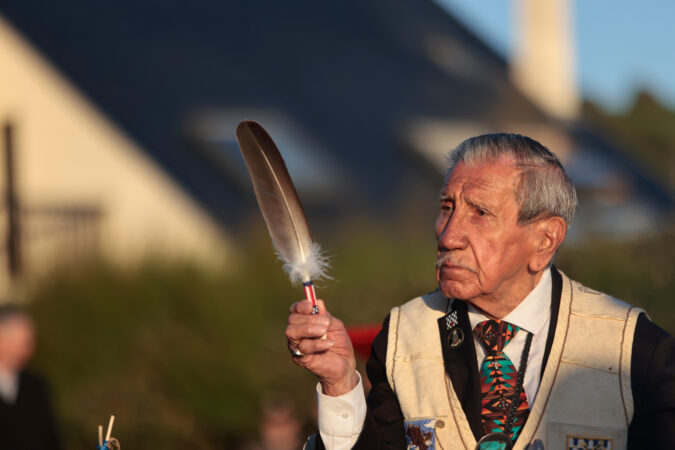
For years, Shay used to perform a sage-burning ceremony, in homage to those who died, on a bluff overlooking Omaha Beach, where the monument bearing his name now stands.
On June 6, 2022, he handed over the remembrance task to another Native American, Julia Kelly, a Gulf War veteran from the Crow tribe. That was just over three months after Russia’s full-scale invasion of Ukraine in what was to become the worst war on the continent since 1945
Shay then expressed his sadness at seeing war back on the continent.
“Ukraine is a very sad situation. I feel sorry for the people there and I don’t know why this war had to come,” he said. “In 1944, I landed on these beaches and we thought we’d bring peace to the world. But it’s not possible.”
MADISON, Wis. — Eugene Hasenfus, who played a key role in unraveling the Iran-Contra affair after his CIA-backed supply plane was shot down over Nicaragua in 1986, has died.
Mr. Hasenfus died on Nov. 26 in Menominee, Mich., after a nine-year battle with cancer, according to his obituary from the Hansen-Onion-Martell Funeral Home in Marinette, Wis. He was 84.
Mr. Hasenfus was born Jan. 22, 1941, in Marinette. He served with the Marines in Vietnam and continued a private career in aviation before he became a key figure in the Cold War’s Iran-Contra scandal in 1986.
In 1981, President Ronald Reagan authorized the CIA to support the anti-communist right-wing guerrilla force known as the Contras who were working against the Sandinistas in the Nicaraguan government. Congress cut off all military assistance to the Contras in 1984.
Months before the cutoff, top officials in Reagan’s administration ramped up a secret White House-directed supply network to the Contras. The operation’s day-to-day activities were handled by National Security Council aide Oliver North. The goal was to keep the Contras operating until Congress could be persuaded to resume CIA funding.
The secrecy of North’s network unraveled after one of its planes with Mr. Hasenfus on board was shot down over Nicaragua in October 1986. Three other crew members died, but Mr. Hasenfus parachuted into the jungle and evaded authorities for more than 24 hours.
He was captured by the leftist Nicaraguan government and charged with several crimes, including terrorism.
Mr. Hasenfus said after his capture that the CIA was supervising the supply flights to the Contras. At first, Reagan administration officials lied by saying that the plane had no connection to the U.S. government.
Congress, spurred by controversy over the Hasenfus flight, eventually launched an investigation.
Mr. Hasenfus was convicted in Nicaragua of charges related to his role in delivering arms to the Contras and sentenced to 30 years in prison. Nicaraguan President Daniel Ortega pardoned Mr. Hasenfus a month later and he returned to his home in northern Wisconsin.
In 1988, he filed an unsuccessful lawsuit seeking $135 million in damages against two men and two companies linked to the Iran-Contra arms deals.
In 2003, he pleaded guilty in Brown County Circuit Court to a charge of lewd, lascivious behavior after he exposed himself in the parking lot of a grocery store. His probation was revoked in 2005 and he spent time in jail, according to online court records.
He is survived by his four children and eight grandchildren.
Kathleen A. Case, 80, of Bryn Mawr, longtime writer, pioneering medical journal editor, award-winning historian, researcher, and volunteer, died Friday, Nov. 14, of heart failure at Bryn Mawr Hospital.
A natural wordsmith who was interested in the origins and nuances of language as well as its use, Ms. Case spent 24 years as a top editor for the Annals of Internal Medicine and vice president for publishing at the Philadelphia-based American College of Physicians. Later, for 15 years, she was publisher, archivist, historian, and director of strategic planning for the publishing division of the Philadelphia-based American Association for Cancer Research.
She was adept at understanding and organizing complex research and other medical information, and helped Annals of Internal Medicine digitize its production process and content, expand its reach, and become one of the world’s most influential and cited medical journals. “She loved precise, concise, and unambiguous writing,” her family said in a tribute.
She was one of the few female editors in the medical publishing industry when she joined Annals as an assistant editor in 1977, and she rose to managing editor, executive editor, and senior vice president for publishing by 1998. She attended many international medical publishing conferences around the world, and other journals tried unsuccessfully to lure her away from Philadelphia.
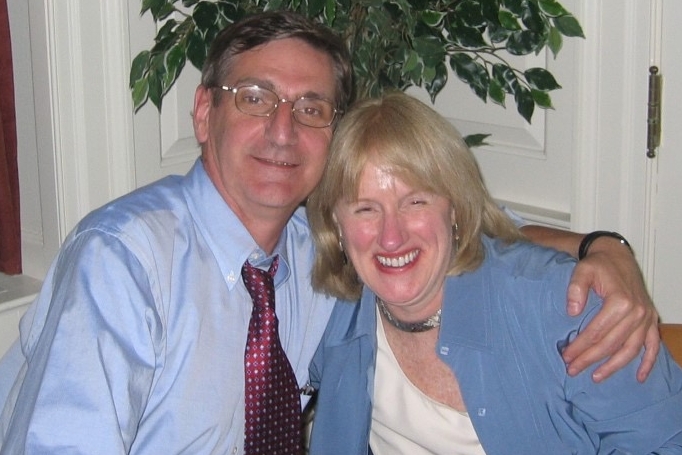
Ms. Case and her husband, Jacques Catudal, married in 1995.
“She set the highest editorial standards in medical publishing and expected the best from everyone around her,” a former colleague said in an online tribute. “But she also took the time to teach. … The lessons I learned from her have shaped my work ever since.”
Ms. Case joined the American Association for Cancer Research in 2001, served two stints as head of the publishing division, and supervised its marketing campaigns, advertising sales, and product development. She retired in 2008 but continued part time as the AACR archivist, historian, and director of strategic planning until retiring for good in 2016.
Away from her day jobs, Ms. Case was past president of the Society for Scholarly Publishing and what is now the Council of Science Editors. She also served on boards and committees for the American Medical Association, the American Chemical Society, the American Heart Association, and the International Committee of Medical Journal Editors.
Even in retirement, she continued to work as a board member, writer, researcher, and historian for the Haverford Township Historical Society. She served on the Haverford Township Historical Commission, was a member of the Historical Society of Pennsylvania, chaired the Friends of the Polo Field, and helped establish the Brynford Civic Association.
Ms. Case graduated from Radnor High School and Pennsylvania State University.
“She was always busy, always involved with some project,” said her husband, Jacques Catudal. She edited his published academic papers, he said, and routinely marked up her two sons’ school reports in red ink for years.
In 2019, she won a historic preservation award from the Heritage Commission of Delaware County. “She was an endlessly inspiring woman whose intelligence was matched only by her sharp wit and her extraordinary cultural sensitivity,” a friend said in a tribute.
Kathleen Ann Case was born Sept. 13, 1945, in Westfield, N.J. The youngest of three children, her family moved to Omaha, Neb., and then Radnor when she was young.
She graduated from Radnor High School, studied journalism at Pennsylvania State University, and earned a bachelor’s degree in English in 1967. She was a reporter and editor for the Penn State student newspaper and so active that school officials waived their prohibition of female students living alone off campus so she could reside near the paper’s office. In 1987, she earned a master’s degree in technical and science communication at Drexel University.
Ms. Case (second from left) enjoyed time with her family
She married D. Benjamin van Steenburgh III, and they had sons Ben and Jason. After a divorce, she married Peter Moor. They divorced, and she married Catudal in 1995.
Ms. Case raised her sons as a single mother in Avondale, Chester County, for years and moved to Bryn Mawr in 1979. She read voraciously about history, collected antiques, and enjoyed travel, classic rock, and Irish folk music.
She rode horses, was an expert archer, and followed the local sports teams. She tended her garden and investigated her genealogy.
She liked to refinish and paint furniture and discuss current events. She and her husband camped, hiked, and canoed all over the world.
Ms. Case enjoyed hiking and the outdoors.
She also dealt with metastatic breast cancer and three heart attacks. “She always gave as much honesty, opinion, perspective, experience, literary acumen, word knowledge, help, advice, comfort, and love as could be needed,” said her son Jason.
Her husband said: “She was brilliant and extremely funny. She was an organizer and always giving of herself.”
In addition to her husband, sons, and former husbands, Ms. Case is survived by four grandchildren, a sister, a brother, and other relatives.