Category: Opinion

  • Susie Wiles reveal: Trump thinks Putin wants all of Ukraine

    Susie Wiles reveal: Trump thinks Putin wants all of Ukraine

    During the Christmas holidays, the word peace makes a frequent appearance, in sermons and carols and frequent performances of Handel’s Messiah, with its glorious Hallelujah Chorus praising “the Prince of Peace.”

    That makes it even more infuriating to watch President Donald Trump demanding that Ukraine (and American’s European allies) agree to a so-called peace deal by the new year that guarantees more war and killing. Equally depressing is to watch much of the media buy the premise that the U.S. and Russia are actually conducting peace talks.

    Baloney. What is going on in Berlin, Miami, Washington, and Moscow is a Trump-led farce. Ukrainian President Volodymyr Zelensky and European leaders are forced to play along lest POTUS cut off crucial U.S. intelligence sharing and halt critical (but limited) sales of U.S. weaponry. They know Trump seeks a deal, any deal, even one on Kremlin terms, in order to claim he achieved peace in Ukraine. Yet the gleam of a Nobel Peace Prize and rare earth business deals with Moscow override any concerns about helping Moscow crush Kyiv.

    Vladimir Putin, on the other hand, has shown no interest in negotiating, but just waits for more Trump concessions. Any deal that protects Kyiv’s future will be rejected by Vladimir Putin, but Trump, following past practice, will likely blame Ukraine.

    That is why many more Americans, and security conscious Republicans in Congress must recognize that Trump is no worldly prince (or king) of peace. Rather, he is a poseur who must be prevented from sacrificing Ukraine on the altar of his ego and endangering the security of Europe and the United States.

    You doubt me? Then read Part Two of the notorious Vanity Fair interviews with Trump’s chief of staff and right-hand woman Susie Wiles, in which she reveals Trump’s mindset regarding Ukraine. Despite debates within Trump’s team over whether Putin wants the whole of Ukraine, she admits, “Donald Trump thinks he wants the whole country.”

    In an interview with Vanity Fair, White House chief of staff Susie Wiles said of the president’s talks with Vladimir Putin about Ukraine: “Donald Trump thinks he wants the whole country.”

    Vanity Fair asked Secretary of State Marco Rubio if he felt the same. He responded that, after watching Putin repeatedly reject freezing the war at the line of conflict, “You do start to wonder, well, maybe what this guy wants is the entire country.” Presumably, the secretary has bothered to read Putin’s speeches in which the Kremlin leader has said over and over again that Ukraine has no right to be a state,

    However, Rubio has been pushed aside as negotiator in favor of the supremely naive and ill-informed real estate mogul Steve Witkoff, who keeps insisting Putin wants peace, an argument repeated by POTUS. Trump initially signed off on a 28-point “peace” plan that was handed by a Putin emissary directly to Witkoff.

    Even though Zelensky and European leaders have gotten some of the most egregious points eliminated, the two biggest obstacles still remain: Putin’s demand that Kyiv turn over critical territory that Russia hasn’t been able to capture in nearly four years, and strategic guarantees of Western military aid to prevent Russia from violating any agreement.

    On both sticking points, the Trump negotiators continue to play into Putin’s hands.

    On the question of territory, what Putin demands is that Kyiv turn over a belt of fortified cities on high ground in the Donetsk region. Moscow has been unable to make major territorial gains in this area since near the beginning of the war, and the gains they have made have incurred terrible Russian casualties.

    This belt “is not easy to conquer because [its cities are] well fortified militarily and naturally due to the landscape,” I was told by Yehor Cherniev, deputy chairman of the Committee on National Security and Defense of the Ukrainian parliament. “It would cost the Russians thousands and thousands of lives and months if not years to take it. I don’t see any compromise on this.”

    From left, German Chancellor Friedrich Merz, British Prime Minister Keir Starmer, Ukrainian President Volodymyr Zelensky, and French President Emmanuel Macron meet at 10 Downing Street, in London earlier this month.

    Yet Putin has persuaded Witkoff to demand that Kyiv turn it over for nothing, which would leave the flat farmlands of central Ukraine open to further Russian attack.

    Compounding the insult, Witkoff has proposed that the area be made into a “demilitarized zone” from which Ukrainian troops would withdraw but Russian troops not enter. No one who has read anything on recent history could be unaware that Putin has zero respect for such nonsense. “We know the Russians would just use this to infiltrate soldiers in civilian clothing and then seize control of the area,” Cherniev said by phone from Kyiv. “It would just be a trap.”

    The second, enormous sticking point, concerns security guarantees for Ukraine in case Putin violates any agreement.

    Putin has broken every accord Russia has signed with modern-day Ukraine. This includes, most notoriously, the 1994 Budapest Memorandum, in which Ukraine handed over its Soviet-era nuclear weapons in return for pledges from Moscow, Washington, and London that Kyiv’s sovereignty would be respected.

    No wonder Zelensky insisted on Monday: “There is one question I — and all Ukrainians — want to get an answer to. If Russia again starts a war, what will our partners do?”

    Putin has made clear he accepts no NATO membership, no Western military guarantees and only a shrunken, disarmed Ukrainian military. As for the Witkoff team, they concur on no NATO membership for Ukraine, but have offered only puffery in its stead.

    The big headline has been that Trump would agree to “Article 5-like” guarantees, a reference to the provision in NATO that an attack on one requires help from every member. But Trump has played up the ambiguity of Article 5, which doesn’t specify that the help needs to be military. “Depends on your definition,” he said in August. “There’s numerous definitions of Article 5.”

    Moreover, Sen. Lindsey Graham (R., S.C.), a golf buddy of Trump, has made clear, that even if the Senate approves security guarantees, it wouldn’t be a treaty but “a congressional blessing, statutory in nature.”

    A “blessing” won’t help Ukraine if Russia pauses, regroups, and attacks again.

    It fascinated me that, after revealing Trump’s awareness of Putin’s goals, Wiles told Vanity Fair she thought Trump’s greatest achievement of 2025 was acting as “an agent of peace.”

    The president’s claim that he ended eight wars is braggadocio: No wars were ended, including in Gaza, where a ceasefire is tottering. The list includes long-standing disputes that remain and outbreaks of fighting that continue, and even a Pakistan-India outbreak, where New Delhi denies Trump played a role in settling it down.

    But if POTUS wants to be known as a peacemaker in Ukraine, it will only happen if he helps Ukraine convince Putin that a unified West will not permit Russia to crush Ukraine. That would require arming Ukraine to the hilt with U.S. and European weapons paid for by Europe, backed with frozen Russian assets or the European Union’s shared budget. It would also require U.S. enforcement of current and future sanctions, which the White House isn’t doing.

    Most of all it would require Trump to pressure Putin, which he shows no signs yet of doing. The Russian despot is vulnerable economically and militarily, and Ukraine won’t lose if POTUS doesn’t betray the country. But Putin will only be persuaded to cease fire if Trump joins Europe in convincing him he can’t afford to continue the fight.

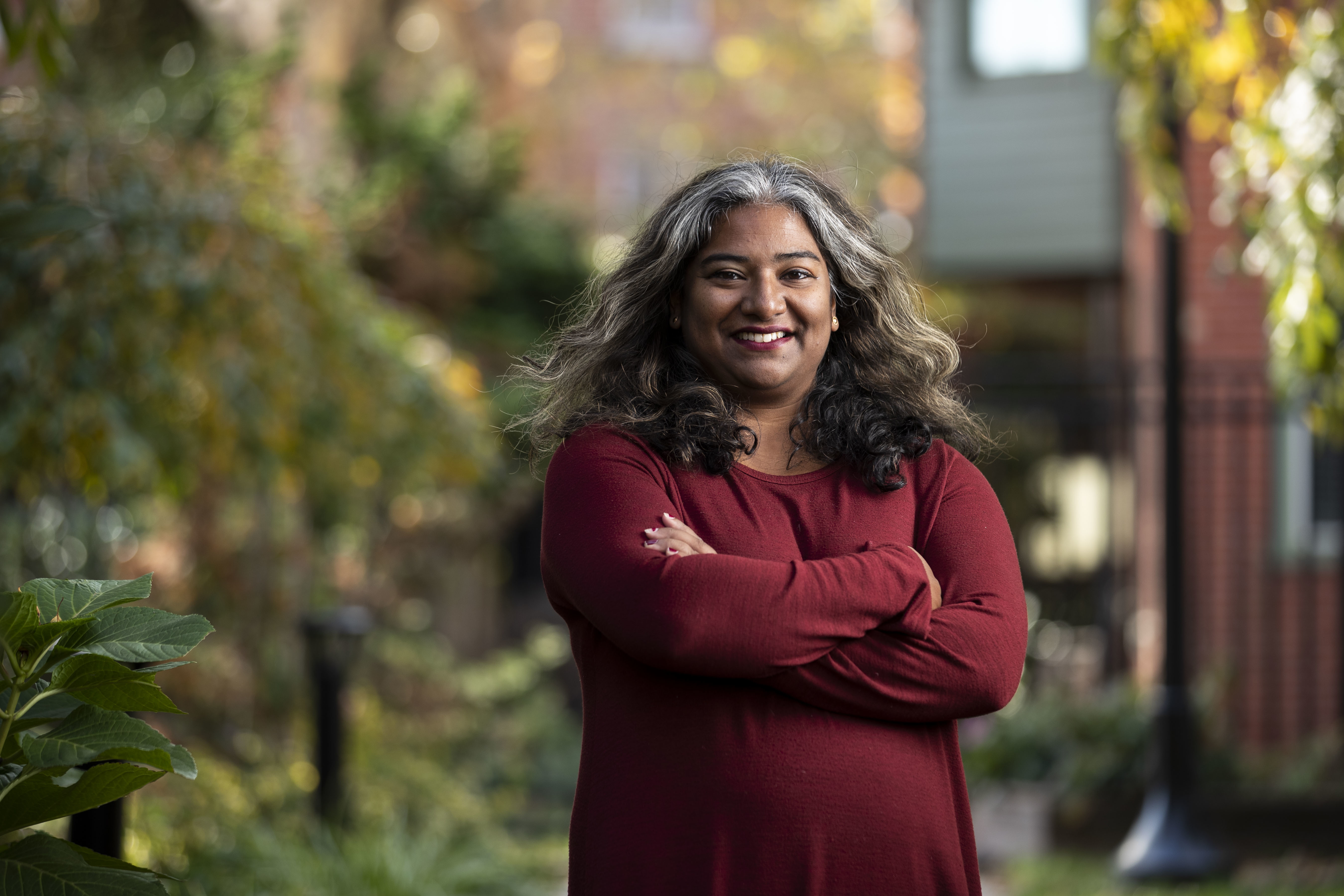
  • We are at a generational inflection point in healthcare. It’s time for Gen X physicians to assert themselves as the stewards of our profession.

    We are at a generational inflection point in healthcare. It’s time for Gen X physicians to assert themselves as the stewards of our profession.

    Thanksgiving brought a revelation. I was sous-chef to my children and my mother, a sounding board for my son as he completed college applications and my parents as they navigated different doctors, and the planner working around the needs of my children, husband, parents, and in-laws. I now realize what it means to be part of the “sandwich generation.”

    My generation is also squeezed between older and younger cohorts in the professional world — especially medicine and healthcare. I am solidly Gen X and lie squarely between the boomers and the millennials.

    These days, no matter where you turn, the realities of the U.S. healthcare crisis are impossible to ignore. From access to medications, availability of health insurance, affordability of medical costs, even trust and reliability in the messaging or directives we hear, the situation is daunting at best and overwhelmingly dark at worst.

    Perhaps the canary in the coal mine has been the growing healthcare workforce crisis.

    Physician burnout and moral injury, worsened by COVID-19, drove millennial and even Gen X doctors and nurses to leave the field. Adding to the dearth of primary care physicians as the U.S. population ages with worsened chronic diseases, the imminent retirement of a large cohort of boomers results in projections of a shortage of a combined 400,000 physicians and nurses by 2037.

    I can’t help but feel the weight and responsibility of my generation of doctors in the world of medicine, along parallel lines of my personal life.

    The same voices, same perspectives, and same ideas have been echoing across institutions for years — even when not representative of the rest of younger medical professionals, writes the author.

    When we were born and grew up shapes the decisions we make and the ways we manifest and execute them. In his book Birth and Fortune, Richard Easterlin, an economist and demographer who researched happiness, posits that the size of the cohort you are born into shapes your generational opportunity.

    Large cohorts, such as the baby boomers, face competition, but they also get the benefits of institutions that bend to their size. Smaller cohorts in the shadow of the larger generation ahead of them often contend with fewer resources and less investment. That’s Gen X in a nutshell.

    And it models my experiences in the world of Philadelphia medicine almost perfectly.

    Even within these cohorts, Easterlin illustrates, there are differences and disparities. Resources and opportunities available to early boomers became scarce to the later boomers, as the systems were slow to meet their needs. Those returning from the Vietnam War later were more likely to feel this dearth of structures and resources — such was the “birth” of homelessness as we recognize it now.

    I saw that firsthand in Philly as a member of the Homeless Death Review team — a small group of experts from across the city convened by the Medical Examiner’s Office. We reviewed every death of a person experiencing homelessness in Philadelphia.

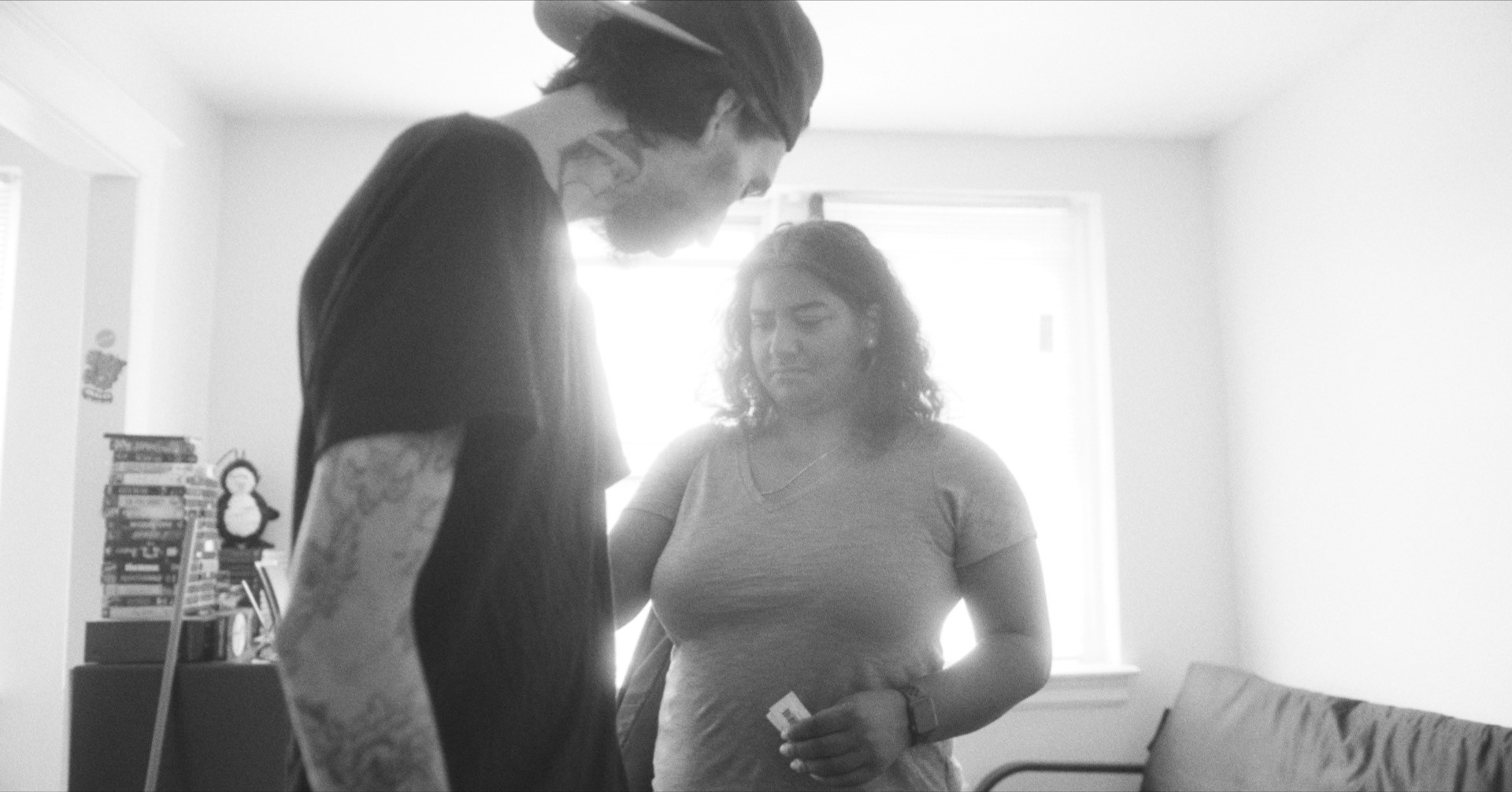
    The author makes a home visit, as part of Pathways to Housing Philadelphia, in 2018, to care for a client who was at that time part of the Prevention Point community in Kensington.

    From a systems-level view, it became clear that a lack of resources decades ago created a disparity that was perpetuated throughout the lives of specific demographics. They contributed to their premature deaths.

    Boomers created the healthcare system we know today. Building on advances in science, research, and opportunity, they expanded and deepened training pipelines. They established medical specialties, subspecialties, and leadership roles.

    They also continued long-standing practices anchored in hierarchy and compliance, where gravitas comes from the company you keep and not always the merit and competency you demonstrate.

    A look across academic medical leaders in Philadelphia shows several with tenures that started in their 40s or early 50s and continued for well over 20 years, ongoing even now. Our city’s medical leadership — whether it be the Philadelphia County Medical Society, Pennsylvania Medical Society, or the American Medical Association — shows many of these same individuals making decisions across organizations.

    The same voices, same perspectives, and same ideas have been echoing across institutions for years — even when not representative of the rest of us.

    Take the American Medical Association. While being known for having the largest lobbying budget of all medical associations, it represents only 20% of the doctors across the country. The AMA designed and owns the Current Procedural Terminology — the five-digit codes that are commonly used in medical billing. That coding system creates an avenue for higher payments for procedures over primary care prevention with a percentage for them as middleman.

    Years ago, I wrote about how my approach to being an emergency physician evolved as I saw a changing world of healthcare that was not meeting the needs of the patients who turned to me for help.

    That same month, the Wall Street Journal reported on the shift among doctors from “GOP stalwarts” to Democratic voters. My Gen X brethren look different from the generation before us: more women, more people of color, a broader range of ethnicities and cultures. It makes sense that we vote differently, in line with our priorities, values, and missions. Just as it makes sense that we lead differently, as well.

    As Gen X doctors, we trained under the “old rules” of loyalty, compliance, endurance, and strict hierarchy. We worked with paper charts, well before computers became the central source of our clinical work. We mastered clinical skills and memorized reams of information. We also understood how issues outside the exam room and beyond our control impacted our patients.

    My cohort went on to learn to practice medicine as the corporatization of hospitals took hold and our profession took on the additional contours of a business. We met productivity quotas and metrics around how quickly we saw patients and moved on to the next. We eventually even learned to ask corporate conglomerates for permission to get the tests, procedures, and medications our training and expertise, together with our direct evaluation, told us our patients needed, through prior authorizations.

    Boomers continued to adhere to their definition of an ideal physician over the last 25 years — fixating on their commanding expertise and a brand of patient care they developed. In the process, they ceded governance of medicine, including financial oversight and systems design, to non-medical stakeholders. They often treated these issues as beneath them.

    For the bulk of our careers, we Gen Xers were complicit — through our silent obedience and compliance. Many of us had learned from personal experience that speaking up or being seen as contrarian to those in power was overtly punished or covertly met with retaliation.

    Now however, Gen X physicians are positioned to do something the generation before could not: carry medicine’s core values forward while shedding the destructive traditions and practices that broke the system.

    We are facing AI in medicine, further decentralization of medical care, technology and innovation, unprecedented availability of our own health data through wearables, simultaneously with more difficult access to the doctors we have always turned to, and fewer hospitals in our communities.

    I see us at a critical generational inflection point. And it’s time to assert ourselves in a few tangible ways:

    • Claim leadership by redefining it. We don’t have to wait to inherit positions when those who have inhabited them for decades finally vacate. Gen X knows well that true leadership doesn’t come through hierarchy or titles. In the words of my dear friend Jeremy Nowak: “Power belongs to the problem solvers.”
    • Reclaim and own our voice. Our predecessors confused apolitical detachment with impartial professionalism. In the process, the discussions, decisions, and policymaking that shaped physicians’ reality excluded us. It’s time we lean in unapologetically and stop waiting for permission. 
    • Reject passive compliance as a virtue. Our silence has helped no one. The courage we spent decades swallowing is exactly the courage we need now to right this ship. We must be intentional in how we define ourselves, our profession, and our value: clinical integrity, collaboration, dignity, empathy, humanity, all come to mind as our unmatched superpowers. 

    It feels we are standing at the precipice of the unfamiliar and unknown. Where technology and AI will redefine what is possible, but the needs of our patients will demand practical and accessible solutions.

    Sustainable change will come from us — crammed in the middle. At the risk of making a sweeping generalization, Gen X believes in fairness, head-down work, and accomplishment. We have learned and adapted throughout our lives. Unlike the boomers and millennials on either side of us, we are “raised analog, fluent digital, comfortable with a rotary phone and an AI dashboard.”

    We are the stewards of the medical profession — not its museum guards. We can bridge the meaningful lessons of our past with the awareness of today and the promise of the future, while centering empathy, values, missions, and ethics.

    The silver lining is this: Our hard-earned lessons have become the foundation for a new kind of courage. It’s one that refuses passivity, demands better, pushes into all the spaces that exclude us, and insists that we show up not just for ourselves, but for our colleagues, our patients, our community, and the generations coming behind us.

    Priya E. Mammen is an emergency physician, healthcare executive, and public health specialist who helps the nation’s most impactful companies integrate clinical integrity at scale.

  • Will the Philadelphia Police Department ever be free of scandal? | Editorial

    Will the Philadelphia Police Department ever be free of scandal? | Editorial

    By most accounts, the Philadelphia Police Department has had a good year.

    Crime is down, a majority of residents feel safer and many give Commissioner Kevin J. Bethel high marks.

    But as is often the case with the PPD, the good work of many dedicated officers gets marred by one scandal after another.

    In February, former homicide detective James Pitts was sentenced to at least 2½ years in prison for fabricating evidence in a murder investigation and then lying about it on the witness stand.

    In May, Officer Mark Dial was convicted of voluntary manslaughter and other crimes after he shot Eddie Irizarry six times, killing him seconds after encountering him in his car with the windows rolled up.

    In November, nine current or former police officers, including a former captain, were charged with theft and conspiracy in connection with the misuse of city anti-violence funds surrounding a youth boxing program.

    Earlier this month, more than 130 drug cases were tossed out after three narcotics officers repeatedly gave false testimony in court. When all is said and done, nearly 1,000 cases are expected to get dismissed because the officers apparently lied about drug deals that never happened or they did not witness.

    The string of scandals is not the case of a few bad apples, as the police often like to claim. It points to a systemic problem that has undermined the department for decades. Stamping out the skullduggery will require a change in recruitment practices, training, culture, and accountability.

    The latest scandal resulting in hundreds of dismissed drug cases underscores the disturbing tolerance for corruption that runs through the department.

    Common Pleas Court Judge Lillian Ransom vacated the first tranche of 134 drug cases after prosecutors said the testimony of three officers on the Narcotics Strike Force was deemed unreliable.

    Hundreds of additional cases built on the officers’ testimony are expected to be voided in the coming months. Amazingly, Officers Jeffrey Holden, Eugene Roher, and Ricardo Rosa remain on the job and assigned to their narcotics squad.

    Commissioner Bethel declined to speak with the Editorial Board but issued a statement that said an internal affairs investigation was launched in March 2024 and remains ongoing. That’s good, but what is taking so long?

    He added that “thus far we have not identified any evidence that would raise concerns of misconduct or criminal behavior on the part of those officers.”

    In other words, move along folks. Nothing to see here. Just about 1,000 criminal cases falling apart because three police officers apparently lied over and over again.

    Credit for uncovering the injustice goes to the overworked and underpaid lawyers at the Defenders Association of Philadelphia.

    In particular, Paula Sen and Michael Mellon of the Defenders’ Police Accountability Unit uncovered video footage that contradicted the evidence mounted by the officers.

    More disturbing, this is not the first time the Defenders Association caught the police cooking cases.

    In 2015, Bradley Bridge, a longtime public defender, got more than 950 drug convictions vacated after discovering six narcotics officers robbed and beat drug dealers and then filed bogus paperwork.

    Bridge, who came out of retirement to help on the recent cases, estimated he has overturned about 2,500 drug convictions since 1995.

    Therein lies the problem. Different day, same corruption.

    Bethel said the Police Department takes “potential credibility issues with our officers extremely seriously.” But the department’s history of corruption over the past half century or more indicates otherwise.

    To be sure, Philadelphia does not have a monopoly on police corruption. Problems exist in other big cities and small towns.

    And despite recent reforms, it is unclear if all have been for the better.

    A high-quality police department begins with high quality recruits. But to combat staffing shortages, the department — like many others — eliminated the need for college credits and lowered the requirements for physical training.

    There must also be independent accountability. But a Citizens Police Oversight Commission created in 2022 has not conducted a single investigation.

    Bad cops reduce morale and must be weeded out. But most corrupt officers not only avoid criminal charges but get to keep their jobs — thanks to a police union that goes to bat for every cop, good or bad. A recent analysis found friendly arbitrators reinstated 85% of fired officers.

    Dirty cops undermine community trust and the good work of committed officers who risk their lives to keep the city safe. Even worse, the wrongful prosecutions can take away a person’s liberty and upend lives and families.

    Police corruption also costs taxpayers real money. Over a recent 18-month stretch, Philadelphia taxpayers spent more than $60 million to settle cases stemming from police misconduct.

    The recent reduction in crime is welcome, but a question remains: Will there ever come a day when the Philadelphia Police Department is not plagued by scandal?

  • Grids are out, brick is back, and Philadelphia architects have rediscovered the arch

    Grids are out, brick is back, and Philadelphia architects have rediscovered the arch

    It’s one of the paradoxes of Philadelphia’s 21st-century residential building boom. The more rowhouses and apartments that get built here, the more they look alike.

    The streets of Fishtown and Graduate Hospital and Spruce Hill are now awash in interchangeable blocky structures, all dressed in the same dreary gray clothing, their aluminum panels shrink-wrapped around the exterior like a sheet of graph paper.

    Instead of providing the kind of fine details that enlivened earlier generations of buildings, their architects try to distract us with patches of color and cheap trim.

    The look is derisively known as fast-casual architecture, McUrbanism, or developer modern. No one likes these buildings, not even, I suspect, the architects who stamp the drawings. But because they are cheap and easy to build, the no-frills grids have emerged as a developer standard across America.

    As bad as they might look in newer cities, their flat, lifeless facades are especially jarring in Philadelphia, where even humble rowhouses are animated by varied textures of brick and recessed windows.

    While there’s little chance that developers will start building them like they used to, a few Philadelphia architects have thrown a curve into the works. The arch, which traces its origins to Roman times, is making a comeback.

    Once you start looking around the city, you can’t help but see contemporary arches and rounded corners everywhere: on metal-clad rowhouses and brick-faced apartment buildings, in restaurant dining rooms and hotel lobbies.

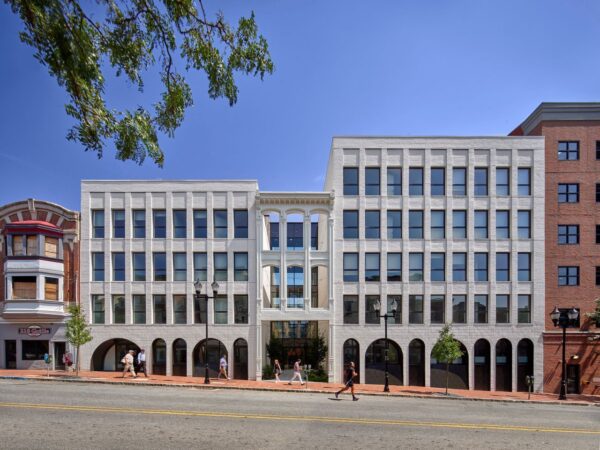
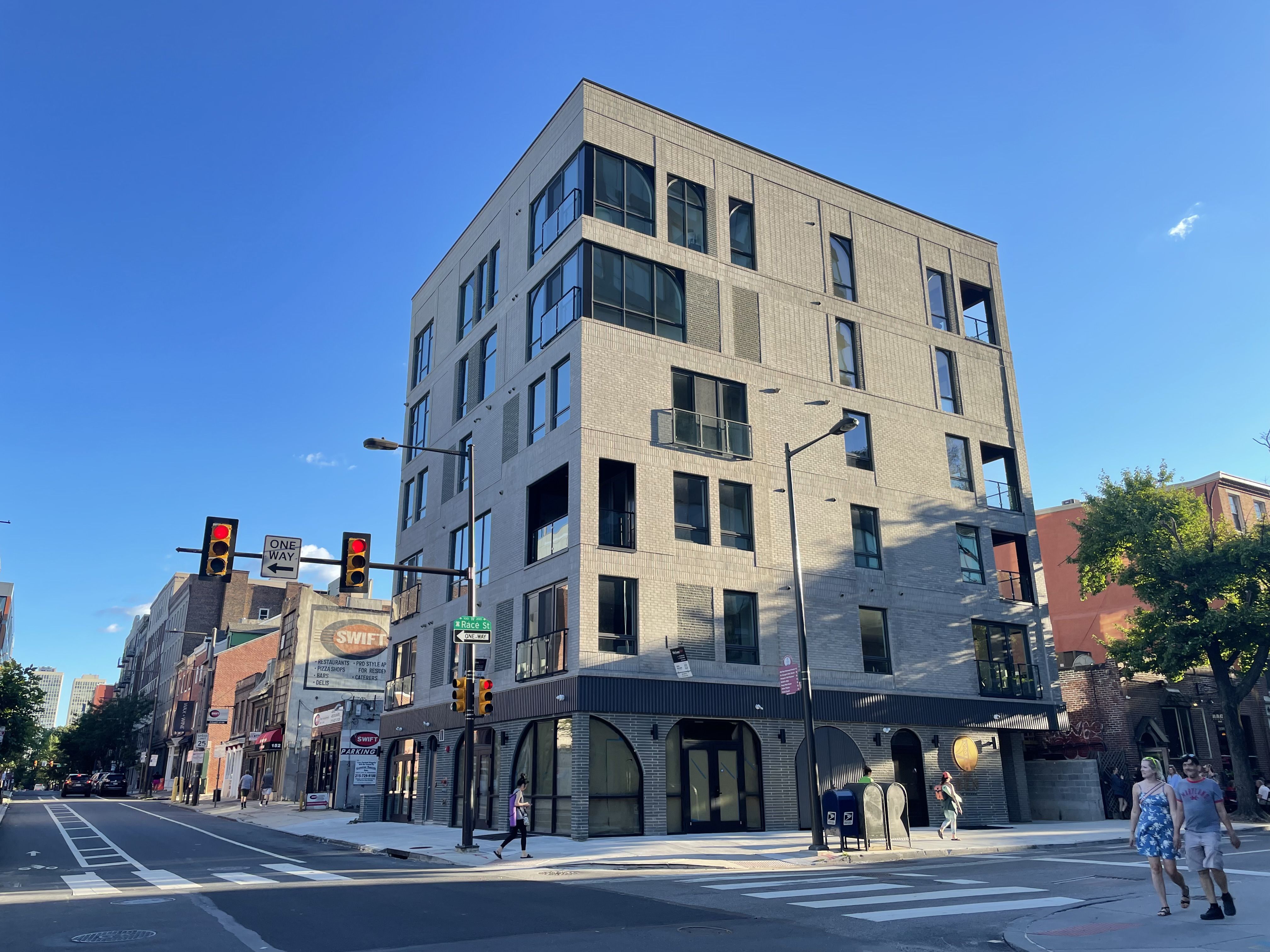
    This small apartment building at Second and Race Streets in Old City breaks up the usual grid with arched windows on the ground floor and irregularly spaced windows. Morrissey Design created the facade.

    The rise of the arch

    To be clear, today’s arches bear only a faint familial resemblance to their brawny predecessors, which come in all sizes and architectural styles, and typically have a large keystone at the apex. Those old masonry arches were workhorses that helped buildings stand up.

    But as construction methods advanced in the early 20th century, arches ceased to have a structural purpose. The changes coincided with the rise of modernism, which largely eschewed the form in favor of straight lines, at least until the 1960s, when architects such as Louis Kahn and Robert Venturi — both Philadelphians — began sneaking them back into architecture.

    Arches started reappearing on Philadelphia buildings about a decade ago, after Bright Common’s Jeremy Avellino marked the entrance to his Kensington Yards project with an exaggerated arc that seems to be descended from the famous Chestnut Hill house that Venturi designed for his mother. Even though the gesture was also a nod to the arched windows on the 19th-century townhouse next door, Avellino intentionally emphasized his building’s contemporary look by cladding it in metal. He considers his arches as nothing more than a “geometric memory.”

    The new-wave arches come from a different place. Although they certainly help architects break free from the oppressive grid, arches help their contemporary designs blend in better with their neighbors.

    The design for this three-story apartment building at 1716 Frankford Ave. uses shallow, industrial-style arches to enliven the facade. The project, which was designed by Gnome Architects for developer Roland Kassis, was expected to break ground in December.

    Eschewing look-alikes

    It’s no accident that arches began to proliferate just as brick was enjoying a revival as a building material in Philadelphia. Roland Kassis, a Fishtown developer who is responsible for several buildings with arches on Frankford Avenue and Front Street, says he first began using brick for building facades as a reaction against the poor quality of fast casual architecture.

    Even though brick took more time and expertise to install, and ultimately cost slightly more than other materials, he felt it was worth it because it set his projects apart from the competition and signaled quality to potential renters. Later, he added arches.

    Most of Kassis’ buildings that feature arches have been designed by Gnome Architects. They include a new mid-rise apartment building and a small hotel that are now under construction on Frankford Avenue.

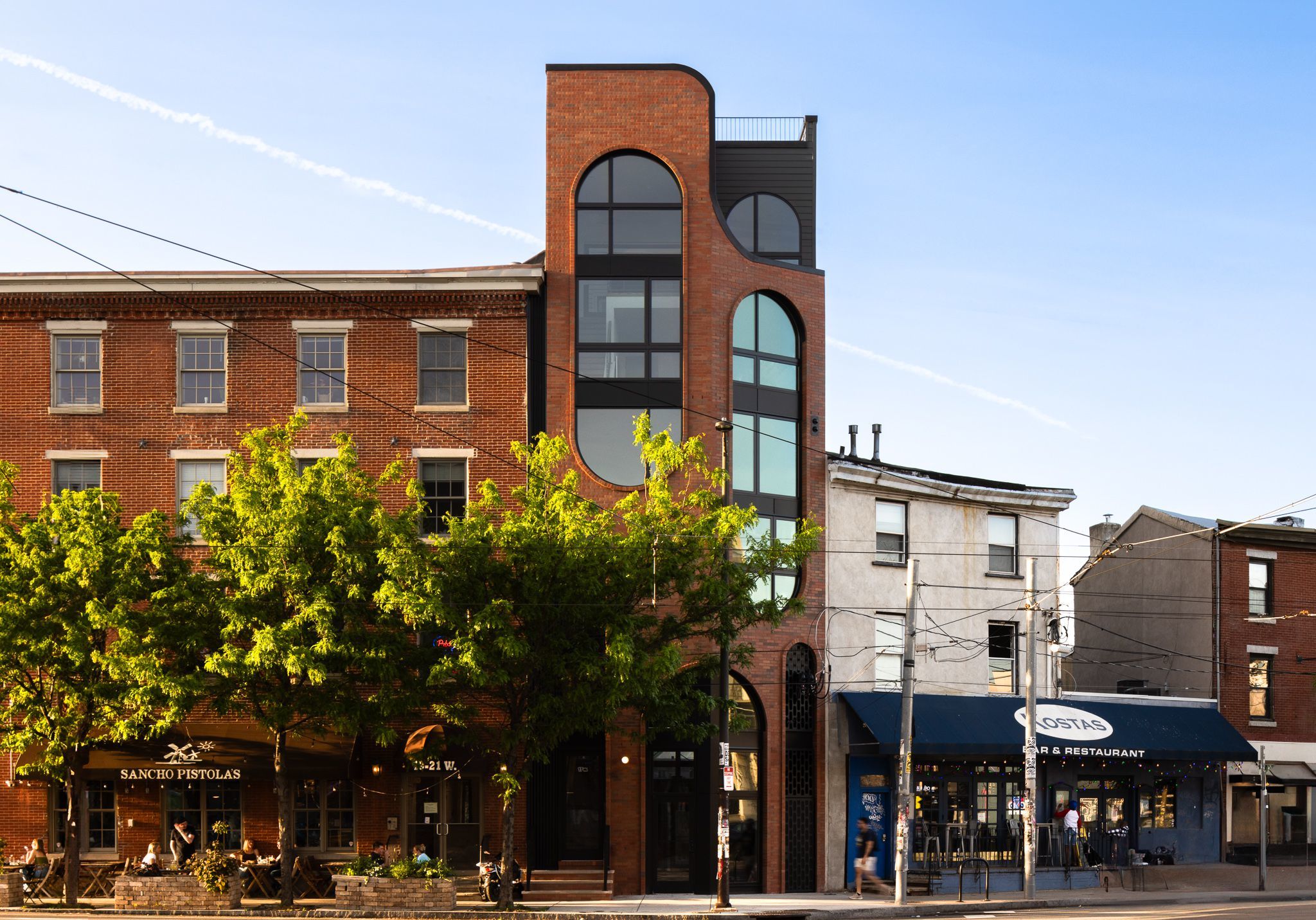
    While Gnome’s use of the arches is a way of paying homage to Fishtown’s industrial past, the firm’s most interesting design is less referential. Located at 17 Girard Ave., the skinny, mixed-used building features brick-framed oval windows that float up the facade like elongated soap bubbles. It functions as a sort of urban lighthouse at the entrance to Fishtown.

    Gnome’s new three-unit apartment building at 17 Girard Ave. in Fishtown is an exuberant counterpoint to the straight lines of Philadelphia’s traditional brick facades.

    Several other Philadelphia architects have embraced arches in their work for developers, including Digsau, KJO Architecture, and Morrissey Design. What unites their aesthetic is a strong interest in craft. They’re not just pasting factory-made brick panels onto facades; they’re hiring skilled workers from Philadelphia’s bricklayers union to lay the blocks on site, one at a time.

    That kind of craftwork isn’t something architects usually learn in school. To ensure that he gets the arches right, Gnome’s Gabriel Deck signed up for the International Masonry Institute’s training camp, where he tried his hand at using a trowel and spreading mortar. Digsau’s Mark Sanderson, who used a variety of arch types for Wilmington’s Cooper apartments, jokes that “we have the institute on speed dial.”

    The institute’s regional director, Casey Weisdock, says she’s noticed an uptick in both the use of brick and modern interpretations of the arch. She attributes brick’s newfound popularity to the Biophilic design movement, which believes natural construction materials are better for people’s health and can improve their moods.

    “A brick has a human quality,” she says. “A block fits right into your hand.”

    This massive apartment building on Lancaster Avenue, ANOVA uCity Square, typifies the plodding, graph paper-inspired architecture that is sweeping America. It was designed by Lessard Design on the site of the former University City High School, which is now home to life science complex called uCity.

    Digsau has a long history of incorporating wood and brick into its projects, yet the firm started adding arches into the mix only a few years ago. Like other architects, Sanderson, one of Digsau’s founders, says he was frustrated that design is increasingly dictated by financial models that result in the mass production of look-alike apartment buildings. Arches were a way of breaking out of that rut.

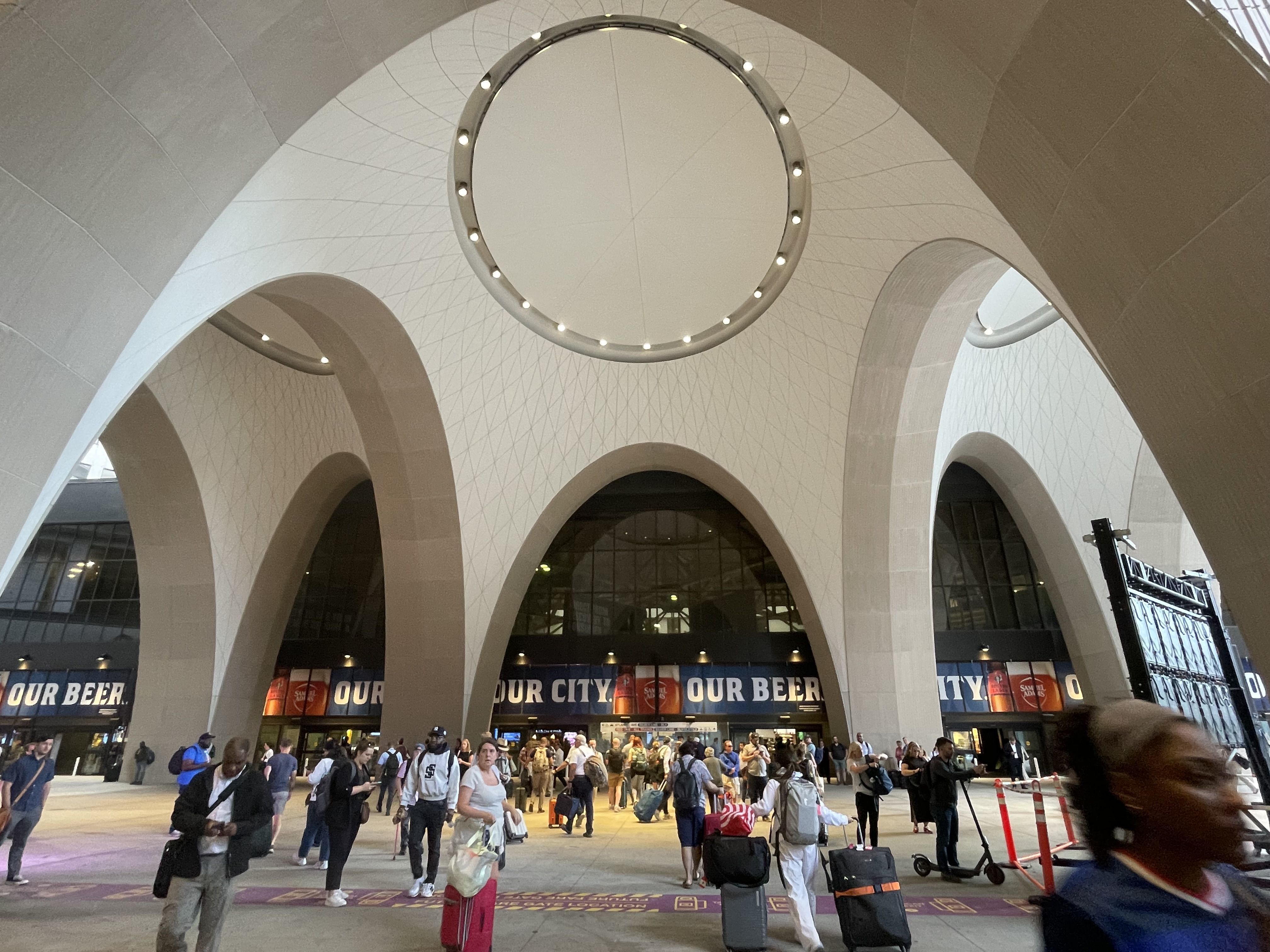
    The rebellion against straight lines and slick facades has spread to other big cities, and now even big corporate architects who specialize in skyscrapers are playing with bricks and arches. Pelli Clarke Pelli, which is responsible for designing many of the crystalline towers along the Schuylkill, just dropped a ring of soaring arches into Boston’s newly renovated South Station. (Of course, staying true to type, the firm’s tower, located on top of the station, is still a blue glass ice sculpture.)

    Pelli Clarke Pelli inserted these almost parabolic arches into Boston’s newly refurbished South Station.

    The urge for curves extends into interior design. Furniture showrooms overflow with tub chairs and sofas with curved backs. Virtually every surface at Enswell, an upscale Center City cocktail lounge designed by Stokes Architecture & Design, bends and flows in some way. The firm is responsible for several rounded counters in Philadelphia’s cafes and was part of the team that created Borromini’s interior arches.

    “You hear the words ‘comfy and cozy’ used a lot these days,” and the arch is one way to achieve that, says architect Brian Phillips, the founding principal at ISA. Interestingly, it’s hard to find arches in any of the firm’s work, which relies on textured materials, strategic cutaways, and complex geometry to animate its work. ISA did, however, introduce an arch and some curves for the Frankie’s Summer Club pop-up at the former University of the Arts building.

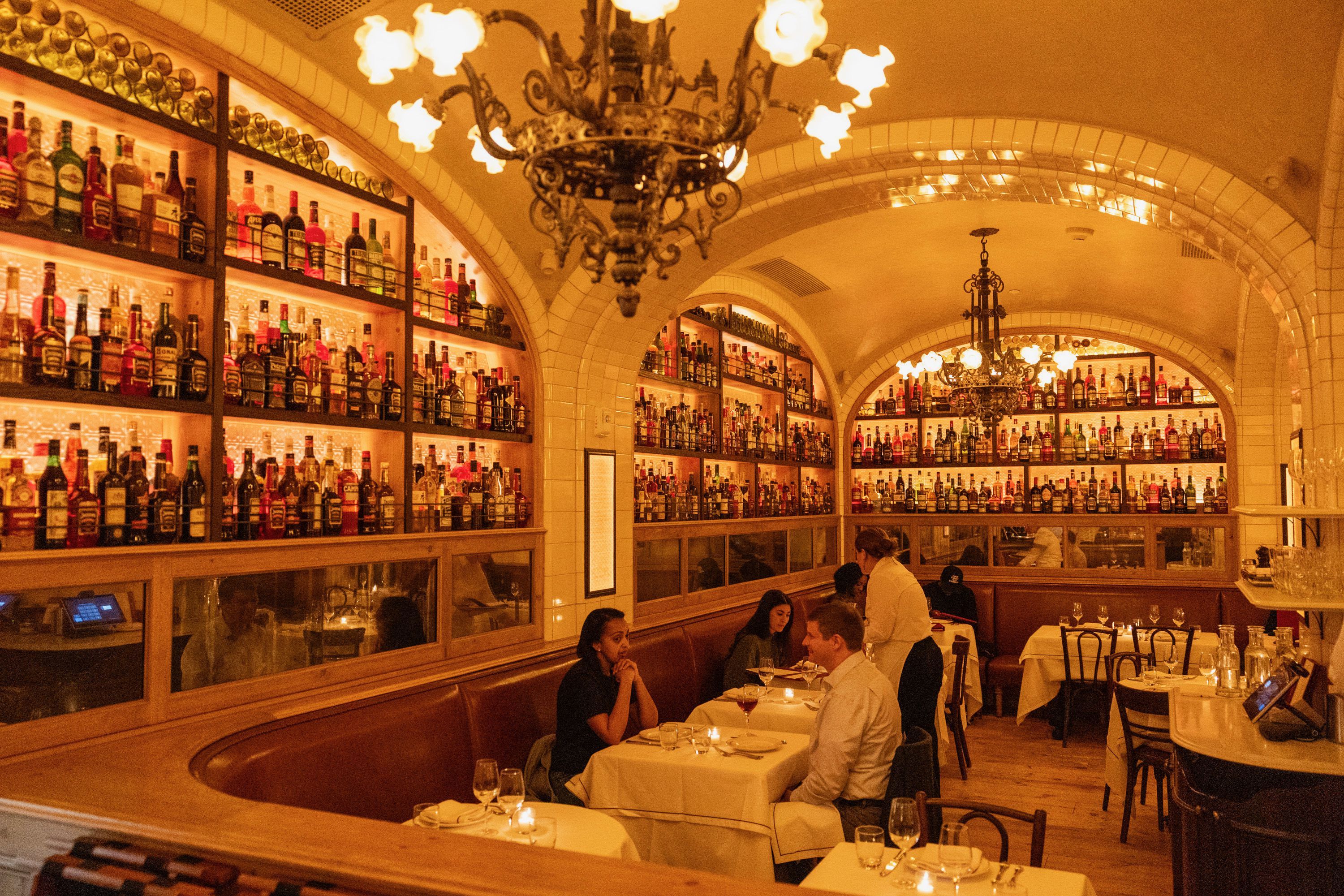
    The fashion for arches and curves has also spread to interior design. Stephen Starr’s new Borromini restaurant on Rittenhouse Square — collaboratively designed by Keith McNally, Ian McPheely, and Stokes Architecture & Design — includes a curved banquette and dramatic, tiled arches in the main dining room.

    While the arches have allowed architects to fight back against the deadening sameness of Developer Modern, the new style risks becoming its own cliche.

    So far, those Philadelphia architects who include arches in their work haven’t embraced the literal historicism of Robert Stern, but neither have they come up with anything as groundbreaking as the exaggerated and ironic forms introduced by Venturi and his partner, Denise Scott Brown. In some cases, the use of arches seems arbitrary — merely decorative, to use the modernist critique. And arches aren’t always well integrated into the composition.

    The most satisfying of Philadelphia’s new-wave brick buildings has plenty of curves, but no arches. Bloc24, a small condo building on 24th Street between South and Bainbridge, is a bravura essay in different styles of brickwork.

    A curving screen made from bull-nose bricks, laid on the diagonal, sweeps across the facade. Because it protrudes several feet from the surface, it functions as a giant bay window. While it’s a stretch, you could consider the stylish, curved cut-out at the entrance a sideways arch.

    While Bloc24, by Moto Designshop, has no arches, it is a bravura essay in brick styles and features plenty of curves. The new condo building is located on 24th Street, between South and Bainbridge.
    The brickwork on Moto Designshop’s Bloc 24, at 24th and South, is anything but flat.

    Bloc24 was designed by Moto Designshop, the firm responsible for the intricate brick chapel at St. Joseph’s University. Moto has made intricate brickwork its signature, and, unlike those designs that use brick as a veneer, every detail of Bloc24 is integrated into the overall concept.

    Perhaps the most out-of-the-box use of the arch can be found at Avellino’s Mi Casa houses, a group of rowhouses in tropical colors that he designed as affordable housing for Xiente (formerly the Norris Square Community Alliance). Because the sites are scattered around the neighborhood, often on very narrow lots, he was unable to replicate the standard, double window pattern found on most Philadelphia rowhouses. Instead, he used single arched windows, placed asymmetrically to energize the facades.

    There isn’t a single brick in sight, evidence that the arch has come full circle.

    Arched windows define this tropical pink house, part of group of affordable houses built on infill sites in the Norris Square neighborhood. Bright Common’s Jeremy Avellino used the arches to energize the narrow facades.
  • Political theater at the Pa. Society, more bad ideas from Council, and preservation done right | Shackamaxon

    Political theater at the Pa. Society, more bad ideas from Council, and preservation done right | Shackamaxon

    This week’s Shackamaxon goes to the Pennsylvania Society dinner in Manhattan, explores more Council shenanigans, and extolls an example of positive preservation.

    We’re all pals here

    I made a rookie mistake while attending my first Pennsylvania Society retreat in New York City last week: I arrived far too late. Instead of attending the various parties hosted by lobbyists and law firms, which is where the real political news is found, I covered the signature gala at the recently reopened Waldorf Astoria.

    Former Ed Rendell right-hand man, Comcast executive, and onetime Canadian ambassador, David L. Cohen, was honored with the nonprofit organization’s Gold Medal. Both Cohen and Gov. Josh Shapiro gave speeches praising the value of bipartisanship. In fact, bipartisanship seemed to dominate the air at the event — despite the rising division in just about every other aspect of political life.

    Where was this bipartisan love over the summer, as Pennsylvanians waited for months for a state budget? Where was the political collegiality when local governments and school districts were forced to shutter services or take out loans, and transit riders faced brutal service cuts?

    Apparently Champagne, cigars, cocktails, and filet mignon are a necessary component to talking productively with the other side.

    Lacking these amenities in the General Assembly, Harrisburg politicians chose vitriol over working together. Beyond the infamous Joe Pittman speech where the Senate majority leader showed how much he resents the southeastern part of the commonwealth he’s supposed to help lead, our local politicians also engaged in a blatantly partisan strategy to secure sustainable transit funding, one that ultimately failed.

    In one of the most boneheaded political moves I’ve ever seen, Pennsylvania Democrats openly bragged they hoped the brutal SEPTA cuts would help them make political gains. While they succeeded in forcing local Republican senators like Joe Picozzi, Frank Farry, and Tracy Pennycuick into making a bad vote to divert transit funding to roads in other parts of the state, this strategy only inflamed partisan tensions, making a deal less likely.

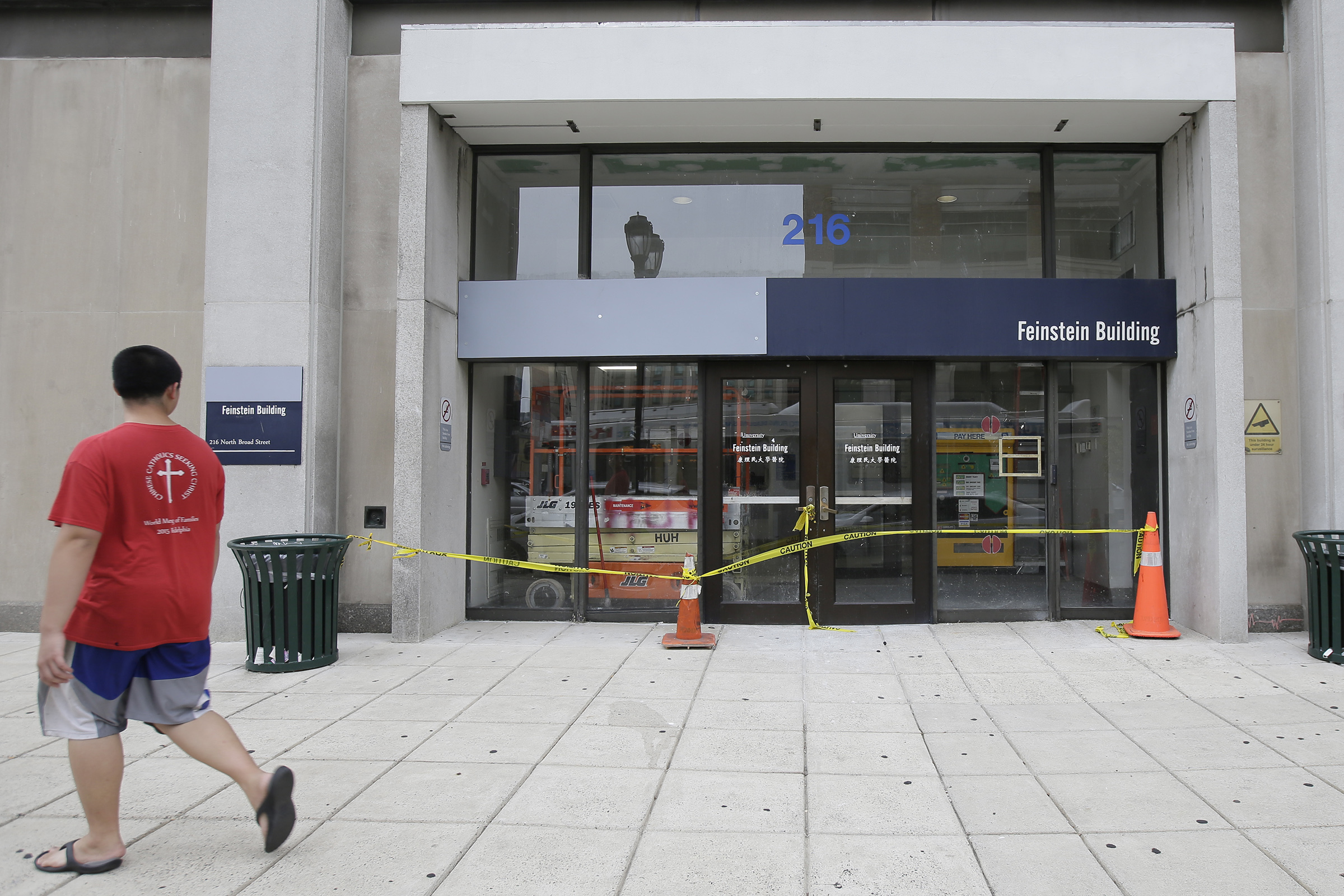
    A closed off entrance to the Feinstein Building at Hahnemann University Hospital in 2019.

    At it again

    I really try to avoid having Jeffrey “Jay” Young, the City Council member representing North Philadelphia’s 5th District, make a weekly appearance in this column, but he makes that very difficult. His latest bad idea is to ban housing on and around the campus of what had been Hahnemann University Hospital.

    To be clear, the loss of Hahnemann is an absolute tragedy. My eldest was born there, and the attentive care she and my wife received was excellent. Yet the hospital is closed, and it has been closed for more than five years at this point. There are no plans to reopen it. In fact, the property was sold earlier this year to Dwight City Group. The developer told my colleague Jake Blumgart they were avoiding high-end apartments.

    With a location right next to a subway station, midmarket housing is an ideal way to ensure the property does not become a source of blight over time. The former hospital’s neighbors include the Convention Center, the Pennsylvania Academy of the Fine Arts, a couple of highway ramps, and a ton of parking lots.

    Young claims his bill is meant to “promote job creation.” Maybe for zoning lawyers, but not for anyone else.

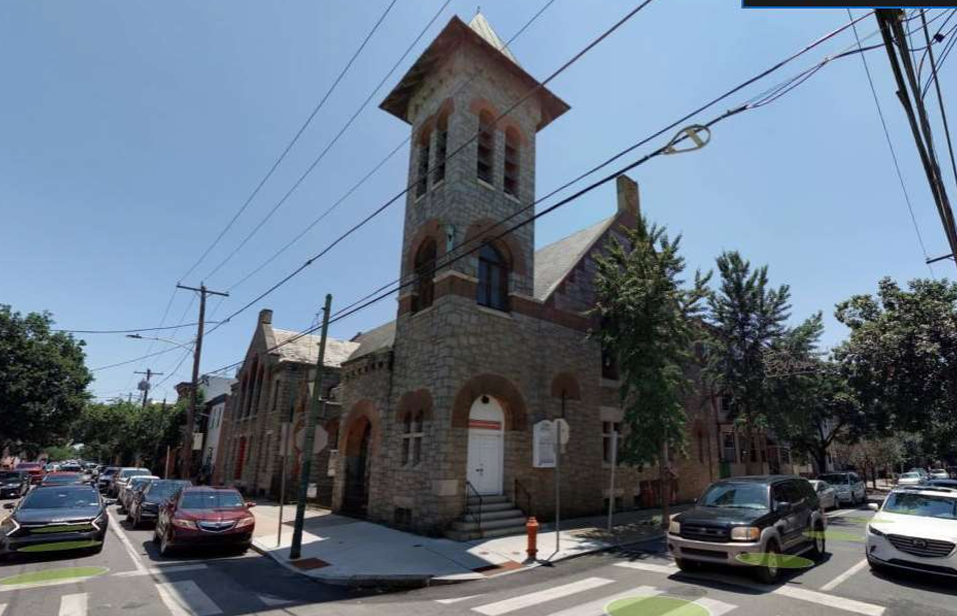
    St. John’s Baptist Church, at 13th and Tasker Streets, is being transformed into apartments.

    Preservation done right

    St. John’s Baptist Church at 13th and Tasker Streets has an interesting story that follows the demographic shifts of its neighborhood over the 132 years it housed a congregation. Thanks to a pragmatic local preservation law, the building should avoid demolition and remain standing for years to come.

    In the late 1800s, immigrants from Europe, in particular from Roman Catholic Italy, were flocking to South Philadelphia for work and opportunity. Some viewed this trend with consternation. They saw Protestant Christianity as integral to being an American, and they sought to convert the new residents.

    This process was called “Christian Americanization.” A cross-denominational effort led to the establishment of “missions” to reach these groups. St. Thomas, built in an Italianate style, was a part of this movement.

    Originally a Reformed Episcopal Church, the building was later transferred to a Baptist denomination. The Baptists had bilingual Italian clergy and were thought to be better suited to evangelizing the new residents. In the 1950s, the church diversified. It became known as a house of prayer for all people, and welcomed its new, non-Italian neighbors to its pews — in particular, Burmese and Indonesian immigrants, many of whom came to America specifically to practice their faith.

    The congregation’s last pastor was Tony Campolo, an evangelical leader who eschewed a megachurch pulpit and televised program in favor of the itinerant preaching popular among earlier leaders in that tradition. He exhorted his fellow Christians to set aside conservative politics in favor of social justice.

    Campolo died last year, not long after the church closed its doors. A fuller history of the congregation can be found in its historic nomination.

    While many houses of worship end up demolished after years of plans and negotiations fail to come to fruition, St. John’s will not join their ranks. That’s because of a 2019 law passed by City Council, which makes it easier to reuse historically protected buildings, like churches. While the project of turning a place of worship into apartments may seem daunting, other conversions in the city have worked out well.

    If the purpose of preservation is to deepen the link between past and present, this pragmatic approach is the right way forward.

  • Letters to the Editor | Dec. 19, 2025

    Letters to the Editor | Dec. 19, 2025

    Sad and sickening

    I’m still having a hard time wrapping my head around Donald Trump’s vile comments about Rob Reiner’s death. To watch anyone, least of all the president of what was once the most envied country in the world, spew such venom about one deceased man is so far beyond my comprehension that I can only opine that this is the result of envy turned sickness.

    And, as the would-be emperor fiddles, our country burns.

    We can wait until the midterms and vote, but that will accomplish little.

    Why don’t we take another look at the 25th Amendment, it has become obvious that our Congress is too wrapped up in politics to do its job.

    Contact your Congress members, contact your representatives, contact the dog catcher if you think it helps.

    Philip A. Tegtmeier Sr., Honey Brook

    When Charlie Kirk was assassinated, the Trump administration made it a point to go after anyone who criticized Kirk after his death. People lost their jobs over their criticism of Kirk. I think the president should lose his job for criticizing Rob Reiner after the tragic death of him and his wife.

    Julio Casiano Jr., Philadelphia

    The social media posting by the president with regard to the tragic death of Rob Reiner shows the state of mind of a man who totally lacks compassion, character, and empathy. His hatred has infected this nation and the world in ways never seen before. He’s not making America great; he’s making America hate and that’s not a good thing.

    Gerard Iannelli, Haddon Heights

    The president of the United States used social media to post a disgusting political attack on Rob Reiner in the aftermath of his killing. Yet following the assassination of Charlie Kirk, he railed against any public comments taking Kirk to task for his racist and misogynist commentary, recommending retaliation against anyone who chose a public forum to tell the truth about Kirk.

    Just when you think Trump has reached a low in his absence of shame and decency, he shows us that there is no bottom.

    Steven Barrer, Huntingdon Valley, sjbarrer@gmail.com

    Season for giving

    When disaster strikes, it often happens in the middle of the night, catching families off guard and leaving them with nothing but uncertainty. In those moments, Red Cross volunteers — neighbors from our own community — are there to provide comfort, emergency lodging, and recovery support.

    Thanks to donations of money and time, this kind of care happens every eight minutes across the U.S., most often after a home fire.

    Whenever it happens, we’ll be there — because of our generous donors and volunteers who help in so many ways. But our mission goes beyond disaster relief; we help patients in need of lifesaving blood, teach critical skills like first aid and CPR, and support veterans and military families navigating unique challenges.

    This holiday season, please consider donating at redcross.org. Your gift ensures that when the unexpected happens, families have the support and care they need — because no one should face a disaster alone.

    Jennifer Graham, CEO, American Red Cross Southeastern Pennsylvania Region

    Join the conversation: Send letters to letters@inquirer.com. Limit length to 150 words and include home address and day and evening phone number. Letters run in The Inquirer six days a week on the editorial pages and online.

  • Can the Brown University tragedy bring the left and the right together?

    Can the Brown University tragedy bring the left and the right together?

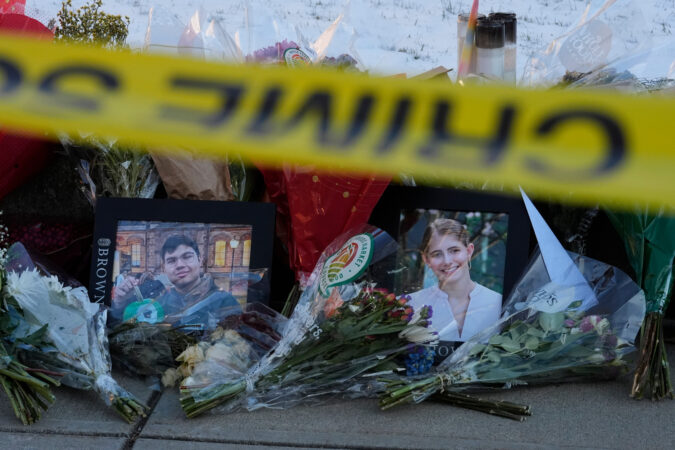
    Let’s start with the easy part. There is absolutely no evidence so far to suggest that the shooter at Brown University targeted Alabama native Ella Cook — one of two students who died in the massacre last Saturday — because of her political opinions.

    That’s what several right-wing commentators said, noting that Cook had been vice president of the College Republicans at Brown. Cook “was targeted for her conservative beliefs, hunted, and killed in cold blood,” the national chairman of the College Republicans wrote in a post on X, which has garnered nearly two million views.

    Please. We still don’t know who opened fire in a classroom building at Brown, or why. It’s reckless — and cynical — to pretend that we do.

    But behind every crazed conspiracy theory lies a small grain of truth. Conservative students are not in danger for their lives, but they do experience ostracism and discrimination. People who claim otherwise are like climate change deniers, except in this case the naysayers are on the left.

    I’m on the left, too. And it’s time for us to come clean about the biased environments we have created.

    I feel that every time I hear a colleague say all Trump voters are white supremacists or fascists. I feel it when students email me to complain about the left-wing groupthink in their classes.

    And I feel it, most of all, when they come out to me as Trump supporters in my office, with the door closed. I plead with them to share their views with others, which is the only way we learn anything. But they tell me the cost would be too high: They’d be vilified and canceled.

    A poster seeking information about the shooting suspect is seen on the campus of Brown University on Wednesday.

    That’s why so many Republicans disdain higher education. They know that we abhor their views, and they return the favor.

    Now they’re trying to impose their will upon us. Start with President Donald Trump’s “compact,“ which is really just an act of extortion: Do what we say, or we’ll cut off your funding. I’m glad that Brown — like Penn — rejected it, but schools with smaller endowments might face a more difficult choice when deciding whether to do so.

    Then there are state measures restricting instruction about race and gender. The logic goes like this: You taught things we didn’t like, so we’re going to prevent you from teaching about them at all.

    Remember the adage about two wrongs? We seem to have forgotten it. Liberals created an intolerant atmosphere on our campuses. In response, conservatives are taking political measures to silence us.

    It’s time to end this madness. And perhaps we can use the Brown tragedy to do just that.

    The other student who was murdered was a naturalized U.S. citizen from Uzbekistan, Mukhammad Aziz Umurzokov. He survived a serious childhood illness and wanted to become a doctor, so he could assist other people who had suffered like he did.

    You haven’t heard a lot about Umurzokov in right-wing media, which has been busy memorializing Ella Cook. But neither have my fellow liberals made much mention of Cook; instead, they have been commemorating the remarkable life of Mukhammad Umurzokov.

    Imagine a national day of mourning, where we switched all of that up. In Congress and in statehouses, Democratic leaders would hoist large blow-up pictures of Cook — the kind you see in sports stadiums — to memorialize her. And GOP officials would do the same for Umurzokov.

    That would require courage on both sides, which is in short supply these days.

    Democrats would need to celebrate a brave churchgoing conservative who bucked the dominant liberal consensus on campus. And Republicans would need to challenge their party’s nativist and anti-Islamic rhetoric by praising a young Muslim immigrant who wanted to do good in and for America.

    They would also have to call out the conspiracy theorists in their midst. Political violence is real, but there’s no evidence that Ella Cook was killed because of her politics. Honest Republicans know that. They need to say it.

    And maybe, just maybe, that can begin the healing that our battered nation so desperately needs. We simply cannot make anything better by hating on each other.

    At our schools and universities, we’ll resolve to welcome all points of view. Instead of maligning the other side — or trying to censor it — we’ll bring different sides together.

    And we will educate a new generation of citizens, who have both the will and the skill to converse across their differences. That will be a great way to remember Ella Cook and Mukhammad Umurzokov. And it will make America great, too. For all of us.

    Jonathan Zimmerman teaches education and history at the University of Pennsylvania. He is the author of “Whose America? Culture Wars in the Public Schools”.

  • In the face of terror, one man’s courage shows us the way forward

    In the face of terror, one man’s courage shows us the way forward

    This Hanukkah season, as Jewish families gathered at Sydney’s Bondi Beach to celebrate the Festival of Lights, terrorists opened fire. At least 15 people were killed and dozens more injured in an attack that has sent shockwaves through Jewish communities worldwide.

    For many Jewish families, this attack feels horrifyingly familiar. I know that fear personally. As I wrote in these pages last year, I had to hire armed security for my son’s bar mitzvah — a celebration that should have been filled with only joy, but instead required armed guards and threat assessments. That shouldn’t be our reality. But it is.

    Since that bar mitzvah, the situation has only intensified. The Anti-Defamation League documented more than 460 antisemitic incidents in Pennsylvania in 2024. Nationally, the numbers are equally alarming. Jewish families are making calculations our grandparents hoped we’d never have to make: Is it safe to go to synagogue? Should we display our menorah in the window? Will our children be targeted for wearing a Star of David?

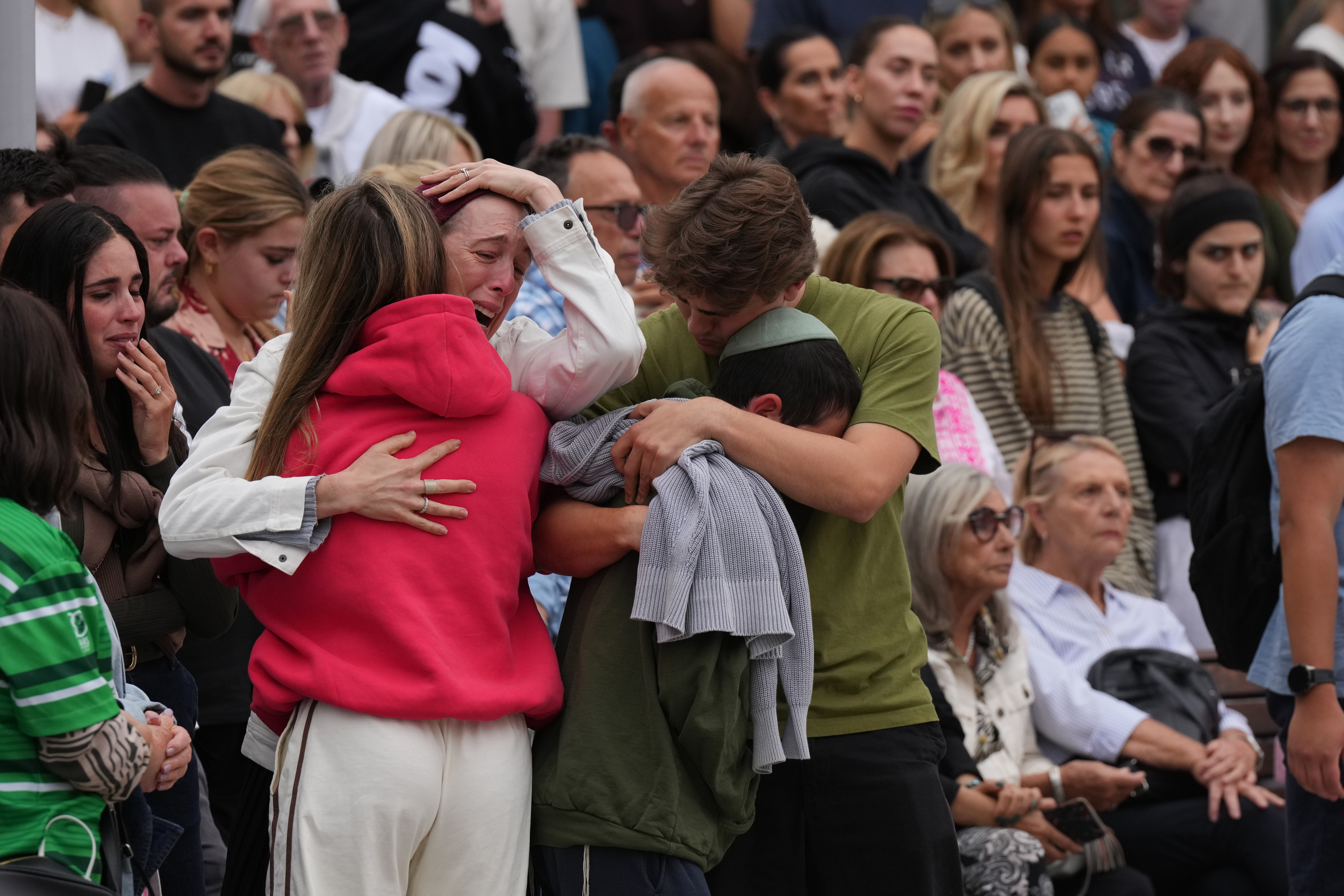
    Family members of a victim from Sunday’s shooting mourn at a flower memorial made after the shooting at the Bondi Pavilion at Bondi Beach on Dec. 16 in Sydney, Australia.

    But amid the horror of Bondi Beach, there emerged an image we cannot ignore: Ahmed al-Ahmad, a civilian, tackling one of the gunmen to the ground and saving countless lives.

    When hatred showed its ugliest face, Ahmed didn’t calculate the risk. He didn’t hesitate. He ran toward danger to protect people he didn’t know, celebrating a holiday he didn’t observe, from terrorists who claimed to share his faith.

    This matters — not as a feel-good footnote to a tragedy, but as a fundamental truth we must hold onto in these dark times.

    The alleged attackers reportedly followed ISIS ideology. But Ahmed al-Ahmad, a Muslim man, risked his life to stop them. This is precisely why we cannot — we must not — paint entire communities with the brush of their worst actors.

    When individuals commit acts of hatred, we should hold specific perpetrators accountable — not entire identity groups. Yet, these days: Often Jews are blamed collectively for events in the Middle East and Muslims are blamed for the actions of terrorists, like what occurred at Bondi Beach.

    Resisting communal blame is essential to defeating hate. Because here’s the truth: Neither courage nor hatred belongs to any one group. There are heroes and villains in every community. The sooner we recognize this; the sooner we can build the coalitions necessary to fight antisemitism, hate, and extremism in all its forms.

    Creating moments of solidarity matter as much as the hate incidents themselves, perhaps more. I am personally grateful for the phone calls and emails that I did receive from allies following the attack at Bondi Beach. They show that the voices against antisemitism and hate are greater in number and in moral force than those who traffic in it.

    But solidarity requires more than social media posts and attendance at rallies. It demands courage. Ahmed al-Ahmad showed us what that looks like.

    Here’s what each of us can do:

    Become an active bystander. When you witness hatred or harassment, you have the power to intervene safely — to distract, delegate, document, or directly address the situation.

    Reject collective blame. When acts of terror occur, resist the urge to blame entire communities. Hold perpetrators accountable while standing with those who share a background but not the hatred.

    Show up. Share in Hanukkah and Christmas celebrations, attend a Ramadan iftar, join in a Juneteenth event. Our presence in each other’s celebrations builds the relationships that sustain us through dark times.

    Report hate incidents. Whether it’s antisemitism, Islamophobia, racism, or any other form of bias, report it to law enforcement and organizations like ADL that track incidents. Silence allows hate to fester.

    As we light the menorah this Hanukkah, we commemorate the ancient victory of light over darkness. That light endures not because it was never threatened, but because in every generation, people chose to protect it — people from all backgrounds, all faiths, all walks of life.

    Ahmed al-Ahmad chose to be one of those people. The question for the rest of us is: Will we?

    Andrew Goretsky is the senior regional director of the Anti-Defamation League’s Philadelphia office, serving Eastern Pennsylvania, Southern New Jersey, and Delaware.

  • You may not have healthcare but you can get into a national park for free on Trump’s birthday

    Soon, you may no longer be able to afford healthcare since Republicans have once again blocked efforts to subsidize the Affordable Care Act.

    The most recent government shutdown became the longest in history because Democrats insisted on continuing to fund healthcare while the GOP balked. The Republicans won. America lost.

    But don’t despair.

    When President Donald Trump’s 80th birthday rolls around on June 14 — which happens to coincide with Flag Day — you will be able to visit a national park for free.

    See? Trump really is making America great again.

    Kidding aside, most of us aren’t going to mark Trump’s birthday — he hasn’t earned that from us. He can accept all the fake awards he wants, but he’s no hero. He’s a billionaire who has the nerve to claim that “the word affordability is a Democrat scam.” Remember that the next time you’re at the grocery store. Trump promised to bring down costs. It hasn’t happened.

    President Donald Trump picks up his FIFA Peace Prize medal before the draw for the 2026 soccer World Cup at the Kennedy Center in Washington, in December.

    Trump also said he would fix healthcare. That hasn’t happened either. He said he was going to fix the situation at the border. We now have masked ICE agents terrorizing undocumented immigrants and U.S. citizens alike. Entry into America is for sale y’all. As long as you have $1 million to pay for a green card. Make that a gold car with Trump’s image on it. Next up, a Trump platinum card.

    The president’s actions remind me of a narcissist whose world begins and ends with himself. This nation, however, is expansive and needs a president who puts the American people first. That’s not what we have with Trump. He demonstrates that over and over again.

    His administration’s decision to make entrance at national parks free on his birthday wouldn’t be quite as egregious if it hadn’t also revoked free admission for visitors on not one, but two federal holidays that honor Black history — Juneteenth and the Rev. Dr. Martin Luther King Jr.’s birthday. It feels like just another way to antagonize African Americans who still haven’t gotten over his calling Somalis “garbage” and saying they should leave the country.

    But wait, there’s more.

    The Trump administration has ordered the Park Service to clear the shelves of its gift shops, bookstores, and concession stands of any merchandise that runs afoul of its anti-diversity, equity, and inclusion policies. Employees have until Dec. 19 to get rid of any of the so-called offending merchandise. (Note: Let us know when the fire sale is and we’ll take it off your hands.)

    Trump only wants to present a sanitized version of American history: So no mention of slavery and Jim Crow and that sort of thing. But lots of red, white, and blue like he sells in his Trump store.

    As with practically everything else he sticks his suspiciously bruised hand into, he’s making a mess of things at the National Park Service.

    And I’m not just talking about the way officials have slapped the president’s scowling face on the prized annual park pass. An environmental group is suing him for that. I hope the lawsuit wins. I’d love to get one to give as a present for Christmas but I’m not doing it if his face is on it.

    A 2026 America the Beautiful National Park Service annual pass features President Donald Trump’s portrait. The Center for Biological Diversity sued the Trump administration, saying the pass must have a contest winner photo taken in federal lands, as deemed by federal law.

    The Trump administration also has cut numerous jobs and services at national parks, imposed a $100 fee for foreign visitors to certain parks, and stripped conservation protections for public land. I shudder to think about what could be next. Selling off national parks to the highest bidder? I wouldn’t put it past him to try it. We’ve seen what he did to the East Wing of the White House.

    Healthcare premiums for more than 24 million Americans may soon skyrocket without government subsidies to bring down costs for everyday people. Remember who is to blame when your insurance premiums suddenly spike.

    The day can’t come soon enough when Trump is finally out of office for good. That’s when we, the people, can set about undoing all the damage he has done.

    And that includes reinstating admission fees at national parks on Trump’s birthday.

  • Civility in the courtroom should be a model for our public life

    Civility in the courtroom should be a model for our public life

    Public discourse today feels like a shouting match — hostile, polarized, and quick to “cancel” those who disagree.

    Yet in the courtroom, there remains a model for conflict that doesn’t turn toxic. There, fierce disagreement unfolds with civility when the stakes couldn’t be higher. The norms that make justice possible serve as an example for the public square.

    Shakespeare’s famous line: “The first thing we do, let’s kill all the lawyers,” is often quoted as a jab. But in Henry VI, the line is spoken by a would-be tyrant’s accomplice.

    Shakespeare understood that to impose tyranny, one must first destroy the lawyers — the guardians of due process and rational debate. Rather than mock the profession, the line underscores the indispensable role of civility in preserving liberty, justice, and our way of life.

    Reasonable people can differ

    Law is built on the recognition that reasonable, ethical people can look at the same facts and reach opposite conclusions.

    One lawyer argues for conviction, another for acquittal. One sees a statute as broad, another as narrow. Their task is not to despise each other, but to argue — forcefully, yes, but intellectually within rules, procedures, and professional decorum.

    In court, a lawyer does not shout down an opponent. A judge does not belittle the losing side. Objections are made in accordance with established procedures and professional standards. Rulings are issued without personal attack.

    This disciplined approach requires patience, listening, and respect. The process is grounded in fairness and reason. Contrast that with today’s public square — particularly social media. People who differ are demonized. Disagreement is cast as patriots vs. traitors. No wonder our democracy feels frayed.

    The legal profession offers a vital lesson: Disagreement is not only inevitable but healthy. Truth is sharpened by opposing arguments. What keeps the system intact is the civility with which those arguments are conducted.

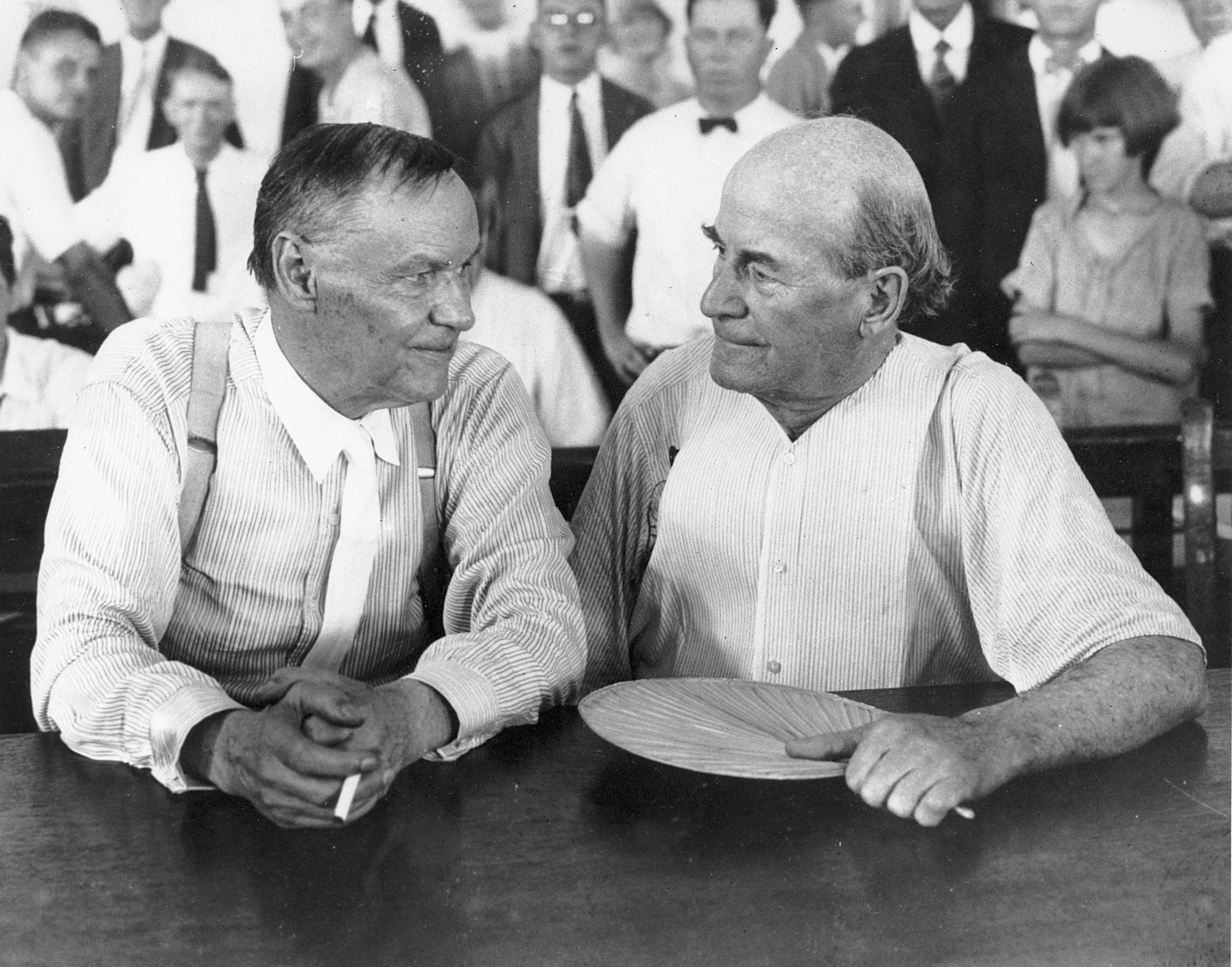
    Defense attorney Clarence Darrow (left) and prosecutor William Jennings Bryan talk civilly during the Scopes “monkey trial” in 1925.

    Picture a trial: The gavel strikes. Two sides rise, ready to battle over questions of fact and law. The plaintiff’s attorney delivers a fiery close. The defendant’s attorney responds just as vigorously.

    Afterward, no matter the outcome, the two shake hands. The judge thanks both for their professionalism. Each has fought hard, yet neither has questioned the other’s intent or integrity. Even in profound disagreement, opponents are not enemies. Respect prevails.

    Imagine if political debates resembled appellate arguments: sharp, disciplined, but respectful. Imagine if social media mirrored courtroom decorum, where civility restrains the loudest voice and allows reasoned discourse to be heard.

    It is possible to disagree passionately without resorting to insults or treating opponents as enemies.

    Civility is not surrender

    Of course, lawyers and judges are human. They sometimes fall short. Bar associations remind members of their duty of civility because the temptation toward hostility is real. Judicial misconduct, including poor courtroom demeanor, is policed in many states by independent boards and commissions.

    But the profession understands that its legitimacy depends on restraint. When civility fails, the entire system suffers. So does democracy.

    Civility does not mean surrender. Lawyers cross-examine with intensity. Judges write sharply worded opinions. Citizens, too, can argue with passion. But passion that eclipses respect erodes the common good.

    We are living in a moment in time when polarization tempts us to see neighbors as enemies. The courts remind us of a better way. American justice is built on adversaries treating one another as colleagues, with respect and decency, bound by a higher purpose.

    That lesson could not be timelier.

    P. Kevin Brobson is a justice of the Supreme Court of Pennsylvania.