Category: Opinion

  • Letters to the Editor | Dec. 12, 2025

    Letters to the Editor | Dec. 12, 2025

    Equitable education

    Sen. David McCormick is right that many students struggle in low-performing public schools. He is wrong that school choice is the cure. He wants Pennsylvania to opt into a tax credit scheme for wealthy donors to assist not just “those who can afford it” to go to private school. He wants you to think this will fix the problem of struggling public school students. It can’t. It’s not only affordability that allows some parents to pay for private school tuition. It is access to information, time to complete application processes, access to a reliable car, and time to drive the child to school every day. It’s not simply affordability.

    What school choice does is take one or two students out of many classrooms in a school, city, or township, those with parents with information, time, and a working car, and remove them from their public school community. The public school network loses a few children from each local school, but not enough to close classrooms or reduce staff. The loss of active families and funding, which follows slowly, bleeds schools of support and leaves the budget short for operations, maintenance, and improvements. The problem compounds because private schools and charter schools do not serve all students with special needs, as public schools must.

    Opting in to McCormick’s tax credit for wealthy donors will short public schools and worsen the problems for all students. No more schemes to “fix” schools while making problems worse. Instead of incentivizing wealthy donors to subsidize some students’ private school tuition, incentivize donors to give to public schools to benefit all children. Fix our public schools now by providing all the resources our children deserve.

    Ann Burruss, Newark, Del.

    . . .

    When U.S. Sen. Dave McCormick published his recent op-ed attempting to rebrand Donald Trump’s unpopularOne Big Bad Bill” and advocating for school vouchers and tax credits, he painted a bleak picture of Pennsylvania’s public schools and offered privatization as the cure. As a lifelong advocate for our children, I cannot let his Wall Street talking points go unchallenged — because the health of our commonwealth is at stake.

    Sen. McCormick, a hedge fund executive turned politician, claims his plan would give every family “school choice.” But let’s be clear: His proposal isn’t about empowering working Pennsylvanians. It’s about siphoning public dollars away from our neighborhood schools and funneling them into private institutions — many unaccountable to taxpayers and selective about whom they serve. This is the same playbook we’ve seen from billionaires and wealthy conservative donors who routinely privatize public goods for profit, leaving real Pennsylvanians to foot the bill.

    Sen. McCormick’s plan would drain hundreds of millions from public education annually. In 2024-2025 alone, Pennsylvania’s tax credit programs diverted over $525 million in potential state support away from public schools—money that could have repaired buildings, reduced class sizes, and hired more counselors. That’s not fiscal responsibility — that’s fiscal sabotage.

    Sen. McCormick and his allies love to talk about “waste, fraud, and abuse” in government — until it’s their donors cashing in. Voucher schemes across the country have led to exactly the kind of corruption and inflated spending they claim to oppose. States like Florida and Ohio have seen voucher programs riddled with scandals and declining student performance.

    Sen. McCormick’s allegiance is clear: He stands with the donor class and private interests who profit from dismantling public education. The real choice isn’t between “failing schools” and privatization. It’s between investing in the public good or selling it off to the highest bidder. Let’s choose to strengthen the health of our public schools — because the health of our children, our communities, and our democracy depends on it.

    Maria Collett, Pennsylvania state senator, 12th Senatorial District

    . . .

    A free-market system is grounded in the idea that consumers making informed choices spur competition, which, in turn, leads to improved goods and services. Dave McCormick, however, turns that idea on its head by telling us in his recent op-ed that “School choice offers accountability through competition.” He explains his position by writing that “It lets parents choose what’s best for their children.” But how do parents choose a school for their child without any information on how students perform at that school?

    Public school performance data is readily available for various school districts, as well as the Pennsylvania Department of Education. If Sen. McCormick believes school choice is such a great idea, then he should be advocating for private schools making their data available to the public, too, rather than trying to make us believe competition will somehow make schools more accountable.

    Coleman Poses, Philadelphia

    . . .

    Sen. Dave McCormick’s recent op-ed is little more than a self-promotional puff piece with a glaring omission. What McCormick does not mention is the Educational Improvement Tax Credit Program. It is basically a huge handout from Pennsylvania’s taxpayers to rich private schools. Wealthy individuals form limited liability corporations, and then get a significant tax break on up to $750,000 per year that they donate to a private school.

    The EITC program has been a windfall for schools with wealthy parents. Take the Episcopal Academy in Newtown Square, one of Pennsylvania’s richest and most prestigious private schools. Every year, several million dollars are donated through EITC. This is an educational institution in which the head of school got $961,451 in total compensation in 2024, according to ProPublica.

    The Working Families Tax Cut Act that McCormick praises is just one more shot at undermining the quality of our public schools. The more money they take away, the worse schools perform, and the more Republicans blame schools and teachers for that failure. In truth, it is the Republican Party that is responsible for the deterioration of our public school system.

    Alex Pearson, Merion Station

    . . .

    Pennsylvania Sen. David McCormick did a fine job of showing his bona fides as a blind follower of the Trump regime.

    His first mistake is being on the wrong side of history and constituent well-being in his mindless pursuit of Donald Trump’s favor.

    His second is using Florida as an example of success with “busting the education monopoly.” I’ve now lived in Florida for 25 years, and watched as a Republican-dominated state legislature added ever more money to school choice vouchers.

    Yet, Florida, too, has an abysmal rate of 12th graders who could not succeed on basic math and reading exams. Plus, charters and other private schools that receive vouchers are not held to the same high standards as public schools for teacher accreditation, testing, and core curriculum. They’re also permitted to cherry-pick their students instead of accepting everyone. Many have closed because of either poor performance or poor financial management while using tax dollars.

    I’ve seen it firsthand: Pennsylvania shouldn’t let vouchers make a mess of its public schools the way Florida has.

    Terri Benincasa, Palm Harbor, Fla.

    . . .

    The term school choice is a euphemism for taking funds away from those who need it and giving it to those who don’t. Public education in the wealthy suburbs and private schools is doing just fine. It’s public schools in the cities that are failing. They’re failing due to a critical lack of financial resources, low tax bases, and the relentless cycle of poverty that our country is unable/unwilling to resolve.

    I am a product of private, Catholic schools where my faith was taught every day. I don’t think taxpayer dollars (which are what school vouchers are) should support this type of school. If certain groups wish to provide education based upon their specific beliefs or principles, they must fund it for themselves. Taxpayers include Jews, Muslims, atheists, all faiths. Why should their dollars go to Catholic schools?

    I live in a city and have no children, yet I am willing to have my tax dollars support urban public schools. All kids need the basic skills to support themselves in meaningful, productive jobs, which is important, especially to Republicans.

    Let’s all say no to school vouchers.

    Patricia Clarke, Pittsburgh

    Join the conversation: Send letters to letters@inquirer.com. Limit length to 150 words and include home address and day and evening phone number. Letters run in The Inquirer six days a week on the editorial pages and online.

  • L&I is underfunded and overworked. It’s also integral to Mayor Parker’s affordable housing plan. | Editorial

    L&I is underfunded and overworked. It’s also integral to Mayor Parker’s affordable housing plan. | Editorial

    Philadelphia Mayor Cherelle L. Parker is traveling around the city to tout her $2 billion plan to invest in 30,000 new or renovated homes. Yet, one of the key city departments for ensuring her plan is enacted safely is facing questions about transparency and efficiency.

    If Parker’s affordable housing initiative is to succeed, it needs clear answers and greater efficacy from the Department of Licenses and Inspections.

    In many ways, L&I performs one of the most quintessential duties of local government: regulating local businesses and inspecting property. Despite the essential nature of their work, the department has not always met the standards Philadelphians deserve. For decades, it was known for corruption, with rogue inspectors accused of accepting bribes.

    In 2013, these issues metastasized into a catastrophe. A building being improperly demolished on Market Street collapsed onto the Salvation Army store next door, killing six people. An inspector took his own life, blaming his own actions for the disaster, even as city officials strongly defended his integrity.

    Mayor Jim Kenney appointed David Perri to lead L&I in 2015 with a mandate to effect transformational change, root out corruption, and embrace new ways of doing things. One of the changes Perri made was to the system of tracking vacant and abandoned properties. In the past, inspectors would verify vacancy by doing a “windshield survey.” This meant driving by homes to look for physical signs of abandonment. The method was inefficient, and the counts were almost certainly inaccurate.

    The department partnered with the city’s Office of Innovation and Technology to create a new way of tracking vacancies. They used data from the Water Department, Peco, and other city sources that strongly indicate abandonment.

    This information was not only used by the city, but also by groups like Clean and Green Philly, which aims to reduce gun violence by cleaning up empty lots. According to a study led by University of Pennsylvania physician Eugenia South, keeping these lots from becoming sources of blight, trash, and disorder helps reduce shootings.

    Then, without warning, the database disappeared.

    According to Nissim Liebovits, the founder of Clean and Green Philly, it was down for 16 months before being restored. Even before its disappearance, it had significantly fewer properties listed than expected.

    While the data is available again on the city’s Open Data portal, residents still deserve to know what happened. City officials have yet to provide an adequate explanation for the disparity or the gap in publication.

    Beyond the missing data sets, L&I also struggles with understaffing and political pressure, particularly from members of City Council. Despite many quality inspectors joining the department in the years following the 2013 collapse, outside pressures often led them to leave city government. Union leaders called it a mass exodus.

    The workers themselves said they were often told to ignore violations by bigger developers and contractors, while also being urged to come down harshly on smaller entities.

    The U.S. attorney who oversaw the investigation into the Market Street collapse said the remaining inspectors are overworked and have too many buildings to handle. Meanwhile, Council members regularly divert departmental resources away from the backlog and toward their pet issues. They also seek to put their finger on the scales to help or hinder projects.

    A city controller report from earlier this year cited insufficient enforcement of the city’s building regulations, with construction crews across the city operating without licenses or work permits. Meanwhile, some contractors with suspended licenses and records of shoddy work have resumed doing business simply by changing their names.

    Philadelphia cannot afford further backsliding at L&I, particularly when the city has committed to increasing the rate of construction. Mayor Parker and City Council President Kenyatta Johnson must work together to provide adequate staffing, restore full transparency, and insulate inspectors from the kind of political pressures that routinely interrupt regular business and contribute to the backlog of unfinished work.

    The ability to call up an inspector and get immediate results may be politically beneficial for the city’s elected leaders and a few lucky constituents, but the “squeaky wheel” approach must end if the department is ever going to systematically address ongoing concerns.

    Parker says she wants Philadelphia to be America’s “cleanest, greenest, and safest city, with economic opportunity for all.” Her One Philly dream can only be achieved if residents feel they can trust L&I to work for all.

  • Why a ceasefire is not enough: A call to block the bombs

    Why a ceasefire is not enough: A call to block the bombs

    This Hanukkah, while Jews around the world prepare to light the menorah and bring light into the darkest days of winter, our celebration of hope and resilience remains in the shadow of Israel’s ongoing genocide of Palestinians in Gaza. And, nearly two months into a U.S.-brokered ceasefire, I am still protesting.

    Hanukkah, which in Hebrew means dedication, tells the story of Jewish peoples’ resistance to an oppressive empire, and of a miracle that kept candles aflame for eight days and eight nights when there was only enough oil for one.

    It is a story that resonates to this day, and it is in the spirit of hope, light, and miracles that I find myself rededicating to the struggle for Palestinian liberation.

    The U.S.-brokered ceasefire went into effect on Oct. 10. Since then, Israel has continued near-daily attacks, killing at least 345 Palestinians and wounding another 889. While the agreement required Israel to lift its blockade on aid reaching Gaza, Israel continues to interfere with the free flow of humanitarian aid. Less than 25% of aid deliveries have made it to Gazans, who face increasingly dire circumstances.

    Palestinians grab sacks of flour from a moving truck carrying World Food Programme (WFP) aid as it drives through Deir al-Balah in central Gaza, in November.

    While the United States and Israel insist the ceasefire holds and deny the well-documented violations of the ceasefire agreement, I find it difficult to describe the current conditions as anything other than a slower-paced extension of the genocide.

    The need for our solidarity is no less urgent or crucial than it was last year or the year before.

    What’s more, Israel’s genocidal campaign against Palestinians isn’t confined to Gaza. Tens of thousands of Palestinians have been forcibly expelled from the illegally occupied West Bank, actions that human rights groups have classified as war crimes. It is worth noting that the primary targets of this ethnic cleansing are the refugee camps set up in the 1950s to house Palestinians who were forcibly driven from their homes when the state of Israel was founded.

    I have been in the movement for Palestinian liberation for decades through my work on the Rabbinic Council for Jewish Voice for Peace, the largest progressive Jewish anti-Zionist organization in the world. More recently, I joined over 400 other rabbis organizing as Rabbis for Ceasefire.

    Because of my organizing, I know history didn’t start on Oct. 7, 2023. Palestinians have faced expulsion from their lands, destruction of their homes and civil infrastructure, and deadly violence since 1948. They enjoy fewer rights than their Jewish counterparts, lacking freedom of movement and access to land, jobs, and public services.

    Many falsely proclaim that this system of violent occupation and the ongoing genocide are necessary for Jewish safety. The truth is that this is a desecration of Jewish values and an affront to our long tradition of resisting empire and seeking justice.

    I reject the claim that Jewish safety relies on the subjugation of Palestinians, and am inspired by the growing anti-Zionist movement among American Jews. Just as the Hanukkah lights our ancestors lit were not extinguished, our struggle for Palestinian liberation burns brightly.

    It doesn’t take a miracle, but it does require courage, rededication to fundamental human rights, and, for many, the willingness to shift positions and take accountability for the role of the United States in bankrolling and providing diplomatic cover for Israel’s genocide of Palestinians in Gaza.

    One opportunity I implore our elected officials to take is to sign on to the Block the Bombs legislation, which prohibits the president from selling, transferring, or exporting certain defense articles or services to Israel, except in specified circumstances. I was heartened to see Rep. Dwight Evans recently sign onto the bill, joining 59 other legislators, including three from Pennsylvania.

    Hanukkah celebrates an important miracle in the Jewish faith, the rededication of the Second Temple in Jerusalem.

    This Hanukkah, I call on all of us to shine a light on Gaza and rededicate ourselves to Palestinian liberation. Only by keeping the flame of our solidarity alive can we hope to one day say, as in our Hanukkah story, “a great miracle happened there.”

    Rabbi Linda Holtzman teaches at the Reconstructionist Rabbinical College. She is the organizer of Tikkun Olam Chavurah, a group that pursues social and political justice work together as a Jewish community.

  • Letters to the Editor | Dec. 11, 2025

    Letters to the Editor | Dec. 11, 2025

    Well-meaning policy

    If you walk into any nursing home in the southeastern corner of the commonwealth, you’ll find a highly choreographed system of long-term care (LTC) pharmacies humming along that help keep older Pennsylvanians safe and are the backbone of patient care.

    But this system is just months away from a potential collapse. Unless the Trump administration or Congress takes action now, on Jan. 1, a new policy will devastate LTC pharmacies that serve senior living facilities and nursing homes.

    Passed during the Biden administration, the Inflation Reduction Act allowed the federal government to negotiate with drug companies to determine “maximum fair prices” on certain expensive brand-name drugs for Medicare Part D beneficiaries — a policy designed to help seniors afford medications.

    But there’s a problem: The law is about to bankrupt the very pharmacies these seniors depend on to stay alive.

    By setting “maximum fair prices” on certain brand-name drugs, the policy significantly reduces the reimbursement rates LTC pharmacies receive.

    This price change will have rippling effects on all facilities that depend on the services of LTC pharmacies, including the 200,000 Medicare Part D beneficiaries over age 65 who have long-term care needs.

    The Trump administration can act via an executive order to keep LTC pharmacies operational by delaying or modifying the new drug pricing until a sustainable payment model is identified.

    Simultaneously, Congress must pass the bipartisan Preserving Patient Access to Long-Term Care Pharmacies Act (HR 5031). This legislation would establish a temporary $30 supply fee for each prescription filled under the new negotiated prices — a modest investment that would keep pharmacies solvent through 2027.

    We can’t afford to look the other way — our seniors deserve a system that supports them, not one that collapses under the weight of well-meaning policy.

    Rob Frankil, executive director, Philadelphia Association of Retail Druggists

    Risks vs. benefits

    The loss of a child is always a profound tragedy, and any parent would take extraordinary measures to avoid that possible outcome. Potentially saving their child, though, would not justify the certain death of thousands of other children as a result of their actions, which is what would happen without the timely availability of vaccines. The risk-vs.-benefit consideration is the foundation of effective public health decisions. The Food and Drug Administration even has a reporting system for adverse effects after a vaccine comes on the market to ensure the blessings of getting a jab far outweigh the harms.

    If every vaccine were evaluated solely on the occurrence of any adverse event, it would be regulated out of existence, and the death rate for the diseases the vaccines were meant to address would be catastrophic. While every death is devastating, the 10 deaths Vinay Prasad of the FDA has attributed to COVID-19 vaccinations would not statistically justify impeding the timely development of new vaccines. It is puzzling that President Donald Trump would allow a reversal of his greatest achievement: the timely development of vaccines.

    Jo-Ann Maguire, Norristown

    Join the conversation: Send letters to letters@inquirer.com. Limit length to 150 words and include home address and day and evening phone number. Letters run in The Inquirer six days a week on the editorial pages and online.

  • Ale Ayiti: Philly’s Haitian Americans celebrate a rare World Cup bid

    Ale Ayiti: Philly’s Haitian Americans celebrate a rare World Cup bid

    The first World Cup I remember was in 1970. I was a kid in Guatemala, and my brothers and I were so excited. It was the year the Brazilian seleção included Pelé, Jairzinho, Rivellino, Tostão, Gérson, and Zé Maria — there may be no more beautiful example of the sport of soccer than what they showed us.

    The Guatemalan team was not in the World Cup that year (or ever 😢), but El Salvador was, and although they were unlikely to advance very far, we felt a lot of Central American solidarity and rooted for them — the underdoggiest of the underdogs.

    I expect to root for the underdog again next year, when Brazil and Haiti take the field in World Cup play in Philadelphia. Brazil is a five-time world champion; Haiti last competed at this level 52 years ago.

    Philly’s Haitian community doesn’t care if it’s a little lopsided.

    “Most Haitians adore Brazil,” the Rev. Dr. Josephys Dafils told me via email, “and now Haiti will face the mighty Brazil on American soil. This is the thrill and magic of soccer. Haitians and Haitian Americans will travel to be part of this historic moment. Many of us will gather for a tailgate celebration outside the stadium, even without tickets, which are extremely expensive. We will bring food, music, vendors, and a traditional Haitian band called rara.”

    Numa St. Louis agreed: “For Haitian Americans, this event is more than just a game; it’s a moment of immense pride and emotion. As a Haitian American and die-hard soccer fan, the feelings that arise from witnessing Haiti step onto the world stage are overwhelming. It represents a long-cherished dream; a chance for a nation often faced with adversity to showcase its talent, passion, and spirit on an international platform.”

    “The joy of supporting Haiti, coupled with the opportunity to share the occasion with Brazilian fans,” he told me via email, “underscores the camaraderie found in the beautiful game.”

    Dafils, who at one time served as a youth soccer coach in Haiti, said that for the national team to make it to the World Cup at all, they had to overcome almost insurmountable obstacles.

    “Armed groups have taken control of nearly 85% of [Haiti’s] capital, as well as major cities across the country. More than one million Haitians have been forced to flee their homes,” he said. “Many people no longer have access to electricity, clean running water, or food. Families are constantly moving from one neighborhood to another in search of safety. [And] amid this dire situation, the Haitian national soccer team has accomplished the extraordinary.”

    An example of that? They had to play all the qualifying matches outside of Haiti.

    Haiti’s Leverton Pierre controls the ball during a CONCACAF Gold Cup soccer match in June against the United States in Arlington, Texas.

    “I have cried tears of joy since Nov. 18, 2025 — the day Haiti qualified for the 2026 World Cup,” Dafils told me. “Nov. 18 also marks the anniversary of the Battle of Vertières in 1803, when Haiti secured its independence from France. The symbolism is profound.”

    St. Louis makes another historic connection: Next year’s tournament will also coincide with America’s 250th anniversary, adding another layer of significance.

    The Haitian community has a long history in Philadelphia. Hundreds of white slaveholders and those they enslaved fled the Haitian Revolution, first arriving in Philadelphia in 1793; many of those enslaved people gained their freedom here in the years between 1793 and 1796. The community grew and saw waves of immigration throughout the 20th and 21st centuries, prompted by political turmoil and natural disasters.

    It’s estimated that some 12,000 members of the community are currently legally residing under temporary protected status.

    Those Haitian immigrants, like their peers across the U.S., have felt the impact of the singularly ugly lies JD Vance and Donald Trump fabricated about Haitians during the campaign, and after Trump became president, the decision to not renew protected status when it expires in February.

    The shadow of Trump’s immigration policies “loom large” — even over an event like the World Cup match, according to St. Louis.

    “The cancellation of the Temporary Protected Status program threatens to strip many Haitians of their legal ability to remain in the United States, leaving them vulnerable to deportation,” he said. “Furthermore, Haiti is among the 19 countries whose citizens are banned from entering the U.S., which will hinder potential visitors from attending the matches.”

    But he and Dafils always return to the thrill and magic of the World Cup match.

    “It has taken 52 years for Haiti to return to the World Cup. None of us know when we will see this again. I was not yet born in 1974, and I never thought I would witness such a moment,” Dafils said.

    “This match symbolizes hope,” St. Louis said, “a celebration of cultural connections that transcend borders. Even amid political challenges and the looming impact of immigration policies, this gathering promises to foster unity among diverse communities, showcasing the power of sports to uplift and inspire.”

    “As the day approaches, the anticipation grows for what promises to be an exhilarating clash, filled with heartwarming moments, passionate displays, and the acknowledgment of Haiti’s journey,” he added.

    What a beautiful game. Ale Ayiti!

  • New U.S. National Security Strategy slams Europe as greater threat than Russia or China

    New U.S. National Security Strategy slams Europe as greater threat than Russia or China

    Ordinarily, I wouldn’t recommend perusing the annual National Security Strategy of the United States of America. It generally summarizes the foreign policy direction in which the current administration is headed, and makes for lengthy, dry reading.

    But the new 33-page document is so shocking — even given what we already know about this administration’s behavior — that Americans need to pay attention.

    The NSS 2025 ignores the real security threats the U.S. faces in favor of praising white nationalist policies at home and demanding our democratic allies adopt the same. It promotes the myth that President Donald Trump can create a stable world by doing “deals” with authoritarian Moscow and Beijing.

    As for Russia’s invasion and brutalization of Ukraine, no word, except for chastising Europe for obstructing Trump’s efforts to force a pro-Russian “peace” plan on Kyiv. No wonder Kremlin spokesperson Dmitry Peskov quickly announced that the report was “largely consistent with our vision.”

    The document envisions a world in which Trump, Vladimir Putin, and Xi Jinping dominate the globe in concert, each controlling his own sphere of influence; it labels Trump’s intended control over the Western Hemisphere the “Monroe Doctrine Trump Corollary.”

    In reality, if Trump pursues this megalomaniacal mirage, he will facilitate the efforts of China and Russia to undermine U.S. security, destroy U.S. alliances, and dominate the world.

    What’s so revealing about the NSS is how much it has changed from the 2017 version released after Trump’s first year in office. Back then, the strategy referenced “the revisionist powers of China and Russia [who] want to shape a world antithetical to U.S. values and interests.” Russia, the document added, “aims to weaken U.S. influence in the world and divide us from our allies and partners.”

    The security threat from both countries has only worsened since then. What has changed is the personnel around the president.

    Gone are the professionals and knowledgeable advisers (except for Secretary of State Marco Rubio, who has largely been pushed to the sidelines). Present are the sycophants who flatter Trump’s brilliance and advance the white nationalist MAGA line.

    It’s no wonder there’s no reference to rising Chinese military threats to Taiwan. Or to massive Chinese cyberattacks on our country. One, called Salt Typhoon by U.S. intelligence agencies, has compromised U.S. telecommunications networks; another has penetrated U.S. infrastructure, including water supply plants, electricity grids, and transportation.

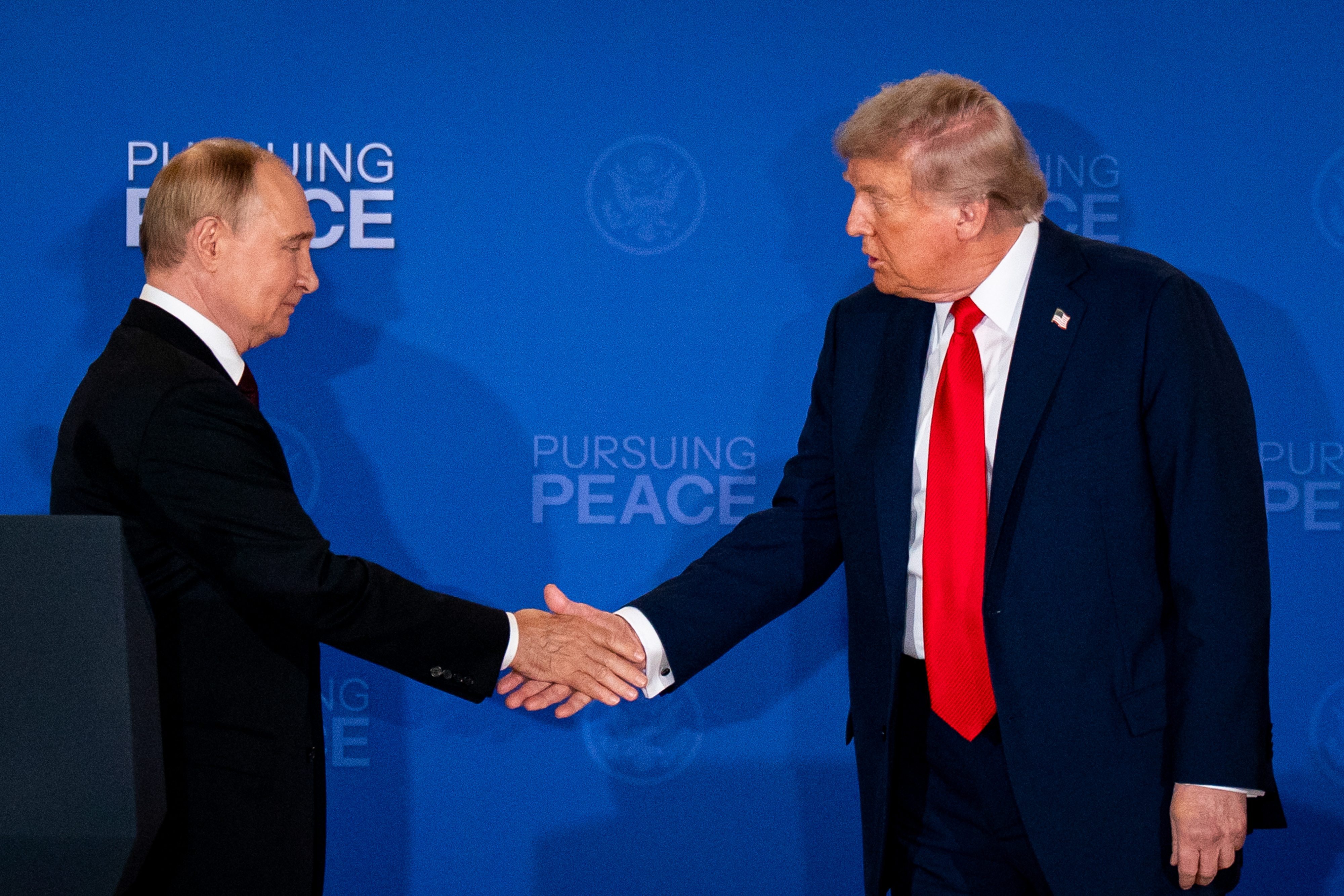
    Vladimir Putin and Donald Trump.

    Yet, in typical contradictory behavior, the Trump administration just halted plans to impose sanctions on China’s Ministry of State Security in response to Salt Typhoon.

    The security plan devotes pages to Trump’s penchant for trade deals and tariffs with Beijing, which it claims will ensure U.S. superiority in advanced technology.

    In another capitulation, however, Trump just agreed that Nvidia can sell advanced H200 chips to China, threatening that very U.S. superiority in advanced technology. Trump apparently wants to avoid displeasing Xi before traveling to Beijing for a summit in April. The president doesn’t want to interfere with his hopes of closing a brilliant trade deal.

    In other words, national security can be ignored when it contradicts the prospect of illusory economic gains — whether it be deals with China or Russia. And the president counts on his brilliance to secure both with his pals Putin and Xi (although he has repeatedly been bested by each of them).

    This fatal flaw is at the heart of NSS 2025.

    But the uglier and more gut-wrenching flaw is the document’s attack on Europe, its democratic values, and its support for Ukraine.

    The 2017 NSS read: “A strong and free Europe is of vital importance to the United States. We are bound together by our shared commitment to the principles of democracy, individual liberty, and the rule of law.”

    The “Promoting European Greatness” section of the new NSS echoes Vice President JD Vance’s tirade against European democracies, which I heard firsthand at the Munich Security Conference in February. Rather than speaking about the Russian war on Ukraine that threatens all of Europe, Vance denounced Germany for not inviting the extreme right, neo fascist Alternative für Deutschland party into a governing coalition.

    The 2025 NSS contends that Europe is on the verge of “civilizational erasure” because of immigration policies; instead, it promotes (white) nationalist, anti-immigration political parties. It slurs the European Union for its multilateralism (which the United States promoted after World War II, and which brought political and economic stability to the continent).

    And instead of supporting NATO allies as Russia attacks them with drones, cuts their underwater cables, and conducts sabotage and assassinations on European soil, the White House blames the Europeans for “regarding Russia as an existential threat.”

    “Our goal,” the document reads, “should be to help Europe correct its current trajectory.”

    There is something truly sick here.

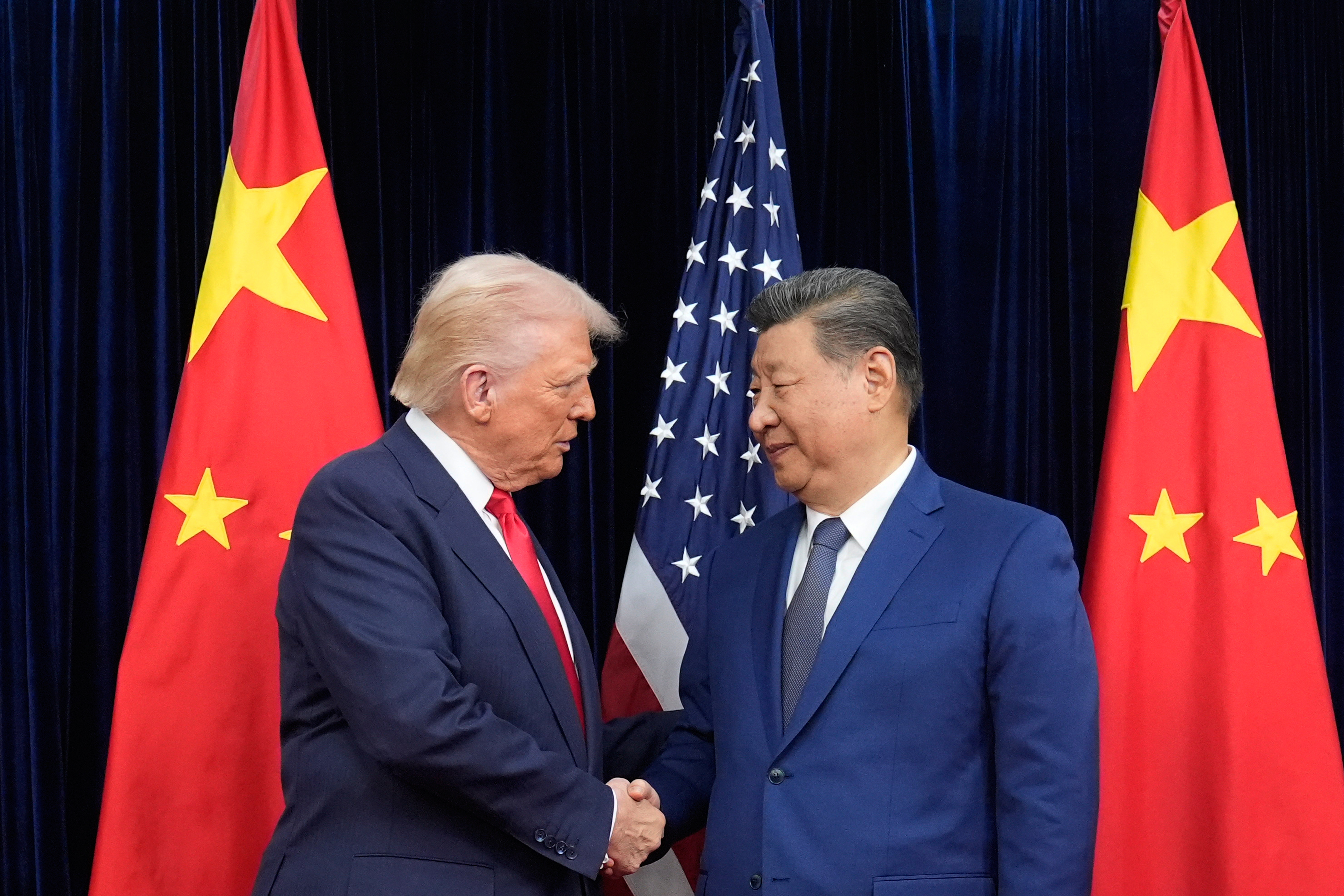
    President Donald Trump and Chinese President Xi Jinping shake hands before their meeting at Gimhae International Airport in Busan, South Korea, in October.

    Trump thinks China and Russia are his potential partners, while Europe is in the way — on Ukraine, on human rights, on warnings about Russia, on its own regulation of technology. Forget about common values or shared commitment to the principles of democracy and the rule of law.

    Unabashed to intervene in domestic European politics, the document calls on Europeans to restore “strategic stability” with Russia, meaning pressure Kyiv into signing a deal that consigns Ukraine to permanent domination by Moscow.

    And the U.S. wants Europe to take over most of NATO’s conventional defense capabilities, from intelligence to missiles by 2027, an impossible feat.

    Moreover, the White House is actively promoting as part of its “security strategy” the success of radical white nationalist parties in Britain, France, Germany, and elsewhere that are pro-Moscow and eager to do any and all business with Beijing. In other words, a Europe led by parties that are hostile to American security interests.

    The NSS 2025 envisions an alliance of authoritarian governments and their imitators, including Russia, China, the United States – and far-right European parties that dislike NATO, want to end the European Union, and prefer deals with dictators to defending democracy.

    This is what Trump advocates, although he doesn’t grasp that it would destroy him as well as his country.

    Fortunately, Europe won’t capitulate, nor will our allies in Asia. Nor would most Americans, I believe, if they only knew what the Trump national security policy is all about.

  • Letters to the Editor | Dec. 10, 2025

    Letters to the Editor | Dec. 10, 2025

    Normalizing evil

    On March 23, 1933, the Nazis passed the Enabling Act, which allowed Adolf Hitler and his cabinet to pass any laws — without approval from the Reichstag — even if they were unconstitutional. The Trump administration is effectively doing the same thing by ignoring court orders, disappearing people based on how they look without regard to their citizenship or legal status to reside here, and blowing them out of the water with impunity. Now the U.S. Supreme Court “shadow docket” is allowing racial gerrymandering to try to steal the 2026 midterms. If this is not fascism, it is certainly not democracy.

    James Hohmann, Langhorne

    . . .

    What has happened to the United States of America? Have we become so inured to the craziness of President Donald Trump that we barely seem to bat an eye while the situations and pronouncements become more and more bizarre and evil? Yes, evil. What else can you call what is happening all around us? The bombing of reputed drug smugglers at sea was terrifying. Planes swooping down and obliterating the boats and crew. Now we find out we murdered the survivors. What we did was a war crime. America does not do that, do we? If that news did not shake you to your emotional core, President Trump called the people of Somalia “garbage“ and wants them all out of the country. Where is the moral outrage? Where are we Americans standing up to protect other Americans? Have we become so used to Trump that we accept evil behavior as normal? His behavior, his deputies’ behavior, is not normal; it is not OK. None of it — the drug boat bombings, the U.S. Immigration and Customs Enforcement raids, the racism — none of it is normal, and “We the People “ must stand against it.

    Sheryl Kalick, Philadelphia

    Congressional maps

    The use of the term minorities regarding the gerrymandering of congressional maps in Texas seems inaccurate. A slightly larger number of Texans identify as Hispanic than those who say they are not. And while voters in Texas do not register by party, more Texans choose to participate in primaries as Democrats than as Republicans. In Texas, gerrymandering may be more accurately described as an increasingly extreme attempt to impose the will of a minority on the majority. And that is true regardless of whether the U.S. Supreme Court sees the motivation as racial or political.

    Kris J. Kolo, Philadelphia

    Retirement stability

    Philadelphia’s workers deserve the chance to build real financial security, and I appreciate The Inquirer’s recent coverage of the city’s retirement savings proposal. Too many Philadelphians go their entire careers without access to a basic plan. That gap leaves families vulnerable, and it places additional strain on our social safety net.

    The goal of PhillySaves is simple. It makes it easier for employees who want to save and avoids adding new burdens for small businesses that already manage enough responsibilities. There are no employer fees and no complicated reporting. Just an easy, portable option that follows workers from job to job.

    Before joining City Council, I worked in Harrisburg as a state representative on retirement security issues and legislation. I saw how many Pennsylvanians age into poverty without access to a plan. PhillySaves reflects that experience and the importance of helping workers save steadily.

    Council President Kenyatta Johnson has been clear that improving economic stability for working people is a priority for this Council. PhillySaves is one part of that broader effort. It will not solve every challenge, but it gives thousands of residents a fair chance to start building long-term savings.

    Mike Driscoll, 6th District, Philadelphia City Council

    Dems need direction

    The Democratic Party is a rudderless ship. Its irrational opposition to President Donald Trump has caused it to lose its moral compass and common sense. It no longer works in the best interest of the American people. Its misguided effort at “leverage” betrayed the trust of its constituents and caused unnecessary pain for many. It focused on extending subsidies to the ironically named Affordable Care Act while ignoring the hundreds of billions of dollars in additional spending that it attached to its proposal. Using that time to explore viable alternatives for affordable healthcare would have served everyone better. Extending subsidies implemented during the pandemic is throwing good money after bad.

    Democrats pontificated that nobody was above the law while stressing the importance of upholding the rule of law. For years, they ignored immigration laws and allowed millions to cross our borders. They now demonize law enforcement and encourage active resistance when enforcing those same laws. Anyone who crosses the border illegally has broken federal law and is subject to deportation. Democrats are more concerned with the plight of illegal immigrants than the safety of the American citizens they are sworn to protect. They show little sympathy for victims of crime committed by many of those same people whom they failed to vet.

    Now, Democratic lawmakers are “reminding” armed service members that they do not need to obey illegal orders. Without examples, their goal is to foment division and instability in our government. If national security is at risk or any lives are lost, those lawmakers have opened themselves up to prosecution. These stunts do nothing to move our country forward. Imagine the reaction if GOP lawmakers made a similar statement during the Biden years.

    It is very difficult to understand what Democrats actually stand for. It is painfully obvious what they are against.

    Mark Fenstemaker, Warminster, markfense@gmail.com

    Trade wars

    America is losing the trade wars because the president does not understand trade. While Donald Trump believes trade involves only manufacturing, which contributes about 10% of our economic output, he overlooks the service economy, which includes education and tourism. Trump’s tariffs-based trade war might have made sense in the 1960s, but it is out of step with the current world economy and is helping to fuel our affordability problems.

    The current CEOs of Microsoft, Alphabet (Google), and Nvidia, three of America’s biggest and most innovative companies, were educated here but born overseas. Education is one of America’s leading exports and helps contribute to our prosperity, but the administration devalues it and attacks and extorts our most prestigious universities. When Trump attacks Canada and other countries that contribute to American tourism, many of our destination areas, like the Jersey Shore, are diminished.

    Trump’s worldview is that all confrontations can be won and all collaboration is defeat. History has proven he’s wrong.

    Elliott Miller, Bala Cynwyd

    Another bended knee

    As he was sworn in just two days after his slim victory in the race for the U.S. House of Representatives, Tennessee Republican Matt Van Epps said, “I come to this body as a Christian.” He has also pledged himself to be firmly devoted to Donald Trump and his agenda. How does Rep. Van Epps square the two?

    Trump has expectorated upon the tenets of every religion. He is a thug, a bigot, and the most corrupt president ever to serve, enriching himself and his family of grifters to the tune of billions of dollars. He seeks to divide and conquer, and has clearly expressed his hatred and contempt for those who oppose him, embarking upon a campaign of revenge against them. He has contempt for people of color and immigrants, as he seeks to welcome only white people who seek to live here.

    Can Christian Rep. Epps cite any facet of his faith that is modeled by the president to whom he is so devoted? The question is rhetorical.

    Oren Spiegler, Peters Township

    Imperfect harmony

    I retired in 1999 after 31 years of teaching in Philadelphia. In 2003, I applied for a mortgage with several local banks. None of them would give me a mortgage based on my retirement income, despite my good credit rating. In the last two years, my prescription plan cost has gone up 60%. My wife’s prescription premium for 2026 has increased by 400%. Other costs have increased dramatically, as well. My retirement income is still the same as it was in 2003.

    I read in The Inquirer that Pennsylvania state legislators received a 3.25% cost-of-living raise, and that cost-of-living adjustments, or COLAs, each year are mandated for them. I know that eventually the state will give Pennsylvania teachers a COLA. I would prefer to get mine before I die.

    Mitchell Bernstein, Philadelphia

    Join the conversation: Send letters to letters@inquirer.com. Limit length to 150 words and include home address and day and evening phone number. Letters run in The Inquirer six days a week on the editorial pages and online.

  • Trump says Somalis are ‘garbage’ and wants them to leave America. No one should be surprised by his ignorance.

    Trump says Somalis are ‘garbage’ and wants them to leave America. No one should be surprised by his ignorance.

    Donald Trump let us know exactly who he is when he rode down that escalator in June 2015, declared his presidential candidacy, and said this about Mexicans: “They’re bringing drugs. They’re bringing crime. They’re rapists.”

    We’ve heard him refer to Haiti, African nations, and El Salvador as “shithole countries.” Last year, he accused Haitians in Springfield, Ohio, of eating their neighbors’ dogs and cats. Trump allows mask-wearing U.S. Immigration and Customs Enforcement agents to terrorize undocumented immigrants, most recently in New Orleans, as reported by my colleague Will Bunch.

    No one should be surprised he called Somalis “garbage” who “contribute nothing” and should leave America during a cabinet meeting last week.

    “These are people that do nothing but complain,” Trump said. “When they come from hell, and they complain and do nothing but bitch, we don’t want them in our country. Let them go back to where they came from and fix it.”

    Trump talks a really good game about putting America First, but he really means people of color last. An example of that was when he suspended refugee admissions, but then turned around and made an exception for white South Africans.

    Even knowing Trump’s agenda, it’s still upsetting to hear a sitting U.S. president denigrate the roughly 250,000 Somalis in this country.

    He’s talking about law-abiding folks like Salma Hussein. She made headlines in 2022 when she became the first female Somali principal in her school district in suburban Minneapolis, and possibly in the entire state of Minnesota.

    Hussein was born in Somalia, but has lived in America since the age of 7, and is a naturalized citizen. She’s a wife. She’s a mother of two. She’s a good person. “It’s really hurtful, and he’s giving permission to people to be hateful, and that’s really disheartening,” Hussein said.

    I stumbled across some of her social media posts about what’s been happening and decided to reach out. When I got her on the phone last week, Hussein, 37, and I talked about a lot of things, including how a stranger had emailed her saying: “Watch out. You’re not wanted. We’re taking out the trash from our country.”

    Salma Hussein, a Somali American who’s lived in the U.S. since she was 7, said the president is “giving permission to people to be hateful.”

    I shouldn’t even have to write this: Most Somalis are honest, law-abiding people. Many settled in Minnesota during the early 1990s after fleeing their war-torn country. Of the state’s foreign-born Somalis, most are naturalized U.S. citizens. They have every right to live in the Land of 10,000 Lakes. They vote. They pay taxes. Trump is their president, too. Some, oddly enough, even voted for him.

    I wish they’d thought longer and harder before voting for Trump, who posted on Truth Social that Minnesota is “a hub of fraudulent money laundering” and announced he was terminating Somalis’ Temporary Protected Status.

    Dozens of Somalis in Minnesota are facing charges in connection with a nefarious scheme to defraud the U.S. government of hundreds of millions in funding that had been set aside to feed hungry children at the height of the pandemic. Still, it’s unfair for a sitting U.S. president to stereotype an entire community for the actions of a subset. “As a Somali American, I’m just as upset about the people in my community who use fraud to make money,” Hussein told me.

    Somalis, who have built a large and influential enclave in Minnesota, are terrified that masked agents from ICE will take them into custody. Some have started carrying their passports. Others refuse to even leave their homes.

    “This kind of dangerous rhetoric and this level of dehumanizing can lead to dangerous actions by people who listen to the president,” said Rep. Ilhan Omar (D., Minn.) on CBS’s Face the Nation on Sunday.

    It’s textbook Trump — and, of course, MAGA loves it.

    Rep. Ilhan Omar (D., Minn.) speaks during a news conference, May 24, 2023, on Capitol Hill in Washington.

    In New Orleans last week, Trump sicced ICE on undocumented Hispanic immigrants. At around the same time, his agents were also targeting Somalis in Minnesota.

    Which ethnic minority Trump will single out next for harassment is anybody’s guess. The only thing we can be certain of is that they will be from a Black or brown community.

  • The Trump regime murders that aren’t on video | Will Bunch Newsletter

    There’s this idea in the sports world that when your team wins a championship like the Super Bowl, fans can’t really complain about whatever happens in the next season or two. The author of that maxim has obviously never been to Philadelphia, which is experiencing a 1776-level revolt over the Eagles’ three-game losing streak and the increasingly erratic play of the Super Bowl MVP, quarterback Jalen Hurts. So much for brotherly love, pal.

    If someone forwarded you this email, sign up for free here.

    Trump’s body count is a lot higher than two men on a wrecked ship

    A malnourished child receives treatment at Banadir Hospital in Mogadishu, Somalia, in May.

    You might have thought it would have happened when hundreds of men — in apparent conflict with a judge’s order, and often based on nothing more than a misreading of their tattoos — were shackled and flown to a notorious El Salvador torture prison.

    Or maybe it would have been making billions of dollars on crypto investments or real-estate deals with foreign dictators while running the government. Or pretending that climate change doesn’t exist. Or pardoning hundreds of bad guys, including those who launched an insurrection against the United States on Jan. 6, 2021. Even the president’s friendship with the world’s most notorious sex trafficker wasn’t exactly it.

    No, the thing that finally caused the mainstream media to go all Watergate all the time on Donald Trump and his Pentagon chief was a lot more simple, if harder to stomach: the early September murder by drone strike of two men — their identities still unknown to the world, or most of it — clinging to a piece of ship-wreckage in the Caribbean Sea near Venezuela.

    Flip on the favorite show of the Beltway set — MS Now’s Morning Joe — and there practically is no other story than the second attack on the seemingly helpless victims of an initial drone strike that killed their nine comrades. The media is demanding to learn what did self-proclaimed “Secretary of War” Pete Hegseth know about the strike, and when did he know it. Commentators are calling the killing a war crime at best, a murder at worst. An unnamed lawmaker who saw a video of the second strike told reporters that the film is nauseating.

    Pressure on the Trump regime to release this 45 or so minutes of footage of the boat attack is intensifying, and it’s not hard to understand why. It’s a bit like 2020’s video of the excruciating cop murder of George Floyd in Minneapolis, which made a problem that activists had been talking about for decades — police brutality — so real for everyday folk that millions took to the streets.

    Likewise, people have been calling Trump names — including the “f-word,” fascist — ever since the Manhattan real-estate mogul descended the escalator at Trump Tower to run for president in 2015. But somehow the mental image of men reportedly begging to be saved seconds before an admiral gives the order to obliterate them has captured the angry imagination in a way that past Trump outrages did not. No wonder Trump has flip-flopped on releasing the video.

    Look, I’m glad the media and Congress, including some Republicans, are finally taking seriously the idea that major felonies are being committed in Trump World. Still, the two men killed in what’s called the double-tap strike came after nine other people had already been blown up, in an attack against civilians of a nation America is not at war with, who were accused of committing a crime — drug trafficking — that is not a capital offense.

    There is no legal, let alone moral, justification for this attack — and it was the first of a series of drone strikes that have killed at least 86 people. There’s a strong case that every one of these is a war crime. It’s just that the killing of the two men clinging to debris appears even more egregious.

    This highlights an even weightier issue. From Day One of Trump’s second term, there has been a callous indifference to human life — a hallmark that the current U.S. government unfortunately shares with many other authoritarian regimes throughout history. But the media, and the watchdogs, have struggled to convey this reality with so many of the deaths taking place off camera.

    So far, the worst crime has been the rash move back in the first weeks of the new administration by Trump’s billionaire then-ally Elon Musk and his so-called Department of Government Efficiency, or DOGE, to dismantle the U.S. Agency for International Development (USAID) — a once-thriving $34-billion-a-year agency that funded food, medicine, classrooms and other aid in developing nations.

    The Musk team labelled USAID as inefficient and out of whack with Trump’s new priorities like curbing immigration. This despite the fact that experts saw the American agency as the best projector of “soft power” around the globe as it saved literally millions of lives, especially for children under age 5.

    “We are now witnessing what the historian Richard Rhodes termed ‘public man-made death,’ which, he observed, has been perhaps the most overlooked cause of mortality in the last century,” Atul Gawande, a surgeon who worked with USAID in the Joe Biden years, wrote last month in the New Yorker. Gawande estimated that the wanton destruction of USAID programs that offered vaccines and fought AIDS and infectious disease outbreaks caused 600,000 needless deaths in the first 10 months of the Trump regime, with millions more to come.

    This week, the philanthropic Gates Foundation reported that for the first time in the 21st century, mostly preventable deaths of children under age 5 are rising instead of falling, and the main culprit is cuts in development aid, led by the United States. “We could be the generation who had access to the most advanced science and innovation in human history,” the billionaire philanthropist Bill Gates said, “but couldn’t get the funding together to ensure it saved lives.”

    The MAGA comebacks to cries that Trump is a fascist dictator often claim that innocent people aren’t getting slaughtered as happened under Adolf Hitler or Mao Zedong or other historic despots. The truth is that the regime’s cruelty-is-the-point demagoguery is inevitably becoming a death cult, epitomized by Musk’s chainsaw DOGE shtick. The murder happens in small batches, on boats off South America, and it also happens in big lots in places like famine-plagued South Sudan, as children die from aid cuts to badly needed health centers.

    And increasingly, Trump’s death cult is taking root here at home, from the 25 humans, and counting, who’ve died in ICE’s overcrowded detention centers this year, to individuals like Roberto Carlos Montoya Valdez, who was struck by cars while running away from immigration agents who raided a Home Depot parking lot in Southern California. This is before we know the full and likely lethal impact of alarming health policy changes from Robert F. Kennedy Jr.’s Health and Human Services Department, and the toxic anti-vaccine culture he promotes.

    We should be just as outraged by the deaths that take place out of sight, in dusty and remote places on the other side of the world, as by two premeditated murders captured in a MAGA snuff film. Understanding the nature of Trump’s cult of death is critical for folks to find the courage to rise up and stop this before it gets much, much worse.

    Yo, do this!

    • The one thing that truly sets MS Now’s Rachel Maddow apart from her peers as an opinionated late-night cable-news host is her love for history, and her ability to put today’s crisis in the context of what came before. In her second life as a top podcaster, Maddow’s sweet spot has become America before, during, and immediately after World War II, and what memory-holed stories from that era tell us about today. Her new audio series, Burn Order, is about immigration, paranoia and demagoguery — not now, but in the unconscionable internment of Japanese-Americans in the 1940s. Two episodes in, it’s her best podcast yet.
    • I’ve never really kept my promise to include great restaurants and bars in this space, but here goes. During last week’s fairly frantic journalistic sojourn to New Orleans, I took one night off and grabbed a beer in what might be the greatest American dive bar, Jake and Snake’s Christmas Club Bar. This shotgun shack of a watering hole in the middle of an otherwise residential street has to be seen to be believed, both on the ramshackle outside and in the dark interior pumping 1950s rockabilly and lit only by — what else? — Christmas lights. There is no better way to kick off your holiday season.

    Ask me anything

    Question: All things considered, the U.S. has weathered this first year of the second Trump regime OK. But three more years of this? Any guesses as to what happens between now and then? — Shawn “Smith” Peirce (@silversmith1.bsky.social) via Bluesky

    Answer: Weathered? Just barely. But I do exit 2025 slightly more optimistic than I began the year, thanks to the size of the No Kings protests and the growing resolve of citizen resistance to immigration raids. What happens in the next three years? I think 2026 will be pivotal. Trump will surely look at his sagging polls and double down on dictatorship, which could include misguided foreign wars, more aggressive use of troops at home, and efforts to somehow nullify next November’s midterms. I also think these will fail, which means a Democratic Congress in 2027 and 2028 that will certainly impeach Trump and restrain his worst impulses. If not, I may be writing this newsletter from my prison cell.

    What you’re saying about…

    The question I posed here two weeks ago about the John F. Kennedy assassination was a good, evergreen topic ahead of a long break. Maybe it was my boomer-heavy readership, but all but one respondent didn’t believe that Lee Harvey Oswald acted alone. “I also saw Jack Ruby shoot Oswald on live television, another searing memory,” wrote Laura Hardy, who was 8 in 1963. “Nothing ever added up in my mind. Still doesn’t. Was it the Russians? The CIA? The mob?” The one naysayer was Armen Pandola, who argues that “JFK was a fairly conservative Democrat at the time…Where is the motive?”

    📮 This week’s question: This has been asked before, but it’s still the most important thing going. Trump is appearing in public with a bruised, bandaged hand, prone to weird digressions or outbursts. So what is the deal with his health? Please email me your answer and put the exact phrase “Trump’s health” in the subject line.

    Backstory on an all-too fitting venue for Trump’s Pa. speech

    The Mount Airy Casino Resort in Mount Pocono, Pa.

    Donald Trump may be constitutionally ineligible to run again for president — no seriously, he can’t — but that factoid apparently isn’t stopping the 47th POTUS from campaigning in the critical swing states. Why else did Trump choose Pennsylvania — a state he visited a gazillion times as a candidate — as the location for a major speech on the economy, to convince citizens that what they are seeing in supermarket aisles is not what’s happening? I can’t even imagine what Trump will say Tuesday night, but I was stunned to learn the regime’s choice of venue: The Mount Airy Casino Resort, the former honeymoon haven in Mount Pocono.

    It’s not just that Trump is touting economic security in a casino, which seems way too fitting in an America where so many folks have decided that the only way they’ll ever get rich is through gambling, whether that’s a get-rich-quick investment in crypto or meme stocks, or by an addiction to the betting sites like DraftKings that are devouring the sports world. Or that the backdrop might remind people that Trump was the rare entrepreneur who drove his own Atlantic City casinos — supposedly a license to print money — into bankruptcy.

    The real problem is that the Mount Airy Lodge is the epitome of the real Trump economy: Public corruption. Like Trump’s real-estate empire, the original Mount Airy Lodge fell on hard times in the 1990s, and its longtime owner died from a self-inflicted gunshot wound in 1999. The supposed savior was the state’s headlong rush into casino gambling and northeastern Pennsylvania’s landfill magnate Louis DeNaples, long dogged by allegations of ties to Scranton’s organized crime family. In 2008, DeNaples was indicted on four counts of perjury tied to his casino permit application; ultimately the politically connected businessman turned over the casino to a trust chaired by his daughter and saw the charges dropped. But the Mount Airy Resort Casino remains dogged by controversy, including a recently proposed $2.3 million settlement with its table-games dealers who accused the owners of years of wage theft.

    But Trump considers DeNaples “a close friend,” and the Mount Airy casino nabbed a $50 million federal bailout loan during the COVID-19 pandemic in the final year of Trump’s first term. Five years later, is there a positive story about the Trump economy that can be told from this stage of dropped felony charges, alleged wage theft, and government largesse for the well-connected? Don’t bet your nest egg on it.

    What I wrote on this date in 2015

    Ten years ago, I was fascinated by the decades-long political rise of Vermont senator and then-White House hopeful Bernie Sanders. This left-wing curmudgeon and relic of the 1960s didn’t capture the White House but changed America, for good. On Dec. 9, 2015, I touted my Amazon Kindle Single e-book about Sanders (The Bern Identityit’s still available!) and offered highlights. I wrote: “Politics mattered then, before Chicago and Kent State and Watergate and all the cynicism, and the unvarnished, authentic voice of Bernie Sanders is bringing that feeling back for many.” Read the rest: “5 things I learned writing an e-book about Bernie Sanders.”

    Recommended Inquirer reading

    • Did I mention that I went to New Orleans? I wrote two columns from the scene of Homeland Security’s immigration raid that the Trump regime has branded “Catahoula Crunch” in a gross homage to the Louisiana state dog. The first piece looked at Day One of the operation — the Big Lie behind the raids that claim to target criminals but instead go after day laborers, usually without criminal records — and the fear that pervaded the Latino community. The second column was a much more hopeful look inside the growing citizen resistance, as I profiled the everyday folks who are taking risks to blow whistles, chase cars, and generally impede Trump’s mass deportation agenda.
    • Last week — if you could somehow make it through the sickening bromance between Donald Trump and FIFA, the world governing body of soccer — we finally learned the key groupings and early-stage matches of the 2026 men’s World Cup finals across the United States as well as our now frenemies Canada and Mexico. You won’t be surprised to know that The Inquirer’s soccer writer extraordinaire Jonathan Tannenwald was all over the key developments. We learned who the U.S. team will play: Paraguay, a to-be-determined European qualifier, and Australia, in a June 19 Seattle match I still want to attend if I can start a GoFundMe (kidding…maybe) for the astronomical ticket prices. The Philadelphia matches include perennial contenders France and Brazil as well as a Curaçao-Ivory Coast showdown that I’m excited for because I might be able to afford it. The World Cup is going to be one of the biggest stories of 2026, and you know the Inquirer will cover this like an Italian center back. This alone will be worth the price of a subscription, so what are you waiting for?

    By submitting your written, visual, and/or audio contributions, you agree to The Inquirer‘s Terms of Use, including the grant of rights in Section 10.

  • David McCormick: How we can have school choice for everyone, not just rich people

    David McCormick: How we can have school choice for everyone, not just rich people

    You would think that freshmen at a top-ranked university could do basic math. You would be wrong. According to a recent analysis at the University of California, San Diego, one in eight cannot meet minimum high school standards. This story is repeating itself across America. As a proud product of Pennsylvania’s public schools, it pains me to say: Our nation’s public education system is failing miserably.

    Fortunately, we have an opportunity to begin to fix it, thanks to the school choice tax credit passed into law in the Working Families Tax Cut Act in July.

    The trick? Governors must opt in. So far, four governors — from North Carolina, Tennessee, South Dakota, and Nebraska — have signed up or signaled they will. Will Pennsylvania support giving free money to families? Or will it double down on a failing educational system that disproportionately hurts the poorest among us?

    Access to a good education levels the playing field, giving students an equal opportunity to chase the American dream. It forms kids into citizens. And it not only gives students book smarts, but also the ability to wrestle with hard problems at a time when every American must be ready to adapt to a rapidly changing world.

    The inverse is equally true. Trapping students in bad schools robs them of the opportunity promised to each generation and unduly harms people of color and students from lower-income families.

    According to a 2024 national assessment, 45% of 12th graders could not complete even basic math. Roughly one-third of 12th graders could not read at a basic level. Pennsylvania students performed similarly: 37% of eighth graders did not have basic math skills, and 31% lacked basic reading ability. Students of color and those from low-income families struggled most.

    The COVID-19 pandemic made this all so much worse and set back a generation of Pennsylvanians. The commonwealth’s children have still not recovered from the damage done by school closures foisted on them by the national teachers’ unions.

    Our public school system too often puts the interests of the system over the interests of the students, Sen. David McCormick writes.

    Not only are we falling behind as a nation, we’re also falling behind other states. Florida, Arkansas, and others have busted the education monopoly. By embracing this new federal tax credit, Pennsylvania’s leaders can follow suit.

    One of my first acts in the U.S. Senate was to cosponsor the Educational Choice for Children Act. One of my proudest moments was voting to pass this school choice provision into law alongside childcare tax credits for working families.

    The bill established a $1,700 tax credit for donations to organizations that give educational scholarships to families. The program offers families true opportunity, as these stipends can be used to pay tuition, hire tutors, buy school supplies, and otherwise expand educational opportunities for students. It could inject tens of billions of new funding for our schools.

    Not everyone will agree with me. Some may say we shouldn’t take money away from public schools. Well, this tax credit doesn’t redirect any existing federal or state funds. It allows Americans to support other Americans’ right to a good education.

    It also recognizes that a certain class of people already have the privilege of school choice: those who can afford it. If Pennsylvania opts into this tax credit, it will provide low- and middle-class families with the same opportunity.

    Others might question the quality or accountability of private and charter schools. They have it wrong. The public education system has failed for decades without consequence. School choice introduces accountability through competition. It lets parents choose what’s best for their children instead of being forced into failing schools by fate of geography.

    Finally, I understand the fears that promoting private and charter schools risks hurting teachers, but what I’m proposing is entirely pro-teacher. As the son of two Pennsylvania public school teachers and the product of the commonwealth’s public school system, I have immense respect and admiration for educators.

    The problem is the system, not the teachers. Our public school system too often puts the interests of the system over the interests of the students — and educators. Teachers do the Lord’s work and deserve our thanks. They also deserve to work in schools that value their talent. This program would put more money into education and provide greater choice to teachers, too.

    There are many details to iron out still, but this program has the potential to transform education in Pennsylvania at a moment of incredible change and consequence. It will both allow Pennsylvanians to support their neighbors and invite national investment in our commonwealth’s future.

    The choice is clear. Pennsylvania families have been offered a door to a better education for their children. Will the governor and our leaders in Harrisburg open it?

    David McCormick is a U.S. senator from Pennsylvania.