For anyone trying to follow OpenAI’s latest corporate restructuring, here’s the breakdown from a professor of entrepreneurship who studies social enterprises.
The nonprofit OpenAI Foundation controls a for-profit company that just restructured into a public benefit corporation (OpenAI Group PBC). The company says this new form will “benefit everyone” by allowing OpenAI to cure diseases and build “resilient AI.”
Sounds noble, right? Stick with me, and I’ll explain what is really happening.
Let’s use the analogy of KPop Demon Hunters, a recent megahit movie by Netflix. It’s an age-old story in which it’s up to the brave to fight evil for the good of humanity, but this time told using catchy K-pop songs and pastel animations.
In the movie, the demons disguise themselves as a boy K-pop group, the Saja Boys. The girl K-pop group, HUNTR/X, are the saviors who need to slay the demons — but instead are dazzled by the Saja Boys’ talent and smooth dance moves. The Saja Boys end up sucking the souls of all humans and lead the population into misery as the girl group remains helpless to the boy group’s whims.
So in our analogy, OpenAI sees itself as HUNTR/X, and it is here to save the world from the demon, which in this scenario is artificial general intelligence (AGI).
Unlike today’s generative artificial intelligence (e.g., ChatGPT, Claude, Gemini), artificial general intelligence would actually think and reason like a human. Some data scientists see it as having the ability to become superior to human intelligence. (Think of Terminator’s Skynet, an AI that becomes self-aware and launches nuclear war against humans. Some call that science fiction fantasy, whereas others say it is a possibility.)
AGIs are not yet possible, but OpenAI, the maker of ChatGPT, wants to be the first to introduce them to the general market. So, like the girl group HUNTR/X, OpenAI sees itself as the savior by building “resilient” AI to harness the evil AGI.
To have the power to fight evil, HUNTR/X needed K-pop songs, whereas OpenAI just needs capital, and lots of it. For example, it just signed a $38 billion deal with Amazon. However, OpenAI is more like the Saja Boys than HUNTR/X, by disguising itself as a public benefit corporation that allows it to make profits while saying it is focusing on the public good.
It’s important to our story to know that a PBC is a for-profit corporate entity that legally commits to pursuing one or more declared public benefits in addition to generating profit for shareholders. Being a public company, it can raise funds through selling shares. By investing in a PBC, shareholders understand profits will be diverted to a public good.
OpenAI promises profits will flow back to its nonprofit, funding “AI resilience.”
It sounds altruistic until you realize: If it’s all for the public good, why does a nonprofit need to own the for-profit version of itself — and what is AI resilience anyway?
Back to our analogy: OpenAI wants to be the market leader in building out AGI (fight evil demons). It can’t do it without capital (catchy songs). Representing itself as a public benefit corporation (Saja Boys), it can collect the cash (human souls) that is then diverted to the nonprofit (demon king), which will control how AGI is used and marketed (rule the world).
“AI resilience” is OpenAI’s way of controlling the market. This is a form of “Big Tech extraction.“ Another benefit of this shell is that it pays less taxes as a nonprofit.
Some may say my analogy is too simplistic. I’ll counter that every “save the world” story needs a hero and a villain. The twist? The villain always insists they’re the hero. When a $500 billion company says it’s saving humanity, it’s worth asking why it needs a legal shell game to do so.
A lawsuit against OpenAI claims that Joshua Enneking, 26, was coached into suicide by ChatGPT after confiding in the chatbot for months.
These are hardly the marks of altruism.
OpenAI isn’t HUNTR/X or even the Saja Boys. It’s the soul-stealing Gwi-Ma, the demon king who wins by pretending to deliver good.
Investors, beware: You’re being Gwi-Ma’d. Many will be OK with that. The rest should question the deception of Big Tech.
Rosanna Garcia is the endowed chair of innovation and entrepreneurship at Worcester Polytechnic Institute in Massachusetts and a public voices fellow on technology in the Public Interest with the OpEd Project.
I take issue with Rann Miller’s recent op-ed questioning the efficacy of the “No Kings” protests. I agree with Mr. Miller’s statement that in order for demonstrations to have impact, there have to be demands and real follow-through. However, I disagree that the “No Kings” protest lacked those elements.
Millions of people took to the streets to demand that the U.S. have no king. The fact that there was fun and joy in these protests should not take away from that demand. In other words, we wanted to restore the balance of powers between the three federal branches of government and between the states and the federal government.
The action that followed was a national rejection of our wannabe king in the election. From coast to coast, Democratic candidates in November did significantly better than the polls indicated they would. We need only look across the Delaware River to see this. The polls indicated the New Jersey governor’s race would be close. Instead, Mikie Sherrill, the Democrat, won in a landslide against Jack Ciattarelli, a Republican who pledged his loyalty to our wannabe king. Or, in Miller’s terminology, we boycotted those candidates who supported the wannabe king.
As far as putting our bodies on the line, how many people have been assaulted by U.S. Immigration and Customs Enforcement agents or other federal officials in trying to stop ICE from disappearing people without a warrant for their arrest?
These messages seem to be working with some elected officials. Witness that the wannabe king had to surrender to those who passed the law to release the Jeffrey Epstein files. Witness that the bipartisan leaders of the House and Senate Armed Services Committees had a telephone call with the chairman of the Joint Chiefs of Staff about the “integrity and legality” of the boat strikes. Witness the number of supporters of the wannabe king announcing their retirement from Congress rather than face the voters.
The importance of the “No Kings” protests should not be discounted just because there was joy and fun during them.
Jules Mermelstein,Dresher
Seeking consistency
As part of Robert F. Kennedy Jr.’s war on science, the Food and Drug Administration now claims — without citing any evidence at all — that COVID-19 vaccines “had contributed to the deaths of at least 10 children” and should be rethought. As part of this diktat, Vinay Prasad, the FDA official who issued it, said he remains “open to vigorous discussions and debate” of the new policy. Then, without a hint of embarrassment or self-awareness, added that “staff who did not agree with the core principles of his new approach should submit their resignations.” Which is it, Mr. Prasad? “Open to vigorous debate”? Or “My way or the highway”? Of course, I should realize that it’s foolish to expect logical consistency from a cabal of anti-science extremists who choose to ignore the effectiveness of vaccines that have spared hundreds of millions of people from devastating diseases like smallpox, polio, typhoid, tetanus, diphtheria, mumps, measles, yellow fever, cholera, and plague, in favor of “doing their own research.”
I should add that the vaccines I just listed were those that I, along with every other Army recruit in 1967, queued up to get, in assembly-line style, one right after another. Of course, there were some pretty nasty side effects. These included: push-ups, KP, long walks with rifles and backpacks, predawn calisthenics, crawling through mud, and drill sergeants loudly hurling obscene insults inches from your face.
Isaac Segal,Cherry Hill
Join the conversation: Send letters to letters@inquirer.com. Limit length to 150 words and include home address and day and evening phone number. Letters run in The Inquirer six days a week on the editorial pages and online.
For more than an hour, one domestic violence survivor after another stepped up to the microphone with tales of pain and resilience.
“When people get close to me, I flinch because I’m afraid they are going to abuse me,” said one woman, speaking in Spanish, her words translated into English by a staffer at Congreso de Latinos Unidos, a nonprofit social services agency in North Philadelphia that provides help with housing, education, medical needs, workforce training, and after-school activities for youngsters.
Congreso is celebrating its 48th year in operation, and for 30 of those years, it has maintained a program to support people dealing with, and trying to escape from, domestic violence.
“I was never allowed to go outside. He would show up at my job,” the woman continued in a room decorated with purple balloons, the color symbolizing domestic violence. Each year, Congreso honors survivors and mourns, in a few moments of poignant silence, the people who lost their lives to domestic violence. Last year, in Pennsylvania, there were 102.
“He would bruise my face so I couldn’t see my family. I worked in a nightclub, and he would drag me out … No one wanted to get involved,” she said.
No one, until Congreso did and helped relocate her to a new home.
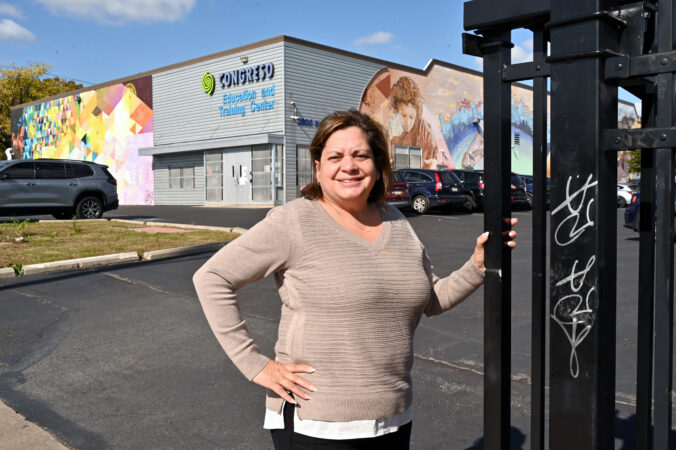
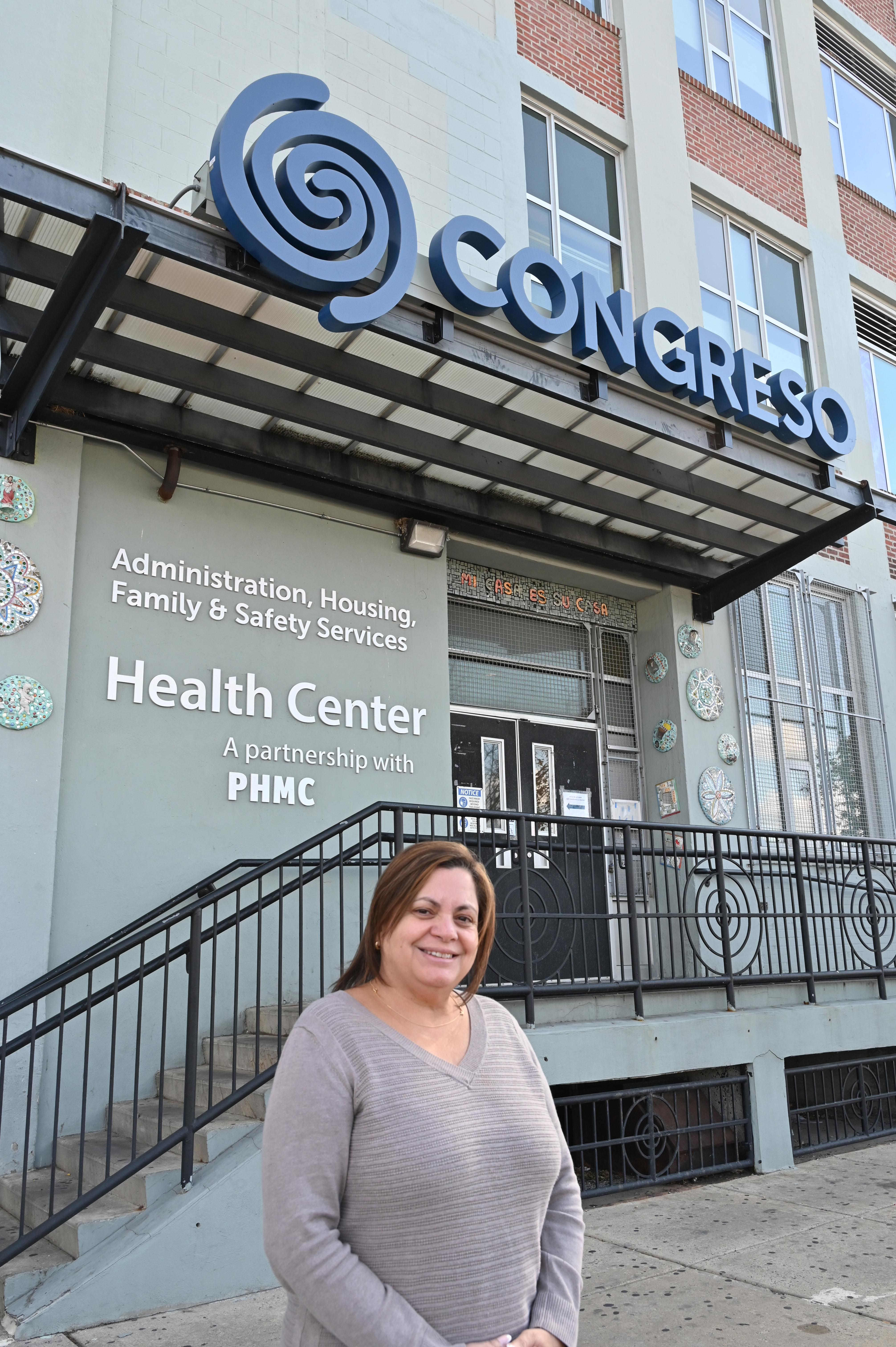
Jannette Diaz, president and CEO of Congreso, outside the group’s offices in North Philadelphia.“We’re all feeling the crunch,” she said of recent funding challenges.
“It takes a lot of courage to come up here and share your story,” Ramona Peralta, Congreso’s director of family wellness, said as the woman finished speaking. “We’re very proud of you, and we are here for you all the way.”
In the main room, the mood vacillated between the heavy silence of shared pain and the cheerful clamoring of babies. Later, there was music, and before, a friendly lunch of rice with pork and chicken.
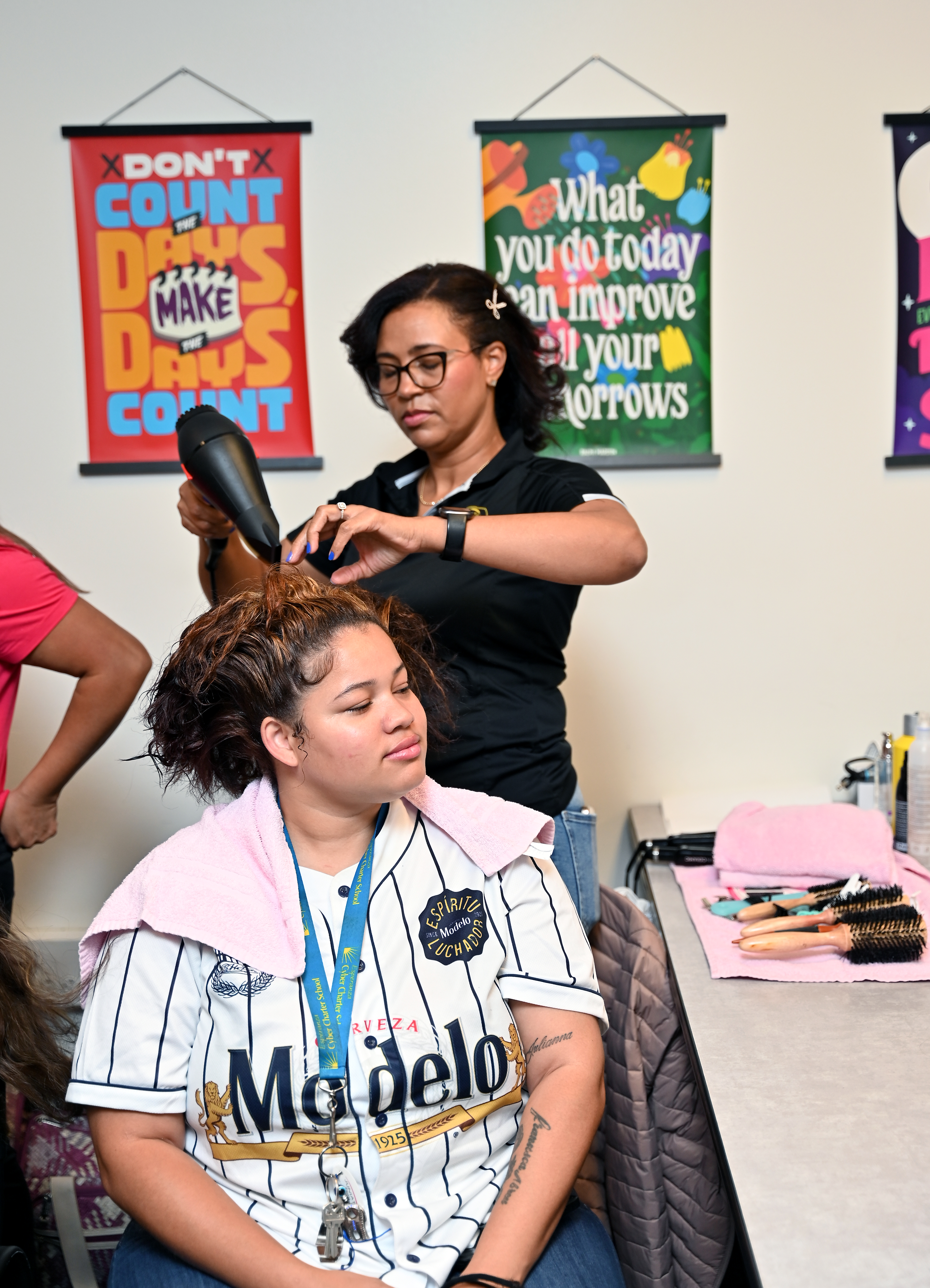
Across the hall, members of the Asociación de Cosmetologas de Pennsylvania offered free hairstyling to the women who attended the celebration.
Congreso, as part of its program to teach police, educators, social workers, and others to recognize signs of domestic abuse, had trained this group, as well, and because of the intimacy of their work, the stylists were uniquely positioned to do so. More than most, beauty salon operators could readily see the bruises hidden under hair and makeup. They could feel the cuts and scars on the scalp. And then there were the confidences confessed during shampoos and stylings.
Wanda Gómez, of the Blessings of God beauty salon, styles Franyeimi Abreu’s hair at Congreso’s offices.
Among the volunteers was Wanda Gómez, owner of the Blessings of God beauty salon in Northeast Philadelphia. “Thank God, I’m no longer in that situation,” she said, speaking through a translator. But because she survived domestic violence, she said she’s in a better position to help others. She tells them about Congreso.
Elisa Zaro Doran, owner of Dominican Divas Beauty Salon in Olney, twisted a strand of hair around a curling iron as she styled Maria Rodriguez’s long, dark hair. Like Gómez, Doran survived domestic abuse. “The first time, when he hit me, we were having a lot of problems, so I thought it was normal,” Doran said.
He’d even come into her beauty salon and hit her. “My clients would try to defend me,” she said. Eventually, when her son tried to protect her, she knew she had to take the necessary steps to get away and be safe — for herself and her children.
Rodriguez was there yesterday to support her daughter, who survived domestic violence, but still lives in fear — which is the reason she would only agree to be interviewed if her name was not used. “He told me that it doesn’t matter how many years — he will come and burn down my house with me in it,” she said.
Hairdresser Domaris Rodriguez shows her artistry on Raquel Mendez’s hair.
Rodriguez’s daughterturned to Congreso for help after Thanksgiving a few years ago. Her oldest son told her that day that he would no longer live with her, because every night he dreamed of killing his father. He couldn’t stay and watch the beatings or watch his father, in a rage, destroy the furniture in their home.
“I don’t know how many dining room tables I bought,” the daughter said.
On that Thanksgiving, she told her husband he had to leave. It was the end of the relationship, but the beginning of a new nightmare. He followed her to work and even stood in the pharmacy, watching her as she managed the office.
Counseling at Congreso helped her name her situation for what it was — abuse. “They made me see that I was in danger,” and that what she thought was normal was anything but. In group sessions, she learned a critical lesson: “I understood that I wasn’t the only one. They made me know it wasn’t my fault.”
She’s still afraid to leave her home. “I’m going through anxiety, PTSD. It still affects me.”
As she watched her mother get her hair styled, Rodriguez’s daughter hoped her mother would absorb a lesson from the stories she would hear. The daughter wanted her mother to understand the intergenerational legacy of abuse because she believes her mother also suffered from domestic violence.
That abuse, Rodriguez’s daughter believes, impacted both her and her sister, whose abuser stopped hitting her only when he thought she was dead. She teaches her sister lessons learned from counseling at Congreso. Counseling includes helping women develop a safety plan.
Rodriguez’s daughter brings her own little girl, 13, to Congreso’s counseling groups for children impacted by domestic violence. “I’m saving my sister’s life, and I’m saving my daughter’s life,” she said. As for her sons, “I’m not raising abusers,” as she reminds them to respect their girlfriends.
Last month’s celebration in honor of the survivors of domestic abuse took center stage that day at Congreso, but Congreso’s programming benefits many more people in the community, 75% of whom are Latino, said Jannette Diaz, president and chief executive.
Diaz grew up a few blocks from Congreso, and her father relied on the nonprofit for help with the family’s utility bills.
These days, she spends time working on strengthening relationships with fellow nonprofit agencies and with Congreso’s friends in the donor community.
“We’re all feeling the crunch,” Diaz said, describing a double whammy in mid-October of the state’s failure to pass a budget as the national government moved into another week of shutdown. Congreso gets much of its funding from government reimbursements for services provided.
At Congreso, “we’re very mindful of our spending. So far, we’re continuing to provide services at 100%, but there’s only so much we can do, tapping into our reserves and our line of credit.”
“Sometimes it’s heavy, but I’m also hopeful,” Diaz said, explaining that the twin state and federal budget crises required a sharper focus even as demand for services increases. Changes in Medicaid regulations may impact finances at Congreso’s health center, for example.
But, she said, donors can be confident their dollars are being spent wisely.
Why? Because as nonprofits come and go, Congreso has survived, thanks to providing trauma-informed and culturally responsive services that are informed by data to its clients, Diaz said.
“We’ve been around for 48 years, and there’s a reason for that. And that is how we operate within our community,” she said. “We forge a trusting relationship, and we try our best to do what they need. It’s important that we make sure our programs have impact.”
And that impact, Diaz said, goes beyond help given directly to clients. When Congreso assists a first-time home buyer in qualifying for and landing a mortgage, that homeowner becomes a Philadelphia taxpayer, benefiting the community.
When someone like Gary DeJesus-Walker earns a CDL truck-driving license through Congreso’s workforce training program, he can go on to build a trucking business. Now he employs three people.
“Congreso — they changed my life,” he said. “From trucking, I started two other companies.” With Congreso’s CDL program, “if you need a second chance, you can have one for the rest of your life. This is a way you can provide for and feed your family, forever.”
The stories are an inspiration to Diaz.
“Even in this season,” she said, “we can strategize and design services that our community needs. We’re not paralyzed by this crisis, and in terms of moving the needle forward, we’re progressing.”
This article is part of a series about Philly Gives — a community fund to support nonprofits through end-of-year giving. To learn more about Philly Gives, including how to donate, visit phillygives.org.
For more information about Philly Gives, including how to donate, visit phillygives.org.
About Congreso de Latinos Unidos
Mission: To enable individuals and families in predominantly Latino neighborhoods to achieve economic self-sufficiency and well-being.
People served: 13,435 unique clients served in fiscal year 2025.
Annual Spending: $30 million
Point of Pride: Trademarked Primary Client Model that drives Congreso’s bilingual and bicultural approach to delivering services in a client-centered, data-informed, and culturally responsive way, whether a community member is receiving support in education, workforce development, housing, health, or family services.
You can help: Become a monthly donor, a member of Congreso’s Corporate Advisory Council, or a volunteer in the Congreso Cares Program. Volunteers help with participating in program initiatives like Congreso’s free tax preparation, supporting program and agency events, and assisting with fundraising.
Despite years of bipartisan insistence that action is just around the corner, state leaders have yet to agree on a plan to regulate and tax so-called games of skill. While Harrisburg dithers, the machines have proliferated across the commonwealth, with dire consequences for many communities.
Make no mistake, ideally, these machines should be banned. However, courts have so far ruled that these devices — the use of which, proponents argue, involves a modicum of skill — do not run afoul of gambling laws. In reality, though, there seems to be little separating them from slot machines, which are regulated.
While no one knows the exact number of skill games in Pennsylvania, their impact is clearer.
Philadelphia City Council members have described them as a nuisance, attracting crime, and creating what are essentially unlicensed slot machine parlors. The all-cash machines also lend themselves to low-effort money laundering. Meanwhile, supporters claim the money from skill games helps small businesses, VFW halls, and other community anchors to pay their bills.
For Harrisburg, gambling in general has become a crutch to avoid tough decisions about spending and revenue. Taxing skills games is expected to bring in hundreds of millions of dollars to state coffers. That’s on top of the $2.7 billion the commonwealth already earns from existing forms of gambling, like slot machines, interactive virtual casinos, and online sports betting.
Gambling is a predatory, extractive, and addictive industry. Ignoring its negative effects while depending on gambling revenue to avoid broader tax increases is a counterproductive strategy for the Keystone State. Research shows that an incredibly high share of gambling revenue comes from a very small percentage of overall gamblers. People trapped in gambling addiction experience bankruptcy, divorce, and suicide at higher rates.
Yet, a small army of lobbyists, a surge in advertising, sympathetic social media influencers, and a hefty presence by gambling interests on campaign finance reports have made legislators fearful of taking action, even on skill games.
A recent pressure campaign sponsored by the industry led state Senate President Pro Tempore Kim Ward to declare that her caucus doesn’t “do well being bullied,” and that gaming interests “have done nothing but try to bully us. And I don’t think we stand for that.” But for years, that’s exactly what’s happened.
Beyond the million-plus dollars a year advocates have spent on political donations, some legislators report that the gaming industry is also using its cash to build influence in more subtle ways. Sports betting companies FanDuel and DraftKings have taken over from Bud Light as the sponsor of free service on SEPTA’s sports express. Skill games operators and others in the gambling industry are using the prospect of charitable donations to build political influence.
There is still some hope regarding skill games, at least. The Pennsylvania Supreme Court is currently hearing a case that could reinstate the previous ban on the devices. This would be a win for communities across the commonwealth.
If the machines are deemed legal, the state must at the very least ensure they are sufficiently regulated and taxed. Some of the legislation surrounding the games proposes that the Department of Revenue handle regulation. This would be a mistake. Given their similarity to existing gambling, the devices should be regulated by the Pennsylvania Gaming Control Board.
For her part, Mayor Cherelle L. Parker has softened her strong opposition to skill games, in part because Republican leaders in the General Assembly have promised the money could help support public transit, including SEPTA. The transit agency needs an additional, sustainable funding source. Still, politicians should remember there are other ways to raise revenue besides new forms of gambling.
Until the court or Harrisburg acts, skill games will remain in an unregulated, untaxed status quo. That may work for machine operators, but it doesn’t work for Pennsylvania.
JUÁREZ, Mexico — Carolina was living in Colombia as a refugee when her 15-year-old son disappeared. Almost a year after her boy went missing and she mourned his loss, she got a call from an international number.
Her son was alive 3,000 miles away in this historic Mexican city once known as “the Pass of the North,” nestled along the Texas border.
“I was so happy, but I didn’t know how to get here, without knowing anything, without money, with nothing,” she told me when I met with her recently at an immigrant shelter in Juárez. “I sold my house and came here alone.”
After a harrowing three-month journey during which she made her way across seven countries, survived two kidnappings, and endured beatings and sexual assault, she reunited with her son on Jan. 10.
They tried to get an appointment to cross the border through U.S. Customs and Border Protection’s CBP One app — part of a program launched by the Biden administration to allow people to come to the U.S. legally while they waited for their asylum or other immigration case to be processed.
Carolina and her son were still trying when President Donald Trump ended the program the day of his inauguration.
They’ve been stuck in shelters ever since.
Speak to immigrants at the border, and what happened to Carolina is sadly common. Some people are luckier, some less so, but no one comes out unscathed from their journey. And while some are willing to see their dreams deferred, there are and will continue to be more people who see coming to the United States as the only way out of a desperate situation.
Visiting the border nearly 10 months after Trump took office and essentially ended the ability to seek asylum in the United States, you see what many Americans — even some begrudging critics — credit the president with doing.
Trump has been brutally effective at limiting border crossings. The quiet downtown streets and plazas, the nearly empty shelters in both El Paso, Texas, and its sister city of Juárez in Mexico, are a testament to that fact. Only a few years ago, thousands of immigrants crowded sidewalks and shelters here, straining the region’s spirit of hospitality.
Today, the immigrants left behind are the vulnerable among the vulnerable, advocates said. People who are unable to move out or move on, stuck in shelters with the hope that Trump’s “hard heart will soften,” as one woman told me.
My own heart was not hard enough to dash her dream. Perhaps it should have been.
The last thing immigrants need is for some well-meaning dope to ignore the facts for short-term comfort. They had enough of that during the Biden administration.
A large “Welcome to Mexico” sign hung over the Bridge of the Americas is visible as President Joe Biden talks with U.S. Customs and Border Protection officers in El Paso, Texas, in 2023.
Good intentions
Under President Joe Biden, about six million people were allowed entry to pursue asylum applications and other immigration cases, according to the Migration Policy Institute.
I believe that all things being equal, the U.S. has no trouble absorbing these immigrants. Call me cynical (I prefer pragmatic), but our economy runs on cheap labor and consumer spending — six million people give you both. It gives you adults who are willing to do the work Americans won’t, and kids who will go to school and graduate for the jobs there aren’t enough Americans for.
But the problem is the president can only do so much. The executive can allow people to remain in the country under some sort of limited parole, it can direct enforcement toward higher priority targets, such as immigrants with criminal records, but it cannot grant legal status.
Only Congress can do that, and legislators have decided there is no major issue they can’t shrug off as intractable and call it a day.
So the Biden administration opted to let people in — regardless of whether they had a good asylum case — knowing full well that just as one president could open the door for immigrants, another could slam it in their faces.
Biden himself shut that door halfway as the 2024 presidential election neared, but the political damage had already been done, because the administration at no point made the argument for why it was doing what it was doing.
As desperate people who wanted a better life clustered at the border — partly because of the pent-up demand that grew under pandemic restrictions Trump put in place — Bidencould have made a moral argument, or laid out the economic benefits of immigration. He could have done more than introduce immigration reform shortly after taking office, and then just as quickly give up on it.
Instead, it was never clear what Biden wanted other than not to be seen as the bad guy.
His administration’s humanitarian intentions, coupled with incessant fear-mongering on the right, paved the way to where we are today.
Flags from North, South, and Central America line the left side of the chapel inside the Casa del Migrante in Juárez, Mexico, in November.
All for nothing
It took Helen, her husband, and their 3-month-old baby three months to travel from Ecuador to the Casa del Migrante shelter in Juárez, which is run by the Roman Catholic Diocese of Ciudad Juárez.
Like Carolina, Helen — who remains concerned about the status of her potential immigration case — would speak with me only on the condition that her last name not be used.
Helen and her husband, both in their early 20s, arrived in October of last year after leaving their home because of growing gang violence. “You couldn’t have any peace anymore,” Helen said.
The family crossed the dangerous jungle and rode through Mexico on the freight train known as “the beast.” She saw a man die, falling under the wheels of the cars.
While her husband goes out to work odd jobs, she takes care of their daughter. The routine gets to her, she said. Once a month, they’re able to go out and splurge on a meal, even as they’re afraid to walk the city’s streets.
Her daughter has now lived most of her life inside a shelter, but Helen told me they will continue to sacrifice.
“We are waiting to cross. Whatever it takes,” she said.
Across town at the Vida shelter,Carolina, 53, is torn aboutwhat to do.
Her journey to Juárez began 14 months ago. Distraught over her son’s disappearance, she went back to her native Venezuela to be with her mother.
When Mexican officials informed Carolina that her son was alive, she left Venezuela on Oct. 20, 2024, and traveled across Central America. She was kidnapped twice, Carolina said. Once when she crossed the Guatemalan border into Mexico, and again when she got to Juárez in December.
“The one here was the worst. The one here was rape, beatings. I still can’t fully touch myself here,” she said, grimacing as she moved her hand along her left breast. “They left me with nothing.”
Although she’s grateful for all the help she’s received, she said, it’s coming up on a year of living in shelters,and the uncertainty is becoming overwhelming.
Her son is going to high school, and sometimes works with a handyman. She sells donated used clothing in front of the shelter and cleans houses, but work is sporadic.
“I tell my son we should go back,” Carolina said. “He says he came here for a future.”
Her mother calls and tells her she doesn’t have food, she said. She trusts that God has a plan and things will work out accordingly — even if it means returning home to struggle there — but there must be a point to her journey.
“You go hungry, you grow tired, it’s raining, you see corpses. You spend sleepless nights, running from people who want to rob you, kill you,” she said.
“Do you know what it’s like to go through what I went through and not be able to cross?”
President Donald Trump during a July tour of “Alligator Alcatraz,” a migrant detention facility at Dade-Collier Training and Transition facility in Ochopee, Fla.
No turning back
Many immigrants who are still in shelters, and those who have decided to remain in Mexico, are in a state of flux, waiting for the opportunity to cross the border.
Trump may have succeeded in curtailing illegal immigration through a mix of enforcement, deterrence, and cruelty, but it is unsustainable. While he may be able to delay the inevitable — especially if he manages to crash the economy and there are fewer jobs for immigrants to fill — eventually, people will return.
“Listening to people’s stories, we’re really at a critical moment,” said Alejandra Corona, who heads Jesuit Refugee Services in Juárez, a nonprofit that serves the migrant community. “The world is broken, and there are no options.”
You see it in the eyes of parents who are deeply wounded because they cannot provide for their families even in the most basic ways, Corona told me, and the reasons why are far from simple.
“It’s not just, ‘Oh, I lost my job,’” she said. “It’s, ‘I had a job, but couldn’t afford to pay off the gang member or the cartel. I stopped paying for protection and had to flee. I was discriminated against, I’ve never had a passport, I’ve never been to school, I’ve never had access to my rights. I do not exist, and no one wants to see that I don’t exist.’”
The lesson to be drawn from the border today is that immigrants may not be as visible, but they haven’t gone away.
If Democrats capture the presidency in 2028, they will likely not follow the Trump administration’s amoral ruthlessness, but they cannot repeat the Biden administration’s aimless permissiveness, either.
Everyone suffers under the current seesaw approach to immigration, where an immigrant can come here “the right way” under one administration, only to see things turn out wrong under the next. Trump has tried — successfully and unsuccessfully — to kill programs for immigrants established under Presidents George H.W. Bush, Barack Obama, and Biden.
Whether or not you support immigration, the whims of an individual — even if it’s the president — are no substitute for the legislative process.
The United States is a nation of immigrants. America has thrived economically and culturally thanks to this fact. On immigration, it’s Congress, as representatives of the people, who must determine the who and how, the when and where, that makes the most sense for the country.
Until then, immigrants will be ready and waiting — and prayingfor a softer heart in the White House.
This week’s Shackamaxon is all about how cities change, whether some like it or not.
Meno Italiano
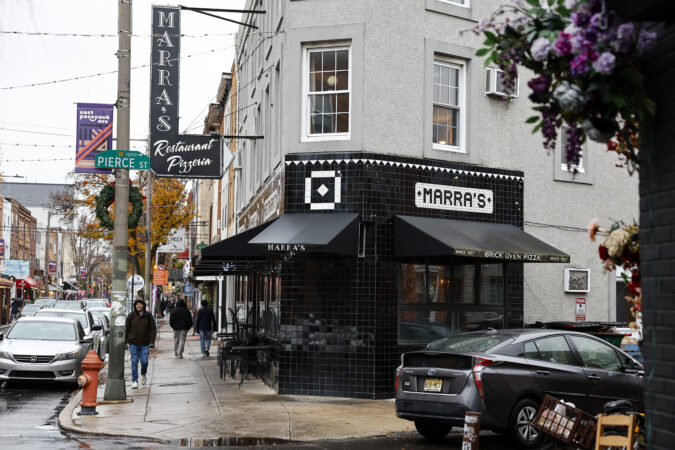
Like so many of my neighbors in South Philadelphia, I had been meaning to go back to Marra’s on East Passyunk Avenue for a while when I heard the news of its imminent closure. The classic Italian restaurant was just two years shy of a century’s worth of business when the owners found an interested buyer in Dan Tsao, the owner of Chinatown’s EMei.
In an interview with my colleague Michael Klein, Marra’s owners blamed a lack of parking for contributing to their decision to close and potentially relocate. Given their location on a thriving and increasingly renowned dining corridor, some have expressed skepticism about this diagnosis. To me, however, it rings true in a different way.
After all, when Marra’s initially opened, parking would not have been much of a concern. Their customer base, like much of the customer base for the new restaurants on the corridor, would have lived nearby. The pizzeria was part of an extensive Italian American community that came to be synonymous with South Philadelphia during the 20th century. Over the years, the center of gravity for this lively community moved to places like Cherry Hill, where people get around by driving, not walking. This means that, over time, many existing businesses have become more dependent on the ease of parking.
Marra’s is not the only neighborhood institution to fall victim to this phenomenon. While many still call it the “Italian Market,” the stalls on Ninth Street are now more likely to be occupied by Asian and Latino entrepreneurs. When I first moved to South Philly in 2011, I’d regularly hear older residents conversing with each other in Sicilian. That’s much less common today.
I call this process suburbanization. As more members of a community live and work outside the city, it becomes harder to maintain the institutions that helped forge their identity in the first place. After all, who wants to fight for a parking spot in South Philadelphia when there’s unlimited free parking at the many Italian restaurants closer to home?
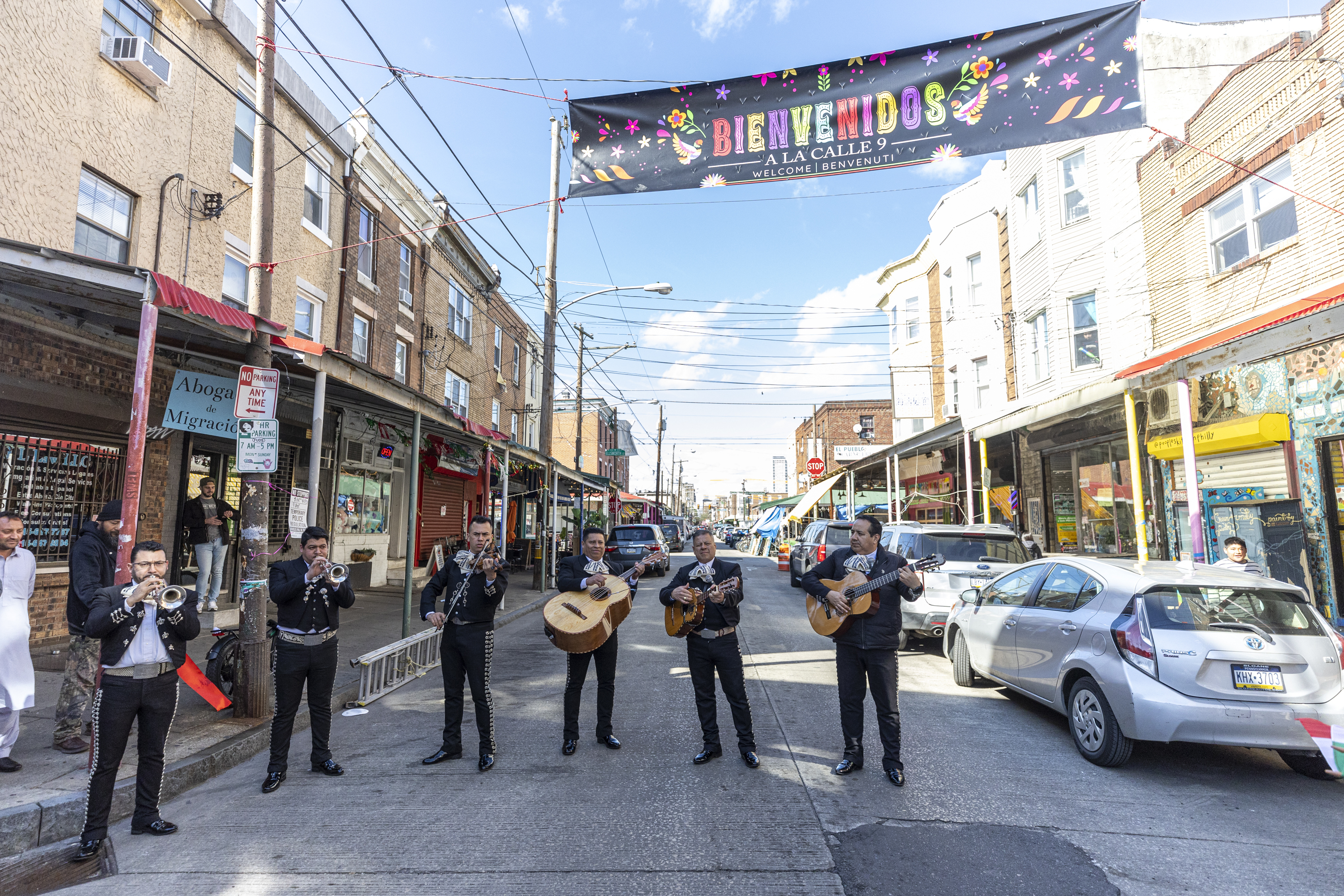
Rey Azteca Mariachi performs in 2024 below the then-new banner welcoming shoppers to Ninth Street in South Philadelphia.
Fight displacement, not change
Marra’s and South Philadelphia are hardly alone when it comes to managing suburbanization. The same phenomenon affects Chinatowns across America, including Philadelphia’s own. Szechuan and Cantonese cuisine are now available throughout the region, just like traditional Italian fare. The largest Chinese restaurant in the city is now Northeast Philadelphia’s China Gourmet, not a Chinatown banquet hall. This is why so many business owners feared the possibility of a Sixers arena on Market Street. They felt fans would be more interested in General Tso’s chicken and bubble tea than the authentic fare that defined the neighborhood. Meanwhile, they’d also take up parking spots that would otherwise be used by their own patrons.
Suburbanization even affects places of worship. During the debate over bike lane parking in Center City, I talked to Tim Geiger — then interim pastor of Tenth Presbyterian Church on Spruce Street — about why his congregation was so reliant on parking spaces. The answer was clear: They had gone through the suburbanization process decades before South Philadelphia or Chinatown.
While Geiger told me he encourages congregants to walk, use paid parking, or take transit, it can be a hard sell when so many can attend services closer to home, at a church that offers free parking.
For many people, this process is a reason to abhor or prevent change. They cite the increase in residential density in and around Center City, the work of groups like the Passyunk Avenue Revitalization Corp., and civic interventions like the Schuylkill River Trail as catalysts for gentrification. At a recent City Council meeting, members of the Committee on Public Property and Public Works echoed these sentiments, expressing a concern that a proposal to turn an abandoned railway viaduct into an expanded Rail Park and pedestrian pathway could drive out low-income residents.
This is the wrong way to conduct public policy.
After all, the South Philadelphia neighborhood that hosted Marra’s hasn’t seen a massive shift in its built environment. It has changed significantly anyway.
Santiago Uribe and his golden retriever Koda take a walk along the Rail Park in 2019.
Whose community?
As usual, Council members expressed their skepticism about the park proposal by putting their thoughts into the mouths of residents who conveniently were not there to express their opinions themselves. Jeffery “Jay” Young and Quetcy Lozada, in particular, were concerned that there hadn’t been enough community engagement, or that the park would serve as a playground for wealthy residents, leaving the rest of the city behind.
Paul Levy, the former head of the Center City District, is heading up the planned expansion of the Rail Park. Levy said the plan is to unite neighborhoods and offer a useful amenity, not to push anyone away. Unlike Councilmember Young’s plans to demolish the Cecil B. Moore Library, the Rail Park has already earned the support of local civic associations. Center City District held 15 meetings to gauge community reaction to the idea.
It is a process that’s already been successful for the Center City District’s other big projects, Dilworth and Sister Cities Parks. Both serve as urban oases for families across Philadelphia thanks to thoughtful programming and design choices. Levy told me to think in three concentric rings: community involvement in design, community involvement in programming, and a comprehensive housing and development plan for the surrounding neighborhoods.
That’s a lot more thought than obstructionists like Young and Lozada likely put into their opposition.
The U.S. War Crimes Act of 1996 is explicit about what is believed to have occurred on the high seas on Sept. 2.
Murder. —
The act of a person who intentionally kills, or conspires or attempts to kill, or kills whether intentionally or unintentionally in the course of committing any other offense under this subsection, one or more persons taking no active part in the hostilities, including those placed out of combat by sickness, wounds, detention, or any other cause.
I believe a shipwrecked individual hanging on for dear life to the detritus of an attack fits this explicit description. In fact, I would suggest the original attack order fits this description, as well, as I have yet to see evidence that these individuals were involved in hostilities or combat of any kind.
The facts are that the Post relied on a single anonymous source who presented no evidence that such an order was given. In fact, the New York Times reported that there was no direct evidence to make that determination. Yet, many people ran with another anonymous source to launch a broadside against the administration, claiming war crimes had been committed. We are entitled to our own opinion, but not our own facts.
Interestingly, a group of Democratic representatives recently made a video about the importance of service members ignoring illegal orders. Then — lo and behold — an anonymous source claims such an order was given, again with no evidence. Then, the Democrats demand hearings. The sequence is interesting. There is an old saying that you can tell the people who are actually doing something about our problems by the arrows in their backs.
MG Del Rossi, Blue Bell
. . .
It is almost unbelievable that while Pete Hegseth is ordering the killing of suspected drug dealers in boats off the coast of Venezuela, Donald Trump is pardoning a convicted drug lord who brought hundreds of tons of cocaine into the United States.
It is almost unbelievable that the Trump administration is seeking to court-martial Mark Kelly for making a video with fellow members of Congress, reminding members of the military that they swear an oath to the Constitution and are not required to follow illegal orders.
It is almost unbelievable that Hegseth orders a bomb strike on suspected drug dealers, and then the killing of two survivors of the attack. That the Trump administration is incompetent, corrupt, and full of hate — now that is believable.
Mary Ann Furin, Philadelphia
. . .
While there has been debate over the legality of recent attacks in the Caribbean and the Pacific, the illegality of the attack on survivors of a first strike, reportedly ordered by Defense Secretary Pete Hegseth, is crystal clear. Whether it was a war crime or simply murder committed in our name, there is no question that Hegseth has broken the law. This murderous act falls squarely within the “high crimes and misdemeanors” referenced in Article II, Section 4 of the Constitution — the impeachment clause. If murder is not worthy of impeachment, then that section is a dead letter. Every member of the House of Representatives should be asked when we can expect articles of impeachment to be filed. If they refuse to impeach Hegseth, then they should be voted out in 2026.
Jared Cram, Philadelphia
Join the conversation: Send letters to letters@inquirer.com. Limit length to 150 words and include home address and day and evening phone number. Letters run in The Inquirer six days a week on the editorial pages and online.
KENNER, La. — When the day New Orleans had feared for weeks finally came on Wednesday, it began with a lie as wide as the meandering Mississippi River.
A port city somehow dubbed the Big Easy despite its centuries of big trouble woke up to a frigid blast of Arctic air and a claim from the U.S. Department of Homeland Security that local immigration raids it’s named the “Catahoula Crunch” would narrowly target “criminal illegal aliens roaming free thanks to sanctuary policies …”
Within a couple of hours — in raids that were, in fact, wildly untargeted — SUV caravans bearing masked, green-uniformed U.S. Customs and Border Protection (CBP) agents stormed into parking lots and at suburban Home Depots and Lowe’s, blitzkrieged Latino restaurants and a car wash on a busy strip near the airport, and cruised neighborhoods looking for roofers to arrest.
On a hunch, I drove to a Home Depot here in Kenner at lunchtime and found them: a platoon of maybe 15 masked Border Patrol officers in olive-drab uniforms and dark baseball caps wrapping up a sweep of the parking lot, strutting past the piled-up orange shopping carts and ignoring a film crew shouting, “Why are you here?”
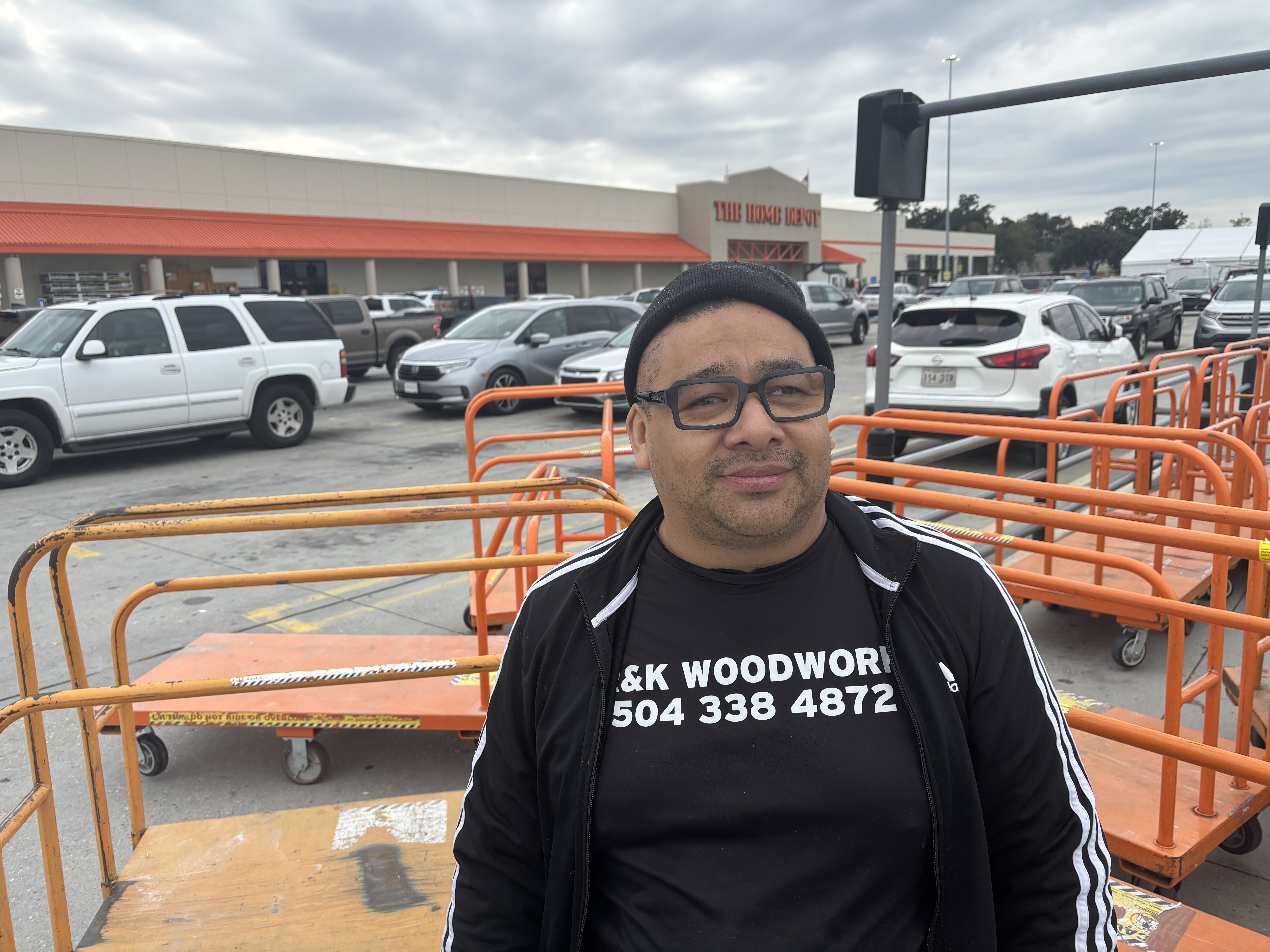
Ricardo Ramírez, a 50-year-old construction worker and a U.S. citizen, had just pulled into the Home Depot lot to return some items when, as he told me a few minutes later, one of the officers came up to him and barked, “Which country? Are you a citizen?” Ramírez carries his passport because “it’s so crazy what’s going on that I have to, just because I look Spanish” — and was surprised when the officers moved past without asking to see it.
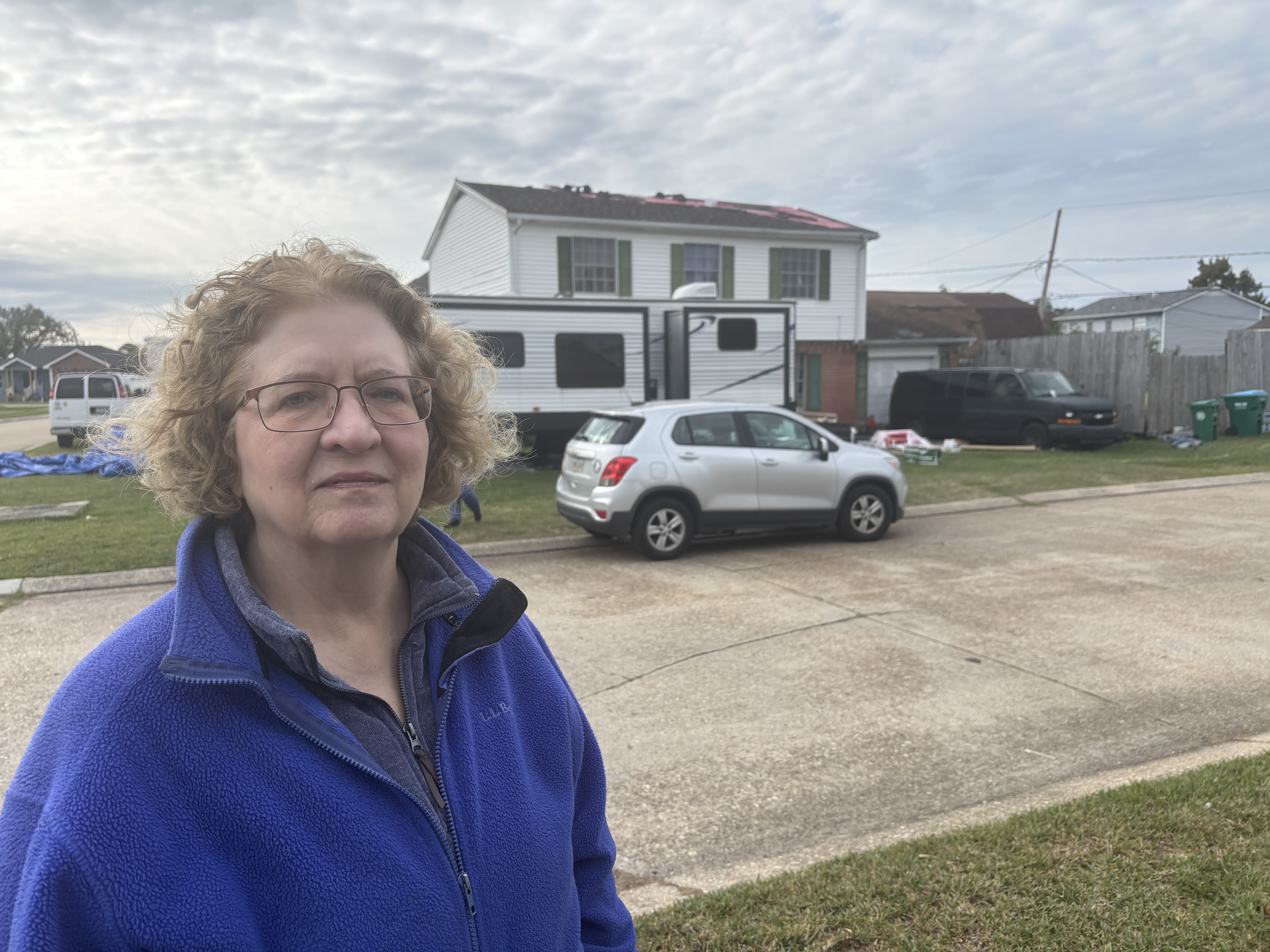
But at that moment, just two miles away in a suburban subdivision in North Kenner, citizen volunteers raced to find another 12-agent Border Patrol team raiding a two-story home with white siding and green shutters. As an agent trained a sniper rifle on them, two Latino workers who’d been replacing a metal roof damaged in a recent hurricane stood atop the home, hands in the air.
Zoe Higgins, a 33-year-old social worker who volunteered with the group Unión Migrante to track the immigration raids and watched the tense drama, told me, “I could only imagine how they were feeling, and I was filled with anger.” But as more and more citizens and some journalists crowded the narrow, one-way Louisiana State Drive, they saw the agents leave — the rooftop workers spared, but two other crew members handcuffed and whisked away, destination unknown.
This is life during wartime in America in 2025, as an iconic U.S. city that celebrates itself as a boiling gumbo pot of Spanish-style architecture, Louisiana French, and spicy Creole culture suddenly finds itself under a terrorizing siege from the same federal government that promised billions so “New Orleans will rise again” after the devastation of Hurricane Katrina 20 years ago.
Heard about Los Angeles? Heard about Chicago? Heard about Charlotte, N.C.? The 10-month-old Donald Trump regime has stumbled into a playbook for the xenophobic mass deportation drive it promised voters in 2024 — an “American Counter-Revolutionary Guard” of around 250 masked Border Patrol officers, led by the arrogance and telegenic evil of their commander, Greg Bovino, rampaging the Lowe’s parking lots and back alleys of one U.S. city before caravanning in their black SUVs to terrorize the next.
Ricardo Ramírez, a 50-year-old construction worker, talks about being questioned by Border Patrol agents at a Home Depot parking lot in Kenner, La., on Wednesday.
I flew from Philadelphia into Greater New Orleans Tuesday afternoon, just in time for the launch of the so-called Catahoula Crunch, because I wanted to see what it looked and felt like when the U.S. government sends a commando squad to wage war on one of its own cities. That meant spurning the beignets and darkened French Quarter jazz clubs of my 10 prior visits here and instead embedding on Williams Boulevard in Kenner, where former Pizza Huts are now taquerias with twinkling white lights and mariachi-style music is pumped into the markets.
This is the New Orleans tourists only see speeding past in their airport Ubers, where in low-slung brick homes under the constant roar of jet engines, the Latino community has nearly tripled since 2000 — swelled by Mexican and Central American workers who labored around-the-clock on the massive post-Katrina reconstruction. That narrative of communal pride has been swamped by a palpable fear that this week pervades Kenner, where nearly a third of residents are Latino, yet the police chief is pro-immigration raids.
By the end of the day, observers tallied around 12 to 14 apparent arrests. There was no evidence that any of these people were on the list of 10 most-wanted actual criminals Homeland Security pictured along with Wednesday’s launch — catnip for the Fox News audience clinging to the delusional Big Lie that Team Bovino is only targeting bad guys.
Instead, his secret police just swarmed wherever they could find the most brown-skinned people — the Home Depot lot, a white van filled with contractors, Mexican restaurants — and acted like the gun-toting officer in the recent movie Civil War who famously asked, “What kind of American are you?”
In Bovino’s past operations, only a fraction of those arrested and facing deportation had criminal records — just 44 out of 370 in last month’s Charlotte op — and there was no evidence that Louisiana’s “Catahoula Crunch” would be any different.
The Rev. Jane Mauldin, a Unitarian minister and immigration watchdog, outside a home worksite that was raided by Border Patrol agents on Wednesday.
Yet, the real terror in Kenner is what you don’t see — a vibrant community that overnight has vanished underground.
Shoppers who enter the Latino-oriented Ideal Market on the Williams strip are greeted with a sign: “STOP: NO ICE ACCESS IN THIS BUSINESS.” Yet, at midmorning Wednesday, there was just one shopper in the entire supermarket, outnumbered by workers stocking bins of green and yellow plantains and glistening produce that looked utterly untouched.
“A lot of people are staying home, not going out,” Ramírez, the worker questioned by Border Patrol, told me. “We work in construction, and we are shorthanded. We know people don’t want to go to work. They are afraid.”
Several local volunteers shared the same thought: that these “papers, please” random raids and the families hiding behind closed blinds and locked doors remind them of the stories they’ve read about Jews who lived in constant fear of Nazi raids in the 1930s and ‘40s.
“I keep thinking about Anne Frank, who was kept alive with her family by a good friend named Miep,” said the Rev. Jane Mauldin, a Unitarian minister who was one of thevolunteers who raced to the North Kenner raid on the roofers, referring to the Jewish teen who eventually died in a German concentration camp in 1945, and her Dutch protector. “I keep in my head saying, ‘What would Miep do?’”
School attendance is down, and church pews are empty. Volunteers are collecting food for families that have suddenly gone into a COVID-level lockdown, and almost everyone who is out and about has a friend or coworker who abruptly went into hiding when they heard Border Patrol had targeted New Orleans.
Father Luis Duarte, a 33-year-old immigrant from Colombia, talks about plunging attendance at St. Jerome Catholic Church, in Kenner, La., where he is pastor, as federal immigration raids begin on Wednesday.
“There is a good friend of mine who hasn’t left her house in a week,” Mauldin said. “Her children are not going to school because of the fear … And she has all the right papers, but she’s not a citizen, so there is a possibility that she could be kidnapped and taken away and never see her children again.”
The Rev. Luis Duarte, the 33-year-old Colombian-born priest at St. Jerome RomanCatholic Church in Kenner, told me that attendance at weekend Masses offered in Spanish has plunged, and a family that for weeks had been planning a joyous quinceañerafor their daughter’s 15th birthday called it off. “They are fearful,” he told me, adding, “Not fearful because they are criminal, but because they are Hispanics.”
Duarte was one of many who spoke of the unbelievable irony that the very people who came to the United States with hammers and 16-hours-a-day energy to rescue New Orleans in its darkest hour, after flooding from 2005’s Hurricane Katrina swamped thousands of homes and killed 1,833 people, are now seeing their new world turned upside down by the same U.S. government that vowed to rebuild the Crescent City.
Duarte said his parishioners have told him of yard signs that welcomed the 2005 influx in Spanish — the same language government agents are now using to profile those they seek to handcuff and whisk away. “So when I see what’s going on now …” the priest said, then paused. “Yeah, why?”
Yeah, why? This feels like a domestic Vietnam in reverse: We saved the town in order to destroy it. You can glean clues from the way Bovino and his cosplay tin soldiers preened for the prearranged cameras on Canal Street Wednesday afternoon, or the twisted name for his operation. The Catahoula leopard dog is the official state canine, revered by Louisiana’s early settlers for their ability to herd cattle and hunt down wild boars. The “crunch” is the sound of jaws ripping flesh. It’s a terrible echo for a place that once sicced bloodhounds on its enslaved people.
Commander Greg Bovino led a group of Border Patrol agents on walk around the French Quarter in New Orleans this afternoon. pic.twitter.com/mo5jGUd8wH
The cruelty was the point in 1825. The cruelty is the point in 2025. The day laborers outside Lowe’s, just wanting to hammer shingles onto your roof, are the modern-day Christians thrown to Bovino’s cowardly lions in a Roman circus for Fox News couch potatoes. Same as the Somali Americans in Minneapolis, whom Trump was slandering on Wednesday as “garbage.” The worst Americans can revel in the latest model of white supremacy while their Dear Leader is robbing them blind and stashing the profits in crypto or the Trump Plaza Kazakhstan or whatever.
But every day, more and more people are catching onto the scam and asking what Miep would do. “This hits very deep and very personal for many of us — in my neighborhood, almost every roof had to be replaced,” Mauldin said. “The men who were willing to go on the roof in 100-degree heat in September 2005 were not white, not Black — mostly, they were the Latino men who rebuilt this city.”
Hours later, I stood at the busy corner of Elysian Fields and St. Claude with a dozen protesters amid a nonstop cacophony of cars responding to one of their signs: “Honk If Your Ancestors Were Immigrants.”
In a colorless move that, Pantone says, speaks to our collective longing for calmness, a clean slate, serenity, and focus, the New Jersey-based global color authority named Cloud Dancer — a billowy, balanced white — as its 2026 color of the year.
The blank hue’s uncluttered vibe, Pantone says, plucks us out of the day-to-day crazy of our newsfeeds, AI-generated madness, and hustle culture.
White, says Pantone Color Institute’s vice president Laurie Pressman, offers relief and respite. White noise silences the cacophony of worry rattling around in our overstimulated brains. The color gives us permission to think, refocus, and chart a new future.
The pause between the doing, white is the be-ing.
“White speaks to the value of measured consideration and quiet reflection,” Pressman said. “It represents a future free of toxicity and excess … contentment and peace, unity, and cohesiveness. It’s ethereal. White embraces the clouds.”
Sweet dollops of whipped cream are white, meringue is white. Fluffy mashed potatoes are white, too.
A fresh pair of Air Force 1s, patent leather go-go boots, a clean tee, a crisp button-up. A voluminous bridal gown. We ski in winter white.
Mikado crop top with organza ball-gown skirt, limited edition ($1,150) at David’s Bridal, with pearl-drop earrings ($1,300) at Rosnov Jewelers. (Michael Bryant/Staff Photographer)
White is fly.
“In fashion and interior design, white is in our comfort zone,” said Leatrice Eiseman, executive director of the Pantone Color Institute. “It’s natural and organic. It’s about sustainability.”
White is ethereal. She’s dreamy. She represents new beginnings. I’m overwhelmed, too. I would love to drop my precepts and jump into a world of my own making. Architectural white shirts and black pants are my grown woman fashion go-to.
I get it.
But y’all, white is the color of the year in 2026.
As a Black woman living in Trump’s America, I can’t help but wonder if Pantone’s choice of Cloud Dancer was much more of a nefarious harbinger than they perhaps realized.
No, I don’t think Pantone is low key promoting whiteness or advocating for a white savior.
Cloud Dancer, the 2026 Color of the Year, is billowy like this curtain blowing in the wind.
Fashion and style always gives us clues to the future. So, I asked Pantone if they were tapping into something that perhaps they weren’t even aware of?
“Absolutely not,” Pressman said, her tone pleading with me to stop with the correlation. “Pantone is not political.”
Pantone is not political, true. But its trend forecasters keep their manicured fingers on the pulse. And in this moment I’m unable to ignore Ku Klux Klan robes are white, too.
COY is always right
Pantone’s Color of the Year is rooted in fashion. Its early picks – oceanic Cerulean in 2000; orange Tiger Lilly in 2004; and golden Mimosa in 2009 – influenced clothing, accessories, and makeup. As we moved deeper into the millennium, COY was the trendy choice for Kitchen Aids, accent walls, and Post-it notes.
In the last decade, however, color of the year has come to define our collective moods more than just our fashion aspirations.
It’s the aura hovering over the world, indicative not just of the life we have, but the one we want. The colors have become a peek into the energy of the feelings driving tomorrow’s zeitgeist.
That became crystal clear in 2016, the first year Pantone chose two colors — a pink Rose Quartz and a baby blue Serenity. The dual hues were a nod to the emerging blurring of gender lines.
In 2021, Pantone chose two colors again: Ultimate Gray and Illuminating Yellow.
A key reason why Pantone chose white is because, Pressman said, people are craving blank slates.
“People have gotten to a point where they see what’s happening isn’t working for them anymore,” Pressman said. “They want something different, new, authentic.”
Debris is seen at a largely demolished part of the East Wing of the White House, Thursday, Oct. 23, 2025, in Washington, before construction of a new ballroom. (AP Photo/Jacquelyn Martin)
Cloud Dancer, Eiseman said, is a throwback to classic fashion, citing Coco Chanel and Audrey Hepburn. Sure, fashion of the “Golden Era” was glamorous. These women were undeniably well-dressed, but it was also a time when white gloves and girdles were the norm, and equally glamorous Black women like 1940 Academy Award winner Hattie McDanielwas forced to sit in a segregated section during the Oscar ceremony because her white colleagues didn’t want to sit next to her.
When the conversation turned to the yin (black) and yang (white) of fashion, I wondered aloud if, maybe this could have been a year when Pantone chose two colors: black and white. Perhaps this could signify harmony.
Crickets.
Pantone’s Color of the Year image of the Cloud Dancer.
Later, I realized Pantone didn’t pick the cooperative vibe up, because it just wasn’t there.
I’m not ready to wave the white flag yet. In the midst of all this, white remains a shade of hope, purity, and freedom. It’s the color of the Suffragist movement. Pantone’s is simply yet another canary in the coal mine which means I have a lot of work to do.
On this date 56 years ago, I awoke in my tiny apartment on the South Side of Chicago and heard the news that changed the course of my life: Fred Hampton was dead.
Hampton, chairman of the Illinois Black Panther Party, had been killed that morning in what the Chicago police described as a “shootout” between them and members of the party at the group’s West Side headquarters.
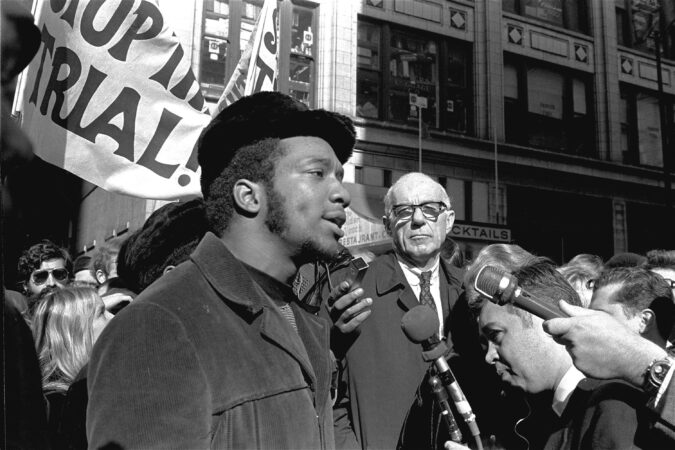
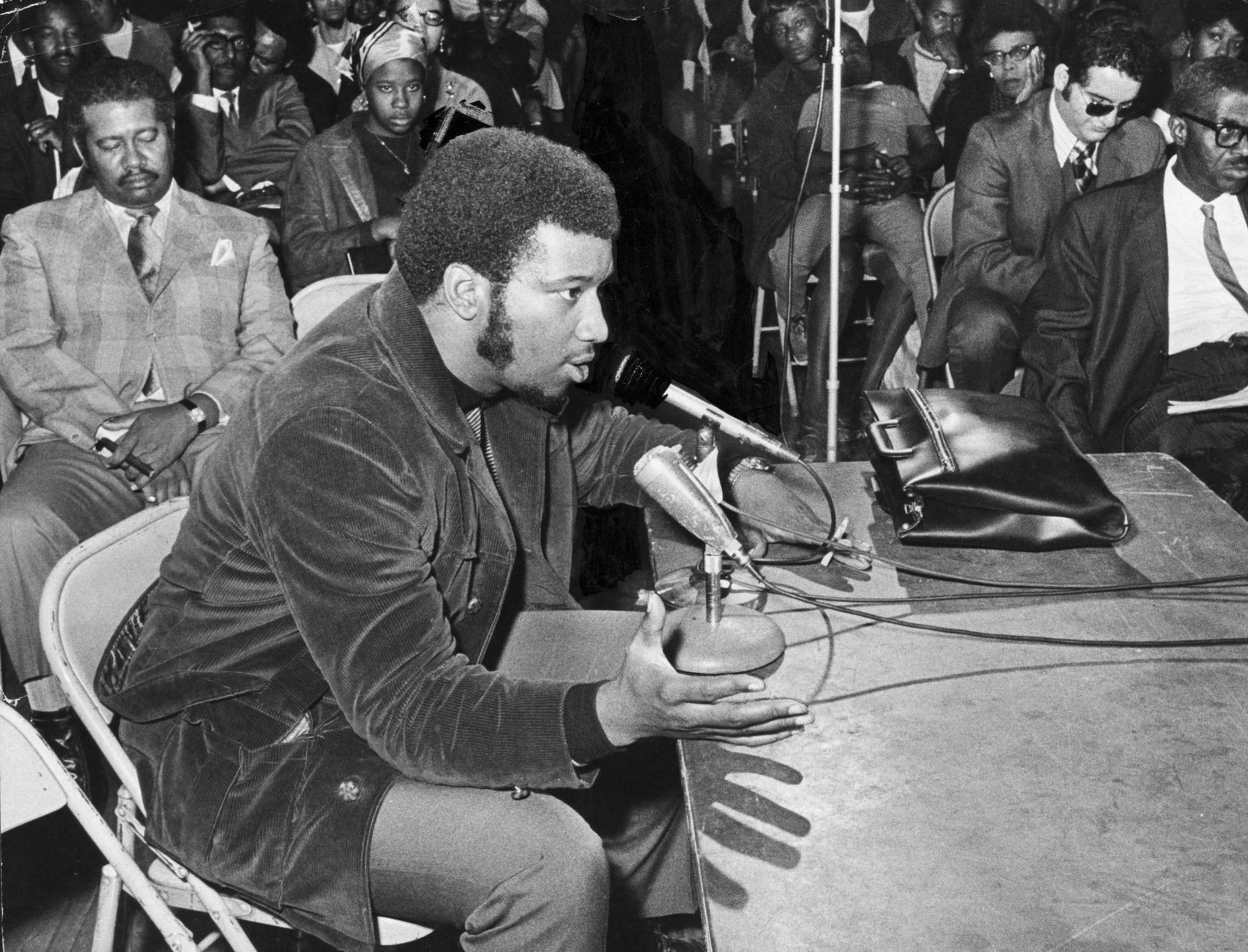
Hampton was 21, a year younger than I was then. But he already was a magnetic, charismatic figure on the left, clearly destined for leadership beyond the Panthers and Illinois.
I was a graduate student at the University of Chicago, looking for a purpose in life that academia was not providing. Suddenly, the death of Hampton — actually, the assassination of Hampton — gave me that purpose.
Just as many young Americans watched the events of Sept. 11, 2001, and felt compelled to join the military, I watched the aftermath of Hampton’s death and was moved to become a journalist.
At 21, Fred Hampton was already a magnetic, charismatic figure on the left, clearly destined for leadership beyond the Black Panthers, Don Wycliff writes.
I had been habituated to the importance of news since I was a child in rural East Texas, listening with my maternal grandfather to Gabriel Heatter’s quavering delivery of the news each evening on the radio.
In high school, I read and watched in terror as the Cuban missile crisis unfolded. And the year before my high school graduation, I watched faithfully as CBS’s Roger Mudd delivered daily reports on the progress through Congress of the Civil Rights Act of 1964.
But even as I progressed through college at the University of Notre Dame, it never occurred to me that a Black kid like me could become a journalist. And then came Dec. 4, 1969.
The Chicago media were all over the Hampton story, and I was into every news story and broadcast about the case.
One station broadcast a police reenactment of the raid and shootout.
Five daily newspapers — including the legendary Black publication the Chicago Daily Defender (which, a few years prior, had been led by an editor named Chuck Stone) — published editions virtually around the clock, constantly trying to advance the story.
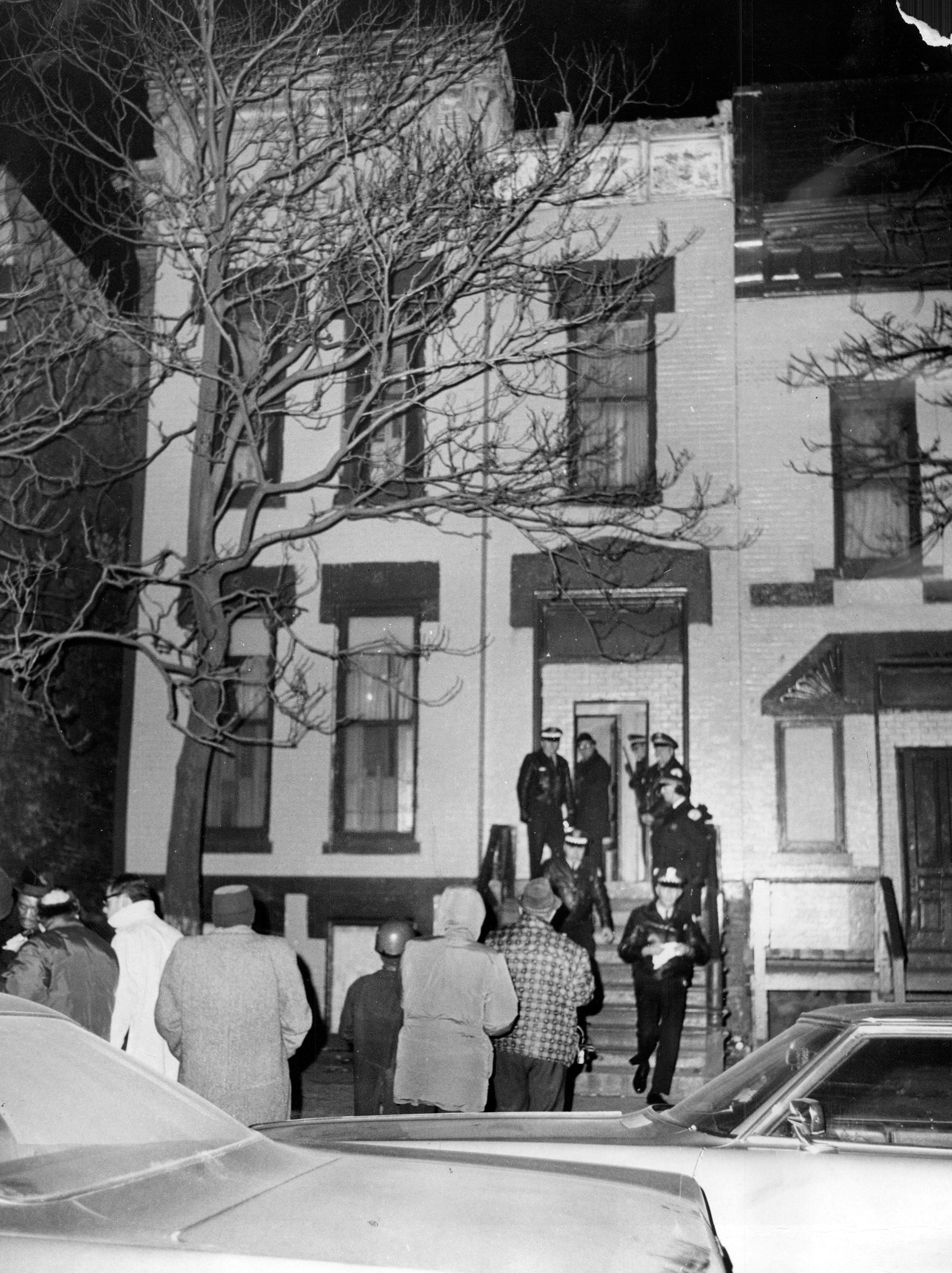
On Dec. 4, 1969, police gathered at 2337 W. Monroe St. on Chicago’s West Side, where Fred Hampton and another member of the Black Panthers were killed.
Eventually, it became clear that there had been no “shootout” at all, but a shoot-in by the police. The clincher was a front-page photo in the Dec. 12 editions of the Chicago Sun-Times under a headline that read, “Those ‘bullet holes’ aren’t.”
The police had put out a similar photo earlier, claiming to show holes in a door caused by bullets fired from within the Panther apartment. The Sun-Times photo showed they were actually rusted nail heads.
What all of this demonstrated to me was the power of journalism to expose truth, to lay bare hidden facts for examination by citizens of a democracy. And after seeing it done, I knew I wanted to do it, too.
The Hampton case was the catalyst for my desire to do journalism, but there have been others.
Bob Woodward and Carl Bernstein inspired a whole generation of journalists with their coverage of Richard Nixon’s Watergate scandal.
And in cities and towns and hamlets all across the country, journalists have unearthed inconvenient truths that people in power would have preferred remained buried — and that undoubtedly inspired others who wanted to do the same.
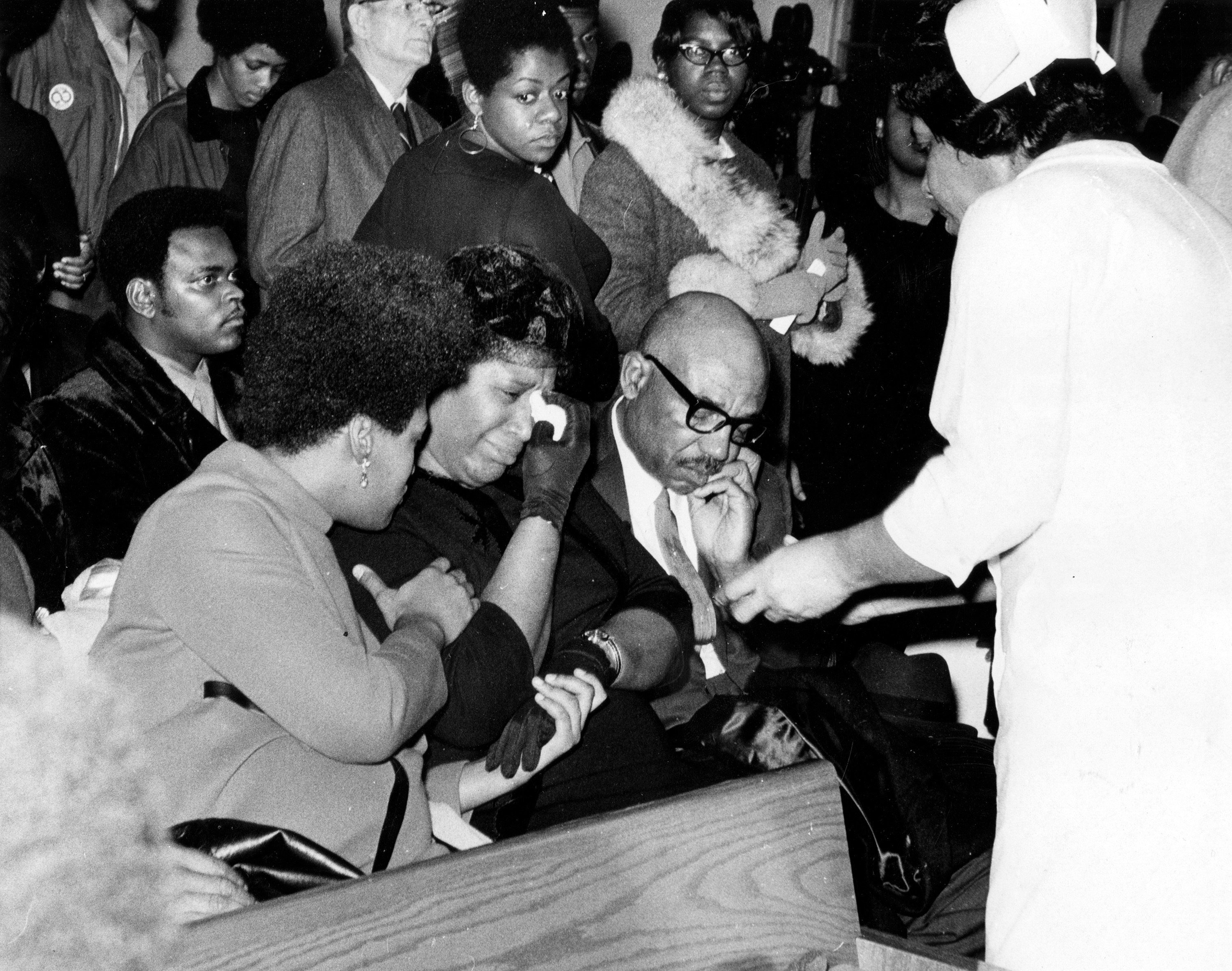
The parents of Fred Hampton, Mr. and Mrs. Francis Hampton (center with tissue-second and third from left), weep during a memorial service for their son on Dec. 9, 1969, in Melrose Park, Ill.
But there are plenty of abuses short of lethal ones that cry out for investigation and exposure. In a world where those in power see disagreement as disloyalty, protest as terrorism, and constitutional mandates like due process as dispensable annoyances, the need for passionate, implacable, even clamorous, journalism endures. And will, I suspect, for at least another 56 years.