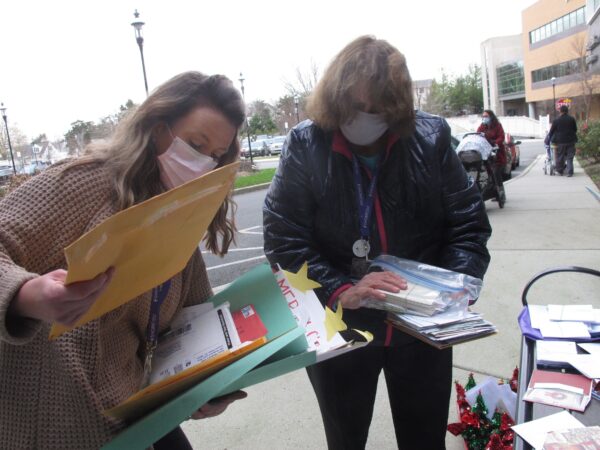
It’s suddenly December, and the Thanksgiving leftovers are mostly eaten. That means it’s once again time to make the big decision: Is this the year to finally stop sending holiday cards?
When I graduated from college, I promptly embraced the trappings of adult life, from getting a job to buying a car to moving into my own apartment. But the step that made me feel most adultlike was sending out my own holiday cards. A holiday card from a separate address says: “This is my household. Not my parents’ household, mine.”
Not cheap
Sending holiday cards isn’t cheap.
There are the cards themselves, which go up in price if you’re sending a photo card or selecting fancy lined envelopes. Stamps are currently 78 cents apiece, which doesn’t sound like much, unless you’re sending out 50 cards or more.
And then there’s the issue of time: You have to decide on the cards and purchase them, write a little note in each card, address the envelopes, then make your way to the post office.
Yet, despite the costs in money and time, I’ve always sent out cards, even in my younger, poorer years. There has always been a satisfaction in reaching out to people I don’t see regularly, but who nevertheless have a place in my heart and my history.
A customer at Paper Source in Chicago on Dec. 18, 2018. The greeting cards retailer filed for bankruptcy the next week.
Then, about 10 years ago, I realized we were receiving fewer cards each year.
The clogged mailbox became progressively emptier over a span of years, like a dying mall. This shift shows up in statistics from the U.S. Postal Service, which notes that mail bearing postage stamps, including cards, letters, and bill payments, dropped from 16.5 billion pieces of mail in 2019 to 10.7 billion last year.
For the first few years, I worried the non-senders were going through challenging times. A person doesn’t feel very merry if they’ve gotten divorced or been laid off or had a death in the family. But it turned out that — fortunately — very few had faced hardship. They just weren’t sending cards anymore.
“It’s a lot of trouble,” said one. “I don’t have the time,” said another.
People who used to send holiday cards can now share photos online of their family and their travels. Because they’re regularly connecting with those far-flung cousins and high school friends on social media, mailing out cards has become redundant and maybe even pointless to them.
The young adults in my life, including my own grown children, who are now in their 30s, haven’t just decided against sending cards; the idea never occurred to them in the first place.
So once again, at this time of year, I consider whether to keep the tradition going. But there are several relatives who are not on social media, and there are a few longtime friends I’m in touch with only through holiday cards.
It’s a poignant yearly ritual to go over the list of recipients, noting who has moved, who has married, who has had a baby, and who has passed away. People come and people go, and nothing underscores this quite like the holiday card list.
Better to let them know they’re loved, right now.
So I will get to the task, laying cards and envelopes neatly on the kitchen table. My husband will look at me blankly.
“Are we still doing that?” he’ll ask.
Elizabeth Luciano writes essays and fiction and teaches composition at Bucks County Community College.
One day, an English teacher at my gigantic public high school in Manhattan paused the lesson.
He placed his hands shoulder-width apart on his ancient desk. He hooked his toes on the rim of the chalkboard behind him, and there he was: suspended in the air, floating above the sullen earth toward the end of third period on a dismal November day.
“Have you ever seen anyone do this before?” he asked.
He looked around from his perch, mischievous joy sparkling in his eyes beneath his mop of white hair. He held the pose, and then the period bell rang.
That the teacher happened to be Frank McCourt, who would later win a Pulitzer Prize for his memoir Angela’s Ashes, is only partly relevant. Mr. McCourt was celebrating the weirdness and joy of being human, the possibility and story in every moment.
Messing with our heads
And, like all good artists, he was messing with our heads to pop us out of our usual selves, into the realms of creativity and new thought that have always moved civilizations forward.
For a teenager unhappy to be in school at all, he was a welcome light.
Federal law enforcement officers watch from atop the ICE facility in Portland, Ore., as a protester in a frog costume demonstrates.
The Portland Frog reminded me of that moment, now 40 years ago, the way it stood there with its belly out like a 3-year-old asking for cookies, and the unbelievable, cowboy-laconic toughness the suit’s occupant expressed after an ICE agent pepper-sprayed his vent hole: “I’ve definitely had spicier tamales.”
Contrast this great fun to today’s singularly humorless White House, as best exemplified by press secretary Karoline Leavitt. In a recent exchange, a reporter inquired about the significance of a Putin-Trump summit meeting proposed for Budapest, Hungary. Why there? In 1994, that’s where Russia promised not to invade Ukraine if that country gave up its nuclear weapons.
Leavitt responded with a string of insults. But the question was actually interesting and thoughtful: It would have been more fun to mull its implications than to be a jerk.
Used to be funny
Deranged as Donald Trump is, he has always been funny. But even that modestly redeeming trait seems gone in this bleakly self-serious White House. If I were an autocrat in training, I’d be worried about that, on durability grounds.
The late anthropologist David Graeber and the archeologist David Wengrow are known for rethinking early human history in a way that credits Neolithic peoples with intelligence and whimsy. In the spirit of the Portland Frog or Mr. McCourt, early humans may have initially avoided labor-intensive agriculture because they had other things to do, including storytelling, masquerades, or traveling. Maybe early signs of trade were not nascent capitalism, they argue, but the result of vision quests, or of women gambling.
Our best human projects survive because they are aspirational, offbeat, and fun. Early democracy in the U.S. was certainly colored by those qualities. When an exhausted John Adams arrived in Philadelphia for the first Continental Congress, he went straight to a bar — City Tavern. Pursuit of happiness, anyone? And yes, dark projects occur, but they rarely last long.
Visiting my mother recently in that same city of Philadelphia, close to her 88th birthday, I wondered what characteristics lead to a long life and other lasting human projects.
My mom marched in “No Kings” Day. She suggested we visit a unique beer shop with hundreds of ales to get some Thai beer to pair with our meal. And perhaps, she also offered, you would like to attend the euphonium concert I’m hosting tomorrow night?
Helping her declutter her storage closet, I held up a Chock full o’Nuts coffee can. “What are we doing with this?” I asked. “I was saving it because it had the twin towers on it … It might be valuable.”
Indeed, the can featured the skyline of my youth. “It’s art,” I said. “We’ll keep it,” placing it on a shelf for display, an Arabica-scented monument to a city as it once was, still a place of joy and loss and resilience.
Photos from within U.S. Immigration and Customs Enforcement detention centers show a contrasting vision of the city: pictures of humans in distress, put upon by violent, masked, monstrous agents. The victims’ faces were a panoply of the diversity of the American experience. Perhaps some were vicious criminals, but most seemed to be moms, children, or laborers.
If they were really Tren de Aragua, would they be crying?
In the contrast between that dungeon and my mom’s happiness project, I caught a glimpse of the reason our country has endured and thrived, even despite many imperfections.
As parents enter this fall’s college application season, they’ve likely been warning their children incessantly that a degree in art history or philosophy won’t pay the bills.
“Study something practical,” they’re muttering, “so you can get a job.”
But a report from the Federal Reserve Bank of New York tells a different story. Census data from 2023 on recent college graduates reveal that the unemployment rate of students majoring in art history and philosophy, in fact, resembles that of some STEM majors.
This is welcome news. Studying the humanities — which includes art history and philosophy, but also history, literature, language, religion, and music — isn’t an impractical luxury. Rather, these subjects offer a competitive, if still hidden, advantage and return on investment in the job market.
The humanities prepare students not just to get a job, but to keep it, and excel while doing so. And Wall Street seems to be noticing.
“We have more and more conviction that we need people who majored in history, in English, and things that have nothing to do with finance or technology,” he said, adding, “It’s that diversity of thinking and diversity of people and diversity of looking at different ways to solve a problem that really fuels innovation.”
Death reports exaggerated
Yes, despite grim headlines about the “death” of the humanities and the end of the English major, the chief operating officer of BlackRock, arguably America’s largest multinational investment company, is now actively seeking college graduates in the humanities.
Why are the humanities, then, continuing to lose ground on college campuses? Partly because their most important financial benefits do not show up immediately upon graduation. But this myopic perspective, which has long devalued the humanities, is now affecting the perception of what has been the most popular major in recent years: computer science.
Only recently, professors Mary Shaw and Michael Hilton of Carnegie Mellon University wrote in the New York Times a persuasive defense of computer science, whose majors have seen such a rapid decline with the rise of generative artificial intelligence that graduates cannot even get a job at Chipotle.
Computer science majors should not panic, however.
“The rise of generative A.I.,” Shaw and Hilton said, “should sharpen, not distract us from, our focus on what truly matters in computer science education: helping students develop the habits of mind that let them question, reason and apply judgment in a rapidly evolving field.”
By the same token, as AI reshapes the world, the content of humanities education is more vital than ever for addressing the ethical and existential questions such change provokes.
The skills cultivated by majoring in the humanities are equally worthy of defense as those of computer science. The wide-ranging studies of the economics of education show that humanities degrees are being underestimated for the job skills they promise students in tomorrow’s workforce.
Graduates await diplomas. Derided in the age of technology, a humanities degree can bring untold rewards, writes Gene Andrew Jarrett.
Finally, the critical skills they develop can withstand the rapidly changing technologies that force workers to relearn demanding job tasks. Studying the humanities, then, is akin to investing in academic stock today for long-term professional gain.
One recent study tells us that the “wage-by-major statistics” parents and students review before declaring a major undervalue how “an education in history increases a student’s labor market value — perhaps through the development of critical reading and writing skills or because reading history texts cultivates a transferable attention to detail — that enables them to earn higher wages when they seek employment after graduation.”
Transferable skills
The “transferable” nature of skills is a significant educational benefit of the humanities. A 2020 study describes the labor market returns to the specific, or technically specialized, nature of a college major. That “specificity” determines how much the skills inculcated by this major are transferable across different jobs.
In short, the humanities consistently produce some of the most transferable skills across professions.
Another 2020 study looks at earnings dynamics, changing job skills, and careers in science, technology, engineering, and math (STEM). Studying the humanities can develop the skills that overcome the following conundrum: When a person acquires only “specific skills that are in high demand but also changing rapidly over time,” that person likely will need “to learn many new tasks each year.”
To make a long story short, a humanities education results in one of the slowest measurable rates of counterproductive “skill change.” This means the skills learned through a humanities degree endure resiliently, even in the face of massive technological changes.
The humanities, of course, have substantive educational benefits. Their themes enable students to learn several critical things about humanity, such as the impact of human intelligence and creativity, the evolution of ideas about humankind, and the vitality of language and culture in how to see and survive in the world.
But the true value of the humanities includes their ability to build the professional skills students need to thrive in the global workforce — especially at a time when colleges may be deciding whether to consolidate or eliminate humanities departments, majors, and courses.
The question, then, that parents and children should ask isn’t, “What can you do with a degree in art history or philosophy?” The better question is, “What can’t you do with it?”
Yes, contrary to what you might think, a degree in the humanities, alongside degrees in computer science and many in between, remains one of the smartest investments students can make.
Gene Andrew Jarrett is dean of the faculty and William S. Tod Professor of English at Princeton University.
While those of us concerned about the future of our nation’s scientific institutions and safety net feel distraught without a way to protect them, we doomscroll and spiral out further. Yet, it is in that doomscrolling that a solution may lie.
Why are we giving away our attention to plutocrats, for free, when we could be investing it in the direction of the common good?
Meta, the parent company of Facebook and Instagram, made over $160 billion in advertising revenue last year, largely generated by our clicks, our scrolling, and the algorithms that entrap us and, too often, damage our children’s mental health.
That $160 billion flowed into a corporate machine with a primary duty to its shareholders, not to the public.
Gutting research
Meanwhile, the federal government canceled $8 billion in research grants to more than 600 colleges and universities through the National Institutes of Health and the National Science Foundation. And that was just in the first six months of the second Trump administration. That’s a mere 5% of Meta’s profits.
And while an exact figure for Donald Trump’s contested cuts to nonprofits remains elusive, he did try to cut $400 million from AmeriCorps, and tried to claw back $49 million in aid to the lawyers representing abused and neglected children. The nonprofit sector stands to lose even more if the president’s budget reinforces changes to the tax code.
That’s the bad news.
But we believe these catastrophic losses to research and charity can be turned into wins. We believe it is time to rewrite the social contract of social media.
Cell phones are ubiquitous, and social media generates billions. A new platform could direct money to nobler purposes, the authors write.
Imagine a nonprofit social media platform run with input from universities, nonprofits, and research institutions — a competitor to Facebook, Instagram, TikTok, and X — where every dollar from advertising and sponsorship supports charitable missions and research.
The model is radical in its simplicity: users engage much as they do now, advertisers pay to reach them, sponsors chip in, and instead of profits accruing to billionaires, the revenue stream funds scientific research and humanitarian programs.
You like cat videos? Great — so do the researchers fighting pediatric cancer that your ad clicks just helped fund. Need a dopamine rush from someone liking a picture of your sandwich? So does the charity furnishing apartments for unhoused people. Why cede the attention economy entirely to the for-profit sector?
Imagine if even a fraction of Meta’s $160 billion in ad revenue were redirected into research into Alzheimer’s and other diseases. On a new social media platform, users could earmark the revenue they generate for particular causes or research institutions.
Critics will scoff: “You can’t compete with Facebook.” But Myspace once seemed unassailable. TikTok rose from nowhere to global dominance in under five years.
Attention is fickle. Platforms age. Generations shift. And when they do, new players emerge — players who can ride the next wave of interface design, AI integration, and community-driven features.
Or, starting small but growing with time, we can build an economic engine designed with community input and guardrails to serve the public good.
Ours is not a utopian dream.
The infrastructure exists. The advertising market is there, especially among small local businesses and nonprofits. We don’t know yet what innovative features the platform can offer, but the human desire to connect online isn’t going anywhere. The only missing piece is the will to claim a piece of that market for purposes nobler than quarterly earnings.
The call here is straightforward: Help us build our social media platform, CommonLoop. We are starting off as a lawyer and a journalist with an email account, seeking an anchor sponsor and early participants.
If you’re a university president, a nonprofit director, a philanthropist, or simply someone with the resources and skills to help launch such a platform — now is the time. The start-up costs are real, but so is the prize: a self-sustaining system that turns the most lucrative business model of the digital age into a public trust.
Click, scroll, like — but this time, make it count.
To this day, George Matysik, executive director of Share Food Program, can’t bite into a South Indian dosa without remembering a daily act of kindness that mattered to him when he was a young man, a paycheck away from poverty.
When he would arrive for his 6 a.m. shift as a housekeeper at the University of Pennsylvania’s engineering school building, the engineering school’s librarian would hand him a homemade dosa, a thin crepe redolent with the warm smells of curry and potatoes.
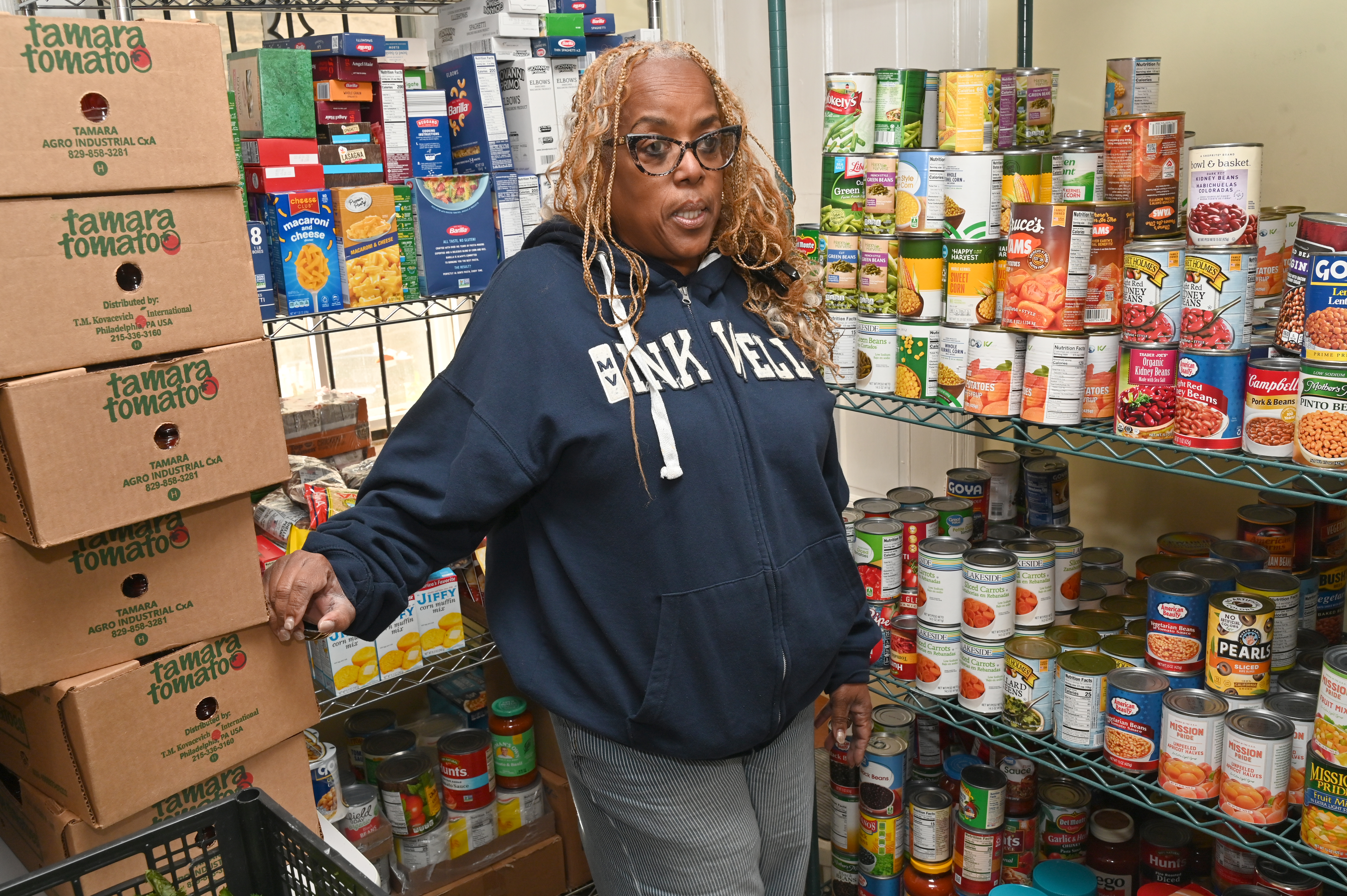
“My stomach was growling by then,” he said, sitting in a warehouse full of food ready to be packed for the nearly three million people who rely on the Philadelphia nonprofit for food.
“The moment of her handing me that dosa, I felt like I was going to be OK,” he said. Matysik, who graduated from Mercy Career and Technical High School across the street and down the block from Share’s main warehouses near Henry, Hunting Park, and Allegheny Avenues, went on to earn a degree in urban studies from Penn.
“I felt supported,” he said. Now, Matysik leads an organization that supports people who are missing meals and are worried about getting their next ones.
Look, Matysik said, society has many problems, and most are difficult to solve. Homelessness is complicated. Addiction grips its victims in its relentless stranglehold. “They don’t have simple solutions,” he said.
“But with hunger, it is simple. It’s getting food to the people who need it,” he said, like the dosa that began his day of washing floors and cleaning toilets at Penn.
“It’s frustrating to me that in the richest country in the world, a food program like Share has to exist at all,” Matysik said. “Food is a human right, and hunger is solvable. We have the resources in this country to eliminate food insecurity, and we can do it in Philadelphia if organizations like Share can get the resources.”
But it’s daunting.
Jimmette Hughes, a volunteer at the Canaan Baptist Church’s Family Life Center, which distributes food contributed by Share.
Since the start of President Donald Trump’s second term in office in January, Share’s funding from the federal government has been cut by $8.5 million, or about 20% of the nonprofit’s annual expenses.
Also, the cost of the food Share buys wholesale by the pallet has risen. The increase in food costs will come as no surprise to grocery shoppers around the nation, Matysik said. “We can all see our receipts.”
Even as Share’s resources are being depleted, demand for the food it provides is increasing. Share distributes food to nearly 400 community partners — religious groups, food pantries, neighborhood organizations — and all of them are telling Share that more and more people are coming for food.
Community partners report that the number of new families or individuals registering to receive food has increased 12-fold. For example, in the past, a community partner might register five new families or individuals a week. But in late October and early November, with the government shutdown and the delay in government SNAP food benefits, that number might have risen to 60.
And more people than ever are coming to receive food. Organizations that served 100 people or families on their food distribution days were seeing 150 in line, Matysik explained.
“It’s making it more and more challenging for families to get the resources they need,” he said.
Patricia Edwards understands. When Edwards, a retired security guard, opened her refrigerator on Veterans Day in mid-November, she saw one box of powdered milk. That was it.
Supplemental Nutrition Assistance Program benefits had provided barely enough in the past, but with all the back-and-forth during the shutdown, her benefits weren’t available. “I’m looking at a bare cabinet and a bare refrigerator,” she said.
Patricia Edwards picks up food, including a Share box of food in her cart, at the Canaan Baptist Church’s Family Life Center.
The only reason Edwards had anything to eat leading up to Veterans Day was that a neighbor stopped by with some prepackaged meals.
“I didn’t know what to do. I didn’t know where to go,” she said, “but a neighbor told me about this.”
So, on that cold November day, Edwards walked a few blocks from her home in Germantown to the Canaan Baptist Church’s Family Life Center, hoping she could get some groceries at its weekly food pantry. “I need some food in the house,” she said.
She wound up with a box of food from Share and two bags of groceries filled with tuna, noodles, cereal, and vegetables.
“It’s a blessing,” she said.
Of course, those blessings cost money.
Share pays $12,000 to $14,000 a month for electricity to keep its warehouses running. Each tractor-trailer-sized truckload of food costs $40,000. Each industrial-sized freezer costs $800,000, and Share bought three of them in the last two years.
Three years ago, Share expanded into two warehouses, one in Ridley Park in Delaware County and the other near Lansdale in Montgomery County, the better to serve people in Philly’s surrounding communities.
Share needs money for forklifts, for payroll, for trucks. Funding pays for food, of course, but it’s also necessary to bankroll the infrastructure required to move not just boxes of food, but tons of it, to the people who need it. Share pays drivers to deliver food to homebound seniors. Even that’s a cost.
Share also has government contracts to provide school meals to 300,000 kids per day in public and charter schools in 70 districts, including Philadelphia’s public schools.
It’s a source of revenue, “but we lose money on it,” Matysik said.
Beyond that, Share runs gardens and greenhouses, which serve both as food sources and educational laboratories for young people.
Years ago, Matysik was one of those young people crossing the street from his high school to pack boxes as a Share volunteer.
These days, his work at Share involves budgeting and fundraising — balancing demand against resources.
“I’ve never been more disappointed in the American government,” he said, “And yet, I’m inspired every day by the American people stepping up to support organizations like ours.”
This article is part of a series about Philly Gives — a community fund to support nonprofits through end-of-year giving. To learn more about Philly Gives, including how to donate, visit phillygives.org.
For more information about Philly Gives, including how to donate, visit phillygives.org.
About Share Food Program
Mission: Share Food Program leads the fight against food insecurity in the Philadelphia region by serving an expansive, quality partner network of community-based organizations and school districts engaged in food distribution, education, and advocacy.
People served: 2,901,243 in 2024
Annual spending: $42 million, including $25 million distribution of in-kind donations and $6 million to purchase food.
Point of pride: In 2024, Share Food Program supported nearly 400 food pantry partners across the region, provided more than 6,500 30-pound senior food boxes each month, ensured over 300,000 children had access to nutritious food every day through its National School Lunch Program, and rescued and redistributed nearly six million pounds of surplus food. Altogether, Share distributed 32,214,873 pounds of food.
You can help: Volunteer your time packing boxes, rescuing food, or make calls from home to help coordinate senior deliveries.
The American military has always been required not to comply with illegal orders; however, Donald Trump and his lackeys have claimed that the Democrats’ effort to remind our service members of that fact is, to quote Trump, “seditious behavior punishable by death.” Trump, either by ignorance or intent, misstated the Democrats’ statement by leaving out the word “illegal.”
The Nazi murderers, during their trials at the end of World War II, justified their actions by saying “they were following the orders given to them by their superiors.” The tribunals judging these men found them guilty of the most heinous war crimes, and they were either imprisoned or executed.
Our troops have a duty to disregard any illegal orders — no matter who gives them.
Paul S. Bunkin, Turnersville
. . .
Six Democratic members of Congress with military and/or intelligence backgrounds recently advised current members of the military that they did not have to obey illegal orders. For this, these six have been roundly criticized by many and might face federal investigations.
About 80 years ago, at the end of World War II, some members of the German military and other Germans were tried in Nuremberg for war crimes. Their defense? “I was only following orders.” The Nuremberg judges rightly declared that this was not a valid defense. Illegal orders are illegal and should not be followed.
What was true for Germans then is true for Americans now: Illegal orders are illegal and should not be followed.
Joan Chinitz,Philadelphia
Welcomed tax credit
In a rare moment of bipartisan state legislative reform, Pennsylvania now has its first earned income tax credit for lower-income workers. The measure complements the 50-year-old (and highly successful) federal Earned Income Tax Credit. It has the progressive hallmark of being refundable, allowing refunds where the credit exceeds state income tax liability. And although it is set at a refund level of 10% of the federal EITC benefit — which is far too low — it has the potential for future increases.
The state’s new credit should shine a light on the city of Philadelphia’s wage tax refund law, which is beset by an embarrassingly low 4½% take-up rate for those eligible; that figure is the result of a number of arbitrary eligibility and processing barriers that demand councilmanic reforms. An excellent start toward this end was made through a bill introduced this year by Councilmembers Kendra Brooks and Nicolas O’Rourke. These reforms — which will ensure continued upward mobility for lower-income workers and help keep our local tax system from undermining the financial security of its working-class residents — now await the full support of Mayor Cherelle L. Parker, Council President Kenyatta Johnson, and fellow members of City Council.
Jonathan Stein, Philadelphia
Join the conversation: Send letters to letters@inquirer.com. Limit length to 150 words and include home address and day and evening phone number. Letters run in The Inquirer six days a week on the editorial pages and online.
This week’s Shackamaxon welcomes back City Council’s quarrelsome contrarian and makes the most out of SEPTA’s “new” funding.
Council vs. community
Councilmanic prerogative, a tradition that gives individual district Council members sole discretion over land-use decisions within their constituencies, is not popular with the public. A 2022 poll found that only 22% of Philadelphians wanted to keep the practice, while more than two-thirds wanted it abolished. Among Council members themselves, however, prerogative is king.
During a recent City Council meeting, 7th District Councilmember Quetcy Lozada wondered when the phrase “councilmanic prerogative became a dirty word.” Council President Kenyatta Johnson said that “it isn’t like they say in the newspaper.” Most of their colleagues and predecessors make similar defenses of the tradition, which they claim is just a way to make sure the community doesn’t get steamrolled by powerful interest groups.
The process, however, often stymies community aspirations or pits the interests of some neighbors against those of others.
Fourth District Councilmember Curtis Jones Jr. reduced the number of development projects allowed along a stretch of Ridge Avenue in Roxborough, citing community opposition to new construction and parking woes.
The move, known as downzoning, took a sledgehammer to the net worth of longtime business owners along the corridor, with the value of their life’s work deflated overnight. They testified against the move at City Council, to no avail.
In the 8th District, Councilmember Cindy Bass has discouraged the redevelopment of sizable properties like the former YWCA, Germantown Town Hall, and the Ada H.H. Lewis Middle School, despite community support for doing something with those buildings.
In extreme cases, councilmanic prerogative has also been an invitation to more questionable practices. Just ask former 7th District Councilmember Rick Mariano, who was convicted in 2005 of taking prerogative-enabled bribes. “It’s just a very sketchy and nontransparent thing,” Mariano told WHYY in an interview a decade ago. “If I could do everything over again, I wouldn’t be a councilman. But if I was, I would not want anything like that. It can just come back and bite you in the ass.”
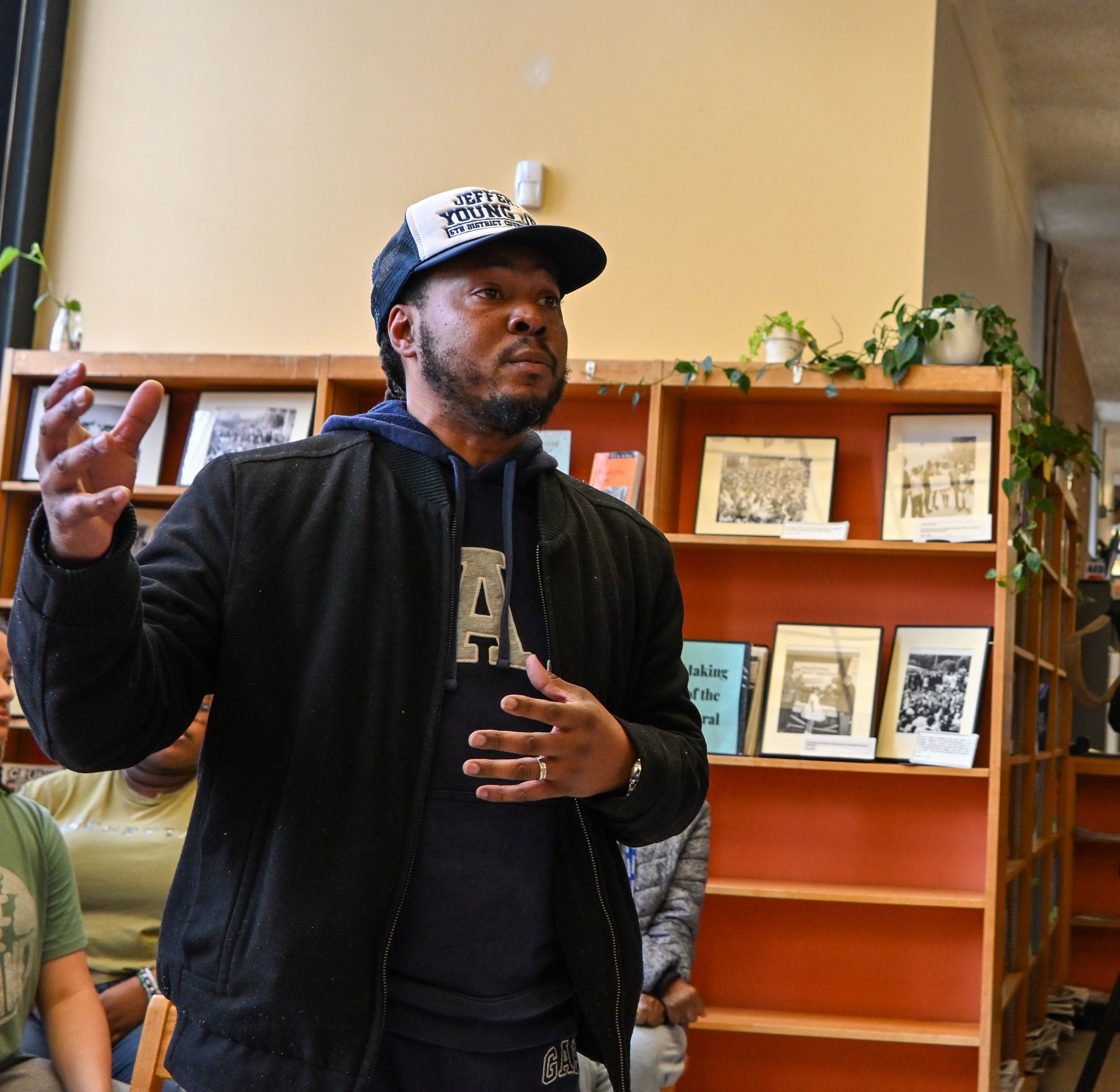
Councilmember Jeffery “Jay” Young speaks to community members at the Cecil B. Moore Library on Saturday.
No fighting in the library
A good example of how prerogative can get in the way of a neighborhood’s wishes is the recent debate over the future of the Cecil B. Moore Library.
Cierra Freeman, Claire Newsome, and the rest of the Save Cecil B. Moore Library coalition have been organizing and campaigning for years to renovate the current library building, which is on the 2300 block of Cecil B. Moore Avenue in North Philadelphia. They helped secure millions of dollars for the effort from the city’s Rebuild initiative. Then they were blindsided by Councilmember Jeffery “Jay” Young,who is finishing his second year representing the 5th District.
My newsroom colleagues have branded Young as City Council’s “quarrelsome contrarian.” While he’s bristled at the description, he also regularly confirms its accuracy. More than any other member of Council, Young has employed a haphazard approach to using the powers of his office, often stepping in at the very last moment to scuttle long-standing plans. Small businesses, street safety campaigners, and affordable housing advocates have all been burned by his tendency toward unilateral and inexplicable decision-making.
The library renovations are the centerpiece of what’s shaping up as his legacy of obstinacy.
First, Young opposed renovating the library because he wanted to redevelop the site as a mixed-use building, with affordable housing above and library services below. Community members expressed deep skepticism about the idea, and Young never produced a rendering or other documentation to prove that his plan was feasible.
On Saturday, Young told a packed community meeting about his plan to move the library, with a nearby city-owned lot on 19th Street identified as a potential location. Young, wearing a baseball cap emblazoned with his own name, presented the move as a way to ensure the community gets everything it deserves, including space for teenagers.
This vacant lot at 19th Street and Cecil B. Moore Avenue, currently used as a pocket park, would be the new home of the library if Councilmember Jeffery “Jay” Young gets his way.
Of course, the current renovation plans already include a revamped teen space. They are also the product of years of engagement between the city and the community. Young’s proposal, once again, lacks even the basics you’d expect from any developer coming to the community with a new construction project.
When I first arrived at the meeting, Young already had his hackles raised. He was berating a constituent and disrupting the proceedings. Another neighbor, Nadine Blackwell, who has lived in the area for 73 years, told Young, “I’m not gonna hit you,” citing his “defensive body communications.” The only resident to express any interest in his ideas was Bonita Cummings, a former staff member in his office.
Renovating a library should not be a contentious issue. It has become one only because City Council’s traditions allow members like Young to make it one.
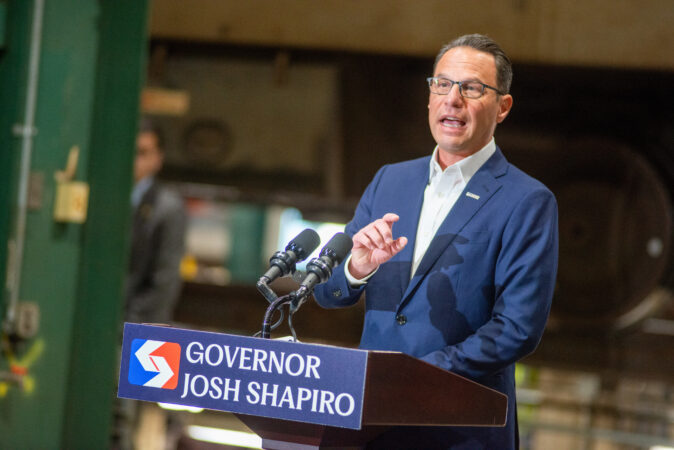
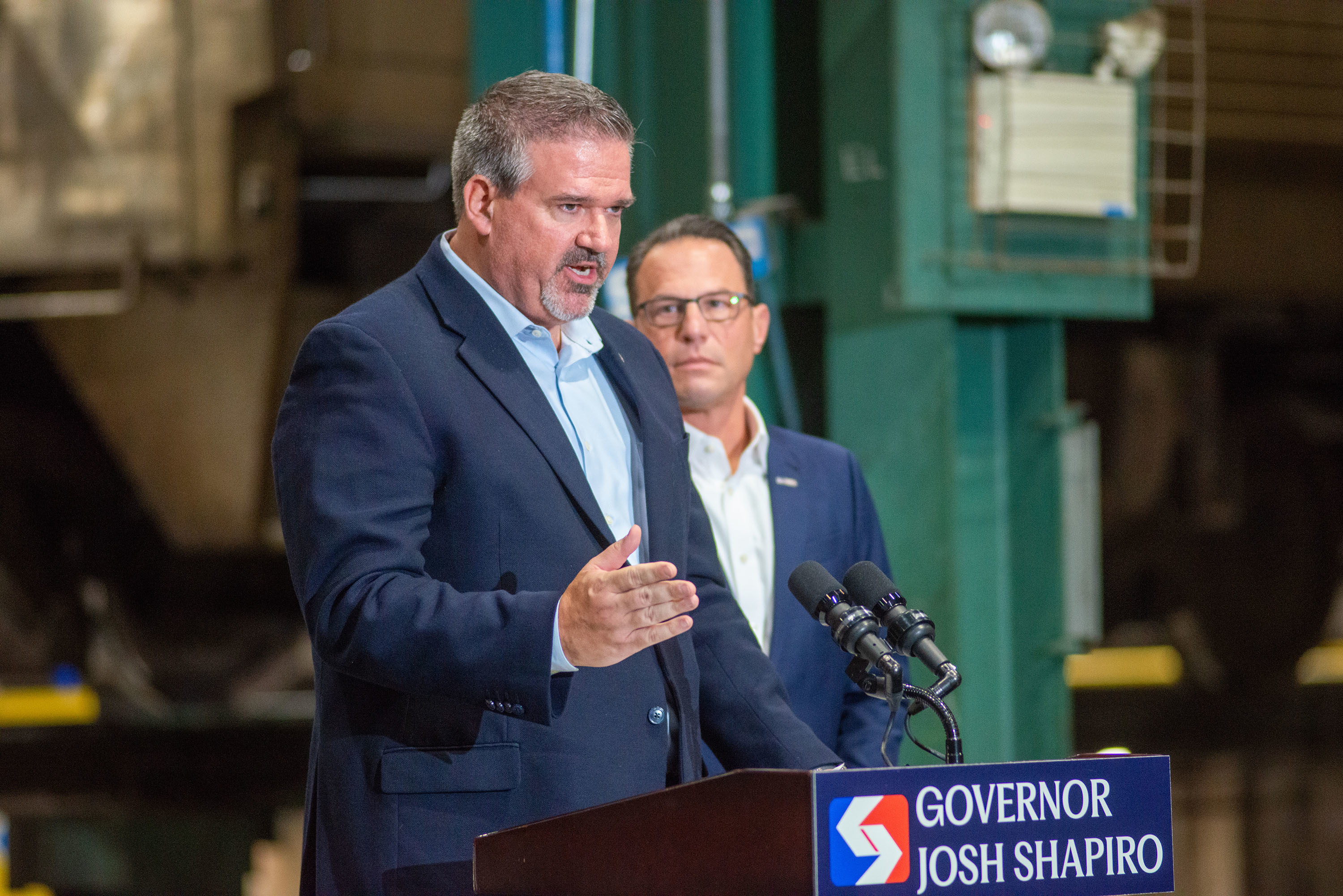
Gov. Josh Shapiro looks on as SEPTA General Manager Scott Sauer speaks at the agency’s Frazer Shop and Rail Yard in Malvern on Monday.
Don’t call it a bailout
There are few things Gov. Josh Shapiro loves more than talking about how he likes to take decisive action. From quickly repairing the I-95 collapse to last year’s maneuvers in Harrisburg that secured an infusion of money for SEPTA, it all helps buttress his “get stuff done” reputation. But Monday’s announced transfer of $220 million to SEPTA, while necessary, does not represent a real solution for our commonwealth’s transit woes. In fact, it makes transit’s future more precarious, absent new sustainable funding from intransigent Republicans in Harrisburg.
That’s because Shapiro took the money from the state’s public transit trust fund, which is tasked with supporting systems across Pennsylvania. While Republicans have presented the fund as money that’s “just sitting there,” those dollars have already been earmarked for specific projects, like SEPTA’s proposed modernization of its trolley system. The money Shapiro used was being set aside for emergencies. Using it to abate a wholly political crisis is not ideal.
The proposed investments, however, represent a judicious use of public resources. Nearly every part of the system will be revamped, providing riders with faster and more efficient trips. It’s an opportunity for Scott Sauer, who’s been working as general manager for 11 months, to prove to the General Assembly that the transit agency can be effective and efficient if given the chance.
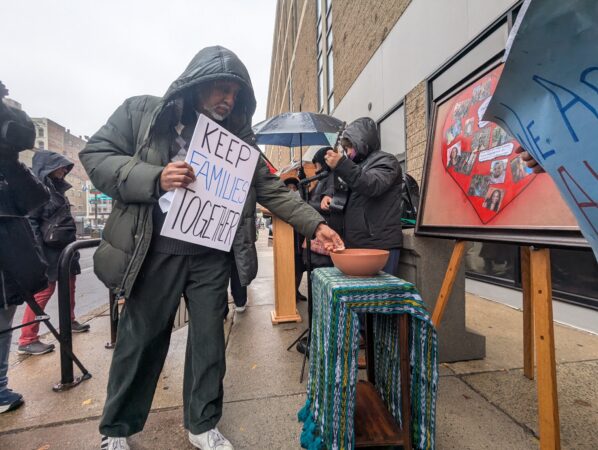
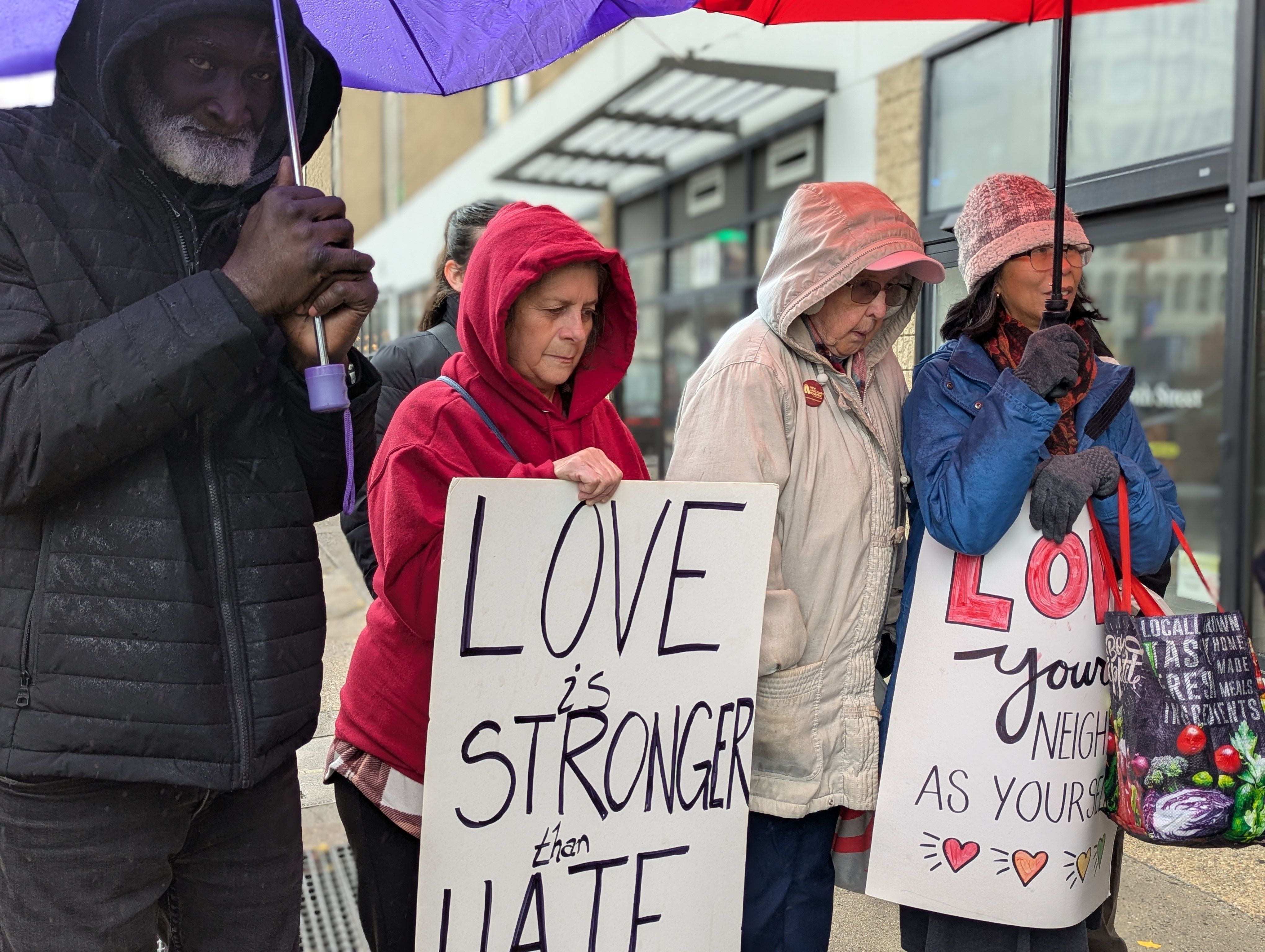
On a rainy Wednesday a week before Thanksgiving, members of the congregations of the Roman Catholic parishes of Holy Innocents and St. Joan of Arc gathered in front of the U.S. Immigration and Customs Enforcement office in Center City.
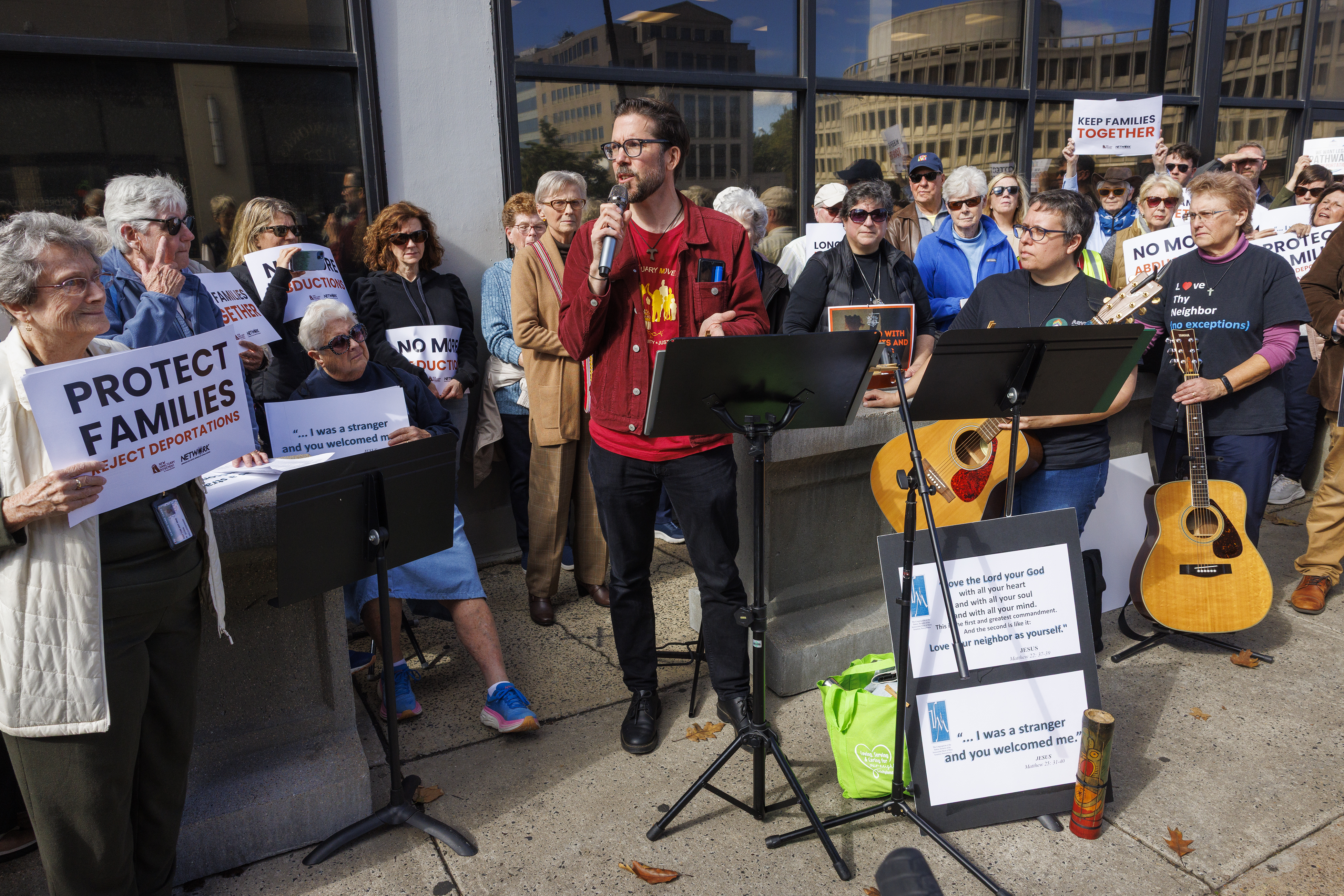
Another religious group appeared at ICE’s door near Eighth and Cherry Streets on the day before Thanksgiving. This time, it was an interfaith mix of folks led by Christianity for Living Ministries.
And there will be more. On Wednesdays to come, members of Mennonite Action, a couple of United Methodist churches, a Quaker meeting, two synagogues, a Presbyterian church, the Sisters of St. Joseph of Philadelphia and more Catholic parishes have all pledged to take part in a recurring demonstration that Neilson calls ICE Profest 40 — an ecumenical and interfaith action to oppose the government’s pitiless anti-immigrant crackdown slated to take place over 40 weeks. The word profest was coined by Neilson to mean “an amalgamation of faith expressed through proclamation, prayer, and protest.”
Members of the congregations of Holy Innocents and St. Joan of Arc parishes gathered Nov. 19 for an interfaith prayer vigil outside the ICE office in Center City. It was the kickoff of 40 weeks of vigils planned by faith communities across Philadelphia.
But organizers are hopeful that whatever their movement might lack in numbers, it more than makes up for in the power of their spiritual conviction — a conviction that is grounded in the Bible and other sacred texts.
“We proclaim God’s word of justice, mercy, and humility (Micah 6:8),” Neilson told me via email. “We pray for ICE agents and authorities (St. Matthew 5:44-45; St. Luke 3:24; 6:27-28; I Timothy 2:1-4), many of whom are conflicted and have crises of conscience. [We pray] for their courage, transformation, and turning, and for the protection and provision of the detainees and deportees, who are traumatized, from family separation and living in constant fear (Isaiah 1:17; Psalm 10:17-18; 82:3; St. Luke 4:18-19).”
“And,” he added, “we protest ICE activity, i.e., the orders ICE agents are given and the ways in which they are carried out, that dehumanizes and victimizes those created in the image and likeness of God [who] are our neighbors, and [which] disobeys and violates God’s command to welcome and love the stranger and alien (Leviticus 19:33-34; Deuteronomy 10:18-19; St. Matthew 25:31-46).”
The Rev. Christopher Neilson said that demonstrators at the protests pray for detainees and deportees who have been traumatized by family separation and are living in fear. They also pray for the safety of ICE agents and that the organization’s leaders might change their policies.
The number of weeks — 40 — during which this will happen has biblical significance, Neilson said, as a period of transition from trial to transformation. (Think of the 40 days and 40 nights Jesus traveled in the wilderness before the crucifixion.)
For me, the timing of when ICE Profest 40 is gearing up is especially resonant.
We’re moving from Thanksgiving — a secular holiday which, in good years, I get to celebrate with a family that includes foreign-born and U.S.-born folks — into Advent.
The beginning of the liturgical year is when Christians like me move from anticipation to action as we wait to celebrate the birth of Christ into a humble, migrant human family. I love the hush that precedes a world on the brink of transformation. I suspect that is why the quiet power of ICE Profest 40 actions moves me so deeply.
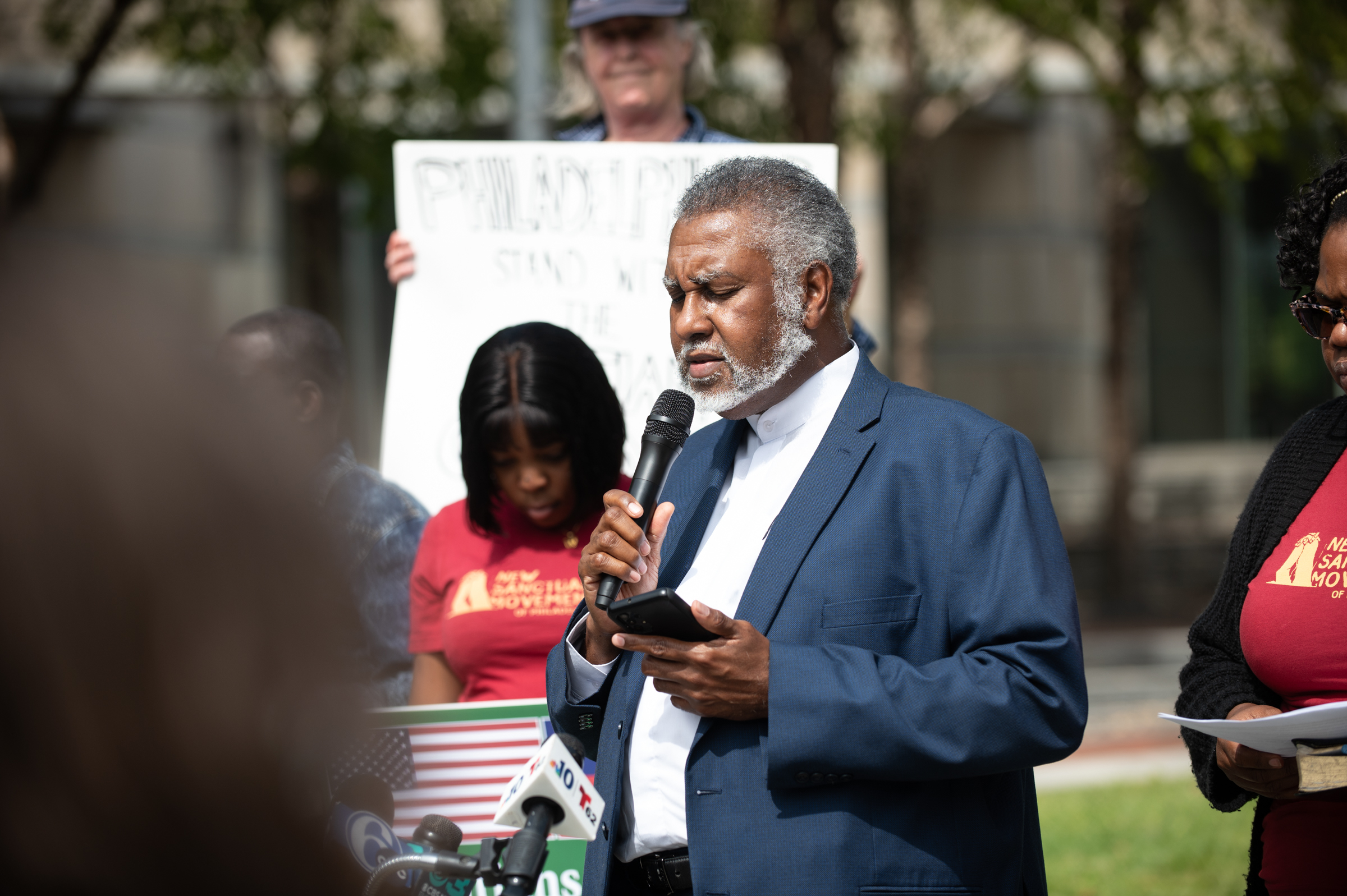
“The tone of these vigils is different,” Peter Pedemonti, the codirector of New Sanctuary Movement of Philadelphia, told me via email.
Peter Pedemonti, codirector of the New Sanctuary Movement, addressing Catholics gathered outside the ICE office at Eighth and Cherry Streets, in October.
“They are not as loud as a protest, but they have the potential for big impact,” he said. “We are seeing people sign up who are new to public witness, and so they serve as an entry into collective action. This is important as we fight not only the attacks on immigrant communities, but also Trump’s rapid steps toward authoritarianism. We need everyone right now, and it is really important we have paths for new people to get involved.”
“I have been doing faith-rooted organizing for nearly 20 years. These spiritual tools we have work. We can’t always see the immediate impact, but I have seen them help win campaigns. And so I believe that when we bring them to ICE, we are engaging in something powerful,” Pedemonti added. “The religious community has an important role right now. We are the moral voice, and when we see Trump trample our faith teachings and our democracy, it is critical [that] faith communities speak out.”
While my own faith tradition has long had priests, religious men and women accompanying immigrants and advocating for their rights, the United States Conference of Catholic Bishops has been pretty circumspect about commenting on the Trump administration’s policies.
But for Catholics who supported Trump — 55% overall (62% of white Catholics, 41% of Hispanic Catholics), according to the Pew Research Center — the Catholic bishops’ statement could serve as a come-to-Jesus (heh!) moment.
It is certainly a clear call for transformation during this most transformative of seasons.
I won’t speak for other people of faith, but for me, those are questions that go beyond political affiliation or temporal power, and touch on the “act justly, love mercy, and walk humbly” core requirements Neilson referenced.
On the first Sunday of Advent, one of the readings will be Isaiah’s proclamation that the people “shall beat their swords into plowshares, and their spears into pruning hooks; one nation shall not raise the sword against another, nor shall they train for war again,” and that throws me right back into the fact that both the Catholic bishops in their statement, and the Rev. Neilson in his description of the ICE Profest 40 vigils, reference ICE agents.
ICE agents aren’t wielding swords, of course, but they do carry firearms and other implements with which they smash the windows and doors of terrified immigrants. And with the proposal that military members could be “trained” by deployment to U.S. cities to support ICE and U.S. Customs and Border Protection agents, it’s not that much of a stretch to make Isaiah fit the moment.
I’m going to confess something now. I’ve prayed often for immigrants, never for ICE agents. In fact, I bristled a bit when I heard the bishops equating the vilification immigrants have experienced with the vilification of ICE agents — no one has accused ICE agents of eating pets, or separated them from their families, or turned them from legally residing to unauthorized in a moment.
But, as we saw with this week’s shooting of two National Guard members in Washington, D.C., those who have been asked to carry out the administration’s ill-conceived and oppressive policies may also be endangered by them.
The shooting reminded me of what Pedemonti told me: “If we want ICE to see the humanity of those they are persecuting, then we need to model that and see the humanity of ICE agents.”
“The religious community has an important role right now. We are the moral voice, and when we see Trump trample our faith teachings and our democracy, it is critical [that] faith communities speak out,” Peter Pedemonti said.
“We believe all people can change,” he added, “and so in the tradition of St. Óscar Romero, who called on soldiers in El Salvador’s authoritarian regime to put down their arms, we call for ICE agents to follow their conscience and refuse to follow orders, to leave people with their families, to leave the people in peace.”
I guess it’s time to broaden my prayers. Don’t get me wrong, my rosary (the one which, along with its crucifix and Our Lady of Guadalupe medallion, has monarch butterfly beads representing migrants) will still be in regular rotation with prayers for immigrant justice. But maybe the Romero quote with which I open my prayers using a niner that has his medallion will be different: I want to make a special appeal to soldiers, National Guard members, and policemen: Each of you is one of us.
The first candle we light at Advent represents hope, after all, and no matter how far away or unlikely the desired outcome appears, hope always leads to transformation.
Six lawmakers, including two from Pennsylvania, had good reason to remind military members not to follow unlawful orders, given Donald Trump’s illicit history and recent actions, such as sending federal troops into cities and boat strikes that violate international law.
The six Democrats, who either served in the military or the intelligence community, posted a short video telling their former counterparts that “no one has to carry out orders that violate the law or our Constitution.”
Right on cue, Trump responded with a fury of unhinged social media posts calling for the lawmakers to be jailed or executed.
“Each one of these traitors to our Country should be ARRESTED AND PUT ON TRIAL,” Trump wrote. He followed that with: “SEDITIOUS BEHAVIOR FROM TRAITORS!!! LOCK THEM UP???” He escalated in yet another post: “SEDITIOUS BEHAVIOR, punishable by DEATH!”
Trump later claimed he was not calling for members of Congress to be put to death — though his words plainly suggested otherwise.
When he isn’t lying, Trump’s abhorrent rhetoric over the past decade has become so routine that it barely causes a stir. (See: his recent outburst telling a reporter, “Quiet, piggy!” and shameful defense of Saudi Crown Prince Mohammed bin Salman, who authorized the vile murder of a journalist.)
Given Trump’s record of abusing his power, the members of Congress were right to sound the alarm.
In his previous term, Trump incited a violent insurrection at the U.S. Capitol. Let’s not forget he is a convicted felon who was criminally indicted three other times.
Trump was also impeached twice in his first term. Since his return, he has committed as many as eight impeachable offenses, according to legal scholars.
Trump’s first year back in office has been marked by relentless abuses. A federal judge said his attempt to eliminate birthright citizenship was “blatantly unconstitutional.” (The U.S. Supreme Court is weighing whether to take it up.)
Trump’s pardon of more than 1,500 insurrectionists, including nearly 200 who assaulted police officers, rewarded lawbreakers. Other steps to freeze foreign aid, fire federal workers, send troops into cities, and deport migrants have faced more than 100 legal challenges and strong rebukes from judges.
The Republicans who control Congress have done nothing to stop Trump’s abuses, let alone investigate whether he has used the presidency to enrich himself.
President Donald Trump speaks during a cabinet meeting at the White House in July.
Likewise, the unqualified loyalists overseeing the various government departments do whatever Trump demands. See: Attorney General Pam Bondi’s willingness to fire career prosecutors and go after Trump’s perceived political enemies.
Former Defense Secretary Mark Esper ignored Trump’s suggestion to shoot demonstrators following the death of George Floyd. Does anyone trust Pete Hegseth — a former weekend Fox News host who has faced allegations of financial mismanagement, sexist behavior, and excessive drinking — to show similar restraint?
That explains why the members of Congress urged service members to follow their constitutional oath — and not any unlawful orders.
Trump’s response to jail and kill elected officials is especially irresponsible given the rise in political violence, including murders of state lawmakers, a judge, and far-right podcaster Charlie Kirk. Not to mention the attack on former House Speaker Nancy Pelosi’s husband, the firebombing of the Pennsylvania governor’s mansion, and the attack on Trump’s own life.
After the president targeted the six Democrats, Pennsylvania Reps. Chrissy Houlahan and Chris Deluzio received bomb threats at their offices. Michigan Sen. Elissa Slotkin received a similar threat at her home.
Meanwhile, House Speaker Mike Johnson (R., La.) deflected Trump’s outrageous behavior by claiming it was “wildly inappropriate” for Democrats to urge troops not to follow the chain of command.
But that was not what the six legislators did. They reminded military members not to follow unlawful orders in accordance with Article 92 of the Uniform Code of Military Justice.
For example, the legality of Trump’s boat strikes — which have killed more than 80 people — is dubious.
A secret U.S. Department of Justice memo reportedly blessed the strikes by claiming the U.S. is in an armed conflict with drug cartels. But members of Congress from both parties argue it is illegal to target civilians — even suspected criminals — who do not pose an imminent threat. The United Nations’ human rights chief said the strikes violated international law.
As such, legal experts said if the strikes are found to be illegal, a defense by military officials of “just following orders” may not hold up in court.
Of course, Trump is shielded from prosecution thanks to a Supreme Court ruling last year that placed presidents above the law.
The same cannot be said for those who do Trump’s bidding.
U.S. Citizenship and Immigration Services (USCIS) is making it more difficult for immigrants to register to vote.
Several years ago, I went to a naturalization ceremony at Pennsbury Manor museum in Bucks County, welcoming more than 50 new Americans. Joy and hope danced in the air. As we left, I was thrilled to see volunteers at a nonpartisan League of Women Voters table helping our new citizens register to vote.
What a dirty shame to learn that recently, USCIS announced that nonpartisan organizations and their volunteers are no longer allowed to register new citizens to vote after ceremonies — even though the work of those organizations is crucial in states like Pennsylvania, with no automatic or same-day voter registration.
Greene said that three men slashed her and wrote “Trump Whore” across her stomach before leaving her zip-tied in the woods in Egg Harbor Township.
But prosecutors said that it was all a lie, that Greene paid a scarification artist to cut her — and that they even had a receipt and a signed consent form (including a copy of Greene’s driver’s license) from the artist to prove it.
It is not known if Greene remained employed as an aide to Van Drew during the four-month period between when she said the attack occurred on July 23 and when the criminal complaint was filed against her on Nov. 14.
It is not known when Van Drew — who has not been accused of any wrongdoing — was informed of this situation.
Quite frankly, not much is known besides the facts in the criminal complaint because Rep. Van Drew has mostly been silent.
After the charges were announced, members of Van Drew’s team put out a statement offering “thoughts and prayers” and saying they “hope she’s getting the care she needs.” But no one has heard much else.
And, strangely enough, Van Drew isn’t even mentioned by name in the criminal complaint — he’s only referred to as “Federal Official 1.”
Rep. Van Drew’s constituents want to hear from him. The congressman often talks about transparency — this is his chance to be transparent.
Michael J. Makara, Mays Landing, N.J.
ACA enhanced subsidies
A recent editorial states that subsidies are for Americans who earn up to 400% of the federal poverty level. However, the enhanced subsidies, which are due to expire, have no income limit. They are designed to keep the cost to an individual at no more than 8.5% of income. Consider this example: a single 60-year-old millionaire with $150,000 income. If the insurance company charges $1,300 per month ($15,600 per year), the ACA currently will subsidize this individual by $2,850 = $15,600 – 0.085 x $150,000. Whether such a person should receive government subsidies is debatable.
Tom Muench,Ridley Park
Brew safer than water
As one who is fond of the malty brew, a former home brewer, and a student of history, I read with great interest the recent article about the role of tavern life in shaping the American Revolution. I enjoyed it and am certain it enlightened many of your readers, but there was one major oversight. While the Founding Fathers certainly enjoyed their brews and other beverages, there was, I think, another reason for imbibing so much not only in Philadelphia but throughout colonial and revolutionary America: the water. Even well water was usually extremely unhealthy to drink. The water of the period was often highly contaminated and the bearer of diseases, many fatal. People knew this. Beer, wine, hard cider, and distilled liquors like whiskey, consisting of a certain amount of alcohol and brewed and distilled often with heated water, were far safer than water and even milk. It was not unusual for “small beer” (beer with a lower alcohol content) to be imbibed even by children (small amounts) and with breakfast. I’m disappointed this was overlooked by the author.
Kenneth J. Wissler, Halifax, Nova Scotia
Forgotten American hero
Ken Burns deserves great credit for producing the magnificent six-part PBS series documenting The American Revolution. But there is no mention of any Jews who helped win the nation’s freedom, which is a major oversight. Many Jews fought on the side of the patriots — perhaps none more selflessly than Haym Salomon.
The British arrested Salomon for revolutionary activities in New York City in 1778. He was sentenced to be executed, escaped from prison, fled to Philadelphia, and became a prominent member of Congregation Mikveh Israel, Philadelphia’s oldest synagogue. He is most remembered for financing George Washington’s Yorktown campaign, the decisive battle of the American Revolution. Washington believed that without Salomon’s financing to provide salaries and supplies, much of the Continental Army would have deserted with catastrophic consequences. Salomon died destitute at age 44. He is buried in Mikveh Israel Cemetery.
In 1975, the United States issued a commemorative stamp honoring Salomon as the “Financial Hero” of the American Revolution. A 1939 film, Sons of Liberty, depicts his life; Salomon is played by Claude Rains. The movie won an Academy Award for best short film.
At a time when antisemitism is once again raging in America, Haym Salomon’s life deserves to be remembered.
Jacob Daniel Kanofsky, Philadelphia
Right side of history
Assuming civility and sanity return and American democracy survives, I would love to be here a hundred years from now to read historical accounts of what’s happening in America today. If the reporting is reliable and factual, Will Bunch’s recent column, “The night America’s doomed ruling class gorged on lamb, blood, and oil,” should definitely be included. Sure, it’s an opinion column, but he paints a truthful overview that will serve historians well.
Jacques Gordon,Devon
Join the conversation: Send letters to letters@inquirer.com. Limit length to 150 words and include home address and day and evening phone number. Letters run in The Inquirer six days a week on the editorial pages and online.