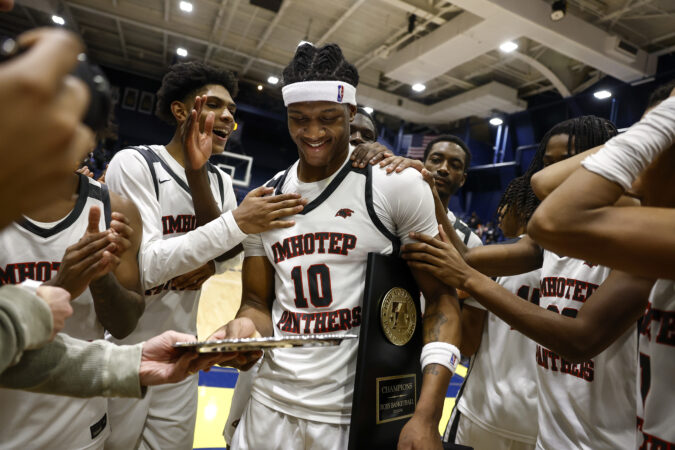
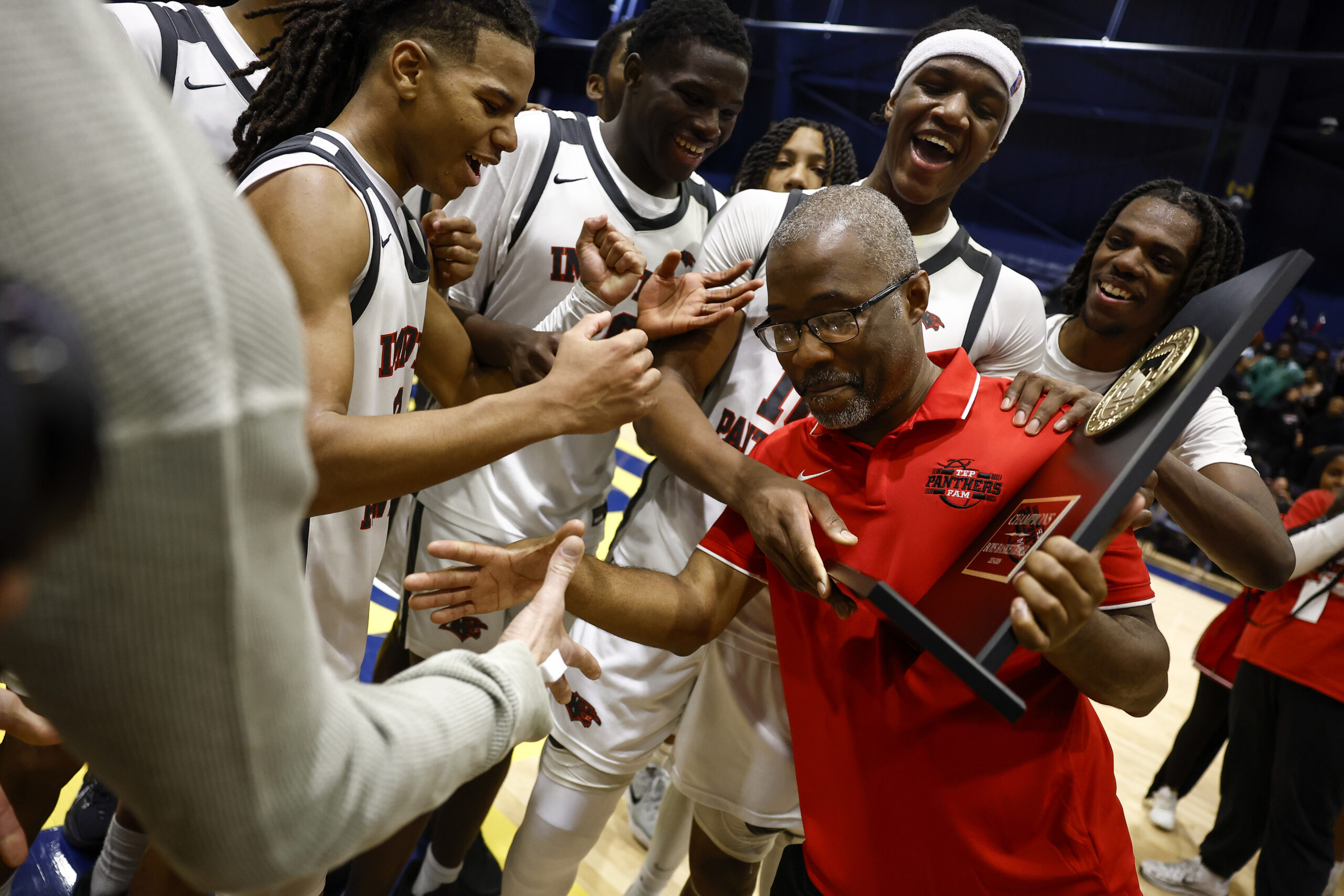
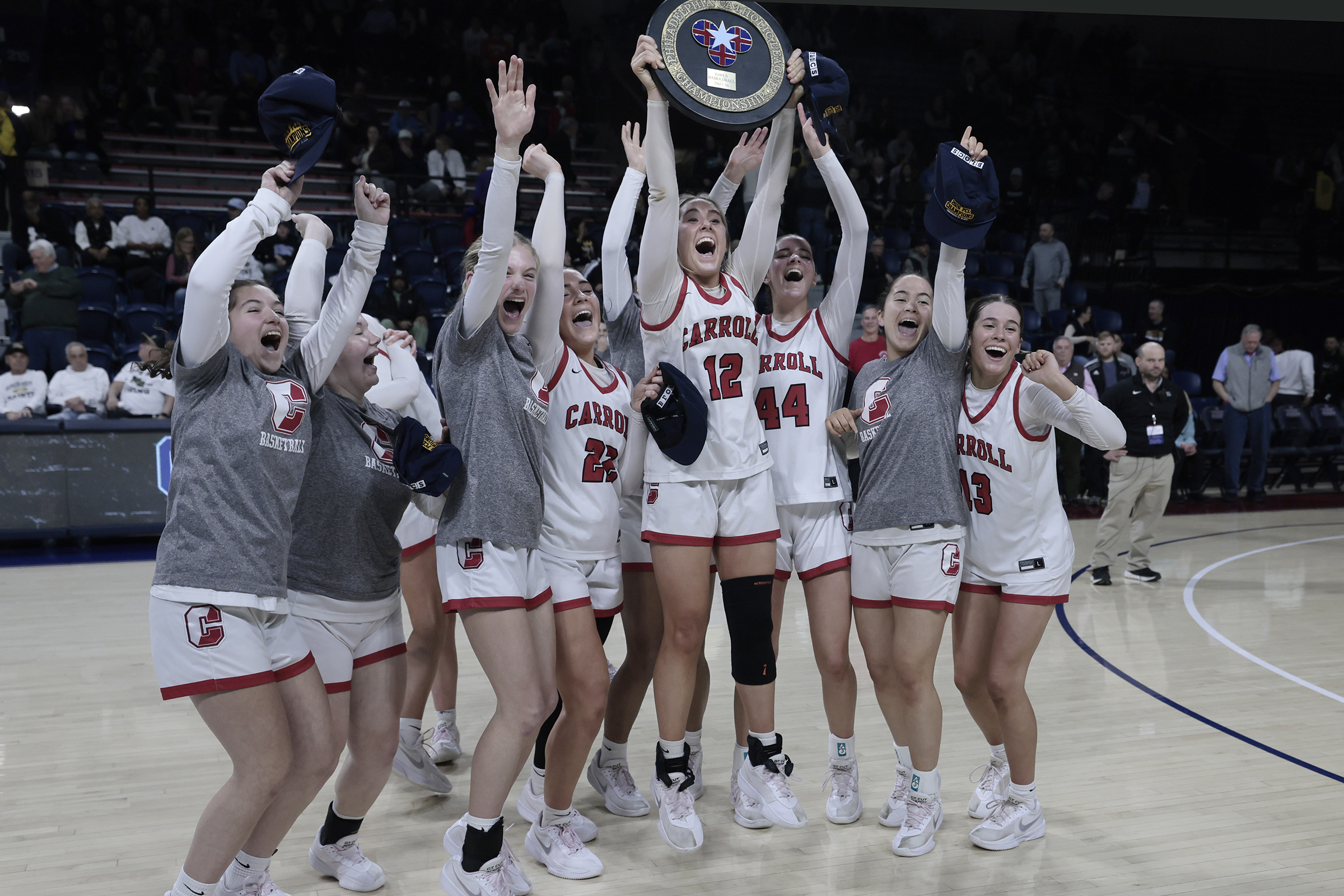
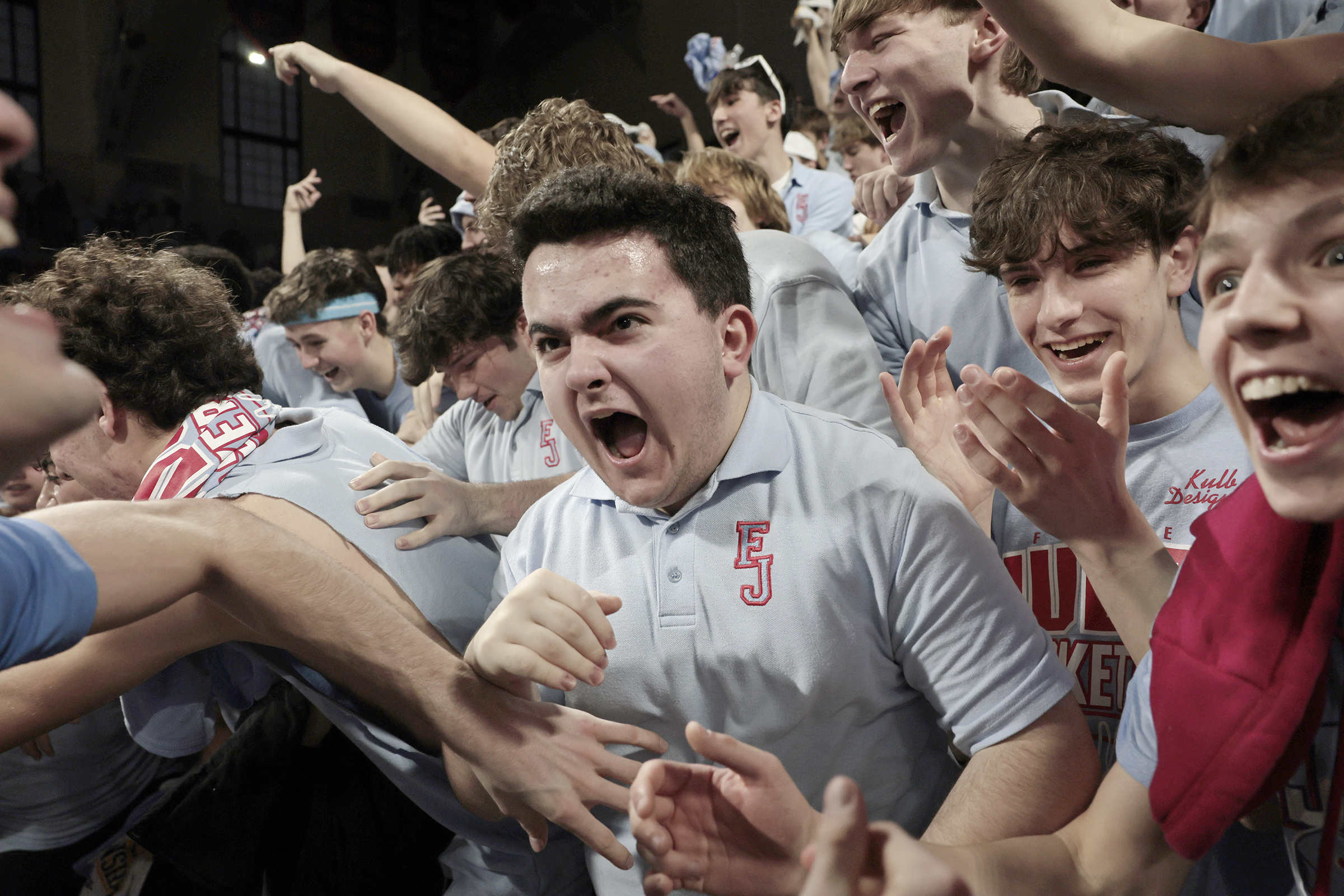
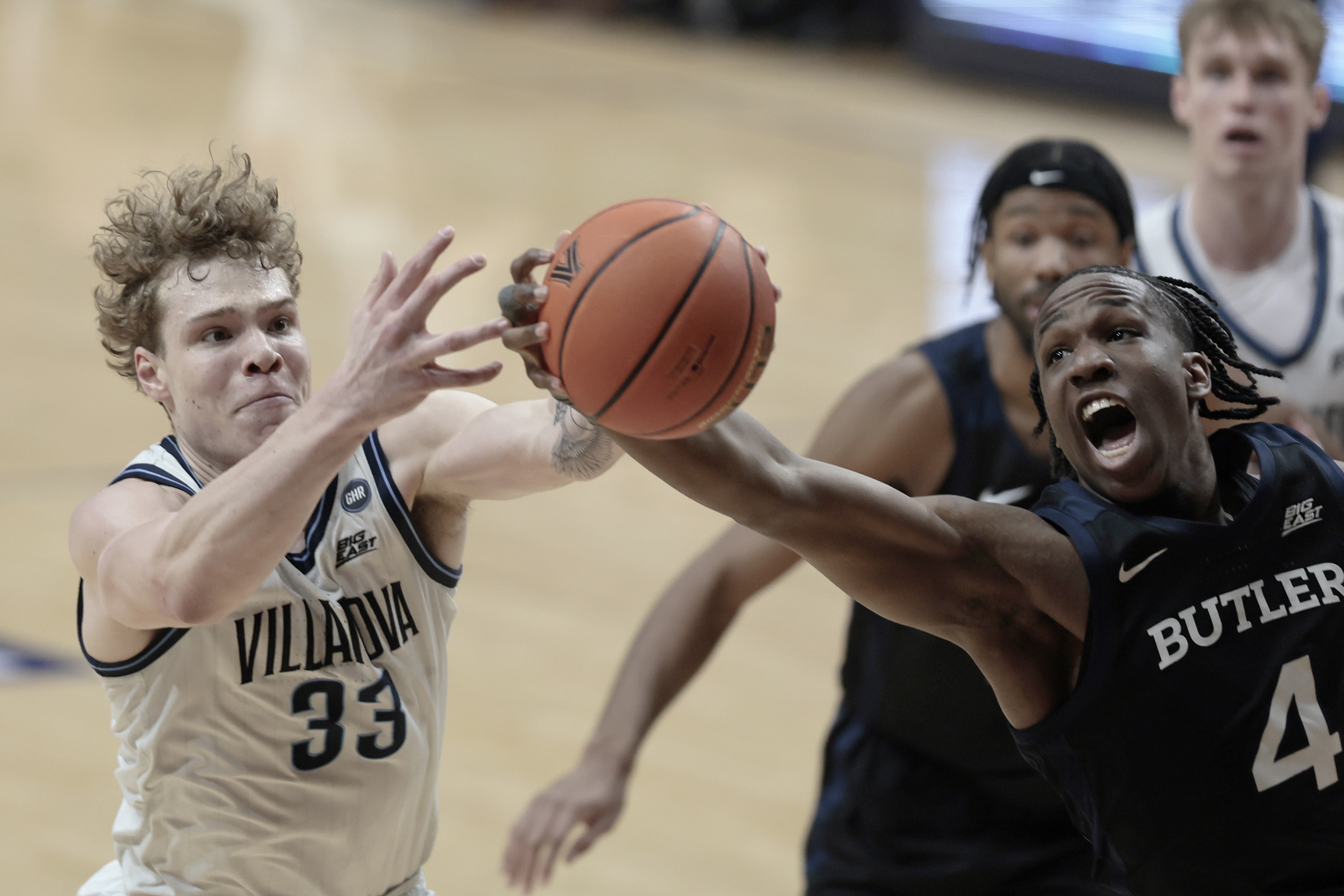
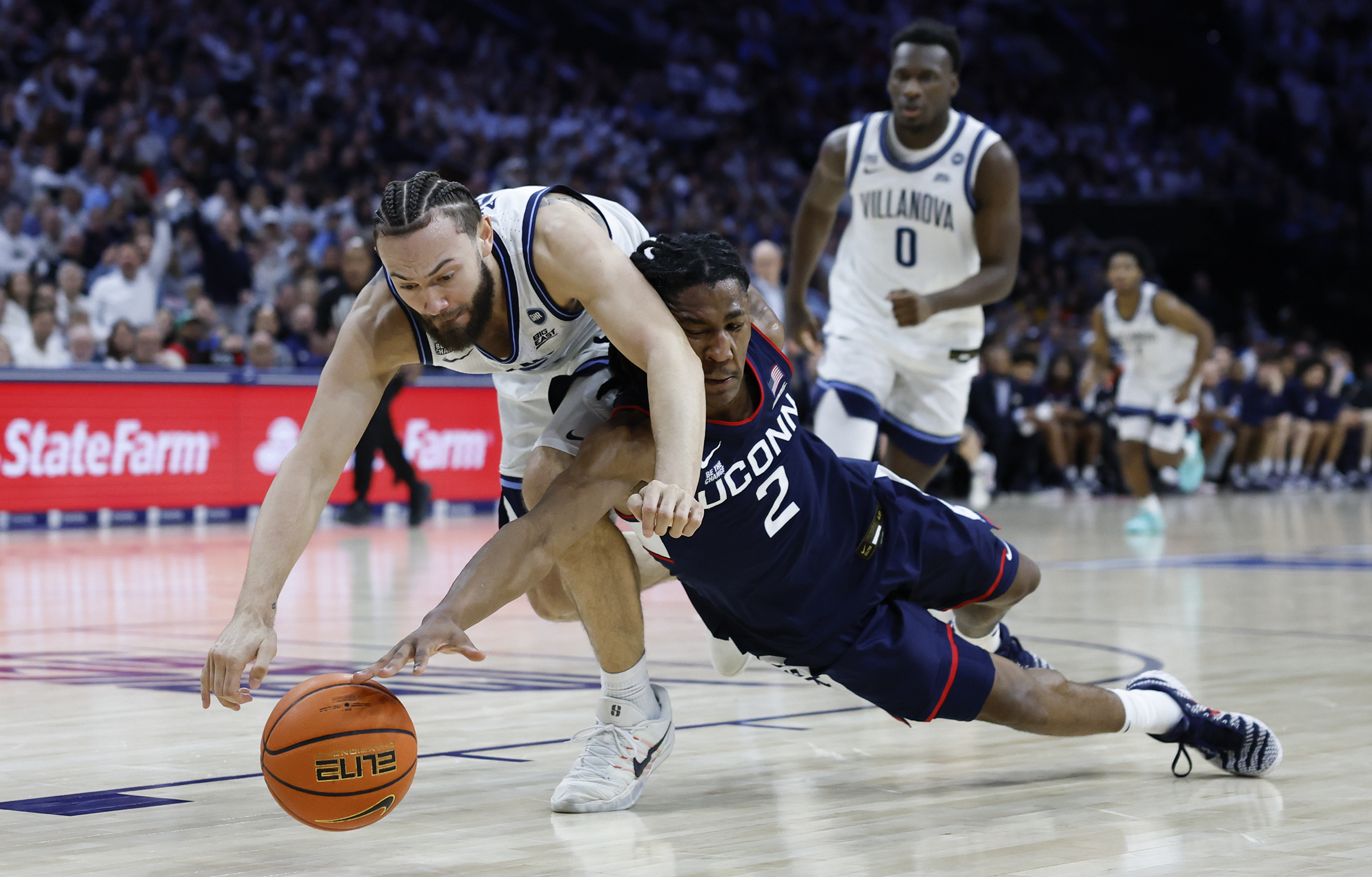
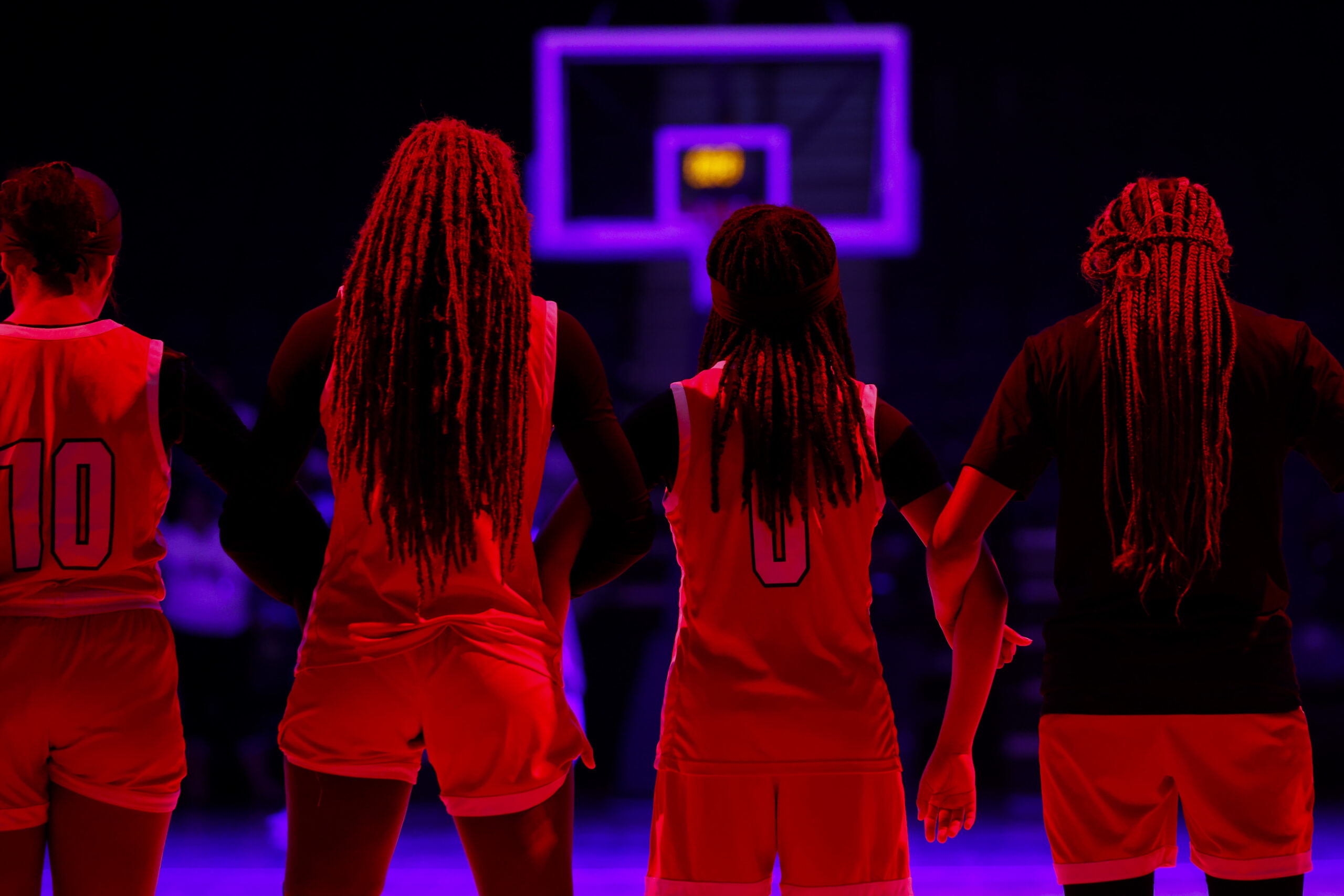
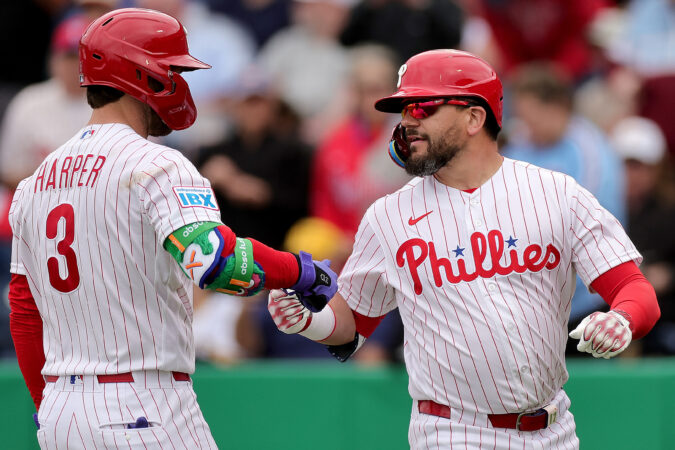
Each Friday, Inquirer photo editors pick the best Philly sports images from the last seven days. This week, the Philadelphia Public and Catholic League basketball playoffs were decided, with three of the four champions — Imhotep and Father Judge on the boys’ side and Audenried on the girls’ — picking up where they left off last year. In the case of Imhotep, it was the sixth straight Public League title, while Audenried captured its fourth. Meanwhile, the Archbishop Carroll girls won their first title since 2019. Down at spring training in Clearwater, the Phillies’ Grapefruit League schedule began, giving fans their first taste of baseball in more than four months.
Imhotep Institute Charter players celebrate their sixth straight Philadelphia Public League boys basketball title with head coach Andre Noble (red shirt). They beat West Philadelphia High School, 39-35, on Sunday at La Salle University’s John E. Glaser Arena.
Archbishop Carroll won the Philadelphia Catholic League girls’ championship behind the trio of senior Alexis Eberz (holding trophy), and her sisters, sophomores Kayla and Kelsey Eberz.
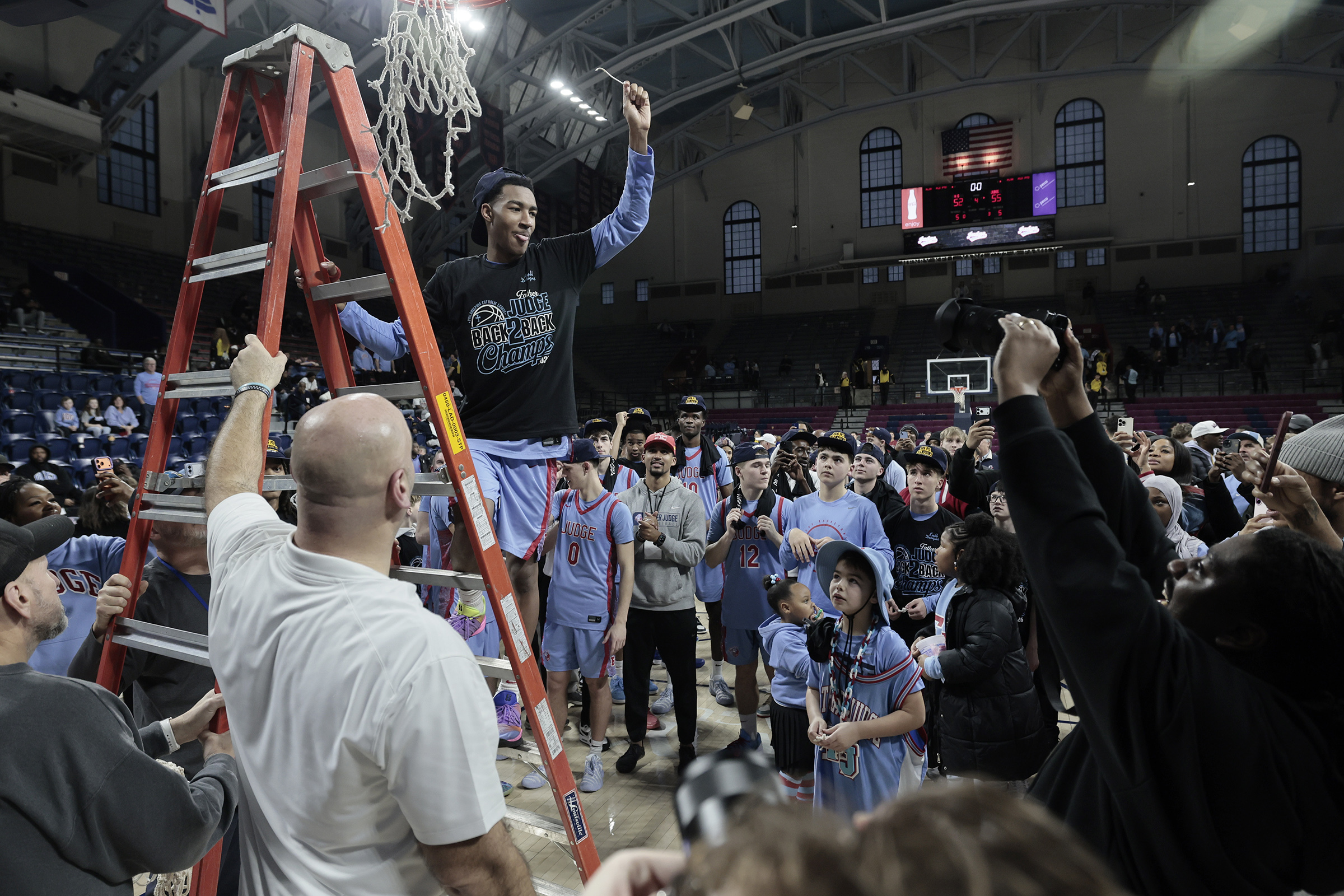
Father Judge fans celebrate after their team won its second straight Catholic League boys’ championship. Last year, the Crusaders followed it up with a state title.
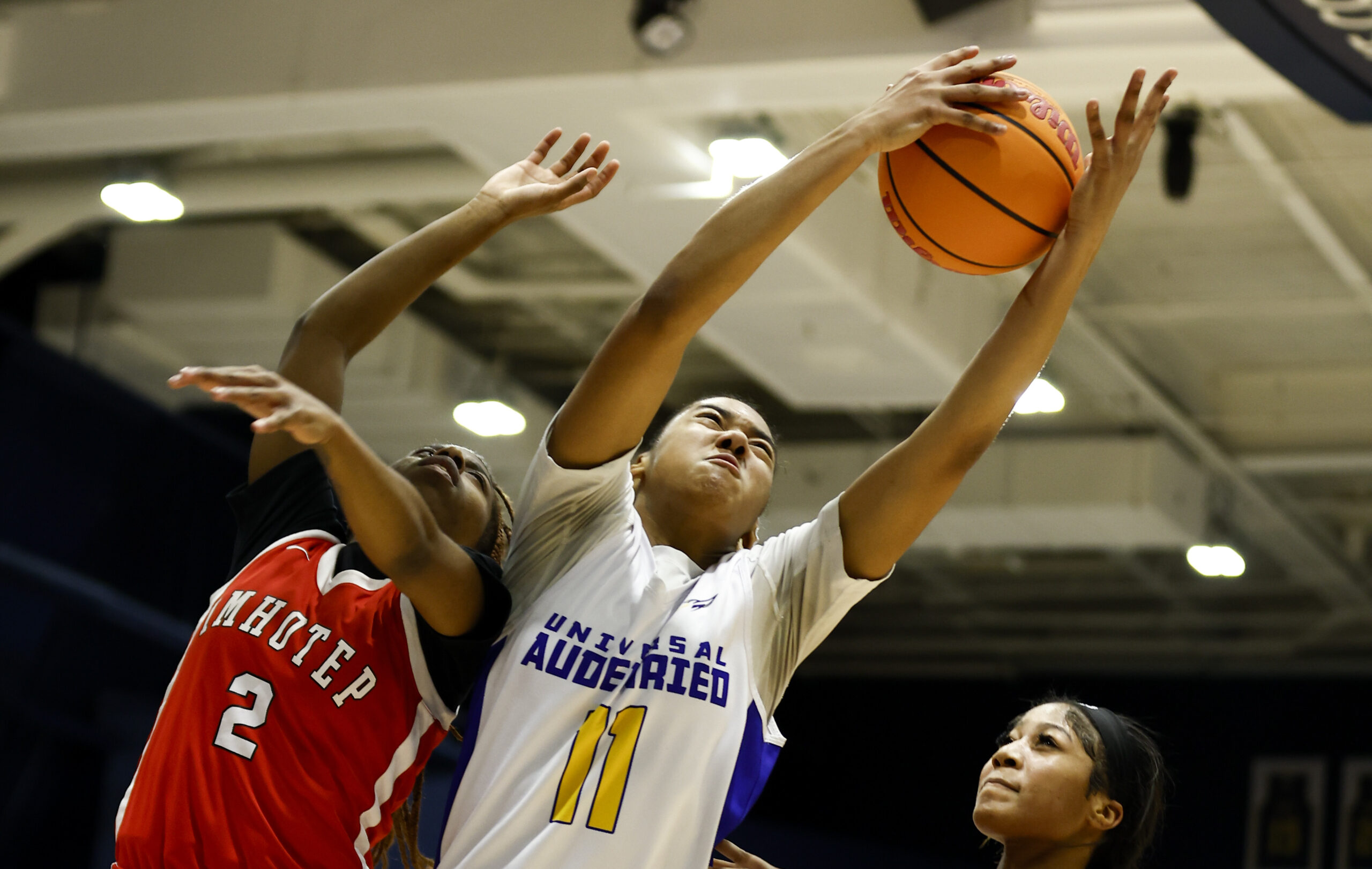
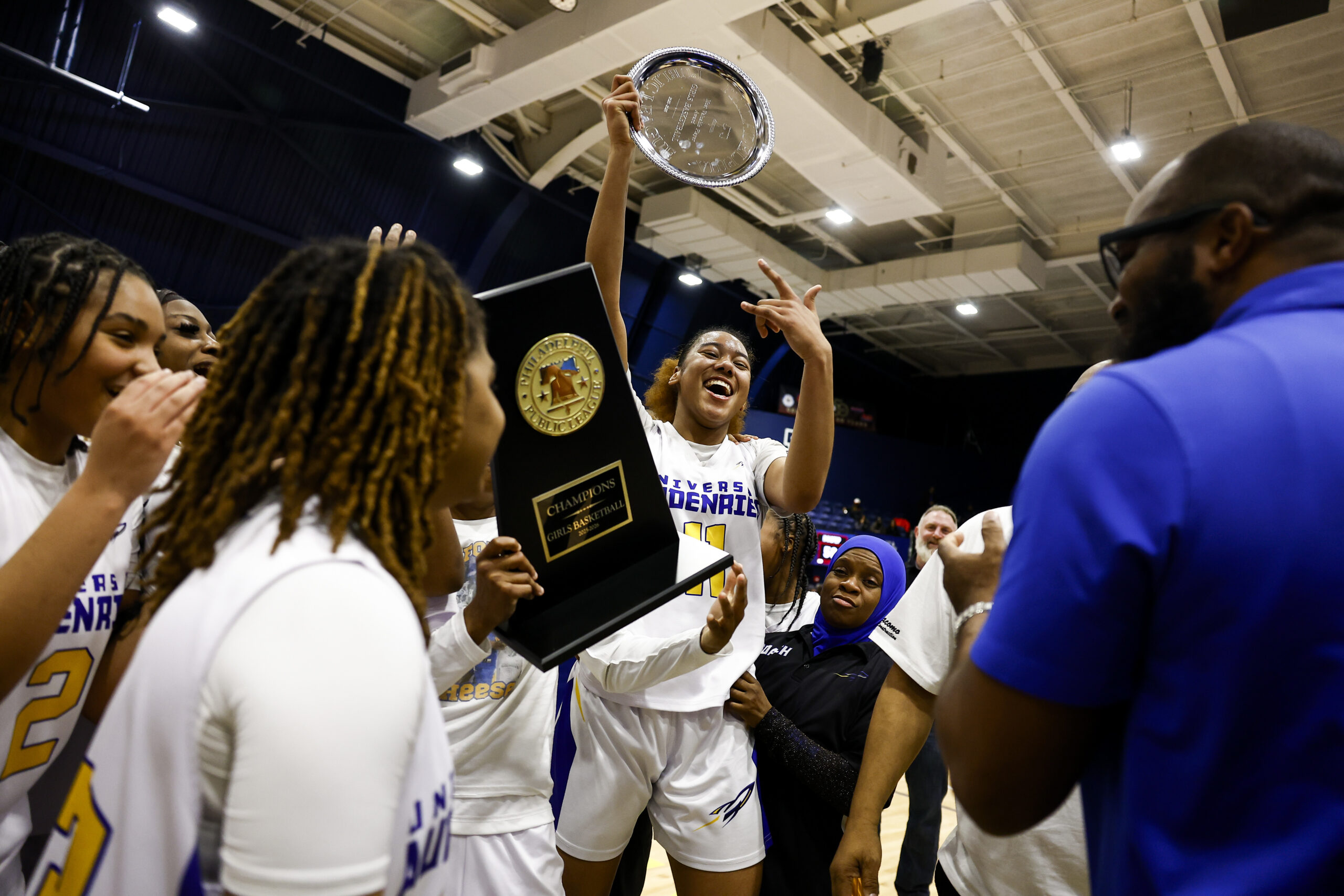
Imhotep had a chance to win both the boys’ and girls’ titles, but Universal Audenried Charter and junior Nasiaah Russell took home the school’s fourth straight crown Sunday at John E. Glaser Arena.
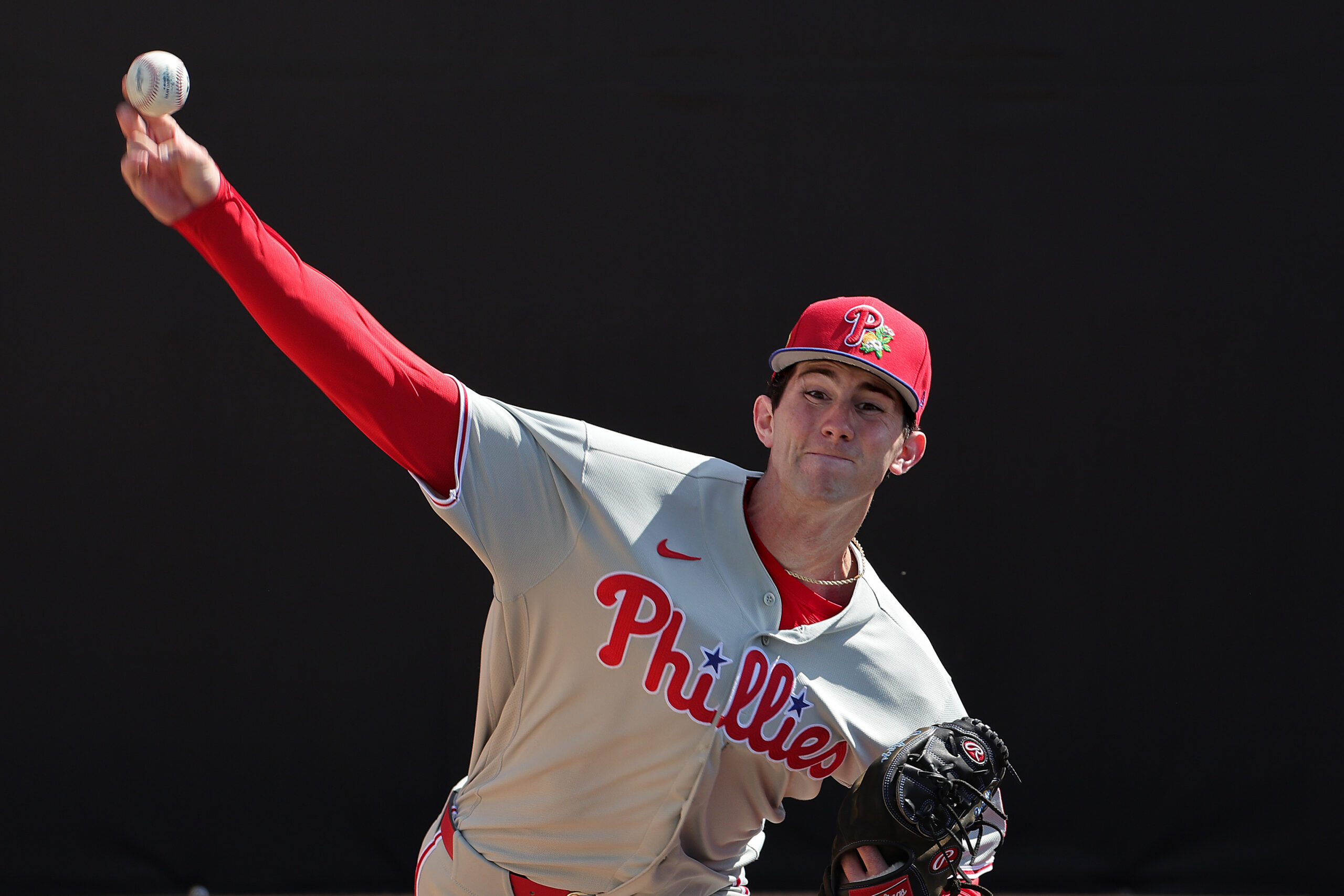
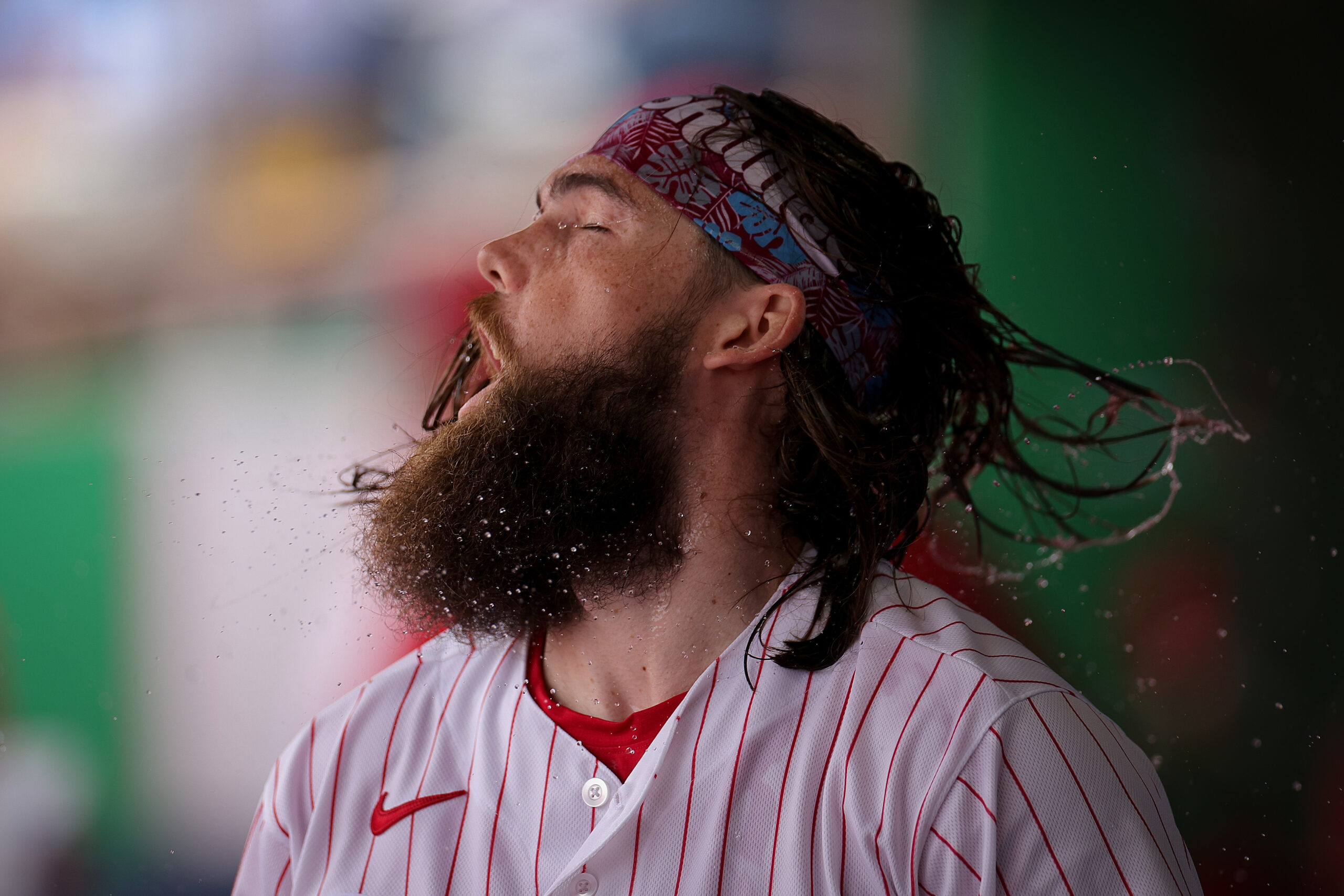
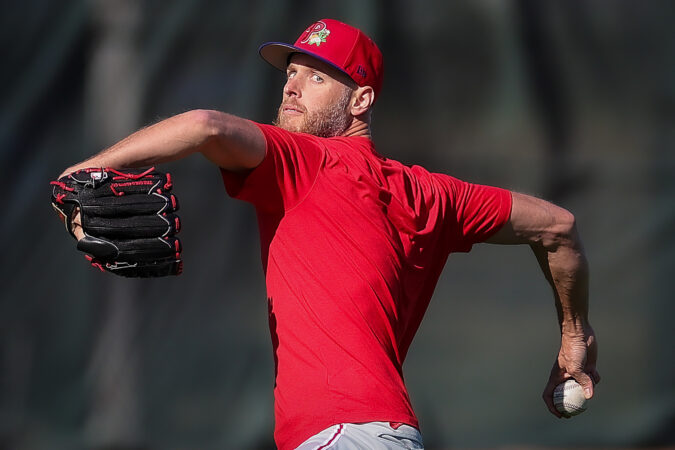
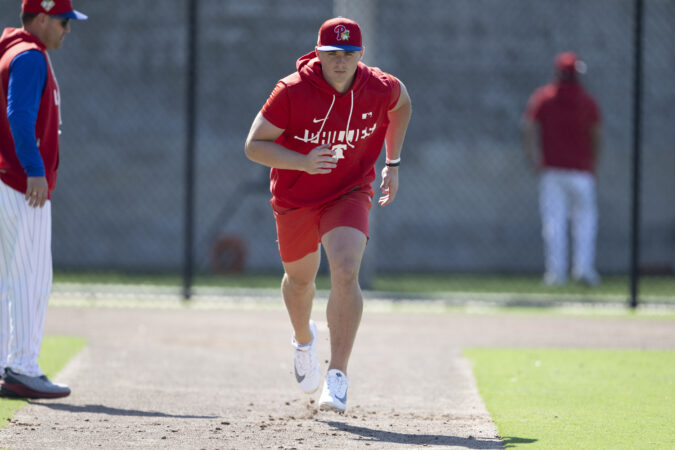
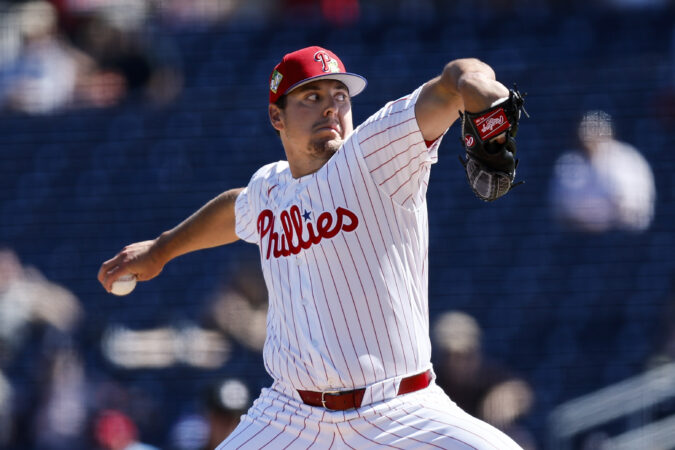
Andrew Painter spent most of last season in Lehigh Valley with the IronPigs, where he was selected to represent the Phillies at the 2025 All-Star Futures Game. He’s expected to be a part of the big-league rotation this season.
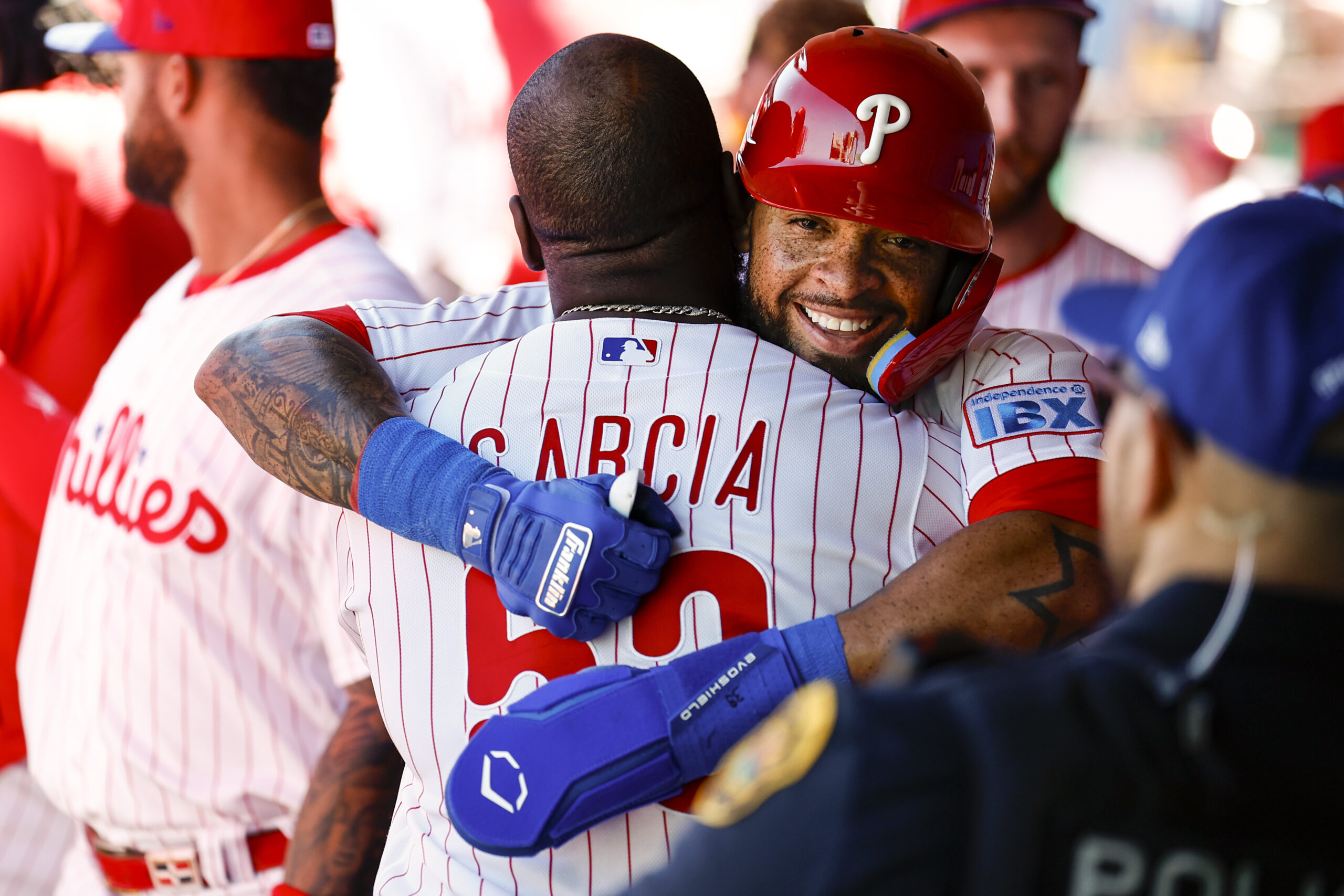
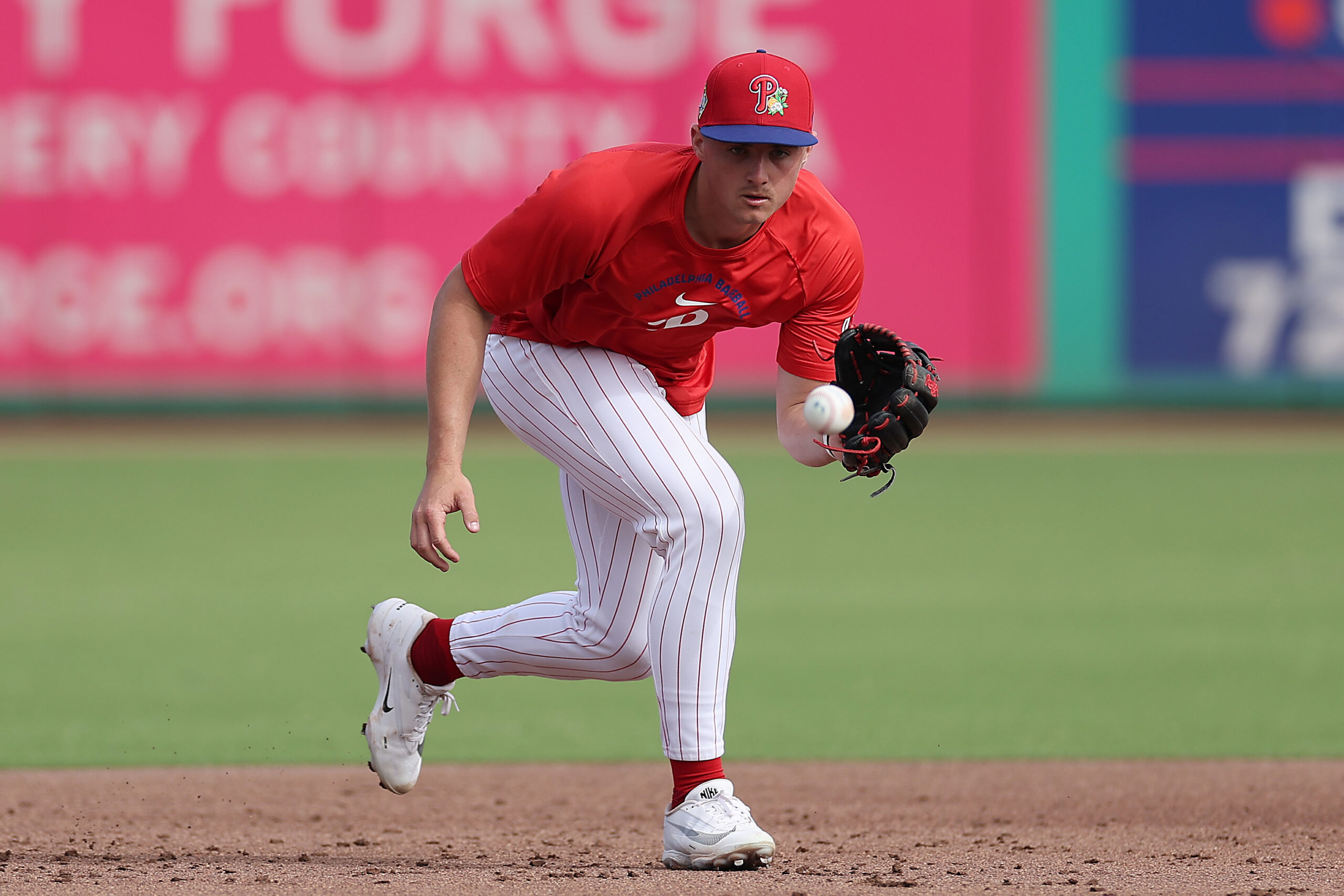
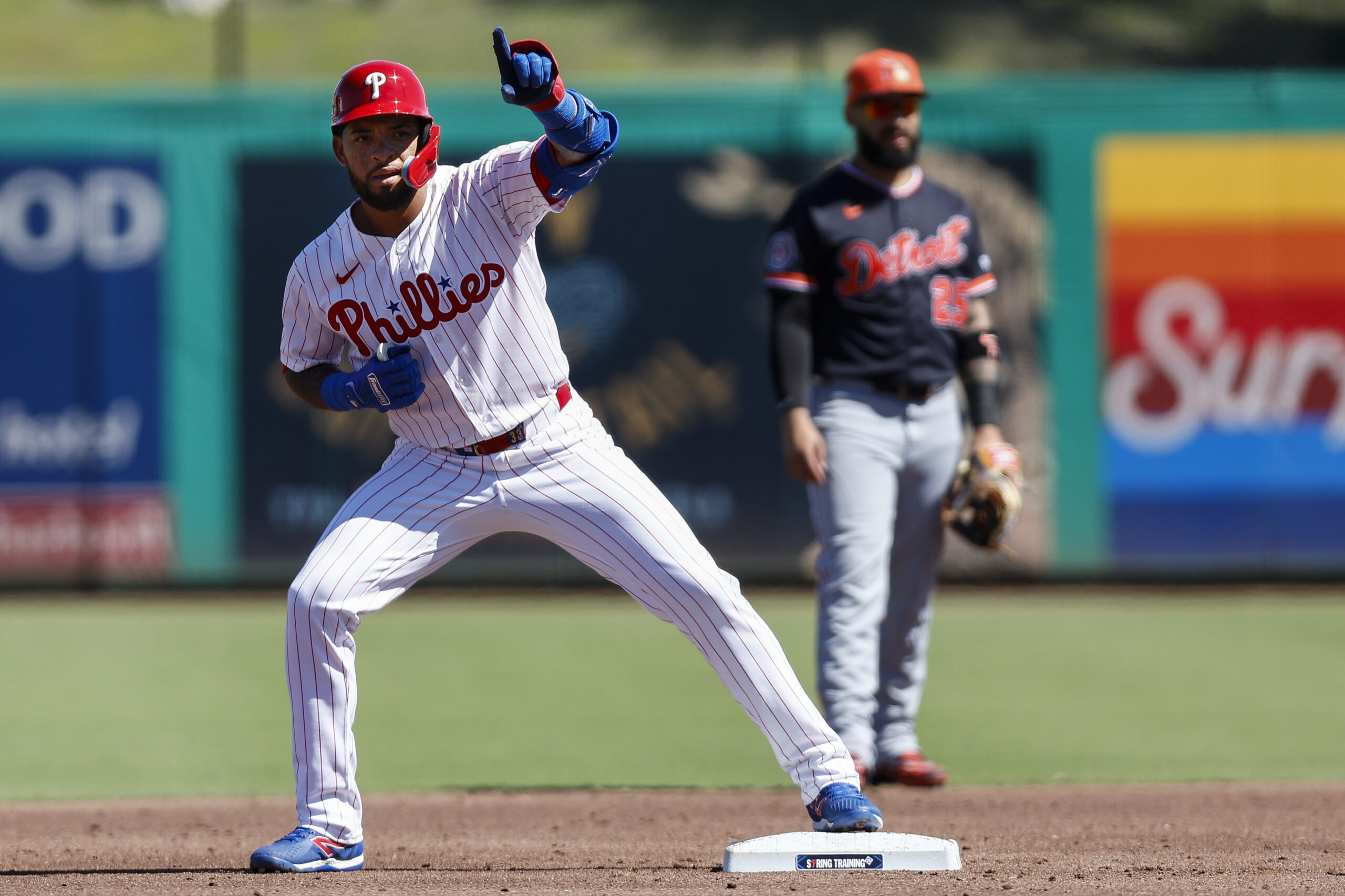
Phillies shortstop Edmundo Sosa hugs new outfielder Adolis García during Wednesday’s 5-3 win over the Detroit Tigers in Clearwater. The victory was the Phillies’ first of spring training.
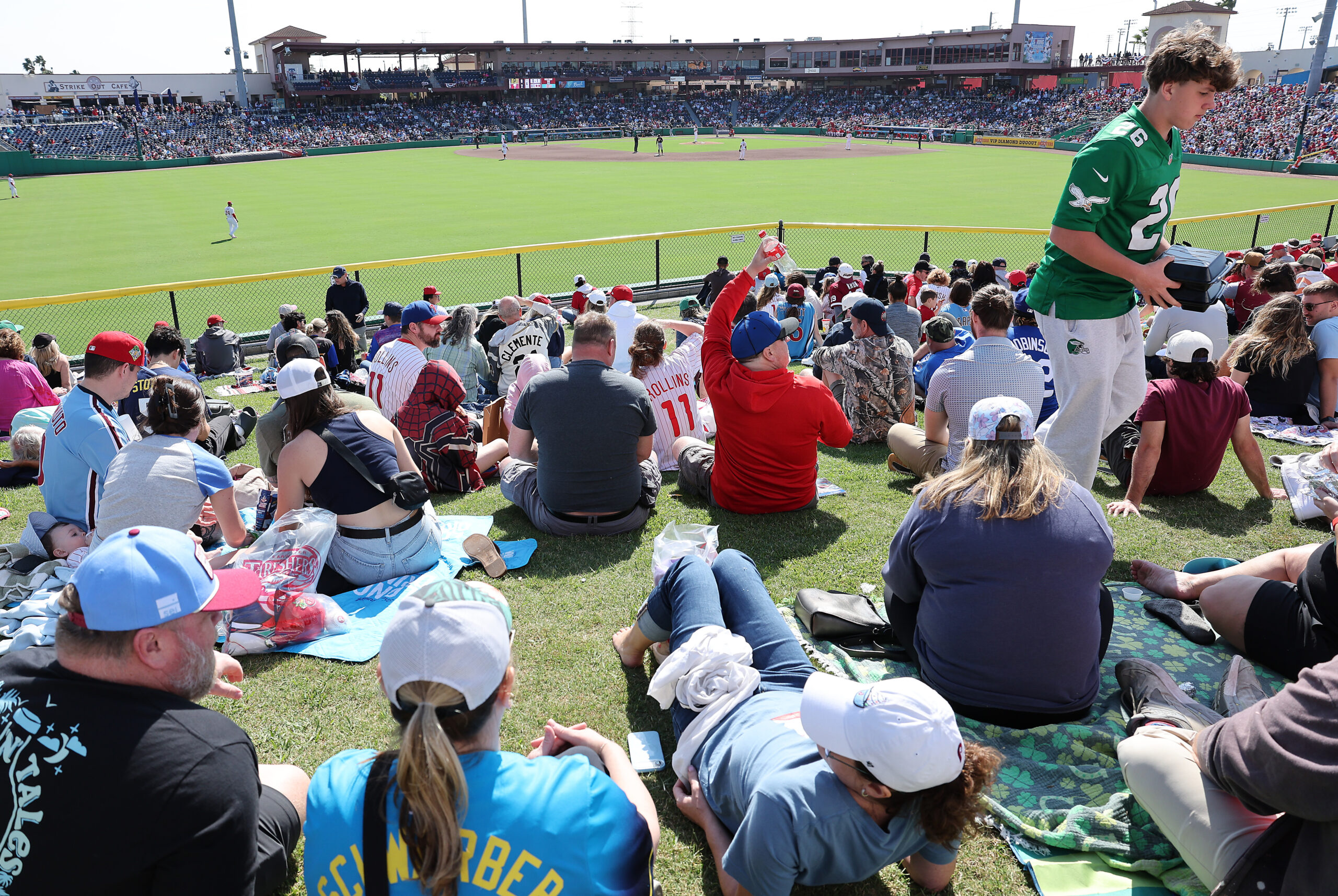
Even on the berm at BayCare Ballpark in Clearwater, Eagles fans aren’t hard to find, including this one in a kelly green Saquon Barkley jersey. It was Sunday.
What if I told you that Alec Bohm offered more protection to Bryce Harper than Kyle Schwarber?
What if I told you the Phillies’ best batting order is the one they rode to the NL East title, and that Rob Thomson shouldn’t change a thing?
I can’t say either of these things with any degree of certainty. All I can tell you is what the numbers added up to last season. If you don’t like numbers, what you are about to read probably isn’t for you. But a surprising number of people emailed me after Tuesday’s column and suggested that I compare Harper and Schwarber’s numbers when hitting back-to-back in the lineup.
As a refresher, the topic du jour — or however you say the topic of that day in French — was Harper’s struggles to score runs after reaching base. It was a pertinent topic, given that it sat at the intersection of issues people rightfully have with the Phillies’ odd-fitting and top-heavy batting orders.
But the ramifications of Dave Dombrowski’s roster construction are much broader than the infrequent sound of Harper’s cleats clacking on home plate. The weight is disproportionately borne by Thomson. The dam has more holes than he has fingers. Baseball would be a lot more fun if he could use Harper and Schwarber twice each time through the batting order. Until he can, the lineup will always leak somewhere.
The question remains. What is the optimal (legal) combination? Specifically, at the top of the order, seeing that Thomson has used a number of different combinations of Harper, Schwarber, and Trea Turner, with or without another hitter mixed in.
I used Retrosheet’s play-by-play data and borrowed Will Hunting’s chalkboard and did some figurin’. Harper behind Schwarber, Schwarber behind Harper, neither behind the other. The sample sizes are too small to render any definitive judgments, especially given other confounding variables in play.
Observation 1: Harper didn’t get any benefit from batting in front of Schwarber.
In fact, he was his least productive self with Schwarber behind him in the order. The splits are pretty drastic. Harper’s OPS was nearly 100 points higher when batting in front of Bohm vs. Schwarber. And it wasn’t just because he walked more. His extra-base hit percentage was higher, thanks in part to five home runs in 126 plate appearances in front of Bohm compared with seven in 200 in front of Schwarber.
Here’s the interesting part: Harper was much better hitting behind Turner when Schwarber wasn’t hitting directly behind him, specifically when Bohm split the lefties in the No. 3 spot, with Harper batting second and Schwarber fourth. In fact, Harper and Schwarber were both pretty darn good in those situations — again, in tiny sample sizes.
Harper behind Turner, and nonconsecutively with Schwarber: 9-for-37, five extra-base hits, two home runs, 11 walks, .903 OPS.
Schwarber in those situations: 9-for-38, six extra-base hits, four homers, eight walks, 1.014 OPS.
All of Harper’s plate appearances in front of Schwarber came in the first three months of the season. The last time Thomson used a Harper-Schwarber lineup was those back-to-back losses in Toronto when the Blue Jays outscored them, 11-2.
Phillies manager Rob Thomson has quite the number of decisions to make when it comes to where Bryce Harper and Kyle Schwarber end up in his batting order.
After Harper returned from the injured list in late June, Thomson switched to the lineup that carried the Phillies through the rest of the season. Schwarber in the two-hole, followed by Harper. Only twice did he deviate from that batting order when both players were in the lineup. Understandably so. The Phillies averaged five runs per game in their last 79 games, putting together a team OPS of .789.
There is a question of correlation vs. causation here. Were the Phillies better as a team because Harper’s numbers were better behind Schwarber? Or were Harper’s numbers better behind Schwarber because that’s where he was hitting when he and the rest of the team found its stride?
All sorts of variables could be in play: the quality of pitching the Phillies faced in the last three months vs. the first three months, the weather, etc.
That being said …
The numbers show Kyle Schwarber should not bat in the cleanup spot behind Bryce Harper.
Observation 3: Schwarber should not bat cleanup. The optimal lineup is either Turner-Schwarber-Harper or Schwarber-Turner-Harper.
The Phillies were at their best when Schwarber and Harper were batting in the top three. This is obvious. Schwarber may look like the prototypical table-clearer until you see what happens when Bryson Stott and Turner are getting it set.
No offense to either player. But the goal is to get your elite players the most at-bats. It doesn’t get more prototypical than Aaron Judge, and the Yankees bat him leadoff.
It comes down to this, really: Down by one in the bottom of the ninth with the top of the order due up, you want a lineup that guarantees Harper and Schwarber a chance at tying the game. The data from last season doesn’t prove anything, but it is always smarter to err on the side of what the data suggests when what it suggests is the same as one’s intuition.
We can argue about Bohm vs. Adolis García vs. Realmuto. Hopefully, we’ll end up arguing about Aidan Miller. But there isn’t much of an argument for batting Schwarber or Harper lower than third.
Just ask any opposing pitcher what he would prefer.
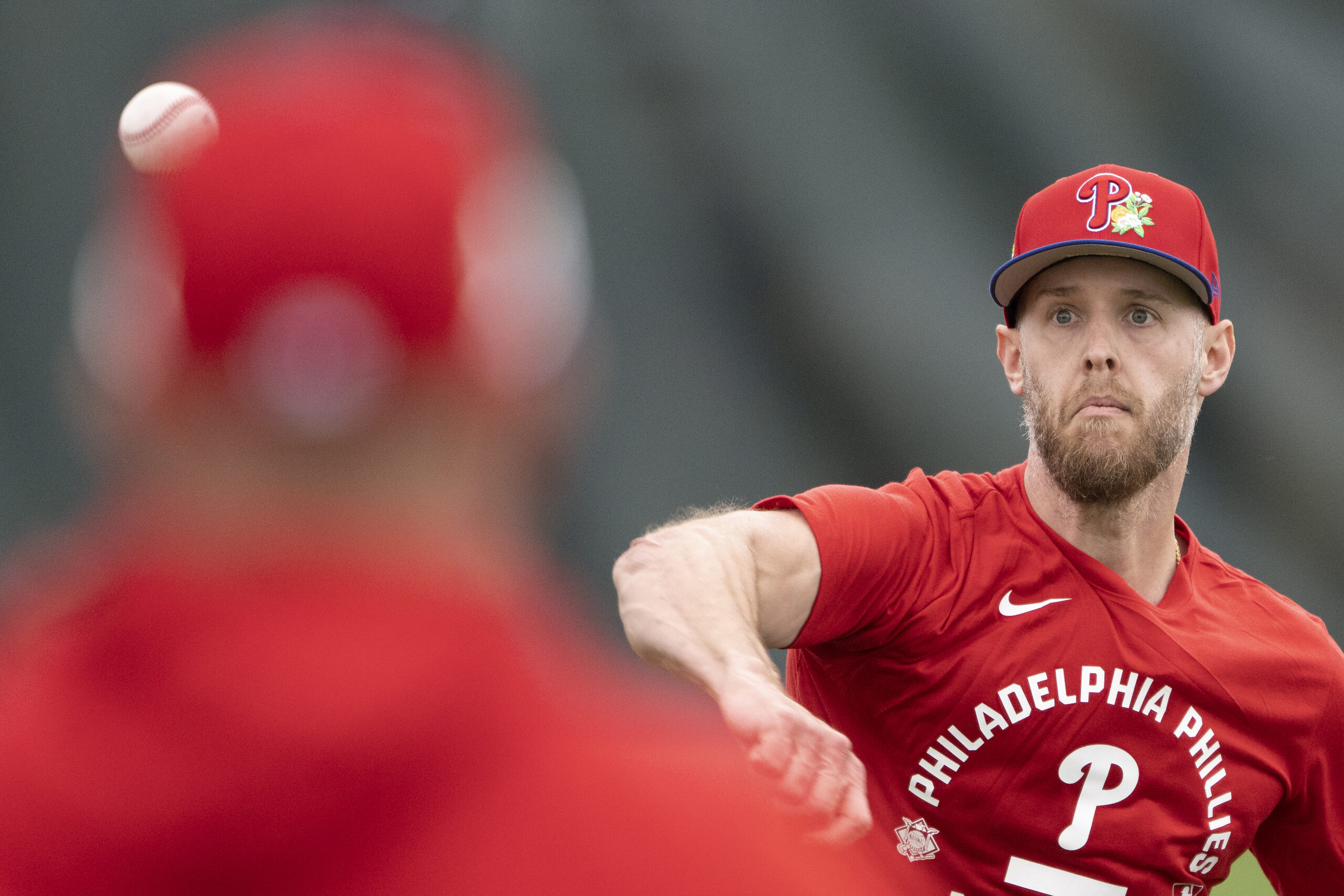
CLEARWATER, Fla. — Zack Wheeler toed the rubber on a mound Thursday for the first time in more than six months.
The 21 pitches — all four-seam fastballs and sinkers — Wheeler threw at the Phillies’ Carpenter Complex marked the next major step in his journey back from Sept. 23 thoracic outlet decompression surgery. A blood clot was discovered near the right-hander’s shoulder in August.
Wheeler had been recovering well from his long toss sessions, which had extended as far as 120 feet. The Phillies identified Thursday as a potential date for his first bullpen session and decided to go for it when he came in that morning feeling good.
“The velo was good, the ball flight was good,” said manager Rob Thomson, who declined to share the radar gun readings. “Hit the glove. He was good.
“… He thought it was great. He felt great. We’ll check him [Friday] and find out how he’s feeling, and get a plan going for moving forward.”
Could Wheeler be ready to pitch in major league games in six weeks?
“Possibly,” Thomson said. “It’s new stuff, and it’s different than a lot of other injuries. We really can’t pin it down to a week or a day.”
Typically when players are built up in the spring, the schedule is two days off between bullpen sessions. Thomson hopes that Wheeler will be able to adhere to that, but because of the uniqueness of the injury and recovery process, that isn’t certain.
Thomson added that he wasn’t surprised at Wheeler’s progress so far.
“He’s worked awfully hard, and that’s the key to it,” he said. “He’s worked harder than he’s ever worked in the offseason. So it’s a really good sign. He’s strong. Shoulder’s stronger than it ever has been. So really feel good about it.”
CLEARWATER, Fla. — Bryce Harper and Taijuan Walker shared a laugh as they walked off the field Thursday.
Walker had just turned and fired a perfect throw to first base to pick off Nationals prospect Seaver King and end the second inning. The Phillies right-hander, making his Grapefruit League debut in Thursday’s 7-3 winover Washington, picked off five baserunners last season.
“Harp was like, ‘I wanted to yell at you so bad,’ because he saw how big his lead was,” Walker said. “I said, ‘Trust me, I saw it. Don’t worry.’”
Walker said his pickoff move has always been a strength. He practices often, but the key is knowing how to read runners and their leads. Walker noticed King take two extra steps off first base and knew he was going to try to steal, so he threw over.
In addition to flashing his trademark move, Walker took the opportunity to work on his slider and curveball on Thursday. He didn’t throw a single splitter or cutter, typically two of his best weapons. He touched 92.7 mph with his sinker.
“Been trying to work on the slider, and felt really good with it today,” he said. “Thought the shapes were really good, swings and misses, and got weak contact with it.”
Walker, who allowed one run and three hits over two innings of work, got three whiffs on his slider and two on his curve. He is set to leave Saturday to join Team Mexico for the World Baseball Classic, and is scheduled to pitch on Tuesday in an exhibition against the Diamondbacks.
Who stood out
Bryson Stott homered down the left-field line in the first inning. He drew a walk in the third and was driven home by a Harper double.
Outfield prospect Dante Nori doubled, and catcher prospect Kehden Hettiger blasted a homer to right.
José Alvarado pitched a 1-2-3 inning and recorded two strikeouts, including one of Nationals outfielder James Wood. His sinker topped out at 98.8 mph.
Tanner Banks pitched the fourth and gave up a two-run home run to Andrés Chaparro.
Jonathan Bowlan retired the side in order in the fifth. Chase Shugart induced three straight groundouts in the sixth.
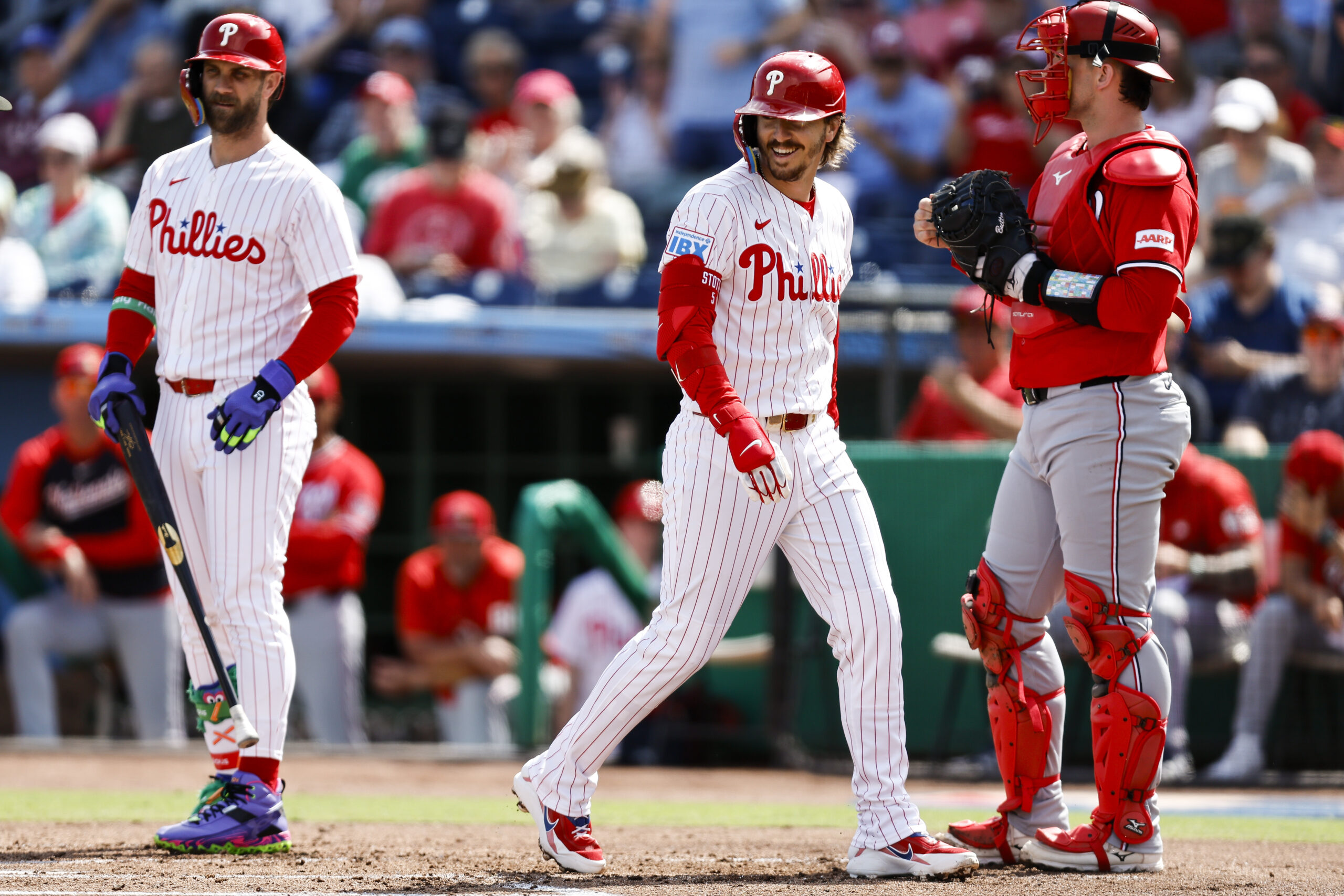
Phillies second baseman Bryson Stott (center) celebrates his home run during the first inning against the Washington Nationals.
Quotable
“Working on command of the cutter, but velocity was good and the movement was good,” manager Rob Thomson said of Alvarado. “Threw his two-seamer for strikes for the most part. So that was encouraging.”
On deck
The Phillies will split up Friday, with one group hosting the Miami Marlins at BayCare Ballpark and the other headed to Lakeland, Fla., to play the Tigers (1:05 p.m., NBCSP+). Aaron Nola is scheduled to start against Miami and Jean Cabrera will start against Detroit.
CLEARWATER, Fla. — Aidan Miller isn’t on social media, so it wasn’t until his father sent along a television clip last Sunday that he realized Bryce Harper told Phillies fans everywhere that he’s injured.
“I was like, ‘Oh, that’s pretty cool,’” Miller said with a laugh Thursday. “’He’s talking about me on the broadcast.’”
If anything, it speaks to how highly the face of the Phillies thinks of the 21-year-old top prospect that the status of Miller’s sore lower back is on Harper’s mind. Soon, though, Miller hopes Harper will be talking about him more for what he does on the field.
Miller’s work largely has been confined to the training room since the Grapefruit League schedule opened last weekend. He awoke one day last week, and his back was “super tight.” The feeling didn’t subside with treatment.
“We decided to take a couple of days off to just kind of let it relax, and now I’m kind of building back,” Miller said. “I feel like I’m in a better spot than I was. It’s getting better.”
The Phillies haven’t announced a timeline for Miller’s return, but they won’t rush him back.
“I still think I’m going to get into some games toward the end,” Miller said. “It’s definitely frustrating. I feel like it’s a big camp. Just really trying to stay present. My mind’s been spiraling a little like, ‘When am I going to get into games? Is it going to be next week? The week after?’ But I’m trying to just get better every day.”
The Phillies plan to give Aidan Miller reps this spring at shortstop, third base, and second when he’s healthy.
Miller was a long shot to make the Phillies’ opening day roster. But he was expected to get reps in spring training at third base and second base, in addition to shortstop, in preparation for a potential midseason call-up.
The root of the lower back soreness is unclear, according to Miller, who said it wasn’t a specific incident on the field. He said he felt similar soreness late last season. Miller was ticketed to play in the Arizona Fall League, but the Phillies told him to stay home. At the time, farm director Luke Murton said Miller had “some nagging things physically.”
“It went away for a little bit, and I thought it was gone,” Miller said. “Structurally, there’s nothing wrong there. It’s just, I think swinging a bat 100,000 times a year, we put a little bit of a toll on it. I think it’s just finding a good routine that could help me and prevent flare-ups in the future. I’m not worried about it at all.”
Aidan Miller is out for now with a sore back, according to Rob Thomson. Bryce Harper had hinted at it earlier on his TV interview.
Miller, whose spring training locker is sandwiched between those of Harper and J.T. Realmuto, said he has asked older teammates about best practices for dealing with similar issues.
“They’re texting people for me and trying to help me out,” Miller said. “They’ve been a huge help, just kind of bouncing questions off them.”
Miller, the Phillies’ first-round draft pick in 2023, has shot through the farm system over the last two years. Last season, he batted .264 with 27 doubles, 14 homers, 59 stolen bases, and an .825 OPS between double-A Reading and triple-A Lehigh Valley.
CLEARWATER, Fla. — For 30 minutes Wednesday, on the half-field adjacent to the Phillies’ clubhouse, Larry Bowa flipped baseballs to Bobby Dickerson, who hit one-hoppers and choppers and line drives at Bryce Harper.
Over and over. Again and again.
Ninety feet from Harper, a nine-time Gold Glove-winning first baseman and former captain of the Yankees stood with a glove on his right hand and a paper folded lengthwise in his back pocket. He didn’t say much. Mostly, he observed.
Then, after the drill, Don Mattingly conferred with Harper.
“I mean, it’s Donnie Baseball,” Harper said, smiling. “I grew up a Yankee fan, so knowing he played first base in the Bronx and had a great, storied career in the Bronx and was one of the best first basemen to ever do it, I have such a respect for him and the way he went about it.”
The admiration is mutual.
“He’s going on his 15th year, and I’m like, ‘Wow,’” Mattingly said. “I had a decent career, but I don’t know if I really can talk about some of the things that he can do. Because he can do things that, I think he’s kind of that Barry Bonds-type guy. It’s different.”
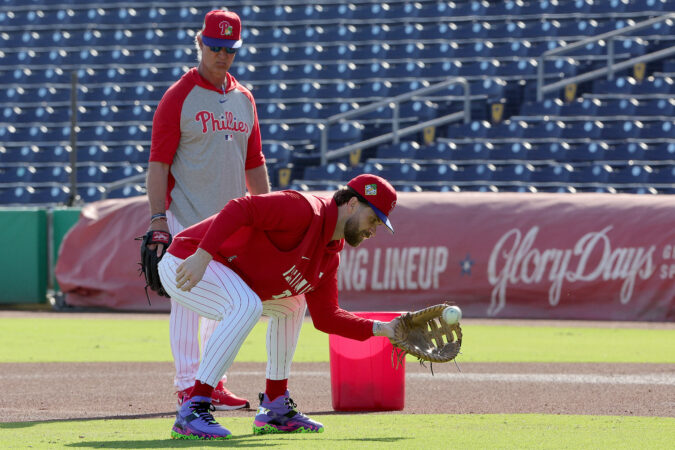
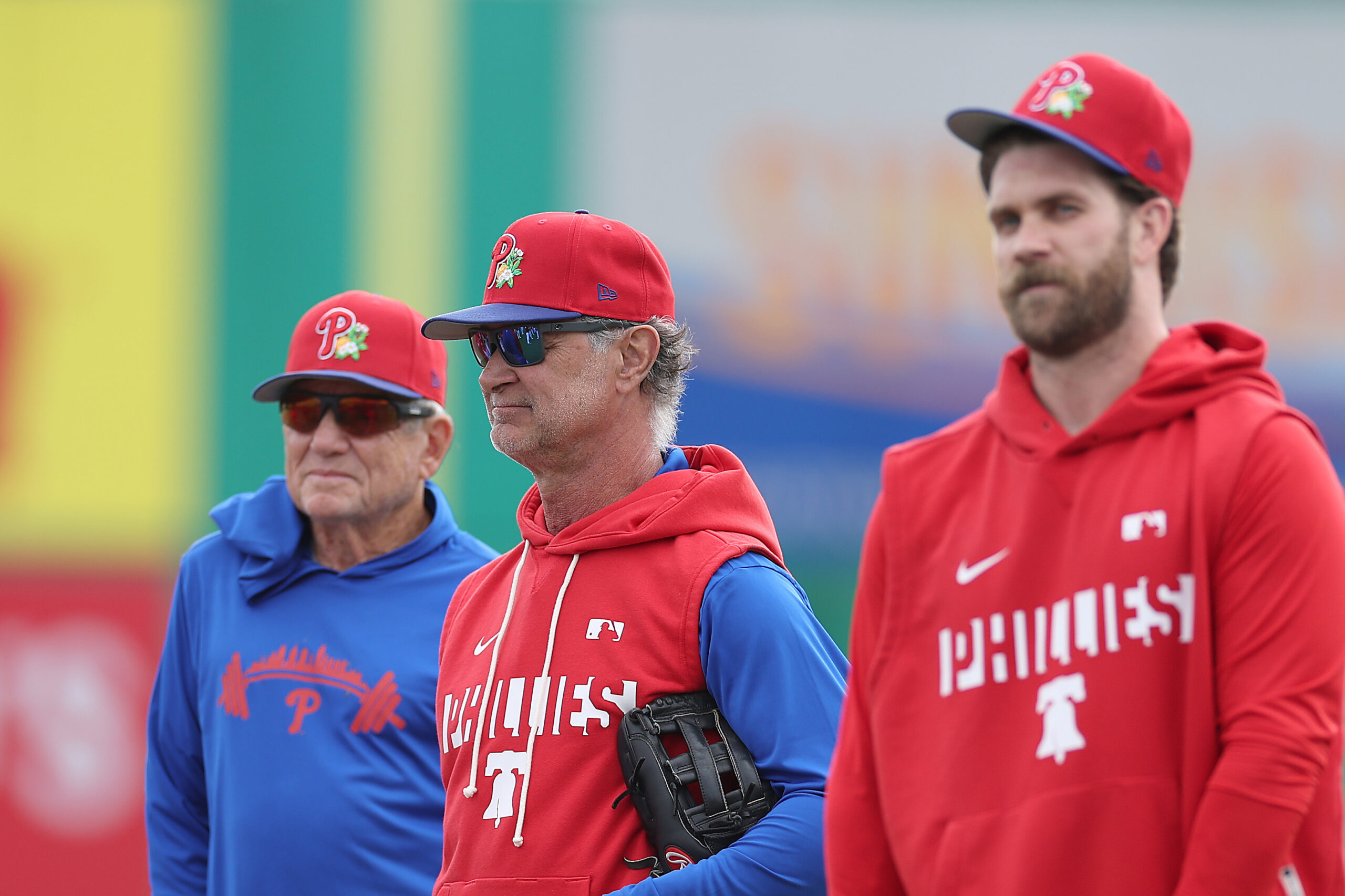
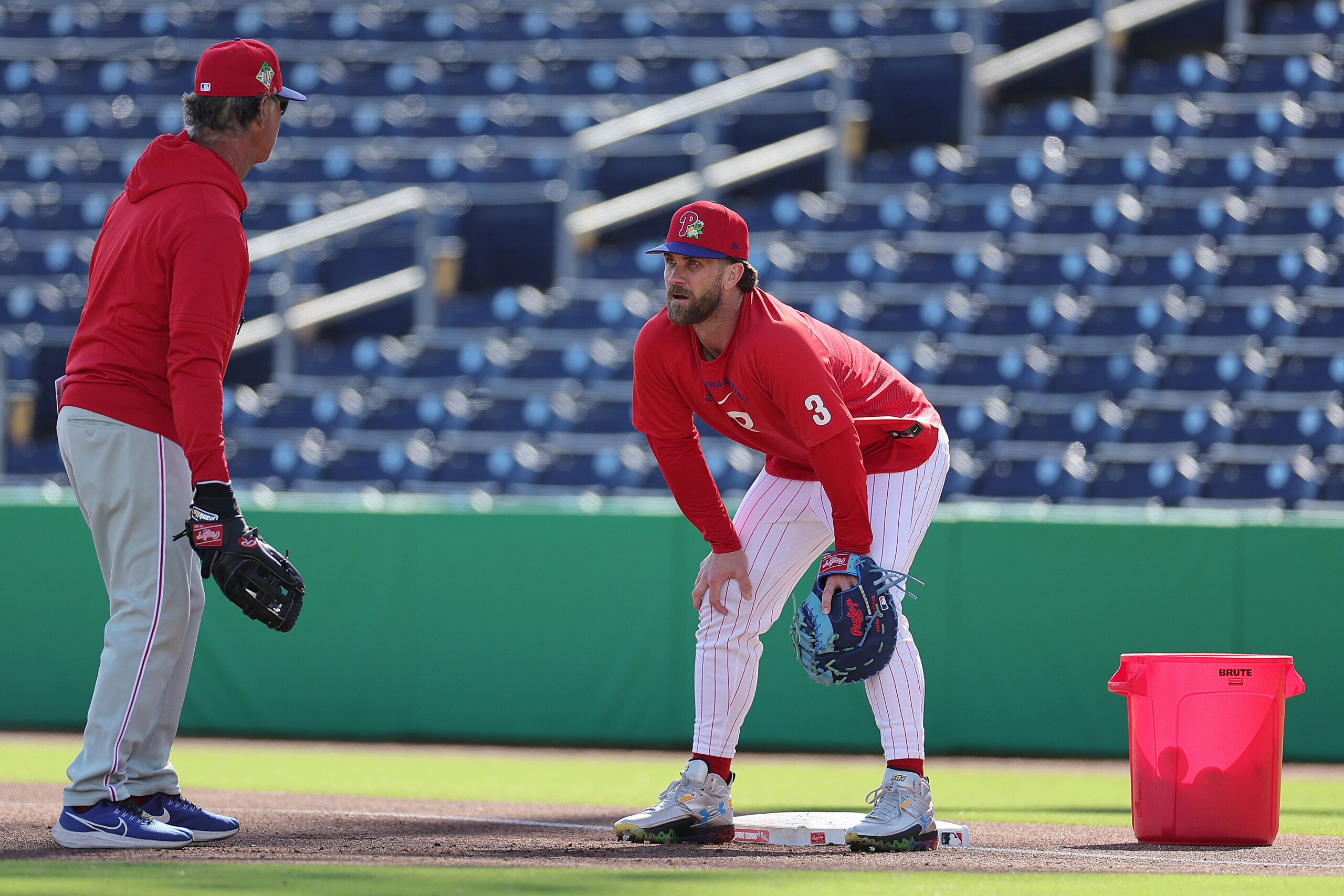
Phillies first baseman Bryce Harper (right) has an appreciation for the career of new bench coach Don Mattingly (center).
OK, let’s move beyond the pleasantries — and Mattingly’s modesty about a Hall of Fame-worthy playing career in New York — and get to what Mattingly and Harper can do for each other, notably winning the World Series championship that has eluded both.
The Phillies didn’t hire Mattingly to be their bench coach because of the effect he could have on any one player. But they do believe he will bring a different form of credibility to a coaching staff that is well-regarded within the sport but light on major league playing experience.
Harper has solid relationships with manager Rob Thomson and especially hitting coach Kevin Long and Dickerson, the infield coach who slings grounders with a fungo bat and a roux of encouragement and trash talk through a Mississippi drawl. All are good at their jobs. None played a day in the majors.
But Mattingly was the face of baseball back when baseball could still call itself the national pastime. A word from him surely resonates differently with Harper, among the biggest stars in the sport for a decade and a half.
“We have such a good staff, and to be able to bring him in and be part of that, he’s just going to make us that much better,” Harper said. “Being able to have a guy on the staff — and no disrespect to anybody — that has done it at the highest of levels, it’s so good to be able to bounce stuff off of him.”
Two weeks into camp, Mattingly said he’s still getting a feel for everyone, including Harper. He isn’t the hitting coach or the infield instructor. Long and Dickerson have those areas covered. But he’s a fresh set of eyes on a staff that has been together since Thomson took over as manager in 2022.
And after two weeks of watching pitcher fielding practice, live batting practice, and baserunning drills, peeking on hitters in the cage, and offering feedback to Thomson and the coaches, Mattingly has a few observations.
“I like the way guys work here,” he said. “It’s concentrated when they’re in the cage, and the work’s been good on the field for pitchers. It’s not like you’re coming in here to a 96-win team and try to say, ‘You guys should be doing this, this, or this.’ It’s a really good club.
“You’re just trying to find the details of how do you get a little bit better?”
Marginal improvements could make the difference between the Phillies losing three games by a total of four runs to the Dodgers in the divisional round and advancing to the NL Championship Series.
Phillies bench coach Don Mattingly (left) talks with first baseman Bryce Harper in Clearwater, Fla., on Monday.
In the case of Harper, who will play this season at age 33, Mattingly’s influence could help extend his peak.
Harper was still in diapers when Mattingly retired in 1995. But as a baseball obsessive with an appreciation for the sport’s past, Harper has studied highlights — “ESPN Century, all that kind of stuff,” he said — from Mattingly’s career.
“The little crouched-down stance,” Harper said. “Bat-to-ball skills were unbelievable. The short porch [in right field at Yankee Stadium] was really good for him. But just a doubles machine that knew how to hit.“
Mattingly hit it off with star infielder Bo Bichette in his last job as bench coach of the Blue Jays. Last season, Bichette batted .311 with 44 doubles, 18 homers, and a 129 OPS-plus.
“I think they really came together, and you saw Bo have the great year that he had,” Harper said. “Probably learned a lot of stuff from Donnie and what he does. It’s no coincidence.
“And I love being coached. I don’t care where I’m at or how old I am. I love being coached at the highest level by guys like him because just an ounce of information from him could change the dynamic of somebody’s career. I think everybody should have an open mind and open ears to him.”
Harper is 3-10 in 13 career postseason series. The Nationals famously won the World Series one year after Harper joined the Phillies.
Mattingly is chasing something similar. A year after he retired from playing, the Yankees began their run of four World Series championships in five years. He managed the Dodgers before they became a dynasty. The Blue Jays just lost in Game 7 of the World Series.
After 14 seasons as a player, 12 as a manager, and 10 as a coach, Mattingly is still aiming to win a World Series.
With a talented Phillies lineup, Don Mattingly says, “You’re just trying to find the details of how do you get a little bit better.”
Maybe Harper can help with that.
They’re still getting to know each other. Mattingly’s early observations include Harper’s attention to detail in the batting cage and solid footwork around first base. Harper will leave camp Saturday to join Team USA for the World Baseball Classic. Upon his return, the work with Mattingly will continue.
“He’s a different animal than almost anybody else as far as, he’s been here for a long time, still in great shape, still big-time bat speed,” Mattingly said. “He’s a guy that has a chance to win a Gold Glove, in my mind. I’ve had different first basemen, and he’s as good as any.
“Sometimes I think guys like that, you start to take for granted how good they are. And that’s what I think about with him. That doesn’t mean you don’t try to get better in different areas. But he’s going to have a pile of numbers there that, as he gets toward the end of his career, people are going to be going, ‘Holy [bleep], this guy’s been incredible.’”
A mid-career boost from Donnie Baseball can’t hurt.
CLEARWATER, Fla. — If the idea had never been floated last year at Chicago Cubs camp that Brad Keller could make the switch from starting to relieving, his life today would probably look completely different.
“I was basically destined to go to Iowa and just be kind of a bulk starter down there and kind of see what happens,” he said. “Definitely a career changer.”
But instead of pitching for the Cubs’ triple-A affiliate in Des Moines, Keller tried out the bullpen. The switch revitalized his career, as he developed from journeyman starter to key reliever for a team in a playoff race, and then signed a two-year, $22 million deal with the Phillies this winter to be a high-leverage arm.
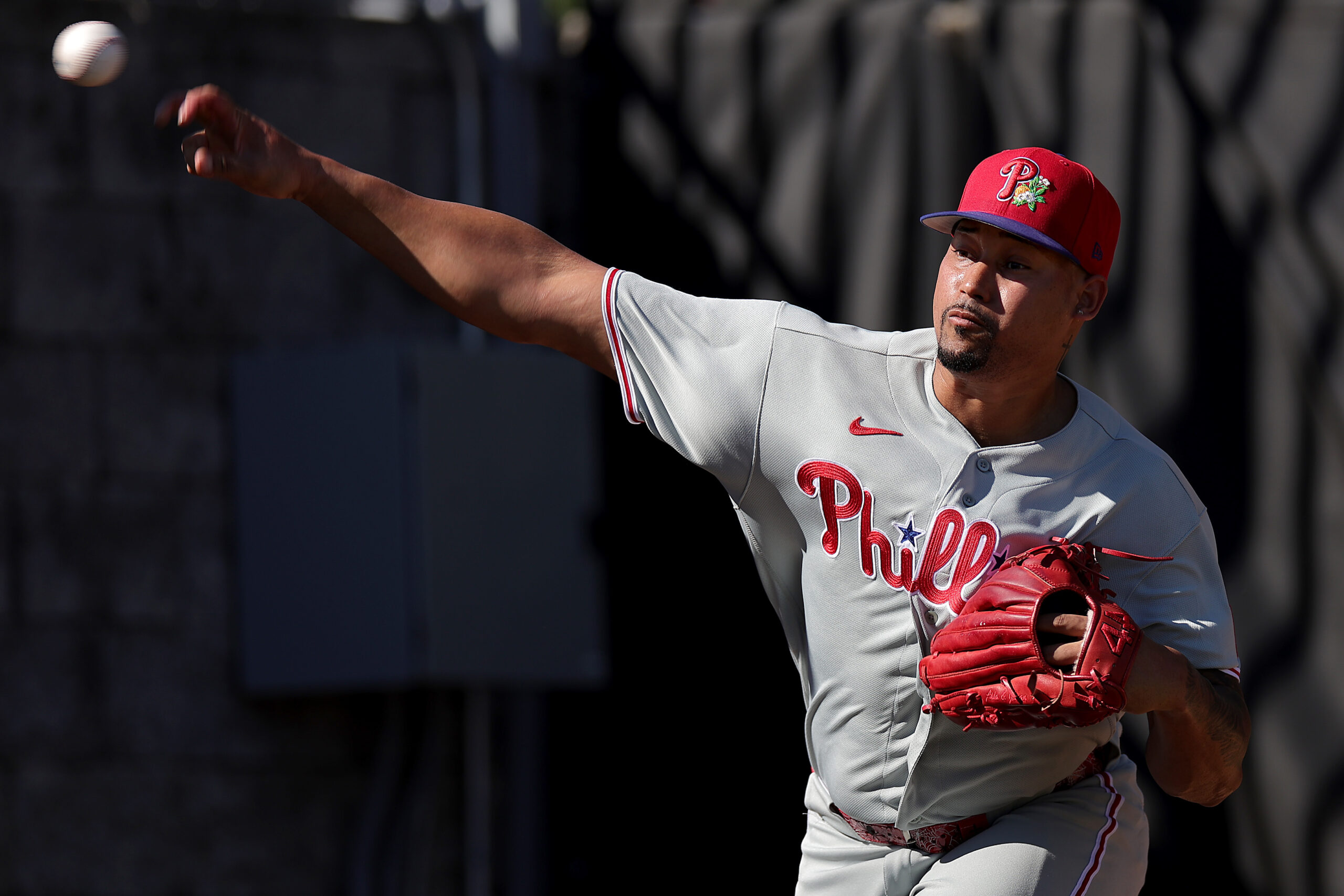
Keller pitched the first inning of a Phillies bullpen game on Wednesday, a 5-3 win over the Detroit Tigers. He needed just 11 pitches to retire the side in order.
“It was good to get in there and face hitters, get in front of the stadium instead of just the live backfields and stuff like that. So it was good. Felt good,” Keller said.
Keller’s fastball jumped from 93.7 mph in 2024 to 97.1 mph last season after his move to the bullpen. In his first Grapefruit League outing, he blew two fastballs by Colt Keith clocking 97.3 mph and 96.9 mph to strike him out swinging.
“High velocity, and the slider was really good,” said manager Rob Thomson. “He looked great.”
Rather than paring down his starter’s arsenal when he made the switch to the bullpen, Keller actually added a pitch — a sweeper. He typically uses it as a weapon against righties, throwing one Wednesday to Gleyber Torres that he fouled off, before getting him to ground out on his sinker.
Keller, who will join Team USA to prepare for the World Baseball Classic on Saturday, said he always knew he had the potential for higher velocity.
“I knew it was always in there,” he said. “It’s just my mentality was always starting. I started my whole career, minor leagues and most of the big leagues. And so I just never really reached back for anything. Last year was a little bit of a surprise, because I feel like I didn’t ever have to reach back. It was just there, which was nice.”
Who stood out
Edmundo Sosa hit a ground-rule double to left field in the third inning.
Alec Bohm made a nice play on a sharply hit ground ball at third base, and turned a double play to end the top of the fourth. Bohm finished 2-for-3 with two RBIs.
“He’s in really good shape this year, and he’s a little bit stronger. He’s done a lot of work, so he’s ready for this,” Thomson said. “He’s been swinging the bat well and hitting the ball the other way. I thought our at-bats today were good.”
Otto Kemp hit a home run onto the center-field berm, and Bryce Harper doubled to right to drive in a run in the fifth inning.
Justin Crawford also made a big defensive play, leaping to catch a deep fly ball from Matt Vierling on the center-field warning track.
On the mound
Following Keller, Zach Pop, Kyle Backhus, Zach McCambley, Tim Mayza, Trevor Richards, and Génesis Cabrera each pitched an inning. Those six are competing for the final two bullpen spots.
Pop, Backhus, and Richards each sidestepped a single for a scoreless frame. McCambley allowed a run on a walk and two straight singles, but induced a double play to escape the jam. A run scored on Mayza after two singles put runners on the corners and a wild pitch went to the backstop.
Cabrera tossed a 1-2-3 seventh.
Phillies shortstop Edmundo Sosa celebrates after hitting a ground-rule double during the third inning against the Tigers on Wednesday in Clearwater, Fla.
Injury check
Infield prospect Aidan Miller (sore back) has continued to get treatment and has begun to ramp up in the weight room. The Phillies are being cautious with him and do not have a timeline for when he will start swinging a bat.
Outfielder Brandon Marsh jammed his hand during sliding drills on Tuesday and has some inflammation and soreness. To be cautious, Thomson said Marsh likely won’t play until after Monday’s off day.
“He’s been throwing strikes and the slider’s good,” Thomson said of Pop. “He’s got a bowling ball fastball, heavy sink to it. It’s a mid-90s fastball. He’s throwing the ball well. Backhus, again, threw the ball well today. So yeah, we’re going to have some tough decisions at the end of this thing.”
On deck
The Phillies host the Nationals at 1:05 p.m. Thursday at BayCare Ballpark, with Taijuan Walker set to start.
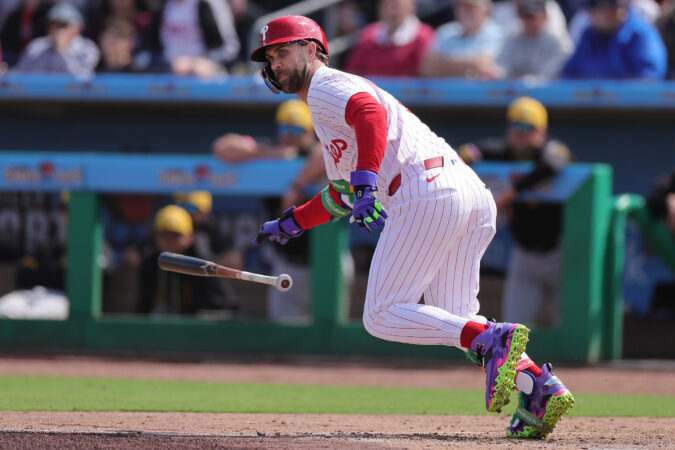
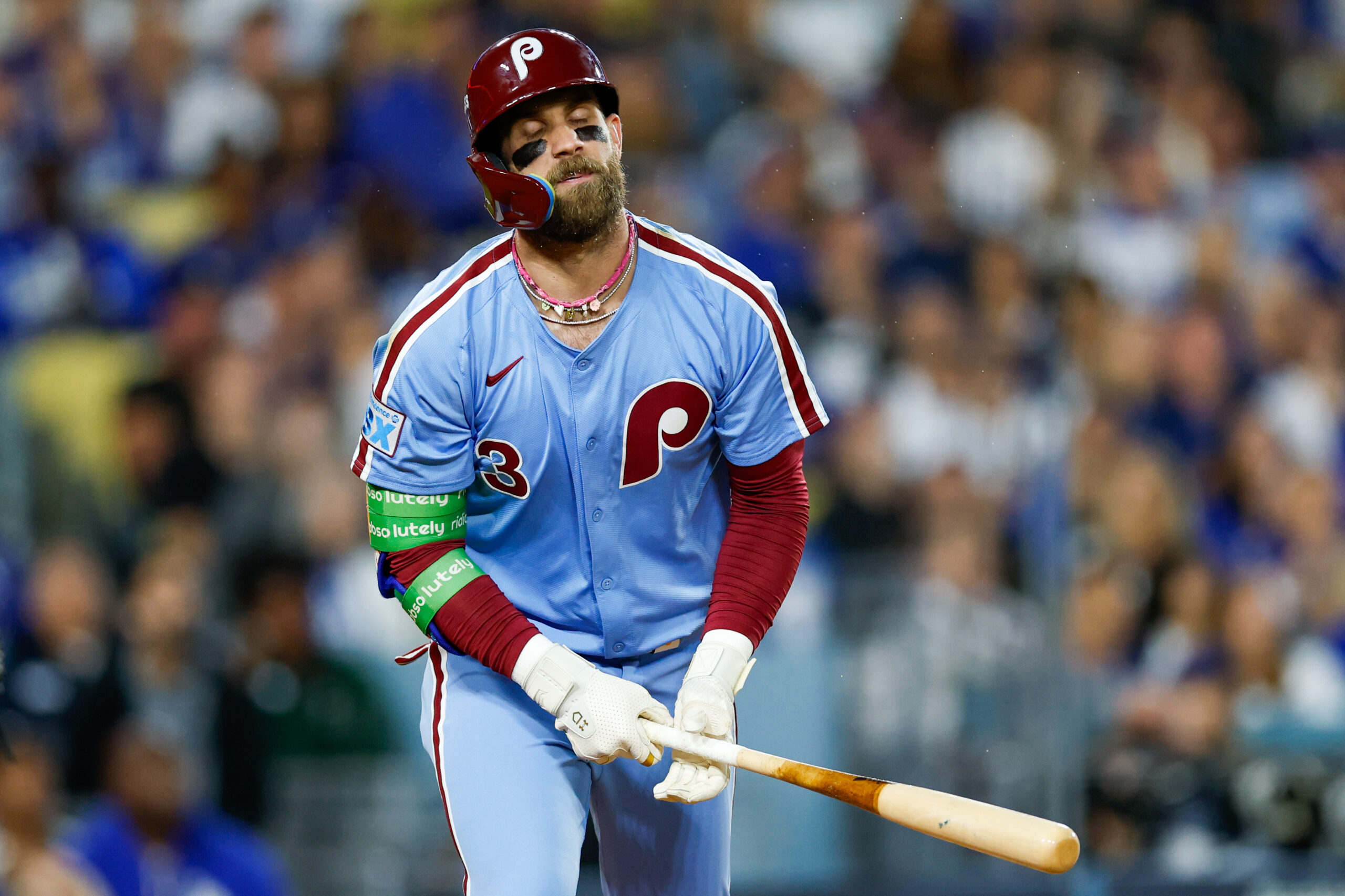
No man is an island. Unless that man is Bryce Harper and he has just reached base.
Last season, there wasn’t a lonelier lot in life than to be a Phillies superstar standing on first, second, or third. Only four players in the majors reached base as many times as Harper did and scored fewer runs. The 72 runs he did score were the fewest of his career in a season with at least 500 plate appearances. Only one player in the majors last year failed to score more than 72 runs while posting an OPS of at least .800 in 580-plus plate appearances. It was Harper. In fact, he was the only player to do it since 2023. That’s not some hocus-pocus bit of cherry-picked math. Fifty-nine players meet our criteria (.800 OPS, 580 PAs). Harper’s 2025 campaign ranked dead last in runs scored.
Not since E.T. have we seen someone with such otherworldly attributes struggle this hard to get home.
We’ve heard a lot of chatter about lineup protection this offseason. Scott Boras broached the topic back in October. Harper himself weighed in last week. Their focus was on pitchers pitching around Harper in order without the threat of reprisal from those due up next.
“I think the four spot has a huge impact,” Harper said when he arrived in Clearwater, Fla., for spring training. “I think the numbers in the four spot weren’t very good last year for our whole team. I think whoever’s in that four spot is going have a big job to do, depending on who’s hitting three or who’s hitting two.”
Neither Harper nor his agent spoke much about the issue of him rotting on base like an unsold ham on Easter Monday. But it’s just as important, if not more so.
Last season, Phillies hitters had 366 plate appearances when Harper was on base. That’s not including his home runs. We’re limiting ourselves to the plate appearances when Harper was physically standing on base, hoping for a teammate to drive him home. In those 366 plate appearances, the hitters behind Harper combined for a whopping .227 batting average, .290 on base percentage, and .342 slugging percentage. Of the 180 times he reached base without driving himself in (i.e., without hitting a home run), he ended up crossing home just 45 times.
In 366 plate appearances (not including home runs), the hitters behind Bryce Harper combined for a whopping .227 batting average, .290 on base percentage, and .342 slugging percentage.
That’s a remarkably low percentage. Three out of four times that Harper reached base, the inning ended with him jogging back to the dugout. That’s a remarkably low percentage compared to most other hitters of his ilk. Even more troublesome is the fact that Kyle Schwarber’s percentage wasn’t much better. But we’ll get to that in a second.
First, let’s remind ourselves of the real-world situations that these numbers tabulate. Harper didn’t have a great NLDS against the Dodgers. But he did reach base six times. That was tied for second on the team behind Alec Bohm. Bohm reached base 10 times and scored three runs. J.T. Realmuto reached base six times and scored three runs. Harper reached base six times and scored one run.
It’s an imperfect example. In the NLDS, Harper mostly expired on first base after arriving there with two outs. You could write it off to circumstance if not for the body of evidence. In the 2025 regular season, no player in the majors was stranded as often as Harper, once you account for where he hits in the order. His driven-in percentage (25%) ranked dead last among players who regularly hit in the top-third of the order (minimum 500 plate appearances).
The table below shows the 34 players who had at least 500 plate appearances in an average batting order position between the two-hole (2.0) and three-hole (3.0). Their run percentage is the number of times they reached base and later scored.
Just as concerning as Harper in dead last is Schwarber a mere two spots ahead of him. Of the 34 qualified hitters, Schwarber and Harper ranked 32nd and 34th in scoring percentage. Put another way, Schwarber and Harper’s teammates ranked dead last in their ability to drive them in.
Between Schwarber and Harper is Cal Raleigh, whose Mariners advanced to last year’s ALCS and put up a sporting effort. Meanwhile, Toronto’s Bo Bichette scored at a below-average rate. The Blue Jays made the World Series. It isn’t completely unheard of for upper-middle-of-the-order hitters to drive in more runs than they score, given the drop-off in quality behind them. But the Phillies have two players at the bottom of the list. We’re talking about the upper two-thirds of their order. And they aren’t just below-average. They are virtual outliers. The only other team that has two players in the bottom half of this list is the Angels. Nobody wants to be mentioned in the same breath as the Angels. If you are comparable to the Angels in a certain regard, it’s a sure sign the regard needs fixing.
If Harper sounds a little cranky this spring, think about how it feels to reach base and not score. And then think about the fact that the Phillies still don’t have a viable solution. Is it any wonder that Harper is acting like he woke up on the wrong side of the red-light therapy sleeping bag?
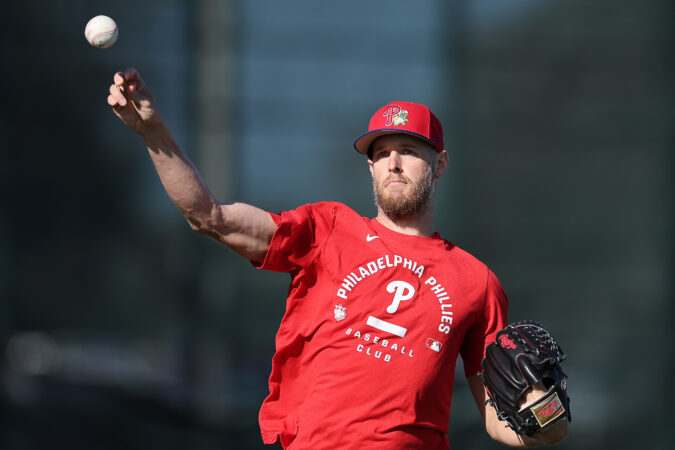
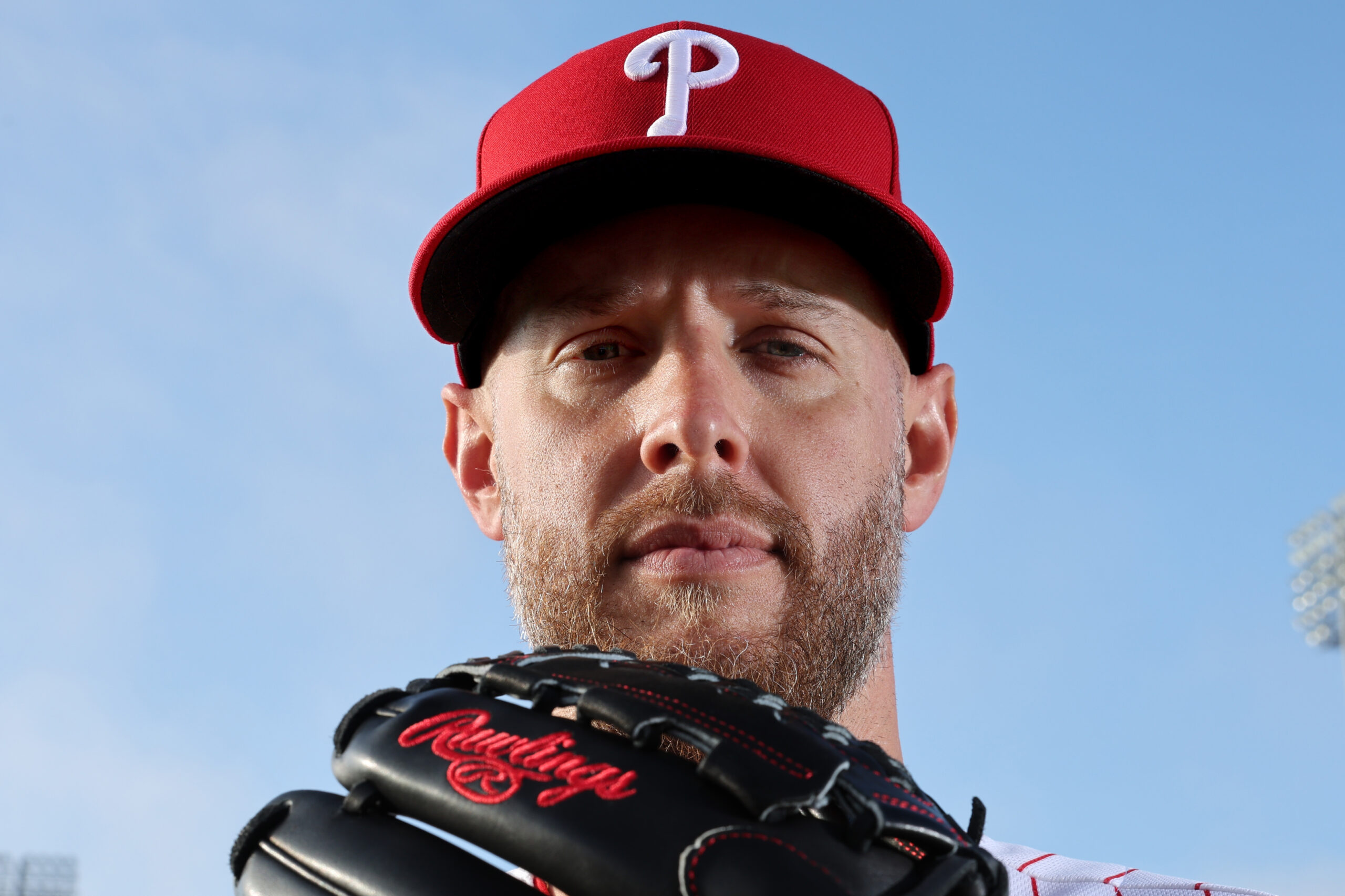
CLEARWATER, Fla. — It’s a long, scary-sounding procedure — venous thoracic outlet decompression surgery — so let’s just ask Zack Wheeler to explain what it entailed on that Tuesday in September at a St. Louis hospital.
OK, Zack, don’t spare any details.
“Basically all they do,” the Phillies ace said Tuesday, “is go in, chop the bone, get rid of that [rib] because that’s what’s causing it, get rid of the blood clot, and then open up the vein. My vein closed back, I think two different times, so they had to go back and open it. If it happened again, I think they were just going to do a stent. But so far, so good.
Five months later, there’s a matter-of-factness with which Wheeler talks about all of this, from the onset of symptoms on the eve of an Aug. 15 start in Washington to the tension-filled days and weeks that followed.
Maybe it’s because the 35-year-old righty endured injury-related misery early in his major-league career. In the spring of 2015, he suffered a torn elbow ligament and had Tommy John surgery. Setbacks in his recovery led to a second procedure and caused him to miss two seasons.
Compared to that, Wheeler says this is “not that bad.”
“Knock on wood,” he added, tapping the side of his locker.
Since he signed with the Phillies in 2020, Zack Wheeler leads all major-league pitchers with 28.6 wins above replacement, according to Fangraphs.
Wheeler remains in the long-toss phase of his comeback, playing catch from as far as 120 feet. He’s inching closer to throwing from the mound. The standard buildup will follow: bullpen sessions, facing hitters in live batting practice, more bullpen sessions, and a few starts in the minor leagues.
Although Wheeler won’t be ready in time for opening day, he and the Phillies believe he will pitch a lot of innings this season. But beneath the optimism is an underlying mystery raised the other day by none other than Bryce Harper.
“We have no idea what Wheels is going to look like,” Harper said. “We all hope that Wheels comes back and is Zack Wheeler because there’s nobody better in baseball when he’s going good. But we have no idea.”
In classic Wheeler fashion, he insists he isn’t worried.
“I don’t think there’s any reason why I wouldn’t be who I am,” he said. “It’s not like a major surgery. I just got a rib taken out. It might sound like a crazy situation, or crazy surgery, or whatever, but mentally, I’m not really stressed about it. Physically, I’m not really stressed about it.”
Not since that Friday night in D.C., at least, when a late-night consultation by the Nationals team physicians after a five-inning start led to the next-day diagnosis of a blood clot near his right shoulder.
In detailing for the first time those few days in August, Wheeler said he felt “like a full feeling” as he went through arm exercises in the training room on Aug. 14. He chalked it up as “something wacky,” and went outside to play catch. The sensation didn’t subside.
Phillies pitcher Zack Wheeler was diagnosed with a blood clot near his right shoulder after a start in Washington on Aug. 15 of last season.
When they work out, Phillies pitchers often wear a cuff that partially restricts blood flow to help the arm recover. As Wheeler put it, “your veins start popping up.”
“That’s literally what I felt like,” he said.
Only he wasn’t wearing the cuff.
Wheeler said he reported the issue to head athletic trainer Paul Buchheit, with whom he has developed a close relationship since both joined the Phillies in the 2019-20 offseason. He also told Buchheit about “a little bubble in my armpit” that looked like a lymph node.
Everything checked out in the training room. Wheeler said the “full feeling” went away, then returned the next day in the bullpen before his start, then went away again. He held the Nationals to two runs in five innings, threw 97 pitches, and topped out at 95.7 mph, a 1.5-mph gain over his previous start.
“Paul was like, ‘Let’s just get it checked out,’” Wheeler said. “The D.C. doctors came over, and they’re like, ‘Uh, it’s not a lymph node. You need to go get that checked out tomorrow morning, first thing.’ And that was kind of what started the whole thing.”
Doctors diagnosed the blood clot. Wheeler went back to Philadelphia and underwent a venogram, a test to detect blood flow in his veins. The conclusion: The clot was caused by a vein that got compressed between Wheeler’s rib cage and collarbone.
If anything, Wheeler actually felt relieved.
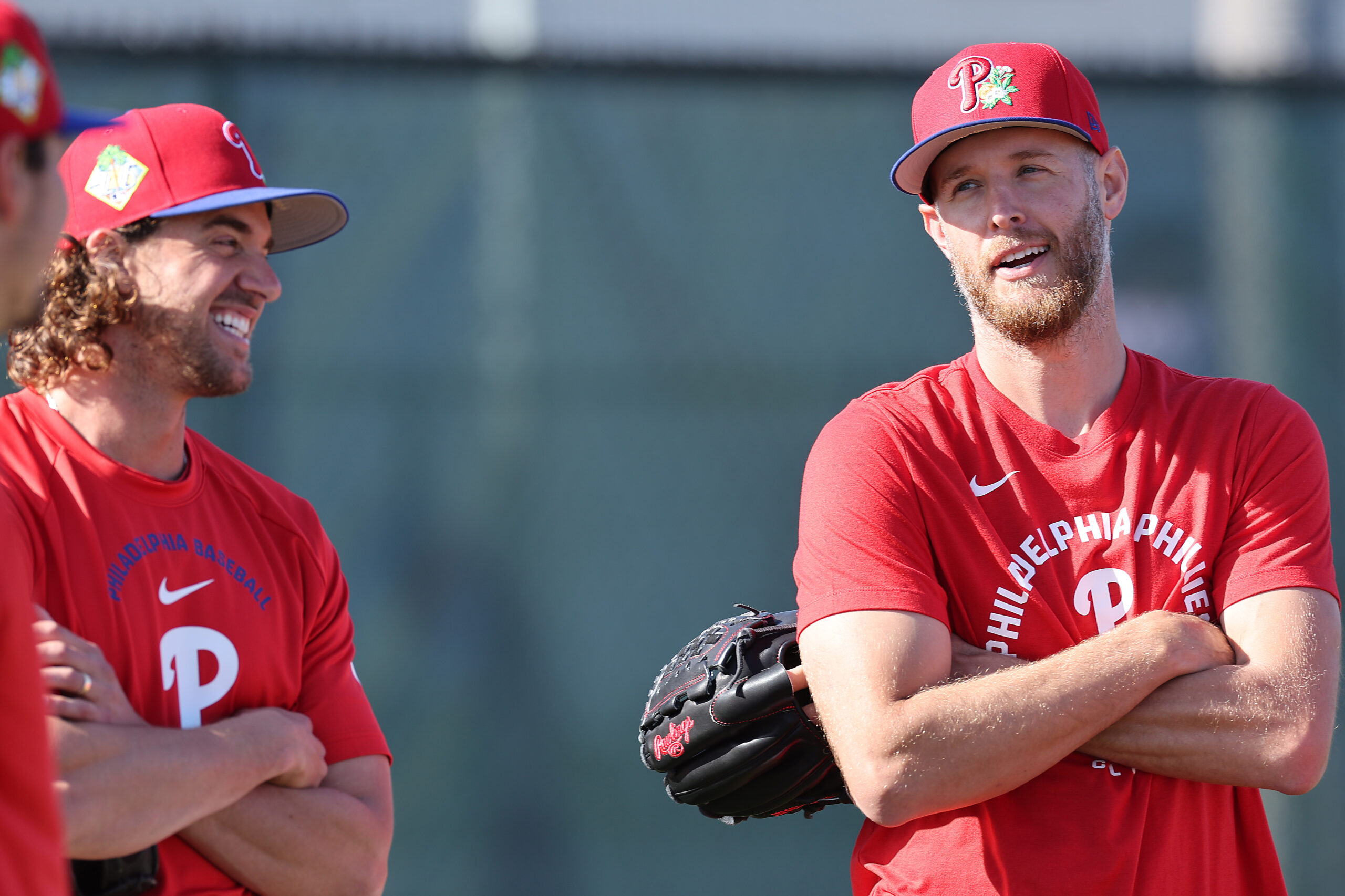
Phillies pitcher Aaron Nola (left) listens as Zack Wheeler jokes around during spring training in Clearwater, Fla.
“Even though like the whole blood clot thing was pretty serious, I didn’t even find it that scary,” he said. “Maybe I’m just naive to it. But I didn’t get a blood clot because of my health or anything like that. It’s just two bones were pinching together. That’s why it happened. So, that kind of eased the thoughts in my head.”
Wheeler underwent a thrombolysis on Aug. 18 at Thomas Jefferson University Hospital to remove the clot and open the vein. After taking blood thinners for five weeks, Wheeler had surgery Sept. 23 to remove the rib. The vein had closed again and a second clot was forming.
It was “nothing out of the ordinary,” according to Wheeler, who said his St. Louis-based vascular surgeon, Robert W. Thompson, warned that the vein might not stay open until after they removed the rib.
“Just from hearing what they were saying, if it stayed open, hooray. But I don’t think they really expected it to,” Wheeler said. “The rib was still there. The clavicle is obviously still there.”
Before Wheeler left the hospital, doctors went in again to make sure the vein hadn’t closed again. It had not.
Then came the hard part: weeks of physical therapy and rehab, including a strict diet of what Wheeler described as “small amounts and healthy stuff,” not easy for an unabashed fast-food and junk-food lover. He’s unsure how much weight he lost but said it was “a good bit.”
“You can’t have fats or something like that,” said Wheeler, who rejoined the team Oct. 4 for pregame introductions before Game 1 of the division series against the Dodgers. “I lost a lot of weight doing that because I could barely eat, really.
“It was pretty painful that first week. It was rough. But since then it’s been pretty smooth sailing.”
Wheeler spent most of the winter in Philadelphia, rehabbing under Buchheit’s supervision. There’s a history of pitchers returning from this particular form of thoracic outlet syndrome. Among the success stories: Merrill Kelly, at age 31, had surgery in September 2020, made it back by April 2021, and is still going.
So, while outsiders — and even some of his teammates — wonder if Wheeler will be Wheeler again after a procedure that he insists wasn’t as scary as it sounds, he puts in the work each day with his usual nonchalance.
“I mean, it might be a little thought, but at the same time, you can’t worry about that kind of stuff,” Wheeler said. “There’s no hesitation at all.”
CLEARWATER, Fla. — After Jhoan Duran finished his throwing program in the BayCare Ballpark outfield, he didn’t head straight for the mound, where he was scheduled to throw live batting practice.
First, he stopped by the empty bullpen.
Duran wanted to reenact the jog he will make every time he comes in to close games for the Phillies this season, to help get in the right head space for facing hitters the first time all spring.
“That’s what I do in the game,” Duran said. “So I wanted to go in live, too.”
It was shortly before noon on a clear Florida day, so Duran wasn’t accompanied by his traditional light show, flames, or crawling spiders on the video board. But it didn’t really matter, because Duran got the results he was looking for on the mound with the 17 pitches he threw.
“I feel good,” he said. “My command is there. I feel it’s there. My breaking ball pitches are moving good. So that’s good.”
The last time Duran had jogged from bullpen to mound, in Game 4 of the National League Division Series, things had not gone so according to plan.
“I feel good,” Jhoan Duran said. “My command is there.”
With the Phillies protecting a 1-0 lead over the Dodgers, manager Rob Thomson called on his closer with two runners on in the seventh inning. He intentionally walked Shohei Ohtani to load the bases for the more advantageous right-on-right matchup against Mookie Betts. But Duran issued his first career bases-loaded walk after Betts held off on an elevated fastball, which tied the game.
After the Phillies were eliminated in extra innings, Duran said he didn’t dwell on the walk or the game at all over the winter. He has learned to have a short memory.
“I don’t think about it too much,” he said. “Because that’s the past. I learned in the minor leagues, if you throw one inning and you do it bad, the next day, you think about that, you don’t throw good that day. So if I do it bad, I forget. I’m ready for the next day. That’s me.”
With 2025 in the rearview, Duran said the number of outings he has each spring can vary, and will depend on how he feels. He doesn’t have the added complication that some of his teammates have, of factoring in preparation for the World Baseball Classic, which will start pool play in less than two weeks.
He was asked to pitch for the Dominican Republic but opted not to participate. He wanted to focus on being ready for the regular season instead.
When he does make that jog for the first time with the lights, it will also mark the Phillies’ first time starting a season with a bona fide closer under Thomson. And having a dedicated ninth-inning pitcher will also impact how the manager deploys the rest of the bullpen this year.
Thomson is leaning toward having designated roles for his other high-leverage arms, rather than just piecing things together based on matchups. Lefty José Alvarado and righty Brad Keller are both potential setup men for Duran.
“When you have a true closer like Duran, that’s the way you should set it up,” Thomson said. “And especially when we have the type of arms that we have. But again, if you give a guy a fifth- or sixth-inning role, and the seventh- and eighth-inning guys aren’t available, well, they’re going to have to pitch in the seventh or eighth.”
“I think it’s probably the best group of arms we’ve had here since I’ve been here,” he said.
Keller signed a two-year, $22 million deal with the Phillies this winter after a breakout season as a Cubs reliever last year. He and Duran coincided in the Diamondbacks organization as minor leaguers between 2015 and 2018. At the time, they were also both starters.
Now their careers have taken them to the back end of the Phillies’ bullpen.
“I think that’s what makes a fun bullpen, right?” Keller said on a recent episode of Phillies Extra, the Inquirer’s baseball interview show. “All different backgrounds, all different personalities, and just all come together, just be a bunch of grinders and a bunch of dogs down there. That’s kind of the mentality that a bullpen takes over. And it’s so fun getting to know these guys and watching.”
Duran is excited for the unit that is shaping up. Also in the group are returning lefty Tanner Banks and righty Orion Kerkering, plus newcomer Jonathan Bowlan, a righty acquired from the Royals in exchange for Matt Strahm. There are several contenders in camp for the final two spots, including Rule 5 pick Zach McCambley and sidearmer Kyle Backhus.
“We talk a lot together, we practice together, too, more and more times,” Duran said. “And it’s great, these guys in the bullpen; great arms, great talent. We have everything in the bullpen.”