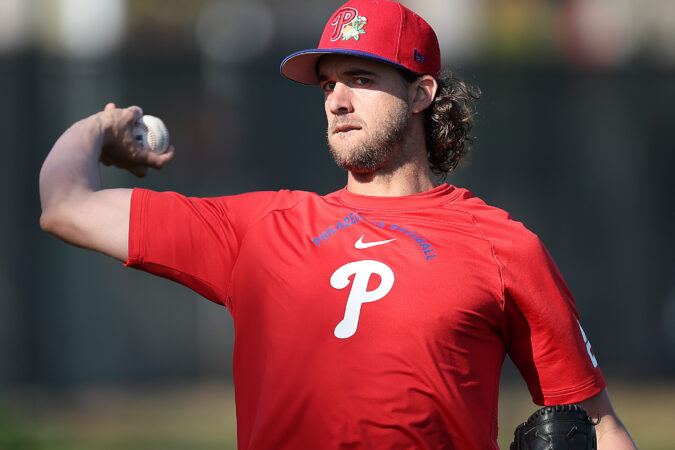
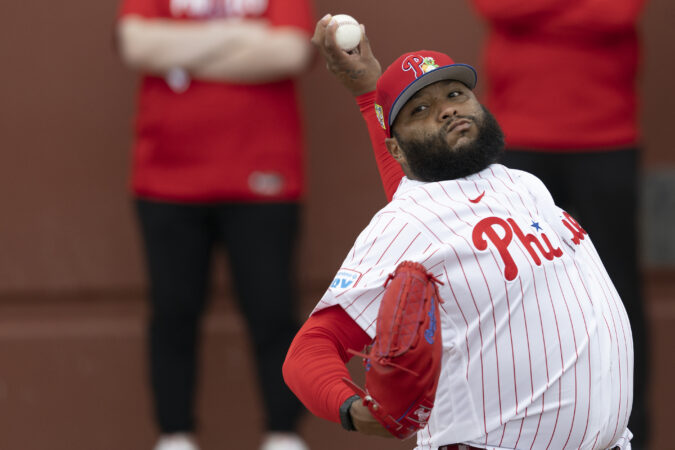
After being named the 2025 Philanthropist of the Year by the Major League Baseball Players Trust, Phillies pitcher Aaron Nola earned a $25,000 grant to donate to a charity of his choice. On Wednesday, he selected Philabundance, the largest food bank in the Greater Philadelphia region, as the recipient.
“Aaron Nola has been helping Philabundance strike out hunger for five years,” said Loree D. Jones Brown, the chief executive officer of Philabundance. “We are deeply grateful for his generosity and partnership. Delivering food, hope, and stability to those of our neighbors who need it most is a collective effort, and we could not fulfill our mission without the crucial, consistent support of donors — and friends — like Aaron.”
Nola has been working with Philabundance since 2019, joining its efforts to battle food insecurity across two states in nine counties. Their partnership will continue into 2026 with Philabundance as one of the beneficiaries for Nola’s charity poker tournament on April 16 at Citizens Bank Park.
“Aaron embodies the Players Trust’s goal of making a positive impact in the world and has demonstrated an extraordinary personal commitment to philanthropic endeavors,” said Amy Hever the executive director of the Players Trust. “Our goal is to amplify the good the Players do in their community, and we hope this grant will help Philabundance reach even more people and families experiencing food insecurity.”
Phillies pitcher Aaron Nola was named the 2025 Philanthropist of the Year by the MLBPA.
Nola was named the Philanthropist of the Year for all his work giving back to the community, working with Philabundance, Team Red, White and Blue — an organization for veterans and service members seeking improved physical or mental health — and ALS research.
Although Nola was unable to attend Wednesday’s Playmakers Classic, the Players Trust’s annual fundraising and awareness event, the 11-year veteran left an important message.
“This award means a lot to me, because giving back has always been a core part of who I am and what I believe in,” said Nola in a video message.
“Baseball has given me so many opportunities, mentors, and teammates who feel like family, and I’ve always felt a responsibility to use that platform to make a positive impact — whether it’s supporting ALS, veterans, kids and families, or doing whatever I can to strengthen communities and help make the world a little bit better. … This is truly an honor, and it motivates me to keep doing more, both on and off the field.”
CLEARWATER, Fla. — J.T. Realmuto is in spring training with the Phillies for the eighth consecutive year.
But for a week in January, he wasn’t sure he’d be back.
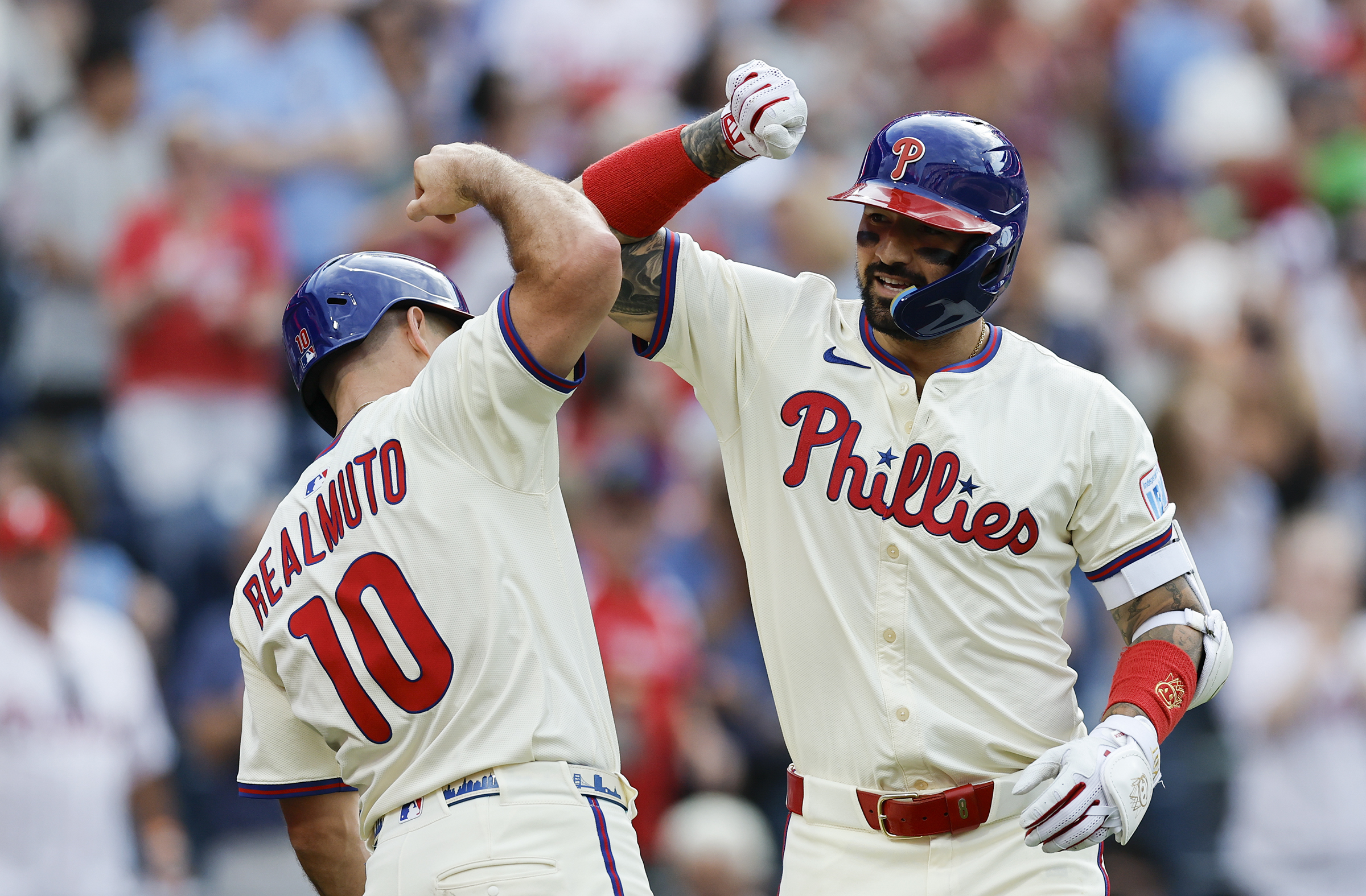
Realmuto sat down last week with Phillies Extra, The Inquirer’s baseball podcast, to talk about his start-and-stop contract talks, which included a call in which president of baseball operations Dave Dombrowski told the star catcher’s agent that the team was heading in a different direction.
In addition, Realmuto discussed the Phillies’ decision to release Nick Castellanos, offered his outlook for the starting rotation in 2026, and more.
Watch the full interview below and subscribe to the Phillies Extra podcaston Spotify or Apple Podcasts.
Q: Take me back to that week in January and how seriously you began thinking that you might be somewhere else this year.
A: It was definitely a pretty hectic maybe 48 hours for us. Obviously there were the rumblings about the [Bo] Bichette stuff going on, and then, we were kind of at a standstill with the Phillies for quite a while. It had been all the way dating back to December at that point where there was no momentum. We had many conversations. There was just no momentum on the deal moving anywhere. So, yeah, I got a little stressful there for a couple days where we weren’t sure what was going to happen. Started kind of thinking about our other options and putting the logistics together of what it might be like to go somewhere else. And thankfully it didn’t come to that, because as we’ve stated all along, this is where we wanted to be. So, we’re happy we didn’t have to up and move and go somewhere else.
Q: How much confidence do you have in this starting rotation, and how do you feel about how that group shapes up again going into 2026?
A: I love it. I don’t think there’s any secret that this starting pitching is one of the main strengths of our team. And it’s going to be what gets us to where we want to go. Similar to last year, we were so good in the regular season because of our starting pitching, and they’re going to be the horses we ride again all year long.
It’s obviously not ideal. Losing Ranger [Suárez to the Red Sox] is going to be tough. But also [Zack] Wheeler starting on the IL most likely, it’s tough to replace those type of innings. But we have the depth, and we have the guys back there to do it. You got [Andrew] Painter coming back after being healthy for a full season, coming off that injury. I think he’s going to be big for us this year. [Jesús] Luzardo, [Cristopher] Sánchez, [Aaron] Nola, those guys, Taijuan [Walker] is throwing the ball great for us. So we just have to lean on those guys. And the Phillies are going to go how those guys go. And it’s a really good group to ride with.
Q: There are people back in Philly who are saying the Phillies are running it back, and it’s been the same core for the last four or five years. How do you avoid it becoming kind of a stale feeling in the clubhouse?
A: I understand the narrative that comes from the fans, the media, just the fact that it’s largely the same team. But as far as staleness goes, inside the clubhouse, we don’t feel any. We’re still as hungry as we’ve ever been, because we haven’t been able to finish the job. Obviously, we’ve been a very good regular season team the last few years, had a couple pretty good postseason runs, but we just haven’t been able to get over that hump and win the World Series. We’re still very hungry for that. So, there’s definitely no sense of staleness in the clubhouse. We still really enjoy each other. We love to hang out. We get along together well.
So, the recipe is there. We have the pieces to win a championship. We all know that. I think the fans and the media know that as well. It’s just a matter of putting it together and playing our best baseball at the right time. Last year … I know we lost [in the NLDS to the Dodgers], 3-1, but the series was very close. Every game was very close, one play here and there changes that whole series, so we didn’t feel overmatched. If we play our best brand of baseball, we feel like we can beat anybody. And obviously the Dodgers are the team to chase down right now because they won two in a row, and they even got better this offseason. So, I feel like we have as good a chance as anybody to take them down. They’re going to be the favorites. But in my opinion, the Phillies are right up there with them, and we have as good a chance as anybody to beat them.
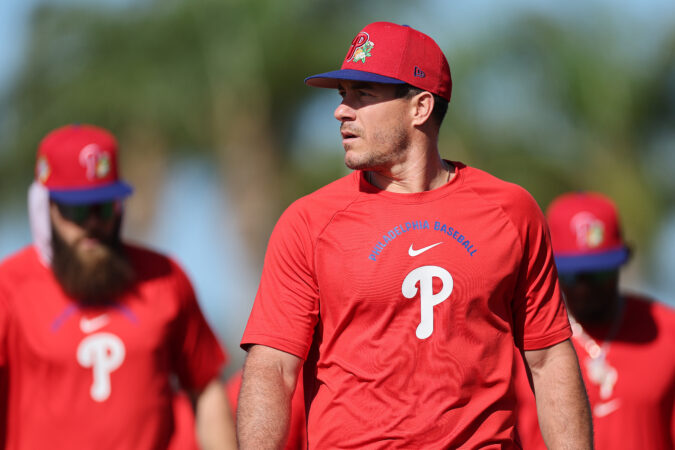
J.T. Realmuto said Nick Castellanos (right) “was always a great teammate to me.”
Q: How difficult was last year for Nick Castellanos, and what were you guys trying to do to make sure that you could try to keep Nick in the right frame of mind?
A: Yeah, I’m sure it was tough on him, just coming from the career he’s had, and just being an everyday player, getting everyday at-bats his whole career, being able to have the transition into that role of playing less. That can’t be easy for anybody. And everybody knows Nick. Sometimes he’s going to say what’s on his mind, and that rubs some people wrong, and others love him for it. So, that’s just who he is, and he’s always going to be that way.
So, I’m sure it’s not easy going through what he went through. But to be honest, now that he’s going to be moving on [to the Padres] and hopefully get another good opportunity for himself, I think he would say the same — that it’s best for both parties, just based off of everything that went on last year. And we obviously wish him the best. Our clubhouse loves Nick. I know that some people have feelings about him, but Nick was always a great teammate to me. I love that guy, and I wish him the best moving forward.
Q: What does it do for a team when you can inject some youth like Justin Crawford, Andrew Painter and Aidan Miller into a roster?
A: It’s awesome. I think it’s just a spark for our team, especially our team where everybody talks about how old we are. So, it’s nice that [we’re] finally getting some young pups in the mix. What was our last youth wave — [Bryson] Stott, [Alec] Bohm, those guys. Bringing those guys up and being able to kind of take them under our wings and show them how to be big leaguers, that stuff is fun for us, for the older guys, and really being able to teach them how to win and show them what matters in this game. Our minor league system does a good job of having guys prepared when they come up, how to act like professionals, and how to play winning baseball. So, it’s always fun for us to get them in the clubhouse and make them feel like part of the team.
CLEARWATER, Fla. — The fastest man in the National League in 2015 still wears the crown, which seems impossible until Trea Turner shares his secret.
“I pay attention to a lot of little things,” the Phillies‘ star shortstop said Wednesday, “that maybe other guys don’t.”
OK, such as?
“Things that happen to all of us all the time,” Turner said. “I walk down my stairs and I’m like, ‘Oh, my knee’s kind of feeling weird today,’ or I wake up and sleep wrong. Then, I’ll get to the field and ask questions in the training room.
“Sometimes it might be annoying, where I just keep asking questions. But when something bothers me, I try to find out why so that, if it does happen again, I get rid of it real quick.
“Like I said, I pay attention more than probably other guys.”
And that, Turner said, explains how he hasn’t lost a step 10 years into his major league career. If anything, he may be a tick faster. As a 23-year-old rookie with the Nationals in 2016, he averaged 30 feet per second, according to Statcast. Last season, at age 32, he averaged 30.3.
Turner also led the majors last year with 117 bolts, defined by Statcast as any run above 30 feet per second. The only other player with more than 100 bolts: Royals 25-year-old star shortstop Bobby Witt Jr.
It’s as uncommon as it sounds. Of the 28 fastest players in baseball last season based on sprint speed, only three — Turner, Twins center fielder Byron Buxton, and Braves utility man Eli White — were in their 30s.
“I still feel young,” said Turner, who will turn 33 on June 30. “I don’t feel as old as I am, which, I don’t think I’m old. But I don’t feel as old as I am. Hopefully I can continue that for a while.”
As always, it will hinge on health. Turner did miss time in each of the last two seasons with hamstring strains. Ever curious, he sought the root of each injury. He believes last year’s injury, a mild strain of his right hamstring while running to first base Sept. 7 in Miami, was caused by dehydration.
Through the years, Turner has changed his nutritional habits. He cut out soda several years ago. He eats more carefully now, taking cues from Bryce Harper, Aaron Nola, and other teammates.
“Genetics, I’d say, is a big part of it,” said Brett Austin, Turner’s college teammate and close friend. “But I think his offseason program really allows him to optimize and maintain his speed.”
Indeed, the biggest reason Turner has remained in the fast lane is a training routine that he has followed since he was a teenager.
In high school, he met Ed Smith, a physical therapist and strength coach who worked with major leaguers at a facility in Wellington, Fla., near Turner’s hometown. Back then, Turner was 5-foot-4 and bony. He was taller but still skinny when he arrived on campus at North Carolina State, where coach Elliot Avent nicknamed him “Seabiscuit” after the famously undersized champion racehorse.
A training routine he has followed since he was a teenager has allowed Trea Turner to remain one of the game’s fastest players at age 32.
As a freshman, Turner led the nation with 57 stolen bases. But when he went home after the season, he asked Smith to help improve his running form.
“He hated the weight room. Hated it,” Austin said. “I’d go, ‘Dude, you need to get big. You need to get strong.’ He was like, ‘I don’t want to lose my speed.’ And he would go see Ed and do his explosion drills, his speed and agility, his laterals.
“They still work together every offseason. If I had to guess, that’s just allowed him to have the longevity and maintain his speed.”
Turner works out with Smith multiple times per week in the winter. During the season, he speaks by phone with Smith at least monthly and texts him more often with questions. He takes feedback from Smith and shares it with the Phillies’ staff, notably athletic trainer Paul Buchheit and strength coaches Morgan Gregory and Furey Leva.
Because as much pride as Turner takes in still being faster than most players, he focuses more on maintaining that speed. Since making his major-league debut, his average sprint speed has ranged from 30.6 feet per second in 2015 and 2021 to 29.6 in 2024. Only once has he not finished among the six fastest players in baseball.
“Some guys are fast for a year or two years, and then an injury pops up and they might not be the same again,” Turner said. “I don’t want that to happen. I’ve tried to become a complete player, so if I ever lose my speed, I want to be able to contribute. But it also would change who I am.
“If I lose a step, I lose a step. That’s OK. But if I’m running at 29 feet per second instead of 30, I can still impact the game. That’s still moving. But you’ve got to run correctly to do that.”
Shortstop Trea Turner, who will be 33 in June, enters his fourth season with the Phillies.
Turner will be challenged to remain in the pole position for the Phillies. Rookie center fielder Justin Crawford, 22, is a burner, with a top recorded speed of 31.1 feet per second in triple A last season. Johan Rojas, a candidate to make the team as a reserve outfielder, averaged 30.1 feet per second over the last two seasons.
But the fastest man in the league in 2015 was still at the top of the leader board in 2025, with no sign of slowing down.
“I’ve seen the numbers, and I’m proud of them,” Turner said. “Because when you look at those charts, you don’t see many 30-year-olds. And even if you do, it’s really low volume. I think it’s pretty cool. I take pride in it, and I think it’s cool for the people around me that help me do it. It’s something they should be proud of, too.”
CLEARWATER, Fla. — For the first few drills that infield coach Bobby Dickerson often runs each day in Phillies camp, no gloves are necessary.
The early days of spring training are an opportunity for players to work on fundamentals and reactivate their muscle memory before the 162-game grind. Some of Dickerson’s tactics for his infielders might look unconventional, but there’s a method to the madness.
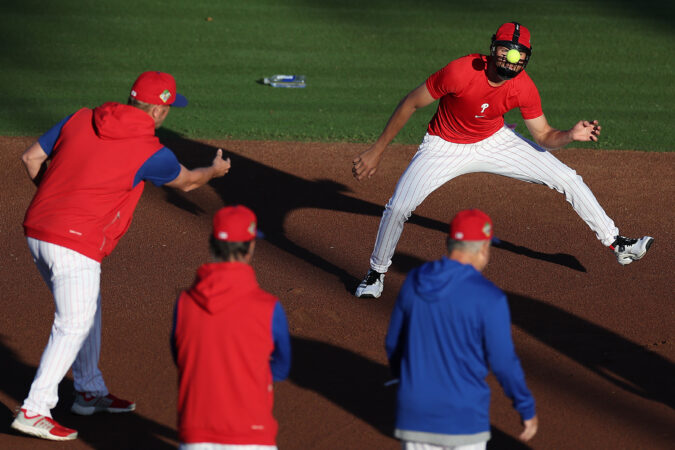
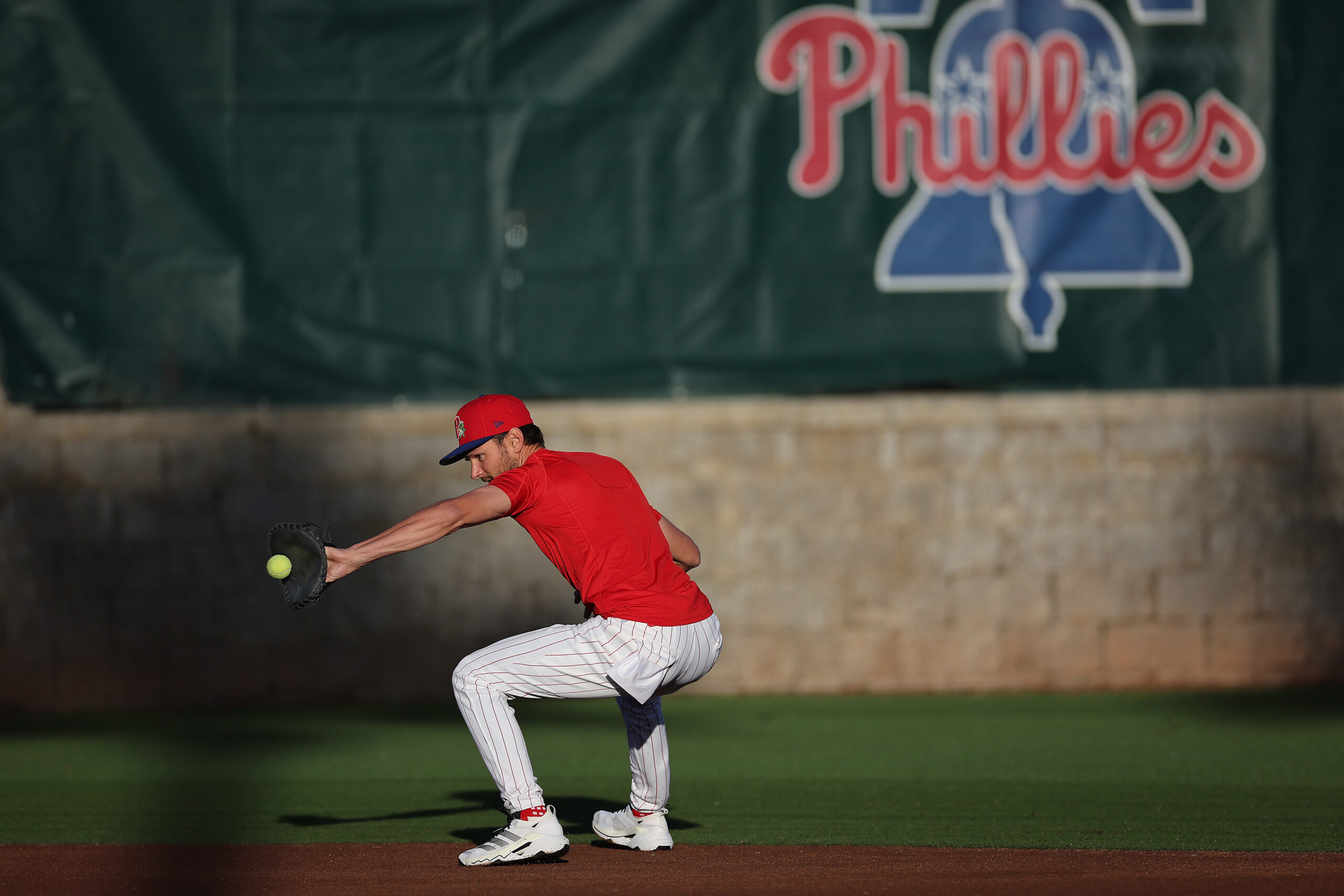
In one drill, the infielder wears a softball mask, and Dickerson tosses tennis balls at him, which he then “catches” with his face. In another, the infielder uses a paddle to field tennis balls that Dickerson hits toward him with a fungo bat.
Both drills are designed to help with ball security. The idea behind the mask drill is to practice getting a player’s face in the path of the ball. That way, when a glove enters the equation, he will be more likely to watch the ball all the way into it.
“You hear it all the time, ‘Watch the ball in,’ ‘See the ball to catch it.’ ‘Don’t take your eye off the ball,’ all these things,” Dickerson said. “But yet, if you pay attention and you really watch the game like, fortunately, I have for 40 years, and watching every little detail, you’ll see even great players, they’re so good they lose sight of the ball, the last six inches to 10 inches.”
If an infielder forgets to watch a ground ball all the way into his glove, he still could make the play. But once in a while, he also could make a mistake that a bit of concentration may have prevented. Dickerson wants to eliminate those mistakes.
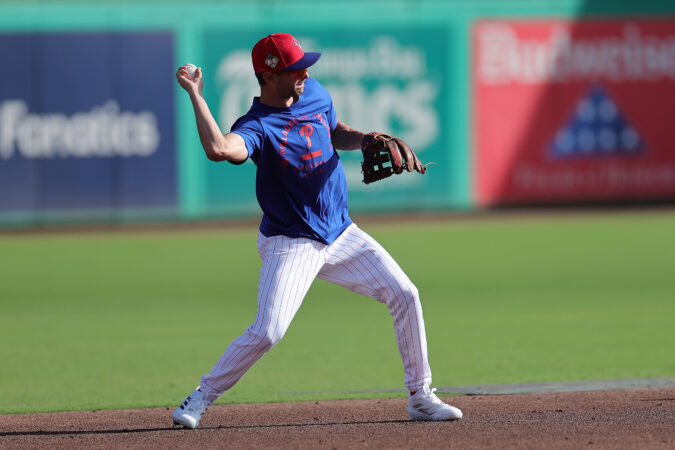
Phillies shortstop Trea Turner knocks a tennis ball away during a drill on Tuesday at spring training in Clearwater, Fla.
“This is a drill to get them to really focus. You’d be surprised how many times when you first do it to a guy, they don’t realize that their face is that far away from the ball, that they’re not really looking it in, looking at the ball,” he said.
The paddle drill is intended to help with glove action. Dickerson said some infielders have a tendency to retreat their glove at the last second as the ball enters it, which can allow the ball to stay alive.
Using the paddle helps reinforce better habits. Using a tennis ball, which bounces more, helps players work on timing.
“It reinforces good glove presentation,” Dickerson said. “The face of that glove should be looking at the ball the whole time, and the last move to catch it is toward the ball.”
For players who have fielded thousands of ground balls in their lifetime, drills that take them out of their comfort zone can help them get back to basics. Dickerson likes incorporating them early in camp as a way to wake players’ gloves up. He also often tells them to do other activities at home with their nondominant glove hand, like using a fork.
When Dickerson, 60, started incorporating these drills earlier in his career, he had to earn trust from players for some of his seemingly unorthodox instruction methods.
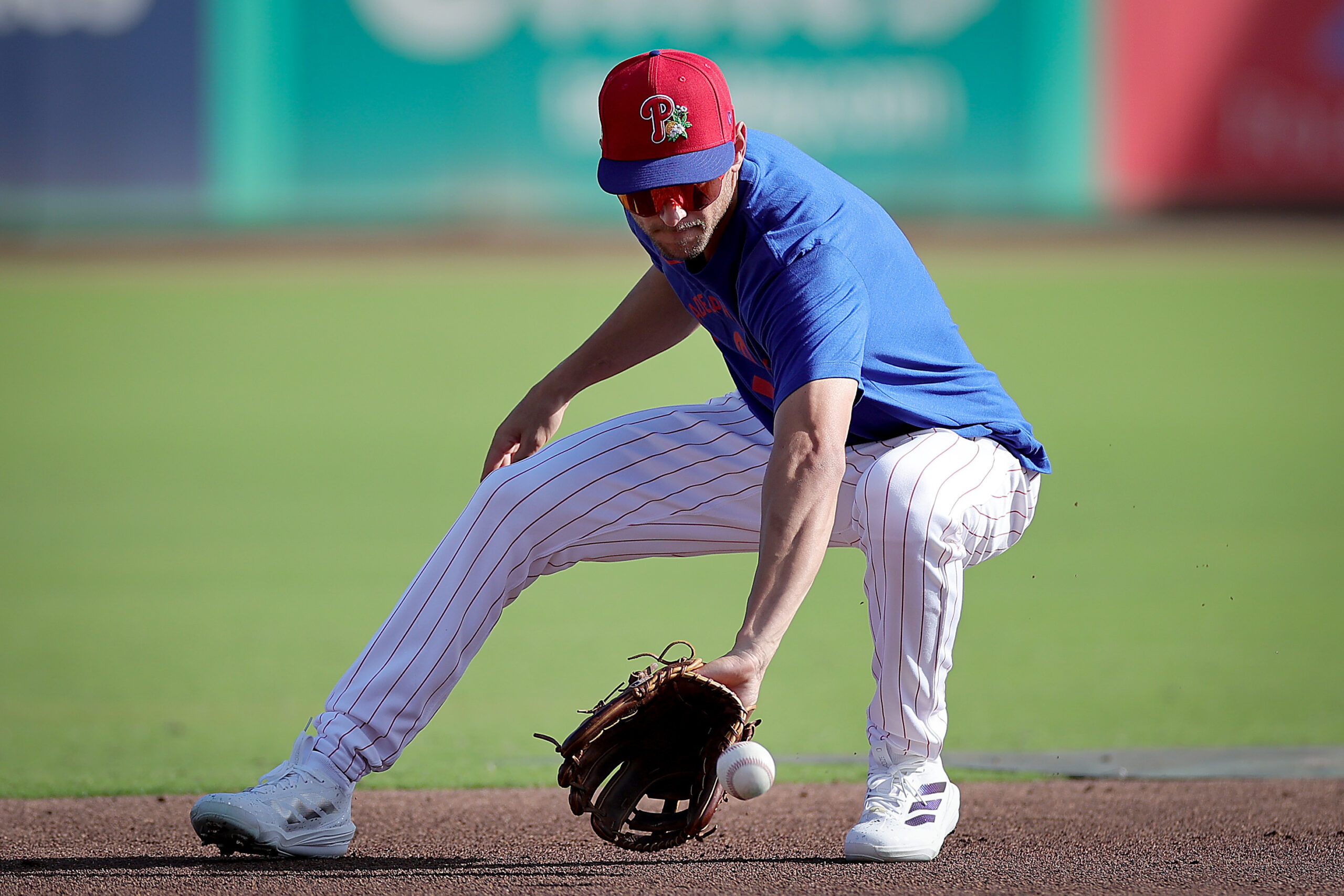
But now, the results speak for themselves. Dickerson credits some of Trea Turner’s defensive improvements at shortstop last year to the work he put in with these drills. Turner went from minus-3 outs above average in 2024 per Statcast to plus-17 in 2025.
“He had a little retreat to his glove. And there would be times where his glove was behind his face,” Dickerson said. “And I think both those drills — both the tennis ball with the paddle glove and the face mask — I think both of those helped him with just some cues to get the ball out in front of his face, see it in. … And his glove hand has woke up a lot in the last year.”
Dickerson recently introduced the drills to 21-year-old Aidan Miller. The shortstop prospect, who is also getting work at third base this spring, said he found the mask drill fun.
“At first, it was hard,” Miller said. “I sucked at it, but I really get the point behind it. It’s all about just keeping your eyes behind the ball, getting your head behind it. So it’s really good in that way.”
Dickerson has been impressed with what he’s seen from Miller.
“They’ve done a lot of great stuff in the minor leagues with him,” Dickerson said. “I can see he’s already ahead of a lot of guys I’ve had at some point that have come to big league camps in my past and were highly touted players, but he’s ahead of that right now, for me. They’ve done a great job. His glove hand works great. His glove presentation is really good. His glove action is really good, and all these things. …
“If I didn’t do the drill, he’d probably play great. And by doing the drill, maybe we can get him to play a little greater, just a little bit.”
Extra bases
Zack Wheeler (thoracic outlet decompression surgery) threw out to 120 feet on flat ground on Wednesday. … Orion Kerkering (hamstring strain) threw 10 pitches from the mound and was “fine,” Rob Thomson said. … Aaron Nola, Jesús Luzardo, and Andrew Painter pitched in live batting practice on Wednesday. … Bryse Wilson will start the Phillies’ Grapefruit League opener against the Toronto Blue Jays on Saturday.
The best way to understand Bryce Harper is to think about all the things he can’t say.
He can’t say that Alec Bohm is a seven-hole hitter at best. He can’t say that Adolis García is much closer to Nick Castellanos than he is a legitimate four- or five-hole hitter. He can’t say that J.T. Realmuto isn’t the guy he was three years ago. He can’t say that he’d swing at fewer pitches out of the zone if he had more confidence that the guys behind him would get the job done.
Given all of those things, Harper also can’t say that Dave Dombrowski has not been an elite personnel boss for at least a couple of years. He can’t say that Dombrowski’s lack of eliteness is chiefly to blame for the Phillies’ run-scoring struggles. Harper can’t say that he was much closer to the hitter the Phillies needed in 2025 than Dombrowski was to being the roster-constructor they needed.
To throw shade at Dombrowski would be to implicitly throw shade at teammates whose “underperformance” is mostly a function of Dombrowski needing them to be something they aren’t.
Harper could have gone deeper. He could have said that the Phillies lost to the Dodgers last season because Dombrowski cobbled together a playoff roster that didn’t allow Rob Thomson to pinch-run for Castellanos. He could have said that the Phillies have finished the last three seasons one reliever short. That they lost to the Diamondbacks in 2023 because Gregory Soto, Craig Kimbrel, and Orion Kerkering were pitching in roles where the Phillies should have had a prime high-leverage arm.
Harper could have pointed to Austin Hays, to Whit Merrifield, to Max Kepler, to David Robertson. He could have asked why he, or we, should have any faith in the decisions to sign García or trade away Matt Strahm when those decisions were made by the same man who made all the previous ones.
But Harper didn’t say those things. He couldn’t say those things. Instead, he said things that could lead one to conclude that he is a little too sensitive, a little too close to the prima donna archetype, a man in possession of emotions triggered by even the faintest whiff of criticism.
Phillies president of baseball operations Dave Dombrowski at BayCare Ballpark last week.
When Dombrowski raised the question of whether Harper would ever be the elite player he’d once been, Harper could have raised a question of his own:
Who are you to talk, suit?
Instead, he said things like this:
“It was kind of wild, the whole situation,” Harper said Sunday when he arrived at spring training. “I think the big thing for me was, when we first met with this organization, it was, ‘Hey, we’re always going to keep things in-house, and we expect you to do the same thing.’ When that didn’t happen, it kind of took me for a run a little bit. I don’t know. It’s part of it, I guess. It’s kind of a wild situation, you know, that even happening.”
It only makes sense in conjunction with the other things we heard from Harper and his camp. In October, in an interview with MLB.com, agent Scott Boras pointed to the number of pitches Harper saw in the zone (43%, fewest out of 532 qualifying players). On Sunday, Harper riffed on that theme, pointing out the paltry production the Phillies got out of the lineup spot directly behind his usual place in the three-hole.
Look at last season’s Mount Rushmore of hitters and you’ll see the source of Harper’s frustration.
One of the common bonds for Aaron Judge, Shohei Ohtani, and Cal Raleigh was the talent that followed them in the batting order.
Hitting behind Judge were Cody Bellinger, Ben Rice, Jazz Chisholm, and Giancarlo Stanton. Each of those players finished the season with at least 24 home runs and an .813 OPS.
Ohtani’s supporting cast needs no introduction. Mookie Betts and Freddie Freeman are both former MVPs. Will Smith has been an All-Star in three straight seasons.
Raleigh was most often followed directly by Julio Rodriguez, Josh Naylor, Eugenio Suárez, and Jorge Polanco. Three of those players finished 2025 with at least 26 home runs.
Each of those three superstars — the three leading vote-getters on AL and NL MVP ballots — were followed in the batting order by at least three players who finished the season with at least 20 home runs. Compare that to Harper, who usually had two players behind him with more than 12 home runs, neither of whom is on the roster this season (Kepler 18, Castellanos 17).
If anything, Harper was underselling the situation when he met with the media Sunday in Clearwater. The two-time MVP limited his focus to the Phillies’ struggles in the cleanup spot, where they ranked 20th in the majors in OPS last season.
“I think the four spot has a huge impact,” Harper said. “I think the numbers in the four spot weren’t very good last year for our whole team. I think whoever’s in that four spot is going to have a big job to do, depending on who’s hitting three or who’s hitting two.”
Bryce Harper fist-bumps Phillies teammates Sunday ahead of the team’s workout in Clearwater, Fla.
But the issues behind Harper — and/or Kyle Schwarber, depending on the configuration — are deeper than the next-man-up. As we saw last season, pitchers are more than willing to pitch around two hitters when those hitters are Harper and Schwarber, especially when the guys behind them allow for an extended period of exhalation. Lineup protection is a cumulative thing.
We saw that in 2022, didn’t we? A big reason the Phillies thrived with Schwarber leading off and Harper batting third was the presence of Rhys Hoskins (30 homers, .794 OPS) and Realmuto (22 homers, .820 OPS) behind them. Even in 2023, they had some combination of Castellanos (29 homers, .788 OPS), Realmuto (20 homers, .762 OPS), and Bohm (10 homers, .765 OPS).
Boras and Harper have zeroed in on the number of pitches he sees out of the zone. It’s part of the story, no doubt. Over the last three seasons, he has seen a lower percentage of pitches in the zone than any previous three-year stretch of his career. When he was NL MVP in 2021, he saw a career-high 46.7% of pitches in the zone.
At the same time, Harper was pretty darn good in 2023, when he saw 41.2% of pitches in the zone, the second-lowest of his career, according to FanGraphs. Just as important is what Harper chooses to do with the pitches he sees.
Last year, his chase rate was 36%. In 2021, it was 25.5%. But he wasn’t necessarily chasing more pitches. His swing percentage on pitches in the zone was 78.3%, up from 72.1% in 2021.
Protection is a mindset as much as it is an externality. The more protected a hitter feels, the more comfortable he is waiting for his pitch rather than trying to do too much. Pitchers won’t necessarily approach Harper differently if they feel more danger from the hitters behind him. But Harper will absolutely feel more comfortable taking whatever pitchers give him.
The Phillies acknowledged as much with their openness about their failed pursuit of Bo Bichette. Dombrowski knows what the Phillies need. They need what they had in 2021 and 2022 in prime Hoskins and prime Realmuto (and company).
They will need to get lucky to have it this season. Their decision-making will need to be filtered through this context. Aidan Miller, Justin Crawford, the trade deadline. Bohm and García will get the first chances. Dombrowski’s future as the bossman will be determined by how they perform, and then by what happens if they don’t.
CLEARWATER, Fla. — During Tuesday morning’s bullpen sessions at the Phillies’ Carpenter Complex, José Alvarado and Jhoan Duran were pitching at opposite flanks of the seven-pack of mounds.
It was an early look at likely the two hardest-throwing relievers in the Phillies’ 2026 bullpen, who only were able to team up for exactly 24 days last season. The Phillies acquired Duran at the trade deadline in July, while Alvarado was away from the team serving an 80-game suspension for a positive performance-enhancing drug test.
He returned in August, but only pitched in eight games before a left forearm strain ended his season. He was ineligible for the playoffs due to the PED suspension.
Now healthy and back in camp, Alvarado does not want to dwell on the past.
“I know everything that passed last year, I want to say last year is over,” Alvarado said. “I prepare for coming healthy in this spring. I’m so happy for me, what I see in this spring now. Keep working hard and never give up.”
This winter, the Phillies picked up the $9 million club option on Alvarado’s contract for 2026. The 30-year-old lefty will be a free agent after this season.
Alvarado said he ramped up slower with his throwing program this offseason, with fewer bullpen sessions and live at-bats than he’s typically done by this point. According to Phillies pitching coach Caleb Cotham, that was planned out of caution for Alvarado’s forearm.
“I wouldn’t use the word behind, but it’s just more intentional with the build-up,” Cotham said. “He’s normally overly prepared. Now it’s just more a normal build-up.”
Alvarado is also planning to represent Venezuela at the World Baseball Classic in March, which will help accelerate his ramp-up.
At this point in the spring, bullpen sessions aren’t so much focused on velocity, since pitchers are still building up and, in some cases, experimenting. Alvarado has been working on his four-seam fastball. He relies almost exclusively on his sinker-cutter mix, but in past springs, he has also toyed with bringing back his curveball and four-seamer, both of which he threw more when he first broke into the big leagues.
So far, they haven’t really stayed in his arsenal when the regular season starts. In a limited sample size of 26 innings due to his abbreviated 2025 season, Alvarado threw 22 curveballs (4.8% of his pitches) and six four-seamers (1.3%). When he did throw the four-seam, it averaged 99.6 mph.
The Phillies are planning to have José Alvarado (left) and Jhoan Duran as a late-inning, 1-2 punch out of the bullpen.
“I’m not very confident on that pitch, because when it’s game time, it’s different energy. It looked good,” Alvarado said of his four-seam after a recent bullpen session. “ … Every result I see right now is good. I am in a good spot right now; I need to keep it like that.”
Will the four-seam stick around this time?
“I think a lot of times things that stick are things that work,” Cotham said. “So I think the avenue for me in getting it to stick is he’s got to feel good with it, but it’s also got to work. And we got to work to help him, and find the spots with [catcher] J.T. [Realmuto] and when not to throw it.”
The four-seam can give Alvarado another tool for certain right-handed hitters who handle sinkers well. Cotham also said that working on the four-seam can also help Alvarado fine-tune his other, bread-and-butter fastball.
“It’s also a nice way to keep the sinker calibrated, because he can feel the difference in the four-seam, sinker,” he said. “He’s a guy where the sinker can fly similar to a four-seam sometimes. So actually keeping those both in practice helps keep the sinker going.”
The Grapefruit League, which starts for the Phillies on Saturday, will provide an opportunity for Alvarado to mix in the four-seam to test it out in games.
“Alvy’s a guy where … there’s a lot of feel to his game and wanting to feel the delivery,” Cotham said. “So if he feels good with it, what I tell him is, I’m in. It’s just a matter of when and why, where we use it.”
Extra bases
Brandon Marsh was a full participant in batting practice Tuesday after a cut on his foot limited him the day before. “He’s full go,” Thomson said.
CLEARWATER, Fla. — Six years into his major-league career, Alec Bohm knows exactly who he is as a player.
Also, who he’s not.
“In the grand scheme of things,” Bohm said here Tuesday, “you think about it, I’m prototypically not your average cleanup hitter. Body type-wise, yeah. But the way my game is, I guess, is not that of a typical [No.] 4 hitter.”
Bohm has thought about it. A lot. Because he does look the part — 6-foot-5, with shoulders that block the sun and never-ending arms and legs. But he hasn’t hit more than 20 homers or slugged .450 in a full season.
And yet, guess the Phillies‘ most frequent cleanup hitter over the last two seasons — and the leading candidate to reprise the role on opening day of Bohm’s last year before free agency.
Rob Thomson hasn’t settled on the order but wants Trea Turner, Kyle Schwarber, and Bryce Harper to bat in the first inning. And whether Schwarber and Harper bat second and third, or vice versa, the cleanup hitter will be tasked with protecting one of the Phillies’ feared lefty sluggers.
Thomson has mentioned new right fielder Adolis García and J.T. Realmuto as options. But he noted that Bohm “would have taken down most of the at-bats” in the cleanup spot if not for two stints on the injured list. He was the cleanup hitter 102 times — and an All-Star — in 2024.
Phillies third baseman Alec Bohm hasn’t hit more than 20 homers or slugged .450 in a full season of his career.
Get ready, then, for one more round of the familiar gripe about the Phillies’ atypical cleanup hitter, notably that someone as big and strong as Bohm doesn’t hit more balls over the fence.
“Anybody that says that has no [bleeping] clue how hard this game is and how good the pitching is at this point,” Bohm said. “Would you rather me swing at stuff that’s bouncing in front of the plate and strike out 180 times and get you 25 to 30 home runs so you feel better about it? Or do you want me to hit .280 and drive in 80 to 90 to 100 runs and hit 40 doubles and do it that way?
“To me, that’s more productive than me walking up there and striking out 190 times. That’s not my game.”
Bohm concedes that his game was “down last year.” He opened the season in a 9-for-60 tailspin with one extra-base hit through 14 games. He missed 27 games after the All-Star break with a cracked left rib and 11 in September with a cyst in his left shoulder that needed to be drained.
And after back-to-back 97-RBI seasons in which he was 11% more productive than league average based on OPS-plus, he backslid to 18 doubles, 11 homers, and a .741 OPS, 2% more productive than league average.
The Phillies shuttled Nick Castellanos, Realmuto, and Bohm through the cleanup spot, behind Harper. Phillies cleanup hitters combined for a .720 OPS, 20th in the majors. And Harper saw the lowest rate of pitches in the strike zone (43%) of anyone who qualified for the batting title.
Coincidence? Somewhat. Harper saw 42.6% of pitches in the zone through his first six Phillies seasons (2019-24). He has long contended that teams take extreme care in how they pitch to him no matter who bats behind him.
“There’s a lot of situations throughout the game, especially later in the game, where they’re obviously not going to let the franchise player beat them,” Bohm said. “You’ve got a righty on the mound, who in their right mind would let Bryce beat them?”
When Phillies third baseman Alec Bohm was an All-Star in 2024, he batted in the cleanup spot 102 times.
Maybe it would make the decision to pitch around Harper more difficult if Schwarber batted behind him, so Thomson is mulling that arrangement.
“But if Schwarbs is sitting there [in the No. 3 spot], the same thing’s going to kind of happen, right?” Harper said. “So, whoever’s in that four spot is going to have a big job to do.”
Bohm believes he’s up for it, even if his homer total doesn’t rise far above his 14.8 average over the last four years.
“For me, it’s not necessarily putting up a certain number of home runs,” Bohm said. “It’s just, am I executing with runners in scoring position? Am I driving in runs? Am I putting tough at-bats up there?
“The protection [of Harper or Schwarber] aspect of it, the way I want to go about it just being a good situational baseball player. The home runs, the damage, the doubles, all that stuff is going to come. But it’s not going to come as frequently if I’m up there trying to force it.”
Bohm’s best work over the years has come with runners in scoring position, largely because he makes more consistent contact than most hitters in the Phillies’ lineup. Even last year, his strikeout rate (16.3%) was well below major-league average (22.2%).
It’s one of the attributes cited by Thomson as a reason to like Bohm in the cleanup spot.
“If there’s runners out there, he’s going to put the ball in play,” Thomson said. “Typically, he hits a lot of doubles. And I love doubles. I love home runs, but I love doubles as well because that clears the bases.”
Phillies right fielder Adolis Garcia (left) is another candidate to bat in the cleanup spot.
And Bohm has millions of reasons to capitalize on another opportunity to fill the cleanup role. He’s eligible for free agency after the season, which he said feels “really far off in the distance.”
Bohm’s successor may be only a few lockers away in the spring-training clubhouse. Top prospect Aidan Miller will play third base at times this year. And the Phillies discussed moving on from Bohm in each of the last two offseasons. They nearly signed free-agent infielder Bo Bichette last month, a move that would’ve corresponded with trading Bohm.
But for as long as he’s here, Bohm believes he can handle batting behind Harper or Schwarber.
“I can do things in a different way to create runs and not let the other team go, ‘We got through Kyle, now just walk Bryce, and we should be home free,’” Bohm said. “What I do is put the ball in play to where I’m not a hole behind a very important piece of our lineup.”
CLEARWATER, Fla. — Four innings before Orion Kerkering’s error sealed the Phillies’ fate in Game 4 of the 2025 National League Division Series, home plate umpire Mark Wegner made a call that may have helped tilt the game.
Cristopher Sánchez’s 2-2 pitch to Alex Call in the seventh, which caught the inside edge of the plate, was called a ball. What could have been a strikeout ultimately became a walk, and Justin Dean, who pinch ran for Call, went on to score the tying run in a game the Los Angeles Dodgers won, 2-1, in 11 innings.
In the quiet clubhouse after the Phillies were eliminated, Sánchez said that Wegner actually apologized to him for missing the strike.
“He knows he missed it,” Sánchez said through a team interpreter. “He knows he missed it because he told me, and he apologized to me. But a lot of pressure, important game, important situation, you can’t miss those things. You can’t miss those calls.”
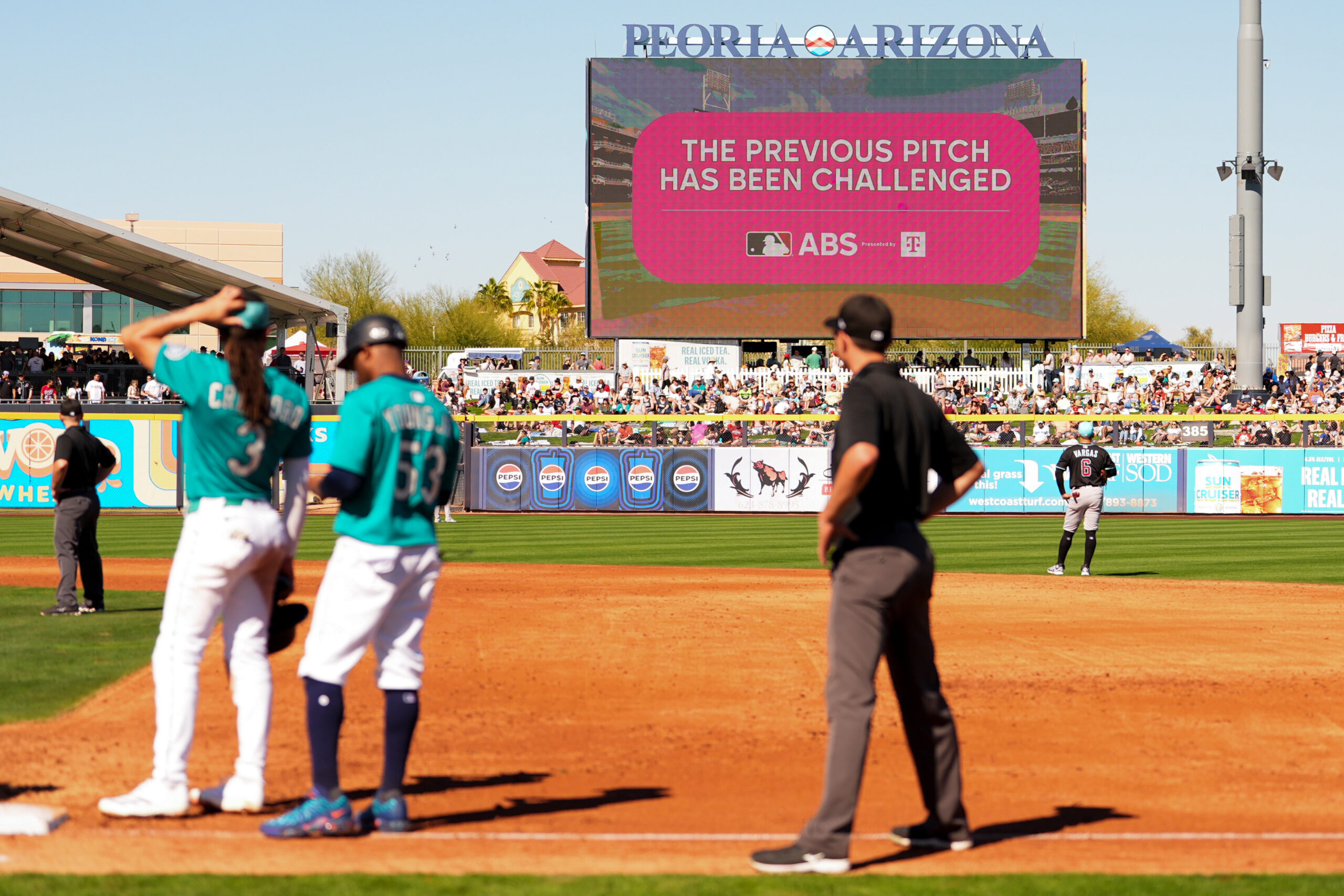
With the automated ball-strike challenge system arriving to MLB in 2026, it’s possible those impactful misses could be a thing of the past. Under the system, each team starts with two challenges, which can be used by the pitcher, catcher, or batter to challenge a pitch call. If a challenge is unsuccessful, the team loses it.
According to the rules, challenges must be made immediately after the umpire’s call, and no input from the bench or manager is allowed. A team without challenges in extra innings will receive an additional one.
The Phillies piloted the system during spring training last year, and they will use this spring as a chance to get further acclimated.
“I think it will change the game a lot late, just making sure those calls are right in the biggest moments,” shortstop Trea Turner said. “Even if a team challenges and they’re wrong, at least you know the call is right. So I think that’s going to be big later on.”
Some critics of the system think that ABS removes the “human element” of baseball in the umpire’s strike zone.
“It’s kind of now that human element’s back on the players,” Turner said. “So that’s kind of interesting. It’s going to be fun to watch.”
The Phillies will eventually develop a strategy for using ABS as the regular season begins. Some teams only allow catchers to challenge, rather than pitchers, since they have a better vantage point. Teams also might prefer to save their challenges for after a certain inning of the game.
But for the first few weeks of spring training, Phillies manager Rob Thomson will have no rules.
“We need to push them to use it, so that they can learn,” Thomson said. “And as the situations come up, we just talk them through it. ‘This might be a situation where you should use it,’ even if they didn’t. ‘No, maybe that’s not the situation.’ But we still want them to try and get some experience with it.”
The Seattle Mariners’ Julio Rodriguez challenges a pitch call, initiating a review with the automated ball-strike challenge system during a spring training game last February in Peoria, Ariz.
Turner said that typically, when he has disagreed with umpires’ calls at the plate and then reviewed the footage later, he is often right about pitches he thought were inside or outside, but has been wrong about pitches high or low.
“I think that’s part of this. You’ve got to know what you’re good at, and where you’re good at,” he said. “I don’t plan on challenging too much, but if I do, I’ll probably be on the corners more so than up and down. And I think some guys are good at some things, and you’re going to have to learn.”
Extra bases
Zack Wheeler threw out to 120 feet for the first time Monday as he continues his rehab from thoracic outlet decompression surgery. Thomson said he did not have a date for when Wheeler will get on a mound, but “he’s getting there.” … Kerkering (mild hamstring strain) is running and doing agility drills and threw on flat ground. The next step is a light bullpen session, possibly on Wednesday, according to Thomson. … Brandon Marsh cut his foot off the field and did not fully participate in the workout, although he did glove work and played catch. “It’s minor,” Thomson said. “I wouldn’t be surprised if he was out there hitting [Tuesday].”
CLEARWATER, Fla. — Brandon Marsh stood in the outfield of the main stadium here the other day alongside a half-dozen teammates when it dawned on him.
“I was the oldest guy out there,” he said, a toothy smile forming above his lumberjack beard, “and I was like, ‘What the heck?’ I’ve never, ever in my life been in this position.”
Don’t tell Marsh, then, that these are the Same Old Phillies.
Other changes: A 22-year-old rookie (Justin Crawford) in center field, and a righty-hitting utility man (Otto Kemp) who might see most of his playing time in left field whenever the Phillies face left-handed pitching.
And — voila! — Marsh is the new dean of an outfield that critics believe will be among the worst in the majors.
Brandon Marsh didn’t have a hit in April but batted .303 over the final five months of the season.
“It’s going to be almost a complete different outfield, I know that,” said Marsh, limited in the Phillies’ first full-squad workout Monday because of a cut on his foot that Thomson didn’t consider serious. “But we have some incredible guys here that are going to step up. As humans, we always want to challenge ourselves. It’s going to be a fun challenge for us, and nothing that we’re not capable of doing.”
Maybe. Crawford did bat .300 at every level of the minors despite hitting a high rate of balls on the ground. García, a two-time All-Star, is three years removed from 39 homers and a dominant postseason for the World Series-champion Texas Rangers. Kemp impressed team officials with his grit last season while playing through shoulder and knee injuries.
But any improvement over last season, when the Phillies ranked 19th in the majors in outfield OPS (.710) and 21st in wins above replacement (3.2, measured by Fangraphs) must involve Marsh.
It has been nearly four years since the Phillies traded for Marsh. With Bryson Stott and Alec Bohm, he comprised a group of young, often goofy players dubbed by teammates as the “Daycare” along the way to the 2022 World Series. He has been a supporting cast member ever since.
Marsh is 28 now. He has two seasons before free agency. And still, there are questions about his ceiling as a player.
Take last season, for instance. Marsh was 4-for-42 — and hitless in April (0-for-29) — when he strained his right hamstring. The injury was mild. Physically, he was ready to return after the minimum 10-day term on the injured list. Mentally, he was a wreck.
“Honestly, I’ve never been on a baseball field and felt that low before,” Marsh said. “Not low as in depression or anything, but just like self-belief and just realizing like, ‘Dang, am I really cut out for this?’
“But I think the second half of last year really proved — not to anyone else but just to myself — that I can get through the thick of it. You know?”
Indeed, upon returning May 3, Marsh batted .303 with 25 doubles, 10 homers, and a .358 on-base percentage for the rest of the season. Among 96 National League players with at least 350 plate appearances after May 1, Marsh ranked 17th with an .836 OPS.
Brandon Marsh’s .836 OPS from May 3 through the rest of the season ranked 17th in the National League among players with at least 350 plate appearances.
Never mind, then, that Marsh continued to struggle to hit left-handed pitching. The Phillies would sign up for his post-April production from last season and install him as the strong (lefty-hitting) half of a left-field platoon.
But can they count on Marsh being that player?
“I’ve got to go off what the last five months looked like,” Thomson said. “All our analytics and what we see with our eyes has told us that that’s who he is. Now, maybe he’s becoming that. Hopefully he has a full year of that type of performance.”
If anything, the depths of Marsh’s struggle were surprising because of when it occurred.
Given the length of the season, with a game almost every day for six months, most players, especially veterans, downplay April slumps. It’s early, they insist, while falling back on clichés about the numbers on the back of their baseball card.
But Marsh — Bohm, too, his roommate and close friend who started in a 9-for-60 tailspin — was drowning.
“You play in Philadelphia and you’re hitting .090,” Marsh said. “… And I deserved every bit of boos I got and every bit of bashing that I got, and I just had to wear it the best I could. Some days were harder than others, for sure.
“I remember saying that to someone, like, ‘It’s April.’ But it’s easy to get overwhelmed, and there were days where I was like, ‘Oh my gosh, this mountain might be too steep to climb.’ I might be too low, fighting for keeping a job and stuff like that. There was a whole bunch of stuff going on.
“Me and Bohmer, I remember us just driving home and we were like, ‘Bro, it can’t get any worse.’”
The Phillies signed Adolis García this offseason to replace Nick Castellanos in right field.
It helped that the Phillies gave Marsh a few extra days on his injury rehab assignment at triple-A Lehigh Valley. He credited catcher Garrett Stubbs for changing his perspective.
“Show up and smile,” Stubbs said.
“When Brandon Marsh was with us, we had some epic wins, a couple walk-off home runs, and he was just as happy as anybody on our team,” triple-A hitting coach Adam Lind said. “Maybe that’s just what it was. Sometimes a rehab assignment can just reignite that joy in the game. You can take a deep breath.”
In any case, Marsh salvaged his season. He batted .280 overall, “but it felt like I hit .800.” And the Phillies chose to remake their outfield around him.
Garcia represents “a very big bounce-back candidate,” as Bryce Harper put it.
“I think he’s going to have a lot more fun hitting in Philly than he did in a big Texas stadium,” Harper said. “But also, you’re not really sure until it happens.”
Ditto for Crawford, whom the Phillies expect to bring speed and energy to the bottom of the lineup. But he also would be the youngest player in a Phillies’ opening-day lineup since Freddy Galvis in 2012.
So, Marsh looked around the outfield the other day as the constant at the one spot on the Phillies’ roster that has undergone massive change. Last April, he never would’ve guessed it.
“I’m glad that bad stretch happened because it showed just to myself what I could crawl out of,” Marsh said. “I have that self-confidence now of feeling like you’re a dude, like you’re supposed to be here. That’s kind of where I’m at.”
CLEARWATER, Fla. — Next month will mark three years since Trea Turner made history with one swing at Miami’s LoanDepot Park.
During the 2023 World Baseball Classic, Turner became the first Team USA player in a decade to hit a grand slam in the tournament. It propelled his team to a come-from-behind win over then-undefeated Venezuela in the quarterfinals, and it was just one of many big moments for Turner that March.
He finished with five home runs to tie a WBC record, helping his team to a silver medal.
But this year, when Bryce Harper, Kyle Schwarber, and Brad Keller leave Phillies spring training to join Team USA for the 2026 iteration of the international tournament, Turner will not join them.
“The phone never rang,” Turner said. “I wish those guys the best. I think it’s so much fun. I gladly would have done it again. I said the last time, if they ever asked, I would say yes. They’ve got a great roster this year, stacked.”
Team USA manager Mark DeRosa included Kansas City Royals star Bobby Witt Jr. and the Baltimore Orioles’ Gunnar Henderson as shortstops on his roster. Milwaukee’s Brice Turang is the second baseman for the American team, while Toronto’s Ernie Clement is listed as a utility infielder.
Turner won the National League batting title in 2025 with a .304 average and also had one of the best seasons of his career defensively. He posted +17 outs above average at shortstop, ranking in the 99th percentile at his position according to StatCast data.
“I think we’re in a good spot to win,” Turner said of Team USA. “I’ll definitely be watching it, and I wish Kyle and Bryce and all these guys, [Edmundo] Sosa, everyone playing, I hope they perform well for their countries, and it’s a lot of fun.”
Other WBC participants from the Phillies’ major league roster are Sosa (Panama); Cristopher Sánchez and Johan Rojas (Dominican Republic); Taijuan Walker (Mexico); José Alvarado (Venezuela); Garrett Stubbs and 21-year-old (Israel); and Aaron Nola (Italy).
Turner knows that Harper, in particular, is excited to play in the WBC. He had planned to join the team alongside Turner in 2023 but was unable to participate after undergoing Tommy John elbow surgery the previous winter.
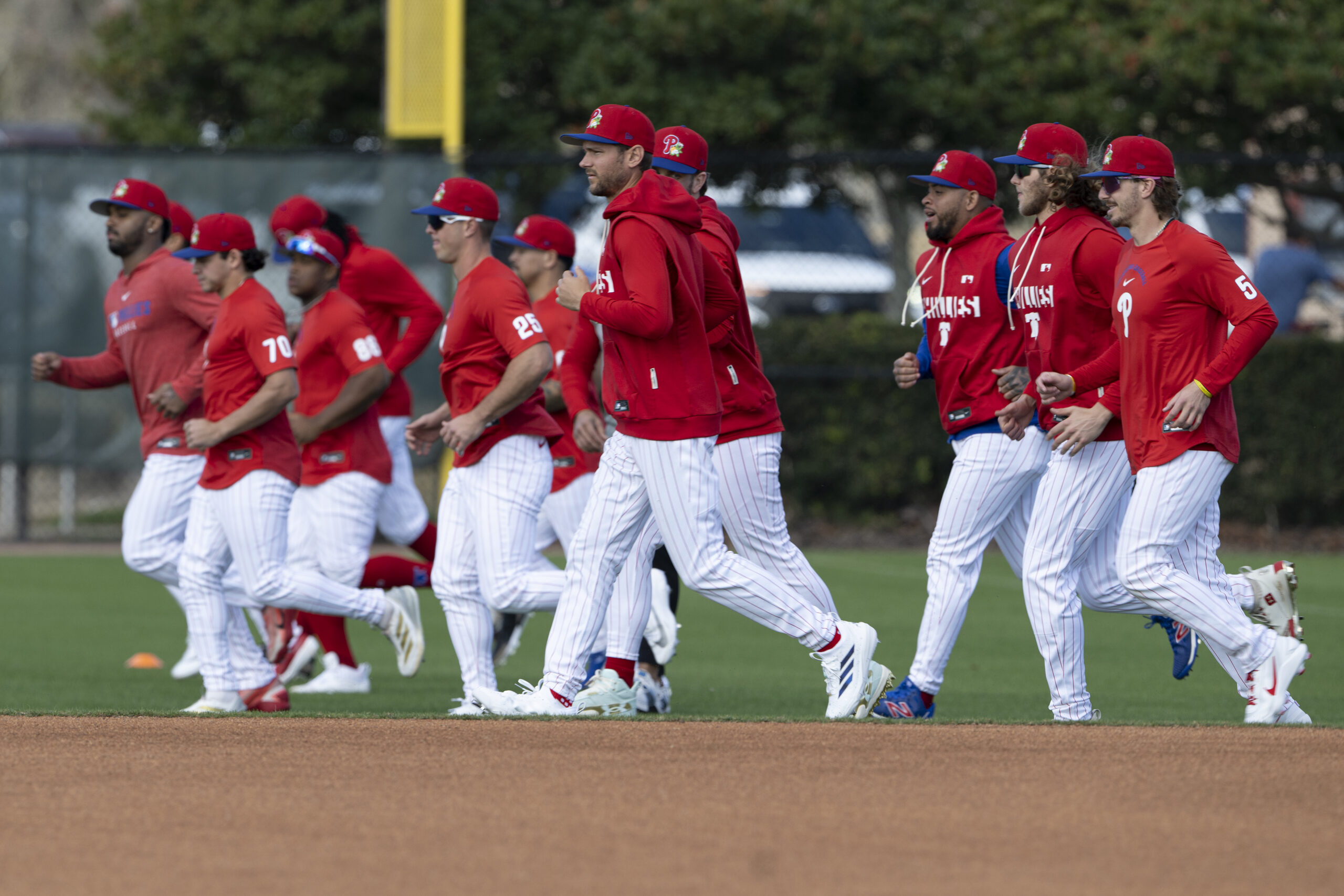
The Phillies jog during the first full-squad workout of spring training on Monday.
“You have to prepare a little bit differently in spring training for that,” Turner said. “You’ve got to kind of get out there earlier, and get your at-bats earlier. So it seems like he’s working harder. But at the same time, he’s just got to get ready, because he’s going to have live at-bats. But he’s competitive.”
Turner’s own offseason was about the same as usual for him, he said. His main priority this year is maintaining his health, which also happened to be the main theme of manager Rob Thomson’s speech to the team Monday morning ahead of the first official full-squad workout of the spring.
Turner, 32, missed time in each of the last two seasons with hamstring strains, and he is aiming to prevent that from happening again primarily through nutrition and hydration.
“Body feels good. Still feel young, although when I have to play with guys like this and Aidan and whatnot, makes me feel old,” Turner said, gesturing to the nearby lockers of 22-year-old Justin Crawford and 21-year-old Aidan Miller. “But I feel 25. I feel ready.”
Turner is looking forward to how Crawford and his speed could help lengthen the bottom half of the Phillies’ lineup. He said he hadn’t seen much of Miller before Monday, when they did infield work together.
“Glove looks good,” Turner said. “Got a chance to talk to him, just trying to get to know him a little bit more. Seems like a great kid, had a good season last year, and excited for him to be around much more and contribute. Because we need guys like that.
“We need to build depth. We need some younger guys. And I think that’s really important for a good organization.”