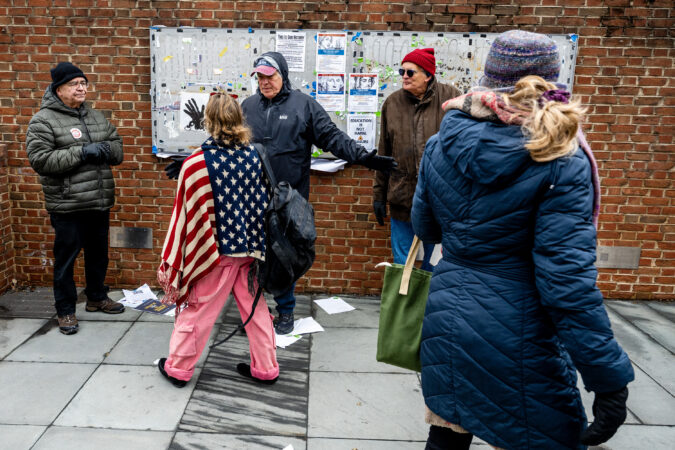
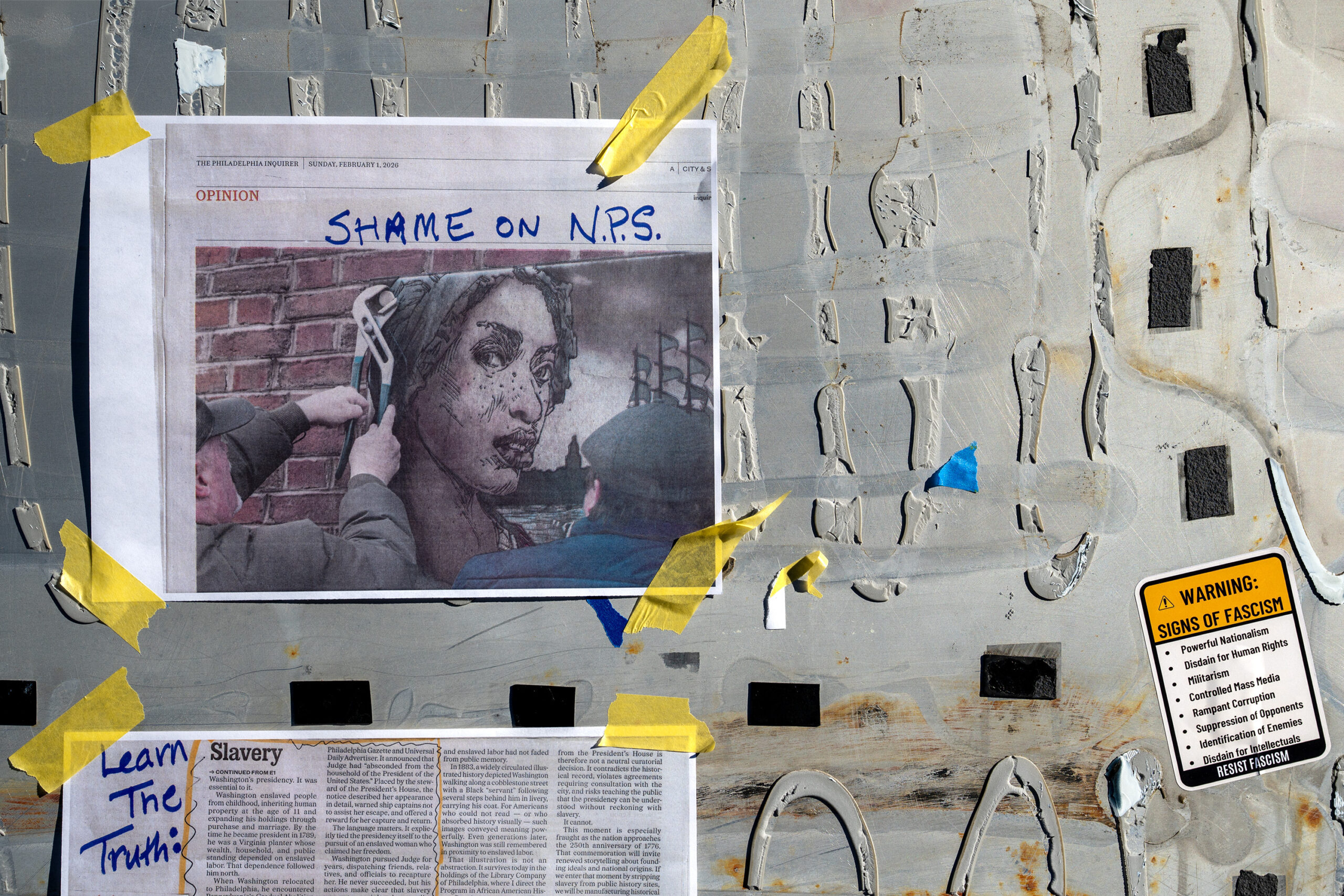
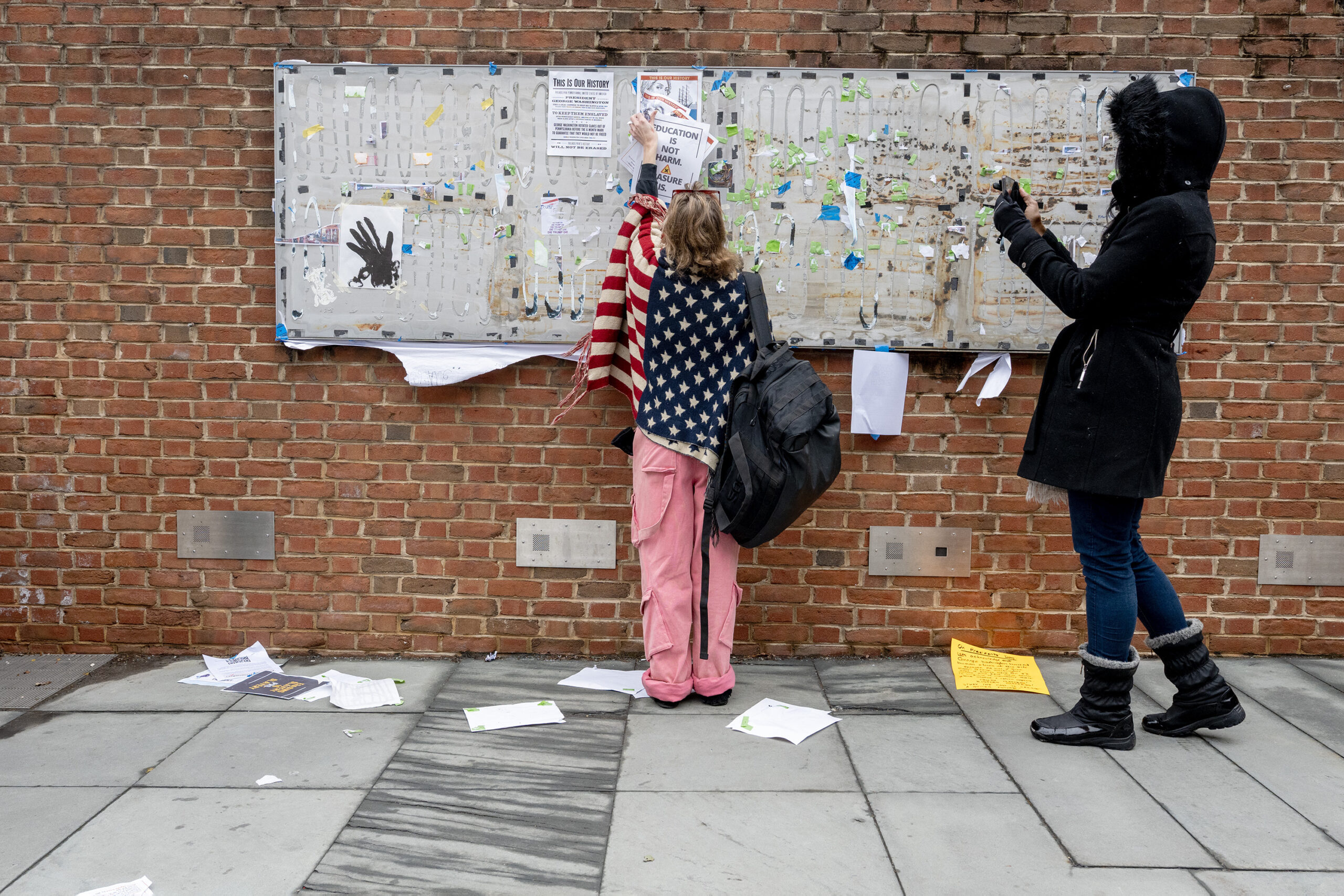
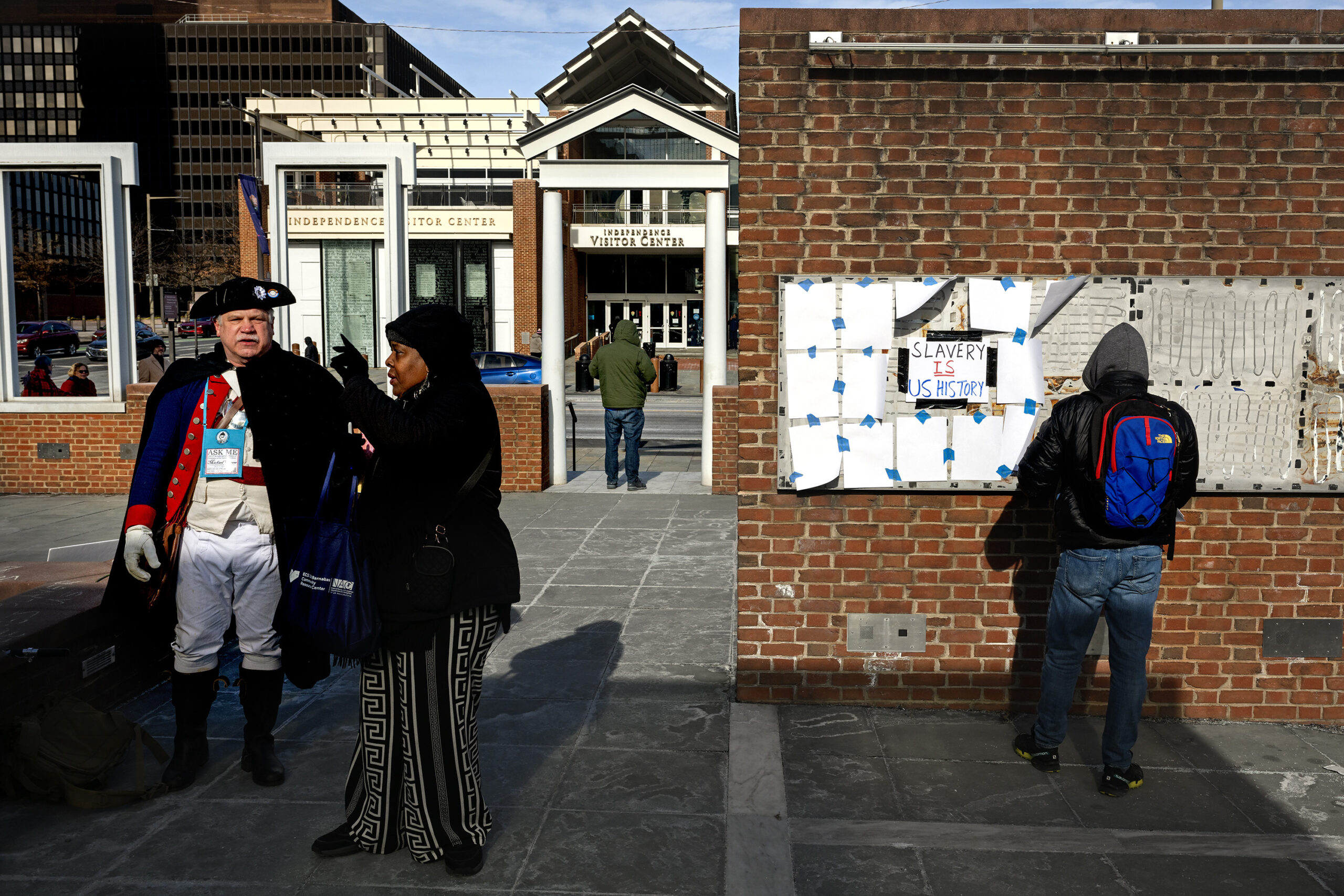
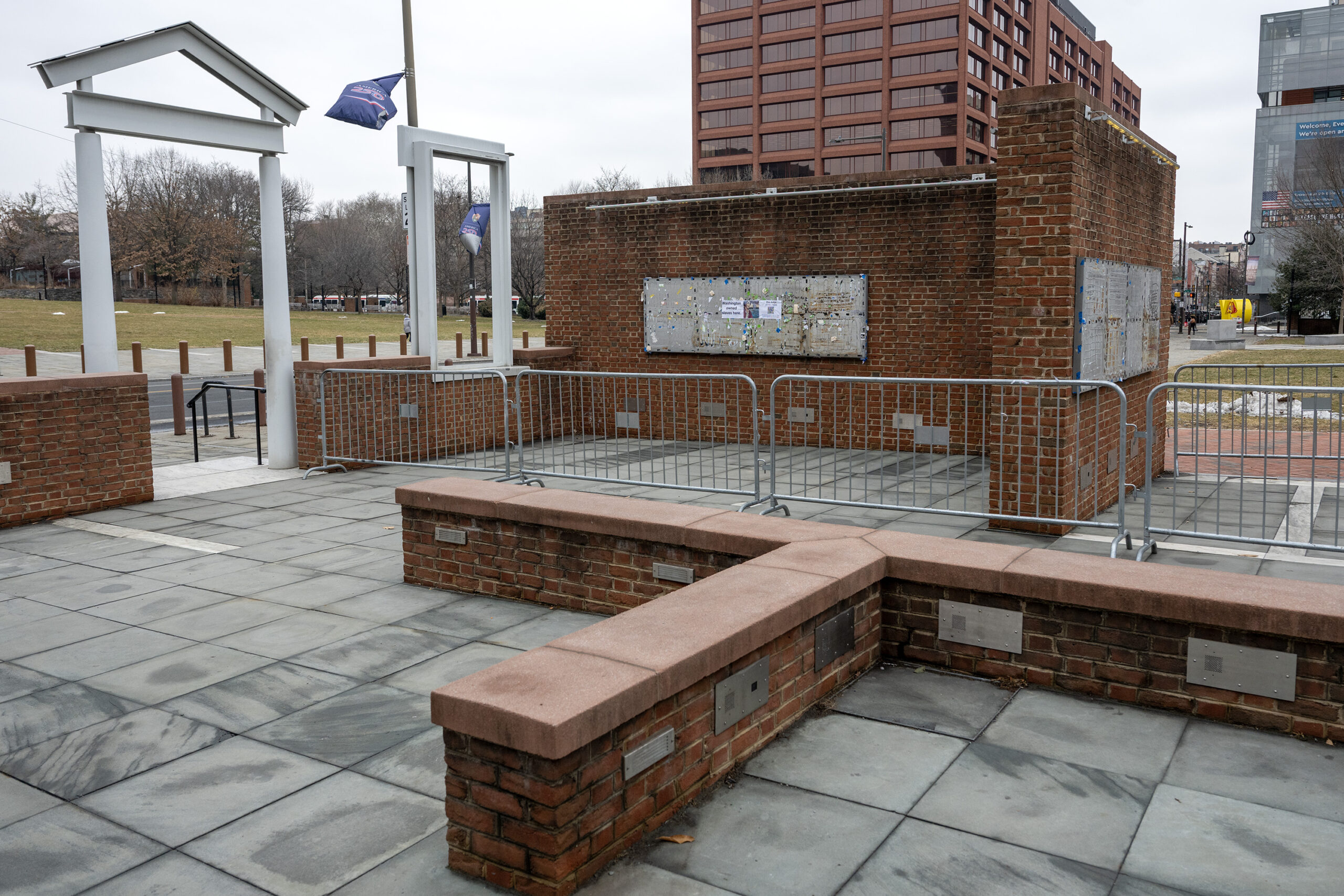
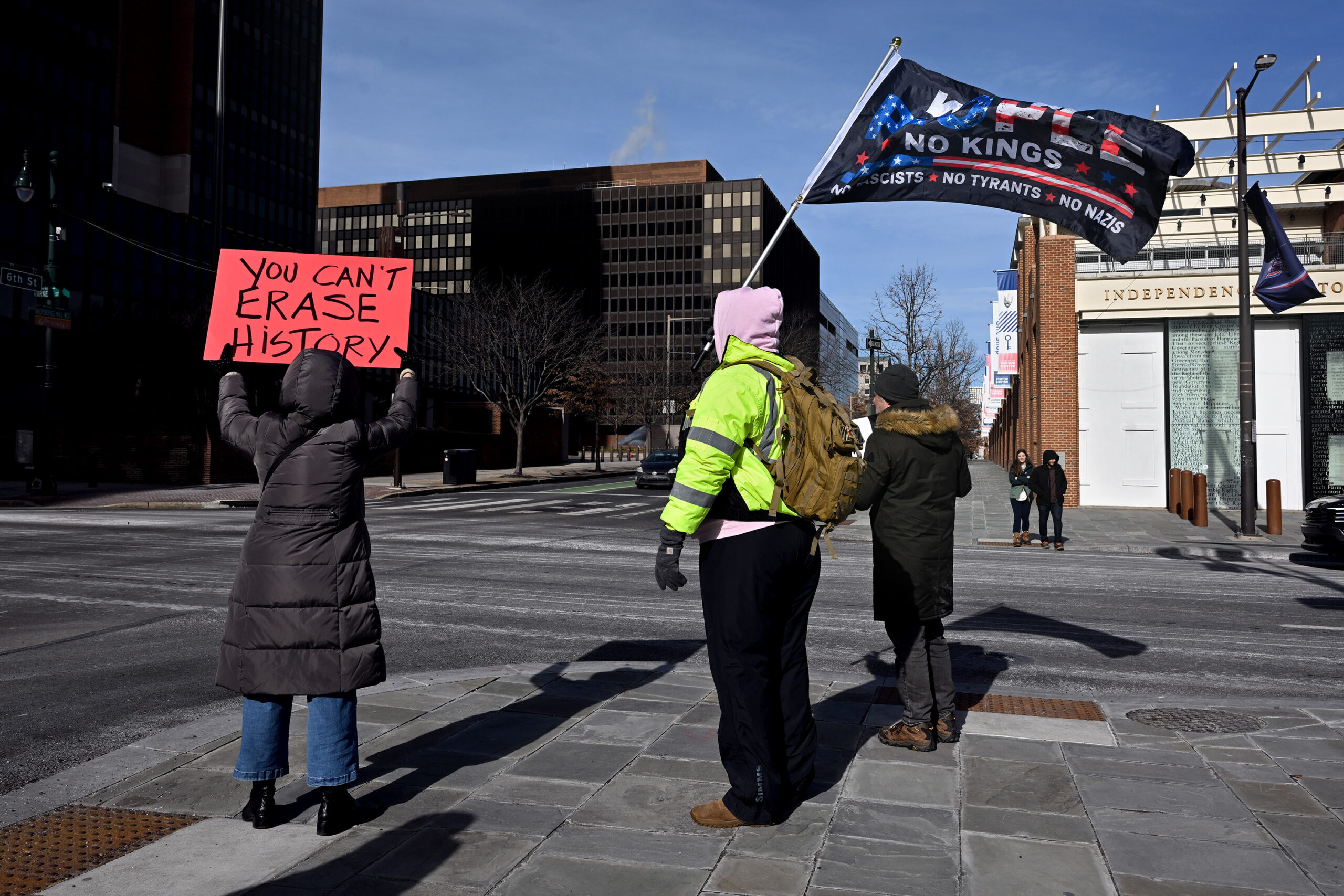
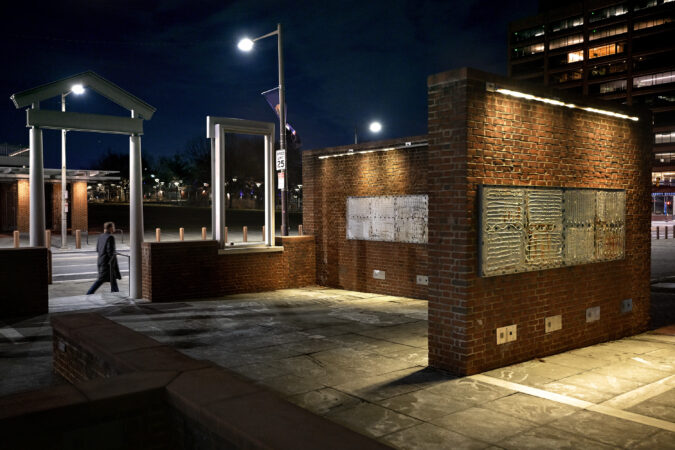
The brief confrontation came this week in front of the empty frames where visitors had been taping informal signs to fill the void where the original panels hung at the President’s House, after President Donald Trump’s administration removed the slavery exhibits last month.
Signs and notes placed by visitors at the President’s House in Independence National Historical Park.
Glenn Bergman and his wife Dianne Manning were just arriving at the Avenging the Ancestors Coalition’s annual Presidents’ Day observance. They had earlier attended the weekly ICE vigil a few blocks away. Bystanders yelled at the woman to stop as she declared it was her “First Amendment right” while tearing off the notes.
Bergman stepped in to block her, saying later, he “had to do something.” After a few seconds everyone stepped away, accusing her of “littering.”
She grabbed the papers off the ground and left abruptly, shouting “George Washington made this country great… for white people.”
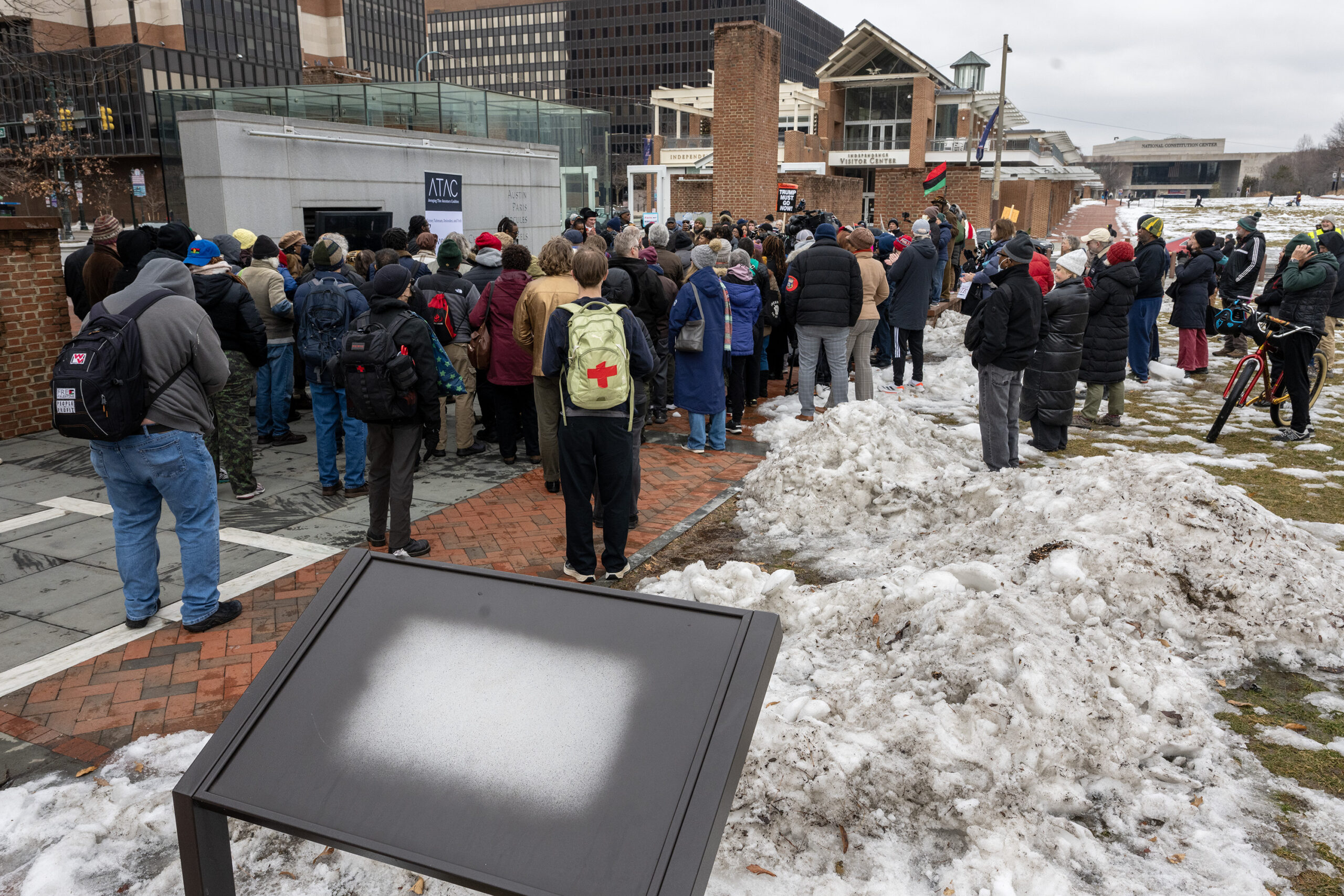
The entire interaction lasted less than three minutes — and unfolded right on the other side of the wall from where the main advocacy organization leading the fight to protect the President’s House was gathered.
The Avenging the Ancestors Coalition holds their annual Presidents’ Day observance at the President’s House Monday, Feb. 16, 2026. The empty frame in the foreground held a panel about slavery that was removed.
As the week of Presidents’ Day ends, I’m moving that presidential apostrophe back a letter and remembering my time photographing at the President’s House.
It is almost a year since our current President signed Executive Order #14253, titled “Restoring Truth and Sanity to American History,” on Mar. 27, 2025.
In addition to requiring the Secretary of the Interior to develop a plan to improve Independence National Historical Park in preparation for our 250th birthday, he directed National Park Service staff to identify language and historical depictions that “inappropriately disparage Americans past or living.”
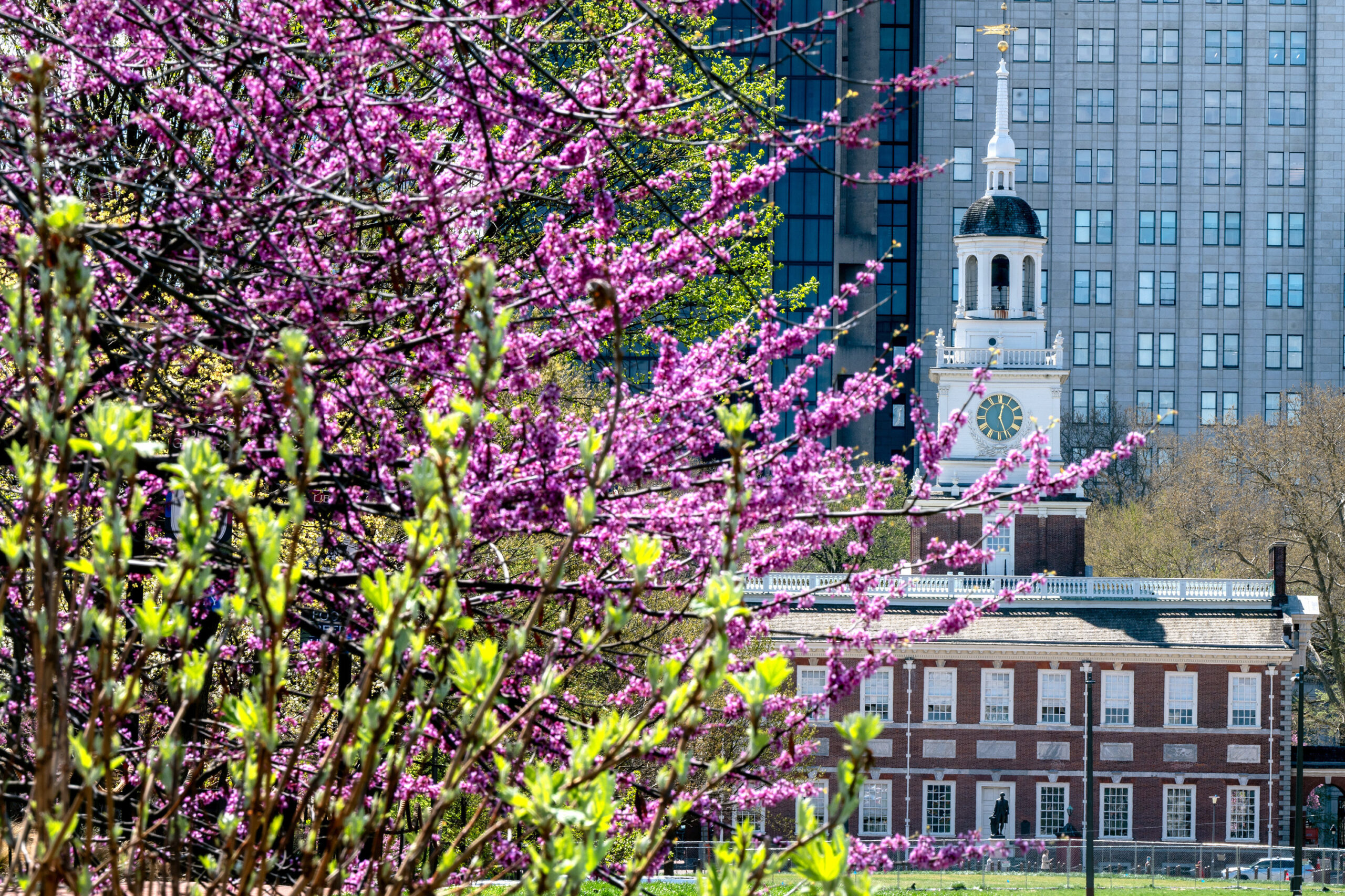
Flowering trees by Independence Hall in spring, 2025.
In May, Interior Secretary Doug Burgum issued an order that signs be posted in all National Park asking employees and visitors to report any negative information.
A sign and QR code located in Independence National Historical Park inviting the public to submit feedback on repairs, improvements, and content that is “negative about either past or living Americans.”
In July, President Donald Trump’s administration started taking steps to review or remove materials key to understanding the history of race in America.
But it didn’t happen until last month.
I was on another assignment nearby when the newspaper received a tip workers were on the site “with tape measures.”
They weren’t talking to our reporter, already on the site, when I arrived to find park service workers indeed examining the panels. So I just assumed if they would be dismantling the exhibits it would happen in the middle of the night — like when the statue of former Mayor Frank Rizzo was “disappeared” and his Italian Market mural was erased under cover of darkness in 2020.
I made a few photos then left to edit and upload, only to get a text, “it’s happening now.”
It was awkward as the workers asked me to “give us a break,” while I hovered around — not right on top of them — watching every move. I replied we were both doing our jobs.
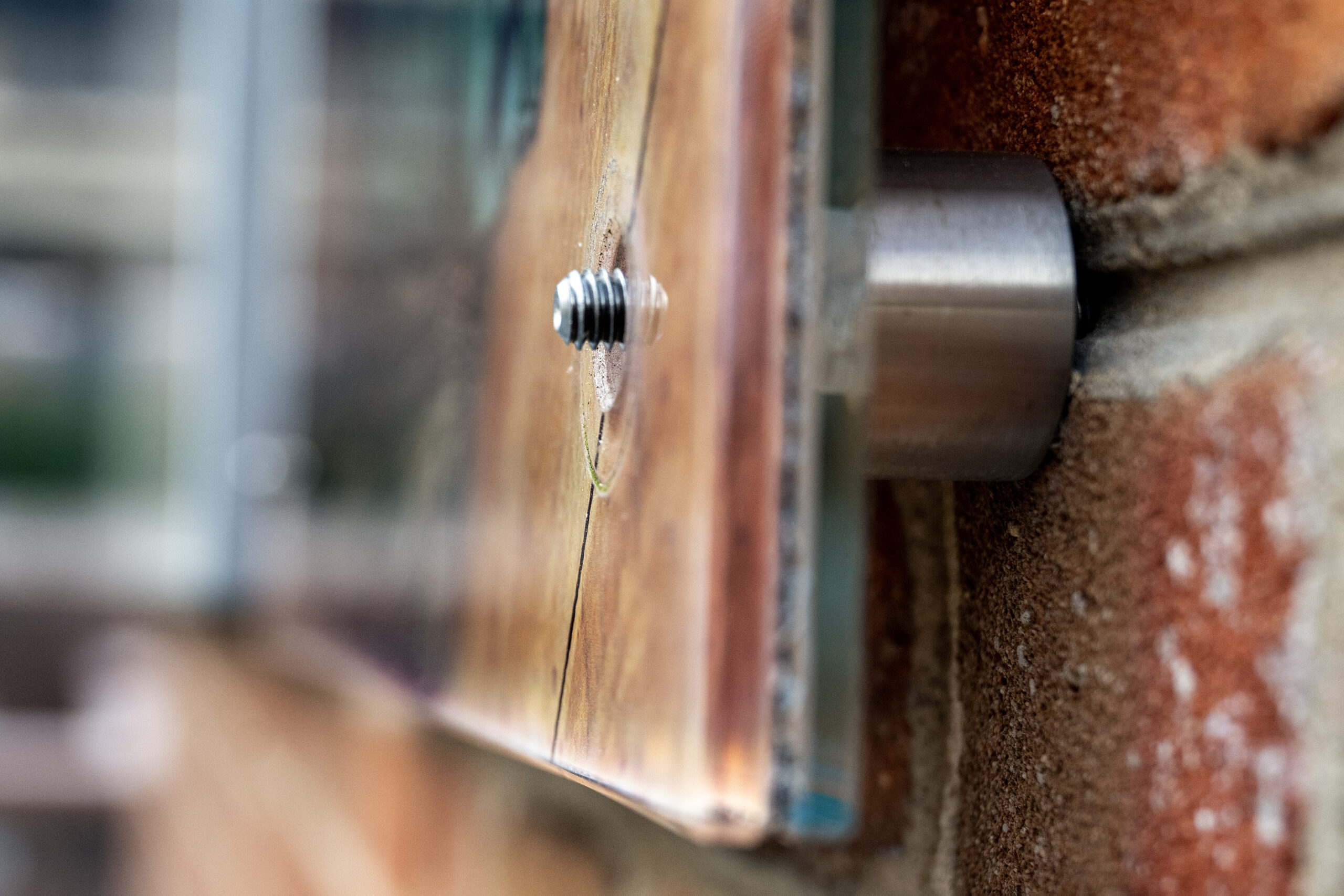
Bolts are removed from Interpretive panels as the exhibits are taken off the walls in Independence National Historical Park Thursday, Jan. 22, 2026.
It wasn’t long before other news media arrived, and I continued to document the entire removal. I was joined by photographer Elizabeth Robertson who made a photo from our newsroom overlooking the site. Later that evening, I returned to a much quieter scene.
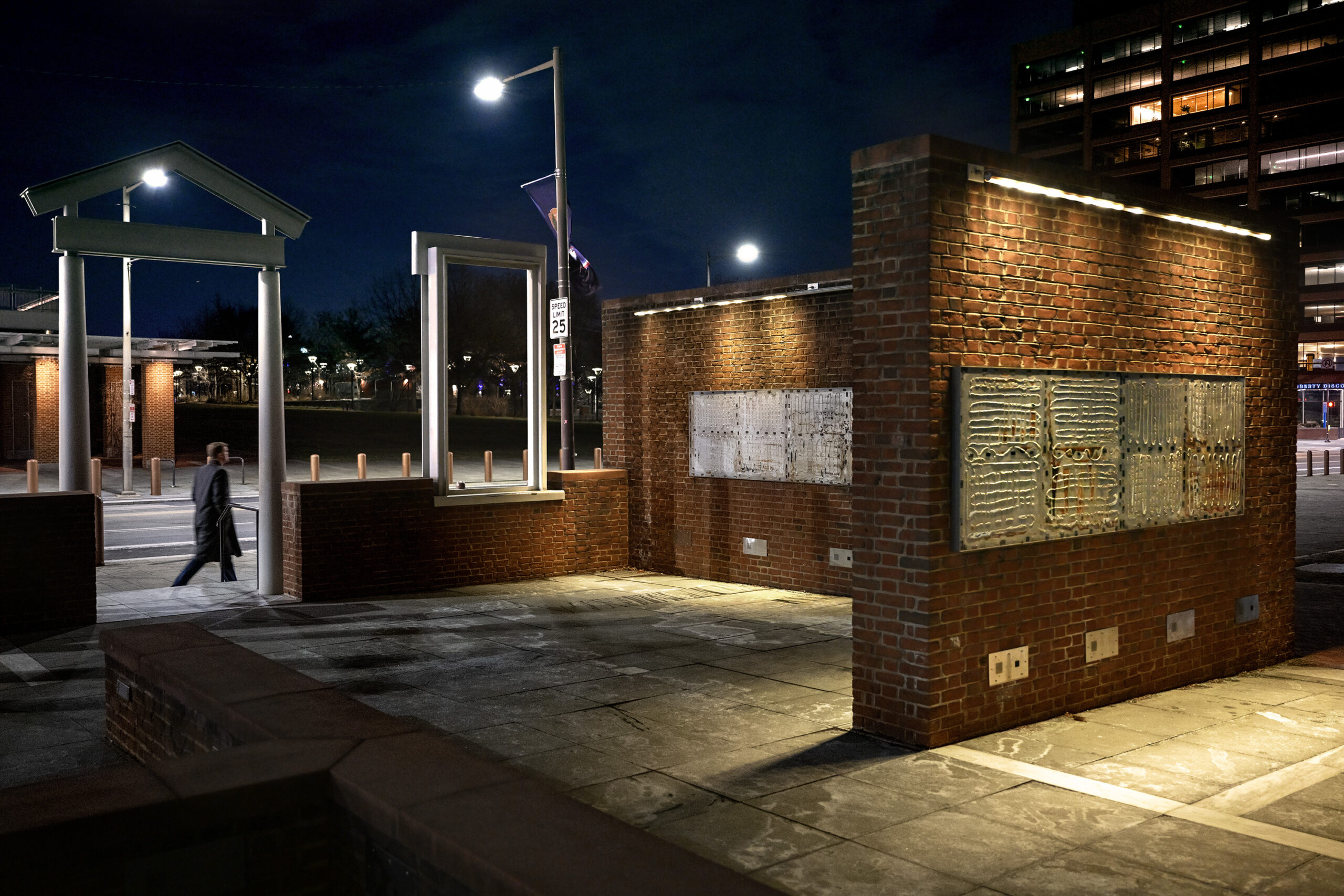
The President’s House Historical Park Jan. 22, 2026, after all historical exhibits were removed. The site, a reconstructed “ghost” structure titled “Freedom and Slavery in the Making of a New Nation” (2010), serves as a memorial to the nine people George Washington enslaved there during the founding of America.
That wasn’t the end of it. Protests continued…
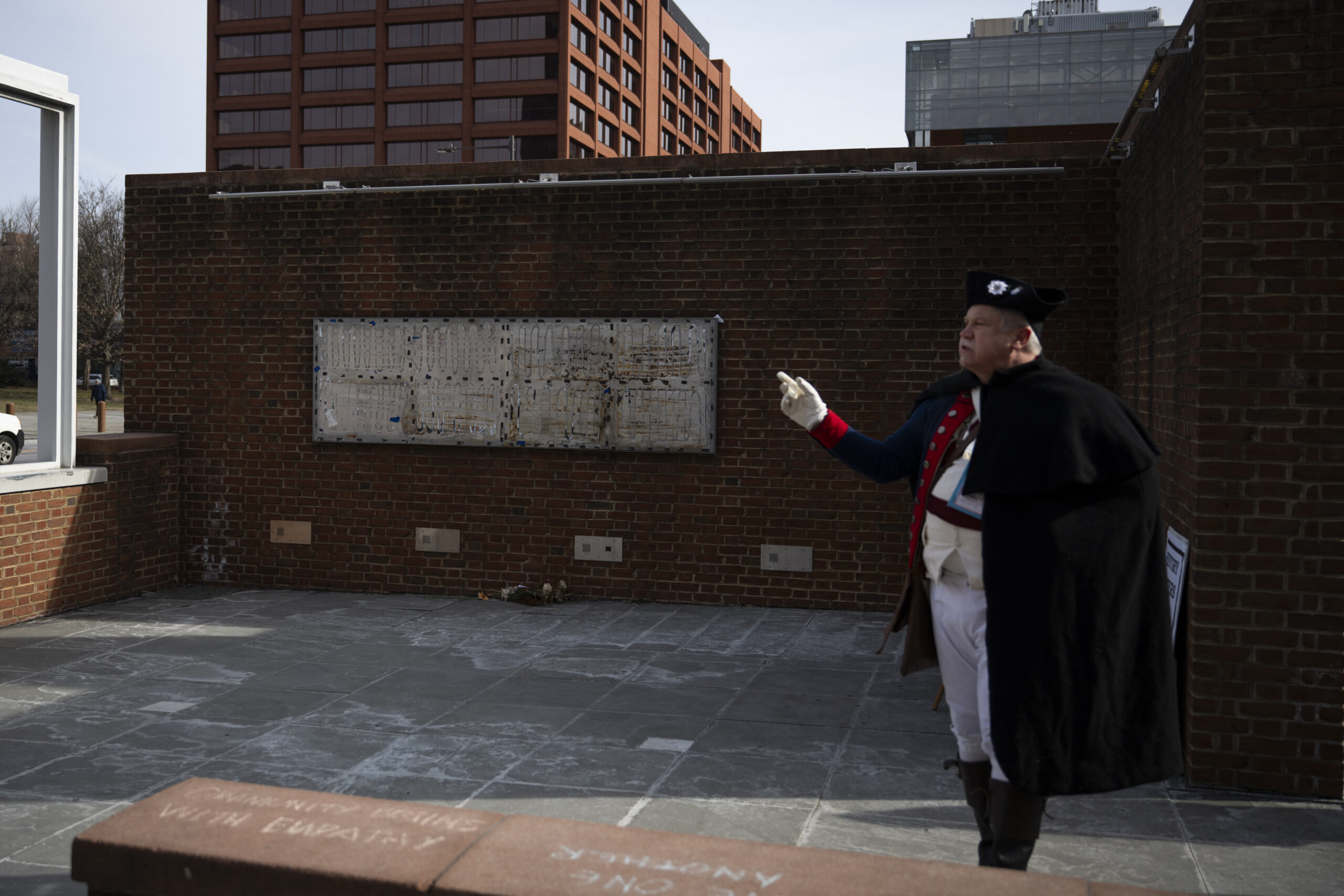
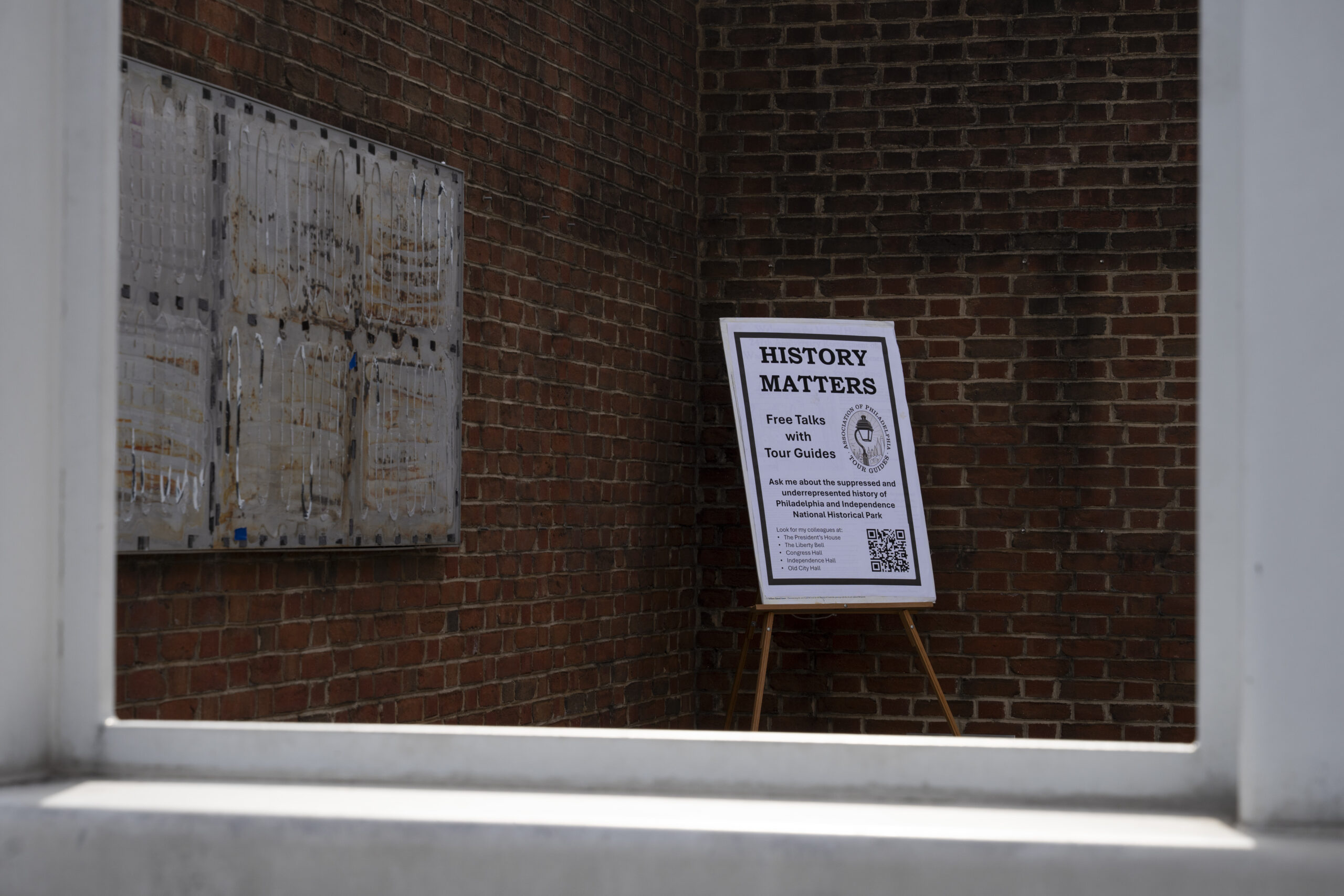
Historical interpreter Michael Carver talks with visitors while he and other members of the Association of Philadelphia Tour Guides host “History Matters” offering “Free Talks with Tour Guides” Jan. 24, 2026 at the President’s House site two days after more than a dozen educational displays about slavery were removed from the site.
… and the City of Philadelphia sued the National Park Service and Department of Interior. District Judge Cynthia M. Rufe inspected the removed panels in storage for herself, visited the President’s House site, then ordered the federal government “restore the President’s House Site to its physical status as of January 21, 2026,” which is the day before the exhibits were removed.
Trump administration officials appealed her ruling calling it “unnecessary judicial intervention” and on Presidents’ Day, when Glenn Bergman and Dianne Manning of Mt. Airy were attending the Avenging the Ancestors Coalition rally, Judge Rufe issued an injunction that required the federal agencies to restore the interpretive panels.
So we all waited to see what happened next. The “what’s next?” was two days later the federal judge, citing the agencies’ “failure to comply” set a deadline of 5 p.m. Friday.
A spokesperson for the White House defended their inaction saying removal of the exhibits is not final because the Department of the Interior is “engaged in an ongoing review of our nation’s American history exhibits in accordance with the President’s executive order to eliminate corrosive ideology, restore sanity, and reinstate the truth.”
A cleaded up and power-washed President’s House site the day after a federal judge ordered the Trump administration to restore the slavery exhibits that the National Park Service removed from the President’s House in January.
Upon hearing the news I thought, “Friday is my day off. I will just have to read what my excellent reporting colleagues Fallon Roth, Maggie Prosser, and Abraham Gutman write about it. And live vicariously through the photos by whichever of my photo co-workers gets the assignment.“
I just couldn’t stay away, so I returned to the site early Thursday morning, just to “babysit.”
After about 30 minutes and only seeing two visitors, a park service worker arrived with a 5-gallon Lowe’s plastic blue bucket ($4.95, lid sold separately) and another, plain white plastic pail full of rags. More prep work for Friday, my day off, I figured.
When he returned with a six-foot Little Giant ladder ($255.99, King Kombo), I asked “so you’re not just doing more cleaning, right?”
I alerted my newsdesk, and spent the next six hours there.
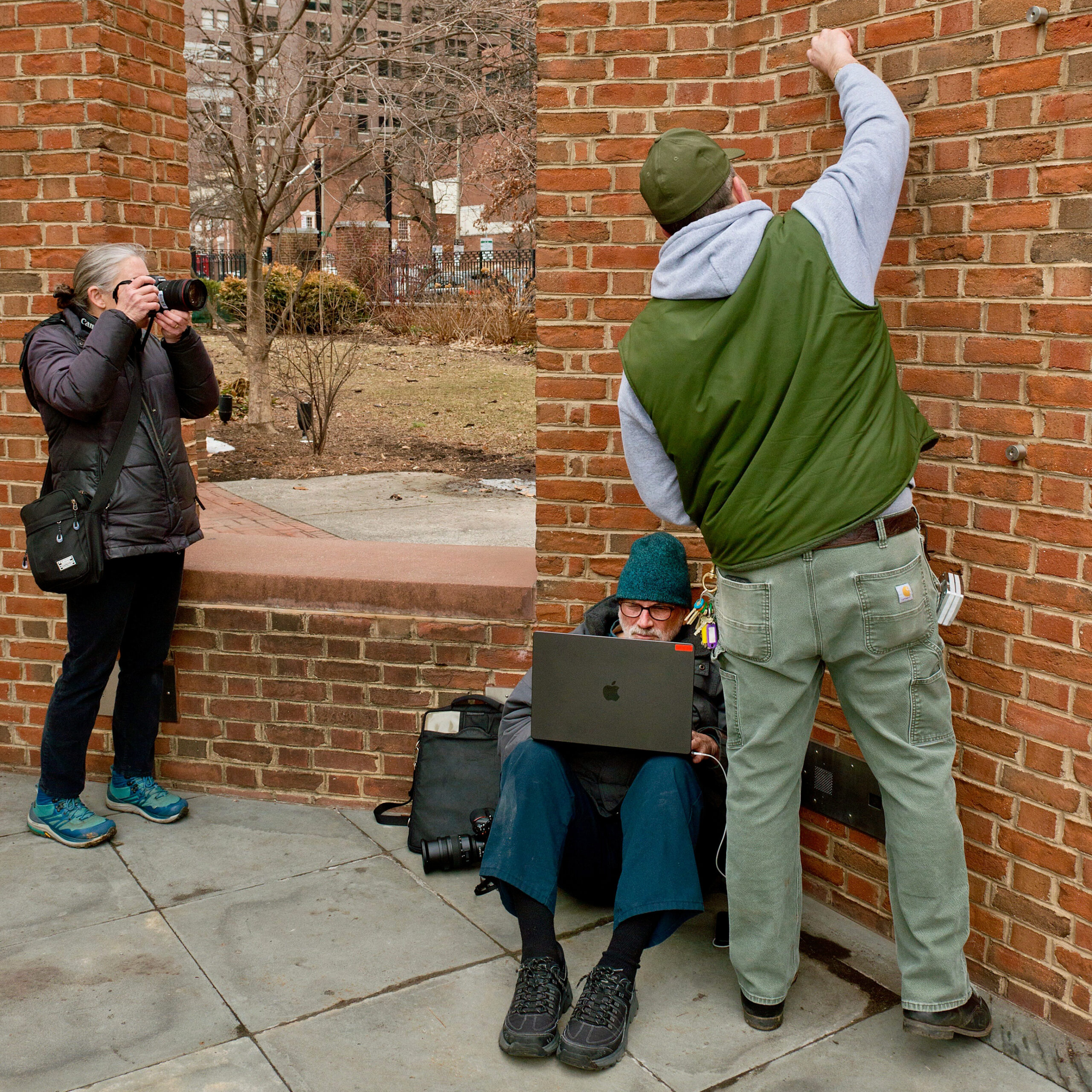
Philadelphia Inquirer staff photographer Tom Gralish edits his news photos at the President’s House site in Independence National Historical Park Thursday, Feb, 19, 2026 as park service workers restore the slavery exhibits that were removed in January. Gralish had met and talked with the NPS employee earlier in the morning before other news media arrived at the site, and hadn’t noticed a panel would be going back up later where he was sitting. “You’re okay,” the worker said, “you were here first.”
Since 1998 a black-and-white photo has appeared every Monday in staff photographer Tom Gralish’s “Scene Through the Lens” photo column in the print editions of The Inquirer’s local news section. Here are the most recent, in color:
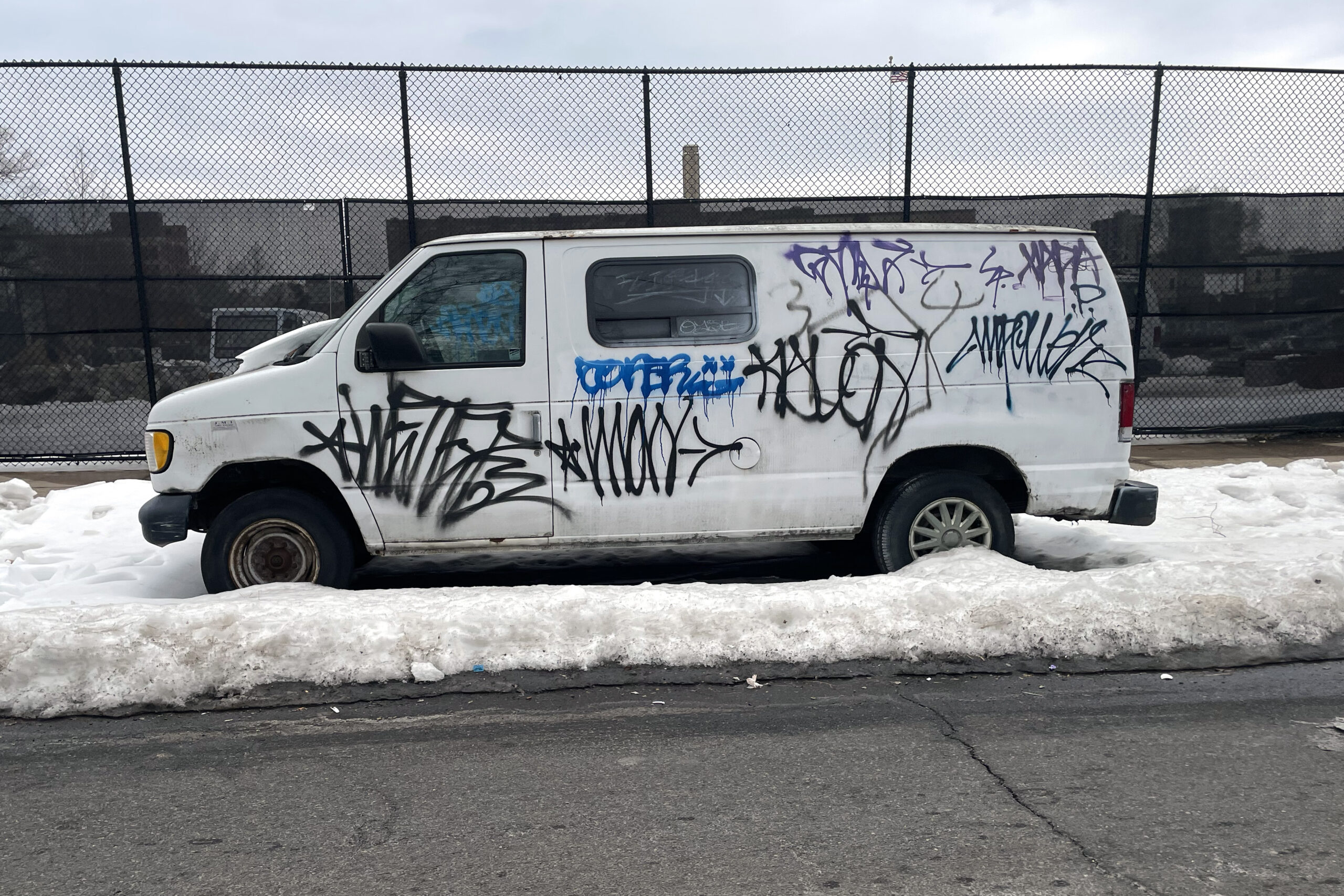
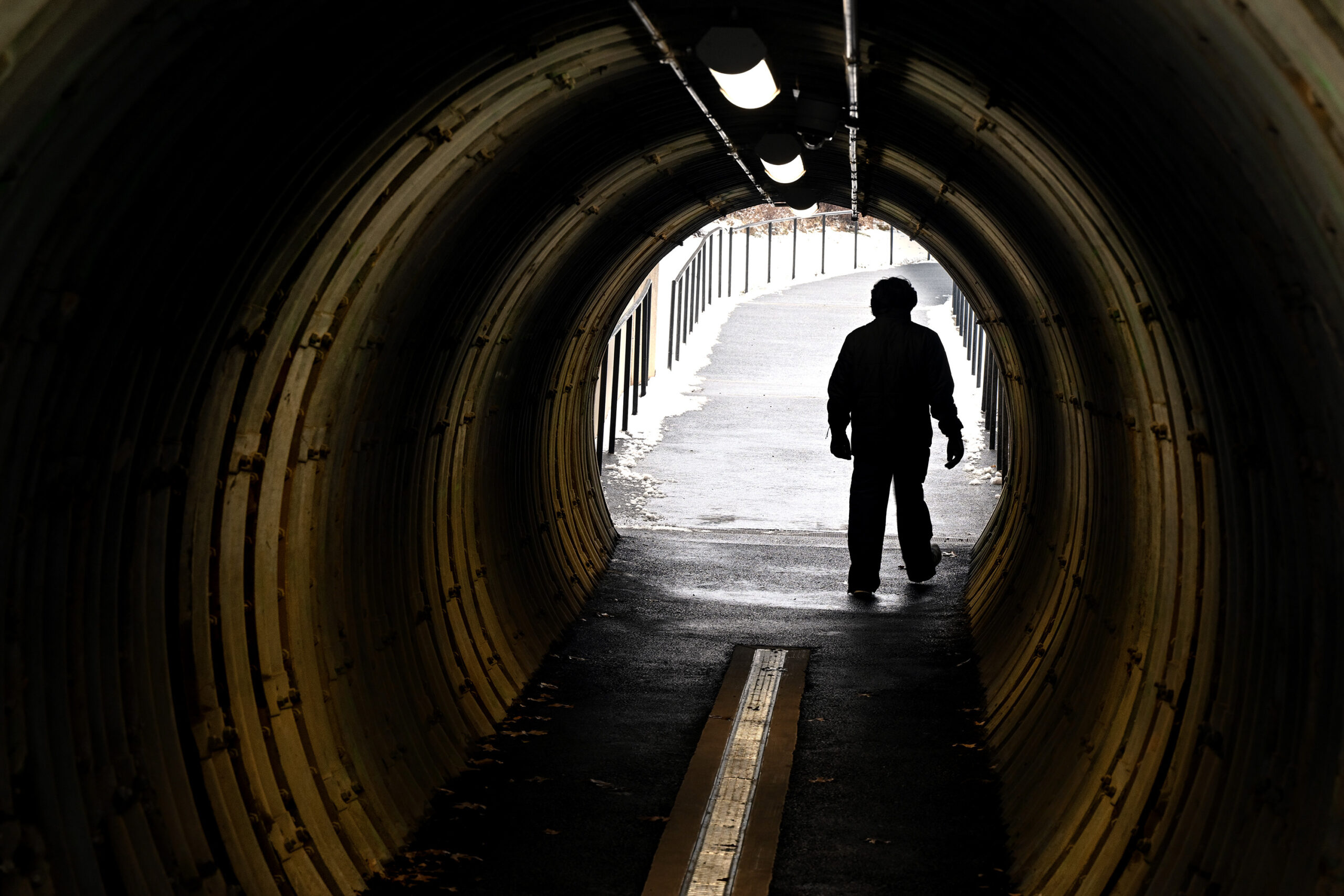
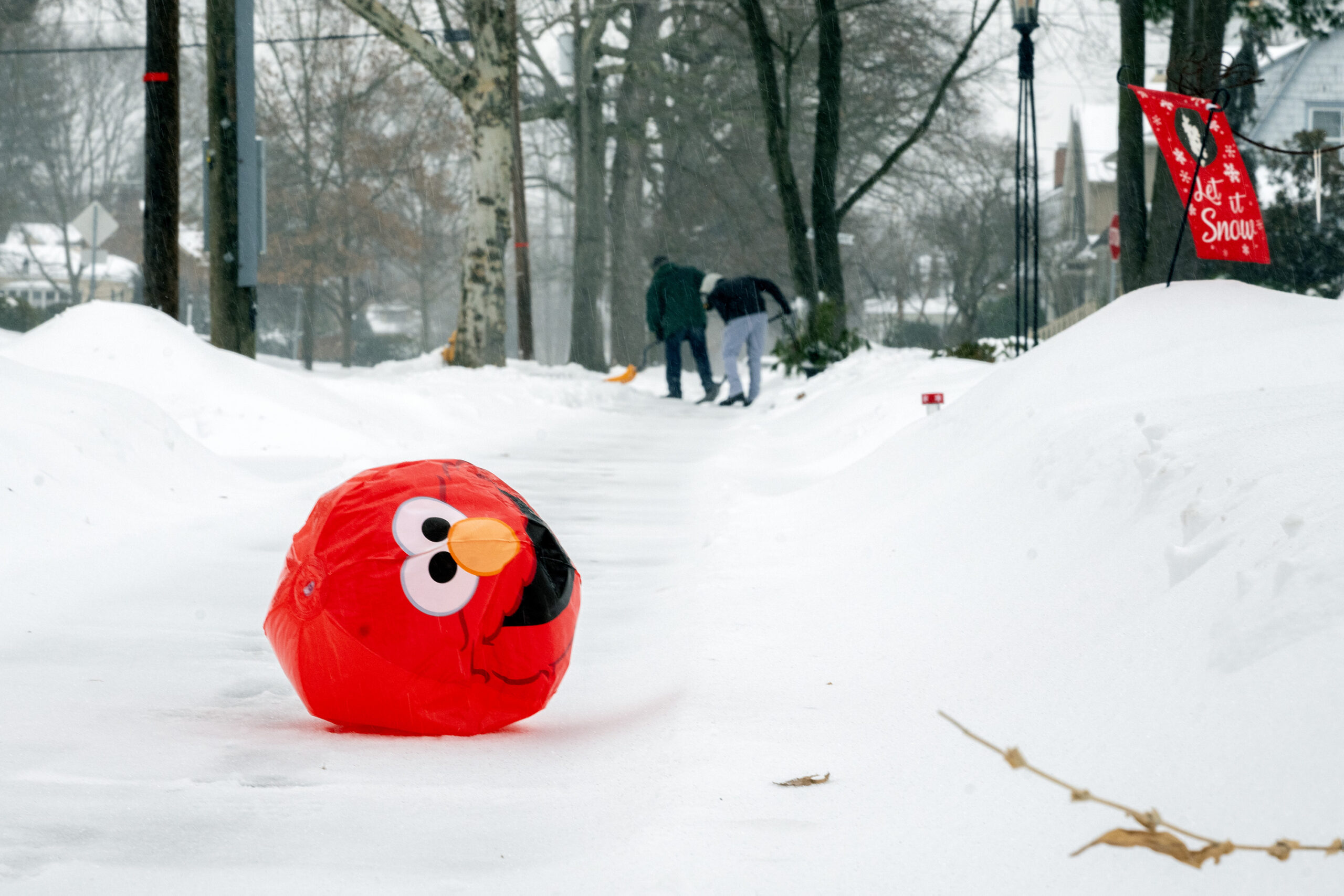
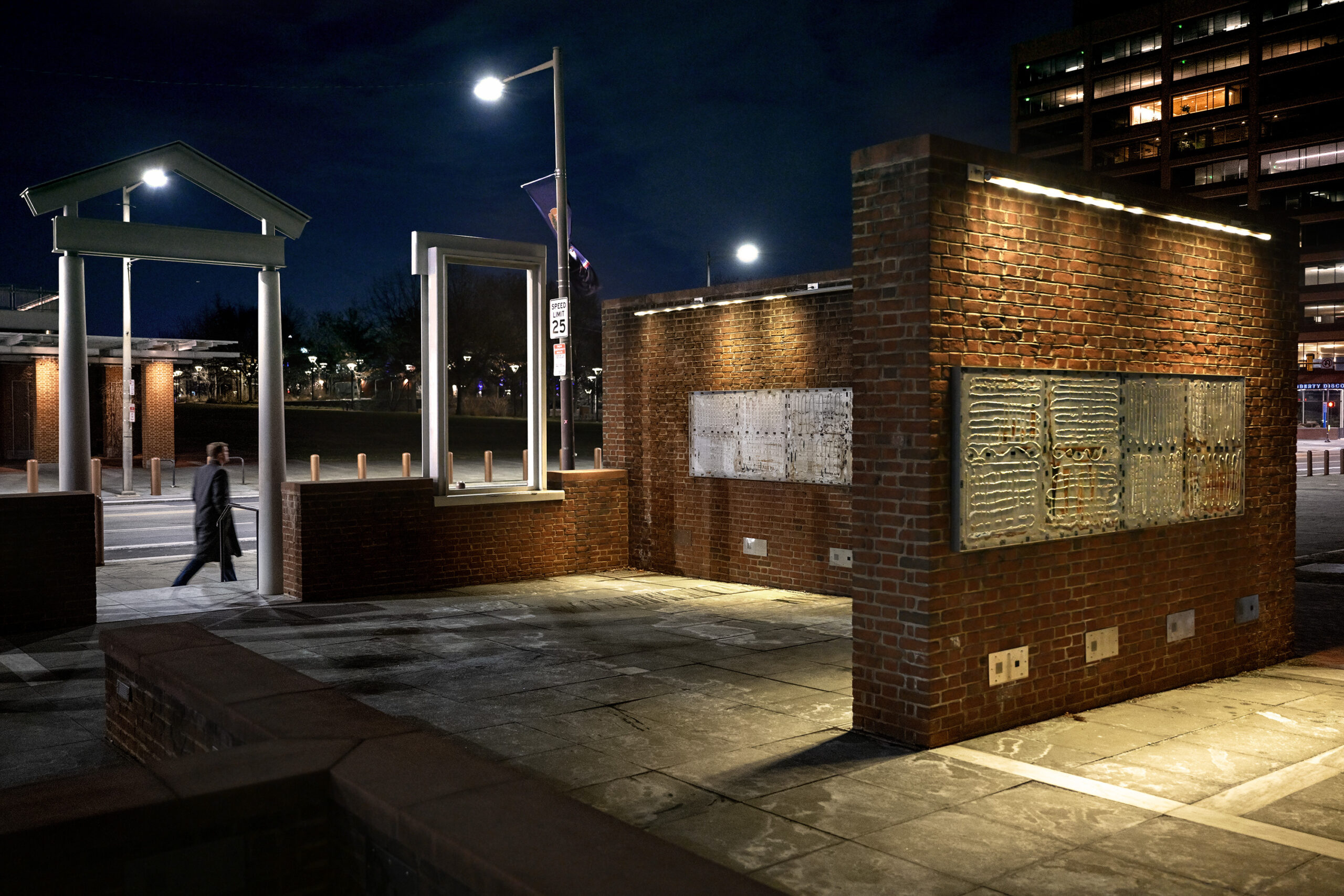
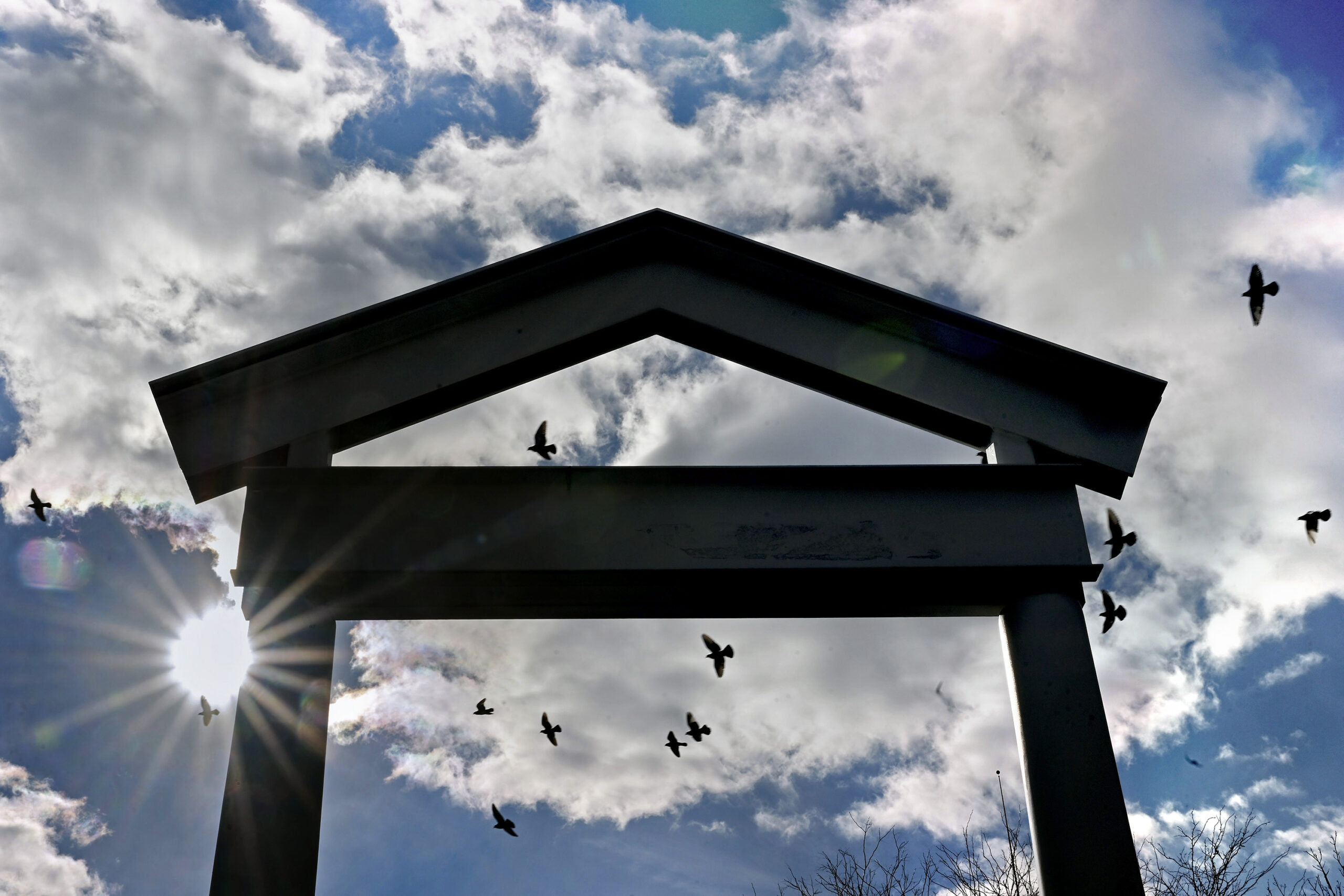
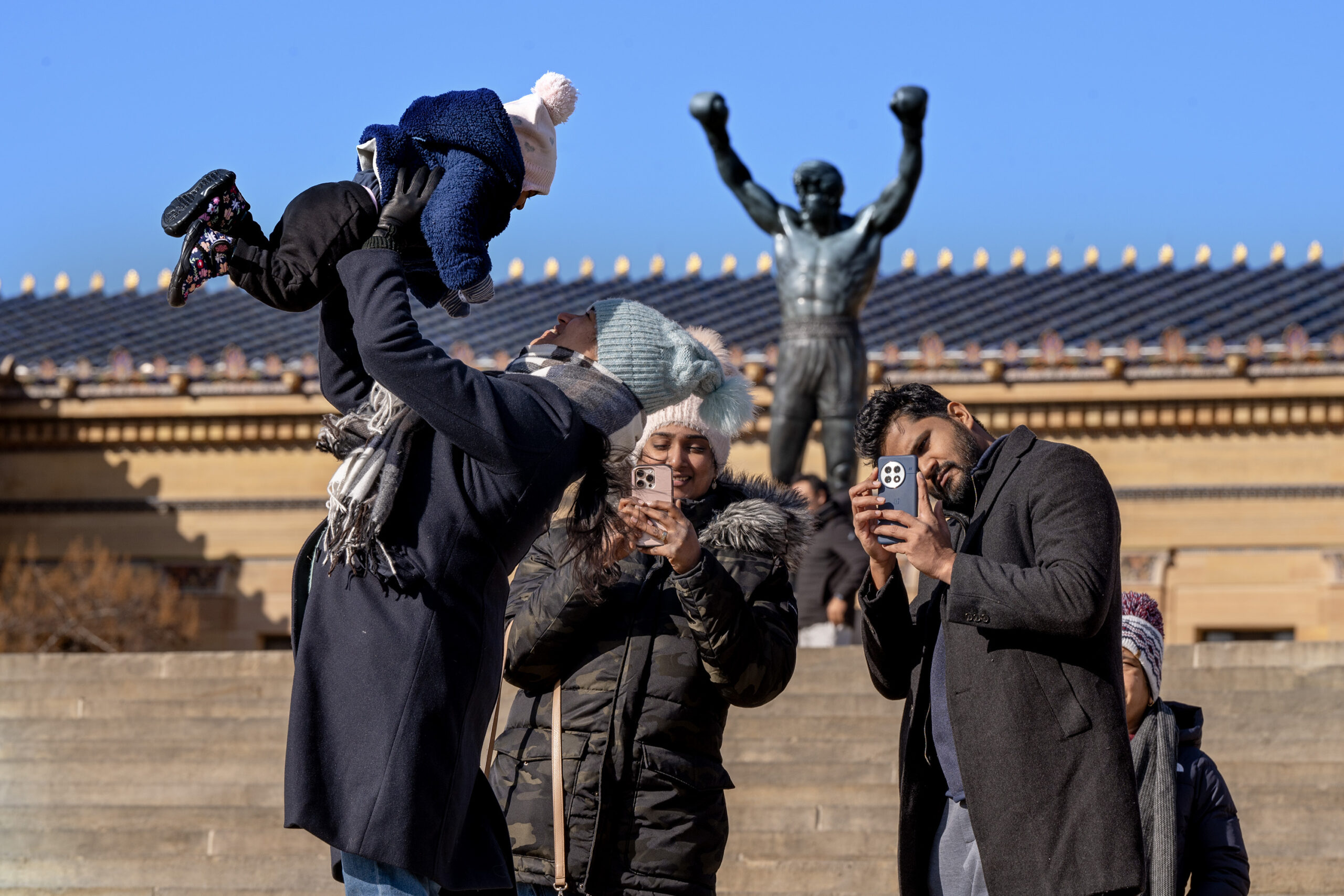
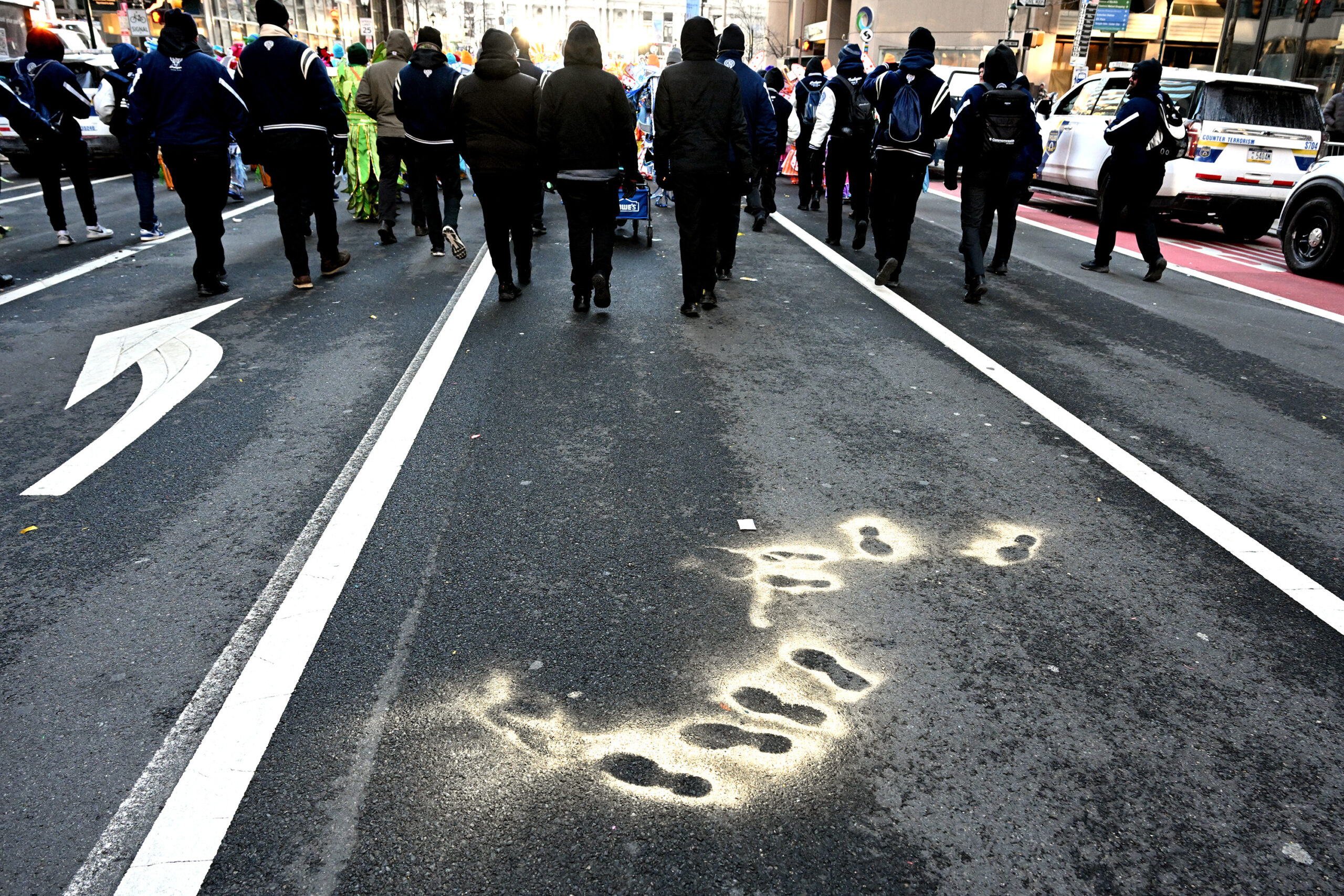
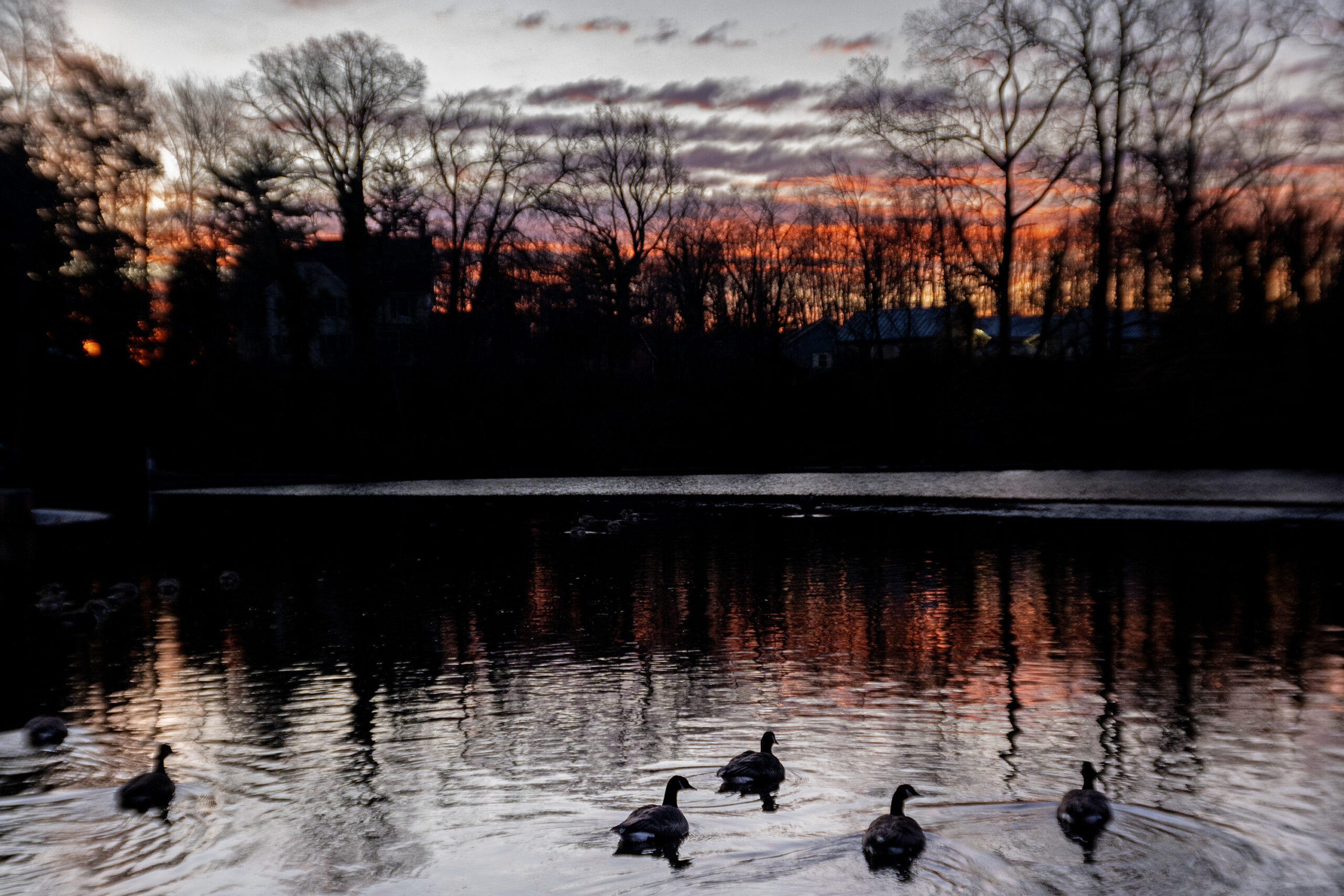
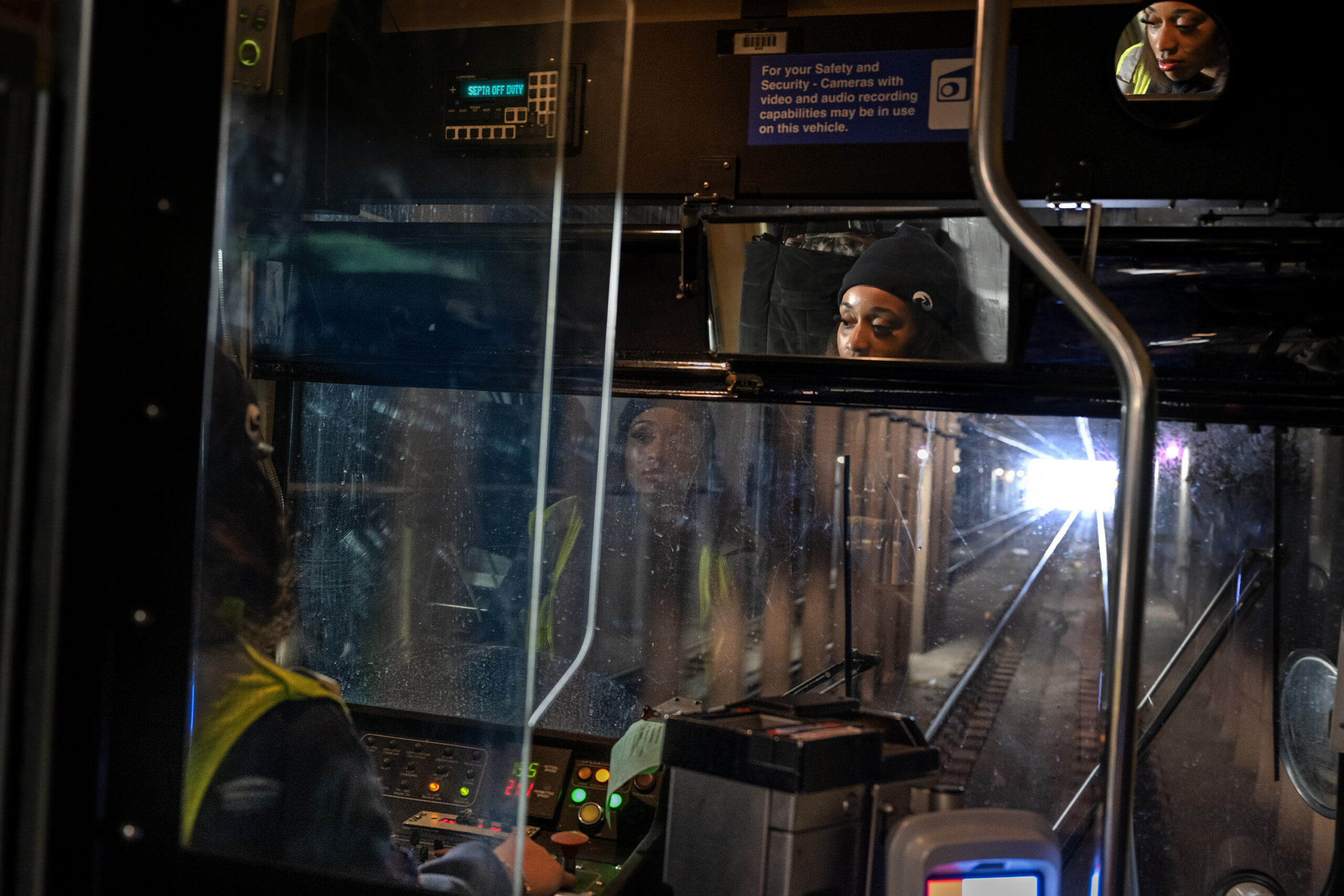
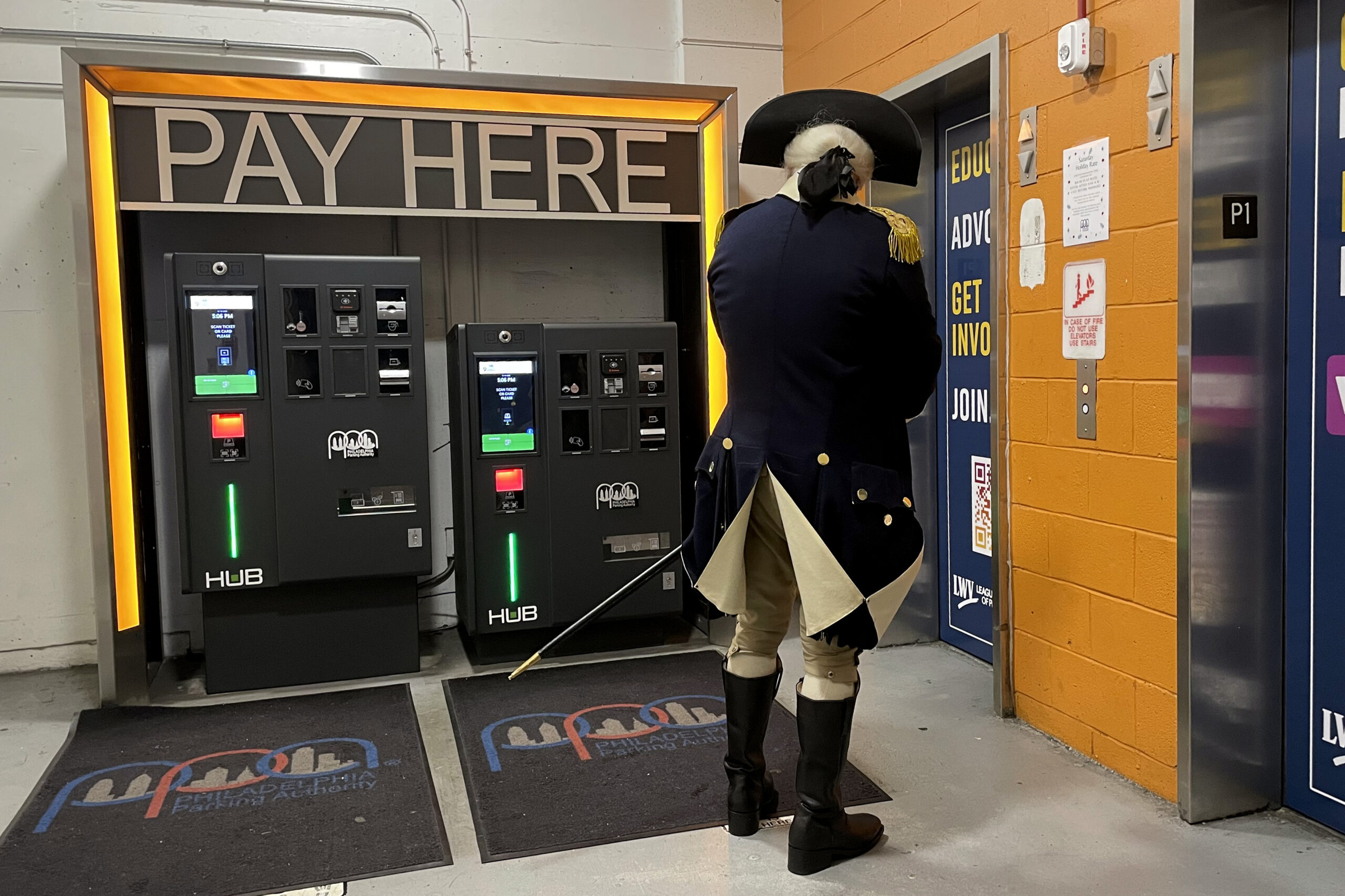
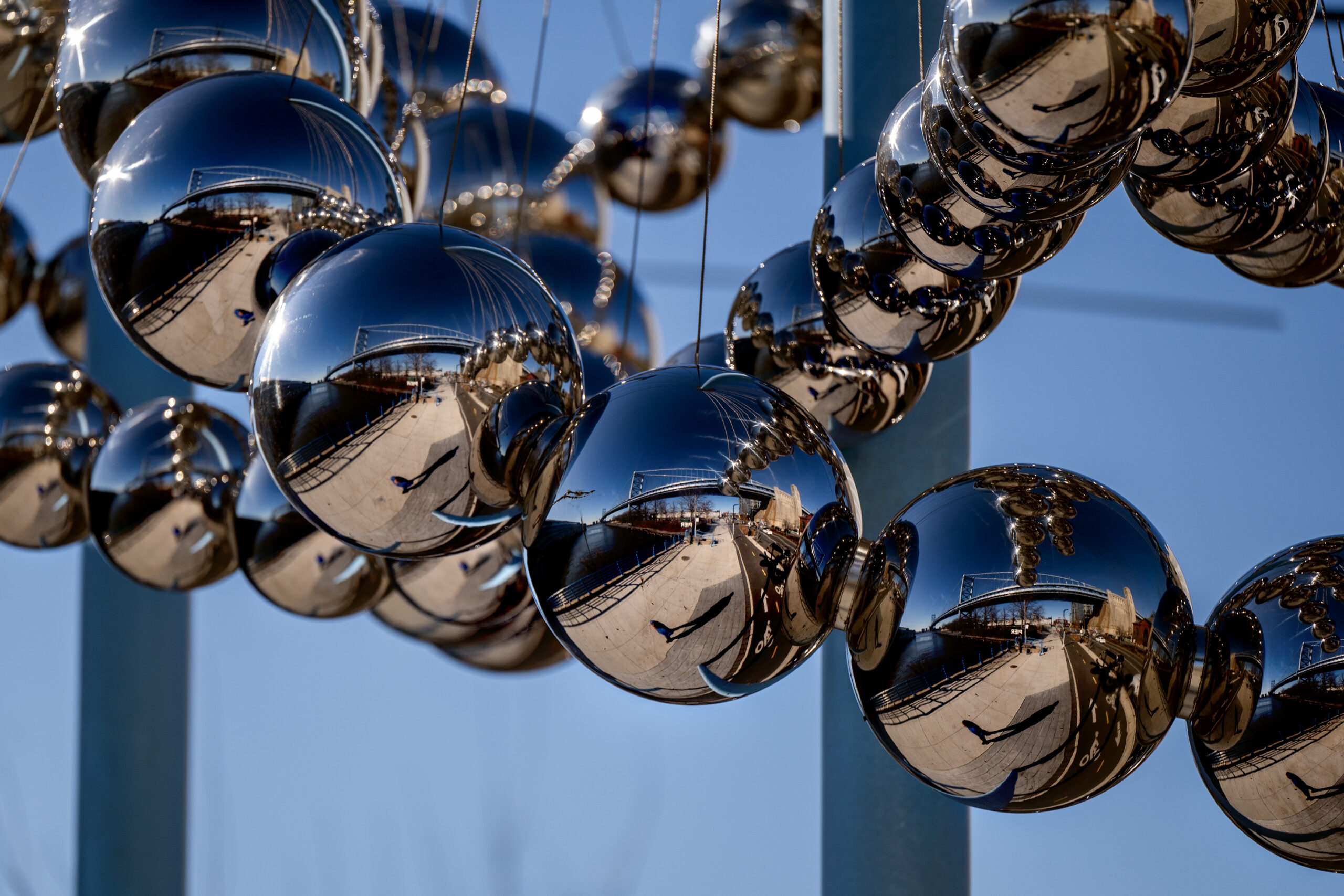
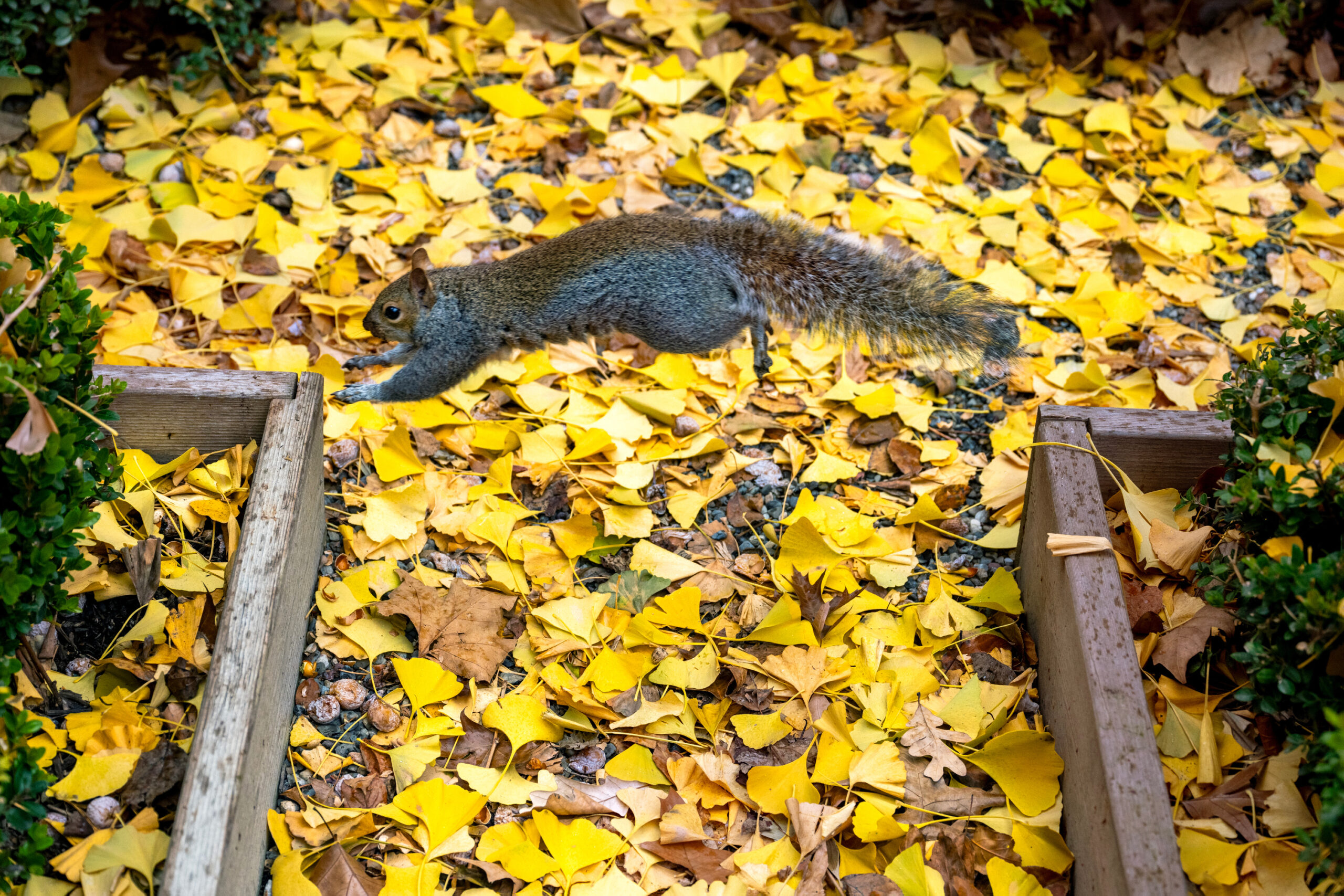
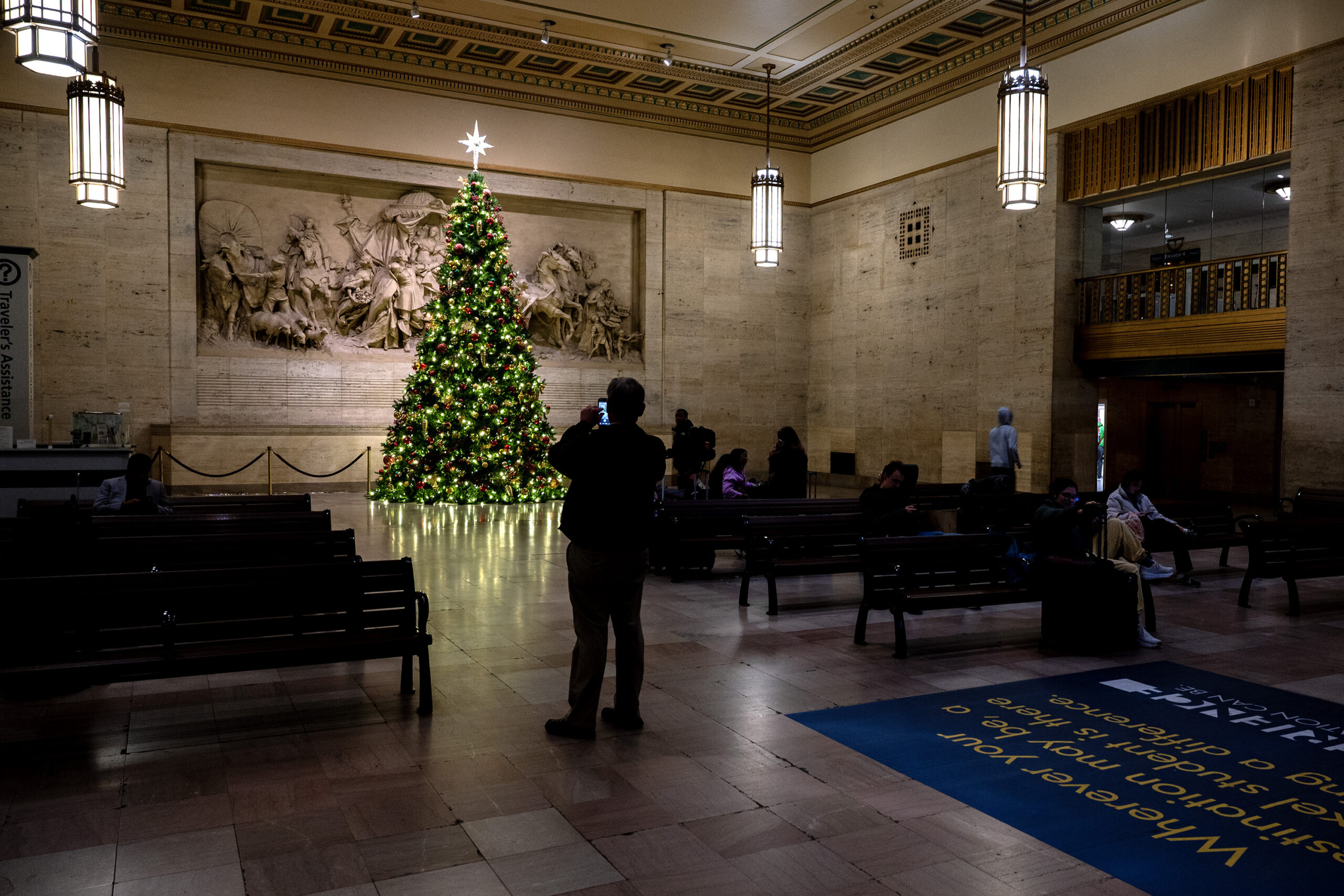
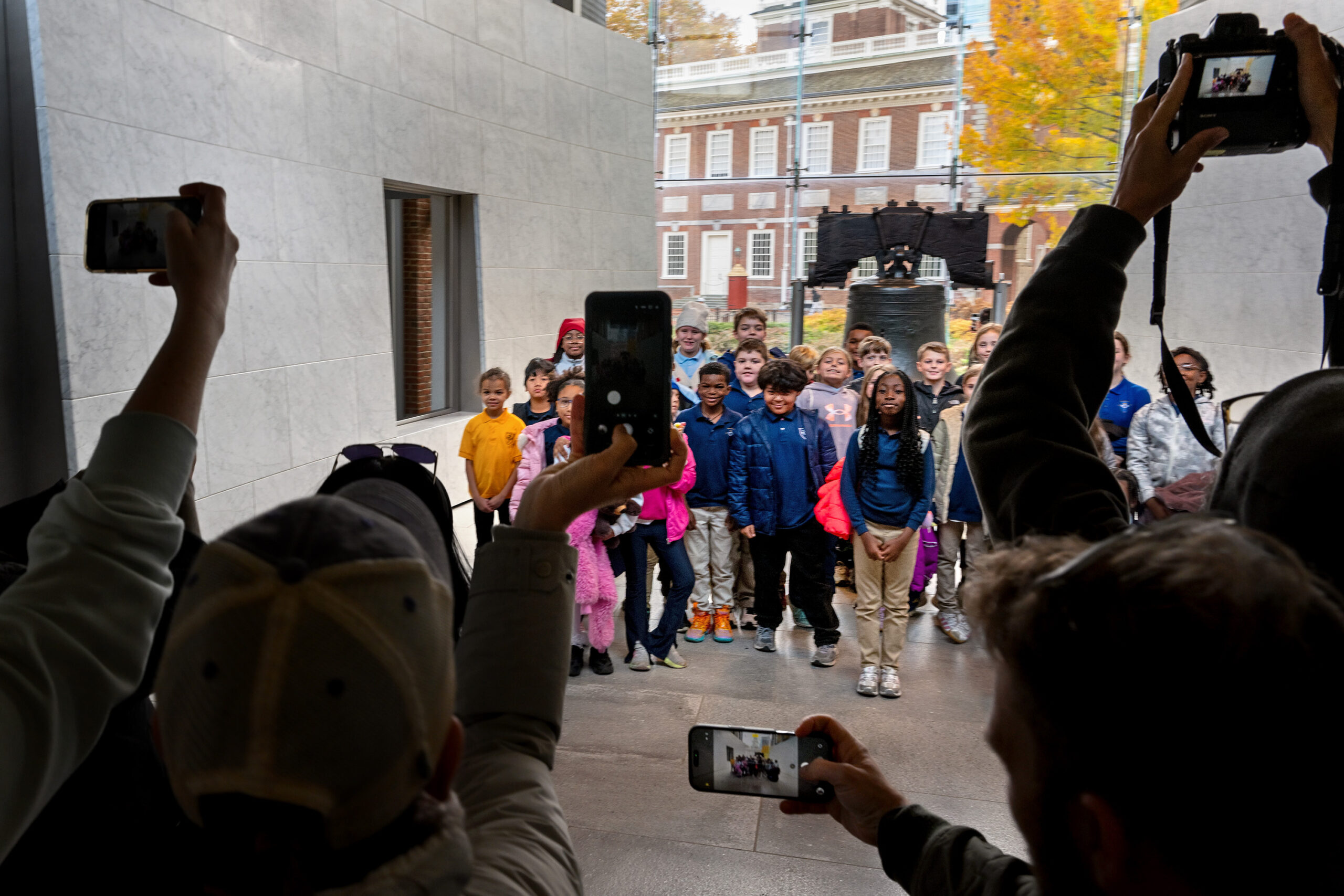
February 16, 2026: What came first? The dirty snowpacked berm of frozen slush or the graffiti? February 9, 2026: Walking through a corrugated metal culvert called the “Duck Tunnel,” a pedestrian navigates the passageway under the SEPTA tracks on the Swarthmore College campus. February 2, 2026: A light-as-air Elmo balloon rolls along a sidewalk in Haddonfield, propelled by the wind as Sunday’s heavy snow starts to turn to ice and sleet. January 26, 2026: The President’s House in Independence National Historical Park hours Jan, 22, after all historical exhibits were removed following President Trump’s Executive Order last March that the content at national parks that “inappropriately disparage” the U.S. be reviewed. The site, a reconstructed “ghost” structure titled “Freedom and Slavery in the Making of a New Nation” (2010), serves as a memorial to the nine people George Washington enslaved there during the founding of America.January 19, 2026: A low-in-the-sky winter sun is behind the triangular pediment of the “front door” of the open-air President’s House installation in Independence National Historical Park. The reconstructed “ghost” structure with partial walls and windows of the Georgian home known in the 18th century as 190 High St. is officially titled, “Freedom and Slavery in the Making of a New Nation” (2010). It is designed to give visitors a sense of the house where the first two presidents of the United States, George Washington and John Adams, served their terms of office. The commemorative site designed by Emanuel Kelly, with Kelly/Maiello Architects, pays homage to nine enslaved people of African descent who were part of the Washington household with videos scripted by Lorene Cary and directed by Louis Massiah. Deepika Iyer holds her niece Ira Samudra aloft in a Rockyesque pose, while her parents photograph their 8 month-old daughter, in front of the famous movie prop at the top of the steps at the Philadelphia Art Museum. Iyer lives in Philadelphia and is hosting a visit by her mother Vijayalakshmi Ramachandran (partially hidden); brother Gautham Ramachandran; and her sister-in-law Janani Gautham who all live in Bangalore, India.January 5, 2026: Parade marshals trail behind the musicians of the Greater Kensington String Band heading to their #9 position start in the Mummers Parade. Spray paint by comic wenches earlier in the day left “Oh, Dem Golden Slippers” shadows on the pavement of Market Street. This year marked the 125th anniversary of Philly’s iconic New Year’s Day celebration.Dec. 29, 2025: Canada geese at sunrise in Evans Pond in Haddonfield, during the week of the Winter Solstice for the Northern Hemisphere. December 22, 2025: SEPTA trolley operator Victoria Daniels approaches the end of the Center City Tunnel, heading toward the 40th Street trolley portal after a tour to update the news media on overhead wire repairs in the closed tunnel due to unexpected issues from new slider parts.December 15, 2025: A historical interpreter waits at the parking garage elevators headed not to a December crossing of the Delaware River, but an event at the National Constitution Center. General George Washington was on his way to an unveiling of the U.S. Mint’s new 2026 coins for the Semiquincentennial, December 8, 2025: The Benjamin Franklin Bridge and pedestrians on the Delaware River Trail are reflected in mirrored spheres of the “Weaver’s Knot: Sheet Bend” public artwork on Columbus Boulevard. The site-specific stainless steel piece located between the Cherry Street and Race Street Piers was commissioned by the City’s Public Art Office and the Delaware River Waterfront Corporation and created and installed in 2022 by the design and fabrication group Ball-Nogues Studio. The name recalls a history that dominated the region for hundreds of years. “Weaver’s knot” derives from use in textile mills and the “Sheet bend” or “sheet knot” was used on sailing vessels for bending ropes to sails. November 29, 2025: t’s ginkgo time in our region again when the distinctive fan-shaped leaves turn yellow and then, on one day, lose all their leaves at the same time laying a carpet on city streets and sidewalks. A squirrel leaps over leaves in the 18th Century Garden in Independence National Historical Park Nov. 25, 2025. The ginkgo (Ginkgo biloba) is considered a living fossil as it’s the only surviving species of a group of trees that existed before dinosaurs. Genetically, it has remained unchanged over the past 200 million years. William Hamilton, owner the Woodlands in SW Phila (no relation to Alexander Hamilton) brought the first ginkgo trees to North America in 1785.November 24, 2025: The old waiting room at 30th Street Station that most people only pass through on their way to the restrooms has been spiffed up with benches – and a Christmas tree. It was placed there this year in front of the 30-foot frieze, “The Spirit of Transportation” while the lobby of Amtrak’s $550 million station restoration is underway. The 1895 relief sculpture by Karl Bitter was originally hung in the Broad Street Station by City Hall, but was moved in 1933. It depicts travel from ancient to modern and even futuristic times. November 17, 2025: Students on a field trip from the Christian Academy in Brookhaven, Delaware County, pose for a group photo in front of the Liberty Bell in Independence National Historical Park on Thursday. The trip was planned weeks earlier, before they knew it would be on the day park buildings were reopening after the government shutdown ended. “We got so lucky,” a teacher said. Then corrected herself. “It’s because we prayed for it.”
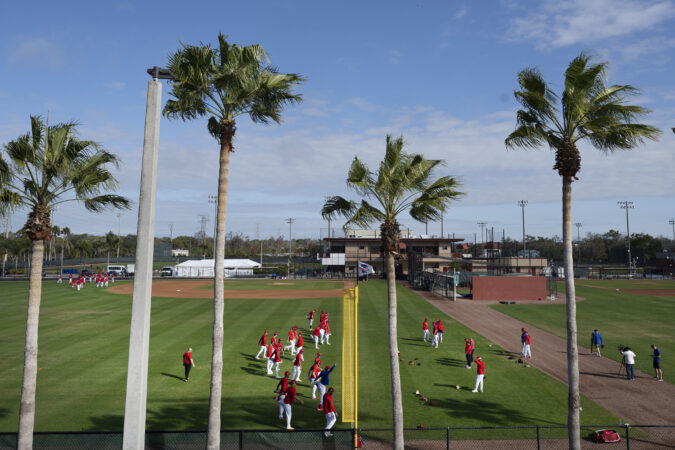
Each Friday, Inquirer photo editors pick the best Philly sports images from the last seven days. This week, there’s nowhere better to start than on the hardwood with the boys’ and girls’ high school basketball playoffs in full swing. There’s plenty from the college game and Phillies spring training as well.
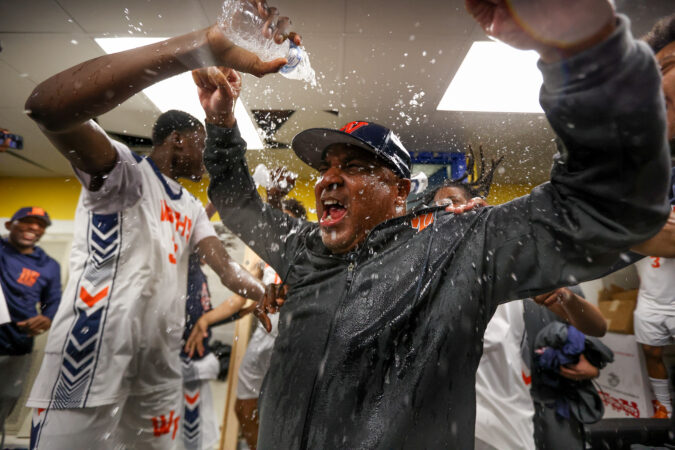
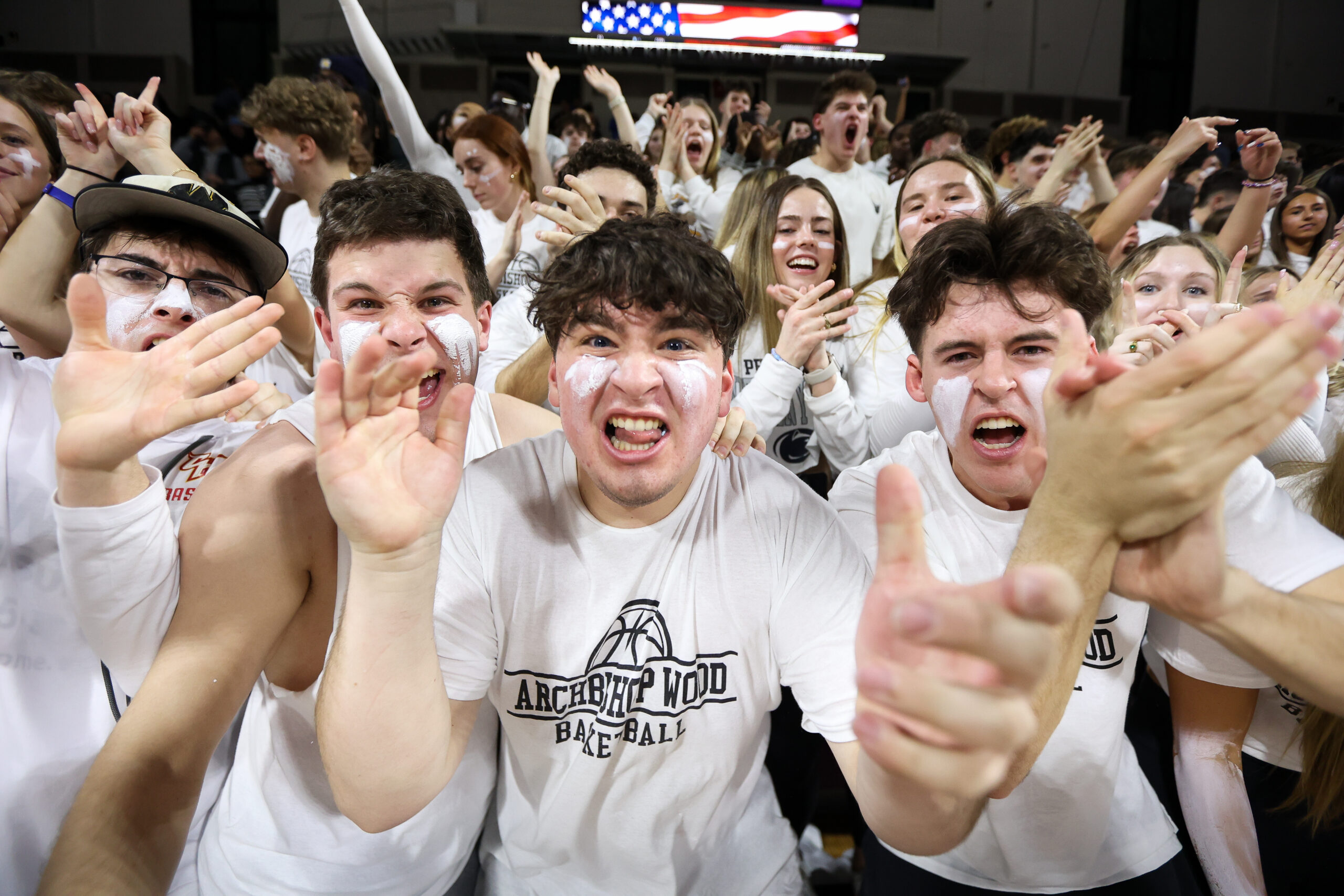
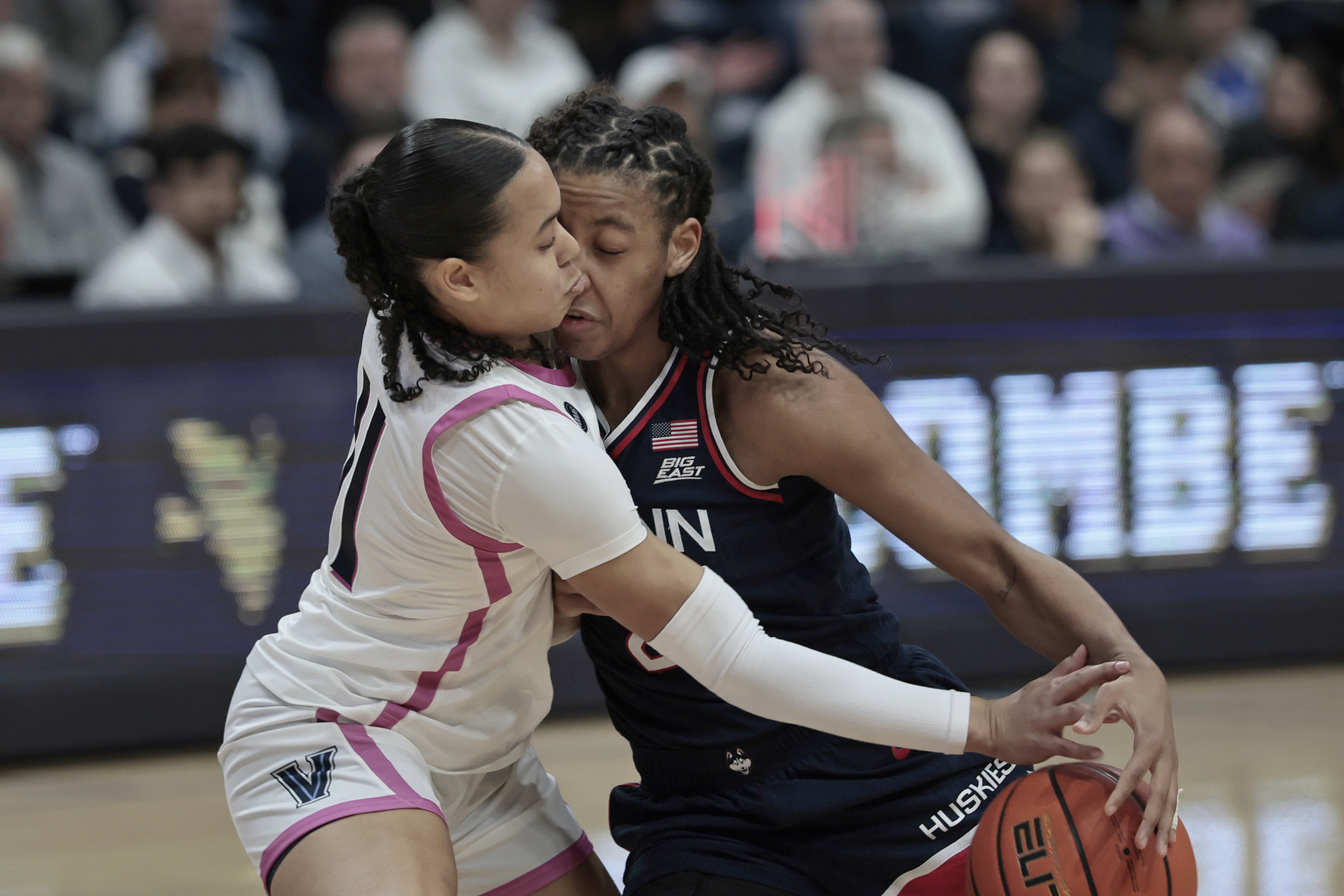
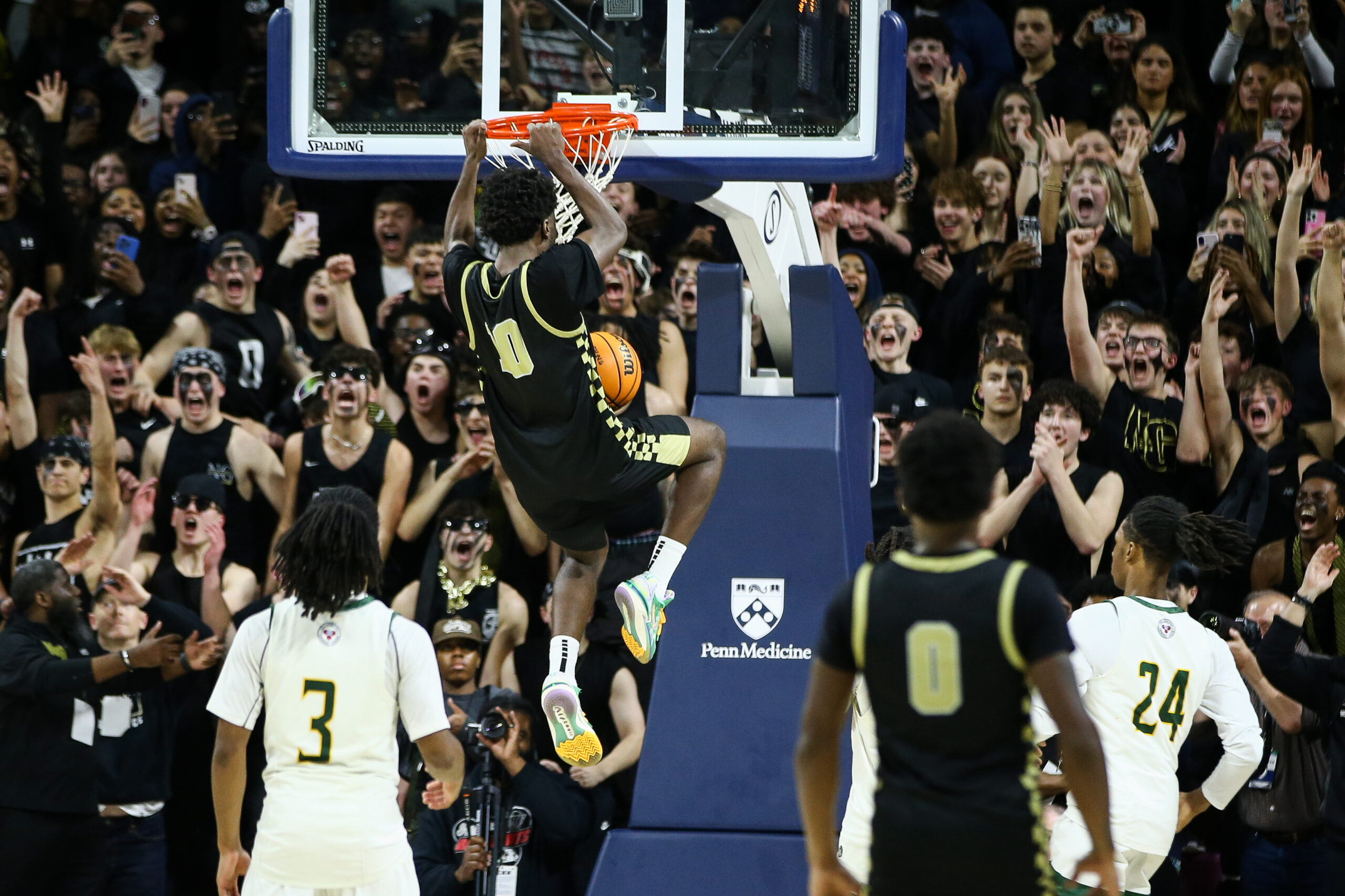
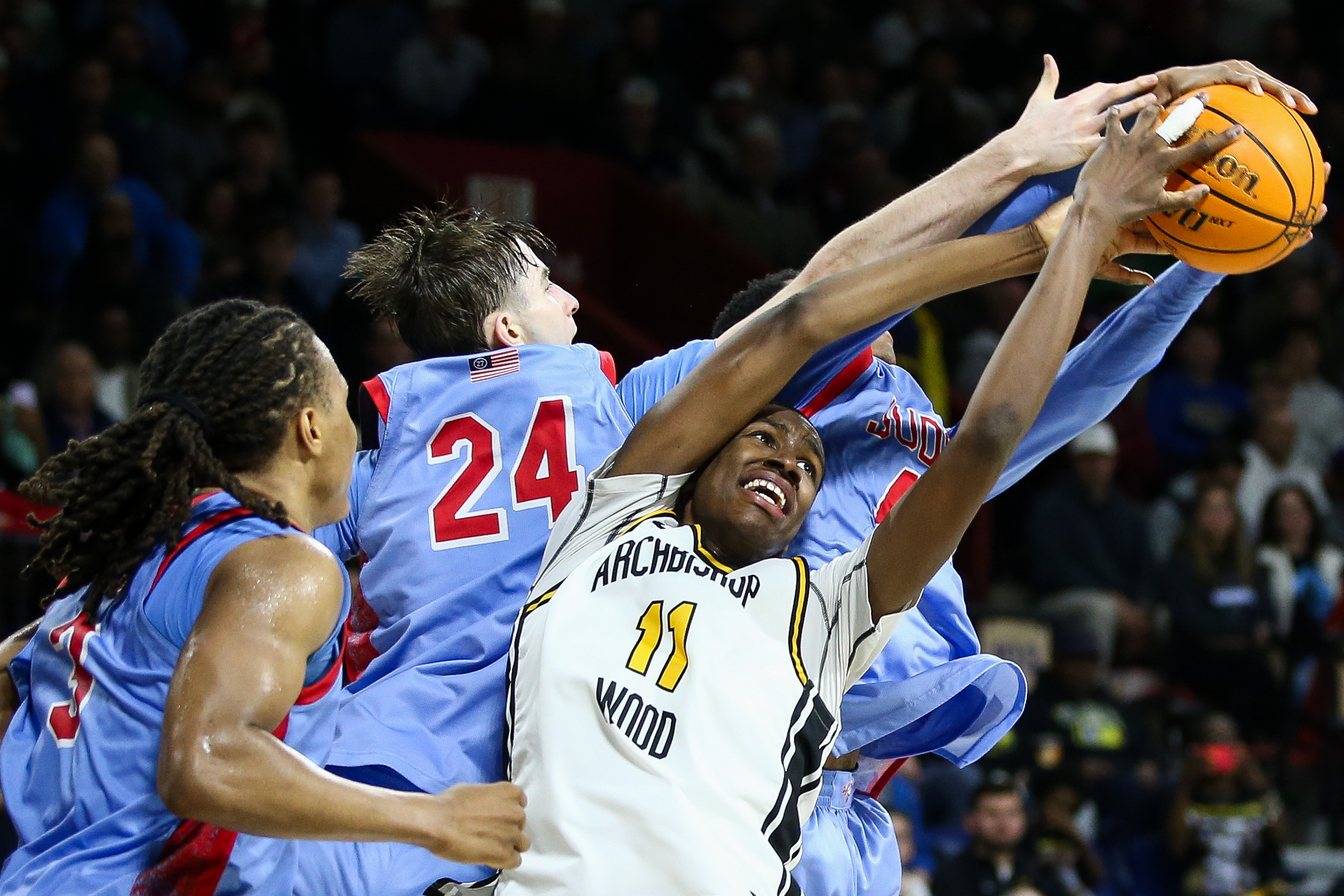
The Archbishop Wood student section cheers before the start of the Vikings’ Catholic League semifinal against Father Judge at the Palestra on Wednesday. Villanova’s Jasmine Bascoe (left) knocks the ball away from UConn’s KK Arnold on Wednesday at the Finneran Pavilion. No. 1 UConn prevailed, 83-69.Neumann Goretti’s Marquis Newson dunks during the final minutes of its win against Bonner Prendergast in the Catholic League semifinals.
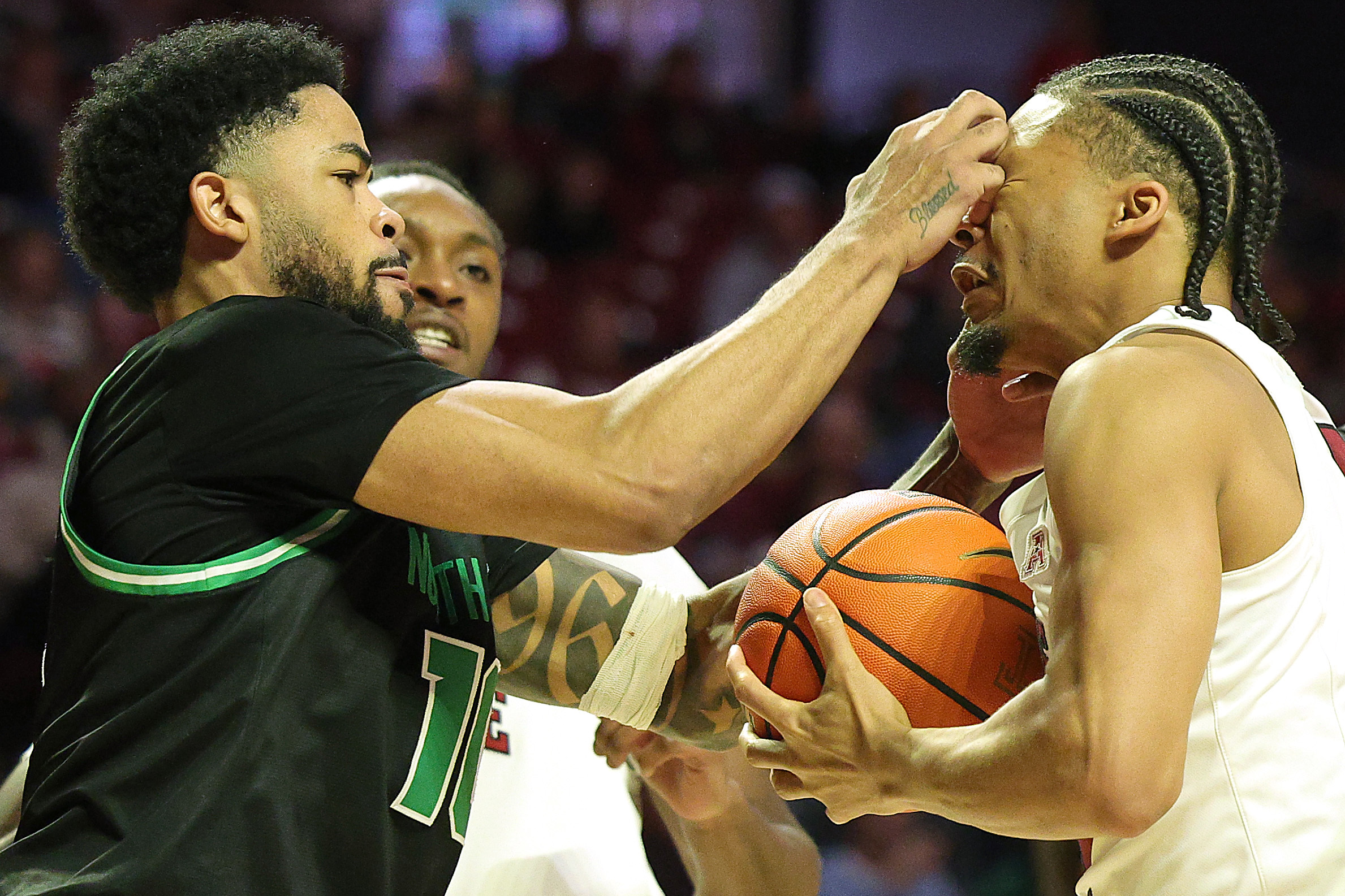
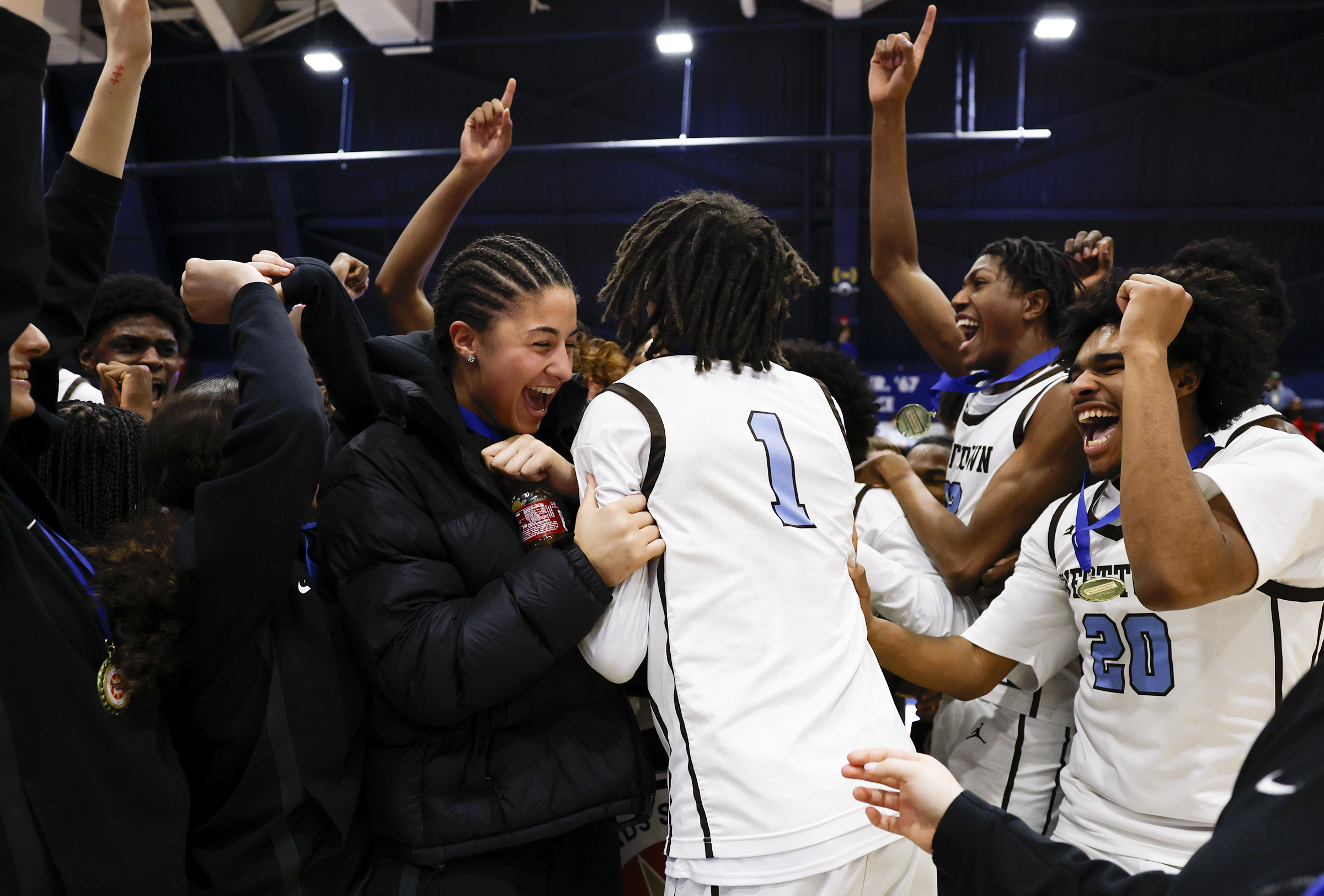
Archbishop Wood’s Jaydn Jenkins reaches for a rebound against several Father Judge players in their Catholic League semifinal game. Judge came out the winner.Cole Franklin of North Texas hits Temple’s Masiah Gilyard as he reaches for the ball Sunday at the Liacouras Center. The Owls fell, 65-62.Members of the boys’ and girls’ basketball teams at Westtown School rejoice after wining their Friends Schools League championships at La Salle University last Friday.
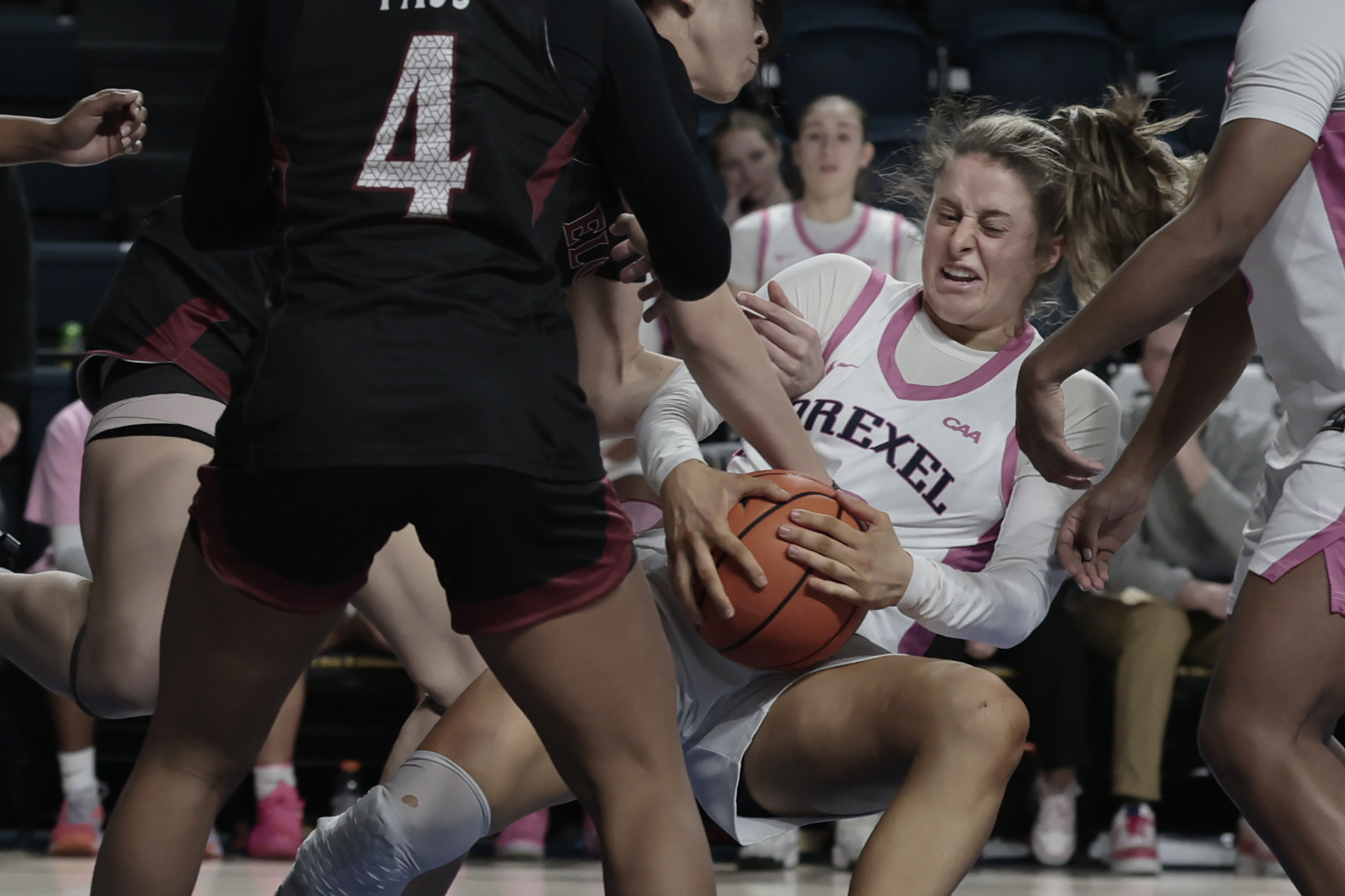
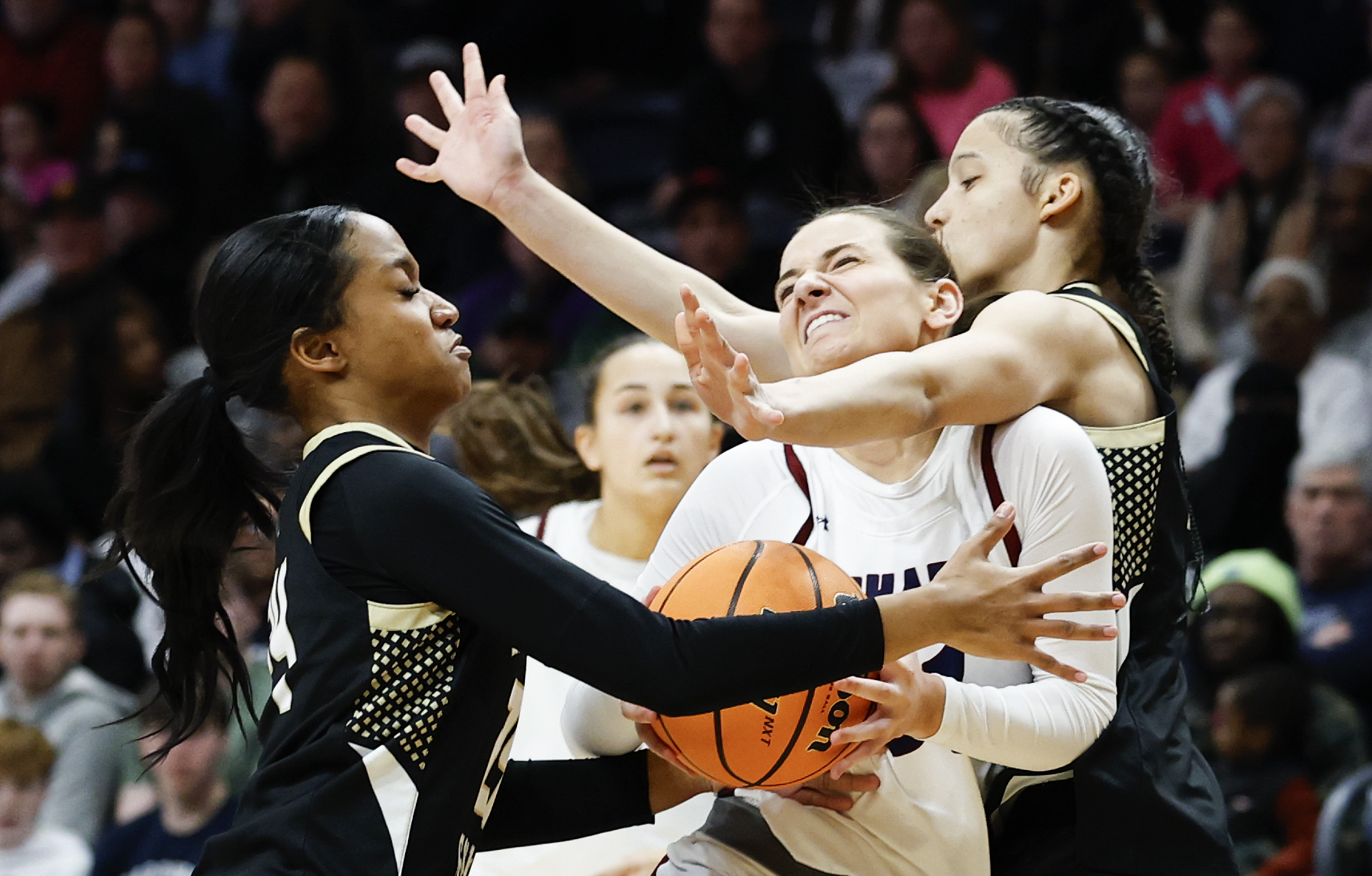
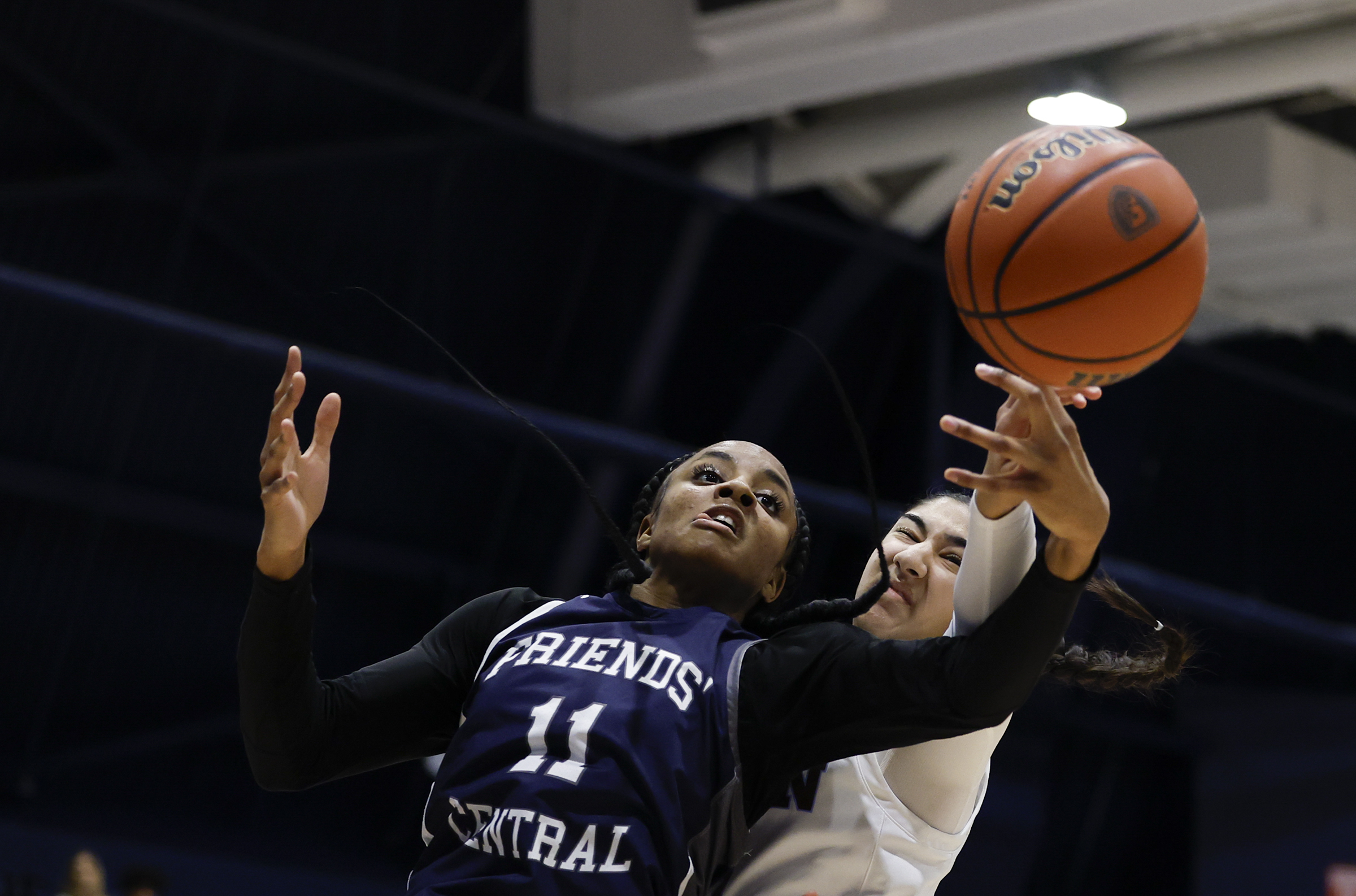
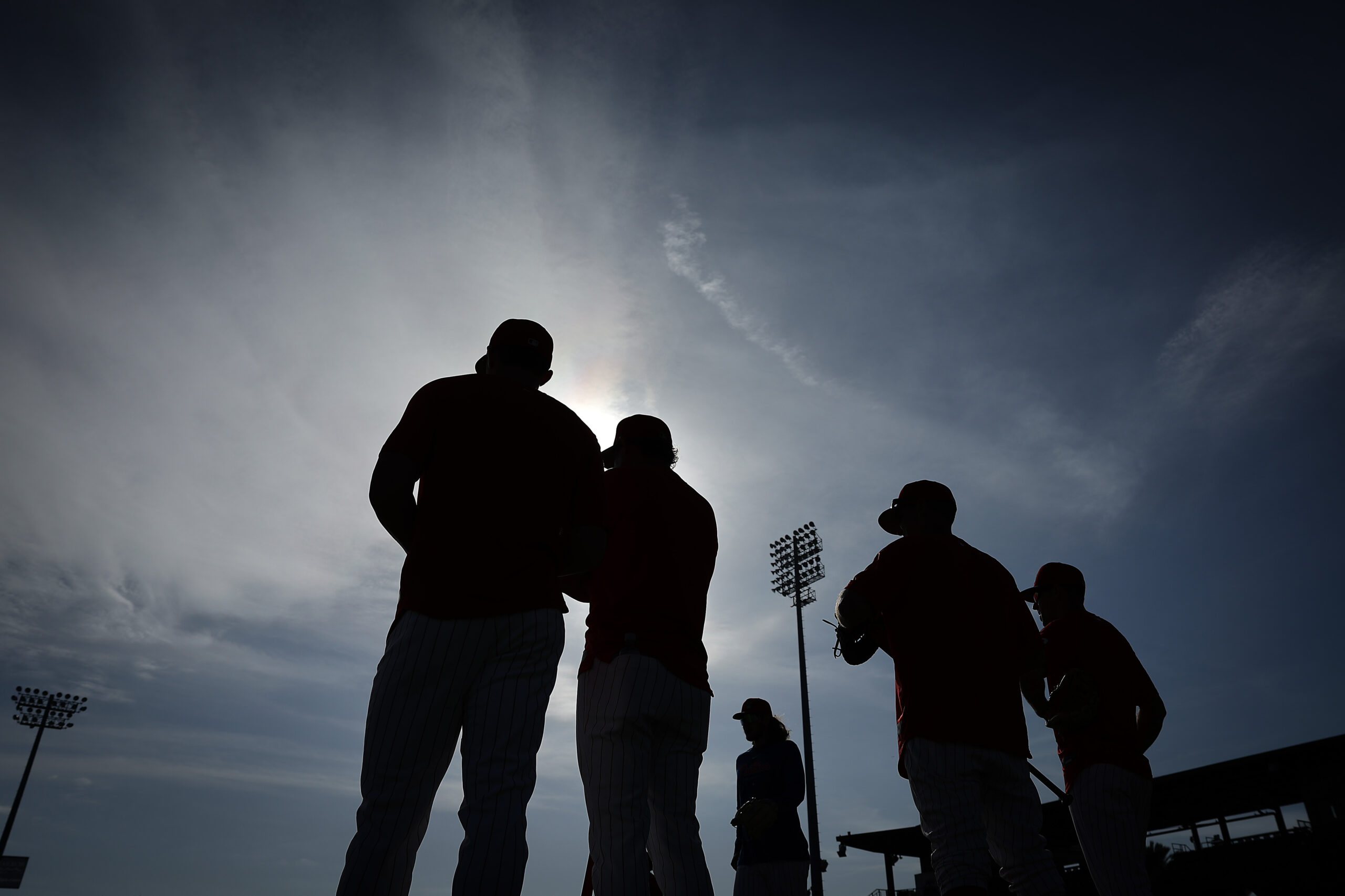
Drexel’s Laine McGurk hits the deck as she fights for a loose ball against Elon last Friday. Drexel won, 68-59. Cardinal O’ Hara’s Megan Rullo (center) is fouled driving to the basket against Neumann Goretti’s Kamora Berry (left) and Reginna Baker during their Catholic League semifinal at Villanova. Rullo scored 22 points in a 51-33 victory. Friends’ Central School’s Zya Small (11) fights for the basketball with Westtown School’s Ishana Sundararajan during the Friends Schools League title game. Phillies third baseman Alec Bohm (center) is silhouetted along with some of his teammates as they wait during a drill at spring training in Clearwater, Fla.
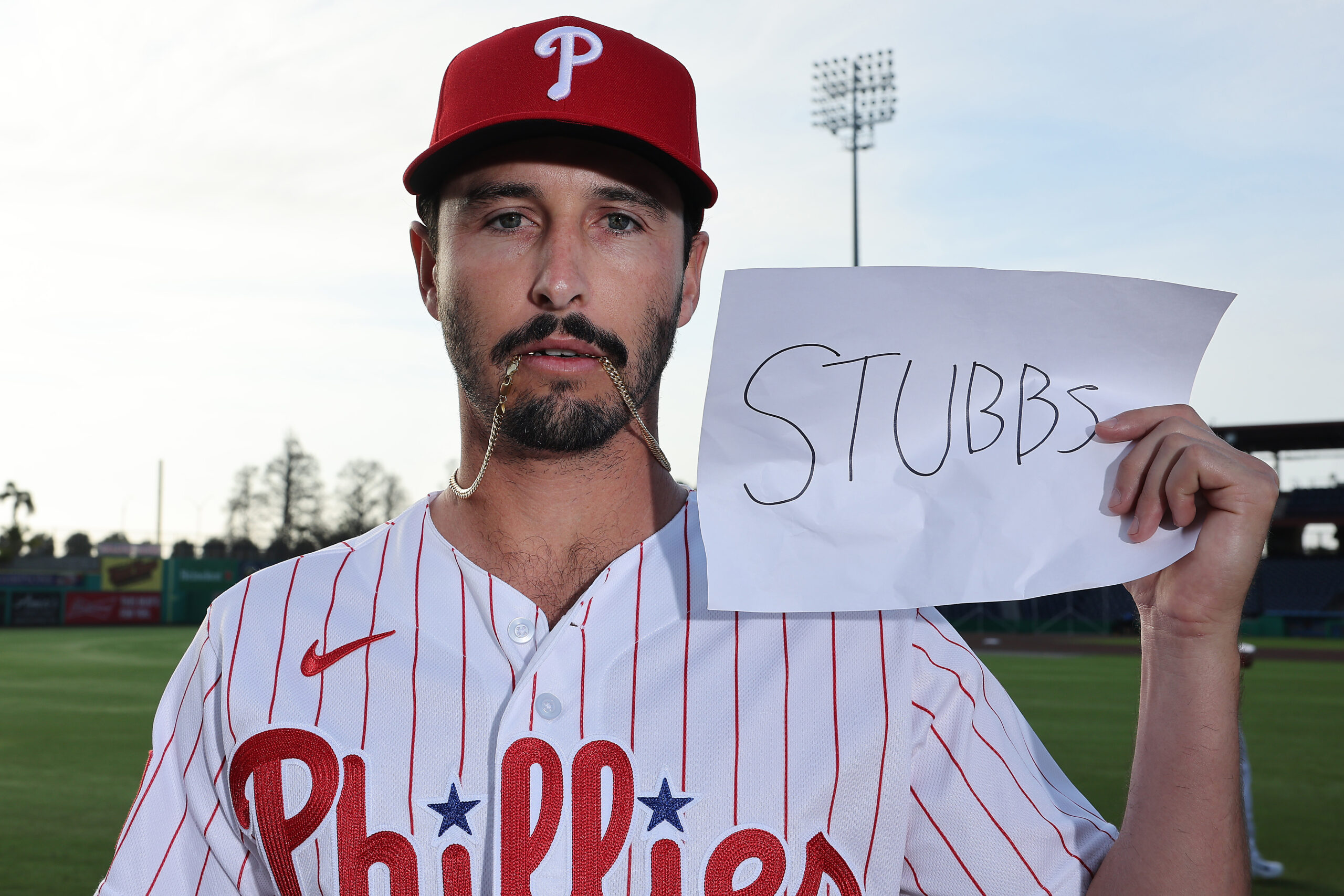
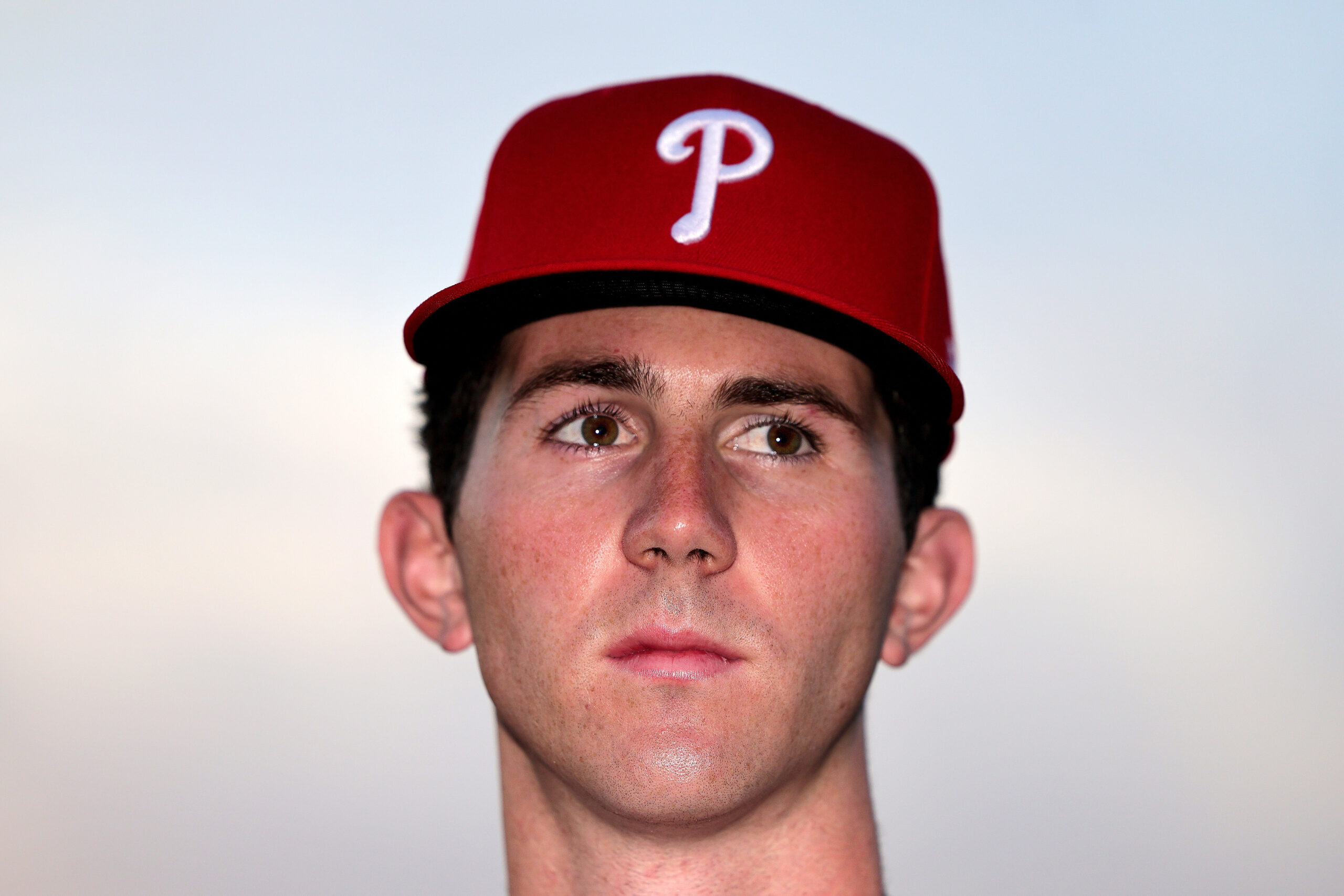
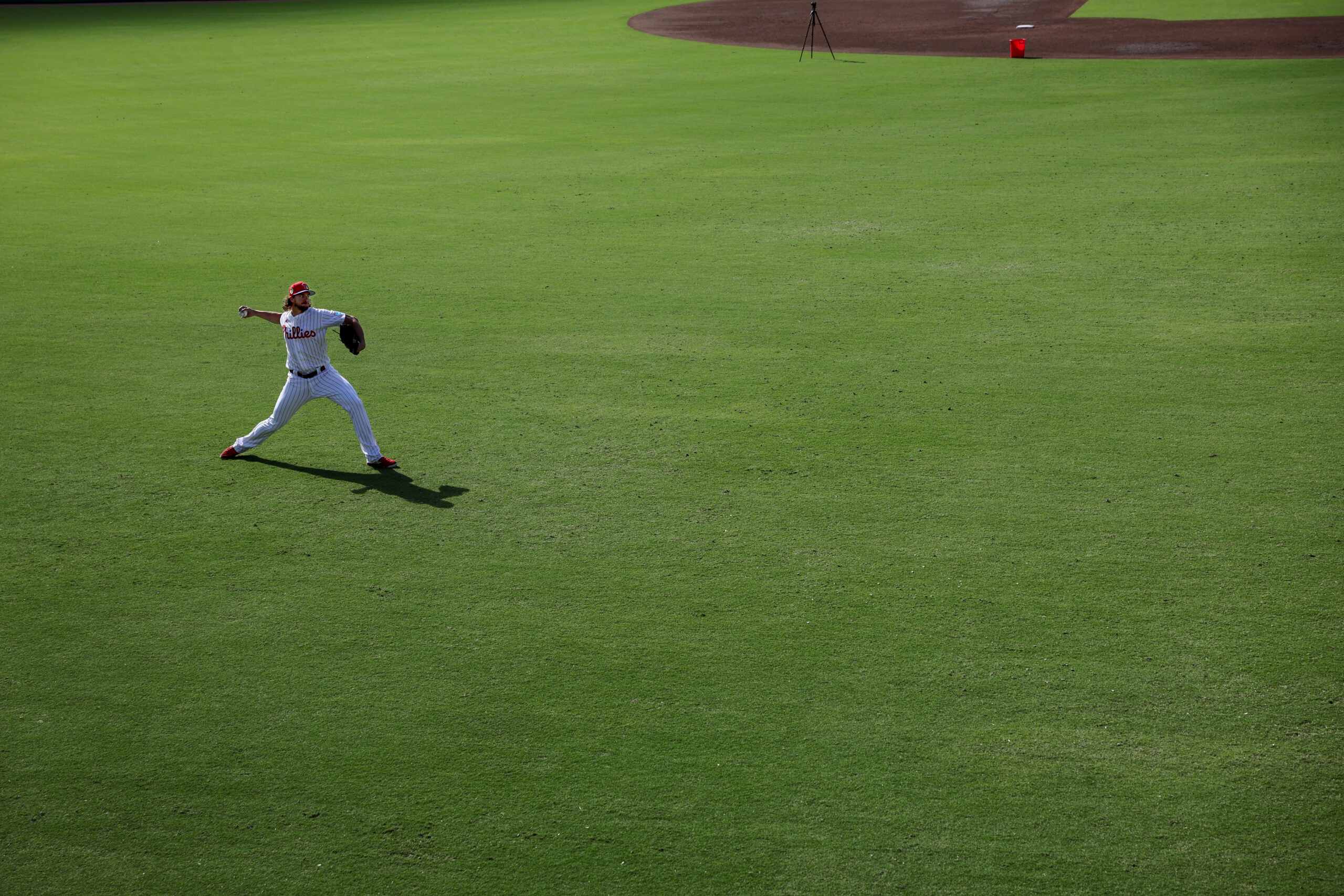
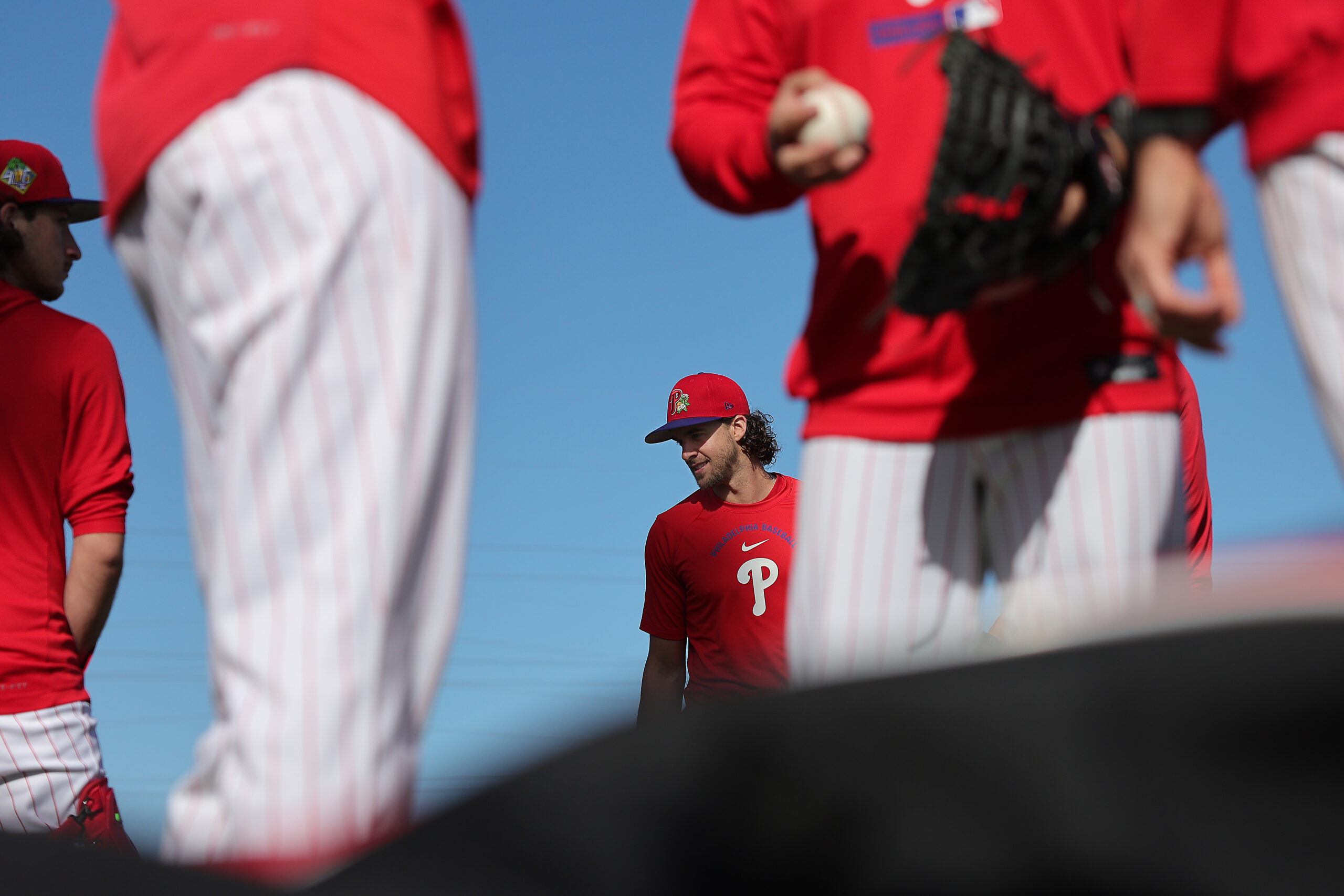
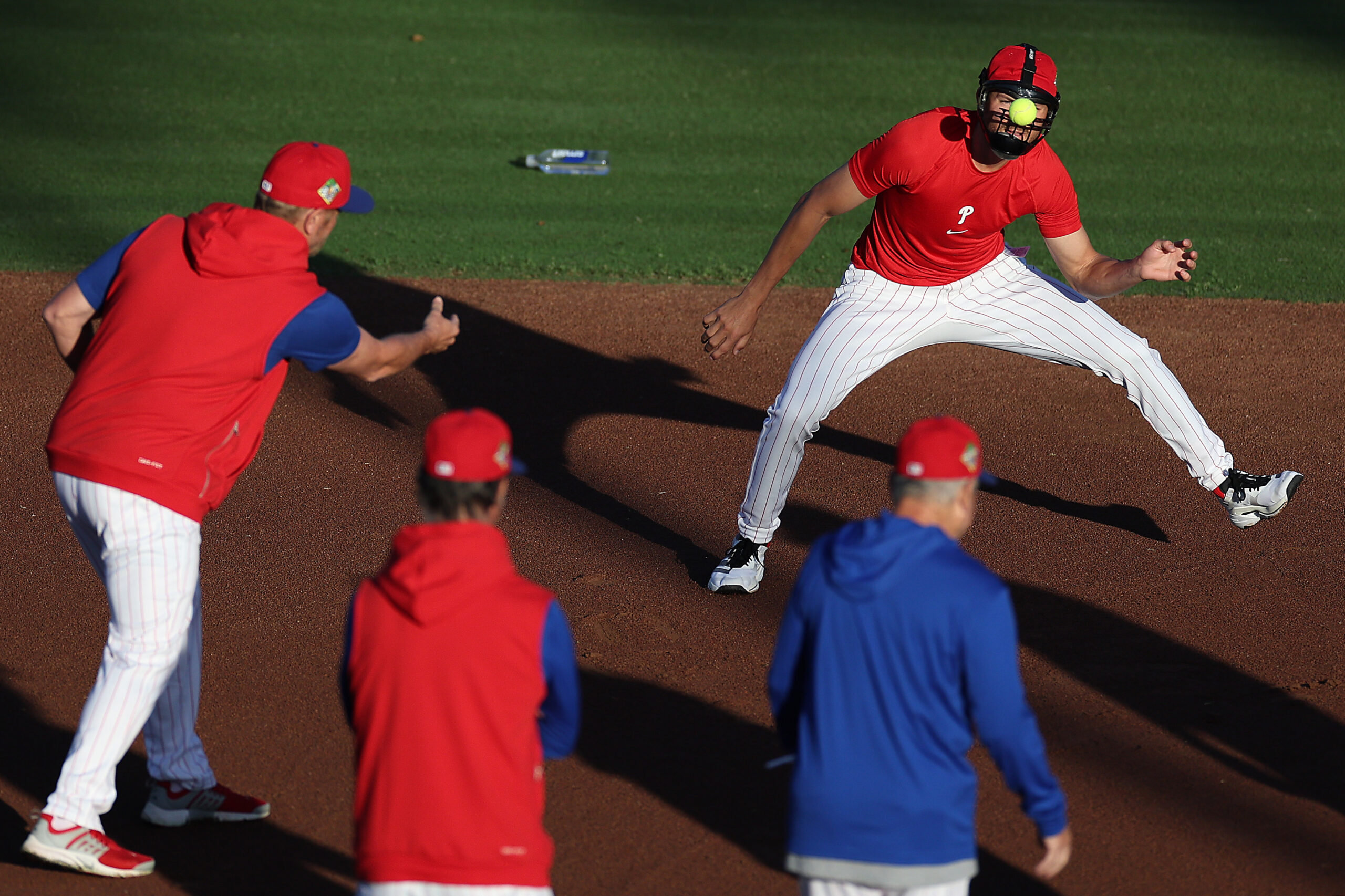
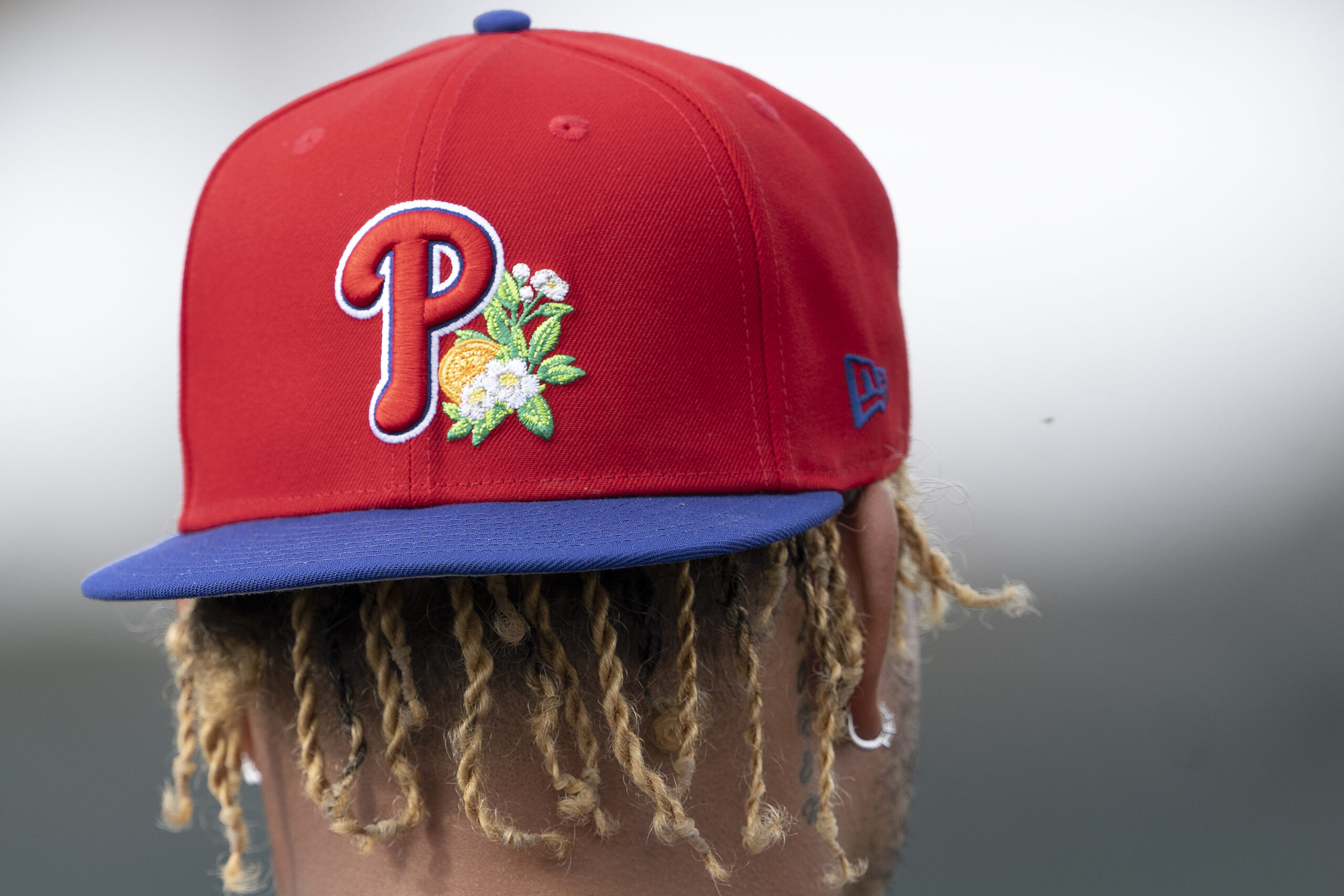
Phillies catcher Garrett Stubbs plays around for his portrait on photo day at spring training. Phillies pitcher Andrew Painter poses for a portrait during photo day in Clearwater, Fla. Veteran right-hander Aaron Nola warms up in the outfield at spring training on Wednesday. Justin Crawford, a rookie outfielder known for his speed, runs the bases during a drill at Phillies spring training on Tuesday. Hoping for a bounce-back season, pitcher Aaron Nola (center) talks with his Phillies teammates in Clearwater, Fla. Phillies shortstop Trea Turner takes part in a drill that involved bouncing a tennis ball off a mask during spring training.
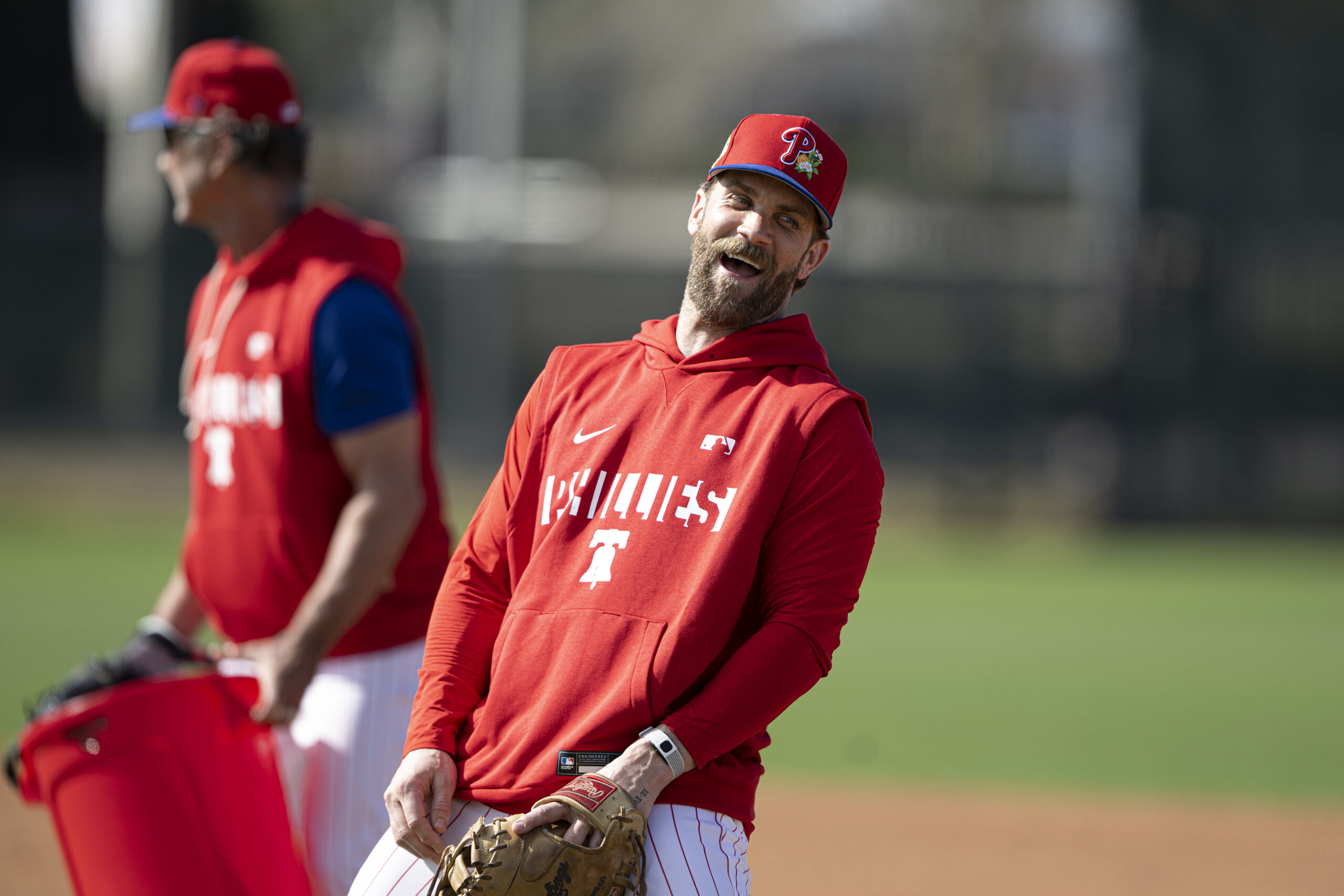
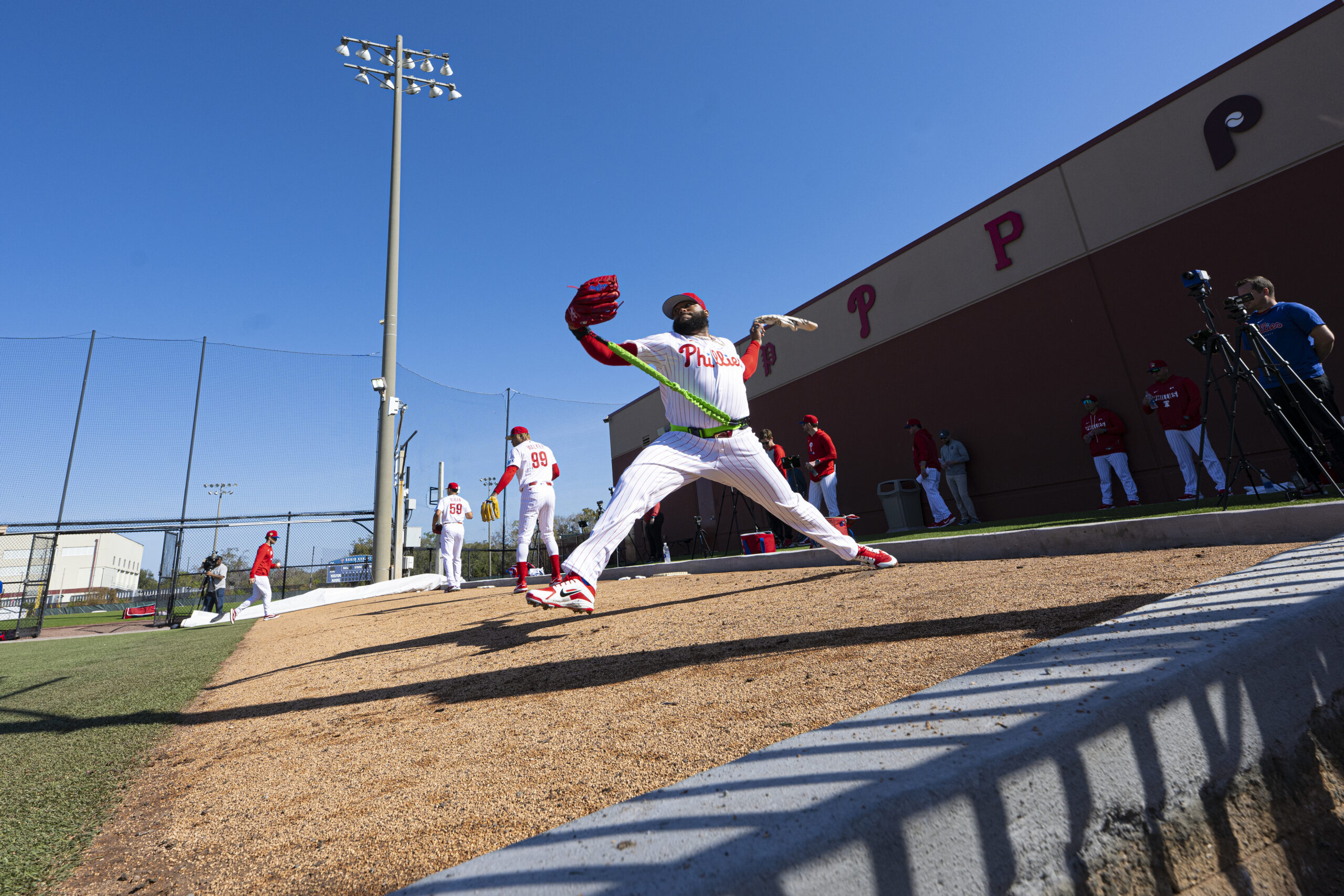
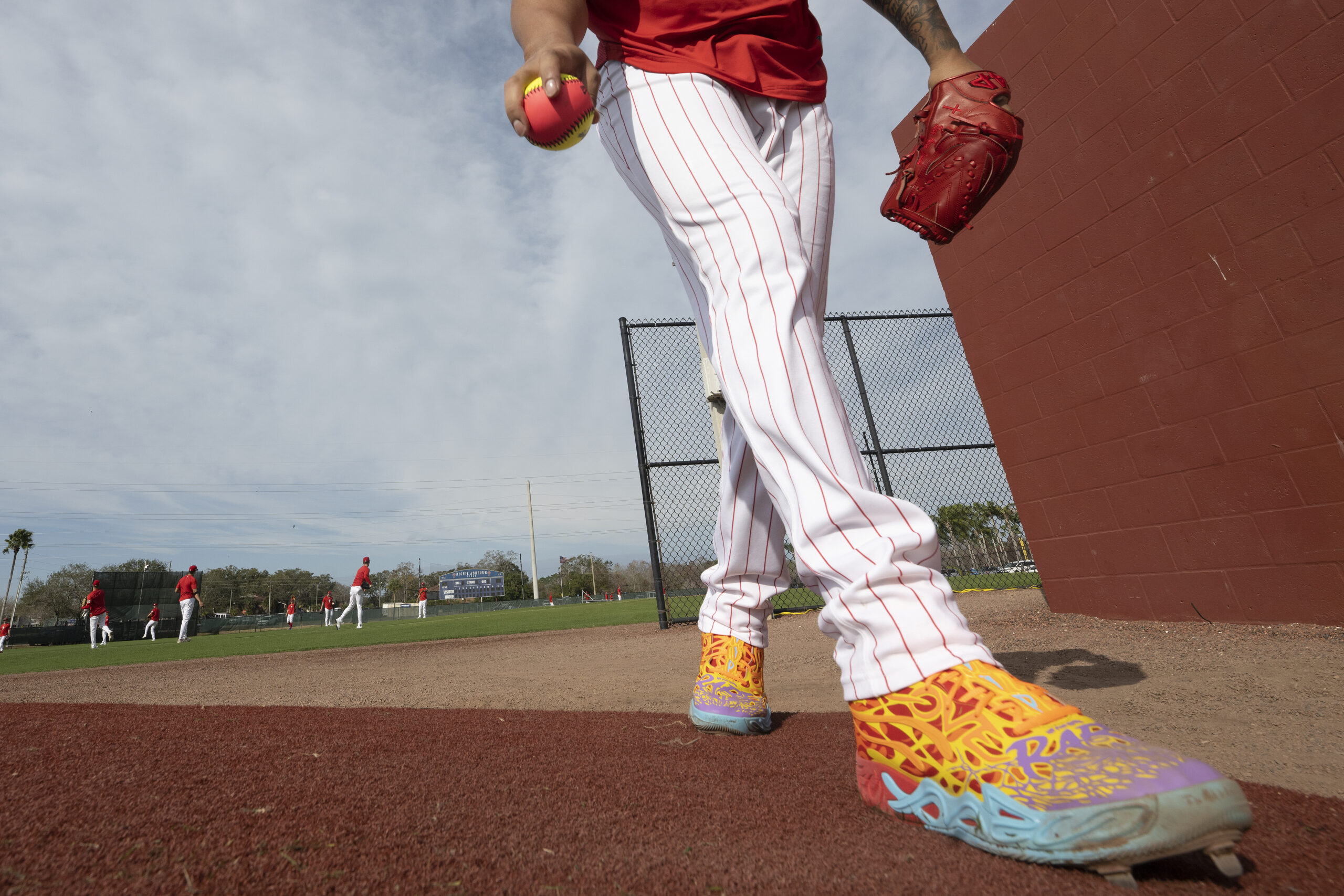
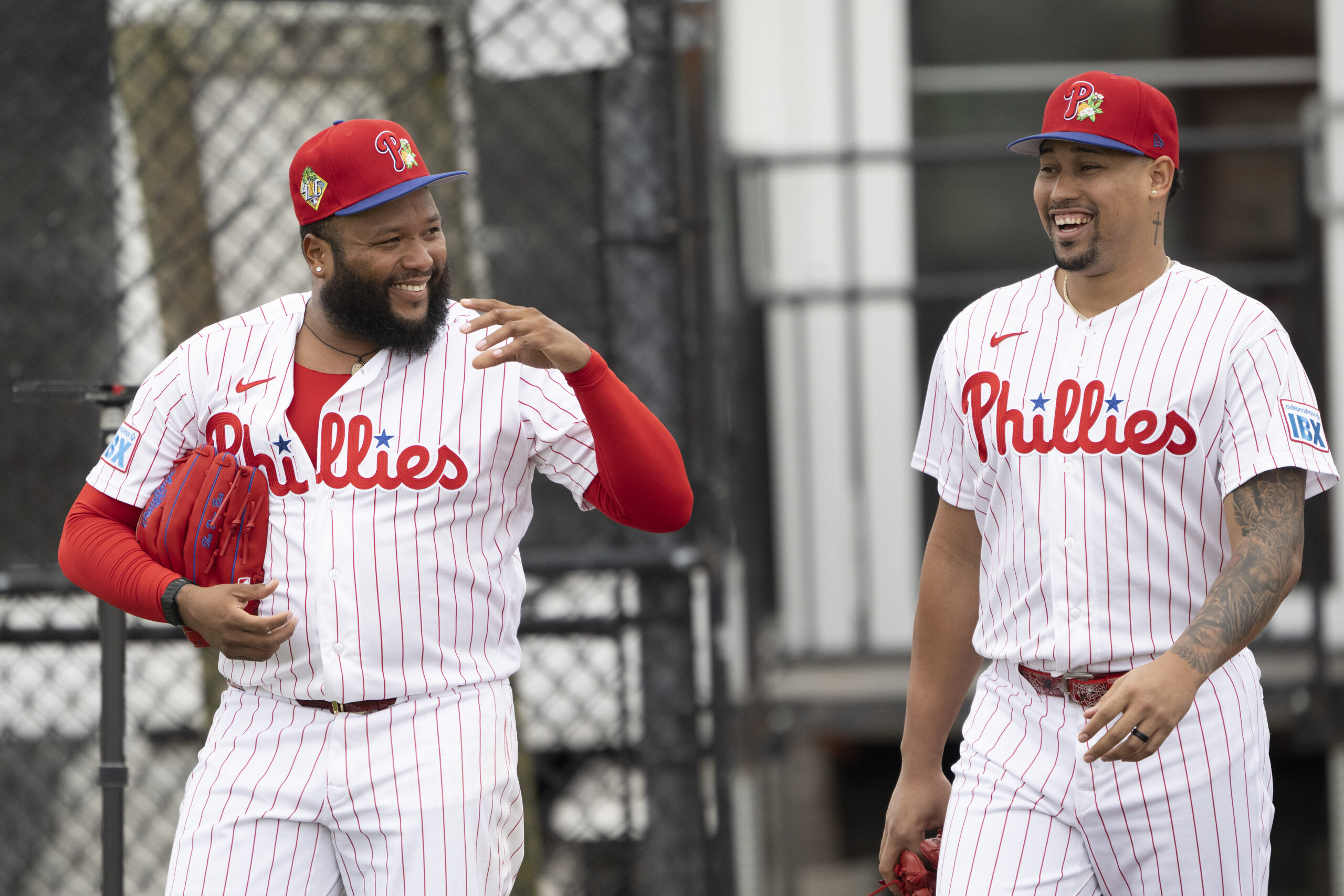
First baseman Bryce Harper (right) interacts with new Phillies bench coach Don Mattingly during the first full-squad workout on Monday. Phillies reliever Jose Alvarado goes through a workout on Saturday. Pitcher Taijuan Walker looks on during a spring training workout on Sunday. Hot feet: Closer Jhoan Duran walks off the mound after a bullpen session during spring training on Sunday.
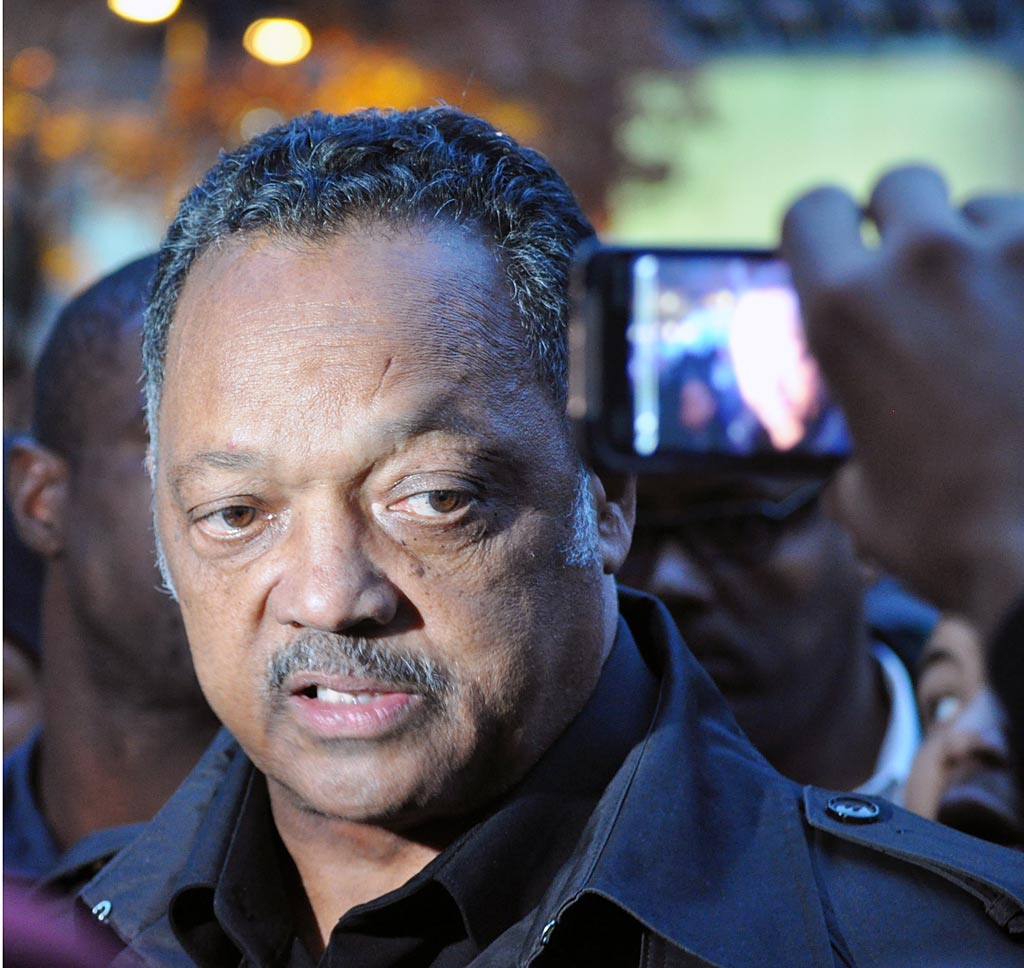
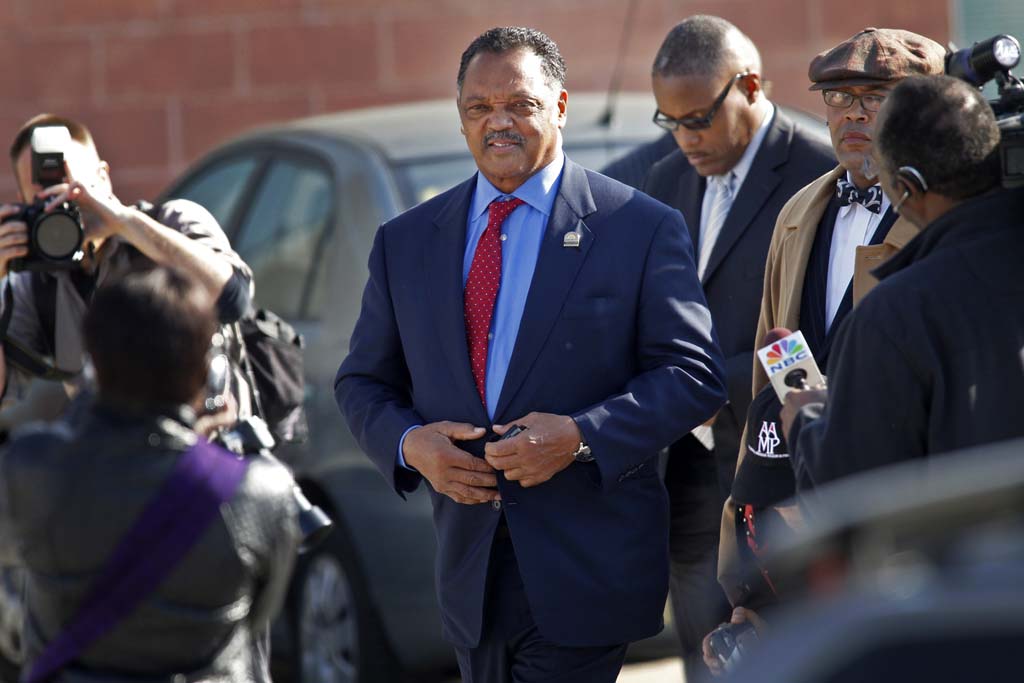
The Rev. Jesse L. Jackson, a civil rights icon and a regular presence in Philadelphia who energized Black voters both locally and nationally for more than five decades, died Tuesday at his home in Chicago following a prolonged battle with a rare neurological disorder. He was 84.
“Jesse Jackson will be remembered in Philadelphia as a civil rights hero, and a leader in terms of independent Black politics nationwide,” said former Councilmember W. Wilson Goode Jr., the son of Philly’s first Black mayor, W. Wilson Goode Sr. “He loved Philadelphia, and Philadelphia loved him.”
A native of Greenville, S.C., Rev. Jackson initially rose to prominence in the mid-1960s, when he joined the 1965 voting rights march that the Rev. Dr. Martin Luther King Jr. led from Selma to Montgomery, Ala. In the years following King’s assassination in 1968, Rev. Jackson largely came to be considered his successor.
Rev. Jackson would go on to become a prominent Black political and cultural leader in his own right, with his lengthy time in the public eye including presidential runs in 1984 and 1988. His visits to Philadelphia date back to the 1970s, and run the gamut from time in town supporting his own presidential campaigns — though neither of which were successful in the ‘80s — to appearances at the Democratic National Convention in 2016.
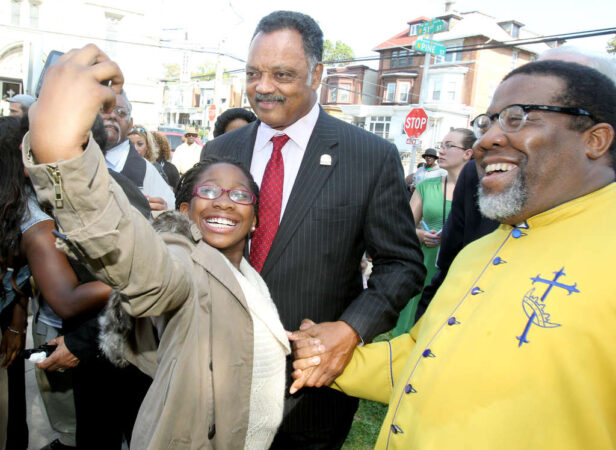
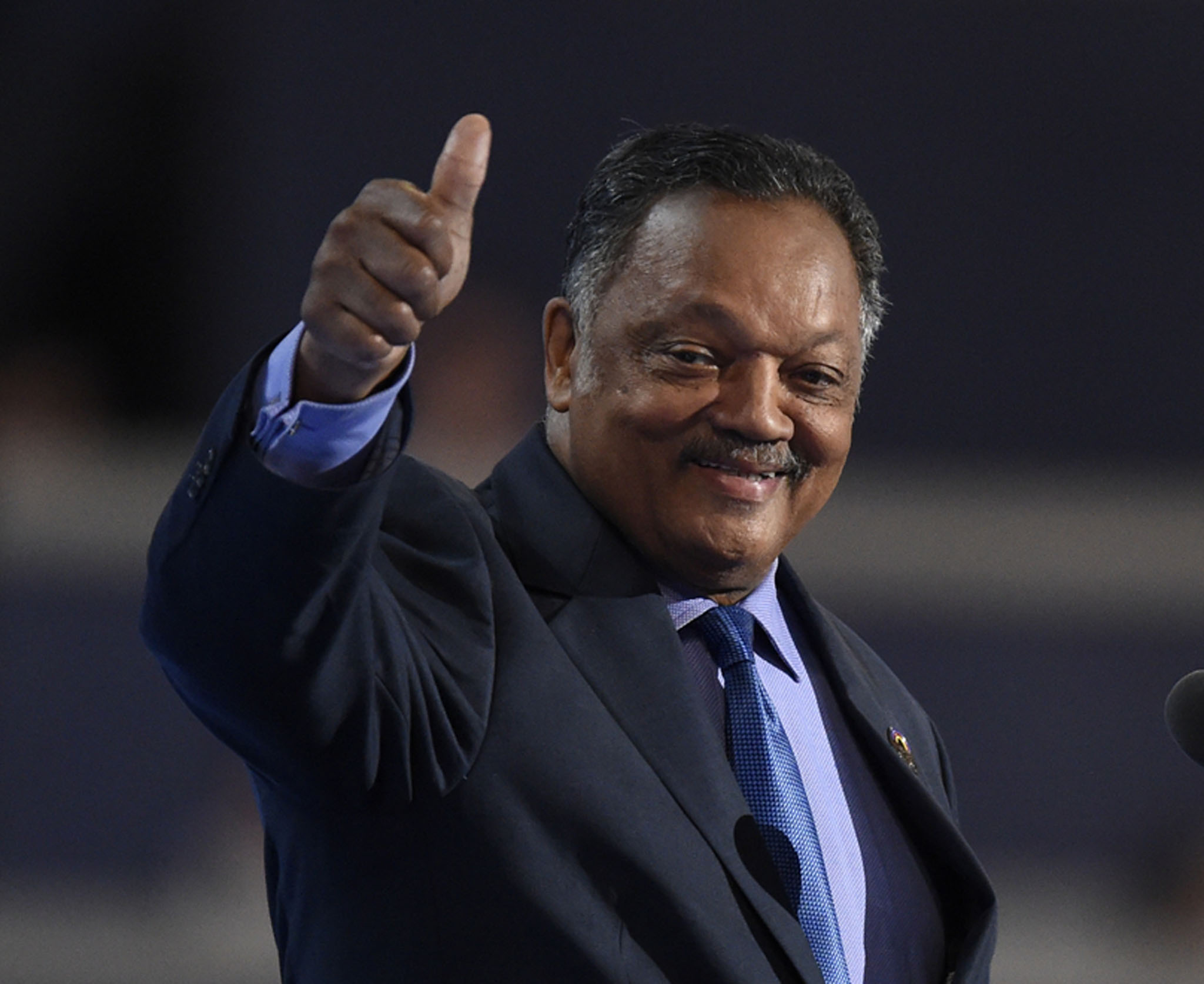
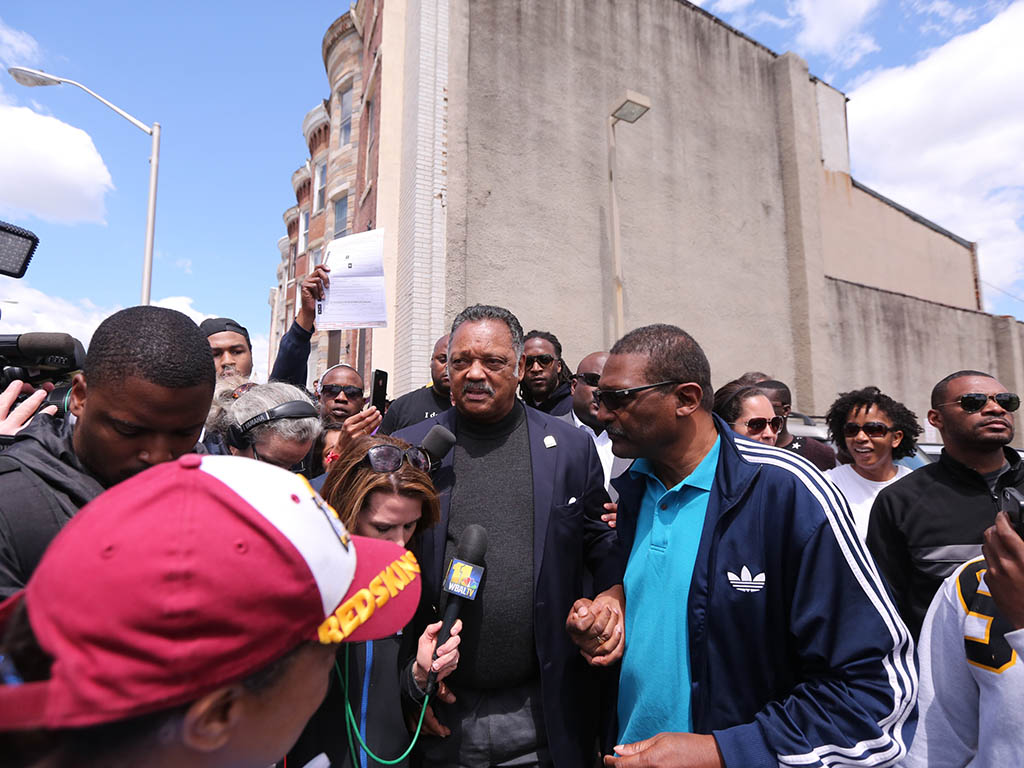
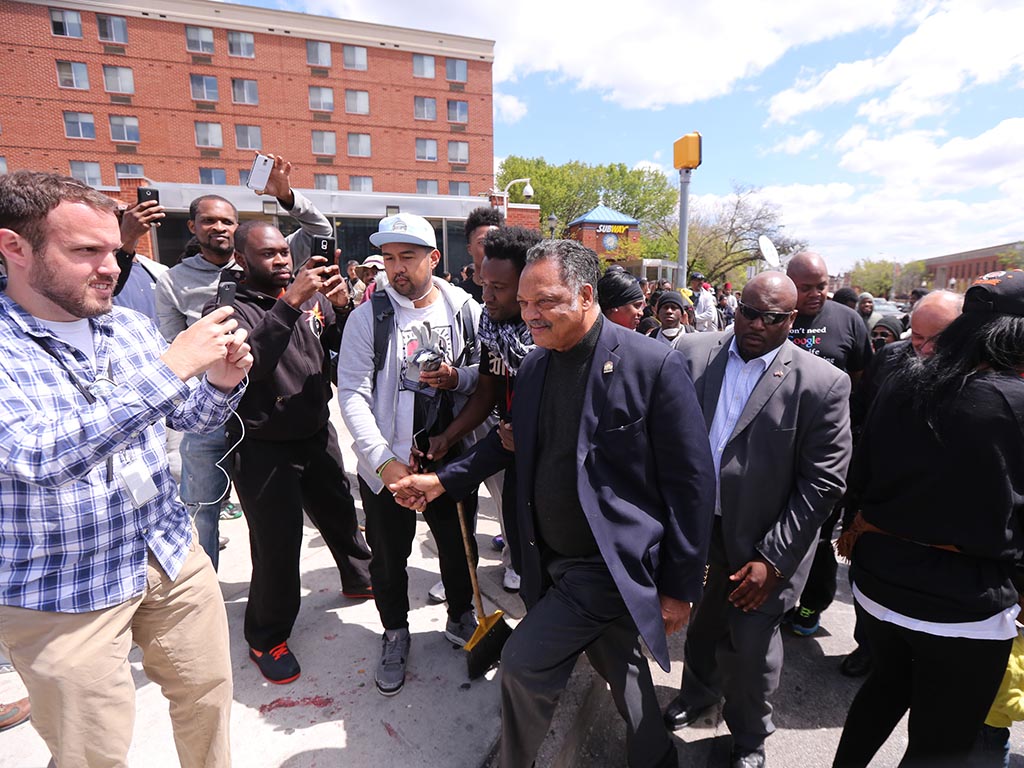
The Rev. Jesse Jackson, founder and president of the Rainbow/PUSH Coalition, acknowledges the cheers of delegates as he walks to the podium to deliver remarks on the third night of the Democratic National Convention in Philadelphia on July 27, 2016.Hillary Clinton supporters and the Rev. Jesse Jackson (right) on the fourth day of the Democratic National Convention at the Wells Fargo Center on July 28, 2016.The Rev. Jesse Jackson visits Baltimore’s turbulent intersection of West North Avenue and Pennsylvania Avenue on April 28, 2015.
Across that time, Rev. Jackson served as a sort of rallying figure for Black Philadelphians at large, who largely supported his candidacy during his presidential runs, despite him failing to secure the Democratic nomination statewide. Still, his impact for Black voters both in Philadelphia and nationally remains everlasting.
“That was the Rosetta stone to everything Jackson was trying to achieve,” said former Daily News scribe Gene Seymour, nephew of legendary People Paper columnist Chuck Stone. “We aren’t to be ignored or dismissed or cast aside — we matter.”
In that sense, Goode Jr. said, Rev. Jackson will remain a political icon who inspired the nationalization of Black political empowerment.
“Jesse Jackson is also a cultural icon in terms of telling people to be proud of being Black, and telling themselves, ‘I am somebody,’” Goode Jr. said, referencing Rev. Jackson’s famed refrain. “That is something that was indelible in the soul of Black people across the nation and world, and in Philadelphia here as well.”
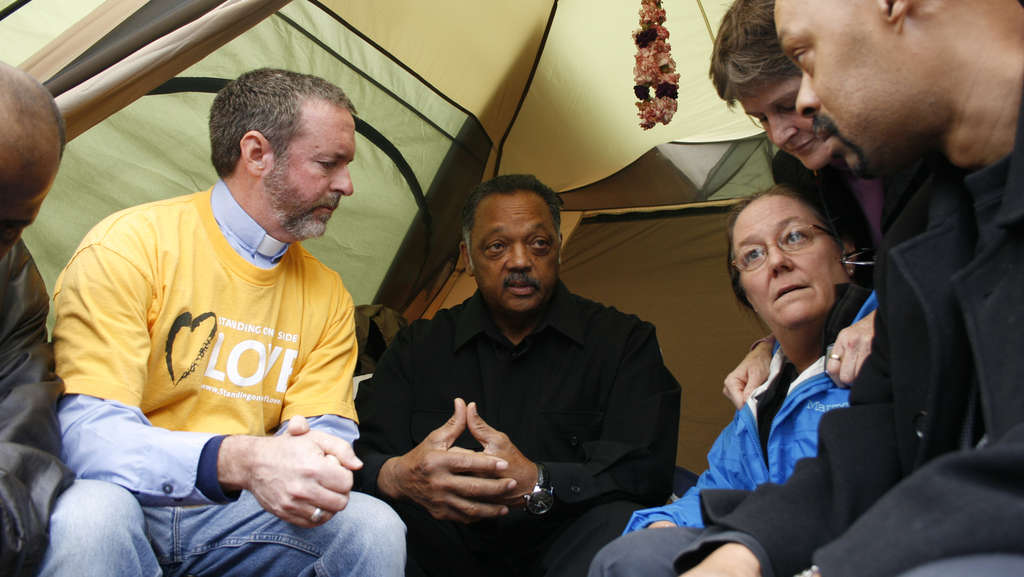
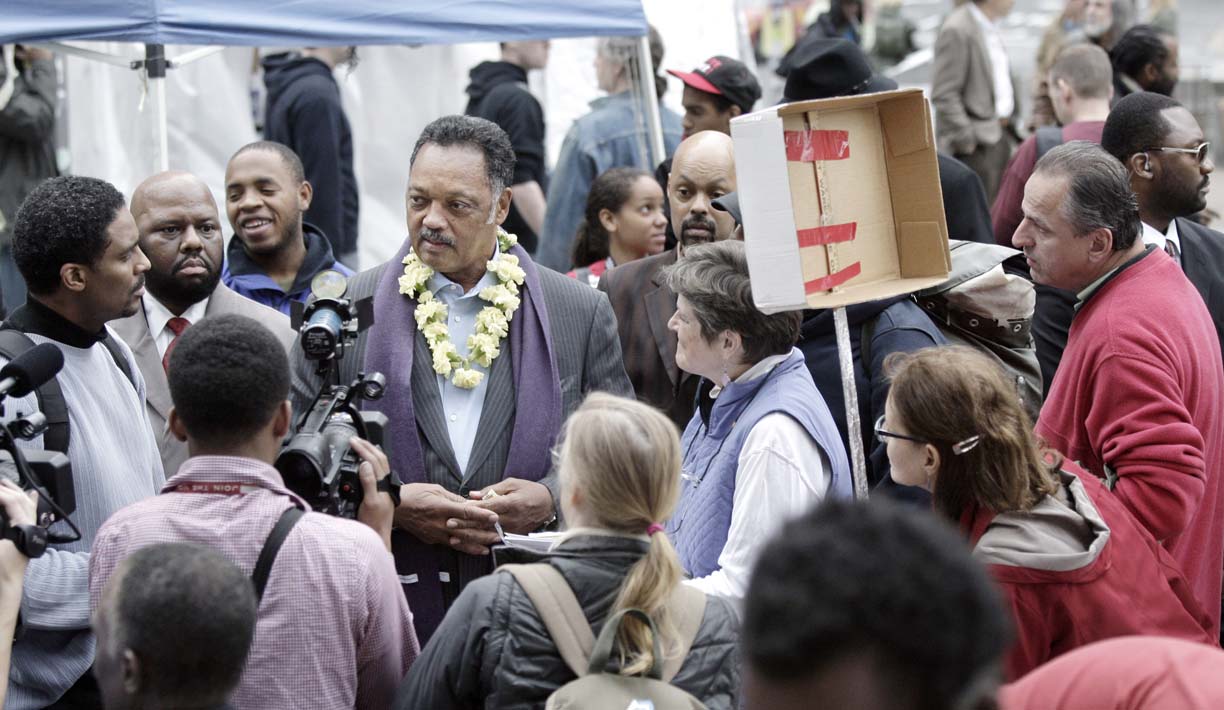
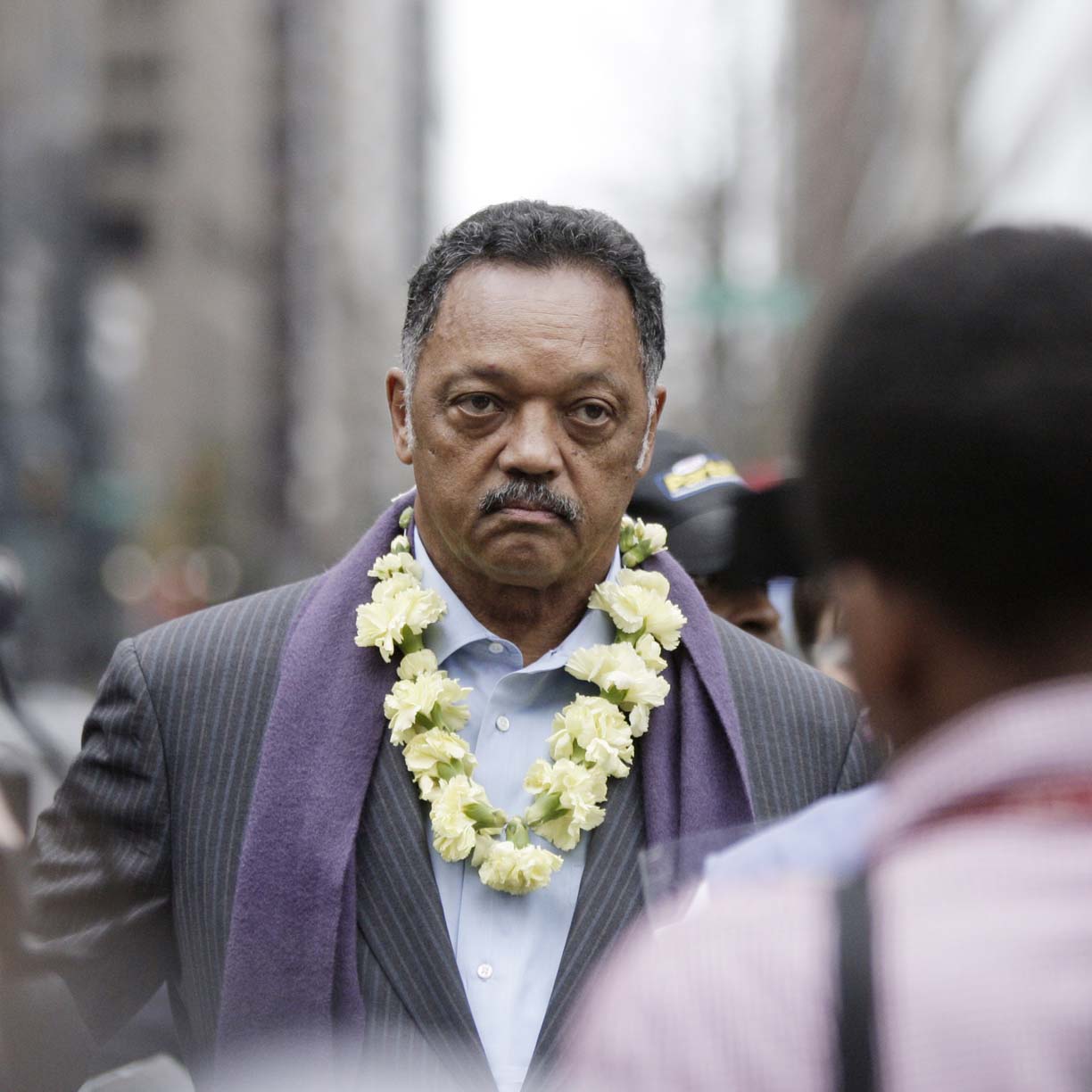
The Rev. Jesse Jackson visits the turbulent intersection of West North Avenue and Pennsylvania Avenue in Baltimore on April 28, 2015.The Rev. Jesse Jackson visited Occupy Philadelphia protesters on Nov. 13, 2011. He told them to “never surrender.”The Rev Jesse Jackson at Joe Frazier’s funeral at Enon Tabernacle Baptist Church on Cheltenham Avenue in Philadelphia on Nov. 14, 2011.The Rev. Jesse Jackson (center) visits the Interfaith tent, donated by Quakers, to talk to the Rev. Peter Friedrich (left) and (from right) Phillip Hall, Hollister Knowlton, and Joyce Moore in 2011.
Though Philadelphia’s Black community generally was supportive of and receptive to Rev. Jackson’s messaging historically, Seymour said, he maintained something of a complicated relationship with the city’s prominent politicians. Wilson Goode Sr., for example, officially supported Walter Mondale and Michael Dukakis for president in the 1980s. At least in 1988, Seymour said, Rev. Jackson likely had “the people’s hearts,” despite lacking the official nomination.
Wilson Goode Sr. was not immediately available for comment.
“His presidential campaigns in 1984 and 1988 reshaped American politics,” said the Rev. Gregory Edwards, of the Philly-based POWER Interfaith, in a statement. “Those campaigns widened the political imagination of this country and helped cultivate a generation of Black elected leaders.”
Rev. Jackson’s relationship with Goode Sr. was somewhat complicated following the 1985 MOVE bombing, which brought the civil rights leader to tour the ruins of the 6200 block of Osage Avenue in its aftermath. Rev. Jackson urged a congressional investigation into the incident, which he called “excessive force,” but avoided criticizing Goode directly in subsequent meetings. Goode, meanwhile, said that the city would cooperate with any groups investigating the incident, The Inquirer reported at the time.
“He was not happy with what happened in ‘85 with MOVE,” Seymour said.
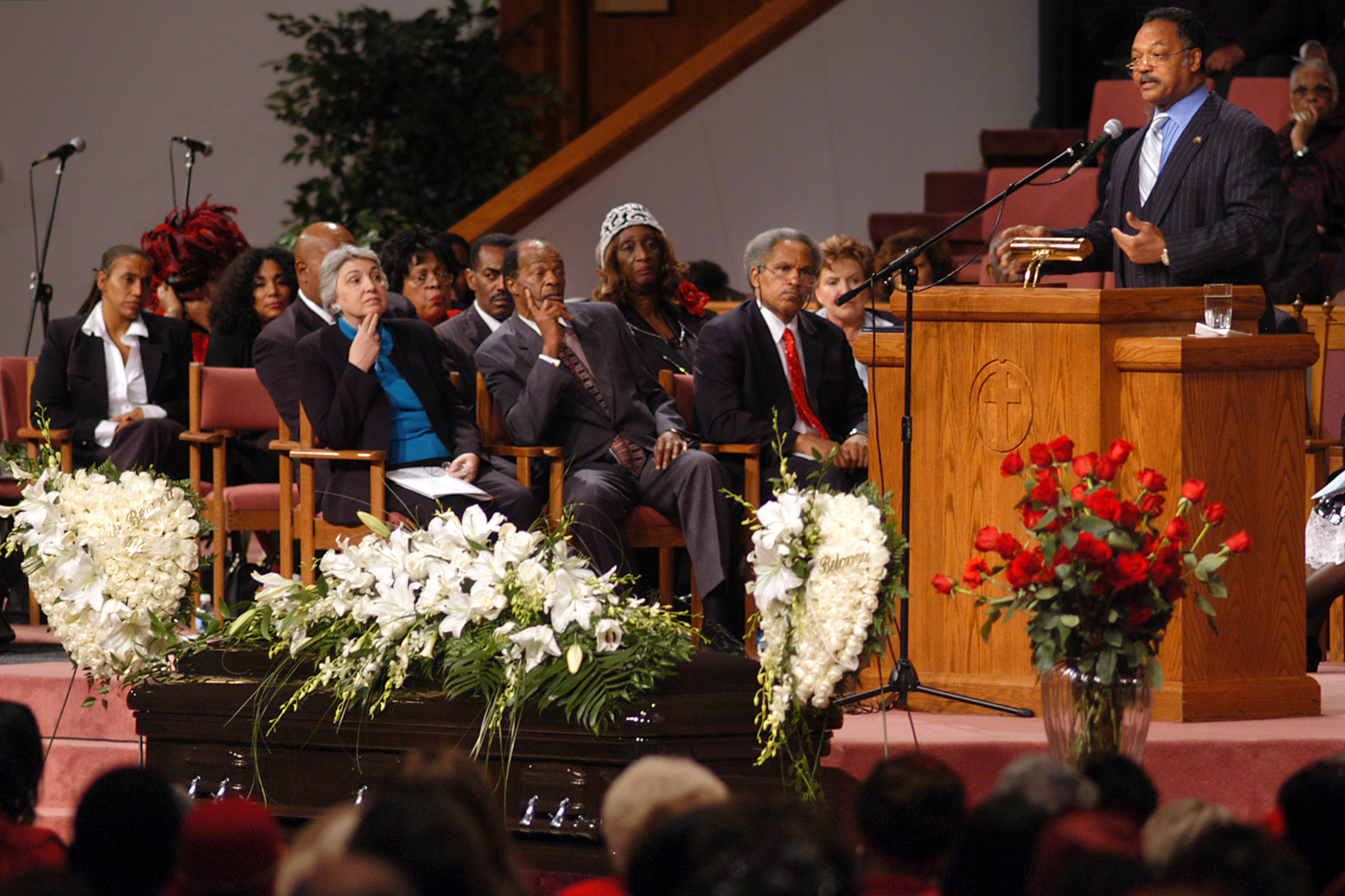
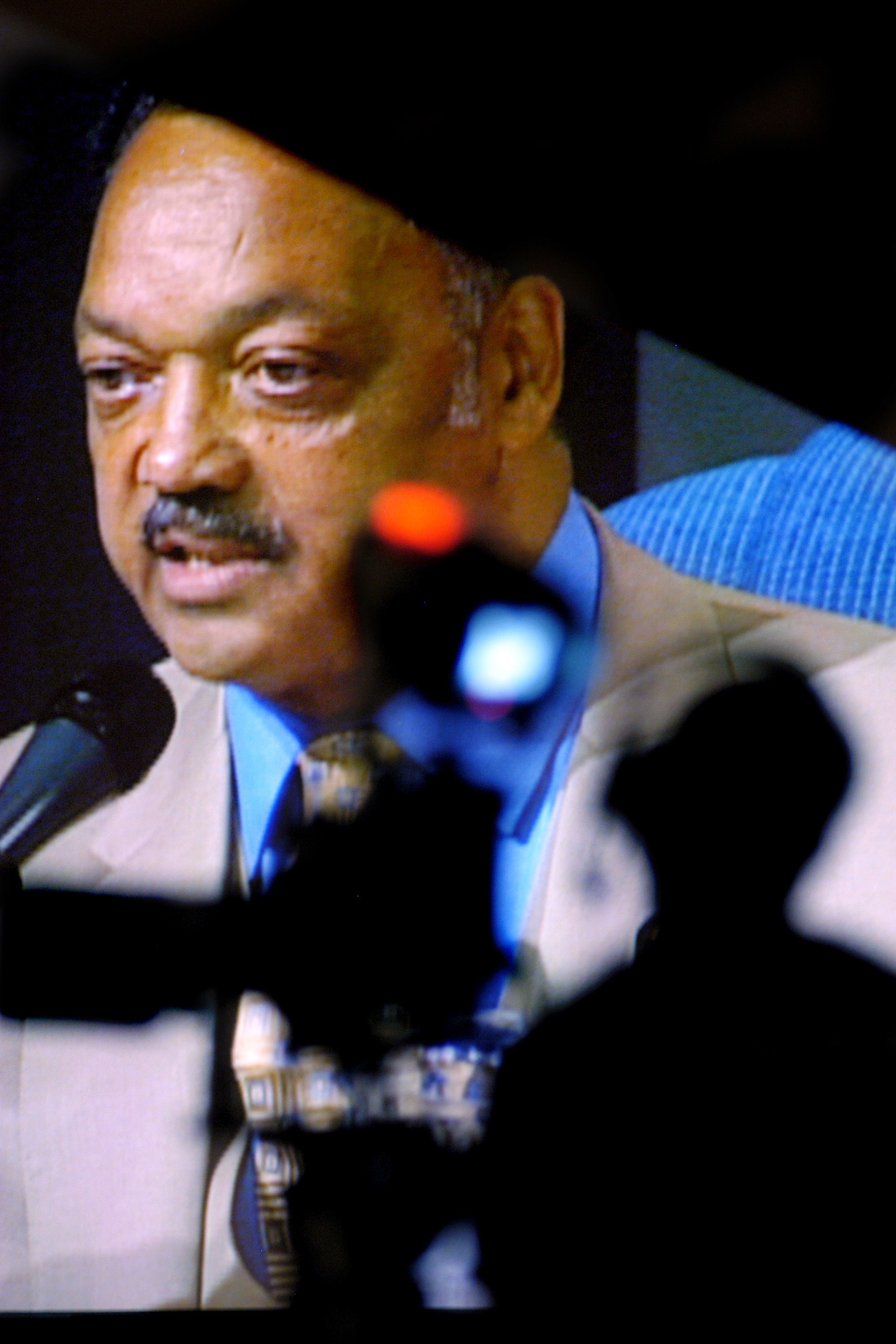
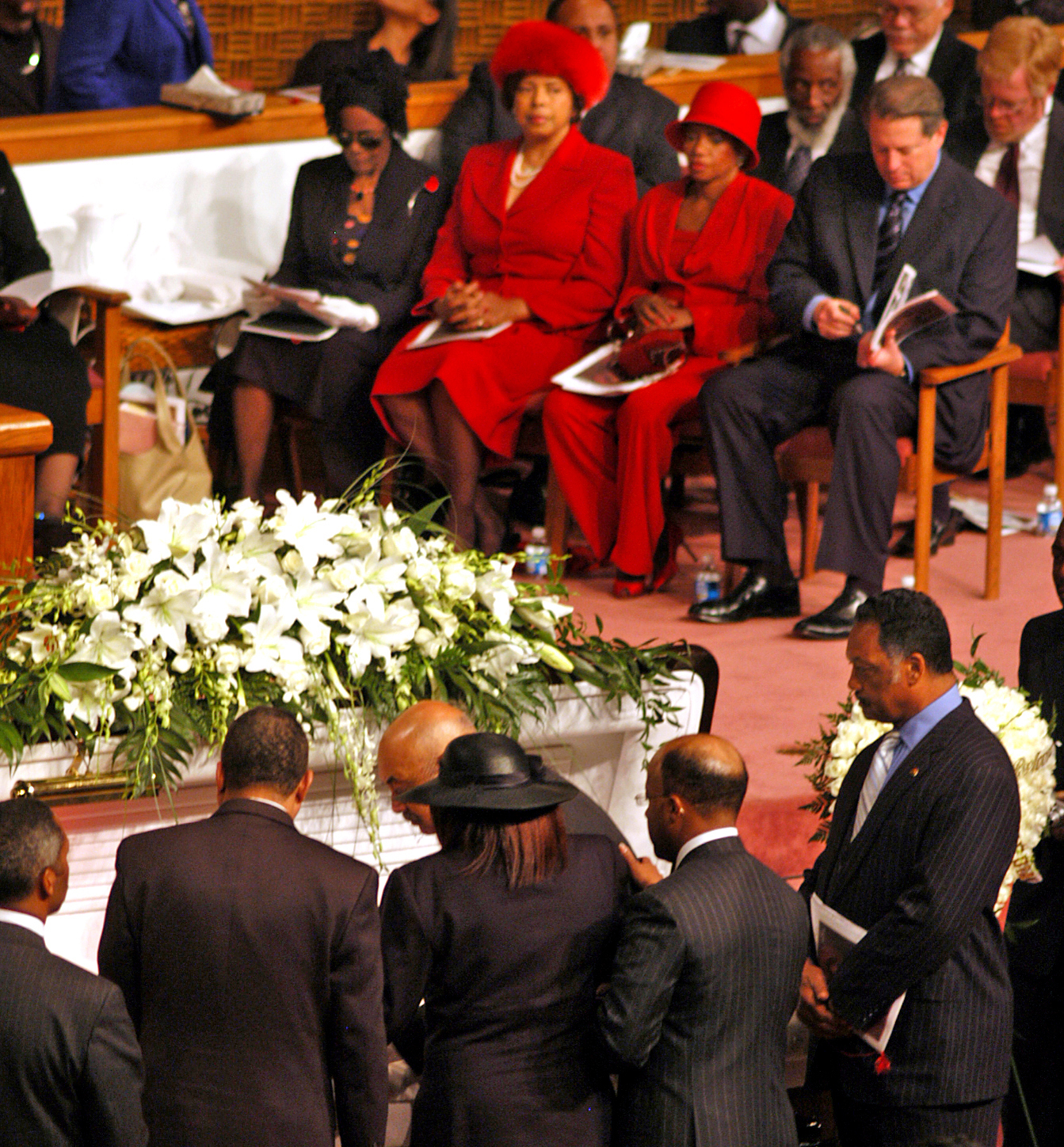
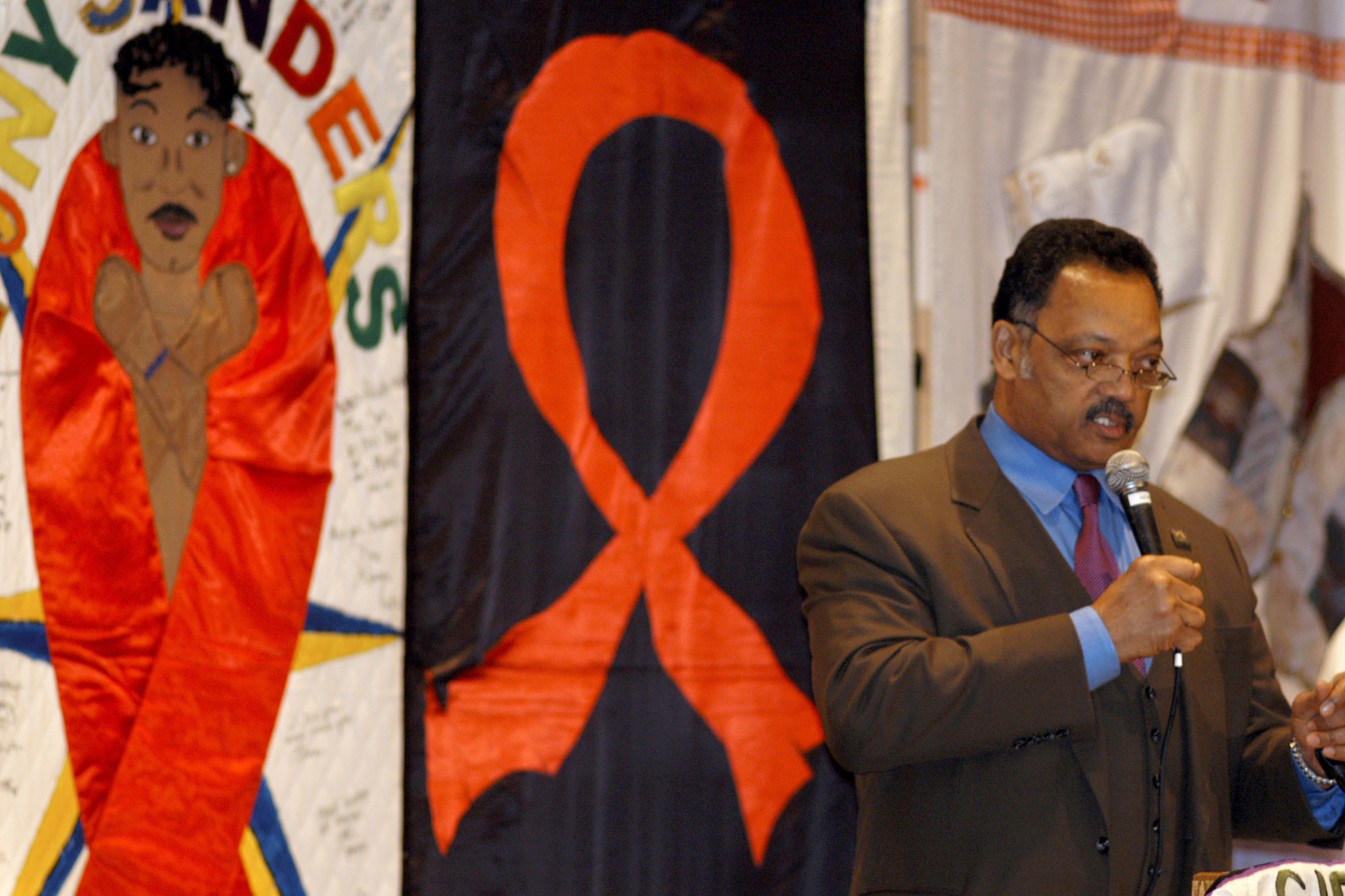
The Rev. Jesse L. Jackson speaks during during funeral services for civil rights activist C. Delores Tucker at Deliverance Evangelistic Church on Oct. 21, 2005. Seated in front row behind him, left to right are Eleanor Smeal, president of the Feminist Majority Foundation; Marion Barry, former mayor of Washington, and Philadelphia Mayor John Street. Rev. Jackson is projected live on a large screen monitor (camera operator in foreground) as he participates in a panel discussion laying out a legal and political strategy for fulfilling Brown v. the Board of Education, at the annual NAACP meeting on July. 14, 2004 at the Convention Center. Her family stands by as husband (partially hidden) William T. Tucker covers the body of civil rights activist C. Delores Tucker in her casket at the beginning of funeral service at Deliverance Evangelistic Church on Oct. 21, 2005. At right is the Rev. Jesse L. Jackson, founder and president of the Rainbow Coalition/PUSH, who later delivered the eulogy. Seated in rear at right is former Vice President Al Gore. AIDS quilt panels flank the podium as the Rev. Jesse Jackson speaks at an African American AIDS conference at the Wyndham Franklin Plaza Hotel on Feb. 28, 2005.
Still, Rev. Jackson often served as a defender of Philadelphia’s famed Black figures. In 2011, for example, Rev. Jackson spoke at the funeral of legendary world heavyweight boxing champion Joe Frazier, who had long competed with the fictional Rocky Balboa for recognition. As Jackson put it at the time, Frazier was the “real champion,” not the “Italian Stallion.”
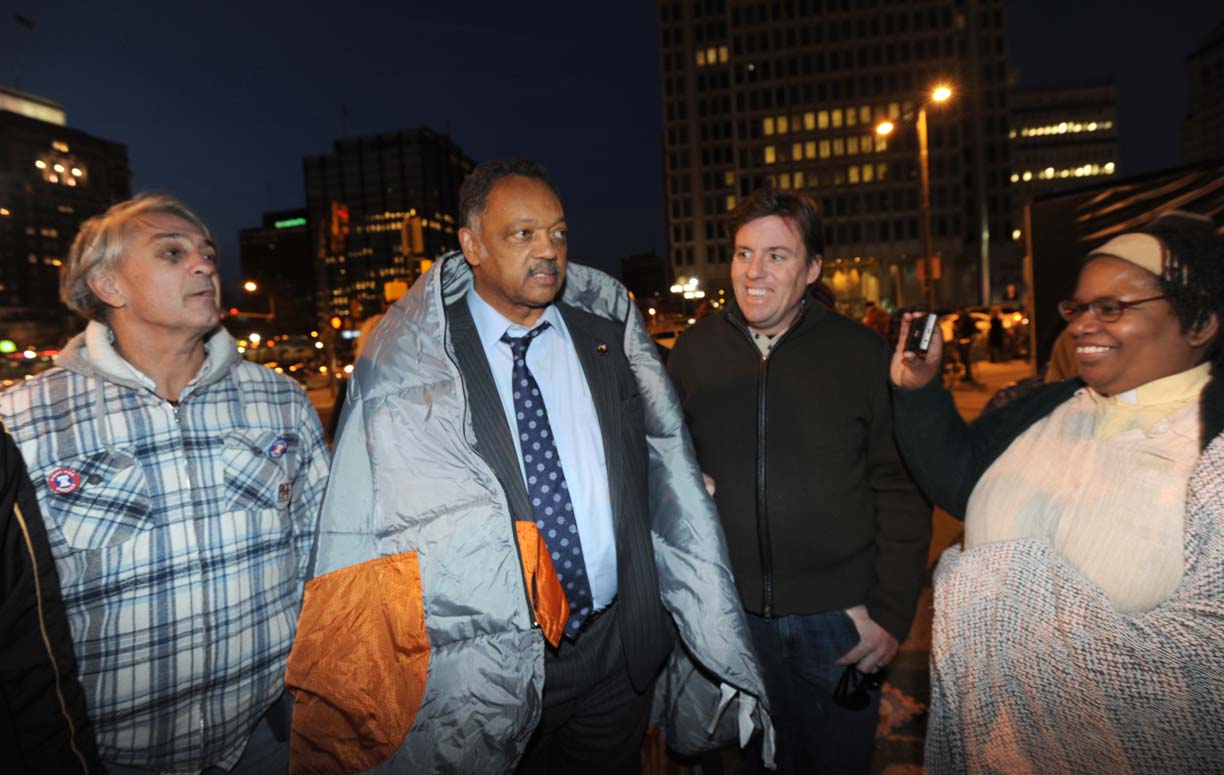
The Rev. Jesse Jackson, who has a sleeping bag draped around his shoulders, is talking and praying with Occupy Philadelphia demonstrators: Brad Wilson (from left); the Rev. Bill Golderer, pastor of Broad Street Ministry; and Donna Jones, pastor of the Cookman Baptist Initiative.
“If you were of importance as a Black person in America during the time [Jackson] was in the public eye,” Seymour said, “he was there to speak on your behalf.”
Goode Jr.’s most prominent memory of Rev. Jackson, meanwhile, dates back to the mid-1980s, when he was a student at the University of Pennsylvania. At the time, he said, Rev. Jackson attended a National Black Student Union conference following an invitation from its organizers, Goode Jr. included. It was, Goode Jr. said, an inspiration.
“It meant a lot to us,” Goode Jr. said. “Not just Black leaders at Penn, but across the nation, who were gathered there.”
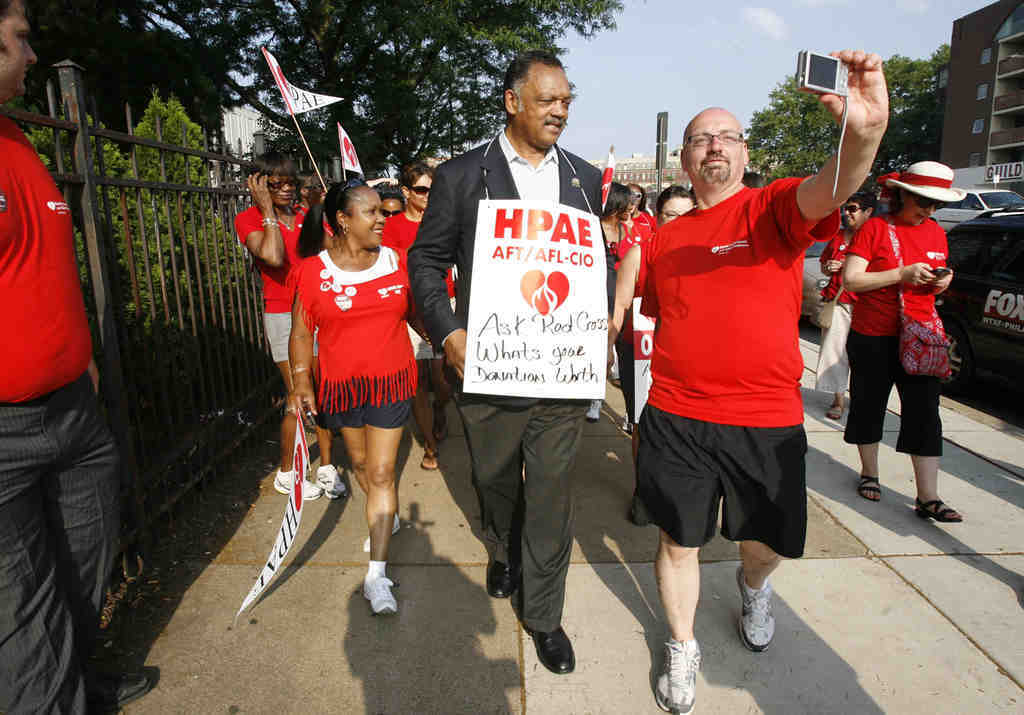
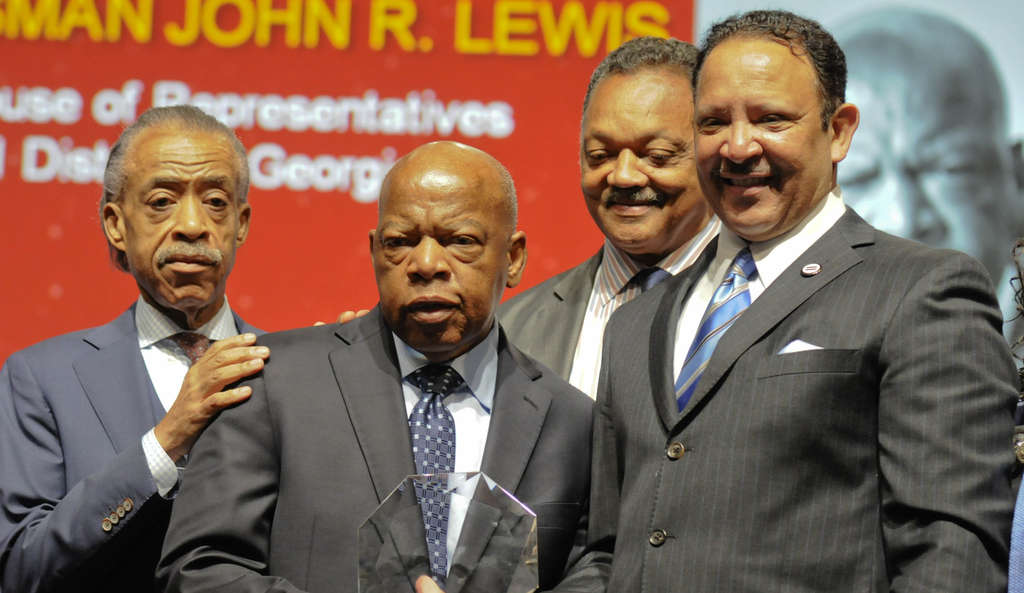
Striking Red Cross worker Lenny Lerro takes a picture of himself with the Rev. Jesse Jackson as they walk the picket line in 2011 on Spring Garden Street in Philadelphia.Rev. Jesse Jackson visits with folks at Occupy Philadelphia, just outside City Hall on Nov. 20, 2011.The Rev. Jesse Jackson visits with folks at Occupy Philadelphia, just outside City Hall on Nov. 20, 2011.U.S. Rep. John Lewis (second from left) is presented with the Civil Rights Champion Award in 2013 by (from left) the Rev. Al Sharpton, the Rev. Jesse Jackson, and Marc Morial, president of the Urban League.
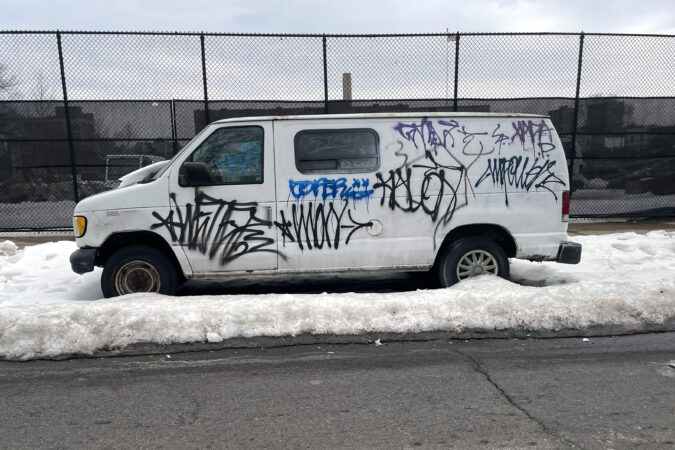
I don’t know why this scene caught my eye. I have seen graffiti-tagged walls on roll-down metal storefronts and yes, even panel trucks and vans before.
And in the past few weeks since our biggest snowfall in a decade — followed by a brutal freeze that locked in all the plowed piles — I have certainly seen enough streets lined with snowed-in vehicles. Maybe it was the combination of the two.
I was stopped because the dirty snowpack on street shoulders reduced traffic lanes and created gridlock. But while I waited through not one or two, but three traffic light cycles, I had the time to look, pick up my phone, roll down my window and take a picture.
Not the kind of image I usually look for.
Then that got me thinking, “What kinds of pictures do I like? What came first, the snow or the graffiti?” (I was at that light a long time.)
I clearly like photographing people. That’s why I got into journalism.
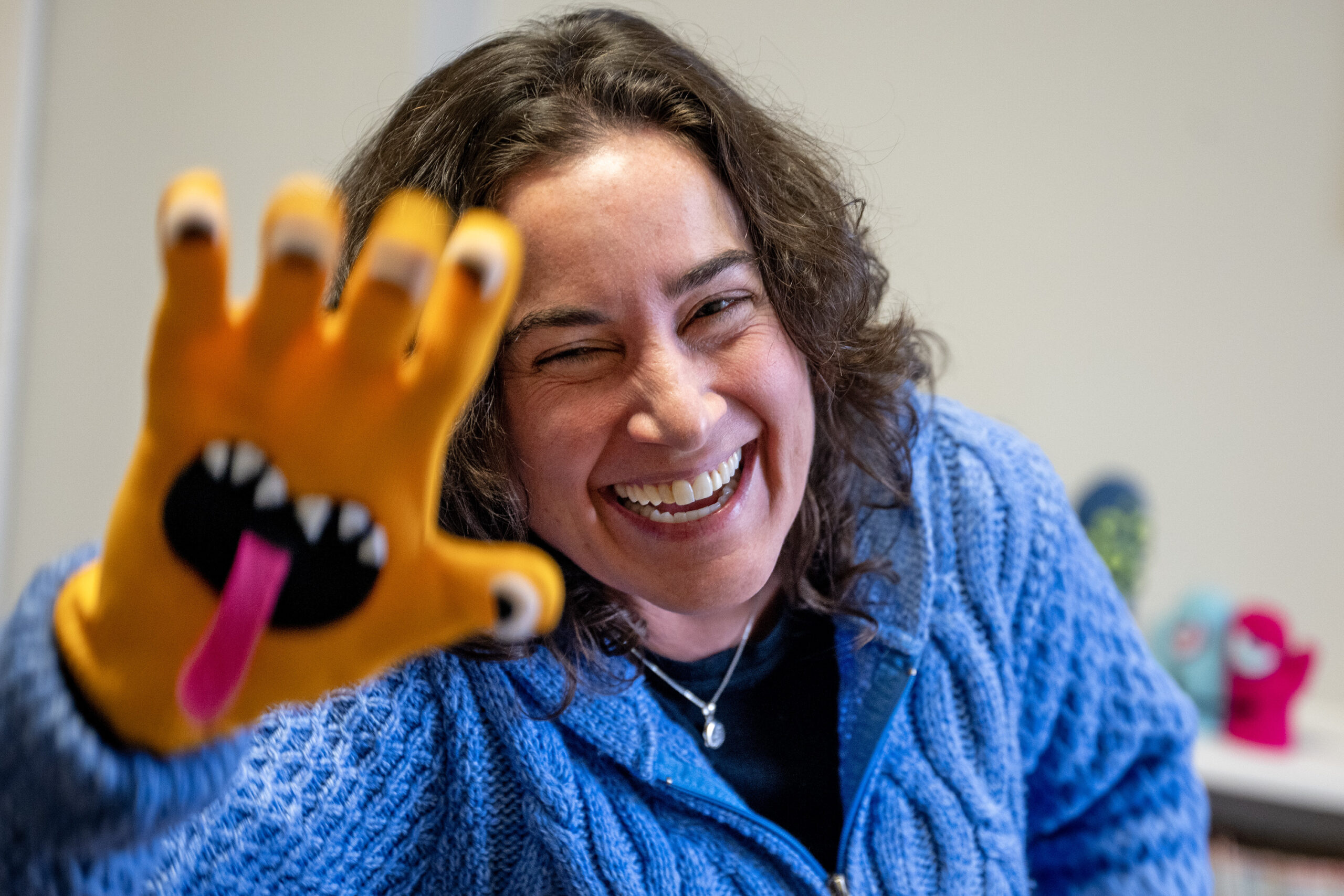
Highlights editor Judy Burke, last month at the editorial offices of America’s most beloved and respected educational magazines for kids.
When doing portraits on assignments I have always tried to get people comfortable with being themselves. I have always had a hard time “directing” them. It is especially difficult when the story I’m trying to illustrate is not about them, but about where they work, or what they are doing.
Trying avoid posing subjects by saying “just do whatever you’d be doing if I — and a reporter, and the public relations person(s) — wasn’t here,” doesn’t help. And just makes it awkward for all of us.
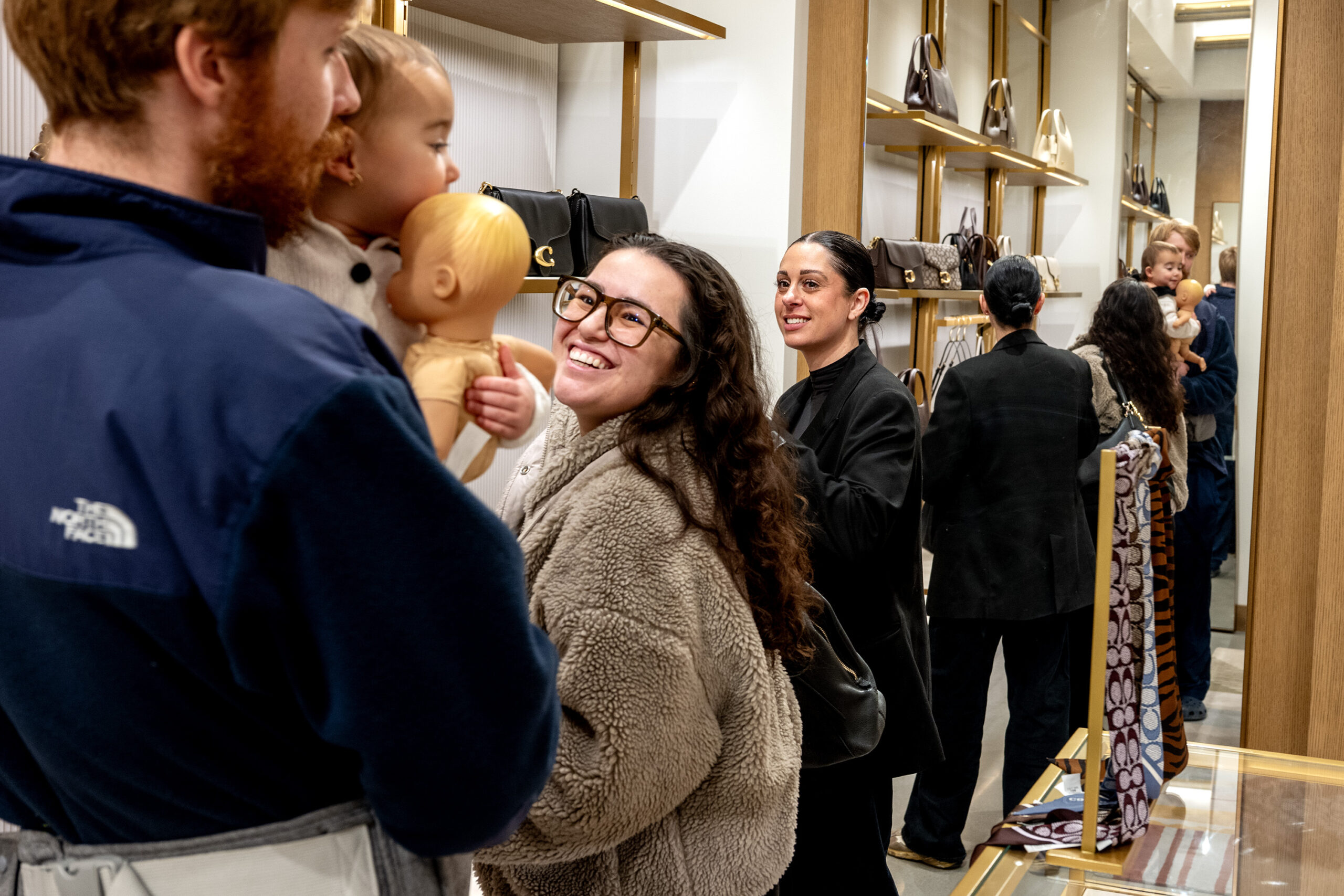
Employee Alex Costa (right) assists Alessandra Bruno as she tries out purses with husband Luke Baur and their 20 month-old daughter Rosalina at the Coach store at the Cherry Hill Mall on Monday.
Walking into a room where everyone is ready and waiting to be photographed — but unsure of what the photographer will do — is also hard for them. If possible I get them to interact with each other, even if it’s just sharing what they had for breakfast. In public spaces I will often enlist customers or passersby, asking if I can photographed over their shoulders. Then wait — and hope — for a genuine moment. Like in the mall retail shop, a customer interaction is much better than five salespeople standing among the merchandise looking at the camera.
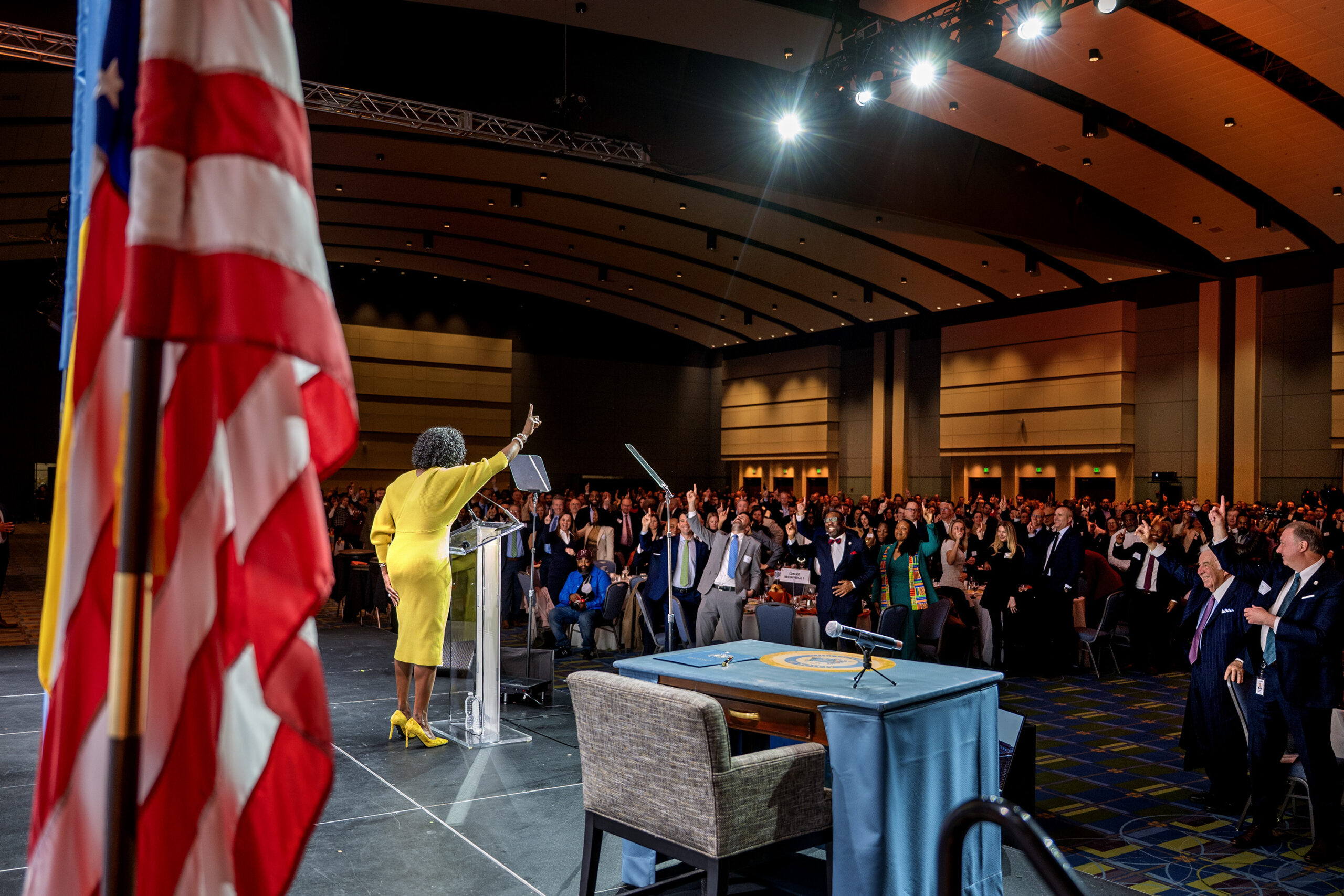
That is also why I most enjoy assignments where I am just there, observing an event trying to capture something that will make readers click on a link or pause to read a story. And I keep myself enthused while doing it. Like the many public appearances of our mayor.
Mayor Cherelle L. Parker has the whole room of business leaders standing with her and her “One Philly” chant as she finishers her keynote address at the Chamber of Commerce for Greater Philadelphia’s Annual Mayoral Luncheon Wednesday.
That goes for ordinary people too, not just politicians or executives or sports or entertainment celebrities. And what is more normal and everyday than stopping at your regular convenience store?
I also photographed Wawa’s excursion into Sheetz land in 2024. For decades, it was assumed there were unspoken boundaries in Pennsylvania between Wawa in the East and Sheetz in the West. But representatives of both chains deny they are rivals and as my colleague Stephanie Farr points out, they have worked together to support various nonprofits.
Next stop for me (soon, I hope) a photographic road trip to the nearest Buc-ees.
Since 1998 a black-and-white photo has appeared every Monday in staff photographer Tom Gralish’s “Scene Through the Lens” photo column in the print editions of The Inquirer’s local news section. Here are the most recent, in color:
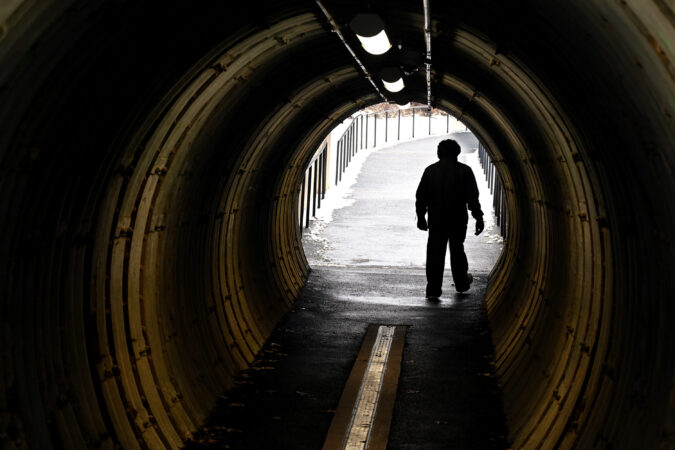
February 9, 2026: Walking through a corrugated metal culvert called the “Duck Tunnel,” a pedestrian navigates the passageway under the SEPTA tracks on the Swarthmore College campus. February 2, 2026: A light-as-air Elmo balloon rolls along a sidewalk in Haddonfield, propelled by the wind as Sunday’s heavy snow starts to turn to ice and sleet. January 26, 2026: The President’s House in Independence National Historical Park hours Jan, 22, after all historical exhibits were removed following President Trump’s Executive Order last March that the content at national parks that “inappropriately disparage” the U.S. be reviewed. The site, a reconstructed “ghost” structure titled “Freedom and Slavery in the Making of a New Nation” (2010), serves as a memorial to the nine people George Washington enslaved there during the founding of America.January 19, 2026: A low-in-the-sky winter sun is behind the triangular pediment of the “front door” of the open-air President’s House installation in Independence National Historical Park. The reconstructed “ghost” structure with partial walls and windows of the Georgian home known in the 18th century as 190 High St. is officially titled, “Freedom and Slavery in the Making of a New Nation” (2010). It is designed to give visitors a sense of the house where the first two presidents of the United States, George Washington and John Adams, served their terms of office. The commemorative site designed by Emanuel Kelly, with Kelly/Maiello Architects, pays homage to nine enslaved people of African descent who were part of the Washington household with videos scripted by Lorene Cary and directed by Louis Massiah. Deepika Iyer holds her niece Ira Samudra aloft in a Rockyesque pose, while her parents photograph their 8 month-old daughter, in front of the famous movie prop at the top of the steps at the Philadelphia Art Museum. Iyer lives in Philadelphia and is hosting a visit by her mother Vijayalakshmi Ramachandran (partially hidden); brother Gautham Ramachandran; and her sister-in-law Janani Gautham who all live in Bangalore, India.January 5, 2026: Parade marshals trail behind the musicians of the Greater Kensington String Band heading to their #9 position start in the Mummers Parade. Spray paint by comic wenches earlier in the day left “Oh, Dem Golden Slippers” shadows on the pavement of Market Street. This year marked the 125th anniversary of Philly’s iconic New Year’s Day celebration.Dec. 29, 2025: Canada geese at sunrise in Evans Pond in Haddonfield, during the week of the Winter Solstice for the Northern Hemisphere. December 22, 2025: SEPTA trolley operator Victoria Daniels approaches the end of the Center City Tunnel, heading toward the 40th Street trolley portal after a tour to update the news media on overhead wire repairs in the closed tunnel due to unexpected issues from new slider parts.December 15, 2025: A historical interpreter waits at the parking garage elevators headed not to a December crossing of the Delaware River, but an event at the National Constitution Center. General George Washington was on his way to an unveiling of the U.S. Mint’s new 2026 coins for the Semiquincentennial, December 8, 2025: The Benjamin Franklin Bridge and pedestrians on the Delaware River Trail are reflected in mirrored spheres of the “Weaver’s Knot: Sheet Bend” public artwork on Columbus Boulevard. The site-specific stainless steel piece located between the Cherry Street and Race Street Piers was commissioned by the City’s Public Art Office and the Delaware River Waterfront Corporation and created and installed in 2022 by the design and fabrication group Ball-Nogues Studio. The name recalls a history that dominated the region for hundreds of years. “Weaver’s knot” derives from use in textile mills and the “Sheet bend” or “sheet knot” was used on sailing vessels for bending ropes to sails. November 29, 2025: t’s ginkgo time in our region again when the distinctive fan-shaped leaves turn yellow and then, on one day, lose all their leaves at the same time laying a carpet on city streets and sidewalks. A squirrel leaps over leaves in the 18th Century Garden in Independence National Historical Park Nov. 25, 2025. The ginkgo (Ginkgo biloba) is considered a living fossil as it’s the only surviving species of a group of trees that existed before dinosaurs. Genetically, it has remained unchanged over the past 200 million years. William Hamilton, owner the Woodlands in SW Phila (no relation to Alexander Hamilton) brought the first ginkgo trees to North America in 1785.November 24, 2025: The old waiting room at 30th Street Station that most people only pass through on their way to the restrooms has been spiffed up with benches – and a Christmas tree. It was placed there this year in front of the 30-foot frieze, “The Spirit of Transportation” while the lobby of Amtrak’s $550 million station restoration is underway. The 1895 relief sculpture by Karl Bitter was originally hung in the Broad Street Station by City Hall, but was moved in 1933. It depicts travel from ancient to modern and even futuristic times. November 17, 2025: Students on a field trip from the Christian Academy in Brookhaven, Delaware County, pose for a group photo in front of the Liberty Bell in Independence National Historical Park on Thursday. The trip was planned weeks earlier, before they knew it would be on the day park buildings were reopening after the government shutdown ended. “We got so lucky,” a teacher said. Then corrected herself. “It’s because we prayed for it.”
Each Friday, Inquirer photo editors pick the best Philly sports images from the last seven days. This week, there’s nowhere better to start than in Clearwater, Fla., where the Phillies kicked off their spring training this week. The Sixers also returned from their West Coast trip for a matchup with the Knicks before this weekend’s NBA All-Star Game, where Tyrese Maxey will make his first start. And as always, there’s plenty of Big 5 hoops action with March Madness just over a month away.
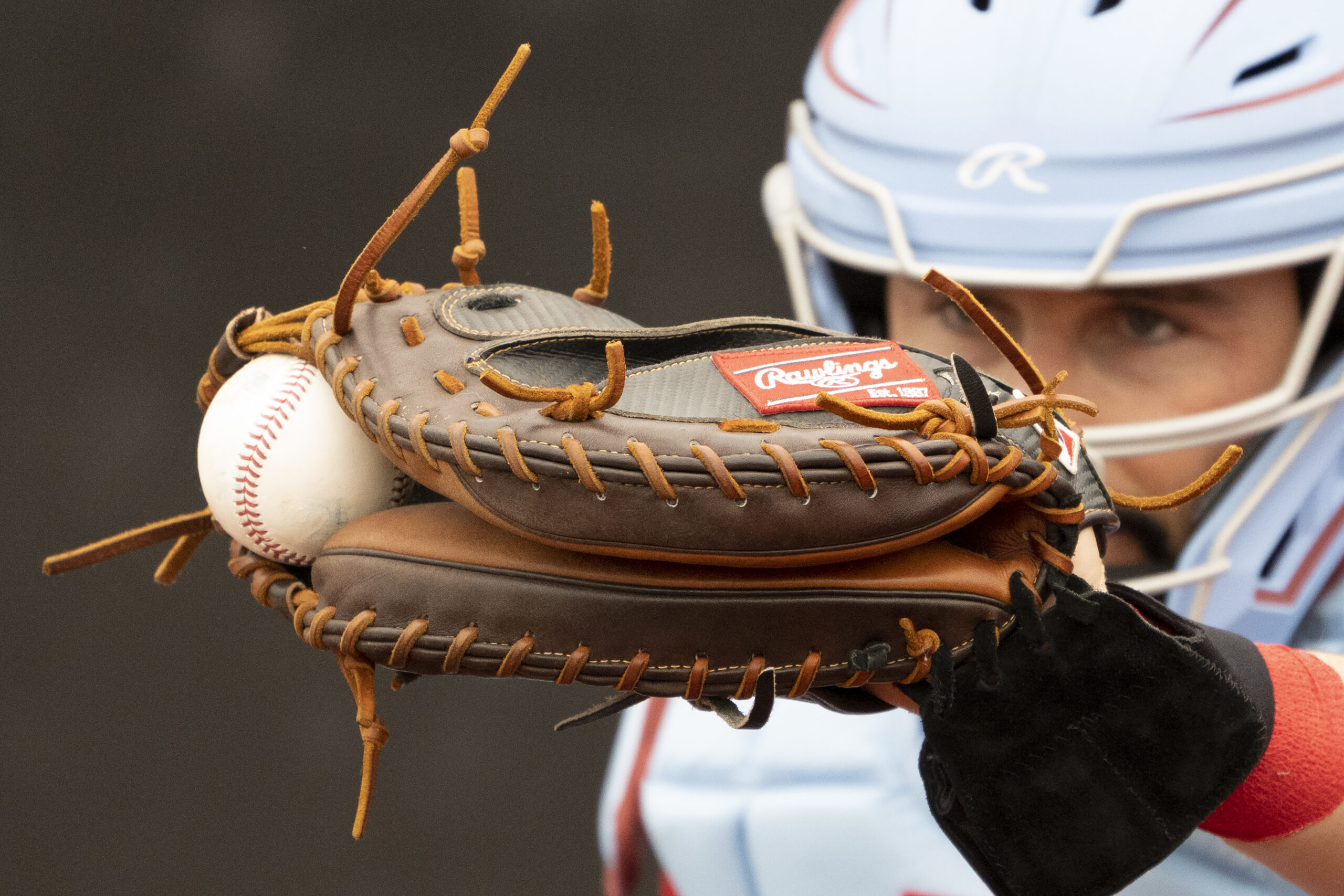
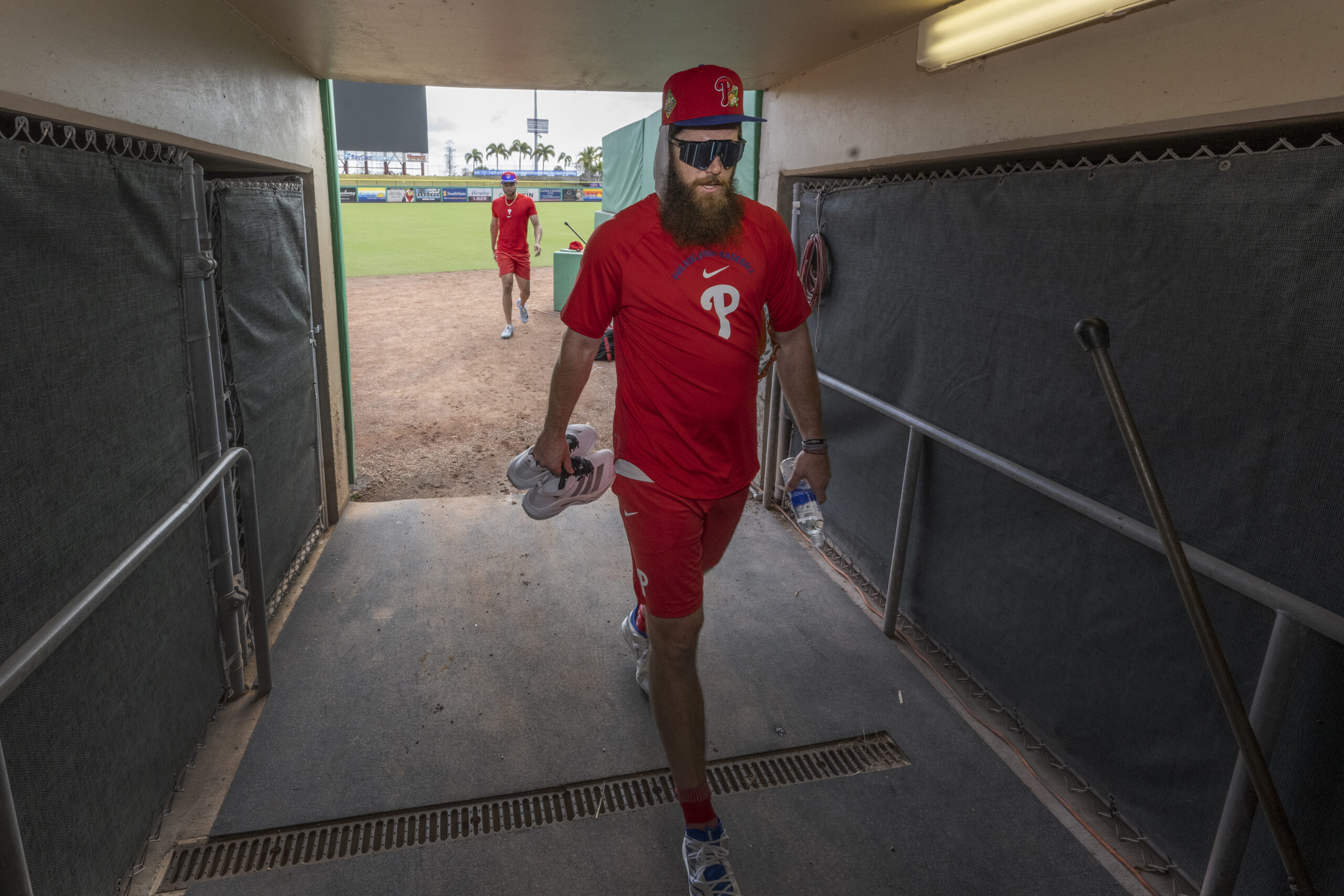
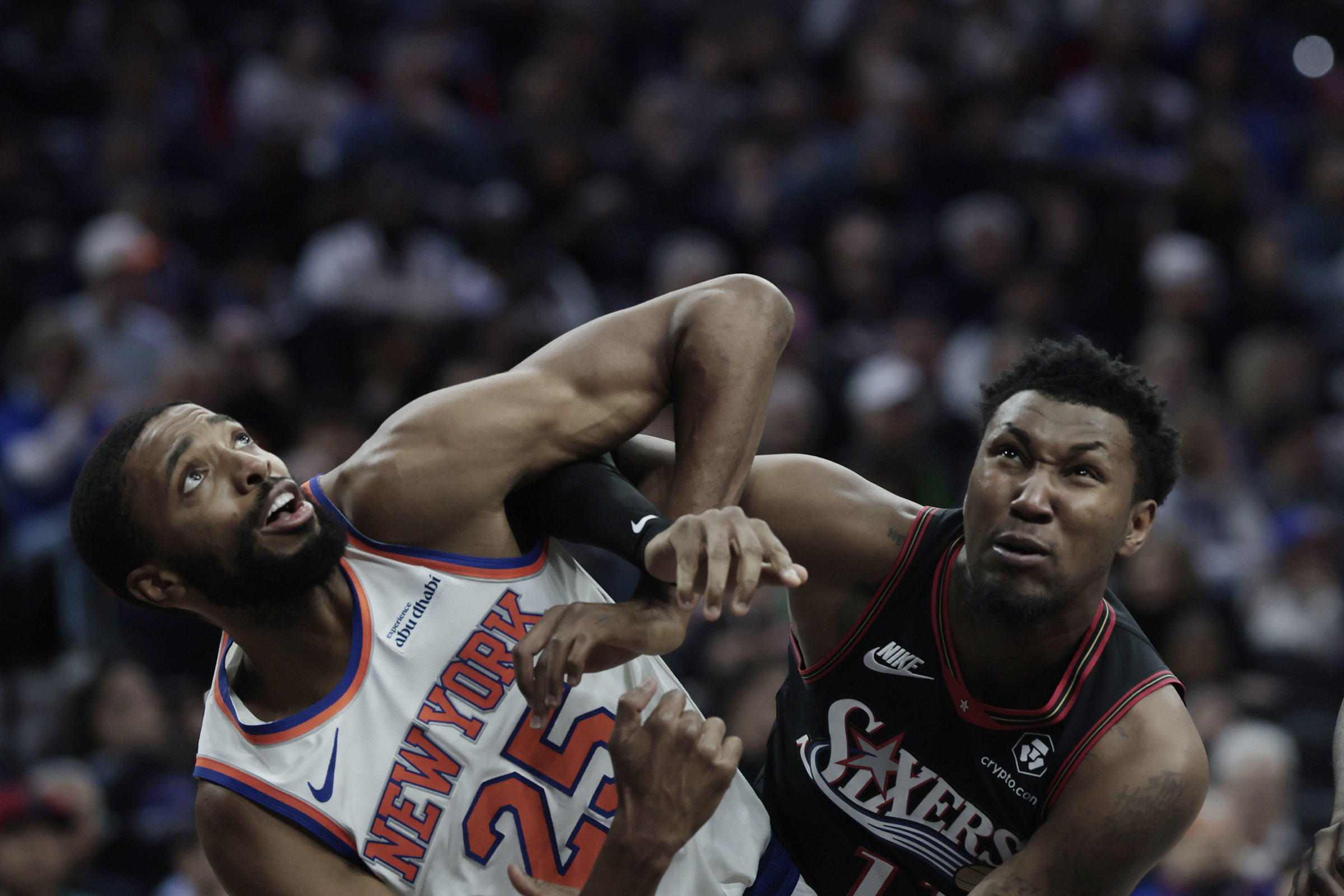
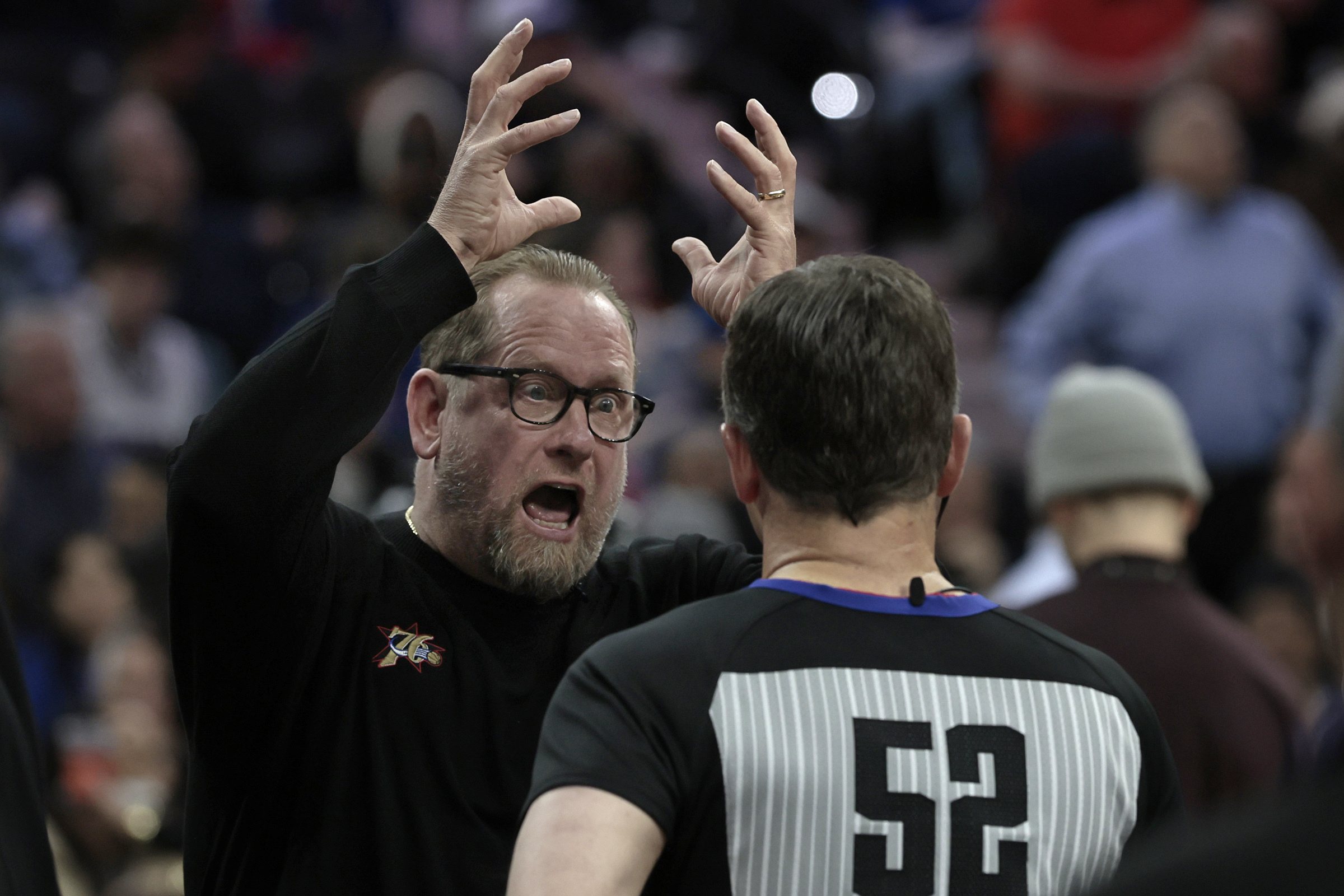
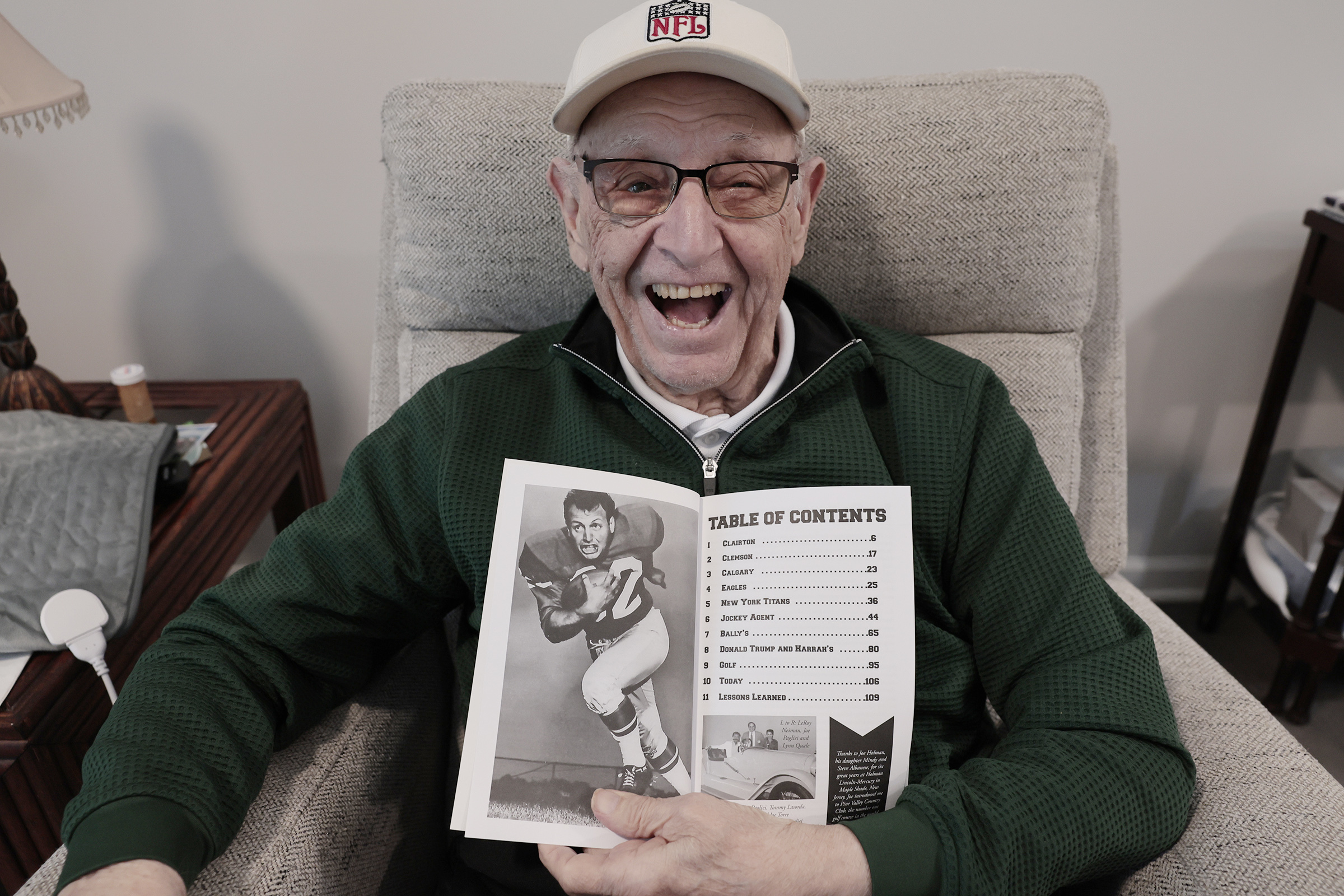
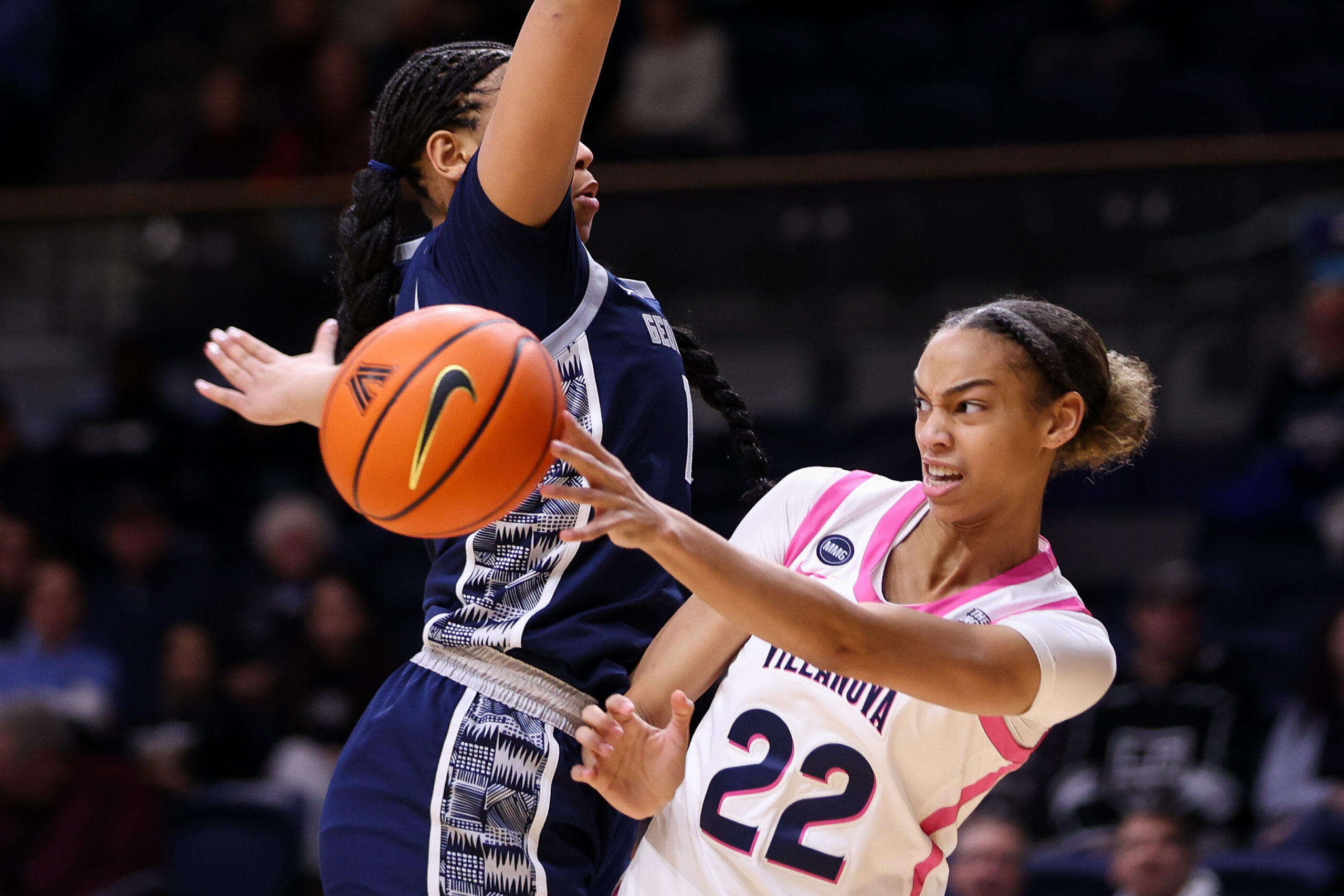
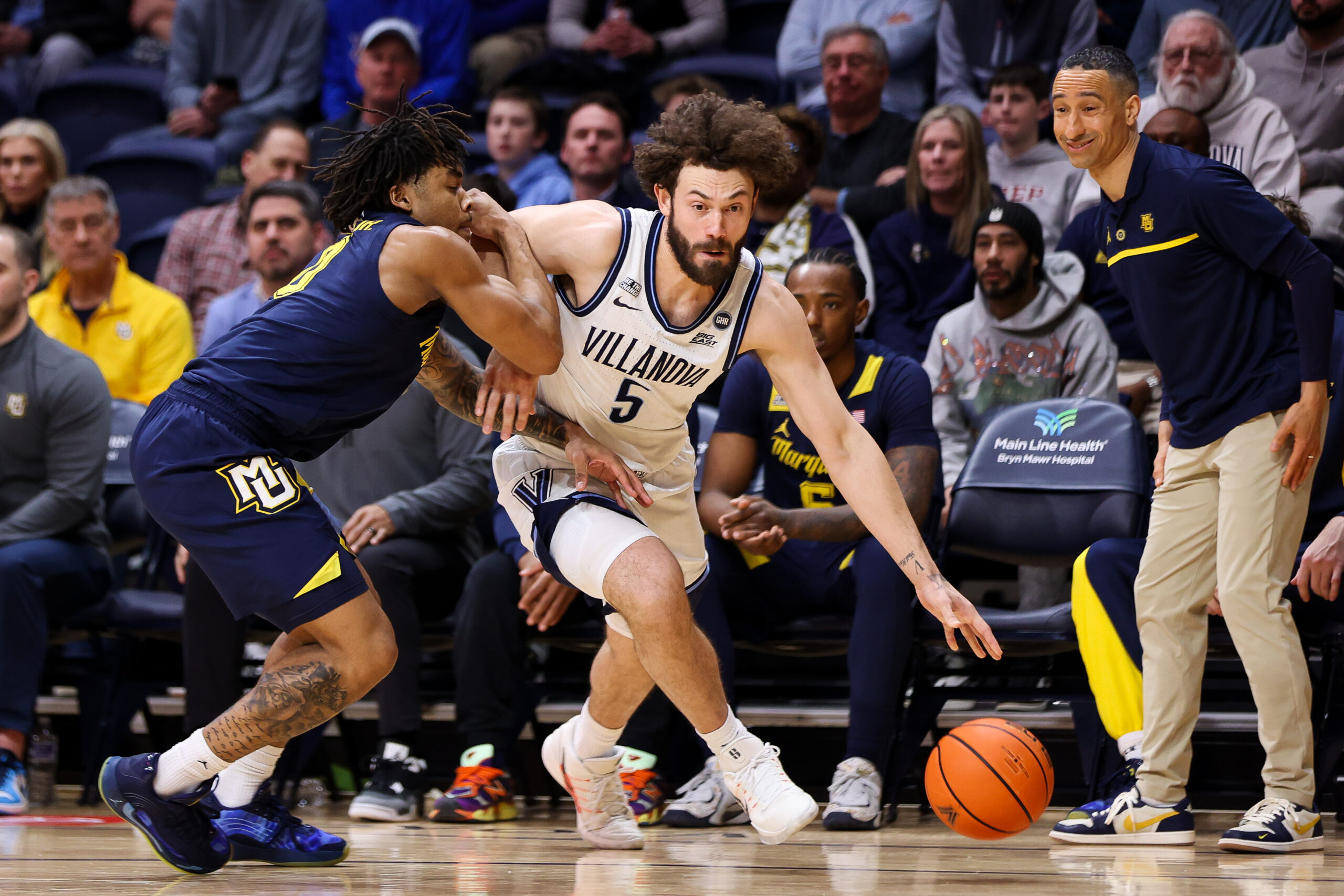
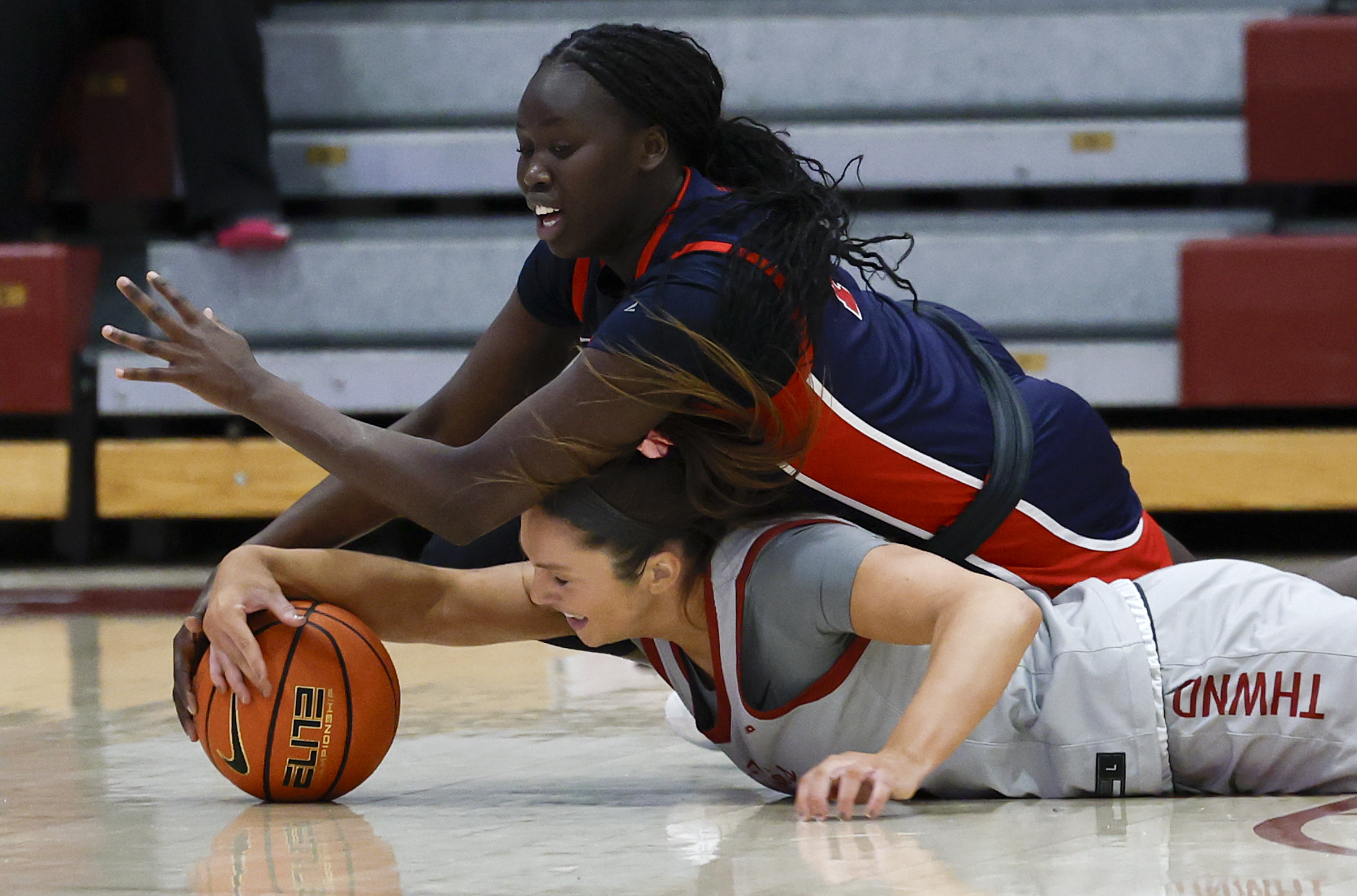
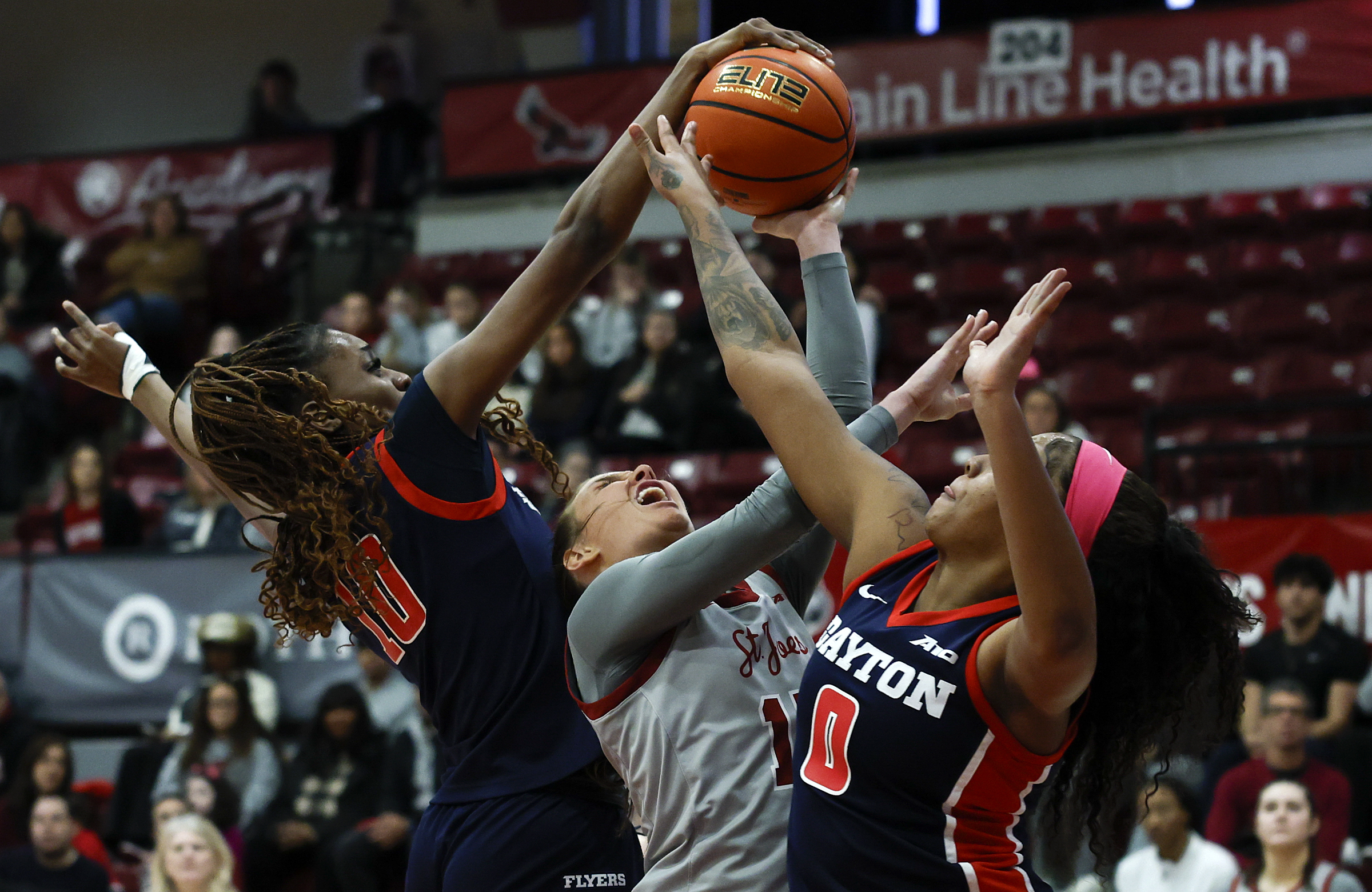
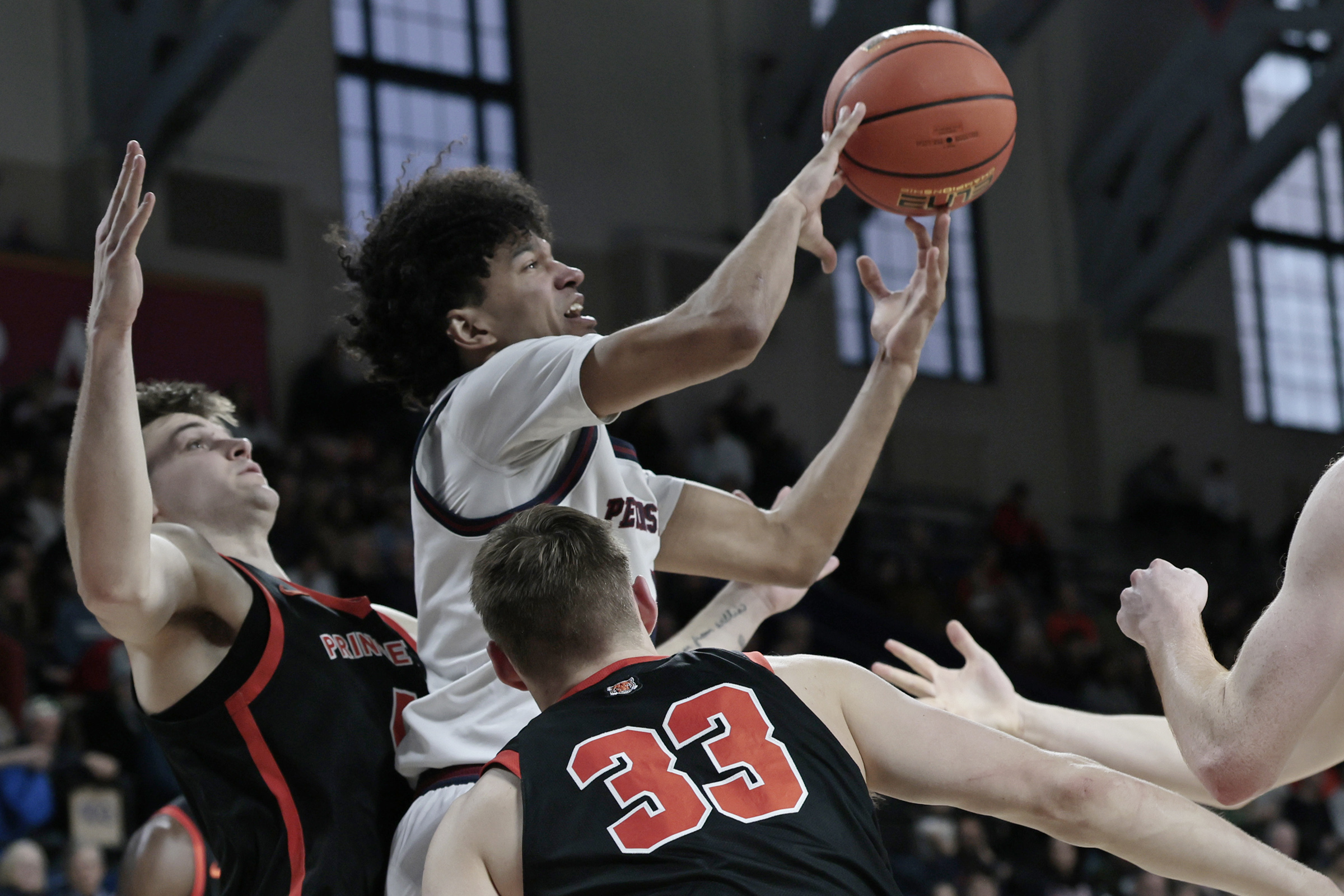
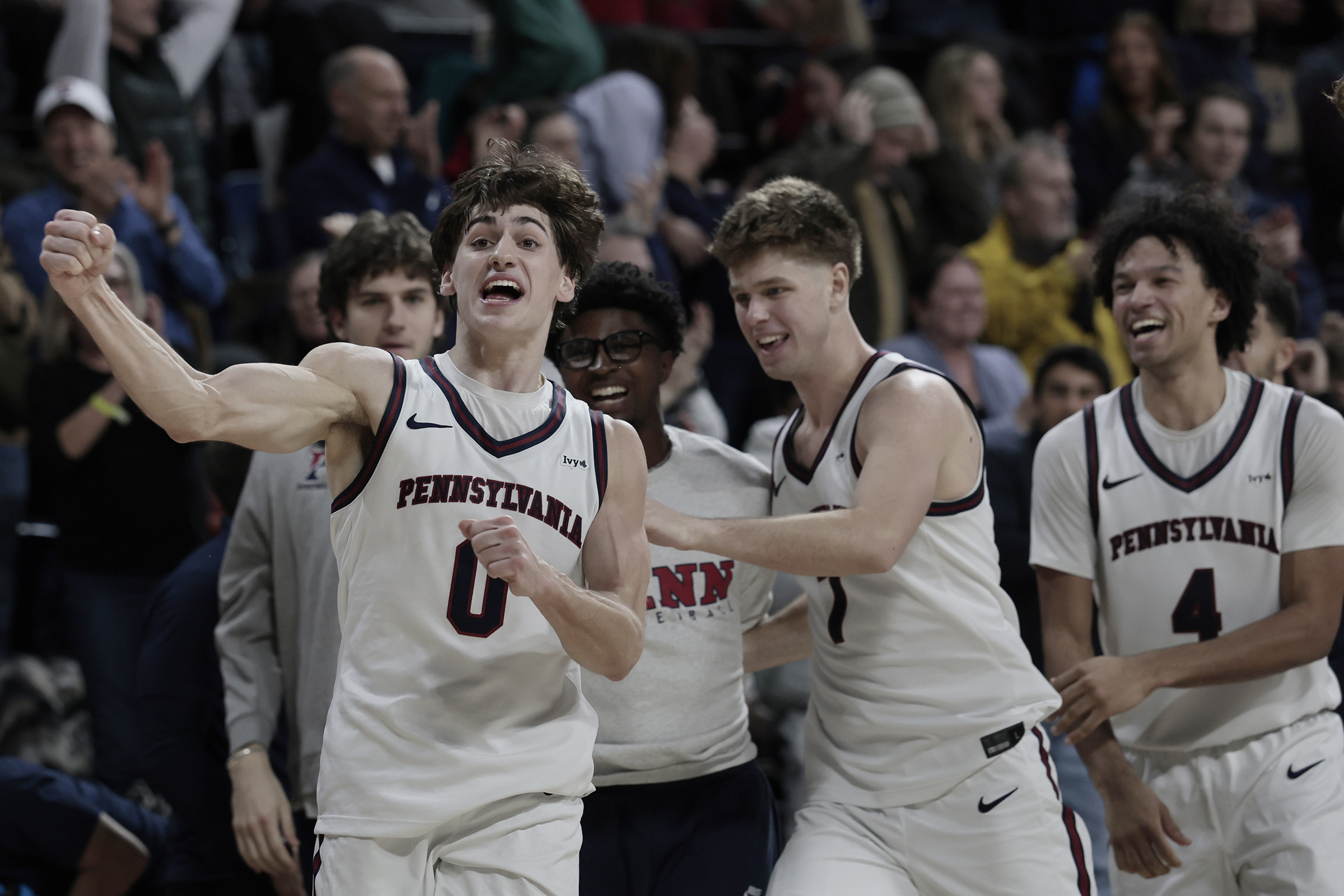
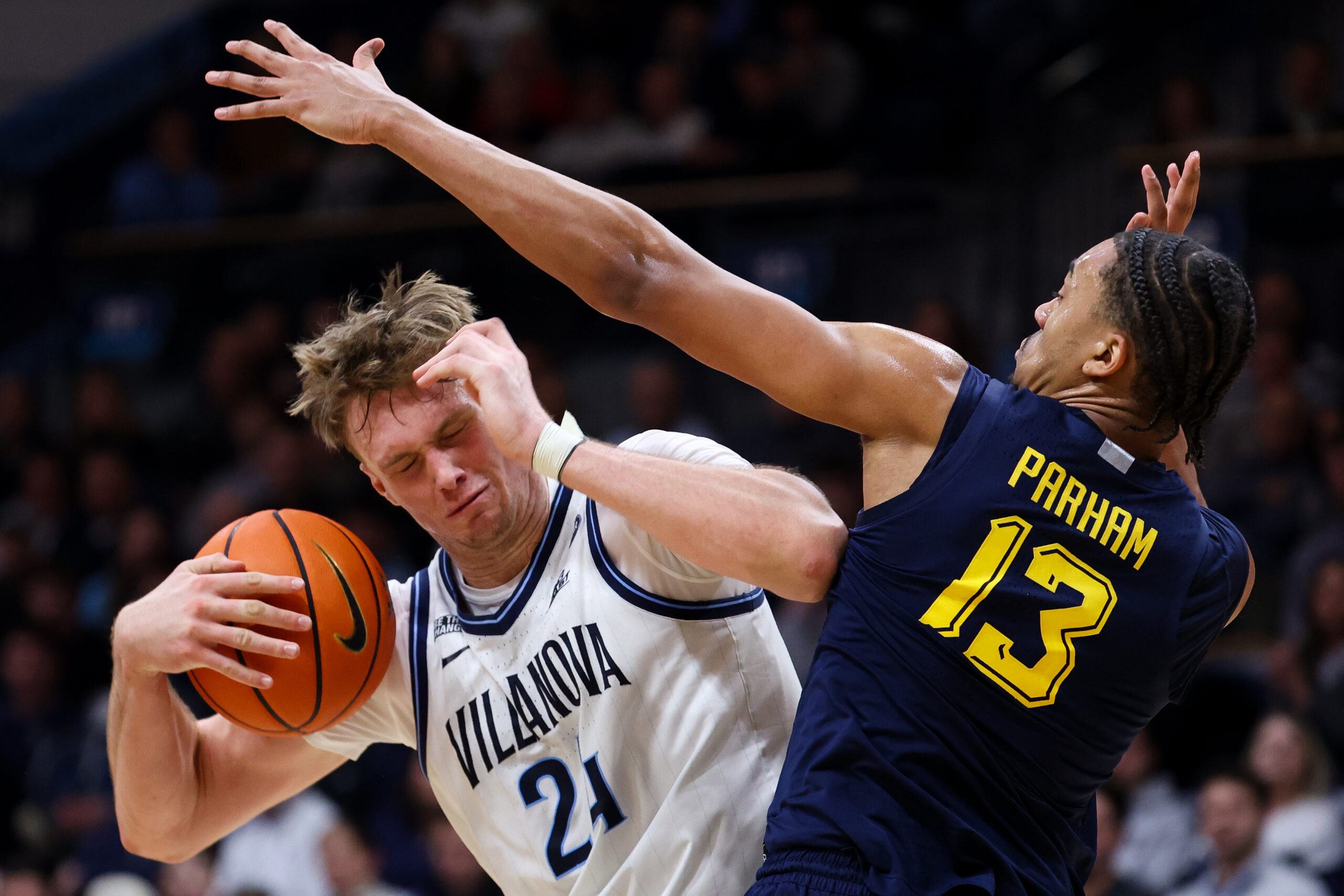
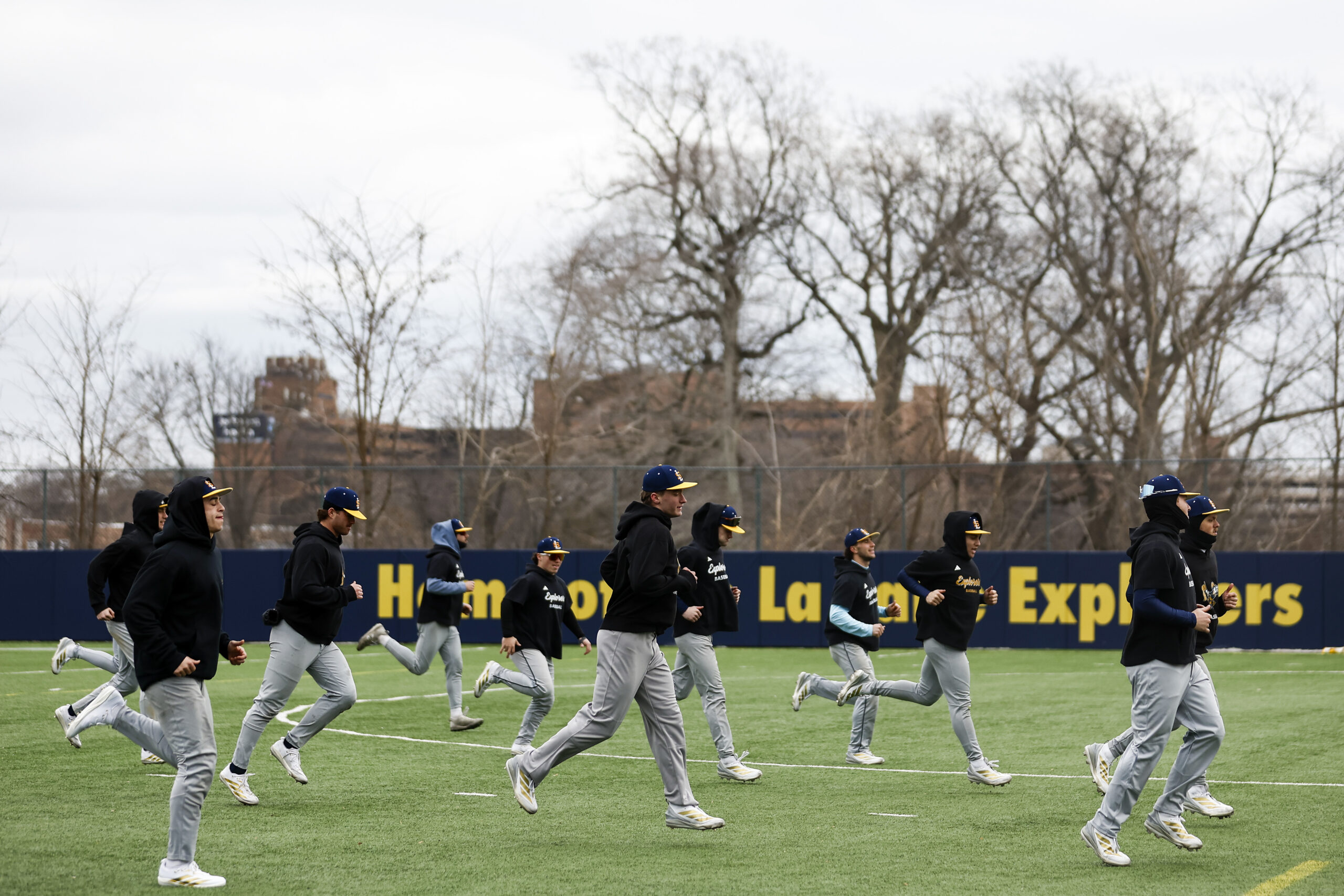
Phillies backup catcher Garrett Stubbs holds on to a pitch during the first day of spring training practice. Most of the team is already in Clearwater ahead of Monday’s first full-squad workout.Reliever Jose Alvarado (left) is no stranger to BayCare Ballpark in Clearwater, Fla., but this is the first spring training with the Phillies for Jhoan Duran, who was acquired ahead of the trade deadline last season.Phillies outfielder Brandon Marsh is back at spring training — as is his popular beard.The Sixers were blown out by the Knicks on Wednesday night, and have lost three of four heading into the All-Star break. Earlier this week, they signed Dalen Terry (right) to a two-way deal.Former Villanova star Mikal Bridges (left) was back in South Philly this week for the Knicks’ win over Justin Edwards (right) and the Sixers.Sixers coach Nick Nurse was without Joel Embiid and Quentin Grimes in Wednesday’s loss to the Knicks.Joe Pagliei, 91, is the Eagles’ oldest living player and was a member of the 1960 championship team.Villanova guard Kennedy Henry (right) is third on the team in scoring (9.2 points per game). The Wildcats (20-5) are currently second in the Big East behind undefeated UConn, the nation’s No. 1 ranked team.Guard Devin Askew (right) has helped the Villanova to a 19-5 record as they look to get back in the NCAA Tournament. The Wildcats have won four straight, including Tuesday’s 77-74 victory over Marquette.Saint Joseph’s guard Jill Jekot (bottom) battles for a loose ball against Dayton forward Ajok Madol in Sunday’s loss. The Hawks bounced back with a 70-63 win over George Washington on Wednesday.Saint Joseph’s guard Gabby Casey (center) has her shot attempt blocked against Dayton. Casey leads the team in points (16.7), rebounds (7.0), and steals (1.7) per game, and is second in assists (3.2).Penn guard Jay Jones (with ball) fights for a rebound during the Quakers’ win over Princeton University on Saturday at the Palestra. Penn hosts Columbia on Friday night.Penn guard AJ Levine (left) celebrates with teammates after the Quakers’ win over Princeton. It was the team’s second straight after three losses in a row.Villanova center Duke Brennan (left) collides with Marquette Golden Eagles forward Royce Parham (13). The Wildcats will go for their fifth straight win Saturday against Creighton.While the Phillies are in Clearwater, the La Salle University baseball team practices on campus in the cold. The team takes on the University of Maryland Eastern Shore on Friday in their first game of the season.
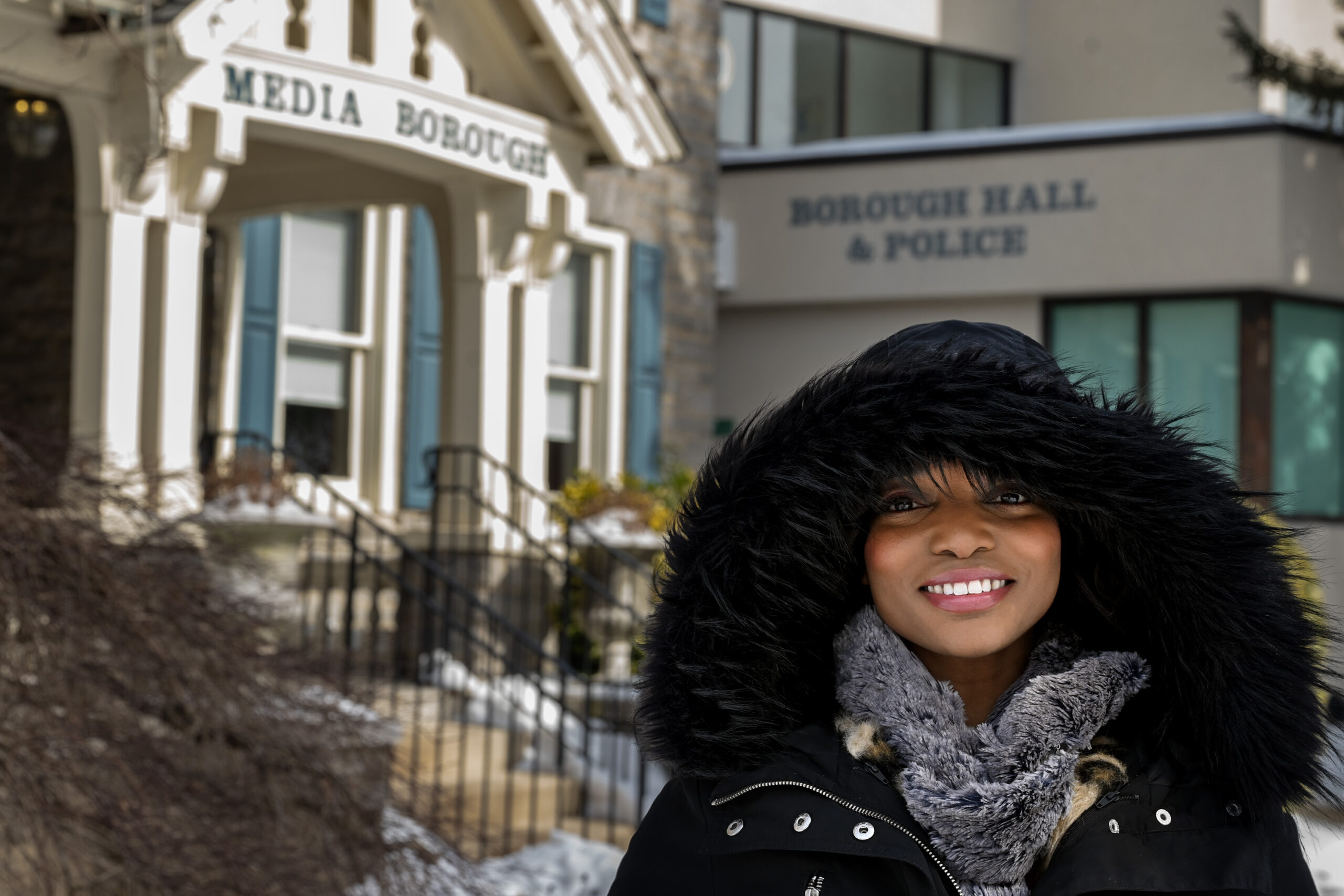
My assignment that day was pretty typical for a newspaper photographer: show the reader what the person a reporter is profiling looks like. And maybe what they do and where they do it.
Newly-inaugurated Mayor Joi Washington at Media Borough Hall.
Having accomplished that task, I headed out looking for something else to photograph in the snow, and ended up at a pedestrian passage way.
As I made a picture of a person silhouetted in the corrugated metal culvert, the first thing I thought of was an old friend and photo editor Joe Elbert who famously said there are four categories in the “hierarchy” of newspaper photographs, lowest to highest: informational, graphic, emotional, and intimate.
In just a few hours I had knocked out his “lower” two types.
I made a few pictures that report “just the facts” without much flavor or fanfare. Then I found a visually appealing scene and waited until I could turn it into a well composed, interesting image. Graphic, even.
Joe was the photo editor at the Post from 1988 through 2007. Under his direction the paper won four Pulitzer Prizes, and many other awards, all for work that epitomizes that highest category of intimate photographs.
It’s easy to feel nostalgic for those “glory days,” but I mourn that almost an entire section of the newspaper is now gone.
Post photographers were still creating those most intimate images of Joe’s hierarchy. They were still making the reader feel something that allows us to connect with lives beyond our own, to empathize, and to care.
Since 1998 a black-and-white photo has appeared every Monday in staff photographer Tom Gralish’s “Scene Through the Lens” photo column in the print editions of The Inquirer’s local news section. Here are the most recent, in color:
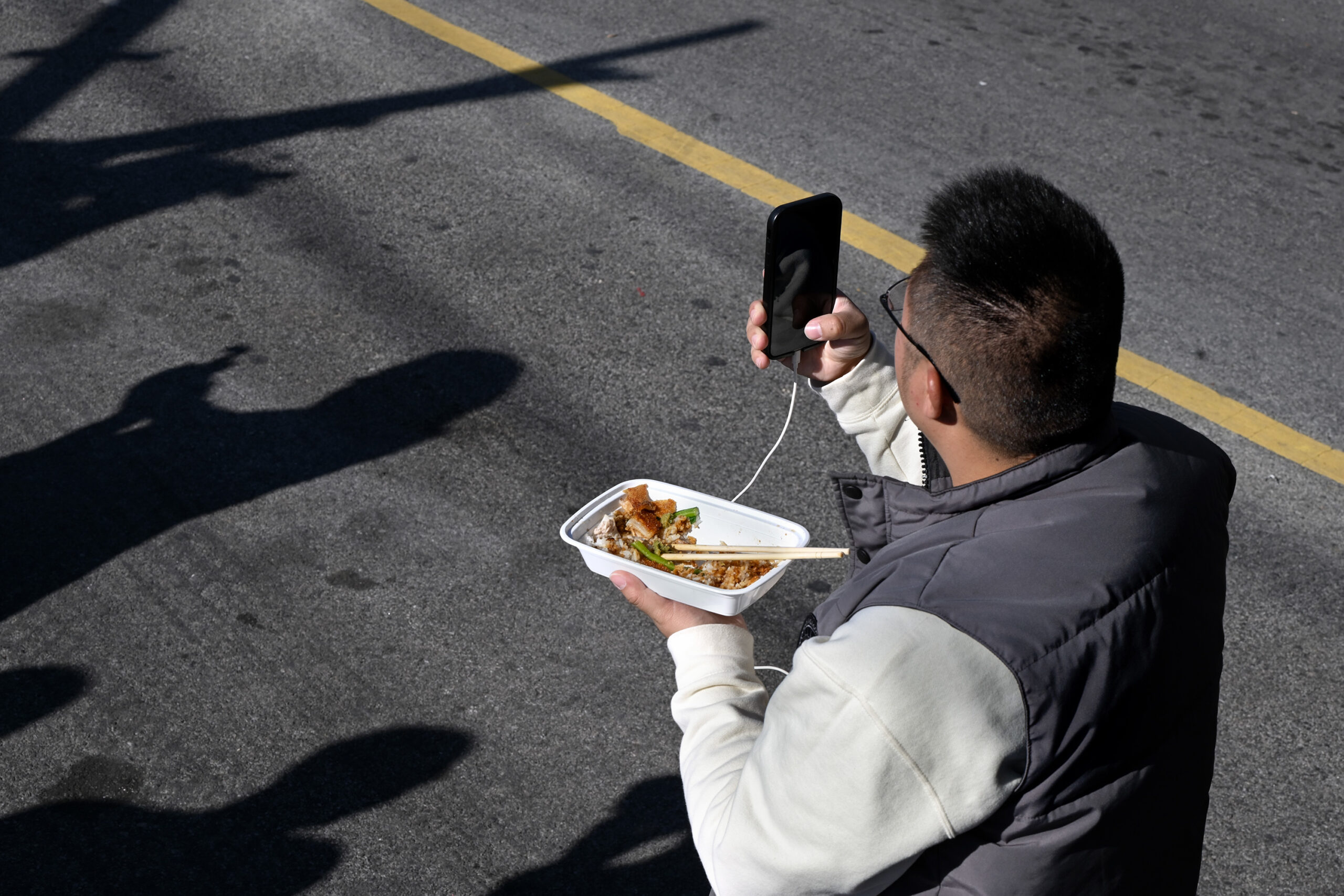
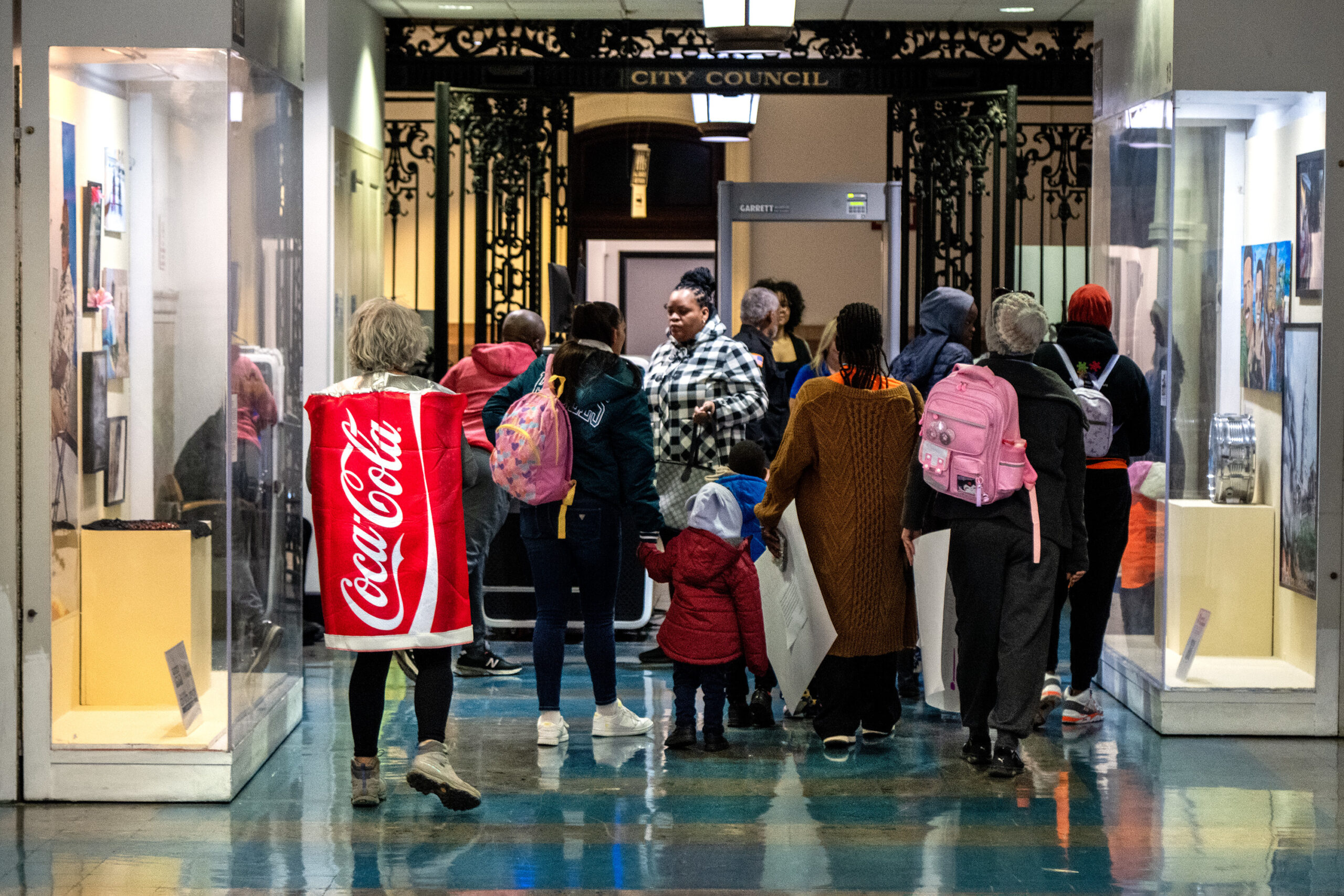
February 2, 2026: A light-as-air Elmo balloon rolls along a sidewalk in Haddonfield, propelled by the wind as Sunday’s heavy snow starts to turn to ice and sleet. January 26, 2026: The President’s House in Independence National Historical Park hours Jan, 22, after all historical exhibits were removed following President Trump’s Executive Order last March that the content at national parks that “inappropriately disparage” the U.S. be reviewed. The site, a reconstructed “ghost” structure titled “Freedom and Slavery in the Making of a New Nation” (2010), serves as a memorial to the nine people George Washington enslaved there during the founding of America.January 19, 2026: A low-in-the-sky winter sun is behind the triangular pediment of the “front door” of the open-air President’s House installation in Independence National Historical Park. The reconstructed “ghost” structure with partial walls and windows of the Georgian home known in the 18th century as 190 High St. is officially titled, “Freedom and Slavery in the Making of a New Nation” (2010). It is designed to give visitors a sense of the house where the first two presidents of the United States, George Washington and John Adams, served their terms of office. The commemorative site designed by Emanuel Kelly, with Kelly/Maiello Architects, pays homage to nine enslaved people of African descent who were part of the Washington household with videos scripted by Lorene Cary and directed by Louis Massiah. Deepika Iyer holds her niece Ira Samudra aloft in a Rockyesque pose, while her parents photograph their 8 month-old daughter, in front of the famous movie prop at the top of the steps at the Philadelphia Art Museum. Iyer lives in Philadelphia and is hosting a visit by her mother Vijayalakshmi Ramachandran (partially hidden); brother Gautham Ramachandran; and her sister-in-law Janani Gautham who all live in Bangalore, India.January 5, 2026: Parade marshals trail behind the musicians of the Greater Kensington String Band heading to their #9 position start in the Mummers Parade. Spray paint by comic wenches earlier in the day left “Oh, Dem Golden Slippers” shadows on the pavement of Market Street. This year marked the 125th anniversary of Philly’s iconic New Year’s Day celebration.Dec. 29, 2025: Canada geese at sunrise in Evans Pond in Haddonfield, during the week of the Winter Solstice for the Northern Hemisphere. December 22, 2025: SEPTA trolley operator Victoria Daniels approaches the end of the Center City Tunnel, heading toward the 40th Street trolley portal after a tour to update the news media on overhead wire repairs in the closed tunnel due to unexpected issues from new slider parts.December 15, 2025: A historical interpreter waits at the parking garage elevators headed not to a December crossing of the Delaware River, but an event at the National Constitution Center. General George Washington was on his way to an unveiling of the U.S. Mint’s new 2026 coins for the Semiquincentennial, December 8, 2025: The Benjamin Franklin Bridge and pedestrians on the Delaware River Trail are reflected in mirrored spheres of the “Weaver’s Knot: Sheet Bend” public artwork on Columbus Boulevard. The site-specific stainless steel piece located between the Cherry Street and Race Street Piers was commissioned by the City’s Public Art Office and the Delaware River Waterfront Corporation and created and installed in 2022 by the design and fabrication group Ball-Nogues Studio. The name recalls a history that dominated the region for hundreds of years. “Weaver’s knot” derives from use in textile mills and the “Sheet bend” or “sheet knot” was used on sailing vessels for bending ropes to sails. November 29, 2025: t’s ginkgo time in our region again when the distinctive fan-shaped leaves turn yellow and then, on one day, lose all their leaves at the same time laying a carpet on city streets and sidewalks. A squirrel leaps over leaves in the 18th Century Garden in Independence National Historical Park Nov. 25, 2025. The ginkgo (Ginkgo biloba) is considered a living fossil as it’s the only surviving species of a group of trees that existed before dinosaurs. Genetically, it has remained unchanged over the past 200 million years. William Hamilton, owner the Woodlands in SW Phila (no relation to Alexander Hamilton) brought the first ginkgo trees to North America in 1785.November 24, 2025: The old waiting room at 30th Street Station that most people only pass through on their way to the restrooms has been spiffed up with benches – and a Christmas tree. It was placed there this year in front of the 30-foot frieze, “The Spirit of Transportation” while the lobby of Amtrak’s $550 million station restoration is underway. The 1895 relief sculpture by Karl Bitter was originally hung in the Broad Street Station by City Hall, but was moved in 1933. It depicts travel from ancient to modern and even futuristic times. November 17, 2025: Students on a field trip from the Christian Academy in Brookhaven, Delaware County, pose for a group photo in front of the Liberty Bell in Independence National Historical Park on Thursday. The trip was planned weeks earlier, before they knew it would be on the day park buildings were reopening after the government shutdown ended. “We got so lucky,” a teacher said. Then corrected herself. “It’s because we prayed for it.” November 8, 2025: Multitasking during the Festival de Día de Muertos – Day of the Dead – in South Philadelphia.November 1, 2025: Marcy Boroff is at City Hall dressed as a Coke can, along with preschoolers and their caregivers, in support of former Mayor Jim Kenney’s 2017 tax on sweetened beverages. City Council is considering repealing the tax, which funds the city’s pre-K programs.
I spoke with a Friends School class this week, primarily about my photos decades ago of unhoused men in Center City. It was part of their week working with PhotoVoice, a research method where participants photograph their own lives to highlight community strengths and challenges, and advocate for social change.
After the class, and following many thoughtful questions from the middle schoolers about how in general I approach people before I photograph them, and specifically people in vulnerable situations, a student came up to ask me a more practical question: “How do you take pictures in bad weather?”
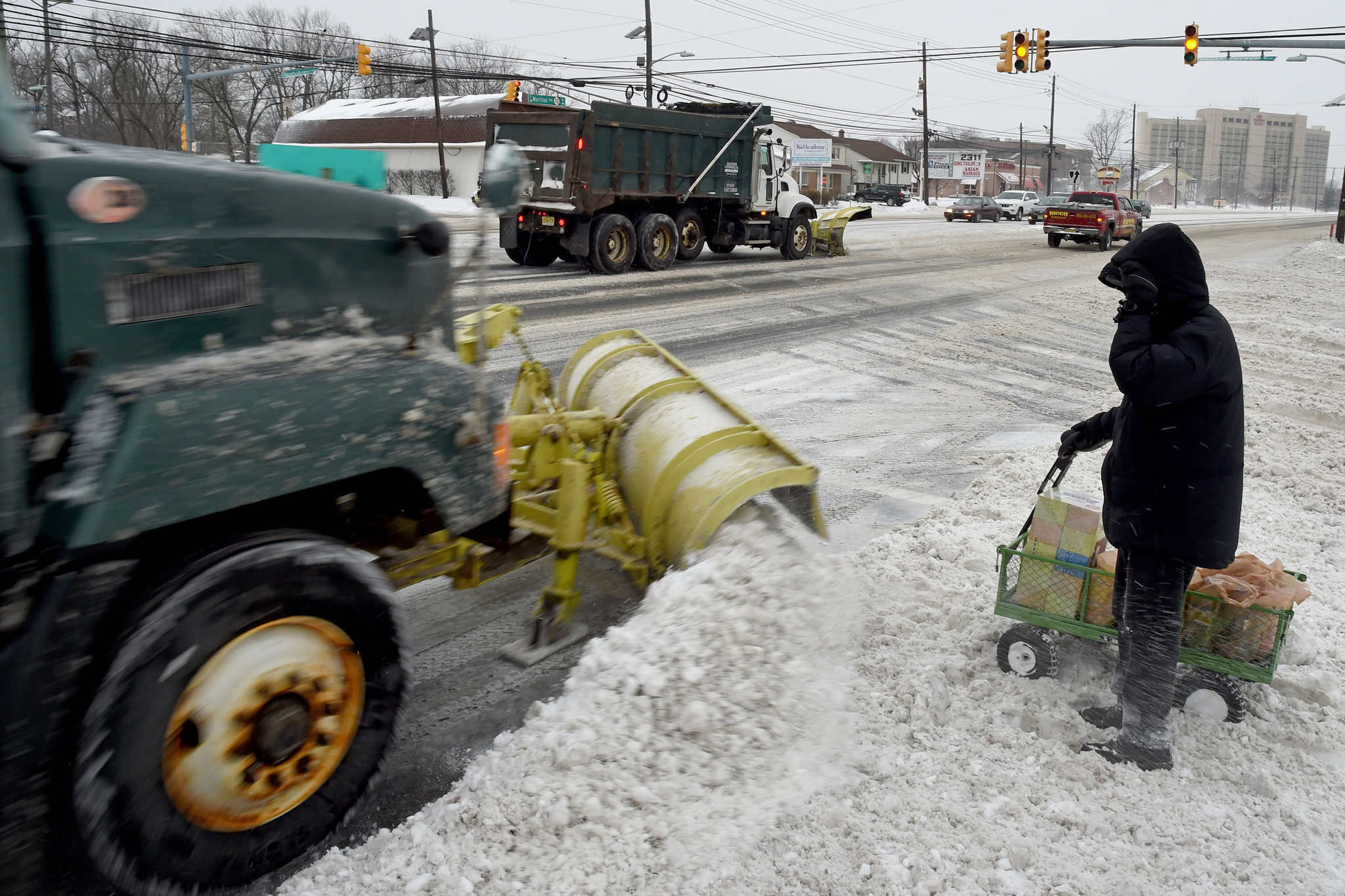
Pedestrians and plows on Rt. 70 in Cherry Hill in Januiary, 2018.
I don’t have an all-weather, sealed camera, so besides dressing as best I can for the conditions (and always having a spare pair of thick, dry wool socks in my car) keeping my camera protected is the biggest priority. I not only need to stave off mechanical/electronic breakdown, but have to keep my lens clear of the elements.
I told him I do have a dedicated rain sleeve but I’ve only used it once or twice at rainy sporting events (they’re priced from $2 each up to $200).
Mostly I use plastic bags or a large umbrellas (watching that I not catch the edges in my frame). I also try to find dry areas to stand in — while watching and photographing others out in the elements. I seek cover under a roof, awning, or doorway. I go into parking garages or subway entrances.
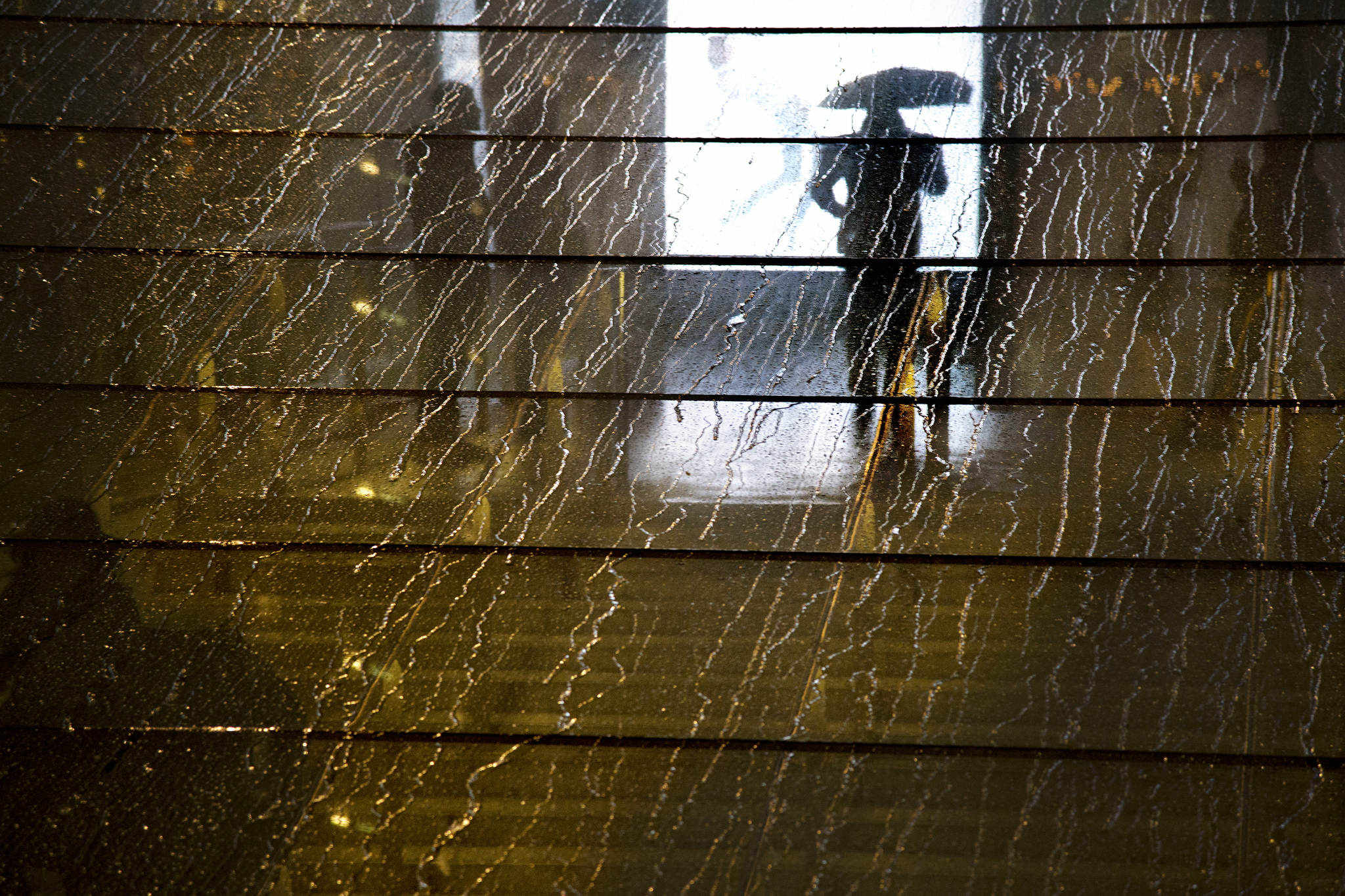
The glass entrance to SEPTA’s underground concourse at Dilworth Park by City Hall.
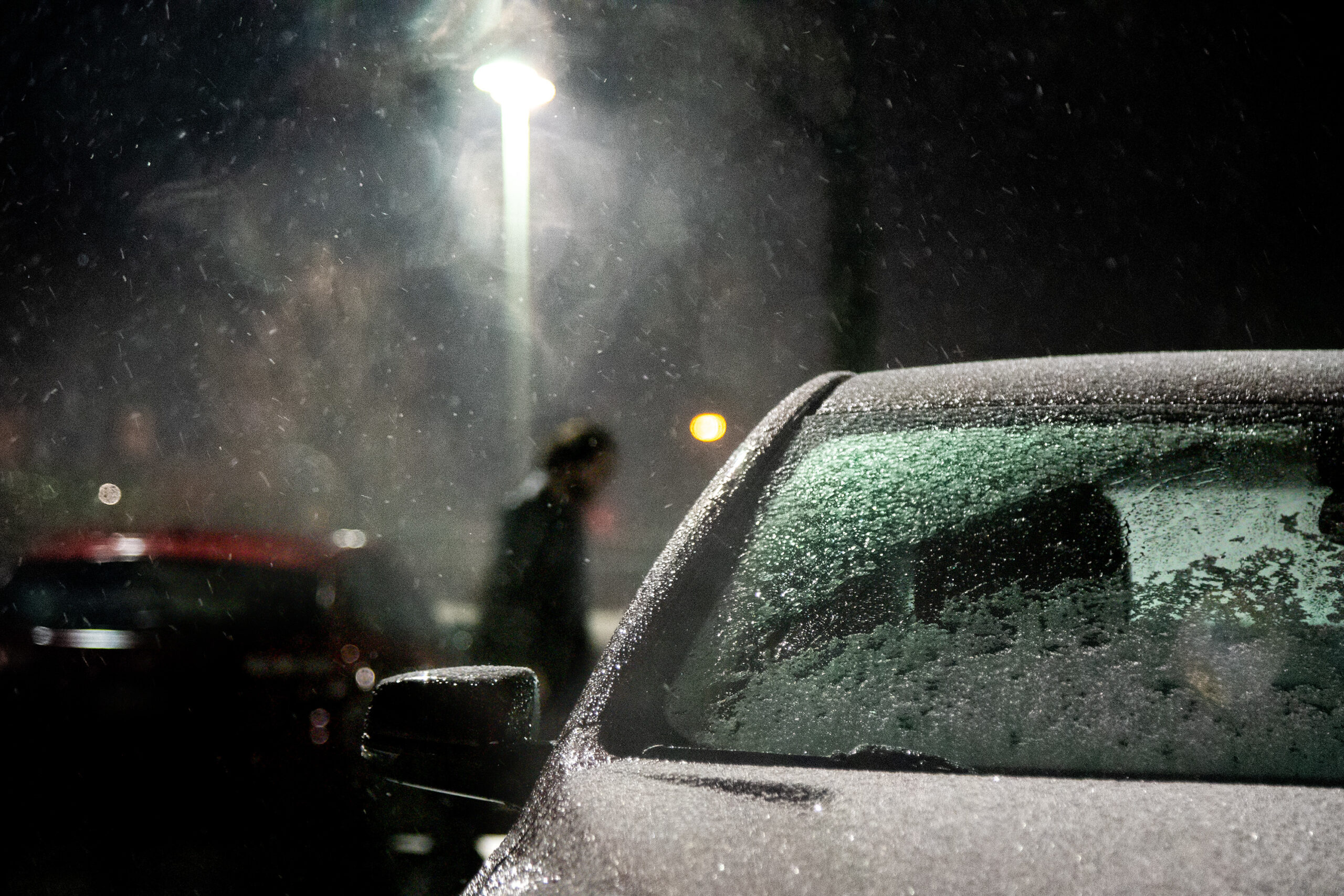
Sometimes I safely park my car where I can briefly open my leeward (downwind!) window. Other times the rain or snow on glass can even be an effective way to portray the “dab” weather. It can be in or out of focus to create a bokeh-like effect or blurred to convey mood. Your choice of a fast shutter or slow shutter can either stop the drops or show their movement.
Precipitation — some snow and some rain — falls on cars in a parking lot on City Avenue.
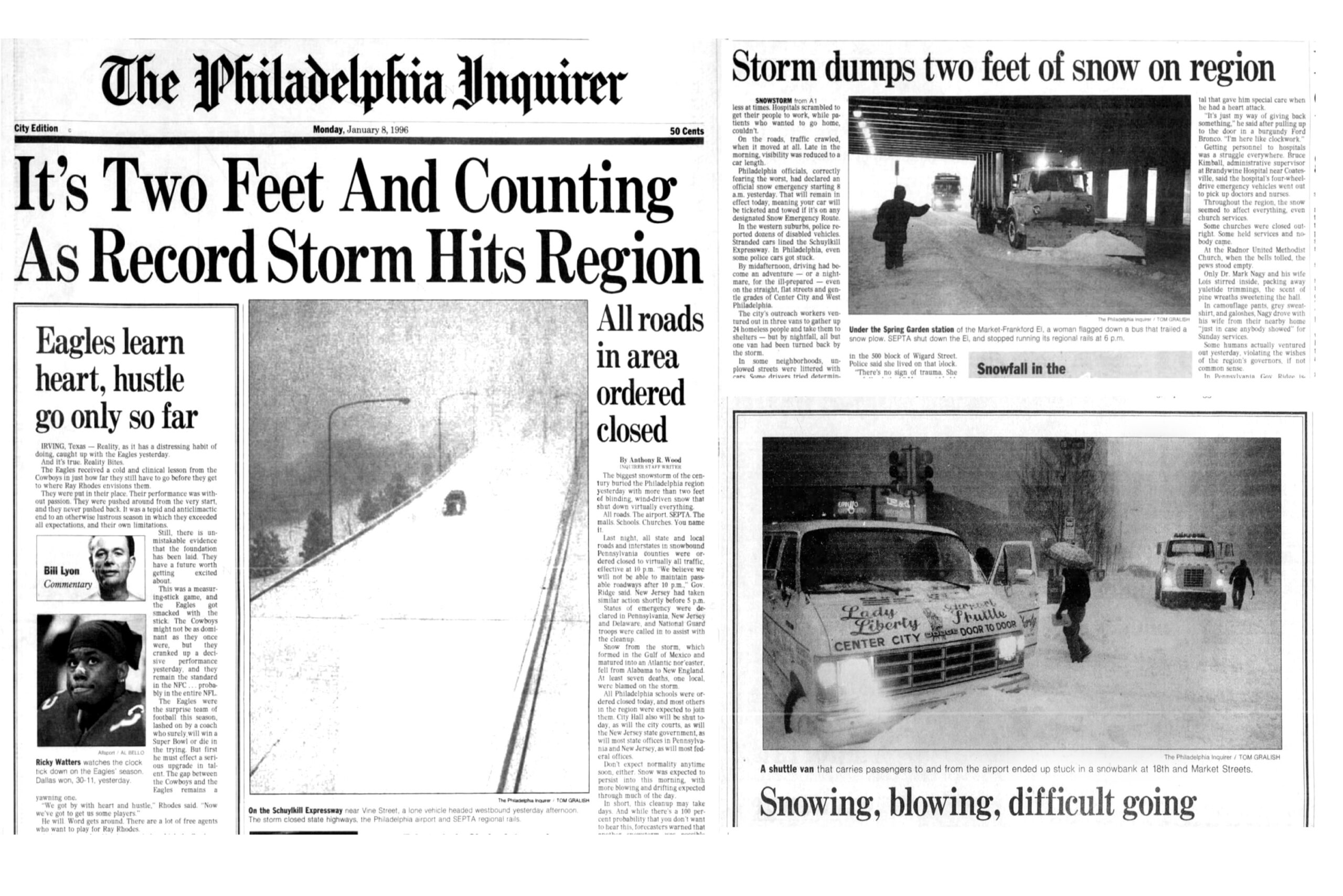
I’ve covered all of the biggest storms of the past few decades, including the historic “Blizzard of the Century” thirty years ago this month.
Front page and inside photos from The Philadelphia Inquirer. January 8, 1996.
So, I took my own advice while preparing to go out last Sunday. Knowing the roads would get worse as the day went on, I drove out of my South Jersey neighborhood while an early pass of the plows left main arteries somewhat passable, and headed straight to the nearest Wawa that I knew would have a clear-ish parking lot.
Stepping out from under the overhang — I made a few photos before walking out into on the wide street to get the few passing cars and plowing crews in a nearby shopping center.
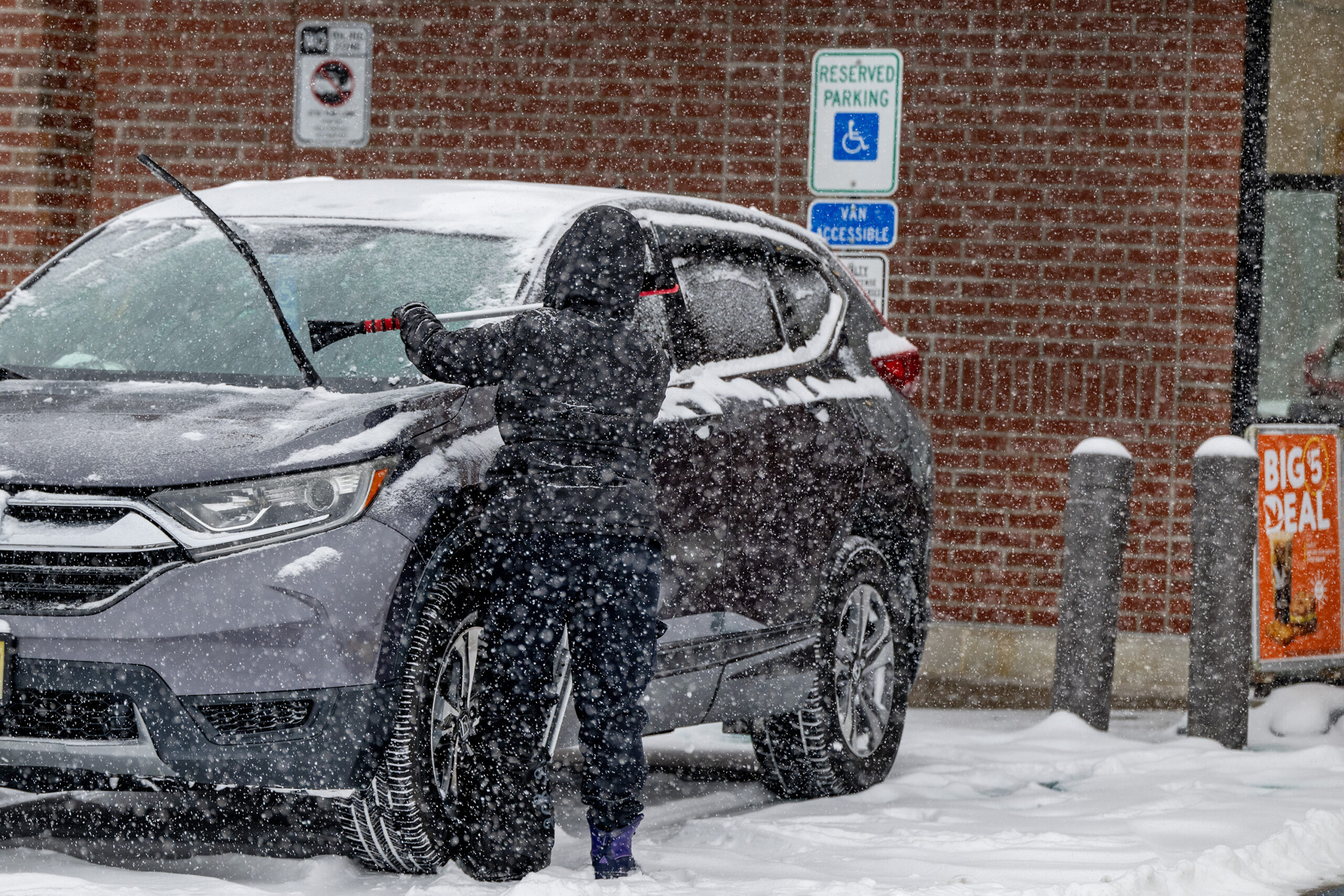
Carmen Roman clears snow off her car at a Cherry Hill Wawa early Sunday morning, Jan. 25, 2026, as heavy snow bands move through the region generating snowfall rates of 1 to 2 inches an hour.
From there, confirming my fears the roads would be more difficult to drive on, I headed the Westmont PATCO station, finding a safe place to park even as workers were hard at it, clearing the lot.
I made photos from the elevated platform before taking a train to Collingswood, where — standing on the leeward side of the stairwell shelter — I took more pictures then walked into downtown.
Haddon Avenue was plowed and relatively empty of cars, but the sidewalks were impassible. I sent in my best photo of people walking along the middle of the downtown street.
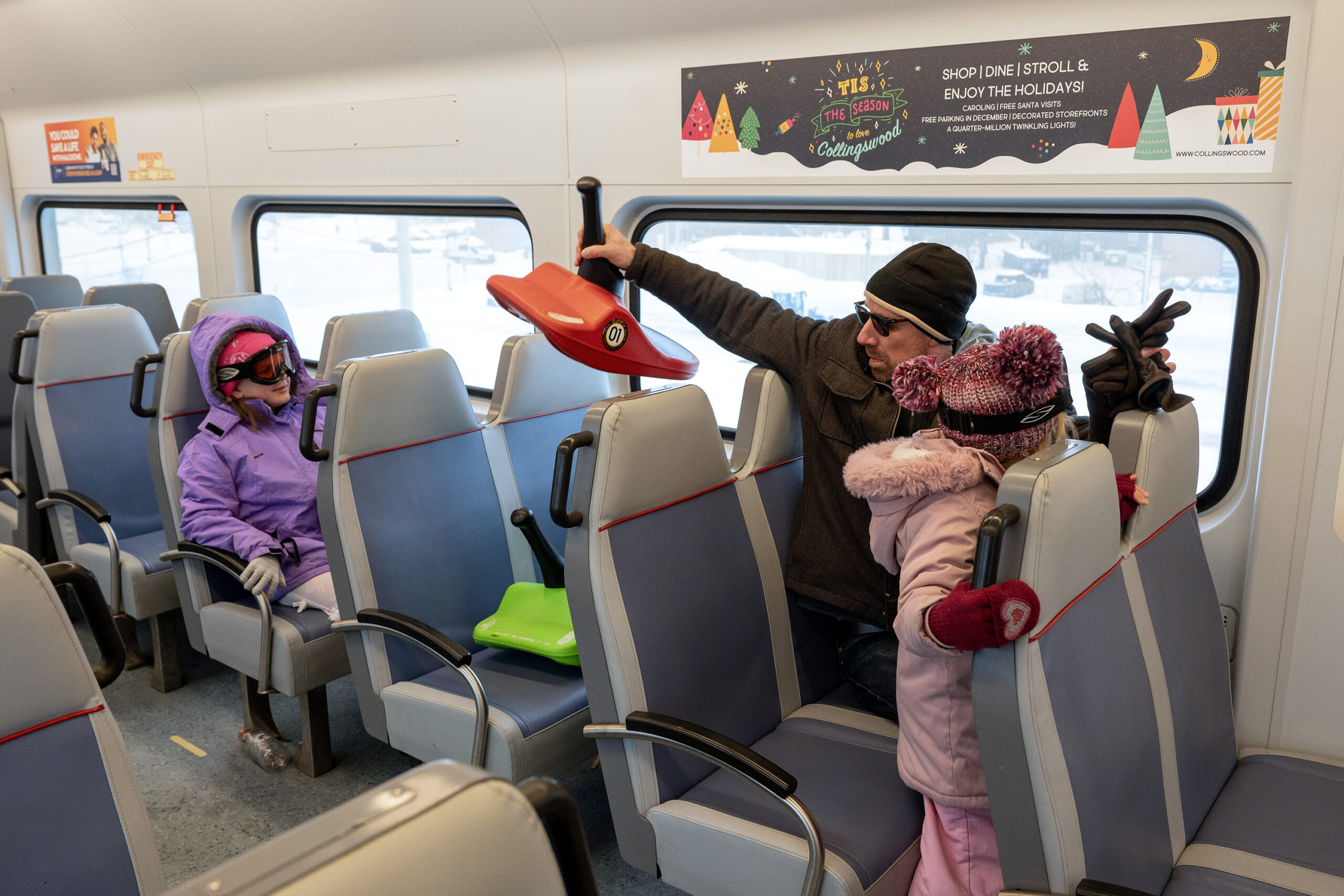
It was then I saw Mike Doveton and his daughters. Not wanting to repeat my earlier image, I asked if they were headed to or from sledding.
They were walking to the PATCO station to sled in Haddonfield, so I tagged along.
On the train headed to sled.
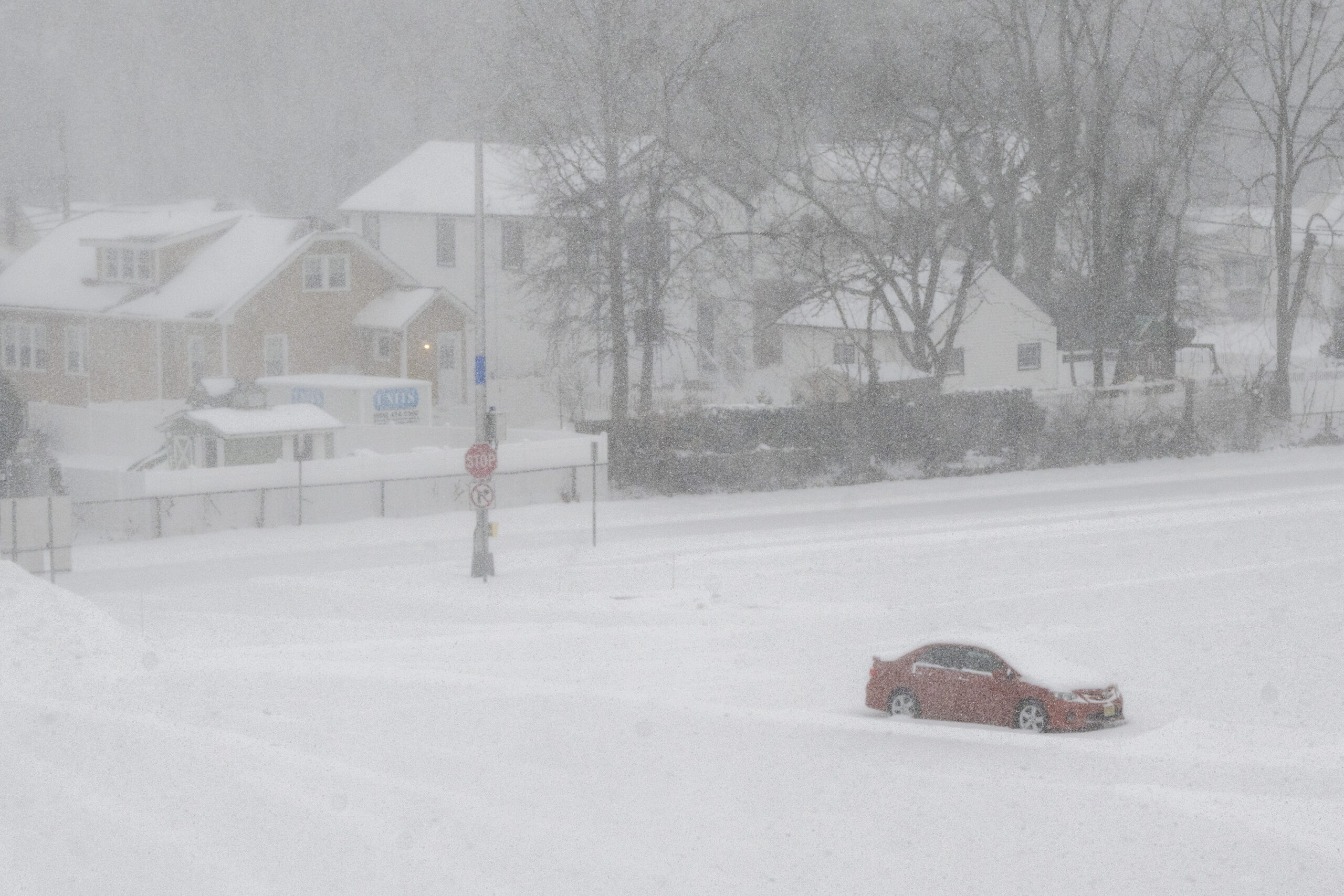
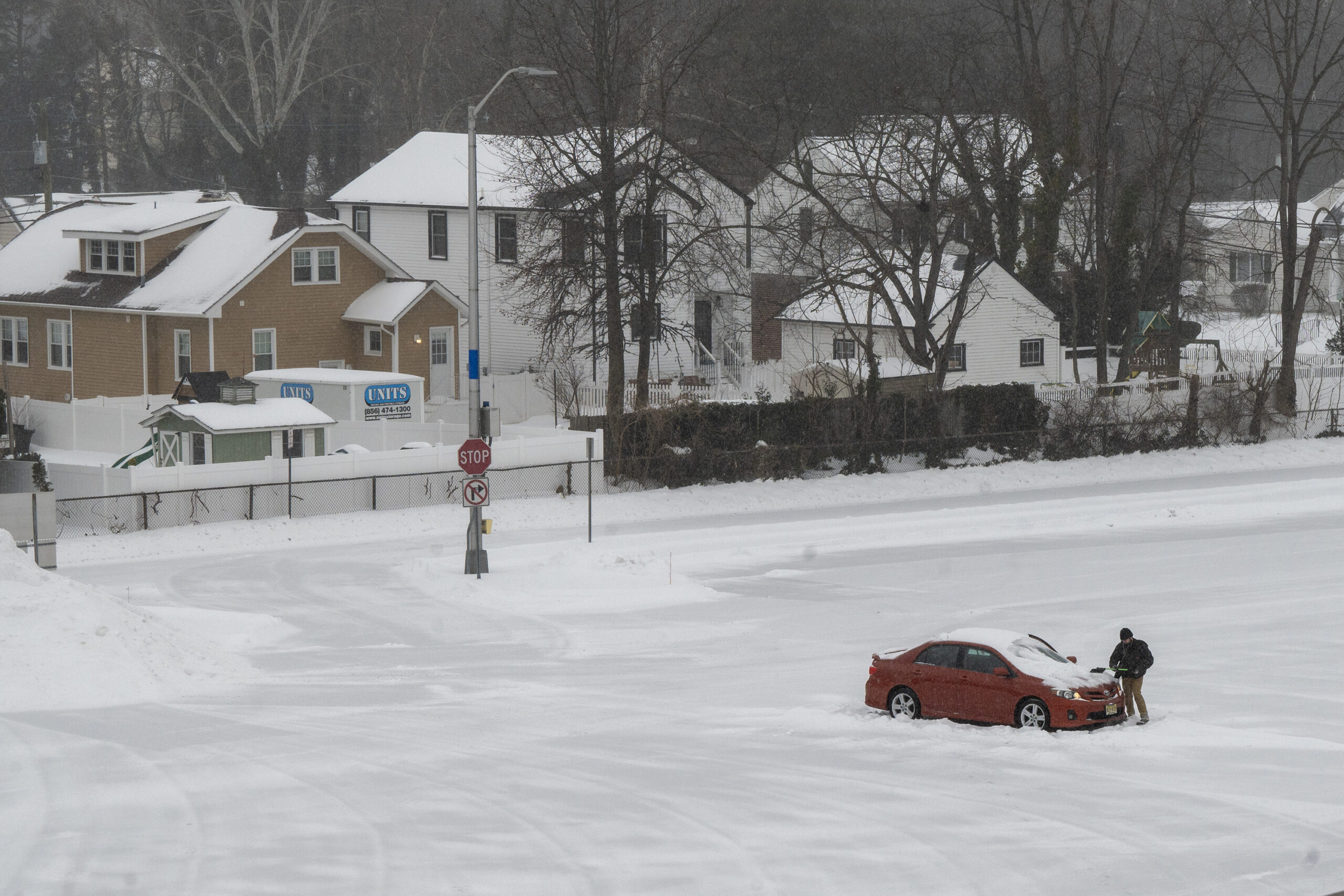
I went with them to their destination, but didn’t want another kids-on-a-hill photo, so I got back on the train returning to the Westmont station, and my car, calling it a day. Until I saw someone digging out their car — the same one I had photographed hours earlier. I got as close as I could to the spot on the platform and made an “after” photo.
Before and after in the Westmont PATCO station parking lot.
Luis Nova had left his car there on Friday, and was in Philadelphia all weekend helping friends move and going to a goodbye party. He spent the morning sledding with friends in Clark Park in West Philadelphia. Like me, he had experience with storms. “I spent four years in Rochester [NY],” he told me. “So I knew what I was signing up for and was ready. I left all my equipment to get myself out.”
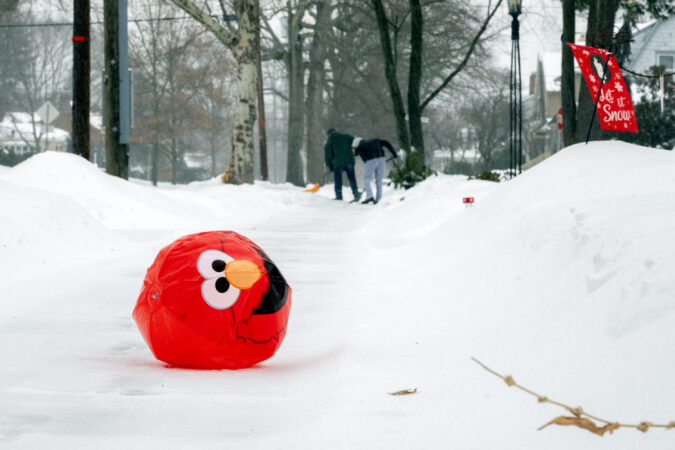
But the highlight of the day was at the very end, as I headed for home as the snow was turning to sleet. Two hours earlier, in the middle of the storm my grandson snapped a photo out our front window of an Elmo head in the middle of the street before the wind blew it away, and shared the picture with our family. As I approached my house, I see a red ball rolling fast down the street toward me. I almost drove into a snow bank laughing.
Not really, but I did pull into the driveway, grab a camera, jump out of my car and go chasing after it. The wind was really moving it, and I couldn’t see where it was, which was hard to imagine, being as the road and everything else was all white. I came up to a couple of guys shoveling and asked, “Did you see an Elmo head come this way?” They had, and said it went up a driveway and jumped onto the sidewalk. I found it and just as I was lining up my photo the wind took it again and it started spinning.
Since 1998 a black-and-white photo has appeared every Monday in staff photographer Tom Gralish’s “Scene Through the Lens” photo column in the print editions of The Inquirer’s local news section. Here are the most recent, in color:
January 26, 2026: The President’s House in Independence National Historical Park hours Jan, 22, after all historical exhibits were removed following President Trump’s Executive Order last March that the content at national parks that “inappropriately disparage” the U.S. be reviewed. The site, a reconstructed “ghost” structure titled “Freedom and Slavery in the Making of a New Nation” (2010), serves as a memorial to the nine people George Washington enslaved there during the founding of America.January 19, 2026: A low-in-the-sky winter sun is behind the triangular pediment of the “front door” of the open-air President’s House installation in Independence National Historical Park. The reconstructed “ghost” structure with partial walls and windows of the Georgian home known in the 18th century as 190 High St. is officially titled, “Freedom and Slavery in the Making of a New Nation” (2010). It is designed to give visitors a sense of the house where the first two presidents of the United States, George Washington and John Adams, served their terms of office. The commemorative site designed by Emanuel Kelly, with Kelly/Maiello Architects, pays homage to nine enslaved people of African descent who were part of the Washington household with videos scripted by Lorene Cary and directed by Louis Massiah. Deepika Iyer holds her niece Ira Samudra aloft in a Rockyesque pose, while her parents photograph their 8 month-old daughter, in front of the famous movie prop at the top of the steps at the Philadelphia Art Museum. Iyer lives in Philadelphia and is hosting a visit by her mother Vijayalakshmi Ramachandran (partially hidden); brother Gautham Ramachandran; and her sister-in-law Janani Gautham who all live in Bangalore, India.January 5, 2026: Parade marshals trail behind the musicians of the Greater Kensington String Band heading to their #9 position start in the Mummers Parade. Spray paint by comic wenches earlier in the day left “Oh, Dem Golden Slippers” shadows on the pavement of Market Street. This year marked the 125th anniversary of Philly’s iconic New Year’s Day celebration.Dec. 29, 2025: Canada geese at sunrise in Evans Pond in Haddonfield, during the week of the Winter Solstice for the Northern Hemisphere. December 22, 2025: SEPTA trolley operator Victoria Daniels approaches the end of the Center City Tunnel, heading toward the 40th Street trolley portal after a tour to update the news media on overhead wire repairs in the closed tunnel due to unexpected issues from new slider parts.December 15, 2025: A historical interpreter waits at the parking garage elevators headed not to a December crossing of the Delaware River, but an event at the National Constitution Center. General George Washington was on his way to an unveiling of the U.S. Mint’s new 2026 coins for the Semiquincentennial, December 8, 2025: The Benjamin Franklin Bridge and pedestrians on the Delaware River Trail are reflected in mirrored spheres of the “Weaver’s Knot: Sheet Bend” public artwork on Columbus Boulevard. The site-specific stainless steel piece located between the Cherry Street and Race Street Piers was commissioned by the City’s Public Art Office and the Delaware River Waterfront Corporation and created and installed in 2022 by the design and fabrication group Ball-Nogues Studio. The name recalls a history that dominated the region for hundreds of years. “Weaver’s knot” derives from use in textile mills and the “Sheet bend” or “sheet knot” was used on sailing vessels for bending ropes to sails. November 29, 2025: t’s ginkgo time in our region again when the distinctive fan-shaped leaves turn yellow and then, on one day, lose all their leaves at the same time laying a carpet on city streets and sidewalks. A squirrel leaps over leaves in the 18th Century Garden in Independence National Historical Park Nov. 25, 2025. The ginkgo (Ginkgo biloba) is considered a living fossil as it’s the only surviving species of a group of trees that existed before dinosaurs. Genetically, it has remained unchanged over the past 200 million years. William Hamilton, owner the Woodlands in SW Phila (no relation to Alexander Hamilton) brought the first ginkgo trees to North America in 1785.November 24, 2025: The old waiting room at 30th Street Station that most people only pass through on their way to the restrooms has been spiffed up with benches – and a Christmas tree. It was placed there this year in front of the 30-foot frieze, “The Spirit of Transportation” while the lobby of Amtrak’s $550 million station restoration is underway. The 1895 relief sculpture by Karl Bitter was originally hung in the Broad Street Station by City Hall, but was moved in 1933. It depicts travel from ancient to modern and even futuristic times. November 17, 2025: Students on a field trip from the Christian Academy in Brookhaven, Delaware County, pose for a group photo in front of the Liberty Bell in Independence National Historical Park on Thursday. The trip was planned weeks earlier, before they knew it would be on the day park buildings were reopening after the government shutdown ended. “We got so lucky,” a teacher said. Then corrected herself. “It’s because we prayed for it.” November 8, 2025: Multitasking during the Festival de Día de Muertos – Day of the Dead – in South Philadelphia.November 1, 2025: Marcy Boroff is at City Hall dressed as a Coke can, along with preschoolers and their caregivers, in support of former Mayor Jim Kenney’s 2017 tax on sweetened beverages. City Council is considering repealing the tax, which funds the city’s pre-K programs. October 25, 2025: Austin Gabauer, paint and production assistant at the Johnson Atelier, in Hamilton Twp, N.J. as the finished “O” letter awaits the return to Philadelphia. The “Y” part of the OY/YO sculpture is inside the painting booth. The well-known sculpture outside the Weitzman National Museum of American Jewish History was removed in May while construction continues on Market Street and has been undergoing refurbishment at the Atelier at the Grounds for Sculpture outside of Trenton.
The resistance was born on a Friday morning at the Gen. George A. McCall School photocopy machine.
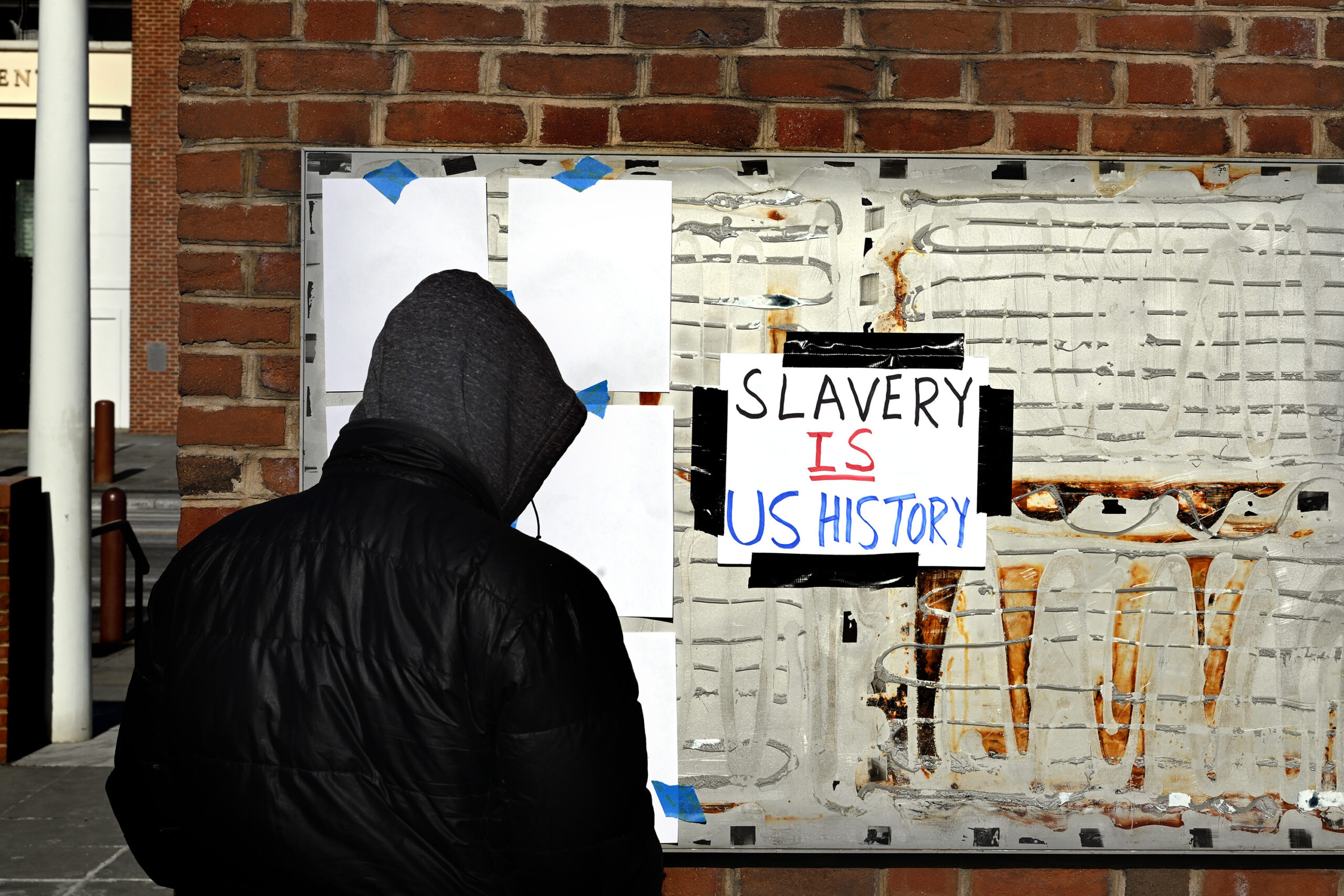
The copier spat the message out on yellow, purple, and orange paper — page after page amplifying the same sentiment scrawled on each in big black letters: Learn all history.
In the aftermath of the removal of the slavery exhibit at the President’s House Site on Jan. 22, fourth-grade social studies teacher Kaity Berlin wanted to convert her rage into something productive, she said. She quickly thought of the words on one of her shirts: “Teach all history.” So she gathered some teacher friends, took to the photocopier, and headed to Independence National Historical Park.
Berlin wasn’t the only one who saw the shallow silver frames at the President’s House as a void screaming to be filled.
The city asked a federal justice to order that no more exhibits be removed from the President’s House and that the exhibits that were already removed be kept safe. In a hearing Friday, judge Cynthia M. Rufe didn’t issue a ruling but asked the Trump administration attorney that the exhibits remain untouched so she can review them Monday.
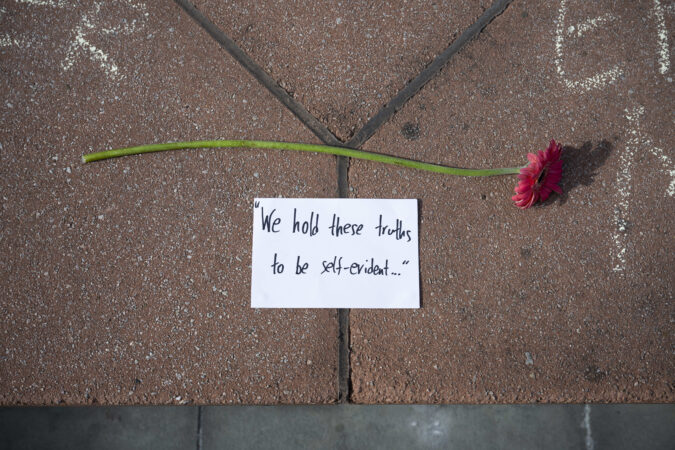
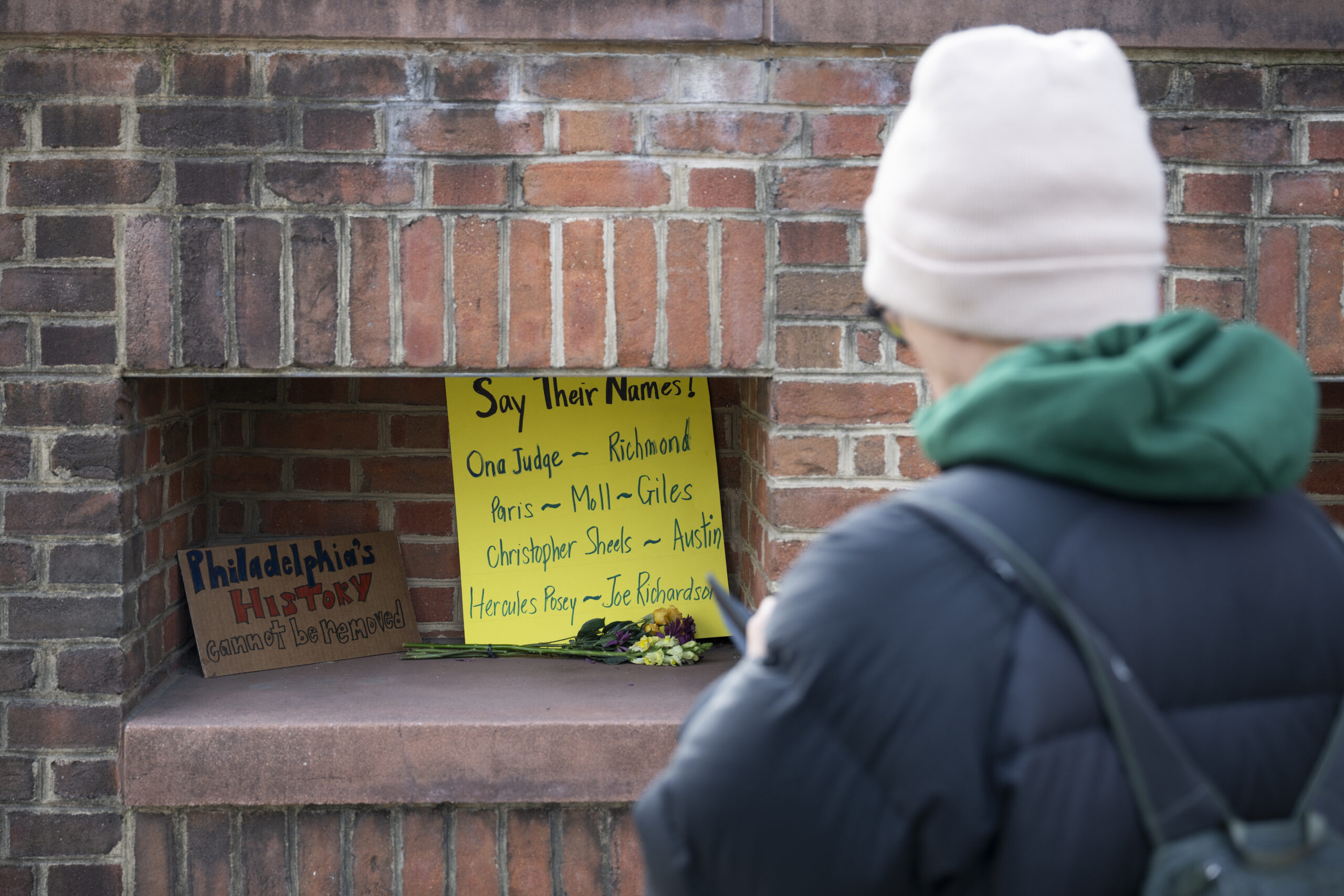
Over that first weekend colorful signs populated the walls, reenactors donned historic garb and positioned themselves along the red brick pillars with a flourish, some people held giant replica signs of the ones that were removed, and others laid flowers delicately across the facility.
To Berlin, whose school is a few blocks from the President’s House, posting the colorful signs was just a quick action she could take in her 45-minute prep period.
“It was just a cathartic way to be like ‘Ugh, this sucks,’” Berlin said.
But it soon became the first of numerous forms of activism and art that filled the space as more and more Philly-area residents yearned for a similar way to express their opposition to the removal of the plaques.
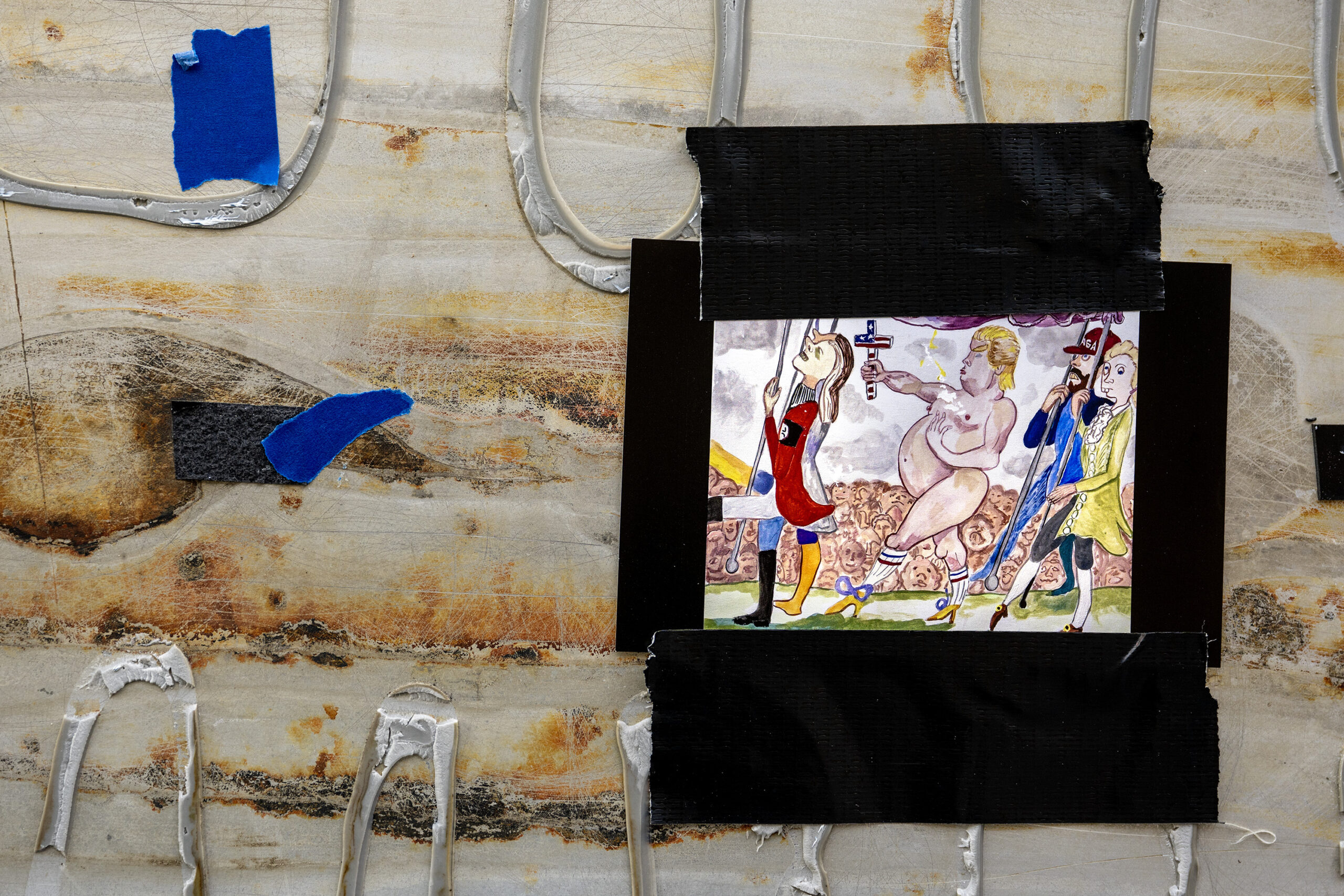
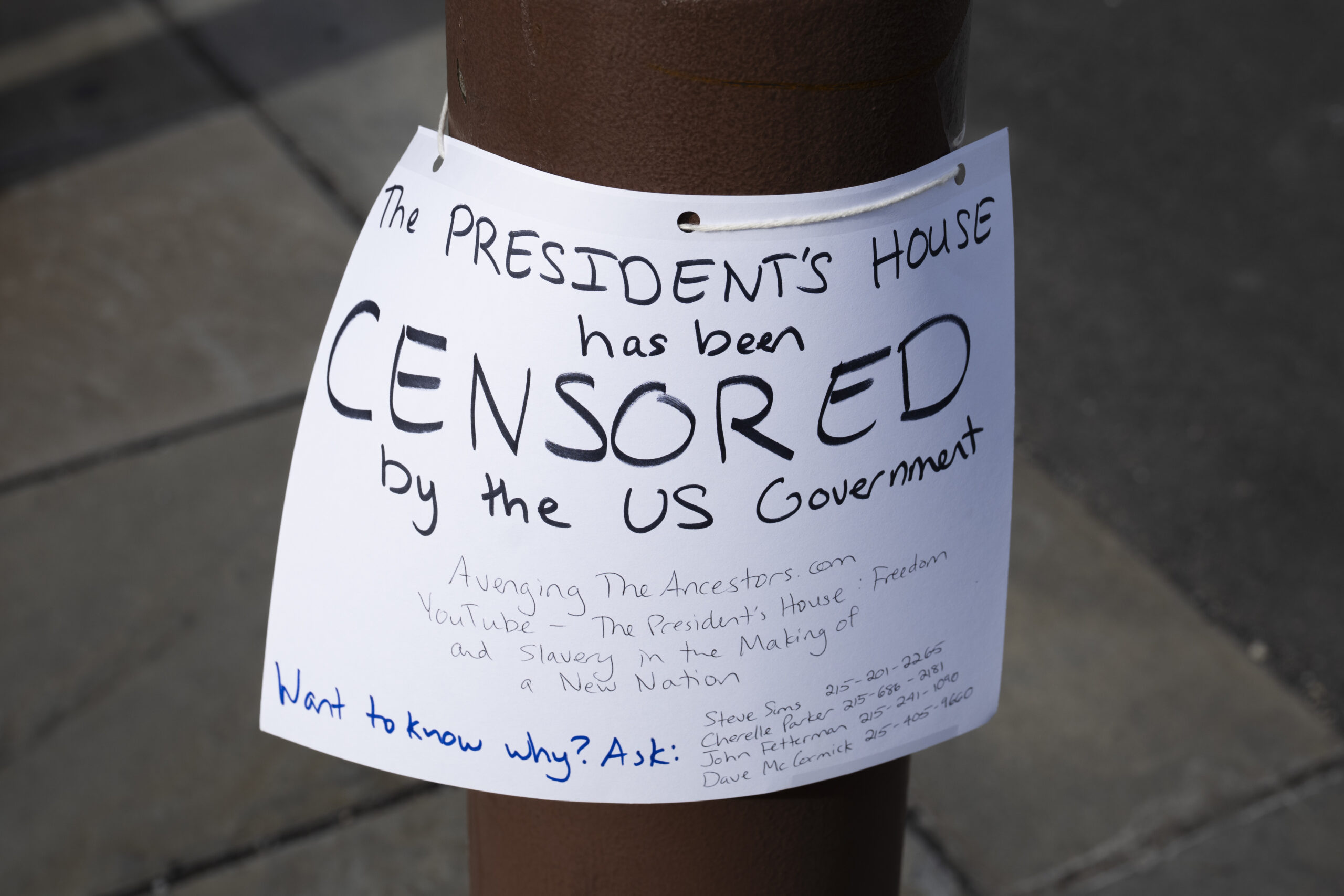
Media ranged from cardboard to poster board. Tools included Sharpies and pens. Many of the more informal signs were affixed with painter’s tape to nooks in the brick structure and empty metallic shells where the original signs hung. Some more official-looking signs included QR codes and printed messages balanced on easels. Others were replicas of the signs that were there made with assistance from professional printing services.
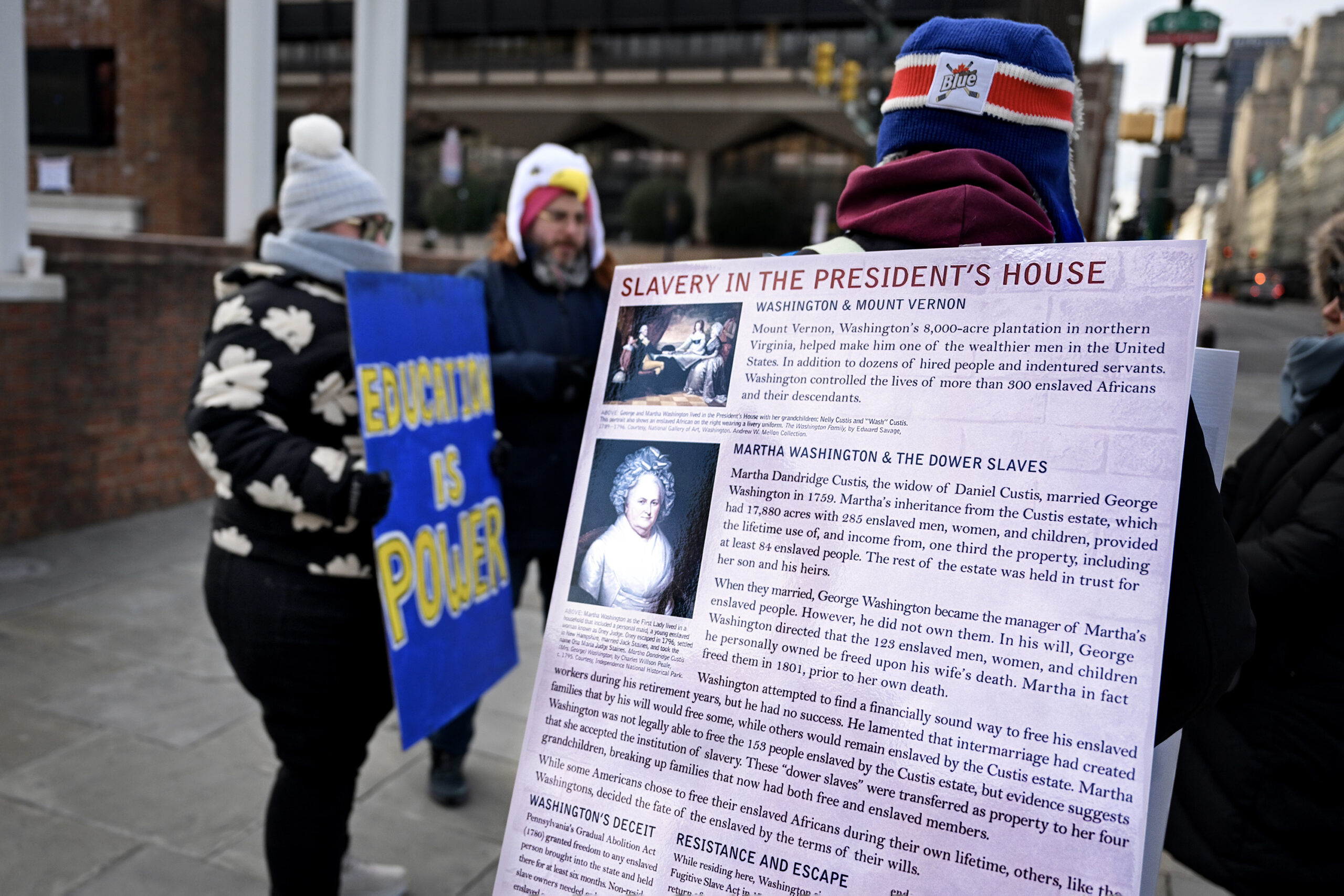
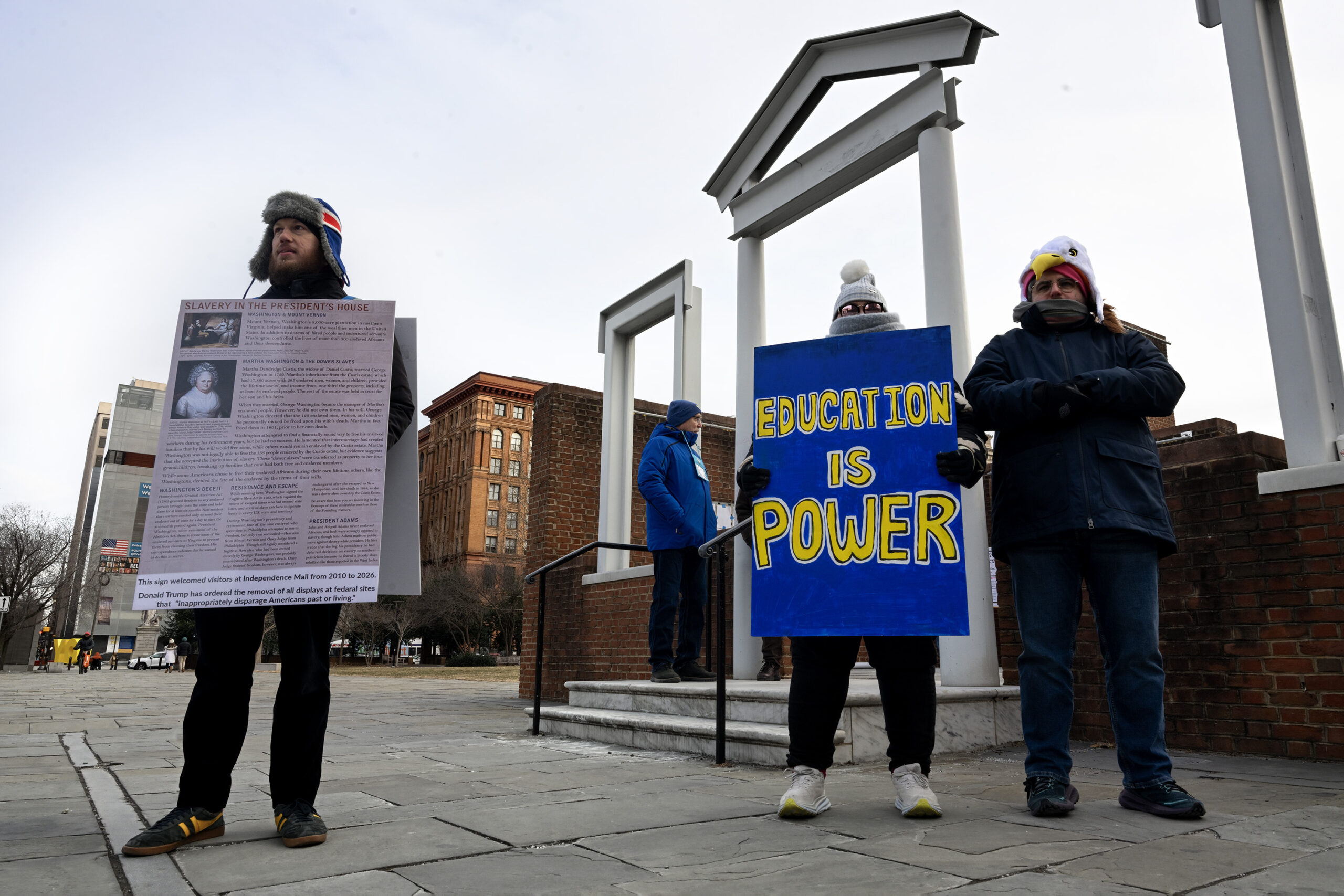
Ted Zellers, a property manager in North Philly, took a more full-body approach to his protest. He found a high-resolution image online of one of the removed signs, titled “Slavery in the President’s House,” got it printed twice, fashioned a sandwich board out of the posters, and became “a living sign,” he said.
It was an educational tool he could wield, but it doubled as a warning.
“I hope people will think about what other information is under threat of being disappeared,” Zellers said.
He expected to be the only person in the park with a sign, but was heartened to see a few dozen others there withstanding the 17-degree air interspersed with sharp winds slicing through the open air exhibit.
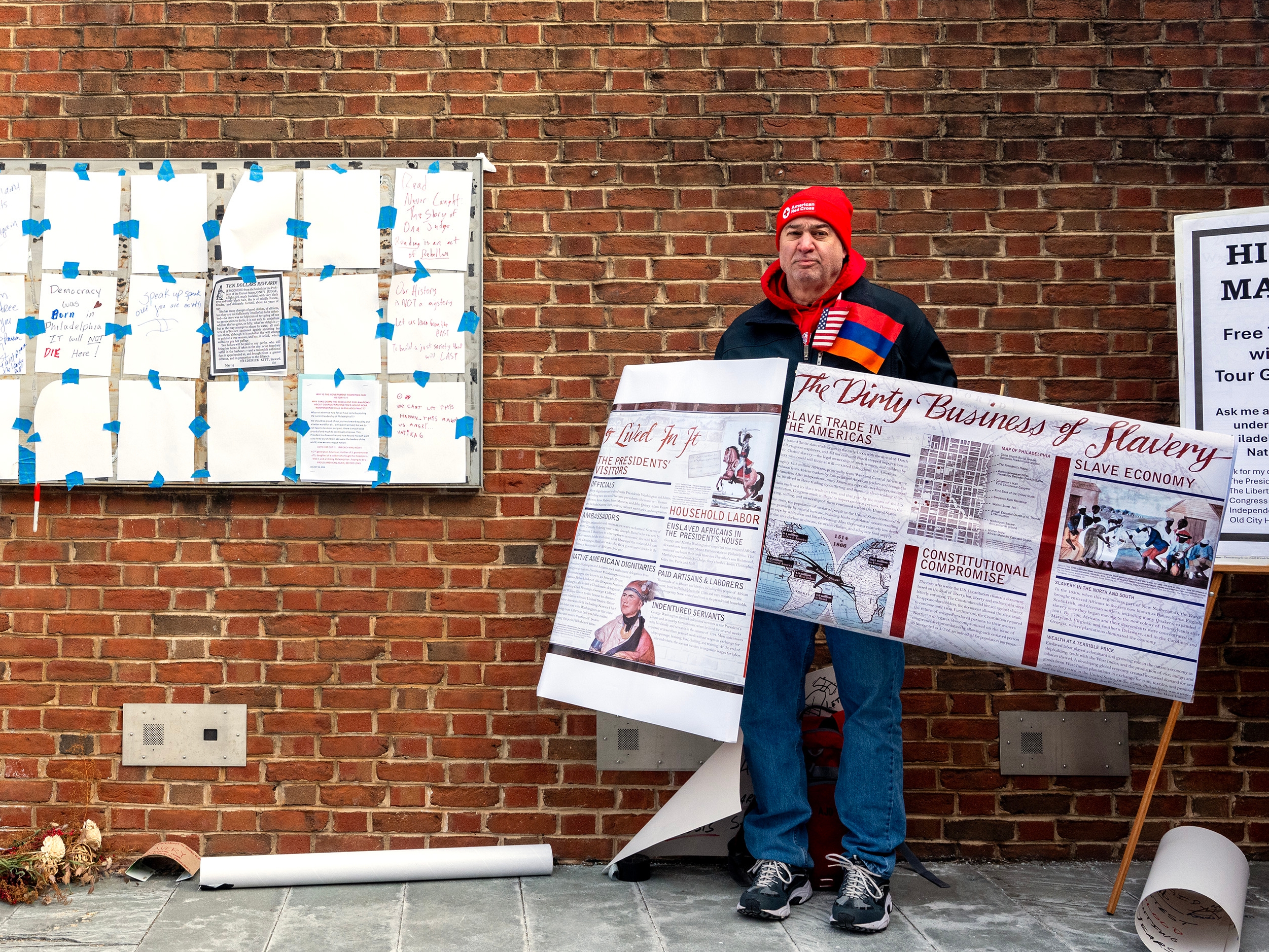
Albert DerMovsesian from Willow Grove, who came to the site equipped with one vertical sign detailing the labor that took place in the house and a horizontal one titled “The Dirty Business of Slavery,” found himself similarly pleased to see so many like-minded others around him.
In the park he saw little kids writing on pieces of paper pasted to the walls, a woman leaving a sign with the names of those enslaved at the site, and people adorning the structure with flowers.
“It reminded me that I wasn’t alone,” DerMovsesian said.
“We don’t need 350 million Malcolm X’s to make the country better,” Zellers said. “We just need a lot of regular people who recognize that they’re part of networks and who can take some action and amplify what’s going on, pass it onm and get other people engaged.”
The collage of images developed organically, but hearkened back to a long lineage of protest art that has become increasingly prevalent under the Trump administration, said Nicolo Gentile, an artist and adjunct faculty member at Temple University’s Tyler School of Art and Architecture.
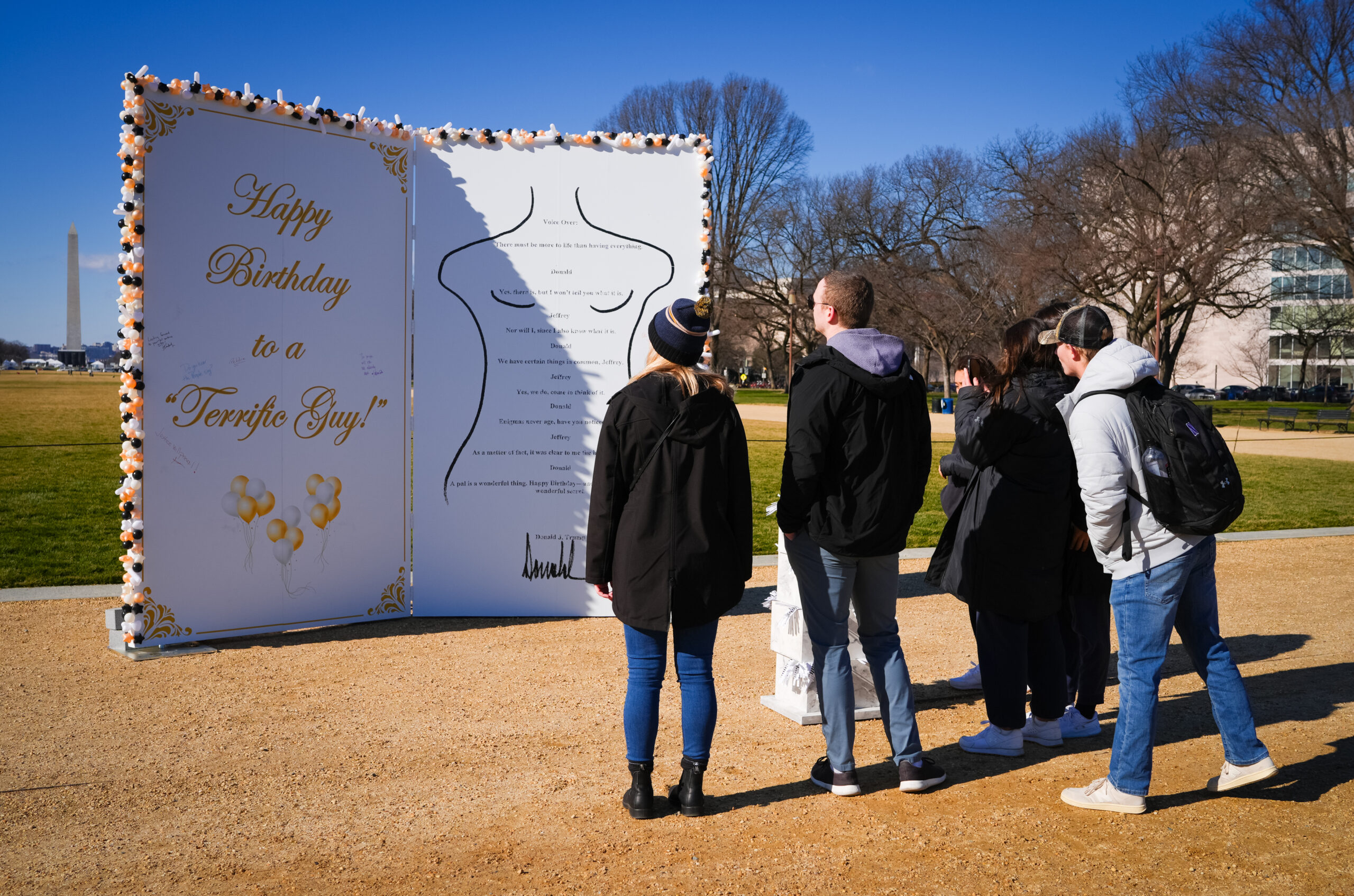
A new protest art installation referencing the Epstein files and President Donald Trump was installed on Third Street SW along the National Mall.
The assortment of papers reading “learn all history” gets its power from the relative anonymity of its author, Gentile said, as well as its use of repetition.
“It starts to create a texture of sound of a greater voice the way that the many voices of a chant during protest does,” he said.
While Berlin said she doesn’t see herself as an artist, she appreciates the punch of a stark and direct message through signage and art.
“I do love the impact of a good simple piece,” she said.
In some cases, political art can be used to “accelerate progress,” Gentile said, but sometimes its best use is halting regression and “to wedge our foot in the door as progress may seem to be closing.”
“This work seems to be the foot in the door,” he said.
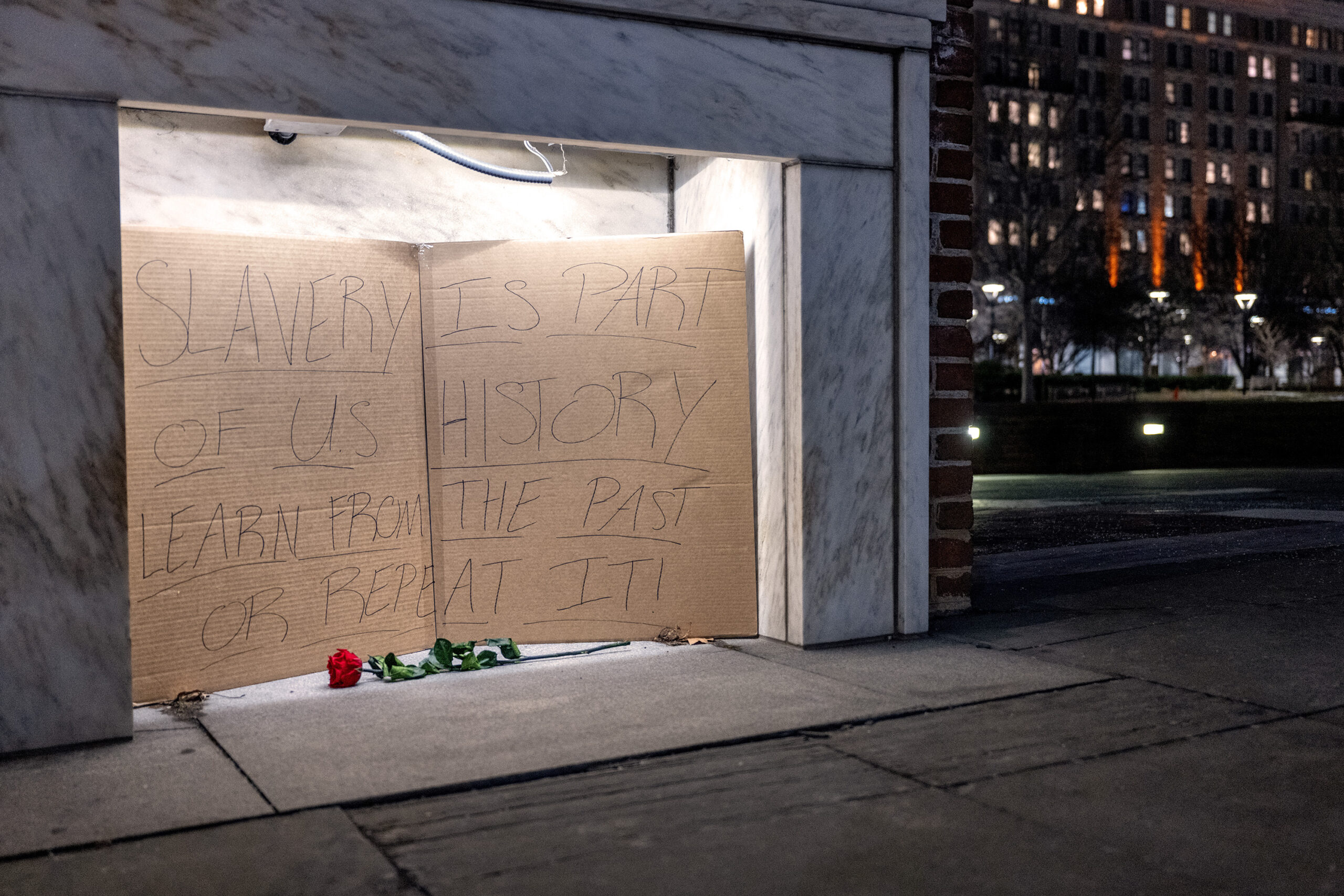
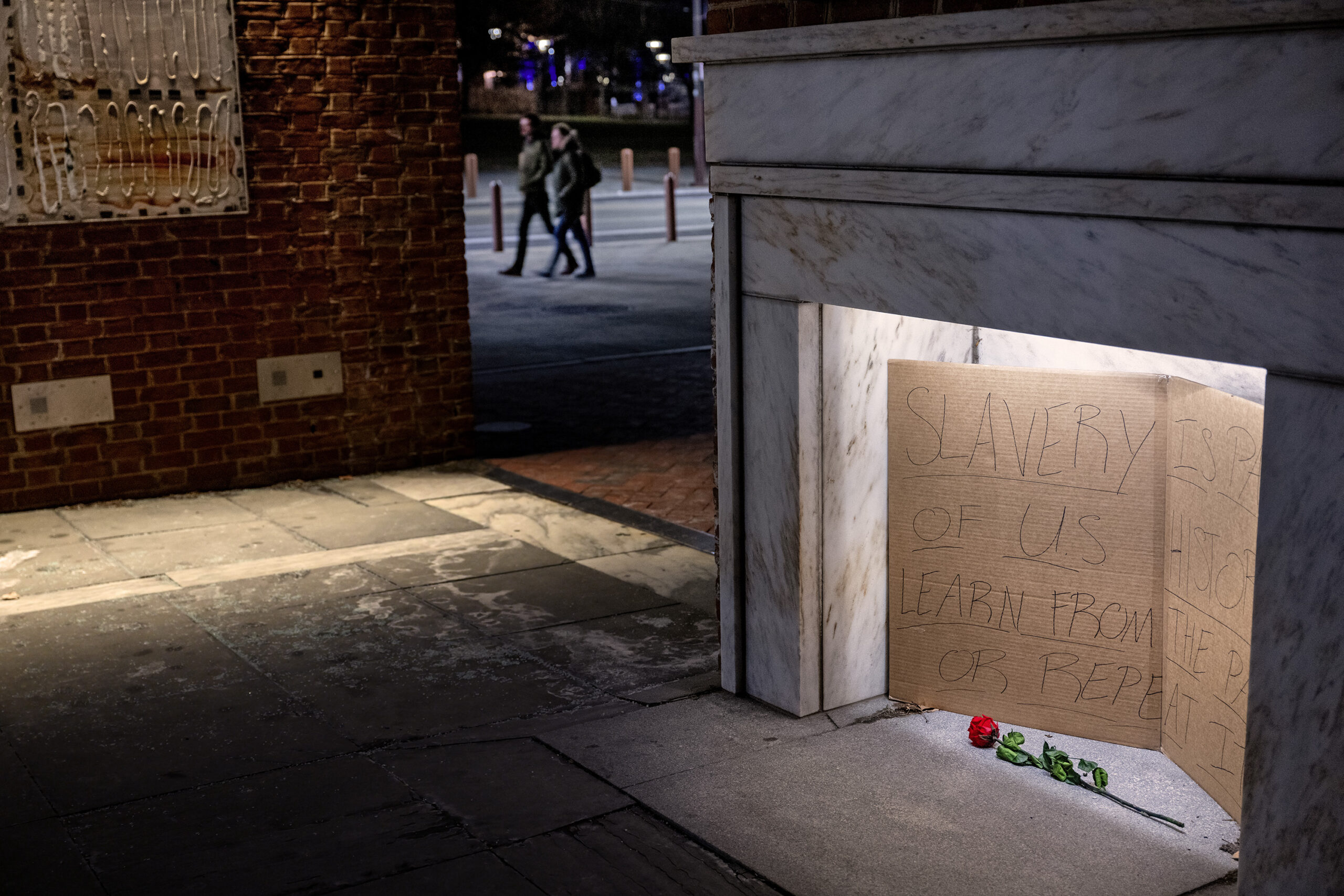
People leave notes on the spaces at the President’s House site in Independence National Historical Park.Ted Zellers (right) wears a sandwich board with a replica of one of the removed slavery panels as people visit and protest at the President’s House site.Ted Zellers (left) wears a sandwich board with a replica of one of the removed slavery panels, joining Jenna and Gregory May (right) protesting at the President’s House. People leave notes and political satire cartoons in the spaces at the President’s House.People protest at the President’s House site.Al DerMovsesian holds replicas of some of the removed slavery panels as people visit the President’s House site.The President’s House in Independence National Historical Park.The President’s House in Independence National Historical Park.Michael Carver portrays Mordecai Sheftall as part of a “History Matters” guide at The President’s House.A sign was placed at the President’s House.A group of teacher taped posters along the now barren brick walls of the President’s House.A single rose and a handwritten cardboard sign (“Slavery is part of U.S. history learn from the past or repeat it”) are inside an empty hearth at the President’s House.
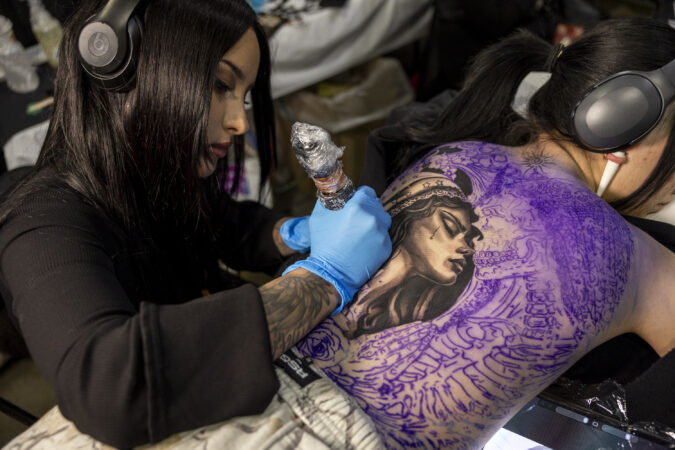
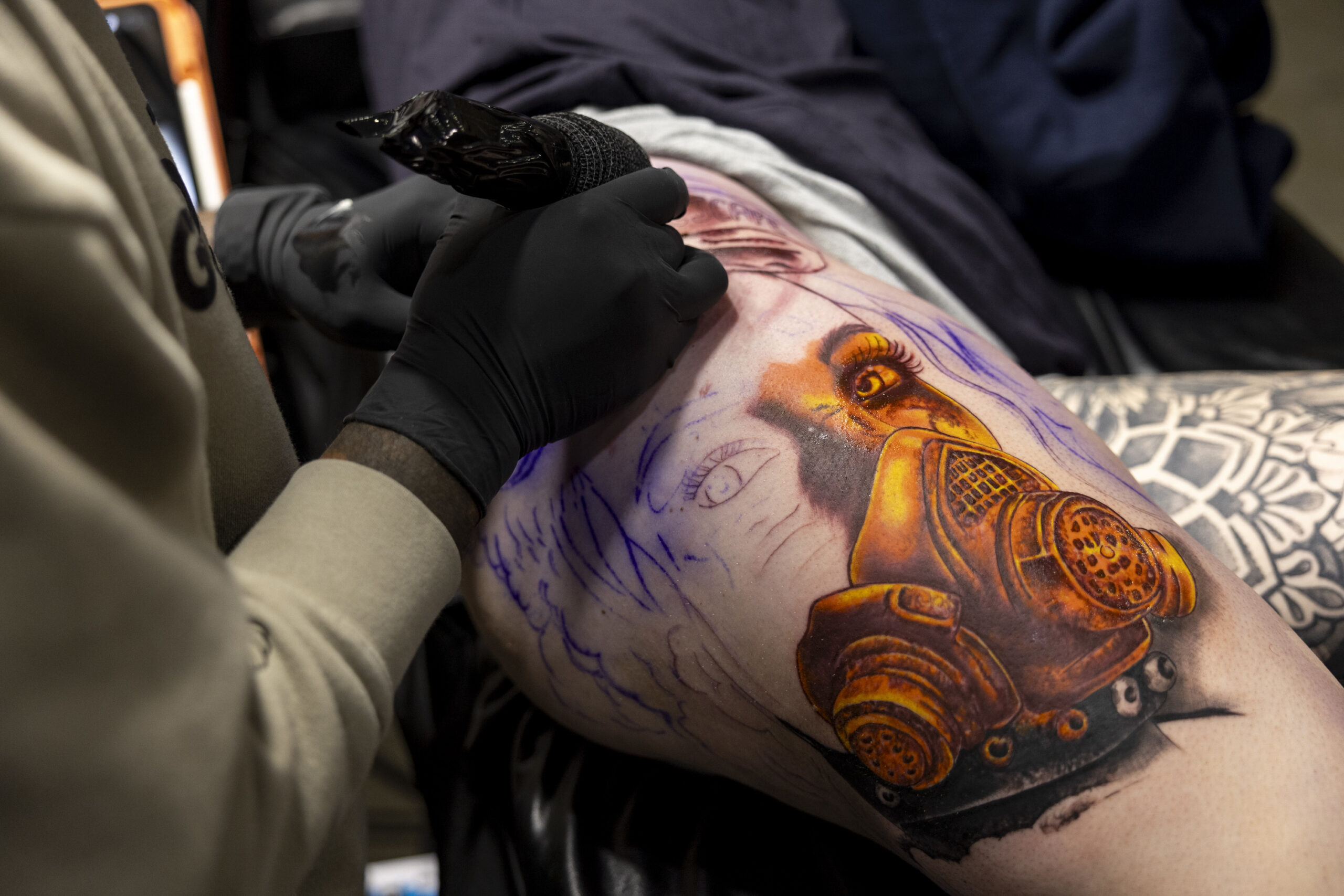
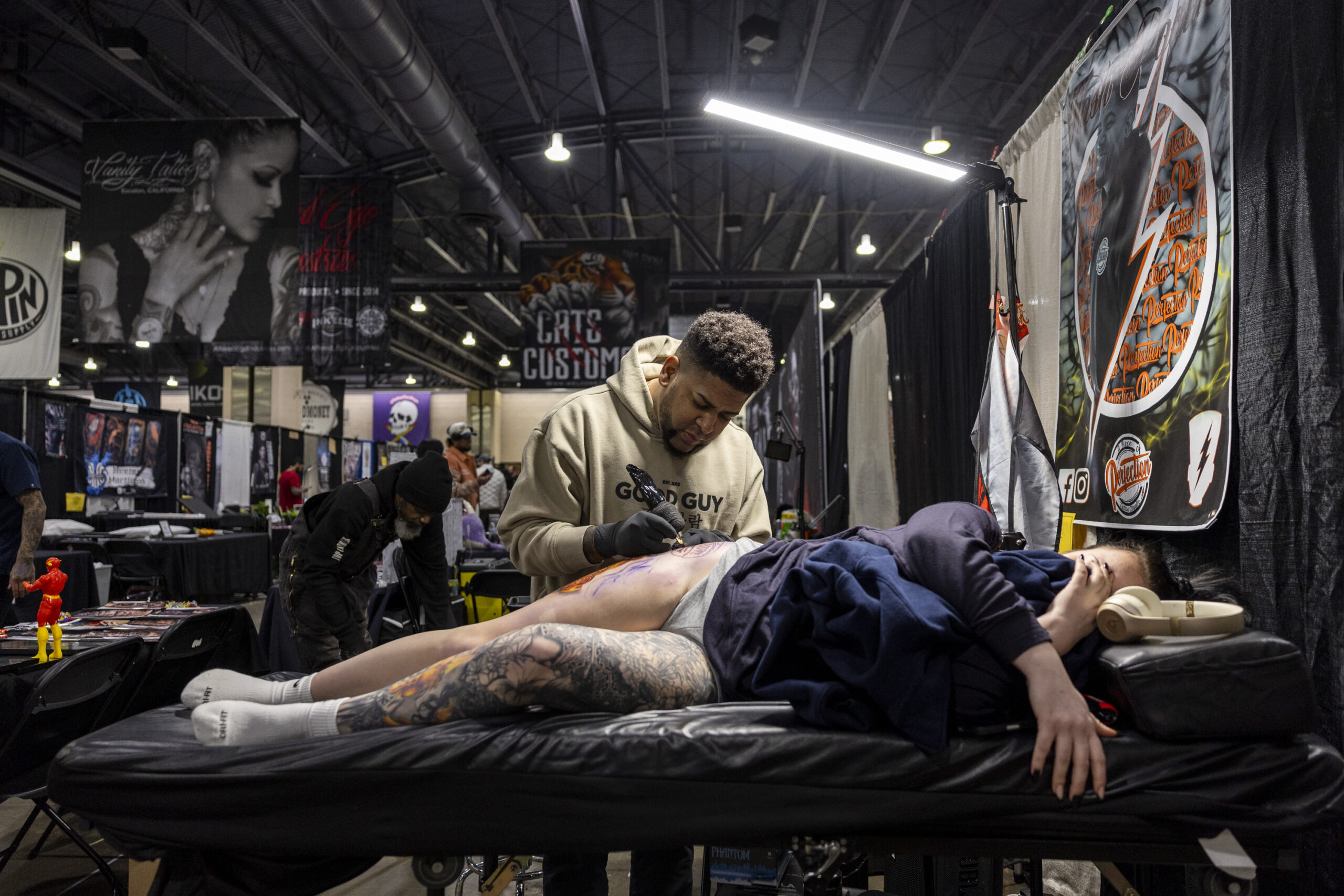
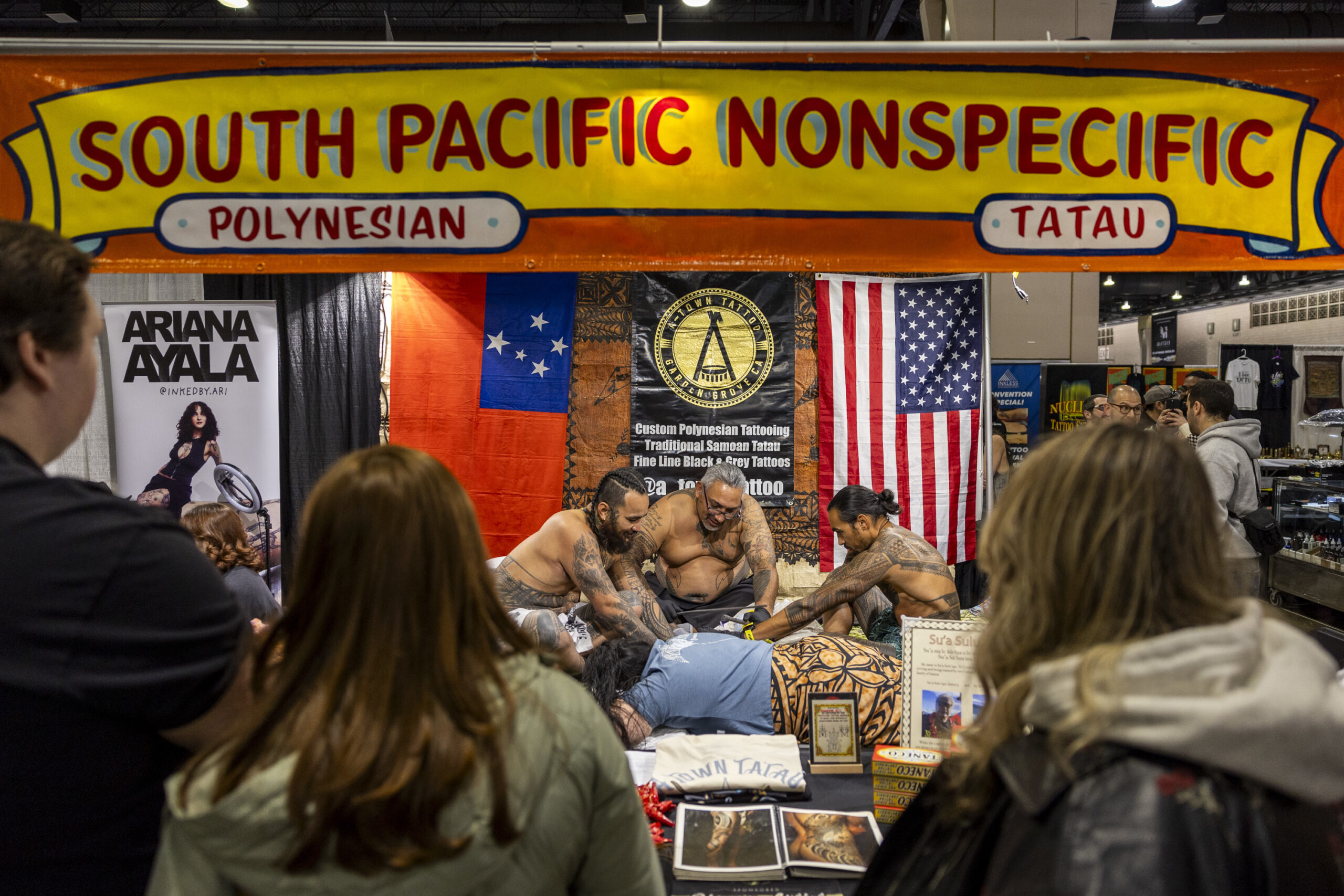
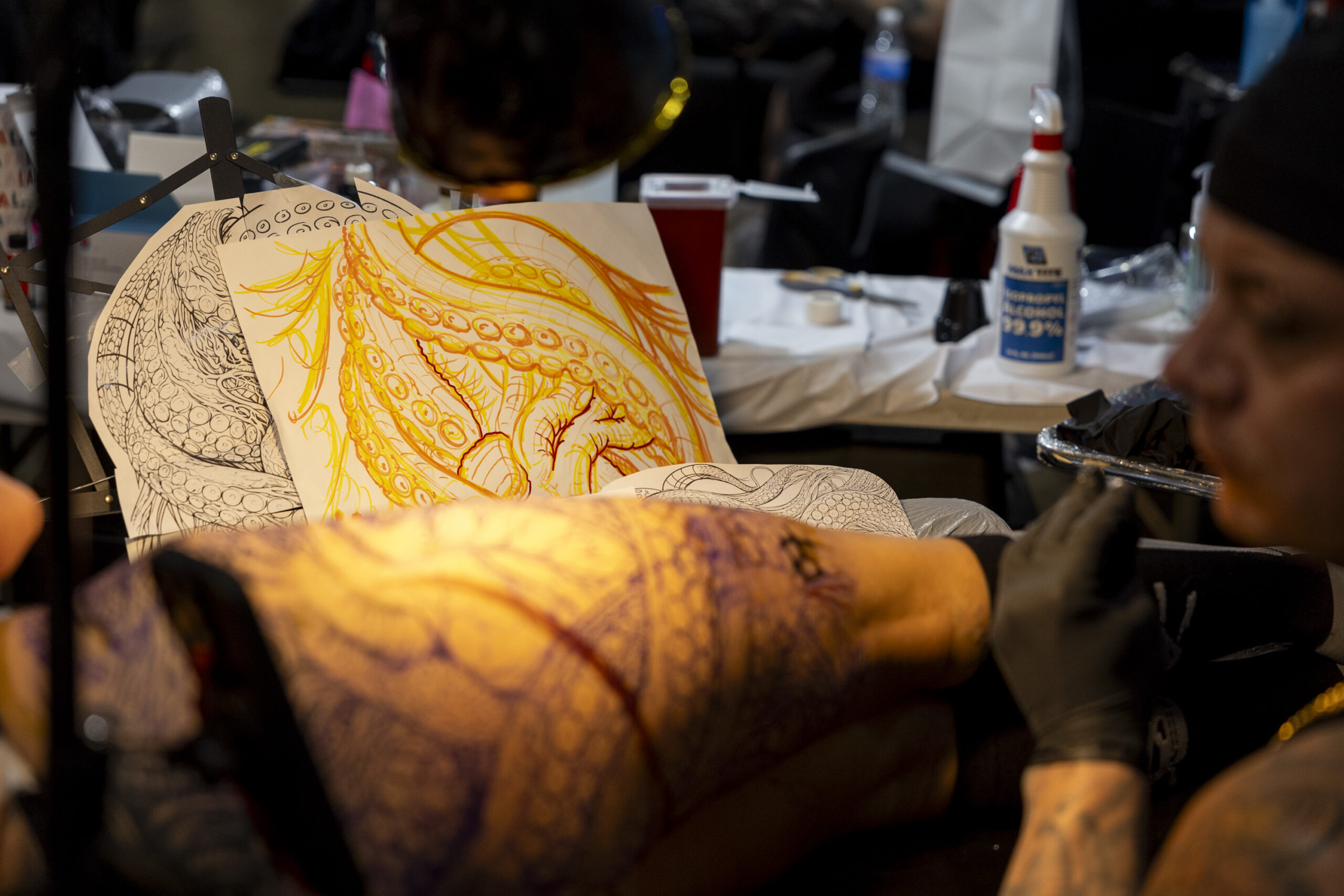
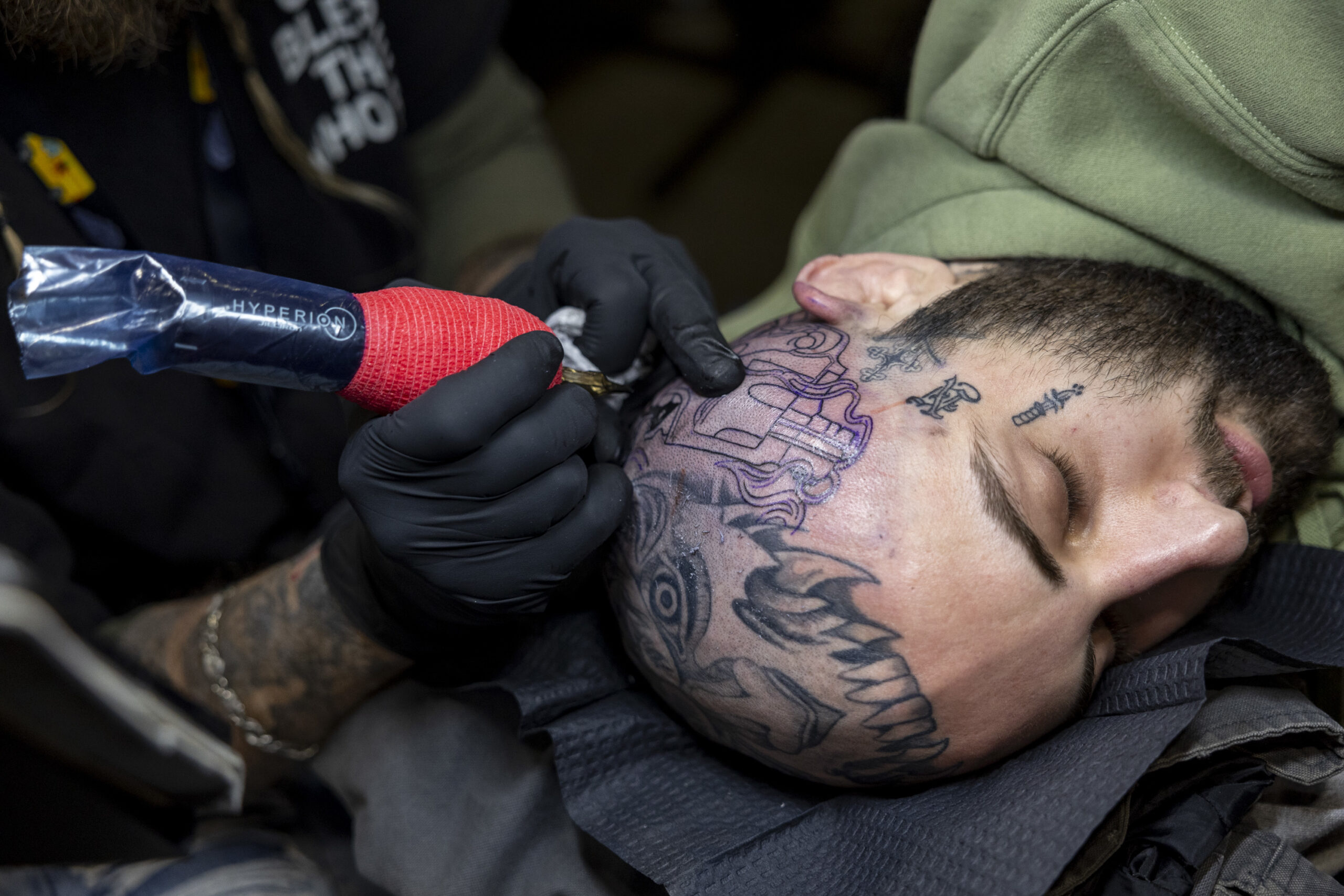
Villain Arts Tattoo Festival, held at the Convention Center last weekend, celebrated the art of tattooing, brining together hundreds of the world’s best tattoo artists and their fans. Numerous vendors showcased everything from industrial supplies to clothing, artwork, and jewelry.
Marisa Miller, of Palymyra, Pa., has a tattoo done by Flash Padilla, also of Palmyra, Pa., at the Villain Arts Tattoo Festival on Jan. 24.Flash Padilla, works on Marisa Miller’s tattoo.Su’a Sulu-ape Si’i Liufau (center), of Garden Grove, Cali., does a traditional Polynesian tattoo with the help of Lousua Filoi (left) and Max Stimac, of A-Town Tattoos.Su’a Sulu-ape Si’i Liufau, does a traditional Polynesian Tattoo with the help from Lousua Filoi (left) and Max Stimac of A-Town Tattoos.Alexandra Fische, of Ben Salem, is tattooing Daneka Hoopaugh, of Atlanta, Ga., who has been waiting for years to get tattooed by Fische.Jesse Probus, of Whitehall, Pa., with Sick Ink Studios, tattoos a heart surrounded by tentacles on Abby Zeiseo, also of Allentown.Cezar Walerski, of Allentown, Pa., tattoos the head of Nick Onea, also of Allentown.
I have walked through Independence National Historical Park many times looking at the many interpretive panels, exhibits and historical materials after President Donald Trump’s March 27, 2025 Executive Order 14253.
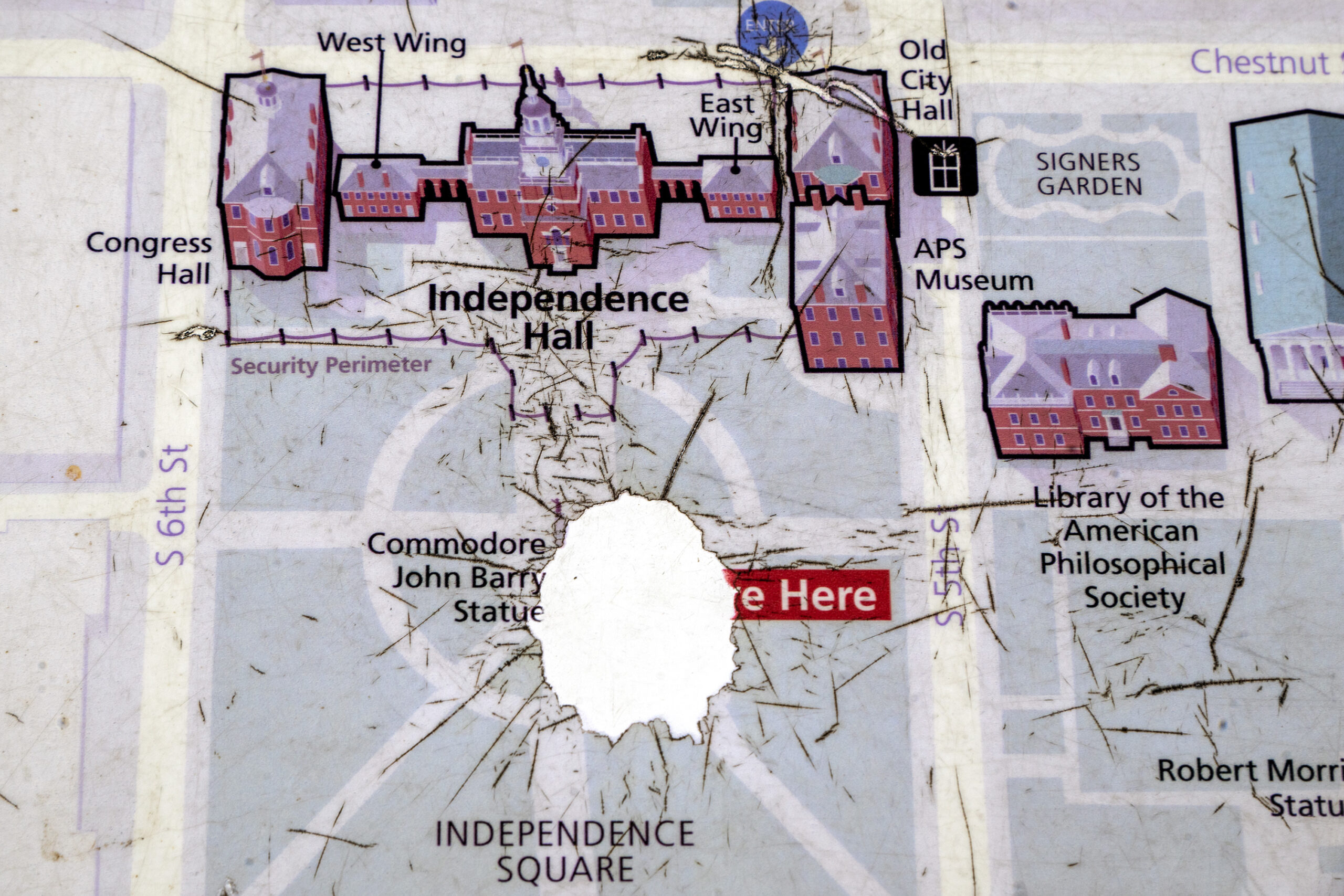
“You Are Here” sign in the square behind Independence Hall July 23, 2025.
Titled “Restoring Truth and Sanity to American History,” the order directed the Department of the Interior, which oversees the National Park Service, to review over 400 national sites to remove or modify interpretive materials that it deems “inappropriately disparage Americans past or living (including persons living in colonial times).” The order aimed to focus on the “greatness of the achievements and progress of the American people.”
At first I looked at the many interpretive panels, videos, exhibits and historical materials in Independence Hall, Liberty Bell Center, President’s House and Ben Franklin Museum, wondering which ones the Interior Secretary might identify that “perpetuate a false reconstruction of American history, inappropriately minimize the value of certain historical events or figures, or include any other improper partisan ideology.”
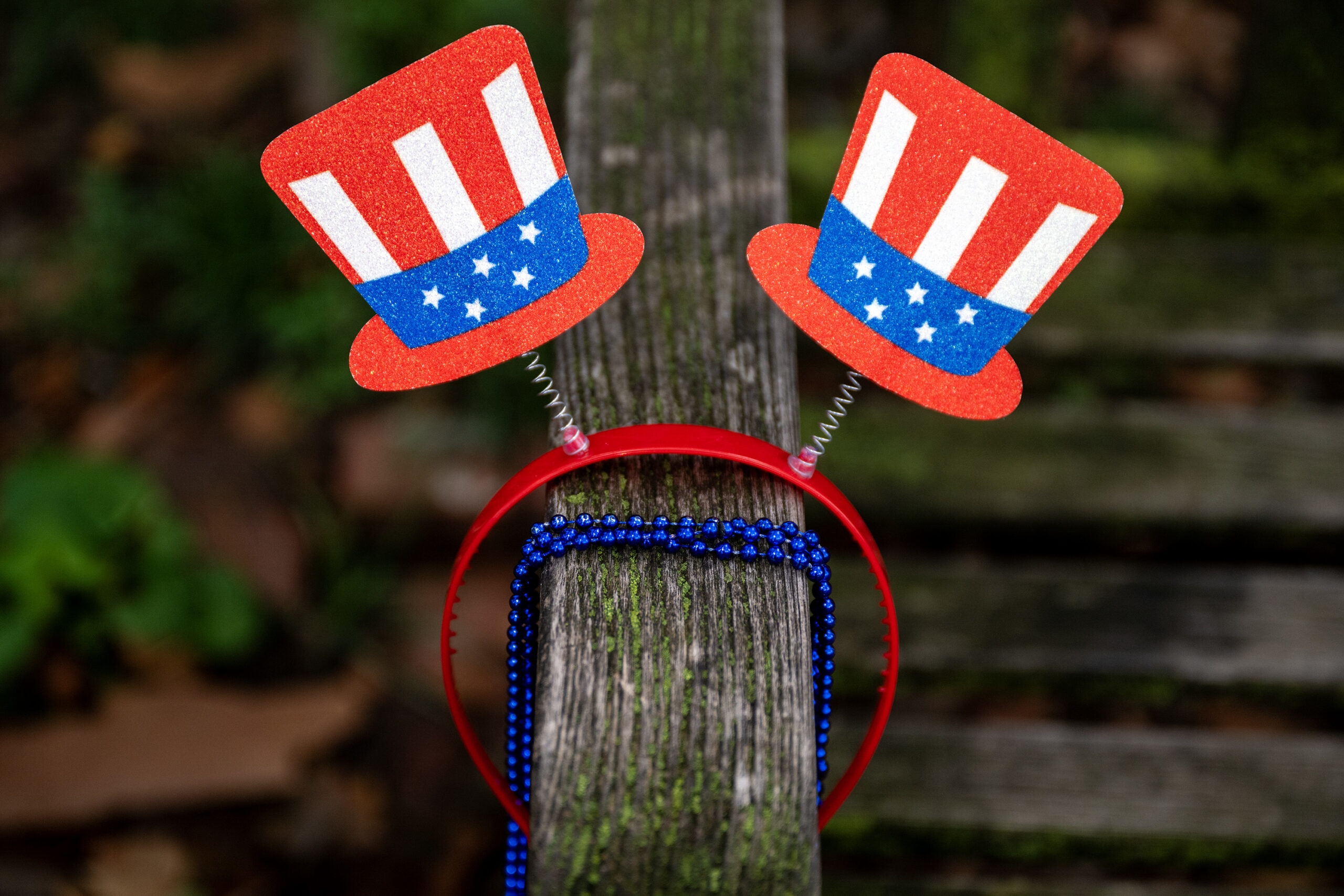
An Uncle Same hatted headband is left on a park bench Philadelphia’s Historic District during the Independence Day weekend celebrations Jul. 2, 2025.
I took a lot of photos, but realized there wasn’t a way I could write a caption reading, “the administration doesn’t like what this panel says about slavery.” So I put any photos I made in a file for later use.
In July, the New York Times broke the story that employees of the National Park Service had been flagging descriptions and displays at scores of parks and historic sites around the country for review — and they had examples of a few here in Philadelphia.
The next day, armed with the specific panels at the Liberty Bell and the President’s House they reported, I went back and re-photographed them all for our own story.
My colleague Fallon Roth obtained and reviewed the internal comments submitted by NPS employees here with many more details so in the following days I made many more photos.
I was even told to re-photograph some panels for a third time, grumbling (to myself) when told “we need higher resolution versions, shot head on, without any distortion,” for an interactive project. Which, I had to admit later (again, to myself) turned out great!
The President’s House came under particular scrutiny, and the removal of noncompliant displays was initially slated to come on Sept. 17.
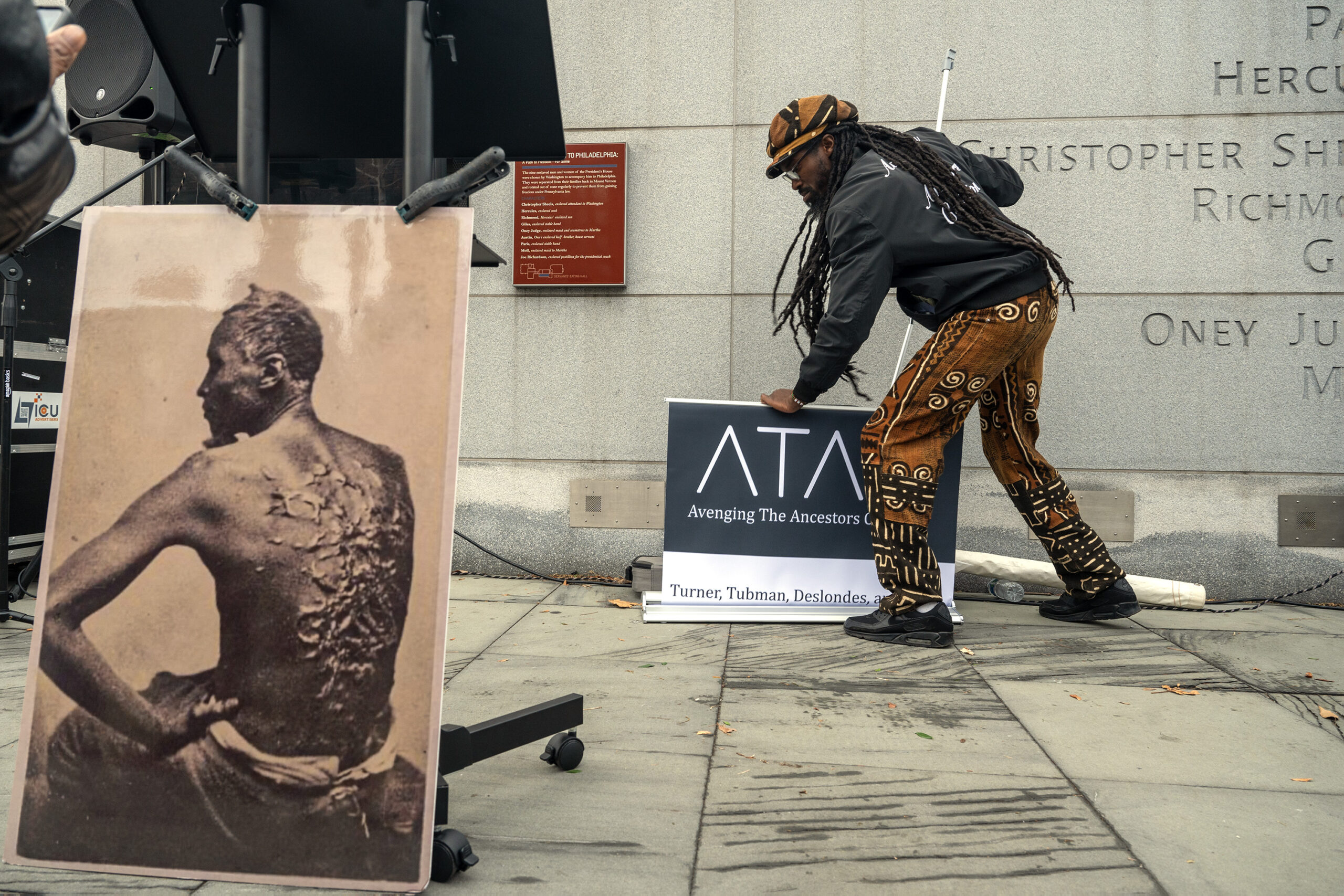
Farugh Maat, with Avenging the Ancestors, Coalition, takes down signs at the President’s House exhibit following a ceremony on the site Dec. 21, 2025 marking the 15th anniversary of its opening. The photo at left, known as “The Scourged Back” is copy of one that was removed from display at Fort Pulaski National Monument in Georgia following an order from President Trump’s “disparaging” executive order.
The administration’s deadline came and went. We got tips that signs had been altered, but I checked, and nothing actually happened. Until Thursday.
I was on assignment near Independence Hall, and as always, walked through the President’s House. It was quiet except for a local TV news crew using Independence Mall as a location for their report on this weekend’s coming winter storm.
Later while editing that assignment, we got a tip that workers with tape measures where looking and poking around “behind the panels” there. I rushed down where my colleague Maggie Prosser was already asking them what they were up to.
I photographed the entire removal, and was joined by photographer Elizabeth Robertson who even made an overall photo from our newsroom overlooking the site.
Finally, I ended up returning after dark, just because.
A single rose and a handwritten cardboard sign – “Slavery is part of U.S. history learn from the past of repeat it”- are inside an empty hearth at the President’s House site Thursday night, Jan. 22, 2026 after workers removed display panels.
Since 1998 a black-and-white photo has appeared every Monday in staff photographer Tom Gralish’s “Scene Through the Lens” photo column in the print editions of The Inquirer’s local news section. Here are the most recent, in color:
January 19, 2026: A low-in-the-sky winter sun is behind the triangular pediment of the “front door” of the open-air President’s House installation in Independence National Historical Park. The reconstructed “ghost” structure with partial walls and windows of the Georgian home known in the 18th century as 190 High St. is officially titled, “Freedom and Slavery in the Making of a New Nation” (2010). It is designed to give visitors a sense of the house where the first two presidents of the United States, George Washington and John Adams, served their terms of office. The commemorative site designed by Emanuel Kelly, with Kelly/Maiello Architects, pays homage to nine enslaved people of African descent who were part of the Washington household with videos scripted by Lorene Cary and directed by Louis Massiah. Deepika Iyer holds her niece Ira Samudra aloft in a Rockyesque pose, while her parents photograph their 8 month-old daughter, in front of the famous movie prop at the top of the steps at the Philadelphia Art Museum. Iyer lives in Philadelphia and is hosting a visit by her mother Vijayalakshmi Ramachandran (partially hidden); brother Gautham Ramachandran; and her sister-in-law Janani Gautham who all live in Bangalore, India.January 5, 2026: Parade marshals trail behind the musicians of the Greater Kensington String Band heading to their #9 position start in the Mummers Parade. Spray paint by comic wenches earlier in the day left “Oh, Dem Golden Slippers” shadows on the pavement of Market Street. This year marked the 125th anniversary of Philly’s iconic New Year’s Day celebration.Dec. 29, 2025: Canada geese at sunrise in Evans Pond in Haddonfield, during the week of the Winter Solstice for the Northern Hemisphere. December 22, 2025: SEPTA trolley operator Victoria Daniels approaches the end of the Center City Tunnel, heading toward the 40th Street trolley portal after a tour to update the news media on overhead wire repairs in the closed tunnel due to unexpected issues from new slider parts.December 15, 2025: A historical interpreter waits at the parking garage elevators headed not to a December crossing of the Delaware River, but an event at the National Constitution Center. General George Washington was on his way to an unveiling of the U.S. Mint’s new 2026 coins for the Semiquincentennial, December 8, 2025: The Benjamin Franklin Bridge and pedestrians on the Delaware River Trail are reflected in mirrored spheres of the “Weaver’s Knot: Sheet Bend” public artwork on Columbus Boulevard. The site-specific stainless steel piece located between the Cherry Street and Race Street Piers was commissioned by the City’s Public Art Office and the Delaware River Waterfront Corporation and created and installed in 2022 by the design and fabrication group Ball-Nogues Studio. The name recalls a history that dominated the region for hundreds of years. “Weaver’s knot” derives from use in textile mills and the “Sheet bend” or “sheet knot” was used on sailing vessels for bending ropes to sails. November 29, 2025: t’s ginkgo time in our region again when the distinctive fan-shaped leaves turn yellow and then, on one day, lose all their leaves at the same time laying a carpet on city streets and sidewalks. A squirrel leaps over leaves in the 18th Century Garden in Independence National Historical Park Nov. 25, 2025. The ginkgo (Ginkgo biloba) is considered a living fossil as it’s the only surviving species of a group of trees that existed before dinosaurs. Genetically, it has remained unchanged over the past 200 million years. William Hamilton, owner the Woodlands in SW Phila (no relation to Alexander Hamilton) brought the first ginkgo trees to North America in 1785.November 24, 2025: The old waiting room at 30th Street Station that most people only pass through on their way to the restrooms has been spiffed up with benches – and a Christmas tree. It was placed there this year in front of the 30-foot frieze, “The Spirit of Transportation” while the lobby of Amtrak’s $550 million station restoration is underway. The 1895 relief sculpture by Karl Bitter was originally hung in the Broad Street Station by City Hall, but was moved in 1933. It depicts travel from ancient to modern and even futuristic times. November 17, 2025: Students on a field trip from the Christian Academy in Brookhaven, Delaware County, pose for a group photo in front of the Liberty Bell in Independence National Historical Park on Thursday. The trip was planned weeks earlier, before they knew it would be on the day park buildings were reopening after the government shutdown ended. “We got so lucky,” a teacher said. Then corrected herself. “It’s because we prayed for it.” November 8, 2025: Multitasking during the Festival de Día de Muertos – Day of the Dead – in South Philadelphia.November 1, 2025: Marcy Boroff is at City Hall dressed as a Coke can, along with preschoolers and their caregivers, in support of former Mayor Jim Kenney’s 2017 tax on sweetened beverages. City Council is considering repealing the tax, which funds the city’s pre-K programs. October 25, 2025: Austin Gabauer, paint and production assistant at the Johnson Atelier, in Hamilton Twp, N.J. as the finished “O” letter awaits the return to Philadelphia. The “Y” part of the OY/YO sculpture is inside the painting booth. The well-known sculpture outside the Weitzman National Museum of American Jewish History was removed in May while construction continues on Market Street and has been undergoing refurbishment at the Atelier at the Grounds for Sculpture outside of Trenton.October 20, 2025:The yellow shipping container next to City Hall attracted a line of over 300 people that stretched around a corner of Dilworth Park. Bystanders wondered as they watched devotees reaching the front take their selfies inside a retro Philly diner-esque booth tableau. Followers on social media had been invited to “Climb on to immerse yourself in the worlds of Pleasing Fragrance, Big Lip, and exclusive treasures,” including a spin of the “Freebie Wheel,” for products of the unisex lifestyle brand Pleasing, created by former One Direction singer Harry Styles.