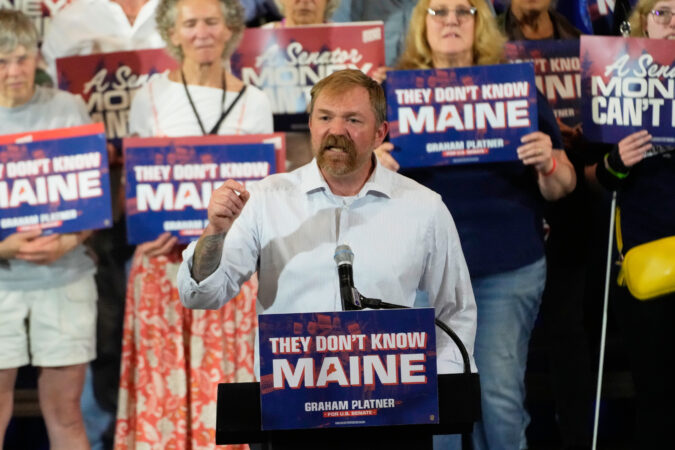
Increasingly isolated from the Democratic Party, Graham Platner is holed up at his home in rural Maine, navigating the likely end of his once-surging campaign for the U.S. Senate, as establishment fury over his prolonged exit grows louder.
Platner’s campaign team held a call Wednesday afternoon in which campaign leadership sounded resigned to the idea that the Democrat’s bid could be ending soon, said a Democrat close to Platner. Campaign staff were told that Platner would speak about the future of his run Wednesday night.
He could drop out of the race soon, probably by prerecorded video, said a second person close to Platner’s team who, like others in this article, spoke on the condition of anonymity to avoid alienating fellow Democrats in what has become an increasingly tense situation.
One of Platner’s key advisers, Morris Katz, flew up to Maine from New York on Tuesday to discuss his withdrawal, said the person. But Platner, whose political support has evaporated since he was accused of sexual assault on Monday, has struggled with the decision, people close to him said, and has said he would like input on the replacement process, leaving the timing of any announcement unclear.
“It is him who is wanting to hold on,” the first Democrat said. “He is having to come to terms that his dream is dead. The show is over, this is done.”
Until Platner pulls the plug, however, the Democratic Party is at an impasse, unable to fully refocus on its uphill battle to defeat five-term Republican Sen. Susan Collins. The race is critical to Democrats’ longshot bid to retake the Senate, where the party must flip four seats held by Republicans to win back control in November.
That frustration is now spilling into the public.
On Tuesday night, the Maine Democratic Party released a confrontational video reiterating its call for Platner to drop out so it could select a replacement candidate. If Platner withdraws by Monday, the party has until July 27 to submit a new nominee – though it remains unclear how that decision would be made.
“Unfortunately, Graham Platner’s team has repeatedly reached out to us in an attempt to put their thumb on the scale of what this process looks like,” Devon Murphy-Anderson, executive director of the Maine Democratic Party, said in the video. “We have repeatedly reiterated to Graham Platner’s team that they have no role in determining our next Democratic nominee for the U.S. Senate.”
That posture incensed Platner’s more dedicated supporters, some of whom have felt aggrieved by how quickly Democrats turned on him after the sexual assault accusation and who argue that any replacement candidate must be aligned with the populist politics that fueled his rise.
Party officials are sensitive to the fact that, despite Platner’s downfall, they need to keep the political movement that emerged around him intact in order to win.
“It is important that someone carry forward the movement that has been built here of everyday working-class people who are fed up with a system in Washington that is so broken,” Maine House Speaker Ryan Fecteau said in an interview. “There are a number of people in Maine politics who share the same views as Graham Platner, who have the same message as Graham Platner, who can carry this work forward.”
A spokesperson for Platner denied that “the campaign tried to ‘put its finger on the scale’” of the replacement process. But Platner is seeking to influence it as he navigates his exit – and his decision not to drop out immediately has divided many within his campaign.
Platner’s attempt to continue a campaign detonated by his own alleged behavior has not only exasperated some Maine Democrats but also dumbfounded them.
“People who have made their political careers decrying a rigged political system are now trying to rig the political system,” quipped a Democratic operative who works in Maine.
National Democrats, led by the Democratic Senatorial Campaign Committee, have said that they will not spend money in Maine if Platner remains the nominee.
But their role in selecting his successor is minimal, beyond supporting the Maine Democratic Party’s currently unknown plans for selecting a replacement should Platner drop out. There is belief within the committee that any nominee, at this point, will be stronger than a scandal-plagued Platner, said one person familiar with the committee’s thinking.
Since he launched his campaign last summer, Platner’s political rise and his outsider message have invigorated Maine Democrats, who have long failed to find a candidate who can defeat Collins, despite the state’s Democratic lean.
Many voters were willing to overlook earlier controversies that plagued the charismatic 41-year-old oyster farmer and military veteran, including old social media posts where Platner downplayed sexual assault and made other inflammatory comments; a tattoo resembling a Nazi symbol that he had covered up; sexually explicit text messages sent to other women after he married; and accusations of violent behavior by ex-girlfriends.
Then on Monday, a woman who used to date Platner said he entered her home intoxicated one night in late 2021 and forced himself on her as she told him to stop.
On Tuesday, a second ex-girlfriend told The Washington Post that Platner repeatedly removed protection without her consent when they were having sex. The campaign called the claim “categorically false and politically motivated.”
Unlike some politicians engulfed by scandal, Platner retains a core of close advisers who have stuck by him since Monday, allowing him to hold out against calls for his withdrawal.
In April, when then-Rep. Eric Swalwell (D-California) was accused of sexual assault by a former staffer amid a run for governor, top campaign staff immediately quit and his campaign imploded within days. Platner, by contrast, continues to operate with the inner circle of his campaign from his home in the small coastal town of Sullivan.
The scene was quiet there Wednesday morning. Several cars were parked in Platner’s driveway near a pile of chopped wood and a boat covered in a green tarp. A few reporters were across the narrow road.
As the public awaits word from Platner about his plans, longtime friends say this has been a difficult moment, with one even suggesting that Platner could continue to fight.
“Everybody says they are pulling their support. Is that truly what they are going to do? Are they just going to let Susan Collins win?” the friend said. “That seems highly unlikely to me because we need Maine to flip the Senate.”
That is not a universal view, however. Some people who have backed Platner for months, even through his many scandals, are too disgusted with him to continue their relationship.
“At this point, he knows I know he’s lied to me directly too many times,” said a top Maine Democrat who has been close to Platner. “I don’t think he has the shame to speak directly to me.”
Joanna Slater in Sullivan, Maine, contributed to this article.
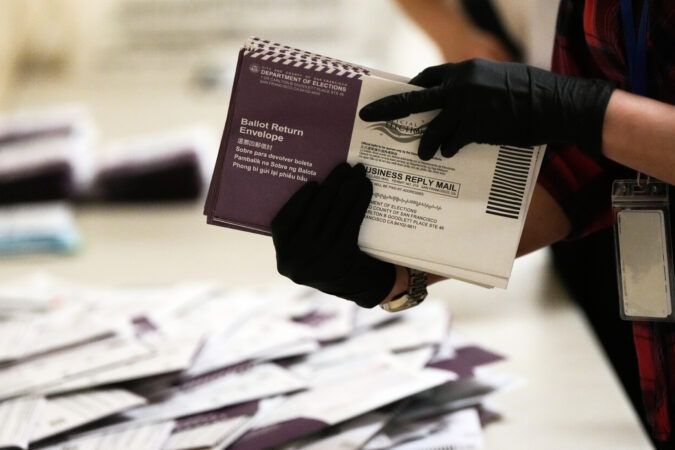
The Supreme Court on Monday upheld a Mississippi law that allows officials to tally mail-in ballots postmarked by Election Day that arrive later, a decision that keeps voting procedures in place in several states as the midterm elections loom.
In an ideologically mixed 5-4 ruling, the justices turned aside a challenge by Republicans and Libertarians, who argued federal law preempts a Mississippi statute that allows the counting of such ballots that arrive up to five days after polls close.
The decision could make less likely similar legal challenges in 14 states that allow the counting of ballots that arrive days or weeks after polls close, and others that allow military members to return ballots later. Most states require mail-in ballots to be received by Election Day.
Justice Amy Coney Barrett delivered the opinion for the majority, which included Chief Justice John G. Roberts Jr. and the court’s three liberals. Barrett said federal election law did not address when ballots should be received.
“The election-day statutes say nothing about ballot receipt, and we cannot add to the words Congress chose,” Barrett wrote.
The ruling came over the objections of four of the court’s conservatives. Justice Samuel A. Alito Jr. wrote the opinion for the group, which included Justices Clarence Thomas, Neil M. Gorsuch, and Brett M. Kavanaugh.
“Not only is today’s decision inconsistent with statutory text, legal context, historical practice, and precedent; it also threatens to produce lamentable consequences,” Alito wrote. “The majority’s holding spawns a slurry of troubling election-law questions and risks further undermining Americans’ confidence in election integrity.”
President Donald Trump and some Republican allies have falsely argued that voter fraud is rampant in mail-in balloting. Trump partly blamed his loss in the 2020 presidential election on mail-in votes and unsuccessfully called on states to stop tallying them during the contest.
Trump called the ruling a “tremendous loss” in a post on Truth Social. He called on Congress to pass the Save America Act, which tightens voter identification laws.
Republicans in a number of states have launched legal challenges to mail-in voting, which has grown in popularity since the onset of the coronavirus pandemic. One study found about 1 in 3 voters voted by mail in 2024, but the practice is more widespread in Democratic-leaning states.
Conservatives in Congress also have introduced legislation to limit mail-in voting.
In March, Trump issued an executive order telling the Postal Service to send ballots only to voters who appear on lists of citizens created by states in conjunction with the federal government. A federal judge in Massachusetts blocked that provision of the executive order last week, saying states — not the president — are responsible for setting election rules.
Despite his criticism of mail-in voting, Trump voted by mail in a special election in Florida earlier this year.
In the case decided by the high court, the Republican National Committee, the Mississippi Republican Party, a state voter, and a county election commissioner had sued Mississippi in 2024, claiming it was illegal to count mail-in ballots that arrive after polls close because federal law sets elections for a specific day. The Libertarian Party later filed a similar suit.
The cases were consolidated by a federal judge, who allowed groups of veterans and retirees to intervene in the suit on behalf of Mississippi. The judge dismissed the case, but the U.S. Court of Appeals for the 5th Circuit reversed that ruling. Mississippi then appealed to the Supreme Court.
During arguments in March, Paul D. Clement, an attorney for the conservatives, told the justices that casting and counting ballots at the same time has long been “intertwined.” He said allowing mail-in ballots to be counted after Election Day could increase fraud and undermine faith in elections, particularly if the winning candidate was not the one ahead when polls closed.
“The losers are going to doubt the result, full stop,” Clement said. “That is bad for our system.”
Mississippi Solicitor General Scott G. Stewart countered that existing law required only that voters fill out their ballots by Election Day. He said mail-in voting has a long history in the United States, pointing to field voting that occurred during the Civil War.
“States have allowed it for over a century, and Congress has respected it,” Stewart said.
This term has been an active one for the justices on voting and election issues. In January, the court allowed a Republican congressman from Illinois to challenge the state’s mail-in balloting laws, finding candidates have inherent standing to sue over election rules.
The case brought by Rep. Mike Bost (R., Ill.) also argues that federal law prohibits ballots from being counted after Election Day. The case was sent back to the lower courts.
The justices also severely limited a key section of the Voting Rights Act, which has cleared the way for a number of Republican-controlled states in the South to carve up districts held mostly by Black Democrats ahead of the midterm elections. Hundreds of other minority officeholders could be redistricted out of their seats in state and local boards.
The court has yet to rule in a case challenging limits on spending coordinated between political parties and candidates that is being pushed by the Republican Party. Striking down the spending limits could give Republicans a big money boost in November.
Fourteen states provide grace periods for all mail ballots, and another 16 provide them for military and overseas voters. Republican-led states have been steering away from ballot grace periods recently, with Kansas, North Dakota, Ohio, and Utah eliminating them last year, according to Voting Rights Lab.
RNC Chairperson Joe Gruters said Republicans would push Congress to pass legislation requiring ballots in all states to be returned by Election Day.
“Democrats are inviting chaos at the ballot box by allowing elections to drag on for days and weeks after voters cast their ballots,” he said in a statement.
Voting rights advocates praised the decision, saying they feared the court could reverse long-standing policies on when ballots are due.
“Good news rarely comes out of this Supreme Court, but today’s ruling is a win for our democracy,” NAACP President Derrick Johnson said. Virginia Kase Solomón, president of Common Cause, said the decision was correct because voters “shouldn’t lose their voice because of mail delays outside their control.”
If elected in November, Stacy Garrity would become Pennsylvania’s first female governor in the state’s 238-year history.
Even now, she is one of only two women in history to receive the Republican Party’s nomination for the job.
The state has never had a woman as itsgovernor; no woman has been elected as U.S. senator; and both times a woman ran for president, she lost the state. Over the last two centuries, Pennsylvania’s political glass ceiling has proven stubbornly resistant to cracks.
But on the campaign trail against Democratic Gov. Josh Shapiro, Garrity, 62, said she doesn’t give that too much thought.
“It’s my least favorite thing to talk about,” she said. “I was the oldest of four daughters, and we were just told that we were expected to work hard.”
Navigating gender dynamics in politics can prove to be a particularly fine balance. Republicans, in particular, often emphasize that candidates should rise on their skills and talent, not personal identity.
Garrity emphasized her attention is on issues like the power grid, education, and reining in spending, though she recognizes the historic significance of a potential win.
“Republicans, for the most part, are based on merit, and that’s how I was raised,” said Garrity, who spent decades serving in the Army Reserve and as an executive in the manufacturing industry before becoming state treasurer. When she was reelected in 2024, she broke the record in Pennsylvania for the most number of votes cast in her favor for a statewide office, a distinction formerly held by Shapiro.
In addition to taking on centuries of male-dominated leadership,Garrity will face other challenges in November.
“I think [voters] are excited to have a first female governor, but I don’t think that is the reason anybody would vote for me,” she said.
In Pennsylvania and 16 other states
It is hard to be what you can’t see. And for voters who have never experienced a woman at the top of the hierarchy, it is difficult to imagine what that could look like, experts said.
It has been 300 years since a woman led Pennsylvania — before it was a state.
Hannah Callowhill Penn led the colony of Pennsylvania, governing first while her husband, William Penn, suffered several strokes, and then alongside a group of trustees after he died. Over 14 years, she settled boundary disputes, appointed and replaced government officials, and navigated relations with the monarchy in England.
Other Pennsylvania women made attempts to break gender barriers but came up short. Barbara Hafer ran as a Republican against Democratic incumbentBob Casey Sr. in the 1990 governor’s race, but lost with just 32% of the vote.
Former U.S. Rep. Allyson Schwartz lost to Tom Wolf during the Democratic primary for governor in 2014, and Laura Ellsworth was defeated by Scott Wagner in the 2018 Republican gubernatorial primary.
“It could just be a coincidence, but also it’s very hard to break political traditions, and one of those traditions in Pennsylvania, unfortunately, is male leadership,” said Nichola Gutgold, a professor at Pennsylvania State University’s Lehigh Valley campus, who has researched women in politics.
Pennsylvania, however, is not alone. There are 17 states that have never had a female senator, and 17 states have never had a female governor, according to the Pew Research Center. That distinction spans geographic ranges and party control.
Still, Pennsylvania is one of just four states that has never had either, along with Idaho, Indiana, and Colorado. Among them, only Colorado went for Democrats Hillary Clinton and Kamala Harris for president.
“We have certain variables at play in the Commonwealth of Pennsylvania that make it more challenging for women to run for elected office,” said Dana Brown, executive director of the Pennsylvania Center for Women and Politics.
The role of the parties on the state and county levels means they have a strong influence on recruiting candidates and pushing them up through the pipeline. Historically, recruiting tended to come from more masculine bases — such as fire stations or township supervisor positions.
Now, though, “both sides of the aisle recognize that women can win here in Pennsylvania, and so Republicans and Democrats have been purposely recruiting more women,” she said.
Women have made strides in other Pennsylvania elected offices.
In Harrisburg, State Rep. Joanna McClinton (D., Philadelphia) is the first woman and second Black person to serve as speaker of the Pennsylvania House. Republican State Sen. Kim Ward of Westmoreland County is the first woman in Pennsylvania history to serve as Senate president pro tempore and Senate majority leader.
When former Democratic U.S. Rep. Susan Wild, the first woman to represent the Lehigh Valley in Congress, was elected in 2018, “it took a real concentrated effort from [political action committees] and from groups that really wanted to see a woman win to make that happen,” Gutgold said.
In other cases, as in neighboring New Jersey or Virginia, women have ascended with a combination of fortunate timing, skill, experience, and deft campaigning.
Even though Sherrill, a Democrat, shares the same party as her predecessor, Phil Murphy, New Jersey’s vote for a woman represents change, Brown said. “She also worked really, really hard for it, as most women do,” she added.
Sometimes, female candidates succeed by pushing against expected norms for women by emphasizing military experience or work in male-dominated trades, Gutgold said. Garrity has emphasized her military and business experience on the campaign trail, holding a Veterans for Garrity rally last week.
“I think that, rhetorically speaking, it would be easier to elect a woman who appears to hold more conservative views, because of the way we, the electorate, still views women’s role in society,” Gutgold said.
Republican women have scored victories in the Deep South by upholding conservative values such as opposition to abortion and support of gun rights. Kay Ivey holds the governor’s mansion in Alabama, and Nikki Haley previously led South Carolina for two terms. In Tennessee, U.S. Sen. Marsha Blackburn has represented the state since 2018 and publicly repudiated gender-specific titles, such as congresswomanvs. congressman.
Garrity, on the campaign trail, has also vowed to clean up the “boys will be boys” culture in Harrisburg and has criticized Shapiro’s handling of a sexual harassment case involving a longtime aide.
The aide, Mike Vereb, abruptly stepped down in 2023, while the administration quietly agreed to pay $295,000 to settle claims from an employee in the governor’s office that Vereb had made repeated sexual advances toward her, and made lewd claims about her and other women.
“We don’t need to settle for a governor who will sweep sexual harassment and abuse charges under the rug. We don’t need to accept that our state government is a cesspool where intimidation is the norm and public employees fear retribution,” Garrity said during a news conference this year.
Manuel Bonder, a spokesperson for Shapiro, rejected those accusations.
“Governor Shapiro has a track record of taking on powerful institutions, exposing sexual abuse, and putting predators behind bars — and he continues to fight to deliver real accountability and justice for survivors here in Pennsylvania,” he said.
Could Pa. women give Garrity a boost?
Nationally, women voters tend to lean more toward the Democratic Party, Pew Research Center data show, so it’s unlikely that the Republican Party will attract a huge turnover — even with a female candidate on the top of the ticket.
Sometimes, however, the gender divide can become even more entrenched. In 2024, for example, when the candidates were broadly polling neck-and-neck, Harris saw a 17-point advantage with Pennsylvania women, while Trump led with men in the state by 11 points, according to a Philadelphia Inquirer/New York Times/Siena College poll.
Garrity said she is putting together agendas that speak to various coalitions of voters, such as veterans, Latinos, and small-business owners.
“I don’t think we’ve done specifically females, but that might be a good idea,” she said. A campaign spokesperson added that Garrity would be rolling out women-focused events in the coming weeks.
Campaigns can target women by speaking directly to certain issues. Democrats have often focused their message on support for reproductive access and abortion rights, especially since the 2022 Supreme Court decision overturning Roe v. Wade.
According to a Pew Research Center report in March, 64% of women and 55% of men say abortion should be legal in all or most cases. But Garrity has been inconsistent on the issue. She said “Roe was wrong from the beginning” on the day the ruling came out and sold T-shirts on her campaign website that opposed abortion. But in an interview last September, Garrity said she would “respect” Pennsylvania’s current abortion law and would not support a state ban.
Republicans, meanwhile, often promote public safety and have sought to make women’s sports a wedge issue in recent elections by pushing restrictions on the participation of transgender athletes.
It is a tactic Garrity will use against Shapiro, who has called attempts to silo transgender athletes discriminatory.
“A lot of people think that he’s moderate because he likes to be all things to all people, and they don’t understand, he is really for boys competing against girls in sports,” Garrity said.
There are other issues women candidates are often seen as more trusted on, such as education, healthcare, and children’s needs, Gutgold said.
Amy Widestrom, executive director of the League of Women Voters of Pennsylvania, said top of mind for members of her organization right now is the right to vote. She said some women have expressed concern that requiring documentary proof of citizenship, which Republicans say is meant to ensure immigrants in the country illegally do not vote, could affect those who change their legal name and do not have matching identification records.
Appealing to women on these issues can pay off, as they represent a significant voting bloc. Among registered voters in Pennsylvania, 52% are female. Of registered Democrats, 59% are female, and 47% of registered Republicans are female. Roughly 40% of unaffiliated voters are female, according to Widestrom, via voter data.
But Macy Charles of Concerned Women for America, a socially conservative political nonprofit focused on women, said candidates should speak more expansively when courting women voters.
“It’s pretty offensive to assume that when we’re talking about issues women care about, it’s only women’s specific issues, like abortion,” said Charles, a legislative strategist. “Women care about the economy, women care about the U.S. borders. Because they have maternal instincts, they care about their families, they care about the well-being of America’s future.”
Rather than leaning into identity, Charles said, Garrity is reinforcing her reputation of competence.
“More than just her identity as a woman, she is willing to stand up for common sense and truth and really put families first,” she said.
Still, Garrity recognizes the achievement her potential victory could bring.
To be Pennsylvania’s first female governor, “I think it would be great,” she said, “but I think it will be because I am absolutely the best candidate.”
Congressional hopeful Ala Stanford on Wednesday morning announced she was dropping out of a WHYY candidates debate two hours before it was scheduled to begin, saying her campaign could not agree with the public radio station on a format for the debate and criticizing her opponents in the race for “misogynistic attacks.”
“I have never been afraid of a hard room,” Stanford said in a statement. “After engaging in good faith with WHYY, we could not reach terms on a format that would deliver the serious accountability voters in PA-03 deserve.”
Stanford’s campaign manager emailed the announcement to reporters around 10 a.m., two hours before the debate on WHYY’s Studio 2 was supposed to take place.
In her statement, Stanford did not clarify what problems she had with the debate format. She also did not provide details on any attacks from her opponents in the Democratic primary for Pennsylvania’s 3rd Congressional District.
A Stanford spokesperson declined to comment beyond her written statement.
Stanford’s surprise announcement came less than three weeks before the May 19 primary, and followed a series of missteps for her campaign, including the revelation that a staffer used artificial intelligence to help answer a candidates’ questionnaire and her stumbling through a question about immigration enforcement in an interview with NBC10.
A recent Inquirer report on her stewardship of the Black Doctors Consortium also found that the organization omitted details about her income that were required to be included on nonprofit tax forms filed with the Internal Revenue Service.
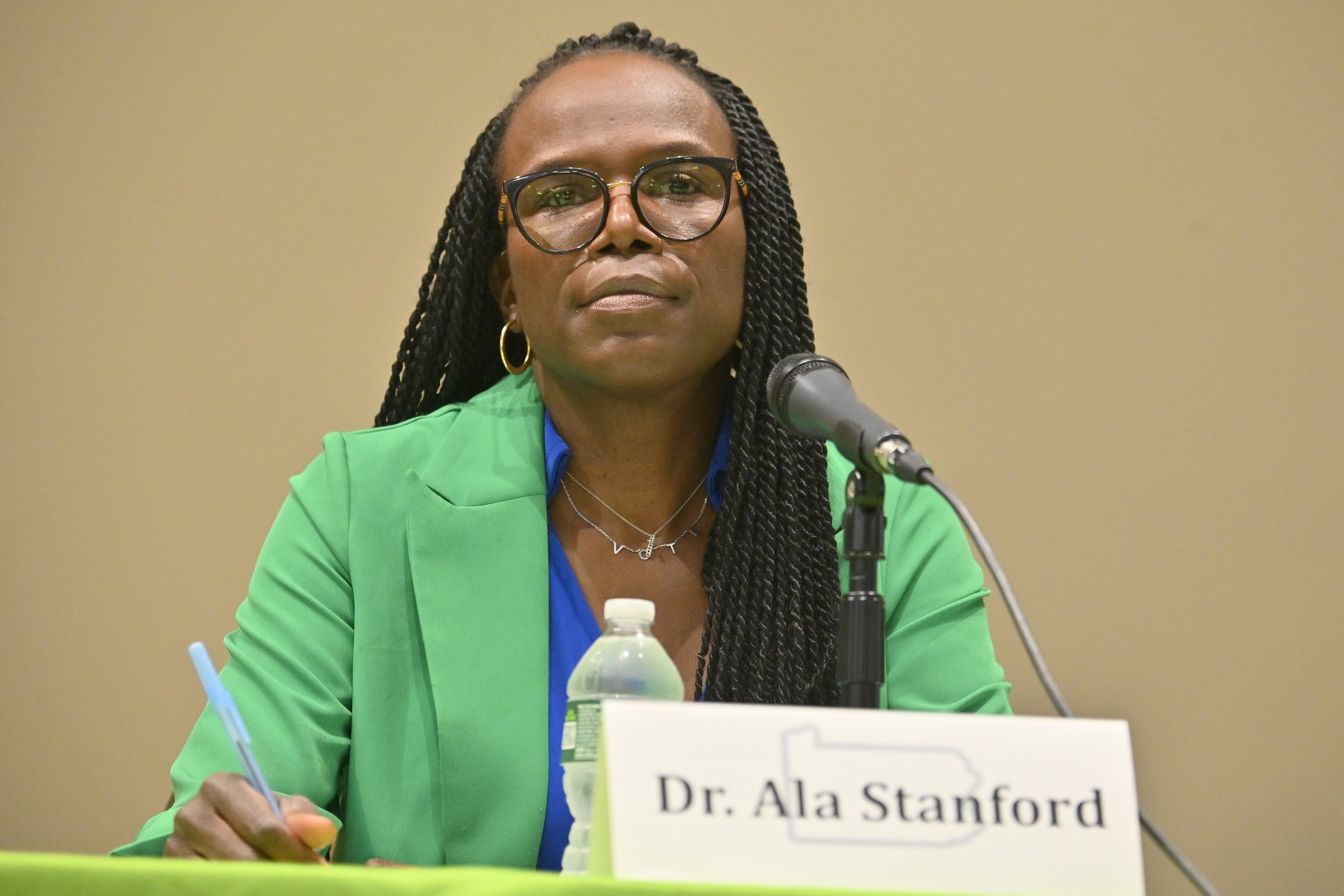
Ala Stanford, pediatric surgeon and founder of the Black Doctors Consortium, participates in the debate for Pennsylvania’s 3rd Congressional District at Center in the Park in Germantown on Tuesday, April 14, 2026.
Stanford’s exit from the Wednesday event meant the other two top contenders in the race, State Rep. Chris Rabb and State Sen. Sharif Street, were the only candidates to participate in the debate featured on WHYY’s Studio 2, the highest-profile live and on-air debate thus far.
It was a relatively subdued affair compared to some of the other more gloves-off style campaign events in the open race. Street and Rabb took questions from moderators and largely agreed on policy, with both saying they support expanding universal healthcare, abolishing U.S. Immigration and Customs Enforcement, and impeaching President Donald Trump.
The two state lawmakers sought to contrast their styles, with Street portraying himself as a more competent legislator.
“I get things done,” said Street, the former head of the state Democratic Party. “Rep. Rabb and I share a lot of value propositions. But the difference is I deliver on ideas.”
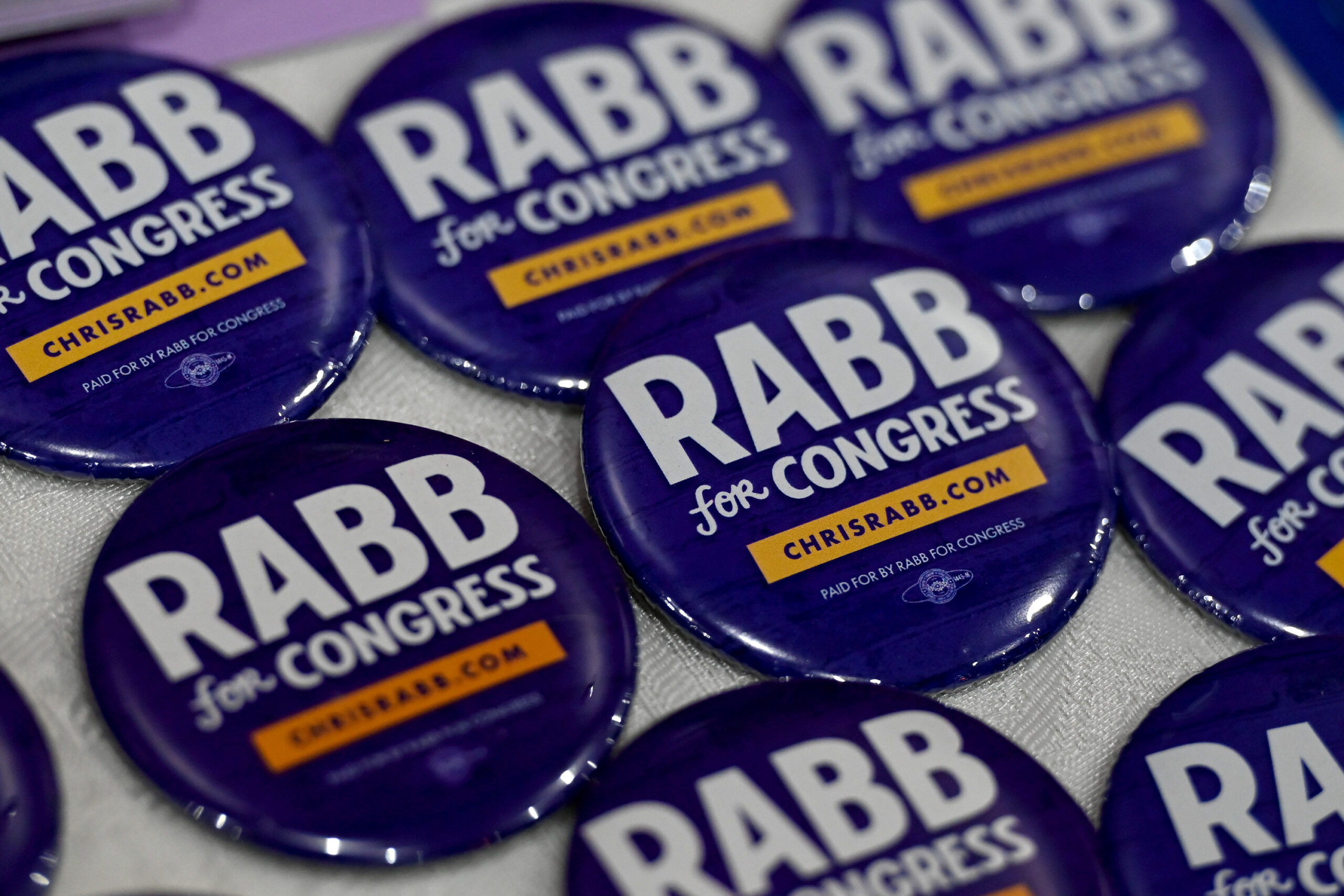
Rabb, a progressive who has been endorsed by the Working Families Party, said Street is too closely aligned with the Democratic establishment, and that his ideas are not bold enough.
“There’s so many people who think we can’t do things big and bold,” he said. “They play around the edges, because that’s what establishment politics does.”
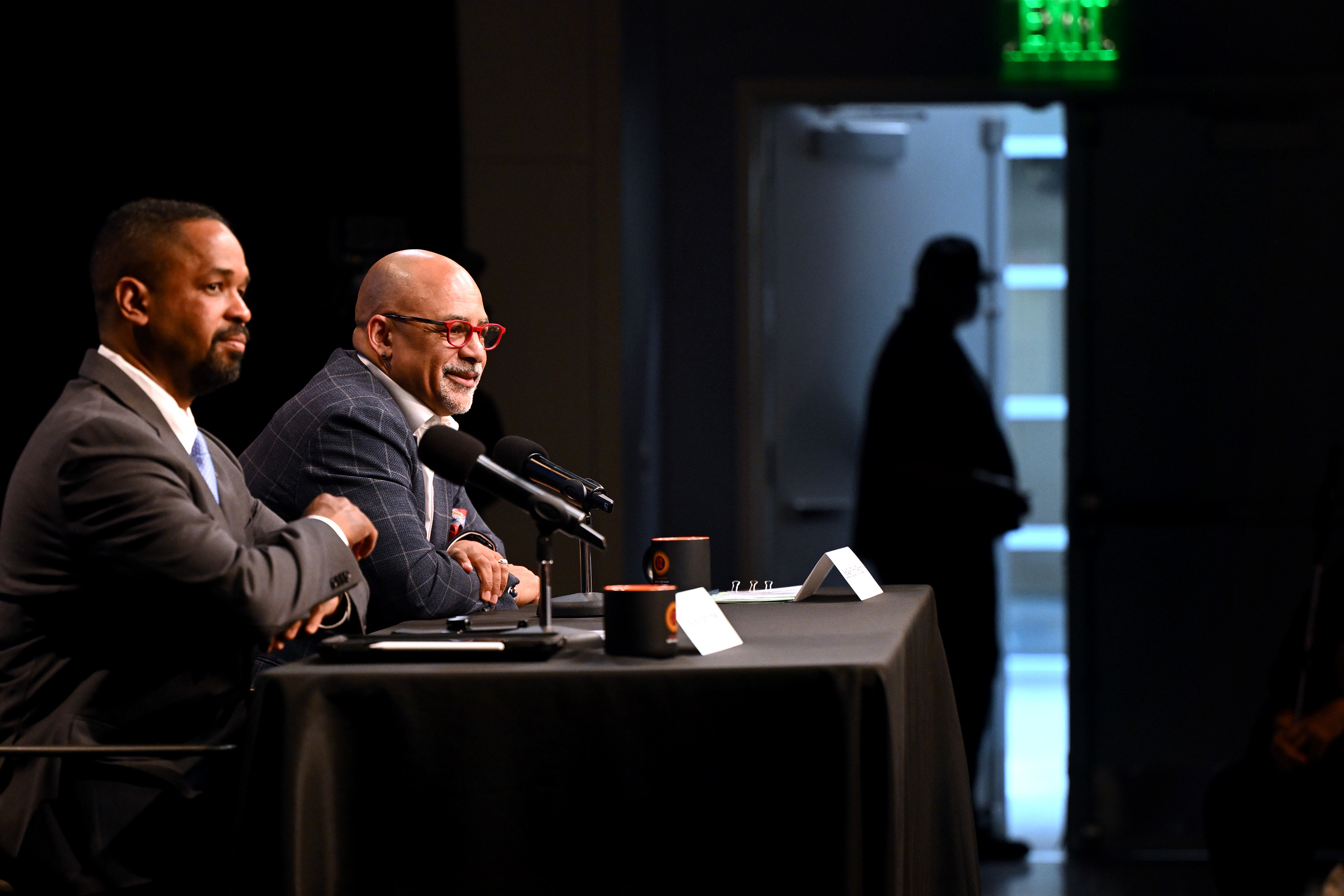
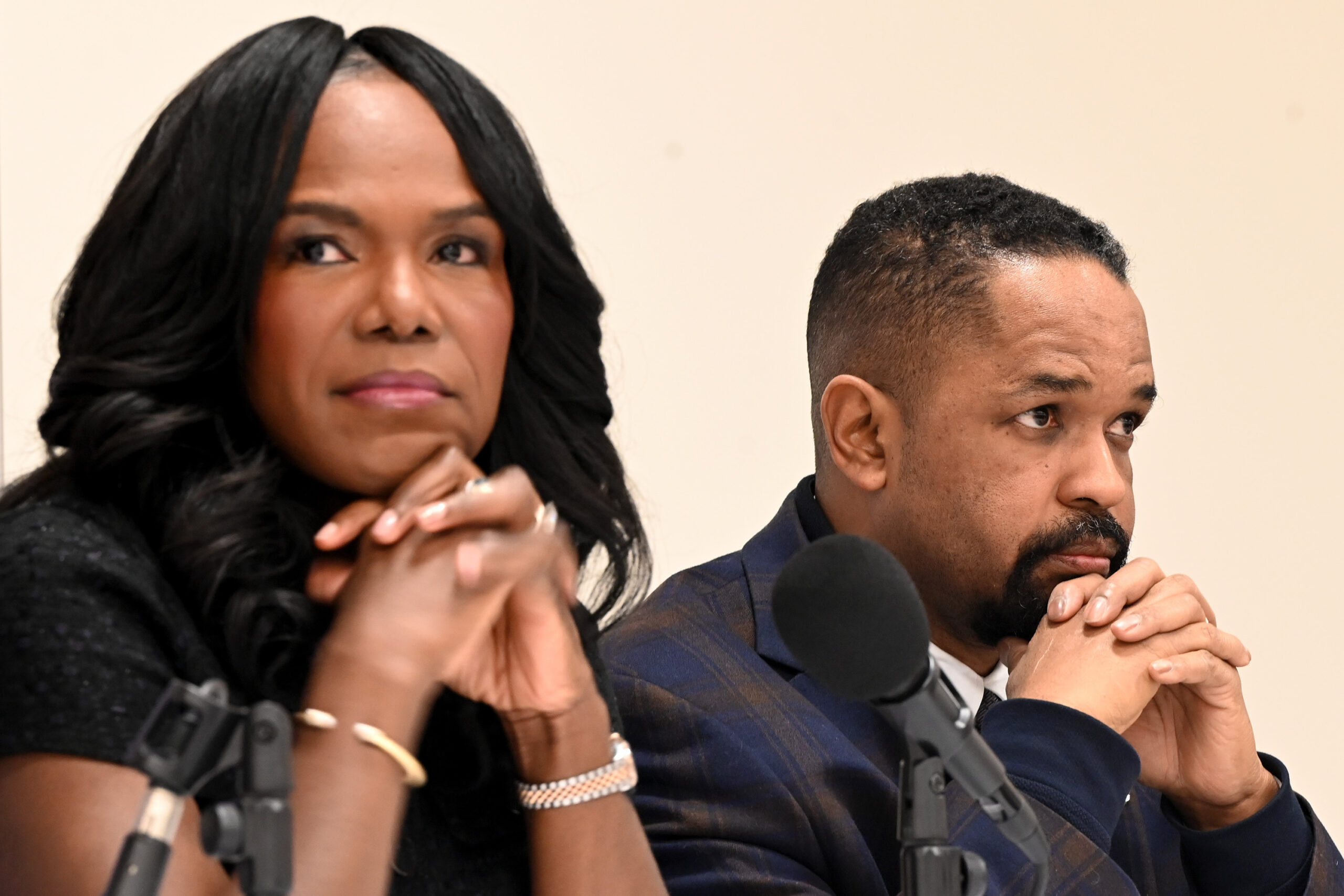
State Sen. Sharif Street (left) and State Rep. Christopher Rabb (right) wait for the WHYY studio door to close Wednesday, April 29, 2026 before start of their debate in the Democratic primary for the 3rd Congressional District. The third leading candidate, Ala Stanford declined to attend at the last moment.
Both candidates were also asked about Stanford’s absence and her charge Wednesday that the race has been “marred by misogynistic attacks and lies from both of my opponents.”
Stanford, a first-time political candidate, is the only woman on the ballot.
Rabb said he wasn’t sure what she was referring to, but pointed out that when Stanford was recently heckled by some of his own supporters during a candidates forum, he repeatedly told them to let her speak.
And Street said he has not attacked her directly, but acknowledged that she’s faced criticisms.
“She has been attacked. I’ve been attacked. Everybody on this campaign, I’m sure, has been attacked at some point,” he said.
Rabb and Street said their campaigns did not negotiate with WHYY on the format of the event.
Kevin McCorry, an executive producer and host at the station, said WHYY engaged with Stanford’s campaign “in good faith” and acquiesced to her staff members’ requests, including allowing her to have notes on the table and bring extra staffers to sit in the audience.
He said WHYY learned that she was pulling out when Stanford’s campaign manager released a statement to reporters from multiple news outlets.
“We were flexible with her requests,” McCorry said. “At no time did they say, ‘If X doesn’t change, we’re backing out.’”
State Sen. Sharif Street (left) and State Rep. Christopher Rabb (right) appear in a debate at WHYY studios Wednesday, April 29, 2026 for the Democratic primary in the 3rd Congressional District. The third leading candidate, Ala Stanford declined to attend at the last moment.
Street spokesperson Anthony Campisi accused Stanford of dropping out to avoid tough questions,adding that “her campaign is in free fall.”
“Rather than answer these questions in a debate that’s aired on radio and television, she appears to be taking her ball and going home, which is not what Philadelphians expect from their member of Congress,” Campisi said Wednesday. “Philadelphians deserve a member of Congress who is ready to fight for them and against Donald Trump, not someone who runs from a fight.”
Rabb said that when it comes to campaign events, he and his team “don’t negotiate, we just show up.”
“Even if I didn’t like the format, which is not uncommon, I still show up,” he said, “because I’m a public servant and I’m a public candidate, and I got to reach people wherever they are.”
In her statement, Stanford, a physician, noted she has taken the Hippocratic Oath “to first do no harm.”
“I challenge everyone in this race to join me in promoting the kind of spirited, but serious and meaningful dialogue Philadelphians should expect from those asking to serve,” she said. “In the meantime, I will be where I have always been — on doorsteps, in church basements, and on the corners of the wards that built me.”
Shaun Griffith, a tax adviser and the fourth candidate in the race, did not participate in the debate because he did not meet WHYY’s criteria, which included a fundraising threshold.
He attended the event and sat in the audience, and said afterwards that it was “frustrating to be watching other people get to answer questions and not have the opportunity to do so myself.”
At times, Ala Stanford feels like she doesn’t quite fit in.
She’s a pediatric surgeon — albeit very well-known — who is running for political office for the first time, trying to win a seat in Congress that for decades has been held by a seasoned Philadelphia politician.
At campaign events, when the top Democrats in the congressional race are chit-chatting among themselves, Stanford has found herself on the margins. Often, she feels more comfortable talking medical procedures with Dave Oxman, the other physician in the race, than whatever the sitting state representatives have going on in Harrisburg.
The trail may get lonelier. Oxman is planning to drop out Wednesday and endorse Stanford, making her the hands-down most prominent outsider in a race that is stacked with political veterans.
To amass support ahead of the crowded May 19 primary election — the likely deciding contest in one of the nation’s bluest congressional districts — Stanford will have to chart a path that beats both the Democratic establishment and the progressive left, which have chosen other candidates in the wide-open race.
Stanford, 55, knows her lack of political experience makes her stand out, and she’s accentuating it on the campaign trail. She is highlighting her career as a physician, and she says she’ll fix a healthcare system her opponents failed to address in their years as public officials. Her candidacy comes as an increasing number of medical professionals are running for office across the country, and as thousands of Pennsylvanians have dropped their healthcare coverage due to rising costs.
She has kept pace with three sitting lawmakers who are also running for the seat, in part by lending her campaign $250,000 of her own money.
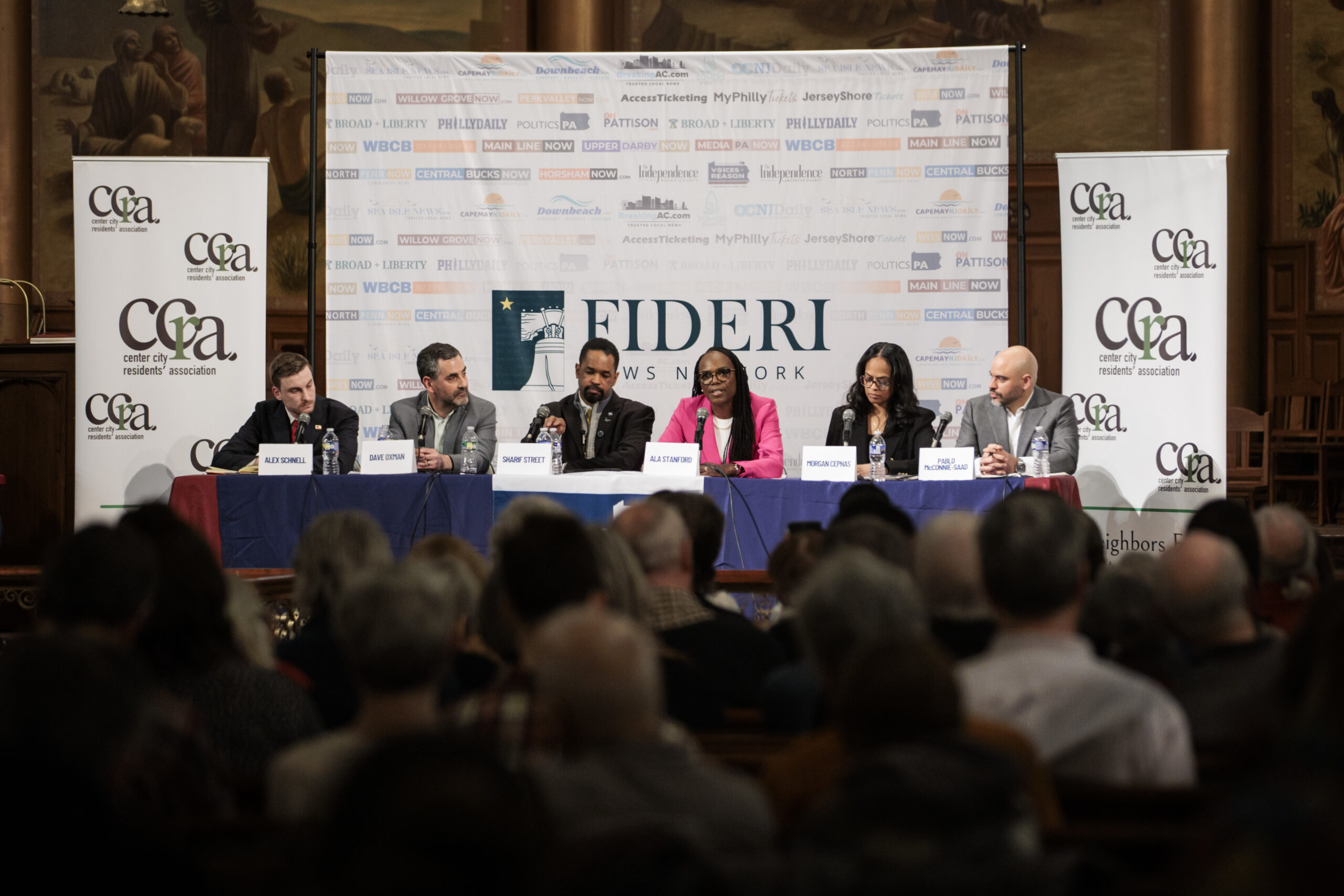
Candidates (from left) State Rep. Morgan Cephas; physician David Oxman; State Rep. Chris Rabb; physician Ala Stanford and State Sen. Sharif Street appear at a forum hosted by the 9th Ward Democratic Committee in Mt. Airy Thursday, Dec. 4, 2025.
Stanford alsohas a cadre of healthcare workers uplifting her. She has won endorsements from prominent doctors, as well as a national super PAC, 314 Action, which backs candidates with backgrounds in science and has poured $1.5 million into a pro-Stanford campaign.
The group so far funded five weeks of television commercials reminding voters that Stanford founded the Black Doctors COVID-19 Consortium. In the throes of the pandemic, she set up mobile testing sites in majority-Black communities and ran vaccination clinics to inoculate thousands of Philadelphians, a grassroots effort to fill gaps left by government-funded programs.
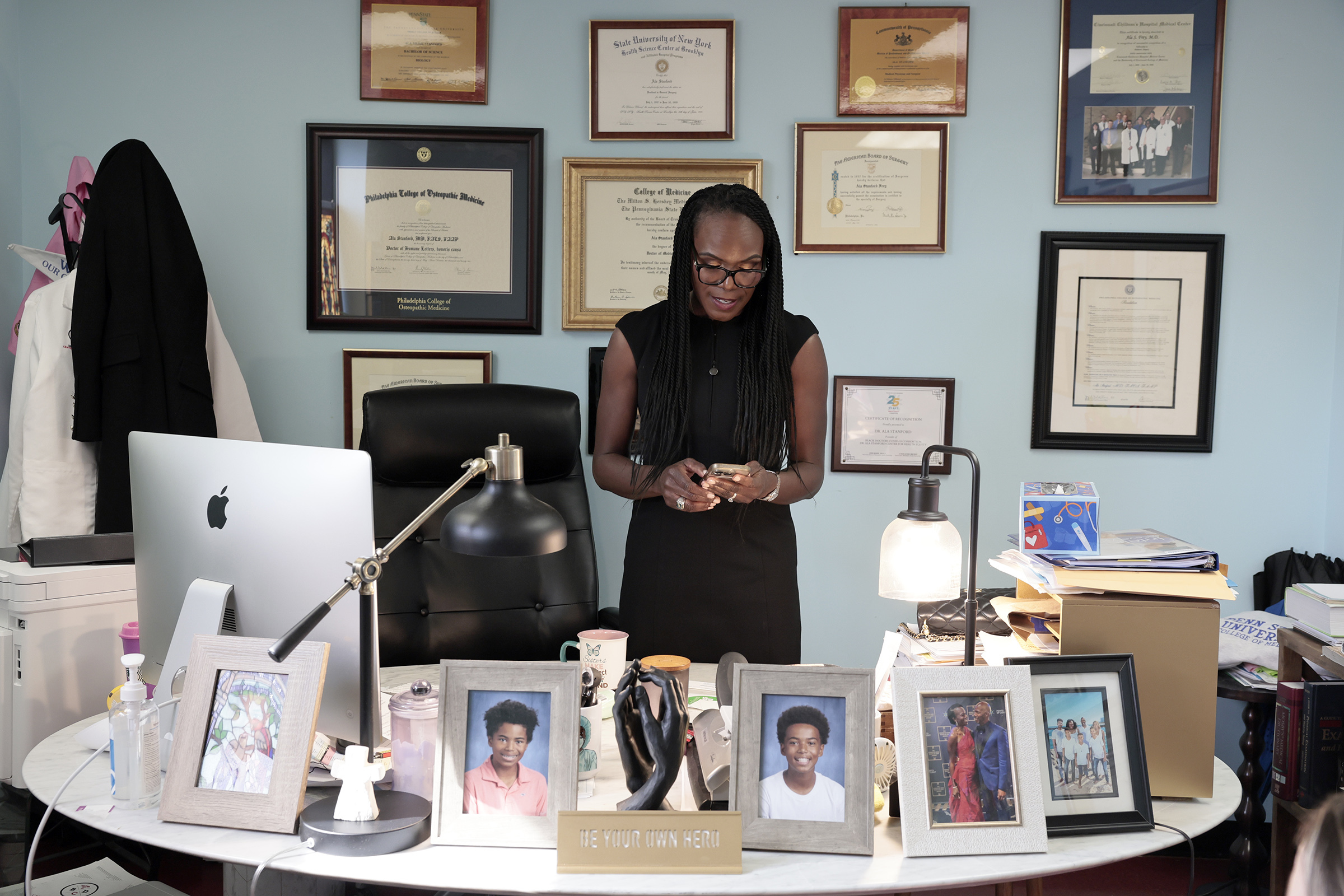
Ala Stanford texts her son while in her office at the Dr. Ala Stanford Center for Health Equity, 2001 W Lehigh Ave. in Philadelphia on Friday, March 13, 2026
It is a compelling story that has been told many times — across national media, on podcasts, and in Stanford’s own memoir.
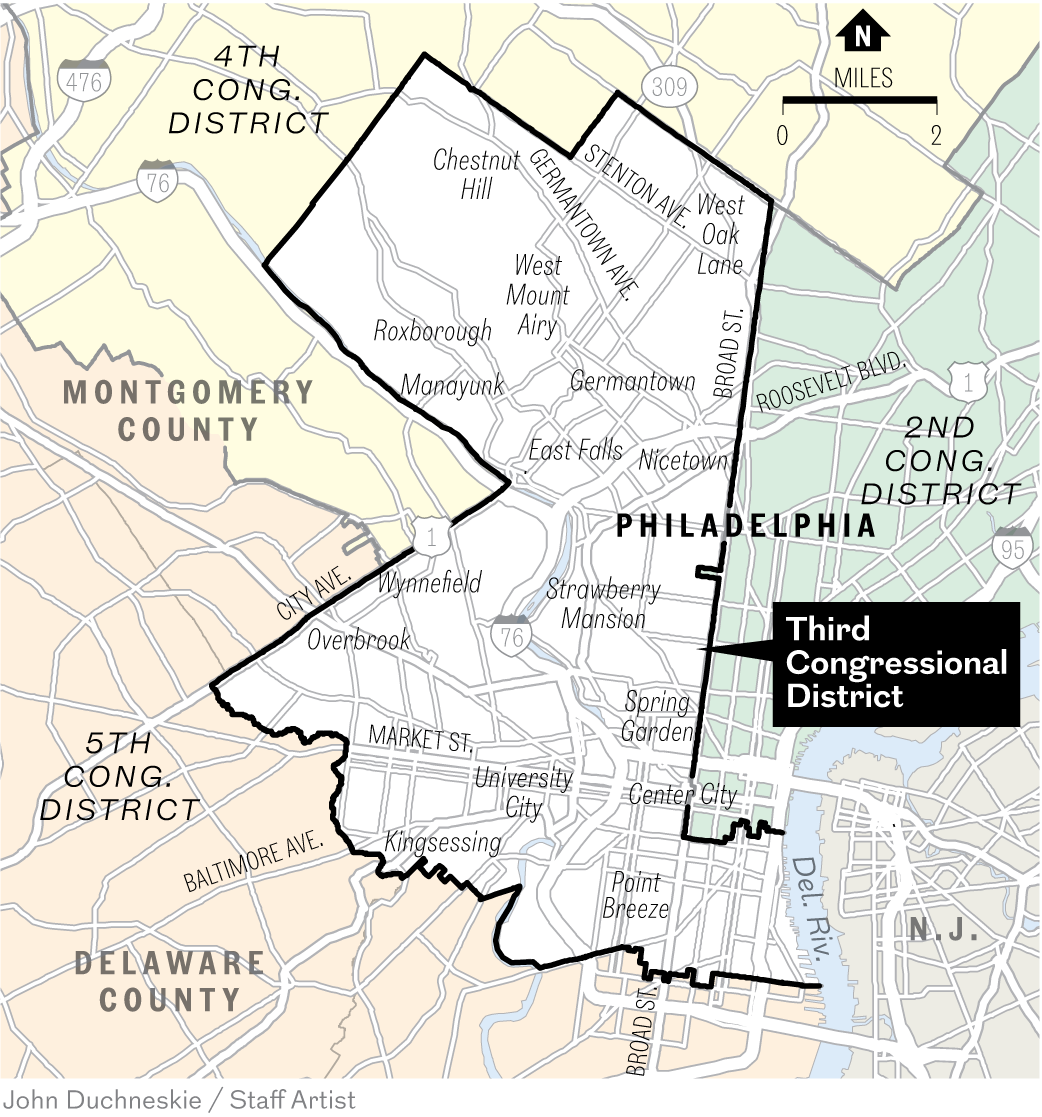
What hasn’t been told is why it means she should represent the 3rd Congressional District, which covers much of Philadelphia, over her opponents who have spent years in politics.
“People get so comfortable doing things the same way, the same way, the same way,” she said in a recent interview at her health clinic. “And no one likes change. But the city needs this. The city needs some change.”
Other candidates say Stanford doesn’t have a monopoly on talking about healthcare. State Sen. Sharif Street, another front-runner in the race, has touted that he and other government officials helped secure funding for Stanford’s pandemic operation.
“During COVID, he was very proud of his work,” Street spokesperson Anthony Campisi said, “to ensure that Doctor Stanford’s vaccination efforts received the support they needed so that we could get vaccines into arms quickly.”
Stanford’s opponents also clearly know that her status as a physician may be an asset.
She submitted paperwork to appear on the ballot as “Dr. Ala Stanford.” But on Tuesday, a member of the Democratic City Committee — which endorsed Street — filed a petition in state court, saying Stanford’s name should appear without the “Dr.” in front of it.
In the coming days, a judge will decide.
Leaning on healthcare as a core issue
Stanford does not fit neatly onto the ideological spectrum.
Of course, she is not conservative. She doesn’t call President Donald Trump by his name — he’s “47″ — and she uses words like “tyranny” and “running amok” to describe the current White House.
But unlike some of her opponents, she is not of the Philadelphia Democratic establishment. She said she feels like the city’s long-entrenched party apparatus had always planned to endorse Street, the former head of the state party and the son of a Philadelphia mayor.
Stanford is also not of the populist left. She believes Palestinians “deserve to have safety and freedom,” but thinks it’s inflammatory when her progressive opponent, State Rep. Chris Rabb, calls Israel’s war in Gaza a “genocide.”
“I know when you use the G-word how hurtful it is to a group of people,” she said. “It’s like someone saying the N-word around me. I don’t want to hear that. And every time you shout that from the rooftops, how many people are you hurting?”
What she does believe is that government systems have failed underserved communities, and that most domestic issues can be traced back to inequities in healthcare — points she has consistently emphasized in her campaign.
Physician Ala Stanford (right) arrives at a forum hosted by the 9th Ward Democratic Committee Dec. 4, 2025. She is a Democratic candidate running to represent Philadelphia’s 3rd Congressional District.
She has hammered Republicans for not extending pandemic-era subsidies that ensured people on Affordable Care Act health plans did not pay more than 8.5% of their income for care. She has advocated for universal healthcare. And she has harshly criticized Health and Human Services Secretary Robert F. Kennedy Jr., who has long been skeptical of vaccines.
“In this country, wealth is linked to homeownership, home ownership is linked to education, education is linked to health outcomes, and health outcomes are all exacerbated by racial injustice,” Stanford said during a recent candidates forum. “So when you talk about one, you talk about all.”
Stanford is careful to say that her focus on healthcare doesn’t mean she can’t discuss housing, immigration, or the war in Iran.
But it is clear that she feels most comfortable talking about what she knows best. Her supporters say that’s an asset in the 3rd Congressional District, which has a disproportionately high number of people who rely on public healthcare systems.
More than a third of the district’s residents, or more than 284,000 people, were on Medicaid as of December, according to the state Department of Human Services. Among Pennsylvania congressional districts, that’s the second-highest proportion of residents on Medicaid. (The first highest is the 2nd Congressional District, which also includes parts of Philadelphia.)
There were also more than 80,000 people in the district who last yearhad health coverage under the Affordable Care Act, either through expanded Medicaid eligibility or a plan they purchased through the marketplace.
That number is also likely lower now since ACA subsidies expired this year and premiums rose. Statewide, one in five people who bought plans last year from Pennsylvania’s marketplace, Pennie, opted out for 2026.
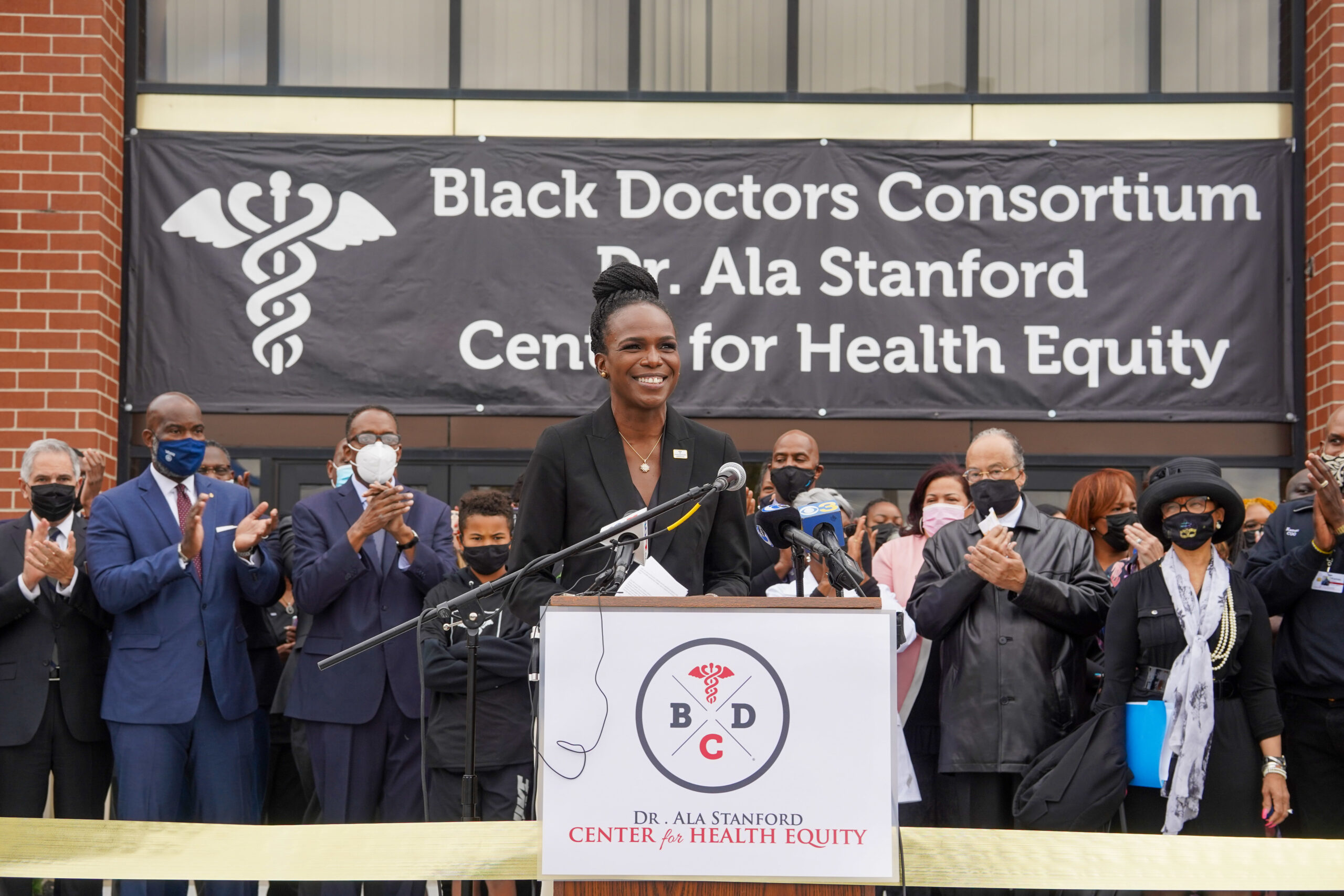
Ala Stanford speaks at the Black Doctors Consortium Dr. Ala Stanford Center for Health Equity in Philadelphia, Pa., on October 27, 2021. The center was opened with the goal of making healthcare accessible for those in communities who might struggle to get proper healthcare treatment.
Stanford’s supporters think Philadelphia voters will trust a doctor to ensure affordable healthcare access. They point to a survey released this month by the Annenberg Policy Center at the University of Pennsylvania that found 86% of respondents said their primary healthcare provider is trustworthy.
Erik Polyak, the executive director of 314 Action, said Stanford’s background differentiates her in a Democratic primary in which most candidates align on key issues.
“Voters want healthcare decisions made by people who understand patients and the science,” he said, “and not politicians chasing headlines.”
Oxman, Stanford’s now-former opponent, said physicians running for office can help rebuild a Democratic Party that has “lost the trust of so many people.”
“So many people see us as not centered on their needs, particularly their economic needs,” he said. “If the Democrats are going to build a party that has a chance of winning in Center City Philadelphia and in central Pennsylvania, it’s got to regain the trust of the voters.”
New to politics, but not government
It was the spring of 2020, and the bills were piling up.
Stanford, who was born in Germantown, had given up her well-paying day job as a surgeon to work full-time with the Black Doctors Consortium. She ran COVID-19 testing clinics in Philly parking lots and churches, and amassed some $200,000 in bills, saying she couldn’t “let one person lose their life for a test that costs $100.”
That was the beginning of her pandemic experience with government.
A lot of it was begging. As Stanford tells it, she peppered government officials with emails, telling them how many people she and her volunteers had tested that day, and asking for help securing funding.
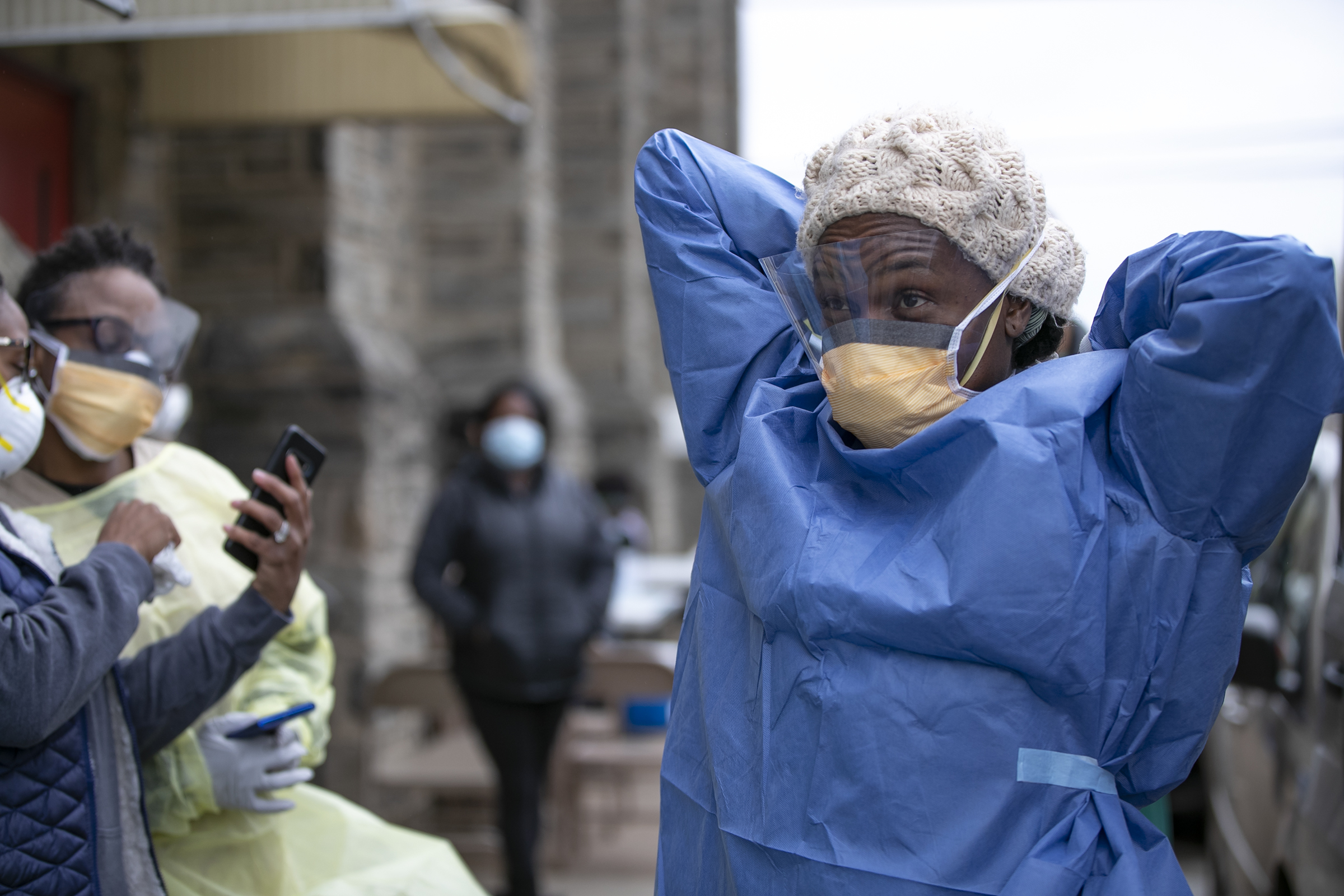
In this April 2020 file photo, Ala Stanford puts on her mask before running a coronavirus (COVID-19) testing site at the Miller Memorial Baptist Church in Philadelphia.
U.S. Rep. Dwight Evans was immediately responsive. He connected Stanford with the White House, other members of Congress, and top insurance companies. And he publicly called on former Gov. Tom Wolf and then-Mayor Jim Kenney to allocate funding to Stanford’s organization, citing the group’s outreach to predominately Black communities and its work to address distrust of medical institutions.
The money came in several months later. It was finally enough for Stanford to pay for testing, compensate her staff, and prepare to vaccinate thousands of Philadelphians.
Fast-forward five years, and Evans has endorsed Stanford to replace him in Congress as he retires after decades of public service. His backing has been invaluable to Stanford, and it surprised some political observers who figured he might endorse one of the politicians whom he’d served alongside.
Stanford said Evans’ support has not convinced some Democratic voters. Some tell her they plan to vote for Street, citing his family name, or they say that “it’s his turn now.”
“What about if he is not what’s best for the people?” Stanford said. “Doesn’t that factor in?”
She tells voters that despite being new to the campaign trail, she isn’t new to government. She worked as a regional director for the Department of Health and Human Services under former President Joe Biden, who appointed her to the role. And she leads medical services at the Riverview Wellness Village, the city-owned drug recovery center opened last year by Mayor Cherelle L. Parker’s administration.
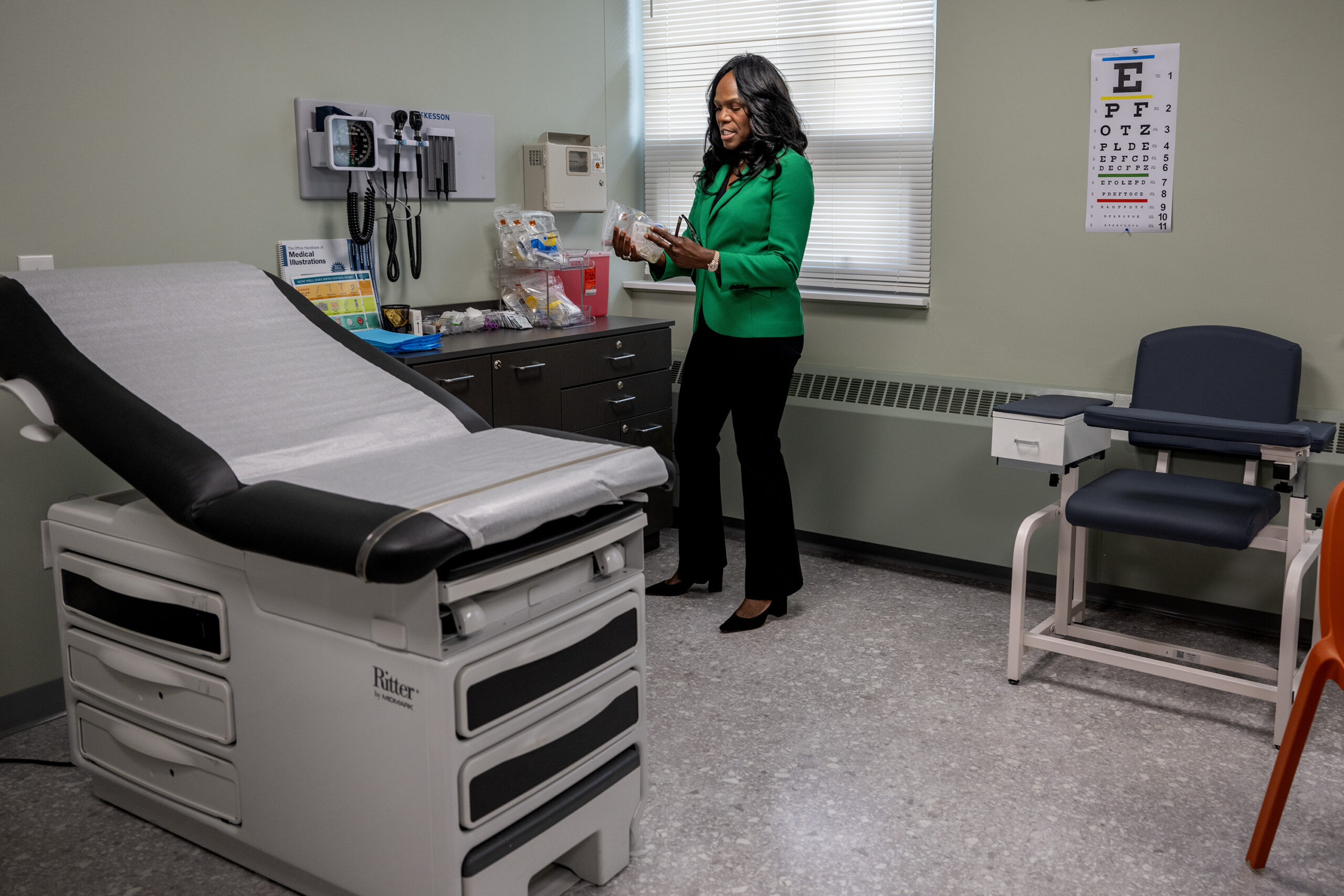
Physician Ala Stanford in an examination room at the primary medical care center run by her Black Doctors Consortium at Riverview Wellness Village, a city-owned drug recovery home in Northeast Philadelphia Tuesday, Nov. 25, 2025.
Still, Stanford very much sees herself as a doctor.
She often works out of a corner office in the North Philadelphia health center, and she still is alerted when the temperature of the vaccine refrigerator dips a degree too low. She has, on more than one occasion, tended to someone experiencing a medical emergency while she was campaigning.
She knows that overseeing day-to-day operations at the health clinic won’t be possible if she’s in Congress. There’s a succession plan in place.
“It’s just about, how can I have more significance at a larger scale? Congress is definitely a way to do it, but it might be somewhere else,” Stanford said. “That is, if I don’t win. But I want to win. I should win.”
DALLAS — State Rep. James Talarico topped Congresswoman Jasmine Crockett in an expensive and fiercely contested Texas Senate Democratic primary that once again has the party dreaming of a big upset in November.
Who Talarico will face depends on a May runoff between longtime Republican Sen. John Cornyn and MAGA favorite Ken Paxton — a race expected to get increasingly nasty over coming months and could hinge on whether or not President Donald Trump offers an endorsement.
Texas, along with North Carolina and Arkansas, on Tuesday kicked off midterm elections with control of Congress at stake and against the backdrop of the U.S.-Israeli war with Iran.
No Democrat has won a statewide race in the reliably Republican state in over 30 years, but in a statement after his victory, Talarico proclaimed “We’re about to take back Texas.”
Crockett concedes
Crockett on Wednesday conceded the primary in the Texas Senate race to Talarico.
“Texas is primed to turn blue and we must remain united because this is bigger than any one person,” Crockett said in a statement. ”This is about the future of all 30 million Texans and getting America back on track.”
Crockett’s campaign had said she planned to sue over voting issues in Dallas and she spoke only briefly on Tuesday night to warn that “people have been disenfranchised.” A spokesperson did not immediately respond to a question about those plans.
Republicans head to round 2
Cornyn, meanwhile, is seeking a fifth term but is facing a tough challenge from Paxton, the state attorney general. Cornyn hopes to avoid becoming the first Republican senator in Texas history to seek reelection and not be renominated.
The GOP contest also featured U.S. Rep. Wesley Hunt, who finished a distant third and conceded. But him making it a three-way race made it tougher for any candidate to reach the 50% vote threshold needed to win the nomination outright and avoid the May 26 runoff.
All three campaigned on their ties to Trump, who did not make an endorsement in the race. Now both Cornyn and Paxton will again fiercely compete to curry the president’s favor.
Cornyn was facing a tough enough battle that he didn’t hold an election night party. Instead, in comments to reporters in Austin, he sought to make the case that a runoff win by Paxton would leave “a dead weight at the top of the ticket for Republicans.”
“I’ve worked for decades to build the Republican Party, both here in Texas and nationally,” Cornyn said. “I refuse to allow a flawed, self-centered and shameless candidate like Ken Paxton to risk everything we’ve worked so hard to build over these many years.”
Addressing supporters in Dallas, Paxton made a point of saying he felt like he had during a recent trip to Mar-a-Lago, Trump’s Florida estate. He also proclaimed: “We proved something they’ll never understand in Washington.”
“Texas is not for sale,” he said.
Cornyn’s cool relationship with Trump is part of what made him vulnerable. He and allied groups spent at least $64 million in television advertising alone since July to try stabilize his support.
Paxton, who began campaigning in earnest only last month, has made national headlines for filing lawsuits against Democratic initiatives. He remained popular in Texas despite a 2023 impeachment trial on corruption charges, of which he was acquitted, and accusations of marital infidelity by his wife.
Senate GOP leaders, who are backing Cornyn, worry that Paxton’s liabilities would make it harder to defend the seat if he is the nominee — and require significant spending that could be better used elsewhere.
Confusion at some polling places
In the Democratic campaign, Crockett and Talarico each argued that they would be the stronger general election candidate in a state that backed Trump by almost 14 percentage points in 2024.
Voting was extended in Dallas County and Williamson County, outside Austin, after voters reported being turned away and directed to different voting precincts because of new primary rules. Paxton’s office later challenged a decision keeping the polls open longer, and the state Supreme Court ruled that ballots cast by people not in line by 7 p.m. should be separated from others.
It was not immediately clear how the court’s action would be carried out or how many eligible ballots remained to be counted in Dallas County, Crockett’s home base. Crockett said she would seek legal action after voting was concluded.
And in Harris County, which includes Houston, a spokesperson said that as of 10 p.m. there were still voters at 20 centers.
Democratic race featured clash of styles
Crockett and Talarico waged a spirited race as Democrats look for their first Senate win in Texas since 1988.
Crockett has built a national profile for zinger attacks on Republicans and focused on turning out Black voters in the Dallas and Houston areas. Talarico, a seminarian who often references the Bible, held rallies across the state, including in heavily Republican areas.
“We are not just trying to win an election,” a jubilant Talarico told supporters in Austin before the race was called. “ We are trying to fundamentally change our politics. And it’s working.”
Dallas voter Tanu Sani said she cast her ballot for Talarico because he “really spoke to me in the way he tries to unify.”
Tomas Sanchez, a voter in Dallas County, said he supported Crockett because “she cares about immigrants, she cares about the American people in a way that a lot of the Republicans have proven they haven’t.”
Talarico outspent Crockett on television advertising by more than four to one as of late February. He got a burst of attention — and campaign contributions — last month from CBS’ decision not to air his interview with late-night host Stephen Colbert, who said the network pulled the interview for fear of angering Trump’s FCC.
Other key primaries
Texas’ races also featured new congressional district boundaries that GOP lawmakers — urged on by Trump — redrew to help elect more Republicans. The result matched several Democratic incumbents in primary fights and set up new general election battlegrounds.
Republican former Rep. Mayra Flores was attempting a comeback but was defeated by Eric Flores, a lawyer endorsed by Trump, for the nomination to run against Democratic Rep. Vicente Gonzalez. Mayra Flores made history in a 2022 special election as the first Republican to win in the Rio Grande Valley in 150 years but lost her bid for a full term later that year.
Incumbent Republican Rep. Dan Crenshaw lost his primary to state Rep. Steve Toth, who was endorsed by Sen. Ted Cruz.
Another incumbent GOP incumbent, Rep. Tony Gonzales, was considered vulnerable after an alleged affair with a staffer who killed herself. He was challenged by gun manufacturer and YouTube influencer Brandon Herrera, who calls himself “the AK guy.” The two will head to a runoff in a district that includes Uvalde, site of a deadly 2022 shooting at Robb Elementary School.
Former Major League Baseball star Mark Teixeira clinched the Republican primary to succeed GOP Chip Roy in southwest Texas.
Democrat Bobby Pulido, a Latin Grammy winner, won his party’s primary in South Texas against physician Ada Cuellar. Pulido will face two-term Republican Rep. Monica De La Cruz.
In suburban Dallas, Democratic Rep. Julie Johnson was facing former Rep. Colin Allred, a former NFL linebacker and 2024 Senate nominee.
Democratic Rep. Al Green was fighting to stay in office after his Houston-based district was drawn to lean Republican. Green, 78, ran in a newly drawn district against Democratic Rep. Christian Menefee, 37, who won a January special election for the current 18th District.
Republican Gov. Greg Abbott easily won his primary and will face Democratic state Rep. Gina Hinojosa. Roy advanced to a primary runoff with Mayes Middleton for attorney general.
A Florida developer who is building data centers in Pennsylvania. A Chicago crypto trader whose company was sued by the Biden administration. And a Southwestern Pennsylvania coal magnate whose firm received a permit from state regulators last year to expand operations — and is now seeking approval to open a new mine.
Shapiro’s gubernatorial campaign raised at least $8.5 million last year from nearly 240 CEOs, founders, business owners, and other top executives, according to an Inquirer analysis of campaign-finance records that were made public last month.
That includes the single biggest donation to the campaign: $2.5 million from billionaire and former New York City Mayor Michael Bloomberg. Shapiro’s haul from top executives represents 50.8% of the $16.8 million he raised from donors who listed their occupation in campaign finance filings.
window.addEventListener(“message”,function(a){if(void 0!==a.data[“datawrapper-height”]){var e=document.querySelectorAll(“iframe”);for(var t in a.data[“datawrapper-height”])for(var r,i=0;r=e[i];i++)if(r.contentWindow===a.source){var d=a.data[“datawrapper-height”][t]+”px”;r.style.height=d}}});
During his first three years in office, Shapiro, 52, has sought to build a profile as a pragmatic, business-friendly governor, focusing on speeding the permitting process and promoting economic development through government grants and tax breaks.
At the same time, the governor has proven adept at raising campaign cash from people who have business interests before state government in Harrisburg. Those include a skill game developer who staved off a major policy defeat this year and a waste coal power plant owner who gave $100,000 to Shapiro two days before the governor pulled out of a multistate program that requires such facilities to pay for their greenhouse gas emissions.
It’s a contrast with the rising populism on both the left and right, marked by a “Fighting Oligarchy” tour by progressive leaders and the MAGA movement’s deep suspicion of elites.
It’s not unusual for corporate executives to make contributions to candidates from both parties. But the practice could invite scrutiny for Shapiro in a White House run — particularly among voters and activists who are dismayed by the role of money in politics.
“We are concerned about any elected leaders taking monetary donations from corporate interests, regardless of who they are,” said Ashley Funk, executive director of the Mountain Watershed Association, a nonprofit that opposes a Shapiro donor’s coal mining expansion.
“I think that it influences decision-making,” she said.
‘The speed of business’
For now, Shapiro’s pledge to make Pennsylvania’s government run “at the speed of business” appears to have won over many executives, helping him build a massive fundraising advantage in his reelection bid. Shapiro raised $23.2 million overall in 2025, compared with the $1.5 million reported by his likely Republican opponent, State Treasurer Stacy Garrity.
“I’ve long admired the way the commonwealth approaches economic development and innovation, and I have deep respect for Gov. Shapiro’s leadership,” said Bob Clark, executive chairman and founder of Clayco, a Chicago-based real estate and construction firm that is redeveloping a site at the industrial hub known as the Bellwether District in South Philadelphia.
Clark gave Shapiro’s campaign $100,000 last year. “I consider him both a trusted colleague and an effective leader,” he said.
In recent weeks, the governor has celebrated pledges by pharmaceutical companies to invest billions of dollars in new facilities in Montgomery County and the Lehigh Valley, secured with tens of millions of dollars in state incentives. And last year, Amazon said it would spend $20 billion in Pennsylvania to build two new artificial intelligence data centers, in what officials called the single largest private investment in state history.
Shapiro’s allies say he stands up to big business, too, highlighting how he successfully prodded PJM Interconnection LLC — the Valley Forge-based regional electric grid operator whose voting members largely consist of companies in the electricity industry — to impose and extend a price cap. He has also received support from organized labor.
Shapiro argues that the way to restore faith in institutions is not by railing against billionaires but by showing that the government can fix real problems — “get s— done,” in his parlance.
Garrity, the Republican state treasurer, says Shapiro’s actions don’t live up to the hype.
“Liberal national donors may be investing in Josh Shapiro’s political vanity project, but hardworking Pennsylvanians are seeing nothing in return,” she said in a statement.
Garrity received nearly $380,000 from more than 60 CEOs and other top business executives. That figure represents about 41% of her contributions from donors who listed their occupation in campaign-finance filings.
Shapiro’s campaign said his coalition is “reflective of a governor who is delivering for all Pennsylvanians — and of a campaign that is fighting to win up and down the ballot.”
window.addEventListener(“message”,function(a){if(void 0!==a.data[“datawrapper-height”]){var e=document.querySelectorAll(“iframe”);for(var t in a.data[“datawrapper-height”])for(var r,i=0;r=e[i];i++)if(r.contentWindow===a.source){var d=a.data[“datawrapper-height”][t]+”px”;r.style.height=d}}});
The governor has “focused on growing our economy and creating jobs, and he has delivered — creating tens of thousands of jobs, winning major deals, and building the only growing economy in the Northeast,” campaign spokesperson Manuel Bonder said in a statement.
Shapiro highlighted one such deal in July, when he appeared alongside executives at defense contractor Rhoads Industries at the Navy Yard in South Philly to announce the firm’s $100 million plan to build a new manufacturing facility, create 450 jobs, and boost production of submarine parts.
“One of the things that Rhoads is known to do is get things done. … We want to turn out product; we want to turn it around; we want to get it done,” president Mike Rhoads said.
Looking toward Shapiro, he said, “Somebody standing to my left has the kind of same attitude.”
Gov. Josh Shapiro (right) with Rhoads Industries CEO Dan Rhoads in July 2025 at the Navy Yard.
Taking his turn at a lectern that read “Rebuilding America’s Fleet,” Shapiro said Rhoads’ investment — with help from the state — would “ensure the future of submarine manufacturing, shipbuilding, and all things important to securing our freedom is going to run right through the Philadelphia Shipyard.”
Three months later, in October, CEO Dan Rhoads contributed $10,000 to Shapiro’s campaign — the single largest donation he made to a candidate for state office in the last decade, records show. Rhoads did not respond to requests for comment.
Data centers and ‘skill games’
Shapiro donors’ business interests include everything from data center construction to state regulation of slot machine-style games and approvals for a nuclear reactor.
Dan Hilferty, CEO of Philadelphia-based Comcast Spectacor — which owns the Flyers and the Xfinity Mobile Arena in South Philly — gave $40,000. A political action committee affiliated with parent company Comcast also gave $50,000. Comcast Spectacor and the 76ers are building a new arena at the South Philadelphia sports complex, and Shapiro last year did not rule out offering state incentives. Hilferty, a former CEO of Independence Blue Cross, previously gave Shapiro’s campaigns $27,500 over the last decade. Other Comcast Spectacor executives contributed about $95,000 during that period.
Top executives at Pace-O-Matic, the Georgia-based developer of so-called skill games that have proliferated across convenience stores and bars, gave $50,000. Operators for Skill, a PAC affiliated with the firm, contributed $10,000. The company successfully fended off a push in 2025 by Shapiro and lawmakers to tax the games at a level the industry considered too high. The governor has renewed a push to regulate the games, which some Philadelphia lawmakers say they would prefer to see banned. Pace-O-Matic contributes to both parties and remains “committed to fighting for fair regulation and taxation of Pennsylvania skill games,” said Mike Barley, chief public affairs officer for Pace-O-Matic.
Joseph Dominguez, president of Baltimore-based Constellation Energy, gave $25,000. The company is seeking to restart a nuclear reactor at Three Mile Island, just outside Harrisburg, and needs state and federal approvals. The plant would supply power to Microsoft to support the tech company’s data centers. “Constellation executives contribute to policymakers on both sides of the aisle who, like Gov. Shapiro, prioritize results and pragmatic solutions over politics,” a company spokesperson said.
Brian Patten, CEO of Next Generation Land Co. LLC, gave $10,000. He is a Florida data center developer who says he is pursuing projects in Pennsylvania. Data centers that power companies’ cloud storage and computing needs have drawn backlash across the U.S. over fears of rising electricity rates. In his February budget address, Shapiro said he wants data centers to supply their own energy and pay for any new generation they need. He has also said the U.S. needs to win the AI race against China.
Justin Thompson, CEO of Iron Senergy, a coal operator, gave $10,000. His firm owns the Cumberland Mine in Greene County. When Pennsylvania applied to the U.S. Environmental Protection Agency for a $400 million grant, it mentioned several firms — including Iron Senergy — that could use the money for decarbonization projects, the Pittsburgh Post-Gazette reported in 2024. The EPA awarded the grant, and the Pennsylvania Department of Environmental Protection is tasked with administering it. The state is now reviewing applications, which it says are confidential.
The Cumberland Coal Mine in Greene County seen in 2020.
Local and national donors
Shapiro drew on a mix of executives from local and national firms. In Pennsylvania, he raised money from health system CEOs (Joseph Cacchione of Thomas Jefferson University, $10,000), bankers (Richard J. Green of Philly-based Firstrust Bank, $125,000), and a home remodeler (Asher Raphael of Power Home Remodeling in Chester, $100,000). Josh Kopelman — founder of First Round Capital and chairman emeritus of The Inquirer’s board of directors — and his wife, Rena, each gave $50,000.
There were private equity investors (San Francisco billionaire John Pritzker, cousin of Illinois Gov. JB Pritzker, $50,000), Hollywood producers (Jimmy Miller of talent management and production firm Mosaic, $75,000), professional sports team owners (telecom billionaire Robert Hale, minority owner of the Boston Celtics, $50,000), and a Massachusetts sports betting executive (Jason Robins of DraftKings, $10,000).
For his part, Bloomberg is “a big fan of Gov. Shapiro and a big believer in his leadership, and thinks he’s done a great job for Pennsylvania,” adviser Howard Wolfson told Axios.
At least one donor had ties to President Donald Trump, whom Shapiro often criticizes.
Don Wilson Jr., CEO of Chicago-based trading firm DRW Holdings LLC, gave $10,000 to Shapiro in September.
The Securities and Exchange Commission filed civil charges against a unit of Wilson’s firm while President Joe Biden, a Democrat, was in office. The SEC accused it of operating as an unregistered cryptocurrency dealer.
Biden-era regulators said that firms were dodging that rule by claiming crypto was a commodity, not a security. The enforcers argued this exposed investors to extra risks associated with digital currencies.
Then last March, a couple of months after Trump took office, the new administration dropped the charges against Wilson’s firm. Nine weeks later, Wilson invested $100 million into a Trump bitcoin project, the Financial Times reported.
The company told the newspaper it engages in a “variety of strategies in the crypto ecosystem” and saw value in holding bitcoin. “This transaction was viewed purely through that lens,” it said.
Trump denies having conflicts of interest.
That didn’t stop the Democratic National Committee from flagging the news on its “CORRUPTION WATCH” page.
The Trump administration, the Democrats’ post said, “now appears to be engaged in blatant pay-to-play politics.”
Power plants and coal mines
Among corporate executives, two of the eight biggest donors to Shapiro’s campaign last year were the father-and-son owners of privately held Robindale Energy Services, which owns about 20 companies involved in waste coal reclamation, power generation, mining, and logistics. Robindale’s assets include multiple power plants fueled by waste products from abandoned coal mines.
CEO Scott Kroh and his son Judson, the Latrobe-based company’s president, gave a total of $271,000.
That included a $100,000 contribution from Scott Kroh two days before Shapiro signed the annual budget, which came after a monthslong stalemate. The deal with Senate Republicans included language pulling the state out of the Regional Greenhouse Gas Initiative, a multistate effort to generate cleaner power that Robindale had vocally opposed.
Robindale’s executives did not respond to requests for comment.
In June 2023, Judson Kroh spoke out against RGGI at a public hearing, telling Pennsylvania lawmakers that Robindale’s power plants have enough capacity to power 500,000 homes. “Our main concern is you’ll see a significant decrease in power exports out of the state due to RGGI, as well as a significant decrease in coal production,” Kroh said.
Other energy industry firms, Republican lawmakers, and building trades unions have also long opposed the initiative, which requires power plants to buy allowances to cover their carbon emissions. They call it a job killer and an electricity tax. Environmental groups say it has reduced pollution and led to investments in clean energy in other states.
Shapiro had for years expressed concerns about the greenhouse gas initiative, which Pennsylvania joined under his predecessor but never implemented due to litigation. Shapiro said in 2021 during his first run for governor that “it’s not clear to me” that the program protected jobs, addressed climate change, or ensured energy reliability.
The Kroh family donated a total of $55,000 to his 2022 campaign and $21,000 the following year. Judson Kroh was among the more than 300 people who served on Shapiro’s transition team.
Many of Robindale’s operations are regulated by the state, and the company spent $150,000 lobbying state government officials last year, records show. Company executives in recent years have largely donated to Republicans in Harrisburg, though they have also supported some Democrats, including Shapiro.
window.addEventListener(“message”,function(a){if(void 0!==a.data[“datawrapper-height”]){var e=document.querySelectorAll(“iframe”);for(var t in a.data[“datawrapper-height”])for(var r,i=0;r=e[i];i++)if(r.contentWindow===a.source){var d=a.data[“datawrapper-height”][t]+”px”;r.style.height=d}}});
In addition to its power generation business, Robindale owns coal mines that are subject to state inspections and oversight. When two people died in a Somerset County mine operated by subsidiary LCT Energy, DEP required the company to update its safety protocols. The deaths in 2022 and 2023 came during a time in which there were 20 coal mining fatalities nationwide, according to federal data.
Johnstown-based LCT is currently expanding.
About 30 miles west of Maple Springs, LCT opened another mine in 2018 in Westmoreland County called Rustic Ridge 1, which produces 600,000 tons of coal a year.
The state renewed the permit for the 2,800-acre underground mine in January last year, and from that month through March, the Kroh family donated $70,000 to Shapiro’s campaign.
In April, after a yearslong review, the Pennsylvania Department of Environmental Protection approved a permit authorizing LCT to expand its operations there, adding 1,400 acres under the Pennsylvania Turnpike — the equivalent of 93 Lincoln Financial Fields. The permit allows LCT to mine coal up to 600 feet underground. The company sells the coal for production of steel.
The nonprofit Mountain Watershed Association is appealing the DEP’s approval to the Pennsylvania Environmental Hearing Board — whose judges are appointed by the governor, subject to confirmation by the state Senate — arguing that the expansion could harm groundwater and streams.
Others say the mine supports jobs and helps the local economy. Before opening, the company said in 2014 that it would invest $50 million to develop the mine, according to local news reports.
The state budget Shapiro signed in November expanded a program for expedited permitting involving approvals from the DEP, which reviews 40,000 permits a year. Introduced in 2024, the program is currently available for eligible permits such as air quality, dam safety, and oil and gas erosion and sediment control.
The budget legislation — cheered by Shapiro and GOP lawmakers — added more permit types, including one for mining, “which DEP is in the process of adding to the program,” a department spokesperson said.
Funk — the executive director of the watershed association, which has spent millions of dollars over the last 30 years repairing the environmental damage of legacy coal mining — said she is concerned the Krohs’ political giving “might be having an influence over Shapiro and his administration as we work to permit some of Robindale’s projects such as LCT Energy.”
Shapiro says permitting reform reflects his governing ethos.
“When you think about getting stuff done … it requires focus and speed,” he said in December at a National Governors Association event. “We’ve gotta be speedier as a country.”
Weeks earlier, Brown was accused of robbing campaign donations from another Democrat more than a thousand miles away in Florida.
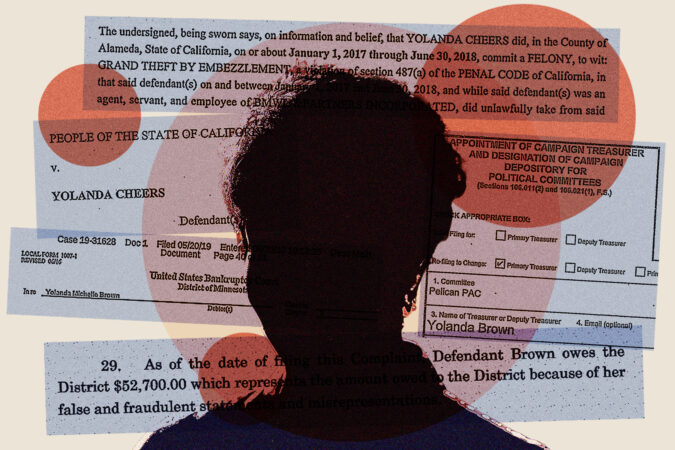
Brown, a Florida-based finance manager and campaign consultant who works primarily with Democrats and social justice groups, has over the last decade faced criminal charges for embezzlement and other allegations of financial fraud in at least four states totaling in excess of half a million dollars, according to an Inquirer review of hundreds of pages of court documents, campaign finance filings, and business records.
The misdeeds Brown, 46, has been accused of range from shaving money from campaign accounts to setting up sham jobs and billing nonprofits for work that was never performed. Two years ago, Brown paid $330,000 after pleading no contest to felony embezzlement in California, where prosecutors said she stole from a nonprofit and set up a fake loan under the name of a consultancy where she previously worked.
Through it all, she avoided jail time and, using three different surnames, continued to work on political campaigns from Florida to Philly, persuading candidates to trust her with access to their bank accounts and thousands of dollars in donations to their causes.
Khambrel Davis, a Florida-based criminal defense attorney representing Brown, says this is all a misunderstanding. He said that Brown is the victim, and that a rogue employee of Brown’s firm stole from the PACs in Philadelphia and St. Petersburg and then disappeared “in the wind.”
Davis said Brown reached out to law enforcement but has not heard back.
“[Brown] just can’t locate her, and now it’s kind of all coming back on her,” Davis saidin a phone interview Saturday. “Her history is coming up, so everyone’s just assuming she must have done this. They’re kind of putting together this narrative that she’s just this habitual thief.”
Records show Brown as the only employee of her firm who ever filed campaign finance paperwork for the campaigns now accusing her of theft.
Today, Brown’s whereabouts are unknown to the campaigns she once worked for.Her firm’s address listed in campaign finance filings is a mailbox rental shop, and her website went dark in February. She is registered to vote in Coral Springs, Fla., a suburb of Fort Lauderdale.
Davis, who said he has been in contact with Brown, declined to say where she is. He insisted she has been “transparent and forthcoming with everyone.”
Several other campaign consultants based in Florida told The Inquirer that they have identified suspicious transactions made last year while Brown had access to their accounts. And multiple law enforcement agencies are investigating Brown’s accounting, including the FBI, according to two sources who requested anonymity because they were not authorized to discuss the ongoing probe.
State Rep. Chris Rabb at a forum hosted by the 9th Ward Democratic Committee on Dec. 4, 2025. He is a Democratic candidate running to represent Philadelphia’s 3rd Congressional District.
Before Brown joined Rabb’s campaign in August, she worked with high-profile Democrats in New York, Illinois, and Florida — at times using her married name, Yolanda Rumph.
Her clients included former Tallahassee Mayor Andrew Gillum, who waged a closely watched campaign for Florida governor against Ron DeSantis in 2018. Gillum was indicted for making fraudulent transactions out of the same political action committee that Brown worked for — but prosecutors dropped the charges in 2023 after a jury deadlocked and the court declared a mistrial.
Rabb, a progressive who is considered among a handful of front-runners in the race to replace outgoing U.S. Rep. Dwight Evans, has said he is committed to continuing his campaign for the 3rd Congressional District seat, despite losing money that heis unlikely to see returned before the May 19 primary.
In January, before allegations of the missing money became public, Rabb was already significantly trailing the financial front-runner in the race. Records show he had about $100,000 in his campaign account at the start of the year, while State Sen. Sharif Street reported having more than five times that amount.
Rabb’s campaign declined to say how much money was taken, citing the ongoing law enforcement investigation.
Abe White, Rabb’s spokesperson, said in a statement that the campaign identified the unauthorized withdrawals after finding errors in its most recent campaign finance filing, which encompasses fundraising and spending activity from October to December.
He said the campaign had protocols in place to reconcile accounts and “immediately took action” after coming across the suspicious activity.
“The campaign’s former treasurer manipulated every campaign safeguard in place,” White said. “It’s what these people do.”
Davis, Brown’s attorney, said his client intends to pay back the funds he alleges were stolen by the employee.
“She’s just going to take responsibility,” he said, “and try to remedy the situation.”
No warning signs until it was too late
Very few people working on political campaigns have access to the bank accounts powering their efforts. The accounts see thousands — and sometimes millions — of dollars flowing in and out in a relatively short period of time.
That means candidates put significant trust in their treasurers, who are official designees responsible for ensuring campaigns comply with finance laws.
Matthew Haverstick, a managing partner with Kleinbard LLC, a Philadelphia-based law firm that often works with political campaigns and causes, said it is essential that campaigns thoroughly vet campaign treasurers and compliance consultants.
“This is why you work hard at the front end of this stuff in campaigns,” Haverstick, who is not working for any candidate in the race, said of Rabb’s situation. “When you’re deep into a campaign and a problem like this blows up, it has the potential to end the campaign. So the right time to spend a little more money and try a little harder is before you hire somebody.”
Rabb, a five-term Pennsylvania state representative, entrusted his account to Brown shortly after launching his run for Congress in July. Rabb had not worked with Brown before, and records show no other campaign in Pennsylvania has paid her or her firm for work.
The three other candidates who have so far raised the most money in the 3rd Congressional District race have treasurers based in Philadelphia. But it’s not unheard of for candidates to use consultants and staff from out of state, especially when they are seeking federal office.
White, Rabb’s spokesperson, said Brown “came highly recommended”and “there was no reason for concern” when she was hired.
Elsewhere, other Democrats who hired Brown said they similarly saw no warning signs until it was too late.
In January, the chairperson of a PAC backing St. Petersburg Mayor Ken Welch said she had reported Brown to law enforcement for misspending $207,000.
Brown had worked with the group, called the Pelican PAC, for about a year. Campaign finance records show that last fall, several transactions were made to transfer money from the PAC account into O’Reilly Business LLC, a separate entity that Brown controls.
Davis said Brown’s employee also had access to that LLC, and said it was the employee who moved the money.
Adrienne Bogen, who heads the Pelican PAC, said Brown was removed as the PAC’s treasurer in January.
She was hired following “standard onboarding practices,” Bogen said.
“Nothing was identified that raised concerns,” she added.
In this 2023 file photo, St. Petersburg Mayor Ken Welch greets the audience during a Suncoast Tiger Bay Club meeting at Tropicana Field in St. Petersburg, Fla.
In reality, Brown had been under indictment on 10 criminal charges in Alameda County, Calif., where she worked as a finance manager for Oakland-based consultancy BMWL & Partners. She was charged under the name “Yolanda Cheers.”
In 2019, prosecutors in court documents accused Brown — referring to her as “Cheers” — of routing money belonging to a nonprofit client of the consultancy to herself and then, years after being fired, taking out unauthorized loans in BMWL’s name. She faced charges of aggravated white-collar crime, grand theft by embezzlement, forgery, and identity theft, and could have faced years in prison.
The same year she was indicted in California, Brown faced legal trouble elsewhere. Authorities in Washington, D.C., accused her of fraud, allegations that came to light after she filed for bankruptcy in Minnesota.
Brown had previously worked as a grants manager for the local government in D.C. and owed the city $52,700 while filing for bankruptcy, the D.C. attorney general wrote in court papers. Authorities alleged that in 2014 and 2015, Brown asked two city contractors to hire her fiance,and she billed them for work that he supposedly completed — even though he was on an active-duty military assignment at the time.
The Minnesota bankruptcy case moved forward. Much of Brown’s debt was erased, but not the money that she owed in Washington.
On the other side of the country, the criminal case in California languished for nearly five years.
In February 2024, Alameda County District Attorney Pamela Price announced that her office had reached a plea deal. Brown pleaded no contest to one count of grand theft by embezzlement andwas required to pay $330,000 in restitution. She served no jail time.
Davis cast the no-contest plea as Brown’s attempt to put the charges behind her — not as an admission of guilt.
“Court could be kind of dragging on people,” he said. “It’s a very big burden.”
‘Some people will inevitably give in to temptation’
After the campaign allegations against Brown in St. Petersburg and Philadelphia trickled out this year, others who have worked with her said they reported activity they think is suspicious to law enforcement.
Jamie Jodoin, a Florida-based political and financial consultant, said she worked on a PAC last year that hired Brown as its treasurer. She said Brown wired $25,000 out of the PAC’s bank account and later closed the account without notifying the candidate.
“We have no idea where that went,” Jodoin said.
Political campaigns, which are small and short-lived entities, often don’t carry insurance against internal theft. But they do usually have review processes.
The Federal Election Commission recommends candidates put in place internal controls such as risk assessment and monitoring in order to prevent the misappropriation of funds. The guidance says that bank statements should be reviewed by someone who is not also writing the checks.
“Absent some basic checks and balances,” the commission says in its recommendations, “some people will inevitably give in to temptation.”
Campaign buttons for State Rep. Chris Rabb Dec. 4, 2025. A Democratic candidate running to represent Philadelphia’s 3rd Congressional District.
White said the Rabb campaign had safeguards in place. But he added that, after the unauthorized withdrawals were identified, the campaign newly established “airtight financial protocols” such as “strengthening oversight and internal controls.”
The campaign recently named a new treasurer and hired a new compliance firm.
Bogen, of Welch’s PAC in St. Petersburg, said Brown’s access to internal systems and bank accounts was “immediately revoked” once it was discovered that she had made suspicious transactions.
Brown, Bogen said, “has not been heard from since.”
New Jersey joined the growing list of states sued by the Department of Justice after refusing to share personal information of voters with President Donald Trump’s administration because of privacy concerns.
The Justice Department sued New Jersey on Thursday alongside Utah, Oklahoma, Kentucky, and West Virginia as it escalates its effort to obtain voter data. It previously sued Washington, D.C., and 24 other states, including Pennsylvania.
The suits follow Trump’s rhetoric in recent weeks about the need to “nationalize elections.” During his State of the Union address to a joint session of Congress this week, the president repeated the unsubstantiated allegation that “cheating is rampant in our elections.”
The lawsuit in the New Jersey District Court accuses Dale Caldwell, who is serving as the Garden State’s lieutenant governor and secretary of state, of violating Title III of the Civil Rights Act of 1960 by refusing to hand over the list of the state’s registered voters to U.S. Attorney General Pam Bondi.
“Accurate, well-maintained voter rolls are a requisite for the election integrity that the American people deserve,” Bondi said in a statement. “This latest series of litigation underscores that This Department of Justice is fulfilling its duty to ensure transparency, voter roll maintenance, and secure elections across the country.”
Caldwell’s office did not immediately respond to a request for comment.
Acting New Jersey Attorney General Jennifer Davenport said the state would defend against the lawsuit in court.
“As several courts have already held, the Department of Justice’s request for voters’ personal information, including driver’s license numbers and Social Security numbers, is baseless,” Davenport’s statement said. “We are committed to protecting the privacy of ours state’s residents.”
Bondi sent a letter to Caldwell on July 15 asking for the statewide voter registration list, the suit says. The letter cited alleged discrepancies in New Jersey’s voting registration statistics compared to national averages. For example, it says the state removes fewer duplicates from its voter rolls.
A month later, the suit says, Bondi sent another letter asking for the full list including each voter’s full name, date of birth, address, and driver’s license or last four digits of their Social Security number.
In the months following the August letter, former state Attorney General Matthew Platkin declined to share the information because of privacy concerns — a reason Pennsylvania officials have also cited.
After the administration of Gov. Mikie Sherrill took office in January, DOJ sent a “courtesy email” to check if the state’s position on sharing the records has changed. But it didn’t.
The suit is asking a federal judge to find that Caldwell violated federal law by refusing to share the records and order the state to pass over the information.
Schmidt called the department’s request “unprecedented and unlawful” and promised to “vigorously fight the federal government’s overreach in court.”
“I have an obligation to protect the personal information that Pennsylvania voters entrust us with, and I take that obligation extremely seriously,” Schmidt said in a September statement.
The voter roll lawsuit is the second filed by the Justice Department against New Jersey this week. Bondi sued Sherrill on Tuesday over a Feb. 11 executive order that prohibits state agencies to allow federal immigration agents from entering state property for enforcement actions without a warrant.
The lawsuit said the executive order would disrupt the ability of U.S. Immigration and Customs Enforcement to capture “dangerous criminals” who are in prisons or courthouses controlled by the state.
Davenport said in a Tuesday statement that the state would continue to ensure the safety of the immigrant communities.
“Instead of working with us to promote public safety and protect our state’s residents, the Trump administration is wasting our resources on a pointless legal challenge,” Davenport’s statement said.
At the end of the event, the moderator, 21st Ward Leader Lou Agre, allowed the candidates to ask one another questions. Their choices offered hints as to which of their rivals the candidates view as most threatening.
Dr. Ala Stanford, who appears to be the strongest candidate among the non-elected officials in the race, questioned the accomplishments of State Sen. Sharif Street, who is seen by many as a frontrunner after being endorsed by the Democratic City Committee and building trades unions.
The 3rd District covers about half of Philadelphia and is, by some measures, the bluest seat in Congress. The Democratic primary is May 19.
The forum was initially scheduled to be held in-person at the Polish Legion of American Veterans’ Adam Kowalski post in Roxborough, but it was moved to Zoom due to the blizzard on Sunday and Monday.
Here are the issues the candidates debated Monday night.
She began the candidate-on-candidate questioning on Monday by asking Street for instances in which his work has helped constituents in tangible ways, setting up a juxtaposition with her record.
“In a time when the people are asking for new leadership, they’re asking for innovation, they’re asking for not the same politics as usual … can you tell the people a time when the seas were rough and you stepped up and delivered for them that they felt it?” Stanford asked, adding: “Can you share what you can do during the chaos that people can feel — and where was it during COVID?”
Physician Ala Stanford (left) and State Sen. Sharif Street at a December forum hosted by the 9th Ward Democratic Committee.
Street began by saying that, as the top Democrat on the Senate Banking & Insurance Committee in Harrisburg, he boosted Stanford’s work during the pandemic by pressuring insurance companies to reimburse her fledgling organization, which provided testing and vaccinations for thousands of Philadelphians in disadvantaged neighborhoods.
“Independence Blue Cross was not moving forward with the reimbursement rates for the Black COVID Doctors Consortium,” Street said. “I spoke with you, and I helped, and I reached out to them to make sure that [the Medicaid plan] Keystone First would begin to pay the reimbursement in an immediate way.”
He also said his office distributed food to constituents and helped process rent rebates during the pandemic.
In the run-up to the 2020 election, Street, as chair of the Pennsylvania Democratic Party at the time, repeatedly fought in court against President Donald Trump’s campaign over election administration issues. In her question, Stanford asked Street to focus on what he delivered for his constituents — “not that you sued Donald Trump 20 times and won every time, because how do the people feel that?”
“Donald Trump wanted to challenge people’s ability to vote in some of the most vulnerable communities,” he said. “I went to court, I stopped him, and I made sure that they had the right to vote, and that was why we were able to pass the vote to remove him from office.”
Street and Rabb clash over hate-crime legislation
When it was his turn to pose a question, Street pressed Rabb on why the progressive was opposed to hate-crime legislation, an issue the two had sparred over at a forum last week.
“You and I have worked to fight for regular folks, for disadvantaged people, for a long time. I was shocked that you … want to prevent hate-crimes legislation,” Street, a centrist Democrat, said to Rabb. “I’ve heard from so many trans women of color, who are most likely to be victims of hate crimes, and they don’t understand.”
Rabb responded by saying that Street’s line of attack was “shameful and unnecessary.”
“I know you want to win. I just thought you would do it with honor,” Rabb said. “I am an active member of the LGBTQ Equality Caucus. I am the father of a queer son. I represent an active queer community. … To use this as a political punching bag is just — man, it’s beneath you.”
At the end of the forum, Street clarified that he has no doubts about Rabb’s commitment to the LGBTQ community.
At a December candidates forum in Mount Airy, (from left) State Reps. Morgan Cephas and Chris Rabb and physician David Oxman.
“I had a policy dispute about hate crimes,” Street said. “I did not mean to question your commitment to the trans community or to your kid.”
The dust-up got in the way of a meaningful debate over hate-crime laws, which increase sentences for people convicted of crimes that prosecutors prove were motivated by prejudice against particular groups.
Such laws are common across the country, but they have long faced criticism from the libertarian right, which fears that such regulations could be used to target citizens for political views. The laws have also faced pushback from some on the progressive left, who contend that they contribute to mass incarceration.
“Politicians tout hate-crime laws as proof they care about the marginalized,” Rabb wrote in an op-ed for PennLive last fall. “In reality, the main outcome is more policing, more prosecution, and more incarceration.”
Street said last week that people who oppose hate-crime laws on the “far left … don’t want to address the antisemitism on the left or the right.”
The Pennsylvania House in 2023 approved a bill to expand the state’s law that criminalizes ethnic intimidation to include sexual orientation and disability status. Rabb voted for the bill, which ultimately died in the Senate amid GOP opposition, but said he had “considerable reservations.”
“We should collectively focus on structural violence and hatred that has been cultivated by the very institutions that have been asked to address this legislation,” Rabb said at the time.
Cephas presses Stanford about her government contracts
Cephas, who represents a West Philadelphia district and chairs the Philadelphia delegation to the state House, questioned how much money Stanford’s nonprofit organization has made from government contracting since the onset of the pandemic.
“You oftentimes quote that you, as a private citizen, came in and saved Philadelphia from COVID, and, you know, there are a number of people on this [Zoom] call that stepped up during COVID,” Cephas said, noting that she worked with Stanford to set up clinics in her district during the pandemic.
“We all did it in our own individual capacity, and we didn’t receive government contracts for it. … How much in government contracts did you receive during the COVID-19 period?”
Stanford noted that she initially launched the Black Doctors Consortium with her own financial resources to serve neighborhoods that were not being reached by existing healthcare and government institutions. She said her first $1 million city grant for testing came months after she began her work.
In 2020 and 2021, Stanford’s groups received $2.5 million in grants and contracts from the city, state, and federal governments, according to Stanford campaign manager Janée Taft-Mack. That money covered costs including supplies, staff, mobile medical units, personal protective equipment, and facility rentals, Taft-Mack said.
Since then, Stanford hascontinued partnering with government agencies to address healthcare inequality. She has opened the Dr. Ala Stanford Center for Health Equity in Swampoodle and secured a $5.38 millioncontract for the Black Doctors Consortium to work at Riverview Wellness Village, the city-owned drug recovery home.
The total amount Stanford and her organizations have received for work since 2021 was not immediately clear.
Philly’s most famous culinary offering has proven politically hazardous over the years, such as when John Kerry catastrophically asked for Swiss cheese while visiting Pat’s King of Steaks during the 2004 presidential election.
This year’s congressional hopefuls were better prepared than the Massachusetts senator.
Agre, the moderator whose ward includes much of Roxborough, interjected to insist that Dalessandro’s served up the best steak sandwiches in the city.
At a candidate’s forum on Feb. 9 at the Church of the Holy Trinity, (left to right) Alex Schnell, physician Dave Oxman, State Sen. Sharif Street, physician Ala Stanford, State Rep. Morgan Cephas, and Pablo McConnie-Saad.
Cephas said she orders Cooper Sharp at Angelo’s Pizzeria. Stanford’s go-to is American from Dalessandro’s. Street, a vegetarian, said he gets non-meat cheesesteaks from Hip City Veg and enjoys the cheese they use. (Mozzarella, per Hip City’s website.)
And Rabb shouted out the cheesesteak egg rolls from Black Dragon, a West Philadelphia establishment offering a “unique fusion of Black American cuisine presented with the familiar aesthetics of classic Chinese American takeout,” according to its website.
Still tense from the previous questions and perhaps a bit peckish, the candidates declined Agre’s offer to deliver closing remarks.
Staff writers Max Marin and Ryan W. Briggs contributed to this article.