A federal judge on Wednesday tossed out a lawsuit filed by the Justice Department that accused four New Jersey cities of having “sanctuary” policies that shield immigrants in the U.S. illegally from federal immigration enforcement.
Justice Department lawyers had sued the mayors and City Council members of Newark, Jersey City, Hoboken, and Paterson last month as tensions were rising between local governments in the Garden State and immigration authorities.
The complaint accused local officials of thwarting federal immigration enforcement by impeding access to immigrants in local custody, restricting the ability of local officers to turn over immigrants to agents, and barring “willing local officers from providing mission-critical information to federal immigration authorities.”
But Judge Evelyn Padin, who was appointed by President Joe Biden, ruled that the federal lawsuit had “a fundamental flaw” because it challenged only the cities’ policies and did not take into account an order from the state attorney general’s office, known as the immigrant trust directive, that dictates how local law enforcement officers must engage with immigration authorities.
That 2008 directive, which has been upheld by previous court rulings, was not raised in the lawsuit, Padin wrote. That means, as a legal matter, the federal government lacks the standing to file the suit.
The judge dismissed the lawsuit without prejudice, meaning the Justice Department could refile it. A spokesperson for the department did not immediately return a request for comment.
The ruling came as protesters have swarmed Delaney Hall, an immigration facility in Newark, with nearly daily demonstrations.
Local officials praised Padin’s ruling, saying the immigrant trust directive was one key to maintaining good relationships between local police agencies and immigrants without permanent legal status. Police departments depend on cooperation in immigrant neighborhoods to stop crime.
Amol Sinha, the executive director for the American Civil Liberties Union of New Jersey, wrote in a statement that the sanctuary policies “help people access public services” without fear of being detained, separated from their families and perhaps deported.
“Public safety is strengthened when people can report crimes, and public health is improved when people can seek medical care,” he said.
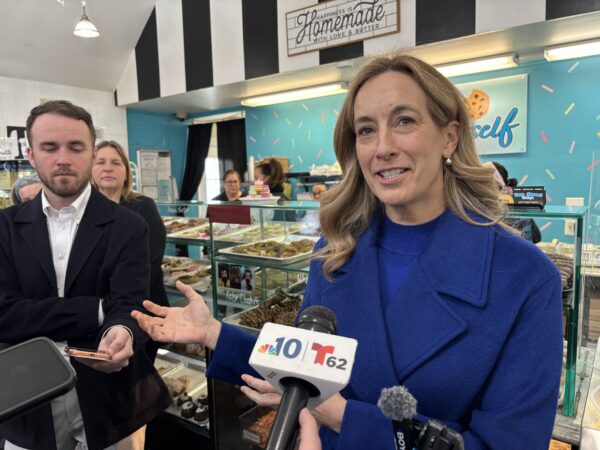
When New Jersey Gov. Mikie Sherrill walked into Two Sweet Boutique in Deptford, she couldn’t help but noticephotos of the Kelce brothers taped inside the bakery glass.
Below the sign were gigantic mounds of Reese’s Puffs dipped in chocolate and drizzled with peanut butter — coined the Kelce Kluster and named after retired Eagles legendJason Kelce and his brother, Travis Kelce, who plays tight end for Kansas City Chiefs and is engaged to pop superstar Taylor Swift.
“I’ve never seen anything like that,” said the Democratic governor, who took office last month. “It looks fantastic.”
She directed her staffer to add one of the domes to her bakery haul. She said the sweet treat will go to her two hungry teenagers at home.
New Jersey football fandom is often divided by New York Giants fans in the North and Eagles fans in the South, but Sherrill, who grew up in Virginia before settling in North Jersey, roots for the New York Jets.
But her purchase during the South Jersey stop may appeal to Eagles fans, who watched Jason Kelce play center for 13 seasons and emerge as a fan favorite after his boisterous victory speech following the team’sfirstSuper Bowl win in 2018.
Rocco Centrone, who owns the Deptford business with his wife and daughter, said the idea of the Kelce Kluster struck him when he was listening to the brothers’ podcast and they agreed on Reese’s Puffs as their favorite cereal.
Gov. Mikie Sherrill speaks to reporters in front of the Kelce Klusters at Two Sweet Boutique in Deptford.
The Centrones and their supporters took to social media and successfully got the football stars’ attention. The Kelce brothers have chatted about the treat on their podcast New Heights, drawing customers nationwide to the small Gloucester County business.
“They look delicious, I can’t believe this isn’t a thing,” Jason Kelce said on a 2023 episode. “These are outstanding. Well, I guess this is a thing now.”
Dressed in Mummers attire, Eagles center Jason Kelce pauses during his colorful speech on the Art Museum steps in 2018 at the Super Bowl victory parade.
The label on the treat during the governor’s visit spelled the treat name as “Kelse Clusters,” but an employee assured The Inquirer that the misspelling was just an error and not the official title.
Sherrill visited the South Jersey bakery on Friday to discuss her “Save You Time and Money Agenda,” though the conversation largely focused on learning about the business and its sweet treats.
Sherrill said she visited the bakery because “small businesses really are the heart of our communities.”
“I find that everywhere I go with small businesses, they truly are the lifeblood,” she said. “So I want to make sure, as governor, I’m making it easier for people who are running these businesses, saving them time and money, cutting through red tape and bureaucracy, and that is a cornerstone to me.”
New Jersey Gov. Mikie Sherrill said Friday that “all options are on the table” when asked by The Inquirer whether she would support adding a new tax on ICE detention centers in the state.
A bill introduced in both the state Assembly and Senate last week would implement a 50% tax on the gross receipts of private detention centers in the state and send that money to a fund for immigration services in the state. It has not yet been put up for a vote in either chamber.
Sherrill expressed opposition to new U.S. Customs and Immigration Enforcement detention facilities in the Garden State and said the state can ensure the federal government is following proper legal processes as it buys up warehouses and seeks to expand confinement capacity.
The legislativeeffort is led in part by progressives who were just elected to the legislature in November — Assembly members Ravi Bhalla and Katie Brennan, both North Jersey Democrats.
On a national level, Sens. Andy Kim and Cory Booker, both Democrats, introduced legislation on Thursday that would ban President Donald Trump’s administration from purchasing or converting warehouses for immigration detention or processing.
Sherrill wrote a letter to Homeland Security Secretary Kristi Noem on Friday expressing her opposition to the plan, which the governor said involves housing up to 1,500 beds in a 470,000-square-foot facility that currently has just two bathrooms.
“They really just have not gone through a thoughtful process,” she said during her Gloucester County stop. “It’s going to put some pressure on the town as well, and these types of facilities have a history of not being built in a way that is safe for prisoners.”
New Jersey has existing ICE detention centers at Delaney Hall in Newark and in Elizabeth. The agency has also floated the idea of confining people at Joint Base McGuire-Dix-Lakehurst.
“This is not a warehouse that’s fit for human habitation, and they say they’re putting 1,500 people in there,” she said of the Roxbury plan. “So there is a lot we can do as a state to prevent this.”
In her Friday letter to Noem, Sherrill denounced the Department of Homeland Security’s lack of transparency around their Roxbury plans — a criticism that Pennsylvania Gov. Josh Shapiro, who opposes ICE warehouse facilities in Pennsylvania, has also lodged against the agency.
Protests erupted in Roxbury after the Washington Post included it as a site that ICE was considering. Confusion later ensued after DHS, which oversees ICE, put out contradictory statements to the media over whether they were purchasing a warehouse for a detention center there.
Sherrill also told Noem in her letter that the state will “assess all options to protect the community’s infrastructure, public safety, health, and long-term economic stability,” using “every tool at our disposal.” She said the ICE detention centers in the state and elsewhere are known for “deplorable conditions,” such as overcrowding, undrinkable water, rotten food, and insufficient healthcare.
“In short, DHS’s treatment of human beings — citizen and noncitizen alike — reflects a chilling disregard for both human life and the rule of law,” she said in the letter. “New Jersey will not be complicit in this.”
The alarm bells went off for Assembly member Cody Miller when he heard about Newark schools installing artificial intelligence surveillance. The South Jersey lawmaker wants to get ahead of the technology before it spreads in his region.
Miller, a Democrat who represents parts of Atlantic, Camden, and Gloucester Counties, sponsored a bill that would require schools to develop AI surveillance policies and to communicate them to parents before using the technology and post public signage about it.
The bill passed the Assembly 78-1 on Tuesday with bipartisan support and one member not voting.
“We need guardrails,” Miller said. “And that’s really why we developed and drafted this legislation. It was in response to something that we know is going to become a part of a larger operation — most likely — as artificial intelligence becomes the new norm for things.”
Artificial intelligence surveillance is already present in South Jersey. Glassboro Public School District in Gloucester County became the first school to implement a newsystem developed by a Pennsylvania company that uses artificial intelligence to detect guns through security cameras last year, NJ.com reported.
Miller, 35, said he sees the pros and cons to AI but is concerned about student privacy and cybersecurity surrounding students’ images, campus layouts, and security protocols.
“Safety is important, but when you decide to implement something like this, you need to make sure that you’re communicating with the families and the parents, and students should also have a right to know what information is being collected on them,” the Democrat said.
The bill states that a district school board, charter school board of trustees, or renaissance school project that uses video, X-ray, or body scanner surveillance systems with AI must create a policy about using the technology and distribute it to district families.
The policy would need to include benefits and challenges of using the tool, what information will be collected, and how it will be used and accessed.
Signage would have to be posted in a “prominent, public place” where the system is used, indicating the use of AI.
If the bill becomes law as written, it would be implemented in the next school year.
Newark Public Schools announced plans to install more than 7,000 cameras with artificial intelligence capabilities in 2024 through a multimillion-dollar plan funded with COVID relief money in 2024, Chalkbeat Newark reported.
“I read it, and I went, ‘Whoa, this is a first. This is the first time I’m seeing something like this,’” said Miller, who works at Rowan College and served on the Monroe Township Board of Education.
Miller sponsored another version of the bill last session that didn’t make it to a floor vote. One of his cosponsors is Assembly member Dan Hutchison, another South Jersey Democrat who represents parts of Camden, Gloucester, and Atlantic Counties.
Sen. Linda Greenstein, a Democrat whose Central Jersey district includes parts of Mercer and Middlesex Counties, is slated to introduce a companion bill in the Senate.
The only lawmaker to vote against the bill in the Assembly was Republican Brian Bergen, who represents parts of Morris and Passaic Counties in North Jersey.
Bergen said schools are capable of figuring out their own policies and would already have policies in place for video surveillance.
“What’s the difference about AI? Your ring camera at home has AI in it,” he said.
The GOP lawmaker called the bill a “silly” example of legislators wanting “to write bills to write bills.” Bergen also questioned why it only focuses on schools and not other government buildings kids use.
“Schools have policies all over the place,” he said. “They’re local school boards. They have local control. They’re smart people.”
New Jersey Attorney General Jennifer Davenportmarked her first official day in the office Tuesday exchanging lawsuits with President Donald Trump’s administration.
Davenport, appointed by Gov. Mikie Sherrill, had already been waging legal battles against Trump as acting attorney general before her unanimous confirmation by the New Jersey Senate.
Thestate’s new top lawyer announced a lawsuit the same day against Trump’s Department of Health and Human Servicesover what she called its “rogue vaccine schedule that gambles with children’s health and lives.”
Trump’s administration also announced a lawsuit against New Jersey over a new immigration policy Davenport helped roll out that restricts ICE operations on state property.
She called the federal government’s suit a “pointless” waste of resources.
The two cases are a sign of more battles to come as Sherrill promises to fight Trump. Davenport will betasked with making sure the governor’s policies withstand a potential barrage of court battles in the months and years ahead.
DOJ sues Sherrill over her executive order limiting ICE
The Department of Justice announced Tuesday that it filed a lawsuit against Sherrill and the state over the Democratic governor’s recent executive order prohibiting ICE from conducting civil immigration enforcement without a judicial warrant in non-public areas of state-owned property, which she announced alongside Davenport.
The DOJ’s legal complaint repeatedly misspells Sherrill’s last name.
“Federal agents are risking their lives to keep New Jersey citizens safe, and yet New Jersey’s leaders are enacting policies designed to obstruct and endanger law enforcement,” U.S. Attorney General Pam Bondi said in a statement. “States may not deliberately interfere with our efforts to remove illegal aliens and arrest criminals — New Jersey’s sanctuary policies will not stand.”
Davenport said Tuesday that the DOJ lawsuit is a waste and that her team looks “forward to defending this executive order in court.”
“New Jersey will continue to ensure the safety of our state’s immigrant communities,” she said.
Davenport joins lawsuit against RFK Jr.
In a lawsuit going in the other direction, Davenport announced on Tuesday that New Jerseyis joining a multi-state lawsuit against HHS, the Centers for Disease Control and Prevention, and their leaders.
The suit challenges a January CDC memo that upended childhood vaccination recommendations. Vaccines for rotavirus, meningitis, hepatitis A, hepatitis B, influenza, COVID-19, and respiratory syncytial virus (RSV) were previously universally recommended, but are now only recommended for children under high risk of serious illness. (Parents of otherwise healthy children can still decide with their doctors to give their kids these vaccines.)
The lawsuit also focuses on HHS Secretary Robert F. Kennedy Jr.’s decision to replace members of the Advisory Committee on Immunization Practices.
“This radical and unlawful overhaul of the nation’s childhood vaccine schedule rests on fringe theories and ignores decades of science,” Davenport said.
Prior to her confirmation, Davenport as acting attorney general joined another multi-state lawsuit last week against the Trump administrationfor rescinding clean energy funding that had previously been appropriated by Congress.
In New Jersey, the federal Department of Energy ended two agreements with Rutgers University, according to Davenport’s office. One, a $3.2 million award, was for energy-efficiency upgrades that would result in potential energy savings between $3.8 billion and $15.4 billion over the course of five years. The other award of $1.7 million was for research for farmers to use their land for energy production and agricultural production at the same time.
Lowering energy costs and fighting Trump were hallmarks of Sherrill’s campaign for governor and are part of her continued messaging as the state’s executive.
Davenport also sued the Trump administration with New York earlier this monthover his halting of funding for the Gateway infrastructure project between New York and New Jersey. A federal judge ordered the Trump administration to release funding for the project, and construction is moving forward as the appeal process plays out.
She has also joined multi-state coalitions condemning the Trump administration over the DOJ asking Minnesota to hand over resident data in exchange for ending the violent ICE operations there, as well as Trump’s attempt to halt funding for natural disaster response.
Sherrill and Davenport have also worked together to create a portal for people to submit videos of ICE agents in New Jersey and share information for residents to know their rights when interacting with federal immigration agents.
Who is Jennifer Davenport?
Davenport has more than 15 years of state and federal law enforcement experience, with experience at the New Jersey Attorney General’s Office, United States Drug Enforcement Administration, and the U.S. Attorney’s Office in New Jersey, where she was colleagues with Sherrill for part of her time there.
She most recently worked as deputy general counsel and chief litigation counsel for the energy company PSEG.
Davenport worked in a top role at the New Jersey Attorney General’s office in 2018 when the state first implemented the Immigrant Trust Directive, the state’s sanctuary policy that limits law enforcement cooperation with ICE and has been upheld by federal judges.
The litigator, who grew up in Wildwoodand now lives in Monmouth County, has two daughters ages 11 and 14. She graduated from DeSales University in Pennsylvania and the Seton Hall University School of Law in New Jersey.
“I am grateful to Governor Sherrill and the Legislature for the trust placed in me,” she said in a statement Tuesday. “I will serve with fairness, independence, and integrity — the same values that have guided every step of my public service.”
New Jersey lawmakers just got a nearly 70% raise when they took their oaths in January.
It’s their first pay bump in more than two decades. The state’s legislators had been paid a $49,000 salary since 2001, but this year they saw it jump to $82,000 under a law signed in 2024.
Despite the increase, their spending power isn’t any bigger than it was 25 years ago. But legislators giving themselves a raise is a politically fraught move.
Their new salaries fall below the state’s median household income of more than$100,000, though the legislature says most of its members have other employment. Garden State lawmakersare considered part-time, even though they meet throughout the year and some members say the job is a full-time commitment.
“They say it’s part-time but I would argue that people act like it’s full-time, and it really is a full-time job,” said Assemblymember Anthony Angelozzi, a newly elected Democrat who represents parts of Burlington and Atlantic Counties and also works as a Hammonton teacher and leads the Hammonton Education Association, the local teachers union.
“My term is two years, and I am in a swing district … so if I don’t work hard every day to do things in my district and to talk to people, build relationships, visit the 25 towns that I represent, I’m going to lose my seat,” he said.
window.addEventListener(“message”,function(a){if(void 0!==a.data[“datawrapper-height”]){var e=document.querySelectorAll(“iframe”);for(var t in a.data[“datawrapper-height”])for(var r,i=0;r=e[i];i++)if(r.contentWindow===a.source){var d=a.data[“datawrapper-height”][t]+”px”;r.style.height=d}}});
New Jersey legislators are now among the highest-paid in the country, but they’re still paid less than their counterparts in Harrisburg, whose salaries are more than $113,000, including per diems, above Pennsylvania’s median household income of roughly $78,000.
In New Jersey, each chamber was scheduled to meet for less than a dozen full sessions in 2025, but members met more frequently for committee meetings and quorums, in which lawmakers can conduct business if more than half are present.
Most New Jersey state lawmakers have other jobs, too
Along with Angelozzi, all of the other 19 state lawmakers who represent Camden, Burlington, and Gloucester Counties in the state House and Senate also received a paycheck from outside employment, according to 2024 financial disclosures. A handful of them also reported receiving Social Security or pension income.
Assemblymember Balvir Singh, a Burlington County Democrat who began his term last year, said he’s not sure he would have voted for the pay increase given the drastic jump at once, though he would have supported a formula with annual increases over time.
“I think not doing something for so many years and then doing it all of a sudden, definitely is a suspicion among people, and rightfully so,” he said.
Singh works as a public school curriculum and instruction supervisor, which gives him flexibility to plan his work hours around days he has to be in the legislature, though he still uses his time off for legislative matters and constituent services.
window.addEventListener(“message”,function(a){if(void 0!==a.data[“datawrapper-height”]){var e=document.querySelectorAll(“iframe”);for(var t in a.data[“datawrapper-height”])for(var r,i=0;r=e[i];i++)if(r.contentWindow===a.source){var d=a.data[“datawrapper-height”][t]+”px”;r.style.height=d}}});
Does better pay mean Trenton can better represent New Jerseyans?
Proponents of payingelectedofficials higher salaries argue thatitcan lead to a more diverse legislature that’s more representative of New Jerseyans, though the evidence is limited.
Anthony Campisi, a political consultant who works in both New Jersey and Pennsylvania, said higher legislative pay opens up the prospect of running for state office to those who aren’t independently wealthy or hold white-collar jobs, that come with the flexibility to go to Trenton regularly, like lawyers.
“I think it’s a good thing to pay legislators living wages,” he said. “They’re responsible for appropriating billions of dollars for overseeing important legislative work that impacts every aspect of our lives.”
But Peverill Squire, a national expert on legislative pay based at the University of Missouri, said pay increases lead to minimal changes in the makeup of legislatures because of the financial and time commitment that comes with running for office.
“It makes it more attractive for more people to think about, but it’s still a very difficult thing to run for office, and so in the final analysis, it doesn’t have as big an impact as one might have thought it would,” he said.
That being said, higher pay can incentivize legislators to remain in the job. Squire said state lawmakers who step down voluntarily often do so because of the financial impact on their families.
The average state legislator salary across the country hasn’t kept pace with inflation over the past few decades, according to the National Conference of State Legislatures(NCSL). In New Jersey, the old salary of $49,000 in 2001 had the buying power of roughly $90,000 today.
New Hampshire legislators receive the lowest annual salary of $100, which has not been changed since 1889. Meanwhile, New Mexico lawmakers do not receive a salary, but they receive per diems.
In 2025, only six states paid their lawmakers more than New Jersey lawmakers’ new salary of $82,000, while Pennsylvania lawmakers made the third most behind New York and California, according to NCSL data.
New Jersey Gov. Mikie Sherrill holds up a just signed executive order during her inauguration ceremony in Newark, N.J., Tuesday, Jan. 20, 2026. Sherrill will received a higher salary than her predecessor, former Gov. Phil Murphy, under a law taking effect this year.
Should New Jersey become a full-time legislature?
The 2024 law,which was signed by former Gov. Phil Murphy, also increased the salary for the governor and other public employees, including legislative staff, cabinet members, and judges.
Starting this year with Gov. Mikie Sherrill, the state’s top executive got a 20% pay increase from $175,000 to $210,000. For comparison, Pennsylvania Gov. Josh Shapiro’s salary has risen to nearly $254,000 this year.
The Office of Legislative Services estimated in 2024 that the increases altogether would bring a cost increase to the state of at least $9.8 million for 2026 and at least $12.4 million in 2027 and thereafter.
The bill faced opposition from some Republican lawmakers, including member Alex Sauickie, a Republican whose district includes parts of Burlington, Middlesex, Monmouth, and Ocean Counties. Sauickie said the billwas brought forward at a horrible time as New Jersey residents struggled with the high cost of living — an issue that persists as the law takes effect.
“We should fix the state for everybody else before we make adjustments for ourselves,” said Sauickie, whose district includes parts of Burlington, Middlesex, Monmouth, and Ocean Counties.
The GOP lawmaker said he does not believe higher wages lead to better legislators.
“Under the old salary we had questionable legislators, and out of the gate on the new salary I think we still have questions about certain legislators,” he added.
Antoinette Miles, the state director of the progressive Working Families Party, said New Jersey should have a full-time legislature with term limits, attractive pay, and limits on outside income.
“The real problem is that too many legislators are moonlighting as lawyers, lobbyists, or even at a second public job,” she said.
But even with a higher salary, the lack of job security as an elected official makes it a hard sell as an only source of employment, especially in a politically fickle district like Angelozzi’s.
“Nothing in politics is guaranteed … if I lose my job, I would have to be guaranteed to go back to my full-time day job, because, you know, I have bills to pay,” Angelozzi said.
TRENTON — The Trump administration is suing New Jersey over a state order that prohibits federal immigration agents from making arrests in nonpublic areas of state property, such as correctional facilities and courthouses.
The Justice Department lawsuit, filed Monday in federal court in Trenton, challenges Gov. Mikie Sherrill‘s Feb. 11 executive order, which also bars the use of state property as a staging or processing area for immigration enforcement.
Sherrill, a Democrat who took office Jan. 20, “insists on harboring criminal offenders from federal law enforcement,” the lawsuit said, accusing her of attempting to obstruct federal law enforcement and thwart President Donald Trump’s immigration crackdown.
Sherrill’s executive order “poses an intolerable obstacle” to immigration enforcement and “directly regulates and discriminates” against the federal government, said the lawsuit, which misspelled her name as “Sherill.”
Asked about the lawsuit Tuesday, Sherrill said: “What I think the federal government needs to be focused on right now, instead of attacking states like New Jersey working to keep people safe, is actually training their ICE agents.”
The state’s acting attorney general, Jennifer Davenport, said the Trump administration was “wasting its resources on a pointless legal challenge.” New Jersey will fight the lawsuit and “continue to ensure the safety of our state’s immigrant communities,” she said.
The lawsuit is the latest in the Trump administration’s fight against state and local level restrictions on immigration enforcement.
Last year, the Justice Department sued Minnesota and Colorado, as well as cities including New York, Chicago, Los Angeles, and Denver over so-called sanctuary laws, which are aimed at prohibiting police from cooperating with immigration agents.
Last May, the Trump administration sued four New Jersey cities — Newark, Jersey City, Paterson, and Hoboken — over such policies. That case is pending.
Pennsylvania Gov. Josh Shapiro joined President Donald Trump at the White House for a breakfast on Friday, following weeks of uncertainty and strife over whether any Democrats would attend the traditionally bipartisan annual event after Trump reversed course on a decision to disinvite two other blue-state governors from the meeting.
A spokesperson forShapiro said he decided to attend the meeting at the White House once Maryland Gov. Wes Moore and Colorado Gov. Jared Polis were invited, despite Trump previously declaring the pair of Democratic leaders were not welcome.
“Gov. Shapiro chose to join his colleagues and go to the White House to raise real issues and harm the Trump administration is doing to Pennsylvania,” Rosie Lapowsky, Shapiro’s press secretary, said in a statement.
Trump initially planned to invite only Republican governors to the annual event that coincides with the National Governors Association winter meeting in Washington, D.C., but faced pushback by the group’s GOP chair. Trump then invited Democrats, as well, but rescinded the invitations for Moore and Polis. In a post on his Truth Social platform earlier this month, Trump wrote that the two Democratic governors were “not worthy of being there.”
The weekslong back-and-forth threatened the nonpartisan nature of the National Governors Association that represents 55 governors, including those from all 50 states and five U.S. territories. Ultimately, the NGA declined to facilitate the annual breakfast event, and Trump later re-invited Polis and Moore.
President Donald Trump arrives to speak during a breakfast with the National Governors Association in the State Dining Room of the White House, Friday, Feb. 20, 2026, in Washington. (AP Photo/Evan Vucci)
Moore, Polis, and Shapiro were among the more than two dozen governors who attended the White House breakfast Friday, where Trump delivered brief remarks. Other Democrats, including New Jersey Gov. Mikie Sherill, decided against going.
Sherrill, a former member of Congress who just began her term last month, said in a statement that she opted to skip the White House breakfast to “focus on other NGA meetings.”
“The president’s chaotic back-and-forth about the NGA was counterproductive and Gov. Sherrill decided not to attend,” said Sean Higgins, a spokesperson for Sherrill.
What Shapiro talked about
Shapiro described the closed-door meeting between Trump, the governors, and all of Trump’s cabinet as productive for him to advocate for specific issues directly with federal leaders.
“Folks were respectful to me,” Shapiro told reporters following the meeting. “I went there with a mission to talk about things that were important to Pennsylvania.”
Shapiro, who is currently running for reelection and touts his ability to work across partisan lines, has expressed an openness to working with Trump on issues specific to Pennsylvania, though he has challenged the president more than a dozen times in court since Trump took office last year.
Shapiro said he was able to discuss his top issues directly with federal officials. He said he spoke with U.S. Department of Agriculture Secretary Brooke Rollins about the reemergence of the avian flu in Pennsylvania; discussed releasing withheld broadband funding with Treasury Secretary Howard Lutnick about releasing withheld broadband funding; and talked with U.S. Secretary of Health and Human Services Robert F. Kennedy Jr. and Director of the Office of Management and Budget Russ Vought about the ways “their policies are hurting rural Pennsylvanians.”
New York Gov. Kathy Hochul, another Democrat who attended the meeting, said afterward in a news conference that she was glad to hear what lessons Trump said he learned from his administration’s immigration enforcement mission in Minneapolis that led to mass protests and the fatal shootings of two U.S. citizens by federal agents.
Hochul said Trump told the group that “we’ll only go where we’re wanted,” alleviating concerns among some Democratic governors that their states may be the next to see a full-scale federal presence upending daily life.
Weeks of back-and-forth ahead of the White House breakfast
“Democratic governors have a long record of working across the aisle to deliver results and we remain committed to this effort,” they said in a joint statement on Feb. 10 through the Democratic Governors Association. “But it’s disappointing this administration doesn’t seem to share the same goal. At every turn, President Trump is creating chaos and division, and it is the American people who are hurting as a result.”
They added: “Democratic governors remain united and will never stop fighting to protect and make life better for people in our states.”
In comments to CNN last week, Sherrill said that “worse decisions” would be made without all the governors there.
“For the president to pick and choose who he is going to have to sort of undermine the very focus of this, of coming together to get stuff done for the country just seeds more … chaos,” the New Jersey Democrat said.
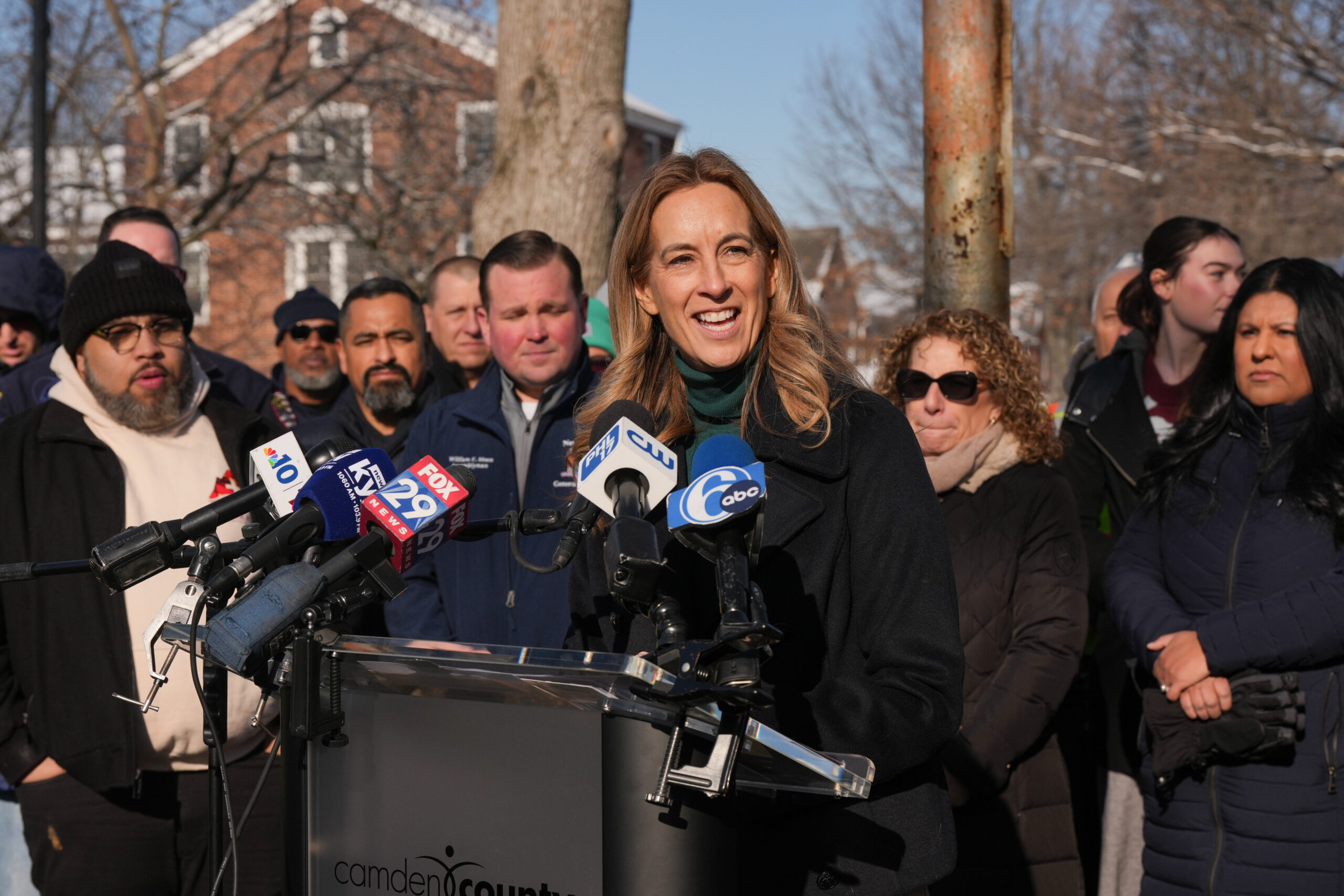
Gov. Mikie Sherrill, shown here at a news conference as volunteers gather prior to shoveling snow at Fairview Village on Martin Luther King Day during a day of service, in Camden, New Jersey, January 19, 2026.
Moore, the nation’s only Black governor, and Polis, the first openly gay man elected to U.S. governor, were the only two leaders Trump singled out, raising concerns by civil rights groups.
Trump, however, cited different reasons for his objections to Moore and Polis’ attendance. He said he wanted to exclude Polis because his state continues to incarcerate a former county clerk over her conviction related to allowing election-denier activists access to election data following the 2020 election. Trump also expressed a number of grievances toward Moore, including his handling of the rebuilding of the Francis Scott Key Bridge and Baltimore’s crime rates.
Following the meeting Friday, governors from both parties reaffirmed that they were still committed to working with Trump despite the turmoil.
“It’s really important imagery that we stand together as governors of our states and represent all of America, and just remind people that there’s really more that brings us together and unites us than divides us,” said Oklahoma Gov. Kevin Stitt, a Republican who chairs the NGA.
Shapiro separately told reporters that he has worked with directly Trump to “save steelworker jobs” but remains ready to challenge them in court if they threaten Pennsylvanians’ rights.
Asked whether he has a good relationship with Trump, Shapiro said: “We have a relationship where we can work for the people of Pennsylvania, that’s my job.”
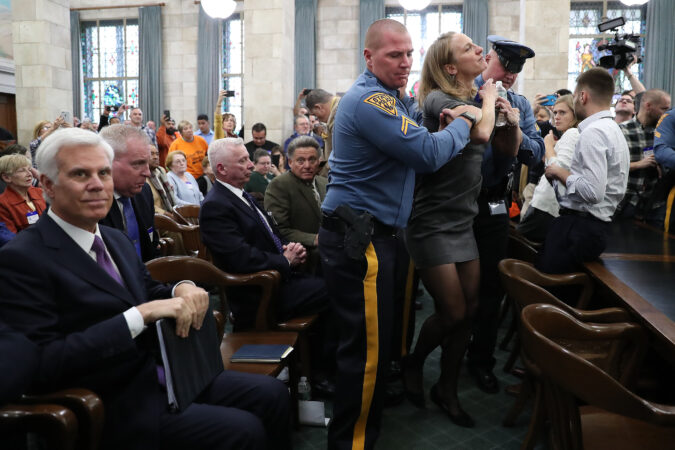
Sue Altman showed up at a state Senate hearing in late 2019 to confront George E. Norcross III and was dragged out by state troopers. Six years later, she is using that incident as an example of why New Jersey voters should send her to Congress.
“If anything can prepare you for a dogfight that Washington politics is, it’s Jersey politics,” said Altman, one of more than 15 Democrats vying to succeed retiring U.S. Rep. Bonnie Watson Coleman in a reliably blue Central Jersey seat.
Altman, 43, recently resigned after serving for the last year as state director for U.S. Sen. Andy Kim, a South Jersey Democrat who has also challenged the state’s machine politics. Before that role, she unsuccessfully ran for Congress in 2024 in a swing district thatborders Coleman’s district.
She made a name for herself as a progressive activist in Camden, where she fought former Republican Gov. Chris Christie as the state began its takeover of the city’s public schools, vocally criticized power brokers like Norcross, and leda legal effort to abolish the county line from New Jersey ballots before Kim took it to the finish line in 2024.
“My time in Camden was extremely important, and in many ways shapes the work that I did in the state from that point forward,” she said.
WhileAltman built her progressive credentials in Camden, she has most recently lived in Lambertville andwill be relocating northeast to Bridgewater to move in with her long-term boyfriend, who lives just outside the district’s boundaries.
“I think what the electorate is hungry for and what the party needs are people who are going to challenge power,” she said. “I’ve done that my whole career.”
Altman, who grew up in Central Jersey, playedprofessional basketball in Ireland and Germany after graduating from Columbia University. She earned two master’s degrees from Oxford University before landing in Camden in 2014.
She garnered attention in the city for going back and forth with Christie for roughly six minutes at a public meeting in which they tossed a microphone in the air to each other.
Altman drew national attention that year after she was dragged out of the hearing in Trenton on a corporate tax incentive program Norcross defended,drawing a message of support from U.S. Sen. Elizabeth Warren (D., Mass.). Activists used images of the incident to bolster their argument that unelected power brokers like Norcross hold outsize influence in New Jersey, though Norcross later said he did not believe she should have been thrown out.
Camden Mayor Vic Carstarphen, a Democrat, criticized Altman for what he called her “singular focus” on “trying to tear down” Norcross during her time in Camden for her own “self-promotion.”
“She created a lot of chaos in the city, and ran amok throughout the city,” Carstarphen said Tuesday.
In 2021, Altman led the legal strategy in the first major lawsuit against the county line, the old ballot that was advantageous to party-endorsed candidates. The fall of the line has led to more competitive primaries, including her own.
She went on to unsuccessfully challengeincumbent Republican U.S. Rep. Tom Kean Jr., losing by more than five percentage points in 2024.
Altman said dealing with immigration cases while working in Kim’s office partially inspired her to run again. She said Democrats should replace U.S. Immigration and Customs Enforcement with “full comprehensive immigration reform” while also securing the border.
Neither Kim nor the Working Families Party has weighed in on the race.
Altman warns that the country is at “one of the most vulnerable points” in its history with Trump in office for a second time.
“We have a very short window of time to prove to the rest of the country that Democrats in power can deliver for people and hold Trump accountable, but not get overwrought with the politics of it,” she said.
In recent years, a string of the state’s iconic diners have shuttered their doors. New state legislation aims to keep the lights on at those still in business.
The bill, which was introduced in the New Jersey Senate in January, would provide some diners and other historic restaurants with tax benefits.
“Diners, and specifically historic diners, are a cornerstone of our great state, having served residents and visitors for many decades. They are part of our culture and our history, and we have a duty to help them thrive,” State Sen. Paul Moriarty of Gloucester County, a sponsor of the bill, said in a statement Thursday.
The legislation, which would establish a registry of historic diners and restaurants, would give the businesses a tax credit of up to $25,000. Only diners and family-owned restaurants operating for at least 25 yearswill qualify.
The bill has been referred to the Senate Budget and Appropriations Committee.
“It has been heartbreaking to see so many of these well-known establishments close or dramatically cut their hours,” Moriarity said.
Where have diners closed in New Jersey?
The origin of the modern diner can be traced back to a horse-drawn lunch wagon in 19th-century Rhode Island and the model has evolved since then. New Jersey has been coined the “diner capital” of the U.S. but has seen closures in recent years due to increased operating expenses, the challenge of finding employees, and the impact of the pandemic.
The Cherry Hill Diner closed in 2023 after 55 years in business and following the co-owner’s unsuccessful search for a buyer. South Jersey’s Gateway Diner in Gloucester County closed that same year amid construction of the Westville Route 47 Bridge and the state’s acquisition of the site. The Red Lion Diner in Burlington County also sold, making way for a Wawa.
In January 2024, the Star View Diner in Camden County closed. Last year, the Collingswood Diner shut its doors in August, to be replaced by a marijuana dispensary.
The trend extended in Philadelphia where the Midtown III closed in 2020. Last year, the Mayfair Diner in Northeast Philadelphia was listed for sale.