The National Park Service does not need to restore the exhibits for the the moment, the order said, but is enjoined from damaging the exhibits and required to take “all necessary steps” to ensure they are not harmed.
The order further prohibits the federal government from making any other changes to the site, including setting up replacement exhibits, which the Department of Interior said would have been installed “in the coming days” if not for the injunction.
“[The Department of Interior and National Park Service] are to preserve the status quo as to the President’s House as of the entry of this order,” Hardiman wrote.
The order is not accompanied by an opinion or memorandum explaining which of the government’s arguments Hardiman found compelling.
Hardiman’s ruling landed an hour before the deadline District Judge Cynthia M. Rufe set for the administration to restore the site to its condition before the Jan. 22 abrupt removal of the exhibits.
In a legal filing Friday, U.S. attorneys said National Park Service staff had begun planning to reinstall the exhibits once they received the Feb. 16 order to restore the site.
On Thursday, 16 of 17 glass panels were reinstalled, with the remaining one needing repairs. Prior to the Third Circuit order, National Park Service employees on Friday restored panels around the site’s glass-enclosed archaeological dig, the wayside panel identifying the site, and four functioning video monitors, the federal government said.
The federal government also had not reinstalled 13 metal panels, but was in the process of doing so prior to the stay, according to the filing.
The city declined to comment on Hardiman’s order. The National Park Service did not immediately respond to a request for comment.
The government argued to the Third Circuit that Rufe misunderstood the difference between the laws and agreements that govern the 55-acre Independence Hall National Historic Park and the stricter rules regarding Independence Hall National Historic Site, the city-owned block between Chestnut and Walnut Streets.
The President’s House, on the corner of Sixth and Market Streets, sits on federal land and the law “imposes no restriction on the government’s removal of the President’s House exhibit,” the filing said.
The city failed to demonstrate harm from the removal of the exhibits, the administration argued, because it has other avenues to promote the history of slavery in the President’s House.
But an injunction forcing the restoration of the exhibits violates the federal government’s free-speech rights, the stay request argued.
“It requires the display and operation of expressive exhibits — at a marquee national historic site in the run-up to the nation’s 250th anniversary — when the government has chosen not to display those exhibits,” the court filing said.
The city responded to the request in a letter in which it expressed confusion about what the administration was asking for. After all, the government already began restoring the exhibits.
“It is not clear whether the United States is asking the court for permission to re-remove the panels that were just reinstalled yesterday, or whether they are asking to be relieved of the duty to reinstall the remaining panels, or whether they are asking for more time to restore the remaining panels because today’s deadline is not feasible,” the city’s letter said.
Either way, the city reiterated its opposition to a stay.
Philadelphia’s lawsuit was the first in the nation challenging the removal of exhibits from national parks in accordance with Trump’s March executive order, which instructed the Interior Department to remove any content or displays that “inappropriately disparage Americans past or living.”
The site will see no further changes for now. Hardiman placed the injunction appeal on an expedited track. With the current deadlines set by the judge, a ruling on the injunction is unlikely before May.
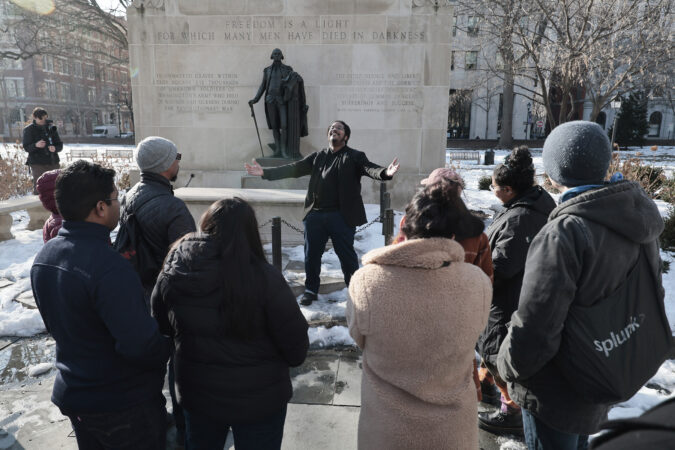
Mijuel K. Johnson stood on theground where the dining room of the first president’s residence once stood as he told the story of Ona Judge’s path to freedom.
Speaking to a group assembled just steps from the Liberty Bell, Johnson recounted how Judge escaped George Washington’s household in Philadelphia into the city’s free Black community before eventually making her way to New Hampshire, and evading the Washingtons’ several attempts to recapture her.
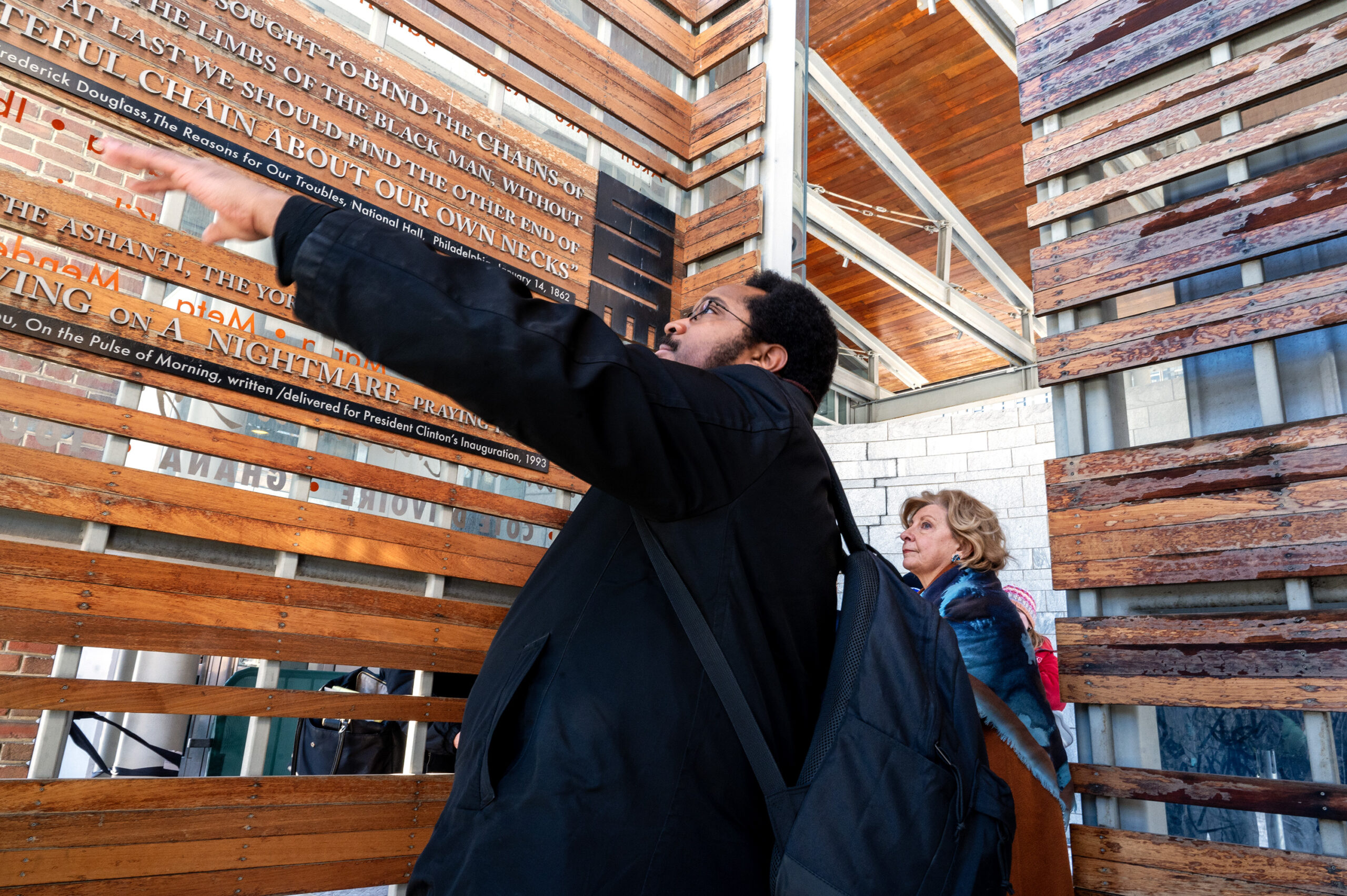
It’s a story Johnson has told many times as a guide for the Black Journey, which offers walking tours focused on African American history in Philadelphia. One of the first stops on “The Original Black History Tour” is the President’s House Site, an open-air exhibit at Sixth and Market Streets that memorializes Judge and the eight other people enslaved by the first president here.
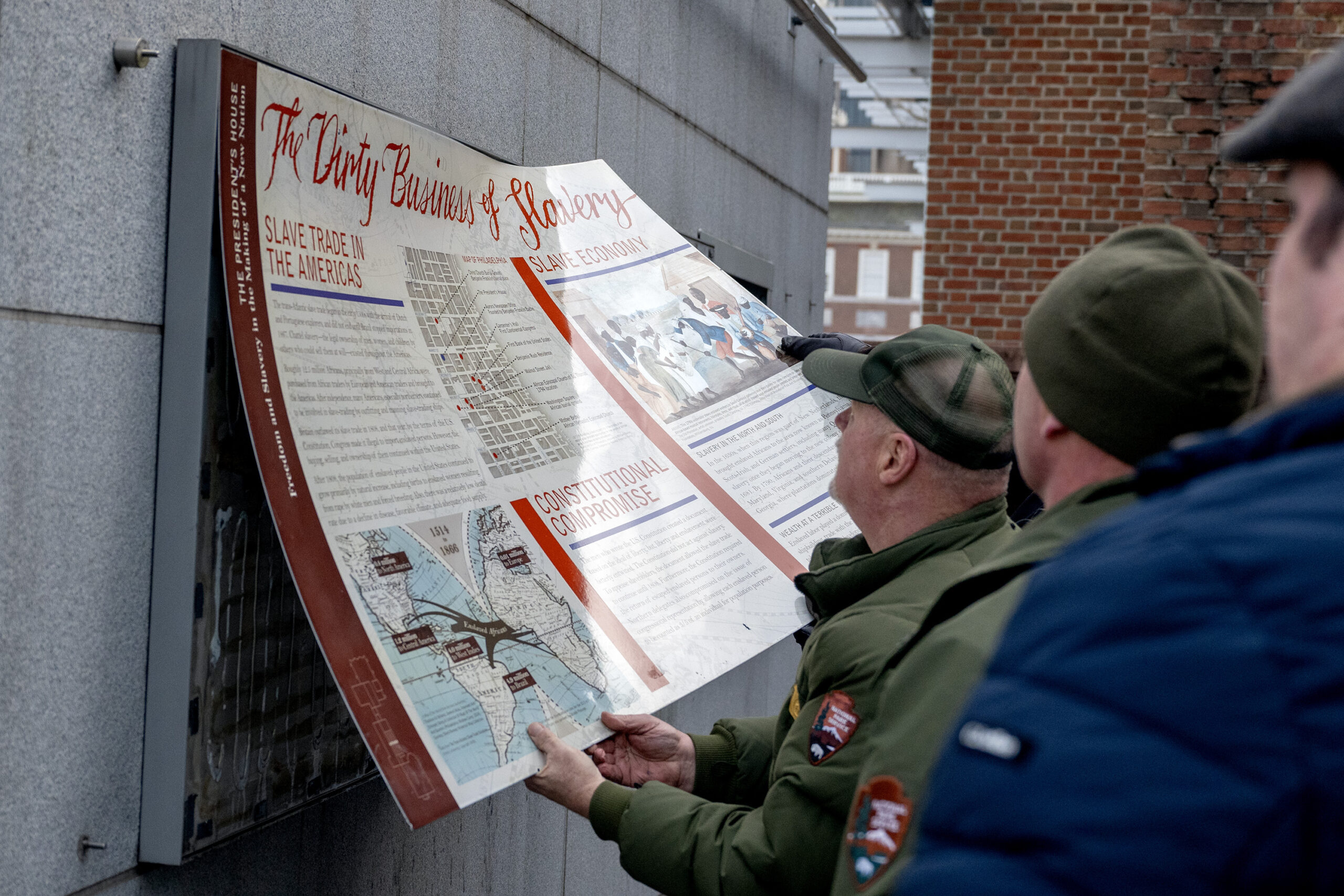
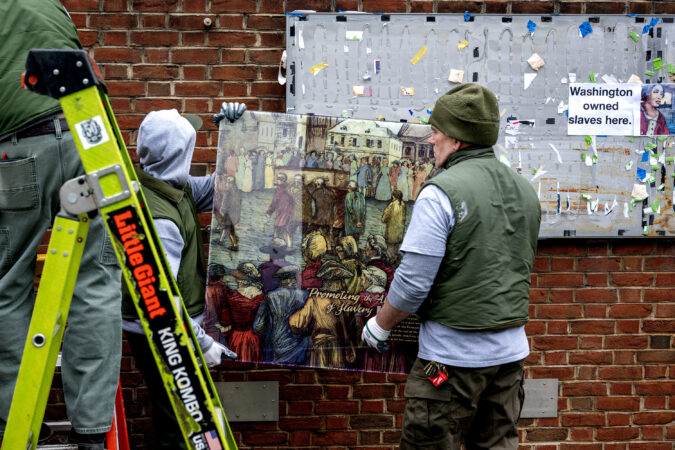
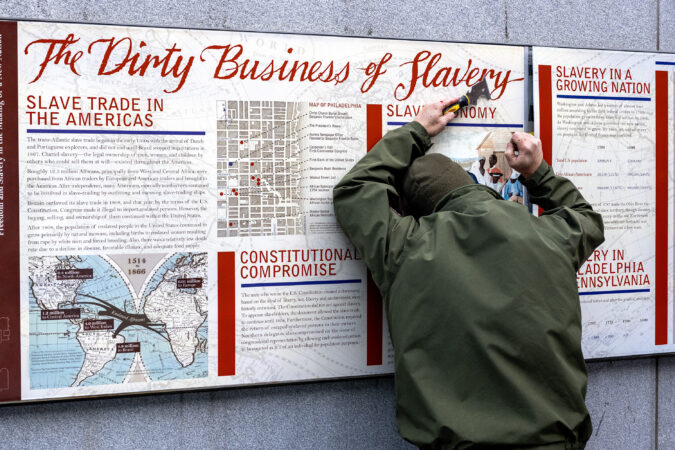
But last weekend, instead of the educational panels and informative videos displayed for the last 15 years, the guide and his group were faced with faded brick walls and blank TV screens. Adhesive residue marked the spots where colorful panels had been.
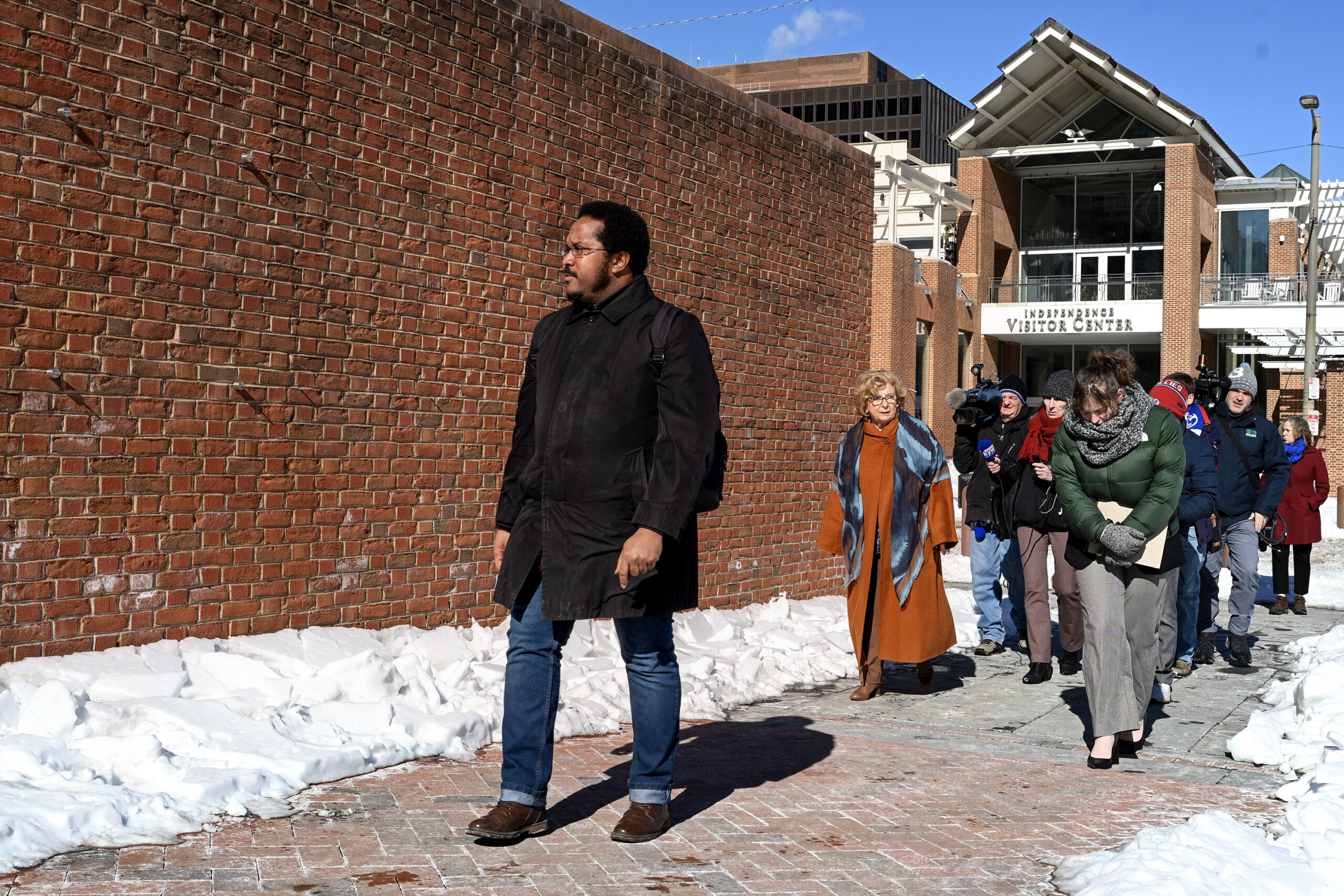
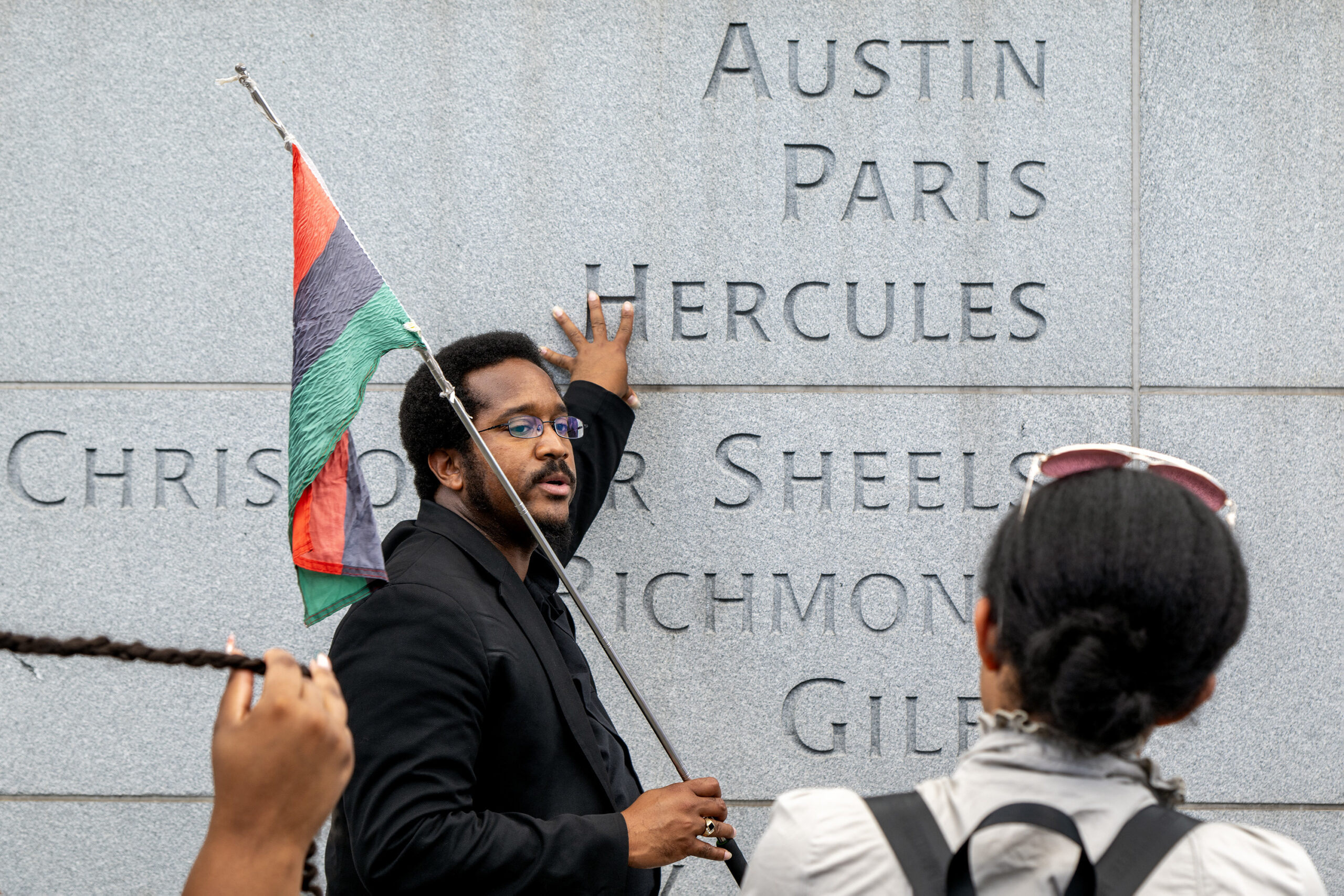
Mijuel K. Johnson guides Judge Cynthia M. Rufe as she visits the President’s House in Independence National Historical Park on Monday, Feb. 2, 2026.
It was Johnson’s first group tour since National Park Service employees wielding wrenches and crowbars — acting at the direction of President Donald Trump’s administration — last month stripped out every panel at the President’s House, censoring roughly 400 years of history. Judge’s name was still inscribed on the Memorial Wall and her footprints still imprinted into the concrete as the group walked through the site, but her story was missing. Television screens recounting her life had been abruptly disconnected.
Black History Month began this year with visitors unable to read displays juxtaposing the cruelty of slavery with the country’s founding principles for the first time since the site opened in late 2010. For many tourists and the guides who know the site best, the removal was a call to action.
Workers remove the displays at the President’s House in Independence National Historical Park on Thursday, Jan. 22, 2026. More than a dozen displays about slavery were flagged for the Trump administration’s review, with the President’s House coming under particular scrutiny.Maria Felton (middle) and Jahmitza Perez (right) of Philadelphia listen to Mijuel K. Johnson (left) during The Black Journey tour in Philadelphia on Saturday, Feb. 14, 2026.
“In telling their stories, I’m telling my own,” Johnson, 34, of South Philadelphia, said of the nine people the site memorializes, “and that’s where it becomes personal, so that in trying to erase their story, they’re effectively trying to erase me, too, and I just refuse to be erased.”
Parker celebrated the reinstallation in a post on social media Thursday but cautioned: “We know that this is not the end of the legal road.”
The Trump administration is appealing the ruling, so the future of the site remains uncertain even after this week’s victory. On Friday, a federal appeals judge said that the Trump administration does not have to restore more panels while the appeal is pending.
Seeing the site bare without the panels last weekend felt like a “slap in the face” for Maria Felton, 31, a stay-at-home mom from Roxborough. Felton, who is Afro-Latina, joined the Black Journey’s tour with best friend Jahmitza Perez, 37, as part of her quest to reconnect with her heritage.
“The administration can take away physical things. They can’t take away our ability to connect and learn and share our culture,” Felton said.
Passing a wall where panels about slavery were removed, Mijuel K. Johnson (left) with The Black Journey: African-American Walking Tour of Philadelphia, leads Judge Cynthia M. Rufe (second from left) as she visits the President’s House in Independence National Historical Park on Monday, Feb. 2, 2026.
‘A sign of the revolution’
Johnson has been giving tours since 2019, delivering rousing accounts of U.S. history interwoven with humor and theatrical gestures. He tells his patrons, who come from around the country, that long before cheesesteaks became Philly’s iconic food,the city was known for its pepper pot stew, an African dish.
“We can tell the full story of America,” he said.
Last weekend, Johnson’s tour group was more “somber” than usual, he said, as they saw the bare walls of the “desecrated” site.
“People seeing it for themselves that this actually did happen,” Johnson said.
For Toi Rachal, 47, a pharmacist from Dallas, and her husband, the tour was eye-opening. The couple had been unaware of the Trump administration’s changes to the site until they joined the tour during their visit to Philadelphia. The work of Johnson and other community members to continue telling the story was even more crucial with the exhibits gone, Rachal said.
“If we just walked in these areas on our own, eventually we would have probably figured it out,” she said, “but you may not have known exactly what happened.”
The exhibits were removed under an order issued by Trump instructing the Department of the Interior to remove materials at national parks that “inappropriately disparage Americans past or living,” widely criticized as an effort to whitewash history ahead of this year’s celebrations of the country’s 250th anniversary.
But the move brought unprecedented attention to the President’s House, drawing curious onlookers. When the panels were beginning to be restored Thursday, a group observed as park employees put history back in its rightful place.
Shortly before Johnson’s tour group stopped at the site, a volunteer read from a binder containing the informational text that had been removed. The volunteer was one of dozens of people who had signed up for a shift with Old City Remembers, a grassroots effort to speak the history of the President’s House even if the panels were no longer there.
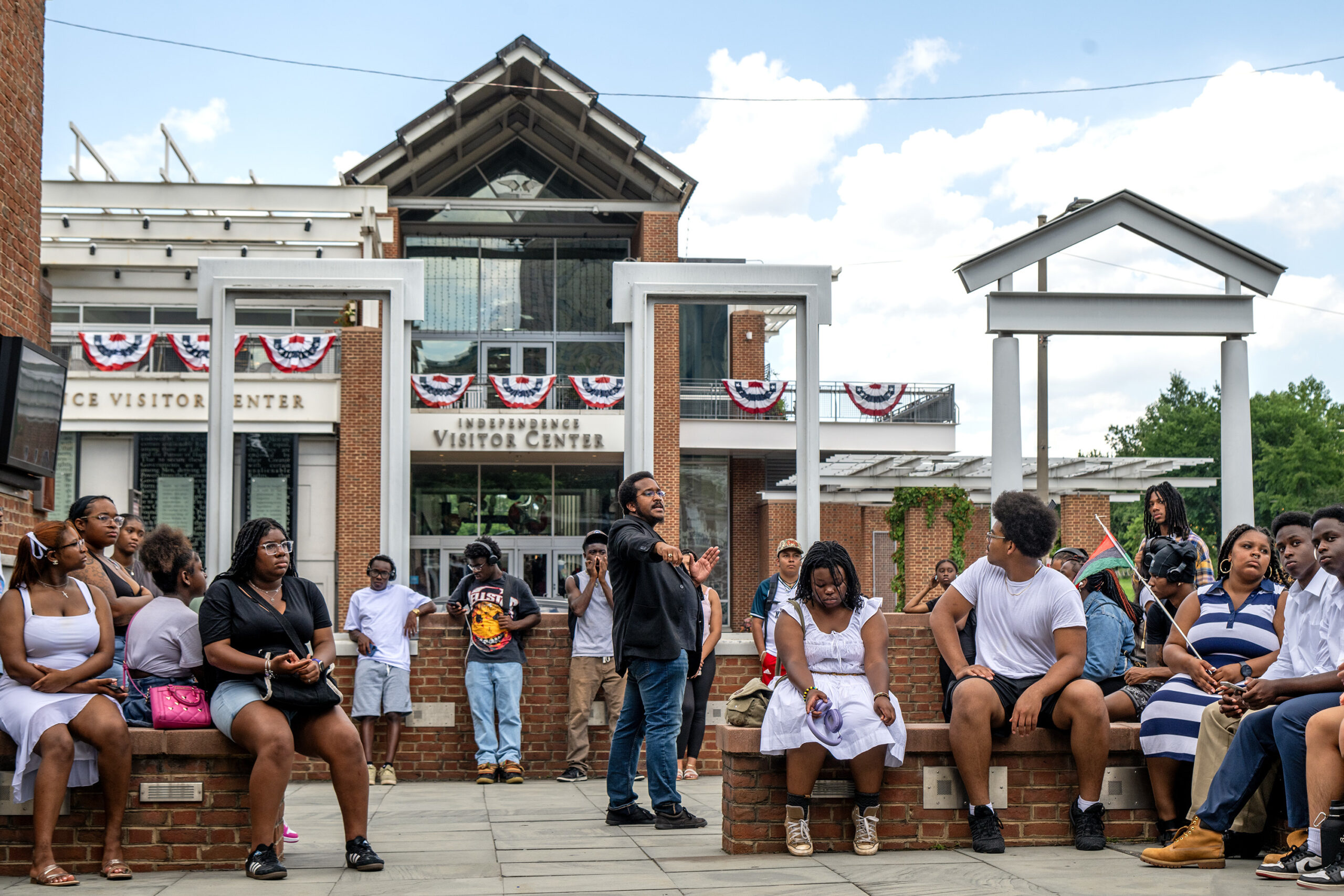
Mijuel K. Johnson leads visitors from Charlotte, North Carolina, at the President’s House in Independence National Historical Park on Wednesday, July 23, 2025.
“Because those have been removed, somebody needs to tell the story, somebody needs to make sure that we’re not going to let that history be erased,” Matt Hall, a professor and the organizer of the group, said in an interview earlier this month.
It’s “active history,” said Ashley Jordan, president and CEO of the African American Museum in Philadelphia, located blocks away from the site. “The fact that they are using their words, their demonstrations, through art-making, through signage, through print materials — that has always been a sign of the revolution in America.”
Ahead of Johnson’s tour last Saturday, visitors taking advantage of the warmest winter day in weeks congregated around the bare exhibit wall. In its place were educational fliers about Washington, Ona Judge, and other historical figures. Posters displayed messages: “Truth Matters,” “Erasing Slavery is Pro-slavery,” and “Dump Trump Not History.”
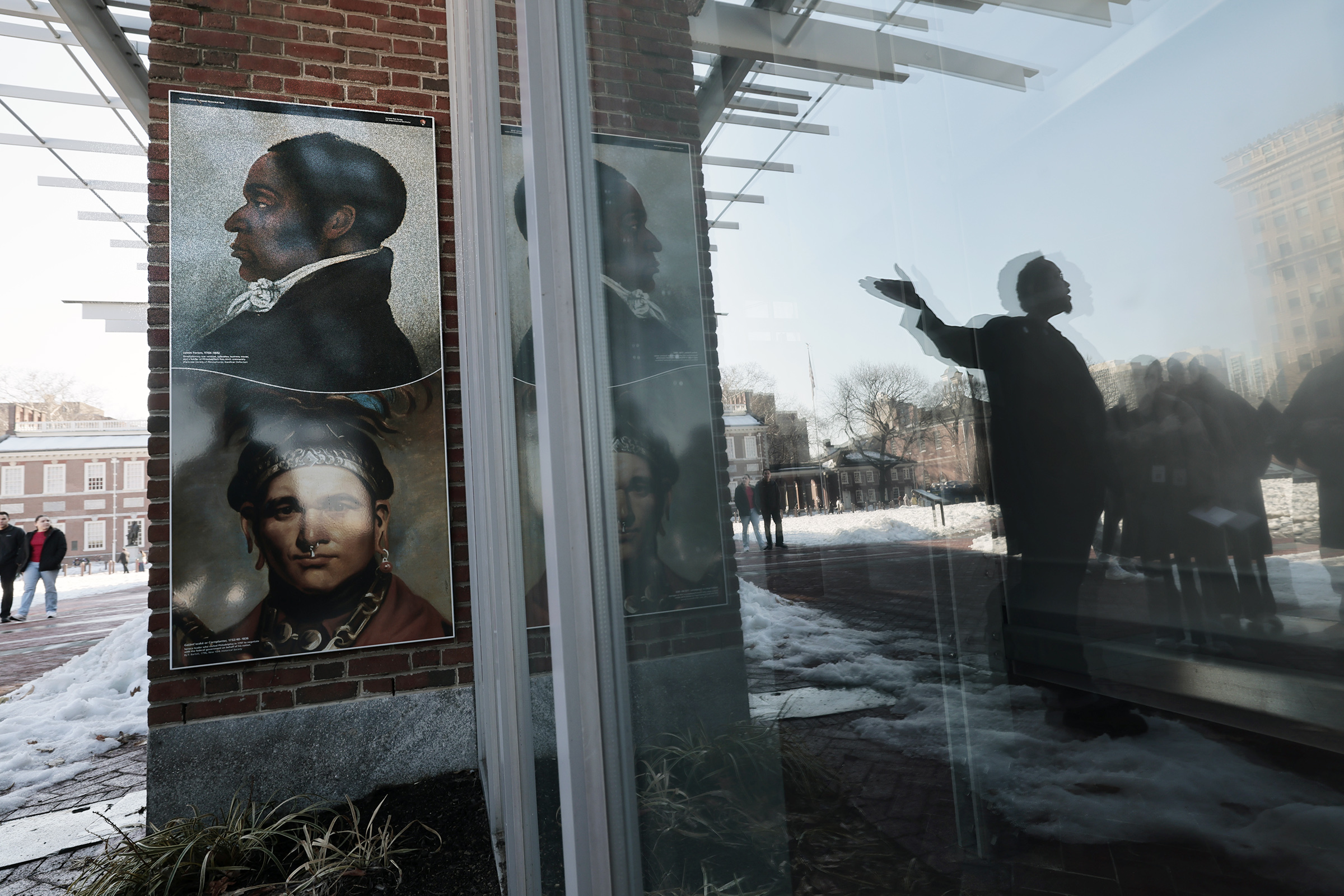
The Black Journey and the 1838 Black Metropolis tour guide Mijuel K. Johnson (right) is reflected in the Liberty Bell Center window as he talks about James Forten (top left) 1746-1842 during a Black History tour in Philadelphia on Saturday, Feb. 14, 2026. Forten was a Revolutionary War veteran, sailmaker, business owner, and a leader of Philadelphia’s free Black community.
Philadelphians celebrate, but prepare for more fights ahead
Avenging the Ancestors Coalition members gathered Thursday afternoon at the President’s House, celebrating the reinstallation earlier in the day.
“This is actually a moment in time,” said Michael Coard, attorney and leader of the coalition, which had fought tirelessly to develop and, now, protect the site. “Your children, your grandchildren, your great-grandchildren are going to be talking about this for years.”
Coard emphasized the fight was not yet over while highlighting the significance of the community’s contributions in the fight to safeguard the President’s House.
“I just want you for a few seconds just to think about what you all have done,” Coard told the crowd. “Because what you’ve done is to actually create history. … Think about it. You fought the most powerful man on the planet, and you won.”
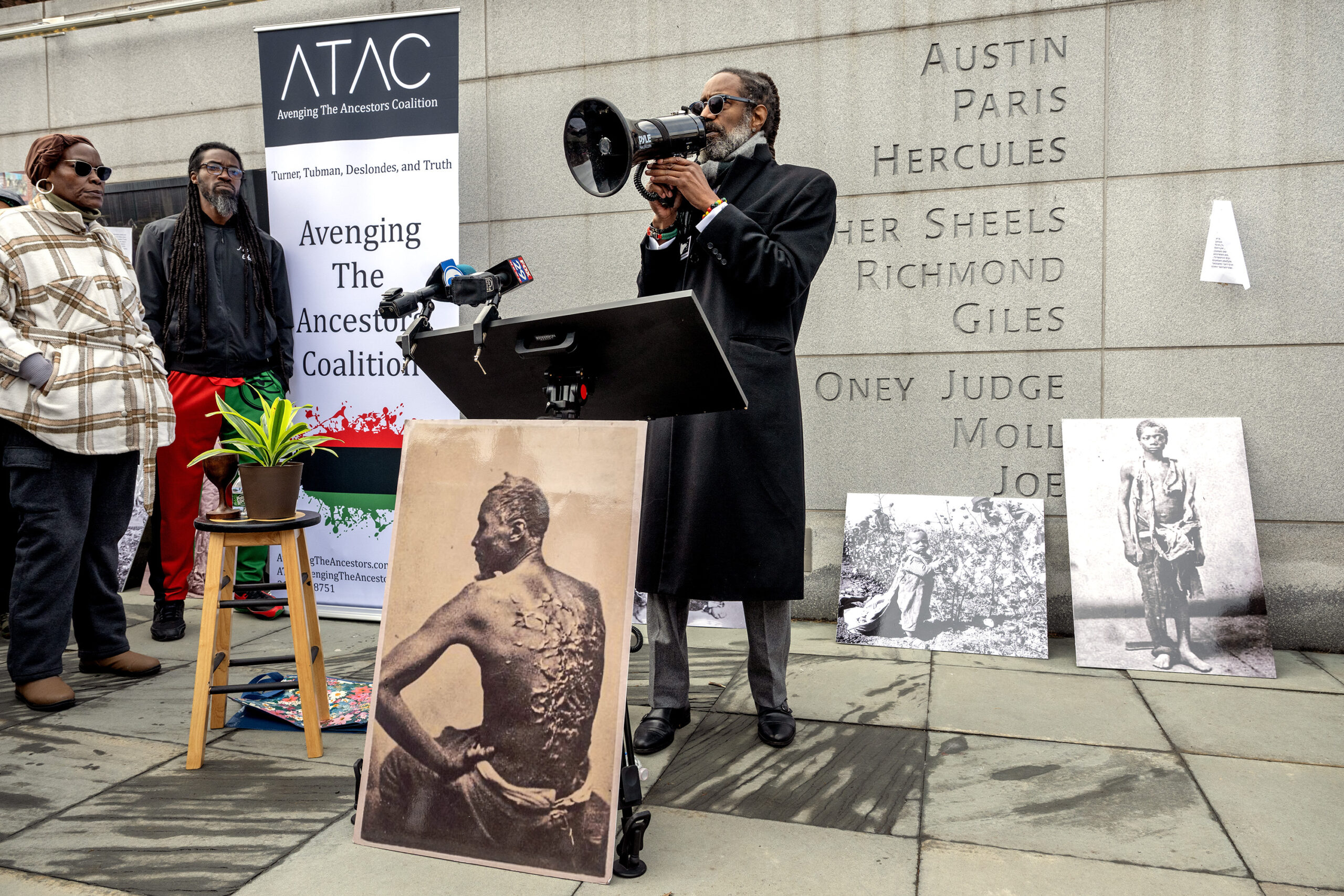
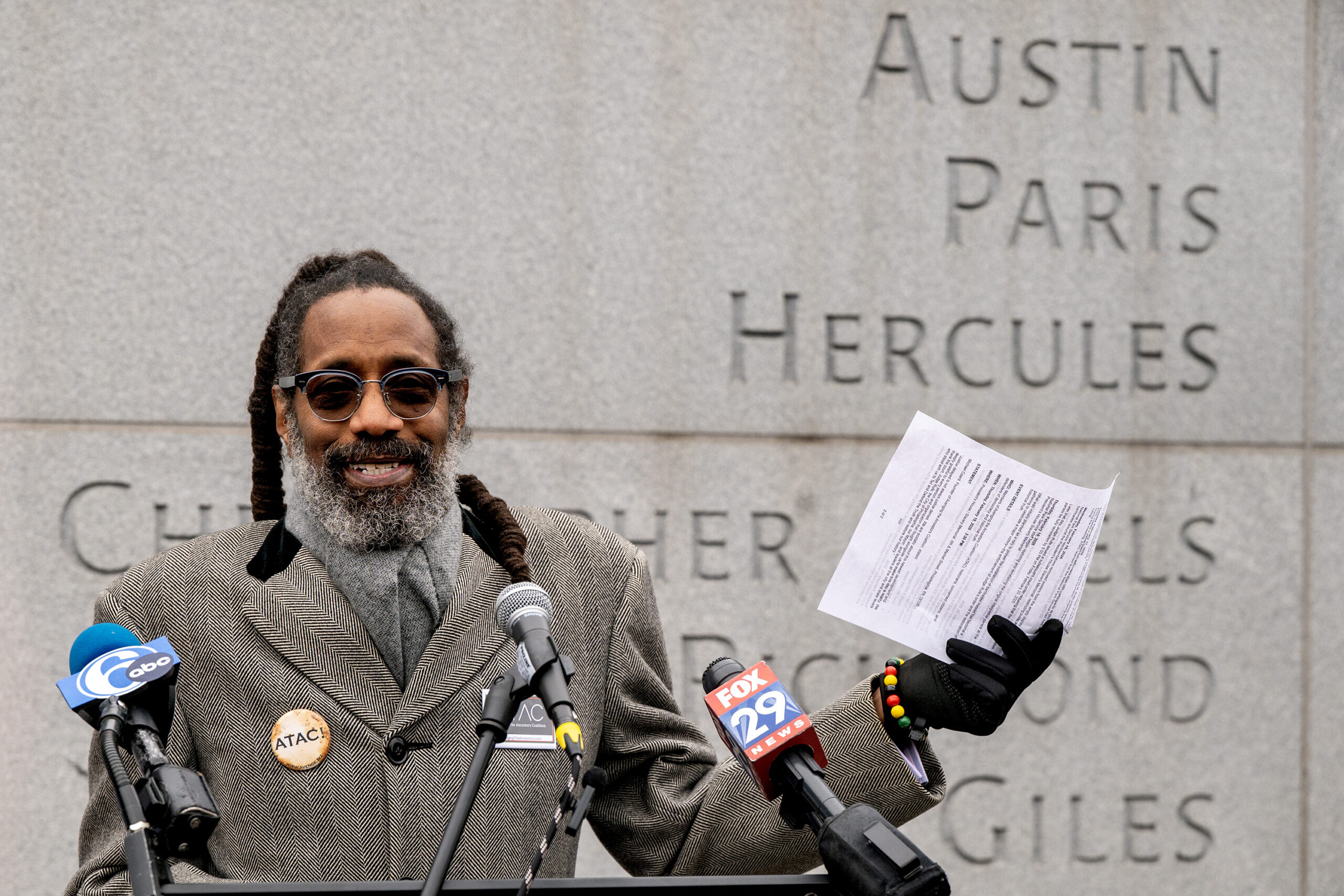
Attorney Michael Coard, leader of the Avenging the Ancestors Coalition, speaks at the President’s House site on Monday, Feb. 16, 2026, during their annual gathering for a Presidents’ Day observance. While there, they learned a federal judge ordered the Trump administration to restore the slavery exhibits that the National Park Service removed from the site last month. The names of nine enslaved people who lived and worked in the household of George Washington engraved in stone behind him were not removed by the NPS.
Even as Philadelphians celebrated the reinstallation, more efforts were being planned to continue sharing the story of the President’s House.
Mona Washington, a playwright and Avenging the Ancestors Coalition board member,is crafting a series of plays related to the President’s House, which she hopes to showcase this summer, during the height of the 250th anniversary celebrations. Some of the plays, she said, are written in the first person for the people who were enslaved by the first president at his Philadelphia residence.
“We’re here, and you can try and erase whatever you want, as much as you want, but guess what? There are lots of us, and we’re just going to keep moving and moving and moving toward truth,” Washington said.
At the President’s House last Saturday, there were few pieces that Johnson could share with the group that had not been tainted by the Trump administration. One of them was the Memorial Wall, which is engraved with the names of Ona Judge and the eight other people George Washington enslaved — Austin, Paris, Hercules, Christopher Sheels, Richmond, Giles, Moll, and Joe. A few paces away, their quarters once stood, where at least four of the nine individuals would stay at any given time, Johnson said.
Mijuel Johnson, a guide with The Black Journey: African-American Walking Tour of Philadelphia, leads visitors in the President’s House in Independence National Historical Park Wednesday, July 23, 2025. The names of nine enslaved people who lived and worked at the House are engraved in stone on the site.
Outside the quarters appears a plaque signed by the city and the National Park Service that reads: “It is difficult to understand how men who spoke so passionately of liberty and freedom were unable to see the contradiction, the injustice, and the immorality of their actions.”
These words are preceded by an italicized quote from former President Barack Obama, the country’s first Black president: “It was whispered by slaves and abolitionists as they blazed a trail toward freedom … yes we can, yes we can.”
A lack of proper tools and the snow were the only things standing in the way of the Trump administration making further alterations to the President’s House last month.U.S. District Judge Cynthia M.Rufe has now ordered that the President’s House cannot be further altered.
Last Saturday, Johnson assured his tour group as they were filing through the quarters that this piece of history would remain.
“They can’t touch this,” he said.
Staff writer Maggie Prosser contributed to this article.
Mayor Cherelle L. Parker’s administration last August told the U.S. Department of Justice that Philadelphia remains a “welcoming city” for immigrants and that it had no plans to change the policies the Trump administration has said make it a “sanctuary city,” according to a letter obtained by The Inquirer through an open-records request.
“To be clear, the City of Philadelphia is firmly committed to supporting our immigrant communities and remaining a welcoming city,” City Solicitor Renee Garcia wrote in the Aug. 25, 2025, letter. “At the same time, the City does not maintain any policies or practices that violate federal immigration laws or obstruct federal immigration enforcement.”
Garcia sent the letter last summer in response to a demand from U.S. Attorney General Pam Bondi that Philadelphia end its so-called sanctuary city policies, which prohibit the city from assisting some federal immigration tactics. Bondi sent similar requests to other jurisdictions that President Donald Trump’s administration contends illegally obstruct immigration enforcement, threatening to withhold federal funds and potentially charge local officials with crimes.
Although some other cities quickly publicized their responses to Bondi, Parker’s administration fought to keep Garcia’s letter secret for months and initially denied a records request submitted by The Inquirer under Pennsylvania’s Right-To-Know Law.
The city released the letter this week after The Inquirer appealed to the Pennsylvania Office of Open Records, which ruled that the Parker administration’s grounds for withholding it were invalid.
The letter largely mirrors Parker’s public talking points about immigration policy, raising questions about why her administration sought to keep it confidential.
But the administration’s opaque handling of the letter keeps with the approach Parker has taken to immigration issues since Trump returned to office 13 months ago. Parker has vowed not to change immigrant-friendly policies enacted by past mayors, while avoiding confrontation with the federal government in a strategy aimed at keeping Philadelphia out of the president’s crosshairs as he pursues a nationwide deportation campaign.
Although U.S. Immigration and Customs Enforcement officers operate in the city, Philadelphia has not seen a surge in federal agents like the ones Trump sent to Minneapolis and other jurisdictions.
A spokesperson for the Justice Department did not respond to a request for comment.
Immigrant advocates have called on Parker to take a more aggressive stand against Trump, and City Council may soon force the conversation. Councilmembers Rue Landau and Kendra Brooks have proposed a package of bills aimed at further constricting ICE operations in the city, including a proposal to ban law enforcement officers from wearing masks. The bills will likely advance this spring.
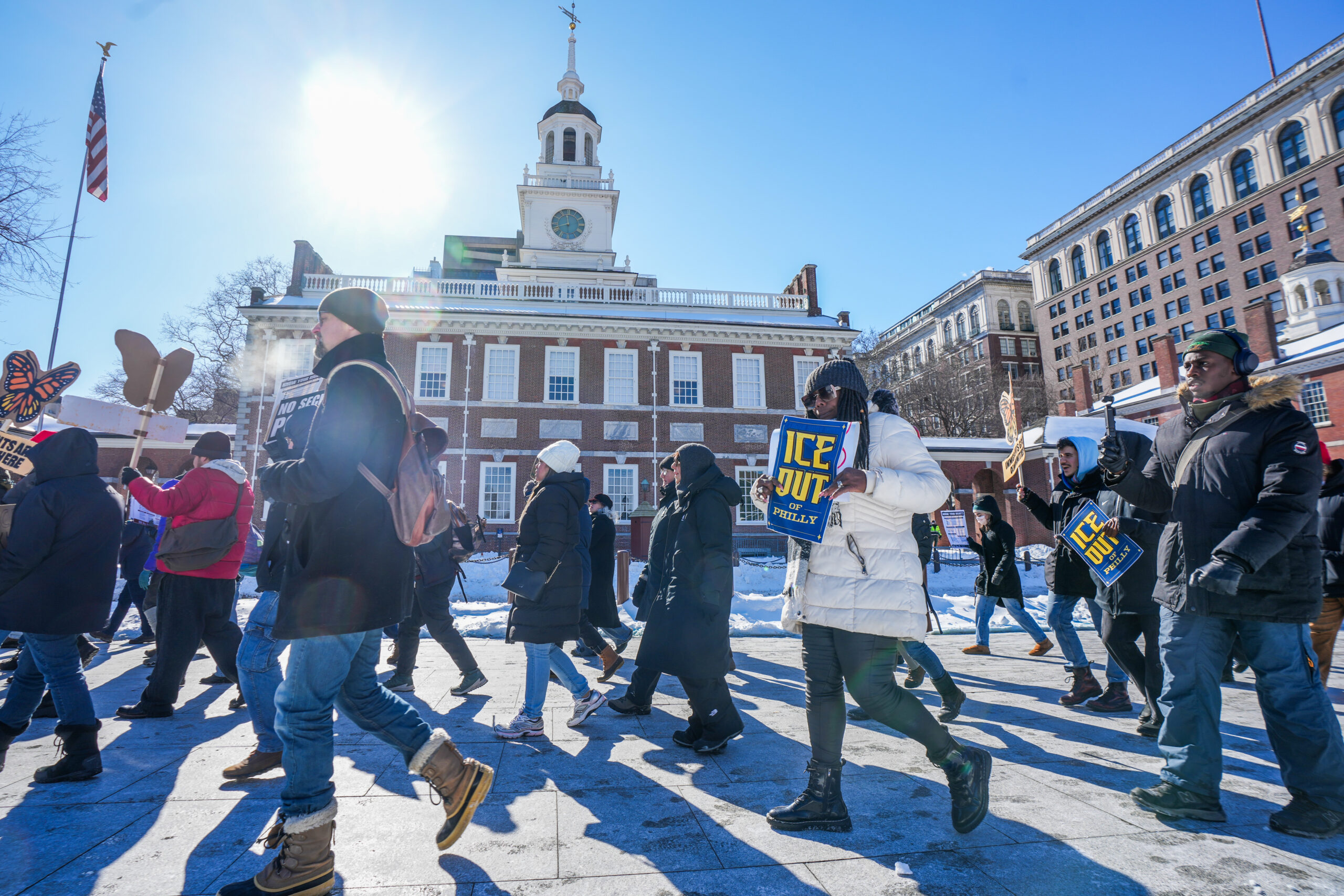
Advocates and protesters call for ICE to get out of Philadelphia in Center City on January 27, 2026.
Parker’s delicate handling of immigration issues stands in contrast to her aggressive response to the Trump administration’s removal last month of exhibits related to slavery at the President’s House Site on Independence Mall.
The city sued to have the panels restored almost immediately after they were taken down. After a federal judge sided with the Parker administration, National Park Service employees on Thursday restored the panels to the exhibit in a notable win for the mayor.
Bondi’s letter, which was addressed to Parker, demanded the city produce a plan to eliminate its “sanctuary” policies or face consequences, including the potential loss of federal funds.
“Individuals operating under the color of law, using their official position to obstruct federal immigration enforcement efforts and facilitating or inducing illegal immigration may be subject to criminal charges,” Bondi wrote in the letter, which is dated Aug. 13. “You are hereby notified that your jurisdiction has been identified as one that engages in sanctuary policies and practices that thwart federal immigration enforcement to the detriment of the interests of the United States. This ends now.”
“Sanctuary city” is not a legal term, but Philadelphia’s policies are in line with how the phrase is typically usedto describe jurisdictions that decline to assist ICE.
Immigrant advocates have in recent years shifted to using the label “welcoming city,” in part because calling any place a “sanctuary” is misleading when ICE can still operate throughout the country. The newer term is also useful for local officials hoping to evade Trump’s wrath, as it allows them to avoid the politically hazardous “sanctuary city” label.
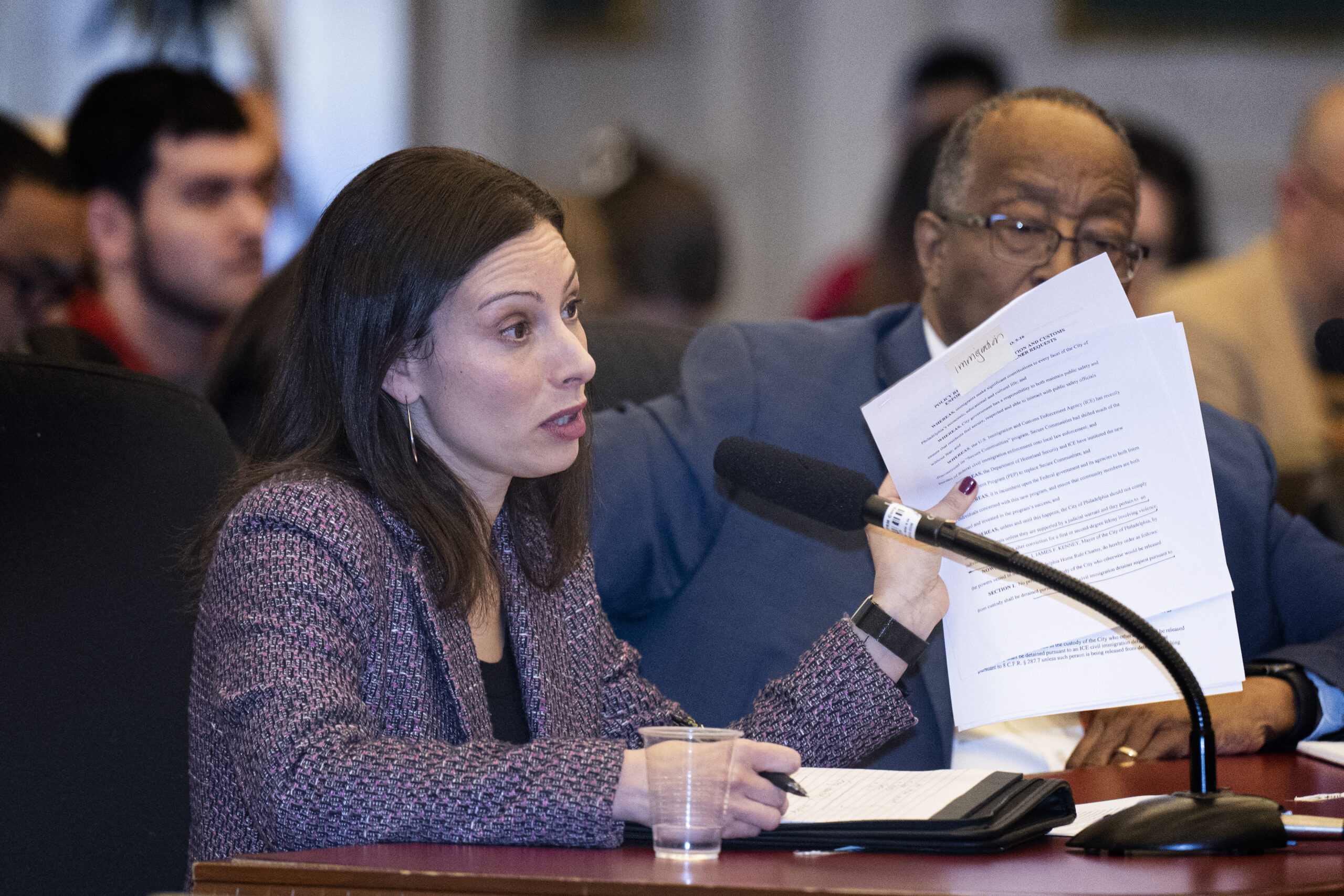
Philly’s most notable immigration policy is a 2016 executive order signed by then-Mayor Jim Kenney that prohibits city jails from honoring ICE detainer requests, in which ICE agents ask local prisons to extend inmates’ time behind bars to facilitate their transfer into federal custody. The city also prohibits its police officers from inquiring about immigration status when it is not necessary to enforce local law.
Renee Garcia, Philadelphia City Solicitor speaks before City Council on Jan 22, 2025.
Garcia wrote in the August letter that Kenney’s order “was not designed to obstruct federal immigration laws, but rather to clarify the respective roles of the Police Department and the Department of Prisons in their interactions with the Department of Homeland Security when immigrants are in City custody.” The city, she wrote, honors ICE requests when they are accompanied by judicial warrants.
Immigration enforcement is a federal responsibility, and — in a case centered on Kenney’s order — the Philadelphia-based U.S. Court of Appeals for the Third Circuit ruled in 2019 that cities do not have to assist ICE.
The court, Garcia wrote, “held that the federal government could not coerce Philadelphia into performing immigration tasks under threat of federal repercussions, including the loss of federal funds.”
City loses fight over records
In Pennsylvania, all government records are considered public unless they are specifically exempted from disclosure under the Right-To-Know Law. In justifying its attempt to prevent the city’s response to the Trump administration from becoming public, the Parker administration cited two exemptions that had little to do with the circumstances surrounding Garcia’s letter.
First, the administration argued that the letter was protected by the work product doctrine, which prevents attorneys’ legal work and conclusions from being shared with opposing parties. Given that the letter had already been sent to the federal government — the city’s opponent in any potential litigation — the doctrine “has been effectively waived,” Magdalene C. Zeppos-Brown, deputy chief counsel in the Pennsylvania Office of Open Records, wrote in her decision in favor of The Inquirer.
“Despite the [city’s] argument, the Bondi Letter clearly establishes that the Department of Justice is a potential adversary in anticipated litigation,” Zeppos-Brown wrote.
Second, the city argued that the records were exempted from disclosure under the Right-To-Know Law because they were related to a noncriminal investigation. The law, however, prevents disclosure of records related to Pennsylvania government agencies’ own investigations — not of records related to a federal investigation that happen to be in the possession of a local agency.
“Notably, the [city] acknowledges that the investigation at issue was conducted by the DOJ, a federal agency, rather than the [city] itself,” Zeppos-Brown wrote. “Since the DOJ is a federal agency, the noncriminal investigation exemption would not apply.”
Garcia’s office declined to appeal the decision, which would have required the city to file a petition in Common Pleas Court.
“As we stated, the City of Philadelphia is firmly committed to supporting our immigrant communities as a Welcoming City,” Garcia said in a statement Wednesday after the court instructed the city to release the letter. “At the same time, we have a long-standing collaborative relationship with federal, state, and local partners to protect the health and safety of Philadelphia, and we remain [in] compliance with federal immigration laws.”
Staff writers Anna Orso and Jeff Gammage contributed to this article.
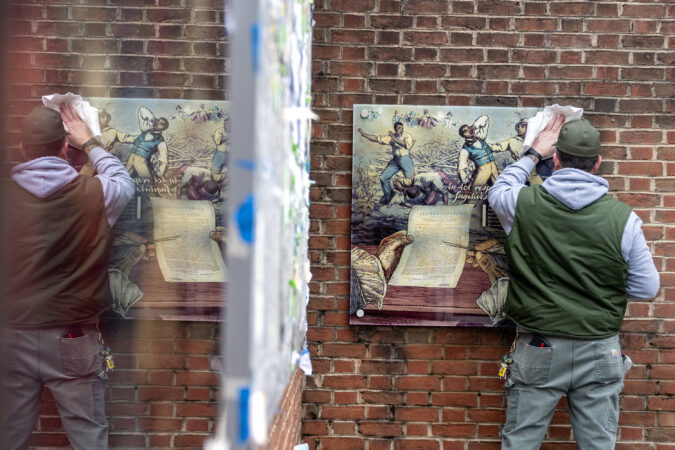
Almost a month after abruptly dismantling exhibits about slavery from the President’s House Site, National Park Service employees began reinstalling the panels late Thursday morning ahead of a court-imposed deadline.
Just before 11 a.m., four park service employees carted glass panels from a white van to a barricaded area at the site. They screwed each panel back into the bricks before cleaning the glass with rags.
The restoration is a win for the City of Philadelphia and local stakeholders who have been fighting to preserve the President’s House after President Donald Trump’s administration ordered the removal of educational panels from the exhibit on Independence Mall last month, censoring 400 years of history. The removal sparked weeks of community activism that turned into celebrations Thursday once the reinstallation began.
As of Thursday evening, 16 of the 34 panels had been reinstalled. A couple of bystanders clapped as the displays were put back up.
Shortly before noon, Parker arrived at the scene, taking in the newly reinstalled exhibits. She shook hands with and thanked the National Park Service employees.
“It’s our honor,” an employee told the mayor.
Parker did not take questions from the media but later issued a statement celebrating the return of the exhibits.
“We know that this is not the end of the legal road,” the mayor said. “We will handle all legal challenges that arise with the same rigor and gravity as we have done thus far.”
Michael Coard, an attorney and leader of Avenging the Ancestors Coalition, which helped steer efforts to preserve the President’s House, called Thursday’s reinstallation a “huge victory” after weeks of advocacy in court and around the site itself.
“We had people doing something at least every single day since the vandalism took place on Jan. 22, and we’ve had the attorneys in court, so it’s a great day, but the battle is not over,” Coard said.
On Wednesday, several employees from Independence National Historical Park placed metal barriers around the brick walls where panels had been displayed near the open-air exhibit’s Market Street entrance. One employee said the barriers were set up so employees could clean the area.
Prior to Thursday, exhibits were being stored in a National Park Service storage facility adjacent to the National Constitution Center.
The reinstallation was a moment that Philadelphians who had been tirelessly fighting to protect the President’s House had been waiting for.
On Jan. 22, after park employees took crowbars and wrenches to the President’s House, which memorializes the nine people George Washington enslaved at his Philadelphia residence, the City of Philadelphia filed suit against members of the Trump administration. Community stakeholders took action to preserve the memory of the site.
“It’s important to hang on to hope,” said Bill Rooney, 68, of Chestnut Hill. “The people who lived here — sometimes that’s all they had to hold on to. We need to do that, too, and [make] sure that the whole history is told.”
Rooney, a certified tour guide, added: “History matters. All of history matters.”
Rufe, a George W. Bush appointee, issued a blistering 40-page opinion in which she compared the federal government’s arguments justifying the removal of the interpretive panels to the dystopian Ministry of Truth from George Orwell’s novel 1984.
The opinion said it was urgent that the full exhibit be shown to the public. When the federal government did not comply 48 hours later, the judge set a deadline of 5 p.m. Friday for the Department of the Interior and the National Park Service to fulfill her order.
The Trump administration asked Rufe on Wednesday night for a stay on the injunction while its appeal is pending in the U.S. Court of Appeals for the Third Circuit.
The motion says enforcement of the order makes Philadelphia a “backseat driver holding veto power” in all decisions related to Independence National Historical Park. By forcing the government to restore the slavery panels, the court “compels the Government to convey a message that it has chosen not to convey,” the motion says.
The city filed a brief Thursday opposing the stay, saying that the federal government did not add anything new to its argument. The idea that the restoration would cause harm was undermined by the fact that the exhibits “stood for 15 years without alteration, conveying the ‘whole, complicated truth,’” the city said. The filing does not acknowledge that some panels had been reinstalled.
Rufe had not ruled on the stay as of Thursday afternoon. But neither the federal government’s appeal to a higher court nor the request for a stay pauses Rufe’s order.
Complying with the order could complicate the federal agencies’ argument that restoring the panel inflicts irreparable harm because they have “turned around and done what they said they couldn’t do,” said Marsha Levick, a visiting chair at Temple University’s Beasley School of Law.
Attorney Michael Coard, leader of the Avenging the Ancestors Coalition speaks during a rally at the President’s House in Independence National Historical Park Thursday, Feb, 19, 2026, after some of the slavery exhibits were returned.
The people behind the fight to restore the President’s House Site were lauded at a late-afternoon rally. Organizers had called the 120-person event after the barricades were installed Wednesday, which they said prevented people from visiting the memorial. Instead, the event Thursday — set to Kool & the Gang’s “Celebration” and “Fight the Power” by Public Enemy — was celebratory.
“We’re still fighting. The battle is still being fought in court,” said coalition member Mijuel Johnson. “But today — this greatest day, this day of pride — we got our panels put back up.”
Coard said Thursday’s development epitomizes the group’s name. He said his coalition’s advocacy for the President’s House stands on the shoulders of activism by ancestors during the Civil Rights Movement.
“We took that baton from them and we ran with it,” Coard said. “And the interesting thing about taking that baton is that this track was not as difficult for us. They had more obstacles on their track. We have fewer because they cleared it for us.”
A three-year ban on puppy breeding in Philadelphia is likely to become law after City Council members on Thursday passed a bill to relieve overcrowded animal shelters.
Tightening the leash on backyard breeders: The bill was authored by Councilmember Cindy Bass, a Democrat who represents parts of North and Northwest Philadelphia.
Bass was sick and absent from Council on Thursday, but she has previously said that her bill is aimed at limiting people from breeding more puppies than they can sell.
“Every litter means more dogs in our shelter, more cost for taxpayers, and more suffering that we can prevent,” Bass said last year. “This isn’t about punishment; it’s about compassion and responsibility.”
Under the bill, it would be illegal to sell puppies or post ads to sell them within city limits. Breeders who violate the moratorium could face a $1,000 fine, with the proceeds going to the city’s Animal Care and Control Team, also known as ACCT Philly. The animal control agency would also enforce the ban.
Sammi Craven, a local animal welfare advocate, testified Thursday about overcrowding at ACCT Philly’s North Philadelphia shelter. She named the dogs that were recently euthanized or are scheduled to be put down: Stella, Cheese Burrito, Luna, and Muffin, among others.
“Philadelphia’s current animal welfare policy is ineffective,” Craven said, “and infrastructure and prevention have not kept pace with intake.”
In this 2022 file photo, Brian Martin, 31, and Vanessa Green, 29, look at their new dog they plan to adopt while Green holds Autumn, 1, at ACCT Philly, which was hosting a pet adoption event.
Critics of the moratorium say it will be challenging to enforce and could harm smaller, responsible breeders as opposed to those already operating illegally.
Charley Hall, a government relations official with the American Kennel Club, called on Council to hold the bill and establish a working group to draft new regulations.
“Working together, we can stop the flow of irresponsible breeders and improve animal welfare and fewer dogs ending up in Philadelphia’s shelters,” Hall said. “The question is how to achieve that goal in a way that is effective, fair, and legally sound.”
What else happened today?
Resign to run gets amended: City Councilmember Isaiah Thomas has been trying for more than a year to pass legislation amending a rule that requires city employees quit their jobs to run for higher office.
He’s attempting to amend the rule so that city officeholders can keep their jobs only if they are running for a state or federal office. That means Council members running for mayor would still have to give up their seats.
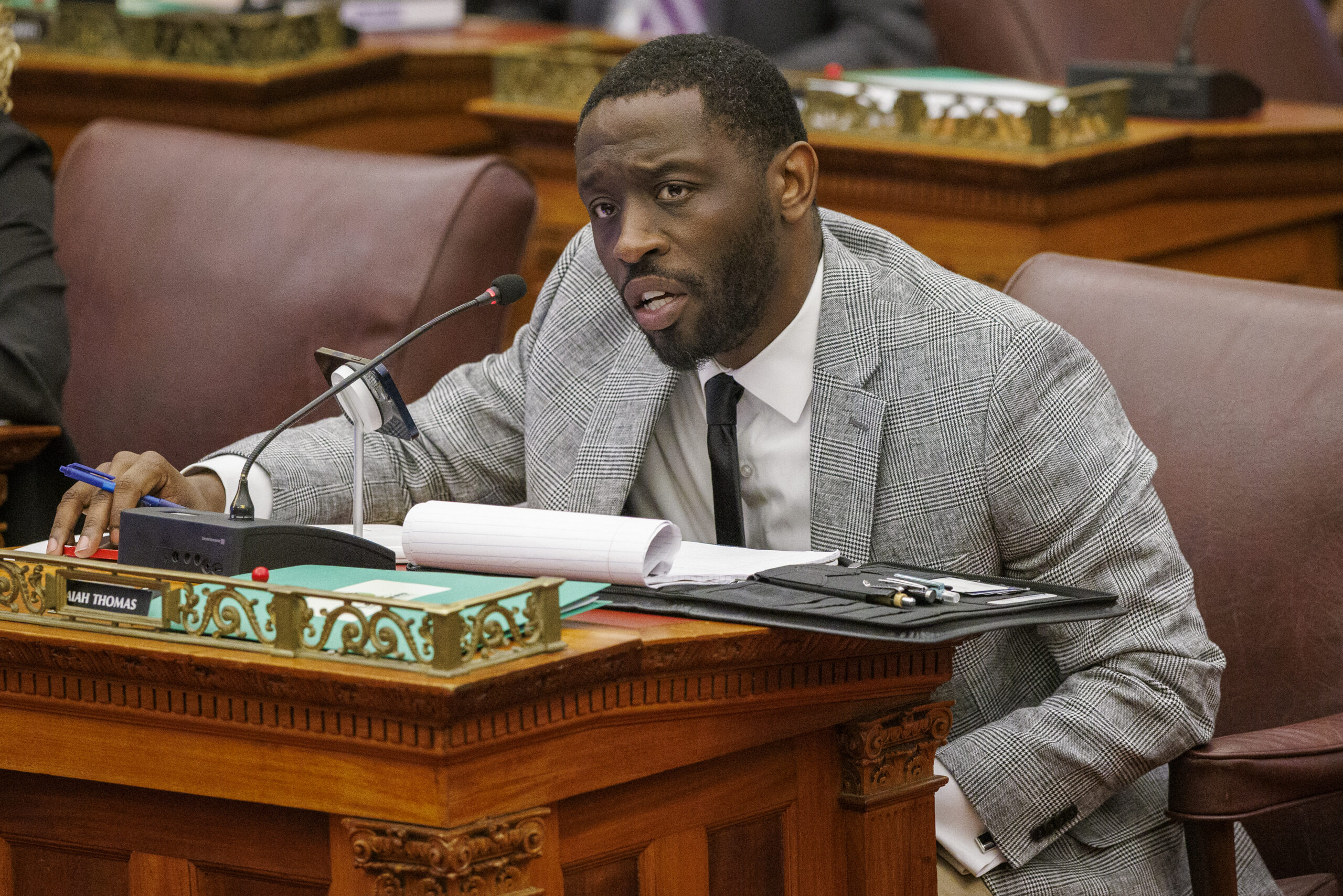
Councilmember Isaiah Thomas makes a statement at the start of a hearing last week.
But Thomas has run into roadblocks, including opposition from the city’s Board of Ethics, which asked him to make changes to the legislation in December, just before it appeared poised to pass.
On Thursday, he introduced an amendment that made a series of tweaks, including clarifying that sitting city officeholders may only run for one public office in any election.
Jordana Greenwald, general counsel for the city’s Board of Ethics, testified that the board still has concerns and requested more amendments, including prohibiting certain forms of politicking in the workplace.
She also said the legislation should clarify that the mayor can’t run for another office while serving as the city’s chief executive, a rule that is already enumerated elsewhere in the city charter.
However, making additional amendments could require Thomas re the legislation entirely. He said he would prefer for the bill to be called up for a final vote next week.
Amending the resign-to-run rule requires changing the city’s Home Rule Charter, meaning voters would have to approve it through a ballot question. Voters have rejected earlier attempts to repeal resign-to-run.
Codifying the youth watchdog: Council members also approved legislation to make the city’s Office of the Youth Ombudsperson permanent.
The office was created through an executive order signed by former Mayor Jim Kenney and is responsible for monitoring child welfare, juvenile justice, and behavioral health residential placement facilities in the city.
Making the office permanent also requires an amending the charter. A ballot question is likely to appear in the May primary election.
Quote of the week
Councilmember Jim Harrity in Council Chambers in September 2025.
That was Councilmember Jim Harrity, an Irish Catholic who in a speech Thursday honored the sacrifices made during the Muslim holy month of Ramadan.
State Rep. Chris Rabb announced Thursday he will not seek reelection to Harrisburg this year while he runs for a seat in Congress.
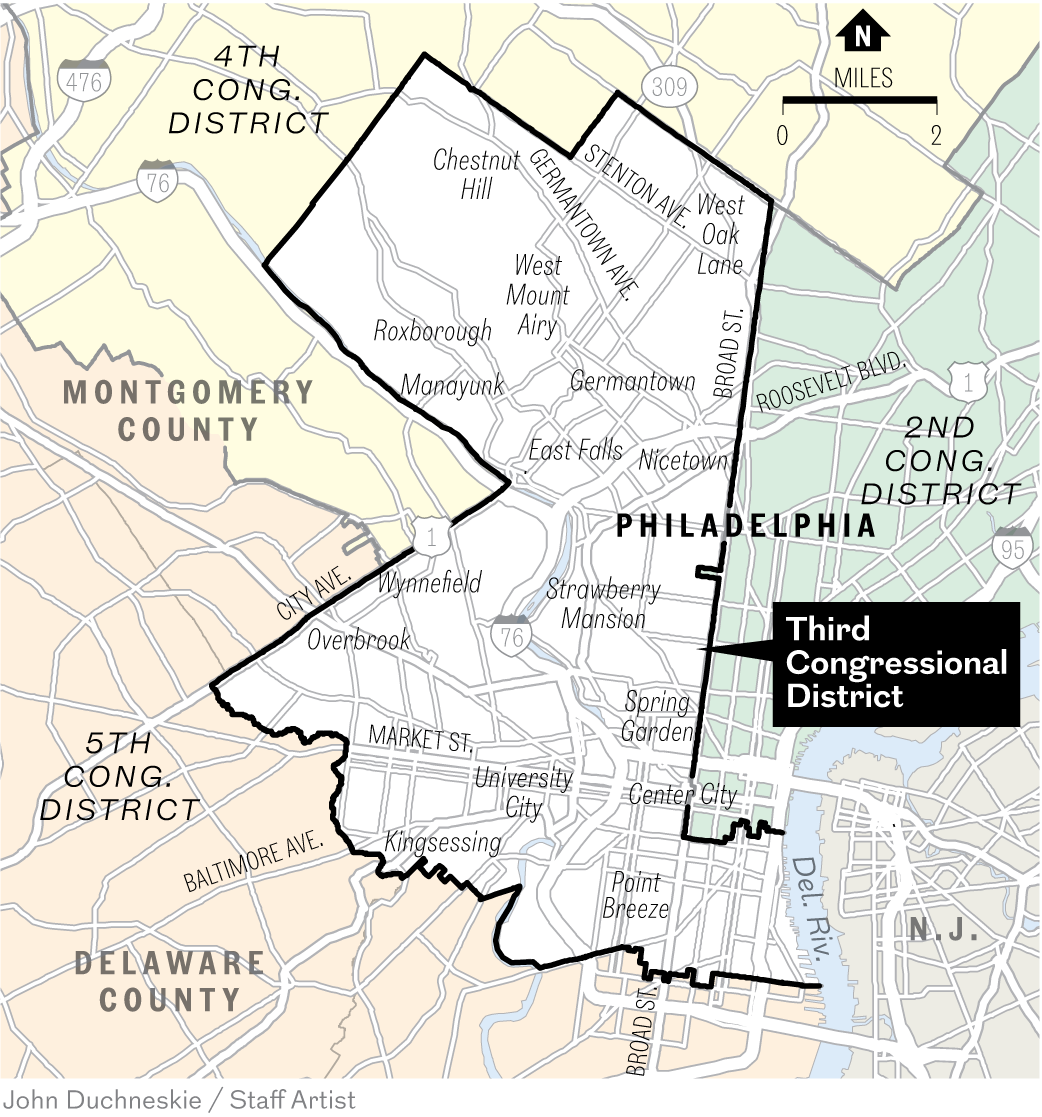
State lawmakers are allowed to simultaneously run for two offices. But Rabb, a Democrat, said he is fully committed to his campaign for Pennsylvania’s 3rd Congressional District, which covers roughly half of Philadelphia and is, by some measures, the most Democratic district in the nation.
“I’m so inspired and overwhelmed by the tremendous outpouring of support we are seeing all across the city, and today I want to send a message loud and clear: I am all in on this race for Congress,” Rabb said in a statement.
Rabb served five terms in the Pennsylvania House’s 200th District in Northwest Philadelphia, a seat once held by Mayor Cherelle L. Parker. A progressive who often operates as a political lone wolf, Rabb has frequently clashed with the city’s Democratic establishment, especially Parker and her allies in the Northwest Coalition political organization.
In his first election, Rabb in 2016 defeated Tonyelle Cook-Artis, Parker’s close friend who now serves as an aide in the mayor’s office. Two years later, he bested Melissa Scott, who is now the Parker administration’s chief information officer. In 2022, redistricting forced Rabb to run against fellow incumbent State Rep. Isabella Fitzgerald, and he won again.
Map of Pennsylvania’s Third Congressional District.
State Sen. Sharif Street, of North Philadelphia, is not up for reelection this year, meaning he will keep his seat in Harrisburg if he loses the congressional race without having to run two campaigns. Street last year resigned as chair of the Pennsylvania Democratic Party after facing questions about whether his congressional campaign would conflict with his party leadership role.
State Rep. Morgan Cephas, who chairs the Philadelphia delegation in the state House and represents a West Philadelphia district, is up for reelection this year. Her campaign on Thursdaysaid she intends to simultaneously run for another term while vying for the congressional seat.
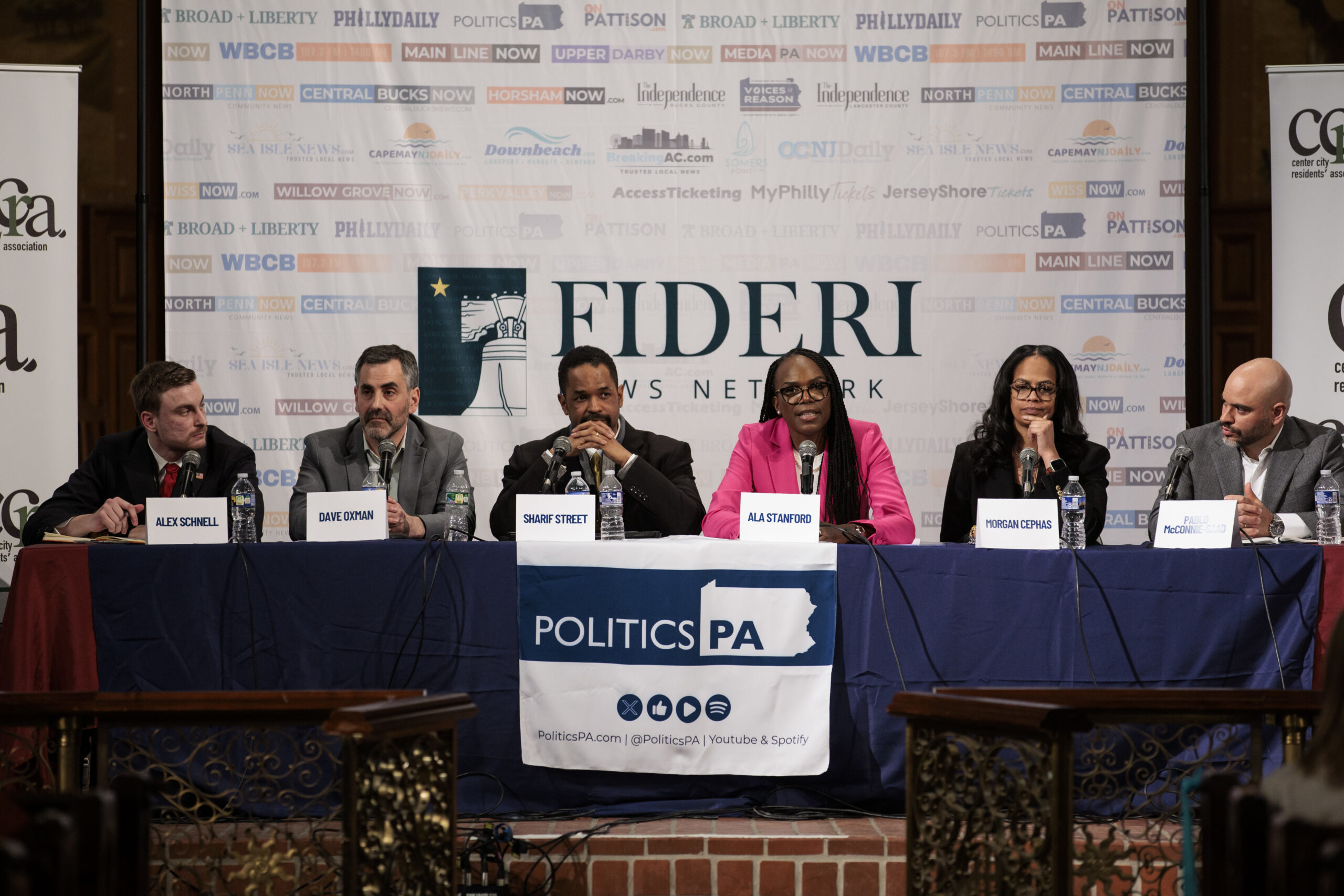
(left to right) Alex Schnell, physician Dave Oxman, State Sen. Sharif Street, physician Ala Stanford, State Rep. Morgan Cephas, and Pablo McConnie-Saad appear during a candidate forum for the 3rd Congressional District seat at Church of the Holy Trinity on Monday, Feb. 9, 2026 in Philadelphia. The seat vacancy comes from Rep. Dwight Evans’ retirement.
It is common for state legislators to run two simultaneous campaigns while seeking federal office. Their reelection bids often require little effort, as incumbents rarely face serious challenges. (Rabb’s career as an anti-establishment legislator in the backyard of one of Philadelphia’s most powerful political factions, however, has made him an outlier in that regard.)
He declined to say how much money went missing. In his most recent campaign finance report, Rabb reported raising $127,000 in the last three months of 2025 and entering the year with $99,000 in cash on hand, which at the time represented the fifth-largest reserve among the 3rd District hopefuls.
Rabb’s decision not to run for reelection means the Northwest Coalition now has its best opportunity in a decade to recapture the 200th District state House seat. Northwest Philadelphia’s liberal voter base, however, also opens the door for another progressive to follow in Rabb’s footsteps.
“It has been the honor of a lifetime to serve Philadelphia families across the 200th House District for the past 10 years and I look forward to seeing the great candidates who will run,” Rabb said. “In the coming weeks, I’m committed to working with my fellow progressive leaders and advocates across this district to ensure that this seat continues to be held by a true champion for Philadelphia’s working families.”
Anyone hoping to succeed Rabb in Harrisburg will have to act quickly. Candidates must submit petitions to appear on the ballot. The window to gather signatures opened this week and closes March 10.
Rabb said Wednesday that his congressional campaign collected the required 1,000 signatures in just 12 hours, which he said makes him the first candidate in Pennsylvania to submit qualifying petitions and shows that his campaign “continues to build strong grassroots support across Philadelphia.”
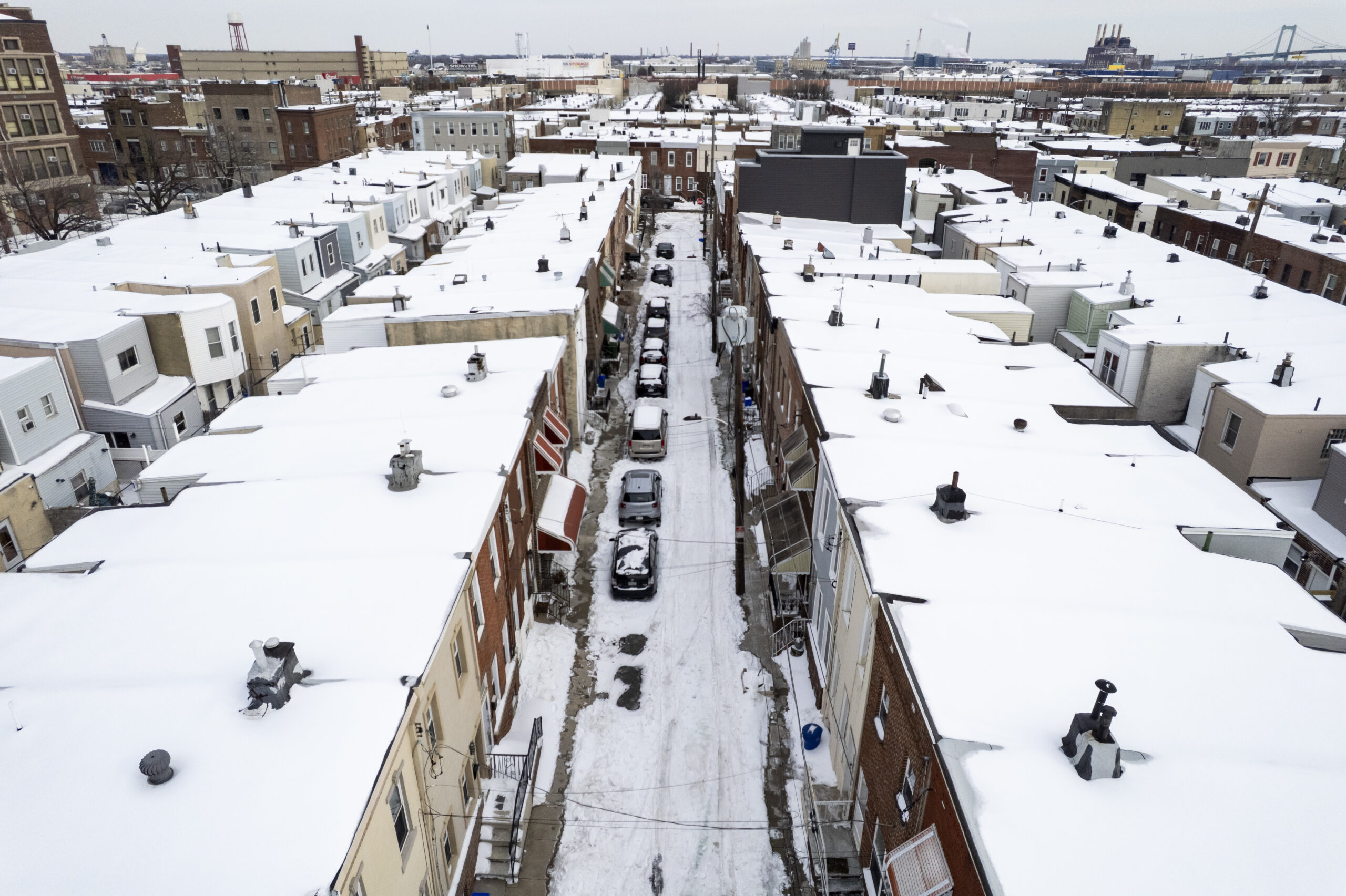
With the arrival of above-freezing temperatures, Philadelphia is declaring an end to an emergency response that lasted 26 days, closing the chapter on an all-hands-on-deck mobilization of various city departments that navigated the biggest snowfall in a decade and the persistent cold snap that followed.
The city’s “enhanced code blue” response began the Friday before a winter storm that blanketed Philadelphia with 9.3 inches of snow and sleet on Jan. 25. The designation allowed the city to deploy support services across departments for some of the city’s most vulnerable, living on the streets.
A preliminary estimate by the city puts the cost of the storm response at about $59 million, which officials said reflects the intensity of the storm and conditions that followed.
“A tremendous City workforce, outreach teams, first responders, nonprofit partners, and community stakeholders came together without hesitation,” Mayor Cherelle L. Parker said in a statement Tuesday. “Because of their coordination, compassion, and commitment, lives were protected during some of the harshest conditions we have faced this winter.”
Amid a bitter cold that hampered snow-removal efforts, the city embarked on a cleanup operation that lasted more than two weeks and combined heavy machinery and old-fashioned manual digging.
Here are some key numbers highlighting how various city departments mobilized and the costs they accrued.
Heavy machinery and dump trucks collecting piles of snow from Germantown and Thompson Street, Philadelphia, Wednesday, Jan. 28, 2026.
$46,021,516 in snow removal
The city crafted its $4.1 million snow operations budget for fiscal year 2026 using a rolling-year average of prior costs.
But the storm brought about a slew of unanticipated expenses and challenges, including snow removal, ice control, and other emergency operations.
The city looked to contractors to bolster its workforce as it launched a massive effort to treat and plow streets.
Contractor plowing and salting operations during the storm cost $13.9 million, while the post-storm contractor cleaning and lifting operations cost $31.8 million. The remainder of the expenses came from snow-related operations across departments, such as the activation of warming centers.
Part of what made the storm so costly was the uncooperative temperatures.
Amid complaints from residents over what was perceived as a slow cleanup, the city noted that the below-freezing temperatures created increasingly tightly packed ice that had nowhere to go.
The city even brought in a snow melter from Chicago, which eliminated 4.7 million pounds of snow in the first two days after the snowfall. The costs of melting, which is considered a specialized service, ran more than $139,000.
After the initial snow removal, the city moved to what it called its lifting operations.
Snowplows, compactors, front-end loaders, and backhoes took part in an intricate operation where snow was placed in dumpsters before being shipped off to more than 30 dumping sites.
The Philadelphia Streets Department mobilized up to 300 pieces of equipment on any given day in an effort to leave no street untreated.
The city went through 15,000 tons of salt through the three-week cleanup amid other challenges, such as an icy Delaware River that temporarily blocked additional salt orders, and the rising cost of salt post-storm.
The cost of salt was more than $1.2 million.
Emily Street is still covered in snow near Furness High School (top left) on Wednesday, Jan. 28, 2026 in South Philadelphia.
18,340 ramps cleared
The massive cleanup had the city looking at creative ways to boost the number of workers clearing streets.
The streets department tapped participants in its Future Track Program for snow-removal efforts early on. These are trainees, typically at-risk young adults, who are not enrolled in higher education and are unemployed. They get job experience, as well as other services, and they help in beautification projects.
The trainees cleared hundreds of ADA ramps across Philadelphia.
But more than a week after the storm, the city was still being flooded with complaints about inaccessible crosswalks and SEPTA stops piled with ice.
That’s when officials tapped into a city program that pays people the same day for their work, deploying 300 people to help chip and sweep away the hardened ice with shovels and brooms.
The city assembled a more than 1,000-person workforce for cleanup efforts this way, deploying a mix of city employees, contractors, and participants from the same-day pay program.
In all, the city said, the crews worked nearly 2,300 intersections, clearing 18,340 ADA ramps and about 2,800 SEPTA stops.
The use of contractors, however, was met with pushback from American Federation of State, County and Municipal Employees District Council 33, the city’s largest municipal workers union, which said the decision was made without consulting the union.
“Our members are the trained, dedicated workforce responsible for this work, and it is disheartening to see the administration move forward without even a discussion on how best to manage these challenges,” DC 33 president Greg Boulware said in a statement in early February.
(function() { var l = function() { new pym.Parent( ‘phillysnowcosts__graphic’, ‘https://media.inquirer.com/storage/inquirer/ai2html/phillysnowcosts/index.html’); }; if(typeof(pym) === ‘undefined’) { var h = document.getElementsByTagName(‘head’)[0], s = document.createElement(‘script’); s.type = ‘text/javascript’; s.src = ‘https://pym.nprapps.org/pym.v1.min.js’; s.onload = l; h.appendChild(s); } else { l(); } })();
22 warming centers
The cold snap presented another life-or-death challenge for the city: how to get people living on the streets indoors.
Between Jan. 20 and Feb. 14, homeless outreach teams worked nonstop distributing more than 2,800 warming kits, 4,000 fleece blankets, 700 cases of water, and 35,000 food items while trying to get people to take a shelter bed or go to one of the city’s 22 so-called warming centers.
The code blue designation allowed the city to activate some libraries and recreation centers as hubs for people looking to escape the cold.
The warming center operation was seen as lifesaving, largely supported by library staff. Between Jan. 19 and Feb. 11, New York City recorded at least 18 cold-related deaths; Philadelphia had three over a similar time frame.
Still, after 20 days of 12-hour operations, staff at the daytime centers described a lack of support from the city when it came to dealing with people who had medically complex issues requiring behavioral health support and wound care. (One library staffer said more city-assigned support staff showed up at the daytime centers after The Inquirer published a report about workers’ concerns.)
Philadelphia officials said more than 100 people from more than 20 city and partner organizations helped support the warming centers.
Nighttime warming centers had about 4,400 overnight guests, according to the city.
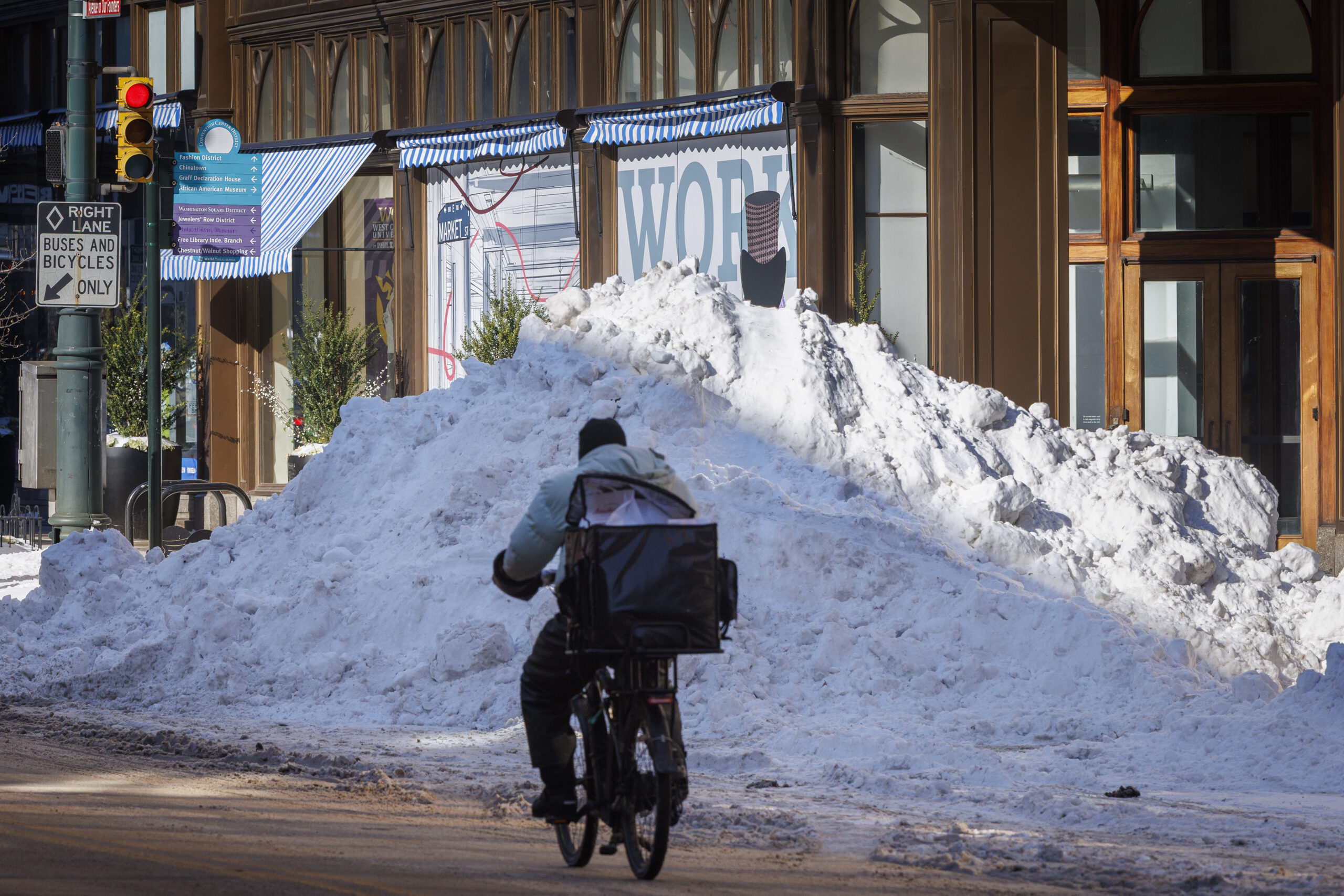
Mount Market Street at 7th Street, Center City Philadelphia, Tuesday, Jan. 27, 2026. Large pile of snow on northeast corner of Market and 7th.
$50 million from general fund
Because snow operations exceeded the initial amount allotted in the budget, the city plans to transfer $50 million from its general fund to its transportation fund.
Even so, the city said its general fund remains higher than projected in its five-year plan because of a larger-than-anticipated general fund balance in the previous fiscal year.
Rufe wrote that the deadline follows the agencies’ “failure to comply” with the injunction’s instruction to take action “forthwith,” which is often defined in law to mean as soon as possible or within 24 hours.
National Park Service staff were at the President’s House site on Wednesday morning to hose down the walls, which are covered with protest signs in lieu of the exhibits, and place barricades around them.
The National Park Service did not respond to questions about the activity.
A spokesperson for the White House, Taylor Rogers, said in a statement Wednesday that the lawsuit brought by Philadelphia was “premature” because the removal of the exhibits from the President’s House and other national parks is not final.
“The Department of the Interior is engaged in an ongoing review of our nation’s American history exhibits in accordance with the President’s executive order to eliminate corrosive ideology, restore sanity, and reinstate the truth,” Rogers said.
Staff writer Fallon Roth contributed to this article.
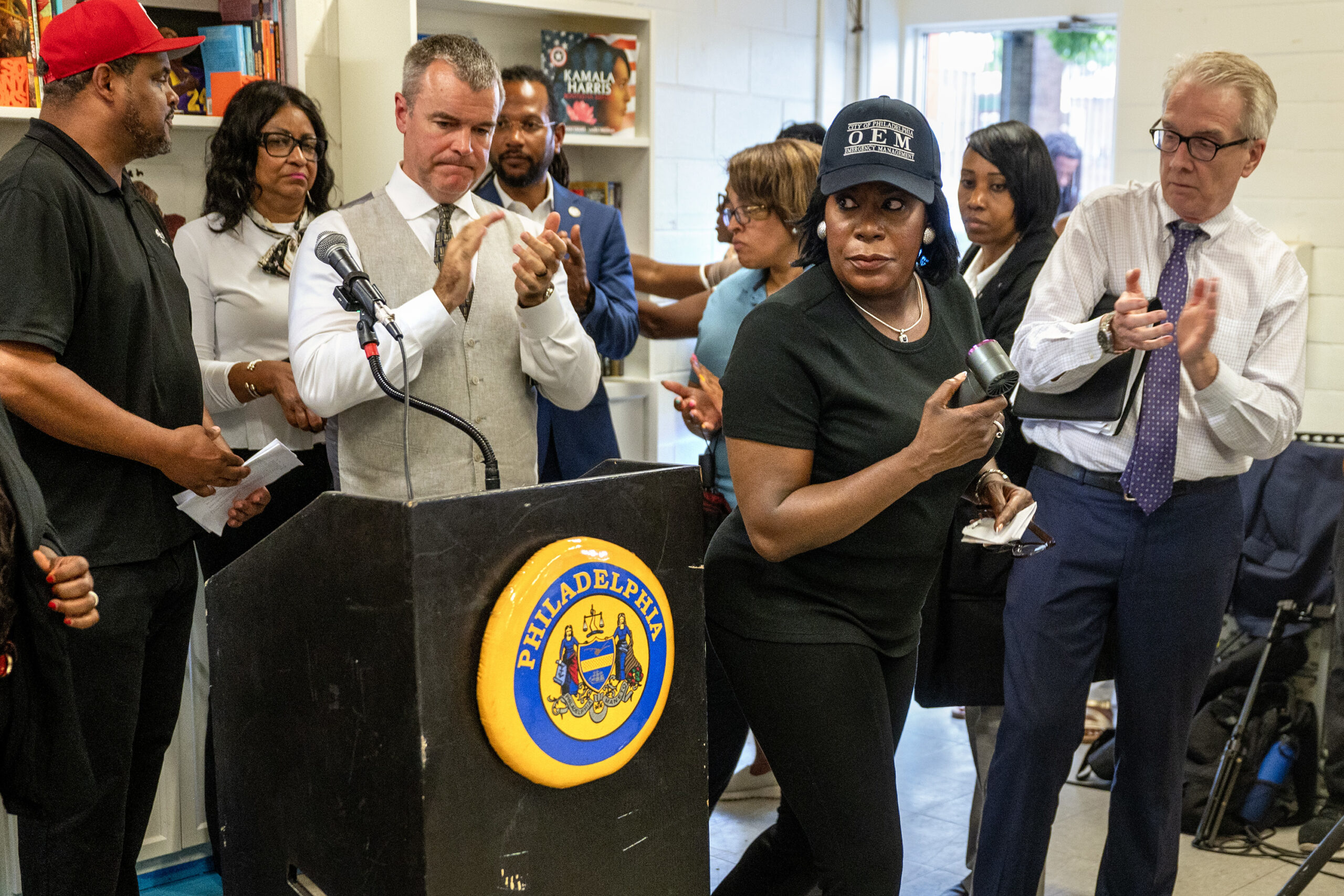
When Mayor Cherelle L. Parker stood in the city’s emergency management center last month and announced that her administration was preparing for the worst winter storm Philadelphia had seen in years, she was flanked by the police commissioner, the head of public schools, and a dozen other deputies.
Missing from the news conference of Philadelphia’s top officials was Managing Director Adam K. Thiel, whose job it is to oversee the delivery of city services.
It wasn’t the only time over the last year that Thiel, Philadelphia’s No. 2 public official, was noticeably absent.
Thiel, who is effectively the city’s chief operating officer, was out of office last year for a total of nearly five months, much of which he spent on military leave, according to 2025 payroll register records obtained by The Inquirer. His increasingly low profile in Philadelphia City Hall has generated frustration and fueled questions about his job performance among some lawmakers, especially as the city faced criticism over the recent snow cleanup.
Almost half of Thiel’s $316,200 city salary last year was for paid time off, according to payroll records. He is one of the highest-paid officials in the government and made more than Parker, who last year earned $280,000.
In addition to his top city role, Thiel is a major in the U.S. Army Reserves. He joined the reserves in August 2024, eight months after beginning his job as managing director.
Thiel also holds other positions outside government. In 2024, while he was managing director, he made more than $300,000 working as a consultant, according to financial disclosures. He is an adjunct faculty member at two universities and sits on several nonprofit boards.
Five City Council members told The Inquirer that it has been months since they interacted directly with Thiel.
“The managing director of the city is an extremely important job,” said Councilmember Jamie Gauthier, a Democrat from West Philadelphia. “I do not understand how someone who is absent as much as Thiel is able to carry out this job effectively.”
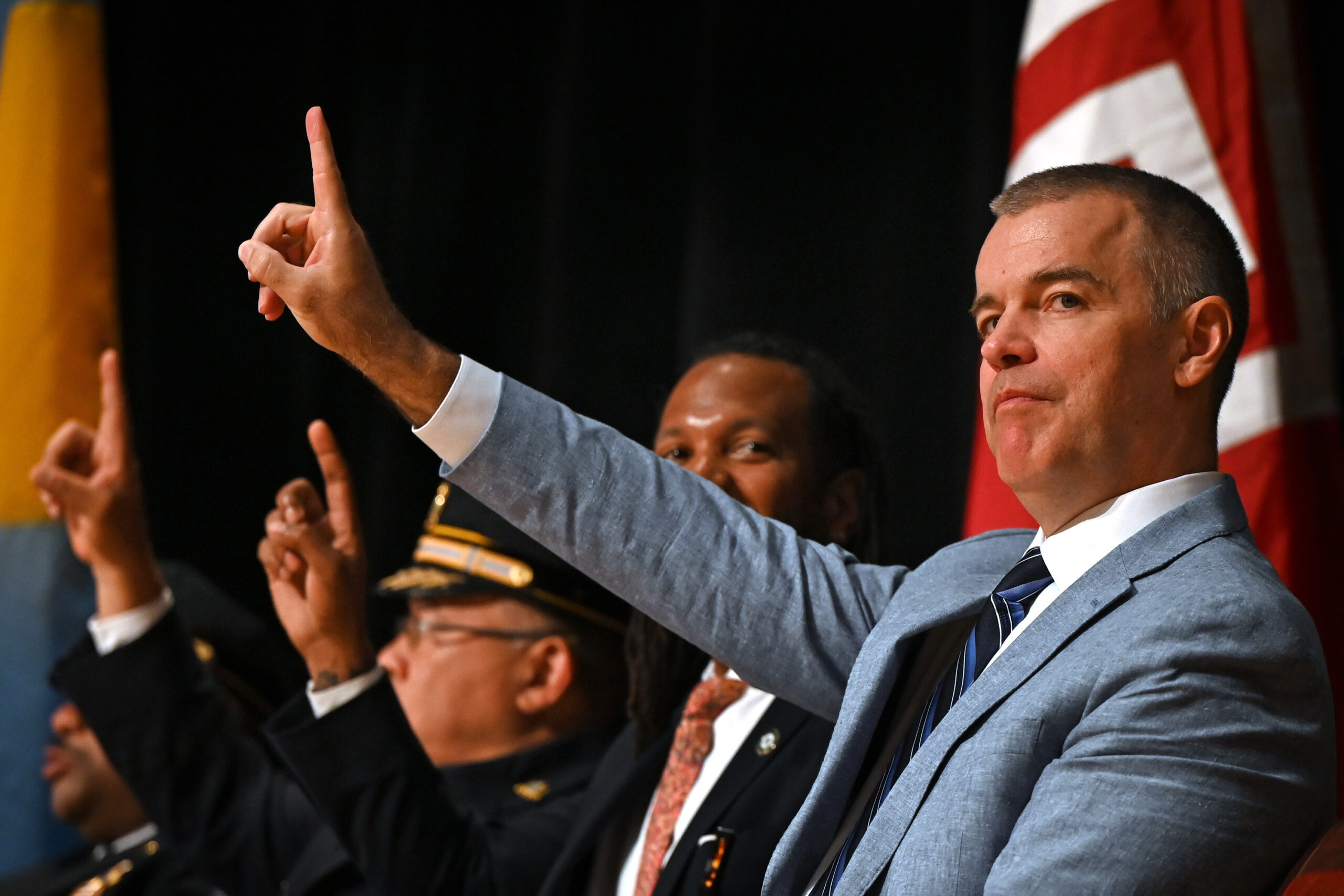
Managing Director Adam Thiel during graduation ceremonies for the police academy Class #402 of the Philadelphia Police Department and Temple University Police Department at Temple University Performing Arts Center June 17, 2024.
The administration declined requests to interview Thiel and Parker for this article. In a statement, Thiel thanked Parker for her “continued support of our city of Philadelphia employees who also serve the United States of America.”
Sharon Gallagher, a spokesperson for the managing director’s office, said in a statement that Thiel has been employed by the city for nearly 10 years and “earns leave offered by the city the same way as other city employees accrue vacation, sick days, family, medical, military and other leave categories.”
Payroll records show that Thiel logged six weeks of military leave time last year — the maximum amount the city offers employees. Gallagher said he also used 11 weeks of accrued vacation time to cover additional military assignments.
The administration declined to answer questions about Thiel’s military service, including details about his location and unit. His LinkedIn page says he “helps provide emergency management subject matter expertise to combatant commands and partner nations.”
Thiel is also founding partner of one consulting firm and the president of a second, though the specific nature of that work is not known and he has declined to disclose his clients publicly.
In 2024, Thiel said his consulting work took fewer than 10 hours per week. Gallagher said Tuesday that “nothing has changed” since then.
The Parker administration did not publicly announce when Thiel was on leave last year, but officials acknowledged it once asked by reporters last summer. At the time, Deputy Managing Director Michael Carroll filled in on an interim basis.
Thiel, 53, is a nationally recognized expert in emergency management. He held a variety of firefighting, public safety, and disaster preparedness roles across the country before coming to Philadelphia in 2016 to serve as fire commissioner and deputy managing director under former Mayor Jim Kenney.
Thiel said in a statement Tuesday that Williams was “the best choice to lead our city’s unified response to the recent snowstorm operation and is the right leader for future snow and ice events.”
Gauthier said the city’s handling of the storm “needed a higher-level emergency response.” She said while she respects Thiel’s military service, she raised his consulting work as a concern.
“A decision needs to be made what he wants to do. Does he want to serve locally, or does he want to do other things?” Gauthier said. “We need a managing director who will serve full time.”
The administration did not answer questions about whether Thiel was in town through the duration of the city’s 26-day winter emergency response.
Parker’s chief of staff, Tiffany W. Thurman, said in a statement that the city is proud to offer benefits such as military and administrative leave that support employee well-being and professional development.
Thurman said Thiel “is always reachable and fulfills the responsibilities of his position as needed based on the situation.”
“His leadership — as is the case with the leadership team of any large city — is not limited by time designated as leave,” she said.
The purpose of the Philadelphia managing director
The authors of the 1950s-era Philadelphia Home Rule Charter created the position of managing director to serve as a barrier between the mayor’s political appointees and the city’s operational departments.
The idea was that having a bureaucrat at the helm would ensure city service delivery would be apolitical, and the mayor cannot fire the managing director without cause.
In reality, different mayors have granted their managing directors varying levels of power.
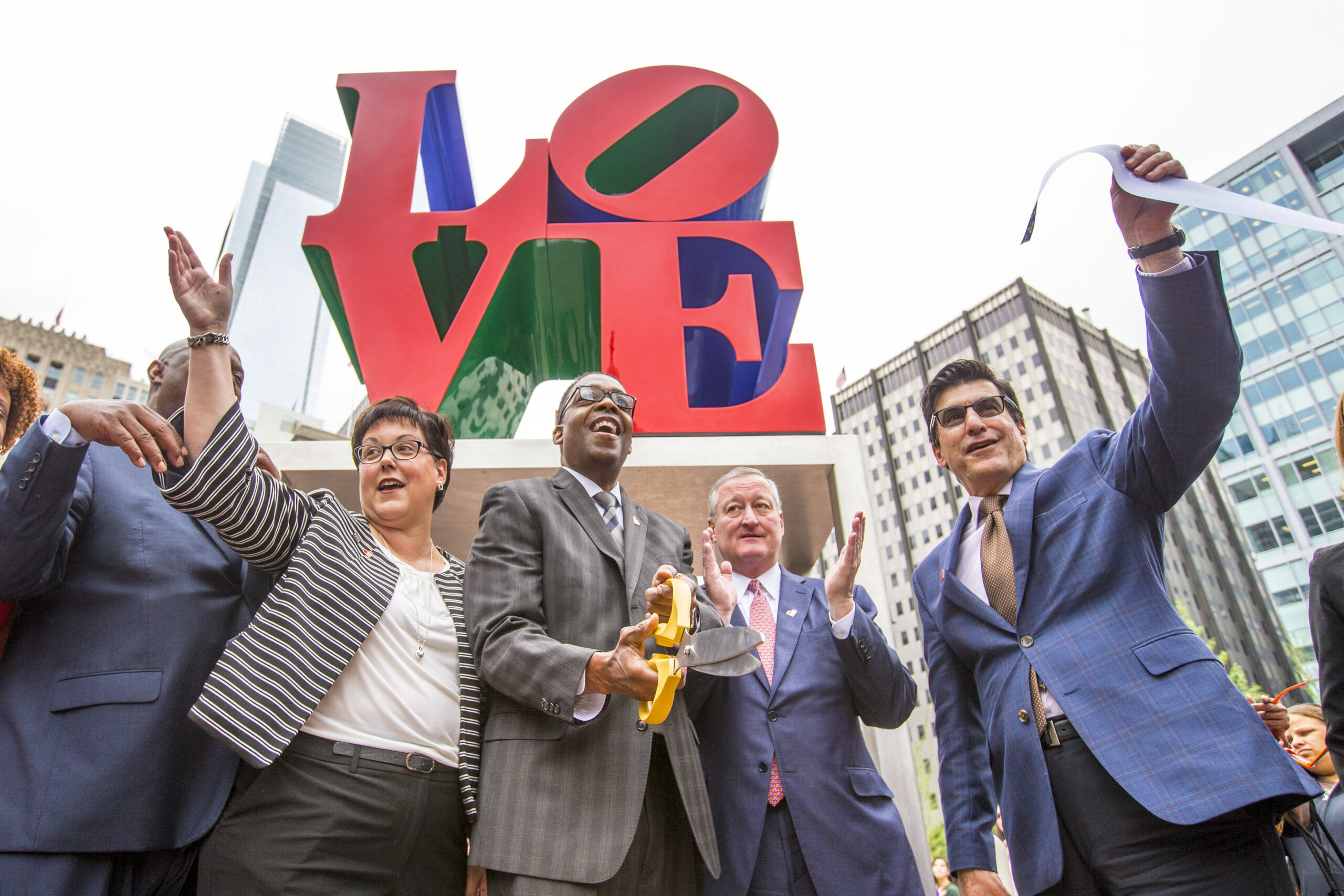
In this 2018 file photo, LOVE Park is by (left to right) then-Philadelphia Parks and Recreation Commissioner Kathryn Ott Lovell, former City Council President Darrell Clarke, former Philadelphia Mayor Jim Kenney and then-Managing Director Michael DiBerardinis.
For example, former Mayor Michael Nutter dispensed with decades of tradition and assigned robust portfolios to several deputy mayors. While his managing directors were important figures in his administration, they oversaw fewer operating departments than their predecessors.
Kenney, Parker’s immediate predecessor, sought to re-empower the city’s managing director position, while his deputy mayors took on advisory roles. He reassigned almost all departmental oversight to the managing director’s office.
“We’re going to have a managing director that’s actually a managing director,” Kenney said before he took office.
Council members who were in office before Parker’s 2024 swearing-in became used to the managing director being accessible. Several lawmakers said that under Kenney’s administration, they routinely communicated about constituent services matters with ex-Managing Director Tumar Alexander and his predecessor, Brian Abernathy.
That hasn’t been the case with Thiel in the role.
“Since the beginning of this administration, I have gone to Carlton Williams,” said Councilmember Jeffery “Jay” Young Jr., a freshman Democrat who represents parts of North Philadelphia.
Mayor Cherelle L. Parker is applauded by members of her administration at City Hall Wednesday, Jul. 9, 2025, hours after reaching a tentative contract agreement with District Council 33 leaders overnight, ending the workers’ strike. At left is Carlton Williams, director of the Office of Clean and Green Initiatives and Chief Deputy Mayor Sinceré Harris is behind the mayor at right.
Several other members said that instead of going to the managing director’s office, they take administrative needs to legislative affairs staff, agency heads, or Thurman.
“Almost everything goes through Tiffany, and she’s able to get things done,” said one Council member who spoke on the condition of anonymity to preserve relationships with the administration.
Parker doesn’t deny that little happens at the top rungs of city government without Thurman’s involvement. The mayor has come to see her chief of staff as the central figure in her administration and calls her the city’s “chief air traffic controller.”
Phil Goldsmith, who served as managing director for two years under former Mayor John F. Street, said Thiel’s minimized public role may be because Parker appears to favor “a very strong mayor’s office.”
“It seems to me that the managing director may have to go through more hoops to get things done than, for example, I had to do,” Goldsmith said. “That’s just a function of what a mayor wants and feels comfortable with.”
Fading out of public view
Thiel’s lack of public appearances over the last year has been unusual for a managing director.
It has been 10 months since he testified before City Council, despite the managing director in previous administrations being a mainstay in hearings to answer lawmakers’ questions about city services ranging from street repaving to emergency preparation.
And in December, when a half-dozen top Parker administration officials spoke during the mayor’s State of the City event, Thiel was not on the roster.
The decrease in visibility marks a departure from his first year in office, when Thiel had a more consistent public presence and was often seen beside the mayor.
Ahead of a snowstorm in January 2024, Thiel stood with Parker during a news conference about preparations. He donned a suit while snowflakes fell, and he reassured the city that the administration was ready for the service disruptions that bad weather can bring.
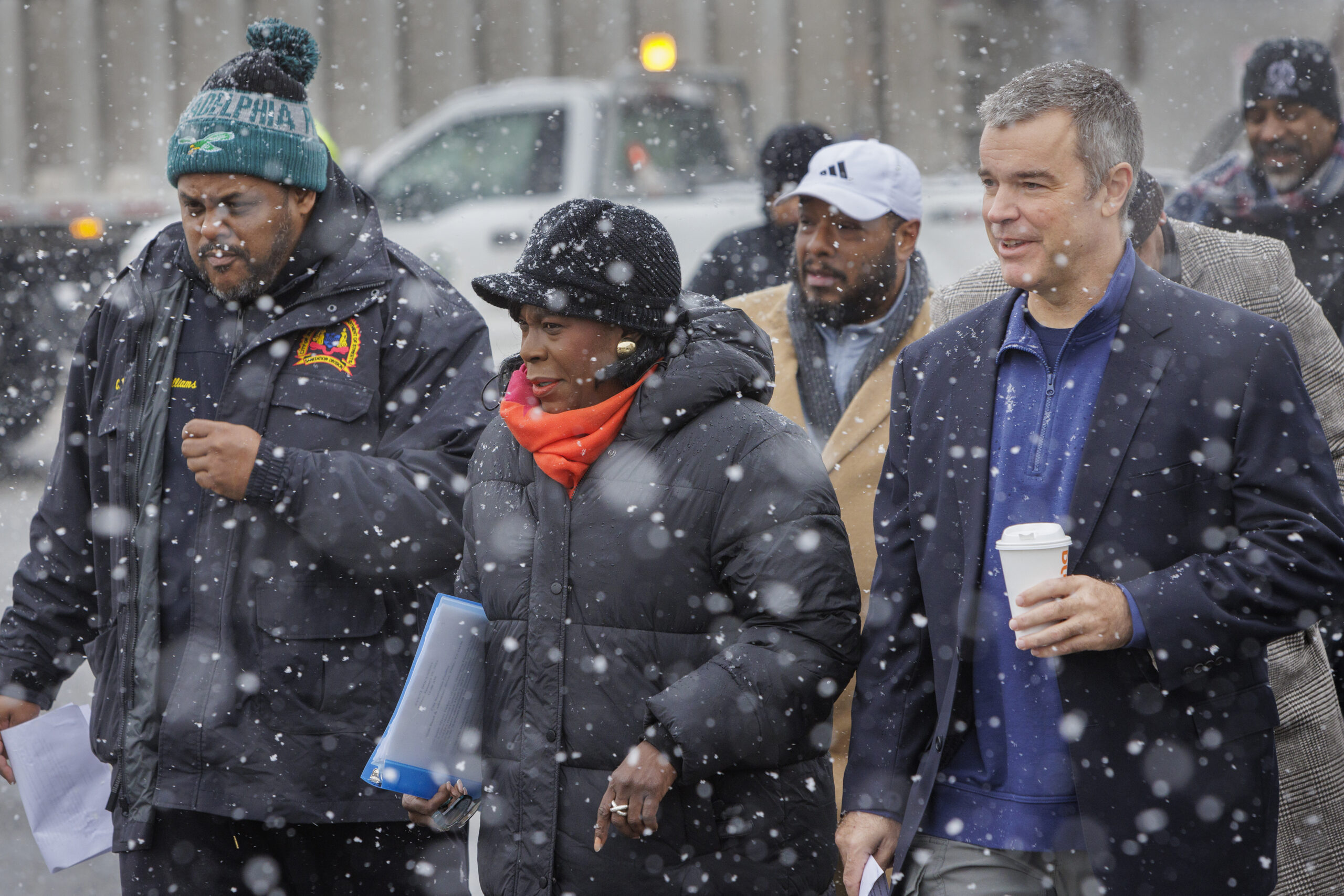
Mayor Cherelle L. Parker (center) with Managing Director, Adam Thiel (right) and at left Carlton Williams, Director of Clean & Green Initiatives, at a news conference with city officials in Northeast Philadelphia on Friday, Jan. 19, 2024 to share the city’s response to the snowstorm.
Through his first year in the position, Thiel also faced scrutiny as the face of some of the mayor’s most controversial initiatives.
He took a leading role in Parker’s efforts to end the open-air drug market in the city’s Kensington neighborhood, and he oversaw the development of the Riverview Wellness Center, a new city-owned recovery house for people with substance use disorder.
Today, much of Kensington initiative is overseen by the public safety director, who reports directly to Parker. A new head of community wellness is leading development at Riverview, and Williams was the face of the storm response.
Mayor Cherelle L. Parker finishes a news media briefing with her leadership team at the Tustin Playground at 60th St. and W Columbia Ave. Tuesday, Jul, 1, 2025, on the first day of the strike by District Council 33. At left are Carlton Williams (Phillies cap), Director of Clean and Green Initiative with the Dept. of Streets Sanitation Division; and Managing Director Adam Thiel (at lectern).
But by the time the strike was resolved, Thiel had faded from public view, departing from his city job for one of his stints on military leave. After Parker reached an agreement with the union, she held a news conference with 20 top deputies and thanked each of them by name.
Thiel, absent from the City Hall news conference, was not one of them.
Staff writers Ryan W. Briggs and Sean Collins Walsh contributed to this article.
The U.S. attorneys representing the federal government argued previously that the White House has full discretion over the exhibits in national parks, an argument U.S. District Judge Cynthia M. Rufe called “dangerous” and “horrifying” during last month’s hearing.
The notice of appeal to the U.S. Court of Appeals for the Third Circuit at this stage does not require a brief arguing what the government says the judge got wrong when she issued the injunction. But the Department of the Interior and the National Park Service said in a statement Tuesday that the agencies “disagree” with the injunction.
“The National Park Service routinely updates exhibits across the park system to ensure historical accuracy and completeness,” the statement said. “If not for this unnecessary judicial intervention, updated interpretive materials providing a fuller account of the history of slavery at Independence Hall would have been installed in the coming days.”
Neither agency responded to a request for more information on the plan for alternative panels. The White House did not respond to a request for comment.
Rufe on Monday granted Philadelphia’s request for an injunction requiring the full restoration of exhibits removed from the President’s House on Jan. 22. She further enjoined the federal government from making any changes to the site without the agreement of the city.
The panels that tell the stories of the nine enslaved African people who lived in President George Washington’s house must be displayed again swiftly, the judge said in her 40-page opinion.
The order directs the agencies to comply “immediately” and “forthwith” but does not include a specific deadline.
“Each person who visits the President’s House and does not learn of the realities of founding-era slavery receives a false account of this country’s history,” wrote Rufe, who was appointed by former President George W. Bush.
In addition to the appeal, the federal government will need to ask for a stay on the order or risk not complying with Rufe’s injunction.
Parker addressed the injunction in a video Tuesday celebrating the ruling as a “huge win for the people of this city and our country.”
“This summer Philadelphia will lead a litany of Semiquincentennial celebrations in honor of America’s 250th birthday, and please know that we will do so with a great deal of pride,” Parker said. “A pride that comes from acknowledging all of our history, and all of our truth, no matter how painful it may be.”
Philadelphia’s lawsuit was the first in the nation challenging the removal of exhibits from national parks in accordance with President Donald Trump’s March 2025 executive order, which instructed the Interior Department to remove any content or displays that “inappropriately disparage Americans past or living.”
The federal government violated a 2006 cooperative agreement between the National Park Service and the city when it dismantled the exhibits without notice in what amounted to an unlawful “arbitrary and capricious” act, Philadelphia’s lawsuit said. Rufe found that the agreement is still binding.
As the city’s litigation proceeds following the injunction, it is not the only effort to address changes to historic exhibits on federal parks.
A lawsuit filed Tuesday by park conservation advocacy groups in Massachusetts federal court says that removals of the type that took place in Philadelphia violate “Congress’s clear instructions.”
The suit asks a federal judge to order the Interior Department and National Park Service to “cease all unlawful efforts to remove up-to-date and accurate historical or scientific information from the national parks, and order that interpretive materials that have been removed pursuant to the unlawful Order be restored.”