The Rev. Jesse L. Jackson, a civil rights icon and a regular presence in Philadelphia who energized Black voters both locally and nationally for more than five decades, died Tuesday at his home in Chicago following a prolonged battle with a rare neurological disorder. He was 84.
“Jesse Jackson will be remembered in Philadelphia as a civil rights hero, and a leader in terms of independent Black politics nationwide,” said former Councilmember W. Wilson Goode Jr., the son of Philly’s first Black mayor, W. Wilson Goode Sr. “He loved Philadelphia, and Philadelphia loved him.”
A native of Greenville, S.C., Rev. Jackson initially rose to prominence in the mid-1960s, when he joined the 1965 voting rights march that the Rev. Dr. Martin Luther King Jr. led from Selma to Montgomery, Ala. In the years following King’s assassination in 1968, Rev. Jackson largely came to be considered his successor.
Rev. Jackson would go on to become a prominent Black political and cultural leader in his own right, with his lengthy time in the public eye including presidential runs in 1984 and 1988. His visits to Philadelphia date back to the 1970s, and run the gamut from time in town supporting his own presidential campaigns — though neither of which were successful in the ‘80s — to appearances at the Democratic National Convention in 2016.
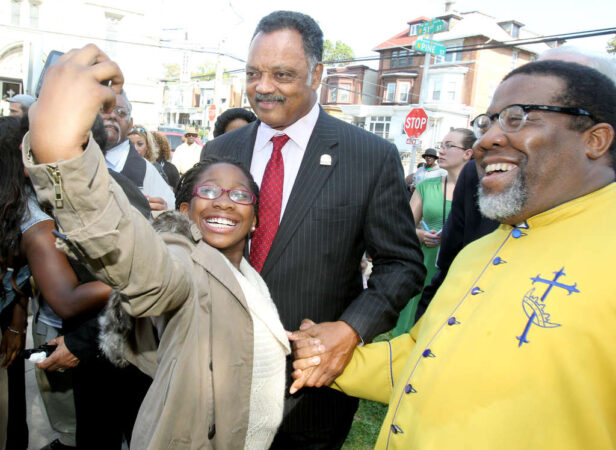
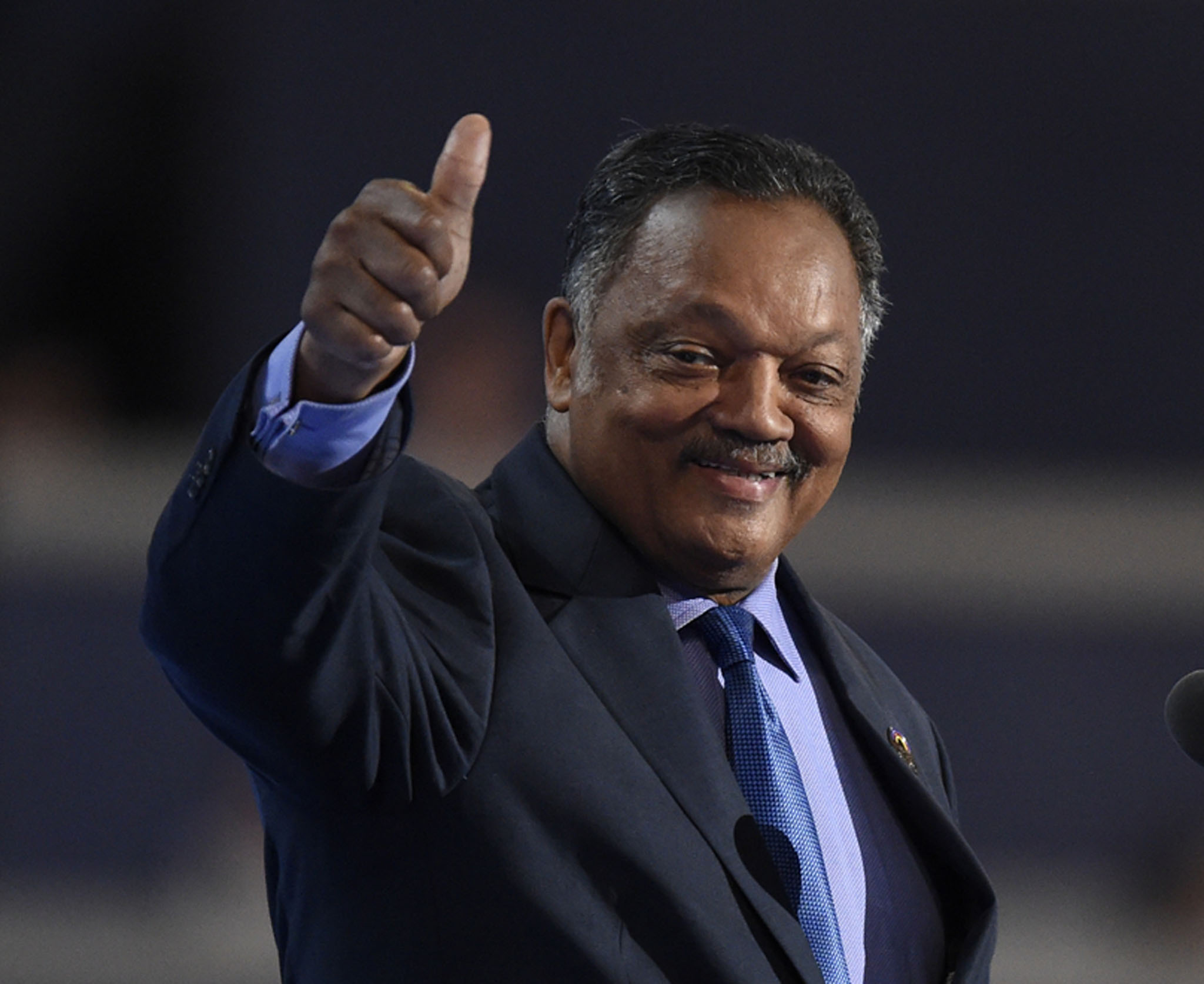
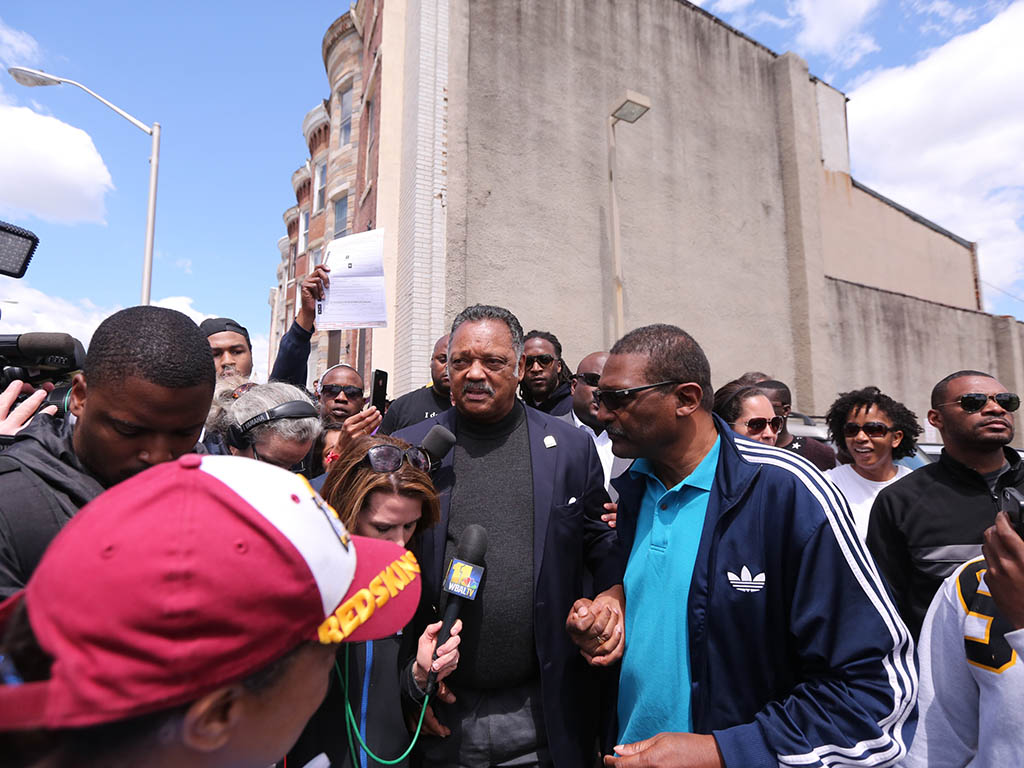
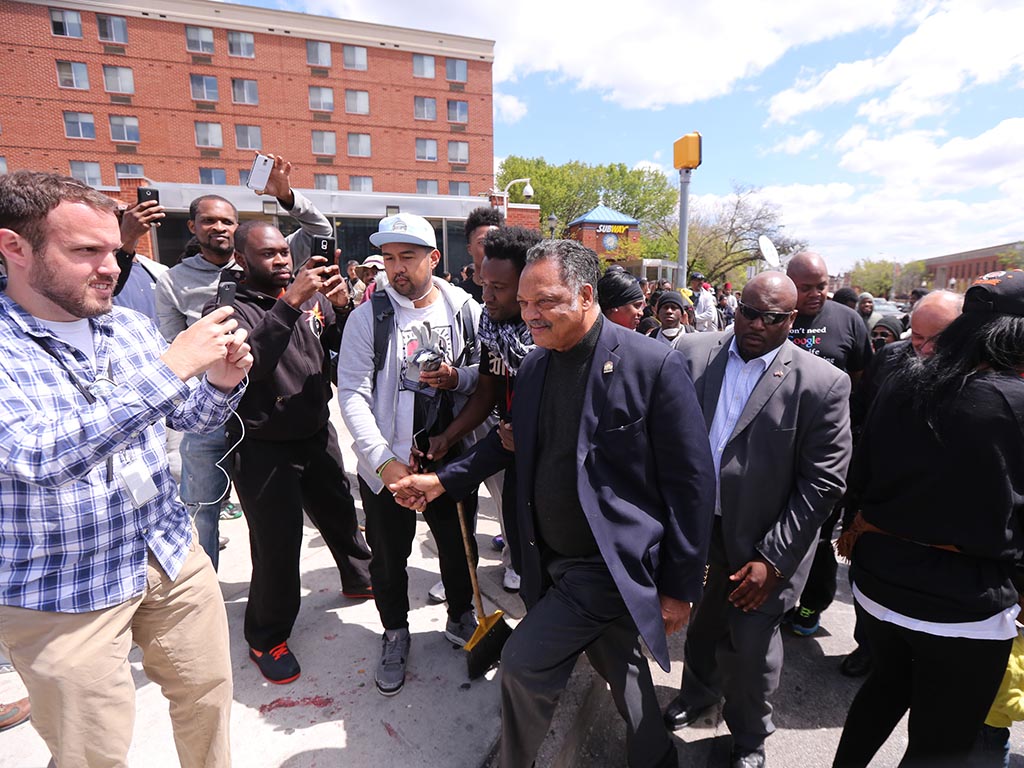
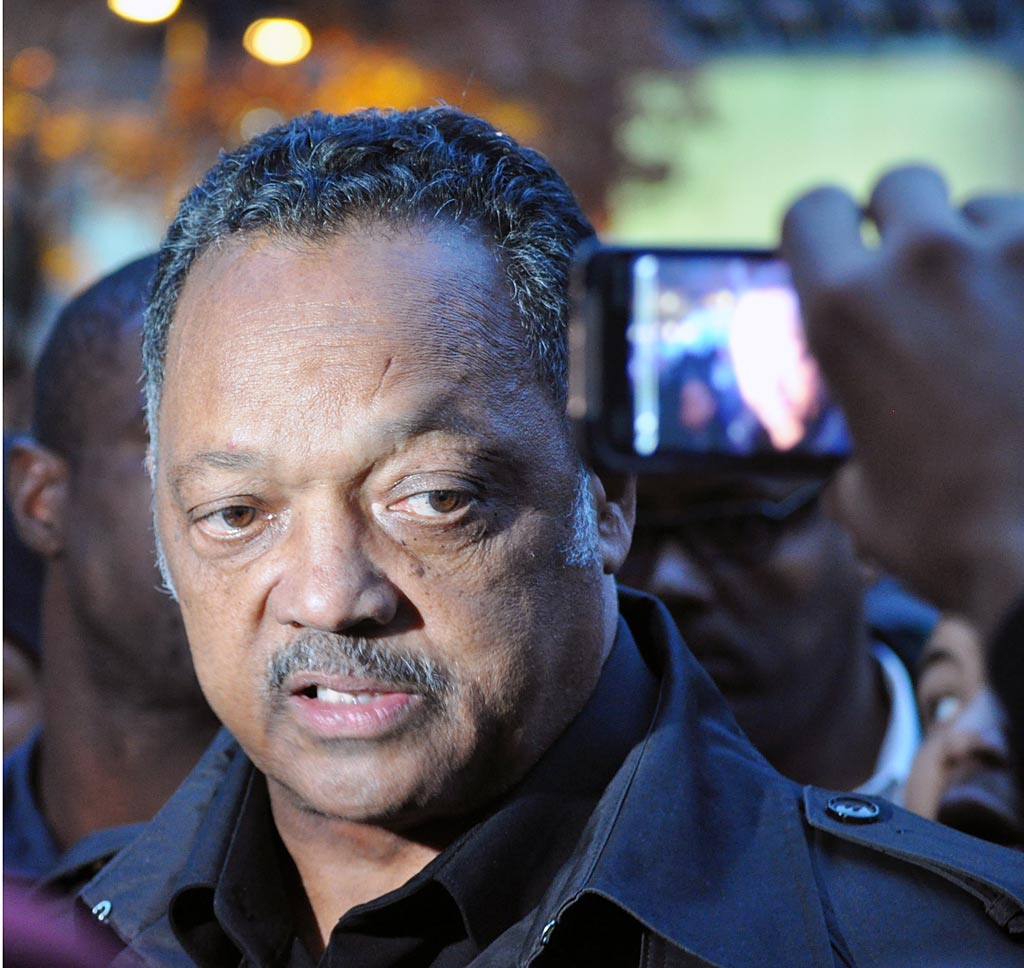
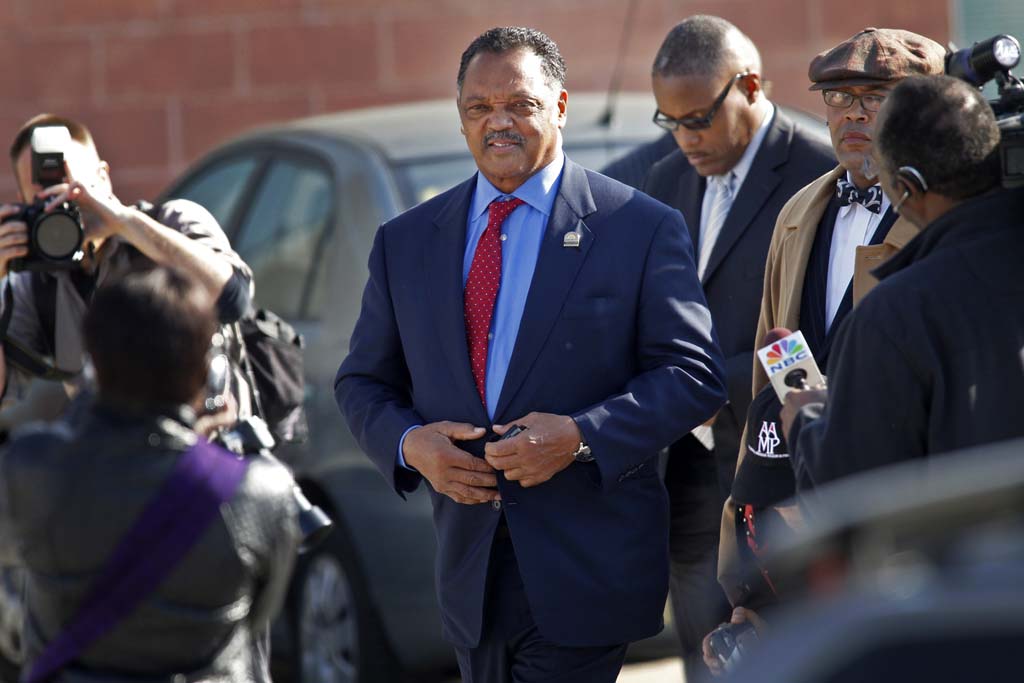
The Rev. Jesse Jackson, founder and president of the Rainbow/PUSH Coalition, acknowledges the cheers of delegates as he walks to the podium to deliver remarks on the third night of the Democratic National Convention in Philadelphia on July 27, 2016.Hillary Clinton supporters and the Rev. Jesse Jackson (right) on the fourth day of the Democratic National Convention at the Wells Fargo Center on July 28, 2016.The Rev. Jesse Jackson visits Baltimore’s turbulent intersection of West North Avenue and Pennsylvania Avenue on April 28, 2015.
Across that time, Rev. Jackson served as a sort of rallying figure for Black Philadelphians at large, who largely supported his candidacy during his presidential runs, despite him failing to secure the Democratic nomination statewide. Still, his impact for Black voters both in Philadelphia and nationally remains everlasting.
“That was the Rosetta stone to everything Jackson was trying to achieve,” said former Daily News scribe Gene Seymour, nephew of legendary People Paper columnist Chuck Stone. “We aren’t to be ignored or dismissed or cast aside — we matter.”
In that sense, Goode Jr. said, Rev. Jackson will remain a political icon who inspired the nationalization of Black political empowerment.
“Jesse Jackson is also a cultural icon in terms of telling people to be proud of being Black, and telling themselves, ‘I am somebody,’” Goode Jr. said, referencing Rev. Jackson’s famed refrain. “That is something that was indelible in the soul of Black people across the nation and world, and in Philadelphia here as well.”
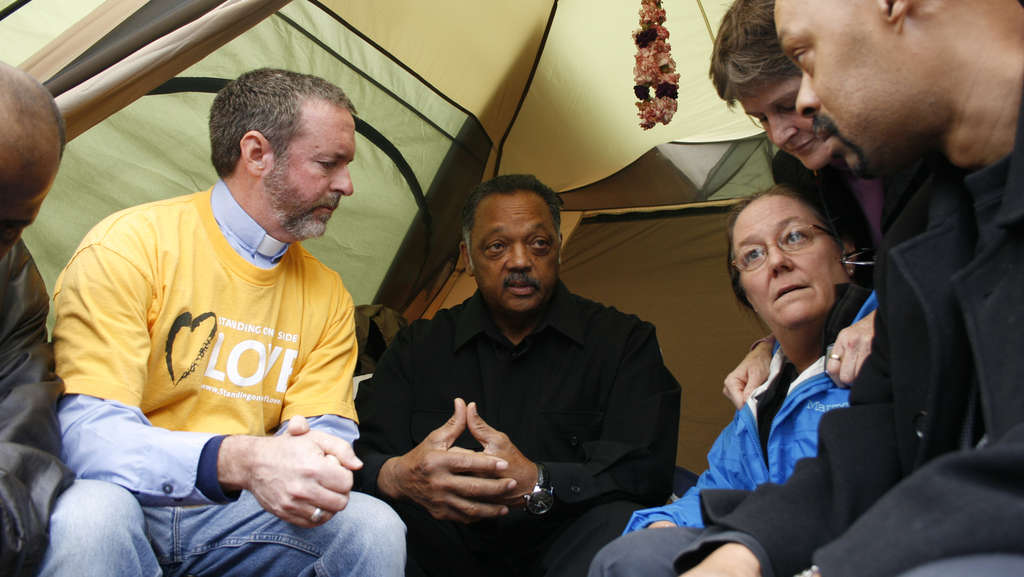
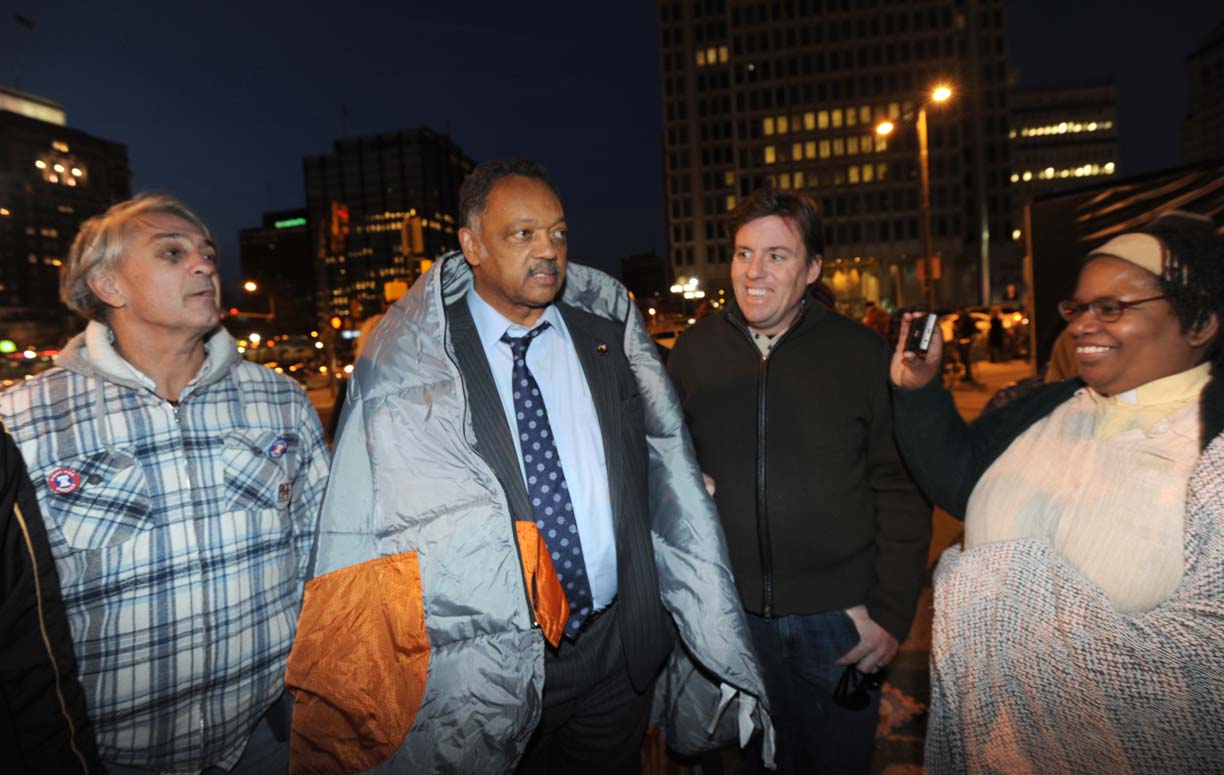
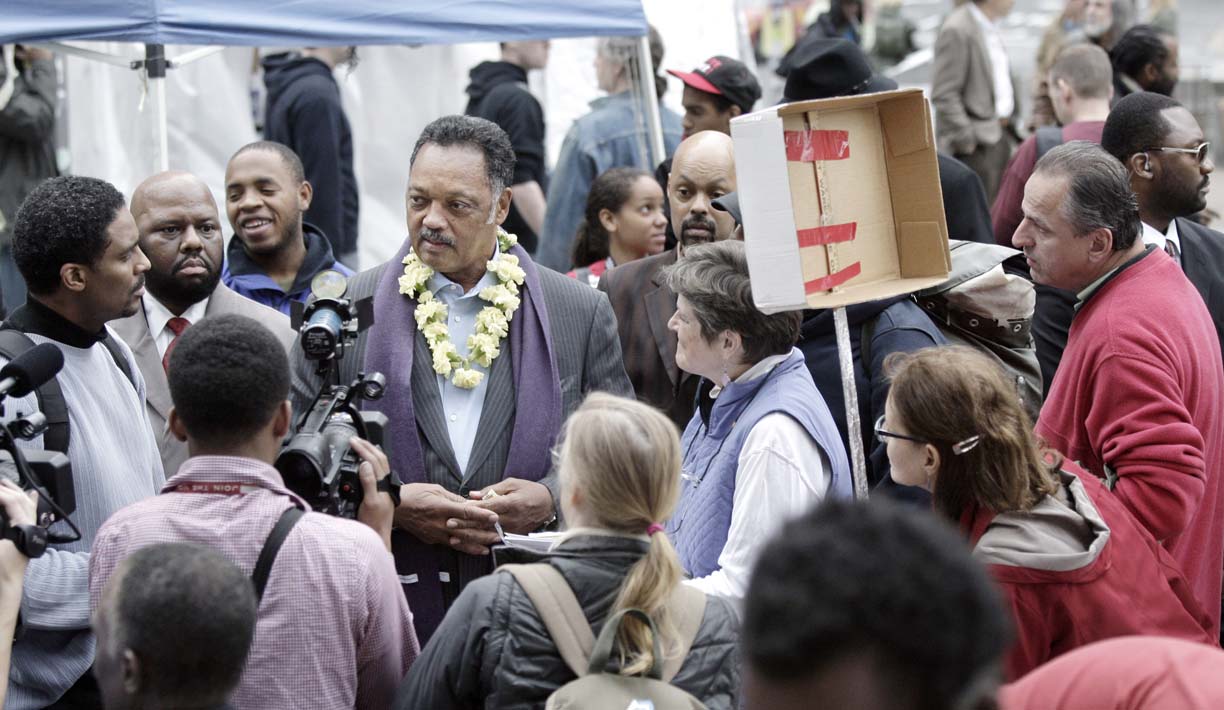
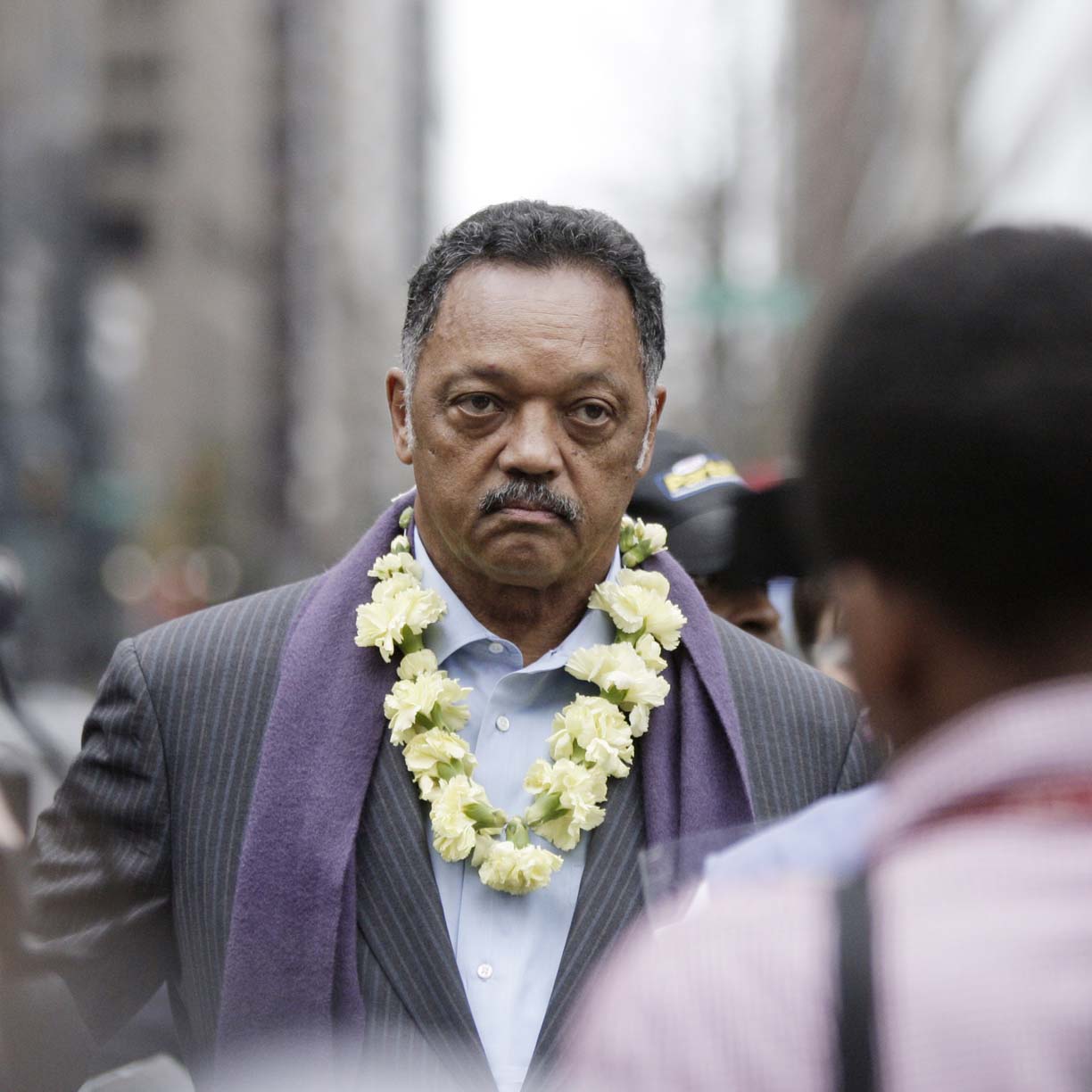
The Rev. Jesse Jackson visits the turbulent intersection of West North Avenue and Pennsylvania Avenue in Baltimore on April 28, 2015.The Rev. Jesse Jackson visited Occupy Philadelphia protesters on Nov. 13, 2011. He told them to “never surrender.”The Rev Jesse Jackson at Joe Frazier’s funeral at Enon Tabernacle Baptist Church on Cheltenham Avenue in Philadelphia on Nov. 14, 2011.The Rev. Jesse Jackson (center) visits the Interfaith tent, donated by Quakers, to talk to the Rev. Peter Friedrich (left) and (from right) Phillip Hall, Hollister Knowlton, and Joyce Moore in 2011.
Though Philadelphia’s Black community generally was supportive of and receptive to Rev. Jackson’s messaging historically, Seymour said, he maintained something of a complicated relationship with the city’s prominent politicians. Wilson Goode Sr., for example, officially supported Walter Mondale and Michael Dukakis for president in the 1980s. At least in 1988, Seymour said, Rev. Jackson likely had “the people’s hearts,” despite lacking the official nomination.
Wilson Goode Sr. was not immediately available for comment.
“His presidential campaigns in 1984 and 1988 reshaped American politics,” said the Rev. Gregory Edwards, of the Philly-based POWER Interfaith, in a statement. “Those campaigns widened the political imagination of this country and helped cultivate a generation of Black elected leaders.”
Rev. Jackson’s relationship with Goode Sr. was somewhat complicated following the 1985 MOVE bombing, which brought the civil rights leader to tour the ruins of the 6200 block of Osage Avenue in its aftermath. Rev. Jackson urged a congressional investigation into the incident, which he called “excessive force,” but avoided criticizing Goode directly in subsequent meetings. Goode, meanwhile, said that the city would cooperate with any groups investigating the incident, The Inquirer reported at the time.
“He was not happy with what happened in ‘85 with MOVE,” Seymour said.
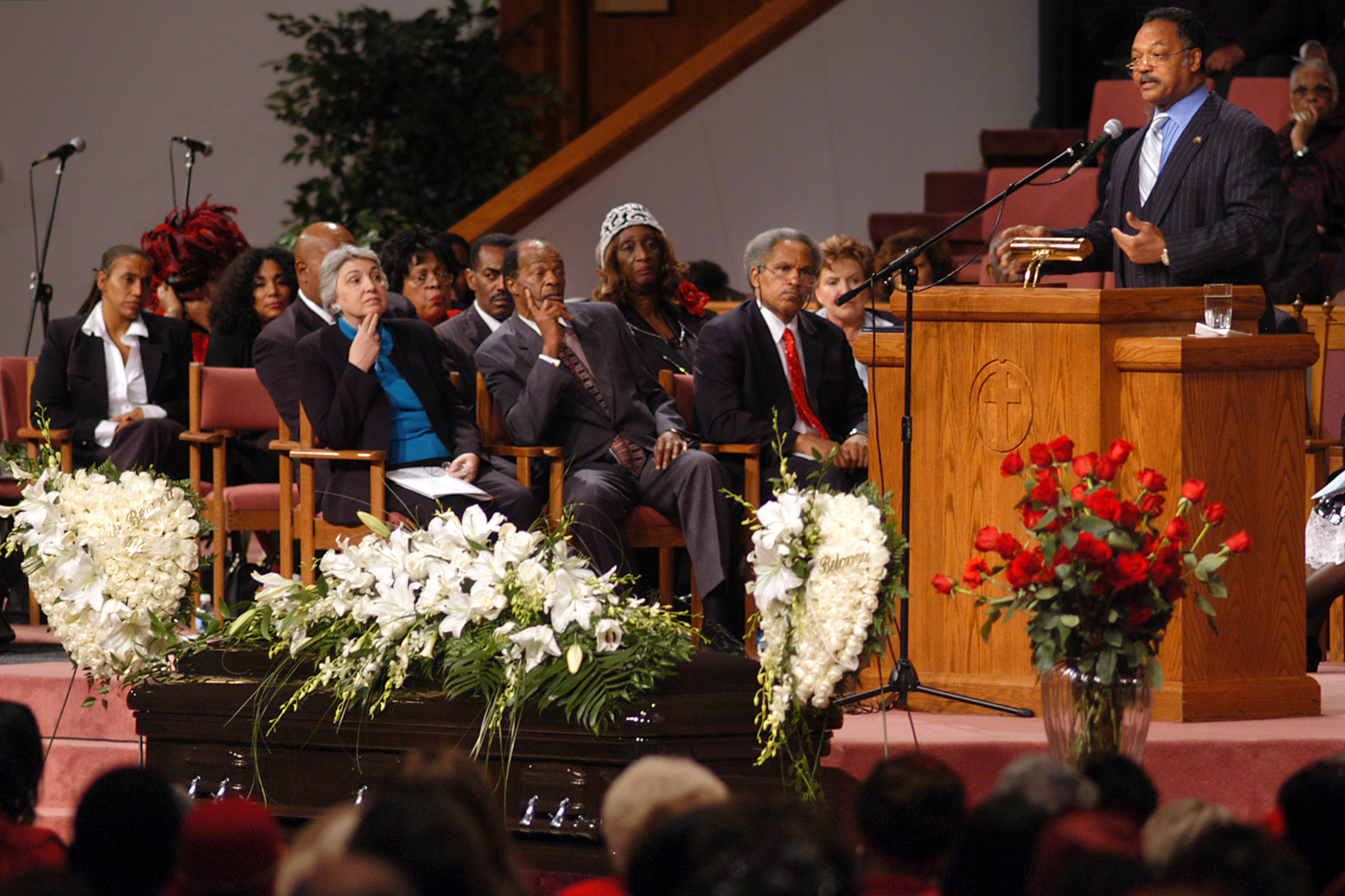
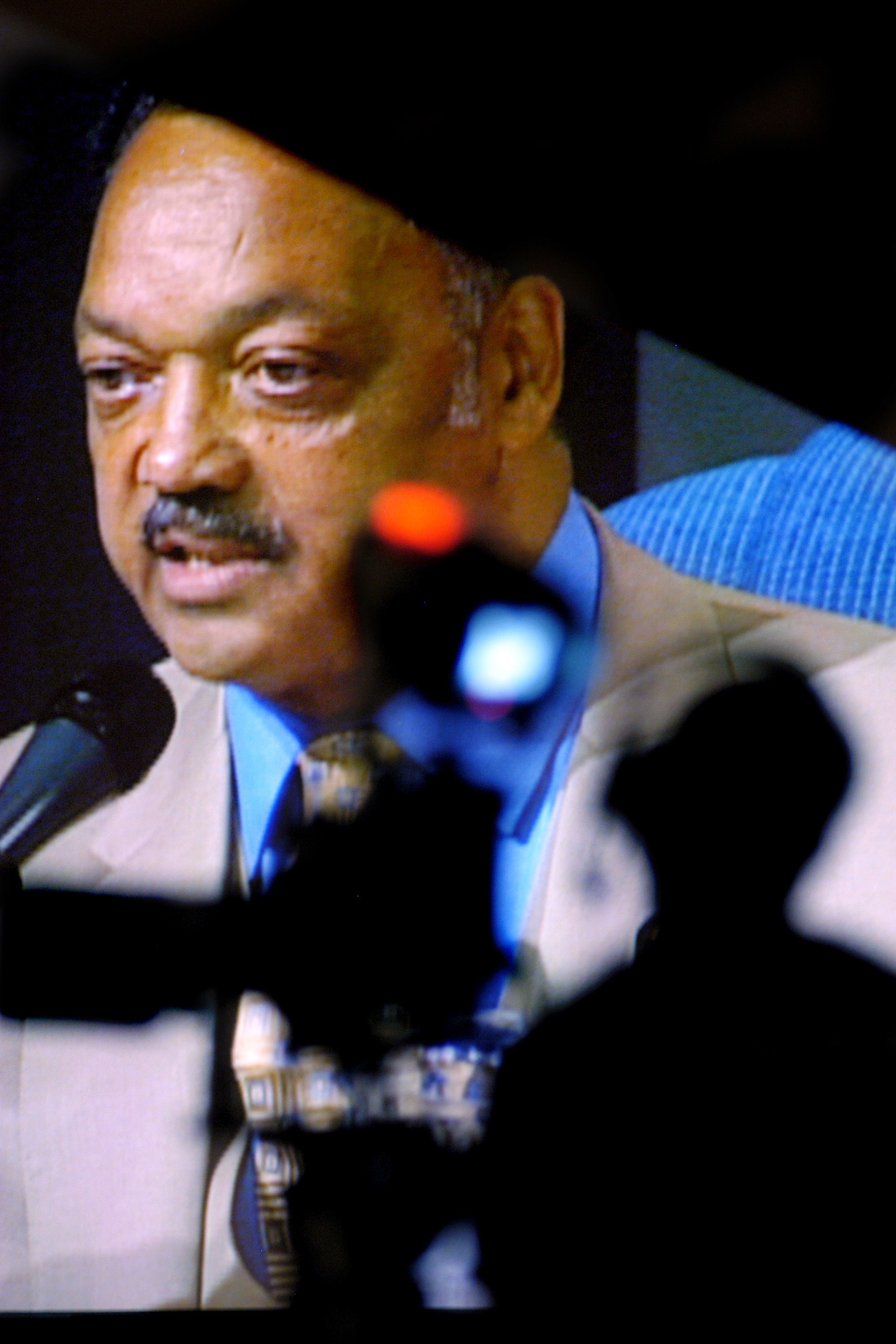
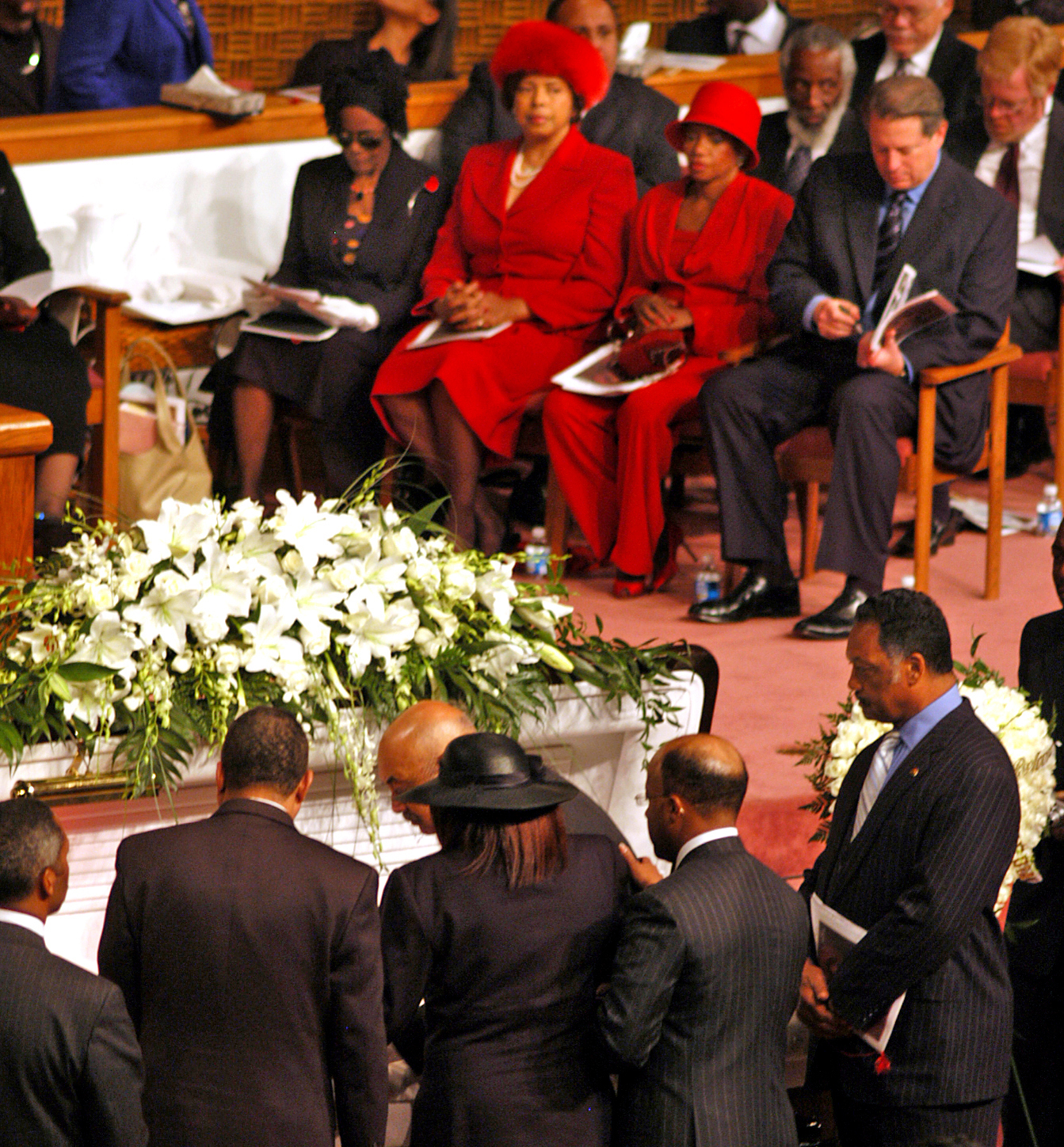
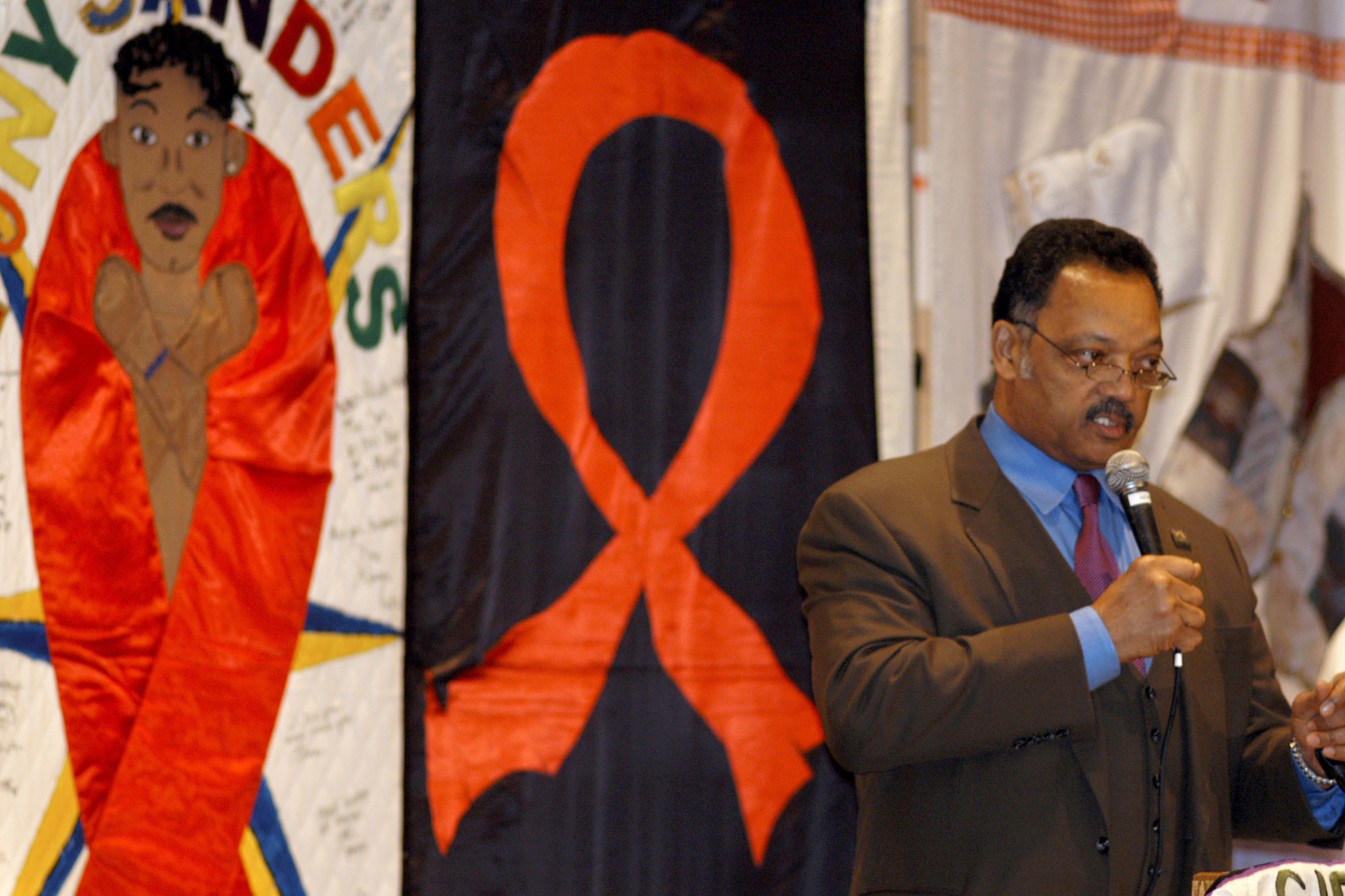
The Rev. Jesse L. Jackson speaks during during funeral services for civil rights activist C. Delores Tucker at Deliverance Evangelistic Church on Oct. 21, 2005. Seated in front row behind him, left to right are Eleanor Smeal, president of the Feminist Majority Foundation; Marion Barry, former mayor of Washington, and Philadelphia Mayor John Street. Rev. Jackson is projected live on a large screen monitor (camera operator in foreground) as he participates in a panel discussion laying out a legal and political strategy for fulfilling Brown v. the Board of Education, at the annual NAACP meeting on July. 14, 2004 at the Convention Center. Her family stands by as husband (partially hidden) William T. Tucker covers the body of civil rights activist C. Delores Tucker in her casket at the beginning of funeral service at Deliverance Evangelistic Church on Oct. 21, 2005. At right is the Rev. Jesse L. Jackson, founder and president of the Rainbow Coalition/PUSH, who later delivered the eulogy. Seated in rear at right is former Vice President Al Gore. AIDS quilt panels flank the podium as the Rev. Jesse Jackson speaks at an African American AIDS conference at the Wyndham Franklin Plaza Hotel on Feb. 28, 2005.
Still, Rev. Jackson often served as a defender of Philadelphia’s famed Black figures. In 2011, for example, Rev. Jackson spoke at the funeral of legendary world heavyweight boxing champion Joe Frazier, who had long competed with the fictional Rocky Balboa for recognition. As Jackson put it at the time, Frazier was the “real champion,” not the “Italian Stallion.”
The Rev. Jesse Jackson, who has a sleeping bag draped around his shoulders, is talking and praying with Occupy Philadelphia demonstrators: Brad Wilson (from left); the Rev. Bill Golderer, pastor of Broad Street Ministry; and Donna Jones, pastor of the Cookman Baptist Initiative.
“If you were of importance as a Black person in America during the time [Jackson] was in the public eye,” Seymour said, “he was there to speak on your behalf.”
Goode Jr.’s most prominent memory of Rev. Jackson, meanwhile, dates back to the mid-1980s, when he was a student at the University of Pennsylvania. At the time, he said, Rev. Jackson attended a National Black Student Union conference following an invitation from its organizers, Goode Jr. included. It was, Goode Jr. said, an inspiration.
“It meant a lot to us,” Goode Jr. said. “Not just Black leaders at Penn, but across the nation, who were gathered there.”
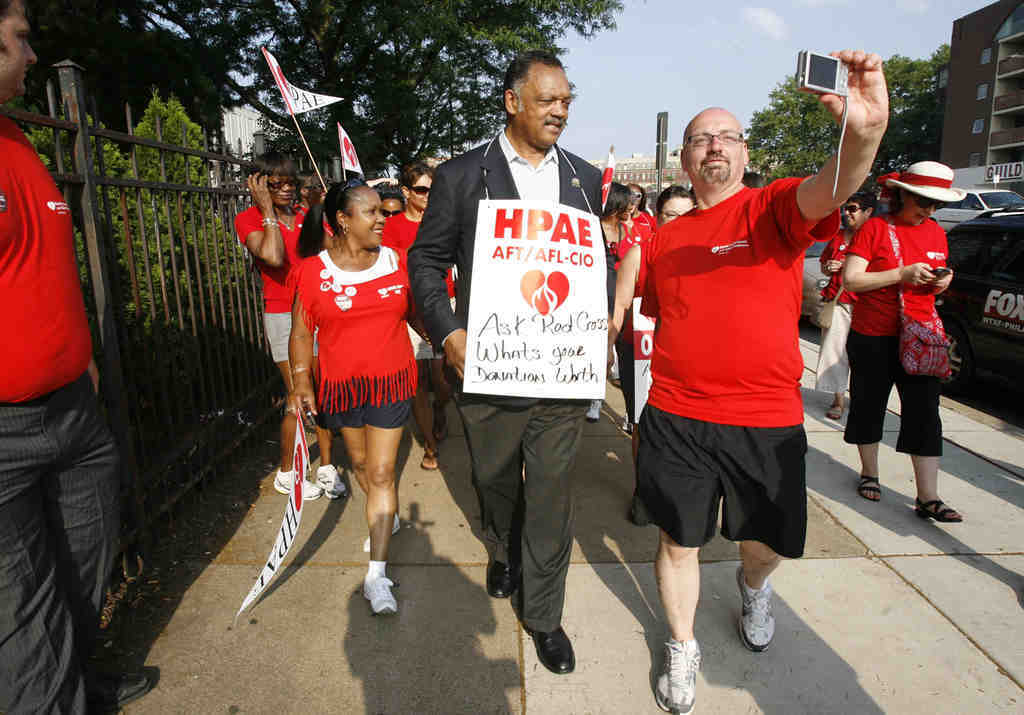
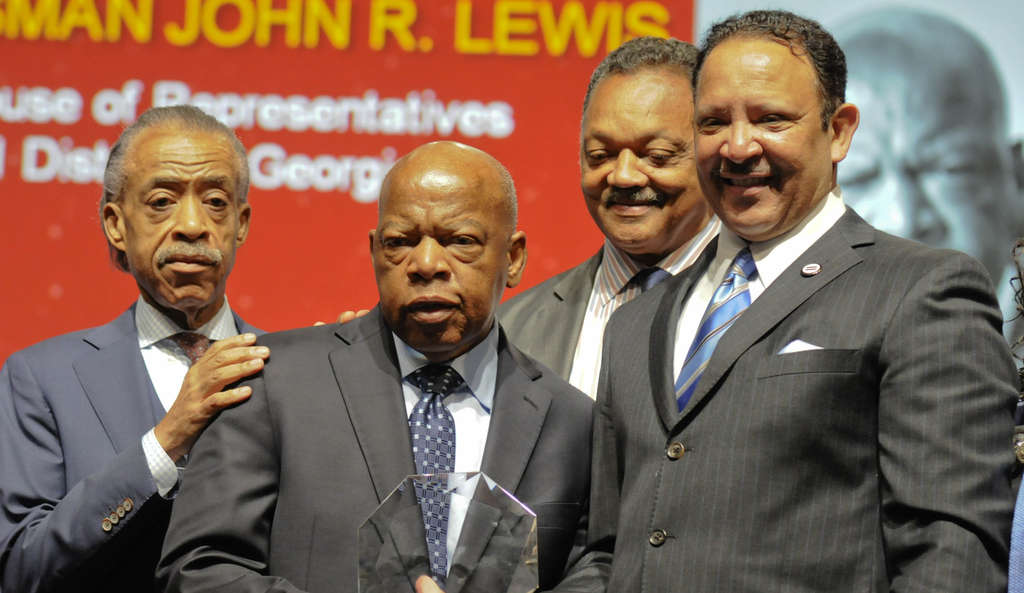
Striking Red Cross worker Lenny Lerro takes a picture of himself with the Rev. Jesse Jackson as they walk the picket line in 2011 on Spring Garden Street in Philadelphia.Rev. Jesse Jackson visits with folks at Occupy Philadelphia, just outside City Hall on Nov. 20, 2011.The Rev. Jesse Jackson visits with folks at Occupy Philadelphia, just outside City Hall on Nov. 20, 2011.U.S. Rep. John Lewis (second from left) is presented with the Civil Rights Champion Award in 2013 by (from left) the Rev. Al Sharpton, the Rev. Jesse Jackson, and Marc Morial, president of the Urban League.
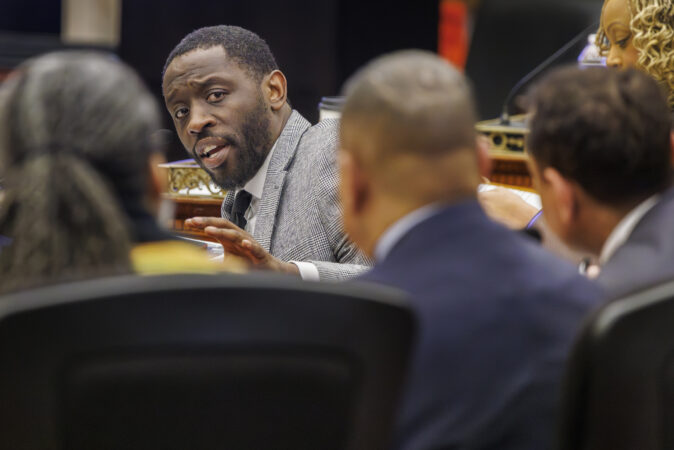
Philadelphia City Council may not have a vote on Superintendent Tony B. Watlington Sr.’s sweeping facilities plan, but it indicated Tuesday that it will have a say in school closings.
As a packed hearing began in Council’s chambers Tuesday morning, both Council President Kenyatta Johnson and Isaiah Thomas, chair of the Education Committee, said Council refused to be a “rubber stamp” to Watlington’s proposal to close 20 schools, colocate six, and modernize 159.
“I’m infuriated that we don’t get a say,” Councilmember Jimmy Harrity said, warning the district officials who appeared before him. “But, Council president, you and I both know we do get a say, because budget’s coming. And we will be looking. Mindful is the word I would use for today — be mindful.”
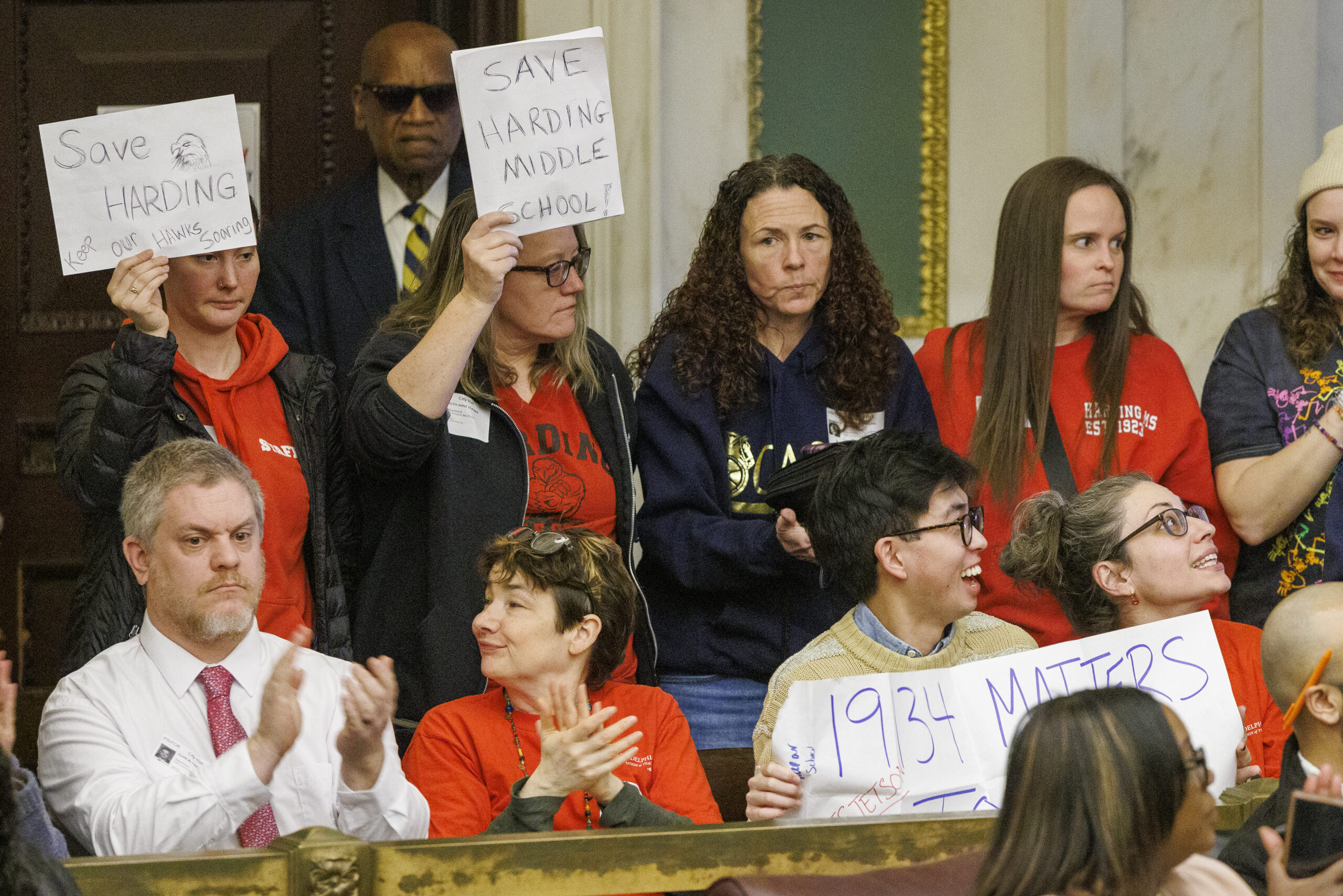
Concerned citizens stand with signs in support of Harding Middle School before the start of a Philadelphia City Council hearing Tuesday at City Hall on the school district’s plan to close 20 schools.
About 40% of the district’s nearly $5 billion budget comes from local revenue and city funding, which City Council and Mayor Cherelle L. Parker must approve in the annual city budget by the end of June.
Harrity, an at-large Council member, said he was “tired that every time cuts come, they come from a certain neighborhood. You know, I live in Kensington, in the 7th District. I talk to these kids. They’re good kids. They deserve everything that other kids in other neighborhoods are getting. … You can see that this isn’t what our people want.” Watlington has proposed closing four schools in the 7th District.
More than 100 community members holding babies and waving signs opposing the facilities plan filled Council chambers on the fourth floor of City Hall on Tuesday as Council members spent hours grilling Watlington and other district officials.
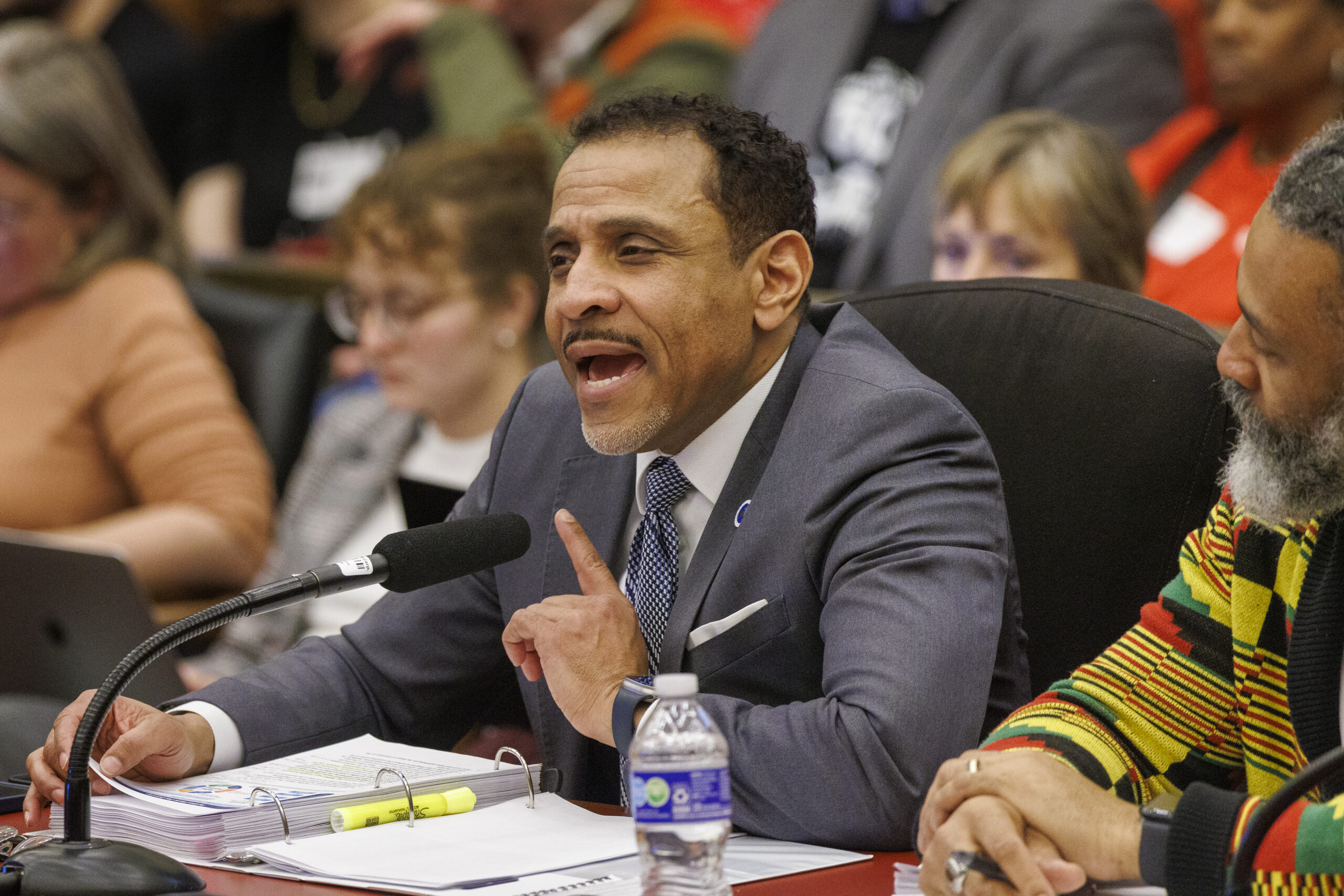
Watlington, meanwhile, stood by his plan in testimony to Council on Tuesday, sayingthat 20 closings was a much smaller number than he could have settled on.
“We could have come here and presented a plan that closed twice as many schools and been able to defend it,” Watlington said.
A once-in-a-lifetime opportunity?
District officials have said thefacilities process is not about saving money, but about optimizing education and equity for the city’s 115,000 students.
But it was clear Tuesday that finances played a part: The district has lost 15,000 students in the last 10 years, and over 80,000 since 1997, when charter schools were first authorized in Pennsylvania. It has 300 buildings, many of them 75 years and older and in poor repair, and some schools with more than 1,000 empty seats, while others are overcrowded.
Tony B. Watlington Sr., superintendent of School District of Philadelphia, speaks at a City Council hearing Tuesday on his proposal to close 20 schools.
“We’ve got to be very careful with our limited resources in a historically underfunded district,” Watlington told Council.
Watlington and board president Reginald Streater, who also testified, pitched the plan as a way to add things the district cannot now offer — Advanced Placement courses in every high school, the opportunity for all eighth graders to take algebra, more prekindergarten, and career and technical education programs.
“I do not believe we’ll get this opportunity again in our lifetime,” Watlington said.
The superintendent dropped a few previously undisclosed facts about the facilities road map, indicating that his recommendations could shift slightly before he presents the plan to the school board on Feb. 26. No date has been set for the board’s final vote, which is expected later this winter.
“It’s premature to say how the final recommendations will land,” Watlington said.
But, the superintendent said, “if there are schools that Council wants me to take off the list, and add others on that list, we are open to you telling me what those are, but we cannot get to a place where we address our 35% non-utilization rate in buildings if no changes are made.”
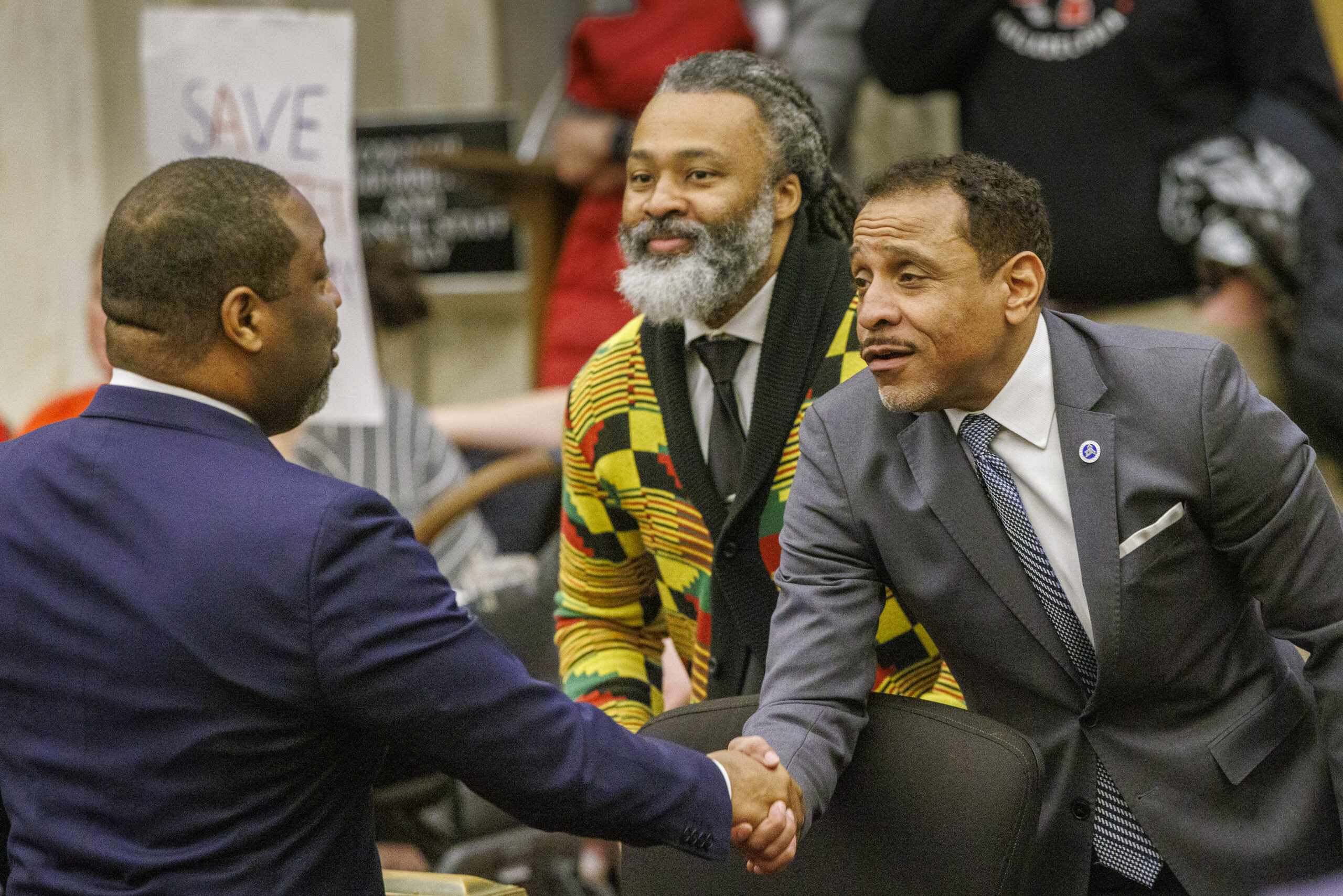
Philadelphia City Council President Kenyatta Johnson (left) greets Dr. Tony Watlington, Superintendent of School District of Philadelphia Philadelphia City Council holds hearing with board members of School District of Philadelphia, Tuesday, Feb. 17, 2026. Reginald L. Streater, Esq., President Board of Education. (center)
Debora Carrera, the city’s chief education officer, who spent three decades as a district teacher and administrator, told Council that Parker believes “the current district footprint is unsustainable.”
Carrera said her own experience as principal of Kensington High School for Creative and Performing Arts shows that it is right for the district to focus resources on neighborhood high schools.
“My high school was a small high school,” Carrera said. “I could only offer my children two AP courses, when other schools like Central — where my son went — could offer them over 20-plus AP courses.“
‘Breaking down of public education’
The hearing got tense at times.
“I feel like this is the breaking down of public education in Philadelphia,” said Councilmember Cindy Bass, who said some of the district’s own decisions had led to closures.
Several members of Council raised questions about the plan’s price tag. Prior district and city estimates put the cost just under $8 billion, but members of Watlington’s team said they could they could actually do the work for $2.8 billion — $1 billion from district capital funds, and $1.8 from yet-unpromised state and philanthropic sources.
In the past, the district had made public detailed facilities condition assessments for every school in the district, Councilmember Rue Landau noted.
Residents could look up their school and see exactly what the condition of every system in the building was, and how much money would be required to fix those that needed repair.
“We don’t have any of those details,” said Landau, who went so far as to say she believed the district should be spending more than $2.8 billion on the plan. “What is the increased investment, and why don’t we have any of those details? They are not out there in the public for us, so none of us have any understanding as to why this is happening, This should all be public so all of the public can see.”
“You need much more money than that,” Roseman told Council. “We need more money than this plan comes close to.”
Some Council members pushed the district and the board on the plan’s timing.
The city has been asking for a long-range facilities plan for years, Councilmember Quetcy Lozada pointed out.
“It’s taken us all this time,” Lozada said. “Now, you guys have come up with a plan, and now we want to rush through it. Now all of a sudden there’s this urgency to get through this plan, which I don’t understand.”
Streater said the board is moving forward with hearing Watlington’s plan on Feb. 26, but won’t vote until it hears more feedback.
But ultimately, he said, the board will vote on “a plan that is dynamic, that can evolve over time. … I think that we all understand that things change, facts change, funding changes, enrollment trends change.”
And, Streater said, there will also likely be policy changes based on redrawing some catchment areas, or boundaries that determine which neighborhood schools children attend.
Streater, who introduced himself at the beginning of the hearing as “Reggie from Germantown,” underscoring his history as a graduate of two district schools that closed — Germantown High and Leeds Middle School — said that changes must be made.
“I think if we continue doing the same thing, expecting a different result — which I would argue is chronic underachievement — we are doomed.”
The city’s teachers union has significant concerns with the Philadelphia School District’s sweeping facilities plan, and it has taken them to a City Council committee.
Superintendent Tony B. Watlington Sr.’s $2.8 billion proposal “does not provide sufficient detail or data to inform binding decisions about school closures, co-location, re-purposing, or widespread impact and disruption that will be incurred,” Philadelphia Federation of Teachers president Arthur Steinberg wrote in a letter to Council’s education committee obtained by The Inquirer.
The appeal, sent late last week, comes as the district prepares for a Tuesday Council hearing on the school blueprint, which currently calls for 20 school closings, six colocations, and 159 modernization projects.
Council members are not the decision-makers — Philadelphia’s school board will ultimately vote on the plan sometime this winter — but as one of the district’s main funders, “you hold powerful levers that may be used to encourage the district to craft a more equitable [plan] that achieves our shared goals of improving student learning conditions and educators’ working conditions,” Steinberg wrote.
About 40% of the district’s nearly $2 billion budget comes from local revenue and city funding, which City Council and Mayor Cherelle L. Parker must approve in the annual city budget by the end of June.
What does the PFT letter say?
Before any decisions are made about what to do with the district’s buildings, the PFT wants system officials to do better by “showing their work and providing all data used to reach their determinations and recommendations for school improvement,” Steinberg wrote.
The teachers union also flagged compliance inconsistencies with the district’s own standards, implementation questions, and “substantial problems with data interpretation and application.”
The conclusions came after Jerry Roseman, the PFT’s longtime director of environmental science, scrutinized the plan. Roseman has decades of experience working with district officials on environmental issues.
The PFT and Roseman want access to all data. The district has released some details officials used to make their calls, but some remain opaque.
“How is the district ensuring that decisions regarding closing and receiving schools are based on comprehensive, up-to-date, and easily verifiable facility data (e.g., lead, asbestos, ventilation, overall condition)?” Steinberg wrote.
The PFT also wants to “definitively show that the facility condition of receiving schools is not, in fact, worse than the facilities thatare slated to close. If students are moving to a facility with worse current conditions, what will happen at the facility to improve it prior to students being moved there?”
District officials outlined some modernization and renovation plans ahead of Tuesday’s Council hearing, but some remain a mystery to the public. Watlington has promised all projects will be detailed before Feb. 26, when he’s scheduled to formally present the plan to the school board.
Don’t close schools or displace students based on incomplete data, PFT says
The school system’s own data contains some inconsistencies, Steinberg said — including some schools judged to be in “good” or “fair” building condition by the district’s metrics that have “severely inadequate” critical systems, such as roofing, windows, or electrical and plumbing systems.
And though the district said it could modernize all 85 school buildings currently in poor or unsatisfactory condition for $2.8 billion, the PFT questioned that price tag as overly optimistic. (City and district officials had previously put the system’s total deferred maintenance cost at $7 billion or more.)
“The cost to fully repair poor-inadequate buildings and systems could actually exceed $3.5 billion,” the PFT said.
The teachers union also highlighted the inequitable distribution of adverse conditions, noting that “Black and brown children and children from economically disadvantaged families are more vulnerable — to health risks, learning disruptions, and the long-term effects of instability and displacement.”
While the information the district has made public is “useful and has value as a ‘baseline,’ it is insufficient for its use in supporting the proposed conclusions, recommendations and other plan details released,” Steinberg said.
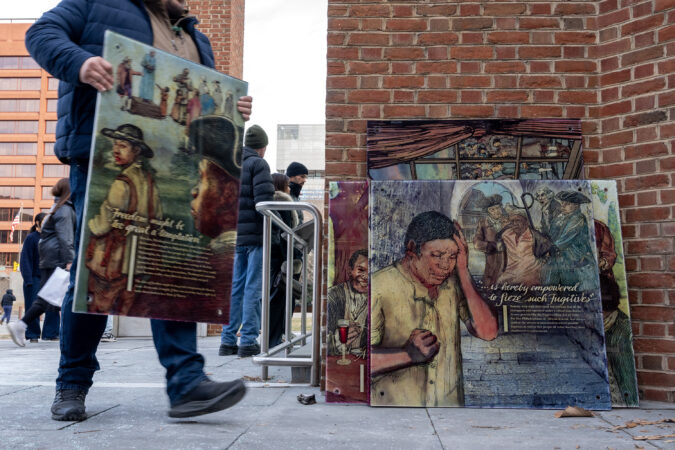
U.S. District Judge Cynthia M. Rufe issued a ruling Monday requiring the federal government to “restore the President’s House Site to its physical status as of January 21, 2026,” which is the day before the exhibits were removed.
The order does not give the government a deadline for the restoration of the site. It does require that the National Park Service take steps to maintain the site and ensure the safety of the exhibits, which memorialize the enslaved people who lived in George Washington’s Philadelphia home during his presidency. The exhibits were abruptly removed in January following months of scrutiny by the Trump administration.
Rufe, a George W. Bush appointee, compares the federal government’s argument that it can unilaterally control the exhibits in national parks to the Ministry of Truth in George Orwell’s 1984, a novel about a dystopian totalitarian regime.
“As if the Ministry of Truth in George Orwell’s 1984 now existed … this Court is now asked to determine whether the federal government has the power it claims — to dissemble and disassemble historical truths when it has some domain over historical facts,” Rufe wrote. “It does not.”
Mayor Cherelle L. Parker’s administration filed a federal lawsuit against Interior Secretary Doug Burgum and acting National Park Service Director Jessica Bowron, and their respective agencies, the day the exhibits were dismantled. The complaint argued dismantling the exhibits was an “arbitrary and capricious” act that violated a 2006 cooperative agreement between the city and the federal government.
The federal government has the option to appeal the judge’s order. The Interior Department and National Park Service did not immediately comment on the ruling, which fell on Presidents’ Day, a federal holiday. The U.S. Attorney’s Office for the Eastern District of Pennsylvania declined to comment.
During a hearing last month, Rufe called the federal government’s argument that a president could unilaterally change the exhibits displayed in national parks “horrifying” and “dangerous.” She ordered the federal government to ensure the panels’ safekeeping after an inspection and a visit to the President’s House earlier this month.
Monday’s ruling follows an updated injunction request from the city that asked for the full restoration of the site — not merely that the exhibits be maintained safely — and a brief from the federal government arguing the National Park Service has discretion over the exhibits and that the city’s lawsuit should be dismissed on procedural grounds.
The federal government’s brief also argued there could be no irreparable harm from the removal of the exhibits because they are documented online and replacement panels would cost $20,000.
But the judge found the city is likely to prove its case that the removal was unlawful, and the panels should be restored while the litigation continues.
“If the President’s House is left dismembered throughout this dispute, so too is the history it recounts, and the City’s relationship to that history,” Rufe wrote.
The judge also found that the cooperative agreement between Philadelphia and the National Park Service remains in “full force,” even though the contract is technically expired.
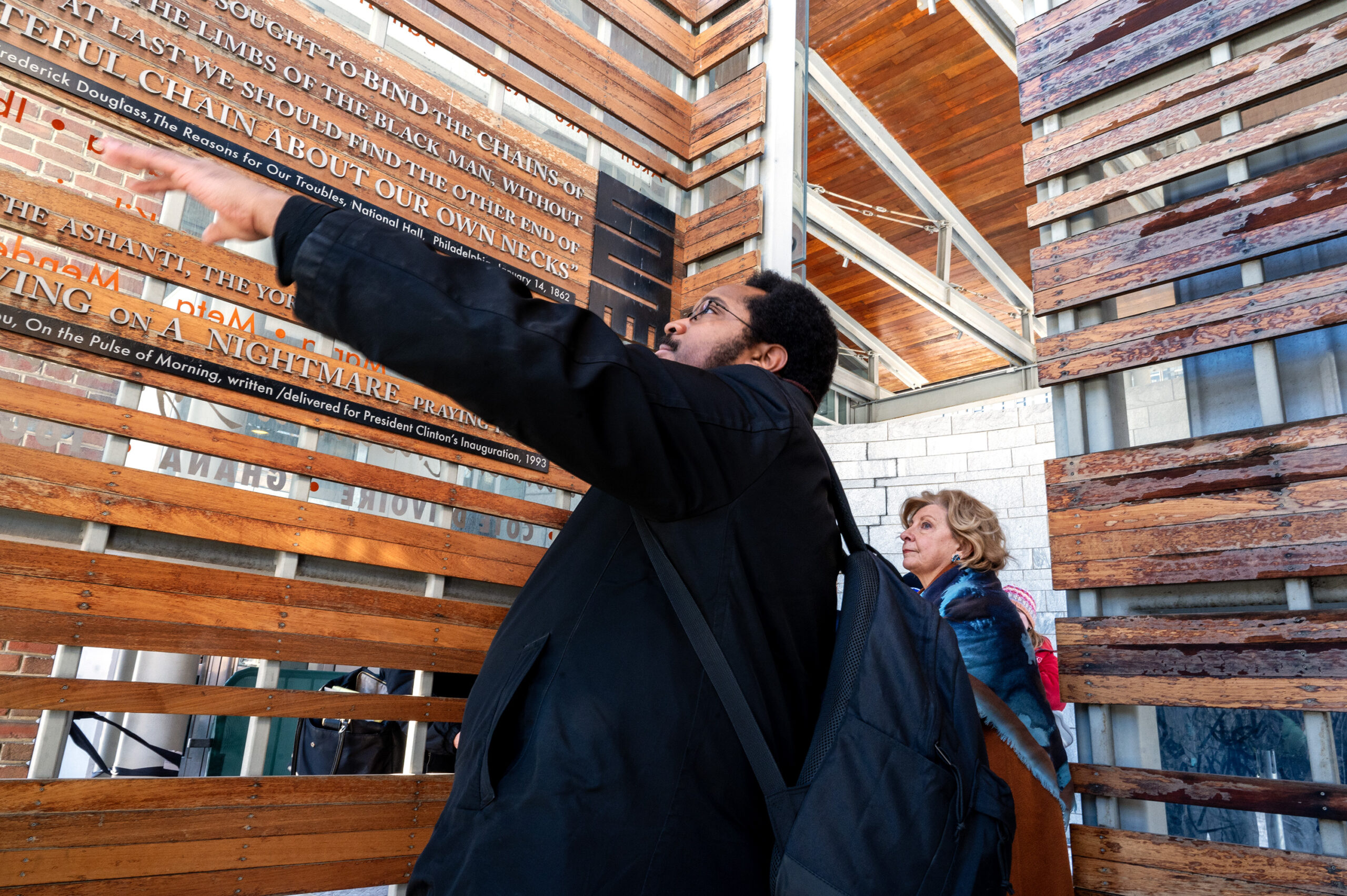
Rufe’s memo named the nine enslaved Africans owned by Washington, and noted that two — Oney Judge and Hercules Posey — escaped. The removed displays recognize their struggles and the nation’s “progress away from the horrors of slavery,” the judge wrote.
“Each person who visits the President’s House and does not learn of the realities of founding-era slavery receives a false account of this country’s history,” the judge wrote.
The injunction does not resolve the underlying lawsuit, and is in effect for the duration of the litigation. In a January hearing, Rufe said she wouldn’t let the case drag into the summer, recognizing the 250th anniversary celebration being planned for Independence Mall.
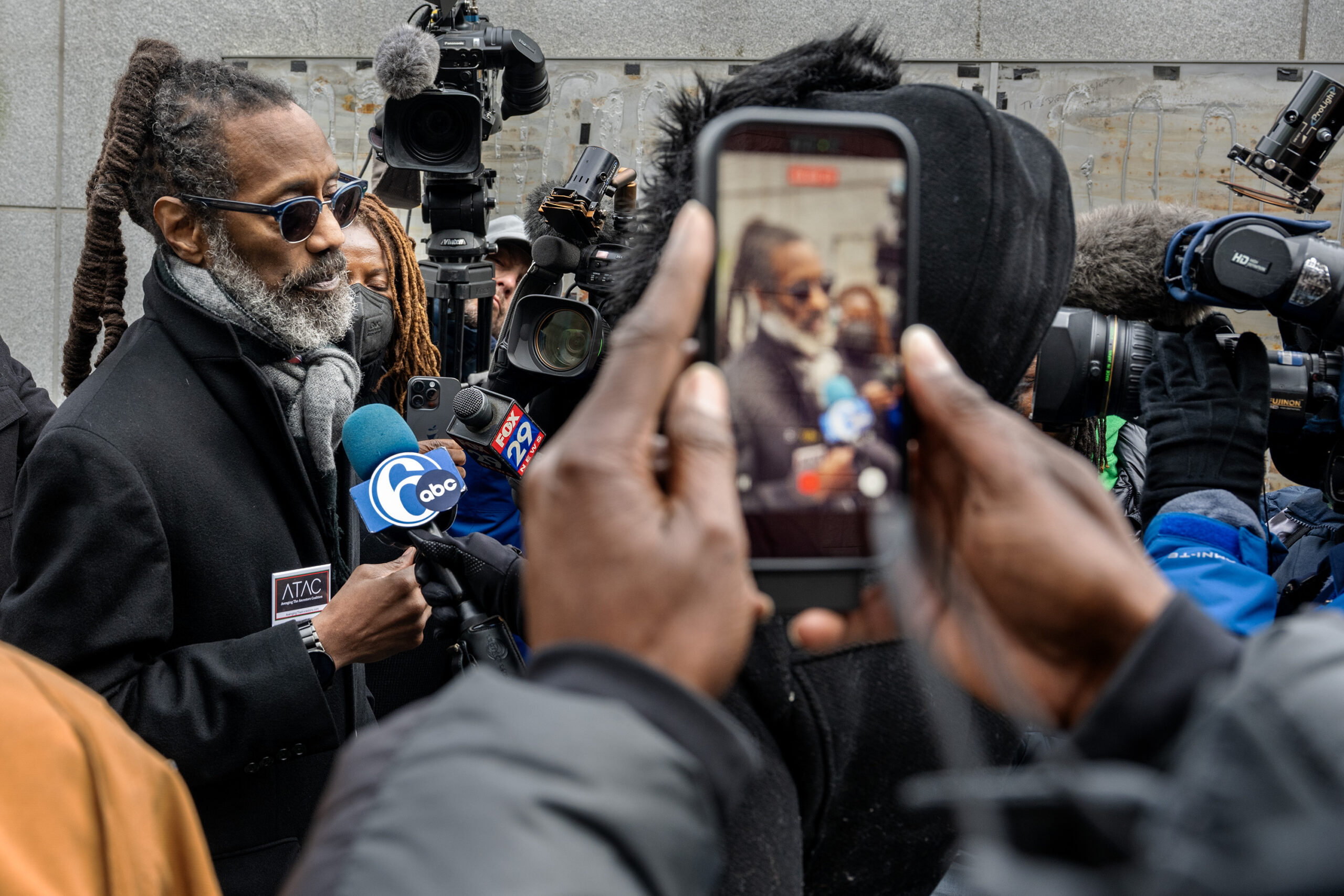
Attorney Michael Coard, leader of the Avenging the Ancestors Coalition, speaks with the news media Monday after a federal judge ordered the Trump administration to restore the slavery exhibits that the National Park Service removed from the President’s House last month. The group was on the site for an annual gathering for a Presidents’ Day observance when they learned of the order.
Avenging the Ancestors Coalition, the main advocacy organization leading the fight to protect the President’s House, was less than an hour into its Presidents’ Day event at the site when leaders got wind of their victory.
The group’s leaders, excited and completely in shock, congregated behind the site’s Memorial Wall to soak in the news before announcing it.
Moments later, Michael Coard, an attorney and the coalition’s leader, emerged before the crowd of about 100 people and told them: “Thanks to you all, your presence and your activism, I have great news: We just won in federal court.”
The crowd erupted in cheers and chants of “When we fight, we win!” and “We have won!”
Coard told reporters there was “no other blessing that we could have gotten today.”
The coalition has led dozens of rallies and town halls meant to energize the public in opposing the Trump administration’s ongoing scrutiny of the President’s House. The Black-led advocacy group helped develop the site in the early 2000s before it opened in 2010.
Dana Carter, the group’s head organizer, said she was in disbelief when she heard about the ruling.
“After we figured out that it really was the truth, I am just moved. My heart is overflowing with love for the judge who made the ruling, as well as the people who have been with us since the beginning … and also the people who have joined us in this fight to restore the President’s House,” Carter said.
But the fight is not over, advocates said, with Coard expecting the Trump administration to appeal or ignore rulings.
“This is a lawless administration. The people are going to have to take over to force them to do the right thing,” Coard said.
The Trump administration’s attempt to alter the President’s House was part of a wider initiative to remove content from national parks that “inappropriately disparage Americans past or living,” following an executive order from Trump. For instance, Park Service employees removed signage about the mistreatment of Native Americans from the Grand Canyon.
The fate of the President’s House exhibits was in limbo for months until they were removed by Park Service employees with wrenches and crowbars on Jan. 22. Meanwhile, advocacy groups and creatives behind the President’s House cultivated support for their cause to protect the site. Philadelphia City Council issued a resolution condemning the censorship of the exhibit.
“Judge Cynthia Rufe made it clear that historical truth cannot be dismantled or rewritten, and that the federal government does not have the authority to erase or alter facts simply because it has control over a national site. … We can not let President Donald Trump whitewash African-American history. Black history is American history,” City Council President Kenyatta Johnson said in a statement Monday.
Mijuel Johnson (left), a tour guide with The Black Journey: African-American Walking Tour of Philadelphia, leads Judge Cynthia Rufe (right) as she visits the President’s House in Independence National Historical Park on Feb. 2.
Attendees at Monday’s event were invigorated by the ruling.
Mijuel Johnson, a tour guide leader with the Black Journey who led Rufe through the site earlier this month, said he was “enjoying the moment for now” but then he would be back to work.
“This is a great win for this movement,” Johnson said.
State Rep. Chris Rabb, who is running in a competitive primary forPhiladelphia’s open congressional seat, said that his now-former campaign treasurer made unauthorized withdrawals and that he has reported her to federal authorities for “misconduct.”
The treasurer, Yolanda Brown, is a Fort Lauderdale, Fla.-based campaign consultant who was accused last month of embezzling six figures’ worth of campaign dollars from another Democrat.
Rabb said in an interview Friday that he would not speculate on the amount of money that may have been stolen, citing a pending review. He said he reported the matter to the Federal Election Commission.
“My team and I remain committed to this campaign toward a collective victory on May 19,” said Rabb, who is running to succeed retiring Democratic U.S. Rep. Dwight Evans.
Brown, who manages the firm Brown Financial Consulting Services Group LLC, did not respond to calls and emails seeking comment.
A campaign treasurer is generally responsible for a political action committee’s bank account and is often tasked with ensuring legal compliance. Rabb on Monday filed paperwork with the FEC to list himself as his campaign’s treasurer, replacing Brown.
Last month, Ken Welch, the mayor of St. Petersburg, Fla., accused Brown of embezzling $207,000 from his campaign committee. Attorneys for Welch’s campaign told a local Fox television station that they had discovered Brown made “improper transactions” and that they had “demanded the return of funds.” When the money was not sent back, Welch’s campaign notified state and federal law enforcement, the station reported.
Campaign finance reports showed that Welch’s PAC had made several transactions, including one for $100,000, to a business that Brown controlled.
The developments came as the race for Pennsylvania’s 3rd Congressional District, which covers about half of Philadelphia, was just heating up. Rabb is considered among a handful of front-runners seeking the Democratic nomination to represent the district, which is one of the most Democratic-leaning in the country.
Rabb was not in attendance at several events this week — including two community forums — citing an emergency.
State Sen. Sharif Street, the former head of the state Democratic Party, had more than half a million dollars in the bank as of Jan. 1, according to his most recently filed campaign finance report. Ala Stanford, a pediatric surgeon, had nearly $400,000 on hand after lending her campaign $250,000 of her own money.
Rabb, by comparison, had just shy of $100,000 in the bank. That came after a lackluster fundraising quarter — he raised $127,000 in the final three months of 2025, significantly less than the $257,000 he raised in the previous reporting period.
On Tuesday, the city agreed to pay $250,000 to a former clerk who, like several other register of wills employees, said he was fired after he refused to contribute to Gordon’s campaign.
Nicholas Barone alleged in a 2023 federal lawsuit that Gordon, through an intermediary, had first requested a $150 contribution in late 2021.
When Barone told his supervisor he could not afford to contribute, Gordon asked for $75, according to the lawsuit. Barone balked again.
Then, in January 2022, Barone received a termination letter, effective immediately. The letter came four days after a performance review found he was exceeding expectations, according to his suit.
“She pressured everyone to make a donation and sort of made it known, if you’re not donating, you’re not going to be employed,” said Barone’s lawyer, James Goslee.
In addition to the Barone settlement, the city has paid $400,000 to settle four other federal lawsuits brought by former Gordon staffers. They alleged that Gordon, who was elected in 2019, had essentially turned the register of wills office into an arm of her unsuccessful reelection campaign.
Patrick Parkinson, a former administrative deputy in the office, claimed in his lawsuit that Gordon “continually and relentlessly badgered” him for campaign money, then fired him in 2022 when he refused. His suit was settled in 2024 for $120,000.
Barone’s case was unusual in that it was the only one that got as far as a trial, which began Monday. Several former employees testified about how Gordon had politicized the office. Gordon testified last.
The city then agreed to settle before the jury began deliberating. Goslee said her testimony was a “disaster” for the defense.
“She just wasn’t a good witness, I’ll put it to you that way,” Goslee said. “She should not be in politics or be allowed anywhere near public office.”
Reached by phone Thursday, Gordon initially declined to comment. She called back five minutes later.
“In connection with the allegations brought against me, I maintain I did nothing wrong,” Gordon said. “Any decision to settle the case was a decision made by the City of Philadelphia.”
A spokesperson for the city’s law department declined to comment.
The register of wills office is a somewhat obscure row office in City Hall that employees approximately 100 people with an annual budget of about $5.2 million. It issues marriage licenses, processes inheritance-related records, and does other nonpolitical work.
But it also has a reputation as a Democratic patronage operation going back at least to the 1980s, with jobs being doled out to people with political connections.
Goslee said he was hoping that Barone’s case might lead to some “structural change.”
“This is a very important public interest case,” he said. “That system of entrenched, compelled patronage really needs to come to an end.”
That does not appear to be happening yet.
Gordon was defeated in the 2023 Democratic primary by John Sabatina Sr., an estate attorney and Northeast Philadelphia ward leader. He took office in January 2024.
The city has since paid out $256,000 in settlements to nine former register of wills employees who filed lawsuits alleging that Sabatina fired them to make way for his own patronage hires. Five cases are still pending.
“It was a hit list,” lawyer Timothy Creech, who is representing most of those ex-employees, said in September, comparing Sabatina to a “Tammany Hall”-style party boss, a reference to the former New York City political machine.
“It wasn’t to save money,” Creech said. “It was specifically to hire their own people.”
Register of Wills John Sabatina
Several of the 30 office employees on the list are described by their connections to Gordon, including “Tracey niece,” “Tracey’s friend, 7th Ward committee person,” “Last Tracey hire.” The suggested action for most of those employees was immediate termination.
“We have enough immediate terminations to allow us several hires in the next two weeks,” reads a note at the bottom of the spreadsheet.
Another note appears to indicate that some firings were planned before Sabatina had replacements:“We don’t have people lined up for all of these jobs and we need to make sure we use up all of the funds set aside in the budget for salary.”
Sabatina has declined to comment on those cases.
Lauren Cristella, president and CEO of the Committee of Seventy good-government group, said it is not acceptable for the city to spend more than $900,000 to settle lawsuits stemming from politics in the register of wills office.
“We can all think of a thousand better things we could do with these funds,” Cristella said. “The patronage mill better start printing money to keep up with these payouts because taxpayers in this city can no longer foot this bill. When is enough for Council and the mayor to meaningfully reform the row offices?”
Last year, the Pennsylvania Intergovernmental Cooperation Authority, Philadelphia’s fiscal watchdog, passed a resolution to recommend that City Council and Mayor Cherelle L. Parker abolish the register of wills office, along with the sheriff’s office, another row office with a long history of problems.
Neither Parker nor Council has shown any interest in taking action.
Gordon, who ran unsuccessfully for Congress in 2024, now works in the sheriff’s office as a services representative, according to city payroll records.
“Row offices are set up to create jobs for the politically connected, not serve the people of our city,” Cristella said. “It doesn’t matter who is in the office, the taxpayers are always on the hook for their abuse of power.”
Staff writer Ryan W. Briggs contributed to this article.
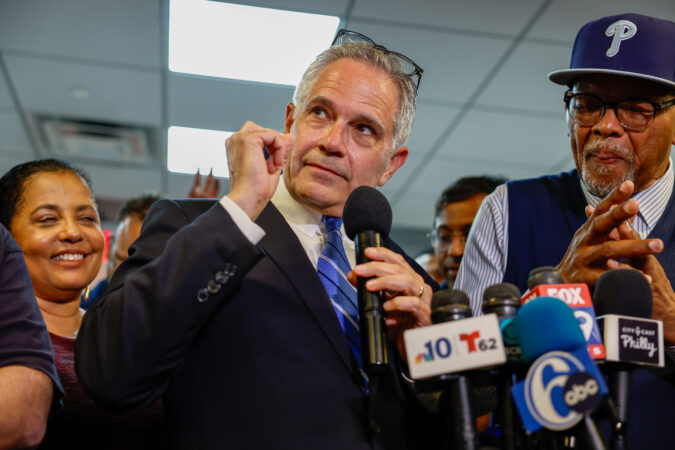
Philadelphia District Attorney Larry Krasner on Wednesday dismissed rumors that he may challenge Mayor Cherelle L. Parker when she will face reelection next year, and he said in a statement that he is focused on his job as the city’s top prosecutor.
Krasner, who last year won his third term as district attorney and has cultivated a national brand,told The Inquirer that talk he might challenge the incumbent divides the city’s leadership.
His statement came after the news website Axios Philly reported that some political insiders were floating Krasner’s name as a potential mayoral contender.
“Especially in these times, all Philadelphia residents need to stand together and work together for Philly,” Krasner said. “Not sure whose agenda this narrative serves, but there’s nothing new about insiders stirring things up to benefit themselves at the expense of everyone else.”
Talk of Parker facing a potential primary challenge ramped up in recent days after the mayor’s political action committee filed a campaign finance report showing she had raised $1.7 million last year, a striking sum for a sitting mayor two years out from a reelection bid.
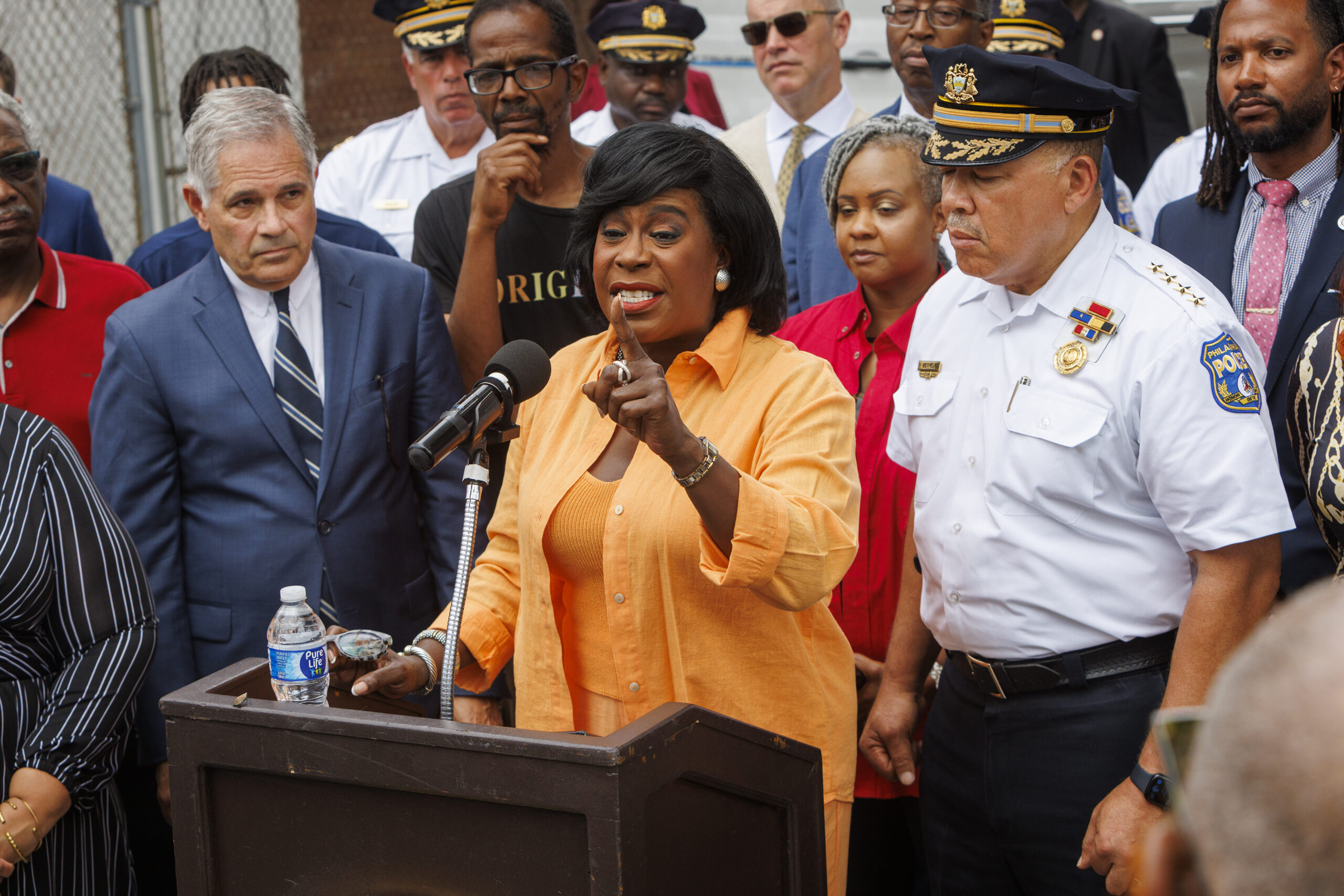
In this 2024 file photo, Philadelphia Mayor Cherelle L. Parker is flanked by Police Commissioner Kevin Bethel and District Attorney Larry Krasner during a news conference.
The fundraising report fueled speculation among the city’s political class that Parker, a centrist Democrat who is backed by much of the party establishment, may be expecting a challenge in the primary.
Krasner, 64, is the most prominent progressive in the city. He won reelection last year in landslide fashion, and he has positioned himself as the city’s most vocal Trump opponent, often drawing comparisons between the federal government and 20th-century fascism.
And several past district attorneys have run for mayor, including Ed Rendell, who went on to serve two terms in City Hall and then was elected governor of Pennsylvania.
But for Krasner, any run at Parker would be tricky.
Krasner, who is white, has been successful in electoral politics in large part because of support from the city’s significant bloc of Black voters, politicians, and clergy. Those groups are also key to the base of support that has backed Parker, who comes from a long line of Black politicians hailing from the city’s Northwest.
Allies of the district attorney say a better fit — if he decided to seek higher office — could be running for a federal seat.
Political observers have suggested a handful of Democrats, including Krasner, could run for the U.S. Senate seat currently occupied by Sen. John Fetterman. The Democratic senator, who will be up for reelection in 2028, has an independent streak and has angered many in the party for at times siding with Republicans.
Several other Democrats have been floated as potential contenders for the seat, including U.S. Reps. Brendan Boyle, of Philadelphia, and Chris Deluzio, whose Western Pennsylvania district includes Allegheny County. Some have also speculated that former U.S. Rep. Conor Lamb, also of Western Pennsylvania, could run.
Mayor Cherelle L. Parker on Wednesday unveiled PHL PRIME, a new service in Philadelphia that has nothing to do with Amazon — although the e-commerce giant could potentially sign up for it.
At her annual address to the Chamber of Commerce for Greater Philadelphia, Parker signed an executive order to establish PHL PRIME, which stands for Project Review and Infrastructure Made Easy. The new program is designed to draw “high-impact economic development projects that generate quality jobs” by helping businesses that are considering investing in Philadelphia to navigate city rules and regulations, according to the mayor’s office.
“I‘m the mayor, and I’m not absolving myself of the responsibility of making sure that bureaucracy is working effectively and efficiently,” Parker said during her annual speech at the Convention Center. “We’re not going to burden business with the ‘time tax.’ We’re going to work at the speed of business.”
Parker told reporters the new program will not involve hiring any new staff. Instead, it’s meant to bring various city departments together into a “PHL PRIME Tiger Team“ to coordinate a streamlined approach and lay out the welcome mat for investment.
In her wide-ranging speech, Parker also said the city was committed to helping major development plans from the Market East corridor and the South Philadelphia Stadium Complex to the port and shipyard.
But Parker did not speak at length about two measures she included in last year’s city budget deal that some have said shows the city is not as welcoming to business as it could be. Both relate to the city’s business income and receipts tax, or BIRT.
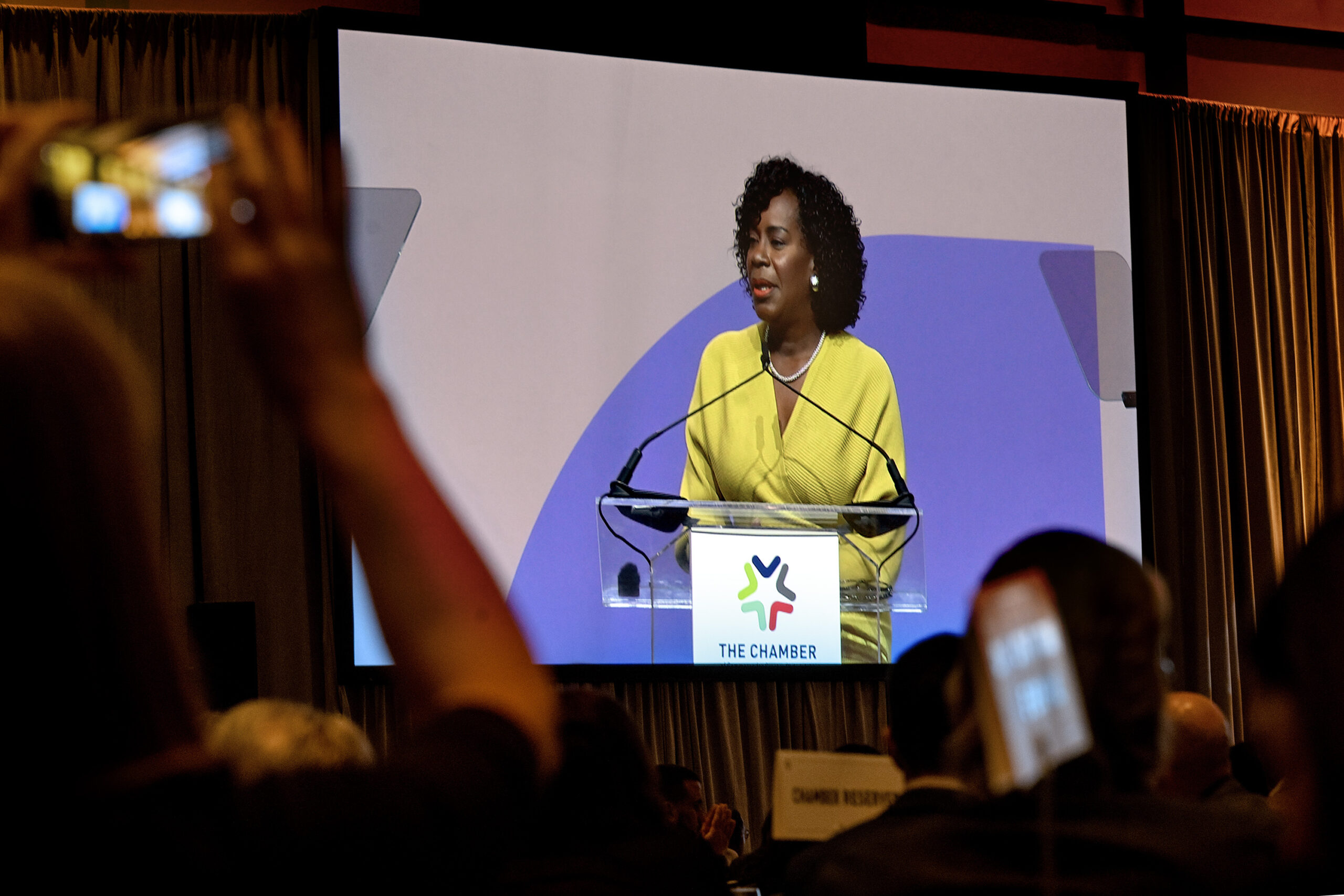
Attendees record Mayor Cherelle L. Parker on the big screen as she delivers her keynote address at the Chamber of Commerce for Greater Philadelphia’s Annual Mayoral Luncheon at the Convention Center Wednesday, Feb. 11, 2026.
Parker on Wednesday briefly mentioned a law she and City Council adopted last year that bakes in annual incremental cuts to the two BIRT tax rates over 13 years. And she thanked the Tax Reform Commission for guidance on making the city’s tax structure more business-friendly.
“I am proud to affirm that we proposed and codified into law $210 million in tax investments to provide the kind of predictability that the business community told us that it needs,” Parker said. “I hope that was a direct sign to each of you in this room that the executive and the legislative branches are listening.”
But she did not mention that the enacted tax cuts — the steepest of which will likely take effect after she leaves office — are far less aggressive than the commission’s recommendations, which called for completely eliminating BIRT within eight to 12 years.
Parker also did not address the elimination of an important tax break that allowed businesses to exempt their first $100,000 in revenue when calculating their BIRT liabilities. That policy — which lasted about a decade before Council approved a Parker bill to end it last year — effectively eliminated BIRT for the tens of thousands of businesses that take in less than $100,000 per year from commerce in the city.
Parker has said she supports the exemption but was forced to get rid of it after the city was sued by Massachusetts-based Zoll Medical Corp., which does business in Philadelphia and argued that the tax break violated the Pennsylvania Constitution.
Despite Philadelphia being a deep-blue city dominated by Democrats, local officials have been somewhat cautious in how they talk about President Donald Trump’s administration.
That has included the top legislator, City Council President Kenyatta Johnson, who has largely taken a measured approach on national politics, opting to convene task forces and hold public hearings rather than go scorched-earth on Trump.
That was until last month, when Johnson, like the rest of the country, watched video footage on the news showing federal immigration enforcement agents bearing down on Minneapolis and fatally shooting two United States citizens.
He said in an interview Friday that he now sees City Council differently: as an “activist body” that is obligated to take legislative action in opposition to the Trump administration.
And Johnson said he questions the purpose of his position if not to stand up for the city’s most vulnerable — and right now, he said, that’s immigrants.
“It’s my responsibility to step up in this space and be more vocal,” he said over lunch in South Philadelphia’s Point Breeze neighborhood, the section of the city where he grew up and still lives. “It’s just the evolution of me really not addressing it from a political standpoint, but from a moral standpoint of advocating and fighting for individuals who really need a voice.”
That reflects a shift for Johnson, the centrist Democrat who is entering his third year as Council president. He considers himself pro-law enforcement, and he typically takes an understated approach to leadership, preferring to dissent with others privately rather than duke it out in public.
In employing a more assertive approach, Johnson has also over the last several months started to diverge from Mayor Cherelle L. Parker, a close ally.
“The mayor can respond how she chooses to respond,” he said. “For me, it’s a moral issue.”
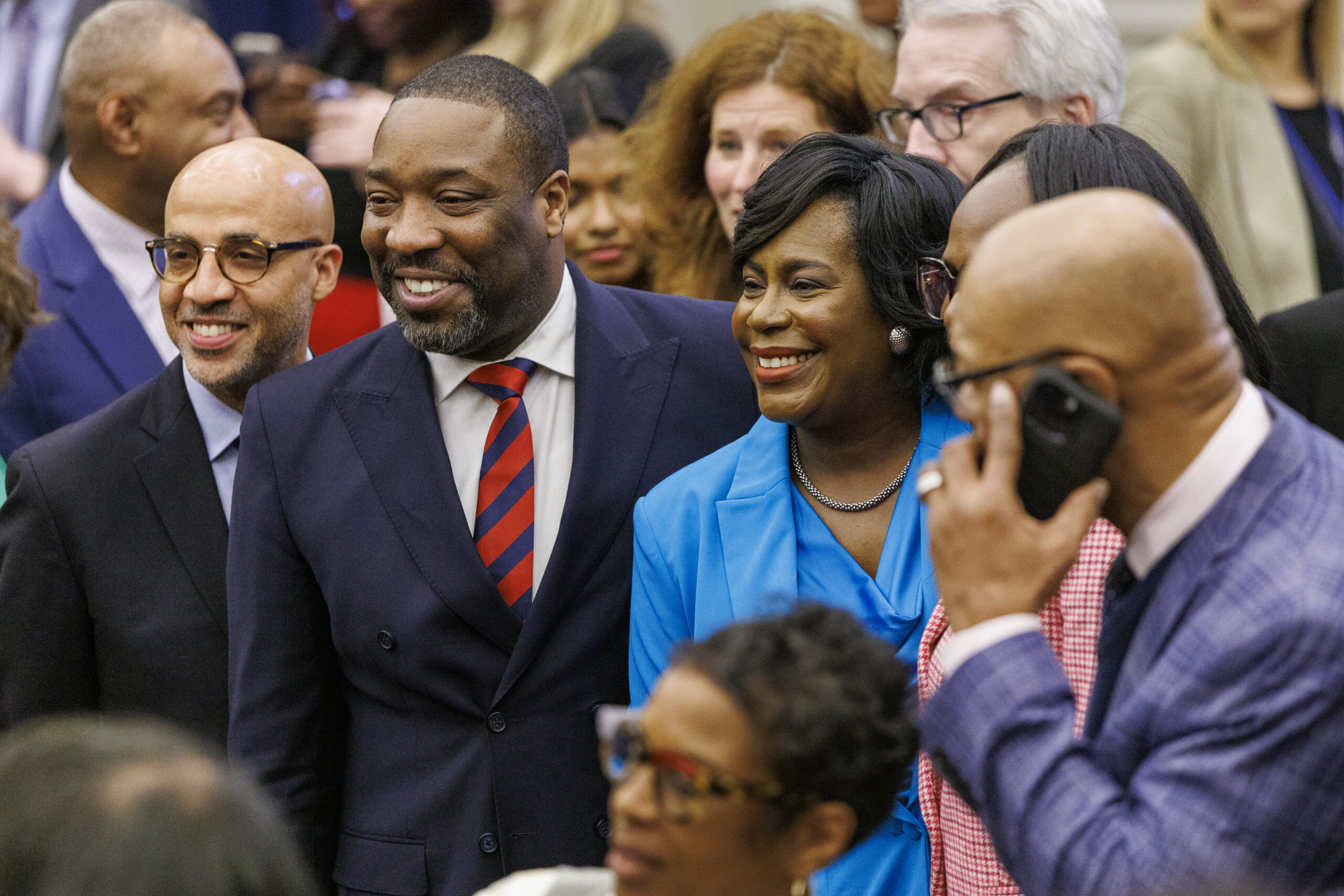
Philadelphia Mayor Cherelle L. Parker stands beside Council President Kenyatta Johnson (left) after she finished her budget address to City Council, City Hall, Thursday, March 13, 2025.
Larry Ceisler, a public affairs executive and longtime City Hall observer, said he has watched Johnson rise from community activist to lawmaker.
He said the Council president, in his latest evolution, might have calculated that a majority of the 16 other members want the city’s legislative body to take a more active role.
“He is an activist at heart, and he has a tremendous amount of empathy for people,” Ceisler said. “At the same time, he’s a pretty good politician and he can count votes. It’s very difficult for him at this point to push back on the will of his members.”
But Ceisler said that Parker might have more to lose, and that she will “be on the hook for all this if there is retribution from Washington.”
A ‘shameful’ episode at the President’s House
Through the first eight months of the second Trump administration, Johnson largely kept focused on local policymaking.
When a reporter asked Johnson in January 2025 how he saw his role responding to the Trump administration, he noted that he had convened two working groups to study how Trump-backed policies would affect Philadelphia residents.
Other Council members introduced more than a dozen resolutions to condemn the Trump administration’s efforts that they said would harm Philadelphians, like cutting food assistance and prohibiting some diversity-hiring initiatives. One resolution opposed the federal government’s deployment of the National Guard as a crime-fighting measure in major American cities; another said Trump’s cabinet members were wholly unqualified.
Those measures, almost entirely symbolic, were largely spearheaded by progressive members. They passed the overwhelmingly Democratic Council with little debate and not much acknowledgment from the Council president.
But by September, Johnson began to speak up.
He was incensed when word spread that the Trump administration was seeking to alter some content related to slavery on federal properties, including at Independence National Historical Park. The National Park Service was reportedly looking to edit panels at the President’s House Site in Center City that memorialize the nine people whom George Washington enslaved.
Last month, federal workers removed the exhibit and relocated the panels to the National Constitution Center, where they are in storage. Parker’s administration filed a lawsuit immediately, and the issue remains the only Trump initiative that Parker has vocally opposed over the last year.
“This history is a critical part of our nation’s origins, and it deserves to be seen and heard,” she said in a video posted on social media.
Veronica Chapman-Smith, concerned citizen was present at the history lesson and protest, Presidents house, Independence National Historical Park, Philadelphia, Friday, Feb. 6, 2026. The community is coming together to protest the removal of slavery exhibit at the President’s House site.
The Council president said he wants the panels returned in time for an expected influx of tourists this year for several major events, including World Cup games and the 250th anniversary of the founding of the nation.
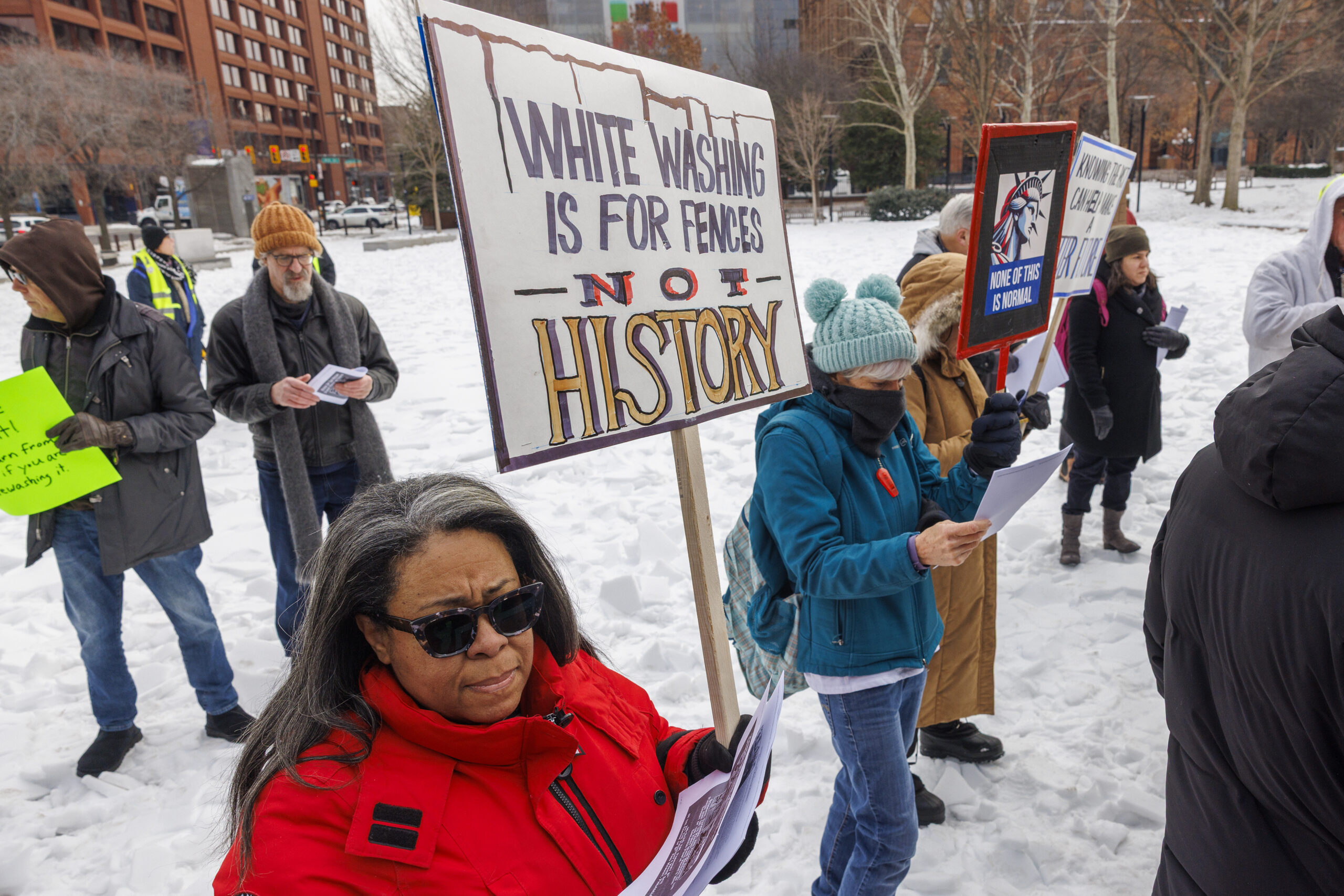
“It’s shameful that during this celebration of our country, the birthplace of America, here in the city of Philadelphia, we have to deal with a Trump administration trying to whitewash our history,” Johnson said last week.
A Minneapolis-like ICE surge on ‘any given day’
Over the next five months, Johnson will juggle advocating for the return of the panels as he manages other high-profile local matters. Council must approve a city budget by the end of June, and its members are expected to play a crucial role in the Philadelphia School District’s closure and consolidation plan that will affect dozens of schools.
The “ICE Out” legislation that Johnson has already backed is also expected to be a major undertaking over the coming weeks. The seven bills that make up the package already have support from 15 of Council’s 17 members, which constitutes a veto-proof majority.
City Councilmember Rue Landau, a Democrat who is one of the prime sponsors of the immigration legislation, said Johnson “fully realizes the importance of this moment.”
“His support,” she said, “is a recognition that local government has a pivotal role to play in moments like these.”
Prior to this year, Johnson rarely talked about immigration. He has spent most of his career focused on public safety, gun violence prevention, and quality-of-life issues.
Bloomberg reported that the building, about 85 miles outside Philadelphia, is one of two dozen across the nation that ICE has identified for conversion into detention centers. ICE purchased another warehouse in Schuylkill County, about 110 miles from Philadelphia.
Together, the two facilities could hold 9,000 beds.
To Johnson, it was like the federal government was saying: “We want to set up shop right in your backyard.”
ICE is already operating in the city. But Johnson said the warehouse purchases are a sign that Philadelphia should prepare for a greater surge of immigration enforcement like the operation in Minneapolis, where more than 3,000 federal agents were deployed and large-scale protests ensued.
Countless Minnesotans have said they were harassed, racially profiled, and unlawfully arrested by ICE agents during the operation this year.
“Who’s to say that won’t happen to any of my constituents that I represent from Liberia? From Sierra Leone? From Cambodia?” Johnson said. “It can happen on any given day here in the city of Philadelphia.”
Philadelphia and state officials awarded more than $6 million in taxpayer funds over the last five years to a politically connected but financially unstable anti-violence nonprofit, despite repeated warnings from city grant managers about improper spending and mismanagement, an Inquirer investigation has found.
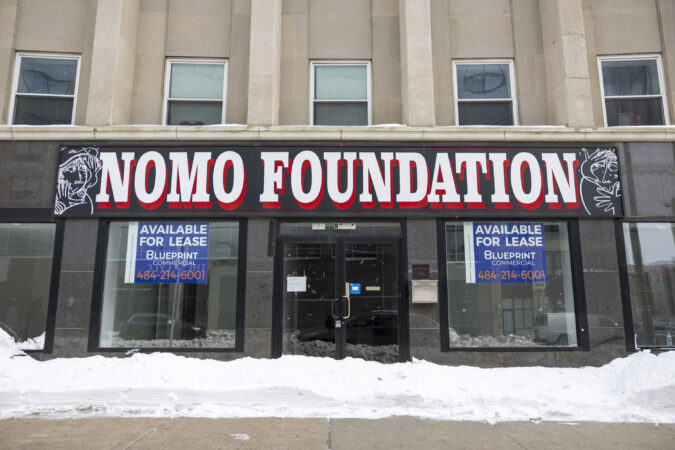
The group — New Options More Opportunities, or NOMO Foundation — received city and state anti-violence grants and locally administered federal dollars to expand its youth programs and launch a new affordable housing program. The money fueled NOMO’s rapid rise from a small, grassroots outfit into a sprawling nonprofit that took on expenses it ultimately could not afford.
Mayor Cherelle L. Parker has publicly touted NOMO’s work in the community, and she further boosted its profile by naming its director to her transition team upon taking office. But behind the scenes, Parker administration staffers watched NOMO face mounting financial pressures over the last two years.
In that time, the organization has been hit with multiple eviction filings and an IRS tax lien, and had to lay off staff and suspend programming. Most significantly, NOMO had to terminate its housing initiative last year — displacing all 23 low-income households that had been its tenants.
The warning signs were evident years earlier. Records obtained under Pennsylvania’s Right to Know Law show that city grant managers expressed concerns as far back as 2021 about NOMO’s lack of financial controls, incomplete balance sheets, and chronic inability to provide basic documents. As recently as last year, the city was unaware who sat on the group’s board.
Yet records show city officials kept propping up the group with more funds, without successfully putting in place the kind of structural support that might have kept it from foundering. Last year, the city sought to award a $700,000 federal homelessness prevention contract to NOMO, but the nonprofit was unable to meet the conditions of the contract and the funds were never disbursed. Officials also proposed writing more funding to NOMO into last year’s city budget as a last-minute line item. That effort failed.
In a September interview, NOMO executive director Rickey Duncan blamed city officials for funding delays.
“I was breaking my back to make sure those young people were getting housed,” Duncan said. “We built a tab that was so big we couldn’t pay no more, because the city didn’t pay.”
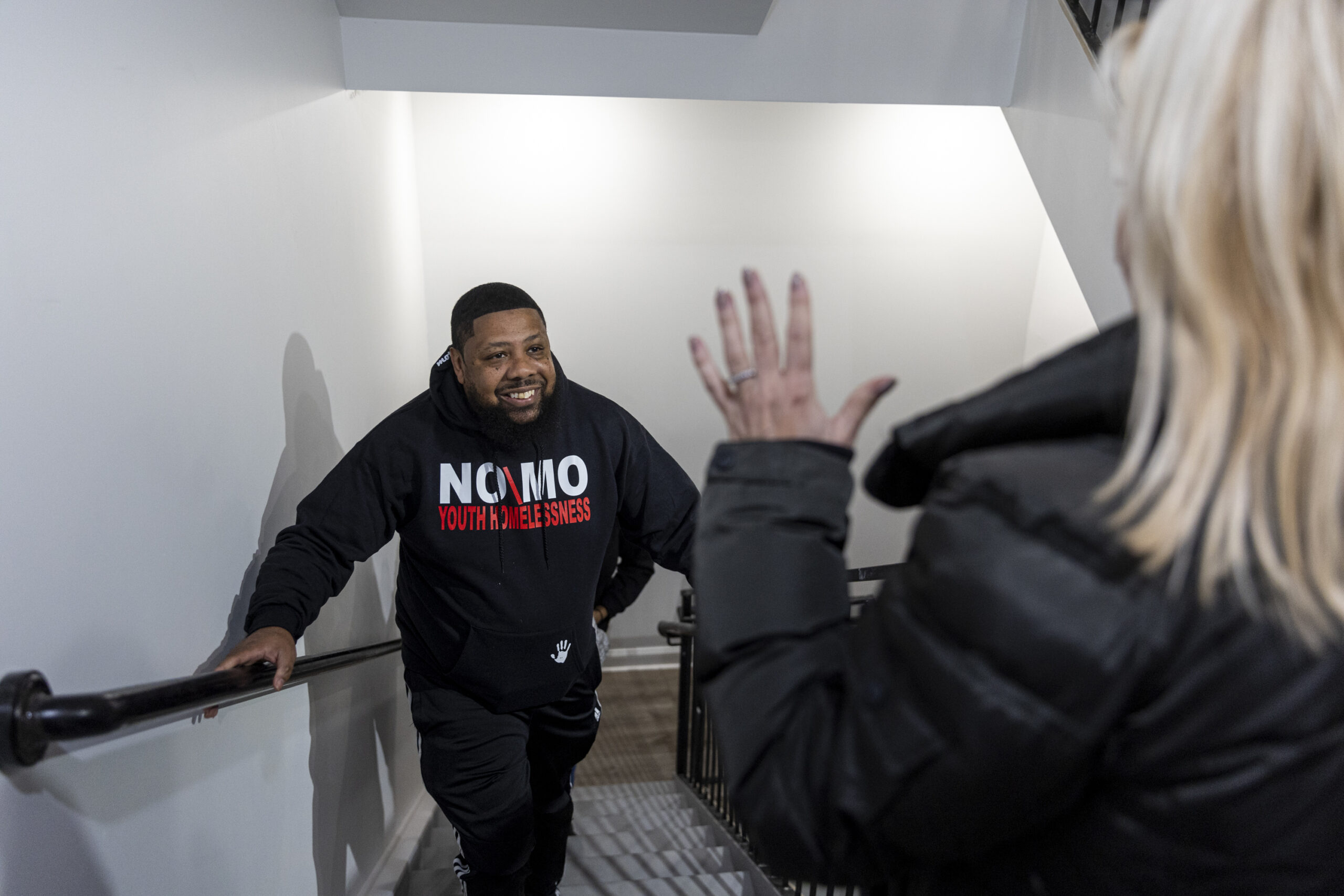
Rickey Duncan surprised a group of young women with apartments in a December 2022 file photograph. Last year, NOMO gave up the leases for the apartments citing a lack of funding.
Much of the money awarded to NOMO came via Philadelphia’s Community Expansion Grant (CEG) program, launched in 2021 to respond to record gun violence and support alternatives to policing. NOMO was one of only two initial grantees to receive the maximum $1 million award, which was meant to help the group scale up its operations and serve more at-risk youth.
NOMO’s financial records detail spending that quickly led to trouble after it received the first city grant, starting with the decision to devote most of the funds to launching a costly housing initiative while opening sprawling new youth centers to expand its after-school programs to new neighborhoods.
Duncan signed annual building leases totaling $750,000, and increased his own salary from $48,000 in 2021 to $144,000 the next year. (Duncan said that his pay — now $165,000, according to the most recent tax filing — is below average for an organization of NOMO’s size and was previously lower because he was volunteering half his time.)
The records contain no evidence that city grant managers questioned the lease expenses or conducted an evaluation of whether the upstart housing program was an appropriate addition to the organization’s core mission of offering after-school programming.
By the start of last year, a tax lien and lawsuits over unpaid rent threatened NOMO’s existence. Still, Duncan asked the city in January 2025 to reimburse the roughly $9,000 cost of two Sixers season tickets he purchased a year earlier. He explained in a memo that the tickets were “an innovative tool for workforce development.”
“Season tickets to the Sixers are not an acceptable programmatic expense,” the grant program manager responded in an email.
Records show that city officials discovered in April that a $35,000 IRS lien, filed four months earlier, had rendered NOMO ineligible for grant funding. Grant administrators sent an email to NOMO staffers with a warning written in all-caps: “CEASE ALL SPENDING.”
Duncan said that the lien was the result of a missing signature on a tax form, and that it was eventually resolved at no cost. But in a June email to Public Safety Director Adam Geer and other city officials, he accused the city of pushing his organization to the brink of collapse.
“I am respectfully requesting a written response detailing how a tax [lien] escalated into a comprehensive investigation into the NOMO Foundation’s financial health,” Duncan wrote. “NOMO has been disrespected, attacked, and harassed, by members of this office on this and previous occasions.”
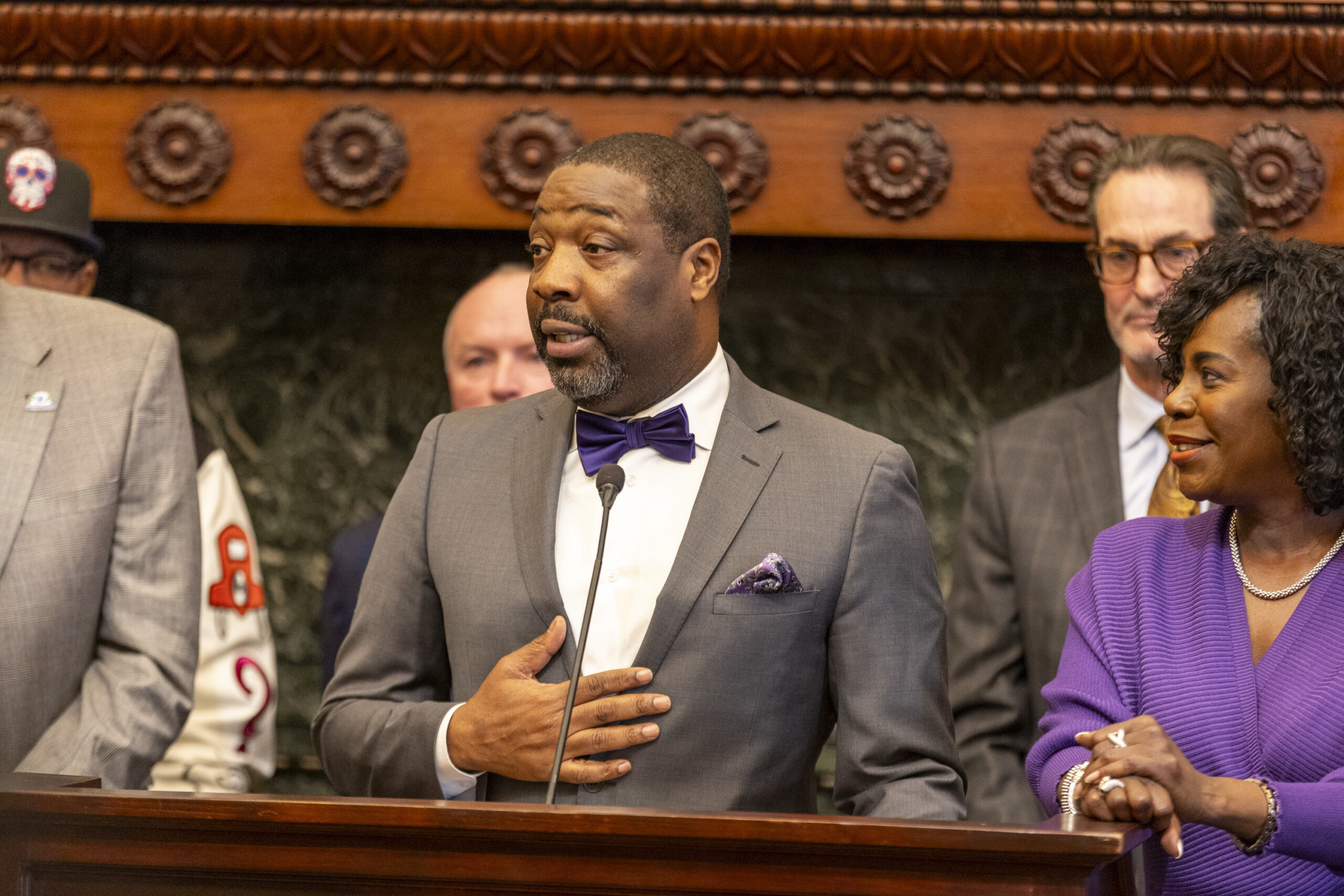
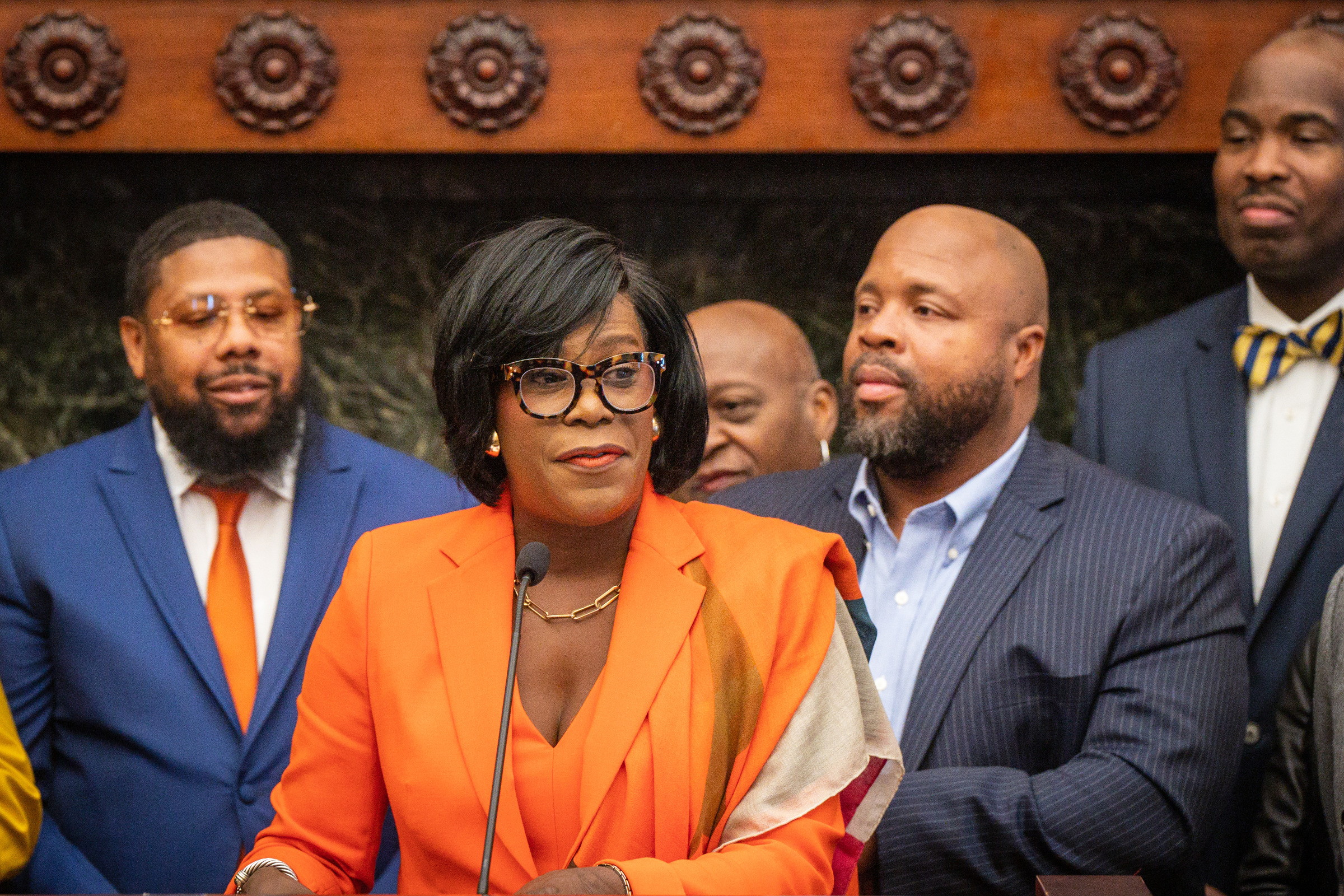
City Council President Kenyatta Johnson, speaking on Jan. 20. Regarding NOMO, he says, “It is crucial that any concerns are taken seriously.”
In a statement responding to The Inquirer’s findings, Johnson praised NOMO and credited the organization with “working with children throughout Philadelphia, intervening in cycles of violence, and literally saving lives in our community.”
Johnson, who was listed as a reference on the group’s most recent grant application, added: “Regarding any allegations raised against Mr. Duncan and NOMO, I am confident that the City of Philadelphia’s Office of Public Safety will review these matters thoroughly, fairly, and professionally. It is crucial that any concerns are taken seriously and examined through the proper channels, with facts guiding the outcome.”
A spokesperson for Parker referred questions to the Philadelphia Office of Public Safety, which manages CEG grants.
In a written response, a spokesperson for the department, Jennifer Crandall, praised NOMO’s efforts.
Rickey Duncan (left) and then Mayor-elect Cherelle Parker at a news conference that outlined Parker’s transition team and the plans that she had for her administration on Nov. 9, 2023.
“Not only has NOMO delivered on grant-funded programs, it has become an important partner on city initiatives like interventions with at-risk youth,” Crandall wrote. She cited evaluations by an unnamed third party that credited NOMO for providing “holistic support to participants … beyond the immediate program activities” and “addressing the broader social determinants of violence.”
Crandall did not respond to a follow-up request for the evaluation.
Duncan gave The Inquirer a 2023 report prepared by four nonprofit partners that evaluated CEG recipients in their first year, with the intention of documenting program goals and activities. The report states that the evaluation was based on a single site visit, interviews with staff, and a youth focus group, and that it was then too soon to evaluate impact. It noted that NOMO had retained more than half its participants over the grant cycle and had created “an environment that is welcoming and comfortable, so that participants willingly show up.”
The assessment did not address the viability of the housing program, nor did it cite any metrics that might be used to gauge whether NOMO’s programs had reduced community violence.
Duncan also sent The Inquirer written statements from two landlords indicating that their court cases against him had been resolved, and that they support NOMO’s mission.
He says NOMO is now financially stable, despite three years of tax returns showing the nonprofit in the red. He said NOMO’s programs now serve about 140 children a year across its three locations — about the same as when it was operating in just one location in 2019 and before the city awarded the expansion grants.
Laura Otten, a nonprofit consultant and former director of La Salle University’s Nonprofit Center, said it was clear the city’s grant awards to NOMO had not fulfilled their stated goals.
“It obviously didn’t work if they ended up having to evict people,” she said. “Where is the evidence that this grant has improved the capacity of the organization?”
Dawan Williams (left), vice president of restorative justice for the Nomo Foundation, and Rickey Duncan, Nomo CEO and executive director, in one of the student spaces at the foundation on South Broad Street on April 13, 2023.
‘Significant weaknesses noted’
When Parker laid out her priorities in her first budget address before City Council in spring 2024, she mentioned Duncan and NOMO by name as she praised the grassroots anti-violence organizations “working each day to lessen the pain and the trauma caused by gun violence.” She also promised to reward the various groups with an additional $24 million in grant funding.
It was another highlight of Duncan’s well-documented redemption story. By his own account, he dropped out of South Philadelphia High School in 1994 to sell drugs and promote concerts, earning the nickname “Rickey Rolex” for his flashy style. He was arrested the next year for robbery and spent more than a decade in prison. After he was released in 2015, Duncan began volunteering with NOMO, then a fledgling nonprofit, and eventually took the reins.
“My vision started off, to be honest, just wanting to help kids and give back to a city that I took from,” Duncan said in a 2023 interview with The Inquirer.
NOMO began as a largely volunteer-run effort operating in borrowed space on less than $50,000 a year, tax returns show.
In 2019, the tiny nonprofit submitted a grant application to Philadelphia Works, the city’s workforce development board, which was tasked with distributing about $6 million in federal Temporary Assistance for Needy Families (TANF) grants. NOMO proposed after-school programs that would teach up to 125 kids everything from neuroscience to software development to road construction.
Philadelphia Works awarded NOMO $209,000, skipping the standard financial review in order to disburse funds that would have otherwise expired.
“It breathed life into us,” Duncan said.
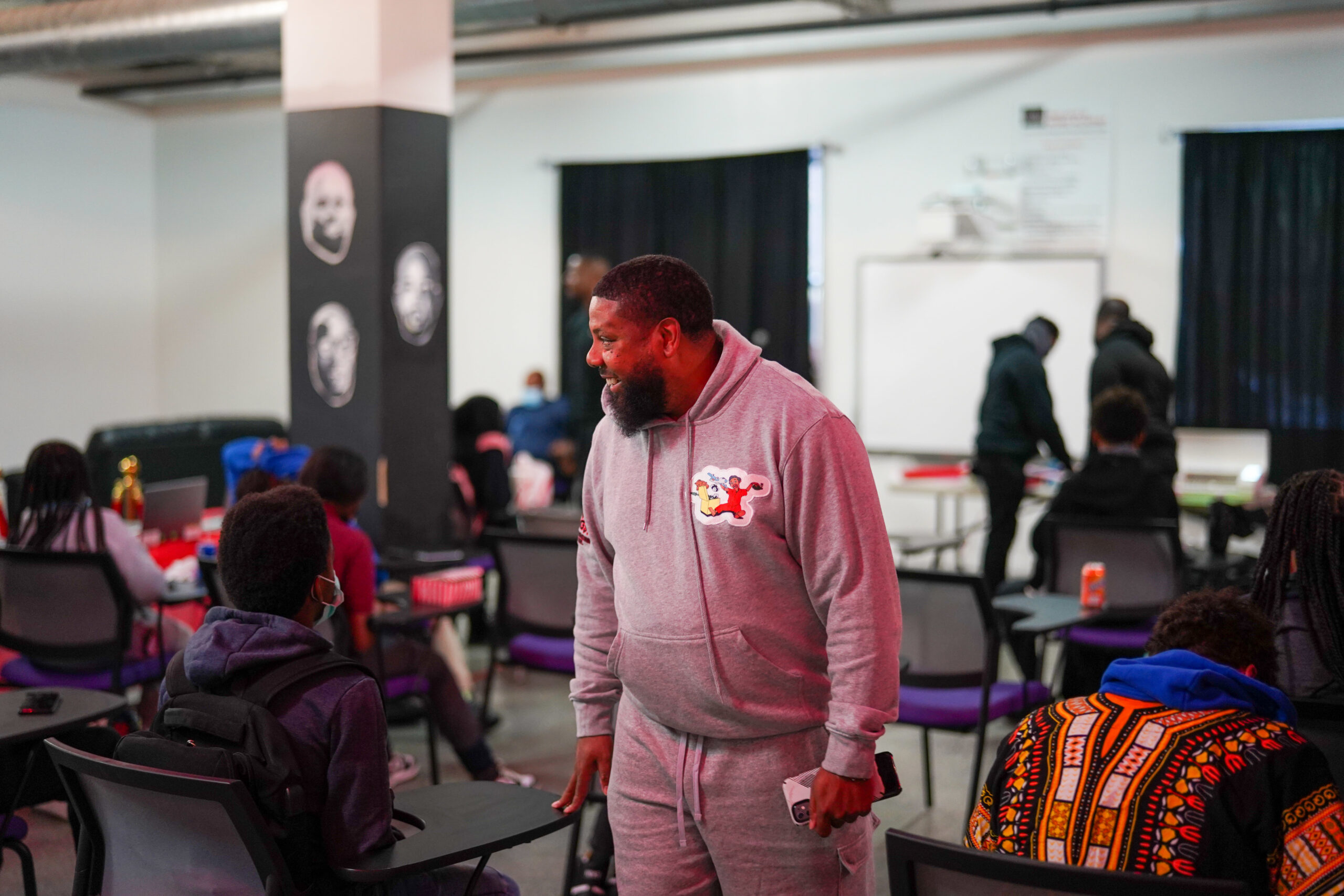
Rickey Duncan speaks with kids at a NOMO after-school program in a 2021 file photograph.
By 2021, NOMO was receiving half a million dollars annually in TANF money — enough to lease a 7,000-square-foot office space on North Broad Street and support programs for more than 100 young people. And Duncan’s star was rising as a charismatic and credible voice who came up from the same streets that he and others were working to rid of violence. Elected officials and news media alike turned to him for quotes and photo ops amid a surge in shootings.
In December 2021, then-Mayor Jim Kenney announced a $155 million investment in gun violence prevention funding. The plan included a $22 million grant program, with more than half that focused on “supporting midsized organizations with a proven track record” to “expand their reach, deepen their impact, and achieve scale.”
Duncan’s scrappy, homespun nonprofit was exactly the type of group city officials had in mind when they created the CEG program, and his grant application cited support from State Reps. Danilo Burgos and Elizabeth Fiedler. Although 30 other nonprofits received funding, NOMO was one of only two organizations awarded the maximum grant of $1 million — a transformative sum that would roughly triple NOMO’s operating budget.
In his first application for the CEG funds, Duncan pledged to expand his “trauma informed” after-school program to South Philadelphia by offering paid work experience, academic support, and intensive case management. The $1.4 million proposed budget projected the organization would spend about $1 million annually on staff salaries and participation incentives for teens, while spending $94,000 a year to cover added lease costs.
NOMO devoted just one sentence of its 15-page grant application to describing a new affordable housing initiative “to combat youth homelessness.” The proposal did not include what metrics would be used to judge that program’s success.
Despite the brief mention, the housing initiative would become the organization’s largest single budget item, by far.
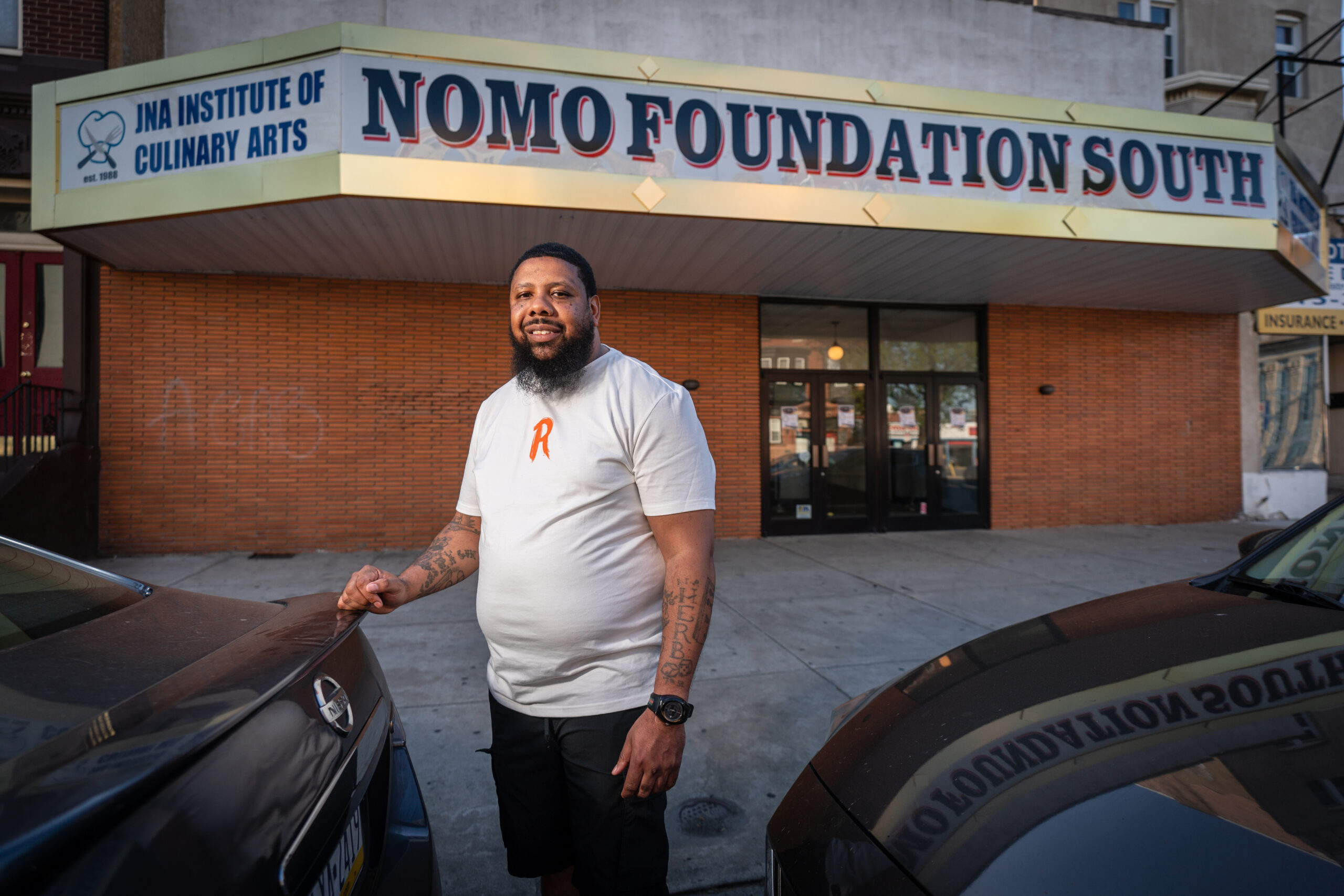
After securing the city grant money, NOMO took on a $552,000 annual lease for a newly built 27,000-square-foot West Philadelphia apartment complex near 40th Street and Lancaster Avenue. It also signed a $192,000-per-year lease for a 17,000-square-foot former culinary school on South Broad Street.
The deals left NOMO with youth centers in North, South, and West Philly, each with large event spaces that could host its programming. Duncan also planned to market the venues for private events — such as weddings and Eagles watch parties — to generate additional revenue.
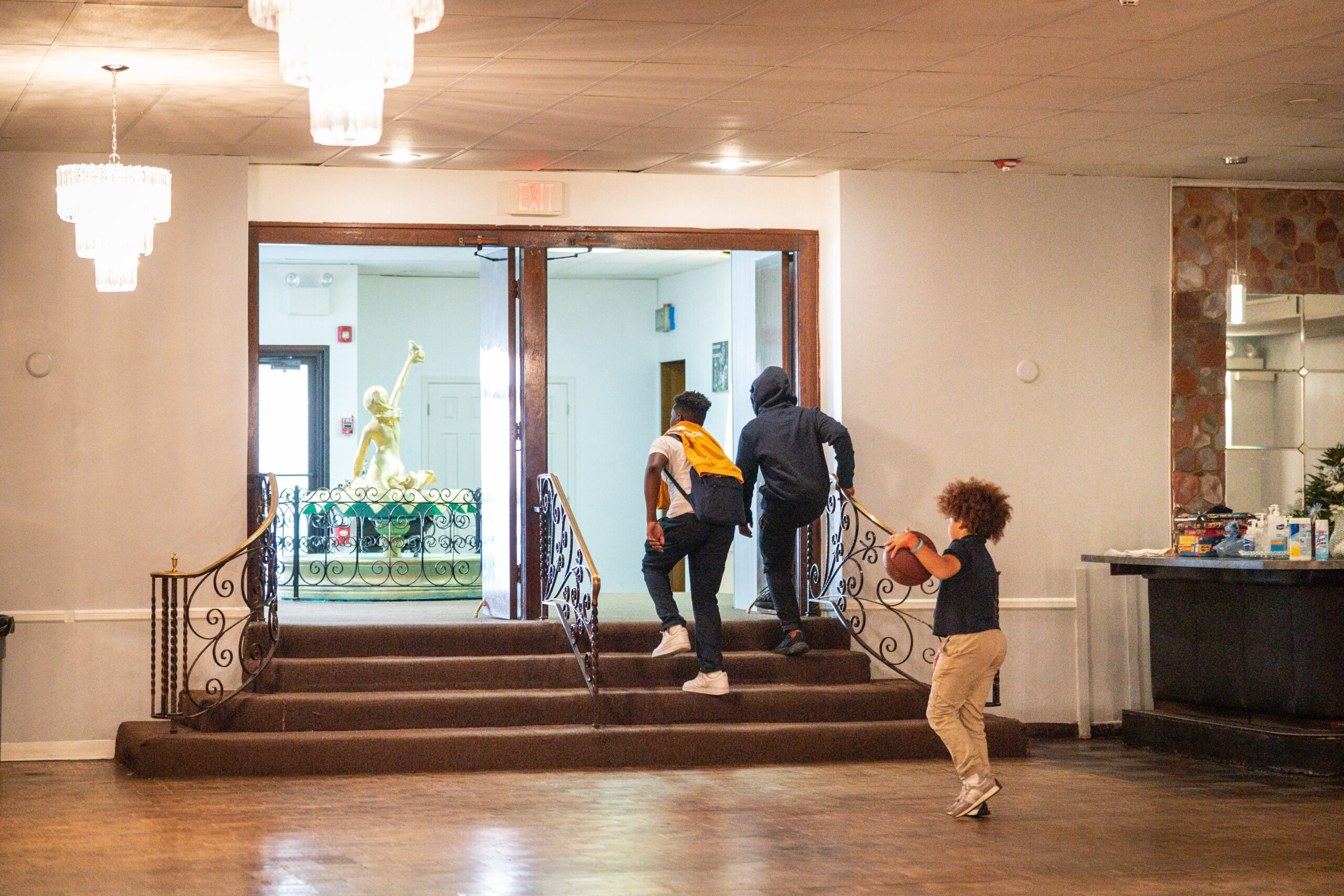
NOMO students bounced a basketball in the ballroom at the nonprofit’s South Broad Street youth center. The space is offered for event rentals, which Duncan said can generate crucial unrestricted income.
If city officials had concerns about NOMO’s costly expansion strategy or the viability of his plan to lease out the youth centers for parties, they are not reflected in the available records.
However, staffers at the Urban Affairs Coalition — a nonprofit the city had contracted to manage the first round of the grant program — flagged NOMO’s general lack of financial controls in a December 2021 fiscal assessment of prospective grantees.
“Significant weaknesses noted,” an Urban Affairs staffer wrote of NOMO in an email to then-anti-violence director Erica Atwood and other city officials. “No audited financials. No balance sheets presented even in the [IRS Form] 990s. Separation of Authority: Basically non-existent.”
That month, the city instructed Urban Affairs to proceed with the scheduled grant advance of $200,000 and to work with NOMO to establish a remediation plan. Instead, grant administrators wrote that they were reassured after NOMO installed a new chief operating officer — who left the organization the following year.
By the end of the grant cycle, Duncan was able to deliver a public relations win for NOMO. He appeared on Good Day Philadelphia in December 2022 to launch the housing plan with a surprise giveaway of the first of 23 brand-new apartments for young women, many of them single mothers.
Duncan said NOMO’s housing program would cover 70% of rent costs for 18 to 24 months while enrollees seek employment and eventually move out on their own.
“They’ll be getting their credit together so they can prepare to become a homeowner,” he told Fox 29. “We need money to finish doing this.”
Rickey Duncan, CEO and executive director, at Nomo on South Broad Street on April 13, 2023.
Billion-dollar dream
The city renewed NOMO’s grant in January 2024, this time for $850,000. But a tax return the same year showed the organization was already $710,000 in the red.
Months later, the nonprofit faced its first eviction suit, targeting its North Broad headquarters, and had to cut a check for $275,000 in back rent — the equivalent of one-third of its city grant money for that year.
By the fall of 2024, records show NOMO had spent only about 5% of the $150,000 initially budgeted for youth incentives, outside activities, equipment, or program supplies. The city withheld most of NOMO’s fourth-quarter grant funding, reducing the nonprofit’s award by $170,000 to a total of $680,000 for that year.
Still, the city re-upped the group for a third grant in 2025, this time for $600,000.
By January 2025, financial records show NOMO had virtually stopped spending on youth programming. It laid off most of its staff as landlords for all three youth centers took legal action against the nonprofit over hundreds of thousands of dollars of back rent.
NOMO sought to justify the expense of Sixers season tickets with a narrative submitted to the city, which denied the expense. Duncan said the majority of the tickets went to youth participants and members of the community.
Around then, NOMO received an infusion of support in the form of a $950,000 grant from the Pennsylvania Commission on Crime and Delinquency. But the TANF funds had run out, and the organization’s problems continued. City officials had NOMO submit a formal “performance enhancement plan” last July.
Duncan said in September that NOMO had cut costs, hired a new accounting firm, and was working toward “full financial stability.” It resolved two eviction cases by reducing its real estate footprint — downsizing its North Philly headquarters into basement offices and terminating its affordable housing program. Duncan said the former tenants moved in with family members or were transferred to the nonprofit Valley Youth House, which provides transitional housing.
After The Inquirer asked Duncan about the most recent lawsuit over back rent, this one for $312,000, his landlord filed notice in court that the matter was resolved. Duncan said keeping three youth centers and marketing the NOMO spaces for special events are key parts of his business plan as the organization continues to settle its debts.
The spate of lawsuits has not dampened the city’s enthusiasm for Duncan’s nonprofit. Crandall, the spokesperson for the Philadelphia Office of Public Safety, said NOMO remains eligible to receive funds when a new round of grants are awarded this year.
And with the housing initiative scrapped, NOMO is left pursuing its original mission — anti-violence programming for city youth. The organization’s renegotiated leases for its three youth centers now total $360,000 a year, roughly half what NOMO had been paying.
In a 2023 interview, Duncan acknowledged that he underestimated the financial demands of running an organization on a citywide scale.
“As a kid you think, … ‘If I can get a million dollars, I’ll be rich.’ And then you’re broke again,” he said then. “I had a billion-dollar dream. I didn’t realize it was a billion-dollar dream.”
ACKNOWLEDGMENT
The Inquirer’s journalism is supported in part by The Lenfest Institute for Journalism and readers like you. News and Editorial content is created independently of The Inquirer’s donors. Gifts to support The Inquirer’s high-impact journalism can be made at inquirer.com/donate. A list of Lenfest Institute donors can be found at lenfestinstitute.org/supporters.