When Cherelle L. Parker was a City Council member, she championed a strict residency rule that required city employees to live in Philadelphia for at least a year before being hired.
Amid protest movements for criminal justice reform in 2020, Parker said stricter residency requirements would diversify a police force that has long been whiter than the makeup of the city, and ensure that officers contribute to the tax base.
“It makes good common sense and good economic sense for the police policing Philadelphia to be Philadelphians,” she said then.
But today, under now-Mayor Parker, more police live outside Philadelphia than ever before.
About one-third of the police department’s 6,363 full-time staffers live elsewhere. That share — more than 2,000 employees — has roughly doubled since 2017, the last time The Inquirer conducted a similar analysis.
(function() {
var l2 = function() {
new pym.Parent(‘ppd_zips’,
‘https://media.inquirer.com/storage/inquirer/projects/innovation/arcgis_iframe/ppd_zips.html’);
};
if (typeof(pym) === ‘undefined’) {
var h = document.getElementsByTagName(‘head’)[0],
s = document.createElement(‘script’);
s.type = ‘text/javascript’;
s.src = ‘https://pym.nprapps.org/pym.v1.min.js’;
s.onload = l2;
h.appendChild(s);
} else {
l2();
}
})();
Today, the percentage of nonresidents is even higher among the top brass: Nearly half of all captains, lieutenants, and inspectors live outside the city, according to a review of the most recent available city payroll data.
Even Commissioner Kevin Bethel keeps a home in Montgomery County, despite officially residing in a smaller Northwest Philadelphia house that he owns with his daughter.
Most municipal employees are still required to live within city limits. Across the city’s 28,000-strong workforce, nearly 3,200 full-time employees listed home addresses elsewhere as of last fall. Most of them — more than 2,500 — are members of the police or fire departments, whose unions secured relaxed residency rules for their workers in contract negotiations. About a quarter of the fire department now lives outside the city.
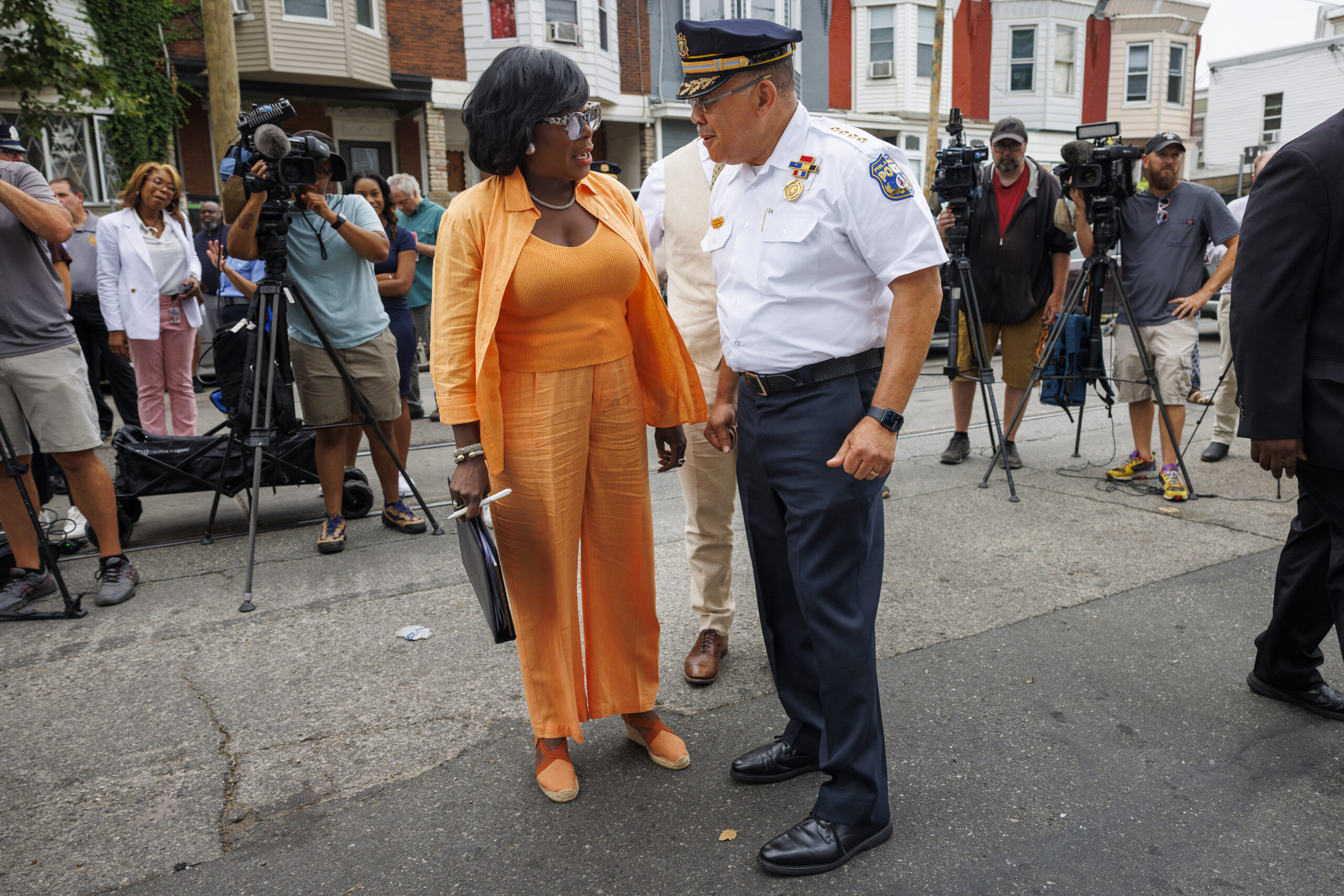
Philadelphia Mayor Cherelle L. Parker and Police Commissioner Kevin Bethel speak before the start of a news conference.
Proponents of residency rules in City Hall have long argued they improve rapport between law enforcement and the communities they serve, because officers who have a stake in the city may engage in more respectful policing.
But experts who study public safety say there is little evidence that residency requirements improve policing or trust. Some say the rules can backfire, resulting in lesser quality recruits because the department must hire from a smaller applicant pool.
A survey of 800 municipalities last year found that residency requirements only modestly improved diversity and had no measurable effect on police performance or crime rates.
“It’s a simple solution thrown at a complex problem,” said Fritz Umbach, an associate professor at John Jay College of Criminal Justice. “It doesn’t have the impact people think it will.”
Parker, a Philadelphia native who lives in the East Mount Airy neighborhood, says she would still prefer all municipal employees live in the city.
“When I grew up in Philadelphia, it was a badge of honor to have police officers and firefighters and paramedics who were from our neighborhood,” she said in a statement. “They were part of the fabric of our community. I don’t apologize for wanting that to be the standard for our city.”
‘Where they lay their heads at night’
What qualifies as “residency” can be a little pliable.
Along with his wife, Bethel purchased a 3,600-square-foot home in Montgomery County in 2017 for over a half-million dollars. Although he initially satisfied the residency rule by leasing a downtown apartment after being named commissioner by Parker in late 2023, he would not have met the pre-residency requirement the mayor championed for other city employees while she was on Council.
Today, voter registration and payroll data shows that Bethel resides in a modest, 1,800-square-foot rowhouse in Northwest Philadelphia, which he purchased with his daughter last year. While police sources said it was common for Bethel to sleep in the city given his long work hours, his wife is still listed as a voter in Montgomery County.
Police Commissioner Kevin Bethel speaks during the 22nd District community meeting at the Honickman Learning Center on Dec. 2, 2025.
Sgt. Eric Gripp, a spokesperson for the department, said in a statement that Bethel is a full-time resident of Philadelphia, and that while he owns a property outside the city, his “main residence” is the home in Northwest Philly.
Although sources say it was not unheard of for rank-and-file officers to use leased apartments to satisfy the requirement on paper, Gripp said “only a small number” of residency violations had required formal disciplinary action following an investigation by the department’s Internal Affairs Division.
That likely owes to officers’ increasing ability to reside elsewhere legally. The Fraternal Order of Police Lodge 5, which represents thousands of active and retired Philadelphia Police officers, won a contract provision in 2009 allowing officers to live outside the city after serving on the force for at least five years.
The union didn’t respond to a request for comment.
Few of the cops who left the city went very far.
While Northeast Philly and Roxborough remain the choice neighborhoods for city police, the top destinations for recent transplants were three zip codes covering Southampton, and Bensalem and Warminster Townships, according to city payroll data.
A few officers went much farther than the collar counties.
Robert McDonnell Jr., a police officer in West Philadelphia’s 19th district with 33 years on the force, has an official address at a home in rural Osceola Mills, Pa., about 45 minutes north of Altoona in Centre County.
A person who answered a phone number associated with McDonnell — who earned $124,000 last year between his salary, overtime, and bonus pay — declined to speak to a reporter.
Asked about the seven-hour round-trip commute McDonnell’s nominal residence could entail, Gripp said the department doesn’t regulate the manner in which employees travel to and from work.
“Our members serve this city with dedication every day,” he said, “regardless of where they lay their heads at night.”
A long and winding history
Versions of residency rules can be found as far back as the 19th century, when police recruits were required to live in the districts they sought to work in.
But when Mayor Joseph S. Clark pushed to reform the city charter in the 1950s, he sought to abolish the rules as an impediment to hiring, saying “there should be no tariff on brains or ability.”
Instead, City Council successfully fought to expand the restrictions. And, for more than five decades, the city required most of its potential employees to have lived in Philadelphia for a year — or obtain special waivers that, in practice, were reserved for the most highly specialized city jobs, like medical staff.
Many other big cities enacted similar measures either to curb middle-class flight following World War II or to prioritize the hiring of local residents. But the restrictions were frequently blamed for causing chronic staff shortages of certain hard-to-fill city jobs.
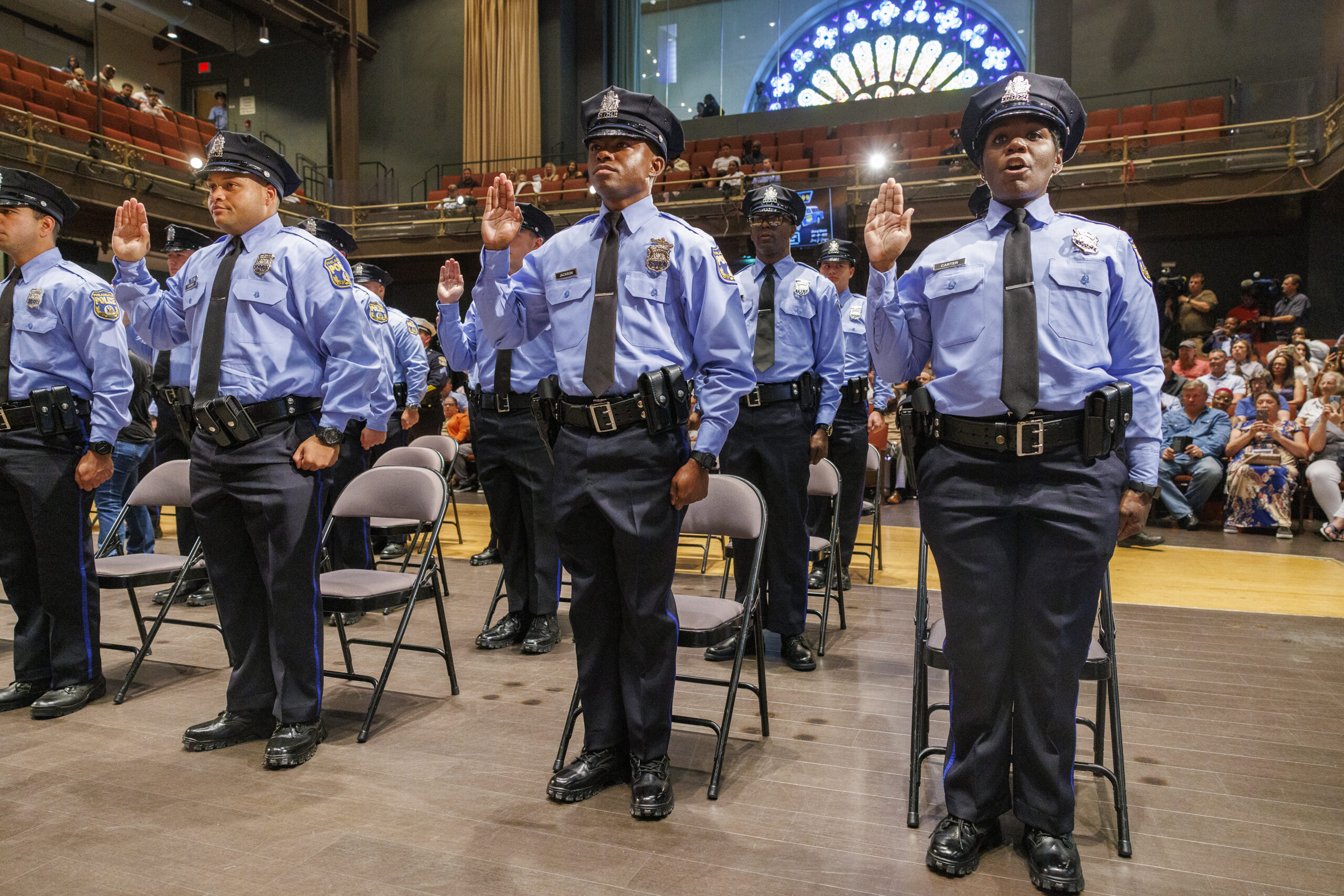
Officers Azieme Lindsey (from left), Charles T. Jackson, and Dalisa M. Carter taking their oaths in 2023.
Citing a police recruit shortage in 2008, former Mayor Michael A. Nutter successfully stripped out the prehiring residency requirement for cadets. Recruits were required only to move into the city once they joined the force.
A year later, the police union attempted to have the residency requirement struck from its contract entirely.
Nutter’s administration objected. But an arbitration panel approved a compromise policy to allow officers to live elsewhere in Pennsylvania after five years on the job. By 2016, firefighters and sheriff’s deputies secured similar concessions.
But experts say there’s little research showing that to be true.
“I am unsure if requiring officers to reside in the city is a requirement supported by evidence,” said Anjelica Hendricks, an assistant law professor at the University of Pennsylvania who worked for the city’s Police Advisory Commission. “Especially if that rule requires a city to sacrifice something else during contract negotiations.”
FOP leaders have long opposed the rule and said it was partly to blame for the department’s unprecedented recruitment crisis and a yearslong short-staffing problem that peaked in the aftermath of the COVID-19 pandemic.
In 2022, facing nearly 1,500 unfilled police jobs, former Mayor Jim Kenney loosened the prehire residency rule for the police department again, allowing the force to take on cadets who lived outside the city, so long as they moved into Philadelphia within a year-and-a-half of being hired.
Since then, recruiting has rebounded somewhat, which police officials attribute to a variety of tactics, including both the eased residency rules and hiring bonuses. The force is still short 20% of its budgeted staffing and operating with 1,200 fewer officers than it did 10 years ago.
Umbach, the John Jay professor, said the impact on recruiting is obvious: Requiring officers to live in a city where the cost of living may be higher than elsewhere amounts to a pay cut, which shrinks candidate pools.
“Whenever you lower the standards or lower the appeal of the job, you’re going to end up with people who cause you problems down the road,” he said. “A pay cut is just that.”
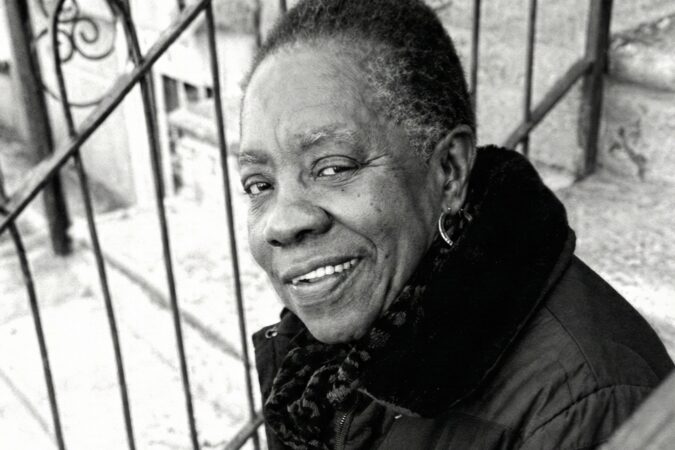
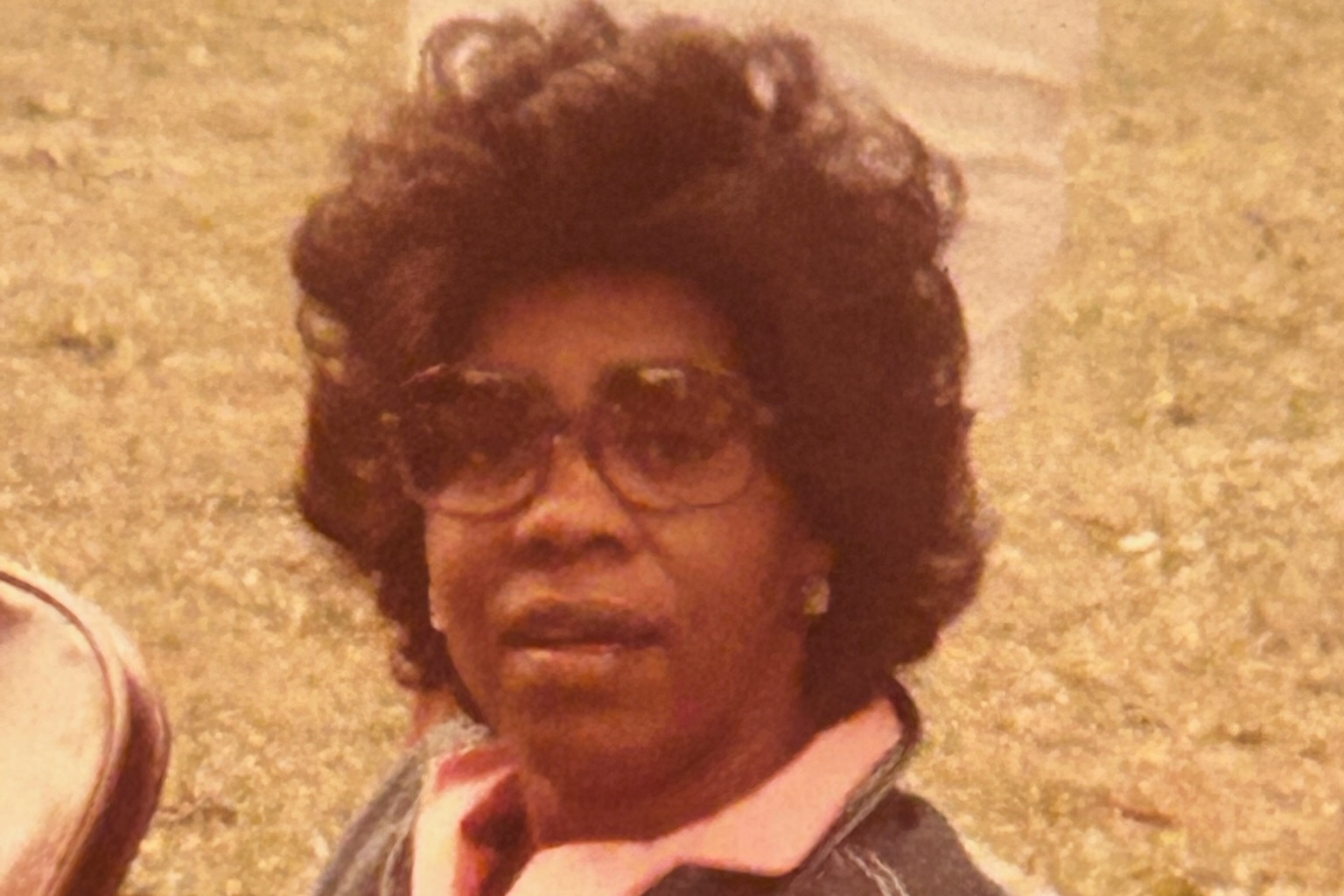
Frances Ola Walker, 86, of Philadelphia, cofounder of Parents Against Drugs and Dunlap Community Citizens Concerned, onetime president of the Mill Creek Coalition and director of the West Philadelphia Empowerment Zone, former aide to U.S. Rep. William H. Gray III, college instructor, mentor, and volunteer, died Tuesday, Dec. 30, of respiratory illness at the Hospital of the University of Pennsylvania-Cedar Avenue.
A lifelong champion of education, civil rights, comprehensive healthcare, environmental responsibility, employment and housing equity, and community partnerships, Ms. Walker spent more than 70 years, from age 13 to 86, protesting injustice, improving life for her neighbors, and caring for historic residential swaths of West Philadelphia.
In the 1960s, she marched with fellow activist Cecil B. Moore and others to protest segregation at Girard College. Most recently, she advocated for alternative SEPTA transit routes to support Black-owned businesses.
“I just stayed involved,” she said in a video interview for the West Philadelphia Landscape Project. “If there was a protest, I was leading it. … I’m glad I made a contribution people can respect.”
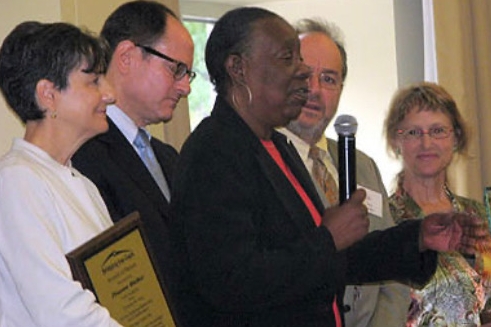
Ms. Walker (center) spoke often at awards ceremonies and civic events.
She cofounded Dunlap Community Citizens Concerned in the early 1980s to address housing and infrastructure concerns, and Parents Against Drugs in the late ‘80s. She led the local Healthy Start federal initiative to reduce infant mortality in the 1990s and served on the advisory board of Bridging the Gaps, a healthcare partnership of academic health institutions and community groups.
She developed programs that connected University of Pennsylvania students and faculty with neighborhood residents through what is now Penn’s Netter Center for Community Partnerships. She acquired federal funds to revitalize communities in the West Philadelphia Empowerment Zone, partnered with Penn to pioneer urban ecology projects, and supervised the West Philadelphia Landscape Project in the Mill Creek neighborhood.
Her family said she was “fearless in her pursuit of justice.”
Anne Whiston Spirn, professor of landscape architecture and planning at the Massachusetts Institute of Technology in Cambridge, invited Ms. Walker to lecture virtually in her ecological urbanism course. “She bridged the worlds of university, politics, and neighborhood, and called the powerful to account,” Spirn said.
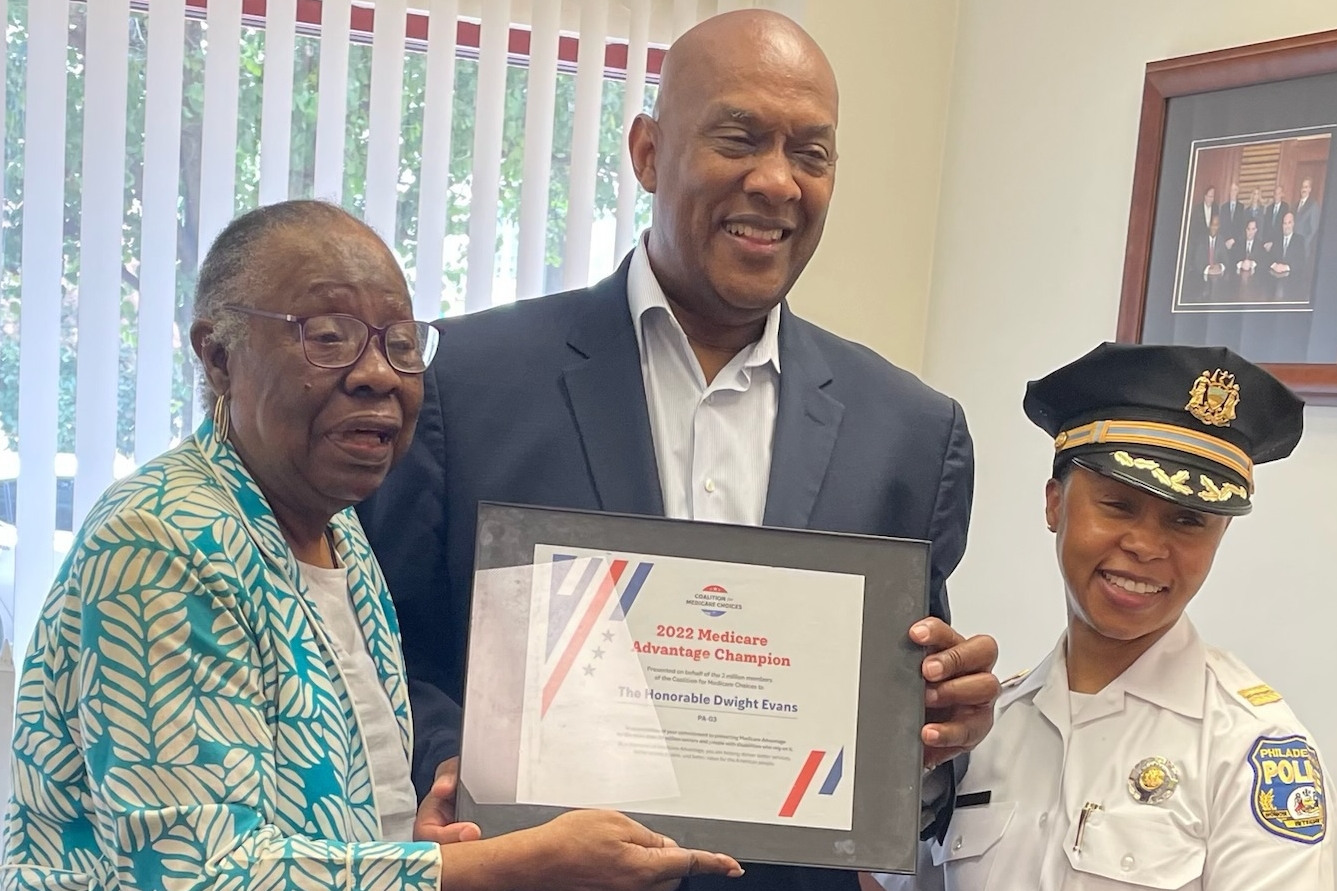
Ms. Walker (left) presents an award to U.S. Rep. Dwight Evans (center) as a Philadelphia police officer looks on.
She served on then-Mayor Ed Rendell’s search committee for a new health commissioner in 1993 and briefly considered her own run for City Council. She worked with then-Vice President Al Gore on his community empowerment programs and managed Gray’s West Philadelphia office for 10 years in the 1980s.
Former U.S. Rep. Chaka Fattah noted her “extraordinary legacy of helping others” and said: “She always chartered her own path and spoke her truth.” Former City Council member at large Blondell Reynolds Brown said: “Her unwavering grassroots work brought care, dignity, and possibility to families facing hardships.”
She studied community engagement in MIT’s Mel King Community Fellows Program in 2000 and 2001, and earned more than 100 awards, citations, and commendations, including from the White House for her leadership in a children’s immunization campaign.
Regarding drugs and crime in West Philadelphia, Ms. Walker said in 1987: “People in this community have to take a stand.”
“My grandmother didn’t leave us directions,” said her grandson, Abdul-Malik Walker, “but she left us a compass. Her voice is in our habits, and her strength is in how we handle the miles ahead.”
Frances Ola Walker was born Jan. 20, 1939, in South Philadelphia. Her father was a preacher, and the family is related to the Rev. Dr. Martin Luther King Jr. So it surprised no one when she began leading academic tutoring for her siblings and teen neighborhood friends on her front stoop.
She was one of 11 children, and her family moved to the Dunlap section of West Philadelphia in 1945. She attended West Philadelphia High School and worked at first as a personal shopper for neighborhood seniors.
She was always interested in civic affairs and social justice, and she became the first Black woman to work at an Acme markets warehouse, her family said, and one of the first female postal carriers.
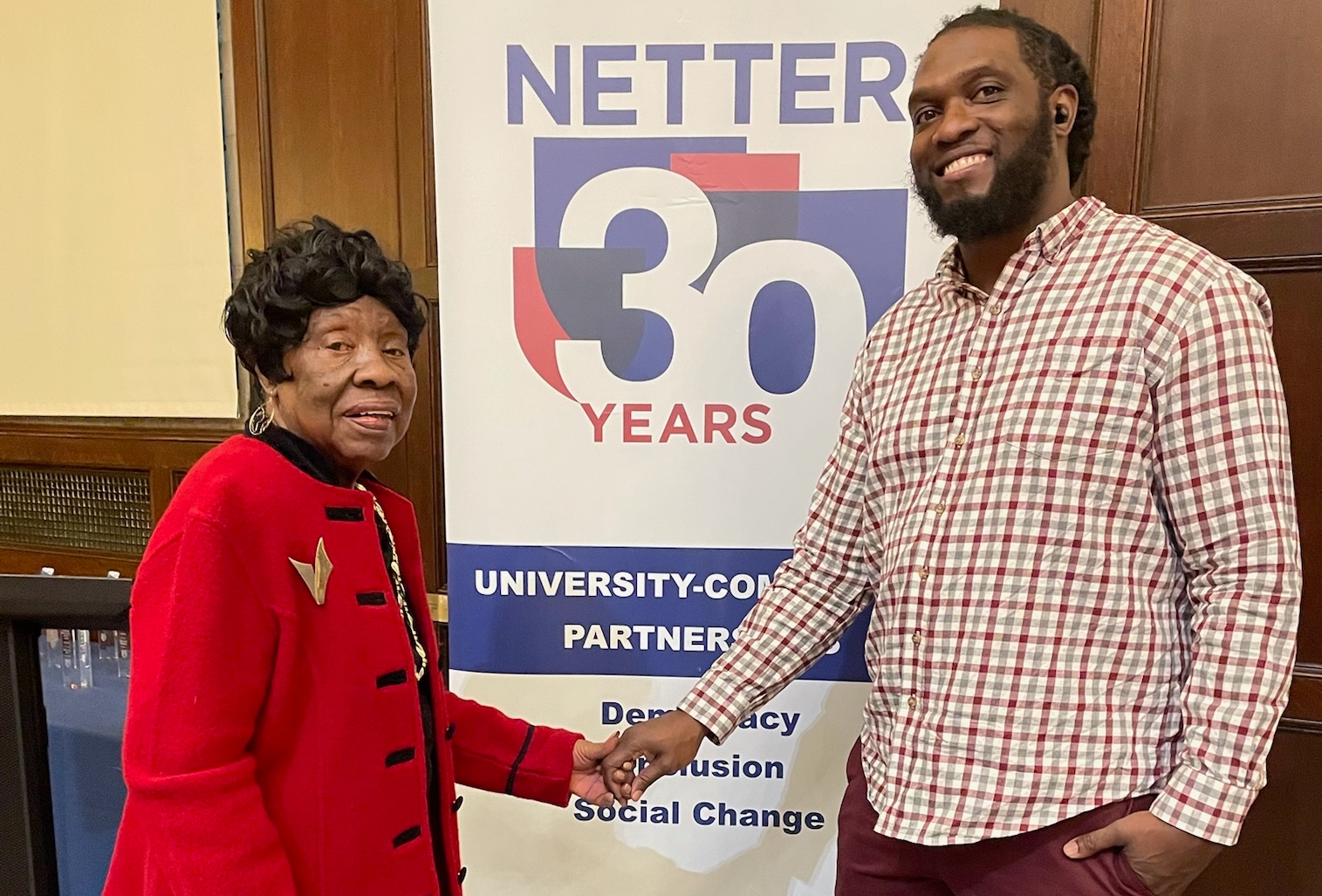
Ms. Walker stands with her grandson Abdul-Malik Walker.
She had sons Gregory and James, and daughters Michelle, Roslyn, Wala, and Patricia. She married John Ponnie. Her husband, sons Gregory and James, and daughters Michelle and Patricia died earlier.
Ms. Walker enjoyed traveling and playing cards with her family. She knew the detailed history of Dunlap and Mill Creek, and delighted in sharing it with others she encountered on her frequent walks.
“She was an encourager to people of all ages,” said her niece Sibrena Stowe. “She was truly a force to be reckoned with.”
Ms. Walker told her family: “It is through love that all things are possible. For me, it is when people call on you that lets you know you make a difference.”
Ms. Walker appeared in this documentary video for the West Philadelphia Landscape Project.
In addition to her daughters, niece, and grandson, Ms. Walker is survived by 16 other grandchildren, nine great-grandchildren, two sisters, and other relatives. Six sisters and two brothers died earlier.
Visitation with the family is to be from 9 to 10 a.m. Friday, Jan. 9, at Ezekiel Baptist Church, 5701 Grays Ave., Philadelphia, Pa. 19143. A service is to follow, and a repast at 2 p.m. Livestream is at repastai.com/frances.
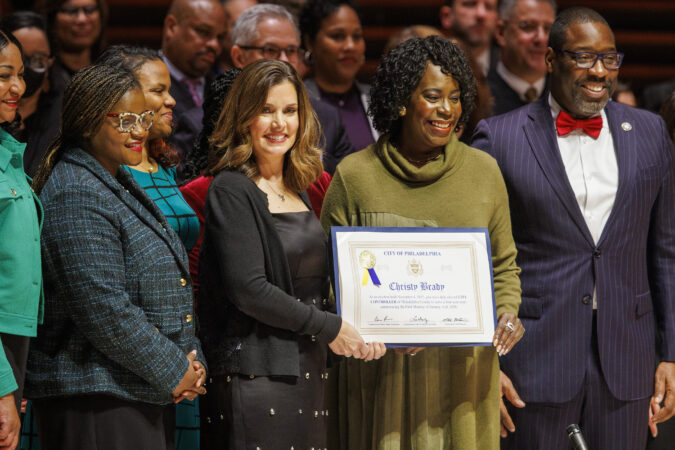
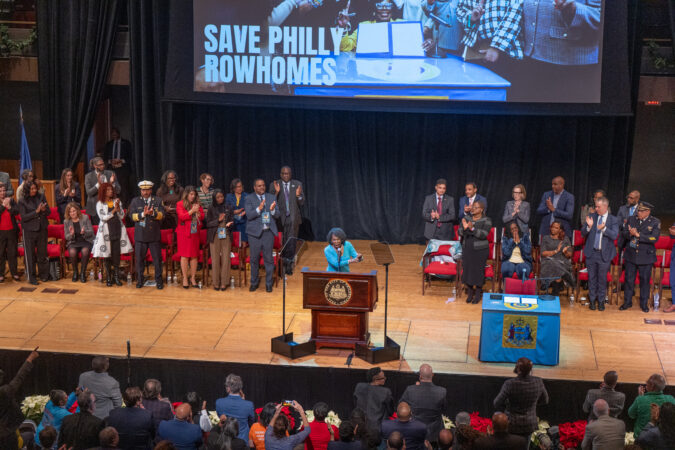
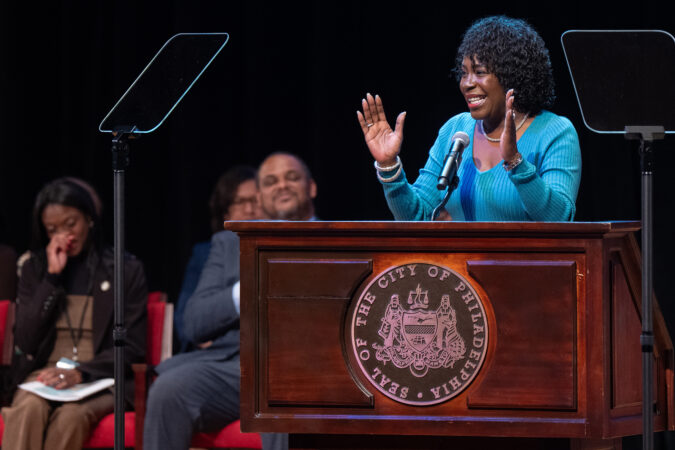
After being sworn in to her first full four-year term, City Controller Christy Brady on Monday vowed to examine spending related to Mayor Cherelle L. Parker’s signature housing program and to probe whether Philadelphia is maximizing economic opportunities at its waterfront and port.
“In my next term, I will be expanding my oversight of the mayor’s housing program to ensure every dollar borrowed is used as intended and is properly accounted for,” Brady said of Parker’s Housing Opportunities Made Easy, or H.O.M.E., initiative during a swearing-in ceremony at the Kimmel Center for the Performing Arts.
“And with our waterfront and ports being one of our strongest economic assets, we will be focusing on efforts to ensure they can deliver the greatest financial impact,” Brady said.
Holt denies that it has engaged in anticompetitive conduct, and a company spokesperson said growth is “vitally important to the future of our business and our region.”
“Holt Logistics has been a key driver of the Port’s growth over the last decade, as witnessed by the fact that in the last month alone, two new lines of business have chosen to call Philadelphia, largely because of the service they receive,” spokesperson Kevin Feeley said.
Additionally, Brady promised to help prevent fraud in city spending related to this year’s Semiquincentennial festivities.(Parker has pledged to dole out $100 million, focusing on neighborhood-based programming across the city, for major events in 2026, including the nation’s 250th birthday.)
And in her capacity as chair of the Philadelphia Gas Commission, Brady said she would “conduct a thorough review of PGW’s operations.”
Brady also sits on the city Board of Pensions and Retirement and said she would “collaborate with [City] Council to adjust benefit structures.”
The controller’s office audits city agencies and investigates allegations of fraud, waste, and abuse.
Brady was appointed by former Mayor Jim Kenney to serve as acting controller in late 2022 when Rebecca Rhynhart resigned to run for mayor. Brady in 2023 won a special election to serve the remaining two years of Rhynhart’s term.
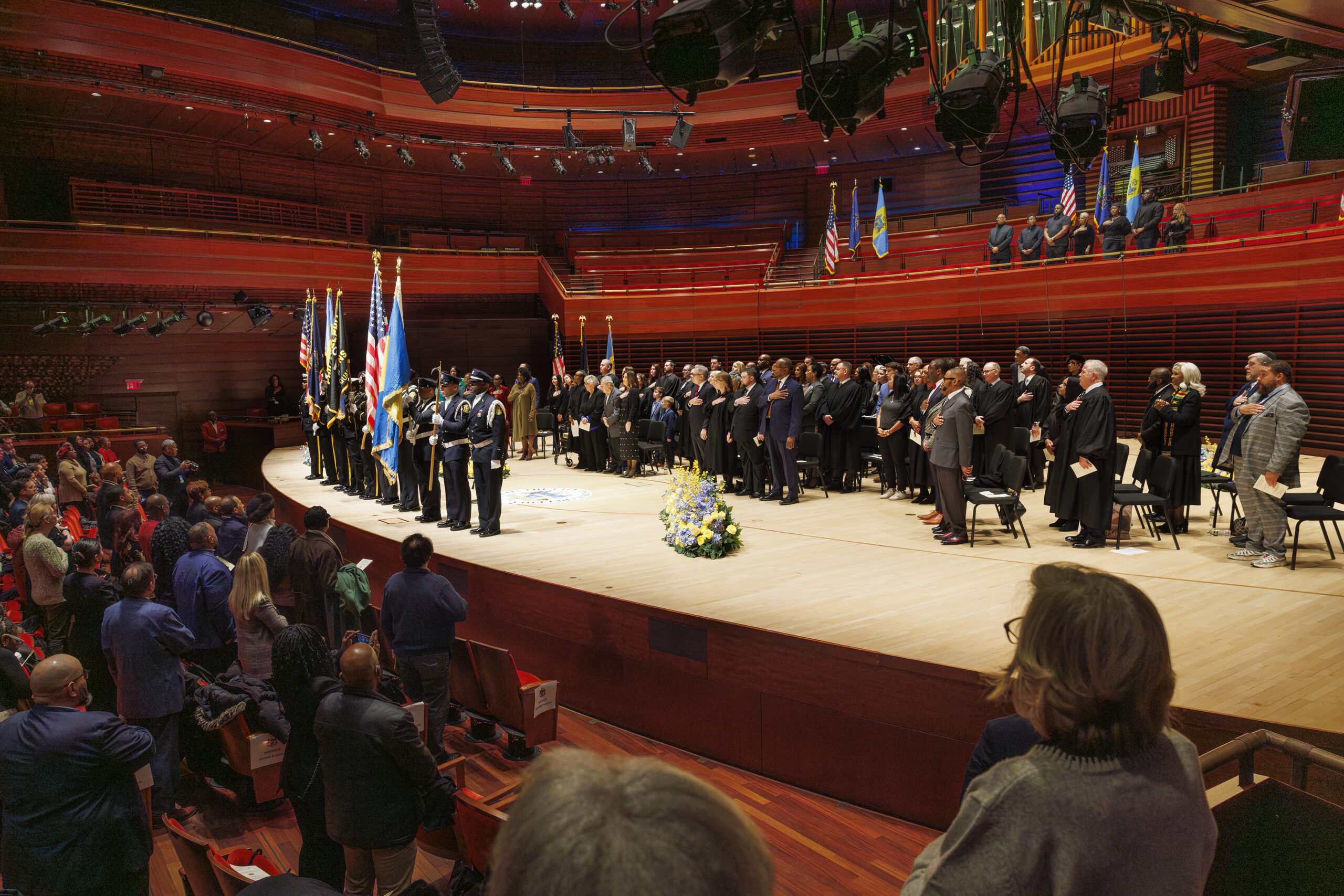
Seeking her first four-year term, Brady ran unopposed in the May 2024 Democratic primary and easily defeated Republican Ari Patrinos in the November general election.She was sworn in Monday with District Attorney Larry Krasner, who is beginning his third term, and city judges who were on the ballot last year.
Philadelphia Common Pleas Court Judge Natasha Taylor-Smith introduced Brady and administered her oath of office.
Many past controllers have had less-than-friendly relationships with the mayors they served alongside, a natural dynamic for an office tasked with investigating the executive branch. The post has also served as a springboard for many politicians with higher aspirations.
Rhynhart, for instance, repeatedly clashed with Kenney by publishing critical reports on city accounting practices and a lack of accountability in spending on anti-violence groups. She touted those probes to brand herself as a reformer while running in the 2023 mayor‘s race, finishing second behind Parker in the Democratic primary.
Brady’s background and leadership style are different. She has spent three decades rising through the ranks in the controller’s office and was deputy controller in charge of the audit division before being appointed to the top job. And since becoming controller, she has made a point of working collaboratively with Parker’s administration.
Dignitaries and elected officers before start of 2026 Inaugural Ceremony at the Kimmel Center Performing Arts on Monday.
“As promised, I hit the ground running. We’ve achieved far more than many thought was possible,” Brady said. “A key to that success has been collaboration with Mayor Parker and Council President [Kenyatta] Johnson to ensure that our recommendations resulting from the findings in each report, review, and audit that we issue are implemented.”
Parker acknowledged their collaboration in her remarks during Monday’s ceremony.
“Controller Brady, thank you for not being wrapped up in politics and staying focused on the work of the controller’s office,” Parker said. “You do it by communicating with our office. No ‘gotcha’ moments.”
In her relatively short political career, Brady has received strong support from influential groups in local politics, especially the building trades unions and the Democratic City Committee. On Monday, she gave shout-outs to numerous politicos, including former U.S. Rep. Bob Brady, who chairs the city’s Democratic Party and is not related to her.
“I want to thank the people who have made this possible, including my friends in labor, Congressman Bob Brady, my friends in the Democratic Party, the business community, and all the voters who put their trust in me,” Christy Brady said.
When Larry Krasner was sworn in to his second term as district attorney four years ago, Philadelphia was in a public safety crisis: Murders and shootings were at an all-time high and the homicide clearance rate was at a historic low.
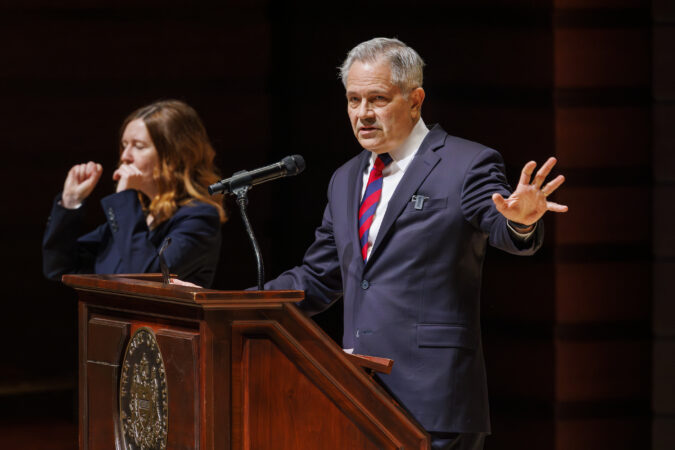
Krasner, 64, took the oath of office alongside his wife, former Common Pleas Court Judge Lisa M. Rau, and one of his two sons inside the grand auditorium of the Kimmel Center for the Performing Arts.
Krasner cruised to reelection in November after handily defeating former Municipal Court Judge Patrick F. Dugan with about 75% of the vote. Krasner’s campaign often focused more on attacking President Donald Trump than specifying what, if anything, he might do differently with another four years.
He struck similar tones on Monday.
Across a nearly 20-minute speech, Krasner did not lay out a coming agenda, saying that was “not for today,” but instead recounted what he said were his accomplishments over the last eight years: building what he said was a more morally intact staff, investing in forensic advancements to help take down violent gangs, and providing grants to community organizations.
“It will be headed towards more safety. It will be headed towards more freedom,” he said of his office in the next four years.
And he took a few shots at Trump.
“Sometimes people ask me, ‘Why are you talking about Trump so much? Why do you keep bringing up Trump?’” he said.
While City Council members and state lawmakers have “tremendous power,” he said, “they don’t have the obligation, as I just swore in front of you, to uphold the Constitution and the laws of the United States from someone … whose intent is, without question, the overthrow of democracy in the United States of America.”
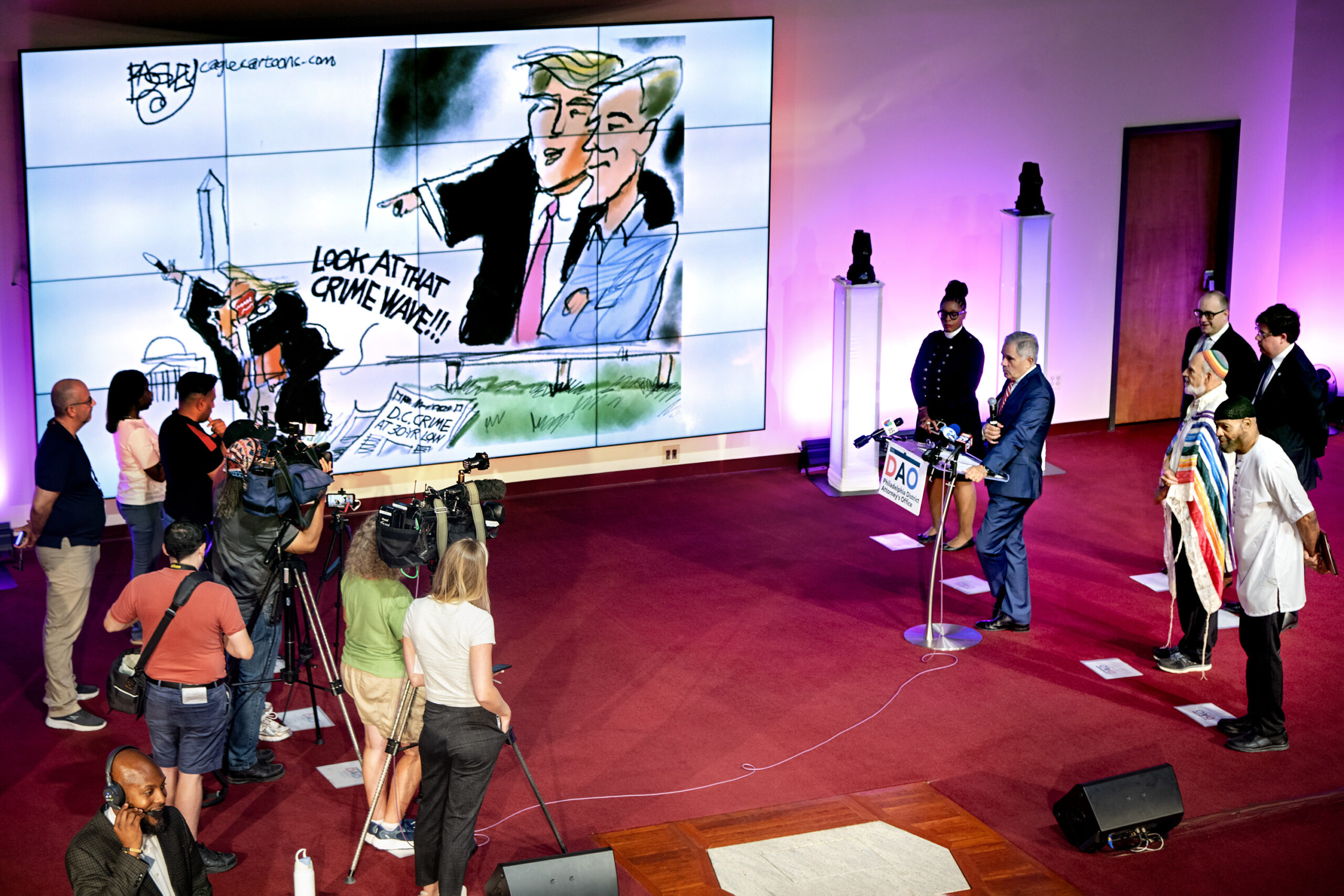
District Attorney Larry Krasner displays a political cartoon by Pat Bagley during a news conference in August 2025 to lament President Trump’s deployment of the National Guard to D.C. streets. Bagley is staff cartoonist for the Salt Lake Tribune in Salt Lake City, Utah.
He also noted that Trump has not deployed the National Guard to Philadelphia, as the president has done in other Democratic cities like Chicago, San Francisco, and Los Angeles, and seemed to acknowledge Cherelle L. Parker’s hotly debated strategy of avoiding confrontation with Trump.
“If that has any part in the reality that we have not seen Trump’s troops, Trump’s tanks in the City of Philadelphia — I don’t know if it does or not, but if it has anything to do with that, then I’m glad, and I intend to work closely, always, with other elected officials.”
Parker, who earlier congratulated Krasner in her introductory remarks, stared ahead stoically during his comments about Trump.
Krasner ended by promising to continue making Philadelphia safer, and then returned to one of his favorite themes.
“We all got to this point of achievement together, and this is no time to retreat. It is no time to surrender. It is time to push on so that Philadelphia goes from being known as chronically violent to being known as consistently safe for decades to come,” he said.
“And if anybody — including the guy in D.C. — doesn’t want that, if they want to F around, then they’re gonna find out.”
Venezuelans in the Philadelphia region had mixed reactions to the U.S. strike against their home country over the weekend, which removed Nicolás Maduro from power and left the future of the South American country unclear.
But some Ukrainian Americans in the region felt an uneasy sense of déjà vu as they watched events in Venezuela unfold — and are concerned about what it could mean for relatives and compatriots 6,000 miles away from Caracas, in Ukraine.
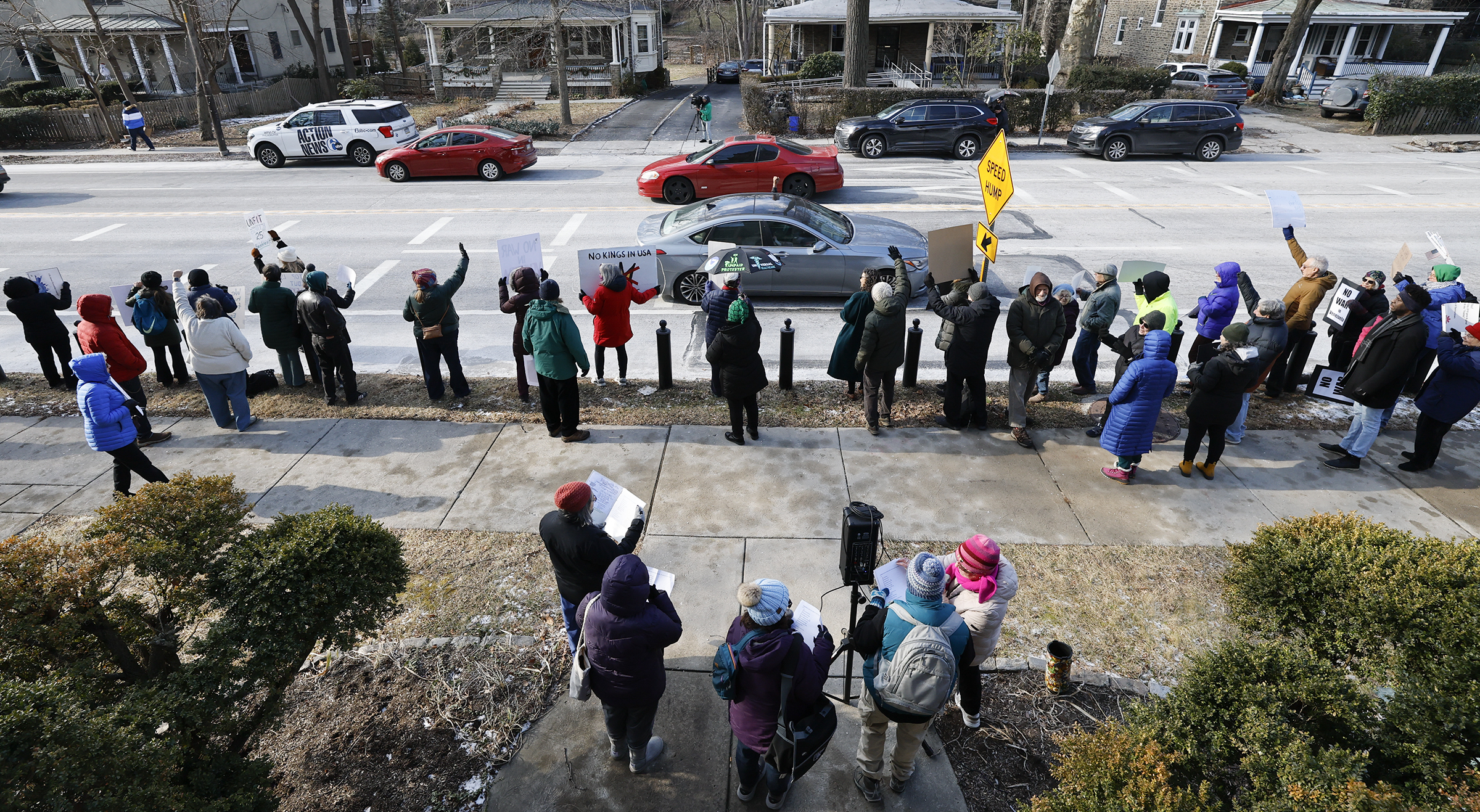
“This action, which is an illegal action, gives the light to people like [Russian President Vladimir Putin] and other dictators to do whatever they like,” Ukrainian American activist Mary Kalyna said Sunday amid a 60-person anti-war rally outside the Unitarian Society of Germantown in West Mount Airy. “Why should he not invade Ukraine or Poland or Lithuania, when the U.S. is invading Venezuela?”
The Trump administration’s unilateral action sends a message to other countries, like Russia, that the United States may no oppose a larger nation meddling in a smaller country’s political affairs, said Paula Holoviak, a political science professor at Kutztown University, in an interview.
“It just doesn’t set a good precedent,” said Holoviak, who is a Ukrainian American.
‘We have been waiting for this for 26 years’
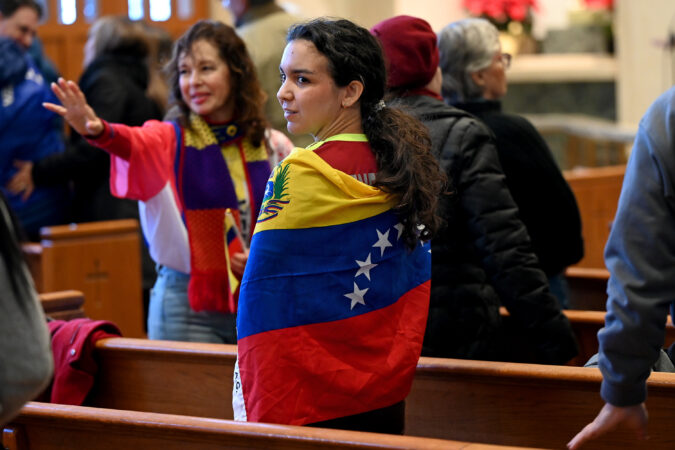
Venezuelan flag in hand, Diana Corao Uribe, 53, and her family drove from Media to the Cathedral Basilica of SS. Peter and Paul to attend a Sunday vigil for the future of Venezuela, organized by local groups Casa de Venezuela Philadelphia, Casa de Venezuela Delaware, and Gente de Venezuela Philadelphia.
Hundreds of people hugged, cried, and prayed as they waited inside with flags and apparel, brightening the basilica with yellow, red, and blue. Members of the crowd were largely critical of the rule of Maduro and his predecessor, Hugo Chávez.
“We have been waiting for this for 26 years; you cannot imagine the feeling, the joy, the happiness, the hope that we feel right now,” Corao Uribe said.
But Corao Uribe said that as the hours passed, her feelings have grown more complicated. Until President Donald Trump announced the U.S.’s intentions to “run” Venezuela until a “safe, proper and judicious transition” could be completed, Corao Uribe had hoped Edmundo González Urrutia, who faced Maduro at the polls in the 2024 Venezuelan presidential election, would become the next president.
The announcement was unexpected and a bit concerning, she said, but it wasn’t enough to shake her sense of happiness.
Philadelphia resident Astrid Da Silva, 32, said it felt bittersweet.
“The amount of joy that seeing the dictator out of Venezuela brings — it’s immeasurable; it’s normal when there has been torture and pain for so long,” Da Silva said. “But without a democratic transition of power, fear starts slipping in.”
Hearing Trump say that opposition leader Maria Corina Machado lacked support in Venezuela clouded her feelings.
“People don’t want the U.S. there; we want the opposition or at least a free election,” Da Silva said, adding that the country’s political turmoil forced her to emigrate to the U.S. at age 7.
Ongoing power struggles have at times made her feel like people view Venezuela as a pawn, forgetting there are real lives at stake, she said.
‘It could be very destabilizing’
The U.S. has a long history of intervening in other countries, Holoviak noted, but that hasn’t always gone well. “We do have an extremely powerful military, but we might not want the aftermath of this,” Holoviak said. “It could be very destabilizing.”
Residents of Northwest Philadelphia voice their opposition to the Trump administration’s strike against Venezuela in a vigil outside the Unitarian Society of Germantown on Sunday, Jan. 4, 2026.
Ukrainian leaders have largely welcomed the liberation of Venezuelans from Russian-allied Maduro’s regime. Speaking with reporters in Kyiv, President Volodymyr Zelensky said, “Well, what can I say? If dictators can be dealt with in this way, then the United States of America knows what it should do next.”
Eugene Luciw, a Ukrainian American who lives in Montgomery County, said in an interview that he interpreted Zelensky’s comments to mean that he believes the U.S. should arrest Putin — and Luciw agrees.
Luciw said that he has no problem with Trump removing Maduro, whom he called “a dictator who slaughters people.”
However, Luciw questioned Trump’s motives and said his actions were inconsistent.
“If we want to do away with a real dictator, with absolute evidence that he’s a genocidal maniac,” then the U.S. should be tougher on Putin, he said.
At the Cathedral Basilica, Fernando Torres, 45, said he has struggled with what the future may hold for Venezuela after Trump’s actions.
“Even if we don’t like Trump, we have to separate things. It’s like if you were drowning and someone threw you a life buoy,” Torres said. “You don’t care who threw it or what their intentions were; you just care about saving your life. What people don’t understand is that Venezuelans needed their life buoy and now for the first time we have hope.”
As political decision-making continues to unfold, Corao Uribe, Da Silva, and Torres agree on one thing: the importance of listening to what Venezuelans want for their future.
“Venezuelans have suffered for so long, don’t try to understand our pain; this isn’t about politics, it’s about the suffering of the Venezuelan people,” Corao Uribe said.
This article contains information from the Associated Press.
And this year, Parker let go of three top city officials amid ordeals fraught with internal drama for the administration.
Despite those tribulations, the big-picture news for the city has been positive, and the mayor can credibly say she has made progress on her oft-repeated campaign slogan of making Philadelphia “the safest, cleanest, greenest big city in the nation with access to economic opportunity for all.”
"We are doing the best we can with what we have," Parker said in an interview Friday. “Nobody’s resting. We’re not having a party and celebrating because we know we have a lot more work to do.”
story continues after advertisement
The year encapsulated Philadelphia’s reality under Parker’s administration: big wins on major goals despite signs of tension in City Hall.
“She’s getting some pushback, but statistically, in terms of the crime rate, the city is doing better,” said David Dunphy, a Pennsylvania Democratic political consultant and lobbyist. “In terms of the biggest issues that voters had in the last election, it’s inarguable there’s been vast improvement.”
“There’s a general sense Philadelphia is coming back and making a rebound [following the pandemic], and she gets a lot of good will from the sense she enjoys being mayor,” Dunphy said.
Here are six takeaways from Parker’s second year in office.
story continues after advertisement
Big wins, with caveats
Parker made public safety the central themeof her 2023 mayoral campaign. And two years in, the news could hardly be better.
The Police Department as of last week had recorded 212 homicides in 2025, and is on pace to close the year with the lowest level since 1966.
But it’s not just the reduction in violence.
Philadelphia’s poverty rate has dipped below 20%, and it no longer has the highest rate among the 10 largest U.S. cities. The city’s finances are in the best shape they have been in since the early 1990s fiscal crisis. Perhaps most shockingly, there even appears to be progress in Kensington, where Parker has pledged to end the neighborhood’s notorious open-air drug market.
Onedrug dealer told The Inquirer the city’s crackdown has cut his weekly revenue from about $1,500 to $400. And the city isexpanding its Riverview Wellness Village, a first-of-its-kind initiative from Parker’s administration to house and provide treatment for people in recovery.
There are plenty of caveats to all of those headline accomplishments. The decline in homicides began shortly before Parker took office. Philadelphia still has the lowest median income of the 10 biggest cities in the country. The city’s finances, buoyed by a growing economy, have been growing more stable for decades. And the Kensington drug market isn’t disappearing anytime soon.
Workers from Philadelphia’s Community Life Improvement Program clean the intersection of Kensington Avenue and Somerset Street on Jan. 22, 2025.Jessica Griffin / Staff Photographer
But mayors are judged by how the city changes during their tenures. And so far, Parker is likely pleased with her progress on the most important measuring sticks.
“She communicated during the campaign and throughout the beginning of her term a set of priorities that everybody can repeat: the safe, clean, green, inclusive growth or opportunity for all,” said Pedro A. Ramos, a former city managing director who now leads the Philadelphia Foundation, a major philanthropy. “Two years in, I think any fair scorecard has got to give her pretty good grades.”
Tom Gralish / Staff Photographer
Strike highlighted Parker’s strengths and weaknesses
During the first major city worker strike in 40 years, the mayor stoodatop the Philadelphia Art Museum steps in sweltering heat as what were unofficially dubbed “Parker piles” of uncollected trash mounted around the city.
“I will not put the fiscal stability of the city of Philadelphia in jeopardy for no one,” Parker said, explaining her refusal to meet demands for bigger wage increases for the union representing trash collectors, 911 dispatchers, water treatment plant employees, and other blue-collar workers. “If that means I’m a one-term mayor, then so be it.”
Philadelphia Mayor Cherelle L. Parker discusses the AFSCME DC 33 municipal workers strike at a news conference at the Philadelphia Art Museum on Thursday, July 3, 2025.Kaiden J. Yu / Staff Photographer
But the strike was also the most divisive moment in Parker’s tenure, fuelingtensions within organized labor and leading to accusations that Parker didn’t care about the workers’ plight.
Teamsters Local 107 president Bill Hamilton said the mayor encouraged workers to cross picket lines and “should be ashamed of her actions and her words during this strike.”
“She doesn’t have any friends on my side of labor, I can tell you that,” he said.
Parker said that being at odds with labor was “abnormal” for her and that she was disappointed the strike led some people to believe she was not a strong supporter of organized labor.
”Was I disappointed? Yes, because it wasn’t reflective of my career and everything I had done," Parker said in the interview. “But I also respect the union.”
Alejandro A. Alvarez / Staff Photographer
Parker’s don’t-poke-the-bear strategy with Trump
In August, the U.S. Department of Justice sent so-called sanctuary cities a letter threatening to cut off federal funding if they did not get in line with the Trump administration’s immigration policies.
Like many other Democratic leaders, Boston Mayor Michelle Wu excoriated the Trump administration andpublished a scathing response to the DOJ.
But Parker said nothing. Her administration refused to release Philadelphia’s response to the DOJ letter and is still fighting an Inquirer request for the document under Pennsylvania’s Right to Know Law.
Since President Donald Trump took office in January, Parker has rarely if ever uttered the president’s name in public. Supporters sayher don’t-poke-the-bear approach has saved Philadelphia from Trump’s wrath and kept National Guard troops out of the city while theywere deployed to other major U.S. cities. Critics say it shows an unwillingness to stand tall during a dangerous moment in American history.
Read More
Mayor Parker’s restraint with Trump is both calculation and gamble as the president escalates against blue cities
Mayor Cherelle L. Parker has avoided overtly criticizing Trump, even as the president has sought to deploy troops to other American cities against the will of their Democratic mayors.
“We are living in actual fascism,” said City Councilmember Nicolas O’Rourke, of the progressiveWorking Families Party. “It’s clear the mayor is being calculating. That is not the tactic I would take. I think we need to be more pronounced.”
Parker said her goal was to focus on delivering on her campaign promises without letting politics get in the way.
“If there were ever a time that the citizens of Philadelphia needed a mayor to stay laser-focused on doing everything we can with the scarce resources that we have … that time is now,” Parker said. “Some people won’t like it. That’s very unfortunate, but I have to lead in a way that’s authentic to me.”
Kaiden J. Yu / Staff Photographer
A remarkable level of control over Philly’s political arena
In one meeting in June, Council approved the initial legislation for the H.O.M.E. initiative, a $6.8 billion city budget, and a 13-year plan to gradually cut the business tax — all while makingminimal changes to Parker’s proposals.
For a moment, it appeared Council President Kenyatta Johnson had gotten rolled by Parker. But Johnson, standing next to Parker at a celebratory news conference, revealed they had been working together all along, even before Parker unveiled her budget and tax plans three months earlier.
“Folks want to see us fight,” Johnson said. “A while ago … we had the John Street-Ed Rendell partnership when the city thrived. We haven’t seen it since then, quite frankly.”
City Council President Kenyatta Johnson and Mayor Cherelle L. Parker at City Hall on Thursday, Dec. 19, 2024.Tom Gralish / Staff Photographer
It’s difficult to overstate the significance of the comparison. In the 1990s, Mayor Ed Rendell and Council President John F. Street formed an unlikely partnership that was credited with saving the city from the brink of bankruptcy. No mayor and Council presidenthave worked together as closely since.
The moment highlighted how Parker has amassed a remarkable level of control over institutions in Philadelphia government and politics that have tripped up past mayors’ agendas.
In City Hall, Parker’s alliance with Johnson has seen her agenda largely sail through the legislature. City Controller Christy Brady, whose office has historically been a thorn in the sides of mayors, ran for reelection this year on a platform of working with, and not against, the Parker administration.
And the unions for city workers,which have inflicted lasting wounds on past mayors including Rendell and Michael A. Nutter, are all locked in multi-year contracts after Parker’s successful stand against DC 33’s strike.
Politically, the centrist Democratic mayor has a seemingly unbreakable bond with some of the most influential labor organizations in the city — the Philadelphia Building and Construction Trades Council, the Carpenters union, and the Service Employees International Union Local 32BJ — and she is usually in lockstep with Democratic City Committee Chair Bob Brady.
Additionally, potential threats from both the right and the left have not materialized, with the Philly GOP in the political wilderness and the local progressive movement appearing to have lost some momentum.
Parker said the support she has built in Philadelphia politics is not a strategy but the product of her career in public service, which began when she was a teenager interning for former Councilmember Marian Tasco.
“These are organic relationships. These are not like forced marriages,” Parker said. “I’ve been working with all of these people my whole life.”
Council took its most notable stand against Parker during a fight this fall over legislation related to the H.O.M.E. initiative.Johnson sided with lawmakers who wanted to prioritize funding for housing programs for the city’s lowest-income Philadelphians, defying Parker’s plan to spread the benefits more evenly across low- and middle-income households.
But Council still supports the major tenets of H.O.M.E., and Johnson made clear earlier this month the episodedid not damage his alliance with Parker. He even made an unsolicited early endorsement for her 2027 reelection campaign.
“I’m pretty confident that our mayor will be reelected — that’s my personal opinion — and will have my support to get reelected,“ said Johnson, the only senior Democratic member of Council who did not endorse Parker in the 2023 mayor’s race.
Despite facing little political opposition, Parker clearly still sees enemies in many corners.
The mayor bristles at dissent even when she wins, and has recently has been handing out to journalists, administration officials, and others copies of a 98-page book titled Performative Outrage: How Manufactured Fury Undermines Local Government and Public Service.
“It is truly our blueprint,” chief of staff Tiffany W. Thurman said. “It reminds us that noise isn’t the same as progress. … We don’t chase the outrage of the moment. We chase the outcomes of a lifetime.”
The city in August spent $423.80 to order copies for every cabinet member, according to records for the mayor’s office credit card.
Parker signed a copy of the book, which was given to a reporter, writing: “Great read!”
Tom Gralish / Staff Photographer
Signs of discord within the administration
Parker freely admits she is a tough boss. And the strains of working under her demanding leadership style started to show in her second year.
But Anderson, the former DEI director, pushed back on that account, and asserted that DeSantis’ investigation was a pretext for Parker to fire her because she had pushed for the administration to take a more aggressive stance against Trump’s DEI crackdown. Her comments took on new salience whenThe Inquirer revealed this fall that Parker had quietly ended the city’s longstanding policy of prioritizing city contracts for businesses owned by women, people of color, or disabled people due to legal threats from conservative groups.
Parker said personnel issues come with the territory of running a city.
“Things happen. You can’t have a government with 29,000 employees where stuff doesn’t just happen,” she said. “For me, it’s how does my administration navigate those challenges? … Do we get paralyzed into inaction? And the answer is no.”
Ramos added that Parker will be judged by outcomes, not internal disputes.
“At the end of the day, people only care about palace intrigue if they don’t see results,” Ramons said.
Tom Gralish / Staff Photographer
A ‘big mahoff’ emerges
When she became mayor, Parker said she didn’t want one top aide to be the “big mahoff” in her administration. Instead she appointed a “big three” — a trio of senior advisers.
Two years later, it looks like Parker ended up with a “big mahoff” after all.
Thurman, the chief of staff, appears to have become the central figure in the administration, and her portfolio of responsibilities has continually grown over the last two years.
The shift started in 2024, when Thurman took over the 76ers arena negotiations from then-Chief Deputy Mayor Aren Platt. And when Platt resigned in October of that year, Thurman took over the oversight of all the city’s planning and development projects. This year, her portfolio has grown to include the Neighborhood Community Action Centers, a Parker initiative to establish 10 “mini-City Halls” throughout the city, where residents can request services like graffiti removal and traffic-calming measures.
Chief of staff Tiffany W. Thurman takes questions from City Council on Nov. 12, 2024.Alejandro A. Alvarez / Staff Photographer
Parker objected to the notion that her “big three” structure had gone by the wayside and emphasized that the two chief deputy mayors who make up the rest of the triumvirate continue to have “a hell of a lot” in their portfolios. Sinceré Harris, who was Parker’s 2023 campaign manager, oversees labor, legislative affairs, and intergovernmental relations. Vanessa Garrett-Harley leads on child welfare, early education, DEI, and other issues.
Thurman could instead be seen as a first among equals, given that Harris and Garrett-Harley still report directly to the mayor.
But at Friday’s event, Thurman introduced Parker with a flattering speech, and the mayor in turn made clear that Thurman has a central role in her administration.
“Tiffany Thurman is not just my chief of staff. She is the chief air traffic controller” of the administration, Parker said Friday. “Nothing moves in this city without her. I don’t make a decision without her.”
Tom Gralish / Staff Photographer
Staff Contributors
Reporting: Sean Collins Walsh, Anna Orso, Jake Blumgart, Ellie Rushing, and Ryan Briggs
Editing: Oona Goodin-Smith, Ariella Cohen, and Addam Schwartz
Digital Editing: Patricia Madej
Subscribe to The Philadelphia Inquirer
Our reporting is directly supported by reader subscriptions. If you want more journalism like this story, please subscribe today
Mayor Cherelle L. Parker marked the halfway point of her term as mayor Friday by portraying the city as safer and more stable than when she took office two years ago, pointing to metrics like the plummeting homicide rate and cleaner streets.
During her second end-of-year State of the City speech, Parker also briefly acknowledged challenges she faced this past year, including the eight-day city worker strike and a spat with City Council over her signature housing plan.
And she outlined a plan to address rising street homelessness heading into 2026, when the city will host several major events expected to draw more than a million visitors.
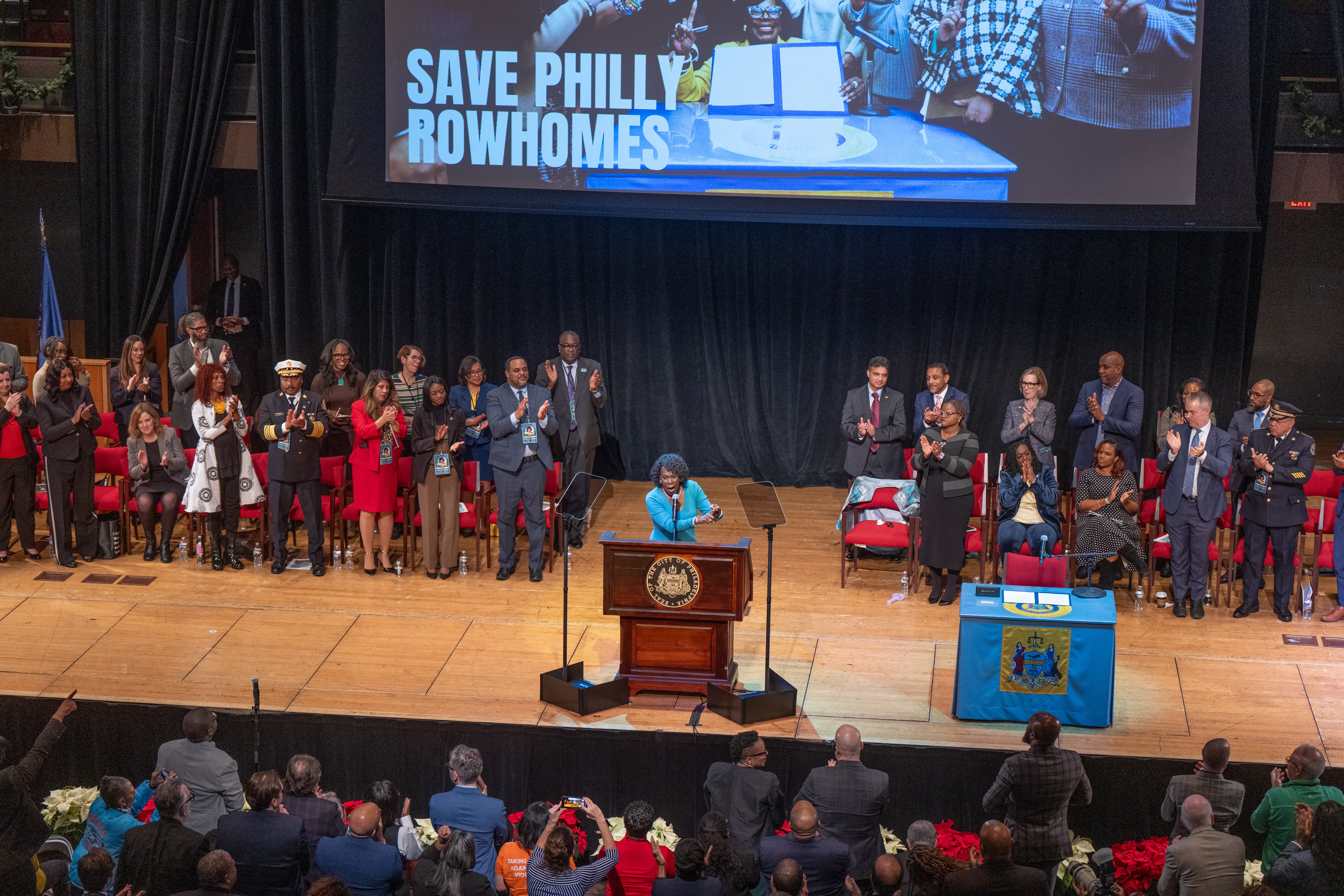
Parker outlined a plan to address rising street homelessness heading into 2026, when the city will host several major events expected to draw millions of visitors, during her end-of-year speech at Temple University Friday.
“I am here today to proudly report to all of you,” she said, “that the state of our city is strong and good, and we are moving in the right direction.”
Parker’s announcement to add 1,000 shelter slots to the city’s system was a stark reminder that — despite progress on public safety and a coming year ripe with opportunity for tourism and growth — some of the city’s longest-term challenges remain unresolved.
And after the mayor this year unveiled a long-awaited plan to build thousands of units of housing in the city, she hit roadblocks in City Council, where members rejected her vision to bolster the middle class in favor of a plan that prioritizes the poorest Philadelphians.
Still, Parker and members of her administration struck an optimistic tone Friday. During the highly produced event, top officials repeatedly proclaimed that the “state of the city” is strong, and they thanked municipal employees in attendance, like police officers and sanitation workers.
Parker’s State of the City address last year was Philadelphia’s first. Traditionally, the mayor’s March budget address to Council was seen as the city’s version of the presidential State of the Union speech in Congress. Parker plans to make the December event an annual tradition as well.
Here are three takeaways from Parker’s speech Friday in North Philadelphia:
A homelessness plan is in the works for 2026
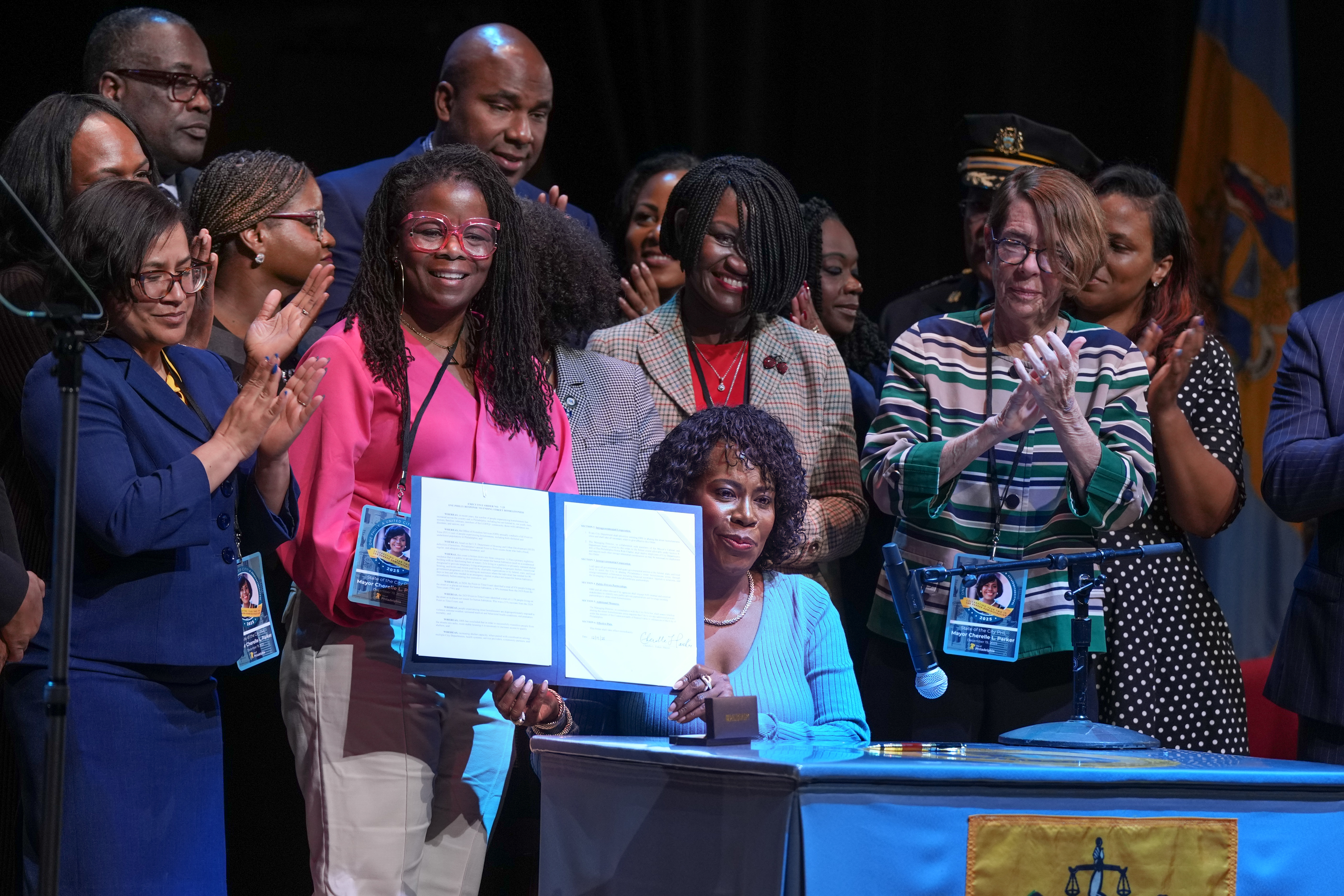
In the middle of her speech, Parker signed an executive order on stage, directing city departments to add 1,000 new beds to the existing shelter system by Jan. 31. That would represent a 35% increase in the number of beds citywide.
The move comes as city data shows homelessness in the city is rising. There were 1,178 unsheltered people in Philadelphia this year, a 20% increase over last year and the highest number recorded since at least 2018, according to city data.
In total, 5,516 people were considered homeless, a number that includes people who live in emergency shelters, are couch surfing, or otherwise lack an adequate nighttime residence. That number is up slightly from 5,191 last year.
Parker’s executive order directs city agencies to increase outreach efforts to people living on the streets and to collaborate with the Philadelphia Housing Authority to move people from shelters to more stable housing.
“We are seeking long-term solutions,” she said, “Solutions that will not only provide an expanded quality shelter system, but with more beds in safe, clean, and welcoming environments.”
Philadelphia Mayor Cherelle L. Parker holds up executive order ending street homelessness.
30,000-unit housing plan swells to 50,000
The mayor’s second year in office was in part defined by her plan to build, repair, or preserve 30,000 units of housing. In March, she unveiled her Housing Opportunities Made Easy, or H.O.M.E., plan, funded by $800 million in bonds.
Parker made clear that her plan would be aimed at uplifting the middle class and often vowed never to pit “the have-nots against the have-a-little-bits.” But City Council this month advanced its own version of the proposal, rejecting Parker’s vision and directing more resources to the poorest Philadelphians.
It was the most significant break between Parker and the legislative branch of her tenure. But the mayor on Friday defended her strategy, saying the middle class should not be asked to wait for access to housing programs.
“You want me to tell you why we shouldn’t tell them to wait?” she said. “Because when I knocked on their doors and asked for their votes — and we’re running for reelection — we don’t ask them to wait.”
Of Council’s 17 members, just four attended Parker’s speech Friday: Anthony Phillips, a close ally, as well as Rue Landau, Jamie Gauthier, and Nicolas O’Rourke — three progressives who led the effort to amend her housing plan. They sat in the front row.
Parker struck a conciliatory tone, saying: “We will work together to press forward together, and we won’t let petty politics get in the way of us moving Philadelphia forward.”
The mayor also made clear Friday that her 30,000-unit benchmark is separate from a plan being advanced by the Philadelphia Housing Authority, which is pursuing an ambitious expansion plan that Parker said would add an additional 20,000 units of affordable housing.
“When you add our H.O.M.E. goal of 30,000 units with that 20,000, those are 50,000 units of housing,” Parker said, “and we shouldn’t have to leave any neighborhood behind.”
On Friday, Parker touted her administration’s work negotiating new contracts this year for almost all of the city’s major municipal unions. She acknowledged, but didn’t dwell on, the strike by the American Federation of State, County and Municipal Employees District Council 33.
“We did have to endure an eight-day work stoppage,” she said. “But guess what we did? In true Philadelphia fashion … we got through it. It wasn’t easy, but we persevered together, and we found common ground, and we reached a fair and fiscally responsible agreement with both District Council 33 and District Council 47.”
DC 33, the largest and lowest-paid union for city workers, called the strike when their previous contract expired at 12:01 a.m. July 1, the first minute the union was legally allowed to walk off the job. Union president Greg Boulware promised his members wouldn’t return to work unless they won raises of 5% per year.
Boulware eventually called off the strike and accepted a contract with raises of 3% per year, which is close to Parker’s last offer before the strike. The deal also included $1,500 onetime bonuses for the union’s roughly 9,000 members and the addition of a fifth step in the DC 33 pay scale, a benefit for veteran employees.
Parker also defended the city’s treatment of DC 33 under her tenure. Repeating an administration talking point from the strike, Parker noted that the union’s accumulated pay increases — combining raises the union won in a one-year contract during Parker’s first year with the increases included in the new three-year deal — will be higher in her first term than under any other mayoral term since the 1990s.
“Just for the record, I also need to affirm — because sometimes people [create] revisionist history — I want to be clear that they were historic pay increases for our city workers,” Parker said. “It’s the largest in one term from any Philadelphia mayor over 30 years.”
Philadelphia Councilmember Jeffery “Jay” Young introduced legislation at the last City Council meeting of 2025 that would ban residential development from the area that once housed Hahnemann University Hospital.
The bill would create a new zoning overlay — a hyperlocal patch on the code — covering the area “bounded by the north side of Race Street, the east side of North 16th Street, the south side of Callowhill Street, and the west side of North Broad Street.”
That covers the area where developer Dwight City Group plans to convert two former Hahnemann University Hospital patient towers into 288 apartments, and other related properties including those owned by Drexel University and Iron Stone Real Estate Partners.
The project does not yet have building orzoningpermits. The legislation would make the projectimpossible unless the developer could convince the Zoning Board of Adjustment to make an exception, if the law is passed.
Young pitched the bill as an employment-generating measure in the long term.
“It is for commercial preservation in that part of our district,” Young said last week. “We want to make sure that area keeps producing jobs for our city.”
Dwight City Group declined to comment on the legislation.
In an interview earlier this year, the company’s CEO Judah Angster said the apartments planned for the Hahnemann University Hospital patient towers would be moderately priced one- to two-bedroom units.
“We stick with middle-market apartments, not super high-end,” Angster said at the time. “We like to believe that there’s a lot of space for affordable luxury product in the area. That’s the only thing we do.”
But he also cautioned that the redevelopment would take a while, saying the buildings might not be leased up until 2030.
City Council returns on Jan. 22. The earliest Young’s bill could be enacted is February.If Young proceeds with the bill, the tradition of “councilmanic prerogative” would likely guarantee its passage because other Council members are usually unlikely to vote against a district member’s bills that only affect their territory.
Developers, good government groups, and housing advocates frequently decry City Council’s use of zoning overlays to create custom land use tweaks to specific corners of City Council districts, especially when they seem designed to help or hurt a particular project.
“Choking housing supply isn’t the direction that our city should take,” said Mohamed “Mo” Rushdy, who is managing partner of the Riverwards Group and chair of the Philadelphia Housing Development Corp.
“Overlays that prohibits housing units is generally a bad idea,” Rushdy said. “Overlays that target a ‘specific’ project is, let me be politically correct here, is simply unwise and not right.”
Young said his bill is simply meant to preserve the possibility of jobs, especially as a new 20-year tax abatement is considered next year for the redevelopment of old commercial, industrial, and public buildings into housing.
“Next year, we’re going to be facing, potentially, a bill that will allow abatements for underutilized commercial properties,” Young said. “We want to make sure that those benefits that the property owners can reap, that Philadelphians see those benefits with the creation of jobs in those locations.”
All 17 of Philadelphia’s City Council members have indicated they will seek reelection in 2027. And if they follow through, that election would mark the first time all members simultaneously asked voters for new four-year terms since the city’s Home Rule Charter was adopted in 1951.
The 2027 primary is more than a year away, and plenty can happen before then. Past lawmakers have declined to seek reelection for a variety of unexpected reasons, such as receiving an appointment to another post or being indicted. And while incumbents usually prevail in Council elections, several current members are likely to see serious challengers.
Still, if the incumbents all run and prevail, Philadelphia could potentially see for the first time in its modern political history a cohort of Council members serving more than four years together.
In some ways, it makes sense that this crop of Council members might be the first to achieve that feat. Council is remarkably inexperienced at the moment, with 12 of its members having served less than two terms. And it appears no current Council members are expected to resign their seats to run for other offices until after 2027, given that none have entered the race for Philadelphia’s open U.S. House seat next year and that Mayor Cherelle L. Parker is in her first term and unlikely to face a reelection challenge from Council’s ranks.
“It’s no surprise this City Council all wants to return,” said John C. Hawkins, a City Hall lobbyist. “They are much younger and newer than previous iterations, and they’re feeling confident that they and their leadership are representing their constituents well.”
While many voters may not start paying attention to who is running for Council until much closer to the primary, potential candidates and political insiders are already hard at work trying to figure out which seats will be open or vulnerable and who might run in the 2027 election cycle.
In addition to being an opportunity for special interests to wine and dine the state’s political class, Pennsylvania Society also serves as a breeding ground for rumors about future elections. This year, there was little if any talk of vacancies emerging on Council.
O’Neill to seek 13th term
In the run-up to every recent city election cycle, speculation has swirled around whether Councilmember Brian J. O’Neill, the body’s lone Republican member and by far its longest-serving, will run for reelection.
O’Neill, who turns 76 later this month and was first elected in 1979, said he is up for the challenge of extending his own record by seeking a 13th four-year term.
“I am definitely running,” O’Neill said Monday. “If my health or my wife’s changed, that would be a big factor. Right now, she’s pretty healthy, and so am I.”
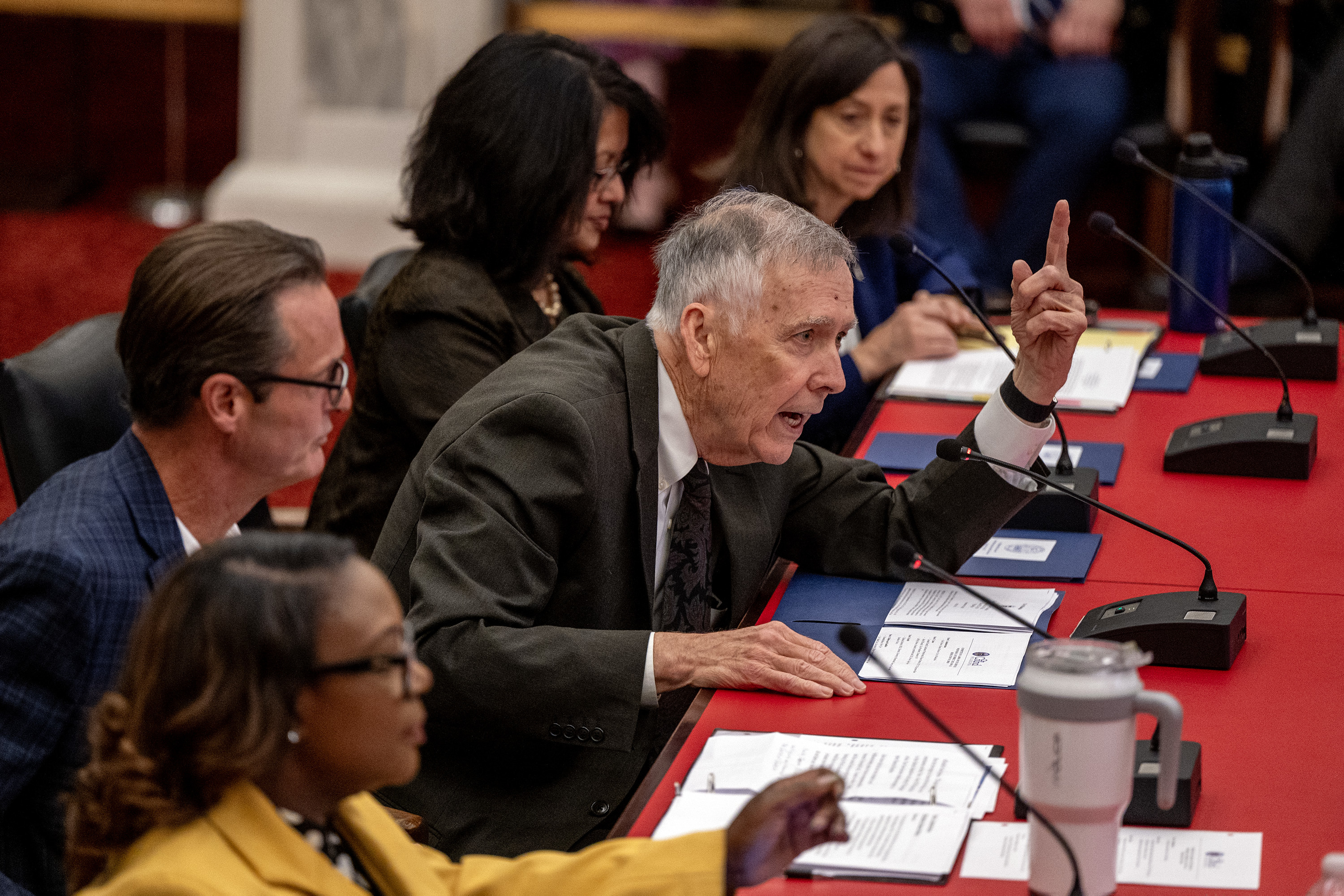
Councilmember Brian J. O’Neill (center) speaks during a hearing in City Council Monday, Oct. 27, 2025 on former Mayor Jim Kenney’s tax on sweetened beverages. Behind him, front to rear, are: Councilmembers Kendra Brooks, Jimmy Harrity, Nina Ahmad, and Rue Landau.
O’Neill said he decided long ago that if he could no longer knock on doors while campaigning, he would call it quits. After shoveling snow for more than two hours last weekend, O’Neill said, he is confident that won’t be a problem.
What is most remarkable about O’Neill’s longevity is that he is one of the few district Council members who regularly face opposition. That’s because his Northeast Philadelphia-based 10th District is the only one in deep-blue Philly that could be considered purple.
In fact, a majority of voters registered with parties in the district are now Democrats. But O’Neill has successfully swatted away a series of Democratic challengers, doing so most recently in 2023 against Gary Masino, who led the sheet metal workers’ union.
O’Neill, who avoids partisan political debates in Council and focuses almost entirely on Northeast Philly neighborhood issues, expects another challenge in 2027. But he is not concerned.
“I try not to think about it because I could never have predicted any of the races I’ve had,” O’Neill said. “It’s a waste of energy because no matter who runs against you, they all present different situations.”
The Council members who are viewed as potentially vulnerable include some of the newest and some who must navigate ideologically divided constituencies.
Councilmember Jimmy Harrity, one of seven Council members who represent the entire city, was the last-place finisher among Democrats in the 2023 primary, putting a target on his back for the 2027 primary.
In the last two election cycles, Councilmembers Kendra Brooks and Nicolas O’Rourke of the progressive Working Families Party won at-large seats set aside for minority-party or independent candidates. The GOP, which had held those seats for 70 years, may seek to mount a comeback.
City Council candidates Kendra Brooks and Nicolas O’Rourke celebrate after the Working Families Party declared victory at their election night gathering at Roar Nightclub in Philadelphia, Pa. on Tuesday, Nov. 7, 2023.
Councilmember Cindy Bass, a centrist who represents the 8th District, which includes parts of North and Northwest Philadelphia, narrowly eked out a win over progressive Democrat Seth Anderson-Oberman in the 2023 primary and may see another challenge from the left in 2027.
And Councilmember Jeffery “Jay” Young Jr., who represents the North Philadelphia-based 5th District, has already drawn a potential challenger.
Young won his seat without opposition after being the only candidate to qualify for the ballot in a bizarre scenario triggered by former Council President Darrell L. Clarke’s last-minute decision not to seek reelection in 2023.
Council members do not have to make their reelection campaigns official for more than a year, and they gave a variety of answers when asked if they planned to seek new terms.
“I can’t see a reason why I wouldn’t,” said Council President Kenyatta Johnson, who represents the 2nd District in South and Southwest Philadelphia.
“I’m strongly considering yes,” said Councilmember Curtis Jones Jr., whose 4th District includes parts of West and Northwest Philadelphia.
Councilmember Isaiah Thomas, who holds an at-large seat, said yes, and added, “What I like is the fact this legislative body as a collective is so young.”
Councilmembers Nina Ahmad, Harrity, O’Rourke, Jamie Gauthier, Rue Landau, Quetcy Lozada, and Mike Driscoll all simply affirmed they would likely run. And numerous City Hall insiders told The Inquirer they expect all members to seek new terms.
Councilmember Rue Landau speaks with Councilmember Curtis Jones Jr. on first day of City Council on Jan. 23, 2025, Caucus Room, Philadelphia City Hall.
Young gave perhaps the most puzzling answer.
“It’s not up to me to make that decision,” he said. “It’s up to the people of the 5th District.”
Asked how he would discern whether voters wanted to keep him before the next election, Young said he would gauge support by doing outreach in his district. But he also said he would personally like to serve another four years.
“I like doing my job,” he said.
2031 mayoral election race on horizon
Even if they all win reelection, it is unlikely that this group of Council members will stay together for future elections.
One major driver of Council turnover is the City Charter’s “resign to run” rule, which requires city employees to step down if they want to campaign for an office other than the one they hold. Consequently, mayoral elections are a major driver of resignations.
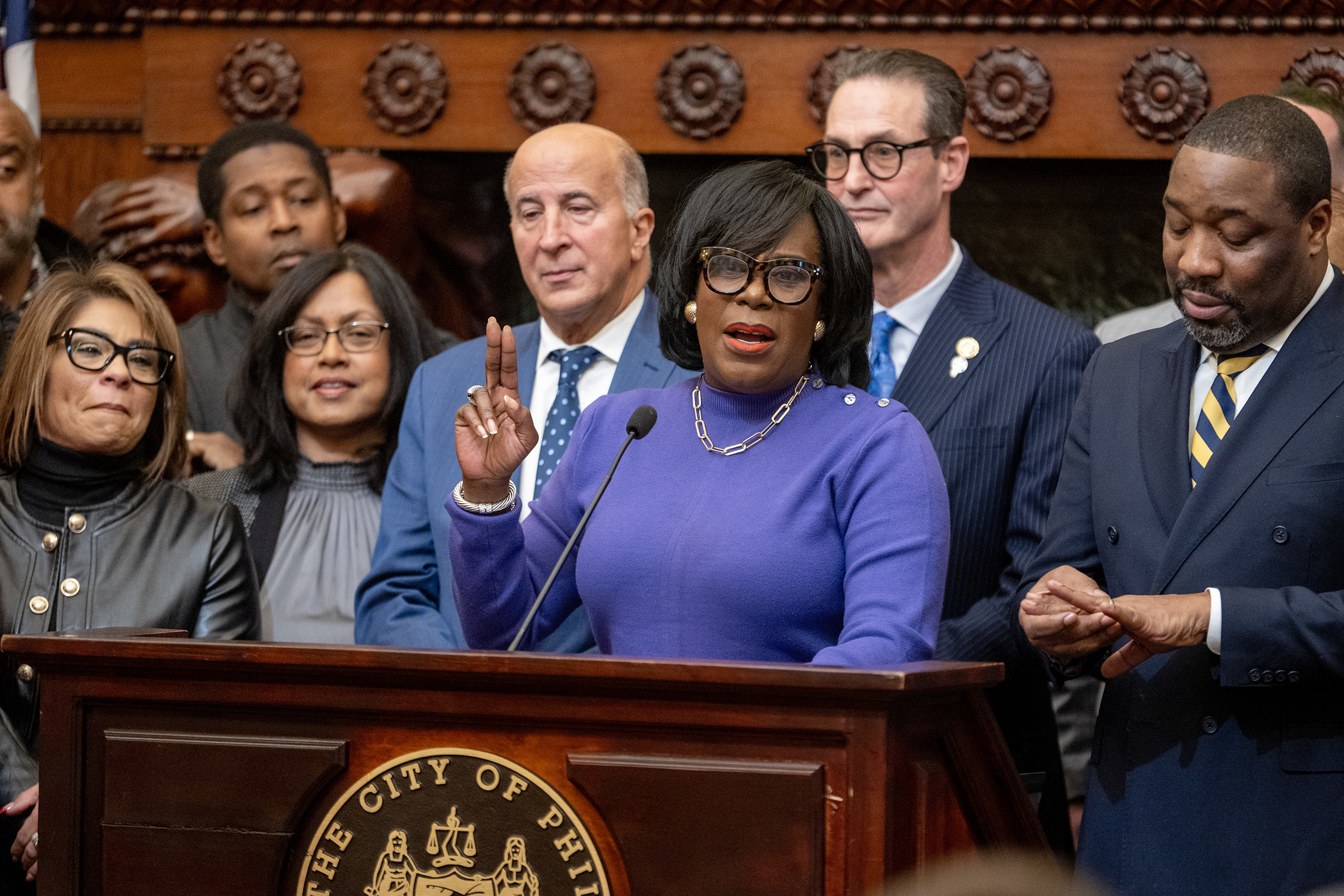
Mayor Cherelle L. Parker is with City Council President Kenyatta Johnson (far right) and supportive Council members in the Mayor’s Reception Room at City Hall Thursday, Dec. 19, 2024 after Council gave final approval to the Sixers arena.
Assuming Parker wins reelection in 2027, she will be unable to seek a third consecutive term in 2031, and several current members are likely to throw their hats in the ring to replace her.
Johnson, Thomas, Gauthier, and Majority Leader Katherine Gilmore Richardson are all seen as potential contenders for that race.
In the last six months, President Donald Trump has sent troops, immigration agents, or both to Democratic cities from coast to coast. The list includes Los Angeles, Chicago, Washington, Memphis, Portland, Ore., Charlotte, N.C., New Orleans, and Minneapolis.
But not Philadelphia.
The city that seemed an obvious early target, condemned by Trump as the place where “bad things happen,” has somehow escaped his wrath. At least so far.
That has sparked speculation from City Hall to Washington over why the president would ignore the staunchly Democratic city with which he has famously feuded. Here we offer some insight into whether that’s likely to change.
Why has Philadelphia been spared when smaller, less prominent cities have not?
Nobody knows. Or at least nobody knows for sure. But lots of people in government and immigration circles have ideas.
There’s the weather theory, that it’s hard for immigration agents who depend on cars to make arrests in cities that get winter snow and ice. Except, of course, the administration just launched Immigration and Customs Enforcement operations in Minneapolis, which gets 54 inches of snow a year.
Then there’s the swing-state theory, that Trump is staying out of Philadelphia because Pennsylvania ranks among the handful of states that can tip presidential elections. But that doesn’t explain Trump’ssurge into North Carolina, where he sent immigration forces last month.
While the Tar Heel State voted for Trump three times, elections there can be decided by fewer than 3 percentage points.
U.S. Rep. BrendanBoyle, a Democrat whose North and Northeast Philadelphia district includes many immigrants, suggested a blue-state theory, that Trump has mostly targeted cities in states that voted for Vice President Kamala Harris in the 2024 presidential election. But Boyle acknowledged that North Carolina and Tennessee are exceptions.
“It could just be that they’re working their way down the list,” Boyle said.
Has Mayor Cherelle L. Parker had a hand in keeping troops out of Philadelphia?
It depends on whom you talk to.
For months she has passed up opportunities to publicly criticize the president, turning aside questions about his intentions by saying she is focused on the needs of Philadelphia. Some believe her more passive approach has kept the city out of the White House crosshairs.
People close to the mayor point out that big-city mayors who land on the president’s bad side have faced big consequences. For instance, in Los Angeles, Mayor Karen Bass frequently clashed with Trump ― and faced a National Guard deployment.
Some point out that Parker has good relationships with Republicans who are friendly with the president, including U.S. Sen. Dave McCormick of Pennsylvania, who has praised the mayor on multiple occasions.
On the other hand, some in the city’s political class ― especially those already skeptical of Parker ― say the suggestion that she has shielded the city gives her too much credit.
One strategist posited that the lack of overt federal action has more to do with Trump’s trying to protect a razor-thin Republican majority in the House, and that targeting Philadelphia could anger voters in the Bucks County and Lehigh Valley districts where Republicans hold seats.
What does Trump say about his plans for Philadelphia?
Trump suggested there should be a “permanent pause” on immigration from “hellholes like Afghanistan, Haiti, Somalia and many other countries,” declared Washington the safest it has been in decades, and praised ICE as “incredible.”
“I love Philadelphia,” Trump declared. “It’s gotten a little rougher, but we will take it.”
That was a marked change from a decade ago, when Trump called Jim Kenney a “terrible” mayor, and Kenney called him a “nincompoop.”
Kenney fought Trump in court and won in 2018, when a U.S. District Court judge ruled that the president could not end federal grants based on how the city treats immigrants. After the ruling, the Irish mayor was captured on video dancing a jig and calling out “Sanctuary City!”
More recently, in May, Philadelphia landed on Trump’s list of more than 500 sanctuary jurisdictions that he planned to target for funding cuts. That was no surprise. Nor was it surprising that in August, when the administration zapped hundreds of places off that list, Philadelphia was among the 18 cities that remained.
“I don’t know why they’re not here yet,” said Peter Pedemonti, codirector of New Sanctuary Movement of Philadelphia. But the larger point is that “ICE is in neighborhoods every day, they are taking away people every day,” and he urged those who support immigrants to prepare.
“Now is the time to get involved with organizations that are organizing around this,” Pedemonti said. “There are neighbors who need us.”
Has Gov. Josh Shapiro helped dissuade federal action in Philadelphia?
It’s hard to say. Shapiro has challenged Trump in court multiple times, including when he was the state attorney general during Trump’s first term.
As governor,Shapiro sued the administration over its move to freeze billions in federal funds for public health programs, infrastructure projects, and farm and food bank contracts. He also joined a multistate suit challenging an executive order that restricted gender-affirming care for minors.
On immigration, however, Shapiro has been careful not to directly engage in the sanctuary city debate, saying his job is to provide opportunity for all Pennsylvanians. But he has been critical of Trump’s enforcement tactics, calling them fear-inducing and detrimental to the state’s economy and safety.
Still, Trump has not lashed out at Shapiro, a popular swing-state governor. At his rally in Mount Pocono last week, in which he criticized several Democrats, Trump didn’t mention Shapiro ― or the Republican in attendance who is running against the governor in 2026, Stacy Garrity.
Why is the president sending troops to American cities in the first place? Isn’t that unusual?
Highly unusual ― and fought in court by the leaders of many of the cities that have been targeted. On Wednesday, a federal judge blocked Trump’s deployment of troops to Los Angeles, saying it was “profoundly un-American” to suggest that peaceful protesters “constitute a risk justifying the federalization of military forces.”
Trump says the National Guard is needed to end violence, to help support deportations, and to fight crime in Democratic-run cities. Last week he declared that Democrats were “destroying” Charlotte, after a Honduran man who had twice been deportedallegedly stabbed a person on a commuter train.
Two members of the West Virginia National Guard were hospitalized in critical condition ― one subsequently died ― after being shot by a gunman in Washington the day before Thanksgiving.
That the attack was allegedly carried out by an Afghan man who had been granted asylum helped spark a wave of immigration policy changes, all in the name of greater security. For some immigrants who are attempting to legally stay in the country, that has resulted in the cancellation of citizenship ceremonies and the freezing of asylum processes.
So what happens next?
It’s hard to say. Immigration enforcement will surely continue to toughen.
But it’s difficult to predict when or whether troops might land on Market Street.
“I’ve heard so many different theories,” said Jay Bergen, the pastor at Germantown Mennonite Church, who has helped lead demonstrations against courthouse arrests. “It’s probably all of them ― a little bit of the way Shapiro has positioned himself, the way the mayor has positioned herself, a little bit the electoral map of Pennsylvania, a little bit, more than a little bit, Trump’s own personality.”
That Philadelphia has been ignored to date doesn’t mean it won’t be in Trump’s sights tomorrow, Bergen said.
“This administration thrives on being unpredictable, and on sowing as much exhaustion and pain as possible,” Bergen said. “We don’t do ourselves a favor by getting panicked in advance, but we also need to be ready.”