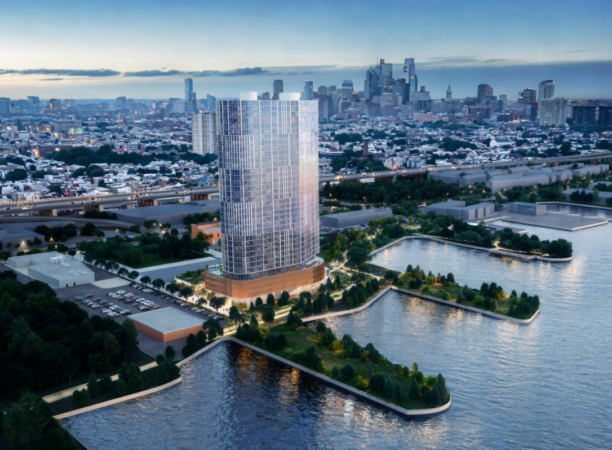
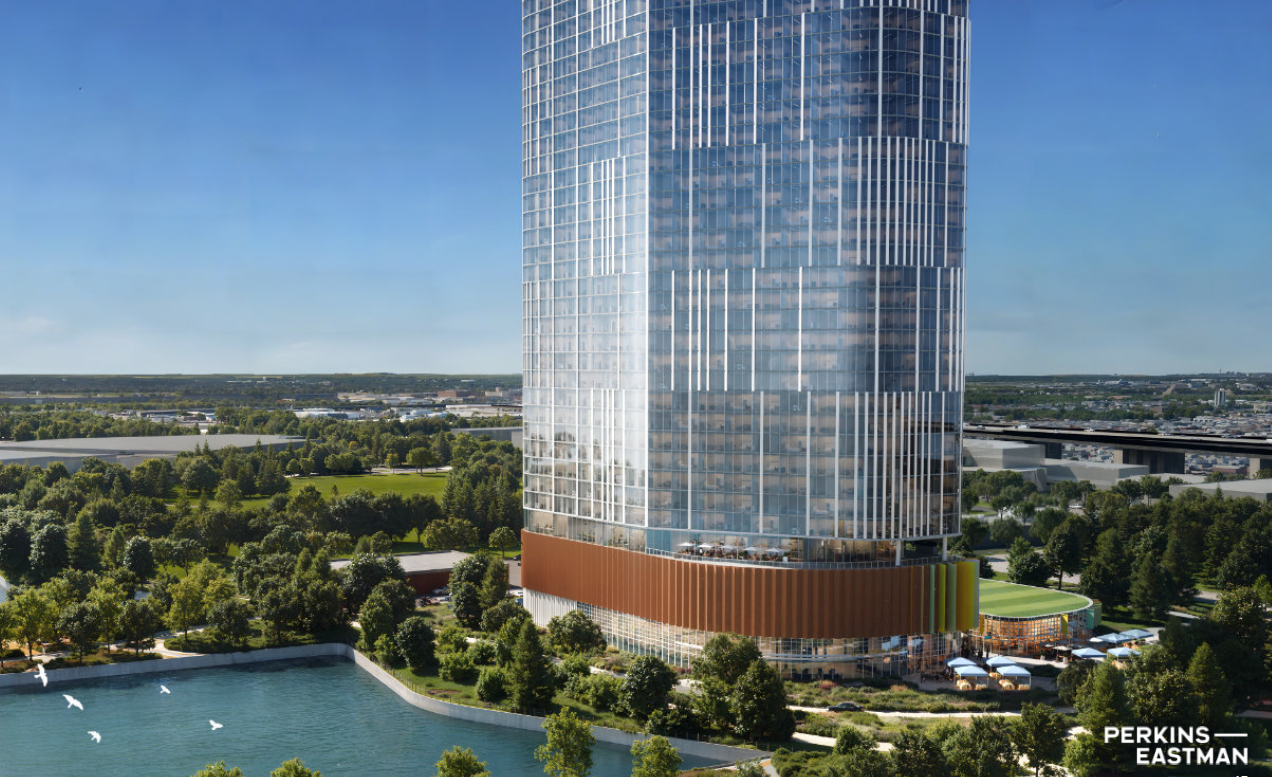
New York’s Brevet Capital Management revealed its vision for 1341 S. Christopher Columbus Blvd. to the Pennsport Civic Association on Wednesday night, showing a soaring tower on Delaware River with 620 units and promising a dramatic revision of public space in the area.
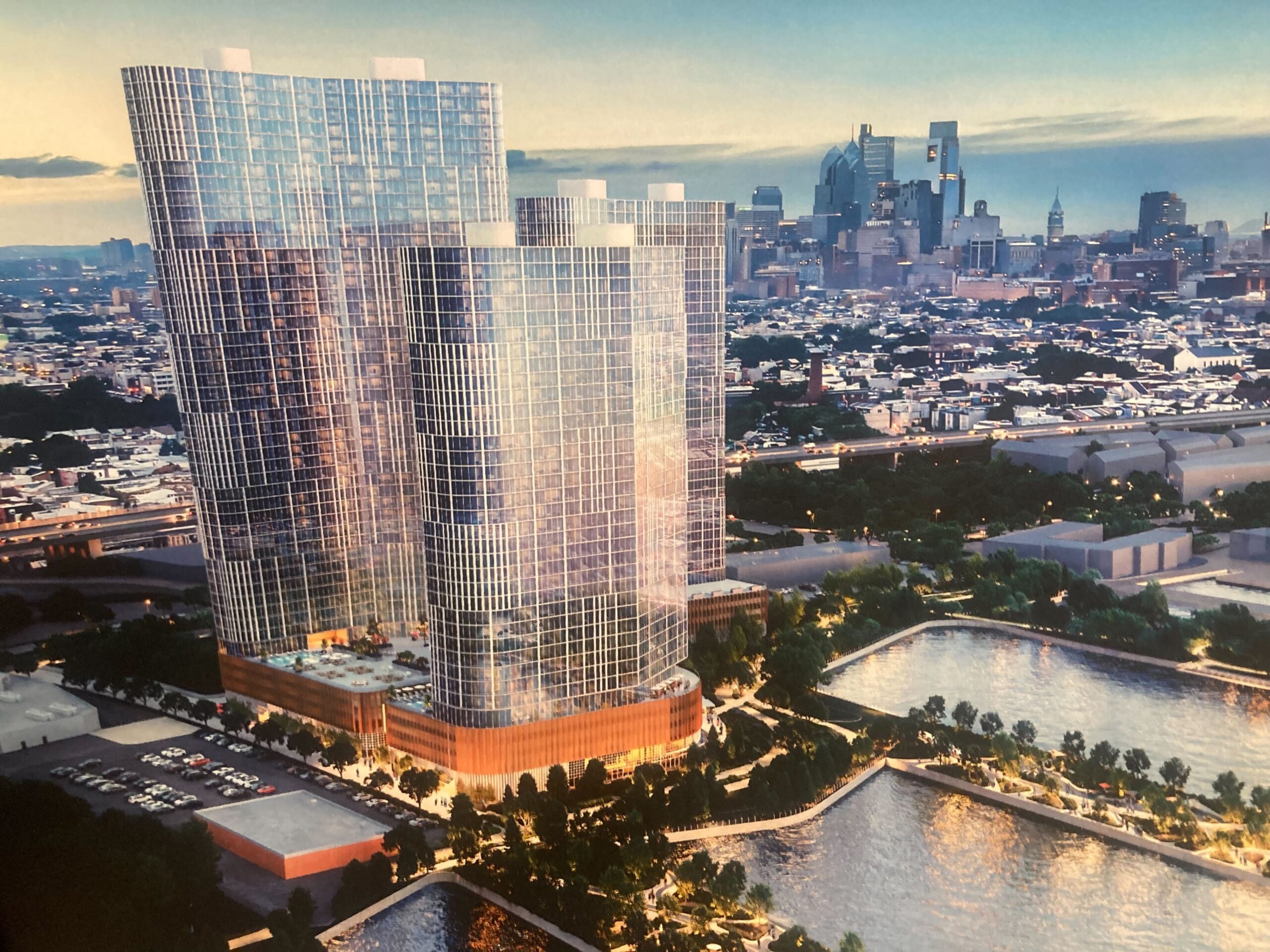
In addition to the tower and small retail building just to its west, the developer’s representatives outlined possible future phases that could include two additional towers.
“The retail building is constructed as a placeholder,” Meredith Trego, a zoning lawyer with Ballard Spahr, said at the Pennsport Civic Association meeting. “But the idea is in a future phase that a one-story building would go away, and a new tower could go in its place.”
The towering project, with its limited parking, is legally possible due to the unique zoning incentives available along the central Delaware riverfront.
In exchange for building as high as they want, the developers must meet a variety of requirements including paying into the city’s housing trust fund, providing public space, and upgrading, maintaining, and extending a rundown stretch of the Delaware River Trail down to Reed Street.
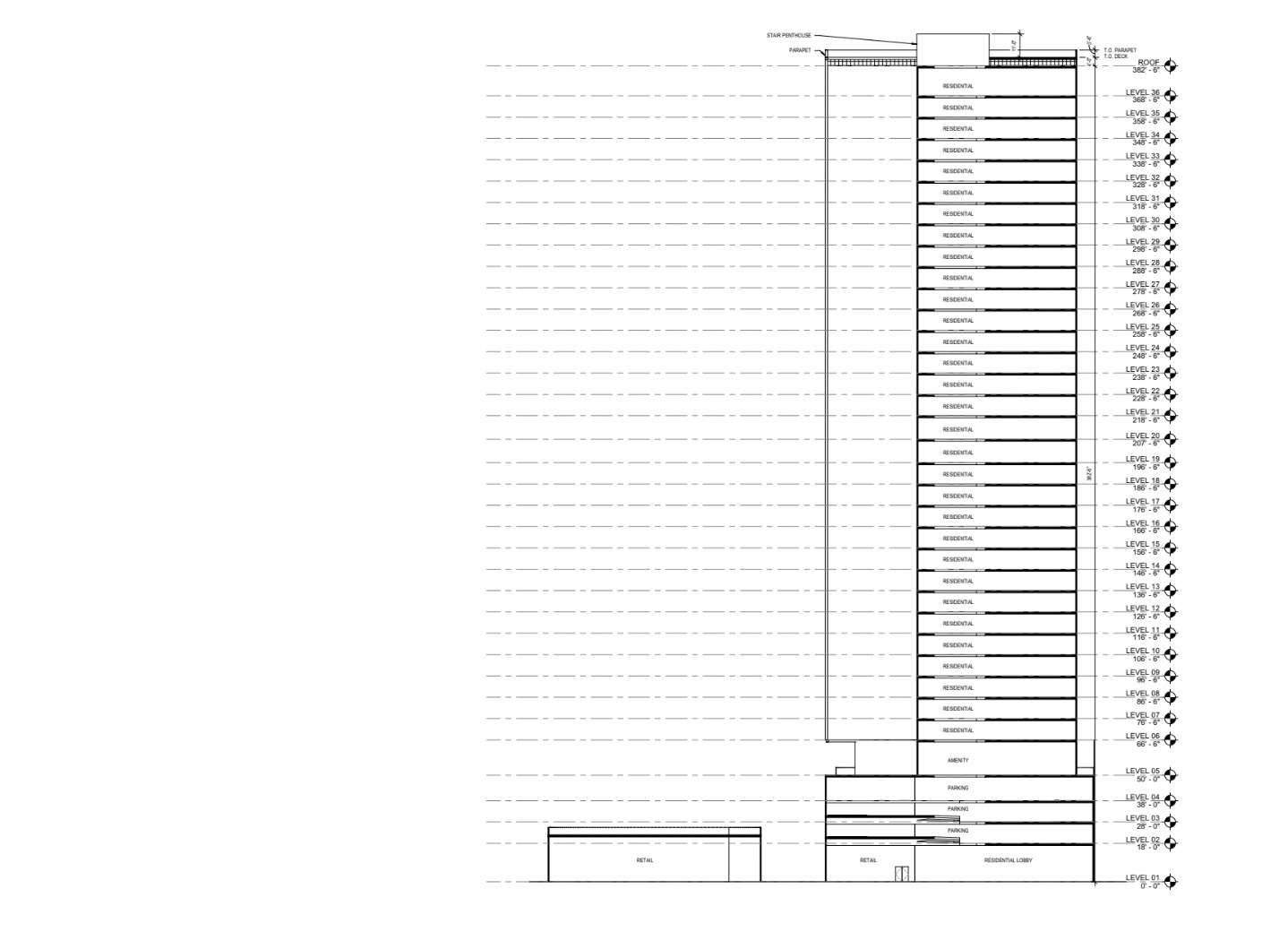
The first tower would be more than 380 feet tall, and renderings show possible future towers that would be even taller. To be allowed to build that high for future buildings, the developer would have to meet the city’s exacting requirements again, including by paying more into the housing trust fund (and they could not encroach on trail space).
Conditions on the pedestrian- and bike-friendly river trail have deteriorated below Washington Avenue. The infrastructure has not been maintained to the level it is farther north.
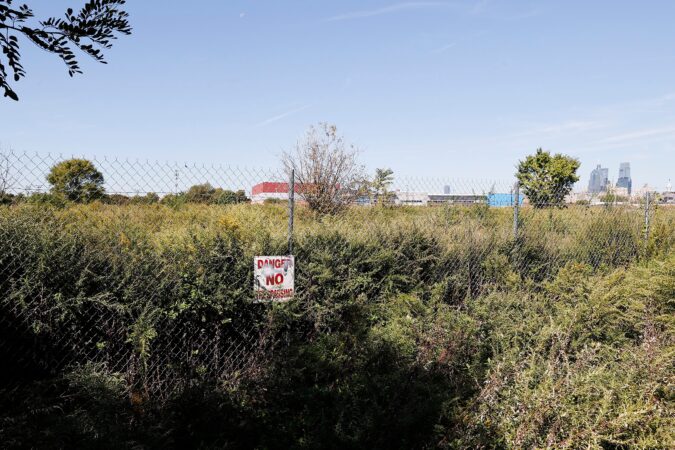
An encampment of homeless people has settled along this portion of the trail, although its residents have been moved around several times in sweeps orchestrated by the city, Delaware River Waterfront Corp., and property owners.
Another sweep is planned for Tuesday, the developer’s representatives said at the Pennsport meeting, and additional signage and fencing are planned to limit access to the property.
But currently the encampment is largely along the public access bike and pedestrian trail itself, not private property.
“Everyone knows that’s only going to last so long until we get density back there, people [will probably be] living back there,” said Matt McClure, a zoning lawyer representing Brevet. “That’s why we need an active use.”
A rendering of the proposed tower discussed at the Pennsport Civic Association meeting Wednesday night.
Brevet’s team said they would provide additional public space with the initial tower, including on disused piers that jut into the river. Currently they do not plan to build structures on the piers but turn them into publicly accessible green space.
Residents also asked that the developer address traffic conditions on Columbus Boulevard, which is a high-speed roadway that is unsafe for pedestrians.
“Big projects generate focus on improvements,” McClure said. “Hopefully it generates dialogue on making things better” on the boulevard.
The biggest applause of the night came when an attendee urged the developer to add more parking than the 187 spaces currently proposed within the tower. Another 100 spaces are available in an existing surface lot, although that is also the site for a possible third future residential tower.
The developer’s representatives tempered hopes for a greater share of parking in future development, while not ruling it out.
“So for future phases, if there’s a need for additional parking, we could incorporate that,” Trego said. Based on what they’re seeing in developments throughout the city, she added, garages are not as full as expected.
A rendering of the highly theoretical future two towers the developer has discussed as a possibility for the site.
Plans for the first tower have mostly smaller units — 50% one-bedroom units and 35% studios — but the developer said that could change.
“As we study this further, if there is desire for larger units, we can always make room for that,” said Milton Lau, a project architect with the firm Perkins Eastman.
Brevet expects to begin building in summer 2026, with an 18- to 24-month construction timeline for the first tower.
This is Brevet’s first real estate project in Philadelphia, although the company has built other developments in Florida, Texas, and California.
A New York developer is planning a 620-apartment development at 1341 S. Christopher Columbus Blvd. in South Philadelphia.
The 36-story project from Manhattan-based Brevet Capital Management makes use of multiple zoning bonuses to allow a taller, denser project than would otherwise be legal.
In exchange for those development benefits, the developer will pay into Philadelphia’s Housing Trust Fund and upgrade and maintainthe Delaware River Trail belowWashington Avenue, where its conditions currently get much rougher.
The zoning was changed before the pandemic to allow developers to build taller in exchange for extending the trail, but Brevet would be the first to do so.
“To me the most exciting aspect of this project is that they will be paying for and constructing the waterfront trail along their property,” said Matt Ruben, chair of the Central Delaware Advocacy Group, which has long pushed for responsible development on the riverfront.
“That’s one of the most important and consequential public benefits a developer can provide” in this area, said Ruben, who has not seen renderings of the buildings.
Jack O’Brien, who posts in JackPhillyRE’s Substack, first reported the latest project for this parcel in advance of a Wednesday night meeting with the developers before the Pennsport Civic Association. The permit with Brevet executives listed as owners was pulled on July 3 of this year.
“We are pleased to see the first major investment in Pennsport’s historically underutilized waterfront,” said Patrick Fitzmaurice, president of the Pennsport Civic Association. “We look forward to neighbors safely enjoying the waterfront with the proposed retail and recreational plans.
The project is designed by the international architecture firm Perkins Eastman, with its Philadelphia office listed, and is called Wharton Piers in plans filed with the city. The developer is represented by Matt McClure and Meredith Trego of the law firm Ballard Spahr.
Although no parking is required, the developer is providing 187 parking spaces on floors two to four of the housing tower. Over 10,000 square feet of commercial and office space will be on the ground floor, with amenity space on level five.
A small, neighboring one-story building will include 20,650 square feet of retail space.
A screenshot from plans filed with the city shows how the housing tower proposed on the right dwarfs the small retail building proposed on the left.
Previous proposals for the property
The property at 1341 S. Christopher Columbus Blvd. has had multiple development proposals over the years. Most recently, in 2023, New York-based Silverstein Properties proposed 612 apartments and 500 parking spaces across two towers.
Before the pandemic, it was the site of a 2,000-unit project that would have spanned 10 buildings. That plan, from Maryland-based developer Jeffery Kozero called Liberty on the River, drew widespread skepticism and went nowhere.
Kozero’s company at that time, K4 Associates LLC, is still listed as the permit holder. His proposal was met by backlash from the Central Delaware Advocacy Group and other neighborhood organizations.
K4 “tried to warp the entire overlay to allow the construction of 10 huge towers that many of us knew would never get built,” Ruben said.
Following the backlash, City Council changed the zoning overlay covering the waterfront in part by allowing developers to build taller in exchange for growing and maintaining the bike path, part of a larger plan.
“It’s ironic that this [new proposal] is the first project that will make use of the new density bonus system,” said Ruben, given that the old K4 project on the same site is the reason the zoning incentive exists at all.
Until recently, the vast vacant lot at 1341 S. Christopher Columbus had been used asan encampment by people who are homeless. Last December, The Inquirer reported that the property was being swept, with the tents and residents removed, at the behest of the property owners.
Today, an established encampment instead lines much of the bike and pedestrian trail below Washington Avenue.
This story has been corrected to make clear that the river bike trail does extend below Washington Avenue and that the developer promises to upgrade and maintain that part of the path.
A building boom is unfolding on Front Street in Fishtown along the Market-Frankford elevated train line.
Walking north beneath this towering transit edifice, pedestrians are forced to zig-zag across the street to avoid construction sites spilling onto the sidewalks. The total number of apartments on Front Street between Girard and the York-Dauphin stations is set to almost double in the next year.
“It’s pretty surreal to see it all happening at the same time,” said Henry Siebert, cofounder of Archive Development, which plans to build at 1440 N. Front St. “The amount of construction that’s ongoing, I don’t see that anywhere else in Fishtown.”
According to the CoStar Group, a commercial real estate analytics firm, there are 441 apartment units actively under construction along this 1.1-mile stretch of the Market-Frankford Line, another 174 are proposed, and 231 have been completed since 2019. (There were 215 apartment units along the stretch prior to that year.) And that’s probably a slight undercount because it only includes projects with five units or more.
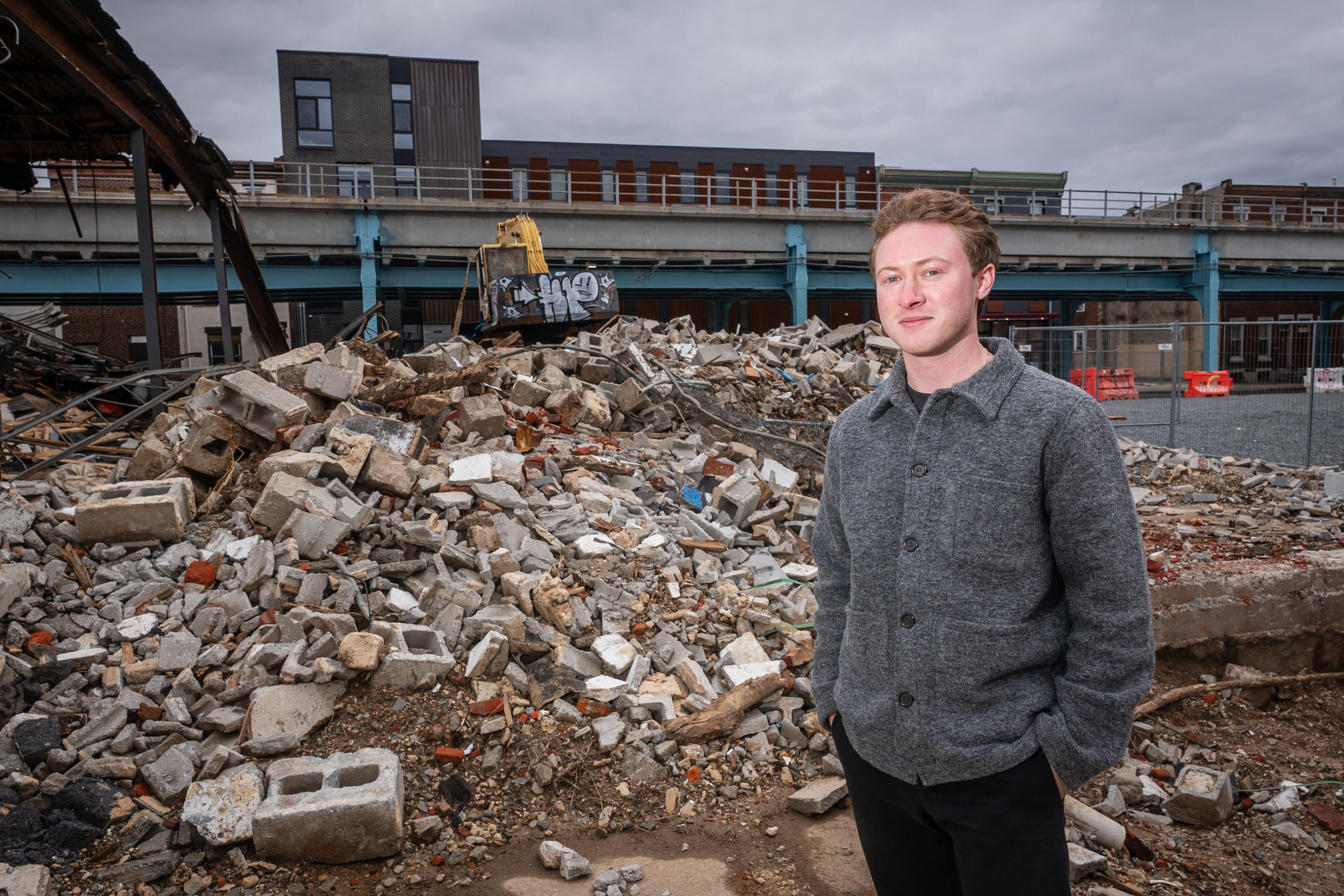
There are new apartments popping up in the storefronts of renovated older buildings along the train line, such as the building that housed Mighty Mick’s boxing gym in the Rocky movies. When construction there is complete, it will include a commercial space of 2,600 square feet along with four apartments in the revitalized historic brick building.
All this is happening as SEPTA ridership is dramatically lower than it was before the pandemic. In November, ridership on the Market-Frankford Line was only at 58% of February 2020 levels. Ridership at the stops in this part of Fishtown is even lower, according to data provided by SEPTA, with the York-Dauphin station only seeing 46% of 2019 ridership levels in 2023, the Berks station 52%, and the Girard station 48%.
(function() {
var l2 = function() {
new pym.Parent(‘fishtown_el’,
‘https://media.inquirer.com/storage/inquirer/projects/innovation/arcgis_iframe/fishtown_el.html’);
};
if (typeof(pym) === ‘undefined’) {
var h = document.getElementsByTagName(‘head’)[0],
s = document.createElement(‘script’);
s.type = ‘text/javascript’;
s.src = ‘https://pym.nprapps.org/pym.v1.min.js’;
s.onload = l2;
h.appendChild(s);
} else {
l2();
}
})();
And yet, the transit infrastructure is attracting a level of investment unprecedented in modern memory.
“SEPTA is experiencing a rough patch,” said Yonah Freemark, a senior researcher at the Washington-based Urban Institute, a policy think tank. “But for all the problems with drug abuse and lack of investment from the public sector, the fact that private investors want to spend huge amounts of money bringing hundreds of apartments to the neighborhood seems incredibly bullish for the future.”
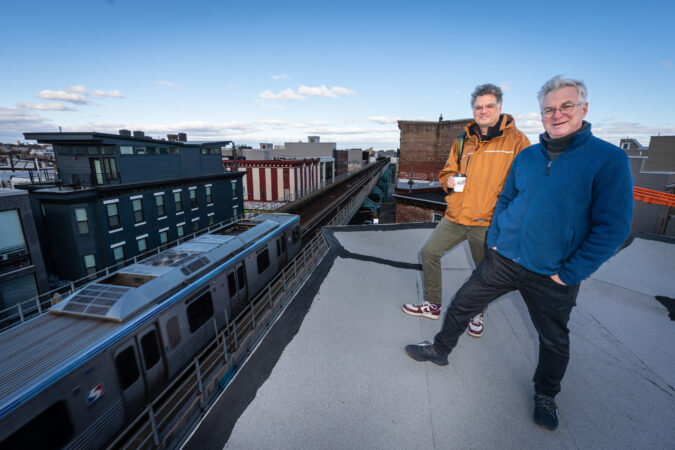
Henry Siebert, cofounder of Archive Development, at the company’s apartment project on 1440 N. Front St.
A ‘critical mass’ of demand
Few neighborhoods in Philadelphia have been as transformed as Fishtown since the Great Recession.
In 2012, political scientist Charles Murray used the neighborhood as the embodiment of all that had gone wrong for a downwardly mobile, white, working-class America. The commercial corridors on Frankford Avenue and Front Street were run-down, with many shuttered storefronts. The headquarters of the Warlocks Motorcycle Club could be found, but not a wine bar.
Now, Fishtown is the neighborhood in Philadelphia outsiders are most likely to be able to name, partly due to a spate of national media attention. The Warlocks vacated in 2011, and Frankford Avenue is now a thriving commercial corridor home to many of the city’s finest restaurants (including a James Beard Award winner), cocktail bars, and a La Colombe that looks largeenough to house a harrier jet. According to Census data, the Northern Liberties and Fishtown area now has the highest median income in the city.
“As Northern Liberties got all the hype [in the 2000s] prices went up and people started moving into Fishtown because it was more affordable,” said Brenda Nguyen, associate director at CoStar’s Philadelphia office. Now “the Fishtown area has enough dense housing, retail, restaurants, and neighborhood amenities that there’s a critical mass of demand.”
Throughout Fishtown’s redevelopment, many of the large vacant lots on Frankford Avenue, and elsewhere east of the Market-Frankford Line, filled in. Within a 10-minute walk of the heavy rail line there are 4,585 existing apartment rentals and 1,646 under construction. (A further 922 are proposed, although their status is unclear given the development industry’s current deep freeze.)
“When we originally started developing in the city in 2018, I told [my partner]that we would likely never develop a property along the El,” said Siebert. But “as large-scale development opportunities became more and more scarce, developers eventually turned their attention to Front [Street].”
Many developers had avoided the thoroughfare, partly because the looming edifice creates challenges with noise from passing trains and limits natural light. But the area became more appealing as other developable land vanished.
It helps that the land along this stretch of the Market-Frankford Line is zoned to allow taller and denser buildings than much of the rest of Fishtown. Archive Development addressed the challenges of building next to the train line by designing a first floor with 17-foot ceilings, ensuring the residential units on the second floor were elevated above transit. They plan to install windows with special glazing to reduce noise from passing trains.
Developers who have seen how Frankford Avenue has thrived to the east hope that they can build enough housing to create the demand for a second strong retail corridor. But they also hope to help establish attractive retail businesses that will, in turn attract more tenants. It’s the virtuous cycle that helped early developers in Fishtown such as Roland Kassis — who is also building next to the El — successfully launch businesses such as Frankford Hall and the La Colombe flagship.
“I was talking to a broker the other day and he said that what people want is an activated street front,” said Rafi Licht, a developer with Norris Square Development, the company behind the renovated Mighty Mick’s gym building.
“That’s what we’re aiming for here,” said Licht. “Putting in coffee shops, bars, restaurants, whatever is going to activate the street that makes it easier for people to imagine living upstairs.”
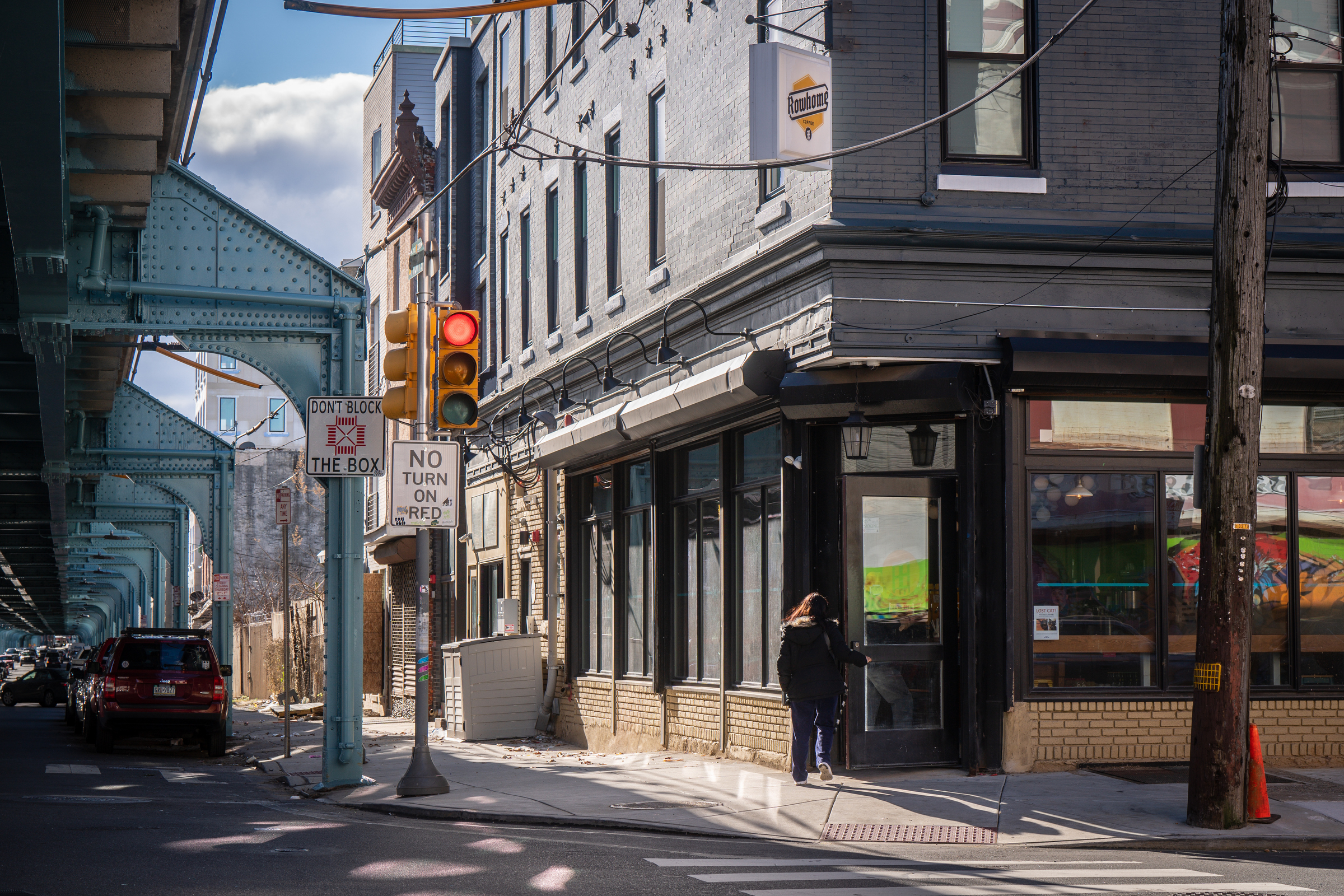
Rowhome Coffee at 2152 N. Front St., in a recently renovated historic building.
Norris Square Development is also working on other properties around the York-Dauphin stop. In 2022, Rowhome Coffee opened in its building at 2152 N. Front St. It drew a crowd then, and it still does.
“When Rowhome Coffee opened during the pandemic, people were queued up for the takeout window,” said Jonathan Auerbach, a partner in Norris Square Development. “I saw young women with prams lined up and realized, wow, people have been waiting for this.”
Will the redevelopment of Front Street aid mass transit?
Few of the developments along the El are subsidized, meaning rents will be relatively high in comparison with housing costs in nearby working-class and lower-income neighborhoods. (The rents in the Mighty Mick’s building will be close to $2,000 for a two-bedroom or $1,600 for a one-bedroom.) Many workers who have jobs that require in-person attendance — such as retail, hospitality, or restaurant work — are less likely to be able to afford newly constructed, transit-oriented apartments.
Even before the pandemic, most studies showed that lower-income and working-class people are far more likely to use transit, partly due to the high cost of car ownership and partly because they were more likely to live in cities with extensive transit systems.
A 2016 Pew study and a Census study of 2019 commuter behavior also revealed that higher-income Americans were more likely to use transit than their middle-income peers, perhaps because wealthier people had started moving back to the transit-rich big cities of the Northeast.
But post-pandemic, transit may be less of an important amenity than it once was.
“[These] renters might not see public transit as a primary factor when they’re choosing where they want to live,” said Nguyen of CoStar. “It’s more of an added bonus.”
Still, developers in Fishtown argue that even if white-collar workers are less likely to be going into the office five days a week, the Market-Frankford Line still offers unparalleled access to Center City and University City.
“If you’re going to the office [at all], you still need a way to get to Center City,” said Ryan Kalili, cofounder of Archive Development. “Two days or three days a week is still enough that you’re not going to Uber. “I think [ridership] hopefully will change as the northern part of Front Street [attracts more residents].”