Category: Science

  • Saturn’s moon Titan may not have a buried ocean as long suspected, new study suggests

    Saturn’s moon Titan may not have a buried ocean as long suspected, new study suggests

    CAPE CANAVERAL, Fla. — Saturn’s giant moon Titan may not have a vast underground ocean after all.

    Titan instead may hold deep layers of ice and slush more akin to Earth’s polar seas, with pockets of melted water where life could possibly survive and even thrive, scientists reported Wednesday.

    The team led by researchers at NASA’s Jet Propulsion Laboratory challenged the decade-long assumption of a buried global ocean at Titan after taking a fresh look at observations made years ago by NASA’s Cassini spacecraft around Saturn.

    They stress that no one has found any signs of life at Titan, the solar system’s second-largest moon spanning 3,200 miles and brimming with lakes of liquid methane on its frosty surface.

    But with the latest findings suggesting a slushy, near-melting environment, “there is strong justification for continued optimism regarding the potential for extraterrestrial life,” said the University of Washington’s Baptiste Journaux, who took part in the study published in the journal Nature.

    As to what form of life that might be, possibly strictly microscopic, “nature has repeatedly demonstrated far greater creativity than the most imaginative scientists,” he said in an email.

    JPL’s Flavio Petricca, the lead author, said Titan’s ocean may have frozen in the past and is currently melting, or its hydrosphere might be evolving toward complete freezing.

    Computer models suggest these layers of ice, slush, and water extend to a depth of more than 340 miles. The outer ice shell is thought to be about 100 miles deep, covering layers of slush and pools of water that could go down another 250 miles. This water could be as warm as 68 degrees Fahrenheit.

    Because Titan is tidally locked, the same side of the moon faces Saturn all the time, just like our own moon and Earth. Saturn’s gravitational pull is so intense that it deforms the moon’s surface, creating bulges as high as 30 feet when the two bodies are closest.

    Through improved data processing, Petricca and his team managed to measure the timing between the peak gravitational tug and the rising of Titan’s surface. If the moon held a wet ocean, the effect would be immediate, Petricca said, but a 15-hour gap was detected, indicating an interior of slushy ice with pockets of liquid water. Computer modeling of Titan’s orientation in space supported their theory.

    Sapienza University of Rome’s Luciano Iess, whose previous studies using Cassini data indicated a hidden ocean at Titan, is not convinced by the latest findings.

    While “certainly intriguing and will stimulate renewed discussion … at present, the available evidence looks certainly not sufficient to exclude Titan from the family of ocean worlds,” Iess said in an email.

    NASA’s planned Dragonfly mission — featuring a helicopter-type craft due to launch to Titan later this decade — is expected to provide more clarity on the moon’s innards. Journaux is part of that team.

    Saturn leads the solar system’s moon inventory with 274. Jupiter’s moon Ganymede is just a little larger than Titan, with a possible underground ocean. Other suspected water worlds include Saturn’s Enceladus and Jupiter’s Europa, both of which are believed to have geysers of water erupting from their frozen crusts.

    Launched in 1997, Cassini reached Saturn in 2004, orbiting the ringed planet and flying past its moons until deliberately plunging through Saturn’s atmosphere in 2017.
  • After more icy mornings in the Philly region, the snow may disappear in a hurry Thursday

    After more icy mornings in the Philly region, the snow may disappear in a hurry Thursday

    That icy glaze that has appeared on streets, sidewalks, and driveways this week reappeared Wednesday and will make an encore Thursday morning as water continues to ooze from the snowpack by day and freeze at night.

    So-called black ice — ice that masquerades as harmless wetness — is especially dangerous, officials warn, and conditions are ripe for a harvest, given the generous snowpacks.

    “Refreezing and black ice are definitely a concern,” said PennDOT spokesperson Brad Rudolph. “We will continue to treat areas as needed.”

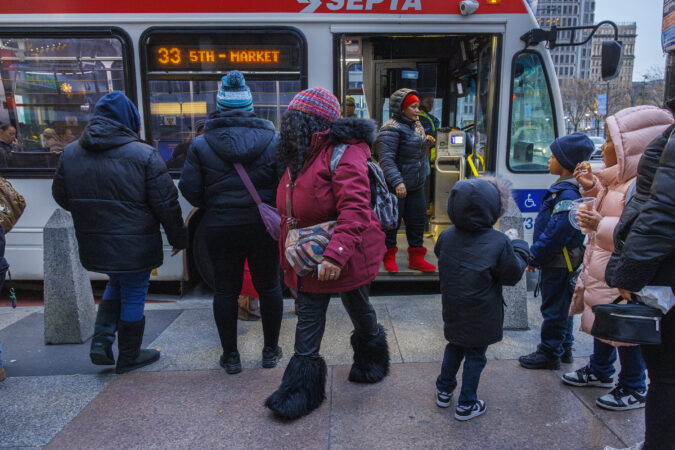
    SEPTA advised commuter to watch out for ice on platforms, walkways, and in parking lots.

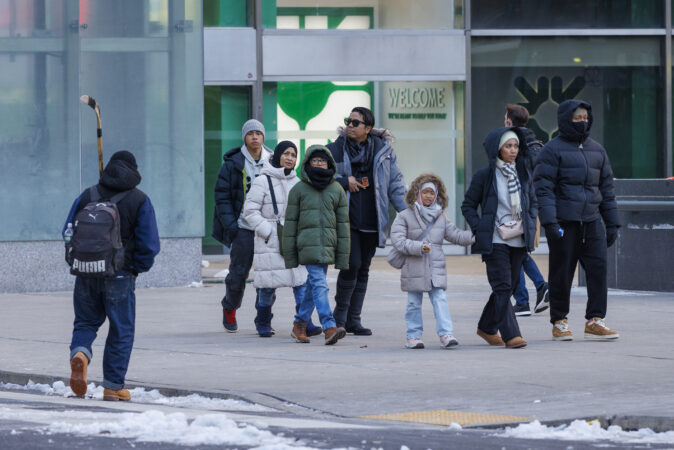
    Temperatures early Wednesday fell into the teens throughout the region — save for Philadelphia International Airport where the low was 26 — and on Thursday are due to drop into the 20s region-wide.

    But along with that winter landscape, the atmosphere over the region is going to undergo radical changes by the end of the workweek, forecasters say, with a rapid but short-lived warmup, and something that’s been missing around here lately — a soaking rain.

    As for more snow, the atmospheric scientists are saying it’s probably safe to put away the shovels for a while, and not just in the Philly region.

    “In my opinion, cold looks hard to come by for most of the United States through the remainder of December,” said Amy Butler, research scientist at the NOAA Chemical Sciences Laboratory.

    In short, prepare for a more typical Philadelphia December.

    “With the pattern changing, we’re kind of getting closer to where we should be this time of year,” said Mike Lee, a lead meteorologist at the National Weather Service Office in Mount Holly.

    The forecast for the rest of the week

    Wednesday should be at least partially sunny with some substantial melting as temperatures are due to crack 40 degrees by early afternoon.

    Then after one more overnight with readings dropping into the melt-freezing 20s, Thursday is forecast to become the first day with above-normal temperatures in Philadelphia since the Wednesday before Thanksgiving.

    As temperatures rise through the 40s, several hours of soaking rain are forecast to begin in the early evening with the potential for up to an inch.

    Throughout the region the snowpack contains about a half inch of water that will be heading to local storm sewers and local waterways, said the weather service’s Lee.

    In addition to the rain, the high moisture content of the air is one of nature’s most-efficient snow-removal tools. When warm, moist air comes in contact with snow, it gives off a latent heating effect that accelerates melting.

    “We’ll have to watch for the possibility of some localized flooding,” said Paul Dorian, a meteorologist with Arcfield Weather.

    For now, Lee said, the weather service isn’t contemplating flood advisories. Precipitation the last 90 days has been substantially below normal throughout the region, and a drought warning remains in effect for New Jersey.

    The outlook for the weekend and beyond

    Friday’s forecast high in the mid-50s is likely to occur in the early morning hours, and then temperatures are forecast to crash, with wind gusts to 40 mph possible.

    Saturday is expected to be dry but chilly, with readings in the low 40s, warmer than it’s been but still several degrees below normal, and in the mid-40s Sunday, closer to the long-term averages.

    The polar vortex, the persistent low pressure system that spins around the Arctic and confines the cold air to the ice box of the planet, has been strengthening, said Butler.

    It’s possible that it would undergo “stretching” and allow cold air to sink into parts of the contiguous United States, but “it’s not a signal that is very robust,” she said.

    For now, she said no obvious dominant feature is emerging that would define the winter.

    La Niña conditions continue in the tropical Pacific, where vast expanses of the sea surfaces are about a degree below normal. La Niña can have powerful effects on west-to-east winds that ferry weather to the United States.

    In this case, however, La Niña is currently weak, meaning that its influence over global seasonal patterns is also weak, said Emily Becker, scientist with the University of Miami/Cooperative Institute for Marine & Atmospheric Studies.

    For now, it would be prudent to savor what’s left of the snow cover, and it wouldn’t hurt to spread a little sand or gravel on the driveway or the front steps before going to bed.

  • The snow and ice are sticking around the Philly region after an unusual storm

    The snow and ice are sticking around the Philly region after an unusual storm

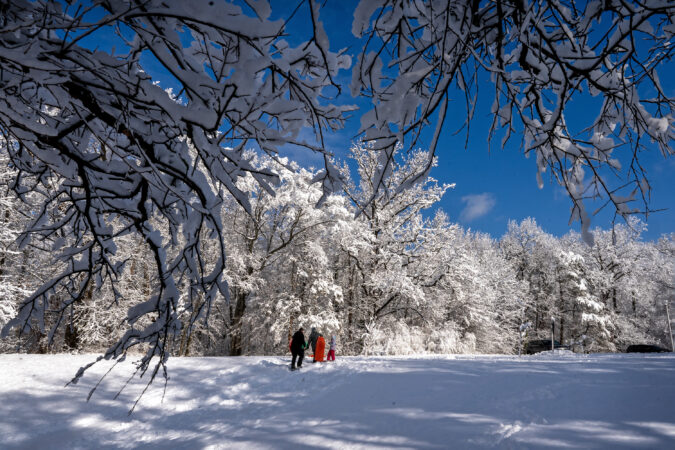
    What have become the glacial remnants of a picturesque and a meteorologically unusual snowfall that tufted the trees and bushes with a cottony whiteness are likely to stay around for a few more days.

    In what has been quite a chilly December, with not a single day of above-normal temperatures, readings tumbled into the teens for the second consecutive morning on Tuesday and not make it out of freezing in the afternoon.

    Expect more ice and stealth “black ice,” re-frozen snow melt that forms on driveways, sidewalks and other surfaces, again Wednesday morning.

    But if you’re getting tired of salting and chipping ice after those overnight freeze-ups, you’re about to get some help.

    A warm-up is forecast to get underway Wednesday, and come Thursday, which is slated to be the warmest day since before Thanksgiving, the atmosphere is expected to train its snow-removal guns on the region.

    Forecasters see a surge of snow-erasing warmth and a significant — and badly needed — rainfall Thursday night that should restore the landscape to a condition more familiar to Philadelphians and ease precipitation deficits.

    As for the prospects of a winter-wonderland encore, nothing is on the horizon in the near term, said Nick Guzzo, meteorologist with the National Weather Service in Mount Holly.

    Said Matt Benz, senior meteorologist with AccuWeather Inc, “For folks looking for more snow, this might have been it.”

    At least for now and perhaps until after Christmas, or later. But, “Winter’s not done yet,” Benz said.

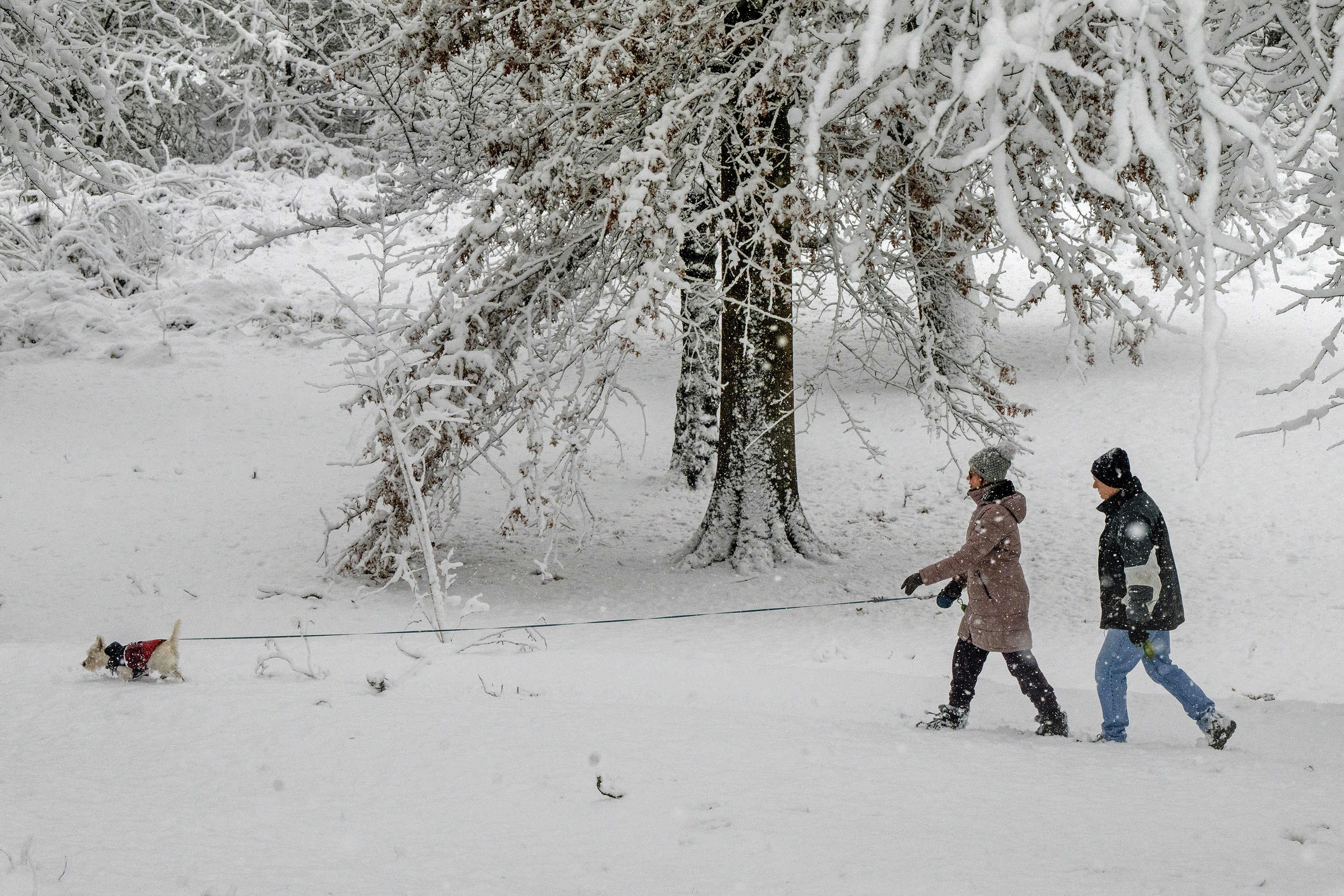
    Willow, a West Highland, is with Amanda and David York on a walk in Maria Barnaby Greenwald Memorial Park in Cherry Hill on Sunday morning.

    The warmup in Philly is expected to be brief

    Temperatures could go as high as 55 degrees Thursday, Benz said. Then after a cold front passes through, temperatures will fall during the day Friday.

    This won’t be an Arctic front like the one that gave Philly its coldest day of the season on Monday, with a high of 28. However, the forecasts call for readings to be no higher than the 30s on Saturday, and mid-40s on Sunday, which is close to the longer-term normal high, followed by several degrees chillier on Monday.

    What’s expected for the next two weeks

    In its updated extended outlooks on Monday, NOAA’s Climate Prediction Center had just about the entire country with above-normal temperatures through Dec. 29, with a notable exception — the Northeast, including Philadelphia.

    Predicted upper-air conditions in the Arctic and the North Atlantic would argue against above-normal temperatures around here during the period, climate center forecaster Thomas Collow said.

    The center wisely eschews the snow-forecasting business.

    Philly just had quite the unusual snow event

    Regardless of what happens the rest of the way, the winter of 2025-26 will be snowier than at least seven others in the period of snow records that date to the winter of 1884-85.

    The 4.2 inches measured officially at Philadelphia International Airport Sunday is a half-inch above the long-term average for the season to date.

    Granted almost any substantial snowfall would seem exceptional these days around here, but this one truly was, said the weather service’s Zach Cooper, a meteorologist in the Mount Holly office.

    Most of Philly’s significant snows are the result of coastal storms that mine moist air from the ocean.

    That wasn’t the case Sunday.

    ”In some ways it was a bit of a unique situation for us, especially to get the amounts that we did,” he said.

    The snow was generated by a weak “clipper system,” a storm that dives out of southwestern Canada and usually has minor impacts around here, and a disturbance in the upper atmosphere.

    Totals generally ranged from 4 to 8 inches across the region. Totals were less around the city in part because temperatures took their good, old time dropping below freezing.

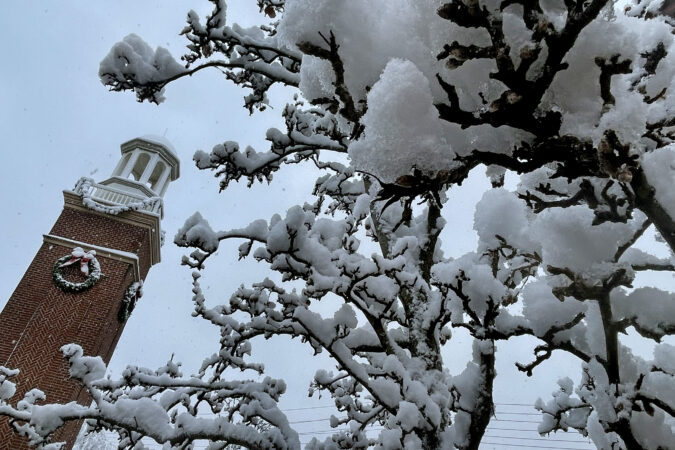
    Marginal temperatures also were a factor in the spread of accumulations. They added some extra weight and heft to the flakes that glommed on the branches and what remains of the foliage with tenacity.

    While the show will have a limited run, the region learned anew that snow and ice may be a pain, but nothing decorates like nature.

  • How much snow fell near you, mapped

    How much snow fell near you, mapped

    The Philadelphia region’s first snowfall of the season ended up having quite a March-like quality.

    Totals generally ranged from 4 to 8 inches, but the snow literally was so heavy that the average shoveler may have had a hard time discerning the difference.

    “When I was shoveling my car out, it felt rough,” said Michael Silva, meteorologist at the National Weather Service Office in Mount Holly. Silva lives in Mount Laurel, where an unofficial 7 inches was reported.

    The snow was so weighty because it had a high liquid content, the result of temperatures close to the freezing mark, as so often happens in March. The borderline temperatures also would help explain the range in accumulations, he said.

    The snow glommed onto the trees, weighing down branches. In fact it took down a branch outside the Mount Holly office that damaged a federal car (sorry, taxpayers).

    The highest amounts, just over 8 inches, were recorded in Chester and Bucks Counties.

    Officially, at Philadelphia International Airport, where temperatures didn’t get below freezing until midmorning Sunday, 4.2 inches was measured.

    By contrast, Boston has measured only 3.1 inches so far.

    Here are the snowfall totals posted by the weather service as of 10 a.m. Monday.

    window.addEventListener(“message”,function(a){if(void 0!==a.data[“datawrapper-height”]){var e=document.querySelectorAll(“iframe”);for(var t in a.data[“datawrapper-height”])for(var r,i=0;r=e[i];i++)if(r.contentWindow===a.source){var d=a.data[“datawrapper-height”][t]+”px”;r.style.height=d}}});

  • Snow is a near certainty in Philly this weekend, and it won’t melt quickly

    Snow is a near certainty in Philly this weekend, and it won’t melt quickly

    The first measurable snowfall of the winter of 2025-26 evidently is all but a done deal for Philly this weekend, and it has a chance to be the biggest in two winters — not that the bar is ultra-high in a period when snow has been mightily lacking.

    The National Weather Service has issued a winter storm warning for 3 to 5 inches of snow across the region, with a near 100% likelihood of at least an inch of snow.

    That was in line with the AccuWeather Inc. outlook.

    The weather service has a 76% chance of at least 4 inches and 43% of 6 or more.

    With the caveat that timing and duration of precipitation aren’t in the wheelhouse of atmospheric science, the weather service is expecting snow or snow mixed with rain to start late Saturday night.

    If it’s a mix at the outset it would quickly become all snow as temperatures fall below freezing, and continue into midmorning.

    The snow would be generated primarily by an upper-air disturbance, said Matt Benz, senior meteorologist for AccuWeather. It’s possible that the storm may regroup off the coast, however, that “probably will form too late to have any impact.”

    In a forecast discussion, the weather service said inch-an-hour snowfall rates are possible early Sunday.

    “There is a potential for a concentrated area of 4-5 inches of snowfall somewhere near the I-95 corridor and immediately south and east,” the forecasters said.

    They noted a 20% to 30% chance that some places get over 5 inches.

    And the snow is likely to stick around until at least midweek, with high temperatures Sunday, Monday, and Tuesday expected to be around freezing or lower and the sun angles about as low as they get.

    After that February storm, the temperature climbed to near 50 a day later, and the strengthening sun made quick work of the snow cover.

    That February snow turned out to be the biggest of a season in which the 8.1-inch total at Philadelphia International Airport barely bested the 8 inches of New Orleans. That winter, the I-95 corridor found itself in a snow hole, and Philly a snow hole within a snow hole. The highest total in the winter of 2023-24 was 4.6 inches during a snowy January week.

    Snow fell to the north, west, and south, and that trend has continued in the early going. With 6 inches so far this winter, Richmond, Va., now has measured 22.8 inches since last December, nearly triple the Philly total.

    Official totals at Philadelphia International Airport have been less than half of normal for four consecutive winters. The normal for a season is 23.2 inches.

    The meteorological winter, which began Dec. 1, certainly is off to a wintry start, with temperatures averaging more than 6 degrees below normal.

    It is not off to a particularly wet start, however, and whatever falls this weekend isn’t expected to exceed a half inch of liquid.

    In its long-term outlooks through Dec. 26, NOAA’s Climate Prediction Center is on the fence regarding whether precipitation will be above or below normal.

    With high confidence it is calling for a national warm-up.

    In any given year, the odds are greatly against Christmas snow in Philly or elsewhere along the I-95 corridor.

    But it does look like the region is about get a white Sunday.

  • Snow, up to 5 inches, is a near certainty in Philly this weekend, and it won’t melt quickly

    Snow, up to 5 inches, is a near certainty in Philly this weekend, and it won’t melt quickly

    The first measurable snowfall of the winter of 2025-26 evidently is all but a done deal for Philly this weekend, and it has a chance to be the biggest in five winters — not that the bar is ultra-high in a period when snow has been mightily lacking.

    The National Weather Service Saturday has issued a winter storm warning for 3 to 5 inches throughout the region, listing a 98% likelihood of at least an inch.

    The AccuWeather Inc. forecast was similar.

    The weather service foresaw a 76% chance of 4 inches in the immediate Philly area, and a 43% chance of 6 or more.

    With the caveat that timing and duration of precipitation aren’t in the wheelhouse of atmospheric science, the weather service is expecting snow or snow mixed with rain to start late Saturday night.

    If it’s a mix at the outset it would quickly become all snow as temperatures fall below freezing, and end around daybreak. As the weather service pointed out, the timing couldn’t be much better for minimizing disruption.

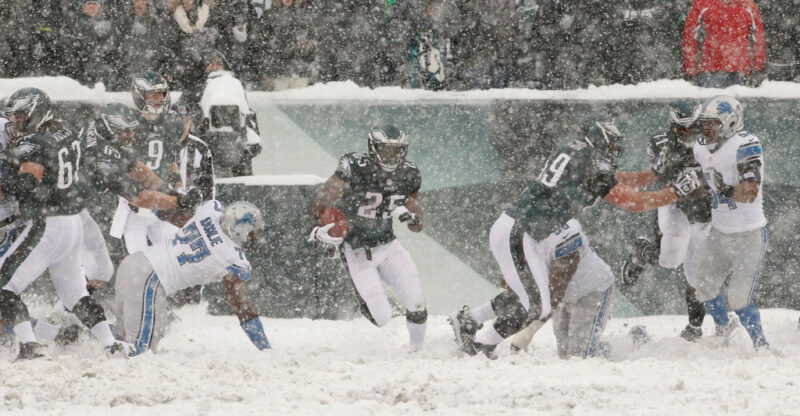
    However, snow showers and wind chills in the teens are expected when the Eagles host the Oakland Raiders in South Philly.

    The accumulating snow would be generated primarily by an upper-air disturbance, said Matt Benz, senior meteorologist with AccuWeather. It’s possible that the storm may regroup off the coast; however, that “probably will form too late to have any impact,” Benz said.

    The weather service said inch-an-hour snowfall rates are possible in the early morning hours of Sunday.

    And the snow is likely to stick around until at least midweek, with high temperatures Sunday, Monday, and Tuesday expected to be around freezing or lower and the sun angles about as low as they get.

    After a 3.1-inch snowfall in February, the temperature climbed to near 50 a day later, and the strengthening sun made quick work of the snow cover.

    That February snow turned out to be the biggest of a season in which the 8.1-inch total at Philadelphia International Airport barely bested the 8 inches of New Orleans. That winter, the I-95 corridor found itself in a snow hole, and Philly a snow hole within a snow hole. The highest total in the winter of 2023-24 was 4.6 inches during a snowy January week.

    Last season, snow fell to the north, west, and south, and that trend has continued in the early going. With 6 inches so far this winter, Richmond, Va., now has measured 22.8 inches since last December, nearly triple the Philly total.

    Official totals at Philadelphia International Airport have been significantly below normal for four consecutive winters. The normal for a season is 23.1 inches.

    The meteorological winter, which began Dec. 1, certainly is off to a wintry start, with temperatures averaging more than 6 degrees below normal.

    It is not off to a particularly wet start, however, and whatever falls this weekend isn’t expected to exceed a half inch of liquid.

    In its long-term outlooks through Dec. 26, NOAA’s Climate Prediction Center is on the fence regarding whether precipitation will be above or below normal.

    With high confidence it is calling for a national warm-up.

    In any given year, the odds are greatly against Christmas snow in Philly or elsewhere along the I-95 corridor.

    But it does look like the region is about to get a white Sunday.

  • 2 to 4 inches of snow expected this weekend in the Philly region

    2 to 4 inches of snow expected this weekend in the Philly region

    The odds are almost always stacked against a white Christmas around here, but it is looks like the region will experience a white Dec. 14.

    The National Weather Service on Friday said Philadelphia was all but certain to get at least an inch of snow during the weekend, with a general 2 to 4 inches expected, said Joe DeSilva, a meteorologist in the Mount Holly office.

    The weather service issued a winter-weather advisory for the entire region from 7 p.m. Saturday through 1 p.m. Sunday.

    A storm forming along an Arctic front combined with a strung idsturbance in the upper atmosphere were forecast to begin shaking out snowflakes very late Saturday night or early Sunday. It’s possible that the snow may be mixed with rain, at least at the outset, especially south and east of the city.

    And while this may be shocking, computer models continue to tweak outcomes, leaving “still a little bit of uncertainty how this low is going to track,” said DeSilva’s colleague Eric Hoeflich.

    However, recent model runs overall have been a shade more bullish on snow amounts than they had been, and the U.S. model has bumped up amounts slightly, said DeSilva.

    Timing and duration issues remained to be resolved, and snow could cause commuting issues in the morning. In addition to church-goers, tail-gaters will be commuting commuting to the Eagles game at Lincoln Financial Field in South Philly, and supermarkets typically experience brisk traffic in the run-up to Eagles’s games.

    The snow, however, is forecast to end well before kickoff at the Linc, scheduled for 1:15 p.m., DeSilva said.

    Some flakes were evident Thursday in the region, with Philadelphia International Airport, where winds gusted past 30 mph, reporting its third “trace” of the season.

    The renegade flakes were flying from lake-effect snows, said Bill Deger, senior meteorologist with AccuWeather Inc.

    The winds have shut off, and both Friday and Saturday were expected to be tranquil with daytime temperatures mostly in the 30s.

    And this time, that holiday least-favorite, the “wintry mix,” wouldn’t be in the mix.

    How much snow for Philly?

    AccuWeather Inc. was calling for up to 3 inches.

    If the storm is a quick mover, expect the inch, but if slows down and ripens a bit, it could be as much as 3, said AccuWeather senior meteorologist Bill Deger.

    The weather service was pretty much on board with that estimate.

    It painted 3 nches for Philly on its Friday morning snow map.

    One near-certainty: This will change.

    What time would the snow start?

    It is likely to begin very late Saturday night or very early Sunday and continue until mid- or late morning, forecasters say.

    Temperatures throughout the day are not expected to get past 30, with wind chills in the teens.

    It might feel even colder if the Eagles lose to the lowly Las Vegas Raiders.

    Regardless, everyone should be able to make it home.

    “We’re not talking a major snowstorm,” Hoeflich said.

    But this would be something a little bit different compared with recent local snow history.

    Hoeflich noted that, as happened last winter, generous snow has fallen to the north, south, and west, leaving “a giant snow hole” over the Philadelphia area.

    “It looks like that’s going to change.”

  • Scientists discover oldest evidence of human-made fire in a 400,000-year-old hearth

    Scientists discover oldest evidence of human-made fire in a 400,000-year-old hearth

    Scientists have discovered the oldest evidence of ancient humans igniting fires: a 400,000-year-old open-air hearth buried in an old clay pit in southern England.

    The study, published in the journal Nature, is based on a years-long examination of a reddish patch of sediment excavated at a site in Barnham. It pushes back the timeline on fire-making by about 350,000 years.

    The nebulous question of how far back human ancestors conjured fire is deeply intertwined with some of the biggest outstanding mysteries about human evolution. The ability to reliably set fires would have allowed humans to cook food, expanding the range of what they could eat and making meals more digestible. That, in turn, could have supported bigger brains that consumed more energy, catalyzing new social behaviors as humans gathered around campfires.

    But campfires don’t leave fossils. It takes painstaking work to reconstruct these ephemeral uses of technology. And what remains unclear is who set them. No telltale bones have been recovered at Barnham, but researchers think it was Neanderthals, close cousins of our species who interbred with our ancestors.

    “The evidence of fire is incredibly difficult to preserve. If you get to ash and charcoal, it can wash away. Sediment can get washed away,” said Nicholas Ashton, curator of Paleolithic collections at the British Museum and one of the leaders of the work. “We just found this one pocket — quite a large site — where it happens to be preserved.”

    Even when traces of fire remain, the task of distinguishing incidental flames sparked by lightning strikes or wildfires from those set by people is difficult. Perhaps most challenging is distinguishing between fires ignited by humans with the know-how from those produced by scavenging embers from wildfires.

    The study could spark more debate.

    “The authors did an excellent job with their analysis of the Barnham data, but they seem to be stretching the evidence with their claim that this constitutes the ‘earliest evidence of fire making,’” Wil Roebroeks, an archaeologist at Leiden University, said in an email, calling the evidence “circumstantial.”

    Ségolène Vandevelde, an archaeologist and adjunct professor at the University of Quebec at Chicoutimi, praised the multidisciplinary approaches the authors used and said the finding was “solid.”

    Pyroarchaeology

    In the Paleolithic era, the Barnham site would have been a woodland with a seasonal pond — set away from the main river valley, where predators might have roamed, according to Robert Davis, an archaeologist at the British Museum and one of the authors of the study. The wildlife would have included elephants, lions, deer, fish and other small mammals.

    Despite the fleeting nature of fire, it can leave traces under the right conditions. At the site in Barnham, where artifacts such as heat-shattered flint hand axes were also found, researchers were intrigued by a layer of reddish sediment — a result of iron-rich sediments being heated to produce a mineral called hematite. For four years, they studied it, trying to determine whether it was the result of a wildfire or deliberate human activity.

    One of the first questions they asked was whether this was a one-time blaze or something closer to a fireplace that was lit and relit many times.

    To deconstruct this question, scientists studied the magnetism of the sediment, which is altered by heating. They conducted modern experiments, to see if they could come up with an estimate of how many heating events might have resulted in the magnetic profile of the sediment — and found that after about a dozen heating events, each one four hours long, their modern samples mimicked the archaeological one.

    Then they examined the chemistry of the site — scrutinizing particular chemical compounds left behind. The patterns they found suggested humans had been using these fires.

    The last element was small pieces of cracked flint scattered about the site — as well as two bits of pyrite, which can create a spark when struck together. A geological study of the area showed that pyrite was scarce in the local landscape, leading the authors to argue that the inhabitants had carried it there for the specific purpose of making fire.

    Scavenging sparks vs. setting fires

    The archaeological record with examples of fires used by hominins — the ancestors of humans — stretches back more than a million years ago in Africa.

    But what interests scientists is not just the ability to successfully scavenge sparks from wildfires or lightning strikes, but also the ability to reliably create it — possibly by striking flint and pyrite together to create sparks.

    The oldest accepted evidence of fires purposefully set are from a Neanderthal site dated to 50,000 years ago in France. That evidence is considered convincing in part because there are chunks of flint showing “microwear traces of having been struck” to create sparks, Roebroeks said. But at Barnham, there are no microwear traces, leaving room for disagreement.

    “It’s a very contentious debate that’s been going on for some time,” Davis said.

    Early hominins would have learned to harvest fire by collecting embers, harvesting the right fuel and tending the fire. And eventually, they had to learn how to make it on demand — which would allow them to live in colder places, cook, fend off predators and socialize after dark.

    The study does not suggest that Barnham was where fire originated; it was probably widespread across the ancient world. But it does offer a rare, preserved snapshot of prehistoric life.

    “The maintenance of fire requires social cooperation, cultural rules and work coupled with knowledge of wood types, and means that a complicated tradition is at play,” said John Hawks, a paleoanthropologist at the University of Wisconsin at Madison.

  • It’s the coldest morning of the season and the chill goes on, but snow may continue to snub Philly

    It’s the coldest morning of the season and the chill goes on, but snow may continue to snub Philly

    The city experienced its coldest morning since at least Feb. 19 with low temperatures in the teens, even at Philadelphia International Airport, as for the second straight year December is off to quite a chilly start.

    And also for the second straight year, those looking forward to that first generous coating of white in Philly, or viewing the possibility with a certain trepidation, may be in for a wait.

    Readings dropped into single digits in Pottstown and Doylestown, and in the teens elsewhere. As usual, Philadelphia International Airport was the regional hotspot, bottoming out at 18.

    Temperatures are due to top out in the mid-30s Tuesday, more than 10 degrees below normal. A midweek warmup is due as rain approaches, followed by a late-week cooldown, and a deeper chill over the weekend into next week as the Arctic continues to share a generous supply of cold air to the central and eastern United States.

    Flake sightings are possible this week in Philly, but don’t expect a rash of school closings.

    The city and areas to the north and west may see a few snowflakes at the onset of general rainfall Wednesday, said Robert Deal, the science and operations officer at the National Weather Service Office in Mount Holly. And a dusting or less is possible in the region Friday with a cold frontal passage, he said.

    So, while folks around Doylestown had to dig out from a whole three-tenths of an inch of snow during the weekend, and the likes of Atglen, Chester County, and Avalon at the Shore were buried under a tenth of an inch, the vigil goes on for Philly’s first ruler-worth snowfall.

    With an unusual degree of certainty, in its Monday update, NOAA’s Climate Prediction Center said it was very likely that temperatures in Philadelphia and the rest of the Northeast would be below normal in the Dec. 13-17 period, with odds favoring below-normal readings through the solstice.

    That doesn’t mean it’s going to snow.

    Snow has been wanting the last several winters

    The region is accustomed to snow snubs.

    Deal pointed out that since the 2019-20 season, Philly’s official snowfall is more than 80 inches below normal — that’s a total of 56.7 inches measured, vs. 139.4 inches that constitute the normal.

    The last several winters generally have been mild, but snow doesn’t always correlate well with cold, and atmospheric scientists caution that snow is a lousy climate indictor.

    Last season, for example, the Dec. 1-Feb. 28 meteorological winter finished about a degree below normal with plenty of cold air for snow, but snowfall was a paltry 8.1 inches — beating New Orleans by a mere 0.1 inches. The seasonal normal as measured at Philadelphia International Airport is 22.3 inches.

    Tuesday officially would be Philadelphia’s 13th consecutive day of below-normal temperatures, and 13th without measurable snow.

    Why the absence?

    Snow around here typically falls near the battlegrounds of cold, heavy air from the north country and warmer moist air off the Gulf and Atlantic Ocean, which can rout the cold.

    “We generally need a high-pressure system anchored to the north so it keeps the cold air locked in place,” Deal said. “Lately, most of the high-pressure systems have been more transient, shifting offshore.”

    If they are too strong and persistent, those same cold high-pressure systems can repel moisture.

    The climate center outlooks favor below-normal precipitation in the Northeast in the six-to-10-day and eight-to-14-day periods.

    The lack of snow to date is by no means unusual, Deal points out. On average Philly doesn’t measure an official inch until Dec. 10.

    “Right now,” he said, “normal is next to nothing.”

    Brightening prospects

    The winter solstice doesn’t occur until Dec. 21, but if you have had it with these early sunsets, your prospects are brightening considerably.

    Monday’s sunset, just before 4:37 p.m., was a second later than Sunday’s. Tuesday’s will be 4 seconds later than Monday’s, and the sun will call it a day four whole minutes later on Dec. 21.

    That will still be the shortest day, however, since daybreak will be later, but feel free to sleep through it.

  • Philly gets its first winter storm of the season, but hold the shovels

    Philly gets its first winter storm of the season, but hold the shovels

    The region is experiencing a classic Philadelphia early winter storm — a touch of ice and snow, rinsed away by plenty of ice water.

    Some light freezing rain, sleet, and random snowflakes were reported across the region around daybreak Tuesday, and several school districts in Chester and Montgomery Counties opted for two-hour delays.

    Small accumulations of freezing rain, under a tenth of an inch, were measured in the Doylestown and Pottstown areas.

    For the record, the National Weather Service in Mount Holly reported that the city recorded its second official “trace” of snow, defined as a trained spotter’s sighting at least one flake at Philadelphia International Airport.

    That duly noted, Philly’s chances for its first measurable snowfall of the season remained minimal or less.

    “It’s cut and dried,” said Tyler Roys, senior meteorologist with AccuWeather Inc.

    Quite wet, actually. As temperatures rise quickly above freezing, plain, old liquid rain, possibly heavy at times, is expected to persist into the afternoon throughout the region.

    PennDot anti-icing crews have been mobilized, said spokesperson Krys Johnson, but they are also clearing leaf-clogged drains to mitigate road flooding.

    The precipitation should shut off well before the peak afternoon commuting period. However, it appears that the meteorological winter, which began officially Monday, is going to get off to a livelier start than last year’s.

    “We’re changing the script already,” said Roys, noting another storm threat later in the week. “It’s definitely an active start.”

    NOAA’s Climate Prediction Center has the odds favoring below-normal temperatures and above-normal precipitation in the Northeast in the Dec. 7 through 15 period.

    What time will any snow and ice change to rain?

    The changeover to rain should proceed quickly, forecasters say, and it should be raining everywhere by midmorning.

    Winds are from the east, and that is importing warm air off the ocean, where sea-surfaces temperatures off Atlantic City were in the upper 40s on Tuesday morning.

    How much for Philly?

    For Philly, Johnson’s reading of the forecast — “A chance of one snowflake” — was essentially correct. In fact, from King of Prussia eastward, said Roys, “You’re looking at nothing.”

    What is the outlook for the rest of the week?

    The weather community divides the seasons into tidy three-month increments, with Dec. 1 as opening day for winter.

    It will feel that way, with temperatures several degrees below normal into the weekend, with daytime highs Tuesday and Wednesday mostly in the 30s and lows in the 20s.

    A wild card would be the arrival of an Arctic front Thursday morning, said Roys, which might set off snow squalls in parts of the region.

    Another winter storm is possible on the weekend, however computer guidance has been showing just about everything and not much, said Zach Cooper, a weather service meteorologist in the Mount Holly office.

    Welcome to winter in Philly.