Category: Soccer/Union

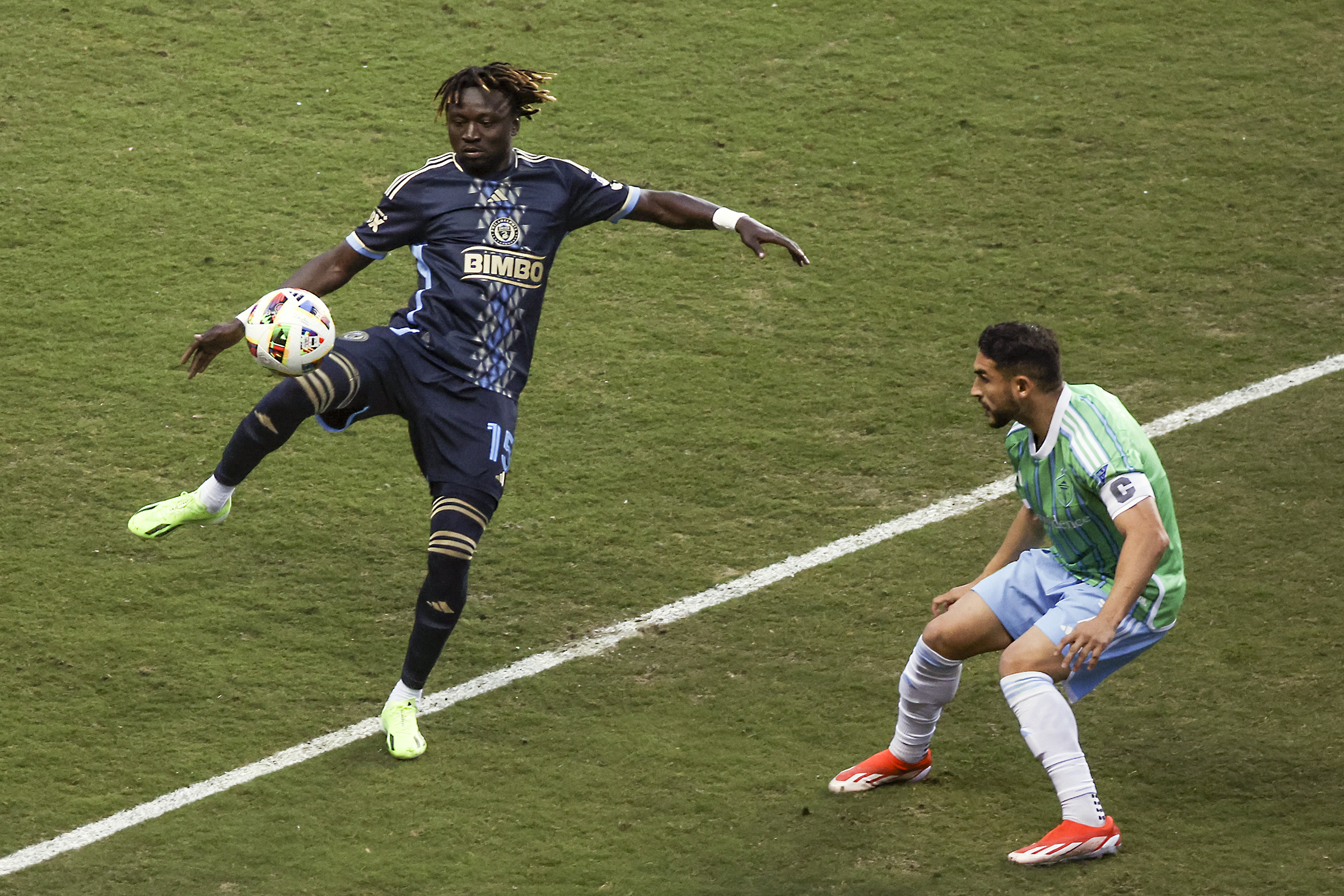
  • The Union’s Danley Jean Jacques celebrates helping Haiti reach its first men’s World Cup since 1974

    The Union’s Danley Jean Jacques celebrates helping Haiti reach its first men’s World Cup since 1974

    In soccer as in life, sometimes more than one thing happens at once. Right now, the Union have so many things happening that your head could end up on a swivel.

    There’s the ongoing investigation into sporting director Ernst Tanner’s alleged misconduct, for which there were no new updates by the close of business Thursday.

    There’s the rest of the team’s preparations to resume the playoffs on Sunday vs. New York City FC at Subaru Park (7:55 p.m., FS1, Fox Deportes, Apple TV) after three weeks without a game.

    There’s the fact that next year’s schedule was announced Thursday with three rounds of this year’s playoffs still to go. (Early schedule releases are good, but this one took almost everyone by surprise.)

    And on top of all of that, there are the epic swings of emotions that two of the Union’s stalwart players experienced while playing for their national teams.

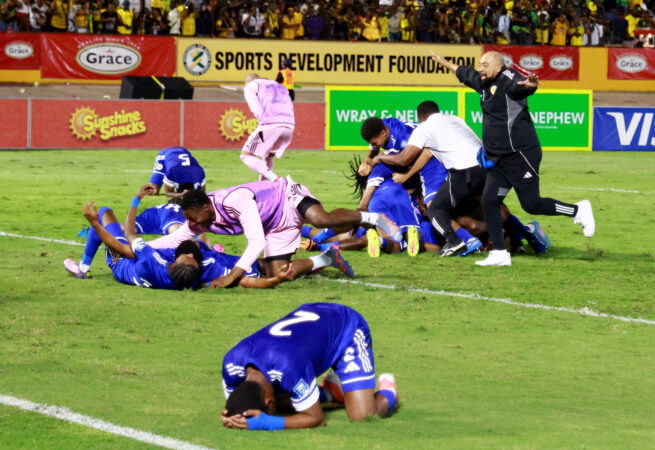
    Andre Blake’s Jamaica came up painfully short of qualifying for next year’s World Cup, with ties at Trinidad and home vs. Curaçao. The first made the second game a must-win, but the Reggae Boyz could only manage a scoreless tie while hitting the post three times.

    Those results sentenced Jamaica to March’s inter-continental playoffs in Mexico that will clinch two of the six remaining World Cup tickets. Blake and company will play Oceania runner-up New Caledonia, and the winner will play Africa’s Democratic Republic of the Congo for a Cup berth.

    At the same time, Danley Jean Jacques’ Haiti reached the world game’s biggest stage for the first time since 1974. Despite not being able to play a true home game for years because of domestic unrest, Les Grenadiers beat Costa Rica 1-0 and Nicaragua 2-0. When tradition-rich Costa Rica and Honduras played a scoreless tie on Tuesday, Les Grenadiers clinched first place in their group.

    Even better, Tuesday was Haiti’s national holiday, celebrating its centuries of independence from France.

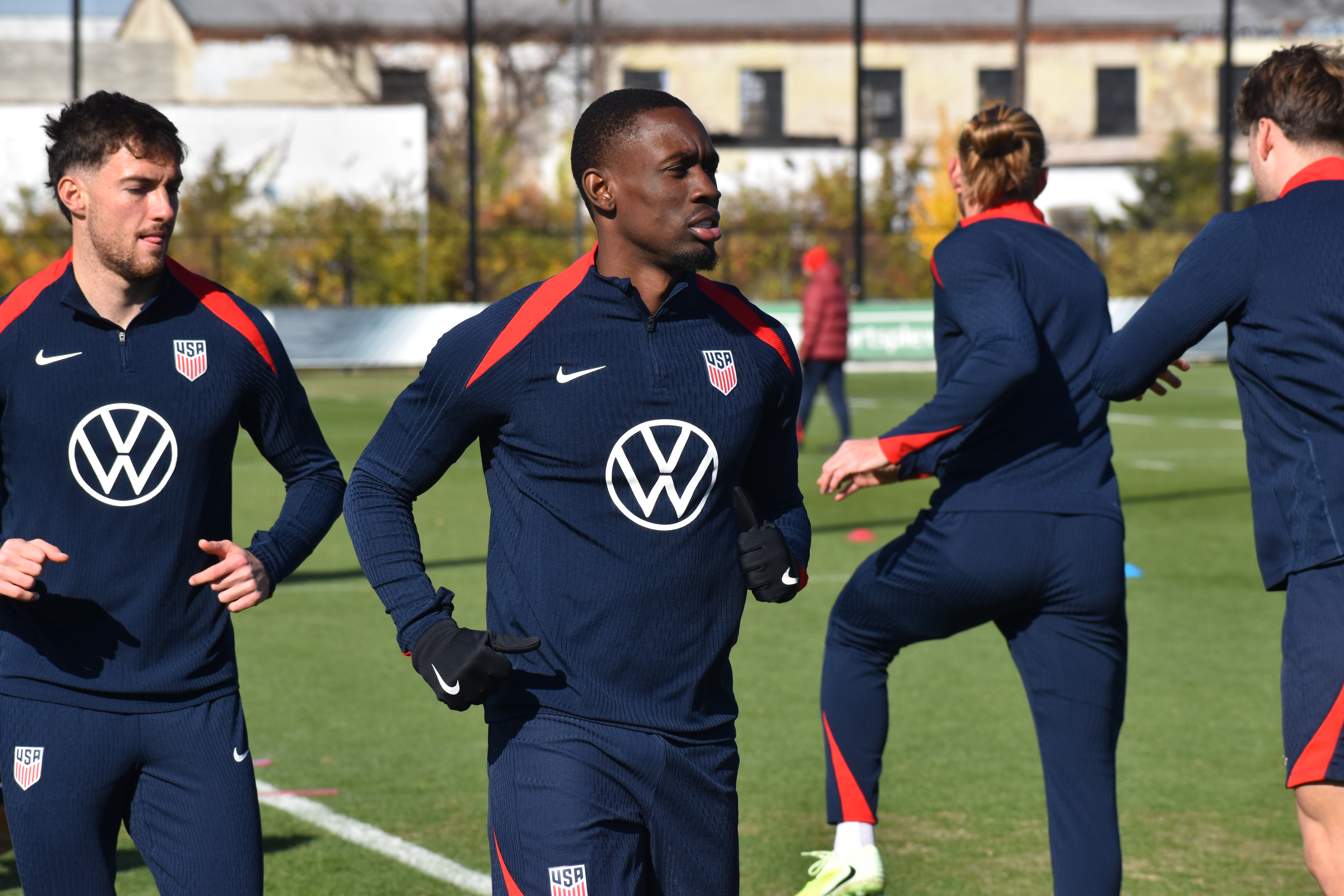
    “I’m very proud to have qualified my country for a World Cup,” Jean Jacques said at Thursday’s Union practice, speaking in his native French. “It feels good, and I think it makes all Haitian people in general feel good.”

    Unfortunately, the 25-year-old midfielder was suspended from the finale because of yellow card accumulation, so watched from the stands of Haiti’s neutral-ground “home” in Curaçao. But he was able to take part in the celebrations.

    “It was a bit stressful, because I wanted to play, I wanted to give everything for my country,” Jean Jacques said. “But I was confident in my teammates. I knew they would do the rest of the work. I had done the most I could, and I was very confident that my teammates would get it done.”

    Because Haiti’s game finished before Costa Rica-Honduras, the team didn’t know at its final whistle whether it had qualified. So they all waited on the field, following the other game on mobile phones. TV cameras were still rolling and captured the joy when the news came across.

    “Representing Haiti means many things,” Jean Jacques said. “You have to give your heart. Every time I represent Haiti, I try to give my maximum, I try to give everything for my country. I don’t want to come up short for my country — I try to give my maximum, and I feel very, very good to represent Haiti.”

    Some players documented their celebrations on Instagram, and fans flooded their comments to celebrate. There were also great scenes in Haiti’s capital, Port-au-Prince, and throughout the Haitian diaspora across North America.

    “It had been a long time since Haiti qualified for a [men’s] World Cup, and now we’ve done it,” Jean Jacques said. “I think they [at home] are proud, and I hope they will stay behind us and push us and give us strength. They will help us in the future, because I think we have more to give.”

    Coincidentally, Jean Jacques isn’t the only player on Haiti’s team with ties to Philadelphia. Outside back Duke Lacroix, 32, is an Ocean County, N.J., native who played his college soccer at Penn from 2011-14.

    Lacroix has played professionally ever since in the U.S. second-division USL Championship, for a range of teams. At his current home, the Colorado Springs Switchbacks, he has many teammates with Union ties, including Matt Real and Anthony Fontana.

    “He told me that he spent some time here, and about the city,” Jean Jacques said of Lacroix. “He said it’s a nice city and I’m in a good club. … I can say he’s a good player who plays strong, is very serious, and works hard.”

    It’s also a coincidence that Jean Jacques’ closest friend on the Union, Olivier Mbaizo, was the first player to make a World Cup squad while with the club. Jean Jacques could be the second, with lots of people in Chester and beyond hoping Blake ties him on that mark.

    “It means many things for me. I think it would mean many things for the club, too,” Jean Jacques said. “The team deserves this, because it’s a good club, with a good setup. I hope there will be other players, too, who will be able to be part of the World Cup, because it’s a good thing for the club.”
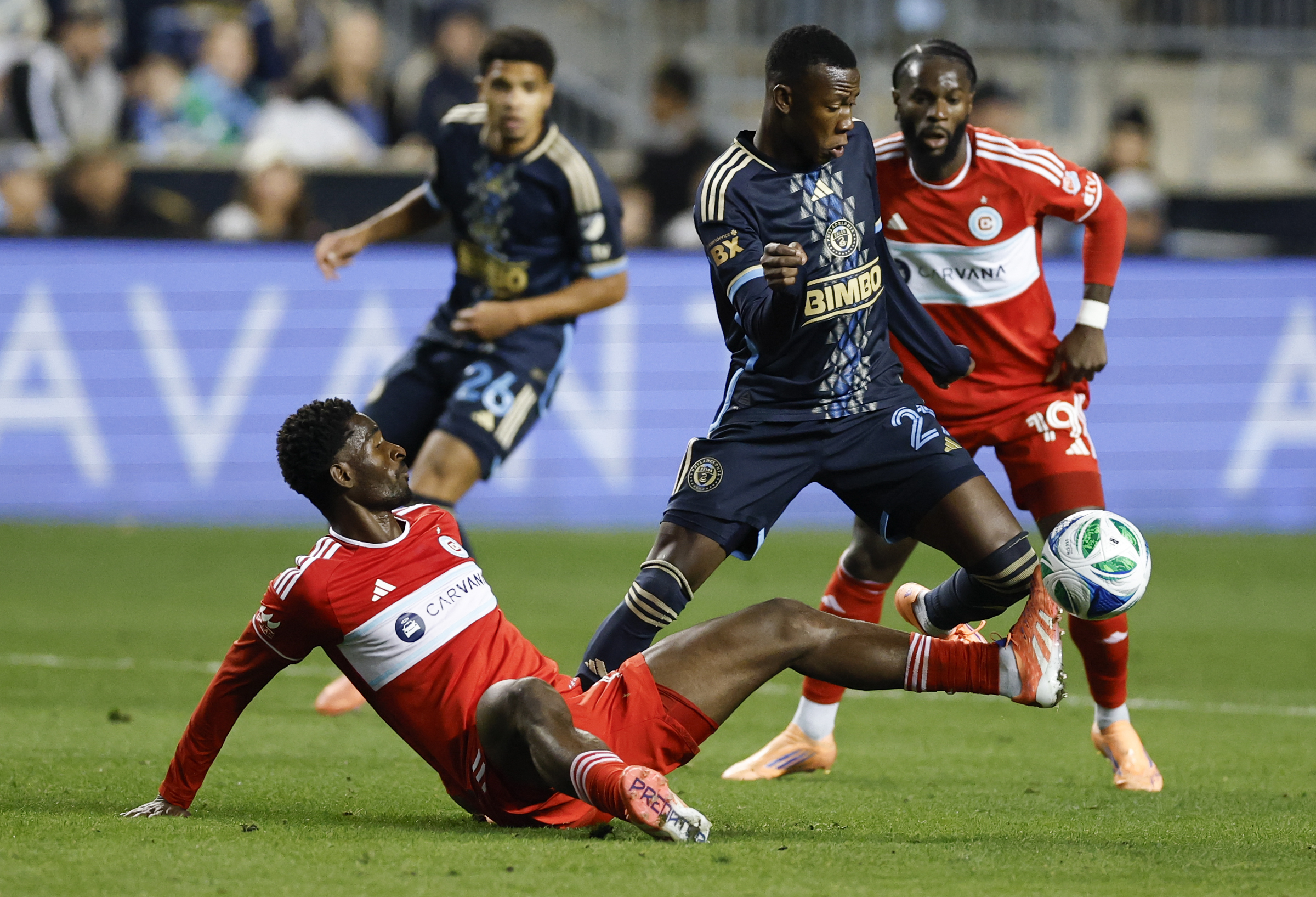
    Danley Jean Jacques (center) in action with the Union during their playoff series against Chicago last month.

    He also took a moment to praise the club’s young Americans who have played in youth World Cups lately: Frankie Westfield at the under-20 level and Cavan Sullivan at the under-17 level.

    “I think they will keep growing,” he said.

    There’s a long way to go until next summer for Jean Jacques, Haiti, and the Union. But he has allowed himself a moment to dream of what it will be like if he steps onto the field in a World Cup game — perhaps even at Lincoln Financial Field if Haiti is drawn to play here.

    “It has always been a dream to play in a World Cup, to qualify my country, so I’m very happy,” he said. “I’m waiting for the moment when it arrives, and I’ll see how it goes. But no matter what, whether I’m on the field or off it, I’ll support my teammates and give everything for the country.”

    2026 FIFA World Cup qualifying playoffs

    All games will be played in March as single-elimination rounds. The inter-continental playoffs will be played in Guadalajara and Monterrey, Mexico, while the European playoffs will be played on home fields.

    Inter-continental playoffs

    Bracket 1: New Caledonia (Oceania) vs. Jamaica (Concacaf); winner plays Democratic Republic of the Congo (Africa)

    Bracket 2: Bolivia (South America) vs. Suriname (Concacaf); winner plays Iraq

    European playoffs

    In all the brackets listed below, the first game’s winner will host the second-round contest.

    Bracket 1: Wales vs. Bosnia & Herzegovina, Italy vs. Northern Ireland

    Bracket 2: Ukraine vs. Sweden, Poland vs. Albania

    Bracket 3: Slovakia vs. Kosovo, Turkey vs. Romania

    Bracket 4: Czech Republic vs. Republic of Ireland, Denmark vs. North Macedonia
  • The Union’s 2026 MLS schedule is set. Here’s what to know about it.

    The Union’s 2026 MLS schedule is set. Here’s what to know about it.

    MLS usually makes its schedule announcement with lots of fanfare, but this time, it jumped straight in out of almost nowhere.

    The league announced its 2026 calendar on Thursday, confirming news everyone had been waiting for: a World Cup break from May 25-July 16.

    With five MLS stadiums hosting tournament games and many more serving as practice sites, the notion that there would be a lengthy stoppage felt ever-present.

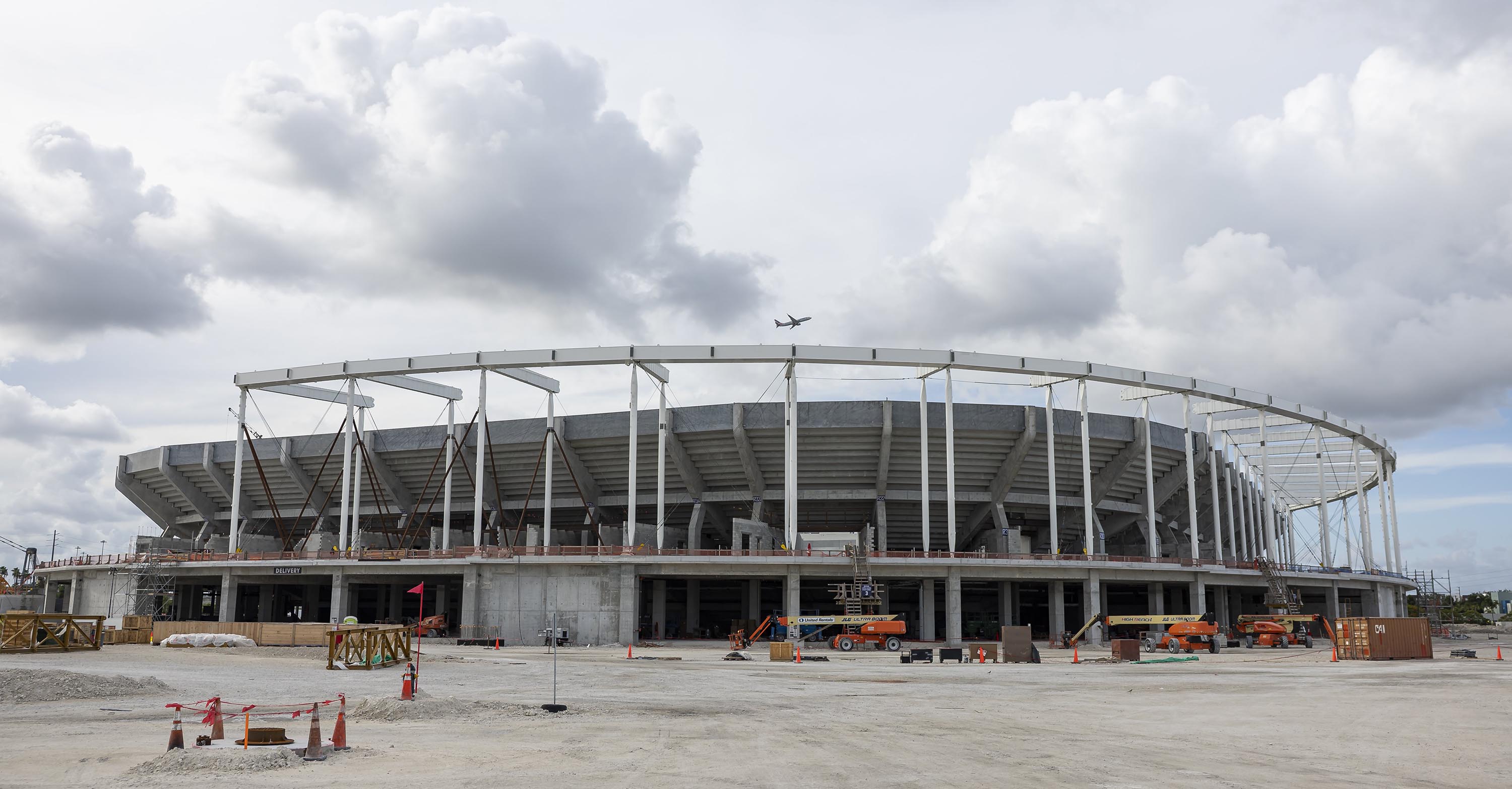
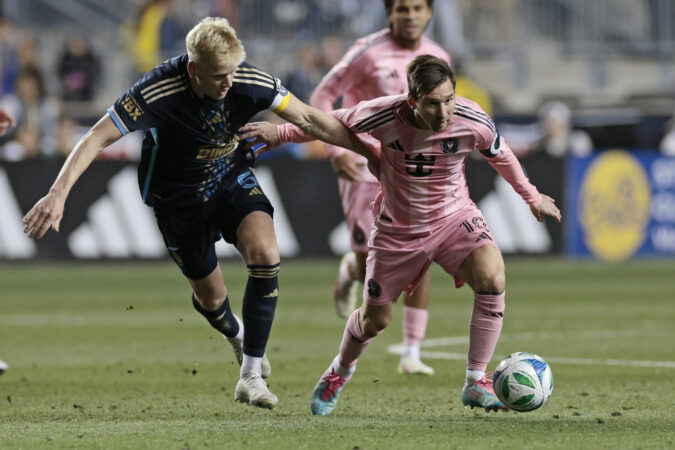
    Now we know the details. May 25 is FIFA’s mandatory reporting date for players in the tournament, and the last league games before then will be on Saturday, May 23, and Sunday, May 24. The Union will play on the latter, and it will be a big one: at Lionel Messi’s Inter Miami in the Herons’ new stadium, currently under construction next to Miami’s airport.

    Inter Miami’s new stadium, Miami Freedom Park, will open next year.

    That will also be one of three Union regular-season games on network television, with a prime-time kickoff on Fox. The others are March 14 at Atlanta United (also on Fox) and Sept. 9 vs. FC Cincinnati on FS1.

    The Union open the season on the road against D.C. United on Feb. 21, and will play their home opener on March 1 against New York City FC. The latter is one of four home games with afternoon kickoffs, two in March and two in October.

    The MLS season will resume on the weekend of the World Cup final, with six games across Thursday and Friday between the semifinals and final. The Union won’t be in those games, though, as their campaign won’t resume until July 22 — the Wednesday after the tournament ends — against Red Bull New York (the slightly-rebranded New York Red Bulls) at Subaru Park.

    The Seattle Sounders will visit three days later on July 25, followed by another marquee home game against Atlanta United on Aug. 1.

    Cristian Roldan (right) might visit the Union with the Seattle Sounders soon after playing in the World Cup for the United States, if he makes the team.

    Messi’s visit here, at least in theory, is set for Aug. 19, a Wednesday. The Argentine superstar might also play close to town on March 7 when D.C. United hosts Miami at M&T Bank Stadium, the home of the Baltimore Ravens. That game is a 4:30 p.m. kickoff, and enterprising fans could catch it before the Union host the San Jose Earthquakes at 7:30 p.m. that night in Chester.

    The Union’s marquee road trip of the season is the team’s first matchup with San Diego FC, out west on Sept. 13. Though it will take place after the school year resumes, many fans will likely circle it.

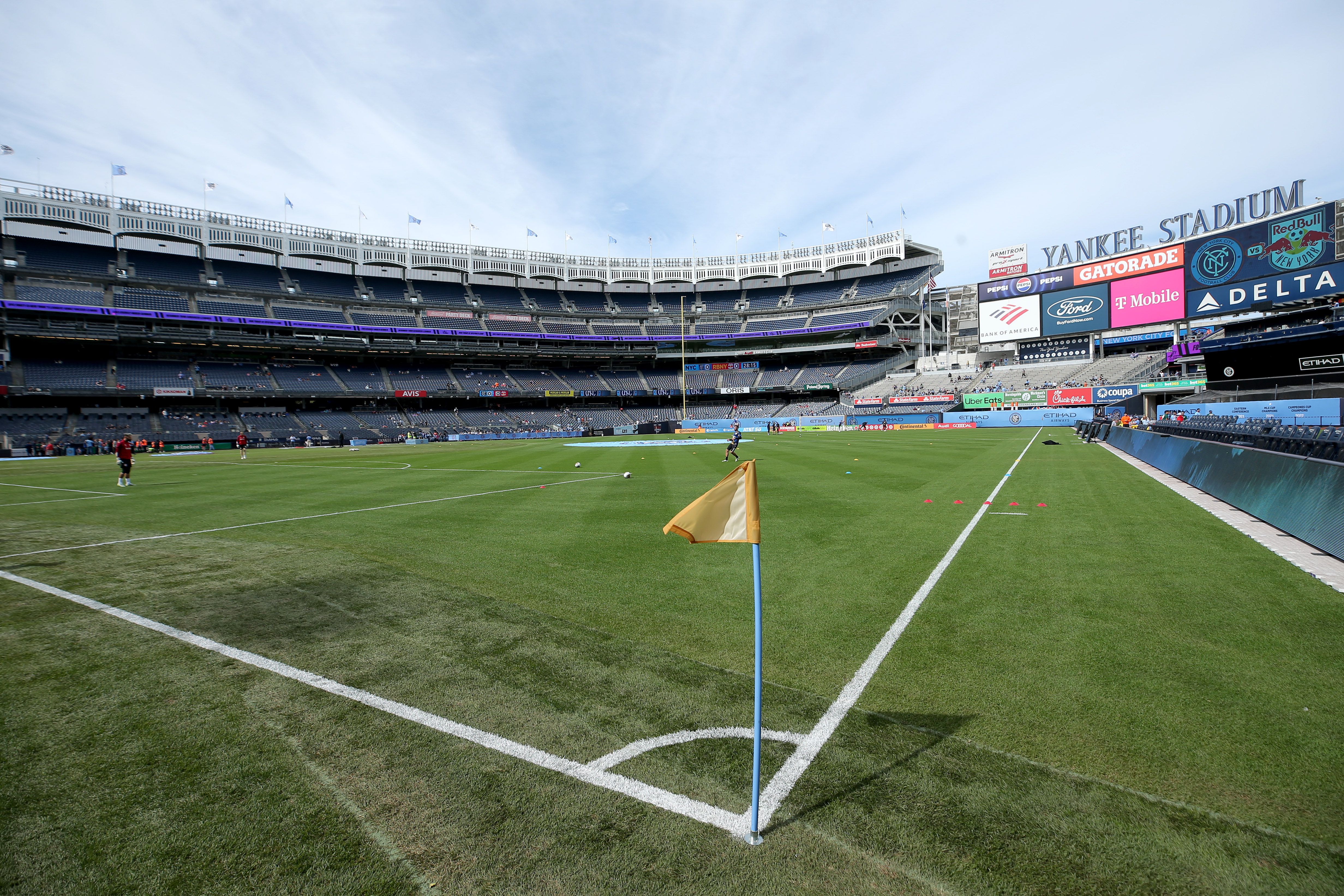
    They might also circle Aug. 16, when the Union visit New York City FC. Along with being a rivalry clash, it will be the last time the Union play at Yankee Stadium before the Pigeons open their own home in Queens (next door to the Mets’ Citi Field) in 2027.

    The worst game of the year weather-wise is likely the Aug. 22 visit to Austin FC, a scorching time of year in Texas. Toward the opposite end of the weather spectrum, the Union visit CF Montréal for the Canadian club’s home opener on April 11, when it will still be fairly chilly up north.

    Next year will bring the Union’s last game at Yankee Stadium before New York City opens its new stadium in Queens in 2027.

    The regular season concludes with the usual Decision Day of simultaneous kickoffs on Nov. 7, with the Union hosting Toronto. MLS will then pause for a week for November’s FIFA window (Nov. 9-17), then at long last get an uninterrupted run for its playoffs.

    Though the league said its postseason schedule will be announced later, it seems the final will be later in December than its recent home on the first weekend of the month.

    The Leagues Cup will also be played at some point next year, and the Union are expected to be in it. That schedule will be set later.

    Also, 2026 will be the last year when MLS runs a summer-centric calendar. The league will flip to a winter-centric one in 2027, running a short season in the first half of that year before starting the new full calendar in July.

    Union fans will have to get used to watching more games in cold weather after next year.

    2026 Union schedule

    All games will be broadcast on Apple TV. MLS Season Pass is no longer, with the league’s games now included in the same package with baseball, Formula 1, and scripted shows like Ted Lasso and Severance.

    Union season ticket holders, and season ticket holders of all MLS teams, will be able to get Apple TV free of charge as part of their 2026 packages.

    Saturday, Feb. 21: at D.C. United, 7:30 p.m.

    Sunday, March 1: vs. New York City FC, 4:30 p.m.

    Saturday, March 7: vs. San Jose Earthquakes , 7:30 p.m.

    Saturday, March 14: at Atlanta United, 3 p.m. (also on Fox29 and Fox Deportes)

    Saturday, March 21: vs. Chicago Fire, 4:30 p.m.

    Saturday, April 4: at Charlotte FC, 7:30 p.m.

    Saturday, April 11: at CF Montréal, 7:30 p.m.

    Saturday, April 18: vs. D.C. United, 7:30 p.m.

    Wednesday, April 22: at Toronto FC, 7:30 p.m.

    Saturday, April 25: at Columbus Crew, 7:30 p.m

    Saturday, May 2: vs. Nashville SC, 7:30 p.m.

    Saturday, May 9: at New England Revolution, 7:30 p.m.

    Wednesday May 13: at Orlando City, 7:30 p.m.

    Saturday, May 16: vs. Columbus Crew, 7:30 p.m.

    Sunday, May 24: at Inter Miami, 7 p.m. (also on Fox29 and Fox Deportes; last game before the World Cup break)

    Wednesday, July 22: vs. Red Bull New York, 7:30 p.m.

    Saturday, July 25: vs. Seattle Sounders, 7:30 p.m.

    Saturday, Aug. 1: vs. Atlanta United, 7:30 p.m.

    Sunday, Aug. 16: at New York City FC, 6:30 p.m. (at Yankee Stadium)

    Wednesday, Aug. 19: vs. Inter Miami, 7:30 p.m.

    Saturday, Aug. 22: at Austin FC, 8:30 p.m.

    Saturday, Aug. 29: at Red Bull New York, 7:30 p.m.

    Saturday, Sept. 5: vs. CF Montréal, 7:30 p.m.

    Wednesday, Sept. 9: vs. FC Cincinnati, 7:30 p.m. (also on FS1 and Fox Deportes)

    Sunday, Sept. 13: at San Diego FC, 9 p.m.

    Saturday, Sept. 19: at Sporting Kansas City

    Saturday, Sept. 26: vs. Orlando City SC

    Saturday, Oct. 10: vs. Real Salt Lake, 7:30 p.m.

    Wednesday, Oct. 14: at Chicago Fire, 8:30 p.m.

    Saturday, Oct. 17: vs. Charlotte FC, 2:30 p.m.

    Saturday, Oct. 24: vs. New England Revolution, 7:30 p.m.

    Wednesday, Oct. 28: at Nashville SC, 8:30 p.m.

    Saturday, Oct. 31: at FC Cincinnati, time TBD

    Saturday, Nov. 7: vs. Toronto FC, 4 p.m.

  • The Union put Ernst Tanner on leave as MLS reopens an investigation into alleged misconduct

    The Union put Ernst Tanner on leave as MLS reopens an investigation into alleged misconduct

    The Union said Wednesday that they have put sporting director Ernst Tanner on “administrative leave” as Major League Soccer reopened its investigation into Tanner’s alleged misconduct.

    Both moves follow a report by the Guardian that accused Tanner, 59, of a yearslong series of incidents involving racist, sexist, and homophobic remarks toward a range of people across American soccer.

    While Tanner’s lawyer denied the claims, the league said it reopened its investigation after “new allegations and potentially new information.”

    Some of those allegations were raised to the league by the MLS Players Association, although the league said Wednesday that the allegations “had not been independently verified.”

    On Wednesday, The Inquirer received this statement on behalf of Tanner through his legal team: “I continue to firmly deny these accusations. My priority is the team, the employees, and the Philadelphia Union community, particularly at this important time when the team has the opportunity to continue to excel in the playoffs. I will cooperate fully with the league’s investigation as I work to clear my good name and reputation.”

    Tanner has been the Union’s sporting director since 2018. He’s widely regarded as the architect of the team’s rise to one of the top clubs in MLS, all on a tight operating budget. In 2022, he was named the league’s Executive of the Year after putting together the team that reached the MLS Cup final for the first time in the Union’s history.

    The league said that in its investigation, it contacted “more than a dozen current and former players and club employees” and “all individuals were offered the option to participate anonymously and assured they could speak without fear of retaliation.”

    From there, the league said, “a majority of those contacted participated — several anonymously — while others declined. After reviewing all available information and documentation, the investigation was unable to substantiate the allegations.”

    The Guardian, a British newspaper and website, reported that in the league’s initial investigation, it contacted 13 people to potentially interview and that eight of them, “who the Guardian understands to be current and former players and employees of the Philadelphia Union, chose to speak with the league.”

    MLS said, as the Guardian reported, that Tanner “has been required to participate in a structured remedial program focused on professional workplace conduct.” The Guardian’s report said this is the second time he has gone through that program.

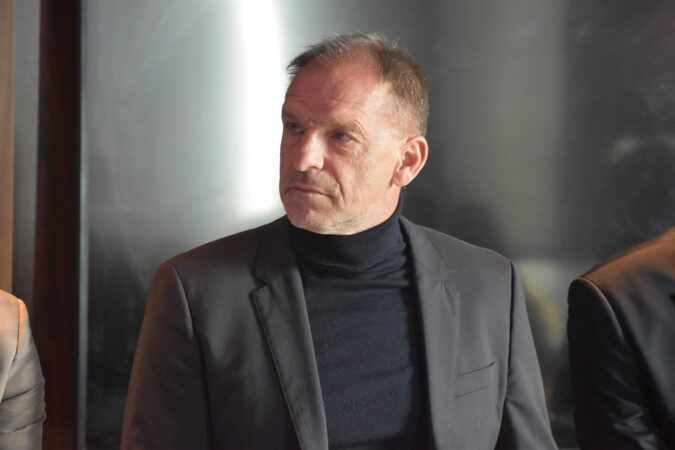
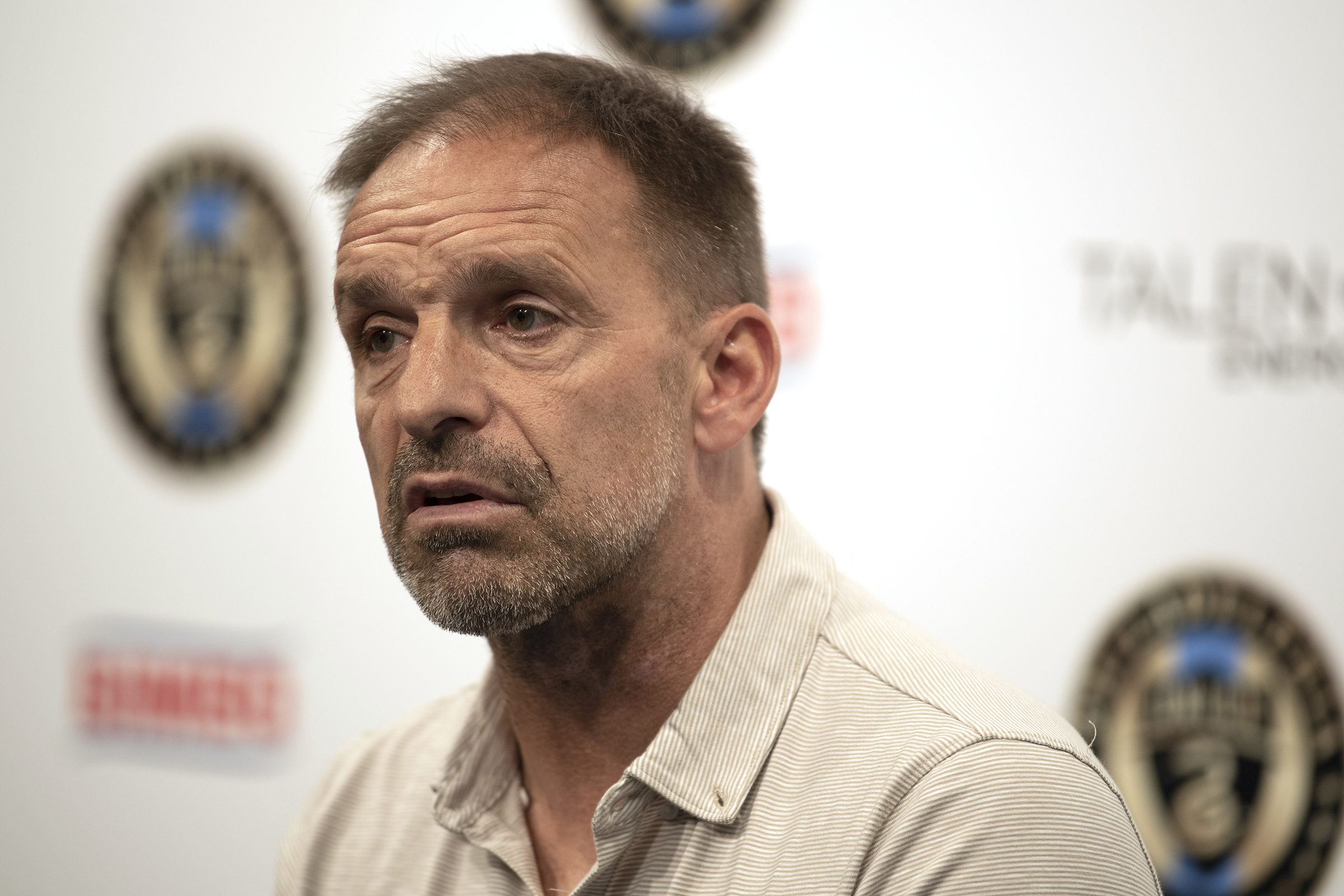
    Ernst Tanner, who joined the Union in 2018 as its sporting director, has been placed on administrative leave after allegations of misconduct.

    The Union, in their statement, said the team “takes all allegations of misconduct extremely seriously and is committed to maintaining a safe, respectful, and inclusive environment for everyone associated with our club. Discrimination, harassment, or abusive conduct of any kind has no place here, and all staff are required to complete annual sensitivity training.”

    The team also said it “continues to cooperate fully” with the league and that “throughout this process, our top priority remains the well-being of our players, fans, staff, and community.”

    The Union have a home playoff game on Sunday, an Eastern Conference semifinal against New York City FC (7:55 p.m., FS1, Fox Deportes, Apple TV). The winner of that game advances to the Eastern Conference final against either FC Cincinnati or Lionel Messi’s Inter Miami.

    The Union have home-field advantage in the playoffs for as long as they’re playing, including if they reach the Dec. 6 MLS Cup final.

  • Curaçao and Union midfielder Danley Jean Jacques’ Haiti qualify for the World Cup

    Curaçao and Union midfielder Danley Jean Jacques’ Haiti qualify for the World Cup

    KINGSTON, Jamaica — The tiny Caribbean island country Curaçao will go to the 2026 World Cup as the smallest nation by population ever to qualify for the marquee event in men’s soccer.

    Curaçao, an autonomous territory of about 156,000 people within the Netherlands kingdom, breaks the record of Iceland, with a population of just over 350,000, which was previously the smallest country to reach the World Cup when it qualified for Russia 2018.

    A team relying heavily on players born and raised in the Netherlands rode its luck Tuesday to take a 0-0 draw in Jamaica and finish top of a four-team group. Its other opponents were Trinidad and Tobago and last-place Bermuda.

    Jamaica’s side of the result means the Reggae Boyz, captained by Union goalkeeper Andre Blake, must play the final round of intercontinental playoffs in March to try to reach their first men’s World Cup since 1998.

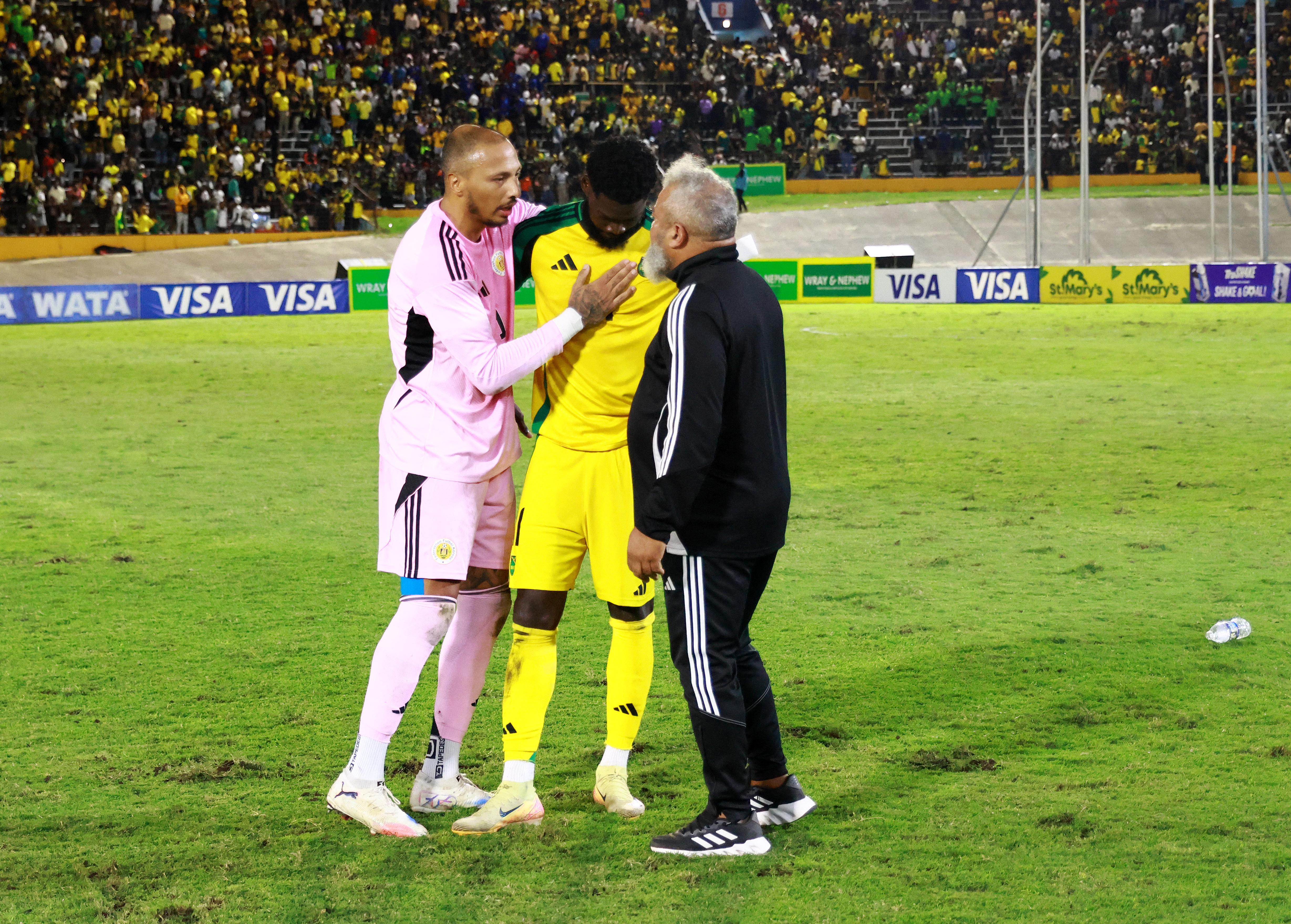
    Jamaica’s Shamar Nicholson (center) is consoled after the final whistle.

    Curaçao has actively recruited from its diaspora, getting permission from FIFA within world soccer’s rules to change the national-team eligibility of players who once represented the Netherlands at youth or Under-21 level, including five since August.

    Defender Joshua Brenet even played a World Cup qualifying game for the Netherlands in 2016.

    Tahith Chong, a former Manchester United youth player, is one of the few squad members born in Curaçao, which was called Netherlands Antilles until getting its autonomy 15 years ago.

    A storied Dutch coach has led Curaçao on to the elite stage for the first expanded 48-team World Cup in the United States, Canada and Mexico.

    Dick Advocaat, at age 78, is set to lead his third team at a World Cup, and his second in the U.S. He took his native Netherlands to the quarterfinals at the 1994 edition and coached South Korea at the 2006 World Cup in Germany.

    Curaçao’s adventure is set to put players from unheralded clubs on the biggest stage. The squad that clinched qualification included players from Rotherham in England’s third-tier league, Bandırmaspor in the Turkish second division and Abha in Saudi Arabia.

    Curaçao got the historic result despite not having Advocaat on the bench. He missed the match in Jamaica because he had to return to the Netherlands last weekend for family reasons.

    His team saw Jamaica strike the woodwork three times in the second half in Kingston. A potentially decisive penalty kick awarded to the home team in stoppage time was overturned after a video review.

    Curaçao will be joined by regional neighbors Panama and Haiti, which also booked their World Cup spots Tuesday.

    Absolute scenes as Panama qualify for their second-ever World Cup 🇵🇦

    [image or embed]

    — CBS Sports Golazo (@cbssportsgolazo-m.bsky.social) November 18, 2025 at 10:12 PM

    Panama advanced to its second World Cup after defeating El Salvador 3-0 on first-half goals from César Blackman and Erick Davis, plus Jose Luis Rodriguez late in the game.

    Panama’s only previous World Cup appearance was in 2018. It overtook Suriname, another Dutch-influenced team, which started play atop the group before losing 3-1 against Guatemala.

    Haiti, a troubled Caribbean country, had a surprising campaign and beat Nicaragua, 2-0, to win its group over favorites Honduras and Costa Rica, which was a quarterfinalist at the 2014 World Cup.

    Haiti’s only previous trip to the World Cup was in West Germany in 1974.

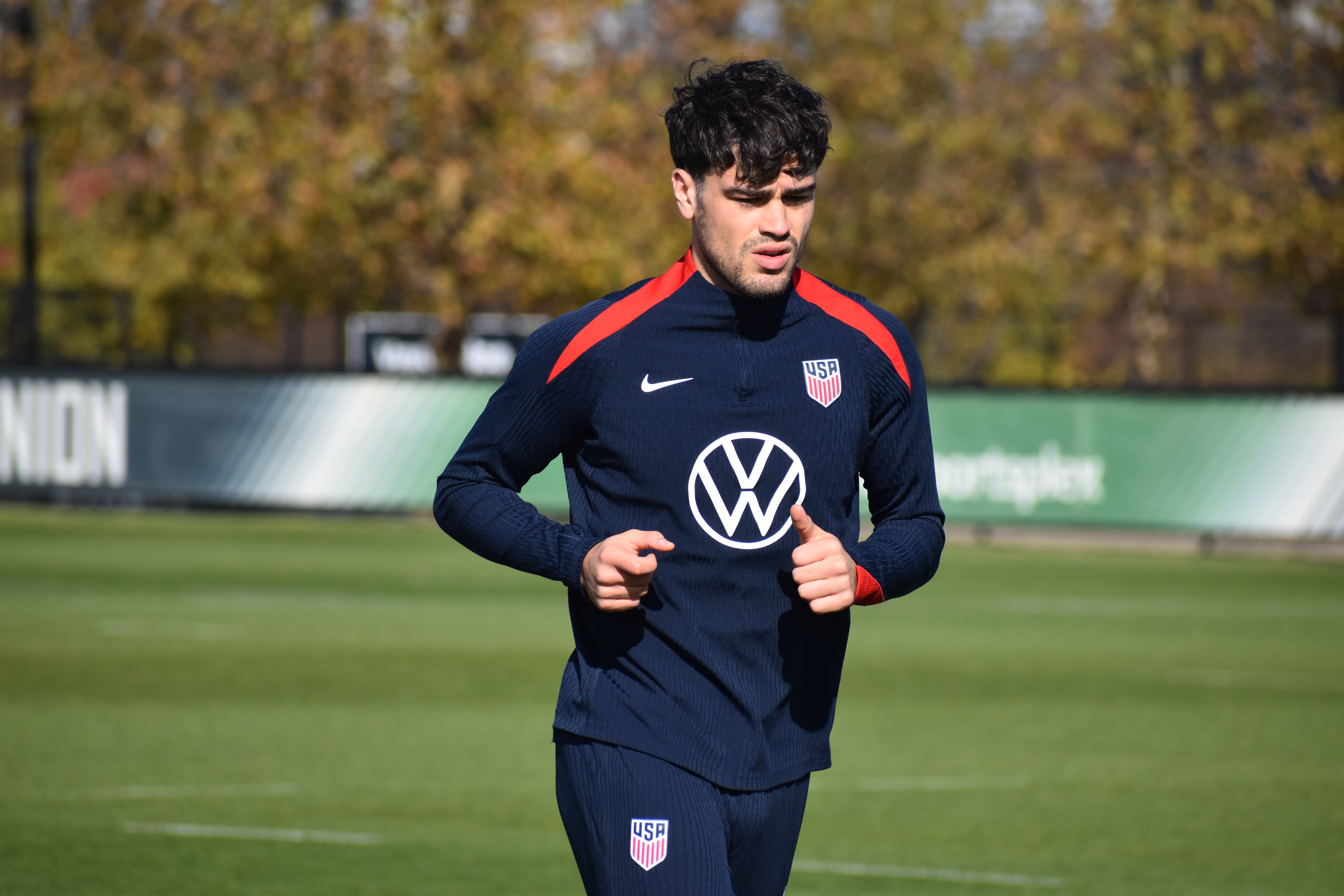
    Les Grenadiers’ squad includes Union midfielder Danley Jean Jacques and former Penn midfielder Duke Lacroix, who has played for eight years in the USL Championship since graduating in 2015.

    The Caribbean and Central American results Tuesday also finalized the six teams that will take part in the intercontinental playoffs in Mexico in March.

    Two teams will qualify from the playoffs, which includes Jamaica and Suriname, plus Iraq from Asia, Congo from Africa, Bolivia from South America and New Caledonia from Oceania.
    Staff writer Jonathan Tannenwald contributed to this article.

  • Projecting the USMNT’s World Cup roster after its last game of the year: Several locals in; surprises on the bubble

    Projecting the USMNT’s World Cup roster after its last game of the year: Several locals in; surprises on the bubble

    TAMPA, Fla. — From the time Mauricio Pochettino took over the U.S. men’s soccer team last year, each moment has had two meanings.

    Along with trying to win games, every pass, shot, tackle, save, or failure has been about trying to make the World Cup team. That mentality is burned deep into American soccer’s psyche, as it has been for many decades, and it’s even deeper when the tournament is on home soil.

    The competition is made more difficult by how few opportunities there are to compete. Tuesday’s U.S.-Uruguay game was the 22nd match of Mauricio Pochettino’s tenure, with two more in March before the World Cup roster is named in late May.

    That is the same number of games (24) the Eagles played in their entire 2024 campaign, from the preseason through the Super Bowl — to say nothing of how many games there are in other sports’ calendars.

    U.S. manager Mauricio Pochettino.

    On top of that, in none of those 22 games has Pochettino had every member of his A squad healthy. Christian Pulisic, Tyler Adams, Weston McKennie, Folarin Balogun, Chris Richards, Sergiño Dest, and others have missed significant time along the way.

    Then combine those absences with the Nations League flop in March, which forced Pochettino to blow up his plans and bring in a bunch of less-talented challengers to try to outhustle the stars. The result is the roller-coaster path the U.S. team has been on this year, reaching a smooth track only in the last two months.

    This has made projecting a World Cup roster quite difficult. It’s a game fans love to play, and the media often enjoys it too. But the absences, the results, and the quick cadence of FIFA windows this fall made it more sensible to wait.
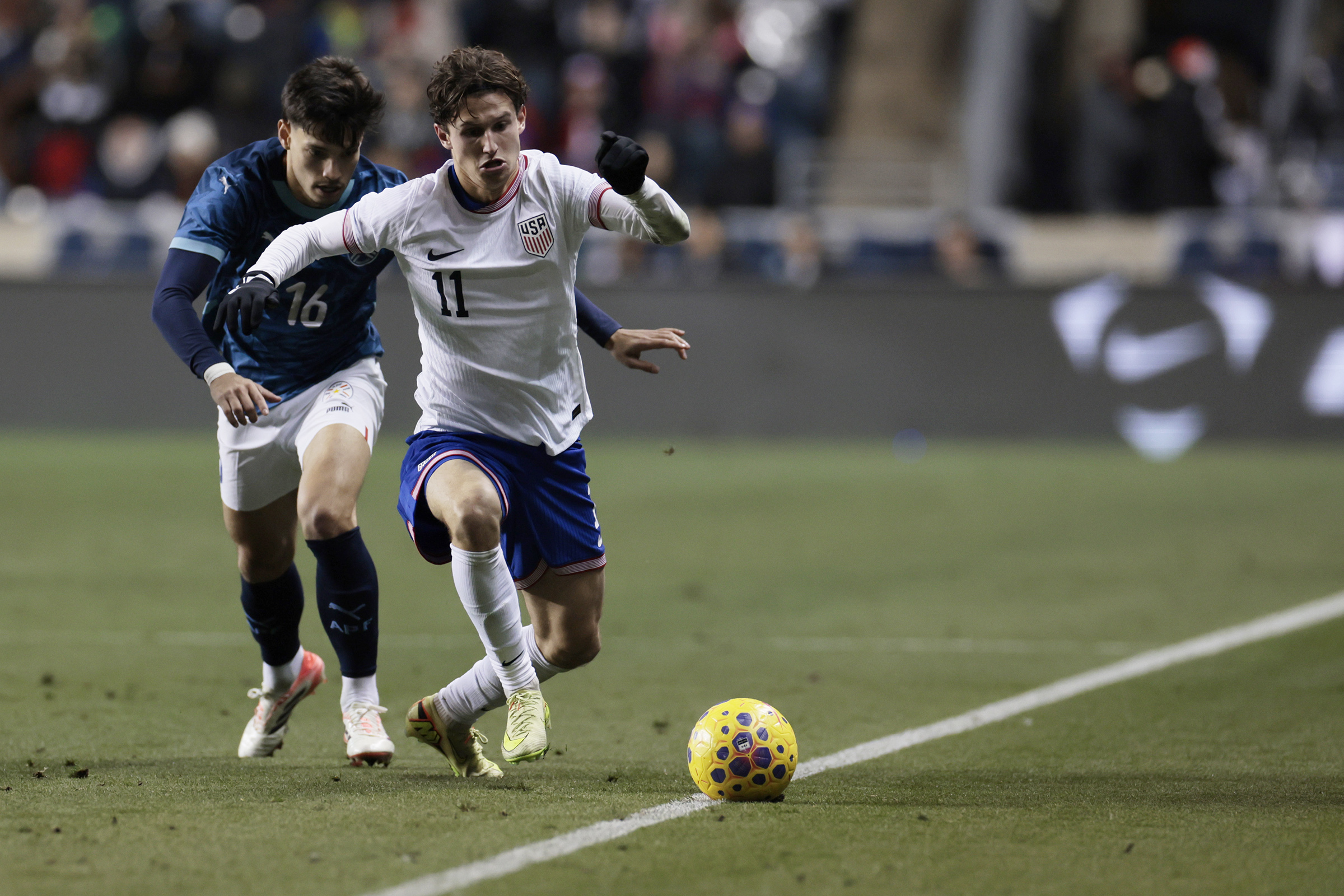
    Now, though, the Americans have wrapped up their work for the year. The 24 players on this month’s squad headed back to the club world on Wednesday morning, and that side of the game will reign until late March.

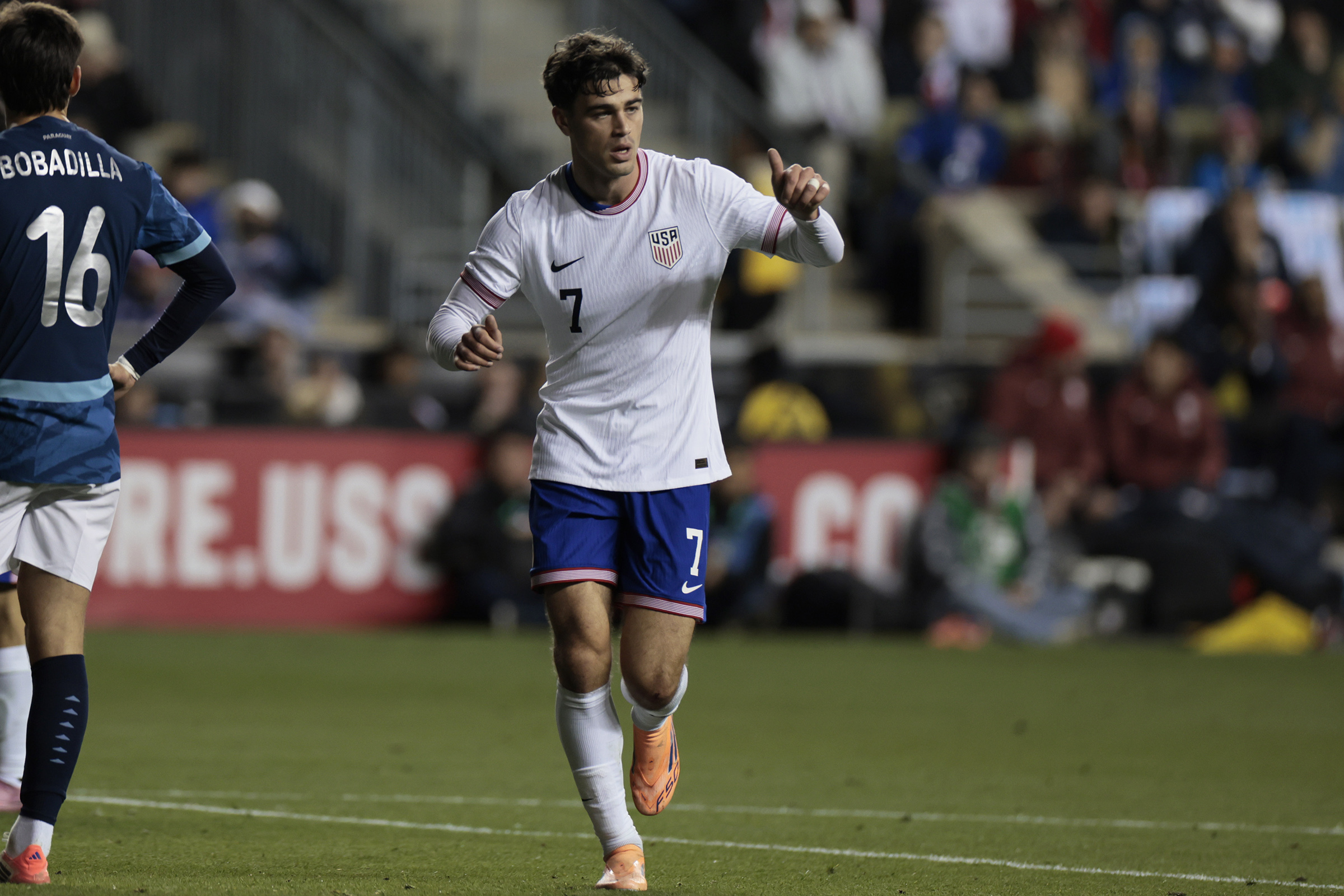
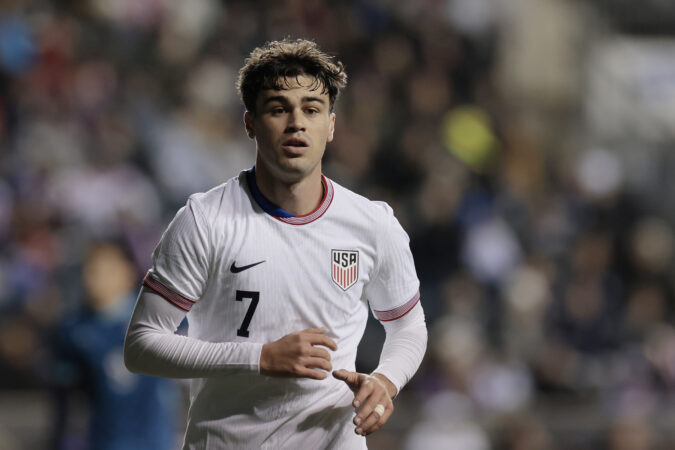
    Gio Reyna is one of the players who left a big and positive impression in this month’s games.
    So this moment feels right to look at the bigger picture. Here’s my view of the race to make the plane to Atlanta, where the 26-player World Cup team will gather at U.S. Soccer’s new national training center before its pretournament friendlies.

    The projection is broken down by the six main positions in Pochettino’s tactics: goalkeeper, outside back, centerback, central midfielder, attacking midfielder, and striker. Each position then has players who look like they’re in, those on the bubble (in alphabetical order), and a few words of analysis.

    Goalkeepers

    In: Matt Freese (New York City FC), Patrick Schulte (Columbus Crew)

    Bubble: Roman Celentano (FC Cincinnati), Jonathan Klinsmann (Cesena, Italy), Zack Steffen (Colorado Rapids), Matt Turner (New England Revolution)

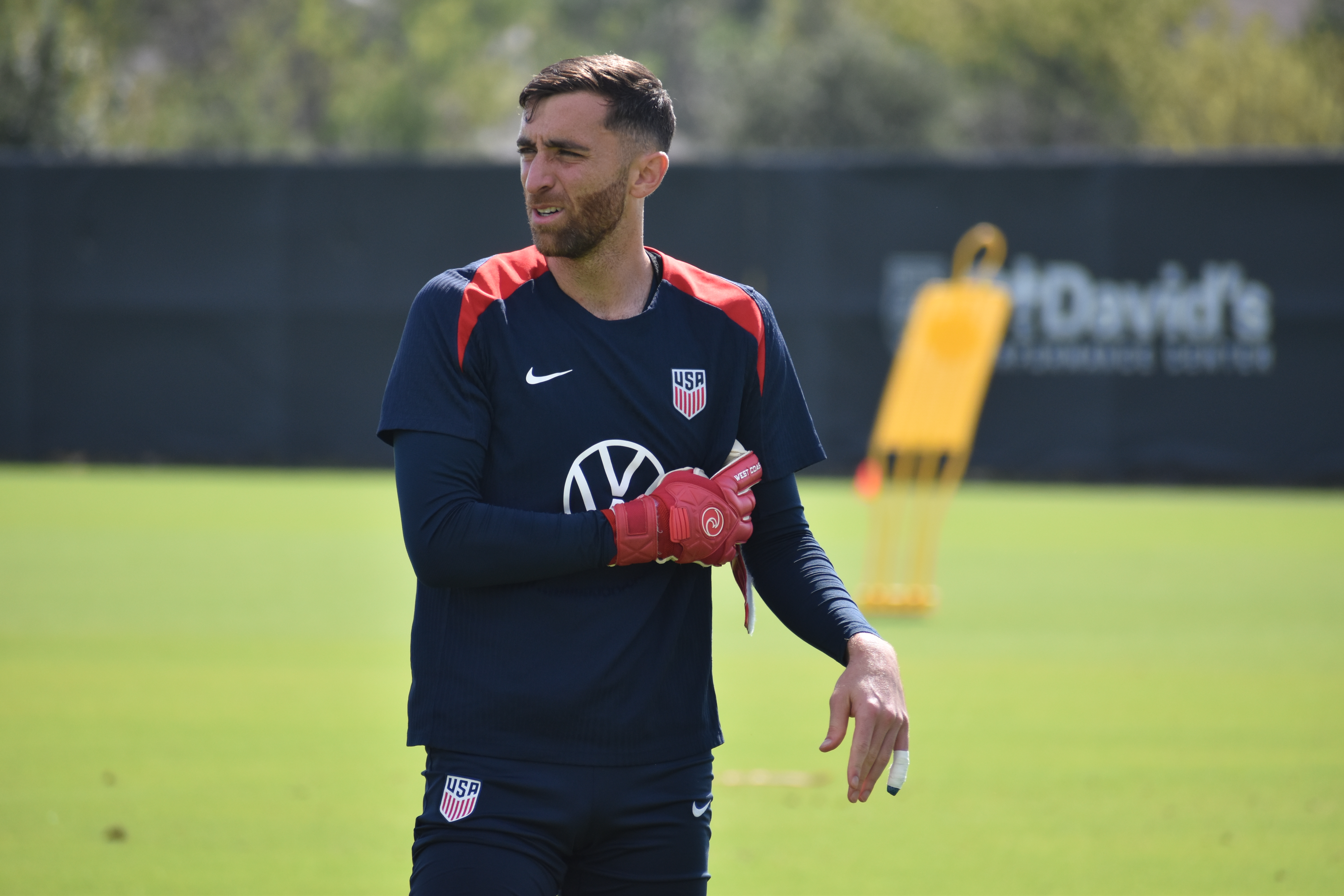
    Matt Freese making a save during one of the U.S. men’s team’s practice sessions in Chester last week.

    Analysis: Unless something goes off the rails for Freese, the Wayne native is in line to become the most surprising U.S. starting goalkeeper at a World Cup for generations. He was given a chance in June and has not let it go, playing 13 of the Americans’ 14 games since the start of the summer.

    Schulte, at age 24, is a fine starter in Columbus, a capable backup with the U.S., and a leading name for the 2030 cycle.

    Turner’s fall is as surprising as Freese’s rise. The locked-in starter from the 2021 Gold Cup through this past March is now not just out of games, but out of rosters. Even a move back to New England to get the playing time he lacked in Europe hasn’t gotten him back in Pochettino’s good graces.

    Matt Turner is on the outside looking in with the U.S. squad right now.

    Celentano and Klinsmann, son of former U.S. manager Jürgen Klinsmann, have been in a few U.S. camps. Steffen, of Downingtown, unfortunately is on the outside looking in right now, despite his talent. He’ll have to hope for a strong start next year in Colorado that vaults him over the field.

    Outside backs

    In: Max Arfsten (Columbus Crew), Sergiño Dest (PSV Eindhoven, Netherlands), Alex Freeman (Orlando City), Antonee Robinson (Fulham, England), Tim Weah (Marseille, France)

    Bubble: Kristoffer Lund (FC Köln, Germany), John Tolkin (Holstein Kiel, Germany)

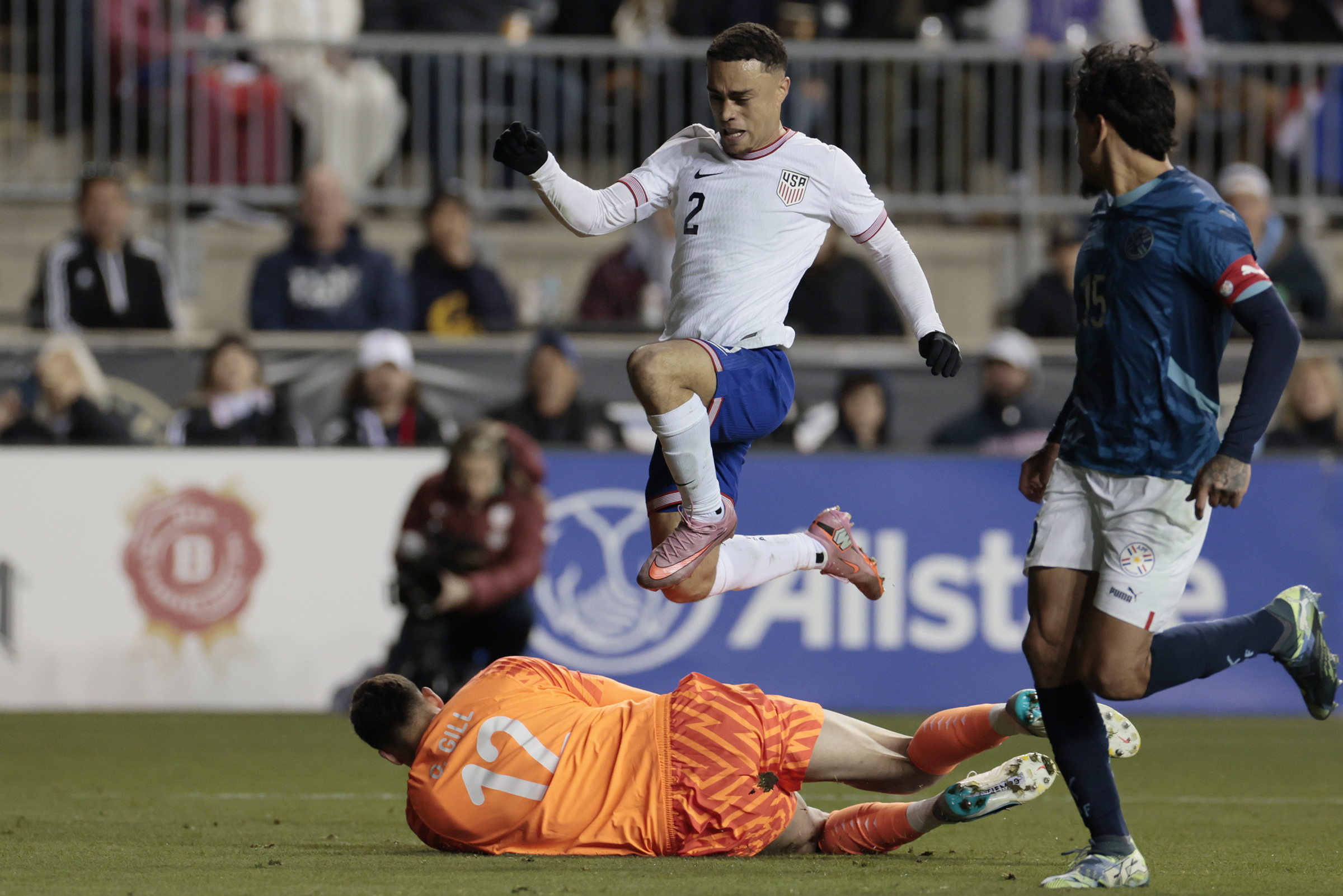
    Sergiño Dest (2) in action against Paraguay at Subaru Park on Saturday.

    Analysis: With one exception, this position is easy to line up. All five of the “in” names are locks to make the squad unless Robinson can’t recover from a long-term knee issue. From here, the view is if he’s healthy on June 1, that’s all that matters.

    Dest and Weah are the other big names, each capable of thriving in the right wingback role and playing the left side if necessary.

    Earlier this year, a reader complained to me on social media that the underwhelming Gold Cup squad might only produce the last players picked for a World Cup squad. I responded that if that was to happen, that squad would be a smashing success, no matter its results.

    Arfsten and Freeman are the proof of that, having shot to well-earned prominence this year. Though they wouldn’t start if the three others are healthy, they are more than capable backups.

    Lund and Tolkin are on the bubble in case Robinson ends up out. Tolkin played well against Uruguay on Wednesday in his first U.S. cap since the Gold Cup; Lund hasn’t been called in since October of last year.

    Centerbacks

    In: Mark McKenzie (Toulouse, France), Tim Ream (Charlotte FC), Chris Richards (Crystal Palace, England)

    Bubble: Noahkai Banks (Augsburg, Germany), Tristan Blackmon (Vancouver Whitecaps), Cameron Carter-Vickers (Celtic, Scotland), Miles Robinson (FC Cincinnati), Joe Scally (Borussia Mönchengladbach, Germany), Auston Trusty (Celtic, Scotland), Walker Zimmerman (free agent, last with Nashville SC)

    Chris Richards working out during a practice in September.

    Analysis: Ream and Richards aren’t just locks, they’re expected starters. The third starting spot is up for grabs, and there’s a lot of competition.

    McKenzie isn’t just projected as in here out of hometown loyalty to the Union alumnus from Bear, Del. His play for the national team and Toulouse puts him above a field in which no one else has truly stepped up.

    From here, the bet is Pochettino will take two more, and the race is wide-open.

    Blackmon has played some for Pochettino but isn’t at the needed level. Carter-Vickers didn’t play for the U.S. in October, a big warning sign, then suffered an Achilles injury at Celtic. Robinson is a U.S. regular but hasn’t quite done well enough to ensure a plane ticket.

    Scally can play multiple positions and is listed here because right centerback is where he projects under Pochettino. After being out of the picture for a while, he played there against Paraguay, got torched on a goal, then didn’t play vs. Uruguay.

    Mark McKenzie (left) and Auston Trusty (right) grew up with the Union together, and could go to the World Cup together.

    Trusty played the full game vs. Uruguay and did well at both ends of the field. Zimmerman is last in line, but if he lands at a big club in MLS free agency and starts the year strong, he could be an emergency option.

    Banks is a big wild card. The 18-year-old Hawaii native stands 6-foot-4, is starting to earn regular playing time at Augsburg, and has held his own in the Bundesliga’s cauldron. Pochettino called him up in September, but hasn’t since. If Banks keeps playing, he might just make it.

    Central midfielders

    In: Tyler Adams (Bournemouth, England)

    Bubble: Sebastian Berhalter (Vancouver Whitecaps), Johnny Cardoso (Atlético Madrid), Aidan Morris (Middlesbrough, England), Cristian Roldan (Seattle Sounders), James Sands (St. Pauli, Germany), Tanner Tessmann (Lyon, France)

    Tyler Adams (left) is one of the U.S. team’s biggest stars.

    Analysis: Adams is a lock — a star, a veteran, and the team’s most vocal leader. From there, the question will be how deep Pochettino goes at the position.

    Tessmann, Roldan, and Morris lead the way, with Tessmann the closest to a lock. That takes the total to four, and the guess here is one more will make it.

    Berhalter made quite a statement in Tuesday’s win over Uruguay, with a goal and an assist off a corner kick. That puts him ahead for now of Cardoso, who has tons of talent and is at a huge club but has a history of playing poorly for the U.S. He’s also coming off an injury. If he’s healthy by March, he could get one shot at a ticket in that month’s friendlies.

    Sands helps his case with versatility, as he also can play centerback. He got a look in October and wasn’t bad, but he wasn’t called back this month even though there was room for him.

    Attacking midfielders

    In: Brenden Aaronson (Leeds United, England), Weston McKennie (Juventus, Italy), Christian Pulisic (AC Milan, Italy), Malik Tillman (Bayer Leverkusen, Germany), Alejandro Zendejas (Club América, Mexico)

    Bubble: Diego Luna (Real Salt Lake), Jack McGlynn (Houston Dynamo), Gio Reyna (Borussia Dortmund, Germany)

    Union alum and Medford native Brenden Aaronson in action for the U.S. on his former home field at Subaru Park.

    Analysis: The “in” players are locks as long as they’re healthy, with Zendejas the only one close to a question. Pulisic obviously is a starter, with Tillman or McKennie in line to run next to him.

    From there, Pochettino can make subs based on situations. Medford’s Aaronson is an ideal defensive closer, and Zendejas provides width and creativity.

    The last pick could come down to Luna, whom Pochettino rightly adores for his toughness; or Reyna, whose talent is forever followed by injury fears. It would be great to see both make it, but there might not be room unless another position is sacrificed. Reyna has the advantage now and will keep it if he plays regularly for his club.

    McGlynn is a long shot, but a hot streak with Houston next year could bring his magic left foot back to the picture.

    Strikers

    In: Folarin Balogun (AS Monaco, France), Ricardo Pepi (PSV Eindhoven, Netherlands), Haji Wright (Coventry City, England)

    Bubble: Patrick Agyemang (Derby County, England)

    Folarin Balogun (center) might finally be the U.S. team’s long-awaited top striker.

    Analysis: It’s truly remarkable that the highest-profile position is one at which the U.S. has the fewest questions. Never before in the program’s 36-year modern era has there been a striker depth chart with this much quality.

    If Balogun, Pepi, and Wright are healthy, they’ll be on the plane, and that will be it. If any of them are injured — which Pochettino and every U.S. fan will pray doesn’t happen — Agyemang is first in line to come in.

    The field drops so far from there that right now no other strikers truly are in consideration.

  • USMNT stuns Uruguay with a 5-1 rout in its last game of the year

    USMNT stuns Uruguay with a 5-1 rout in its last game of the year

    TAMPA, Fla. — The U.S. men’s soccer team closed its year with one of its toughest tests under Mauricio Pochettino, against star-studded Uruguay on Tuesday. And if the opponent’s quality wasn’t enough, Pochettino upped the ante by starting many of his backups to test them.

    What resulted was one of the most surprising games not just of Pochettino’s tenure, but for some years with the U.S. program: a 5-1 shellacking by the Americans, with goals from four different scorers.

    Sebastian Berhalter, Alex Freeman (twice), and Diego Luna tallied in the first half, and Tanner Tessmann added another in the second before a crowd at Raymond James Stadium that was as stunned as it was thrilled.

    As much as the result of any friendly game counts, Pochettino’s lineup changes immediately became the night’s first headline. Just two of the 11 players who started Saturday’s win over Paraguay, right back Sergiño Dest and former Union goalkeeper Matt Freese, remained starters three days later. (The short time between contests was perhaps another factor in Pochettino’s rotation.)

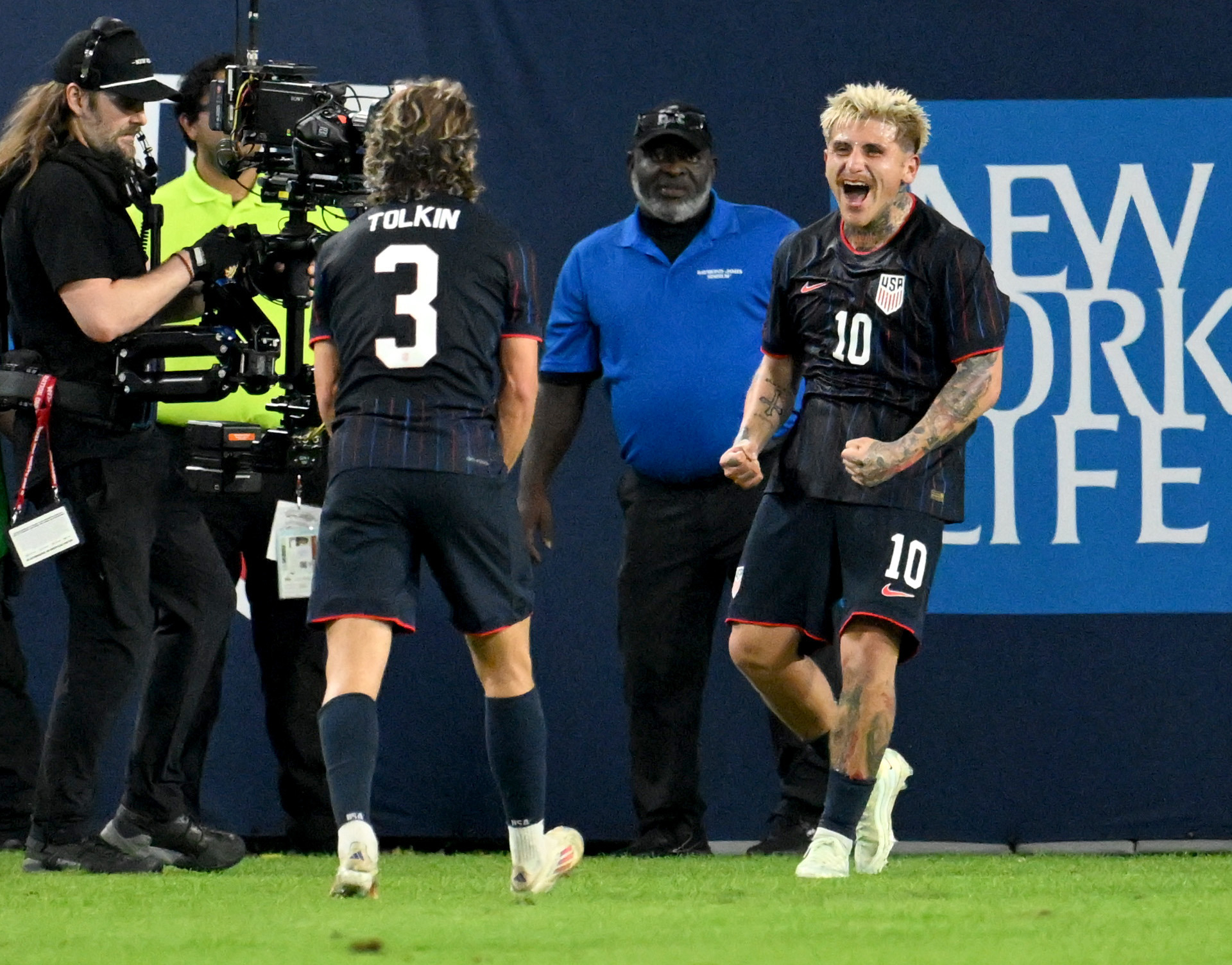
    John Tolkin (left) and goal scorer Diego Luna (right) were among the new U.S. starters.

    Pochettino took the U.S. back to a 4-3-3 setup, with Union alumni Mark McKenzie and Auston Trusty together at centerback, John Tolkin at left back, and Freeman at right back. Aidan Morris was the midfield stopper behind Timothy Tillman and Berhalter; and Luna, Haji Wright, and Dest were the front three from left to right.

    They faced an Uruguay lineup stacked with marquee names. Barcelona’s Ronald Araújo anchored the back line; Tottenham Hotspur’s Rodrigo Bentancur and Manchester United’s Manuel Ugarte led the midfield; and Flamengo dynamo Giorgian de Arrascaeta created behind striker Federico Viñas of Spain’s Real Oviedo.

    Along with their talents, they were expected to bring Uruguay’s famed garra charúa fighting spirit. Instead, the near total opposite happened.

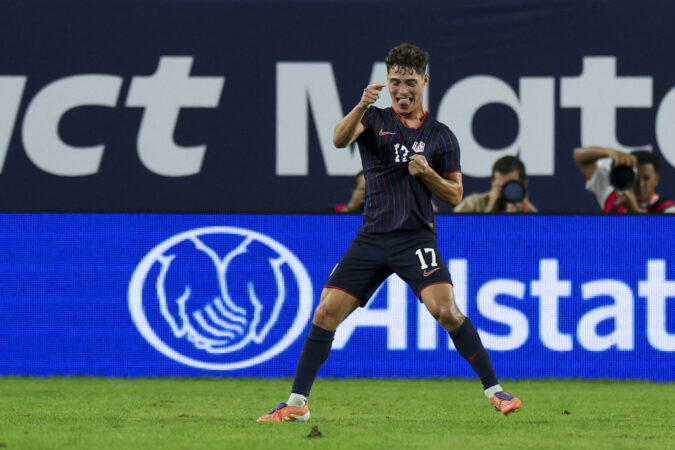
    Berhalter opened the scoring in the 17th off a free kick trick play, a give-and-go with Dest for a curler from the left side of the 18-yard box. The son of former U.S. manager Gregg Berhalter grabbed his jersey by the badge as he exulted, pointed to it, and aimed an ear to the crowd — perhaps to make a point to his critics.

    Freeman doubled the lead four minutes later when he leapt to meet Berhalter’s corner kick and headed it past a stranded Uruguay goalkeeper Cristopher Fiermarin — one of la Celeste’s only inexperienced players, in just his second national team game.

    In the 31st minute, Freeman made it 3-0 at the tail end of another corner kick play. After an initial clearance, Freeman ended up on the left side of the field, Trusty sprung him forward, and Freeman — who plays his club soccer 90 minutes west of here in Orlando — split Araújo and Ugarte before shooting.

    Luna struck the fourth in the 42nd, set up by Tillman. This really was shocking now, as Uruguay’s stars looked tired and uninterested. It was miles from the standard set by famed manager Marcelo Bielsa, who launched Pochettino’s professional career decades ago at Argentine club Newell’s Old Boys.

    This all said, in the moments Uruguay advanced forward, the U.S. defense didn’t exactly look great. It came to a head in first-half stoppage time, when Freese came off his line, nearly crashed into Freeman, recovered, then was stuck at his right post as de Arrascsaeta uncorked a bicycle kick in front of McKenzie. Seven U.S. field players stood in front of Freese at the point when de Arrascaeta launched himself.

    Uruguay’s fight showed up in the second half, but not always for the better: Bentancur was ejected with a straight red card in the 65th for upending Berhalter.

    Just before then, Pochettino made his first substitutions of the night. Luna, Wright, and Dest went out, and Gio Reyna, Folarin Balogun, and Tessmann went in. That didn’t all add up as like-for-like swaps, but the end result was a 4-2-3-1 with Berhalter, Reyna, and Tillman in front of Morris and Tessmann.

    The fifth goal came in the 68th, off another corner kick play. Reyna had the eventual assist with a ball floated from the left wing that Tessmann headed in, with Fiermarin barely contesting the service.

    Max Arfsten and Brenden Aaronson entered next, replacing Tolkin — who had been kicked around enough to be injured — and Tillman in the 75th. Cristian Roldan was the last U.S. substitute, replacing Morris in the 86th.

    When the clock struck 90 minutes, Guatemalan referee Julio Lune blew the final whistle right away instead of adding stoppage time.

    He, like everyone else, had seen quite a sight.

  • Union sporting director Ernst Tanner is accused of racist, sexist, and homophobic behavior

    Union sporting director Ernst Tanner is accused of racist, sexist, and homophobic behavior

    A report published Tuesday by the Guardian, an English news outlet with a large U.S.-based sports staff, accused Union sporting director Ernst Tanner of a series of incidents involving racism, sexism, and homophobia directed toward people around American soccer.

    The report centers on a “wide-ranging” complaint filed by the MLS Players Association with the league in January containing eight allegations. Since then, the Guardian said it has heard from “17 sources” who “have alleged numerous misbehaviors spanning nearly the entirety of Tanner’s seven-year tenure with the Union,” including those mentioned in the MLSPA’s report and other alleged incidents.

    Figures allegedly targeted by Tanner include several referees, including Tori Penso.

    Veteran referee Tori Penso is said to be a target of alleged sexist comments made by Union sporting director Ernst Tanner.

    Although Penso has officiated top-level games for many years, including the 2023 women’s World Cup final, Tanner is accused of repeatedly criticizing her since 2020, including multiple claims that women should not be involved in men’s soccer.

    A native of Germany, the 59-year-old Tanner has been the Union’s sporting director since 2018. His lawyer gave a statement to the Guardian saying that Tanner “denies ever intentionally making insensitive gender-based comments.”

    The article said another veteran referee, Nima Saghafi, was the target of an allegedly homophobic slur by Tanner in a game in 2023. The MLSPA accused Tanner of racist remarks toward an assistant referee at a game in the same season.

    In a statement to the Guardian later shared to The Inquirer, Professional Referee Organization general manager Mark Geiger said: “If these remarks are proven to be true, we are appalled. Such comments — and any form of discriminatory language — are deeply irresponsible, wholly inappropriate, and have no place in our game or in society. We take great pride in our diverse roster of officials who serve the professional game across North America, demonstrating leadership, integrity, and respect. Every PRO official has earned their place through hard work and dedication, progressing along the pathway solely on merit.”

    MLSPRO general manager and referee Mark Geiger said that if the allegations against Tanner are true, it’s “deeply irresponsible.”

    According to one source who spoke with the Guardian, Tanner “consistently would speak about African players like they were subhuman.”

    He is also accused of enabling allegedly discriminatory behavior, including racism, by former Union II coach Sven Gartung. Tanner hired Gartung in early 2020, and he lasted only 5½ months in the job.

    Beyond games, the Guardian reported that in 2019, the Union’s human relations department was notified about allegations that Tanner had “engaged in inappropriate physical contact” with a female employee by touching her buttocks “numerous times.”

    The Guardian’s reporter, Pablo Maurer, said the outlet saw emails regarding the notice and heard from “nine sources familiar with the incidents.” Those sources said they had not received any response from the team, and the Guardian’s report said the sources claimed “the club’s handling of that complaint is par for the course.”

    The report further claimed that “over a dozen current and former Philadelphia Union employees say that complaints concerning Tanner’s behavior have been submitted to the club’s HR department but that they have seen no evidence of a response.”

    The Union’s chairman and majority owner, Jay Sugarman, looks on while sporting director Ernst Tanner speaks to the media in 2024.

    Tanner’s lawyer told the Guardian that Tanner “firmly denies these accusations, some of which are six or seven years old. Throughout his career spanning over three decades in professional soccer around the globe, Mr. Tanner has worked fairly and effectively in a diverse, multicultural world upholding high standards of professionalism.”

    The Union told the Guardian that Tanner “was found to have made potentially insensitive gender-based comments early in his tenure, for which he underwent training and had discussions with club leadership.” The team also said it was “not previously aware of the allegations in the MLSPA complaint.”

    “The Philadelphia Union takes all allegations of misconduct extremely seriously and is unwavering in our commitment to maintaining a safe, respectful, and inclusive environment for all players, staff, and members of our community,” the statement said.

    When reached Tuesday by The Inquirer, the team declined to comment beyond that statement.

    MLS said it launched an investigation immediately after receiving the MLSPA complaint.

    The Guardian reported that “Tanner was never placed on leave after the investigation began in January because MLS couldn’t corroborate the claims against him,” and that the investigation was closed within the last few weeks. But the outlet also said the league “found the alleged behavior, if true, to be unacceptable” and “a ‘clear violation’ of league policy.”

    Ernst Tanner (left) welcoming Union manager Bradley Carnell during Carnell’s introductory news conference in January.

    The league told the Guardian that Tanner had been required to follow a “structured remedial program focused on professional workplace conduct.” The report noted that Tanner has had to go through that training twice, along with the team’s “annual sensitivity training,” which is required of all staff.

    MLS and the Union told the Guardian that if new information comes forward, both may investigate Tanner further. The league has an anonymous reporting hotline, and the team said that “should any new information emerge, the Philadelphia Union will act quickly and appropriately, in accordance with our policies, and will continue to cooperate fully with the league.”

  • The USMNT’s players appreciate the team’s tough schedule leading up to the World Cup

    The USMNT’s players appreciate the team’s tough schedule leading up to the World Cup

    TAMPA, Fla. — Once the U.S. men’s soccer team knew it wouldn’t have to qualify for next year’s World Cup as a cohost, it faced a different challenge.

    Having no qualifiers to play meant the program would have to fill its calendar with exhibition games, which the world’s game calls “friendlies” even when they aren’t polite. (Look no further than the brawl that ended Saturday’s U.S.-Paraguay match in Chester.)

    Since it started to matter in June, U.S. Soccer could have picked several lesser opponents to try to rack up wins for public perception. But it knew those would have been empty calories, and many fans would have agreed.

    So manager Mauricio Pochettino and his staff chose the harder path: aim high, suffer along the way, and come out the other side sharpened.

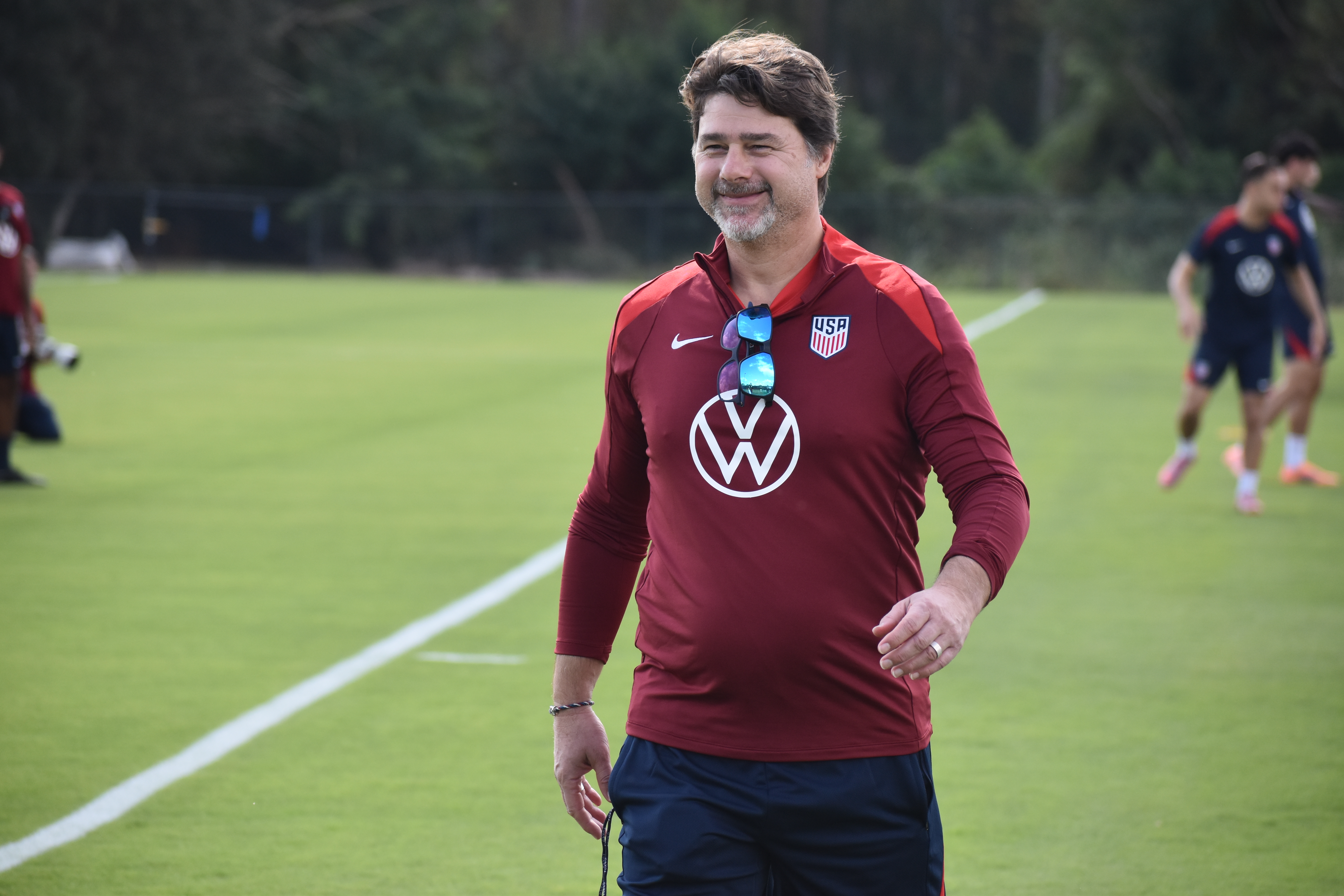
    U.S. manager Mauricio Pochettino at Monday’s practice in Tampa.

    There was certainly suffering for a while: a 2-1 loss to Turkey and a 4-0 blowout to Switzerland in June, and a 2-0 loss to South Korea in September.

    Pochettino’s words after the Switzerland game were as true then as they are now, with the U.S. on a four-game unbeaten run against Japan, Ecuador, Australia, and Paraguay.

    “We knew that we wanted to play with two important teams in Europe like Turkey and Switzerland,” he said. “When we decided to play them, it’s because we wanted the players to feel the high level. And when you take the risk, this accident can happen.”

    Had the Americans not turned results in their favor, as they have over the last four games, the ride would still be bumpy. Perhaps some critics would claim to prefer the easier path.

    But the good results have further justified a correct decision.

    Gio Reyna (left) celebrating after scoring the opening goal for the U.S. against Paraguay at Subaru Park on Saturday.

    Now the hill grows steeper. After facing Turkey and Switzerland in June, South Korea and Japan in September, Ecuador and Australia last month, and Paraguay last week, the U.S. closes its year by facing South American superpower Uruguay at the Tampa Bay Buccaneers’ Raymond James Stadium on Tuesday (7 p.m., TNT, Universo).

    Next March’s games, the last before the World Cup is set, are expected to be against Portugal and Belgium at Atlanta’s Mercedes-Benz Stadium — a fittingly glamorous stage in U.S. Soccer’s new hometown.

    ‘A real, raw passion’

    All 10 of those teams were or will be in the top 40 of FIFA’s global rankings at the time of the matchup, with nine in the top 25 and five in the top 20. (The U.S. sits 16th, and has for all but one ranking period over the last year.)

    And since the opponents had their own World Cup qualifiers to play, U.S. Soccer earns more credit for getting them over here in the rare times they were available.

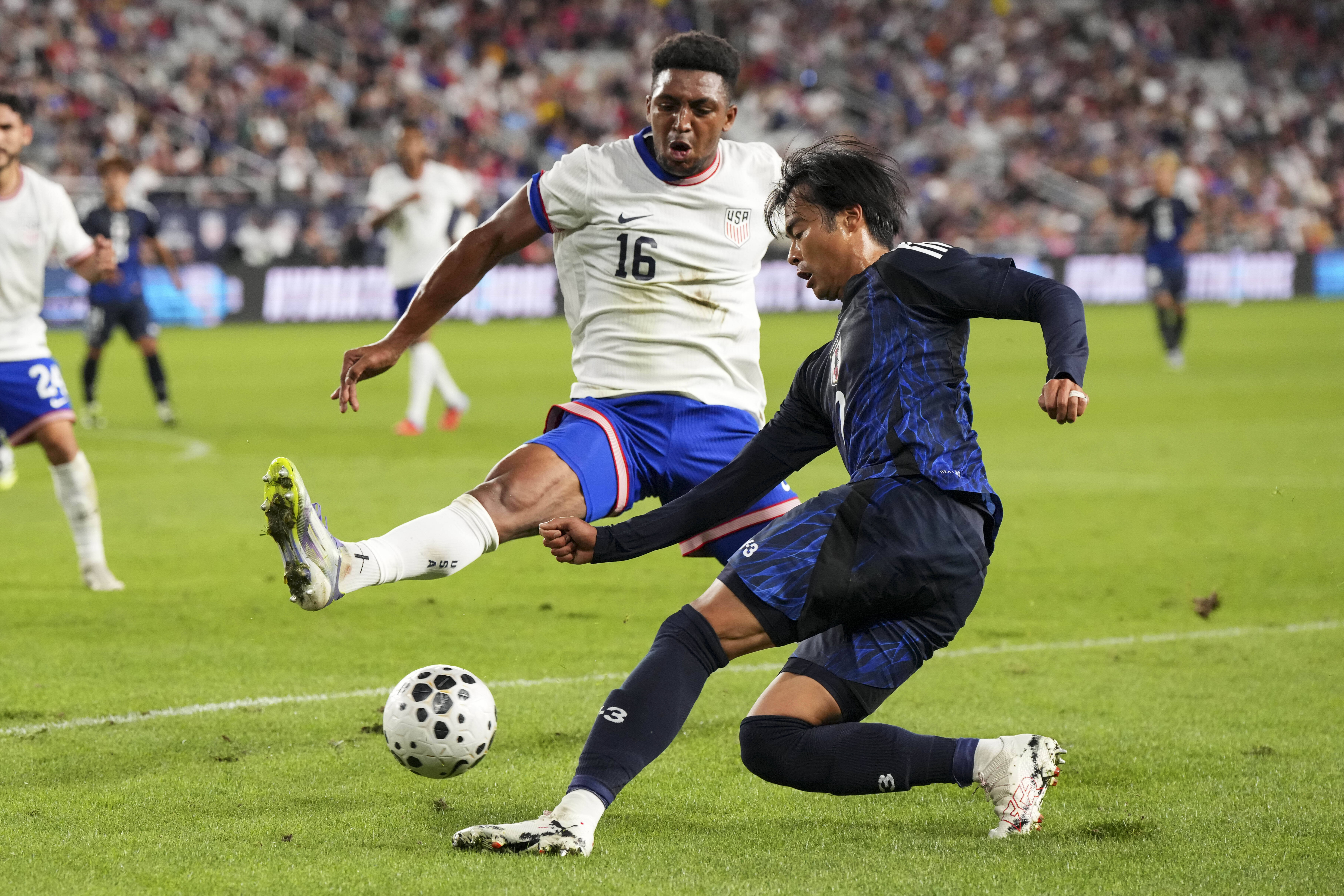
    Alex Freeman (left) defending Japan’s Kaoru Mitoma during their matchup in September.

    “That’s ultimately what you want,” former Union centerback Mark McKenzie said. “I think any competitor wants to play against the best of the best, and as you go into a World Cup where we don’t have the luxury of a qualification period, you want to play against opponents who ultimately you have the potential to see in the World Cup. So I think when you play against those teams that are especially high-ranked, it puts you up to bat, and to figure out where you stand against those kinds of teams.”

    The competitive juices especially come out when the U.S. plays South American opponents. Though big-name European nations draw more fan interest, South American teams deliver an unmatched mix of talent and passion.

    “There’s a real, raw passion that comes along with that,” McKenzie said. “There’s a sense of real pride that South American teams play with. You hear it with the national anthems — the stadium is rocking because their supporters are all singing and screaming their anthem.”

    McKenzie tries to bring the same mentality to playing for his country, and to his teammates.

    “We have that mentality of, it’s not every day you get the chance to represent your crest, [or] every day you get to be one of 20-some-odd players to step on that pitch,” he said. “So, yeah, we’re going for the same mentality. We approach each game [as] it’s not a friendly match, but this is a preparation for what’s to come.”

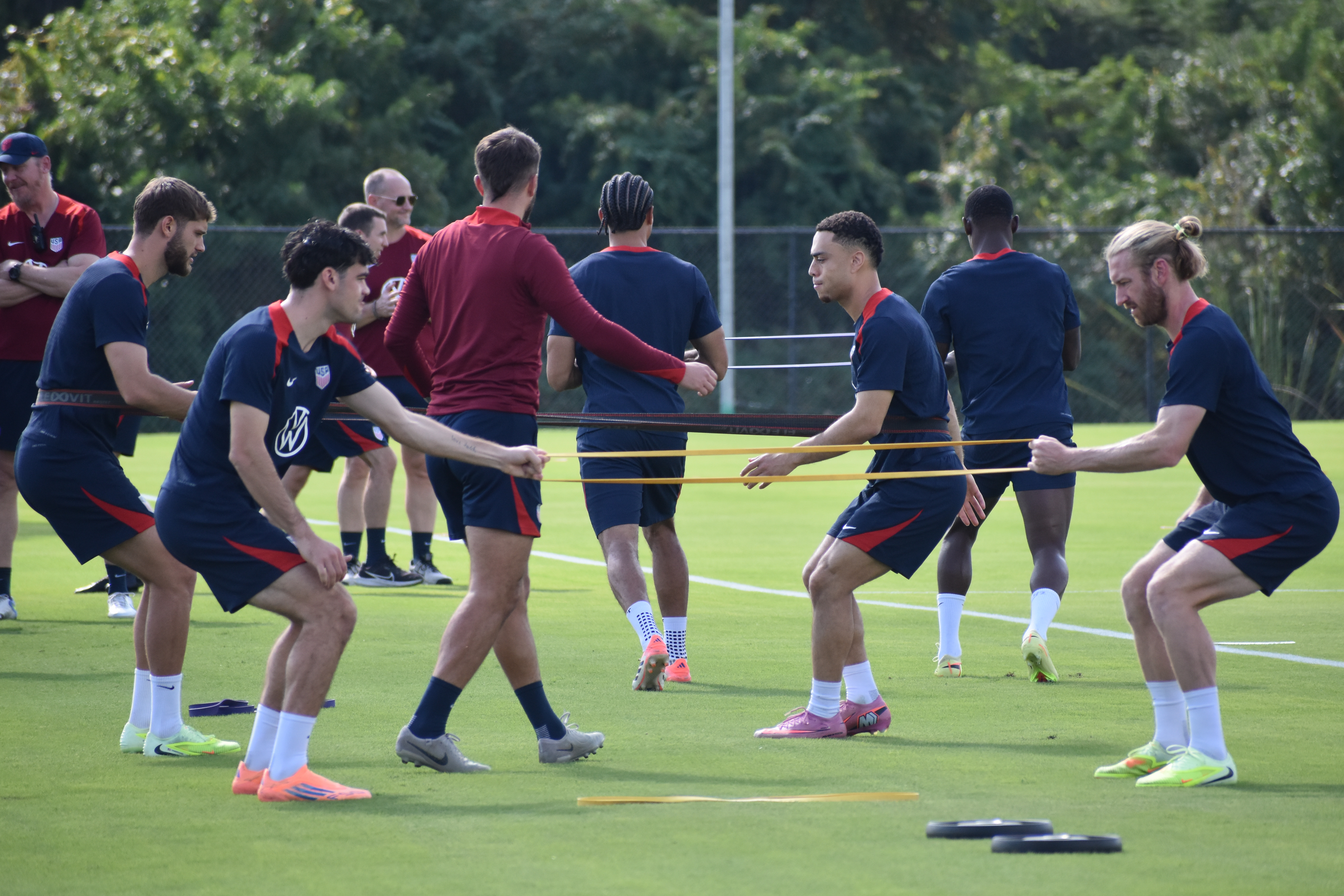
    Gio Reyna (second from left) and Tim Ream (right) are among the U.S. players shown stretching at Monday’s practice.

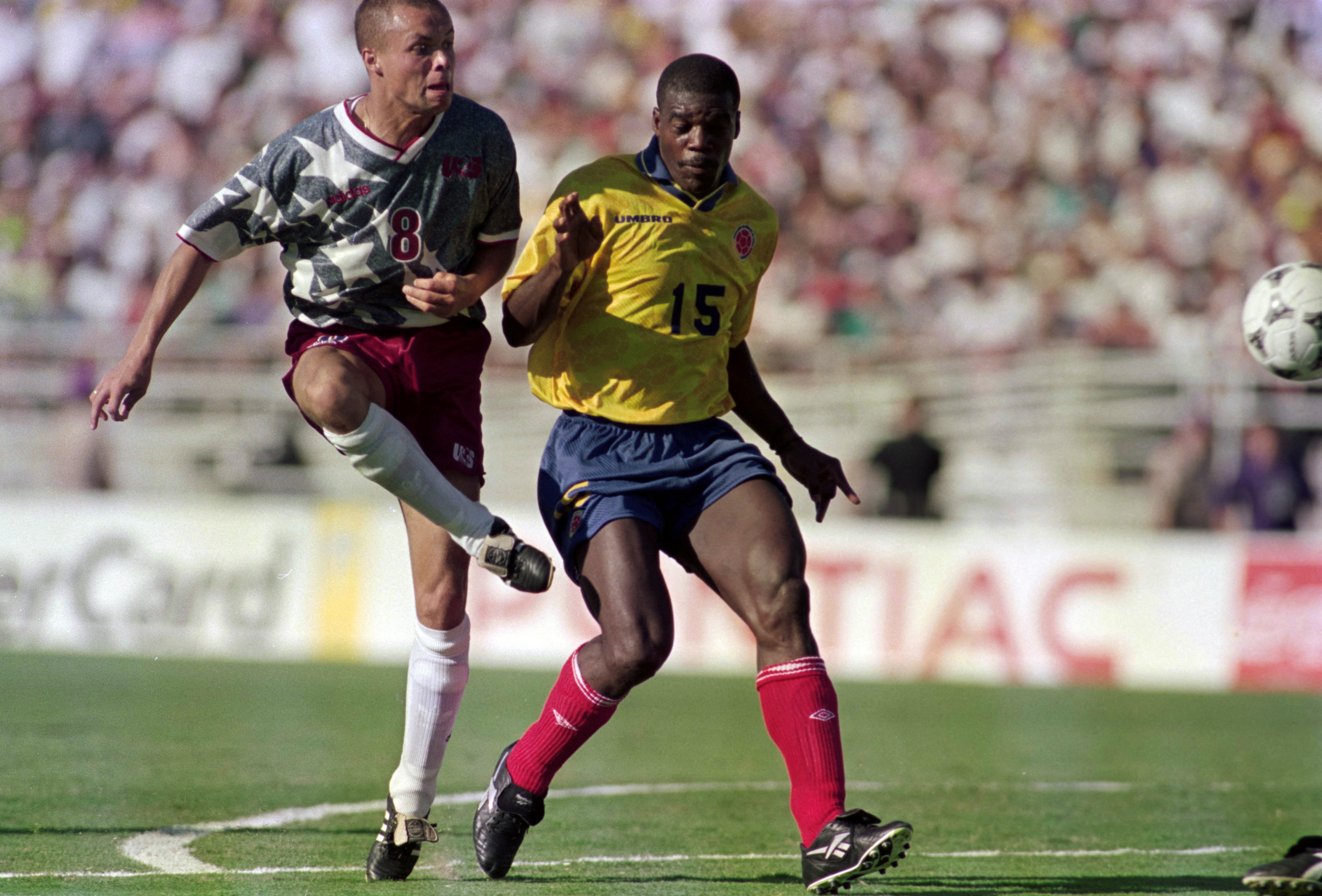
    The U.S. has a long history of big games against South American foes. Its first guest appearance in a Copa América, South America’s continental championship, was in 1993 — a year before facing Colombia and Brazil in the first men’s World Cup hosted here.

    Kasey Keller’s 10-save masterclass against Brazil in 1998 still lives in the history books, as does a 1999 upset of an Argentina squad that Pochettino played for. More recently, the U.S. hosted two Copa Américas, in 2016 and last year, and in them faced six of the continent’s 10 teams.

    That Uruguay landed the knockout blow in last year’s group stage makes this meeting even more of a benchmark.

    Among the players who have gotten the message is outside back Alex Freeman, one of the younger members of this group but with a fast-rising profile.

    “I feel like it’s a good test for us,” he said. “I feel like, especially in our home country, we need these tests. We need to show what we’re capable of and what we can do, and I feel like just knowing that we’re able to compete against these teams, it’s just a good step for us, and for the U.S. in general for soccer.

    Long before he was the Union’s sporting director from 2015-18, Earnie Stewart (left) scored a historic goal to help the U.S. men upset Colombia at the 1994 World Cup.

    The USMNT’s pre-World Cup friendly opponents

    Here’s a look at the teams the U.S. has played in friendlies since the start of June, and will play leading up to the World Cup.

    After the World Cup roster is announced in late May or early June, the tournament squad will play two friendlies against teams and in cities that are still to be announced.

    The FIFA rankings below are as of the date of the matchup, or as of this week for games that haven’t happened yet.

  • Gio Reyna seizes his moment with the USMNT, and is now in the World Cup race

    Gio Reyna seizes his moment with the USMNT, and is now in the World Cup race

    From the moment the U.S. men’s soccer team’s starting lineup was announced Saturday, all eyes were fixed on Gio Reyna.

    Not only was he about to play for his country for the first time since late March, but he was starting for the first time since last year’s Copa América group stage finale — a loss to Uruguay that sent the U.S. out in the group stage on home soil, and sent manager Gregg Berhalter out of his job.

    Reyna, 23, didn’t make any of Mauricio Pochettino’s squads until the Nations League final four in March because of a groin injury. Then he didn’t play in the semifinal loss to Panama, and was an ineffective second-half substitute in the third-place game loss to Canada.

    For all Reyna’s talents — and he has perhaps the most natural talent of any U.S. player besides Christian Pulisic — Pochettino declared him not “ready to play in the way that we expect from him” on the eve of the third-place game.

    Gio Reyna hadn’t been with the U.S. men’s soccer team since March.

    That was how far he had fallen, in terms of fitness, form, and playing time at his club, Germany’s Borussia Dortmund.

    Nor was he done falling. Reyna went to the Club World Cup with Dortmund instead of the Gold Cup and the friendlies before it, because Dortmund wanted him at their games and Pochettino didn’t want players at the friendlies whom he wouldn’t have afterward.

    Would that be salvation? No, it was almost the opposite. Reyna got off the bench only once in Dortmund’s five tournament games, a mostly useless 12-minute cameo in the group stage finale.

    Only after that did he finally leave for newer pastures, a move many outsiders had hoped to see for years. Borussia Mönchengladbach bought him for about $4.5 million up front and $3 million in incentives. It was miles below what Dortmund expected when a 17-year-old Reyna made his first-team debut in early 2020.

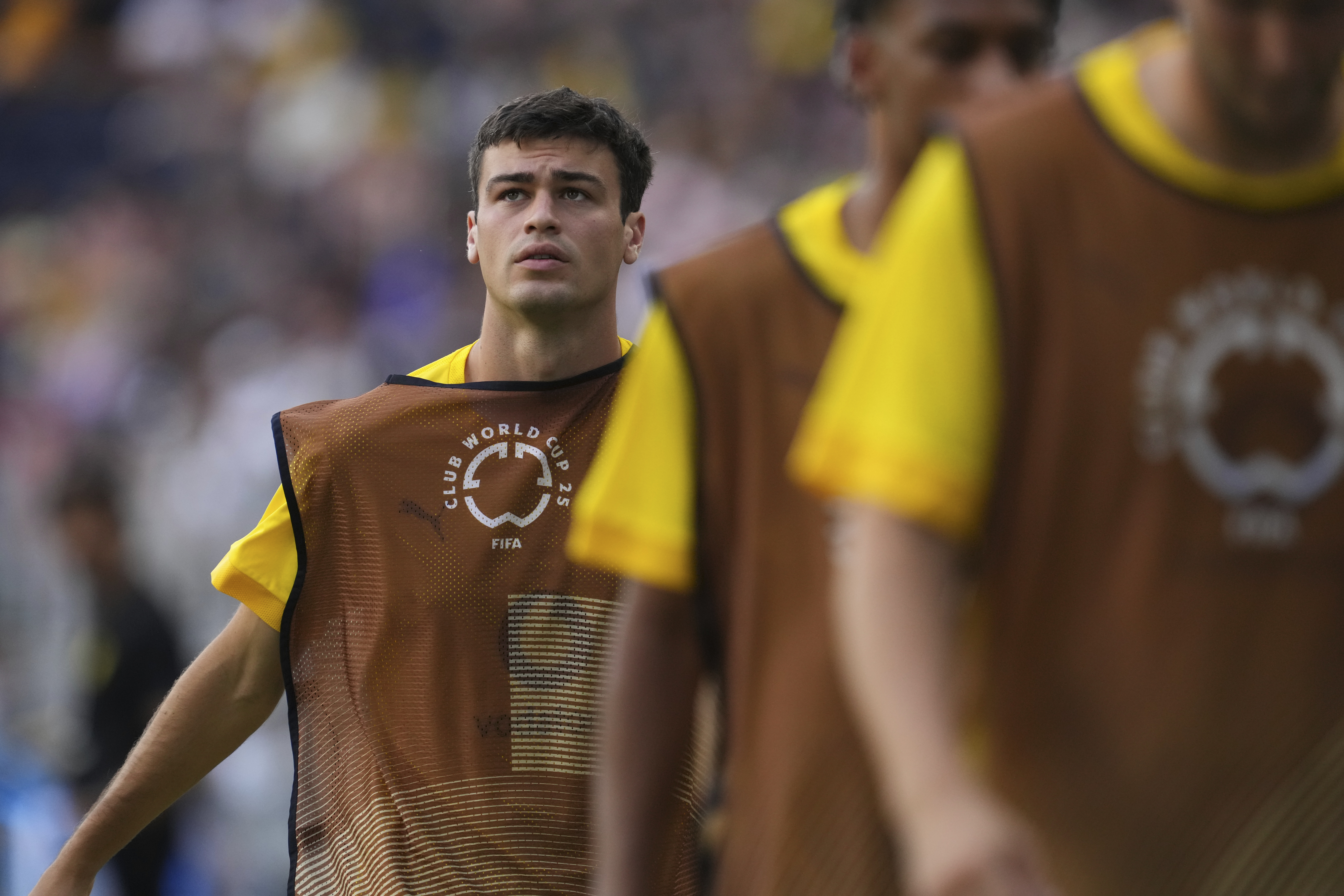
    Gio Reyna watched almost all of Borussia Dortmund’s Club World Cup run this summer from the bench, finally leaving the club afterward.

    It was to be a fresh start, but it barely started before Reyna suffered the latest of seemingly countless muscle injuries in September. He returned to action in mid-October, but only as a substitute.

    So it was a pretty big surprise when Pochettino called him up to the national team this month. But over the course of the week in Chester, it felt increasingly inevitable that he would start Saturday against Paraguay at Subaru Park.

    Meeting the moment

    Right on cue, there he was, and the message was clear. This was Reyna’s shot. Would he take it?

    The answer came within four minutes.

    It was a broken play out of a corner kick, the ball pinging around off all manner of limbs on both teams. Eventually, it fell to Max Arfsten, and he chipped a cross into the crowd. Reyna rose highest and met it with a header that caromed in off the crossbar.

    As the crowd roared, Reyna ran toward the corner flag, pointing to the U.S. badge on his jersey. Within seconds, his teammates had swarmed him to celebrate.

    “I know the kind of player he is, and I’m just really happy for him — he deserves it,” said Medford’s Brenden Aaronson, who started with Reyna in the attacking midfield spots. “He’s been through a lot with injuries, with all this stuff. But whenever he plays for the national team, he’s always there, and it’s awesome to see. … He’s confident in his ability, he knows what he can do, and that’s the beauty of him.”

    There wasn’t time in the moment to point out that Reyna has not in fact always been “there” when with the national team. That was the whole point of the 2022 World Cup scandal that nearly torpedoed him.

    When that goal went in, though, it was a moment for his immense burden of history to be a privilege, not a weight. The tally was his ninth for the U.S., passing his legendary father Claudio’s eight.

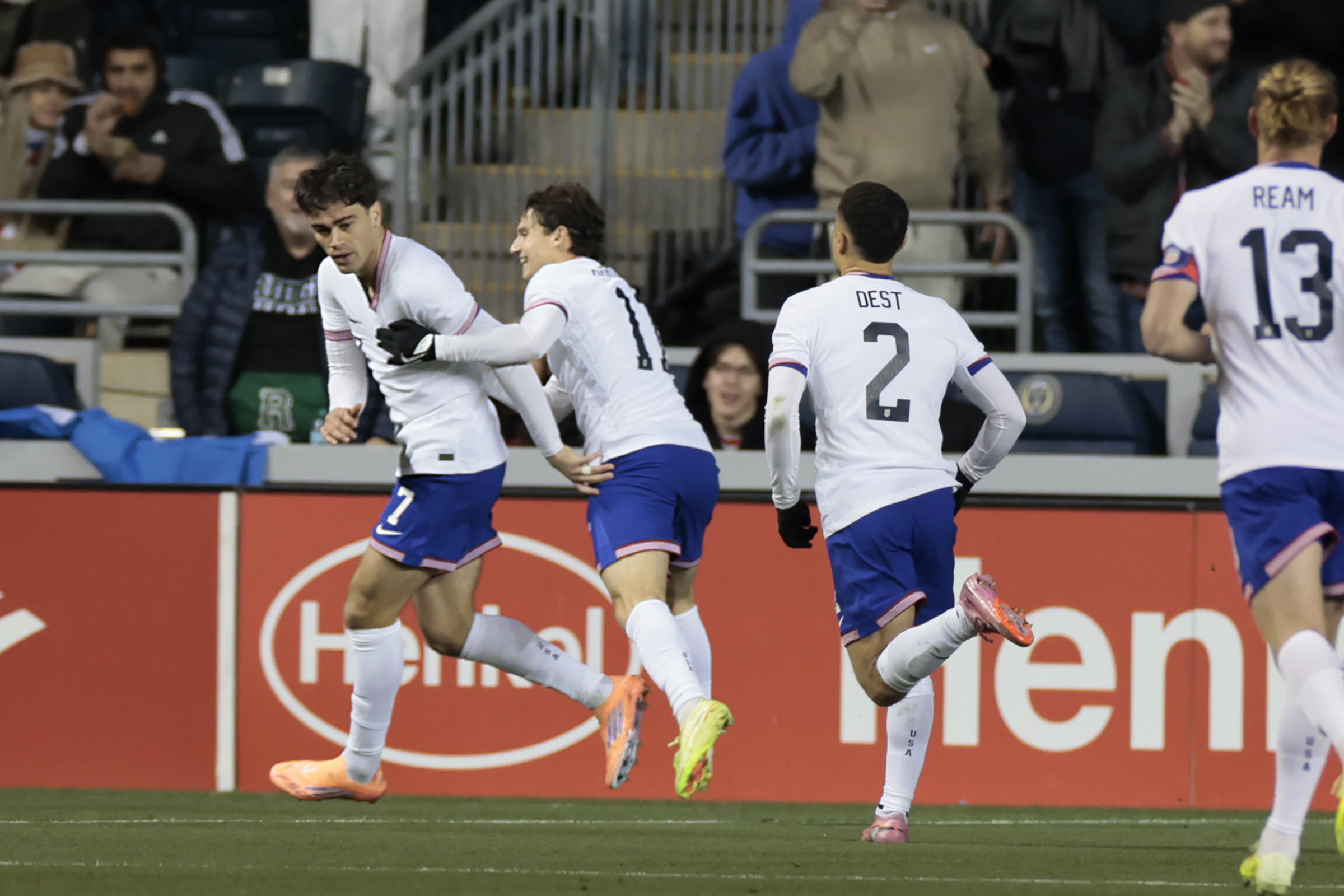
    Gio Reyna (left) celebrates with Brenden Aaronson (center) and other teammates after scoring the game’s opening goal.

    And for once, Claudio wasn’t invoked because of that scandal, or all the times Claudio interfered with U.S. Soccer officials before then, or yelled at referees from the sidelines in Gio’s youth days, or by genetics passed his ego on to his son.

    By the time Gio emerged from the locker room to meet one of the biggest media packs at a U.S. game in quite a while, he had already texted with his father.

    “It was just fun, love,” Gio said. “He was obviously happy for me that I passed him, but I had no idea. So he was more making fun of me for the fact that it was my first header I’ve ever scored.”

    The pressure on him is earned

    The negative side of the burden struck twice after that. On Paraguay’s 10th-minute equalizer, Reyna was late and slow to challenge Junior Alonso before he launched the long ball that sprung Miguel Almirón for a dazzling assist on Alex Arce’s goal.

    In the 50th, Reyna had a look to shoot in the 18-yard box and didn’t take it, choosing instead to dribble into what became a crowd of defenders.

    Those were small moments, but they mattered. Just as pressure is a privilege, Reyna knows his talents bring extra scrutiny.

    The scale tilted back his way in the 71st. Reyna combined superbly with Folarin Balogun to create the winning goal. The man of the hour had delivered again, and the U.S. went on to close out a 2-1 win.

    “I think in the end, performances like this that can help everybody here,” Reyna said. “But I want to have, more importantly, seven or eight good months in the rest of the season with Gladbach. And then I believe if I keep performing like I did tonight, then I’ll have a good chance to make the team and have an impact there, too.”

    There’s still a ways to go, and as Pochettino said, plenty for Reyna to do to earn a seat on the plane next summer. But in a moment when he was asked to step up, he did, and in national team soccer there are never many moments. So when you get one, you have to take it.

    “He showed why he started, and yes, confirmed that he’s a player that needs to improve because he needs to play more in his club,” Pochettino said. “But we can see today that he was great: scored and assisted. And the way that [he has] always the capacity to read the game, and find the free space in between the lines, I think that was a nightmare for Paraguay, and I think he did a very good job.”

    Reyna thanked Pochettino in turn, with some notable humility.

    “I knew it was an opportunity for me to to show that I belong here,” he said. “He’s been great with me all week, working with him, and just trying to give me the freedom and the confidence to sort of be myself. So I can’t thank him enough, obviously, for the start and just for the relationship that we’ve really built this camp.”

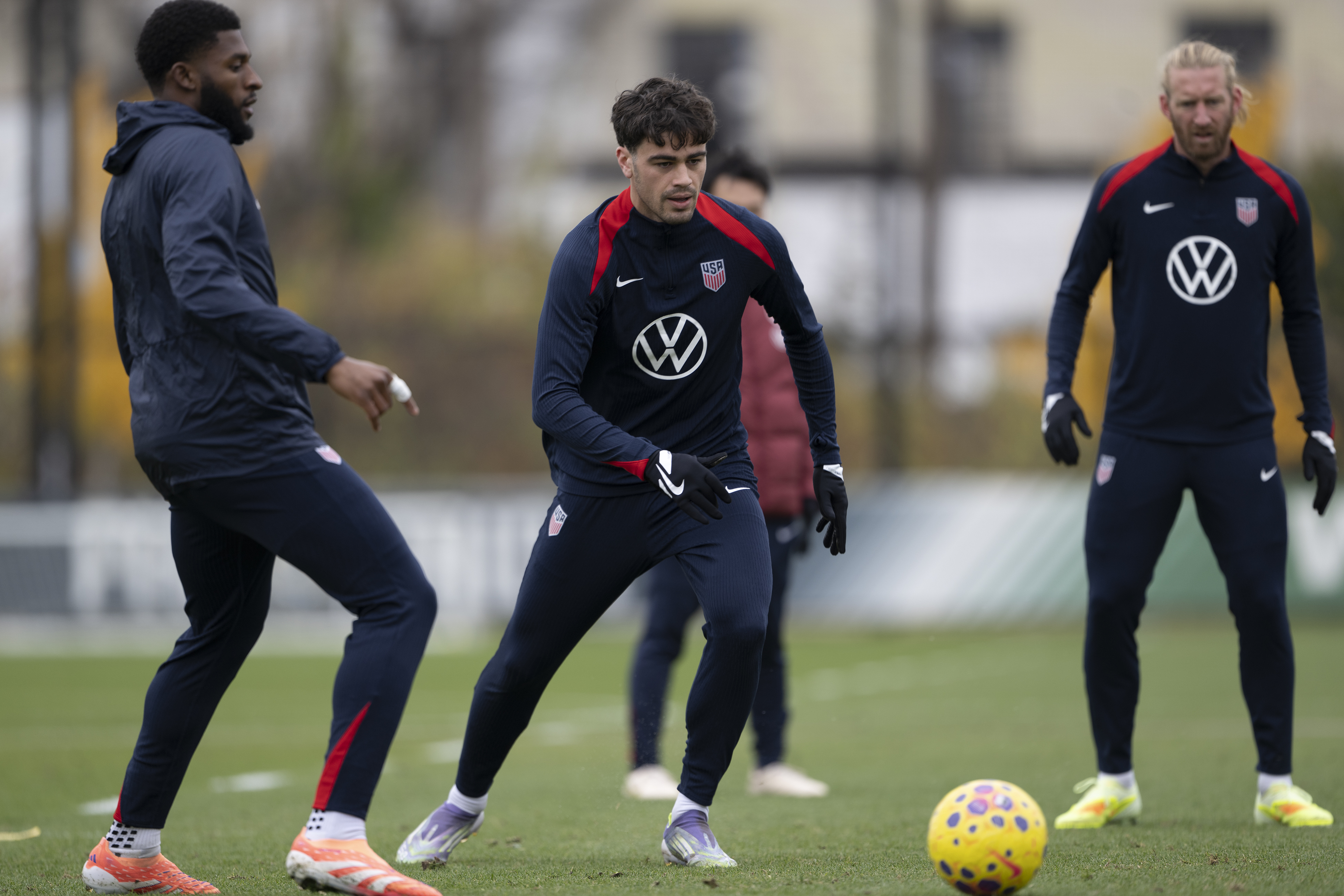
    Gio Reyna (center) working in practice during the week.

    The stakes only get higher from here, and so does the quality of opponent the U.S. will face. After meeting Uruguay on Tuesday in Tampa, Fla. (7 p.m., TNT, Universo), to close out this month, it’s expected that March’s games will see big-time opponents from Europe. Portugal, France, and Belgium are reportedly on the radar, with Atlanta’s Mercedes-Benz Stadium set as a fittingly big-time venue.

    Time will tell if Reyna earns the right to be there. For now, he’s only in the race. But that alone is the best place he’s been in for a long time.

  • Gio Reyna and Folarin Balogun lead the USMNT to a win over Paraguay at Subaru Park

    Gio Reyna and Folarin Balogun lead the USMNT to a win over Paraguay at Subaru Park

    After waiting six years to see the U.S. men’s soccer team in town again, Philadelphia soccer fans got their money’s worth on Saturday.

    Gio Reyna scored in the fourth minute and assisted Folarin Balogun’s winner in the 71st to give the Americans a 2-1 win over Paraguay, extending their unbeaten run this fall to four games.

    Reyna was the man of the hour from the moment the lineups came out. This was his first U.S. game since the Concacaf Nations League final four in March and his first start since last year’s Copa América group stage finale. It also was just his fifth start of the calendar year in any game for club or country because of injuries and bad form.

    Reyna leapt to meet Max Arfsten’s cross after a corner kick got broken up. The 23-year-old attacking midfielder with so much unfulfilled talent ran to the corner flag, pointing to the U.S. crest on his jersey along the way, and his teammates joined him for a big group hug next to the TV cameras.

    Paraguay equalized just over five minutes later with a lightning-fast and impressive play. Junior Alonso hit a long ball down the left flank for Miguel Almirón — after Reyna waited too long to press — and the Atlanta United star hit an inch-perfect first-time cross. Alex Arce was right on time, and slammed the finish past a frozen Matt Freese.

    Almirón might have been an inch offside when the pass was played, but he otherwise left Joe Scally in the dust — in Scally’s first U.S. game since the Nations League flop. Arce then easily beat Miles Robinson, who has been a regular under manager Mauricio Pochettino but isn’t a surefire starter.

    The Paraguay fans in the bipartisan crowd of 17,221, many of whom arrived early to tailgate, were thrilled.

    After that, the game settled down for a while, and fans could observe how the U.S. was trying to play.

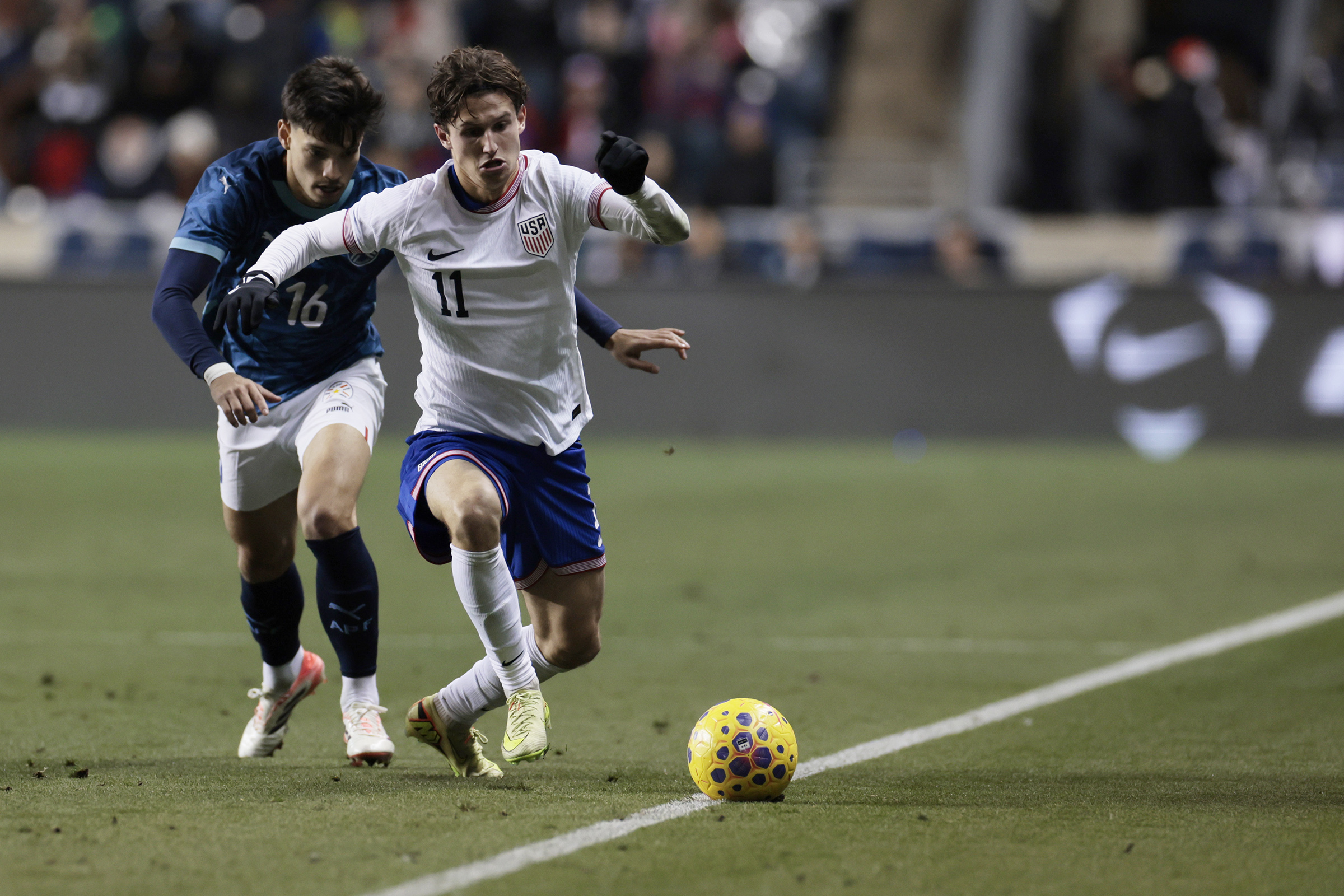
    Pochettino set out a lineup that looked on paper like the 3-4-2-1 he’s used lately, but it had some wrinkles. Arfsten, who played left wingback, sat a bit deeper than usual, while right wingback Sergiño Dest pushed up so high that it often looked like he was an attacking midfielder.

    The result looked at times like a 4-2-3-1, with Scally as the right back, Medford’s Brenden Aaronson in a central attacking midfield role, Dest to Aaronson’s right, and Reyna to the left — though Aaronson and Reyna had the freedom to switch places.

    Folarin Balogun led the line up top, Cristian Roldan and Tanner Tessmann were the central midfielders, and Tim Ream and Robinson stood at centerback.

    It was a fluid setup all in all, and it produced some entertaining soccer.

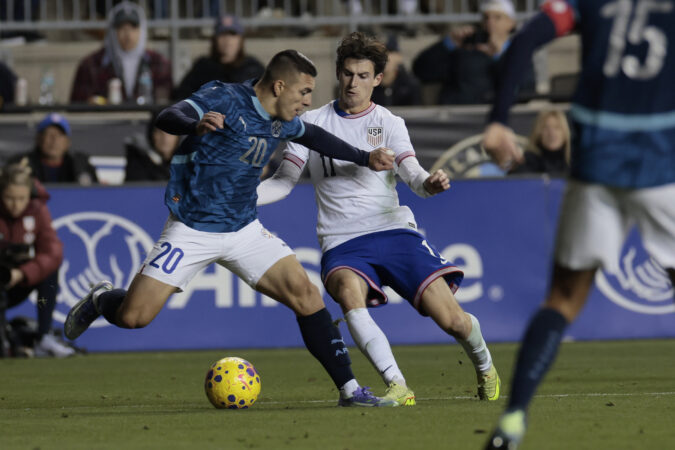
    Brenden Aaronson (right) runs past Paraguay’s Damian Bobadilla to chase a loose ball.

    The starting lineup stayed intact until the 67th minute and was just as lively as the first half. Aaronson was on the ball a lot, and Dest ripped a shot from atop the 18-yard box that Paraguay goalkeeper Orlando Gill tipped over his bar.

    That shot was Dest’s last action, as he and Scally departed for Diego Luna and Alex Freeman. The swaps shifted the U.S. formation to a traditional 4-2-3-1, with Freeman at right back and Luna, Reyna, and Aaronson in the attacking midfield roles from left to right.

    Balogun struck for the lead in the 71st, after first intercepting a loose pass forced by Juan Cacéres. Roldan and Luna forced it with some hustle, and when Balogun got the ball he held it up to spring Reyna down the left flank. Reyna returned the favor with a square pass that was deflected but fell right for Balogun to finish.

    Four minutes later, Pochettino sent in three more subs: Ricardo Pepi for Balogun at striker, Timothy Tillman for Reyna in attacking midfield, and Aidan Morris for Roldan in the center.

    Freese made his big save for the night in the 78th, denying a long-range blast from Almirón.

    After the ensuing corner kick, the U.S. went down the field, and Pepi should have made it 3-1 in front of an open net. But he was off-balance receiving it, and by the time he turned to his favored right foot, Paraguay’s Gustavo Gómez had raced to the goal line to block the shot.

    The last U.S. sub was Sebastian Berhalter for Aaronson in the 80th, and the hometown hero got a big ovation from the crowd on his way out.

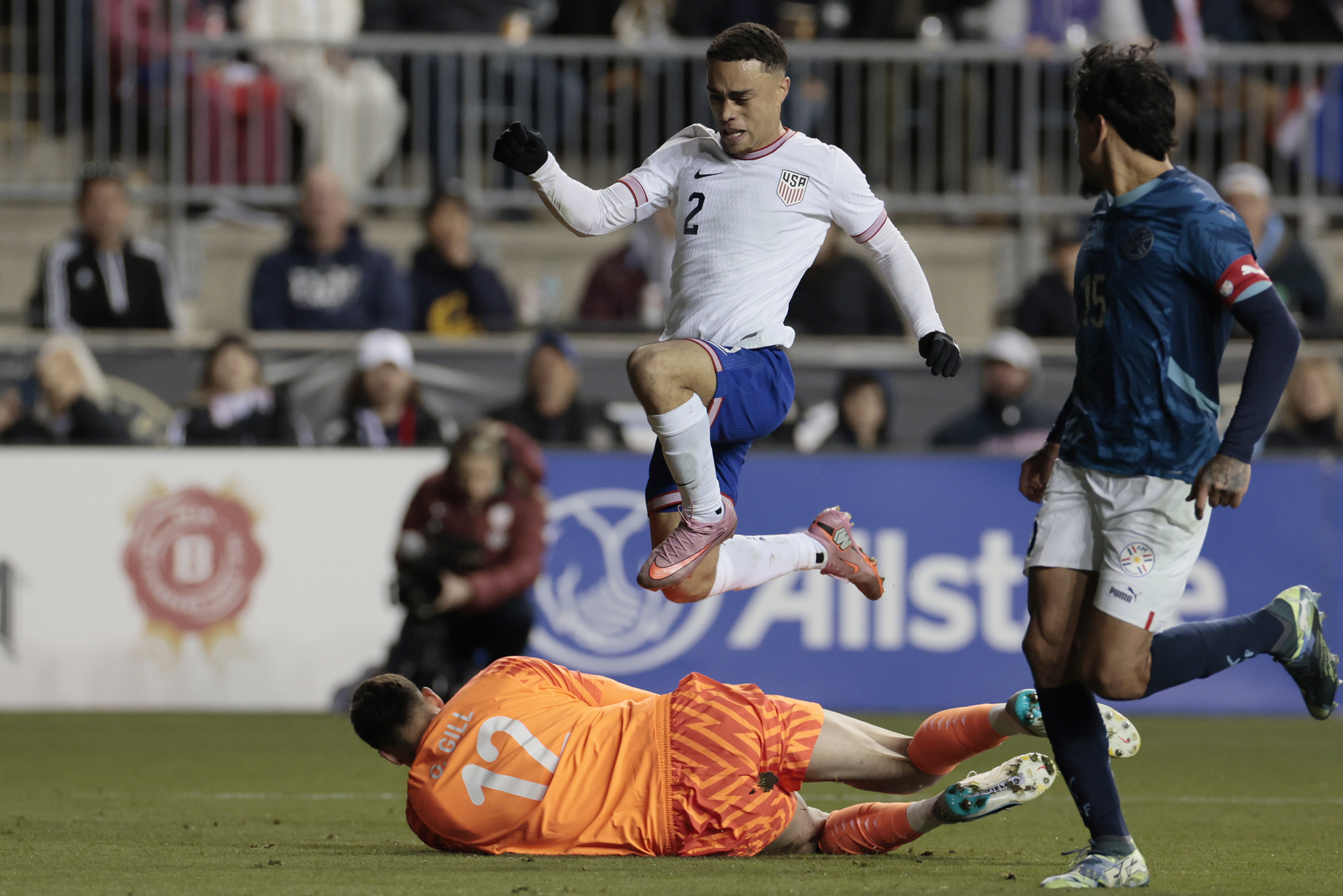
    Sergiño Dest (center) jumps over a diving Paraguay goalkeeper Orlando Gill on a U.S. scoring attempt during the second half

    Things got dicey from there for the U.S., including a deflection off Arfsten right on 90 minutes that rolled inches wide of Freese’s far post.

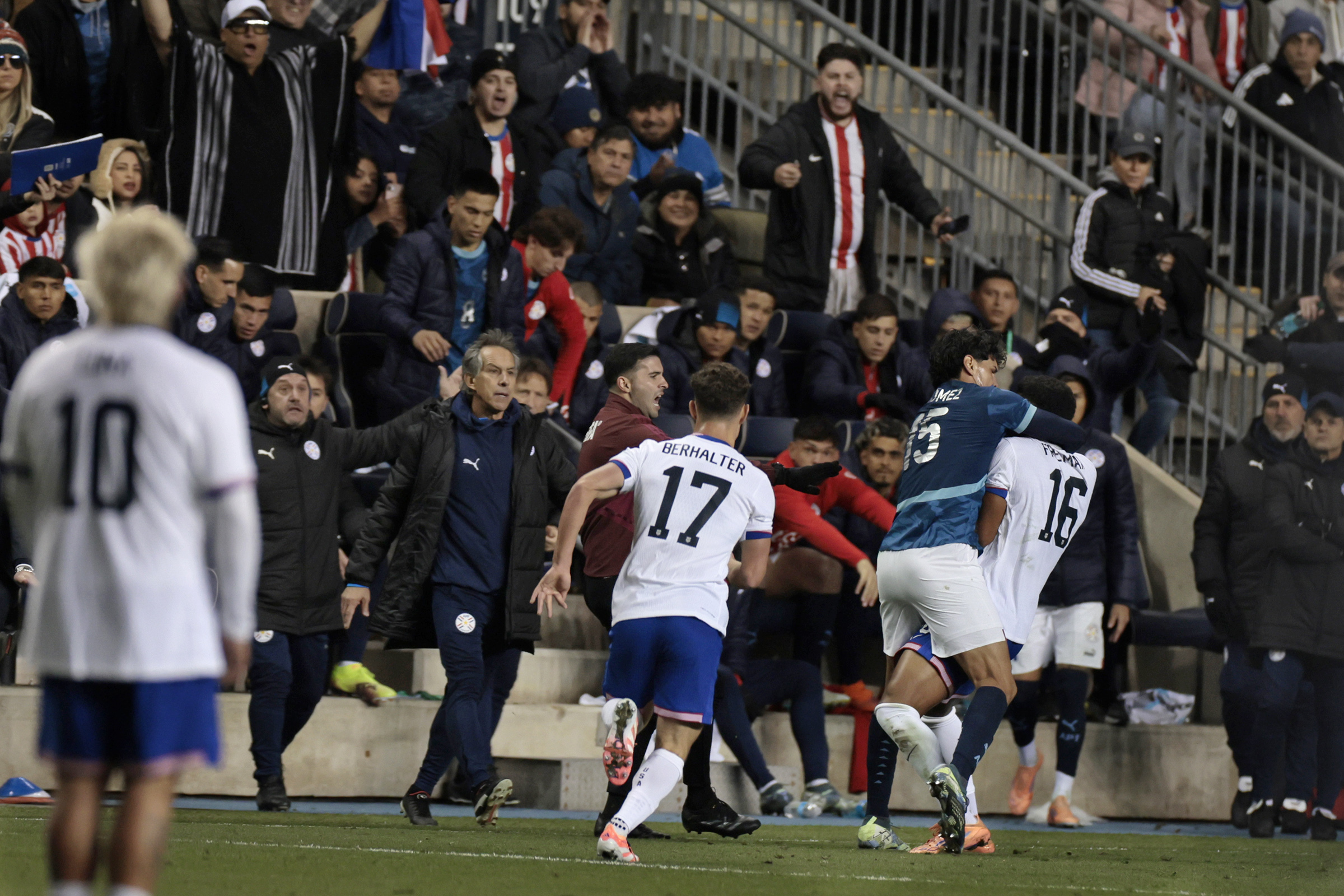
    Just over a minute later, a brawl erupted by the benches after Gómez and Freeman briefly argued over who would claim a dead ball on the field. Gómez put Freeman in a headlock, which sparked a melee that ensnared both teams’ active players and benches, coaches included. It was a sight rarely seen in soccer, but especially in a friendly without official stakes.

    Referee Cristhofer Corado of Guatemala dished out a few yellow cards, and would have been well within his rights to end the game there instead of waiting out the announced four minutes of stoppage time. But play did resume, and the clock ran to 96 minutes when the final whistle came.

    The U.S. now heads south to play another South American foe, Uruguay, in Tampa, Fla., on Tuesday (7 p.m., TNT, Universo).

    Our photographer’s view of Paraguay’s Gustavo Gómez getting Alex Freeman in a headlock, which led to the brawl at the end of the game.