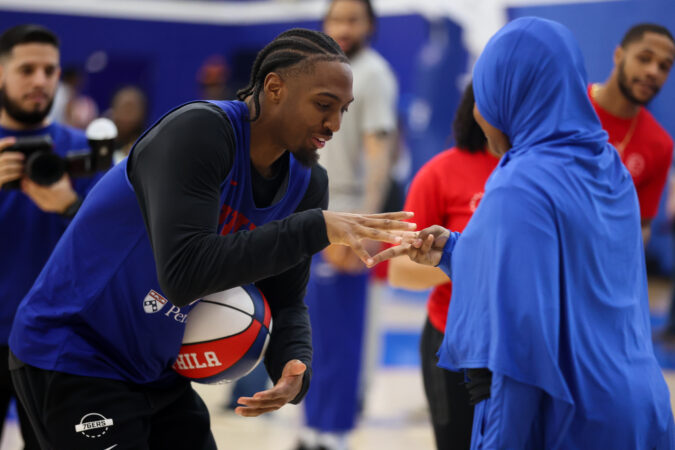
Two games into their six-game homestand, the 76ers took time for a community event at their practice facility, where they brought in in 40 local kids from Breakthrough of Greater Philadelphia.
The Sixers often attend community charity events individually or in small groups. Saturday’s event, in honor of Martin Luther King day and Mentorship Month, was a rare full team event, something the players said helped them decompress after Friday’s loss.
“It’s cool to see the entire team here, entire staff, that’s a really cool scenario,” Sixers guard Tyrese Maxey said. “I’ve never done this since I’ve been here.”
The team split into small groups with the students and competed in a series of different games, including a basketball obstacle relay course, knockout, a math station, and a rock, paper, scissors challenge featuring a few hula hoops, which many of the Sixers chose to bypass.
Through each of the four stations, the teams worked to earn points, which ultimately led to a win for star rookie VJ Edgecombe’s team.
Sixers big man Dominick Barlow enjoyed the down time with the students and his teammates.
“[I love] just being around the guys, I like these events,” Barlow said. “Obviously, when we’re around like the youth and the community, we get to show them that they mean a lot to us, and we try to give that back to them.”
Breakthrough of Greater Philadelphia is a non-profit that helps put students from underserved parts of the Philadelphia area on the path for top high schools and colleges, and helps educate and inspire the next generation of teachers through a teacher-in-residence program.
The organization was a Sixers Youth Foundation grantee and served 211 total students across grades five through 12 in 2024-25.
“Seeing the smile on some of these kids faces, obviously, some guys on the team are their favorite players, like Tyrese, VJ,” Trendon Watford said. “It’s just good to see the smile on their faces, and take a little time out of our day to make their day.”
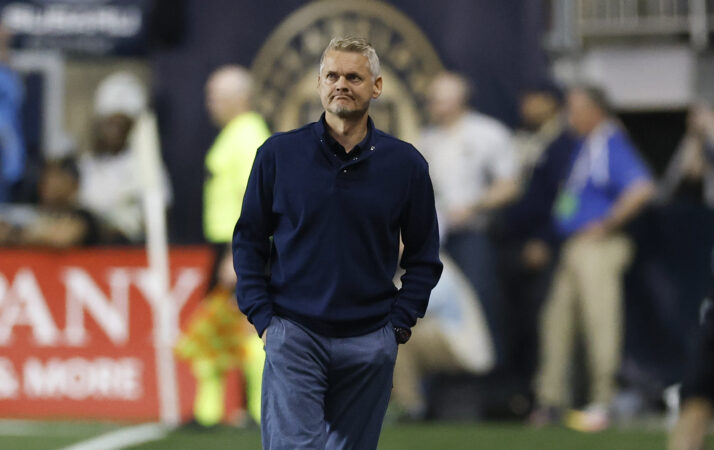
Nestled under all the success of last season for the Union is that their manager, Bradley Carnell, proved yet again that he’s one of Major League Soccer’s bona fide tacticians.
In his first season at the helm, he came within one point of the club’s record, a statistic that originally took more than a decade to amass. He guided the Union to their second Supporters’ Shield, which is given to the club with MLS’s best regular-season record.
With 30 teams vying for the shield, that’s no small thing.
While aspirations of their second MLS Cup final appearance were dashed in the Eastern Conference quarterfinals, success was already apparent, and Carnell, 48, was orchestrator, the proof in the form of the 2025 MLS Coach of the Year award.
However, in the afterglow of a banner year for the Union, Carnell knows the limelight, particularly for him, is fleeting. He’ll never admit it, but his vision board, whether real or imaginary, surely includes the notion that success this season would right a lot of wrongs along his coaching path.
He knows it. It’s why in a conversation with Union sideline reporter Sage Hurley, he said: “I take personal accolades and forget about them very quickly. In our business, it’s very fluid, very daily, and we focus on the present.”
Bottom line: Judge this manager not by what he has done, but by what he does in 2026.
Here’s why:
Been here before
It’s important to remind folks that what Carnell accomplished with the Union last season wasn’t new for him over his nine seasons in MLS. Replicating it or even eclipsing it in Year 2 would be.
Why? Because he’s well aware of just how quickly a sophomore slump can turn into a crash-and-burn.
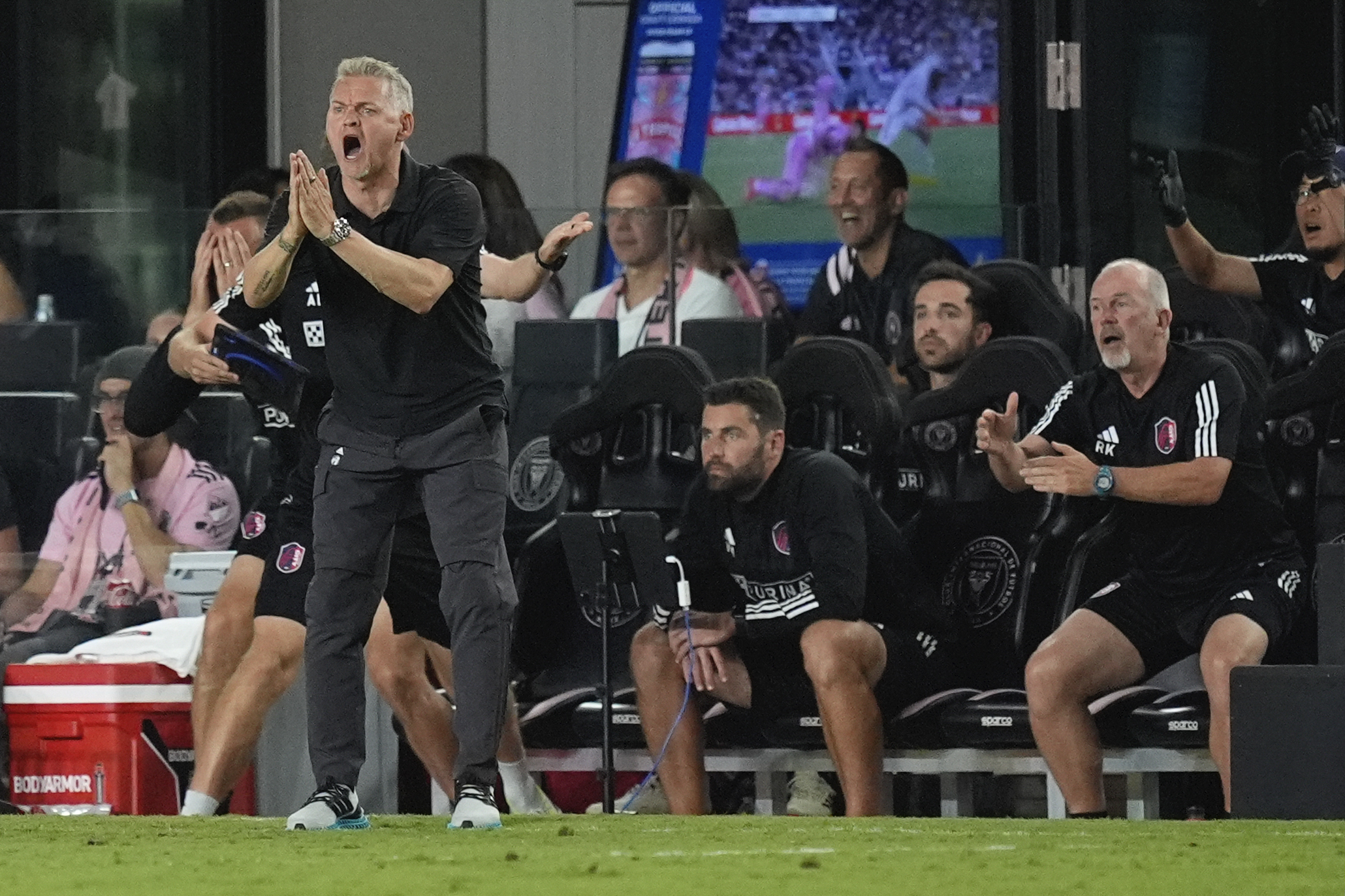
In his previous stint as a manager, Carnell’s St. Louis City SC became the first expansion team to win its conference in its inaugural season. St. Louis topped the Western Conference with a 17-12-5 record and reached the 2023 MLS playoffs.
Like the Union this year, St. Louis crashed out of the playoffs early. It was swept in a best-of-three first-round series against Sporting Kansas City after entering the tournament with the fourth-highest point total (56) that season.
Copy and paste.
As coach of expansion team St. Louis City SC, Carnell led the team to the best regular-season record in MLS’s Western Conference.
Carnell didn’t even finish the following season. He was replaced in July following a dismal start in which St. Louis was at the bottom of the Western Conference standings with just three wins.
But in his final regular-season news conference of 2025, while answering questions about who will orchestrate player moves with sporting director Ernst Tanner on leave amid an investigation into his alleged misconduct, Carnell was asked what he learned from the season to ensure he doesn’t find himself in the same boat.
He seemed like he couldn’t wait for someone to bring it up.
“This has been an amazing journey for me as a coach,” Carnell said. “I’ve grown up, and I’ve learned a lot more through the players and the engagement and just the people here at the front office. [I’ve learned that] when there’s support, alignment, [and] collaboration, a lot can be achieved. I think we’ve shown that over the course of the year that we are all pulling in the same direction.”
A big takeaway, Carnell said, too, is just how easily he assimilated into the culture of the club, its fans, and the city. Philly feels like home for the South Africa native, as he noted that the team and front office have made it easy for him and others who felt like outsiders to want to be here.
“I think about [former Union defender] Kai Wagner, who has been here multiple years now. You would assume he’s from Philadelphia,” Carnell said. “There’s a certain edge and a drive and a determination and a quality about this group. That speaks volumes for the development of the club and the development of people, staff, and players.”
It’s safe to say the pressure Carnell will feel entering Year 2 will eclipse his second year with St. Louis. The Union made massive changes in the offseason, as proven players (like Wagner) were brokered for top dollar and replaced by some complete unknowns.
Bradley Carnell (right) was all smiles last season, celebrating the Union’s Supporters’ Shield title with midfielder Danley Jean Jaques.
Also, Carnell wasn’t operating St. Louis City during a FIFA World Cup year in a city that will host six matches. Soccer eyes will be on MLS — and just how good the local MLS club is. Especially one that was the league’s best under his guidance a year before.
Another thing he won’t admit: There is newfound pressure for the Union to come out strong — not just to further erase the pain of coming up short last season, but also because events like a World Cup tend to bring transformative change within an organization.
The club won’t admit it, but there are questions in the background that perhaps only top Union management and ownership can answer. But no one expects those questions to arise until the afterglow of the World Cup.
Union majority owner Jay Sugarman has figured out how to remain one of the league’s best clubs on a shoestring budget. Carnell is a big reason.
There also are other reasons. The obvious is that, entering a seven-week World Cup break beginning in May, sitting near the top of the Eastern Conference standings bodes well once MLS play resumes.
And while he’ll naturally mask that last factor by suggesting that the focus is “on the collective,” a familiar phrase from his first season in Philly, nothing would make people forget his sophomore slump in St. Louis more than not replicating something similar in 2026 with the Union.
“Around 11 months ago, we stepped in here in a world of our own,” Carnell said. “I hope 11 months later, through the team’s performance and collective effort, some of those questions have been answered.”
Some have, sure. But on a personal level for this manager, heading into 2026, just one more needs closure.
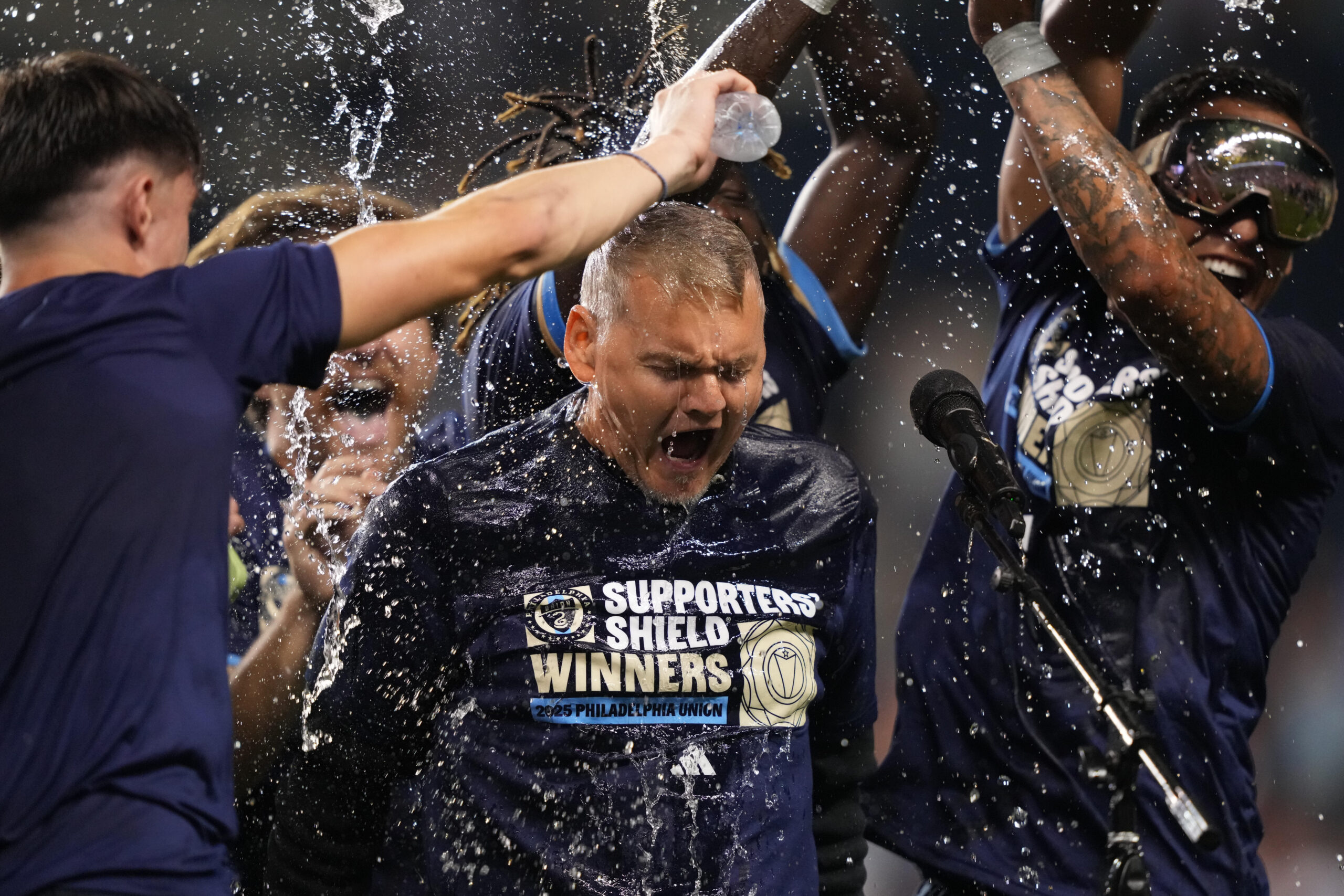
Players showered manager Bradley Carnell with a lot more than just praise after the team’s massive 2025 season.
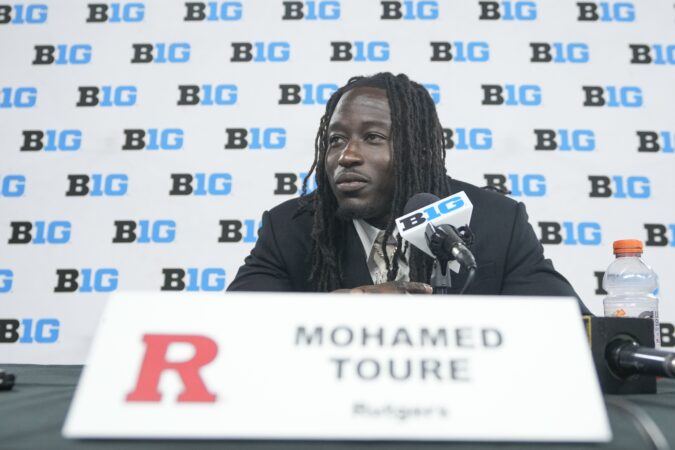
Mohamed Toure may have the chance to lift a trophy in the final game of his seven-year college football career.
Toure, a native of Pleasantville, Atlantic County, will take the field alongside his Miami teammates as the 10th-seeded Hurricanes seek their first national championship since 2001 against top-seeded Indiana on Monday in Miami (7:30 p.m., ESPN).
In his first year at Miami, Toure has been the anchor of a defensive unit that has allowed 14 points per game, ranking fifth in the Football Bowl Subdivision.
Toure transferred to Miami in May to use his final year of graduate eligibility after playing three seasons in six years at Rutgers. He redshirted, played through the pandemic-shortened 2020 season, and suffered two ACL tears while with the Scarlet Knights, which makes Toure a seventh-year player.
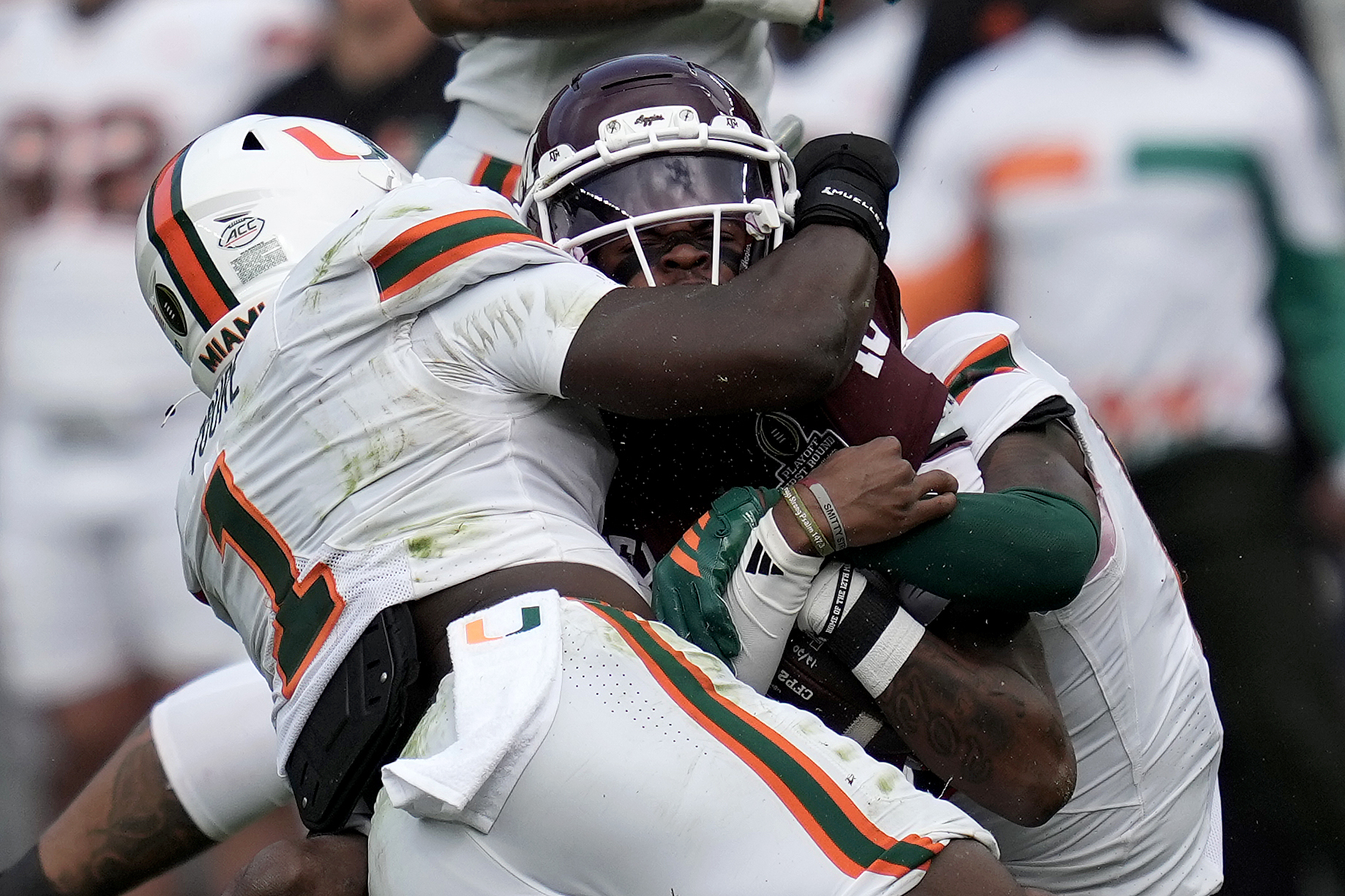
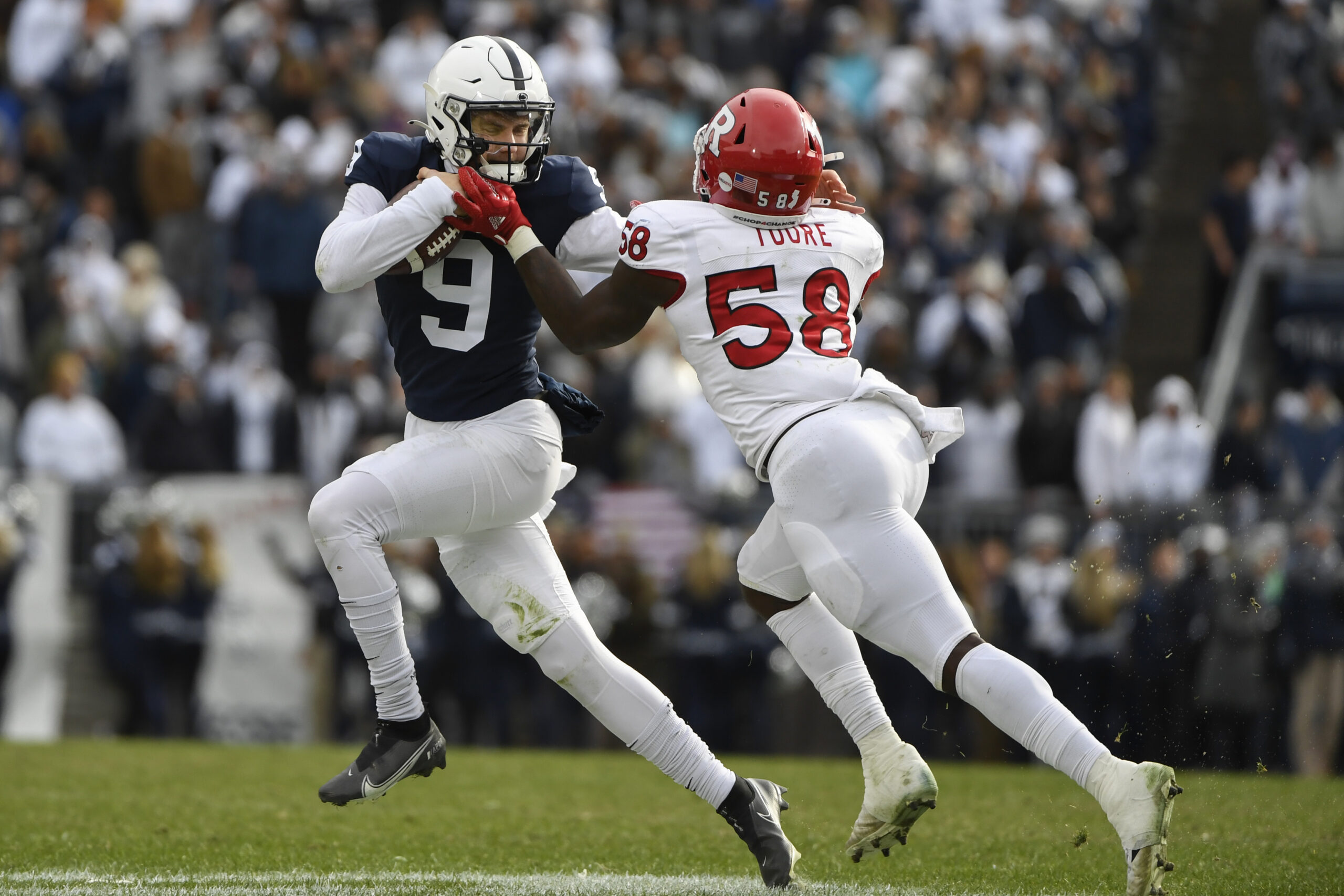
Texas A&M quarterback Marcel Reed is tackled by Miami linebacker Mohamed Toure on Dec. 20.
But before Rutgers and Miami, Toure was a star running back and linebacker at Pleasantville High School.
“To see him play at a high level, and for them to be playing where they’re at right now, it’s just surreal to watch,” said former Pleasantville teammate Elijah Glover, now the school’s head coach. “It’s something I couldn’t imagine when we were 10th graders.”
Jersey journey
Toure and Glover, who played college football at Villanova, were freshmen when Chris Sacco took over as head coach for the Greyhounds in 2015. Pleasantville had won just three games over the previous five seasons before Sacco took over, including winless campaigns in 2010, 2011, 2012, and 2014.
The Greyhounds went winless again in Sacco’s first season but improved the following season to 4-6. In 2017, the program posted a 7-3 record behind a breakout season from Toure, playing both running back and linebacker. Glover recalls Toure’s 95-yard game-winning fumble return in overtime against Buena Regional High as one of the many moments when he realized his teammate had a future in football.
“It didn’t happen by accident,” Glover said. “That was the first game of the season. Junior year, he went crazy. It was just like, ‘He’s for real.’”
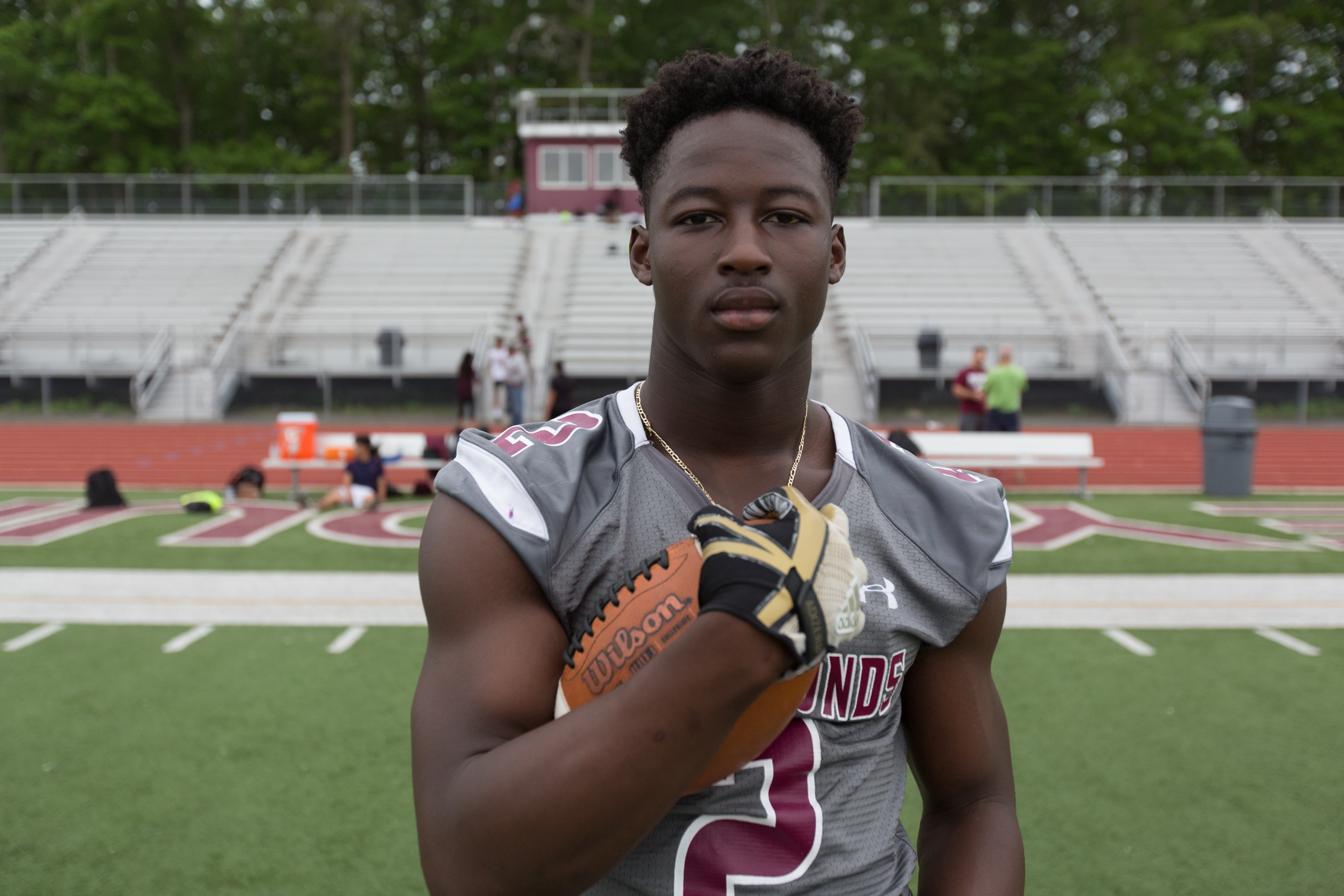
Mohamed Toure played running back and linebacker at Pleasantville High School.
In his senior season, Toure led the Greyhounds to an 8-3 record, rushing for 981 yards and 11 touchdowns, while adding 69 tackles and five sacks on defense. He was named to the all-South Jersey first-team by The Inquirer in 2018.
The personal accolades for Toure reflected an improbable turnaround for Pleasantville’s football program. Sacco, who is now the athletic director at Hammonton High School, said Toure’s leadership and commitment to Pleasantville was a crucial part of the program’s transformation.
“It would have been easy for him, as the type of player that he was, and is, to leave and go to an established program,” Sacco said. “To stay and build something, I always said, ‘it’ll mean more to you, especially down the road. It’ll mean more to your friends and your community. It’ll mean more to the school and this program.’ And I think when you see what he did by staying and essentially helping transform a program, you don’t get much better leadership than that.”
Road to Rutgers
Toure’s teammates and coaches at Pleasantville knew that the linebacker would end up playing college football at a power conference school. Toure made explosive plays on the field, but he was also a force off it.
“You definitely could see it, just in the weight room,” Glover said. “He was doing stuff that none of us could do.”
Sacco said the recruitment process for Toure started slowly, something the former head coach attributed to the program’s losing reputation. But it picked up during Toure’s junior year, as he led the Greyhounds to a winning season for the first time in a decade.
Toure was ranked as a three-star recruit and had 17 scholarship offers before he decided on Rutgers. He took a redshirt year in 2019, but in the pandemic-shortened 2020 season, Toure led the Scarlet Knights with 4½ sacks in their nine-game campaign.
He built on that performance with another 4½-sack season in 2021.
Mohamed Toure, a former Rutgers linebacker, recorded 93 tackles and 4 1/2 sacks in 13 games in 2023.
Toure was set to be a key piece for new Rutgers linebackers coach Corey Hetherman in 2022, but his season was derailed by an ACL tear in the spring. He returned for the 2023 campaign, serving as a team captain. Toure recorded 93 tackles and 4½ sacks in 13 games that season.
Toure planned to finish out his college career at Rutgers in 2024 while playing alongside his younger brother Famah, a junior wide receiver. But another preseason ACL tear led Toure to change his plans. He entered the transfer portal after the 2024 season, looking to use his final year of eligibility elsewhere.
“Both the situations were very unfortunate, but I also think that he utilized that,” Sacco said. “Instead of feeling sorry for himself, he just refocused that energy into, ‘This is what I need to do to get back and better.’”
Toure reunited with Hetherman, his former coach at Rutgers, in Miami. Hetherman spent the 2024 season as the defensive coordinator in Minnesota before joining Mario Cristobal’s staff in the same role ahead of the 2025 season.
Toure, who leads the Hurricanes with 73 tackles, has been a key piece of Hetherman’s defense.
Pleasantville power
Toure stepped into a bigger spotlight as Miami made its improbable run to the national championship game.
The 10th-seeded Hurricanes became the first double-digit seed to win a game in the playoff with a 10-3 road defeat of No. 7 seed Texas A&M. Without Toure, it could have been the Aggies moving on.
Toure recorded eight tackles and kept Texas A&M’s Rueben Owens from catching a potentially game-tying touchdown pass with 28 seconds remaining. Toure delivered a vicious hit on the goal line to break up the pass, and the Hurricanes secured the win two plays later.
Miami then pulled off a 24-14 upset against No. 2 seed and defending national champion Ohio State in the Cotton Bowl quarterfinal. The Hurricanes beat No. 6 seed Ole Miss, 31-27, in the Fiesta Bowl semifinal, with Toure recording four tackles and a sack.
Their path through the bracket has led the Hurricanes back to Miami, where they will have an opportunity to compete for a title on their home field. While the Hurricanes will likely have the advantage of a home crowd on Monday, Toure will also have a number of fans cheering for him in Atlantic County.
“It means a lot to the community,” Sacco said. “I know it means a lot to the younger kids to be able to, look at the school and say there’s somebody playing on Monday night for the national championship that went here, and recently.”
For Glover, Toure’s steps to the national spotlight are a chance to show the high schoolers on his team, including Toure’s youngest brother Sekou, that effort and dedication can take them anywhere, whether in football or in life.
“It’s definitely something I’m using just to let them know, like, ‘Yo, it’s possible if you just put the work in and stay down and let things end up how they’re going to be for you,’” Glover said. “Everybody won’t be a Division I recruit, that’s just impossible. But they can end up anywhere they want to be.
“That’s really the message, besides it being Miami or football. It’s really like, ‘You could go on a big stage of anything you want in this life if you just follow these steps.’”
Six minutes was all it took for the things that had to have worried Kevin Willard ahead of Villanova’s Saturday night showdown with St. John’s to make the difference.
Villanova’s deficit at halftime was just one point, but by the time St. John’s converted the fifth Villanova turnover of the second half into a layup, the deficit was 56-39 with 14 minutes to go in an eventual 86-79 St. John’s victory.
Some inherent disadvantages were working against Villanova at Xfinity Mobile Arena. Chief among them were the size, strength, and experience that St. John’s possesses, and the way its defensive pressure can be unrelenting. Three of Villanova’s top five scorers — Acaden Lewis, Bryce Lindsay, and Matt Hodge — are in their first or second season playing college basketball. The Red Storm, meanwhile, starts four seniors to Villanova’s one. All of that showed during a 20-4 run.
St. John’s had 12 offensive rebounds to Villanova’s seven. Four of the 12 came during that fateful six-minute stretch. Each team had eight turnovers by halftime, but Villanova finished with 14, five during the opening six minutes of the second half, and St. John’s had just one over the final 20 minutes. The Red Storm converted those Villanova turnovers into 17 points. St. John’s had 42 paint points to Villanova’s 22.
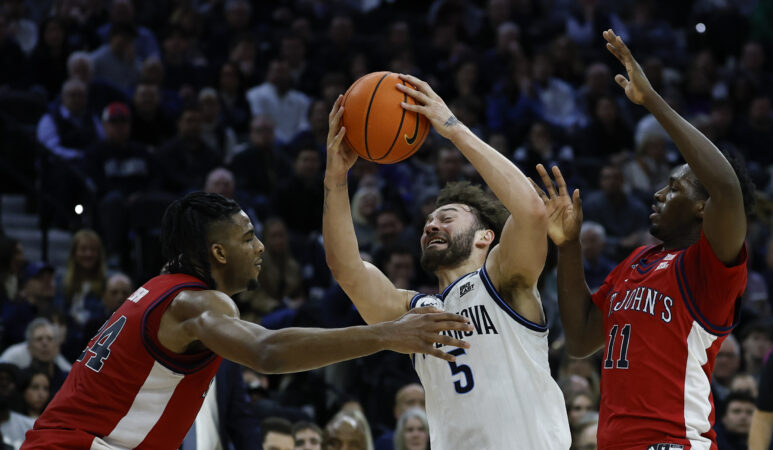
The youthful Wildcats eventually got back in the game and trailed by five with 6 minutes, 36 seconds left and again inside of a minute to play. But St. John’s was too big, too strong, and too experienced for Villanova to get over the hump, no matter how hard junior Tyler Perkins and senior Devin Askew — who scored 23 and 21 points, respectively — tried.
Villanova’s lone senior starter, center Duke Brennan, a transfer from Grand Canyon, was no match for his experienced Big East counterparts. Zuby Ejiofor had 17 points and seven rebounds. Bryce Hopkins had 20 and six. Brennan was minus-14 on the night. Lewis finished with a season-low three points and a season-high six turnovers and was on the bench for the final 11 minutes.
Lewis, who was also minus-14, looked like a freshman, which has only happened a few times this season. Hodge normally scores 10.6 points per game but was held to four. Lindsay entered Saturday scoring 15.2 points per game and scored 11, all in the second half.
“Acaden, Bryce, Matt — freshman, freshman, sophomore — against grown men,” Willard said. “That’s why Devin and Tyler played well, because they’re grown men. They’re physical, able to play against a St. John’s where I think Acaden, Bryce, and Matt are all trying to figure out, ‘How do I play when I play against a physically dominant team?’ We’ve struggled against physically dominant teams for that reason.”
Saturday night offered Villanova (14-4, 5-2 Big East) a chance for its first real signature win. Instead, it showed, for now, where the Wildcats are. They have beaten teams projected to make the NCAA Tournament like Wisconsin and Seton Hall, but they have been knocked off by the three big dogs on the schedule so far: BYU, Michigan, and now St. John’s. Villanova is where it is — ranked 25th in the NCAA’s NET rankings and 27th at KenPom as of Saturday — in large part because it has beaten the teams it’s supposed to beat.
Villanova entered Saturday as the 21st team in ESPN bracket guru Joe Lunardi’s projected NCAA Tournament field. The best of all the No. 6 seeds. St. John’s, meanwhile, was 26th. Saturday should at least cause a flip-flop.
“You’ve got to sit back as a coach every once in a while and realize there is a process to this,” Willard said. “Sometimes you’ve got to play bad and go back and watch film and kind of … we did some things in the second half late, defensively, that made no sense.”
It is not a talent thing, Askew said. Villanova has the players, but it needs to play in games like Saturday’s to get better.
“It’s an experience thing,” said Askew, a sixth-year senior who is averaging 18 points off the bench in his last three. “As they play more games in atmospheres like that, they’ll get better. … They just have to get used to it and they will.”
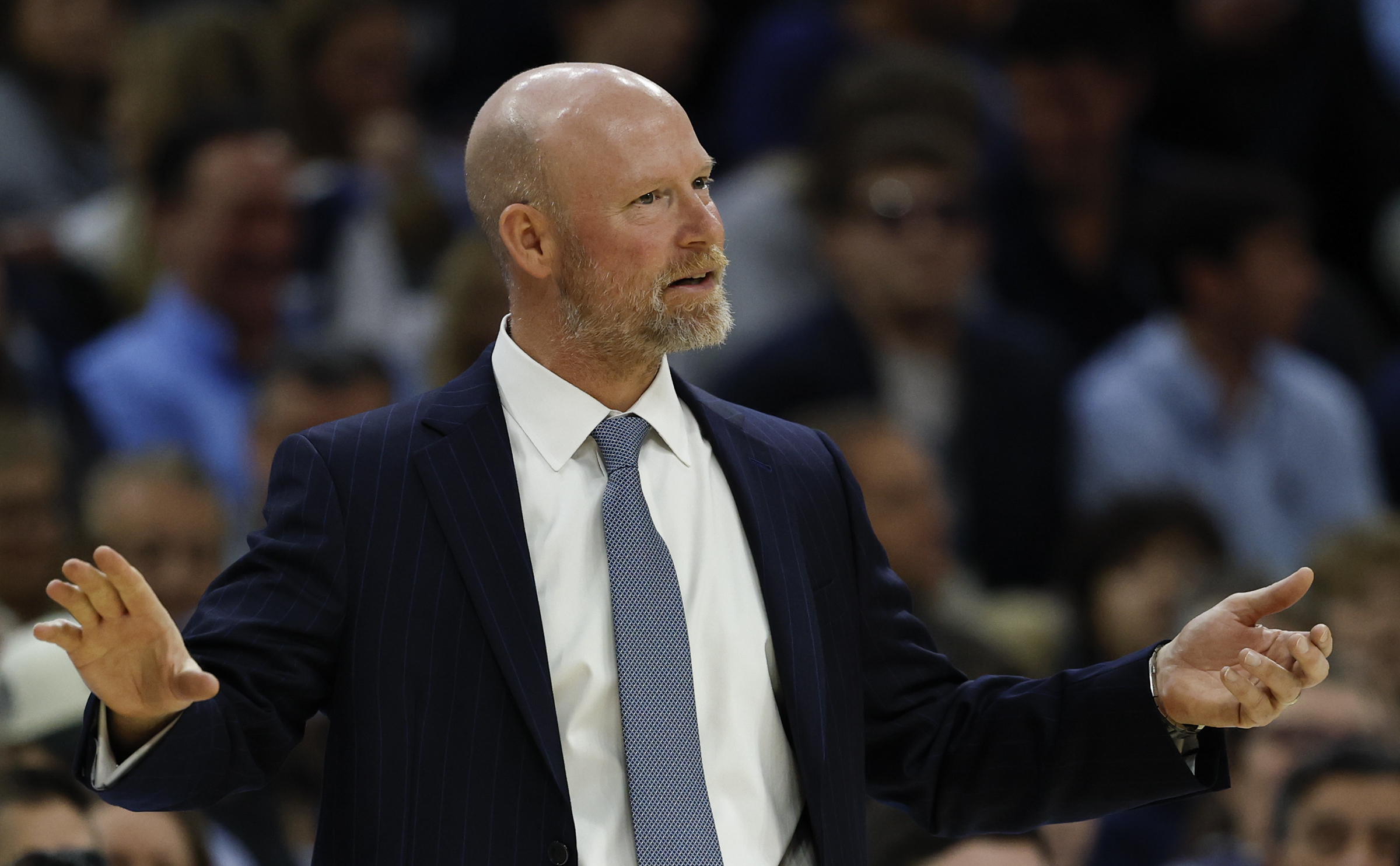
Villanova coach Kevin Willard believes his team is still learning to deal with physical opponents.
The good part for Villanova is that very few teams in the Big East are built to hurt Villanova the way St. John’s can.
The Wildcats are back at the Finneran Pavilion on Wednesday night against Georgetown, which is 1-6 in the Big East. After that is another big test — a road game at No. 3 UConn next Saturday afternoon that will give Villanova a chance to quickly show what it learned from its step up in competition.
“It’s a little bit of a learning process,” Willard said. “This group, they have a great attitude, they work hard. We’re going to have some bumps in the road. It’s a part of conference play.
“We’re not at the level where we’re going to pitch a shutout. We can’t give up 50 points in the second half. We can’t give up nine offensive rebounds in the second half. We can’t come out and turn the ball over three times. That’s all part of the learning curve a little bit.”
For Eagles fans, the end came suddenly, even if the signs were there all along. That doesn’t make the loss any easier to handle. Now that it’s all over, perhaps you’re confused and consumed by strong, unexpected emotions.
story continues after advertisement
The doctor is in
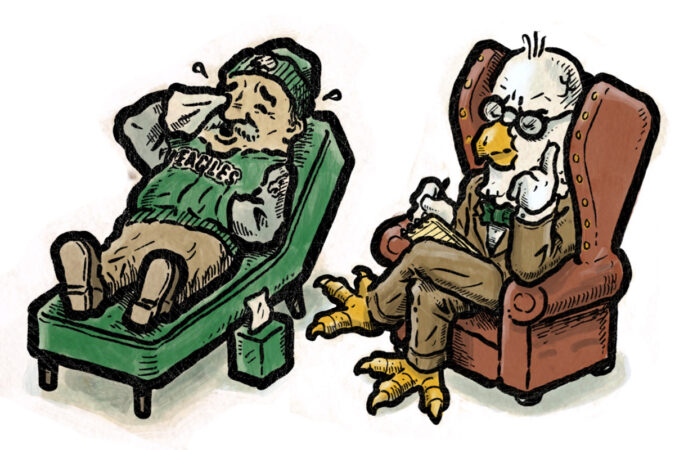
Pull up a chair. Here is a guide to identifying the five stages of grief for Eagles fans.
Denial
The first reaction to loss is denial — “How many times are they going to keep running four verticals against a quarters defense??” Your refusal to accept reality could be a psychological defense mechanism to avoid intense emotional pain, but football is a painful sport.
Anger
Anger is the birthright of a true Philadelphia sports fan. Just remember that venting your anger on other people (or homes of Eagles’ coaches) is off-limits. Whether to take out your frustrations on your TV is up to you, your significant other, and your budget.
Bargaining
If you find yourself saying something like “I’d give up my first-born child for another Super Bowl win,” perhaps amend the proposition to substitute a relative of lesser importance.
Depression
If the Eagles losing a playoff game has made you mournful and sullen, giving you feelings of emptiness and hopelessness, then welcome to life as a Philadelphia sports fan.
Acceptance
After cycling through the other stages of grief, you’ll come to this conclusion: Two Super Bowl wins in the last nine seasons is not too shabby.
story continues after advertisement
Of course, once you arrive at acceptance and you’re ready to move on to next season, we’ve got plenty of Eagles content to get you ready for the offseason.
Staff Contributors
Design: Steve Madden
Reporting: John Duchneskie
Digital Editing: Matt Mullin
Copy Editing: Tony Moss
(()=>{var R=(e,t)=>()=>(t||e((t={exports:{}}).exports,t),t.exports);var M=R(s=>{var G={0:”Jan.”,1:”Feb.”,2:”March”,3:”April”,4:”May”,5:”June”,6:”July”,7:”Aug.”,8:”Sept.”,9:”Oct.”,10:”Nov.”,11:”Dec.”};function y(e){return e===void 0&&(e=new Date),G[e.getMonth()]}var W={0:”Jan”,1:”Feb”,2:”Mar”,3:”Apr”,4:”May”,5:”Jun”,6:”Jul”,7:”Aug”,8:”Sep”,9:”Oct”,10:”Nov”,11:”Dec”};function S(e){return e===void 0&&(e=new Date),W[e.getMonth()]}function r(e){return e==null}function x(e){return typeof e==”number”&&isFinite(e)}function u(e){return x(e)&&Math.floor(e)===e}var Y=[“one”,”two”,”three”,”four”,”five”,”six”,”seven”,”eight”,”nine”],U=[“million”,”billion”,”trillion”,”quadrillion”,”quintillion”,”sextillion”,”septillion”,”octillion”,”nonillion”,”decillion”],b=[“th”,”st”,”nd”,”rd”,”th”,”th”,”th”,”th”,”th”,”th”],_=[11,12,13];function L(e){if(r(e))return””;var t=+e;return u(t)?_.indexOf(t%100)>-1?b[0]:b[t%10]:””}var Z=[“first”,”second”,”third”,”fourth”,”fifth”,”sixth”,”seventh”,”eighth”,”ninth”],K=new RegExp(/s+([^s]*)s*$/);s.apdate=function(e){return e===void 0&&(e=new Date),y(e)+” “+e.getDate()+”, “+e.getFullYear()},s.apdatetab=function(e){return e===void 0&&(e=new Date),S(e)+” “+e.getDate()+”, “+e.getFullYear()},s.apmonth=y,s.apmonthtab=S,s.apnumber=function(e){if(r(e))return””;var t=+e;return u(t)?t=10?e.toString():Y[t-1]:e.toString()},s.aptime=function(e){e===void 0&&(e=new Date);var t,n,o=e.getHours(),i=e.getMinutes(),a=i===0;if(a){if(o===0)return”midnight”;if(o===12)return”noon”}return o0?o:12):(t=”p.m.”,n=o===12?o:o-12),a?n+” “+t:n+”:”+(i<10?"0"+i:i)+" "+t},s.capfirst=function(e){if(r(e))return"";var t=String(e);return""+t.charAt(0).toUpperCase()+t.slice(1)},s.intcomma=function(e){if(r(e))return"";var t,n=+e;return x(n)?((t=n.toString().split("."))[0]=t[0].replace(/B(?=(d{3})+(?!d))/g,","),t.join(".")):e.toString()},s.intword=function(e){if(r(e))return"";var t=+e;if(!u(t))return e.toString();var n=Math.abs(t);if(n<1e6)return e.toString();var o=Math.ceil(Math.log(n+1)/Math.LN10)-1,i=o-o%3,a=t/Math.pow(10,i);return(a=Math.round(10*a)/10)+" "+U[Math.floor(i/3)-2]},s.ordinal=function(e,t){if(t===void 0&&(t=!1),r(e))return"";var n=+e;return u(n)?t&&n{n||(n=document.querySelector(“head”));let o=document.createElement(“script”);o.type=”text/javascript”,o.src=e,t&&(o.onload=t),n.appendChild(o)},A=()=>(window.PMNdataLayer?.[0]!==void 0&&window.PMNdataLayer[0])?.analytics?.user?.state===”Subscribed”,T=()=>{let t=(window.PMNdataLayer?.[0]!==void 0&&window.PMNdataLayer[0])?.analytics?.user?.state;return window.location.host.includes(“zzz-systest”)||window.location.host.includes(“pmn.arcpublishing.com”)||window.location.host.includes(“stage.fusion.inquirer.com”)||typeof t>”u”},q=()=>{let t=(window.PMNdataLayer?.[0]!==void 0&&window.PMNdataLayer[0])?.analytics?.user?.hasAdsFreeReading;return!!(t&&t==1)},m=()=>window.location.host.includes(“localhost”);var Q=()=>{q()&&document.querySelectorAll(“.js-adbox”).forEach(t=>{t.classList.add(“is-hidden”)})},k={init:()=>{Q()}};var c,E,V=()=>{c=document.getElementById(“js-inno-toast”)},X=e=>{if(!c)return;c.innerHTML=e,c.classList.add(“is-active”);let t=()=>{c.addEventListener(“transitionend”,ee,{once:!0}),c.classList.remove(“is-active”)};clearTimeout(E),E=setTimeout(t,5e3)},ee=()=>{c.innerHTML=””},l={init:()=>{V()},showToast:X};var p,j=!1,te=async()=>new Promise(e=>{setTimeout(()=>{console.log(“simulating createShareLink for localhost”),e(“https://inquirer.com/interactives”),ne()},100)}),ne=()=>{let e=document.querySelector(“.js-gift-toast-receiver”);!e||!(e instanceof HTMLElement)||setTimeout(()=>{let t=e?.querySelector(“span”);t&&(t.innerHTML=”Gift link copied to clipboard“)},20)},oe=()=>{let e=window.services?.createShareLink;e&&(p=e),m()&&(p=te),p&&se()},ie=async e=>{let t=”text/plain”,n=async()=>{try{return await p(window.location.pathname)}catch{e.dataset.state=”error”,l.showToast(“Hmm, we couldn’t generate a gift link…”)}},o=new ClipboardItem({[t]:n()});await navigator.clipboard.write([o]).catch(i=>{console.log(i),l.showToast(“Couldn’t copy to clipboard, try again?”),e.dataset.state=”error”}),l.showToast(“Gift link copied to clipboard!”),e.dataset.state=”complete”},se=()=>{document.querySelectorAll(“.js-gift”).forEach(t=>{(A()||m()||T())&&t.classList.add(“is-available”)}),document.querySelectorAll(“.js-gift-button”).forEach(t=>{t instanceof HTMLButtonElement&&t.addEventListener(“click”,()=>{t.classList.contains(“disabled”)||(t.dataset.state=”loading”,j=!0,ie(t),setTimeout(()=>{t.dataset.state=”ready”},2e3))})});let e=document.querySelector(“.js-gift-toast-receiver”);!e||!(e instanceof HTMLElement)||re(e)},re=e=>{new MutationObserver(n=>{for(let o of n){let i=[…o.addedNodes].at(0);if(!(i instanceof HTMLElement))return;j&&l.showToast(i.outerHTML)}}).observe(e,{subtree:!0,childList:!0})},P={init:()=>{oe()}};var ae=()=>{window.addEventListener(“message”,e=>{if(e.data[“datawrapper-height”]){let t=e.data[“datawrapper-height”];for(let n in t)document.querySelector(`#datawrapper-chart-${n}`).setAttribute(“height”,t[n])}})},ce=()=>{document.querySelectorAll(“.js-datawrapper-graphic”).forEach(e=>{h(`https://datawrapper.dwcdn.net/${e.dataset.id}/embed.js`,null,e)})},le=()=>{window.addEventListener(“message”,e=>{let t=e.data;document.querySelectorAll(`iframe[src*=”${t.id}”]`).forEach(o=>{o.style.height=`${t.height}px`})},!1)},de=()=>{document.querySelectorAll(“.js-pym-graphic”).forEach(e=>{if(typeof window{new window.pym.Parent(e.id,e.dataset.iframe)};typeof window.pym>”u”?h(“https://pym.nprapps.org/pym.v1.min.js”,t):t()}})},D={init:()=>{ae(),ce(),de(),le()}};var d,ue=()=>{document.querySelectorAll(“.js-hover”).forEach(e=>{e.addEventListener(“click”,()=>{C(e)}),e.addEventListener(“mouseenter”,()=>{C(e)}),e.addEventListener(“mouseout”,()=>{I(e)})}),window.addEventListener(“scroll”,()=>{d!==null&&pe()})},pe=()=>{(d>window.scrollY+100||d{I(e)})},C=e=>{e.classList.add(“is-visible”),d=window.scrollY},I=e=>{e.classList.remove(“is-visible”),d=null},N={init:()=>{ue()}};var f,fe=(e,t)=>{f=f||window.PMNdataLayer,f?f.push({event:”misc_event”,eventAction:e,eventLabel:t}):window.location.hostname.includes(“localhost”)?console.log(“Analytics event:”,e,t,”(not actually being sent due to localhost)”):console.log(“Failed to push analytics event”,e,t)},H={event:(e,t)=>{fe(e,t)}};var $=1,v=class{constructor(t){this.el=t,this.contentPosition=”default”,this.possibleSteps=new Array,this.currentStep=null,this.offset=window.innerHeight*.9,this.instanceOfSteps=$,$++,this.setPossibleSteps(),this.updateContent(),this.bindings()}setPossibleSteps(){this.el.querySelectorAll(“.js-steps-step”).forEach(t=>{t.dataset.step&&this.possibleSteps.push(t.dataset.step)})}bindings(){window.addEventListener(“scroll”,()=>{this.updateContent()}),window.addEventListener(“resize”,()=>{this.updateContent()})}updateContent(){this.updateCurrentStep()}updateCurrentStep(){let t;if(this.el.querySelectorAll(“.js-steps-step”).forEach((o,i)=>{o.getBoundingClientRect().top{let w=”is-“+i,g=”is-“+a;this.possibleSteps.indexOf(i){document.querySelectorAll(“.js-steps”).forEach(e=>{new v(e)})}};var he=()=>{},O={init:()=>{he()}};var B={init:()=>{k.init?.(),P.init?.(),D.init?.(),N.init?.(),F.init?.(),O.init?.(),l.init?.()}};var me=()=>{},z={init:()=>{me()}};var ve=document.querySelector(“.js-inno”),J=()=>{B.init(),z.init()};ve?J():new MutationObserver((t,n)=>{if(document.querySelector(“.js-inno”)){n.disconnect(),J();return}}).observe(document,{attributes:!0,childList:!0,subtree:!0});})();
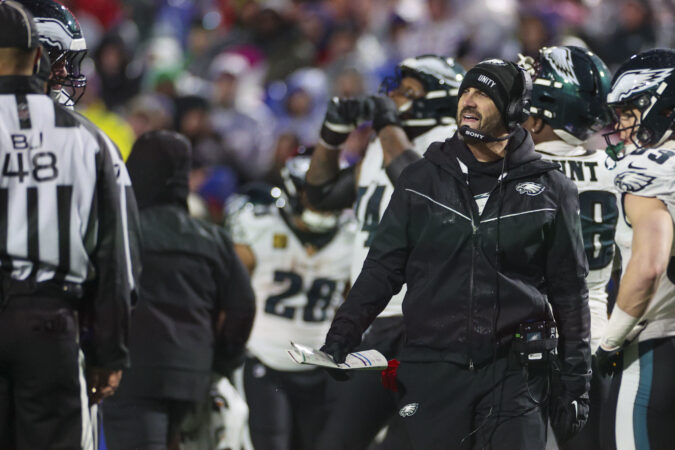
Nick Sirianni is the son of a high school football coach and a mentee of a Division III football coach. Everyone knows this about him.
When he speaks publicly, he frequently sprinkles in references to his father, Fran, and his nine years in charge of the program at Southwest Central High School in western New York. He talks of lessons learned from his years as a player and assistant under Larry Kehres at the University of Mount Union (it was Mount Union College when Sirianni was there) in northeast Ohio.
If one of Sirianni’s greatest weaknesses as an NFL head coach is that he’s often too impulsive and emotional, maybe it’s because there’s a fine line between small town and small-time, and he can’t help himself from crossing it. Still, he ain’t changin’ now, and in an honest appraisal of Sirianni’s five years with the Eagles, one can make the case that his background might be one of his greatest strengths.
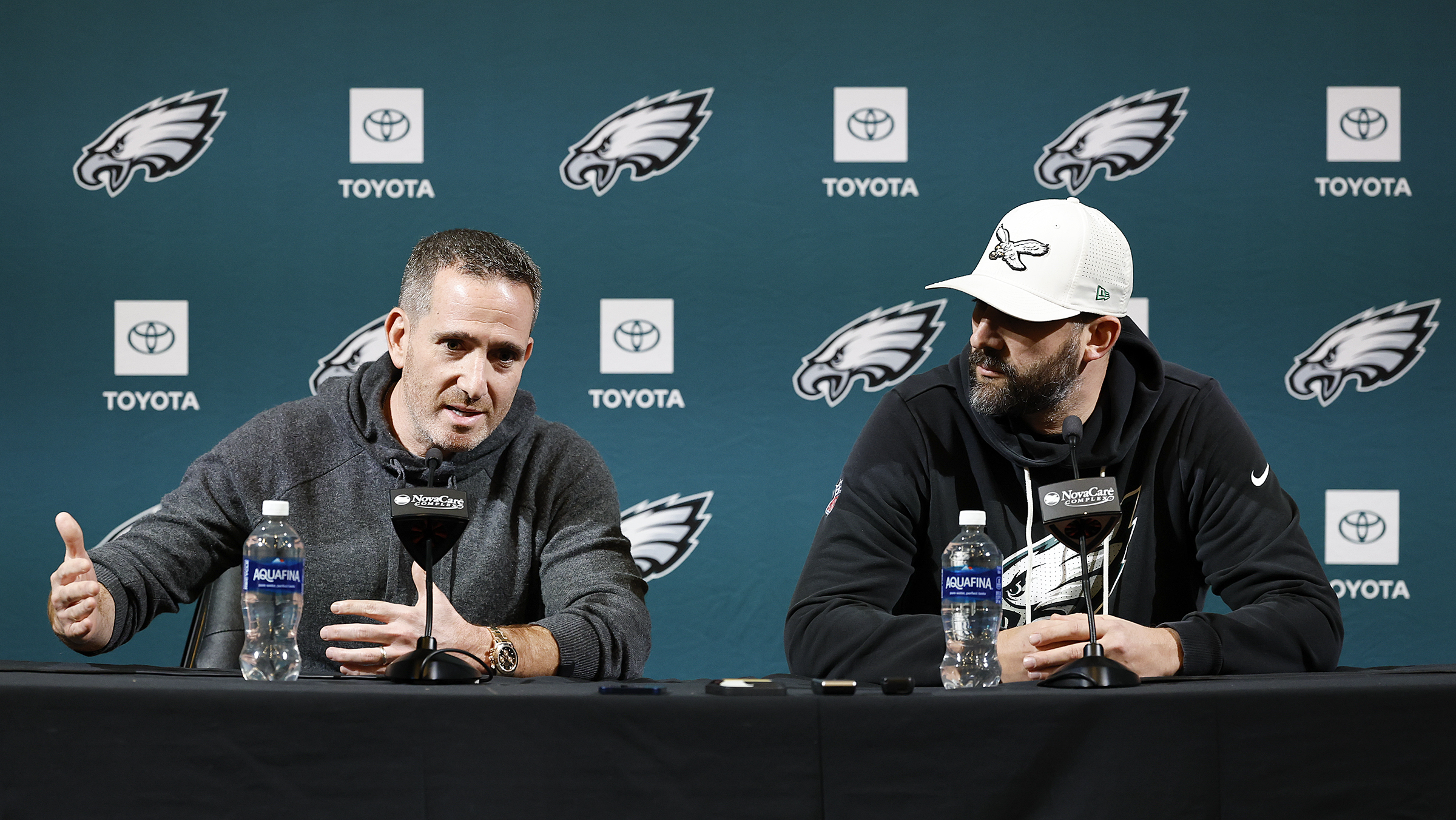
Eagles executive vice president and general manager Howie Roseman (left) says the Eagles are fortunate to have an “elite” coach in Nick Sirianni.
If nothing else, it might be one of the reasons that he’s still in this position and, if Howie Roseman was to be believed Thursday, will be for more than a minute.
“Obviously,” Roseman said, “I sit here, and I feel incredibly grateful that I’m working with someone who … is elite at being a head coach, elite at building connections with our team, elite talking about fundamentals, game management, situational awareness, bringing the team together, holding people accountable. When you’re looking for a head coach, those are really the job descriptions.”
They’re not much different from the job descriptions of a head coach at any level of football, and for all the suggestions that Sirianni is nothing but an empty hoodie, those qualities still matter at the sport’s highest level.
What’s more — and this is the important part as far as Sirianni’s future is concerned — they allow him to be flexible, to contour himself both to what the team needs in a given season … and what he needs to do to survive.
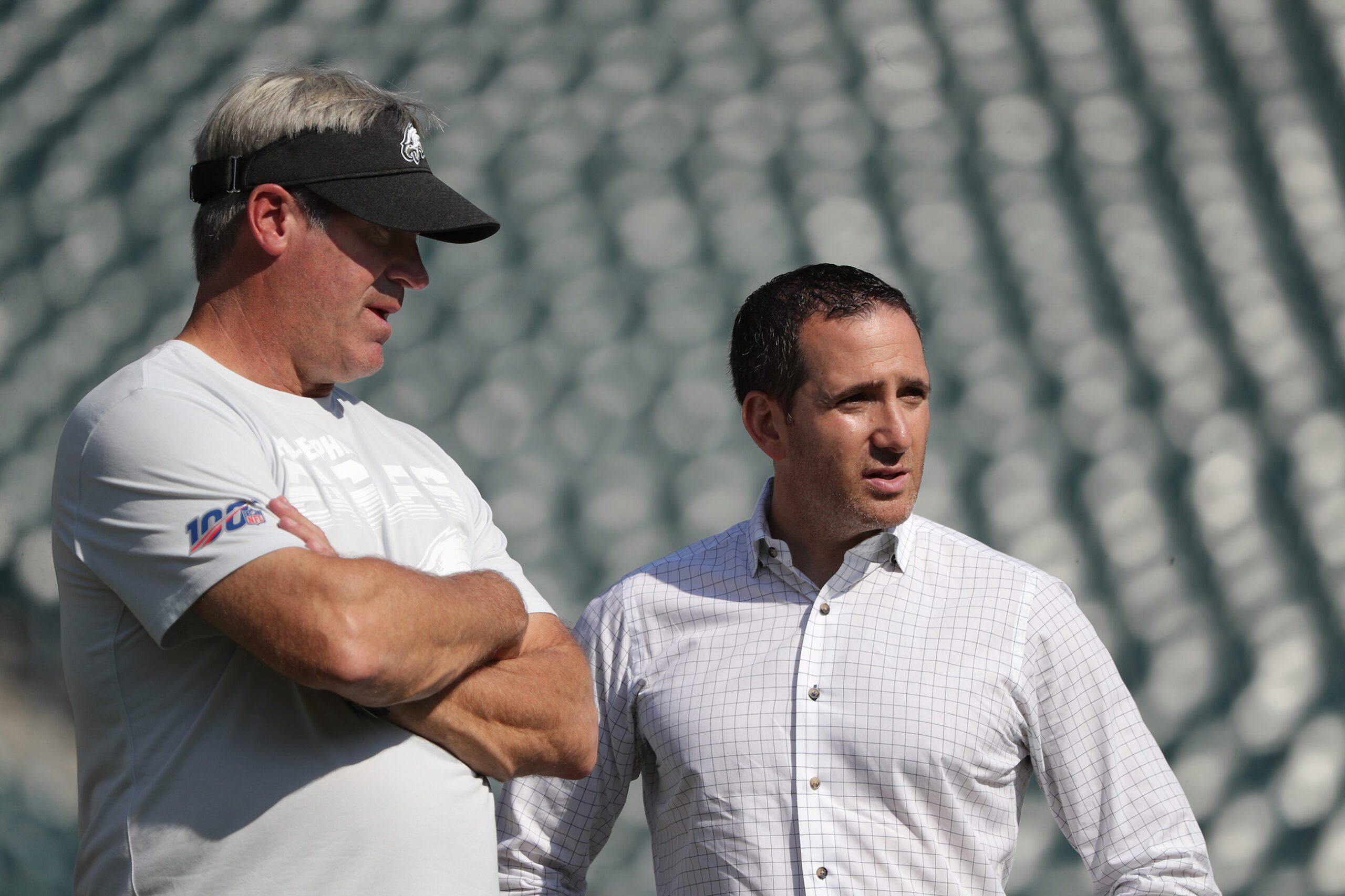
Think about Sirianni for a moment in contrast to his predecessor, Doug Pederson. It’s no secret that Roseman and Eagles chairman Jeffrey Lurie want a head coach who aligns with their thinking on how to win games. Boiled down, a head coach here doesn’t have much independence or power relative to others around the NFL. (The last time Lurie gave a coach such freedom, Chip Kelly started making holiday party-related demands, and Pat Shurmur ended up coaching the 2015 season finale.)
Pederson had been hired as an offensive guy, and he accepted that label and that arrangement right up until he and his team won Super Bowl LII in February 2018. Six months later, his memoir hit stores. At the end of the 2019 season, he asserted in a news conference that embattled assistants Mike Groh and Carson Walch would return — only to have Lurie say, Not so fast, Dougie.
The Eagles relationship with former coach Doug Pederson (left) shares contrasts to Nick Sirianni’s time as head coach.
One day after Pederson endorsed them, Groh and Walch were gone. A year later, after a 4-11-1 season, so was Pederson. So much for assertiveness, and so much for the notion that Pederson’s status as the orchestrator and often the lead play-caller for the Eagles’ offense would preserve his job. Once Carson Wentz and the offense collapsed, what reason was there to keep Pederson?
Because Sirianni’s personality is more tempestuous than Pederson’s, it was always fair to wonder whether, if he ever found himself in the same post-championship situation, he might try to flex a little bit, too. But he did the opposite Thursday, explaining why his close friend Kevin Patullo was no longer the offensive coordinator, suggesting that he would be open to having the new OC have the kind of say-so over the unit that Vic Fangio has over the defense.
“You’re looking to continue to evolve as an offense,” he said, “and I’m looking to bring in the guy [who is] going to best help us do that. I think that there are many different ways to be successful on offense, and everybody has different styles. Everybody has different players. And there’s many different ways to be successful.”
The cynical way to look at this, of course, is that A) Sirianni is acting out of self-preservation; and B) his presence acts as a Kevlar vest for Roseman, protecting him from any public-relations damage if he messes up the assembling of the Eagles’ roster. As great a general manager as Roseman has been, he still makes mistakes. And on those rare occasions when he makes more than his share, the perception that Sirianni is handed an outstanding team every year and that all he can do is screw it up sure takes a lot of heat off the guy who is calling the player-personnel shots.
There’s another prism through which to view Sirianni, though: that he doesn’t have to control every aspect of a team, or even one specific aspect of a team, to do his job and do it well. He doesn’t need to pick the players, design the offense, call the plays.
He’ll delegate responsibility, trust his people, fill in the gaps where he can and should. He’ll take the guys who happen to be on his team that particular year and play that particular hand. Sounds like what a high school or small-college coach does. Sounds like a formula to last a while with this particular franchise.
The hockey season can be a long and winding road, but right now the Flyers have gone off-roading and toward a cliff.
Eleven days ago, the vibes were high following an emotional, high-intensity win against Cutter Gauthier and the Anaheim Ducks. The whole night, Xfinity Mobile Arena was rocking in front of a sellout crowd.
On Saturday, the Flyers were booed out of their own building before they head west to play the Vegas Golden Knights, Utah Mammoth, and Colorado Avalanche — two Stanley Cup contenders and a team in the playoff picture in the Western Conference — on a trip that could send them spiraling over.
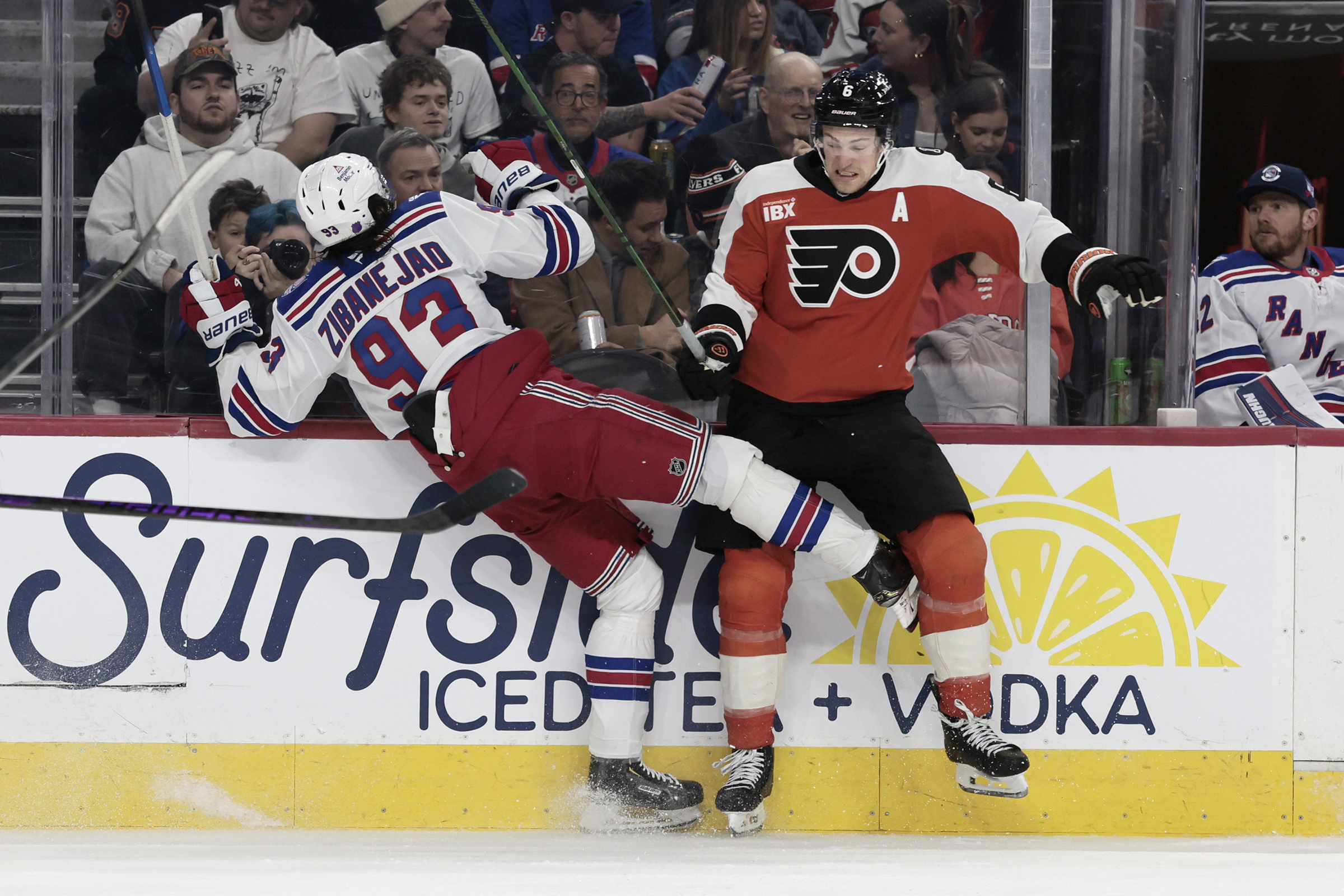
The Flyers have now lost six straight, capped off by a dreadful 6-3 loss to a New York Rangers team that confirmed on Friday, with a letter to its fans, that they have officially driven off the cliff and essentially quit on their season.
“We sucked. Plain and simple. We can’t show up,” captain Sean Couturier said. “Down 3-1, 5 minutes in, 10 minutes in, whatever it was. We’ve got to be better.”
Can the Flyers be better? Can they pump the brakes on the slide?
From the outside, six straight losses is a concern, for sure; however, the longest losing streak of the season previously was three games, Dec. 11-15 — all in overtime — so the losses alone are not setting off alarm bells.
What is setting off loud sirens is how they are losing games.
Entering their game on Jan. 8 against the Toronto Maple Leafs, the Flyers had allowed 2.80 goals on average across the first 41 games of the season. The past six? An eye-popping 5.17.
“Obviously, really frustrated,” defenseman Cam York said postgame, after being on the ice for three goals by the Rangers. “We’ve kind of just been shooting ourselves in the foot, making silly mistakes, I think. It’s correctable stuff, stuff that we haven’t done all year up to this point.”
Creeping back in are the odd-man rushes, the two-on-one goals, the three-on-one goals — the Rangers had both — the turnovers, the bad penalties that plagued them early in the year, and players not stepping up on the opposition.
The structure has broken down as guys are missing reads, attacking players who already have a Flyer on them, and giving time and space to the opposition. They are leaving opponents wide open on the weak side.
It does not make it easy on the goalies when they’re having to dive across the crease to stop pucks — a hallmark of what coach Rick Tocchet’s system is meant to prevent.
Is this who the Flyers really are? Was goalie Dan Vladař, who missed his second straight game on Saturday after being injured in the first period on Wednesday, hiding the Flyers’ flaws with his red-hot start?
“I‘ve been preaching since the start of the year, you cannot give weak side goals up, so you protect the middle and let the goalie have it,” Tocchet said.
“Now what happens is, when you start getting goals side to side, what are the goalies doing? They’re just playing on their heels. … But before, especially when Vladdy was here, he knew, most of the time the puck was going to be there and he was ready for it. He made those stops. I’m just using it as an example.”
There’s no denying that, beyond Vladař, the goaltending has been an issue. Aleksei Kolosov got the start on Saturday and allowed three goals on three shots — the fourth Flyers goalie in team history to finish a game with a .000 save percentage, joining Ron Hextall, Ken Wregget, and Antero Niittymäki. Sam Ersson actually made several big-time stops against the Rangers when left out to dry, but ultimately gave up three goals on 25 shots.
“Tocc always says that it’s hard for anyone to make five, six perfect reads in a game. And when you’re not playing well, and you’re in the D zone, you’re having to make 15 reads, it makes the game a lot harder,” forward Travis Konecny said.
“You guys [the media] see it, when we’re playing good and things are buzzing, we’re getting through the neutral zone, we’re playing good offense, things just kind of happen naturally. You’re not really thinking out there. And then when you have to put your thinking cap on that many times in a game, it’s hard to be perfect. More times than not, there’s going to be a mistake somewhere in there.”
The question is now what? The power play is in a familiar but unwelcome spot, ranked dead last at 14.9% — allowing two short-handed goals. (Um, did Scott Laughton’s goal on Jan. 8 break the Flyers?). The penalty kill jumped ship a while ago and is at 61.9% during the losing streak.
And now they have injury woes with Vladař (undisclosed injury); defenseman Rasmus Ristolainen on injured reserve (upper-body injury) and not expected to head west; Bobby Brink on injured reserve (upper-body injury) but could draw back in on Monday against Vegas; Rodrigo Ābols got hurt during the game on Saturday (lower-body injury); and Tyson Foerster was ruled out for likely the season in mid-December.
Seventeen days ago, Flyers president Keith Jones sat down with The Inquirer and said that “the players will decide” what management will do as the March 6 trade deadline approaches. At the time, “the players have done a really good job of putting themselves in a position where we’re going to look to enhance what they’ve done,” he added.
Where do things stand now? There are 14 games between now and the trade deadline. Will they be sellers? Will they add?
As Jones said, the players will decide, so will they step on the brakes or hit the gas pedal?
Time will tell. That time is now.
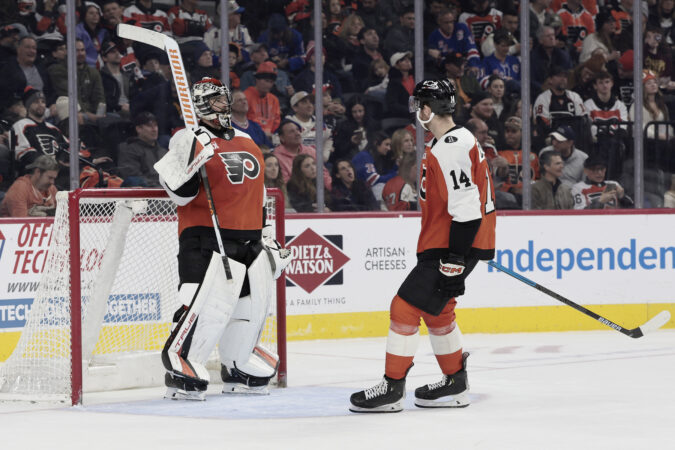
The Flyers were embarrassed on Saturday against a Rangers team that waved the white flag on Friday.
Breakaways
The Flyers’ injury bug stung again just 6 minutes, 10 seconds into the game. Ābols appeared to get his right toe stuck in the ice along the boards in the offensive zone. His ankle buckled in the process, and he was unable to skate off the ice without help. He did not return with a lower-body injury, and Tocchet said postgame, “It’s not good.” … The Flyers have four players slated to play at the 2026 Milano Cortina Olympics and now three are hurt with Ābols (lower-body injury), Vladař (undisclosed) day-to-day, and, Ristolainen was placed on injured reserve with an upper-body injury after the game. … Defenseman Hunter McDonald was officially recalled from Lehigh Valley of the American Hockey League after the game but watched the loss from the press box.
The Flyers begin a three-game swing through what some are calling the new “Death Valley,” beginning Monday with a matchup against the Vegas Golden Knights (8 p.m., NBCSP+).
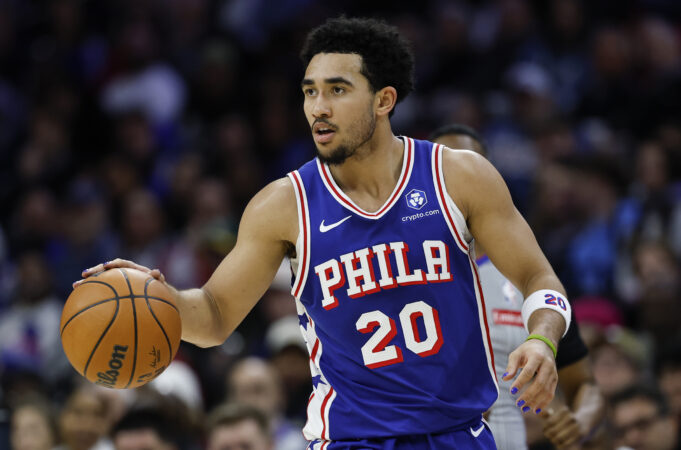
Jared McCain has been assigned to the G League’s Delaware Blue Coats, the 76ers announced Saturday.
McCain did not play in the Sixers’ Friday loss to the Cleveland Cavaliers, and his rotation minutes have diminished in recent games as the roster has returned to full strength. The Blue Coats play at the Noblesville Boom on Sunday and Monday.
It has been a challenging second NBA season for McCain, who is about 13 months removed from meniscus surgery and also underwent thumb surgery in September. The second-year guard is averaging 6.3 points on 35.4% shooting from the floor in 30 games, but has been surpassed on the depth chart by dynamic rookie VJ Edgecombe and sixth man Quentin Grimes.
McCain also had two-game stint with the Blue Coats in November to help him regain conditioning and his shooting stroke shortly after returning from injury. Sixers coach Nick Nurse said throughout McCain’s reacclimation that game experience is expected to help him return to form.
Before his surgeries, McCain was a Rookie of the Year frontrunner after averaging 15.3 points, 2.6 assists, and 2.4 rebounds in 23 games. He shot 38.3% on 5.8 three-pointers per game, after connecting on 41.4% of his long-range attempts during his one college season at Duke.
Albie Crosby has come across several talented athletes over his two decades as a high school football coach. But DJ Moore was “always one of the elites in that group.”
It makes sense, considering the success the 28-year-old is having in his eighth NFL season.
The Chicago Bears receiver, who graduated from Imhotep Charter in 2015, has been a critical part of the passing game since his arrival in 2023, while etching his name into franchise history.
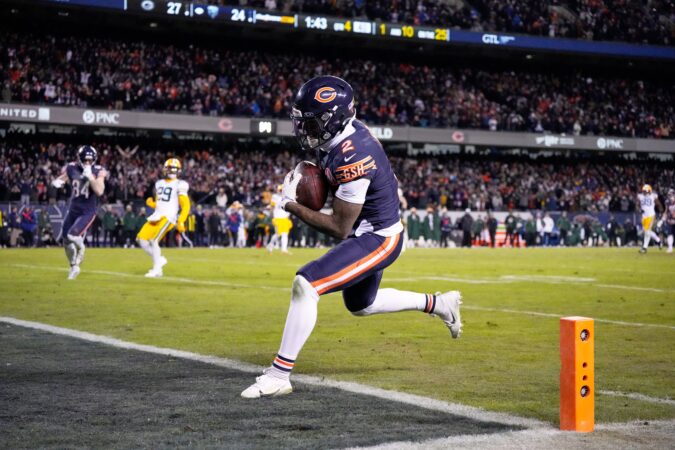
The Bears won the NFC North for the first time since 2018, and Moore caught a 25-yard game-winning touchdown to seal a thrilling 31-27 comeback victory over the Packers in the wild-card round. St. Joseph’s Prep graduates D’Andre Swift and Olamide Zaccheaus also scored as the Bears (12-6) advanced to the divisional round for the first time since 2011 and will face the Los Angeles Rams on Sunday (6:30 p.m., NBC10).
The wild-card matchup was Moore’s first NFL playoff game, and he’s experiencing his first winning season since his senior year at Imhotep.
“When you look at it, no winning seasons since high school. It’s crazy,” Moore told Marquee Sports Network ahead of the Bears-Packers game. “This is my first time in this thing, too, so I’m just going with the flow and working hard.”
That aspect of Moore has never changed.
He always wanted to be the best, Crosby said, who took over at Simon Gratz in late December after spending nine season at Neumann Goretti. Moore was the talk of the area. His skills caught the attention of coaches while he was in grade school, Crosby among them.
When Crosby became the head coach at Imhotep in 2012, Moore was in his sophomore season and played receiver, running back, and was the team’s kicker. He still holds the Philadelphia Public League record for most kicked points.
As a junior, he helped ignite Imhotep’s run to its first-ever state championship appearance. However, the Panthers got trounced, 41-0, in the PIAA Class 2A championship game by South Fayette of Allegheny County. That didn’t matter to Crosby, because his players had the experience of a lifetime at Hersheypark.
Imhotep finished 12-2 during Moore’s senior campaign. While it lost to Archbishop Wood in the first round of Class 3A playoffs, moments from that year have stuck with Crosby.
Former Imhotep star DJ Moore, who now plays for the Chicago Bears, caught a game-winning touchdown in his first NFL playoff game.
“We played Trinity High School, and into the third quarter, our kids started cramping up,” Crosby said. “Injuries started happening. We lost our quarterback. So the next week, we played Boys’ Latin of Philadelphia, and I had to put DJ in at quarterback.
“Then, we had another national game where we played against Friendship Collegiate Academy outside of D.C., they thought they got the team with DJ at quarterback. … First play, quarterback’s back, and DJ’s at wide receiver. We throw a little screen to DJ, and he takes it 80 yards.”
Moore finished with 35 receptions for 1,012 yards and 16 touchdowns in 2014 and was the No. 12 player in Pennsylvania, according to 247Sports.com’s recruiting rankings.
Despite the accolades, he’s a “private young person” off the field. He also had a strong support system, and his mother, Cookie Ridley, used to attend every game, Crosby recalled.
“He had an advantage when he turned to the sideline, he knew that there was loved ones looking out for him,” Crosby said. “His mom was one of the team moms, and she made sure that all the kids felt loved. He was a special kid because he embraced that. There was never no jealousy. He loved that his mom loved everybody. It speaks volumes of a young person that can share their parents.”
Crosby often brings up Moore’s journey when he’s coaching his high school or seven-on-seven team. But when he thinks about the impact he may have had on Moore, Crosby hopes he offered more lessons about life than football.
“I’m super proud of him,” Crosby said. “To be the father that he is, be the husband that he is, to be the son and brother that he is. All that is what makes me extremely proud.”
During his three seasons at Maryland and five with the Carolina Panthers — who drafted Moore in the first round with the 24th overall pick in 2018 — his teams compiled 13-24 and 29-53 records, respectively. With the Bears, he’s having career highlights.
In his first season, Moore finished with a career-high 1,364 receiving yards and eight touchdowns. Last year, he had a career-best in receptions with 98. He hauled in six touchdowns and had 682 receiving yards in 2025.
Moore will have the crowd behind him on Sunday, and his former coach also will be cheering for him and the Bears back in his hometown.
“I’ll be rooting for him like crazy,” Crosby said. “Rooting for him, rooting for Olamide, and Swift.”
The Flyers face the New York Rangers on Saturday before embarking on a three-game road trip through what some are calling the new Death Valley.
Whether they will have reinforcements as the team heads west to face the Vegas Golden Knights, Utah Mammoth, and Colorado Avalanche is the big question.
According to Flyers coach Rick Tocchet, who spoke Saturday morning at Xfinity Mobile Arena, Bobby Brink is a “possibility against Vegas.” Brink was placed on injured reserve on Thursday, retroactive to Jan. 6, when he was injured on a blindsided hit by Anaheim Ducks forward Jansen Harkins just 2 minutes, 38 seconds into the first period.
It had seemed earlier in the week that the winger would return, but he was not on the trip for the losses to the Buffalo Sabres and Pittsburgh Penguins, and he has now missed six games. Brink skated Saturday morning and, if he is good to go,they’llappreciate having back his production — 11 goals and 20 points in 41 games — and chemistry with Noah Cates.
Flyers goaltender Dan Vladař is considered day-to-day. It’s uncertain if he’ll travel with the team on their road trip.
Goalie Dan Vladař‘s status for the road trip is a little more up in the air.
“At this point, I’d say day to day,” Tocchet said. “It depends [on] how he feels after therapy. So it’s like, one of those things every 24 hours, you kind of, you get better or not? What percentage? So it’s hard to really pinpoint things exactly.”
Vladař suffered what looked to be a lower-body injury in the first period against the Buffalo Sabres, when he wasn’t sure where a missed shot by Josh Doan went before Rasmus Dahlin scored a power-play goal. The netminder, who is one of Czechia’s three goalies for the 2026 Milano Cortina Olympics, allowed two goals on five shots in one period of action during the Flyers’ 5-2 loss on Wednesday.
According to a team source on Thursday afternoon, the Flyers may have avoided the worst-case scenario on his injury. While the early findings are positive, they won’t know more for a few days. Whether or not he goes on the trip is to be determined.
“Yes, I think,” Tocchet said before adding, “still got to talk to the doctors on that, because if he’s not going to play in the games [maybe not]. Is there a possibility for the third game? Maybe. That’s what we’ll decide.”
Although the team source also stated that Rasmus Ristolainen’s early findings were also positive and that they may have avoided the worst-case scenario, the defenseman will not make the trip west.
“I don’t think it’s a long-term. Is it a week thing? Maybe,” Tocchet said. “If I say a week and it’s not seven days, you guys (the media) are going to kill me. But it’s definitely a week. It could be eight days, nine days, I don’t know.”
Flyers defenseman Rasmus Ristolainen will not travel with the team on their three-game road trip.
Ristolainen is out with an upper-body injury. When and how the injury was sustained is unknown. He was a full participant at morning skate and took power-play reps with the top unit in Buffalo on Wednesday, but then did not skate in the game that night.
It’s another unfortunate setback for the 31-year-old blueliner. He made his season debut on Dec. 16 in Montreal after undergoing surgery on a right triceps tendon rupture in late March. It followed a pair of procedures in 2024, which also repaired a ruptured triceps tendon. Flyers general manager Danny Brière said last April that the injury was similar, although he wouldn’t confirm whether he suffered a torn tendon again.