Category: Sports

Sports news, scores, and analysis

  • High school football: It’s a showdown for the District 1 crown in the PIAA quarterfinals

    High school football: It’s a showdown for the District 1 crown in the PIAA quarterfinals

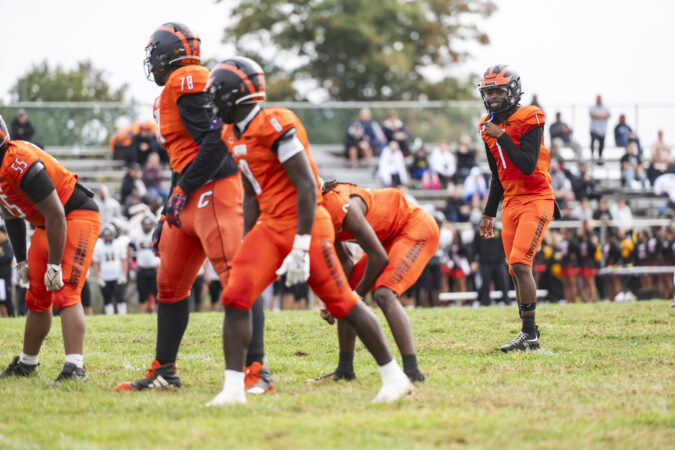
    The opening round of the PIAA state football playoffs arrived with a number of achievements and several firsts for area programs. This weekend promises more in the state quarterfinals.

    Three defending state champions remain alive: Class 1A Bishop Guilfoyle of Blair County (District 6), Class 3A Northwestern Lehigh of Lehigh County (District 11), and Class 5A Bishop McDevitt of Dauphin County (District 3). Of the 48 teams that have reached the state quarterfinal round, 10 teams remain alive from District 12 and District 1.

    In District 12, there is a team alive at each level (Belmont Charter-1A, Lansdale Catholic-2A, Neumann-Goretti-3A, Cardinal O’Hara-4A, Roman Catholic-5A, and La Salle-6A), with two major games coming this Friday in the District 1 Class 6A championship (Pennridge vs. North Penn) and Class 5A championship (Chester vs. Springfield).

    Here’s a breakdown of the local teams competing in the state quarterfinals:

    PIAA Class 6A

    • La Salle (10-1) vs. District 11 champion Easton (13-0) at Liberty High on Friday (7 p.m.).

    This is the deepest La Salle has gone in the state playoffs since reaching the quarterfinals in 2015, when the Explorers lost to Parkland in the final year of the Class 4A system. The Explorers entered this season with the goal of winning the program’s first state championship since 2009.

    After leading 24-0, La Salle scrambled to stave off a furious rally by Philadelphia Public League champion Imhotep Charter on Saturday and did it by leaning on its running game to win, 31-16.

    “Easton is a very good football team, that is a senior-heavy team whose quarterback [Cole Ordway] has rushed for over 2,000 yards this year,” La Salle coach Brett Gordon said. “Easton historically likes to establish its running game, and that will be an important piece of the game to stop that.”
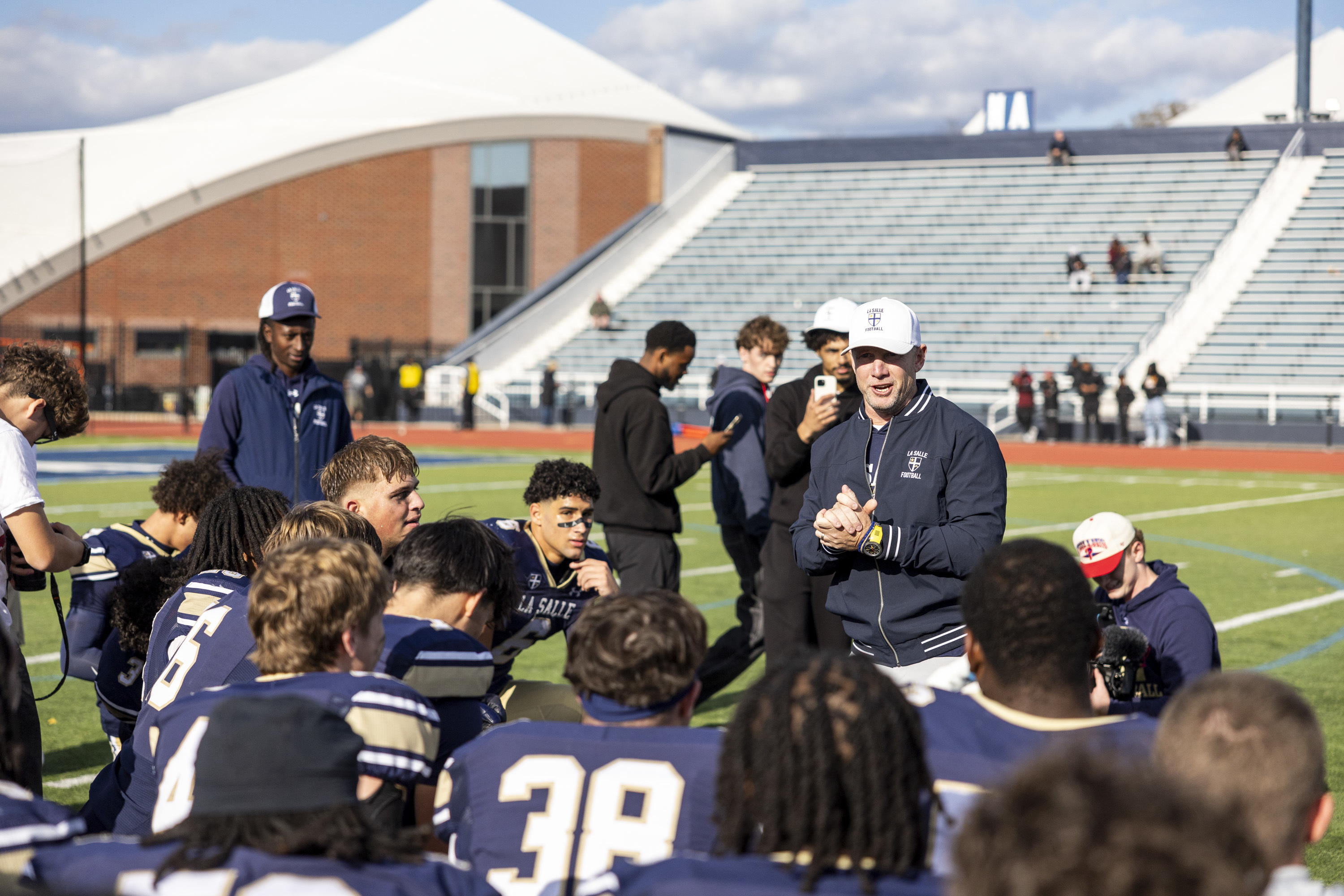
    Brett Gordon speaks to his team after beating St. Joe’s Prep at Villanova Stadium on Nov. 1.
    • North Penn (11-2) at Pennridge (12-1) in District 1 Class 6A championship on Friday (7 p.m.)

    This is a rematch of Pennridge’s 34-10 regular-season victory over traditional Southeastern Pennsylvania powerhouse North Penn, the first time the Rams beat North Penn since Oct. 19, 2012. Pennridge has never won a District 1 championship in football. Until this season, the Rams had not won a district playoff game during a full season since 2017. Pennridge has won more games this season (12) than its previous three years combined (2-8 in 2022, 3-7 in 2023, and 4-7 in 2024). The Rams will lean on 6-foot-3, 215-pound four-year starting quarterback Noah Keating, and running backs Ryan Rowe, a Princeton pledge, and William Dougherty.

    “It’s always really hard to beat a good team twice, and they have changed a lot since they played us,” Keating said. “They have changed up personnel on both sides. We have changed some things, too. I think we are pretty confident going into this. We have been tested. We beat three really good defenses to get here in Plymouth-Whitemarsh, Downingtown East, and Coatesville.”

    North Penn is riding an eight-game winning streak since the Pennridge loss. The Knights have not won a District 1 Class 6A championship since 2016, the first year that PIAA instituted the Class 6A classification system. The Pennridge-North Penn winner will face the La Salle-Easton winner in the state semifinals next weekend.
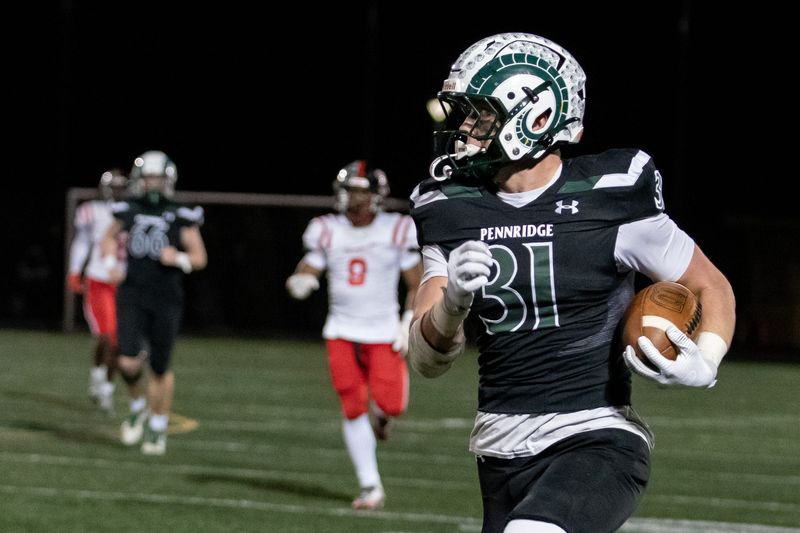
    Pennridge running back Ryan Rowe running for a touchdown against Coatesville on Nov. 14.

    PIAA Class 5A

    • Roman Catholic (9-3) vs. District 6 champion Hollidaysburg (13-0) at Mechanicsburg’s Memorial Park on Friday (7 p.m.).

    This is a rematch of last year’s state quarterfinals, won by Roman, 48-14. Over their last three games, the Cahillites have averaged 53.3 points, having outscored their opponents by 160-28. Akron-bound senior quarterback Semaj Beals is the only Philadelphia-area quarterback to throw for more than 11,000 yards in his career, and he has two Division I threats in Ash Roberts and Eyan Stead Jr., both committed to Temple.

    Roman coach Rick Prete may have the best team in the state. The Cahillites beat La Salle during the regular season and suffered one-point regular-season losses to St. Joseph’s Prep and Providence Day (N.C.). Hollidaysburg is averaging 50 points in its last three games. But the Golden Tigers have not faced a team as fast as Roman.

    “Hollidaysburg is good, and faster than they were last year,” Prete said. “I feel good how we are playing right now, and we exposed ourselves early to learn what are flaws were. I feel we are battle-tested. Playing in the Catholic League and our nonleague schedule, and I don’t think we face anyone like the teams we saw. Styles make fights, and while we are battle-tested, we still have work to do. Springfield is really good, and Chester is really good and very well-coached. We are playing our best at the right time, but they are kids and we are trying to make sure we do not skip over any steps.”
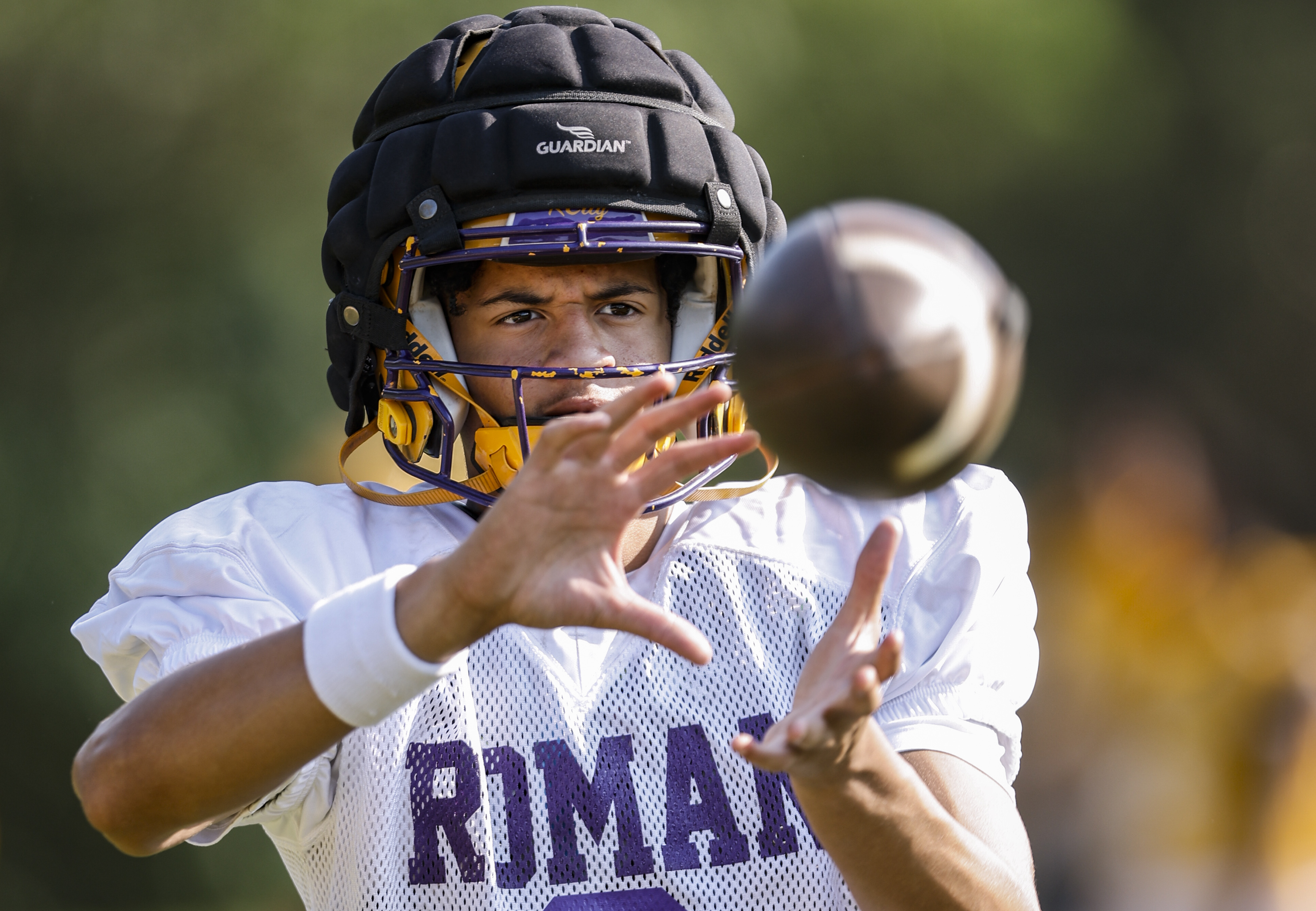
    Roman Catholic’s Semaj Beals is the only Philly-area quarterback to throw for more than 11,000 yards in his career.
    • Chester (13-0) at Springfield (Delco) (13-0) in District 1 Class 5A championship on Friday (7 p.m.).

    This is the game of the weekend. Springfield, the No. 1 seed, is expecting more than 6,000 fans. It is a classic clash of the only two undefeated teams in the area, and they have been circling each other all season. Neither team has ever won a District 1 championship in football. Springfield has been to the district final four previous times (2014, 2016, 2017, and 2024).

    Chester, the No. 2 seed, has reached the final once, losing to Strath Haven in 2023. Chester is having a historic season, winning the most games in a season. This is the longest the Clippers have ever gone undefeated. The Clippers have won their last two district playoff games without their best player, Daron Harris, who was serving a two-game suspension after being ejected in the Marple Newtown opening-round playoff game. Harris will be eligible to play, and he will be joined by 6-foot, 170-pound junior receiver Sekai Brown-Murray, who missed five games with a pulled hamstring. Jalen Harris, Daron’s twin and the Clippers’ quarterback, has filled in nicely as a defensive back with five interceptions this season. Senior running back and linebacker Jerrell Palmer anchors the middle while 6-8, 330-pound tackle Semaj Henry, who’s committed to Syracuse, blocks everything else out.

    “Springfield is a good football team, they are well coached, but we like where we are as a team right now,” Clippers coach Dennis Shaw said. “We are playing our best at the right time. We have seen everything teams can do to us with the power run.”

    Springfield is 13-0 for the first time since 2017, when the Cougars lost to Unionville in the district final. Cougars coach Chris Britton has been successful behind his offensive line comprised of juniors Shane Kilroy (tight end), Zion Culbreth (left guard), Jaxon DeConti (center), and Alex McGinnis (right guard), along with seniors Dom Stewart (left tackle) and Michael Francks (right tackle). It is a young team made up of primarily sophomores and juniors.

    “We are playing selfless football, and we focus on details,” Britton said. “We have very coachable kids. We hit adversity various times of the season and these guys didn’t get flustered. Chester is well coached; they do a good job of mixing things up. They throw well, they run well. They check a lot of boxes. We need to keep them off the field. If we give up explosive plays, we are going to have problems.”
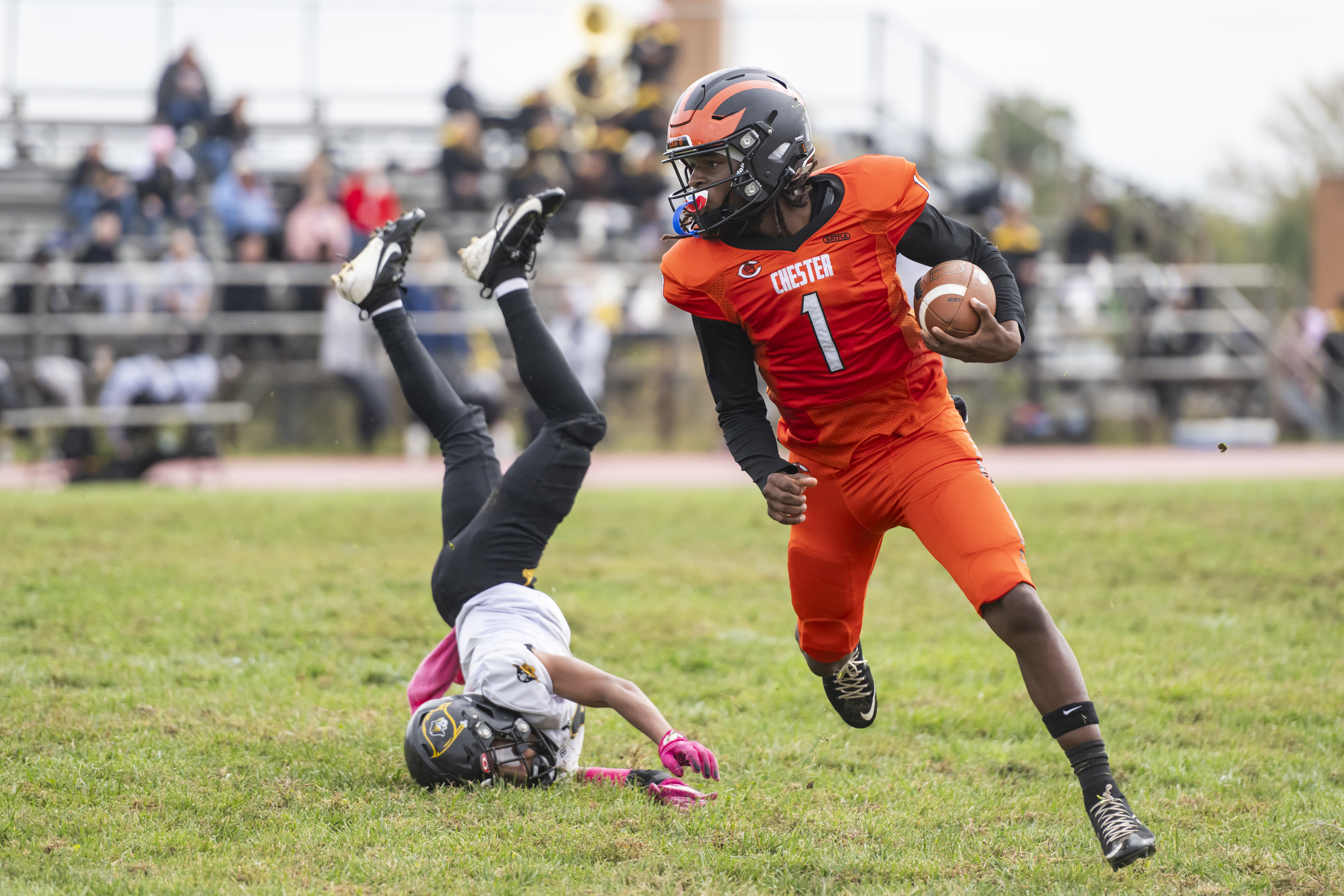
    Jalen Harris avoids a tackle against Interboro High School on Oct. 11.

    PIAA Class 4A

    • Cardinal O’Hara (9-4) vs. District 2 champion North Pocono (13-0) at Whitehall on Friday (7 p.m.).

    The Lions get to play at Saquon Barkley’s alma mater after beating West Philadelphia, 34-6, in the District 12 championship on Saturday for O’Hara’s first district championship and first state playoff victory. Senior tailback Amahj Gowans has been exceptional, carrying the offensive load. O’Hara’s defense will rely on Hakim Allah, Sammy Dantonka, and Jalen Patterson, who were game wreckers against West Philly, combining for seven tackles for losses of 32 yards.
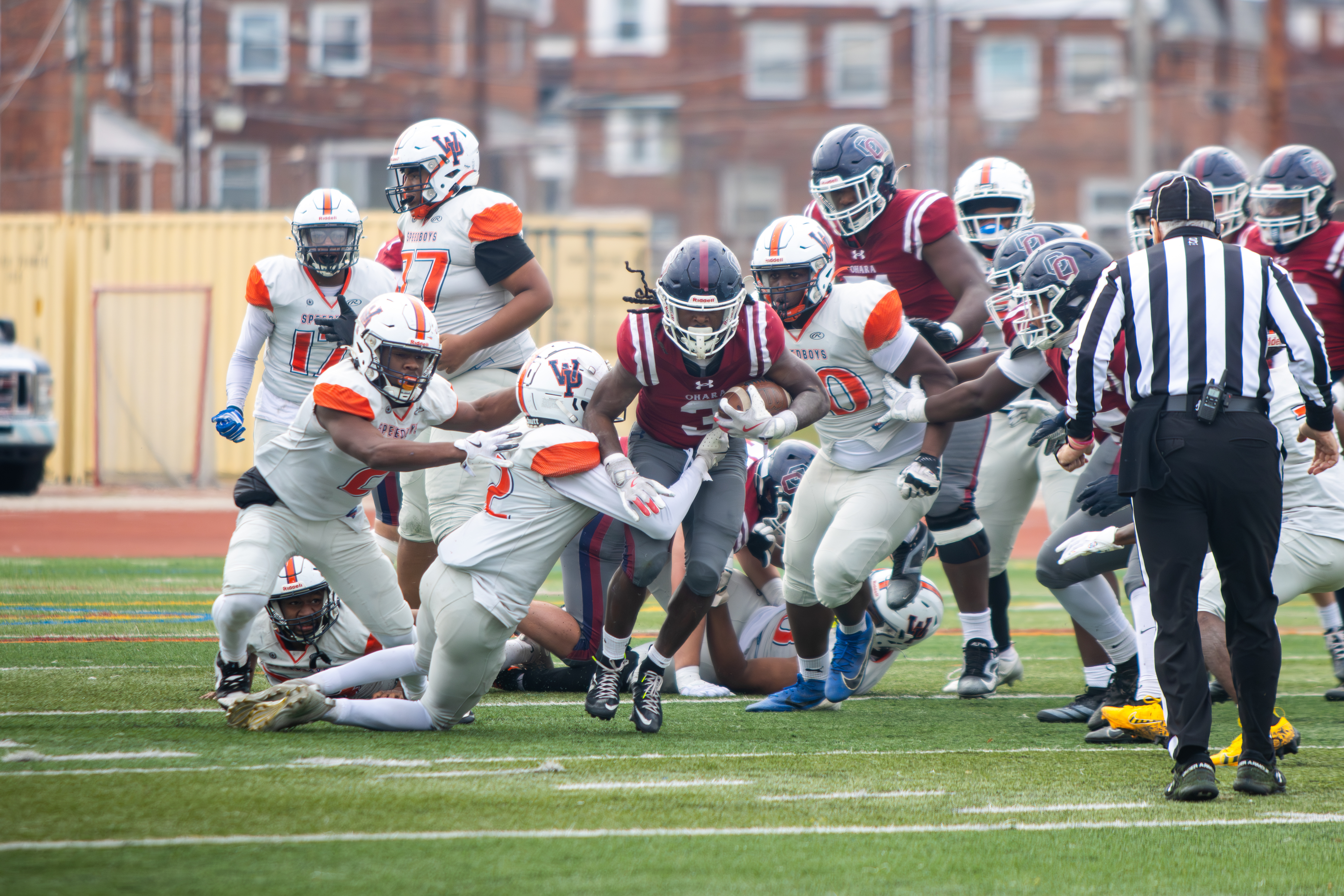
    Amahj Gowans of Cardinal O’Hara pushes through a group of West Philadelphia defenders on Nov. 15.

    PIAA Class 3A

    • Neumann Goretti (8-4) vs. District 3 champion Trinity High School (10-3) at Exeter Township High on Friday (7 p.m.).

    Neumann Goretti coach Albie Crosby continues to produce winners. He guided Imhotep Charter to the PIAA Class 3A state championship in 2015, enabling the Panthers to become the first Philadelphia Public League team to win a state championship. This year, he lost his starting quarterback, sophomore Shane “King” Salley, to injury in the season opener. He has since found 6-1, 170-pound freshman quarterback Marquis Coleman, who has produced a 6-1 record as a starter.

    “We are playing hard and gritty — there is nothing pretty about our wins,” Crosby said. “We look like a South Philly boxer or point guard. We believe in Marquis. He’s very poised. Nothing bothers him. We need to go 3-0.”

    PIAA Class 2A

    • Lansdale Catholic (11-2) vs. District 11 champion Williams Valley (12-1) at Lehighton High on Friday (7 p.m.).

    This is Crusaders coach Dom D’Addona’s seventh season at the helm and this is the deepest Lansdale Catholic has gone in the PIAA state playoffs, since the late Hall of Fame coach Jim Algeo led the Crusaders to the 2004 PIAA Class 2A championship.

    The Crusaders’ 43-7 victory over District 2 champion Lakeland last weekend was their first state playoff victory in 21 years. The Crusaders offense revolves around two-year senior quarterback Yeboa Cobbold. Cobbold threw for two touchdowns and scored one rushing in Lansdale Catholic’s opening-round romp over Lakeland.

    PIAA Class 1A

    • Belmont Charter (9-1) vs. District 2 champion Lackawanna Trail (12-1) at Northern Lehigh High on Friday (7 p.m.).

    This is Belmont’s fifth season as a program, and the Tigers have reached the PIAA quarterfinals for the first time. Freshman quarterback Nafis Watkins threw three touchdown passes and rushed for another score in Belmont’s 36-20 victory over York Catholic. Lackawanna Trail’s Isaac Ryon is a game-wrecking threat. He rushed for 150 yards and two touchdowns in the Lions’ state playoff-opening 31-20 win over District 4 champion Line Mountain.
  • James Franklin vows to pour his ‘heart and soul’ into new job as Virginia Tech’s coach

    James Franklin vows to pour his ‘heart and soul’ into new job as Virginia Tech’s coach

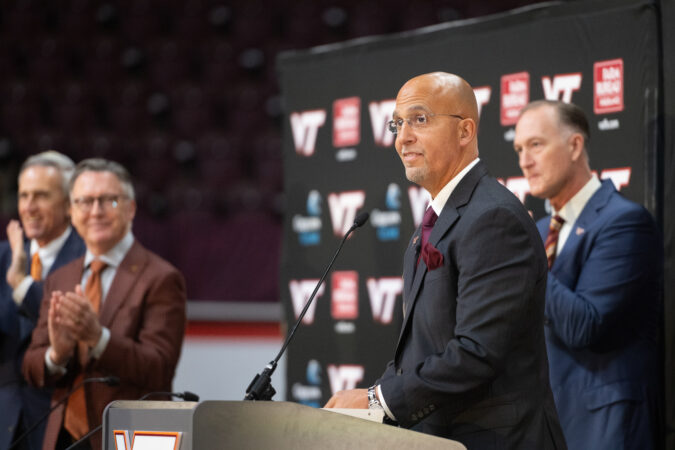
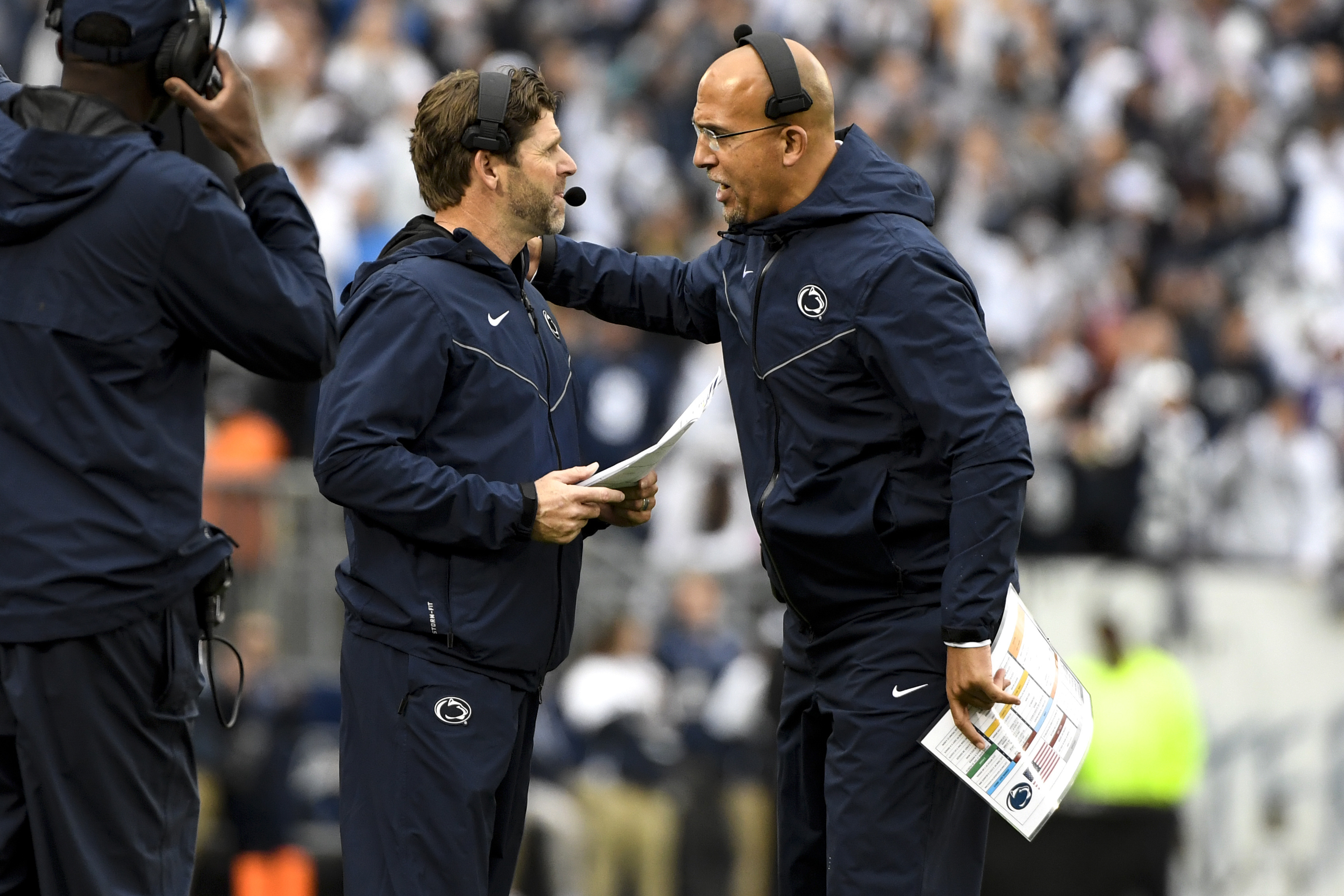
    The James Franklin era at Penn State ended Oct. 12 after a 22-21 loss to Northwestern, ending his 11-plus seasons in Happy Valley. Thirty-eight days later, he walked into Virginia Tech’s Cassell Coliseum with “Enter Sandman” blaring on the speakers, the song that plays when the Hokies enter each home game at Lane Stadium.

    On Wednesday, two days after making the move official, Virginia Tech introduced Franklin as its new football coach.

    “Been in this profession for over 30 years, and I’ve learned a ton of lessons,” Franklin said at the news conference. “… Got my first big break in the ACC, been a head coach in the SEC, been a head coach in the Big Ten, and now obviously fortunate to have this unbelievable opportunity in the ACC at Virginia Tech.

    “All these experiences, all these lessons that I’ve learned, we’re going to pour them into Virginia Tech.”

    Before he spoke at the podium, Franklin received glowing reviews from Virginia Tech’s board of visitors member, John Rocovich, president Tim Sands, and athletic director Whit Babcock. Babcock called Franklin “a proven program builder, a winner, an elite recruiter, a strong developer of men, and a relentless competitor.” Rocovich said “Blacksburg, Va., and Virginia Tech will be the best place he ever lived.”

    Franklin, 53, has a 128-60 record in 15 years as a head coach at Vanderbilt and Penn State.

    Franklin mostly discussed his vision for the program. He did not talk much about Penn State, where he went 104-45, but he did use a moment in his opening statement to show appreciation for his former school.

    “I want to thank Penn State. I had 12 years there,” Franklin said. “It’s very unusual in college football, to get 12 years at a place, most importantly, the relationships, the staff, the players. The players here at Virginia Tech are going to find out I’m a players’ coach. That’s what it’s all about for me. That’s what it always will be.”

    Franklin also thanked several people at Virginia Tech, including former longtime coach Frank Beamer, whom he called for his blessing the night before he took the job. But Franklin got choked up talking about Brent Pry, the Hokies’ former head coach, alongside whom Franklin worked for 11 seasons at Vanderbilt and Penn State.

    Pry was Penn State’s defensive coordinator from 2014 to 2021. Franklin wanted to make sure his former colleague and his family “got the respect they deserve.”

    Penn State coach James Franklin (right) with defensive coordinator Brent Pry in 2021.

    “Brent’s dad was my offensive coordinator in college. I’ve known Brent for over 30 years,” Franklin said, holding back tears. “I’ve got a ton of respect for Brent and his family. I know he poured his heart and soul into this place. I know this place is better today because of Brent and the commitment that he made.”

    For the first time in a long time, Franklin said he had time to reflect and “take a deep breath” in the month in between jobs.

    “Me and my family, to take a take a minute to recharge our battery was very important,” he said.

    Virginia Tech was aggressive in its pursuit of him, Franklin said. “The very first time we met — I don’t want to speak for them, but I feel like they were ready for me to say yes that night,” he said. As the talks played out, the former Penn State coach said he used the notes app on his phone, compiling “next staff” and “things that I learned through the process.”

    “Some of those things are for public consumption. Some of those things are private for me and my family but areas that I know we need to grow and get better,” Franklin said. “People that have been following my career and the things that we did at Penn State, what I’m talking about is what you see right now, the leadership, the commitment, and the alignment. And the nice thing for me is I’m walking in here, and that alignment already exists.”

    Franklin already has hit the recruiting trail, he said, and has spoken with more than 40 Virginia Tech pledges and most of the top players in Virginia. He even sent offers to former and current Penn State pledges, including Timber Creek’s Roseby Lubintus, an offensive tackle.

    Franklin’s recruiting philosophy largely will remain the same and rely on high school recruiting with the transfer portal supplementing the roster. Now he has the task of leading a program that hasn’t won the ACC since 2010 and has played for the national championship just once in school history (1999).

    “You could not have found a coach that’s going to pour his heart and soul into this place more than me and my family,” Franklin said. “I give you my word on that.”

  • What Paul George can still give the Sixers — and what might be a thing of the past

    What Paul George can still give the Sixers — and what might be a thing of the past

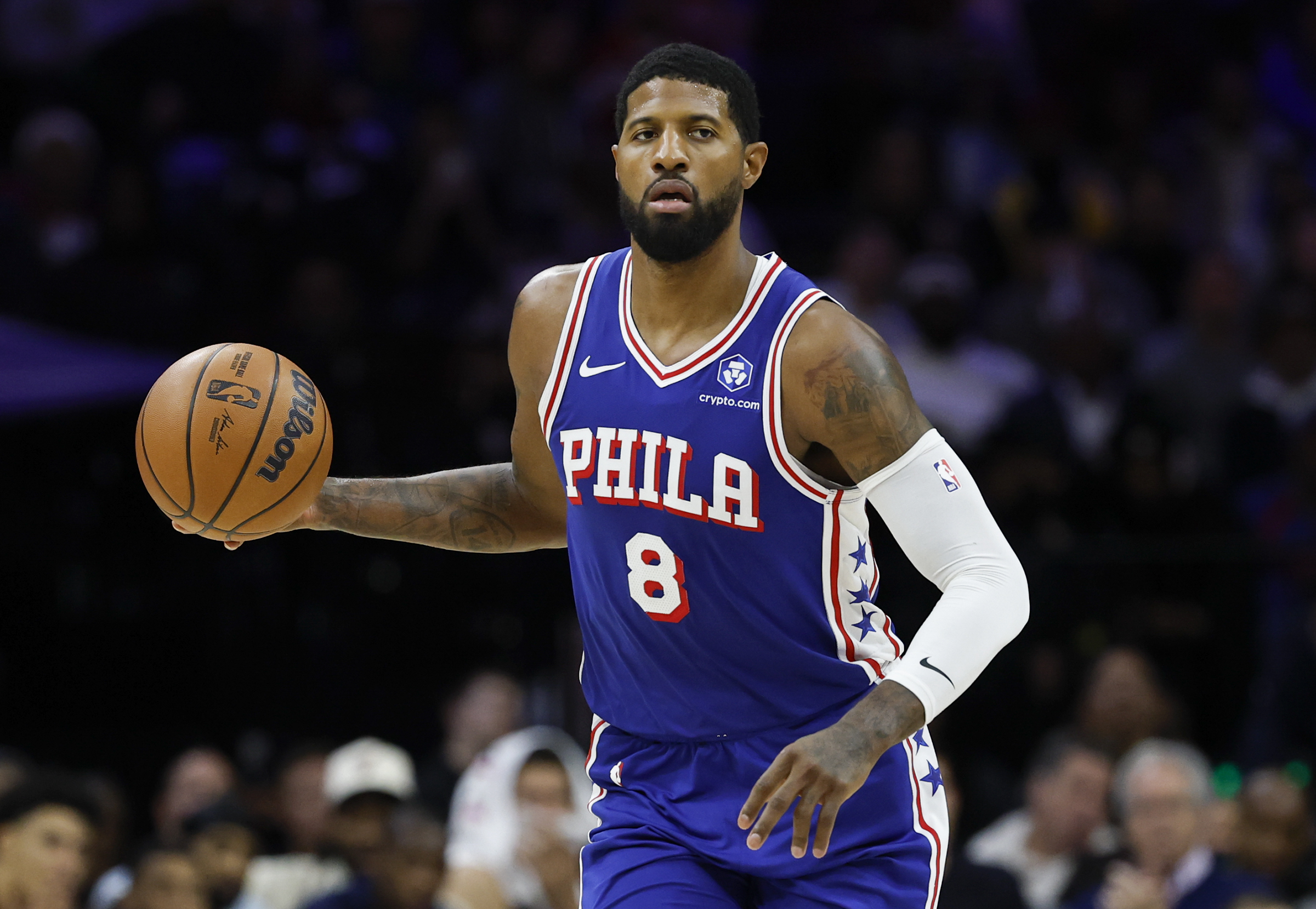
    Paul George didn’t waste any time in his return to NBA action on Monday night, taking just 36 seconds to block a James Harden shot and turn a quick give-and-go with Tyrese Maxey into a catch-and-shoot three-pointer for his first made basket since March 4. It was a much-missed glimpse into the do-it-all player that PG had been billed as when he first came to the 76ers as a major free-agency coup in the summer of 2024 — a sight that was all too rare with George limited to 41 games in a disappointing Philly debut.

    Of course, the rest of George’s night wasn’t quite as smooth: He scored six additional points and went 1-for-8 from the field (0-for-3 from deep) after drilling that early jumper, while the Sixers were outscored by 12 in his remaining minutes — though he did grab seven rebounds and dish three assists in his 21 minutes of court time. All told, it was roughly what you could have expected out of a 35-year-old who hadn’t suited up in 259 days.

    Because of this — along with the fact that Joel Embiid was out — it’s tough to draw too many sweeping conclusions from George’s season debut. But between what we saw on Monday and the general profile of similar players at this age, we do have some clues about what PG might have left in the tank this season, when he’s available — which is always a question mark — and how it could help the Sixers improve at both ends while lightening the load on Maxey.

    For one thing, it’s already clear George is going to get plenty of touches even while coexisting alongside Maxey’s ongoing development into a huge scorer. His usage rate on Monday was 28%, which was higher than both his figure last season (23.5%) and what it was during his final season with the Los Angeles Clippers in 2023-24 (26.6%). Along the way, he launched some threes, got to the line plenty, and made a few plays as a ballhandler and passer as well. Despite easing himself back into live play, George is still a future Hall of Famer who commands plenty of attention from opponents.

    And the Sixers do need a guy like that. Aside from Maxey, who had a sky-high 39.1% usage rate on Monday and carries a 30.8 share — 15th-highest in the NBA — this season overall, the Sixers haven’t had anyone else who can consistently initiate and/or finish possessions when Embiid is sidelined. Not including Maxey, Embiid, and George, the only other Sixers player (in at least 20 total minutes) with a usage above the league average of 20% is Quentin Grimes at 21.5%. Usage rate estimates the percentage of a team’s possessions a player “uses” while on the court, showing how much the offense is centered on them.

    Sixers forward Paul George scored nine points in 21 minutes during his season debut.

    To be sure, others have been efficient within their roles. Kelly Oubre Jr., Andre Drummond and Trendon Watford are all comfortably above the league’s average true shooting percentage, while Justin Edwards and Dominick Barlow have made great use of their chances when their number gets called.

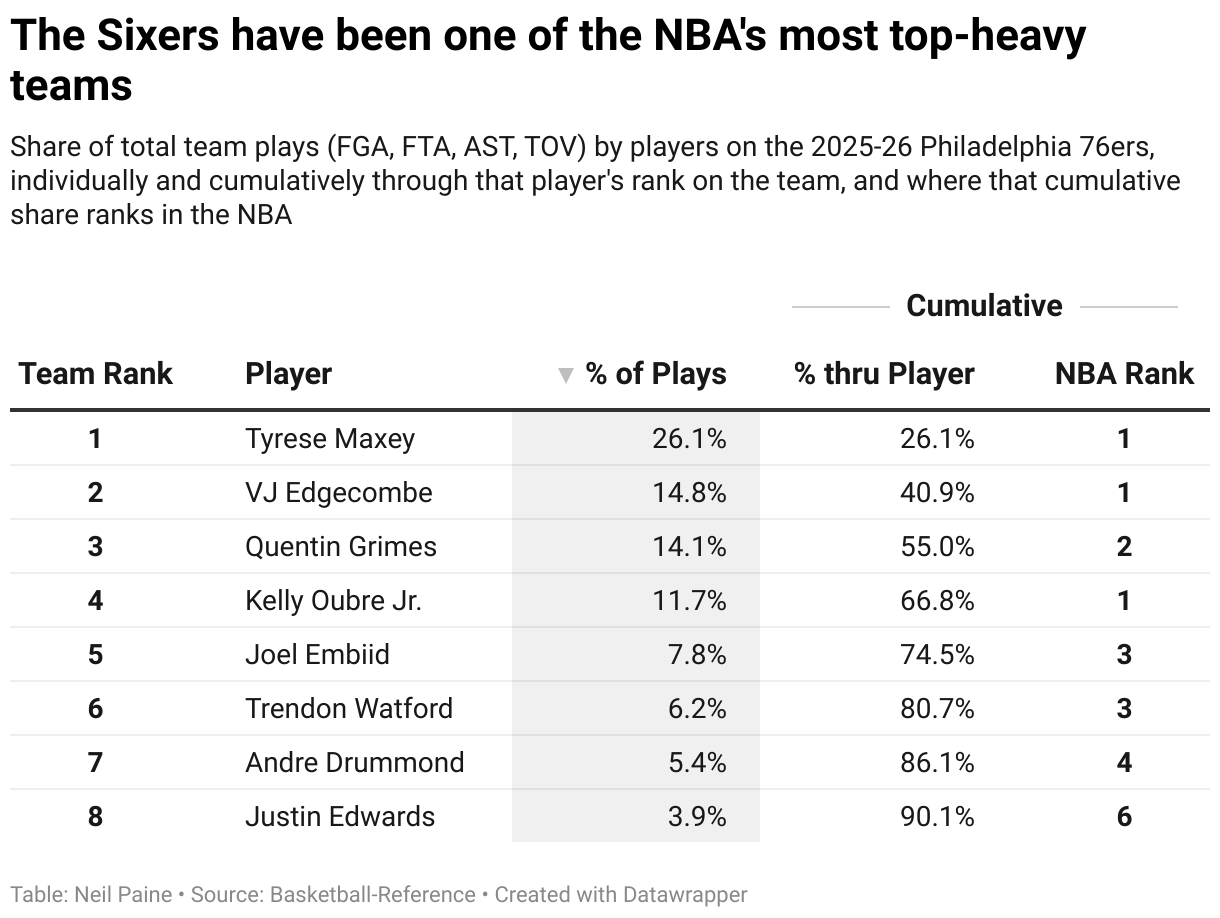
    But the Sixers offense has been notably top-heavy in its distribution of plays toward just a small number of players so far this season. And we can see this if we look at each Sixer player’s share of total team plays (FG and FT attempts, assists and turnovers), tracking how concentrated those plays are among a given number of players.

    For instance, Maxey has personally been responsible for 26.1% of his team’s total plays this year, the highest rate in the league. Maxey and VJ Edgecombe have combined for 40.9% of plays, which is the highest share for any teammate tandem in the league. Maxey, Edgecombe, Grimes, and Oubre have collectively shared 66.8% of Philly’s plays, the highest rate for any quartet of players in the league … and so forth:

    The Sixers have been one of the NBA's most top-heavy teams (Table)

    This isn’t inherently a bad thing, and one needs only to look back upon the 2022-23 Sixers to find a team with the fourth-best offense in the league despite a disproportionately large share of possessions going to Embiid, Harden, Maxey and Tobias Harris. But Maxey in particular is being asked to carry a massive load so far this season, as one of just 10 players across the league with a usage rate and an assist rate north of 30%.

    So anything George can do to alleviate that burden — and not merely be an expensive role player for the 2025-26 Sixers — would do wonders for an offense that ranks 11th in the league efficiency-wise but may not be able to sustain that level while asking Maxey to play 40.4 minutes per game at his current level of usage.

    Can George do that, though, given his age and injury profile?

    Based on his percentile grades relative to the league last season, PG had already slipped from a 95th-percentile to a 49th-percentile player overall, with notable drops in his true shooting (77th to 19th) and turnover percentiles (67th to 17th). If we look for the most similar players by skills at a similar age, George’s top comps went from Manu Ginóbili, Clyde Drexler, Kawhi Leonard, Michael Jordan, and Eddie Jones in 2023-24 to Stephen Jackson, Bobby Jackson and old versions of Dwyane Wade, Scottie Pippen, and Vince Carter in 2024-25.

    That doesn’t exactly inspire tremendous confidence in what he can do this season, even when healthy, although Pippen (as a Trail Blazer) in 2002 and Carter (as a Maverick) in 2012 were more effective than we probably remember them being. The average themes across George’s top-20 comps from last year as they got a year older were that they scored less (down 9 percentile points in usage and 7 points in per-possession scoring), though perhaps a bit more efficiently, had fewer assists (down 6 points) and were less of a factor in rebounding (down 4 points), steals (down 6 points) and defense overall (down 8 points).

    Those changes would leave George further diminished as an aging star wing, if still a useful one for his above-average scoring, passing, and defense. And based on what we saw in his season debut Monday, that’s probably about what George’s potential is for the season at large. He may not be the MVP candidate of his prime nor even the All-Star he was for L.A. in 2024, but he can still provide the Sixers with plenty of things they need if he can stay on the court.

  • Vic Fangio’s best Eagles defense yet, Jason Kelce’s ‘biggest concern’ on offense, and more from ‘New Heights’

    Vic Fangio’s best Eagles defense yet, Jason Kelce’s ‘biggest concern’ on offense, and more from ‘New Heights’

    While the Eagles (8-2) topped the Lions, 16-9, on Sunday and continue to lead the division, not all has been to Philadelphia’s standard.

    Unsurprisingly, retired Eagles center Jason Kelce had some constructive criticism for what he called a “frustrating” Birds offense. He shared his thoughts on the game in the latest episode of his New Heights podcast, alongside his brother and Kansas City Chiefs tight end, Travis Kelce.

    Defense continues to impress

    In Jason Kelce’s view, the most notable success of Sunday’s win was limiting a potent Lions offense to just nine points. Travis Kelce also recognized the Philadelphia defense’s ability to stop Detroit on fourth down on all five of its attempts.

    “The [Eagles] defense is playing unbelievable right now,” Jason said. “Probably the best they’ve played since Vic Fangio’s been here. … And it’s at every single level of the defense. The defensive line is playing out of their minds. Jordan Davis and Jalen Carter were playing volleyball out there, batting down passes left and right.”

    One of those deflected passes turned into an interception for cornerback Cooper DeJean, who picked off Lions quarterback Jared Goff in the first quarter, leading to an Eagles field goal.

    “Batting down those passes early, that clearly got [the Lions] out of their rhythm,” Kelce added.

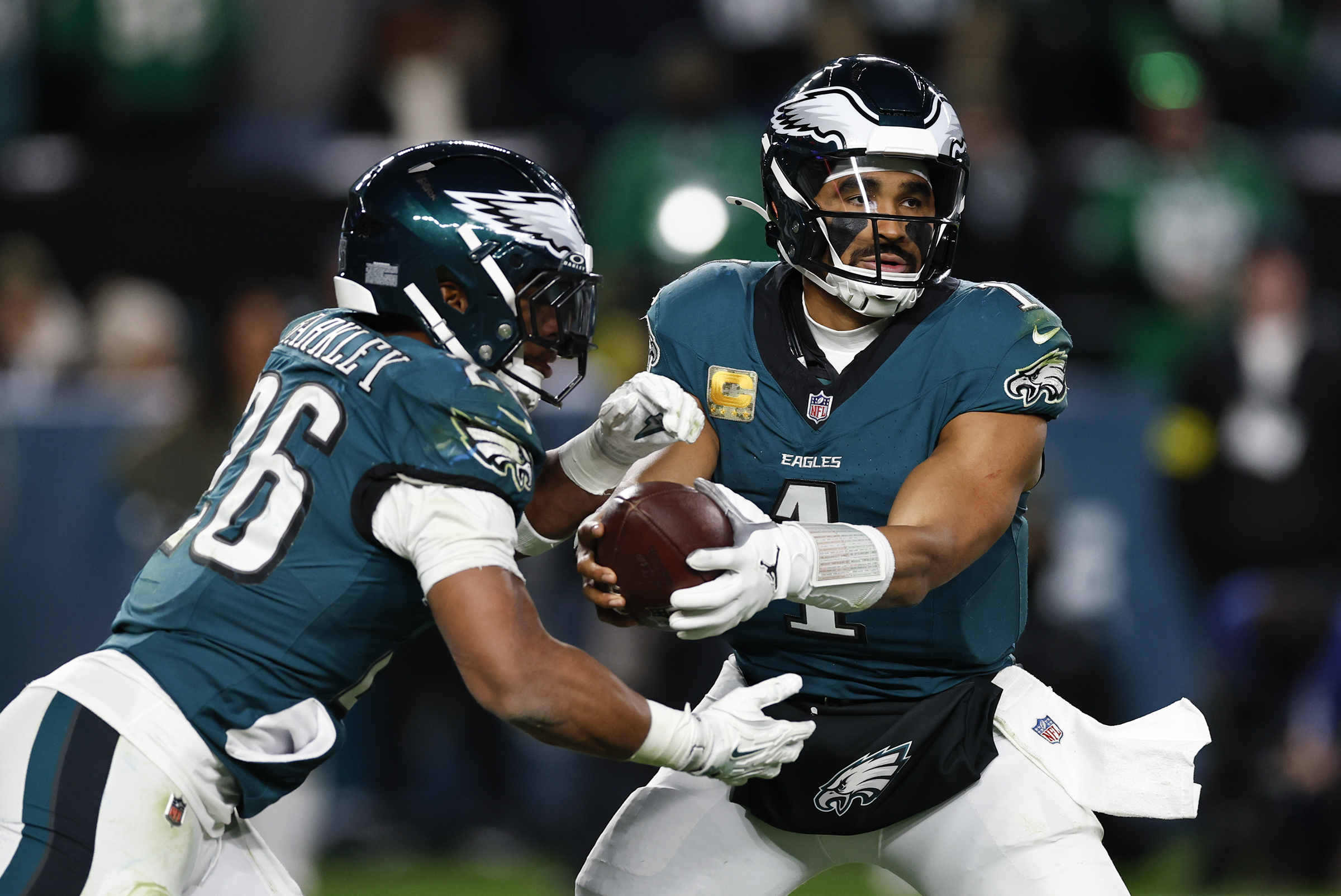
    After finishing with 2,005 yards last season, Saquon Barkley is on pace to finish with 1,125 this season.

    Kelce’s ‘biggest concern’ with the Eagles

    The longtime Eagles center was less satisfied with his former team when it came to the offensive side of the ball.

    He recognized the midgame blow of not having Lane Johnson on the field. The offensive tackle went down in the first quarter with a foot injury and is expected to be sidelined for several weeks.

    “I don’t know how long [Johnson] is going to be out, but that’s something that has decimated this offense in years past,” Kelce said. “Whenever Lane’s been out, it’s been very detrimental. Positively, Fred Johnson has played well in his snaps that he’s had to go in for Lane. But make no mistake, they’re going to miss Lane.”

    However, Kelce stated that the Eagles have wider struggles on offense to address — particularly, not maximizing their potential to run the ball.

    “We have to get the ground game going,” Kelce said. “Everyone wants to talk about this year’s offense vs. last year’s offense, and vs. previous offenses with Jalen Hurts. The number one difference is that we can’t run the football. We’re not running it at a consistent, successful rate. …

    “We have to be demoralizing in the ground game. And [the Eagles] can be. They should be, and they’re just not. It’s frustrating to watch.”

  • The Union put Ernst Tanner on leave as MLS reopens an investigation into alleged misconduct

    The Union put Ernst Tanner on leave as MLS reopens an investigation into alleged misconduct

    The Union said Wednesday that they have put sporting director Ernst Tanner on “administrative leave” as Major League Soccer reopened its investigation into Tanner’s alleged misconduct.

    Both moves follow a report by the Guardian that accused Tanner, 59, of a yearslong series of incidents involving racist, sexist, and homophobic remarks toward a range of people across American soccer.

    While Tanner’s lawyer denied the claims, the league said it reopened its investigation after “new allegations and potentially new information.”

    Some of those allegations were raised to the league by the MLS Players Association, although the league said Wednesday that the allegations “had not been independently verified.”

    On Wednesday, The Inquirer received this statement on behalf of Tanner through his legal team: “I continue to firmly deny these accusations. My priority is the team, the employees, and the Philadelphia Union community, particularly at this important time when the team has the opportunity to continue to excel in the playoffs. I will cooperate fully with the league’s investigation as I work to clear my good name and reputation.”

    Tanner has been the Union’s sporting director since 2018. He’s widely regarded as the architect of the team’s rise to one of the top clubs in MLS, all on a tight operating budget. In 2022, he was named the league’s Executive of the Year after putting together the team that reached the MLS Cup final for the first time in the Union’s history.

    The league said that in its investigation, it contacted “more than a dozen current and former players and club employees” and “all individuals were offered the option to participate anonymously and assured they could speak without fear of retaliation.”

    From there, the league said, “a majority of those contacted participated — several anonymously — while others declined. After reviewing all available information and documentation, the investigation was unable to substantiate the allegations.”

    The Guardian, a British newspaper and website, reported that in the league’s initial investigation, it contacted 13 people to potentially interview and that eight of them, “who the Guardian understands to be current and former players and employees of the Philadelphia Union, chose to speak with the league.”

    MLS said, as the Guardian reported, that Tanner “has been required to participate in a structured remedial program focused on professional workplace conduct.” The Guardian’s report said this is the second time he has gone through that program.

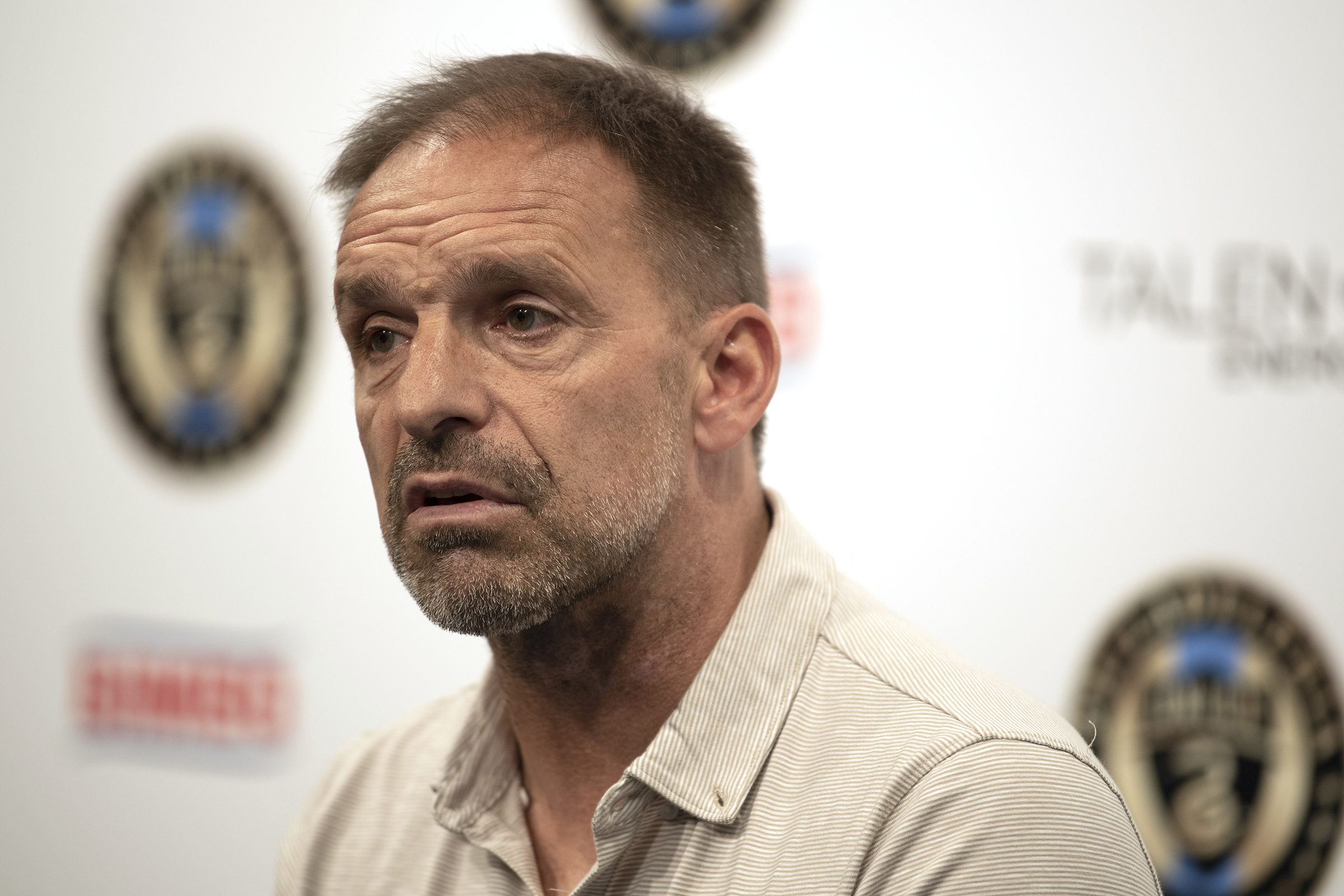
    Ernst Tanner, who joined the Union in 2018 as its sporting director, has been placed on administrative leave after allegations of misconduct.

    The Union, in their statement, said the team “takes all allegations of misconduct extremely seriously and is committed to maintaining a safe, respectful, and inclusive environment for everyone associated with our club. Discrimination, harassment, or abusive conduct of any kind has no place here, and all staff are required to complete annual sensitivity training.”

    The team also said it “continues to cooperate fully” with the league and that “throughout this process, our top priority remains the well-being of our players, fans, staff, and community.”

    The Union have a home playoff game on Sunday, an Eastern Conference semifinal against New York City FC (7:55 p.m., FS1, Fox Deportes, Apple TV). The winner of that game advances to the Eastern Conference final against either FC Cincinnati or Lionel Messi’s Inter Miami.

    The Union have home-field advantage in the playoffs for as long as they’re playing, including if they reach the Dec. 6 MLS Cup final.

  • Curaçao and Union midfielder Danley Jean Jacques’ Haiti qualify for the World Cup

    Curaçao and Union midfielder Danley Jean Jacques’ Haiti qualify for the World Cup

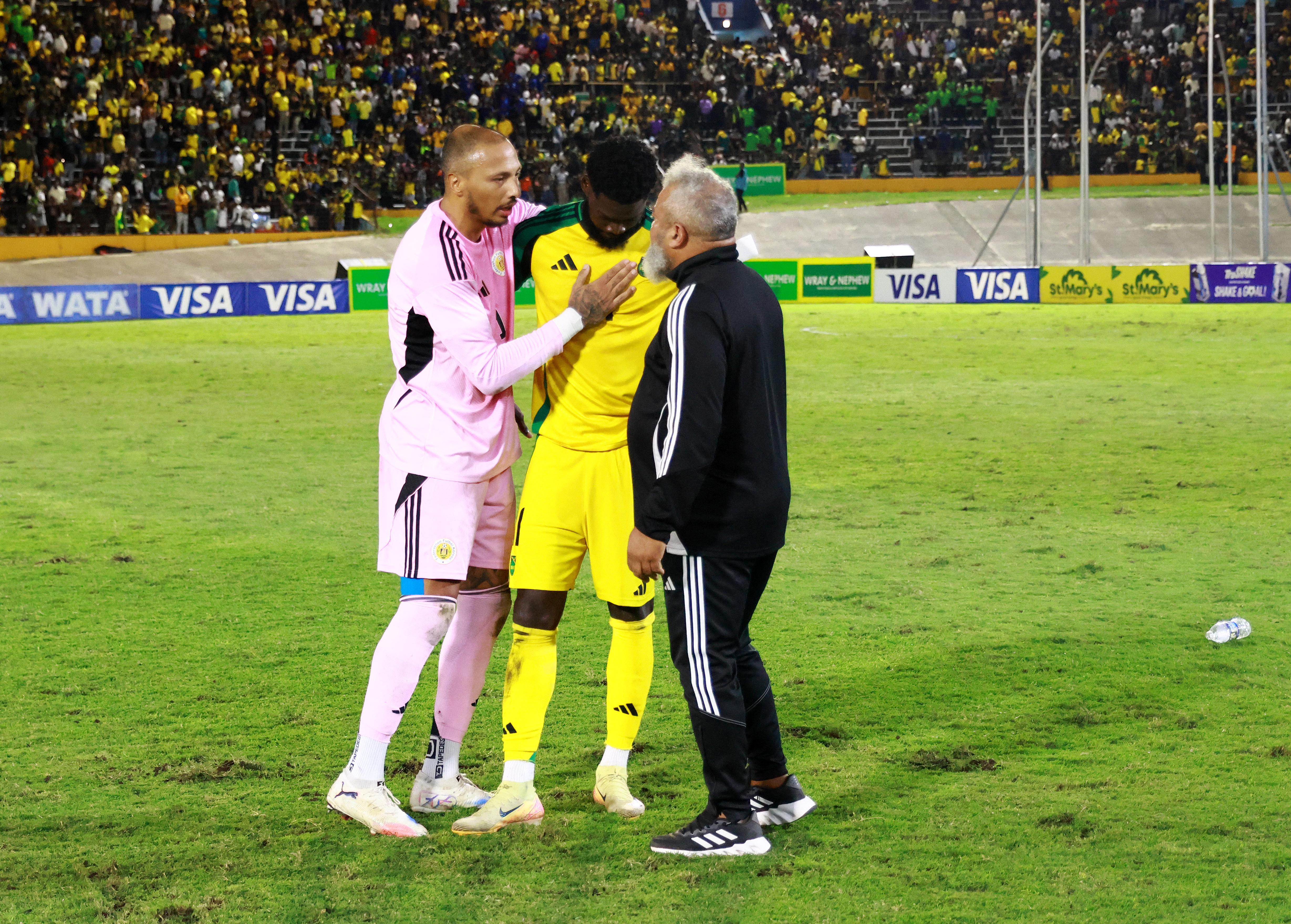
    KINGSTON, Jamaica — The tiny Caribbean island country Curaçao will go to the 2026 World Cup as the smallest nation by population ever to qualify for the marquee event in men’s soccer.

    Curaçao, an autonomous territory of about 156,000 people within the Netherlands kingdom, breaks the record of Iceland, with a population of just over 350,000, which was previously the smallest country to reach the World Cup when it qualified for Russia 2018.

    A team relying heavily on players born and raised in the Netherlands rode its luck Tuesday to take a 0-0 draw in Jamaica and finish top of a four-team group. Its other opponents were Trinidad and Tobago and last-place Bermuda.

    Jamaica’s side of the result means the Reggae Boyz, captained by Union goalkeeper Andre Blake, must play the final round of intercontinental playoffs in March to try to reach their first men’s World Cup since 1998.

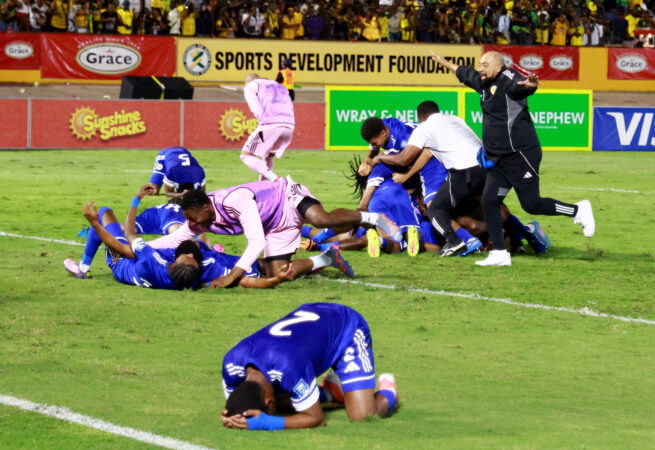
    Jamaica’s Shamar Nicholson (center) is consoled after the final whistle.

    Curaçao has actively recruited from its diaspora, getting permission from FIFA within world soccer’s rules to change the national-team eligibility of players who once represented the Netherlands at youth or Under-21 level, including five since August.

    Defender Joshua Brenet even played a World Cup qualifying game for the Netherlands in 2016.

    Tahith Chong, a former Manchester United youth player, is one of the few squad members born in Curaçao, which was called Netherlands Antilles until getting its autonomy 15 years ago.

    A storied Dutch coach has led Curaçao on to the elite stage for the first expanded 48-team World Cup in the United States, Canada and Mexico.

    Dick Advocaat, at age 78, is set to lead his third team at a World Cup, and his second in the U.S. He took his native Netherlands to the quarterfinals at the 1994 edition and coached South Korea at the 2006 World Cup in Germany.

    Curaçao’s adventure is set to put players from unheralded clubs on the biggest stage. The squad that clinched qualification included players from Rotherham in England’s third-tier league, Bandırmaspor in the Turkish second division and Abha in Saudi Arabia.

    Curaçao got the historic result despite not having Advocaat on the bench. He missed the match in Jamaica because he had to return to the Netherlands last weekend for family reasons.

    His team saw Jamaica strike the woodwork three times in the second half in Kingston. A potentially decisive penalty kick awarded to the home team in stoppage time was overturned after a video review.

    Curaçao will be joined by regional neighbors Panama and Haiti, which also booked their World Cup spots Tuesday.

    Absolute scenes as Panama qualify for their second-ever World Cup 🇵🇦

    [image or embed]

    — CBS Sports Golazo (@cbssportsgolazo-m.bsky.social) November 18, 2025 at 10:12 PM

    Panama advanced to its second World Cup after defeating El Salvador 3-0 on first-half goals from César Blackman and Erick Davis, plus Jose Luis Rodriguez late in the game.

    Panama’s only previous World Cup appearance was in 2018. It overtook Suriname, another Dutch-influenced team, which started play atop the group before losing 3-1 against Guatemala.

    Haiti, a troubled Caribbean country, had a surprising campaign and beat Nicaragua, 2-0, to win its group over favorites Honduras and Costa Rica, which was a quarterfinalist at the 2014 World Cup.

    Haiti’s only previous trip to the World Cup was in West Germany in 1974.

    Les Grenadiers’ squad includes Union midfielder Danley Jean Jacques and former Penn midfielder Duke Lacroix, who has played for eight years in the USL Championship since graduating in 2015.

    The Caribbean and Central American results Tuesday also finalized the six teams that will take part in the intercontinental playoffs in Mexico in March.

    Two teams will qualify from the playoffs, which includes Jamaica and Suriname, plus Iraq from Asia, Congo from Africa, Bolivia from South America and New Caledonia from Oceania.

    Staff writer Jonathan Tannenwald contributed to this article.

  • Projecting the USMNT’s World Cup roster after its last game of the year: Several locals in; surprises on the bubble

    Projecting the USMNT’s World Cup roster after its last game of the year: Several locals in; surprises on the bubble

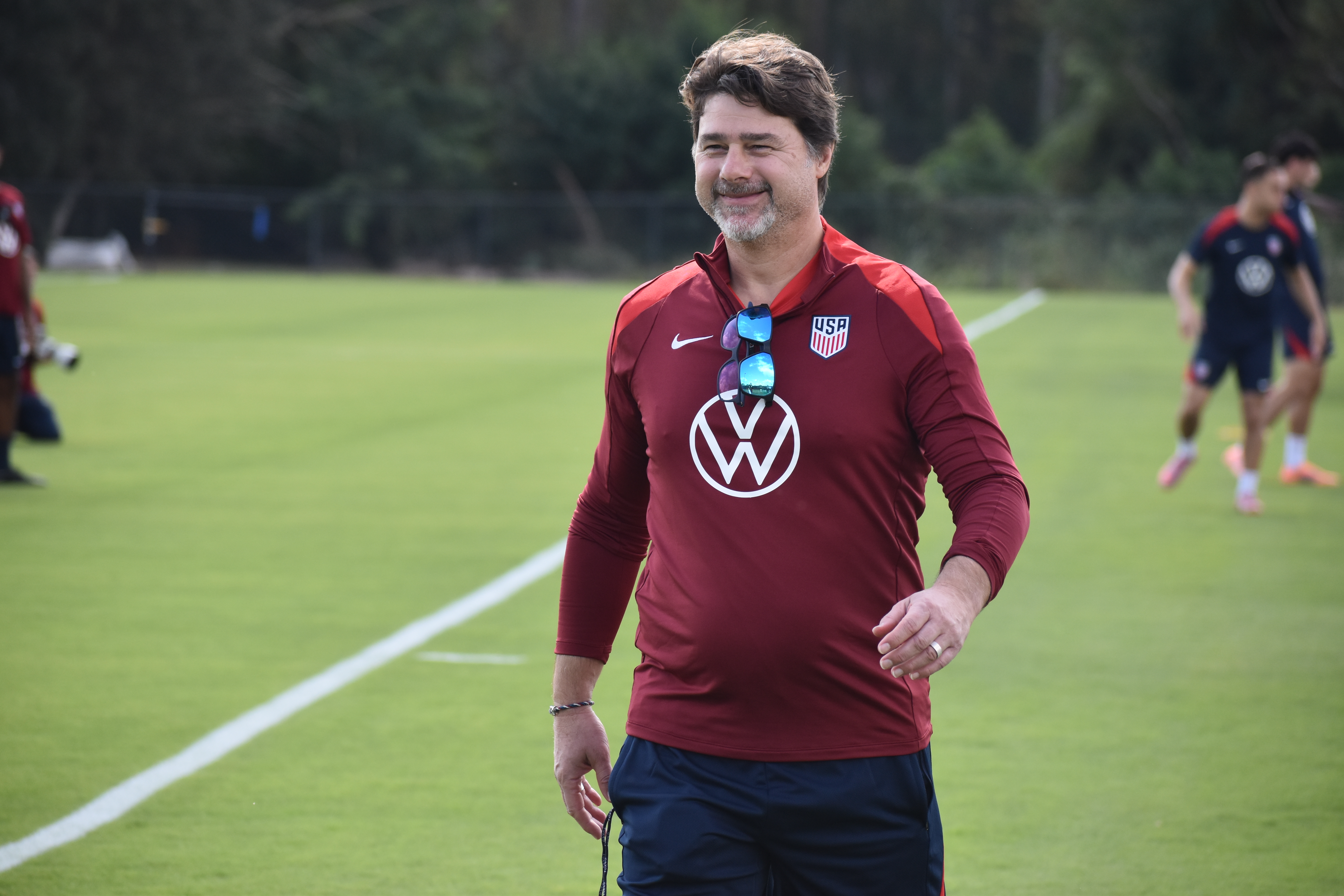
    TAMPA, Fla. — From the time Mauricio Pochettino took over the U.S. men’s soccer team last year, each moment has had two meanings.

    Along with trying to win games, every pass, shot, tackle, save, or failure has been about trying to make the World Cup team. That mentality is burned deep into American soccer’s psyche, as it has been for many decades, and it’s even deeper when the tournament is on home soil.

    The competition is made more difficult by how few opportunities there are to compete. Tuesday’s U.S.-Uruguay game was the 22nd match of Mauricio Pochettino’s tenure, with two more in March before the World Cup roster is named in late May.

    That is the same number of games (24) the Eagles played in their entire 2024 campaign, from the preseason through the Super Bowl — to say nothing of how many games there are in other sports’ calendars.

    U.S. manager Mauricio Pochettino.

    On top of that, in none of those 22 games has Pochettino had every member of his A squad healthy. Christian Pulisic, Tyler Adams, Weston McKennie, Folarin Balogun, Chris Richards, Sergiño Dest, and others have missed significant time along the way.

    Then combine those absences with the Nations League flop in March, which forced Pochettino to blow up his plans and bring in a bunch of less-talented challengers to try to outhustle the stars. The result is the roller-coaster path the U.S. team has been on this year, reaching a smooth track only in the last two months.

    This has made projecting a World Cup roster quite difficult. It’s a game fans love to play, and the media often enjoys it too. But the absences, the results, and the quick cadence of FIFA windows this fall made it more sensible to wait.

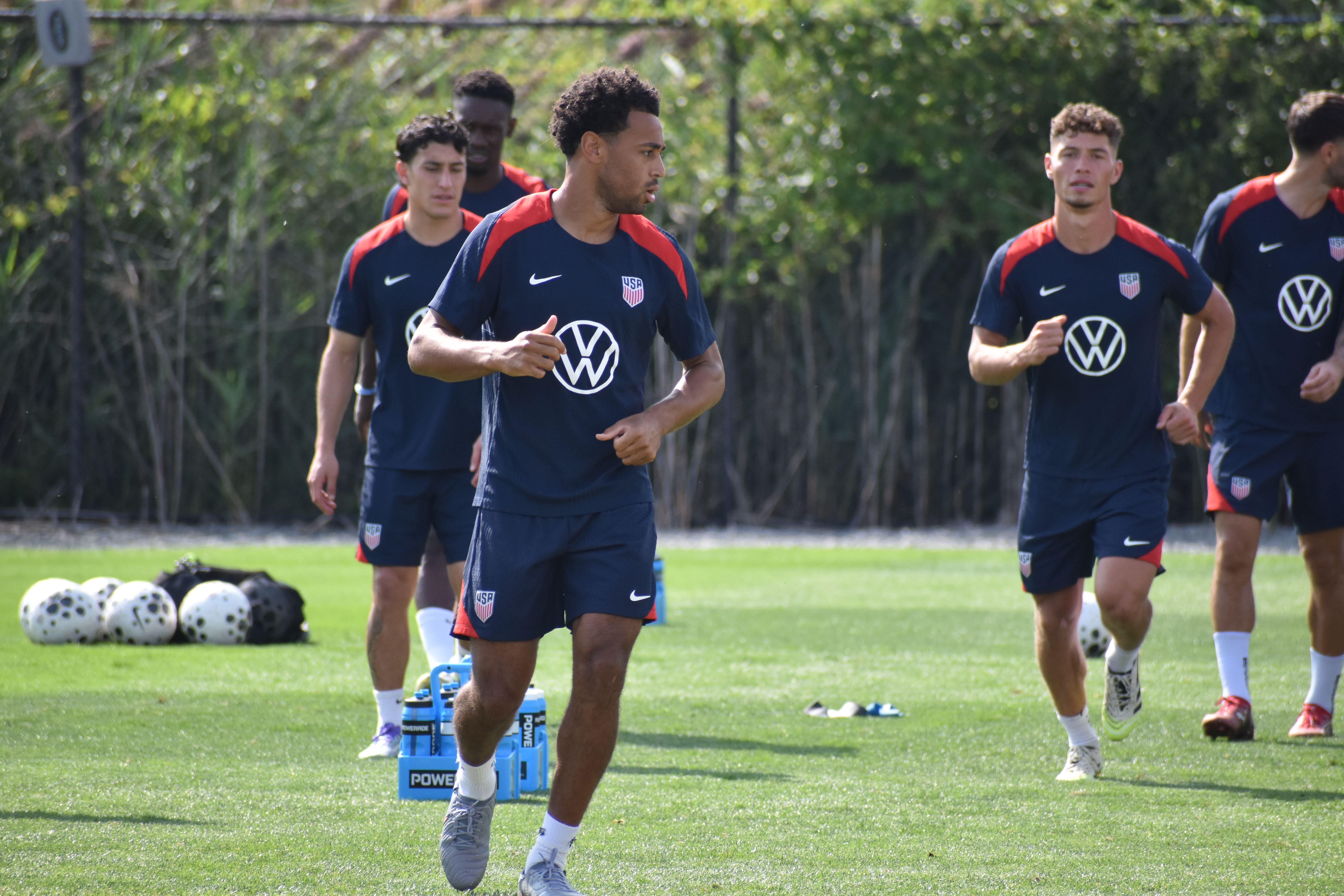
    Now, though, the Americans have wrapped up their work for the year. The 24 players on this month’s squad headed back to the club world on Wednesday morning, and that side of the game will reign until late March.

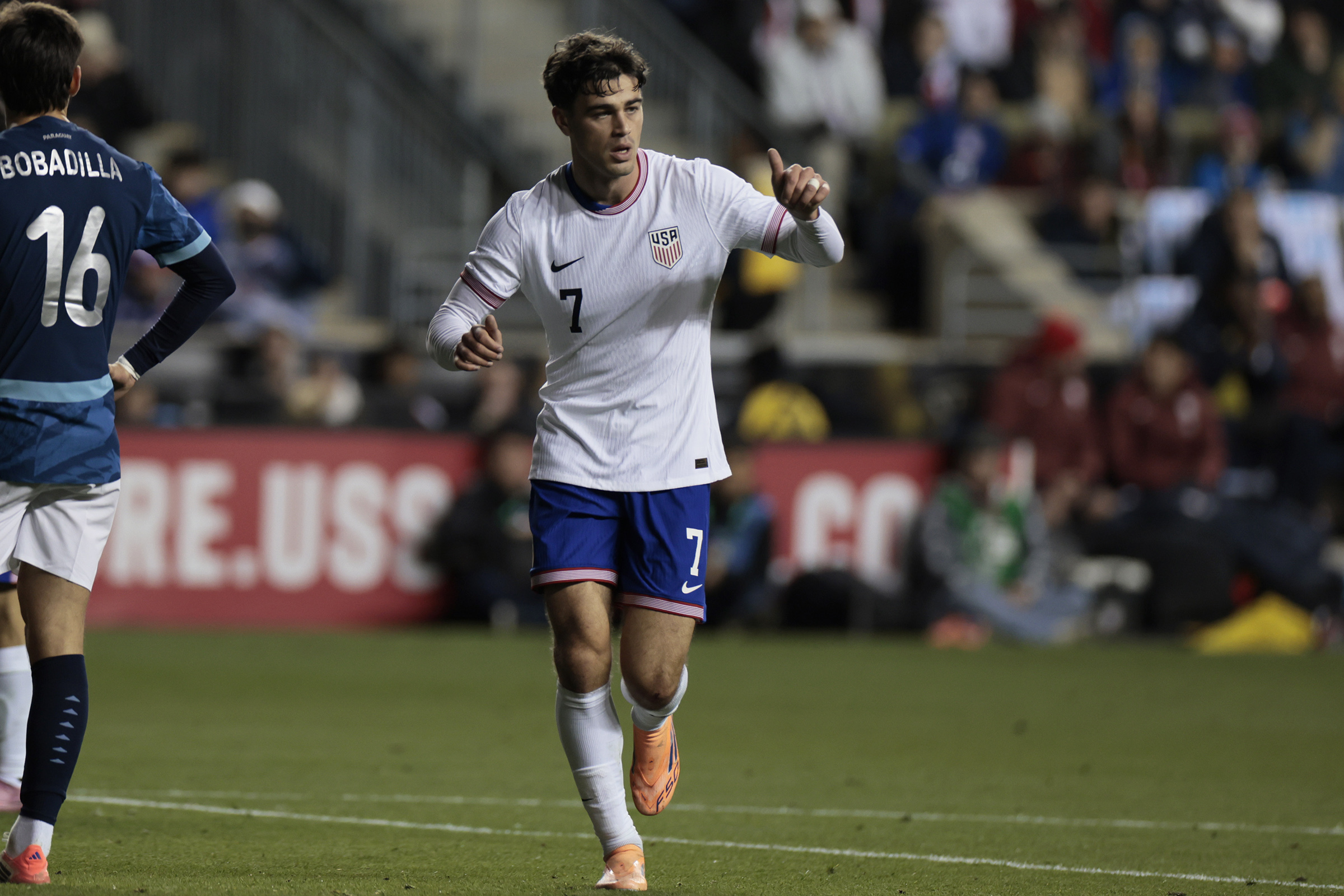
    Gio Reyna is one of the players who left a big and positive impression in this month’s games.

    So this moment feels right to look at the bigger picture. Here’s my view of the race to make the plane to Atlanta, where the 26-player World Cup team will gather at U.S. Soccer’s new national training center before its pretournament friendlies.

    The projection is broken down by the six main positions in Pochettino’s tactics: goalkeeper, outside back, centerback, central midfielder, attacking midfielder, and striker. Each position then has players who look like they’re in, those on the bubble (in alphabetical order), and a few words of analysis.

    Goalkeepers

    In: Matt Freese (New York City FC), Patrick Schulte (Columbus Crew)

    Bubble: Roman Celentano (FC Cincinnati), Jonathan Klinsmann (Cesena, Italy), Zack Steffen (Colorado Rapids), Matt Turner (New England Revolution)

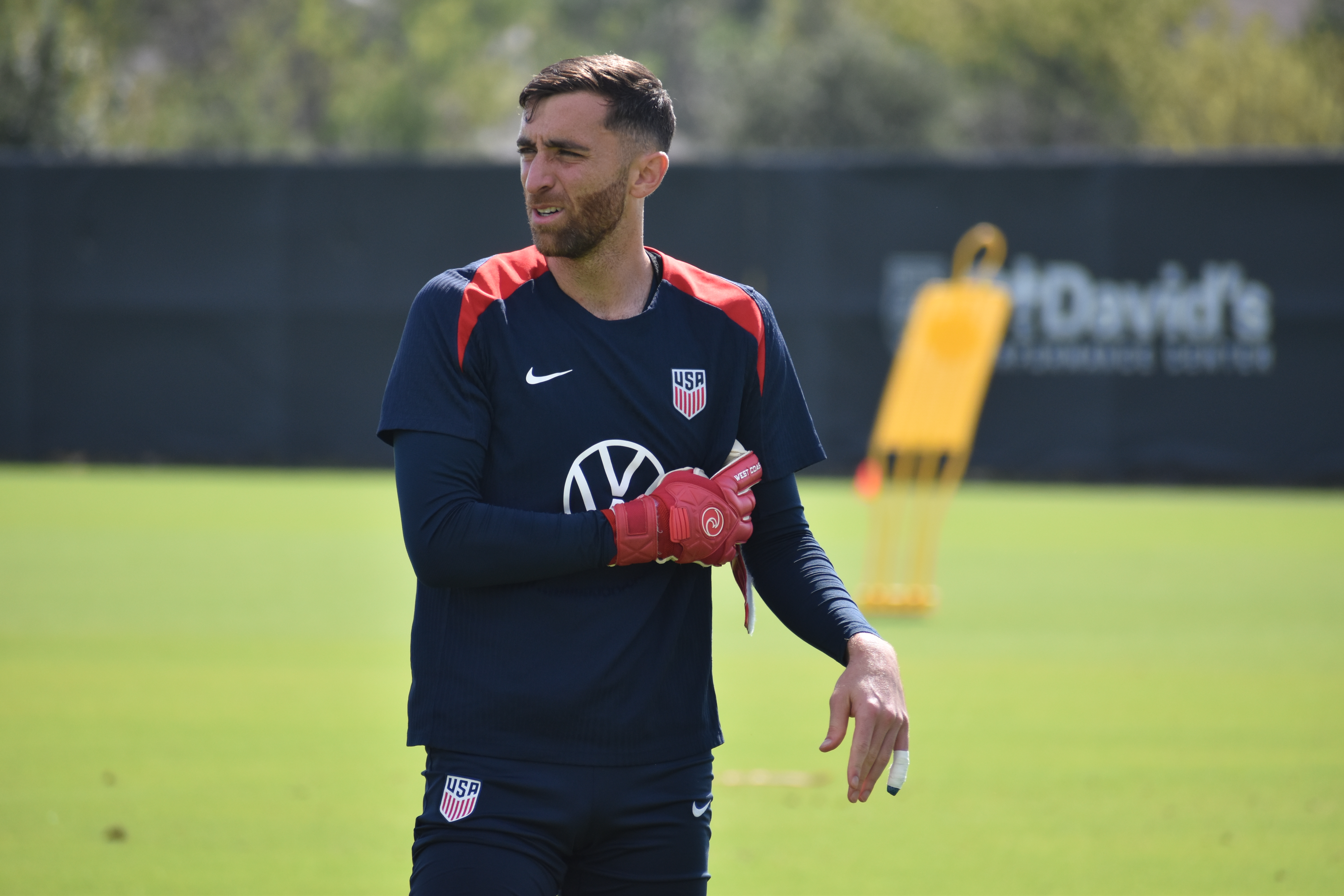
    Matt Freese making a save during one of the U.S. men’s team’s practice sessions in Chester last week.

    Analysis: Unless something goes off the rails for Freese, the Wayne native is in line to become the most surprising U.S. starting goalkeeper at a World Cup for generations. He was given a chance in June and has not let it go, playing 13 of the Americans’ 14 games since the start of the summer.

    Schulte, at age 24, is a fine starter in Columbus, a capable backup with the U.S., and a leading name for the 2030 cycle.

    Turner’s fall is as surprising as Freese’s rise. The locked-in starter from the 2021 Gold Cup through this past March is now not just out of games, but out of rosters. Even a move back to New England to get the playing time he lacked in Europe hasn’t gotten him back in Pochettino’s good graces.

    Matt Turner is on the outside looking in with the U.S. squad right now.

    Celentano and Klinsmann, son of former U.S. manager Jürgen Klinsmann, have been in a few U.S. camps. Steffen, of Downingtown, unfortunately is on the outside looking in right now, despite his talent. He’ll have to hope for a strong start next year in Colorado that vaults him over the field.

    Outside backs

    In: Max Arfsten (Columbus Crew), Sergiño Dest (PSV Eindhoven, Netherlands), Alex Freeman (Orlando City), Antonee Robinson (Fulham, England), Tim Weah (Marseille, France)

    Bubble: Kristoffer Lund (FC Köln, Germany), John Tolkin (Holstein Kiel, Germany)

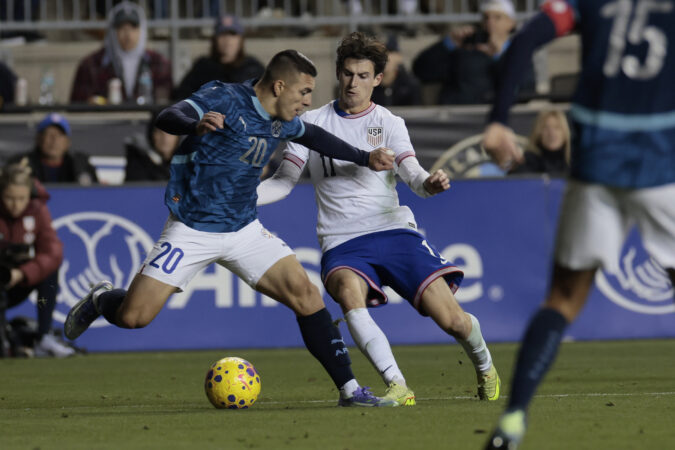
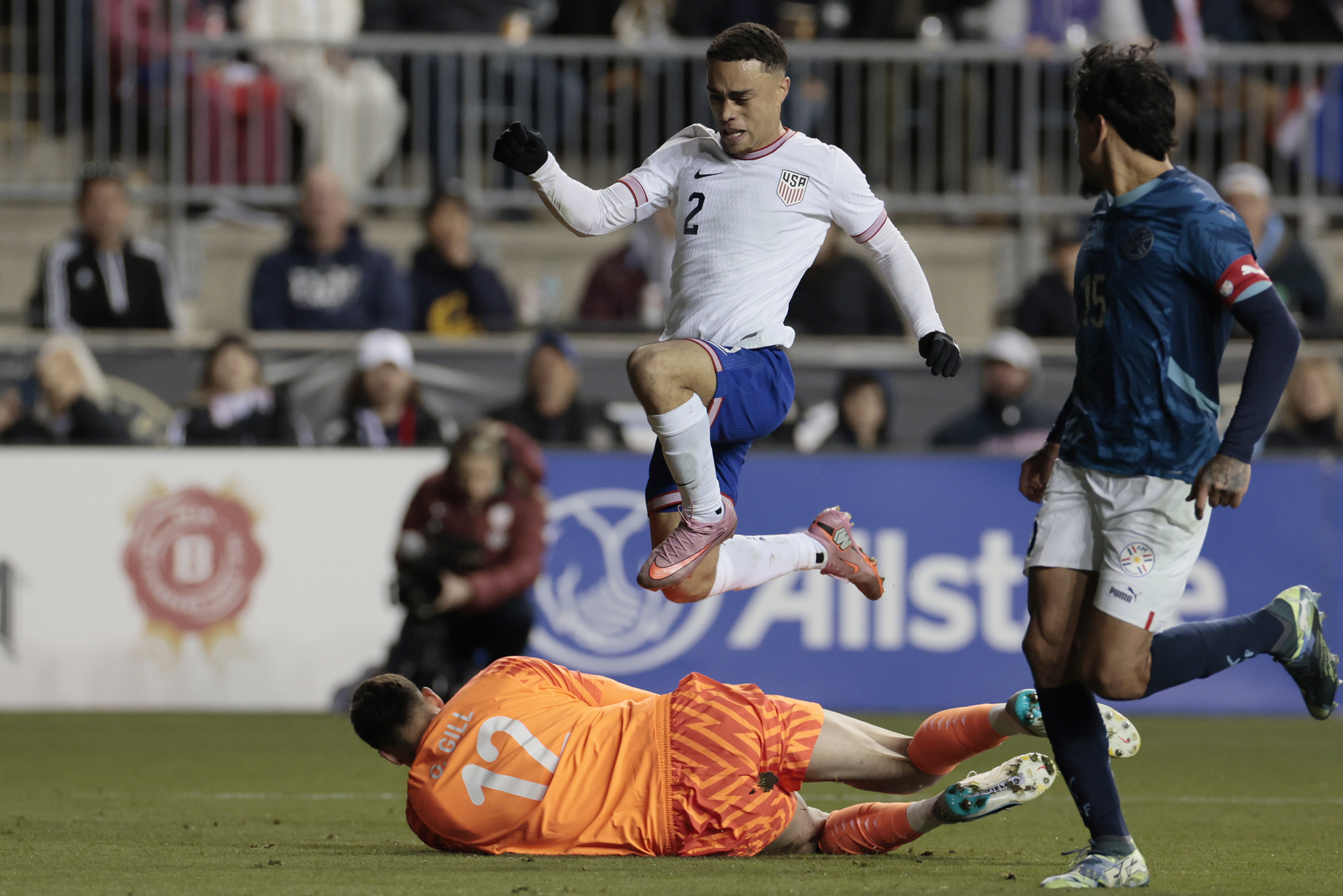
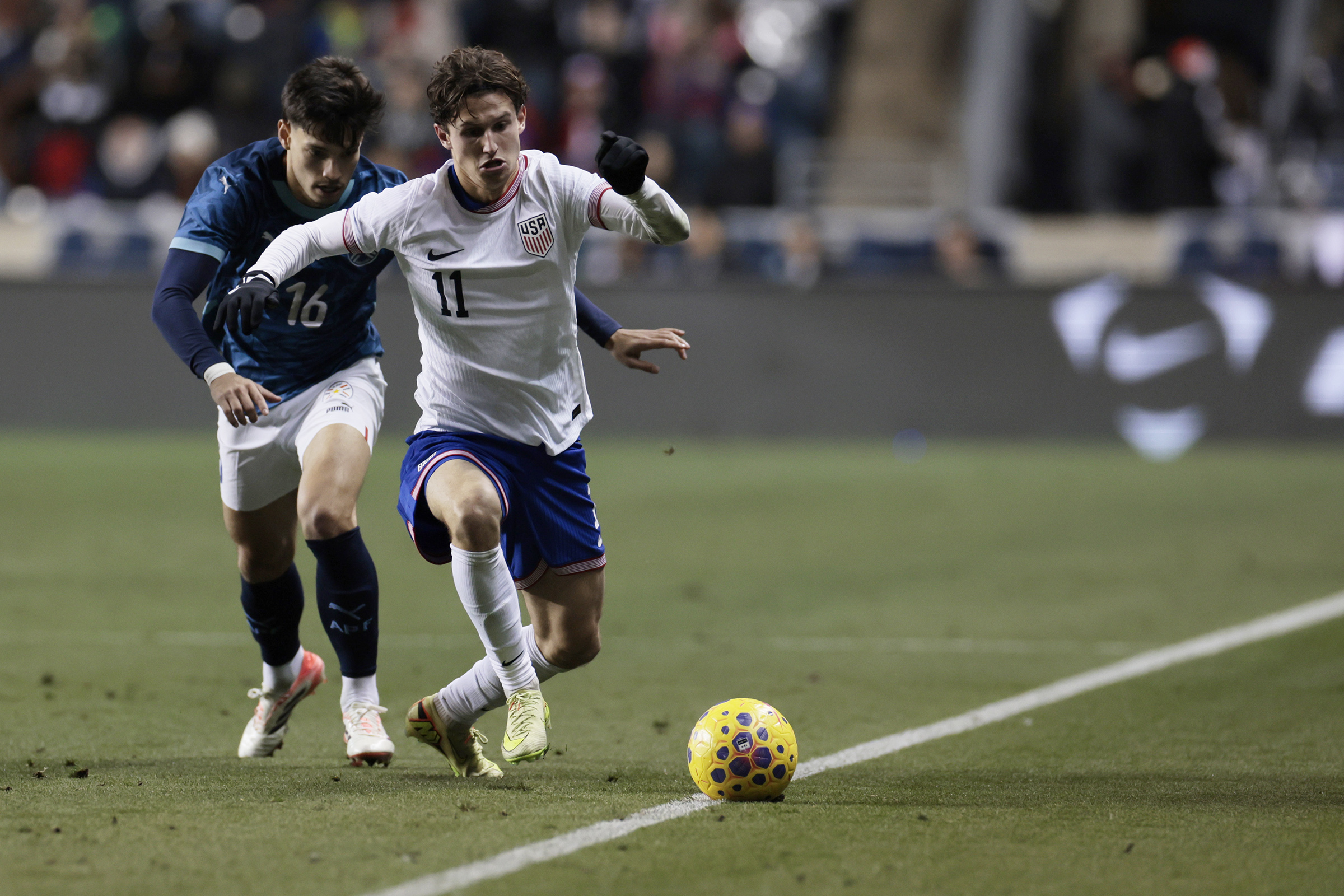
    Sergiño Dest (2) in action against Paraguay at Subaru Park on Saturday.

    Analysis: With one exception, this position is easy to line up. All five of the “in” names are locks to make the squad unless Robinson can’t recover from a long-term knee issue. From here, the view is if he’s healthy on June 1, that’s all that matters.

    Dest and Weah are the other big names, each capable of thriving in the right wingback role and playing the left side if necessary.

    Earlier this year, a reader complained to me on social media that the underwhelming Gold Cup squad might only produce the last players picked for a World Cup squad. I responded that if that was to happen, that squad would be a smashing success, no matter its results.

    Arfsten and Freeman are the proof of that, having shot to well-earned prominence this year. Though they wouldn’t start if the three others are healthy, they are more than capable backups.

    Lund and Tolkin are on the bubble in case Robinson ends up out. Tolkin played well against Uruguay on Wednesday in his first U.S. cap since the Gold Cup; Lund hasn’t been called in since October of last year.

    Centerbacks

    In: Mark McKenzie (Toulouse, France), Tim Ream (Charlotte FC), Chris Richards (Crystal Palace, England)

    Bubble: Noahkai Banks (Augsburg, Germany), Tristan Blackmon (Vancouver Whitecaps), Cameron Carter-Vickers (Celtic, Scotland), Miles Robinson (FC Cincinnati), Joe Scally (Borussia Mönchengladbach, Germany), Auston Trusty (Celtic, Scotland), Walker Zimmerman (free agent, last with Nashville SC)

    Chris Richards working out during a practice in September.

    Analysis: Ream and Richards aren’t just locks, they’re expected starters. The third starting spot is up for grabs, and there’s a lot of competition.

    McKenzie isn’t just projected as in here out of hometown loyalty to the Union alumnus from Bear, Del. His play for the national team and Toulouse puts him above a field in which no one else has truly stepped up.

    From here, the bet is Pochettino will take two more, and the race is wide-open.

    Blackmon has played some for Pochettino but isn’t at the needed level. Carter-Vickers didn’t play for the U.S. in October, a big warning sign, then suffered an Achilles injury at Celtic. Robinson is a U.S. regular but hasn’t quite done well enough to ensure a plane ticket.

    Scally can play multiple positions and is listed here because right centerback is where he projects under Pochettino. After being out of the picture for a while, he played there against Paraguay, got torched on a goal, then didn’t play vs. Uruguay.

    Mark McKenzie (left) and Auston Trusty (right) grew up with the Union together, and could go to the World Cup together.

    Trusty played the full game vs. Uruguay and did well at both ends of the field. Zimmerman is last in line, but if he lands at a big club in MLS free agency and starts the year strong, he could be an emergency option.

    Banks is a big wild card. The 18-year-old Hawaii native stands 6-foot-4, is starting to earn regular playing time at Augsburg, and has held his own in the Bundesliga’s cauldron. Pochettino called him up in September, but hasn’t since. If Banks keeps playing, he might just make it.

    Central midfielders

    In: Tyler Adams (Bournemouth, England)

    Bubble: Sebastian Berhalter (Vancouver Whitecaps), Johnny Cardoso (Atlético Madrid), Aidan Morris (Middlesbrough, England), Cristian Roldan (Seattle Sounders), James Sands (St. Pauli, Germany), Tanner Tessmann (Lyon, France)

    Tyler Adams (left) is one of the U.S. team’s biggest stars.

    Analysis: Adams is a lock — a star, a veteran, and the team’s most vocal leader. From there, the question will be how deep Pochettino goes at the position.

    Tessmann, Roldan, and Morris lead the way, with Tessmann the closest to a lock. That takes the total to four, and the guess here is one more will make it.

    Berhalter made quite a statement in Tuesday’s win over Uruguay, with a goal and an assist off a corner kick. That puts him ahead for now of Cardoso, who has tons of talent and is at a huge club but has a history of playing poorly for the U.S. He’s also coming off an injury. If he’s healthy by March, he could get one shot at a ticket in that month’s friendlies.

    Sands helps his case with versatility, as he also can play centerback. He got a look in October and wasn’t bad, but he wasn’t called back this month even though there was room for him.

    Attacking midfielders

    In: Brenden Aaronson (Leeds United, England), Weston McKennie (Juventus, Italy), Christian Pulisic (AC Milan, Italy), Malik Tillman (Bayer Leverkusen, Germany), Alejandro Zendejas (Club América, Mexico)

    Bubble: Diego Luna (Real Salt Lake), Jack McGlynn (Houston Dynamo), Gio Reyna (Borussia Dortmund, Germany)

    Union alum and Medford native Brenden Aaronson in action for the U.S. on his former home field at Subaru Park.

    Analysis: The “in” players are locks as long as they’re healthy, with Zendejas the only one close to a question. Pulisic obviously is a starter, with Tillman or McKennie in line to run next to him.

    From there, Pochettino can make subs based on situations. Medford’s Aaronson is an ideal defensive closer, and Zendejas provides width and creativity.

    The last pick could come down to Luna, whom Pochettino rightly adores for his toughness; or Reyna, whose talent is forever followed by injury fears. It would be great to see both make it, but there might not be room unless another position is sacrificed. Reyna has the advantage now and will keep it if he plays regularly for his club.

    McGlynn is a long shot, but a hot streak with Houston next year could bring his magic left foot back to the picture.

    Strikers

    In: Folarin Balogun (AS Monaco, France), Ricardo Pepi (PSV Eindhoven, Netherlands), Haji Wright (Coventry City, England)

    Bubble: Patrick Agyemang (Derby County, England)

    Folarin Balogun (center) might finally be the U.S. team’s long-awaited top striker.

    Analysis: It’s truly remarkable that the highest-profile position is one at which the U.S. has the fewest questions. Never before in the program’s 36-year modern era has there been a striker depth chart with this much quality.

    If Balogun, Pepi, and Wright are healthy, they’ll be on the plane, and that will be it. If any of them are injured — which Pochettino and every U.S. fan will pray doesn’t happen — Agyemang is first in line to come in.

    The field drops so far from there that right now no other strikers truly are in consideration.

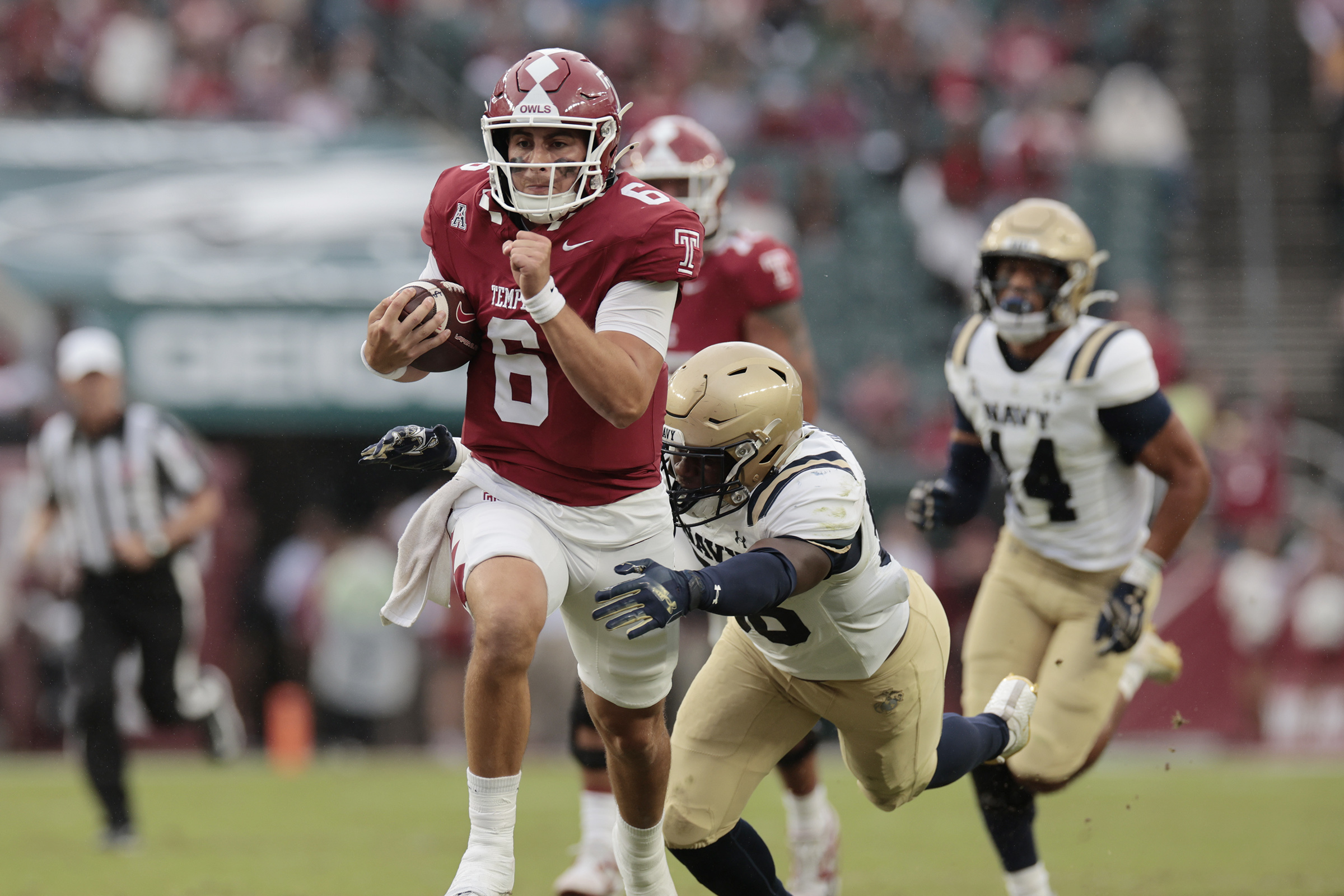
  • First-year coach K.C. Keeler is committed to Temple, Philly, and his ‘grandpa’ dance moves

    First-year coach K.C. Keeler is committed to Temple, Philly, and his ‘grandpa’ dance moves

    Last summer, K.C. Keeler and his wife, Janice, began building a house in Wilmington. This would not have been notable if Keeler were coaching at an SEC dynasty or a Big 10 stalwart.

    But he works for Temple, where head football coaches have long been transient.

    The Owls have shuffled through 11, including interims, in 15 years. Some were fired because they weren’t winning; some were poached to fill higher-paying jobs.

    One coach, Manny Diaz, stayed for 17 days before running off to the University of Miami. Another, Geoff Collins, led Temple to a 15-10 record, only to leave for Georgia Tech after two years.

    Collins took over for Matt Rhule, who went 28-23 over four seasons before departing for Baylor. Rod Carey came next, and was fired after three seasons, during which he posted a 12-20 record.

    Stan Drayton, who won only nine games in parts of three seasons, didn’t even make it to the end of the 2024 campaign.

    This dynamic — being a smaller Division I program with fewer resources — has led Temple to a difficult balancing act. The school is established enough to hire good coaches but not always to keep them.

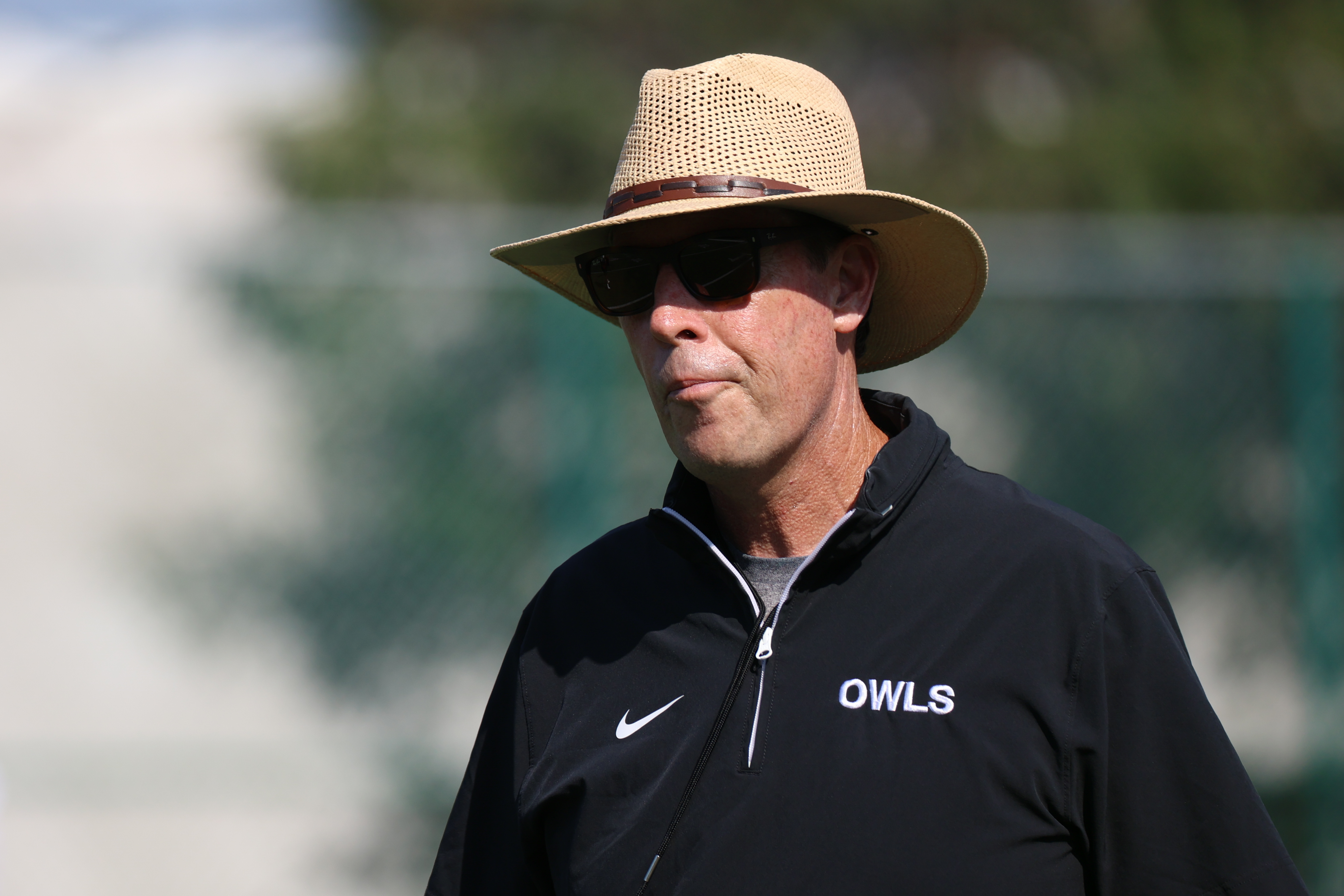
    Temple coach K.C. Keeler looks on during practice at the Edberg-Olson Hall football facility in July 30.

    Keeler, whom the Owls hired on Dec. 1, appears to be different. He has an established track record of building winning programs, and the 66-year-old won’t likely use Temple as a stepping stone.

    He’s deeply invested in the Owls and has genuine belief in his team’s ability. He also has local ties: The coach grew up in Emmaus, Lehigh County, 50 miles north of Philadelphia, and has a daughter and grandchildren who live in Delaware.

    Which is why he built a home in the area. Keeler is the first Temple head coach since Bruce Arians in the mid-1980s to do so.

    “It’s incredible what he’s done,” said senior quarterback Evan Simon, “and it’s only his first year. I wish I had a couple more with him.”

    A winning legacy

    Keeler’s first memory of Temple dates to the late 1970s, when he was a starting linebacker at the University of Delaware.

    The Blue Hens were a strong team but consistently struggled against the Division I Owls. In 1978, they won 10 games but were soundly beaten by Temple, 38-7.

    In 1979, when it won a Division II national championship, Delaware lost only one game. It was to Temple, at home, 31-14, on Sept. 22.

    Keeler graduated in 1981, and was hired as an assistant coach at Amherst College in Massachusetts that year. Rowan added him to its staff in 1986 (when it was known as Glassboro State College) and named Keeler head coach in 1993.

    Over nine seasons, he led the Profs to an 88-21-1 record, with seven Division III playoff appearances. Delaware brought him on as head coach in 2002 (succeeding Tubby Raymond after 36 seasons) and Keeler went 86-52 with the Blue Hens, reaching the Division I-AA national title game three times and winning a championship in 2003.

    He joined Sam Houston State as head coach in 2014, and posted a 97-39 record through 11 seasons, making the FCS playoffs six times and winning a second national title in 2020.

    Temple, meanwhile, notched only 11 winning seasons between 1981 and 2024. The Owls had suffered an especially tough stretch of late, failing to win more than three games in a season since 2019.

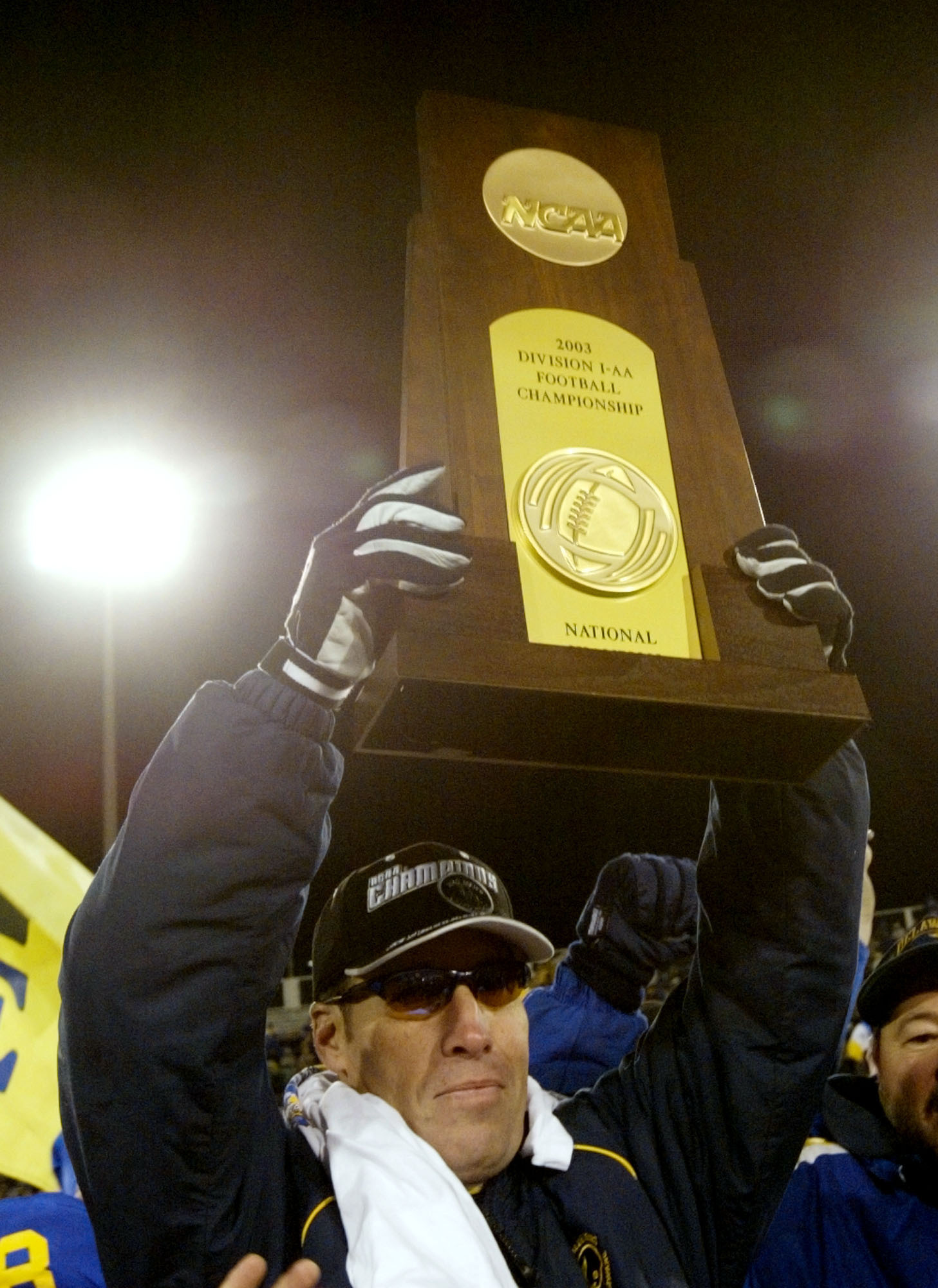
    K.C. Keeler won the NCAA Division I-AA Championship at Delaware in 2003.

    But for Keeler, the shine of those 1970s-era teams never wore off. He still saw a winner. So, when Temple approached him last year after firing Drayton, he took the opportunity.

    Things got off to a slow start. Some players were worried that they wouldn’t be welcomed back.

    Others were unsure of how they’d jell with Keeler and his staff.

    The head coach held a team meeting in December, before his introductory news conference. He tried to tell a couple of jokes, to lighten the mood.

    No one laughed. Keeler turned to his special teams coordinator, Brian Ginn.

    “Boy, these guys are serious,” he said.

    “Yeah,” Ginn responded. “They just went 3-9. I can see why they’re serious.”

    A few hours later, Keeler told the media what he told his team: that there would be no rebuild. That he was here to win a bowl or a conference championship.

    Simon, the senior quarterback, was standing in the back of the room, listening acutely.

    “It was a little scary [at first],” he said. “I mean, this place hasn’t won more than three games since, who knows? I don’t even know.”

    Over the next few days, Keeler held one-on-one meetings with all 114 players on Temple’s roster.

    He asked what they liked — and disliked — about the program, and what changes they wanted to see.

    The coach quickly showed a willingness to listen, even to seemingly mundane concerns. Many players lived off-campus and mentioned that they had to pay for a meal plan that they didn’t use.

    Keeler talked to a few higher-ups, and was able to make a change, putting $500 worth of meal money back into players’ pockets. Temple now provides grab-and-go lunches and snacks, available outside the locker room.

    The head coach continued to encourage his team to communicate, and gradually, the players began to feel more comfortable.

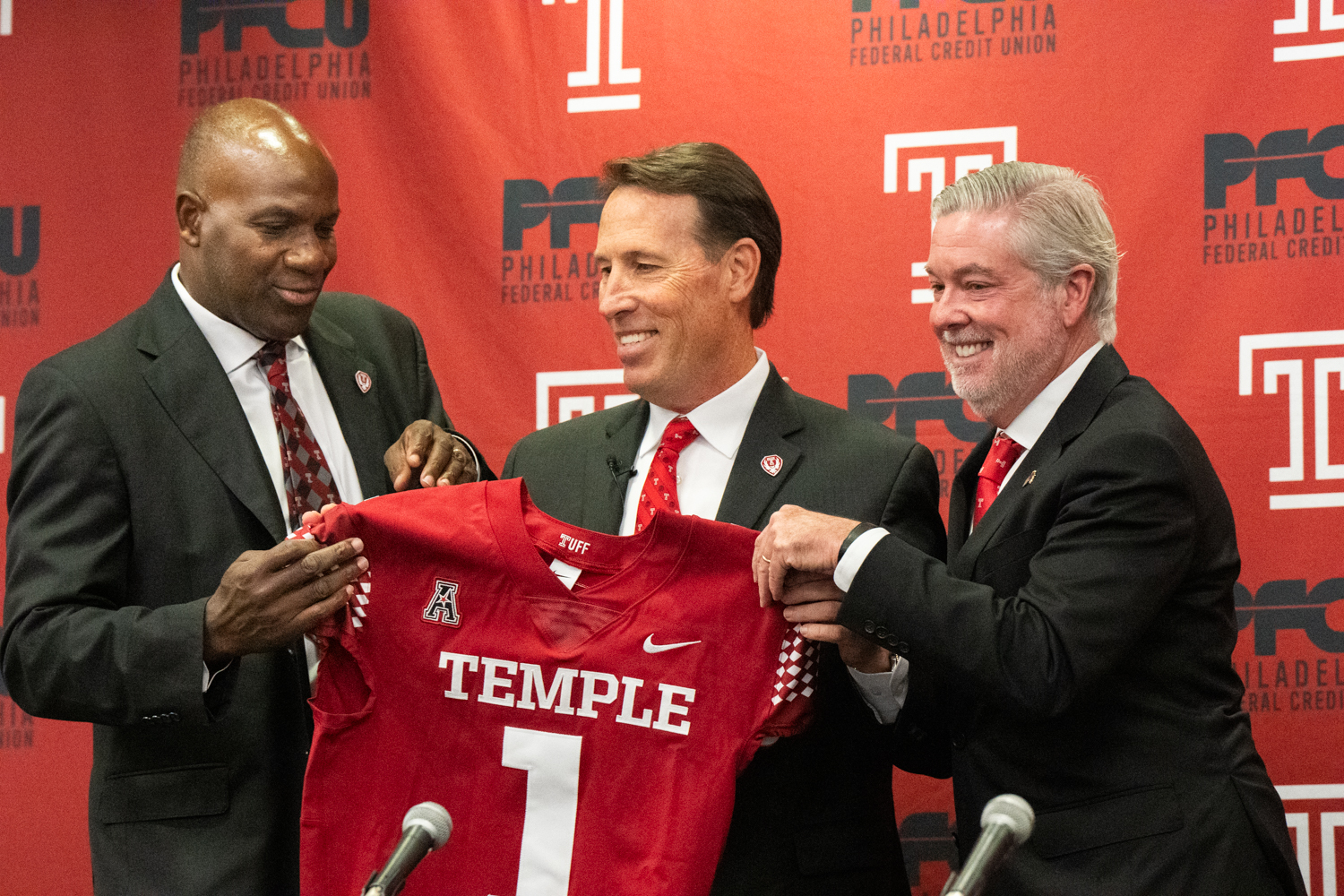
    From left, Temple athletic director Arthur Johnson, newly-hired football head coach K.C. Keeler, and university president John Fry at a news conference on Dec. 3.

    In February, Keeler got word that a former Temple defensive tackle, Demerick Morris, would be leaving Oklahoma State. He had transferred there in December 2024 but had a change of heart, and was eager to return to Philly.

    Keeler wanted to bring him back, too, but decided to ask his defensive line coach, Cedric Calhoun, to check with rest of the linemen first.

    They were not on board.

    “Coach Calhoun goes, ‘They said, [expletive] no. There’s no way they’re taking him back,’” Keeler said. “And he was in a panic. I’m like, ‘It’s OK, let me handle this.’”

    The three defensive linemen — Allan Haye, K.J. Miles, and Sekou Kromah — shuffled into Keeler’s office and sat shoulder-to-shoulder on his cherry-red couch.

    Before Keeler explained his side, he made sure the players knew it was their decision.

    Then, he asked for their perspective. They said that years ago, the four linemen had made a pact not to enter the transfer portal. To stay at Temple and “fix” the program.

    When Morris left for Oklahoma State, Haye, Miles, and Kromah felt betrayed.

    “[To them], it was ‘Demerick broke the pact,’” Keeler recounted. “‘Demerick took the money.’”

    The head coach laid out the situation in more pragmatic terms. Temple needed to bring in another defensive tackle, regardless. Why not go with the familiar option?

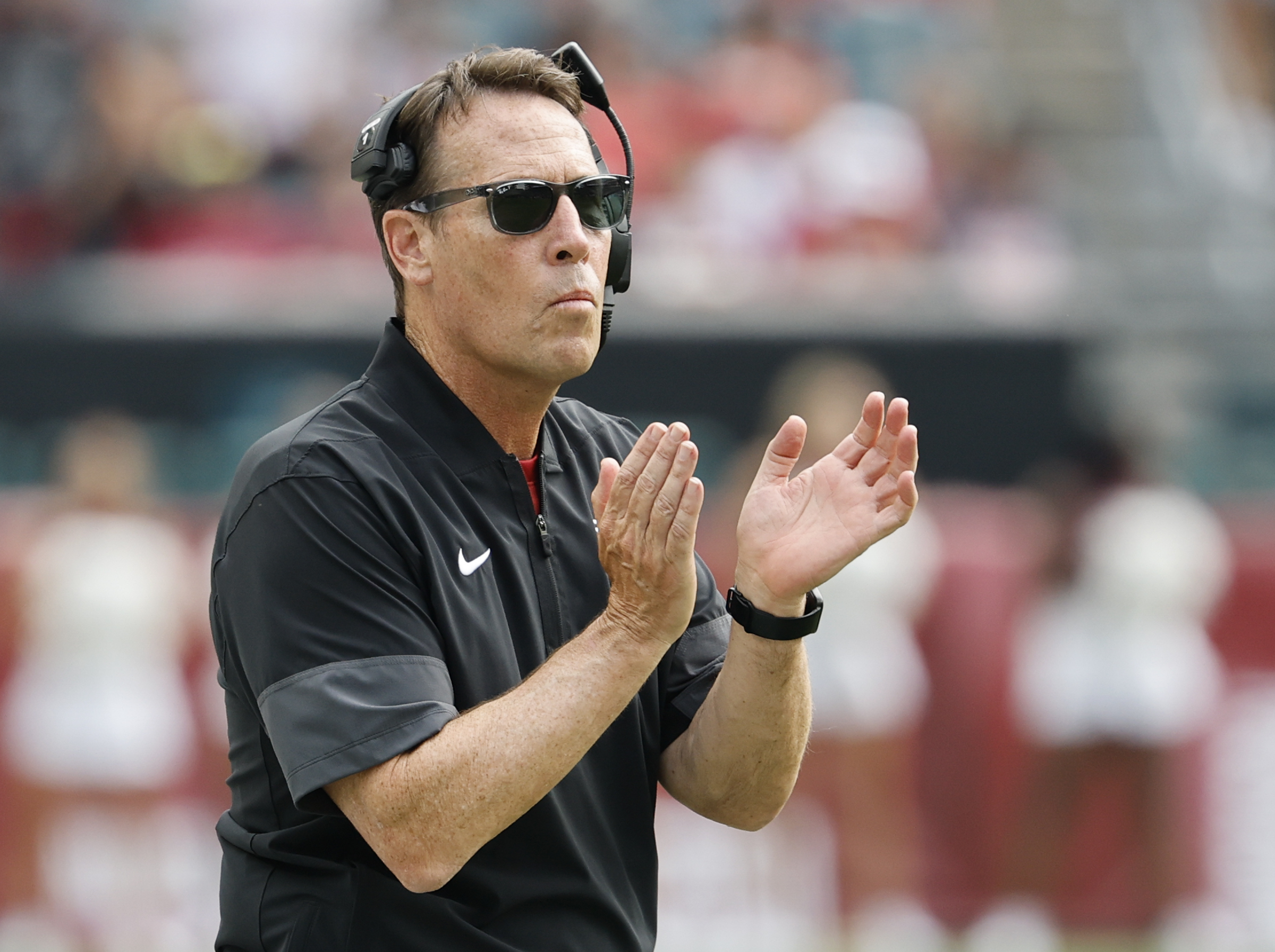
    K.C. Keeler directing Temple against Howard on Sept. 6.

    “I know Demerick is a great player,” Keeler told them. “I can’t guarantee the [other] guy we’re going to bring in is going to be a great player.

    “I know Demerick is a great person. The guy we bring in … I don’t know a lot about him. I know Demerick loves Philadelphia. He’s living here now. He’s from Chicago.”

    The linemen changed their minds.

    “Again, the key was, this is still your call,” Keeler said. “I am not going to overrule your decision.”

    Poor push-ups and ‘terrible’ dance moves

    When Simon showed up to practice last summer, he could tell things were going to be different.

    At 66, Keeler was doing push-ups in the middle of the field. He was running sprints and stretching alongside his team.

    He even took control of the stereo sometimes, playing the music of his adolescence: Bruce Springsteen, Bananarama, and, of course, KC and the Sunshine Band.

    The quarterback compared it to being around your fun “uncle.”

    “They’re the world’s worst push-ups,” Simon said. “But his energy, it lifts the program. You’re allowed to have fun at practice.”

    Keeler strikes a balance. There are times when practice is not fun. The head coach has high standards and pushes his team hard.

    But he also tries to foster human connection wherever he can, whether it’s sending a birthday text to a player, hosting team dinners, or organizing trivia nights at Temple’s Liacouras Center.

    One of Keeler’s biggest assets is his humor. He isn’t afraid to laugh at himself.

    On Oct. 4, in Temple’s fifth game of the season, the Owls trailed Texas-San Antonio, 14-3, at the half.

    Keeler reamed his players out in the locker room. He told them that it was the first time he’d been embarrassed to be their coach.

    “I said, ‘This the first time I’ve ever even thought this, in my 10 months here,’” Keeler recalled.

    The team responded almost immediately. Temple scored 21 points in the third quarter and ended up winning the game, 27-21.

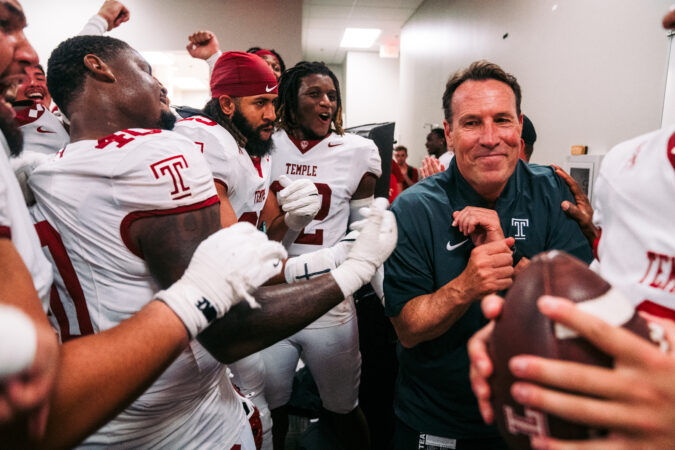
    Afterward, the players started dancing in the locker room. Keeler joined in.

    The coach received some tough feedback.

    “A lot of comments like ‘I dance like an old white guy,’” he said. “Well, yeah, I am an old white guy. But, you know, winning is hard. So when you win? You celebrate.”

    The post-win dance quickly became a team tradition, and Keeler began to get creative with which guys he’d single out.

    On Oct. 18, in the final seconds of Temple’s victory over Charlotte, he looked to the sideline to find three of his players — Cam Stewart, Khalil Poteat, and Mausa Palu — dancing.

    The coach had always instructed his team not to gloat in public. So, he decided to teach them a lesson.

    When the players walked into the locker room, Keeler called them out.

    “OK,” he said. “You guys want to dance? You’re leading the dance.”

    General manager Clayton Barnes hit the music. The team gathered in a circle, as Stewart, Poteat, and Palu showed off their moves.

    Then, Keeler showed off his.

    “Terrible,” said Kromah.

    “It’s like seeing your grandpa dancing,” said running back Jay Ducker. “‘OK, grandpa! OK!’”

    “I think he’s got to start stretching before he does them,” said Simon.

    On Oct. 25, after Temple’s fifth win of the season, against Tulsa, Keeler summoned offensive lineman Giakoby Hills.

    It was Hills’ birthday.

    “Giakoby, come on down!” Keeler said. “Birthday boy is going to lead the dance.”

    This may seem like a silly custom, but for a team that couldn’t muster a laugh back in December, it’s progress.

    Temple quarterback Evan Simon has 22 touchdowns with 1,847 passing yards and only one interception through 10 games this season.

    And for players like Simon, it has made a difference. The quarterback is in the midst of a career season. He has 22 touchdowns with 1,847 passing yards and only one interception through 10 games.

    He credits a lot to “Uncle” Keeler.

    “He’s so easy to talk to,” Simon said. “And that’s important as a player. Not being nervous all the time. Because I’ve experienced that, where there’s tension, [and you’re] afraid to mess up. But he’s super easygoing.”

    ‘Not afraid to fail’

    There are plenty of young players who have thrived under Keeler’s quirky coaching style.

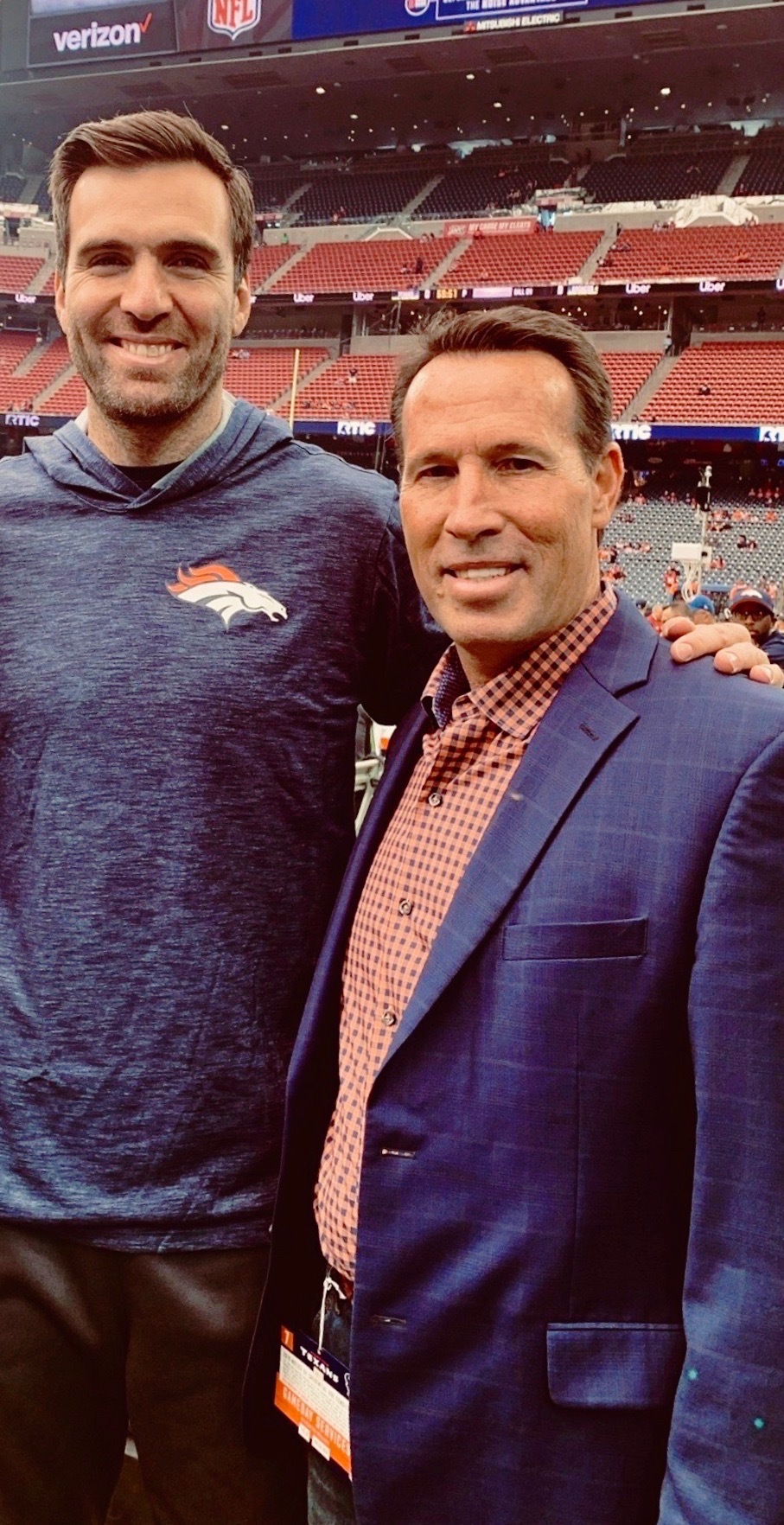
    But none as successful as Bengals quarterback and 18-year NFL veteran Joe Flacco, who played at Delaware in 2006 and 2007.

    Keeler brought the same enthusiasm back then that he does now (with fewer dance moves, to which Flacco responded: “Thank God”).

    When Flacco transferred from Pittsburgh to Delaware, he was a backup quarterback, sorely in need of a good spring.

    K.C. Keeler coached Joe Flacco at Delaware.

    He contemplated playing collegiate baseball, an idea the coach quickly put an end to. Keeler told his pupil that he needed to focus on football. He reiterated, time and time again, that Flacco would be drafted by an NFL team.

    It was helpful for the young quarterback to hear.

    “I was honestly happy,” Flacco said. “I thought I wanted to pursue [baseball], but deep down, I really didn’t. And he didn’t want me to do it. So, I was like, ‘Good, I don’t really want to do it.’”

    After Flacco was selected by the Baltimore Ravens in the first round of the 2008 NFL draft, he met with his former coach.

    Keeler asked him a question.

    “I’m going to be talking to another team [someday], and they’re going to want to know,” he said, “what makes Joe Flacco great?”

    The quarterback answered without hesitation.

    “I’m not afraid to fail,” he responded.

    Keeler might have this quality, too. He was not afraid to loudly proclaim that he wanted Temple to become bowl-eligible this season, and his team is close to meeting that threshold.

    The Owls have lost their last two games, in part because of mounting injuries. Despite that setback, they sit at 5-5, the most wins since 2019.

    Temple needs to win one of its remaining two games — Saturday against Tulane or Nov. 28 at North Texas — to qualify for a bowl game.

    But regardless of what happens, Keeler won’t be afraid of the outcome. And if the Owls win, he certainly won’t be afraid to dance.

    “[He has] a belief and ability to make [a program] bigger than what everybody thinks it is,” Flacco said of his former coach. “It’s not only that he says it, and preaches it, but he also gets you to believe it. And that’s huge.”

  • ‘Phillies Extra’ Q&A: Joe Maddon on Kyle Schwarber’s evolution, and a potential key to playoff success

    ‘Phillies Extra’ Q&A: Joe Maddon on Kyle Schwarber’s evolution, and a potential key to playoff success

    Kyle Schwarber spent much of his first five major league seasons trying to get things right against lefties.

    Joe Maddon watched the struggle up close.

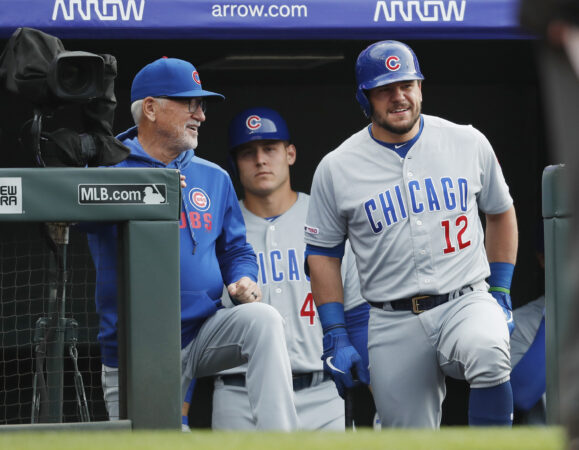
    Schwarber was a .198 hitter with a .658 OPS in 374 plate appearances against lefties from 2015 to 2020, and as the Cubs’ manager, Maddon was hard-pressed to keep him in the lineup. After the 2020 season, under an ownership mandate to cut payroll, Chicago let Schwarber go.

    It must have been quite a sight, then, for Maddon to watch Schwarber bat .300 against lefties in 2024 for the Phillies and set a single-season major league record with 23 left-on-left homers this year.

    Schwarber became a complete hitter in four seasons with the Phillies — and put himself in position to cash in this offseason in free agency. As Schwarber’s market develops, Maddon sat down with Phillies Extra, The Inquirer’s baseball podcast, to discuss the slugger’s maturation as a hitter.

    Maddon also weighed in on how the Phillies can best protect Bryce Harper in the lineup, the value of experience in the manager’s seat, and more. Here’s an excerpt from our conversation, edited for brevity and clarity.

    Watch the full interview below and subscribe to the Phillies Extra podcast on Spotify or Apple Podcasts.

    Q: You managed Schwarber in his first five years in the big leagues, and there were real questions about his ability to hit lefties and be an everyday player. What goes through your mind this year, when you see him set a record with 23 homers against left-handers and evolve into a complete hitter?

    A: The guy’s all heart. He comes from a family of first responders. He’s got a great charity organization. I love his wife, Paige. Also haven’t met the baby yet, but there’s a lot to love about this guy. He’s real … and that’s why he fits in so well in Philadelphia.

    When we had him there [in Chicago], I wanted to hit him leadoff because of all the attributes that we’re discussing right now, the fact that I thought he had a good eye at the plate, he would accept his walks, and he could put you up 1-0 before the first hitter is done right there. However, he was deficient against left-handed pitching at that time. He didn’t wait on the ball as well as he does right now. … You can see the difference in the way that Schwarbs just lets the ball get to him, as opposed to wanting to go get it, especially against the left-handed pitcher, the ability to hit the ball to left-center has really highlighted that even better. So am I surprised? No, I thought that eventually it would get to that point.

    If you’re the Cubs, at that point in his career, it’s hard to be patient. I was criticized for [hitting him] leadoff, even though I really thought it was a great idea, and you’ve seen it’s worked well, even in Philadelphia when they do that. But he really did need to learn a new approach, mentally and physically, against left-handed pitching. And he has. They’ve done a wonderful job.

    The other part that was against him was his defense. He had been a catcher. When he came up, we put him in the outfield, and he was a below-average outfielder. There’s no way to describe it otherwise. But he had a good arm. He made some really great throws. And of course, he’s one of those guys, if you tell him he can’t do something, he’s going to prove you wrong, which he’s done his entire existence, from [college at] Indiana on up, and even probably when he was in high school. So these are the things he had to learn. He has learned them.

    I’m so happy for him and his family that this all happened now, so that probably, I would say absolutely, a three-year heavy contract with maybe a fourth year as an option is in order right now. I’d love to see him stay in Philadelphia, because I think his sensibilities, his personality, plays with that fan base extremely well, and that’s not going to go away.

    However, I know Dave Dombrowski really well. David and I scouted together in Arizona back in the ’80s. David’s a real baseball guy. He’s going to look beyond certain components of this. They know what they see, also talking to him and the impact he has in the clubhouse. I would like to believe he’s going to stay in Philadelphia, and I think he should. I don’t know that if somebody wants to give him a couple more million bucks than the Phillies do, that, I still think Schwarbs is grounded enough that he’s going to go where he wants to go, as opposed to being swayed by a couple extra dollars.

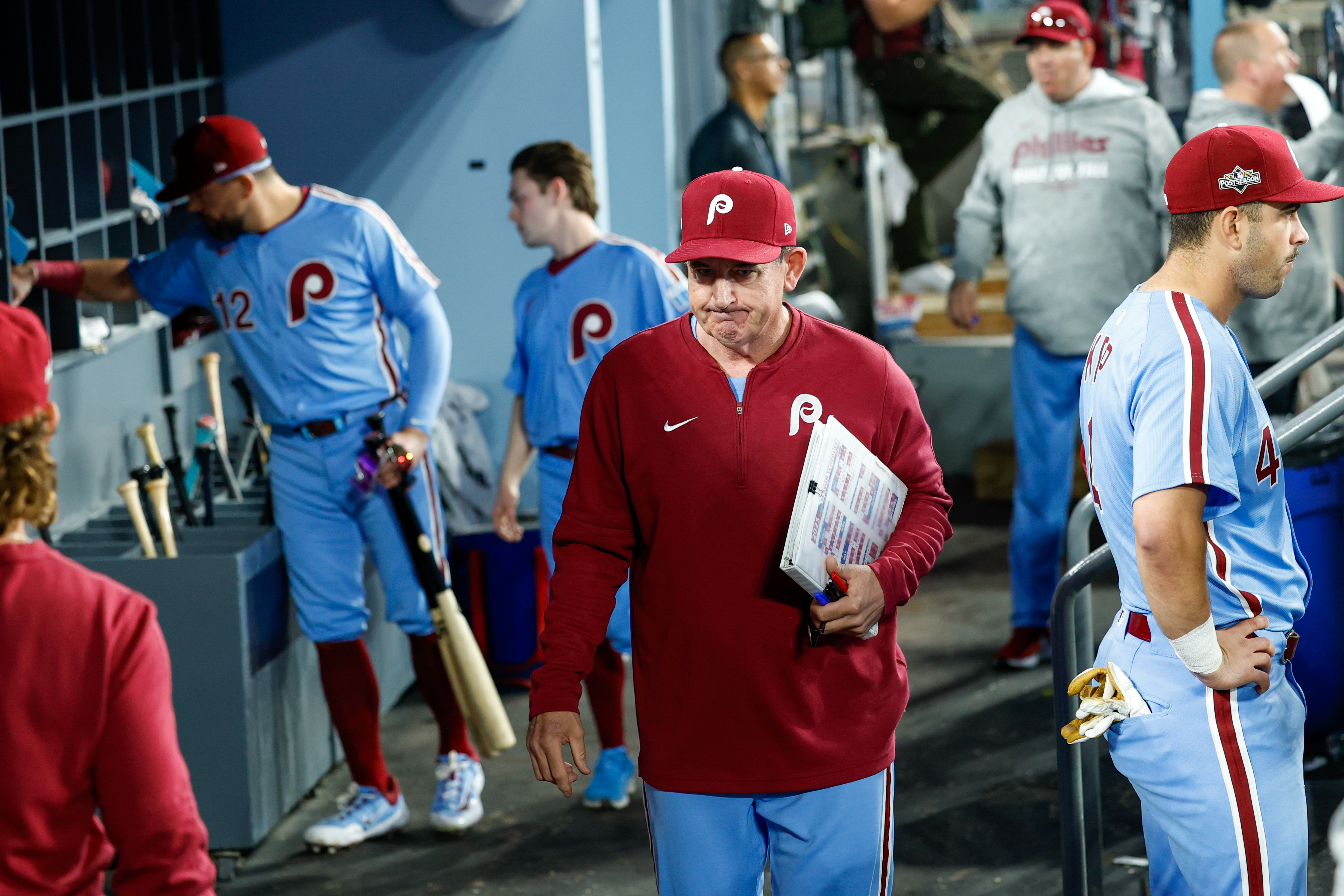
    Rob Thomson’s Phillies have been bounced from the playoffs in the NLDS each of the last two seasons.
    Q: What do you make of where the Phillies stand in their competitive cycle, and how far do you think they can go with the same group?

    A: If you’re going to change things, you’ve got to pretty much make sure that you’re getting better, right? They are good. I like watching them. I watch them often, and I think they have grit. I think they have great camaraderie. I love their leadership. I don’t know what else you want, really. I mean to say that we’re just going to blow this up and all of a sudden we’re going to be as good next year as we were the last two or three years, and then we’re going to do better in the playoffs, that’s kind of a reach for me.

    With this group, I would look to tweak it a little bit. I wouldn’t necessarily look to blow it up. There’s just too many good players on that roster, and I really think they interact well.

    The division itself, with the Mets, the Braves off a bad year are going to probably be better. But I still think Philly’s the right team, the team that has a chance to repeat again as the champs of their division again next year.

    My biggest thing I would look at is, “how do we prep for playoffs? What are we doing there?” My big thing is, when you get to the playoffs, I like to do less and not more. And analytical departments like to do more and not less. That time of the year, you’ve already played all these teams. You’ve played them; you’ve seen them. And then there’s the meetings. If they become more laborious, more detailed, longer, you’re putting more stuff on guys’ plate, that would be the mistake I would consider. So I don’t know this. I’m just saying I would really look at the prep work, because what would always frustrate me, we would go through the whole year, you get to this particular juncture, and now is the time to really let your players get out there, rested body, rested mind, and free. Give them a nugget or two, but let them go play some baseball, which is why we just love the World Series.

    … I had Shohei [Ohtani], I’ve had a lot of these guys — they don’t hold on to analytical nuggets when the game’s played. They don’t. That’s for managers and coaches to really decipher before a game. But then again, it has to be distilled. When you get too much information, it only serves to confuse. And again, I don’t know anything here, because I’m not privy to this, but I would look into, how are we prepping going into the playoffs? What are we laying on these guys, and how are we approaching them at that point? Because, quite frankly, they look a little bit more uptight to me in the playoffs than they do during the regular season. Like with Arizona a couple years ago [in the NLCS], I couldn’t believe that.

    So, I would really research and analyze my approach into that part of the year. Because obviously the approach during the year looks pretty darn good, and I don’t see that changing. So whatever you feel as though there was a deficiency, yes, try to add on to that. There’s got to be some micro stuff. But to blow that thing up doesn’t make any sense to me.

    Watch or listen to the full interview to hear Maddon’s thoughts on protecting Harper in the lineup, his connection with Phillies manager Rob Thomson, and more.

  • Jordan Davis plays quarterback, and serves up a Thanksgiving meal to Camden families: ‘It takes a village’

    Jordan Davis plays quarterback, and serves up a Thanksgiving meal to Camden families: ‘It takes a village’

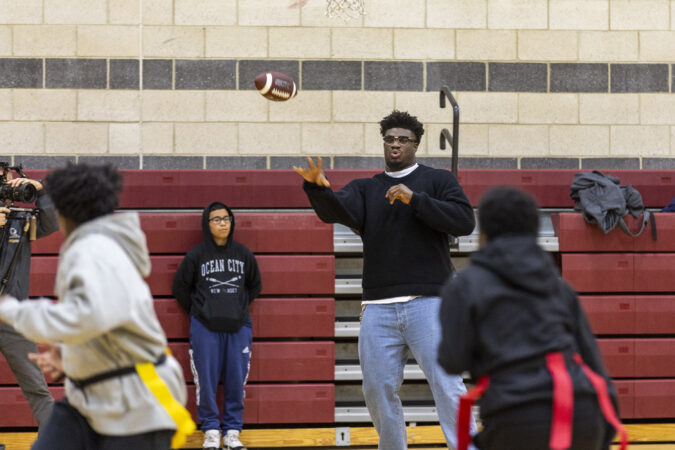
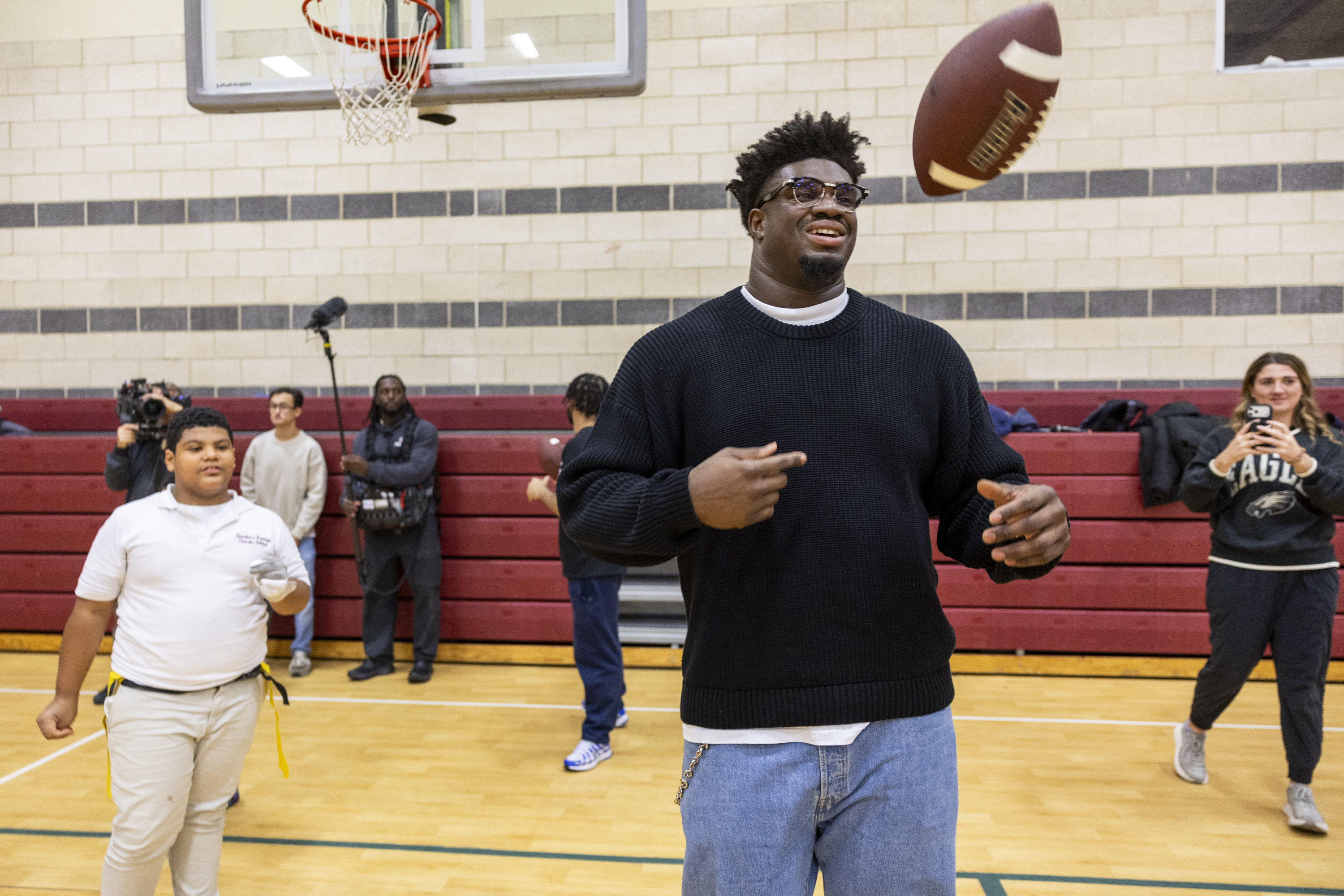
    The Eagles’ Jordan Davis had a different role Tuesday night at the Salvation Army Camden Kroc Center. The 6-foot-6, 336-pound defensive tackle lined up under center as the designated quarterback in a room with over 100 children, ready to play flag football.

    Davis spent time with four teams, joining each huddle and running plays as he introduced football to several kids who had never played the sport before.

    “This is the best flag football team in Camden, New Jersey. And I’m standing on that right now,” Davis said. “If I had so much time, I would actually coach y’all because y’all have so much potential.”

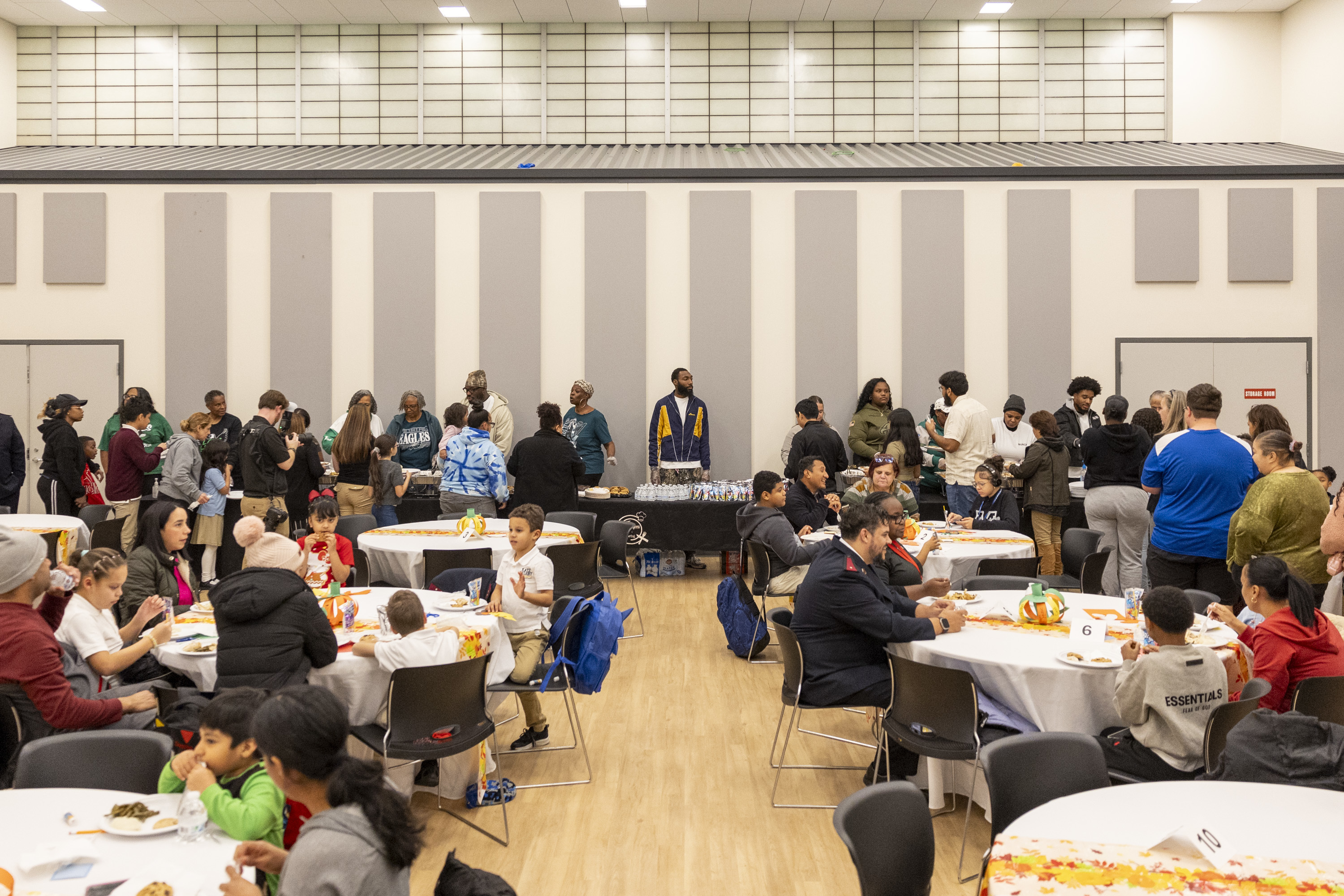
    This was just one way the North Carolina native helped families in need Tuesday. The Jordan Davis Family Foundation provided a fully catered Thanksgiving meal to families who attended. And to end the night, all the families were handed Thanksgiving turkeys and AT&T laptops as they left the Kroc Center.

    The Jordan Davis Family Foundation provided Thanksgiving meals for families at the Salvation Army Camden Kroc Center in Camden on Tuesday night.

    Partnering with the Salvation Army is a full-circle moment for Davis. When he was a child, his family received assistance from the organization. Now, it’s his turn to give back.

    “It was hard for my mom, just making sure that we had a meal every night, me and my brothers,” Davis said. “And even nights that she might have sacrificed the meal for herself, it was always meant for us to eat. And I think that’s just a wonderful story for me because it shows the type of woman that she is.

    “She raised me to be that way. And it might not be a meal here, it could be a coat drive. It could be another drive. It could be a back-to-school event. It could be a kids camp. Anything matters. Everything matters. So, that’s just something that I keep in my heart, and I want to keep that going.”

    Davis isn’t the only Eagles player giving back ahead of the holiday season. Last week, running back Saquon Barkley partnered with Ashley Furniture and the Salvation Army to give out mattresses and bedding to families in need.

    Jordan Davis played flag football with the kids after eating providing a Thanksgiving meal through his foundation on Tuesday night.

    “It takes a village to raise a child,” Davis said. “And that’s something that my team, we always say. It takes a village. … When you have an opportunity to give back, it doesn’t matter what time it is. As long as you have that time, you want to make sure that you’re providing that time.

    “Time is the most important thing you can spend. And we could be doing anything else with this time right now, but we spend it giving back and we spend it doing the things that matter most to us.”