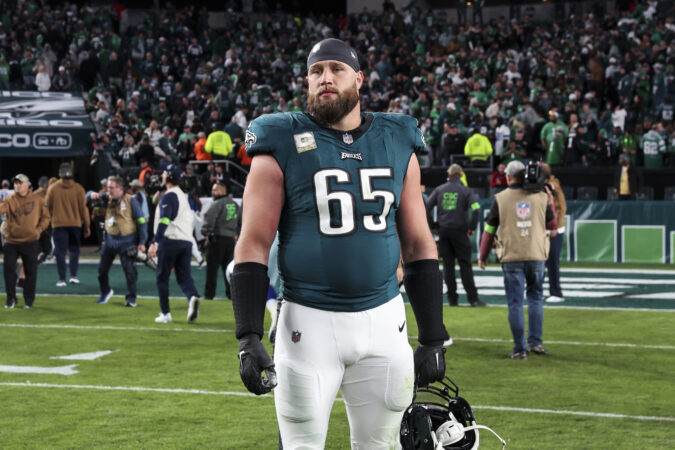
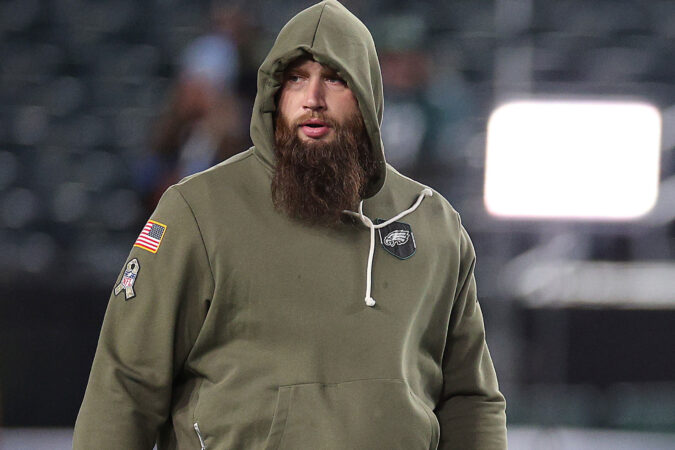
Lane Johnson is dealing with a Lisfranc sprain in his foot that is likely to sideline the Eagles’ star right tackle for multiple weeks, league sources confirmed to The Inquirer on Monday.
NFL Network was first to report the update on Johnson, who left Sunday’s 16-9 Eagles win over the Detroit Lions after playing just 14 snaps.
Johnson is awaiting results from X-rays with Dr. Robert Anderson, a foot and ankle specialist. While Johnson is believed to have suffered a sprain, a decision will be made if he needs potentially season-ending surgery, according to sources.
He is likely to miss at least 4-6 weeks with a sprain. A placement on injured reserve would force him to miss at least the next four games.
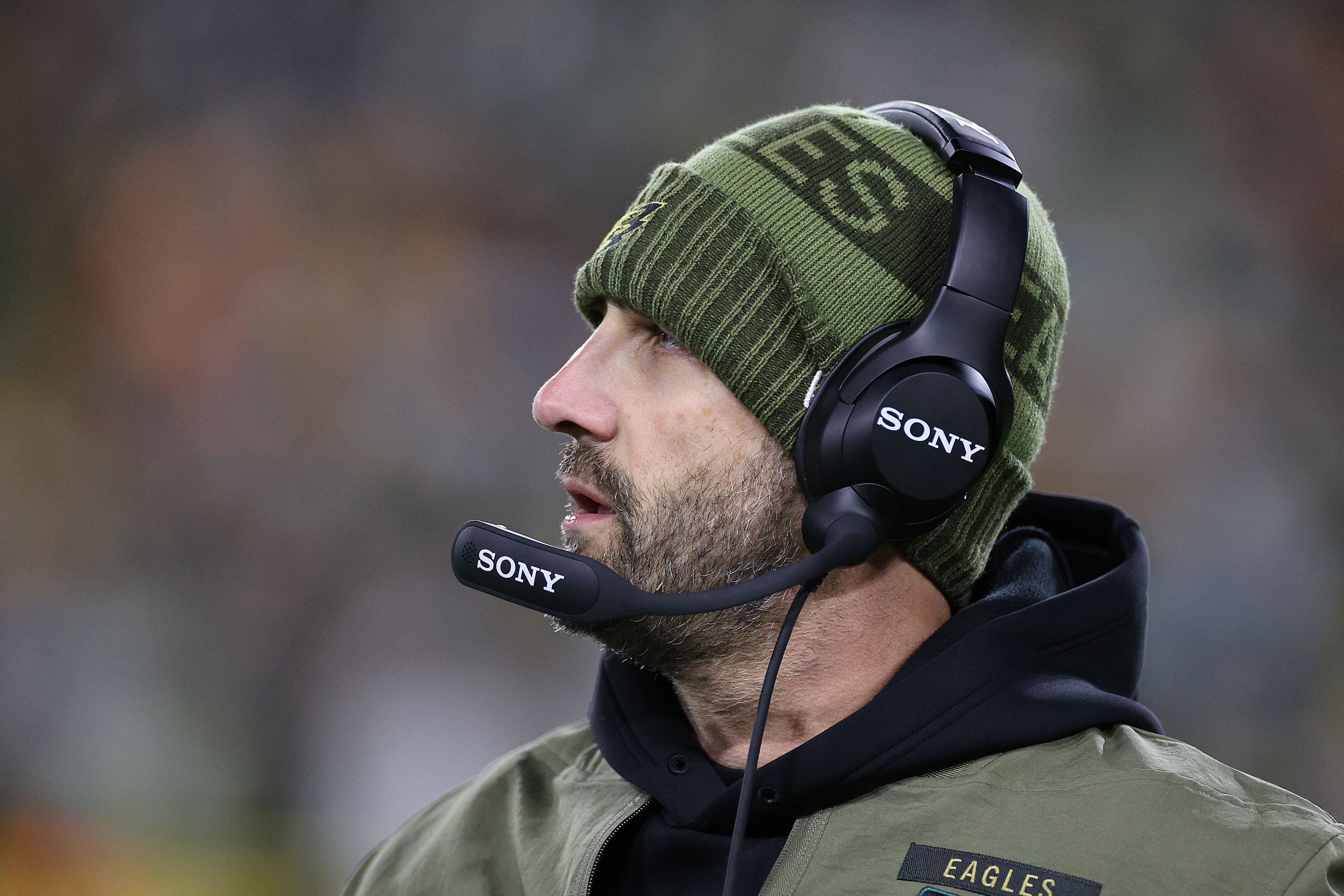
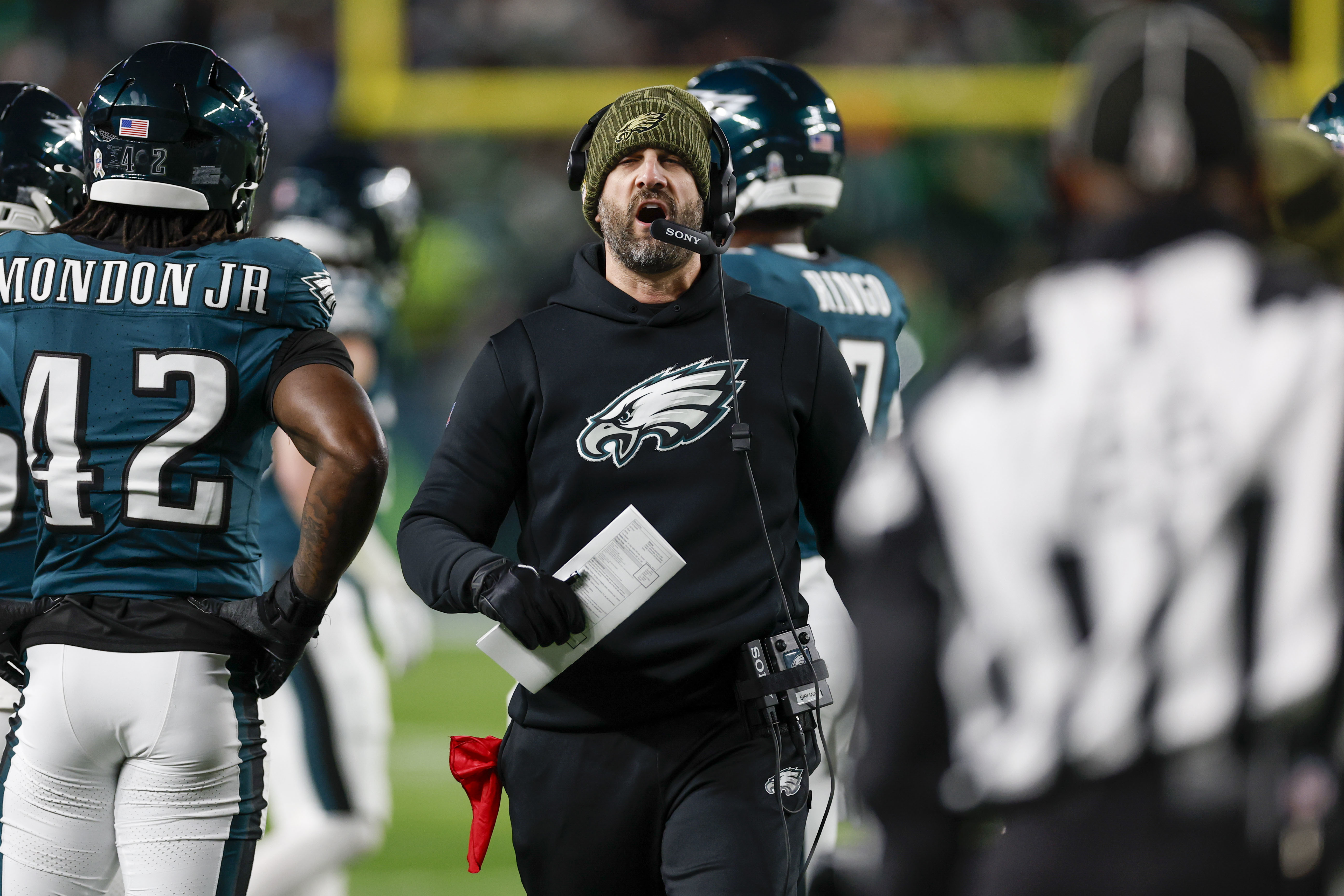
“I know that he’ll do everything he can do to get back as quick as he possibly can,” Eagles coach Nick Sirianni said Monday. Sirianni would not discuss a potential timeline.
The 35-year-old Johnson, who is playing in his 13th season, has dealt with multiple injuries this year. He left the Eagles’ Week 3 game against the Los Angeles Rams with a stinger, then left the team’s Week 4 game against Tampa Bay because of a shoulder injury. He left last week’s game against Green Bay with an ankle injury and missed a large chunk before returning in the fourth quarter.
Johnson, who has been a first- or second-team All-Pro selection in each of the last four seasons, has played in every game this season and continues to play at a high level despite battling multiple injuries.
This one, however, will cost him at least a few games, which historically presents a problem to the Eagles.
The Eagles are 12-23 in games Johnson hasn’t started since the beginning of the 2016 season. But backup tackle Fred Johnson has filled in well this season — and last year — when Johnson has missed time.
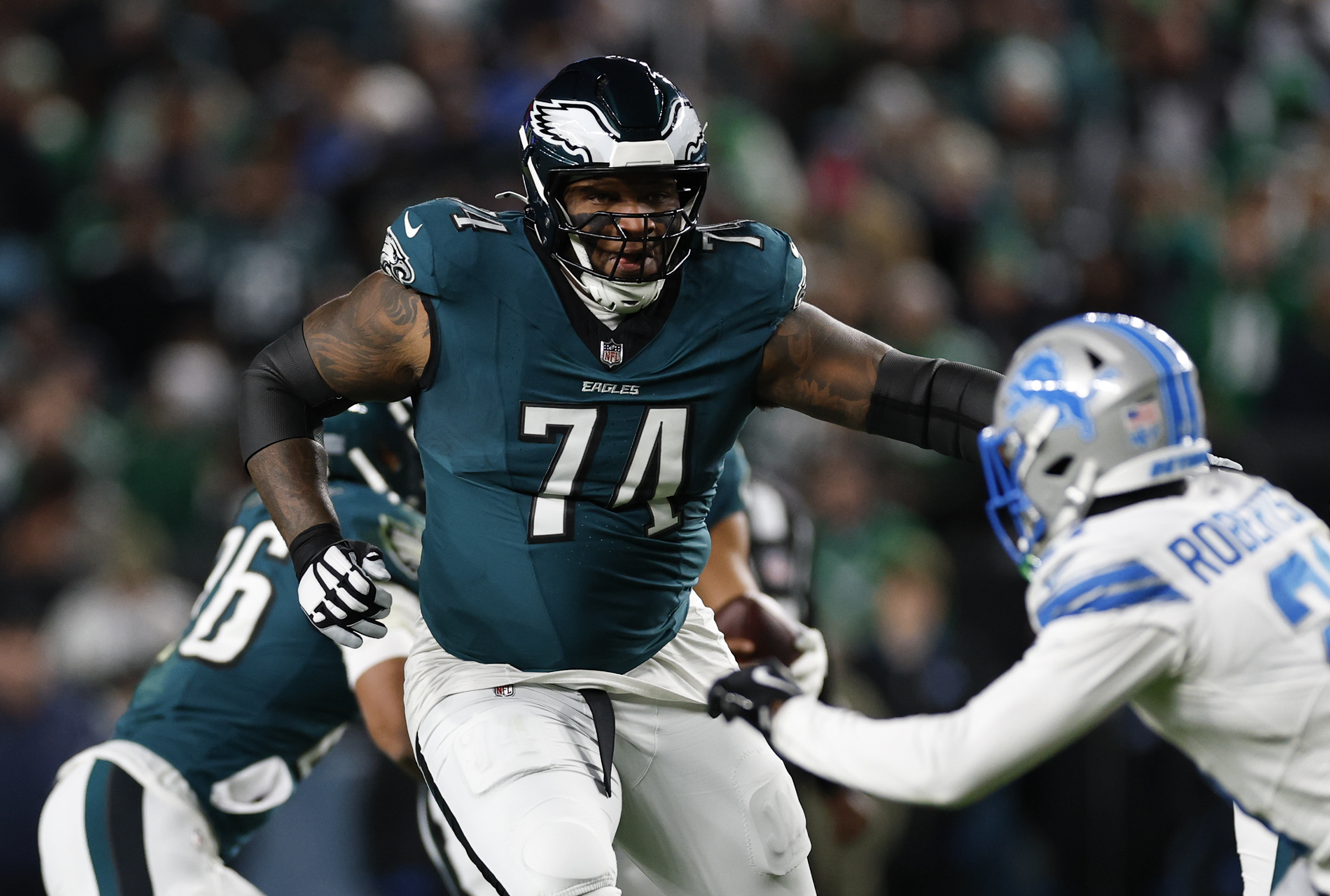
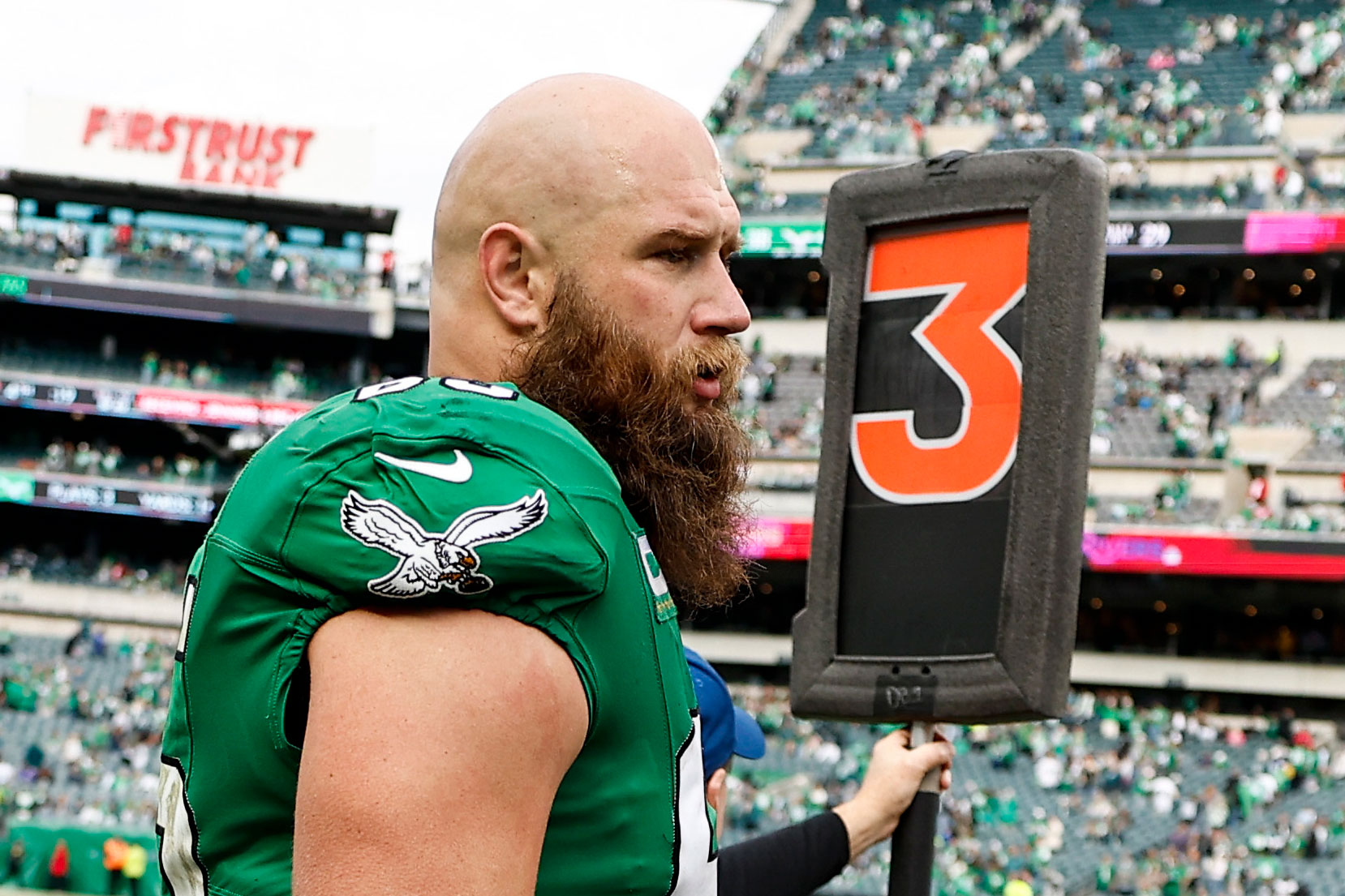
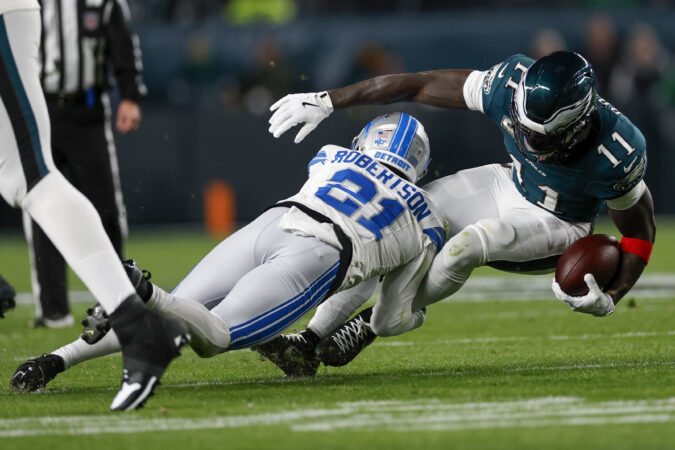
Eagles offensive tackle Fred Johnson keeps an eye on Lions cornerback Amik Robertson on Sunday.
The Eagles traded to bring Fred Johnson back at the end of training camp after the tackle left for Jacksonville in free agency. He has been a difference maker for the Eagles. They were 5-1 last season when he started and are 3-0 in games this season when he has come on in relief to play at least 50% of the offensive snaps.
The Eagles have been using Fred Johnson as an extra tight end in jumbo packages in recent weeks. That duty will fall to Matt Pryor, who saw four snaps Sunday night after Lane Johnson exited. Sirianni said the Eagles have confidence in both Fred Johnson and Pryor.
“I think they’ve played good football when they’ve been able to go in and play,” Sirianni said.
Fred Johnson, 28, played his first substantial snaps with the Eagles in 2024 after the team signed him to its practice squad in 2022. In Week 4 last year, he started his first game since the 2021 season, when he was a member of the Cincinnati Bengals. So far this season, he has played 181 offensive snaps and, according to Pro Football Focus, has allowed seven pressures and one sack on 78 pass blocking snaps.
Lane Johnson wasn’t the only Eagles offensive lineman to leave the game. Center Cam Jurgens also did not finish the contest.
Sirianni was not asked Monday for an update on Jurgens, who left the game in the fourth quarter Sunday. Jurgens was playing in his first game since Week 7, when he suffered a knee injury. It’s unclear whether he aggravated that injury or whether he’ll miss time.
Brett Toth filled in for Jurgens after he left the game.
Sirianni on fourth-down decision
Six days after the analytics overwhelmingly supported the Eagles punting on fourth down at the end of the Packers game (to the tune of a 5% increase in win percentage if they would have punted), Sirianni again made an aggressive fourth-down decision that didn’t go the team’s way.
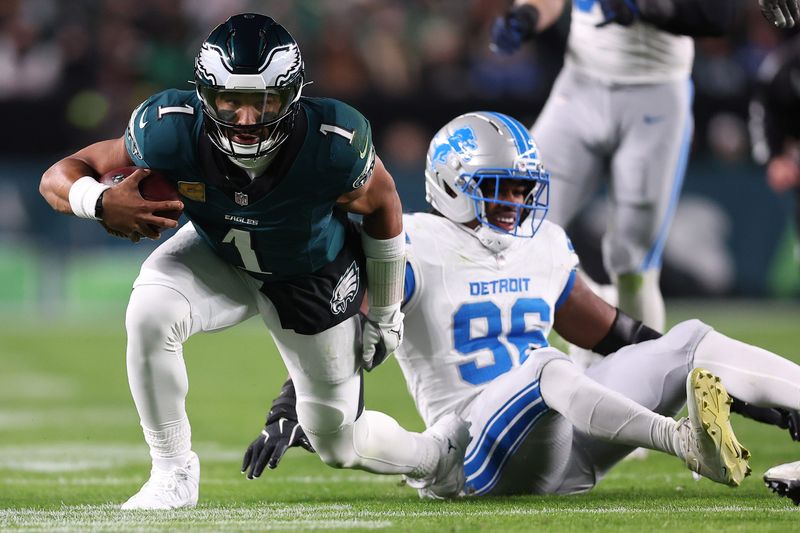
The Eagles, leading the Lions by 10 points, tried to Tush Push their way to a first down on a fourth-and-1 from their own 29-yard line with three minutes to play. The Eagles, down two starters on the offensive line, got stuffed, and the Lions took over in scoring range. They cut the lead to one score and almost got the ball back again to try for a game-tying drive.
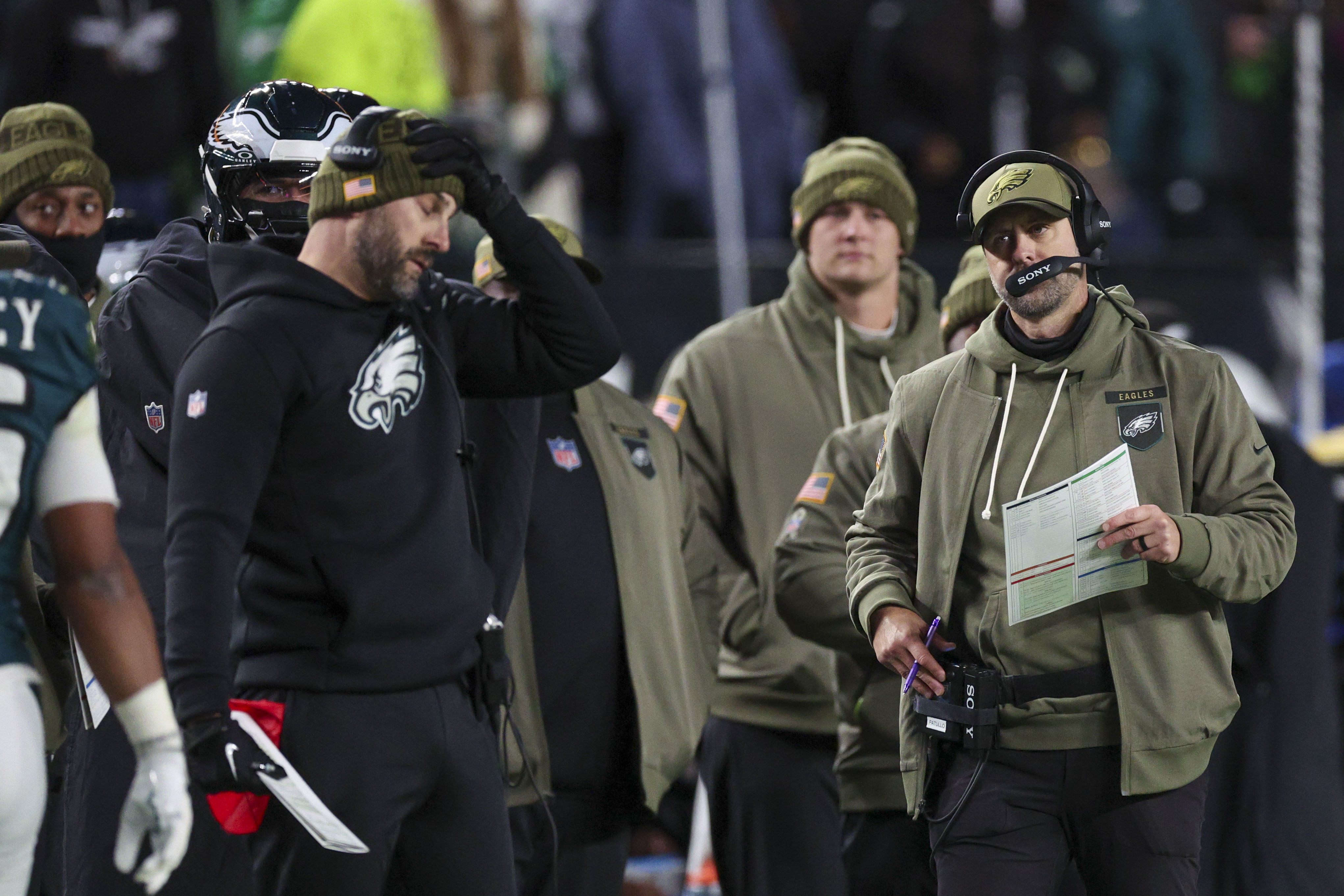
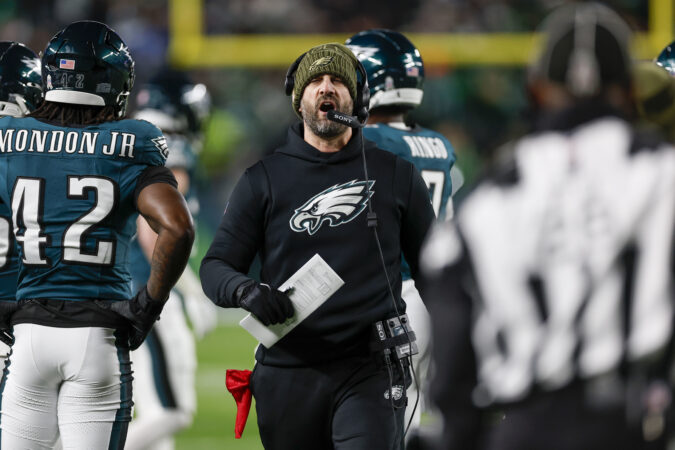
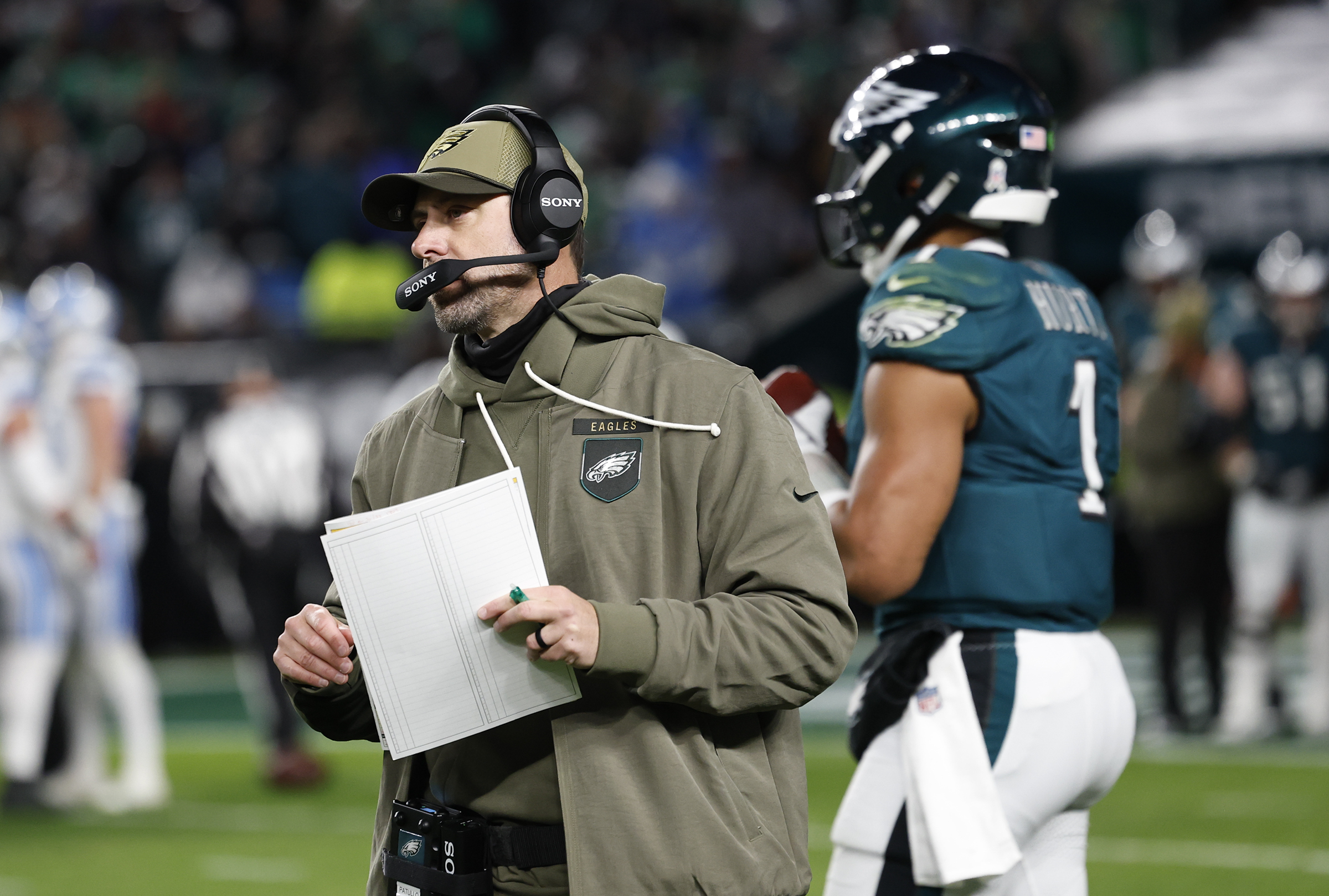
Eagles offensive coordinator Kevin Patullo (right) and coach Nick Sirianni after running back Saquon Barkley lost a few yards on a play against the Lions.
Sirianni took the blame for the decision not working after the game and was asked again about the topic on Monday. The fifth-year Eagles coach said the decision starts with his confidence in his players and the play.
“The analytics can say what it wants, but if you don’t have faith in the players to go execute it, that doesn’t give you a lot of confidence,” he said. “Analytics is a piece of the puzzle. All these different things are a piece of the puzzle: your past successes, the league studies that you do. All these things play into that. I love our process. Just because you have a great process doesn’t automatically mean you’re going to convert every fourth down.”
The Eagles have learned that over the last two weeks.
The Eagles failed to convert a pair of crucial fourth downs in the their last two games, but still managed to come away unscathed.
Six days after the analytics overwhelmingly supported the Eagles punting on fourth down at the end of the Packers game — to the tune of a 5% increase in win percentage had they punted — Nick Sirianni again made an aggressive fourth-down decision that didn’t go the Eagles’ way.
The Eagles, ahead by 10 points, tried to Tush Push their way to a first down on a fourth-and-1 from their own 29-yard line with three minutes to play. The Eagles, down two starters on the offensive line, got stuffed, and the Lions took over in scoring range. They cut the lead to one score and almost got the ball back again to try for a game-tying drive.
Sirianni took the blame for the decision not working after the game, and on Monday was asked again about the topic. The fifth-year Eagles coach said the decision starts with his confidence in his players and the play.
“The analytics can say what it wants, but if you don’t have faith in the players to go execute it, that doesn’t give you a lot of confidence,” he said. “Analytics is a piece of the puzzle. All these different things are a piece of the puzzle: your past successes, the league studies that you do. All these things play into that. I love our process. Just because you have a great process doesn’t automatically mean you’re going to convert every fourth down.”
The Eagles have learned that over the last two weeks.
“Ultimately I have to make those tough calls and be able to have that conviction,” Sirianni said. “When you don’t convert on fourth down it is always going to be on you as a head coach because you ultimately made that decision. And you’re not going to get a lot of praise when you get it on first down … it just doesn’t go that way.
“You have to have a major process that you go through to put yourself in a position where you can have major conviction when you make those decisions. Fully accept all the criticisms that happen when you don’t get it, because that’s my job as the coach, but it can’t affect you moving forward of making the right decisions with the right process as we continue on.”
Eagles film review: Jalen Carter’s dominance, Brandon Graham’s impact
Underrated credit goes to Brandon Graham on the #Eagles first fourth down stop of the game on a tackle that Moro Ojomo made last night. Graham knocks back the #Lions LG into Jahmyr Gibbs and halts his momentum. pic.twitter.com/Z6jKHlAydX
Another dominant game from #Eagles DT Jalen Carter defending the run (also helped create a sack for Jaelan Phillips and batted 2 passes at the LOS).
His quickness and ability to stack, shed, and close just makes it tough for offenses to run through the middle of this defense. pic.twitter.com/Sc9Y2Hmqsx
Even on the plays that ended in a tipped or batted ball, #Eagles DB Quinyon Mitchell stayed in the hip pocket of Lions receivers all game long. Made plays on the ball against Amon-Ra St. Brown and Isaac Teslaa on back-to-back plays, then was in position to make plays on the ball… pic.twitter.com/5lPnvTXI0K
What is a Lisfranc injury, and what is Lane Johnson’s recovery time?
Lane Johnson is waiting on X-ray results to determine if he needs season-ending surgery.
Eagles right tackle Lane Johnson is expected to miss multiple weeks with a Lisfranc sprain in his foot that could land him on injured reserve.
Johnson suffered the midfoot injury in the first quarter and did not return to the game.
What is a Lisfranc injury?
According to the Neville Foot & Ankle Centers, “Lisfranc injuries often occur as a result of a high-energy impact to the midfoot. It’s common to see fractures of the Lisfranc Joint in contact/collision sports like American Football, however low energy incidents (like twisting) can also be a cause.”
According to the Cleveland Clinic, a Lisfranc injury is “any damage to the Lisfranc joint on top of your foot. It’s where your metatarsal bones (the bridges to your toes) connect to the rest of your foot.”
Cleveland Clinic describes the Lisfranc joint as “a busy highway or on-ramp” because so many parts of the foot meet up in one place.
Where does the name come from?
The Lisfranc was named, according to the National Institutes of Health, in homage to French physician Jacques Lisfranc de St. Martin, “who was the first to describe an amputation through this joint.”
Lisfranc was a surgeon and OBGYN who during the Napoleonic Wars was brought in to help France, which was dealing with a physician shortage.
The story has it that a soldier dismounting from his horse had his foot stuck in the stirrups. The blood flow to his lower limb was stopped and it created a “gangrenous foot,” according to the Neville Foot & Ankle Centers. Lisfranc described the surgery as “amputation of the foot through the tarsometatarsal articulation.”
Does a Lisfranc injury require surgery?
Unlike in Lisfranc’s days, the injury isn’t a prescription for an amputation anymore.
It sometimes doesn’t even require surgery.
In Johnson’s case, it might. He is awaiting results from X-rays from Dr. Robert Anderson. While he is believed to have suffered a sprain, a decision will be made if he needs potentially season-ending surgery, according to sources.
Non-surgical Lisfranc injuries could take about six to eight weeks to recover, but sometimes less. If Johnson doesn’t require surgery, he could be back on the field after four to six weeks.
Anderson, a former Packers and Panthers physician, is a sort of NFL authority on the Lisfranc injury.
Have other Eagles suffered Lisfranc injuries?
Yes. Many of them.
Offensive lineman Isaac Seumalo suffered a Lisfranc injury in September of 2021 that required season-ending surgery. Two years earlier, defensive tackle Malik Jackson suffered a season-ending Lisfranc injury in a season-opening game.
More recently, Nakobe Dean suffered a Lisfranc sprain in early November of 2023 that required surgery and ended his season.
Others, like Cre’Von LeBlanc, have suffered Lisfranc sprains that did not require surgery. LeBlanc suffered his injury in training camp in 2019, and while he did not have to have surgery, he did not make his season debut until December.
Johnson’s timeline will all depend on the severity of his sprain.
The Eagles beat the Cowboys, 24-20, in their season opener at the Linc.
After securing a 16-9 win at home over the Lions, the Eagles are gearing up to travel to AT&T Stadium to face the Dallas Cowboys. The teams last met in the season opener at the Linc, a game that saw the Eagles pull out a 24-20 win at home despite a big ejection, a lightning delay, and some shaky early defense.
Now, the Eagles defense looks the best they have all season. Meanwhile, the Cowboys are preparing to play the Las Vegas Raiders on Monday Night Football after losing their last two games.
Ahead of their Week 12 matchup, sportsbooks are favoring Philadelphia, who opens as a 4.5-point favorite at both FanDuel and DraftKings.
The younger Johnson will likely play a critical role at right tackle on the Eagles offensive line for the next month and a half. But just a few months ago, he wasn’t even on the team.
Howie Roseman acquired the 6-foot-7, 326-pound Johnson from the Jacksonville Jaguars on Aug. 24, two days before the roster cutdown deadline, in exchange for a 2026 seventh-round pick. Johnson had signed to the Eagles’ practice squad in 2022 and had served as the depth tackle from 2023-24, but he opted to join the Jaguars in free agency with the aspiration to earn a starting gig.
That didn’t work out, but Johnson said he wasn’t disappointed in the aftermath of the trade.
“I went down there with the right mentality, with the right goals, and I attacked it the right way, the process,” Johnson said on Aug. 27. “It’s one of those things that didn’t end up working out. I developed a lot more of my game mentally and what I go through and how I attack stuff. I’m back here, back ready to do what I’ve got to do for this team and get another opportunity and do what I’ve got to do.”
Johnson played his first substantial snaps with the Eagles in 2024 and started his first game since the 2021 season when he was a member of the Cincinnati Bengals, the team that claimed him off waivers from the Pittsburgh Steelers in his rookie year in 2019. The Steelers had signed Johnson as an undrafted free agent out of Florida.
He played a critical role in the Eagles’ 2024 Week 3 win over the New Orleans Saints when he stepped in for Johnson, who went down with a concussion in the first quarter. Johnson started one game at right tackle and four at left tackle last season while Jordan Mailata was sidelined with a hamstring issue.
This year, Johnson has filled in for the elder Johnson on 144 snaps as he dealt with various injuries. He’s also served as the sixth offensive lineman when the Eagles utilize their jumbo package. With Johnson expected to start at right tackle, Matt Pryor is the next in line to step into the sixth offensive lineman role.
Lane Johnson waiting on X-ray results, season-ending surgery possible
Lane Johnson is awaiting results from X-rays with Dr. Robert Anderson. While he is believed to have suffered a sprain, a decision will be made if he needs potentially season-ending surgery, per sources.
Lane Johnson expected to miss 4-6 weeks with foot injury
Lane Johnson could be back in time for the playoffs.
Eagles star right tackle Lane Johnson is dealing with a Lisfranc sprain in his foot likely to sideline him for multiple weeks, league sources confirmed to The Inquirer.
NFL Network was first to report the update on Johnson, who left Sunday’s 16-9 Eagles win over the Detroit Lions after playing just 14 snaps.
Johnson will undergo further testing, and while the injury is not expected to end his season, he is likely to miss four to six weeks. A placement on injured reserve, which is likely, would force him to miss at least the next four games.
Johnson, who is 35 years old and playing in his 13th season, has dealt with multiple injuries this season. He left the Eagles’ Week 3 game against Los Angeles with a stinger, then left the team’s Week 4 game due to a shoulder injury. He left last week’s game vs. the Green Bay Packers due to an ankle injury and missed a large chunk before returning in the fourth quarter.
Johnson, who has been a first- or second-team All-Pro selection in each of the last four seasons, has played in every game this season and continues to play at a high level despite battling multiple injuries.
This one, however, will cost him at least a few contests. The Eagles are 12-23 in games Johnson hasn’t started since the beginning of the 2016 season. But backup tackle Fred Johnson has filled in well this season — and last year — when Johnson has missed time.
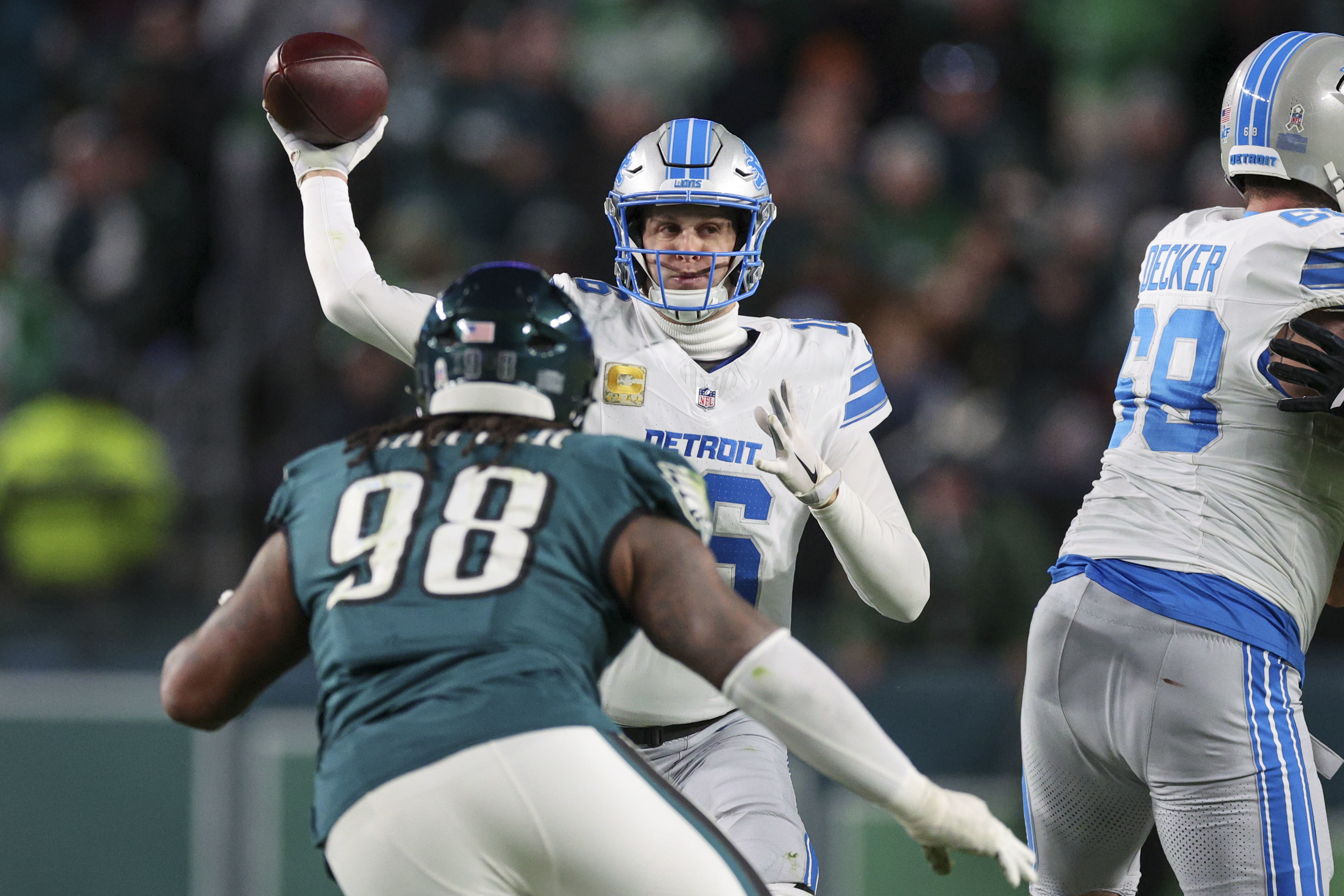
Jalen Carter puts pressure on Jared Goff during Sunday’s win against the Lions.
Jordan Davis, who batted three of Jared Goff’s passes, said it started with film study earlier in the week.
The Eagles noticed Goff had an arm angle that would give them a chance to deflect balls up front, so they spent extra time this week practicing deflections. The Eagles coach their players along the defensive front to get their hands in the air when they’re being double-teamed or if their pass rush is failing on a given play.
This week, the Eagles worked more on the tip drill. Sometimes it was Nick Sirianni at quarterback. Other times it was defensive line coach Clint Hurtt or player development assistant Matt Leo.
Turning drills in practice into on-field success was reminiscent of the Eagles’ Week 7 win over the Minnesota Vikings. Prior to that game, the Eagles sent their edge rushers through extra catching drills. Jalyx Hunt had dropped an interception a week earlier. Against Minnesota, Hunt dropped into coverage and returned an interception for a touchdown.
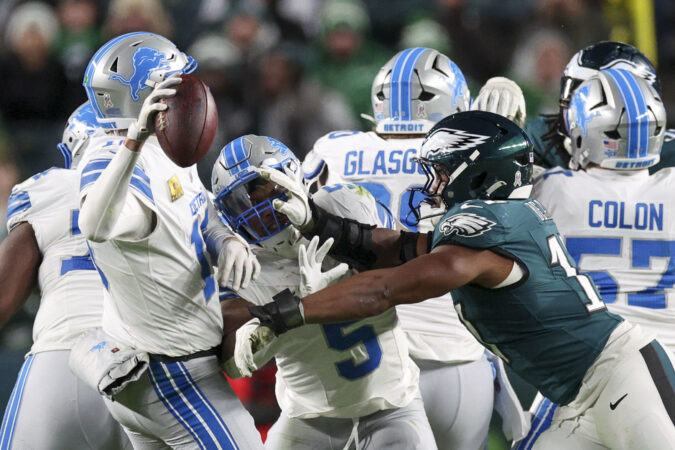
On Sunday, the Eagles batted five of Goff’s passes. Davis started it all on the first drive, when he batted a pass into the air that Cooper DeJean intercepted.
For the second consecutive game, the Eagles, with their new-look defensive front, dominated a good opponent.
Jaelan Phillips’ busy night, Jihaad Campbell getting less playing time
Eagles linebacker Jaelan Phillips played 76% of the defensive snaps Sunday night.
The Eagles’ offense was on the field for 72 snaps Sunday while the defense played 59 plays. Here are some notes and thoughts from Sunday’s snap counts vs. the Lions:
Rookie linebacker Jihaad Campbell saw his lightest workload of the season. His 20 snaps were just behind the 21 he played in Week 8 vs. the New York Giants. Nakobe Dean’s return (40 snaps, 68%) has meant less time on the field for Campbell, who, according to Pro Football Focus, lined up on the edge just three times and in the box 17 times.
Cornerback Adoree’ Jackson saw much more of the field Sunday than he did last week vs. Green Bay. That’s because the Eagles were rarely in their base package with just four defensive backs. When that package is deployed, Cooper DeJean moves outside. But the Eagles were often in nickel and at least once went into a dime package. Jackson played 57 of a possible 59 snaps. The 57 snaps tied a season-high. Jackson held up well, too, despite being burned for a long pass to Jameson Williams.
Jaelan Phillips led the edge rushers with 45 snaps (76%). Nolan Smith still seems to be on a pitch count like he was last week when he returned from a triceps injury that had him on injured reserve since after Week 3. Smith played 37% of the snaps while Jalyx Hunt was on the field 61% of the time. Brandon Graham got out there for eight snaps (14%) and almost picked up his first sack of the season. Josh Uche, meanwhile, is the odd one out of the rotation. He played solely on special teams (nine snaps).
Offensively, the Eagles played a lot of 11 or 12 personnel. They rarely had more than two receivers on the field. Jahan Dotson played 23 snaps (32%), though he did contribute with two catches for 43 yards. Darius Cooper, meanwhile, the fourth receiver, saw just three snaps.
Lane Johnson left a game early for the fourth time this season. He finished with just 14 snaps before suffering a foot injury. Cam Jurgens also left early. He played 61 snaps before Brett Toth came in for the final 11 offensive plays.
Saquon Barkley’s workload was over 80% (58 snaps, 81%) for the first time since Week 6.
Eagles head coach Nick Sirianni just keeps winning.
The narrative that the Eagles win in spite of Nick Sirianni still exists despite his continued success.
His detractors were given more ammunition on Sunday with another lackluster offensive performance and another aggressive fourth-down gamble from the coach that failed. They’ll point to contradictory decision-making that leaned conservative early on, but was almost reckless in the latter stages at Lincoln Financial Field.
Sirianni’s critics will credit Vic Fangio and his defense for the Eagles’ 16-9 victory over the Detroit Lions. They’ll say any coach can win with the roster general manager Howie Roseman has assembled. And some will spend the next week digging through stats and film to support their claim.
They might have an argument, especially this season. This version of the Eagles may defy logic. But it’s hard to debate facts. They’re 8-2 and possibly two more wins from clinching the NFC East before December. They sit atop the conference having already beaten the 8-2 Rams, not to mention five other playoff teams from last season.
And Sirianni just piles up Ws — 56 in his first 78 regular season games — and in each of his five seasons in Philly he’s found a different way to do so. For most of this season, the Eagles have been a team in search of an identity.
They haven’t quite found one on offense and that remains a concern. But after two dominating defensive performances, it’s clear the Eagles can ride Fangio’s unit to the playoffs as long as Sirianni’s aesthetically unpleasing philosophy holds.
Eagles linebacker Jaelan Phillips celebrates following Sunday’s win against the Lions.
The Eagles’ magic number to win the NFC East is four.
The Birds improved to 8-2 Sunday night, and are currently four-and-a-half games up on the Dallas Cowboys in the NFC East, which the Eagles could clinch before December.
If the Cowboys lose tonight against the Las Vegas Raiders and the Birds defeat them next week in Dallas, the Eagles will be five-and-a-half games up with just six to play. The Washington Commanders, currently five games back, have their bye next week.
The Cowboys’ upcoming schedule is also tough, which also helps the Eagles. After the two face off Sunday, Dallas has to play the Kansas City Chiefs and Detroit Lions.
What helps is the Eagles currently hold tiebreakers against four of the top six NFC teams — the Lions, Los Angeles Rams, Tampa Bay Buccaneers, and Green Bay Packers. They can add the Chicago Bears to that list on Black Friday.
As for the rest of the NFC, the Rams, Bears, and Buccaneers are currently the division leaders, while the three wild card teams are the Seattle Seahawks, Packers, and San Francisco 49ers.
If the season were to end today, the Lions wouldn’t qualify for the playoffs.
NFC playoff picture
window.addEventListener(“message”,function(a){if(void 0!==a.data[“datawrapper-height”]){var e=document.querySelectorAll(“iframe”);for(var t in a.data[“datawrapper-height”])for(var r,i=0;r=e[i];i++)if(r.contentWindow===a.source){var d=a.data[“datawrapper-height”][t]+”px”;r.style.height=d}}});
Week 12 elimination scenarios
As of now, it doesn’t look like there are any official elimination scenarios in the NFC heading into Week 12, but it seems unlikely five teams — the Arizona Cardinals, Atlanta Falcons, Washington Commanders, New Orleans Saints, and New York Giants — have much of a shot of turning things around.
Jalen Hurts and the Eagles’ offense struggled again
Jalen Hurts and the Eagles offense have scored just 26 points combined in their last two games.
The Eagles are a very good team. Winning football games is important. But so is progress. Right now, the Eagles are a long way off from being the best team they can be.
Nothing that we saw from them on Sunday night suggests their fundamental problem has been solved. It isn’t just that the Eagles aren’t scoring enough points. It’s that they don’t appear to be getting any better.
They have scored 17 or fewer in four of their last six games, including a combined 26 in their last two. Are they capable of winning a Super Bowl in their current form? Absolutely. But you can’t ignore how different their current form is from the one that saw them win the Super Bowl last season.
For the second straight game, and for the fifth time this season, the Eagles failed to crack 300 yards of total offense. That only happened three times all last season. Heck, it only happened five times in 2023.
Give them credit for trying something new. They tried to force the ball to Brown, which is something that he and plenty of Eagles fans have been lobbying for in recent weeks. His 11 targets were more than he had in the last two games combined, including last week’s three-target, two-catch nothingburger in Green Bay.
The concerning thing is that nothing else changed. Brown’s seven catches went for just 49 yards. The Eagles scored just one touchdown. Even on a night where Jared Goff was out of sync and the Lions went 0-for-5 on fourth down, Detroit’s offense looked like the more highly evolved unit. The pinnacle came in the second quarter, when Goff hit Amon-Ra St. Brown for 34 yards and then Jameson Williams for a 40-yard touchdown. The 74 yards the Lions gained on two plays were more than the Eagles had gained all game to that point.
A.J. Brown and the Eagles benefited from a bad call late in the game.
Thankfully the worst pass interference call so far this season worked in the Eagles’ favor.
With just under two minutes left, Jalen Hurts failed to connect with A.J. Brown, which would have given the Lions one final chance to tie the game.
Instead, the officials called pass interference on Lions defender Rock Ya-Sin, a call so bad even NBC’s Cris Collinsworth ripped the refs.
“Oh come on. That is terrible,” Collinsworth said during the broadcast. “That is an absolutely terrible call that’s going to decide this football game.”
Cris Collinsworth: "Oh, come on! Come on! That is terrible! That is an absolutely terrible call that's going to decide this football game! If anything, it's an offensive push!"
And it did. The penalty gave the Eagles a first down, and they were able to run out the clock, preventing Jared Goff and the Lions offense from getting one final shot at evening the score.
Following the game referee Alex Kemp was asked by the Athletic’s Zach Berman, the designated pool reporter, about the penalty.
“The official observed the receiver’s arm getting grabbed and restricting him from going up to make the catch,” Kemp said. “So, the ball was in the air, there was a grab at the arm, restricted him and he called defensive pass interference.”
“I thought he played defense like he did the whole game,” Lions head coach Campbell told reporters following the game. “I thought he challenged and played it like he did the very first rep that we played man-to-man. So I wouldn’t tell him to do anything different: Get up there and challenge and play your style. That’s it.”
The Eagles were also the victim of a bad call. Facing third-and-1 from their own 41-yard line in the middle of the third quarter, right guard Tyler Steen was called for a false start when it seemed obvious he was pointing out Lions defender Tyleik Williams had entered the neutral zone.
“That’s a neutral zone infraction,” said NBC rules analyst and former NFL referee Terry McAulay.
Tyler Steen was called for a false start for pushing the Lions’ hand out of the neutral zone pic.twitter.com/qi6ivspqy2
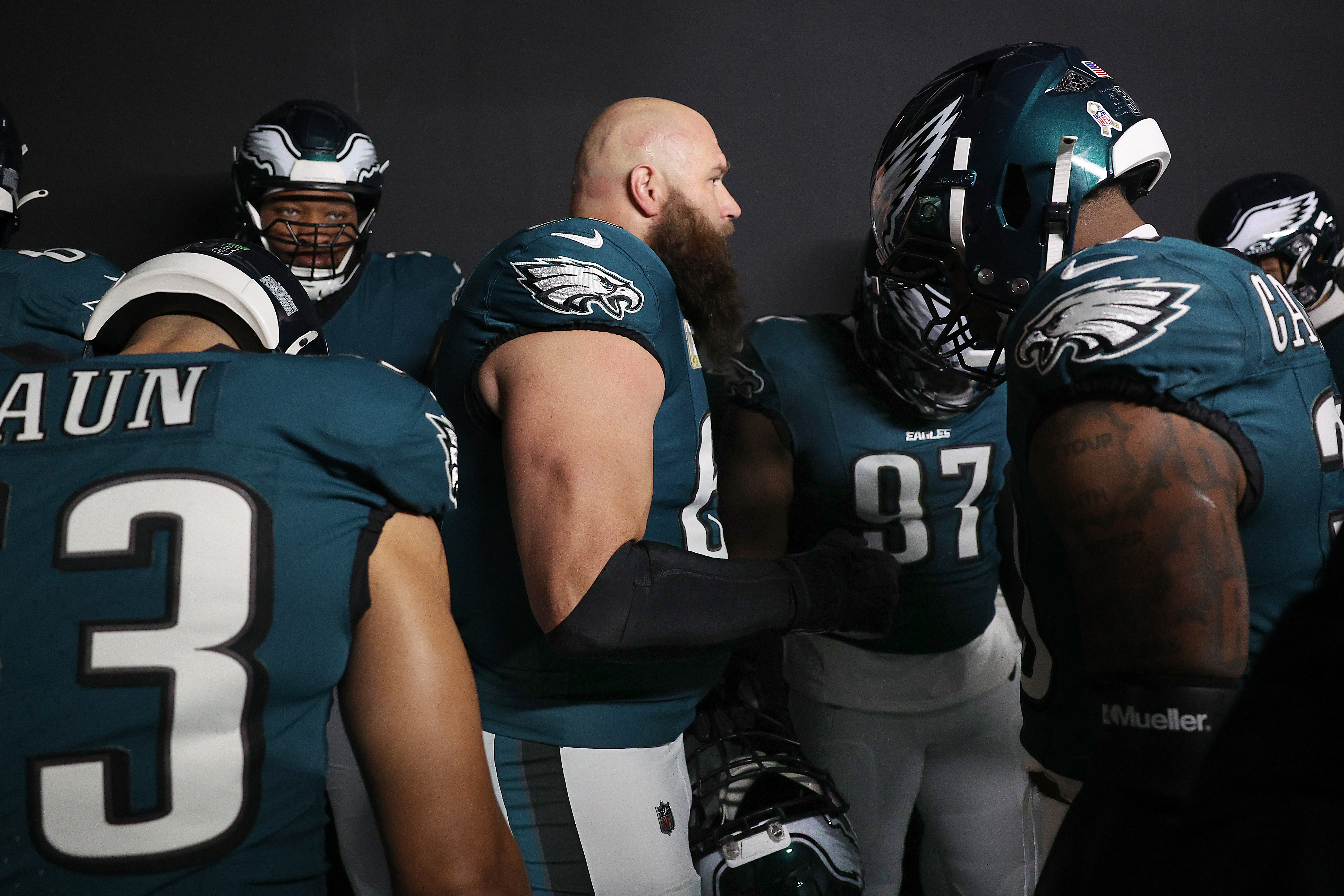
Lane Johnson (center) gives a pep talk to his teammates prior to Sunday’s win against the lions.
Offensive tackle Lane Johnson went down with a foot injury late in the first quarter and didn’t return. He suffered a Lisfranc sprain in his foot and is expected to miss four to six weeks.
Center Cam Jurgens, who entered the game with a right knee injury, left late in the fourth quarter. The 26-year-old starting center went indoors after a visit to the medical tent and was replaced by Brett Toth.
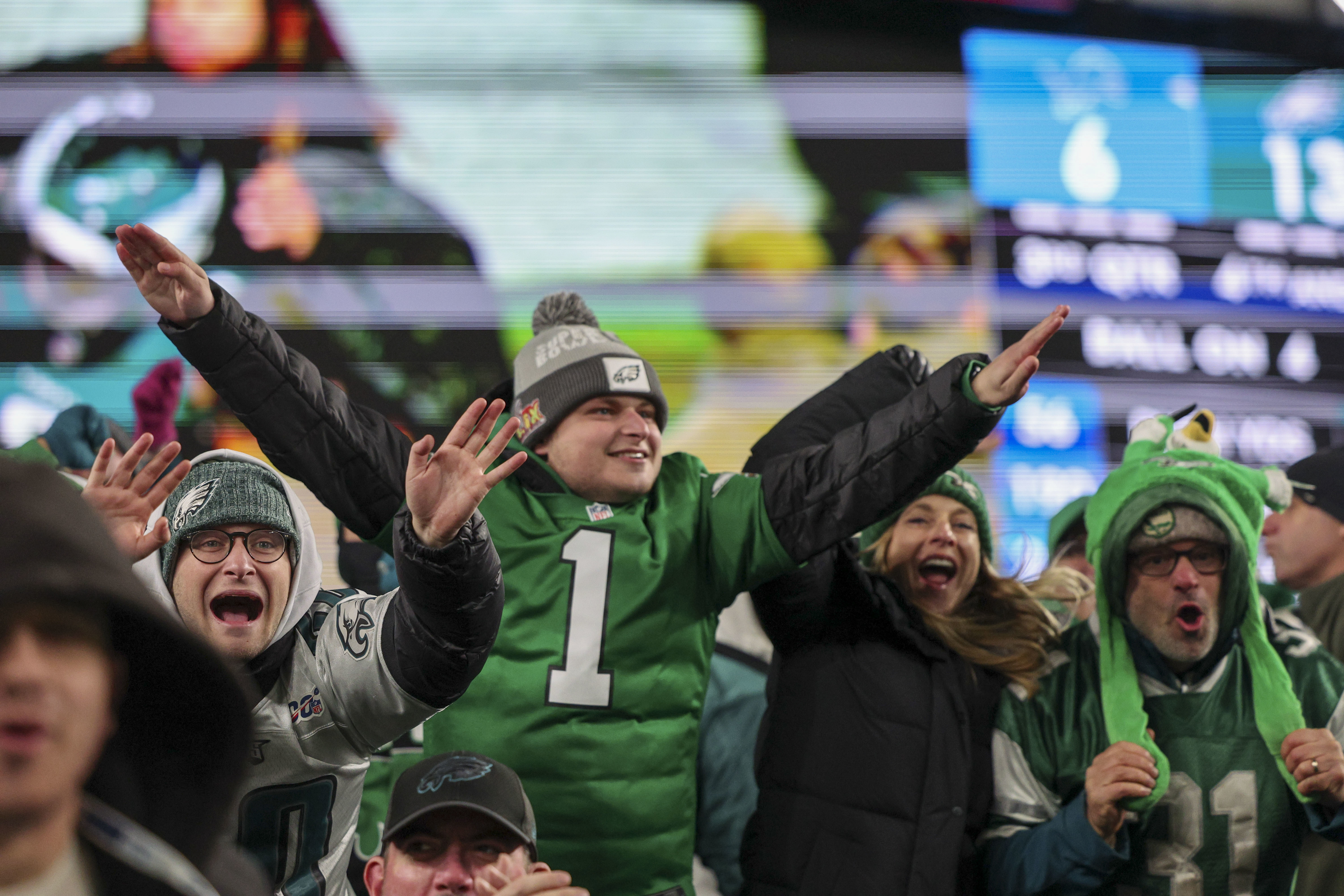
Eagles fans celebrate during the Birds’ win against the Lions Sunday.
The Eagles remain at the top of the NFC for another week thanks to their win against the Detroit Lions Sunday night.
It’s the fourth straight season the Eagles have started 8-2 or better, and Nick Sirianni is a perfect 11-0 as a coach against the NFC North, including playoff games.
Speaking of the playoffs, the Birds now have the head-to-head tiebreaker against four of the top six teams, with a chance to add the Chicago Bears on Black Friday.
NFC standings
window.addEventListener(“message”,function(a){if(void 0!==a.data[“datawrapper-height”]){var e=document.querySelectorAll(“iframe”);for(var t in a.data[“datawrapper-height”])for(var r,i=0;r=e[i];i++)if(r.contentWindow===a.source){var d=a.data[“datawrapper-height”][t]+”px”;r.style.height=d}}});
The Eagles also extended their lead in the NFC East Sunday thanks to the Washington Commanders’ wild overtime loss against the Miami Dolphins.
The Dallas Cowboys play tonight against the Las Vegas Raiders. A loss will push the Cowboys back four-and-a-half games behind the Eagles with seven left to play.
NFC East standings
!function(){“use strict”;window.addEventListener(“message”,function(a){if(void 0!==a.data[“datawrapper-height”]){var e=document.querySelectorAll(“iframe”);for(var t in a.data[“datawrapper-height”])for(var r,i=0;r=e[i];i++)if(r.contentWindow===a.source){var d=a.data[“datawrapper-height”][t]+”px”;r.style.height=d}}})}();
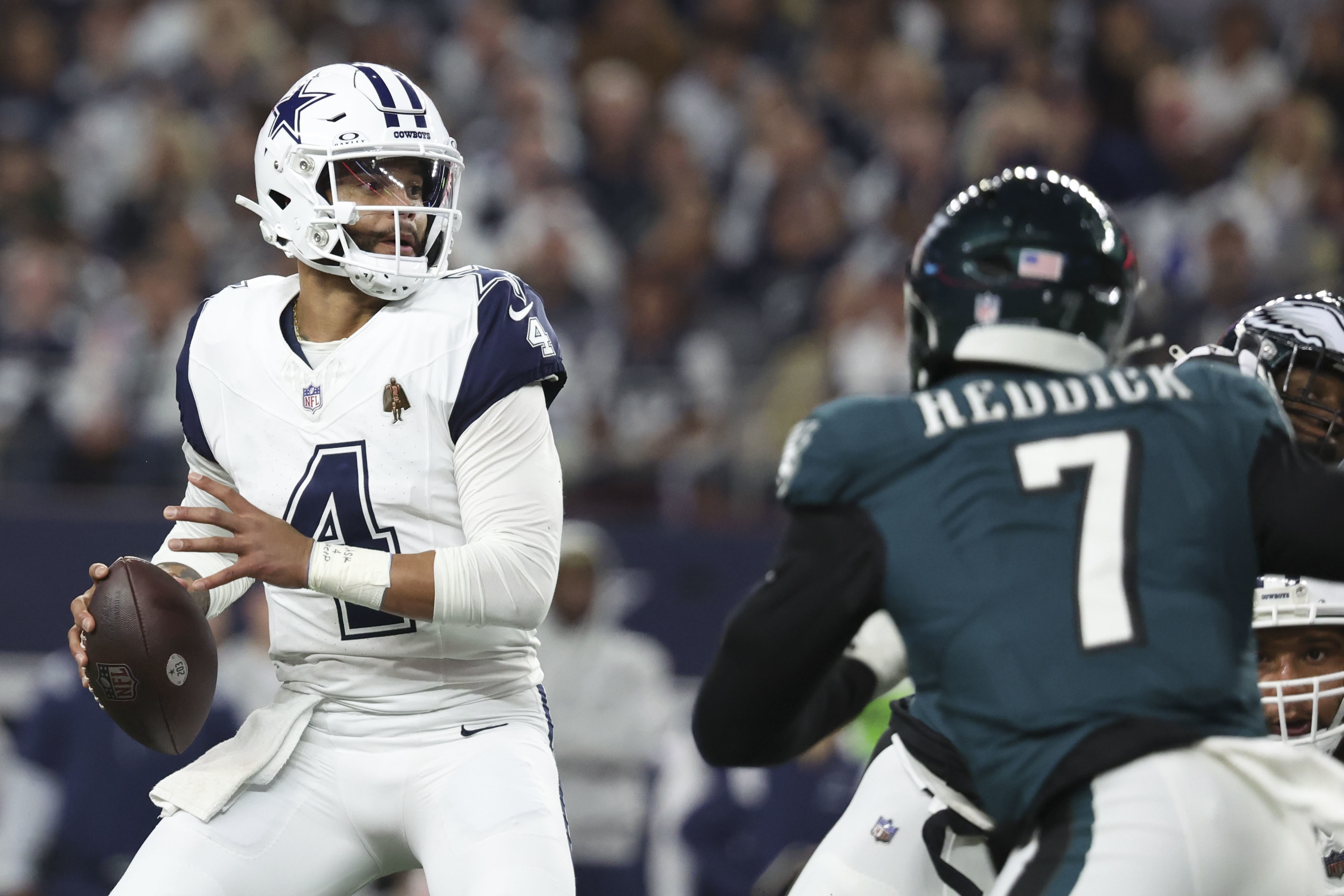
The Eagles defeated Dak Prescott and the Cowboys 24-20 way back in Week 1.
The Eagles will need another dominating performance by their defense next week against the Dallas Cowboys.
The Cowboys, who play tonight against the Las Vegas Raiders, are averaging 29.2 points per game, fourth-best in the NFL. Dallas has the No. 3 offense in the league and leads the NFL in passing yards, averaging 257.8 points per game.
It’s not like the Eagles’ defense isn’t capable. The Birds held the high-powered Detroit Lions offense to just nine points and 317 total yards, and the Eagles defense hasn’t allowed more than 10 points for two straight weeks.
The Eagles narrowly won their first matchup against the Cowboys, a 24-20 nail-biter in the NFL kickoff game, helped by CeeDee Lamb’s fourth-down drop late in the game. Dallas has lost three of their last four games, and are quietly watching their playoff hopes fade away.
The good news for the Eagles is the Cowboys have the third-worst defense in the league, allowing 378.4 yards and 29.2 points per game. If Jalen Hurts and the Eagles offense can’t get things going against the Cowboys, the Birds may be in store for a tough playoff run.
The narrative that the Eagles win in spite of Nick Sirianni still exists despite his continued success.
His detractors were given more ammunition Sunday with another lackluster offensive performance and another aggressive fourth-down gamble from the coach that failed. They’ll point to contradictory decision-making that leaned conservative early on but was almost reckless in the latter stages at Lincoln Financial Field.
Sirianni’s critics will credit Vic Fangio and his defense for the Eagles’ 16-9 victory over the Detroit Lions. They’ll say any coach can win with the roster general manager Howie Roseman has assembled. And some will spend the next week digging through stats and film to support their claim.
They might have an argument, especially this season. This version of the Eagles may defy logic. But it’s hard to debate facts. They’re 8-2 and possibly two more wins from clinching the NFC East before December. They sit atop the conference having already beaten the 8-2 Rams, not to mention five other playoff teams from last season.
And Sirianni just piles up W’s — 56 in his first 78 regular-season games — and in each of his five seasons in Philly he’s found a different way to do so. For most of this season, the Eagles have been a team in search of an identity.
They haven’t quite found one on offense and that remains a concern. But after two dominating defensive performances, it’s clear the Eagles can ride Fangio’s unit to the playoffs as long as Sirianni’s aesthetically unpleasing philosophy holds.
“I think our guys have this knack of knowing,” Sirianni said. “As I watched football today, I feel like I saw a lot of teams waiting to lose. Our team’s waiting to win because they know how to win.”
Some fans have become spoiled by all the winning since Sirianni arrived. There’s nothing wrong with having a high standard. The Eagles have it themselves and have struggled at times to enjoy the victories when they’ve looked unappealing, particularly on offense.
A.J. Brown has been the most vocal about the deficiencies and despite being targeted Sunday night more than the wide receiver has all season, the offense looked just as inept as it did last week at the Packers. The Eagles averaged just 3.9 yards per play vs. the Lions. They finished with their worst expected points added per drive (-1.40) in nearly two seasons.
But unlike in 2023, they have a defense and a coordinator to compensate. Even Brown seemed resolved to accept this current version of the Eagles. He may have no choice.
“We’re in the business of trying to get better,” Brown said. “It’s not that we just moping around. We’re excited. Guys were just here dancing.”
Sirianni is an offensive-minded coach, but the defense still works for him. Fangio is the schematic architect. And Roseman has built a young group that has elite talent at all three levels. But the coach has established a culture centered on a slogan — “Tough, detailed, together” — that may seem hackneyed until you watch his players execute it.
“I think it comes from the bond and the familiarity within the building,” quarterback Jalen Hurts said. “You’ve heard me talk a lot about those Georgia guys on the other side of the ball and how familiar they are with one another. I think they bring a special energy to the defense and into the team.
“You see it out there today with all those guys making plays. The defense was playing lights out. It was one of the best performances I’ve ever seen.”
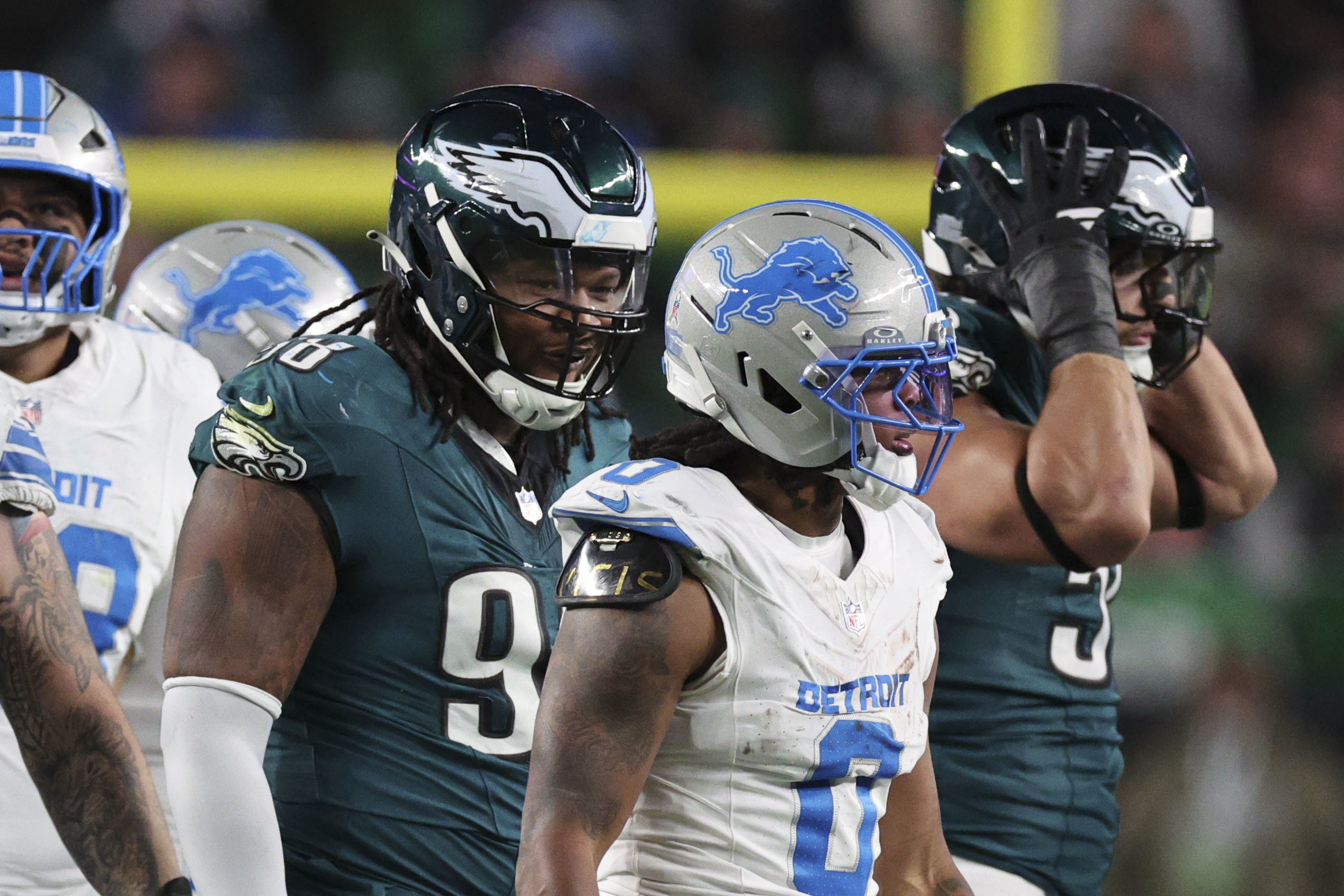
Eagles defensive tackle Jalen Carter has some words with Lions running back Jahmyr Gibbs.
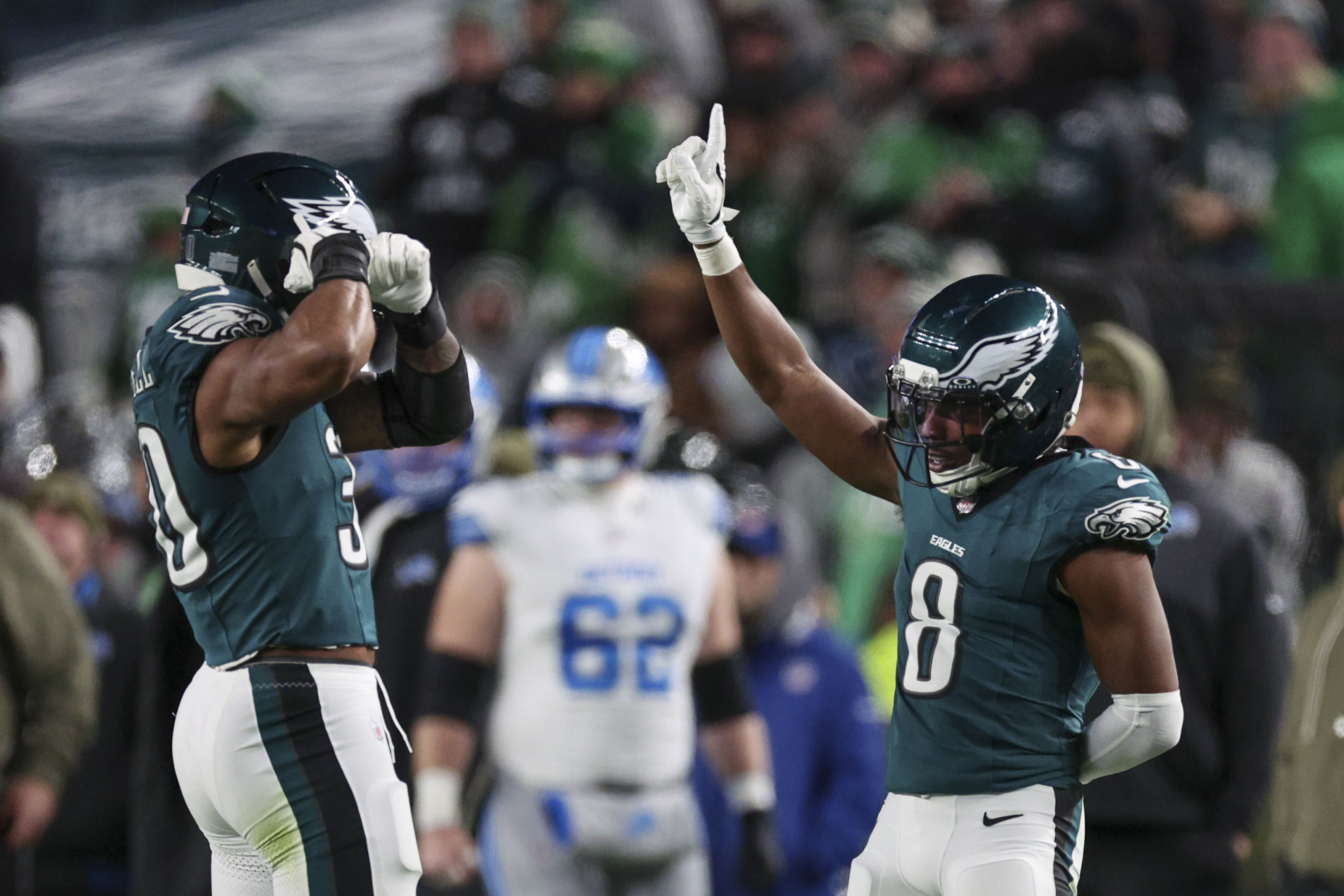
Two of the Georgia guys — defensive linemen Jordan Davis and Jalen Carter — combined to deflect five passes at the line of scrimmage. One of Davis’ deflected to cornerback Cooper DeJean for an interception.
It was the Eagles’ lone takeaway, but they had five fourth-down stops that Sirianni characterizes as turnovers. The offense, meanwhile, didn’t give the ball away and still has the lowest turnover percentage in the NFL.
“That’s always a philosophical staple and what he believes,” Hurts said of Sirianni and winning the turnover battle. “It’s always been that.”
It wasn’t the only offensive highlight. The four-minute offense finally delivered with running back Saquon Barkley (26 carries for 83 yards) picking up tough gains in the final moments. There were occasional glimmers.
But Hurts and Co. struggled again to get into any rhythm. Offensive coordinator Kevin Patullo’s play-calling resulted in more negative-yard plays and three- and-outs. There were self-inflicted wounds: dropped passes, penalties, missed blocks, and throws.
Hurts completed just 50% of his passes. He was sacked only once. Left tackle Jordan Mailata was instrumental in keeping Lions defensive end Aidan Hutchinson from wrecking the Eagles, especially after right tackle Lane Johnson left early with a foot injury.
But with Barkley failing to find light on the ground, the drop-back game often resulted in errant throws or Hurts scrambling and throwing the ball away. He forced the ball to Brown at times. Four of his first six attempts went to the receiver and 11 overall. Brown caught seven for 49 yards, but he never broke free after contact or found much separation downfield.
“It wasn’t about targets last week or the week before … it wasn’t about that at all,” Brown said. “It was me trying to help and contribute. That’s all. And regardless of what that looked like in phases, I think I did.
“But like I said, it’s a lot of stuff that we as [an] offense — and me myself — need to continue to get better at.”
A.J. Brown was more involved on Sunday night, but the offense remained inconsistent.
Asked about Brown’s targets after the receiver saw the ball come his way just three times in Green Bay, Hurts said he was “going with the flow of the game” and “how it was called.”
“That may be a KP question,” he added.
Hurts spoke with several reporters off the podium after his news conference ended in the early morning hours. He talked about the various ways the offense has approached each week based on game planning and how it has been defended. He wasn’t making excuses, but it’s obvious the Eagles are still trying to find an element to hang their hats on.
“We have to do a bit of identifying who we are, so we can find consistency in something and go out there and execute at a high level,” Hurts said earlier. “I think there was a lot of encouragement coming into the bye week, where we were still with a ton of room to improve. But you know what I feel about momentum, it can begin to end at any moment.
“But as I told you guys last week, is it half-full or half-empty? Everybody’s got to be all hands on deck and trying to improve that. Nothing takes over the precedent of winning.”
Hurts has faced the same scrutiny as Sirianni and the belief from some that he is a product of his supporting cast. But the idea that the offense, despite returning 10 of 11 starters, has elite talent across the board may be an erroneous one.
And yet, Sirianni rolled the dice on fourth-and-1 with the Tush Push — after falling short on third down — on the Eagles’ 29 with three minutes left in the game. He essentially handed Detroit at least three points when Hurts was stopped short, but his defense — some might say — bailed him out.
“Obviously, I’m going to be second-guessing myself about the fourth-and-1 in our own territory there, but awesome job by the defense holding them to three there,” Sirianni said. “We got about half of it the play before. I thought we could get the other half right there. We didn’t. I have to live with that when we don’t execute on fourth down.”
It was the second straight week that Sirianni’s fourth-down gamble nearly cost his team. Game management has mostly been a strong point, especially after he handed over offensive play calling in 2021. So he gets the benefit of doubt once more.
But the only guy in the Super Bowl era to win at least eight of the first 10 games of a season four times in his first five years — some guys named George Halas, Paul Brown, and Guy Chamberlin did it — may deserve more than that.
All you have to do is look at the rest of the NFL to put Sirianni’s accomplishments in perspective. Lions coach Dan Campbell had multiple dubious calls and decisions that backfired on him Sunday night.
Sirianni will face the gauntlet after another ugly win. He knows as well as anyone that the Eagles won’t likely win another Super Bowl if his offense keeps sputtering.
“Do we want things to be better? Yeah, of course,” he said. “You’re in a constant quest of getting better and we’re going to be crazy tomorrow about the things. We are working tomorrow.”
Seven hundred and twenty-four days ago, Nick Sirianni stared into a bank of TV cameras and dared the NFL — hell, dared the whole world — to stop the play that the Eagles had mastered and no one else in pro football had. It was late October 2023, and while holding a seven-point lead against the Miami Dolphins, the Eagles ran a quarterback sneak, a Tush Push, on fourth-and-1 with 10 minutes, 1 second left in regulation. That wasn’t the striking part. Neither, really, was the fact that Jalen Hurts powered forward for a first down. The striking part was that the Eagles were on their own 26-yard line, a set of circumstances that made a bold postgame assertion from Sirianni all the more memorable.
“If everybody could do it,” he said that night, “everybody would do it.”
Well, there the Eagles were Sunday night, and for once, the Tush Push was an issue for them. For once, it wasn’t automatic. For once, its magic was gone, and of all the ramifications of the Eagles’ 16-9 victory over the Detroit Lions, that relative demystifying of their signature, unstoppable play was among the most concerning. For these last few years, the Tush Push had given them an innovative and significant advantage over their opponents, had meant the Eagles really needed just 9 yards to get a first down, because the 10th yard was a fait accompli.
Nothing was that easy Sunday. The Eagles succeeded just once — Hurts’ second-quarter touchdown, the team’s only one of the game — in their six sneak attempts. They false-started. They were stuffed. With 2:54 left in regulation, with the Eagles up 10 and facing fourth-and-1 from their own 29-yard line — a situation similar to the one they confronted against the Dolphins in ’23 — Hurts went nowhere, and that failure invited the Lions back into the game by handing them at least a chance to cut the lead to a single score.
“I’d do it again over and over,” tackle Jordan Mailata said. “I’d take us any day. Now, we’ve got to go back and watch that play and see what went wrong. But I’d still take us any day of the week. When you have a defense like ours, it does make it easier to go for it on fourth down. There’s the trust and faith in the guys up front, but also, if we don’t get it, there’s the trust and faith in the guys on defense.”
That was the knee-jerk justification for a call that, in the context of this particular game and the condition of this particular Eagles offensive line, Sirianni never should have made. When he had the Eagles go for it from their own 26 nearly two years ago, his decision was surprising because it was so unconventional at the time. He was correct then: The Eagles were the only team that could run the Tush Push with so high a rate of success, and they could because of the players they had blocking on the play: Jason Kelce, Lane Johnson, Mailata, all healthy.
Jalen Hurts has been frequently working behind a different version of the O-line than the dominant one that patented the Tush Push.
Sunday was so far from that same scenario. Johnson was ruled out at halftime with a foot injury, and center Cam Jurgens, having missed the previous two games with a knee injury and already playing through the painful effect of offseason back surgery, had exited, too, with 5:06 to go. So two backups, Fred Johnson and Brett Toth, were subbing for them. And the NFL and its officials and a chorus of complainers are now watching every twitch and subtle hint of movement every time the Eagles run the Tush Push. And now a play that was once a slam dunk is something closer to a midrange jump shot.
“They’re homing in on it,” Hurts said. “They’re very strict on the guard and the center and how they operate. They’ve got their eyes on it, and we’ve got to go out there and be as clean as possible.”
This sliver of doubt when it comes to the Tush Push might seem a small matter. It isn’t. The play’s reliability was a tangible symbol of the strength of the Eagles offense: the manner with which they controlled the line of scrimmage. Lane Johnson’s warning last month, after a loss to the New York Giants, about the offense becoming “predictable” was in that sense silly. No offense in the NFL last season was more predictable than the Eagles’. Everyone knew Saquon Barkley was getting the ball, and still no one could stop it.
This season, the worry for a team that is 8-2 and atop the NFC is simple: That inevitable dominance hasn’t been there, and that reality has to change the calculus when it comes to the Eagles’ trademark aggressiveness in their play-calling. They could afford to go for it anytime, anywhere in short-yardage situations when they had the best collection of blockers in the league. The line’s regression should compel Sirianni to coach the team he has right now, not the one he used to have or the one he wished he had, and over the rest of the season, he has to weigh how much he asks of a defense that is carrying the Eagles, that allowed them to get away with two subpar offensive performances against two playoff-caliber teams.
“Always. Always. You always think about those things,” he said. “You think about how it plays in-game, but you also think about your past experiences. Everything is taken into account. But you definitely think about how it’s playing in-game. … Any time we don’t get a fourth-down conversion, I’m going to put that on myself. I’m always going to be hypercritical of myself. Obviously, if I had known we weren’t going to get it, I would have punted it.”
He couldn’t have known it, but he could have suspected it, and he has to start asking himself a question that he once didn’t have to contemplate. Of course, if everybody could do the Tush Push, everybody would. But what if the Eagles can’t?
If that sounds harsh, well, harsh is a pretty good word to describe the experience of watching the Eagles offense right now. The play-calling lacks imagination. The run-blocking lacks the dominance that was once its hallmark. The quarterback has always lacked aggression. Now, he lacks accuracy, too.
That’s not an ideal formula. There are all kinds of ways you can shrug off the staggering ineptitude the Eagles displayed while muddling their way to a 16-9 win over the Detroit Lions on Sunday night. It’s an easy thing to do when your defense consistently forces opponents to play bleepier than you. The Eagles are 8-2, with the best Super Bowl odds in the NFC, and victories over four of the five teams whose odds are just behind theirs. That stuff matters. But you can’t shrug off the one question that every team with Super Bowl aspirations must constantly ask itself.
Are we a championship team in our current form?
That the Eagles can even think about answering yes is a testament to how good they are everywhere outside of offensive execution.
Brown said it best on Sunday night.
“This team is resilient,” said the Eagles’ wide receiver, who broke free of his recent on-field anonymity with 11 targets and seven catches, albeit for only 49 yards. “Show up, work hard, find a way, no matter what it looks like.”
Brown is right. And he has been right all along. The Eagles are a very good team. Winning football games is important. But so is progress. Right now, the Eagles are a long way off from being the best team they can be.
Nothing that we saw from them on Sunday night suggests their fundamental problem has been solved. It isn’t just that the Eagles aren’t scoring enough points. It’s that they don’t appear to be getting any better.
They have scored 17 or fewer in four of their last six games, including a combined 26 in their last two. Are they capable of winning a Super Bowl in their current form? Absolutely. But you can’t ignore how different their current form is from the one that saw them win the Super Bowl last season.
For the second straight game, and for the fifth time this season, the Eagles failed to crack 300 yards of total offense. That only happened three times all last season. Heck, it only happened five times in 2023.
There are plenty of mitigating circumstances. Last week’s game in Green Bay was played in real feel temperatures that dropped into the teens. Sunday’s win over the Lions featured a steady wind with wild gusts above 30 miles per hour. In both games, the Eagles lost All-Pro right tackle Lane Johnson to an injury (most recently, his foot, which sidelined him for all of the second half Sunday night).
Coordinator Kevin Patullo is among those seeking answers to the team’s offensive issues.
The schedule has been brutal. The Lions defense entered Sunday ranked seventh in the NFL in yards per play allowed. The Eagles had already faced three of the six teams who ranked above Detroit (Denver Broncos, Green Bay Packers, Los Angeles Rams).
“We want to be better than what we were tonight, but every game’s played a little bit differently,” coach Nick Sirianni said. “Every game is played to win, but do we have to clean up things on offense? Of course we do. As good as the defense played, we’re going to have to clean up things on defense. As good as the special teams played, we’re going to have to clean up things on special teams. But on offense, there’s some shooting ourselves in the foot that’s happening and some of those things are things that, we always talk about [things that] take no talent, and we have such good talent that we have to be able to master the things that take no talent so our talent can shine.”
Give them credit for trying something new. They tried to force the ball to Brown, which is something that he and plenty of Eagles fans have been lobbying for in recent weeks. His 11 targets were more than he had in the last two games combined, including last week’s three-target, two-catch nothingburger in Green Bay.
The concerning thing is that nothing else changed. Brown’s seven catches went for just 49 yards. The Eagles scored just one touchdown. Even on a night when Jared Goff was out of sync and the Lions went 0-for-5 on fourth down, Detroit’s offense looked like the more highly evolved unit. The pinnacle came in the second quarter, when Goff hit Amon-Ra St. Brown for 34 yards and then Jameson Williams for a 40-yard touchdown. The 74 yards the Lions gained on two plays were more than the Eagles had gained all game to that point.
There were plenty of stretches last season when the Eagles looked like that sort of offense. Brown was always at the center of it, it seemed.
Jalen Hurts and the Eagles offense must find a rhythm if they wish to make a run at another Super Bowl.
The Eagles need to find a way to make Sunday night a building block. Good things happen when you target even a diminished Brown. The final example came with 1:47 left, with the Eagles one play away from turning the ball back over to the Lions for a chance at a wholly unearned game-tying touchdown drive. On third-and-8 from the Eagles 37, Jalen Hurts forced a pass to a tightly covered Brown, and Lions cornerback Rock Ya-Sin panicked. Instead of watching Hurts’ pass sail wide of its mark and short of the sticks, he reached out toward Brown and drew a flag. It was a questionable call, but the end result gave the Eagles a first down, and kept the Lions offense on the sidelines for the rest of the game.
“We’re always trying to get A.J. involved,” Sirianni said. “Always, always, always, always. The game play is played differently each and every week of what happens. I don’t think I’ve been shy about saying this. The game plan’s always going to start in the passing game with him and [WR] DeVonta [Smith] and [TE] Dallas [Goedert], and so we’re always trying to do that and get him the football. That’s the way the game played out a little bit today.”
At some point, it will need to play out better. Let’s hope that point comes soon.
It’s the goal-line stand that will have everyone talking, and rightly so, since it was the sort of set of plays from which hard-nosed, November NFC football is made.
The Lions had the ball, second-and-goal from the 6, trailing by seven points, late third quarter. Safety Reed Blankenship hit Jahmyr Gibbs on first down for just 2 yards. Defensive tackle Jalen Carter limited Gibbs to 1 yard on the next play. Deadline addition Jaelan Phillips pressured Jared Goff and forced an incompletion on fourth down.
The Lions never got inside the 29-yard line again.
Because that Eagles defense, which led them to a Super Bowl win nine months ago, suddenly, again, is elite.
“The defense is [bleeping] balling right now,” said grateful offensive tackle Jordan Mailata.
But, elite?
Nakobe Dean, who shined all night, paused and considered.
“We gotta continue to get better,” he said.
They’d just held the Packers to seven at Lambeau Field, then allowed the NFC’s highest-scoring offense its fewest points in 16 games, counting playoffs. The Eagles travel to Dallas on Sunday, where the Cowboys are shaking in their boots.
Really, how much better can the Eagles’ defense get?
After a virtuoso performance in Game 9 last Monday night at Green Bay, the defense — constructed by general manager Howie Roseman and coordinated by Vic Fangio — delivered a tour de force six nights later. Zones and man, blitzes and stunts, batted passes and sacks and so much more.
Most important: Sixteen points surrendered against two very good quarterbacks who play for playoff-likely teams that are above .500.
Linebacker Jihaad Campbell (left) celebrates with Adoree’ Jackson after the cornerback broke up a pass in the fourth quarter.
“You saw those guys, all those guys, out there making plays,” said quarterback Jalen Hurts, appreciatively.
Phillips, Carter, and Dean featured all night. Among them, only Carter had featured before Game 5, since Dean was hurt and Phillips was in Miami, and frankly, Carter didn’t feature much, since he wasn’t in shape until Game 6.
Sunday marked the first game that the Eagles defense played as it originally was comprised. Thanks to Roseman, it also featured reinforcements.
For the first time this season both Dean, the middle linebacker, and defensive end Nolan Smith started without snap-count limitations; Smith had been hurt, too.
“Holy [bleep],” Mailata said. “Them coming back — game-changer. Really a game-changer.
They were joined by Philips, a pricey trade-deadline pass rusher who’d debuted brilliantly Monday night in Green Bay, and by old friend Brandon Graham, who’d unretired four weeks earlier and also had played his first game as a 2025 Eagle in Green Bay.
Not coincidentally, the Eagles surrendered just seven points to the Packers, their stingiest performance of the season … by 10 points. The seven-point allowance was 17 fewer than the Packers’ average, which ranked 14th.
Eagles linebacker Jalyx Hunt goes after Detroit Lions quarterback Jared Goff in the fourth quarter at Lincoln Financial Field.
The Lions averaged 31.4 points entering Sunday night, second-best in the league. They scored 22 fewer than they averaged.
The Lions entered with a pedestrian 37.5% third-down conversion rate, but ranked fourth in fourth-down conversions at 72.2%.
They converted 3 of 13 third downs, or 23%.
They converted zero of 5 fourth downs, or, yep, 0%.
“Those are turnovers in our mind,” coach Nick Sirianni said. “Five-for-five, the way we look at it.”
How?
Playmakers all over Lincoln Financial Field, wearing the midnight green.
First series: Dean covered the running back out of the backfield, Jordan Davis pushed the pocket and deflected the pass, and Cooper DeJean intercepted it. That led to a field goal.
Second series: Phillips sacked Goff, which led to a punt.
Third series: Carter dropped David Montgomery for a 2-yard gain on third down, which led to a punt.
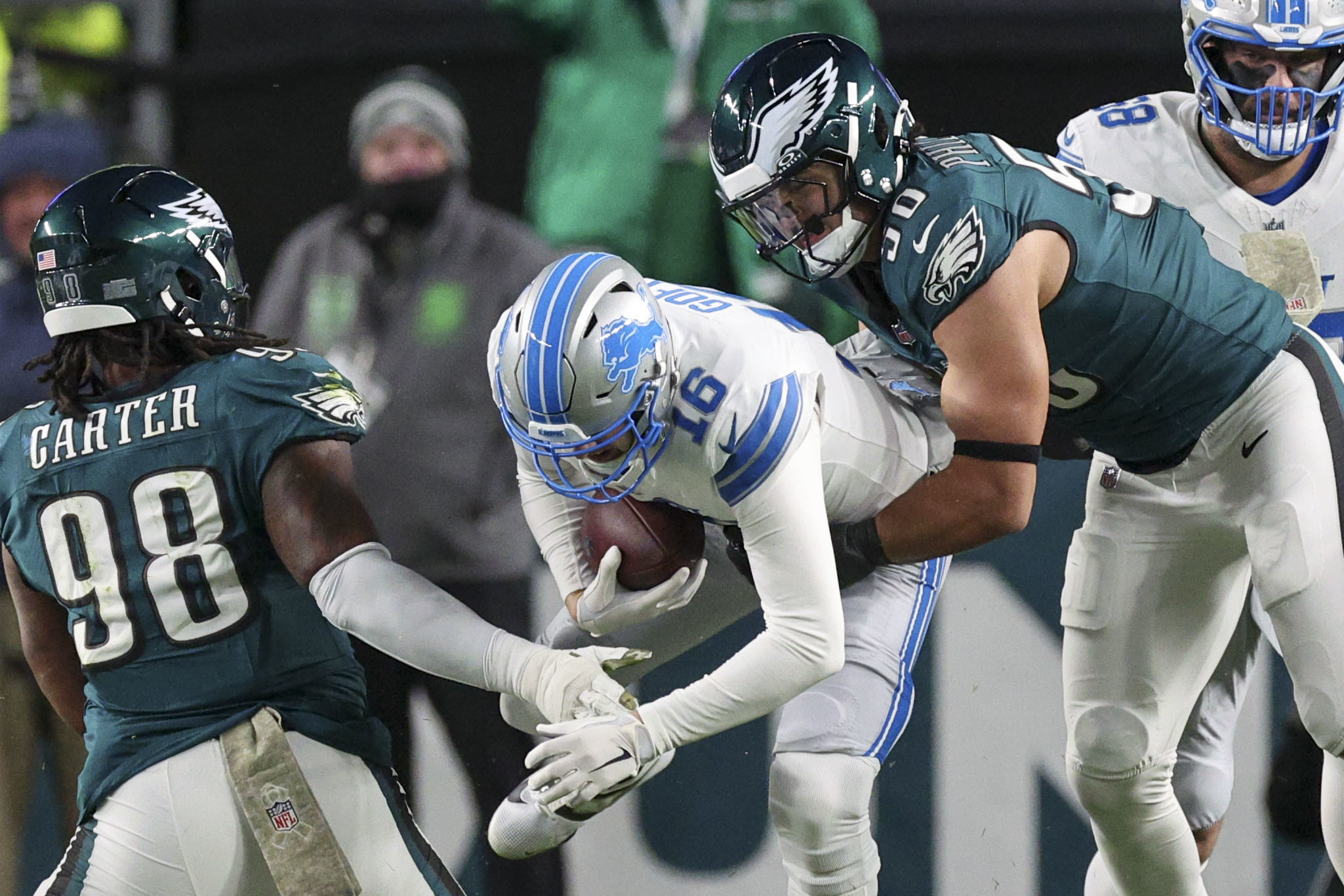
Eagles edge rusher Jaelan Phillips sacks Lions quarterback Jared Goff as Jalen Carter moves in.
Fourth series: On fourth-and-1, Moro Ojomo grabbed Gibbs low, Carter hit him high, and they stoned him at the line of scrimmage.
Fifth series: Dean hit Goff on third down, which forced an incompletion that forced fourth down, and the Lions tried a fake punt and failed.
From the moment the U.S. men’s soccer team’s starting lineup was announced Saturday, all eyes were fixed on Gio Reyna.
Not only was he about to play for his country for the first time since late March, but he was starting for the first time since last year’s Copa América group stage finale — a loss to Uruguay that sent the U.S. out in the group stage on home soil, and sent manager Gregg Berhalter out of his job.
Reyna, 23, didn’t make any of Mauricio Pochettino’s squads until the Nations League final four in March because of a groin injury. Then he didn’t play in the semifinal loss to Panama, and was an ineffective second-half substitute in the third-place game loss to Canada.
For all Reyna’s talents — and he has perhaps the most natural talent of any U.S. player besides Christian Pulisic — Pochettino declared him not “ready to play in the way that we expect from him” on the eve of the third-place game.
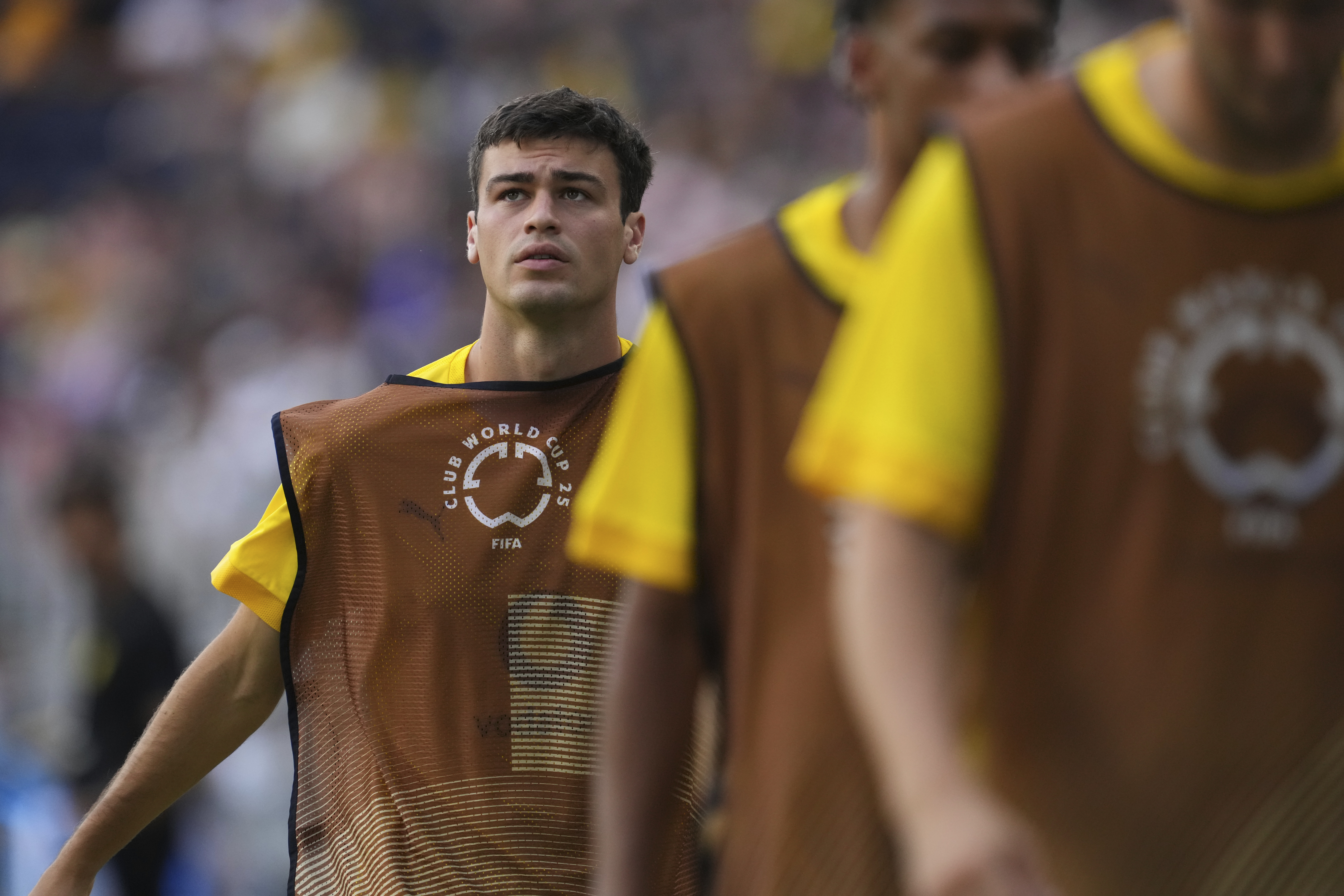
Gio Reyna hadn’t been with the U.S. men’s soccer team since March.
That was how far he had fallen, in terms of fitness, form, and playing time at his club, Germany’s Borussia Dortmund.
Nor was he done falling. Reyna went to the Club World Cup with Dortmund instead of the Gold Cup and the friendlies before it, because Dortmund wanted him at their games and Pochettino didn’t want players at the friendlies whom he wouldn’t have afterward.
Would that be salvation? No, it was almost the opposite. Reyna got off the bench only once in Dortmund’s five tournament games, a mostly useless 12-minute cameo in the group stage finale.
Only after that did he finally leave for newer pastures, a move many outsiders had hoped to see for years. Borussia Mönchengladbach bought him for about $4.5 million up front and $3 million in incentives. It was miles below what Dortmund expected when a 17-year-old Reyna made his first-team debut in early 2020.
Gio Reyna watched almost all of Borussia Dortmund’s Club World Cup run this summer from the bench, finally leaving the club afterward.
It was to be a fresh start, but it barely started before Reyna suffered the latest of seemingly countless muscle injuries in September. He returned to action in mid-October, but only as a substitute.
So it was a pretty big surprise when Pochettino called him up to the national team this month. But over the course of the week in Chester, it felt increasingly inevitable that he would start Saturday against Paraguay at Subaru Park.
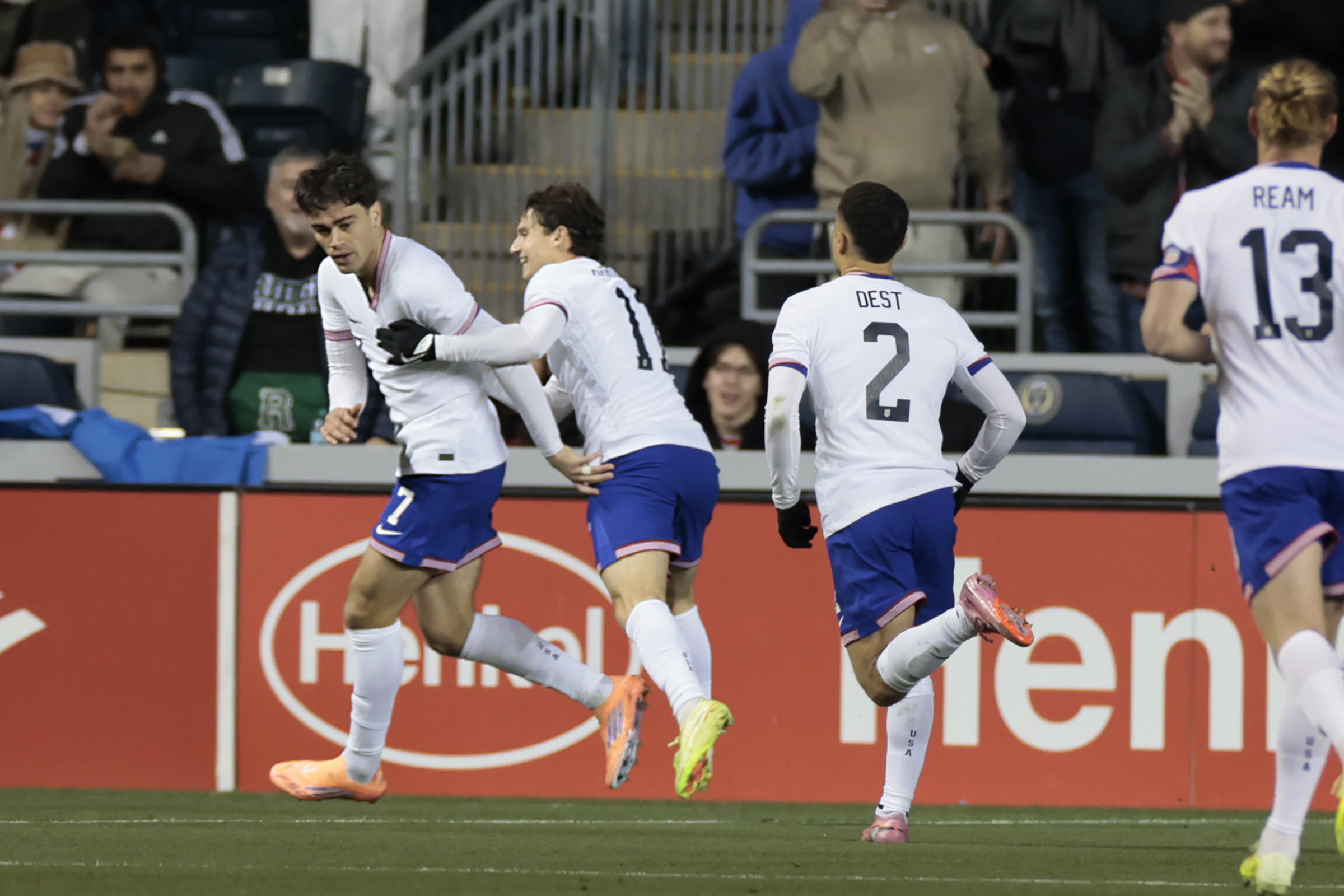
It was a broken play out of a corner kick, the ball pinging around off all manner of limbs on both teams. Eventually, it fell to Max Arfsten, and he chipped a cross into the crowd. Reyna rose highest and met it with a header that caromed in off the crossbar.
As the crowd roared, Reyna ran toward the corner flag, pointing to the U.S. badge on his jersey. Within seconds, his teammates had swarmed him to celebrate.
“I know the kind of player he is, and I’m just really happy for him — he deserves it,” said Medford’s Brenden Aaronson, who started with Reyna in the attacking midfield spots. “He’s been through a lot with injuries, with all this stuff. But whenever he plays for the national team, he’s always there, and it’s awesome to see. … He’s confident in his ability, he knows what he can do, and that’s the beauty of him.”
There wasn’t time in the moment to point out that Reyna has not in fact always been “there” when with the national team. That was the whole point of the 2022 World Cup scandal that nearly torpedoed him.
When that goal went in, though, it was a moment for his immense burden of history to be a privilege, not a weight. The tally was his ninth for the U.S., passing his legendary father Claudio’s eight.
Gio Reyna (left) celebrates with Brenden Aaronson (center) and other teammates after scoring the game’s opening goal.
And for once, Claudio wasn’t invoked because of that scandal, or all the times Claudio interfered with U.S. Soccer officials before then, or yelled at referees from the sidelines in Gio’s youth days, or by genetics passed his ego on to his son.
By the time Gio emerged from the locker room to meet one of the biggest media packs at a U.S. game in quite a while, he had already texted with his father.
“It was just fun, love,” Gio said. “He was obviously happy for me that I passed him, but I had no idea. So he was more making fun of me for the fact that it was my first header I’ve ever scored.”
The pressure on him is earned
The negative side of the burden struck twice after that. On Paraguay’s 10th-minute equalizer, Reyna was late and slow to challenge Junior Alonso before he launched the long ball that sprung Miguel Almirón for a dazzling assist on Alex Arce’s goal.
The scale tilted back his way in the 71st. Reyna combined superbly with Folarin Balogun to create the winning goal. The man of the hour had delivered again, and the U.S. went on to close out a 2-1 win.
“I think in the end, performances like this that can help everybody here,” Reyna said. “But I want to have, more importantly, seven or eight good months in the rest of the season with Gladbach. And then I believe if I keep performing like I did tonight, then I’ll have a good chance to make the team and have an impact there, too.”
Folarin Balogun's third goal in his last four USMNT games restores the lead 🫡 pic.twitter.com/fe85pV30M2
There’s still a ways to go, and as Pochettino said, plenty for Reyna to do to earn a seat on the plane next summer. But in a moment when he was asked to step up, he did, and in national team soccer there are never many moments. So when you get one, you have to take it.
“He showed why he started, and yes, confirmed that he’s a player that needs to improve because he needs to play more in his club,” Pochettino said. “But we can see today that he was great: scored and assisted. And the way that [he has] always the capacity to read the game, and find the free space in between the lines, I think that was a nightmare for Paraguay, and I think he did a very good job.”
Reyna thanked Pochettino in turn, with some notable humility.
“I knew it was an opportunity for me to to show that I belong here,” he said. “He’s been great with me all week, working with him, and just trying to give me the freedom and the confidence to sort of be myself. So I can’t thank him enough, obviously, for the start and just for the relationship that we’ve really built this camp.”
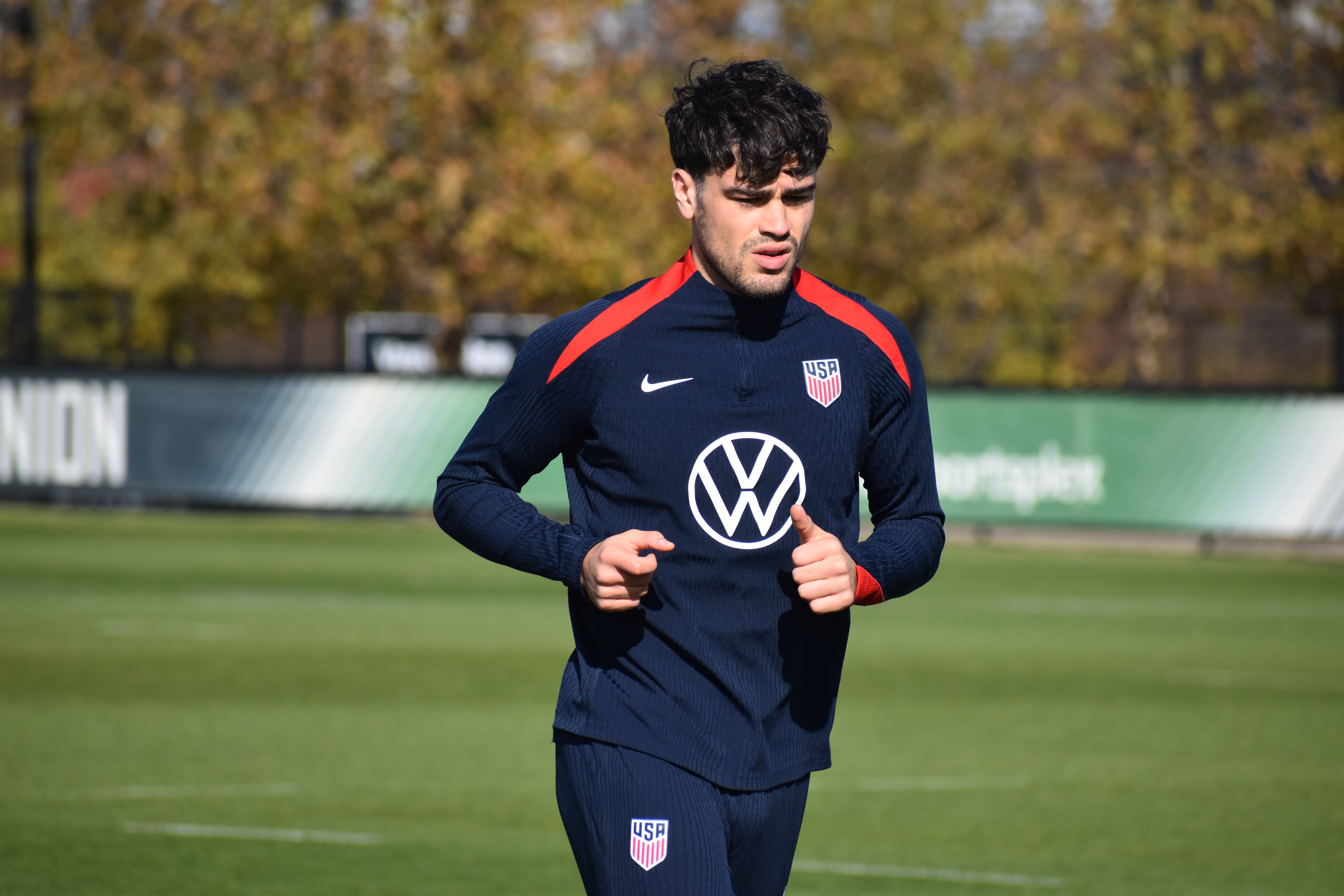
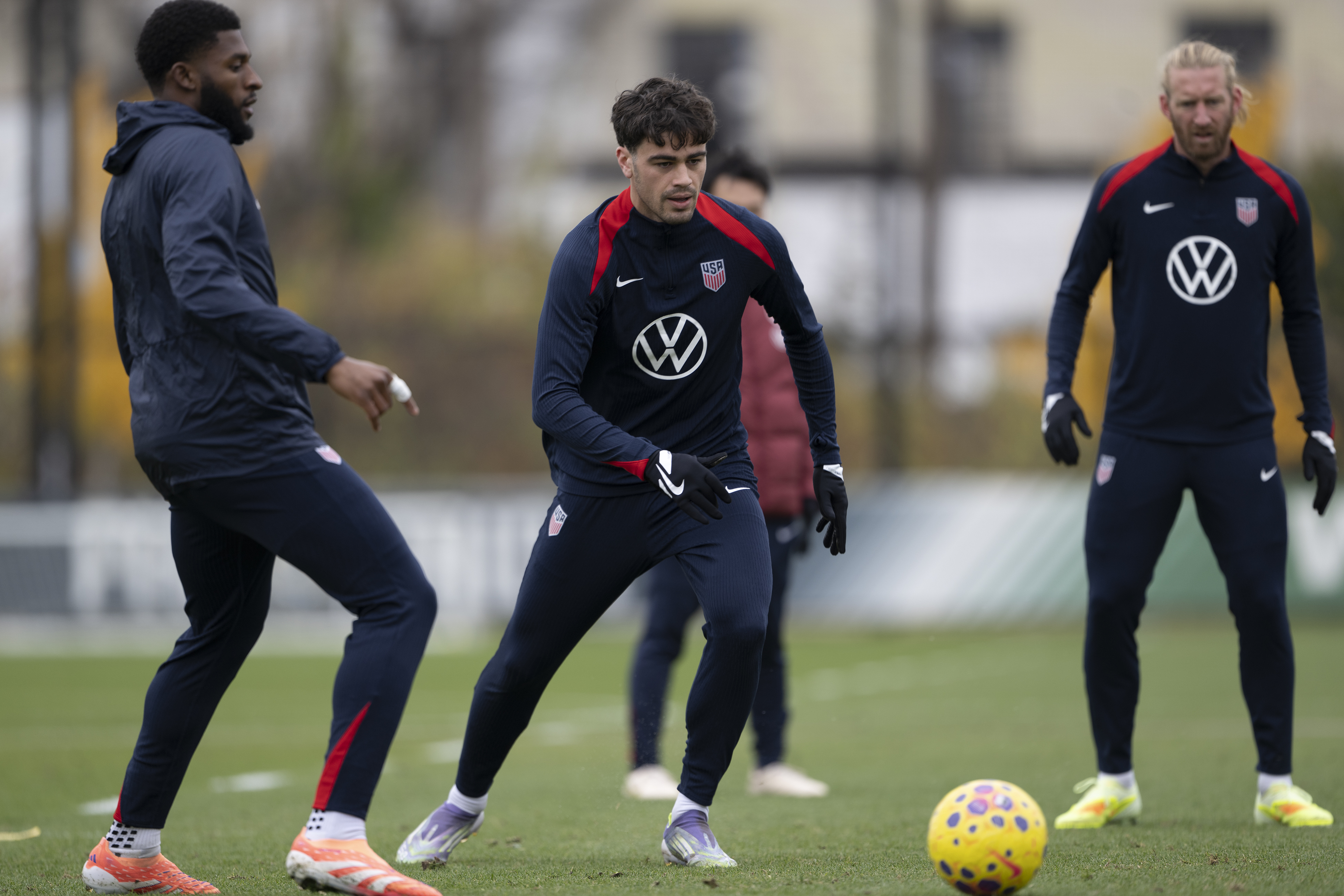
Gio Reyna (center) working in practice during the week.
The stakes only get higher from here, and so does the quality of opponent the U.S. will face. After meeting Uruguay on Tuesday in Tampa, Fla. (7 p.m., TNT, Universo), to close out this month, it’s expected that March’s games will see big-time opponents from Europe. Portugal, France, and Belgium are reportedly on the radar, with Atlanta’s Mercedes-Benz Stadium set as a fittingly big-time venue.
Time will tell if Reyna earns the right to be there. For now, he’s only in the race. But that alone is the best place he’s been in for a long time.
After waiting six years to see the U.S. men’s soccer team in town again, Philadelphia soccer fans got their money’s worth on Saturday.
Gio Reyna scored in the fourth minute and assisted Folarin Balogun’s winner in the 71st to give the Americans a 2-1 win over Paraguay, extending their unbeaten run this fall to four games.
Reyna was the man of the hour from the moment the lineups came out. This was his first U.S. game since the Concacaf Nations League final four in March and his first start since last year’s Copa América group stage finale. It also was just his fifth start of the calendar year in any game for club or country because of injuries and bad form.
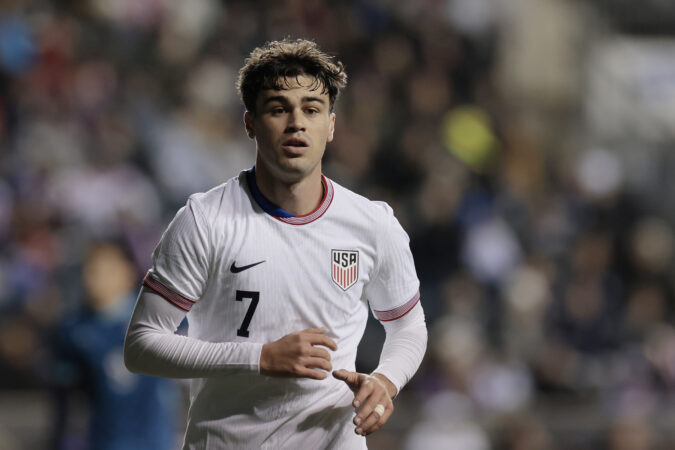
Reyna leapt to meet Max Arfsten’s cross after a corner kick got broken up. The 23-year-old attacking midfielder with so much unfulfilled talent ran to the corner flag, pointing to the U.S. crest on his jersey along the way, and his teammates joined him for a big group hug next to the TV cameras.
Paraguay equalized just over five minutes later with a lightning-fast and impressive play. Junior Alonso hit a long ball down the left flank for Miguel Almirón — after Reyna waited too long to press — and the Atlanta United star hit an inch-perfect first-time cross. Alex Arce was right on time, and slammed the finish past a frozen Matt Freese.
Almirón might have been an inch offside when the pass was played, but he otherwise left Joe Scally in the dust — in Scally’s first U.S. game since the Nations League flop. Arce then easily beat Miles Robinson, who has been a regular under manager Mauricio Pochettino but isn’t a surefire starter.
The Paraguay fans in the bipartisan crowd of 17,221, many of whom arrived early to tailgate, were thrilled.
After that, the game settled down for a while, and fans could observe how the U.S. was trying to play.
Pochettino set out a lineup that looked on paper like the 3-4-2-1 he’s used lately, but it had some wrinkles. Arfsten, who played left wingback, sat a bit deeper than usual, while right wingback Sergiño Dest pushed up so high that it often looked like he was an attacking midfielder.
The result looked at times like a 4-2-3-1, with Scally as the right back, Medford’s Brenden Aaronson in a central attacking midfield role, Dest to Aaronson’s right, and Reyna to the left — though Aaronson and Reyna had the freedom to switch places.
Folarin Balogun led the line up top, Cristian Roldan and Tanner Tessmann were the central midfielders, and Tim Ream and Robinson stood at centerback.
It was a fluid setup all in all, and it produced some entertaining soccer.
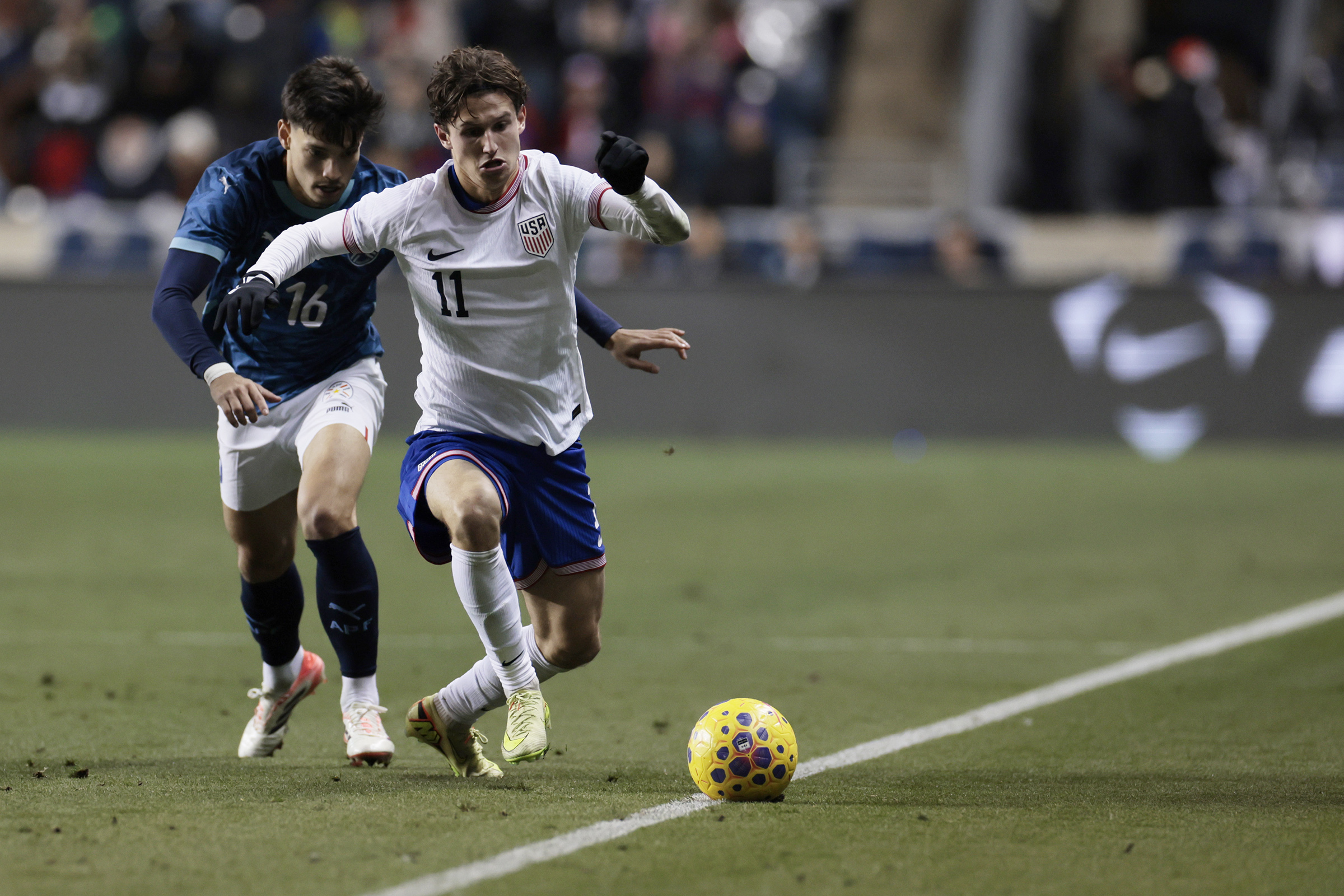
Brenden Aaronson (right) runs past Paraguay’s Damian Bobadilla to chase a loose ball.
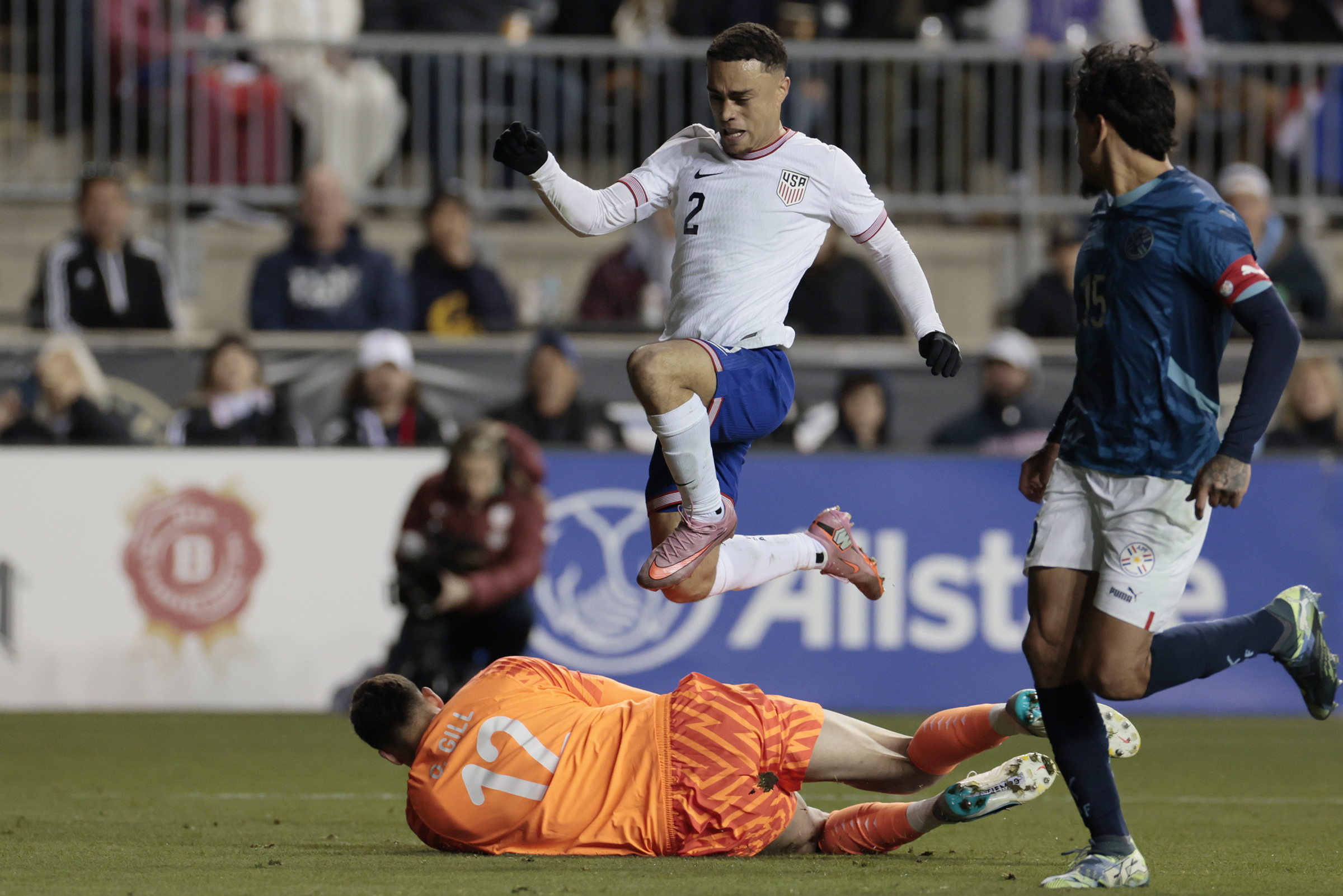
The starting lineup stayed intact until the 67th minute and was just as lively as the first half. Aaronson was on the ball a lot, and Dest ripped a shot from atop the 18-yard box that Paraguay goalkeeper Orlando Gill tipped over his bar.
That shot was Dest’s last action, as he and Scally departed for Diego Luna and Alex Freeman. The swaps shifted the U.S. formation to a traditional 4-2-3-1, with Freeman at right back and Luna, Reyna, and Aaronson in the attacking midfield roles from left to right.
Balogun struck for the lead in the 71st, after first intercepting a loose pass forced by Juan Cacéres. Roldan and Luna forced it with some hustle, and when Balogun got the ball he held it up to spring Reyna down the left flank. Reyna returned the favor with a square pass that was deflected but fell right for Balogun to finish.
Folarin Balogun's third goal in his last four USMNT games restores the lead 🫡 pic.twitter.com/fe85pV30M2
Four minutes later, Pochettino sent in three more subs: Ricardo Pepi for Balogun at striker, Timothy Tillman for Reyna in attacking midfield, and Aidan Morris for Roldan in the center.
Freese made his big save for the night in the 78th, denying a long-range blast from Almirón.
After the ensuing corner kick, the U.S. went down the field, and Pepi should have made it 3-1 in front of an open net. But he was off-balance receiving it, and by the time he turned to his favored right foot, Paraguay’s Gustavo Gómez had raced to the goal line to block the shot.
The last U.S. sub was Sebastian Berhalter for Aaronson in the 80th, and the hometown hero got a big ovation from the crowd on his way out.
Sergiño Dest (center) jumps over a diving Paraguay goalkeeper Orlando Gill on a U.S. scoring attempt during the second half
Things got dicey from there for the U.S., including a deflection off Arfsten right on 90 minutes that rolled inches wide of Freese’s far post.
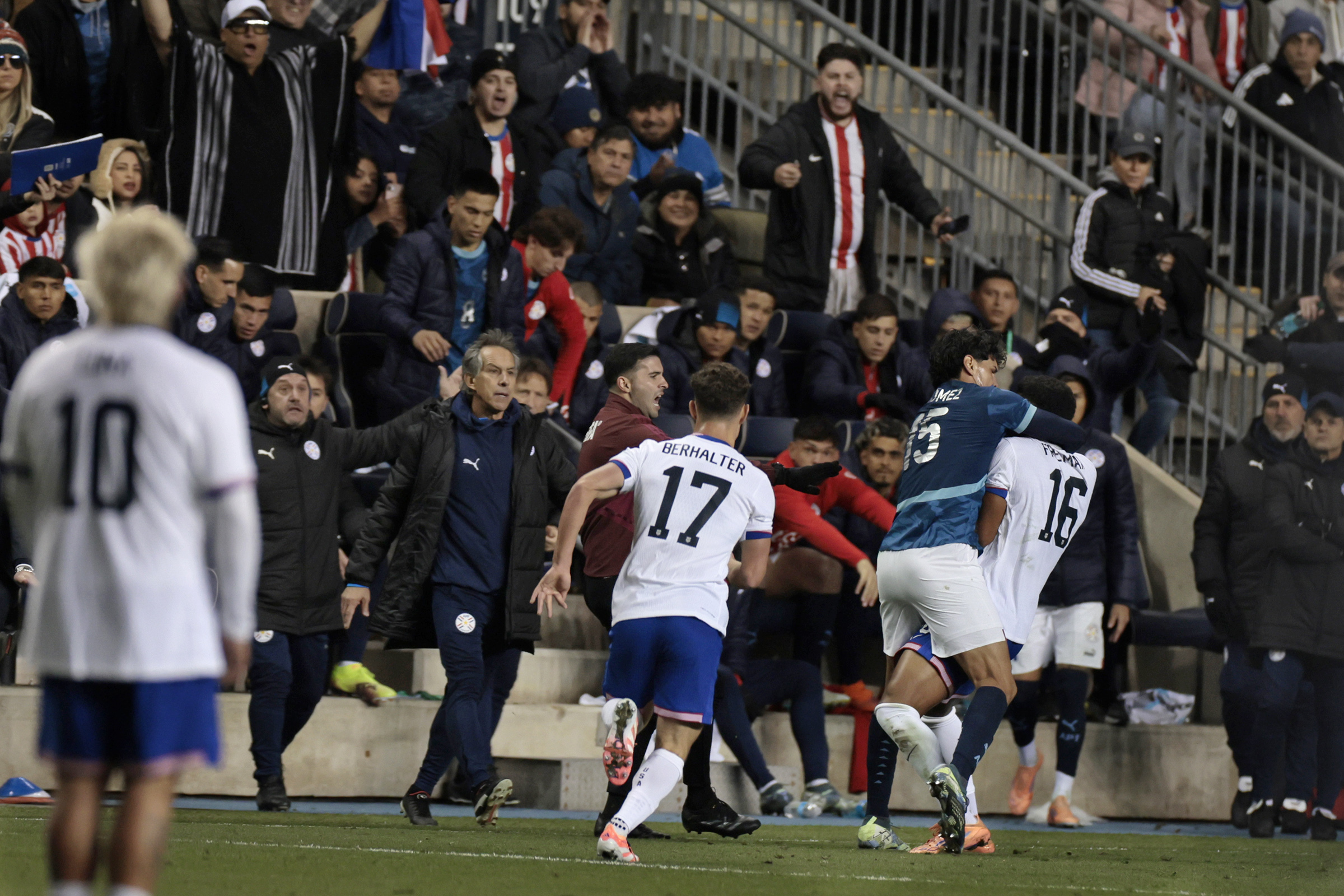
Just over a minute later, a brawl erupted by the benches after Gómez and Freeman briefly argued over who would claim a dead ball on the field. Gómez put Freeman in a headlock, which sparked a melee that ensnared both teams’ active players and benches, coaches included. It was a sight rarely seen in soccer, but especially in a friendly without official stakes.
Referee Cristhofer Corado of Guatemala dished out a few yellow cards, and would have been well within his rights to end the game there instead of waiting out the announced four minutes of stoppage time. But play did resume, and the clock ran to 96 minutes when the final whistle came.
Long before U.S. men’s soccer team manager Mauricio Pochettino unveiled a 3-4-2-1 formation for his players, outsiders debated the possibility.
Though the program went decades without playing that way, the rise of high-flying outside backs like Sergiño Dest made the idea start to sound sensible.
But since Pochettino made the switch in September, Dest hasn’t gotten to play in the new setup much. He was a second-half substitute in the momentum-turning win over Japan, then had to miss October’s games because of an injury.
That makes this month’s games crucial for the 25-year-old, who plays his club soccer at Dutch power PSV Eindhoven. The odds are good that fans will see him play a major role Saturday at Subaru Park when the U.S. faces Paraguay (5 p.m., TNT, Telemundo 62).
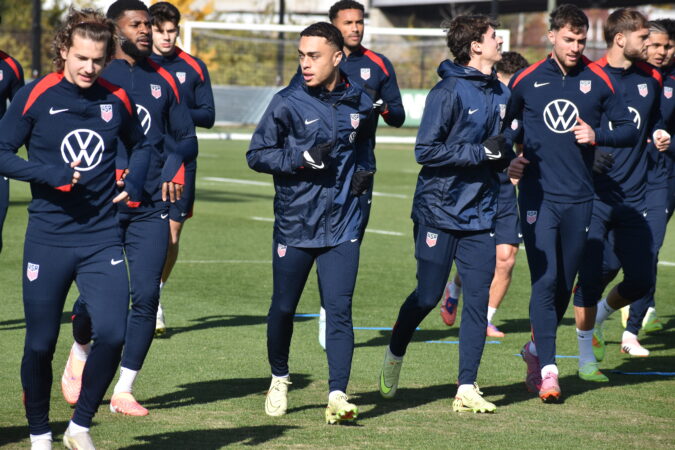
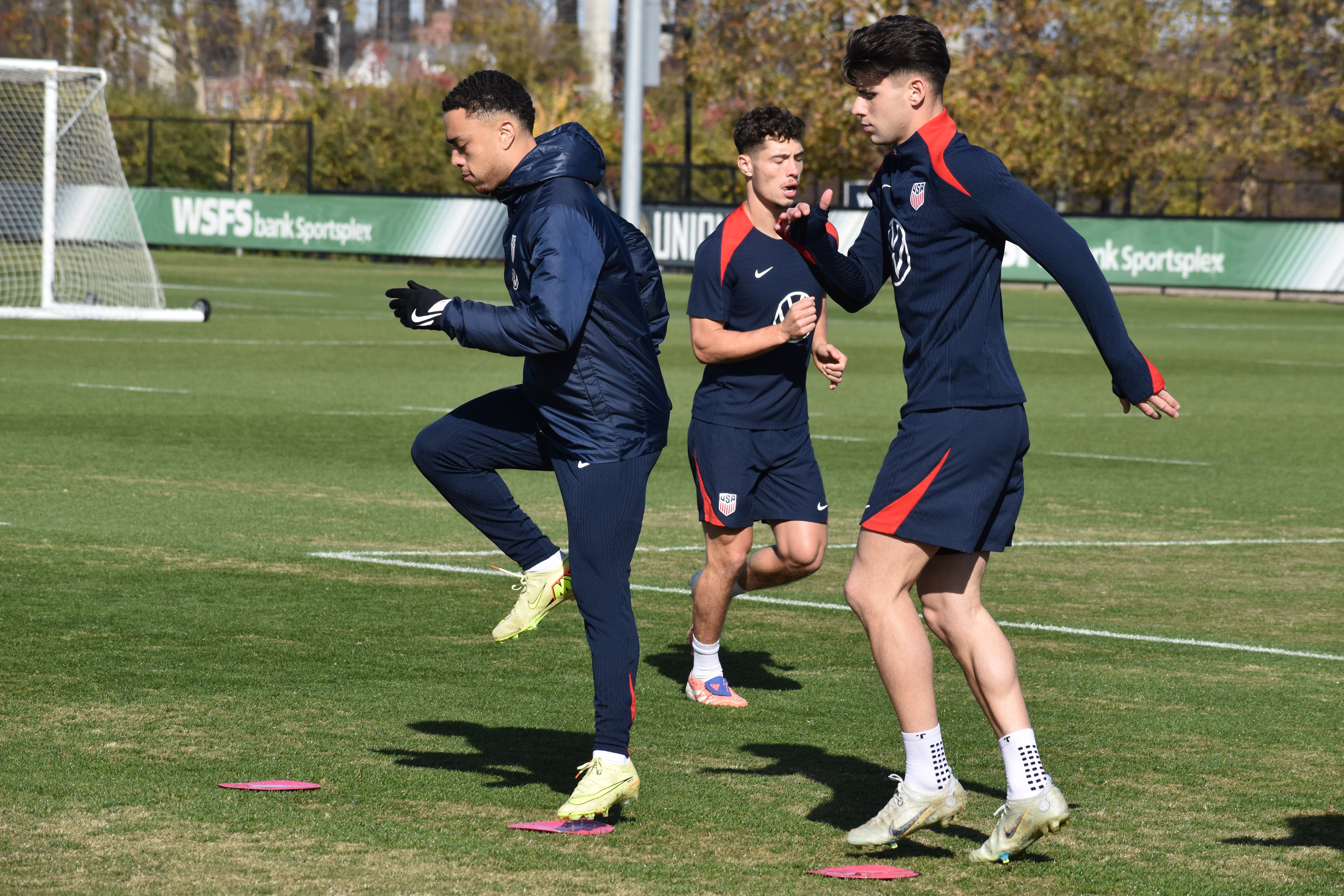
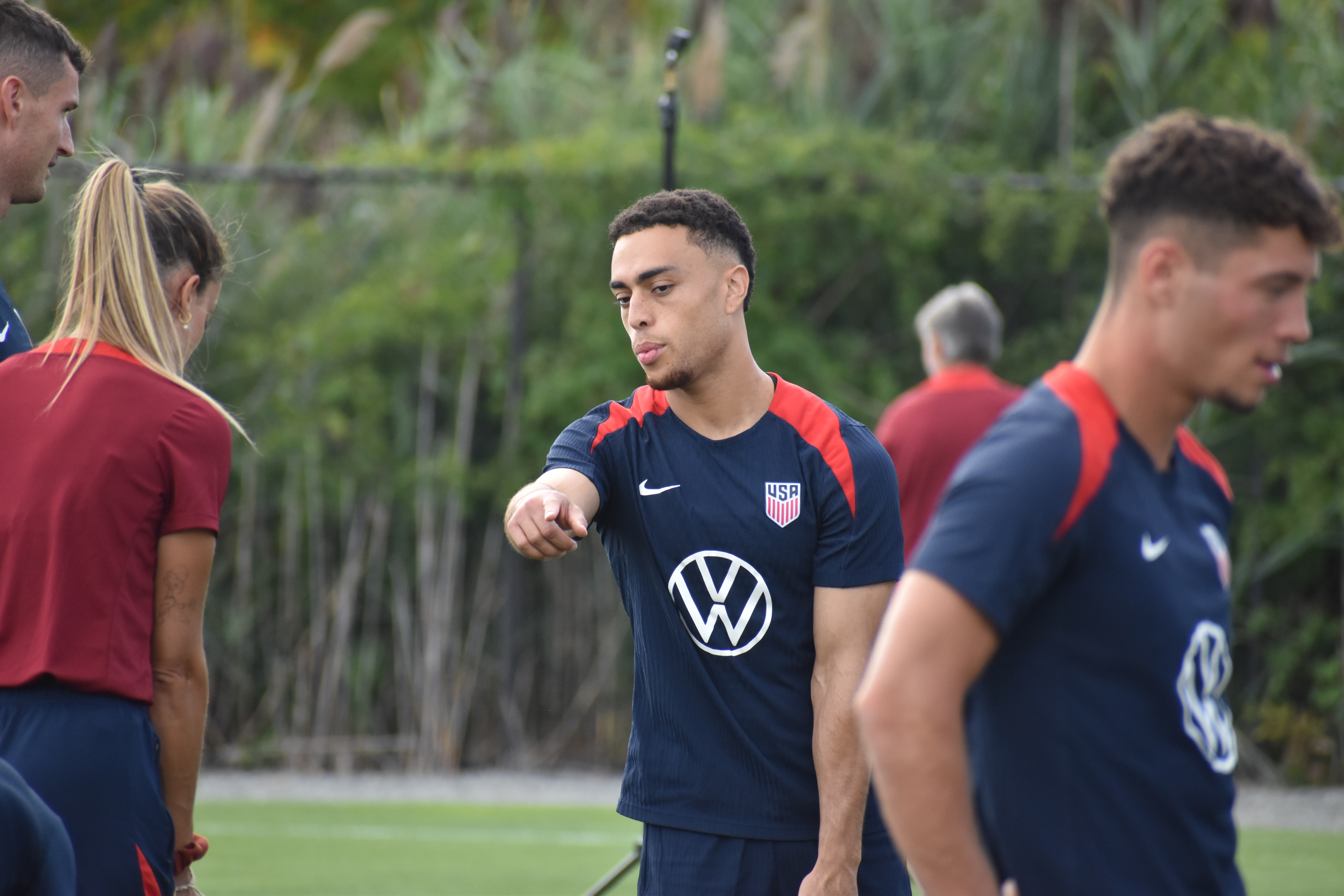
Sergiño Dest (left) and left wingback Max Arfsten (right) working out together at Friday’s practice.
“Yeah, I feel like it’s really important,” Dest said at Friday’s practice in Chester. “Because the rosters are a little bit different. For me personally, because I was injured, I didn’t really have that much time to play with everyone, the players that I didn’t know before. It needs time.”
Dest has historically played on the right side of a four-defender setup with both club and country. The right wingback spot ahead of three centerbacks isn’t too different, but as with any tactical change, there are subtleties.
“It’s a little bit different, but obviously, that’s the way we play at the moment, so I feel like you have to adapt to that formation,” Dest said. “For me personally, I’ve always been an attacking outside back, so I feel like it’s not that hard. But you still need some time.”
Dest can also play on the left side, as he did against Japan. That could matter even more if longtime starter Antonee Robinson can’t overcome his longstanding knee issues. A combination of Dest and Tim Weah (who’s out injured right now) as the wingbacks would be quite dynamic — though with plenty of defense needed between them.
Sergiño Dest (center) at a U.S. practice in September, the last time he was with the team.
“Now is a good opportunity for him,” Pochettino said. “I think we have good players in that position [in this squad] like Alex Freeman and Joe Scally, that are very competitive and they can play in different [roles]. Sergiño is more offensive than defensive — he needs to improve in defensive areas — but I think it’s a great opportunity for us to know him, to see the capacity to adapt to our demands that are completely different for his club, or were in the past year. “
Whatever Dest is asked, he made it clear he’s ready to answer the call.
“I always want to play for the national team,” he said. “I feel like it’s an honor to be here and to fight for my spot. I always wanted to be here, but to have some extra training and some extra rest between some games, especially after the injury I came from, I think it’s also not bad, especially with the long season we still have ahead.”
Gio Reyna in the spotlight
While local fans will obviously be focused on the four Philly-area products on this squad, many eyes nationally will be on Gio Reyna’s return to the squad. The talented young playmaker had been on a downward slide for a while, but has finally started to trend back up in the last few weeks.
Gio Reyna (center) on the ball at Wednesday’s practice.
If he can make an impression in these two games, it will be a big deal in his quest to make a second straight World Cup team.
Reyna hasn’t spoken with the media yet this week, but veteran U.S. centerback Tim Ream had praise for Reyna’s work in practice.
“He’s not really letting the challenges overseas seep into camp, which is great to see,” said Ream, who wears the captain’s armband under Pochettino as the squad’s most experienced player. “He’s speaking up a lot more in the trainings, in terms of, ‘OK, I’m seeing this, what are you seeing?’ He’s really getting involved in the understanding of the movements and what we’re doing in the buildup and in the defensive shape.”
Ream said he has observed a better mentality in Reyna, too. That has long been a question about the attacking midfielder, dating back to the scandal with former U.S. coach Gregg Berhalter at the 2022 World Cup.
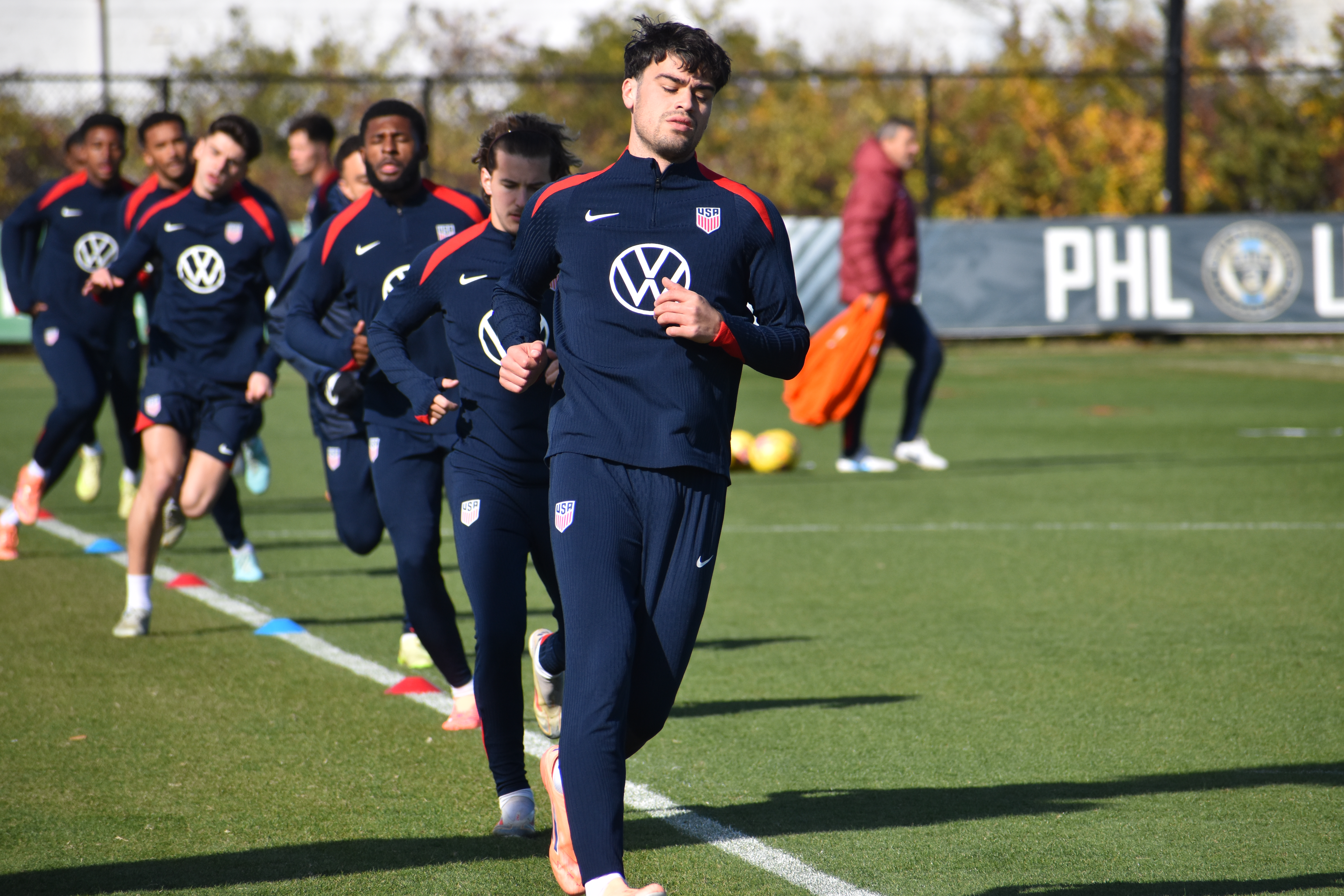
Gio Reyna leading the jogging line at the start of Friday’s practice.
“I feel like he’s more in tune and more focused on the field than I’ve seen in the past, which is a great thing,” Ream said. “And I think whether it was injury or other things that were going on, I think his focus is so much greater now, and that’s a good thing.”
The mention of “other things” didn’t need further detail. Just last month, Reyna talked about it with the Associated Press, and his lack of contrition did not go over well.
This U.S. squad is the first one where Reyna has worked with Sebastian Berhalter, Gregg’s son. Gio’s famed father, Claudio, was as close as could be with Berhalter until the scandal erupted.
Pochettino was asked whether the subject had come up between the sons, and he said it has not.
“I hear some things, but for me it’s not important, because in front of everything is the national team,” he said. “I cannot judge, I cannot take decisions from the past. … Now it’s a completely different environment. And what I saw from day one — good synergy, good teammates — I think the interaction and the communication is fantastic.”
As VJ Edgecombe prepared to leave the 76ers’ locker room Sunday, following the team’s second set of back-to-back games in less than a week, veteran teammate Andre Drummond noticed the rookie looked “exhausted.”
So Drummond offered direct instructions for Edgecombe heading into the Sixers’ mandatory off day.
“Don’t get up until 6 p.m. tomorrow,” Drummond publicly reiterated in front of reporters a few minutes later. “6 p.m., VJ. So if you see this, keep your [butt] in bed.”
Perhaps no Sixer will benefit more than Edgecombe from this light stretch of the Sixers’ early schedule, when their only game in five days is Friday at the Detroit Pistons. After a torrid scoring start — including a historic 34-point outburst in the Sixers’ opener at the Boston Celtics — Edgecombe has shot 27.9% (17 of 61) from the floor and 25% (5 of 20) from three-point range and averaged 9.4 points during his past five games.
The mini slump is understandable for a rookie going through the demanding 82-game NBA schedule for the first time, and playing heavy minutes for a competitive Sixers team in record (7-4) and in number of “clutch” games played (nine, tied for the NBA lead entering Thursday). And there is no substitution for Edgecombe simply experiencing the grind.
“It’s not weighing on me,” Edgecombe said of his recent struggles. “Why I say it’s not is because it’s an 82-game season. Nobody’s going to remember these games early. I mean, I’m a rookie, man. I’ve got to give myself some grace. Obviously, I set a pretty high standard when I came and had a good debut scoring the ball.
“But at the end of the day, I just want to win. That’s the main thing for me. I just want to win.”
Coach Nick Nurse said that Edgecombe’s “tremendous engine” — the 20-year-old guard can “work really long days, and then do it again the next day,” the coach added — and mental fearlessness have been present since the Sixers drafted him this summer.
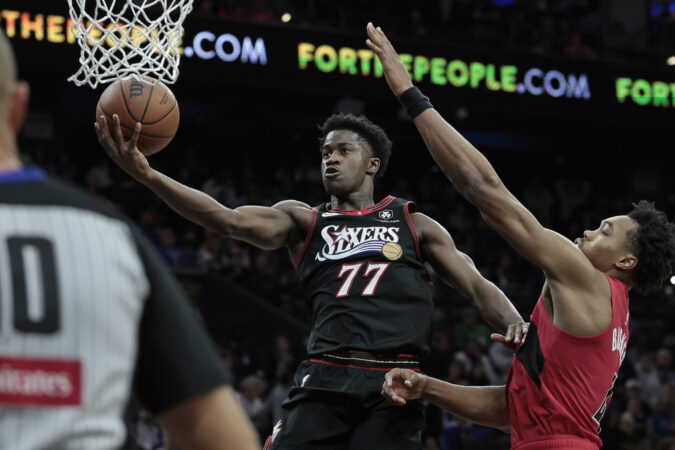
Sixers Vj Edgecombe has shot 27.9% from the floor and 25% from three-point range and averaged 9.4 points during his past five games.
That motor has already been put to use. Entering Thursday, Edgecombe ranked second in the NBA in minutes played (37.3 per game), only behind teammate Tyrese Maxey (40.5 per game). And after playing 35 total games his one college season at Baylor — “and 12 of them don’t really count,” Nurse quipped — Edgecombe logged 11 NBA games in less than three weeks. That included three back-to-backs, which Edgecombe acknowledged was “tough for me personally.”
“I don’t know if I can prepare myself for that,” Edgecombe said.
And it is not just the avalanche of games, but everything in between. Last week, the Sixers completed their first multigame road trip to Brooklyn, Chicago, and Cleveland. That typically means leaving one city immediately after a game, landing in the next city in the middle of the night, then needing to be ready to jump into practice or game preparation a few hours later.
Maxey said Tuesday that, in Year 6, he has just begun to figure out a maintenance routine that works for him. Justin Edwards, who was a rookie last season, learned preventive treatment such as sitting in a cold tub, “flush” massages, and red light therapy are crucial.
So far, Edgecombe spends nights without a game sitting on his couch in recovery boots that alleviate leg soreness. On game days, he takes a nap and speaks to his family. His goal is to keep his mind peaceful, following a mantra from high school coach John Buck that “you can’t be grateful and stressed at the same time.”
Edgecombe had already earned the trust of teammates and coaches with his work ethic and temperament. Nurse praised that Edgecombe was “everywhere” the team asked during the offseason, even canceling a visit home to the Bahamas.
That is why Nurse was not hesitant about immediately inserting Edgecome into the starting lineup. Or keeping him with the closing group, even when he struggled with his shot or turnovers earlier in the game. Edgecombe is already one of the Sixers’ better perimeter defenders. He also always has the potential to flash his insane athleticism as a driver or finisher. And he has already shown a knack for knocking down clutch shots, while averaging 15.4 points, 5.5 rebounds, and 4.3 assists so far this season.
“He’s got great composure. He’s calm. He doesn’t make too many mistakes,” Nurse said. “I super believe in him. … He needs to be out there and learn this stuff, and he’s produced.”
Like during the Sixers’ win over Celtics Tuesday night. Edgecombe missed eight of his first nine shots, including an air-balled three-pointer to begin the third quarter that prompted him to mouth “Oh my God” in surprise (or self-deprecation).
Sixers guards VJ Edgecombe and Tyrese Maxey occupy the NBA’s top two spots in minutes played per game.
But with about five minutes remaining, Edgecombe elevated to block All-Star Jaylen Brown’s dunk attempt, then pushed the ball ahead to Edwards for a three-pointer. Then with 2 minutes, 20 seconds to play, Edgecombe let an open three-pointer fly — and watched it bounce high off the rim and through the net to give the Sixers a four-point lead. Perhaps that was a reward for Edgecombe’s summer work to get more arc on his shot, and “give it a chance to get in the rim,” he said.
“It’s been a rough couple days, but I won’t stop shooting the ball,” Edgecombe said. “I will continue shooting the ball if I’m wide-open, if it’s the right shot.”
That is one of several on-court lessons for Edgecombe during these first 11 games. Another is that he cannot expect to outjump competitors for a rebound, because “they’re 7-foot and they’re gonna get there quicker than me.” Nurse added that Edgecombe must get downhill more aggressively while playing alongside Joel Embiid, in order to draw the defender away from the former MVP and open opportunities for Edgecombe to pass to a rolling or popping Embiid. Even the speedy Edgecombe notices the increased pace at the NBA level, and that he needs to sharpen his defensive positioning.
And though Edgecombe feels empowered by coaches and teammates to be himself on the court, Nurse acknowledged Thursday that the staff can more deliberately put Edgecombe in situations with the ball in his hands.
“Come hell or high water, this is your play,” Nurse said. “Go make something happen.”
After Tuesday’s sputters, Edgecombe believes he is “due for a game to get back on track.” Nurse added that Edgecombe’s past two days have been filled with “constant film work,” which is “still [a] pretty heavy load mentally, no matter if he’s on the court or not.”
But that approach does allow Edgecombe to take Drummond’s advice. On Monday, Edgecombe said he woke up after noon, then was back asleep by 5 p.m. So it is fair to assume he will aim to maximize this lighter early-season stretch, with one game in five days.
“When I get home, in my bed,” Edgecombe said, “that’s the best thing.”