The Eagles travel to face the Minnesota Vikings in a Week 7 matchup at U.S. Bank Stadium at 1 p.m. on Sunday. Here’s what you need to know about the game:
Vikings defensive coordinator Brian Flores is known for blitzing a lot.
When the Eagles have the ball
We’ve seen Nick Sirianni switch it up offensively coming out of mini-byes or byes before, with the emphasis often placed on the run game. The guess here is that he will take the same approach this season. The Eagles desperately need to get Saquon Barkley going on the ground. There have been glimpses in the last few games, but play caller Kevin Patullo hasn’t stuck with it enough for various reasons.
The Vikings’ run defense offers an opportunity to get on track (of course, so apparently did the New York Giants last week). They rank 24th in the NFL in expected points added (EPA) per rush and have allowed 132.2 yards a game. The Eagles haven’t won as much at the point of attack, but Minnesota is light on its defensive line. Landon Dickerson (ankle) could return at left guard, but playing at far less than 100% hasn’t helped.
The Eagles don’t major in under-center plays. They ranked 30th in snaps there. But I think we may see more of Jalen Hurts in that formation. It would conceivably help get Barkley downhill, and if successful, open up play action. They just can’t tip off defenses with their tendencies and may need to throw from under center a few times early on.
Vikings defensive coordinator Brian Flores is likely willing to give up yards on the ground because his No. 1 EPA-ranked pass defense has been stingy. Flores is a master of creating chaos. Yes, he blitzes a lot — a second-most 35.8% rate — but it’s his simulated pressures and disguised coverages that have given quarterbacks the most fits. The Eagles have struggled mightily against the latter two, partly because they’re often late to the line.
Flores leans heavily on zone coverages (77%) and employs a lot of two-high safety shells, often in Cover 2 or 6. The Eagles have seen zone more than ever and have had trouble working the intermediate part of the field.
Only 9.9% of Hurts’ attempts have traveled 10 to 19 yards, less than half the NFL average of 20.1%. Sirianni, Patullo, and Hurts have to do a better job of getting the ball to receivers A.J. Brown and DeVonta Smith in space. Eagles receivers are averaging only 4 yards after the catch, which ranks 32d — last — in the league.
Carson Wentz will make his second career start against his former team, this time with the Vikings.
When the Vikings have the ball
The Eagles will face former franchise quarterback Carson Wentz for the second time since he was traded in 2021. It didn’t go well for Wentz in the first round. Then, with Washington, he got overrun by the Birds’ pass rush and was sacked nine times and fumbled twice. He still holds the ball too long and wants to play the hero.
But the Eagles’ front isn’t as ferocious and he has a solid offensive line, assuming that most of the starters are playing. Christian Darrisaw and Brian O’Neill (sprained MCL) are plus tackles. Rookie left guard Donovan Jackson is back from a wrist injury, but backup center Michael Jurgens (hamstring) and O’Neill are questionable.
Wentz, despite his flaws, can still make throws many quarterbacks can’t. And he has arguably the best receiver in the NFL. Justin Jefferson will draw additional attention from Vic Fangio’s defense. Cornerback Quinyon Mitchell has followed top receivers this season, but his recent hamstring injury could hamstring Fangio’s coverage plans.
If opposite-side corner Adoree’ Jackson, who steps back into the starting role after Kelee Ringo’s benching, is matched up against Jefferson, Fangio will likely cloud his side. Jefferson alone, for context, has matched Hurts’ 10 intermediate-length completions this season for 205 yards. Jordan Addison is a potent No. 2 receiver.
The Eagles’ run defense has been leaky. They rank 20th in EPA per rush and 26th in success rate. With defensive tackle Jalen Carter (heel/shoulder) out last week, the Giants ran it down their throats. Minnesota running back Jordan Mason (4.7 yards per rush) has been effective in Aaron Jones’ absence.
It’s been an 11-man problem in stopping the run, but the Eagles have been susceptible on the edges. That isn’t just an outside linebacker issue, but a suspect pass rush that can be traced to the ineffectiveness of the Eagles’ edges. The current group, after Za’Darius Smith’s retirement, has just one collective sack.
Jalyx Hunt, Joshua Uche, Azeez Ojulari, and Patrick Johnson (owner of said sack) have gotten pressure at times, but if Wentz has an extra click in the pocket, you can be sure he’ll often find an open Jefferson downfield.
Eagles beat writers Olivia Reiner and Jeff McLane will provide a preview of the game before the Eagles face the Minnesota Vikings on Sunday.You can tune in here.
Extra point
I don’t know what to make of this Eagles team through six games. I thought there would be early-season struggles, and predicted a 4-2 start. I just didn’t think it would look like this. Fangio’s unit has not played well over the last five quarters, but the offense’s second-half malaise against the Denver Broncos led to a fourth-quarter meltdown. And losing Carter and Mitchell clearly affected the Eagles at the Meadowlands. It shouldn’t have looked that pathetic.
There are still concerns at corner, edge, and safety. And where has defensive tackle Jordan Davis been the last three games? But it’s the pains on the other side of the ball that are more disconcerting. I keep expecting talent to win out, but the Sirianni-Patullo-Hurts trinity has had more holes than holiness. I foresee a tough, grind-it-out outcome, so the game could go either way. But I have a hard time riding with Wentz.
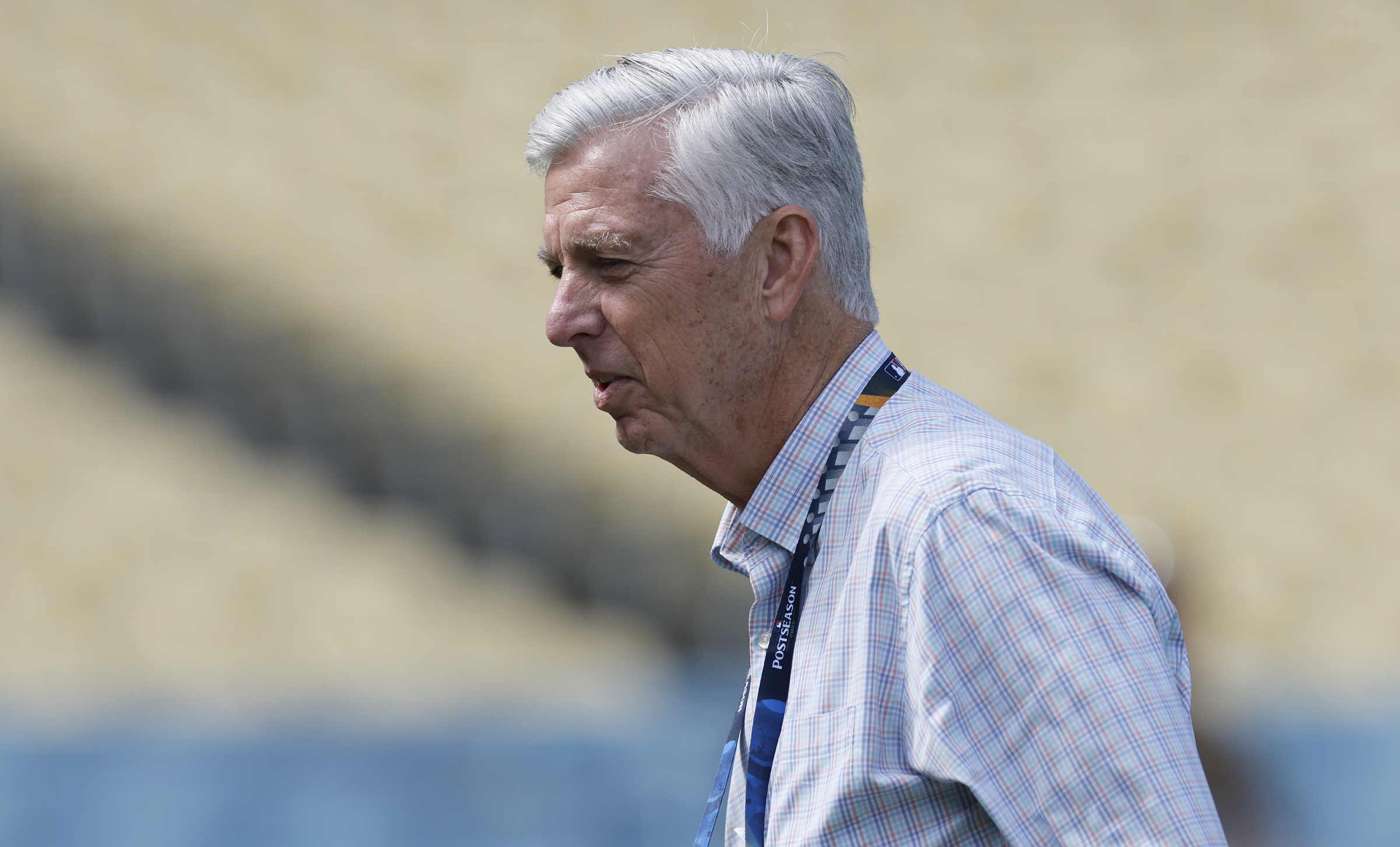
When he looks up from assembling the Phillies’ roster, Dave Dombrowski watches sports. One thing recently caught his eye. The Golden State Warriors are poised to open the NBA season with four starters who are 35 or older.
“It’s never happened before,” he said.
Dombrowski, the team’s president of baseball operations, brought this up Thursday, midway through his 54-minute news conference in Citizens Bank Park, to make a point: Aging teams can contend for titles.
It’s relevant because if the Phillies achieve their offseason priority of re-signing free agents Kyle Schwarber and J.T. Realmuto, who will be 33 and 35 next season, at least four of the top hitters in the projected opening-day lineup will be 32 or older and locked up to multiyear contracts. It would be so uncommon that Schwarber joked about it several months ago.
“We would love to all finish our careers together,” he said. “But who would want to come out and want to watch a bunch of 40-year-old dudes play baseball? Right?”
Warriors fans might not mind the basketball version, but there’s a notable difference. Whereas Stephen Curry and Draymond Green won four championships together before teaming with Jimmy Butler and Al Horford, the Phillies’ core — Bryce Harper (33), Trea Turner (32), Schwarber, Realmuto, and pitchers Zack Wheeler (35) and Aaron Nola (32) — is still title-less.
The Phillies are coming off 96 wins, 95 last season, and 90 the year before. It would be irrational to blow it all up based on one bad week in each of the last three Octobers and impractical given all the long contractual commitments made by Dombrowski and owner John Middleton.
Phillies president of baseball operations Dave Dombrowski must balance blending an aging core with young players from the farm system.
But in addition to an eyebrow-raising challenge to Harper — “I guess we only find out if he becomes elite or if he continues to be good. … I’ve seen guys at his age that level off, or I’ve seen guys rise again. We’ll see what happens” — the takeaway from Dombrowski’s end-of-season gab session was that he realizes the need for an infusion of youth, even as the Phillies prepare a nine-figure offer to Schwarber and discuss how far to go to retain Realmuto.
To extend the NBA comparison, the Phillies must incorporate their Moses Moody and Jonathan Kuminga, the 23-year-olds among the Warriors’ graybeards.
“We have some young players that we’re going to mesh into our club,” Dombrowski said. “I’m not going to declare that anybody has a job. But there will be some people that we’re really open-minded to being with our big league club next year, coming out of spring training.”
Unsurprisingly, Dombrowski mentioned outfielder Justin Crawford and right-hander Andrew Painter. He also name-checked Otto Kemp, who made his major-league debut in June and could fit next season as a right-handed bench bat.
But Dombrowski said he “wouldn’t even preclude [infielder] Aidan Miller from being that type of guy” to contribute in 2026, an indication that the Phillies are ready to push down harder on the prospect pedal.
They were conservative this season, consistent with their recent philosophy. A recent Fangraphs study showed that only 24 players have made their major- league debut with the Phillies since 2022, the third-fewest in baseball after the Yankees and Braves.
The trend must change.
“It’ll be very interesting next spring training because those guys, they’re on the doorstep, and a couple of them are ready to go,” manager Rob Thomson said of Crawford, Painter, and Miller. “So we’ll see. I love young players because they always bring energy. But they have to perform, too.”
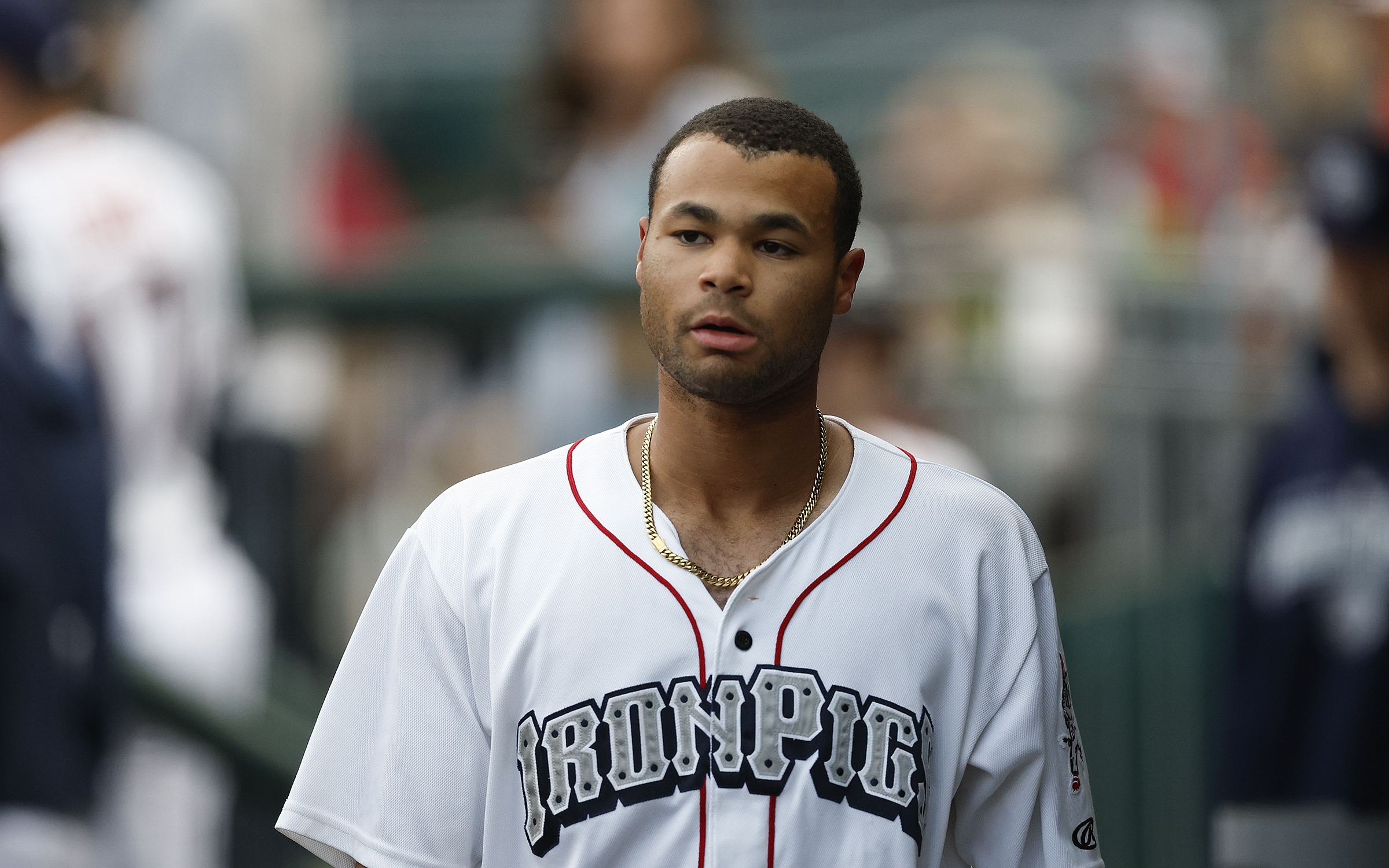
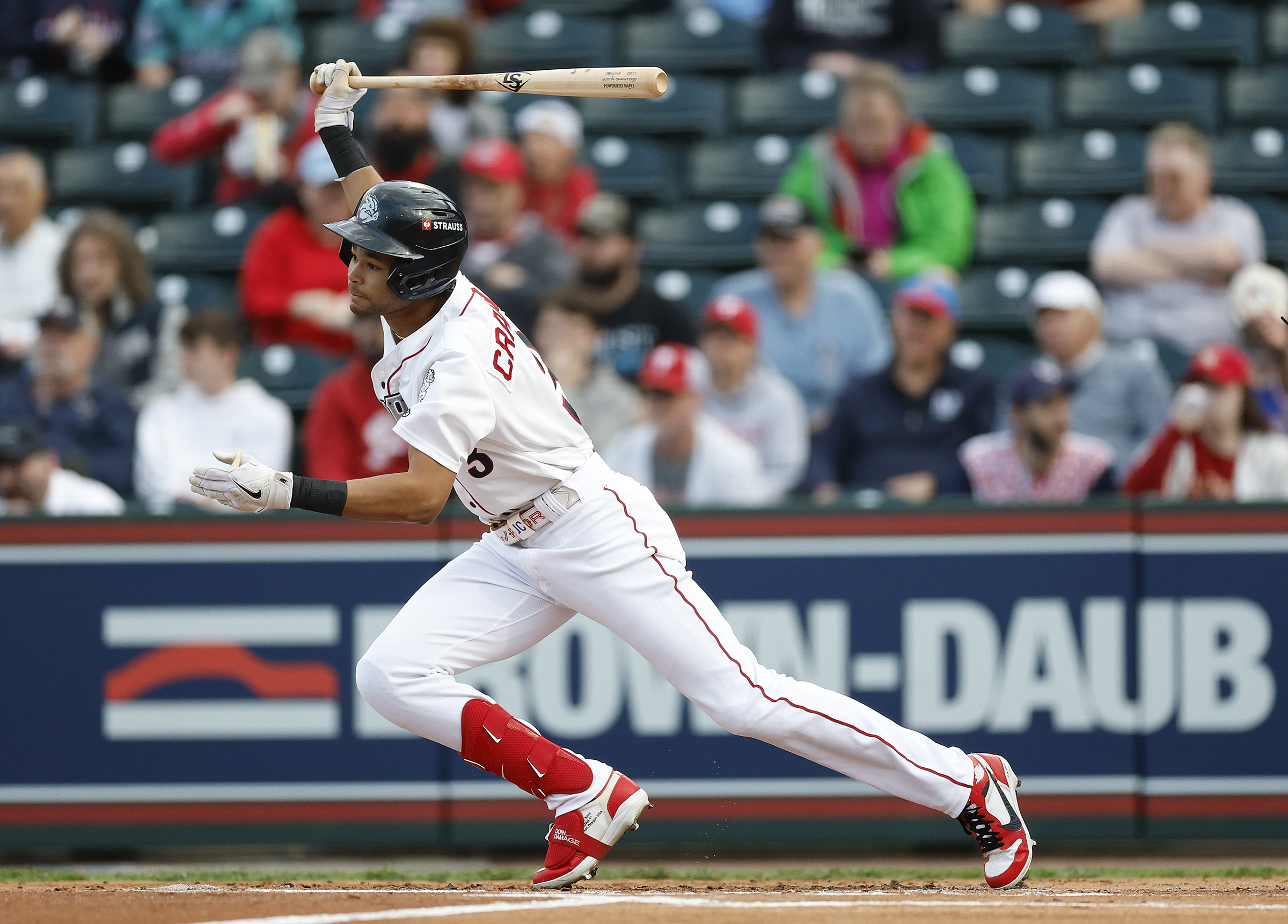
Phillies outfield prospect Justin Crawford won the triple-A International League batting crown with a .334 average.
Front and center, or stage left?
At times this summer, the Phillies got “very close,” a team source said, to calling up Crawford.
Instead, they left the 21-year-old in triple A.
Never mind that left fielder Max Kepler was drowning, with a .201 average and .661 OPS through July 25. Rather than releasing the $10 million veteran and replacing him with Crawford, the Phillies gave Kepler a longer rope. And after trading for Harrison Bader at the deadline, there wasn’t an opportunity for Crawford to play every day in the majors.
But Crawford reached base at a .411 clip for Lehigh Valley and won the International League batting crown with a .334 average. He stole 46 bases and led the farm system with 147 hits.
“I don’t know what else he really does at the minor-league level at this point,” Dombrowski said. “He’s led leagues in hitting. He steals bases. He’s a good energy guy. He’s a solid outfielder.”
Go ahead, then, and pencil in Crawford for a spot in the season-opening outfield.
Differences of opinion about Crawford once focused on his offense, notably his extreme tendency to hit the ball on the ground. Now, it’s more whether he’s best suited for center field or left.
Crawford got drafted as a center fielder and played there exclusively for three years. He shifted to left field more often late this season, especially once Johan Rojas got sent back to triple A. Crawford’s dad, Carl, played left field for 15 years in the majors.
Dombrowski might have hinted at the Phillies’ thinking by saying Kepler is “not going to most likely be back because he’s a free agent and we have Justin Crawford coming.” And Thomson said Crawford is “maybe a little better in left than he is in center,” based on internal reports.
Other team officials don’t fully concur.
Some Phillies officials believe Justin Crawford is best suited to play left field. Others think he can handle center.
“I see Justin as a center fielder,” minor-league director Luke Murton said. “We’re very confident in his ability to play center field. It’s just a matter of, he’s played less left field over the course of his career, so give him exposure to that so when the opportunity comes, if he has to go to the big leagues and play left field, then he’s prepared to do that.
“But I think, as an organization, we see him as a center fielder.”
It would simplify the outfield picture if Crawford is able to handle center field.
Bader, who stabilized center field after the trade, is expected to decline his $10 million mutual option. The Phillies would feel less urgency to bring him back in free agency off his career-best season at the plate.
And they could commit to Brandon Marsh, also a better defender in left field than center, as at least the lefty-hitting side of a corner outfield platoon, which would enable them to focus on finding a replacement for malcontented right fielder Nick Castellanos, all but certain to be traded or released.
Regardless, it will be Crawford’s time. At last.
“I don’t expect him to carry our club in the very beginning of the season, but you also don’t want to put him in where you think it would be a bit too much for him,” Dombrowski said.
“I don’t think that’s going to happen. He has never been overwhelmed when he’s been with us at any level, and we keep moving him up. You want to just see that he just continues to handle himself the same way that he has,” Dombrowski said.
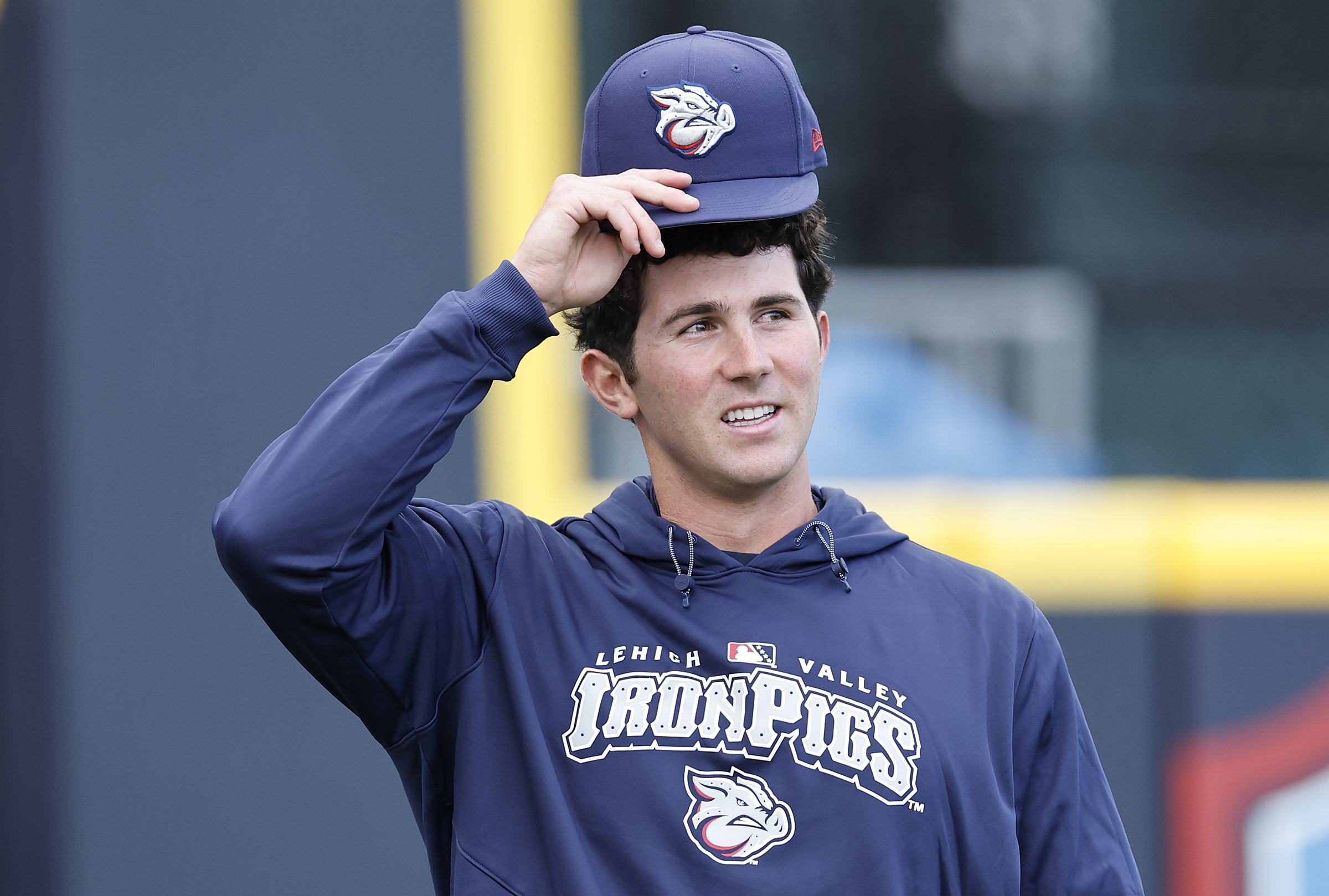
Phillies top pitching prospect Andrew Painter struggled in triple A in his first season back from Tommy John elbow surgery.
‘He’s going to be fine’
Don’t look now, but there will probably be a spot for Painter in the season-opening starting rotation.
Really. It’s true this time.
In 2023, a few team officials predicted that Painter would make the team out of camp even though he was 19 and hadn’t pitched above double A. He injured his elbow and wound up needing Tommy John surgery.
Last winter, in outlining the plan to build Painter’s workload in his return to the mound, Dombrowski infamously said he could be ready for the majors by “July-ish.” Instead, the top prospect had a 5.40 ERA in triple A.
It’s doubtful, then, that Dombrowski will pin yet another timetable on Painter. But with Ranger Suárez headed to free agency and Wheeler recovering from thoracic outlet decompression surgery, Painter’s long-awaited debut could come early next season.
“I think he’s going to be better the second year out after the Tommy John [surgery],” Thomson said. “The command’s going to get better. The quality of stuff’s going to get a little bit better. He’s going to be fine.”
Rival talent evaluators generally agree. One NL scout said last month that he has “appropriate concern” about the decline in Painter’s command but is inclined to “cut him some slack” after not pitching for two years.
There were encouraging signs last month. In his second-to-last start, Painter tossed five scoreless innings. He shut out Syracuse for three innings before allowing three runs in the fourth in his final start.
Even if Suárez bolts, Cristopher Sánchez, Jesús Luzardo, Nola, and Taijuan Walker are rotation holdovers. The Phillies are optimistic that Wheeler will return. They can’t say for sure that he will still be elite.
Painter’s time is coming. Maybe even in April.
“He still throws his fastball in the upper-90s, touches 100, still has quality breaking stuff,” Dombrowski said. “Most importantly, he remained healthy. So, those things are the encouragement. He used to have great command. It wasn’t quite as good this year. And normally, when you trace back to a lot of people that have had Tommy John, that’s the last thing that comes back. We’re optimistic that he’ll be able to regain that.”
Phillies infield prospect Aidan Miller went 9-for-27 with two doubles and a homer in an eight-game triple-A cameo to end the season.
Miller time?
Murton was skeptical in spring training when minor-league baserunning coordinator Gary Cathcart recommended that Miller be among the players who got a green light to run.
“I was like, ‘Hey man, I don’t think Aidan Miller’s going to steal a ton of bases in the big leagues. That’s just me,’” Murton said. “He’s like, ‘Well, I think he’s going to.’ I’m like, ‘Yeah, I don’t.’”
Murton relented. A few months later, he marveled that Miller already swiped more than 20 bases. Miller finished with 59, including seven steals in eight games at triple A to end the season.
In hindsight, even Miller didn’t see it coming.
“Honestly, no,” he said last month. “I don’t really know if I’m faster this year. Maybe a little bit. But I think I’m just being more aggressive on the bases.”
Miller’s path to the majors might be accelerated, too.
After a slow start, he batted .356 with a 1.099 OPS in his last 36 games. If the Phillies trade Alec Bohm this winter, after dangling him in talks last offseason, Miller could be in the wings at third base, even though he has played shortstop so far throughout the minors.
“He’s played some second, he’s played some third, but he’s primarily been a shortstop, so we’d have to make sure that we properly prepared him to do that,” Dombrowski said. “That’s still a discussion that we’ll have to have. But he’s a really good player and a good athlete. And he can hit.
“If Miller’s coming up here, he’s going to be an everyday player at the beginning of his career. We’re not going to bring him up and not play the majority of time.”
Miller was scheduled to play in the Arizona Fall League, but the Phillies decided that it was better if he rested after a long season. Besides, he could be in for a big spring training.
If it seems fast, consider this: When Dombrowski ran the Red Sox, he called up Andrew Benintendi from double A in 2016 and Rafael Devers a year later after only six triple-A games, two fewer than Miller played this season.
Last week at the Vatican, two Villanova legends finally came together: Pope Leo XIV and former basketball star Maddy Siegrist.
Siegrist took a short trip to Rome to visit the big landmarks, including the Trevi Fountain and the Colosseum and spent a day with Villanova at an Augustinian conference, where she got to meet the pope.
Last year, the Villanova women’s basketball team took a group trip to Italy and the Vatican, but Siegrist, still in the middle of the WNBA season, couldn’t attend. This time around, after the Dallas Wings were eliminated from playoff contention, Chrissy Quisenberry, who helps organize alumni trips at Villanova, reached out to let Siegrist know they were planning another trip and that they might get an audience with the pope, also a Villanova graduate.
“People always joke because he [went to] Villanova, like, ‘Is he going to do the wedding?’” said Siegrist, who’s engaged to Stephen Perretta, an assistant women’s basketball coach at Drexel and the son of former Wildcats coach Harry Perretta. “When it did happen, I was like, ‘Oh my gosh, this is crazy.’ We have a family group chat of all my cousins and aunts and grandparents. I sent the picture, and they’re like, ‘Are you joking?’ It was kind of a last-minute trip, so I didn’t really tell anyone because I didn’t know — when they said audience, it could be 1,000 people outside, which would have been unbelievable, but I didn’t realize I was actually going to have the opportunity to shake his hand.”
The group attended mass at St. Peter’s Basilica and toured the catacombs before meeting with Pope Leo. Siegrist got a photo shaking the pope’s hand — which she did have to pay for, like a Disneyland ride photo — and said it was a bucket list moment, which “rejuvenated” her Catholic faith.
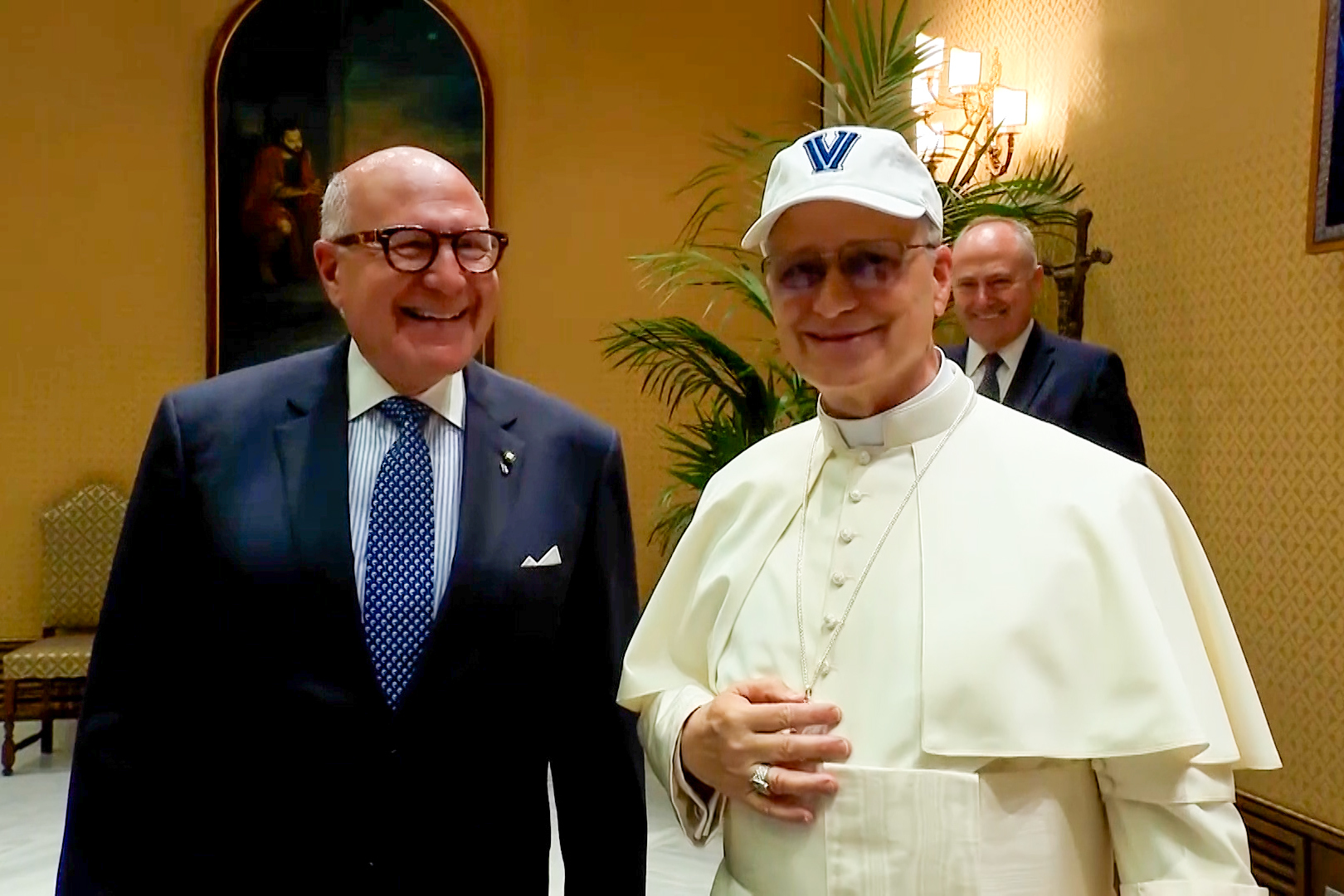
Pope Leo XIV wears a Villanova hat gifted to him during a meeting with an Italian heritage group in June.
Pope Leo frequently goes viral for his White Sox fandom and has been pictured in Villanova hats on multiple occasions since assuming his new role. But even with a group from Villanova in the building, Siegrist said he was careful to stay impartial.
“He’s not biased at all,” Siegrist said. “I’ve seen a few pictures of Villanova hats and stuff. I think he addressed that. Dr. [Barbara] Wall was on the trip, she was one of his professors, so that was pretty cool to be with her during that moment. He knew there was a small group from Villanova at the conference, I think about 20-25 people. Such a cool experience. I really don’t even remember what I said in the moment. You just get so starstruck. You’re so nervous.”
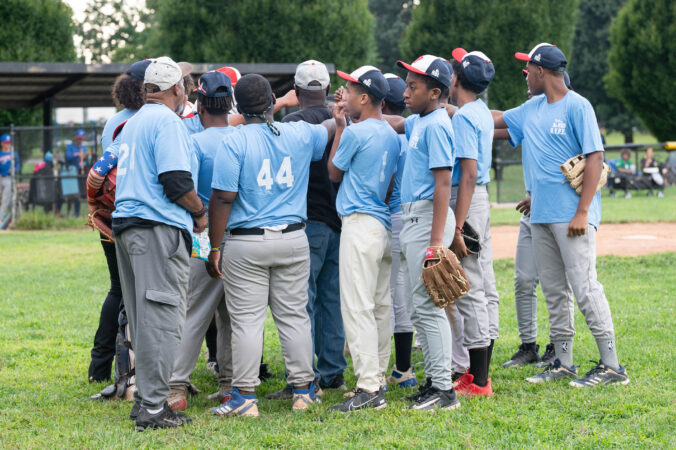
Before the first pitch is thrown, Tyrone Young arrives early to the baseball field at Hunting Park to pick up trash in both dugouts where teenagers gather to play in North Philadelphia’s Heritage Baseball League.
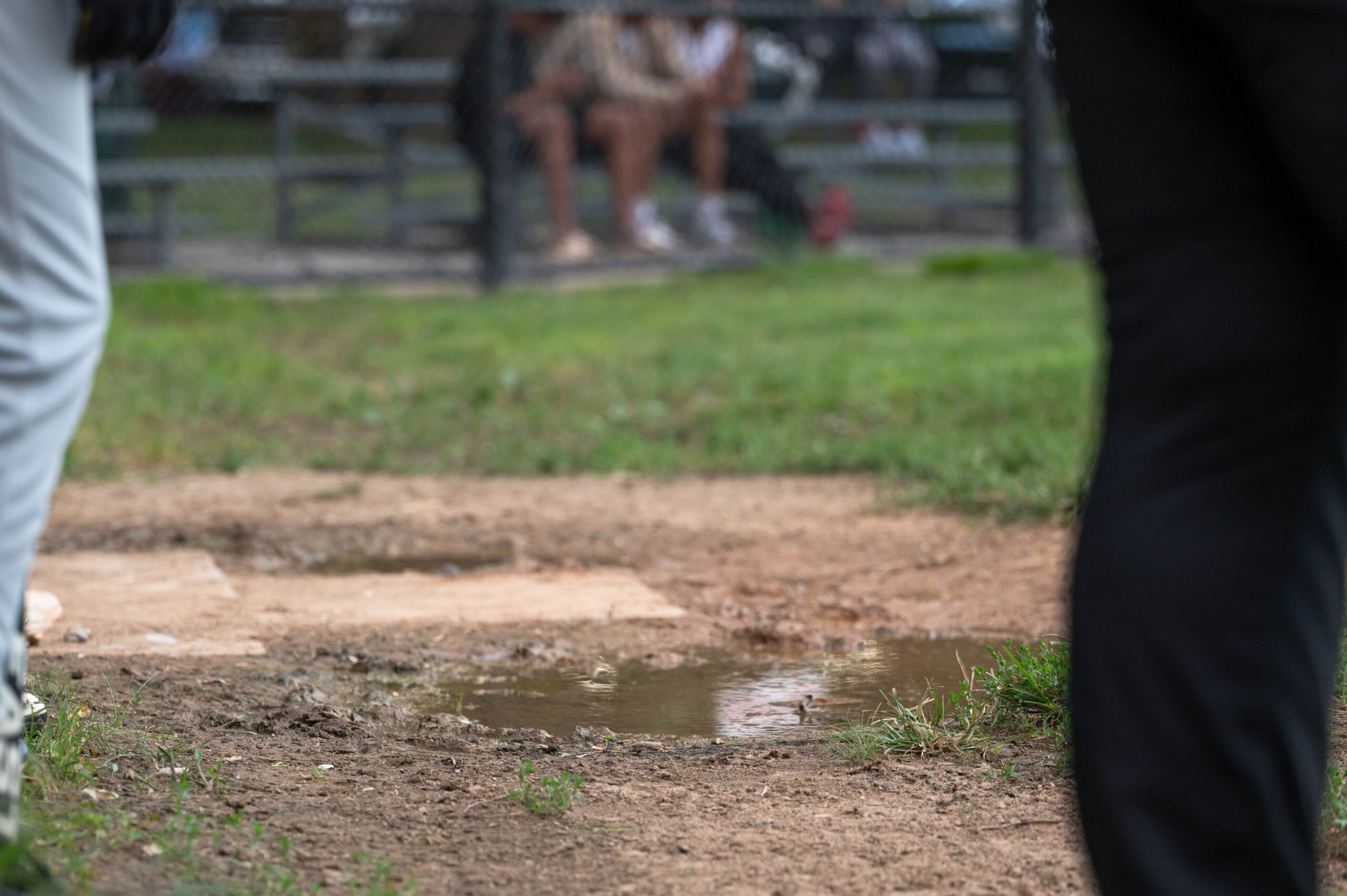
The trash is what he can control. What he can’t fix are the deep holes on the base paths that make it nearly impossible to play when it rains. He believes race has something to do with the condition of his field.
“Certain fields you might go in the Northeast … their fields are immaculate, but why do ours not look like that?” said Young, who founded the league in 2008.
A new city-funded study of nearly all public sports facilities in Philadelphia confirmed his suspicions: Neighborhoods with more white residents have more fields, amenities that are in better shape, and more youth sports programs than other areas. The survey, conducted across more than 1,400 fields, courts, and baseball diamonds in 2023, also found lower crime rates in the blocks surrounding sports facilities and youth programs, echoing the belief of many coaches that sports help kids stay out of trouble.
The study also found that areas with higher rates of homeownership have more sports facilities. Areas with a higher proportion of white residents are more likely to have youth sports programs, while areas with a higher proportion of foreign-born residents are less likely to have them.
There are holes throughout the baseball field at Hunting Park. The holes trap water, making it difficult for the players to use it.
“I wouldn’t even want to imagine if they weren’t playing baseball what they would be doing,” Young said of his players. “So [we’re] giving them an avenue to do some stuff.”
The Philadelphia Youth Sports Collaborative (PYSC), a nonprofit consortium of youth sports providers, chose Temple University’s Sport Industry Research Center to conduct the study with funding from Philadelphia Parks and Recreation. The city and PYSC had a shared interest in gathering data on fields that had experienced “a lifetime of underinvestment,” said Beth Devine, PYSC’s executive director.
“As an advocate in this space, we not only have to identify the issues but we have to call them out,” Devine said. “If we want to say that we’re a youth sports city and we’re investing in youth sports, we can’t only do that, we have to look at the spaces where the kids are playing.”
The study’s results reflect Philadelphia’s de facto racial segregation and a pattern of disinvestment in communities of color. But they also show the city’s sports facilities are in poor shape overall, with 60% rated “somewhat below” or “far below” average quality, attributed in large part to heavy traffic, litter, and poor maintenance.
The city’s Rebuild initiative to renovate parks, libraries, and recreation centers has made a dent in the catalog of fields in need. But in Hunting Park, where Young’s Heritage League plays, the ball field built 13 years ago with help from former Phillie Ryan Howard is an example of what can happen when facilities don’t receive sustained care over time.
“The investment has to be a long-term, thoughtful, and deep investment,” said Mike Barsotti, the director of youth sports at Philadelphia Parks and Recreation. “Every neighborhood needs to have these great advantages, so how do we think about doing that, not in six months, but over a 20-year plan?”
An effort to fix the fields
For decades, Philadelphia leaders have been contending with how to fix the city’s park infrastructure — labeled “Acres of Neglect” by the Daily News in 2001 — amid a growing body of research tying quality green space to crime prevention.
Rebuild, launched under former Mayor Jim Kenney and continued by Cherelle L. Parker’s administration, has showed signs of success: Thirty-nine sites have received improvements and another 21 are under construction or in planning phases, according to an October report from the city, and sports facilities at completed sites were rated at 18% higher quality than other sites in the Temple study.
However, Rebuild has been beset by delays and was largely funded by one-time cash infusions of bonds, grants, and city capital funds. Maintaining those sites and others over time with sustained investment should be a priority, Devine said.
“If you renovate a building with no solid long-term investment in the maintenance of what you’ve just done, you’re going to be talking about Rebuild again in 20 years,” Devine said.
Philadelphia ranked 14th among U.S. cities in total city spending on parks in 2024, according to the Trust for Public Land. The $83.5 million budgeted for Parks and Recreation this fiscal year comprised about 1.2% of the city’s $6.8 billion budget.
The stakes of continued investment in youth sports are tied to the city’s crime prevention efforts, as the Temple study found 21% less violent crime in the immediate area surrounding sports facilities compared to sites without them. The study found similar trends for sites with more permitted youth sports programs.
“We talk about Rebuild and the importance of built physical infrastructure, but there’s a huge personal, social component to this, which I think is the programming itself, and is using these places as essentially a hub to build social capital and positive social relations among community members,” said Gareth Jones, the study’s principal investigator.
A member of the North Heritage Baseball League wears a shirt detailing the league that the Phillies help run at Hunting Park. The Phillies help run leagues across the city.
The Parker administration in 2024 poured $3 million into youth sports, including $450,000 for PYSC’s Philly Youth Sports Fund, with an explicit focus on youth development and violence prevention, Philly Voice reported.
Shanika Bowen, whose son Elijah plays for Young’s Heritage Baseball League, said when children are doing something positive — like playing baseball — “we have to back them on that.”
“Many people are complaining about the kids being on the street and not having anything to do,” Bowen said. “That money needs to be put into different programs to have these kids doing something other than being out on the corners or running rambunctiously, not doing anything.
“If they don’t have the field, where are they going to go?”
Emelie Beckman contributed reporting to this story.
Playing Fields, Not Killing Fields is an Inquirer collaboration with Temple’s Claire Smith Center for Sports Media and the Logan Center for Urban Investigative Reporting, to produce a series examining the current state of Philadelphia’s youth recreation infrastructure and programs. The project will explore the challenges and solutions to sports serving as a viable response to gun violence and an engine to revitalize city neighborhoods.
Shay Barker wouldn’t describe his relationship with his older brother Ryan as instant best friends. They fought as children and were competitive with each other, but Shay secretly wanted to do whatever his big brother was doing.
“I was kind of like a crybaby as a kid, and he was the one who just found that super annoying,” said Shay, three years younger than Ryan. “We would get in a lot of fights and stuff. But I’m a lot more mature now. I don’t really get upset about things. I think that’s probably the biggest reason why we’re so close now: We connect on a different level than we used to.”
Part of their connection also stems from the bond that the two Chester County natives share in the same sport.
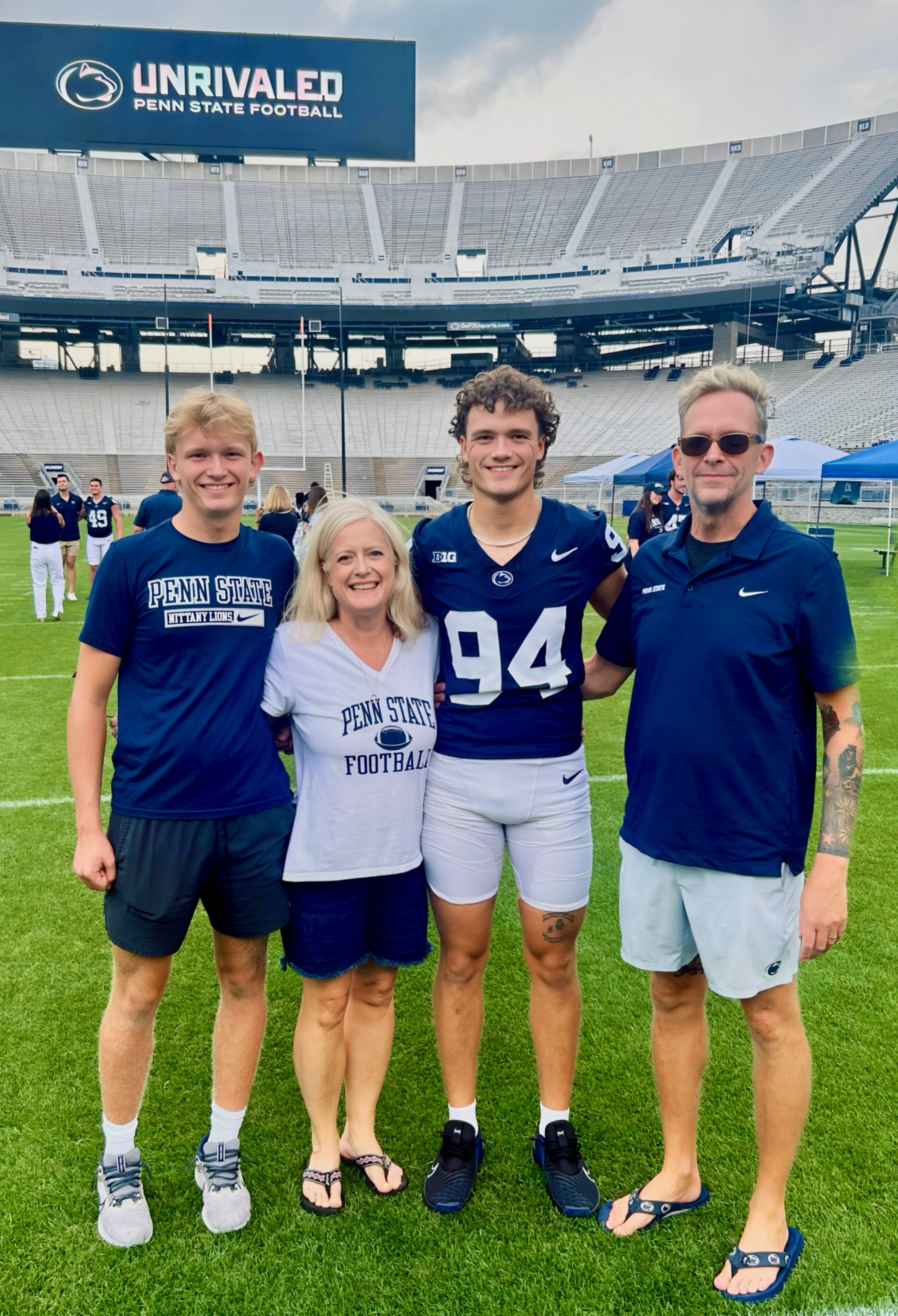
Ryan is the starting kicker at Penn State. The redshirt sophomore, once a preferred walk-on, is now on scholarship. Shay, a senior at Kennett High School, will also head to a high-major program to kick and punt next fall. He earned a scholarship offer to Syracuse and made his pledge in June.
Ryan is considered one of the best to come through Kennett’s program. He holds the school record for longest field goal (45 yards) and was the first in program history to play Division I football. With the Nittany Lions this season, Ryan’s longest field goal is 49 yards, and he ranks eighth on Penn State’s all-time list in extra-point percentage (98.6%), while carrying the top percentage (86.7%) in field goals made in program history.
Shay felt he had high expectations to live up to. He has been compared to Ryan before. But Shay brushed those comments to the side because the only way to silence those remarks is on the gridiron.
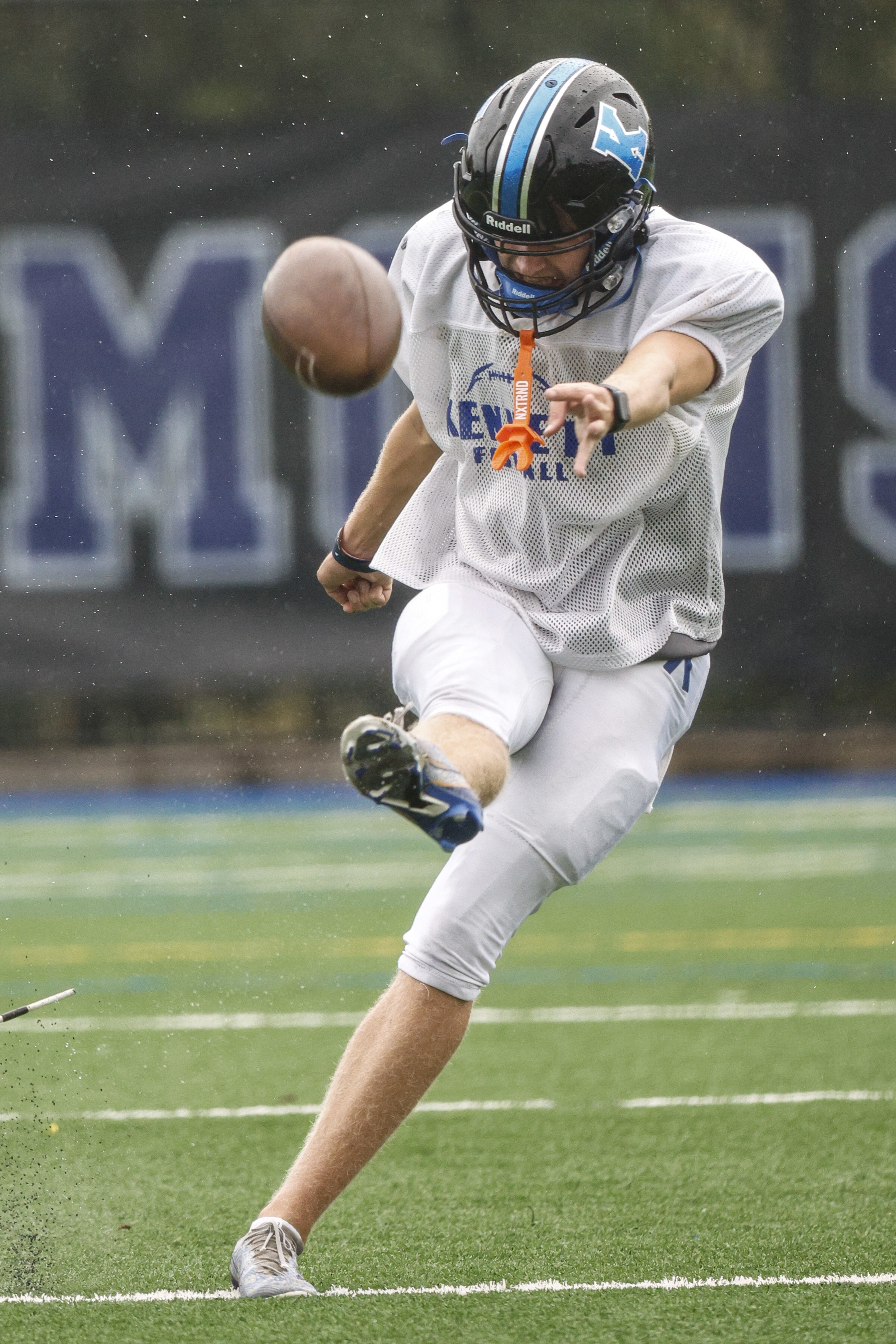
The 6-foot-2, 190-pounder is ranked among the top 10 high school kickers in the country, according to 247Sports. He has kicked field goals as far as 63 yards in practice, and his in-game career-long is 44 yards. So far, Shay has made 8 of 10 field goal attempts for a 7-2 Kennett team.
“Kicking has brought us closer than I ever thought we would be,” Ryan Barker said. “It’s such an individualized thing that we’re both trying to work just as hard as each other to get better at whatever we need to improve on, and to be able to have each other there for the mental and physical aspect, it’s just awesome. I love helping him. I love coaching him, and I can see that he’s listening.”
Soccer turned football
The Barkers grew up in a soccer family.
Their mother, Sally, used to visit her parents’ native England during the holidays. In the early days of their relationship, her future husband came along. The two decided to go to a championship match a tier below the Premier League, and “my jaw hit the floor,” Chris Barker said.
From the atmosphere to the game itself, Barker was hooked and became a supporter of Manchester United. The Barkers even named Ryan after Ryan Giggs, one of the most decorated footballers of all time, who spent the majority of his career with United.
And it didn’t take long for Ryan Barker to pick up the sport.
Shay, Sally, Ryan, and Chris Barker together on the field at Penn State.
“We have video of Ryan barely walking but kicking a soccer ball,” his father said. “Ryan went on to achieve a lot of success in soccer. We thought that was going to be the pathway. We thought that soccer would be their ticket to maybe a scholarship in college. But little did we know that there’s an influx of Europeans now in the American collegiate soccer system, and it became pretty clear early on that it was going to be a lot more competitive for our boys to earn a scholarship, let alone play at a high level.”
Both brothers started soccer around age 3. They played for the Delaware Rush Football Club in Hockessin and the Southern Chester County Soccer Association in Kennett Square. However, before Ryan entered high school, he sat on the idea of kicking in football.
One day in the summer, he asked his father to drop him off at Kennett’s football field. He brought a football and tried to kick a field goal. After each attempt, he would jog over to the ball to do it again. A custodian at the school saw Ryan and went to find coach Lance Frazier to tell him, “‘There’s a freshman on the field kicking 50-yard field goals,’” Frazier recalled.
“I’m like, ‘Get out of here, that’s not possible,’” said Frazier, in his eighth season as Kennett’s head coach. “I go up there and I see this tall, slender kid. I can hear him before I can see him, because he’s kicking the [stuff] out of the ball. … I knew he was going to have to make a really big decision here in the future: Is he a soccer player or is he a football player?”
Through three years, Ryan played on Kennett’s soccer team and kicked for the football team. In his senior year, he decided to put his full commitment into kicking. He had some interest from smaller soccer programs to play collegiately, but he wanted to go Division I.
Football could give him that opportunity.
“That was probably one of the most difficult decisions that I ever had to make for myself,” Ryan said. “Just in terms of soccer being my first love and playing it for 17 years. … When I realized I could potentially play Division I football, that was kind of the main factor in my decision.”
Kennett’s Shay Barker kicked his longest field goal of 41 yards last season.
Shay’s journey was a bit different. He started to fall out of love with soccer in the eighth grade. Due in part to a growth spurt, Shay had patellar tendinitis in his knees, which made it painful to run. He decided to try kicking as a freshman while learning alongside his brother, then a senior.
“He had seen how fun it was for his brother to play on Friday nights and to be part of the football team at school,” their mother said. “I think he was really excited to join [Ryan] and kind of be his understudy.”
Kicking came naturally to Shay, but he was uncertain what he wanted from the sport. Then, something changed.
Carving his own path
During his junior year, Shay competed in a few camps and showcases through Kohl’s Kicking, a program for athletes who play specialized positions of kicker, punter, and long snapper to gain exposure to college coaches. He had a rough showing during the January showcase, which led him to question whether this was what he wanted to do.
“Growing up, Shay always wanted to go to hang out with his friends,” his mother said. “He wanted to play this sport, this club. Last winter, he said, ‘I think I’m going to try to play basketball my senior year.’ [Chris and I] would look at each other like, ‘What is he talking about?’ He just could not say no. … The biggest question mark was maybe not whether he could do it, but whether he would choose to do it because of the sacrifice.”
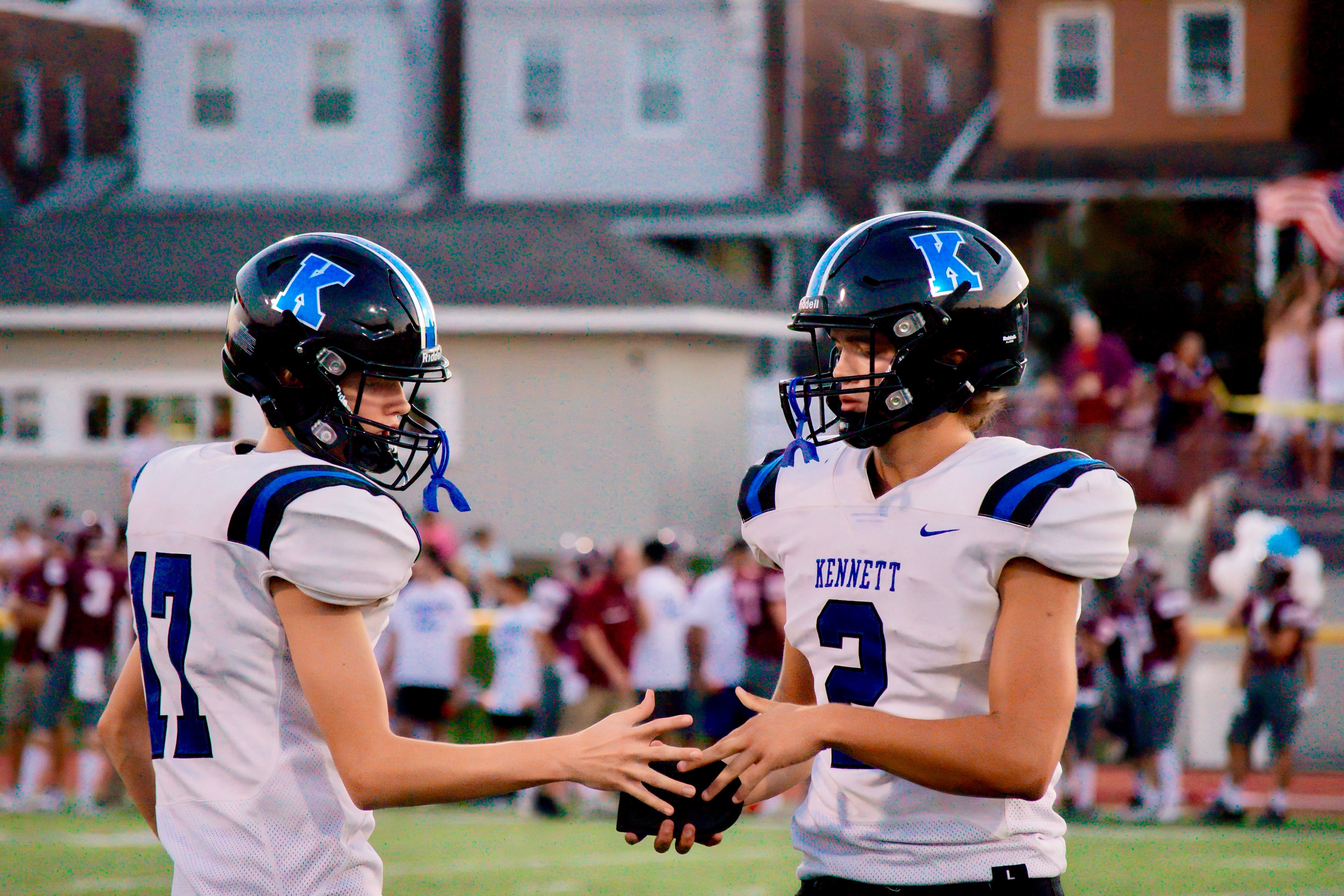
Shay and Ryan Barker shown together while they played at Kennett High School.
That performance fueled his desire to get better.
Shay began seeing a personal trainer to get stronger and sought out advice from Ryan, who reminds his younger brother that “the only kick that matters is the next one.”
In June, Shay attended a camp at Syracuse, where he won the field goal competition and backed up to about 58 yards. He also was a finalist in the kickoff competition.
A few days later, Syracuse came calling to offer Shay a full ride.
“They saw something in me that I didn’t even see in myself,” Shay said. “I was kind of an underdog a lot of my career. I just got in the right mental space and did what I needed to do. … I’m honored to have this opportunity, especially coming from a small school like Kennett, where not many kids get these kinds of opportunities. I just want to make the most of it.”
And even when Ryan and Shay aren’t together, they are still competing.
Last year, when Penn State faced Southern California on Oct. 12, Ryan hit the game-winning field goal in overtime to secure a 33-30 win for the Nittany Lions. Later that evening, Shay hit a career-long 41-yard field goal against Unionville.
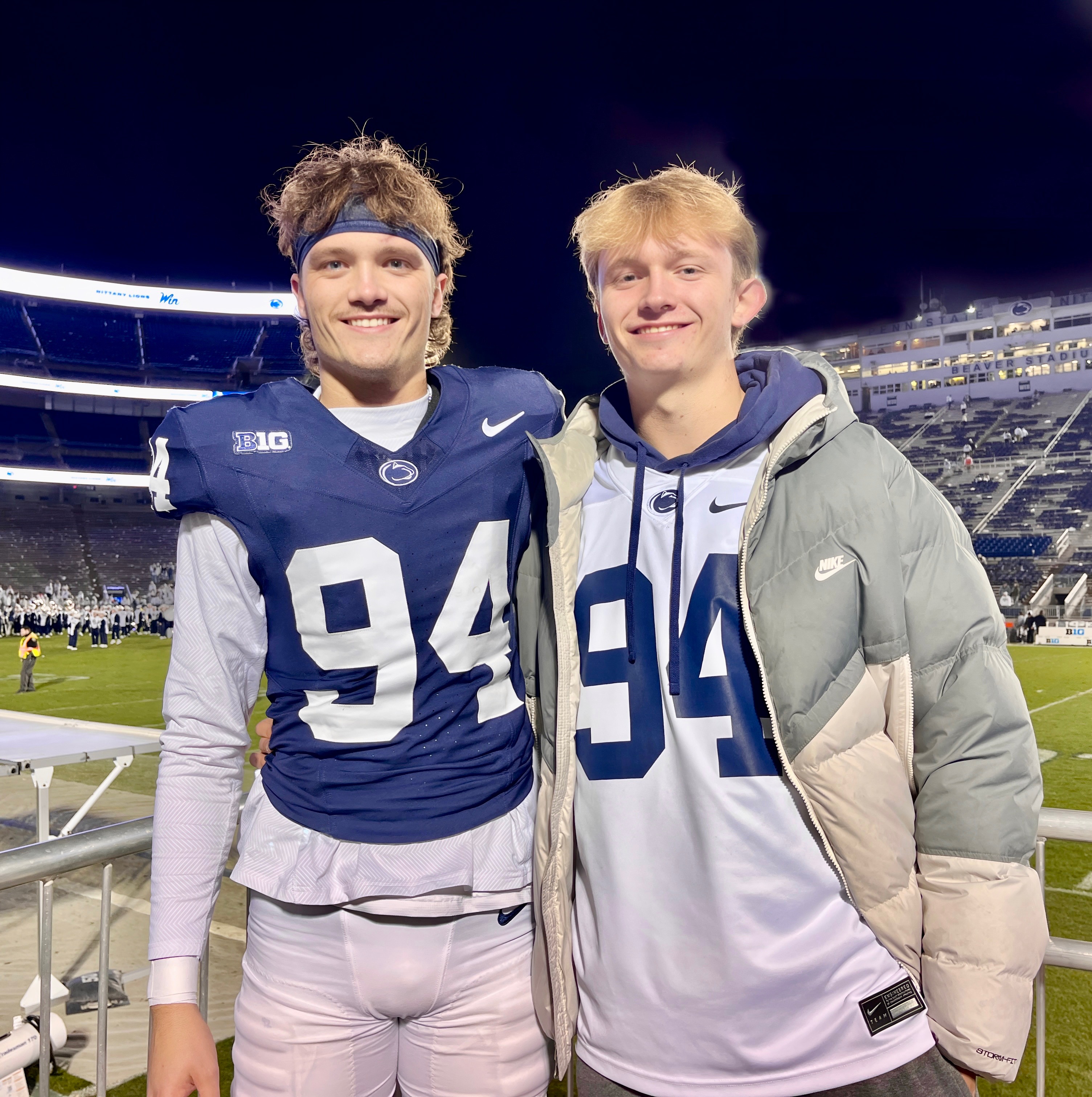
Ryan and his younger brother Shay during a Penn State football game.
“That was probably one of the proudest and special moments for us as parents,” their father said. “Both our boys, at their various levels, did something quite remarkable on the same day.”
Shay has hopes of surpassing Ryan’s program record. Last weekend, he broke his career-long with a 44-yard field goal against Avon Grove. He told his big brother about those aspirations and has his support.
“Ever since I went to college, Shay is finally able to find his identity and what he brings to the table in terms of football,” Ryan said. “It’s great seeing him succeed. He, without a doubt, has the capability to beat that record, so I hope that he gets that opportunity.”
Frazier believes Ryan and Shay could be the next brother duo to kick in the NFL.
The two already have Sept. 4, 2027, circled on their calendars, when the Nittany Lions host the Orange at Beaver Stadium. This journey isn’t what Shay would have expected, he said, but kicking has given him the chance to play college sports, while forming a lifelong bond with his brother.
“It’s definitely something I don’t take for granted,” he added. “I wouldn’t be here without Ryan.”
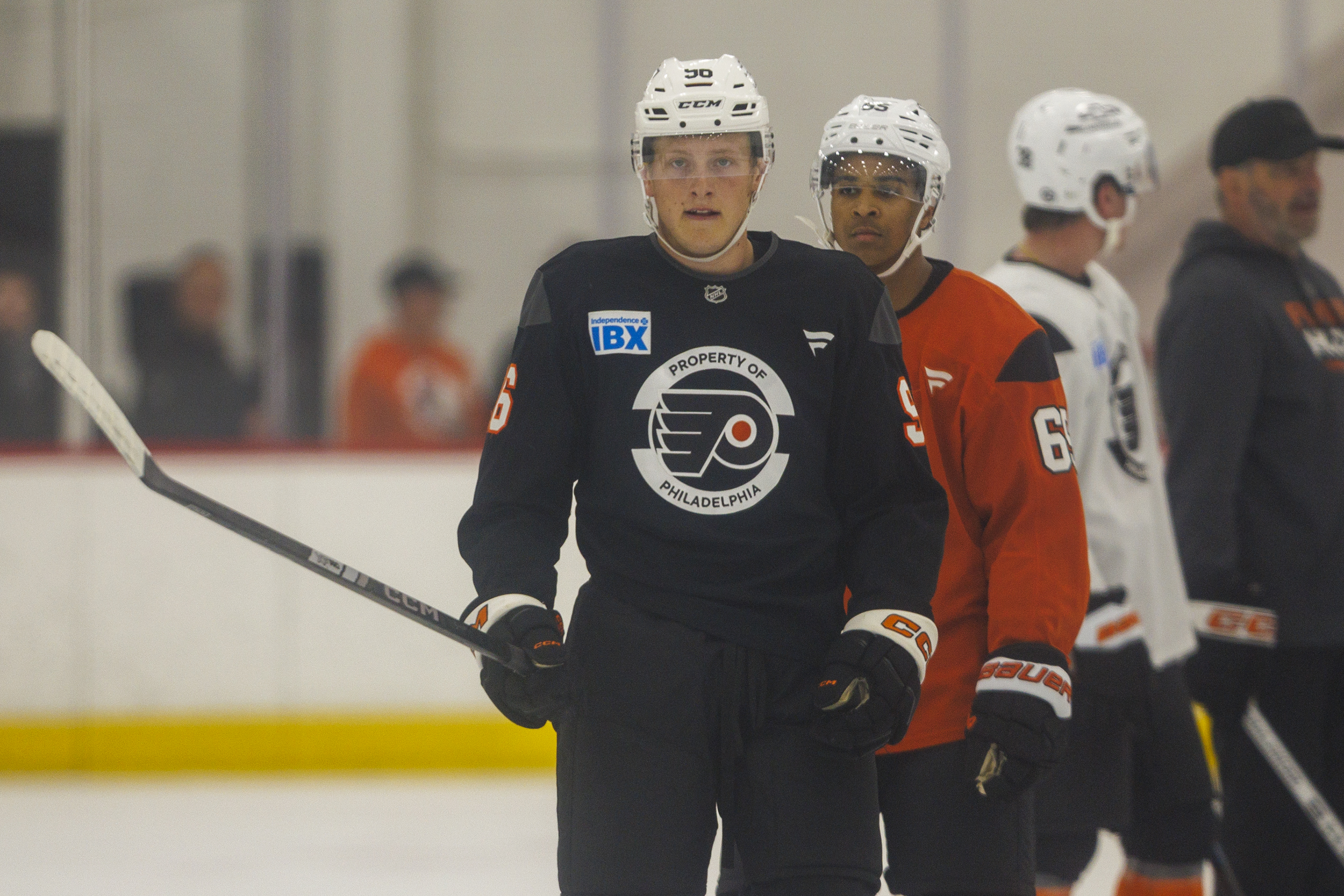
Ty Murchison rubbed out Jack Nesbitt along the wall during a drill on the first day of Flyers development camp last month
The 2021 fifth-rounder, who is 6-foot-2 and 205 pounds, made sure he did it with noticeable authority. And not just because he was taking out Nesbitt, the 6-5 and 185-pound center who was drafted 12th overall four days before.
Murchison’s game is predicated upon his size and physicality, and he has quietly developed into a left-shot prospect on defense whom the organization is watching closely.
“He’s a late-round pick, but maybe he just has a little bit longer of a runway to get to where he’s going,” Flyers director of player development Riley Armstrong told The Inquirer in April. “And I think when you do a rebuild, you can’t just sit back, in my mind, can’t just sit there and be like, OK, we’re only going to focus on our high-end picks.
“You have to go in there and say we’ve got to focus on the fifth, the sixth. … And I really do think that just because you’re a sixth-, seventh-round pick, or not even drafted … if you work your butt off, and you do the little stuff, you never know what can happen.”
Murchison, now 22, did that.
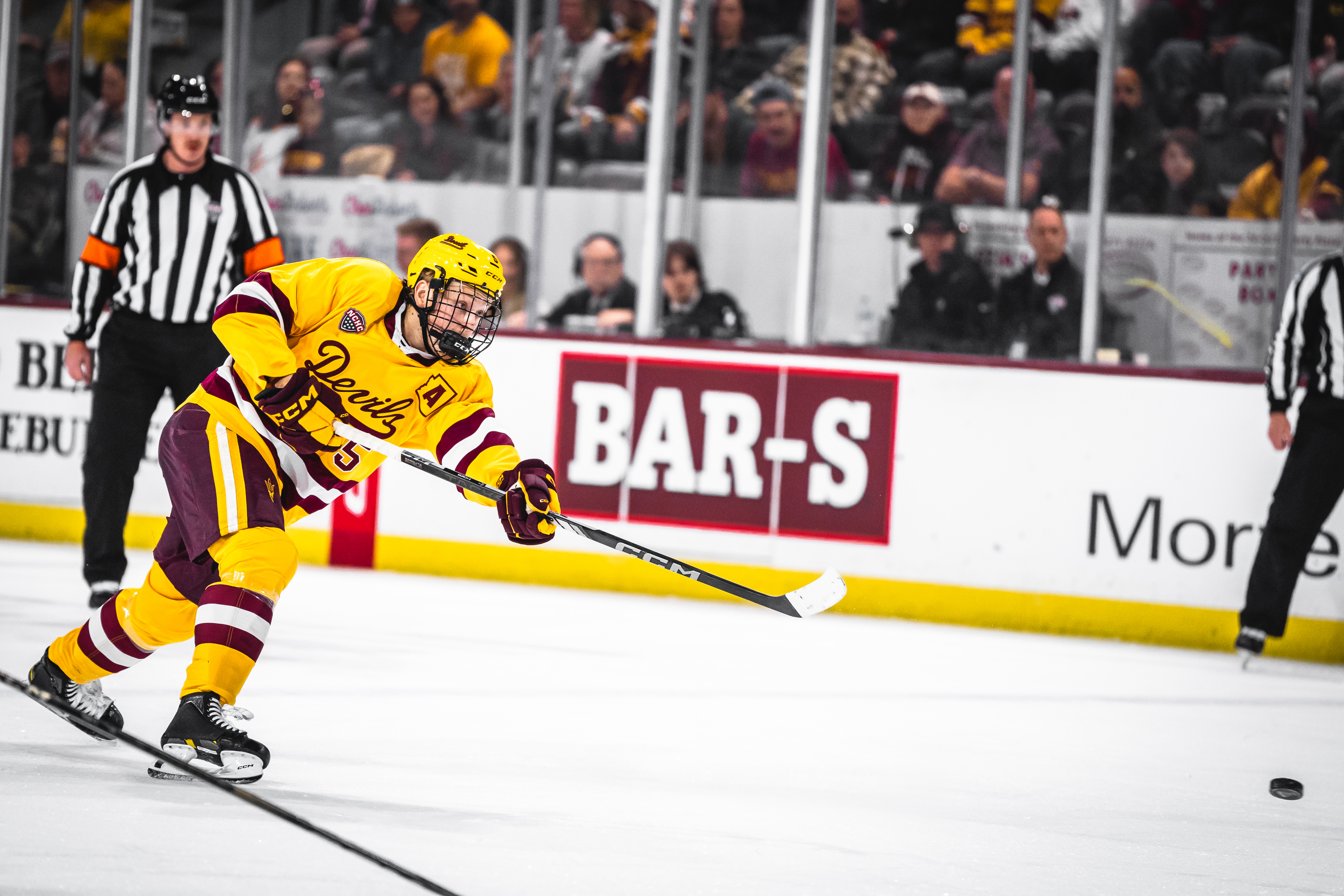
Murchison wrapped up his four-year career at Arizona State last season as the National Collegiate Hockey Conference’s defensive defenseman of the year. Skating against schools like Western Michigan — and Alex Bump — and national semifinalist Denver, which the Sun Devils finished ahead of in the standings, the assistant captain snagged the award after blocking 98 shots.
Those 98 blocks were a program record and also led all NCHC players. He recorded seven against Bump’s Broncos, two shy of the career high he set against Boston University as a sophomore.
“He’s great,” ASU teammate and Calgary Flames draft pick Cullen Potter told The Inquirer at the NHL scouting combine. “He puts his body out there for the team, in any way he can, blocking shots. … So he’s just a great team guy, and I love having him around the rink, keeps it light, and has some fun with it, which I think hockey should be.”
The Flyers selected Ty Murchison, who played collegiately for Arizona State, in the fifth round of the 2021 NHL draft.
Ready to roll(er)
Maybe it’s the California vibes that help him keep it light. Maybe it’s that Murchison, who will play with Lehigh Valley of the American Hockey League this season, wasn’t twirling around rinks as a wee tyke.
Correction: Ice hockey rinks.
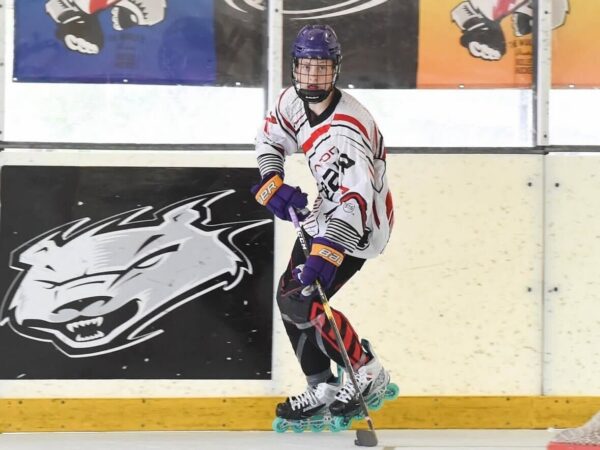
“I played roller hockey, pretty much since I could walk. I had no intentions of really getting into ice hockey until I was probably like 14, just for fun,” Murchison said in April. “But I got a coach from ice hockey who kind of saw me play roller and asked me to join their team. That’s how I got into it, and kind of just took off from there. But, yeah, roller hockey is really my roots, for sure.”
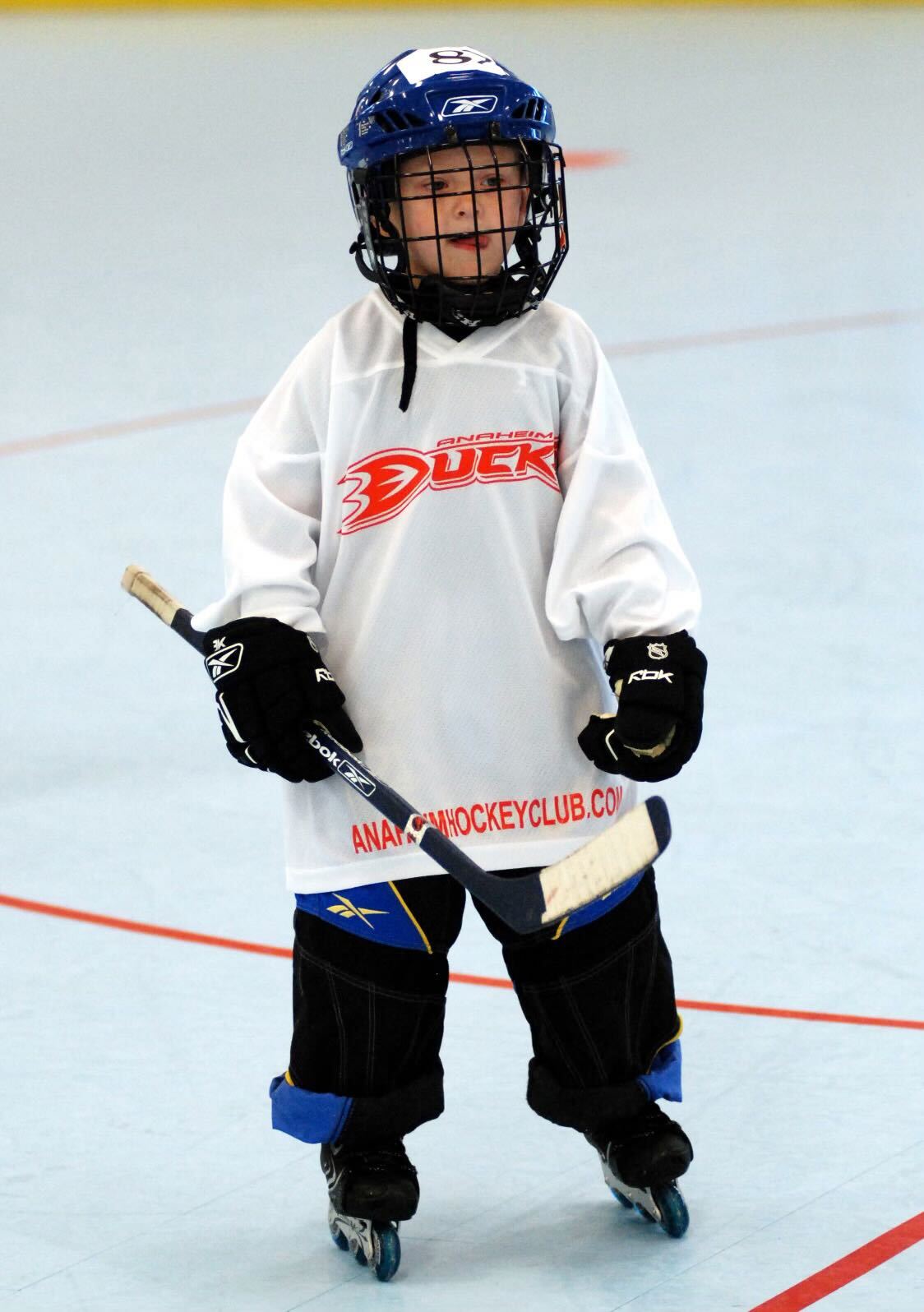
Murchison’s parents moved to California from Canada so his father, Ken, could play in the Roller Hockey International, a professional inline hockey league that ran from 1993 to 1999. Ken Murchison, who played at the University of New Brunswick and in the East Coast Hockey League, also worked for the Anaheim Ducks and managed inline rinks around the state.
Ty Murchison didn’t swap his wheels for blades until he was 11.
“The adjustment was really the edges and the skating. I couldn’t stop when I first started playing,” the younger Murchison said with a big laugh. “So that’s kind of how I got my physical aspect. I was blowing kids up because I couldn’t stop. I was just running into kids.”
After doing “a ton of skating lessons,” Murchison began to excel, and at 16, he moved to Michigan to join the U.S. National Team Development Program. But roller hockey was never far from his mind, and while at Arizona State, he and his dog Penny would rollerblade around Tempe Town Lake.
Ty Murchison grew up playing roller hockey in California.
NHL prospects?
Murchison’s skating has drastically improved through the years, and “he’s physical, keeps it simple,” and is “in your face.” He also does “all the little things that you need guys like that to do when you want to go far,” as noted by former Phantoms coach and current Flyers hockey operations adviser Ian Laperrière.
Now, Murchison and Armstrong are working on his hands.
“He is a high-end skater, really competitive and physical,” Armstrong said of Murchison, whom he compared to Nick Seeler. “Right now, we’re just working on his puck plays and his decision-making. At the junior level, maybe he runs the power play, and he gets that little bit of confidence on the blue line about doing stuff and things like that; I think it goes a long way.
“So we’re working at that with him right now, and who knows? We’ll see where it goes.”
Ty Murchison participated in the recent Flyers’ development camp.
This summer, Murchison is spending time working on getting stronger and putting on weight because “at the next level, everybody’s strong, and the way I play, I need to be stronger than most guys.”
The blueliner got a taste of what’s to come, skating in four games for the Phantoms in April after the conclusion of his college season.
He’s also working on those hands and upping his offensive game after collecting nine goals and 14 assists in 145 career games for the Sun Devils. And of course, he’s playing roller hockey. Recently, Murchison skated in the North American Roller Hockey championships in California.
But now he has his sights set on bigger goals.
“I’m very proud of it, it’s been a blessing,” Murchison said of playing pro ice hockey. “I’m happy to be here. It’s what I’ve been dreaming of — even though I played roller hockey — I always dreamed of playing in the NHL when I was a little kid. So, yeah, I’m hoping to take the next step and get there one day.”
Brady Martin answered the phone last week. Was he at the rink, keeping his legs loose before he is selected in the NHL draft on Friday? Or maybe home, relaxing after a week of interviews and physical tests at the NHL scouting combine?
Nope.
“I’m actually sitting outside an auction right now,” the projected top-10 draft pick said. Yep, Martin was selling some of his cows just days before being drafted.
During the COVID pandemic, the center didn’t have much to do. Martin, the middle son of Sheryl and Terry Martin, and his brothers invested their money in beef cows. He was selling some of his cows on this day.
“We usually buy a cow, and usually have a calf with it,” Martin explained to The Inquirer. “We raise up the baby calf, and then once it’s big enough to sell, we’ll take it to the butcher or the auction, and then someone else will buy it, or we’ll butcher it and keep it for our own meat. Depends on what the price is looking at.”
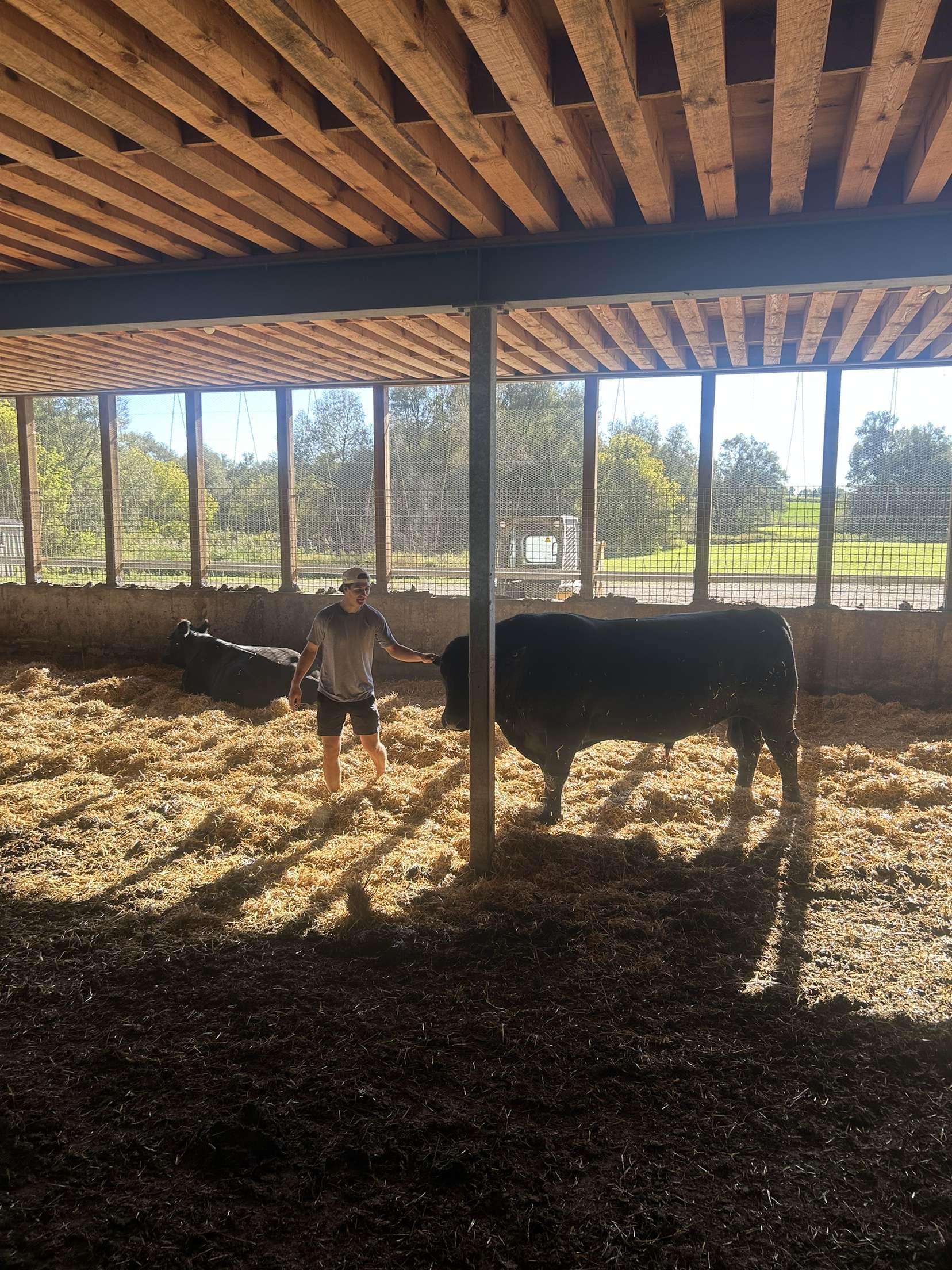
Raising cows isn’t something new to Martin. Known for his hitting and physical game on the ice, he gets his strength from his family’s dairy farm, helping to raise and maintain 250 cattle, 4,000 pigs, and 60,000 chickens. They have a lot of land — technically two farms — outside of Elmira, Ontario, near the hometown of former Flyer Darryl Sittler, and they grow wheat, corn, beans, ryegrass, and hay to feed their animals before selling the excess.
Brady Martin is planning on taking over the family farm once his hockey career is over.
When the now 18-year-old Martin was younger and not training as much, his days would start at 6 a.m. doing chores for the next 2½ hours before having breakfast. After getting his fill, he’d return to the beef barn for more chores until 10 a.m. Some of his responsibilities included feeding the cows and baby calves, making sure they had dry bedding to lie on, and ensuring the herd was healthy.
During the hockey season, he was part of a co-op and in school part-time. So, he would work most of the day, until about 5:30 p.m., before practice at 7 p.m. “That was kind of my day, and after practice, come home, watch some hockey, and then do it all over again the next day,” he said.
“I’m not working much anymore,” he added. “I’ll get up and still do the chores around 6 before anything. I’ll get up and I’ll do the chores, and then I’ll go work out and skate, and usually have that done by midafternoon. Then I have my day to go back to the barn and do whatever. … Kind of used to working hard and working a full day.”
The work ethic is there
Farming has been part of the Martin family for generations, and he plans on taking over the farm when his hockey days are over. It is this background, as a member of the Mennonite community in Canada, that has helped him build a strong work ethic akin to the blue-collar values of Philly.
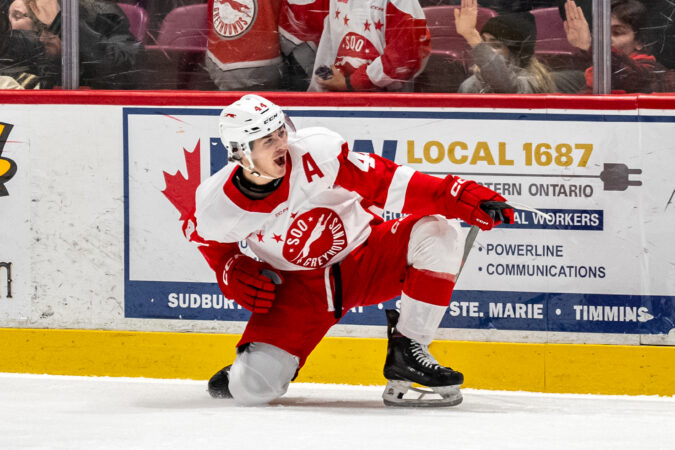
And it is at No. 6 that the Flyers could snag this highly touted prospect. This past season, the centerman put up 33 goals and 72 points in 57 regular-season games for the Soo Greyhounds of the Ontario Hockey League. An alternate captain, he had a team-best eight power-play goals before adding another four points (two goals, two assists) in five playoff games. He then went to Texas and put up 11 points (three goals, eight assists) in seven games for the gold-medal winning Canadians at the U18 World Championship.
“It does not take long to find out why scouts love him so much, because he is the hardest hitter in the draft,” FloHockey NHL draft analyst Chris Peters said. “He hurts people because of how hard he hits. He’s not doing it maliciously; he’s just that devastating of a body checker. But then, he can also score, and he’s got hands, he’s got the ability.
“Does he have the offensive upside of some of these other guys that we are talking about, like [Jake] O’Brien, [James] Hagens, [Porter] Martone? Probably not, but he does have that well-rounded capability to be defensive, to make you know that he’s there. There is still a huge value placed on that competitive element of his game. He comes by it naturally, too. Grew up on a farm, raised on a farm. … There’s a work ethic to the kid. There’s a character to the kid. And on top of it, he is this fearsome player.”
Brady Martin has turned into “a wild card” in the 2025 draft, The Athletic’s NHL draft analyst Scott Wheeler says.
When asked about being called a “wrecking ball on skates” by draft analysts, Martin replied quietly and modestly with a “Yeah” and a laugh.
“I love the physical part of the game, and just a big part of my game for sure,” he said. “Yeah, to be offensively skilled and compete and work hard like that, to have that tool in my toolbox is good. To be on a hit, know when to hit, I know I enjoy it, too. So yeah, it’s a big part of my game.”
At 6 feet and 187 pounds, the pivot is “not a behemoth,” as NHL draft analyst Scott Wheeler said at the combine in Buffalo. “But he is probably pound-for-pound, one of the strongest players in this draft, and just an absolute terror.”
That’s a pretty good thing when you compare your game to NHL menaces — but also point producers — Matthew Knies, Tom Wilson, Zach Hyman, and Sam Bennett. The latter was named the Conn Smythe Trophy winner as the playoff MVP while leading the Florida Panthers to their second straight Stanley Cup over Hyman’s Edmonton Oilers, Martin’s favorite team.
Sounds like his work ethic and style would fit perfectly in Philly.
Brady Martin had 33 goals and 72 points in 57 regular-season games for the Soo Greyhounds of the Ontario Hockey League.
“Brady Martin is one of one in this class,” Wheeler said. “He is the most competitive forward in this class. He is arguably the most competitive player in this class. I would say that him and Kashawn Aitcheson are the fiercest competitors in this age group. He is the most physical forward in this class. He hits and hurts guys. He dominates guys physically in terms of just his intensity, the way that he goes after guys, and finishes his checks.
“So there’s that piece of it, which every team loves, the throwback player, and then on top of that, he’s very skilled. He’s got this sort of quick-twitch hands, and he can make plays, and he’s got an NHL shot.”
Martin met with the Flyers and was one of three players known to have had dinner with the team in Buffalo. He said they talked for a while, it was casual and, fittingly, they took him for a steak. Flyers hockey is “kind of the hockey I play, so I think it’d be a perfect fit for me,” he added.
It may be, considering the Flyers are always searching for guys who already come with a “high compete” level. It was the edict under former coach John Tortorella, and it’s fair to say Rick Tocchet leans the same way. And of course, at No. 6, the expectation is that if the Flyers take a center, he’ll be the future linemate of Matvei Michkov.
“I think it would be good,” Martin said of pairing with the Russian star winger. “I think he’s a skilled player, and he’s one of the best players this year on that team. And, yeah, it’d be cool to play with him and, if I get the opportunity, I think it could work, get him pucks, and make room on the ice for him.”
When asked what he loves the most about hockey, the kid who started skating at 3 and “wasn’t very good” when he started said it was “being part of a team” and “when you win at the end, it’s even more fun [because] you get to enjoy the moment with your peers and your teammates who you’ve played all season with.”
Brady Martin is widely considered the top hitter in this year’s draft class.
Who is Brady Martin? He’s a banger with high skill who puts the team above himself. Which is why he will not be in Los Angeles to hear his name called on Friday. He will be home in Ontario, surrounded by family and friends, as his community throws a party, too.
“I could have went to LA, but I really enjoy my family and hockey season playing in the Soo, I don’t really get to see them much,” he said. “So to be at home and experience that with them is what I’ve always wanted to do, and to have a couple of my buddies and my peers on my side, and cousins and stuff, it’ll be pretty special.”
And after celebrating? There will be chores to do in the morning.
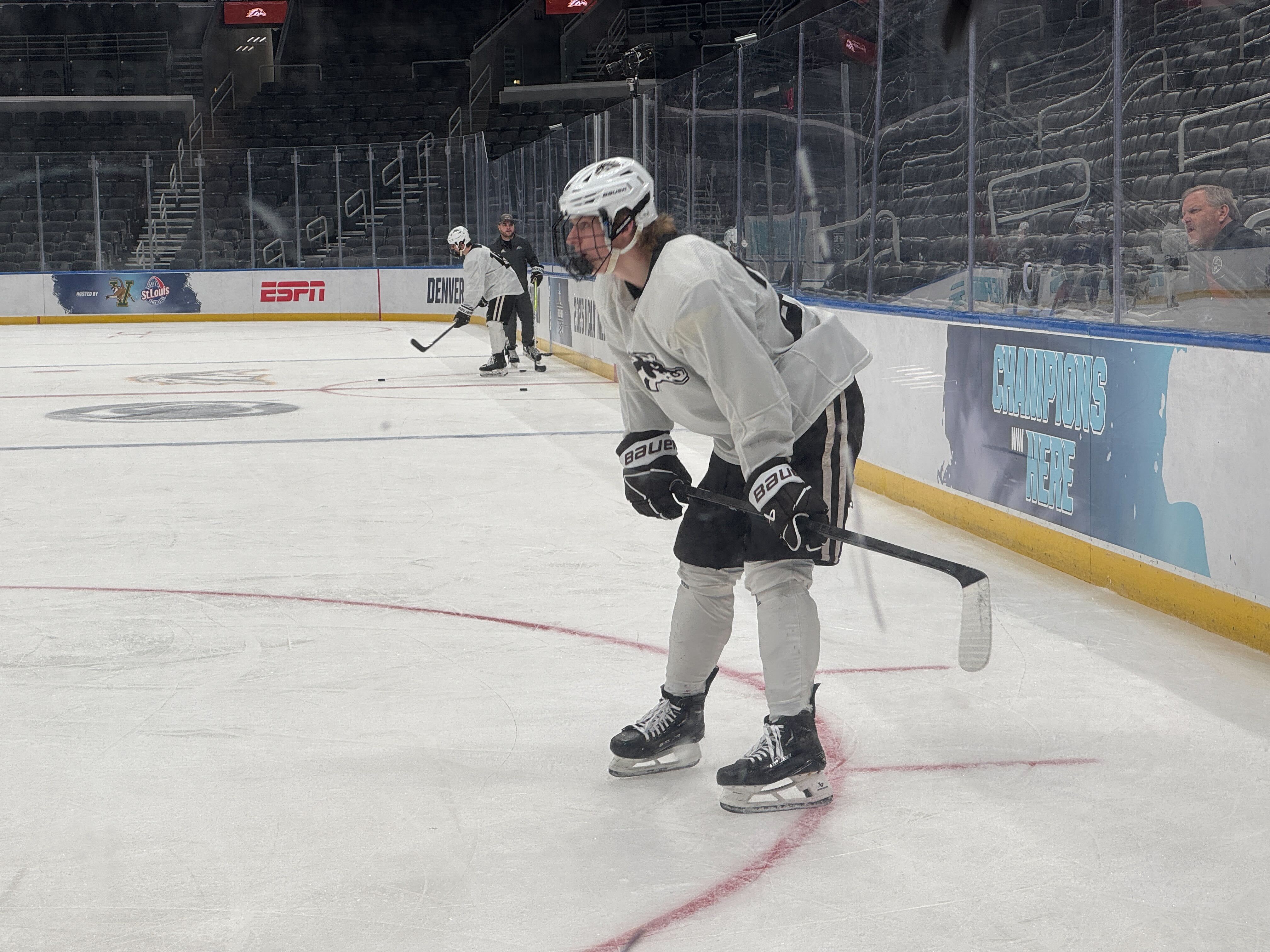
ST. LOUIS — Skating around the Enterprise Center with his blond hair flowing out of his helmet, Flyers prospect Alex Bump potted a quick wrister from the slot as his linemate Matteo Costantini let out a big yelp.
Were they celebrating a goal like the double-overtime winner that sent Western Michigan to the NCAA regional finals? No. Was it one of his team-leading 23 tallies this season? Nope. It was instead at Western Michigan’s final practice before the university’s first-ever appearance in the Frozen Four.
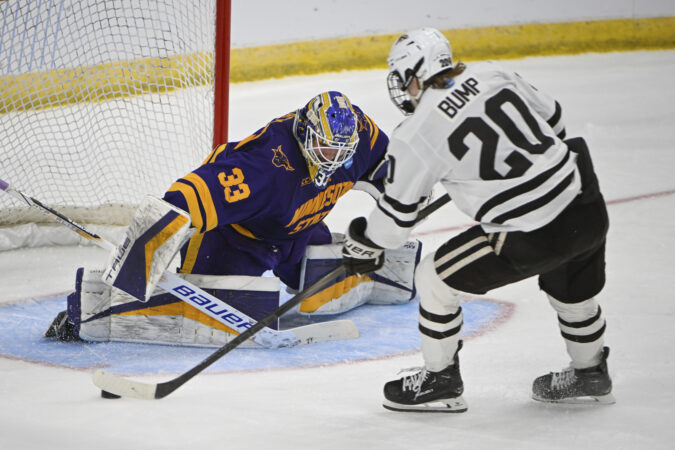
While the goal came as he skated around in a white practice jersey with a black Bronco on it, it encompassed what Bump, 21, does best now, and what he will look to replicate when he suits up for the Flyers in the no-longer-distant future.
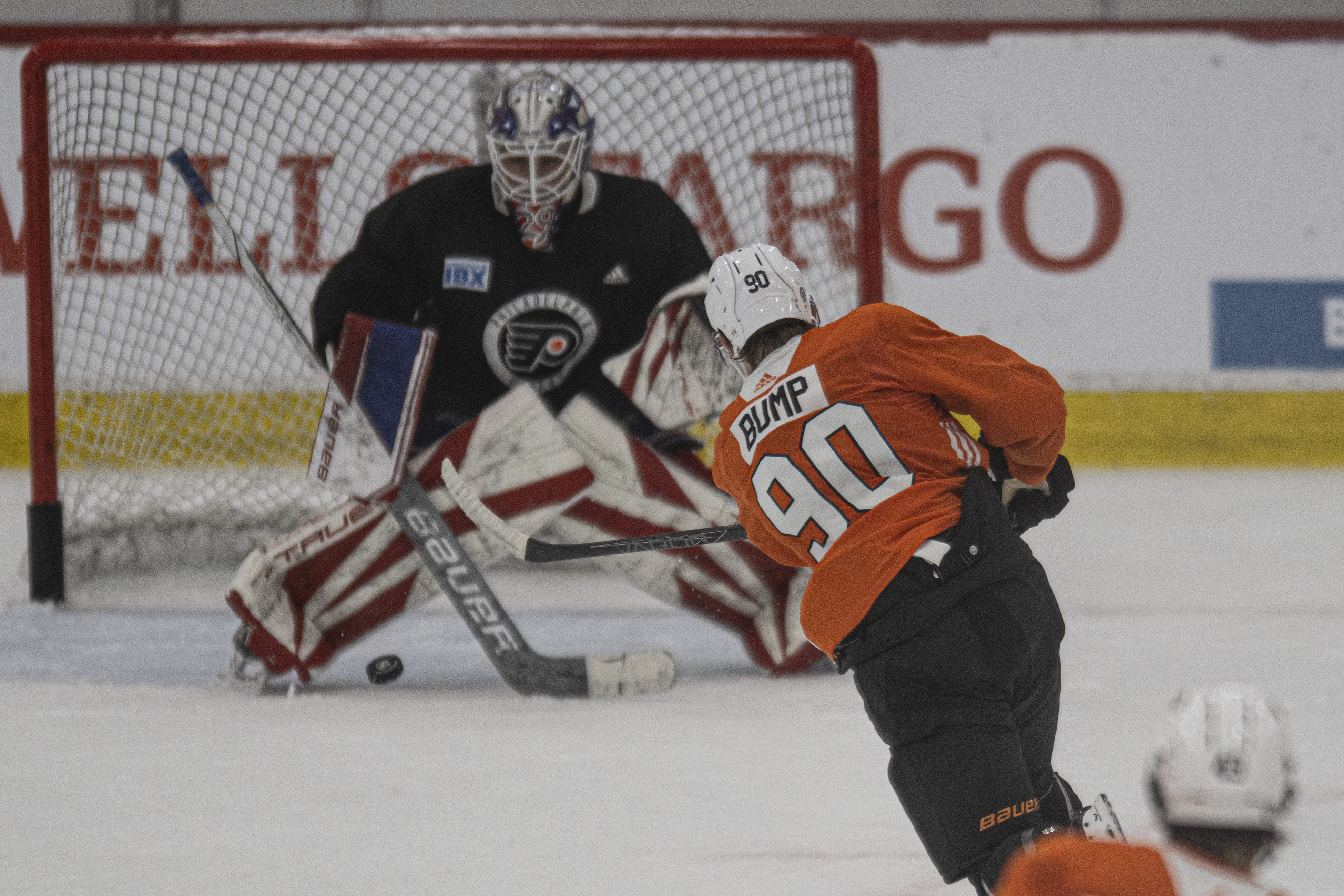
“A lot of guys are not confident in their shooting,” Flyers director of player development Riley Armstrong said. “A lot of guys don’t think they can beat a goalie, or they have to get to a certain area on the ice to be able to beat the goalie. I think Alex is a very confident shooter, he knows where to shoot the puck. He’s always known how to find the net.”
Flyers prospect Alex Bump is tied for eighth in the nation with 23 goals this season.
Hometown hero
Joe Pankratz remembers Bump being at the rink, even before he starred for him at Prior Lake High School. Bump’s two older brothers played hockey for the school’s longtime coach, and a young Bump — who at the age of 8 and 9, “was a good squirt”— developed a reputation as a rink rat.
“The biggest thing is, he absolutely loves hockey,” Pankratz told The Inquirer. “You can’t get him off the ice.”
It was in his hometown of Prior Lake, Minn., where Bump developed that lethal shot of his. He scored 48 goals during his senior season as the Lakers’ captain, including 12 in the section and state tournament playoffs; five came in one playoff game.
“It’s a lot of snapshots, and he protects it and hides it really well. He changes the angle on his shot. … A lot of that is he’s got amazing hands, but he has a lot of poise with the puck, so he isn’t in a rush,” Pankratz said. “He doesn’t panic with it.”
And he is a volume shooter. This season, the left-shot winger has fired 236 shots on goal with 23 goals, a 9.7% shooting percentage.
But it’s not just his shot that’s impressed the Flyers.
“He’s very elusive of checks. He’s slippery, as you would call it in hockey,” Armstrong said. “He always finds a way to get around guys, get through guys, and then when he doesn’t have the puck, he always finds a way to get open. He has a really good stick. He’s physical. He engages with and without the puck into contact, which is something that you need to play at the NHL level.”
Alex Bump’s skill has popped at multiple Flyers development camps. Next year, he hopes to crack the NHL out of main training camp.
The NHL could come as soon as the Broncos’ season ends, either Thursday against the University of Denver (5 p.m., ESPN2) or after Saturday’s national championship game (7:30 p.m., ESPN2). And it sounds like Bump will be coming with an ax to grind.
“Our guys, Brent [Flahr, assistant general manager] and [amateur scout] Shane Fukushima in Minnesota, had seen him play a lot [in high school], and they were very comfortable with him. They couldn’t believe that he had fallen this far,” Flyers general manager Danny Brière said this week.
At the time, Brière was an adviser to then-GM Chuck Fletcher. He jokes that his nephew Zaac, the team’s runner at the Montreal draft, “still claims he made the pick for us” after seeing Bump’s name high on the team’s draft board and saying they should take the Minnesotan.
Bump was eventually selected by the Flyers in the fifth round with pick No. 133 — and it lit a fire.
“He came up to the suite after. He had his brothers there, his family, and he came in and he was [ticked] off that he went so late. He felt he should have went earlier in the draft,” added Armstrong, then an assistant coach with Lehigh Valley.
“I think he’s proven a lot of people wrong, or for our sake, right.”
Why Bump, the 2022 USA Today High School Hockey Player of the Year, fell is irrelevant now. Just like the round he was drafted. As Flahr always says, it’s all about what you do after that matters. And what Bump, 21, has done has been impressive.
But first, Bump had to face some adversity. He played USHL hockey wrapped around his senior year but didn’t put up the biggest numbers the year after he graduated. A University of Vermont commit, he had to make a last-minute pivot when the Catamounts’ coach was fired, and found a home at Western Michigan in Kalamazoo, Mich.
Alex Bump, pictured at Western Michigan’s Frozen Four practice on Wednesday, was the NCHC’s top forward this year.
“I think that we’ve seen over the last two years is that his development has seemingly gone into hyperdrive. I think he’s ahead of schedule where we thought he would be this time two years ago,” FloHockey’s prospect analyst Chris Peters told The Inquirer. “So that’s a pretty positive development, because he was good in the USHL, but he wasn’t dominant. And now this year, you could say he was one of the best players in college hockey.”
Broncos coach Pat Ferschweiler, who was a linemate at Western Michigan with Flyers president Keith Jones, and the Flyers organization work in lockstep. Armstrong speaks with the coaching staff and Bump consistently, and goes over videos with the player to make sure they are all on the same page as far as his development and making sure he is NHL-ready.
How it will translate at the NHL level is to be determined. Ferschweiler says the Flyers got “an absolute steal.” He notes Bump’s “incredible hockey sense and incredible vision,” but feels what will really separate him and “what the Flyers fans are going to love, is, he’s got incredible compete.”
“Alex does not lack for confidence,” he said. “He’s got inner belief, because he works really hard, and that’s how belief is earned. He does that every day. So he’s not a cocky kid, but he does have self-belief, which I think there’s a fine line there and he walks on the right side of it.”
A pure goal scorer, Bump does need to continue to work on his skating. But those who know him best have seen improvement. This past winter break, Bump skated with his old high school team and Pankratz noted “how much stronger, more powerful of a skater he is.”
And they all know he will put in the work because he wants to succeed.
“I don’t think he’s ever really been a passenger.” Peters said. “He’s a driver, and especially at his age, and that program, and based on what they have surrounding him, like they needed him to be that, and he’s delivered. So he’s risen to the occasion.”
The Flyers and their fans will love to hear that because maybe, just maybe, he becomes another game-changer for a team that needs more of them to take that next step.
“I really do,” Armstrong said, when asked if Bump could be that type of guy. “I think, with Matvei [Michkov] as well. … You just have to have a little bit of patience to kind of see the rebuild through and wait for these kids to get there.
“Once they do, you’re going to have a couple of game-changers sitting right in front of you.”
Alex Bump’s shot is his No. 1 attribute but the Flyers see more than just that in the 21-year-old.
If you’re a longtime Union fan, you know this year’s playoff format is going to be unlike any you’ve ever seen, and not in a good way. If you’re a new or casual follower who tunes into Saturday’s first-round opener against New England at Subaru Park (5 p.m., Apple TV, free), you might think you’ve landed on another planet.
Greetings, fellow Earthling. Let’s get right to the point.
There is no valid competitive reason for Major League Soccer’s latest postseason setup — one of far too many in the league’s 28-year history — to have a best-of-three first round and single games the rest of the way.
The real reasons for the invention are commercial, and the league has barely hidden from them. Nor have any number of players, coaches, front-office staffers, and anyone else willing to tell the truth without putting their names out there for fear of retribution.
The first reason is that the expanded postseason gives broadcaster Apple more games to sell to fans in its streaming package. That’s easy enough for anyone to understand and doesn’t require much more explanation — except for one angle we’ll get to in a bit.
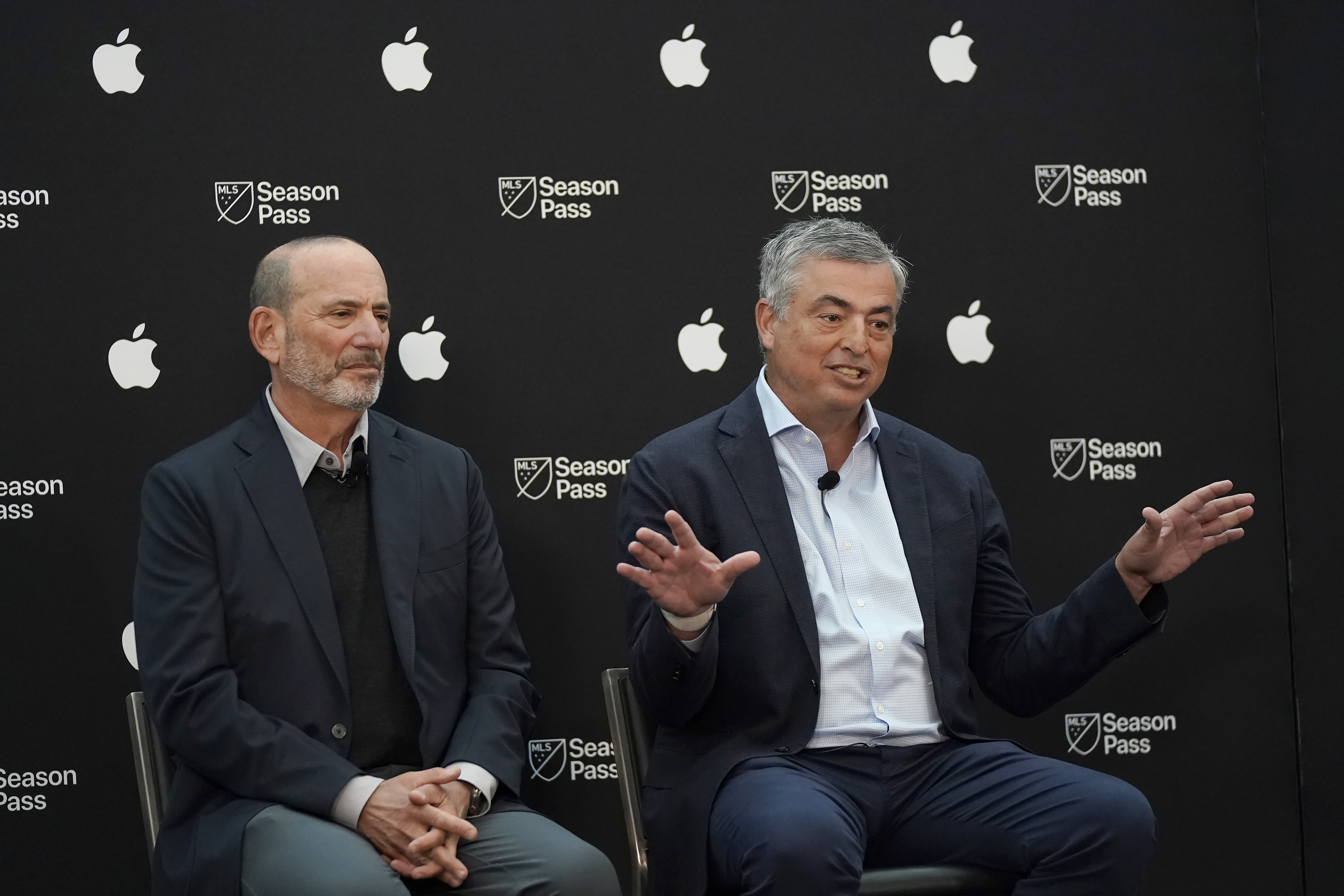
Apple senior vice president of services Eddy Cue (right), who oversees Apple’s sports rights deals, with MLS commissioner Don Garber in January.
The second reason is worse. While the last four years of single-game rounds all the way produced some terrific drama, they also produced complaints from the staff members of lower-seeded teams. They felt entitled to a home game just because their players made the playoffs, no matter their regular-season records. The complainers got what they wanted.
He said, he said
Who was complaining? No one quite said it aloud, but FC Cincinnati outed itself when the format change was announced.
“We are pleased that the new format will provide if we earn a postseason berth, the near-certain opportunity to bring a playoff atmosphere home to our fans this season,” co-CEO Jeff Berding told the Cincinnati Enquirer.
Contrast that with Union manager Jim Curtin, who said at the time: “It’s best to have [the] regular season mean as much as possible to teams. … The more you can incentivize having a good season and earning those home games, I think, the better.”
Or Los Angeles FC manager Steve Cherundolo, who said this week: “You sacrifice a fluid playoff system like we had last year, which everybody was very pleased with — the first time in 19 years the top seed in each conference played each other in the final. You couldn’t have planned it any better, you got a fantastic game in the end, so it makes perfect sense to go change everything.”
Union manager Jim Curtin (center) on the sideline during his team’s Leagues Cup game against Lionel Messi’s Inter Miami in August.
As fate would have it, the tables turned this year. The Union and LAFC fell back a bit, and Cincinnati won the Supporters’ Shield. In the prior format, Cincinnati wouldn’t be leaving home for the rest of the year. Now it must visit a New York Red Bulls team on a four-game winning streak. The first of those wins was in Cincinnati on Oct. 4, and the latest was Wednesday’s 5-2 rout of Charlotte FC in the Wild-Card round.
One might wonder from afar what Cincinnati thinks now — and what if Charlotte won on Wednesday instead? There’s a big difference between a less-than-full Red Bull Arena for a game on natural grass, which we’ll likely see Nov. 4, and a 70,000 crowd in Charlotte for a game on artificial turf, which we would have seen.
Paying a penalty
If it’s bad enough that the best-of-three format exists, the way to win a series has made it even worse. There’s no aggregate goals count like there is in European soccer’s traditional two-game series that MLS used to use. And any tied game will go straight to penalty kicks to produce a winner, instead of a first-to-five points format with a tiebreaker only at the end.
That’s an open invitation for teams to make these games as low-scoring and defensive as possible, then ride their luck in penalties. If a team forces two scoreless ties and wins both shootouts, it wins the series.
For a league that fights every day to convince soccer fans across America that it’s as entertaining as the rest of the world, that’s a recipe for big trouble. Especially when that league has to convince those fans to spend their hard-earned money on an Apple subscription after buying streaming packages of other networks to watch the UEFA Champions League, England’s Premier League, Mexico’s Liga MX, Spain’s La Liga, and more — plus a cable TV subscription to watch the big U.S. sports.
In Philadelphia and across the country, MLS competes with the English Premier League and other soccer leagues for fans’ money and attention.
Should New York upset Cincinnati with two ugly games, will it be worthwhile for MLS to still have a New York media market team alive in the playoffs? It’s a trick question: Apple and MLS don’t produce viewership numbers as other outlets do, including Amazon for the NFL.
If there’s one reasonable argument for expanding the playoffs, it’s that the one-game-round format played out in less than a month, too little time to build up widespread interest.
That argument is easily countered, though. First, it was to MLS’s overall benefit that it could run the entire postseason between the October and November FIFA national team windows, reducing the burden on clubs and countries alike — and reducing the risk of a November injury that knocked a key player out for the year.
Creating more problems
Second, while it’s fair to say a long offseason doesn’t help MLS players’ fitness relative to their global counterparts, playing the title game in November makes it more palatable in cold-weather cities. (Apologies to the heavyweight teams in Los Angeles, but there are a lot of such cities in MLS. LAFC might even visit one of them for this year’s final on Dec. 9.)
Now add in a new factor with the expanded Concacaf Champions Cup, which will kick off in early February with 10 MLS teams participating. A December title game means the MLS Cup winner gets barely any offseason at all. The same goes for any other CCC qualifiers that make deep playoff runs.
Nathan Harriel (left) and the Union will be back in the Concacaf Champions Cup, the new (and more accurate) name for the Concacaf Champions League, in February.
There’s one more thing to note, and it’s one that especially pains me as someone who’s been following MLS since long before the Union existed. Since the league’s earliest days, there’s been a widespread lament about how few people pay attention to its regular season. It’s been heard by diehard fans, team and league business offices, broadcasters, and all the way up to the commissioner’s office. And it’s correct.
The one-game-round format made the regular season matter more than almost anything else MLS has ever done because regular season performance was the only way teams got playoff home games. Blowing out the playoff format feels like a reversal of so much hard-won progress.
Lionel Messi’s arrival in MLS papered over a lot of problems. But he’s not playing now. Only teams that earned their way into the playoffs are. Just as it’s the ultimate time for those teams to prove themselves, it’s also time for the league and Apple to prove they’ve got a playoff-worthy product.
If it doesn’t work, all those Messi jersey sales and viral videos won’t be enough to stop the truth from prevailing.
On Tuesday, Flyers defenseman Ivan Provorov refused to wear a rainbow warmup jersey during the team’s LGBTQ Pride Night game against the Anaheim Ducks. He was the only player to do so. Provorov, who hails from Yaroslavl, Russia, cited his Russian Orthodox faith as the reason for abstaining from rainbows, telling reporters after the game that he had chosen “to stay true to myself and my religion.”
As a queer woman, a former hockey player, a Christian, and an NHL fan, I am disappointed at the league and the Flyers’ response. In refusing to wear the Pride Night jersey, Provorov refused to acknowledge the humanity of LGBTQ people. And the league, in defending his stance, went right along with it.
In a statement released Wednesday, the NHL said: “Clubs decide whom to celebrate, when and how — with league counsel and support. Players are free to decide which initiatives to support, and we continue to encourage their voices and perspectives on social and cultural issues.”
In other words: There’s no problem with players being vocally antigay. Flyers head coach John Tortorella doubled down on the support of Provorov’s homophobia, telling reporters after the game: “This has to do with his belief and his religion. It’s one thing I respect about Provy, he’s always true to himself. That’s where I’m at with that.”
Too few people understand that this tacit acceptance of discrimination — especially as it relates to sexuality and religion — is a matter of life or death for members of my community.
Provorov is entitled to his personal convictions. He can believe that only marriages between a man and a woman can be blessed by God, or that homosexuality is a sin. But I wish he knew this: For other populations, when they adopt the church, the suicide rate decreases. For LGBTQ people, when they adopt the church, the suicide rate increases.
Provorov should have donned that rainbow jersey and, yes, put rainbow tape on his hockey stick — not because he accepts gay marriage or because he’s eager to march in a Pride parade — but to stand up for LGBTQ people who are suffering. The defenseman had a chance to make a statement against bullying, against hatred, and against violence, without even opening his mouth. Instead, he chose not to step on the ice for warmups. That is shameful.
I would recommend that Provorov, Tortorella, NHL leadership, and anyone who disagrees with me — take a moment to read the book Heavy Burdens by sociologist Bridget Eileen Rivera. In it, she shows how generations of LGBTQ people have been condemned and alienated by churches. That legacy has caused immeasurable harm to my community. It is a heavy burden to carry.
Flyers defenseman Ivan Provorov sat out warmups on Tuesday night to avoid wearing the team’s Pride Night jerseys.
Next, dive into Affirming: A Memoir of Faith, Sexuality, and Staying in the Church bySally Gary. Gary is the executive director of CenterPeace, a nonprofit organization that helps members of the LGBTQ community feel a sense of belonging in the church — and provides resources for Christian leaders and parents of LGBTQ kids to respond to the queer community as Christ would: with love and acceptance.
After that, I would recommend that Provorov sit down and spend time with his Bible.
If Provorov truly wants to follow Jesus, the best thing to do is to stand up for the vulnerable. One of the first things Jesus said in announcing his ministry was: “The Spirit of the Lord is on me, because he has anointed me to proclaim good news to the poor. He has sent me to proclaim freedom for the prisoners and recovery of sight for the blind, to set the oppressed free, to proclaim the year of the Lord’s favor.” (Luke 4:18-19)
That is how close the vulnerable were to Jesus’ heart. If Provorov’s Christianity does not center on helping the vulnerable — and I mean every vulnerable population — then he’s missing the mark.
My heart goes out to Provorov. He’s trying to follow God with the knowledge and resources he has.
In the Gospel of Matthew, Jesus had some of the strongest warnings for the most religious of his day. He warned his followers to be wary of those who “preach, but do not practice. They tie up heavy burdens, hard to bear, and lay them on people’s shoulders, but they themselves are not willing to move them with their finger.” (Matthew 23:3-4)
I’m asking Provorov to move his finger. Clear these burdens. Reading the Bible with fresh eyes might open his mind.