HAWLEY, Pa. — Former Phillies All-Star center fielder Lenny Dykstra waived his preliminary hearing on two misdemeanor drug charges Tuesday before District Judge Randy Schmalzle, meaning the matter will now be addressed in a higher court.
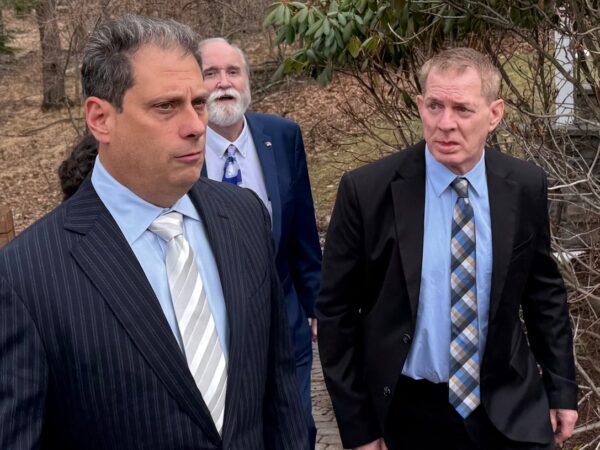
Dykstra, 63, appeared with his two attorneys, Matthew Blit and Thomas Mincer, and the member of the 1993 National League champions was dressed in a dark suit, blue shirt, and tie. Dykstra said little in the windowless courtroom during the roughly 10-minute proceeding, other than to say he understood the meaning of waiver. Assistant District Attorney Dave Marra was also present.
“Thomas Mincer and I are pleased to report that today was Lenny Dykstra’s first court appearance,” Blit said in a statement. “Attorney Mincer had a very productive meeting with the District Attorney’s office and we are pleased to report that everything is moving [in] a positive direction.”
The charges stem from a New Year’s Eve traffic stop in Pike County in northeastern Pennsylvania, when Dykstra was the passenger in a GMC pickup driven by Scranton resident Kevin Zelna. State Trooper Kody Nowicki pulled the GMC over after Zelna failed to stay in his lane, according to testimony by Nowicki and a criminal complaint. Zelna, 37, was charged with several counts, including driving under the influence.
When Dykstra told law enforcement that he wanted to retrieve his ID and credit card, “troopers observed, in plain view, a glass smoking device and a jar/container containing suspected narcotics.” Nowicki later testified that the contents tested positive for crack cocaine.
Mincer released the following statement Jan. 6:
“We firmly assert that the alleged narcotics in the vehicle did not belong to Lenny, who is currently recovering from a serious stroke. Lenny was not knowingly in possession of or under the influence of any narcotics, had none on his person and was not taken into custody at the scene. The driver was arrested and taken into custody at the scene and accused of 17 counts, including being under the influence, not Lenny. Attorney Matthew Blit and our team remain steadfast in our commitment to absolve Lenny of all possession charges.”
Dykstra’s preliminary hearing was originally scheduled for Feb. 3 and then Feb. 17. Dykstra recently completed a 75-day rehabilitation stint, according to Dennis D’Augostine, a pastor at Steamtown Church in Scranton, where the former major leaguer lives. D’Augostine has been working with Dykstra and said he baptized him on March 8.
Lenny Dykstra during his 2012 sentencing on grand theft auto charges in Los Angeles.
Dykstra played 12 major league seasons as a center fielder, his first 4½ with a New York Mets team that won the 1986 World Series. He was traded to the Phillies in 1989 and helped the team reach the World Series in 1993, when he finished second to Barry Bonds in the NL MVP voting. Dykstra retired with the Phillies in 1996 at age 33.
He spent time in prison after pleading guilty in federal court to bankruptcy fraud and money laundering in 2012. Dykstra also pleaded no contest to grand theft auto in California.
PHOENIX — Howie Roseman may have altered his approach to answering questions about A.J. Brown at the annual league meeting, but Mike Vrabel has not.
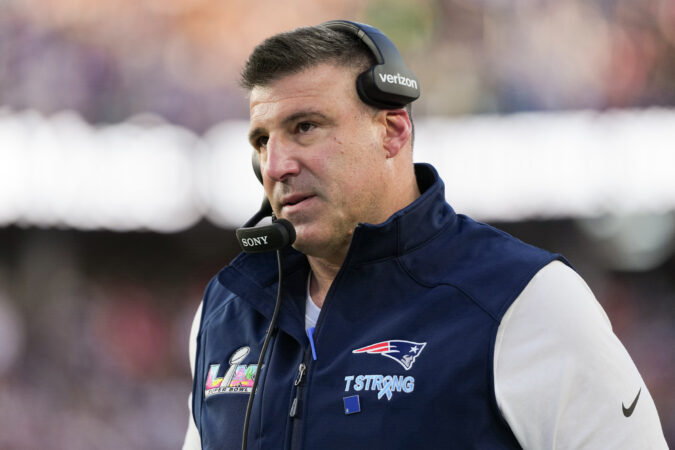
At his news conference Tuesday, the New England Patriots coach didn’t rule out any possibilities regarding a trade for Brown. Vrabel echoed the comments he gave to New England-area reporters at the NFL Scouting Combine last month when he said that the team would do anything it could to bolster its personnel in response to a question about attempting to acquire the Eagles receiver.
“We’ve talked about this since last January,” Vrabel said Tuesday. “We’re going to try to do everything we can to strengthen our roster, through the draft, through free agency, multiple ways of player acquisition. So anything that we can continue to do to strengthen the roster, we’re going to try to do.”
Roughly three weeks after the start of the new league year, Brown’s future in Philadelphia remains uncertain. Earlier in the offseason, Roseman didn’t explicitly rule out trading Brown. On Sunday, Roseman was less elaborate in his responses about Brown, repeating some iteration of “A.J. Brown is a member of the Eagles” to multiple queries on the topic.
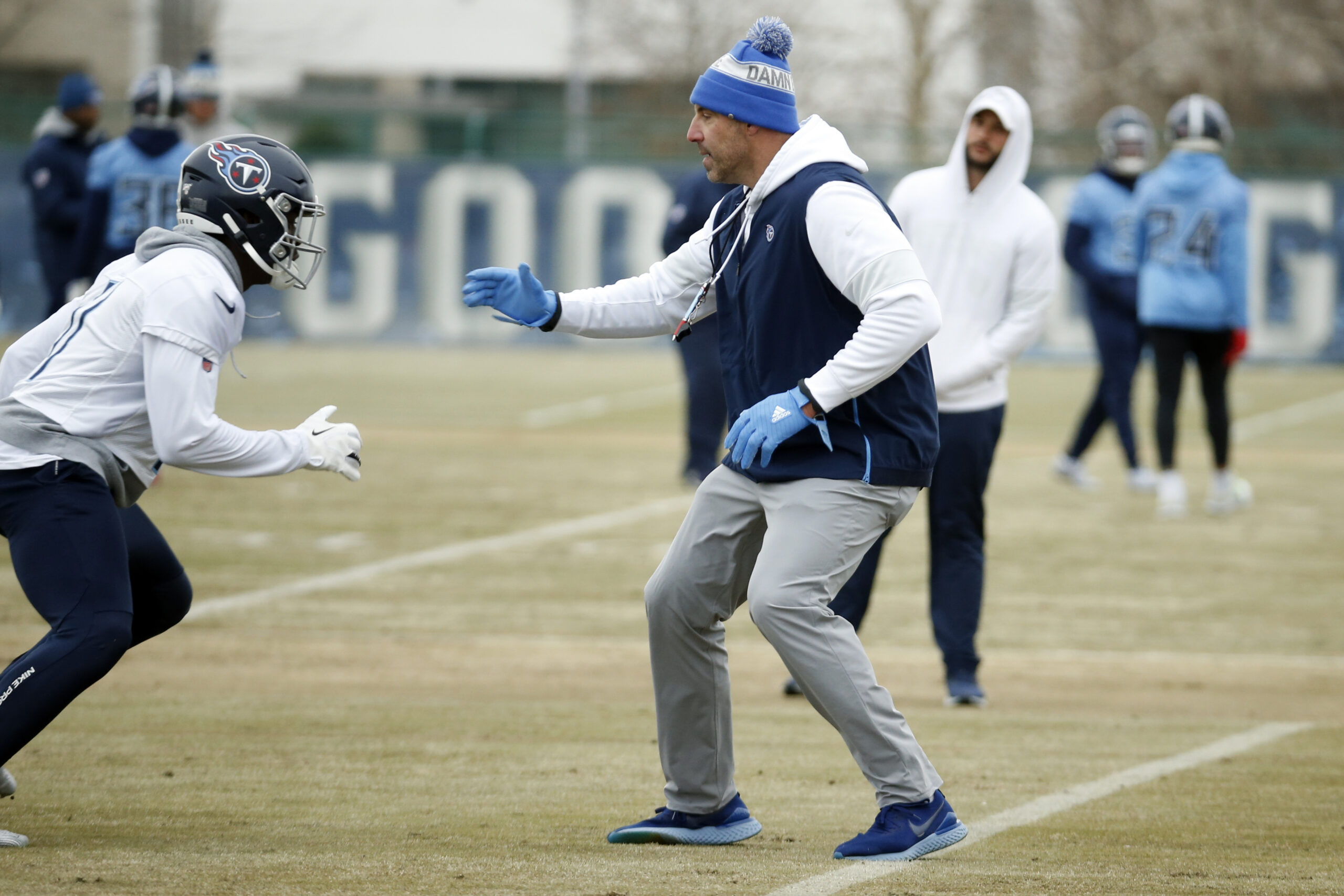
Mike Vrabel (right) coached a Titans team that drafted A.J. Brown (left), and has spoken of his affection for the receiver.
According to several reports this offseason, the Patriots have interest in adding Brown. The reigning AFC champions have made some tweaks at receiver by cutting Stefon Diggs and signing former Green Bay Packer Romeo Doubs to a four-year deal.
But the Patriots still have a need for a top receiver to compensate for the targets vacated by Diggs. Doubs, who turns 26 in April, projects better as a second or third receiver based on his past performance.
Vrabel didn’t express a sense of concern about redistributing Diggs’ targets, but he did stress the value of what the 32-year-old receiver did with those targets.
“We all appreciate what Stef did and being able to coach him,” Vrabel said. “But what has to happen is the efficiency in which he was able to catch the ball was impressive, whether that’s [Drake Maye’s] accuracy, ball location, or Stef’s ability to catch it. That’s something that we’ll have to recreate.”
Few NFL coaches are more familiar with Brown and his skill set than Vrabel. Brown was a second-round pick of the Tennessee Titans in 2019, when Vrabel was the head coach. The pair spent three seasons together before Brown was traded to the Eagles in 2022 for a first-round pick (No. 18) and a third-rounder (No. 101).
“We all understand in professional sports, players that are talented and get to this level have some sort of ego to them,” Vrabel said. “And there’s a balance. They have to have that edge. And so I think as a coaching staff and whatever that is, you have to balance that edge to make sure that that’s helping the team.
“Everybody wants to excel. What receiver doesn’t want to catch the ball? What pass rusher doesn’t want to sack the quarterback? What DB doesn’t want to intercept the ball? The running backs want to score touchdowns. That’s how this thing goes.”
As the Brown saga continues this offseason, June 1 could be a date to circle. The Eagles could spread his dead salary cap hit over two seasons in a trade after June 1, instead of eating it all in 2026 if they move him before that date.
If the Eagles trade Brown, what would they seek in return? Shortly after the start of the new league year, the Denver Broncos acquired Jaylen Waddle and a fourth-round pick from the Miami Dolphins in exchange for their 2026 first-round pick (No. 30) as well as third- and fourth-round selections, offering a glimpse into what Roseman could receive for Brown.
Regarding any potential trade this offseason, Vrabel didn’t express a preference between surrendering draft picks this year or in future years.
“However you can come to an agreement with another team, I’ve never really looked at it as this year, next year, how good the draft is in three years,” Vrabel said. “Just try to come to an agreement. If you make a trade, you just want to try to come to an agreement that both teams feel like they’re getting something that everybody’s happy [with].”
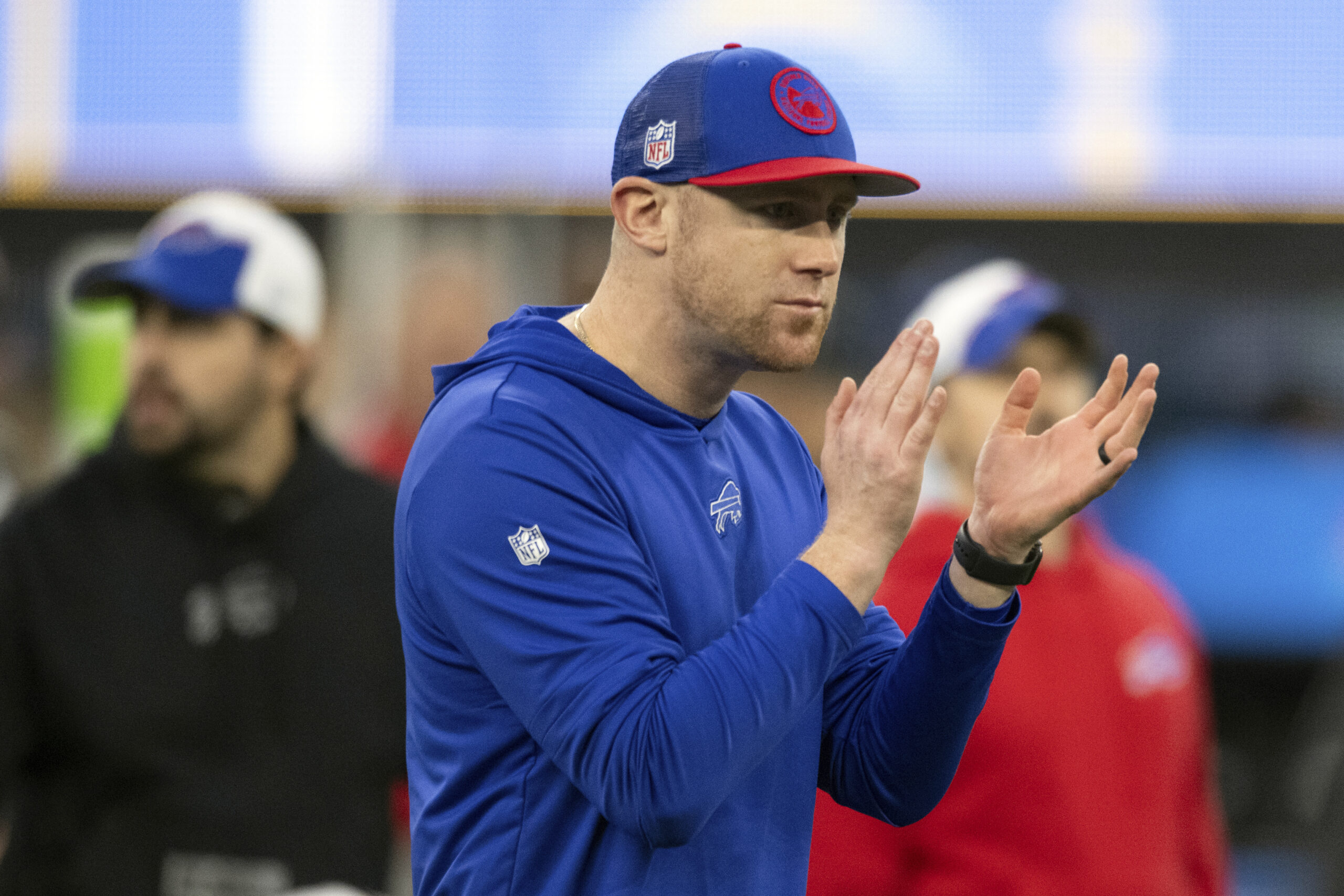
New Bills coach Joe Brady ran the Tush Push regularly in his previous role as offensive coordinator.
Bills coach and the Tush Push
This time last year, the Tush Push was on the brink of a ban. But the Packers’ proposed rule change failed to garner the support among the owners it needed to pass and it hasn’t come under attack since.
The league’s waning interest in banning the play correlates with the Eagles’ struggles at executing it in 2025. According to tushpush.fyi, Jalen Hurts converted on 74.1% of his attempts, well under the 82.3% league average.
No team was more successful at running the Tush Push last season than the Buffalo Bills. Josh Allen converted on 92.3% of his attempts. Hurts led the league with 27 attempts and Allen trailed him by one.
But the Bills were among the teams that voted to ban the play last year. Former Bills head coach Sean McDermott voiced his concern over the health and safety of the players at the time, even though he acknowledged that there wasn’t significant data that indicated any risks.
Joe Brady, the new Bills head coach and former offensive coordinator, continued to run the play to great success regardless.
“As the [former] offensive coordinator, if [former] Coach McDermott was like, ‘Hey, look, I don’t want us doing it,’ we wouldn’t,” Brady said. “And to his credit, it was like, ‘Hey, yes, I might be against it, but there’s a lot of rules that sometimes as coaches, as personnel, we might not vote for, but once the rule is, hey, this is what it is, we want to make sure as an offense, defense, special teams, as a team that we’re doing whatever we’re capable of.’
”But once it got to that point, he was like, if the rule is in, and you feel like it’s [in] the best interest to help us win, he was for it.”
Brady said he didn’t know why there wasn’t a renewed attempt to ban it this year.
“Sometimes I’m surprised that when a rule [proposal] comes and it doesn’t [pass], do they make it to the next year?” Brady said. “Or they’re, as I’m learning in the league, is it just we’re, hey, we went all in, it didn’t go, and we’re going to keep it moving? The success that we have with it, I was fortunate that it was a part of our offense last year.”
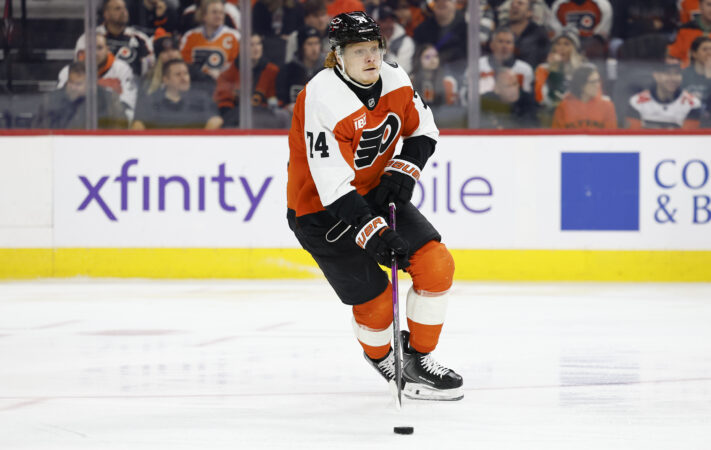
DETROIT ― Detroit may be known for Motown, but on Saturday night, on national television, it was Motownphilly.
Coming off a dominating win against the Chicago Blackhawks at home, the Flyers went into Little Caesars Arena, continued the trend, and handed the Detroit Red Wings a 5-3 loss.
The Flyers have won two straight, five of their past six, and 11 of the 16 games since the Olympic break. “It’s long overdue, but now Philly is slammin’,” as Boyz II Men sing.
Philly now has 84 points and moved three points back of the Columbus Blue Jackets, who lost to the San Jose Sharks on Saturday, for the second wild card in the Eastern Conference. The Flyers have a game in hand on Columbus.
They are also four points back of the Pittsburgh Penguins for the three-seed in the Metropolitan Division and five points behind the New York Islanders for the two-seed, with a game in hand on Pittsburgh and two on New York. On Saturday, Pittsburgh lost to the Dallas Stars, and New York jumped into second with a win against the Florida Panthers.
Detroit almost staged a comeback in the final seven minutes of the game, with Mason Appleton scoring off a long dump-in, Alex DeBrincat taking a pass in the right circle and shooting it quickly, and Lucas Raymond curling and scoring from the left circle during a six-on-five.
But Sean Couturier iced it with a goal in his third straight game as he sent the puck into the empty net with just over two minutes to go.
“I loved our game for 55 minutes,” coach Rick Tocchet said. “Obviously, the five-on-six, a couple of things happened that we have to shore up. When the pressure hit us, we ran out of position, but that’s for another day. It’s a big win for us.”
Owen Tippett started things off just over four minutes into the game with his first of three goals. Detroit defenseman Moritz Seider tried to dangle through the neutral zone but had the puck slide off his stick thanks to pressure from Denver Barkey. It went right to Trevor Zegras, who sent the pass up to Tippett, and away the speedster went. He skated in, blowing past Simon Edvinsson and scoring five-hole on John Gibson.
In the second period, he extended the lead to 2-0 with another five-hole goal.
Barkey carried the puck through the neutral zone, pushing the Red Wings’ defense of Seider and Edvinsson back as he entered the zone. He dished it to Tippett on his left a few feet into the offensive zone and cut in front of Tippett as Edvinsson went down to one knee to try and block the shot. Instead, the puck went through the legs of Edvinsson and through Gibson.
“He did a really good job,” Tippett said of Barkey. “I don’t think I have that space if he doesn’t take the route he does and pick the guy he does. He does a great job wheeling it up the ice and grabbing middle and backing those two defenders off. … He opened up that ice for me the whole way.”
Later in the middle frame, the Flyers’ power play collected for the third time in 12 games and 35 opportunities.
Noah Cates won the offensive-zone faceoff, and the Flyers got to work. Eventually, Travis Konecny threw the puck on goal, and it deflected off Matvei Michkov sitting near the left post, off the pad of Gibson, and popped in front.
Cates, who was sitting on the right post, jammed it in for his seventh goal and 15 points in the 16 games since the Olympic break. He leads the Flyers in points during that stretch and has also hit a career high in goals with his 17th of the season.
The Red Wings and Flyers then traded goals; however, each was wiped away by a coach’s challenge for offside. Seider thought he scored on a power play with under two minutes to go in the second period to make it 3-1 — Tocchet gave credit to his video coach, Dylan Crawford, who told him it was one of the easier ones to call — and Christian Dvorak thought he made it 4-0 early in the third; however, Alex Bump went in a little too early.
But Tippett put the game away and completed the hat trick later in the final frame with a beauty of a power-play goal. He got the puck in the Flyers’ end, skated through the neutral zone, appeared to pass it to himself to get around Ben Chiarot, before going bar down to make it a 2-for-2 night with the man advantage for Philly.
Tippett has 27 goals on the season and 48 points — he added an assist on the Couturier goal — putting him one goal shy of his career high set in 2023-24. He has eight goals and 12 points in his past 11 games.
“He’s been an absolute game breaker for us,” said Jamie Drysdale, who had two assists and reached 100 career points. “He’s just someone that you do not want to go up against. You have to know where he is at all times on the ice, and even if you do, there’s a good chance he’s still going to burn you.”
And although he did give up three goals, Dan Vladař was once again masterful in net. In the first period, he stoned Patrick Kane, the holder of the record for the most points by a U.S.-born player in NHL history, with a left pad save off a cross-ice pass. Vladař stopped Justin Faulk and J.T. Compher on consecutive shots in the third period before the Red Wings tallied their three.
But he shut the door in the end, stopping a DeBrincat slap shot, a Dylan Larkin tip-in, and using the blocker to rob DeBrincat again after Couturier’s goal. Vladař made 30 saves and now has 24 wins on the season, almost doubling his previous career high of 14 set in 2022-23 with the Calgary Flames.
Breakaways
Defenseman Travis Sanheim made a big block on a one-timer by Raymond in the last minute of the second period during a Detroit power play. He went down in pain, stayed on until the horn, and then gingerly got off as his teammates came off the bench to check on him and tap him for the big play. Sanheim was back out there for the start of the third. … Michkov now has 39 points with six assists coming in his last six games. Konecny had two assists to give him 62 points in 68 games. … Gibson was pulled after Tippett’s third goal, and former Flyers goalie Cam Talbot entered the game. He made four saves. … Defenseman Noah Juulsen and forward Garrett Wilson were healthy scratches. They watched from the press box alongside forward Tyson Foerster, who participated in morning skate. … Defenseman Cam York played in his 300th NHL game. … Flyers prospects Porter Martone, Shane Vansaghi, and Michigan State lost to Wisconsin in the regional final on Saturday. The expectation is that Martone will sign his entry-level contract in the coming days and could make his NHL debut Tuesday in Washington, D.C. against the Capitals.
Up next
The Flyers get right back to it at Xfinity Mobile Arena on Sunday, when they host the Dallas Stars (7 p.m., NBCSP). The Stars have already clinched a playoff spot.
The Sixers overcame a 15-point deficit to win a critical game on the road in Charlotte.
Thanks to the 118-114 win, the Sixers now own the tiebreaker over Charlotte, and are tied with Atlanta for sixth in the Eastern Conference, a half game out of fifth.
Here’s what we noticed in the win:
Tyrese Maxey returns
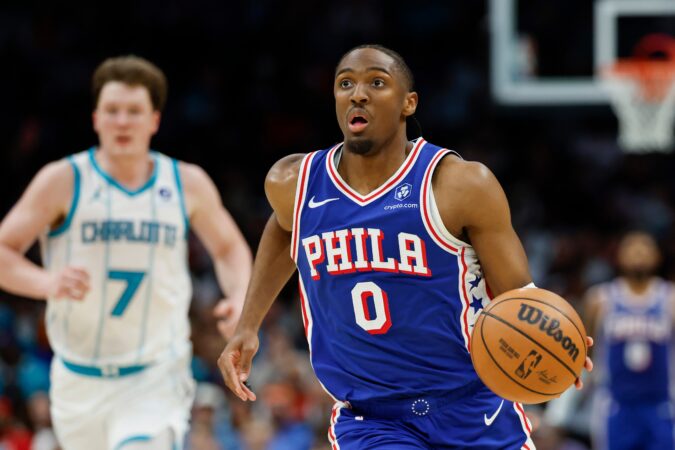
Tyrese Maxey made his long-awaited return to the Sixers’ lineup after missing three weeks with a pinky injury on Saturday.
Last year, after Maxey hurt his pinky finger, his shooting fell off a cliff. Returning from this three-week absence, Maxey started off hot, going 6-for-8 from the field, including 3-for-4 from three, in the first half. He ended the game with 26 points, shooting 10-for-18, with seven rebounds and eight assists.
After he posterized Miles Bridges with a left-handed dunk, his teammates held up a pinky in celebration that Maxey was officially back.
Quite the offensive battle
Charlotte’s offense is potent, especially from behind the arc, but in the first half, the Sixers matched them shot for shot, with each team making 10 three-pointers. The Sixers shot 52.5% from the field in the first half compared to the Hornets’ 48%, but still were down as many as 13 points, because the Hornets created so many extra possessions.
Charlotte dominated the offensive glass, grabbing 10 rebounds for 11 second-chance points, compared to the Sixers’ three offensive rebounds and two second-chance points. By the end of the third quarter, they’d grabbed 20 offensive rebounds.
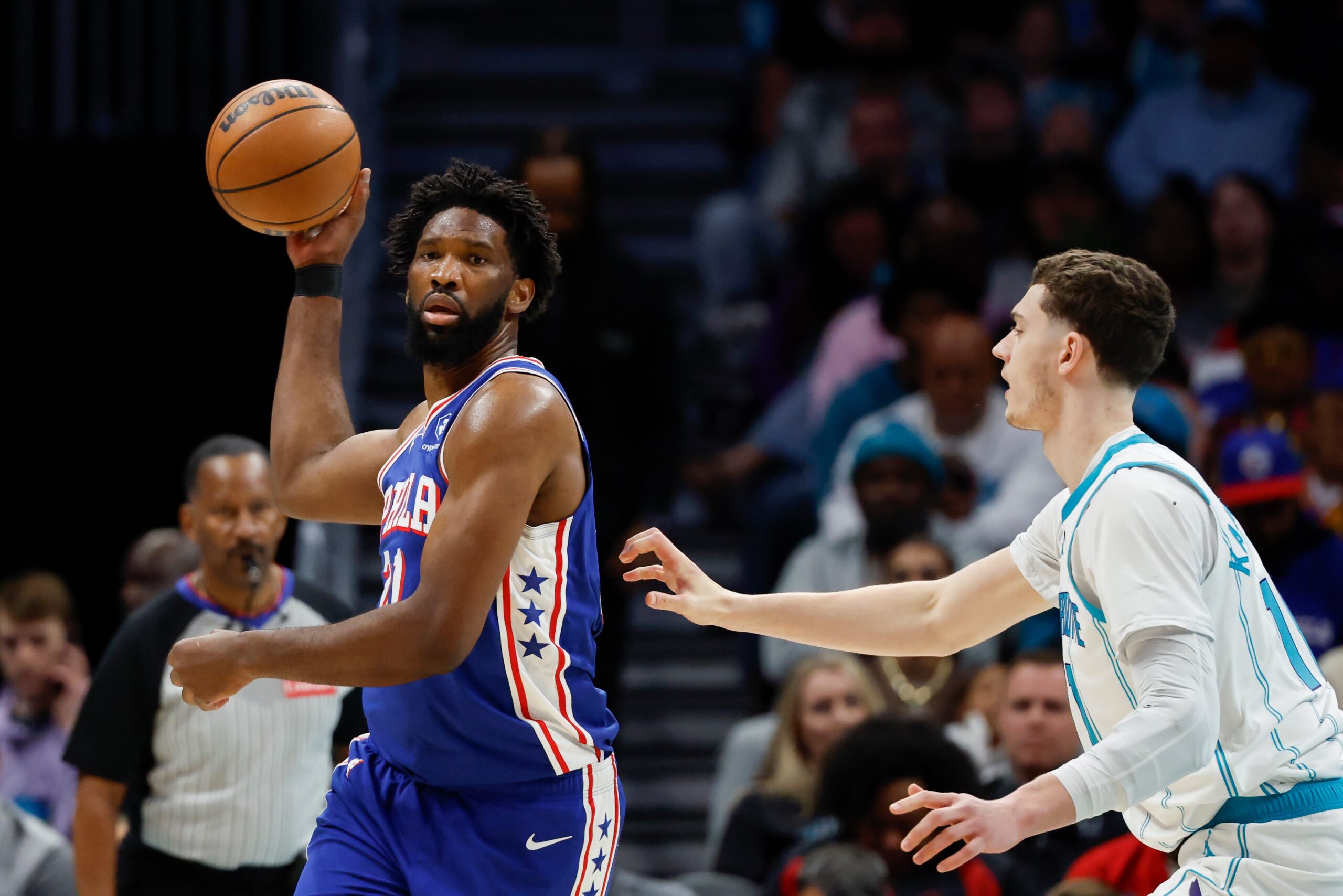
Joel Embiid (left) scored a team-high 29 points in Saturday’s Sixers win against Charlotte.
Big man Moussa Diabaté did most of the damage, grabbing seven offensive rebounds in the game. In the fourth quarter, Nurse turned to Andre Drummond at backup center in place of Adem Bona, to put a little more size in the paint. The Sixers managed to hold the Hornets to zero offensive rebounds in that final quarter, a key reason why they ultimately managed to take the lead and win the game.
The Sixers are finally healthy … mostly
Kelly Oubre Jr. returned to the lineup after missing two weeks with an elbow injury, coming in off the bench, the latest in big names coming off the injury report.
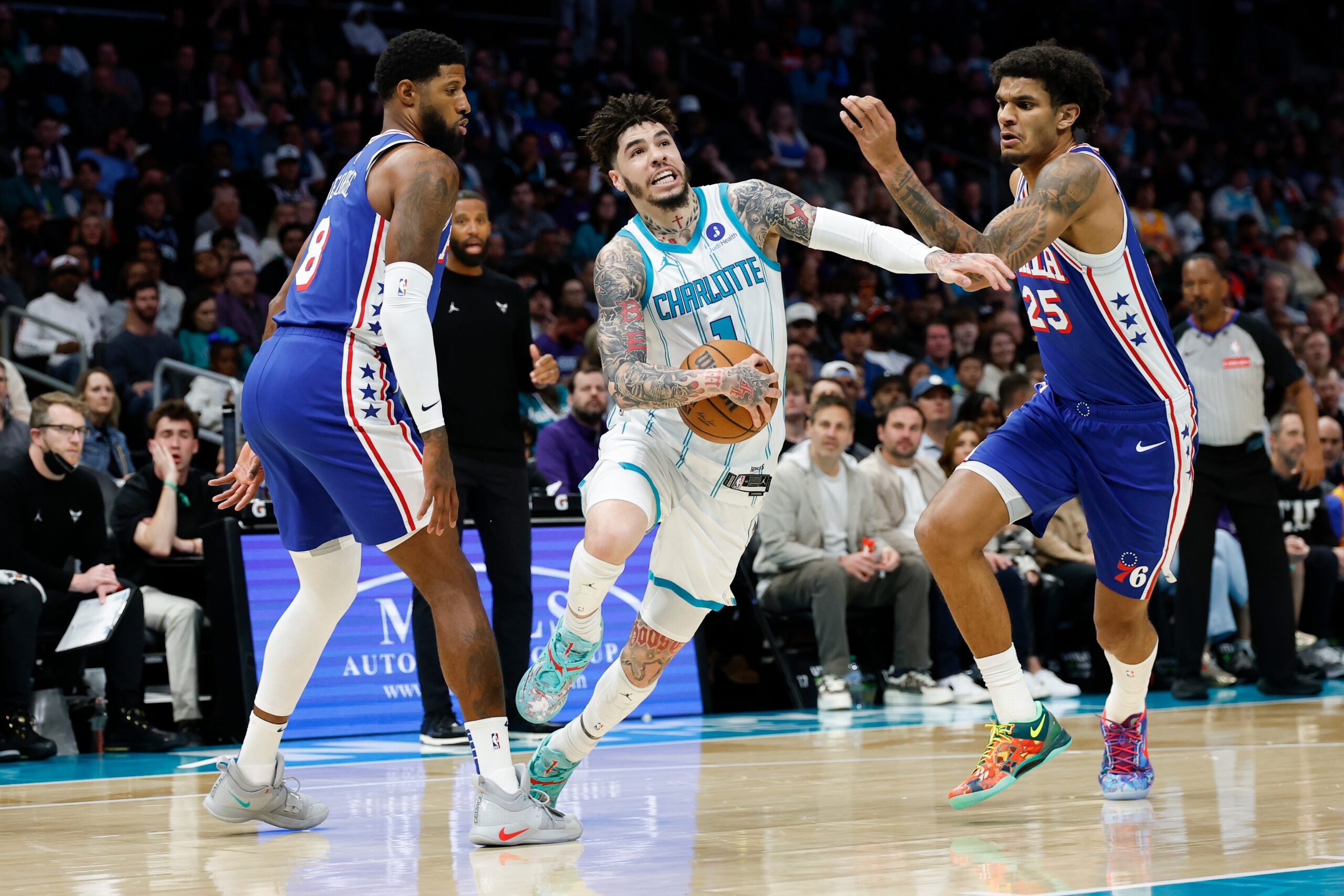
Sixers forward Paul George (left) and forward Dominick Barlow (right) work to shut down Charlotte’s LaMelo Ball on Saturday.
Each one of the Sixers’ biggest stars had a critical moment down the stretch — Embiid blocked a three-point attempt from Brandon Miller with under 10 seconds to play, Paul George hit the corner three that put the Sixers up for the final time, Maxey made a free throw to add to that cushion, and Edgecombe broke up a potential offensive rebound opportunity from Diabaté on the final possession on the glass.
“It just comes down to being healthy,” Maxey said Friday after practice. “I think that’s the NBA in general. A lot of teams have talent, a lot of teams have hard work and good coaching, but most of the time it comes down who’s healthy at the end.”
When Aaron Nola threw the first pitch of Saturday’s game against the Texas Rangers, the temperature at Citizens Bank Park was a chilly 45 degrees.
Fans in the stands were bundled up in blankets, and several Phillies wore red balaclavas underneath their baseball caps for the coldest first pitch in Philadelphia since 2019.
For the first eight innings, the Phillies’ bats reflected the weather.
A furious ninth-inning rally spurred some late excitement and forced extras, but the Phillies ultimately fell, 5-4, to the Rangers in the 10th.
“They kept after it,” said manager Rob Thomson. “Two big hits with two strikes. Never gave up.”
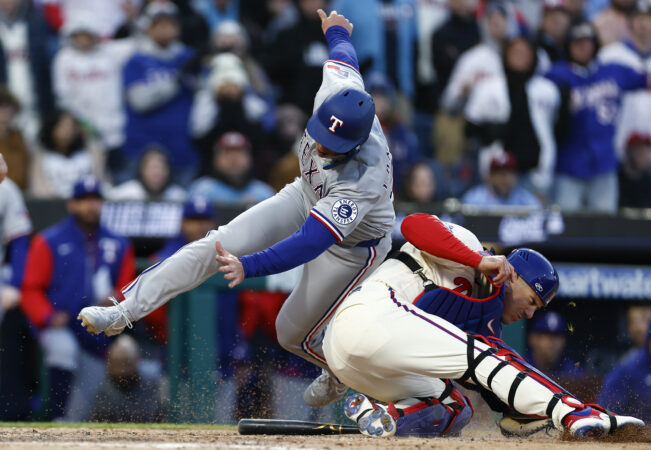
The winning run was scored on Phillies closer Jhoan Duran in the 10th inning. A single from Wyatt Langford, a bloop just 67.8 mph off the bat, advanced ghost-running Brandon Nimmo, who then came home on a wild pitch. Andrew McCutchen then singled to drive in an insurance run.
With two runners on in the bottom of the 10th and the opportunity to answer back, Kyle Schwarber challenged the strike call on a cutter from Tyler Alexander that barely caught the bottom outside corner of the zone. The call was confirmed, and when Alexander threw a changeup below the zone for a called third strike to Schwarber, the Phillies had no challenges remaining to attempt to overturn it.
“It’s a game of inches. It’s less than inches,” Brandon Marsh said. “I’m still getting used to it. … It’s kind of nuts seeing just how close those balls are to the zone, missing or barely catching it. I feel like we’re all still trying to get a good gauge for it, and as the season goes on, we’ll figure it out.”
Thomson said he had no issue with Schwarber using the Phillies’ final challenge in that situation.
“Especially with those guys late in the game like that, it could change the at-bat,” Thomson said.
With the Phillies down to their final out in the 10th, Bryce Harper cut into the Texas lead with a broken-bat single that scored the Phillies’ automatic runner, but Alec Bohm popped out to shortstop to end the game.
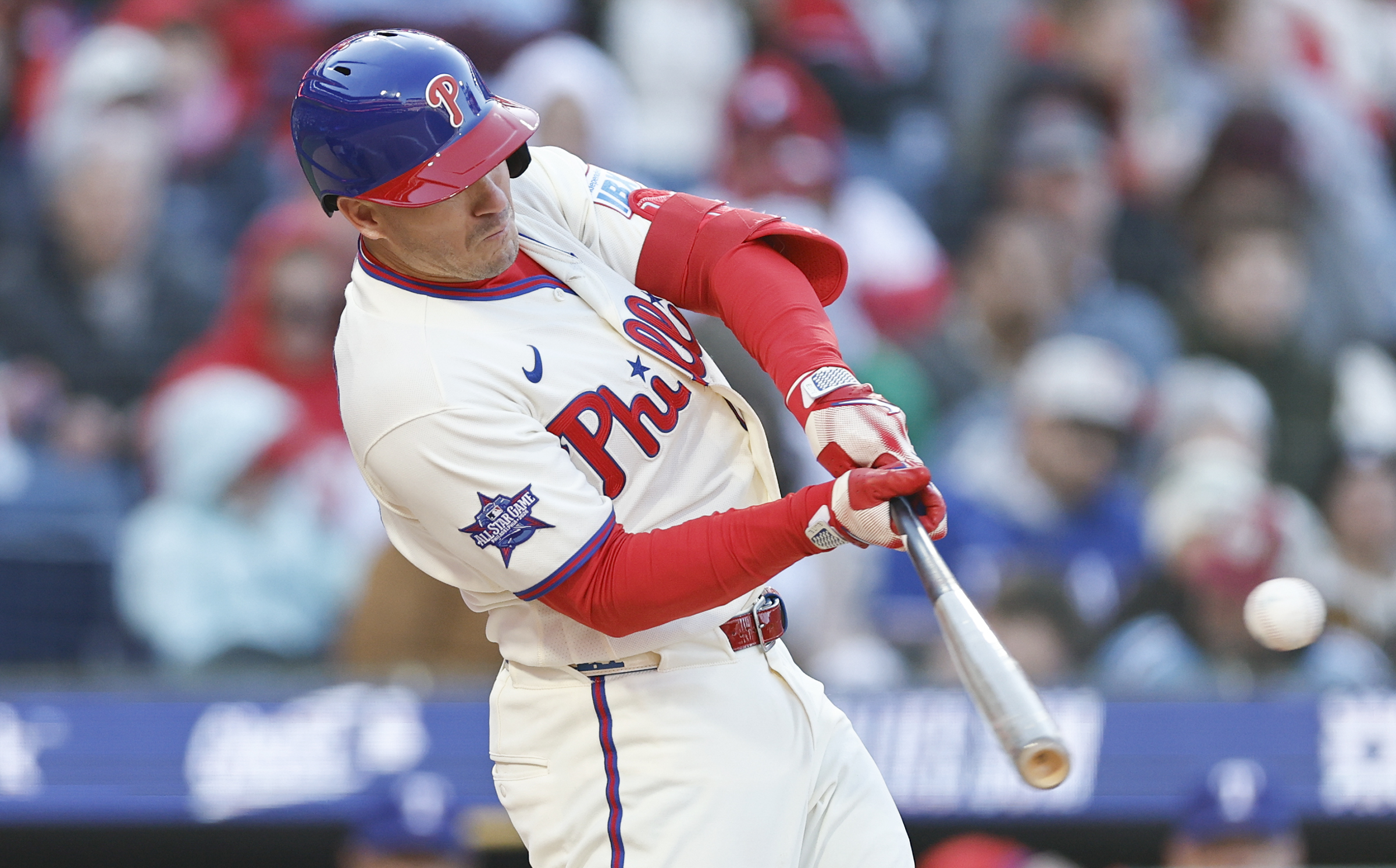
The Phillies’ J.T. Realmuto hits a fifth-inning single against the Rangers on Saturday.
Texas lefty Jacob Latz stepped in for scheduled starter Jacob DeGrom, who was scratched a few hours before game time with a stiff neck. He held the Phillies without a hit for the first four innings. J.T. Realmuto finally delivered a single off reliever Cole Winn in the fifth, but that was the Phillies’ only hit until the ninth.
“They pitched really well,” Thomson said. “Latz threw well. He attacked, threw strikes. Their entire pitching staff attacked; a lot of first-pitch strikes. They did a nice job keeping us off-balance, but I liked the way we fought at the end.”
The Phillies found themselves down early after Corey Seager ambushed Nola in the first inning with a solo home run on the first pitch he saw. The Rangers tacked on to their lead in the third when Nola hung a curveball to first baseman Jake Burger, who hit a two-run shot to the left field foul pole.
The damage could have been even worse. Nola wriggled out of a jam in the second inning after walking the first two batters. He induced a force out at third followed by a lineout, and then struck out Danny Jansen looking to leave both runners.
“Felt pretty good, body and arm felt good,” Nola said. “I think the command in the second inning got out of whack there, but felt like it came back pretty well. I threw a lot of pitches. They worked the counts pretty good. Obviously, those two pitches that those guys hit for homers were tough.”
In the third inning, Justin Crawford made a jumping catch at the center field wall to rob Langford of extra bases.
Nola allowed five hits, two walks, and struck out seven over five innings. The Phillies used three lefty relievers, Tanner Banks, José Alvarado, and Tim Mayza.
The entire ninth-inning rally came with two outs. Bohm started things off with a line drive single for the Phillies’ second hit of the game. Edmundo Sosa, pinch-hitting for Stott, then won an eight-pitch battle by drawing a walk to bring up García.
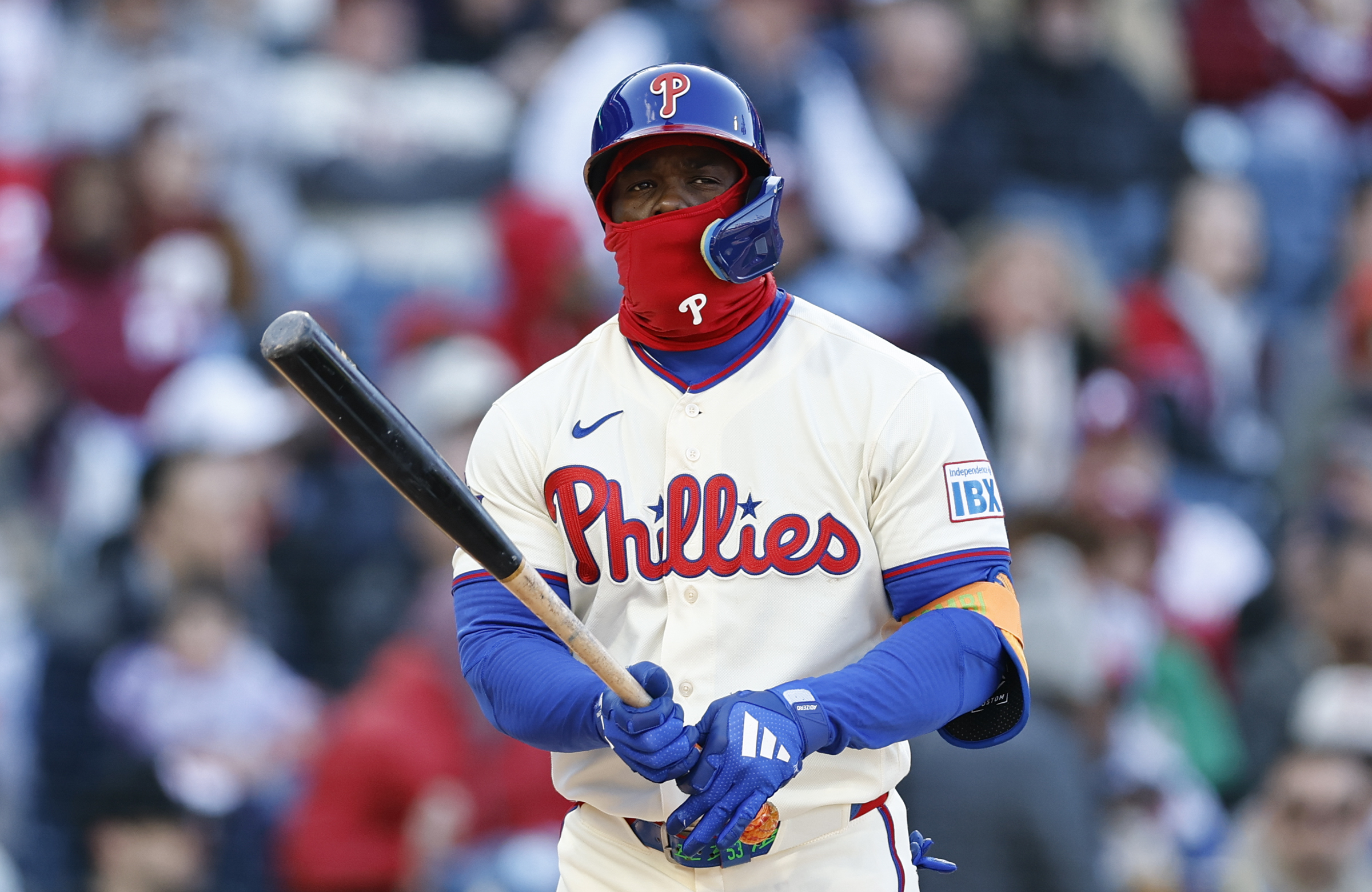
The Phillies’ Adolis García prepares to bat in the second inning against the Rangers on Saturday.
García popped up the first pitch he saw, but was given another life when Burger dropped the ball in foul territory. He responded by punching a double to left field.
“It’s a crazy, crazy game,” Marsh said. “The wind was howling today, so I know that wasn’t an easy play for him. So thankfully, it fell, and got Garcia’s first knock and kept the boys rolling.”
Marsh fell behind in the count 1-2, but then connected with a splitter for a game-tying, two-RBI single to force extras.
ATLANTA — The U.S. men’s soccer team wanted to test itself against Europe’s best this month, and it got what it asked for on Saturday.
It also failed that test in front of a pro-American crowd.
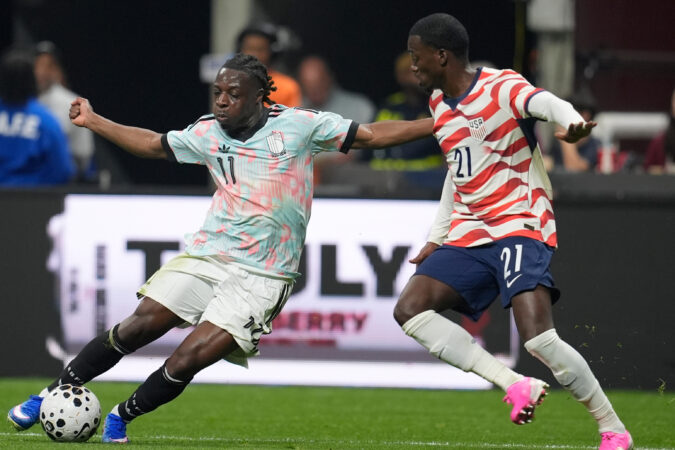
Belgium rolled over the Americans, 5-2, playing just as well against the U.S. starters as against the many second-half substitutes.
U.S. manager Mauricio Pochettino sprung some surprises with his starting lineup, the biggest being Matt Turner replacing Matt Freese at goalkeeper. Freese had played 12 straight games before Saturday, and seemed locked in as the World Cup starter.
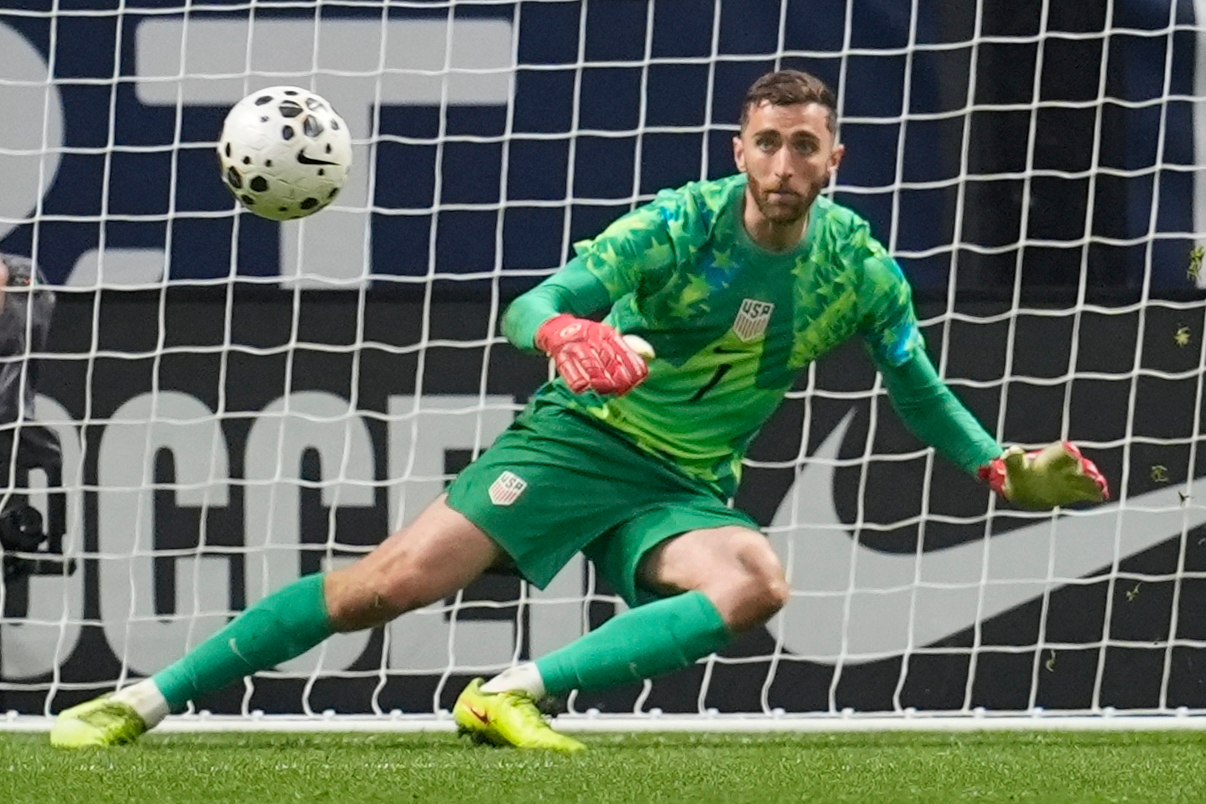
Matt Turner in the U.S. net on Saturday.
There was also a surprise with the 10 players in front of Turner. Pochettino switched out of the three-centerback setup that was so successful in the fall, going with an attack-minded 4-2-3-1 instead.
The starting group would have been remarkably attack-minded against any opponent, but especially one of Belgium’s quality. Tim Weah and Antonee Robinson were the outside backs, and Christian Pulisic, Malik Tillman, and Weston McKennie lined up in midfield behind striker Folarin Balogun.
As risky as the setup felt, the U.S. took it to Belgium early. McKennie got the best in a series of looks, denied from 8 yards by a great save from goalkeeper Senne Lammens in the 17th minute.
Belgium equalized in the 45th with a mighty hit from Zeno Debast. Jérémy Doku started the play with a sprint in from the left flank, then shot hard, but Turner punched it out. Debast corralled the ball, no one pressed him, and the centerback fired through the crowd from some 30 yards.
If Turner didn’t look great on the play, it might have been worse that no U.S. player pressed Debast before he let fly, even if him shooting was unexpected.
Turner then finished the half with one more punch-out save, denying Alexis Saelemaekers’ bouncing shot off a corner from 18 yards.
Pochettino’s first substitution was Cristian Roldan for Cardoso at halftime. But that didn’t stop Belgium from taking control of the game. Amid notable misses from Pulisic and Weah, Amadou Onana put the Red Devils up, 2-1, in the 53rd.
Lots of U.S. players looked bad on the play. Mark McKenzie was caught one-on-one with the terrific Doku on the flank. Roldan came to help, but neither closed the play down, then a trio of Americans failed to stop Saelemaekers from passing the ball back to Onana. Tanner Tessmann was then late to close down Onana, and the shot followed from atop the box.
Five minutes later, Tim Ream was called for a handball in the box, and Belgium had a penalty kick. There was a long video review to judge the contact, but referee Esteban Ostojich stuck with his call, and De Ketelaere converted from the spot.
Mass subs started in the 63rd, when Pochettino sent in Max Arfsten, Alex Freeman, and Sebastian Berhalter for Robinson, Tessmann, and Weah.
Dodi Lukébakio slammed in the fourth in the 68th, catching Arfsten twice along the way: in a two-on-one with Thomas Meunier on the right, then in a one-on-one as he cut in to shoot.
Pochettino then made four more subs, and with it switched out of a four-back formation to three. Patrick Agyemang, Ricardo Pepi, Gio Reyna, and Joe Scally entered, with Scally taking up a right centerback post; and Balogun, McKennie, Pulisic, and Tillman exited.
Lukébakio struck again in the 82nd, off a give-and-go with Timothy Castagne. Lots of U.S. players were guilty again here. Lukébakio almost walked past Ream, Berhalter, and Arfsten before his pass, then Scally and McKenzie stood to try to block the shot instead of pressuring the shooter.
Agyemang got a consolation goal in the 87th, cashing in a loose ball after Pepi jumped on a poor backpass attempt by Youri Tielemans.
That was a good sign of the Americans’ mentality in the midst of a rout. But the rest of the game was a sign of how far the U.S. remains behind the world’s elite.
ALLENTOWN — Zack Wheeler didn’t have to subject himself to this.
In planning out where to pitch in a game for the first time since having a rib removed to relieve a compressed vein 186 days ago, the Phillies ace could have opted for the warmth of Clearwater, Fla., where the A-ball season will begin in a few days.
But Wheeler, whose recovery already is tracking ahead of schedule by several weeks, wanted a bigger test. He took the mound here, then, amid a 46-degree chill Saturday, then threw cold water all over a lineup of triple-A batters.
“It was really my choice,” Wheeler said after holding Toledo, the Tigers’ triple-A club, to two hits and one walk on 38 pitches in three scoreless innings. “I wanted to see more competitive at-bats and more competitive situations. I knew it was going to be cold, but at the end of the day, this is probably where I need to be facing hitters.”
Everyone got what they came for.
Wheeler threw each of his pitches — four-seam fastball, sinker, sweeper, cutter/slider, curveball, and splitter — to a lineup that included outfielder Wenceel Pérez and top Tigers prospects Max Clark and Jace Jung. His fastball sat 92-94 mph, slightly better than in spring training, before dipping in the third inning. His curveball was especially sharp.
Philadelphia Phillies pitcher Zack Wheeler long tosses at spring training in Clearwater, Fla. on Monday, Feb. 23, 2026.
And the IronPigs, the Phillies’ Lehigh Valley-based triple-A affiliate, got to stage “Rehab Ribs Night,” complete with a barbecue buffet in the left-field stands above the bullpen that began an hour before the game and ran through the middle innings for an announced crowd of 6,740.
“It’s a little aggressive,” Wheeler said, smiling. “Made my bone hurt a little bit, and it’s not even there. No, whatever can help these guys out. It’s minor league baseball. They run a bunch of promotions. Whatever makes a little bit of money, I’m here for it, I guess.”
Phillies reliever Orion Kerkering was here, too. He followed Wheeler into the game and threw 10 pitches, including two of his newly minted splitters, in a scoreless fourth inning.
Wheeler and Kerkering returned to Philadelphia after the game but will rejoin the IronPigs next week in Durham, N.C. Kerkering expects to make back-to-back appearances Tuesday and Wednesday before possibly coming off the injured list; Wheeler will start Friday night, then make at least one more minor league start for double-A Reading.
After that? He could join the Phillies’ rotation.
Certainly nothing that happened in his first start for Lehigh Valley suggested otherwise.
“Yeah, it went well, obviously,” Wheeler said. “Felt good. At the end of the day, coming out of it healthy is really all that mattered to me.”
Wheeler produced seven swings-and-misses, four of which came off his curveball. He struck out Pérez on a curveball to open the game and got Trei Cruz to chase a breaking ball in the dirt to end the first inning, probably his best pitch of the start.
But despite the results, Wheeler said he wasn’t necessarily satisfied with the spin on his off-speed pitches.
“Whether it be the curve, sweeper, or even the cutter, they weren’t doing necessarily what I needed them to do,” Wheeler said. “But the curveball, it had good shape on it and it was moving so much that it was effective. It’s something that’ll come with more reps and the higher intent and stuff.”
Jung had the only hard-hit ball against Wheeler, a scalded single to right field that registered 109.5 mph off the bat. Otherwise, Wheeler got mostly soft contract. All three strikeouts came in the first inning.
Wheeler, who lost considerable weight after the surgery, said he’s still about 10 pounds lighter than usual for this time of the season. Maybe it has something to do with why he didn’t feel as comfortable pitching out of the stretch in spring training.
But he was encouraged by his effectiveness out of the stretch. Two of his higher-velocity readings — a 94-mph sinker and a 94.3-mph four-seamer — came out of the stretch to Eduardo Valencia in the first inning.
Wheeler credited a recent mechanical tweak with pitching coach Caleb Cotham in the way he comes set with his front foot.
“Just kind of thinking back over the years, what’s worked for me, we made a little adjustment and today I felt a lot better, more in sync-wise,” Wheeler said. “Sometimes you just need those little reminders along the way even though I’ve been doing it for a while. Sometimes it’s the small stuff that you kind of need to nail down as you build up.”
Phillies pitcher Orion Kerkering, seen here in a simulated game earlier this spring, threw 10 pitches in a scoreless fourth inning on Saturday.
If you blinked, you missed Kerkering.
He was slowed in spring training by a strained right hamstring. He also is introducing the splitter to complement his fastball-sweeper tandem. He spiked one in the dirt and got Cruz to foul off another. It remains a work in progress.
“I think I’m comfortable right now that I can go into a big league game and throw a split,” Kerkering said. “I think tweaking it here, knowing what guys see, kind of judging their swings and trying to reevaluate from there, I think that’s what’s helpful.”
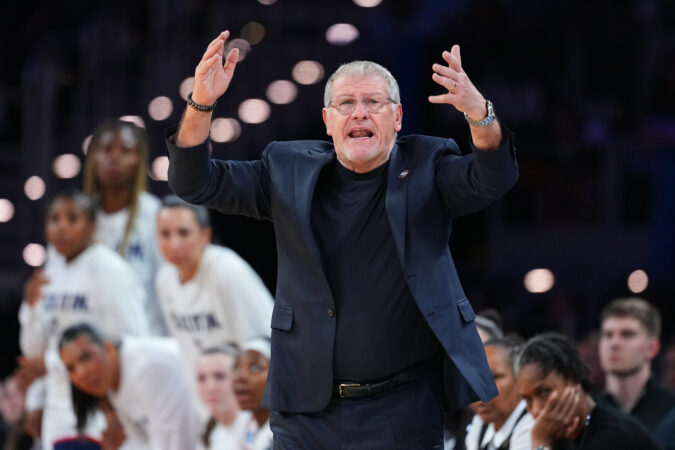
FORT WORTH, Texas — UConn coach Geno Auriemma is ripping the double-regional format being used in the women’s NCAA Tournament, saying it doesn’t make sense for the teams still playing or for efforts to grow the game.
Auriemma brought up attendance, bad shooting percentages, and teams having to come to the arena early and late on the same day when taking aim at the format that’s in place for the fourth year and set to continue for at least five more.
“Well, I think the first question you’d have to ask is why did they go from four [sites] to two. What was the rationale?” the 12-time national champion coach, who grew up in Norristown and graduated from Bishop Kenrick High School and West Chester University, said Saturday. “If they can explain it legitimately and then prove that it works, then great. So what was the reason?”
NCAA officials didn’t immediately respond to a request for comment from ghe Associated Press.
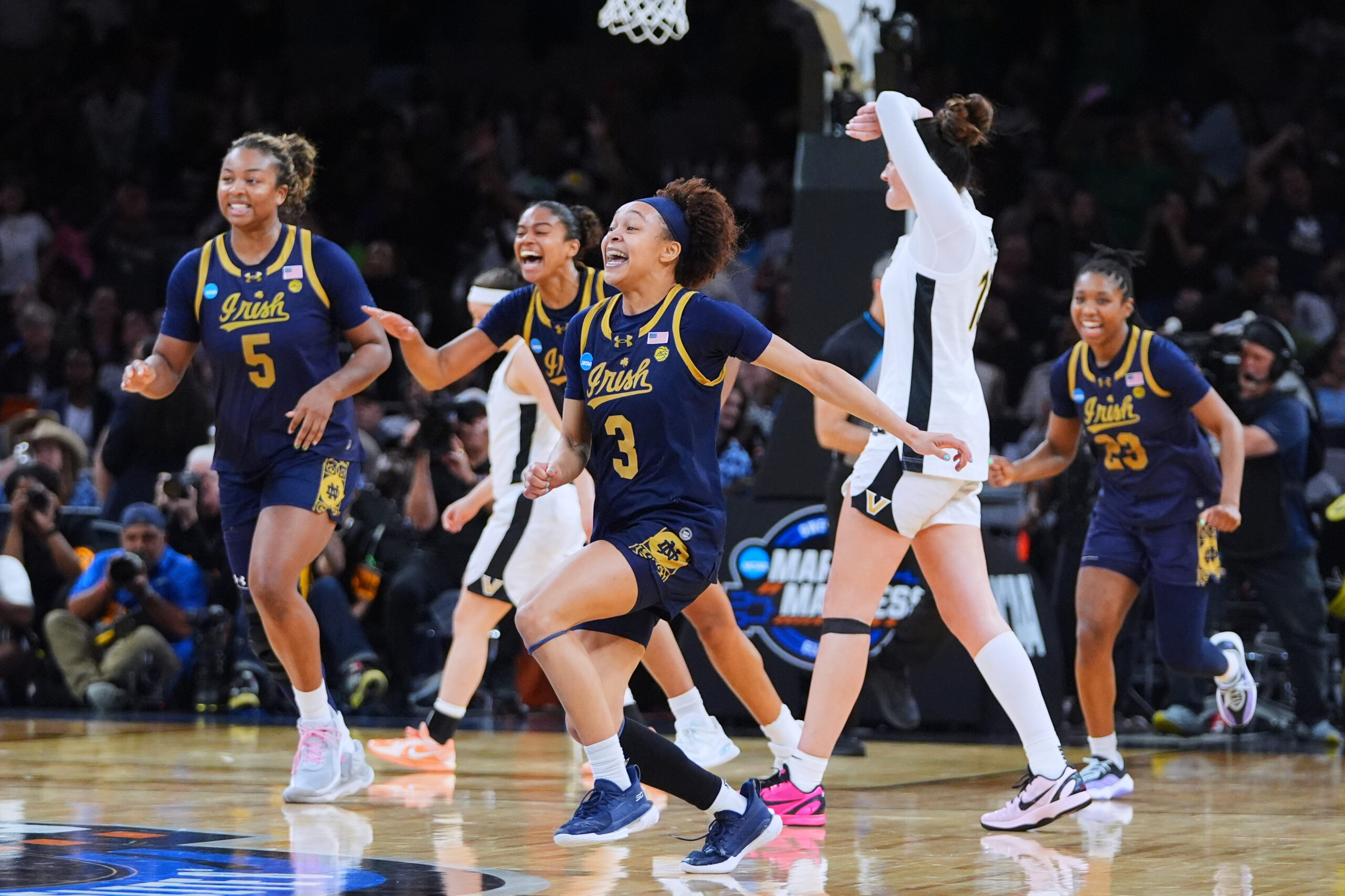
Hannah Hidalgo (3), Malaya Cowles (5), Iyana Moore (23), and their Notre Dame teammates will face UConn on Sunday.
The Huskies held their required media availability Saturday morning, after the Fighting Irish had already completed their session and before two Sweet 16 games in Fort Worth Regional 3 were played at Dickies Arena. UConn and Notre Dame had scheduled practice times there later in the evening.
“So we had to get our kids up, come over here. You already knew who we were playing last night, but we can’t get on the court, and neither can the other teams,” Auriemma said. “Does anybody who makes these decisions ever ask the coaches and the players, ‘Hey, does this work?’”
“Everyone’s trying to figure that out right now,” Fudd said. “Every team is going through that. There’s no excuse in that. So we’ll figure it out. We’re making it work, but it definitely isn’t the most ideal setup.”
Auriemma, the winningest men’s or women’s NCAA basketball coach with 1,287 victories, didn’t wait for a question from reporters to share his thoughts on the format, opening his session by reading a sequence of numbers off a piece of paper: 4 for 20, 4 for 22, 1 for 17, 5 for 17, 4 for 16, 7 for 26.
“That’s the three-point shooting yesterday across the country. How many arenas are we going to sell out with that [expletive]?” he said. “Now, maybe it was just a bad day shooting by everybody. These are all teams that average probably 30 [percent], over 30, for the season. Know what time our shootaround was yesterday? Six in the morning, 6:20, I think, for half an hour.”
He also mentioned the total combined attendance (18,821 announced) at the two venues Friday, in Fort Worth and Sacramento, Calif.
UCLA coach Cori Close, whose team is the top seed in Sacramento Regional 2 and plays Duke in an Elite Eight game on Sunday, said it is important to get maximum exposure and coverage while also looking for the best setup to have high-level basketball played on the court.
“I think that I was in favor of going to the two regional sites when that happened,” Close said. “I think every year we should look and go, Where are we in our game? How did this play out, efficiency-wise, from a student-athlete wellbeing side. Is there some ways in which we can organize to make things a little bit more cohesive so teams aren’t going back and forth from media coverage to practices later and those kinds of things?’”
Auriemma said there is a lack of input from coaches, and that nothing changes, even when the NCAA sends representatives to schools every year after the tournament.
“Hopefully I’m speaking for the other coaches,” he said. “Some coaches might think I’m full of it. And this is not about UConn. I hope everybody understands that. This is not about us, because we’ve managed to go to the Final Four and win national championships, no matter where they’re played, when they’re played, what time they’re played, whatever.
“I think there is a level of frustration right now among the coaches that’s higher than any time I’ve ever seen it.”
Duke coach Kara Lawson would like more practice time on the game court, especially more than the designated half-hour on game days for shootarounds, which routinely last about an hour the rest of the season.
“That would be the only thing I’d change. I mean two regionals, I think the arena thing is the thing that’s hard,” Lawson said. “It’s not that we’re in the same city, it’s that we don’t get long enough practice or shootaround times in the venue for your most important games of the season.”
For the second day in a row, Auriemma mentioned new rims and new basketballs being used during NCAA Tournament games and the impact those have on shooting.
“It’s hard to make shots in the postseason. They just break out these new baskets, new rims, and then it gets in the kids’ heads,” Auriemma said Friday after UConn’s 63-42 win over North Carolina, in which the teams were a combined 8 of 42 on three-pointers.
The coach on Saturday again brought up “new basketballs right out of the box” and the rims.
“Got people dribbling the ball off their feet,” he said. “You got people missing layups all over the place. You bounce the ball, and it goes up to the ceiling. There’s just no concept of how basketball is played. Not that I have any of the answers. Believe me, I just have questions.”
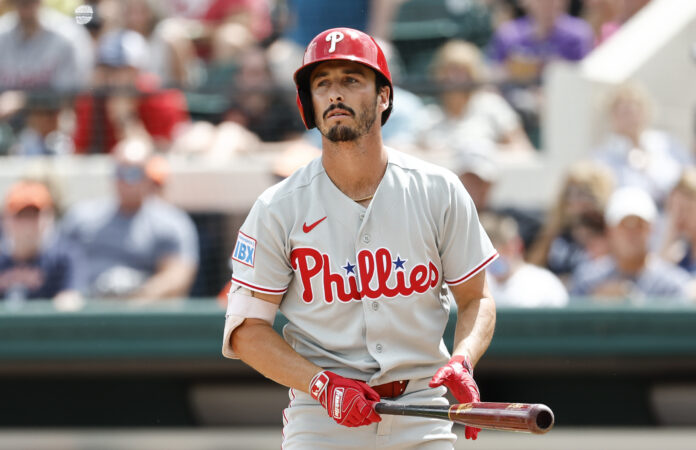
Garrett Stubbs is remaining in the Phillies organization.
The team announced Saturday that the catcher has cleared waivers and has been outrighted to triple-A Lehigh Valley. Stubbs had been designated for assignment on Wednesday.
The Phillies had searched for a trade partner for Stubbs, who also saw time in the outfield and at third base this spring, to potentially find a major league opportunity for him last week. Stubbs, 32, could have elected free agency after clearing waivers, but he accepted the minor league assignment and the Phillies retain some crucial catching depth at triple A.
Phillies manager Rob Thomson said this week that on a personal level, he had hoped Stubbs would find a major league job, but from a Phillies perspective he hoped he would stay in the organization.
“He’s meant so much to this place, the energy that he brings, the type of teammate that he is, and he’s a good player, too,” Thomson said. “Unfortunately, when he was here, he was behind the best catcher in baseball, so he didn’t get a whole lot of playing time, but I think he showed us enough in spring training that he’s a potential super utility guy.”
Stubbs spent most of last season with the IronPigs, where he hit .265 with a .754 OPS in 71 games. He has a career .215 batting average and .603 OPS in 197 games with the Phillies and Houston Astros.
The Phillies opted to keep Rafael Marchán, a 27-year-old switch-hitter, as J.T. Realmuto’s backup for the second consecutive season. During spring training, the Phillies considered keeping Stubbs on the roster as the 26th man, which was why he took reps at other defensive positions than catcher. That spot ultimately went to former Gold Glove utility player Dylan Moore.
Thomson said that the conversation he had with Stubbs informing him that he had not made the team was one of the toughest of his career.
deGrom scratched
Several hours before first pitch on Saturday at a chilly Citizens Bank Park, Texas Rangers starting right-handed pitcher Jacob deGrom was scratched from the game with neck stiffness. Lefty Jacob Latz started in his place.
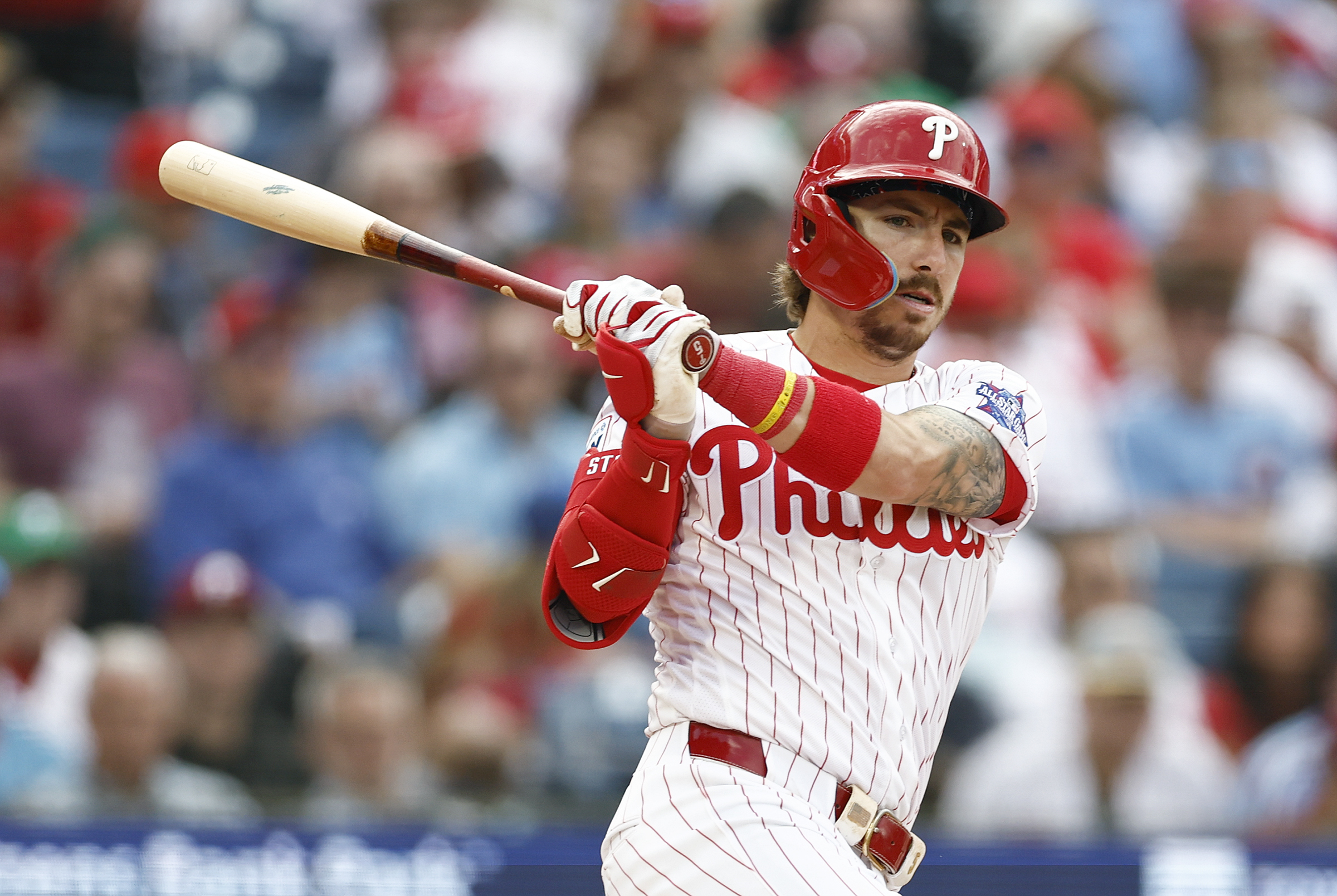
Thomson opted not to change his batting order after the pitching change, with Bryson Stott and Brandon Marsh both remaining in the lineup against the left-hander rather than drawing out for their right-handed platoon partners Edmundo Sosa and Otto Kemp.
Bryson Stott and Brandon Marsh will remain in the lineup against Texas left-handed pitcher Jacob Latz.
The Phillies are expecting to face a string of left-handed starters this homestand, and Thomson said he did not want Stott or Marsh sitting on the bench for too many days in a row, especially following Friday’s off day.
Extra bases
Zack Wheeler (thoracic outlet decompression surgery) and Orion Kerkering (hamstring strain) both began rehab assignments on Saturday in Lehigh Valley. Wheeler is scheduled to start again Friday in Durham in triple A, and will make another start after that for double-A Reading. Kerkering is next scheduled to pitch a back-to-back on Tuesday and Wednesday in triple A. … Jesús Luzardo is scheduled to start Sunday (1:35 p.m., NBCSP) against Rangers lefty MacKenzie Gore. The Phillies announced Saturday that The Jesús Luzardo Family Foundation has pledged to donate $150 to the Boys’ and Girls’ Clubs of Philadelphia for every strikeout he records this year.
DETROIT ― While everyone waited with bated breath to see if there was one more move the Flyers were going to make at the buzzer of the NHL trade deadline, a tweet went out.
“Roster update: We have claimed forward Luke Glendening off waivers,” the post read.
It was a bit surprising, considering everyone was hoping for that 1C or 1D to find their way to Philly. Instead, the Flyers picked up a gritty veteran from the New Jersey Devils who can play wing and center.
The move may have appeared to be a minor one, but the 36-year-old has slotted in nicely on the fourth line with Sean Couturier and Garnet Hathaway, and on the penalty kill.
But what he has also brought is something that the Flyers were severely lacking. Entering the season, the Flyers’ five centers — Christian Dvorak, Trevor Zegras, Couturier, Noah Cates, and Rodrigo Ābols — are all left-handed. Glendening, who came to Philly with a career 55.6% winning percentage in the faceoff circle, is a righty.
“It really has added a lot to our team,” coach Rick Tocchet said of having a right-handed center whom Jon Cooper raved to him about. “Think, since I put that line together, they’re an identity line for us. But it’s also on the PK, having that right-handed shot — Coots all year has done a nice job [but] it’s hard to play both dots all the time — so it is a luxury.”
Having a righty is more important than most realize, especially in the defensive zone when the faceoff is in the right circle, which would be Couturier’s weak side, because his stick would line up angled to the net, not the boards. Teams would take advantage of that, especially on icings where the offensive team dictates the circle used; however, with Glendening, things are evened out.
“He’s a smart, reliable defensive player, really strong on faceoffs. Used to hate going against him in the draws; it was always a battle,” Couturier said. “Probably chopped your wrist off if you got too low. So it’s nice to have it on my side.”
Glendening has four points (one goal, three assists) and a 60% winning rate on faceoffs since joining the Flyers. He will suit up on Saturday for his eighth game with the Orange and Black in one of the biggest games of the season against the Detroit Red Wings (8 p.m., ABC) in an all-too-familiar place.
About 2½ hours northwest of Detroit in Grand Rapids, Glendening grew up playing hockey. He didn’t join the famous Little Caesars Hockey program, which has produced over 100 pros like former Flyers John Vanbiesbrouck, Mike Knuble, and Derian Hatcher.
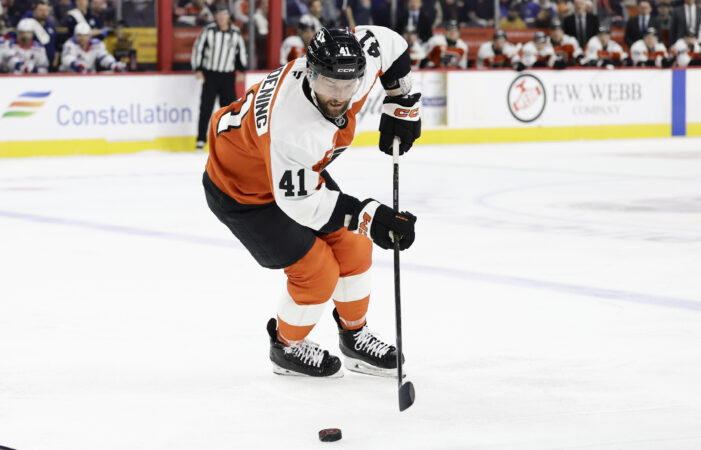
Luke Glendening was acquired by the Flyers during the NHL trade deadline.
Instead, he played four years of hockey at East Grand Rapids High School and a year at The Hotchkiss School in Connecticut. He spent four years at the University of Michigan, where he served as captain for two years and went to the national championship as a junior. (The Wolverines lost to Minnesota-Duluth, where Cates played, and “He’ll always have that over me,” the older Glendening joked, with the two teams meeting again in a regional final on Sunday.)
After playing three games with Providence of the American Hockey League on a tryout agreement once his college career was over, he signed a deal with his hometown Grand Rapids Griffins. Glendening spent most of the season in Michigan, but also suited up for 27 games with Toledo of the ECHL.
The next summer, he inked a deal with his childhood team, the Red Wings, and made his NHL debut, somewhat fittingly now in hindsight, against the Flyers.
“I think dream come true is probably overused, but for me, it really was,” he said. “I signed in the American League, played in the Coast [ECHL], and never thought that I was going to play in the NHL, and then to get a chance to play with my hometown team was really special.”
Glendening spent eight seasons with the Red Wings, even playing for his childhood favorite-turned-team-general-manager, Steve Yzerman, toward the end. He was with the Dallas Stars, who the Flyers see on Sunday at home (7 p.m., NBCSP) for two seasons, two seasons with Cooper and the Tampa Bay Lightning, and the Devils this season.
It’s always special for the Michigander to not just come back home — he’ll have a family contingent in the crowd — but to the first place he stepped onto the ice as an NHLer.
When you mention to him that he’s inching toward 1,000 NHL games, Glendening will humbly say he’s not really that close. But, if he plays the rest of the way this season and 65 the next, he’ll hit the milestone mark.
“I’ve just always found joy in the journey, I guess would be the best way to put it,” he said.
“It’s been a huge blessing to be around this league. There’s been many different stops along the way, and times when I didn’t know if it was going to continue, but just thankful for each and every day I get.”
Breakaways
Dan Vladař will start in goal for the Flyers. The expectation is that Sam Ersson will then tend the twine on Sunday against Dallas. Forward Tyson Foerster made the trip and participated in morning skate in a regular jersey. Per Tocchet, don’t read too much into it as morning skate prep work was not a contact-heavy skate.
The New York Sirens and Montreal Victoire of the PWHL played at 1 p.m. to a packed house at Little Caesars Arena.