Category: Sports Columnists

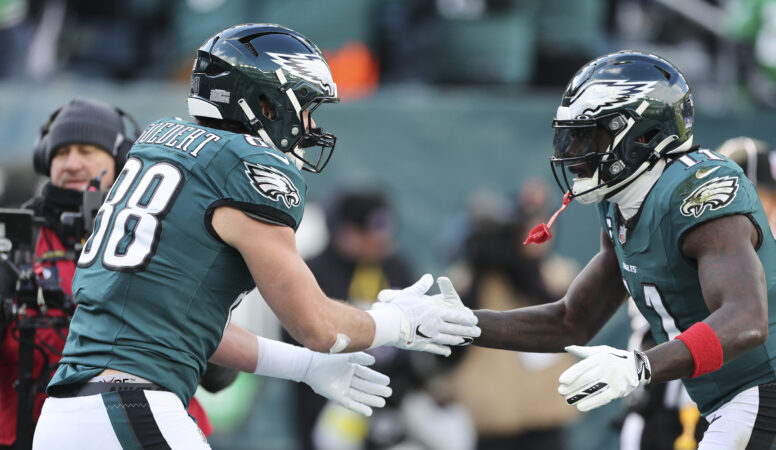
  • Let’s stop acting like the Eagles haven’t had a great season. An NFC East title would make it a rousing success.

    Let’s stop acting like the Eagles haven’t had a great season. An NFC East title would make it a rousing success.

    Nobody wants to hear this, but every football season is different, and the preceding season should never flavor its successor, and expectations of continued excellence from a team that is markedly different are utterly ridiculous. Super Bowl LIX is gone, just like six significant players from that championship roster.

    Which brings us to the 9-5 Eagles, who, contrary to much of the commentary and punditry, are nearing the end of a very good season. Saquon Barkley isn’t going to break rushing records this season, and the passing game hasn’t equaled its pedigree, and the defense won’t finish ranked No. 1, but none of that matters. What matters is who they beat, who they lost to, and where they stand.

    What? How? Why even consider such heresy as this? Isn’t there enough gaslighting going on during White House press briefings?

    This isn’t fake news, and this isn’t pandering to the franchise (as if).

    This is common sense.

    The Eagles’ results through 15 weeks present a team that can become just the eighth franchise to win consecutive Lombardi Trophies.

    They’ve beaten the Rams, Packers, and Buccaneers, all playoff teams. They also beat the 8-6 Lions, and they won in Kansas City against a Chiefs team that began the season 5-3.

    More relevantly, if you view the season objectively, the negative isn’t very negative.

    The Birds have one bad loss in 14 games. That bad loss came Oct. 9, to the Giants. That was one of the NFL’s idiotic, three-days-of-rest, Thursday Night Football games, and the Eagles were the road team. The Giants were riding a wave of hope in the form of a pair of dynamic rookies with names straight out of youth fiction sports novels, Jaxson Dart and Cam Skattebo. Still, it was a loss, and a bad loss.

    The other losses are eminently explicable.

    The week before they lost to the visiting Broncos, who, now 12-2, turned out to be the best team in the league.

    They lost to the Cowboys at Dallas on Nov. 23 because Dallas came back hard, which was to be expected, since Dallas has the league’s No. 1 offense.

    They lost to the Bears, a 10-win team that holds the No. 2 seed in the NFC, mainly because of an inability to stop the run game, an inability predicated on the infirmity of defensive tackle Jalen Carter’s shoulders, which were subsequently repaired. That also was a short-week game, played on Black Friday.

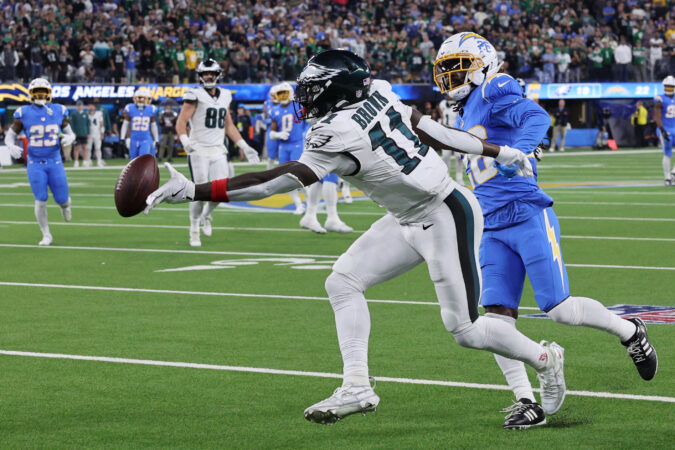
    They lost on the road to the Chargers, another 10-win team, because Jalen Hurts had a catastrophically bad game. That’s allowed. It was his first catastrophically bad game since Dec. 18, 2023, when he and A.J. Brown went rogue. That means it was Hurts’ first disaster in a span of 36 starts. That’s not bad, considering Brett Favre averaged about two catastrophes per season in his first years as a starter.

    Hurts hasn’t been great, but this season he has produced his two best games in terms of passer rating, which this season is 99.4, about 5 points higher than his previous four complete seasons as a starter. With 22 TD passes, he’s just two away from a career high.

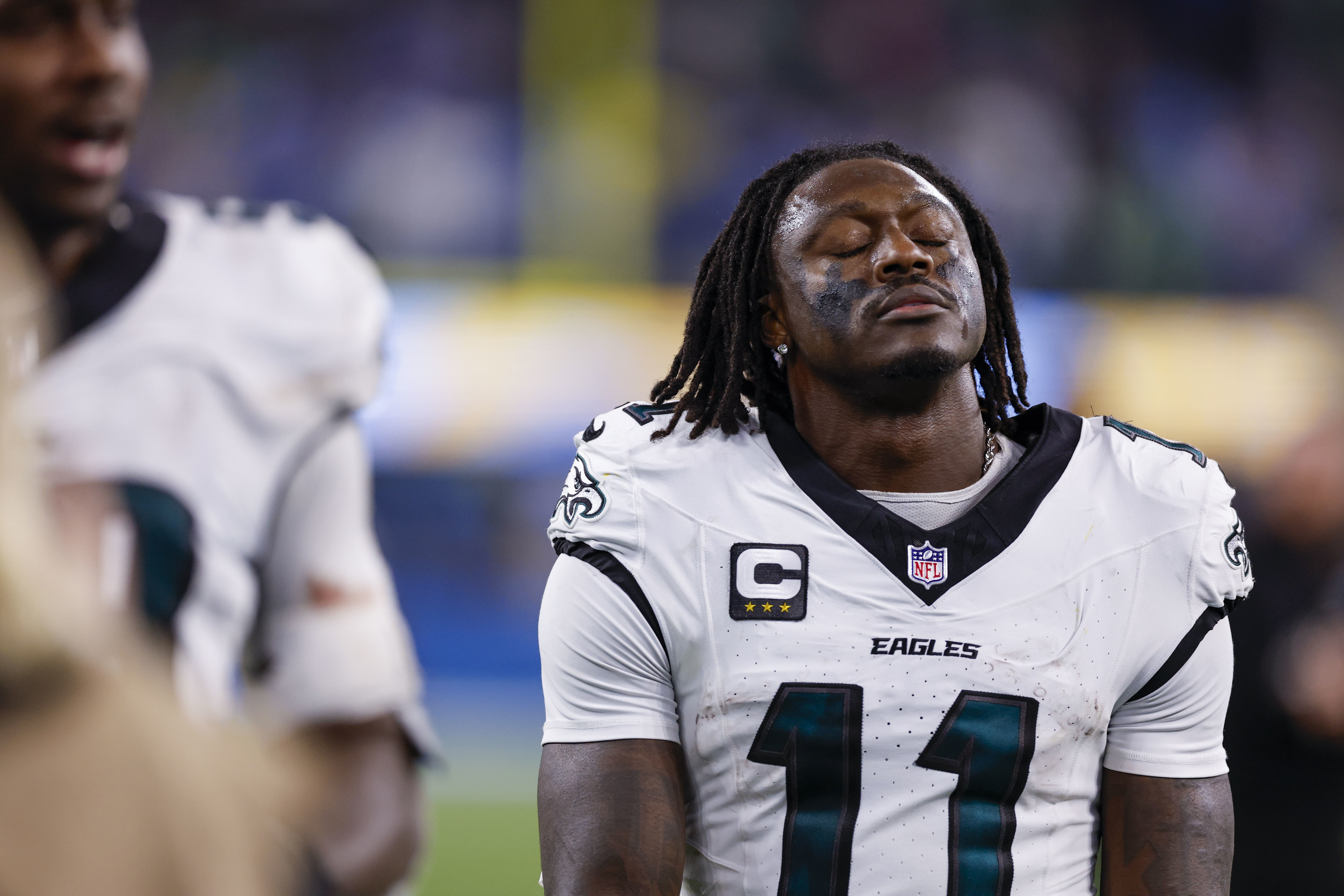
    Jalen Hurts and the offense have been frustrating to watch at times, especially during the three-game losing streak. But on balance, Hurts has had a good year.

    And, while every team suffers in-season roster attrition, it’s only fair to factor in the Eagles’ most relevant absences, since they help explain some of the losses.

    They recently lost three games in a row when Carter and right tackle Lane Johnson, the two best players on the team, were either playing hurt or not playing at all.

    Guess which other game Carter missed because of injury? The bad loss in New York.

    Further, the Eagles have had four short-week games: Games 6, 10, 12, and 14. They have a fifth, on Saturday, at Washington. They could have a sixth if the NFL decides Game 17 against the Commanders should be played on a Saturday.

    Short-week games are an onerous burden. The long week that follows a short week never compensates for the shortened time for rest, healing, and preparation.

    These are not complaints. These are explanations. This is how champions are forged. This is the price of greatness.

    Have the Eagles looked great in the first 14 games? No. But when they’ve looked bad, or when they’ve lost, it either occurred against very good teams, or with extenuating circumstances, or both.

    What, then, does Saturday portend? Nothing certain. The Eagles have lost once apiece to their other NFC East opponents, the Cowboys and Giants, each time on the road. The Commanders might be without some of their better players, but they are not without talent, however aged that talent might be.

    They play hard for coach Dan Quinn, who worked as the Cowboys defensive coordinator for three seasons before taking over in Washington.

    This game isn’t a walkover, and the rematch in Game 17 won’t be a walkover, either. But, assuming Johnson and Carter return soon, the Eagles should be regarded as a fearsome playoff foe.

    This is a much more palatable argument coming off an impressive win, but it would be just as true had they not won by 31 points or shut out the Raiders.

    Because they are a very, very good team. Does Jalen Hurts need to run the ball more? Yes. Does the offense need to commit fewer penalties? Yes. Did they endure a midseason lull? Yes.

    But the Eagles are nearly a touchdown favorite Saturday, and likely will be favored by even more in the season finale against the Commanders. They’ll probably get points in Buffalo next weekend, but likely no more than a field goal.

    Why? Because, again, they’re a very good team that has had a very good season.
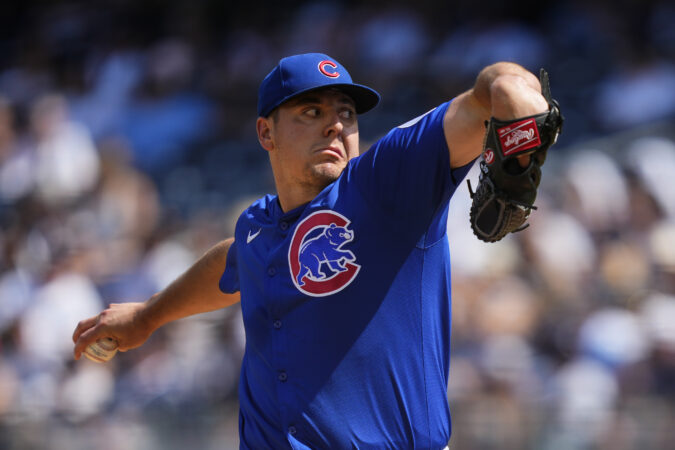
  • Phillies deserve big props for spending big on Brad Keller, the setup man they sorely needed

    Phillies deserve big props for spending big on Brad Keller, the setup man they sorely needed

    Sometimes, it’s the thought that counts.

    As recently as Tuesday, Dave Dombrowski sounded like a man who didn’t feel much of a sense of urgency with regard to his bullpen.

    “I guess we’d look for arms in the bullpen, but we’ve also got five solid guys out there that are of veteran status,” the Phillies president said.

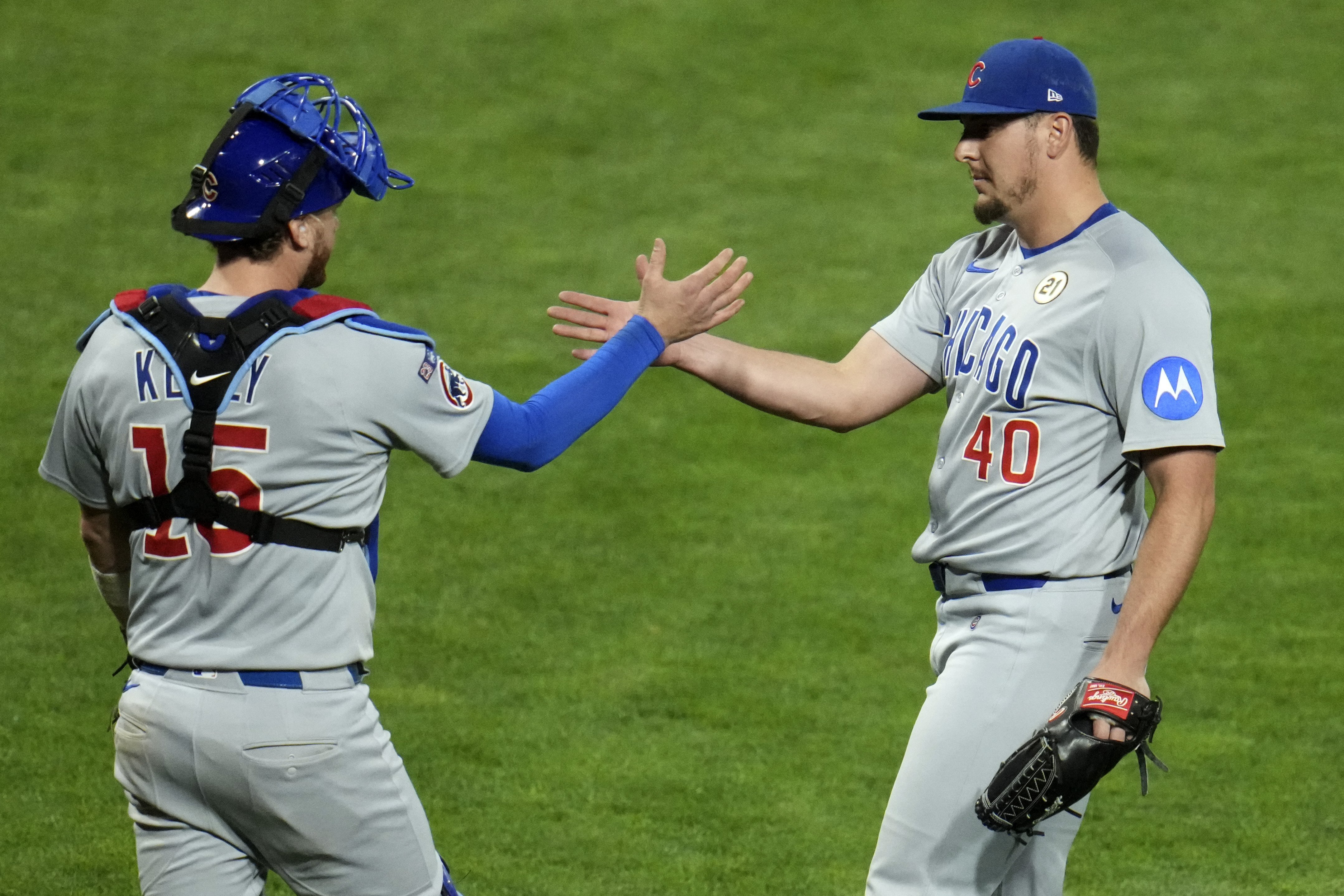
    It was encouraging, then, when news leaked on Wednesday that the Phillies were closing in on a two-year, $22 million contract for former Cubs setup man Brad Keller. Set aside the question of who Keller is and whether or not Rob Thomson can count on a repeat of the veteran righty’s breakout 2025 campaign. The mere fact that the Phillies saw a pressing enough need to spend this sort of money on another reliever is commendable.

    And, let’s be clear. This is real money that the Phillies are spending. The relief market has exploded this offseason. That’s true at the top of the market, where former Mets closer Edwin Díaz accepted a whopping $21 million AAV on a three-year contract, all the way down to erratic former Phillies lefty Gregory Soto, who somehow landed $7.75 million from the Pirates on a one-year deal. Keller is the 11th reliever to sign a deal worth at least $9.5 million per year and the seventh to sign for at least $11 million.

    Brad Keller, right, revived his career with the Cubs in 2025 as one of manager Craig Counsell’s most trusted relievers.

    He is also the youngest of that group, which is a key fact to consider. Heading into his 30-year-old season, Keller doesn’t have the wear-and-tear that relievers tend to accumulate by the time they hit free agency. He spent the first six years of his career moving into and then out of the Royals rotation. In 2024, he bounced back and forth between the minors and the Red Sox big-league roster, later landing with the White Sox.

    Last offseason, the Cubs nabbed Keller on a minor league deal and gave him a job in their bullpen. His velocity jumped from the low-90s to a Statcast average of 97 in 2025, and he quickly worked his way to the back of the Cubs’ bullpen. He thrived in high-leverage situations, holding opponents to just four extra-base hits and a .582 OPS with 28 strikeouts and 10 walks in 101 plate appearances. His numbers after the All-Star break were as good as you’ll see: 35 strikeouts, eight walks, a 0.33 ERA in 99 plate appearances.

    The addition of Keller gives the Phillies an assortment of high-leverage arms unlike any they’ve had in a long time. At 6-foot-5, 250 pounds, he is built like a closer. The Phillies will enter spring training with the thought that he will pair with Jhoan Duran as an elite setup/closer combo in the eighth and ninth innings. Between Keller, Duran and Matt Strahm, they have three of the 34 big-league relievers who finished last season with an ERA+ of 160 or better (minimum 40 innings). Lefty José Alvarado, back on a team option after a suspension-marred 2025, remains a quality high-leverage option. That gives Thomson four legitimate options for the late innings of close games, with lefty specialist Tanner Banks and young righty Orion Kerkering also bringing plenty of experience and potential upside.

    The Phillies easily could have convinced themselves that they could make due without making a significant investment in another arm. They tried to ham-and-egg their way through last offseason, signing Jordan Romano and Joe Ross for about the same amount they’ll pay Keller. Though the Phillies won 96 games, they arrived in the postseason without the back-end horsepower to complement their best-in-class rotation. It cost them against the Dodgers. As much as the offense struggled, a dominant bullpen would have given them a clear edge in the series.

    Who knows if it will work out? The relief market is little different from a roulette wheel. You ante up and then cross your fingers. But if the bullpen again emerges as a concern next season, it at least won’t be for a lack of trying.

  • The Eagles are about to win the NFC East again, as usual. Here’s how they’ve done it.

    The Eagles are about to win the NFC East again, as usual. Here’s how they’ve done it.

    The Eagles are going to win their division. They need just one victory to clinch first place, and they’re likely to get that victory Saturday night against the Washington Commanders. And even if, by some minor miracle, they manage to lose to a 4-10 team that will be quarterbacked by Marcus Mariota, they can still just wait until the Dallas Cowboys lose again, which would bring its own kind of satisfaction.

    One way or another, the Eagles will end up atop the NFC East, becoming the first team to repeat as the division’s champion since they won it four straight times from 2001 through 2004. That statistic makes the last quarter-century of NFC East history sound more competitive and equitable among the Eagles, Cowboys, New York Giants, and Washington than it has actually been. In 2001, the Eagles won their first division title and reached their first NFC championship game with Andy Reid as their head coach and Donovan McNabb as their starting quarterback. That season was, really, the start of the general dominance that has followed. Here’s the breakdown of these 25 years, assuming the Eagles finish first again this season:

    Eagles

    Overall record: 240-160-2

    Winning seasons: 18

    Playoff berths: 16

    Division titles: 12

    Conference championship games: 8

    Super Bowl appearances: 4

    Super Bowl victories: 2

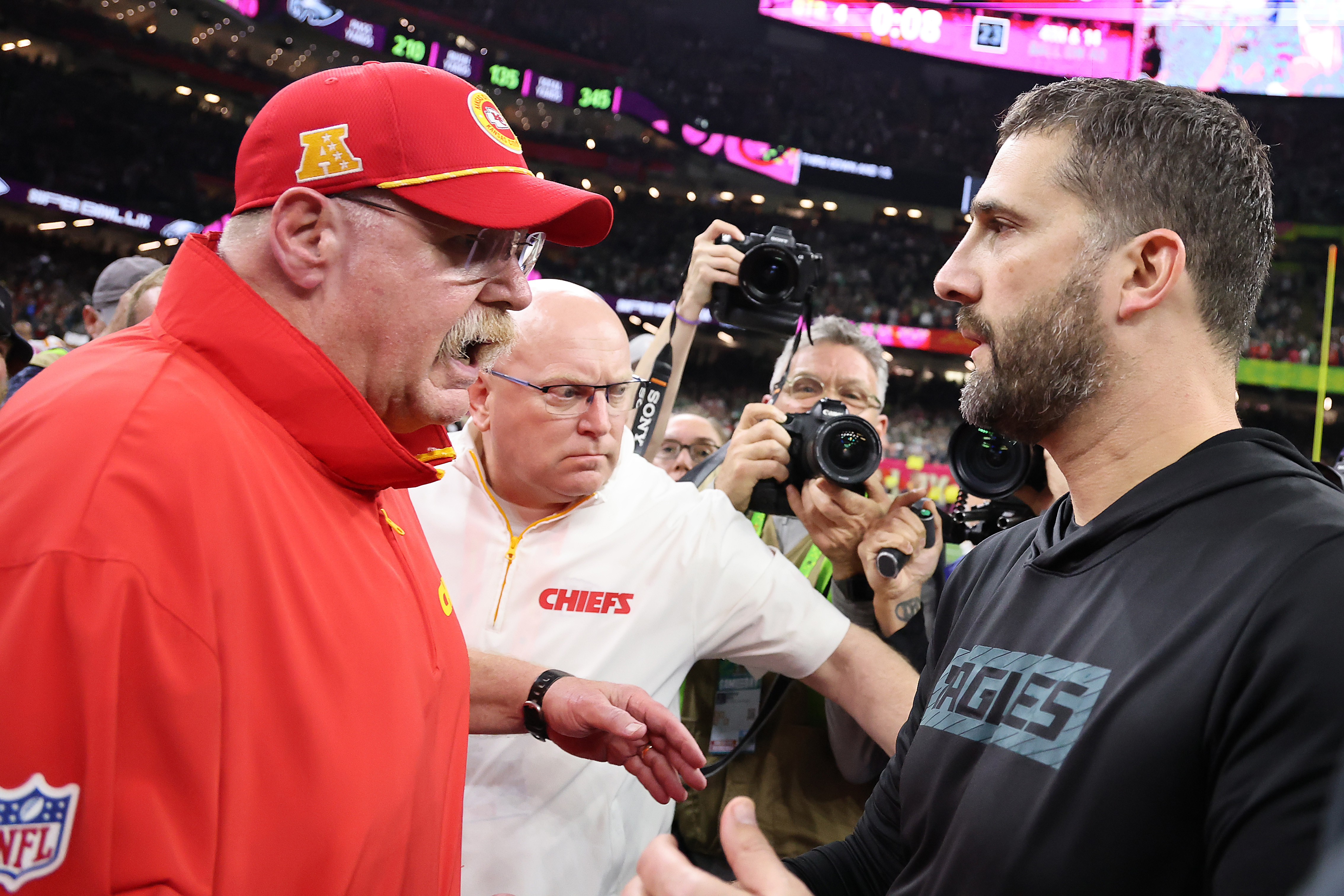
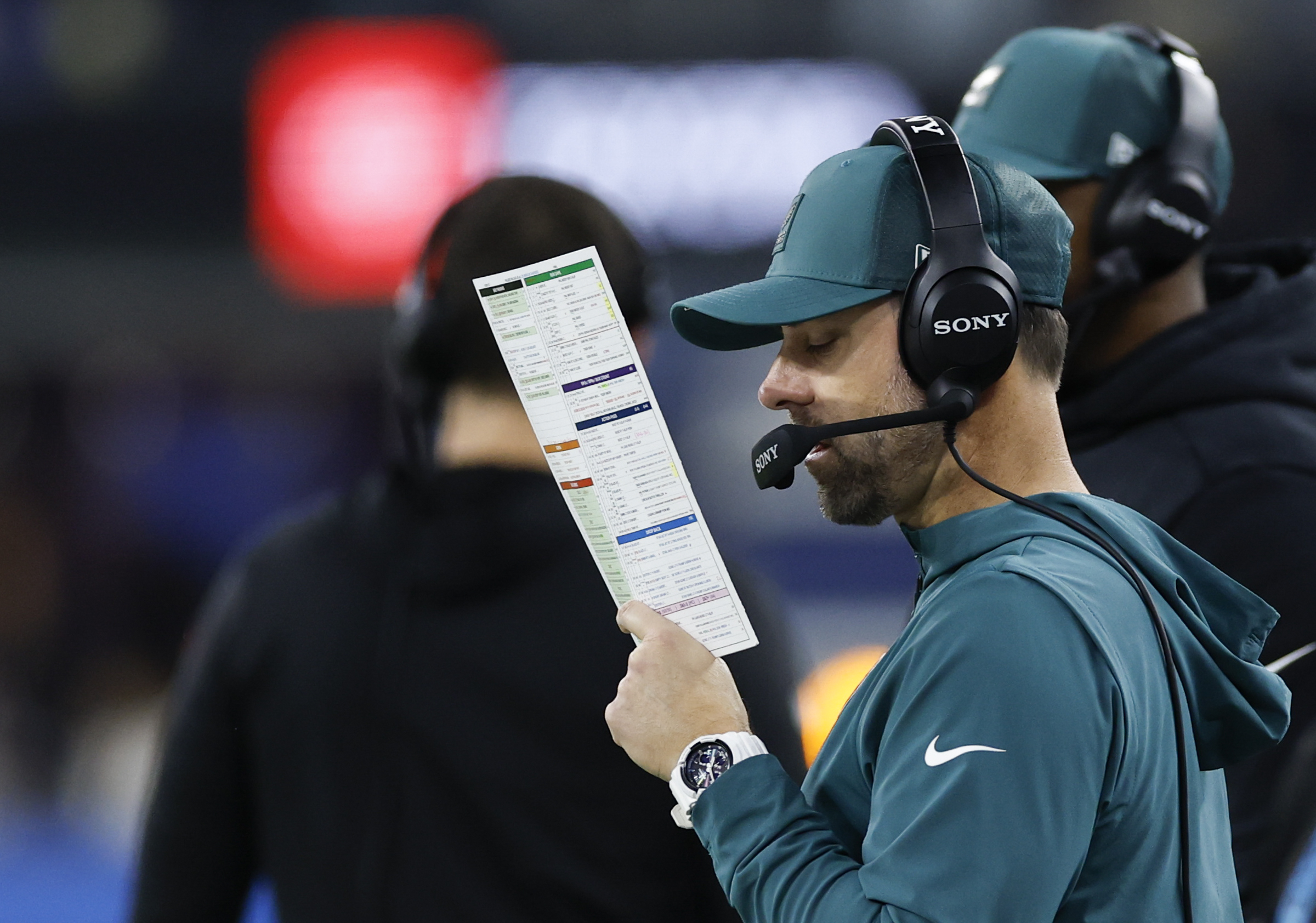
    Nick Sirianni (right) has carried on the Eagles’ winning tradition that started with Andy Reid.

    Cowboys

    Overall record: 218-183-1

    Winning seasons: 13

    Division titles: 7

    Conference championship games: 0

    Super Bowl appearances: 0

    Super Bowl victories: 0

    Giants

    Overall record: 176-225-1

    Winning seasons: 9

    Division titles: 3

    Conference championship games: 2

    Super Bowl appearances: 2

    Super Bowl victories: 2

    Washington

    Overall record: 166-234-2

    Winning seasons: 6

    Division titles: 3

    Conference championship games: 1

    Super Bowl appearances: 0

    Super Bowl victories: 0

    Whatever crises the Eagles might be undergoing are framed through a different lens from any other team in the division. They judge themselves and are judged by the answer to one question: Are we good enough to win the Super Bowl? Their divisional foes’ standard has not been quite as high: Are we good enough to keep from embarrassing ourselves again?

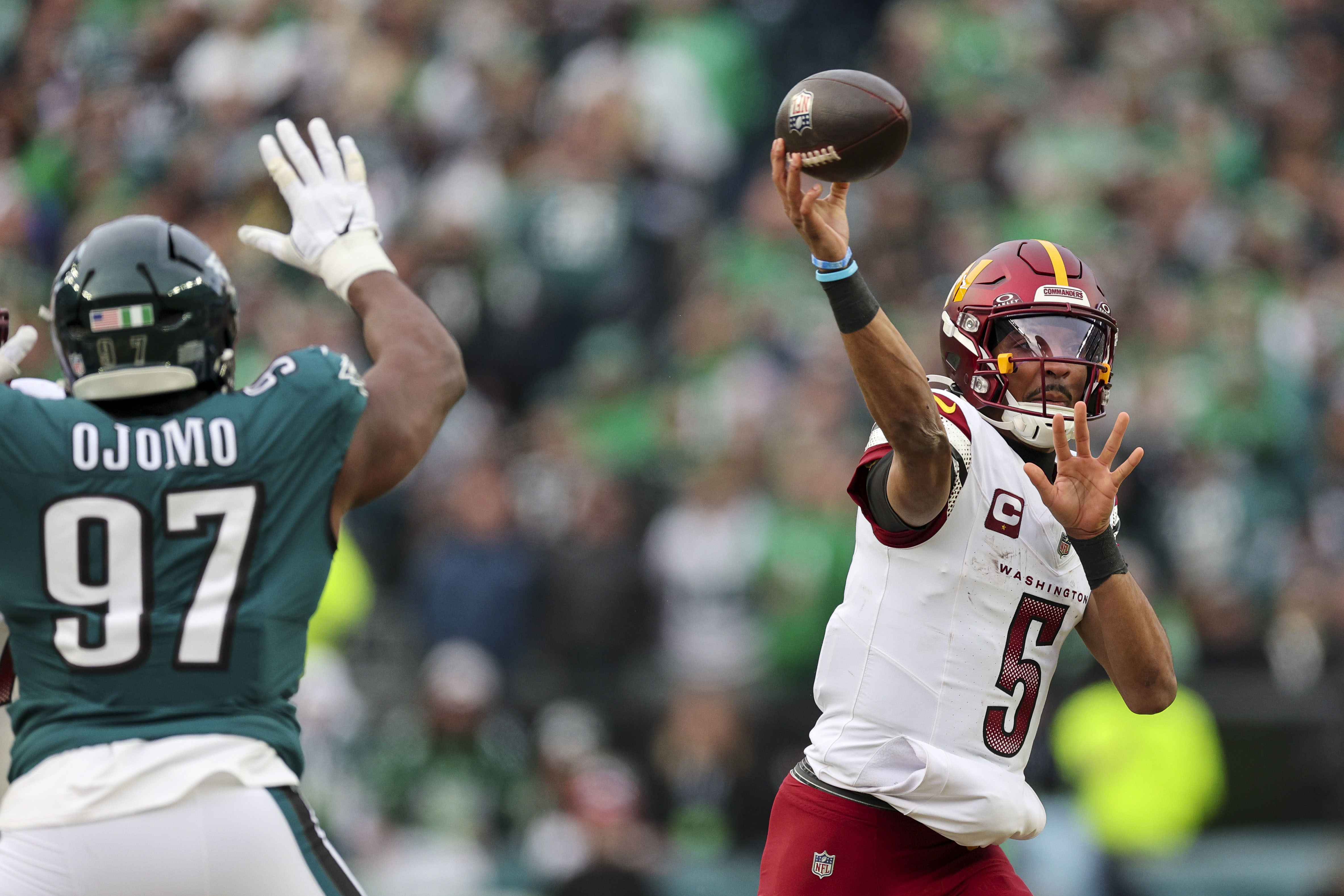
    Quarterback Jayden Daniels and the Commanders took a big step backward in an injury-plagued season.

    Less than a year ago, for instance, the Commanders’ appearance in the NFC championship game was supposed to augur a new rivalry between them and the Eagles at least and a new era for the division at best. That’s why the teams’ two games this season were scheduled in the season’s final three weeks. Huge head-to-head matchups to decide the division, right? Instead, the Eagles trounced the Commanders by 32 points to reach Super Bowl LIX. Jayden Daniels, Washington’s wonderful young quarterback, has played just seven games this season because of injuries, and even if Daniels had remained healthy, the Commanders might be floundering anyway; their front office built the oldest roster in the NFL around him.

    So what happened? How did the Eagles manage to create so much distance between themselves and the NFC East field? As with all big questions, there’s not just one big answer, but here are a few explanations:

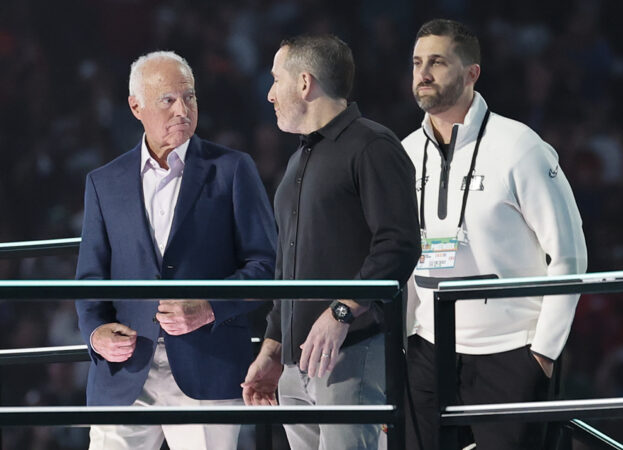
    Jeffrey Lurie, Joe Banner, and Howie Roseman have been forward-thinkers.

    From strategic massaging of the salary cap to aggressive play-calling on fourth down, Lurie has empowered his executives (and, in that middle-management position, his head coaches) to be creative, to posit how the NFL would evolve and how the Eagles might get ahead of those changes.

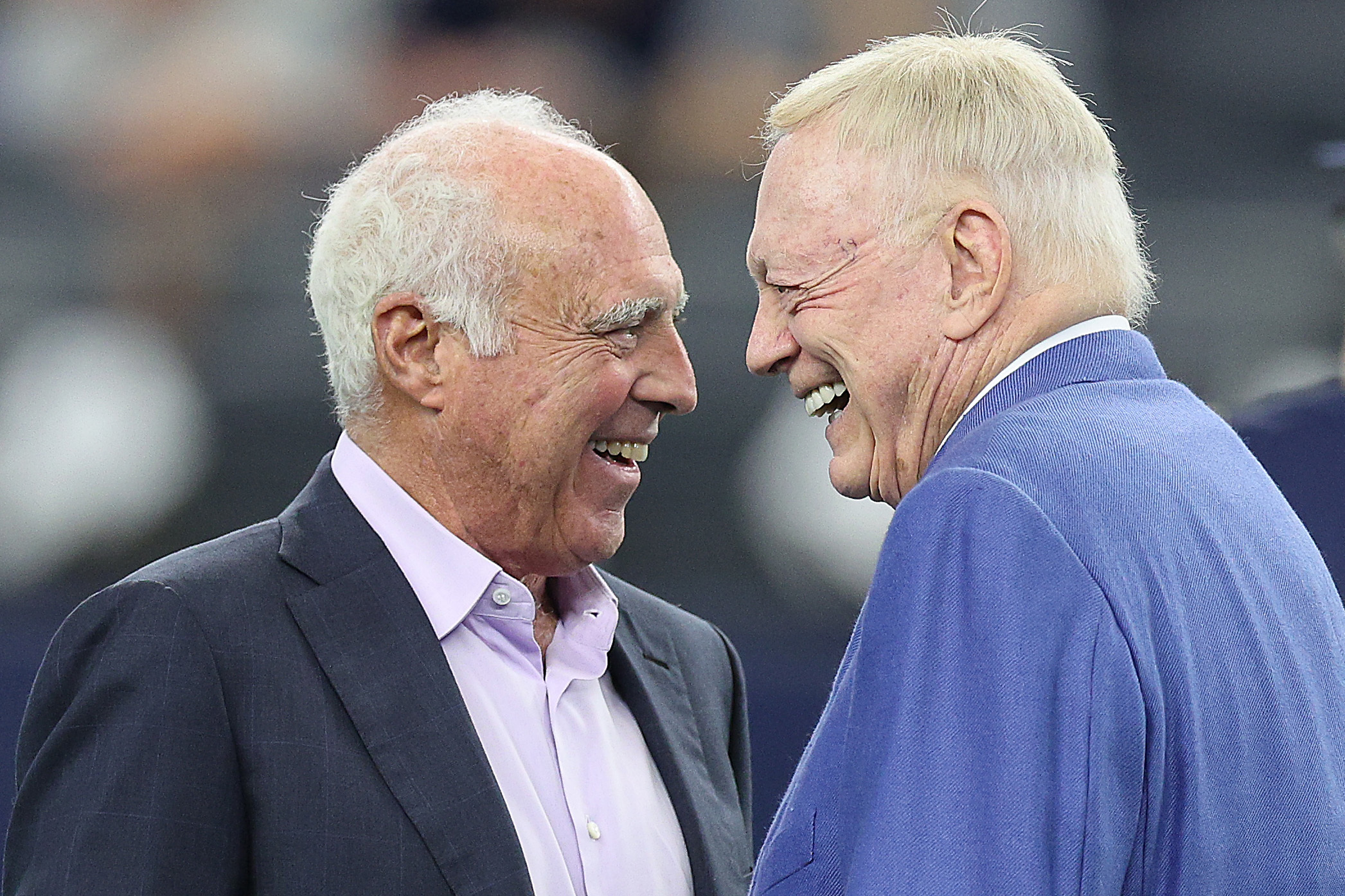
    Jerry Jones can’t put his ego aside for the sake of a Super Bowl.

    Jones has been a true visionary when it comes to the NFL’s growth into the pop-cultural monster it is today. He recognized America’s insatiable appetite for pro football and has built one trough after another to feed us, and he does want to win championships. But he’s not willing to sacrifice the publicity and the credit, to stand aside and let someone smarter handle the Cowboys’ football-related decision-making. It is not enough that the Cowboys win. Jones must be perceived as the reason they have won, and it’s that very thinking that keeps them from matching the Eagles’ success.

    Jerry Jones (right) and the Cowboys have not been able to keep up with Jeffrey Lurie’s Eagles.

    Daniel Snyder.

    That’s it. The man pretty much single-handedly destroyed one of the best and most popular franchises in the league. As just one example, Washington’s coaching staff in 2013, under head coach Mike Shanahan, included Sean McVay, Kyle Shanahan, Matt LaFleur, Mike McDaniel, and Raheem Morris — and Snyder let all of them get away. (Or run away, as the case may be.)

    Eli Manning retired.

    Sounds crazy, right? It’s not. When Manning was in his prime, the Giants went through an eight-year stretch in which they qualified for the postseason five times, won two Super Bowls, and never finished under .500. The Giants haven’t been able to replace him, and that has been a bigger failure even than allowing Saquon Barkley to sign with the Eagles.

    Jeff Stoutland has given the Eagles an edge in the trenches.

    Yes, the Eagles have long maintained that games are won and lost along the offensive and defensive lines. Any franchise’s coaching staff can chant that mantra, though. Few, if any, can develop linemen like the Eagles, and Stoutland’s presence and expertise are invaluable in that regard. Ask yourself if Jordan Mailata would have become an elite left tackle anywhere else.

    The Eagles value depth at quarterback.

    They won one Super Bowl with their backup quarterback (Nick Foles), won another with a player who had been drafted to be their backup quarterback (Jalen Hurts), made a season-saving run to the NFC divisional round in 2006-07 with their backup quarterback (Jeff Garcia), and have generally hired head coaches who know how to implement and oversee quarterback-friendly systems.

  • In moving on from Harrison Bader, the Phillies are putting an awful lot of faith in Justin Crawford

    In moving on from Harrison Bader, the Phillies are putting an awful lot of faith in Justin Crawford

    The scariest day of the offseason is always the one when Dave Dombrowski looks at his Phillies roster, smiles, and says, “Yep, that’ll do.”

    On Tuesday, Christmas came earlier than usual for next year’s trade-deadline sellers.

    “We feel very good,” said Dombrowski. “I guess we’d look for arms in the bullpen. But we’ve also got five solid guys out there that are of veteran status. Sometimes, you have to give some young guys an opportunity. We have some guys that we like. So that’s really where it stands. And maybe depth at different positions. We’re dealing with that. But I think as far as our everyday positional players — other than catcher — we’re pretty well set.”

    [JUMP CUT TO MAY 2026, THE CITIZENS BANK PARK SCOREBOARD]

    VISITOR — 000 000 03X | 3 5 0

    HOME — 100 000 0XX | 1 2 0

    [THE CAMERA ZOOMS OUT SLOWLY, REVEALING A PLAYER IN A GRAY JERSEY CIRCLING THE BASES AS A PHILLIES RELIEVER STANDS ON THE MOUND WITH HIS SHOULDERS SLUMPED, STARING BLANKLY INTO THE MIDDLE DISTANCE]

    NARRATOR: (gravely) As it turned out, they weren’t pretty well set.

    It goes like this every year, doesn’t it? Opening day arrives and a month or two later the Phillies realize they could really use one more right-handed bat and another reliever or two. Maybe this will be the year that breaks the cycle.

    Or, hey, maybe we’ve been looking at the offseason wrong this whole time. Maybe the whole point of the thing is to remind us what it feels like to believe. That Adolis García will be the player he was at 30 years old instead of the player he was at 31 and 32. That Justin Crawford will go from being a player who didn’t deserve a big league roster spot over Max Kepler to one who will be an impactful piece of the Phillies lineup and play a good center field to boot. That the bullpen will transform into a dominant unit instead of one that has allowed 25 runs and 21 of 26 inherited runners to score in the Phillies’ last eight postseason games.

    It’s a magical time of year, isn’t it? Maybe we are the grinches.

    There’s some truth to it. As Dombrowski has said before, there is no such thing as a perfect roster. The team you bring into opening day is much more the sum of all previous offseasons than it is the product of the most recent one. The Phillies have spent a lot of money in the five years since they hired Dombrowski as president of baseball operations. Most of those expenditures are still on the books and occupying roster spots in the lineup, rotation, and bullpen. It’s easy to watch the Dodgers drop $69 million on Edwin Díaz and wonder why the Phillies can’t do the same. But there are 20-plus teams saying the same about the Phillies as they watch Kyle Schwarber re-up for five years and $150 million.

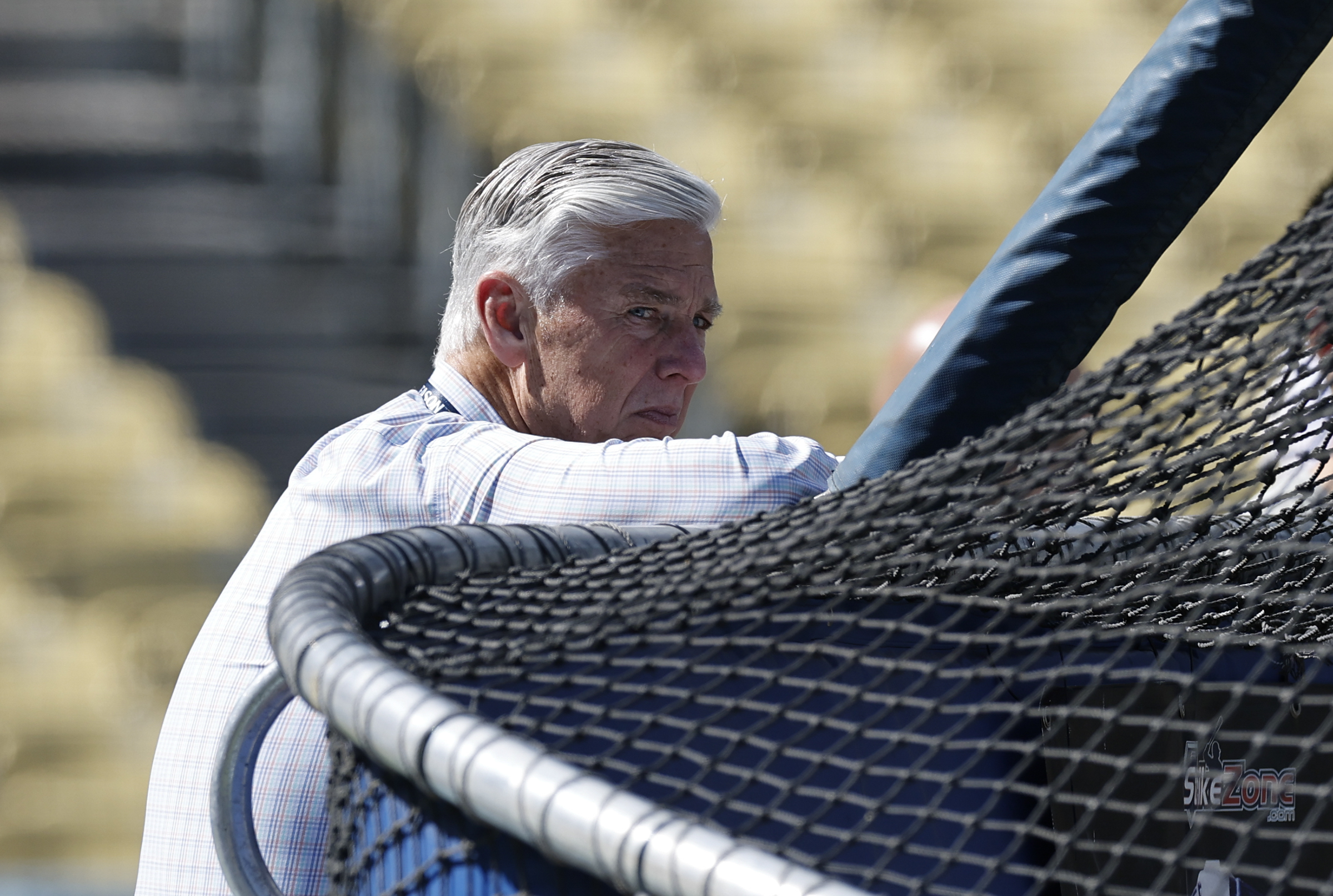
    Dave Dombrowski says the Phillies’ roster is “pretty well set.”

    Using the Dodgers as a benchmark can skew reality. The Phillies have improved their regular-season win total in each of Dombrowski’s first five seasons at the helm. Not only did they win 96 games last season, but they scored 31 more runs and allowed 37 fewer than they did in 2022, when they went to the World Series. Those results don’t necessarily align with the narrative that says the Phillies are a team in the midst of a steady decline.

    As long as we assume that the Phillies eventually come to terms with J.T. Realmuto and fill their gaping void at catcher, they will enter 2026 with a sensible roster that is well within the range of outcomes we should have expected heading into the offseason. García is a decent bet to be an improvement over Nick Castellanos, pairing good defense, decent speed, and better power with his free-swinging approach. In left field, the Phillies will presumably begin the season with Brandon Marsh and perhaps Otto Kemp and keep an open mind from there. A little bit of flux can be a good thing, perhaps preserving an opening to get a look at a prospect like the lefty-hitting Gabriel Rincones at some point down the road.

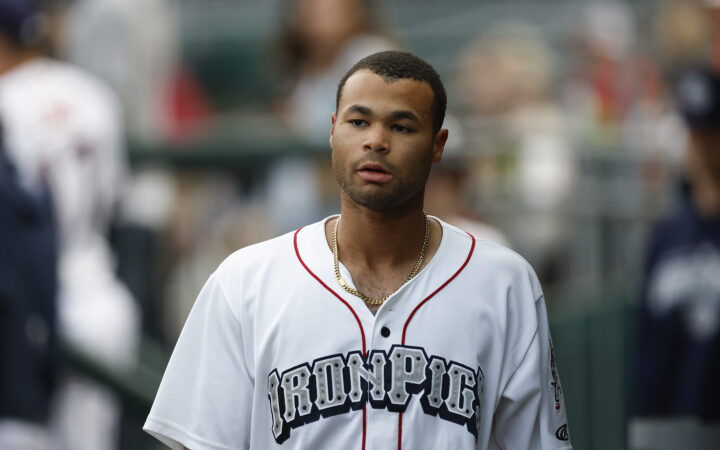
    The biggest potential weakness in the Phillies’ approach is the extent to which they will be counting on Crawford, whom Dombrowski indicated would report to spring training as the leading candidate to man center field. Nobody is expecting Crawford, who will be 22 in January, to hit .334 with a .411 on-base percentage, as he did last season in 506 plate appearances at triple-A Lehigh Valley. He won’t even need to come close to those marks to warrant an everyday role. But he will need to warrant that role, or else the Phillies’ outfield situation will look a lot closer to what it did during the first half of last season vs. the competent unit it became as Kepler emerged and Harrison Bader joined up.

    The big risk the Phillies are taking is in moving on from Bader. The center fielder was such an obvious fit after his trade-deadline acquisition from the Twins that you can’t help but think that they will enter next July looking for another similar player. The obvious question: Why not just do it now?

    The first answer is money. Bader is reportedly looking for a three-year deal at $10 million to $15 million annually. That’s a steep price to pay a 31-year-old player with an injury history who is coming off his first season of 500-plus plate appearances.

    The second answer is Crawford.

    “If you’re going to give Crawford an opportunity, you’ve got to give it to him,” Dombrowski said. “And that’s where we are. We’re going to give him an opportunity to go out there and have a chance to play a lot.”

    Where they are is the place they usually are, and one that is the fate of most teams when pitchers and catchers report.

    Hoping for the best.

  • Adolis García could be the new Nick Castellanos, and he looks the part. Uncomfortably so.

    Adolis García could be the new Nick Castellanos, and he looks the part. Uncomfortably so.

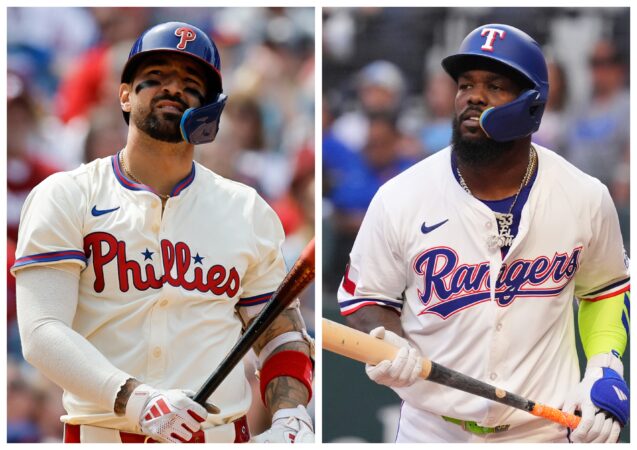
    Adolis García is the new Nick Castellanos. That’s the simplest way to look at the Phillies agreeing to a one-year, $10 million contract with the former Rangers star on Monday. It’s true on a lot of different levels, including some that will make you scratch your head about why Dave Dombrowski decided to go in this direction. Not only is García likely to replace Castellanos in right field — his batting profile looks an awful lot like Castellanos’. Uncomfortably so.

    Let’s make sure we keep things in context here. General managers can’t be picky at this particular price point. Any regular who is willing to sign a one-year deal for less than $20 million is self-evidently going to have some massive flaws. Basically, you are talking about two types of players:

    1. Veterans who have done it before and could potentially bounce back to doing it again.
    2. Veterans who have never done it before but have shown flashes of being able to do it.

    Dombrowski has always seemed to favor the first group of players. Whit Merrifield, Max Kepler, Austin Hays, Jordan Romano, etc. — all were brought into the fold with the hope that they could get back to a form they’d shown in previous seasons. García fits that mold.

    The best-case scenario for the Phillies is that García reemerges as the player he was in 2023, when he was an All-Star and then hit eight postseason home runs with a 1.108 OPS in 15 games as the Rangers won the World Series. His regular-season batting line that year was .245/.328/.508 with 39 home runs and 107 RBIs. That’s quite nice.

    García’s first three seasons in Texas looked a lot like what the Phillies were hoping for out of Castellanos when they signed him to a five-year, $100 million deal. From 2021 through ’23, García averaged 32 home runs with a .226 isolated power percentage. Aaron Judge was the only right-handed-hitting outfielder who hit more home runs than García in those three seasons. His Statcast numbers ranked in the top 10 of righty outfielders in all of the power metrics: Hard-hit percentage (47.6%, 10th), barrel percentage (13.4%, 10th), exit velocity (91.7, ninth), etc.

    Castellanos has never flashed that kind of power in his four seasons with the Phillies. His hard-hit rate since 2022 is just 39.8, down from the 46.9% he posted in his walk year with the Reds. His 82 home runs are well shy of a total that let you accept his plate discipline struggles.

    Adolis Garcia hit 141 home runs over the last five seasons with the Rangers.

    García has many of the same struggles. They are largely to blame for his back-to-back disappointing seasons, which led the Rangers to non-tender him rather than pay him a projected $12 million. After hitting 39 home runs in 2023, he hit just 44 combined in 2024-25. His batting line over those two seasons was .225/.278/.397. That’s still good enough for an OPS+ that was within range of league average. But without the power production, his lack of competitiveness at the plate can be a frustrating thing to watch, manage, and play alongside.

    At the same time, García’s plate discipline metrics aren’t as extreme as Castellanos’. His chase rate of 34.4% in 2024-25 was well above average, but also well shy of Castellanos’ 39.1%. Same goes for his overall swing percentage: 52.1%, compared with 58.4% for Castellanos. García is much more likely to swing-and-miss in the zone. You can live with that when he is hitting 30-plus homers. Not when he is hitting 19, as he did in 2025.

    García hasn’t even been all that good against lefties. His .715 career OPS with the platoon advantage is a lot lower than you’d expect to see out of a power hitter of his profile. Last year, he hit just .199 with 44 strikeouts in 136 at-bats against lefties.

    There aren’t a lot of bad gambles at the $10 million price point. I’m just not sure how realistic the upside is. García is coming off two disappointing seasons and was just non-tendered by a team that knows him quite well. If the Rangers didn’t think he was worth $10 million-$12 million, and the Phillies do, who is more likely to be correct?

    Instead of García, the Phillies could have taken a chance on someone like Miguel Andujar, who finished last season on a tear for the Reds (1.035 OPS, seven home runs in 125 plate appearances over the last quarter of the season). A onetime top-100 prospect who had a big year with the Yankees in 2018 at the age of 23, Andujar has had less than 1,200 plate appearances over the last seven seasons. Heading into his 31-year-old season, he is young enough to think that he might still have his biggest season in front of him. At worst, he gives you a platoon bat (.807 career OPS vs. lefties) with some positional versatility (third base and outfield). Although, you can argue that positional versatility doesn’t mean much if a guy can’t play any of the positions well.

    Dombrowski would likely argue that there is a certain floor of value for a guy who has a track record of playing every day for competitive teams. He wouldn’t be wrong, either. García has five straight seasons of 500-plus plate appearances with an elite tool (power) and production that has been close to league average even in two straight disappointing seasons. The Phillies were clearly looking for someone who could play every day for them, presumably in right field, where Castellanos is almost certainly on his way out.

    Whatever the Phillies ended up doing with this particular roster spot, it wasn’t going to be the kind of move you could judge on its own. The important question is the overall picture in the Phillies’ outfield. If they can find a way to bring back Harrison Bader, the unit will be a better one than it was a year ago. Even the player García was in 2024-25 is better than the player Castellanos has been lately.

  • Brandon Graham set the Eagles’ shutout tone Sunday; NFL’s injury epidemic changes the playoff picture

    Brandon Graham set the Eagles’ shutout tone Sunday; NFL’s injury epidemic changes the playoff picture

    Cooper DeJean committed two penalties on the same play in the first quarter Sunday. First, he held Tyler Lockett, then he pushed him, which drew an unsportsmanlike conduct penalty. However, that was not the most important thing that happened on the play.

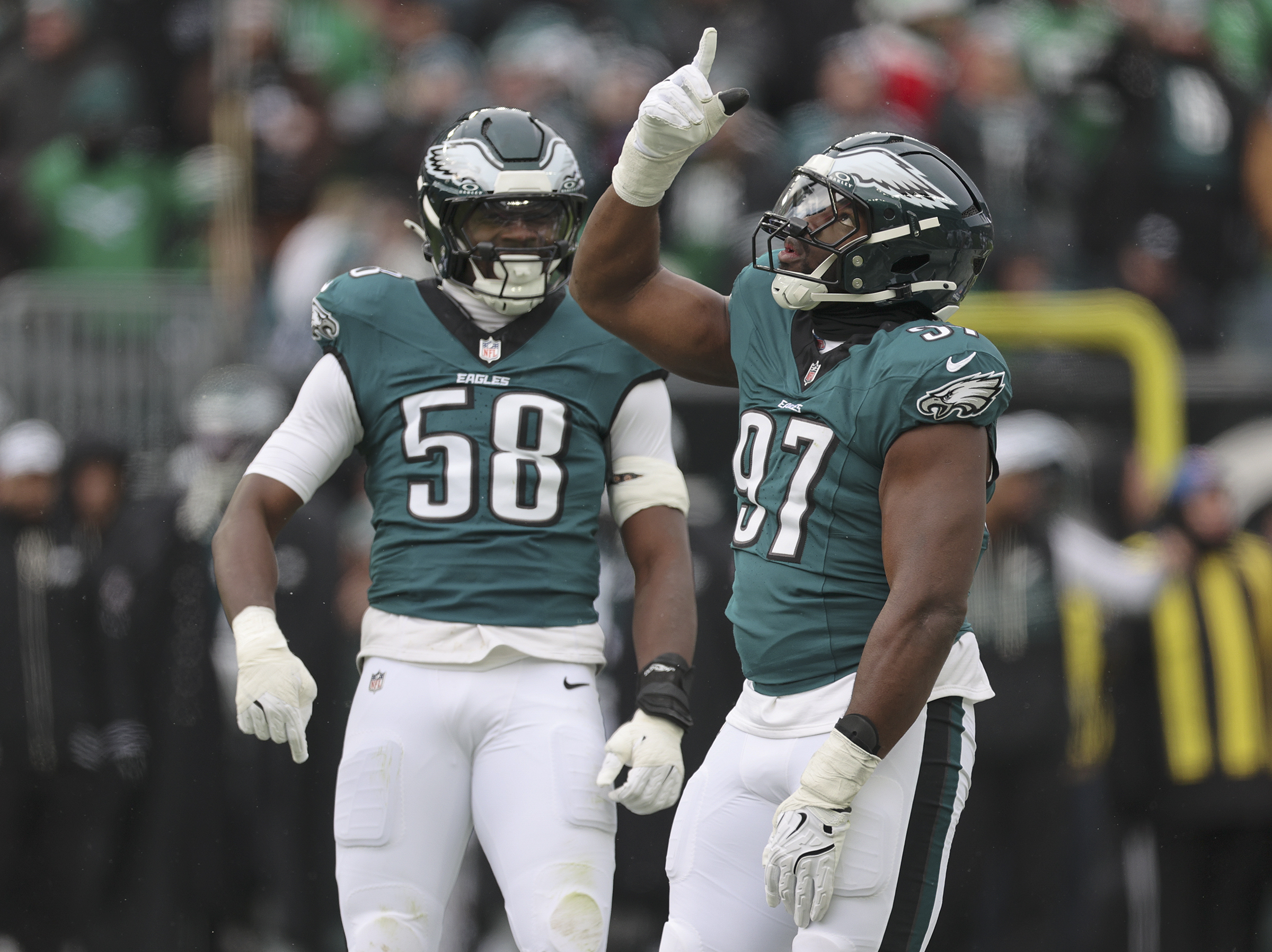
    In the backfield, 37-year-old unretired defensive end Brandon Graham, playing his second career game at defensive tackle due to depth issues, sacked Raiders quarterback Kenny Pickett. It was about 25 degrees, it felt about 25-below, and the turf was as cold and as hard as Graham’s heart when it comes to quarterbacks.

    The penalties dulled the impact of the sack, but that sack changed the game.

    To that point, Pickett was 4-for-5 for 16 yards, plus an 8-yard scramble. The Raiders had gained 20 yards.

    They gained just 55 more yards all game as the Eagles secured their first shutout since Dec. 30, 2018. Graham was the only current Eagles defender to play in that game; the next afternoon, Pickett, a sophomore at Pitt, lost to Stanford in the Sun Bowl.

    After the Graham sack, Pickett looked like he wished he was back in El Paso. Pickett went 11-for-20 for 48 yards, with an interception, minus-1 rushing yard, and three more sacks. Every drop back, he’d glance at the coverage and then look for Graham & Co.

    “It was big, man,” Graham said. “Whenever we can hit the quarterback like that … you just abort the plan that you had.”

    Moro Ojomo sacked Pickett on the very next play.

    Graham later collected another sack on a day when he became the oldest Eagle in history to record a sack. They were his first and second since he returned to the field six games ago, when the Birds found themselves shorthanded at end. Now, in the absence of Jalen Carter, Graham, at 265 pounds, is playing tackle, to great effect.

    He was good at the Chargers last week, but he was great Sunday. It was his first game with at least two sacks since Jan. 1, 2023, against the Saints, which was Game 16 of the 2022 season.

    DeJean was grateful that, thanks to Graham laying wood while he was fouling Lockett, nothing much came of his penalty.

    “It had this, like, carryover effect,” DeJean said. “It gets into the mind of a quarterback, and we were just able to come after him.”

    Graham didn’t win every play. In fact, not only did Graham not see Zack Baun intercept Pickett’s pass early in the third quarter, he was rendered completely irrelevant.

    “Oh, my goodness,” Graham said after the game, shaking his head and smiling. “Oh, my goodness.”

    Graham had left the middle for one play and lined up on the left edge. There, he told tight end Michael Mayer, “You better not chip me!”

    Mayer chipped him as right tackle DJ Glaze blocked him.

    Graham wound up on his back.

    He was still there when Mayer, who’d raced across the field, tackled Baun.

    “I didn’t think he was going to chip me,” Graham said with a shrug. “He got me. But trust me, it looked worse than it felt.”

    Shutout football with two sacks at the age of 37 can be a powerful anesthetic.

    Injury earthquakes

    Micah Parsons is the Packers’ best defensive player. He entered Sunday’s game with 12½ sacks and a league-high 60 QB pressures, a brilliant return on the Packers’ investment. He cost the Pack two first-round picks and defensive tackle Kenny Clark in a blockbuster trade with Dallas, then signed a four-year, $188 million contract extension.

    Then, Sunday. Parsons left the game with a knee injury in the third quarter just before the Broncos took the lead for good in their 34-26 win. Reports indicate that he has a torn ACL.

    The Packers’ Micah Parsons reacts after suffering a knee injury Sunday against the Denver Broncos.

    The loss dropped the Packers to 9-4-1, a half-game in the NFC North standings behind the 10-4 Bears — the team they visit Saturday night — but Green Bay leads the 9-5 Eagles, in case that matters. Parsons’ absence might matter more than anything. It would be like the Browns losing Myles Garrett, or maybe even like the Chiefs losing Patrick Mahomes.

    On that point …

    Mahomes left the Chiefs’ loss Sunday with a torn ACL. The Chiefs were eliminated from playoff contention.

    So, suddenly, the best player on an elite NFC team is gone, and, while the return from an ACL injury can be as short at eight months, Parsons, a dynamic athlete who relies on speed, probably won’t be the same until 2027.

    Also, suddenly, the best player in the NFL over the last eight seasons on the best team in the NFL over the last eight seasons is gone, and, as perhaps the most effective mobile quarterback in history, Mahomes probably won’t be the same until 2027, either. Neither will the Chiefs.

    Finally, star wideout Davante Adams left the Rams’ comeback win against the visiting Lions when he aggravated a hamstring injury. Adams has 14 touchdown receptions, which leads the league by six. He’s seventh on the all-time TD catches list with 117, and he’s the active leader by 11. The Rams sit atop the NFC at 11-3, which might be enough to secure the No. 1 seed, but the impact of a diminished Adams could resonate in the playoffs.

    Philip Rivers gave the Colts a chance to win in Seattle but came up just short at age 44.

    Extra points

    The Cowboys’ home loss to the Vikings left them at 6-7-1 and essentially ended their hopes for a playoff berth. The Cowboys would have to win the NFC East, and to do that they’d have to go 3-0 and have the Eagles go 0-3. … Josh Allen led the Bills to five touchdowns and a third big comeback win, this time at New England, which kept the Patriots from clinching the AFC East. … Unretired grandfather Philip Rivers, signed by Indianapolis to replace injured Daniel Jones, threw a touchdown pass and an interception but the Colts (8-6) lost their fourth in a row when Seahawks kicker Jason Myers kicked his franchise-record sixth field goal, a 56-yarder in the final minute. Seattle, with quarterback Sam Darnold, is 11-3. … Trevor Lawrence led the Jaguars (10-4) to a fifth straight win with a career-high five TD passes, ran for another, and has his team on top of the AFC South.

  • The Eagles can still get to the Super Bowl, but only if their defense drags them there

    The Eagles can still get to the Super Bowl, but only if their defense drags them there

    For an Eagles team desperate to stop a losing streak, a coach turned to Scripture the other day to inspire a few members of the one unit that has been pretty much beyond reproach. Jeremiah Washburn, who’s in charge of the Eagles’ defensive line, shared a message with the team’s tackles and ends from Isaiah 6:8: Then I heard the voice of the Lord saying, “Whom shall I send? And who will go for us?” And I said, “Here am I. Send me!”

    “The perspective of the D-line — it’s like, ‘Send me,’” tackle Moro Ojomo said. “That was kind of our mentality heading into this game.”

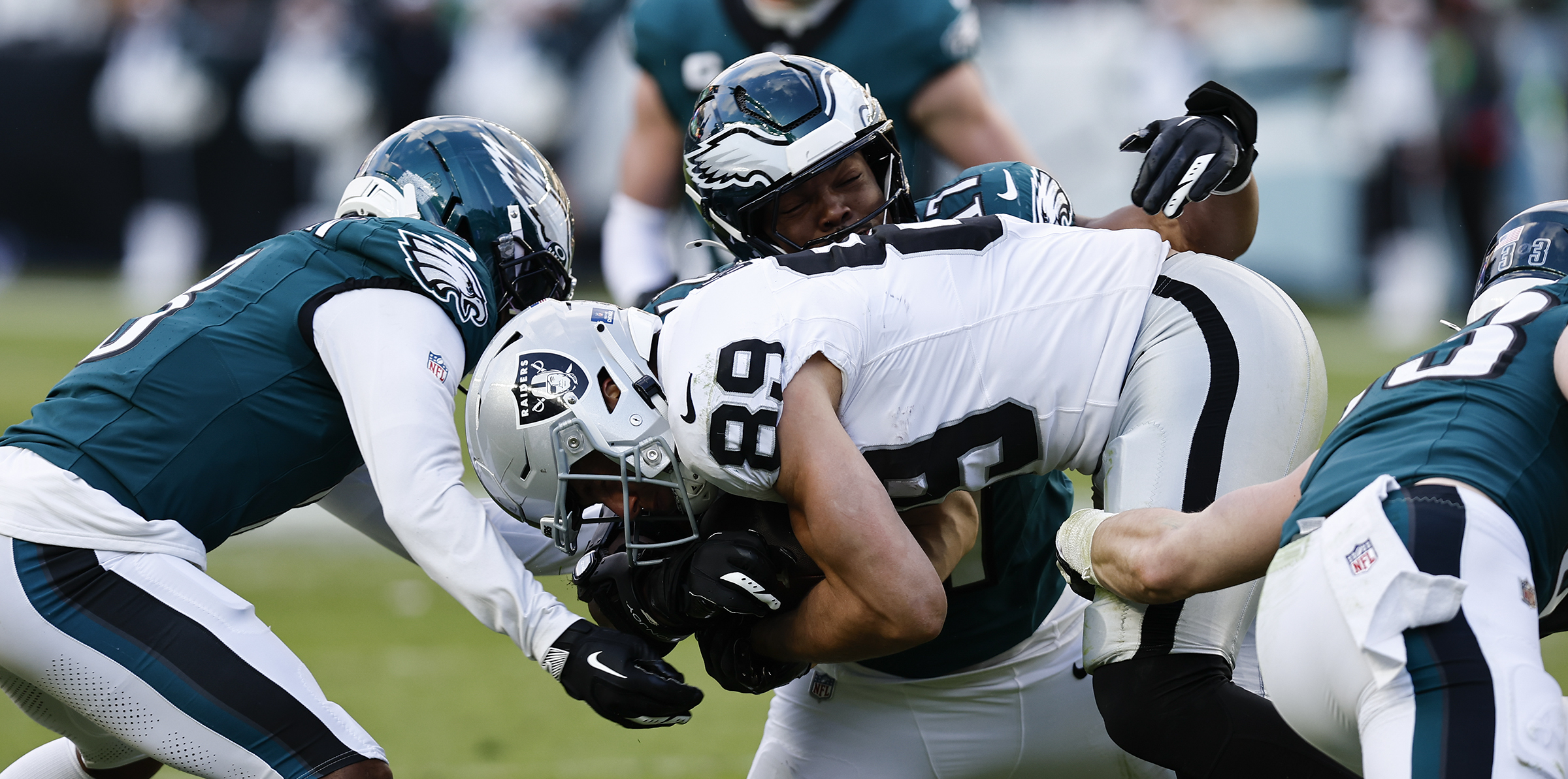
    So on Sunday against the two-win Las Vegas Raiders, the Eagles sent Ojomo, who had a sack and two quarterback hits. And they sent Brandon Graham, who had two sacks while lining up at tackle. And they sent Zack Baun, who had four tackles and an interception. And they sent the Raiders back to the Strip wearing the scarlet letter of having produced the worst offensive performance of any Eagles opponent ever. It wasn’t just that the Eagles won 31-0 — their first shutout in nearly seven years. It was that they allowed the Raiders to gain just 75 yards of total offense.

    Combine those two figures, the 0 and the 75, and you get what was, statistically speaking, the best game any Eagles defense has ever played. You get a game in which the Raiders’ longest gain on any play was 15 yards … on an unnecessary roughness penalty by Cooper DeJean. And as pitiful as Las Vegas was Sunday and has been offensively all season — the Raiders entered the game last in the NFL in points and next-to-last in yardage — you still got a glimpse of what might yet be the Eagles’ saving grace in their quest to win a second straight Super Bowl. As ragged and inconsistent as their offense has been, their defense is good enough to get them there.

    “Our mindset, regardless, is, ‘If they don’t score, they don’t win,’” Ojomo said. “You saw that today. That’s the mindset we’ve got to have. The offense has to have the mindset of not necessarily depending on us, and what you get is that perfect marriage. They do their thing. We do our thing. We’re always going to raise the standard.”

    “If they don’t score, they don’t win,” Moro Ojomo (right) said after Sunday’s victory.

    They have to. Maybe Jalen Hurts, Saquon Barkley, and the rest of the offense will raise their level of play over the next three weeks and beyond. Maybe this dominant performance against a terrible team can allow the Eagles to get their groove from last season back. But to be in their locker room after Sunday’s game was to observe a different collective disposition from one side of the ball to the other.

    Hurts delivered one curt, clipped answer after another in his postgame news conference, as if he were offended that the people in the room had pointed out that he’d committed five turnovers six days earlier against the Los Angeles Chargers. Nick Sirianni, Landon Dickerson, and other members of the offense kept up that same standoffish pose. Meanwhile, the team’s defensive players were ebullient and enthusiastic and generally have been all season. With the exception of the 281 rushing yards they gave up to the Chicago Bears two weeks ago, they have done their part to keep the Eagles in contention in the NFC.

    They let the Eagles get away with victories against the Green Bay Packers and the Detroit Lions. They surrendered a touchdown on the Chargers’ first possession last Monday night, and they haven’t given up another in the 20 possessions since. They have a high standard, and they keep meeting it, and it was telling to hear, for instance, linebacker Nakobe Dean describe a lesson he learned from the unit’s perfect performance Sunday.

    “There are plays we’re going to look back at and be like, ‘Oh, man, we could have [done] this better,’” he said. “I had a blitz. I was too high. I didn’t have great pad level. I got blocked by [running back] Raheem [Mostert], and the last couple of weeks I’ve been running through guys. So it’s like, yes, I have something to build on. I got blocked trying to bull [rush]. Now it’s time to stick/swat. Now it’s time to spin, do something like that. At first, I was thinking I was going to do it from the beginning. It was ‘Do this until they block it.’ Now it’s blocked. Now you can add a little something.”

    Eagles linebacker Nakobe Dean (center) and cornerback Adoree’ Jackson stop Las Vegas Raiders tight end Brock Bowers in the fourth quarter of Sunday’s win.

    The striking aspect of this dynamic — the inconsistency of the offense, the consistent excellence of the defense — is the lack of dissension within the locker room. Dean and Ojomo and their defensive teammates would be well within their rights to resent how much they’ve had to carry the Eagles. But there’s no indication that such a fissure exists. That’s a credit to coordinator Vic Fangio, sure, and it’s a credit to a unit full of young, homegrown players who aren’t surly, cynical veterans, who aren’t mercenaries, who don’t know any better but to ball out.

    “We’re hungry, and we run around, and we want to be great,” Ojomo said. “We want to go and get it. It’s like this perfect thing, but the reality is, we’ve got to do it again.”

    And again. And again. And again into January, if the Eagles are to have any hope of playing into February. A Super Bowl is still possible for them. Their defense will have to drag them there.

  • ‘Ridiculous’ indeed: Jalen Hurts is nearly perfect in an Eagles bounce-back blowout

    ‘Ridiculous’ indeed: Jalen Hurts is nearly perfect in an Eagles bounce-back blowout

    When Jalen Hurts hit A.J. Brown in the end zone with the exclamation point touchdown Sunday, he turned to the Eagles’ sideline and, with unusual enthusiasm, he jumped up and down, waved his arms with emphasis, and said several things that seemed out of character for a young man who usually behaves in such a godly manner.

    Maybe he was saying, “Bench me? Bench me?!? That’s ridiculous!”

    Probably not. But you couldn’t blame him if he was.

    After the game Hurts declined to divulge what he said, or even what he felt, after that, his last play of the game.

    “Just a natural reaction,” he offered.

    Hurts declined to divulge much of anything, in fact. It is part of his personality: When he plays well after a spate of poor play, he retreats into himself.

    “Heavy is the head that wears the crown,” said Brandon Graham, unlikely Shakespeare paraphraser. “Everybody thinks they want it until they get it.”

    Hurts was benched in the 2018 College Football Playoff Championship Game, was a second-round draft pick projected as a gadget quarterback, and is routinely maligned for his arm strength and decision-making when things go badly. A three-week slump isn’t going to derail his career.

    “Everybody needs to remember where I come from,” he said, “and how I’m built. … [Losses] aren’t barriers. They’re just bumps in the road.”

    The high road, in Hurts’ case.

    Naturally reticent and having long borne the burdens of doubt, demotion, and disappointment, it is all Hurts can do in these moments to not gloat. Small clues provide the only window into Hurts’ world. Like a master gambler, he has few “tells,” but you can always sense the smoldering passion when, after playing under water, he burst to the surface for air.

    It’s how he has survived. It’s how he survived the past week.

    “You control your own joy when there’s a lot of noise out there,” coach Nick Sirianni explained.

    It was impossible for Hurts to not hear the noise.

    Hurts’ seven turnovers and 69.9 passer rating were the most apt and most significant barometers of the three-game losing streak the Eagles rode into Sunday’s snow-frosted walkover contest against the visiting Raiders.

    Hurts’ slump raised the question about whether, if he continued to struggle, he should be benched. This, despite having gone to two Pro Bowls and two Super Bowls, the most recent of which he was crowned MVP. Still, playing without stars Lane Johnson on the offensive line and Jalen Carter on the defensive line, the Eagles had slipped from 8-2 to 8-5 and had gone from being the No. 1 seed in the NFC to No. 3, with the Cowboys lurking in the weeds of the NFC East race.

    Eagles quarterback Jalen Hurts runs past Las Vegas Raiders cornerback Darien Porter during the third quarter at Lincoln Financial Field.

    The question in question was posed by the Eagles’ flagship station, WIP 94.1-FM, during its weekly, contracted interview with Sirianni that follows the most recent game. Hurts had five turnovers in the most recent game, a Monday Night Football loss at the Chargers.

    Sirianni’s response: “I think that’s ridiculous.”

    The question wasn’t ridiculous. It was legitimate.

    It sure seems ridiculous now.

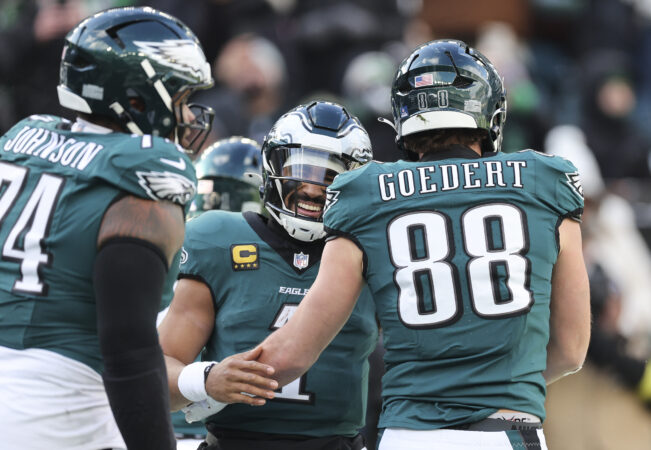
    Hurts rebounded from the worst game of his career with one of the best. He completed 12 of 15 passes for 175 yards and three touchdowns. Two went to tight end Dallas Goedert, who led the team with six catches for 70 yards. The third went to Brown, only his second official target of the day, a 27-yard dime into triple coverage — by far, Hurts’ best throw of the day.

    It was not, however, his best play. That came a few minutes earlier.

    Midway through the third quarter, a holding penalty put the ball on the Raiders’ 27 and presented Hurts with third-and-12. At stake: a dagger touchdown or a field goal that would preserve for the Raiders a sliver of hope.

    Hurts, in the shotgun formation, saw the middle of the field utterly undefended. He appeared to audible at the line of scrimmage, but later said the play was run as called by offensive coordinator Kevin Patullo. Either way, it was the sort of play that only a handful of quarterbacks can make.

    Hurts received the snap, took a half-step backward, tucked the ball, and darted up the middle. He then scooted to his left and outraced defenders to the sideline, exiting the field a yard beyond the first-down marker.

    Three plays later, he hit Goedert from 4 yards and the Eagles led, 24-0.

    The Brown TD was little more than garnish, but might serve the team well. Brown spent the first half of the season complaining, mostly on social media, that he was being underutilized. He then was targeted 45 times in the next four games, but the offense struggled and the team lost three of four.

    On Sunday, Brown was underutilized again, but he did catch the TD pass.

    He didn’t speak with the press after the game.

    Monitor your insta feed.

    At any rate, Hurts thrived in a game that unfolded in the proper design for the team’s composition.

    He threw just 15 passes, but none was thrown into harm’s way. None was forced to Brown. Hurts’ 154.9 passer rating was the second-best of his 89 starts, including playoffs. He has not thrown more than 28 passes in any of his top four.

    Eagles running back Saquon Barkley runs for a first down as Raiders safety Isaiah Pola-Mao moves in.

    Hurts benefited from an absence of offense from the Raiders, who used backup quarterback Kenny Pickett in place of injured Geno Smith, who’d been piloting the league’s worst scoring offense, at 15.1 points per game. The Eagles’ defense was great, but it was playing a warm-weather dome team in 20-degree weather with 25-mph wind gusts on Pacific Coast time.

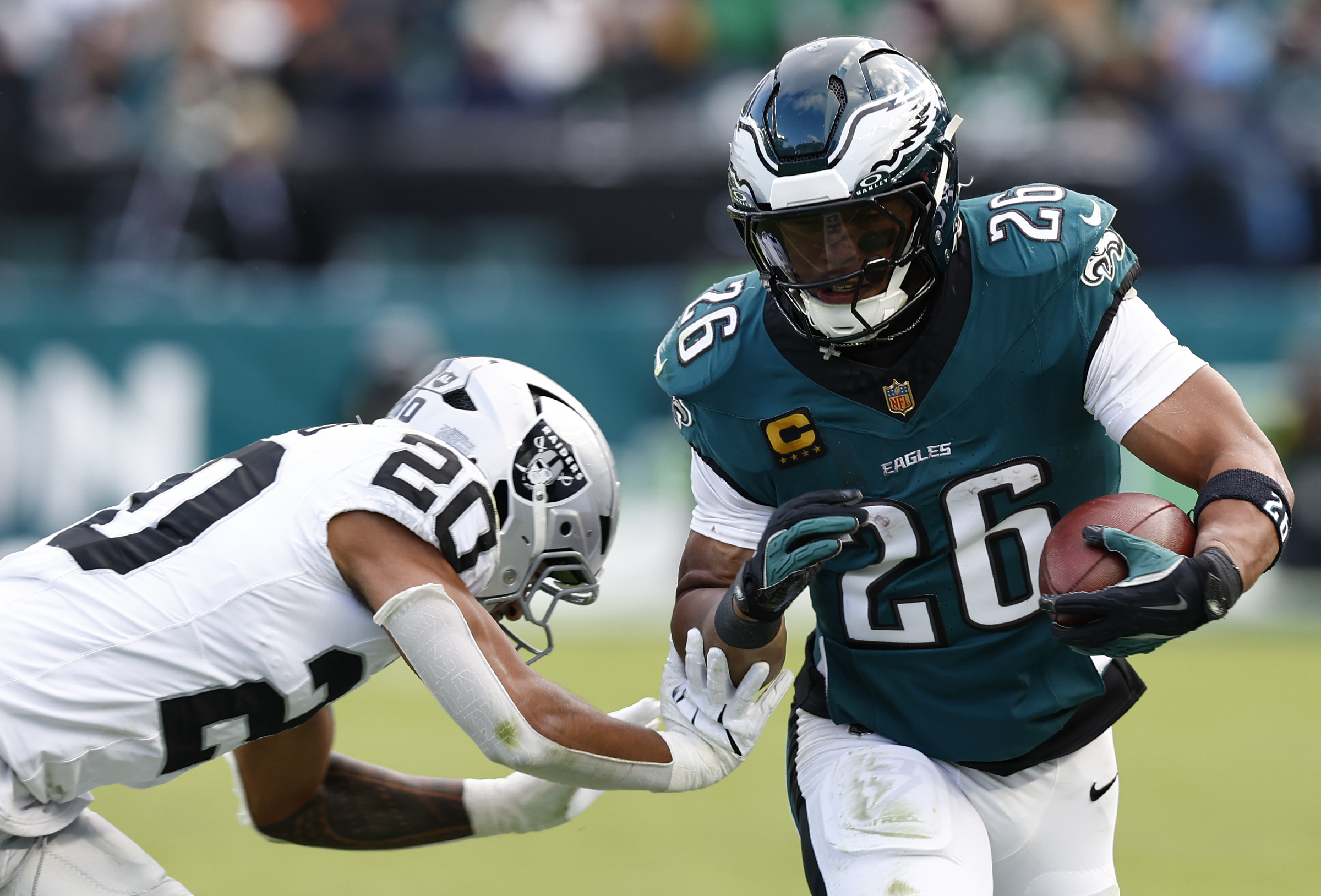
    Hurts also benefited from a pointed effort to feature running back Saquon Barkley, who ran 22 times for 78 yards and a touchdown. He averaged 14 carries during the losing streak.

    Finally, the Eagles incorporated a handful of designed runs, and Hurts ran on his own. His 39 yards on seven rushes were his most since Game 4. He averaged 44.8 rushing yards in the first four games, all of which were wins. The Eagles went 4-5 in the next nine games.

    Hurts needs to run. Saquon needs to run. Goedert needs the ball.

    If A.J. gets some looks, great. If not, live with it.

    “It’s a good formula,” said Brandon Graham, who had two sacks in Game 14 of his 16th season. He’s seen some stuff. “It’s definitely a good formula for us.”

    Sirianni understands the formula but wouldn’t commit.

    “Next week we could come out and it could be a completely different game,” he said.

    Why?

    This is how these Eagles can win.

    Any other method would be ridiculous.

  • Since Jalen Hurts started forcing the ball to A.J. Brown, the Eagles have stopped winning

    Since Jalen Hurts started forcing the ball to A.J. Brown, the Eagles have stopped winning

    Three seismic developments occurred over the past three Eagles games, all losses. Seismic, because the developments involved the Eagles’ best current defender, the best receiver in club history, and perhaps the best player in the history of the franchise.

    First, in an apparent response to complaints about his role in the offense, the Eagles began force-feeding wide receiver A.J. Brown. He was targeted 35 times in the three games in question. He’d been targeted 37 times in the five previous games.

    Second, right tackle Lane Johnson, who might be the greatest Eagle in history, injured his foot. The Eagles win 66% of the time when Johnson plays, while their winning percentage without him is 34%, and falling.

    Third, defensive tackle Jalen Carter was either hurting or absent. Carter missed the loss Monday night against the Chargers after undergoing a procedure on his shoulders, which had rendered him virtually useless in the two previous games.

    Nothing can be done to remedy the conditions of Johnson or Carter. Johnson issued a cryptic Twitter/X message after Monday night’s game that indicated his return might come sooner than later, and he wasn’t put on injured reserve, but he’s going to miss Sunday’s game against the visiting Raiders. Carter isn’t on IR either, but he’s out, too.

    Which leaves A.J.

    He was getting fewer and fewer looks. The ball just wasn’t finding him. He wanted the ball more. Hell, I wanted him to get the ball more. After all, with due respect to the golden oldies and one year of Terrell Owens, the Eagles have never had a receiver quite like him.

    But getting it to him has spelled disaster.

    Me, Me, Me

    After the Eagles beat Tampa Bay in Game 4, Brown, who had two catches for 7 yards, posted a passage of scripture that indicated he was being ignored: “If you’re not welcomed, not listened to, quietly withdraw. Don’t make a scene. Shrug your shoulders and be on your way.”

    Three games later, after a win at Minnesota, Brown posted, “Using me but not using me.” He had four catches for 121 yards and two touchdowns.

    A week later, after a win in Green Bay, Brown was seen on a livestream playing a video game with a friend and saying the offense was a “(bleep)-show” and that he was “struggling” after catching two passes for 13 yards.

    Brown might have been indiscrete, but he wasn’t wrong: He needs to be included, if not featured, in order for the Eagles’ offense to function properly. What the past three games proved is that he does not need to be featured in order for the football team to win.

    A day after the “(bleep)-show” scandal, very publicly, on the sideline at practice, owner Jeffrey Lurie convinced Brown to stop publicly humiliating the team. Brown has gone silent.

    He also has been targeted a whopping 46 times. The first 11 times came against the Lions, a game the Eagles won.

    That was also the last time the Eagles had a healthy Lane Johnson and Jalen Carter.

    Eagles wide receiver A.J. Brown has been targeted 35 times over the past three games, up from 37 in his previous five.

    Correlation equaling causation?

    How do the issues fit together?

    Well, while the Eagles beat the Lions, they scored only 16 points — not exactly an offensive feast. They won not because Brown was targeted 11 times but because Carter had his second-best game of the season and the defense surrendered just nine points. The Birds scored just 10 in Green Bay the week before, but Carter & Co. limited the Packers to seven.

    The offense wasn’t humming, but neither was it hurting the cause, in large part because the offensive line remained viable.

    Without Johnson, it is less so.

    Before Johnson was injured, Hurts had committed three turnovers in 10 games. The team was 8-2.

    Since Johnson’s injury, Hurts has seven turnovers in three games. The team is 0-3.

    The defense has been pretty good in the past three games, but just before Carter wore down it had again developed into the type of elite unit that led the Eagles to their second Super Bowl win.

    The defense has not been good enough to compensate for Hurts, who is playing the worst football of his career.

    But is it because he’s trying to force the ball to A.J. Brown?

    What about us?

    Before Brown’s bellyaching got him more looks, bookend receiver DeVonta Smith was on pace for a career-high 1,241 receiving yards. That pace has been cut in half in the past four games.

    Asked Friday why his inclusion and production had slowed, Smith paused, then replied:

    “Um … ” five seconds passed as he looked into the distance and mused: ” … I don’t know. I don’t have an answer for that.”

    No one can accuse Smith of being indiscrete.

    Similarly, tight end Dallas Geodert was on pace for 72 catches, 13 more than his career best, and in a contract year, to boot. His pace has slowed by about 25%.

    First-time playcaller Kevin Patullo runs an offense that is both predictable and flavorless.

    Meanwhile, after projecting to fewer than 900 yards for 2025, Brown now has a chance for a fourth consecutive 1,000-yard season.

    There are plenty of issues with the Eagles’ offense.

    The biggest problem: The offensive line, due to rampant injury and aggregate fatigue, has declined from being the league’s best to being the league average.

    Another problem: First-year offensive coordinator Kevin Patullo, who has never before called plays, runs an offense that is both predictable and flavorless.

    The most recent problem: Hurts has become hesitant unless he’s throwing to Brown, usually on the first read.

    All three of those problems get diminished the minute Lane Johnson returns. All three of those problems matter less if Jalen Carter is on the field.

    But the only thing the Eagles can do Sunday is let the ball find A.J. when the ball finds A.J.

  • Benching Eagles quarterback Jalen Hurts would be short-sighted, but it isn’t ridiculous to wonder

    Benching Eagles quarterback Jalen Hurts would be short-sighted, but it isn’t ridiculous to wonder

    Nick Sirianni is only half right.

    It is ridiculous to think that the Eagles might consider benching their Super Bowl MVP quarterback with four games left in the season and a division title all but assured.

    Yet, Sirianni and his coaching staff have a long list of equally ridiculous things they must consider.

    • It is ridiculous to think that an offense with the defending Super Bowl MVP at quarterback could go five straight games failing to score more than 21 points.
    • It is ridiculous to think said offense could score the fifth-fewest points in the NFL during that five-game stretch.
    • It is ridiculous to think that the four teams that have scored fewer points than the Eagles since Week 9 are all teams that have either A) benched their quarterback (Saints, Vikings), B) played with a backup quarterback (Washington), C) or continued to start Geno Smith at quarterback rather than benching him.
    • It is ridiculous to think that the Jets have outscored the Eagles by seven points over the last five games while shuffling Tyrod Taylor and Justin Fields at quarterback.

    In his weekly interview on Eagles flagship station 94.1 WIP after the team’s 22-19 loss to the Chargers on Monday, Sirianni dismissed the notion that he might make a change at quarterback.

    “No, I think that’s ridiculous,” Sirianni said. “I know every time I go out on that field with Jalen Hurts as our quarterback, we have a chance to win the game. That’s something that’s been proven. We’ve won a lot of football games.”

    But you know what’s really, truly, magnificently ridiculous to think? That any quarterback could play as poorly as Hurts has played in back-to-back losses to the Bears and the Chargers without prompting some level of discussion about whether or not he should continue to start. As good as Hurts has played in his two Super Bowl appearances, that’s how bad he has played over the last couple of weeks.

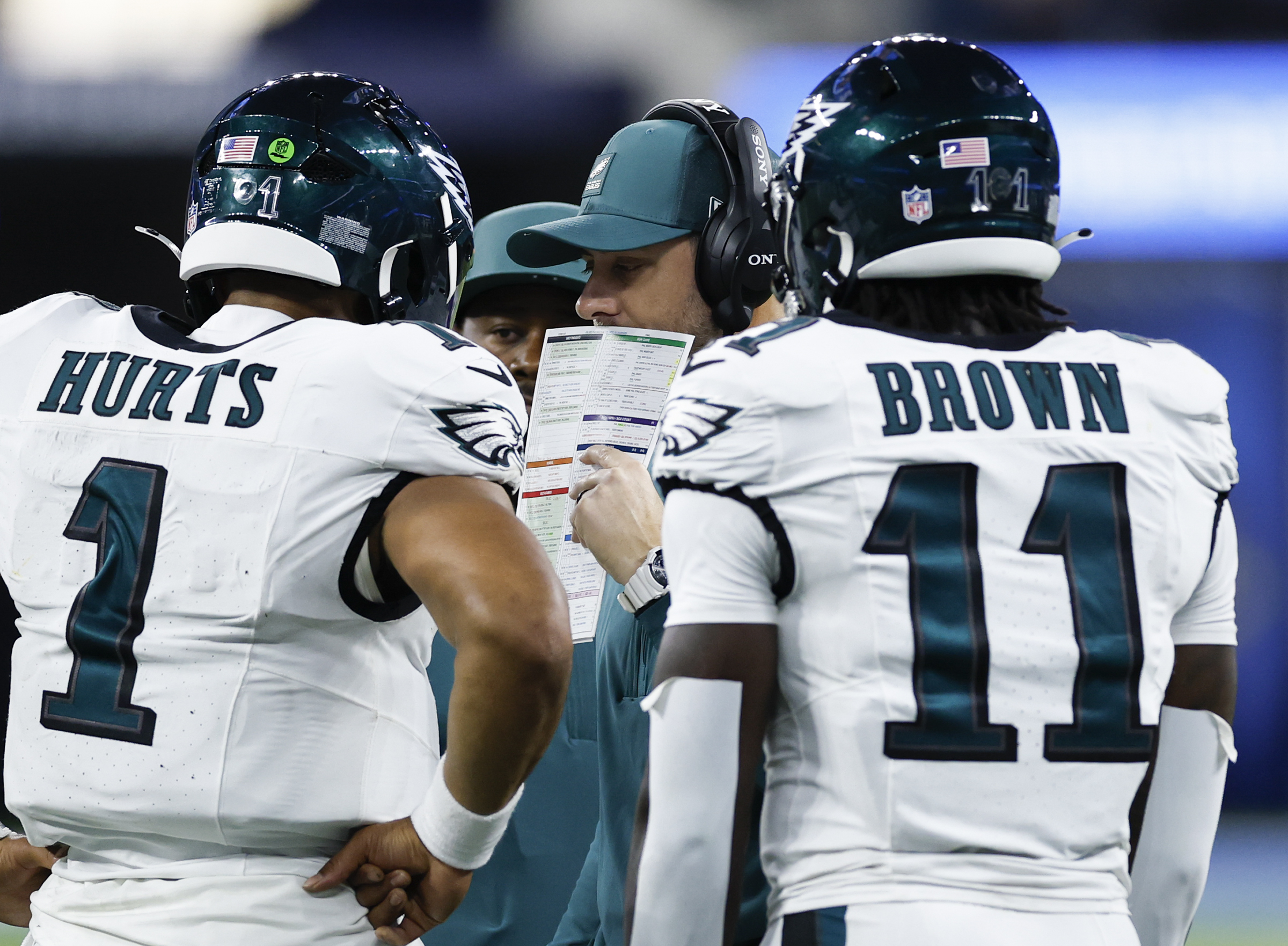
    Eagles offensive coordinator Kevin Patullo is shown with A.J. Brown and Jalen Hurts against the Chargers on Monday night.

    In the Eagles’ loss to the Chargers on Monday, Hurts did something that only 10 other quarterbacks have done over the last 10 seasons. Here’s the list of names of quarterbacks who have thrown four interceptions on 40 or fewer pass attempts with no touchdowns while averaging six or fewer yards per attempt:

    • Max Brosmer (2025)
    • Sam Howell (2023)
    • Trevor Lawrence (2021)
    • Davis Mills (2021)
    • Jake Luton (2020)
    • Sam Darnold (2018 and 2019)
    • Nathan Peterman (2017)
    • Andy Dalton (2017)

    Apart from Lawrence, all of those guys eventually either lost their job as starter or never really had it to begin with. It took a couple of years for Darnold and Dalton. But it certainly wouldn’t sound ridiculous now to know that people were talking about benching them at the time. In fact, the two words that might best describe all eight of those players are, “Eminently benchable.”

    The rebuttal from Sirianni, et. al. is as follows. None of those eight players have been to two Super Bowls, and they’ve certainly never won one. None of those eight players have ever come close to factoring into an NFL MVP discussion. With the possible exceptions of Lawrence and Darnold, none of those players have ever come close to the quarterback Hurts was in the first nine weeks of the season, let alone at his peak.

    If you are going to ding Hurts for throwing four interceptions in his most recent start, you have to credit him for throwing only one in his first nine starts of the season. The Eagles offense didn’t set the world on fire in those first nine games, but it was the kind of unit that plenty of NFL teams would be thrilled to have. They scored 30 points three times, twice against potential playoff opponents (Rams, Bucs). We’ve seen this offense be plenty good enough with Hurts under center this season.

    Nobody was talking about benching Patrick Mahomes in 2023 when the Chiefs lost five of eight games and averaged under 20 points per game between Weeks 8-16. It’s a good thing, too. Mahomes recovered to win his last five starts, four of them in the postseason, the last three of them on the road, including a 25-22 victory over the 49ers in the Super Bowl.

    Again, so the argument goes.

    Sirianni’s head is in the right place. No team in modern NFL history has benched a quarterback this late into a season and gone on to win a Super Bowl. Nick Foles and Jeff Hostetler caught lightning in a bottle, but they were injury-related replacements. It’s absolutely ridiculous to think that the Eagles’ Super Bowl odds would improve with Tanner McKee at quarterback. That’s true even if you limit the discussion to the aptitude of each player. When you broaden the scope to include the ramifications within the locker room and the organization of benching a player of Hurts’ caliber, the discussion does seem more than a tad silly.

    What isn’t silly is the thought process of those fans and media members who have floated the prospect of a switch to McKee. The Eagles aren’t going to win a Super Bowl with Hurts playing as he has in recent weeks. Something is broken, and Sirianni and his coaching staff need to figure out a way to fix it. Hurts doesn’t need to be a world-beater to be a quarterback who can lead these Eagles to a second straight title. But he needs to be functional.

    Eagles coach Nick Sirianni defended his quarterback this week when asked about the possibility of benching Jalen Hurts.

    “You always praise the things that they do well, and you correct the things that you want them to improve,” Sirianni said on Wednesday when asked about his approach to coaching Hurts. “That’s our job as coaches. The tone or the energy or whatever you do, won’t get too much into that. You may not coach everything exactly the same as far as demeanor. There’s a time to yell, there’s a time to bring [it] up, but it always goes back to, and I think there’s an art to this, it always goes back to the standard. Did you meet the standard, or did you not meet the standard? Then there’s an art to how you correct it in the sense of that. But it always goes back to the standard. Did you meet it? Great, and you’re going to praise that. Did you not? Then you correct it.”

    They need to correct it fast. The Raiders and Commanders are two opponents who won’t offer an opportunity for any excuses. These next two games are an opportunity for Hurts to quiet the noise and get himself back into a rhythm that can carry over into the postseason. If that doesn’t happen, you’ll only need one word to characterize the thought of the Eagles in another Super Bowl.

    Ridiculous.