Category: Things To Do

  • How to spend a spooky weekend in Sleepy Hollow, N.Y. | Field Trip

    How to spend a spooky weekend in Sleepy Hollow, N.Y. | Field Trip

    The advent of spooky season brings endless options for driving-distance getaways packed with U-pick orchards, twisting corn mazes, and high-tech haunts. But only Sleepy Hollow, at the gateway to New York’s Hudson Valley, has a reputation so perfectly tied to the macabre.

    As the setting for Washington Irving’s The Legend of Sleepy Hollow, the town and its neighboring villages blend American history, small-town autumn charm, and an enduring flair for the supernatural. It’s about a two and a half hour drive from Philly — or take Amtrak to Penn Station, get to Grand Central, and hop on Metro-North’s Hudson Line.

    Once you’ve arrived, the mix of colonial history, Halloween pageantry, and riverfront beauty makes it easy to fall under Sleepy Hollow’s spell.

    Stay: Tarrytown House Estate

    If you’re making a weekend of it, check into Tarrytown House Estate, a historic retreat on a hill above Sunnyside. The estate is home to Goosefeather, chef Dale Talde’s acclaimed Cantonese-inspired restaurant, and combines classic mansions with modern touches — think terraces, firepits, and lounges. It’s one of the few local hotels that’s both stylish and (relatively) affordable. During fall, the property leans into the season with festive touches like pumpkin displays and glowing jack-o’-lanterns scattered across the grounds. It’s an ideal base for exploring Sleepy Hollow’s haunted happenings — close to the action, but tucked away once the lanterns dim.

    📍 49 E. Sunnyside Lane, Tarrytown, N.Y. 10591

    Snack: Irvington Station

    However you choose to travel, make a morning pit stop at Irvington Station. Grab a matcha latte or flat white from the Australian-accented Ludy Café, and a sage-scented apple-cheddar scone from Red Barn Bakery, walking distance from one another right along the train tracks.

    📍 Ludy Café, 7 N. Astor St., Irvington, N.Y. 10533

    📍 Red Barn Bakery, 4 S. Astor St., Irvington, N.Y. 10533

    Learn: Blue Hill at Stone Barns

    Continuing north, head into the woods of Tarrytown to chef Dan Barber’s famous Blue Hill at Stone Barns for a guided Explore Tour of their elysian farm and agricultural center. Take a spin through the market, admiring the hand-thrown ceramics and exquisite preserves, and stay for lunch at the cafeteria. Reservations required.

    📍 630 Bedford Rd., Tarrytown, N.Y. 10591

    Stroll: Sleepy Hollow Cemetery

    After arriving in Sleepy Hollow proper, ease into the spookiness at Sleepy Hollow Cemetery, where the one-hour guided tour (in full daylight) leans more history than horror. Not only is the cemetery beautiful, it’s also a great context-setter for the region, providing all the background on its most famous storyteller, Washington Irving, who rests here among other notable figures.

    📍 540 N. Broadway, Sleepy Hollow, N.Y. 10591

    Solve: The Headless Horseman Files

    At the Headless Horseman Files, collect clues from costumed townspeople to unravel what really happened to Ichabod Crane. This live theater-meets-interactive whodunit at Philipsburg Manor is part mystery, part museum experience — and yes, you can exit through the gift shop for a Horseman snow globe.

    📍 381 N. Broadway, Sleepy Hollow, N.Y. 10591

    Vibe: Lyndhurst After Dark

    Bask in the flickering glow of candles and Gothic drama at the Lyndhurst After Dark, the spooky (but not scary) experience at the Lyndhurst Mansion. Guests walk through the riverfront estate, decked in its Halloween best, and encounter live actors in period dress, who share unnerving tales of the mansion’s history.

    📅 Oct. 16-26 (recommended for kids 10+)

    📍 635 S. Broadway, Tarrytown, N.Y. 10591

    Dine: Goosefeather

    Pot stickers plumped with dry-aged beef, char siu Berkshire pork belly, and blueberry cheesecake mochi waffles grace the menu at Goosefeather. The free-spirited Cantonese-ish joint comes from Dale Talde, known for his appearances on Top Chef.

    📍 49 E. Sunnyside Lane, Tarrytown, N.Y. 10591
  • Winter weather is on the way: Tips to prevent frozen pipes, safely heat your home

    Winter weather is on the way: Tips to prevent frozen pipes, safely heat your home

    When it gets colder, it’s not only important to be mindful of your pets and your plants but also your home’s pipes and water heater.

    Yes, those inanimate objects need extra care, too.

    As temperatures drop across the region, the risk of your home’s pipes freezing increases. There are steps, however, that homeowners can take to help stop that from happening and help you avoid a hefty plumbing bill this winter.

    Here’s a list of plumber-approved tips on how to keep a pipe from freezing, spotting a frozen one, and what to do if it bursts.

    How to prevent your pipes from freezing

    “It comes down to three main things: draining outside faucets, keeping pipes warm, and checking for leaks,” said Vincent Thompson, owner of Thompson Plumbing and Heating. Thompson is a master plumber of more than 50 years and for two decades taught plumbing at Dobbins Vocational School in North Philadelphia.

    💧 Draining outside faucets

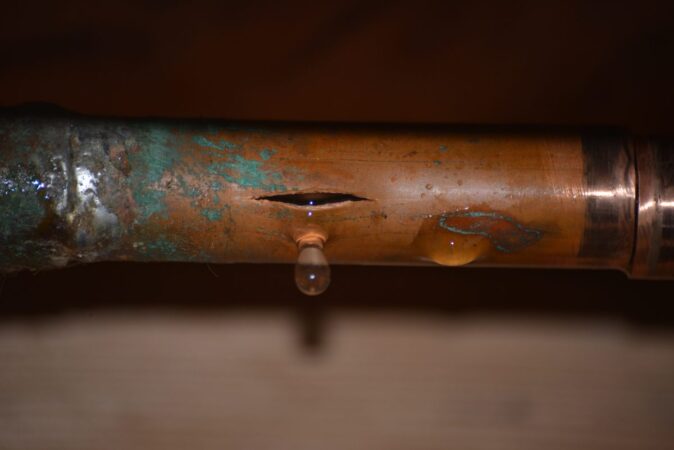
    Over the summer, we use outside faucets and hoses to water the plants, rinse of sidewalks, or simply cool down. When the temperature dips, water can freeze and build pressure, ultimately causing a burst pipe, a situation far too common, according to Thompson.

    He recommends disconnecting your hose (and storing it for the winter), shutting off the valve that feeds the faucet or spigot (usually found near the hot water heater), and letting the remaining water in the pipe drain out. You can leave the faucet or spigot slightly open, according to Thompson. Letting the faucet drip is also a good suggestion for inside fixtures.

    “If it’s empty, it’ll never freeze,” Thompson said. “But if there’s water, it can expand and explode. Then you’ll come out in the spring to use your hose and the water will be shooting out of the wall.”

    🌡️ Keep your pipes warm

    When the freezing weather descends upon us, we bundle up to stay warm. Pipes need that treatment too. Ideally, the lowest you want to keep your thermostat set at is 50 degrees, but heating is expensive. According to Thompson, the absolute lowest you can go is 40 degrees, because your pipes will start freezing at 39 degrees.

    Opening the cabinets underneath your bathroom sink can be a good way to keep pipes from getting too cold. And for the ones in extra-cold spots, using electrical heating tape or fitting them with foam and rubber sleeves is a good idea. Be sure to check for any leaks beforehand, because if water is accumulating, they won’t prevent a pipe from bursting and it will become an added step.

    🚽 Check for leaks

    “Every drop that goes down the drain will turn into an icicle and eventually can clog up the entire soil stack,” explained Thompson. Not addressing it can result in frozen pipes, flooding, and even water backing up through your toilet.

    After 50 years of handling these cases, he advises looking at your water meter because sometimes the leak might not be obvious. Make sure no water sources are open, and look at the blue or red triangle (depending on your meter). If it’s turning that can be a sign of a leak.

    If you suspect the culprit is your toilet, he recommends adding a couple of food dye drops into the tank. If the water in the bowl changes color, your suspicions are correct.

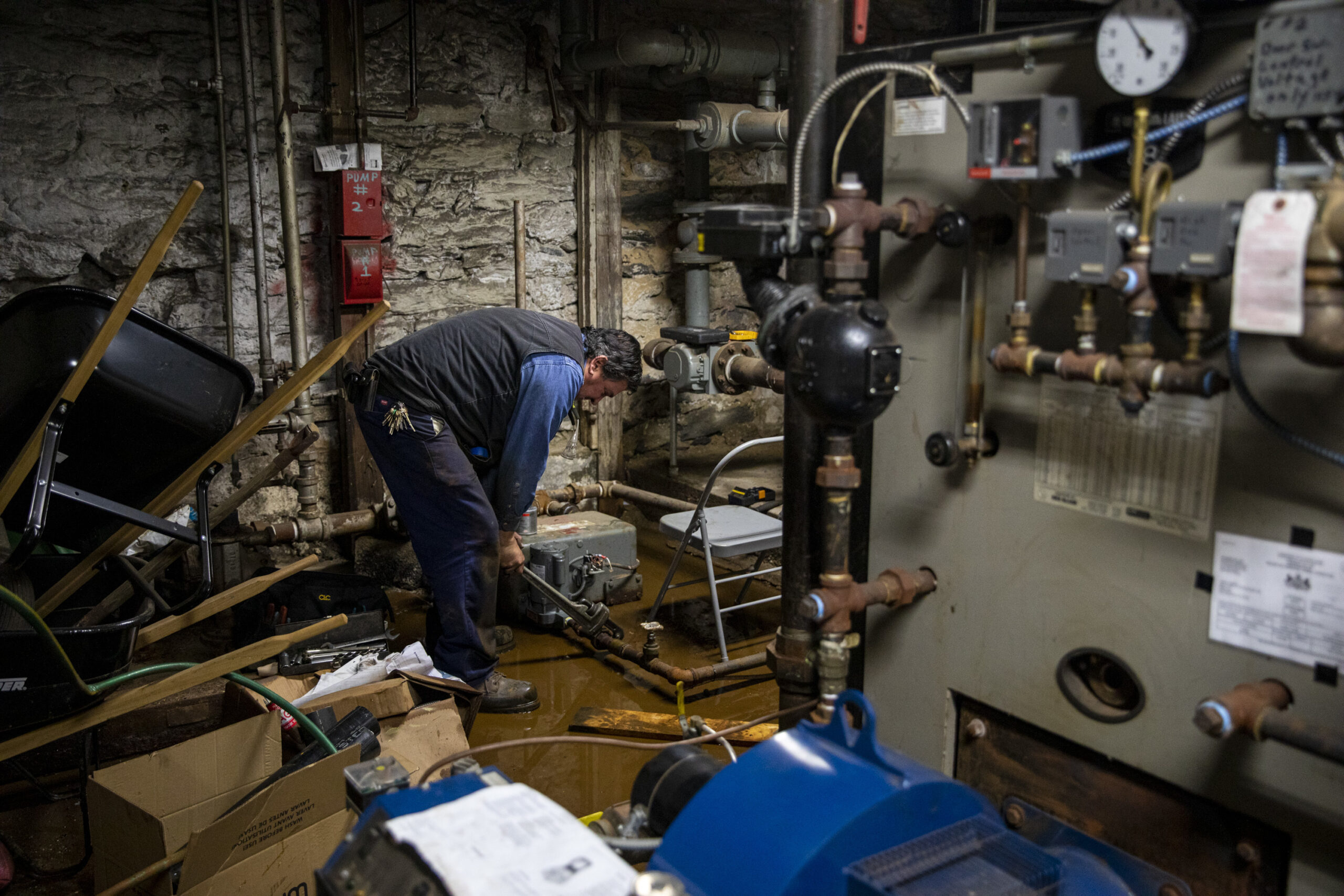
    Andrew Gadaleta, contractor, works on getting the heat fixed at Visitation BVM School in Philadelphia in December 2021 so that students could return to school. Thieves broke into the school Tuesday morning, ripping copper pipes from the walls that caused flooding. The water rendered the school unusable for a week.

    How to spot a frozen pipe

    Your house is filled with water pipes, and while it’s not hard to figure out when you’re dealing with a frozen pipe, it can be tricky to figure out where the frozen section is. If you turn on a faucet and nothing comes out, you’re going to have to do a little detective work.

    The first step should be to try all the other faucets in your house. If all the faucets in a room aren’t working, the freeze is likely in a split from the main pipe. If all the faucets on a floor aren’t working, the freeze is likely between where the first- and second-floor pipes separate. If all the faucets in your house aren’t working, then the freeze is probably near where the main pipe enters the house.

    The frozen section of the pipe, if exposed, will sometimes have condensation over it. You’ll also be able to tell that it’s colder just by touching it.

    How to thaw a frozen pipe

    Before thawing a frozen section of pipe, you should open the faucet to relieve the water pressure and allow the water to escape once it thaws. You should also begin the thawing process close to the faucet and work your way to the blockage. If melted water and ice get caught behind the blockage, the chance that the pipe will burst increases.

    One of the easiest ways to thaw a frozen pipe is with a hair dryer. You can also use hot towels or a heat lamp to warm up the pipe. Never use an open flame.

    What to do if a pipe bursts

    Don’t panic. The first thing you should do is shut off the main water line into your property. This will prevent your house from flooding. The main water valve is usually near your water meter. After you’ve done that, call your plumber. Locating and tagging the valve to your main water line ahead of time can help make the moment less stressful.