Relief is coming to thousands of aggrieved trolley riders.
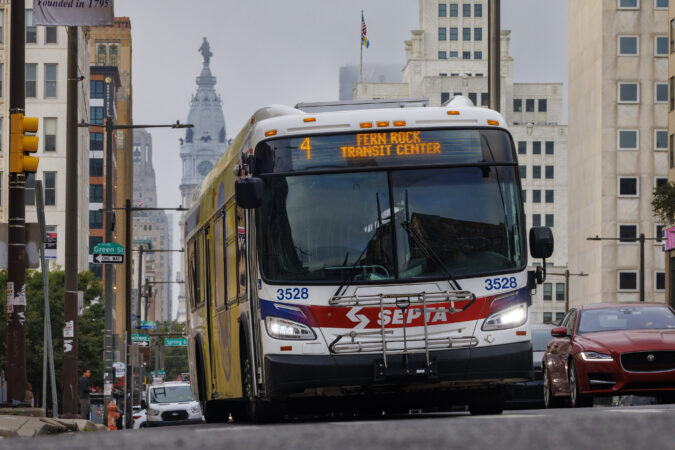
After two months of closure, the trolley tunnel connecting Center City and West Philadelphia is scheduled to reopen Monday at 5 a.m., SEPTA announced late Friday.
Test runs of trolleys through the 5-mile passageway have shown that repairs to damaged connections between the vehicles and the overhead electric wires that supply their power have worked and it’s safe to resume normal operations, officials said.
“We recognize that this prolonged closure of the trolley tunnel posed a significant inconvenience for our riders, and we appreciate their patience,” SEPTA General Manager Scott A. Sauer said. “Our crews worked around the clock to complete the emergency repairs.”
About 60,000 riders traveled daily through the tunnel between 13th Street and its West Philadelphia portal at 40th Street before SEPTA closed it in early November.
Since November, SEPTA has replaced nearly 5,000 feet of overhead wire, or about 20% of the wire in the tunnel. Crews will continue to replace wire during scheduled weekend closures, the transit agency said.
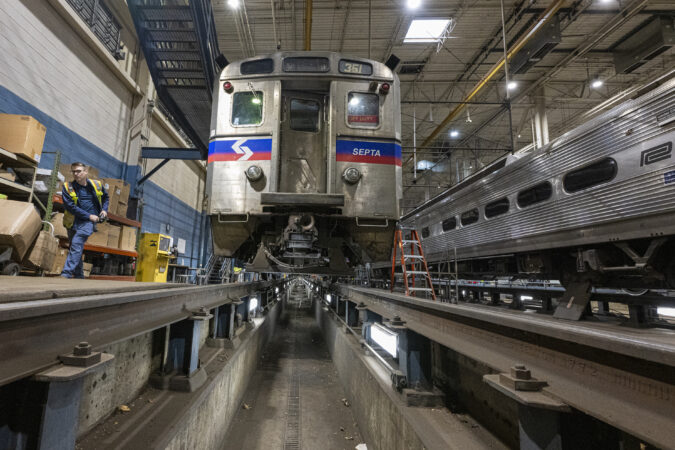
Regional Rail trains are operating with fewer canceled trips and are running with more cars after months of service disruptions while SEPTA rushed to inspect and repair 223 Silverliner IV cars after five caught fire last year.
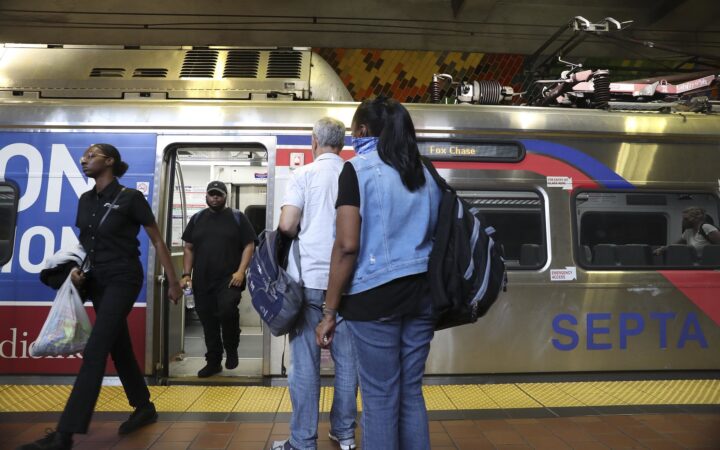
Yet packed two-car trains and skipped stops persist on some lines during peak travel times.
“It’s been three months and our customers had reason to believe things would be better sooner and they’re frustrated — understandably,“ SEPTA spokesperson Andrew Busch said. ”There is still some catching up to do.”
SEPTA decided late Thursday to restore 24 Regional Rail express trips on the Lansdale/Doylestown, Media, Paoli, West Trenton, Norristown, and Wilmington Lines, Busch said. The restored expresses had been running as locals.
An Oct. 1 federal mandate to inspect and mitigate Silverliner IV fire risks required the transit authority to take the workhorse of Regional Rail offline, leading to shorter trains and furious riders.
SEPTA’s records show it canceled 2,544 Regional Rail trains from October through Dec. 31, though the number steadily droppedover time — from 1,324 to 752 to 468.
As of Thursday, 180 of the Silverliner IV cars had met all the milestones set by the Federal Railroad Administration to return to service.
Regulators demanded each car pass a safety inspection, have necessary repairs made, and have a modern thermal-detection circuit installed.
So far, however, just 78 of those 180 Nixon-Ford era rail cars have been returned to service.
That means work is yet to be completed on35 Silverliner IVs.All together, the carsmake up 57% of the Regional Rail fleet.
(function() { var l = function() { new pym.Parent( ‘regional-rail-return__graphic’, ‘https://media.inquirer.com/storage/inquirer/ai2html/regional-rail-return/index.html’); }; if(typeof(pym) === ‘undefined’) { var h = document.getElementsByTagName(‘head’)[0], s = document.createElement(‘script’); s.type = ‘text/javascript’; s.src = ‘https://pym.nprapps.org/pym.v1.min.js’; s.onload = l; h.appendChild(s); } else { l(); } })();
“Over the last couple of days, we’ve been adding more three and four-car trains,” Busch said. With the restoration of express service, that should continue, he said.
To keep Regional Rail service running in its slimmer form, SEPTA has been using its 120 Silverliner V cars, which arrived between 2009 and 2011, as well as 45 coach cars, which have no motors and are pulled by locomotives.
The Silverliners have onboard motors, carrying passengers and providing propulsion at the same time. The 78 returned to service will also add capacity.
In addition, SEPTA plans to use an additional 10 passenger coaches leased from Maryland’s commuter railroad. They are here, but train crews are undergoing training, which was delayed by vacations and work schedules over the holidays. They should be ready to go a couple of weeks, Busch said.
The transit agency is seeking to buy 20 used passenger cars from Montreal but has not heard whether it won the bidding.
Back-ordered shipments arrived around Christmas, and now there is plenty of wire to finish the job, SEPTA says. The deadline for the installations was Dec. 5, but under the circumstances, federal authorities did not punish SEPTA.
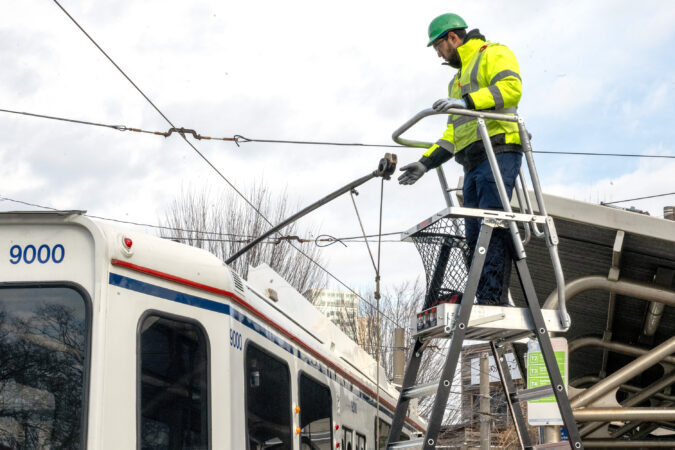
Philadelphia’s trolley tunnel has been closed for two months, but SEPTA now is saying that it has completed most necessary repairs and could reopen the connection between Center City and West Philadelphia soon.
Crews currently are running trolleys through the tunnel to test fixes for damaged overhead wires and other equipment and to decide when it is safe for normal service to resume.
“We’re pretty close,” SEPTA spokesperson Andrew Busch said Tuesday.
About 60,000 riders traveled daily through the tunnel between 13th Street and its West Philadelphia portal at 40th Street before SEPTA closed it in early November.
At issue is a U-shaped brass part called a slider that carries carbon, which acts as a lubricant on the copper wires above the tracks that carry the electricity that powers the trolleys.
There were two major incidents when trolleys were stranded in the tunnels. On Oct. 14, 150 passengers were evacuated from one vehicle and 300 were evacuated from a stalled trolley on Oct. 21.
The Federal Transit Administration on Oct. 31 ordered SEPTA to inspect the overhead catenary system along all its trolley routes.
SEPTA has had to replace about 5,000 feet of damaged wire and make other repairs. It also switched back to 3-inch sliders.
On Nov. 7, SEPTA shut down the tunnel to deal with the issue, which had cropped up again, then reopened it on the morning of Nov. 13, thinking it was solved. But it discovered further damage to the catenary system and the tunnel was closed at the end of the day.
Other potential reopening dates were announced but postponed.
This story has been updated to correct the amount of wire replaced in the tunnel.
On weekdays from 9 a.m. until 2:30 p.m., buses will serve Fox Chase, Ryers, Cheltenham, Lawndale, and Olney stations. Trains will run to and from Center City between Wayne Junction Station and 30th Street Station.
Passengers headed inbound should plan on an additional 30 to 35 minutes of travel time.
An outbound trip toward Fox Chase Station will take an extra 35 to 40 minutes during the midday hours, SEPTA advises. The connecting shuttle bus is scheduled to depart Wayne Junction Station five minutes after a train arrives.
Scott Sauer would like nothing better than to make SEPTA an afterthought.
He doesn’t mean that the Philadelphia region’s mass transit agency should be neglected, but rather that it will come to do its job so seamlessly that its nearly 800,000 daily customers can rely on the service without worrying about breakdowns, delays and disruptions.
Given the cascading crises that hit SEPTA in 2025, many people wondered if the place was hexed.
“I hope not, because I don’t know how to get the curse off me,” Sauer said in a recent interview. “But listen, truth be told, there were days when I scratched my head and thought, ‘Oh, my goodness, what is going on?’”
“We just couldn’t seem to get more than a day or two of relief before something else was causing a headache,” said Sauer.
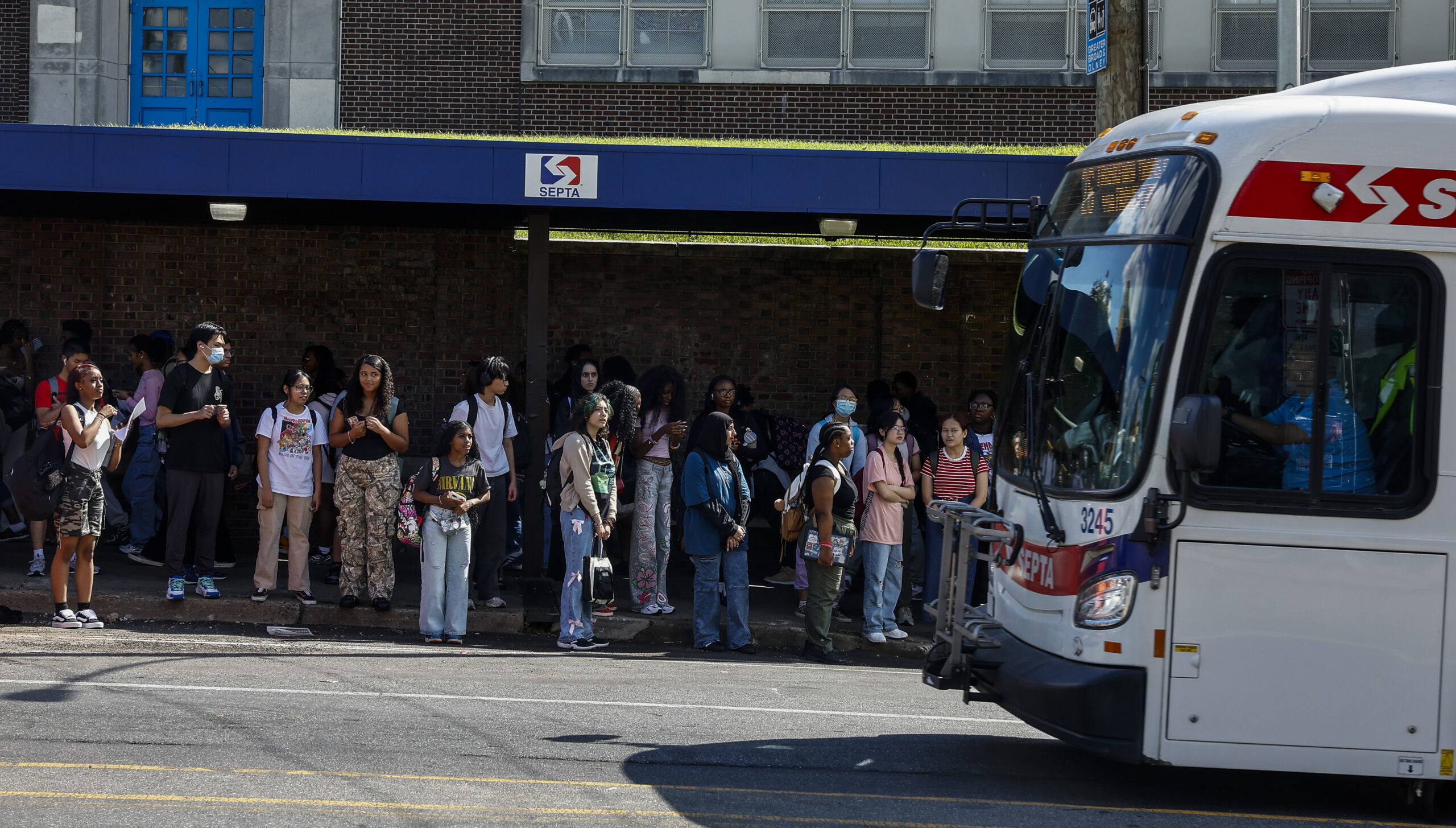
A bus passes the stop near Girls High at Broad and Olney Streets on Monday, Aug. 25, 2025. Thirty two SEPTA bus routes were cut and 16 were shortened, forced by massive budget deficits.
Back to basics in 2026
In the end, help from above and a new labor contract bought SEPTA at least two years to recover from its annus horribilis and stabilize operations.
When the Pennsylvania legislature couldn’t get a transit funding deal done, Gov. Josh Shapiro shifted $394 million in state-allocated funds for infrastructure projects to use for operations — the third temporary solution in as many years. The administration also later sent $220 million in emergency money in November for the Regional Rail fleet and the trolley tunnel.
And, early in December, SEPTA reached agreement on a new, two-year contract with its largest bargaining unit, Transport Workers Union Local 234.
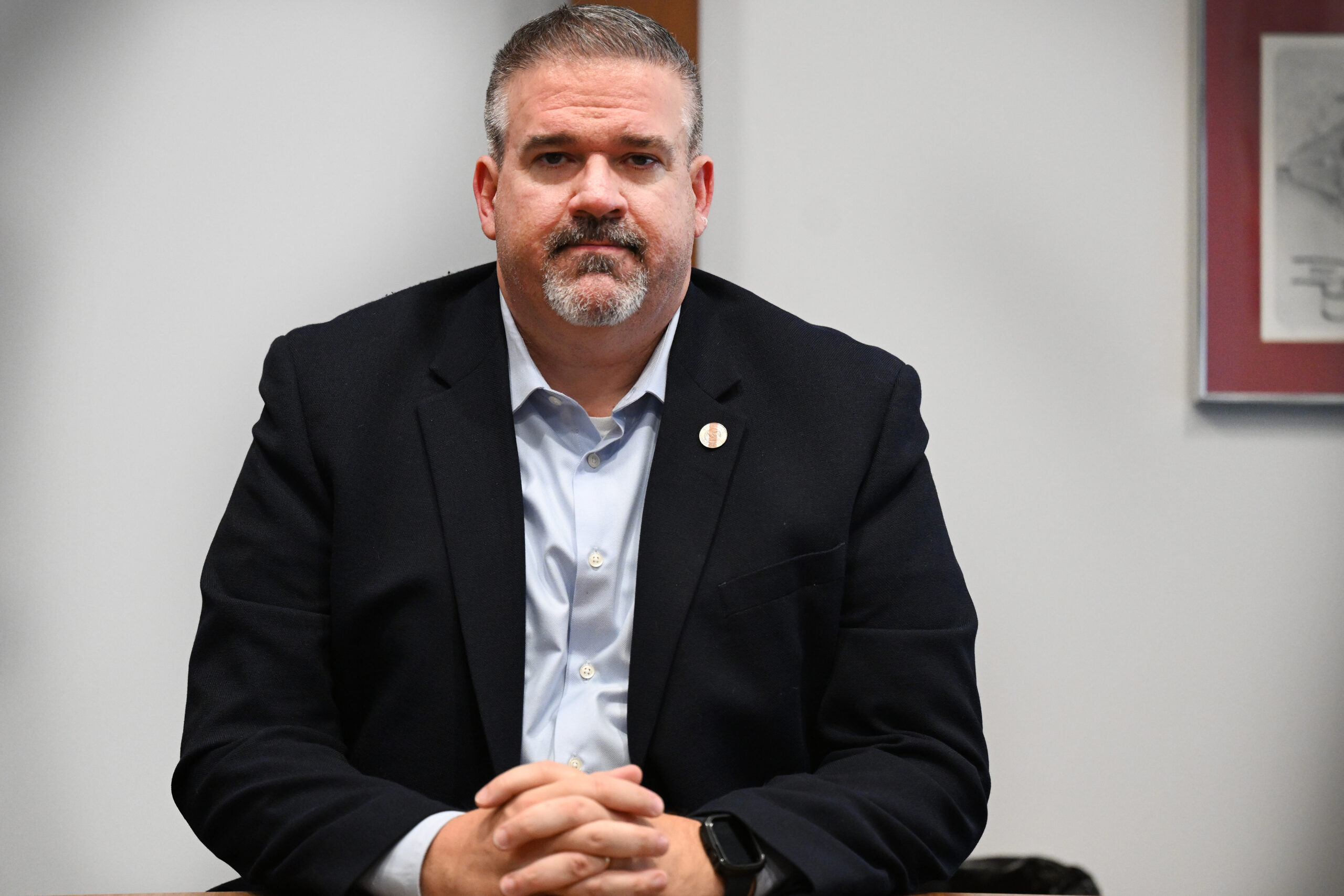
Scott Sauer, general manager of SEPTA, admits that 2025 was an extremely challenging year.
Sauer compared SEPTA’s position to football refs. When they are doing their jobs right, fans don’t have to think about them when watching the game. And when things are going well on the transit system, it becomes part of the background.
“Let’s make sure we do the basics, and we do them really well, because at the end of the day, people want SEPTA to move them from one place to the other, right?” he said.
The test of the focus on fundamentals comes soon, with millions of visitors expected in the region for the 250th anniversary of the Declaration of Independence, World Cup soccer, and other big events.
Sauer, 54, began his career as a trolley operator more than 30 years ago. He had no political experience, though, and would quickly be thrown headfirst into those murky waters to swim with sharks.
Storm clouds were already rolling in. Weeks before Sauer took the reins, Shapiro had flexed $153 million in state highway funds for SEPTA operations after a broader deal failed amid Senate GOP opposition.
It’s a legal move, but often controversial, and Shapiro’s opponents were furious.
Richards and her leadership team had been warning of a looming fiscal “doomsday scenario” for months. Officials were drafting a budget with service cuts and fare increases.
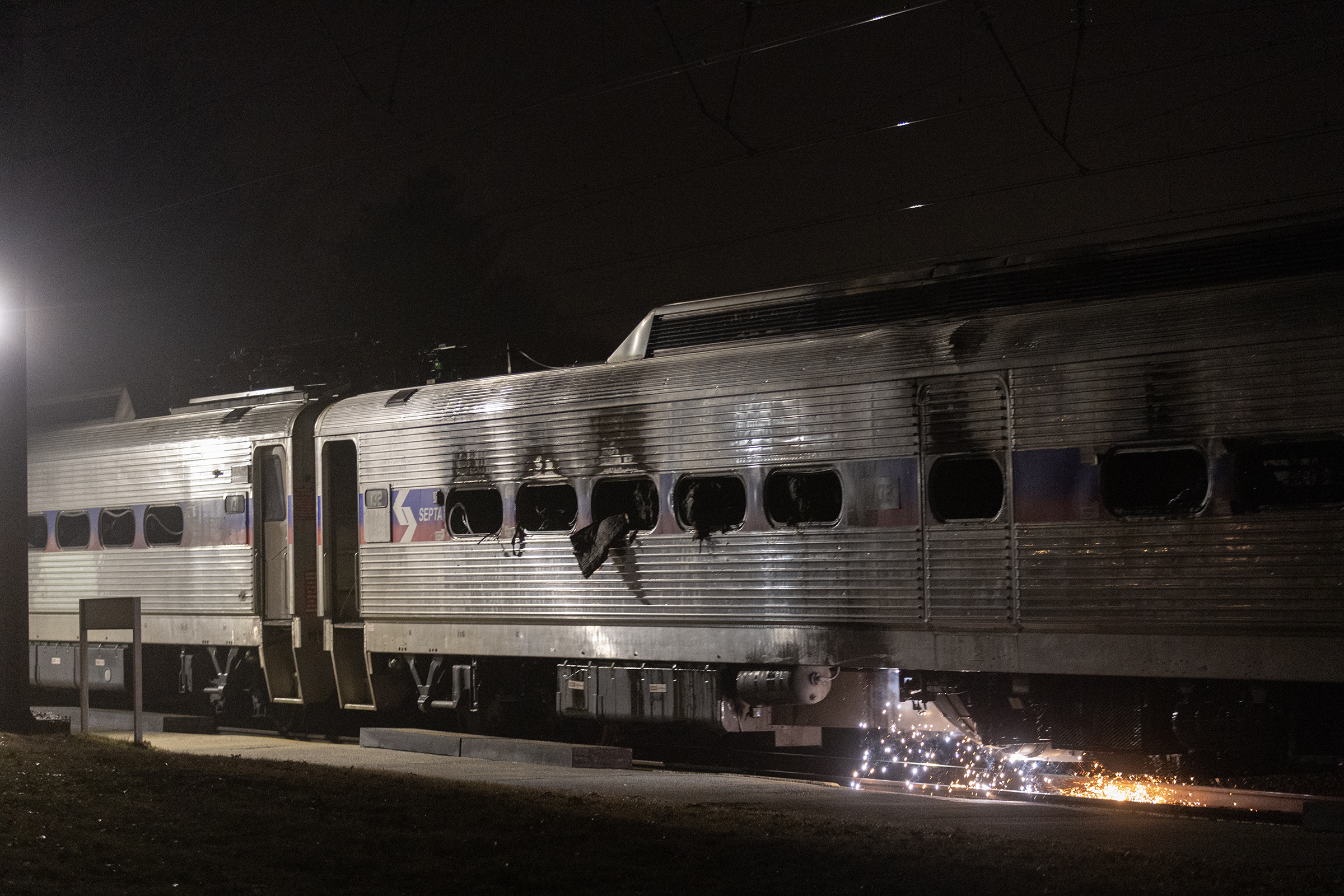
On Feb. 6, a Wilmington-bound Regional Rail train caught fire as it was leaving Crum Lynne Station in Delaware County. It was worrisome, but at the time, nobody knew it would get worse.
More than 300 passengers were safely evacuated after a SEPTA Regional Rail train caught fire near Crum Lynne Station in February.
Familiar battle lines were drawn. Senate Republicans, in the majority in the chamber, opposed Shapiro’s proposal to generate $1.5 billion for transit operations over five years by increasing its share of state sales tax income.
They preferred a new source of income for the state’s transit aid and said SEPTA was mismanaged, citing high-profile crimes, rampant fare evasion, and lax enforcement.
On a mid-August night, the Senate GOP came up with a proposal that would take money from the Public Transportation Trust Fund, a source for transit capital projects, and split it evenly between transit operations subsidies and rural state highway repairs.
Senate Majority Leader Joe Pittman, a Republican from Indiana County, was a key player in budget negotiations, which ultimately did not yield additional funding for mass transit.
“It was kind of quiet … and then we got alerted that a proposal was coming within minutes. And so everybody was scrambling to try to read through it,” Sauer said.
In a quick news conference with Shapiro, Sauer opposed the idea of taking capital dollars for transit operations, as did the governor. Then he spoke with Senate Republicans and told reporters it could be worth considering, but he had questions. And by the end of the night, he walked that back and opposed the measure.
“I guess if there was a lesson to be learned for me in August, it was I should have taken some [more] time reading through that proposal,” he said.
There was not much time to reflect on what happened, though, because the hits kept on comingas the federal government ordered SEPTA to inspect all 223 Regional Rail cars.
SEPTA’s Regional Rail fleet is the oldest operating commuter fleet in the country, and the fires highlighted the difficulty of keeping them maintained while needing to stretch limited capital funds to address multiple problems.
The Market-Frankford El cars, though younger than the Silverliner IVs, have been beat up and unreliable. SEPTA is moving forward with replacing them, as well as the Kawasaki trolleys that are more than 40 years old.
SEPTA had ordered new Regional Rail coaches from a Chinese-government-related manufacturer, but canceled the contract after the first few models, built during the pandemic, showed flaws. Now the agency is advertising for bids on a new fleet of Regional Rail workhorses — but it has to make them sturdier to last for at least seven more years before new cars would be on the way.
Officials plan to use $220 million received from the state on that effort.
Some of the money, about $48 million, is slated to help fix the trolley-tunnel issue. SEPTA is contending with glitches in the connection between the overhead catenary wires and the pole that conducts electricity to the vehicle.
What SEPTA got done
SEPTA has made some progress on some of its persistent issues, officials say, though the accomplishments understandably have been largely overlooked amid the urgent, existential crises of 2025.
For instance, serious crimes on the SEPTA system dropped 10% through Sept. 30 compared to the same period in 2024, according to Transit Police metrics.
And there had already been a sharp improvement. Serious crimes in 2024 dropped 33% compared to 2023 — from 1,063 to 711, year over year.
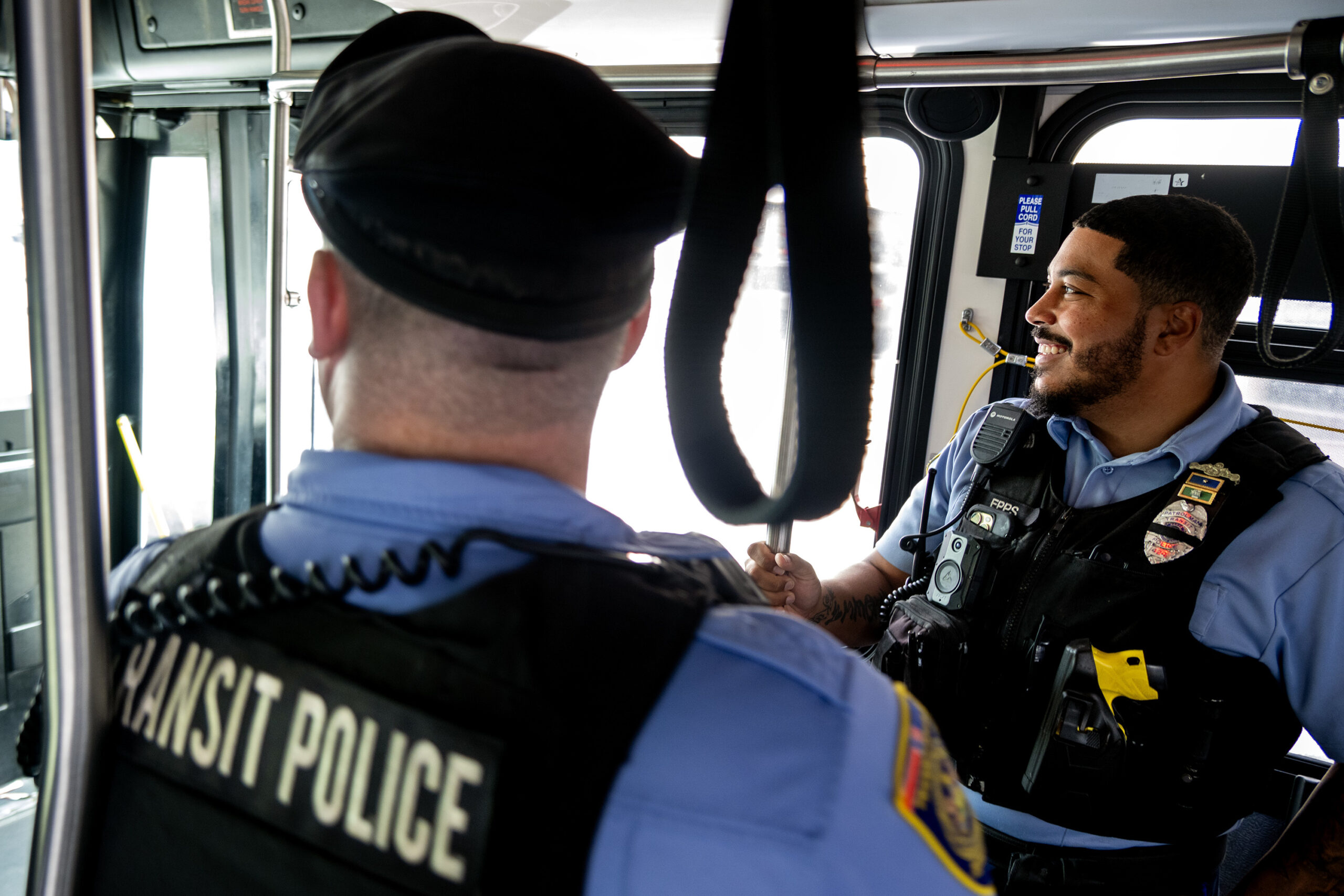
SEPTA transit police police patrol officers Brendan Dougherty (left) and Nicholas Epps (right) with the Fare Evasion Unit ride the 21 bus.
“If you think back to where we were in 2021 and 2022, the perception was bad things were happening on SEPTA, and you should steer clear of them,” Sauer said.
The Transit Police have been hiring new officers, including a recently graduated academy class of nine, and has about 250 officers.
SEPTA also installed 42 full-length gates designed to thwart fare evasion on seven platforms in five stations during 2025, spokesperson Andrew Busch said.Another 48 gates are coming in the first quarter of the year.
Police are also issuing citations with an enhanced penalty of up to $300 for fare evasion.
Prepare for déjà vu
Andyet, in 2027, it will be time to start the old SEPTA-funding dance once again, as transit agency advocates and supportive lawmakers work at getting a stable state funding stream for transit operations.
State Democrats have said the transit issue could help them take control of the Senate from Republicans — a longtime goal but one that is difficult to achieve. One wild card is whether President Donald Trump’s slumping popularity will cause GOP congressional candidates to get swamped in the 2026 midterms, and whether that will translate into voters’ local senators.
It likely would have to be a huge wave, and it’s a closely divided state.
By 2027, Shapiro is expected to be running for president (if he is reelected next year), and it’s anyone’s guess how that could affect budget politics.
“Not everybody wants to see us. I didn’t make a lot of friends,” Sauer joked after the TWU settlement.
The new pedestrian bridge extension coming to Society Hill and Queen Village, which will better connect the neighborhoods to the Delaware River waterfront, is reaching a milestone.
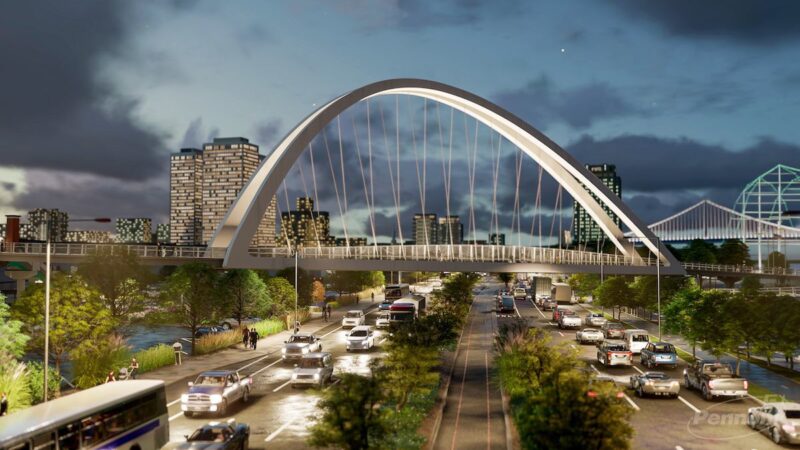
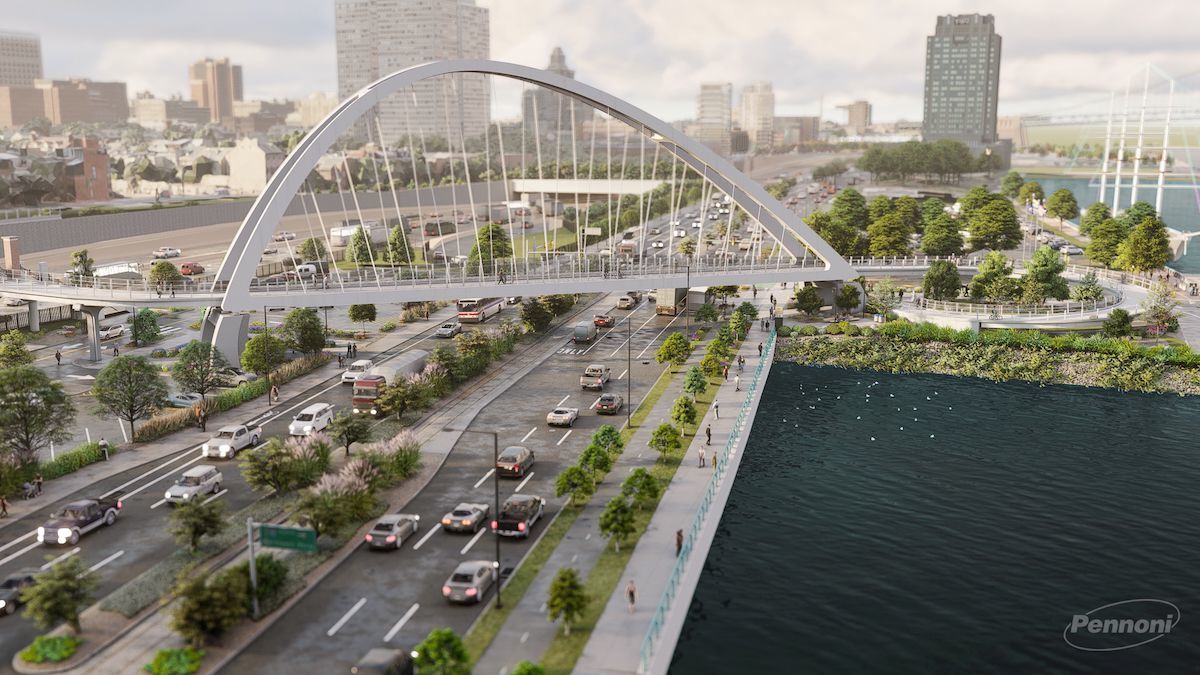
The South Street Pedestrian Bridge expansion will extendthe existing redbrick footbridge constructed in the mid-1990s with a longer and more distinctive suspended archway bridge, as part of the long-planned I-95 capping project. Construction begins this spring, but the bridge will not be open to the public until 2027, a Pennsylvania Department of Transportation spokesperson said.
A rendering of the South Street Pedestrian Bridge extension that will better connect South Street to the Delaware River waterfront. Construction will begin in Spring 2026 and go through 2027, when the bridge will open to pedestrians and cyclists.
The 250-foot-long bridge will allow pedestrians to cross over Columbus Boulevard and I-95 with entrances at South Street and Lombard Circle that have more accessible walkways for people with disabilities. Pedestrian access to the waterfront is crucial for people on South Street visiting attractions like Penn’s Landing, Cherry Street Pier, and Spruce Street Harbor Park.
(function() {
var l2 = function() {
new pym.Parent(‘southstreetbridge’,
‘https://media.inquirer.com/storage/inquirer/projects/innovation/arcgis_iframe/southstreetbridge.html’);
};
if (typeof(pym) === ‘undefined’) {
var h = document.getElementsByTagName(‘head’)[0],
s = document.createElement(‘script’);
s.type = ‘text/javascript’;
s.src = ‘https://pym.nprapps.org/pym.v1.min.js’;
s.onload = l2;
h.appendChild(s);
} else {
l2();
}
})();
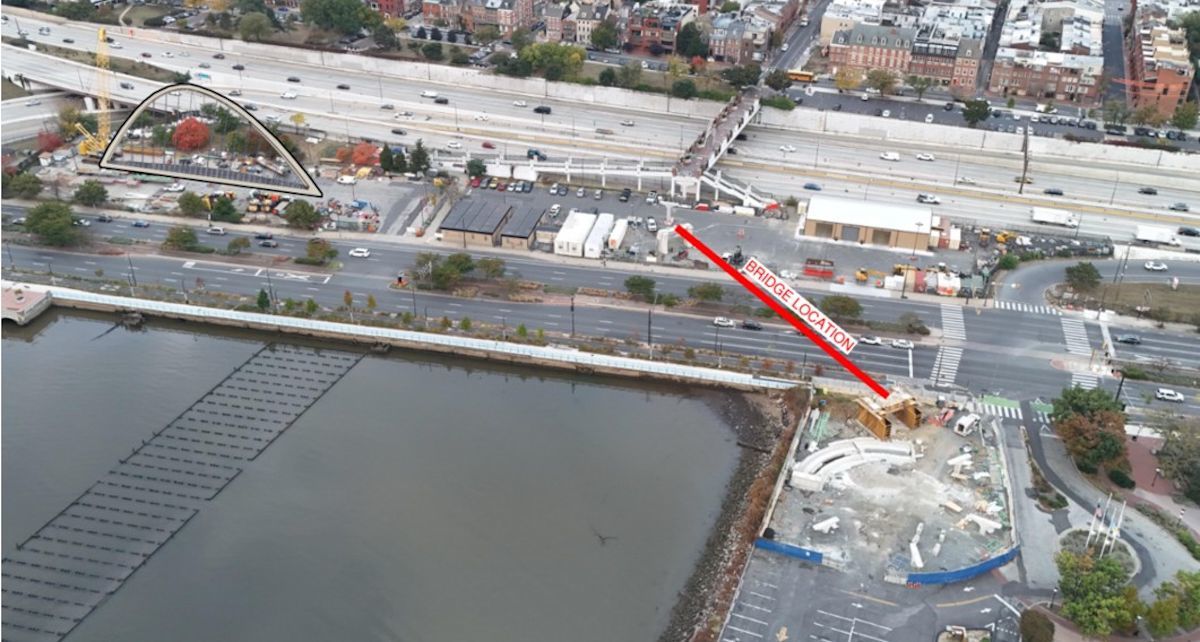
Construction will use an installation method in which the archways are built at a nearby location and then rolled into place, instead of being built on-site.
“The contractor was able to eliminate long-term lane closures and full closures on Columbus Boulevard,” PennDot spokesperson Brad Rudolph said. “While this method is fairly common, it is the first time PennDot has performed it in [Southeastern Pennsylvania] with this type of pedestrian structure.”
An aerial view of the construction site where the South Street Pedestrian Bridge extension will take place. A rendering of the archways in a nearby parking lot show where the bridge structure will be assembled and then later rolled into place where a red line marks its installation site. Construction begins in Spring 2026, with the bridge open to the public in 2027.
The bridge structure will be assembled for about two months in a parking lot near the installation site this spring. The new structure will then be rolled into place by mid-2026, according to PennDot. Additional work, including pouring the bridge deck, will take an additional year, with the span expected to open to pedestrians and cyclists in 2027.
Sitting 258 feet long and 100 feet from the ground to its highest arch, the footbridge will feature 14-foot-wide walkways with lit archways and handrail lighting. The entrance at Lombard Circle will have a spiraling ramp to allow for cyclists to stay on their bikes and to provide easier wheelchair and mobility access.
A rendering of the mass timber building planned for the Penn’s Landing park.
The pedestrian bridge is only a small part of PennDot’s $329 million project to build a cap over I-95 at Penn’s Landing, which will house a 12-acre Penn’s Landing Park with green spaces, playgrounds, and an amphitheater. Construction on the cap is nearly 30% complete as of this month.
Nearby, Old City is getting a revamp of Market Street, where the road will be shrunk and more pedestrian thoroughfares will be added, with the new Tamanend Square plaza at Second and Market Streets to serve as the centerpiece.
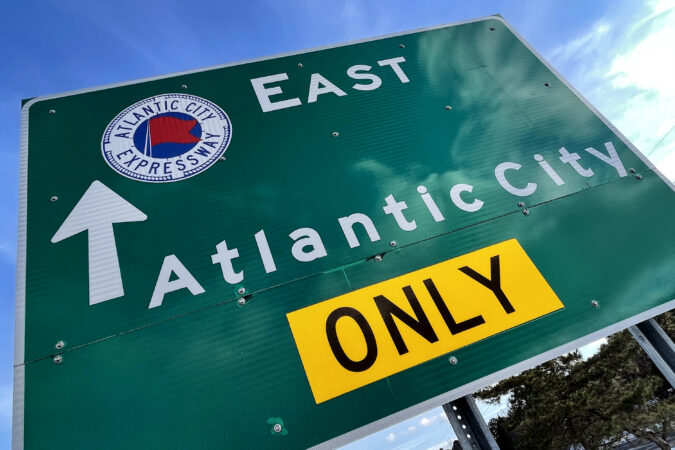
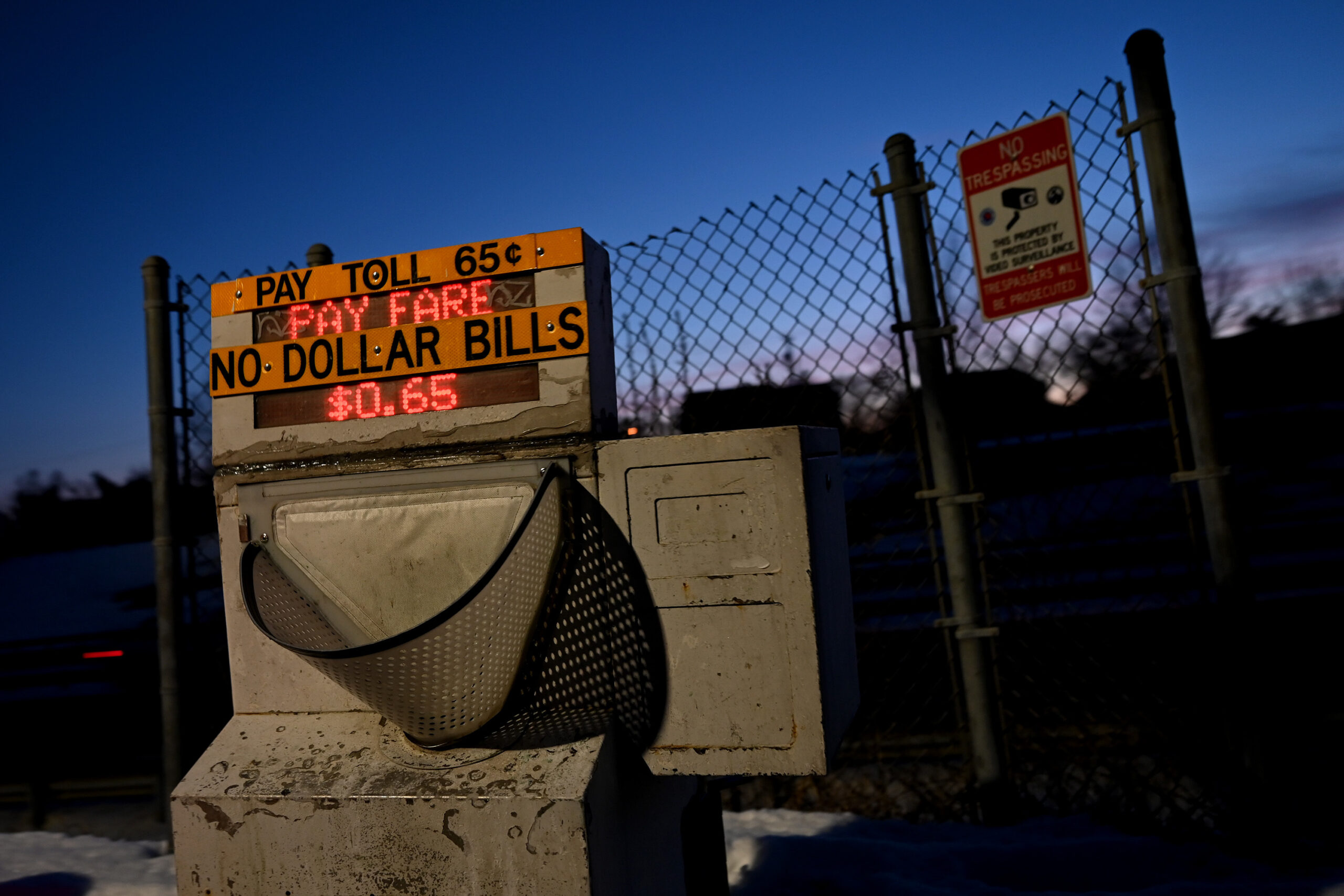
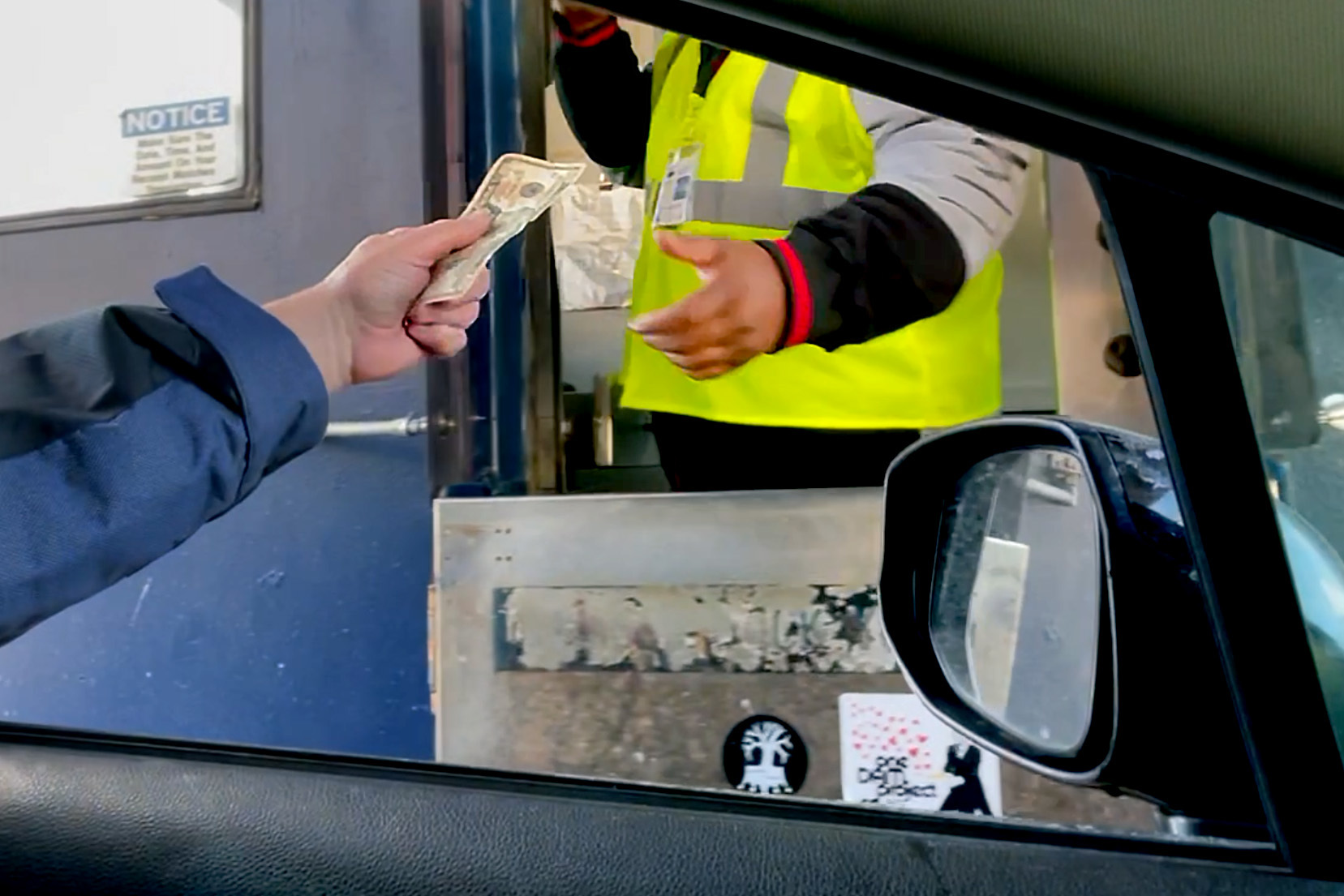
The Atlantic City Expressway is set to become the first of New Jersey’s major toll roads to go cashless.
Starting Sunday, drivers on the highway must pay via E-ZPass or be billed by plate, according to the South Jersey Transportation Authority (SJTA).
Drivers who don’t have E-ZPass will be mailed a bill for the toll, plus a 100% surcharge and a $1 administrative fee. Driving the length of the expressway without E-ZPass would cost about $14. The SJTA says the extra charges will help “offset the administrative costs associated with the new billing process.”
If drivers fail to pay the first bill, they will receive another with an extra $5 late fee. If they still don’t pay, it will be considered a toll violation, which can result in fines and a suspension of vehicle registration.
The start of all-electronic tolling on the A.C. Expressway comes after a $77 million multiyear project that replaced the Egg Harbor and Pleasantville barrier toll plazas with overhead gantries that digitally read E-ZPass transponders and license plates. All ramp toll machines were also replaced with gantries.
A cash lane at the Berlin-Cross Keys toll booth on the Atlantic City Expressway as shown in 2022.
With the new system, drivers don’t stop to go through a toll booth; they keep moving, which state officials have said will be safer and more environmentally friendly. It may also result in quicker drives on the 44-mile highway that connects Camden County to the Shore.
The Garden State Parkway and the New Jersey Turnpike are also set to go cashless sometime in the future.
The New Jersey Turnpike Authority’s 2020 long-range capital plan estimated that endeavor would cost $900 million — $500 million for the parkway and $400 million for the turnpike.
A driver pays a toll in cash at the Egg Harbor Toll Plaza on the Atlantic City Expressway in 2022.
Spokespeople for the South Jersey Transportation Authority could not immediately be reached for comment Tuesday regarding whether Atlantic City Expressway toll workers were losing their jobs.
The authority, which runs the expressway, has been using its social media accounts to encourage drivers to get E-ZPass. They can do so online at ezpassnj.com, by phone at 1-888-288-6865, or by stopping at the Customer Service Center at milepost 21.3 on the expressway.
The in-person center is open from 8 a.m. to 3 p.m. Monday, 9 a.m. to 4 p.m. Tuesday through Thursday, and 11 a.m. to 6 p.m. Friday. It is closed on weekends and holidays, including New Year’s Day.
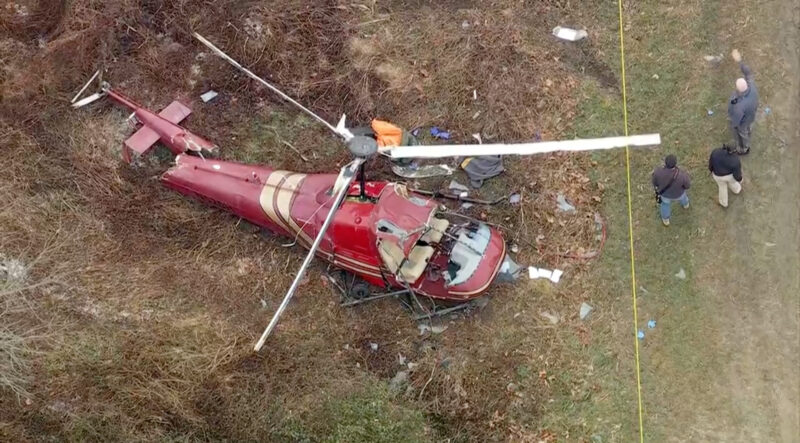
Two men stopped by Apron Cafe, a breakfast spot overlooking Hammonton Municipal Airport’s runway, before they took off in separate helicopters late Sunday morning for what the restaurant owner described as one of their frequent flights together over the years.
Minutes later, about 11:25 a.m., Apron Cafe patrons and staff could see one of the helicopters spiraling, engulfed in flames not far in the distance.
“I looked up and I could see in the distance the one spiraling down and then I see the other one coming down,” said the cafe’s owner, Sal Silipino. “It was hard to believe that they were crashing.”
Local authorities identified the pilots Monday as Kenneth Kirsch, a 65-year-old from Carneys Point, Salem County, and Michael Greenberg, a 71-year-old resident of Sewell, Gloucester County.
Hammonton Police Chief Kevin Friel said that Greenberg died at the scene. Kirsch died at an area hospital after being flown there.
Just what led to the crash remains under investigation by the Federal Aviation Administration and the National Transportation Safety Board.
The parcel of land where the helicopters crashed was an open field amid a busy area. U.S. Routes 30 and 206 are nearby, as are Atlanticare Hammonton Health Park, an assisted living facility, and homes.
“It was a miracle,” Silipino said. “There was so much in that area that they could have landed on top of.”
Federal investigators remained on site Monday cataloging debris that spanned nearly the length of a football field and was “made up of parts of the main rotor and tail rotors,” according to the NTSB.
The agency said the helicopters are slated to be taken from the crash site to a secure location Tuesday. The preliminary report is expected to be made available in about 30 days.
This article contains information from the Associated Press.
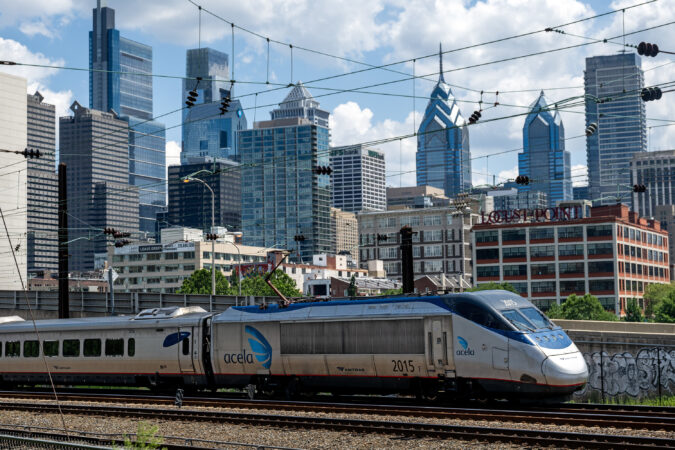
Some of Amtrak’s fleet of next-generation Acela and Airo trains will likely sit idle in 2026 as the national railroad company faces delays in upgrading maintenance facilities.
Amtrak is behind schedule on completing the necessary facilities upgrades to maintain its newest fleet of trains, inspectors told Amtrak in a new report. Delays in next-gen fleet rollouts, of which there have been several, cost the company millions in lost revenue.
Early missteps in planning, like starting its fleet upgrade efforts in 2010 but its facilities upgrades in 2016, led to a “schedule misalignment,” inspectors said in the report.
Amtrak is in the process of acquiring three fleets of trains from manufacturers — NextGen Acela, Airo, and Long Distance — to the tune of $8 billion. The national railroad corporation rolled out a handful of NextGen Acela trains in August. Airo trains are scheduled to roll out in 2026 and Long Distance trains in the early 2030s, according to Amtrak.
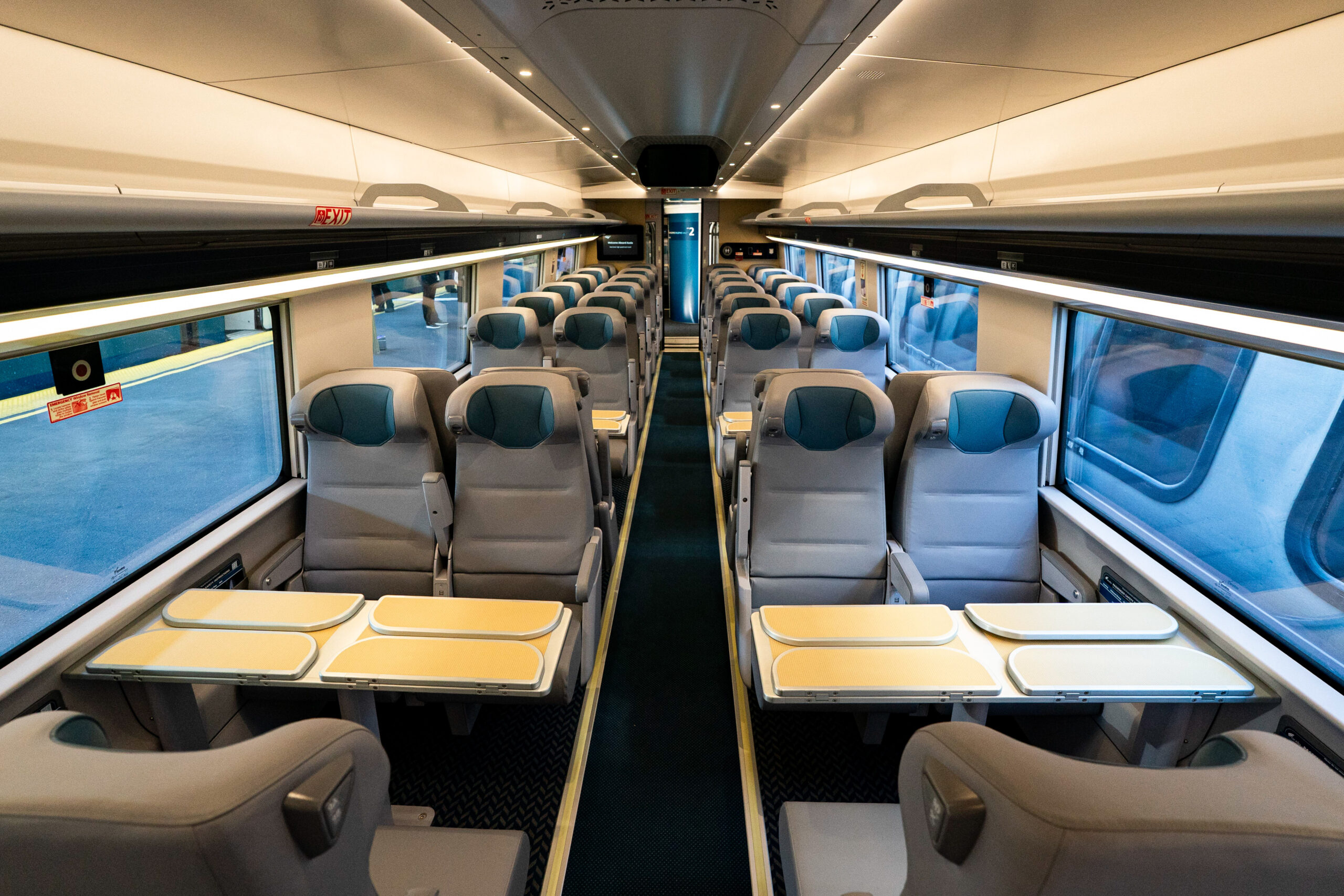
In a recent review of the NextGen Acela trains, The Inquirer lauded the train for its smoother, faster ride, comfortable seats, and above all, its cleanliness, but lamented its infrequency and cost as the older Acela trains on Keystone and Northeast Regional services still carry the bulk of trips for a cheaper ticket.
NextGen Acela and Airo trains offer faster travel with speeds of up to 160 mph and 125 mph, respectively, and modernized cabins featuring upgraded seats, improved Wi-Fi, and expanded dining options.
A business-class car in the NextGen Acela in Washington on Aug. 27.
The latest report from the Amtrak Office of Inspector General details that under its current facility construction schedule, Amtrak will only be able to operate the first 24 out of 28 NextGen Acela trains and the first 12 out of the planned 83 Airo trains hitting the tracks in 2026.
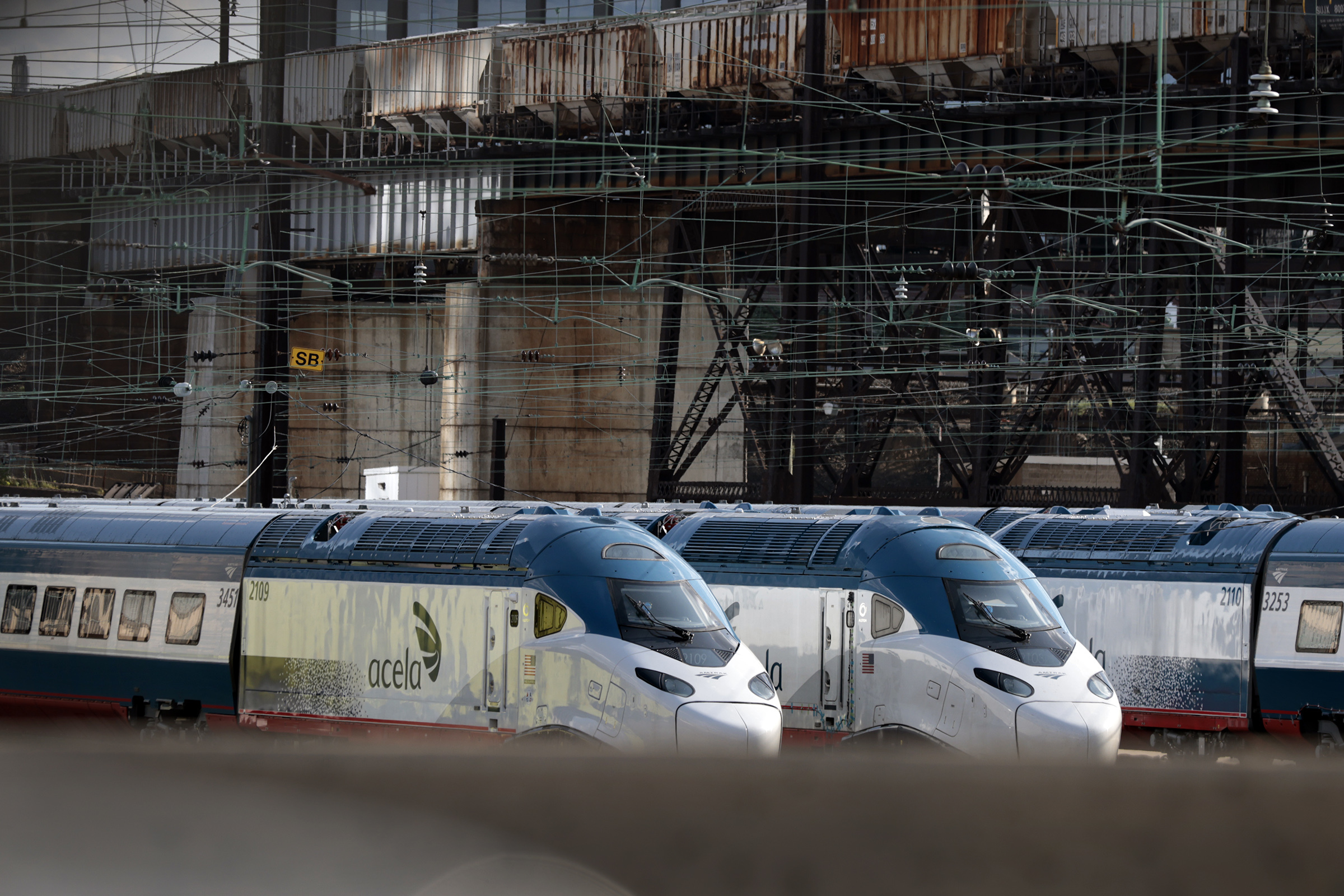
Amtrak Acela trains sit in the Amtrak yard adjacent to 30th Street Station in Philadelphia in August 2023.
While the company began considering plans to replace its aging trains 15 years ago, Amtrak didn’t start addressing facility upgrades until 2016 for NextGen Acela and 2021 for Airo. Additionally, Amtrak took a targeted individual site approach to facility planning instead of an “overarching” one, according to inspectors.
Amtrak approved a new strategic fleet and facilities plan to align both efforts last month. However, inspectors found the company failed to appropriately define the scope of the six years of work that remains.
In the report, a senior Amtrak official described the current system as “building a house without ensuring the garage fits the vehicles.”
Amtrak officials agreed to implement a new management framework to streamline facility upgrade efforts by the end of March 2026.
Philadelphia might have mild weather this holiday week, with light rain showers and likely no snow on Christmas. However, more people will be on the roads and in the sky, traveling to holiday destinations, than in recent years.
Holiday weather should be much milder this week, despite earlier forecasts calling for snow Monday evening, said Ray Martin, a meteorologist at the National Weather Service in Mount Holly. Monday and Tuesday have a chance for light rain showers, and if temperatures drop, maybe snow, but there should be little to no snow accumulation.
Christmas Eve and Christmas Day in the Northeast will be warmer, drier days for travel, according to AccuWeather. Millions across the South and Midwest will experience the warmest holiday on record, though.
Whether it’s the expected good weather or people getting their post-COVID travel confidence back, roads and airports are expected to be packed this week, according to data from Philadelphia International Airport and INRIX, a national travel analytics firm.
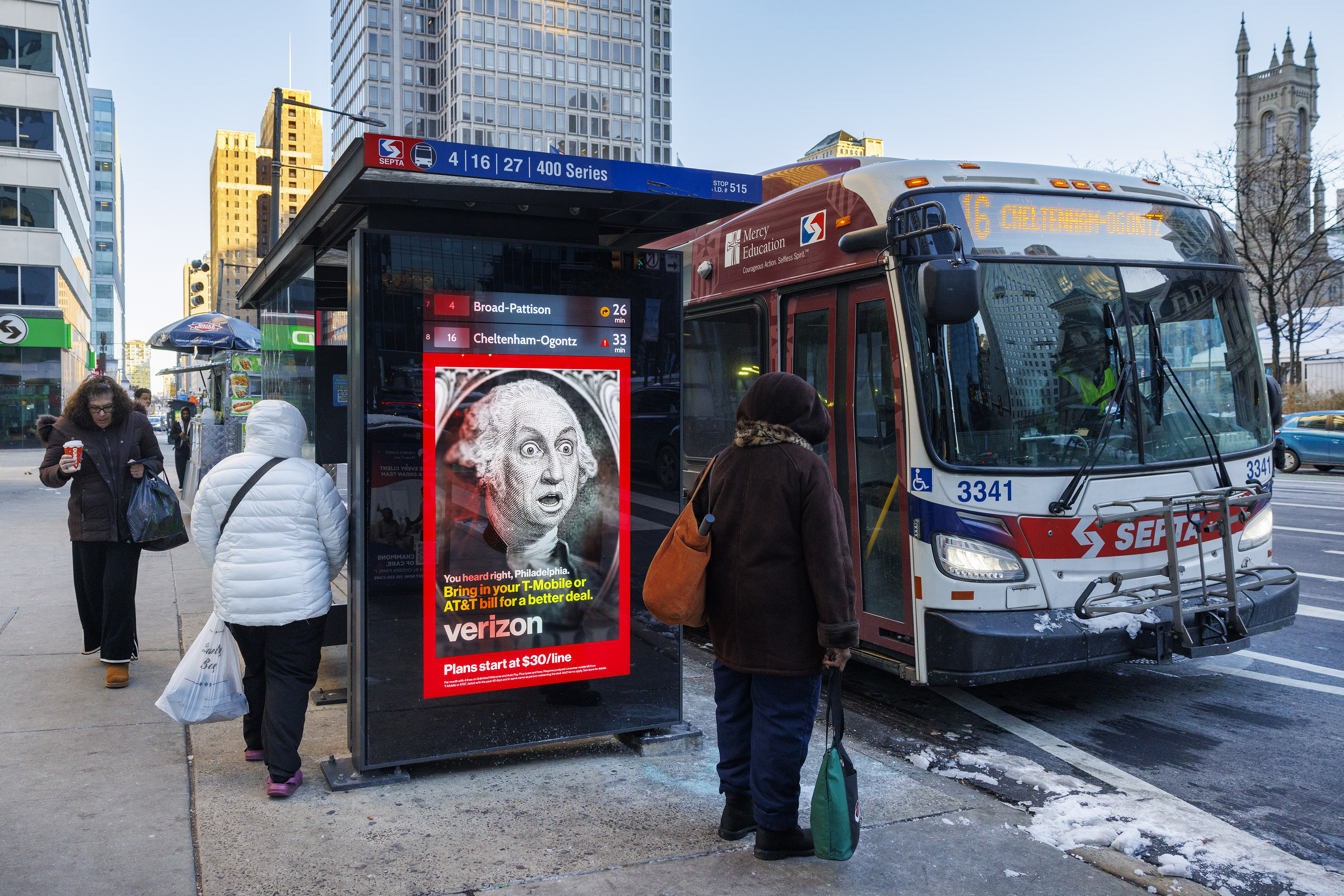
Winter coats are out on a cold morning at a bus stop at 15th and Market Streets on Dec. 15.
Holiday weather this week in Philadelphia
While no snow will likely fall on Christmas Eve or Christmas Day in the Philadelphia region, Tuesday and Friday have chances for precipitation that could bring rain and ice to Philadelphia, and possibly snow north of the city, said AccuWeather senior meteorologist Tyler Roys.
Monday: The best weather this week. Warmer, drier, and less windy.
Tuesday: Rain showers in Philadelphia during the morning commute, but no snow. Possible rain, sleet, or snow in Montgomery and Bucks Counties. Lehigh Valley could receive an inch or more of snow.
Wednesday: No precipitation, but expect wind gusts up to 30 mph. The evening is expected to bring lots of cloud coverage. “Rudolph will definitely need his red nose out and about,” Roys said.
Thursday: Misty weather or light rain scattered across the region throughout the day.
Friday: Stormy weather with precipitation. Philadelphia has a chance for rain and possible ice, but Upper Bucks County and the Lehigh Valley could get snow.
The weekend: On Saturday and Sunday temperatures are forecast to range from the mid-30s to 50 degrees, with a slight wind. Rain is possible Sunday.
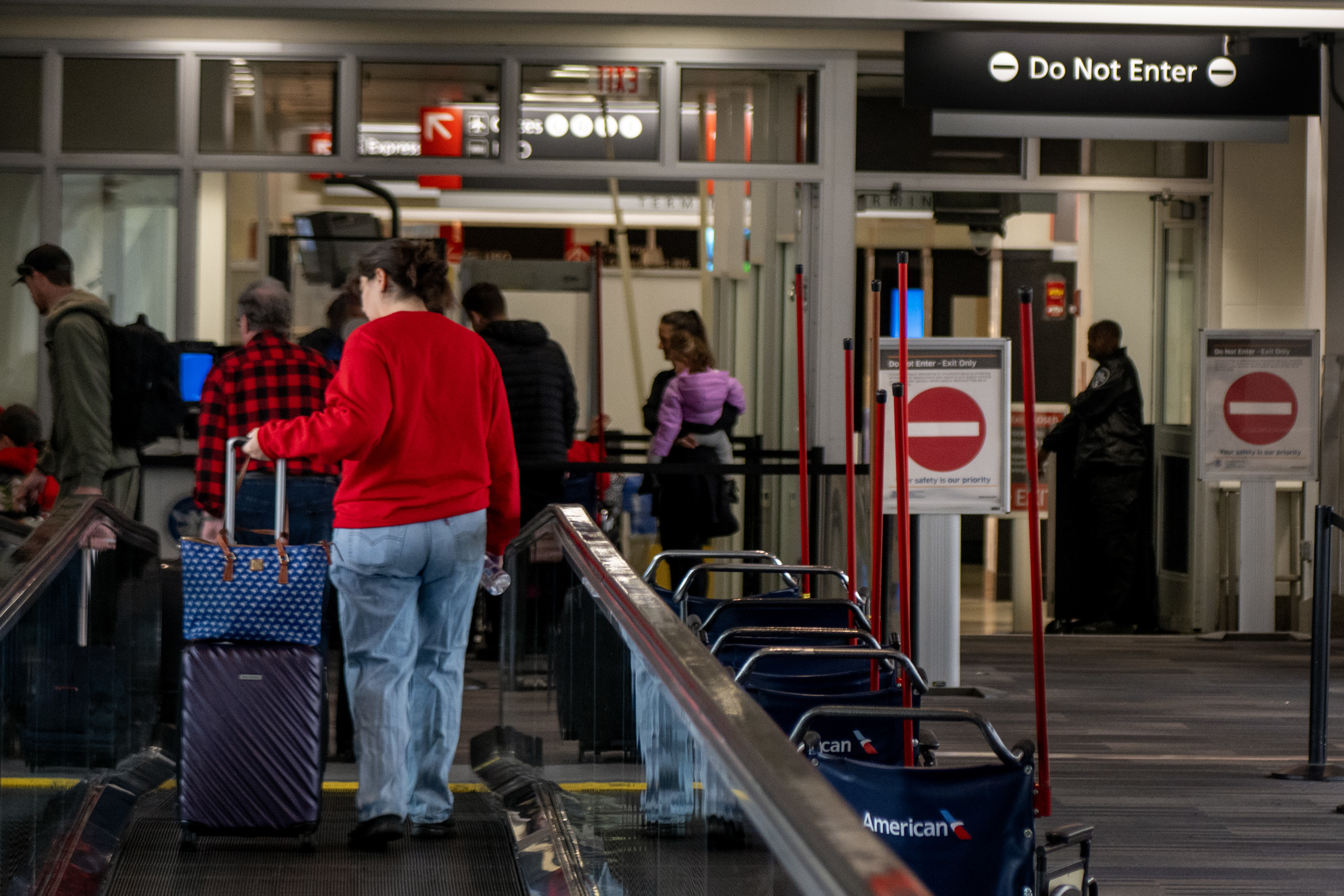
The scene at the TSA checkpoint line in Terminal B at Philadelphia International Airport on Nov. 9.
Holiday travel in the Philadelphia region
Expect longer travel times this year as more people hit the road and sky to get to their holiday destinations.
Airports and flying
Philadelphia International Airport will see a 5% increase in the number of travelers this week compared to the same period last year, with more than 1 million people expected to come through the airport from Wednesday to Sunday, Jan. 4.
PHL’s heaviest traveling days:
Friday, Dec. 26: 94,028 expected passengers
Monday, Dec. 29: 93,096 expected passengers
Saturday, Dec. 27: 92,954 expected passengers
Travelers should arrive two hours before their flight to ensure they get to their gate on time, said Heather Redfern, an airport spokesperson. PHL also has an online travel tips guide for more guidance on easier travel.
The Inquirer operates a year-end PHL tracker for up-to-date information on airport delays and airline performance.
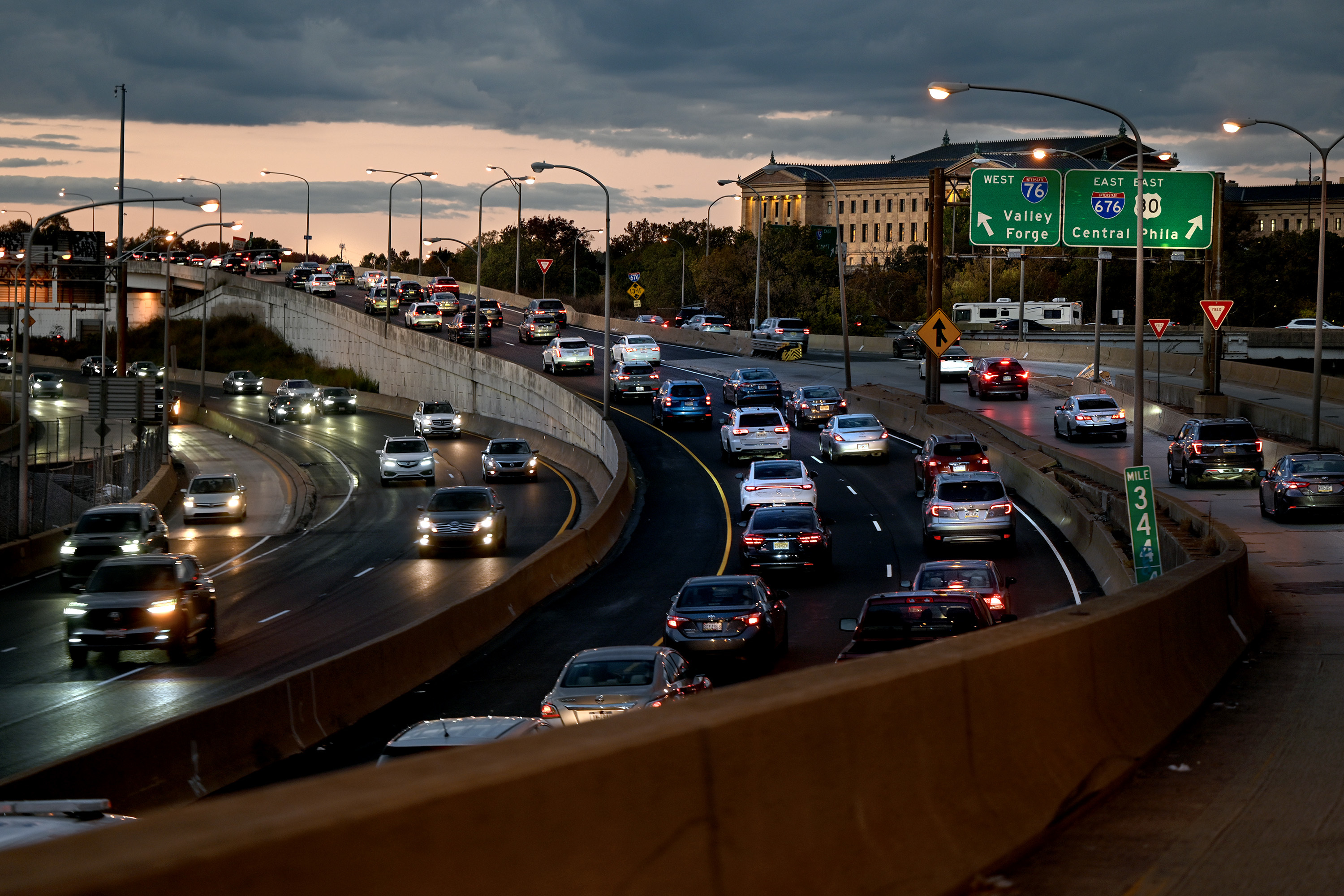
Traffic on the Schuylkill Expressway on Oct. 26.
Driving and peak travel times
A large portion of the holiday travel already occurred this past weekend, but the increased holiday traffic continues.
Christmas Day, Christmas Eve, and New Year’s Eve historically see lower vehicle traffic as people have reached their holiday destinations, according to INRIX. However, Friday is expected to be busy as travelers make their post-Christmas Day moves. “But, remember, crashes or severe weather could create unexpected delays,“ their year-end report warns.
Best travel times for driving in Philadelphia
Most of the traffic congestion this week will come after Christmas Day, with Friday being the busiest, INRIX reports.
To avoid peak traffic, drivers should steer clear of the roads on Monday and Tuesday, from 1 p.m. to 7 p.m. The best time to travel on those days is before 10 a.m.
Wednesday, Christmas Eve, and Christmas Day will have minimal traffic impact, according to INRIX.
The following days will have some of the busiest roads all year: From Friday to Sunday, the worst travel times will be from 11 a.m. to 8 p.m. To avoid congestion, drivers should leave for their destinations before 11 a.m.