Category: Entertainment Wires

  • An app’s blunt life check adds another layer to the loneliness crisis in China

    An app’s blunt life check adds another layer to the loneliness crisis in China

    BEIJING — In China, the names of things are often either ornately poetic or jarringly direct. A new, wildly popular app among young Chinese people is definitively the latter.

    It’s called, simply, Are You Dead?

    In a vast country whose young people are increasingly on the move, the new, one-button app — which has taken the country by digital storm this month — is essentially exactly what it says it is. People who live alone in far-off cities and may be at risk — or just perceived as such by friends or relatives — can push an outsized green circle on their phone screens and send proof of life over the network to a friend or loved one. The cost: 8 yuan (about $1.10).

    It’s simple and straightforward — essentially a 21st-century Chinese digital version of those American pendants with an alert button on them for senior citizens that gave birth to the famed TV commercial: “I’ve fallen, and I can’t get up!”

    Developed by three young people in their 20s, Are You Dead? became the most downloaded paid app on the Apple App Store in China earlier this month, according to local media reports. It is also becoming a top download in places as diverse as Singapore and the Netherlands, Britain and India, and the United States — in line with the developers’ attitude that loneliness and safety aren’t just Chinese issues.

    “Every country has young people who move to big cities to chase their dreams,” Ian Lü, 29, one of the app’s developers, said Thursday.

    Lü, who worked and lived alone in the southern city of Shenzhen for five years, experienced such loneliness himself. He said the need for a frictionless check-in is especially strong among introverts. “It’s unrealistic,” he said, “to message people every day just to tell them you’re still alive.”

    A reflection of life in modern China

    Against the backdrop of modern and increasingly frenetic Chinese life, the market for the app is understandable.

    Traditionally, Chinese families have tended to live together or at least in close proximity across generations — something embedded deep in the nation’s culture until recent years. That has changed in the last few decades with urbanization and rapid economic growth that have sent many Chinese to join what is effectively a diaspora within their own nation — and taken hundreds of millions far from parents, grandparents, aunts, and uncles.

    Today, the country has more than 100 million households with only one person, according to an annual report from the National Bureau of Statistics of China in 2024.

    Consider Chen Xingyu, 32, who has lived on her own for years in Kunming, the capital of southern China’s Yunnan province. “It is new and funny. The name Are You Dead? is very interesting,” Chen said.

    Chen, a “lying flat” practitioner who has rejected the grueling, fast-paced career of many in her age group, would try the app but worries about data security. “Assuming many who want to try are women users, if information of such detail about users gets leaked, that’d be terrible,” she said.

    Yuan Sangsang, a Shanghai designer, has been living on her own for a decade. She’s not hoping the app will save her life — only help her relatives in the event that she does, in fact, expire alone.

    “I just don’t want to die with no dignity, like the body gets rotten and smelly before it is found,” said Yuan, 38. “That would be unfair for the ones who have to deal with it.”

    Is the app tapping into a particular angst?

    While such an app might at first seem best suited to elderly people — regardless of their smartphone literacy — all reports indicate that Are You Dead? is being snapped up by younger people as the wry equivalent of a social media check-in.

    “Some netizens say that the ‘Are you dead?’ greeting feels like a carefree joke between close friends — both heartfelt and gives a sense of unguarded ease,” the business website Yicai, the Chinese Business Network, said in a commentary. “It likely explains why so many young people unanimously like this app.”

    The commentary, by writer He Tao, went further in analyzing the cultural landscape. He wrote that the app’s immediate success “serves as a darkly humorous social metaphor, reminding us to pay attention to the living conditions and inner world of contemporary young people. Those who downloaded it clearly need more than just a functional security measure; they crave a signal of being seen and understood.”

    That name, though

    Death is a taboo subject in Chinese culture, and the word itself is shunned to the point where many buildings in China have no fourth floor because the word for four and the word for death sound the same — si. Lü acknowledged that the app’s name sparked public pressure.

    “Death is an issue every one of us has to face,” he said. “Only when you truly understand death do you start thinking about how long you can exist in this world, and how you want to realize the value of your life.”

    Early Friday, the app had disappeared from Apple’s App Store in China, at least for the time being. The developers wouldn’t say why, only that the incident “occurred suddenly.”

    A few days ago, though, the developers said on their official account on China’s Weibo social platform that they’d be pivoting to a new name. Their choice: the more cryptic Demumu, which they said they hoped could “serve more solo dwellers globally.”

    Then, a twist: Late Wednesday, the app team posted on its Weibo account that workshopping the name Demumu didn’t turn out “as well as expected.” The app team is offering a reward for whoever offers a new name that would be picked over the weekend. Lü said more than 10,000 people have weighed in.

    The reward for the new moniker: $96 — or, in China, 666 yuan.

  • Press freedom advocates worry that raid on Washington Post journalist’s home will chill reporting

    Press freedom advocates worry that raid on Washington Post journalist’s home will chill reporting

    If the byproduct of a raid on a Washington Post journalist’s home is to deter probing reporting of government action, the Trump administration could hardly have chosen a more compelling target.

    Hannah Natanson, nicknamed the “federal government whisperer” at the Post for her reporting on President Donald Trump’s changes to the federal workforce, had a phone, two laptops, and a Garmin watch seized in the Wednesday search of her Virginia home, the newspaper said.

    A warrant for the raid said it was connected to an investigation into a government contractor accused of illegally retaining classified government materials, said Matt Murray, the Post’s executive editor, in an email to his staff. The Post was told that Natanson and the newspaper are not targets of the investigation, he said.

    In a meeting Thursday, Murray told staff members that “the best thing to do when people are trying to intimidate you is not be intimidated — and that’s what we did yesterday.”

    The Reporters Committee for Freedom of the Press said Thursday it has asked the U.S. District Court in Virginia to unseal the affidavit justifying the search of Natanson’s home.

    Attorney General Pam Bondi said that the search was done at the request of the Defense Department and that the journalist was “obtaining and reporting classified and illegally leaked information from a Pentagon contractor.”

    “If the attorney general can describe the justification for searching a reporter’s home on social media, it is difficult to see what harm could result from unsealing the justification that the Justice Department offered to this court,” the Reporters Committee said in its application.

    Government raids to homes of journalists highly unusual

    Jameel Jaffer, executive director of the Knight First Amendment Institute at Columbia University, has been working on press freedom issues for a decade and said a government raid on a journalist’s home is so unusual he couldn’t remember the last time it happened. He said it can’t help but have a chilling effect on journalism.

    “I strongly suspect that the search is meant to deter not just that reporter but other reporters from pursuing stories that are reliant on government whistleblowers,” Jaffer said. “And it’s also meant to deter whistleblowers.”

    In a first-person piece published by the Post on Christmas Eve, Natanson wrote about how she was inundated with tips when she posted her contact information last February on a forum where government employees were discussing the impact of Trump administration changes to the federal workforce.

    She was contacted by 1,169 people on Signal, she wrote. The Post was notably aggressive last year in covering what was going on in federal agencies, and many came as a result of tips she received — and was still getting. “The stories came fast, the tips even faster,” she wrote.

    Natanson acknowledged the work took a heavy toll, noting one disturbing note she received from a woman she was unable to contact. “One day, a woman wrote to me on Signal, asking me not to respond,” she wrote. “She lived alone, she messaged, and planned to die that weekend. Before she did, she wanted at least one person to understand: Trump had unraveled the government, and with it, her life.”

    Natanson did not return messages from the Associated Press. Murray said that “this extraordinary, aggressive action is deeply concerning and raises profound questions and concern around the constitutional protections for our work.”

    The action “signals a growing assault on independent reporting and undermines the First Amendment,” said Tim Richardson, journalism and disinformation program director at the advocacy group PEN America. Like Jaffer, he believes it is intended to intimidate.

    Sean Spicer, Trump’s press secretary at the beginning of his first term, said the concerns are premature. If it turns out that Natanson did nothing wrong, then questions about whether the raid was an overreach are legitimate, said Spicer, host of the political news show The Huddle on streaming services.

    “If Hannah did something wrong, then it should have a chilling effect,” he said.

    A law passed in 1917 makes it illegal for journalists to possess classified information, Jaffer said. But there are still questions about whether that law conflicts with First Amendment protections for journalists. It was not enforced, for example, when The New York Times published a secret government report on U.S. involvement in Vietnam in 1971.

    “It’s the government’s prerogative to pursue leakers of classified material,” the Post said in an editorial. “Yet journalists have First Amendment rights to gather and publish such secrets, and the Post also has a history of fighting for those freedoms.”

    Not the first action taken against the press

    The raid was made in context of a series of actions taken against the media during the Trump administration, including lawsuits against The New York Times and the BBC. Most legacy news organizations no longer report from stations at the Pentagon after they refused to sign on new rules restricting their reporting set by Defense Secretary Pete Hegseth. Funding for public broadcasting has been choked off due to Trump’s belief that its news coverage leaned left.

    Some news outlets have also taken steps to be more aligned with the administration, Jaffer said, citing CBS News since its corporate ownership changed last summer. The Washington Post has shifted its historically liberal opinion pages to the right under owner Jeff Bezos.

    The Justice Department over the years has developed, and revised, internal guidelines governing how it will respond to news media leaks. In April, Bondi issued new guidelines saying prosecutors would again have the authority to use subpoenas, court orders and search warrants to hunt for government officials who make “unauthorized disclosures” to journalists.

    The moves rescinded a policy from President Joe Biden’s Democratic administration that protected journalists from having their phone records secretly seized during leak investigations.

    “Leaking classified information puts America’s national security and the safety of our military heroes in serious jeopardy,” White House press secretary Karoline Leavitt said in a post on X. “President Trump has zero tolerance for it and will continue to aggressively crack down on these illegal acts moving forward.”

    The warrant says the search was related to an investigation into a system engineer and information technology specialist for a government contractor in Maryland who authorities allege took home classified materials, the Post reported.

    The worker, Aurelio Perez-Lugones, is accused of printing classified and sensitive reports at work, and some were found at his Maryland home, according to court papers. He was arrested last week on a charge of unauthorized removal and retention of classified documents.

    Perez-Lugones made a brief appearance in a Baltimore courtroom on Thursday. His attorney said they weren’t prepared to proceed with a hearing to determine whether he should remain jailed until a trial.

  • Dodge Charger, Ford Maverick Lobo, and Hyundai Palisade win the 2026 North American vehicle awards

    Dodge Charger, Ford Maverick Lobo, and Hyundai Palisade win the 2026 North American vehicle awards

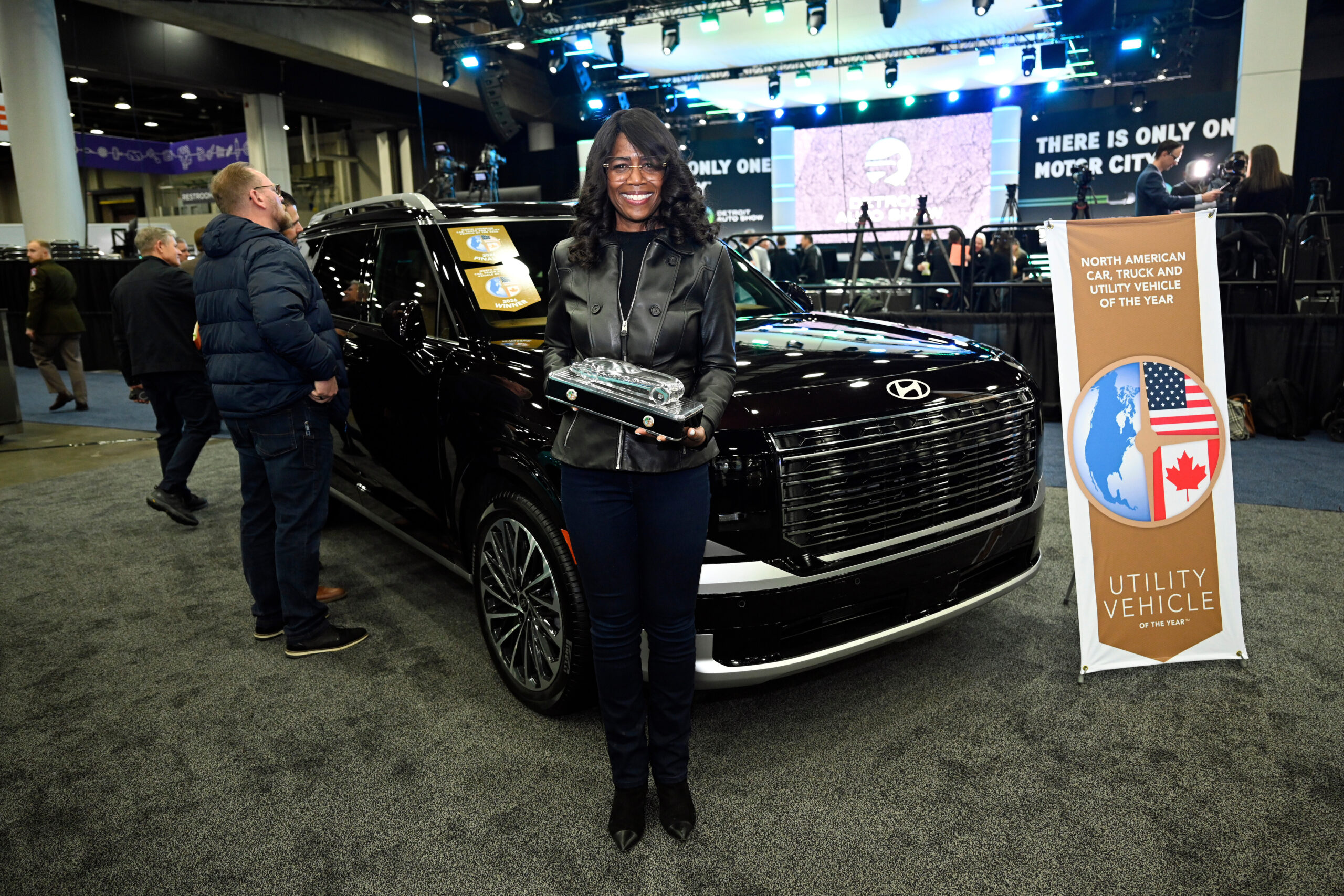
    DETROIT — The Dodge Charger won the 2026 North American Car of the Year award, while the Ford Maverick Lobo took the crown for trucks, and the Hyundai Palisade won the utility award.

    The awards were announced Wednesday morning during an Automotive Press Association event at the start of the North American International Auto Show in Detroit.

    Automakers prize the awards, which are decided by a group of journalists from the U.S. and Canada who evaluate factors such as vehicle innovation, design, performance, driver satisfaction, and more in their decisions.

    Pamela Wylie, Ford Motor Co. vehicle programs director, holds the North American Truck of the Year award in front of the Ford Maverick Lobo.

    The honors are considered a key gauge for how media perceive automakers’ new and redesigned vehicles, and buyers often use them in selecting vehicles for purchase.

    In addition to the winning Dodge Charger midsize car, car finalists included the Honda Prelude hybrid sports coupe and the Nissan Sentra compact car.

    The truck finalists this year included the Ram 1500 Hemi alongside the Ram 2500.

    Olabisi Boyle, Hyundai Motor North America senior vice president for product planning and mobility strategy, with the North American Utility Vehicle of the Year award in front of the Hyundai Palisade.

    The remaining utility finalists were the Lucid Gravity luxury electric vehicle and Nissan Leaf small electric crossover SUV.

    This year’s finalists represented a mix of internal combustion engine, hybrid, and electric vehicles.

  • Actor-director Timothy Busfield turns himself in to face child sex abuse charges in New Mexico

    Actor-director Timothy Busfield turns himself in to face child sex abuse charges in New Mexico

    ALBUQUERQUE, N.M. — Director and Emmy Award-winning actor Timothy Busfield turned himself to authorities on Tuesday to face child sex abuse charges in New Mexico.

    His apprehension comes after authorities in Albuquerque issued a warrant for his arrest on Jan. 9 on two counts of criminal sexual contact of a minor and one count of child abuse. The charges stem from allegations that Busfield inappropriately touched a young boy on the set of the TV series The Cleaning Lady that he was directing.

    Busfield was being booked by Albuquerque police on the charges, said Gilbert Gallegos, spokesperson for the city police department.

    A criminal complaint filed by an investigator with the Albuquerque Police Department says the boy reported that he was 7 years old when Busfield touched him three or four times on private areas over his clothing. Busfield allegedly touched him five or six times on another occasion when he was 8, the complaint said.

    The child was reportedly afraid to tell anyone because Busfield was the director and he feared he would get mad at him, the complaint said.

    The boy’s twin brother told authorities he was touched by Busfield but did not specify where. He said he didn’t say anything because he didn’t want to get in trouble.

    Busfield denied the allegations last fall when interviewed by authorities as part of the investigation, the complaint said. He suggested that the boys’ mother was seeking revenge for her children being replaced on the series. He also said he likely would have picked up and tickled the boys, saying the set was a playful environment.

    Busfield’s attorney did not immediately return a message seeking comment Tuesday. A video obtained by TMZ showed Busfield in front of a window with the Albuquerque skyline in the backdrop. He said he arrived in the city after driving 2,000 miles.

    “I’m going to confront these lies. They’re horrible. They’re all lies,” Busfield said.

    The mother of the twins — who are identified only by their initials in court records — reported to Child Protective Services that the abuse occurred between November 2022 and spring 2024, the complaint said.

    The investigation began in November 2024, when the investigator responded to a call from a doctor at the University of New Mexico Hospital in Albuquerque. The boys’ parents had gone there at the recommendation of a law firm, the complaint said.

    According to the complaint, one of the boys has been diagnosed with post-traumatic stress disorder and anxiety. A social worker documented him saying he has had nightmares about Busfield touching him.

    The Cleaning Lady aired for four seasons on Fox, ending in 2025. The show was produced by Warner Bros., which according to the complaint conducted its own investigation into the abuse allegations but was unable to corroborate them.

    Busfield, who is married to actor Melissa Gilbert, is known for appearances in The West Wing, Field of Dreams, and Thirtysomething, the latter of which won him an Emmy for outstanding supporting actor in a drama series in 1991.

  • Malaysia and Indonesia become the first countries to block Musk’s Grok over sexualized AI images

    Malaysia and Indonesia become the first countries to block Musk’s Grok over sexualized AI images

    KUALA LUMPUR, Malaysia — Malaysia and Indonesia have become the first countries to block Grok, the artificial intelligence chatbot developed by Elon Musk’s company xAI, as concerns grow among global authorities that it is being misused to generate sexually explicit and nonconsensual images.

    There is growing scrutiny of generative AI tools that can produce realistic images, sound, and text, and concern that existing safeguards are failing to prevent their abuse. The Grok chatbot, accessed through Musk’s social media platform X, has been criticized for generating manipulated images, including depictions of women in bikinis or sexually explicit poses, as well as images involving children.

    “The government sees nonconsensual sexual deepfakes as a serious violation of human rights, dignity and the safety of citizens in the digital space,” Indonesian Communication and Digital Affairs Minister Meutya Hafid said in a statement.

    Scrutiny of Grok is growing, including in the European Union, India, France, and the United Kingdom, which said Monday it was moving to criminalize “nudification apps.” Britain’s media regulator also launched an investigation into whether Grok broke the law by allowing users to share sexualized images of children.

    Last week, Grok limited image generation and editing to paying users following a global backlash over sexualized deepfakes of people, but critics say it didn’t fully address the problem.

    An emailed request for comment by the Associated Press to xAI resulted in an automated reply from the media support address which stated, “Legacy Media Lies.” This was the same message received from a different address when asked for comment regarding the global backlash.

    Asian action aimed at Grok

    Regulators in the two Southeast Asian nations said existing controls weren’t preventing the creation and spread of fake pornographic content, particularly involving women and minors. Indonesia’s government temporarily blocked access to Grok on Saturday, followed by Malaysia on Sunday.

    Initial findings showed Grok lacks effective safeguards to stop users from creating and distributing pornographic content based on real photos of Indonesian residents, Alexander Sabar, director-general of digital space supervision, said in a statement. He said such practices risk violating privacy and image rights when photos are manipulated or shared without consent.

    The Malaysian Communications and Multimedia Commission noted “repeated misuse” of the tool to generate obscene, sexually explicit, and nonconsensual manipulated images, including content involving women and minors.

    The regulator said notices were issued this month to X Corp. and xAI demanding stronger safeguards.

    “The restriction is imposed as a preventive and proportionate measure while legal and regulatory processes are ongoing,” it said, adding that access will remain blocked until effective safeguards are put in place.

    Investigation launched in U.K.

    Launched in 2023, Grok is free to use on X. An image generator feature, Grok Imagine, was added last year and included a so-called spicy mode that can generate adult content.

    The U.K.’s media regulator said it launched an investigation into whether Grok violated its duty to protect people from illegal content. The regulator, Ofcom, said Grok-generated images of children being sexualized or people being undressed may amount to pornography or child sexual abuse material.

    Technology Secretary Liz Kendall called the AI-generated images “weapons of abuse” and said the center-left Labour government would target the source of the problem by making it a crime for companies to supply tools to create nude images without consent.

    Kendall said X could face a possible Ofcom fine of up to 10% of its qualifying global revenue depending on the investigation’s outcome and a possible court order blocking access to the site.

    “They can choose to act sooner to ensure this abhorrent and illegal material cannot be shared on their platform,” Kendall said in Parliament.

    Musk over the weekend called the British government “fascist” and said it is trying stifle free speech.

  • Long story short: ‘Joe Dirt’ tribute takes top prize in mullet contest

    Long story short: ‘Joe Dirt’ tribute takes top prize in mullet contest

    HARRISBURG — A packed crowd celebrated the much-maligned but enduring mullet hairstyle Monday in a contest at the Pennsylvania Farm Show in Harrisburg.

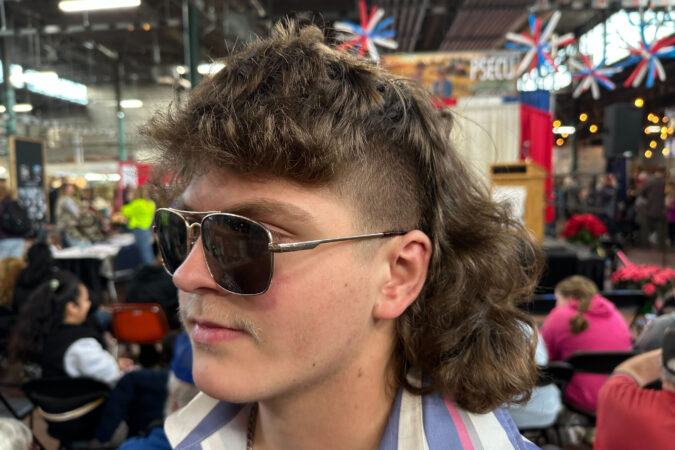
    The short-in-the-front, long-in-the-back coiffure, once the province of Canadian hockey players and hair metal bands, attracted about 150 competitors and more than a thousand spectators for the day’s “mane” attraction.

    The top award, in the form of the rear bumper of a Corvette, went to 10-year-old Drew Fleschut of Dallas, Luzerne County — who wore a red-and-black shirt in an homage to movie character Joe Dirt and carried Joe’s trademark mop.

    Contestants were evaluated for the style of their cut, any props or accessories, their presentation and their overall sense of commitment, said judge Brittany Goldberg.

    “This is for fun,” said Goldberg, owner of Heavy Metal Hair Salon in Philadelphia. “It’s about the camaraderie and everyone having a laugh and a good time.”

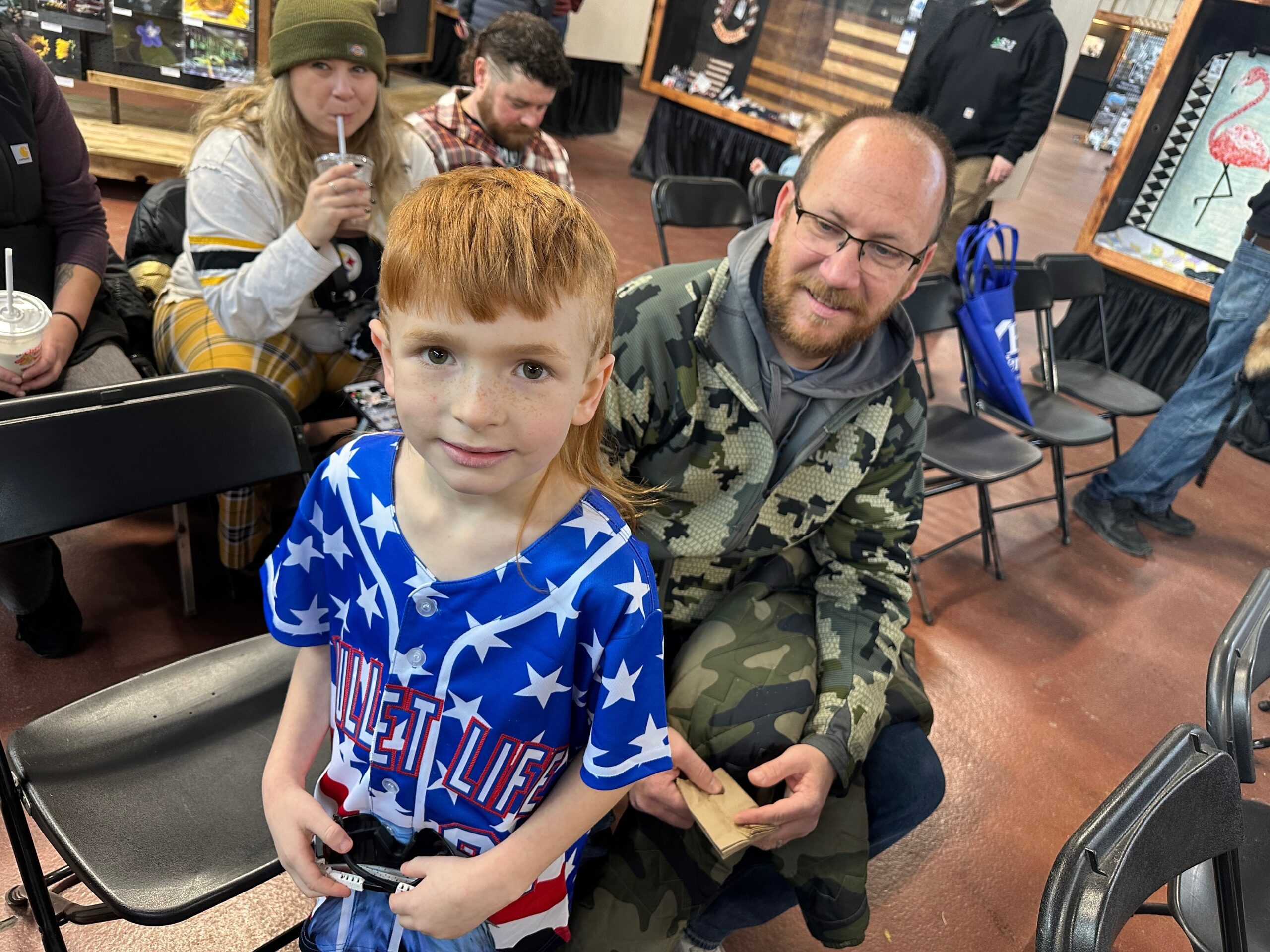
    Ben Barley, a 7-year-old first grader from Red Lion, Pa., waits with his father, Robert Barley, for the start of a mullet judging contest at the Pennsylvania Farm Show in Harrisburg on Monday.

    There were magic tricks, customized T-shirts, and even a “skullet” — a mullet sported by a balding man. One kid didn’t want to leave the stage. Another took the occasion to pick his nose. Some danced the worm, some dabbed, and a few ripped off their shirts, pro-wrestling style.

    Brittni Williamson of Harvey’s Lake brought along her 3-year-old son Mason, who ended up with a mullet when the hair on the back of his head grew more quickly than the rest of his hair when he was a baby.

    “We just clean it up in the front and keep the party going,” Williamson said. Mason didn’t win, but he did get to accomplish his New Year’s resolution by feeding a cow.

    Ben Barley, 7, of Red Lion arrived at the event wearing a T-shirt featuring his name and the words “MULLET LIFE 6-7,” a nod to both his hairstyle and the bafflingly popular youth catchphrase. He said he’d been working on his mullet for two years.

    Kyle Wertman said he was inspired to go with a mullet while watching old professional wrestling footage of Hacksaw Jim Duggan. He gets a lot of comments about it in his hometown of Murrysville.

    “They like to fluff the curls in the back, ‘Look at this thing, it’s got a mind of its own,’” said Wertman, 43, who works in sales and service of industrial air compressors.

    It’s taken Lancaster resident Brayden Shaner, 14, about four years to grow his mullet, which was good enough for third-place in the teenager category.

    “I like it because it’s different,” he said. “You don’t see, walking through the grocery store, people with a mullet. I think the girls like it.”

    Though mullets likely have been around longer than there have been barbers, the Oxford English Dictionary cites hip-hop legends the Beastie Boys for helping popularize the term mullet with the song “Mullet Head” on their 1994 recording, Ill Communication. As the venerable dictionary notes, it’s a term that is slang, humorous “and frequently derogatory.”

    The contest, in its third year, is one of the few at the Pennsylvania Farm Show open to people who live outside the state.

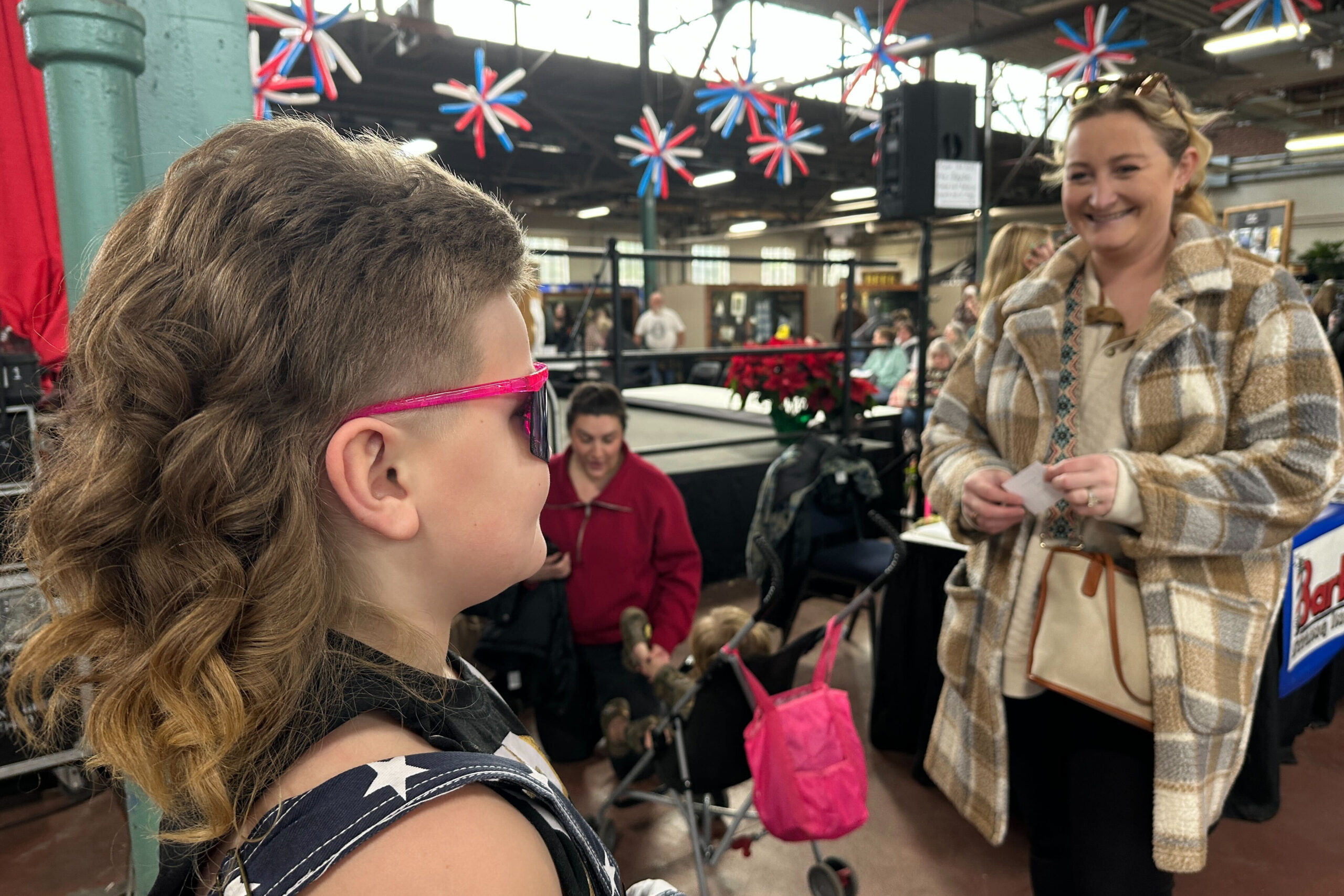
    Meredith Nelson smiles at her son, “Mikey Mullet,” an 8-year old-contestant from South Jersey in Monday’s hairstyle contest at the Pennsylvania Farm Show.
  • Erich von Däniken, Swiss writer who spawned alien archaeology, has died at 90

    Erich von Däniken, Swiss writer who spawned alien archaeology, has died at 90

    BERLIN — Erich von Däniken, the Swiss author whose best-selling books about the extraterrestrial origins of ancient civilizations brought him fame among paranormal enthusiasts and scorn from the scientific community, has died. He was 90.

    Von Däniken’s representatives announced on his website on Sunday that he had died the previous day in a hospital in central Switzerland.

    Von Däniken rose to prominence in 1968 with the publication of his first book Chariots of the Gods, in which he claimed that the Mayans and ancient Egyptians were visited by alien astronauts and instructed in advanced technology that allowed them to build giant pyramids.

    The book fueled a growing interest in unexplained phenomena at a time when thanks to conventional science humankind was about to take its first steps on the Moon.

    Chariots of the Gods was followed by more than two dozen similar books, spawning a literary niche in which fact and fantasy were mixed together against all historical and scientific evidence.

    Public broadcaster SRF reported that altogether almost 70 million copies of his books were sold in more than 30 languages, making him one of the most widely read Swiss authors.

    While von Däniken managed to shrug off his many critics, the former hotel waiter had a troubled relationship with money throughout his life and frequently came close to financial ruin.

    Born in 1935, the son of a clothing manufacturer in the northern Swiss town of Schaffhausen, von Däniken is said to have rebelled against his father’s strict Catholicism and the priests who instructed him at boarding school by developing his own alternatives to the biblical account of the origins of life.

    After leaving school in 1954, von Däniken worked as a waiter and barkeeper for several years, during which he was repeatedly accused of fraud and served a couple of short stints in prison.

    In 1964, he was appointed manager of a hotel in the exclusive resort town of Davos and began writing his first book. Its publication and rapid commercial success were quickly followed by accusations of tax dodging and financial impropriety, for which he again spent time behind bars.

    By the time he left prison, Chariots of the Gods was earning von Däniken a fortune and a second book, Gods from Outer Space, was ready for publication, allowing him to commit himself to his paranormal passion and travel the world in search of new mysteries to uncover.

    Throughout the 1970s von Däniken undertook countless field trips to Egypt, India, and above all Latin America, whose ancient cultures held a particular fascination for the amateur archaeologist.

    He lectured widely and set up societies devoted to promoting his theories, later pioneering the use of video and multimedia to reach out to ever-larger audiences hungry for a different account of history.

    No amount of criticism dissuaded him and his fans from believing that Earth has been visited repeatedly by beings from outer space, and will be again in the future.

    In 1991 von Däniken gained the damning accolade of being the first recipient of the “Ig Nobel” prize for literature — for raising the public awareness of science through questionable experiments or claims.

    Even when confronted with fabricated evidence in a British television documentary — supposedly ancient pots were shown to be almost new — von Däniken insisted that, minor discrepancies aside, his theories were essentially sound.

    In 1985 von Däniken wrote Neue Erinnerungen an die ZukunftNew Memories of the Future — ostensibly to address his many critics: “I have admitted (my mistakes), but not one of the foundations of my theories has yet been brought down.”

    Although his popularity was waning in the English-speaking world by the 1980s, von Däniken’s books and films influenced a wave of semi-serious archaeological documentaries and numerous popular television shows, including The X-Files, which featured two FBI agents tasked with solving paranormal mysteries.

    His last major venture, a theme park based on his books, failed after just a few years due to lack of interest. The Mystery Park still stands, its human-made pyramids and otherworldly domes rotting as tourists prefer to explore the charms of the nearby town of Interlaken and the imposing Swiss Alps that surround it.

    Erich von Däniken is survived by his wife of 65 years, Elisabeth Skaja, daughter Cornelia, and two grandchildren.

  • Retouched images of Netanyahu’s wife, distributed by the state, ignite a fiery ethics debate

    Retouched images of Netanyahu’s wife, distributed by the state, ignite a fiery ethics debate

    JERUSALEM — The photos seemed destined for posterity in Israel’s state archives.

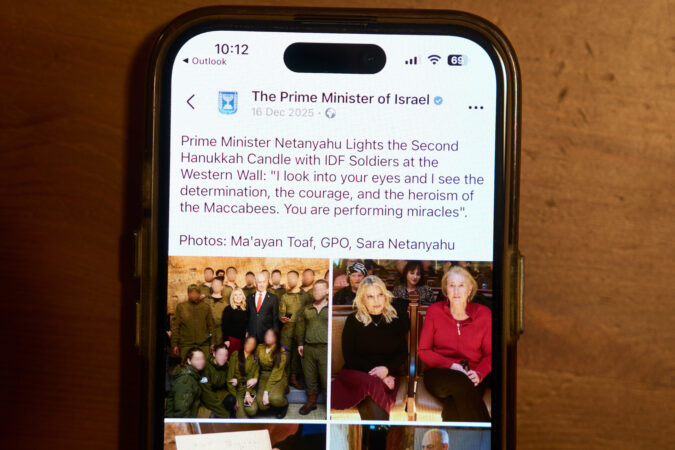
    In the snapshots, Prime Minister Benjamin Netanyahu is joined by his wife, Sara, as well as U.S. Ambassador Mike Huckabee and a group of Israeli soldiers, as they light Hannukah candles at Western Wall, the holiest site where Jews pray. The leaders exchange triumphant looks.

    But something is off.

    Sara Netanyahu’s skin is poreless, her eyes overly defined and her hair perfectly coiffed — a look officials acknowledge is the result of heavy retouching.

    Critics say the issue isn’t the use of photo-editing software, which is common on the social media accounts of celebrities and public figures. They say it’s the circulation of the images in official government announcements, which distorts reality, violates ethical codes, and risks compromising official archiving and record-keeping efforts.

    “All the pictures to this day in the archives in Israel are authentic pictures of reality as it was captured by the lenses of photographers’ cameras since the establishment of the state,” said Shabi Gatenio, the veteran political journalist who broke the story in the Seventh Eye, an Israeli site that covers local media. “These images, if entered into the database, will forever infect it with a virtual reality that never existed.”

    Since the manipulation of images was revealed, the government has taken the unprecedented step of crediting Sara Netanyahu in its releases that include manipulated images. And it’s not clear if the official archive will include images of her taken during the second half of last year, when Gatenio said the editing appears to have begun.

    Mrs. Netanyahu’s personal spokesperson did not respond to a request for comment.

    Nitzan Chen, director of the Government Press Office, told the Associated Press that images of the prime minister are never manipulated and that his office would not upload any retouched photos to the official archive.

    Personal Photoshop habit enters political realm

    Sara Netanyahu, 67, has long used photo-editing software on her images. Her social media account is filled with images in which her face appears heavily retouched.

    But the topic raised eyebrows since her Photoshop habit entered the public record.

    Gatenio said he first noticed this last July, when the couple visited President Donald Trump in Washington, D.C., and again in September, as Sara Netanyahu joined her husband on the tarmac ahead of a trip to New York for the U.N. General Assembly.

    At the time, the prime minister’s office released a video of the send-off along with a photo, credited to Avi Ohayon, an official government photographer.

    Comparing the photo to the raw video, Hany Farid, a digital forensics expert at the University of California, Berkeley, said the image had been post-processed, bearing local manipulations to smooth her skin and remove wrinkles.

    Since then, photos showing Mrs. Netanyahu meeting with Vice President JD Vance and his wife, Usha, in Washington also appear to have been retouched, Farid said.

    “There’s been some Photoshop editing to — let’s call it — ‘beautify,’ lighten, smooth the face,” Farid said.

    “Is it nefarious? No. Is it a problem? Yes. This is about something bigger than, ‘she Photoshopped her face to make herself look younger.’ This is about trust. Why should I trust any official photo coming out of that administration?”

    Chen, the head of the Government Press Office, said office lawyers are trying to determine how to handle and properly identify photos “processed by people other than GPO photographers.”

    He said the Justice Ministry is also examining the “criteria, limitations, and possibilities” of the edited images, though he stressed there is nothing illegal about touching up photos. The issue, he said, is being transparent when such changes are made.

    For now, the Prime Minister’s Office has decided to add Sara Netanyahu’s name to press releases that include retouched images. Since November, press releases showing photos of her smiling next to Trump and the family of the last hostage in Gaza in Washington, visiting a Miami synagogue, and attending a funeral for an Israeli mayor have included this label.

    At least one outlet, the Times of Israel, has said it will no longer carry official state photos that appear to have been manipulated. The Associated Press does not publish images that appear to have been retouched or digitally manipulated.

    A broader phenomenon

    Chen said the prime minister is never edited: “No Photoshop, no corrections, no color. Nothing.”

    While his face may not be retouched, the prime minister’s official Instagram account tells another story.

    The page has posted a bevy of content that appears to be AI-edited or generated, including a picture of the couple with Trump and first lady Melania Trump celebrating the new year in Washington.

    The photo raised suspicions in Israel because it shows Sara Netanyahu wearing a black dress absent from other photos of the event, where she wore a dark red frock. Appearing in the sky above the couples are brightly colored fireworks and American and Israeli flags that Farid said were “almost certainly” generated by AI.

    It is now marked with a tag on Instagram indicating that it may have been altered or generated using AI. It is not clear when the tag was added nor by whom.

    Netanyahu is not alone. Many world figures, including Trump, frequently use AI-generated image manipulation in their public output.

    Tehilla Shwartz Altshuler, who runs the Democracy in the Digital Age Program at the Israel Democracy Institute, a Jerusalem think tank, called it “part of the populist playbook” and said there was “no question” that Netanyahu was emulating how Trump uses the technology.

    Netanyahu’s official Instagram has posted video of Trump and Netanyahu in a B-2 bomber that appears entirely AI-generated. It is captioned “on our victory lap,” referencing the joint Israel-U.S. attacks on Iran last year.

    “This is exactly what Netanyahu and his surrounding circle have tried to do for many years,” she said. “Presenting himself as a superhero, his wife as a supermodel, their family as a super loyal family. Even when it wasn’t the case, even at the expense of actual political work, administrative work, and social work.”

    She said Israel has reached a critical point in official government record-keeping and communications.

    “The question of archiving the truth, archiving history, will be one of the questions of our time.”

  • Grateful Dead founding member Bob Weir has died at 78

    Grateful Dead founding member Bob Weir has died at 78

    LOS ANGELES — Bob Weir, the guitarist and singer who as an essential member of the Grateful Dead helped found the sound of the San Francisco counterculture of the 1960s and kept it alive through decades of endless tours and marathon jams, has died. He was 78.

    Mr. Weir’s death was announced Saturday in a statement on his Instagram page.

    “It is with profound sadness that we share the passing of Bobby Weir,” a statement on his Instagram posted Saturday said. “He transitioned peacefully, surrounded by loved ones, after courageously beating cancer as only Bobby could. Unfortunately, he succumbed to underlying lung issues.”

    The statement did not say where or when Mr. Weir died, but he lived in the San Francisco Bay Area for most of his life.

    Mr. Weir joined the Grateful Dead — originally the Warlocks — in 1965 in San Francisco at just 17 years old. He would spend the next 30 years playing on endless tours with the Grateful Dead alongside fellow singer and guitarist Jerry Garcia, who died in 1995.

    Mr. Weir wrote or co-wrote and sang lead vocals on Dead classics including “Sugar Magnolia,” “One More Saturday Night,” and “Mexicali Blues.”

    After Garcia’s death, he would be the Dead’s most recognizable face. In the decades since, he kept playing with other projects that kept alive the band’s music and legendary fan base, including Dead & Company.

    The Dead were beloved in Philadelphia. “Only sports teams have played the Spectrum more than the Grateful Dead,” Inquirer music critic Dan DeLuca wrote when the band played its last concert at the now-demolished arena on May 2, 2009. DeLuca wrote that the Dead had sold out the arena more than 50 times.

    “For over sixty years, Bobby took to the road,” the Instagram statement said. “A guitarist, vocalist, storyteller, and founding member of the Grateful Dead. Bobby will forever be a guiding force whose unique artistry reshaped American music.”

    Mr. Weir’s death leaves drummer Bill Kreutzmann as the only surviving original member. Founding bassist Phil Lesh died in 2024. The band’s other drummer, Mickey Hart, practically an original member since joining in 1967, is also alive at 82. The fifth founding member, Ron “Pigpen” McKernan, died in 1973.

    Dead and Company played a series of concerts for the Grateful Dead’s 60th anniversary in July at Golden Gate Park in San Francisco, drawing some 60,000 fans a day for three days.

    Born in San Francisco and raised in nearby Atherton, Mr. Weir was the Dead’s youngest member and looked like a fresh-faced high schooler in its early years. He was generally less shaggy than the rest of the band, but he had a long beard like Garcia’s in later years.

    The band would survive long past the hippie moment of its birth, with its ultra-devoted fans known as Deadheads often following them on the road in a virtually nonstop tour that persisted despite decades of music and culture shifting around them.

    “Longevity was never a major concern of ours,” Mr. Weir said when the Dead got the Grammys’ MusiCares Person of the Year honor last year. “Spreading joy through the music was all we ever really had in mind, and we got plenty of that done.”

    Ubiquitous bumper stickers and T-shirts showed the band’s skull logo, the dancing, colored bears that served as their other symbol, and signature phrases like “ain’t no time to hate” and “not all who wander are lost.”

    The Dead won few actual Grammys during their career — they were always a little too esoteric — getting only a lifetime achievement award in 2007 and the best music film award in 2018.

    Just as rare were hit pop singles. “Touch of Grey,” the 1987 song that brought a big surge in the aging band’s popularity, was their only Billboard Top 10 hit.

    But in 2024, they set a record for all artists with their 59th album in Billboard’s Top 40. Forty-one of those came since 2012, thanks to the popularity of the series of archival albums compiled by David Lemieux.

    Their music — called acid rock at its inception — would pull in blues, jazz, country, folk, and psychedelia in long improvisational jams at their concerts.

    “I venture to say they are the great American band,” TV personality and devoted Deadhead Andy Cohen said as host of the MusiCares event. “What a wonder they are.”

  • Washington National Opera bows out of Kennedy Center

    Washington National Opera bows out of Kennedy Center

    WASHINGTON — The Washington National Opera announced Friday that it had decided to end its arrangement with the Kennedy Center in the nation’s capital, though it said it was hoping for an “amicable transition.”

    “To ensure fiscal prudence and fulfill its obligations for a balanced budget, the WNO will reduce its spring season and relocate performances to new venues,” the Opera said in a statement.

    It said the decision stemmed from the Center’s new business model, which “requires productions to be fully funded in advance — a requirement incompatible with opera operations.”

    Kennedy Center spokesperson Roma Daravi told The New York Times, “After careful consideration, we have made the difficult decision to part ways with the WNO due to a financially challenging relationship.”

    Artists ranging from Hamilton creator Lin-Manuel Miranda to rock star Peter Wolf have called off events at the Kennedy Center since President Donald Trump ousted the previous leadership early last year and arranged for himself to head the board of trustees. The board’s decision in December to rebrand the venue the Trump-Kennedy Center led to a new wave of cancellations.

    WNO’s announcement did not mention Trump.