Category: Nation World News Wires

  • Trump’s handpicked board votes to rename Washington performing arts center the Trump Kennedy Center

    Trump’s handpicked board votes to rename Washington performing arts center the Trump Kennedy Center

    WASHINGTON — President Donald Trump’s handpicked board voted Thursday to rename Washington’s leading performing arts center as the Trump Kennedy Center, the White House said, in a move that made Democrats fume, saying the board had overstepped its legal authority.

    Congress named the center after President John F. Kennedy in 1964, after his assassination. Donald A. Ritchie, who served as Senate historian from 2009-2015, said that because Congress had first named the center it would be up to Congress to “amend the law.”

    Ritchie said that while Trump and others can “informally” refer to the center by a different name, they couldn’t do it in a way “that would [legally] stick.”

    But the board did not wait for that debate to play out, immediately changing the branding on its website to reflect the new name.

    House Democratic leader Hakeem Jeffries told reporters that legislative action was needed, “and we’re going to make that clear.” The New York Democrat is an ex officio member of the board because of his position in Congress.

    Trump has teased the name change for some time

    “The Kennedy Center Board of Trustees voted unanimously today to name the institution The Donald J. Trump and The John F. Kennedy Memorial Center for the Performing Arts,” said Roma Daravi, the institution’s vice president for public relations.

    She said the vote recognized that Trump saved the center from “financial ruin and physical destruction,” a pair of claims denied by the venue’s ousted leadership.

    “The new Trump Kennedy Center reflects the unequivocal bipartisan support for America’s cultural center for generations to come,” Daravi said.

    Press secretary Karoline Leavitt announced the vote on social media, attributing it to the “unbelievable work President Trump has done over the last year in saving the building. Not only from the standpoint of its reconstruction, but also financially, and its reputation.”

    Trump, a Republican who’s chairman of the board, said at the White House that he was “surprised” and “honored” by the vote.

    “The board is a very distinguished board, most distinguished people in the country and I was surprised by it and I was honored by it,” he said.

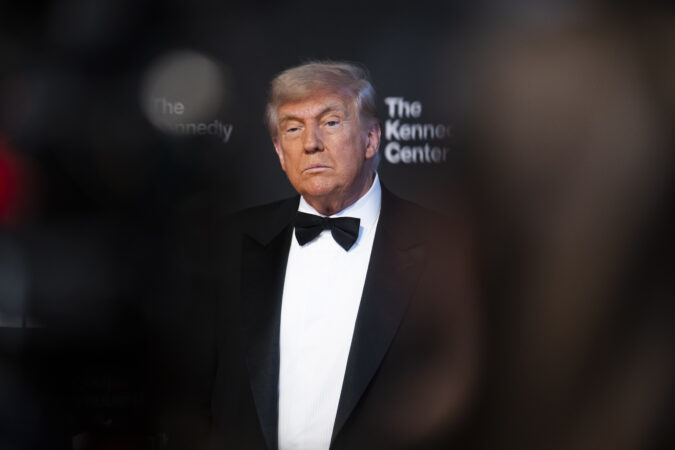
    Trump had already been referring to the center as the “Trump Kennedy Center.” Asked Dec. 7 as he walked the red carpet for the Kennedy Center Honors program whether he would rename the venue after himself, Trump said such a decision would be up to the board.

    Earlier this month, Trump talked about a “big event” happening at the “Trump Kennedy Center” before saying, “excuse me, at the Kennedy Center,” as his audience laughed. He was referring to the FIFA World Cup soccer draw for 2026, in which he participated.

    A name change won’t sit well with some Kennedy family members.

    Maria Shriver, a niece of John F. Kennedy, referred to the legislation introduced in Congress to rebrand the Kennedy Center as the Donald J. Trump Center for the Performing Arts as “insane” in a social media post in July.

    “It makes my blood boil. It’s so ridiculous, so petty, so small minded,” she wrote. “Truly, what is this about? It’s always about something. ‘Let’s get rid of the Rose Garden. Let’s rename the Kennedy Center.’ What’s next?”

    Trump earlier this year turned the Kennedy-era Rose Garden at the White House into a patio by removing the lawn and laying down paving stones.

    Another Kennedy family member, Robert F. Kennedy Jr., serves in Trump’s cabinet as secretary of the Department of Health and Human Services.

    Trump showed scant interest in the Kennedy Center during his first term as president, but since returning to office in January he has replaced board members appointed by Democratic presidents with some of his most ardent supporters, who then elected him as board chairman.

    He also has criticized the center’s programming and its physical appearance and has vowed to overhaul both.

    Trump secured more than $250 million from the Republican-controlled Congress for renovations of the building.

    He attended opening night of the musical Les Misérables, and last week he served as host of the Kennedy Center Honors program after not attending the show during his first term as president. The awards program is scheduled to be broadcast by CBS and Paramount+ on Dec. 23.

    Sales of subscription packages are said to have declined since Trump’s takeover of the center, and several touring productions, including Hamilton, have canceled planned runs there. Rows upon rows of empty seats have been seen in the Concert Hall during performances by the National Symphony Orchestra.

    Some performers, including actor Issa Rae and musician Rhiannon Giddens, have scrapped scheduled appearances, and Kennedy Center consultants including musician Ben Folds and singer Renée Fleming have resigned.

  • House Democrats release more photos from Epstein’s estate

    House Democrats release more photos from Epstein’s estate

    WASHINGTON — House Democrats released several dozen more photos Thursday from the estate of the convicted sex offender Jeffrey Epstein, showing his associations with the rich and famous, as the Department of Justice faces a deadline to release many of its case files on the late financier by the end of the week.

    The photos released Thursday were among more than 95,000 that the House Oversight Committee has received after issuing a subpoena for the photos that Epstein had in his possession before he died in a New York jail cell in 2019. Congress has also passed, and President Donald Trump has signed, a law requiring the Justice Department to release its case files on Epstein, and his longtime girlfriend and confidant Ghislaine Maxwell, by Friday. Anticipation about what those files will show is running high after they have been the subject of conspiracy theories and speculation about his friendships with Trump, former President Bill Clinton, the former Prince Andrew, and others.

    House Democrats have already released dozens of photos from Epstein’s estate showing Trump, Clinton and Andrew, who lost his royal title and privileges this year amid scrutiny of his relationship with the wealthy financier. The photos released Thursday showed Epstein cooking with Sultan Ahmed bin Sulayem, an Emirati businessman. The photos also include the billionaire Bill Gates and images of a 2011 dinner of notable people and wealthy philanthropists hosted by a nonprofit group. The committee made no accusations of wrongdoing by the men in the photos.

    There were also images of passports, visas and identification cards from Russia, the Czech Republic, Ukraine, South Africa, and Lithuania with personally identifying information redacted, as well as photos of Epstein with women or girls whose faces were blacked out. The committee has said it is redacting information from the photos that may lead to the identity of victims being revealed.

    Rep. Robert Garcia, the top Democrat on the oversight panel, said in a statement that the “new images raise more questions about what exactly the Department of Justice has in its possession. We must end this White House cover-up, and the DOJ must release the Epstein files now.”

  • Police are investigating link between Brown shooting and killing of MIT professor, AP sources say

    Police are investigating link between Brown shooting and killing of MIT professor, AP sources say

    PROVIDENCE, R.I. — Authorities said Thursday that they’re looking into a connection between last weekend’s mass shooting at Brown University and one two days later near Boston that killed a professor at another elite school, the Massachusetts Institute of Technology.

    That is according to three people familiar with the matter who were not authorized to discuss an ongoing investigation and spoke on condition of anonymity. Two of the people said investigators had identified a person of interest in the shootings and were actively seeking that individual.

    The attacker at Brown on Saturday killed two students and wounded nine others in a classroom in the school’s engineering building before getting away.

    About 50 miles north, MIT professor Nuno F.G. Loureiro was gunned down in his home Monday night in the Boston suburb of Brookline. The 47-year-old physicist and fusion scientist died at a hospital the next day.

    The FBI previously said it knew of no links between the cases.

    This undated photo provided by the Massachusetts Institute of Technology in December 2025 shows Nuno Loureiro.

    How is the Brown investigation going?

    It’s been nearly a week since the shooting at Brown. There have been other high-profile attacks in which it took days or longer to make an arrest or find those responsible, including in the brazen New York City sidewalk killing of UnitedHealthcare’s CEO last year, which took five days.

    But frustration is mounting in Providence that the person behind the attack managed to get away and that a clear image of their face has yet to emerge.

    “There’s no discouragement among people who understand that not every case can be solved quickly,” the state attorney general, Peter Neronha, said at a news conference Wednesday.

    Authorities have scoured the area for evidence and pleaded with the public to check any phone or security footage they might have from the week before the attack, believing the shooter might have cased the scene ahead of time.

    Investigators have released several videos from the hours and minutes before and after the shooting that show a person who, according to police, matches witnesses’ description of the shooter. In the clips, the person is standing, walking and even running along streets just off campus, but always with a mask on or their head turned.

    Although Brown officials say there are 1,200 cameras on campus, the attack happened in an older part of the engineering building that has few, if any, cameras. And investigators believe the shooter entered and left through a door that faces a residential street bordering campus, which might explain why the cameras Brown does have didn’t capture footage of the person.

    Providence Mayor Brett Smiley said Wednesday that the city is doing “everything possible” to keep residents safe. However, he acknowledged that it is “a scary time in the city” and that families likely were having tough conversations about whether to stay in town over the holidays.

    “We are doing everything we can to reassure folks, to provide comfort, and that is the best answer I can give to that difficult question,” Smiley said when asked if the city was safe.

    What can be learned from past investigations?

    Although it’s not unheard of for someone to disappear after carrying out such a high-profile shooting, it is rare.

    In such targeted and highly public attacks, the shooters typically kill themselves or are killed or arrested by police, said Katherine Schweit, a retired FBI agent and expert on mass shootings. When they do get away, searches can take time.

    “The best they can do is what they do now, which is continue to press together all of the facts they have as fast as they can,” she said. “And, really, the best hope for solutions is going to come from the public.”

    In the 2013 Boston Marathon bombing, it took investigators four days to catch up to the two brothers who carried it out. In a 2023 case, Army reservist Robert Card was found dead of an apparent suicide two days after he killed 18 people and wounded 13 others in Lewiston, Maine.

    The man accused of killing conservative political figure Charlie Kirk in September turned himself in about a day and a half after the attack on Utah Valley University’s campus. And Luigi Mangione, who has pleaded not guilty to murder charges in the killing of UnitedHealthcare CEO Brian Thompson in Manhattan last year, was arrested five days later at a McDonald’s in Altoona, Pa.

    Felipe Rodriguez, a retired New York police detective sergeant and adjunct professor at the John Jay College of Criminal Justice, said it’s clear that shooters are learning from others who were caught.

    “Most of the time an active shooter is going to go in, and he’s going to try to commit what we call maximum carnage, maximum damage,” Rodriguez said. “And at this point, they’re actually trying to get away. And they’re actually evading police with an effective methodology, which I haven’t seen before.”

    Investigators have described the person they are seeking as about 5 feet, 8 inches tall and stocky. The attacker’s motives remain a mystery, but authorities said Wednesday that none of the evidence suggests a specific person was being targeted.

    MIT mourns the loss of an esteemed professor

    Loureiro, who was married, joined MIT in 2016 and was named last year to lead the school’s Plasma Science and Fusion Center, where he worked to advance clean energy technology and other research. The center, one of MITl’s largest labs, had more than 250 people working across seven buildings when he took the helm. He was a professor of physics and nuclear science and engineering.

    He grew up in Viseu, in central Portugal, and studied in Lisbon before earning a doctorate in London, according to MIT. He was a researcher at an institute for nuclear fusion in Lisbon before joining MIT, the university said.

    “He shone a bright light as a mentor, friend, teacher, colleague and leader, and was universally admired for his articulate, compassionate manner,” Dennis Whyte, an engineering professor who previously led MIT’s Plasma Science and Fusion Center, told a campus publication.

    Loureiro had said he hoped his work would shape the future.

    “It’s not hyperbole to say MIT is where you go to find solutions to humanity’s biggest problems,” Loureiro said when he was named to lead the plasma science lab last year. “Fusion energy will change the course of human history.”

  • U.S. announces massive package of arms sales to Taiwan valued at more than $10 billion, angering China

    U.S. announces massive package of arms sales to Taiwan valued at more than $10 billion, angering China

    WASHINGTON — President Donald Trump’s administration has announced a massive package of arms sales to Taiwan valued at more than $10 billion that includes medium-range missiles, howitzers, and drones, drawing an angry response from China.

    The State Department announced the sales late Wednesday during a nationally televised address by the Republican president, who made scant mention of foreign policy issues and did not speak about China or Taiwan. U.S.-Chinese tensions have ebbed and flowed during Trump’s second term, largely over trade and tariffs but also over China’s increasing aggressiveness toward Taiwan, which Beijing has said must reunify with the mainland.

    If approved by Congress, it would be the largest-ever U.S. weapons package to Taiwan, exceeding the total amount of $8.4 billion in U.S. arms sales to Taiwan during President Joe Biden’s Democratic administration.

    The eight arms sales agreements announced Wednesday cover 82 high-mobility artillery rocket systems, or HIMARS, and 420 Army Tactical Missile Systems, or ATACMS — similar to what the U.S. had been providing Ukraine during the Biden administration to defend itself from Russia — worth more than $4 billion. They also include 60 self-propelled howitzer systems and related equipment worth more than $4 billion and drones valued at more than $1 billion.

    Other sales in the package include military software valued at more than $1 billion, Javelin and TOW missiles worth more than $700 million, helicopter spare parts worth $96 million, and refurbishment kits for Harpoon missiles worth $91 million.

    The eight sales agreements amount to $11.15 billion, according to Taiwan’s Defense Ministry.

    The State Department said the sales serve “U.S. national, economic, and security interests by supporting the recipient’s continuing efforts to modernize its armed forces and to maintain a credible defensive capability.”

    “The proposed sale(s) will help improve the security of the recipient and assist in maintaining political stability, military balance, and economic progress in the region,” the statements said.

    China’s Foreign Ministry attacked the move, saying it would violate diplomatic agreements between China and the U.S.; gravely harm China’s sovereignty, security and territorial integrity; and undermine regional stability.

    “The ‘Taiwan independence’ forces on the island seek independence through force and resist reunification through force, squandering the hard-earned money of the people to purchase weapons at the cost of turning Taiwan into a powder keg,” said Foreign Ministry spokesperson Guo Jiakun.

    “This cannot save the doomed fate of ‘Taiwan independence’ but will only accelerate the push of the Taiwan Strait toward a dangerous situation of military confrontation and war. The U.S. support for ‘Taiwan Independence’ through arms will only end up backfiring. Using Taiwan to contain China will not succeed,” he added.

    Under federal law, the U.S. is obligated to assist Taiwan with its self-defense, a point that has become increasingly contentious with China, which has vowed to take Taiwan by force, if necessary.

    Taiwan’s Defense Ministry in a statement Thursday expressed gratitude to the U.S. over the arms sale, which it said would help Taiwan maintain “sufficient self-defense capabilities” and bring strong deterrent capabilities. Taiwan’s bolstering of its defense “is the foundation for maintaining regional peace and stability,” the ministry said.

    Taiwan’s Foreign Minister Lin Chia-lung similarly thanked the U.S. for its “long-term support for regional security and Taiwan’s self-defense capabilities,” which he said are key for deterring a conflict in the Taiwan Strait, the body of water separating Taiwan from China’s mainland.

    The arms sale comes as Taiwan’s government has pledged to raise defense spending to 3.3% of the island’s gross domestic product next year and to reach 5% by 2030. The boost came after Trump and the Pentagon requested that Taiwan spend as much as 10% of its GDP on its defense, a percentage well above what the U.S. or any of its major allies spend on defense. The demand has faced pushback from Taiwan’s opposition KMT party and some of its population.

    Taiwanese President Lai Ching-te last month announced a special $40 billion budget for arms purchases, including to build an air defense system with high-level detection and interception capabilities called Taiwan Dome. The budget will be allocated over eight years, from 2026 to 2033.

    The U.S. boost in military assistance to Taiwan was previewed in legislation adopted by Congress that Trump is expected to sign shortly.

    Last week, the Chinese embassy in Washington denounced the legislation, known as the National Defense Authorization Act, saying it unfairly targeted China as an aggressor. The U.S. Senate passed the bill Wednesday.

  • Brian Walshe is sentenced to life in prison for the murder of his wife, whose body was never found

    Brian Walshe is sentenced to life in prison for the murder of his wife, whose body was never found

    BOSTON — A Boston-area man was sentenced Thursday to life in prison for the grisly murder of his wife, who disappeared nearly three years ago and whose body has never been found.

    Brian Walshe, 50, was convicted Monday of first-degree murder in the killing of Ana Walshe, 39. The sentence carries no possibility of parole.

    He pleaded guilty in November to misleading police and illegally disposing of a body after admitting he had dismembered her body and disposed of it in a dumpster. He said he did so only after panicking when he found she had died in bed.

    Judge Diane Freniere called Walshe’s crimes “barbaric and incomprehensible” and she chastised him for “deceitful and manipulative behavior.”

    Walshe showed no emotion as the sentence was read.

    Children ‘without their mother’s hand to hold’

    Before the sentencing, Ana Walshe’s sister Aleksandra Dimitrijevic told the court how the death has devastated her family, especially because they have no body to bury.

    “I struggle with the grief that comes without warning, hoping every morning that this is just a terrible dream,” she said. “The most painful part of this loss is knowing her children must now grow up without their mother’s hand to hold. They now face a lifetime of milestones, big and small, where her absence will be deeply and painfully felt.”

    The Walshe’s were married for about six years, and their three children are in state custody.

    No chance to properly grieve

    Walshe was also sentenced to 19 to 25 years for witness intimidation and two to three years for improper disposal of a body. Those sentences are to run consecutive to his life sentence, the judge ruled.

    Walshe’s lawyer, Kelli Porges, described the consecutive sentencing — which prosecutors requested due to the severity of the crimes — as “excessive.” Freniere disagreed.

    “You had no regard for the lifelong mental harm that your criminal acts inflicted on your then two, four and six year old sons, not only in taking their mother, but also, as is specific to this charge, and never being able to properly grieve that loss, to say goodbye to their mom,” Freniere said to Walsh during sentencing.

    Assistant District Attorney Gregory Connor defended the sentence.

    “When I looked behind me after the closing arguments, I realized that was the closest day that those people had come to a wake, because they never got together to mourn her. And that happened three years later,” Connor said.

    “We recognize it’s harsh,” he said of the sentencing recommendation, ”but we think it’s appropriate based on the facts.”

    Online searches reveal dismemberment and disposal plan

    Ana Walshe, a real estate agent who immigrated from Serbia, was last seen early Jan. 1, 2023, after a New Year’s Eve dinner at the couple’s home.

    When initially questioned by investigators, Walshe said his wife had been called to Washington, D.C., for a work emergency. But witnesses testified there was no evidence she took a ride service to the airport or boarded a flight. Walshe didn’t contact her employer until Jan. 4.

    During the trial, prosecutors leaned heavily on digital evidence found on devices connected to Walshe, including online searches for “dismemberment and best ways to dispose of a body,” “how long before a body starts to smell,” and “hacksaw best tool to dismember.”

    Investigators also found searches on a laptop that included “how long for someone missing to inherit,” “how long missing to be dead,” and “can you throw away body parts,” prosecutors told the jury.

    Surveillance video also showed a man resembling Walshe throwing what appeared to be heavy trash bags into a dumpster not far from the couple’s home. A subsequent search of a trash processing facility near his mother’s home uncovered bags containing a hatchet, hammer, shears, hacksaw, towels, and a protective Tyvek suit, cleaning agents, a Prada purse, boots like the ones Ana Walshe was last seen wearing and a COVID-19 vaccination card with her name.

    Prosecutors told the jury that the Massachusetts State Crime Laboratory examined some of the items and found Ana and Brian Walshe’s DNA on the Tyvek suit and Ana Walshe’s DNA on the hatchet, hacksaw and other items.

    A failing marriage and a life insurance policy

    Prosecutors floated several possible motives for the killing.

    An insurance executive testified that Brian Walshe was the sole beneficiary of Ana Walshe’s $1 million life insurance policy, suggesting a financial motive. But prosecutors also portrayed a marriage that was falling apart; Brian Walshe was confined at their home in the affluent coastal community of Cohasset, about 15 miles southeast of Boston, awaiting sentencing on an art fraud case. Ana Walshe meanwhile commuted from their home to Washington, D.C., where she worked.

    The year before she died, his wife had started an affair, details of which were shared in court by her boyfriend William Fastow. Brian Walshe’s attorney denied that his client knew about the affair.

    In his opening, Walshe’s attorney, Larry Tipton, argued it was not a murder case but what he called a “sudden unexplained death.” He said the couple loved each other and were planning for the future.

    But Walshe’s defense never called a witness and Brian Walshe declined to testify.

    During the trial, prosecutors did an excellent job of introducing circumstantial evidence and providing the breadcrumbs that led the jury down the path toward finding premeditation, said Daniel Medwed, a law professor at Northeastern University.

    “Here, the evidence about dismemberment and improper disposal of a body was overwhelming, so I suspect the defense goal was to concede that through the guilty pleas, and make the case all about the murder and the absence of direct evidence about intent and cause of death,” Medwed said.

  • Trump administration moves to cut off transgender care for children

    Trump administration moves to cut off transgender care for children

    WASHINGTON — The U.S. Department of Health and Human Services on Thursday unveiled a series of regulatory actions designed to effectively ban gender-affirming care for minors, building on broader Trump administration restrictions on transgender Americans.

    The sweeping proposals — the most significant moves this administration has taken so far to restrict the use of puberty blockers, hormone therapy, and surgical interventions for transgender children — include cutting off federal Medicaid and Medicare funding from hospitals that provide gender-affirming care to children and prohibiting federal Medicaid dollars from being used to fund such procedures.

    “This is not medicine, it is malpractice,” Health Secretary Robert F. Kennedy Jr. said of gender-affirming procedures on children in a news conference on Thursday. “Sex-rejecting procedures rob children of their futures.”

    Kennedy also announced Thursday that the HHS Office of Civil Rights will propose a rule excluding gender dysphoria from the definition of a disability.

    In a related move, the Food and Drug Administration issued warning letters to a dozen companies that market chest-binding vests and other equipment used by people with gender dysphoria. Manufacturers include GenderBender LLC of Carson, Calif., and TomboyX of Seattle. The FDA letters state that chest binders can only be legally marketed for FDA-approved medical uses, such as recovery after mastectomy surgery.

    Proposed rules would threaten youth gender-affirming care in states where it remains legal

    Medicaid programs in slightly less than half of states currently cover gender-affirming care. At least 27 states have adopted laws restricting or banning the care. The Supreme Court’s recent decision upholding Tennessee’s ban means most other state laws are likely to remain in place.

    Thursday’s announcements would imperil access in nearly two dozen states where drug treatments and surgical procedures remain legal and funded by Medicaid, which includes federal and state dollars.

    The proposals announced by Kennedy and his deputies are not final or legally binding. The federal government must go through a lengthy rulemaking process, including periods of public comment and document rewrites, before the restrictions becoming permanent. They are also likely to face legal challenges.

    But the proposed rules will likely further intimidate healthcare providers from offering gender-affirming care to children and many hospitals have already ceased such care in anticipation of federal action.

    Children’s Hospital of Philadelphia recently went to court to prevent the Trump administration from obtaining the private medical records of youth who sought gender-affirming care.

    Nearly all U.S. hospitals participate in the Medicare and Medicaid programs, the federal government’s largest health plans that cover seniors, the disabled and low-income Americans. Losing access to those payments would imperil most U.S. hospitals and medical providers.

    The same funding restrictions would apply to a smaller health program when it comes to care for people under the age of 19, the State Children’s Health Insurance Program, according to a federal notice posted Thursday morning.

    Moves contradict advice from medical organizations and transgender advocates

    Mehmet Oz, the administrator of the Centers for Medicare and Medicaid Services, on Thursday called transgender treatments “a Band-Aid on a much deeper pathology,” and suggested children with gender dysphoria are “confused, lost, and need help.”

    Polling shows many Americans agree with the administration’s view of the issue. An Associated Press-NORC Center for Public Affairs Research survey conducted earlier this year found that about half of U.S. adults approved of how Trump was handling transgender issues.

    Chloe Cole, a conservative activist known for speaking about her gender-transition reversal, spoke at the news conference to express appreciation. She said cries for help from her and others in her situation, “have finally been heard.”

    But the approach contradicts the recommendations of most major U.S. medical organizations, including the American Medical Association, which has urged states not to restrict care for gender dysphoria.

    Advocates for transgender children strongly refuted the administration’s claims about gender-affirming care and said Thursday’s moves would put lives at risk.

    “In an effort to strongarm hospitals into participating in the administration’s anti-LGBTQ agenda, the Trump Administration is forcing health care systems to choose between providing lifesaving care for LGBTQ+ young people and accepting crucial federal funding,” Jamila Perritt, a Washington-based OB/GYN and president and CEO of Physicians for Reproductive Health, said in a statement. “This is a lose-lose situation where lives are inevitably on the line. “

    Rodrigo Heng-Lehtinen, senior vice president at The Trevor Project, a nonprofit suicide prevention organization for LBGTQ+ youth, called the changes a “one-size-fits-all mandate from the federal government” on a decision that should be between a doctor and patient.

    “The multitude of efforts we are seeing from federal legislators to strip transgender and nonbinary youth of the health care they need is deeply troubling,” he said.

    Actions build on a larger effort to restrict transgender rights

    The announcements build on a wave of actions President Donald Trump, his administration and Republicans in Congress have taken to target the rights of transgender people nationwide.

    On his first day in office, Trump signed an executive order that declared the federal government would recognize only two immutable sexes: male and female. He also has signed orders aimed at cutting off federal support for gender transitions for people under age 19 and barring transgender athletes from participating in girls’ and women’s sports.

    On Wednesday, a bill that would open transgender health care providers to prison time if they treat people under the age of 18 passed the U.S. House and heads to the Senate. Another bill under consideration in the House on Thursday aims to ban Medicaid coverage for gender-affirming care for children.

    Young people who persistently identify as a gender that differs from their sex assigned at birth are first evaluated by a team of professionals. Some may try a social transition, involving changing a hairstyle or pronouns. Some may later also receive hormone-blocking drugs that delay puberty, followed by testosterone or estrogen to bring about the desired physical changes in patients. Surgery is rare for minors.

  • U.S. consumer prices slowed unexpectedly in November but are still up 2.7% from last year

    U.S. consumer prices slowed unexpectedly in November but are still up 2.7% from last year

    WASHINGTON — U.S. inflation slowed unexpectedly last month, the government said in a report that was delayed and likely distorted by the government shutdown.

    The Labor Department reported Thursday that its consumer price index rose 2.7% in November from a year earlier. Yet, year-over-year inflation remains well above the Federal Reserve’s 2% target, and Americans are complaining loudly about the high cost of living.

    The report was delayed eight days by the federal government’s 43-day shutdown, which also prevented the Labor Department from compiling overall numbers for consumer prices and core inflation in October. Thursday’ report gave investors, businesses and policymakers their first look at CPI since the September numbers were released on Oct. 24.

    Consumers prices had risen 3% in September from a year earlier, and forecasters had expected the November CPI to match that year-over-year increase.

    Energy prices, driven up by sharply higher fuel oil prices, rose 4.2% in November. Excluding volatile food and energy prices, so-called core inflation rose 2.6%, compared with a 3% year-over-year gain in September and the lowest since March 2021.

    U.S. inflation is still stubbornly high, partly because of President Donald Trump’s decision to impose double-digit taxes on imports from almost every country on earth along with targeted tariffs on specific products like steel, aluminum and autos.

    The president’s tariffs have so far proved less inflationary than economists feared. But they do put upward pressure on prices and complicate matters at the Fed, which is trying to decide whether to keep cutting its benchmark interest rate to support a sputtering job market or whether to hold off until inflationary pressures ease. The central bank last week decided to reduce the rate for the third time this year, but Fed officials signaled that they expect just one cut in 2026.

    Kay Haigh, global co-head of fixed income and liquidity solutions at Goldman Sachs Asset Management, warned that the November numbers were “noisy … The canceling of the October report makes month-on-month comparisons impossible, for example, while the truncated information-gathering process given the shutdown could have caused systematic biases in the data.

    “The Fed will instead focus on the December CPI released in mid-January, just two weeks before its next meeting, as a more accurate bellwether for inflation.’’

    Trump delivered a politically charged speech Wednesday carried live in prime time on network television, seeking to pin the blame for economic challenges on Democrats.

    The speech was a rehash of his recent messaging that has so far been unable to calm public anxiety about the cost of groceries, housing, utilities and other basic goods. Trump has promised an economic boom, yet inflation has stayed elevated and the job market has weakened sharply in the wake of his import taxes.

  • Trump gives a partisan prime-time address insisting the economy is stronger than many voters feel

    Trump gives a partisan prime-time address insisting the economy is stronger than many voters feel

    WASHINGTON — President Donald Trump delivered a politically charged speech Wednesday carried live in prime time on network television, seeking to pin the blame for economic challenges on Democrats while announcing he is sending a $1,776 bonus check to U.S. troops for Christmas.

    The remarks came as the nation is preparing to settle down to celebrate the holidays, yet Trump was focused more on divisions within the country than a sense of unity. His speech was a rehash of his recent messaging that has so far been unable to calm public anxiety about the cost of groceries, housing, utilities and other basic goods.

    Trump has promised an economic boom, yet inflation has stayed elevated and the job market has weakened sharply in the wake of his import taxes. Trump suggested that his tariffs — which are partly responsible for boosting consumer prices — would fund a new “warrior dividend” for 1.45 million military members, a payment that could ease some of the financial strains for many households. The amount of $1,776 was a reference to next year’s 250th anniversary of the signing of the Declaration of Independence.

    “The checks are already on the way,” he said of the expenditure, which would total roughly $2.6 billion.

    Presidential addresses to the nation carried on network television are traditionally less partisan than rally speeches, but Trump gave a condensed version of his usual political remarks.

    Flanked by two Christmas trees with a portrait of George Washington behind him in the White House’s Diplomatic Reception Room, Trump sought to pin any worries about the economy on his predecessor, Joe Biden.

    “Eleven months ago, I inherited a mess, and I’m fixing it,” Trump said. “We’re poised for an economic boom, the likes of which the world has never seen.”

    Trump seeking to stop the slump in his approval ratings

    His holiday wishes came at a crucial time as he tries to rebuild his steadily eroding popularity. Public polling shows most U.S. adults are frustrated with his handling of the economy as inflation picked up after his tariffs raised prices and hiring slowed.

    In 2026, Trump and his party face a referendum on their leadership as the nation heads into the midterm elections that will decide control of the House and the Senate.

    The White House remarks were a chance for Trump to try to regain some momentum after Republican losses in this year’s elections raised questions about the durability of his coalition. He openly leaned into the politics despite television networks’ past reluctance to broadcast presidential addresses loaded with campaign-style rhetoric.

    For example, in September 2022, networks declined to give the Biden White House a prime-time slot for a speech the then-president gave about democracy because it was viewed as too political.

    Trump spoke at a rapid-fire clip with a tone that bordered at times on anger. He responded to the public frustration this year over the economy by making even bolder promises on growth next year, saying that mortgage rates would be coming down and that he “would announce some of the most aggressive housing reform plans in American history.”

    Trump brought charts with him to make the case that the economy is on an upward trajectory. He made claims about incomes growing, inflation easing and investment dollars pouring into the country as foreign leaders, he claimed, have assured him that “we’re the hottest country anywhere in the world,” a statement he has frequently repeated at public events.

    If the argument seemed familiar, that’s because it has echoes of the case that Biden made about the U.S. economy with little success. He, too, in the face of inflation pointed to the enviable rate of U.S. economic growth compared to other nations.

    The public sees the economy differently from Trump

    The hard math internalized by the public paints a more complicated picture of an economy that has some stability but few reasons to inspire much public confidence.

    The stock market is up, gasoline prices are down and tech companies are placing large bets on the development of artificial intelligence.

    But inflation that had been descending after spiking to a four-decade high in 2022 under Biden has reaccelerated after Trump announced his tariffs in April.

    The consumer price index is increasing at an annual rate of 3%, up from 2.3% in April.

    The affordability squeeze is also coming from a softening job market. Monthly job gains have averaged a paltry 17,000 since April’s “Liberation Day,” when Trump announced import taxes that he later suspended and then readjusted several months later.

    The unemployment rate has climbed from 4% in January to 4.6%.

    Trump said that investment commitments for new factories will boost manufacturing jobs and that consumer activity will improve dramatically as people receive increased tax refunds next year.

    While emphasizing the economy, he also faces challenges on other policy fronts.

    Trump’s mass deportations of immigrants have proved unpopular even as he is viewed favorably for halting crossings along the U.S. border with Mexico. The public has generally been unmoved by his globe-trotting efforts to end conflicts and his attacks on suspected drug boats near Venezuela.

    Trump sought to blame Democrats for the likely increase in health insurance premiums as the subsidies tied to the 2010 Affordable Care Act are expiring. Democratic lawmakers and some Republicans have sought to address that issue, but Trump has pushed back and suggested instead that payments should go directly to the buyers of health insurance instead of the companies. The president has yet to commit to a specific legislative fix.

    After his speech ended and the video was no longer being broadcast, Trump turned to his gathered aides and asked them how his address to the nation went. The aides assured him it was great.

    Trump then indicated that White House chief of staff Susie Wiles had told him he needed to address the nation. After some back and forth, he asked Wiles how he had done.

    “I told you 20 minutes and you were 20 minutes on the dot,” Wiles said.

  • Rob and Michele Reiner’s son appears in court on murder charges while siblings speak of their loss

    Rob and Michele Reiner’s son appears in court on murder charges while siblings speak of their loss

    LOS ANGELES — Nick Reiner made his first court appearance Wednesday in Los Angeles on two counts of first-degree murder in the killing of his parents, actor-director Rob Reiner and his wife Michele Singer Reiner, while the couple’s other two children made their first public statement on their crushing loss.

    Nick Reiner, 32, did not enter a plea as he appeared from behind glass in a custody area in the large Los Angeles courtroom where newly charged defendants are arraigned. He was in shackles and wearing a blue, padded suicide prevention smock used in jail.

    His arraignment was postponed until Jan. 7 at his attorney’s request. He spoke only to say “yes, your honor” to agree to the date. He is being held without bail.

    Jake and Romy Reiner talk about their ‘unimaginable pain’

    His older brother Jake Reiner and younger sister Romy Reiner released their statement through a family spokesperson.

    “Words cannot even begin to describe the unimaginable pain we are experiencing every moment of the day,” they said. “The horrific and devastating loss of our parents, Rob and Michele Reiner, is something that no one should ever experience. They weren’t just our parents; they were our best friends.”

    The brother and sister said they are “grateful for the outpouring of condolences, kindness, and support we have received not only from family and friends but people from all walks of life. We now ask for respect and privacy, for speculation to be tempered with compassion and humanity, and for our parents to be remembered for the incredible lives they lived and the love they gave.”

    Medical Examiner says ‘sharp force injuries’ killed couple

    Also Wednesday, the LA County Medical Examiner listed the primary cause of death for both Rob and Michele Reiner as “multiple sharp force injuries” as the office released its investigators’ initial findings.

    The office said more investigation is needed before further details will be revealed, but the bodies can now be released to the family.

    The cause of death was consistent with police describing the couple as having stab wounds.

    Nick Reiner’s attorney urges caution

    After the court hearing, Nick Reiner’s attorney, Alan Jackson, called the case “a devastating tragedy that has befallen the Reiner family.” He said the proceedings will be very complex and asked that the circumstances be met “not with a rush to judgment, not with jumping to conclusions.”

    Jackson declined to answer shouted questions from dozens of reporters surrounding him and has not addressed the guilt or innocence of his client.

    Nick Reiner was charged Tuesday with killing Rob Reiner, 78, and Michele Singer Reiner, 70.

    They were killed sometime in the early morning hours of Sunday, the District Attorney’s Office said. They were found dead late in the afternoon in their home in the upscale Brentwood neighborhood on the west side of Los Angeles, authorities said.

    Nick Reiner did not resist when he was arrested hours later in the Exposition Park area near the University of Southern California, about 14 miles from the crime scene, police said.

    The two counts of first-degree murder come with special circumstances of multiple murders and an allegation that the defendant used a dangerous weapon, a knife. The additions could mean a greater sentence.

    District Attorney Nathan Hochman said at a Tuesday news conference that his office has not yet decided whether to seek the death penalty.

    Meg Ryan and others remember the Reiners

    Rob Reiner was the Emmy-winning star of the sitcom All in the Family who went on to direct films including Stand by Me, The Princess Bride, and When Harry Met Sally …, whose star Meg Ryan paid tribute to the Reiners on Wednesday.

    “Thank you, Rob and Michelle, for the way you believe in true love, in fairy tales, and in laughter. Thank you for your faith in the best in people, and for your profound love of our country,” Ryan said in an Instagram post. “I have to believe that their story will not end with this impossible tragedy.”

    Rob Reiner met Michele Singer Reiner during the shooting of the classic rom-com, and he said the meeting inspired him to change the film to have a happy ending.

    Ryan’s co-star Billy Crystal, a close friend of Rob Reiner for decades, was part of a group that also included Albert Brooks, Martin Short, and Larry David that released a statement mourning and celebrating the couple Tuesday night.

    “They were a special force together — dynamic, unselfish and inspiring,” the statement said. “We were their friends, and we will miss them forever.”

    Rob Reiner has another daughter, Tracy Reiner, from his first marriage, to actor-director Penny Marshall.

    The lawyers on the Reiner case

    Nick Reiner’s attorney Jackson is a high-profile defense attorney and former LA County prosecutor who represented Harvey Weinstein at his Los Angeles trial and Karen Read at her intensely followed trials in Massachusetts. He was a central figure in the HBO documentary on the Read case.

    On the other side will be Deputy District Attorney Habib Balian, whose recent cases included the Menendez brothers’ attempt at resentencing and the trial of Robert Durst.

    Authorities have not said anything about a motive for the killings and would give few details when asked at the news conference.

  • Senate passes $901 billion defense bill that pushes Hegseth for boat strike video

    Senate passes $901 billion defense bill that pushes Hegseth for boat strike video

    WASHINGTON — The Senate gave final passage Wednesday to an annual military policy bill that will authorize $901 billion in defense programs while pressuring Defense Secretary Pete Hegseth to provide lawmakers with video of strikes on alleged drug boats in international water near Venezuela.

    The annual National Defense Authorization Act, which raises troop pay by 3.8%, gained bipartisan backing as it moved through Congress. It passed the Senate on a 77-20 vote before lawmakers planned to leave Washington for a holiday break. Two Republicans — Sens. Rand Paul and Mike Lee — and 18 Democrats voted against the bill.

    The White House has indicated that it is in line with President Donald Trump’s national security priorities. However, the legislation, which ran over 3,000 pages, revealed some points of friction between Congress and the Pentagon as the Trump administration reorients its focus away from security in Europe and toward Central and South America.

    The bill pushes back on recent moves by the Pentagon. It demands more information on boat strikes in the Caribbean, requires that the U.S. keep its troop levels in Europe at current levels and sends some military aid to Ukraine.

    But overall, the bill represents a compromise between the parties. It implements many of Trump’s executive orders and proposals on eliminating diversity and inclusion efforts in the military and grants emergency military powers at the U.S. border with Mexico. It also enhances congressional oversight of the Department of Defense, repeals several years-old war authorizations and seeks to overhaul how the Pentagon purchases weapons as the U.S. tries to outpace China in developing the next generation of military technology.

    “We’re about to pass, and the president will enthusiastically sign, the most sweeping upgrades to DoD’s business practices in 60 years,” said Sen. Roger Wicker, the Republican chair of the Senate Armed Services Committee.

    Still, the sprawling bill did face objections from both Democratic and Republican leadership on the Senate Commerce Committee and the head of the National Transportation Safety Board. That’s because the legislation could allow military aircraft to obtain a waiver to operate without broadcasting their precise location, as an Army helicopter had done before a midair collision with an airliner over Washington, D.C., in January that killed 67 people.

    To address those concerns, the Senate advanced a bill to require all military and civilian aircraft to broadcast their locations. Republican Sen. Ted Cruz, the chair of the Senate Commerce Committee, said the tragedy might have been avoided had the Black Hawk been broadcasting its location before the crash.

    That bill will now go to the House, and Cruz said he’s optimistic it could reach the president’s desk as soon as next month. The White House supports the bill and is committed to helping get it passed, said an official who spoke on condition of anonymity ahead of the formal public statement on the bill.

    Boat strike videos

    Republicans and Democrats agreed to language in the defense bill that threatened to withhold a quarter of Hegseth’s travel budget until he provided unedited video of the strikes, as well as the orders authorizing them, to the House and Senate Committees on Armed Services.

    Hegseth was on Capitol Hill Tuesday ahead of the bill’s passage to brief lawmakers on the U.S. military campaign in international water near Venezuela. The briefing elicited contrasting responses from many lawmakers, with Republicans largely backing the campaign and Democrats expressing concern about it and saying they had not received enough information.

    The committees are investigating a Sept. 2 strike — the first of the campaign — that killed two people who had survived an initial attack on their boat. The Navy admiral who ordered the “double-tap” strike, Adm. Frank “Mitch” Bradley, also appeared before the committees shortly before the vote Wednesday in a classified briefing that also included video of the strike in question.

    Several Republican senators emerged from the meeting backing Hegseth and his decision not to release the video publicly, but other GOP lawmakers stayed silent on their opinion of the strike.

    Democrats are calling for part of the video to be released publicly and for every member of Congress to have access to the full footage.

    “The American people absolutely need to see this video,” said Sen. Richard Blumenthal, a Connecticut Democrat. “I think they would be shocked.”

    Congressional oversight

    Lawmakers have been caught by surprise by the Trump administration several times in the last year, including by a move to pause intelligence sharing with Ukraine and a decision to reduce U.S. troop presence in NATO countries in eastern Europe. The defense legislation requires that Congress be kept in the loop on decisions like that going forward, as well as when top military brass are removed.

    The Pentagon is also required, under the legislation, to keep at least 76,000 troops and major equipment stationed in Europe unless NATO allies are consulted and there is a determination that such a withdrawal is in U.S. interests. Around 80,000 to 100,000 U.S. troops are usually present on European soil. A similar requirement also keeps the number of U.S. troops stationed in South Korea at 28,500.

    Lawmakers are also pushing back on some Pentagon decisions by authorizing $400 million for each of the next two years to manufacture weapons to be sent to Ukraine.

    Cuts to diversity and climate initiatives

    Trump and Hegseth have made it a priority to purge the military of material and programs that address diversity, anti-racism or gender issues, and the defense bill would codify many of those changes. It will repeal diversity, equity and inclusion offices and trainings, including the position of chief diversity officer. Those cuts would save the Pentagon about $40 million, according to the Republican-controlled House Armed Services Committee.

    The U.S. military has long found that climate change is a threat to how it provides national security because weather-related disasters can destroy military bases and equipment. But the bill makes $1.6 billion in cuts by eliminating climate-change related programs at the Pentagon.

    Repeal of war authorizations and Syria sanctions

    Congress is writing a closing chapter to the war in Iraq by repealing the authorization for the 2003 invasion. Now that Iraq is a strategic partner of the U.S., lawmakers in support of the provision say the repeal is crucial to prevent future abuses. The bill also repeals the 1991 authorization that sanctioned the U.S.-led Gulf War.

    The rare, bipartisan moves to repeal the legal justifications for the conflicts signaled a potential appetite among lawmakers to reclaim some of Congress’ war powers.