Category: Nation World News Wires

  • Oklahoma college instructor is fired after giving failing grade to a Bible-based essay on gender

    Oklahoma college instructor is fired after giving failing grade to a Bible-based essay on gender

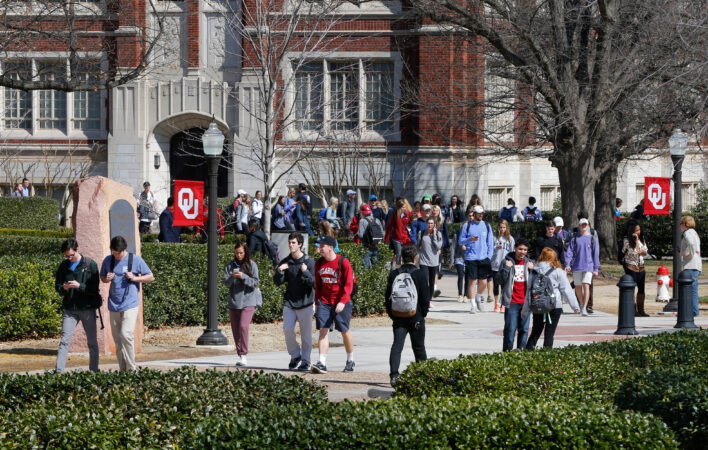
    The University of Oklahoma has fired an instructor who was accused by a student of religious discrimination over a failing grade on a psychology paper in which she cited the Bible and argued that promoting a “belief in multiple genders” was “demonic.”

    The university said in a statement posted Monday on X that its investigation found the graduate teaching assistant had been “arbitrary” in giving 20-year-old junior Samantha Fulnecky zero points on the assignment. The university declined to comment beyond its statement, which said the instructor had been removed from teaching.

    Through her attorney, the instructor, Mel Curth, denied Tuesday that she had “engaged in any arbitrary behavior regarding the student’s work.” The attorney, Brittany Stewart, said in a statement emailed to The Associated Press that Curth is “considering all of her legal remedies.”

    Conservative groups, commentators, and others quickly made Fulnecky’s failing grade an online cause, highlighting her argument that she’d been punished for expressing conservative Christian views. Her case became a flashpoint in the ongoing debate over academic freedom on college campuses as President Donald Trump pushes to end diversity, equity, and inclusion initiatives, and restrict how campuses discuss race, gender, and sexuality.

    Fulnecky appealed her grade on the assignment, which was worth 3% of the final grade in the class, and the university said the assignment would not count. It also placed Curth on leave, and Oklahoma’s conservative Republican governor, Kevin Stitt, declared the situation “deeply concerning.”

    “The University of Oklahoma believes strongly in both its faculty’s rights to teach with academic freedom and integrity and its students’ right to receive an education that is free from a lecturer’s impermissible evaluative standards,” the university’s statement said. “We are committed to teaching students how to think, not what to think.”

    A law approved this year by Oklahoma’s Republican-dominated Legislature and signed by Stitt prohibits state universities from using public funds to finance DEI programs or positions or mandating DEI training. However, the law says it does not apply to scholarly research or “the academic freedom of any individual faculty member.”

    Home telephone listings for Fulnecky in the Springfield, Mo., area had been disconnected, and her mother — an attorney, podcaster, and radio host — did not immediately respond Tuesday to a Facebook message seeking comment about the university’s action.

    Fulnecky’s failing grade came in an assignment for a psychology class on lifespan development. Curth directed students to write a 650-word response to an academic study that examined whether conformity with gender norms was associated with popularity or bullying among middle school students.

    Fulnecky wrote that she was frustrated by the premise of the assignment because she does not believe that there are more than two genders based on her understanding of the Bible, according to a copy of her essay provided to The Oklahoman.

    “Society pushing the lie that there are multiple genders and everyone should be whatever they want to be is demonic and severely harms American youth,” she wrote, adding that it would lead society “farther from God’s original plan for humans.”

    In feedback obtained by the newspaper, Curth said the paper did “not answer the questions for the assignment,” contradicted itself, relied on “personal ideology” over evidence and “is at times offensive.”

    “Please note that I am not deducting points because you have certain beliefs,” Curth wrote.
  • Supreme Court keeps Trump’s National Guard deployment blocked in the Chicago area, for now

    Supreme Court keeps Trump’s National Guard deployment blocked in the Chicago area, for now

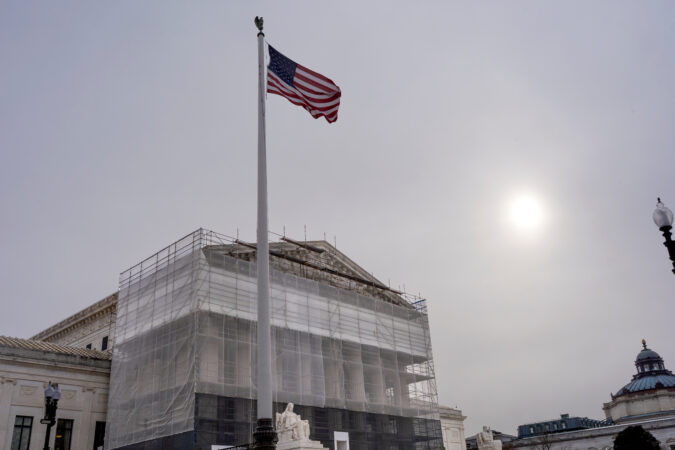
    WASHINGTON — The Supreme Court on Tuesday refused to allow the Trump administration to deploy National Guard troops in the Chicago area to support its immigration crackdown.

    The justices declined the Republican administration’s emergency request to overturn a ruling by U.S. District Judge April Perry that had blocked the deployment of troops. An appeals court also had refused to step in. The Supreme Court took more than two months to act.

    Three justices, Samuel Alito, Clarence Thomas and Neil Gorsuch, publicly dissented.

    The high court order is not a final ruling but it could affect other lawsuits challenging President Donald Trump’s attempts to deploy the military in other Democratic-led cities.

    The outcome is a rare Supreme Court setback for Trump, who had won repeated victories in emergency appeals since he took office again in January. The conservative-dominated court has allowed Trump to ban transgender people from the military, claw back billions of dollars of congressionally approved federal spending, move aggressively against immigrants and fire the Senate-confirmed leaders of independent federal agencies.

    The administration had initially sought the order to allow the deployment of troops from Illinois and Texas, but the Texas contingent of about 200 National Guard troops was later sent home from Chicago.

    The Trump administration has argued that the troops are needed “to protect federal personnel and property from violent resistance against the enforcement of federal immigration laws.”

    But Perry wrote that she found no substantial evidence that a “danger of rebellion” is brewing in Illinois and no reason to believe the protests there had gotten in the way of Trump’s immigration crackdown.

    Perry had initially blocked the deployment for two weeks. But in October, she extended the order indefinitely while the Supreme Court reviewed the case.

    The U.S. Immigration and Customs Enforcement facility in the west Chicago suburb of Broadview has been the site of tense protests, where federal agents have previously used tear gas and other chemical agents on protesters and journalists.

    Last week, authorities arrested 21 protesters and said four officers were injured outside the Broadview facility. Local authorities made the arrests.

    The Illinois case is just one of several legal battles over National Guard deployments.

    District of Columbia Attorney General Brian Schwalb is suing to halt the deployments of more than 2,000 guardsmen in the nation’s capital. Forty-five states have entered filings in federal court in that case, with 23 supporting the administration’s actions and 22 supporting the attorney general’s lawsuit.

    More than 2,200 troops from several Republican-led states remain in Washington, although the crime emergency Trump declared in August ended a month later.

    A federal judge in Oregon has permanently blocked the deployment of National Guard troops there, and all 200 troops from California were being sent home from Oregon, an official said.

    A state court in Tennessee ruled in favor of Democratic officials who sued to stop the ongoing Guard deployment in Memphis, which Trump has called a replica of his crackdown on Washington, D.C.

    In California, a judge in September said deployment in the Los Angeles area was illegal. By that point, just 300 of the thousands of troops sent there remained, and the judge did not order them to leave.

    The Trump administration has appealed the California and Oregon rulings to the 9th U.S. Circuit Court of Appeals.

  • Mexican Navy medical flight lost communication for several minutes before Texas crash

    Mexican Navy medical flight lost communication for several minutes before Texas crash

    Air traffic controllers lost communication for about 10 minutes with a small Mexican Navy plane carrying a young medical patient and seven others before it crashed off the Texas coast, killing at least five people, Mexico’s president said Tuesday.

    Authorities initially believed the plane had landed safely at its destination in Galveston, near Houston, before learning it had gone down Monday afternoon, Mexican President Claudia Sheinbaum said. A search-and-rescue operation in waters near Galveston pulled two survivors from the plane’s wreckage, while one remained missing, Mexico’s Navy said.

    U.S. authorities are investigating the cause, but the National Transportation Safety Board said Tuesday that it could take a week or more to recover the aircraft,

    Four Mexican Navy officers and four civilians, including a child, were aboard the plane, according to the country’s military. Two of the passengers were affiliated with a nonprofit that helps transport Mexican children with severe burns to a hospital in Galveston.

    “My condolences to the families of the sailors who unfortunately died in this accident and to the people who were traveling on board,” Sheinbaum said in her morning press briefing, without elaborating on a possible cause. “What happened is very tragic.”

    U.S. Coast Guard Petty Officer Luke Baker said at least five aboard had died but did not identify which passengers.

    The twin turboprop Beech King Air 350i crashed Monday afternoon in a bay near the base of the causeway connecting Galveston Island to the mainland. Emergency responders rushed to the scene near the popular beach destination about 50 miles southeast of Houston.

    Sky Decker, a professional yacht captain who lives about a mile from the crash site, said he jumped in his boat to see if he could help. He picked up two police officers who guided him through thick fog to a nearly submerged plane. Decker jumped into the water and found a badly injured woman trapped beneath chairs and other debris.

    “I couldn’t believe. She had maybe 3 inches of air gap to breathe in,” he said. ”And there was jet fuel in there mixed with the water, fumes real bad. She was really fighting for her life.”

    He said he also pulled out a man seated in front of her who had already died. Both were wearing civilian clothes.

    It’s not immediately clear if weather was a factor. The area was experiencing foggy conditions over the past few days, according to Cameron Batiste, a National Weather Service meteorologist. He said that at about 2:30 p.m. Monday a fog came in that had about a half-mile visibility.

    Teams from the Federal Aviation Administration and National Transportation Safety Board were at the crash site Monday, the Texas Department of Public Safety said. An NTSB spokesperson said in an email that investigators will gather flight track data, recordings of any air traffic control communications and review maintenance records and weather forecasts, with a preliminary report expected within 30 days.

    Mexico’s Navy said the plane was helping with a medical mission in coordination with the Michou and Mau Foundation. In a social media post, the foundation offered condolences to the families and said it shared their grief “with respect and compassion.”

    The charity was founded after a mother died trying to save her kids from a fire. One child succumbed to his injuries because he didn’t receive highly specialized medical care, while another survived after receiving treatment at Shriners Children’s Texas in Galveston. Over 23 years, the foundation has helped transfer more than 2,000 patients to that hospital and other medical facilities with burn expertise, according to the charity’s website.

    The charity’s director didn’t immediately respond to an email from The Associated Press seeking comment.

    Shriners Children’s Texas said in a statement that it learned of the crash with “profound sadness” but wasn’t able to provide any information about the child’s condition because the child hadn’t yet been admitted.

    This latest crash comes amid a year of intense scrutiny on aviation safety after a string of high-profile crashes and the flight disruptions during the government shutdown driven by the shortage of air traffic controllers.

    The January mid-air collision between an Army helicopter and an airliner near Washington D.C. was followed by the crash of a medical transport plane in Philadelphia. This fall’s fiery UPS plane crash only added to the concerns. Still, the total number of crashes in 2025 was actually down a bit from last year and experts say flying remains safe overall.

  • Student loan borrowers in default may see wages garnished in 2026

    Student loan borrowers in default may see wages garnished in 2026

    WASHINGTON — The Trump administration said on Tuesday that it will begin garnishing the wages of student loan borrowers who are in default early next year.

    The department said it will send notices to approximately 1,000 borrowers the week of January 7, with more notices to come at an increasing scale each month.

    Millions of borrowers are considered in default, meaning they are 270 days past due on their payments. The department must give borrowers 30 days notice before their wages can be garnished.

    The department said it will begin collection activities, “only after student and parent borrowers have been provided sufficient notice and opportunity to repay their loans.”

    In May, the Trump administration ended the pandemic-era pause on student loan payments, beginning to collect on defaulted debt through withholding tax refunds and other federal payments to borrowers.

    The move ended a period of leniency for student loan borrowers. Payments restarted in October of 2023, but the Biden administration extended a grace period of one year. Since March 2020, no federal student loans had been referred for collection, including those in default, until the Trump administration’s changes earlier this year.

    The Biden administration tried multiple times to give broad forgiveness to student loans, but those efforts were eventually stopped by courts.

    Persis Yu, deputy executive director for the Student Borrower Protection Center, criticized the decision to begin garnishing wages, and said the department had failed to sufficiently help borrowers find affordable payment options.

    “At a time when families across the country are struggling with stagnant wages and an affordability crisis, this administration’s decision to garnish wages from defaulted student loan borrowers is cruel, unnecessary, and irresponsible,” Yu said in a statement. “As millions of borrowers sit on the precipice of default, this Administration is using its self-inflicted limited resources to seize borrowers’ wages instead of defending borrowers’ right to affordable payments.”

    ___

    The Associated Press’ education coverage receives financial support from multiple private foundations. AP is solely responsible for all content. Find AP’s standards for working with philanthropies, a list of supporters and funded coverage areas at AP.org.

  • Federal judge says Trump administration must restore disaster money to Democratic states

    Federal judge says Trump administration must restore disaster money to Democratic states

    PROVIDENCE, R.I. — A federal judge has blocked the Trump administration’s attempt to reallocate federal Homeland Security funding away from states that refuse to cooperate with certain federal immigration enforcement.

    U.S. District Judge Mary McElroy’s ruling on Monday solidified a win for the coalition of 12 attorneys general that sued the administration earlier this year after being alerted that their states would receive drastically reduced federal grants due to their “sanctuary” jurisdictions.

    In total, the U.S. Department of Homeland Security and the Federal Emergency Management Agency reduced more than $233 million from Connecticut, Delaware, the District of Columbia, Massachusetts, Minnesota, New York, Rhode Island, Vermont, and Washington. The money is part of a $1 billion program where allocations are supposed to be based on assessed risks, with states then largely passing most of the money on to police and fire departments.

    The cuts were unveiled shortly after a separate federal judge in a different legal challenge ruled it was unconstitutional for the federal government to require states to cooperate on immigration enforcement actions to get FEMA disaster funding.

    In her 48-page ruling, McElroy found that the federal government was weighing states’ police on federal immigration enforcement on whether to reduce federal funding for the Homeland Security Grant Program and others.

    “What else could defendants’ decisions to cut funding to specific counterterrorism programming by conspicuous round numbered amounts — including by slashing off the millions-place digits of awarded sums — be if not arbitrary and capricious? Neither a law degree nor a degree in mathematics is required to deduce that no plausible, rational formula could produce this result,” McElroy wrote.

    The Trump-appointed judge then ordered the Department of Homeland Security to restore the previously announced funding allocations to the plaintiff states.

    “Defendants’ wanton abuse of their role in federal grant administration is particularly troublesome given the fact that they have been entrusted with a most solemn duty: safeguarding our nation and its citizens,” McElroy wrote. ”While the intricacies of administrative law and the terms and conditions on federal grants may seem abstract to some, the funding at issue here supports vital counterterrorism and law enforcement programs.”

    McElroy notably cited the recent Brown University attack, where a gunman killed two students and injured nine others, as an event where the $1 billion federal program would be vital in responding to such a tragedy.

    “To hold hostage funding for programs like these based solely on what appear to be defendants’ political whims is unconscionable and, at least here, unlawful,” the Rhode Island-based judge wrote in her ruling, issued little more than a week after the Brown shooting.

    Emails seeking comment were sent to the DHS and FEMA.

    “This victory ensures that the Trump Administration cannot punish states that refuse to help carry out its cruel immigration agenda, particularly by denying them lifesaving funding that helps prepare for and respond to disasters and emergencies,” said Massachusetts Attorney General Andrea Joy Campbell in a statement.

  • A look at aging baby boomers in the United States

    A look at aging baby boomers in the United States

    The oldest baby boomers — once the vanguard of an American youth that revolutionized U.S. culture and politics — turn 80 in 2026.

    The generation that twirled the first plastic hula hoops and dressed up the first Barbie dolls, embraced the TV age, blissed out at Woodstock and protested and fought in the Vietnam War — the cohort that didn’t trust anyone over age 30 — now is contributing to the overall aging of America.

    Boomers becoming octogenarians in 2026 include actor Henry Winkler and baseball Hall of Famer Reggie Jackson, singers Cher and Dolly Parton and presidents Donald Trump, George W. Bush, and Bill Clinton.

    The aging and shrinking youth of America

    America’s population swelled with around 76 million births from 1946 to 1964, a spike magnified by couples reuniting after World War Two and enjoying postwar prosperity.

    Boomers were better educated and richer than previous generations, and they helped grow a consumer-driven economy. In their youth, they pushed for social change through the Civil Rights Movement, the women’s rights movement and efforts to end the Vietnam War.

    “We had rock ‘n’ roll. We were the first generation to get out and demonstrate in the streets. We were the first generation, that was, you know, a socially conscious generation,” said Diane West, a metro Atlanta resident who turns 80 in January. “Our parents played by the rules. We didn’t necessarily play by the rules, and there were lots of us.”

    As they got older they became known as the “me” generation, a pejorative term coined by writer Tom Wolfe to reflect what some regarded as their self-absorption and consumerism.

    “The thing about baby boomers is they’ve always had a spotlight on them, no matter what age they were,” Brookings demographer William Frey said. “They were a big generation, but they also did important things.”

    By the end of this decade, all baby boomers will be 65 and older, and the number of people 80 and over will double in 20 years, Frey said.

    The share of senior citizens in the U.S. population is projected to grow from 18.7% in 2025 to nearly 23% by 2050, while children under 18 decline from almost 21% to a projected 18.4%.

    Without any immigration, the U.S. population will start shrinking in five years. That’s when deaths will surpass births, according to projections from the Congressional Budget Office, which were revised in September to account for the Trump administration’s immigration crackdown. Population growth comes from immigration as well as births outpacing deaths.

    The aging of America is being compounded by longer lives due to better healthcare and lower birth rates.

    The projected average U.S. life expectancy at birth rises from 78.9 years in 2025 to 82.2 years in 2055, according to the CBO. And since the Great Recession in 2008, when the fertility rate was 2.08, around the 2.1 rate needed for children to numerically replace their parents, it has been on a steady decline, hitting 1.6 in 2025.

    Younger generations miss boomer milestones

    Women are having fewer children because they are better educated, they’re delaying marriage to focus on careers and they’re having their first child at a later age. Unaffordable housing, poor access to childcare and the growing expenses of child-rearing also add up to fewer kids.

    University of New Hampshire senior demographer Kenneth Johnson estimates that the result has been 11.8 million fewer births, compared to what might have been had the fertility rate stayed at Great Recession levels.

    “I was young when I had kids. I mean that’s what we did — we got out of college, we got married and we had babies,” said West, who has two daughters, a stepdaughter and six grandchildren. “My kids got married in their 30s, so it’s very different.”

    A recent Census Bureau study showed that 21st century young adults in the U.S. haven’t been adulting like baby boomers did. In 1975, almost half of 25-to-34-year-olds had moved out of their parents’ home, landed jobs, gotten married and had kids. By the early 2020s, less than a quarter of U.S. adults had hit these milestones.

    West, whose 21-year-old grandson lives with her, understands why: They lack the prospects her generation enjoyed. Her grandson, Paul Quirk, said it comes down to financial instability.

    “They were able to buy a lot of things, a lot cheaper,” Quirk said.

    All of her grandchildren are frustrated by the economy, West added.

    “You have to get three roommates in order to afford a place,” she said. ”When we got out of college, we had a job waiting for us. And now, people who have master’s degrees are going to work fast food while they look for a real job.”

    Implications for the economy

    The aging of America could constrain economic growth. With fewer workers paying taxes, Social Security and Medicare will be under more pressure. About 34 seniors have been supported by every 100 workers in 2025, but that ratio grows to 50 seniors per 100 working-age people in about 30 years, according to estimates released last year by the White House.

    When West launched her career in employee benefits and retirement planning in 1973, each 100 workers supported 20 or fewer retirees, by some calculations.

    Vice President JD Vance and Tesla CEO Elon Musk are among those pushing for an increase in fertility. Vance has suggested giving parents more voting power, according to their numbers of children, or following the example of Hungary’s Viktor Orban in giving low-interest loans to married parents and tax exemptions to women who have four children or more.

    Frey said programs that incentivize fertility among U.S. women hardly ever work, so funding should support pre-kindergarten and paid family leave.

    “I think the best you can do for people who do want to have kids is to make it easier and less expensive to have them and raise them,” he said. “Those things may not bring up the fertility rate as much as people would like, but at least the kids who are being born will have a better chance of succeeding.”

  • Controversial ’60 Minutes’ segment on Trump immigration policy leaks online

    Controversial ’60 Minutes’ segment on Trump immigration policy leaks online

    A news segment about the Trump administration’s immigration policy that was abruptly pulled from 60 Minutes was mistakenly aired on a TV app after the last minute decision not to air it touched off a public debate about journalistic independence.

    The segment featured interviews with migrants who were sent to a notorious El Salvador prison called the Terrorism Confinement Center, or CECOT, under President Donald Trump’s aggressive crackdown on immigration.

    The story was pulled from Global Television Network, one of Canada’s largest networks, but still ran on the network’s app. Global Television Network swiftly corrected the error, but copies of it continued to float around the internet and pop up before being taken down.

    “Paramount’s content protection team is in the process of routine take down orders for the unaired and unauthorized segment,” a CBS spokesperson said Tuesday via email.

    A representative of Global Television Network did not immediately respond to a request for comment.

    In the story, two men who were deported reported torture, beatings, and abuse. One Venezuelan said he was punished with sexual abuse and solitary confinement.

    Another was a college student who said guards beat him and knocked out his tooth upon arrival.

    “When you get there, you already know you’re in hell. You don’t need anyone to tell you,” he said.

    The segment featured numerous experts who called into question the legal basis for deporting migrants so hastily amid pending judicial decisions. Reporters for the show also corroborated findings by Human Rights Watch suggesting that only eight of the deported men had been sentenced for violent or potentially violent crimes, using available ICE data.

    The decision to pull a critical account of the Trump administration was met with widespread accusations that CBS leadership was shielding the president from unfavorable coverage.

    The journalist who reported the story, Sharyn Alfonsi, said in an email sent to fellow 60 Minutes correspondents that the story was factually correct and had been cleared by CBS lawyers and its standards division.

    CBS News chief Bari Weiss said Monday that the story did not “advance the ball” and pointed out that the Trump administration had refused to comment for the story. Weiss said she wanted a greater effort made to get its point of view and said she looked forward to airing Alfonsi’s piece “when it’s ready.”

    The dispute put one of journalism’s most respected brands — and a frequent target of Trump — back in the spotlight and amplified questions about whether Weiss’ appointment is a signal that CBS News is headed in a more Trump-friendly direction.

  • Mexican Navy medical flight lost communication for several minutes before Texas crash

    Mexican Navy medical flight lost communication for several minutes before Texas crash

    Air traffic controllers lost communication for about 10 minutes with a small Mexican Navy plane carrying a young medical patient and seven others before it crashed off the Texas coast, killing at least five people, Mexico’s president said Tuesday.

    Authorities initially believed the plane had landed safely at its destination in Galveston, near Houston, before learning it had gone down Monday afternoon, Mexican President Claudia Sheinbaum said. The cause of the crash remains under investigation. A search-and-resuce operation in waters near Galveston pulled two survivors from the plane’s wreckage, Mexico’s Navy said, while one remained missing.

    Four of the eight people aboard were Navy officers and four were civilians, including a child, Mexico’s Navy said. Two of the passengers were affiliated with a nonprofit that helps transport Mexican children with severe burns to a hospital in Galveston.

    “My condolences to the families of the sailors who unfortunately died in this accident and to the people who were traveling on board,” Sheinbaum said in her morning press briefing, without elaborating on a possible cause. “What happened is very tragic.”

    U.S. Coast Guard Petty Officer Luke Baker said at least five aboard had died but did not identify which passengers.

    The plane crashed Monday afternoon in a bay near the base of the causeway connecting Galveston Island to the mainland. Emergency responders rushed to the scene near the popular beach destination about 50 miles (80 kilometers) southeast of Houston.

    Sky Decker, a professional yacht captain who lives about a mile (1.6 kilometers) from the crash site, said he jumped in his boat to see if he could help. He picked up two police officers who guided him through thick fog to a nearly submerged plane. Decker jumped into the water and found a badly injured woman trapped beneath chairs and other debris.

    “I couldn’t believe. She had maybe 3 inches of air gap to breathe in,” he said. ”And there was jet fuel in there mixed with the water, fumes real bad. She was really fighting for her life.”

    He said he also pulled out a man seated in front of her who had already died. Both were wearing civilian clothes.

    It’s not immediately clear if weather was a factor. The area has been experiencing foggy conditions over the past few days, according to Cameron Batiste, a National Weather Service meteorologist. He said that at about 2:30 p.m. Monday a fog came in that had about a half-mile visibility.

    Teams from the Federal Aviation Administration and National Transportation Safety Board were at the crash site Monday, the Texas Department of Public Safety said, and a spokesperson for the NTSB said the agency was gathering information about the crash.

    Mexico’s Navy said the plane was helping with a medical mission in coordination with the Michou and Mau Foundation. In a social media post, the foundation offered condolences to the families and said it shared their grief “with respect and compassion.”

    This latest crash comes amid a year of intense scrutiny on aviation safety after a string of high-profile crashes and the flight disruptions during the government shutdown driven by the shortage of air traffic controllers.

    The January mid-air collision between an Army helicopter and an airliner near Washington D.C. was followed by the crash of a medical transport plane in Philadelphia. This fall’s fiery UPS plane crash only added to the concerns. Still, the total number of crashes in 2025 was actually down a bit from last year and experts say flying remains safe overall.

  • Resilient U.S. consumers drive strongest economic expansion in two years

    Resilient U.S. consumers drive strongest economic expansion in two years

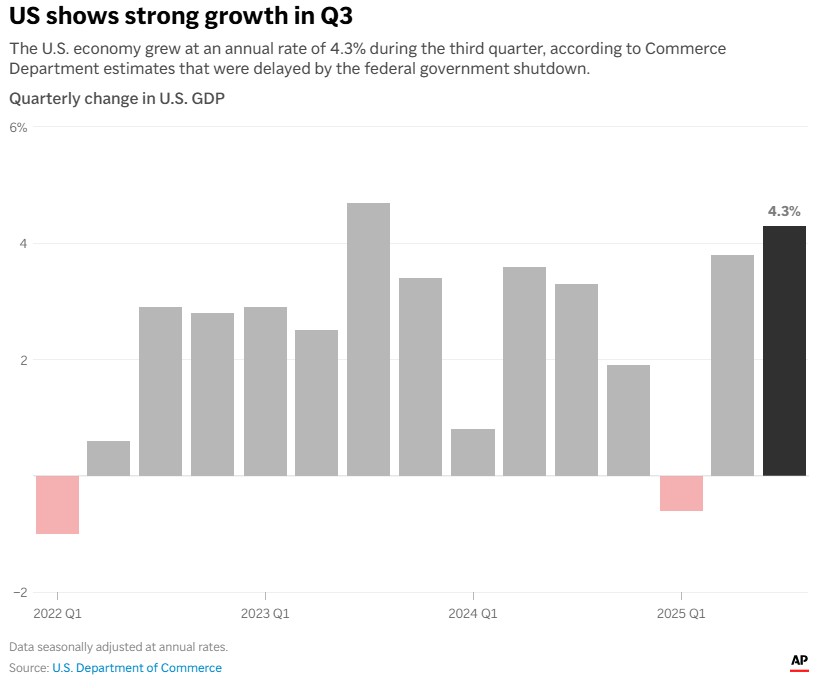
    WASHINGTON — The U.S. economy grew at a surprisingly strong 4.3% annual rate in the third quarter, the most rapid expansion in two years, driven by consumers who continue to spend in the face of ongoing inflation.

    U.S. gross domestic product from July through September — the economy’s total output of goods and services — rose from its 3.8% growth rate in the April-June quarter, the Commerce Department said Tuesday in a report delayed by the government shutdown. Economists surveyed by the data firm FactSet forecast growth of just 3% in the period.

    The U.S. economy grew at an annual rate of 4.3% during the third quarter, according to Commerce Department estimates that were delayed by the federal government shutdown.

    As has been the case for most of this year, the consumer is providing the fuel that is powering the U.S. economy. Consumer spending, which accounts for about 70% of U.S. economic activity, rose to a 3.5% annual pace last quarter. That’s up from 2.5% in the April-June period.

    A number of economists, however, believe the growth spurt may be short-lived with the extended government shutdown dragging on the economy in the fourth quarter, as well as a growing number of Americans fatigued by stubbornly high inflation.

    A survey published by the Conference Board Tuesday showed that consumer confidence slumped close to levels not seen since the U.S. rolled out broad tariffs on its trading partners in April.

    “The jump in consumer spending reminds me a lot of last year’s (fourth quarter),” said Stephen Stanley, chief U.S. economist at Santander. “Consumers were stretching. So, as was the case entering this year, households probably need to take a breather soon.”

    However, at least in recent years, consumer spending has held up even when data suggests they’ve grown more anxious about money.

    Tuesday’s GDP report also showed that inflation remains higher than the Federal Reserve would like. The Fed’s favored inflation gauge — called the personal consumption expenditures index, or PCE — climbed to a 2.8% annual pace last quarter, up from 2.1% in the second quarter.

    Excluding volatile food and energy prices, so-called core PCE inflation was 2.9%, up from 2.6% in the April-June quarter.

    Economists say that persistent and potentially worsening inflation could make a January interest rate cut from the Fed less likely, even as central bank official remain concerned about a slowing labor market.

    “If the economy keeps producing at this level, then there isn’t as much need to worry about a slowing economy,” said Chris Zaccarelli, chief investment officer for Northlight Asset Management, adding that inflation could return as the greatest threat to the economy.

    Another consistent driver in the U.S. economy, spending on artificial intelligence, was also evident in the latest data.

    Investment in intellectual property, the category that covers AI, grew 5.4% in the third quarter, following an even bigger jump of 15% in the second quarter. That figure was 6.5% in the first quarter.

    Consumption and investment by the government grew by 2.2% in the quarter after contracting 0.1% in the second quarter. The third quarter figure was boosted by increased expenditures at the state and local levels and federal government defense spending.

    Private business investment fell 0.3%, led by declines in investment in housing and in nonresidential buildings such as offices and warehouses. However, that decline was much less than the 13.8% slide in the second quarter.

    Within the GDP data, a category that measures the economy’s underlying strength grew at a 3% annual rate from July through September, up slightly from 2.9% in the second quarter. This category includes consumer spending and private investment, but excludes volatile items like exports, inventories and government spending.

    Exports grew at an 8.8% rate, while imports, which subtract from GDP, fell another 4.7%.

    Tuesday’s report is the first of three estimates the government will make of GDP growth for the third quarter of the year.

    Outside of the first quarter, when the economy shrank for the first time in three years as companies rushed to import goods ahead of President Donald Trump’s tariff rollout, the U.S. economy has continued to expand at a healthy rate. That’s despite much higher borrowing rates the Fed imposed in 2022 and 2023 in its drive to curb the inflation that surged as the United States bounced back with unexpected strength from the brief but devastating COVID-19 recession of 2020.

    Though inflation remains above the Fed’s 2% target, the central bank cut its benchmark lending rate three times in a row to close out 2025, mostly out of concern for a job market that has steadily lost momentum since spring.

    Last week, the government reported that the U.S. economy gained a healthy 64,000 jobs in November but lost 105,000 in October. Notably, the unemployment rate rose to 4.6% last month, the highest since 2021.

    The country’s labor market has been stuck in a “low hire, low fire” state, economists say, as businesses stand pat due to uncertainty over Trump’s tariffs and the lingering effects of elevated interest rates. Since March, job creation has fallen to an average 35,000 a month, compared to 71,000 in the year ended in March. Fed Chair Jerome Powell has said that he suspects those numbers will be revised even lower.

  • Trump warns Venezuela, announces plans for new Navy ‘battleship’

    Trump warns Venezuela, announces plans for new Navy ‘battleship’

    WEST PALM BEACH, Fla. — President Donald Trump on Monday delivered a new warning to Venezuelan President Nicolás Maduro as the U.S. Coast Guard steps up efforts to interdict oil tankers in the Caribbean Sea as part of the Republican administration’s escalating pressure campaign on the government in Caracas.

    Trump was surrounded by his top national security aides, Secretary of State Marco Rubio and Defense Secretary Pete Hegseth after a meeting at his Florida home, Mar-a-Lago. He suggested that he remains ready to further escalate his four-month pressure campaign on the Maduro government, which began with the stated purpose of stemming the flow of illegal drugs from the South American nation but has developed into something more amorphous.

    “If he wants to do something, if he plays tough, it’ll be the last time he’ll ever be able to play tough,” Trump said of Maduro.

    Trump levied his latest threat as the U.S. Coast Guard on Monday continued for a second day to chase a sanctioned oil tanker that the Trump administration describes as part of a “dark fleet” Venezuela is using to evade U.S. sanctions. The tanker, according to the White House, is flying under a false flag and is under a U.S. judicial seizure order.

    “It’s moving along and we’ll end up getting it,” Trump said.

    It is the third tanker pursued by the Coast Guard, which on Saturday seized a Panama-flagged vessel called Centuries that U.S. officials said was part of the Venezuelan shadow fleet.

    Meanwhile, Russia’s Foreign Ministry started evacuating the families of diplomats from Venezuela, according to a European intelligence official speaking on condition of anonymity to discuss sensitive information.

    The official told the Associated Press the evacuations include women and children and began on Friday, adding that Russian Foreign Ministry officials are assessing the situation in Venezuela in “very grim tones.” The ministry said in an X posting that it was not evacuating the embassy but did not address queries about whether it was evacuating the families of diplomats.

    Venezuela’s Foreign Minister Yván Gil on Monday said he spoke by phone with his Russian counterpart, Sergey Lavrov, who he said expressed Russia’s support for Venezuela against Trump’s declared blockade of sanctioned oil tankers.

    “We reviewed the aggressions and flagrant violations of international law that have been committed in the Caribbean: attacks against vessels and extrajudicial executions, and the unlawful acts of piracy carried out by the United States government,” Gil said in a statement.

    A new “Golden Fleet”

    Trump also announced on Monday a bold plan for the Navy to build a new, large warship that he is calling a “battleship” as part of a larger vision to create a “Golden Fleet.”

    “They’ll be the fastest, the biggest, and by far 100 times more powerful than any battleship ever built,” Trump claimed during the announcement at Mar-a-Lago.

    The ship, according to Trump, will be longer and larger than the World War II-era Iowa-class battleships and will be armed with hypersonic missiles, rail guns, and high-powered lasers — all technologies that are still being developed by the Navy.

    Just a month ago, the Navy scrapped its plans to build a new, small warship, citing growing delays and cost overruns, deciding instead to go with a modified version of a Coast Guard cutter that was being produced until recently. The sea service has also failed to build its other newly designed ships, like the new Ford-class aircraft carrier and Columbia-class submarines, on time and on budget.

    Historically, the term battleship has referred to a very specific type of ship — a large, heavily armored vessel armed with massive guns designed to bombard other ships or targets ashore. This type of ship was at the height of its prominence during World War II, and the largest of the U.S. battleships, the Iowa-class, were roughly 60,000 tons.

    After World War II, the battleship’s role in modern fleets diminished rapidly in favor of aircraft carriers and long-range missiles. The U.S. Navy did modernize four Iowa-class battleships in the 1980s by adding cruise missiles and anti-ship missiles, along with modern radars, but by the 1990s all four were decommissioned.

    Trump has long held strong opinions on specific aspects of the Navy’s fleet, sometimes with a view toward keeping older technology instead of modernizing.

    During his first term, he unsuccessfully called for a return to steam-powered catapults to launch jets from the Navy’s newest aircraft carriers instead of the more modern electromagnetic system.

    He has also complained to Phelan about the look of the Navy’s destroyers and decried Navy ships being covered in rust.

    Phelan told senators at his confirmation hearing that Trump “has texted me numerous times very late at night, sometimes after one (o’clock) in the morning” about “rusty ships or ships in a yard, asking me what am I doing about it.”

    On a visit to a shipyard that was working on the now-canceled Constellation-class frigate in 2020, Trump said he personally changed the design of the ship.

    “I looked at it, I said, ‘That’s a terrible-looking ship, let’s make it beautiful,’” Trump said at the time.

    He said Monday he will have a direct role in designing this new warship as well.

    “The U.S. Navy will lead the design of these ships along with me, because I’m a very aesthetic person,” Trump said.