Category: Reuters

  • The AI frenzy is driving a new global supply chain crisis

    The AI frenzy is driving a new global supply chain crisis

    An acute global shortage of memory chips is forcing artificial intelligence and consumer-electronics companies to fight for dwindling supplies, as prices soar for the unglamorous but essential components that allow devices to store data.

    Japanese electronics stores have begun limiting how many hard-disk drives shoppers can buy. Chinese smartphone makers are warning of price increases. Tech giants including Microsoft, Google, and ByteDance are scrambling to secure supplies from memory-chip makers such as Micron, Samsung Electronics, and SK Hynix, according to three people familiar with the discussions.

    The squeeze spans almost every type of memory, from flash chips used in USB drives and smartphones to advanced high-bandwidth memory (HBM) that feeds AI chips in data centers. Prices in some segments have more than doubled since February, according to market-research firm TrendForce, drawing in traders betting that the rally has further to run.

    The fallout could reach beyond tech. Many economists and executives warn the protracted shortage risks slowing AI-based productivity gains and delaying hundreds of billions of dollars in digital infrastructure. It could also add inflationary pressure just as many economies are trying to tame price rises and navigate U.S. tariffs.

    “The memory shortage has now graduated from a component-level concern to a macroeconomic risk,” said Sanchit Vir Gogia, CEO of Greyhound Research, a technology advisory firm. The AI build-out “is colliding with a supply chain that cannot meet its physical requirements.”

    This Reuters examination of the spiraling supply crisis is based on interviews with almost 40 people, including 17 executives at chipmakers and distributors. It shows industry efforts to meet voracious appetite for advanced chips — driven by Nvidia and tech giants like Google, Microsoft, and Alibaba — created a dual bind: Chipmakers still can’t produce enough high-end semiconductors for the AI race, yet their tilt away from traditional memory products is choking supply to smartphones, PCs, and consumer electronics. Some are now hurrying to course-correct.

    Details of the global scramble by tech firms and price increases described by electronics retailers and component suppliers in China and Japan are reported here for the first time.

    Average inventory levels at suppliers of dynamic random-access memory (DRAM) — the main type used in computers and phones — fell to two to four weeks in October from three to eight weeks in July and 13 to 17 weeks in late 2024, according to TrendForce.

    The crunch is unfolding as investors question whether the billions of dollars poured into AI infrastructure have inflated a bubble. Some analysts predict a shakeout, with only the biggest and financially strongest companies able to stomach the price increases.

    One memory-chip executive told Reuters the shortage would delay future data-center projects. New capacity takes at least two years to build but memory-chip makers are wary of overbuilding for fear it could end up idle should the demand surge pass, the person said.

    Samsung and SK Hynix have announced investments in new capacity but haven’t detailed the production split between HBM and conventional memory.

    SK Hynix Inc. 12-layer HBM3E memory chips and a LPDDR5X CAMM2 memory module. MUST CREDIT: SeongJoon Cho/Bloomberg

    SK Hynix has told analysts that the memory shortfall would last through late 2027, Citi said in November.

    “These days, we’re receiving requests for memory supplies from so many companies that we’re worried about how we’ll be able to handle all of them. If we fail to supply them, they could face a situation where they can’t do business at all,” Chey Tae-won, chairman of SK Hynix parent SK Group, said at an industry forum in Seoul last month. OpenAI in October signed initial deals with Samsung and SK Hynix to supply chips for its Stargate project, which would require up to 900,000 wafers per month by 2029. That’s about double current global monthly HBM production, Chey said.

    Samsung told Reuters it is monitoring the market but wouldn’t comment on pricing or customer relationships. SK Hynix said it is boosting production capacity to meet increased memory demand.

    Microsoft declined to comment and ByteDance didn’t address questions about the chip strain. Micron and Google didn’t respond to comment requests.

    ‘Begging for supply’

    After ChatGPT’s release in November 2022 ignited the generative AI boom, a global rush to build AI data centers led memory makers to allocate more production to HBM, used in Nvidia’s powerful AI processors.

    Competition from Chinese rivals making lower-end DRAM, such as ChangXin Memory Technologies, also pushed Samsung and SK Hynix to accelerate their shift to higher-margin products. The South Korean firms account for two-thirds of the DRAM market.

    Samsung told customers in May 2024 that it planned to end production of one type of DDR4 chips — an older variety used in PCs and servers — this year, according to a letter seen by Reuters. (The company has since changed course and will extend production, two sources said.) In June, Micron said it had informed customers it would stop shipping DDR4 and its counterpart LPDDR4 — a type used in smartphones — in six to nine months.

    ChangXin followed suit in ending most DDR4 production, one source said. The firm declined to comment.

    This shift, however, coincided with a replacement cycle for traditional data centers and PCs, as well as stronger-than-expected sales of smartphones, which rely on conventional chips.

    In hindsight, “one could say the industry was caught off-guard,” said Dan Hutcheson, senior research fellow at TechInsights. Samsung raised prices of server memory chips by up to 60% last month, Reuters has reported. Nvidia CEO Jensen Huang, who in October announced deals awith Samsung Electronics Chairman Jay Y. Lee during a trip to South Korea, acknowledged the price surge as significant but said Nvidia had secured substantial supply.

    Google, Amazon, Microsoft, and Meta in October asked Micron for open-ended orders, telling the company they will take as much as it can deliver, irrespective of price, according to two people briefed on the talks.

    China’s Alibaba, ByteDance, and Tencent are also leaning on suppliers, dispatching executives to visit Samsung and SK Hynix in October and November to lobby for allocation, the two people and another source told Reuters.

    “Everyone is begging for supply,” one said.

    The Chinese firms didn’t address questions about the chip crunch. Nvidia, Meta, Amazon, and OpenAI didn’t respond to requests for comment.

    In October, SK Hynix said all its chips are sold out for 2026, while Samsung said it had secured customers for its HBM chips to be produced next year. Both firms are expanding capacity to meet AI demand, but new factories for conventional chips won’t come online until 2027 or 2028. Shares in Micron, Samsung, and SK Hynix have rallied this year on chip demand. In September, Micron forecast first-quarter revenue above market estimates while Samsung in October reported its biggest quarterly profit in more than three years.

    Consultancy Counterpoint Research expects prices of advanced and legacy memory to rise by 30% through the fourth quarter and possibly another 20% in early 2026.

    Smartphone sticker shock

    Chinese smartphone makers Xiaomi and Realme have warned they may have to raise prices.

    Francis Wong, Realme India’s chief marketing officer, told Reuters the steep increases in memory costs were “unprecedented since the advent of smartphones” and could force the company to lift handset prices by 20% to 30% by June.

    “Some manufacturers might save costs on imaging cameras, some on processors, and some on batteries,” he said. “But the cost of storage is something all manufacturers must completely absorb; there’s no way to transfer it.”

    Xiaomi told Reuters it would offset higher memory costs by raising prices and selling more premium phones, adding that its other businesses would help cushion the impact.

    In November, Taiwanese laptop maker ASUS said it had about four months of inventory, including memory components, and would adjust pricing as needed.

    Winbond, a Taiwanese chipmaker with around 1% of the DRAM market, was among the first to announce a capacity expansion to meet demand. Its board of directors approved a plan in October to sharply boost capital expenditure to $1.1 billion.

    “Many customers have been coming to us saying, ‘I really need your help,’ and one even asked for a six-year long-term agreement,” Winbond’s President Pei-Ming Chen said.

    Traders rush in

    In Tokyo’s electronics hub of Akihabara, stores are restricting purchases of memory products to curb hoarding. A sign outside PC shop Ark says that since Nov. 1 customers have been limited to buying a total of eight products across hard-disk drives, solid-state drives, and system memory. Ark declined to comment.

    Clerks at five shops said shortages had pushed prices sharply higher in recent weeks. At some stores, one-third of products were sold out.

    Products such as 32-gigabyte DDR5 memory — popular with gamers — were over 47,000 yen, up from around 17,000 yen in mid-October. Higher-end 128-gigabyte kits had more than doubled to around 180,000 yen.

    The hikes are driving customers to the secondhand market — benefiting people like Roman Yamashita, owner of iCON in Akihabara, who said his business selling used PC parts is booming.

    Eva Wu, a sales manager at component trader Polaris Mobility in Shenzhen, said prices are changing so rapidly that distributors issue broker-style quotes that expire daily — and in some cases hourly — versus monthly before the crunch.

    In Beijing, a DDR4 seller said she had hoarded 20,000 units in anticipation of further increases.

    Some 6,000 miles away in California, Paul Coronado said monthly sales at his company, Caramon, which sells recycled low-end memory chips pulled from decommissioned data-center servers, have surged since September. Almost all its products are now bought by Hong Kong-based intermediaries who resell them to Chinese clients, he said.

    “We were doing about $500,000 a month,” he said. “Now it’s $800,000 to $900,000.”

  • Netflix to buy Warner Bros Discovery’s studios, streaming unit for $72 billion

    Netflix to buy Warner Bros Discovery’s studios, streaming unit for $72 billion

    Netflix has agreed to buy Warner Bros Discovery’s TV, film studios and streaming division for $72 billion, a deal that would hand control of one of Hollywood’s most prized and oldest assets to the streaming pioneer.

    The agreement, announced on Friday, follows a weeks-long bidding war in which Netflix offered nearly $28-a-share, eclipsing Paramount Skydance’s close to $24 bid for the whole of Warner Bros Discovery, including the cable TV assets slated for a spinoff.

    Buying the owner of marquee franchises including “Game of Thrones,” “DC Comics” and “Harry Potter” will further tilt the balance of power in Hollywood in favor of Netflix.

    It would help the streaming giant, which has so far built its dominance without major deals or a large content library, to ward off competition from Walt Disney and the Ellison family-backed Paramount.

    The two companies together will “help define the next century of storytelling,” said Netflix co-CEO Ted Sarandos, who had once said “the goal is to become HBO faster than HBO can become us.”

    Strong antitrust scrutiny likely

    The deal, however, is likely to face strong antitrust scrutiny in Europe and the U.S. as it would give the world’s biggest streaming service ownership of a rival that is home to HBO Max and boasts nearly 130 million streaming subscribers.

    David Ellison-led Paramount, which kicked off the bidding war with a series of unsolicited offers and has close ties with the Trump administration, had questioned the sale process earlier this week and alleged favorable treatment to Netflix.

    Even before the bids were in, some members of Congress said a Netflix–Warner Bros Discovery deal could harm consumers and Hollywood.

    Cinema United, a global exhibition trade association, said on Friday the deal poses an “unprecedented threat” to movie theaters worldwide.

    “In light of the current regulatory environment this will raise eyebrows and concerns. The combined dominant streaming player will be heavily scrutinized,” said PP Foresight analyst Paolo Pescatore.

    “We should expect this to wrangle on given Paramount Skydance pursuit for Warner Bros Discovery.”

    Looking to allay some concerns, Netflix said the deal would give subscribers more shows and films, boost its U.S. production and long-term spending on original content and create more jobs and opportunities for creative talent.

    The company argued in deal talks that a combination of its streaming service with HBO Max would benefit consumers by lowering the cost of a bundled offering.

    The company has told Warner Bros Discovery it would keep releasing the studio’s films in cinemas in a bid to ease fears that its deal would eliminate another studio and major source of theatrical films, according to media reports.

    Cash-and-stock deal

    Warner Bros Discovery shares were up 2.4% at $25 in premarket trading, while Netflix fell nearly 3% and Paramount 2.2%. Comcast, the third suitor, was trading little changed.

    Paramount and Comcast did not immediately respond to requests for comment.

    Under the deal, each Warner Bros Discovery shareholder will receive $23.25 in cash and about $4.50 in Netflix stock per share, valuing Warner at $27.75 a share, or about $72 billion in equity and $82.7 billion, including debt.

    The deal represents a premium of 121.3% to Warner Bros Discovery’s closing price on September 10, before initial reports of a possible buyout emerged.

    The deal is expected to close after Warner Bros Discovery spins off its global networks unit, Discovery Global, into a separate listed company, a move now set for completion in the third quarter of 2026.

    Netflix has offered Warner Bros Discovery a $5.8 billion breakup fee, while Warner Bros Discovery would pay Netflix $2.8 billion if the deal collapses.

    Netflix said it expects to generate at least $2 billion to $3 billion in annual cost savings by the third year, after the deal closes.

    Netflix growth worries

    Analysts have said Netflix is driven by a desire to lock up long-term rights to hit shows and films and rely less on outside studios as it expands into gaming and looks for new avenues of growth after the success of its password-sharing crackdown.

    Its shares are up just 16% this year, after surging more than 80% in 2024, as investors worry its breakneck growth could be slowing, especially after it stopped disclosing subscriber figures earlier this year.

    The company has leaned on its ad-supported tier to drive growth, but that is not expected to become a major revenue engine until next year, while analysts say its push into video games has stumbled amid strategy shifts and executive turnover.

    Buying Warner Bros would also deepen its gaming bet, as WBD is one of the few entertainment companies to notch big successes in the sector, including its Harry Potter title “Hogwarts Legacy,” which has generated more than $1 billion in revenue.

  • Supreme Court lets Texas use congressional map favored by Trump

    Supreme Court lets Texas use congressional map favored by Trump

    WASHINGTON – Texas can use a congressional map drawn to give President Donald Trump and Republicans an advantage in the 2026 midterm elections, the Supreme Court said Dec. 4 in a decision that may help the GOP keep control of the U.S. House.

    An ideologically divided court paused a lower court’s ruling that the map likely discriminates against racial minorities by diluting the voting power of Hispanic and Black Texans.

    That opinion, which replaces a temporary freeze on the ruling issued by Justice Samuel Alito on Nov. 21, keeps the map in place for the midterm elections as litigation over the boundaries continues.

    The court said the order blocking the map from being used next year was improper because it came too close to the election.

    “The District Court improperly inserted itself into an active primary campaign, causing much confusion and upsetting the delicate federal-state balance in elections,” the majority wrote in a brief, unsigned opinion.

    The court’s three liberal justices dissented.

    Texas started redistricting push

    At the urging of the Trump administration, the GOP-controlled Texas legislature drew new district lines midway through the usual 10-year redistricting cycle, setting off a race among states to get in the game. Some of those other efforts are also being challenged in court.

    Despite the uncertainty about what the playing field will look like, Democrats remain favored to flip the House next year, according to nonpartisan handicappers at the University of Virginia’s Center for Politics.

    That could change, however, if the Supreme Court issues a ruling in a pending case from Louisiana that could open the door to more redistricting attempts in southern states. Depending on what the court says and how quickly the justices rule, Republicans could create multiple districts they’d be expected to win, analyst Kyle Kondik estimates.

    The new Texas map was designed to help Republicans win five more seats, although that’s not a sure thing.

    Republicans currently hold 25 of the state’s 38 seats in the U.S. House, where they have a slim majority. If Democrats seize control, they can block Trump’s legislative agenda and launch investigations into his administration.

    Racial gerrymandering?

    In redistricting battles, the Supreme Court has said federal courts can review whether race was improperly used to draw new lines, but not whether partisan politics was a factor.

    Civil rights groups and others challenging Texas’ new map argue it has fewer districts where Hispanic and Black voters together make up the majority, diminishing their voting power.

    “This is as stark a case of racial gerrymandering as one can imagine,” lawyers for some of the challengers said in a filing.

    A three-judge panel in Texas that reviewed the map ruled 2-1 that Texas Republican Gov. Greg Abbott directed the legislature to use race to redraw the lines following a demand from the Trump administration that discussed the racial makeup of some districts.

    “The public perception of this case is that it’s about politics. To be sure, politics played a role in drawing the 2025 Map. But it was much more than just politics,” Judge Jeffrey Brown, who was appointed to the federal bench by Trump in 2019, wrote. “Substantial evidence shows that Texas racially gerrymandered the 2025 Map.”

    In an irate and unusually personal dissent, Judge Jerry Smith – who was appointed by former President Ronald Reagan – called the decision “the most blatant exercise of judicial activism that I have ever witnessed.”

    Texas says race wasn’t main factor

    Texas’ attorneys told the Supreme Court that partisanship – not race – drove the redistricting. And the lower court’s ruling has caused chaos because candidates have already gathered signatures and filed applications to run in the new districts, they argued.

    Weighing in on behalf of Texas, the Justice Department told the Supreme Court that the lower court “misconstrued” the direction the administration gave the state.

    “Indeed, the record here affirmatively shows that the 2025 map was drawn in a race-blind manner,” the Justice Department wrote in a filing.

    The civil rights groups and voters challenging the map said the lower court’s decision was based on a nine-day hearing that included dozens of witnesses and hours of footage of legislators and Abbott discussing their motives.

    The challengers also said the impending December 8 filing deadline for Texas candidates running in the spring primary is not a reason to allow the new map to be used.

    Texas created its own emergency by unnecessarily choosing to create new maps, they told the Supreme Court, and “can’t insulate unconstitutional conduct from judicial review by deliberately timing that conduct close to an election.”

  • Who is Brian Cole? What we know about the D.C. pipe bomb suspect

    Who is Brian Cole? What we know about the D.C. pipe bomb suspect

    In a move that could soon bring closure to a mystery investigated by federal law enforcement for nearly five years, the FBI announced a person has been arrested for allegedly planting pipe bombs in Washington ahead of the Capitol attack on Jan. 6, 2021.

    The suspect was identified as Brian Jerome Cole Jr., 30, of Northern Virginia, Attorney GeneralPam Bondi said in a Thursday news briefing.

    The pipe bombs were placed near the offices of the Democratic and Republican national committees on the night of Jan. 5, 2021, the FBI previously said. The explosives did not detonate.

    Federal law enforcement officials said they located Cole by using evidence they already had — not a new tip — including cell phone data and purchasing records that a special team of investigators was brought in to reevaluate.

    “That evidence has been sitting there collecting dust,” Bondi said.

    But who is Brian Cole? Here’s what we know so far about the alleged suspect.

    Who is Brian Cole?

    Brian Cole, 30, lives in Woodbridge, Va., a community in Prince William County about 20 miles south of Washington.

    According to a criminal complaint filed in U.S. District Court for the District of Columbia reviewed by USA TODAY, Cole resides in a home with his mother and other family members.

    Prince William County Public Schools Director of Communication Diana Gulotta confirmed to USA TODAY that Cole graduated from Hylton High School in Woodbridge in 2013.

    According to public records reviewed by USA TODAY, Cole does not have a criminal history but does have several traffic violations on file, which took place after the pipe bomb incident.

    What charges is Brian Cole facing?

    Cole is charged with use of an explosive device, Bondi told reporters.

    Documents say Cole bought pipe bomb components from Home Depot, Walmart

    Cole’s credit card and checking account records showed that he purchased multiple items as early as October 2019 through late 2020 consistent with the components used to manufacture two pipe bombs placed at the RNC and DNC offices, according to his 7-page charging document.

    Cole bought components including a galvanized pipe, end caps, electrical wire, battery clips and white kitchen timers, court records also said. Investigators tracked Cole’s purchases at Home Depot, Lowe’s, Walmart, and Micro Center.

    The suspect bought items including safety glasses, a wire-stripping tool and a machinist’s file, which could be used to make pipe bombs, officials said. Cole then allegedly continued to buy the components after the pipe bombs were found, including a kitchen timer, more nine-volt batteries and galvanized pipes during January 2021.

    A call to Cole’s phone number listed in public records, as well as to other relatives, went unanswered on Thursday.

    Provider records show Cole’s cell phone connected with towers consistent with his being in the area of the RNC and DNC offices on Jan. 5, 2021.

    In addition, court documents continued, a Virginia license plate registered to a 2017 Nissan Sentra that he owns was captured on camera the same day at 7:10 p.m., at the South Capitol Street exit from Interstate 395 South. That’s “less than one-half mile from the location where the individual who placed the devices was first observed on foot,” records said.

    It was not immediately clear if he had obtained legal counsel.

    On Thursday, Prince William County police and FBI agents sealed the street in front of the suspect’s home.

    It was not immediately known what law enforcement recovered, if anything.

  • She made $14M on OnlyFans. Now, she’s an outspoken anti-porn advocate.

    She made $14M on OnlyFans. Now, she’s an outspoken anti-porn advocate.

    In her early 20s, Nala Ray had it all. Or so she thought.

    She lived in a $4.3 million home in California. She frequently drove luxury cars, including Ferraris, Bentleys and Lamborghinis. Her closet dripped with designer labels — Givenchy, Dior, Prada. Her favorite? A lamb-skin Chanel bag — red, with gold chains. Even her dogs, she says, sported Louis Vuitton collars.

    All the luxury, however, came at a cost, she says. Ray made her fortune posting explicit content of herself on OnlyFans. In fact, she says she was one of the first to ever do so. In the early years of the website, when she made her account, no one quite knew what the fledgling, subscription-based platform would become. Maybe it’d be full of cooking classes. Or fitness tutorials. But, Ray says, because of early adopters like her, it became a de facto porn site, where anyone can upload content of themselves in exchange for cash from paying subscribers. Though not everyone on OnlyFans makes porn, the site has become known for it.

    Most OnlyFans creators make next to nothing. A lucky few make millions. Ray was one of them. Over the course of her five years on the site, she estimates she made $14 million total, averaging $300,000 a month.

    But after what she describes as a spiritual awakening, Ray left OnlyFans and has since become an outspoken critic of the platform. Now, she says, she wants to see OnlyFans — the very website she helped turn into a porn empire — destroyed.

    Her plan? By shedding light on what she describes as the hidden cost of pornography, she hopes to change the hearts and minds of those still on OnlyFans, one person at a time. She wants to see a day when no one frequents the platform anymore.

    “I was so deep in the industry,” Ray says. “I was bold enough to take so many crazy, radical steps into it. And now, I’m just on the opposite spectrum. It’s crazy. That shows God’s glory.”

    How Nala Ray found OnlyFans

    Ray’s upbringing was tumultuous.

    When she was 8, a tornado wiped out her family’s home in small-town Missouri. Her dad had an affair, leading to her parents’ divorce, but they remarried each other two years later. After that, Ray says, her dad took on a newfound religious intensity, becoming a minister. Frequent in-fighting in her Baptist community led her family to hop from church to church. She never felt like she had a spiritual home.

    “You get to see a dark side of religion,” Ray says. “People will kick you out of their church, and that’s so hard to see from people that you kind of fell in love with. So it was kind of major divorces, over and over and over again.”

    Things worsened when her dad took pity on a wayward 16-year-old boy, letting him live in their home. The boy molested Ray when she was 13, she says, and the abuse continued for months until he ran away one night. Ray says neither she nor her family have heard from him since.

    After that, Ray began acting out. She’d sneak out of the house at 2 a.m. to meet boys. She longed for the day she could finally move out and become independent. At around age 20, she found herself in Florida, working for an orthopedics company. She wasn’t sure where to go next.

    Then, she got the Instagram DM.

    “A random guy on Instagram − he was verified − he reached out,” she says. “And he was like, ‘Hey, you’d be so good at OnlyFans.’”

    ‘I couldn’t feel much at all’

    OnlyFans skyrocketed in popularity during the COVID-19 pandemic. Ray caught the wave at the perfect time, she says, joining the site in February of 2020. Her first month, she made $87,000.

    It became her new full-time job — and she took it seriously.

    Ray acquired a manager. She read books on men’s psychology, so she could learn how best to appeal to their fantasies. She studied popular porn trends — and adjusted her content accordingly. She went on podcasts and made outrageous statements about sex that would go viral — whatever it took to drive more people to her page. At her peak on the site, she had 270,000 subscribers.

    As the earnings ramped up, so did the pressure to make more gratuitous content, she says. She relied on marijuana and alcohol to get through particularly tough filming days. Anything, she says, to numb herself.

    “Honestly, I couldn’t feel much at all. I could feel angry, but I didn’t cry for years. It felt like I didn’t feel sorry for anybody,” she says. “Anytime I would have to do major scenes, I’d have to drink myself into oblivion to just do it.”

    Then, Ray met Jordan Giordano, a Christian influencer, on TikTok in 2023. He didn’t know who she was. They started talking.

    Giordano treated her as a person, not as as sex object. It was his compassion and gentle nudging, she says, that ultimately got her to see the life she was living differently.

    In January 2024, Ray quit OnlyFans. She and Giordano wed that March.

    “There was this tear inside of me. I had built this whole life. I was so independent. I didn’t need a man. I made my bag. I could have anything I wanted. I could go anywhere I wanted, even though I didn’t have a lot of friends or anything. I felt so unique, and OnlyFans had given me that kind of freedom,” Ray says.

    “To cross over into this very unknown world was terrifying to me. I thought so many times, ‘I can’t do this. I can’t do this. It’s too scary for me. I don’t know if I’m courageous enough to cross this line.’ And so what happened was, I continued to just talk to Jordan. I continued reading my Bible. I continued to pray. And then Jordan’s mom was actually the one that really helped me make the decision. She was like, ‘You’re on the right path, but you still have this door of darkness open, which is OnlyFans. You cannot have both.’”

    ‘Someone just wants someone else to listen to them’

    Since leaving OnlyFans, Ray’s received tons of backlash online − much of it not from OnlyFans models, but from fellow Christians.

    They call her a grifter. They call her faith a sham. They say she’ll be back on OnlyFans any day now.

    The noise used to bother her. Now, she says, she’s better at tuning it out.

    “The hate got to me for sure,” she says. “It got to my husband. I felt utterly alone some days, just being like, ‘Wow, the whole world hates me.’ And that’s a tough pill to swallow, honestly.”

    Ray still has empathy for the women who do OnlyFans. Though she disagrees with their actions, she knows many have struggles few will ever understand.

    “I have a heart for the OnlyFans girls, not only because I was one, but I saw it,” she says. “So many girls were like, ‘Oh, my dad abused me.’ ‘My stepdad tried to do things with me.’ ‘I don’t have a dad.’ ‘My dad ran away.’ ‘My mom hates me.’ I heard it all … Behavior is a symptom of what’s really going on underneath, right? Hurt damages people so bad, and shame will lead you into things that you never thought you would do.”

    When they ask for it, Ray helps guide people through the process of quitting OnlyFans. She recalls one model who deleted her account after flying to Tennessee to have a heart-to-heart with Ray in person.

    When someone like that contacts her, Ray says she listens to them, without judgment. It’s what her husband did for her − and it’s what she believes makes a real difference.

    “The biggest thing I realized is someone just wants someone else to listen to them,” Ray says. “She just wanted to talk, and I let her. And she just told me everything that was going on in her life with her family and her relationship and how she felt about OnlyFans. And I didn’t pass one word of judgment. That’s it. We just can’t judge other people, because we have no idea what it’s like to walk a day in their shoes.”

    Ray’s life looks quite different than it did a year ago. Her financial situation looks different, too. The OnlyFans money dried up fast, she says. The website took 20% of it. Her manager, 45%. Not to mention the hefty California taxes she owed.

    Although her life hasn’t gotten easier, she says she doesn’t regret her decision. Being honest about her current life is also something that’s important to her, as she charts this new path. She plans on launching a podcast to continue sharing her story.

    “The kind of Christian I want to portray is like, yeah, life freaking sucks,” Ray says. “I mess up. I’m not always modest. I still cuss sometimes. Yes, I want a joint sometimes. That is the Christian walk. I hate it when I see Christians online who just seem so perfect, but yet aren’t real with the fact that life is so hard sometimes.”

  • AI companies’ safety practices fail to meet global standards, study shows

    AI companies’ safety practices fail to meet global standards, study shows

    The safety practices of major artificial-intelligence companies, such as Anthropic, OpenAI, xAI, and Meta, are “far short of emerging global standards,” according to a new edition of Future of Life Institute’s AI safety index released on Wednesday.

    The institute said the safety evaluation, conducted by an independent panel of experts, found that while the companies were busy racing to develop superintelligence, none had a robust strategy for controlling such advanced systems.

    The study comes amid heightened public concern about the societal impact of smarter-than-human systems capable of reasoning and logical thinking, after several cases of suicide and self-harm were tied to AI chatbots.

    “Despite recent uproar over AI-powered hacking and AI driving people to psychosis and self-harm, U.S. AI companies remain less regulated than restaurants and continue lobbying against binding safety standards,” said Max Tegmark, MIT professor and Future of Life president.

    The AI race also shows no signs of slowing, with major tech companies committing hundreds of billions of dollars to upgrading and expanding their machine-learning efforts. The Future of Life Institute is a nonprofit organization that has raised concerns about the risks intelligent machines pose to humanity. Founded in 2014, it was supported early on by Tesla CEO Elon Musk. In October, a group including scientists Geoffrey Hinton and Yoshua Bengio called for a ban on developing superintelligent artificial intelligence until the public demands it and science paves a safe way forward.

    A Google DeepMind spokesperson said the company will “continue to innovate on safety and governance at pace with capabilities” as its models become more advanced, while xAI said, “Legacy media lies,” in what seemed to be an automated response.

    Anthropic, OpenAI, Meta, Z.ai, DeepSeek, and Alibaba Cloud did not immediately respond to requests for comment on the study.

  • Trump’s push to end the Russia-Ukraine war raises fears of an ‘ugly deal’ for Europe

    Trump’s push to end the Russia-Ukraine war raises fears of an ‘ugly deal’ for Europe

    BRUSSELS – However Donald Trump’s latest push to end the war in Ukraine pans out, Europe fears the prospect of a deal – sooner or later – that will not punish or weaken Russia as its leaders had hoped, placing the continent’s security in greater jeopardy.

    Europe may well even have to accept a growing economic partnership between Washington, its traditional protector in the NATO alliance, and Moscow, which most European governments – and NATO itself – say is the greatest threat to European security.

    Although Ukrainians and other Europeans managed to push back against parts of a 28-point U.S. plan to end the fighting that was seen as heavily pro-Russian, any deal is still likely to carry major risks for the continent.

    Yet Europe’s ability to influence a deal is limited, not least because it lacks the hard power to dictate terms.

    It had no representatives at talks between U.S. and Ukrainian officials in Florida at the weekend, and will only watch from afar when U.S. Special Envoy Steve Witkoff visits Russian President Vladimir Putin on Tuesday.

    “I get the impression that, slowly, the awareness is sinking in that at some point there will be an ugly deal,” said Luuk van Middelaar, founding director of the Brussels Institute for Geopolitics think tank.

    “Trump clearly wants a deal. What is very uncomfortable for the Europeans…is that he wants a deal according to great-power logic: ‘We’re the U.S., they are Russia, we are big powers’.”

    Rubio seeks to reassure Europeans

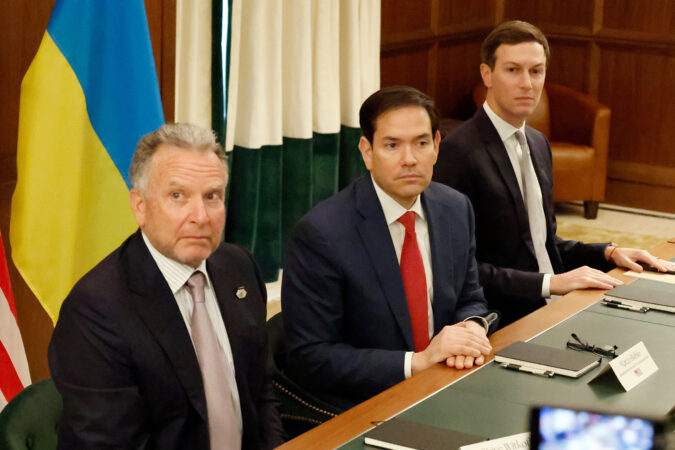
    U.S. Secretary of State Marco Rubio has said Europeans will be involved in discussions about the role of NATO and the European Union in any peace settlement.

    But European diplomats take limited comfort from such reassurances. They say that just about every aspect of a deal would affect Europe – from potential territorial concessions to U.S.-Russian economic cooperation.

    The latest initiative has also triggered fresh European worries about the U.S. commitment to NATO, which ranges from its nuclear umbrella through numerous weapons systems to tens of thousands of troops.

    German Defence Minister Boris Pistorius said last week that Europeans no longer know “which alliances we will still be able to trust in future and which ones will be durable.”

    Despite Trump’s previous criticism of NATO, he affirmed his commitment to the alliance and its Article 5 mutual defense clause in June in return for a pledge by Europeans to ramp up their defense spending.

    But Rubio’s plans to skip a meeting of NATO foreign ministers in Brussels this week may only fan European jitters, amid fears that an eastern member of the alliance may be Moscow’s next target.

    “Our intelligence services are telling us emphatically that Russia is at least keeping open the option of war against NATO. By 2029 at the latest,” German Foreign Minister Johann Wadephul said last week.

    Europeans fear territorial concessions will embolden Putin

    European officials say they see no sign that Putin wants to end his invasion of Ukraine. But if he does, they worry that any deal that does not respect Ukraine’s territorial integrity could embolden Russia to attack beyond its borders again.

    Yet it now seems likely any peace accord would let Moscow at least keep control of Ukrainian land that it has taken by force, whether borders are formally changed or not.

    The Trump administration has also not rejected out of hand Russian claims to the rest of the Donbas region that Moscow has been unable to capture after nearly four years of war.

    Moreover, Trump and other U.S. officials have made clear they see great opportunities for business deals with Moscow once the war is over.

    European officials fear that ending Russia’s isolation from the Western economy will give Moscow billions of dollars to reconstitute its military.

    “If Russia’s army is big, if their military budget is as big as it is right now, they will want to use it again,” EU foreign policy chief Kaja Kallas told reporters on Monday.

    Europe struggles to exert leverage

    But European leaders have struggled to exert a strong influence on any peace settlement, even though Europe has provided some 180 billion euros ($209.23 billion) in aid to Ukraine since Russia’s invasion in February 2022.

    The EU has a big potential bargaining chip in the form of Russian assets frozen in the bloc. But EU leaders have so far failed to agree on a proposal to use the assets to fund a 140-billion-euro loan to Ukraine that would keep Kyiv afloat and in the fight for the next two years.

    To try to show they can bring hard power to bear, a “coalition of the willing” led by France and Britain has pledged to deploy a “reassurance force” as part of postwar security guarantees to Ukraine.

    Russia has rejected such a force. But even if it did deploy, it would be modest in size, intended to bolster Kyiv’s forces rather than protect Ukraine on its own, and it could only work with U.S. support.

    “The Europeans now are paying the price for not having invested in military capabilities over the last years,” said Claudia Major, senior vice president for transatlantic security at the German Marshall Fund of the United States think tank.

    “The Europeans are not at the table. Because, to quote Trump, they don’t have the cards,” she said, referring to the U.S. president’s put-down of Ukrainian President Volodymyr Zelenskiy in February.

    ($1 = 0.8603 euros) (Additional reporting by Lili Bayer, John Irish and Sabine Siebold; writing by Andrew Gray; editing by Mark Heinrich)

  • Costco sues the Trump administration over tariffs, seeking a “complete refund”

    Costco sues the Trump administration over tariffs, seeking a “complete refund”

    Wholesale retail giant Costco has sued the federal government to ensure it will receive a “complete refund” on import duties if the Supreme Court rules against President Donald Trump’s sweeping tariffs.

    The lawsuit, filed in the U.S. Court of International Trade in New York on Nov. 28 and reviewed by USA TODAY, asked the court to find Trump’s use of the International Emergency Economic Powers Act to impose tariffs as unlawful.

    Costco, the largest warehouse club operator in the United States, said it has been the “importer of record” for products affected by the tariffs, but did not provide a specific dollar amount it is seeking in damages. The corporation noted in the filing that the suit was necessary because importers are not guaranteed to receive a refund if the high court strikes down the tariffs, unless they sue.

    Costco also claims in the lawsuit that Customs and Border Protection (CBP) denied its request to delay the calculation of the total tariffs that it owes. The lawsuit claims that Costco’s ability to receive a refund will be significantly impacted if those calculations are completed.

    The suit is separate from the larger case challenging Trump’s tariffs that the Supreme Court heard on Nov. 5.

    Other companies have sued to preserve refund rights, but the Issaquah, Washington-based retail warehouse club operator is among the largest to sue the administration so far. Others that have sought to protect tariff refunds include Bumble Bee Foods, eyeglass giant EssilorLuxottica, Kawasaki Motors, Revlon, and Yokohama Tire, court records show.

    Costco and the CBP did not immediately respond to USA TODAY’s requests for comment on Dec. 1.

    ‘Razor-close case’

    During nearly three hours of debate on Nov. 5, Supreme Court justices questioned whether Trump has the power to impose sweeping tariffs on most imports using the 1977 International Emergency Economic Powers Act. Several legal experts said the justices’ questions reveal a lot about where they stand on Trump’s policy.

    Ashley Akers, a former Justice Department attorney now with the law firm Holland & Knight, previously told USA TODAY that she heard a “notable skepticism from justices across the ideological spectrum.”

    “Overall, it felt like a strong day for the tariff challengers, though it feels like this will be a razor-close case,” Akers said.

    Several justices were concerned that if they sided with Trump, Congress would lose control over tariffs, even though the Constitution gives that power to lawmakers, said Curtis A. Bradley, an expert on foreign relations law at the University of Chicago Law School.

    Oliver Dunford, an attorney with the libertarian Pacific Legal Foundation, said the case is complicated enough without a majority of the court focusing on just one legal argument.

    “If I had to guess,” Dunford said, “I’d guess that the court will rule against the president without agreeing on the reason.”

    The Supreme Court took the tariff case on an accelerated basis, but has not said when it will rule.

    Contributing: Maureen Groppe, Bart Jansen, and Aysha Bagchi, USA TODAY; Reuters

    This article originally appeared on USA TODAY: Costco sues US to preserve tariff refunds if Trump loses appeal

    Reporting by James Powel, USA TODAY / USA TODAY

    USA TODAY Network via Reuters Connect

  • WNBA proposes $1.2M max player salary amid ongoing CBA negotiations

    WNBA proposes $1.2M max player salary amid ongoing CBA negotiations

    One day after the WNBA and Women’s National Basketball Association (WNBPA) agreed to extend the current collective barging agreement (CBA) through Jan. 9, the league has reportedly come to the negotiating table with a new proposal that increases player compensation.

    The league’s latest offer includes a maximum $1 million guaranteed base salary with projected revenue sharing raising max players’ total earnings to more than $1.2 million in 2026, a source close to the situation told USA TODAY Sports. They spoke on condition of anonymity because they’re not authorized to speak publicly about ongoing negotiations.

    The offer also raises the league’s minimum salary to more than $225,000 and the average salary to more than $500,000, up from $220,000 and $460,000, respectively, in the WNBA’s previous proposal on Nov. 18.

    The latest proposal also raises the salary cap to $5 million a season per team, an increase from $1.5 million salary cap in 2025. The salary cap would reportedly increase over the length of the CBA and be directly tied to the league’s revenue growth each year, although the specific revenue sharing details weren’t disclosed.

    USA TODAY Sports reached out to the WNBA and WNBPA for comment.

    Although the WNBA and WNBPA are on the record saying players deserve a significant pay increase in the next CBA, the sides have differing opinions on how to go about it has led the current standoff.

    The league previously proposed a maximum salary of more than $1.1 million — including both the base salary and revenue sharing component — available to more than one player per team on Nov. 18, but the proposal didn’t move the needle for the players. Both sides subsequently agreed on the Nov. 30 deadline to extend the CBA for a second time as revenue sharing and pay structure remain points of contention in negotiations.

    Last season, the minimum salary was $66,079, while the supermax was worth $249,244. Only five WNBA players made more than $225,000 last season: Kelsey Mitchell at $269,244, Arike Ogunbowale at $249,032, Jewell Loyd, at $249,032, Kahleah Copper at $248,134, and Gabby Williams at $225,000

    The current CBA was previously set to expire on Oct. 31 after the WNBPA exercised its right to opt out of the agreement in October 2024. However, the WNBA and players association agreed to a 30-day extension to extend the deadline to Nov. 30 to allow more time for a deal to be reached. The new deadline has been moved to Jan. 9, 2026, and both sides have the option to terminate the extension with 48 hours’ advance notice.

    The league and players association previously agreed to a 60-day extension in 2019, three days before the last CBA was set to expire on Oct. 31, 2019. A new deal was subsequently reached on the current CBA on Jan. 14, 2020 and singed into effect three days later on Jan. 17, 2020. The WNBA has not had a work stoppage in its nearly 30-year existence.

  • Hong Kong arrests more suspects in fire probe as the death toll hits 151

    Hong Kong arrests more suspects in fire probe as the death toll hits 151

    HONG KONG – Hong Kong authorities said on Monday they had arrested 13 people for suspected manslaughter in a probe into the city’s deadliest fire in decades, pointing to substandard renovation materials for fueling a blaze that has claimed at least 151 lives. Police continued to sweep the seven burnt-out towers engulfed in Wednesday’s disaster at the Wang Fuk Court estate, finding bodies of residents in stairwells and on rooftops, trapped as they tried to flee the flames.

    More than 40 people are still missing.

    “Some of the bodies have turned into ash, therefore we might not be able to locate all missing individuals,” police official Tsang Shuk-yin told reporters, choking up with emotion.

    Tests on several samples of a green mesh that was wrapped around bamboo scaffolding on the buildings at the time of the blaze did not match fire retardant standards, officials overseeing the investigations told a news conference.

    Contractors working on the renovations used these substandard materials in hard-to-reach areas, effectively hiding them from inspectors, said Chief Secretary Eric Chan.

    Foam insulation used by contractors also fanned the flames and fire alarms at the complex were not working properly, officials have said.

    Thousands have turned out to pay tribute to the victims, who include at least nine domestic helpers from Indonesia and one from the Philippines, with lines of mourners stretching more than a kilometer (a half-mile) along a canal next to the estate.

    Vigils are also due to take place this week in Tokyo, London and Taipei, authorities said.

    Amid pockets of public anger over missed fire risk warnings, Beijing has warned it would crack down on any “anti-China” protests.

    At least one person involved in a petition calling for an independent probe and a review of construction oversight among other demands was detained for around two days, sources familiar with the matter said.

    Police have declined to comment on the case.

    Hong Kong Security Chief Chris Tang also declined to comment on specific operations at a press conference on Monday.

    “I’ve noticed that some people with malicious intent, aiming to harm Hong Kong and national security, have taken advantage of this painful moment for society,” he said.

    “Therefore, we must take appropriate action, including enforcement measures.”

    Search moves to worst affect buildings

    The buildings being scoured for remains are the worst damaged and the search may take weeks, authorities have said.

    Images shared by police showed officers clad in hazmat suits, face masks and helmets, inspecting rooms with blackened walls and furniture reduced to ashes, and wading through water used to douse fires that raged for days.

    Throngs of officers arrived at the site early on Monday morning to continue their search of the burnt-out buildings.

    Members of the Disaster Victim Identification Unit work in an apartment in the aftermath of a deadly fire at Wang Fuk Court, a residential estate in Hong Kong.

    The apartment blocks were home to more than 4,000 people, according to census data, and those that escaped must now try to get their lives back on track.

    More than 1,100 people have been moved out of evacuation centers into temporary housing, with a further 680 put up in youth hostels and hotels, authorities said.

    With many residents leaving behind belongings as they fled, authorities have offered emergency funds of HK$10,000 ($1,284) to each household and provided special assistance for issuing new identity cards, passports and marriage certificates.

    Deadliest blaze since 1948

    Residents of Wang Fuk Court were told by authorities last year they faced “relatively low fire risks” after complaining about fire hazards posed by the renovations, the city’s Labour Department said.

    The residents raised concerns in September, 2024, including about the potential flammability of the mesh contractors used to cover the scaffolding, a department spokesperson said.

    Hong Kong’s deadliest fire since 1948, when 176 people died in a warehouse blaze, has stunned the city, where legislative elections are due to be held this weekend.

    Flowers are placed near the site of the deadly fire at Wang Fuk Court in Hong Kong.

    On Saturday, police detained Miles Kwan, 24, part of a group that launched a petition demanding an independent probe into possible corruption and a review of construction oversight, two people familiar with the matter said. Reuters could not establish whether he had been arrested.

    Kwan left a police station in a taxi on Monday afternoon, according to a Reuters witness.

    Two others have also since been arrested on suspicion of seditious intent, the South China Morning Post said. The police declined to comment on those reported arrests.

    China’s national security office warned individuals on Saturday against using the disaster to “plunge Hong Kong back into the chaos” of 2019, when massive pro-democracy protests challenged Beijing and triggered a political crisis.

    “We sternly warn the anti-China disruptors who attempt to ‘disrupt Hong Kong through disaster’,” the office said in a statement. “No matter what methods you use, you will certainly be held accountable and strictly punished.”