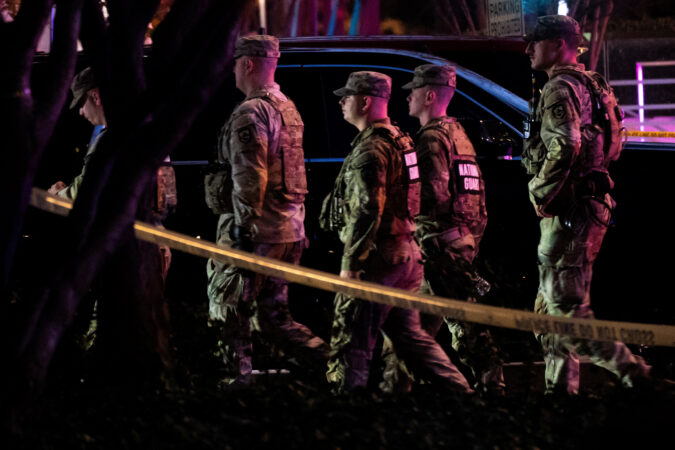
WASHINGTON – Two National Guard soldiers were shot on Wednesday near the White House in what officials described as a targeted ambush, and the suspect was in custody after suffering gunshot wounds during the attack.
Investigators identified the suspect as Rahmanullah Lakanwal, a 29-year-old Afghan national from Washington State, according to a Justice Department official who spoke on condition of anonymity. The attack is being investigated as an act of terrorism, the official said.
Lakanwal came to the U.S. in 2021 on a special visa program for Afghans who assisted the U.S. during the Afghanistan war and were vulnerable to reprisals from the ruling Taliban after the U.S. withdrawal, the official said. But he overstayed his visa and is in the country illegally, according to the official.
President Donald Trump was in Florida at the time of the attack, which prompted the White House to go into lockdown as law enforcement from multiple federal and city agencies swarmed the area.
The two soldiers, members of the West Virginia National Guard, were part of a “high-visibility patrol” around 2:15 p.m. ET (1915 GMT) near the corner of 17th and I streets, a few blocks from the White House. The suspect came around a corner and “ambushed” them, Metropolitan Police Assistant Chief Jeff Carroll said at a press briefing.
After an exchange of gunfire, other National Guard troops were able to subdue the shooter, he said. The two wounded soldiers were in critical condition at local hospitals, FBI Director Kash Patel said.
“This is a targeted attack,” Washington Mayor Muriel Bowser said at the briefing.
The shooter appeared to have acted alone, officials said.
Trump is at his resort in Palm Beach ahead of Thursday’s Thanksgiving holiday, while U.S. Vice President JD Vance is in Kentucky.
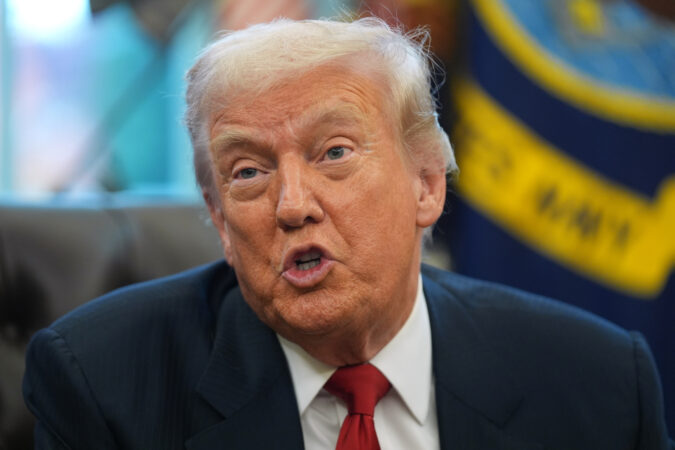
In a social media post, Trump called the suspected shooter an “animal” who would “pay a very steep price” and praised the National Guard.
He also ordered 500 more guard soldiers deployed to Washington, Secretary of Defense Pete Hegseth told reporters, joining about 2,200 already in the city as part of the president’s contentious immigration and crime crackdown targeting Democratic-led cities.
Witnesses describe chaotic scene
The shooting unfolded near Farragut Square, a popular lunch spot for office workers just a few blocks from the White House. The park, where light posts are wrapped in wreaths and bows for the holiday season, is flanked by fast-casual restaurants and a coffee shop, as well as two metro stops.
Witnesses described a chaotic scene after shots were fired, with pedestrians fleeing.
Mike Ryan, 55, said he was on his way to buy lunch nearby when he heard what sounded like gunfire. He ran half a block away and heard another round of apparent gunfire.
When he made his way back to the scene, he saw two National Guard soldiers on the ground across the street, with people trying to resuscitate one of them. At the same time, other guard troops had pinned someone on the ground, Ryan said.
Another witness, Emma McDonald, said she saw one of the soldiers carried away on a stretcher minutes after the shooting, his head covered in blood and an automated compression system attached to his chest.
National Guard soldiers have been in Washington since Trump’s initial deployment in August, a move that was opposed by local officials and criticized by Democrats. The guard troops in the city include contingents from the District of Columbia as well as Louisiana, Mississippi, Ohio, South Carolina, West Virginia, Georgia and Alabama.
Trump, a Republican, has suggested repeatedly that crime has disappeared from the capital as a result of the deployment, an assertion at odds with the police department’s official crime statistics.
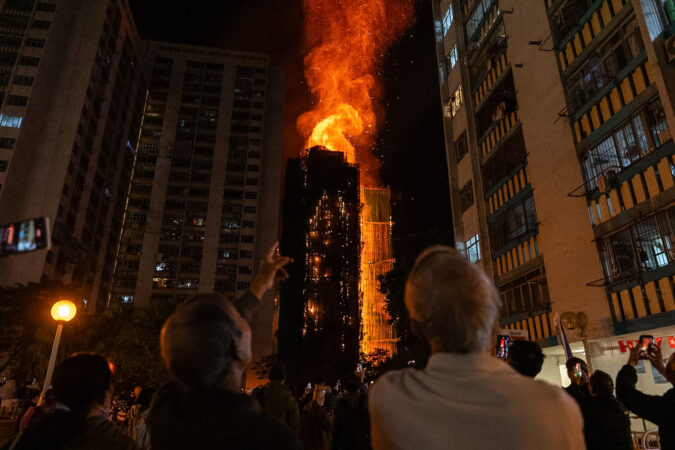
HONG KONG – At least 36 people were killed and 279 were missing on Wednesday after Hong Kong’s deadliest fire in three decades ripped through high-rise residential towers sheathed in flammable bamboo scaffolding, authorities said.
More than 10 hours after the fire started in the northern Tai Po district, flames and thick smoke still engulfed the 32-story towers as rescue workers swarmed the site and shocked inhabitants watched nearby.
The cause of the blaze was not immediately known, but it was fanned by green construction mesh and bamboo scaffolding which the government began phasing out in March for safety reasons.
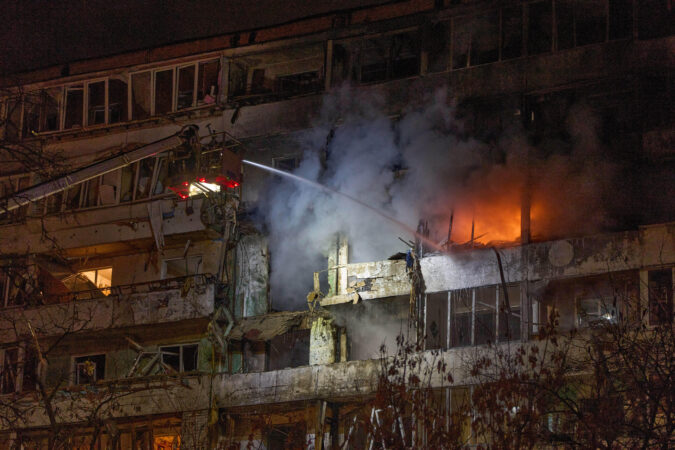
Firefighters work to extinguish a blaze that broke out at Wang Fuk Court in Hong Kong on Wednesday.
Working through the night, firefighters were struggling to reach upper floors of the Wang Fuk Court housing complex, which has 2,000 apartments in eight blocks, due to the intense heat.
One 71-year-old resident surnamed Wong broke down in tears, saying his wife was trapped inside.
A firefighter was among the 36 killed, and 29 people were in hospital, Hong Kong leader John Lee told reporters. Some 900 people were in eight shelters.
“The priority is to extinguish the fire and rescue the residents who are trapped. The second is to support the injured. The third is to support and recover. Then, we’ll launch a thorough investigation,” Lee told reporters. Harry Cheung, 66, who has lived at Block Two in one of the complexes for more than 40 years, said he heard a loud noise about 2:45 p.m. (6:45 GMT) and saw fire erupt in a nearby block.
“I immediately went back to pack up my things,” he said.
“I don’t even know how I feel right now. I’m just thinking about where I’m going to sleep tonight because I probably won’t be able to go back home.”
A firefighter was among those killed, the director of Fire Services said.
China’s XI urges ‘all-out’ effort against fire
Frames of scaffolding were seen tumbling to the ground as firefighters battled the blaze, while scores of fire engines and ambulances lined the road below the development.
From the mainland, China’s President Xi Jinping urged an “all-out effort” to extinguish the fire and to minimize casualties and losses, China’s state broadcaster CCTV said.
Hong Kong’s sky-high property prices have long been a trigger for social discontent in the city and the fire tragedy could stoke resentment towards authorities ahead of a city-wide legislative election in early December.
The cause of the blaze was not immediately known, but it was fanned by green construction mesh and bamboo scaffolding which the government began phasing out in March for safety reasons.
Hong Kong’s Transport Department said that due to the fire, an entire section of the Tai Po road, one of Hong Kong’s two main highways, had been closed and buses were being diverted.
At least six schools will be closed on Thursday due to the fire and traffic congestion, the city’s Education Bureau said.
It was Hong Kong’s worst fire since 41 people died in a commercial building in the heart of Kowloon in November 1996.
That fire was later found to be caused by welding during internal renovations.
A public inquiry yielded sweeping updates to building standards and fire safety regulations in the city’s high-rise offices, shops and homes.
Dozens of shocked residents and onlookers in Hong Kong watched from nearby walkways as smoke funneled up from the complex.
Bamboo scaffolding being phased out
Hong Kong is one of the last places in the world where bamboo is still widely used for scaffolding in construction.
The government moved to start phasing that out in March, citing safety. It announced that 50% of public construction works would be required to use metal frames instead.
Wang Fuk Court is one of many high-rise housing complexes in Hong Kong, one of the most densely populated areas in the world. Tai Po, located near the border with mainland China, is an established suburban district with some 300,000 residents.
Occupied since 1983, the complex is under the government’s subsidized home ownership scheme, according to property agency websites. According to online posts, it has been undergoing renovations for a year at a cost of HK$330 million ($42.43 million), with each unit paying between HK$160,000 and HK$180,000.
Owning a home is a distant dream for many in Hong Kong, one of the world’s most expensive housing markets and where residential rents are hovering around record highs.
WASHINGTON – A prosecutor on Wednesday dropped all criminal charges in Georgia against U.S. President Donald Trump for interference in the 2020 presidential election, ending a high-profile racketeering case that once seemed like a significant threat to the Republican.
The decision by Peter Skandalakis, a state official who recently took over the prosecution, was a stinging defeat for Fulton County District Attorney Fani Willis, who brought the case in 2023 but then lost control of it amid ethics complaints by defense lawyers.
It was one of four criminal prosecutions that Trump faced in the years since losing his 2020 presidential re-election bid to Democrat Joe Biden. Only one of them — a New York case over a hush-money payment to a porn star during his 2016 campaign — went to trial. Trump was found guilty in that case but has asked for it to be thrown out.
The dismissal highlighted how Trump’s return to the White House this year, a political comeback unparalleled in U.S. history, dismantled a thicket of legal cases that once seemed set to define his post-presidency era.
Trump’s political career had appeared to be over after his false claims of election fraud led a mob of supporters to storm the U.S. Capitol on Jan. 6, 2021, in a failed bid to overturn his 2020 defeat.
Skandalakis said in a court filing that “there is no realistic prospect that a sitting President will be compelled to appear in Georgia to stand trial,” so it would be “futile and unproductive” to push forward with the case.
Skandalakis said his decision, which was approved by a judge on Wednesday morning, “is not guided by a desire to advance an agenda but is based on my beliefs and understanding of the law.”
Steve Sadow, a lawyer for Trump, praised the dismissal, saying the case should have never been brought.
Willis had brought the case against Trump and 18 co-defendants, charging a sweeping criminal conspiracy to overturn Georgia’s 2020 election results after a recording surfaced in the media of Trump asking Georgia’s top electoral official to “find” him enough votes to win the state.
The co-defendants included former Trump lawyers Rudy Giuliani and John Eastman, who like Trump pleaded not guilty.
An appeals court removed Willis, an elected Democrat in Atlanta, from the case last year. The court said she had created an “appearance of impropriety” by having a romantic relationship with the special prosecutor she had hired to lead the case.
Skandalakis heads the Prosecuting Attorneys’ Council of Georgia, a government agency that supports the state’s local prosecutors. Earlier this month, he appointed himself to lead the case, saying he had been unable to find another prosecutor willing to take it over.
Anthony Michael Kreis, a Georgia State University law professor, said Skandalakis’s decision to drop the charges was not surprising. The agency he oversees does not have the resources to prosecute such a complex case with several co-defendants, Kreis said.
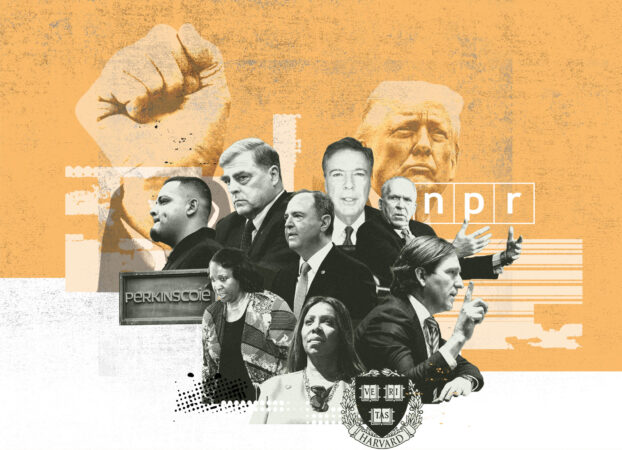
In his second term, Donald Trump has turned a campaign pledge to punish political opponents into a guiding principle of governance.
What began as a provocative rallying cry in March 2023 — “I am your retribution” — has hardened into a sweeping campaign of retaliation against perceived enemies, reshaping federal policy, staffing and law enforcement.
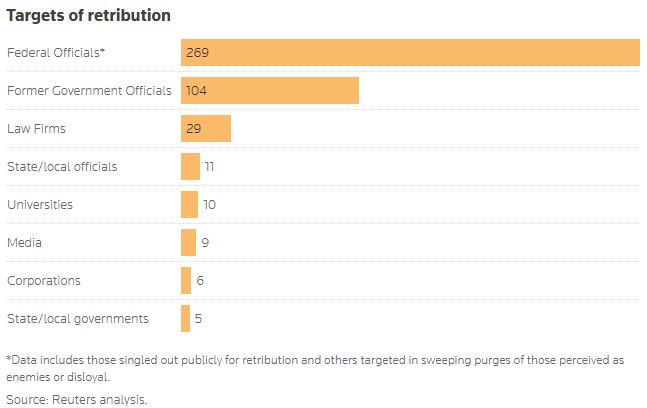
A tally by Reuters reveals the scale: At least 470 people, organizations and institutions have been targeted for retribution since Trump took office — an average of more than one a day. Some were singled out for punishment; others swept up in broader purges of perceived enemies. The count excludes foreign individuals, institutions and governments, as well as federal employees dismissed as part of force reductions.
The Trump vengeance campaign fuses personal vendettas with a drive for cultural and political dominance, Reuters found. His administration has wielded executive power to punish perceived foes — firing prosecutors who investigated his bid to overturn the 2020 election, ordering punishments of media organizations seen as hostile, penalizing law firms tied to opponents, and sidelining civil servants who question his policies. Many of those actions face legal challenges.
At the same time, Trump and his appointees have used the government to enforce ideology: ousting military leaders deemed “woke,” slashing funds for cultural institutions held to be divisive, and freezing research grants to universities that embraced diversity initiatives.
Reuters reached out to every person and institution that Trump or his subordinates singled out publicly for retribution, and reviewed hundreds of official orders, directives and public records. The result: the most comprehensive accounting yet of his campaign of payback.
The analysis revealed two broad groups of people and organizations targeted for retaliation.
Members of the first group – at least 247 individuals and entities – were singled out by name, either publicly by Trump and his appointees or later in government memos, legal filings or other records. To qualify, acts had to be aimed at specific individuals or entities, with evidence of intent to punish. Reuters reporters interviewed or corresponded with more than 150 of them.
Another 224 people were caught up in broader retribution efforts – not named individually but ensnared in crackdowns on groups of perceived opponents. Nearly 100 of them were prosecutors and FBI agents fired or forced to retire for working on cases tied to Trump or his allies, or because they were deemed “woke.” This includes 16 FBI agents who kneeled at a Black Lives Matter protest in 2020. The rest were civil servants, most of them suspended for publicly opposing administration policies or resisting directives on health, environmental and science issues.
Most common were punitive acts, such as firings, suspensions, investigations and the revocation of security clearances.
Reuters found at least 462 such cases, including the dismissal of at least 128 federal workers and officials who had probed, challenged or otherwise bucked Trump or his administration.
The second form was threats. Trump and his administration targeted at least 46 individuals, businesses and other entities with threats of investigations or penalties, including freezing federal funds for Democratic-led cities such as New York and Chicago.
Trump openly discussed firing Federal Reserve Chair Jerome Powell for resisting interest rate cuts, for instance. Last week, he threatened to have six Democratic members of Congress tried for sedition – a crime he said is “punishable by DEATH” – after the lawmakers reminded military personnel they can refuse “illegal orders.” This week, the Defense Department threatened to court-martial one of them, U.S. Senator Mark Kelly, a former Naval officer.
The third form was coercion. In at least a dozen cases, organizations such as law firms and universities signed agreements with the government to roll back diversity initiatives or other policies after facing administration threats of punishment, such as security clearance revocations and loss of federal funding and contracts.
It’s a campaign led from the top: Trump’s White House has issued at least 36 orders, decrees and directives, targeting at least 100 individuals and entities with punitive actions, according to the Reuters analysis.
Trump openly campaigned on a platform of revenge in his latest run for the presidency, promising to punish enemies of his Make America Great Again movement. “For those who have been wronged and betrayed, I am your retribution,” he said in a March 2023 speech. Weeks later, while campaigning in Texas, he repeated the theme. “I am your justice,” he said.
Today, the White House disputes the idea that the administration is out for revenge. It describes recent investigations and indictments of political adversaries as valid course corrections on policy, necessary probes of wrongdoing and legitimate policy initiatives.
“This entire article is based on the flawed premise that enforcing an electoral mandate is somehow ‘retribution.’ It’s not,” White House spokesperson Abigail Jackson said. There is no place in government for civil servants or public officials “who actively seek to undermine the agenda that the American people elected the president to enact,” she added. Trump is abiding by campaign promises to restore a justice system that was “weaponized” by the Biden administration, Jackson said, and “ensure taxpayer funding is not going to partisan causes.”
Trump’s actions have been cheered by his staunchest backers. Right-wing commentator and former Trump advisor Steve Bannon told Reuters the use of government power to punish Trump’s enemies is “not revenge at all” but an attempt to “hold people accountable” for what he said were unfair investigations targeting Trump. More is on the way, he said.
“The people that tried to take away President Trump’s first term, that accused him of being a Russian asset and damaged this republic, and then stole the 2020 election – they’re going to be held accountable and they’re going to be adjudicated in courts of law,” he said in an interview. “That’s coming. There’s no doubt.” There’s no evidence the 2020 election was stolen.
Trump’s allies point to actions former President Joe Biden took upon taking office. After Trump’s supporters attacked the U.S. Capitol on January 6, 2021, in a failed bid to overturn his election loss, Biden revoked Trump’s access to classified information, a first for any former president. Biden also won a court battle to dismiss Senate-confirmed directors of independent agencies serving fixed terms, such as the Federal Housing Finance Authority, and removed scores of Trump-era appointees from unpaid advisory boards.
Yet the scale and systematic nature of Trump’s effort to punish perceived enemies marks a sharp break from long-standing norms in U.S. governance, according to 13 political scientists and legal scholars interviewed by Reuters. Some historians say the closest modern parallel, though inexact, is the late President Richard Nixon’s quest for vengeance against political enemies. Since May, for instance, dozens
of officials from multiple federal agencies have been meeting as part of a task force formed to advance Trump’s retribution drive against perceived enemies, Reuters previously reported.
“The main aim is concentration of power and destruction of all checks against power,” said Daron Acemoglu, Nobel laureate in economics and a professor at the Massachusetts Institute of Technology, which faces an ongoing federal investigation for embracing diversity and equity programs. “Retribution is just one of the tools.”
Dozens of Trump’s targets have challenged their punishments as illegal. Fired and suspended civil servants have filed administrative appeals or legal challenges claiming wrongful termination. Some law firms have gone to court claiming the administration exceeded its legal authority by restricting their ability to work on classified contracts or interact with federal agencies. Most of those challenges remain unresolved.
Investigating foes of Trump
The administration has moved aggressively against officials in the government’s legal and national security agencies, institutions central to investigations of Trump’s alleged misconduct during and after his first term.
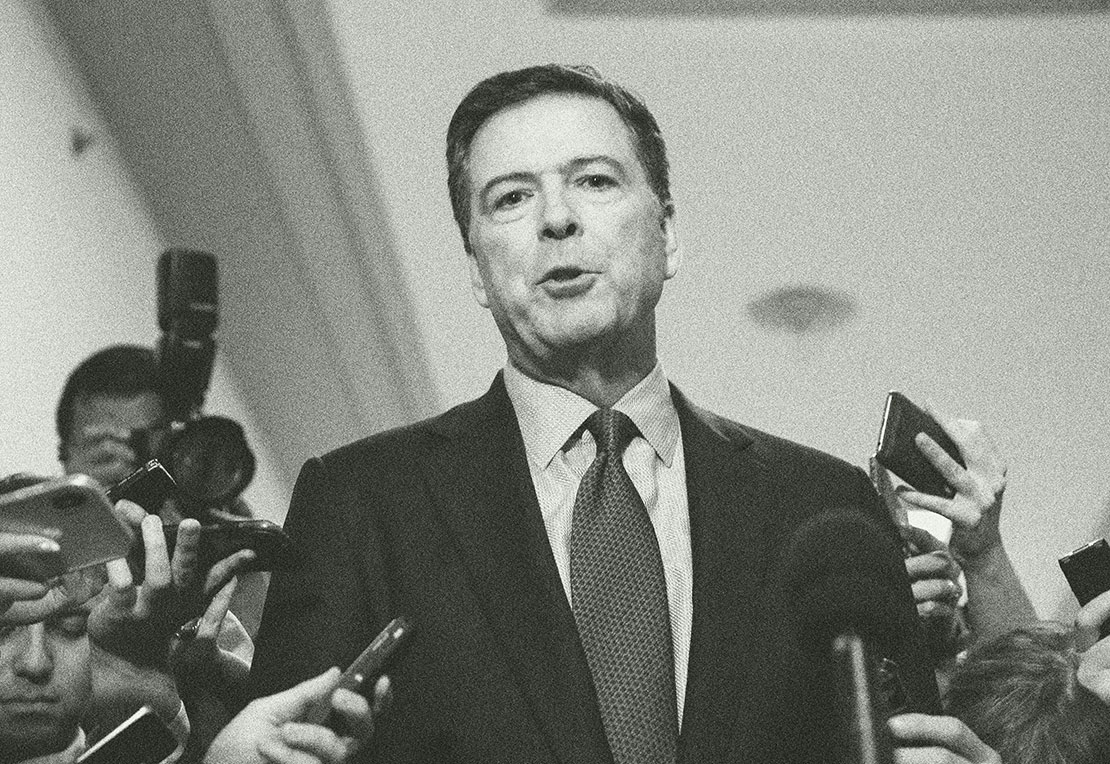
At least 69 current and former officials were targeted for investigating or sounding alarms about Russian interference in U.S. elections. U.S. intelligence agencies concluded soon after the 2016 election that Moscow sought to tilt the race toward Trump, a finding later affirmed by a bipartisan Senate Intelligence Committee report in August 2020. Acts of retribution tied to the Russia probe include the September 25 indictment of former FBI Director James Comey, a break from Justice Department norms meant to shield prosecutions from political influence.
Comey, who led the FBI’s investigation into Trump’s 2016 campaign, was charged after Trump demanded his prosecution. The Justice Department has cast the case as a corruption crackdown. Comey and his lawyers said in court documents that the case was “vindictive” and motivated by “personal animus.” Comey, who pleaded not guilty, declined to comment. A federal judge dismissed the case on Monday, ruling that Trump’s handpicked prosecutor had been unlawfully appointed.
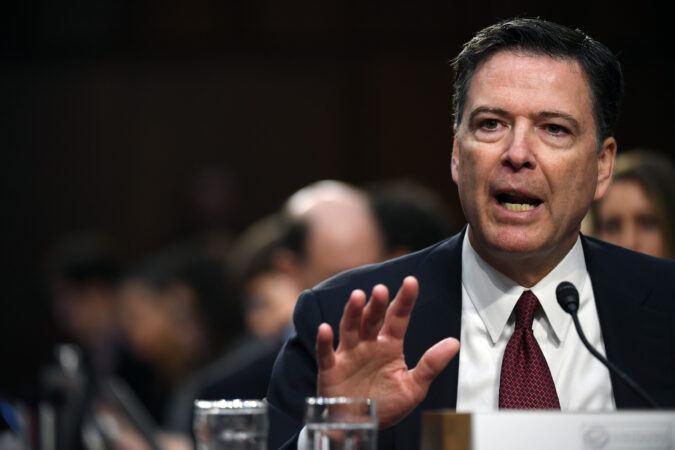
Acts of retribution tied to the Russia probe include the indictment of former FBI Director James Comey. His lawyers say he is the target of a “vindictive” prosecution.
At least 58 acts of retribution have targeted people Trump viewed as saboteurs of his election campaigns, including Chris Krebs, the top cybersecurity official during his first term. Trump fired him in 2020 for disputing claims that the election was rigged. In April, Trump stripped Krebs’ security clearance and ordered a federal investigation into his tenure. Krebs, still asserting that Trump’s defeat was valid, has vowed to fight the probe. He did not respond for this story.
Reuters documented 112 security clearances revoked from current and former U.S. officials, law firms and state leaders – credentials needed for work that involves classified information. In August, Director of National Intelligence Tulsi Gabbard announced she was revoking 37 clearances.
In a response to Reuters posted on X, an agency spokesperson said Gabbard and Trump are working “to ensure the government is never again wielded against the American people it is meant to serve.” She added: “President Trump said it best, ‘Our ultimate retribution is success.’”
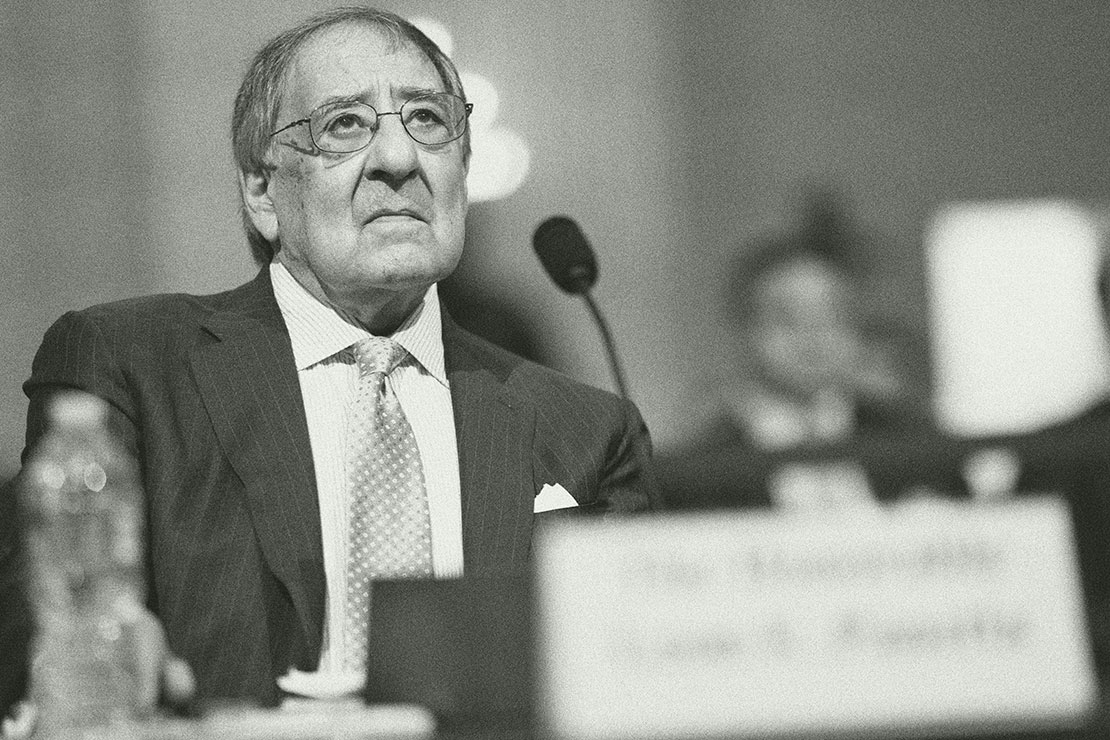
Leon Panetta, CIA director and defense secretary under former President Barack Obama, had his security clearance revoked in January along with others who signed an October 2020 letter suggesting Russia may have been behind reports about emails on Hunter Biden’s laptop. At the time, Joe Biden — Hunter’s father — was Trump’s Democratic rival in the 2020 election. An executive order Trump signed in January claimed: “The signatories willfully weaponized the gravitas of the Intelligence Community to manipulate the political process and undermine our democratic institutions.” Panetta has said he stands by signing the letter.
Panetta told Reuters he had already surrendered his clearance after leaving government nearly a decade ago. Trump’s retribution campaign is hurting CIA morale and wrecking the bipartisan trust that allows Washington to function, Panetta said. “What I worry about is that our adversaries will look at what’s happening and sense weakness,” he said. “This kind of political retribution leads to a loss of trust, which ultimately leads to a failure of governing.” The CIA did not respond to a request for comment.
Former CIA director Leon Panetta had his security clearance revoked along with others who signed a letter suggesting Russia may have been behind reports about emails on Hunter Biden’s laptop.
The revenge effort also reaches deep into the civil service, punishing employees who speak out against Trump’s policies and turning forms of dissent that were tolerated by past administrations into grounds for discipline.
This summer, hundreds of Environmental Protection Agency staffers wrote an open letter protesting deep cuts to pollution control and cleanup programs. The fallout was swift. More than 100 signers who attached their names were placed on paid leave. At least 15 senior officials and probationary employees were told they would be fired. The rest were informed they were under investigation for misconduct, leading to at least 69 suspensions without pay. Many remained out of work for weeks.
“They followed all the rules” of conduct for civil servants, said Nicole Cantello, one of the signers and an officer with the American Federation of Government Employees, a union that represents many affected workers. She called the punishments an attempt to “quell dissent,” stifle free speech and “scare the employees.” In a statement, the EPA said it has “a zero-tolerance policy for career officials using their agency position and title to unlawfully undermine, sabotage, and undercut” administration policy.
At the Federal Emergency Management Agency, about 20 staffers were put on leave and now face misconduct investigations after signing a letter criticizing the agency’s decision to scrap bipartisan reforms adopted years ago to speed disaster relief.
Cameron Hamilton, a Republican who served briefly as acting head of FEMA, was fired in May, a day after telling Congress he didn’t believe the agency should be shut down, contradicting the administration.
Hamilton told Reuters he still supports Trump. But he said too many senior officials are firing people in the name of retribution, trying to impress the White House. “They want to find ways to really launch themselves to prominence and be movers and shakers, to kick ass and take names,” said Hamilton. “They’re trying to show the president ‘look at what I am doing for you.’”
In a statement to Reuters, the Department of Homeland Security, which includes FEMA, said it is building a “new FEMA” to fix “inefficiency and outdated processes.” Employees “resisting change” are “not a good fit,” the statement said.
Dr. Jeanne Marrazzo, former head of the National Institute for Allergy and Infectious Diseases, sees her firing in October — three weeks after filing a whistleblower complaint alleging politicization of research and vaccine policy — as a warning shot. She told Reuters the administration’s purge of dissenting health officials is breeding “anticipatory obedience” — a reflex to comply before being asked. “People know if they push back … this is what happens,” she said. The effect, she says, is an ecosystem of fear: those who stay in government self-censor; those who speak out are branded “radioactive, too hot to handle.”
The Department of Health and Human Services, the agency that oversees NIAID, did not respond to a request for comment.
Federal agency leaders have dismissed a wide array of officials they deemed out of step with Trump’s MAGA agenda, including employees involved in diversity, equity and inclusion initiatives and those working on transgender issues.
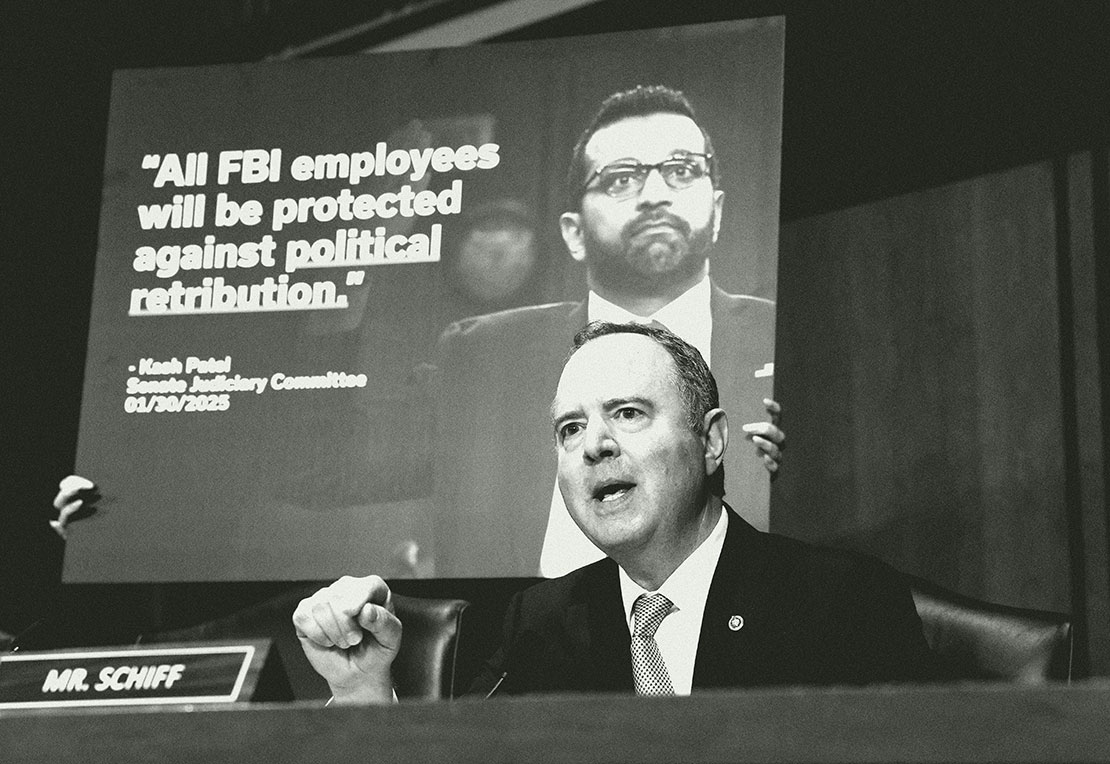
David Maltinsky, a Federal Bureau of Investigation employee, says he was fired by Director Kash Patel for displaying a Pride flag at work — one of at least 50 bureau personnel dismissed on Patel’s watch. Maltinsky sued the FBI and Justice Department, alleging violations of his constitutional rights and seeking reinstatement. The Justice Department has yet to file a formal response.
In his 2023 book, “Government Gangsters,” Patel named 60 people that he said were members of an “Executive Branch deep state” that opposed Trump, including former Democratic government officials and Republicans who served in Trump’s first administration but eventually broke with him. He called for firings and said that anybody who abused their authority should face prosecution. In his 2025 confirmation hearing before Congress, Patel denied that it was an “enemies list.”
Under FBI Director Kash Patel’s watch, at least 50 FBI personnel have been dismissed. In this photo, U.S. Senator Adam Schiff speaks in front of an image of Patel at a Senate hearing on FBI oversight.
Reuters found that at least 17 of the 60 people on Patel’s list have faced some sort of retribution, including firings and stripping of security clearances. The FBI did not respond to a request for comment.
Against perceived foes in the private sector, the administration has wielded financial penalties as leverage. At least two dozen law firms faced inquiries, investigations or restrictions on federal contracting, often for employing or representing people tied to past cases against Trump. Eight struck deals to avoid further action.
Nine media organizations have faced federal investigations, lawsuits, threats to revoke their broadcast licenses and limits on access to White House events. Trump has also suggested revoking broadcast licenses for networks whose coverage he dislikes.
The targets include universities, long cast by the president and his allies as bastions of left-wing radicals.
Officials froze more than $4 billion in federal grants and research funding to at least nine schools, demanding policy changes such as ending diversity, equity and inclusion programs, banning transgender athletes from women’s sports and cracking down on alleged antisemitism amid pro-Palestinian protests. Five universities have signed agreements to restore funding. Harvard University successfully sued to block a freeze on $2.2 billion in federal aid for the school, which Trump accused of “pushing political, ideological, and terrorist inspired” dogma. Harvard declined to comment.
The administration has described the funding freezes and other efforts to force policy changes at colleges and universities as a necessary push to reverse years of leftward drift in U.S. education. “If Reuters considers restoring merit in admissions, reclaiming women’s titles misappropriated by male athletes, enforcing civil rights laws, and preventing taxpayer dollars from funding radical DEI programs ‘retribution,’ then we’re on very different planes of reality,” said Julie Hartman, a spokesperson for the U.S. Education Department.
A historical parallel: Nixon’s enemies
It’s impossible to predict, of course, how far the Trump revenge campaign will go, or whether it will be affected by a recent slide in popular support. Trump has been hurt by public frustration with the high cost of living and the investigation into late convicted sex offender Jeffrey Epstein.
Nixon resigned in 1974 over the Watergate scandal, in which aides to his re-election campaign broke into Democratic Party headquarters and the president himself later directed a cover-up. While in office, he kept a list of more than 500 enemies. But while Trump has conducted his retribution campaign in the open, historians note, Nixon’s enemies list was conceived as a covert tool.
John Dean, chief counsel in the Nixon White House, wrote a confidential memo in 1971 addressing “how we can use the available federal machinery to screw our political enemies.” The planned methods included tax audits, phone-tapping, the cancellation of contracts and criminal prosecution. Yet the execution faltered: IRS Commissioner Donald Alexander refused to conduct mass audits, and most targets escaped serious punishment.
Other recent presidents, to be sure, have been accused of seeking to punish opponents, though on a smaller scale. The Obama administration pursued “aggressive prosecution of leakers of classified information,” the Committee to Protect Journalists said in a 2013 report. Two IRS employees alleged they were retaliated against during the Biden administration for raising concerns about the handling of the tax-compliance investigation of Hunter Biden.
Nixon’s plotting remained a secret until the Watergate hearings exposed it, turning his enemies list into a symbol of presidential abuse. The secrecy reflected a political culture in which retaliation was whispered, not broadcast, and where institutional checks blunted many of Nixon’s ambitions.
Trump’s approach reverses that pattern, historians say. He has openly named his perceived enemies, urged prosecutions in public and framed vengeance as a campaign vow. Some say today’s “enemies list” politics are in that sense farther-reaching than Nixon’s, possibly signaling a shift toward a normalization of retribution in American political life.
Corey Brettschneider, a political science professor at Brown University who has written a book on power grabs by American presidents, said Nixon was ultimately checked and forced to resign by Congress, including members of his own Republican Party. “That’s just not happening now,” he said.
A group of U.S. states filed a lawsuit on Tuesday to compel President Donald Trump’s administration to reinstate more than $3 billion in grant funding used to provide permanent housing and other services to homeless people.
The 20 mostly Democratic-led states and Washington, D.C., said changes the U.S. Department of Housing and Urban Development announced to its Continuum of Care program this month violate federal law and are illegally targeted at LGBTQ people and other communities that are not aligned with the Trump administration’s policy priorities, in the lawsuit in Rhode Island federal court.
The lawsuit seeks to block the funding cuts and new conditions HUD has placed on receiving the grants.
Program created in 1987
New York Attorney General Letitia James, a Democrat, said in a statement that communities across the country depend on the program to provide housing and other resources to their most vulnerable members.
“These funds help keep tens of thousands of people from sleeping on the streets every night,” James said.
The states that joined New York in the lawsuit include California, Illinois, Pennsylvania, Arizona and Kentucky.
“For decades, these housing programs have helped vulnerable people — families, seniors, veterans, people with disabilities, and LGTBQ+ Pennsylvanians — have access to safe, affordable housing,” Pennsylvania Gov. Josh Shapiro said in a statement released Tuesday. “Now, the Trump Administration is trying to abruptly dismantle the very system Congress created to fight homelessness. Pennsylvanians depend on this funding and the Trump Administration’s decision will force people out of their homes, defund organizations doing critical work, and leave state taxpayers on the hook. I’m taking action to ensure the federal government keeps its promise — because no Pennsylvanian should be thrown back into homelessness because of political games in Washington.”
Congress created the Continuum of Care program in 1987 to provide resources for states, local governments and nonprofits to deliver support services to homeless people, with a focus on veterans, families, and people with disabilities.
The program has long been based on the “housing first” approach to combating homelessness, which prioritizes placing people into permanent housing without preconditions such as sobriety and employment. Along with housing, the grants fund childcare, job training, mental health counseling and transportation services. The Trump administration has criticized the housing-first approach, and HUD this month said it was overhauling the grant program to focus on transitional housing initiatives with work requirements and other conditions. HUD has also barred grant recipients from using the funding for activities that promote diversity, equity, and inclusion, elective abortions, or “gender ideology,” or interfere with the administration’s immigration enforcement agenda. Trump, a Republican, has also urged states and cities to clear out homeless encampments and direct people to substance abuse and mental health treatment facilities.
The changes could cause more than 170,000 people to lose their housing, according to the states’ lawsuit. The states claim the Trump administration cannot impose its own conditions on funds that Congress said should be distributed based solely on need. (Reporting by Daniel Wiessner in Albany, New York, Editing by Alexia Garamfalvi and Rod Nickel)
WASHINGTON — U.S. consumer confidence sagged in November as households worried about jobs and their financial situation, likely in part because of the recently ended government shutdown.
The Conference Board said on Tuesday its consumer confidence index dropped to 88.7 this month from an upwardly revised 95.5 in October.
Economists polled by Reuters had forecast the index edging down to 93.4 from the previously reported 94.6 in October.
“Consumers’ write-in responses pertaining to factors affecting the economy continued to be led by references to prices and inflation, tariffs and trade, and politics, with increased mentions of the federal government shutdown,” said Dana Peterson, chief economist at the Conference Board.
“Mentions of the labor market eased somewhat but still stood out among all other frequent themes not already cited. The overall tone from November write-ins was slightly more negative than in October.”
WASHINGTON – The FBI has requested interviews with six Democrats from the U.S. Congress who told members of the military they must refuse any illegal orders, a Justice Department official told Reuters on Tuesday.
The move, reported earlier by Fox News, comes a day after the Pentagon threatened to recall Senator Mark Kelly, a Navy veteran and one of the six lawmakers, to active duty potentially to face military charges over what Secretary of Defense Pete Hegseth described as “seditious” acts on social media.
The other lawmakers, who made the comments in a video released last week, include Senator Elissa Slotkin, a former CIA analyst and Iraq war veteran, and Representatives Jason Crow, Maggie Goodlander, Chris Deluzio and Chrissy Houlahan, all military veterans.
The legislators created the video amid concerns from Democrats — echoed privately by some U.S. military commanders — that the Trump administration is violating the law by ordering strikes on vessels purportedly carrying suspected drug traffickers in Latin American waters.
The Pentagon has argued the strikes are justified because the drug smugglers are considered terrorists.
The Justice Department official, who spoke on condition of anonymity, said the interviews were to determine “if there’s any wrongdoing and then go from there.”
The FBI did not immediately respond to a request for comment.
In a statement on Monday, Kelly dismissed the Pentagon’s threat as an intimidation tactic.
WASHINGTON/KYIV — Ukraine on Tuesday signaled support for the framework of a peace deal with Russia but stressed that sensitive issues needed to be fixed at a meeting between President Volodymyr Zelensky and U.S. President Donald Trump.
Kyiv’s message hinted that an intense diplomatic push by the Trump administration could be yielding some fruit but any optimism could be short-lived, especially as Russia stressed it would not let any deal stray too far from its own objectives.
U.S. and Ukrainian negotiators held talks on the latest U.S.-backed peace plan in Geneva on Sunday. U.S. Army Secretary Dan Driscoll then met on Monday and Tuesday with Russian officials in Abu Dhabi, a spokesperson for Driscoll said.
U.S. and Ukrainian officials have been trying to narrow the gaps between them over the plan to end Europe’s deadliest and most devastating conflict since World War Two, with Ukraine wary of being strong-armed into accepting a deal largely on the Kremlin’s terms, including territorial concessions.
“Ukraine — after Geneva — supports the framework’s essence, and some of the most sensitive issues remain as points for the discussion between presidents,” a Ukrainian official said.
Zelensky could visit the United States in the next few days to finalize a deal with Trump, Kyiv’s national security chief Rustem Umerov said, though no such trip was confirmed from the U.S. side.
White House press secretary Karoline Leavitt said on X that over the past week the U.S. had made “tremendous progress towards a peace deal by bringing both Ukraine and Russia to the table.” She added: “There are a few delicate, but not insurmountable, details that must be sorted out and will require further talks between Ukraine, Russia, and the United States.”
Oil prices extended an earlier decline after reports of Ukraine potentially agreeing to a war-ending deal.
Underlining the high stakes for Ukraine, its capital Kyiv was hit by a barrage of missiles and hundreds of drones overnight in a Russian strike that killed at least seven people and again disrupted power and heating systems. Residents were sheltering underground wearing winter jackets, some in tents.
Zelensky will discuss sensitive issues with Trump
U.S. policy towards the war has zigzagged in recent months.
A hastily arranged summit between Trump and Russian President Vladimir Putin in Alaska in August raised worries in Kyiv and European capitals that the Trump administration might accept many Russian demands, though the meeting ultimately resulted in more U.S. pressure on Russia.
The 28-point plan that emerged last week caught many in the U.S. government, Kyiv and Europe alike off-guard and prompted fresh concerns that the Trump administration might be willing to push Ukraine to sign a peace deal heavily tilted toward Moscow.
The plan would require Kyiv to cede territory beyond the almost 20% of Ukraine that Russia has captured since its February 2022 full-scale invasion, as well as accept curbs on its military and bar it from ever joining NATO — conditions Kyiv has long rejected as tantamount to surrender.
The sudden push has raised the pressure on Ukraine and Zelensky, who is now at his most vulnerable since the start of the war after a corruption scandal saw two of his ministers dismissed, and as Russia makes battlefield gains.
Zelensky could struggle to get Ukrainians to swallow a deal viewed as selling out their interests.
He said on Monday the latest peace plan incorporated “correct” points after talks in Geneva. “The sensitive issues, the most delicate points, I will discuss with President Trump,” Zelensky said in his nightly video address.
Zelensky said the process of producing a final document would be difficult. Russia’s unrelenting attacks on Ukraine have left many skeptical about how peace can be achieved soon.
“There was a very loud explosion, our windows were falling apart, we got dressed and ran out,” said Nadiia Horodko, a 39-year-old accountant, after a residential building was struck in Kyiv overnight.
“There was horror, everything was already burning here, and a woman was screaming from the eighth floor, ‘Save the child, the child is on fire!’”
Russian Foreign Minister Sergei Lavrov said an amended peace plan must reflect the “spirit and letter” of an understanding reached between Putin and Trump at their Alaska summit.
“If the spirit and letter of Anchorage is erased in terms of the key understandings we have established then, of course, it will be a fundamentally different situation (for Russia),” Lavrov warned.
A group of countries supporting Ukraine, which is known as the coalition of the willing and includes Britain and France, was also set to hold a virtual meeting on Tuesday.
“It’s an initiative that goes in the right direction: peace. However, there are aspects of that plan that deserve to be discussed, negotiated, improved,” French President Emmanuel Macron told RTL radio regarding the U.S.-proposed plan. “We want peace, but we don’t want a peace that would be a capitulation.”
In a separate development, Romania scrambled fighter jets to track drones that breached its territory near the border with Ukraine early on Tuesday, and one was still advancing deeper into the NATO-member country, the defense ministry said. (Reporting by Idrees Ali, Phil Stewart, Devika Nair, Tom Balmforth, Pavel Polityuk, Alessandro Parodi, Michel Rose, Luiza Ilie and Sergiy Karazy; writing by Matthias Williams; editing by Frances Kerry and Mark Heinrich)
WASHINGTON — A federal judge on Monday dismissed criminal charges against two perceived adversaries of President Donald Trump, FBI Director James Comey and New York Attorney General Letitia James, ruling the U.S. attorney he hand picked to prosecute them was unlawfully appointed.
The ruling throws out two cases Trump had publicly called for as he pressured Justice Department leaders to move against high-profile figures who had criticized him and led investigations into his conduct.
Lindsey Halligan, a former personal lawyer to Trump, was named interim U.S. Attorney for the Eastern District of Virginia in September to take over both investigations despite having no previous prosecutorial experience. The findings by U.S. District Judge Cameron McGowan Currie came after both Comey and James accused the Trump Justice Department of violating the U.S. Constitution’s Appointments Clause and federal law by appointing Halligan in September.
New York Attorney General, Letitia James, speaks after pleading not guilty outside the United States District Court in October in Norfolk, Va.
‘No legal authority’
Currie found that Halligan “had no legal authority” to bring indictments against either Comey or James. But Currie dismissed the cases “without prejudice,” giving the Justice Department an opportunity to seek new indictments with a different prosecutor at the helm.
“All actions flowing from Ms. Halligan’s defective appointment,” Currie wrote, were “unlawful exercises of executive power and are hereby set aside.”
After the decision, Attorney General Pam Bondi told reporters the Justice Department would “be taking all available legal action, including an immediate appeal to hold Letitia James and James Comey accountable for their unlawful conduct.”
Bondi said that because Halligan was made a special U.S. attorney, she can continue to prosecute cases.
“She can fight in court just like she was and we believe we will be successful on appeal,” Bondi said.
James and Comey separately said they were grateful for the ruling. James’ attorney, Abbe Lowell, said she would “continue to challenge any further politically motivated charges through every lawful means available.”
In an Instagram video, Comey said the case against him “was a prosecution based on malevolence and incompetence and a reflection of what the Department of Justice has become under Donald Trump.”
It is unclear if prosecutors could seek to bring a new case against Comey over the same conduct. The five-year statute of limitations on the charges expired on September 30, and Comey’s lawyers have already indicated in court filings that they do not believe prosecutors have more time to refile the charges.
Both Comey and James have been longtime targets of Trump’s ire. Comey as FBI director oversaw an investigation into alleged ties between Trump’s 2016 election campaign and the Russian government and later called Trump unfit for office.
James, an elected Democrat, successfully sued Trump and his family real estate company for fraud. Trump ordered Bondi to install Halligan to the post after her predecessor Erik Siebert declined to pursue charges against Comey or James, citing a lack of credible evidence in both cases.
Halligan moved swiftly
Shortly after her appointment, Halligan alone secured indictments against Comey and James after other career prosecutors in the office refused to participate. Comey pleaded not guilty to charges of making false statements and obstructing Congress after he was accused of lying about authorizing leaks to the news media. James pleaded not guilty to charges of bank fraud and lying to a financial institution for allegedly misleading on mortgage documents to secure more favorable loan terms.
Attorneys for Comey and James argued that Halligan’s appointment violated a federal law they said limits the appointment of an interim U.S. attorney to one 120-day stint.
Repeated interim appointments would bypass the U.S. Senate confirmation process and let a prosecutor serve indefinitely, they said. Siebert previously had been appointed by Bondi for 120 days and was then re-appointed by the U.S. District Court for the Eastern District of Virginia, since the Senate had not yet confirmed him in the role.
Lawyers for the Justice Department argued the law allows the attorney general to make multiple interim appointments of U.S. Attorneys. Still, Bondi sought to shore up the cases by separately installing Halligan as a special attorney assigned to both prosecutions. In that same document, she also said she ratified the indictments.
Currie found that Bondi’s attempts to retroactively secure the cases were invalid. Currie, who is based in South Carolina and was appointed by former Democratic President Bill Clinton, was assigned to rule on Halligan’s appointment because federal judges in Virginia had played a role in appointing her predecessor.
The challenge to Halligan’s appointment was one of several efforts lawyers for Comey and James have made to have the cases against them thrown out before trials. Both also argued that the cases are “vindictive” prosecutions motivated by Trump’s animosity.
Halligan has come under intense scrutiny by courts, particularly over her handling of the Comey case. A federal magistrate judge found she may have made significant legal errors in presenting evidence and instructing the grand jury that indicted Comey. The trial judge repeatedly questioned whether the full grand jury had seen the final version of the Comey indictment.
WASHINGTON — The Pentagon on Monday threatened to recall Senator Mark Kelly, a retired Navy captain, to active duty status in order to prosecute him after saying it received “serious allegations of misconduct.”
The statement did not say what charges Kelly could face if it took such a step. But President Donald Trump last week accused Kelly and other Democratic lawmakers of seditious behavior for urging U.S. troops to refuse any illegal orders. Trump, in a social media post, said the crime was “punishable by DEATH!”
“All servicemembers are reminded that they have a legal obligation under the UCMJ (Uniform Code of Military Justice) to obey lawful orders and that orders are presumed to be lawful. A servicemember’s personal philosophy does not justify or excuse the disobedience of an otherwise lawful order,” the Pentagon said.