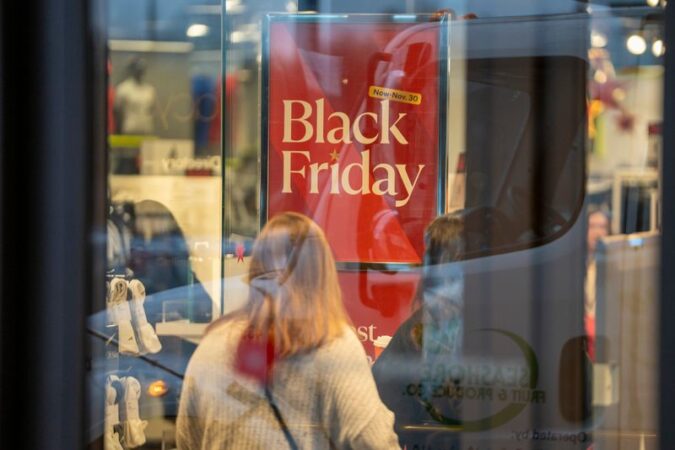
NEW YORK — Unprecedented numbers of Americans are expected to hit stores this Black Friday, but they are likely to curtail their spending as they find fewer bargains from tariff-hit retailers.
Marking the biggest turnout ever for the five-day stretch between Thanksgiving and Cyber Monday, 186.9 million people will shop, up from 183.4 million last year, the National Retail Federation projects. But sales growth for the last two months of the year, crucial for retailers, is expected to slow.
“Everything seems to be way more expensive” at malls, said Kate Sanner, a New Yorker who runs an online aggregator for secondhand listings. Last year, Sanner, 33, spent around $500 on gifts, but this season she plans to trim her budget to $300, eschewing most Black Friday discounts for targeted deals on specific products.
Thanksgiving falls on Nov. 27 this year, giving retailers an extra day in the holiday window, which typically accounts for a third of annual profits. Retailers have launched early promotions to lock in sales: Walmart’s began on Nov. 14 and will run in three phases through Dec. 1, with Walmart+ members getting early access. Amazon started its Black Friday deals week on Thursday, while Macy’s has opened a dedicated Black Friday portal.
Sales in November and December — in physical stores and online — are forecast to top $1 trillion for the first time, rising between 3.7% and 4.2%, but are likely to grow at a slower pace than last year’s 4.8% gain, NRF projections show.
Shoppers avoid dipping into savings for purchases
While the sticker shock alone could deter some buyers, others are budgeting for the increased costs of other necessities.
“Knowing that our healthcare premium bill is going to jump astronomically in 2026 … all of our discretionary spending has dropped significantly,” said Liz Sweeney, founder of marketing agency Dogwood Solutions, who lives in Boise, Idaho.
“While we spent close to $2,000 on gifts in 2024, our 2025 budget is $750,” said 52-year-old Sweeney, who is skipping electronics and big buys this year, sticking to shoes, books, and kitchenware.
Shoppers still have plenty in the bank, with households across all income levels holding more deposits than they did in 2019, before the COVID-19 pandemic, November data from Bank of America data shows. Consumers were also not using a significant portion of their savings, the data showed.
“Consumers are sentimentally weak and fundamentally sound,” said Mark Mathews, the NRF’s chief economist. “U.S. household balance sheets are still strong.”
The federation estimates average spending on gifts and seasonal items such as decorations, cards, food and candy will reach $890 per person, slightly less than last year’s $902. Nearly two-thirds of the 8,427 consumers polled say they will wait for Thanksgiving weekend deals, up from 59% in 2024, with older shoppers driving the trend.
‘Definitely seen fewer promotions’
“Knowing when is the right time to buy this year is more difficult,” said Edgar Dworsky, founder of Consumer World, who tracks holiday pricing. “With so many pre-Black Friday sales, there are no assurances the same deals will be offered again on the real Black Friday or that popular items will still be in stock.”
Historically, Dworsky said, stores such as Kohl’s, JC Penney, and Macy’s offered small kitchen appliances for as little as $5 after some combination of sales prices, percentage-off coupons, and mail-in rebates, but many of those discounts have disappeared. Kohl’s, for instance, is offering toasters, blenders, and electric frying pans for $9.99 without a rebate but with a coupon for 15% off this year, he said.
“I’ve definitely seen fewer promotions this year both in-store and online. The first two weeks of November usually bring some activity — though in recent years the discounts haven’t been very deep — but this year there’s been very little and much more full price,” said Jessica Ramirez, who runs brand consultancy the Consumer Collective.
“When promotions do show up, they’re spot promotions, meaning they aren’t set and don’t last long,” she added.
While some retailers appear to be pulling back on promotions, Walmart is teasing some aggressive price cuts for Black Friday.
Some of Walmart’s featured deals include an 85-inch TCL Roku TV, originally priced at $678, marked down to $498 for Black Friday, according to a Reuters review of the retailer’s website. Last year, Walmart highlighted a $120 discount on a 75-inch Vizio TV. This year’s lineup also features a Blackstone outdoor grill offered at $157, reduced from its list price of $224.
Warner Bros. Discovery has received preliminary buyout bids from rivals Paramount Skydance, Philadelphia-based Comcast, and Netflix, a source familiar with the matter said on Thursday, kicking off a potential sale of the century-old Hollywood studio.
The bids set the stage for a significant consolidation in the media industry and will determine the future of prized assets such as HBO, the Warner Bros. film library, and the DC Comics universe.
Paramount is expected to bid for all of Warner Bros. Discovery, including its cable television networks. Paramount’s bid is backed by the studio’s controlling shareholder, billionaire Oracle co-founder Larry Ellison, who is among the world’s richest men. The potential combination would enhance Paramount’s presence in movie theaters, giving it a 32% share of the North American theatrical market, according to Comscore, and strengthen its streaming service by combining HBO Max with Paramount+.
Reuters exclusively reported that Warner Bros. Discovery’s board rejected a mostly cash offer of nearly $24 a share for the company, valuing it at $60 billion, and publicly announced it would evaluate strategic options for the studio.
NBCUniversal’s corporate parent, Comcast, is interested in Warner Bros.’ film and television studios and HBO, whose characters, including Superman and Batman, would strengthen its theatrical and streaming business and its theme parks. The merged studios’ share of the North American theatrical market would exceed 43%, according to Comscore.
Netflix is also courting Warner Bros.’ studio and streaming businesses, aiming to gain access to Warner Bros.’ extensive film library and established entertainment franchises, such as Harry Potter and Lord of the Rings. Warner Bros. Discovery previously announced plans to split into two publicly traded companies, separating its studios and streaming business from its fading cable networks.
Warner Bros. Discovery did not immediately respond to Reuters’ request for comment. Comcast and Paramount Skydance declined to comment. Netflix could not be reached for comment. The New York Times first reported the development.
When Lauren Vaughn, a kindergarten assistant in South Carolina, saw reports that right-wing influencer Charlie Kirk had been shot at an event in Utah, she opened Facebook and typed out a quote from Kirk himself.
Gun deaths, Kirk said in 2023, were unfortunate but “worth it” if they preserved “the Second Amendment to protect our other God-given Rights.” Following the quote, Vaughn added: “Thoughts and prayers.”
Vaughn, a 37-year-old Christian who has taken missionary trips to Guatemala, said her call for prayer was sincere. She said she hoped reading Kirk’s words in the context of the shooting might prompt her friends to rethink their opposition to gun control.
“Maybe now they’ll listen,” she recalled thinking.
A few days later, Vaughn lost her job. She was one of more than 600 Americans fired, suspended, placed under investigation or disciplined by employers for comments about Kirk’s September 10 assassination, according to a Reuters review of court records, public statements, local media reports and interviews with two dozen people who were fired or otherwise disciplined.
Some were dismissed after celebrating or mocking Kirk’s death. At least 15 people were punished for allegedly invoking “karma” or “divine justice,” and at least nine others were disciplined for variations on “Good riddance.” Other offending posts appeared to exult in the killing or express hope that other Republican figures would be next. “One down, plenty to go,” one said.
Others, like Vaughn, say they simply criticized Kirk’s politics.
In the pro-Kirk camp, at least one academic was put on administrative leave after threatening to “hunt down” those celebrating the assassination.
This account is the most comprehensive to date of the backlash against Kirk’s critics, tracing how senior officials in President Donald Trump’s administration, local Republican lawmakers and allied influencers mobilized to enforce the Trump movement’s views. The story maps the pro-Trump machinery of retaliation now reshaping American political life, detailing its scale and tactics, ranging from shaming on social media to public pressure on employers and threats to defund institutions. Earlier reports by Reuters have documented how Trump has purged the federal government of employees deemed opponents of his agenda and cracked down on law firms defending people in the administration’s crosshairs.
Americans sometimes lose their jobs after speaking out in heated political moments. Twenty-two academics were dismissed in 2020, the year George Floyd was murdered by a Minneapolis police officer, most for comments deemed insensitive, according to the Foundation for Individual Rights and Expression, a free-speech advocacy group. In 2024, the first full year following the outbreak of the latest Israel-Gaza war, more than 160 people were fired in connection with their pro-Palestinian advocacy, according to Palestine Legal, an organization that protects the civil rights of American supporters of the Palestinian cause.
The backlash over comments about Kirk’s shooting stands apart because of its reach and its public backing from Trump, Vice President JD Vance and other top government officials. It represents a striking about-face for Republicans, who for years castigated the left for what they called “cancel culture” — the ostracism or punishment of those whose views were deemed unacceptable.
Supporters of the firings say that freedom of speech is not freedom from consequence. Standards of behavior should be high for people like doctors, lawyers, teachers or emergency workers who are in positions of public trust, they said.
In a statement, White House spokesperson Abigail Jackson said: “President Trump and the entire Administration will not hesitate to speak the truth – for years, radical leftists have slandered their political opponents as Nazis and Fascists, inspiring left-wing violence. It must end.” She added: “no one understands the dangers of political violence more than President Trump” after he survived two assassination attempts.
Turning Point USA, the youth movement Kirk founded in 2012, said in a statement that it supported the right to free speech, “including that of private employers to determine when a bright line has been crossed and an employee deserves to be terminated.” The organization, however, cautioned that while celebrating or gloating over Kirk’s death was “evil and disqualifying behavior, respectfully disagreeing with his ideas, statements, or values is every American’s right.”
Vaughn is challenging her dismissal in a federal lawsuit filed September 18, seeking reinstatement. As part of the case, she submitted a letter she received from the Spartanburg County School District superintendent that described her remarks as “inflammatory, unprofessional, and inappropriate.” Responding to the lawsuit, the district said Vaughn’ s post “appeared to endorse Mr. Kirk’s murder or indicate that it was ‘worth’ him losing his life to protect Americans’ constitutional rights.”
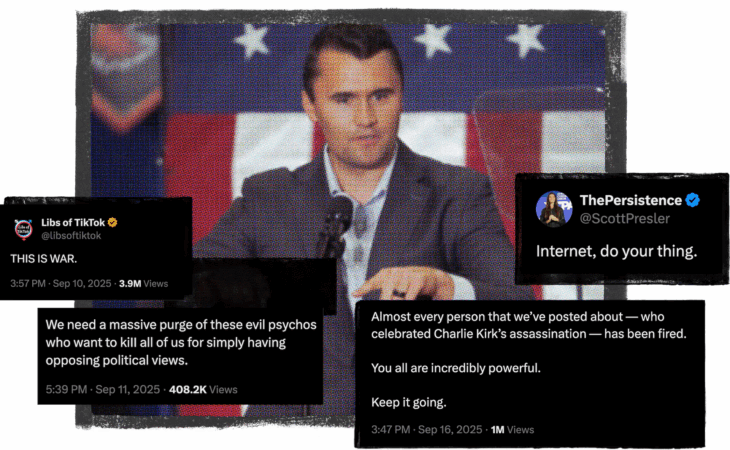
The punishments have often been driven by social media campaigns that circulate screenshots of the offending remarks, along with the names and phone numbers of employers, and appeals such as, “Internet, do your thing.” What typically follows are hundreds of angry or threatening messages, Reuters found. Several individuals who were targeted said in interviews they were inundated with phone calls. One recalled receiving a call every minute for an entire day. At least two said the harassment was so intense they plan to sell their homes.
Julie Strebe, a sheriff’s deputy in Salem, Missouri, lost her job after posting comments on Facebook about the shooting, including “Empathy is not owed to oppressors.” She later said she viewed Kirk as an oppressor because, in her words, he sought to marginalize vulnerable groups and used his platform to rally conservative white Christians behind “racist, sexist, hateful views.” She said her bosses were besieged with calls for her dismissal and that, at one point, a hand-drawn sign appeared across from her home reading, “Julie Strebe Supports the Assassination of Charles Kirk.”
Strebe said she installed five surveillance cameras at her home and now fuels her car only at night to avoid neighbors. Moving from Salem would mean leaving extended family, but she said the small city has grown too hostile to stay. “I just don’t feel like I could ever let my guard down,” she said in an interview. Strebe’s former employer, the Dent County Sheriff’s Office, declined to comment.
Many Republican officials have embraced the punitive campaign. Some have proposed extraordinary measures, including lifetime bans from social media for those deemed to be reveling in Kirk’s death. The U.S. State Department revoked visas for six foreigners who the agency said “celebrated the heinous assassination of Charlie Kirk.”
Speaking on a special episode of Kirk’s podcast on September 15, Vice President JD Vance urged his listeners to inflict consequences on those celebrating Kirk’s death.
“Call them out, and, hell, call their employer,” Vance said. Vance’s office pointed Reuters to comments made earlier this year in which the vice president said, “where I draw the line is encouraging violence against political opponents.”
Some academics compared the backlash to the “Red Scare,” the anti-Communist purge that peaked in the 1950s, when officials, labor leaders and Hollywood figures were accused of Communist ties. Thousands were investigated in a climate of fear that shaped U.S. politics and culture for a generation. There are “very disturbing parallels,” said Landon Storrs, a University of Iowa history professor.
Several prominent Republicans have voiced unease at the clampdown, especially after the Federal Communications Commission openly pressured broadcaster ABC to suspend talk show host Jimmy Kimmel following a monolog in which he suggested that Kirk’s assassin hailed from the political right. Police haven’t fully detailed the findings of their investigation into suspect Tyler Robinson and his motives. Robinson hasn’t entered a plea to the murder and other charges against him.
Republican Senator Ted Cruz warned on his podcast that letting government decide “what speech we like and what we don’t” sets a dangerous precedent. Silencing voices like Kimmel’s might feel good, he said, but “when it’s used to silence every conservative in America, we will regret it.” His spokesperson declined further comment.
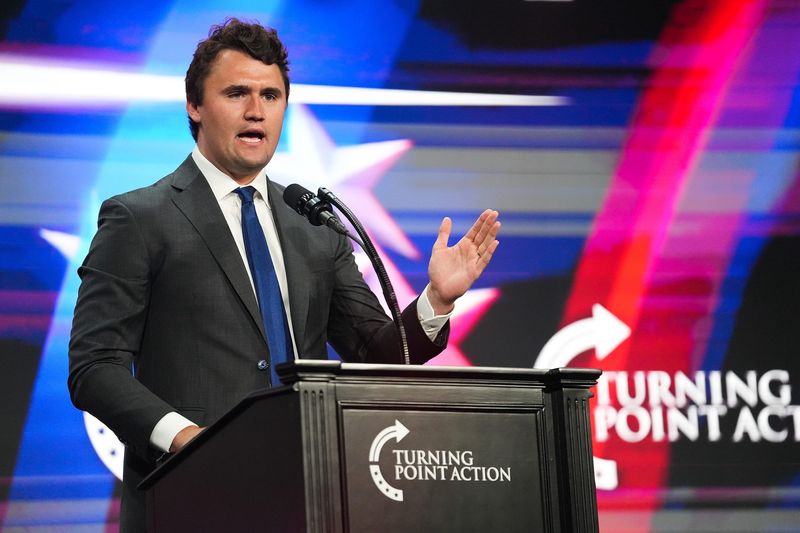
Charlie Kirk, founder of Turning Point USA, speaks in 2022.
‘Massive purge of these evil psychos’
The campaign to punish Kirk’s critics began almost immediately.
About 30 minutes after Trump’s announcement that Kirk had died, right-wing influencers mobilized. Among the first was Chaya Raichik, operator of the widely followed Libs of TikTok account, which had posted on X, “THIS IS WAR,” before highlighting a Massachusetts teacher who had written: “Just a reminder, We’re NOT offering sympathy.”
By night’s end, Libs of TikTok had published or reposted the professional details of 37 individuals, often accompanied by commentary such as “absolutely vile,” “Your tax dollars pay her salary,” or “Would you want him teaching your kids?”
“It’s actually terrifying how many of them are teachers, doctors and military members,” Libs of TikTok wrote the next day. “We need a massive purge of these evil psychos who want to kiII all of us for simply having opposing political views.”
In the week after the shooting, Libs of TikTok shared the names and profiles of at least 134 people accused of celebrating violence or mocking Kirk’s memory, frequently tagging Trump administration officials including Defense Secretary Pete Hegseth and Attorney General Pam Bondi. At times, the influencer posted disciplinary actions taken against specific government employees.
“BREAKING: This marine was fired,” Libs of TikTok posted on September 12, a day after calling out a Marine Corps captain. The officer had responded to Kirk’s death by posting an emoji of clinking beer mugs, according to a screenshot the influencer shared with followers. Reuters could not verify the authenticity of the beer-mug post; the captain declined to comment. Libs of TikTok also reported similar disciplinary actions involving an Army Reserve officer and an Army colonel who had commented on the death on social media.
The Pentagon and the Justice Department issued statements condemning celebrations of Kirk’s death but did not address questions about their relationship with Libs of TikTok.
Right-wing influencer Scott Presler began posting screenshots of Kirk commentary, too.
“Take a screenshot of EVERY single person celebrating today,” he told his followers on September 10. “You bet your behind we will make them infamous.” Over the next week, Presler shared posts on X about 70 people who had commented on the killing, and wrote in one message: “Almost every person we’ve posted about — who celebrated Charlie Kirk’s assassination — has been fired.” Presler didn’t respond to requests for comment.
For many on the right, outraged by celebratory reactions from the left, the wave of firings became a form of catharsis.
“It’s good that they are shamed and humiliated and must live with the repercussions for the rest of their lives,” right-wing podcaster Matt Walsh told his audience as he discussed the firings. “It’s good if they wake up every day until they die wishing they had not said what they said.” Asked for comment, Walsh emailed back: “f**k off.”
On YouTube, video blogger and recovery coach JD Delay expressed glee as he read aloud names of those who had lost their jobs over their remarks.
“I’m having fun! This is so much fun!” he shouted, raising his hands in excitement. Delay told Reuters that he believes in “accountability and consequences” and that “if you publicly say abhorrent things and get fired from your job, I’m going to laugh at you.”
The punishment campaign sometimes veered off course. In at least five cases, people were wrongly blamed for comments made by others. In another case, a website that drew up a blacklist called “Expose Charlie’s Murderers” vanished after taking in tens of thousands of dollars in cryptocurrency donations. Attempts to identify and seek comment from the site’s creators were unsuccessful.
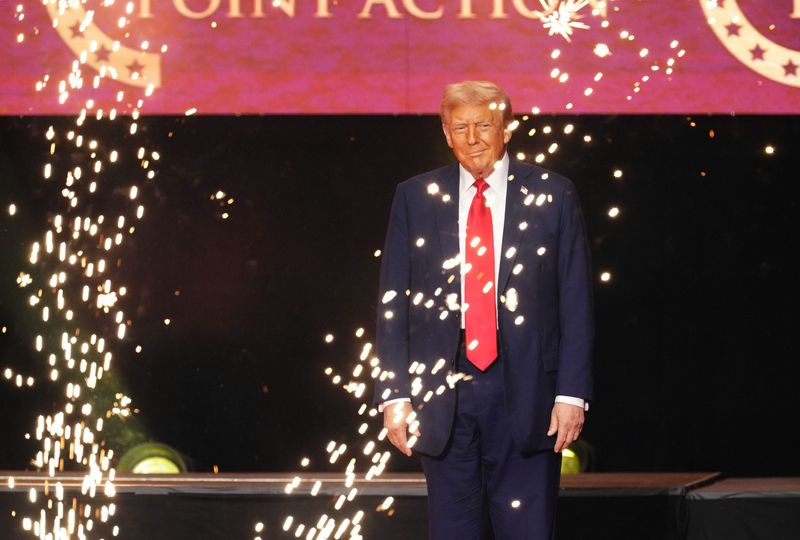
President Donald Trump takes the stage during a memorial service honoring conservative activist Charlie Kirk in Glendale, Arizona, on Sept. 21, 2025.
Several online influencers said they received hundreds — sometimes thousands — of tips from individuals seeking to get Kirk’s detractors fired. Reuters was unable to verify those figures. But at various points, Presler, Libs of TikTok and other right-wing personalities publicly urged tipsters to be patient as they worked through the volume of submissions.
“Can’t keep up with all of you,” Presler wrote on X on September 12. “Post your submissions below & I’ll go through them as I can.”
A day later, the post had drawn more than 2,700 replies.
The tally of more than 600 people punished for criticizing Kirk is likely an undercount. Many companies and government organizations haven’t publicly disclosed terminations or suspensions.
Those punished came from at least 45 states and represented a cross-section of society, from soldiers and pilots to doctors, nurses and police officers.
In Michigan, an Office Depot employee was fired after being filmed refusing to print a poster memorializing Kirk. In Ohio, a Starbucks barista lost her job after she was accused of writing an anti-Kirk message on a cup of mint tea.
Reuters couldn’t determine the identities of the Office Depot worker or the barista. Office Depot and Kroger — the grocery store chain that runs the Ohio Starbucks — condemned the anti-Kirk incidents and said the people involved were no longer employees.
Requests to 21 federal agencies — including Homeland Security, Veterans Affairs and the Defense Department — for the number of suspensions or dismissals tied to the Kirk assassination were either ignored or declined. When the Office of the Director of National Intelligence was contacted, its deputy chief of staff responded on social media, accusing Reuters of trying to generate sympathy “for the ghouls who celebrate his death.”
Educators among the main targets
Teachers, academics and university administrators were among those most frequently punished for criticizing Kirk. More than 350 education workers were fired, suspended or investigated in the days following the assassination, including 50 academics and senior university administrators, three high school principals, two cheerleading coaches and a theology instructor.
The prominence of educators in the backlash may stem from several factors. As leaders tasked with shaping young minds, teachers have long been cast by some conservatives as ideologues who aim to pull their students left. Their status as taxpayer-funded employees made any perceived partisan commentary especially combustible.
In interviews and public statements, at least six teachers cited another reason for speaking out: concern over the frequency of gun violence at schools nationwide — and anger at those, like Kirk, who have championed widespread access to firearms.
Vaughn, the South Carolina kindergarten assistant, said that was front of mind when she went to Facebook to quote Kirk’s 2023 remark dismissing some fatal shootings as the price to pay to protect gun rights. Like other teachers across the country, she said she regularly practiced active-shooter drills at her elementary school and saw fear on her five-year-olds’ faces as they learned how to hide from a gunman.
As she defended her post on the day of Kirk’s death, she told a Facebook friend that she felt “no satisfaction” at the assassination. “Just heartbreak for everyone and anyone affected by gun violence and the hope that one day, enough will be enough.” Speaking to Reuters later, she said, “The one thing I want people to know is that my message was out of concern for the kids.”
Many educators did celebrate Kirk’s death, including a Virginia teacher who wrote, “I hope he suffered through all of it,” and a Texas middle school intern who said the shooting “made me giggle.” Screenshots of both posts were circulated by right-wing influencers. Reuters could not locate the original posts, which may have been deleted or made private. The Virginia teacher was suspended and the Texas intern was fired. Neither could be reached for comment.
While schools that suspended or fired educators cited disruptions to the learning environment, some private employers pointed to a violation of company values or safety concerns as the basis for terminations. Corporations caught up in the backlash gave a variety of explanations: Delta Air Lines CEO Ed Bastian said in a statement some employees’ comments were in “stark contrast” to the company’s values and violated its social media policy, while a United Airlines statement said the company had “zero tolerance for politically motivated violence or any attempt to justify it.”
At least a dozen Kirk critics who took pains to condemn the shooting also found themselves out of jobs or suspended, sometimes after Republican lawmakers got involved.
In the wake of Kirk’s death, Joshua Bregy, a climate scientist at Clemson University in South Carolina, shared another user’s Facebook post that read, in part: “No one should be gunned down — not a school child, not an influencer, not a politician — no one. But am I going to allow people to make a martyr out of a flawed human being whose rhetoric caused notable damage? Not a chance.”
The Clemson College Republicans reposted part of his message, labeling him “ANOTHER leftist professor” and calling for his termination. The post was amplified by right-wing influencers and Republican state lawmakers who threatened to defund the public university unless Bregy was fired.
Clemson initially pledged in a September 12 statement to “stand firmly on the principles of the U.S. Constitution, including the protection of free speech.”
The next day, Trump himself reposted a state lawmaker’s call to “Defund Clemson.” On September 16, after South Carolina’s House speaker and Senate president sent a letter to Clemson’s trustees demanding they “take immediate and appropriate action,” the school fired Bregy. Bregy’s Facebook post was “blatantly unprofessional” and “seriously prejudicial to the university,” Clemson said in a letter informing Bregy he had been dismissed.
Bregy is suing Clemson in a South Carolina federal court in a bid to be reinstated. His lawyer, Allen Chaney, said the academic would have kept his job “but for the really aggressive, coercive tactics of elected officials in South Carolina.”
Clemson, State House Speaker Murrell Smith and Senate President Thomas Alexander did not respond to requests for comment. Clemson has yet to file a response to Bregy’s suit.
In at least six other cases, Republican officials publicly threatened to deprive universities and schools of taxpayer funds unless specific critics of Kirk were fired.
Chaney, who serves as legal director of the South Carolina chapter of the American Civil Liberties Union, said the threats to defund Clemson and others crossed a constitutional line. “The government can’t police speech by pressuring third parties,” he said. Last year, the Supreme Court unanimously held that government officials cannot use their authority to “attempt to coerce” private parties into punishing or suppressing speech they dislike.
The threats to defund schools that resist firing Kirk’s critics were “stunning,” said Paul McGreal, a constitutional law professor at Creighton University Law School in Nebraska. “Government officials are threatening speakers with punishment because they disagree with what they’re saying. These are core First Amendment protections that they’re violating.”
Kirk praised as Christ’s ‘13th disciple’
Since Kirk’s assassination, many Republicans have cast him as a saintly champion of free expression. Evangelical figures have likened him to Saint Stephen, revered as Christianity’s first martyr. One Republican lawmaker told Congress “he’d have been the 13th disciple” had he lived in Biblical times. Trump compared Kirk to the ancient Greek philosopher Socrates, slain President Abraham Lincoln and assassinated civil rights icon Martin Luther King Jr. when posthumously awarding him the Presidential Medal of Freedom.
Kirk’s legacy is complicated, however. He gained fame for debating college students as part of his work with Turning Point. Kirk also advocated criminalizing expression – such as pornography – that clashed with his Christian views. When Black football players started kneeling during the national anthem in protest at police brutality, he backed Trump’s call to strip the National Football League of taxpayer subsidies. The White House later said Trump was making a statement, not a proposal.
Kirk repeatedly denigrated minorities, calling transgender people an “abomination,” warning of “prowling Blacks” in cities, accusing wealthy Jews of stoking “hatred against Whites,” and declaring Islam incompatible with Western civilization. He also dismissed Pope Francis as a Marxist.
Some of those who spoke out against Kirk after his death said they were disturbed by the hagiography.
“I just felt compelled to remind people who he was and what he stood for,” Kimberly Hunt, a human resources worker in Arizona, said in an interview. She had posted a video captioned, “Save your tears for his victims, not him.”
In the video, Hunt cited Kirk’s record of using derogatory language about transgender people and Muslims, before adding that his children “are better off without him.” Hunt was fired soon after. Her employer, an Arizona construction firm, did not respond to requests for comment.
Hunt told Reuters she understood her words sounded harsh but stood by them. She said they reflected Kirk’s stance in a debate last year that if he had a 10-year-old daughter who was impregnated through rape, “the baby would be delivered.”
The retaliation has silenced many voices. Scores of people who posted anti-Kirk comments have since scrubbed or locked their accounts, Reuters found. Others said in interviews that they are pushing back.
Hunt said she has raised more than $88,000 from a GoFundMe campaign titled, “Doxxed, Fired, but Not Silenced.” She said she wants to use the money to further her education, become a content creator, and keep calling out people like Kirk.
“It’s definitely just emboldened me,” she said.
At least 19 lawsuits have been filed against employers who punished Kirk critics, state and federal court records show. At least two plaintiffs have succeeded, including an academic in South Dakota who got his teaching job back.
Karen Leader, an associate professor at Florida Atlantic University, took to social media after Kirk’s death to protest a narrative that he “was a shining inspiration to youth and a noncontroversial figure who just wanted to have open and civil dialog,” she said. “Anyone who’s in higher education knows that it’s not that simple.”
She noted that Turning Point rose to prominence through its Professor Watchlist, a site that encouraged students to report faculty for allegedly holding “radical left” views or being a “terror supporter.”
Kirk had described the Watchlist as an awareness tool, not a blacklist. Those on it have said in interviews, social media posts and public forums that it fostered harassment and intimidation. In 2023, a Turning Point reporter was accused of assaulting an Arizona professor who was on the watchlist after confronting him on camera about his sexuality and shoving him to the ground. The reporter admitted to harassment, assault and disorderly conduct and was ordered to complete a diversion program. A Turning Point cameraman admitted to harassment in the case.
On September 10, Leader began posting Kirk’s past statements on X. She said she made a mistake by incorrectly accusing Kirk of having uttered an ethnic slur and then deleted it. The rest of her posts she said she stands behind, including one highlighting Kirk’s claim that Black Americans were “better” during Jim Crow.
“None of it was me encouraging violence,” Leader said. “I was sharing evidence.”
Jordan Chamberlain, a former staffer of Florida Governor Ron DeSantis, shared screenshots of several of Leader’s posts and tagged her university, asking if it approved of the content. Libs of TikTok shared Leader’s faculty headshot. The university’s president announced she had been put on administrative leave. Her address and phone number appeared online, and menacing messages followed.
In one voicemail reviewed by Reuters, the caller said: “We’re coming to get you. Karen Leader, we know where you work. We’re gonna come to your home as soon as we have your location.” Leader said she has rarely left her apartment since.
She reported the threats to Boca Raton police, which referred the case to campus officers, according to a police report. Florida Atlantic University police said their report could not be released because of an active criminal investigation.
Florida Atlantic University confirmed Leader was one of three academics who were on leave pending investigations. It declined further comment. Chamberlain also didn’t return an email seeking comment.
“Whether my career is over or not, I don’t know,” Leader said. “But my life has changed.”
STANTON, Tenn. — Stanton, Tenn., population 450, welcomed a massive new neighbor a few years ago: a Ford electric-truck factory and a joint-venture battery plant slated to employ 6,000 workers.
Ford’s 2022 groundbreaking triggered an influx of construction activity into the former cotton-and-soybean farmlands outside of Memphis. Hard-hatted workers filled local diners. Developers scrambled to build homes and fire stations
Stanton is quieter these days. Ford over the past 18 months repeatedly delayed phases of the project. The EV truck plant is slated to begin initial production in 2027 and start sending deliveries the next year, a timeline delayed several times from the original plan of coming online in 2025.
Ford said it “will be nimble in adjusting our product launch timing to meet market needs and customer demand while targeting improved profitability.”
The Ford complex is part of the so-called Battery Belt, a swath of factories stretching across the U.S. heartland that spans from Georgia to Indiana. Roughly two dozen battery projects worth tens of billions in investment have been announced this decade, promising to inject tens of thousands of jobs in Republican-dominated states like Georgia and Kentucky.
By last year, though, Americans’ waning enthusiasm for electric cars led automakers to delay or scrap some factory projects. Now, the additional fallout from U.S. President Donald Trump’s recent policy changes is descending on the Battery Belt.
Ford CEO Jim Farley last week offered the prediction that electric-car sales could fall by around 50% following the Sept. 30 expiration of a $7,500 tax credit for buyers, echoing other gloomy forecasts for the EV market.
The uncertain fate of these massive, high-tech factories and their employment has rattled the small rural communities that spent years hitching their economic futures to these projects.
“That’s on everybody’s mind, quite frankly,” said Allan Sterbinsky, who retired as mayor of Stanton in December and advocated for the site for years before Ford came to town. Some residents worry that Ford will never follow through on the plant, the former mayor said. Others hope the company will repurpose the 3,600-acre site if demand doesn’t increase for EVs.
A Ford spokesperson pointed to the automaker’s community work in Stanton, including grants to public safety organizations as part of a broader $9 million commitment to the area.
A Reuters review of U.S. battery-investment plans shows those worries are justified. The industry appears headed toward a huge glut of factory capacity, if all those projects were to move ahead as planned.
By 2030, the planned battery plants would provide the capacity to produce 13 million to 15 million EVs annually, according to figures provided to Reuters by research firm Benchmark Mineral Intelligence. But the industry now might only need about one-quarter of that factory space. S&P Global Mobility predicts only around 3 million EVs will be produced that year, and some would likely use batteries imported from other countries.
Some of that excess roughly 10 million-EV worth of battery capacity would likely be used for hybrids and extended-range EVs as well as the booming energy storage industry, but there is still a sizable gulf, said Stephanie Brinley, S&P Global Mobility automotive analyst.
The demise of the $7,500 tax credit — which had been in place for more than 15 years to persuade Americans to try green cars — is only the highest profile of several anti-EV measures put forth by the Trump administration. Combined, they further jeopardize battery projects and other electric-car-related investments, experts say. In the last few months, several automakers have canceled, delayed or downsized EV projects.
Meanwhile, a pot of tens of billions of dollars available to companies that make EV batteries domestically has tighter restrictions that will likely reduce the amount of federal money that flows to the battery sites.
“All of a sudden, much of what was originally going to benefit from these credits now no longer can to a large degree,” said Jennifer Stafeil, tax auto sector lead for KPMG.
Trump has said he is not anti-EV, but prefers that consumers decide what cars to buy, without government influence. He also has criticized EV-friendly regulations implemented under former President Joe Biden, which Trump has said were costly and threatened American auto jobs.
One of the nation’s largest EV projects, Hyundai Motor’s $12.6 billion assembly plant and joint-venture battery factory near Savannah, Ga., is moving ahead. Last month the project suffered a setback when federal law enforcement raided it. Hyundai has said the fallout would delay the battery plant by at least two to three months.
In the three years since Hyundai announced the megasite, 21 suppliers have opened operations near the site.
“Hyundai is committed to offering a diverse product lineup, including internal combustion, hybrid, plug-in hybrid, and EV models. We understand that every customer is unique, and we strive to meet a wide range of needs,” a company spokesperson said.
The complex is gearing up to hire 8,500 employees by 2031, and is paying wages 25% above the county average, said Trip Tollison, president of the Savannah Economic Development Authority.
Tollison acknowledged that some in the community worry about the uncertain future of the nascent EV industry that underpins all that development. He is hopeful Hyundai can flexibly shift to hybrid production if the EV market doesn’t take off.
“That’s how you provide opportunities like this to lift people out of poverty,” he said.
A divided U.S. appeals court ruled on Monday that Donald Trump can send National Guard troops into Portland, Oregon, despite objections by the leaders of the city and state, giving the Republican president an important legal victory as he dispatches military forces to a growing number of Democratic-led locales.
A three-judge panel of the 9th U.S. Circuit Court of Appeals granted the Justice Department’s request to put on hold a judge’s order that had blocked the deployment while a legal challenge to Trump’s action plays out.
The court said that sending in the National Guard was an appropriate response to protesters, who had damaged a federal building and threatened U.S. Immigration and Customs Enforcement officers.
The unsigned majority opinion was joined by Circuit Judge Bridget Bade and Circuit Judge Ryan Nelson, who were both appointed by Trump in his first term. Nelson also wrote a concurring opinion saying that courts have no ability to even review the president’s decision to send troops.
Circuit Judge Susan Graber, an appointee of Democratic President Bill Clinton, dissented. She said that allowing troops to be called in response to “merely inconvenient” protests was “not merely absurd” but dangerous, and she said the full 9th Circuit should overturn the ruling before Trump has a chance to send troops.
White House spokeswoman Abigail Jackson welcomed the ruling, saying Trump had exercised his lawful authority to protect federal assets and personnel from protesters.
Portland’s city attorney did not immediately respond to a request for comment.
On October 4, Portland-based U.S. District Judge Karin Immergut, who Trump appointed during his first term as president, ruled that Trump likely acted unlawfully when he ordered troops to Portland. She had blocked Trump from sending any National Guard troops to Portland at least until the end of October, and has scheduled a non-jury trial set to begin on October 29 to determine whether to impose a longer-term block.
DEMOCRATIC-LED STATES SEEK TO HALT DEPLOYMENTS
In an extraordinary use of the U.S. armed forces for domestic purposes, Trump has sent National Guard troops into Los Angeles, Washington, D.C., and Memphis, and announced plans for deployments to Portland and Chicago.
Democratic-led states and cities have filed lawsuits seeking to halt the deployments, and courts have not yet reached a final decision on the legality of Trump’s decisions to send the National Guard to U.S. cities.
Trump has asked the U.S. Supreme Court to weigh his authority to send troops to Democratic-led cities, after another U.S. appeals court ruled against his decision to send troops to Chicago.
City and state officials sued the administration in a bid to stop the Portland deployment, arguing that Trump’s action violates several federal laws that govern the use of military forces as well as the state’s rights under the U.S. Constitution’s 10th Amendment.
The lawsuit accused Trump of exaggerating the severity of protests against his immigration policies to justify illegally seizing control of state National Guard units.
Trump on September 27 ordered 200 National Guard troops to Portland, continuing his administration’s unprecedented use of military personnel in U.S. cities to suppress protests and bolster domestic immigration enforcement. Trump called the city “War ravaged” and said, “I am also authorizing Full Force, if necessary.”
Police records provided by the state showed that protests in Portland were “small and sedate,” resulting in only 25 arrests in mid-June and no arrests in the 3-1/2 months since June 19.
A federal law called the Posse Comitatus Act generally restricts the use of the U.S. military for domestic law enforcement purposes. In ordering troops to California, Oregon and Illinois, Trump has relied on a law – Section 12406 of Title 10 of the U.S. Code – that allows a president to deploy state National Guard to repel an invasion, suppress a rebellion or allow the president to execute the law.
The National Guard serves as state-based militia forces that answer to state governors except when called into federal service by the president.
During arguments in the case on October 9, the two Trump-appointed judges suggested that Immergut had focused too closely on protests in the city in September without fully considering more serious protests two months before the troop deployment. Circuit Judge Ryan Nelson said that courts should not engage in a “day by day” review of whether troops were needed at any given time.
Immergut issued decisions against the administration on October 4 and October 5, first ruling that Trump could not take over Oregon’s National Guard and then ruling that he could not circumvent that decision by calling in National Guard troops from other states.
The judge said there was no evidence that recent protests in Portland rose to the level of a rebellion or seriously interfered with law enforcement, and she said Trump’s description of the city as war-ravaged was “simply untethered to the facts.”
Immergut is one of three district court judges who have ruled against Trump’s use of the National Guard, and no district court judge has yet ruled for Trump in the National Guard cases.
Appeals courts have split over the issue so far, with the 9th Circuit previously backing Trump’s use of troops in California and the 7th Circuit ruling that troops should stay out of Chicago for now.