Starting Monday, SEPTA will no longer post alerts about potential delays and cancellations due to bus and trolley driver shortages on social media, the service announced this week on its website.
Alerts about delays due to weather and other issues will continue.
Driver shortage alerts originated shortly after the COVID-19 pandemic hit, at a time when the service was operating with a significant deficit of drivers, SEPTA spokesperson Andrew Busch said. Now that the service has partly resolved the staffing issue and improved its notification systems, the generic alerts are no longer necessary, he said.
“It was never very precise,” Busch said. Alerts were not “giving customers a good picture of what they should expect.”
Since the pandemic, Busch said, the service has refined its tools, like its app and website, to offer customers a more accuratesense of what is happening with their route in real time,including how late a bus may be running and if it has been canceled.
The service has also gotten a better handle on staffing. During 2022 and early 2023, SEPTA was operating withabout 220 fewer bus and trolley operators than its budgeted headcount, Busch said. Nowthat gap has shrunk to about 100 operators, which makes it easier to adjust for staffingfluctuations.
Between those two improvements, the generic delay and cancellation warnings became obsolete, Busch said.
“It just seemed like it was the right time to move on from that and to try to push customers to where they’re going to get more accurate information,” he said.
Riderswho do not rely on the website, social media, or the app can get updates on their route by calling 215-580-7800.
SEPTAwas at one time a trailblazer in governmental use of social media. It first started posting on Twitter, now X, in 2008, long before many municipal transit agencies had adopted social media. In 2013, it expanded its presence on Twitter with @SEPTA_Social, whichwas staffed by SEPTA employees.
Customers could post complaints and concerns and receive a personalized response from SEPTA staff, signedwith the initials of the staff member. SEPTA shared best practices on social media interaction with transit officials in Chicago, New York, and Boston, Busch said.
SEPTA does not plan onmoving away from social media any time soon, he said, even as other large organizations move away from personalized customer service with artificial intelligence. The goal for SEPTA is more tailored support, Busch said, not less.
“That’s been a very successful program and we’ll probably only grow that going forward,” he said.
Now, attorneys for the man charged in Kirk’s killing want a state judge to block such videos from being shown during a hearing scheduled for Tuesday. Defense attorneys also want to oust TV and still cameras from the courtroom, arguing that “highly biased” news outlets risk tainting the case.
Prosecutors, attorneys for news organizations, and Kirk’s widow urged state District Judge Tony Graf to keep the proceedings open.
“In the absence of transparency, speculation, misinformation, and conspiracy theories are likely to proliferate, eroding public confidence in the judicial process,” Erika Kirk’s attorney wrote in a Monday court filing. “Such an outcome serves neither the interests of justice nor those of Ms. Kirk.”
But legal experts say the defense team’s worries are real: Media coverage in high-profile cases such as Tyler Robinson’s can have a direct “biasing effect” on potential jurors, said Cornell Law School Professor Valerie Hans.
“There were videos about the killing, and pictures and analysis (and) the entire saga of how this particular defendant came to turn himself in,” said Hans, a leading expert on the jury system. “When jurors come to a trial with this kind of background information from the media, it shapes how they see the evidence that is presented in the courtroom.”
Prosecutors intend to seek the death penalty for Robinson, 22, who is charged with aggravated murder in the Sept. 10 shooting of Kirk on the Utah Valley University campus in Orem. An estimated 3,000 people attended the outdoor rally to hear Kirk, a co-founder of Turning Point USA, who helped mobilize young people to vote for President Donald Trump.
To secure a death sentence in Utah, prosecutors must demonstrate aggravating circumstances, such as that the crime was especially heinous or atrocious. That’s where the graphic videos could come into play.
Watching those videos might make people think, “’Yeah, this was especially heinous, atrocious or cruel,’” Hans said.
Further complicating efforts to ensure a fair trial is the political rhetoric swirling around Kirk, stemming from the role his organization played in Trump’s 2024 election. Even before Robinson’s arrest, people had jumped to conclusions about who the shooter could be and what kind of politics he espoused, said University of Utah law professor Teneille Brown.
“People are just projecting a lot of their own sense of what they think was going on, and that really creates concerns about whether they can be open to hearing the actual evidence that’s presented,” she said.
Robinson’s attorneys have ramped up claims of bias as the case has advanced, even accusing news outlets of using lip readers to deduce what the defendant is whispering to his attorneys during court hearings.
Fueling those concerns was a television camera operator who zoomed in on Robinson’s face as he talked to his attorneys during a Jan. 16 hearing. That violated courtroom orders, prompting the judge to stop filming of Robinson for the remainder of the hearing.
“Rather than being a beacon for truth and openness, the News Media have simply become a financial investor in this case,” defense attorneys wrote in a request for the court to seal some of their accusations of media bias. Unsealing those records, they added, “will simply generate even more views of the offending coverage, and more revenue for the News Media.”
Prosecutors acknowledged the intense public interest surrounding the case but said that does not permit the court to compromise on openness. They said the need for transparency transcends Robinson’s case.
“This case arose, and will remain, in the public eye. That reality favors greater transparency of case proceedings, not less,” Utah County prosecutors wrote in a court filing.
Defense attorneys are seeking to disqualify local prosecutors because the daughter of a deputy county attorney involved in the case attended the rally where Kirk was shot. The defense alleges that the relationship represents a conflict of interest.
In response, prosecutors said in a court filing that they could present videos at Tuesday’s hearing to demonstrate that the daughter was not a necessary witness since numerous other people recorded the shooting.
Among the videos, prosecutors wrote, is one that shows the bullet hitting Kirk, blood coming from his neck and Kirk falling from his chair.
Trevor Zegras went over to Denver Barkey after a morning skate at Xfinity Mobile Arena a few weeks ago and asked the rookie if he wanted to live with him.
Since being called up on Dec. 19, and making his Flyers debut the next day at Madison Square Garden, the 20-year-old has been living out of a suitcase in a hotel.
“Couldn’t really turn that possibility down? And I was quick to say yes. And then we started to plan on when I move in,” Barkey said.
“I’ve been chipping in,” he continued when asked if he was doing the dishes. “We’ve got to clean now. It’s getting a little messy, trying to do my chores here and there.”
The two are hoping they can clean up on the ice now, too.
Zegras and Barkey will be on a line with Owen Tippett against the Washington Capitals on Tuesday (7 p.m., NBCSP).
According to Natural Stat Trick, at five-on-five, the trio has played just 3 minutes, 25 seconds together. That came during the Flyers’ 6-3 loss to the New York Rangers on Jan. 17. The line had nine shot attempts to the Rangers’ three, including five shots on goal. The trio generated five high-danger chances, held an eight-to-one advantage in scoring chances, and outscored New York, 1-0.
Zegras had the goal, with Barkey and Tippett getting the assists. Tippett went to put the puck on goal but it deflected off the stick of Barkey and then the boot of Urho Vaakanainen to Zegras sitting wide open atop the crease at the right post.
“Yeah, pretty fortunate to be on the line with someone like him,” Barkey said of Zegras, calling it an exciting opportunity. “I think just tonight, play my game, try to find open space for him to find me, because I know he makes those crazy plays. He sees the ice at an insane level. So just trying to get open and create time and space for him to have the puck.”
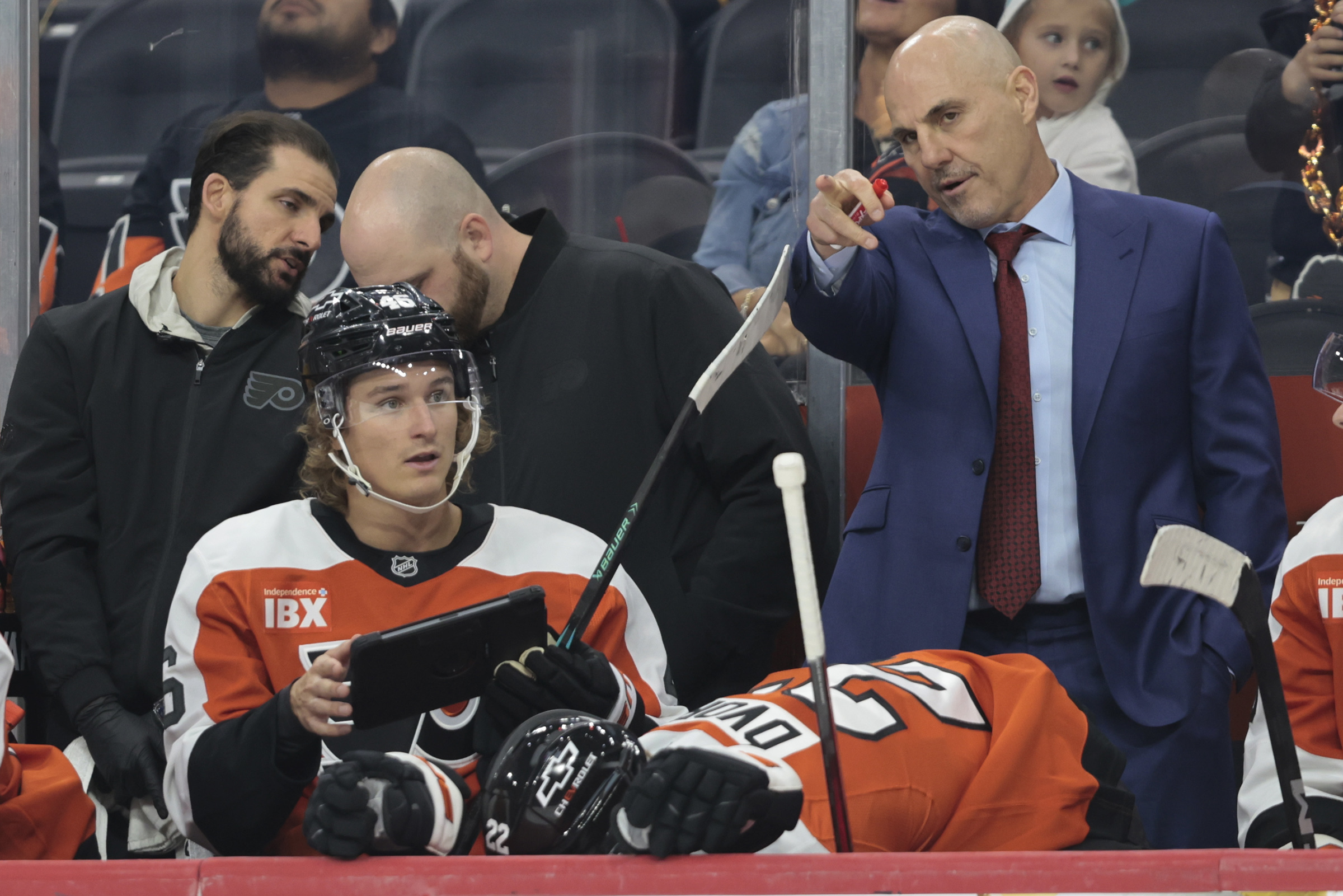
Dating back to when Zegras was acquired from the Anaheim Ducks in June, and entering training camp, the consensus from the player and the front office was that Zegras would get a chance back at his natural position of center. That hasn’t been the case, but Tuesday will mark the third straight game Zegras will play down the middle. He had moments when he played there this season, but they were few and far between; Flyers coach Rick Tocchet is sticking with it for now.
Trevor Zegras, whom Rick Tocchet called a joy to coach, will play his third straight game at center on Wednesday.
“For the first 30 games, he was going so good I didn’t want to make that [change]. I think he would have looked at me like I was crazy. I mean, he was filling the net and he was doing really well,” Tocchet said when asked why he decided now was the time to experiment with Zegras down the middle.
“I thought we were good and we had it locked down [with] the centers, and I thought the lines were good. So then, out of necessity a little bit now, yeah. See if he can hold that position now for us.”
Tocchet and Zegras talk often — the coach was late to Monday’s availability with reporters after practice because the two were chatting — and they talked the other day about his faceoffs. After going 1-for-12 at five-on-five against the Boston Bruins, and losing the one faceoff he took in the defensive zone, he went 4-for-6 at five-on-five against the Los Angeles Kings on Saturday.
“I think he’s been doing OK,” Tocchet said before adding about Zegras’ faceoff percentage rising: “That’s a positive; that was one thing that he was worried about the draws — and some coverages down low.
“But I didn’t see a guy confused out there. I think there’s some runway there, let’s see if he can hold on to this position. He’s got a couple of good linemates today, so maybe he’ll get some offense for us.”
Breakaways
Dan Vladař (16-8-5, .903 save percentage) will start in net. He is 3-2-0 with a 3.59 goals-against average and an .871 save percentage in five career games against the Capitals. His last start against Washington was Feb. 25, 2025, in which Alex Ovechkin scored goal No. 883 in a 3-1 win for the Calgary Flames. Ovechkin, who has 919 career goals entering Tuesday, has scored 52 times in 78 games against the Flyers, his second-best mark against any team. … Carl Grundström will slot in for Garnet Hathaway. The forward last played on Wednesday against the Columbus Blue Jackets. He has seven goals and nine points in 25 games this season.
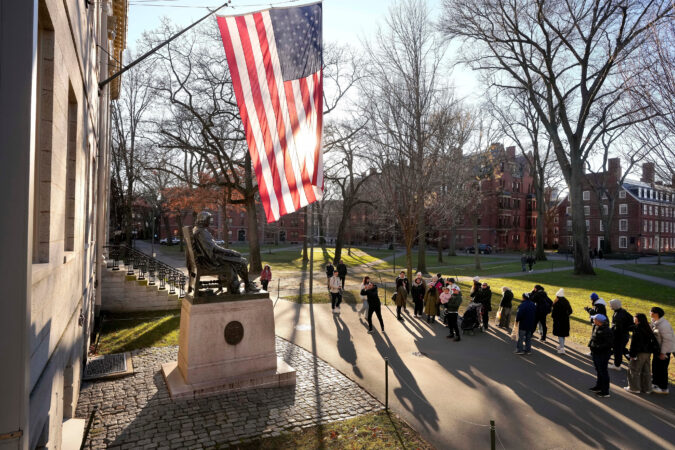
WASHINGTON — President Donald Trump is demanding a $1 billion payment from Harvard University to end his prolonged standoff with the Ivy League campus, doubling the amount he sought previously as both sides appear to move further from reaching a deal.
The president raised the stakes on social media Monday night, saying Harvard has been “behaving very badly.” He said the university must pay the government directly as part of any deal — something Harvard has opposed — and that his administration wants “nothing further to do” with Harvard in the future.
Trump’s comments on Truth Social came in response to a New York Times report saying the president had dropped his demand for a financial payment, lowering the bar for a deal. Trump denied he was backing down.
Harvard officials did not immediately comment.
Trump’s outburst appears to leave both sides firmly entrenched in a conflict that Trump previously said was nearing an end.
Last June, Trump said a deal was just days away and that Harvard had acted “extremely appropriately” during negotiations. He later said an agreement was being finalized that would require Harvard to put $500 million toward the creation of a “series of trade schools” rather than a payment to the government.
That deal appears to have fallen apart entirely. In his social media post, Trump said the trade school proposal had been turned down because it was “convoluted” and “wholly inadequate.”
Harvard has long been Trump’s top target in his administration’s campaign to bring the nation’s most prestigious universities to heel. His officials have cut billions of dollars in Harvard’s federal research funding and attempted to block it from enrolling foreign students after the campus rebuffed a series of government demands last April.
The White House has said it’s punishing Harvard for tolerating anti-Jewish bias on campus.
In a pair of lawsuits, Harvard said it’s being unfairly penalized for refusing to adopt the administration’s views. A federal judge agreed in December, reversing the funding cuts and calling the antisemitism argument a “smokescreen.”
Trump’s latest escalation comes as other parts of his higher education campaign are teetering.
Last fall, the White House invited nine universities to join a “compact” that offered funding priority in exchange for adopting Trump’s agenda. None of the schools accepted. In January, the administration abandoned its legal defense of an Education Department document threatening to cut schools’ funding over diversity, equity, and inclusion policies.
When he took office for his second term, Trump made it a priority to go after elite universities that he said had been overrun by liberal thinking and anti-Jewish bias. His officials have frozen huge sums of research funding, which colleges have come to rely on for scientific and medical research.
Several universities have reached agreements with the White House to restore funding. Some deals have included direct payments to the government, including $200 million from Columbia University. Brown University agreed to pay $50 million toward state workforce development groups.
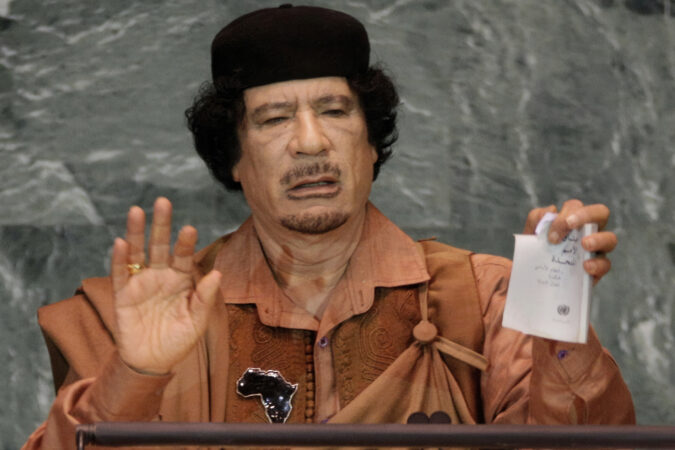
CAIRO — Seif al-Islam Gadhafi, the son and one-time heir apparent of Libya’s late dictator Moammar Gadhafi, was killed in the northern African country, Libyan officials said Tuesday.
The 53-year-old was killed in the town of Zintan, 85 miles southwest of the capital, Tripoli, according to two Libyan security officials in western Libya. The officials spoke on condition of anonymity because they were not authorized to brief the media.
Khaled al-Zaidi, a lawyer for Seif al-Islam, confirmed his death on Facebook, without providing details.
Abdullah Othman Abdurrahim, who represented Gadhafi in the U.N.-brokered political dialogue which aimed to resolve Libya’s long-running conflict, also announced his death on Facebook.
Abdurrahim, who leads his political team, didn’t provide further details, but Libyan news outlet Fawasel Media cited him as saying that armed men killed Seif al-Islam in his home. The outlet reported that prosecutors were investigating the killing.
Seif al-Islam’s political team later released a statement, saying that “four masked men” stormed his house and killed him in a “cowardly and treacherous assassination.” The statement said that he clashed with the assailants, who closed the CCTV cameras at the house “in a desperate attempt to conceal traces of their heinous crimes.”
Born in June 1972 in Tripoli, Seif al-Islam was the second-born son of the longtime dictator. He studied for a Ph.D. at the London School of Economics and was seen as the reformist face of the Gadhafi regime.
Moammar Gadhafi was toppled in a NATO-backed popular uprising in 2011 after more than 40 years in power. He was killed in October 2011 amid the ensuing fighting that would turn into a civil war. The country has since plunged into chaos and divided between rival armed groups and militias.
Seif al-Islam was captured by fighters in Zintan late in 2011 while attempting to flee to neighboring Niger. The fighters released him in June 2017 after one of Libya’s rival governments granted him amnesty. He had since lived in Zintan.
A Libyan court convicted him of inciting violence and murdering protesters and sentenced him to death in absentia in 2015. He was also wanted by the International Criminal Court on charges of crimes against humanity related to the 2011 uprising.
In November 2021, Seif al-Islam announced his candidacy in the country’s presidential election in a controversial move that was met with outcry from anti-Gadhafi political forces in western and eastern Libya.
The country’s High National Elections Committee disqualified him, but the election wasn’t held over disputes between rival administrations and armed groups that have ruled Libya since the bloody ouster of Moammar Gadhafi.
A Montgomery County attorney specializing in personal injury claims against large corporations has been suspended for three years following allegations that he misled at least 16 clients on settlement offers that did not exist.
Brian McCormick was a former partner at Ross Feller Casey, a Philadelphia-based personal injury firm. The conduct that led to his suspension revolves around misleading statements to clients he represented in two types of cases.
The first set of clients are thosewho alleged that using agricultural giant Monsanto‘s weed killer, Roundup, caused their cancer. These cases can be lucrative, as Philadelphia juries returned verdicts against Monsanto for millions, and even billions, of dollars.
Due to the large number of Roundup lawsuits, a federal court appointed a special master who developed a formula to calculate settlement amounts. At least nine of McCormick’s clients rejected the formula-proposed settlement and the attorney claimed he was attempting to obtain, or had obtained, higher offers, according to the suspension order issued last month by the Pennsylvania Supreme Court’s Disciplinary Board.
McCormick went as far as to ask some clients to sign releases to obtain the nonexistent settlements. As his clients waited for their expectedchecks, according to the order, the attorney reassured them via emails, text messages, and voice messages between 2023 and January 2025 that the delays were part of the settlement process.
“[McCormick] did not settle any of the Roundup cases on behalf of the nine clients who rejected the formula determined settlement amount,” the order says.
Clients suing Monsanto weren’t the only ones McCormick misled. The attorney followed a similar pattern with at least seven clients who sued manufacturers of Risperdal, an antipsychotic drug that thousands of men said led them to develop excessive breast tissue, according to the disciplinary board.
McCormick promised settlement to his Risperdal clients, the order said, and at one time even gave a client a specific date on which he should pick up his check “knowing that no settlement check existed.”
Neither McCormick or the attorney who represented him during the disciplinary proceedings responded to a request for comment.
Ross Feller Casey terminated McCormick in January 2025 after finding that he had clients sign settlement agreements even though no settlements were reached.
“The firm’s owners terminated Mr. McCormick’s employment on the very same day they learned of his conduct, and they immediately took steps to ensure that the interests of all affected clients were protected,” said Mario Cattabiani, a spokesperson for Ross Feller Casey.
McCormick admitted to the misconduct and consented to the three-year suspension, the order says. The board noted that he “accepts full responsibility for his misconduct and is remorseful.”
Another Starbucks has unionized in Philadelphia, after a vote at the Schuylkill Yards location last week.
“I see a need for improvements and am optimistic that this win will make great change,” shift supervisor Asia Wright-Wilson said in a union statement. “When problems are not well addressed through the traditional Starbucks channels the greatest strength lies in the collective action of our coworkers.”
The Schuylkill Yards location has 18 union-eligible workers. All participated in the election, with 10 voting to join, according to the union.
The first group of Starbucks workers to unionize did so in 2021 at a Buffalo, N.Y., store. Workers across the country have since joined the Starbucks Workers United union, which has been negotiating a first contract.
“We respect our partners’ right to choose, through a fair and democratic process, to be represented by a union or not to be represented by a union,” said Starbucks spokesperson, Jaci Anderson, via email on Monday. “Any agreement needs to reflect the reality that Starbucks already offers the best job in retail.”
Anderson said Starbucks’ hourly employees’ pay and benefits equate to over $30 an hour on average.
BREAKING: Last night, the Schuylkill Yards Starbucks location won their union… officially making EVERY Starbucks in West Philadelphia unionized!
CONGRATULATIONS to the baristas who are organizing to win a better future for workers everywhere ✊🔥 pic.twitter.com/MI0v1s6wyh
Starbucks has several dozen stores in Philadelphia and more in the surrounding counties. Several city and suburb locations are unionized, including nearby West Philadelphia locations at Penn Medicine, 39th and Walnut Streets, and 34th and Walnut Streets.
The union has reached multiple tentative agreements as they negotiate a contract, but pay has been a sticking point. Workers also want more staffing, and resolution to hundreds of unfair labor practice charges against Starbucks.
Sara Kelly, Starbucks’ chief partner officer, said in December, citing information from the union, that employees from 166 of the 215 strike locations wanted to return to work.
A union spokesperson acknowledged on Tuesday that while some striking workers have returned to their jobs, more than 1,000 remain on strike.
“The nationwide unfair labor practice strike that began in November is still ongoing and has become the longest in company history,” said Michelle Eisen, a Workers United spokesperson and 15-year Starbucks barista.
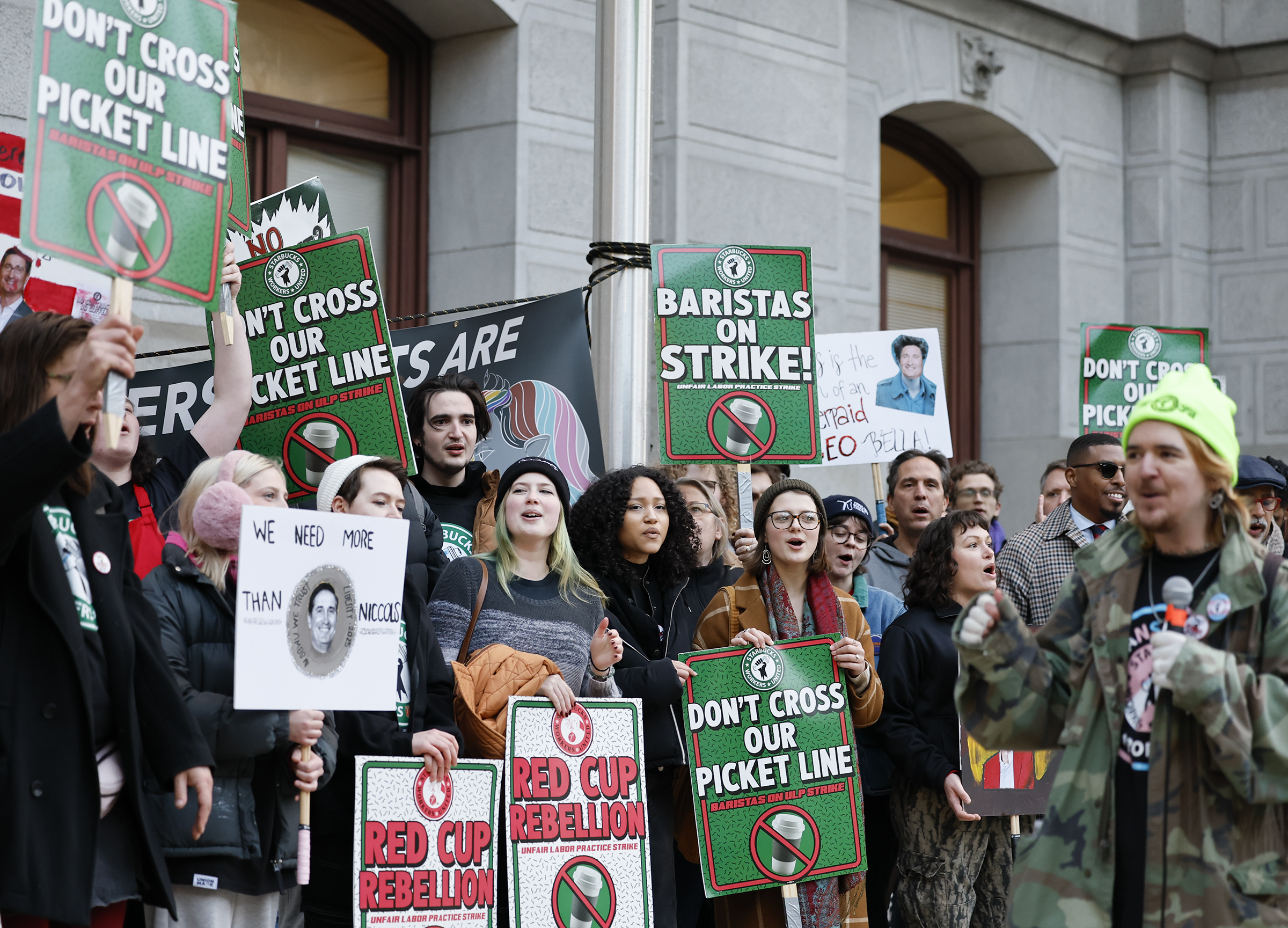
Starbucks Workers United members cheer during a rally at City Hall on Thursday, Nov. 13, 2025.
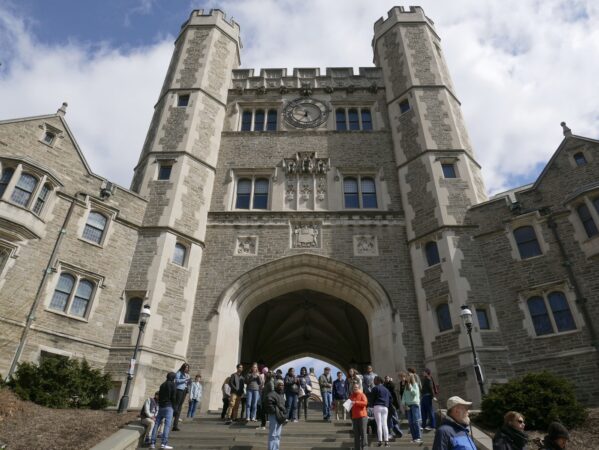
Princeton University’s president, in a message to campus, said the school will take the unusual move of consolidation and cuts, given federal policy changes and “political threats” to its financial model, as well as lowered expectations about future endowment returns.
“Changed political and economic circumstances require that we transition from a period of exceptional growth to one defined by steadfast focus on core priorities,” Christopher Eisgruber wrote Monday in his annual message to campus. “That shift is necessary for multiple reasons, including because it will help Princeton to stand strong for its defining principles and against rising threats to academic freedom.”
The Ivy League university, he wrote, “will have to look for areas where we can consolidate or cut, both to offset rising costs (including salaries and benefits) and to support the investments required for teaching and research excellence.”
Eisgruber’s announcement came days after the University of Pennsylvaniaannounced it would instituteanother round of budgetcutsin response to actions by President Donald Trump’s administration that threaten future funding and revenues, and because of rising legal and insurance expenses. The Trump administration has placed new caps on loans that graduate students can take out, temporarily paused student visa interviews, and sought to cut research funding to universities. Some colleges, including Penn and Princeton, also will see their endowment taxes rise.
Penn’s schools and centers were directed to cut 4% from certain expenses in the next fiscal year and keep in place financial cutbacks instituted last year, including a staff hiring freeze and freezes on midyear adjustments in staff salaries. Schools and centers also were asked last year to cut 5% of certain expenses, and the new 4% reduction would be on top of that.
The new Penn cuts come even though university officials said finances look better than they anticipated a year ago.
At Princeton, university officials also asked units across the school to make 5% to 7% cuts to their budgets over the last year, given an increase in the endowment tax that Princeton faces and federal threats to research funding. Eisgruber noted that the proceeds from its $36.4 billion endowment and sponsored research grants make up 83% of Princeton’s revenue.
The university’s endowment tax is scheduled to rise from 1.4% to 8% in 2026-27. (Penn’s tax on its $24.8 billion endowment is rising from 1.4% to 4%.)
Now, “more targeted, and in some cases deeper, reductions over a multiyear period” are likely required, Eisgruber wrote.
Last year, things were different.
In his 2025 message, Eisgruber noted that the school was “in the midst of an 18-month period in which the University will open more than a dozen substantial new facilities and spaces that enhance the University’s mission.”
Those include a new health center, a commons with a library, an art museum, student housing, and buildings that house an environmental institute and science and engineering programs.
“Princeton will continue to build, but more slowly in the years to come,” Eisgruber said in this week’s message. “Princeton will continue to evolve, but in the future it will more often have to do so through efficiency and substitution rather than addition. That will be a major change for most Princetonians, in comparison to not only the past five years but the last three decades.”
Princeton’s long-term endowment return assumptions have been lowered to 8% from 10.2% three years ago, Eisgruber wrote.
The university’s endowment returns in the three years following 2021 were “the second worst in more than four decades, better only than the returns in the years surrounding the Global Financial Crisis in 2008-09,” Eisgruber wrote. Two of those years saw negative returns.
Princeton spends about 5% of its endowment each year to support operations.
“An 8 percent return rate will require us to get the payout rate down below 5 percent even to cover payout plus inflation,” Eisgruber wrote.
The U.S. House of Representatives Tuesday voted 217-214 to end the partial government shutdown on its fourth day, avoiding a repeat of last year’s 43-day standoff.
The House passed a five-bill package that includes funding the Departments of Defense, State, Transportation, Education, Labor, Treasury, Health and Human Services, and Housing and Urban Development.
Every House Democrat from Pennsylvania opposed the package. U.S. Rep. Scott Perry (R., York) was the lone Republican from the delegation to vote against it.
Among New Jersey Democrats, U.S. Rep. Josh Gottheimer (D., N.J.) was among the 21 members of the party who crossed the aisle to support the bill.
As part of the deal, the House also passed 10 days of funding for the Department of Homeland Security as negotiations for longer-term will continue amid national uproar over President Donald Trump’s immigration crackdown.
Funding for DHS has been the core reason behind the government shutdown after Democrats said they would not vote for an allocation to the department without reforms to federal immigration agents’ conduct after agents fatally shot two Americans in Minnesota last month.
U.S. Rep. Ryan Mackenzie (R., Lehigh), who voted for the deal, said he will participate in “ongoing conversations about achieving commonsense, bipartisan reforms of DHS operations.”
In the House, only a handful of Republicans voted against the package, providing House Speaker Mike Johnson with the support he needed from the party to pass the package in the narrowly divided chamber.
Meanwhile, the vast majority of Democrats voted against the bill, with immigration enforcement remaining a top issue.
"We are in a dangerous and deadly place," U.S. Rep. Madeleine Dean (D, Montgomery) said in a statement. Adding that with DHS receiving funding until Feb. 13, "ICE agents can continue their grotesque and thuggish behavior. Meaning Congress has only ten days to agree on reform,” she said.
Now that Trump has signed the bill, Republicans and Democrats still need to hammer out a long-term deal on DHS, which oversees ICE and the Border Patrol.
Retiring U.S. Rep. Dwight Evans (D., Philadelphia) said in a statement that he would “need to see much-needed guardrails and protections being put into law” before he can support more funding for the agencies.
DHS also oversees TSA and an extended funding lapse could affect air travel.
U.S. Rep. Brian Fitzpatrick, a moderate Republican from Bucks County, voted for the government funding package Tuesday and plans to work with Democrats in the bipartisan Problem Solvers Caucus on reforms to ICE, his spokesperson said.
Staff Contributors
Design, Development and Data: Sam Morris
Reporting: Fallon Roth
Editing: Bryan Lowry
(()=>{var te=(e,t)=>()=>(t||e((t={exports:{}}).exports,t),t.exports);var I=te(r=>{var ue={0:”Jan.”,1:”Feb.”,2:”March”,3:”April”,4:”May”,5:”June”,6:”July”,7:”Aug.”,8:”Sept.”,9:”Oct.”,10:”Nov.”,11:”Dec.”};function E(e){return e===void 0&&(e=new Date),ue[e.getMonth()]}var pe={0:”Jan”,1:”Feb”,2:”Mar”,3:”Apr”,4:”May”,5:”Jun”,6:”Jul”,7:”Aug”,8:”Sep”,9:”Oct”,10:”Nov”,11:”Dec”};function N(e){return e===void 0&&(e=new Date),pe[e.getMonth()]}function s(e){return e==null}function D(e){return typeof e==”number”&&isFinite(e)}function m(e){return D(e)&&Math.floor(e)===e}var fe=[“one”,”two”,”three”,”four”,”five”,”six”,”seven”,”eight”,”nine”],me=[“million”,”billion”,”trillion”,”quadrillion”,”quintillion”,”sextillion”,”septillion”,”octillion”,”nonillion”,”decillion”],$=[“th”,”st”,”nd”,”rd”,”th”,”th”,”th”,”th”,”th”,”th”],he=[11,12,13];function H(e){if(s(e))return””;var t=+e;return m(t)?he.indexOf(t%100)>-1?$[0]:$[t%10]:””}var ve=[“first”,”second”,”third”,”fourth”,”fifth”,”sixth”,”seventh”,”eighth”,”ninth”],ge=new RegExp(/s+([^s]*)s*$/);r.apdate=function(e){return e===void 0&&(e=new Date),E(e)+” “+e.getDate()+”, “+e.getFullYear()},r.apdatetab=function(e){return e===void 0&&(e=new Date),N(e)+” “+e.getDate()+”, “+e.getFullYear()},r.apmonth=E,r.apmonthtab=N,r.apnumber=function(e){if(s(e))return””;var t=+e;return m(t)?t=10?e.toString():fe[t-1]:e.toString()},r.aptime=function(e){e===void 0&&(e=new Date);var t,o,n=e.getHours(),i=e.getMinutes(),l=i===0;if(l){if(n===0)return”midnight”;if(n===12)return”noon”}return n0?n:12):(t=”p.m.”,o=n===12?n:n-12),l?o+” “+t:o+”:”+(i<10?"0"+i:i)+" "+t},r.capfirst=function(e){if(s(e))return"";var t=String(e);return""+t.charAt(0).toUpperCase()+t.slice(1)},r.intcomma=function(e){if(s(e))return"";var t,o=+e;return D(o)?((t=o.toString().split("."))[0]=t[0].replace(/B(?=(d{3})+(?!d))/g,","),t.join(".")):e.toString()},r.intword=function(e){if(s(e))return"";var t=+e;if(!m(t))return e.toString();var o=Math.abs(t);if(o<1e6)return e.toString();var n=Math.ceil(Math.log(o+1)/Math.LN10)-1,i=n-n%3,l=t/Math.pow(10,i);return(l=Math.round(10*l)/10)+" "+me[Math.floor(i/3)-2]},r.ordinal=function(e,t){if(t===void 0&&(t=!1),s(e))return"";var o=+e;return m(o)?t&&o{document.querySelectorAll(“.js-hover”).forEach(e=>{e.addEventListener(“click”,()=>{A(e)}),e.addEventListener(“mouseenter”,()=>{A(e)}),e.addEventListener(“mouseout”,()=>{M(e)})}),window.addEventListener(“scroll”,()=>{u!==null&&ne()})},ne=()=>{(u>window.scrollY+100||u{M(e)})},A=e=>{e.classList.add(“is-visible”),u=window.scrollY},M=e=>{e.classList.remove(“is-visible”),u=null},j={init:()=>{oe()}};var p,ie=(e,t)=>{p=p||window.PMNdataLayer,p?p.push({event:”misc_event”,eventAction:e,eventLabel:t}):window.location.hostname.includes(“localhost”)?console.log(“Analytics event:”,e,t,”(not actually being sent due to localhost)”):console.log(“Failed to push analytics event”,e,t)},f={event:(e,t)=>{ie(e,t)}};var re=!1,se=()=>{document.querySelectorAll(“.js-location”).forEach(e=>{e.querySelector(“.js-location-form”).addEventListener(“submit”,t=>{t.preventDefault(),ae(e)}),e.querySelector(“.js-location-street”).addEventListener(“keyup”,t=>{x(e)}),e.querySelector(“.js-location-street”).addEventListener(“change”,()=>{x(e)})})},ae=e=>{let t=new URLSearchParams;t.set(“street”,e.querySelector(“.js-location-street”).value),t.set(“city”,e.querySelector(“.js-location-city”).value||”Philadelphia”),t.set(“state”,e.querySelector(“.js-location-state”).value||”PA”),f.event(“search”,`submit | ${t.get(“street”)} ${t.get(“city”)}`),e.classList.remove(“is-inactive”,”is-error”,”is-found”),e.classList.add(“is-loading”),fetch(`https://inq-holme.herokuapp.com/geocode?${t.toString()}&fields=cd`).then(o=>{if(o.status>=200&&o.status{console.log(o),o.error?g(“Something has gone wrong. Please try again.”):ce(e,o)})},ce=(e,t)=>{let o=t.results[0].fields.congressional_districts,n=t.results[0].address_components;if(re=!0,t.results[0]&&t.results[0].accuracy>.9&&typeof o!==null&&n.number&&n.formatted_street){e.querySelector(“.js-location-street”).value=`${n.number} ${n.formatted_street}`,e.querySelector(“.js-location-city”).value=n.city;let K=t.results[0].fields.congressional_districts[0].district_number,Q=`${n.state.toLowerCase()}-${K}`,L=document.querySelector(`.js-politicans-member[data-id=”${Q}”]`),v=document.querySelector(“.js-politicans-with-location”),X=v.querySelector(`.js-politicians-members[data-id=”${L.dataset.voteCast.toLowerCase()}”]`),q=v.querySelectorAll(“.js-politicans-member”);q.length>0&&q.forEach(ee=>{ee.remove()}),X.append(L.cloneNode(!0)),v.classList.remove(“is-hidden”),T()}else g(“Address not found. Please try a different one.”)},x=e=>{e.querySelector(“.js-location-street”).value.length>3?e.classList.add(“is-valid”):e.classList.remove(“is-valid”)},T=()=>{document.querySelector(“.js-location”).classList.remove(“is-loading”)},g=e=>{let t=document.querySelector(“.js-location”);t.classList.remove(“is-loading”),t.classList.add(“is-error”),t.querySelector(“.js-error”).textContent=e,document.querySelector(“.js-politicans-with-location”).classList.add(“is-hidden”),T()},k={init:()=>{se()}};var le=()=>{document.querySelectorAll(“.js-politicans-expand”).forEach(e=>{e.addEventListener(“click”,()=>{de(e)})})},de=e=>{f.event(“click”,”open group”),e.closest(“.js-politicans-content”).classList.remove(“is-collapsed”),setTimeout(()=>{e.closest(“.js-politicans-content”).classList.add(“is-open”)},1e3)},P={init:()=>{le()}};var Ve=I();var C=()=>/Android|webOS|iPhone|iPad|iPod|BlackBerry|IEMobile|Opera Mini/i.test(navigator.userAgent);var y=(e,t=null,o=null)=>{o||(o=document.querySelector(“head”));let n=document.createElement(“script”);n.type=”text/javascript”,n.src=e,t&&(n.onload=t),o.appendChild(n)},F=()=>(window.PMNdataLayer?.[0]!==void 0&&window.PMNdataLayer[0])?.analytics?.user?.state===”Subscribed”,O=()=>{let t=(window.PMNdataLayer?.[0]!==void 0&&window.PMNdataLayer[0])?.analytics?.user?.state;return window.location.host.includes(“zzz-systest”)||window.location.host.includes(“pmn.arcpublishing.com”)||window.location.host.includes(“stage.fusion.inquirer.com”)||typeof t>”u”},z=()=>{let t=(window.PMNdataLayer?.[0]!==void 0&&window.PMNdataLayer[0])?.analytics?.user?.hasAdsFreeReading;return!!(t&&t==1)},w=()=>window.location.host.includes(“localhost”);var ye=()=>{z()&&document.querySelectorAll(“.js-ad”).forEach(t=>{t.classList.add(“is-hidden”)})},B={init:()=>{ye()}};var a,_,we=()=>{a=document.getElementById(“js-inno-toast”)},Se=e=>{if(!a)return;a.innerHTML=e,a.classList.add(“inno-toast–active”);let t=()=>{a.addEventListener(“transitionend”,be,{once:!0}),a.classList.remove(“inno-toast–active”)};clearTimeout(_),_=setTimeout(t,5e3)},be=()=>{a.innerHTML=””},c={init:()=>{we()},showToast:Se};var h,Le=async()=>new Promise(e=>{setTimeout(()=>{console.log(“simulating createShareLink for localhost”),e(“https://inquirer.com/interactives”),qe()},100)}),qe=()=>{let e=document.querySelector(“.js-gift-toast-receiver”);!e||!(e instanceof HTMLElement)||setTimeout(()=>{let t=e?.querySelector(“span”);t&&(t.innerHTML=”Gift link copied to clipboard“)},20)},Ae=()=>{let e=window.services?.createShareLink;e&&(h=e),w()&&(h=Le),h&&je()},Me=async e=>{let t=”text/plain”,o=async()=>{try{return await h(window.location.pathname)}catch{e.dataset.state=”error”,c.showToast(“Hmm, we couldn’t generate a gift link…”)}},n=new ClipboardItem({[t]:o()});await navigator.clipboard.write([n]).catch(i=>{console.log(i),c.showToast(“Couldn’t copy to clipboard, try again?”),e.dataset.state=”error”}),c.showToast(“Gift link copied to clipboard!”),e.dataset.state=”complete”},je=()=>{document.querySelectorAll(“.js-gift”).forEach(t=>{(F()||w()||O())&&t.classList.add(“is-available”)}),document.querySelectorAll(“.js-gift-button”).forEach(t=>{t instanceof HTMLButtonElement&&t.addEventListener(“click”,()=>{t.classList.contains(“disabled”)||(t.dataset.state=”loading”,Me(t),setTimeout(()=>{t.dataset.state=”ready”},2e3))})});let e=document.querySelector(“.js-gift-toast-receiver”);!e||!(e instanceof HTMLElement)||xe(e)},xe=e=>{new MutationObserver(o=>{for(let n of o){let i=[…n.addedNodes].at(0);if(!(i instanceof HTMLElement))return;c.showToast(i.outerHTML)}}).observe(e,{subtree:!0,childList:!0})},G={init:()=>{Ae()}};var Te=()=>{window.addEventListener(“message”,e=>{if(e.data[“datawrapper-height”]){let t=e.data[“datawrapper-height”];for(let o in t)document.querySelector(`#datawrapper-chart-${o}`).setAttribute(“height”,t[o])}})},ke=()=>{document.querySelectorAll(“.js-datawrapper-graphic”).forEach(e=>{y(`https://datawrapper.dwcdn.net/${e.dataset.id}/embed.js`,null,e)})},Pe=()=>{window.addEventListener(“message”,e=>{let t=e.data;document.querySelectorAll(`iframe[src*=”${t.id}”]`).forEach(n=>{n.style.height=`${t.height}px`})},!1)},Ee=()=>{document.querySelectorAll(“.js-pym-graphic”).forEach(e=>{if(typeof window{new window.pym.Parent(e.id,e.dataset.iframe)};typeof window.pym>”u”?y(“https://pym.nprapps.org/pym.v1.min.js”,t):t()}})},R={init:()=>{Te(),ke(),Ee(),Pe()}};var Ne=()=>{},J={init:()=>{Ne()}};var d,S,b=!0,$e=()=>{d=document.querySelectorAll(“.js-video-autoplay”)},He=()=>{window.addEventListener(“resize”,()=>{V()}),window.addEventListener(“scroll”,()=>{V()}),d.forEach(e=>{e.addEventListener(“volumechange”,t=>{e.muted!==b&&!C()&&(b=e.muted,De())})})},V=()=>{let e;d.forEach((t,o)=>{let n=t.getBoundingClientRect(),i=n.height/2;n.y-i&&(e=t)}),e!==S&&(S=e,d.forEach(t=>{t.pause()}),e?e.play():S=null)},De=()=>{d.forEach(e=>{e.muted=b})},W={init:()=>{$e(),d&&He()}};var Y={init:()=>{j.init?.(),k.init?.(),P.init?.(),B.init?.(),G.init?.(),R.init?.(),J.init?.(),W.init?.(),c.init?.()}};var Ie=()=>{},U={init:()=>{Ie()}};var Ce=document.querySelector(“.js-inno”),Z=()=>{Y.init(),U.init()};Ce?Z():new MutationObserver((t,o)=>{if(document.querySelector(“.js-inno”)){o.disconnect(),Z();return}}).observe(document,{attributes:!0,childList:!0,subtree:!0});})();
WILMINGTON — The first husband of former first lady Jill Biden has been charged with killing his wife at their Delaware home in late December, authorities announced in a news release Tuesday.
William Stevenson, 77, of Wilmington was married to Jill Biden from 1970 to 1975.
Caroline Harrison, the Delaware Attorney General’s spokesperson, confirmed in a phone call that Stevenson is the former husband of Jill Biden.
Jill Biden declined to comment, according to an e-mailed response from a spokesperson at the former president and first lady’s office.
Stevenson remains in jail after failing to post $500,000 bail after his arrest Monday on first-degree murder charges. He is charged with killing Linda Stevenson, 64, on Dec. 28.
Police were called to the home for a reported domestic dispute after 11 p.m. and found a woman unresponsive in the living room, according to a prior news release. Life-saving measures were unsuccessful.
She ran a bookkeeping business and was described as a family-oriented mother and grandmother and a Philadelphia Eagles fan, according to her obituary, which does not mention her husband.
Stevenson was charged in a grand jury indictment after a weekslong investigation by detectives in the Delaware Department of Justice.
It was not immediately clear if Stevenson has a lawyer. He founded a popular music venue in Newark called the Stone Balloon in the early 1970s.
Jill Biden married U.S. Sen. Joe Biden in 1977. He served as U.S. president from January 2021 to January 2025.