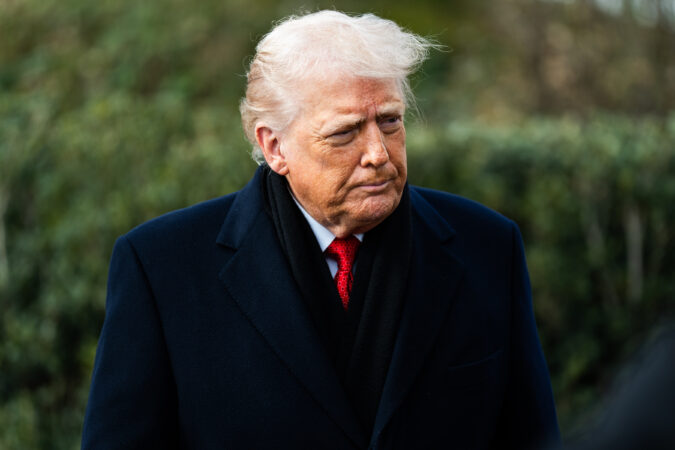
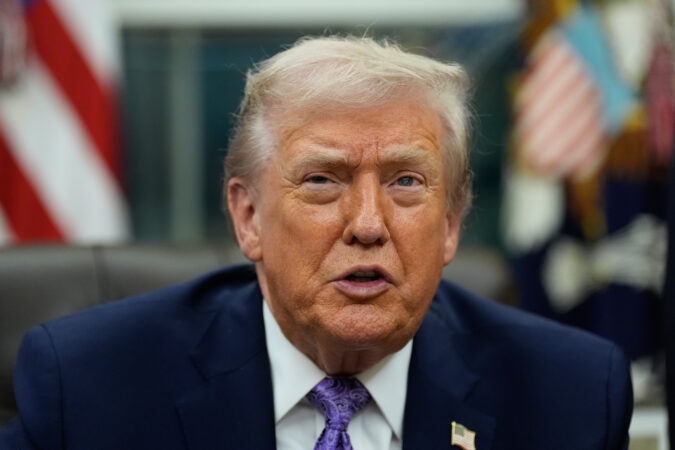
White House press secretary Karoline Leavitt told CBS News to air an interview with President Donald Trump in full or face a lawsuit, according to an audio recording of the exchange reviewed by the Washington Post.
“He said, make sure you guys don’t cut the tape. Make sure the interview is out in full,” Leavitt told new CBS Evening News anchor Tony Dokoupil, relaying a message from the president ahead of the interview last week. “He said, if it’s not out in full, we’ll sue your ass off.”
Dokoupil responded with levity: “He always says that!”
The New York Times first reported on the exchange. The White House did not immediately respond to requests for comment.
“The moment we booked this interview we made the independent decision to air it unedited and in its entirety,” a CBS spokesperson wrote in a statement.
Before winning reelection in 2024, Trump sued CBS News for its editing of a 60 Minutes interview with Kamala Harris, then the vice president and Trump’s rival in the election. Trump’s lawsuit said the edited version was intended to “confuse, deceive, and mislead the public” and deliver the Nov. 5 election to Harris. CBS maintained that Harris’ answer was edited for time considerations only, a long-standing practice in television, just as space considerations come into play for other media outlets. In July, CBS settled the lawsuit out of court for $16 million.
Later in the summer, CBS News’ parent company, Paramount, was purchased by Skydance, whose CEO, David Ellison, is the son of billionaire Trump ally and Oracle co-founder Larry Ellison. In October, the Paramount Skydance chief executive arranged the joint company’s purchase of the conservative opinion website the Free Press, run by former New York Times columnist Bari Weiss, and installed Weiss as editor in chief of CBS News, reporting directly to him.
Weiss’s early tenure has been marked by layoffs and consternation among staffers about their new leader’s direction, story ideas, and deference to the government. In December, Weiss faced staff blowback at 60 Minutes for shelving a segment on the El Salvador prison CECOT because the production team was unable to secure an on-camera interview with an administration official.
Dokoupil, who became the anchor of CBS’s storied evening news program earlier this month, has made a point of taking a different tack on the air, saying “People do not trust us like they used to.”
Trump has expressed criticism of CBS News since it came under the new owners and Weiss’ editorship began. “THEY ARE NO BETTER THAN THE OLD OWNERSHIP, who just paid me millions of Dollars for FAKE REPORTING about your favorite President, ME!” Trump wrote on Truth Social in December. “Since they bought it, 60 Minutes has actually gotten WORSE!”
WASHINGTON — Republican lawmakers are scrambling to contain President Donald Trump’s threats of taking possession of Greenland, with some showing the most strident opposition to almost anything the Trump administration has done since taking office.
They gave floor speeches on the importance of NATO last week. They introduced bills meant to prevent the U.S. from attacking Denmark. And several traveled to Copenhagen to meet with Danish counterparts.
But it’s not clear that will be enough, as the president continues to insist that he will take control of the Arctic island. It’s raised fears of an end to NATO — a decades-old alliance that has been a pillar of American strength in Europe and around the globe — and raised questions on Capitol Hill and around the world about what Trump’s aggressive, go-it-alone foreign policy will mean for world order.
“When the most powerful military nation on earth threatens your territory through its president over and over and over again, you start to take it seriously,” Sen. Chris Coons told the Associated Press.
The Delaware Democrat organized the bipartisan trip to Denmark to “bring the temperature down a bit,” he said, as well as further talks about mutual military agreements in the Arctic. Republican Sens. Thom Tillis of North Carolina and Lisa Murkowski of Alaska accompanied a handful of Democrats on the trip. Also, Republican lawmakers joined in meetings in Washington last week with the Danish foreign minister and his Greenlandic counterpart where they discussed security agreements.
Yet it’s clear Trump has other ideas. He said Saturday he will charge a 10% import tax starting in February on goods from eight European nations because of their opposition to his Greenland plans.
Trump said on social media that because of modern weapons systems “the need to ACQUIRE is especially important.”
The pushback to Trump’s Greenland plans
Key Republicans have made clear they think that forcefully taking Greenland is out of the question. But so far, they’ve avoided directly rebuking Trump for his talk of possessing the island.
Tillis on social media called Trump’s tariff plans “bad for America, bad for American businesses, and bad for America’s allies.”
Senate Majority Leader John Thune (R., S.D.) told reporters Thursday, “There’s certainly not an appetite here for some of the options that have been talked about or considered.”
In a floor speech, Thune’s predecessor as Republican leader, Sen. Mitch McConnell (R., Ky.), warned that an attempt to seize Greenland would “shatter the trust of allies” and tarnish Trump’s legacy with a disastrous foreign policy decision.
Republican and Democratic lawmakers alike see an obvious path to bolstering American interests in Greenland while keeping the relationship with NATO ally Denmark intact.
In a meeting with lawmakers Thursday, Danish Foreign Minister Lars Løkke Rasmussen and his Greenlandic counterpart Vivian Motzfeldt discussed how the countries could work together to develop critical mineral industries and military cooperation, Coons said. The diplomats also told the senators there is no evidence of Chinese or Russian activity in Greenland.
Trump has made the argument that the U.S. should take Greenland before China or Russia do, prompting worry across Europe. Troops from several nations have been sent to Greenland in support of Denmark.
Murkowski said on social media that “our NATO allies are being forced to divert attention and resources to Greenland, a dynamic that plays directly into Putin’s hands by threatening the stability of the strongest coalition of democracies the world has ever seen.”
What can Congress do?
Lawmakers are looking at a few options for taking a military attack on Greenland off the table. Still, the Trump administration has shown little if any willingness to get congressional approval before taking military action.
Lawmakers, including Republicans like Murkowski, are pushing legislation that would prohibit Department of Defense funds from being used to attack or occupy territory that belongs to other NATO members without their consent.
The Alaska senator also suggested Congress could act to nullify Trump’s tariffs. Murkowski and several other Republicans have already helped pass resolutions last year meant to undo tariffs around the globe, but those pieces of legislation did not gain traction in the House. They would have also required Trump’s signature or support from two-thirds of both chambers to override his veto.
Democrats have also found some traction with war powers resolutions meant to force the president to get congressional approval before engaging in hostilities. Republicans last week narrowly defeated one such resolution that would prohibit Trump from attacking Venezuela again, and Democrats think there could potentially be more Republicans who would support one applying to Greenland.
“What I’ve noticed is these war powers resolutions, they do put some pressure on Republicans,” said Sen. Tim Kaine, a Virginia Democrat who has forced votes on several similar resolutions. He said the tactic has also compelled the Trump administration to provide lawmakers with briefings and commitments to get congressional approval before deploying troops.
Still, while dismissing the Venezuela war powers resolution on Wednesday, Republican leaders made the argument that the legislation should be ruled out of order because the Trump administration has said there are currently no U.S. troops on the ground in Venezuela.
That argument may set a precedent for future war powers resolutions, giving Republicans a way to avoid voting against Trump’s wishes.
“If you don’t have boots on the ground, it’s a moot point,” said Sen. Mike Rounds, a South Dakota Republican, about war powers resolutions in general. He also argued that the prospect of taking Greenland over the objections of Denmark is nothing “more than a hypothetical.”
Other Republicans have expressed support for Trump’s insistence that the U.S. possess Greenland, though they have downplayed the idea that the U.S. would take it by force.
That’s left the strongest objections on the Republican side of the aisle coming from a handful of lawmakers who are leaving Congress next year.
Rep. Don Bacon, a Nebraska Republican, told the Omaha World Herald that an invasion of Greenland would lead to Trump’s impeachment — something he would “lean” towards supporting.
Tillis, another retiring Republican, has directed his criticism at Trump advisers like White House deputy chief of staff Stephen Miller.
“The fact that a small handful of ‘advisers’ are actively pushing for coercive action to seize territory of an ally is beyond stupid,” he said.
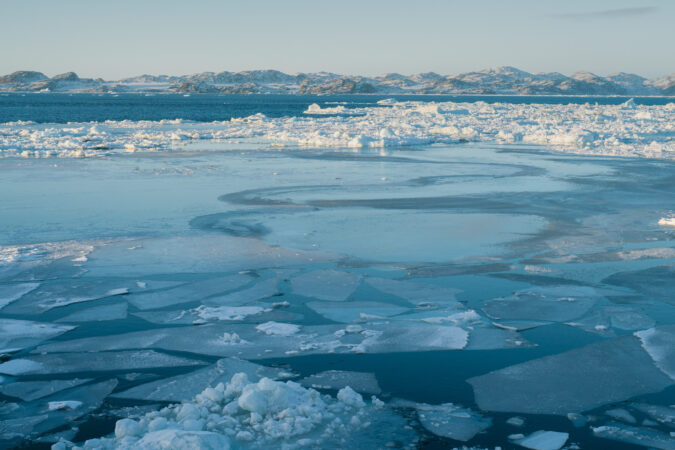
The Arctic is warming around four times faster than the rest of the globe, exposing natural resources, opening up potential shipping routes and prompting an increase in activity among military powers. The changing landscape has created a region ripe for opportunity — and potential conflict — factors that may play a role in President Donald Trump’s sudden quest to obtain Greenland.
Though he has called climate change a “hoax,” part of the value Trump has described in the Danish autonomous territory’s location is a result of the environmental shifts.
“It’s partly the melting of sea ice making it more attractive for the economic development that he’d pursue in Greenland,” said Sherri Goodman, a distinguished fellow at the Atlantic Council and the former deputy undersecretary of defense for environmental security.
Trump has said he wants the territory because of its strategic location and untapped natural resources, including diamonds, lithium, and copper.
The president announced tariffs Saturday on countries that have sent troops to Greenland in recent days. Talks this week between the foreign ministers of Greenland and Denmark and U.S. officials ended in “fundamental disagreement,” according to Denmark’s top diplomat, Lars Lokke Rasmussen.
The prospect of the United States using military force against the NATO ally, as Trump has floated, could end the decades-old defense pact. His bid for the territory is one of the most concrete examples of how climate change is influencing geopolitics. As the northernmost parts of our planet continue to warm, the effects could change the ways the international community operates.
“The freeing of the Arctic from sea ice, at least seasonally, will create an entirely new theater for economic and security competition,” said Joseph Majkut, the director of the Energy Security and Climate Change Program at the Center for Strategic and International Studies. “And while we’ve known that is going to be the case for some time, it seems we’re at an inflection point.”
Arctic sea ice typically peaks in March, as ice forms and spreads through the depth of winter, before beginning to melt to its lowest extent, usually in September. Over approximately the past five decades, changes in Arctic ice cover have revealed pathways for shipping and commerce, as parts of the region stay ice-free for longer. There’s the northern sea route along Russia’s coast, and the northwest passage along northern Canada. Analysts note icebreakers, or vessels with the capability to chomp through thinning ice, have begun passing through a “central route,” over the top of the Arctic.
In October, a Chinese container ship used the northern sea route to shave about 20 days off its typical journey through the Suez Canal to Europe.
If the region becomes ice-free in future summers, it could reshape global trade. That reality is mere decades away, though exact predictions depend on whom you ask and how quickly the planet warms.
A 2021 study in Nature modeled future open-water periods based on different warming thresholds. It found that if the planet warms 2 degrees Celsius (3.6 degrees Fahrenheit) above the 1850-1900 average, that period lengthens by 63 days, while if the planet warms 3.5 degrees (6.3 degrees Fahrenheit) above the average, nearly the entire Arctic would have at least three months of open water each year.
But it’s hard to predict the exact timeline of the rate of melting, and either way, continued escalations or jockeying won’t really depend on the pace of warming, Majkut said.
They also may be underestimating the hazards of a melting Arctic, scientists warn. Regardless of when an ice-free summer comes, it will remain an extreme environment.
“It’s going to be a long time before we’re arguing over beachfront property or protecting people from crocodiles up there,” Majkut said.
Without sea ice, communities could lose crucial protection, said Zack Labe, a climate scientist who studies regional climate risks.
“Typically, the ice would act as a buffer for high wind and waves,” he said, especially in the fall when the region experiences typhoons in the Pacific that bring huge swells. That ice protects people against erosion and flooding.
The melting Arctic could produce unpredictable ocean conditions, like changes in the wind and the waves. And if there is an emergency, there are few accessible ports.
“It could become more hazardous for ships to go into these areas rather than less,” said Labe.
While Trump is pursuing Greenland, he hasn’t publicly acknowledged climate change’s role in what he perceives to be its value. A staunch climate change denier, the president has moved to cut funding to many climate initiatives including Arctic research.
But to some, that could be bad geopolitical strategy.
“Climate change is a significant national security risk,” said Goodman. “The openings of sea lanes, the changing ice conditions, are contributing to the intense geopolitical situations we’re experiencing.”
The Pentagon has ordered about 1,500 active-duty soldiers to prepare for a possible deployment to Minnesota, defense officials told the Washington Post late Saturday, after President Donald Trump threatened to invoke the Insurrection Act in response to unrest there.
The soldiers are assigned to two infantry battalions with the Army’s 11th Airborne Division, which is based in Alaska and specializes in cold-weather operations.
The Army placed the units on prepare-to-deploy orders in case violence in Minnesota escalates, officials said, characterizing the move as “prudent planning.” It is not clear whether any of them will be sent to the state, the officials said, speaking like some others on the condition of anonymity to discuss sensitive military planning.
The White House said in a statement that it’s typical for the Pentagon “to be prepared for any decision the President may or may not make.” Sean Parnell, a spokesperson for Defense Secretary Pete Hegseth, said in a statement Sunday that the Pentagon is “always prepared to execute the orders of the Commander-in-Chief if called upon.” Two officials said that the orders are unrelated to Trump’s recent rhetoric about the United States needing to take control of Greenland.
The development was reported earlier by ABC News.
Minneapolis Mayor Jacob Frey on Sunday called the federal government’s surge of immigration enforcement officials, and the possible deployment of active-duty soldiers, an attempt to “bait” protesters in the city.
“We’re not going to give them an excuse to do the thing that clearly they’re trying to set up to do right now, which is these 1,500 troops,” Frey told CNN. “I never thought in a million years that we would be invaded by our own federal government.”
The Insurrection Act, a federal law dating to 1807, permits the president to take control of a state’s National Guard forces or deploy active-duty troops domestically in response to a “rebellion.” Invoking the act would be an extraordinary move and mark the first time a commander in chief has done so since President George H.W. Bush called on the military during the Los Angeles riots of 1992 that killed dozens of people and caused widespread destruction.
Typically, invoking the Insurrection Act is considered a last resort, when law enforcement personnel are unable to keep the peace during times of civil unrest.
Trump threatened Thursday to invoke the law, saying on social media that unless officials in Minnesota could stop protesters from “attacking” agents with Immigration and Customs Enforcement, he would “institute the INSURRECTION ACT” and “quickly put an end to the travesty that is taking place in that once great State.”
On Friday, Trump seemed to cool his rhetoric, saying there wasn’t a reason to invoke the law “right now.” He added, “If I needed it, I’d use it.”
The Trump administration has turned up the pressure on Gov. Tim Walz and other Democratic leaders in Minnesota, with the Justice Department launching an investigation into whether Walz and Frey have impeded immigration enforcement. Walz, Frey, and other Democrats have said the move is an act of authoritarianism intended to silence critics of the administration’s actions.
On Sunday, Frey said his office had not yet received a subpoena in the investigation, calling the probe “deeply concerning.”
“This whole investigation would ultimately be the product of one of the most basic, foundational responsibilities that I have as mayor, which is to speak on behalf of my constituents,” he told ABC News.
Walz and Frey have pleaded for protesters to remain peaceful. On Saturday, Walz also mobilized the Minnesota National Guard to support local authorities, but he has not deployed those troops.
Minnesota has been a preoccupation of the Trump administration since at least December, when the Department of Homeland Security launched Operation Metro Surge, a multiweek immigration crackdown that has led to the arrest of hundreds of people and has been marked by clashes between federal agents and protesters.
ICE agents have shot two people there this month, killing Renée Good, an American citizen, and wounding a Venezuelan migrant, Julio Cesar Sosa-Celis, after they attempted to detain him.
Minnesota officials have sued the Trump administration over the operation, alleging the surge in law enforcement there is a politically motivated violation of the Constitution. Minnesota Attorney General Keith Ellison (D) said he is seeking a restraining order and called the operation a “federal invasion.”
Other domestic military deployments ordered by Trump have been legally contested, with mixed results. In the most significant of those actions, Trump seized control of the California National Guard in June over the objections of Gov. Gavin Newsom, a Democratic political rival. About 4,000 Guard members were deployed to Los Angeles along with a battalion of about 700 active-duty infantry Marines after protests against ICE turned violent in a few instances.
In December, Trump said he would end his efforts to keep National Guard troops deployed in Los Angeles, Chicago, and Portland, Ore., following a 6-3 ruling by the Supreme Court that found the administration failed to identify a legal way in which the military could “execute the laws in Illinois.” At issue in those jurisdictions was whether the deployments violated the Posse Comitatus Act, a federal law that prohibits U.S. troops from carrying out civilian law enforcement actions.
Trump also has deployed more than 2,600 members of the National Guard to D.C., and administration officials recently extended that mission through the end of 2026. While that deployment remains legally contested, the president has more authority to deploy National Guard members there because it is a federal jurisdiction.
Delicate snowflakes painted Philadelphia white Sunday morning, leaving icy roads and sidewalks to shovel. The storm will also leave behind a cold holiday.
“We have only seen round one; round two is on its way,” said Paul Fitzsimmons, a lead meteorologist with the National Weather Service office in Mount Holly.
Through Sunday, Fitzsimmons predicted a total of 2 to 4 inches of snow, with the second wave of flurries picking up after 1 p.m., possibly mixing with rain after 2 p.m.
Rain is not certain, but there is a 70% chance of showers, according to the National Weather Service. Couple that with a cloudy day, winds around 5 mph, and temperatures in the mid-30s (35 degrees being the warmest Philly will see today), and drivers are in for some hazy driving conditions.
“Roads are icy today: People should exercise extra caution, leave extra time to leave wherever they are going, and drive slower than normal,” Fitzsimmons said.
The weather prompted PennDot to advise drivers to avoid unnecessary travel. Commercial vehicles must stay in the right lane, PennDot said.
Stick to the speed limit even if the roads seem treated, because at the moment, PennDot’s main goal is to only keep them passable, not completely free of ice and snow, the department said.
PennDot’s crews will continue to treat roads throughout the day, but there is a slight chance of more snow coming before 8 p.m., with temperatures dropping as low as 20 degrees, and a 20% chance of rain, according to the weather service.
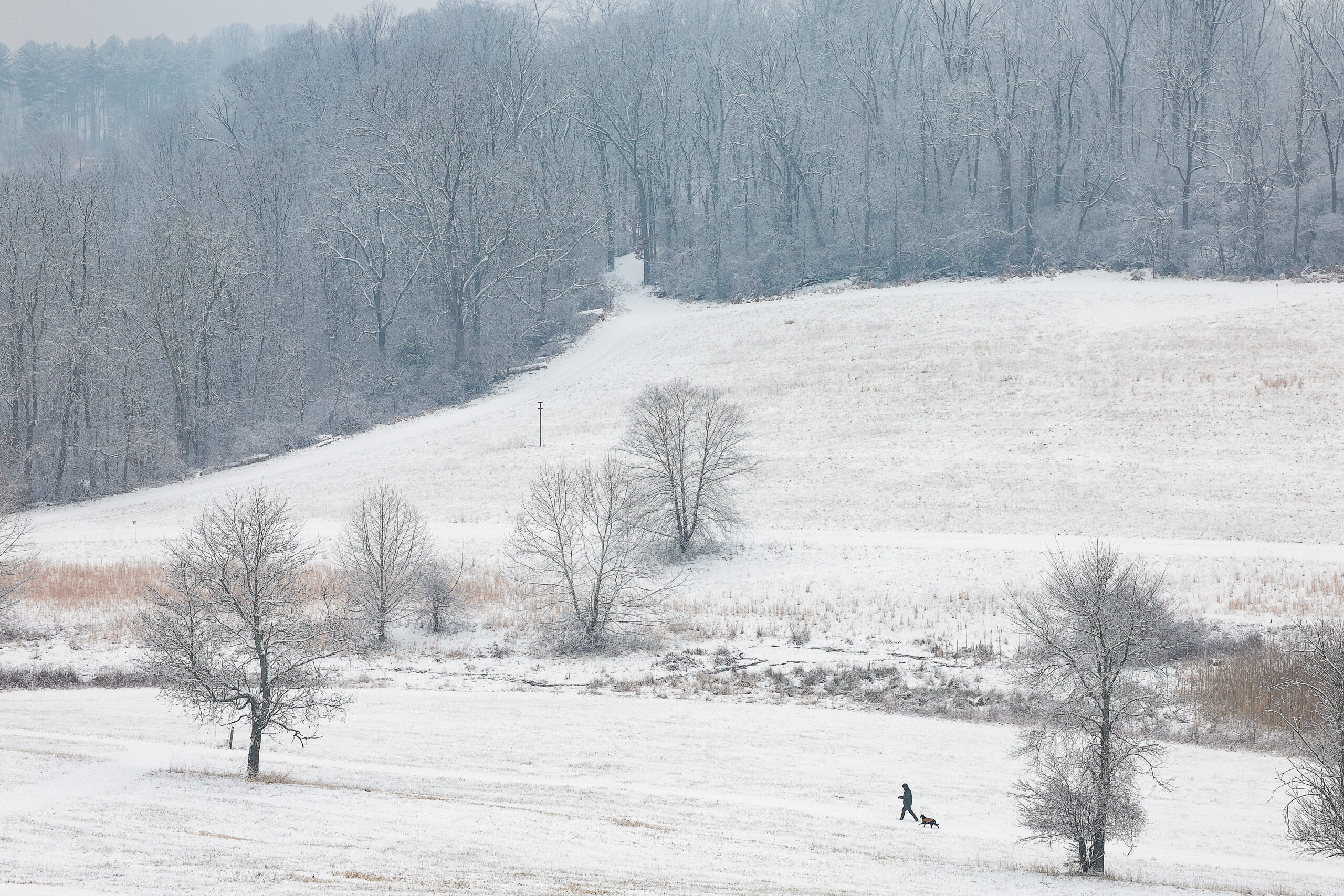
David Bond, of West Chester, walks his dog, Todd, in the snow at Okehocking Preserve in Newtown Square on Sunday, Jan. 18, 2026.
Martin Luther King Jr. Day
Monday arrives a bit sunnier, and with no snow, yet colder than Sunday, Fitzsimmons said.
Skies are expected to be fully clear, with a low of 14 and a high of 35 degrees. Do be mindful of the wind, as the National Weather Service expects gusts as high as 20 mph by Monday night.
That low would be the lowest of the season so far, with an even lower 10 degrees forecast for Tuesday.
“It’s going to be cold overall, so bundle up,” Fitzsimmons said.
(function () {window.addEventListener(‘message’, function (e) { var message = e.data; var els = document.querySelectorAll(‘iframe[src*=”‘ + message.id + ‘”]’); els.forEach(function(el) { el.style.height = message.height + ‘px’; }); }, false); })();
BERLIN — The eight European countries targeted by U.S. President Donald Trump for a 10% tariff for opposing American control of Greenland blasted the move Sunday, warning that his threats “undermine trans-Atlantic relations and risk a dangerous downward spiral.”
The joint statement by some of America’s closest allies signaled a possible turning point in the recent tensions over sovereignty and security nearly 24 hours after Trump’s threat.
It was also the most forceful rebuke of Trump from the European allies since he returned to the White House almost a year ago. In recent months, Europeans have mostly opted for diplomacy and flattery around him, even when seeking an end to the war in Ukraine. Sunday’s statement, as well as some European countries sending troops to Greenland for a Danish military training exercise, appeared to be a step away from that strategy.
The unusually strong joint statement from Denmark, Norway, Sweden, France, Germany, the United Kingdom, the Netherlands, and Finland said troops sent to Greenland for operation Arctic Endurance pose “no threat to anyone.”
Standing in solidarity with Denmark, Greenland
Trump’s Saturday announcement sets up a potentially dangerous test of U.S. partnerships in Europe. He appeared to indicate that he was using the tariffs as leverage to force talks over the status of Greenland, a semiautonomous territory of NATO ally Denmark that he regards as critical to U.S. national security.
“We stand in full solidarity with the Kingdom of Denmark and the people of Greenland,” the group said. “Building on the process begun last week, we stand ready to engage in a dialogue based on the principles of sovereignty and territorial integrity that we stand firmly behind. Tariff threats undermine trans-Atlantic relations and risk a dangerous downward spiral.”
There are immediate questions about how the White House could try to implement the tariffs because the European Union is a single economic zone in terms of trading. It was unclear, too, how Trump could act under U.S. law, though he could cite emergency economic powers that are currently subject to a U.S. Supreme Court challenge.
EU foreign policy chief Kaja Kallas said China and Russia will benefit from divisions between the U.S. and Europe. She added in a post on social media: “If Greenland’s security is at risk, we can address this inside NATO. Tariffs risk making Europe and the United States poorer and undermine our shared prosperity.”
Europe has been trying to keep Trump on its side to ensure U.S. support for Ukraine, including Washington sharing intelligence with Kyiv and its involvement in security guarantees if a peace agreement is reached with Russia.
Rasmus Søndergaard, a senior researcher at the Danish Institute for International Studies, called Trump’s announcement “unprecedented” because tariff threats normally stem from trade disagreements, not territorial disputes between allies.
“That’s of course why we’re seeing the response from European countries saying ’enough is enough,’” he told the Associated Press. “I think there’s in part probably a strategic calculation, of course, from the governments in these countries that if you give in to Trump on this, what will be the next thing? And at some point you have to sort of push back.”
Søndergaard also said Trump leveled the playing field for Europe with the tariff threat. Europeans cannot compete militarily, but the EU can wield an economic weapon through reciprocal tariffs.
“The EU has the ability to really strike back with force if they want to, and it will hurt European economies,” he said. “It will hurt American economies. The challenge for Trump is he has midterms coming up and it’s not going to help him if the U.S. goes into more of an economic recession or more of an economic turmoil than is already the case.”
Meanwhile, NATO Secretary General Mark Rutte wrote on social media Sunday that he’d spoken with Trump. Rutte has been criticized in recent days for largely sidestepping questions about Trump and Greenland and any NATO tensions over the island.
“We will continue working on this, and I look forward to seeing him in Davos later this week,” Rutte said.
U.S. Sen. Mark Kelly, a former U.S. Navy pilot and Arizona Democrat, said Trump’s threatened tariffs on U.S. allies would make Americans “pay more to try to get territory we don’t need.”
“Troops from European countries are arriving in Greenland to defend the territory from us. Let that sink in,” Kelly wrote on social media. “The damage this President is doing to our reputation and our relationships is growing, making us less safe. If something doesn’t change we will be on our own with adversaries and enemies in every direction.”
Former U.S. Vice President Mike Pence said he supports the United States ultimately owning Greenland, but not how Trump is trying to accomplish it.
He said he had concerns whether Trump had the constitutional authority to impose unilateral tariffs on NATO allies, as well as about a threat of a military invasion. Trump’s current position threatens “to fracture that strong relationship, not just with Denmark, but with all of our NATO allies,” Pence said on CNN’s State of the Union.
Populist allies of Trump criticize tariff threat
Six of the countries targeted are part of the 27-member EU, which operates as a single economic zone in terms of trading. It was not immediately clear if Trump’s tariffs would impact the entire bloc. EU envoys scheduled emergency talks Sunday evening to determine a potential response.
The tariff announcement also drew blowback from Trump’s populist allies in Europe.
Italy’s right-wing premier, Giorgia Meloni, considered one of Trump’s closest allies on the continent, said she had spoken to him about the tariffs, which she described as “a mistake.”
The deployment to Greenland of small numbers of troops by some European countries was misunderstood by Washington, Meloni said, adding it was not a move against the U.S. but aimed to provide security against “other actors” that she didn’t identify.
Jordan Bardella, president of Marine Le Pen’s far-right National Rally party in France and a European Parliament lawmaker, posted that the EU should suspend last year’s tariff deal with the U.S., describing Trump’s threats as “commercial blackmail.”
Trump also achieved the rare feat of uniting Britain’s main political parties — including the hard-right Reform UK party — all of whom criticized the tariff threat.
“We don’t always agree with the U.S. government and in this case we certainly don’t. These tariffs will hurt us,” said Reform UK leader Nigel Farage, a longtime champion and ally of Trump. His social media post stopped short of criticizing Trump’s designs on Greenland.
U.K. Prime Minister Keir Starmer, who leads the center-left Labour Party, said the tariffs announcement was “completely wrong” and his government would “be pursuing this directly with the U.S. administration.”
It wasn’t the most clever joke ever told on U.S. prime-time television — not even close — when comedian Nikki Glaser took a swing at CBS News while hosting Hollywood’s Golden Globe Awards, which were seen live by an estimated 8.7 million viewers and clipped on social media by millions more. But the blow still landed hard, especially since the awards aired on CBS.
“The award for most editing goes to CBS News,” Glaser quipped, in a seeming reference to the recent flap over a critical report on the Donald Trump regime’s use of a Salvadoran torture prison that was spiked by 60 Minutes. “Yes. CBS News: America’s newest place to ‘see B.S.’ news.”
Last Wednesday, the network rushed out a report — sourced only to two unnamed “U.S. officials” — that the ICE agent who fired the shot, Jonathan Ross, “suffered internal bleeding to the torso” in his Jan. 7 deadly encounter with the driver who was pulling away from the scene, Renee Nicole Good.
What that report from what was once the most trusted TV newsroom in America seemed to imply — even though it did not explicitly state — was that Good’s Honda Pilot must have struck Ross in the encounter that touched off days of protests in Minneapolis and around the nation. If that did happen, it would radically alter the debate about the shooting and the violent nature of ICE’s deportation raids — creating an argument that the use of deadly force was justified.
This superb video analysis by the New York Times shows that the ICE agent who killed Renee Good in Minneapolis was not hit by her car. He had stepped away after approaching her car and killed her needlessly. https://t.co/63lI5FUVI0
I want to be careful here, because the CBS story was so vague that it’s as hard to disprove as it is to prove. Medical experts immediately noted the report could have been misleading — at best — since “internal bleeding” could mean a bruise, which might have been caused in the chaotic situation by something besides Good’s vehicle. But two reports just hours after the CBS bulletin suggested something far worse — a whiff of the utter baloney that Glaser had just joked about.
First, the New York Times released an in-depth frame-by-frame analysis of the multiple videos of the shooting captured both by citizen observers and by Ross himself as he fired his gun. The Times concluded from the analysis that “the currently available visual evidence still shows no indication agent Jonathan Ross got run over,” and published a photo showing significant daylight between the SUV and the agent as he fired.
Second, a Minneapolis Police Department report on the shooting was released, stating that Ross — who was shown on video walking around in the aftermath without any overt sign of an injury — was not taken to a hospital, as Trump had told the nation in a Truth Social post on the day of the killing. The police said Ross was driven to a government building.
Or, a different way of looking at the CBS “internal bleeding” report is in the context of Sherlock Holmes’ famous crime-solving line about the dog that did not bark. An entire pack of hounds stayed silent on this one. The facts most editors would demand before airing such an explosive claim about the biggest story in America — a medical report, or a quote from Ross’ doctor, or even a family member or an ICE colleague — weren’t published. Just the unsupported words of two officials from an authoritarian U.S. regime with a growing record for lying.
Indeed, it didn’t take long for the dismay from actual professional journalists — the ones who still work at CBS after its late 2025 takeover by a media conglomerate owned by pro-Trump billionaires — to pour out in leaks.
Most of the journalists’ consternation centered on the actions of Bari Weiss, the conservative public intellectual who has been installed as the editor-in-chief of CBS News, despite possessing almost no previous breaking news experience.
Here's Ross walking away and checking his phone after shooting Good. Doesn't look like someone suffering internal injuries after being struck by a vehicle . . . because he isn't and wasn't. pic.twitter.com/ZApbsuoyLv
“There was big internal dissension about the ‘internal bleeding’ report here last night,” a CBS News staffer who was granted anonymity told the Guardian. “It was viewed as a thinly veiled, anonymous leak by [the Trump administration] to someone who’d carry it online.”
A second insider told the news organization that it “felt to many here like we were carrying water for [the administration’s] justifying of the shooting to keep our access to our sources.” The Guardian’s sources said Weiss had personally pushed to get the piece published quickly online.
So far, all the factual, on-the-ground journalism from Minneapolis suggests that CBS News, which has stood atop the pyramid of mainstream American media for decades, has just committed one of the worst acts of bad journalism in U.S. history.
The worst? That’s a high bar, considering other historic missteps like Judith Miller’s later debunked New York Times reporting on alleged Iraqi chemical weapons that bolstered the dishonest case for war, and which was also rooted in boosting government fictions.
But with approval for ICE, Trump’s immigration policies, and the president himself reeling after Good’s killing, and a flood of viral videos showing violent actions by government agents in Minnesota, any aid for a White House campaign to rewrite history is appalling. It could be used by the Trump regime to bolster a case for invoking the Insurrection Act and sending troops to Minnesota, which would cause the simmering crisis of American democracy to boil over.
A CBS News spokesperson told the Independent that the network “went through its rigorous editorial process and decided it was reportable based on the reporting, the reporters, and the sourcing.” It should be noted that ABC News ran a nearly identical story shortly after the CBS report. The parent companies of both CBS and ABC reached multimillion-dollar settlements of questionable lawsuits by Trump at the start of his presidency rather than fight them in court.
In this undated photo released by Paramount, one of the Free Press’s cofounders, Bari Weiss, poses for a portrait. Weiss is the editor-in-chief of CBS News.
The CBS report did not happen in a vacuum. There was a reason, after all, that Hollywood’s elites guffawed when Glaser told her “see B.S.” joke. And it went even deeper than the recent brouhaha over Weiss’ last-minute postponement of the 60 Minutes report on the mistreatment of U.S. deportees in the Salvadoran prison, supposedly because she believed it needed more reporting and more input from the Trump regime.
Critics noted the slow-motion impeding of that story that was so damaging to the White House was the polar opposite of the rushed Minneapolis “internal bleeding” story that was desired by the regime. It’s also come out that a second in-the-works 60 Minutes piece that could make Trump’s government look bad — about its preference for white South African refugees — has also been delayed by intense edits.
This is exactly what many feared last year when the Trump regime green-lighted the sale of CBS’s then-parent Paramount to Skydance Media, owned by David Ellison, son of Trump-supporting Silicon Valley billionaire Larry Ellison, and when the new owner brought in Weiss, a former New York Times opinion journalist whose right-leaning site Free Press — also bought by Ellison — is popular with the superwealthy.
It became almost a cliché to point out how the new team has threatened the storied legacy of CBS News and the iconic moments its star journalists had questioned authority, including Edward R. Murrow’s 1954 takedown of red-baiting Sen. Joseph McCarthy, or Walter Cronkite’s 1968 call for a Vietnam withdrawal that infuriated Lyndon B. Johnson’s White House.
Variety's @DPD_ says that Tony Dokoupil is making "CBS Evening News" all about himself even in the wake of the Minneapolis shooting:
"The anchor who promised, as he prepared to launch his and his boss Bari Weiss’ reinvention of the newscast, to outdo Walter Cronkite had, in… pic.twitter.com/nk00sx3Yje
But already the new reality of CBS News as a kind of state media for the Trump era has been worse than anyone could have feared, now creating “fake news” in the term’s original clear-eyed meaning and not its bastardization by Trump’s MAGA movement.
Weiss’ handpicked anchor, Tony Dokoupil, set the tone when he declared the new CBS News wanted to listen to everyday Americans and not put so much stock in experts — presumably like the doctors who could have told them the “internal bleeding” story didn’t make sense. In the immediate aftermath of Good’s killing, Dokoupil delivered a mush-mouthed “both sides” monologue that surely set Cronkite and Murrow spinning in their graves.
That was almost as embarrassing as Dokoupil’s 13-minute interview with Trump in which the president said the quiet part about the new slant at CBS News out loud, telling the anchor that if Kamala Harris had won in 2024 instead of Trump, “You wouldn’t have this job, certainly whatever the hell they’re paying you.”
That was not edited out of the interview when it aired on CBS Evening News — perhaps because, it later came out, White House press secretary Karoline Leavitt told Dokoupil and his crew that the president demanded all 13 minutes must be broadcast without changes or “we’ll sue your asses off.”
CBS clearly complied. Of course it did. In a matter of weeks, the storied CBS eye logo has become a knowing wink to an autocratic U.S. government. The changes at CBS, and their implications for American democracy, have somewhat been lost in the recent tsunami of unthinkable headlines like the unrest in Minnesota, the bombing and regime change in Venezuela, and Trump’s once-unthinkable threats against Greenland.
But we can’t ignore this. The four million or so Americans who watch Dokoupil and the CBS Evening News every weeknight might be a huge drop from Cronkite’s era when three TV networks dominated the landscape, but many of those folks — older, less politically obsessed, often swing voters — are vital to the future of democracy.
The success of Trump’s strongman project — just like the prior century of dictatorships that have paved the way for this — depends on creating alternative realities for the true believers and a cloud of uncertainty for the rest of us. The goal is to convince the masses of people that truth is fungible — except for what is dictated by the leader.
The only “internal bleeding” we can confirm with any certainty is the battered and visibly bruised reputation of a newsroom that was once a bulwark of press freedom, as well as America’s run-over democracy. OK, that’s kind of an obvious observation, but maybe Glaser can use it if CBS lets her host the Golden Globes again next year.
Entering this season, Penn was looking to break its yearly cycle of finishing fourth in Ivy League women’s basketball.
Now, with the team off to an 0-3 start in league play for the first time since Mike McLaughlin’s first season as head coach in 2009-10, the Quakers look ahead to an uphill battle.
On Saturday, Penn (10-6, 0-3 Ivy) got off to a 10-0 start against Harvard (9-7, 2-1), relying on high energy and pressing defense to control the pace. Once the game settled, Penn’s offense flatlined, with the Quakers scoring only four total field goals through the second and third quarters — leading to a 53-42 Harvard victory.
“Great start,” McLaughlin said. “Really proud of the way we came out. Obviously, get out on that type of lead. We just struggled. Struggled to score the ball. Score in transition was probably our biggest challenge.”
Next up, Penn will host Dartmouth on Monday (2 p.m., ESPN+).
‘Not where anyone wants to be’
After finishing their nonconference games on a five-game winning streak, the Quakers then dropped three straight against Princeton, Brown, and Harvard to fall to the bottom of the Ivy League standings, alongside Yale and Dartmouth.
“Playing against Princeton in the beginning,” McLaughlin said. “A tough road trip to Brown and a good Harvard team. You know, I don’t want to say it’s just the opponent. I don’t think we’ve played well enough the last two times on the offensive side to beat whoever in our league. Coming in after league play, I was expecting us to come out of the gate a little bit faster, to be honest with you. This makes a lot of pressure on Monday to have some success here, for sure.”
Despite being three weeks into league play, Penn finds itself searching for a must win this week. A loss to the Big Green on Monday would cement Penn at the bottom of the Ivy League standings.
“Oh-and-three in the league is not where we wanted to be,” McLaughlin said. “It’s not where anyone wants to be, but this team’s got a lot of basketball to go. Monday’s really vital for this program to get where we need to go, and we’ll respond.”
Not enough help
During its three-game skid, Penn has been overly reliant on junior guard Mataya Gayle, who led the team with 16 points against Harvard.
McLaughlin is aware of his team’s top-heavy disposition on offense and hopes other guards will step up in the coming weeks to alleviate defensive attention from Gayle, who shot 39.2% from the field over this three-game stretch.
Penn’s offense has relied heavily on Mataya Gayle this season.
“Unfortunately, Mataya has taken some really difficult shots,” McLaughlin said. “I see it. You see it. Everyone sees it. But I think not having other kids that are able to make a play at times [and] pushes the ball back in her hands. That’s a tough hill to get over. With good players you’re playing against, they’re the type of shots you’re going to get, and I don’t like that for us to win.”
‘Playing to exhaustion’
Meanwhile, the 2025 Ivy League Rookie of the Year, Katie Collins, is carrying an even larger weight for the Quakers.
Ranked ninth in scoring, averaging 13.1 points, second in rebounds per game (6.4), and second in blocks per game (1.8) in the Ivy League, Collins, a sophomore, has excelled in a larger role after the departure of frontcourt partner Stina Almqvist.
“I do think Katie has definitely stepped up,” McLaughlin said. “I mean, this girl is, as you see her, she’s playing to exhaustion. She’s playing both ends of the floor at full pace. I think she’s taken that next step for sure.”
Katie Collins, a sophomore, is ninth in the Ivy League in scoring.
Collins also ranks third in total minutes (34.6 per game) in the Ivy League. Against Brown, Collins played 48 of 50 minutes in a double-overtime loss.
Collins transitioned from center to power forward in the offseason to fill Almqvist’s role in the lineup, which has left a gap at center. Tina Njike and Gabriella Kelley have filled that role, but with a lack of offensive production, McLaughlin has experimented with movingCollins back to center, while subbing in players like Brooke Suttle to boost the lineup.
“We need her,” McLaughlin said regarding Suttle. “She is going to be in the middle of the lane most of the possessions on both sides of the ball. But some opportunities around the rim, we need more out of her. She’s got to put the ball in the basket. She puts the ball in the basket there, things could change.”
And while Ocean City will never be the same without Gillian’s Wonderland Pier, boardwalk merchants are holding on — and they want a say in what comes next.
Three people died after a natural gas explosion flattened Bristol Health & Rehab Center just before Christmas.
While the cause has not yet been determined, an Inquirer data review found that state regulators had cited the facility for over 70 health and safety violations in the three years leading up to the tragedy.
Highest in the region: The Bristol facility that exploded has been hit with $418,000 in fines since 2023, more than any nursing home in the Philadelphia area.
All other offenders: In the same time span, almost half of the Philadelphia-area’s 182 facilities have faced over $5 million in financial penalties for safety violations.
In related news: Muthoni Nduthu, a nurse who was killed in the blast, was laid to rest Saturday. She was memorialized by family, friends, and a nurse honor guard as a dutiful nurse and faithful mother.
🎤 I’m passing the mic to Amy Rosenberg down the Shore.
Along the commercial stretch of Ocean City’s boardwalk, from Sixth to 14th Streets, there are 167 storefronts, including four Kohr Bros. Frozen Custards, three Johnson’s Popcorns, three Manco & Manco Pizzas, and eight Jilly’s stores of one type or another.
There are eight mini-golfs, nine candy shops, 18 ice cream places, 10 pizza shops, 18 arcades or other types of amusements, five jewelry stores, three surf shops, five T-shirt shops, and 47 clothing or other retail shops. There is one palm reader.
Even without Gillian’s Wonderland Pier, the iconic amusement park at Sixth Street that famously closed in October 2024, it still adds up to a classically specific, if repetitive, Jersey Shore boardwalk experience. Many of the shops are owned by the same Ocean City families, some into their third generation.
But now these very shop owners are sounding the alarm.
“This is a group that’s been hanging on for a long time,” Jamie Ford, owner of Barefoot Trading Co., at 1070 Boardwalk, said in an interview last week. “These places are hanging in there. They’re not going anywhere, but we’re nervous.” — Amy Rosenberg
Bensalem Township police arrested two men and a 17-year-old boy for allegedly stealing $16,000 worth of weight-loss drugs being delivered to a pharmacy.
Small-business advisers and advocates in Philadelphia are bracing for a big tax headache as the city’s municipal tax expands to cover tens of thousands more small businesses and self-employed workers.
A federal lawsuit alleges misconduct by two Pennsylvania state troopers who investigated the case of a former pastor who was acquitted of a 1975 killing.
In an interview with Pennsylvania’s two U.S. senators, CBS Evening News anchor Tony Dokoupil asked about “extreme rhetoric” in Minneapolis. Here’s what Dave McCormick and John Fetterman said.
An Old City establishment now offers a GLP-1 menu, making it one of the country’s first full-service restaurants to do so. It’s part of a trend of restaurateurs adapting to diners’ shifting preferences amid economic uncertainty and the rise of appetite-curbing medications.
Center City District Restaurant Week returns Sunday for the first time in a year, with 120 restaurants offering fixed-price lunches and dinners — the largest lineup since the pandemic.
❓Pop quiz
The Inquirer will make an appearance in an upcoming episode of which TV series?
Cheers toChris Lewis, who correctly guessed Saturday’s answer: Inglis House. Five residents of the home for people with severe physical disabilities are taking classes at Community College of Philadelphia. It’s the largest group to start since the 1990s.
This is Charlotte Astor, a high school junior from Cherry Hill. She’s trying to track down a long-lost demo tape recorded by her mom’s band in the ’90s. The hardcore community banded together to help Astor on her quest.
👋🏽 This newsletter is taking a break in observation of Martin Luther King Jr. Day. We’ll be back in your inbox bright and early on Wednesday. Until then, stay warm and take care.