Blog

  • A teen couldn’t find her mom’s 30-year-old demo tape. The internet stepped in.

    A teen couldn’t find her mom’s 30-year-old demo tape. The internet stepped in.

    The long-lost demo tape had always held a certain mythos in Charlotte Astor’s imagination.

    For years, the Cherry Hill teen had heard stories about it, recorded about 30 years ago by her mother’s very loud, very short-lived, teenage hardcore band, Seed.

    Shannon Astor, now 47, had been a vocalist for the group, just 14 or 15 years old, at a time when female representation within the genre was rare. Within a year or so, the group had disbanded — but before it did, the group, which typically practiced in a member’s parents’ basement, recorded a single demo. There had been only a few dozen copies produced back then, and they had all sold, scattering out around the South Jersey area.

    For Charlotte, the tape became a kind of white whale — a relic of her mother’s hard-charging past, something the teen occasionally scoured the web for, to no avail.

    She’d never heard her mother’s band. And she wanted to. Badly.

    “Ninety-five percent of what I have about my mother is in the stories she tells me,” says Charlotte, 16, a junior at Cherry Hill High School East.

    But a demo was something tangible. Something concrete.

    “A demo,” she decided, “I can find.”

    And so one night last spring, that’s what she set out to do.

    She had little to go on: A rough estimate of when the demo would have been released (1993-94), a general geographic location (South Jersey), and a single lyric (“In the wind of the AM shadows cling to nearby trees as season shifts to satisfy the light from above”).

    “I have been looking for this tape for 4 years,” she wrote in an appeal to her 1,000 or so Instagram followers, “… and it would mean the absolute world to me to find this tape.”

    But something about her search — this desire to connect with a parent, to bridge a gap three decades wide — resonated. It became, within the tight-knit confines of the hardcore music scene, a united pursuit.

    At an age when most teenagers couldn’t get far enough away from their parents, here was one launching a quixotic quest to better understand hers.
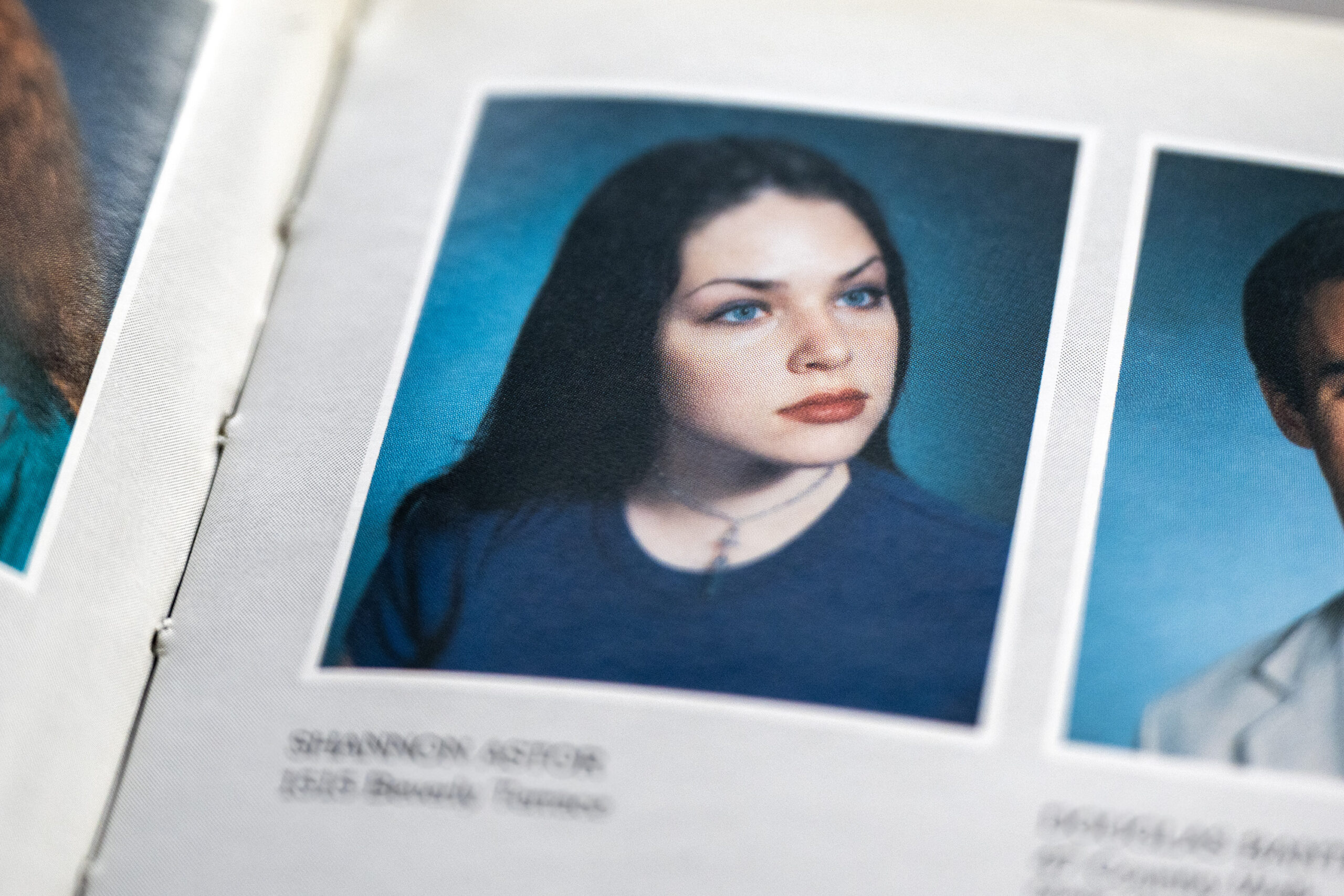
    A senior class photo of Shannon Astor in the 1996 Cherry Hill High School East yearbook. Now 47, Shannon was previously in a hardcore band called Seed.

    Soon, strangers from across the country were digging through old boxes in basements, or tagging old running buddies from Jersey’s 1990s hardcore scene in social media posts. Some reached out to old producers from the area, wondering whether the demo might have made its way into some dusty studio corner.

    Messages poured in, too — hundreds of them — with suggestions ranging from the plausible to the outlandish. Had she tried getting in touch with Bruce Springsteen’s people? You never know what the Boss might have stowed away in some mansion closet.

    “I suddenly had communication with so many people who I thought I would never in my life have any connection with,” Charlotte said. “California to Jersey, and everything in between.”

    The lead singer of a well-known Jersey straight-edge band of the era, Mouthpiece, joined the search, messaging Charlotte after others reached out to him about the tape. (He vaguely remembered her mother, Shannon, but not the band.)

    Much of the outside help, Charlotte notes, has come from the hardcore community.

    Indeed, much of Charlotte’s young life is rooted in the same hardcore music scene that her mother’s once was. Like Shannon before her, Charlotte spends many nights at hardcore shows around the area, photographing the scene for the magazine she self-publishes, “Through Our Eyes.” And like her mother previously, she’s a member of the “straight-edge” hardcore community, a group with a shared collection of ideals that includes abstaining from drinking or drugs. (Her first flirtation with teenage rebellion came when she snuck out of the house one night to go to her favorite record store.)

    And though her mother does not necessarily share Charlotte’s zeal for locating the old tape — “I’m not waiting for some garage band demo to be unearthed,” Shannon joked — she understands what it would mean to her daughter to have it.

    “It’s special to me only because of how much she needed to hear it,” said Shannon. “I’m just so pro-Charli and everything that she does … But this is her journey, and something that was intrinsically important to her.”

    To those in the scene, meanwhile, the response has been very hardcore.

    “A bunch of people banding together to help this random girl find her mom’s thing,” said Quinn Brady, 19, of New York, and a friend of Charlotte’s. “Most people assume that hardcore people are not very nice or friendly. [But] there’s this inherent kinship. It connects people across the nation in a way that not a lot of other genres of music do.”

    A recent selfie by Charlotte Astor (right) and her mother, Shannon Astor, taken at Reading Terminal Market.

    Those outside the hardcore scene have been no less enthralled, however.

    In December, after NJ.com picked up the story, further extending its reach, a documentary filmmaker reached out about the possibility of doing a film on her quest.

    Last year, after posting in some “old-head” hardcore Facebook groups about the tape, Shane Reynolds — a member of the Philly-based hardcore band God Instinct — stumbled upon what appeared to be the most promising lead yet.

    “I found the guy who allegedly made the demo,” Reynolds said.

    But when she got the man on the phone, Reynolds says, it proved to be a dead end.

    The closest Charlotte came was last year, not long after she first posted about the demo on Instagram. Her mom’s former bandmate in Seed, convinced he must have kept something from that period, recovered from storage an old cassette that featured a recording of a single Seed practice session.

    Charlotte took it home, pushed it into the stereo in her bedroom. She stared at the ceiling as the tape began to play and 30 years fell away.

    For the first time, she could put a sound to the stories she grew up hearing.

    “The first thing I heard was a few seconds of my mom talking,” Charlotte said. “That’s my mom, when she was 16. I’m listening to a clip of my mother, listening to her at the same age I am.”

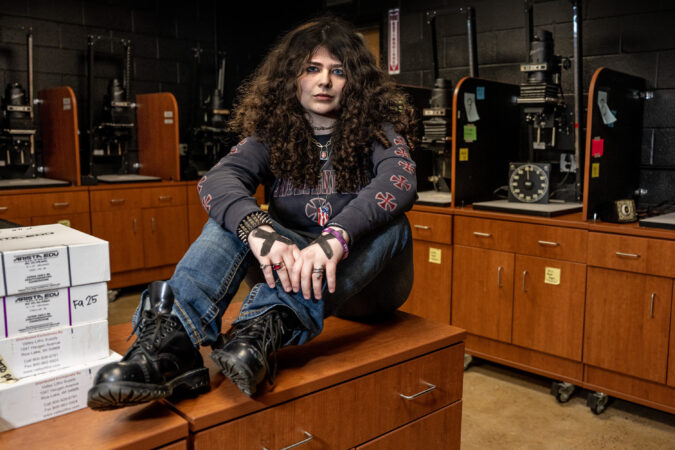
    Charlotte Astor, a junior at Cherry Hill High School East, and her vintage 35mm film Nikon camera in the school’s photography classroom.

    Still, that small taste has only reinforced her devotion to unearthing the actual demo.

    Charlotte remains realistic about her odds of finding it. No, it’s not likely to be found in some radio station’s studio. And no, Bruce Springsteen is almost certainly not in possession of a three-decades old demo tape from her mother’s teenage years.

    But some graying hardcore fan from the ’90s, with a penchant for hoarding and a cluttered garage?

    Stranger things have happened.

    “I have confidence — unwavering confidence — that someone has it,” Charlotte says. “And that I will get my hands on it.”
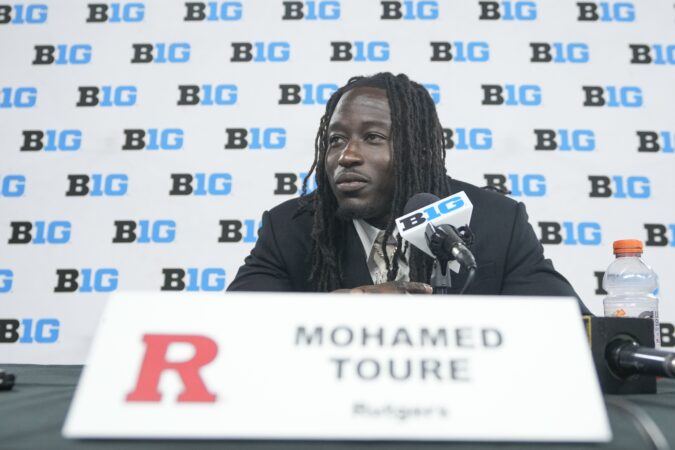

  • Mohamed Toure once transformed Pleasantville’s football team. Now, he’ll play for a national title.

    Mohamed Toure once transformed Pleasantville’s football team. Now, he’ll play for a national title.

    Mohamed Toure may have the chance to lift a trophy in the final game of his seven-year college football career.

    Toure, a native of Pleasantville, Atlantic County, will take the field alongside his Miami teammates as the 10th-seeded Hurricanes seek their first national championship since 2001 against top-seeded Indiana on Monday in Miami (7:30 p.m., ESPN).

    In his first year at Miami, Toure has been the anchor of a defensive unit that has allowed 14 points per game, ranking fifth in the Football Bowl Subdivision.

    Toure transferred to Miami in May to use his final year of graduate eligibility after playing three seasons in six years at Rutgers. He redshirted, played through the pandemic-shortened 2020 season, and suffered two ACL tears while with the Scarlet Knights, which makes Toure a seventh-year player.

    Texas A&M quarterback Marcel Reed is tackled by Miami linebacker Mohamed Toure on Dec. 20.

    But before Rutgers and Miami, Toure was a star running back and linebacker at Pleasantville High School.

    “To see him play at a high level, and for them to be playing where they’re at right now, it’s just surreal to watch,” said former Pleasantville teammate Elijah Glover, now the school’s head coach. “It’s something I couldn’t imagine when we were 10th graders.”

    Jersey journey

    Toure and Glover, who played college football at Villanova, were freshmen when Chris Sacco took over as head coach for the Greyhounds in 2015. Pleasantville had won just three games over the previous five seasons before Sacco took over, including winless campaigns in 2010, 2011, 2012, and 2014.

    The Greyhounds went winless again in Sacco’s first season but improved the following season to 4-6. In 2017, the program posted a 7-3 record behind a breakout season from Toure, playing both running back and linebacker. Glover recalls Toure’s 95-yard game-winning fumble return in overtime against Buena Regional High as one of the many moments when he realized his teammate had a future in football.

    “It didn’t happen by accident,” Glover said. “That was the first game of the season. Junior year, he went crazy. It was just like, ‘He’s for real.’”

    Mohamed Toure played running back and linebacker at Pleasantville High School.

    In his senior season, Toure led the Greyhounds to an 8-3 record, rushing for 981 yards and 11 touchdowns, while adding 69 tackles and five sacks on defense. He was named to the all-South Jersey first-team by The Inquirer in 2018.

    The personal accolades for Toure reflected an improbable turnaround for Pleasantville’s football program. Sacco, who is now the athletic director at Hammonton High School, said Toure’s leadership and commitment to Pleasantville was a crucial part of the program’s transformation.

    “It would have been easy for him, as the type of player that he was, and is, to leave and go to an established program,” Sacco said. “To stay and build something, I always said, ‘it’ll mean more to you, especially down the road. It’ll mean more to your friends and your community. It’ll mean more to the school and this program.’ And I think when you see what he did by staying and essentially helping transform a program, you don’t get much better leadership than that.”

    Road to Rutgers

    Toure’s teammates and coaches at Pleasantville knew that the linebacker would end up playing college football at a power conference school. Toure made explosive plays on the field, but he was also a force off it.

    “You definitely could see it, just in the weight room,” Glover said. “He was doing stuff that none of us could do.”

    Sacco said the recruitment process for Toure started slowly, something the former head coach attributed to the program’s losing reputation. But it picked up during Toure’s junior year, as he led the Greyhounds to a winning season for the first time in a decade.

    Toure was ranked as a three-star recruit and had 17 scholarship offers before he decided on Rutgers. He took a redshirt year in 2019, but in the pandemic-shortened 2020 season, Toure led the Scarlet Knights with 4½ sacks in their nine-game campaign.

    He built on that performance with another 4½-sack season in 2021.

    Mohamed Toure, a former Rutgers linebacker, recorded 93 tackles and 4 1/2 sacks in 13 games in 2023.

    Toure was set to be a key piece for new Rutgers linebackers coach Corey Hetherman in 2022, but his season was derailed by an ACL tear in the spring. He returned for the 2023 campaign, serving as a team captain. Toure recorded 93 tackles and 4½ sacks in 13 games that season.

    Toure planned to finish out his college career at Rutgers in 2024 while playing alongside his younger brother Famah, a junior wide receiver. But another preseason ACL tear led Toure to change his plans. He entered the transfer portal after the 2024 season, looking to use his final year of eligibility elsewhere.

    “Both the situations were very unfortunate, but I also think that he utilized that,” Sacco said. “Instead of feeling sorry for himself, he just refocused that energy into, ‘This is what I need to do to get back and better.’”

    Toure reunited with Hetherman, his former coach at Rutgers, in Miami. Hetherman spent the 2024 season as the defensive coordinator in Minnesota before joining Mario Cristobal’s staff in the same role ahead of the 2025 season.

    Toure, who leads the Hurricanes with 73 tackles, has been a key piece of Hetherman’s defense.

    Pleasantville power

    Toure stepped into a bigger spotlight as Miami made its improbable run to the national championship game.

    The 10th-seeded Hurricanes became the first double-digit seed to win a game in the playoff with a 10-3 road defeat of No. 7 seed Texas A&M. Without Toure, it could have been the Aggies moving on.

    Toure recorded eight tackles and kept Texas A&M’s Rueben Owens from catching a potentially game-tying touchdown pass with 28 seconds remaining. Toure delivered a vicious hit on the goal line to break up the pass, and the Hurricanes secured the win two plays later.

    Miami then pulled off a 24-14 upset against No. 2 seed and defending national champion Ohio State in the Cotton Bowl quarterfinal. The Hurricanes beat No. 6 seed Ole Miss, 31-27, in the Fiesta Bowl semifinal, with Toure recording four tackles and a sack.

    Their path through the bracket has led the Hurricanes back to Miami, where they will have an opportunity to compete for a title on their home field. While the Hurricanes will likely have the advantage of a home crowd on Monday, Toure will also have a number of fans cheering for him in Atlantic County.

    “It means a lot to the community,” Sacco said. “I know it means a lot to the younger kids to be able to, look at the school and say there’s somebody playing on Monday night for the national championship that went here, and recently.”

    For Glover, Toure’s steps to the national spotlight are a chance to show the high schoolers on his team, including Toure’s youngest brother Sekou, that effort and dedication can take them anywhere, whether in football or in life.

    “It’s definitely something I’m using just to let them know, like, ‘Yo, it’s possible if you just put the work in and stay down and let things end up how they’re going to be for you,’” Glover said. “Everybody won’t be a Division I recruit, that’s just impossible. But they can end up anywhere they want to be.

    “That’s really the message, besides it being Miami or football. It’s really like, ‘You could go on a big stage of anything you want in this life if you just follow these steps.’”

  • We’d be so much better off if Kamala Harris had been elected president

    We’d be so much better off if Kamala Harris had been elected president

    My late father was a high school teacher and basketball coach who learned a lot about the world around him during his 81 years. I’ll never forget how, when he’d hear me grousing about what could have been, he would always give me a look and sternly warn, “Don’t look back.”

    I’ve come to appreciate how wise his words were, but let’s face it, sometimes we don’t need wisdom — we need relief.

    Barely a few weeks into Year Two of Donald Trump’s second term, I can’t help but shake my head when I think about how much better off America (and the world) would be if Kamala Harris had won the presidency.

    She wasn’t a perfect candidate. Far from it. But once in the White House, I have no doubt she would have led the country with dignity and integrity, values currently in short supply inside the Oval Office.

    Under President Harris, the U.S. would not have invaded Venezuela and kidnapped its president, threatened to annex Greenland “the hard way,” or alienated our Canadian neighbors into boycotting American products and selling their Florida vacation homes. Rather than flirting with blowing up NATO, we would be working with our European allies to pressure Russia into ending its war with Ukraine.

    Instead of bringing back American imperialism — something nobody voted for — Harris would be focused on improving the lives of everyday Americans.

    She would be implementing policies such as allowing Medicare to better cover the cost of home care, and working with Congress to extend insurance subsidies to help keep healthcare affordable for millions of people. Meanwhile, the inflation that bedeviled her predecessor would continue to ease, untroubled by haphazard tariffs that are no less than a tax on every U.S. family.

    Elon Musk’s Department of Government Efficiency would be a ketamine-fueled figment of the tech billionaire’s imagination instead of the cause of almost 750,000 deaths — most of them children — due to the dismantling of the U.S. Agency for International Development. At home, the roughly 300,000 federal workers who left or lost their jobs because of DOGE would be serving the public, instead of leaving gaps in crucial agencies such as Social Security, the U.S. Department of Veterans Affairs, and the Federal Aviation Administration.

    You know who wouldn’t have a job under a Harris administration? The thousands of U.S. Immigration and Customs Enforcement agents who will be hired, to the tune of $30 billion, over the next few years. ICE would be targeting criminals in the country illegally, not inflicting a reign of terror on the American people. Renee Nicole Good, a 37-year-old mother of three and U.S. citizen, would still be alive instead of gunned down by an ICE agent in Minneapolis.

    FBI agents across the country would be focused on solving and preventing crimes, instead of thousands being reassigned to immigration enforcement. National Guard members would be with their families, not picking up trash in Washington, D.C., or standing around Portland, Ore., waiting for something to happen.

    Kamala Harris during an interview while shopping at Penzeys Spices on Market Street in September.

    Harris, a former California attorney general, would have kept the long-standing tradition of an independent U.S. Department of Justice, instead of turning it into the president’s law firm and using it to go after political enemies. She would have assembled a cabinet stocked with competent and experienced members, one likely as diverse as America. People like Kash Patel and Pete Hegseth would be far away from power, hawking “vaccine reversal” pills and defending war criminals on Fox News, respectively.

    Where would Trump himself be under a Harris presidency? In the same mess of trouble he had gotten himself into.

    Special counsel Jack Smith would be zealously pursuing the case against Trump for illegally retaining classified documents and plotting to overturn the 2020 election. Charges that Smith has said he could prove beyond a reasonable doubt.

    The once and forever former president would not be $3 billion richer thanks to shady crypto deals and other business ventures he has undertaken since returning to Washington. Neither would he be absentmindedly staring out where the East Wing of the White House once stood and imagining his sprawling ballroom, plastering his name on the Kennedy Center, nor costing taxpayers millions to outfit the $400 million luxury jetliner Qatar gave him.

    If anything, he might have found himself with new indictments if he had tried to steal the 2024 election, and the MAGA crowd staged another Jan. 6, 2021-style revolt in protest of a Harris victory. No doubt Harris’ attorney general would have learned a lesson from the previous administration and would not drag his feet, as former Attorney General Merrick Garland did in holding Trump accountable.

    Eventually, though, I’m convinced things would have settled down, and American politics would have gone back to being boring again — like they used to be. Fox News commentators would shift back to their old ways of complaining about Harris’ laugh and occasional lapses into word salad.

    As things calmed down, so, too, would the excitement surrounding her historic win as the realities of governance asserted themselves.

    Signing a bill to restore abortion rights nationwide would have been high on Harris’ agenda, reviving the issue that long fueled a part of the electorate. The culture war over GOP-manufactured concerns about men taking over women’s sports would rage on, never mind that trans people make up only about 1% of the population. So would the debate over the merits of diversity, equity, and inclusion efforts.

    On immigration, Harris would be caught between her party’s activist base and trying to limit people from seeking asylum at the southern border. It’s one thing for Harris to have issued her famous edict telling immigrants, “Don’t come,” and a whole other thing to take substantive steps to stem the flow of people desperate to enter the U.S.

    With Trump out of office, America would continue to be a bulwark for democracy, but the threats of authoritarianism, antisemitism, and racism would not go away. Neither would the voter malaise and congressional dysfunction that have given rise to people like Trump and his supporters. But Harris would fight the good fight for everyday Americans.

    President Joe Biden and Vice President Kamala Harris wave to the audience after addressing the DNC Winter Meeting at the Sheraton Downtown in Philadelphia in 2023.

    For a few days last month, I’d allowed myself to feel a tad bit optimistic, sensing that America had turned a corner. Maybe it was the eggnog, but the upcoming midterm elections had me feeling a little hopeful. So did the public opinion and court decisions pushing back against Trump’s excess and overreach. And Congress showing a spine and demanding accountability in releasing the Jeffrey Epstein files. If ever there were a year Rep. Jasmine Crockett could win a U.S. Senate race in Texas, 2026 felt like it could be it.

    But then, Trump dropped bombs on an Islamic group in Nigeria on Christmas Day and followed that up by sending troops into Venezuela. Now, he’s staking claims to that country’s oil reserves while looking around to see which nation he can storm next. Will it be Mexico? Colombia? Iran? Greenland? I don’t think even he knows.

    Trump isn’t bound by conventional mores or the Constitution. He’s not restrained by Congress or the U.S. Supreme Court. As he told the New York Times recently, the only thing that can stop him is his own mind. His “own morality,” which is downright scary considering his track record.

    And yet, even as I am knocked down by the reality we’re facing. I can’t help but stand up. My dad was right to warn about not looking back, but in imagining the leadership of someone who is more than worthy of the office of the presidency, I like to think I’m looking forward.

    And maybe I am.

  • Trump’s message to politically active mothers: Stay home, or your children will suffer the consequences

    Trump’s message to politically active mothers: Stay home, or your children will suffer the consequences

    The first time the police arrested me, in 2011, I expected it. We were Occupy Philadelphia, we were doing a sit-in at the Comcast lobby. Of course, they led us out in cuffs.

    The second time, I didn’t see it coming. Cops stormed the Occupy encampment, driving us into the street. They trapped us with barricades, making their subsequent dispersal orders a physical impossibility.

    Then, they arrested us illegally for our supposed failure to comply, hauling us all to jail. The experience was shocking. Naively, I had thought that attempted compliance would spare us arrest that day.

    My shock at the time seems quaint now. In the decade that followed, Philadelphia police at mass protests showed an increasing disregard for their supposed rules, the law, and our bodies.

    Tear gas is fired at protesters on I-676 on the third day of Philadelphia protests in response to the police-involved death of George Floyd in Minneapolis, in June 2020.

    During the 2018 Abolish ICE protests, they bruised us and destroyed our belongings. In 2020 — as we protested George Floyd’s murder — they tear-gassed nonviolent crowds, often also shooting at us with potentially lethal baton rounds.

    Those 2020 marches were the last mass protest I felt able to take part in, not out of a sense of self-preservation, but because we had begun to try and start a family. There is no proving that the sudden, heavy bleeding I experienced immediately after the gassings was a miscarriage. No proving that my inability to conceive in the following seven months had any relation to the gas. I’ll never know. What I do know: There is ample evidence demonstrating these chemical weapons to be abortifacients and hormonal disruptors.

    When we did finally manage conception, I feared too much for my pregnancy to attend mass protests and risk that gas again. I’d spent my entire adult life organizing and attending political demonstrations; it felt like a major part of my vocational identity had been stolen from me.

    After giving birth in 2021, I knew from my Occupy years that even perfect compliance could not protect me from arrest and detention. I was breastfeeding, and my underweight infant routinely rejected offers of formula. I couldn’t risk the possibility of separation or a tainted milk supply.

    Then another pregnancy, another birth, another child dependent on breast milk. Mass protest faded even farther into the rearview mirror.

    As the second Trump administration implemented textbook fascist practices and dissenting protests became increasingly vital, I agonized about my political responsibilities, but once again stayed home. My children are so young, the youngest still nutritionally breastfeeding. I still don’t feel comfortable risking even a few days’ disappearance in jail, or tear gas-tainted milk supply.

    As the previous week’s events made clear, birthing parents and primary caretakers — a population consisting mostly of women — are increasingly in a position in which we must make impossible decisions about exercising our right to protest.

    Last Wednesday, in Minnesota, U.S. Immigration and Customs Enforcement agents shot Renee Good in the face. Eyewitnesses report that Good — a mother who had just dropped her 6-year-old off at school — received conflicting orders from ICE agents. “Get out of here,” one agent reportedly told Good. When she attempted to comply, another agent fired three shots into her car, ending her life.

    Demonstrators protest outside the White House in Washington, Saturday, Jan. 10, 2026, against the U.S. Immigration and Customs Enforcement agent who fatally shot Renee Good in Minneapolis.

    Let’s be clear: Even if Good had violated officer orders, there would be no excuse for this summary execution. Video clearly shows she posed no physical threat to any of the agents; there can be no justification for this apparent murder by agents of the state.

    I highlight her compliance not to suggest that her life should have depended on it, but to emphasize the reality that neither whiteness nor obedience protects against violent state repression. This has always been true, but we have entered an era where agents of the U.S. Department of Homeland Security and ICE act with a brazen disregard for human life, most especially the lives of not only targeted immigrant minorities but also protesters decrying this Trumpian ethnic cleansing campaign.

    These rogue agencies now treat constitutionally protected, nonviolent political speech as immediately punishable by violence, by chemical weapon, and even by death.

    The risks of protest for birthing parents and primary caretakers of young children are disproportionately high. We must fear not just for our bodies, but for our pregnancies, and the continued physical and emotional safety of our kids.

    Many of us who are politically active are increasingly forced to make impossible choices between the civic action this moment demands and our sense of responsibility to the vulnerable children who depend on us.

    The image of Good’s blood on an airbag next to a glove compartment bursting with children’s stuffed animals is a stark reminder of the reverberating familial impact of a caretaking mother’s death, and the horrors this rogue presidential regime is only too happy to inflict on dissenters — especially dissenting women.

    “Fucking bitch,” mutters one of the agents — very possibly the shooter — as he surveys the deadly wreckage. In their eyes, it seems, unruly women earn themselves an instant death sentence.

    Whatever the Trump regime’s excuses, however, Renee Good acted legally and on principle. She chose to stand up to the fascists, to stand up for her neighbors. Her civic virtue cost her her life, and cost her child a mother.

    Many gather along Market Street to show their support for Renee Good and to protest against ICE in Philadelphia, Pa., on Saturday, Jan. 10, 2026.

    Illegal, violent repression of political opposition chills all political opposition speech, of course. When we are responsible for the care of the very young or other extremely vulnerable people, however, the effect compounds. Caretakers fear not just for our lives and freedom, but for how deeply and immediately our children might suffer in our absence. We stay home from the protests we might otherwise attend (and are blamed for our “irresponsibility” when we don’t).

    As a result, more and more childbearing-age women find ourselves having to weigh especially horrific possibilities when considering participation in the critically important speech that is a public political demonstration. And as the tragic killing of Good shows, these fears are not unfounded.

    The Trump regime, meanwhile, has repeatedly affirmed this killing as justified. Their message to politically active mothers like me is clear: Stay home, or your children will suffer the consequences. It is a gendered threat, and they know it.

    At the same time, Trump and Homeland Security Secretary Kristi Noem overplayed their hand. Their draconian approach has backfired, emboldening a wide swath of vulnerable people to take to the streets and militantly resist ICE occupation.

    Fox News now complains of “wine moms” using “antifa tactics.” A Native American mother at home with her baby shelters an immigrant DoorDasher from kidnappers. Somali aunties take to the streets of Minneapolis to hand out sambusas to protesters. DHS weakly complains about parents taking their children along to marches. Moms in Minnesota are guarding their kids’ schools from ICE and organizing mutual aid efforts, like grocery delivery to immigrant families.

    Where the Trump regime sought to frighten a populace into cowering submission, they have succeeded in radicalizing whole communities — even and especially the vulnerable — into militant action. They sought to instill fear; they have instead inspired righteous fury.

    A sign for Renee Good, who was fatally shot by an ICE officer in Minneapolis earlier in the week, is seen on the ground alongside candles as people gather outside the U.S. Immigration and Customs Enforcement facility Friday, Jan. 9, 2026, in Portland, Ore.

    The women they tried to banish to the kitchen have taken to the streets and to other acts of resistance, joining a host of vulnerable people with every reasonable excuse to avoid the fray.

    “Hope has two daughters,” wrote St. Augustine of Hippo. “Their names are Anger and Courage.”

    Hope is a mother, it seems. And she is introducing DHS to her kids.

    Gwen Snyder is a professional organizer and longtime Philadelphia activist.

  • Philadelphia-area nursing homes have amassed $5.3 million in fines since 2023 for safety violations

    Philadelphia-area nursing homes have amassed $5.3 million in fines since 2023 for safety violations

    Safety violations at Philadelphia-area nursing homes have led to nearly $5.3 million in fines since 2023, an Inquirer review of federal data shows, with almost half of the region’s 182 facilities facing financial penalties.

    The Bristol Township nursing home, where an explosion last month killed three people, topped a list of nursing homes fined in Philadelphia, Chester, Delaware, Montgomery and Bucks County, according to Centers for Medicare & Medicaid Services (CMS) data.

    The facility was fined a total of $418,000 for two sets of violations in 2024 when it was known as Silver Lake Healthcare Center. The nursing home was renamed Bristol Health & Rehab Center last month, following an ownership change shortly before the explosion.

    Six-figure penalties are not uncommon in the region. More than 22% of the 85 facilities fined had penalties greater than $100,000. The violations cited concerns ranging from noncompliant fire extinguishers to life-threatening hazards, such as allowing a resident to overdose on illegal narcotics.

    Accela Rehab And Care Center at Springfield in Montgomery County had the most citations for health deficiencies in the Philly-area — 122 total.

    Edenbrook of Yeadon in Delaware County had the most fire safety violations with 60.

    Pennsylvania regulators inspect nursing homes annually to ensure compliance with state requirements and once every 15 months for compliance with federal regulations, said Neil Ruhland, a spokesperson for the Pennsylvania Department of Health.

    The amount of a fine depends on the severity of a violation, with bigger fines when people are harmed; the number of residents impacted by the violation; and how long the facility was out of compliance.

    Nursing homes cited for deficiencies are required to develop a plan of correction, which is reviewed and monitored by the state. If the facility continues to be out of compliance, it may face penalties, including fines and ultimately could be terminated from Medicare and Medicaid, though that’s rare.

    Here’s a look at federal fines and citations at nursing homes across Southeastern Pennsylvania since 2023, according to CMS.

    window.addEventListener(“message”,function(a){if(void 0!==a.data[“datawrapper-height”]){var e=document.querySelectorAll(“iframe”);for(var t in a.data[“datawrapper-height”])for(var r,i=0;r=e[i];i++)if(r.contentWindow===a.source){var d=a.data[“datawrapper-height”][t]+”px”;r.style.height=d}}});

  • Pa. public universities didn’t get a state funding increase this year, and they’re preparing for a tough enrollment outlook

    Pa. public universities didn’t get a state funding increase this year, and they’re preparing for a tough enrollment outlook

    The universities in the Pennsylvania State System of Higher Education were flat-funded this year for the first time since 2021-22.

    That funding, approved in the state budget deal lawmakers reached in November after a monthslong standoff, follows three years of state funding increases. In 2022-23, the system got a historic 15.7% increase.

    PASSHE includes the 10 state-owned public universities. (State-related universities, including Pennsylvania State and Temple, are funded separately.)

    Cheyney University, which is part of the system, got a special $5 million earmark “to develop and implement an enhanced transfer and workforce development initiative in partnership with a community college.” Cheyney, a historically Black college in Delaware and Chester Counties, and Community College of Philadelphia recently announced a partnership that will allow students to transfer seamlessly from CCP to Cheyney and earn bachelor’s degrees while remaining on CCP’s Philadelphia campus.

    The state system had asked the state for a 6.5% increase in its general appropriation, which currently stands at $625 million. That would have brought in an additional $40 million for the 10-university system, said Christopher Fiorentino, chancellor of the system.

    But he said the system has been preparing for the possibility of a funding freeze and had increased tuition this year for the first time in seven years, raising an additional $25 million.

    “We knew it was going to be difficult, given the revenue situation in the commonwealth,” he said. “We weren’t blindsided by this.”

    He said he was grateful for the system’s appropriation.

    “That’s a huge amount of money,” he said. “… It is a significant commitment to public higher education, and we really appreciate that support.”

    The system has requested a 5% state funding increase for 2026-27, which would allow universities to freeze tuition again, Fiorentino said.

    But Kenneth M. Mash, president of the Association of Pennsylvania State College and University Faculties, the faculty union, said that would not be enough if tuition is to be frozen. And he has concerns about the freeze in state funding this year.

    “Too often, we go in there and act as if this is what we need to maintain the status quo, but the status quo is not good,” he said, citing technology and program needs. “We don’t have the support for students that we should have. We need to start paying attention to the quality of education and make sure it doesn’t suffer.”

    The system has been in a state of readjustment as it has lost about a third of its enrollment since 2010, including merging six of its universities into two entities. The system’s universities are: Cheyney, Commonwealth, East Stroudsburg, Indiana, Kutztown, Millersville, Penn West, Shippensburg, Slippery Rock, and West Chester.

    Planning for a drop in enrollment

    Another enrollment cliff is expected to begin this year as the population of high school graduates begins to drop.

    “The demographics right now going forward are unfavorable, so we have to continue to be prepared for the fact that even if we maintain our market share, we’re going to see declines in enrollment,” Fiorentino said.

    The system is attempting to recruit in new markets and bring back to college those who have some credits but no degree, he said. Older students may want more weekend, night, and online courses, and that is something the system is reviewing, too, he said.

    The system also is contemplating partnering with area doctoral institutions, such as Temple, to bring in doctoral students to teach at the system’s universities. That would save money on faculty hiring, while cultivating new potential talent for the system, he said.

    And the system is reevaluating its programs, he said. Ninety-five percent of students are graduating from half the programs the system offers, he said. Some of the larger enrollments are in business, education, health, and engineering, he said.

    But only 5% of students are enrolled in the other half of the system’s programs.

    “We have to take a look at that,” he said. “How do we redeploy the money that we currently are receiving to make sure that we’re supporting the programs that are critical to the success of the commonwealth?”

    Mash, the union president, said that bringing in doctoral students would create a viable stream of quality candidates, and that, under the contract, the system is permitted to employ a certain number of adjuncts. But he is concerned about eliminating programs with lower enrollments.

    “We should be providing as broad of a spectrum of opportunity for students as we can,” he said.

    Fiorentino said he was pleased to see Cheyney get the additional funding. The school, which has struggled with enrollment, saw an increase of 234 students — nearly 38% this year, the highest percentage increase of any school in the system. Cheyney enrolls 851 students this year, its highest enrollment since 2014.

    The new effort will allow Philadelphia students to get a Cheyney degree without having to travel to the rural campus, he said.

    “A lot of their market is Philadelphia,” Fiorentino said of Cheyney, “and for a lot of the Philadelphia students, transportation has become more and more difficult.”

    Temple and Penn State were flat-funded again this year. Temple said in a statement that it was grateful to see the budget pass.

    “We also continue to be deeply grateful for the ongoing financial support that the university receives to reduce tuition costs for Pennsylvania residents,” the school said.

  • Letters to the Editor | Jan. 18, 2026

    Letters to the Editor | Jan. 18, 2026

    Domestic terror

    I rarely agree with Donald Trump, but he’s correct about one thing: There is domestic terrorism in America. The perpetrators have been spotted in major cities across the country. They are brazen in their assaults on citizens, wear masks to conceal their identity, drive unmarked vehicles, and rarely identify themselves. They kidnap and hold victims without due process. They carry long guns and many other weapons to cause panic and fear in our communities. We must insist that our elected government officials band together to eliminate this threat. We demand that all U.S. Immigration and Customs Enforcement agents be detained and disarmed, and that ICE be abolished to ensure our safety and protect our rights.

    Barry Adams, Malvern

    Enough is enough

    After almost a year of outrages, large and small, Donald Trump now has blood on his hands. While we seem to be almost immune to caring about the 100 or so casualties of Trump’s bizarre bombing of alleged drug boats, plus another 100 killed in the kidnapping attack on Venezuela, there is now the death of an American citizen in Minneapolis at the hands of U.S. Immigration and Customs Enforcement agents.

    Despite Homeland Security Secretary Kristi Noem’s attempt to spin the horror, it is apparent that this is the tragedy we all feared when we first saw masked thugs, alleging to be law enforcement, cloaked in black and unidentified on the streets of American cities. There was unintended meaning in the fact that The Inquirer’s front-page story happened to jump to Page 6 exactly between Noem calling it “an act of domestic terrorism” and saying the victim was the terrorist. For once, she seemed to be telling the truth: that ICE is a domestic, government terrorist organization. While Trump’s sycophants help him turn our world upside down, Americans need to find ways to stand up and defend ourselves and each other. It is time to bring our feckless leaders to justice before they destroy any more of our lives, our fortunes, and our sacred honor.

    Joe Jones, Mount Holly

    Double standard

    Just to be clear, Vice President JD Vance said about the U.S. Immigration and Customs Enforcement agent who shot the woman in Minnesota: “This is a guy who’s actually done a very, very important job for the United States of America … he’s been assaulted. He’s been attacked. He’s been injured because of it.” Really? Let’s remind the VP that those exact sentiments apply to all police present at the Jan. 6, 2021, insurrection, when armed Donald Trump supporters attacked the U.S. Capitol. What’s changed?

    Dennis Fisher, Media

    Moral restraint

    During a lengthy interview in the Oval Office, our authoritarian president declared that no law, domestic or international, can limit his use of the power he believes American voters bestowed upon him. What can stop him? “My own morality. My own mind. It’s the only thing that can stop me,” he said. No need here to make the case that Donald Trump, who by all rights should be sitting in a federal penitentiary right now, has any morality.

    Those statements, combined with his lawless actions, should at long last be the breaking point, the point of no return, for House and Senate Republicans. As unpalatable as is the thought that his snarky prevaricating vice president will be elevated to chief executive, Congress must now impeach and convict the greatest villain to ever sit in this nation’s highest seat of power. That may require Pennsylvania’s Republican senator to, for the first time, stop blindly toeing the line for Trump and his divisive and often absurd policies.

    David Kahn, Boca Raton, Fla.

    Join the conversation: Send letters to letters@inquirer.com. Limit length to 150 words and include home address and day and evening phone number. Letters run in The Inquirer six days a week on the editorial pages and online.

  • Dear Abby | Neatnik’s patience in cluttered home nears its end

    DEAR ABBY: I am neat and organized, but my wife is the opposite. She’s messy and disorganized. I knew it before we married, but we made a handshake deal that she’d make an effort to pick up after herself once we moved in together. Unfortunately, it hasn’t happened.

    Every time she comes home, whatever she’s carrying gets dropped on the nearest flat surface — keys, bags, mail, you name it. She piles things up instead of putting them away and it feels like there’s clutter everywhere I look. Our bed is often piled with clothes and other items stacked almost two feet high.

    I find myself constantly picking up after her, which is exhausting and makes me feel like I’m the only one taking care of our house. Her lack of effort is driving me crazy and causing me significant stress. I’ve tried talking calmly to her, setting boundaries for clutter-free areas, even threatening divorce out of sheer frustration. Nothing seems to work. I don’t know what else to do.

    I love my wife and don’t want our marriage to fall apart over this, but the constant mess is taking a toll on my mental health and our relationship. How can I approach this in a way that fosters understanding and cooperation? I want us to find a solution that works for both of us without making her feel criticized or attacked.

    — MESSED UP

    DEAR MESSED UP: Several thoughts come to mind. You, a man who is “super neat,” knew your wife was messy but married her anyway. Short of divorcing her, would it be possible for you to designate certain areas of your home that you agree will remain clutter-free? If that isn’t possible, could you do what some other couples have done, which is live apart? Marriage mediation might help your wife understand the message you have been trying (and failing) to deliver. It’s worth a try, but lifelong habits are very hard to break.

    ** ** **

    DEAR ABBY: Our 24-year-old daughter is getting married in 10 months. My wife is invited to the wedding, but I am not, and I am furious. The groom’s family is paying for the trip, but they say I am not invited “for financial reasons.”

    I don’t have a great relationship with my daughter. But that isn’t the point. I told my wife that if the roles were reversed and she was excluded, I would not go. This may be a deal-breaker for me. It’s apparent that our marriage doesn’t mean as much to my wife as it does to me. What are your thoughts?

    — ELIMINATED IN TEXAS

    DEAR ELIMINATED: What I think is it’s terrible for your daughter to put her mother on the spot this way. By doing so she is putting a strain on your marriage. You and your wife need to ask your doctor for a referral to a licensed marriage and family therapist so you can hash this out before further damage is done to your relationship. Do I think your wife should forgo the wedding? What I think doesn’t matter as much as what she does.

  • Horoscopes: Sunday, Jan. 18, 2026

    ARIES (March 21-April 19). With automatic bill payment and thermostats, “set it and forget it” is the aim. But in relationships, the only way to make them work is to show up ready and willing to hold the whole glorious mess.

    TAURUS (April 20-May 20). Here comes the call to action. It’s also normal to look around to see if anyone else will step up so you don’t have to. But this one is for you, and the moment you act, courage kicks in.

    GEMINI (May 21-June 21). Those who have resisted temptation know how hard that can be. What’s easier is using your feet to get somewhere temptations do not exist. Easiest of all? Finding something you like much better.

    CANCER (June 22-July 22). You’re aiming to be fair and balanced. It’s not about splitting things evenly; it’s about choosing what actually restores harmony. Small adjustments like changing a word, choosing to pause or reframing how you think about a problem can change your entire vibe.

    LEO (July 23-Aug. 22). A stone thrown into the choppy water can’t make a ripple. When there’s chaos, you handle it like a pro. But when there’s not, you can apply your talent where it will make an impact.

    VIRGO (Aug. 23-Sept. 22). Charm is the result of countless small decisions about what to say, what to hold back and how to show up. But you’ve already learned, refined and practiced for years. Now all you have to do is trust yourself.

    LIBRA (Sept. 23-Oct. 23). Plans unravel. It’s almost funny. You could look for causes, but you’re inclined to shrug, laugh and then find meaning that works for your new plan — to move forward anyway. Experience shapes you in mighty fine ways.

    SCORPIO (Oct. 24-Nov. 21). Adjust the schedule, try a different route or make a new order of operations. You need a friendlier rhythm, and changing one thing will get you there. It doesn’t even have to be a big change. Small adjustments will strongly influence the outcome.

    SAGITTARIUS (Nov. 22-Dec. 21). A conversation can bring someone more into your life or keep them at a distance, connect the dots or mystify, open a heart or close it. Listen with curiosity. An ordinary exchange will be extremely memorable and useful if you come at it with an attitude of incorporation.

    CAPRICORN (Dec. 22-Jan. 19). Your taste is refined by the choices you’ve made in the past. Some of them were regrettable in an aesthetic sense, but there’s no big harm in it, just a little embarrassment at best. It feels better to make a choice that works with your surroundings, and you’ll get it right today.

    AQUARIUS (Jan. 20-Feb. 18). There’s pleasure in tending today. A drawer, a list, a plant or a single paragraph improves because you handled it. It’s amazing how a simple act of care restores not only the subject but your own mind to a sense of clarity and ease.

    PISCES (Feb. 19-March 20). You’ll notice something appealing in another person’s life. Let that awareness clarify what truly fits you. Comparison doesn’t have to leave anyone feeling less-than. It can be inspiration. It can be saying, “Wow, this is also possible for me.” Let it send you in a new direction.

    TODAY’S BIRTHDAY (Jan. 18). This is your Year of Well-Timed Courage, when you act at precisely the right moment. You don’t rush. You don’t stall. You move when you feel it, and your feelings steer you well. Each brave step feels proportionate and pays off in trust, opportunity or relief. More highlights: A family situation resolves in the sweetest way. Travel is blessed with synchronicities. You’ll give and accept financial grace. Cancer and Libra adore you. Your lucky numbers are: 3, 12, 4, 29 and 6.

  • Kevin Stefanski hired as Falcons coach after being let go by Browns

    Kevin Stefanski hired as Falcons coach after being let go by Browns

    ATLANTA — The Atlanta Falcons have hired Kevin Stefanski to be their head coach.

    Stefanski, a two-time Associated Press NFL Coach of the Year with the Cleveland Browns, replaces Raheem Morris and will report to Falcons President Matt Ryan.

    “We’re thrilled to land a lead-by-example leader in Kevin Stefanski who brings a clear vision for his staff, our team and a closely aligned focus on building this team on fundamentals, toughness and active collaboration with every area of the football operation,” Ryan said in a statement. “Coach Stefanski is a team-first leader who puts a premium on accountability for everyone and a player-driven culture. His experience in Cleveland and Minnesota has given him a great understanding of the importance of working in sync with scouting, personnel and the rest of the football staff to maximize talent across the roster and in doing everything possible to put our players in the best position to succeed.”

    Stefanski was named AP Coach of the Year in 2020 after leading the Browns to the playoffs for the first time since 2002 and their first playoff win since 1994 with an 11-5 record. He won it again in 2023 when the Browns made the playoffs and finished 11-6. Stefanski was 45-56 in Cleveland.

    “I’m beyond thrilled to be charged with leading this iconic franchise,” Stefanski said. “I am grateful to Mr. (Arthur) Blank and Matt Ryan for trusting me to coach this football team and there are many talented players on our roster that I cannot wait to coach. We share a vision for this football team that I believe will make Falcons fans everywhere proud. We will get to work immediately putting together a first-class coaching staff and working hard to get to know all the great people that are so important to getting us all where we want to go.”

    Stefanski previously spent 14 years as an assistant in Minnesota under Brad Childress, Leslie Frazier and Mike Zimmer. He’s a former two-time All-Ivy League defensive back at the University of Pennsylvania from 2000-04.