The reconstructed “ghost” structure with partial walls and windows of the building known in the eighteenth-century as 190 High Street is officially titled, “Freedom and Slavery in the Making of a New Nation” (2010).
The open-air President’s House installation in Independence National Historical Park was designed to give visitors a sense of the house where the first two presidents of the United States, George Washington and John Adams, served their terms of office.
The commemorative site designed by Emanuel Kelly, with Kelly/Maiello Architects, pays homage to nine enslaved people of African descent who were part of the Washington household with videos scripted by Lorene Cary and directed by Louis Massiah.
Just like the Rocky statue I photographed last week in anticipation of this week’s news, the President’s House was in the news last year so it remains on my radar as I walk around Old City (our newsroom is right across the street).
The cloud formation in the winter sky was what first caught my attention. Then it was seeing the sun lined up directly behind the triangular pediment above the Georgian home’s “front door.”
I played with “placement” of the sun peeking through a tiny gap at a bottom corner of the gable. I knew knew that f/22 on my mirrorless camera’s lens would give me a nice starburst. It’s an optical effect that happens because the lens’ aperture blades don’t form a perfect circle. And the narrower the opening — like f/22 — the more pronounced the effect (shooting at f/2.8 is not quite as dramatic).
Then it was simply a matter of my moving my head ever-so-slightly to align the sun with the little hole — like threading a needle.
While standing in the thin shadow of the door, I was getting blasted in the eye each time I moved. Then a group of tourists, or a noise, startled a flock of pigeons and as they took flight I was not poised just right, but I liked having the birds there better than a perfect placement of the starburst.
I tried a similar “trick” a few years ago, when walking around my town photographing with my iPhone. It doesn’t have a mechanical diaphragm so the effect is not the same. Plus, the threading-the-needle part is much more difficult when you are not actually looking through the lens as in a DSLR. And with a backlight sun blasting you directly in the face.
The optical principle of refraction through a lens diaphragm is the same for both mirrorless and DSLR cameras because light travels through the lens elements and aperture in the same way.
Since 1998 a black-and-white photo has appeared every Monday in staff photographer Tom Gralish’s “Scene Through the Lens” photo column in the print editions of The Inquirer’s local news section. Here are the most recent, in color:
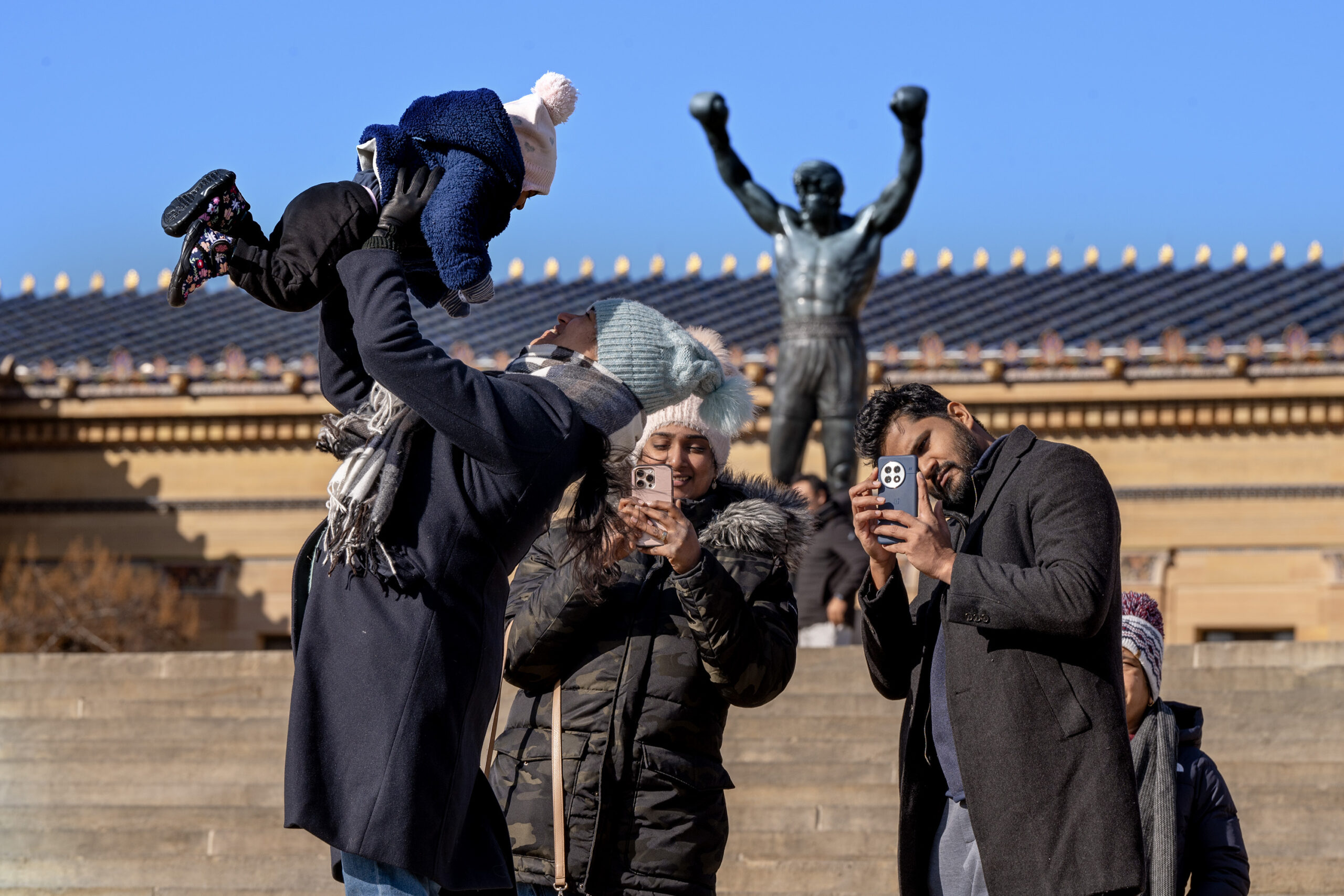
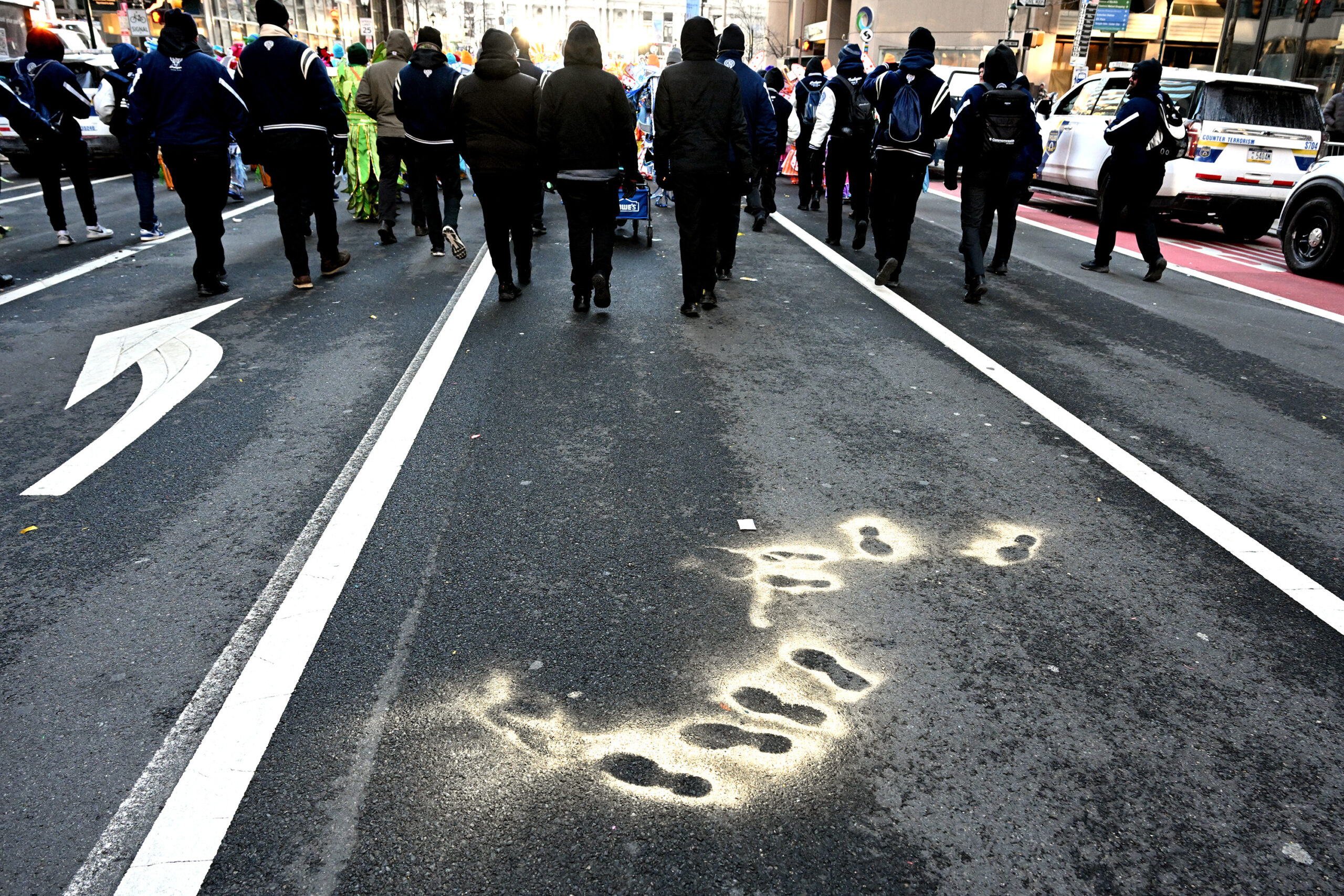
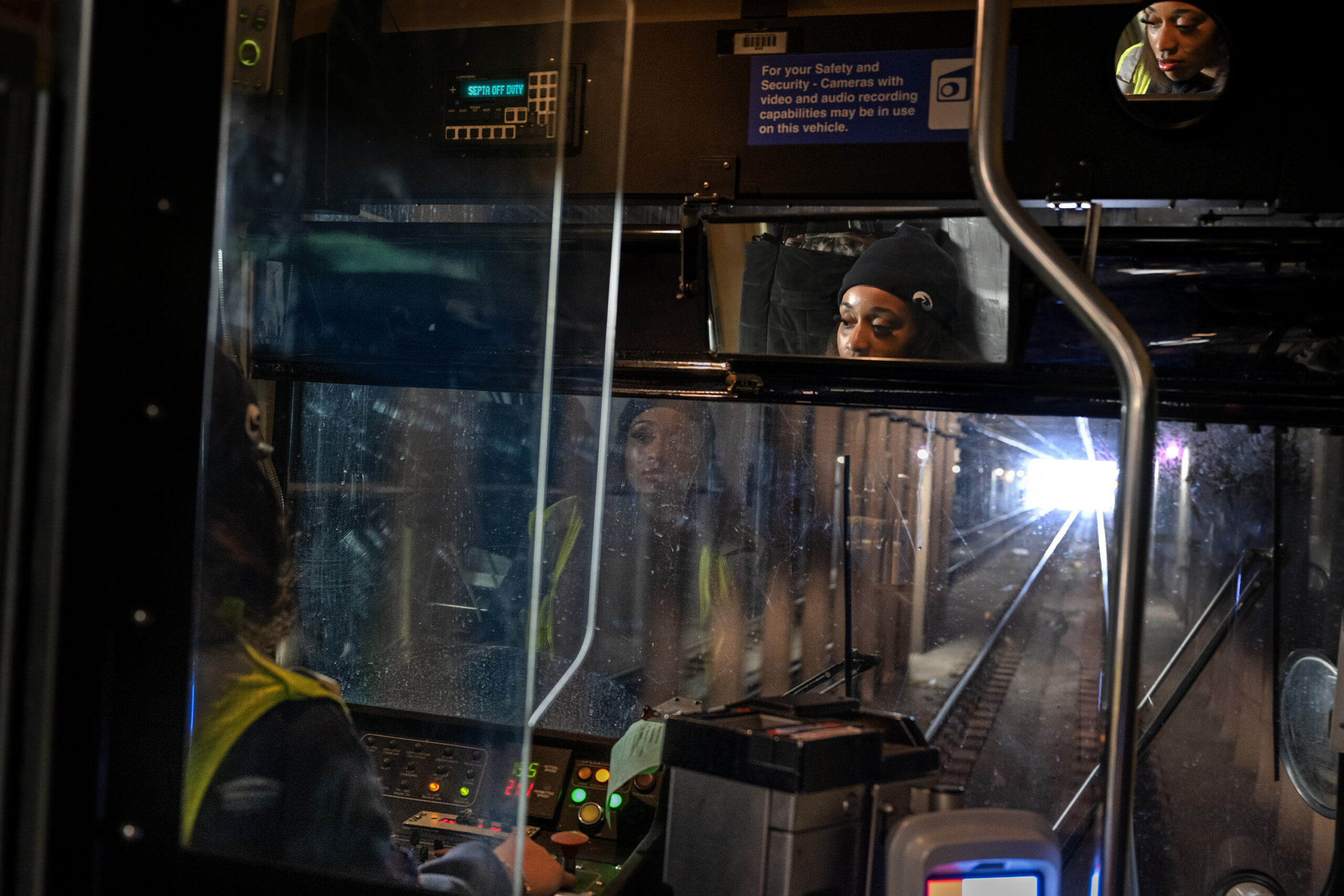
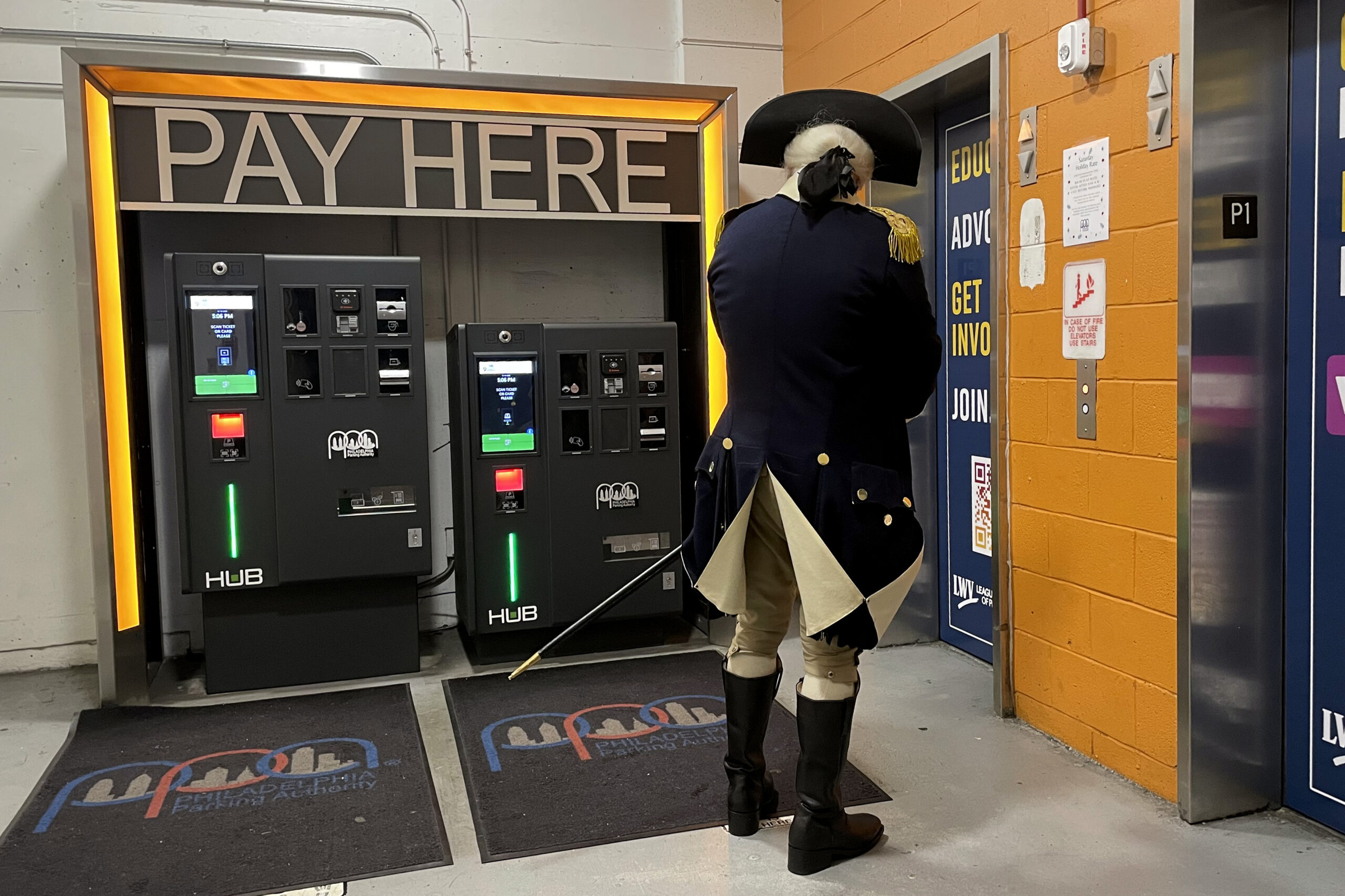
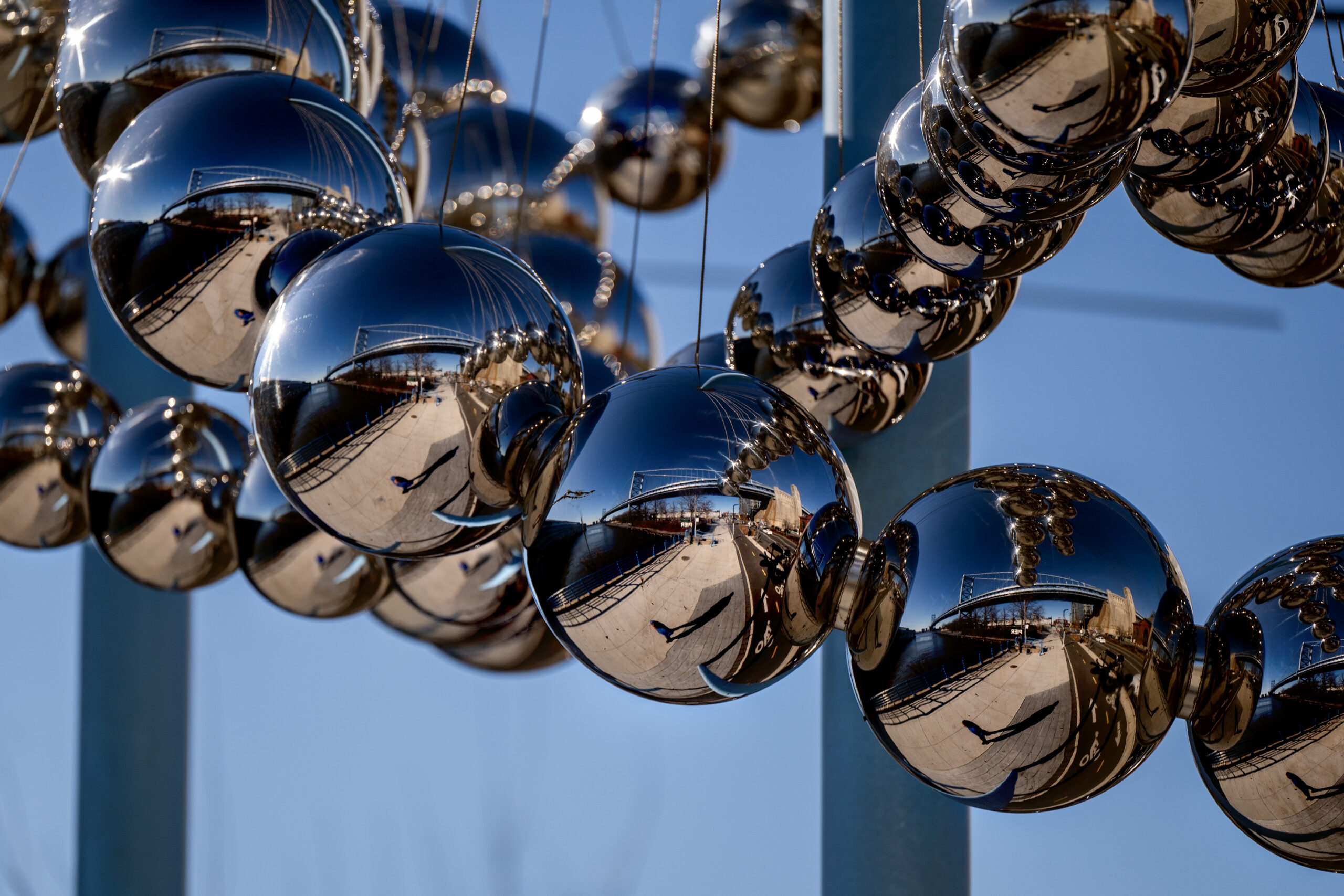
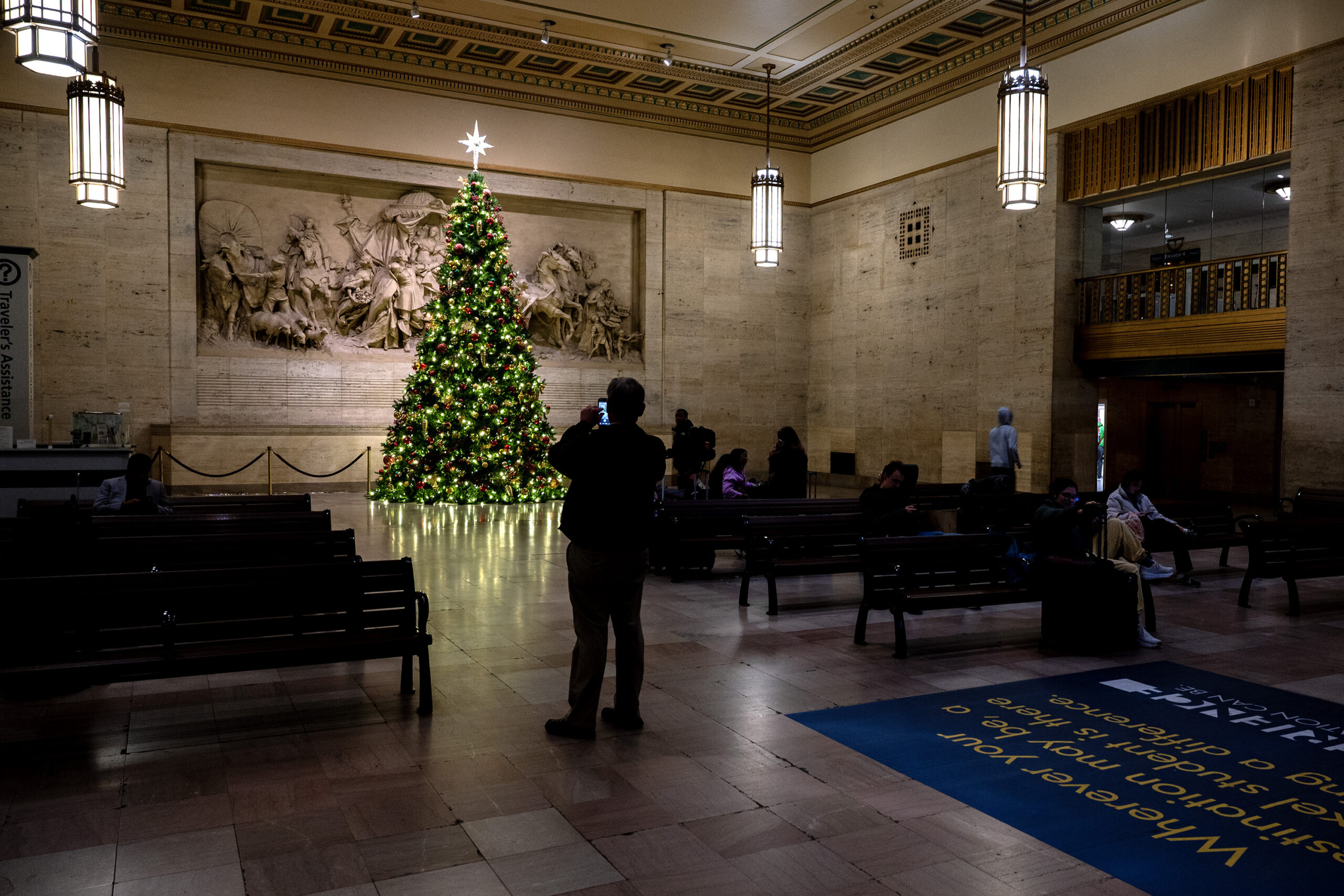
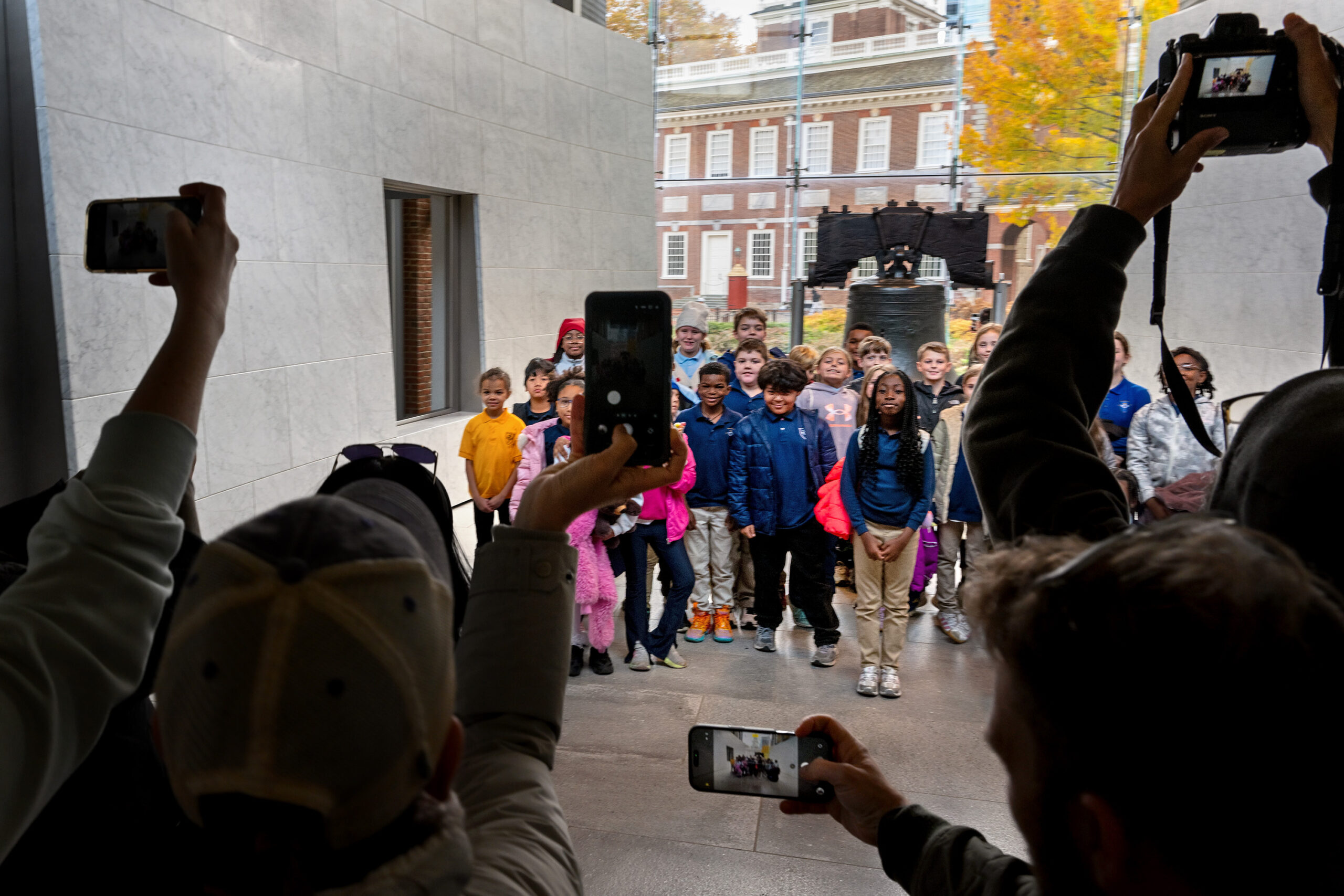
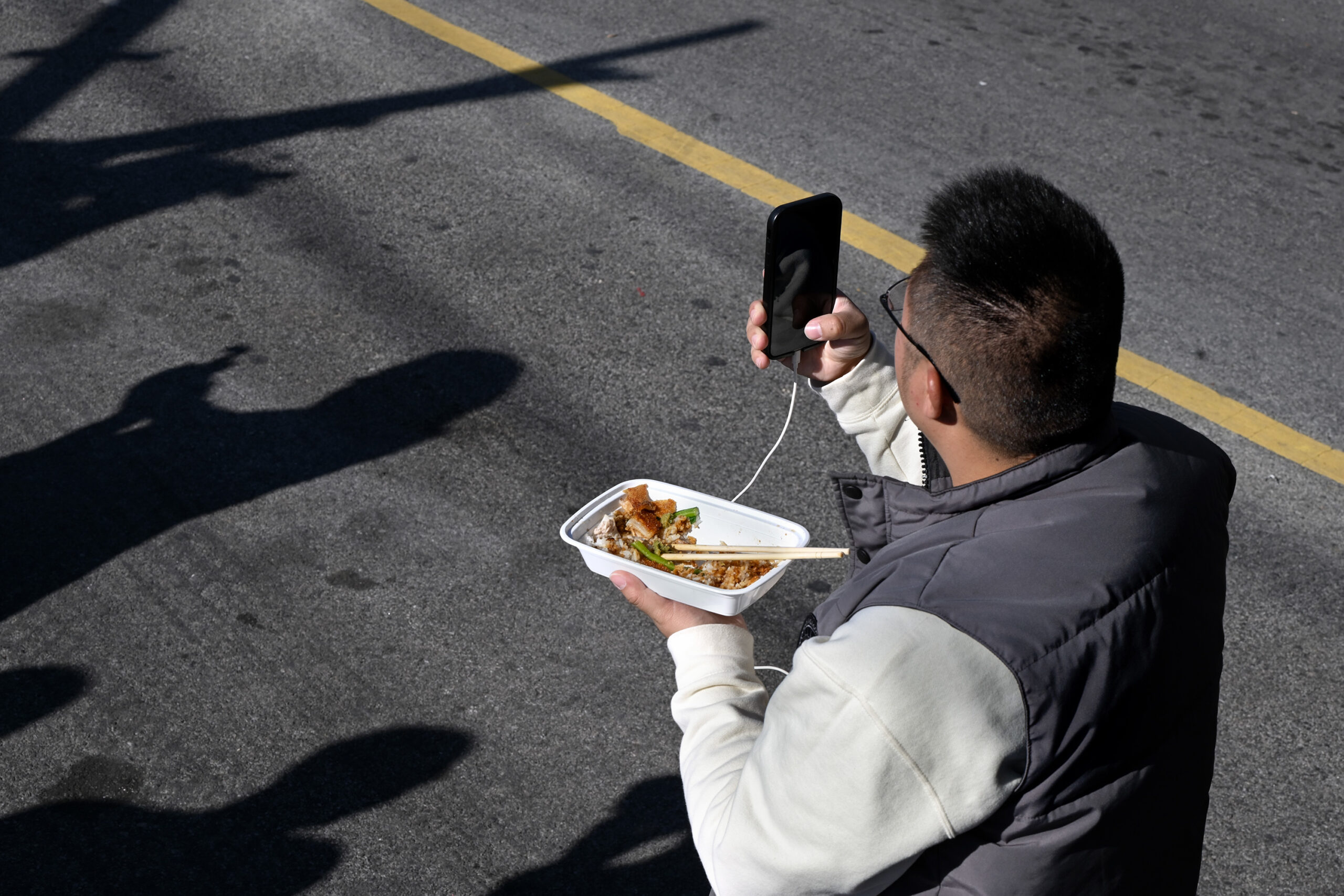
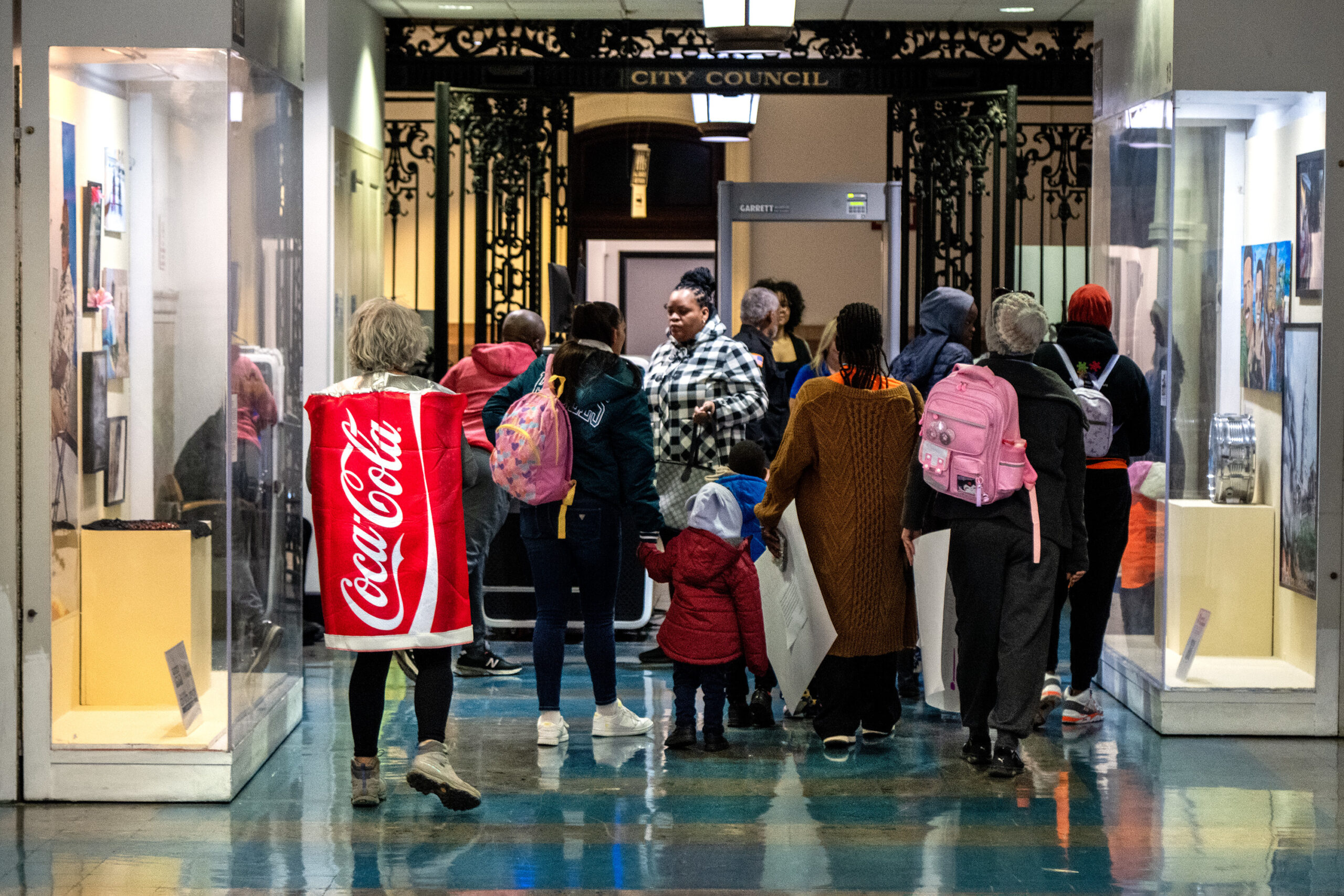
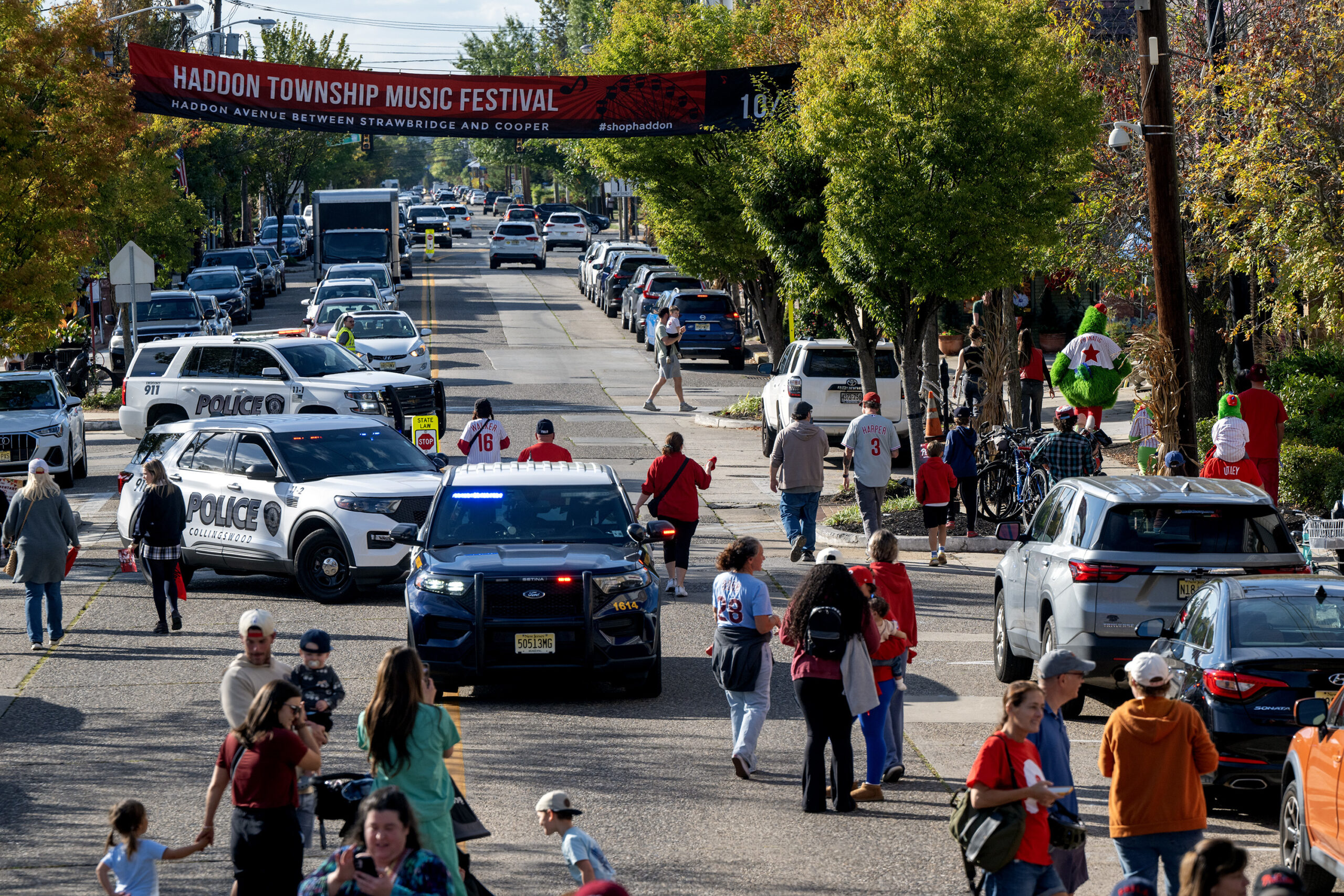
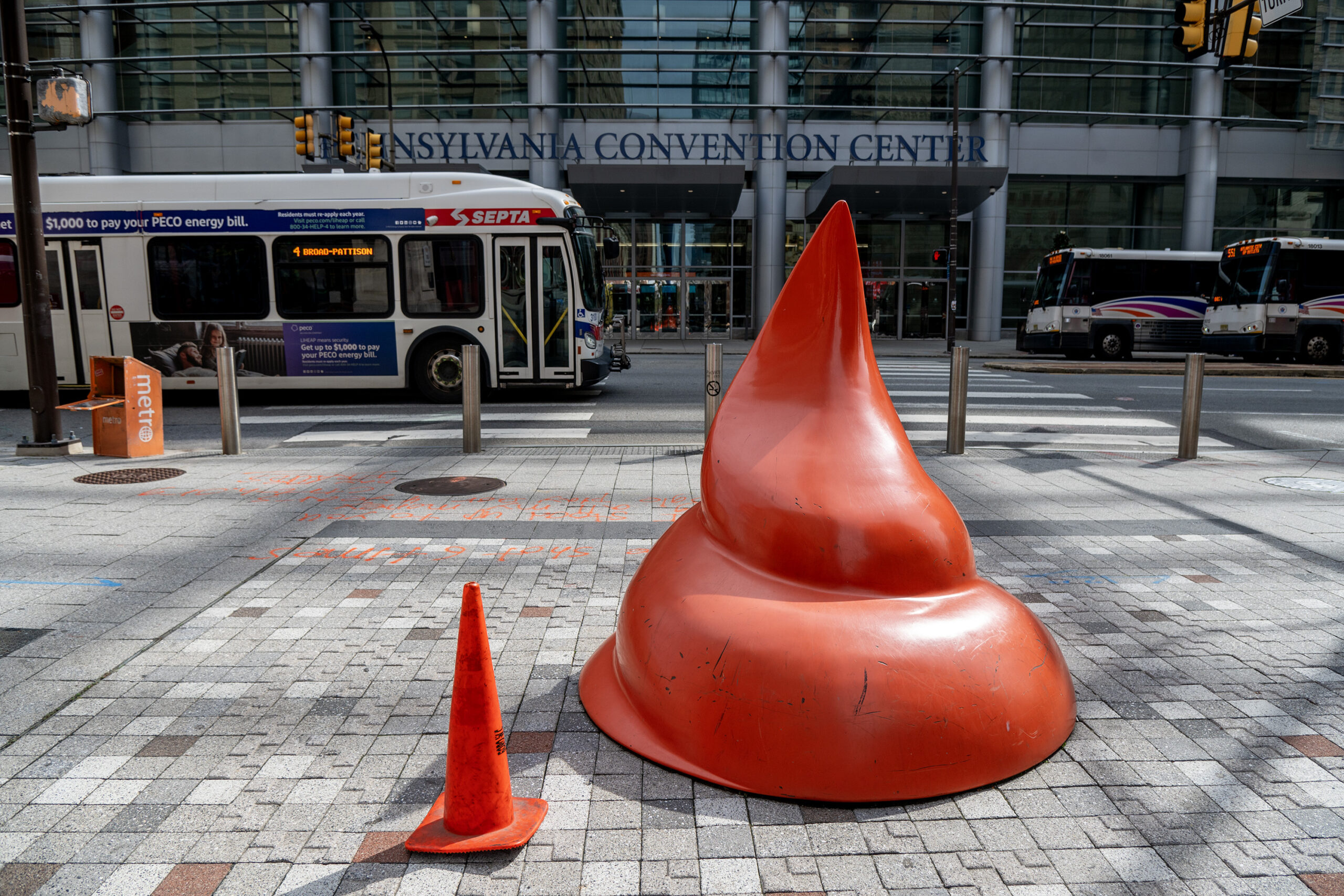
Deepika Iyer holds her niece Ira Samudra aloft in a Rockyesque pose, while her parents photograph their 8 month-old daughter, in front of the famous movie prop at the top of the steps at the Philadelphia Art Museum. Iyer lives in Philadelphia and is hosting a visit by her mother Vijayalakshmi Ramachandran (partially hidden); brother Gautham Ramachandran; and her sister-in-law Janani Gautham who all live in Bangalore, India.January 5, 2026: Parade marshals trail behind the musicians of the Greater Kensington String Band heading to their #9 position start in the Mummers Parade. Spray paint by comic wenches earlier in the day left “Oh, Dem Golden Slippers” shadows on the pavement of Market Street. This year marked the 125th anniversary of Philly’s iconic New Year’s Day celebration.Dec. 29, 2025: Canada geese at sunrise in Evans Pond in Haddonfield, during the week of the Winter Solstice for the Northern Hemisphere. December 22, 2025: SEPTA trolley operator Victoria Daniels approaches the end of the Center City Tunnel, heading toward the 40th Street trolley portal after a tour to update the news media on overhead wire repairs in the closed tunnel due to unexpected issues from new slider parts.December 15, 2025: A historical interpreter waits at the parking garage elevators headed not to a December crossing of the Delaware River, but an event at the National Constitution Center. General George Washington was on his way to an unveiling of the U.S. Mint’s new 2026 coins for the Semiquincentennial, December 8, 2025: The Benjamin Franklin Bridge and pedestrians on the Delaware River Trail are reflected in mirrored spheres of the “Weaver’s Knot: Sheet Bend” public artwork on Columbus Boulevard. The site-specific stainless steel piece located between the Cherry Street and Race Street Piers was commissioned by the City’s Public Art Office and the Delaware River Waterfront Corporation and created and installed in 2022 by the design and fabrication group Ball-Nogues Studio. The name recalls a history that dominated the region for hundreds of years. “Weaver’s knot” derives from use in textile mills and the “Sheet bend” or “sheet knot” was used on sailing vessels for bending ropes to sails. November 29, 2025: t’s ginkgo time in our region again when the distinctive fan-shaped leaves turn yellow and then, on one day, lose all their leaves at the same time laying a carpet on city streets and sidewalks. A squirrel leaps over leaves in the 18th Century Garden in Independence National Historical Park Nov. 25, 2025. The ginkgo (Ginkgo biloba) is considered a living fossil as it’s the only surviving species of a group of trees that existed before dinosaurs. Genetically, it has remained unchanged over the past 200 million years. William Hamilton, owner the Woodlands in SW Phila (no relation to Alexander Hamilton) brought the first ginkgo trees to North America in 1785.November 24, 2025: The old waiting room at 30th Street Station that most people only pass through on their way to the restrooms has been spiffed up with benches – and a Christmas tree. It was placed there this year in front of the 30-foot frieze, “The Spirit of Transportation” while the lobby of Amtrak’s $550 million station restoration is underway. The 1895 relief sculpture by Karl Bitter was originally hung in the Broad Street Station by City Hall, but was moved in 1933. It depicts travel from ancient to modern and even futuristic times. November 17, 2025: Students on a field trip from the Christian Academy in Brookhaven, Delaware County, pose for a group photo in front of the Liberty Bell in Independence National Historical Park on Thursday. The trip was planned weeks earlier, before they knew it would be on the day park buildings were reopening after the government shutdown ended. “We got so lucky,” a teacher said. Then corrected herself. “It’s because we prayed for it.” November 8, 2025: Multitasking during the Festival de Día de Muertos – Day of the Dead – in South Philadelphia.November 1, 2025: Marcy Boroff is at City Hall dressed as a Coke can, along with preschoolers and their caregivers, in support of former Mayor Jim Kenney’s 2017 tax on sweetened beverages. City Council is considering repealing the tax, which funds the city’s pre-K programs. October 25, 2025: Austin Gabauer, paint and production assistant at the Johnson Atelier, in Hamilton Twp, N.J. as the finished “O” letter awaits the return to Philadelphia. The “Y” part of the OY/YO sculpture is inside the painting booth. The well-known sculpture outside the Weitzman National Museum of American Jewish History was removed in May while construction continues on Market Street and has been undergoing refurbishment at the Atelier at the Grounds for Sculpture outside of Trenton.October 20, 2025:The yellow shipping container next to City Hall attracted a line of over 300 people that stretched around a corner of Dilworth Park. Bystanders wondered as they watched devotees reaching the front take their selfies inside a retro Philly diner-esque booth tableau. Followers on social media had been invited to “Climb on to immerse yourself in the worlds of Pleasing Fragrance, Big Lip, and exclusive treasures,” including a spin of the “Freebie Wheel,” for products of the unisex lifestyle brand Pleasing, created by former One Direction singer Harry Styles.October 11, 2025: Can you find the Phillie Phanatic, as he leaves a “Rally for Red October Bus Tour” stop in downtown Westmont, N.J. just before the start of the NLDS? There’s always next year and he’ll be back. The 2026 Spring Training schedule has yet to be announced by Major League Baseball, but Phillies pitchers and catchers generally first report to Clearwater, Florida in mid-February.October 6. 2025: Fluorescent orange safety cone, 28 in, Poly Ethylene. Right: Paint Torch (detail) Claes Oldenburg, 2011, Steel, Fiberglass Reinforced Plastic, Gelcoat and Polyurethane. (Gob of paint, 6 ft. Main sculpture, 51 ft.). Lenfest Plaza at the Pennsylvania Academy of the Fine Arts on North Broad Street, across from the Convention Center.
America’s favorite multitalented Founding Father is celebrating his — checks parchment — 320th birthday Saturday, and the Franklin Institute wants everyone to join the party.
On Saturday the science museum will debut a new “immersive multimedia show,” about Franklin, according to Franklin Institute President and CEO Larry Dubinski. The massive audiovisual display will kick off a day of family-friendly learning activities centered on science and creativity.
The new installation is called “Franklin’s Spark,” Dubinski said, and the theme is curiosity — the kind that led Franklin to fly a kite to learn that lightning is electricity, invent everything from bifocal glasses to a more efficient cast-iron heating stove, and help establish the nation’s first postal system and lending library.
“The message is: curiosity drives progress,“ Dubinski said. ”Benjamin Franklin showed how important it is to ask questions, try things, learn, fail, and learn from those failures. It’s what drives society.”
Dubinski declined to say what the project cost, but noted that it was made possible by a donation from entrepreneur Ed Satell and the Satell Family Foundation.
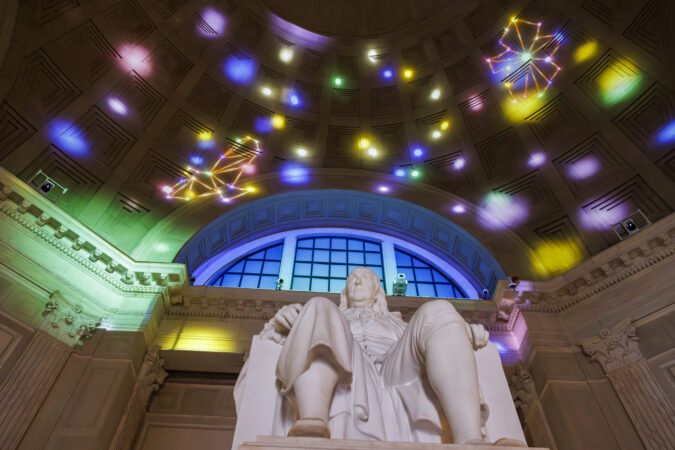
Friday the Franklin Institute provided a preview of the four-minute presentation at the already impressive Franklin National Memorial, where a 30-ton, 20-foot statue of the former statesman resides under an 82-foot-high domed ceiling.
Seven high-resolution Panasonic projectors lit up the dome with animations and images detailing Franklin’s life and times.
“We think he would have liked it a lot,” said Brad Baer, whose design studio, Crafted Action, produced the display. “He was a tinkerer. He was an experimenter.”
At left is Larry Dubinski, president and CEO, The Franklin Institute. At right is Brad Baer, founder and CEO of Crafted Action, designer of multimedia show.
To make it work, the Philly-based company had to conduct some experiments of its own. It created Franklin’s silhouette by combining photography with “AI-style transfer techniques,” he said. It developed a 3D rendering of the 1,600-ton dome, and some of the dome’s many square “coffers” were incorporated into the visual display.
“We wanted to create something that’s equal parts experience and education,” Baer said. “It’s kind of a little gift to the city.”
Saturday at 11 a.m., the installation will commence “Ben’s Bash,” a birthday celebration tailored toward learning and fun. The event is open to anyone who has purchased a general admission ticket to the museum.
Other events include demonstrations on a replica of Franklin’s “glass armonica” musical instrument, a museumwide scavenger hunt with prizes, a lesson on electricity, a birthday card-making activity using a printing press, games, and a dance party.
Dubinski said he’s excited that the new installation will be in place as Philadelphia celebrates the 250th anniversary of the Declaration of Independence, which, of course, Franklin signed.
“Philadelphia is the place,” he said. “All these institutions are coming together to say, ‘Philadelphia is an amazing city.’”
South Philadelphia has acquired an intriguing handful of Algerian restaurants over the past couple years, including Numidia Algeria (at 2340 S. Hemberger St., near 23rd Street), where I recently devoured a platter of house-made beef merguez, Berber-style semolina flatbread, and pastries. My most memorable Algerian meal of late, however, was the special Friday couscous at Algerino’s, which replaced West Passyunk Avenue’s Little Morocco in July with a wood-fired oven that turns out pizzas topped with merguez, North African-spiced roast chickens, and flavorful kebabs. On Fridays, though, this kitchen is all about producing its weekly special couscous platters: fluffy mounds of fine semolina grains topped with huge hunks of slow-braised beef shank and a tall pan of sauce on the side filled with vegetables and broth to be spooned over top at your leisure.
Couscous is a common Berber dish served across North Africa’s Maghreb region, but chef and partner Kaci Grabi — who previously ran a restaurant in the central Algerian city of Tizi Ouzou — says the Algerian style is to serve components separately, as opposed to the Moroccan manner, in which plates are more composed, with vegetables already arranged over top. Flavor-wise, he says, there are also fundamental differences, with Algerian couscous occupying a restrained middle place between the sweet aromatics typical of Morocco and the spicier harissa profile of Tunisia. Indeed, the clear broth at Algerino’s was simple, rustic, and straightforward in its beefy savor, but still so incredibly satisfying for a cold winter lunch, especially with wedges of fresh-baked Berber flatbread on the side to soak it up. Algerino’s, 1431 W. Passyunk Ave., 267-639-4504, instagram.com/algerinos_restaurant
— Craig LaBan
Lomo saltado from Kiko’s Peruvian Kitchen in Collingswood, N.J.
Lomo saltado from Kiko’s Peruvian Kitchen
Lomo saltado — Peruvian-style steak stir-fry with onions, tomatoes, mild ají amarillo chilies, and French fries — has always been my favorite way to the test the quality of a Peruvian joint. Is the skirt steak tender? Are the fries soggy? Does the sauce capture the umami tang of an elevated soy sauce? If the answers are not yes, no, yes — well, thank goodness there’s always pollo al brasa.
The lomo saltado is textbook at this Collingswood hole-in-the wall, with ultrathin cuts of juicy skirt steak and thick yucca fries only made better by sopping up the sauce. The stir-fry’s tomato slices are still just a bit firm and burst with juice, adding a slight sweetness to the otherwise umami soy sauce. I had no trouble tackling the restaurant’s heaping portions and was secretly disappointed with myself for not leaving more leftovers: Stir-fry always tastes better the next day. Kiko’s Peruvian Cuisine, 624 W. Collings Ave., Collingswood, 856-854-6888, kikosperuviankitchen.com
— Beatrice Forman
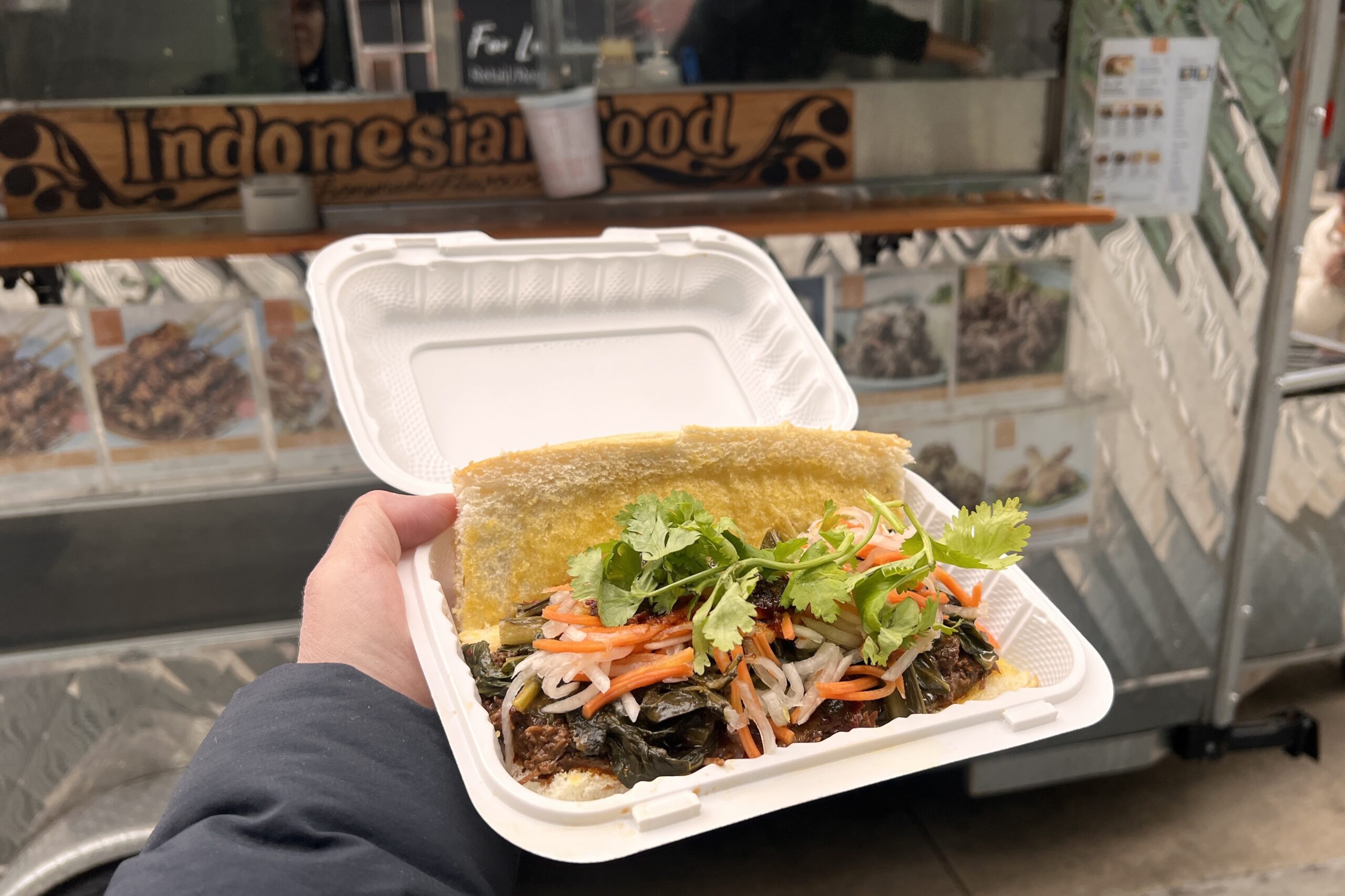
Rendang hoagie from the Sego food cart, on 16th Street, west side, just north of Market Street, on Jan. 14, 2026.
Rendang hoagie from Sego cart
Split a long roll, fill it with just about whatever you wish, and — voila! — in Philadelphia, you’ve got yourself a hoagie. The iconic sandwich, initially made of Italian deli meats and cheeses, has been spun into a world of variety over the years: fish hoagies, eggplant cutlet hoagies, falafel hoagies. All this and banh mi, too. Why shouldn’t the city’s small Indonesian community get in on it, too?
Last year, Aditya Setyawan and his wife, Irza, who own the Indonesian catering business Pecel Ndeso, opened a food cart called Sego on 16th Street in Penn Center. It caught our eye last fall for The 76, our rundown of essential Philadelphia food destinations. One menu star is beef rendang — a spicy-creamy stew served with jasmine rice, sambal, and collard greens. Or go the hoagie route: They ladle the rendang onto a long roll. Each hearty bite gives you a rich beefiness countered by a bright kick from daikon, cilantro, and pickled carrots scattered on top. Sego, 1600 Market St. (outside of NAYA restaurant on 16th Street just north of Market), hours: 11 a.m. to 4 p.m. Monday to Friday, 267-559-1656, instagram.com/pecelndeso.usa
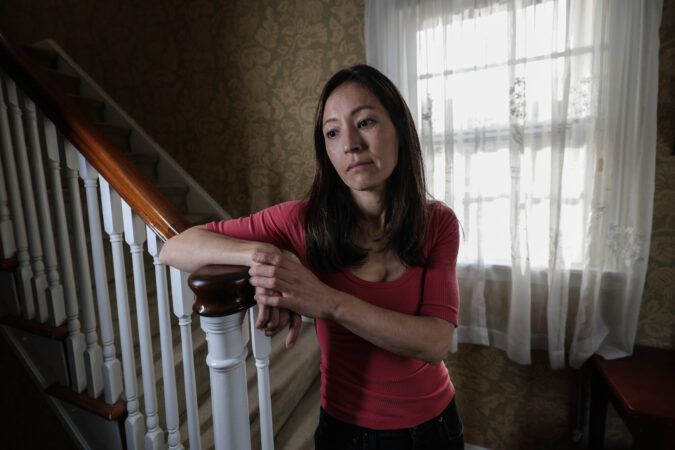
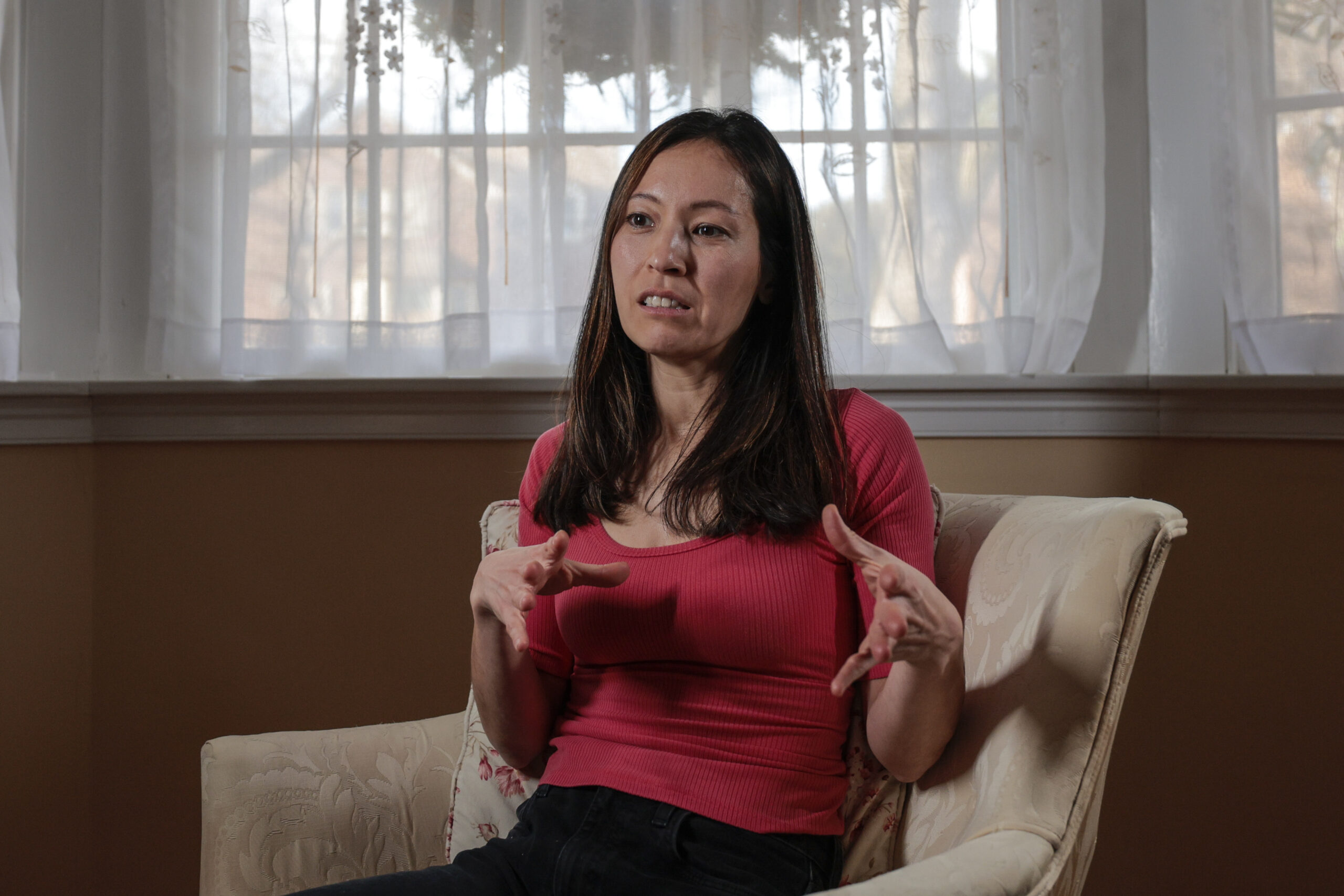
Sasha Kinney fears she cannot afford the $750 a month it will cost to keep her Affordable Care Act health plan in 2026. But she will put the insurance bill on a credit card before risking a medical emergency without access to the doctors she sees regularly.
The 42-year-old Drexel Hill resident’s insurance costs soared this year, after Congress did not extend a federal incentive program that ensured that no one paid more than 8.5% of income on health coverage.
She earns enough doing freelance work for nonprofits, while serving as her mother’s primary caregiver, that she is not eligible for Medicaid, the publicly funded health program for low-income people.
A private health plan through Pennsylvania’s Obamacare marketplace, Pennie, was a major expense, but one she prioritized to help manage her chronic headaches and stress-related pain. But the incentive program expired at the end of last year, leading to skyrocketing ACA insurance costs in Pennsylvania and across the country. Kinney will now pay an extra $250 without the added tax credit.
“I will go into debt because of these increasing costs,” she said. “But it still seems better than not having coverage.”
Congress has failed so far to strike a deal to bring back tax credits that have helped record numbers of Americans get health insurance. The U.S. House of Representatives approved legislation last week that would renew the program for three years, but it is unclear if the Senate will act.
President Donald Trump on Thursdayannounced a healthcare plan that White House officials said would help address rising healthcare costs by creating new drug price controls and sending health subsidies directly to consumers. The sparsely detailed plan is intended to serve as a framework for Congress, though officials did not say which lawmakers are actively working on new healthcare legislation, the Associated Press reported.
Meanwhile, people who are covered by Obamacare plans are running out of time to decide how to handle massive price hikes that doubled the average cost of the health plans in Pennsylvania.
The deadline to enroll in a plan for 2026 in Pennsylvania and other states is Jan. 31. After that date, people can drop their coverage if they find it is too expensive, but they will not be able to select a new plan until the fall enrollment period.
In Pennsylvania, about 70,000 people who bought Pennie plans in 2025 have decided they cannot afford the price increase and dropped their coverage. The dropout rate is unprecedented — about 1,000 people a day, said Devon Trolley, Pennie’s executive director.
Nationally, about 800,000 fewer people have selected Obamacare plans compared with this time last year, a 3.5% drop in total enrollment so far, according to the AP.
With just weeks to go in the enrollment period, marketplace leaders are urging people to think carefully about whether they can afford their plan for the full year and to look at other Pennie plan options. If Congress ultimately renews the enhanced tax credits, they have said, they would work quickly to adjust prices.
“At this point, we are telling people they should make the best decision for their family based on the current cost,” Trolley said. “We want to make sure people who currently have coverage aren’t staying with a plan they can’t afford.”
Trolley worries that people will stick with a plan they like, not realizing they can no longer afford it, only to be forced to drop the coverage and become uninsured partway through the year.
window.addEventListener(“message”,function(a){if(void 0!==a.data[“datawrapper-height”]){var e=document.querySelectorAll(“iframe”);for(var t in a.data[“datawrapper-height”])for(var r,i=0;r=e[i];i++)if(r.contentWindow===a.source){var d=a.data[“datawrapper-height”][t]+”px”;r.style.height=d}}});
Congress considering tax credit extension
The add-on tax credits that expired at the end of 2025 were introduced in 2021 and have been renewed by Congress annually since then.
In Pennsylvania, the federal incentive program ensured the vast majority of enrollees qualified for at least some amount of financial help, driving peak marketplace enrollment of 497,000 in 2025.
The program became a major sticking point in federal budget discussions last fall, with Democrats forcing a government shutdown after Republicans refused to include the tax credits without significant restrictions.
The budget ultimately passed without the tax credits after key Senate Democrats, including Pennsylvania’s John Fetterman, voted with Republicans to end the shutdown.
Last week, 17 House Republicans — including Pennsylvania Reps. Brian Fitzpatrick, Robert Bresnahan, and Ryan MacKenzie — sided with Democrats to approve legislation that would reinstate the tax credits for three years. The measure must be approved by the Senate, and would need to return to the House to consider any changes.
While the incentive program’s expiration is a major blow to the Obamacare marketplaces, Trolley, Pennie’s executive director, urged people not to rule out finding affordable coverage.
President Barack Obama’s landmark health law also included income-based tax credits for people who earn less than 400% of the federal poverty level — about $60,000. These tax credits cannot expire because they are part of the law.
“We have been encouraging people to not assume it’s too expensive,” Trolley said.
Devon Trolley, executive director of Pennie, has been outspoken about how cuts to ACA tax credits are affecting people who buy Pennie health plans. Pictured during a 2025 roundtable with Pennsylvania lawmakers, stakeholders, health systems at the University City Science Center in Philadelphia.
Other factors that affect cost include household size, age, and income. People who are generally healthy and use insurance sparingly may be able to save money by opting for a plan that has a low monthly cost and a higher deductible (the amount of money spent out-of-pocket before the plan begins covering a greater share of costs).
Sasha Kinney, 42, of Drexel Hill, considered switching to a high-deductible health plan to lower her monthly premium, but ultimately stuck with her old Pennie plan because it offered better coverage.
In Drexel Hill, Kinney considered switching to a cheaper plan when she saw how much it would cost to keep her current coverage.
Her current plan has a low deductible, and even so, Kinney said, she still spends hundreds on co-pays and other costs not covered.
She worried that if she switched to a plan with even higher out-of-pocket costs, she would end up skipping appointments and avoiding needed care.
She routinely sees doctors and physical therapists, and didn’t want to risk having to find new providers.
“In the end I think it washes out — you can lower your monthly cost, but if the deductible and co-pays are higher, you’re paying the same,” she said. “There’s basically no way to save money.”
We’ll show you a photo take in the Philly-area, you tell us where you think it was taken. Monday is Martin Luther King Jr. Day, so he is the theme of this week’s quest. Good luck!
Round #16
Question 1
Where is this mural?
Loading…
ClickTap on map to guess the location in the photo
ClickTap again to change your guess and hit submit when you're happy
You will be scored at the end. The closer to the location the better the score
Tom Gralish / Staff Photographer
Pretty good/Not bad/Way off! Your guess was from the location.Spot on! Your guess was exactly at the location. Here's also where a random selection of Inquirer readers guessed.
This is Staircases and Mountaintops: Ascending Beyond the Dream, by artists Willis “Nomo” Humphrey and Jonny Buss. This mural is on the side of Martin Luther King Jr. Recreation Center at 22nd Street and Cecil B. Moore Avenue.
Quiz continues after ad
Question 2
Where can you find this car-free recreational spot?
Loading…
Tom Gralish / Staff Photographer
Pretty good/Not bad/Way off! Your guess was from the location.Spot on! Your guess was exactly at the location. Here's also where a random selection of Inquirer readers guessed.
Pretty good/Not bad/Way off! Your guess was from the location.Spot on! Your guess was exactly at the location. Here's also where a random selection of Inquirer readers guessed.
If you’re one of the more than 1 million people who were laid off this past year, you’ve probably been busy tackling your checklist to land your next job.
You need to spruce up that resumé, start your online job hunt, and connect with old colleagues and professional contacts. But there’s also one more thing you should do right now, experts say. If you’re on the professional social network LinkedIn, a few strategic moves could boost your visibility to hiring managers and recruiters.
“It’s much harder to break into the labor market right now,” said Elise Gould, senior economist at Economic Policy Institute. “Employers just aren’t hiring at the rate that they did last year or the previous years.”
From Amazon to Meta, Walmart, and Starbucks, recent data show that layoffs accelerated in October, bringing the total to 1.1 million, a level not seen since 2020. While the job market may be particularly challenging for some, especially those in industries that are cutting back or young people entering the workforce, the rate of job openings has stayed relatively stable — meaning there’s still opportunity for job seekers, Gould said.
Here are a few things you can do on LinkedIn to increase your chances of landing your next gig.
List your new consulting firm
Some people worry about showing that their employment has ended at one employer without being able to add a new job. So add a new job, said Michelle Volberg, founder of an executive search firm and CEO of Twill, a talent recommendation platform.
“The job market is so competitive right now, you really have to stand out and you want to do it in thoughtful ways,” she said. “Create value.”
Start by opening a limited liability company, which usually involves filling out some paperwork and paying a fee. Start building a portfolio of projects and clients, which at first might be your friends and family who let you do a few things free, Volberg said. Then make a list of 25 employers you want to work for and offer your free consulting services. You can say something like, “I’m interested in your company’s mission, and I have some ideas I’d like to share with you free that could help you with” a specific named client. The idea is to give them a preview in the outreach without giving away your ideas. Save those for a Zoom or in-person meeting, Volberg said.
Be clear about boundaries around your work, including the scope of the project and time expectations. Put them in writing. Use the time to create value and establish a relationship with the employer, but don’t offer free work beyond 30 days, Volberg said. Once you’ve done three or four projects, start charging. You can research market rates through ChatGPT and other AI services and gut check them with connections or professionals in industry social networking groups, including those on Slack, Volberg said.
In the end, you may have a foot in the door at a new employer or a new path to working for yourself.
Don’t lie about the break
Update your LinkedIn as soon as you can to signal you no longer work at your employer. If you’re not interested in consulting, you can update your LinkedIn profile to include a career break.
The feature is under “Experience” on your profile and allows you to include details and skills that could be useful to employers during your unemployment.
“Make sure you’re including what you’re doing in that time that could be seen as transferrable skills,” said Catherine Fisher, career expert at LinkedIn.
You could include a community project you led or a marketing campaign you did for your child’s school fundraiser, or maybe you built something with AI that helped a volunteer organization improve their processes. “AI literacy is a top skill, so is communication, leadership, and collaboration,” Fisher said about what employers seek. “Ways you can show you possess those skills are important.”
Show off your expertise
Face it: You have skills and knowledge. It’s time to share that with your professional network to help get you some visibility, Volberg said.
Regularly publish thoughtful or educational posts relevant to people in your industry, like other people’s posts, and leave smart comments.
“It’s highly underrated,” said Volberg. “You can really stand out by posting as a thought leader.”
Recruiters and hiring managers are always looking, Volberg said. Even if they don’t know you’re available to hire, if they like you, they’re more likely to message you. Posting and publicly engaging with others about industry topics just helps you increase your reach.
Signal that you’re looking
Let people know you’re looking. There are several ways to do this, depending on your comfort level.
One way to do this is to click the “open to” button below your name in your profile and hit “finding a new job.” You can set preferences like job titles and locations as well as choose whether only recruiters can see it or all LinkedIn members. If you choose all LinkedIn members, a green frame will appear around your profile photo that says “#OpenToWork.”
The banner is the best way to remind everyone in your network that you’re searching and LinkedIn’s data shows people are more likely to get noticed that way, Fisher said. But some hiring managers may see this as the worker being not in demand, Volbergcautioned.
Another way to signal you’re open is to post about your layoff on the network. Tell your story, explain your expertise, and let people know what you’re looking for.
Engage with employers
Search for employers you’d like to work for, follow their pages, and connect with people who work for them in your direct or extended networks.
LinkedIn recently released AI-powered people and job searches, which allows users to ask for what they’re looking for using natural language. You might type something like “product managers that work at Apple,” and LinkedIn can surface relevant people. Similarly, you can say, “I’m looking for a full-time sales role in financial services” to find jobs that might fit.
Follow your dream employers’ pages so you can get updates from them and so recruiters can get a sense that you’re interested, Fisher said. Message people who arefirst or second connections. They may also be able to make introductions.
“A secret I always share is that everyone loves to talk about themselves, so just say, ‘I want to learn about you,’” Volberg said. “Find ways to bring value to them.”
Being laid off in a competitive job market can be taxing. But think of it like a really tough breakup, with LinkedIn helping you “glow up,” Volberg said.
“You can be on your couch with ice cream for a couple of days, but then get up,” she said.
There are many things Donald Trump could regret about the aftermath of the 2020 election.
Perhaps it could be his nonstop lying about voter fraud, or how he was recorded asking Georgia election officials to “find” him the votes he needed. Maybe he has remorse about inciting the mob that attacked the U.S. Capitol, violence that led to seven deaths and more than 100 injured law enforcement officers.
But no. What the president “regrets,” as he told the New York Times recently, is not ordering the National Guard to confiscate voting machines in swing states he lost.
If the idea of military reservists marching into Philadelphia polling places and walking out with the pesky will of the people seems far-fetched — just another of Trump’s rambling musings — then consider that he and his enablers are already laying the groundwork to undermine future elections.
With the midterms less than a year away, local and state officials must remain steadfast in their defense of free and fair elections, and voters must demand thattheir rights are protected.
The administration’s assault on the franchise began in March, when Trump issued an executive order seeking to exert control over election law that the Constitution does not grant the president, including demanding states avoid counting mail ballots postmarked by Election Day but received after.
The courts have so far stopped the order from taking effect, but it is worth noting that a new U.S. Postal Service rule changes when a piece of mail is postmarked — no longer when it is dropped off, but when it is processed. That means procrastinating voters in states where a ballot counts if mailed by Election Day can no longer take for granted their vote will be tallied.
Rioters try to break through a police barrier at the U.S. Capitol on Jan. 6, 2021.
Trump has claimed he will target mail-in ballots and voting machines as part of his effort to “help bring HONESTY to the 2026 Midterm Elections.” He has also threatened election officials who oversaw the 2020 election with prosecution while pardoning the Jan. 6, 2021, rioters who sought to interfere with the certification of Joe Biden’s electoral victory.
Meanwhile, starting in May, the U.S. Department of Justice demanded that states turn over their complete voter registration lists. Many states have declined to comply, including Pennsylvania, and are being sued by the government. This is sensitive data that includes Social Security numbers, dates of birth, and home addresses.
Along with privacy concerns, there are fears that the Trump administration may seek to cast doubt on voter eligibility and pressure states to purge people from voting rolls. Already, there are examples of people being falsely identified as noncitizens by federal databases.
It is sadly not much of a leap to imagine Trump claiming widespread voting by noncitizens requires U.S. Immigration and Customs Enforcement agents be stationed at polling places. Of course, noncitizens can’t vote, but one does not need to be an immigrant to be intimidated by gun-toting masked forces who have shown they will fire first and expect no questions later.
The president has also successfully lobbied some Republican-controlled states to remake congressional maps to favor the GOP, regardless of their potential illegality. In Texas, the U.S. Supreme Court allowed 2025 redistricting maps to be used for the upcoming election, even as a legal challenge moves forward over racial gerrymandering. The high court’s conservative members are also likely to strike a blow against the Voting Rights Act this term, further emboldening voter suppression efforts.
The administration’s unprecedented machinations have fortunately run into the wisdom of the founders, who charged the states with running elections, not the federal government. The same decentralization that sometimes frustrates widespread election reform and the implementation of best practices also limits a wholesale takeover.
State election officials — Republicans and Democrats — have shown they take their charge seriously and are honor-bound to do their duty. Still, as Trump continues to consolidate power in the executive and stoke fears of widespread fraud, ensuring free and fair elections will require keeping the federal government from overstepping its authority.
It sits along the scenic banks of the Upper Delaware River in Pike County, surrounded by mountains, with access to major trails, canoeing, kayaking, and biking, and the tallest waterfall in Pennsylvania. It’s an adventure hub among the best in the tristate region.
But Milford isn’t just for people in hiking boots. It’s also an artsy town, with galleries, a theater, and dedicated film, music, and writers’ festivals. It’s a shopping destination too, with a slew of antique and gift shops, and a healthy-living store that rivals anything in Philadelphia or New York.
“Geographically, I believe Milford has the edge over most small towns around,” said local entrepreneur Bill Rosado, who owns some popular businesses in town. “It is centered so well. Just looking at the town is a treat to me.”
There’s plenty of history in Milford, too, which calls itself the “birthplace of the conservation movement” as it was home to Gifford Pinchot, founder and first chief of the U.S. Forest Service. It also has a historical museum that’s home to a unique and morbid artifact from the Civil War era.
And, finally, you have to eat. Milford is home to fine dining at historic hotels, both fancy and cozy bars, along with breweries, classic diners, organic coffee, and, thanks to Rosado, authentic food from Mexico’s Yucatan peninsula. (He was born there.)
Milford’s about 75 miles northwest of Manhattan and just across the river from North Jersey, so yes, you’ll see Yankees and Giants gear, but it’s just 135 miles from Philly, so get up there.
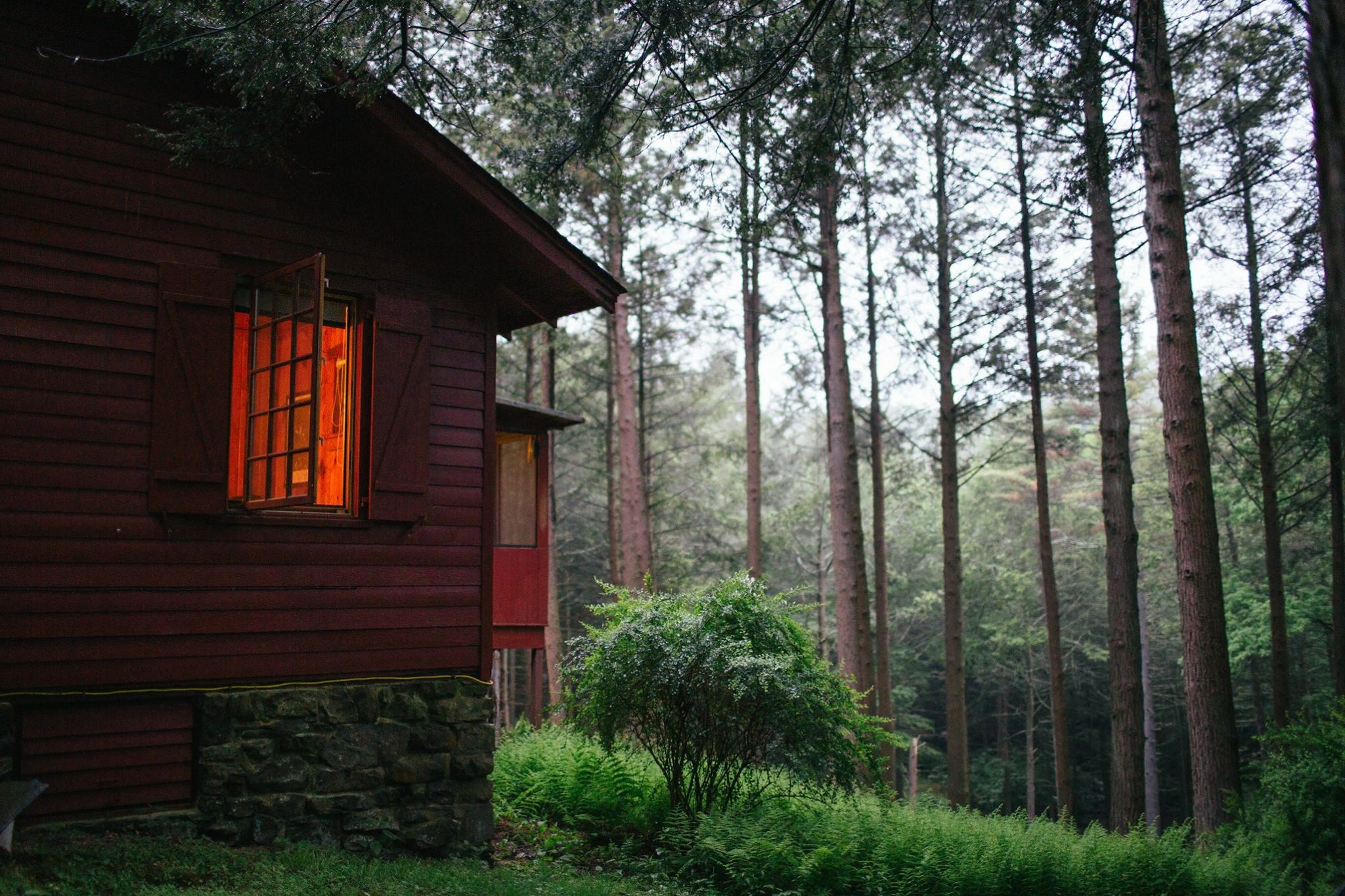
One of the cabins available for rent at Sean Strub’s Dwarfskill Preserve in Milford, Pa.
Stay: Dwarfskill Preserve
There are plenty of hotels in downtown Milford that are in the midst of everything the town has to offer, including the historic and ornate Hotel Fauchère and the Tom Quick Inn, which would be at home in Cape May. Rosado owns both of them.
I’ve been eyeing up the tiny cabin at the 575-acre Dwarfskill Preserve, up in the hills above town, for years now, as a former colleague had spent extended time there over the years and shared lovely pictures. It’s owned by former Milford mayor Sean Strub and consists of three separate properties: the one-room cabin I rented for a few nights with my girlfriend, Jen, and my dog, Wanda, and two larger cabins that can fit more people.
We stayed there over the New Year’s holiday, cooking brisket in the microwave and making coffee on the hot plate. While Milford and the Dwarfskill are undoubtedly at their best in the summer and fall, when you can take full advantage of the outdoor opportunities, including the swimming hole at the cabin, we watched both the wood fireplace and the ample snowfall outside for hours. It was hard to leave, a full hygge experience, in Northeastern Pennsylvania.
📍 Dwarfskill Falls Lane, Milford, Pa. 18337
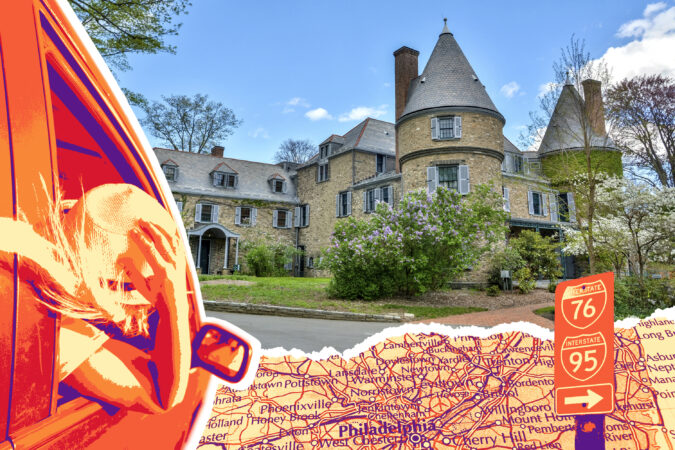
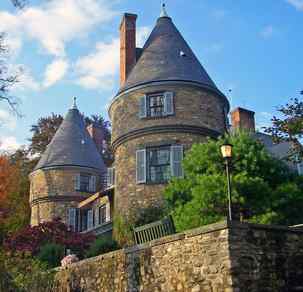
Grey Towers, the Pinchot family residence, outside Milford, and the family’s haven from 1886 to 1963. The family made its fortune in lumber.
Explore: Grey Towers National Historic Site
If you drive around Pennsylvania as much as I do, you’ll see the name Gifford Pinchot quite a bit. Pinchot was a two-term governor of the Commonwealth and has a 54,000-acre state forest named after him.
He went on to found and run the U.S. Forest Service and is generally considered a pioneer in the U.S. conservation movement. Pinchot was born in Milford and his home, Grey Towers, is a national historic landmark run by the U.S. Forest Service. Its curated gardens, French chateau-style stone architecture, and expansive library can all be seen on tours, both in-person during spring, summer, and fall, and online all year round.
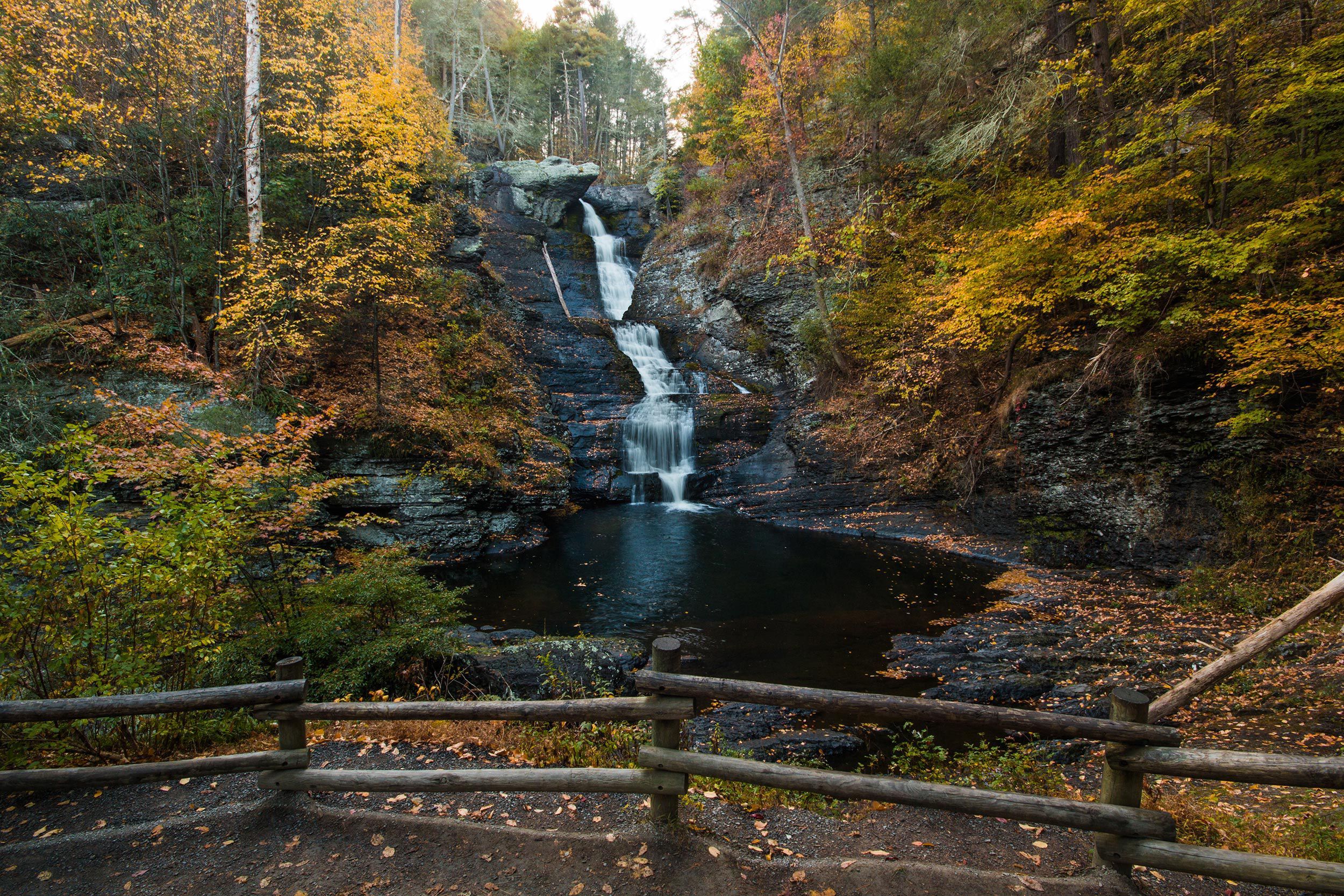
At 150-feet tall, Raymondskill Falls is the tallest waterfall in Pennsylvania.
If you’re interested in something a little more outdoorsy, visit Raymondskill Falls, which, at 150 feet, is the tallest in Pennsylvania. You can, technically, visit in winter, but the ice and snow could be treacherous. In summer, you might have to brave some crowds and jammed parking lots, but the views are worth it.
📍 Grey Towers: 122 Old Owego Turnpike, Milford, Pa. 18337
Learn: The Pike County Historical Society at the Columns
It’s not every day that a county historical society can really wow you with an artifact, but Pike County punches up with a Civil War relic you won’t find anywhere else in the world: the bloody U.S. flag used to cradle Abraham Lincoln’s head after he was shot at Ford’s Theatre in 1865.
The flag and other exhibits are housed in “the Columns,” a 1904 neoclassical-style mansion. Want to learn how they obtained the flag? Visit on Wednesdays, Saturdays, and Sundays.
It’s a place to get coffee or tea and healthy pastries. It’s a community hub, where people gather to meet or work remotely.
It’s also a place to look good, with woolens and other “natural” clothes, and smell good, or simply be good, with homesteading supplies and books.
📍 Broad Street, Milford, Pa. 18337
Eat: Felix’s Cantina at La Posada
Jen spends weeks in the Yucatan every winter, so she was surprised to see a restaurant in Northeastern Pennsylvania promising a “taste of the Yucatan Peninsula and other regional dishes from southern Mexico.”
Rosado, who also owns a historic theater in town, owns the Cantina at La Posada, yet another one of his hotels. He was born in Merida, the capital of Yucatan.
He knows the dishes well, and she approved, describing our pork and birria tacos as “fattening and delicious.”
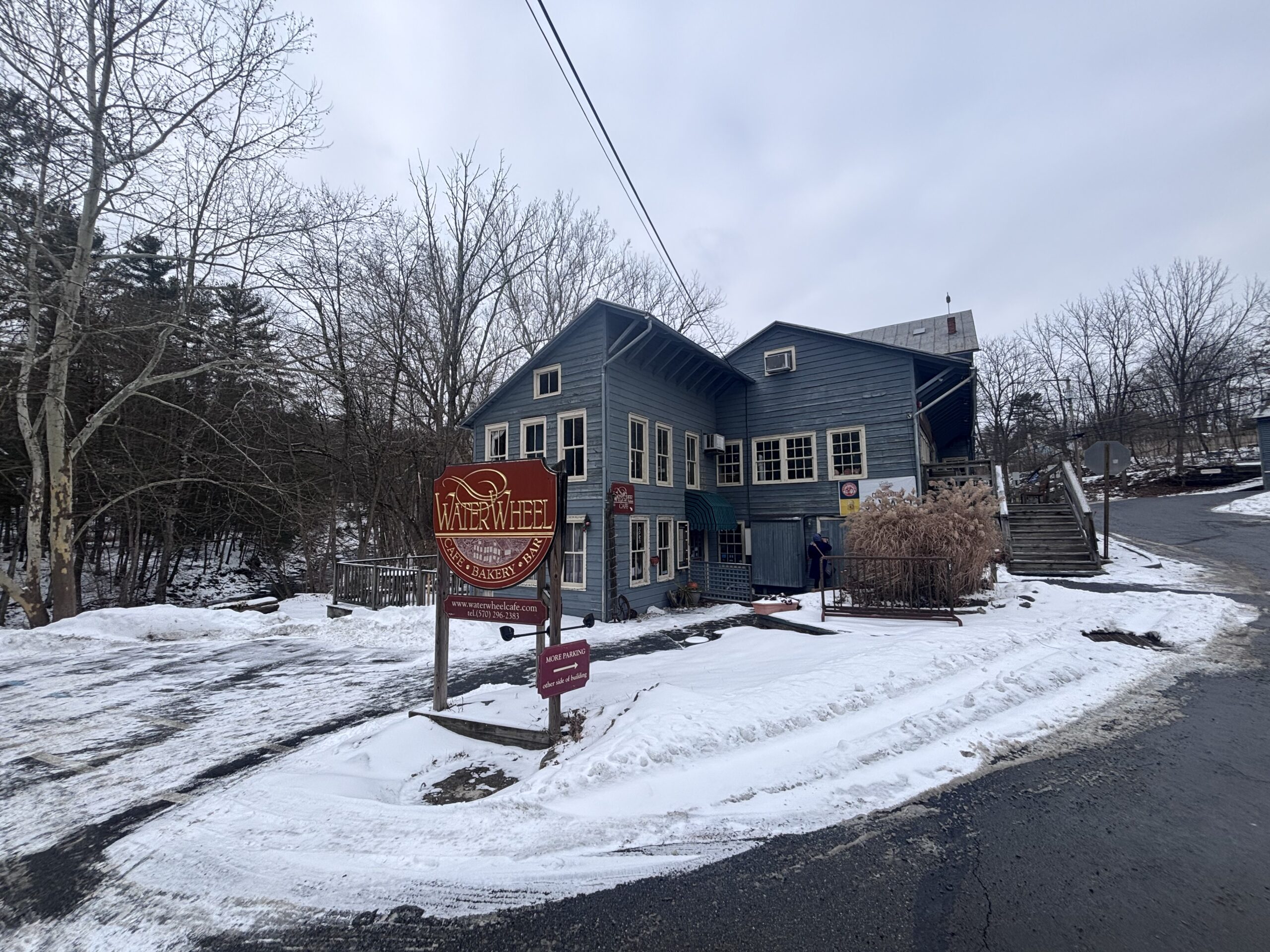
For breakfast, the Waterwheel Café Bakery Bar, an old grist mill along Sawkill Creek, serves up a killer thick-cut challah French toast. We basically licked the plate clean.
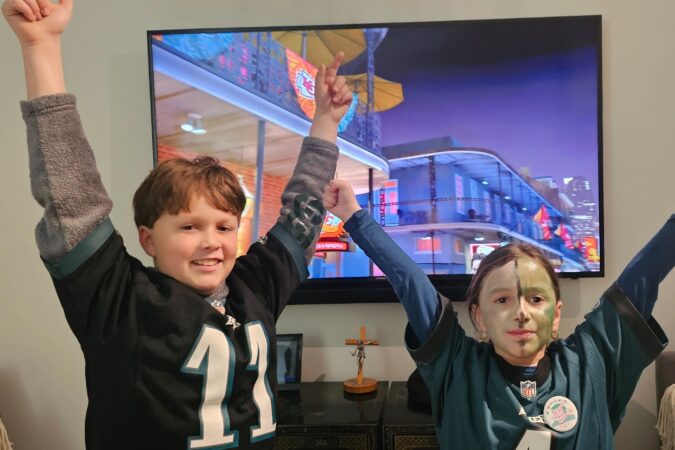
Sam Salvo didn’t deliver a nuanced breakdown of route trees or personnel groupings. He didn’t cite EPA or All-22 tape. He simply announced — with the confidence of someone who has never had to answer a follow-up question — that Kevin Patullo should be flipping burgers at McDonald’s. Philly nodded in unison.
The funniest part isn’t that it went viral. It’s that a day later, Patullo was gone, and the city collectively decided the kid deserved at least partial credit. In a town where people once egged an offensive coordinator’s house (too far), this somehow felt like the healthier outlet.
Sam’s rant worked because it was pure, unscripted Philly logic: blunt, emotional, metaphor-heavy, and somehow accurate. “One-half cooked, one-half raw” is not just a roast, it’s a season recap. And when he popped back up afterward saying, “I just wanted to say anything that could get him fired. And it worked,” it sounded less like a joke and more like a performance review.
The follow-up reactions only added to the lore. Fans celebrated. Former players debated scapegoating. Someone somewhere probably floated Big Dom calling plays. And the Eagles, intentionally or not, let the internet believe that an 11-year-old helped nudge a major coaching decision.
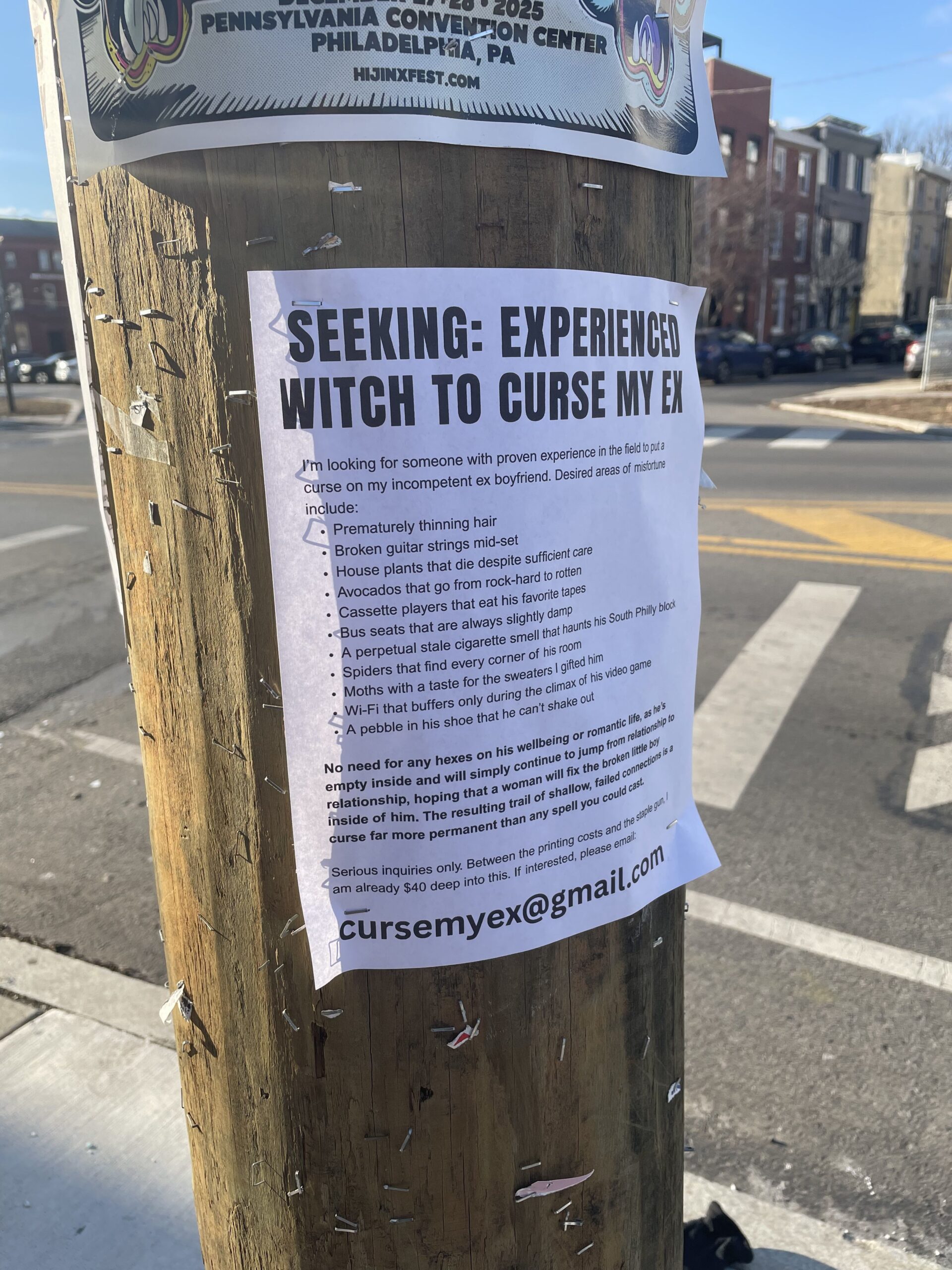
One of the witch-seeker’s fliers hangs in Fishtown on Sunday, Jan. 4. After ending a two-year relationship, a Philadelphia woman posted the fliers around the city and in Phoenixville as a way to channel her emotions over the breakup.
Philly collectively supports hexing an ex (with rules): A
At some point this winter, Philadelphia decided that asking a witch to curse your ex (politely, creatively, and without touching his health or love life) was not only acceptable, but deeply relatable.
The flier itself did most of the heavy lifting. “Seeking: Experienced Witch to Curse My Ex,” stapled to poles from Phoenixville to Fishtown, with a list of curses so specific and mild they felt less like dark magic and more like emotional Yelp reviews: thinning hair, damp bus seats, buffering Wi-Fi, eternally pebbled shoes. Nothing fatal. Nothing irreversible. Just inconvenience with intention.
Instead of pearl-clutching, the city leaned in. The flier spread through neighborhood Facebook groups and socials, where strangers did what they do best: offered commentary, solidarity, jokes, and unsolicited advice. Some people cheered her on. Some defended the ex. Others asked how it ended. And plenty of women recognized the feeling immediately: that moment after you’ve done the therapy, the journaling, the “being mature,” and still need somewhere for the anger to go. This wasn’t about actually ruining someone’s life. It was about yelling into the city and having the city yell back, “Yeah, that sucks.”
The rules mattered, too. No curses on his health. No messing with his love life. Philly rage has boundaries. Even our hexes come with ethics.
Wawa learns Philly does not want a vibes-only convenience store: C-
Philadelphia has many hard rules, but one of the hardest is this: If you remove the shelves from a Wawa, you are no longer operating a Wawa.
And in Philly, that’s not innovation. That’s friction.
This was once one of the company’s highest food-service locations before the pandemic, which makes the experiment feel even more puzzling in hindsight. People weren’t avoiding this store because they didn’t want Wawa. They were avoiding it because it stopped functioning like one. A convenience store that requires commitment, planning, and patience defeats the entire concept.
The grade isn’t lower because this wasn’t malicious or careless. It was a genuine attempt to test something new. But Philly answered clearly, quickly, and repeatedly: We don’t want a Wawa that feels like an airport kiosk. That’s what will get your store closed.
Phillies pitcher Ranger Suárez throws against the Cincinnati Reds on Saturday, July 5, 2025, in Philadelphia.
Saying goodbye to Ranger Suárez hurts, even if it makes sense: B+
This one lands softly and hard at the same time.
Ranger Suárez leaving Philadelphia was never shocking, just quietly devastating. Signed by the Phillies as a teenager, developed patiently, trusted in big moments, and forever tied to the pitch that sent the city to the World Series in 2022, Suárez felt less like a roster spot and more like a constant. You looked up in October and there he was, calm as ever, getting outs without drama.
Now he’s on the Red Sox.
The Phillies weren’t wrong to hesitate on a five-year, $130-million deal for a pitcher with mileage, injury history, and a fastball that succeeds more on craft than velocity. Andrew Painter is coming. The rotation math is real. This is how smart teams stay competitive.
But Philly doesn’t grade purely on spreadsheets.
Suárez embodied a certain Phillies ideal: unflashy, durable when it mattered, unfazed by the moment, and always a little underestimated. He wasn’t the loud ace. He was the steady one. The guy you trusted to calm everything down when the season felt like it might tip.
That’s why this stings. Not because it was reckless to let him go, but because losing someone who felt like a Phillie is different than losing someone who just wore the uniform. Watching him head to Boston is one of those reminders that the version of the team you emotionally commit to is always a few contracts behind the one that actually exists.
OpenTable adds a 2% fee, and Philly sighs deeply: C
Philadelphia understands restaurant math. We’ve lived through inflation menus, pandemic pivots, staffing shortages, reservation deposits, and the great “please cancel if you’re not coming” era. What we don’t love is when the bill quietly grows another line item after we thought we were done reading it.
That’s why OpenTable adding a 2% service fee to certain transactions (no-show penalties, deposits, prepaid dining experiences) landed with more fatigue than outrage. Not rage. Just tired acceptance.
The logic isn’t wrong. No-shows are brutal for small dining rooms, especially in places like South Philly where a missed table can knock a whole service sideways. Restaurants can absorb the fee or pass it on, and in many cases, the platform is genuinely helping places protect their bottom line.
But from a diner’s perspective, this is yet another reminder that convenience now comes with micro-costs layered so thin you barely notice them, until you do. The reservation is free … unless you’re late. Or cancel. Or book a special dinner. Or blink wrong. It’s another reminder that each new surcharge chips away at the simple joy of making dinner plans without feeling like you’re navigating airline baggage rules.
Philly draws the line at selling dinner reservations: A-
Philadelphia has tolerated a lot in recent years: prix-fixe creep, credit card holds, cancellation windows measured in hours, and now, yes, platform fees (see above). But selling a free dinner reservation for profit? That’s where the city finally says no.
The attempted resale of coveted tables at Mawn didn’t just irritate the restaurant’s owners, it offended a basic Philly value system. You can love a place. You can hustle for a table. You can brag that you got one. What you can’t do is turn access into a side hustle and expect people to shrug.
The reaction was swift and very local: public call-out, canceled reservations, and a clear message that this isn’t New York, Miami, or a StubHub-for-dinner experiment. Yes, reservation scalping exists elsewhere, powered by bots and platforms like Appointment Trader. And yes, Philly has passed laws trying to shut that down. But what made this moment resonate wasn’t legislation. It was cultural enforcement. A collective agreement that making money off a free reservation crosses from clever into gross.
Put simply: Waiting your turn is still the rule here. And if you try to flip your way around it, don’t be surprised when the city flips right back.
Amanda Seyfried gives Colbert a very real Allentown community calendar: A
Stephen Colbert has a recurring bit where he asks celebrity guests to promote actual events from their hometowns. When Amanda Seyfried, who grew up in Allentown, took her turn this week, she didn’t try to punch up the material.
She didn’t have to.
Seyfried read through a lineup of events that sounded exactly like a Lehigh Valley bulletin board: all-you-can-eat pasta night, speed dating for seniors, board games at a funeral home, a pirate-themed murder mystery, and Fastnacht Day donuts heavy on lard and tradition. No setup. No apology. Just listings.
That restraint is what made it land. Seyfried treated the segment like she was helping out a neighbor, not auditioning for a tourism campaign.
For viewers around Philly and the surrounding counties, it was immediately recognizable. This is the kind of stuff you scroll past in a local Facebook group or see taped to a coffee shop door without a second thought. Put it on national TV, though, and suddenly it becomes comedy.
Introducing the highest U.S. tariffs since the Great Depression, President Donald Trump made a clear promise in the spring: “Jobs and factories will come roaring back into our country.”
They haven’t.
Manufacturing employment has declined every month since what Trump dubbed “Liberation Day” in April, saying his widespread tariffs would begin to rebalance global trade in favor of American workers. U.S. factories employ 12.7 million people today, 72,000 fewer than when Trump made his Rose Garden announcement.
The trade measures that the president said would spur manufacturing have instead hampered it, according to most mainstream economists. That’s because roughly half of U.S. imports are “intermediate” goods that American companies use to make finished products, like aluminum that is shaped into soup cans or circuit boards that are inserted into computers.
So while tariffs have protected American manufacturers like steel mills from foreign competition, they have raised costs for many others. Auto and auto parts employment, for example, has dipped by about 20,000 jobs since April.
“2025 should have been a good year for manufacturing employment, and that didn’t happen. I think you really have to indict tariffs for that,” said economist Michael Hicks, director of the Center for Business and Economic Research at Ball State in Muncie, Ind.
Small- and midsize businesses have found Trump’s on-again, off-again tariffs especially vexing. Fifty-seven percent of midsize manufacturers and 40% of small producers said they had no certainty about their input costs in a November survey by the Federal Reserve Bank of Richmond. Only 23% of large manufacturers shared that complaint.
Smaller companies also were more than twice as likely to respond to tariffs by delaying investments in new plants and equipment, the survey found. One reason could be that taxes on imports raise the price of goods used in production much more than they do with typical consumer items, according to a study by the San Francisco Fed.
Industries producing more technologically complex goods such as aircraft and semiconductors also are paying an outsize price, according to Gary Winslett, director of the international politics and economics program at Middlebury College. Makers of semiconductors, for example, shed more than 13,000 jobs since April.
“They’re the ones who need the imported inputs. Really advanced manufacturing is actually what’s getting hit the hardest,” he said.
Trump’s tariffs, however, are not the industrial sector’s only headache. Factory payrolls began their post-pandemic decline in early 2023, almost two years before Trump returned to the White House.
High interest rates and a shift in consumer spending patterns are hurting the nation’s manufacturers, economists said. Business loans are more than twice as expensive as they were four years ago, with banks charging their most creditworthy borrowers interest rates of 6.75%. That discourages businesses from expanding operations and hiring additional workers.
After bingeing during the height of the pandemic on durable goods, consumers have gradually redirected their spending to in-person services. Money that once went to makers of furniture, televisions, and exercise machines now goes instead to restaurants and entertainment venues.
In Indiana, the spending switch can be glimpsed in the fortunes of the recreational vehicle industry, a local mainstay. RV shipments soared to a record 600,400 in 2021 as consumers trapped at home by the pandemic hit the road. But by 2024, the work-from-home era was over, and sales fell by nearly half. Thor Industries, the largest RV manufacturer, laid off several hundred workers last year, as demand flagged.
Once Trump returned to the White House, manufacturers responded by over-ordering imports to beat the anticipated tariffs. That’s left many producers with more inventory than they need, suggesting cuts lie ahead, according to Hicks.
“The manufacturing job losses that we see now are really just the beginning of what will be a pretty grim couple of quarters as manufacturing adjusts to a new lower level of demand,” he said.
Modest numbers of manufacturing jobs have been trimmed throughout the economy. In December, Westlake Corp., a Houston-based producer of industrial chemicals, said it would idle four production lines at facilities in Louisiana and Mississippi, putting 295 employees out of work. Speaking on an investor call, company executives blamed excess global capacity and weak demand for the move.
While the jobs that Trump promised have not materialized, factory output rose in 2025, reaching its highest mark in almost three years, according to Federal Reserve data, and administration officials said it is only a matter of time before the full benefits of the president’s plan are felt.
Trump’s tariffs and jawboning encourage CEOs to invest in new U.S. plants. Provisions in the president’s signature fiscal legislation permitting companies to quickly write off the full expense of new investments in equipment and research and development expenses will spur modern manufacturing, they said.
“It also encourages the build-out of high-precision manufacturing here at home, which will lead to high-paying construction and factory jobs,” Treasury Secretary Scott Bessent said in a speech this month.
Companies are spending more than three times as much on constructing new factories as they did when Trump was first inaugurated, though less than during the Biden-era peak. The White House last fall hailed recent investment announcements by companies such as Stellantis and Whirlpool.Last month, T. RAD North America, a subsidiary of a Japanese manufacturer, announced plans for a new auto parts plant in Clarksville, Tenn., which would employ 928 workers.
Nick Iacovella, a spokesperson for the Coalition for a Prosperous America, which backs Trump’s manufacturing policies, said the roughly 1% shrinkage in factory employment last year was less significant than the uptick in business investment.
“We saw a significant increase in capital expenditures, which is the earliest signal that reindustrialization is taking hold. Those investments take time to permit, build ,and staff before they show up in employment data,” he said.
The president’s hopes of increasing manufacturing employment defy decades of experience in the United States and other advanced economies. American factory jobs peaked at 19.5 million in the summer of 1979 and have been sliding ever since, largely because of the introduction of machinery that can do the job of several workers.
As two presidents sought to revive domestic production over the past decade, manufacturing employment rode a roller coaster. Factory jobs increased by 421,000 during Trump’s first term before sinking by more than 1 million during the pandemic. President Joe Biden used government subsidies to encourage hiring, especially for green energy projects, and manufacturing payrolls rose more than 100,000 above Trump’s highest mark.
But those gains evaporated by the end of 2024.
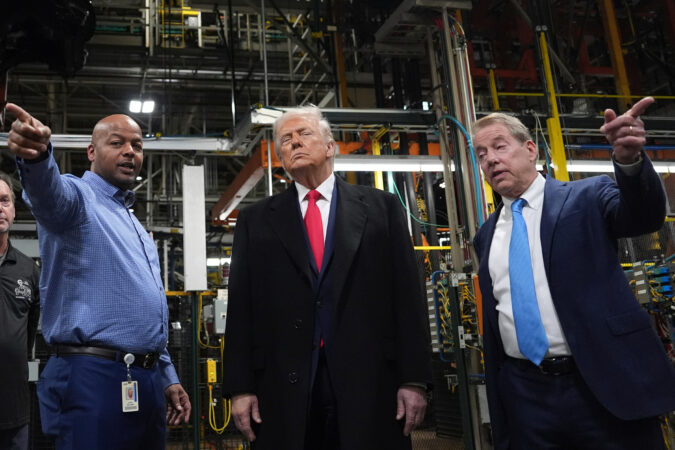
On Tuesday, the president addressed the Detroit Economic Club, touting “the strongest and fastest economic turnaround in our country’s history.” He boasted about growth, productivity, investment, incomes, inflation and the stock market.
“The Trump economic boom is officially begun,” the president said.